EP4556510A1 - Anion exchange resin, electrolyte membrane, binder for forming electrode catalyst layer, and battery electrode catalyst layer - Google Patents

Anion exchange resin, electrolyte membrane, binder for forming electrode catalyst layer, and battery electrode catalyst layer Download PDF

Info

Publication number
EP4556510A1
EP4556510A1 EP23839454.8A EP23839454A EP4556510A1 EP 4556510 A1 EP4556510 A1 EP 4556510A1 EP 23839454 A EP23839454 A EP 23839454A EP 4556510 A1 EP4556510 A1 EP 4556510A1
Authority
EP
European Patent Office
Prior art keywords
group
divalent
anion exchange
hydrophobic
carbon
Prior art date
Legal status (The legal status is an assumption and is not a legal conclusion. Google has not performed a legal analysis and makes no representation as to the accuracy of the status listed.)
Pending
Application number
EP23839454.8A
Other languages
German (de)
French (fr)
Inventor
Kenji Miyatake
Naoki Yokota
Yuko Takahashi
Current Assignee (The listed assignees may be inaccurate. Google has not performed a legal analysis and makes no representation or warranty as to the accuracy of the list.)
Takahata Precision Co Ltd
University of Yamanashi NUC
Original Assignee
Takahata Precision Co Ltd
University of Yamanashi NUC
Priority date (The priority date is an assumption and is not a legal conclusion. Google has not performed a legal analysis and makes no representation as to the accuracy of the date listed.)
Filing date
Publication date
Application filed by Takahata Precision Co Ltd, University of Yamanashi NUC filed Critical Takahata Precision Co Ltd
Publication of EP4556510A1 publication Critical patent/EP4556510A1/en
Pending legal-status Critical Current

Links

Images

Classifications

    • CCHEMISTRY; METALLURGY
    • C08ORGANIC MACROMOLECULAR COMPOUNDS; THEIR PREPARATION OR CHEMICAL WORKING-UP; COMPOSITIONS BASED THEREON
    • C08GMACROMOLECULAR COMPOUNDS OBTAINED OTHERWISE THAN BY REACTIONS ONLY INVOLVING UNSATURATED CARBON-TO-CARBON BONDS
    • C08G61/00Macromolecular compounds obtained by reactions forming a carbon-to-carbon link in the main chain of the macromolecule
    • C08G61/12Macromolecular compounds containing atoms other than carbon in the main chain of the macromolecule
    • C08G61/121Macromolecular compounds containing atoms other than carbon in the main chain of the macromolecule derived from organic halides
    • CCHEMISTRY; METALLURGY
    • C08ORGANIC MACROMOLECULAR COMPOUNDS; THEIR PREPARATION OR CHEMICAL WORKING-UP; COMPOSITIONS BASED THEREON
    • C08GMACROMOLECULAR COMPOUNDS OBTAINED OTHERWISE THAN BY REACTIONS ONLY INVOLVING UNSATURATED CARBON-TO-CARBON BONDS
    • C08G61/00Macromolecular compounds obtained by reactions forming a carbon-to-carbon link in the main chain of the macromolecule
    • C08G61/12Macromolecular compounds containing atoms other than carbon in the main chain of the macromolecule
    • CCHEMISTRY; METALLURGY
    • C08ORGANIC MACROMOLECULAR COMPOUNDS; THEIR PREPARATION OR CHEMICAL WORKING-UP; COMPOSITIONS BASED THEREON
    • C08JWORKING-UP; GENERAL PROCESSES OF COMPOUNDING; AFTER-TREATMENT NOT COVERED BY SUBCLASSES C08B, C08C, C08F, C08G or C08H
    • C08J5/00Manufacture of articles or shaped materials containing macromolecular substances
    • C08J5/20Manufacture of shaped structures of ion-exchange resins
    • C08J5/22Films, membranes or diaphragms
    • C08J5/2206Films, membranes or diaphragms based on organic and/or inorganic macromolecular compounds
    • C08J5/2218Synthetic macromolecular compounds
    • C08J5/2256Synthetic macromolecular compounds based on macromolecular compounds obtained by reactions other than those involving carbon-to-carbon bonds, e.g. obtained by polycondensation
    • C08J5/2262Synthetic macromolecular compounds based on macromolecular compounds obtained by reactions other than those involving carbon-to-carbon bonds, e.g. obtained by polycondensation containing fluorine
    • CCHEMISTRY; METALLURGY
    • C08ORGANIC MACROMOLECULAR COMPOUNDS; THEIR PREPARATION OR CHEMICAL WORKING-UP; COMPOSITIONS BASED THEREON
    • C08LCOMPOSITIONS OF MACROMOLECULAR COMPOUNDS
    • C08L65/00Compositions of macromolecular compounds obtained by reactions forming a carbon-to-carbon link in the main chain; Compositions of derivatives of such polymers
    • CCHEMISTRY; METALLURGY
    • C09DYES; PAINTS; POLISHES; NATURAL RESINS; ADHESIVES; COMPOSITIONS NOT OTHERWISE PROVIDED FOR; APPLICATIONS OF MATERIALS NOT OTHERWISE PROVIDED FOR
    • C09DCOATING COMPOSITIONS, e.g. PAINTS, VARNISHES OR LACQUERS; FILLING PASTES; CHEMICAL PAINT OR INK REMOVERS; INKS; CORRECTING FLUIDS; WOODSTAINS; PASTES OR SOLIDS FOR COLOURING OR PRINTING; USE OF MATERIALS THEREFOR
    • C09D165/00Coating compositions based on macromolecular compounds obtained by reactions forming a carbon-to-carbon link in the main chain; Coating compositions based on derivatives of such polymers
    • CCHEMISTRY; METALLURGY
    • C25ELECTROLYTIC OR ELECTROPHORETIC PROCESSES; APPARATUS THEREFOR
    • C25BELECTROLYTIC OR ELECTROPHORETIC PROCESSES FOR THE PRODUCTION OF COMPOUNDS OR NON-METALS; APPARATUS THEREFOR
    • C25B1/00Electrolytic production of inorganic compounds or non-metals
    • C25B1/01Products
    • C25B1/02Hydrogen or oxygen
    • CCHEMISTRY; METALLURGY
    • C25ELECTROLYTIC OR ELECTROPHORETIC PROCESSES; APPARATUS THEREFOR
    • C25BELECTROLYTIC OR ELECTROPHORETIC PROCESSES FOR THE PRODUCTION OF COMPOUNDS OR NON-METALS; APPARATUS THEREFOR
    • C25B1/00Electrolytic production of inorganic compounds or non-metals
    • C25B1/01Products
    • C25B1/02Hydrogen or oxygen
    • C25B1/04Hydrogen or oxygen by electrolysis of water
    • CCHEMISTRY; METALLURGY
    • C25ELECTROLYTIC OR ELECTROPHORETIC PROCESSES; APPARATUS THEREFOR
    • C25BELECTROLYTIC OR ELECTROPHORETIC PROCESSES FOR THE PRODUCTION OF COMPOUNDS OR NON-METALS; APPARATUS THEREFOR
    • C25B11/00Electrodes; Manufacture thereof not otherwise provided for
    • C25B11/04Electrodes; Manufacture thereof not otherwise provided for characterised by the material
    • CCHEMISTRY; METALLURGY
    • C25ELECTROLYTIC OR ELECTROPHORETIC PROCESSES; APPARATUS THEREFOR
    • C25BELECTROLYTIC OR ELECTROPHORETIC PROCESSES FOR THE PRODUCTION OF COMPOUNDS OR NON-METALS; APPARATUS THEREFOR
    • C25B13/00Diaphragms; Spacing elements
    • C25B13/04Diaphragms; Spacing elements characterised by the material
    • C25B13/08Diaphragms; Spacing elements characterised by the material based on organic materials
    • HELECTRICITY
    • H01ELECTRIC ELEMENTS
    • H01MPROCESSES OR MEANS, e.g. BATTERIES, FOR THE DIRECT CONVERSION OF CHEMICAL ENERGY INTO ELECTRICAL ENERGY
    • H01M4/00Electrodes
    • H01M4/86Inert electrodes with catalytic activity, e.g. for fuel cells
    • H01M4/8663Selection of inactive substances as ingredients for catalytic active masses, e.g. binders, fillers
    • H01M4/8668Binders
    • HELECTRICITY
    • H01ELECTRIC ELEMENTS
    • H01MPROCESSES OR MEANS, e.g. BATTERIES, FOR THE DIRECT CONVERSION OF CHEMICAL ENERGY INTO ELECTRICAL ENERGY
    • H01M8/00Fuel cells; Manufacture thereof
    • H01M8/10Fuel cells with solid electrolytes
    • H01M8/1016Fuel cells with solid electrolytes characterised by the electrolyte material
    • H01M8/1018Polymeric electrolyte materials
    • H01M8/102Polymeric electrolyte materials characterised by the chemical structure of the main chain of the ion-conducting polymer
    • H01M8/1023Polymeric electrolyte materials characterised by the chemical structure of the main chain of the ion-conducting polymer having only carbon, e.g. polyarylenes, polystyrenes or polybutadiene-styrenes
    • HELECTRICITY
    • H01ELECTRIC ELEMENTS
    • H01MPROCESSES OR MEANS, e.g. BATTERIES, FOR THE DIRECT CONVERSION OF CHEMICAL ENERGY INTO ELECTRICAL ENERGY
    • H01M8/00Fuel cells; Manufacture thereof
    • H01M8/10Fuel cells with solid electrolytes
    • H01M8/1016Fuel cells with solid electrolytes characterised by the electrolyte material
    • H01M8/1018Polymeric electrolyte materials
    • H01M8/1039Polymeric electrolyte materials halogenated, e.g. sulfonated polyvinylidene fluorides
    • CCHEMISTRY; METALLURGY
    • C08ORGANIC MACROMOLECULAR COMPOUNDS; THEIR PREPARATION OR CHEMICAL WORKING-UP; COMPOSITIONS BASED THEREON
    • C08GMACROMOLECULAR COMPOUNDS OBTAINED OTHERWISE THAN BY REACTIONS ONLY INVOLVING UNSATURATED CARBON-TO-CARBON BONDS
    • C08G2261/00Macromolecular compounds obtained by reactions forming a carbon-to-carbon link in the main chain of the macromolecule
    • C08G2261/10Definition of the polymer structure
    • C08G2261/12Copolymers
    • C08G2261/124Copolymers alternating
    • CCHEMISTRY; METALLURGY
    • C08ORGANIC MACROMOLECULAR COMPOUNDS; THEIR PREPARATION OR CHEMICAL WORKING-UP; COMPOSITIONS BASED THEREON
    • C08GMACROMOLECULAR COMPOUNDS OBTAINED OTHERWISE THAN BY REACTIONS ONLY INVOLVING UNSATURATED CARBON-TO-CARBON BONDS
    • C08G2261/00Macromolecular compounds obtained by reactions forming a carbon-to-carbon link in the main chain of the macromolecule
    • C08G2261/10Definition of the polymer structure
    • C08G2261/12Copolymers
    • C08G2261/126Copolymers block
    • CCHEMISTRY; METALLURGY
    • C08ORGANIC MACROMOLECULAR COMPOUNDS; THEIR PREPARATION OR CHEMICAL WORKING-UP; COMPOSITIONS BASED THEREON
    • C08GMACROMOLECULAR COMPOUNDS OBTAINED OTHERWISE THAN BY REACTIONS ONLY INVOLVING UNSATURATED CARBON-TO-CARBON BONDS
    • C08G2261/00Macromolecular compounds obtained by reactions forming a carbon-to-carbon link in the main chain of the macromolecule
    • C08G2261/10Definition of the polymer structure
    • C08G2261/14Side-groups
    • C08G2261/141Side-chains having aliphatic units
    • C08G2261/1412Saturated aliphatic units
    • CCHEMISTRY; METALLURGY
    • C08ORGANIC MACROMOLECULAR COMPOUNDS; THEIR PREPARATION OR CHEMICAL WORKING-UP; COMPOSITIONS BASED THEREON
    • C08GMACROMOLECULAR COMPOUNDS OBTAINED OTHERWISE THAN BY REACTIONS ONLY INVOLVING UNSATURATED CARBON-TO-CARBON BONDS
    • C08G2261/00Macromolecular compounds obtained by reactions forming a carbon-to-carbon link in the main chain of the macromolecule
    • C08G2261/10Definition of the polymer structure
    • C08G2261/14Side-groups
    • C08G2261/143Side-chains containing nitrogen
    • CCHEMISTRY; METALLURGY
    • C08ORGANIC MACROMOLECULAR COMPOUNDS; THEIR PREPARATION OR CHEMICAL WORKING-UP; COMPOSITIONS BASED THEREON
    • C08GMACROMOLECULAR COMPOUNDS OBTAINED OTHERWISE THAN BY REACTIONS ONLY INVOLVING UNSATURATED CARBON-TO-CARBON BONDS
    • C08G2261/00Macromolecular compounds obtained by reactions forming a carbon-to-carbon link in the main chain of the macromolecule
    • C08G2261/30Monomer units or repeat units incorporating structural elements in the main chain
    • C08G2261/31Monomer units or repeat units incorporating structural elements in the main chain incorporating aromatic structural elements in the main chain
    • C08G2261/314Condensed aromatic systems, e.g. perylene, anthracene or pyrene
    • C08G2261/3142Condensed aromatic systems, e.g. perylene, anthracene or pyrene fluorene-based, e.g. fluorene, indenofluorene, or spirobifluorene
    • CCHEMISTRY; METALLURGY
    • C08ORGANIC MACROMOLECULAR COMPOUNDS; THEIR PREPARATION OR CHEMICAL WORKING-UP; COMPOSITIONS BASED THEREON
    • C08GMACROMOLECULAR COMPOUNDS OBTAINED OTHERWISE THAN BY REACTIONS ONLY INVOLVING UNSATURATED CARBON-TO-CARBON BONDS
    • C08G2261/00Macromolecular compounds obtained by reactions forming a carbon-to-carbon link in the main chain of the macromolecule
    • C08G2261/30Monomer units or repeat units incorporating structural elements in the main chain
    • C08G2261/33Monomer units or repeat units incorporating structural elements in the main chain incorporating non-aromatic structural elements in the main chain
    • CCHEMISTRY; METALLURGY
    • C08ORGANIC MACROMOLECULAR COMPOUNDS; THEIR PREPARATION OR CHEMICAL WORKING-UP; COMPOSITIONS BASED THEREON
    • C08GMACROMOLECULAR COMPOUNDS OBTAINED OTHERWISE THAN BY REACTIONS ONLY INVOLVING UNSATURATED CARBON-TO-CARBON BONDS
    • C08G2261/00Macromolecular compounds obtained by reactions forming a carbon-to-carbon link in the main chain of the macromolecule
    • C08G2261/30Monomer units or repeat units incorporating structural elements in the main chain
    • C08G2261/33Monomer units or repeat units incorporating structural elements in the main chain incorporating non-aromatic structural elements in the main chain
    • C08G2261/332Monomer units or repeat units incorporating structural elements in the main chain incorporating non-aromatic structural elements in the main chain containing only carbon atoms
    • CCHEMISTRY; METALLURGY
    • C08ORGANIC MACROMOLECULAR COMPOUNDS; THEIR PREPARATION OR CHEMICAL WORKING-UP; COMPOSITIONS BASED THEREON
    • C08GMACROMOLECULAR COMPOUNDS OBTAINED OTHERWISE THAN BY REACTIONS ONLY INVOLVING UNSATURATED CARBON-TO-CARBON BONDS
    • C08G2261/00Macromolecular compounds obtained by reactions forming a carbon-to-carbon link in the main chain of the macromolecule
    • C08G2261/30Monomer units or repeat units incorporating structural elements in the main chain
    • C08G2261/34Monomer units or repeat units incorporating structural elements in the main chain incorporating partially-aromatic structural elements in the main chain
    • CCHEMISTRY; METALLURGY
    • C08ORGANIC MACROMOLECULAR COMPOUNDS; THEIR PREPARATION OR CHEMICAL WORKING-UP; COMPOSITIONS BASED THEREON
    • C08GMACROMOLECULAR COMPOUNDS OBTAINED OTHERWISE THAN BY REACTIONS ONLY INVOLVING UNSATURATED CARBON-TO-CARBON BONDS
    • C08G2261/00Macromolecular compounds obtained by reactions forming a carbon-to-carbon link in the main chain of the macromolecule
    • C08G2261/40Polymerisation processes
    • C08G2261/41Organometallic coupling reactions
    • C08G2261/415Sonogashira / Hagihara reactions
    • CCHEMISTRY; METALLURGY
    • C08ORGANIC MACROMOLECULAR COMPOUNDS; THEIR PREPARATION OR CHEMICAL WORKING-UP; COMPOSITIONS BASED THEREON
    • C08JWORKING-UP; GENERAL PROCESSES OF COMPOUNDING; AFTER-TREATMENT NOT COVERED BY SUBCLASSES C08B, C08C, C08F, C08G or C08H
    • C08J2365/00Characterised by the use of macromolecular compounds obtained by reactions forming a carbon-to-carbon link in the main chain; Derivatives of such polymers
    • YGENERAL TAGGING OF NEW TECHNOLOGICAL DEVELOPMENTS; GENERAL TAGGING OF CROSS-SECTIONAL TECHNOLOGIES SPANNING OVER SEVERAL SECTIONS OF THE IPC; TECHNICAL SUBJECTS COVERED BY FORMER USPC CROSS-REFERENCE ART COLLECTIONS [XRACs] AND DIGESTS
    • Y02TECHNOLOGIES OR APPLICATIONS FOR MITIGATION OR ADAPTATION AGAINST CLIMATE CHANGE
    • Y02EREDUCTION OF GREENHOUSE GAS [GHG] EMISSIONS, RELATED TO ENERGY GENERATION, TRANSMISSION OR DISTRIBUTION
    • Y02E60/00Enabling technologies; Technologies with a potential or indirect contribution to GHG emissions mitigation
    • Y02E60/30Hydrogen technology
    • Y02E60/50Fuel cells

Definitions

  • This invention relates to an anion exchange resin, an electrolyte membrane, a binder for forming an electrode catalyst layer, and a battery electrode catalyst layer.
  • An anion exchange resin comprising: a divalent hydrophobic group being composed of a singular aromatic ring, or being composed of a plurality of aromatic rings which are bonded to each other via a divalent hydrocarbon group, a divalent silicon-containing group, a divalent nitrogen-containing group, a divalent phosphorus-containing group, a divalent oxygen-containing group, a divalent sulfur-containing group, or carbon-carbon bond; and a divalent hydrophilic group being composed of a singular polycyclic compound, or being composed of a plurality of polycyclic compounds which are bonded to each other via a linking group and/or carbon-carbon bond, wherein the linking group is a divalent hydrocarbon group, a divalent silicon-containing group, a divalent nitrogen-containing group, a divalent phosphorus-containing group, a divalent oxygen-containing group, or a divalent sulfur-containing group, and at least one of the linking group or the polycyclic compound is bonded to an anion exchange group via a divalent saturated hydrocarbon group having
  • Patent Document 1 JP 2019-23258 A
  • the anion exchange resin described in Patent Document 1 has successfully improved chemical properties (durability) and mechanical properties (flexibility of the thin film), it is desired to further improve electrical properties (anion conductivity) and chemical properties (gas permeability and water uptake property).
  • electrical properties anion conductivity
  • chemical properties gas permeability and water uptake property.
  • binders for forming an electrode catalyst layer are required to adjust and control gas diffusivity, it is desired to further improve gas permeability, considering the use of the anion exchange resin described in Patent Document 1 as a binder for forming an electrode catalyst layer.
  • an object of the present invention is to provide an anion exchange resin being capable of producing an electrolyte membrane, a binder for forming an electrode catalyst layer, and a battery electrode catalyst layer, which have excellent electrical properties (anion conductivity) and chemical properties (gas permeability and water uptake property); an electrolyte membrane and a binder for forming an electrode catalyst layer formed from the anion exchange resin, and a battery electrode catalyst layer formed from the binder for forming the electrode catalyst layer.
  • an anion exchange resin of the present invention comprises:
  • the hydrophobic group (a) comprises a bisphenol residue represented by following formula (1'). (In the formula, l represents an integer of 2 or more.)
  • the hydrophobic group (b) comprises a bisphenol residue represented by following formula (2).
  • Alk' are same or different from each other and represent an alkyl group or an aryl group; a', b', c', and d' are same or different from each other and represent an integer of 0 to 4; and l' represents an integer of 1 or more.
  • the hydrophobic group (b) comprises a bisphenol residue represented by following formula (2'). (In the formula, l' represents an integer of 1 or more.)
  • the hydrophobic group (b) comprises a bisphenol residue represented by following formula (3).
  • Alk are same or different from each other and represent an alkyl group or an aryl group; a", b", c", and d" are same or different from each other and represent an integer of 0 to 4; and l" represents an integer of 1 or more.
  • the hydrophobic group (b) comprises a bisphenol residue represented by following formula (3'). (In the formula, l" represents an integer of 1 or more.)
  • the hydrophilic group is composed of a singular polycyclic compound, or is composed of a plurality of polycyclic compounds which are bonded to each other via a linking group and/or carbon-carbon bond, wherein the linking group is a divalent hydrocarbon group, a divalent silicon-containing group, a divalent nitrogen-containing group, a divalent phosphorus-containing group, a divalent oxygen-containing group, or a divalent sulfur-containing group, and at least one of the linking group or the polycyclic compound is bonded to an anion exchange group via a divalent saturated hydrocarbon group having a carbon number of 2 or more.
  • the hydrophilic group is a fluorene residue represented by following formula (4).
  • A are same or different from each other and represent an anion exchange group-containing group or an anion exchange group-containing cyclic structure.
  • an electrolyte membrane of the present invention comprises an anion exchange resin described above.
  • a binder for forming an electrocatalyst layer of the present invention comprises an anion exchange resin described above.
  • a battery electrocatalyst layer of the present invention comprises a binder for forming an electrode catalyst layer described above.
  • the present invention can provide an anion exchange resin being capable of producing an electrolyte membrane, a binder for forming an electrode catalyst layer, and a battery electrode catalyst layer, which have excellent electrical properties (anion conductivity) and chemical properties (gas permeability and water uptake property); an electrolyte membrane and a binder for forming an electrode catalyst layer formed from the anion exchange resin, and a battery electrode catalyst layer formed from the binder for forming the electrode catalyst layer.
  • An anion exchange resin of the present invention is composed of a divalent hydrophobic group (a), a divalent hydrophobic group (b), and a divalent hydrophilic group.
  • examples of the divalent hydrophobic group (a) include those containing bisphenol residues represented by the following formula (1).
  • Alk are the same or different from each other and represent an alkyl group or an aryl group; R represents a divalent hydrocarbon group forming an alicyclic structure; and a, b, c, and d are the same or different from each other and represent an integer of 0 to 4.
  • Alk are the same or different from each other and represent an alkyl group or an aryl group.
  • alkyl group include, for example, alkyl groups having a carbon number of 1 to 20 such as methyl group, ethyl group, propyl group, i-propyl group, butyl group, i-butyl group, sec-butyl group, t-butyl group, pentyl group, hexyl group, heptyl group, and octyl group; and cycloalkyl groups having a carbon number of 1 to 20 such as cyclopropyl group, cyclobutyl group, cyclopentyl group, cyclohexyl group, cycloheptyl group, and cyclooctyl group.
  • the aryl group include, for example, phenyl group, biphenyl group, naphthyl group, and fluorenyl group.
  • R represents a divalent hydrocarbon group forming an alicyclic structure.
  • the alicyclic structure include monocyclic cycloalkane structures such as cyclopropane, cyclobutane, cyclopentane, cyclohexane, cycloheptane, cyclooctane, cyclononane, cyclodecane, cycloundecane, cyclododecane, cyclotridecane, cyclotetradecane, cyclopentadecane, cyclohexadecane, cycloheptadecane, cyclooctadecane, cyclononadecane, and cycloicosane; monocyclic cycloalkene structures such as cyclopropene, cyclobutene, cyclopropene, cyclohexene, cycloheptene, and cyclooctene;
  • the alicyclic structure described above may be substituted with an alkyl group, an aryl group, a halogen atom, or the like.
  • alkyl group include alkyl groups described above.
  • aryl group include aryl groups described above.
  • halogen atom include fluorine atom, chlorine atom, bromine atom, and iodine atom.
  • the substituted number and the substituted position of the alkyl group or the aryl group are appropriately set according to the purpose and the application.
  • a and b are the same or different from each other and represent an integer of 0 to 4, and preferably an integer of 0 to 2. Further preferably, both a and b represent 0.
  • c and d are the same or different from each other and represent an integer of 0 to 4, and preferably an integer of 0 to 2. Further preferably, both c and d represent 0.
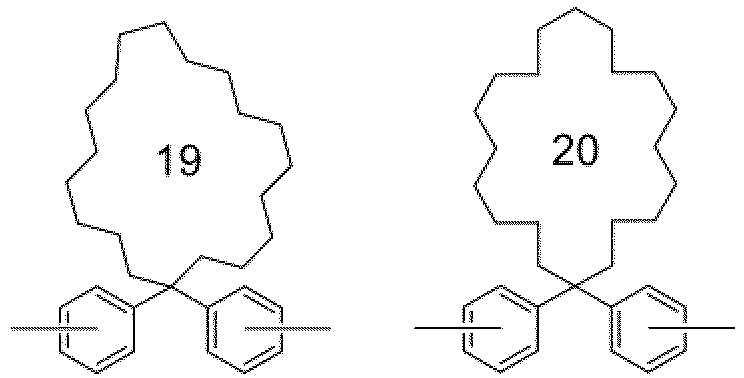
  • hydrophobic group (a) examples include, for example, following structures.
  • hydrophobic group (a) examples include bisphenol residues represented by the following formula (1'). (In the formula, l represents an integer of 2 or more.)
  • l represents an integer of 2 or more, represents preferably an integer of 3 to 20, and represents more preferably an integer of 5 to 8.
  • examples of the divalent hydrophobic group (b) include those composed of a singular aromatic ring and those composed of a plurality of (2 or more, preferably 2) aromatic rings which are bonded to each other via a divalent hydrocarbon group, a divalent silicon-containing group, a divalent nitrogen-containing group, a divalent phosphorus-containing group, a divalent oxygen-containing group, a divalent sulfur-containing group, or carbon-carbon bond.
  • aromatic ring examples include, for example: monocyclic or polycyclic compounds having a carbon number of 6 to 14 such as benzene ring, naphthalene ring, indene ring, azulene ring, fluorene ring, anthracene ring, and phenanthrene ring; and heterocyclic compounds such as azole, oxol, thiophene, oxazole, thiazole, and pyridine.
  • monocyclic or polycyclic compounds having a carbon number of 6 to 14 such as benzene ring, naphthalene ring, indene ring, azulene ring, fluorene ring, anthracene ring, and phenanthrene ring
  • heterocyclic compounds such as azole, oxol, thiophene, oxazole, thiazole, and pyridine.
  • Preferred examples of the aromatic ring include monocyclic aromatic hydrocarbons having a carbon number of 6 to 14, and more preferred examples include benzene ring.
  • the aromatic ring may be substituted with a substituent such as a halogen atom, an alkyl group, an aryl group, or a pseudohalide, if needed.
  • a substituent such as a halogen atom, an alkyl group, an aryl group, or a pseudohalide, if needed.
  • the halogen atom include fluorine atom, chlorine atom, bromine atom, and iodine atom.
  • the pseudohalide include trifluoromethyl group, -CN, -NC, -OCN, -NCO, -ONC, - SCN, -NCS, -SeCN, -NCSe, -TeCN, -NCTe, and -N 3 .
  • alkyl group include alkyl groups described above.
  • the aryl group include aryl groups described above.
  • the aromatic ring is substituted with a substituent such as a halogen atom, an alkyl group, an aryl group, or a pseudohalide
  • a substituent such as a halogen atom, an alkyl group, an aryl group, or a pseudohalide
  • the substituted number and the substituted position of the substituent such as a halogen atom, an alkyl group, an aryl group, or a pseudohalide
  • examples of the aromatic ring substituted with a halogen atom include, for example, benzene ring substituted with one to four halogen atoms (e.g., benzene ring substituted with one to four fluorine atoms, benzene ring substituted with one to four chlorine atoms, benzene ring substituted with one to four bromine atoms, and benzene ring substituted with one to four iodine atoms, in which one to four halogen atoms may be all the same or different).
  • benzene ring substituted with one to four halogen atoms e.g., benzene ring substituted with one to four fluorine atoms, benzene ring substituted with one to four chlorine atoms, benzene ring substituted with one to four bromine atoms, and benzene ring substituted with one to four iodine atoms, in which one to four halogen atoms may
  • divalent hydrocarbon group examples include, for example, divalent saturated hydrocarbon groups having a carbon number of 1 to 20 such as methylene (-CH 2 -), ethylene, propylene, i-propylene (-C(CH 3 ) 2 -), butylene, i-butylene, sec-butylene, pentylene (pentene), i-pentylene, sec-pentylene, hexylene (hexamethylene), 3-methylpentene, heptylene, octylene, 2-ethylhexylene, nonylene, decylene, i-decylene, dodecylene, tetradecylene, hexadecylene, and octadecylene.
  • divalent saturated hydrocarbon groups having a carbon number of 1 to 20 such as methylene (-CH 2 -), ethylene, propylene, i-propylene (-C(CH 3 ) 2 -), butylene,
  • divalent hydrocarbon group examples include saturated divalent hydrocarbon group having a carbon number of 1 to 3, specifically such as methylene (-CH 2 -), ethylene, propylene, i-propylene (-C(CH 3 ) 2 -), more preferred examples include methylene (-CH 2 -) and isopropylene (-C(CH 3 ) 2 -), and particularly preferred examples include i-propylene (-C(CH 3 ) 2 -).
  • the divalent hydrocarbon group may be substituted with a monovalent residue in the aromatic ring described above.
  • hydrophobic group (b) examples include bisphenol residues represented by the following formula (2) and bisphenol residues represented by the following formula (3).
  • Alk' are the same or different from each other and represent an alkyl group or an aryl group; a', b', c', and d' are the same or different from each other and represent an integer of 0 to 4; and l' represents an integer of 1 or more.
  • Alk are the same or different from each other and represent an alkyl group or an aryl group; a", b", c", and d" are the same or different from each other and represent an integer of 0 to 4; and l" represents an integer of 1 or more.
  • Alk' are the same or different from each other and represent an alkyl group or an aryl group.
  • alkyl group include alkyl groups described above.
  • aryl group include aryl groups described above.
  • a' and b' are the same or different from each other and represent an integer of 0 to 4, and preferably an integer of 0 to 2. Further preferably, both a' and b' represent 0.
  • c' and d' are the same or different from each other and represent an integer of 0 to 4, and preferably an integer of 0 to 2. Further preferably, both c' and d' represent 0.
  • l' represents an integer of 1 or more, represents preferably an integer of 1 to 20, and represents more preferably an integer of 2 to 6.
  • Alk are the same or different from each other and represent an alkyl group or an aryl group.
  • alkyl group include alkyl groups described above.
  • aryl group include aryl groups described above.
  • a" and b" are the same or different from each other and represent an integer of 0 to 4, and preferably an integer of 0 to 2. Further preferably, both a" and b" represent 0.
  • c" and d" are the same or different from each other and represent an integer of 0 to 4, and preferably an integer of 0 to 2. Further preferably, both c" and d" represent 0.
  • l represents an integer of 1 or more, represents preferably an integer of 1 to 20, and represents more preferably an integer of 2 to 6.
  • hydrophobic group (b) include bisphenol residues represented by the following formula (2') and bisphenol residues represented by the following formula (3').
  • 2' bisphenol residues represented by the following formula
  • 3' bisphenol residues represented by the following formula
  • l' has the same meaning as l' in the above formula (2) and represents an integer of 1 or more, represents preferably an integer of 1 to 20, and represents more preferably an integer of 2 to 6.
  • l has the same meaning as l" in the above formula (3) and represents an integer of 1 or more, represents preferably an integer of 1 to 20, and represents more preferably an integer of 2 to 6.
  • examples of the divalent hydrophilic group include those composed of a singular aromatic ring and those composed of a plurality of (2 or more, preferably 2) aromatic rings which are bonded to each other via a linking group and/or carbon-carbon bond, in which the linking group is a divalent hydrocarbon group, a divalent silicon-containing group, a divalent nitrogen-containing group, a divalent phosphorus-containing group, a divalent oxygen-containing group, or a divalent sulfur-containing group, and at least one of the linking group or the aromatic ring is bonded to an anion exchange group via a divalent saturated hydrocarbon group having a carbon number of 2 or more.
  • an anion exchange group bonded to a divalent saturated hydrocarbon group having a carbon number of 2 or more may be referred to as an anion exchange group-containing group.
  • the aromatic ring may be a monocyclic compound (benzene ring) or a polycyclic compound.
  • the polycyclic compound include, for example, naphthalene ring, indene ring, azulene ring, fluorene ring, anthracene ring, phenanthrene ring, carbazole ring, and indole ring.
  • Preferred examples include fluorene ring.
  • divalent hydrocarbon group examples include divalent hydrocarbon groups described above.
  • the anion exchange group is introduced into the side chain of the hydrophilic group.
  • the anion exchange group is not particularly limited, and any known anion exchange groups such as quaternary ammonium groups, tertiary amino groups, secondary amino groups, primary amino groups, phosphine, phosphazene, tertiary sulfonium groups, quaternary boronium groups, quaternary phosphonium groups, and guanidium groups can be adopted as the anion exchange group.
  • preferred examples of the anion exchange group include quaternary ammonium groups.
  • anion exchange group examples include -N + (CH 3 ) 3 .
  • Other examples of the anion exchange group include groups having the following structures.
  • * represents a moiety bonded to the aromatic ring having a substituent group.
  • Alk, Alk', and Alk represent an alkyl group described above, and iPr represents i-propyl group.
  • Such anion exchange group is bonded to a linking group or an aromatic ring of a divalent hydrophilic residue via a divalent saturated hydrocarbon group, in which the divalent hydrophilic residue is composed of a plurality of aromatic rings which are bonded to each other via a linking group and/or direct bond, and in which the linking group is a divalent hydrocarbon group, a divalent silicon-containing group, a divalent nitrogen-containing group, a divalent phosphorus-containing group, a divalent oxygen-containing group, or a divalent sulfur-containing group.
  • the anion exchange group need only be bonded to at least one of the linking group or the aromatic rings.
  • the anion exchange group may be bonded to a plurality of linking groups or aromatic rings, and may be bonded to all linking groups or aromatic rings.
  • a plurality of anion exchange groups may be bonded to one linking group or aromatic ring.
  • the carbon number of the divalent saturated hydrocarbon group for bonding the anion exchange group to the linking group or the aromatic ring of the divalent hydrophilic residue is preferably 2 or more, in which the divalent hydrophilic residue is composed of a plurality of aromatic rings which are bonded to each other via the linking group and/or direct bond, and in which the linking group is a divalent hydrocarbon group, a divalent silicon-containing group, a divalent nitrogen-containing group, a divalent phosphorus-containing group, a divalent oxygen-containing group, or a divalent sulfur-containing group.
  • the carbon number of the divalent saturated hydrocarbon group is preferably an integer of 2 to 20, more preferably an integer of 3 to 10, and further preferably an integer of 4 to 8.
  • divalent saturated hydrocarbon group examples include linear saturated hydrocarbon groups such as methylene (-(CH 2 )-), ethylene (-(CH 2 ) 2 -), trimethylene (-(CH 2 ) 3 -), tetramethylene (-(CH 2 ) 4 -), pentamethylene (-(CH 2 ) 5 -), hexamethylene (-(CH 2 ) 6 -), heptamethylene (-(CH 2 ) 7 -), and octamethylene (-(CH 2 ) 8 -).
  • linear saturated hydrocarbon groups such as methylene (-(CH 2 )-), ethylene (-(CH 2 ) 2 -), trimethylene (-(CH 2 ) 3 -), tetramethylene (-(CH 2 ) 4 -), pentamethylene (-(CH 2 ) 5 -), hexamethylene (-(CH 2 ) 6 -), heptamethylene (-(CH 2 ) 7 -), and octamethylene (
  • hydrophilic group having such structure include those having a structure represented by the following formulae.
  • Ion are the same or different from each other and represent an anion exchange group-containing group; a represents an integer of 0 or more (preferably 0 or 1) in which the anion exchange group-containing group can be bonded; and n represents an integer of 0 or more).
  • hydrophilic group having such structure examples include fluorene residues represented by the following formula (4).
  • A are the same or different from each other and represent an anion exchange group-containing group or an anion exchange group-containing cyclic structure.
  • hydrophilic group having such structure include fluorene residues represented by the following formula (4a), the following formula (4b), the following formula (4c), and the following formula (4d).
  • An anion exchange resin of the present invention includes: a hydrophobic unit (a) being composed of the hydrophobic group (a) alone, or being composed of a plurality of the hydrophobic groups (a) repeated via ether bond, thioether bond, or carbon-carbon bond; a hydrophobic unit (b) being composed of the hydrophobic group (b) alone, or being composed of a plurality of the hydrophobic groups (b) repeated via ether bond, thioether bond, or carbon-carbon bond; and a hydrophilic unit being composed of the hydrophilic group alone, or being composed of a plurality of the hydrophilic groups repeated via ether bond, thioether bond, or carbon-carbon bond.
  • the hydrophobic unit (a) is preferably composed of the hydrophobic group (a) alone, or composed of a plurality of the hydrophobic groups (a) repeated via carbon-carbon bond.
  • the hydrophobic unit (b) is preferably composed of the hydrophobic group (b) alone, or composed of a plurality of the hydrophobic groups (b) repeated via carbon-carbon bond.
  • the hydrophilic unit is preferably composed of the hydrophilic group alone, or composed of a plurality of the hydrophilic groups repeated via carbon-carbon bond.
  • the unit corresponds to a block in a block copolymer generally used.
  • hydrophobic unit (a) examples include units formed by the bisphenol residues represented by the above formula (1) bonded to each other via carbon-carbon bond.
  • the bisphenol residue represented by the above formula (1) may also be a unit formed by multiple species bonded to each other in random form, in ordered form including alternating, or in block form.
  • Such hydrophobic unit (a) is represented, for example, by the following formula (11). (In the formula, R, Alk, a, b, c, and d respectively have the same meaning as R, Alk, a, b, c, and d in the above formula (1); and q represents 1 to 200.)
  • q represents, for example, 1 to 200, and preferably 1 to 50.
  • hydrophobic unit (a) examples include units formed by the bisphenol residues represented by the above formula (1') bonded to each other via carbon-carbon bond.
  • Such hydrophobic unit (a) is represented, for example, by the following formula (11'). (In the formula, l has the same meaning as l in the above formula (1'); and q represents 1 to 200.)
  • q represents, for example, 1 to 200, and preferably 1 to 50.
  • the hydrophobic unit (b) include units formed by the divalent hydrophobic groups (b) bonded to each other via carbon-carbon bond in which the hydrophobic group (b) is composed of a singular aromatic ring or is composed of a plurality of aromatic rings which are bonded to each other via a divalent hydrocarbon group, a divalent silicon-containing group, a divalent nitrogen-containing group, a divalent phosphorus-containing group, a divalent oxygen-containing group, a divalent sulfur-containing group, or carbon-carbon bond.
  • the above hydrophobic group (b) may also be a unit formed by multiple species bonded to each other in random form, in ordered form including alternating, or in block form.
  • hydrophobic unit (b) examples include units formed by the bisphenol residues represented by the above formula (2) bonded to each other via carbon-carbon bond and units formed by the bisphenol residues represented by the above formula (3) bonded to each other via carbon-carbon bond.
  • Such hydrophobic unit (b) is represented, for example, by the following formula (12) or the following formula (13).
  • Alk', a', b', c', d', and l' respectively have the same meaning as Alk', a', b', c', d', and l' in the above formula (2); and r represents 1 to 200.
  • Alk", a", b", c", d", and l respectively have the same meaning as Alk", a", b", c", d", and l" in the above formula (3); and r represents 1 to 200.
  • r represents, for example, 1 to 200, and preferably 1 to 50.
  • hydrophobic unit (b) include units formed by the bisphenol residues represented by the above formula (2') bonded to each other via carbon-carbon bond and units formed by the bisphenol residues represented by the above formula (3') bonded to each other via carbon-carbon bond.
  • Such hydrophobic unit (b) is represented, for example, by the following formula (12') or the following formula (13').
  • l' has the same meaning as l' of the above formula (2'); and r represents 1 to 200.
  • l has the same meaning as l" of the above formula (3'); and r represents from 1 to 200.
  • r represents, for example, 1 to 200, and preferably 1 to 50.
  • the hydrophilic unit include units formed by the divalent hydrophilic groups bonded to each other via carbon-carbon bond in which the hydrophilic group is composed of a singular aromatic ring or is composed of a plurality of aromatic rings which are bonded to each other via a divalent hydrocarbon group, a divalent silicon-containing group, a divalent nitrogen-containing group, a divalent phosphorus-containing group, a divalent oxygen-containing group, a divalent sulfur-containing group, or carbon-carbon bond, and in which at least one of the linking group or the aromatic ring is bonded to an anion exchange group-containing group.
  • the hydrophilic unit include units formed by the divalent hydrophilic groups bonded to each other via carbon-carbon bond in which the hydrophilic group is composed of a singular polycyclic compound or is composed of a plurality of polycyclic compounds which are bonded to each other via a divalent hydrocarbon group, a divalent silicon-containing group, a divalent nitrogen-containing group, a divalent phosphorus-containing group, a divalent oxygen-containing group, a divalent sulfur-containing group, or carbon-carbon bond, and in which at least one of the linking group or the aromatic ring is bonded to an anion exchange group via a divalent saturated hydrocarbon group having a carbon number of 2 or more.
  • the divalent hydrophilic group may also be a unit formed by multiple species bonded to each other in random form, in ordered form including alternating, or in block form.
  • hydrophilic unit examples include units formed by the fluorene residues represented by the above formula (4) bonded to each other via carbon-carbon bond.
  • Such hydrophilic unit is represented, for example, by the following formula (14). (In the formula, A has the same meaning as A in the above formula (4); and m represents 1 to 200.)
  • m represents, for example, 1 to 200, and preferably 1 to 50.
  • hydrophilic group examples include units formed by the hydrophilic groups represented by the above formula (4a) bonded to each other via carbon-carbon bond, units formed by the hydrophilic groups represented by the above formula (4b) bonded to each other via carbon-carbon bond, units formed by the hydrophilic groups represented by the above formula (4c) bonded to each other via carbon-carbon bond, and units formed by the hydrophilic groups represented by the above formula (4d) bonded to each other via carbon-carbon bond.
  • Such hydrophilic unit is represented, for example, by the following formula (14a), the following formula (14b), the following formula (14c), or the following formula (14d). (In the formulae, m represents 1 to 200.)
  • m represents, for example, 1 to 200, and preferably 1 to 50.
  • the above hydrophobic unit (a), the above hydrophobic unit (b), and the above hydrophilic unit are bonded via ether bond, thioether bond, or carbon-carbon bond.
  • the above hydrophobic unit (a), the above hydrophobic unit (b), and the above hydrophilic unit are preferably bonded via carbon-carbon bond.
  • anion exchange resin examples include anion exchange resins in which the hydrophobic unit (a) represented by the above formula (11), the hydrophobic unit (b) represented by the above formula (12) or the above formula (13), and the hydrophilic unit represented by the above formula (14) are bonded via carbon-carbon bond.
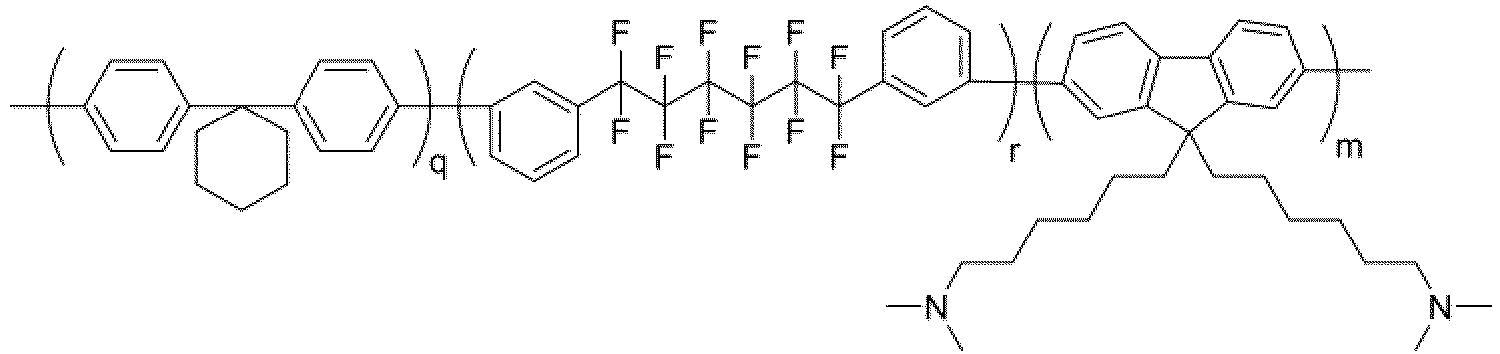
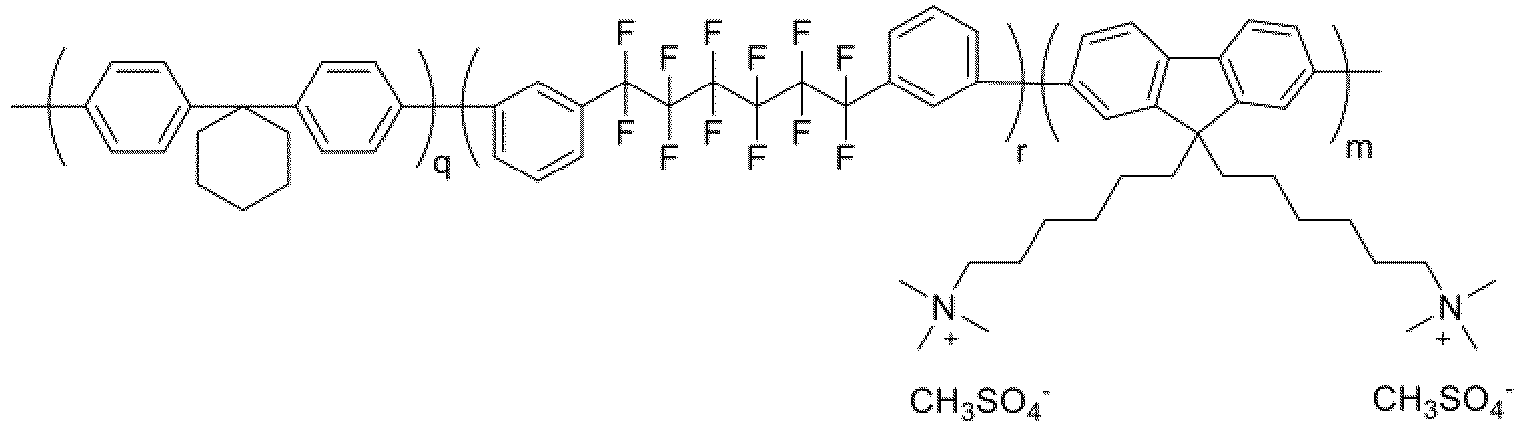
  • Such anion exchange resin is represented, for example, by the following formula (17) or the following formula (18).
  • R, Alk, a, b, c, and d respectively have the same meaning as R, Alk, a, b, c, and d in the above formula (11);
  • Alk', a', b', c', d' and l' respectively have the same meaning as Alk', a', b', c', d', and l' in the above formula (12);
  • A has the same meaning as A in the above formula (14);
  • q, r, and m show a blending ratio or a repeating number and represent 1 to 200; and o shows a repeating number and represents 1 to 100.
  • R, Alk, a, b, c, and d respectively have the same meaning as R, Alk, a, b, c, and d in the above formula (11);
  • anion exchange resins include anion exchange resins in which the hydrophobic unit (a) represented by the above formula (11'), the hydrophobic unit (b) represented by the above formula (12') or the above formula (13'), and the hydrophilic unit represented by the above formula (14a), the above formula (14b), the above formula (14c), or the above formula (14d) are bonded via carbon-carbon bond.
  • Such anion exchange resin is represented, for example, by the following formula (17a), the following formula (17b), the following formula (17c), the following formula (17d), the following formula (18a), the following formula (18b), the following formula (18c), or the following formula (18d).
  • l has the same meaning as l in the above formula (11'); l' has the same meaning as l' in the above formula (12'); q, r, and m show a blending ratio or a repeating number and represent 1 to 200; and o shows a repeating number and represents 1 to 100.
  • l has the same meaning as l in the above formula (11'); l' has the same meaning as l' in the above formula (12'); q, r, and m show a blending ratio or a repeating number and represent 1 to 200; and o shows a repeating number and represents 1 to 100.
  • l has the same meaning as l in the above formula (11'); l' has the same meaning as l' in the above formula (12
  • q, r, and m show a blending ratio and o shows a repeating number, all of which are appropriately set according to the purpose and application.
  • the number average molecular weight of such anion exchange resin is, for example, 10 to 1000 kDa, and is preferably 30 to 500 kDa, as mentioned above.
  • the method of producing the anion exchange resin is not particularly limited and any known methods can be adopted.
  • the method by polycondensation reaction is preferably adopted.
  • the anion exchange resin can be produced: by preparing a monomer for forming a hydrophobic group (a); by preparing a monomer for forming a hydrophobic group (b); by preparing a monomer for forming a hydrophilic group having a precursor functional group for an anion exchange group-containing group; by polymerizing the monomer for forming a hydrophobic group (a), the monomer for forming a hydrophobic group (b), and the monomer for forming a hydrophilic group having a precursor functional group for an anion exchange group-containing group to form a polymer; and by ionizing the precursor functional group for an anion exchange group-containing group in the polymer.
  • the anion exchange resin can be produced: by preparing a monomer for forming a hydrophobic group (a); by preparing a monomer for forming a hydrophobic group (b); by preparing a monomer for forming a hydrophilic group; by polymerizing the monomer for forming a hydrophobic group (a), the monomer for forming a hydrophobic group (b), and the monomer for forming a hydrophilic group to form a polymer; and by introducing a substitution group having an anion exchange group-containing group into the polymer.
  • any general methods known in the art can be adopted.
  • Cross-coupling which forms carbon-carbon bond is preferably adopted.
  • Preferred examples of the monomer (a) for forming a hydrophobic group include compounds represented by the following formula (21), which corresponds to the above formula (1).
  • R, Alk, a, b, c, and d respectively have the same meaning as R, Alk, a, b, c, and d in the above formula (1); and T and T' are the same or different from each other and represent a halogen atom, a pseudohalide, boronic acid group, a boronic acid derivative, or hydrogen atom.
  • Particularly preferred examples of the monomer (a) for forming a hydrophobic group include compounds represented by the following formula (21'), which corresponds to the above formula (1').
  • l has the same meaning as l in the above formula (1'); and T and T' are the same or different from each other and represent a halogen atom, a pseudohalide, boronic acid group, a boronic acid derivative, or hydrogen atom.
  • Preferred examples of the monomer (b) for forming a hydrophobic group include compounds represented by the following formula (22), which corresponds to the above formula (2), and compounds represented by the following formula (23), which corresponds to the above formula (3).
  • Alk', a', b', c', d', and l' respectively have the same as Alk', a', b', c', d', and l' in the above formula (2); and T and T' are the same or different from each other and represent a halogen atom, a pseudohalide, boronic acid group, a boronic acid derivative, or hydrogen atom.
  • Particularly preferred examples of the monomer (b) for forming a hydrophobic group include compounds represented by the following formula (22'), which corresponds to the above formula (2'), and compounds represented by the following formula (23'), which corresponds to the above formula (3').
  • l' has the same meaning as l' in the above formula (2'); and T and T' are the same or different from each other and represent a halogen atom, a pseudohalide, boronic acid group, a boronic acid derivative, or hydrogen atom.
  • T and T' are the same or different from each other and represent a halogen atom, a pseudohalide, boronic acid group, a boronic acid derivative, or hydrogen atom.
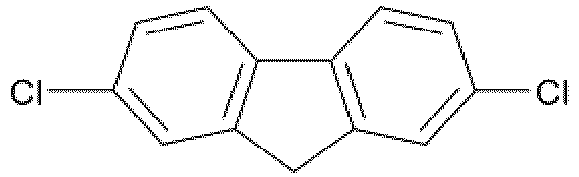
  • Preferred examples of the monomer for forming a hydrophilic group include compounds represented by the following formula (24), which corresponds to the above formula (4).
  • Pre are the same or different from each other and represent a precursor functional group for an anion exchange group-containing group; and T and T' are the same or different from each other and represent a halogen atom, a pseudohalide, boronic acid group, a boronic acid derivative, or hydrogen atom.
  • the blending amount of each monomer is respectively adjusted so as to achieve a desired blending ratio of the hydrophobic unit (a), the hydrophobic unit (b), and the hydrophilic unit in the resulting anion exchange resin precursor polymer.
  • the monomer for forming hydrophobic group (a), the monomer for forming hydrophobic group (b), and the monomer for forming hydrophilic group having a precursor functional group for an anion exchange group-containing group can be dissolved in a solvent such as N,N-dimethylacetamide or dimethyl sulfoxide, for example; and the polymerization can be carried out with bis(cycloocta-1,5-diene)nickel(0) as a catalyst. Any other known methods can be adopted.
  • the reaction temperature in the cross-coupling reaction is, for example, -100 to 300°C, and is preferably -50 to 200°C.
  • the reaction time is, for example, 1 to 48 hours, and is preferably 2 to 5 hours.
  • an anion exchange resin precursor polymer represented by the following formula (27) is obtained.
  • R, Alk, a, b, c, and d respectively have the same meaning as R, Alk, a, b, c, and d in the above formula (21);
  • Alk', a', b', c', d' and l' respectively have the same meaning as Alk', a', b', c', d', and l' in the above formula (22);
  • Prre has the same meaning as A in the above formula (24);
  • q, r, and m show a blending ratio or a repeating number and represent 1 to 200; and o shows a repeating number and represents 1 to 100.
  • an anion exchange resin precursor polymer represented by the following formula (28) is obtained.
  • R, Alk, a, b, c, and d respectively have the same meaning as R, Alk, a, b, c, and d in the above formula (21);
  • Alk", a", b", c", d" and l respectively have the same meaning as Alk", a", b", c", d", and l" in the above formula (23);
  • Pre has the same meaning as Pre in the above formula (24);
  • q, r, and m show a blending ratio or a repeating number and represent 1 to 200; and o shows a repeating number and represents 1 to 100.
  • an anion exchange resin precursor polymer represented by the following formula (27') is obtained.
  • l has the same meaning as l in the above formula (21'); l' has the same meaning as l' in the above formula (22'); Pre has the same meaning as Pre in the above formula (24); q, r, and m show a blending ratio or a repeating number and represent 1 to 200; and o shows a repeating number and represents 1 to 100.
  • an anion exchange resin precursor polymer represented by the following formula (28') is obtained.
  • l has the same meaning as l in the above formula (21'); l" has the same meaning as l" in the above formula (23'); Pre has the same meaning as Pre in the above formula (24); q, r, and m show a blending ratio or a repeating number and represent 1 to 200; and o shows a repeating number and represents 1 to 100.
  • the precursor functional group for an anion exchange group-containing group is then ionized.
  • the method of ionization is not limited and any known methods can be adopted.
  • the anion exchange resin precursor polymer can be dissolved in a solvent such as N,N-dimethylacetamide or dimethyl sulfoxide, for example, and can be ionized using methyl iodide or the like as an alkylating agent. Any other known methods can be adopted.
  • the reaction temperature in the ionization reaction is, for example, 0 to 100°C, and is preferably 20 to 80°C.
  • the reaction time is, for example, 24 to 72 hours, and is preferably 48 to 72 hours.
  • the anion exchange resin represented by the above formula (17) is obtained.
  • the anion exchange resin represented by the above formula (28) is obtained.
  • the ion exchange group capacity of the anion exchange resin is, for example, 0.1 to 4.0 meq./g, and is preferably 0.6 to 3.0 meq./g.
  • the ion exchange group capacity can be calculated by the following equation (30).
  • [ion exchange group capacity (meq./g)] the amount of the anion exchange group introduced per the hydrophilic unit ⁇ the repeating unit of the hydrophilic unit ⁇ 1000 / (the molecular weight of the hydrophobic unit ⁇ the repeating unit number of the hydrophobic unit + the molecular weight of the hydrophilic unit ⁇ the repeating unit number of the hydrophilic unit + the molecular weight of the ion exchange group ⁇ the repeating unit number of the hydrophilic unit) (30)
  • the amount of the ion exchange group introduced is defined as the number of the ion exchange group per unit of the hydrophilic group.
  • the amount of the anion exchange group introduced is a mole number (mol) of the anion exchange group introduced in the main chain or the side chain of the hydrophilic group.
  • Such anion exchange resin has: a divalent hydrophobic group (a) comprising a bisphenol residue represented by the above formula (1); a divalent hydrophobic group (b) being composed of a singular aromatic ring, or being composed of a plurality of aromatic rings which are bonded to each other via a divalent hydrocarbon group, a divalent silicon-containing group, a divalent nitrogen-containing group, a divalent phosphorus-containing group, a divalent oxygen-containing group, a divalent sulfur-containing group, or carbon-carbon bond; and a divalent hydrophilic group being composed of a singular aromatic ring, or being composed of a plurality of aromatic rings which are bonded to each other via a linking group and/or carbon-carbon bond, in which the linking group is a divalent hydrocarbon group, a divalent silicon-containing group, a divalent nitrogen-containing group, a divalent phosphorus-containing group, a divalent oxygen-containing group, or a divalent sulfur-containing group, and at least one of the linking group or
  • the anion exchange resin has a hydrophilic unit being composed of hydrophilic groups repeated via carbon-carbon bond
  • the hydrophilic unit does not have an ether bond, and therefore the anion exchange resin has excellent durability such as alkali resistance. More specifically, if the hydrophilic unit has an ether bond, the decomposition by hydroxide ion (OH - ) as described below may occur, and alkali resistance may not be sufficient.
  • the hydrophilic unit of the anion exchange resin having a hydrophilic unit being composed of the hydrophilic groups repeated via carbon-carbon bond does not have an ether bond, the decomposition by the mechanism described above does not occur, and therefore the anion exchange resin has excellent durability such as alkali resistance.
  • the present invention includes electrolyte layers (electrolyte membranes) obtained by using such anion exchange resin.
  • An electrolyte membrane of the present invention is applicable to various electrochemical applications such as fuel cells, water electrolysis hydrogen generators, and electrochemical hydrogen pumps, but is particularly suitable for use in water electrolysis hydrogen generators.
  • the electrolyte membrane is used in a structural state in which catalyst layers, electrode substrates, and separators are sequentially laminated on both sides.
  • MEA membrane electrode assembly
  • the anion exchange resin described above can be used as an electrolyte membrane (i.e., the electrolyte membrane contains the anion exchange resin described above).
  • the electrolyte membrane can be reinforced, for example, with a known reinforcing material such as a porous substrate, and can also be subjected to various treatments such as biaxial stretching treatments to control the molecular orientation and heat treatments to control crystallinity and residual stress.
  • Known fillers can be added to the electrolyte membrane to increase the mechanical strength, and the electrolyte membrane can be composited with a reinforcing agent such as a glass nonwoven fabric by pressing.
  • various additives normally used in electrolyte membranes such as compatibilizers to improve compatibility, antioxidants to prevent resin degradation, and antistatic agents and lubricants to improve the handling during the film forming and processing may be included as needed to the extent that they do not affect processing and performance as an electrolyte membrane.
  • the thickness of the electrolyte membrane is not particularly limited and is suitably set according to the purpose and application.
  • the thickness of the electrolyte membrane is, for example, 1.2 to 350 ⁇ m, and is preferably 5 to 200 ⁇ m.
  • the present invention also includes a binder for forming the electrode catalyst layer containing an anion exchange resin described above, and a battery electrode catalyst layer containing a binder for forming the electrode catalyst layer. Since the exchange resin described above has excellent anion conductivity and gas permeability, gas diffusivity can easily be adjusted and controlled by using it as a binder for forming the electrode catalyst layer.
  • the binder for forming the electrode catalyst layer is prepared by cutting the anion exchange resin into pieces, and then dissolving the resin in a suitable amount of an organic solvent such as alcohols.
  • the amount of the anion exchange resin is, for example, 2 to 10 parts by weight, and preferably 2 to 5 parts by weight with respect to 100 parts by weight of the binder for forming the electrode catalyst layer.
  • the anion exchange resin can be included in the catalyst layer (the battery electrode catalyst layer).
  • the product was extracted with hexane and washed with pure water, and was then dehydrated using sodium sulfate. After removing the dehydrating agent by filtration, the solution was concentrated in an evaporator. The resulting residue was purified by silica gel column chromatography (developing solvent: hexane). The resulting solution was concentrated and was dried under vacuum overnight to obtain a monomer 1 represented by the following formula in a yield of 57%.
  • the combined organic phase was washed with pure water and with sodium chloride solution, and then water, dichloromethane, and 1,6-dibromohexane were distilled off.
  • the reaction mixture was filtered to collect the precipitate.
  • the precipitate was washed with hydrochloric acid, with potassium carbonate, and with pure water, and was then dried under vacuum (60°C, 24 hours) to obtain an anion exchange resin precursor polymer C6 17 PA (pale yellow solid) represented by the following formula in a yield of 98%.
  • the resulting anion exchange resin QC6 17 PA (about 180 mg) and N,N-dimethylacetamide (about 3.0 mL) were added to an eggplant flask. The mixture was stirred to form a homogeneous solution and was then filtered. The filtrate was poured onto a glass plate rimmed with silicone rubber and was dried on a horizontally adjusted hot plate (45°C). This results in a membrane of the anion exchange resin QC6 17 PA represented by the following formula.
  • a membrane of an anion exchange resin QC6 33 PA was obtained by a similar method as described above using the above monomer 1, the above monomer 2, and the above monomer 5 with modifying the amount of reagents prepared if needed.
  • a membrane of an anion exchange resin QC6 50 PA was obtained by a similar method as described above using the above monomer 1, the above monomer 2, and the above monomer 5 with modifying the amount of reagents prepared if needed.
  • a membrane of an anion exchange resin QC6 17 PA was obtained by a similar method as described above using the above monomer 1, the above monomer 2, and the above monomer 5 with modifying the amount of reagents prepared if needed.
  • a membrane of an anion exchange resin QC6 50 PA was obtained by a similar method as described above using the above monomer 1, the above monomer 2, and the above monomer 5 with modifying the amount of reagents prepared if needed.
  • a membrane of an anion exchange resin QPAF-4 represented by the following formula was obtained by a similar method as described above using the above monomer 2 and the above monomer 5 with modifying the amount of reagents prepared if needed.
  • a membrane of an anion exchange resin QPAF-4 represented by the above formula was obtained by a similar method as described above using the above monomer 2 and the above monomer 5 with modifying the amount of reagents prepared if needed.
  • the permeability of hydrogen gas and oxygen gas was measured for the membranes of the anion exchange resins obtained in the Examples and the Comparative Examples. Specifically, the membranes of the anion exchange resins obtained in the Examples and the Comparative Examples were cut into a piece having a width of 4.5 cm and a length of 4.5 cm as a measurement sample. A gas permeability measurement device (made by GTR TEC Corporation, product name: GTR-20TXFYC) was used as the measurement device.
  • test gas hydrogen or oxygen
  • carrier gas argon in the case where the test gas was hydrogen or helium in the case where the test gas was oxygen
  • the gas permeability P (cm 3 (STP) ⁇ cm ⁇ s -1 ⁇ cm -2 ⁇ cmHg -1 ) was calculated by the following equation from the cell temperature T (K), the volume of the permeating gas q (cm 3 ), the film thickness d (cm), the time to pass through the measuring tube t (s), the permeation area a (cm 2 ), and the partial pressure of the test gas p (cmHg).
  • P 273 / T ⁇ q ⁇ d / t ⁇ a ⁇ p
  • the results of the hydrogen gas permeability are shown in Figure 1 .
  • Example 1, Example 2, and Example 3 with a low IEC the hydrogen gas permeabilities are similar values.
  • the results of the oxygen gas permeability are shown in Figure 2 .
  • the oxygen gas permeability in Comparative Example 1, Example 1, Example 2, and Example 3 with a low IEC the oxygen gas permeability tends to increase with an increase of the hydrophobic unit (a) ratio (q/(q+r) ⁇ 100).
  • the hydrogen gas permeabilities and the oxygen gas permeabilities in Example 4 and Example 5 with a high IEC are higher and respectively about 8 to 25 times and 14 to 19 times than those in Example 1, Example 2, and Example 3 with a low IEC.
  • the hydroxide ion conductivity was measured for the membranes of the anion exchange resins obtained in the Examples and the Comparative Examples. Specifically, the membranes of the anion exchange resins obtained in the Examples and the Comparative Examples were cut into a piece having a width of 1 cm and a length of 4 cm as a measurement sample, and the sample was immersed in 1 M potassium hydroxide aqueous solution (80°C) for 48 hours to form the hydroxide ion type.
  • the water uptake was measured for the membranes of the anion exchange resins obtained in the Examples and the Comparative Examples. Specifically, the membranes of the anion exchange resins obtained in the Examples and the Comparative Examples were cut into a piece having a width of 1 cm and a length of 4 cm as a measurement sample, and the sample was immersed in 1 M potassium hydroxide aqueous solution (80°C) for 48 hours to form the hydroxide ion type.
  • W wet was determined by washing the sample pulled up from 1 M potassium hydroxide solution (80°C) with degassed pure water, by immersing the sample in pure water for 24 hours or longer, by wiping off the water droplets on the sample surface with a tissue, by quickly transferring the sample to a preweighed sample tube bottle with a lid on, by weighing the sample, and by calculating the difference.
  • W dry was determined by drying the water-containing under vacuum overnight (50°C), by quickly transferring the sample to a preweighed sample tube bottle with a lid on, by weighing the sample, and by calculating the difference.
  • the anion exchange resins obtained in the Examples have excellent electrical properties (high anion conductivity) and chemical properties (high gas permeability and low water uptake property) than those of the anion exchange resins obtained in the Comparative Examples.

Landscapes

  • Chemical & Material Sciences (AREA)
  • Chemical Kinetics & Catalysis (AREA)
  • Engineering & Computer Science (AREA)
  • Organic Chemistry (AREA)
  • Electrochemistry (AREA)
  • Materials Engineering (AREA)
  • Manufacturing & Machinery (AREA)
  • General Chemical & Material Sciences (AREA)
  • Medicinal Chemistry (AREA)
  • Life Sciences & Earth Sciences (AREA)
  • Polymers & Plastics (AREA)
  • Health & Medical Sciences (AREA)
  • Metallurgy (AREA)
  • Sustainable Energy (AREA)
  • Sustainable Development (AREA)
  • Inorganic Chemistry (AREA)
  • Crystallography & Structural Chemistry (AREA)
  • Wood Science & Technology (AREA)
  • Fuel Cell (AREA)
  • Polyethers (AREA)
  • Inert Electrodes (AREA)
  • Other Resins Obtained By Reactions Not Involving Carbon-To-Carbon Unsaturated Bonds (AREA)
  • Polyoxymethylene Polymers And Polymers With Carbon-To-Carbon Bonds (AREA)
  • Conductive Materials (AREA)
  • Manufacture Of Macromolecular Shaped Articles (AREA)

Abstract

Provided are an anion exchange resin being capable of producing an electrolyte membrane, a binder for forming an electrode catalyst layer, and a battery electrode catalyst layer, which has excellent electrical properties (anion conductivity) and chemical properties (gas permeability and water uptake property), an electrolyte membrane and a binder for forming an electrode catalyst layer formed from the anion exchange resin, and a battery electrode catalyst layer formed from the binder for forming an electrode catalyst layer.
For example, used is an anion exchange resin in which a hydrophobic unit being composed of divalent hydrophobic groups including a bisphenol residue having an alicyclic structure, which are repeated via carbon-carbon bond, a hydrophobic unit being composed of hydrophobic groups of a plurality of aromatic rings bonded to each other via a divalent fluorine-containing hydrocarbon group, which are repeated via carbon-carbon bond, and a hydrophilic unit having a fluorene ring bonded to an anion exchange group-containing group are bonded via carbon-carbon bond.

Description

    TECHNICAL FIELD
  • This invention relates to an anion exchange resin, an electrolyte membrane, a binder for forming an electrode catalyst layer, and a battery electrode catalyst layer.
  • BACKGROUND ART
  • An anion exchange resin, comprising: a divalent hydrophobic group being composed of a singular aromatic ring, or being composed of a plurality of aromatic rings which are bonded to each other via a divalent hydrocarbon group, a divalent silicon-containing group, a divalent nitrogen-containing group, a divalent phosphorus-containing group, a divalent oxygen-containing group, a divalent sulfur-containing group, or carbon-carbon bond; and a divalent hydrophilic group being composed of a singular polycyclic compound, or being composed of a plurality of polycyclic compounds which are bonded to each other via a linking group and/or carbon-carbon bond, wherein the linking group is a divalent hydrocarbon group, a divalent silicon-containing group, a divalent nitrogen-containing group, a divalent phosphorus-containing group, a divalent oxygen-containing group, or a divalent sulfur-containing group, and at least one of the linking group or the polycyclic compound is bonded to an anion exchange group via a divalent saturated hydrocarbon group having a carbon number of 2 or more; wherein the anion exchange resin comprises: a hydrophobic unit being composed of the hydrophobic group alone, or being composed of a plurality of hydrophobic groups repeated via ether bond, thioether bond, or carbon-carbon bond; and a hydrophilic unit being composed of the hydrophilic group alone, or being composed of a plurality of hydrophilic groups repeated via ether bond, thioether bond, or carbon-carbon bond; and wherein the hydrophobic unit and the hydrophilic unit are bonded via ether bond, thioether bond, or carbon-carbon bond is known (Patent Document 1)..
  • PRIOR ART DOCUMENT PATENT DOCUMENT
  • Patent Document 1: JP 2019-23258 A
  • SUMMARY OF THE INVENTION PROBLEM TO BE SOLVED BY THE INVENTION
  • Although the anion exchange resin described in Patent Document 1 has successfully improved chemical properties (durability) and mechanical properties (flexibility of the thin film), it is desired to further improve electrical properties (anion conductivity) and chemical properties (gas permeability and water uptake property). In particular, since binders for forming an electrode catalyst layer are required to adjust and control gas diffusivity, it is desired to further improve gas permeability, considering the use of the anion exchange resin described in Patent Document 1 as a binder for forming an electrode catalyst layer.
  • Accordingly, an object of the present invention is to provide an anion exchange resin being capable of producing an electrolyte membrane, a binder for forming an electrode catalyst layer, and a battery electrode catalyst layer, which have excellent electrical properties (anion conductivity) and chemical properties (gas permeability and water uptake property); an electrolyte membrane and a binder for forming an electrode catalyst layer formed from the anion exchange resin, and a battery electrode catalyst layer formed from the binder for forming the electrode catalyst layer.
  • MEANS OF SOLVING THE PROBLEM
  • In order to solve the aforementioned problems, an anion exchange resin of the present invention comprises:
    • a divalent hydrophobic group (a) comprising a bisphenol residue represented by following formula (1);
    • a divalent hydrophobic group (b) being composed of a singular aromatic ring, or being composed of a plurality of aromatic rings which are bonded to each other via a divalent hydrocarbon group, a divalent silicon-containing group, a divalent nitrogen-containing group, a divalent phosphorus-containing group, a divalent oxygen-containing group, a divalent sulfur-containing group, or carbon-carbon bond; and
    • a divalent hydrophilic group being composed of a singular aromatic ring, or being composed of a plurality of aromatic rings which are bonded to each other via a linking group and/or carbon-carbon bond, wherein the linking group is a divalent hydrocarbon group, a divalent silicon-containing group, a divalent nitrogen-containing group, a divalent phosphorus-containing group, a divalent oxygen-containing group, or a divalent sulfur-containing group, and at least one of the linking group or the aromatic ring is bonded to an anion exchange group via a divalent saturated hydrocarbon group having a carbon number of 2 or more;
    • wherein the anion exchange resin comprises:
      • a hydrophobic unit (a) being composed of the hydrophobic group (a) alone, or being composed of a plurality of the hydrophobic groups (a) repeated via ether bond, thioether bond, or carbon-carbon bond;
      • a hydrophobic unit (b) being composed of the hydrophobic group (b) alone, or being composed of a plurality of the hydrophobic groups (b) repeated via ether bond, thioether bond, or carbon-carbon bond; and
      • a hydrophilic unit being composed of the hydrophilic group alone, or being composed of a plurality of the hydrophilic groups repeated via ether bond, thioether bond, or carbon-carbon bond; and
      • wherein the hydrophobic unit (a), the hydrophobic unit (b), and the hydrophilic unit are bonded via ether bond, thioether bond, or carbon-carbon bond.
    Figure imgb0001
    (In the formula, Alk are same or different from each other and represent an alkyl group or an aryl group; R represents a divalent hydrocarbon group forming an alicyclic structure; and a, b, c, and d are same or different from each other and represent an integer of 0 to 4.)
  • In the anion exchange resin of the present invention, it is suitable that the hydrophobic group (a) comprises a bisphenol residue represented by following formula (1').
    Figure imgb0002
    (In the formula, l represents an integer of 2 or more.)
  • In the anion exchange resin of the present invention, it is suitable that the hydrophobic group (b) comprises a bisphenol residue represented by following formula (2).
    Figure imgb0003
    (In the formula, Alk' are same or different from each other and represent an alkyl group or an aryl group; a', b', c', and d' are same or different from each other and represent an integer of 0 to 4; and l' represents an integer of 1 or more.)
  • In the anion exchange resin of the present invention, it is suitable that the hydrophobic group (b) comprises a bisphenol residue represented by following formula (2').
    Figure imgb0004
    (In the formula, l' represents an integer of 1 or more.)
  • In the anion exchange resin of the present invention, it is suitable that the hydrophobic group (b) comprises a bisphenol residue represented by following formula (3).
    Figure imgb0005
    (In the formula, Alk" are same or different from each other and represent an alkyl group or an aryl group; a", b", c", and d" are same or different from each other and represent an integer of 0 to 4; and l" represents an integer of 1 or more.)
  • In the anion exchange resin of the present invention, it is suitable that the hydrophobic group (b) comprises a bisphenol residue represented by following formula (3').
    Figure imgb0006
    (In the formula, l" represents an integer of 1 or more.)
  • In the anion exchange resin of the present invention, it is suitable that the hydrophilic group is composed of a singular polycyclic compound, or is composed of a plurality of polycyclic compounds which are bonded to each other via a linking group and/or carbon-carbon bond, wherein the linking group is a divalent hydrocarbon group, a divalent silicon-containing group, a divalent nitrogen-containing group, a divalent phosphorus-containing group, a divalent oxygen-containing group, or a divalent sulfur-containing group, and at least one of the linking group or the polycyclic compound is bonded to an anion exchange group via a divalent saturated hydrocarbon group having a carbon number of 2 or more.
  • In the anion exchange resin of the present invention, it is suitable that the hydrophilic group is a fluorene residue represented by following formula (4).
    Figure imgb0007
    (In the formula, A are same or different from each other and represent an anion exchange group-containing group or an anion exchange group-containing cyclic structure.)
  • In order to solve the aforementioned problem, an electrolyte membrane of the present invention comprises an anion exchange resin described above.
  • In order to solve the aforementioned problem, a binder for forming an electrocatalyst layer of the present invention comprises an anion exchange resin described above.
  • In order to solve the aforementioned problem, a battery electrocatalyst layer of the present invention comprises a binder for forming an electrode catalyst layer described above.
  • EFFECT OF THE INVENTION
  • The present invention can provide an anion exchange resin being capable of producing an electrolyte membrane, a binder for forming an electrode catalyst layer, and a battery electrode catalyst layer, which have excellent electrical properties (anion conductivity) and chemical properties (gas permeability and water uptake property); an electrolyte membrane and a binder for forming an electrode catalyst layer formed from the anion exchange resin, and a battery electrode catalyst layer formed from the binder for forming the electrode catalyst layer.
  • BRIEF DESCRIPTION OF DRAWINGS
    • FIG. 1 is a graph showing the results of hydrogen gas permeability for the samples obtained in the Examples and the Comparative Examples.
    • FIG. 2 is a graph showing the results of oxygen gas permeability for the samples obtained in the Examples and the Comparative Examples.
    • FIG. 3 is a graph showing the results of anion conductivity for the samples obtained in the Examples and the Comparative Examples.
    • FIG. 4 is a graph showing the results of water uptake for the samples obtained in the Examples and the Comparative Examples.
    MODE FOR CARRYING OUT THE INVENTION
  • An anion exchange resin of the present invention is composed of a divalent hydrophobic group (a), a divalent hydrophobic group (b), and a divalent hydrophilic group.
  • In an anion exchange resin of the present invention, examples of the divalent hydrophobic group (a) include those containing bisphenol residues represented by the following formula (1).
    Figure imgb0008
    (In the formula, Alk are the same or different from each other and represent an alkyl group or an aryl group; R represents a divalent hydrocarbon group forming an alicyclic structure; and a, b, c, and d are the same or different from each other and represent an integer of 0 to 4.)
  • In the above formula (1), Alk are the same or different from each other and represent an alkyl group or an aryl group. Examples of the alkyl group include, for example, alkyl groups having a carbon number of 1 to 20 such as methyl group, ethyl group, propyl group, i-propyl group, butyl group, i-butyl group, sec-butyl group, t-butyl group, pentyl group, hexyl group, heptyl group, and octyl group; and cycloalkyl groups having a carbon number of 1 to 20 such as cyclopropyl group, cyclobutyl group, cyclopentyl group, cyclohexyl group, cycloheptyl group, and cyclooctyl group. Examples of the aryl group include, for example, phenyl group, biphenyl group, naphthyl group, and fluorenyl group.
  • In the above formula (1), R represents a divalent hydrocarbon group forming an alicyclic structure. Examples of the alicyclic structure include monocyclic cycloalkane structures such as cyclopropane, cyclobutane, cyclopentane, cyclohexane, cycloheptane, cyclooctane, cyclononane, cyclodecane, cycloundecane, cyclododecane, cyclotridecane, cyclotetradecane, cyclopentadecane, cyclohexadecane, cycloheptadecane, cyclooctadecane, cyclononadecane, and cycloicosane; monocyclic cycloalkene structures such as cyclopropene, cyclobutene, cyclopropene, cyclohexene, cycloheptene, and cyclooctene; polycyclic cycloalkane structures such as decahydronaphthalene, norbornane, cubane, adamantane, and dodecahedrane; polycyclic cycloalkene structures such as norbornene; spirocyclic structures such as spiro[3.4]octane, spiro[4.5]decane, and spiro[5.5]undecane; cyclic structures having one heteroatom such as pyrrolidine, piperidine, tetrahydrofuran, tetrahydropyran, phosphorane, phosphinane, tetrahydrothiophene, and thiane; cyclic structures having two heteroatoms such as imidazolidine, pyrazolidine, oxazolidine, isoxazolidine, thiazolidine, isothiazolidine, dioxolane, dithiolane, piperazine, morpholine, thiomorpholine, dioxane, and dithiane; cyclic structures having three heteroatoms such as hexahydro-1,3,5-triazine, trioxane, and trithiane; and cyclic structures by combining these.
  • The alicyclic structure described above may be substituted with an alkyl group, an aryl group, a halogen atom, or the like. Examples of the alkyl group include alkyl groups described above. Examples of the aryl group include aryl groups described above. Examples of the halogen atom include fluorine atom, chlorine atom, bromine atom, and iodine atom. In the case where the alicyclic structure is substituted with an alkyl group or an aryl group, the substituted number and the substituted position of the alkyl group or the aryl group are appropriately set according to the purpose and the application.
  • In the above formula (1), a and b are the same or different from each other and represent an integer of 0 to 4, and preferably an integer of 0 to 2. Further preferably, both a and b represent 0.
  • In the above formula (1), c and d are the same or different from each other and represent an integer of 0 to 4, and preferably an integer of 0 to 2. Further preferably, both c and d represent 0.
  • Examples of such hydrophobic group (a) include, for example, following structures.
    Figure imgb0009
    Figure imgb0010
    Figure imgb0011
    Figure imgb0012
    Figure imgb0013
    Figure imgb0014
    Figure imgb0015
  • Preferred examples of such hydrophobic group (a) include bisphenol residues represented by the following formula (1').
    Figure imgb0016
    (In the formula, l represents an integer of 2 or more.)
  • In the above formula (1'), l represents an integer of 2 or more, represents preferably an integer of 3 to 20, and represents more preferably an integer of 5 to 8.
  • In an anion exchange resin of the present invention, examples of the divalent hydrophobic group (b) include those composed of a singular aromatic ring and those composed of a plurality of (2 or more, preferably 2) aromatic rings which are bonded to each other via a divalent hydrocarbon group, a divalent silicon-containing group, a divalent nitrogen-containing group, a divalent phosphorus-containing group, a divalent oxygen-containing group, a divalent sulfur-containing group, or carbon-carbon bond.
  • Examples of the aromatic ring include, for example: monocyclic or polycyclic compounds having a carbon number of 6 to 14 such as benzene ring, naphthalene ring, indene ring, azulene ring, fluorene ring, anthracene ring, and phenanthrene ring; and heterocyclic compounds such as azole, oxol, thiophene, oxazole, thiazole, and pyridine.
  • Preferred examples of the aromatic ring include monocyclic aromatic hydrocarbons having a carbon number of 6 to 14, and more preferred examples include benzene ring.
  • The aromatic ring may be substituted with a substituent such as a halogen atom, an alkyl group, an aryl group, or a pseudohalide, if needed. Examples of the halogen atom include fluorine atom, chlorine atom, bromine atom, and iodine atom. Examples of the pseudohalide include trifluoromethyl group, -CN, -NC, -OCN, -NCO, -ONC, - SCN, -NCS, -SeCN, -NCSe, -TeCN, -NCTe, and -N3. Examples of the alkyl group include alkyl groups described above. Examples of the aryl group include aryl groups described above.
  • In the case where the aromatic ring is substituted with a substituent such as a halogen atom, an alkyl group, an aryl group, or a pseudohalide, the substituted number and the substituted position of the substituent such as a halogen atom, an alkyl group, an aryl group, or a pseudohalide are appropriately set according to the purpose and the application.
  • More specifically, examples of the aromatic ring substituted with a halogen atom include, for example, benzene ring substituted with one to four halogen atoms (e.g., benzene ring substituted with one to four fluorine atoms, benzene ring substituted with one to four chlorine atoms, benzene ring substituted with one to four bromine atoms, and benzene ring substituted with one to four iodine atoms, in which one to four halogen atoms may be all the same or different).
  • Examples of the divalent hydrocarbon group include, for example, divalent saturated hydrocarbon groups having a carbon number of 1 to 20 such as methylene (-CH2-), ethylene, propylene, i-propylene (-C(CH3)2-), butylene, i-butylene, sec-butylene, pentylene (pentene), i-pentylene, sec-pentylene, hexylene (hexamethylene), 3-methylpentene, heptylene, octylene, 2-ethylhexylene, nonylene, decylene, i-decylene, dodecylene, tetradecylene, hexadecylene, and octadecylene.
  • Preferred examples of the divalent hydrocarbon group include saturated divalent hydrocarbon group having a carbon number of 1 to 3, specifically such as methylene (-CH2-), ethylene, propylene, i-propylene (-C(CH3)2-), more preferred examples include methylene (-CH2-) and isopropylene (-C(CH3)2-), and particularly preferred examples include i-propylene (-C(CH3)2-).
  • The divalent hydrocarbon group may be substituted with a monovalent residue in the aromatic ring described above.
  • Preferred examples of such hydrophobic group (b) include bisphenol residues represented by the following formula (2) and bisphenol residues represented by the following formula (3).
    Figure imgb0017
    (In the formula, Alk' are the same or different from each other and represent an alkyl group or an aryl group; a', b', c', and d' are the same or different from each other and represent an integer of 0 to 4; and l' represents an integer of 1 or more.)
    Figure imgb0018
    (In the formula, Alk" are the same or different from each other and represent an alkyl group or an aryl group; a", b", c", and d" are the same or different from each other and represent an integer of 0 to 4; and l" represents an integer of 1 or more.)
  • In the above formula (2), Alk' are the same or different from each other and represent an alkyl group or an aryl group. Examples of the alkyl group include alkyl groups described above. Examples of the aryl group include aryl groups described above.
  • In the above formula (2), a' and b' are the same or different from each other and represent an integer of 0 to 4, and preferably an integer of 0 to 2. Further preferably, both a' and b' represent 0.
  • In the above formula (2), c' and d' are the same or different from each other and represent an integer of 0 to 4, and preferably an integer of 0 to 2. Further preferably, both c' and d' represent 0.
  • In the above formula (2), l' represents an integer of 1 or more, represents preferably an integer of 1 to 20, and represents more preferably an integer of 2 to 6.
  • In the above formula (3), Alk" are the same or different from each other and represent an alkyl group or an aryl group. Examples of the alkyl group include alkyl groups described above. Examples of the aryl group include aryl groups described above.
  • In the above formula (3), a" and b" are the same or different from each other and represent an integer of 0 to 4, and preferably an integer of 0 to 2. Further preferably, both a" and b" represent 0.
  • In the above formula (2), c" and d" are the same or different from each other and represent an integer of 0 to 4, and preferably an integer of 0 to 2. Further preferably, both c" and d" represent 0.
  • In the above formula (2), l" represents an integer of 1 or more, represents preferably an integer of 1 to 20, and represents more preferably an integer of 2 to 6.
  • Particularly preferred examples of such hydrophobic group (b) include bisphenol residues represented by the following formula (2') and bisphenol residues represented by the following formula (3').
    Figure imgb0019
    (In the formula, l' represents an integer of 1 or more.)
    Figure imgb0020
    (In the formula, l" represents an integer of 1 or more.)
  • In the above formula (2'), l' has the same meaning as l' in the above formula (2) and represents an integer of 1 or more, represents preferably an integer of 1 to 20, and represents more preferably an integer of 2 to 6.
  • In the above formula (3'), l" has the same meaning as l" in the above formula (3) and represents an integer of 1 or more, represents preferably an integer of 1 to 20, and represents more preferably an integer of 2 to 6.
  • Thus, by introducing a divalent fluorine-containing group into the main chain of the hydrophobic group constituting a hydrophobic unit, the following effects can be obtained.
    • The solubility and flexibility are improved by the main chain having low intermolecular interaction.
    • The water repellency is provided, and ion conductive paths can be formed by growing phase separation with a hydrophilic moiety (near the ion exchange group).
    • The water repellency prevents a hydrophilic hydroxide ion and an oxidant from accessing the main chain (providing improved alkali resistance and chemical stability).
    • The rigidity of the main chain can be adjusted and controlled (providing improved flexibility of the electrolyte membrane).
    • It can adhere to the catalyst layer due to its low glass transition temperature (providing decreased contact resistance).
    • The gas diffusion capability can be adjusted and controlled (providing increased oxygen diffusion capability when used as a binder).
  • In an anion exchange resin of the present invention, examples of the divalent hydrophilic group include those composed of a singular aromatic ring and those composed of a plurality of (2 or more, preferably 2) aromatic rings which are bonded to each other via a linking group and/or carbon-carbon bond, in which the linking group is a divalent hydrocarbon group, a divalent silicon-containing group, a divalent nitrogen-containing group, a divalent phosphorus-containing group, a divalent oxygen-containing group, or a divalent sulfur-containing group, and at least one of the linking group or the aromatic ring is bonded to an anion exchange group via a divalent saturated hydrocarbon group having a carbon number of 2 or more. Hereinafter, an anion exchange group bonded to a divalent saturated hydrocarbon group having a carbon number of 2 or more may be referred to as an anion exchange group-containing group.
  • The aromatic ring may be a monocyclic compound (benzene ring) or a polycyclic compound. Examples of the polycyclic compound include, for example, naphthalene ring, indene ring, azulene ring, fluorene ring, anthracene ring, phenanthrene ring, carbazole ring, and indole ring. Preferred examples include fluorene ring.
  • Examples of the divalent hydrocarbon group include divalent hydrocarbon groups described above.
  • The anion exchange group is introduced into the side chain of the hydrophilic group. Specifically, the anion exchange group is not particularly limited, and any known anion exchange groups such as quaternary ammonium groups, tertiary amino groups, secondary amino groups, primary amino groups, phosphine, phosphazene, tertiary sulfonium groups, quaternary boronium groups, quaternary phosphonium groups, and guanidium groups can be adopted as the anion exchange group. From the viewpoint of the ease of synthesis and the anion conductivity, preferred examples of the anion exchange group include quaternary ammonium groups.
  • Preferred examples of the anion exchange group include -N+(CH3)3. Other examples of the anion exchange group include groups having the following structures. In the following structural formulae, * represents a moiety bonded to the aromatic ring having a substituent group.
    Figure imgb0021
    Figure imgb0022
    (In the figure, Alk, Alk', and Alk" represent an alkyl group described above, and iPr represents i-propyl group.)
  • Such anion exchange group is bonded to a linking group or an aromatic ring of a divalent hydrophilic residue via a divalent saturated hydrocarbon group, in which the divalent hydrophilic residue is composed of a plurality of aromatic rings which are bonded to each other via a linking group and/or direct bond, and in which the linking group is a divalent hydrocarbon group, a divalent silicon-containing group, a divalent nitrogen-containing group, a divalent phosphorus-containing group, a divalent oxygen-containing group, or a divalent sulfur-containing group.
  • The anion exchange group need only be bonded to at least one of the linking group or the aromatic rings. The anion exchange group may be bonded to a plurality of linking groups or aromatic rings, and may be bonded to all linking groups or aromatic rings. A plurality of anion exchange groups may be bonded to one linking group or aromatic ring.
  • The carbon number of the divalent saturated hydrocarbon group for bonding the anion exchange group to the linking group or the aromatic ring of the divalent hydrophilic residue is preferably 2 or more, in which the divalent hydrophilic residue is composed of a plurality of aromatic rings which are bonded to each other via the linking group and/or direct bond, and in which the linking group is a divalent hydrocarbon group, a divalent silicon-containing group, a divalent nitrogen-containing group, a divalent phosphorus-containing group, a divalent oxygen-containing group, or a divalent sulfur-containing group. The carbon number of the divalent saturated hydrocarbon group is preferably an integer of 2 to 20, more preferably an integer of 3 to 10, and further preferably an integer of 4 to 8.
  • Preferred examples of the divalent saturated hydrocarbon group include linear saturated hydrocarbon groups such as methylene (-(CH2)-), ethylene (-(CH2)2-), trimethylene (-(CH2)3-), tetramethylene (-(CH2)4-), pentamethylene (-(CH2)5-), hexamethylene (-(CH2)6-), heptamethylene (-(CH2)7-), and octamethylene (-(CH2)8-).
  • Preferred examples of the hydrophilic group having such structure include those having a structure represented by the following formulae.
    Figure imgb0023
    Figure imgb0024
    Figure imgb0025
    Figure imgb0026
    Figure imgb0027
    Figure imgb0028
    Figure imgb0029
    Figure imgb0030
    Figure imgb0031
    (In the formulae, Ion are the same or different from each other and represent an anion exchange group-containing group; a represents an integer of 0 or more (preferably 0 or 1) in which the anion exchange group-containing group can be bonded; and n represents an integer of 0 or more).
  • Preferred examples of the hydrophilic group having such structure include fluorene residues represented by the following formula (4).
    Figure imgb0032
    (In the formula, A are the same or different from each other and represent an anion exchange group-containing group or an anion exchange group-containing cyclic structure.)
  • Particularly preferred examples of the hydrophilic group having such structure include fluorene residues represented by the following formula (4a), the following formula (4b), the following formula (4c), and the following formula (4d).
    Figure imgb0033
    Figure imgb0034
  • An anion exchange resin of the present invention includes: a hydrophobic unit (a) being composed of the hydrophobic group (a) alone, or being composed of a plurality of the hydrophobic groups (a) repeated via ether bond, thioether bond, or carbon-carbon bond; a hydrophobic unit (b) being composed of the hydrophobic group (b) alone, or being composed of a plurality of the hydrophobic groups (b) repeated via ether bond, thioether bond, or carbon-carbon bond; and a hydrophilic unit being composed of the hydrophilic group alone, or being composed of a plurality of the hydrophilic groups repeated via ether bond, thioether bond, or carbon-carbon bond. The hydrophobic unit (a) is preferably composed of the hydrophobic group (a) alone, or composed of a plurality of the hydrophobic groups (a) repeated via carbon-carbon bond. The hydrophobic unit (b) is preferably composed of the hydrophobic group (b) alone, or composed of a plurality of the hydrophobic groups (b) repeated via carbon-carbon bond. The hydrophilic unit is preferably composed of the hydrophilic group alone, or composed of a plurality of the hydrophilic groups repeated via carbon-carbon bond.
  • The unit corresponds to a block in a block copolymer generally used.
  • Preferred examples of the hydrophobic unit (a) include units formed by the bisphenol residues represented by the above formula (1) bonded to each other via carbon-carbon bond. The bisphenol residue represented by the above formula (1) may also be a unit formed by multiple species bonded to each other in random form, in ordered form including alternating, or in block form.
  • Such hydrophobic unit (a) is represented, for example, by the following formula (11).
    Figure imgb0035
    (In the formula, R, Alk, a, b, c, and d respectively have the same meaning as R, Alk, a, b, c, and d in the above formula (1); and q represents 1 to 200.)
  • In the above formula (11), q represents, for example, 1 to 200, and preferably 1 to 50.
  • Further preferred examples of the hydrophobic unit (a) include units formed by the bisphenol residues represented by the above formula (1') bonded to each other via carbon-carbon bond.
  • Such hydrophobic unit (a) is represented, for example, by the following formula (11').
    Figure imgb0036
    (In the formula, l has the same meaning as l in the above formula (1'); and q represents 1 to 200.)
  • In the above formula (11'), q represents, for example, 1 to 200, and preferably 1 to 50.
  • Preferred examples of the hydrophobic unit (b) include units formed by the divalent hydrophobic groups (b) bonded to each other via carbon-carbon bond in which the hydrophobic group (b) is composed of a singular aromatic ring or is composed of a plurality of aromatic rings which are bonded to each other via a divalent hydrocarbon group, a divalent silicon-containing group, a divalent nitrogen-containing group, a divalent phosphorus-containing group, a divalent oxygen-containing group, a divalent sulfur-containing group, or carbon-carbon bond. The above hydrophobic group (b) may also be a unit formed by multiple species bonded to each other in random form, in ordered form including alternating, or in block form.
  • Further preferred examples of such hydrophobic unit (b) include units formed by the bisphenol residues represented by the above formula (2) bonded to each other via carbon-carbon bond and units formed by the bisphenol residues represented by the above formula (3) bonded to each other via carbon-carbon bond.
  • Such hydrophobic unit (b) is represented, for example, by the following formula (12) or the following formula (13).
    Figure imgb0037
    (In the formula, Alk', a', b', c', d', and l' respectively have the same meaning as Alk', a', b', c', d', and l' in the above formula (2); and r represents 1 to 200.)
    Figure imgb0038
    (In the formula, Alk", a", b", c", d", and l" respectively have the same meaning as Alk", a", b", c", d", and l" in the above formula (3); and r represents 1 to 200.)
  • In the above formula (12) and the above formula (13), r represents, for example, 1 to 200, and preferably 1 to 50.
  • Particularly preferred examples of such hydrophobic unit (b) include units formed by the bisphenol residues represented by the above formula (2') bonded to each other via carbon-carbon bond and units formed by the bisphenol residues represented by the above formula (3') bonded to each other via carbon-carbon bond.
  • Such hydrophobic unit (b) is represented, for example, by the following formula (12') or the following formula (13').
    Figure imgb0039
    (In the formula, l' has the same meaning as l' of the above formula (2'); and r represents 1 to 200.)
    Figure imgb0040
    (In the formula, l" has the same meaning as l" of the above formula (3'); and r represents from 1 to 200.)
  • In the above formula (12') and the above formula (13'), r represents, for example, 1 to 200, and preferably 1 to 50.
  • Preferred examples of the hydrophilic unit include units formed by the divalent hydrophilic groups bonded to each other via carbon-carbon bond in which the hydrophilic group is composed of a singular aromatic ring or is composed of a plurality of aromatic rings which are bonded to each other via a divalent hydrocarbon group, a divalent silicon-containing group, a divalent nitrogen-containing group, a divalent phosphorus-containing group, a divalent oxygen-containing group, a divalent sulfur-containing group, or carbon-carbon bond, and in which at least one of the linking group or the aromatic ring is bonded to an anion exchange group-containing group. More preferred examples of the hydrophilic unit include units formed by the divalent hydrophilic groups bonded to each other via carbon-carbon bond in which the hydrophilic group is composed of a singular polycyclic compound or is composed of a plurality of polycyclic compounds which are bonded to each other via a divalent hydrocarbon group, a divalent silicon-containing group, a divalent nitrogen-containing group, a divalent phosphorus-containing group, a divalent oxygen-containing group, a divalent sulfur-containing group, or carbon-carbon bond, and in which at least one of the linking group or the aromatic ring is bonded to an anion exchange group via a divalent saturated hydrocarbon group having a carbon number of 2 or more. The divalent hydrophilic group may also be a unit formed by multiple species bonded to each other in random form, in ordered form including alternating, or in block form.
  • Particularly preferred examples of the hydrophilic unit include units formed by the fluorene residues represented by the above formula (4) bonded to each other via carbon-carbon bond.
  • Such hydrophilic unit is represented, for example, by the following formula (14).
    Figure imgb0041
    (In the formula, A has the same meaning as A in the above formula (4); and m represents 1 to 200.)
  • In the above formula (4), m represents, for example, 1 to 200, and preferably 1 to 50.
  • Particularly preferred examples of such hydrophilic group include units formed by the hydrophilic groups represented by the above formula (4a) bonded to each other via carbon-carbon bond, units formed by the hydrophilic groups represented by the above formula (4b) bonded to each other via carbon-carbon bond, units formed by the hydrophilic groups represented by the above formula (4c) bonded to each other via carbon-carbon bond, and units formed by the hydrophilic groups represented by the above formula (4d) bonded to each other via carbon-carbon bond.
  • Such hydrophilic unit is represented, for example, by the following formula (14a), the following formula (14b), the following formula (14c), or the following formula (14d).
    Figure imgb0042
    Figure imgb0043
    (In the formulae, m represents 1 to 200.)
  • In the above formula (14a), the above formula (14b), the above formula (14c), and the above formula (14d), m represents, for example, 1 to 200, and preferably 1 to 50.
  • In the anion exchange resin of the present invention, the above hydrophobic unit (a), the above hydrophobic unit (b), and the above hydrophilic unit are bonded via ether bond, thioether bond, or carbon-carbon bond. In particular, the above hydrophobic unit (a), the above hydrophobic unit (b), and the above hydrophilic unit are preferably bonded via carbon-carbon bond.
  • Preferred examples of such anion exchange resin include anion exchange resins in which the hydrophobic unit (a) represented by the above formula (11), the hydrophobic unit (b) represented by the above formula (12) or the above formula (13), and the hydrophilic unit represented by the above formula (14) are bonded via carbon-carbon bond.
  • Such anion exchange resin is represented, for example, by the following formula (17) or the following formula (18).
    Figure imgb0044
    (In the formula, R, Alk, a, b, c, and d respectively have the same meaning as R, Alk, a, b, c, and d in the above formula (11); Alk', a', b', c', d' and l' respectively have the same meaning as Alk', a', b', c', d', and l' in the above formula (12); A has the same meaning as A in the above formula (14); q, r, and m show a blending ratio or a repeating number and represent 1 to 200; and o shows a repeating number and represents 1 to 100.)
    Figure imgb0045
    (In the formula, R, Alk, a, b, c, and d respectively have the same meaning as R, Alk, a, b, c, and d in the above formula (11); Alk", a", b", c", d" and l" respectively have the same meaning as Alk", a", b", c", d", and l" in the above formula (13); A has the same meaning as A in the above formula (14); q, r, and m show a blending ratio or a repeating number and represent 1 to 200; and o shows a repeating number and represents 1 to 100.)
  • Further preferred examples of such anion exchange resin include anion exchange resins in which the hydrophobic unit (a) represented by the above formula (11'), the hydrophobic unit (b) represented by the above formula (12') or the above formula (13'), and the hydrophilic unit represented by the above formula (14a), the above formula (14b), the above formula (14c), or the above formula (14d) are bonded via carbon-carbon bond.
  • Such anion exchange resin is represented, for example, by the following formula (17a), the following formula (17b), the following formula (17c), the following formula (17d), the following formula (18a), the following formula (18b), the following formula (18c), or the following formula (18d).
    Figure imgb0046
    (In the formula, l has the same meaning as l in the above formula (11'); l' has the same meaning as l' in the above formula (12'); q, r, and m show a blending ratio or a repeating number and represent 1 to 200; and o shows a repeating number and represents 1 to 100.)
    Figure imgb0047
    (In the formula, l has the same meaning as l in the above formula (11'); l' has the same meaning as l' in the above formula (12'); q, r, and m show a blending ratio or a repeating number and represent 1 to 200; and o shows a repeating number and represents 1 to 100.)
    Figure imgb0048
    (In the formula, l has the same meaning as l in the above formula (11'); l' has the same meaning as l' in the above formula (12'); q, r, and m show a blending ratio or a repeating number and represent 1 to 200; and o shows a repeating number and represents 1 to 100.)
    Figure imgb0049
    (In the formula, l has the same meaning as l in the above formula (11'); l' has the same meaning as l' in the above formula (12'); q, r, and m show a blending ratio or a repeating number and represent 1 to 200; and o shows a repeating number and represents 1 to 100.)
    Figure imgb0050
    (In the formula, l has the same meaning as l in the above formula (11'); l" has the same meaning as l" in the above formula (13'); q, r, and m show a blending ratio or a repeating number and represent 1 to 200; and o shows a repeating number and represents 1 to 100.)
    Figure imgb0051
    (In the formula, l has the same meaning as l in the above formula (11'); l" has the same meaning as l" in the above formula (13'); q, r, and m show a blending ratio or a repeating number and represent 1 to 200; and o shows a repeating number and represents 1 to 100.)
    Figure imgb0052
    (In the formula, l has the same meaning as l in the above formula (11'); l" has the same meaning as l" in the above formula (13'); q, r, and m show a blending ratio or a repeating number and represent 1 to 200; and o shows a repeating number and represents 1 to 100.)
    Figure imgb0053
  • In the anion exchange resin of the present invention, q, r, and m show a blending ratio and o shows a repeating number, all of which are appropriately set according to the purpose and application. However, the percentage of the hydrophobic group (a) contained in the hydrophobic units (hydrophobic unit (a) and hydrophobic unit (b)) in the anion exchange resin of the present invention (hydrophobic unit (a) ratio = q/(q+r)×100) is preferably 5 to 65, is more preferably 10 to 60, and is further preferably 15 to 55. If the ratio is within this range, the cation exchange resin has excellent gas permeability (in particular, oxygen gas permeability).
  • The number average molecular weight of such anion exchange resin is, for example, 10 to 1000 kDa, and is preferably 30 to 500 kDa, as mentioned above.
  • The method of producing the anion exchange resin is not particularly limited and any known methods can be adopted. The method by polycondensation reaction is preferably adopted.
  • In the case where an anion exchange resin is produced by this method, the anion exchange resin can be produced: by preparing a monomer for forming a hydrophobic group (a); by preparing a monomer for forming a hydrophobic group (b); by preparing a monomer for forming a hydrophilic group having a precursor functional group for an anion exchange group-containing group; by polymerizing the monomer for forming a hydrophobic group (a), the monomer for forming a hydrophobic group (b), and the monomer for forming a hydrophilic group having a precursor functional group for an anion exchange group-containing group to form a polymer; and by ionizing the precursor functional group for an anion exchange group-containing group in the polymer. Alternatively, the anion exchange resin can be produced: by preparing a monomer for forming a hydrophobic group (a); by preparing a monomer for forming a hydrophobic group (b); by preparing a monomer for forming a hydrophilic group; by polymerizing the monomer for forming a hydrophobic group (a), the monomer for forming a hydrophobic group (b), and the monomer for forming a hydrophilic group to form a polymer; and by introducing a substitution group having an anion exchange group-containing group into the polymer.
  • As for the polycondensation reaction, any general methods known in the art can be adopted. Cross-coupling which forms carbon-carbon bond is preferably adopted.
  • Preferred examples of the monomer (a) for forming a hydrophobic group include compounds represented by the following formula (21), which corresponds to the above formula (1).
    Figure imgb0054
    (In the formula, R, Alk, a, b, c, and d respectively have the same meaning as R, Alk, a, b, c, and d in the above formula (1); and T and T' are the same or different from each other and represent a halogen atom, a pseudohalide, boronic acid group, a boronic acid derivative, or hydrogen atom.)
  • Particularly preferred examples of the monomer (a) for forming a hydrophobic group include compounds represented by the following formula (21'), which corresponds to the above formula (1').
    Figure imgb0055
    (In the formula, l has the same meaning as l in the above formula (1'); and T and T' are the same or different from each other and represent a halogen atom, a pseudohalide, boronic acid group, a boronic acid derivative, or hydrogen atom.)
  • Preferred examples of the monomer (b) for forming a hydrophobic group include compounds represented by the following formula (22), which corresponds to the above formula (2), and compounds represented by the following formula (23), which corresponds to the above formula (3).
    Figure imgb0056
    (In the formula, Alk', a', b', c', d', and l' respectively have the same as Alk', a', b', c', d', and l' in the above formula (2); and T and T' are the same or different from each other and represent a halogen atom, a pseudohalide, boronic acid group, a boronic acid derivative, or hydrogen atom.)
    Figure imgb0057
    (In the formula, Alk", a", b", c", d", and l" respectively have the same as Alk", a", b", c", and l" in the above formula (3); and T and T' are the same or different from each other and represent a halogen atom, a pseudohalide, boronic acid group, a boronic acid derivative, or hydrogen atom.)
  • Particularly preferred examples of the monomer (b) for forming a hydrophobic group include compounds represented by the following formula (22'), which corresponds to the above formula (2'), and compounds represented by the following formula (23'), which corresponds to the above formula (3').
    Figure imgb0058
    (In the formula, l' has the same meaning as l' in the above formula (2'); and T and T' are the same or different from each other and represent a halogen atom, a pseudohalide, boronic acid group, a boronic acid derivative, or hydrogen atom.)
    Figure imgb0059
    (In the formula, l" has the same meaning as l" in the above formula (3'); and T and T' are the same or different from each other and represent a halogen atom, a pseudohalide, boronic acid group, a boronic acid derivative, or hydrogen atom.)
  • Preferred examples of the monomer for forming a hydrophilic group include compounds represented by the following formula (24), which corresponds to the above formula (4).
    Figure imgb0060
    (In the formula, Pre are the same or different from each other and represent a precursor functional group for an anion exchange group-containing group; and T and T' are the same or different from each other and represent a halogen atom, a pseudohalide, boronic acid group, a boronic acid derivative, or hydrogen atom.)
  • In copolymerizing the monomer for forming a hydrophobic group (a), the monomer for forming a hydrophobic group (b), and the monomer for forming a hydrophilic group having a precursor functional group for an anion exchange group-containing group by cross-coupling, the blending amount of each monomer is respectively adjusted so as to achieve a desired blending ratio of the hydrophobic unit (a), the hydrophobic unit (b), and the hydrophilic unit in the resulting anion exchange resin precursor polymer.
  • In these methods, the monomer for forming hydrophobic group (a), the monomer for forming hydrophobic group (b), and the monomer for forming hydrophilic group having a precursor functional group for an anion exchange group-containing group can be dissolved in a solvent such as N,N-dimethylacetamide or dimethyl sulfoxide, for example; and the polymerization can be carried out with bis(cycloocta-1,5-diene)nickel(0) as a catalyst. Any other known methods can be adopted.
  • The reaction temperature in the cross-coupling reaction is, for example, -100 to 300°C, and is preferably -50 to 200°C. The reaction time is, for example, 1 to 48 hours, and is preferably 2 to 5 hours.
  • By coupling the compound represented by the above formula (21), the compound represented by the above formula (22), and the compound represented by the above formula (24), an anion exchange resin precursor polymer represented by the following formula (27) is obtained.
    Figure imgb0061
    (In the formula, R, Alk, a, b, c, and d respectively have the same meaning as R, Alk, a, b, c, and d in the above formula (21); Alk', a', b', c', d' and l' respectively have the same meaning as Alk', a', b', c', d', and l' in the above formula (22); Prre has the same meaning as A in the above formula (24); q, r, and m show a blending ratio or a repeating number and represent 1 to 200; and o shows a repeating number and represents 1 to 100.)
  • By coupling the compound represented by the above formula (21), the compound represented by the above formula (23), and the compound represented by the above formula (24), an anion exchange resin precursor polymer represented by the following formula (28) is obtained.
    Figure imgb0062
    (In the formula, R, Alk, a, b, c, and d respectively have the same meaning as R, Alk, a, b, c, and d in the above formula (21); Alk", a", b", c", d" and l" respectively have the same meaning as Alk", a", b", c", d", and l" in the above formula (23); Pre has the same meaning as Pre in the above formula (24); q, r, and m show a blending ratio or a repeating number and represent 1 to 200; and o shows a repeating number and represents 1 to 100.)
  • Particularly preferably, by coupling the compound represented by the above formula (21'), the compound represented by the above formula (22'), and the compound represented by the above formula (24), an anion exchange resin precursor polymer represented by the following formula (27') is obtained.
    Figure imgb0063
    (In the formula, l has the same meaning as l in the above formula (21'); l' has the same meaning as l' in the above formula (22'); Pre has the same meaning as Pre in the above formula (24); q, r, and m show a blending ratio or a repeating number and represent 1 to 200; and o shows a repeating number and represents 1 to 100.)
  • Particularly preferably, by coupling the compound represented by the above formula (21'), the compound represented by the above formula (23'), and the compound represented by the above formula (24), an anion exchange resin precursor polymer represented by the following formula (28') is obtained.
    Figure imgb0064
    (In the formula, l has the same meaning as l in the above formula (21'); l" has the same meaning as l" in the above formula (23'); Pre has the same meaning as Pre in the above formula (24); q, r, and m show a blending ratio or a repeating number and represent 1 to 200; and o shows a repeating number and represents 1 to 100.)
  • In this method, the precursor functional group for an anion exchange group-containing group is then ionized. The method of ionization is not limited and any known methods can be adopted.
  • The anion exchange resin precursor polymer can be dissolved in a solvent such as N,N-dimethylacetamide or dimethyl sulfoxide, for example, and can be ionized using methyl iodide or the like as an alkylating agent. Any other known methods can be adopted.
  • The reaction temperature in the ionization reaction is, for example, 0 to 100°C, and is preferably 20 to 80°C. The reaction time is, for example, 24 to 72 hours, and is preferably 48 to 72 hours.
  • By ionizing the anion exchange resin precursor polymer represented by the above formula (27), the anion exchange resin represented by the above formula (17) is obtained. By ionizing the anion exchange resin precursor polymer represented by the above formula (28), the anion exchange resin represented by the above formula (27) is obtained.
  • The ion exchange group capacity of the anion exchange resin is, for example, 0.1 to 4.0 meq./g, and is preferably 0.6 to 3.0 meq./g.
  • The ion exchange group capacity can be calculated by the following equation (30). [ion exchange group capacity (meq./g)] = the amount of the anion exchange group introduced per the hydrophilic unit × the repeating unit of the hydrophilic unit × 1000 / (the molecular weight of the hydrophobic unit × the repeating unit number of the hydrophobic unit + the molecular weight of the hydrophilic unit × the repeating unit number of the hydrophilic unit + the molecular weight of the ion exchange group × the repeating unit number of the hydrophilic unit) (30)
  • The amount of the ion exchange group introduced is defined as the number of the ion exchange group per unit of the hydrophilic group. The amount of the anion exchange group introduced is a mole number (mol) of the anion exchange group introduced in the main chain or the side chain of the hydrophilic group.
  • Such anion exchange resin has: a divalent hydrophobic group (a) comprising a bisphenol residue represented by the above formula (1); a divalent hydrophobic group (b) being composed of a singular aromatic ring, or being composed of a plurality of aromatic rings which are bonded to each other via a divalent hydrocarbon group, a divalent silicon-containing group, a divalent nitrogen-containing group, a divalent phosphorus-containing group, a divalent oxygen-containing group, a divalent sulfur-containing group, or carbon-carbon bond; and a divalent hydrophilic group being composed of a singular aromatic ring, or being composed of a plurality of aromatic rings which are bonded to each other via a linking group and/or carbon-carbon bond, in which the linking group is a divalent hydrocarbon group, a divalent silicon-containing group, a divalent nitrogen-containing group, a divalent phosphorus-containing group, a divalent oxygen-containing group, or a divalent sulfur-containing group, and at least one of the linking group or the aromatic ring is bonded to an anion exchange group via a divalent saturated hydrocarbon group having a carbon number of 2 or more; in which the anion exchange resin has: a hydrophobic unit (a) being composed of the hydrophobic group (a) alone, or being composed of a plurality of the hydrophobic groups (a) repeated via ether bond, thioether bond, or carbon-carbon bond; a hydrophobic unit (b) being composed of the hydrophobic group (b) alone, or being composed of a plurality of the hydrophobic groups (b) repeated via ether bond, thioether bond, or carbon-carbon bond; and a hydrophilic unit being composed of the hydrophilic group alone, or being composed of a plurality of the hydrophilic groups repeated via ether bond, thioether bond, or carbon-carbon bond; and in which the hydrophobic unit (a), the hydrophobic unit (b), and the hydrophilic unit are bonded via ether bond, thioether bond, or carbon-carbon bond. Thus, this anion exchange resin has excellent electrical properties (anion conductivity) and chemical properties (gas permeability and water uptake property) due to the introduction of the divalent hydrophobic group (a) and the divalent hydrophilic group.
  • In the case where the anion exchange resin has a hydrophilic unit being composed of hydrophilic groups repeated via carbon-carbon bond, the hydrophilic unit does not have an ether bond, and therefore the anion exchange resin has excellent durability such as alkali resistance. More specifically, if the hydrophilic unit has an ether bond, the decomposition by hydroxide ion (OH-) as described below may occur, and alkali resistance may not be sufficient.
    Figure imgb0065
  • In contrast, since the hydrophilic unit of the anion exchange resin having a hydrophilic unit being composed of the hydrophilic groups repeated via carbon-carbon bond does not have an ether bond, the decomposition by the mechanism described above does not occur, and therefore the anion exchange resin has excellent durability such as alkali resistance.
  • The present invention includes electrolyte layers (electrolyte membranes) obtained by using such anion exchange resin. An electrolyte membrane of the present invention is applicable to various electrochemical applications such as fuel cells, water electrolysis hydrogen generators, and electrochemical hydrogen pumps, but is particularly suitable for use in water electrolysis hydrogen generators. In fuel cells, electrochemical hydrogen pumps, and water electrolysis hydrogen generators, the electrolyte membrane is used in a structural state in which catalyst layers, electrode substrates, and separators are sequentially laminated on both sides. Among these, the structure material with catalyst layers and gas diffusion substrates sequentially laminated on both sides of the electrolyte membrane (with a layer structure of gas diffusion substrate/catalyst layer/electrolyte membrane/catalyst layer/gas diffusion substrate) is called membrane electrode assembly (MEA). An electrolyte membrane of the present invention is suitably used as an electrolyte membrane that constitutes an MEA.
  • The anion exchange resin described above can be used as an electrolyte membrane (i.e., the electrolyte membrane contains the anion exchange resin described above).
  • The electrolyte membrane can be reinforced, for example, with a known reinforcing material such as a porous substrate, and can also be subjected to various treatments such as biaxial stretching treatments to control the molecular orientation and heat treatments to control crystallinity and residual stress. Known fillers can be added to the electrolyte membrane to increase the mechanical strength, and the electrolyte membrane can be composited with a reinforcing agent such as a glass nonwoven fabric by pressing.
  • In addition, various additives normally used in electrolyte membranes, such as compatibilizers to improve compatibility, antioxidants to prevent resin degradation, and antistatic agents and lubricants to improve the handling during the film forming and processing may be included as needed to the extent that they do not affect processing and performance as an electrolyte membrane.
  • The thickness of the electrolyte membrane is not particularly limited and is suitably set according to the purpose and application.
  • The thickness of the electrolyte membrane is, for example, 1.2 to 350 µm, and is preferably 5 to 200 µm.
  • The present invention also includes a binder for forming the electrode catalyst layer containing an anion exchange resin described above, and a battery electrode catalyst layer containing a binder for forming the electrode catalyst layer. Since the exchange resin described above has excellent anion conductivity and gas permeability, gas diffusivity can easily be adjusted and controlled by using it as a binder for forming the electrode catalyst layer.
  • Specifically, as the method for including the anion exchange resin in the binder for forming an electrode catalyst layer, for example, the binder for forming the electrode catalyst layer is prepared by cutting the anion exchange resin into pieces, and then dissolving the resin in a suitable amount of an organic solvent such as alcohols.
  • In the binder for forming the electrode catalyst layer, the amount of the anion exchange resin is, for example, 2 to 10 parts by weight, and preferably 2 to 5 parts by weight with respect to 100 parts by weight of the binder for forming the electrode catalyst layer.
  • By using the binder for forming an electrode catalyst layer for the formation of the catalyst layer of the electrode (the battery electrode catalyst layer), the anion exchange resin can be included in the catalyst layer (the battery electrode catalyst layer).
  • Although the embodiments of the present invention have been described hereinabove, embodiments of the present invention are not limited to these embodiments, but may be modified as appropriate to the extent which does not change the scope of the invention.
  • EXAMPLES
  • The present invention is described based on the Examples and the Comparative Examples, but the present invention is not limited by the following Examples.
  • [Example 1: Synthesis of anion exchange resin QC617PA (IEC = 1.7 meq./g,
  • q / q + r × 100 = 17 , m / q + r + m × 100 = 38
    Figure imgb0066
  • <Synthesis of monomer 1>
  • To a 300 mL round-shaped three-necked flask equipped with a nitrogen inlet and a condenser were added cyclohexanone (12.0 g, 122 mmol), aniline (50.0 g, 536 mmol), and 12 M hydrochloric acid (40.0 mL). The temperature was gradually increased and the mixed solution was stirred at 80°C for 24 hours. The solution was then allowed to cool, and ion-exchanged water (80.0 mL) and sodium hydroxide were added to neutralize the solution. The target product was extracted from the reaction solution with ethyl acetate, and the resulting organic phase was washed with water and was dehydrated with sodium sulfate. This solution was concentrated and aniline was distilled off from the solution under reduced pressure. The crude product obtained was purified using silica gel chromatography (developing solvent: hexane : ethyl acetate = 4:1 → 2:1 → 1:1), and was dried under vacuum for 12 hours to obtain a precursor compound in a yield of 40%.
  • To a 100 mL eggplant flask were added the precursor compound (1.00 g, 3.75 mmol) and 6M hydrochloric acid (10 mL). The flask was cooled in an ice bath at 0°C, and ion-exchanged water (10 mL) in which sodium nitrite (0.620 g, 8.99 mmol) was dissolved was slowly added dropwise. The reaction was then carried out at 0°C for 30 minutes. After that, concentrated hydrochloric acid (10 mL) in which copper(I) chloride (1.50 g, 15.1 mmol) was dissolved was added and the reaction was carried out for 8 hours. The solution was allowed to cool to room temperature and was then filtered through celite using hexane. After that, the product was extracted with hexane and washed with pure water, and was then dehydrated using sodium sulfate. After removing the dehydrating agent by filtration, the solution was concentrated in an evaporator. The resulting residue was purified by silica gel column chromatography (developing solvent: hexane). The resulting solution was concentrated and was dried under vacuum overnight to obtain a monomer 1 represented by the following formula in a yield of 57%.
    Figure imgb0067
  • <Synthesis of monomer 2>
  • To a 100 mL round-shaped three-necked flask equipped with a nitrogen inlet and a condenser were added 1,6-diiodoperfluorohexane (5.54 g, 10.0 mmol), 3-chloroiodobenzene (11.9 g, 50 mmol), and dimethylsulfoxide (60 mL). After the mixture was stirred to form a homogeneous solution, copper powder (9.53 g, 150 mmol) was added, and the reaction was carried out at 120°C for 48 hours. The reaction was quenched by adding the reaction solution dropwise to 0.1 M nitric acid aqueous solution. The mixture was filtered to collect the precipitate. The precipitate was washed with methanol, and then the filtrate was collected. After similar procedures were repeated, a white solid was precipitated by adding pure water to the combined filtrate. The white solid was filtered and collected, and washed with a mixed solution of pure water and methanol (pure water / methanol = 1/1). The white solid was then dried under vacuum overnight (60°C) to obtain a monomer 2 (white solid) represented by the following formula in a yield of 84%.
    Figure imgb0068
  • <Synthesis of monomer 3>
  • To a 500 mL round-shaped three-necked flask were added fluorene (83.1 g, 0.50 mol), N-chlorosuccinimide (167 g, 1.25 mol), and acetonitrile (166 mL). After the mixture was stirred to form a homogeneous solution, 12 M hydrochloric acid (16.6 mL) was added, and the reaction was carried out at room temperature for 24 hours. The reaction mixture was filtered to collect the precipitate. The precipitate was washed with methanol and with pure water, and was then dried under vacuum overnight (60°C) to obtain a monomer 3 (white solid) represented by the following formula in a yield of 65%.
    Figure imgb0069
  • <Synthesis of monomer 4>
  • To a 300 mL round-shaped three-necked flask were added the monomer 3 (8.23 g, 35.0 mmol) and 1,6-dibromohexane (53 mL). After the mixture was stirred to form a homogeneous solution, a mixed solution of tetrabutylammonium (2.26 g, 7.00 mmol), potassium hydroxide (35.0 g), and pure water (35 mL) were added, and the reaction was carried out at 80°C for 1 hour. The reaction was quenched by adding pure water to the reaction solution. The target compound was extracted with dichloromethane from the water phase. The combined organic phase was washed with pure water and with sodium chloride solution, and then water, dichloromethane, and 1,6-dibromohexane were distilled off. The crude product was purified by silica gel column chromatography (developing solvent: dichlorometane / hexane = 1/4), and was then dried under vacuum overnight (60°C) to obtain a monomer 4 (pale yellow solid) as shown in the following formula in a yield of 75%.
    Figure imgb0070
  • <Synthesis of monomer 5>
  • To a 300 mL round-shaped three-necked flask were added the monomer 4 (13.2 g, 23.4 mol) and tetrahydrofuran (117 mL). After the mixture was stirred to form a homogeneous solution, 40 wt% dimethylamine aqueous solution (58.6 mL) was added, and the reaction was carried out at room temperature for 24 hours. The reaction was quenched by adding a saturated sodium hydrogen carbonate aqueous solution to the reaction solution. Tetrahydrofuran was removed and then the target ingredient was extracted by adding hexane. The organic phase was washed with sodium chloride solution, and then water and hexane were distilled off. The resulting crude product was dried under vacuum overnight at 40°C to obtain a monomer 5 (pale yellow solid) as shown in the following formula in a yield of 75%.
    Figure imgb0071
  • (Copolymerization reaction)
  • To a 100 mL round-shaped three-necked flask equipped with a nitrogen inlet and a condenser were added the monomer 1 (0.120 g, 0.394 mmol), the monomer 2 (1.03 g, 1.97 mmol), the monomer 5 (0.695 g, 1.42 mmol), 2,2'-bipyridine (2.84 g, 18.2 mmol), and N,N-dimethylacetamide (15.8 mL). After the mixture was stirred to form a homogeneous solution, bis(1,5-cyclooctadiene)nickel(0) (2.50 g, 9.09 mmol) was added, and the reaction was carried out at 85°C for 3 hours. The reaction was quenched by adding the reaction mixture dropwise to a mixed solution of methanol and 12 M hydrochloric acid (methanol / 12 M hydrochloric acid = 1/8). The reaction mixture was filtered to collect the precipitate. The precipitate was washed with hydrochloric acid, with potassium carbonate, and with pure water, and was then dried under vacuum (60°C, 24 hours) to obtain an anion exchange resin precursor polymer C617PA (pale yellow solid) represented by the following formula in a yield of 98%.
    Figure imgb0072
  • (Quaternization reaction and membrane formation)
  • To a 100 mL eggplant flask were added the anion exchange resin precursor polymer C617PA (1.52 g) and N,N-dimethylacetamide (21.3 mL). After the mixture was stirred at 50°C to form a homogeneous solution, dimethyl sulfuric acid (6.87 mL, 72.4 mmol) was added, and the reaction was carried out at 50°C for 48 hours. The reaction was quenched by adding the reaction solution dropwise to pure water. The mixture was filtered to collect the precipitate. The precipitate was washed with pure water, and was then dried under vacuum (50°C, 24 hours) to obtain an anion exchange resin QC617PA (pale yellow solid). The resulting anion exchange resin QC617PA (about 180 mg) and N,N-dimethylacetamide (about 3.0 mL) were added to an eggplant flask. The mixture was stirred to form a homogeneous solution and was then filtered. The filtrate was poured onto a glass plate rimmed with silicone rubber and was dried on a horizontally adjusted hot plate (45°C). This results in a membrane of the anion exchange resin QC617PA represented by the following formula.
    Figure imgb0073
  • [Example 2: Synthesis of anion exchange resin QC633PA (IEC = 1.6 meq./g,
  • q / q + r × 100 = 33 , m / q + r + m × 100 = 38
    Figure imgb0074
  • A membrane of an anion exchange resin QC633PA was obtained by a similar method as described above using the above monomer 1, the above monomer 2, and the above monomer 5 with modifying the amount of reagents prepared if needed.
  • [Example 3: Synthesis of anion exchange resin QC650PA (IEC = 1.7 meq./g,
  • q / q + r × 100 = 50 , m / q + r + m × 100 = 38
    Figure imgb0075
  • A membrane of an anion exchange resin QC650PA was obtained by a similar method as described above using the above monomer 1, the above monomer 2, and the above monomer 5 with modifying the amount of reagents prepared if needed.
  • [Example 4: Synthesis of anion exchange resin QC617PA (IEC = 2.2 meq./g,
  • q / q + r × 100 = 17 , m / q + r + m × 100 = 38
    Figure imgb0076
  • A membrane of an anion exchange resin QC617PA was obtained by a similar method as described above using the above monomer 1, the above monomer 2, and the above monomer 5 with modifying the amount of reagents prepared if needed.
  • [Example 5: Synthesis of anion exchange resin QC650PA (IEC = 2.2 meq./g,
  • q / q + r × 100 = 50 , m / q + r + m × 100 = 38
    Figure imgb0077
  • A membrane of an anion exchange resin QC650PA was obtained by a similar method as described above using the above monomer 1, the above monomer 2, and the above monomer 5 with modifying the amount of reagents prepared if needed.
  • [Comparative Example 1: Synthesis of anion exchange resin QPAF-4 (IEC = 1.5 meq./g,
  • q / q + r × 100 = 0 , m / q + r + m × 100 = 38
    Figure imgb0078
  • A membrane of an anion exchange resin QPAF-4 represented by the following formula was obtained by a similar method as described above using the above monomer 2 and the above monomer 5 with modifying the amount of reagents prepared if needed.
    Figure imgb0079
  • [Comparative Example 2: Synthesis of anion exchange resin QPAF-4 (IEC = 2.0 meq./g,
  • q / q + r × 100 = 0 , m / q + r + m × 100 = 38
    Figure imgb0080
  • A membrane of an anion exchange resin QPAF-4 represented by the above formula was obtained by a similar method as described above using the above monomer 2 and the above monomer 5 with modifying the amount of reagents prepared if needed.
  • <Gas permeability>
  • The permeability of hydrogen gas and oxygen gas was measured for the membranes of the anion exchange resins obtained in the Examples and the Comparative Examples. Specifically, the membranes of the anion exchange resins obtained in the Examples and the Comparative Examples were cut into a piece having a width of 4.5 cm and a length of 4.5 cm as a measurement sample. A gas permeability measurement device (made by GTR TEC Corporation, product name: GTR-20TXFYC) was used as the measurement device. The test gas (hydrogen or oxygen) was passed through the top of the membrane and the carrier gas (argon in the case where the test gas was hydrogen or helium in the case where the test gas was oxygen) was passed through the bottom of the membrane, and the test gas permeating the membrane was measured with the carrier gas using gas chromatography (made by Yanaco Analytical Systems Inc., product name: G2700). The gas permeability P (cm3(STP)·cm·s-1·cm-2·cmHg-1) was calculated by the following equation from the cell temperature T (K), the volume of the permeating gas q (cm3), the film thickness d (cm), the time to pass through the measuring tube t (s), the permeation area a (cm2), and the partial pressure of the test gas p (cmHg). P = 273 / T × q × d / t × a × p
    Figure imgb0081
  • The results of the hydrogen gas permeability are shown in Figure 1. In Comparative Example 1, Example 1, Example 2, and Example 3 with a low IEC, the hydrogen gas permeabilities are similar values. On the other hand, the results of the oxygen gas permeability are shown in Figure 2. In Comparative Example 1, Example 1, Example 2, and Example 3 with a low IEC, the oxygen gas permeability tends to increase with an increase of the hydrophobic unit (a) ratio (q/(q+r)×100). The oxygen gas permeability in Example 3 with the largest hydrophobic unit (a) ratio (q/(q+r)×100 = 50) is higher and about 3.2 times than that in Comparative Example 1 with no hydrophobic unit (a). The hydrogen gas permeabilities and the oxygen gas permeabilities in Example 4 and Example 5 with a high IEC are higher and respectively about 8 to 25 times and 14 to 19 times than those in Example 1, Example 2, and Example 3 with a low IEC.
  • <Anion conductivity>
  • The hydroxide ion conductivity was measured for the membranes of the anion exchange resins obtained in the Examples and the Comparative Examples. Specifically, the membranes of the anion exchange resins obtained in the Examples and the Comparative Examples were cut into a piece having a width of 1 cm and a length of 4 cm as a measurement sample, and the sample was immersed in 1 M potassium hydroxide aqueous solution (80°C) for 48 hours to form the hydroxide ion type. After the sample was pulled up from 1 M potassium hydroxide aqueous solution (80°C) and was washed with degassed pure water, the measurement of the hydroxide ion conductivity was performed by four-terminal method using alternating current (300 mV, 10-100000 Hz) in the degassed pure water. Solartolon 1255B/1287 was used as the apparatus for the measurement, and a gold wire having a diameter of 1 mm was used as the probe. The hydroxide ion conductivity σ (S·cm-1) was calculated by the following equation from the distance between probes L (1 cm), the impedance Z (Ω), and the cross-sectional area of the membrane A (cm2). σ = L / Z × 1 / A
    Figure imgb0082
  • The results are shown in Figure 3. In Comparative Example 1, Example 1, Example 2, and Example 3 with a low IEC, the hydroxide ion conductivities in Example 2 and Example 3 with a large hydrophobic unit (a) ratio (q/(q+r)×100) are higher than that in Comparative Example 1 with no hydrophobic unit (a). The hydroxide ion conductivities in Example 4 and Example 5 with a high IEC are higher than those in Example 1 and Example 3 with a low IEC. The hydroxide ion conductivity in Example 5 with the largest hydrophobic unit (a) ratio (q/(q+r)×100 = 50) is higher and about two times than that in Comparative Example 2 with no hydrophobic unit (a).
  • <Water uptake>
  • The water uptake was measured for the membranes of the anion exchange resins obtained in the Examples and the Comparative Examples. Specifically, the membranes of the anion exchange resins obtained in the Examples and the Comparative Examples were cut into a piece having a width of 1 cm and a length of 4 cm as a measurement sample, and the sample was immersed in 1 M potassium hydroxide aqueous solution (80°C) for 48 hours to form the hydroxide ion type. The water uptake (%) was calculated by the following equation from the mass of the water-containing membrane Wwet (g) and the mass of the dry membrane Wdry (g). water uptake % = W wet W dry / W dry × 100
    Figure imgb0083
  • Wwet was determined by washing the sample pulled up from 1 M potassium hydroxide solution (80°C) with degassed pure water, by immersing the sample in pure water for 24 hours or longer, by wiping off the water droplets on the sample surface with a tissue, by quickly transferring the sample to a preweighed sample tube bottle with a lid on, by weighing the sample, and by calculating the difference. Wdry was determined by drying the water-containing under vacuum overnight (50°C), by quickly transferring the sample to a preweighed sample tube bottle with a lid on, by weighing the sample, and by calculating the difference.
  • The results are shown in Figure 4. In Comparative Example 1, Example 1, Example 2, and Example 3 with a low IEC, the water uptake tends to decrease with an increase of the hydrophobic unit (a) ratio (q/(q+r)×100). The water uptake in Example 3 with the largest hydrophobic unit (a) ratio (q/(q+r)×100 = 50) is lower and about 1/2 time lower than that in Comparative Example 1 with no hydrophobic unit (a). In Comparative Example 2, Example 4, and Example 5 with a high IEC, the water uptake also tends to decrease with an increase of the hydrophobic unit (a) ratio (q/(q+r)×100). The water uptake in Example 5 with the largest hydrophobic unit (a) ratio (q/(q+r)×100 = 50) is lower and about 1/3 time than that in Comparative Example 2 with no hydrophobic unit (a).
  • As described above, it can be found that the anion exchange resins obtained in the Examples have excellent electrical properties (high anion conductivity) and chemical properties (high gas permeability and low water uptake property) than those of the anion exchange resins obtained in the Comparative Examples.
  • This specification discloses at least the following inventions.
    1. [1] An anion exchange resin, comprising:
      • a divalent hydrophobic group (a) comprising a bisphenol residue represented by following formula (1);
      • a divalent hydrophobic group (b) being composed of a singular aromatic ring, or being composed of a plurality of aromatic rings which are bonded to each other via a divalent hydrocarbon group, a divalent silicon-containing group, a divalent nitrogen-containing group, a divalent phosphorus-containing group, a divalent oxygen-containing group, a divalent sulfur-containing group, or carbon-carbon bond; and
      • a divalent hydrophilic group being composed of a singular aromatic ring, or being composed of a plurality of aromatic rings which are bonded to each other via a linking group and/or carbon-carbon bond, wherein the linking group is a divalent hydrocarbon group, a divalent silicon-containing group, a divalent nitrogen-containing group, a divalent phosphorus-containing group, a divalent oxygen-containing group, or a divalent sulfur-containing group, and at least one of the linking group or the aromatic ring is bonded to an anion exchange group via a divalent saturated hydrocarbon group having a carbon number of 2 or more;
      • wherein the anion exchange resin comprises:
        • a hydrophobic unit (a) being composed of the hydrophobic group (a) alone, or being composed of a plurality of the hydrophobic groups (a) repeated via ether bond, thioether bond, or carbon-carbon bond;
        • a hydrophobic unit (b) being composed of the hydrophobic group (b) alone, or being composed of a plurality of the hydrophobic groups (b) repeated via ether bond, thioether bond, or carbon-carbon bond; and
        • a hydrophilic unit being composed of the hydrophilic group alone, or being composed of a plurality of the hydrophilic groups repeated via ether bond, thioether bond, or carbon-carbon bond; and
        • wherein the hydrophobic unit (a), the hydrophobic unit (b), and the hydrophilic unit are bonded via ether bond, thioether bond, or carbon-carbon bond.
    2. [2] The anion exchange resin according to [1],
      wherein the hydrophobic group (a) comprises a bisphenol residue represented by the above formula (1').
    3. [3] The anion exchange resin according to [1] or [2],
      wherein the hydrophobic group (b) comprises a bisphenol residue represented by the above formula (2).
    4. [4] The anion exchange resin according to [3],
      wherein the hydrophobic group (b) comprises a bisphenol residue represented by the above formula (2').
    5. [5] The anion exchange resin according to [1] or [2],
      wherein the hydrophobic group (b) comprises a bisphenol residue represented by the above formula (3).
    6. [6] The anion exchange resin according to [5],
      wherein the hydrophobic group (b) comprises a bisphenol residue represented by the above formula (3').
    7. [7] The anion exchange resin according to any one of [1] to [6],
      wherein the hydrophilic group is composed of a singular polycyclic compound, or is composed of a plurality of polycyclic compounds which are bonded to each other via a linking group and/or carbon-carbon bond, wherein the linking group is a divalent hydrocarbon group, a divalent silicon-containing group, a divalent nitrogen-containing group, a divalent phosphorus-containing group, a divalent oxygen-containing group, or a divalent sulfur-containing group, and at least one of the linking group or the polycyclic compound is bonded to an anion exchange group via a divalent saturated hydrocarbon group having a carbon number of 2 or more.
    8. [8] The anion exchange resin according to [7],
      wherein the hydrophilic group is a fluorene residue represented by the above formula (4).
    9. [9] An electrolyte membrane, comprising an anion exchange resin according to any one of [1] to [8].
    10. [10] A binder for forming an electrode catalyst layer, comprising an anion exchange resin according to any one of [1] to [8].
    11. [11] A battery electrode catalyst layer, comprising a binder for forming an electrode catalyst layer according to [10].
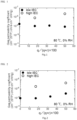
Claims (11)

  1. An anion exchange resin, comprising:
    a divalent hydrophobic group (a) comprising a bisphenol residue represented by following formula (1);
    a divalent hydrophobic group (b) being composed of a singular aromatic ring, or being composed of a plurality of aromatic rings which are bonded to each other via a divalent hydrocarbon group, a divalent silicon-containing group, a divalent nitrogen-containing group, a divalent phosphorus-containing group, a divalent oxygen-containing group, a divalent sulfur-containing group, or carbon-carbon bond; and
    a divalent hydrophilic group being composed of a singular aromatic ring, or being composed of a plurality of aromatic rings which are bonded to each other via a linking group and/or carbon-carbon bond, wherein the linking group is a divalent hydrocarbon group, a divalent silicon-containing group, a divalent nitrogen-containing group, a divalent phosphorus-containing group, a divalent oxygen-containing group, or a divalent sulfur-containing group, and at least one of the linking group or the aromatic ring is bonded to an anion exchange group via a divalent saturated hydrocarbon group having a carbon number of 2 or more;
    wherein the anion exchange resin comprises:
    a hydrophobic unit (a) being composed of the hydrophobic group (a) alone, or being composed of a plurality of the hydrophobic groups (a) repeated via ether bond, thioether bond, or carbon-carbon bond;
    a hydrophobic unit (b) being composed of the hydrophobic group (b) alone, or being composed of a plurality of the hydrophobic groups (b) repeated via ether bond, thioether bond, or carbon-carbon bond; and
    a hydrophilic unit being composed of the hydrophilic group alone, or being composed of a plurality of the hydrophilic groups repeated via ether bond, thioether bond, or carbon-carbon bond; and
    wherein the hydrophobic unit (a), the hydrophobic unit (b), and the hydrophilic unit are bonded via ether bond, thioether bond, or carbon-carbon bond.
    Figure imgb0084
    (In the formula, Alk are same or different from each other and represent an alkyl group or an aryl group; R represents a divalent hydrocarbon group forming an alicyclic structure; and a, b, c, and d are same or different from each other and represent an integer of 0 to 4.)
  2. The anion exchange resin according to claim 1,
    wherein the hydrophobic group (a) comprises a bisphenol residue represented by following formula (1').
    Figure imgb0085
    (In the formula, l represents an integer of 2 or more.)
  3. The anion exchange resin according to claim 1,
    wherein the hydrophobic group (b) comprises a bisphenol residue represented by following formula (2).
    Figure imgb0086
    (In the formula, Alk' are same or different from each other and represent an alkyl group or an aryl group; a', b', c', and d' are same or different from each other and represent an integer of 0 to 4; and l' represents an integer of 1 or more.)
  4. The anion exchange resin according to claim 3,
    wherein the hydrophobic group (b) comprises a bisphenol residue represented by following formula (2').
    Figure imgb0087
    (In the formula, l' represents an integer of 1 or more.)
  5. The anion exchange resin according to claim 1,
    wherein the hydrophobic group (b) comprises a bisphenol residue represented by following formula (3).
    Figure imgb0088
    (In the formula, Alk" are same or different from each other and represent an alkyl group or an aryl group; a", b", c", and d" are same or different from each other and represent an integer of 0 to 4; and l" represents an integer of 1 or more.)
  6. The anion exchange resin according to claim 5,
    wherein the hydrophobic group (b) comprises a bisphenol residue represented by following formula (3').
    Figure imgb0089
    (In the formula, l" represents an integer of 1 or more.)
  7. The anion exchange resin according to claim 1,
    wherein the hydrophilic group is composed of a singular polycyclic compound, or is composed of a plurality of polycyclic compounds which are bonded to each other via a linking group and/or carbon-carbon bond, wherein the linking group is a divalent hydrocarbon group, a divalent silicon-containing group, a divalent nitrogen-containing group, a divalent phosphorus-containing group, a divalent oxygen-containing group, or a divalent sulfur-containing group, and at least one of the linking group or the polycyclic compound is bonded to an anion exchange group via a divalent saturated hydrocarbon group having a carbon number of 2 or more.
  8. The anion exchange resin according to claim 7,
    wherein the hydrophilic group is a fluorene residue represented by following formula (4).
    Figure imgb0090
    (In the formula, A are same or different from each other and represent an anion exchange group-containing group or an anion exchange group-containing cyclic structure.)
  9. An electrolyte membrane, comprising an anion exchange resin according to any one of claims 1 to 8.
  10. A binder for forming an electrode catalyst layer, comprising an anion exchange resin according to any one of claims 1 to 8.
  11. A battery electrode catalyst layer, comprising a binder for forming an electrode catalyst layer according to claim 10.
EP23839454.8A 2022-07-15 2023-06-27 Anion exchange resin, electrolyte membrane, binder for forming electrode catalyst layer, and battery electrode catalyst layer Pending EP4556510A1 (en)

Applications Claiming Priority (2)

Application Number Priority Date Filing Date Title
JP2022113963A JP2024011720A (en) 2022-07-15 2022-07-15 Anion exchange resin, electrolyte membrane, binder for forming electrode catalyst layer, and battery electrode catalyst layer
PCT/JP2023/023786 WO2024014280A1 (en) 2022-07-15 2023-06-27 Anion exchange resin, electrolyte membrane, binder for forming electrode catalyst layer, and battery electrode catalyst layer

Publications (1)

Publication Number Publication Date
EP4556510A1 true EP4556510A1 (en) 2025-05-21

Family

ID=89536679

Family Applications (1)

Application Number Title Priority Date Filing Date
EP23839454.8A Pending EP4556510A1 (en) 2022-07-15 2023-06-27 Anion exchange resin, electrolyte membrane, binder for forming electrode catalyst layer, and battery electrode catalyst layer

Country Status (6)

Country Link
US (1) US20250353950A1 (en)
EP (1) EP4556510A1 (en)
JP (1) JP2024011720A (en)
CN (1) CN119562982A (en)
CA (1) CA3252682A1 (en)
WO (1) WO2024014280A1 (en)

Families Citing this family (2)

* Cited by examiner, † Cited by third party
Publication number Priority date Publication date Assignee Title
WO2025169754A1 (en) * 2024-02-05 2025-08-14 日本化薬株式会社 Electrolyte membrane and catalyst-coated electrolyte membrane
WO2026004900A1 (en) * 2024-06-28 2026-01-02 国立大学法人東京科学大学 Polymer, electrolyte membrane, membrane electrode assembly, fuel cell, and water electrolysis device

Family Cites Families (6)

* Cited by examiner, † Cited by third party
Publication number Priority date Publication date Assignee Title
JP2005232315A (en) * 2004-02-19 2005-09-02 Jsr Corp Polymer electrolyte and proton conducting membrane
JP6653434B2 (en) * 2015-09-22 2020-02-26 国立大学法人山梨大学 Method for producing anion exchange resin, method for producing electrolyte membrane for fuel cell, method for producing binder for forming electrode catalyst layer, method for producing battery electrode catalyst layer, and method for producing fuel cell
JP6842020B2 (en) 2017-07-24 2021-03-17 国立大学法人山梨大学 Anion exchange resin, electrolyte membrane, binder for forming electrode catalyst layer, battery electrode catalyst layer and fuel cell
JP7513970B2 (en) * 2020-07-16 2024-07-10 国立大学法人山梨大学 Method for producing anion exchange resin and method for producing electrolyte membrane
JP7513971B2 (en) * 2020-07-16 2024-07-10 国立大学法人山梨大学 Method for producing anion exchange resin and method for producing electrolyte membrane
CN113801300B (en) * 2021-09-30 2024-03-22 惠州亿纬氢能有限公司 Anion exchange polymer, preparation method and application thereof

Also Published As

Publication number Publication date
US20250353950A1 (en) 2025-11-20
WO2024014280A1 (en) 2024-01-18
CN119562982A (en) 2025-03-04
JP2024011720A (en) 2024-01-25
CA3252682A1 (en) 2025-07-09

Similar Documents

Publication Publication Date Title
Hu et al. Elucidating the role of alkyl chain in poly (aryl piperidinium) copolymers for anion exchange membrane fuel cells
US8809483B1 (en) Functionalization of poly(phenylene) by the attachment of sidechains
EP4556510A1 (en) Anion exchange resin, electrolyte membrane, binder for forming electrode catalyst layer, and battery electrode catalyst layer
US10734663B2 (en) Anion exchange resin, electrolyte membrane, binder for forming electrode catalyst layer, fuel cell electrode catalyst layer and fuel cell
JP6653434B2 (en) Method for producing anion exchange resin, method for producing electrolyte membrane for fuel cell, method for producing binder for forming electrode catalyst layer, method for producing battery electrode catalyst layer, and method for producing fuel cell
US11154852B2 (en) Anion exchange resin, electrolyte membrane, binder for forming electrode catalyst layer, fuel cell electrode catalyst layer and fuel cell
US10727515B2 (en) Anion exchange resin, electrolyte membrane, binder for forming electrode catalyst layer, fuel cell electrode catalyst layer and fuel cell
US11173484B2 (en) Anion exchange resin, electrolyte membrane, binder for forming electrode catalyst layer, fuel cell electrode catalyst layer and fuel cell
WO2015141450A1 (en) Anion exchange resin, electrolyte membrane for fuel cells, binder for forming electrode catalyst layer, battery electrode catalyst layer, and fuel cell
US20120296065A1 (en) Polyarylene ionomers membranes
JP7513970B2 (en) Method for producing anion exchange resin and method for producing electrolyte membrane
EP4332145A1 (en) Anion exchange resin and electrolyte membrane
JP7513971B2 (en) Method for producing anion exchange resin and method for producing electrolyte membrane
WO2019131932A1 (en) Polyphenylene compound
JP6166438B2 (en) Anion exchange resin, electrolyte membrane for fuel cell, binder for electrode catalyst layer formation, battery electrode catalyst layer and fuel cell
EP4556509A1 (en) Cation exchange resin, cation exchange membrane, electrolyte membrane, binder for forming electrode catalyst layer, and battery electrode catalyst layer
US7981567B2 (en) Polymer having oxocarbon group, and use thereof
US20090136819A1 (en) Fuel Cell-Purpose Electrolyte Material and Production Method Therefor
CA3205742C (en) Anion exchange resin and electrolyte membrane
JP2018135450A (en) Anion exchange resin, electrolyte layer, binder for forming electrode catalyst layer, battery electrode catalyst layer and fuel battery
EP4317257A1 (en) Polymer electrolyte membrane, block copolymer, polymer electrolyte material, polymer electrolyte molded body, electrolyte membrane with catalyst layer, membrane electrode composite, solid polymer fuel cell, and water electrolytic hydrogen generator
KR20250098912A (en) Ion conductive compound and method for preparing the same

Legal Events

Date Code Title Description
STAA Information on the status of an ep patent application or granted ep patent

Free format text: STATUS: THE INTERNATIONAL PUBLICATION HAS BEEN MADE

PUAI Public reference made under article 153(3) epc to a published international application that has entered the european phase

Free format text: ORIGINAL CODE: 0009012

STAA Information on the status of an ep patent application or granted ep patent

Free format text: STATUS: REQUEST FOR EXAMINATION WAS MADE

17P Request for examination filed

Effective date: 20241029

AK Designated contracting states

Kind code of ref document: A1

Designated state(s): AL AT BE BG CH CY CZ DE DK EE ES FI FR GB GR HR HU IE IS IT LI LT LU LV MC ME MK MT NL NO PL PT RO RS SE SI SK SM TR

DAV Request for validation of the european patent (deleted)
DAX Request for extension of the european patent (deleted)