EP4556334A1 - Control device and control method - Google Patents
Control device and control method Download PDFInfo
- Publication number
- EP4556334A1 EP4556334A1 EP23744548.1A EP23744548A EP4556334A1 EP 4556334 A1 EP4556334 A1 EP 4556334A1 EP 23744548 A EP23744548 A EP 23744548A EP 4556334 A1 EP4556334 A1 EP 4556334A1
- Authority
- EP
- European Patent Office
- Prior art keywords
- vehicle speed
- speed control
- rotational operation
- straddle
- information
- Prior art date
- Legal status (The legal status is an assumption and is not a legal conclusion. Google has not performed a legal analysis and makes no representation as to the accuracy of the status listed.)
- Pending
Links
Images


Classifications
-
- B—PERFORMING OPERATIONS; TRANSPORTING
- B60—VEHICLES IN GENERAL
- B60W—CONJOINT CONTROL OF VEHICLE SUB-UNITS OF DIFFERENT TYPE OR DIFFERENT FUNCTION; CONTROL SYSTEMS SPECIALLY ADAPTED FOR HYBRID VEHICLES; ROAD VEHICLE DRIVE CONTROL SYSTEMS FOR PURPOSES NOT RELATED TO THE CONTROL OF A PARTICULAR SUB-UNIT
- B60W50/00—Details of control systems for road vehicle drive control not related to the control of a particular sub-unit, e.g. process diagnostic or vehicle driver interfaces
- B60W50/08—Interaction between the driver and the control system
- B60W50/12—Limiting control by the driver depending on vehicle state, e.g. interlocking means for the control input for preventing unsafe operation
-
- B—PERFORMING OPERATIONS; TRANSPORTING
- B60—VEHICLES IN GENERAL
- B60W—CONJOINT CONTROL OF VEHICLE SUB-UNITS OF DIFFERENT TYPE OR DIFFERENT FUNCTION; CONTROL SYSTEMS SPECIALLY ADAPTED FOR HYBRID VEHICLES; ROAD VEHICLE DRIVE CONTROL SYSTEMS FOR PURPOSES NOT RELATED TO THE CONTROL OF A PARTICULAR SUB-UNIT
- B60W30/00—Purposes of road vehicle drive control systems not related to the control of a particular sub-unit, e.g. of systems using conjoint control of vehicle sub-units
- B60W30/14—Adaptive cruise control
- B60W30/143—Speed control
-
- B—PERFORMING OPERATIONS; TRANSPORTING
- B62—LAND VEHICLES FOR TRAVELLING OTHERWISE THAN ON RAILS
- B62J—CYCLE SADDLES OR SEATS; AUXILIARY DEVICES OR ACCESSORIES SPECIALLY ADAPTED TO CYCLES AND NOT OTHERWISE PROVIDED FOR, e.g. ARTICLE CARRIERS OR CYCLE PROTECTORS
- B62J45/00—Electrical equipment arrangements specially adapted for use as accessories on cycles, not otherwise provided for
- B62J45/20—Cycle computers as cycle accessories
-
- B—PERFORMING OPERATIONS; TRANSPORTING
- B62—LAND VEHICLES FOR TRAVELLING OTHERWISE THAN ON RAILS
- B62K—CYCLES; CYCLE FRAMES; CYCLE STEERING DEVICES; RIDER-OPERATED TERMINAL CONTROLS SPECIALLY ADAPTED FOR CYCLES; CYCLE AXLE SUSPENSIONS; CYCLE SIDECARS, FORECARS, OR THE LIKE
- B62K11/00—Motorcycles, engine-assisted cycles or motor scooters with one or two wheels
- B62K11/14—Handlebar constructions, or arrangements of controls thereon, specially adapted thereto
-
- B—PERFORMING OPERATIONS; TRANSPORTING
- B62—LAND VEHICLES FOR TRAVELLING OTHERWISE THAN ON RAILS
- B62K—CYCLES; CYCLE FRAMES; CYCLE STEERING DEVICES; RIDER-OPERATED TERMINAL CONTROLS SPECIALLY ADAPTED FOR CYCLES; CYCLE AXLE SUSPENSIONS; CYCLE SIDECARS, FORECARS, OR THE LIKE
- B62K23/00—Rider-operated controls specially adapted for cycles, i.e. means for initiating control operations, e.g. levers, grips
- B62K23/02—Rider-operated controls specially adapted for cycles, i.e. means for initiating control operations, e.g. levers, grips hand actuated
- B62K23/04—Twist grips
-
- B—PERFORMING OPERATIONS; TRANSPORTING
- B62—LAND VEHICLES FOR TRAVELLING OTHERWISE THAN ON RAILS
- B62M—RIDER PROPULSION OF WHEELED VEHICLES OR SLEDGES; POWERED PROPULSION OF SLEDGES OR SINGLE-TRACK CYCLES; TRANSMISSIONS SPECIALLY ADAPTED FOR SUCH VEHICLES
- B62M7/00—Motorcycles characterised by position of motor or engine
- B62M7/02—Motorcycles characterised by position of motor or engine with engine between front and rear wheels
-
- B—PERFORMING OPERATIONS; TRANSPORTING
- B60—VEHICLES IN GENERAL
- B60T—VEHICLE BRAKE CONTROL SYSTEMS OR PARTS THEREOF; BRAKE CONTROL SYSTEMS OR PARTS THEREOF, IN GENERAL; ARRANGEMENT OF BRAKING ELEMENTS ON VEHICLES IN GENERAL; PORTABLE DEVICES FOR PREVENTING UNWANTED MOVEMENT OF VEHICLES; VEHICLE MODIFICATIONS TO FACILITATE COOLING OF BRAKES
- B60T2201/00—Particular use of vehicle brake systems; Special systems using also the brakes; Special software modules within the brake system controller
- B60T2201/04—Hill descent control
-
- B—PERFORMING OPERATIONS; TRANSPORTING
- B60—VEHICLES IN GENERAL
- B60W—CONJOINT CONTROL OF VEHICLE SUB-UNITS OF DIFFERENT TYPE OR DIFFERENT FUNCTION; CONTROL SYSTEMS SPECIALLY ADAPTED FOR HYBRID VEHICLES; ROAD VEHICLE DRIVE CONTROL SYSTEMS FOR PURPOSES NOT RELATED TO THE CONTROL OF A PARTICULAR SUB-UNIT
- B60W2300/00—Indexing codes relating to the type of vehicle
- B60W2300/36—Cycles; Motorcycles; Scooters
-
- B—PERFORMING OPERATIONS; TRANSPORTING
- B60—VEHICLES IN GENERAL
- B60W—CONJOINT CONTROL OF VEHICLE SUB-UNITS OF DIFFERENT TYPE OR DIFFERENT FUNCTION; CONTROL SYSTEMS SPECIALLY ADAPTED FOR HYBRID VEHICLES; ROAD VEHICLE DRIVE CONTROL SYSTEMS FOR PURPOSES NOT RELATED TO THE CONTROL OF A PARTICULAR SUB-UNIT
- B60W2520/00—Input parameters relating to overall vehicle dynamics
- B60W2520/10—Longitudinal speed
-
- B—PERFORMING OPERATIONS; TRANSPORTING
- B60—VEHICLES IN GENERAL
- B60W—CONJOINT CONTROL OF VEHICLE SUB-UNITS OF DIFFERENT TYPE OR DIFFERENT FUNCTION; CONTROL SYSTEMS SPECIALLY ADAPTED FOR HYBRID VEHICLES; ROAD VEHICLE DRIVE CONTROL SYSTEMS FOR PURPOSES NOT RELATED TO THE CONTROL OF A PARTICULAR SUB-UNIT
- B60W2540/00—Input parameters relating to occupants
- B60W2540/10—Accelerator pedal position
-
- B—PERFORMING OPERATIONS; TRANSPORTING
- B60—VEHICLES IN GENERAL
- B60W—CONJOINT CONTROL OF VEHICLE SUB-UNITS OF DIFFERENT TYPE OR DIFFERENT FUNCTION; CONTROL SYSTEMS SPECIALLY ADAPTED FOR HYBRID VEHICLES; ROAD VEHICLE DRIVE CONTROL SYSTEMS FOR PURPOSES NOT RELATED TO THE CONTROL OF A PARTICULAR SUB-UNIT
- B60W2552/00—Input parameters relating to infrastructure
- B60W2552/15—Road slope, i.e. the inclination of a road segment in the longitudinal direction
-
- B—PERFORMING OPERATIONS; TRANSPORTING
- B60—VEHICLES IN GENERAL
- B60W—CONJOINT CONTROL OF VEHICLE SUB-UNITS OF DIFFERENT TYPE OR DIFFERENT FUNCTION; CONTROL SYSTEMS SPECIALLY ADAPTED FOR HYBRID VEHICLES; ROAD VEHICLE DRIVE CONTROL SYSTEMS FOR PURPOSES NOT RELATED TO THE CONTROL OF A PARTICULAR SUB-UNIT
- B60W2720/00—Output or target parameters relating to overall vehicle dynamics
- B60W2720/10—Longitudinal speed
-
- B—PERFORMING OPERATIONS; TRANSPORTING
- B62—LAND VEHICLES FOR TRAVELLING OTHERWISE THAN ON RAILS
- B62L—BRAKES SPECIALLY ADAPTED FOR CYCLES
- B62L3/00—Brake-actuating mechanisms; Arrangements thereof
- B62L3/02—Brake-actuating mechanisms; Arrangements thereof for control by a hand lever
- B62L3/023—Brake-actuating mechanisms; Arrangements thereof for control by a hand lever acting on fluid pressure systems
-
- B—PERFORMING OPERATIONS; TRANSPORTING
- B62—LAND VEHICLES FOR TRAVELLING OTHERWISE THAN ON RAILS
- B62L—BRAKES SPECIALLY ADAPTED FOR CYCLES
- B62L3/00—Brake-actuating mechanisms; Arrangements thereof
- B62L3/04—Brake-actuating mechanisms; Arrangements thereof for control by a foot lever
Definitions
- the present invention relates to a controller and a control method capable of improving operability of a straddle-type vehicle.
- a driver-assistance system As a conventional technique related to a straddle-type vehicle such as a motorcycle, a technique of assisting with driving by a rider has been available.
- a driver-assistance system is disclosed in PTL 1.
- the driver-assistance system warns the rider of the motorcycle that the motorcycle inappropriately approaches an obstacle on the basis of information detected by a sensor device that detects the obstacle present in a travel direction or substantially in the travel direction.
- the technique of assisting with driving by the rider of the straddle-type vehicle there is a technique of automatically suppressing a vehicle speed of the straddle-type vehicle to be low at the time when the straddle-type vehicle travels on a downhill road. More specifically, such a technique is vehicle speed control for controlling the vehicle speed of the straddle-type vehicle on the basis of a target vehicle speed in the case where it is determined that the straddle-type vehicle travels on the downhill road.
- the invention has been made with the above-described problem as the background and therefore obtains a controller and a control method capable of improving operability of a straddle-type vehicle.
- a controller is a controller that controls behavior of a straddle-type vehicle, and includes an execution section that executes a control mode in which vehicle speed control is enabled in response to a first trigger and the vehicle speed control is disabled in response to a second trigger.
- a vehicle speed of the straddle-type vehicle is controlled on the basis of a target vehicle speed in the case where it is determined that the straddle-type vehicle travels on a downhill road.
- the execution section executes the control mode on the basis of rotational operation information as information on a rotational operation to rotate an accelerator grip, which is located at a reference position in an unloaded state by the rider of the straddle-type vehicle and changes drive power generated to the straddle-type vehicle when being rotated within an angle range located in a first direction with the reference position being a reference, within an angle range located in a second direction as a reverse direction from the first direction with the reference position being the reference.
- a control method is a control method for controlling behavior of a straddle-type vehicle, and includes: executing a control mode in which vehicle speed control is enabled in response to a first trigger and the vehicle speed control is disabled in response to a second trigger by an execution section of a controller, in the vehicle speed control, a vehicle speed of the straddle-type vehicle being controlled on the basis of a target vehicle speed in the case where it is determined that the straddle-type vehicle travels on a downhill road; and executing the control mode by the execution section on the basis of rotational operation information as information on a rotational operation to rotate an accelerator grip, which is located at a reference position in an unloaded state by a rider of the straddle-type vehicle and changes drive power generated to the straddle-type vehicle when being rotated within an angle range located in a first direction with the reference position being a reference, within an angle range located in a second direction as a reverse direction from the first direction with the reference position being the reference.
- the execution section of the controller executes the control mode in which the vehicle speed control is enabled in response to the first trigger and the vehicle speed control is disabled in response to the second trigger.
- the vehicle speed control the vehicle speed of the straddle-type vehicle is controlled on the basis of the target vehicle speed in the case where it is determined that the straddle-type vehicle travels on the downhill road.
- the execution section executes the control mode on the basis of the rotational operation information as the information on the rotational operation to rotate the accelerator grip, which is located at the reference position in the unloaded state by the rider of the straddle-type vehicle and changes the drive power generated to the straddle-type vehicle when being rotated within the angle range located in the first direction with the reference position being the reference, within the angle range located in the second direction as the reverse direction from the first direction with the reference position being the reference.
- the rider can use the vehicle speed control with an intuitive or simple operation and thus can improve operability of the operation related to the vehicle speed control. Therefore, it is possible to improve operability of the straddle-type vehicle.
- a vehicle as a control target of the controller according to the invention only needs to be a straddle-type vehicle, and may be a straddle-type vehicle other than the two-wheeled motorcycle.
- the straddle-type vehicle means a vehicle that a rider straddles.
- Examples of the straddle-type vehicle are motorcycles (a two-wheeled motor vehicle and a three-wheeled motor vehicle) and an all-terrain vehicle.
- the motorcycles include a vehicle having an engine as a power source, a vehicle having an electric motor as the power source, and the like. Examples of the motorcycles are a motorbike, a scooter, and an electric scooter.
- the engine (more specifically, an engine 11 in Fig. 1 , which will be described below) is mounted as a drive source that can output power for driving a wheel.
- a drive source other than the engine (for example, an electric motor) may be mounted, or plural drive sources may be mounted.
- a hydraulic pressure control unit for braking the wheel by using a brake fluid (more specifically, a hydraulic pressure control unit 12 in Fig. 1 , which will be described below) is adopted as a mechanism that brakes the straddle-type vehicle.
- the mechanism that brakes the straddle-type vehicle may be a mechanism other than the hydraulic pressure control unit.
- a mechanism that brakes the straddle-type vehicle a mechanism that brakes the wheel by using electric power may be adopted.
- a mechanism that brakes the wheel by using the electric motor capable of outputting the power for driving the wheel may be adopted.
- the controller and the control method according to the invention are not limited to a case with such a configuration, such operation, and the like.
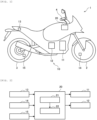
- Fig. 1 is a schematic view illustrating an outline configuration of the straddle-type vehicle 1.
- the straddle-type vehicle 1 is a two-wheeled motorcycle that corresponds to an example of the straddle-type vehicle according to the invention.
- the straddle-type vehicle 1 includes a front wheel 2, a rear wheel 3, a handlebar 4, the engine 11, the hydraulic pressure control unit 12, an inertial measurement unit (IMU) 13, a front-wheel rotational frequency sensor 14, a rear-wheel rotational frequency sensor 15, and a controller (ECU) 20.
- IMU inertial measurement unit
- ECU controller
- the engine 11 corresponds to an example of the drive source for the straddle-type vehicle 1, and can output power for driving a drive wheel (more specifically, the rear wheel 3).
- the engine 11 is provided with: one or plural cylinders, each of which is formed with a combustion chamber therein; a fuel injector that injects fuel into the combustion chamber; and an ignition plug.
- a fuel injector that injects fuel into the combustion chamber
- an ignition plug When the fuel is injected from the fuel injector, air-fuel mixture containing air and the fuel is produced in the combustion chamber, and the air-fuel mixture is then ignited by the ignition plug and burned. Consequently, a piston provided in the cylinder reciprocates to cause a crankshaft to rotate.
- a throttle valve is provided to an intake pipe of the engine 11, and an intake air amount to the combustion chamber varies according to a throttle opening amount as an opening amount of the throttle valve.
- the hydraulic pressure control unit 12 is a unit that has a function of controlling a braking force generated on the wheel.
- the hydraulic pressure control unit 12 includes components (for example, a control valve and a pump) that are provided on an oil channel connecting a master cylinder and a wheel cylinder and control a brake hydraulic pressure in the wheel cylinder.
- the braking force generated on the wheel is controlled when operation of the components in the hydraulic pressure control unit 12 is controlled.
- a detailed description on a brake system 10 that includes the hydraulic pressure control unit 12 will be made below.
- the inertial measurement unit 13 includes a three-axis gyroscope sensor and a three-directional acceleration sensor, and detects a posture of the straddle-type vehicle 1.
- the inertial measurement unit 13 is provided to a trunk of the straddle-type vehicle 1, for example.
- the inertial measurement unit 13 detects a pitch angle of the straddle-type vehicle 1 and outputs a detection result.
- the inertial measurement unit 13 may detect another physical quantity that can substantially be converted to the pitch angle of the straddle-type vehicle 1.
- the pitch angle corresponds to an angle representing a tilt in a vertical direction of a body (more specifically, the trunk) of the straddle-type vehicle 1 with respect to a horizontal direction.
- the pitch angle corresponds to an angle that represents how much the body of the straddle-type vehicle 1 rotates from the posture facing the horizontal direction in a pitch direction as a rotational direction with an axis in a vehicle right-left direction being a center.
- the inertial measurement unit 13 may only include parts of the three-axis gyroscope sensor and the three-directional acceleration sensor.
- the front-wheel rotational frequency sensor 14 is a wheel rotational frequency sensor that detects a rotational frequency of the front wheel 2 (for example, a rotational frequency of the front wheel 2 per unit time [rpm], a travel distance of the front wheel 2 per unit time [km/h], or the like), and outputs a detection result.
- the front-wheel rotational frequency sensor 14 may detect another physical quantity that can substantially be converted to the rotational frequency of the front wheel 2.
- the front-wheel rotational frequency sensor 14 is provided to the front wheel 2.
- the rear-wheel rotational frequency sensor 15 is a wheel rotational frequency sensor that detects a rotational frequency of the rear wheel 3 (for example, the rotational frequency of the rear wheel 3 per unit time [rpm], a travel distance of the rear wheel 3 per unit time [km/h], or the like), and outputs a detection result.
- the rear-wheel rotational frequency sensor 15 may detect another physical quantity that can substantially be converted to the rotational frequency of the rear wheel 3.
- the rear-wheel rotational frequency sensor 15 is provided to the rear wheel 3.
- the controller 20 controls behavior of the straddle-type vehicle 1.
- the controller 20 is partially or entirely be constructed of a microcomputer, a microprocessor unit, memory, or the like.
- the part of the controller 20 or the entire controller 20 may be one whose firmware and the like can be updated, or may be a program module or the like that is executed by a command from a CPU or the like, for example.
- the controller 20 may be provided as one unit or may be divided into plural units, for example.
- Fig. 2 is a block diagram illustrating an exemplary functional configuration of the controller 20. As illustrated in Fig. 2 , the controller 20 includes an acquisition section 21 and an execution section 22, for example. In addition, the controller 20 communicates with each of the devices in the straddle-type vehicle 1.
- the acquisition section 21 acquires information from each of the devices in the straddle-type vehicle 1, and outputs the acquired information to the execution section 22.
- the acquisition section 21 acquires information from the inertial measurement unit 13, the front-wheel rotational frequency sensor 14, and the rear-wheel rotational frequency sensor 15.
- the acquisition of the information can include extraction, generation, and the like of the information.
- the execution section 22 executes various types of control by controlling operation of each of the devices in the straddle-type vehicle 1. For example, the execution section 22 controls the operation of the engine 11 and the hydraulic pressure control unit 12.
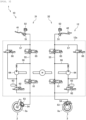
- Fig. 3 is a schematic view illustrating the outline configuration of the brake system 10 in the straddle-type vehicle 1.
- the brake system 10 has a front-wheel brake mechanism 31, a rear-wheel brake mechanism 32, a first brake operation section 41, and a second brake operation section 42.
- the first brake operation section 41 is a brake lever, for example.
- the front-wheel brake mechanism 31 brakes the front wheel 2 in an interlocking manner with at least the first brake operation section 41.
- the second brake operation section 42 is a brake pedal, for example.
- the rear-wheel brake mechanism 32 brakes the rear wheel 3 in an interlocking manner with at least the second brake operation section 42.
- the front-wheel brake mechanism 31 and the rear-wheel brake mechanism 32 are partially included in the hydraulic pressure control unit 12.
- Each of the front-wheel brake mechanism 31 and the rear-wheel brake mechanism 32 includes: a master cylinder 51 in which a piston (not illustrated) is installed; a reservoir 52 that is attached to the master cylinder 51; a brake caliper 53 that is held by the trunk of the straddle-type vehicle 1 and has a brake pad (not illustrated); a wheel cylinder 54 that is provided to the brake caliper 53; a primary channel 55 through which a brake fluid in the master cylinder 51 flows into the wheel cylinder 54; a secondary channel 56 through which the brake fluid in the wheel cylinder 54 is released; and a supply channel 57 through which the brake fluid in the master cylinder 51 is supplied to the secondary channel 56.
- An inlet valve (EV) 61 is provided to the primary channel 55.
- the secondary channel 56 bypasses a portion of the primary channel 55 between the wheel cylinder 54 side and the master cylinder 51 side of the inlet valve 61.
- the secondary channel 56 is sequentially provided with an outlet valve (AV) 62, an accumulator 63, and a pump 64 from an upstream side.
- a first valve (USV) 65 is provided between an end portion on the master cylinder 51 side of the primary channel 55 and a portion of the primary channel 55 to which a downstream end portion of the secondary channel 56 is connected.
- the supply channel 57 communicates between the master cylinder 51 and a portion on a suction side of the pump 64 in the secondary channel 56.
- a second valve (HSV) 66 is provided to the supply channel 57.
- the inlet valve 61 is an electromagnetic valve that is opened in an unenergized state and is closed in an energized state, for example.
- the outlet valve 62 is an electromagnetic valve that is closed in an unenergized state and is opened in an energized state, for example.
- the first valve 65 is an electromagnetic valve that is opened in an unenergized state and is closed in an energized state, for example.
- the second valve 66 is an electromagnetic valve that is closed in an unenergized state and is opened in an energized state, for example.
- the hydraulic pressure control unit 12 includes: components such as the inlet valves 61, the outlet valves 62, the accumulators 63, the pumps 64, the first valves 65, and the second valves 66 used to control the brake hydraulic pressure; and a base body 12a to which those components are provided and in which channels constituting the primary channels 55, the secondary channels 56, and the supply channels 57 are formed.
- the base body 12a may be formed of one member or may be formed of plural members. In addition, in the case where the base body 12a is formed of the plural members, the components may separately be provided to the different members.
- the operation of the above components in the hydraulic pressure control unit 12 is controlled by the execution section 22 of the controller 20. As a result, the braking force generated on the front wheel 2 by the front-wheel brake mechanism 31 and the braking force generated on the rear wheel 3 by the rear-wheel brake mechanism 32 are controlled.
- the controller 20 opens the inlet valve 61, closes the outlet valve 62, opens the first valve 65, and closes the second valve 66.
- the piston (not illustrated) in the master cylinder 51 is pressed to increase the hydraulic pressure of the brake fluid in the wheel cylinder 54, the brake pad (not illustrated) of the brake caliper 53 is then pressed against a rotor 2a of the front wheel 2, and the braking force is thereby generated on the front wheel 2.
- the piston (not illustrated) in the master cylinder 51 is pressed to increase the hydraulic pressure of the brake fluid in the wheel cylinder 54, the brake pad (not illustrated) of the brake caliper 53 is then pressed against a rotor 3a of the rear wheel 3, and the braking force is thereby generated on the rear wheel 3.
- the execution section 22 can execute vehicle speed control for controlling a vehicle speed of the straddle-type vehicle 1 on the basis of a target vehicle speed in the case where it is determined that the straddle-type vehicle 1 travels on a downhill road.
- the vehicle speed control is control for automatically suppressing the vehicle speed of the straddle-type vehicle 1 to be low at the time when the straddle-type vehicle 1 travels on the downhill road.
- the execution section 22 reduces the vehicle speed of the straddle-type vehicle 1 to the target vehicle speed and maintains the vehicle speed of the straddle-type vehicle 1 at the target vehicle speed.
- the execution section 22 can appropriately execute the vehicle speed control on the basis of the vehicle speed of the straddle-type vehicle 1 that is acquired on the basis of the detection result of the front-wheel rotational frequency sensor 14 and the detection result of the rear-wheel rotational frequency sensor 15, for example.
- the vehicle speed control can correspond to control referred to as hill descent control.
- the execution section 22 brings the straddle-type vehicle 1 into a state where the inlet valve 61 is opened, the outlet valve 62 is closed, the first valve 65 is closed, and the second valve 66 is opened, and drives the pump 64 in such a state.
- the execution section 22 increases the hydraulic pressure of the brake fluid in the wheel cylinder 54, and can thereby generate the braking force on the wheel.
- the execution section 22 can maintain the hydraulic pressure of the brake fluid in the wheel cylinder 54 and can thereby maintain the braking force generated on the wheel.
- the execution section 22 can reduce the vehicle speed of the straddle-type vehicle 1 to the target vehicle speed and can thereby maintain the vehicle speed of the straddle-type vehicle 1 at the target vehicle speed.
- the execution section 22 controls the engine 11 in a manner to increase the vehicle speed of the straddle-type vehicle 1 to the target vehicle speed.
- the execution section 22 may brake both of the front wheel 2 and the rear wheel 3 or may brake only one of the front wheel 2 and the rear wheel 3.
- the hydraulic pressure control unit 12 may only control the braking force generated on one of the front wheel 2 and the rear wheel 3.
- the hydraulic pressure control unit 12 may not include the supply channel 57, the first valve 65, and the second valve 66.
- the execution section 22 can execute the vehicle speed control.
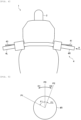
- Fig. 4 is a schematic view illustrating an outline configuration of the handlebar 4 and the surroundings thereof. More specifically, Fig. 4 is a view in which an upper front portion of the straddle-type vehicle 1 is seen from vertically above.
- the handlebar 4 includes a right grip 4R and a left grip 4L.
- the handlebar 4 extends in a vehicle width direction.
- the right grip 4R is formed in a right end portion of the handlebar 4 and is grasped by the rider's right hand during travel.
- the left grip 4L is formed in a left end portion of the handlebar 4 and is grasped by the rider's left hand during the travel.
- the right grip 4R is an accelerator grip that is used for an accelerator operation (that is, an operation to accelerate the straddle-type vehicle 1) by the rider. An operation to rotate the accelerator grip corresponds to the accelerator operation.
- the right grip 4R will also be referred to as an accelerator grip 4R.
- the first brake operation section 41 is provided near the right grip (the accelerator grip) 4R.
- the rider can grip the first brake operation section 41 with his/her right hand.
- An operation to grip the first brake operation section 41 corresponds to the brake operation (that is, an operation to decelerate the straddle-type vehicle 1).
- An operation to depress the above-described second brake operation section 42 also corresponds to the brake operation.
- a clutch operation section 43 is provided near the left grip 4L.
- the clutch operation section 43 is a clutch lever, for example.
- the rider can grip the clutch operation section 43 with his/her left hand.
- An operation to grip the clutch operation section 43 corresponds to a clutch operation (that is, an operation to release a clutch that connects/disconnects power transmission from the engine 11 to the drive wheel).
- Fig. 5 is a schematic view illustrating a rotational direction of the accelerator grip 4R. More specifically, Fig. 5 is a view in which the accelerator grip 4R is seen in a direction of an arrow A in Fig. 4 (that is, a view in which the accelerator grip 4R is seen from a vehicle right side along an axial direction thereof).
- the accelerator grip 4R is cylindrical or columnar and rotatable about a center axis of the accelerator grip 4R.
- the accelerator grip 4R has such a structure that a rotational position of the accelerator grip 4R returns to a reference position P0 in an unloaded state by the rider (that is, a state where the accelerator grip 4R does not receive a load from the outside).
- a reference position P0 in an unloaded state by the rider
- Such a structure can be obtained by using a restoring force of a spring or the like, for example.
- the accelerator grip 4R is located at the reference position P0 in the unloaded state by the rider.
- the drive power generated to the straddle-type vehicle 1 is changed. More specifically, the drive power generated to the straddle-type vehicle 1 is minimized when the rotational position of the accelerator grip 4R is the reference position P0. Then, by rotating the accelerator grip 4R in the first direction D1 from the reference position P0, the drive power generated to the straddle-type vehicle 1 can be increased.
- the drive power generated to the straddle-type vehicle 1 is increased as a relative angle of the rotational position of the accelerator grip 4R to the reference position P0 is increased.
- the rotational position of the accelerator grip 4R is a position P1 in Fig. 5 (more specifically, a position to which the accelerator grip 4R is rotated in the first direction D1 from the reference position P0 by an angle 81)
- the drive power that corresponds to the angle ⁇ 1 is generated to the straddle-type vehicle 1. Accordingly.
- the drive power is increased when the accelerator grip 4R is rotated in the first direction D1, and the drive power is reduced when the accelerator grip 4R is rotated in a second direction D2 that is a reverse direction from the first direction D1 (more specifically, a clockwise direction when seen from the vehicle right side).
- the execution section 22 of the controller 20 can execute the vehicle speed control for controlling the vehicle speed of the straddle-type vehicle 1 on the basis of the target vehicle speed in the case where it is determined that the straddle-type vehicle 1 travels on the downhill road. More specifically, the execution section 22 executes a control mode in which the vehicle speed control is enabled in response to a first trigger and the vehicle speed control is disabled in response to a second trigger.
- the above control mode will also simply be referred to as the control mode.
- the accelerator grip 4R can be rotated in the second direction D2 as the reverse direction from the first direction D1 with the reference position P0 being the reference. Accordingly, the rider can perform a rotational operation to rotate the accelerator grip 4R to the second direction D2 side of the reference position P0 (that is, a rotational operation to rotate the accelerator grip 4R within the angle range located in the second direction D2 as the reverse direction from the first direction D1 with the reference position P0 being the reference).
- the above rotational operation will also simply be referred to as the rotational operation.
- the execution section 22 executes the above control mode on the basis of rotational operation information that is information on the rotational operation. In this way, as will be described below, operability of the straddle-type vehicle 1 is improved.
- first processing, second processing, and third processing as processing examples in each of which the control mode is executed on the basis of the rotational operation information.
- Fig. 6 is a flowchart illustrating an example of a first processing procedure that is executed by the controller 20.
- Step S101 in Fig. 6 corresponds to initiation of a control flow illustrated in Fig. 6 .
- the vehicle speed control is disabled.
- step S102 the execution section 22 determines whether a permission condition for the vehicle speed control is satisfied.
- the permission condition for the vehicle speed control is a condition to permit the vehicle speed control. If the permission condition for the vehicle speed control is satisfied, the vehicle speed control is permitted. On the other hand, if the permission condition for the vehicle speed control is not satisfied, the vehicle speed control is prohibited.
- the execution section 22 can determine whether the straddle-type vehicle 1 travels on the downhill road on the basis of the detection result of the inertial measurement unit 13.
- such a condition may be added that a degree of leaning of a travel road of the straddle-type vehicle 1 with respect to a horizontal direction of the travel road is greater than a reference degree.
- the reference degree is set to such a degree with which it is possible to determine whether the vehicle speed control has to be executed.
- the execution section 22 can determine whether the degree of leaning of the travel road of the straddle-type vehicle 1 with respect to the horizontal direction of the travel road is greater than the reference degree on the basis of a gradient of the travel road of the straddle-type vehicle 1.
- the gradient of the travel road of the straddle-type vehicle 1 can be acquired on the basis of the detection result of the inertial measurement unit 13, for example.
- step S102 If it is determined in step S102 that the permission condition for the vehicle speed control is not satisfied (step S102/NO), the processing in step S102 is repeated. On the other hand, if it is determined that the permission condition for the vehicle speed control is satisfied (step S102/YES), the processing proceeds to step S103.
- step S103 the execution section 22 determines whether the rotational operation information is information indicating that the rotational operation has been performed.
- the rotational operation information is output to the controller 20 from a sensor provided to the accelerator grip 4R, or the like, for example.
- the rotational operation information only needs to be information on the rotational operation and can include information on the rotational position of the accelerator grip 4R, for example.
- the rotational operation information may be output to the controller 20 from a device (for example, a camera that captures an image of the accelerator grip 4R, or the like) other than the sensor provided to the accelerator grip 4R.
- the rotational operation is an operation to rotate the accelerator grip 4R in the second direction D2 from the reference position P0.
- the rotational operation is an operation to rotate the accelerator grip 4R in the second direction D2 from the reference position P0 by a predetermined angle.
- an operation to rotate the accelerator grip 4R from the reference position P0 to a position P2 corresponds to the rotational operation.
- the rotational operation may be an operation to first rotate the accelerator grip 4R in the second direction D2 from the reference position P0 and thereafter slightly rotate the accelerator grip 4R back in the first direction D1.
- the rotational operation may be an operation that includes, in addition to the operation to rotate the accelerator grip 4R in the second direction D2 from the reference position P0 by the predetermined angle, an operation to thereafter rotate the accelerator grip 4R back in the first direction D1.
- the following operation corresponds to the rotational operation.
- the accelerator grip 4R is rotated from the reference position P0 to the position P2 and is thereafter rotated back in the first direction D1 to the reference position P0 or a position on the position P2 side of the reference position P0.
- step S103 If it is determined in step S103 illustrated in Fig. 6 that the rotational operation information is not the information indicating that the rotational operation has been performed (step S103/NO), the processing returns to step S102. On the other hand, if it is determined that the rotational operation information is the information indicating that the rotational operation has been performed (step S103/YES), the processing proceeds to step S104.
- step S104 the execution section 22 enables the vehicle speed control with the rotational operation as the first trigger. In this way, the vehicle speed control is initiated.
- the rotational operation is used as an initiation trigger of the vehicle speed control.
- the rider can initiate the vehicle speed control by performing the rotational operation.
- the execution section 22 reduces the vehicle speed of the straddle-type vehicle 1 to the target vehicle speed.
- the target vehicle speed is set according to the gradient of the travel road of the straddle-type vehicle 1, for example.
- the execution section 22 may change an initiation state of the vehicle speed control on the basis of the rotational operation information.
- the initiation state of the vehicle speed control is a control state at the initiation of the vehicle speed control.
- the execution section 22 may change the target vehicle speed at the initiation of the vehicle speed control on the basis of the rotational operation information.
- the execution section 22 may change the initiation state of the vehicle speed control on the basis of information on an operation amount of the rotational operation as the rotational operation information. For example, it is considered that, in the example illustrated in Fig. 5 , when the rotational operation is performed, the rotational position of the accelerator grip 4R further moves beyond the position P2 in the second direction D2. In this case, as the operation amount of the rotational operation, a rotational amount by which the accelerator grip 4R is further rotated in the second direction D2 with the position P2 being a reference can be used.
- the execution section 22 changes the target vehicle speed at the initiation of the vehicle speed control on the basis of the information on the operation amount of the rotational operation. More specifically, in the example illustrated in Fig. 5 , the execution section 22 may reduce the target vehicle speed at the initiation of the vehicle speed control as the above rotational amount is increased.
- the execution section 22 may change the initiation state of the vehicle speed control on the basis of information on a degree of a change in the operation amount of the rotational operation as the rotational operation information.
- a degree of a change in the operation amount of the rotational operation for example, an average rotational speed of the accelerator grip 4R can be used.
- the average rotational speed of the accelerator grip 4R may be the average rotational speed of the accelerator grip 4R at the time when the rotational position of the accelerator grip 4R moves from the reference position P0 to the position P2.
- the average rotational speed of the accelerator grip 4R may be the average rotational speed of the accelerator grip 4R in a period between initiation and termination of the movement of the accelerator grip 4R in the second direction D2.
- the execution section 22 changes the target vehicle speed at the initiation of the vehicle speed control on the basis of the information on the degree of the change in the operation amount of the rotational operation. More specifically, the execution section 22 may reduce the target vehicle speed at the initiation of the vehicle speed control as the average rotational speed of the accelerator grip 4R is increased.
- step S105 the execution section 22 determines whether a termination condition for the vehicle speed control is satisfied.
- the termination condition for the vehicle speed control is a condition to disable the vehicle speed control for termination.
- the termination condition for the vehicle speed control for example, such a condition is used that the brake operation or the accelerator operation is performed by the rider of the straddle-type vehicle 1. Even in the case where the brake operation or the accelerator operation is not performed, it is determined that the termination condition is satisfied when the initiation condition is no longer satisfied (for example, when the travel road of the straddle-type vehicle 1 becomes a flat road).
- step S105 If it is determined in step S105 that the termination condition for the vehicle speed control is not satisfied (step S105/NO), the processing in step S105 is repeated. On the other hand, if it is determined that the termination condition for the vehicle speed control is satisfied (step S105/YES), the processing proceeds to step S106.
- step S106 the execution section 22 disables the vehicle speed control by using, as the second trigger, a fact that the termination condition for the vehicle speed control is satisfied. In this way, the vehicle speed control is terminated. Then, after step S106, the processing returns to step S102.
- the execution section 22 enables the vehicle speed control with the rotational operation as the first trigger in the control mode.
- the rotational operation is used as the initiation trigger of the vehicle speed control.
- the rider can initiate the vehicle speed control by performing the rotational operation.
- the initiation trigger of the vehicle speed control such a case is considered that an operation other than the rotational operation is adopted.
- the second processing which will be described below, there is a case where an operation using an input device, such as a button, that is provided at a different location from the accelerator grip 4R is adopted as the initiation trigger of the vehicle speed control.
- an input device such as a button
- the rider has to remove his/her hand from the handlebar 4 and perform the operation using the input device.
- the rider can initiate the vehicle speed control with an intuitive and simple operation. Therefore, it is possible to improve operability of the operation related to the vehicle speed control.
- the execution section 22 changes the initiation state of the vehicle speed control on the basis of the rotational operation information in the case where the rotational operation is used as the initiation trigger of the vehicle speed control.
- the execution section 22 may change the initiation state of the vehicle speed control on the basis of the rotational operation information.
- Fig. 7 is a flowchart illustrating an example of a second processing procedure that is executed by the controller 20.
- Step S201 in Fig. 7 corresponds to initiation of a control flow illustrated in Fig. 7 .
- the vehicle speed control is disabled.
- step S202 the execution section 22 determines whether the permission condition for the vehicle speed control is satisfied.
- the processing in step S202 is the same as the processing in step S102 illustrated in Fig. 6 .
- step S202 If it is determined in step S202 that the permission condition for the vehicle speed control is not satisfied (step S202/NO), the processing in step S202 is repeated. On the other hand, if it is determined that the permission condition for the vehicle speed control is satisfied (step S202/YES), the processing proceeds to step S203.
- step S203 the execution section 22 determines whether the initiation condition for the vehicle speed control is satisfied.
- the initiation condition for the vehicle speed control is a condition to enable the vehicle speed control for initiation.
- the initiation condition for the vehicle speed control for example, such a condition is used that the operation using the input device, such as the button, that is provided at the different location from the accelerator grip 4R is performed by the rider of the straddle-type vehicle 1.
- step S203 If it is determined in step S203 that the initiation condition for the vehicle speed control is not satisfied (step S203/NO), the processing returns to step S202. On the other hand, if it is determined that the initiation condition for the vehicle speed control is satisfied (step S203/YES), the processing proceeds to step S204.
- step S204 the execution section 22 enables the vehicle speed control by using, as the first trigger, a fact that the initiation condition for the vehicle speed control is satisfied. In this way, the vehicle speed control is initiated.
- step S205 it is determined whether the rotational operation information is the information indicating that the rotational operation has been performed.
- the processing in step S205 is the same as the processing in step S103 illustrated in Fig. 6 .
- step S205 If it is determined in step S205 that the rotational operation information is not the information indicating that the rotational operation has been performed (step S205/NO), the processing in step S205 is repeated. On the other hand, if it is determined that the rotational operation information is the information indicating that the rotational operation has been performed (step S205/YES), the processing proceeds to step S206.
- step S206 the execution section 22 disables the vehicle speed control with the rotational operation as the second trigger. In this way, the vehicle speed control is terminated. Then, after step S206, the processing returns to step S202.
- the rotational operation is used as a termination trigger of the vehicle speed control. Thus, the rider can terminate the vehicle speed control by performing the rotational operation.
- the execution section 22 disables the vehicle speed control with the rotational operation as the second trigger in the control mode.
- the rotational operation is used as the termination trigger of the vehicle speed control.
- the rider can terminate the vehicle speed control by performing the rotational operation.
- the termination trigger of the vehicle speed control such a case is considered that an operation other than the rotational operation is adopted.
- the brake operation is adopted as the termination trigger of the vehicle speed control.
- the rider in order to terminate the vehicle speed control, the rider has to perform the brake operation, which is essentially the operation to brake the straddle-type vehicle 1.
- the thus-performed brake operation is hardly an intuitive operation for the rider.
- the accelerator operation may be adopted as the termination trigger of the vehicle speed control.
- the accelerator operation has to be performed in order to terminate the vehicle speed control.
- the thus-performed accelerator operation is hardly the intuitive operation for the rider.
- the rider can terminate the vehicle speed control by the intuitive operation with no sense of discomfort. Therefore, it is possible to improve the operability of the operation related to the vehicle speed control.
- Fig. 8 is a flowchart illustrating an example of a third processing procedure that is executed by the controller 20.
- Step S301 in Fig. 8 corresponds to initiation of a control flow illustrated in Fig. 8 .
- the control flow illustrated in Fig. 8 is executed during the execution of the vehicle speed control.
- step S302 the execution section 22 determines whether the rotational operation information is the information indicating that the rotational operation has been performed.
- the processing in step S302 is the same as the processing in step S103 illustrated in Fig. 6 .
- step S302 If it is determined in step S302 that the rotational operation information is not the information indicating that the rotational operation has been performed (step S302/NO), the processing in step S302 is repeated. On the other hand, if it is determined that the rotational operation information is the information indicating that the rotational operation has been performed (step S302/YES), the processing proceeds to step S303.
- step S303 the execution section 22 reduces the target vehicle speed for the vehicle speed control, and then the processing returns to step S302.
- the execution section 22 may change a continuous state of the vehicle speed control on the basis of the information on the rotational operation, which is performed during the execution of the vehicle speed control, as the rotational operation information.
- the continuous state of the vehicle speed control is a control state during the execution (that is, during continuation) of the vehicle speed control.
- the execution section 22 may change the target vehicle speed for the vehicle speed control on the basis of the information on the rotational operation, which is performed during the execution of the vehicle speed control, as the rotational operation information.
- the execution section 22 reduces the target vehicle speed for the vehicle speed control in the case where the rotational operation is performed during the execution of the vehicle speed control.
- the execution section 22 may increase the target vehicle speed for the vehicle speed control in the case where the rotational operation is performed during the execution of the vehicle speed control.
- the execution section 22 may change a change amount of the target vehicle speed on the basis of the rotational operation information.
- the execution section 22 may change the continuous state of the vehicle speed control on the basis of the information on the operation amount of the rotational operation as the rotational operation information. More specifically, when changing the target vehicle speed during the continuation of the vehicle speed control, the execution section 22 may change the change amount of the target vehicle speed on the basis of the operation amount of the rotational operation. For example, when changing the target vehicle speed during the continuation of the vehicle speed control, the execution section 22 may increase the change amount of the target vehicle speed as the operation amount of the rotational operation is increased.
- the execution section 22 may change the continuous state of the vehicle speed control on the basis of the information on the degree of the change in the operation amount of the rotational operation as the rotational operation information. More specifically, when changing the target vehicle speed during the continuation of the vehicle speed control, the execution section 22 may change the change amount of the target vehicle speed on the basis of the degree of the change in the operation amount of the rotational operation. For example, when changing the target vehicle speed during the continuation of the vehicle speed control, the execution section 22 may increase the change amount of the target vehicle speed as the degree of the change in the operation amount of the rotational operation is increased.
- the execution section 22 changes the continuous state of the vehicle speed control on the basis of the information on the rotational operation, which is performed during the execution of the vehicle speed control, as the rotational operation information. In this way, it is possible to change the continuous state of the vehicle speed control with the simple operation during the execution of the vehicle speed control. Therefore, it is possible to improve the operability of the operation related to the vehicle speed control.
- the first processing, the second processing, and the third processing may be executed independently or may be executed in combination.
- the rotational operation may be adopted as the initiation trigger of the vehicle speed control.
- the rotational operation may be adopted as the termination trigger of the vehicle speed control.
- the third processing may be executed during the execution of the vehicle speed control in the first processing (that is, in step S104 illustrated in Fig. 6 ).
- the third processing may be executed during the execution of the vehicle speed control in the second processing (that is, in step S204 illustrated in Fig. 7 ). Furthermore, for example, the third processing may be executed during the execution of the vehicle speed control in the case where the rotational operation is adopted as both of the initiation trigger and the termination trigger of the vehicle speed control.
- the execution section 22 executes the control mode in which the vehicle speed control is enabled in response to the first trigger and the vehicle speed control is disabled in response to the second trigger.
- the vehicle speed control the vehicle speed of the straddle-type vehicle 1 is controlled on the basis of the target vehicle speed in the case where it is determined that the straddle-type vehicle 1 travels on the downhill road.
- the execution section 22 executes the control mode on the basis of the rotational operation information as the information on the rotational operation to rotate the accelerator grip 4R, which is located at the reference position P0 in the unloaded state by the rider and changes the drive power generated to the straddle-type vehicle 1 when being rotated within the angle range located in the first direction D1 with the reference position P0 being the reference, within the angle range located in the second direction D2 as the reverse direction from the first direction D1 with the reference position P0 being the reference.
- the rider can use the vehicle speed control with the intuitive or simple operation and thus can improve the operability of the operation related to the vehicle speed control. Therefore, it is possible to improve the operability of the straddle-type vehicle 1.
- the execution section 22 enables the vehicle speed control with the rotational operation as the first trigger in the control mode.
- the rider can initiate the vehicle speed control with the intuitive and simple operation. Therefore, it is possible to appropriately improve the operability of the operation related to the vehicle speed control.
- the execution section 22 changes the initiation state of the vehicle speed control on the basis of the information on the operation amount of the rotational operation as the rotational operation information. In this way, it is possible to change the initiation state of the vehicle speed control with the simple operation at the initiation of the vehicle speed control. Therefore, it is possible to further effectively improve the operability of the operation related to the vehicle speed control.
- the execution section 22 changes the target vehicle speed at the initiation of the vehicle speed control on the basis of the information on the operation amount of the rotational operation as the rotational operation information. In this way, it is possible to change the target vehicle speed with the simple operation at the initiation of the vehicle speed control. Therefore, it is possible to further effectively improve the operability of the operation related to the vehicle speed control.
- the execution section 22 changes the initiation state of the vehicle speed control on the basis of the information on the degree of the change in the operation amount of the rotational operation as the rotational operation information. In this way, it is possible to change the initiation state of the vehicle speed control with the simple operation at the initiation of the vehicle speed control. Therefore, it is possible to further effectively improve the operability of the operation related to the vehicle speed control.
- the execution section 22 changes the target vehicle speed at the initiation of the vehicle speed control on the basis of the information on the degree of the change in the operation amount of the rotational operation as the rotational operation information. In this way, it is possible to change the target vehicle speed with the simple operation at the initiation of the vehicle speed control. Therefore, it is possible to further effectively improve the operability of the operation related to the vehicle speed control.
- the execution section 22 disables the vehicle speed control with the rotational operation as the second trigger in the control mode.
- the rider can terminate the vehicle speed control by the intuitive operation with no sense of discomfort. Therefore, it is possible to appropriately improve the operability of the operation related to the vehicle speed control.
- the execution section 22 changes the continuous state of the vehicle speed control on the basis of the information on the rotational operation, which is performed during the execution of the vehicle speed control, as the rotational operation information in the control mode. In this way, it is possible to change the continuous state of the vehicle speed control with the simple operation during the execution of the vehicle speed control. Therefore, it is possible to appropriately improve the operability of the operation related to the vehicle speed control.
- the execution section 22 changes the continuous state of the vehicle speed control on the basis of the information on the operation amount of the rotational operation as the rotational operation information. In this way, it is possible to appropriately change the continuous state of the vehicle speed control with the simple operation during the execution of the vehicle speed control. Therefore, it is possible to further effectively improve the operability of the operation related to the vehicle speed control.
- the execution section 22 changes the target vehicle speed during the continuation of the vehicle speed control on the basis of the information on the operation amount of the rotational operation as the rotational operation information. In this way, it is possible to change the target vehicle speed with the simple operation during the execution of the vehicle speed control. Therefore, it is possible to further effectively improve the operability of the operation related to the vehicle speed control.
- the execution section 22 changes the continuous state of the vehicle speed control on the basis of the information on the degree of the change in the operation amount of the rotational operation as the rotational operation information. In this way, it is possible to appropriately change the continuous state of the vehicle speed control with the simple operation during the execution of the vehicle speed control. Therefore, it is possible to further effectively improve the operability of the operation related to the vehicle speed control.
- the execution section 22 changes the target vehicle speed during the continuation of the vehicle speed control on the basis of the information on the degree of the change in the operation amount of the rotational operation as the rotational operation information. In this way, it is possible to change the target vehicle speed with the simple operation during the execution of the vehicle speed control. Therefore, it is possible to further effectively improve the operability of the operation related to the vehicle speed control.
- the invention is not limited to the embodiment that has been described. For example, only a part of the embodiment may be implemented.
Landscapes
- Engineering & Computer Science (AREA)
- Mechanical Engineering (AREA)
- Transportation (AREA)
- Automation & Control Theory (AREA)
- Chemical & Material Sciences (AREA)
- Combustion & Propulsion (AREA)
- Human Computer Interaction (AREA)
- Regulating Braking Force (AREA)
Abstract
Description
- The present invention relates to a controller and a control method capable of improving operability of a straddle-type vehicle.
- As a conventional technique related to a straddle-type vehicle such as a motorcycle, a technique of assisting with driving by a rider has been available. For example, a driver-assistance system is disclosed in
PTL 1. The driver-assistance system warns the rider of the motorcycle that the motorcycle inappropriately approaches an obstacle on the basis of information detected by a sensor device that detects the obstacle present in a travel direction or substantially in the travel direction. - PTL 1:
JP2009-116882A - By the way, as the technique of assisting with driving by the rider of the straddle-type vehicle, there is a technique of automatically suppressing a vehicle speed of the straddle-type vehicle to be low at the time when the straddle-type vehicle travels on a downhill road. More specifically, such a technique is vehicle speed control for controlling the vehicle speed of the straddle-type vehicle on the basis of a target vehicle speed in the case where it is determined that the straddle-type vehicle travels on the downhill road. Here, it is desired to improve operability of an operation related to the vehicle speed control in order to improve operability of the straddle-type vehicle.
- The invention has been made with the above-described problem as the background and therefore obtains a controller and a control method capable of improving operability of a straddle-type vehicle.
- A controller according to the invention is a controller that controls behavior of a straddle-type vehicle, and includes an execution section that executes a control mode in which vehicle speed control is enabled in response to a first trigger and the vehicle speed control is disabled in response to a second trigger. In the vehicle speed control, a vehicle speed of the straddle-type vehicle is controlled on the basis of a target vehicle speed in the case where it is determined that the straddle-type vehicle travels on a downhill road. The execution section executes the control mode on the basis of rotational operation information as information on a rotational operation to rotate an accelerator grip, which is located at a reference position in an unloaded state by the rider of the straddle-type vehicle and changes drive power generated to the straddle-type vehicle when being rotated within an angle range located in a first direction with the reference position being a reference, within an angle range located in a second direction as a reverse direction from the first direction with the reference position being the reference.
- A control method according to the invention is a control method for controlling behavior of a straddle-type vehicle, and includes: executing a control mode in which vehicle speed control is enabled in response to a first trigger and the vehicle speed control is disabled in response to a second trigger by an execution section of a controller, in the vehicle speed control, a vehicle speed of the straddle-type vehicle being controlled on the basis of a target vehicle speed in the case where it is determined that the straddle-type vehicle travels on a downhill road; and executing the control mode by the execution section on the basis of rotational operation information as information on a rotational operation to rotate an accelerator grip, which is located at a reference position in an unloaded state by a rider of the straddle-type vehicle and changes drive power generated to the straddle-type vehicle when being rotated within an angle range located in a first direction with the reference position being a reference, within an angle range located in a second direction as a reverse direction from the first direction with the reference position being the reference.
- In the controller and the control method according to the invention, the execution section of the controller executes the control mode in which the vehicle speed control is enabled in response to the first trigger and the vehicle speed control is disabled in response to the second trigger. In the vehicle speed control, the vehicle speed of the straddle-type vehicle is controlled on the basis of the target vehicle speed in the case where it is determined that the straddle-type vehicle travels on the downhill road. The execution section executes the control mode on the basis of the rotational operation information as the information on the rotational operation to rotate the accelerator grip, which is located at the reference position in the unloaded state by the rider of the straddle-type vehicle and changes the drive power generated to the straddle-type vehicle when being rotated within the angle range located in the first direction with the reference position being the reference, within the angle range located in the second direction as the reverse direction from the first direction with the reference position being the reference. In this way, the rider can use the vehicle speed control with an intuitive or simple operation and thus can improve operability of the operation related to the vehicle speed control. Therefore, it is possible to improve operability of the straddle-type vehicle.
-
-
Fig. 1 is a schematic view illustrating an outline configuration of a straddle-type vehicle according to an embodiment of the invention. -
Fig. 2 is a block diagram illustrating an exemplary functional configuration of a controller according to the embodiment of the invention. -
Fig. 3 is a schematic view illustrating an outline configuration of a brake system for the straddle-type vehicle according to the embodiment of the invention. -
Fig. 4 is a schematic view illustrating an outline configuration of a handlebar and surroundings thereof according to the embodiment of the invention. -
Fig. 5 is a schematic view illustrating a rotational direction of an accelerator grip according to the embodiment of the invention. -
Fig. 6 is a flowchart illustrating an example of a first processing procedure that is executed by the controller according to the embodiment of the invention. -
Fig. 7 is a flowchart illustrating an example of a second processing procedure that is executed by the controller according to the embodiment of the invention. -
Fig. 8 is a flowchart illustrating an example of a third processing procedure that is executed by the controller according to the embodiment of the invention. - A description will hereinafter be made on a controller and a control method according to the invention with reference to the drawings.
- Hereinafter, a description will be made on a controller that is used for a two-wheeled motorcycle (see a straddle-
type vehicle 1 inFig. 1 ). However, a vehicle as a control target of the controller according to the invention only needs to be a straddle-type vehicle, and may be a straddle-type vehicle other than the two-wheeled motorcycle. The straddle-type vehicle means a vehicle that a rider straddles. Examples of the straddle-type vehicle are motorcycles (a two-wheeled motor vehicle and a three-wheeled motor vehicle) and an all-terrain vehicle. The motorcycles include a vehicle having an engine as a power source, a vehicle having an electric motor as the power source, and the like. Examples of the motorcycles are a motorbike, a scooter, and an electric scooter. - In addition, a description will hereinafter be made on a case where the engine (more specifically, an
engine 11 inFig. 1 , which will be described below) is mounted as a drive source that can output power for driving a wheel. However, as the drive source, a drive source other than the engine (for example, an electric motor) may be mounted, or plural drive sources may be mounted. - Furthermore, a description will hereinafter be made on a case where a hydraulic pressure control unit for braking the wheel by using a brake fluid (more specifically, a hydraulic
pressure control unit 12 inFig. 1 , which will be described below) is adopted as a mechanism that brakes the straddle-type vehicle. However, the mechanism that brakes the straddle-type vehicle may be a mechanism other than the hydraulic pressure control unit. For example, as the mechanism that brakes the straddle-type vehicle, a mechanism that brakes the wheel by using electric power may be adopted. Alternatively, a mechanism that brakes the wheel by using the electric motor capable of outputting the power for driving the wheel may be adopted. - A configuration, operation, and the like, which will be described below, merely constitute one example. The controller and the control method according to the invention are not limited to a case with such a configuration, such operation, and the like.
- The same or similar description will appropriately be simplified or will not be made below. In the drawings, the same or similar members or portions will not be denoted by a reference sign or will be denoted by the same reference sign. A detailed structure will appropriately be illustrated in a simplified manner or will not be illustrated.
- A description will be made on a configuration of the straddle-
type vehicle 1 according to the embodiment of the invention with reference toFig. 1 to Fig. 5 . -
Fig. 1 is a schematic view illustrating an outline configuration of the straddle-type vehicle 1. The straddle-type vehicle 1 is a two-wheeled motorcycle that corresponds to an example of the straddle-type vehicle according to the invention. As illustrated inFig. 1 , the straddle-type vehicle 1 includes afront wheel 2, arear wheel 3, ahandlebar 4, theengine 11, the hydraulicpressure control unit 12, an inertial measurement unit (IMU) 13, a front-wheelrotational frequency sensor 14, a rear-wheelrotational frequency sensor 15, and a controller (ECU) 20. - The
engine 11 corresponds to an example of the drive source for the straddle-type vehicle 1, and can output power for driving a drive wheel (more specifically, the rear wheel 3). For example, theengine 11 is provided with: one or plural cylinders, each of which is formed with a combustion chamber therein; a fuel injector that injects fuel into the combustion chamber; and an ignition plug. When the fuel is injected from the fuel injector, air-fuel mixture containing air and the fuel is produced in the combustion chamber, and the air-fuel mixture is then ignited by the ignition plug and burned. Consequently, a piston provided in the cylinder reciprocates to cause a crankshaft to rotate. In addition, a throttle valve is provided to an intake pipe of theengine 11, and an intake air amount to the combustion chamber varies according to a throttle opening amount as an opening amount of the throttle valve. - The hydraulic
pressure control unit 12 is a unit that has a function of controlling a braking force generated on the wheel. For example, the hydraulicpressure control unit 12 includes components (for example, a control valve and a pump) that are provided on an oil channel connecting a master cylinder and a wheel cylinder and control a brake hydraulic pressure in the wheel cylinder. The braking force generated on the wheel is controlled when operation of the components in the hydraulicpressure control unit 12 is controlled. A detailed description on abrake system 10 that includes the hydraulicpressure control unit 12 will be made below. - The
inertial measurement unit 13 includes a three-axis gyroscope sensor and a three-directional acceleration sensor, and detects a posture of the straddle-type vehicle 1. Theinertial measurement unit 13 is provided to a trunk of the straddle-type vehicle 1, for example. For example, theinertial measurement unit 13 detects a pitch angle of the straddle-type vehicle 1 and outputs a detection result. Theinertial measurement unit 13 may detect another physical quantity that can substantially be converted to the pitch angle of the straddle-type vehicle 1. The pitch angle corresponds to an angle representing a tilt in a vertical direction of a body (more specifically, the trunk) of the straddle-type vehicle 1 with respect to a horizontal direction. In other words, the pitch angle corresponds to an angle that represents how much the body of the straddle-type vehicle 1 rotates from the posture facing the horizontal direction in a pitch direction as a rotational direction with an axis in a vehicle right-left direction being a center. Theinertial measurement unit 13 may only include parts of the three-axis gyroscope sensor and the three-directional acceleration sensor. - The front-wheel
rotational frequency sensor 14 is a wheel rotational frequency sensor that detects a rotational frequency of the front wheel 2 (for example, a rotational frequency of thefront wheel 2 per unit time [rpm], a travel distance of thefront wheel 2 per unit time [km/h], or the like), and outputs a detection result. The front-wheelrotational frequency sensor 14 may detect another physical quantity that can substantially be converted to the rotational frequency of thefront wheel 2. The front-wheelrotational frequency sensor 14 is provided to thefront wheel 2. - The rear-wheel
rotational frequency sensor 15 is a wheel rotational frequency sensor that detects a rotational frequency of the rear wheel 3 (for example, the rotational frequency of therear wheel 3 per unit time [rpm], a travel distance of therear wheel 3 per unit time [km/h], or the like), and outputs a detection result. The rear-wheelrotational frequency sensor 15 may detect another physical quantity that can substantially be converted to the rotational frequency of therear wheel 3. The rear-wheelrotational frequency sensor 15 is provided to therear wheel 3. - The
controller 20 controls behavior of the straddle-type vehicle 1. For example, thecontroller 20 is partially or entirely be constructed of a microcomputer, a microprocessor unit, memory, or the like. Alternatively, the part of thecontroller 20 or theentire controller 20 may be one whose firmware and the like can be updated, or may be a program module or the like that is executed by a command from a CPU or the like, for example. Thecontroller 20 may be provided as one unit or may be divided into plural units, for example. -
Fig. 2 is a block diagram illustrating an exemplary functional configuration of thecontroller 20. As illustrated inFig. 2 , thecontroller 20 includes anacquisition section 21 and anexecution section 22, for example. In addition, thecontroller 20 communicates with each of the devices in the straddle-type vehicle 1. - The
acquisition section 21 acquires information from each of the devices in the straddle-type vehicle 1, and outputs the acquired information to theexecution section 22. For example, theacquisition section 21 acquires information from theinertial measurement unit 13, the front-wheelrotational frequency sensor 14, and the rear-wheelrotational frequency sensor 15. In the present specification, the acquisition of the information can include extraction, generation, and the like of the information. - The
execution section 22 executes various types of control by controlling operation of each of the devices in the straddle-type vehicle 1. For example, theexecution section 22 controls the operation of theengine 11 and the hydraulicpressure control unit 12. - A description will herein be made on an outline configuration of the
brake system 10 for the straddle-type vehicle 1 and control of the braking force generated to the straddle-type vehicle 1 with reference toFig. 3. Fig. 3 is a schematic view illustrating the outline configuration of thebrake system 10 in the straddle-type vehicle 1. As illustrated inFig. 3 , thebrake system 10 has a front-wheel brake mechanism 31, a rear-wheel brake mechanism 32, a firstbrake operation section 41, and a secondbrake operation section 42. The firstbrake operation section 41 is a brake lever, for example. The front-wheel brake mechanism 31 brakes thefront wheel 2 in an interlocking manner with at least the firstbrake operation section 41. The secondbrake operation section 42 is a brake pedal, for example. The rear-wheel brake mechanism 32 brakes therear wheel 3 in an interlocking manner with at least the secondbrake operation section 42. The front-wheel brake mechanism 31 and the rear-wheel brake mechanism 32 are partially included in the hydraulicpressure control unit 12. - Each of the front-
wheel brake mechanism 31 and the rear-wheel brake mechanism 32 includes: amaster cylinder 51 in which a piston (not illustrated) is installed; areservoir 52 that is attached to themaster cylinder 51; abrake caliper 53 that is held by the trunk of the straddle-type vehicle 1 and has a brake pad (not illustrated); awheel cylinder 54 that is provided to thebrake caliper 53; aprimary channel 55 through which a brake fluid in themaster cylinder 51 flows into thewheel cylinder 54; asecondary channel 56 through which the brake fluid in thewheel cylinder 54 is released; and asupply channel 57 through which the brake fluid in themaster cylinder 51 is supplied to thesecondary channel 56. - An inlet valve (EV) 61 is provided to the
primary channel 55. Thesecondary channel 56 bypasses a portion of theprimary channel 55 between thewheel cylinder 54 side and themaster cylinder 51 side of theinlet valve 61. Thesecondary channel 56 is sequentially provided with an outlet valve (AV) 62, anaccumulator 63, and apump 64 from an upstream side. A first valve (USV) 65 is provided between an end portion on themaster cylinder 51 side of theprimary channel 55 and a portion of theprimary channel 55 to which a downstream end portion of thesecondary channel 56 is connected. Thesupply channel 57 communicates between themaster cylinder 51 and a portion on a suction side of thepump 64 in thesecondary channel 56. A second valve (HSV) 66 is provided to thesupply channel 57. - The
inlet valve 61 is an electromagnetic valve that is opened in an unenergized state and is closed in an energized state, for example. Theoutlet valve 62 is an electromagnetic valve that is closed in an unenergized state and is opened in an energized state, for example. Thefirst valve 65 is an electromagnetic valve that is opened in an unenergized state and is closed in an energized state, for example. Thesecond valve 66 is an electromagnetic valve that is closed in an unenergized state and is opened in an energized state, for example. - The hydraulic
pressure control unit 12 includes: components such as theinlet valves 61, theoutlet valves 62, theaccumulators 63, thepumps 64, thefirst valves 65, and thesecond valves 66 used to control the brake hydraulic pressure; and abase body 12a to which those components are provided and in which channels constituting theprimary channels 55, thesecondary channels 56, and thesupply channels 57 are formed. - The
base body 12a may be formed of one member or may be formed of plural members. In addition, in the case where thebase body 12a is formed of the plural members, the components may separately be provided to the different members. - The operation of the above components in the hydraulic
pressure control unit 12 is controlled by theexecution section 22 of thecontroller 20. As a result, the braking force generated on thefront wheel 2 by the front-wheel brake mechanism 31 and the braking force generated on therear wheel 3 by the rear-wheel brake mechanism 32 are controlled. - During normal time (that is, when the braking force corresponding to a brake operation by the rider is set to be generated on the wheel), the
controller 20 opens theinlet valve 61, closes theoutlet valve 62, opens thefirst valve 65, and closes thesecond valve 66. When the firstbrake operation section 41 is operated in such a state, in the front-wheel brake mechanism 31, the piston (not illustrated) in themaster cylinder 51 is pressed to increase the hydraulic pressure of the brake fluid in thewheel cylinder 54, the brake pad (not illustrated) of thebrake caliper 53 is then pressed against arotor 2a of thefront wheel 2, and the braking force is thereby generated on thefront wheel 2. Meanwhile, when the secondbrake operation section 42 is operated, in the rear-wheel brake mechanism 32, the piston (not illustrated) in themaster cylinder 51 is pressed to increase the hydraulic pressure of the brake fluid in thewheel cylinder 54, the brake pad (not illustrated) of thebrake caliper 53 is then pressed against a rotor 3a of therear wheel 3, and the braking force is thereby generated on therear wheel 3. - Here, the
execution section 22 can execute vehicle speed control for controlling a vehicle speed of the straddle-type vehicle 1 on the basis of a target vehicle speed in the case where it is determined that the straddle-type vehicle 1 travels on a downhill road. The vehicle speed control is control for automatically suppressing the vehicle speed of the straddle-type vehicle 1 to be low at the time when the straddle-type vehicle 1 travels on the downhill road. In the vehicle speed control, for example, theexecution section 22 reduces the vehicle speed of the straddle-type vehicle 1 to the target vehicle speed and maintains the vehicle speed of the straddle-type vehicle 1 at the target vehicle speed. Here, theexecution section 22 can appropriately execute the vehicle speed control on the basis of the vehicle speed of the straddle-type vehicle 1 that is acquired on the basis of the detection result of the front-wheelrotational frequency sensor 14 and the detection result of the rear-wheelrotational frequency sensor 15, for example. - The vehicle speed control can correspond to control referred to as hill descent control.
- In the vehicle speed control, for example, the
execution section 22 brings the straddle-type vehicle 1 into a state where theinlet valve 61 is opened, theoutlet valve 62 is closed, thefirst valve 65 is closed, and thesecond valve 66 is opened, and drives thepump 64 in such a state. In this way, theexecution section 22 increases the hydraulic pressure of the brake fluid in thewheel cylinder 54, and can thereby generate the braking force on the wheel. In addition, for example, by bringing the straddle-type vehicle 1 into a state where both of theinlet valve 61 and theoutlet valve 62 are closed, theexecution section 22 can maintain the hydraulic pressure of the brake fluid in thewheel cylinder 54 and can thereby maintain the braking force generated on the wheel. In this way, theexecution section 22 can reduce the vehicle speed of the straddle-type vehicle 1 to the target vehicle speed and can thereby maintain the vehicle speed of the straddle-type vehicle 1 at the target vehicle speed. Thus, it is possible to automatically suppress the vehicle speed of the straddle-type vehicle 1 to be low at the time when the straddle-type vehicle 1 travels on the downhill road. In the case where the vehicle speed of the straddle-type vehicle 1 is reduced to be lower than the target vehicle speed during execution of the vehicle speed control, theexecution section 22 controls theengine 11 in a manner to increase the vehicle speed of the straddle-type vehicle 1 to the target vehicle speed. - In the vehicle speed control, the
execution section 22 may brake both of thefront wheel 2 and therear wheel 3 or may brake only one of thefront wheel 2 and therear wheel 3. - The above description has been made on the
brake system 10 with reference toFig. 3 . However, the example inFig. 3 is merely one example, and the configuration of thebrake system 10 is not limited to that in the example illustrated inFig. 3 . For example, the hydraulicpressure control unit 12 may only control the braking force generated on one of thefront wheel 2 and therear wheel 3. In addition, for example, the hydraulicpressure control unit 12 may not include thesupply channel 57, thefirst valve 65, and thesecond valve 66. Also, in this case, for example, by closing both of theinlet valve 61 and theoutlet valve 62, it is possible to maintain the hydraulic pressure of the brake fluid in thewheel cylinder 54 and can thereby maintain the vehicle speed of the straddle-type vehicle 1 at the target vehicle speed. In other words, also, in this case, theexecution section 22 can execute the vehicle speed control. - A further detailed description will herein be made on a configuration of the
handlebar 4 and surroundings thereof with reference toFig. 4 and Fig. 5. Fig. 4 is a schematic view illustrating an outline configuration of thehandlebar 4 and the surroundings thereof. More specifically,Fig. 4 is a view in which an upper front portion of the straddle-type vehicle 1 is seen from vertically above. - As illustrated in
Fig. 4 , thehandlebar 4 includes aright grip 4R and aleft grip 4L. Thehandlebar 4 extends in a vehicle width direction. Theright grip 4R is formed in a right end portion of thehandlebar 4 and is grasped by the rider's right hand during travel. Theleft grip 4L is formed in a left end portion of thehandlebar 4 and is grasped by the rider's left hand during the travel. In particular, theright grip 4R is an accelerator grip that is used for an accelerator operation (that is, an operation to accelerate the straddle-type vehicle 1) by the rider. An operation to rotate the accelerator grip corresponds to the accelerator operation. Hereafter, theright grip 4R will also be referred to as anaccelerator grip 4R. - The first
brake operation section 41 is provided near the right grip (the accelerator grip) 4R. The rider can grip the firstbrake operation section 41 with his/her right hand. An operation to grip the firstbrake operation section 41 corresponds to the brake operation (that is, an operation to decelerate the straddle-type vehicle 1). An operation to depress the above-described secondbrake operation section 42 also corresponds to the brake operation. Aclutch operation section 43 is provided near theleft grip 4L. Theclutch operation section 43 is a clutch lever, for example. The rider can grip theclutch operation section 43 with his/her left hand. An operation to grip theclutch operation section 43 corresponds to a clutch operation (that is, an operation to release a clutch that connects/disconnects power transmission from theengine 11 to the drive wheel). -
Fig. 5 is a schematic view illustrating a rotational direction of theaccelerator grip 4R. More specifically,Fig. 5 is a view in which theaccelerator grip 4R is seen in a direction of an arrow A inFig. 4 (that is, a view in which theaccelerator grip 4R is seen from a vehicle right side along an axial direction thereof). - More specifically, the
accelerator grip 4R is cylindrical or columnar and rotatable about a center axis of theaccelerator grip 4R. Theaccelerator grip 4R has such a structure that a rotational position of theaccelerator grip 4R returns to a reference position P0 in an unloaded state by the rider (that is, a state where theaccelerator grip 4R does not receive a load from the outside). Such a structure can be obtained by using a restoring force of a spring or the like, for example. Just as described, theaccelerator grip 4R is located at the reference position P0 in the unloaded state by the rider. - When the
accelerator grip 4R is rotated within an angle range located in a first direction D1 (more specifically, in a counterclockwise direction when seen from the vehicle right side) with the reference position P0 being a reference (more specifically, an entire range on the first direction D1 side of the reference position P0), the drive power generated to the straddle-type vehicle 1 is changed. More specifically, the drive power generated to the straddle-type vehicle 1 is minimized when the rotational position of theaccelerator grip 4R is the reference position P0. Then, by rotating theaccelerator grip 4R in the first direction D1 from the reference position P0, the drive power generated to the straddle-type vehicle 1 can be increased. - In the case where the
accelerator grip 4R is located within the angle range located in the first direction D1 with the reference position P0 being the reference, the drive power generated to the straddle-type vehicle 1 is increased as a relative angle of the rotational position of theaccelerator grip 4R to the reference position P0 is increased. For example, in the case where the rotational position of theaccelerator grip 4R is a position P1 inFig. 5 (more specifically, a position to which theaccelerator grip 4R is rotated in the first direction D1 from the reference position P0 by an angle 81), the drive power that corresponds to the angle θ1 is generated to the straddle-type vehicle 1. Accordingly. in the case where theaccelerator grip 4R is located within the angle range located in the first direction D1 with the reference position P0 being the reference, the drive power is increased when theaccelerator grip 4R is rotated in the first direction D1, and the drive power is reduced when theaccelerator grip 4R is rotated in a second direction D2 that is a reverse direction from the first direction D1 (more specifically, a clockwise direction when seen from the vehicle right side). - A description will be made on operation of the
controller 20 according to the embodiment of the invention with reference toFig. 6 to Fig. 8 . - As described above, the
execution section 22 of thecontroller 20 can execute the vehicle speed control for controlling the vehicle speed of the straddle-type vehicle 1 on the basis of the target vehicle speed in the case where it is determined that the straddle-type vehicle 1 travels on the downhill road. More specifically, theexecution section 22 executes a control mode in which the vehicle speed control is enabled in response to a first trigger and the vehicle speed control is disabled in response to a second trigger. Hereafter, the above control mode will also simply be referred to as the control mode. - The above description has been made on the rotational direction of the
accelerator grip 4R with reference toFig. 5 . Here, theaccelerator grip 4R can be rotated in the second direction D2 as the reverse direction from the first direction D1 with the reference position P0 being the reference. Accordingly, the rider can perform a rotational operation to rotate theaccelerator grip 4R to the second direction D2 side of the reference position P0 (that is, a rotational operation to rotate theaccelerator grip 4R within the angle range located in the second direction D2 as the reverse direction from the first direction D1 with the reference position P0 being the reference). Hereafter, the above rotational operation will also simply be referred to as the rotational operation. - In this embodiment, the
execution section 22 executes the above control mode on the basis of rotational operation information that is information on the rotational operation. In this way, as will be described below, operability of the straddle-type vehicle 1 is improved. Hereinafter, a description will sequentially be made on first processing, second processing, and third processing as processing examples in each of which the control mode is executed on the basis of the rotational operation information. -
Fig. 6 is a flowchart illustrating an example of a first processing procedure that is executed by thecontroller 20. Step S101 inFig. 6 corresponds to initiation of a control flow illustrated inFig. 6 . When the control flow illustrated inFig. 6 is initiated, the vehicle speed control is disabled. - When the control flow illustrated in
Fig. 6 is initiated, in step S102, theexecution section 22 determines whether a permission condition for the vehicle speed control is satisfied. The permission condition for the vehicle speed control is a condition to permit the vehicle speed control. If the permission condition for the vehicle speed control is satisfied, the vehicle speed control is permitted. On the other hand, if the permission condition for the vehicle speed control is not satisfied, the vehicle speed control is prohibited. - As the permission condition for the vehicle speed control, such a condition is used that the straddle-
type vehicle 1 travels on the downhill road. Theexecution section 22 can determine whether the straddle-type vehicle 1 travels on the downhill road on the basis of the detection result of theinertial measurement unit 13. - As the permission condition for the vehicle speed control, such a condition may be added that a degree of leaning of a travel road of the straddle-
type vehicle 1 with respect to a horizontal direction of the travel road is greater than a reference degree. For example, the reference degree is set to such a degree with which it is possible to determine whether the vehicle speed control has to be executed. Theexecution section 22 can determine whether the degree of leaning of the travel road of the straddle-type vehicle 1 with respect to the horizontal direction of the travel road is greater than the reference degree on the basis of a gradient of the travel road of the straddle-type vehicle 1. The gradient of the travel road of the straddle-type vehicle 1 can be acquired on the basis of the detection result of theinertial measurement unit 13, for example. - If it is determined in step S102 that the permission condition for the vehicle speed control is not satisfied (step S102/NO), the processing in step S102 is repeated. On the other hand, if it is determined that the permission condition for the vehicle speed control is satisfied (step S102/YES), the processing proceeds to step S103.
- In step S103, the
execution section 22 determines whether the rotational operation information is information indicating that the rotational operation has been performed. The rotational operation information is output to thecontroller 20 from a sensor provided to theaccelerator grip 4R, or the like, for example. The rotational operation information only needs to be information on the rotational operation and can include information on the rotational position of theaccelerator grip 4R, for example. The rotational operation information may be output to thecontroller 20 from a device (for example, a camera that captures an image of theaccelerator grip 4R, or the like) other than the sensor provided to theaccelerator grip 4R. - For example, the rotational operation is an operation to rotate the
accelerator grip 4R in the second direction D2 from the reference position P0. For example, the rotational operation is an operation to rotate theaccelerator grip 4R in the second direction D2 from the reference position P0 by a predetermined angle. In an example illustrated inFig. 5 , for example, an operation to rotate theaccelerator grip 4R from the reference position P0 to a position P2 (more specifically, a position to which theaccelerator grip 4R is rotated in the second direction D2 from the reference position P0 by an angle θ2) corresponds to the rotational operation. - However, the rotational operation may be an operation to first rotate the
accelerator grip 4R in the second direction D2 from the reference position P0 and thereafter slightly rotate theaccelerator grip 4R back in the first direction D1. For example, the rotational operation may be an operation that includes, in addition to the operation to rotate theaccelerator grip 4R in the second direction D2 from the reference position P0 by the predetermined angle, an operation to thereafter rotate theaccelerator grip 4R back in the first direction D1. In the example illustrated inFig. 5 , the following operation corresponds to the rotational operation. For example, theaccelerator grip 4R is rotated from the reference position P0 to the position P2 and is thereafter rotated back in the first direction D1 to the reference position P0 or a position on the position P2 side of the reference position P0. - If it is determined in step S103 illustrated in
Fig. 6 that the rotational operation information is not the information indicating that the rotational operation has been performed (step S103/NO), the processing returns to step S102. On the other hand, if it is determined that the rotational operation information is the information indicating that the rotational operation has been performed (step S103/YES), the processing proceeds to step S104. - In step S104, the
execution section 22 enables the vehicle speed control with the rotational operation as the first trigger. In this way, the vehicle speed control is initiated. Just as described, in the first processing, the rotational operation is used as an initiation trigger of the vehicle speed control. Thus, the rider can initiate the vehicle speed control by performing the rotational operation. - At initiation of the vehicle speed control, the
execution section 22 reduces the vehicle speed of the straddle-type vehicle 1 to the target vehicle speed. The target vehicle speed is set according to the gradient of the travel road of the straddle-type vehicle 1, for example. Here, theexecution section 22 may change an initiation state of the vehicle speed control on the basis of the rotational operation information. In other words, the initiation state of the vehicle speed control is a control state at the initiation of the vehicle speed control. For example, theexecution section 22 may change the target vehicle speed at the initiation of the vehicle speed control on the basis of the rotational operation information. - For example, the
execution section 22 may change the initiation state of the vehicle speed control on the basis of information on an operation amount of the rotational operation as the rotational operation information. For example, it is considered that, in the example illustrated inFig. 5 , when the rotational operation is performed, the rotational position of theaccelerator grip 4R further moves beyond the position P2 in the second direction D2. In this case, as the operation amount of the rotational operation, a rotational amount by which theaccelerator grip 4R is further rotated in the second direction D2 with the position P2 being a reference can be used. For example, theexecution section 22 changes the target vehicle speed at the initiation of the vehicle speed control on the basis of the information on the operation amount of the rotational operation. More specifically, in the example illustrated inFig. 5 , theexecution section 22 may reduce the target vehicle speed at the initiation of the vehicle speed control as the above rotational amount is increased. - For example, the
execution section 22 may change the initiation state of the vehicle speed control on the basis of information on a degree of a change in the operation amount of the rotational operation as the rotational operation information. As the degree of the change in the operation amount of the rotational operation, for example, an average rotational speed of theaccelerator grip 4R can be used. For example, in the example illustrated inFig. 5 , the average rotational speed of theaccelerator grip 4R may be the average rotational speed of theaccelerator grip 4R at the time when the rotational position of theaccelerator grip 4R moves from the reference position P0 to the position P2. In the case where the rotational position of theaccelerator grip 4R further moves beyond the position P2 in the second direction D2, the average rotational speed of theaccelerator grip 4R may be the average rotational speed of theaccelerator grip 4R in a period between initiation and termination of the movement of theaccelerator grip 4R in the second direction D2. For example, theexecution section 22 changes the target vehicle speed at the initiation of the vehicle speed control on the basis of the information on the degree of the change in the operation amount of the rotational operation. More specifically, theexecution section 22 may reduce the target vehicle speed at the initiation of the vehicle speed control as the average rotational speed of theaccelerator grip 4R is increased. - After step S104, in step S105, the
execution section 22 determines whether a termination condition for the vehicle speed control is satisfied. The termination condition for the vehicle speed control is a condition to disable the vehicle speed control for termination. As the termination condition for the vehicle speed control, for example, such a condition is used that the brake operation or the accelerator operation is performed by the rider of the straddle-type vehicle 1. Even in the case where the brake operation or the accelerator operation is not performed, it is determined that the termination condition is satisfied when the initiation condition is no longer satisfied (for example, when the travel road of the straddle-type vehicle 1 becomes a flat road). - If it is determined in step S105 that the termination condition for the vehicle speed control is not satisfied (step S105/NO), the processing in step S105 is repeated. On the other hand, if it is determined that the termination condition for the vehicle speed control is satisfied (step S105/YES), the processing proceeds to step S106.
- In step S106, the
execution section 22 disables the vehicle speed control by using, as the second trigger, a fact that the termination condition for the vehicle speed control is satisfied. In this way, the vehicle speed control is terminated. Then, after step S106, the processing returns to step S102. - As it has been described so far, in the first processing, in the case where the rotational operation information is the information indicating that the rotational operation has been performed, the
execution section 22 enables the vehicle speed control with the rotational operation as the first trigger in the control mode. Just as described, in the first processing, the rotational operation is used as the initiation trigger of the vehicle speed control. Thus, the rider can initiate the vehicle speed control by performing the rotational operation. - Here, as the initiation trigger of the vehicle speed control, such a case is considered that an operation other than the rotational operation is adopted. For example, as in the second processing, which will be described below, there is a case where an operation using an input device, such as a button, that is provided at a different location from the
accelerator grip 4R is adopted as the initiation trigger of the vehicle speed control. In this case, in order to initiate the vehicle speed control, the rider has to remove his/her hand from thehandlebar 4 and perform the operation using the input device. Meanwhile, as in the first processing, by adopting the rotational operation as the initiation trigger of the vehicle speed control, the rider can initiate the vehicle speed control with an intuitive and simple operation. Therefore, it is possible to improve operability of the operation related to the vehicle speed control. - The above description has been made on the example in which the
execution section 22 changes the initiation state of the vehicle speed control on the basis of the rotational operation information in the case where the rotational operation is used as the initiation trigger of the vehicle speed control. However, in the case where the rotational operation is not used as the initiation trigger of the vehicle speed control, theexecution section 22 may change the initiation state of the vehicle speed control on the basis of the rotational operation information. -
Fig. 7 is a flowchart illustrating an example of a second processing procedure that is executed by thecontroller 20. Step S201 inFig. 7 corresponds to initiation of a control flow illustrated inFig. 7 . When the control flow illustrated inFig. 7 is initiated, the vehicle speed control is disabled. - When the control flow illustrated in
Fig. 7 is initiated, in step S202, theexecution section 22 determines whether the permission condition for the vehicle speed control is satisfied. The processing in step S202 is the same as the processing in step S102 illustrated inFig. 6 . - If it is determined in step S202 that the permission condition for the vehicle speed control is not satisfied (step S202/NO), the processing in step S202 is repeated. On the other hand, if it is determined that the permission condition for the vehicle speed control is satisfied (step S202/YES), the processing proceeds to step S203.
- In step S203, the
execution section 22 determines whether the initiation condition for the vehicle speed control is satisfied. The initiation condition for the vehicle speed control is a condition to enable the vehicle speed control for initiation. As the initiation condition for the vehicle speed control, for example, such a condition is used that the operation using the input device, such as the button, that is provided at the different location from theaccelerator grip 4R is performed by the rider of the straddle-type vehicle 1. - If it is determined in step S203 that the initiation condition for the vehicle speed control is not satisfied (step S203/NO), the processing returns to step S202. On the other hand, if it is determined that the initiation condition for the vehicle speed control is satisfied (step S203/YES), the processing proceeds to step S204.
- In step S204, the
execution section 22 enables the vehicle speed control by using, as the first trigger, a fact that the initiation condition for the vehicle speed control is satisfied. In this way, the vehicle speed control is initiated. - After step S204, in step S205, it is determined whether the rotational operation information is the information indicating that the rotational operation has been performed. The processing in step S205 is the same as the processing in step S103 illustrated in
Fig. 6 . - If it is determined in step S205 that the rotational operation information is not the information indicating that the rotational operation has been performed (step S205/NO), the processing in step S205 is repeated. On the other hand, if it is determined that the rotational operation information is the information indicating that the rotational operation has been performed (step S205/YES), the processing proceeds to step S206.
- In step S206, the
execution section 22 disables the vehicle speed control with the rotational operation as the second trigger. In this way, the vehicle speed control is terminated. Then, after step S206, the processing returns to step S202. Just as described, in the second processing, the rotational operation is used as a termination trigger of the vehicle speed control. Thus, the rider can terminate the vehicle speed control by performing the rotational operation. - As it has been described so far, in the second processing, in the case where the rotational operation information is the information indicating that the rotational operation has been performed, the
execution section 22 disables the vehicle speed control with the rotational operation as the second trigger in the control mode. Just as described, in the second processing, the rotational operation is used as the termination trigger of the vehicle speed control. Thus, the rider can terminate the vehicle speed control by performing the rotational operation. - Here, as the termination trigger of the vehicle speed control, such a case is considered that an operation other than the rotational operation is adopted. For example, as in the above-described first processing, there is a case where the brake operation is adopted as the termination trigger of the vehicle speed control. In this case, in order to terminate the vehicle speed control, the rider has to perform the brake operation, which is essentially the operation to brake the straddle-
type vehicle 1. The thus-performed brake operation is hardly an intuitive operation for the rider. In addition, for example, as in the above-described first processing, the accelerator operation may be adopted as the termination trigger of the vehicle speed control. In this case, in a situation where the straddle-type vehicle 1 travels on the downhill road, the accelerator operation has to be performed in order to terminate the vehicle speed control. The thus-performed accelerator operation is hardly the intuitive operation for the rider. Meanwhile, as in the second processing, by adopting the rotational operation as the termination trigger of the vehicle speed control, the rider can terminate the vehicle speed control by the intuitive operation with no sense of discomfort. Therefore, it is possible to improve the operability of the operation related to the vehicle speed control. -
Fig. 8 is a flowchart illustrating an example of a third processing procedure that is executed by thecontroller 20. Step S301 inFig. 8 corresponds to initiation of a control flow illustrated inFig. 8 . The control flow illustrated inFig. 8 is executed during the execution of the vehicle speed control. - When the control flow illustrated in
Fig. 8 is initiated, in step S302, theexecution section 22 determines whether the rotational operation information is the information indicating that the rotational operation has been performed. The processing in step S302 is the same as the processing in step S103 illustrated inFig. 6 . - If it is determined in step S302 that the rotational operation information is not the information indicating that the rotational operation has been performed (step S302/NO), the processing in step S302 is repeated. On the other hand, if it is determined that the rotational operation information is the information indicating that the rotational operation has been performed (step S302/YES), the processing proceeds to step S303.
- In step S303, the
execution section 22 reduces the target vehicle speed for the vehicle speed control, and then the processing returns to step S302. - As described above, the
execution section 22 may change a continuous state of the vehicle speed control on the basis of the information on the rotational operation, which is performed during the execution of the vehicle speed control, as the rotational operation information. In other words, the continuous state of the vehicle speed control is a control state during the execution (that is, during continuation) of the vehicle speed control. For example, theexecution section 22 may change the target vehicle speed for the vehicle speed control on the basis of the information on the rotational operation, which is performed during the execution of the vehicle speed control, as the rotational operation information. - In the above example, the description has been made on the example in which the
execution section 22 reduces the target vehicle speed for the vehicle speed control in the case where the rotational operation is performed during the execution of the vehicle speed control. However, theexecution section 22 may increase the target vehicle speed for the vehicle speed control in the case where the rotational operation is performed during the execution of the vehicle speed control. - When changing the target vehicle speed during the continuation of the vehicle speed control, the
execution section 22 may change a change amount of the target vehicle speed on the basis of the rotational operation information. - For example, the
execution section 22 may change the continuous state of the vehicle speed control on the basis of the information on the operation amount of the rotational operation as the rotational operation information. More specifically, when changing the target vehicle speed during the continuation of the vehicle speed control, theexecution section 22 may change the change amount of the target vehicle speed on the basis of the operation amount of the rotational operation. For example, when changing the target vehicle speed during the continuation of the vehicle speed control, theexecution section 22 may increase the change amount of the target vehicle speed as the operation amount of the rotational operation is increased. - For example, the
execution section 22 may change the continuous state of the vehicle speed control on the basis of the information on the degree of the change in the operation amount of the rotational operation as the rotational operation information. More specifically, when changing the target vehicle speed during the continuation of the vehicle speed control, theexecution section 22 may change the change amount of the target vehicle speed on the basis of the degree of the change in the operation amount of the rotational operation. For example, when changing the target vehicle speed during the continuation of the vehicle speed control, theexecution section 22 may increase the change amount of the target vehicle speed as the degree of the change in the operation amount of the rotational operation is increased. - As it has been described so far, in the third processing, in the control mode, the
execution section 22 changes the continuous state of the vehicle speed control on the basis of the information on the rotational operation, which is performed during the execution of the vehicle speed control, as the rotational operation information. In this way, it is possible to change the continuous state of the vehicle speed control with the simple operation during the execution of the vehicle speed control. Therefore, it is possible to improve the operability of the operation related to the vehicle speed control. - The above description has been made on the first processing, the second processing, and the third processing as the processing examples in each of which the control mode is executed on the basis of the rotational operation information with reference to
Fig. 6 to Fig. 8 . The first processing, the second processing, and the third processing may be executed independently or may be executed in combination. For example, as in the first processing, the rotational operation may be adopted as the initiation trigger of the vehicle speed control. In addition, as in the second processing, the rotational operation may be adopted as the termination trigger of the vehicle speed control. For example, the third processing may be executed during the execution of the vehicle speed control in the first processing (that is, in step S104 illustrated inFig. 6 ). For example, the third processing may be executed during the execution of the vehicle speed control in the second processing (that is, in step S204 illustrated inFig. 7 ). Furthermore, for example, the third processing may be executed during the execution of the vehicle speed control in the case where the rotational operation is adopted as both of the initiation trigger and the termination trigger of the vehicle speed control. - A description will be made on effects of the
controller 20 according to the embodiment of the invention. - In the
controller 20, theexecution section 22 executes the control mode in which the vehicle speed control is enabled in response to the first trigger and the vehicle speed control is disabled in response to the second trigger. In the vehicle speed control, the vehicle speed of the straddle-type vehicle 1 is controlled on the basis of the target vehicle speed in the case where it is determined that the straddle-type vehicle 1 travels on the downhill road. Then, theexecution section 22 executes the control mode on the basis of the rotational operation information as the information on the rotational operation to rotate theaccelerator grip 4R, which is located at the reference position P0 in the unloaded state by the rider and changes the drive power generated to the straddle-type vehicle 1 when being rotated within the angle range located in the first direction D1 with the reference position P0 being the reference, within the angle range located in the second direction D2 as the reverse direction from the first direction D1 with the reference position P0 being the reference. In this way, the rider can use the vehicle speed control with the intuitive or simple operation and thus can improve the operability of the operation related to the vehicle speed control. Therefore, it is possible to improve the operability of the straddle-type vehicle 1. - Preferably, in the
controller 20, in the case where the rotational operation information is the information indicating that the rotational operation has been performed, theexecution section 22 enables the vehicle speed control with the rotational operation as the first trigger in the control mode. In this way, the rider can initiate the vehicle speed control with the intuitive and simple operation. Therefore, it is possible to appropriately improve the operability of the operation related to the vehicle speed control. - Preferably, in the
controller 20, in the control mode, theexecution section 22 changes the initiation state of the vehicle speed control on the basis of the information on the operation amount of the rotational operation as the rotational operation information. In this way, it is possible to change the initiation state of the vehicle speed control with the simple operation at the initiation of the vehicle speed control. Therefore, it is possible to further effectively improve the operability of the operation related to the vehicle speed control. - Preferably, in the
controller 20, in the control mode, theexecution section 22 changes the target vehicle speed at the initiation of the vehicle speed control on the basis of the information on the operation amount of the rotational operation as the rotational operation information. In this way, it is possible to change the target vehicle speed with the simple operation at the initiation of the vehicle speed control. Therefore, it is possible to further effectively improve the operability of the operation related to the vehicle speed control. - Preferably, in the
controller 20, in the control mode, theexecution section 22 changes the initiation state of the vehicle speed control on the basis of the information on the degree of the change in the operation amount of the rotational operation as the rotational operation information. In this way, it is possible to change the initiation state of the vehicle speed control with the simple operation at the initiation of the vehicle speed control. Therefore, it is possible to further effectively improve the operability of the operation related to the vehicle speed control. - Preferably, in the
controller 20, in the control mode, theexecution section 22 changes the target vehicle speed at the initiation of the vehicle speed control on the basis of the information on the degree of the change in the operation amount of the rotational operation as the rotational operation information. In this way, it is possible to change the target vehicle speed with the simple operation at the initiation of the vehicle speed control. Therefore, it is possible to further effectively improve the operability of the operation related to the vehicle speed control. - Preferably, in the
controller 20, in the case where the rotational operation information is the information indicating that the rotational operation has been performed, theexecution section 22 disables the vehicle speed control with the rotational operation as the second trigger in the control mode. In this way, the rider can terminate the vehicle speed control by the intuitive operation with no sense of discomfort. Therefore, it is possible to appropriately improve the operability of the operation related to the vehicle speed control. - Preferably, in the
controller 20, theexecution section 22 changes the continuous state of the vehicle speed control on the basis of the information on the rotational operation, which is performed during the execution of the vehicle speed control, as the rotational operation information in the control mode. In this way, it is possible to change the continuous state of the vehicle speed control with the simple operation during the execution of the vehicle speed control. Therefore, it is possible to appropriately improve the operability of the operation related to the vehicle speed control. - Preferably, in the
controller 20, in the control mode, theexecution section 22 changes the continuous state of the vehicle speed control on the basis of the information on the operation amount of the rotational operation as the rotational operation information. In this way, it is possible to appropriately change the continuous state of the vehicle speed control with the simple operation during the execution of the vehicle speed control. Therefore, it is possible to further effectively improve the operability of the operation related to the vehicle speed control. - Preferably, in the
controller 20, in the control mode, theexecution section 22 changes the target vehicle speed during the continuation of the vehicle speed control on the basis of the information on the operation amount of the rotational operation as the rotational operation information. In this way, it is possible to change the target vehicle speed with the simple operation during the execution of the vehicle speed control. Therefore, it is possible to further effectively improve the operability of the operation related to the vehicle speed control. - Preferably, in the
controller 20, in the control mode, theexecution section 22 changes the continuous state of the vehicle speed control on the basis of the information on the degree of the change in the operation amount of the rotational operation as the rotational operation information. In this way, it is possible to appropriately change the continuous state of the vehicle speed control with the simple operation during the execution of the vehicle speed control. Therefore, it is possible to further effectively improve the operability of the operation related to the vehicle speed control. - Preferably, in the
controller 20, in the control mode, theexecution section 22 changes the target vehicle speed during the continuation of the vehicle speed control on the basis of the information on the degree of the change in the operation amount of the rotational operation as the rotational operation information. In this way, it is possible to change the target vehicle speed with the simple operation during the execution of the vehicle speed control. Therefore, it is possible to further effectively improve the operability of the operation related to the vehicle speed control. - The invention is not limited to the embodiment that has been described. For example, only a part of the embodiment may be implemented.
-
- 1: Straddle-type vehicle
- 2: Front wheel
- 2a: Rotor
- 3: Rear wheel
- 3a: Rotor
- 4: Handlebar
- 4L: Left grip
- 4R: Right grip (accelerator grip)
- 10: Brake system
- 11: Engine
- 12: Hydraulic pressure control unit
- 12a: Base body
- 13: Inertial measurement unit
- 14: Front-wheel rotational frequency sensor
- 15: Rear-wheel rotational frequency sensor
- 20: Controller
- 21: Acquisition section
- 22: Execution section
- 31: Front-wheel brake mechanism
- 32: Rear-wheel brake mechanism
- 41: First brake operation section
- 42: Second brake operation section
- 43: Clutch operation section
- 51: Master cylinder
- 52: Reservoir
- 53: Brake caliper
- 54: Wheel cylinder
- 55: Primary channel
- 56: Secondary channel
- 57: Supply channel
- 61: Inlet valve
- 62: Outlet valve
- 63: Accumulator
- 64: Pump
- 65: First valve
- 66: Second valve
- A: Arrow
- D1: First direction
- D2: Second direction
- P0: Reference position
- P1: Position
- P2: Position
- θ1: Angle
- θ2: Angle
Claims (13)
- A controller (20) that controls behavior of a straddle-type vehicle (1), the controller comprising:an execution section (22) that executes a control mode in which vehicle speed control is enabled in response to a first trigger and the vehicle speed control is disabled in response to a second trigger, in the vehicle speed control, a vehicle speed of the straddle-type vehicle (1) being controlled on the basis of a target vehicle speed in the case where it is determined that the straddle-type vehicle (1) travels on a downhill road, whereinthe execution section (22) executes the control mode on the basis of rotational operation information as information on a rotational operation to rotate an accelerator grip (4R), which is located at a reference position (P0) in an unloaded state by a rider of the straddle-type vehicle (1) and changes drive power generated to the straddle-type vehicle (1) when being rotated within an angle range located in a first direction (D1) with the reference position (P0) being a reference, within an angle range located in a second direction (D2) as a reverse direction from the first direction (D1) with the reference position (P0) being the reference.
- The controller according to claim 1, wherein
in the control mode, in the case where the rotational operation information is information indicating that the rotational operation has been performed, the execution section (22) enables the vehicle speed control with the rotational operation as the first trigger. - The controller according to claim 1 or 2, wherein
in the control mode, the execution section (22) changes an initiation state of the vehicle speed control on the basis of information on an operation amount of the rotational operation as the rotational operation information. - The controller according to claim 3, wherein
in the control mode, the execution section (22) changes the target vehicle speed at initiation of the vehicle speed control on the basis of the information on the operation amount of the rotational operation as the rotational operation information. - The controller according to claim 1 or 2, wherein
in the control mode, the execution section (22) changes an initiation state of the vehicle speed control on the basis of information on a degree of a change in an operation amount of the rotational operation as the rotational operation information. - The controller according to claim 5, wherein
in the control mode, the execution section (22) changes the target vehicle speed at initiation of the vehicle speed control on the basis of the information on the degree of the change in the operation amount of the rotational operation as the rotational operation information. - The controller according to claim 1, wherein
in the control mode, in the case where the rotational operation information is information indicating that the rotational operation has been performed, the execution section (22) disables the vehicle speed control with the rotational operation as the second trigger. - The controller according to claim 1, 2, or 7, wherein
in the control mode, the execution section (22) changes a continuous state of the vehicle speed control on the basis of the information on the rotational operation that is performed during execution of the vehicle speed control as the rotational operation information. - The controller according to claim 8, wherein
in the control mode, the execution section (22) changes the continuous state of the vehicle speed control on the basis of information on an operation amount of the rotational operation as the rotational operation information. - The controller according to claim 9, wherein
in the control mode, the execution section (22) changes the target vehicle speed during continuation of the vehicle speed control on the basis of the information on the operation amount of the rotational operation as the rotational operation information. - The controller according to claim 8, wherein
in the control mode, the execution section (22) changes the continuous state of the vehicle speed control on the basis of information on a degree of a change in an operation amount of the rotational operation as the rotational operation information. - The controller according to claim 11, wherein
in the control mode, the execution section (22) changes the target vehicle speed during continuation of the vehicle speed control on the basis of the information on the degree of the change in the operation amount of the rotational operation as the rotational operation information. - A control method for controlling behavior of a straddle-type vehicle (1), the control method comprising:executing a control mode in which vehicle speed control is enabled in response to a first trigger and the vehicle speed control is disabled in response to a second trigger by an execution section (22) of a controller (20), in the vehicle speed control, a vehicle speed of the straddle-type vehicle (1) being controlled on the basis of a target vehicle speed in the case where it is determined that the straddle-type vehicle (1) travels on a downhill road; andexecuting the control mode by the execution section (22) on the basis of rotational operation information as information on a rotational operation to rotate an accelerator grip (4R), which is located at a reference position (P0) in an unloaded state by a rider of the straddle-type vehicle (1) and changes drive power generated to the straddle-type vehicle (1) when being rotated within an angle range located in a first direction (D1) with the reference position (P0) being a reference, within an angle range located in a second direction (D2) as a reverse direction from the first direction (D1) with the reference position (P0) being the reference.
Applications Claiming Priority (2)
| Application Number | Priority Date | Filing Date | Title |
|---|---|---|---|
| JP2022113574 | 2022-07-15 | ||
| PCT/IB2023/056658 WO2024013598A1 (en) | 2022-07-15 | 2023-06-28 | Control device and control method |
Publications (1)
| Publication Number | Publication Date |
|---|---|
| EP4556334A1 true EP4556334A1 (en) | 2025-05-21 |
Family
ID=87426864
Family Applications (1)
| Application Number | Title | Priority Date | Filing Date |
|---|---|---|---|
| EP23744548.1A Pending EP4556334A1 (en) | 2022-07-15 | 2023-06-28 | Control device and control method |
Country Status (4)
| Country | Link |
|---|---|
| US (1) | US20250360936A1 (en) |
| EP (1) | EP4556334A1 (en) |
| JP (1) | JPWO2024013598A1 (en) |
| WO (1) | WO2024013598A1 (en) |
Family Cites Families (10)
| Publication number | Priority date | Publication date | Assignee | Title |
|---|---|---|---|---|
| JP2008044432A (en) * | 2006-08-11 | 2008-02-28 | Yamaha Motor Co Ltd | Hybrid motorcycle |
| JP2010052726A (en) * | 2008-08-01 | 2010-03-11 | Yamaha Motor Co Ltd | Transmission control system and vehicle |
| JP2010247681A (en) * | 2009-04-16 | 2010-11-04 | Suzuki Motor Corp | Vehicle control device |
| JP2010261385A (en) * | 2009-05-08 | 2010-11-18 | Suzuki Motor Corp | Electronically controlled throttle valve controller |
| JP2014025348A (en) * | 2012-07-24 | 2014-02-06 | Yamaha Motor Co Ltd | Saddle-type vehicle |
| JP2020147108A (en) * | 2019-03-12 | 2020-09-17 | 本田技研工業株式会社 | Parking brake device for saddle-mounted vehicles |
| JP2021066364A (en) * | 2019-10-25 | 2021-04-30 | ロベルト・ボッシュ・ゲゼルシャフト・ミト・ベシュレンクテル・ハフツングRobert Bosch Gmbh | Control device and control method |
| DE102020204468A1 (en) * | 2020-04-07 | 2021-10-07 | Robert Bosch Gesellschaft mit beschränkter Haftung | Method and device for deactivating and reactivating an activated distance and / or speed control system |
| JP2022053053A (en) * | 2020-09-24 | 2022-04-05 | ヤマハ発動機株式会社 | Motorcycle |
| JP7410913B2 (en) * | 2021-09-30 | 2024-01-10 | 本田技研工業株式会社 | vehicle |
-
2023
- 2023-06-28 JP JP2024533164A patent/JPWO2024013598A1/ja active Pending
- 2023-06-28 EP EP23744548.1A patent/EP4556334A1/en active Pending
- 2023-06-28 US US18/993,178 patent/US20250360936A1/en active Pending
- 2023-06-28 WO PCT/IB2023/056658 patent/WO2024013598A1/en not_active Ceased
Also Published As
| Publication number | Publication date |
|---|---|
| US20250360936A1 (en) | 2025-11-27 |
| JPWO2024013598A1 (en) | 2024-01-18 |
| WO2024013598A1 (en) | 2024-01-18 |
Similar Documents
| Publication | Publication Date | Title |
|---|---|---|
| US12084030B2 (en) | Controller and control method | |
| US20210339626A1 (en) | Controller and control method | |
| US11912259B2 (en) | Controller and control method for braking in an adaptive cruise control | |
| US11858512B2 (en) | Controller and control method | |
| EP4173905B1 (en) | Control device and control method for controlling the behavior of a lean angle during turning | |
| EP4360977A1 (en) | Control device and control method | |
| US11780412B2 (en) | Controller and control method | |
| EP4556334A1 (en) | Control device and control method | |
| EP4360973A1 (en) | Control device and control method | |
| EP4556324A1 (en) | Controller and control method for a straddle-type vehicle | |
| JP7727743B2 (en) | Control device and control method | |
| EP4438919A1 (en) | Control device and control method | |
| EP4674703A1 (en) | Control device and control method | |
| JP2024033795A (en) | Control device and control method |
Legal Events
| Date | Code | Title | Description |
|---|---|---|---|
| STAA | Information on the status of an ep patent application or granted ep patent |
Free format text: STATUS: UNKNOWN |
|
| STAA | Information on the status of an ep patent application or granted ep patent |
Free format text: STATUS: THE INTERNATIONAL PUBLICATION HAS BEEN MADE |
|
| PUAI | Public reference made under article 153(3) epc to a published international application that has entered the european phase |
Free format text: ORIGINAL CODE: 0009012 |
|
| STAA | Information on the status of an ep patent application or granted ep patent |
Free format text: STATUS: REQUEST FOR EXAMINATION WAS MADE |
|
| 17P | Request for examination filed |
Effective date: 20250217 |
|
| AK | Designated contracting states |
Kind code of ref document: A1 Designated state(s): AL AT BE BG CH CY CZ DE DK EE ES FI FR GB GR HR HU IE IS IT LI LT LU LV MC ME MK MT NL NO PL PT RO RS SE SI SK SM TR |
|
| DAV | Request for validation of the european patent (deleted) | ||
| DAX | Request for extension of the european patent (deleted) | ||
| GRAP | Despatch of communication of intention to grant a patent |
Free format text: ORIGINAL CODE: EPIDOSNIGR1 |
|
| STAA | Information on the status of an ep patent application or granted ep patent |
Free format text: STATUS: GRANT OF PATENT IS INTENDED |