EP4556221A1 - Resin-impregnated decorative paper and resin-impregnated decorative panel - Google Patents
Resin-impregnated decorative paper and resin-impregnated decorative panel Download PDFInfo
- Publication number
- EP4556221A1 EP4556221A1 EP23839487.8A EP23839487A EP4556221A1 EP 4556221 A1 EP4556221 A1 EP 4556221A1 EP 23839487 A EP23839487 A EP 23839487A EP 4556221 A1 EP4556221 A1 EP 4556221A1
- Authority
- EP
- European Patent Office
- Prior art keywords
- resin
- impregnated decorative
- impregnated
- paper
- decorative paper
- Prior art date
- Legal status (The legal status is an assumption and is not a legal conclusion. Google has not performed a legal analysis and makes no representation as to the accuracy of the status listed.)
- Pending
Links
Images
Classifications
-
- D—TEXTILES; PAPER
- D06—TREATMENT OF TEXTILES OR THE LIKE; LAUNDERING; FLEXIBLE MATERIALS NOT OTHERWISE PROVIDED FOR
- D06N—WALL, FLOOR, OR LIKE COVERING MATERIALS, e.g. LINOLEUM, OILCLOTH, ARTIFICIAL LEATHER, ROOFING FELT, CONSISTING OF A FIBROUS WEB COATED WITH A LAYER OF MACROMOLECULAR MATERIAL; FLEXIBLE SHEET MATERIAL NOT OTHERWISE PROVIDED FOR
- D06N7/00—Flexible sheet materials not otherwise provided for, e.g. textile threads, filaments, yarns or tow, glued on macromolecular material
- D06N7/0002—Wallpaper or wall covering on textile basis
-
- D—TEXTILES; PAPER
- D21—PAPER-MAKING; PRODUCTION OF CELLULOSE
- D21H—PULP COMPOSITIONS; PREPARATION THEREOF NOT COVERED BY SUBCLASSES D21C OR D21D; IMPREGNATING OR COATING OF PAPER; TREATMENT OF FINISHED PAPER NOT COVERED BY CLASS B31 OR SUBCLASS D21G; PAPER NOT OTHERWISE PROVIDED FOR
- D21H19/00—Coated paper; Coating material
- D21H19/66—Coatings characterised by a special visual effect, e.g. patterned, textured
- D21H19/70—Coatings characterised by a special visual effect, e.g. patterned, textured with internal voids, e.g. bubble coatings
-
- B—PERFORMING OPERATIONS; TRANSPORTING
- B32—LAYERED PRODUCTS
- B32B—LAYERED PRODUCTS, i.e. PRODUCTS BUILT-UP OF STRATA OF FLAT OR NON-FLAT, e.g. CELLULAR OR HONEYCOMB, FORM
- B32B21/00—Layered products comprising a layer of wood, e.g. wood board, veneer, wood particle board
- B32B21/02—Layered products comprising a layer of wood, e.g. wood board, veneer, wood particle board the layer being formed of fibres, chips, or particles, e.g. MDF, HDF, OSB, chipboard, particle board, hardboard
-
- B—PERFORMING OPERATIONS; TRANSPORTING
- B32—LAYERED PRODUCTS
- B32B—LAYERED PRODUCTS, i.e. PRODUCTS BUILT-UP OF STRATA OF FLAT OR NON-FLAT, e.g. CELLULAR OR HONEYCOMB, FORM
- B32B21/00—Layered products comprising a layer of wood, e.g. wood board, veneer, wood particle board
- B32B21/04—Layered products comprising a layer of wood, e.g. wood board, veneer, wood particle board comprising wood as the main or only constituent of a layer, which is next to another layer of the same or of a different material
- B32B21/06—Layered products comprising a layer of wood, e.g. wood board, veneer, wood particle board comprising wood as the main or only constituent of a layer, which is next to another layer of the same or of a different material of paper or cardboard
-
- B—PERFORMING OPERATIONS; TRANSPORTING
- B32—LAYERED PRODUCTS
- B32B—LAYERED PRODUCTS, i.e. PRODUCTS BUILT-UP OF STRATA OF FLAT OR NON-FLAT, e.g. CELLULAR OR HONEYCOMB, FORM
- B32B3/00—Layered products comprising a layer with external or internal discontinuities or unevennesses, or a layer of non-planar shape; Layered products comprising a layer having particular features of form
- B32B3/02—Layered products comprising a layer with external or internal discontinuities or unevennesses, or a layer of non-planar shape; Layered products comprising a layer having particular features of form characterised by features of form at particular places, e.g. in edge regions
- B32B3/08—Layered products comprising a layer with external or internal discontinuities or unevennesses, or a layer of non-planar shape; Layered products comprising a layer having particular features of form characterised by features of form at particular places, e.g. in edge regions characterised by added members at particular parts
- B32B3/085—Layered products comprising a layer with external or internal discontinuities or unevennesses, or a layer of non-planar shape; Layered products comprising a layer having particular features of form characterised by features of form at particular places, e.g. in edge regions characterised by added members at particular parts spaced apart pieces on the surface of a layer
-
- B—PERFORMING OPERATIONS; TRANSPORTING
- B32—LAYERED PRODUCTS
- B32B—LAYERED PRODUCTS, i.e. PRODUCTS BUILT-UP OF STRATA OF FLAT OR NON-FLAT, e.g. CELLULAR OR HONEYCOMB, FORM
- B32B3/00—Layered products comprising a layer with external or internal discontinuities or unevennesses, or a layer of non-planar shape; Layered products comprising a layer having particular features of form
- B32B3/26—Layered products comprising a layer with external or internal discontinuities or unevennesses, or a layer of non-planar shape; Layered products comprising a layer having particular features of form characterised by a particular shape of the outline of the cross-section of a continuous layer; characterised by a layer with cavities or internal voids ; characterised by an apertured layer
- B32B3/30—Layered products comprising a layer with external or internal discontinuities or unevennesses, or a layer of non-planar shape; Layered products comprising a layer having particular features of form characterised by a particular shape of the outline of the cross-section of a continuous layer; characterised by a layer with cavities or internal voids ; characterised by an apertured layer characterised by a layer formed with recesses or projections, e.g. hollows, grooves, protuberances, ribs
-
- B—PERFORMING OPERATIONS; TRANSPORTING
- B32—LAYERED PRODUCTS
- B32B—LAYERED PRODUCTS, i.e. PRODUCTS BUILT-UP OF STRATA OF FLAT OR NON-FLAT, e.g. CELLULAR OR HONEYCOMB, FORM
- B32B5/00—Layered products characterised by the non- homogeneity or physical structure, i.e. comprising a fibrous, filamentary, particulate or foam layer; Layered products characterised by having a layer differing constitutionally or physically in different parts
- B32B5/18—Layered products characterised by the non- homogeneity or physical structure, i.e. comprising a fibrous, filamentary, particulate or foam layer; Layered products characterised by having a layer differing constitutionally or physically in different parts characterised by features of a layer of foamed material
-
- D—TEXTILES; PAPER
- D06—TREATMENT OF TEXTILES OR THE LIKE; LAUNDERING; FLEXIBLE MATERIALS NOT OTHERWISE PROVIDED FOR
- D06N—WALL, FLOOR, OR LIKE COVERING MATERIALS, e.g. LINOLEUM, OILCLOTH, ARTIFICIAL LEATHER, ROOFING FELT, CONSISTING OF A FIBROUS WEB COATED WITH A LAYER OF MACROMOLECULAR MATERIAL; FLEXIBLE SHEET MATERIAL NOT OTHERWISE PROVIDED FOR
- D06N3/00—Artificial leather, oilcloth or other material obtained by covering fibrous webs with macromolecular material, e.g. resins, rubber or derivatives thereof
- D06N3/0043—Artificial leather, oilcloth or other material obtained by covering fibrous webs with macromolecular material, e.g. resins, rubber or derivatives thereof characterised by their foraminous structure; Characteristics of the foamed layer or of cellular layers
- D06N3/005—Artificial leather, oilcloth or other material obtained by covering fibrous webs with macromolecular material, e.g. resins, rubber or derivatives thereof characterised by their foraminous structure; Characteristics of the foamed layer or of cellular layers obtained by blowing or swelling agent
-
- D—TEXTILES; PAPER
- D21—PAPER-MAKING; PRODUCTION OF CELLULOSE
- D21H—PULP COMPOSITIONS; PREPARATION THEREOF NOT COVERED BY SUBCLASSES D21C OR D21D; IMPREGNATING OR COATING OF PAPER; TREATMENT OF FINISHED PAPER NOT COVERED BY CLASS B31 OR SUBCLASS D21G; PAPER NOT OTHERWISE PROVIDED FOR
- D21H13/00—Pulp or paper, comprising synthetic cellulose or non-cellulose fibres or web-forming material
- D21H13/36—Inorganic fibres or flakes
- D21H13/46—Non-siliceous fibres, e.g. from metal oxides
- D21H13/48—Metal or metallised fibres
-
- D—TEXTILES; PAPER
- D21—PAPER-MAKING; PRODUCTION OF CELLULOSE
- D21H—PULP COMPOSITIONS; PREPARATION THEREOF NOT COVERED BY SUBCLASSES D21C OR D21D; IMPREGNATING OR COATING OF PAPER; TREATMENT OF FINISHED PAPER NOT COVERED BY CLASS B31 OR SUBCLASS D21G; PAPER NOT OTHERWISE PROVIDED FOR
- D21H17/00—Non-fibrous material added to the pulp, characterised by its constitution; Paper-impregnating material characterised by its constitution
- D21H17/03—Non-macromolecular organic compounds
- D21H17/05—Non-macromolecular organic compounds containing elements other than carbon and hydrogen only
- D21H17/07—Nitrogen-containing compounds
-
- D—TEXTILES; PAPER
- D21—PAPER-MAKING; PRODUCTION OF CELLULOSE
- D21H—PULP COMPOSITIONS; PREPARATION THEREOF NOT COVERED BY SUBCLASSES D21C OR D21D; IMPREGNATING OR COATING OF PAPER; TREATMENT OF FINISHED PAPER NOT COVERED BY CLASS B31 OR SUBCLASS D21G; PAPER NOT OTHERWISE PROVIDED FOR
- D21H17/00—Non-fibrous material added to the pulp, characterised by its constitution; Paper-impregnating material characterised by its constitution
- D21H17/20—Macromolecular organic compounds
- D21H17/33—Synthetic macromolecular compounds
- D21H17/46—Synthetic macromolecular compounds obtained otherwise than by reactions only involving carbon-to-carbon unsaturated bonds
- D21H17/53—Polyethers; Polyesters
-
- D—TEXTILES; PAPER
- D21—PAPER-MAKING; PRODUCTION OF CELLULOSE
- D21H—PULP COMPOSITIONS; PREPARATION THEREOF NOT COVERED BY SUBCLASSES D21C OR D21D; IMPREGNATING OR COATING OF PAPER; TREATMENT OF FINISHED PAPER NOT COVERED BY CLASS B31 OR SUBCLASS D21G; PAPER NOT OTHERWISE PROVIDED FOR
- D21H19/00—Coated paper; Coating material
- D21H19/80—Paper comprising more than one coating
- D21H19/82—Paper comprising more than one coating superposed
-
- D—TEXTILES; PAPER
- D21—PAPER-MAKING; PRODUCTION OF CELLULOSE
- D21H—PULP COMPOSITIONS; PREPARATION THEREOF NOT COVERED BY SUBCLASSES D21C OR D21D; IMPREGNATING OR COATING OF PAPER; TREATMENT OF FINISHED PAPER NOT COVERED BY CLASS B31 OR SUBCLASS D21G; PAPER NOT OTHERWISE PROVIDED FOR
- D21H27/00—Special paper not otherwise provided for, e.g. made by multi-step processes
-
- D—TEXTILES; PAPER
- D21—PAPER-MAKING; PRODUCTION OF CELLULOSE
- D21H—PULP COMPOSITIONS; PREPARATION THEREOF NOT COVERED BY SUBCLASSES D21C OR D21D; IMPREGNATING OR COATING OF PAPER; TREATMENT OF FINISHED PAPER NOT COVERED BY CLASS B31 OR SUBCLASS D21G; PAPER NOT OTHERWISE PROVIDED FOR
- D21H27/00—Special paper not otherwise provided for, e.g. made by multi-step processes
- D21H27/18—Paper- or board-based structures for surface covering
- D21H27/22—Structures being applied on the surface by special manufacturing processes, e.g. in presses
- D21H27/26—Structures being applied on the surface by special manufacturing processes, e.g. in presses characterised by the overlay sheet or the top layers of the structures
-
- B—PERFORMING OPERATIONS; TRANSPORTING
- B32—LAYERED PRODUCTS
- B32B—LAYERED PRODUCTS, i.e. PRODUCTS BUILT-UP OF STRATA OF FLAT OR NON-FLAT, e.g. CELLULAR OR HONEYCOMB, FORM
- B32B2255/00—Coating on the layer surface
- B32B2255/12—Coating on the layer surface on paper layer
-
- B—PERFORMING OPERATIONS; TRANSPORTING
- B32—LAYERED PRODUCTS
- B32B—LAYERED PRODUCTS, i.e. PRODUCTS BUILT-UP OF STRATA OF FLAT OR NON-FLAT, e.g. CELLULAR OR HONEYCOMB, FORM
- B32B2255/00—Coating on the layer surface
- B32B2255/26—Polymeric coating
-
- B—PERFORMING OPERATIONS; TRANSPORTING
- B32—LAYERED PRODUCTS
- B32B—LAYERED PRODUCTS, i.e. PRODUCTS BUILT-UP OF STRATA OF FLAT OR NON-FLAT, e.g. CELLULAR OR HONEYCOMB, FORM
- B32B2260/00—Layered product comprising an impregnated, embedded, or bonded layer wherein the layer comprises an impregnation, embedding, or binder material
- B32B2260/02—Composition of the impregnated, bonded or embedded layer
- B32B2260/028—Paper layer
-
- B—PERFORMING OPERATIONS; TRANSPORTING
- B32—LAYERED PRODUCTS
- B32B—LAYERED PRODUCTS, i.e. PRODUCTS BUILT-UP OF STRATA OF FLAT OR NON-FLAT, e.g. CELLULAR OR HONEYCOMB, FORM
- B32B2260/00—Layered product comprising an impregnated, embedded, or bonded layer wherein the layer comprises an impregnation, embedding, or binder material
- B32B2260/04—Impregnation, embedding, or binder material
- B32B2260/046—Synthetic resin
-
- B—PERFORMING OPERATIONS; TRANSPORTING
- B32—LAYERED PRODUCTS
- B32B—LAYERED PRODUCTS, i.e. PRODUCTS BUILT-UP OF STRATA OF FLAT OR NON-FLAT, e.g. CELLULAR OR HONEYCOMB, FORM
- B32B2266/00—Composition of foam
- B32B2266/02—Organic
- B32B2266/0214—Materials belonging to B32B27/00
- B32B2266/0242—Acrylic resin
-
- B—PERFORMING OPERATIONS; TRANSPORTING
- B32—LAYERED PRODUCTS
- B32B—LAYERED PRODUCTS, i.e. PRODUCTS BUILT-UP OF STRATA OF FLAT OR NON-FLAT, e.g. CELLULAR OR HONEYCOMB, FORM
- B32B2266/00—Composition of foam
- B32B2266/02—Organic
- B32B2266/0214—Materials belonging to B32B27/00
- B32B2266/0271—Epoxy resin
-
- B—PERFORMING OPERATIONS; TRANSPORTING
- B32—LAYERED PRODUCTS
- B32B—LAYERED PRODUCTS, i.e. PRODUCTS BUILT-UP OF STRATA OF FLAT OR NON-FLAT, e.g. CELLULAR OR HONEYCOMB, FORM
- B32B2451/00—Decorative or ornamental articles
-
- D—TEXTILES; PAPER
- D06—TREATMENT OF TEXTILES OR THE LIKE; LAUNDERING; FLEXIBLE MATERIALS NOT OTHERWISE PROVIDED FOR
- D06N—WALL, FLOOR, OR LIKE COVERING MATERIALS, e.g. LINOLEUM, OILCLOTH, ARTIFICIAL LEATHER, ROOFING FELT, CONSISTING OF A FIBROUS WEB COATED WITH A LAYER OF MACROMOLECULAR MATERIAL; FLEXIBLE SHEET MATERIAL NOT OTHERWISE PROVIDED FOR
- D06N2209/00—Properties of the materials
- D06N2209/08—Properties of the materials having optical properties
- D06N2209/0807—Coloured
-
- D—TEXTILES; PAPER
- D06—TREATMENT OF TEXTILES OR THE LIKE; LAUNDERING; FLEXIBLE MATERIALS NOT OTHERWISE PROVIDED FOR
- D06N—WALL, FLOOR, OR LIKE COVERING MATERIALS, e.g. LINOLEUM, OILCLOTH, ARTIFICIAL LEATHER, ROOFING FELT, CONSISTING OF A FIBROUS WEB COATED WITH A LAYER OF MACROMOLECULAR MATERIAL; FLEXIBLE SHEET MATERIAL NOT OTHERWISE PROVIDED FOR
- D06N2209/00—Properties of the materials
- D06N2209/08—Properties of the materials having optical properties
- D06N2209/0807—Coloured
- D06N2209/083—Multi-coloured
Definitions
- the present invention relates to resin-impregnated decorative paper and a resin-impregnated decorative plate.
- Resin-impregnated decorative plates obtained by bonding resin-impregnated decorative paper impregnated with a thermosetting resin to substrates are decorative plates having high surface hardness and excellent resistances, such as contamination resistance, wear resistance, heat resistance, and water resistance. Resin-impregnated decorative plates are thus used as surface materials for furniture such as desks or surface materials for fixtures such as shop counters.
- a resin-impregnated decorative plate that requires a tactile sensation on its surface such a tactile sensation can be imparted by pressing the surface of the resin-impregnated decorative plate with a press plate having an uneven pattern to emboss the uneven pattern on the surface of the resin-impregnated decorative plate.
- resin-impregnated decorative plates include a low-pressure melamine decorative plate obtained by bonding resin-impregnated decorative paper impregnated with a melamine resin to a substrate such as a particle board under low pressure.
- a resin-impregnated decorative plate having a tactile sensation on its surface is described in PTL 1.
- the resin-impregnated decorative plate described in PTL 1 has an uneven pattern formed by causing a foaming agent placed in a pattern layer to foam. This can impart a tactile sensation to the surface of the resin-impregnated decorative plate without embossing. Accordingly, since a press plate used for embossing is not needed, production costs can be reduced.
- the present disclosure relates to a resin-impregnated decorative plate with a surface having a tactile sensation imparted by the foaming of a foaming agent and has been made in view of the above problem.
- An object of the present disclosure is to provide a resin-impregnated decorative plate that has a surface roughness combining a good tactile sensation with high scratch resistance and contamination resistance, and to provide resin-impregnated decorative paper used for the resin-impregnated decorative plate.
- a resin-impregnated decorative paper is resin-impregnated decorative paper including decorative paper impregnated with an impregnation resin, in which the decorative paper includes a base paper, a pattern layer formed by printing on the upper side of the base paper, and a foamable resin layer stacked on the upper side of the pattern layer and containing a foaming agent, the foamable resin layer foams to expand in volume, thereby forming an uneven pattern on the upper surface of the pattern layer, and the uneven pattern has a maximum height of 20 ⁇ m or more and 90 ⁇ m or less in a vertical direction from a recess to a projection.
- the foaming agent may have a foaming start temperature of 150 °C or more and 220 °C or less and a post-foaming particle size of 100 ⁇ m or more and 200 ⁇ m or less.
- the base paper may be titanium paper.
- the impregnation resin may contain a melamine resin.
- a resin-impregnated decorative plate includes the above-mentioned resin-impregnated decorative paper and a substrate bonded to the lower side of the resin-impregnated decorative paper.
- the resin-impregnated decorative paper and the resin-impregnated decorative plate according to the present disclosure can provide a resin-impregnated decorative plate that has a surface roughness combining a good tactile sensation with high scratch resistance and contamination resistance, and provide a resin-impregnated decorative paper used for the resin-impregnated decorative plate.
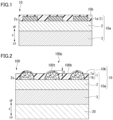
- Fig. 1 is a cross-sectional view of resin-impregnated decorative paper 10 before foaming according to the present embodiment.
- Fig. 2 is a cross-sectional view of a resin-impregnated decorative plate 100 obtained by bonding a substrate 20 to the resin-impregnated decorative paper 10 in Fig. 1 and foaming a foamable resin layer 1.
- the thickness direction of the resin-impregnated decorative paper 10 and the resin-impregnated decorative plate 100 is defined as the vertical direction V
- the side of the resin-impregnated decorative paper 10 to which the substrate 20 is bonded is defined as "lower LO" in the vertical direction V
- the opposite side to the side of the resin-impregnated decorative paper 10 to which the substrate 20 is bonded is defined as "upper UP" in the vertical direction V.
- the resin-impregnated decorative plate 100 includes the resin-impregnated decorative paper 10 and the substrate 20.
- the substrate 20 is bonded to the lower side LO of the resin-impregnated decorative paper 10 by hot pressing.
- the substrate 20 may be a board such as a particle board or a medium-density fiberboard (MDF).
- the impregnation resin 10b is a known thermosetting resin used for resin-impregnated decorative plates.
- the impregnation resin 10b contains a melamine resin. Because melamine resins have high strength, contamination resistance, wear resistance, heat resistance, and water resistance, it is desirable to use a melamine resin as the impregnation resin 10b.
- impregnation resin 10b may not contain a melamine resin.
- the base paper 3 is a layer stacked at the lower side LO of the decorative paper 10a.
- the base paper 3 is a known fibrous sheet that can be impregnated with the impregnation resin 10b.
- the base paper 3 may be, for example, titanium paper or tissue paper. It is desirable to use titanium paper having good concealability as the base paper 3 in order to prevent the transmission of the color and texture of the substrate 20 after the substrate 20 is bonded.
- the pattern layer 2 is a layer printed on the upper side UP of the base paper 3 and formed by printing a pattern such as wood grain, stone grain, or sand grain.
- a known printing method such as gravure printing, offset printing, flexographic printing, silk-screen printing, or inkjet printing may be adopted for the printing.
- the foamable resin layer 1 is a layer printed on the upper side UP of the pattern layer 2 and formed from a foamable-resin-layer resin 1a in which a foaming agent 1b is mixed.
- the foamable resin layer 1 is a layer that adds a stereoscopic effect to the upper UP surface 2s of the pattern layer 2 and is printed in any position on the upper UP surface 2s of the pattern layer 2.
- the foamable resin layer 1 may be printed in either a position that matches the pattern of the pattern layer 2 or a position that does not match.
- a known printing method such as gravure printing, offset printing, flexographic printing, silk-screen printing, or inkjet printing may be adopted for the printing.
- a known printing ink suitable for the printing method adopted may be used for the foamable-resin-layer resin 1a.
- the foaming agent 1b is made up of thermally expandable microcapsules.
- the thermally expandable microcapsules used as the foaming agent 1b are resin capsules containing foaming components such as hydrocarbon and foam to expand in volume when heated.
- the thermally expandable microcapsules used as the foaming agent 1b are formed from a resin such as an epoxy resin, a casein resin, or an acrylic resin.
- the foamable resin layer 1 forms the uneven pattern 100p on the upper UP surface 2s of the pattern layer 2.
- the foaming agent 1b desirably has a post-foaming particle size of 100 ⁇ m or more and 200 ⁇ m or less.
- the foaming agent 1b has a post-foaming particle size smaller than 100 ⁇ m, the uneven pattern 100p formed by the foaming of the foaming agent 1b has a small surface roughness R, which may result in a weak tactile sensation.
- the foaming agent 1b has a post-foaming particle size greater than 200 ⁇ m,the uneven pattern 100p has a great surface roughness R, which may result in low scratch resistance and contamination resistance.
- the foaming agent 1b desirably has a foaming start temperature of 150 °C or more and 220 °C or less.
- the foaming agent 1b has a foaming start temperature lower than 150°C, and the resin-impregnated decorative paper 10 and the substrate 20 are bonded together by hot pressing, the foaming agent 1b starts foaming early in the hot pressing, and accordingly the foamable resin layer 1 collapses due to a longer time of pressurization after the foaming of the foaming agent 1b.
- the uneven pattern 100p may have a weak tactile sensation.
- the foaming agent 1b has a foaming start temperature higher than 220 °C, the foaming agent 1b cannot sufficiently foam during heating, and the uneven pattern 100p may have a weak tactile sensation.
- the pattern layer 2 is formed by printing on the upper side UP of the base paper 3.
- the upper UP surface 2s of the pattern layer 2 is printed with the foamable resin layer 1 formed from the foamable-resin-layer resin 1a in which the foaming agent 1b is mixed.
- the decorative paper 10a including the base paper 3, the pattern layer 2, and the foamable resin layer 1 is formed.
- the foam particle size after the foaming of the foaming agent 1b contained in the foamable resin layer 1 is 100 ⁇ m or more and 200 ⁇ m or less.
- the foaming start temperature of the foaming agent 1b is 150 °C or more and 220 °C or less.
- the decorative paper 10a is impregnated with the impregnation resin 10b and then dried in an oven to form the resin-impregnated decorative paper 10.
- the substrate 20 is bonded by hot pressing to the lower side LO of the resin-impregnated decorative paper 10 to provide the resin-impregnated decorative plate 100.
- the foamable resin layer 1 foams when it reaches the foaming start temperature during heating by the hot pressing that bonds the resin-impregnated decorative paper 10 and the substrate 20 together, and the foaming forms the uneven pattern 100p on the upper UP surface 2s of the pattern layer 2.
- the uneven pattern 100p formed in this manner has a surface roughness R of 20 ⁇ m or more and 90 ⁇ m or less.
- the resin-impregnated decorative paper 10 and the substrate 20 may be bonded together by a hot pressing method known as a thermocompression bonding method for decorative plates.
- a hot pressing method known as a thermocompression bonding method for decorative plates.
- the hot pressing method include a thermocompression bonding method for bonding the resin-impregnated decorative paper 10 and the substrate 20 facing each other in the vertical direction V by heating and pressurizing the paper and the substrate with a flat press plate, and a thermocompression bonding method for bonding the resin-impregnated decorative paper 10 and the substrate 20 facing each other in the vertical direction V by continuously heating and pressurizing the paper and the substrate with circulating cylinder-press endless belts holding them in between.
- the uneven pattern 100p formed by the foaming of the foamable resin layer 1 has a surface roughness R of 20 ⁇ m or more and 90 ⁇ m or less. Since the surface roughness R is 20 ⁇ m or more, the resin-impregnated decorative plate 100 has a good tactile sensation. Furthermore, since the surface roughness R of the uneven pattern 100p is 90 ⁇ m or less, the resin-impregnated decorative plate 100 has high scratch resistance and contamination resistance.
- the decorative paper 10a in the above embodiment includes the foamable resin layer 1, the pattern layer 2, and the base paper 3, the decorative paper is not limited to this form.
- the decorative paper may include a layer having conduit or other representations to give a visually stereoscopic effect and a filler layer to prevent the foamable resin layer 1 or the pattern layer 2 from soaking into the base paper 3.
- the foamable resin layer 1 in the above embodiment contains the foaming agent 1b made up of the thermally expandable microcapsules, the foamable resin layer is not limited to this form.
- the foamable resin layer may be a thermally decomposable chemical foaming agent.
- the heating step for foaming the foamable resin layer 1 in the above embodiment is performed during hot pressing for the resin-impregnated decorative paper 10 and the substrate 20, the step for foaming the foamable resin layer is not limited to this.
- the step for foaming the foamable resin layer may be performed before or after the resin-impregnated decorative paper and the substrate are bonded together.
- the method for bonding the resin-impregnated decorative paper and the substrate is not limited to this.
- the resin-impregnated decorative paper and the substrate may be bonded together by a method without involving heating.
- Titanium paper was prepared as the base paper 3.
- the pattern layer 2 was formed by gravure printing on the upper side UP of the base paper 3.
- the foamable resin layer 1 was formed by gravure printing on the upper side UP of the pattern layer 2.
- thermally expandable microcapsules made from epoxy resin were used as the foaming agent 1b contained in the foamable resin layer 1.
- the foaming agent 1b has a foaming start temperature of 220 °C and a post-foaming particle size of 220 ⁇ m.
- the decorative paper 10a thus obtained was impregnated into a melamine resin serving as the impregnation resin 10b and then sufficiently dried in an oven to form the resin-impregnated decorative paper 10.
- the resin-impregnated decorative paper 10 and a particle board serving as the substrate 20 were bonded together by hot pressing to cause the foaming agent 1b to foam, thus forming the resin-impregnated decorative plate 100 in Example 1.
- the resin-impregnated decorative plate 100 was not embossed with a press plate.
- thermally expandable microcapsules made from casein resin were used as the foaming agent 1b.
- the foaming agent 1b has a foaming start temperature of 180 °C and a post-foaming particle size of 150 ⁇ m. Otherwise, the same method as in Example 1 was used to form the resin-impregnated decorative plate 100 in Example 3.
- thermally expandable microcapsules made from acrylic resin were used as the foaming agent 1b.
- the foaming agent 1b has a foaming start temperature of 150 °C and a post-foaming particle size of 100 ⁇ m. Otherwise, the same method as in Example 1 was used to form the resin-impregnated decorative plate 100 in Example 4.
- thermally expandable microcapsules made from casein resin were used as the foaming agent.
- the foaming agent has a foaming start temperature of 220 °C and a post-foaming particle size of 250 ⁇ m. Otherwise, the same method as in Example 1 was used to form a resin-containing decorative plate in Comparative Example 1.
- thermally expandable microcapsules made from casein resin were used as the foaming agent.
- the foaming agent has a foaming start temperature of 100 °C and a post-foaming particle size of 50 ⁇ m. Otherwise, the same method as in Example 1 was used to form a resin-containing decorative plate in Comparative Example 2.
- Thermally expandable microcapsule used as foaming agent Foamable resin Foaming start temperature Post-foaming particle size Ex. 1 Epoxy resin 220 °c 200 ⁇ m Ex. 2 Epoxy resin 200 °c 200 ⁇ m Ex. 3 Casein resin 180 °c 150 ⁇ m Ex. 4 Acrylic resin 150 °c 100 ⁇ m Comp. Ex. 1 Casein resin 220 °c 250 ⁇ m Comp. Ex. 2 Casein resin 100 °c 50 ⁇ m
- the surface roughness R of the uneven pattern formed by the foaming of the foamable resin layer was measured.
- a surface roughness meter, SURFCOM 120A, manufactured by Tokyo Seimitsu Co., Ltd. was used for the measurement.
- the resin-containing decorative plates in Examples 1 to 4 and Comparative Examples 1 and 2 were subjected to a scratch resistance test.
- each resin-containing decorative plate was subjected to a coin scratch test, and scratches left in the uneven pattern were evaluated.
- the evaluation criteria were based on a three-point scale, and plates rated other than "poor" were considered acceptable.
- the resin-containing decorative plates in Examples 1 to 4 and Comparative Examples 1 and 2 were subjected to a contamination resistance test.
- the contamination resistance test the uneven pattern of each resin-containing decorative plate was coated with black crayon and red ink and wiped with alcohol after one hour, and the percentage of the residual crayon and ink was evaluated.
- the evaluation criteria were based on a three-point scale, and plates rated other than "poor" were considered acceptable.
- the evaluation criteria were based on a three-point scale, and plates rated other than "poor" were considered acceptable.
- Examples 1 to 4 exhibited good results in all the evaluation tests. Examples 2 and 3, in which the surface roughness R was smaller than in Example 1 and greater than in Example 4, exhibited better results.
- Comparative Example 1 in which the surface roughness R was 102.1 ⁇ m, greatest in Examples 1 to 4 and Comparative Examples 1 and 2, failed the scratch resistance test and the contamination resistance test. Comparative Example 2, in which the surface roughness was 8.6 ⁇ m, or smallest, failed the tactile sensation evaluation test.
- Comparative Example 2 In which the surface roughness was 8.6 ⁇ m, or smallest, failed the tactile sensation evaluation test.
- Measurement 1 Experiment 1
- Experiment 2 Experiment 3
- the resin-impregnated decorative paper and the resin-impregnated decorative plate according to the present disclosure can provide a resin-impregnated decorative plate that has a surface roughness combining a good tactile sensation with high scratch resistance and contamination resistance, and provide a resin-impregnated decorative paper used for the resin-impregnated decorative plate.
Landscapes
- Engineering & Computer Science (AREA)
- Life Sciences & Earth Sciences (AREA)
- Wood Science & Technology (AREA)
- Chemical & Material Sciences (AREA)
- Inorganic Chemistry (AREA)
- Textile Engineering (AREA)
- Chemical Kinetics & Catalysis (AREA)
- Laminated Bodies (AREA)
- Synthetic Leather, Interior Materials Or Flexible Sheet Materials (AREA)
Abstract
Description
- The present invention relates to resin-impregnated decorative paper and a resin-impregnated decorative plate.
- This application claims the benefit of priority from
Japanese Patent Application No. 2022-113972 filed in Japan on July 15, 2022 - Resin-impregnated decorative plates obtained by bonding resin-impregnated decorative paper impregnated with a thermosetting resin to substrates are decorative plates having high surface hardness and excellent resistances, such as contamination resistance, wear resistance, heat resistance, and water resistance. Resin-impregnated decorative plates are thus used as surface materials for furniture such as desks or surface materials for fixtures such as shop counters. For a resin-impregnated decorative plate that requires a tactile sensation on its surface, such a tactile sensation can be imparted by pressing the surface of the resin-impregnated decorative plate with a press plate having an uneven pattern to emboss the uneven pattern on the surface of the resin-impregnated decorative plate. Examples of resin-impregnated decorative plates include a low-pressure melamine decorative plate obtained by bonding resin-impregnated decorative paper impregnated with a melamine resin to a substrate such as a particle board under low pressure.
- A resin-impregnated decorative plate having a tactile sensation on its surface is described in
PTL 1. The resin-impregnated decorative plate described inPTL 1 has an uneven pattern formed by causing a foaming agent placed in a pattern layer to foam. This can impart a tactile sensation to the surface of the resin-impregnated decorative plate without embossing. Accordingly, since a press plate used for embossing is not needed, production costs can be reduced. - [PTL 1]
JP 2019-206109 A - However, the resin-impregnated decorative plate described in
PTL 1 has a large surface roughness in the uneven pattern formed by the expansion of the foaming agent, and thus the plate has a good tactile sensation but may have poor scratch resistance and contamination resistance. - On the basis of the above circumstances, the present disclosure relates to a resin-impregnated decorative plate with a surface having a tactile sensation imparted by the foaming of a foaming agent and has been made in view of the above problem. An object of the present disclosure is to provide a resin-impregnated decorative plate that has a surface roughness combining a good tactile sensation with high scratch resistance and contamination resistance, and to provide resin-impregnated decorative paper used for the resin-impregnated decorative plate.
- In order to achieve the object, the present invention proposes the following means.
- A resin-impregnated decorative paper according to the present disclosure is resin-impregnated decorative paper including decorative paper impregnated with an impregnation resin, in which the decorative paper includes a base paper, a pattern layer formed by printing on the upper side of the base paper, and a foamable resin layer stacked on the upper side of the pattern layer and containing a foaming agent, the foamable resin layer foams to expand in volume, thereby forming an uneven pattern on the upper surface of the pattern layer, and the uneven pattern has a maximum height of 20 µm or more and 90 µm or less in a vertical direction from a recess to a projection.
- In the resin-impregnated decorative paper, the foaming agent may have a foaming start temperature of 150 °C or more and 220 °C or less and a post-foaming particle size of 100 µm or more and 200 µm or less.
- In the resin-impregnated decorative paper, the base paper may be titanium paper.
- In the resin-impregnated decorative paper, the impregnation resin may contain a melamine resin.
- A resin-impregnated decorative plate according to the present disclosure includes the above-mentioned resin-impregnated decorative paper and a substrate bonded to the lower side of the resin-impregnated decorative paper.
- The resin-impregnated decorative paper and the resin-impregnated decorative plate according to the present disclosure can provide a resin-impregnated decorative plate that has a surface roughness combining a good tactile sensation with high scratch resistance and contamination resistance, and provide a resin-impregnated decorative paper used for the resin-impregnated decorative plate.
-
-
Fig. 1 is a cross-sectional view of a resin-impregnated decorative paper before foaming according to an embodiment. -
Fig. 2 is a cross-sectional view of a resin-impregnated decorative plate after foaming according to the embodiment. - An embodiment of the present invention will now be described with reference to
Figs. 1 and 2 . -
Fig. 1 is a cross-sectional view of resin-impregnateddecorative paper 10 before foaming according to the present embodiment.Fig. 2 is a cross-sectional view of a resin-impregnateddecorative plate 100 obtained by bonding asubstrate 20 to the resin-impregnateddecorative paper 10 inFig. 1 and foaming afoamable resin layer 1. - In the present embodiment, as illustrated in
Figs. 1 and 2 , the thickness direction of the resin-impregnateddecorative paper 10 and the resin-impregnateddecorative plate 100 is defined as the vertical direction V, the side of the resin-impregnateddecorative paper 10 to which thesubstrate 20 is bonded is defined as "lower LO" in the vertical direction V, and the opposite side to the side of the resin-impregnateddecorative paper 10 to which thesubstrate 20 is bonded is defined as "upper UP" in the vertical direction V. - As illustrated in
Fig. 2 , thefoamable resin layer 1 is foamed to formmultiple recesses 100b andmultiple projections 100t. For anuneven pattern 100p, the maximum height in the vertical direction V from the bottom of therecesses 100b (in the present embodiment, spaces betweenadjacent projections 100t) to the top of theprojections 100t is defined as surface roughness R. Although the number ofrecesses 100b andprojections 100t is assumed to be multiple, the number ofrecesses 100b andprojections 100t is not limited to a specific number. - The resin-impregnated
decorative plate 100 includes the resin-impregnateddecorative paper 10 and thesubstrate 20. Thesubstrate 20 is bonded to the lower side LO of the resin-impregnateddecorative paper 10 by hot pressing. Thesubstrate 20 may be a board such as a particle board or a medium-density fiberboard (MDF). - The resin-impregnated
decorative paper 10 is formed by dryingdecorative paper 10a impregnated with animpregnation resin 10b. When thedecorative paper 10a is impregnated with theimpregnation resin 10b, theimpregnation resin 10b penetrates thedecorative paper 10a to cover the upper surface of thedecorative paper 10a. When thedecorative paper 10a impregnated with theimpregnation resin 10b is dried, theimpregnation resin 10b cures. As a result, the resin-impregnateddecorative paper 10 has excellent properties such as high surface hardness, contamination resistance, wear resistance, heat resistance, and water resistance. - The
impregnation resin 10b is a known thermosetting resin used for resin-impregnated decorative plates. In the present embodiment, theimpregnation resin 10b contains a melamine resin. Because melamine resins have high strength, contamination resistance, wear resistance, heat resistance, and water resistance, it is desirable to use a melamine resin as theimpregnation resin 10b. - It should be noted that the
impregnation resin 10b may not contain a melamine resin. - The
decorative paper 10a includes thefoamable resin layer 1, apattern layer 2, and abase paper 3. - The
base paper 3 is a layer stacked at the lower side LO of thedecorative paper 10a. Thebase paper 3 is a known fibrous sheet that can be impregnated with theimpregnation resin 10b. Thebase paper 3 may be, for example, titanium paper or tissue paper. It is desirable to use titanium paper having good concealability as thebase paper 3 in order to prevent the transmission of the color and texture of thesubstrate 20 after thesubstrate 20 is bonded. - The
pattern layer 2 is a layer printed on the upper side UP of thebase paper 3 and formed by printing a pattern such as wood grain, stone grain, or sand grain. A known printing method such as gravure printing, offset printing, flexographic printing, silk-screen printing, or inkjet printing may be adopted for the printing. - The
foamable resin layer 1 is a layer printed on the upper side UP of thepattern layer 2 and formed from a foamable-resin-layer resin 1a in which afoaming agent 1b is mixed. Thefoamable resin layer 1 is a layer that adds a stereoscopic effect to theupper UP surface 2s of thepattern layer 2 and is printed in any position on theupper UP surface 2s of thepattern layer 2. Thefoamable resin layer 1 may be printed in either a position that matches the pattern of thepattern layer 2 or a position that does not match. A known printing method such as gravure printing, offset printing, flexographic printing, silk-screen printing, or inkjet printing may be adopted for the printing. A known printing ink suitable for the printing method adopted may be used for the foamable-resin-layer resin 1a. - The
foaming agent 1b is made up of thermally expandable microcapsules. The thermally expandable microcapsules used as thefoaming agent 1b are resin capsules containing foaming components such as hydrocarbon and foam to expand in volume when heated. The thermally expandable microcapsules used as thefoaming agent 1b are formed from a resin such as an epoxy resin, a casein resin, or an acrylic resin. - When the
foaming agent 1b foams, thefoamable resin layer 1 forms theuneven pattern 100p on theupper UP surface 2s of thepattern layer 2. - The
foaming agent 1b desirably has a post-foaming particle size of 100 µm or more and 200 µm or less. When thefoaming agent 1b has a post-foaming particle size smaller than 100 µm, theuneven pattern 100p formed by the foaming of thefoaming agent 1b has a small surface roughness R, which may result in a weak tactile sensation. In contrast, when thefoaming agent 1b has a post-foaming particle size greater than 200 µm,theuneven pattern 100p has a great surface roughness R, which may result in low scratch resistance and contamination resistance. - The
foaming agent 1b desirably has a foaming start temperature of 150 °C or more and 220 °C or less. When thefoaming agent 1b has a foaming start temperature lower than 150°C, and the resin-impregnateddecorative paper 10 and thesubstrate 20 are bonded together by hot pressing, thefoaming agent 1b starts foaming early in the hot pressing, and accordingly thefoamable resin layer 1 collapses due to a longer time of pressurization after the foaming of thefoaming agent 1b. As a result, theuneven pattern 100p may have a weak tactile sensation. In contrast, when thefoaming agent 1b has a foaming start temperature higher than 220 °C, thefoaming agent 1b cannot sufficiently foam during heating, and theuneven pattern 100p may have a weak tactile sensation. - A method for producing the resin-impregnated
decorative plate 100 will now be described. - First, the
pattern layer 2 is formed by printing on the upper side UP of thebase paper 3. Theupper UP surface 2s of thepattern layer 2 is printed with thefoamable resin layer 1 formed from the foamable-resin-layer resin 1a in which thefoaming agent 1b is mixed. As a result, thedecorative paper 10a including thebase paper 3, thepattern layer 2, and thefoamable resin layer 1 is formed. - In this paper, the foam particle size after the foaming of the
foaming agent 1b contained in thefoamable resin layer 1 is 100 µm or more and 200 µm or less. The foaming start temperature of thefoaming agent 1b is 150 °C or more and 220 °C or less. - Next, the
decorative paper 10a is impregnated with theimpregnation resin 10b and then dried in an oven to form the resin-impregnateddecorative paper 10. Thesubstrate 20 is bonded by hot pressing to the lower side LO of the resin-impregnateddecorative paper 10 to provide the resin-impregnateddecorative plate 100. - The
foamable resin layer 1 foams when it reaches the foaming start temperature during heating by the hot pressing that bonds the resin-impregnateddecorative paper 10 and thesubstrate 20 together, and the foaming forms theuneven pattern 100p on theupper UP surface 2s of thepattern layer 2. Theuneven pattern 100p formed in this manner has a surface roughness R of 20 µm or more and 90 µm or less. - The resin-impregnated
decorative paper 10 and thesubstrate 20 may be bonded together by a hot pressing method known as a thermocompression bonding method for decorative plates. Examples of the hot pressing method include a thermocompression bonding method for bonding the resin-impregnateddecorative paper 10 and thesubstrate 20 facing each other in the vertical direction V by heating and pressurizing the paper and the substrate with a flat press plate, and a thermocompression bonding method for bonding the resin-impregnateddecorative paper 10 and thesubstrate 20 facing each other in the vertical direction V by continuously heating and pressurizing the paper and the substrate with circulating cylinder-press endless belts holding them in between. - In the resin-impregnated
decorative paper 10 and the resin-impregnateddecorative plate 100 according to the present embodiment, theuneven pattern 100p formed by the foaming of thefoamable resin layer 1 has a surface roughness R of 20 µm or more and 90 µm or less. Since the surface roughness R is 20 µm or more, the resin-impregnateddecorative plate 100 has a good tactile sensation. Furthermore, since the surface roughness R of theuneven pattern 100p is 90 µm or less, the resin-impregnateddecorative plate 100 has high scratch resistance and contamination resistance. As a result, it is feasible to provide the resin-impregnateddecorative plate 100 that has a surface roughness R combining a good tactile sensation with high scratch resistance and contamination resistance, and to provide the resin-impregnateddecorative paper 10 used for the resin-impregnateddecorative plate 100. - Although an embodiment of the present invention has been described in detail with reference to the drawings, specific components are not limited to the embodiment, and the invention encompasses design modifications that fall within the scope and spirit of the present disclosure. Additionally, the components indicated in the above embodiment and the modifications provided below may be combined as appropriate.
- Although the
decorative paper 10a in the above embodiment includes thefoamable resin layer 1, thepattern layer 2, and thebase paper 3, the decorative paper is not limited to this form. The decorative paper may include a layer having conduit or other representations to give a visually stereoscopic effect and a filler layer to prevent thefoamable resin layer 1 or thepattern layer 2 from soaking into thebase paper 3. - Although the
foamable resin layer 1 in the above embodiment contains thefoaming agent 1b made up of the thermally expandable microcapsules, the foamable resin layer is not limited to this form. The foamable resin layer may be a thermally decomposable chemical foaming agent. - Although the heating step for foaming the
foamable resin layer 1 in the above embodiment is performed during hot pressing for the resin-impregnateddecorative paper 10 and thesubstrate 20, the step for foaming the foamable resin layer is not limited to this. The step for foaming the foamable resin layer may be performed before or after the resin-impregnated decorative paper and the substrate are bonded together. - Although the resin-impregnated
decorative paper 10 and thesubstrate 20 are bonded together by hot pressing in the above embodiment, the method for bonding the resin-impregnated decorative paper and the substrate is not limited to this. The resin-impregnated decorative paper and the substrate may be bonded together by a method without involving heating. - The present invention will be described in detail with reference to Examples below. The present invention is not limited to the Examples below.
- Titanium paper was prepared as the
base paper 3. Thepattern layer 2 was formed by gravure printing on the upper side UP of thebase paper 3. Thefoamable resin layer 1 was formed by gravure printing on the upper side UP of thepattern layer 2. As listed in table 1, thermally expandable microcapsules made from epoxy resin were used as thefoaming agent 1b contained in thefoamable resin layer 1. Thefoaming agent 1b has a foaming start temperature of 220 °C and a post-foaming particle size of 220 µm. - The
decorative paper 10a thus obtained was impregnated into a melamine resin serving as theimpregnation resin 10b and then sufficiently dried in an oven to form the resin-impregnateddecorative paper 10. The resin-impregnateddecorative paper 10 and a particle board serving as thesubstrate 20 were bonded together by hot pressing to cause thefoaming agent 1b to foam, thus forming the resin-impregnateddecorative plate 100 in Example 1. In this process, the resin-impregnateddecorative plate 100 was not embossed with a press plate. - As listed in table 1, the
foaming agent 1b used has a foaming start temperature of 200 °C and a post-foaming particle size of 200 µm. Otherwise, the same method as in Example 1 was used to form the resin-impregnateddecorative plate 100 in Example 2. - As listed in table 1, thermally expandable microcapsules made from casein resin were used as the
foaming agent 1b. Thefoaming agent 1b has a foaming start temperature of 180 °C and a post-foaming particle size of 150 µm. Otherwise, the same method as in Example 1 was used to form the resin-impregnateddecorative plate 100 in Example 3. - As listed in table 1, thermally expandable microcapsules made from acrylic resin were used as the
foaming agent 1b. Thefoaming agent 1b has a foaming start temperature of 150 °C and a post-foaming particle size of 100 µm. Otherwise, the same method as in Example 1 was used to form the resin-impregnateddecorative plate 100 in Example 4. - As listed in table 1, thermally expandable microcapsules made from casein resin were used as the foaming agent. The foaming agent has a foaming start temperature of 220 °C and a post-foaming particle size of 250 µm. Otherwise, the same method as in Example 1 was used to form a resin-containing decorative plate in Comparative Example 1.
- As listed in table 1, thermally expandable microcapsules made from casein resin were used as the foaming agent. The foaming agent has a foaming start temperature of 100 °C and a post-foaming particle size of 50 µm. Otherwise, the same method as in Example 1 was used to form a resin-containing decorative plate in Comparative Example 2.
[Table 1] Thermally expandable microcapsule used as foaming agent Foamable resin Foaming start temperature Post-foaming particle size Ex. 1 Epoxy resin 220 °c 200 µm Ex. 2 Epoxy resin 200 °c 200 µm Ex. 3 Casein resin 180 °c 150 µm Ex. 4 Acrylic resin 150 °c 100 µm Comp. Ex. 1 Casein resin 220 °c 250 µm Comp. Ex. 2 Casein resin 100 °c 50 µm - For each of the resin-containing decorative plates in Examples 1 to 4 and Comparative Examples 1 and 2, the surface roughness R of the uneven pattern formed by the foaming of the foamable resin layer was measured. A surface roughness meter, SURFCOM 120A, manufactured by Tokyo Seimitsu Co., Ltd. was used for the measurement.
- The resin-containing decorative plates in Examples 1 to 4 and Comparative Examples 1 and 2 were subjected to a scratch resistance test. In the scratch resistance test, each resin-containing decorative plate was subjected to a coin scratch test, and scratches left in the uneven pattern were evaluated.
- The evaluation criteria were based on a three-point scale, and plates rated other than "poor" were considered acceptable.
- Excellent: No scratches found
- Good: Inconspicuous scratches found
- Poor: Conspicuous scratches found
- The resin-containing decorative plates in Examples 1 to 4 and Comparative Examples 1 and 2 were subjected to a contamination resistance test. In the contamination resistance test, the uneven pattern of each resin-containing decorative plate was coated with black crayon and red ink and wiped with alcohol after one hour, and the percentage of the residual crayon and ink was evaluated.
- The evaluation criteria were based on a three-point scale, and plates rated other than "poor" were considered acceptable.
- Excellent: less than 30% residual crayon and ink
- Good: 30% or more and less than 70% residual crayon and ink
- Poor: 70% or more and 100% or less residual crayon and ink
- The resin-containing decorative plates in Examples 1 to 4 and Comparative Examples 1 and 2 were subjected to a tactile sensation evaluation test. In the tactile sensation evaluation test, ten testers conducted a tactile sensory test for the uneven pattern of each resin-containing decorative plate and evaluated the texture.
- The evaluation criteria were based on a three-point scale, and plates rated other than "poor" were considered acceptable.
- Excellent: Seven or more and ten or less testers rated the texture as good.
- Good: One or more and six or less testers rated the texture as good.
- Poor: No testers rated the texture as good.
- The results of
measurement 1 andexperiments 1 to 3 are listed in table 2. - Examples 1 to 4 exhibited good results in all the evaluation tests. Examples 2 and 3, in which the surface roughness R was smaller than in Example 1 and greater than in Example 4, exhibited better results.
- Comparative Example 1, in which the surface roughness R was 102.1 µm, greatest in Examples 1 to 4 and Comparative Examples 1 and 2, failed the scratch resistance test and the contamination resistance test. Comparative Example 2, in which the surface roughness was 8.6 µm, or smallest, failed the tactile sensation evaluation test.
[Table 2] Measurement 1Experiment 1Experiment 2Experiment 3Surface roughness r (µm) Scratch resistance Contamination resistance Tactile sensation Ex. 1 93.6 Good Good Excellent Ex. 2 78.8 Excellent Excellent Excellent Ex. 3 38.9 Excellent Excellent Excellent Ex. 4 20.8 Excellent Excellent Good Comp. Ex. 1 102.1 Poor Poor Excellent Comp. Ex. 2 8.6 Excellent Excellent Poor - The resin-impregnated decorative paper and the resin-impregnated decorative plate according to the present disclosure can provide a resin-impregnated decorative plate that has a surface roughness combining a good tactile sensation with high scratch resistance and contamination resistance, and provide a resin-impregnated decorative paper used for the resin-impregnated decorative plate.
-
- 100
- Resin-impregnated decorative plate
- 100p
- Uneven pattern
- 100t
- Projection
- 100b
- Recess
- 10
- Resin-impregnated decorative paper
- 10a
- Decorative paper
- 10b
- Impregnation resin
- 1
- Foamable resin layer
- 1a
- Foamable-resin-layer resin
- 1b
- Foaming agent
- 2
- Pattern layer
- 2s
- Upper UP surface of pattern layer
- 3
- Base paper
- 20
- Substrate
- V
- Vertical direction
- UP
- Upper side
- LO
- Lower side
- R
- Surface roughness
Claims (5)
- A resin-impregnated decorative paper comprising decorative paper impregnated with an impregnation resin, whereinthe decorative paper includesbase paper,a pattern layer formed by printing on an upper side of the base paper, anda foamable resin layer stacked on an upper side of the pattern layer and containing a foaming agent,the foamable resin layer foams to expand in volume, thereby forming an uneven pattern on an upper surface of the pattern layer, andthe uneven pattern has a maximum height of 20 µm or more and 90 µm or less in a vertical direction from a recess to a projection.
- The resin-impregnated decorative paper according to claim 1, wherein
the foaming agent has a foaming start temperature of 150 °C or more and 220 °C or less, and the foaming agent has a post-foaming particle size of 100 µm or more and 200 µm or less. - The resin-impregnated decorative paper according to claim 1 or 2, wherein
the base paper is titanium paper. - The resin-impregnated decorative paper according to any one of claims 1 to 3, wherein
the impregnation resin contains a melamine resin. - A resin-impregnated decorative plate comprising:the resin-impregnated decorative paper according to any one of claims 1 to 4; anda substrate bonded to a lower side of the resin-impregnated decorative paper.
Applications Claiming Priority (2)
| Application Number | Priority Date | Filing Date | Title |
|---|---|---|---|
| JP2022113972A JP2024011729A (en) | 2022-07-15 | 2022-07-15 | Resin-impregnated decorative paper and resin-impregnated decorative board |
| PCT/JP2023/024331 WO2024014315A1 (en) | 2022-07-15 | 2023-06-30 | Resin-impregnated decorative paper and resin-impregnated decorative panel |
Publications (2)
| Publication Number | Publication Date |
|---|---|
| EP4556221A1 true EP4556221A1 (en) | 2025-05-21 |
| EP4556221A4 EP4556221A4 (en) | 2025-10-15 |
Family
ID=89536549
Family Applications (1)
| Application Number | Title | Priority Date | Filing Date |
|---|---|---|---|
| EP23839487.8A Pending EP4556221A4 (en) | 2022-07-15 | 2023-06-30 | RESIN-IMPREGNATED DECORATIVE PAPER AND RESIN-IMPREGNATED DECORATIVE PANEL |
Country Status (5)
| Country | Link |
|---|---|
| US (1) | US20250146228A1 (en) |
| EP (1) | EP4556221A4 (en) |
| JP (1) | JP2024011729A (en) |
| CN (1) | CN119451819A (en) |
| WO (1) | WO2024014315A1 (en) |
Family Cites Families (15)
| Publication number | Priority date | Publication date | Assignee | Title |
|---|---|---|---|---|
| JPS5951882B2 (en) * | 1979-05-31 | 1984-12-17 | 松下電工株式会社 | Manufacturing method for textured decorative paper |
| US4500373A (en) * | 1981-09-29 | 1985-02-19 | Dai Nippon Insatsu Kabushiki Kaisha | Process for producing coincidently embossed decorative sheets |
| JP2004050827A (en) * | 2002-05-30 | 2004-02-19 | Dainippon Printing Co Ltd | Decorative sheet, method for producing the same, and decorative material |
| WO2013133314A1 (en) * | 2012-03-07 | 2013-09-12 | 住友ベークライト株式会社 | Melamine resin decorative sheet and method for repairing a finished surface |
| PL236570B1 (en) * | 2014-10-16 | 2021-01-25 | Schattdecor Spolka Z Ograniczona Odpowiedzialnoscia | Method for producing three-dimensional structural surfaces, preferably on wood-like boards |
| JP6821917B2 (en) * | 2016-02-17 | 2021-01-27 | 凸版印刷株式会社 | How to manufacture wallpaper with non-combustible performance |
| JP2017166096A (en) * | 2016-03-17 | 2017-09-21 | 凸版印刷株式会社 | Method for manufacturing foamed wallpaper |
| JP2019085673A (en) * | 2017-11-07 | 2019-06-06 | 凸版印刷株式会社 | Foamed wallpaper and method of manufacturing the same |
| JP7183537B2 (en) * | 2017-11-30 | 2022-12-06 | 凸版印刷株式会社 | foam wallpaper |
| JP7119581B2 (en) * | 2018-05-28 | 2022-08-17 | 凸版印刷株式会社 | Decorative paper for resin-impregnated decorative board, resin-impregnated decorative paper, and resin-impregnated decorative board |
| JP7409371B2 (en) * | 2019-03-28 | 2024-01-09 | 大日本印刷株式会社 | Decorative material |
| JP7383228B2 (en) * | 2019-11-01 | 2023-11-20 | Toppanホールディングス株式会社 | Resin-impregnated decorative paper and resin-impregnated decorative board |
| JP2021115714A (en) * | 2020-01-22 | 2021-08-10 | 三菱ケミカル株式会社 | Method for manufacturing resin laminate, partition material, and resin laminate |
| JP7631678B2 (en) * | 2020-05-22 | 2025-02-19 | Toppanホールディングス株式会社 | Resin-impregnated decorative paper and resin-impregnated decorative board |
| JP2022113972A (en) | 2021-01-26 | 2022-08-05 | 株式会社エヌ・ティ・ティ・ロジスコ | Inspection system using image recognition, inspection method, and program for inspection system |
-
2022
- 2022-07-15 JP JP2022113972A patent/JP2024011729A/en active Pending
-
2023
- 2023-06-30 WO PCT/JP2023/024331 patent/WO2024014315A1/en not_active Ceased
- 2023-06-30 EP EP23839487.8A patent/EP4556221A4/en active Pending
- 2023-06-30 CN CN202380050872.6A patent/CN119451819A/en active Pending
-
2025
- 2025-01-09 US US19/014,976 patent/US20250146228A1/en active Pending
Also Published As
| Publication number | Publication date |
|---|---|
| EP4556221A4 (en) | 2025-10-15 |
| WO2024014315A1 (en) | 2024-01-18 |
| US20250146228A1 (en) | 2025-05-08 |
| CN119451819A (en) | 2025-02-14 |
| JP2024011729A (en) | 2024-01-25 |
Similar Documents
| Publication | Publication Date | Title |
|---|---|---|
| KR101634845B1 (en) | Laminated decorative plate | |
| JP5711971B2 (en) | Method for producing a laminate with a decorative pattern | |
| US10850487B2 (en) | Pressed laminate panel with a single layer elastomerick treated paper | |
| US6610164B2 (en) | Method of selectively coating a wood composite | |
| KR20100025723A (en) | Wood flooring having transfer-printed supporting layer | |
| US20250146228A1 (en) | Resin-impregnated decorative paper and resin-impregnated decorative panel | |
| JP7119581B2 (en) | Decorative paper for resin-impregnated decorative board, resin-impregnated decorative paper, and resin-impregnated decorative board | |
| KR101732791B1 (en) | Embossed film surface board and manufacturing method thereof | |
| JP2009107161A (en) | Decorative plate and method for producing the same | |
| JP2025110790A (en) | Resin-impregnated decorative paper and resin-impregnated decorative board, and methods for manufacturing resin-impregnated decorative paper and resin-impregnated decorative board | |
| CA2392864C (en) | Method for making a shaped article | |
| US20260054517A1 (en) | Decorative paper, decorative board, and methods for producing decorative paper and decorative board | |
| JP7718438B2 (en) | Decorative paper and decorative board, and method for manufacturing decorative paper and decorative board | |
| US20250341057A1 (en) | Decorative paper, decorative board, and methods for producing decorative paper and decorative board | |
| US20090214855A1 (en) | Floor with a chafe resistant overlay paper | |
| JP2024160474A (en) | Decorative paper and decorative board, and method for manufacturing decorative paper and decorative board | |
| JPS6250306B2 (en) | ||
| EP3732041B1 (en) | Laminate with synchronous structure | |
| KR200189870Y1 (en) | The laminate with heap form | |
| JP2004195731A (en) | Decorative panel and its production method | |
| JP2025109344A (en) | Decorative paper and decorative board, and method for manufacturing decorative paper and decorative board | |
| JPS58211448A (en) | Manufacture of decorative material | |
| JP2011076687A (en) | Overprint card | |
| JPS62236794A (en) | Card in which electronic part is incorporated | |
| JPS58151244A (en) | Manufacture of melamine embossed decorative board |
Legal Events
| Date | Code | Title | Description |
|---|---|---|---|
| STAA | Information on the status of an ep patent application or granted ep patent |
Free format text: STATUS: THE INTERNATIONAL PUBLICATION HAS BEEN MADE |
|
| PUAI | Public reference made under article 153(3) epc to a published international application that has entered the european phase |
Free format text: ORIGINAL CODE: 0009012 |
|
| STAA | Information on the status of an ep patent application or granted ep patent |
Free format text: STATUS: REQUEST FOR EXAMINATION WAS MADE |
|
| 17P | Request for examination filed |
Effective date: 20250102 |
|
| AK | Designated contracting states |
Kind code of ref document: A1 Designated state(s): AL AT BE BG CH CY CZ DE DK EE ES FI FR GB GR HR HU IE IS IT LI LT LU LV MC ME MK MT NL NO PL PT RO RS SE SI SK SM TR |
|
| A4 | Supplementary search report drawn up and despatched |
Effective date: 20250912 |
|
| RIC1 | Information provided on ipc code assigned before grant |
Ipc: B32B 27/04 20060101AFI20250908BHEP Ipc: A47B 96/20 20060101ALI20250908BHEP Ipc: B32B 27/00 20060101ALI20250908BHEP Ipc: D06N 7/06 20060101ALI20250908BHEP Ipc: D21H 13/48 20060101ALI20250908BHEP Ipc: D21H 17/07 20060101ALI20250908BHEP Ipc: D21H 19/82 20060101ALI20250908BHEP Ipc: D21H 27/00 20060101ALI20250908BHEP Ipc: D06N 3/00 20060101ALI20250908BHEP Ipc: D06N 7/00 20060101ALI20250908BHEP |
|
| DAV | Request for validation of the european patent (deleted) | ||
| DAX | Request for extension of the european patent (deleted) | ||
| STAA | Information on the status of an ep patent application or granted ep patent |
Free format text: STATUS: EXAMINATION IS IN PROGRESS |
|
| 17Q | First examination report despatched |
Effective date: 20260311 |