EP4554255A2 - Method and apparatus for improving the coding of side information required for coding a higher order ambisonics representation of a sound field - Google Patents
Method and apparatus for improving the coding of side information required for coding a higher order ambisonics representation of a sound field Download PDFInfo
- Publication number
- EP4554255A2 EP4554255A2 EP25158678.0A EP25158678A EP4554255A2 EP 4554255 A2 EP4554255 A2 EP 4554255A2 EP 25158678 A EP25158678 A EP 25158678A EP 4554255 A2 EP4554255 A2 EP 4554255A2
- Authority
- EP
- European Patent Office
- Prior art keywords
- prediction
- side information
- hoa
- array
- numactivepred
- Prior art date
- Legal status (The legal status is an assumption and is not a legal conclusion. Google has not performed a legal analysis and makes no representation as to the accuracy of the status listed.)
- Pending
Links
Images



Classifications
-
- G—PHYSICS
- G10—MUSICAL INSTRUMENTS; ACOUSTICS
- G10L—SPEECH ANALYSIS TECHNIQUES OR SPEECH SYNTHESIS; SPEECH RECOGNITION; SPEECH OR VOICE PROCESSING TECHNIQUES; SPEECH OR AUDIO CODING OR DECODING
- G10L19/00—Speech or audio signals analysis-synthesis techniques for redundancy reduction, e.g. in vocoders; Coding or decoding of speech or audio signals, using source filter models or psychoacoustic analysis
- G10L19/008—Multichannel audio signal coding or decoding using interchannel correlation to reduce redundancy, e.g. joint-stereo, intensity-coding or matrixing
-
- G—PHYSICS
- G10—MUSICAL INSTRUMENTS; ACOUSTICS
- G10L—SPEECH ANALYSIS TECHNIQUES OR SPEECH SYNTHESIS; SPEECH RECOGNITION; SPEECH OR VOICE PROCESSING TECHNIQUES; SPEECH OR AUDIO CODING OR DECODING
- G10L19/00—Speech or audio signals analysis-synthesis techniques for redundancy reduction, e.g. in vocoders; Coding or decoding of speech or audio signals, using source filter models or psychoacoustic analysis
- G10L19/04—Speech or audio signals analysis-synthesis techniques for redundancy reduction, e.g. in vocoders; Coding or decoding of speech or audio signals, using source filter models or psychoacoustic analysis using predictive techniques
- G10L19/16—Vocoder architecture
- G10L19/18—Vocoders using multiple modes
- G10L19/20—Vocoders using multiple modes using sound class specific coding, hybrid encoders or object based coding
-
- H—ELECTRICITY
- H04—ELECTRIC COMMUNICATION TECHNIQUE
- H04S—STEREOPHONIC SYSTEMS
- H04S3/00—Systems employing more than two channels, e.g. quadraphonic
- H04S3/008—Systems employing more than two channels, e.g. quadraphonic in which the audio signals are in digital form, i.e. employing more than two discrete digital channels
-
- H—ELECTRICITY
- H04—ELECTRIC COMMUNICATION TECHNIQUE
- H04S—STEREOPHONIC SYSTEMS
- H04S2420/00—Techniques used stereophonic systems covered by H04S but not provided for in its groups
- H04S2420/11—Application of ambisonics in stereophonic audio systems
Definitions
- the invention relates to a method and to an apparatus for improving the coding of side information required for coding a Higher Order Ambisonics representation of a sound field.
- HOA Higher Order Ambisonics
- WFS wave field synthesis
- channel based approaches like the 22.2 multichannel audio format.
- HOA representation offers the advantage of being independent of a specific loudspeaker set-up. This flexibility, however, is at the expense of a decoding process which is required for the playback of the HOA representation on a particular loudspeaker set-up.
- HOA signals may also be rendered to set-ups consisting of only few loudspeakers.
- a further advantage of HOA is that the same representation can also be employed without any modification for binaural rendering to headphones.
- HOA is based on the representation of the spatial density of complex harmonic plane wave amplitudes by a truncated Spherical Harmonics (SH) expansion.
- SH Spherical Harmonics
- Each expansion coefficient is a function of angular frequency, which can be equivalently represented by a time domain function.
- O denotes the number of expansion coefficients.
- HOA coefficient sequences or as HOA channels in the following.
- HOA sound field representations are proposed in WO 2013/171083 A1 , EP 13305558.2 and PCT/EP2013/075559 . These processings have in common that they perform a sound field analysis and decompose the given HOA representation into a directional component and a residual ambient component.
- the final compressed representation is assumed to consist of a number of quantised signals, resulting from the perceptual coding of the directional signals and relevant coefficient sequences of the ambient HOA component.
- a problem to be solved by the invention is to provide a more efficient way of coding side information related to that spatial prediction.
- a bit is prepended to the coded side information representation data ⁇ COD , which bit signals whether or not any prediction is to be performed. This feature reduces over time the average bit rate for the transmission of the ⁇ COD data. Further, in specific situations, instead of using a bit array indicating for each direction if the prediction is performed or not, it is more efficient to transmit or transfer the number of active predictions and the respective indices. A single bit can be used for indicating in which way the indices of directions are coded for which a prediction is supposed to be performed. On average, this operation over time further reduces the bit rate for the transmission of the ⁇ COD data.
- the inventive method is suited for improving the coding of side information required for coding a Higher Order Ambisonics representation of a sound field, denoted HOA, with input time frames of HOA coefficient sequences, wherein dominant directional signals as well as a residual ambient HOA component are determined and a prediction is used for said dominant directional signals, thereby providing, for a coded frame of HOA coefficients, side information data describing said prediction, and wherein said side information data can include:
- the inventive apparatus is suited for improving the coding of side information required for coding a Higher Order Ambisonics representation of a sound field, denoted HOA, with input time frames of HOA coefficient sequences, wherein dominant directional signals as well as a residual ambient HOA component are determined and a prediction is used for said dominant directional signals, thereby providing, for a coded frame of HOA coefficients, side information data describing said prediction, and wherein said side information data can include:
- Fig. 1 it is illustrated how the coding of side information related to spatial prediction can be embedded into the HOA compression processing described patent application EP 13305558.2 .
- a frame-wise processing with non-overlapping input frames C ( k ) of HOA coefficient sequences of length L is assumed, where k denotes the frame index.
- C ⁇ ( k ) Similar to the notation for C ⁇ ( k ) , the tilde symbol is used in the following description for indicating that the respective quantity refers to long overlapping frames. If step/stage 11/12 is not present, the tilde symbol has no specific meaning.
- a parameter in bold means a set of values, e.g. a matrix or a vector.
- the long frame C ⁇ ( k ) is successively used in step or stage 13 for the estimation of dominant sound source directions as described in EP 13305558.2 .
- This estimation provides a data set ( k ) ⁇ ⁇ 1, ... , D ⁇ of indices of the related directional signals that have been detected, as well as a data set ( k ) of the corresponding direction estimates of the directional signals.
- D denotes the maximum number of diretional signals that has to be set before starting the HOA compression and that can be handled in the known processing which follows.
- step or stage 14 the current (long) frame C ⁇ ( k ) of HOA coefficient sequences is decomposed (as proposed in EP 13305156.5 ) into a number of directional signals X DIR ( k - 2) belonging to the directions contained in the set ( k ), and a residual ambient HOA component C AMB ( k - 2).
- the delay of two frames is introduced as a result of overlap-add processing in order to obtain smooth signals. It is assumed that X DIR ( k - 2) is containing a total of D channels, of which however only those corresponding to the active directional signals are non-zero. The indices specifying these channels are assumed to be output in the data set ( k - 2).
- the decomposition in step/stage 14 provides some parameters ⁇ ( k - 2) which can be used at decompression side for predicting portions of the original HOA representation from the directional signals (see EP 13305156.5 for more details).
- ⁇ ( k -2) the HOA decomposition is described in more detail in the below section HOA decomposition.
- step/stage 16 the active directional signals contained in X DIR ( k - 2) and the HOA coefficient sequences contained in C AMB,RED ( k - 2) are assigned to the frame Y ( k -2) of I channels for individual perceptual encoding as described in EP 13305558.2 .
- Perceptual coding step/stage 17 encodes the I channels of frame Y ( k - 2) and outputs an encoded frame ( k - 2).
- the spatial prediction parameters or side information data ⁇ ( k - 2) resulting from the decomposition of the HOA representation are losslessly coded in step or stage 19 in order to provide a coded data representation ⁇ COD ( k -2), using the index set ( k ) delayed by two frames in delay 18.
- Fig. 2 it is exemplary shown how to embed in step or stage 25 the decoding of the received encoded side information data ⁇ COD ( k - 2) related to spatial prediction into the HOA decompression processing described in Fig. 3 of patent application EP 13305558.2 .
- the decoding of the encoded side information data ⁇ COD ( k -2) is carried out before entering its decoded version ⁇ ( k -2) into the composition of the HOA representation in step or stage 23, using the received index set ( k ) delayed by two frames in delay 24.
- step or stage 21 a perceptual decoding of the I signals contained in ( k - 2) is performed in order to obtain the I decoded signals in ⁇ ( k - 2).
- the perceptually decoded signals in ⁇ ( k - 2) are re-distributed in order to recreate the frame X ⁇ DIR ( k - 2) of directional signals and the frame ⁇ AMB,RED ( k - 2) of the ambient HOA component.
- the information about how to re-distribute the signals is obtained by reproducing the assigning operation performed for the HOA compression, using the index data sets ( k ) and ( k - 2).
- composition step or stage 23 a current frame ⁇ ( k - 3) of the desired total HOA representation is re-composed (according to the processing described in connection with Fig. 2b and Fig.
- ⁇ AMB,RED ( k - 2) corresponds to component D ⁇ A ( k - 2) in PCT/EP2013/ 075559
- ( k ) and ( k ) correspond to A ⁇ ( k ) in PCT/ EP2013/075559
- active directional signal indices can be obtained by taking those indices of rows of A ⁇ ( k ) which contain valid elements.
- I.e., directional signals with respect to uniformly distributed directions are predicted from the directional signals X ⁇ DIR ( k - 2) using the received parameters ⁇ ( k -2) for such prediction, and thereafter the current decompressed frame ⁇ ( k - 3) is re-composed from the frame of directional signals X ⁇ DIR ( k - 2), from ( k ) and ( k ), and from the predicted portions and the reduced ambient HOA component ⁇ AMB,RED ( k - 2).
- the smoothed dominant directional signals X DIR ( k - 1) and their HOA representation C DIR ( k - 1) are computed in step or stage 31, using the long frame C ⁇ ( k ) of the input HOA representation, the set ( k ) of directions and the set ( k ) of corresponding indices of directional signals. It is assumed that X DIR ( k - 1) contains a total of D channels, of which however only those corresponding to the active directional signals are non-zero. The indices specifying these channels are assumed to be output in the set ( k - 1).
- step or stage 33 the residual between the original HOA representation ⁇ ( k - 1) and the HOA representation C DIR ( k - 1) of the dominant directional signals is represented by a number of O directional signals X ⁇ RES ( k - 1), which can be considered as being general plane waves from uniformly distributed directions, which are referred to a uniform grid.
- step or stage 34 these directional signals are predicted from the dominant directional signals X DIR ( k - 1) in order to provide the predicted signals X ⁇ ⁇ RES k ⁇ 1 together with the respective prediction parameters ⁇ ( k - 1).
- step or stage 35 the smoothed HOA representation ⁇ RES ( k - 2) of the predicted directional signals X ⁇ ⁇ RES k ⁇ 1 is computed.
- step or stage 37 the residual C AMB ( k - 2) between the original HOA representation C ⁇ ( k - 2) and the HOA representation C DIR ( k - 2) of the dominant directional signals together with the HOA representation ⁇ RES ( k - 2) of the predicted directional signals from uniformly distributed directions is computed and is output.
- the required signal delays in the Fig. 3 processing are performed by corresponding delays 381 to 387.
- Each directional signal x ⁇ DIR, d ( k - 1), d 1, ...
- D represents a general plane wave impinging from a trajectory interpolated between the directions ⁇ ACT, d ( k - 3), ⁇ ACT, d ( k - 2), ⁇ ACT, d ( k - 1), and ⁇ ACT, d ( k ), assuming that the d-th directional signal is active for the respective frames.
- N 3
- Fig. 4 shows these directions together with the directions ⁇ ACT,1 and ⁇ ACT,4 of the active dominant sound sources.
- These two parameters have to either be set to fixed values known to the encoder and decoder, or to be additionally transmitted, but distinctly less frequently than the frame rate.
- the latter option may be used for adapting the two parameters to the HOA representation to be compressed.
- the general plane wave signal x ⁇ RES,GRID,1 ( k - 1) from direction ⁇ 1 is predicted from the directional signal x ⁇ DIR,1 ( k - 1) from direction ⁇ ACT,1 by a pure multiplication (i.e. full band) with a factor that results from de-quantising the value 40.
- the general plane wave signal x ⁇ RES,GRID,7 ( k - 1) from direction ⁇ 7 is predicted from the directional signals x ⁇ DIR,1 ( k - 1) and x ⁇ DIR,4 ( k - 1) by a lowpass filtering and multiplication with factors that result from de-quantising the values 15 and -13.
- B SC denotes a predefined number of bits to be used for the quantisation of the prediction factors.
- p F, d,q ( k - 1) is assumed to be set to zero, if p IND, d,q ( k - 1) is equal to zero.
- a bit array ActivePred consisting of O bits is created, in which the bit ActivePred[q] indicates whether or not for the direction ⁇ q a prediction is performed.
- the number of 'ones' in this array is denoted by NumActivePred.
- the bit array PredType of length NumActivePred is created where each bit indicates, for the directions where a prediction is to be performed, the kind of the prediction, i.e. full band or low pass.
- the unsigned integer array PredDirSigIds of length NumActivePred ⁇ D PRED is created, whose elements denote for each active prediction the D PRED indices of the directional signals to be used. If less than D PRED directional signals are to be used for the prediction, the indices are assumed to be set to zero.
- Each element of the array PredDirSigIds is assumed to be represented by log 2 D + 1 bits. The number of non-zero elements in the array PredDirSigIds is denoted by NumNonZerolds.
- the integer array QuantPredGains of length NumNonZerolds is created, whose elements are assumed to represent the quantised scaling factors P Q,F, d,q ( k - 1) to be used in equation (17).
- the dequantisation to obtain the corresponding dequantised scaling factors P F, d,q (k - 1) is given in equation (10).
- Each element of the array QuantPredGains is assumed to be represented by B SC bits.
- the state-of-the-art processing is advantageously modified.
- PredGains which however contains quantised values.
- the decoding of the modified side information related to spatial prediction is summarised in the example decoding processing depicted in Fig. 7 and Fig. 8 (the processing depicted in Fig. 8 is the continuation of the processing depicted in Fig. 7 ) and is explained in the following.
- all elements of vector p TYPE and matrices P IND and P QF are initialised by zero.
- the bit PSPredictionActive is read, which indicates if a spatial prediction is to be performed at all.
- the bit kindOfCodedPredlds is read, which indicates the kind of coding of the indices of directions for which a prediction is to be performed.
- the bit array ActivePred of length O is read, of which the q-th element indicates if for the direction ⁇ q a prediction is performed or not.
- the bit array PredType of length NumActivePred is read, of which the elements indicate the kind of prediction to be performed for each of the relevant directions.
- PredDirSigIds consists of NumActivePred ⁇ D PRED elements. Each element is assumed to be coded by log 2 D ⁇ ACT bits.
- the elements of matrix P IND are set and the number NumNonZerolds of non-zero elements in P IND is computed.
- the array QuantPredGains is read, which consists of NumNonZerolds elements, each coded by B SC bits. Using the information contained in P IND and QuantPredGains, the elements of the matrix P Q,F are set.
- inventive processing can be carried out by a single processor or electronic circuit, or by several processors or electronic circuits operating in parallel and/or operating on different parts of the inventive processing.
- EEEs enumerated example embodiments
Landscapes
- Engineering & Computer Science (AREA)
- Physics & Mathematics (AREA)
- Multimedia (AREA)
- Acoustics & Sound (AREA)
- Signal Processing (AREA)
- Health & Medical Sciences (AREA)
- Computational Linguistics (AREA)
- Audiology, Speech & Language Pathology (AREA)
- Human Computer Interaction (AREA)
- Mathematical Physics (AREA)
- Compression, Expansion, Code Conversion, And Decoders (AREA)
- Stereophonic System (AREA)
- Circuit For Audible Band Transducer (AREA)
Abstract
Description
- This application is a European divisional application of European patent application
EP 22176389.9 A16025EP03 - The invention relates to a method and to an apparatus for improving the coding of side information required for coding a Higher Order Ambisonics representation of a sound field.
- Higher Order Ambisonics (HOA) offers one possibility to represent three-dimensional sound among other techniques like wave field synthesis (WFS) or channel based approaches like the 22.2 multichannel audio format. In contrast to channel based methods, the HOA representation offers the advantage of being independent of a specific loudspeaker set-up. This flexibility, however, is at the expense of a decoding process which is required for the playback of the HOA representation on a particular loudspeaker set-up. Compared to the WFS approach, where the number of required loudspeakers is usually very large, HOA signals may also be rendered to set-ups consisting of only few loudspeakers. A further advantage of HOA is that the same representation can also be employed without any modification for binaural rendering to headphones.
- HOA is based on the representation of the spatial density of complex harmonic plane wave amplitudes by a truncated Spherical Harmonics (SH) expansion. Each expansion coefficient is a function of angular frequency, which can be equivalently represented by a time domain function. Hence, without loss of generality, the complete HOA sound field representation actually can be assumed to consist of O time domain functions, where O denotes the number of expansion coefficients. These time domain functions will be equivalently referred to as HOA coefficient sequences or as HOA channels in the following. The spatial resolution of the HOA representation improves with a growing maximum order N of the expansion. Unfortunately, the number of expansion coefficients O grows quadratically with the order N, in particular O = (N + 1)2. For example, typical HOA representations using order N = 4 require O = 25 HOA (expansion) coefficients. According to the previously made considerations, the total bit rate for the transmission of HOA representation, given a desired single-channel sampling rate f S and the number of bits N b per sample, is determined by O. f S · N b . Consequently, transmitting an HOA representation of order N = 4 with a sampling rate of f S = 48kHz employing N b = 16 bits per sample results in a bit rate of 19.2MBits/s, which is very high for many practical applications like e.g. streaming. Thus, compression of HOA representations is highly desirable. The compression of HOA sound field representations is proposed in
WO 2013/171083 A1 ,EP 13305558.2 PCT/EP2013/075559 - An important part of that side information is a description of a prediction of portions of the original HOA representation from the directional signals. Since for this prediction the original HOA representation is assumed to be equivalently represented by a number of spatially dispersed general plane waves impinging from spatially uniformly distributed directions, the prediction is referred to as spatial prediction in the following.
- The coding of such side information related to spatial prediction is described in ISO/IEC JTC1/SC29/WG11, N14061, "Working Draft Text of MPEG-H 3D Audio HOA RM0", November 2013 Geneva, Switzerland. However, this state-of-the-art coding, of the side information is rather inefficient.
- A problem to be solved by the invention is to provide a more efficient way of coding side information related to that spatial prediction.
- This problem is solved by the method disclosed in
claim 1. An apparatus that utilises this method is disclosed inclaim 2. A corresponding computer program product is disclosed in claim 3. - A bit is prepended to the coded side information representation data ζCOD, which bit signals whether or not any prediction is to be performed. This feature reduces over time the average bit rate for the transmission of the ζCOD data. Further, in specific situations, instead of using a bit array indicating for each direction if the prediction is performed or not, it is more efficient to transmit or transfer the number of active predictions and the respective indices. A single bit can be used for indicating in which way the indices of directions are coded for which a prediction is supposed to be performed. On average, this operation over time further reduces the bit rate for the transmission of the ζCOD data.
- In principle, the inventive method is suited for improving the coding of side information required for coding a Higher Order Ambisonics representation of a sound field, denoted HOA, with input time frames of HOA coefficient sequences, wherein dominant directional signals as well as a residual ambient HOA component are determined and a prediction is used for said dominant directional signals, thereby providing, for a coded frame of HOA coefficients, side information data describing said prediction, and wherein said side information data can include:
- a bit array indicating whether or not for a direction a prediction is performed;
- a bit array in which each bit indicates, for the directions where a prediction is to be performed, the kind of the prediction;
- a data array whose elements denote, for the predictions to be performed, indices of the directional signals to be used;
- a data array whose elements represent quantised scaling factors,
- providing a bit value indicating whether or not said prediction is to be performed;
- if no prediction is to be performed, omitting said bit arrays and said data arrays in said side information data;
- if said prediction is to be performed, providing a bit value indicating whether or not, instead of said bit array indicating whether or not for a direction a prediction is performed, a number of active predictions and a data array containing the indices of directions where a prediction is to be performed are included in said side information data.
- In principle the inventive apparatus is suited for improving the coding of side information required for coding a Higher Order Ambisonics representation of a sound field, denoted HOA, with input time frames of HOA coefficient sequences, wherein dominant directional signals as well as a residual ambient HOA component are determined and a prediction is used for said dominant directional signals, thereby providing, for a coded frame of HOA coefficients, side information data describing said prediction, and wherein said side information data can include:
- a bit array indicating whether or not for a direction a prediction is performed;
- a bit array in which each bit indicates, for the directions where a prediction is to be performed, the kind of the prediction;
- a data array whose elements denote, for the predictions to be performed, indices of the directional signals to be used;
- a data array whose elements represent quantised scaling factors,
- provide a bit value indicating whether or not said prediction is to be performed;
- if no prediction is to be performed, omit said bit arrays and said data arrays in said side information data;
- if said prediction is to be performed, provide a bit value indicating whether or not, instead of said bit array indicating whether or not for a direction a prediction is performed, a number of active predictions and a data array containing the indices of directions where a prediction is to be performed are included in said side information data.
- Advantageous additional embodiments of the invention are disclosed in the respective dependent claims.
- Exemplary embodiments of the invention are described with reference to the accompanying drawings, which show in:
- Fig. 1
- Exemplary coding of side information related to spatial prediction in the HOA compression processing described in
EP 13305558.2 - Fig. 2
- Exemplary decoding of side information related to spatial prediction in the HOA decompression processing described in patent application
EP 13305558.2 - Fig. 3
- HOA decomposition as described in patent application
PCT/EP2013/075559 - Fig. 4
- Illustration of directions (depicted as crosses) of general plane waves representing the residual signal and the directions (depicted as circles) of dominant sound sources. The directions are presented in a three-dimensional coordinate system as sampling positions on the unit sphere;
- Fig. 5
- State of art coding of spatial prediction side information;
- Fig. 6
- Inventive coding of spatial prediction side information;
- Fig. 7
- Inventive decoding of coded spatial prediction side information;
- Fig. 8
- Continuation of
Fig. 7 . - In the following, the HOA compression and decompression processing described in patent application
EP 13305558.2 - In
Fig. 1 it is illustrated how the coding of side information related to spatial prediction can be embedded into the HOA compression processing described patent applicationEP 13305558.2 stage 11/12 inFig. 1 is optional and consists of concatenating the non-overlapping k-th and (k-1)-th frames of HOA coefficient sequences C(k) into a long frame C̃(k) as
stage 11/12 is not present, the tilde symbol has no specific meaning. - A parameter in bold means a set of values, e.g. a matrix or a vector.
- The long frame C̃(k) is successively used in step or
stage 13 for the estimation of dominant sound source directions as described inEP 13305558.2 (k) ⊆ {1, ... , D} of indices of the related directional signals that have been detected, as well as a data set (k) of the corresponding direction estimates of the directional signals. D denotes the maximum number of diretional signals that has to be set before starting the HOA compression and that can be handled in the known processing which follows.
- In step or
stage 14, the current (long) frame C̃(k) of HOA coefficient sequences is decomposed (as proposed inEP 13305156.5 (k), and a residual ambient HOA component C AMB(k - 2). The delay of two frames is introduced as a result of overlap-add processing in order to obtain smooth signals. It is assumed that X DIR(k - 2) is containing a total of D channels, of which however only those corresponding to the active directional signals are non-zero. The indices specifying these channels are assumed to be output in the data set (k - 2). Additionally, the decomposition in step/
stage 14 provides some parameters ζ(k - 2) which can be used at decompression side for predicting portions of the original HOA representation from the directional signals (seeEP 13305156.5 - In step or
stage 15, the number of coefficients of the ambient HOA component C AMB(k - 2) is reduced to contain only O RED + D - N DIR,ACT(k - 2) non-zero HOA coefficient sequences, where N DIR,ACT(k - 2) = |(k - 2)| indicates the cardinality of the data set (k - 2), i.e. the number of active directional signals in frame k - 2. Since the ambient HOA component is assumed to be always represented by a minimum number O RED of HOA coefficient sequences, this problem can be actually reduced to the selection of the remaining D - N DIR,ACT(k - 2) HOA coefficient sequences out of the possible O - O RED ones. In order to obtain a smooth reduced ambient HOA representation, this choice is accomplished such that, compared to the choice taken at the previous frame k - 3, as few changes as possible will occur. The final ambient HOA representation with the reduced number of O RED + N DIR,ACT(k - 2) non-zero coefficient sequences is denoted by C AMB,RED(k - 2). The indices of the chosen ambient HOA coefficient sequences are output in the data set
 (k - 2). In step/
stage 16, the active directional signals contained in X DIR(k - 2) and the HOA coefficient sequences contained in C AMB,RED(k - 2) are assigned to the frame Y(k-2) of I channels for individual perceptual encoding as described inEP 13305558.2 stage 17 encodes the I channels of frame Y(k - 2) and outputs an encoded frame(k - 2).
- According to the invention, following the decomposition of the original HOA representation in step/
stage 14, the spatial prediction parameters or side information data ζ(k - 2) resulting from the decomposition of the HOA representation are losslessly coded in step orstage 19 in order to provide a coded data representation ζCOD(k-2), using the index set(k) delayed by two frames in delay 18.
- In
Fig. 2 it is exemplary shown how to embed in step orstage 25 the decoding of the received encoded side information data ζCOD(k - 2) related to spatial prediction into the HOA decompression processing described inFig. 3 of patent applicationEP 13305558.2 stage 23, using the received index set(k) delayed by two frames in
delay 24. - In step or stage 21 a perceptual decoding of the I signals contained in(k - 2) is performed in order to obtain the I decoded signals in Ŷ (k - 2).

- In signal re-distributing step or
stage 22, the perceptually decoded signals in Ŷ(k - 2) are re-distributed in order to recreate the frame X̂ DIR(k - 2) of directional signals and the frame Ĉ AMB,RED(k - 2) of the ambient HOA component. The information about how to re-distribute the signals is obtained by reproducing the assigning operation performed for the HOA compression, using the index data sets(k) and (k - 2). In composition step or
stage 23, a current frame Ĉ(k - 3) of the desired total HOA representation is re-composed (according to the processing described in connection with Fig. 2b andFig. 4 ofPCT/EP2013/075559 (k) of the active directional signal indices together with the set (k) of the corresponding directions, the parameters ζ(k -2) for predicting portions of the HOA representation from the directional signals, and the frame Ĉ AMB,RED(k - 2) of HOA coefficient sequences of the reduced ambient HOA component. ĈAMB,RED(k - 2) corresponds to component D̂ A(k - 2) in
PCT/EP2013/ 075559 (k) and (k) correspond to AΩ̂ (k) in
PCT/ EP2013/075559 (k) and (k), and from the predicted portions and the reduced ambient HOA component Ĉ AMB,RED(k - 2).
- In connection with
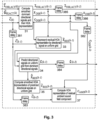
Fig. 3 the HOA decomposition processing is described in detail in order to explain the meaning of the spatial prediction therein. This processing is derived from the processing described in connection withFig. 3 of patent applicationPCT/EP2013/075559 - First, the smoothed dominant directional signals X DIR(k - 1) and their HOA representation C DIR(k - 1) are computed in step or
stage 31, using the long frame C̃(k) of the input HOA representation, the set(k) of directions and the set (k) of corresponding indices of directional signals. It is assumed that X DIR(k - 1) contains a total of D channels, of which however only those corresponding to the active directional signals are non-zero. The indices specifying these channels are assumed to be output in the set
 (k - 1).
- In step or
stage 33 the residual between the original HOA representation Ĉ(k - 1) and the HOA representation C DIR(k - 1) of the dominant directional signals is represented by a number of O directional signals X̃ RES(k - 1), which can be considered as being general plane waves from uniformly distributed directions, which are referred to a uniform grid. - In step or
stage 34 these directional signals are predicted from the dominant directional signals X DIR(k - 1) in order to provide the predicted signals (k - 1), are considered. The prediction is described in more detail in the below section Spatial prediction.
- In step or
stage 35 the smoothed HOA representation Ĉ RES(k - 2) of the predicted directional signals
stage 37 the residual C AMB(k - 2) between the original HOA representation C̃(k - 2) and the HOA representation C DIR(k - 2) of the dominant directional signals together with the HOA representation Ĉ RES(k - 2) of the predicted directional signals from uniformly distributed directions is computed and is output. - The required signal delays in the
Fig. 3 processing are performed by correspondingdelays 381 to 387. - The goal of the spatial prediction is to predict the O residual signals


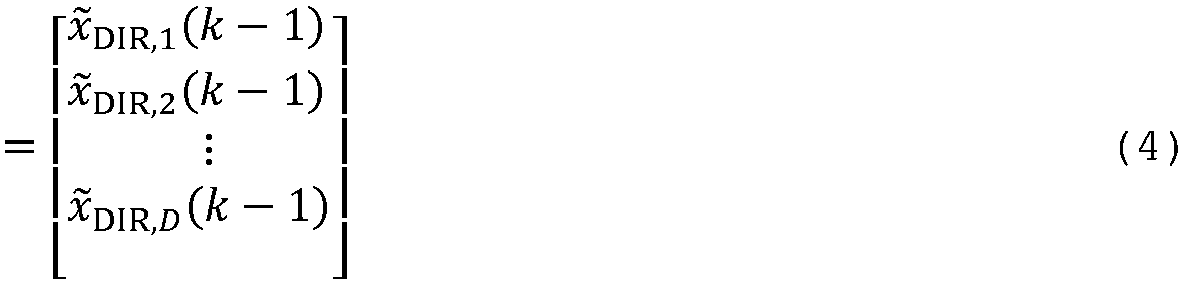
PCT/EP2013/075559 - Each residual signal x̃ RES,GRID,q (k - 1), q = 1, ..., O, represents a spatially dispersed general plane wave impinging from the direction Ωq, whereby it is assumed that all the directions Ωq, q = 1, ... , O are nearly uniformly distributed over the unit sphere. The total of all directions is referred to as a 'grid'. Each directional signal x̃ DIR,d (k - 1), d = 1, ... , D represents a general plane wave impinging from a trajectory interpolated between the directions Ω ACT,d (k - 3), Ω ACT,d (k - 2), Ω ACT,d (k - 1), and Ω ACT,d (k), assuming that the d-th directional signal is active for the respective frames.
- To illustrate the meaning of the spatial prediction by means of an example, the decomposition of an HOA representation of order N = 3 is considered, where the maximum number of directions to extract is equal to D = 4. For simplicity it is further assumed that only the directional signals with indices '1' and '4' are active, while those with indices '2' and '3' are non-active. Additionally, for simplicity it is assumed that the directions of the dominant sound sources are constant for the considered frames, i.e. Ω ACT,d (k - 3) = Ω ACT,d (k - 2) = Ω ACT,d (k - 1) = Ω ACT,d (k3) = Ω ACT,d for d = 1,4 (5) As a consequence of order N = 3, there are O = 16 directions Ωq of spatially dispersed general plane waves x̃ RES,GRID,q(k - 1), q = 1, ... , O.
Fig. 4 shows these directions together with the directions Ω ACT,1 and Ω ACT,4 of the active dominant sound sources. - One way of describing the spatial prediction is presented in the above-mentioned ISO/IEC document. In this document, the signals x̃ RES,GRID,q ( k - 1), q = 1, ..., O are assumed to be predicted by a weighted sum of a predefined maximum number D PRED of directional signals, or by a low pass filtered version of the weighted sum. The side information related to spatial prediction is described by the parameter set ζ(k - 1) = {p TYPE(k - 1), P IND(k - 1), P Q,F(k - 1)}, which consists of the following three components:
- The vector p TYPE(k-1) whose elements p TYPE,q (k - 1), q = 1, ... , O indicate whether or not for the q-th direction Ωq a prediction is performed, and if so, then they also indicate which kind of prediction. The meaning of the elements is as follows:

- The matrix P IND(f - 1), whose elements p IND,d,q (k - 1), d = 1, ... , D PRED, q = 1, ... , O denote the indices from which directional signals the prediction for the direction Ωq has to be performed. If no prediction is to be performed for a direction Ωq, the corresponding column of the matrix P IND(k - 1) consists of zeros. Further, if less than D PRED directional signals are used for the prediction for a direction Ωq, the non-required elements in the q-th column of P IND(k - 1) are also zero.
- The matrix P Q,F(k - 1), which contains the corresponding quantised prediction factors p QF,d,q(k - 1), d = 1, ... , D PRED, q = 1, ... ,O.
- The following two parameters have to be known at decoding side for enabling the appropriate interpretation of these parameters:
- The maximum number D PRED of directional signals, from which a general plane wave signal x̃ RES,GRID,q (k - 1) is allowed to be predicted.
- The number B SC of bits used for quantising the prediction factors p Q,F,d,q (k - 1), d = 1, ... , D PRED, q = 1, ... , O. The de-quantisation rule is given in equation (10).
- These two parameters have to either be set to fixed values known to the encoder and decoder, or to be additionally transmitted, but distinctly less frequently than the frame rate. The latter option may be used for adapting the two parameters to the HOA representation to be compressed.
- An example for a parameter set may look like the following, assuming O = 16, D PRED = 2 and B SC = 8:


- Such parameters would mean that the general plane wave signal x̃ RES,GRID,1(k - 1) from direction Ω 1 is predicted from the directional signal x̃ DIR,1(k - 1) from direction Ω ACT,1 by a pure multiplication (i.e. full band) with a factor that results from de-quantising the value 40. Further, the general plane wave signal x̃ RES,GRID,7(k - 1) from direction Ω 7 is predicted from the directional signals x̃ DIR,1(k - 1) and x̃ DIR,4(k - 1) by a lowpass filtering and multiplication with factors that result from de-quantising the
values 15 and -13. - Given this side information, the prediction is assumed to be performed as follows:
First, the quantised prediction factors p Q,F,d,q (k - 1), d = 1, ... , D PRED, q = 1, ... , O are dequantised to provide the actual prediction factors
- As already mentioned, B SC denotes a predefined number of bits to be used for the quantisation of the prediction factors. Additionally, p F,d,q (k - 1) is assumed to be set to zero, if p IND,d,q (k - 1) is equal to zero.
- For the previously mentioned example, assuming B SC = 8, the dequantised prediction factor vector would result in

- Further, for performing a low pass prediction a predefined low pass FIR filter

- Assuming as signals the predicted signals


- As already mentioned and as now can be seen from equation (17), the signals x̃ RES,GRID,q (k - 1), q = 1, ... , O are assumed to be predicted by a weighted sum of a predefined maximum number D PRED of directional signals, or by a low pass filtered versions of the weighted sum.
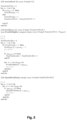
- In the above-mentioned ISO/IEC document the coding of the spatial prediction side information is addressed. It is summarised in
Algorithm 1 depicted inFig. 5 and will be explained in the following. For a clearer presentation the frame index k - 1 is neglected in all expressions. - First, a bit array ActivePred consisting of O bits is created, in which the bit ActivePred[q] indicates whether or not for the direction Ωq a prediction is performed. The number of 'ones' in this array is denoted by NumActivePred.
- Next, the bit array PredType of length NumActivePred is created where each bit indicates, for the directions where a prediction is to be performed, the kind of the prediction, i.e. full band or low pass. At the same time, the unsigned integer array PredDirSigIds of length NumActivePred · D PRED is created, whose elements denote for each active prediction the D PRED indices of the directional signals to be used. If less than D PRED directional signals are to be used for the prediction, the indices are assumed to be set to zero. Each element of the array PredDirSigIds is assumed to be represented by

- Finally, the integer array QuantPredGains of length NumNonZerolds is created, whose elements are assumed to represent the quantised scaling factors P Q,F,d,q (k - 1) to be used in equation (17). The dequantisation to obtain the corresponding dequantised scaling factors P F,d,q (k - 1) is given in equation (10). Each element of the array QuantPredGains is assumed to be represented by B SC bits.
- In the end, the coded representation of the side information ζCOD consists of the four aforementioned arrays according to ζCOD = [ActivePred PredType PredDirSigIds QuantPredGains] . (19)
- For explaining this coding by an example, the coded representation of equations (7) to (9) is used:




- The number of required bits is equal to 16 + 2 + 3 · 4 + 8 · 3 = 54.
- In order to increase the efficiency of the coding of the side information related to spatial prediction, the state-of-the-art processing is advantageously modified.
- A) When coding HOA representations of typical sound scenes, the inventors have observed that there are often frames where in the HOA compression processing the decision is taken to not perform any spatial prediction at all. However, in such frames the bit array ActivePred consists of zeros only, the number of which is equal to O. Since such frame content occurs quite often, the inventive processing prepends to the coded representation ζCOD a single bit PSPredictionActive, which indicates if any prediction is to be performed or not. If the value of the bit PSPredictionActive is zero (or '1' as an alternative), the array ActivePred and further data related to the prediction are not to be included into the coded side information ζCOD. In practise, this operation reduces over time the average bit rate for the transmission of ζCOD.
- B) A further observation made while coding HOA representations of typical sound scenes is that the number NumActivePred of active prediction is often very low. In such situation, instead of using the bit array ActivePred for indicating for each direction Ω q whether or not the prediction is performed, it can be more efficient to transmit or transfer instead the number of active predictions and the respective indices. In particular, this modified kind of coding the activity is more efficient in case that NumActivePred ≤ M M , (24)
- where M M is the greatest integer number that satisfies

- The value of M M can be computed only with the knowledge of the HOA order N: O = (N +1)2 as mentioned above.
- In equation (25),


- According to the aforementioned explanations, a single bit KindOfCodedPredIds can be used for indicating in which way the indices of those directions, where a prediction is supposed to be performed, are coded. If the bit KindOfCodedPredlds has the value '1' (or '0' in the alternative), the number NumActivePred and the array PredIds containing the indices of directions, where a prediction is supposed to be performed, are added to the coded side information ζCOD. Otherwise, if the bit KindOfCodedPredlds has the value '0' (or '1' in the alternative), the array ActivePred is used to code the same information.
- On average, this operation reduces over time the bit rate for the transmission of ζCOD.
- where M M is the greatest integer number that satisfies
- C) To further increase the side information coding efficiency, the fact is exploited that often the actually available number of active directional signals to be used for prediction is less than D. This means that for the coding of each element of the index array PredDirSigIds less than
 , which contains the indices ĩACT,1, ... , ĩACT,D̃
ACT of the active directional signals. Hence, is assumed to be known, and thus the decoder also knows how many bits have to be read for decoding an index of a directional signal. Note that the frame indices of ζCOD to be computed and the used index data set
 have to be identical.
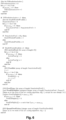
- The above modifications A) to C) for the known side information coding processing result in the example coding processing depicted in
Fig. 6 . - Consequently, the coded side information consists of the following components:

- Remark: in the above-mentioned ISO/IEC document e.g. in section 6.1.3, QuantPredGains is called PredGains, which however contains quantised values.
- The coded representation for the example in equations (7) to (9) would be:


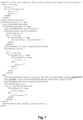
- The decoding of the modified side information related to spatial prediction is summarised in the example decoding processing depicted in
Fig. 7 andFig. 8 (the processing depicted inFig. 8 is the continuation of the processing depicted inFig. 7 ) and is explained in the following. Initially, all elements of vector p TYPE and matrices P IND and P QF are initialised by zero. Then the bit PSPredictionActive is read, which indicates if a spatial prediction is to be performed at all. In the case of a spatial prediction (i.e. PSPredictionActive = 1), the bit KindOfCodedPredlds is read, which indicates the kind of coding of the indices of directions for which a prediction is to be performed. - In the case that KindOfCodedPredIds = 0, the bit array ActivePred of length O is read, of which the q-th element indicates if for the direction Ω q a prediction is performed or not. In a next step, from the array ActivePred the number NumActivePred of predictions is computed and the bit array PredType of length NumActivePred is read, of which the elements indicate the kind of prediction to be performed for each of the relevant directions. With the information contained in ActivePred and PredType, the elements of the vector p TYPE are computed.
- In case KindOfCodedPredIds = 1, the number NumActivePred of active predictions is read, which is assumed to be coded with


- For both cases (i.e. KindOfCodedPredIds = 0 and KindOfCodedPredlds = 1) , in the next step the array PredDirSigIds is read, which consists of NumActivePred · D PRED elements. Each element is assumed to be coded by
 and PredDirSigIds, the elements of matrix P IND are set and the number NumNonZerolds of non-zero elements in P IND is computed.
- Finally, the array QuantPredGains is read, which consists of NumNonZerolds elements, each coded by B SC bits. Using the information contained in P IND and QuantPredGains, the elements of the matrix P Q,F are set.
- The inventive processing can be carried out by a single processor or electronic circuit, or by several processors or electronic circuits operating in parallel and/or operating on different parts of the inventive processing.
- Various aspects of the present invention may be appreciated from the following enumerated example embodiments (EEEs):
- 1. Method for improving the coding of side information required for coding a Higher Order Ambisonics representation of a sound field, denoted HOA, with input time frames of HOA coefficient sequences, wherein dominant directional signals as well as a residual ambient HOA component are determined and a prediction is used for said dominant directional signals, thereby providing, for a coded frame of HOA coefficients, side information data (ζ(k - 2)) describing said prediction, and wherein said side information data (ζ(k - 2)) can include:
- a bit array (ActivePred) indicating whether or not for a direction a prediction is performed;
- a bit array (PredType) in which each bit indicates, for the directions where a prediction is to be performed, the kind of the prediction;
- a data array (PredDirSigIds) whose elements denote, for the predictions to be performed, indices of the directional signals to be used;
- a data array (QuantPredGains) whose elements represent quantised scaling factors,
- providing (19; 34, 384) a bit value (PSPredictionActive) indicating whether or not said prediction is to be performed;
- if no prediction is to be performed, omitting said bit arrays and said data arrays in said side information data (ζ(k - 2));
- if said prediction is to be performed, providing (19; 34, 384) a bit value (KindOfCodedPredIds) indicating whether or not, instead of said bit array (ActivePred) indicating whether or not for a direction a prediction is performed, a number (NumActivePred) of active predictions and a data array (PredIds) containing the indices of directions where a prediction is to be performed are included in said side information data (ζ(k - 2)).
- 2. Apparatus for improving the coding of side information required for coding a Higher Order Ambisonics representation of a sound field, denoted HOA, with input time frames of HOA coefficient sequences, wherein dominant directional signals as well as a residual ambient HOA component are determined and a prediction is used for said dominant directional signals, thereby providing, for a coded frame of HOA coefficients, side information data (ζ(k - 2)) describing said prediction, and wherein said side information data (ζ(k - 2)) can include:
- a bit array (ActivePred) indicating whether or not for a direction a prediction is performed;
- a bit array (PredType) in which each bit indicates, for the directions where a prediction is to be performed, the kind of the prediction;
- a data array (PredDirSigIds) whose elements denote, for the predictions to be performed, indices of the directional signals to be used;
- a data array (QuantPredGains) whose elements represent quantised scaling factors,
said apparatus including means (19; 34, 384) which:- provide a bit value (PSPredictionActive) indicating whether or not said prediction is to be performed;
- if no prediction is to be performed, omit said bit arrays and said data arrays in said side information data (ζ(k - 2));
- if said prediction is to be performed, provide a bit value (KindOfCodedPredIds) indicating whether or not, instead of said bit array (ActivePred) indicating whether or not for a direction a prediction is performed, a number (NumActivePred) of active predictions and a data array (PredIds) containing the indices of directions where a prediction is to be performed are included in said side information data (ζ(k - 2)).
- 3. Method according to
EEE 1, or apparatus according toEEE 2, wherein in said coding of said HOA representation an estimation (13) of dominant sound source directions is carried out and provides a data set ((k)) of indices of directional signals that have been detected.
- 4. Method according to the method of EEE 3, or apparatus according to the apparatus of EEE 3, wherein D is a preset maximum number of directional signals that can be used in said coding of said HOA coefficient sequences, and wherein each element of said data array (PredDirSigIds) which denote, for the predictions to be performed, indices of the directional signals to be used, is coded using

 (k)) of indices of directional signals that have been detected.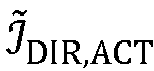
- 5. Method according to the method of one of
EEEs EEEs 2 to 4, wherein said bit value (KindOfCodedPredIds) indicating that a number NumActivePred of active predictions and an array (PredIds) containing the indices of directions where a prediction is to be performed are included in said side information data (ζ(k - 2)) is provided only in case NumActivePred ≤ M M, where M M is the greatest integer number that satisfies
- 6. Method for decoding side information data (ζ(k - 2)) which was coded according to the method of EEE 3, said method including the steps:
- evaluating (25) said bit value (PSPredictionActive) indicating whether or not said prediction is to be performed;
- if said prediction is to be performed, evaluating (25) said bit value (KindOfCodedPredIds) indicating whether
- a) said bit array (ActivePred) indicating whether or not for a direction a prediction is to be performed, or
- b) said number (NumActivePred) of active predictions and said array (PredIds) containing the indices of directions where a prediction is to be performed,
- are used in the decoding of said side information data (ζ(k - 2)), wherein in case a) :
- evaluating said bit array (ActivePred) indicating whether or not for a direction a prediction is to be performed wherein its elements indicate if for a corresponding direction a prediction is performed;
- evaluating said bit array (PredType) which elements indicate the kind of prediction for each of the corresponding directions;
- computing from said bit arrays (ActivePred,PredType) the elements of a vector (p TYPE),
- and wherein in case b):
- evaluating said number (NumActivePred) of active predictions;
- evaluating said data array (PredIds) containing the indices of directions where a prediction is to be performed;
- evaluating said bit array (PredType) which elements indicate the kind of prediction for each of the corresponding directions,
- computing from said number (NumActivePred), said data array (PredIds) and said bit array (PredType) the elements of a vector (p TYPE),
- and wherein in case a) as well as b):
- evaluating said data array (PredDirSigIds) whose elements denote, for the predictions to be performed, indices of the directional signals to be used;
- computing from said vector (p TYPE), said data set ((k)) of indices of directional signals and said data array (PredDirSigIds) the elements of a matrix ( P IND) denoting indices from which directional signals the prediction for a direction is to be performed, and the number of non-zero elements in that matrix;

- evaluating said data array (QuantPredGains) whose elements represent quantised scaling factors used in said prediction.
- 7. Apparatus for decoding side information data (ζ(k - 2)) which was coded according to the apparatus of EEE 3, said apparatus including a processor which performs:
- evaluating (25) said bit value (PSPredictionActive) indicating whether or not said prediction is to be performed;
- if said prediction is to be performed, evaluating (25) said bit value (KindOfCodedPredIds) indicating whether
- a) said bit array (ActivePred) indicating whether or not for a direction a prediction is to be performed, or
- b) said number (NumActivePred) of active predictions and said array (PredIds) containing the indices of directions where a prediction is to be performed,
- are used in the decoding of said side information data (ζ(k - 2)), wherein in case a) :
- evaluating said bit array (ActivePred) indicating whether or not for a direction a prediction is to be performed wherein its elements indicate if for a corresponding direction a prediction is performed;
- evaluating said bit array (PredType) which elements indicate the kind of prediction for each of the corresponding directions;
- computing from said bit arrays (ActivePred,PredType) the
- elements of a vector (p TYPE),
- and wherein in case b):
- evaluating said number (NumActivePred) of active predictions;
- evaluating said data array (PredIds) containing the indices of directions where a prediction is to be performed;
- evaluating said bit array (PredType) which elements indicate the kind of prediction for each of the corresponding directions,
- computing from said number (NumActivePred), said data array (PredIds) and said bit array (PredType) the elements of a vector (p TYPE),
- and wherein in case a) as well as b):
- evaluating said data array (PredDirSigIds) whose elements denote, for the predictions to be performed, indices of the directional signals to be used;
- computing from said vector (p TYPE), said data set ((k)) of indices of directional signals and said data array (PredDirSigIds) the elements of a matrix ( P IND) denoting indices from which directional signals the prediction for a direction is to be performed, and the number of non-zero elements in that matrix;

- evaluating said data array (QuantPredGains) whose elements represent quantised scaling factors used in said prediction.
- 8. Method according to EEE 6, or apparatus according to EEE 7, wherein each element of said data array (PredDirSigIds), which denotes for the predictions to be performed indices of the directional signals to be used and which was coded using
 (k)) of indices of directional signals.
- 9. Digital audio signal that is coded according to the method of
EEE 1. - 10. Computer program product comprising instructions which, when carried out on a computer, perform the method according to
EEE 1.
Claims (9)
- Method for decoding side information data required for decoding an encoded Higher Order Ambisonics, HOA, representation of a sound field, the encoded HOA representation comprising dominant directional signals as well as a residual ambient HOA component, wherein the side information for a coded frame of HOA coefficients describes a prediction used for said dominant directional signals, wherein the side information can include a bit array (ActivePred) indicating whether or not for a direction a prediction is performed,said method comprising:- evaluating a bit value (PSPredictionActive) indicating whether or not said prediction is to be performed;- if said prediction is to be performed, decoding the side information describing said prediction, including decoding the bit array (ActivePred),wherein decoding the side information describing said prediction comprises:- evaluating a bit value (KindOfCodedPredIds) indicating that a number (NumActivePred) of active predictions and a data array (PredIds) containing the indices of directions where a prediction is to be performed, are used in the decoding of said side information data,wherein:- evaluating said number (NumActivePred) of active predictions;- evaluating said data array (PredIds) containing the indices of directions where a prediction is to be performed;- computing, from said data array (PredIds), which has a total number of elements corresponding to said number of active predictions (NumActivePred), the elements of a vector (p TYPE), wherein the elements of the vector (p TYPE) indicate if for a corresponding direction a prediction is performed, and if so, then the elements also indicate which kind of prediction.
- The method of claim 1, wherein, in said coding of said HOA representation an estimation of dominant sound source directions is carried out and provides a data set ((k)) of indices of directional signals that have been detected.

- The method of claim 1 or 2, wherein the number (NumActivePred) indicates how many ones there are in the bit array (ActivePred).
- The method of any one of claims 1 to 3, wherein the number (NumActivePred) is incremented when an element of the bit array (ActivePred) for the corresponding direction, indicates that the prediction is performed.
- Apparatus for decoding side information data required for decoding an encoded Higher Order Ambisonics, HOA, representation of a sound field, the encoded HOA representation comprising dominant directional signals as well as a residual ambient HOA component, wherein the side information for a coded frame of HOA coefficients describes a prediction used for said dominant directional signals, wherein the side information can include a bit array (ActivePred) indicating whether or not for a direction a prediction is performed,said apparatus including a processor which performs:- evaluating a bit value (PSPredictionActive) indicating whether or not said prediction is to be performed;- if said prediction is to be performed, decoding the side information describing said prediction, including the bit array (ActivePred),wherein decoding the side information describing said prediction comprises:- evaluating a bit value (KindOfCodedPredIds) indicating that a number (NumActivePred) of active predictions and a data array (PredIds) containing the indices of directions where a prediction is to be performed, are used in the decoding of said side information data,wherein:- evaluating said number (NumActivePred) of active predictions;- evaluating said data array (PredIds) containing the indices of directions where a prediction is to be performed;- computing from said data array (PredIds), which has a total number of elements corresponding to said number of active predictions (NumActivePred), the elements of a vector (p TYPE), wherein the elements of the vector (p TYPE) indicate if for a corresponding direction a prediction is performed, and if so, then the elements also indicate which kind of prediction.
- The apparatus of claim 5, wherein, in said coding of said HOA representation an estimation of dominant sound source directions is carried out and provides a data set ((k)) of indices of directional signals that have been detected.

- The apparatus of claim 5 or 6, wherein the number (NumActivePred) indicates how many ones there are in the bit array (ActivePred).
- The apparatus of any one of claims 5 to 7, wherein the number (NumActivePred) is incremented when an element of the bit array (ActivePred) for the corresponding direction, indicates that the prediction is performed.
- Computer program product comprising instructions which, when carried out on a computer, cause the computer to perform the method of any one of claims 1 to 4.
Applications Claiming Priority (6)
| Application Number | Priority Date | Filing Date | Title |
|---|---|---|---|
| EP14305022 | 2014-01-08 | ||
| EP14305061 | 2014-01-16 | ||
| PCT/EP2014/078641 WO2015104166A1 (en) | 2014-01-08 | 2014-12-19 | Method and apparatus for improving the coding of side information required for coding a higher order ambisonics representation of a sound field |
| EP19208682.5A EP3648102B1 (en) | 2014-01-08 | 2014-12-19 | Method and apparatus for improving the coding of side information required for coding a higher order ambisonics representation of a sound field |
| EP22176389.9A EP4089675B1 (en) | 2014-01-08 | 2014-12-19 | Method and apparatus for improving the coding of side information required for coding a higher order ambisonics representation of a sound field |
| EP14815731.6A EP3092641B1 (en) | 2014-01-08 | 2014-12-19 | Method and apparatus for improving the coding of side information required for coding a higher order ambisonics representation of a sound field |
Related Parent Applications (3)
| Application Number | Title | Priority Date | Filing Date |
|---|---|---|---|
| EP14815731.6A Division EP3092641B1 (en) | 2014-01-08 | 2014-12-19 | Method and apparatus for improving the coding of side information required for coding a higher order ambisonics representation of a sound field |
| EP19208682.5A Division EP3648102B1 (en) | 2014-01-08 | 2014-12-19 | Method and apparatus for improving the coding of side information required for coding a higher order ambisonics representation of a sound field |
| EP22176389.9A Division EP4089675B1 (en) | 2014-01-08 | 2014-12-19 | Method and apparatus for improving the coding of side information required for coding a higher order ambisonics representation of a sound field |
Publications (2)
| Publication Number | Publication Date |
|---|---|
| EP4554255A2 true EP4554255A2 (en) | 2025-05-14 |
| EP4554255A3 EP4554255A3 (en) | 2025-06-25 |
Family
ID=52134201
Family Applications (4)
| Application Number | Title | Priority Date | Filing Date |
|---|---|---|---|
| EP25158678.0A Pending EP4554255A3 (en) | 2014-01-08 | 2014-12-19 | Method and apparatus for improving the coding of side information required for coding a higher order ambisonics representation of a sound field |
| EP14815731.6A Active EP3092641B1 (en) | 2014-01-08 | 2014-12-19 | Method and apparatus for improving the coding of side information required for coding a higher order ambisonics representation of a sound field |
| EP22176389.9A Active EP4089675B1 (en) | 2014-01-08 | 2014-12-19 | Method and apparatus for improving the coding of side information required for coding a higher order ambisonics representation of a sound field |
| EP19208682.5A Active EP3648102B1 (en) | 2014-01-08 | 2014-12-19 | Method and apparatus for improving the coding of side information required for coding a higher order ambisonics representation of a sound field |
Family Applications After (3)
| Application Number | Title | Priority Date | Filing Date |
|---|---|---|---|
| EP14815731.6A Active EP3092641B1 (en) | 2014-01-08 | 2014-12-19 | Method and apparatus for improving the coding of side information required for coding a higher order ambisonics representation of a sound field |
| EP22176389.9A Active EP4089675B1 (en) | 2014-01-08 | 2014-12-19 | Method and apparatus for improving the coding of side information required for coding a higher order ambisonics representation of a sound field |
| EP19208682.5A Active EP3648102B1 (en) | 2014-01-08 | 2014-12-19 | Method and apparatus for improving the coding of side information required for coding a higher order ambisonics representation of a sound field |
Country Status (6)
| Country | Link |
|---|---|
| US (10) | US9990934B2 (en) |
| EP (4) | EP4554255A3 (en) |
| JP (5) | JP6530412B2 (en) |
| KR (4) | KR102409796B1 (en) |
| CN (7) | CN111179951B (en) |
| WO (1) | WO2015104166A1 (en) |
Families Citing this family (2)
| Publication number | Priority date | Publication date | Assignee | Title |
|---|---|---|---|---|
| WO2021075994A1 (en) | 2019-10-16 | 2021-04-22 | Saudi Arabian Oil Company | Determination of elastic properties of a geological formation using machine learning applied to data acquired while drilling |
| WO2022125771A1 (en) | 2020-12-10 | 2022-06-16 | Saudi Arabian Oil Company | Determination of mechanical properties of a geological formation using deep learning applied to data acquired while drilling |
Citations (1)
| Publication number | Priority date | Publication date | Assignee | Title |
|---|---|---|---|---|
| WO2013171083A1 (en) | 2012-05-14 | 2013-11-21 | Thomson Licensing | Method and apparatus for compressing and decompressing a higher order ambisonics signal representation |
Family Cites Families (17)
| Publication number | Priority date | Publication date | Assignee | Title |
|---|---|---|---|---|
| US7394903B2 (en) * | 2004-01-20 | 2008-07-01 | Fraunhofer-Gesellschaft Zur Forderung Der Angewandten Forschung E.V. | Apparatus and method for constructing a multi-channel output signal or for generating a downmix signal |
| SE0400997D0 (en) * | 2004-04-16 | 2004-04-16 | Cooding Technologies Sweden Ab | Efficient coding or multi-channel audio |
| US7983922B2 (en) * | 2005-04-15 | 2011-07-19 | Fraunhofer-Gesellschaft Zur Foerderung Der Angewandten Forschung E.V. | Apparatus and method for generating multi-channel synthesizer control signal and apparatus and method for multi-channel synthesizing |
| US7680123B2 (en) * | 2006-01-17 | 2010-03-16 | Qualcomm Incorporated | Mobile terminated packet data call setup without dormancy |
| US8379868B2 (en) * | 2006-05-17 | 2013-02-19 | Creative Technology Ltd | Spatial audio coding based on universal spatial cues |
| ES2895384T3 (en) * | 2007-11-16 | 2022-02-21 | Divx Llc | Fragment header incorporating binary flags and correlated variable-length fields |
| US8219409B2 (en) * | 2008-03-31 | 2012-07-10 | Ecole Polytechnique Federale De Lausanne | Audio wave field encoding |
| WO2010090019A1 (en) | 2009-02-04 | 2010-08-12 | パナソニック株式会社 | Connection apparatus, remote communication system, and connection method |
| AU2011231565B2 (en) * | 2010-03-26 | 2014-08-28 | Dolby International Ab | Method and device for decoding an audio soundfield representation for audio playback |
| EP2450880A1 (en) * | 2010-11-05 | 2012-05-09 | Thomson Licensing | Data structure for Higher Order Ambisonics audio data |
| EP2451196A1 (en) * | 2010-11-05 | 2012-05-09 | Thomson Licensing | Method and apparatus for generating and for decoding sound field data including ambisonics sound field data of an order higher than three |
| EP2469741A1 (en) * | 2010-12-21 | 2012-06-27 | Thomson Licensing | Method and apparatus for encoding and decoding successive frames of an ambisonics representation of a 2- or 3-dimensional sound field |
| EP2541547A1 (en) * | 2011-06-30 | 2013-01-02 | Thomson Licensing | Method and apparatus for changing the relative positions of sound objects contained within a higher-order ambisonics representation |
| EP2637427A1 (en) * | 2012-03-06 | 2013-09-11 | Thomson Licensing | Method and apparatus for playback of a higher-order ambisonics audio signal |
| EP2738762A1 (en) * | 2012-11-30 | 2014-06-04 | Aalto-Korkeakoulusäätiö | Method for spatial filtering of at least one first sound signal, computer readable storage medium and spatial filtering system based on cross-pattern coherence |
| EP2743922A1 (en) * | 2012-12-12 | 2014-06-18 | Thomson Licensing | Method and apparatus for compressing and decompressing a higher order ambisonics representation for a sound field |
| EP2800401A1 (en) * | 2013-04-29 | 2014-11-05 | Thomson Licensing | Method and Apparatus for compressing and decompressing a Higher Order Ambisonics representation |
-
2014
- 2014-12-19 US US15/110,354 patent/US9990934B2/en active Active
- 2014-12-19 CN CN202010025266.7A patent/CN111179951B/en active Active
- 2014-12-19 JP JP2016544628A patent/JP6530412B2/en active Active
- 2014-12-19 KR KR1020217040165A patent/KR102409796B1/en active Active
- 2014-12-19 CN CN202410341175.2A patent/CN118248156A/en active Pending
- 2014-12-19 EP EP25158678.0A patent/EP4554255A3/en active Pending
- 2014-12-19 CN CN202010019977.3A patent/CN111179955B/en active Active
- 2014-12-19 EP EP14815731.6A patent/EP3092641B1/en active Active
- 2014-12-19 KR KR1020227019915A patent/KR102686291B1/en active Active
- 2014-12-19 KR KR1020167021560A patent/KR102338374B1/en active Active
- 2014-12-19 EP EP22176389.9A patent/EP4089675B1/en active Active
- 2014-12-19 CN CN201480072725.XA patent/CN105981100B/en active Active
- 2014-12-19 WO PCT/EP2014/078641 patent/WO2015104166A1/en not_active Ceased
- 2014-12-19 CN CN202010019997.0A patent/CN111182443B/en active Active
- 2014-12-19 CN CN202410171734.XA patent/CN118016077A/en active Pending
- 2014-12-19 EP EP19208682.5A patent/EP3648102B1/en active Active
- 2014-12-19 CN CN202010020047.XA patent/CN111028849B/en active Active
- 2014-12-19 KR KR1020247023646A patent/KR20240116835A/en active Pending
-
2018
- 2018-04-18 US US15/956,295 patent/US10147437B2/en active Active
- 2018-11-13 US US16/189,797 patent/US10424312B2/en active Active
-
2019
- 2019-05-16 JP JP2019092768A patent/JP6848004B2/en active Active
- 2019-08-05 US US16/532,302 patent/US10553233B2/en active Active
- 2019-12-18 US US16/719,806 patent/US10714112B2/en active Active
-
2020
- 2020-07-10 US US16/925,334 patent/US11211078B2/en active Active
-
2021
- 2021-03-03 JP JP2021033172A patent/JP7258063B2/en active Active
- 2021-12-21 US US17/558,550 patent/US11488614B2/en active Active
-
2022
- 2022-10-20 US US17/970,118 patent/US11869523B2/en active Active
-
2023
- 2023-04-04 JP JP2023061042A patent/JP7589876B2/en active Active
- 2023-12-20 US US18/390,546 patent/US12277948B2/en active Active
-
2024
- 2024-10-29 JP JP2024189442A patent/JP7834828B2/en active Active
-
2025
- 2025-04-10 US US19/176,090 patent/US20250329338A1/en active Pending
Patent Citations (1)
| Publication number | Priority date | Publication date | Assignee | Title |
|---|---|---|---|---|
| WO2013171083A1 (en) | 2012-05-14 | 2013-11-21 | Thomson Licensing | Method and apparatus for compressing and decompressing a higher order ambisonics signal representation |
Non-Patent Citations (1)
| Title |
|---|
| "Working Draft Text of MPEG-H 3D Audio HOA RMO", ISO/IEC JTC1/SC29/WG11, vol. N14061, November 2013 (2013-11-01) |
Also Published As
Similar Documents
| Publication | Publication Date | Title |
|---|---|---|
| US20250329338A1 (en) | Method and apparatus for decoding a bitstream including encoded higher order ambisonics representations | |
| HK40123824A (en) | Method and apparatus for improving the coding of side information required for coding a higher order ambisonics representation of a sound field | |
| HK40079041A (en) | Method and apparatus for improving the coding of side information required for coding a higher order ambisonics representation of a sound field | |
| HK40079041B (en) | Method and apparatus for improving the coding of side information required for coding a higher order ambisonics representation of a sound field | |
| HK40110211A (en) | Method and apparatus for decoding a bitstream including encoded hoa representations, and medium | |
| HK40107858A (en) | Method and apparatus for decoding a bitstream including encoded hoa representations, and medium | |
| JP2026083325A (en) | Method and apparatus for improving the encoding of side information required to encode higher-order ambisonic representations of sound fields. | |
| HK40018256B (en) | Method and apparatus for decoding a bitstream including encoded hoa representations, and medium | |
| HK40020236B (en) | Method and apparatus for decoding a bitstream including encoded hoa representations, and medium | |
| HK40019652B (en) | Method and apparatus for decoding a bitstream including encoded hoa representations, and medium | |
| HK1227165A1 (en) | Method and apparatus for improving the coding of side information required for coding a higher order ambisonics representation of a sound filed |
Legal Events
| Date | Code | Title | Description |
|---|---|---|---|
| PUAI | Public reference made under article 153(3) epc to a published international application that has entered the european phase |
Free format text: ORIGINAL CODE: 0009012 |
|
| STAA | Information on the status of an ep patent application or granted ep patent |
Free format text: STATUS: THE APPLICATION HAS BEEN PUBLISHED |
|
| AC | Divisional application: reference to earlier application |
Ref document number: 3092641 Country of ref document: EP Kind code of ref document: P Ref document number: 3648102 Country of ref document: EP Kind code of ref document: P Ref document number: 4089675 Country of ref document: EP Kind code of ref document: P |
|
| AK | Designated contracting states |
Kind code of ref document: A2 Designated state(s): AL AT BE BG CH CY CZ DE DK EE ES FI FR GB GR HR HU IE IS IT LI LT LU LV MC MK MT NL NO PL PT RO RS SE SI SK SM TR |
|
| REG | Reference to a national code |
Ref country code: DE Ref legal event code: R079 Free format text: PREVIOUS MAIN CLASS: H04S0003000000 Ipc: G10L0019008000 |
|
| PUAL | Search report despatched |
Free format text: ORIGINAL CODE: 0009013 |
|
| AK | Designated contracting states |
Kind code of ref document: A3 Designated state(s): AL AT BE BG CH CY CZ DE DK EE ES FI FR GB GR HR HU IE IS IT LI LT LU LV MC MK MT NL NO PL PT RO RS SE SI SK SM TR |
|
| RIC1 | Information provided on ipc code assigned before grant |
Ipc: H04S 3/00 20060101ALI20250522BHEP Ipc: G10L 19/008 20130101AFI20250522BHEP |
|
| P01 | Opt-out of the competence of the unified patent court (upc) registered |
Free format text: CASE NUMBER: APP_30092/2025 Effective date: 20250624 |
|
| REG | Reference to a national code |
Ref country code: HK Ref legal event code: DE Ref document number: 40123824 Country of ref document: HK |
|
| STAA | Information on the status of an ep patent application or granted ep patent |
Free format text: STATUS: REQUEST FOR EXAMINATION WAS MADE |
|
| 17P | Request for examination filed |
Effective date: 20251216 |