EP4554233A1 - Information processing device, control method for information processing device, and program - Google Patents
Information processing device, control method for information processing device, and program Download PDFInfo
- Publication number
- EP4554233A1 EP4554233A1 EP23835451.8A EP23835451A EP4554233A1 EP 4554233 A1 EP4554233 A1 EP 4554233A1 EP 23835451 A EP23835451 A EP 23835451A EP 4554233 A1 EP4554233 A1 EP 4554233A1
- Authority
- EP
- European Patent Office
- Prior art keywords
- setting
- processing device
- information processing
- application
- low latency
- Prior art date
- Legal status (The legal status is an assumption and is not a legal conclusion. Google has not performed a legal analysis and makes no representation as to the accuracy of the status listed.)
- Pending
Links
Images

Classifications
-
- H—ELECTRICITY
- H04—ELECTRIC COMMUNICATION TECHNIQUE
- H04N—PICTORIAL COMMUNICATION, e.g. TELEVISION
- H04N21/00—Selective content distribution, e.g. interactive television or video on demand [VOD]
- H04N21/40—Client devices specifically adapted for the reception of or interaction with content, e.g. set-top-box [STB]; Operations thereof
- H04N21/43—Processing of content or additional data, e.g. demultiplexing additional data from a digital video stream; Elementary client operations, e.g. monitoring of home network or synchronising decoder's clock; Client middleware
- H04N21/436—Interfacing a local distribution network, e.g. communicating with another STB or one or more peripheral devices inside the home
- H04N21/4363—Adapting the video stream to a specific local network, e.g. a Bluetooth® network
- H04N21/43632—Adapting the video stream to a specific local network, e.g. a Bluetooth® network involving a wired protocol, e.g. IEEE 1394
- H04N21/43635—HDMI
-
- A—HUMAN NECESSITIES
- A63—SPORTS; GAMES; AMUSEMENTS
- A63F—CARD, BOARD, OR ROULETTE GAMES; INDOOR GAMES USING SMALL MOVING PLAYING BODIES; VIDEO GAMES; GAMES NOT OTHERWISE PROVIDED FOR
- A63F13/00—Video games, i.e. games using an electronically generated display having two or more dimensions
- A63F13/30—Interconnection arrangements between game servers and game devices; Interconnection arrangements between game devices; Interconnection arrangements between game servers
- A63F13/35—Details of game servers
- A63F13/358—Adapting the game course according to the network or server load, e.g. for reducing latency due to different connection speeds between clients
-
- G—PHYSICS
- G06—COMPUTING OR CALCULATING; COUNTING
- G06F—ELECTRIC DIGITAL DATA PROCESSING
- G06F3/00—Input arrangements for transferring data to be processed into a form capable of being handled by the computer; Output arrangements for transferring data from processing unit to output unit, e.g. interface arrangements
- G06F3/14—Digital output to display device ; Cooperation and interconnection of the display device with other functional units
-
- G—PHYSICS
- G09—EDUCATION; CRYPTOGRAPHY; DISPLAY; ADVERTISING; SEALS
- G09G—ARRANGEMENTS OR CIRCUITS FOR CONTROL OF INDICATING DEVICES USING STATIC MEANS TO PRESENT VARIABLE INFORMATION
- G09G5/00—Control arrangements or circuits for visual indicators common to cathode-ray tube indicators and other visual indicators
- G09G5/36—Control arrangements or circuits for visual indicators common to cathode-ray tube indicators and other visual indicators characterised by the display of a graphic pattern, e.g. using an all-points-addressable [APA] memory
-
- G—PHYSICS
- G09—EDUCATION; CRYPTOGRAPHY; DISPLAY; ADVERTISING; SEALS
- G09G—ARRANGEMENTS OR CIRCUITS FOR CONTROL OF INDICATING DEVICES USING STATIC MEANS TO PRESENT VARIABLE INFORMATION
- G09G5/00—Control arrangements or circuits for visual indicators common to cathode-ray tube indicators and other visual indicators
- G09G5/36—Control arrangements or circuits for visual indicators common to cathode-ray tube indicators and other visual indicators characterised by the display of a graphic pattern, e.g. using an all-points-addressable [APA] memory
- G09G5/363—Graphics controllers
-
- G—PHYSICS
- G09—EDUCATION; CRYPTOGRAPHY; DISPLAY; ADVERTISING; SEALS
- G09G—ARRANGEMENTS OR CIRCUITS FOR CONTROL OF INDICATING DEVICES USING STATIC MEANS TO PRESENT VARIABLE INFORMATION
- G09G2340/00—Aspects of display data processing
- G09G2340/04—Changes in size, position or resolution of an image
- G09G2340/0407—Resolution change, inclusive of the use of different resolutions for different screen areas
- G09G2340/0435—Change or adaptation of the frame rate of the video stream
-
- G—PHYSICS
- G09—EDUCATION; CRYPTOGRAPHY; DISPLAY; ADVERTISING; SEALS
- G09G—ARRANGEMENTS OR CIRCUITS FOR CONTROL OF INDICATING DEVICES USING STATIC MEANS TO PRESENT VARIABLE INFORMATION
- G09G2370/00—Aspects of data communication
- G09G2370/12—Use of DVI or HDMI protocol in interfaces along the display data pipeline
Definitions
- the present invention relates to an information processing device that outputs a video signal to a video output machine, a control method for the information processing device, and a program.
- variable refresh rate VRR
- Gaming-VRR and QMS-VRR Quality of Service
- ALLM Automatic Low latency Mode
- Gaming-VRR enables video output from a video signal outputting device (source) to a display (sink) with delay as low as possible.
- source a video signal outputting device
- sink a display
- ALLM see the specifications of HDMI 2.1a.
- Gaming-VRR is normally set to ON because use of Gaming-VRR matches a user's intension as long as Gaming-VRR is usable. Therefore, ALLM is normally set to ON.
- the present invention has been made in view of the above-mentioned circumstances, and one object thereof is to provide an information processing device that sets a low latency mode according to a user's request, and improves the convenience of the setting, control method for the information processing device, and a program.
- One aspect of the present invention for solving the above-mentioned conventional problems, is an information processing device that is connected to a video output machine and that outputs a video signal to the video output machine, the information processing device including a processor and a storage section, in which the processor executes an application, receives a setting of an automatic low latency mode and holds the setting in the storage section, and operates on assumption that the automatic low latency mode is ON regardless of the setting of the automatic low latency mode held in the storage section when video signals are to be outputted with variable refresh rate according to a process of the application being executed.
- a low latency mode can be set according to a user's request, and the convenience of the setting can be improved.
- an information processing device 1 is a program control device such as a home game machine or a personal computer.
- the information processing device 1 includes a control section 11 as a processor, a storage section 12, an operation section 13, an output control section 14, and a communication section 15.
- the information processing device 1 is connected to a video output machine 2 such as a display.
- the control section 11 is a program control device that operates according to a program stored in the storage section 12.
- the control section 11 executes a program of an application, and further, receives a setting of an automatic low latency mode (ALLM) and holds this setting in the storage section 12.
- ALLM automatic low latency mode
- the control section 11 operates on the assumption that the automatic low latency mode is ON regardless of the setting of the automatic low latency mode held in the storage section 12 when video signals are to be outputted with gaming variable refresh rate (Gaming-VRR) according to a process of the application being executed. Further, the operation of the control section 11 will be explained in detail later.
- the storage section 12 includes a memory device, a disk device, or the like.
- the storage section 12 stores a program that is executed by the control section 11.
- the program may be provided in a state of being stored in a computer-readable and non-transitory recording medium, and then, be copied in the storage section 12.
- the storage section 12 also operates as a work memory of the control section 11.
- the operation section 13 is connected to input devices including a game controller, a mouse, and a keyboard in a communicable manner, receives, from these input devices, information indicating the content of a command operation performed by a user, and outputs the information to the control section 11.
- the output control section 14 outputs a video signal and a control signal to the video output machine 2 in accordance with a command inputted from the control section 11.
- the communication section 15 is a network interface or the like, and communicates with, for example, a server connected over a network, in accordance with a command inputted from the control section 11.
- control section 11 functionally includes an application executing section 21, an information acquiring section 22, a setting processing section 23, and a video output section 24.
- the application executing section 21 executes an application program (hereinafter, simply abbreviated as application) designated by a user, and performs a process according to the application.
- Applications that are executed by the application executing section 21 include various types of programs such as a game program and a video reproduction program for reproducing a video distributed over a network, etc.
- variable refresh rate output of video signals (Gaming-VRR requiring application) is previously set for each of applications installed in the information processing device 1, and that the settings (application settings) are stored in the storage section 12.
- the information acquiring section 22 communicates with the video output machine 2 connected to the information processing device 1, and acquires information indicating that whether or not the video output machine 2 supports video output with variable refresh rate (Gaming-VRR) (is Gaming-VRR capable or not) and whether or not the video output machine 2 supports automatic low latency mode (ALLM) (is ALLM-capable or not).
- Gaming-VRR variable refresh rate
- ALLM automatic low latency mode
- the setting processing section 23 receives a setting concerning the automatic low latency mode from a user.
- the setting concerning the automatic low latency mode indicates, for example, to set the automatic low latency mode to ON (a mode of indicating the low latency mode according to the information processing device 1's determination, if needed), or set the automatic low latency mode to OFF (a mode in which the information processing device 1 does not indicate the low latency mode).
- the setting processing section 23 After the information acquiring section 22 acquires information indicating whether or not the video output machine 2 connected to the information processing device 1 is ALLM-capable at the timing such as the start time of the information processing device 1, the setting processing section 23 initializes at least part of the setting with reference to the information. Specifically, if information indicating that the video output machine 2 connected to the information processing device 1 is not ALLM-capable is acquired, the setting processing section 23 sets the automatic low latency mode to OFF, and stores and holds information indicating this setting in the storage section 12.
- the setting processing section 23 sets the automatic low latency mode to ON, and stores and holds information indicating this setting in the storage section 12.
- the setting processing section 23 acquires the current (at the time point of the above command) setting of the automatic low latency mode held in the storage section 12 in response to a command inputted by a user, displays the content of the setting, and allows the user to select the ON or OFF of the automatic low latency mode.
- the setting processing section 23 checks the information which is acquired by the information acquiring section 22 to indicate whether or not the video output machine 2 is ALLM-capable. When determining that the video output machine 2 is not ALLM-capable according to the information, the setting processing section 23 notifies the user of an error and maintains the OFF state of the automatic low latency mode.
- the setting processing section 23 sets the automatic low latency mode to ON according to the user's setting, and stores and holds information indicating this setting in the storage section 12.
- the setting processing section 23 sets the automatic low latency mode to OFF according to the user's setting, and stores and holds information indicating this setting in the storage section 12.
- the video output section 24 determines whether or not the application being executed by the application executing section 21 is a Gaming-VRR requiring application which requires variable refresh rate output of video signals. When the application being executed by the application executing section 21 is not a Gaming-VRR requiring application, the video output section 24 operates according to the setting of the automatic low latency mode held in the storage section 12.
- the video output section 24 gives a command to activate the automatic low latency mode to the video output machine 2. Then, the video output section 24 outputs a video signal that is to be outputted according to operation of the application executing section 21, to the video output machine 2.
- the video output machine 2 performs display output of a video while performing switching between the low latency mode and a non-low latency mode (referred to as a normal mode) without a manual operation.
- a condition predetermined according to an inputted video signal e.g. a condition using information that indicates the type of a video inputted from the information processing device 1
- the video output machine 2 performs display output of a video while performing switching between the low latency mode and a non-low latency mode (referred to as a normal mode) without a manual operation.
- This operation of the video output machine 2 is widely known, and thus, a detailed explanation thereof will be omitted here.
- the video output section 24 gives a command to inactivate the automatic low latency mode to the video output machine 2. Then, the video output section 24 outputs a video signal that is to be outputted according to operation of the application executing section 21, to the video output machine 2.
- the video output machine 2 performs display output of a video in a normal mode that is different from the low latency mode, regardless of a video signal inputted from the information processing device 1 or information indicating the type of the video.
- the video output section 24 operates on the assumption that the automatic low latency mode is ON regardless of the setting of the automatic low latency mode held in the storage section 12, and gives a command to activate the automatic low latency mode to the video output machine 2.
- the video output machine 2 performs display output of a video while performing switching between the low latency mode and the non-low latency mode (referred to as the normal mode) without a manual operation.
- a condition predetermined according to an inputted video signal e.g. a condition using information indicating the type of a video inputted from the information processing device 1
- the video output machine 2 performs display output of a video while performing switching between the low latency mode and the non-low latency mode (referred to as the normal mode) without a manual operation.
- the video output section 24 determines whether or not the application being executed by the application executing section 21 is a Gaming-VRR requiring application.
- the video output section 24 determines whether or not the application under the full-screen operation is a Gaming-VRR requiring application.
- the present embodiment basically has the above-mentioned configuration, and operation thereof is as follows. It is to be noted that the following explanation is based on the assumption that the information processing device 1 causes a plurality of applications to be operated in parallel, but any one of the applications is operated in full screen (during the full-screen operation, none of videos based on indications by the remaining applications is outputted).
- the information processing device 1 By communicating with the video output machine 2 connected to the information processing device 1 at the start time of the information processing device 1, the information processing device 1 acquires information indicating whether or not the video output machine 2 supports video output with variable refresh rate (Gaming-VRR) (is Gaming-VRR capable or not) and whether or not the video output machine 2 supports the automatic low latency mode (ALLM) (is ALLM-capable or not), for example, and holds this information in the storage section 12.
- Gaming-VRR is Gaming-VRR capable or not
- ALLM automatic low latency mode
- the following example is based on the assumption that the video output machine 2 connected to the information processing device 1 is ALLM-capable.
- a user operates the information processing device 1 to perform a setting concerning the automatic low latency mode in advance. For example, a user who uses an application for mainly viewing a distributed video on the information processing device 1, performs a setting to set the automatic low latency mode to OFF. Then, the information processing device 1 sets the automatic low latency mode to OFF according to the user's setting, and stores and holds information indicating this setting in the storage section 12.
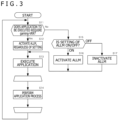
- the information processing device 1 starts a process indicated in FIG. 3 .
- the information processing device 1 checks whether or not the application to be started in accordance with the command is set to output video signals with variable refresh rate (S11).
- the information processing device 1 When the application to be started in accordance with the indication is set to output video signals with variable refresh rate (S11: Yes), the information processing device 1 operates on the assumption that the automatic low latency mode is ON regardless of the setting of the automatic low latency mode held in the storage section 12, and gives a command to activate the automatic low latency mode to the video output machine 2 (S12).
- the information processing device 1 starts the application to be started in accordance with the command and brings the application into full-screen operation (S13). Thereafter, the information processing device 1 executes a process of the application until a command to exit the application or a command to perform switching to another application is given (S14).
- the information processing device 1 determines that a command to start executing a switched application is given (if a command to exit the application is given, switching to a generally-called shell application, which is for starting an application or the like, is performed). Then, the information processing device 1 returns to step S11 to continue the process.
- step S11 when the application to be started in accordance with the command is not set to output video signals with variable refresh rate in step S11 (S11: No), the information processing device 1 checks the setting of the automatic low latency mode held in the storage section 12 (S15). When this setting indicates "ON” (S15: “ON”), a command to activate the automatic low latency mode is given to the video output machine 2 (S16). Then, the information processing device 1 proceeds to step S13 to continue the process.
- step S15 when the checked setting of the automatic low latency mode indicates "OFF" in step S15 (S15: “OFF"), a command to inactivate the automatic low latency mode is given to the video output machine 2 (S17). Then, the information processing device 1 proceeds to step S13 to continue the process.
- a command to activate/inactivate ALLM is given as follows.
- the information processing device 1 sets ALLM to OFF, and notifies the user of an error when the user sets ALLM to ON.
- the information processing device 1 operates according to the user's ON/OFF setting of ALLM, as follows.
- the information processing device 1 gives a command to activate the automatic low latency mode to the video output machine 2 when the setting indicates ON. Then, the process of the application is continued.
- the low latency mode is activated regardless of the user's setting, in the present embodiment. Accordingly, the convenience of the setting is improved.
- the information processing device 1 may operate as follows.
- the information processing device 1 operates in the same manner as the previously explained one in (1) a case where the connected video output machine 2 is not ALLM-capable.
- the information processing device 1 operates in the same manner as the previously explained one also in (2) a case where the connected video output machine 2 is ALLM-capable and (a) an application started by the user and caused to output a video is not set to require Gaming-VRR output of video signals.
- the information processing device 1 gives, according to the user's setting of ALLM held in the storage section 12, a command to inactivate the automatic low latency mode to the video output machine 2 when the setting indicates OFF. Then, the process of the application is continued.
- the information processing device 1 gives a command to activate the automatic low latency mode to the video output machine 2 when the setting indicates ON. Then, the process of the application is continued.
- the information processing device 1 may receive a setting of whether to set ALLM to ON/OFF.
- a setting to output video signals with, for example, fixed refresh rate has been performed
- a menu for setting ALLM to ON/OFF is presented on a setting screen.
- control of the automatic low latency mode based on this setting is performed.
- the information processing device 1 gives a command to inactivate the automatic low latency mode to the video output machine 2 according to the user's setting of ALLM held in the storage section 12, and executes a process of the application when the setting indicates OFF, or the information processing device 1 gives a command to activate the automatic low latency mode to the video output machine 2 and executes the process of the application when the setting indicates ON.
- the information processing device 1 may set ALLM to ON and may cause the setting screen to indicate that ALLM is fixed to an ON state.
- the information processing device 1 may hold, in the storage section 12, a user's setting concerning the ON/OFF of ALLM received during the OFF time of Gaming-VRR (that is, when a video is being outputted with fixed refresh rate), and may restore the held setting of ALLM when a next setting to set Gaming-VRR to OFF (that is, outputting a video at a fixed refresh rate) is performed.
- the information processing device 1 may perform a process of deciding whether or not to activate ALLM on the basis of this setting regardless of whether or not an application to be started is configured to set to require Gaming-VRR output of video signals.
- the information processing device 1 sets ALLM to OFF, and notifies the user of an error when the user sets ALLM to ON.
- the information processing device 1 operates as follows.
- the information processing device 1 When the user's setting indicates to allow Gaming-VRR output of video signals, according to the user's setting of ALLM held in the storage section 12, the information processing device 1 gives a command to inactivate the automatic low latency mode to the video output machine 2 when the setting indicates OFF. Then, the information processing device 1 performs the process of the application.
- the information processing device 1 gives a command to activate the automatic low latency mode to the video output machine 2 when the setting indicates ON. Then, the information processing device 1 performs the process of the application.
- the information processing device 1 gives a command to activate the automatic low latency mode to the video output machine 2 regardless of the user's setting of ALLM held in the storage section 12 (that is, whichever ON or OFF the setting indicates), and then, performs the process of the application.
- an application setting for defining whether or not Gaming-VRR output of video signals is required is held for each application, and the information processing device 1 determines whether or not an application to be executed is defined to require Gaming-VRR output of video signals according to this application setting, and performs a process of activating/inactivating ALLM.
- the present embodiment is not limited to this.
- the information processing device 1 may perform the process of activating/inactivating ALLM when a process of an application is being executed and Gaming-VRR output of video signals is required according to the process of the application.
- the information processing device 1 gives a command to activate/inactivate ALLM to the video output machine 2 according to the user's setting of ALLM held in the storage section 12 when the connected video output machine 2 is ALLM-capable.
- the information processing device 1 gives a command to activate the automatic low latency mode to the video output machine 2 regardless of the user's setting of ALLM held in the storage section 12 (that is, whichever ON or OFF the setting indicates), and then, continues the process of the application.
- the information processing device 1 gives a command to activate/inactivate ALLM to the video output machine 2 again according to the user's setting of ALLM held in the storage section 12, and then, continues the process of the application.
Landscapes
- Engineering & Computer Science (AREA)
- Theoretical Computer Science (AREA)
- Multimedia (AREA)
- Physics & Mathematics (AREA)
- General Physics & Mathematics (AREA)
- Computer Hardware Design (AREA)
- Human Computer Interaction (AREA)
- General Engineering & Computer Science (AREA)
- Computer Graphics (AREA)
- Computer Networks & Wireless Communication (AREA)
- Signal Processing (AREA)
- Pinball Game Machines (AREA)
- Image Processing (AREA)
Abstract
An information processing device is connected to a video output machine, and outputs a video signal to the video output machine. The information processing device includes a processor and a storage section. The processor executes an application, receives a setting of an automatic low latency mode and holds the setting in the storage section, and operates on assumption that the automatic low latency mode is ON regardless of the setting of the automatic low latency mode held in the storage section, when video signals are to be outputted with variable refresh rate according to a process of the application being executed.
Description
- The present invention relates to an information processing device that outputs a video signal to a video output machine, a control method for the information processing device, and a program.
- After HDMI (registered trademark: High-Definition Multimedia Interface) 2.1a, various kinds of function expansion of variable refresh rate (VRR), or particularly, Gaming-VRR and QMS-VRR (Quick Media Switching VRR), ALLM (Auto Low latency Mode), and the like have been achieved, and specifications corresponding to these functions are under development.
- Among them, Gaming-VRR enables video output from a video signal outputting device (source) to a display (sink) with delay as low as possible. When Gaming-VRR is used, it is required to activate ALLM (see the specifications of HDMI 2.1a).
- In a common game apparatus, Gaming-VRR is normally set to ON because use of Gaming-VRR matches a user's intension as long as Gaming-VRR is usable. Therefore, ALLM is normally set to ON.
- However, some game machines output videos of movies distributed over the internet or the like, in recent years. Further, there are also users' requests to enjoy high-quality game images. In these cases, it is preferable to set ALLM to OFF because precedence should be given to the image quality over low latency.
- However, if a setting to set ALLM to OFF is introduced, when an application side of a game or the like requires Gaming-VRR but ALLM is OFF, for example, Gaming-VRR cannot be set to ON due to the above-mentioned specifications. To set ALLM appropriately while utilizing the Gaming-VRR function, it is necessary for a user to switch the ON/OFF of ALLM each time an application for outputting video signals is switched. This causes a problem that the convenience is low.
- The present invention has been made in view of the above-mentioned circumstances, and one object thereof is to provide an information processing device that sets a low latency mode according to a user's request, and improves the convenience of the setting, control method for the information processing device, and a program.
- One aspect of the present invention for solving the above-mentioned conventional problems, is an information processing device that is connected to a video output machine and that outputs a video signal to the video output machine, the information processing device including a processor and a storage section, in which the processor executes an application, receives a setting of an automatic low latency mode and holds the setting in the storage section, and operates on assumption that the automatic low latency mode is ON regardless of the setting of the automatic low latency mode held in the storage section when video signals are to be outputted with variable refresh rate according to a process of the application being executed.
- According to the present invention, a low latency mode can be set according to a user's request, and the convenience of the setting can be improved.
-
- [
FIG. 1 ]
FIG. 1 is a block diagram depicting a configuration of an information processing device and a connection example thereof according to an embodiment of the present invention. - [
FIG. 2 ]
FIG. 2 is a functional block diagram depicting an example of the information processing device according to the embodiment of the present invention. - [
FIG. 3 ]
FIG. 3 is a flowchart of an operation example of the information processing device according to the embodiment of the present invention. - An embodiment of the present invention will be explained with reference to the drawings. For example, an
information processing device 1 according to the embodiment of the present invention is a program control device such as a home game machine or a personal computer. As depicted inFIG. 1 , theinformation processing device 1 includes acontrol section 11 as a processor, astorage section 12, anoperation section 13, anoutput control section 14, and acommunication section 15. Theinformation processing device 1 is connected to avideo output machine 2 such as a display. - The
control section 11 is a program control device that operates according to a program stored in thestorage section 12. In an example of the present embodiment, thecontrol section 11 executes a program of an application, and further, receives a setting of an automatic low latency mode (ALLM) and holds this setting in thestorage section 12. In addition, thecontrol section 11 operates on the assumption that the automatic low latency mode is ON regardless of the setting of the automatic low latency mode held in thestorage section 12 when video signals are to be outputted with gaming variable refresh rate (Gaming-VRR) according to a process of the application being executed. Further, the operation of thecontrol section 11 will be explained in detail later. - The
storage section 12 includes a memory device, a disk device, or the like. Thestorage section 12 stores a program that is executed by thecontrol section 11. The program may be provided in a state of being stored in a computer-readable and non-transitory recording medium, and then, be copied in thestorage section 12. In addition, thestorage section 12 also operates as a work memory of thecontrol section 11. - The
operation section 13 is connected to input devices including a game controller, a mouse, and a keyboard in a communicable manner, receives, from these input devices, information indicating the content of a command operation performed by a user, and outputs the information to thecontrol section 11. - The
output control section 14 outputs a video signal and a control signal to thevideo output machine 2 in accordance with a command inputted from thecontrol section 11. Thecommunication section 15 is a network interface or the like, and communicates with, for example, a server connected over a network, in accordance with a command inputted from thecontrol section 11. - Next, operation of the
control section 11 will be explained. As depicted inFIG. 2 , thecontrol section 11 according to the present embodiment functionally includes anapplication executing section 21, aninformation acquiring section 22, asetting processing section 23, and avideo output section 24. - The
application executing section 21 executes an application program (hereinafter, simply abbreviated as application) designated by a user, and performs a process according to the application. Applications that are executed by theapplication executing section 21 include various types of programs such as a game program and a video reproduction program for reproducing a video distributed over a network, etc. - Incidentally, in one example of the embodiment of the present invention, it is assumed that whether or not to require variable refresh rate output of video signals (Gaming-VRR requiring application) is previously set for each of applications installed in the
information processing device 1, and that the settings (application settings) are stored in thestorage section 12. - At a prescribed timing such as a start time of the
information processing device 1, theinformation acquiring section 22 communicates with thevideo output machine 2 connected to theinformation processing device 1, and acquires information indicating that whether or not thevideo output machine 2 supports video output with variable refresh rate (Gaming-VRR) (is Gaming-VRR capable or not) and whether or not thevideo output machine 2 supports automatic low latency mode (ALLM) (is ALLM-capable or not). - The
setting processing section 23 receives a setting concerning the automatic low latency mode from a user. Here, the setting concerning the automatic low latency mode indicates, for example, to set the automatic low latency mode to ON (a mode of indicating the low latency mode according to theinformation processing device 1's determination, if needed), or set the automatic low latency mode to OFF (a mode in which theinformation processing device 1 does not indicate the low latency mode). - After the
information acquiring section 22 acquires information indicating whether or not thevideo output machine 2 connected to theinformation processing device 1 is ALLM-capable at the timing such as the start time of theinformation processing device 1, thesetting processing section 23 initializes at least part of the setting with reference to the information. Specifically, if information indicating that thevideo output machine 2 connected to theinformation processing device 1 is not ALLM-capable is acquired, thesetting processing section 23 sets the automatic low latency mode to OFF, and stores and holds information indicating this setting in thestorage section 12. - Further, if the information indicating that the
video output machine 2 connected to theinformation processing device 1 is ALLM-capable is acquired, thesetting processing section 23 sets the automatic low latency mode to ON, and stores and holds information indicating this setting in thestorage section 12. - Furthermore, the
setting processing section 23 acquires the current (at the time point of the above command) setting of the automatic low latency mode held in thestorage section 12 in response to a command inputted by a user, displays the content of the setting, and allows the user to select the ON or OFF of the automatic low latency mode. - Herein, when the user performs a setting to set the automatic low latency mode to ON, the
setting processing section 23 checks the information which is acquired by theinformation acquiring section 22 to indicate whether or not thevideo output machine 2 is ALLM-capable. When determining that thevideo output machine 2 is not ALLM-capable according to the information, thesetting processing section 23 notifies the user of an error and maintains the OFF state of the automatic low latency mode. - Further, when checking the information indicating whether or not the
video output machine 2 is ALLM-capable and determining that thevideo output machine 2 connected to theinformation processing device 1 is ALLM-capable according to the information, thesetting processing section 23 sets the automatic low latency mode to ON according to the user's setting, and stores and holds information indicating this setting in thestorage section 12. - On the other hand, when the user is allowed to select the ON or OFF of the automatic low latency mode and the user performs a setting to set the automatic low latency mode to OFF, the
setting processing section 23 sets the automatic low latency mode to OFF according to the user's setting, and stores and holds information indicating this setting in thestorage section 12. - The
video output section 24 determines whether or not the application being executed by theapplication executing section 21 is a Gaming-VRR requiring application which requires variable refresh rate output of video signals. When the application being executed by theapplication executing section 21 is not a Gaming-VRR requiring application, thevideo output section 24 operates according to the setting of the automatic low latency mode held in thestorage section 12. - In this case, if the setting of the automatic low latency mode held in the
storage section 12 is "ON," thevideo output section 24 gives a command to activate the automatic low latency mode to thevideo output machine 2. Then, thevideo output section 24 outputs a video signal that is to be outputted according to operation of theapplication executing section 21, to thevideo output machine 2. - Here, according to a condition predetermined according to an inputted video signal (e.g. a condition using information that indicates the type of a video inputted from the information processing device 1), the
video output machine 2 performs display output of a video while performing switching between the low latency mode and a non-low latency mode (referred to as a normal mode) without a manual operation. This operation of thevideo output machine 2 is widely known, and thus, a detailed explanation thereof will be omitted here. - In contrast, if the setting of the automatic low latency mode held in the
storage section 12 is "OFF," thevideo output section 24 gives a command to inactivate the automatic low latency mode to thevideo output machine 2. Then, thevideo output section 24 outputs a video signal that is to be outputted according to operation of theapplication executing section 21, to thevideo output machine 2. - Here, the
video output machine 2 performs display output of a video in a normal mode that is different from the low latency mode, regardless of a video signal inputted from theinformation processing device 1 or information indicating the type of the video. - On the other hand, when determining whether or not the application being executed by the
application executing section 21 is a Gaming-VRR requiring application which requires variable refresh rate output of video signals and finding that the application being executed by theapplication executing section 21 is a Gaming-VRR requiring application, thevideo output section 24 operates on the assumption that the automatic low latency mode is ON regardless of the setting of the automatic low latency mode held in thestorage section 12, and gives a command to activate the automatic low latency mode to thevideo output machine 2. - In this case, therefore, according to a condition predetermined according to an inputted video signal (e.g. a condition using information indicating the type of a video inputted from the information processing device 1), the
video output machine 2 performs display output of a video while performing switching between the low latency mode and the non-low latency mode (referred to as the normal mode) without a manual operation. - It is to be noted that, in the explanation given so far, the
video output section 24 determines whether or not the application being executed by theapplication executing section 21 is a Gaming-VRR requiring application. - (1) In a case where the
application executing section 21 is executing one application (single task): thevideo output section 24 determines whether or not the one application under execution is a Gaming-VRR requiring application. - In addition,
- (2) in a case where the
application executing section 21 is executing a plurality of applications parallelly (multitask): thevideo output section 24 may determine whether or not at least one of the applications under execution is a Gaming-VRR requiring application. - (2') In a case where the
application executing section 21 is executing a plurality of applications parallelly (multitask) and some of the applications indicates output of video signals: thevideo output section 24 may determine whether or not at least one of the applications indicating output of video signals is a Gaming-VRR requiring application. - In the latter case, if one of the applications being executed by the
application executing section 21 is under full-screen operation (only video signals according to the indication by the application are outputted while video outputs according to indications by the remaining applications are halted), thevideo output section 24 determines whether or not the application under the full-screen operation is a Gaming-VRR requiring application. - The present embodiment basically has the above-mentioned configuration, and operation thereof is as follows. It is to be noted that the following explanation is based on the assumption that the
information processing device 1 causes a plurality of applications to be operated in parallel, but any one of the applications is operated in full screen (during the full-screen operation, none of videos based on indications by the remaining applications is outputted). - By communicating with the
video output machine 2 connected to theinformation processing device 1 at the start time of theinformation processing device 1, theinformation processing device 1 acquires information indicating whether or not thevideo output machine 2 supports video output with variable refresh rate (Gaming-VRR) (is Gaming-VRR capable or not) and whether or not thevideo output machine 2 supports the automatic low latency mode (ALLM) (is ALLM-capable or not), for example, and holds this information in thestorage section 12. The following example is based on the assumption that thevideo output machine 2 connected to theinformation processing device 1 is ALLM-capable. - A user operates the
information processing device 1 to perform a setting concerning the automatic low latency mode in advance. For example, a user who uses an application for mainly viewing a distributed video on theinformation processing device 1, performs a setting to set the automatic low latency mode to OFF. Then, theinformation processing device 1 sets the automatic low latency mode to OFF according to the user's setting, and stores and holds information indicating this setting in thestorage section 12. - Thereafter, when receiving a user's command to start executing a process of any one of installed applications, the
information processing device 1 starts a process indicated inFIG. 3 . Theinformation processing device 1 checks whether or not the application to be started in accordance with the command is set to output video signals with variable refresh rate (S11). - When the application to be started in accordance with the indication is set to output video signals with variable refresh rate (S11: Yes), the
information processing device 1 operates on the assumption that the automatic low latency mode is ON regardless of the setting of the automatic low latency mode held in thestorage section 12, and gives a command to activate the automatic low latency mode to the video output machine 2 (S12). - Further, the
information processing device 1 starts the application to be started in accordance with the command and brings the application into full-screen operation (S13). Thereafter, theinformation processing device 1 executes a process of the application until a command to exit the application or a command to perform switching to another application is given (S14). - When a command to exit the application or to perform switching to another application is given, the
information processing device 1 determines that a command to start executing a switched application is given (if a command to exit the application is given, switching to a generally-called shell application, which is for starting an application or the like, is performed). Then, theinformation processing device 1 returns to step S11 to continue the process. - On the other hand, when the application to be started in accordance with the command is not set to output video signals with variable refresh rate in step S11 (S11: No), the
information processing device 1 checks the setting of the automatic low latency mode held in the storage section 12 (S15). When this setting indicates "ON" (S15: "ON"), a command to activate the automatic low latency mode is given to the video output machine 2 (S16). Then, theinformation processing device 1 proceeds to step S13 to continue the process. - Further, when the checked setting of the automatic low latency mode indicates "OFF" in step S15 (S15: "OFF"), a command to inactivate the automatic low latency mode is given to the video output machine 2 (S17). Then, the
information processing device 1 proceeds to step S13 to continue the process. - As a result of the above operation of the
information processing device 1 according to one example of the present embodiment, a command to activate/inactivate ALLM is given as follows. - In this case, the
information processing device 1 sets ALLM to OFF, and notifies the user of an error when the user sets ALLM to ON. - (2) A case where the connected
video output machine 2 is ALLM-capable In this case, theinformation processing device 1 operates according to the user's ON/OFF setting of ALLM, as follows. - (a) When an application started by the user and caused to output a video is not set to require Gaming-VRR output of video signals (the application is set to perform, for example, fixed refresh rate output of video signals),
- according to the user's setting of ALLM held in the
storage section 12, theinformation processing device 1 gives a command to inactivate the automatic low latency mode to thevideo output machine 2 when the setting indicates OFF. Then, the process of the application is continued. - Alternatively, the
information processing device 1 gives a command to activate the automatic low latency mode to thevideo output machine 2 when the setting indicates ON. Then, the process of the application is continued. - (b) When an application started by the user and caused to output a video is set to require Gaming-VRR output of video signals,
- regardless of the user's setting of ALLM held in the storage section 12 (whichever of ON or OFF the setting indicates), the
information processing device 1 gives a command to activate the automatic low latency mode to thevideo output machine 2. Then, the process of the application is continued. - In this manner, in a case where Gaming-VRR is used while the low latency mode is set according to a user's request, the low latency mode is activated regardless of the user's setting, in the present embodiment. Accordingly, the convenience of the setting is improved.
- Further, in an example of the present embodiment, in a case where the
information processing device 1 receives a user's setting indicating whether or not to allow Gaming-VRR output of video signals, theinformation processing device 1 may operate as follows. - In this example, regarding a command to activate/inactivate ALLM, the
information processing device 1 operates in the same manner as the previously explained one in (1) a case where the connectedvideo output machine 2 is not ALLM-capable. Theinformation processing device 1 operates in the same manner as the previously explained one also in (2) a case where the connectedvideo output machine 2 is ALLM-capable and (a) an application started by the user and caused to output a video is not set to require Gaming-VRR output of video signals. - On the other hand, in (2) a case where the connected
video output machine 2 is ALLM-capable but (b) an application started by the user and caused to output a video is set to require Gaming-VRR output of video signals, the user's setting of Gaming-VRR is checked, and theinformation processing device 1 gives a command to activate the automatic low latency mode to thevideo output machine 2 regardless of the user's setting of ALLM held in the storage section 12 (that is, whichever ON or OFF the setting indicates) when the user's setting indicates to allow Gaming-VRR output of video signals. Then, the process of the application is continued (in the similar manner to that of the above explanation). - However, in (2) a case where the connected
video output machine 2 is ALLM-capable and (b) an application started by the user and caused to output a video is set to require Gaming-VRR output of video signals, and further, the user's setting indicates to prohibit Gaming-VRR output of video signals (the Gaming-VRR is OFF and output of video signals with, for example, fixed refresh rate is indicated), theinformation processing device 1 gives, according to the user's setting of ALLM held in thestorage section 12, a command to inactivate the automatic low latency mode to thevideo output machine 2 when the setting indicates OFF. Then, the process of the application is continued. - On the other hand, the
information processing device 1 gives a command to activate the automatic low latency mode to thevideo output machine 2 when the setting indicates ON. Then, the process of the application is continued. - It is to be noted that, when a setting to output video signals with fixed refresh rate has been performed (that is, when Gaming-VRR is OFF), the
information processing device 1 may receive a setting of whether to set ALLM to ON/OFF. In this example, only when a setting to output video signals with, for example, fixed refresh rate has been performed, a menu for setting ALLM to ON/OFF is presented on a setting screen. Further, in this example, when a setting to output video signals with fixed refresh rate has been performed, control of the automatic low latency mode based on this setting is performed. That is, theinformation processing device 1 gives a command to inactivate the automatic low latency mode to thevideo output machine 2 according to the user's setting of ALLM held in thestorage section 12, and executes a process of the application when the setting indicates OFF, or theinformation processing device 1 gives a command to activate the automatic low latency mode to thevideo output machine 2 and executes the process of the application when the setting indicates ON. In addition, when the fixed refresh rate output of video signals is OFF (that is, when Gaming-VRR is ON), theinformation processing device 1 may set ALLM to ON and may cause the setting screen to indicate that ALLM is fixed to an ON state. Here, theinformation processing device 1 may hold, in thestorage section 12, a user's setting concerning the ON/OFF of ALLM received during the OFF time of Gaming-VRR (that is, when a video is being outputted with fixed refresh rate), and may restore the held setting of ALLM when a next setting to set Gaming-VRR to OFF (that is, outputting a video at a fixed refresh rate) is performed. - It is to be noted that, in such a way, in a case where the
information processing device 1 has received a user's setting of whether or not to allow Gaming-VRR output of video signals, theinformation processing device 1 may perform a process of deciding whether or not to activate ALLM on the basis of this setting regardless of whether or not an application to be started is configured to set to require Gaming-VRR output of video signals. - That is, in this example,
- In this case, the
information processing device 1 sets ALLM to OFF, and notifies the user of an error when the user sets ALLM to ON. - (2) A case where the connected
video output machine 2 is ALLM-capable In this case, according to the user's ON/OFF setting of ALLM, theinformation processing device 1 operates as follows. - (a') When the user's setting indicates to allow Gaming-VRR output of video signals,
according to the user's setting of ALLM held in thestorage section 12, theinformation processing device 1 gives a command to inactivate the automatic low latency mode to thevideo output machine 2 when the setting indicates OFF. Then, theinformation processing device 1 performs the process of the application. - Alternatively, the
information processing device 1 gives a command to activate the automatic low latency mode to thevideo output machine 2 when the setting indicates ON. Then, theinformation processing device 1 performs the process of the application. - On the other hand, (b') when the user's setting indicates to prohibit Gaming-VRR output of video signals,
theinformation processing device 1 gives a command to activate the automatic low latency mode to thevideo output machine 2 regardless of the user's setting of ALLM held in the storage section 12 (that is, whichever ON or OFF the setting indicates), and then, performs the process of the application. - In the explanation given so far, an application setting for defining whether or not Gaming-VRR output of video signals is required is held for each application, and the
information processing device 1 determines whether or not an application to be executed is defined to require Gaming-VRR output of video signals according to this application setting, and performs a process of activating/inactivating ALLM. However, the present embodiment is not limited to this. - Incidentally, in a certain example of the present embodiment, the
information processing device 1 may perform the process of activating/inactivating ALLM when a process of an application is being executed and Gaming-VRR output of video signals is required according to the process of the application. In this example, at the start time of the application, theinformation processing device 1 gives a command to activate/inactivate ALLM to thevideo output machine 2 according to the user's setting of ALLM held in thestorage section 12 when the connectedvideo output machine 2 is ALLM-capable. - Thereafter, when Gaming-VRR output of video signals is required according to the process of the application during execution of the process of the application, the
information processing device 1 gives a command to activate the automatic low latency mode to thevideo output machine 2 regardless of the user's setting of ALLM held in the storage section 12 (that is, whichever ON or OFF the setting indicates), and then, continues the process of the application. - Further, when the Gaming-VRR output of video signals is finished according to the process of the application during execution of the process of the application (when the output is switched to fixed refresh rate output of video signals), the
information processing device 1 gives a command to activate/inactivate ALLM to thevideo output machine 2 again according to the user's setting of ALLM held in thestorage section 12, and then, continues the process of the application. - In this example, a selection can be made as to whether to cause the application to follow the user's ON/OFF setting of ALLM according to a video signal inputted from the application, or to forcibly set ALLM to ON in order to use Gaming-VRR. Accordingly, during execution of, for example, a game application, the
information processing device 1 sets Gaming-VRR to ON and sets ALLM to ON regardless of the user's setting, for a scene of a battle or the like in which the real-time property is important. In contrast, for a scene to enjoy a landscape or the like, theinformation processing device 1 decides to set ALLM to ON/OFF according to the user's setting. Accordingly, with theinformation processing device 1 according to the present embodiment, video output can be performed according to a user's selection. -
- 1:
- Information processing device
- 2:
- Video output machine
- 11:
- Control section
- 12:
- Storage section
- 13:
- Operation section
- 14:
- Output control section
- 15:
- Communication section
- 21:
- Application executing section
- 22:
- Information acquiring section
- 23:
- Setting processing section
- 24:
- Video output section
Claims (6)
- An information processing device that is connected to a video output machine and that outputs a video signal to the video output machine, the information processing device comprising:a processor; anda storage section, whereinthe processorexecutes an application,receives a setting of an automatic low latency mode and holds the setting in the storage section, andoperates on assumption that the automatic low latency mode is ON regardless of the setting of the automatic low latency mode held in the storage section, when video signals are to be outputted with variable refresh rate according to a process of the application being executed.
- The information processing device according to claim 1, wherein, in a case where the application being executed is an application that outputs video signals with variable refresh rate, the processor operates on assumption that the automatic low latency mode is ON regardless of the setting of the automatic low latency mode held in the storage section, when the application is being executed.
- The information processing device according to claim 1, wherein, when the application being executed requires variable refresh rate output of video signals, the processor operates on assumption that the automatic low latency mode is ON regardless of the setting of the automatic low latency mode held in the storage section.
- An information processing device that is connected to a video output machine and that outputs a video signal to the video output machine, the information processing device comprising:a processor; anda storage section, whereinthe processorexecutes an application,receives a setting of an automatic low latency mode and holds the setting in the storage section, andcontrols the automatic low latency mode according to the setting of the automatic low latency mode held in the storage section, when video signals are to be outputted with fixed refresh rate according to a process of the application being executed.
- A control method for an information processing device that is connected to a video output machine and that outputs a video signal to the video output machine, the information processing device including a processor and a storage section, the control method comprising:causing the processorto execute an application;to receive a setting of an automatic low latency mode and hold the setting in the storage section; andto operate on assumption that the automatic low latency mode is ON regardless of the setting of the automatic low latency mode held in the storage section, when video signals are to be outputted with variable refresh rate according to a process of the application being executed.
- A program for an information processing device that is connected to a video output machine and that outputs a video signal to the video output machine, the program being for causing the information processing device to function:to execute an application;to receive a setting of an automatic low latency mode and hold the setting; andto operate on assumption that the automatic low latency mode is ON regardless of the held setting of the automatic low latency mode when video signals are to be outputted with variable refresh rate according to a process of the application being executed.
Applications Claiming Priority (2)
| Application Number | Priority Date | Filing Date | Title |
|---|---|---|---|
| JP2022108894 | 2022-07-06 | ||
| PCT/JP2023/024508 WO2024009919A1 (en) | 2022-07-06 | 2023-06-30 | Information processing device, control method for information processing device, and program |
Publications (1)
| Publication Number | Publication Date |
|---|---|
| EP4554233A1 true EP4554233A1 (en) | 2025-05-14 |
Family
ID=89453460
Family Applications (1)
| Application Number | Title | Priority Date | Filing Date |
|---|---|---|---|
| EP23835451.8A Pending EP4554233A1 (en) | 2022-07-06 | 2023-06-30 | Information processing device, control method for information processing device, and program |
Country Status (4)
| Country | Link |
|---|---|
| US (1) | US20250332504A1 (en) |
| EP (1) | EP4554233A1 (en) |
| JP (1) | JP7749303B2 (en) |
| WO (1) | WO2024009919A1 (en) |
Families Citing this family (1)
| Publication number | Priority date | Publication date | Assignee | Title |
|---|---|---|---|---|
| KR20250146800A (en) * | 2024-04-02 | 2025-10-13 | 삼성전자주식회사 | Electronic apparatus and operating method thereof |
Family Cites Families (2)
| Publication number | Priority date | Publication date | Assignee | Title |
|---|---|---|---|---|
| JP2018028559A (en) * | 2015-01-07 | 2018-02-22 | シャープ株式会社 | Image data output device, image data output method, image display device, and integrated circuit |
| CN114302195B (en) * | 2021-01-14 | 2023-04-14 | 海信视像科技股份有限公司 | A display device, an external device, and a playback control method |
-
2023
- 2023-06-30 US US18/879,955 patent/US20250332504A1/en active Pending
- 2023-06-30 EP EP23835451.8A patent/EP4554233A1/en active Pending
- 2023-06-30 JP JP2024532103A patent/JP7749303B2/en active Active
- 2023-06-30 WO PCT/JP2023/024508 patent/WO2024009919A1/en not_active Ceased
Also Published As
| Publication number | Publication date |
|---|---|
| JPWO2024009919A1 (en) | 2024-01-11 |
| US20250332504A1 (en) | 2025-10-30 |
| JP7749303B2 (en) | 2025-10-06 |
| WO2024009919A1 (en) | 2024-01-11 |
Similar Documents
| Publication | Publication Date | Title |
|---|---|---|
| US20040268262A1 (en) | System and method for switching of media presentation | |
| JP4153462B2 (en) | Display system switching device, display system switching method, display system switching program, and computer-readable storage medium storing the program | |
| US11123635B2 (en) | Game application launch system and method | |
| CN105740010B (en) | A boot method and terminal device | |
| EP3474559B1 (en) | Smart-television playback method and apparatus | |
| EP2460350B1 (en) | Video reproduction apparatus, control method thereof, and computer-readable storage medium storing program | |
| US10862946B1 (en) | Media player supporting streaming protocol libraries for different media applications on a computer system | |
| US12126869B2 (en) | Port-connected television upgrader device | |
| US20060037029A1 (en) | Computer-readable program product, process and apparatus for installing device driver | |
| US20250332504A1 (en) | Information processing device, control method for information processing device, and program | |
| US9807360B2 (en) | Method and apparatus for reproducing content | |
| US20060150108A1 (en) | Information processing device, information processing method, storage medium, and program | |
| CN109218817B (en) | Method and device for displaying virtual gift prompting message | |
| CN110891199B (en) | Page display method and display equipment | |
| US9047040B2 (en) | Method for running computer program on video card selected based on video card preferences of the program | |
| CN116233511A (en) | Video synchronous playing method, spliced screen system, television and storage medium | |
| EP3739874A1 (en) | Video playback method and device, terminal device and computer readable storage medium | |
| CN112269626A (en) | Method, device and device for monitoring virtual machine | |
| WO2024255453A1 (en) | Display device and game picture quality control method | |
| US10585557B2 (en) | Running computer program on video card selected based on video card preferences of the computer program | |
| CN113873298B (en) | Video redirection method, electronic device, and computer-readable storage medium | |
| JP2013090102A (en) | Distribution system | |
| US20260031062A1 (en) | Video display control device, control method therefor, and program | |
| US12307260B2 (en) | Displaying content transmitted by an external device based on detection of a connected state by display firmware | |
| CN112887805B (en) | Voice function prompting method, device, equipment and medium |
Legal Events
| Date | Code | Title | Description |
|---|---|---|---|
| STAA | Information on the status of an ep patent application or granted ep patent |
Free format text: STATUS: THE INTERNATIONAL PUBLICATION HAS BEEN MADE |
|
| PUAI | Public reference made under article 153(3) epc to a published international application that has entered the european phase |
Free format text: ORIGINAL CODE: 0009012 |
|
| STAA | Information on the status of an ep patent application or granted ep patent |
Free format text: STATUS: REQUEST FOR EXAMINATION WAS MADE |
|
| 17P | Request for examination filed |
Effective date: 20250106 |
|
| AK | Designated contracting states |
Kind code of ref document: A1 Designated state(s): AL AT BE BG CH CY CZ DE DK EE ES FI FR GB GR HR HU IE IS IT LI LT LU LV MC ME MK MT NL NO PL PT RO RS SE SI SK SM TR |
|
| DAV | Request for validation of the european patent (deleted) | ||
| DAX | Request for extension of the european patent (deleted) |