EP4554182A1 - Data scheduling method, and electronic device and storage medium - Google Patents
Data scheduling method, and electronic device and storage medium Download PDFInfo
- Publication number
- EP4554182A1 EP4554182A1 EP23838409.3A EP23838409A EP4554182A1 EP 4554182 A1 EP4554182 A1 EP 4554182A1 EP 23838409 A EP23838409 A EP 23838409A EP 4554182 A1 EP4554182 A1 EP 4554182A1
- Authority
- EP
- European Patent Office
- Prior art keywords
- queue
- data
- sub
- network
- slice
- Prior art date
- Legal status (The legal status is an assumption and is not a legal conclusion. Google has not performed a legal analysis and makes no representation as to the accuracy of the status listed.)
- Pending
Links
Images


Classifications
-
- H—ELECTRICITY
- H04—ELECTRIC COMMUNICATION TECHNIQUE
- H04L—TRANSMISSION OF DIGITAL INFORMATION, e.g. TELEGRAPHIC COMMUNICATION
- H04L41/00—Arrangements for maintenance, administration or management of data switching networks, e.g. of packet switching networks
- H04L41/08—Configuration management of networks or network elements
- H04L41/0893—Assignment of logical groups to network elements
-
- H—ELECTRICITY
- H04—ELECTRIC COMMUNICATION TECHNIQUE
- H04L—TRANSMISSION OF DIGITAL INFORMATION, e.g. TELEGRAPHIC COMMUNICATION
- H04L41/00—Arrangements for maintenance, administration or management of data switching networks, e.g. of packet switching networks
- H04L41/08—Configuration management of networks or network elements
- H04L41/0894—Policy-based network configuration management
-
- H—ELECTRICITY
- H04—ELECTRIC COMMUNICATION TECHNIQUE
- H04L—TRANSMISSION OF DIGITAL INFORMATION, e.g. TELEGRAPHIC COMMUNICATION
- H04L45/00—Routing or path finding of packets in data switching networks
- H04L45/80—Ingress point selection by the source endpoint, e.g. selection of ISP or POP
- H04L45/85—Selection among different networks
-
- H—ELECTRICITY
- H04—ELECTRIC COMMUNICATION TECHNIQUE
- H04L—TRANSMISSION OF DIGITAL INFORMATION, e.g. TELEGRAPHIC COMMUNICATION
- H04L47/00—Traffic control in data switching networks
- H04L47/10—Flow control; Congestion control
- H04L47/24—Traffic characterised by specific attributes, e.g. priority or QoS
-
- H—ELECTRICITY
- H04—ELECTRIC COMMUNICATION TECHNIQUE
- H04L—TRANSMISSION OF DIGITAL INFORMATION, e.g. TELEGRAPHIC COMMUNICATION
- H04L47/00—Traffic control in data switching networks
- H04L47/10—Flow control; Congestion control
- H04L47/24—Traffic characterised by specific attributes, e.g. priority or QoS
- H04L47/2408—Traffic characterised by specific attributes, e.g. priority or QoS for supporting different services, e.g. a differentiated services [DiffServ] type of service
-
- H—ELECTRICITY
- H04—ELECTRIC COMMUNICATION TECHNIQUE
- H04L—TRANSMISSION OF DIGITAL INFORMATION, e.g. TELEGRAPHIC COMMUNICATION
- H04L47/00—Traffic control in data switching networks
- H04L47/50—Queue scheduling
- H04L47/62—Queue scheduling characterised by scheduling criteria
- H04L47/6215—Individual queue per QOS, rate or priority
-
- H—ELECTRICITY
- H04—ELECTRIC COMMUNICATION TECHNIQUE
- H04L—TRANSMISSION OF DIGITAL INFORMATION, e.g. TELEGRAPHIC COMMUNICATION
- H04L47/00—Traffic control in data switching networks
- H04L47/50—Queue scheduling
- H04L47/62—Queue scheduling characterised by scheduling criteria
- H04L47/625—Queue scheduling characterised by scheduling criteria for service slots or service orders
- H04L47/6275—Queue scheduling characterised by scheduling criteria for service slots or service orders based on priority
-
- H—ELECTRICITY
- H04—ELECTRIC COMMUNICATION TECHNIQUE
- H04W—WIRELESS COMMUNICATION NETWORKS
- H04W28/00—Network traffic management; Network resource management
- H04W28/16—Central resource management; Negotiation of resources or communication parameters, e.g. negotiating bandwidth or QoS [Quality of Service]
Definitions
- Embodiments of the present application relate to, but are not limited to, the technical field of communications, in particular to a data scheduling method, and an electronic device and a storage medium.
- a network slicing technology performs on-demand networking on a unified network infrastructure to provide a plurality of logically isolated virtual networks.
- scheduling of data of network slices usually adopts a default first input first output (FIFO) scheduling mode of a Linux kernel system, and in the first input first output scheduling mode, packets are sent according to an entry order of the data of the network slices.
- FIFO first input first output
- a default tail-drop policy is usually adopted to drop all data arriving later, and this tail-drop policy causes service interruptions and reduces the network quality of service.
- a data scheduling method and an electronic device and a storage medium.
- an embodiment of the present application provides a data scheduling method, including: acquiring a plurality of pieces of data to be scheduled, wherein the data to be scheduled includes requirement information, and the requirement information represents network features required by the data to be scheduled; determining, for each piece of data to be scheduled, a target network slice from a plurality of network slices according to network features of the network slices and the requirement information, and allocating, to the target network slice, the data to be scheduled, so as to obtain slice data; configuring priority identifiers for the plurality of pieces of slice data; allocating the plurality of pieces of slice data to different sub-queues of different queue groups according to the priority identifiers; and scheduling the slice data in different sub-queues of different queue groups.
- an embodiment of the present application further provides an electronic device, including a memory, a processor and a computer program stored on the memory and capable of running on the processor, and the processor, when executing the computer program, implements the data scheduling method described above.
- an embodiment of the present application further provides a computer readable storage medium, storing a computer executable instruction, and the computer executable instruction is used to execute the data scheduling method described above.
- the data scheduling method includes: acquiring a plurality of pieces of data to be scheduled, wherein the data to be scheduled includes requirement information representing required network features; determining, for each piece of data to be scheduled, a target network slice from a plurality of network slices according to network features of the network slices and the requirement information, and allocating, to the target network slice, the data to be scheduled, so as to obtain slice data; configuring priority identifiers for the plurality of pieces of slice data; allocating the plurality of pieces of slice data to different sub-queues of different queue groups according to the priority identifiers; and scheduling the slice data in different sub-queues of different queue groups according to round robin scheduling processing and priority queue scheduling processing.
- the different data to be scheduled is configured into the different network slices according to the network features, the slice data is allocated into queues according to the priorities, the slice data in the queues is scheduled in combination with the round robin scheduling processing and the priority queue scheduling processing, so that important slice data is scheduled with priority to a certain extent, while ordinary slice data can also be scheduled, which realizes reasonable scheduling of different slice data and thus improves the network quality of service.
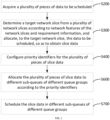
- FIG. 1 is a diagram of steps of a data scheduling method.
- the data scheduling method includes, but is not limited to, the following steps S200-S700.
- Step S200 a plurality of pieces of data to be scheduled is acquired.
- the data to be scheduled includes requirement information, and the requirement information represents network features required by the data to be scheduled.
- Step S300 for each piece of data to be scheduled, a target network slice is determined from a plurality of network slices according to network features of the network slices and the requirement information, and the data to be scheduled is allocated to the target network slice, so as to obtain slice data.
- Step S400 priority identifiers are configured for the plurality of pieces of slice data.
- Step S600 the plurality of pieces of slice data is allocated to different sub-queues of different queue groups according to the priority identifiers.
- Step S700 the slice data in different sub-queues of different queue groups is scheduled.
- the intelligent terminal devices access customer premise equipment (CPE) through network cables, mobile networks or Wi-Fi networks.
- the intelligent terminal devices may include, but are not limited to, any one or more of a smart watch, a smart phone, a computer, a smart printer, a digital camera, a personal digital assistant, a smart voice interaction device, a smart home appliance, or a vehicle-mounted terminal.
- the customer premise equipment is a network connection device configured to access the Internet or services on a network of a provider.
- the customer premise equipment is located on a user side of the network and may be a demarcation point between the network of the provider and a home network or local area network of a customer.
- the customer premise equipment performs network slicing on the network by executing the following step.
- Step S100 network slicing processing is performed on the network according to the network features to obtain the plurality of network slices.
- the different network slices have the different network features.
- network slicing refers to that a network architecture defined by a 3GPP protocol is functionally tailored on the same shared network infrastructure in a combination on demand to provide a plurality of logical networks oriented to user equipment.
- Network slicing slices according to different application scenarios and service index requirements, a physical network from a radio access network to a bearer network and then to a core network into a plurality of independent end-to-end logically isolated logical networks to adapt to service applications of various index requirements.
- Each network slice may flexibly define its own logical topology, SLA requirements, reliability and security level. All network slices are logically isolated, i.e., an abnormality of one slice does not affect other slices, realizing service isolation, resource isolation, and operation and maintenance isolation.
- the network features include at least one of a first feature based on a user terminal, a second feature based on a user behavior, a third feature based on a network load, a fourth feature based on an IP quintet, and a fifth feature based on a virtual local area network.
- the network is divided into four network slices, i.e., a network slice based on a user, a network slice based on a user behavior, a network slice based on a network load, and a network slice based on an IP quintet/Vlan.
- other network features may also be adopted.
- Network resources with different network qualities of service (QoS) and service-level agreements (SLAs) may be provided according to service requirements.
- Slices can further be customized in accordance with durations, capacity requirements, speed requirements, latency requirements, reliability requirements, security requirements, and availability requirements of service, so that the same network and different slices are used to meet various service requirements.
- the overall architecture of network slices is divided into three layers, i.e., a network slice forwarding layer, a network slice control layer and a network slice management layer.
- the network slice forwarding layer supports dividing forwarding resources in the physical network into a plurality of copies that are mutually isolated and provided to be used by different network slices respectively.
- the network slice control layer is used to generate different instances of logical network slices in the physical network, provide an on-demand customized logical topology connection, and integrate the logical topology of the slices with the network resources allocated for the slices to constitute network slices that meet specific service requirements.
- the network slice management layer provides a lifecycle management function for the network slices.
- the intelligent terminal sends the data to be scheduled to the customer premise equipment, and the customer premise equipment acquires a plurality of data to be scheduled.
- a message of the data to be scheduled contains a field corresponding to the requirement information, and the requirement information represents network features required by the data to be scheduled.
- a network slice whose network feature corresponds to the network feature required by the data to be scheduled is determined as the target network slice from the plurality of network slices, i.e., the network feature of the target network slice corresponds to the network feature required by the data to be scheduled.
- a piece of data to be scheduled contains requirement information that requires corresponding to a second feature based on a user behavior, a network slice whose network feature is the second feature based on the user behavior is determined as a target network slice from the plurality of network slices, and the data to be scheduled is allocated to the target network slice.
- the data to be scheduled is allocated to the target network slice to obtain the slice data.
- the allocating processing above is executed for each piece of data to be scheduled to obtain a plurality of pieces of slice data.
- a step of determining priority identifiers is included prior to configuring the priority identifiers for the plurality of pieces of slice data. Determining the priority identifiers includes, but is not limited to, the following steps S401 and S402.
- Step S401 address information of the slice data is acquired.
- Step S402 the priority identifiers corresponding to the slice data are determined from a preset identifier mapping table according to the address information.
- a message of the data to be scheduled contains a field of address information, so the slice data obtained by allocating the data to be scheduled to a slice also contains a field of address information.
- the address information of the slice data is acquired, wherein the address information includes an MAC address or an IP address of the slice data.
- the priority identifiers corresponding to the slice data are determined from the preset identifier mapping table according to the address information.
- the priority identifiers are then configured for the plurality of pieces of slice data through an IPtable, wherein the IPtable is a firewall user agent tool based on packet filtering.
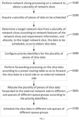
- Step S500 forwarding processing is performed on the slice data according to a preset routing table so as to forward the slice data to a local side or an external network side.
- a network service For the slice data forwarded to the external network side, a network service is provided.
- Step S600 specifically includes the following step: step S601, the plurality of pieces of slice data forwarded to the external network side are allocated to different sub-queues of different queue groups according to the priority identifiers.
- a corresponding sub-queue has been determined by querying a data-to-be-scheduled mapping table according to the priority identifiers, the plurality of pieces of slice data is allocated to different sub-queues of different queue groups, wherein the different queue groups have different group priorities, and the different sub-queues in the same queue group have different queue priorities.
- the sub-queues are divided into unicast sub-queues and multicast sub-queues.
- the slice data is determined to be allocated to a unicast sub-queue or a multicast sub-queue according to the Mac address of the slice data.
- the Mac address of the slice data may be represented in 6-byte hexadecimal, and the Mac address has a total of 48 bits, wherein the 48 th bit may be used to represent whether the Mac address is a multicast address or a unicast address.
- the 48 th bit is 1, the Mac address may be determined to be a multicast address, and the slice data is allocated to a multicast sub-queue.
- the 48 th bit is 0, the Mac address may be determined to be a unicast address, and the slice data is allocated to a unicast sub-queue.
- FIG. 9 is a schematic diagram of a scheduling policy framework.
- the scheduling policy framework includes a Root node, an L0 node, and an L1 node.
- the Root node stores numbers of all queue groups and the group priorities of the queue groups.
- An L0 node stores numbers of sub-queues in a queue group and queue priorities of the sub-queues.
- An L1 node stores numbers of unicast sub-queues and multicast sub-queues under a sub-queue and unicast/multicast scheduling priorities.
- the Root node may store two queue groups, a queue group K0 and a queue group K1 respectively, a group priority of the queue group K0 may be Cosq0, and a group priority of the queue group K1 may be Cosq1.
- the L0 node corresponding to the queue group K0 may store four sub-queues, respectively a sub-queue P0, a sub-queue P1, a sub-queue P2, and a sub-queue P3, and queue priorities may be Cosq0, Cosq1, Cosq2, and Cosq3 respectively.
- the L1 node corresponding to the queue group K1 may store four sub-queues, respectively a sub-queue P4, a sub-queue P5, a sub-queue P6, and a sub-queue P7, and queue priorities may be Cosq0, Cosq1, Cosq2, and Cosq3 respectively.
- Each sub-queue further contains a unicast sub-queue and a multicast sub-queue.
- a queue group to be scheduled is determined from the group priorities in the Root node, then a sub-queue to be scheduled is determined from the queue priorities in the L0 node corresponding to the queue group to be scheduled, and then slice data in a unicast sub-queue or multicast sub-queue to be scheduled is determined from the L1 node corresponding to the sub-queue to be scheduled.
- L0 nodes may be set under each Root node according to actual requirements, and more or less L1 nodes may be set under each L0 node.
- scheduling the slice data in different sub-queues of different queue groups according to round robin scheduling processing and priority queue scheduling processing includes step S710 and step S720.
- Step S710 for different sub-queues in a queue group having a higher group priority, round robin scheduling processing is executed on slice data according to queue priorities.
- Step S720 for different sub-queues in a queue group having a lower group priority, priority queue scheduling processing is executed on slice data according to the queue priorities.
- a queue group to be scheduled may be determined according to the group priorities of the Root node in the scheduling policy architecture, and when the queue group to be scheduled is determined to be a queue group with a higher group priority, round robin scheduling processing is executed on the slice data in the sub-queues of the queue group with the higher group priority according to queue priorities.
- priority queue scheduling processing is executed on the slice data in the sub-queues of the queue group with the lower group priority according to queue priorities.
- the Root node may store two queue groups, a queue group K0 and a queue group K1 respectively, a group priority of the queue group K0 may be Cosq0, and a group priority of the queue group K1 may be Cosq1.
- the queue group K0 is determined to be a queue group having a higher group priority, and round robin scheduling processing is executed on the slice data in the sub-queues of the queue group K0 according to the queue priorities in the L0 node corresponding to the queue group K0.
- the queue group K1 is determined to be a queue group having a lower group priority, and priority queue scheduling processing is executed on the slice data in the sub-queues of the queue group K1 according to the queue priorities in the L0 node corresponding to the queue group K1.
- priority queue scheduling processing For the priority queue (PQ) scheduling processing, the sub-queues with different queue priorities are divided according to a protocol type, a message size, a protocol port number, etc.
- a sub-queue with a low queue priority cannot be scheduled.
- priority queue scheduling processing sends slice data in a sub-queue with a high queue priority in priority strictly in accordance with an order of queue priorities from high to low.
- the slice data in the sub-queue with the high queue priority is sent in priority.
- slice data in a sub-queue with a low queue priority is then sent.
- the adoption of the priority queue scheduling processing may allow slice data of a key service, such as slice data of ERP and a video service, to enter a sub-queue having the highest queue priority so as to ensure that it always obtains a forwarding service with priority when the network is congested.
- round robin scheduling processing which specifically could be weighted round robin (WRR) scheduling
- WRR weighted round robin
- weighted round robin processing is performed on slice data of all sub-queues, and slice data in a sub-queue having a higher queue priority is sent with priority.
- round robin scheduling processing first processes the slice data in the sub-queue having the higher queue priority, but when there is a lot of slice data in the sub-queue having the higher queue priority, the slice data in the sub-queue having the lower queue priority is not completely blocked.
- Round robin scheduling processing can effectively differentiate between all services in the queues.
- the round robin scheduling processing allocates bandwidths equally according to a ratio of a weight configured for each sub-queue to a sum of weights of all the queues whose service flows are queued for scheduling. Therefore, when services with high priorities of a plurality of users are processed, the round robin scheduling processing can ensure that each user does not occupy network bandwidth resources excessively.
- a scheduling advantage of the data to be scheduled in the queue group having a higher group priority is higher than that of the data to be scheduled in the queue group having a lower group priority, and the data to be scheduled in the queue group having the higher group priority can be continuously scheduled.
- round robin scheduling processing is executed on the slice data according to the queue priority, so that the slice data of all sub-queues in the queue group having a higher group priority can be scheduled in turn, which is able to reduce a case in which slice data of a certain queue continues to occupy resources as compared to priority queue scheduling.
- priority queue scheduling processing is executed on slice data according to the queue priority, so that slice data in the sub-queue having a high queue priority in the queue group having a lower group priority can be scheduled with priority, and compared to round robin scheduling, the slice data in the sub-queue having the high priority uses, with priority, resources in the queue group, thus improving the reliability of important service scheduling.
- the slice data of the sub-queues in the queue group with a lower group priority adopts priority queue scheduling processing
- the slice data of the sub-queue with a high priority in the queue group having a lower group priority does not continuously occupy the bandwidth resources as compared to the adoption of priority queue scheduling for all queues, thus reducing cases of interruptions of ordinary service scheduling.
- the slice data of an important service is allocated to a sub-queue of a queue group having a lower group priority
- priority queue scheduling processing is executed on the slice data in this sub-queue in the queue group having the lower group priority
- the slice data of an ordinary service is allocated to a sub-queue of the queue group having a higher group priority
- round robin scheduling processing is executed on the scheduled data in the sub-queue in the queue group having the higher group priority
- the slice data of the important service is scheduled with priority to a certain extent, while the slice data of the ordinary service can also be scheduled, thus improving the reliability of data scheduling.
- step S710 for different sub-queues in a queue group having a higher group priority, executing round robin scheduling processing on slice data according to queue priorities includes, but is not limited to, the following steps S711 and step S712.
- Step S711 first scheduling orders and first scheduling weights of the plurality of sub-queues in the queue group having the higher group priority are determined according to the queue priorities.
- Step S712 round robin scheduling is performed on the slice data in the sub-queues of the queue group having the higher group priority according to the first scheduling weights and the first scheduling orders.
- first scheduling weights of sub-queues in a queue group K0 are determined according to queue priorities in an L0 node corresponding to the queue group K0. For example, it is set that the higher the queue priority, the greater the corresponding first scheduling weight, then, according to that queue priorities of a sub-queue P0, a sub-queue P1, a sub-queue P2, and a sub-queue P3 are Cosq0, Cosq1, Cosq2, and Cosq3 respectively, it is determined that first scheduling weights of the sub-queue P0, the sub-queue P1, the sub-queue P2, and the sub-queue P3 may be 8, 4, 2, and 1 sequentially.
- first scheduling orders of the sub-queues in the queue group K0 are determined according to the queue priorities in the L0 node corresponding to the queue group K0. For example, it is set that the higher the queue priority, the more prioritized the corresponding first scheduling order, then, according to that the queue priorities of the sub-queue P0, the sub-queue P1, the sub-queue P2, and the sub-queue P3 are Cosq0, Cosq1, Cosq2, and Cosq3 respectively, it is determined that first scheduling orders of the sub-queue P0, the sub-queue P1, the sub-queue P2, and the sub-queue P3 are sequentially the sub-queue P0, the sub-queue P1, the sub-queue P2, and the sub-queue P3 from first to last.
- the sub-queue P0, the sub-queue P1, the sub-queue P2, and the sub-queue P3 are sequentially scheduled.
- the first scheduling weights of the sub-queues are determined according to the queue priorities, so that important data to be scheduled in the sub-queue with a higher queue priority in the queue group having a higher group priority may relatively occupy more bandwidth resources.
- step S720 for different sub-queues in a queue group having a lower group priority, executing priority queue scheduling processing on slice data according to the queue priorities includes, but is not limited to, the following step S721 and step S722.
- a prioritized queue is determined from a plurality of sub-queues in a queue group having a lower group priority according to the queue priorities, wherein the prioritized queue is a sub-queue having a highest queue priority.
- a prioritized queue in the queue group K1 is determined from a sub-queue P4, a sub-queue P5, a sub-queue P6, and a sub-queue P7 according to queue priorities in the L1 node corresponding to the queue group K1.
- the queue priorities of the sub-queue P4, the sub-queue P5, the sub-queue P6, and the sub-queue P7 are Cosq0, Cosq1, Cosq2, and Cosq3 respectively
- the prioritized queue is determined to be the sub-queue P4 from the sub-queue P4, the sub-queue P5, the sub-queue P6, and the sub-queue P7.
- a state of the sub-queue P4 is an occupied state, i.e., there is slice data allocated in the sub-queue P4, the slice data in the sub-queue P4 is scheduled with priority.
- Allocating important data to a prioritized queue of a queue group having a lower group priority can reduce the case in which important data continuously occupies bandwidth resources, and at the same time, important data may occupy bandwidth resources with priority in a queue group having a lower group priority, thereby improving the user experience.
- step S720 further includes, but is not limited to, the following steps S723 and S724.
- Step S723 round robin queues are determined from a plurality of sub-queues in the queue group having a lower group priority according to the queue priorities, wherein the round robin queues are sub-queues other than the prioritized queue.
- Step S724 when the state of the prioritized queue is an idle state, round robin scheduling is performed on slice data in the plurality of round robin queues.
- a prioritized queue in the queue group K1 is determined from the sub-queue P4, the sub-queue P5, the sub-queue P6, and the sub-queue P7 according to the queue priorities in the L1 node corresponding to the queue group K1.
- the prioritized queue is determined to be the sub-queue P4 from the sub-queue P4, the sub-queue P5, the sub-queue P6, and the sub-queue P7, and the sub-queue P5, the sub-queue P6, and the sub-queue P7 are round robin queues.
- Second scheduling weights of the sub-queue P5, the sub-queue P6, and the sub-queue P7 are determined according to queue priorities.
- the second scheduling weights of the sub-queue P5, the sub-queue P6, and the sub-queue P7 may be sequentially 4, 2, and 1. Second scheduling orders of the sub-queue P5, the sub-queue P6, and the sub-queue P7 are determined according to the queue priorities.
- the queue priorities of the sub-queue P5, the sub-queue P6, and the sub-queue P7 are Cosq1, Cosq2, and Cosq3 respectively, it is determined that second scheduling orders of the sub-queue P5, the sub-queue P6, and the sub-queue P7 are sequentially the sub-queue P5, the sub-queue P6, and the sub-queue P7 from first to last. Then, when scheduling is performed, the sub-queue P5, the sub-queue P6, and the sub-queue P7 are sequentially scheduled.
- the first scheduling weights of the sub-queues are determined according to the queue priorities, so that important data to be scheduled in the sub-queue with a higher queue priority in the round robin queue may relatively occupy more bandwidth resources.
- Important data may be allocated to the sub-queue P4, the important data in the sub-queue P4 can be scheduled with priority in the queue group K1, and bandwidth resources in the group are used with priority, thereby improving the reliability of scheduling for important data.
- Ordinary data may be allocated to the sub-queue P5, the sub-queue P6, and the sub-queue P7, so that the sub-queue P5, the sub-queue P6, and the sub-queue P7 can be scheduled in turn, which can reduce the case in which the sub-queue P5, the sub-queue P6, and the sub-queue P7 which have lower queue priorities cannot be scheduled as compared to a mode of using priority queue scheduling for all the sub-queues in the queue group K1.
- FIG. 10 is a structural diagram of an electronic device.
- the electronic device includes one or more processors 110 and a memory 120.
- the processor 110 and the memory 120 may be connected via a bus 130 or other means.
- a plurality of pieces of data to be scheduled is acquired, and the data to be scheduled includes requirement information representing required network features.
- a target network slice is determined from a plurality of network slices according to network features of the network slices and the requirement information, and the data to be scheduled is allocated to the target network slice, so as to obtain slice data.
- Priority identifiers are configured for the plurality of pieces of slice data.
- the plurality of pieces of slice data are allocated to different sub-queues of different queue groups according to the priority identifiers.
- the slice data in different sub-queues of different queue groups is scheduled according to round robin scheduling processing and priority queue scheduling processing.
- the different data to be scheduled is configured into the different network slices according to the network features, the slice data is allocated into queues according to the priorities, the slice data in the queues is scheduled in combination with the round robin scheduling processing and the priority queue scheduling processing, so that important slice data is scheduled with priority to a certain extent, while ordinary slice data can also be scheduled, which realizes reasonable scheduling of different slice data and thus improves the network quality of service.
- the memory 120 may include a program area and a data area, wherein the program area may store an operating system, and an application program required by at least one function, and the data area may store data, etc., required to execute data scheduling in the above embodiments of the present application.
- the memory 120 may include a high-speed random access memory 120, and may further include a non-transient memory 120, such as at least one disk memory device, a flash memory device, or other non-transient solid state memory device.
- the memory 120 optionally includes memories 120 remotely arranged relative to the processor 110, and these remote memories 120 may be connected to this terminal via a network. Examples of the above network include, but are not limited to, the Internet, corporate intranets, local area networks, mobile communication networks, and combinations thereof.
- the non-transient software program required to implement the above data scheduling in the embodiments of the present application, as well as the program, are stored in the memory 120, and when executed by one or more processors 110, execute the above data scheduling in the embodiments of the present application.
- the node embodiment described above is merely illustrative. Units described as separate parts may or may not be physically separated, that is, they may be located in one place, or they may be distributed onto a plurality of network units. Some or all of the modules can be selected according to actual needs to realize the purpose of the solution of the embodiment.
- an embodiment of the present application further provides a computer readable storage medium, storing a computer executable instruction, and the computer executable instruction is executed by a processor or controller, e.g., by a processor, so that the above processor executes the data scheduling in the above embodiment.
- a processor or controller e.g., by a processor
- step S200, step S300, step S400, step S600, and step S700 in FIG. 1 step S100 to step S700 in FIG. 2 , step S401 to step S402 in FIG. 3 , step S710 to step S720 in FIG. 4 , step S711 to step S712 in FIG. 5 , step S721 to step S722 in FIG. 6 , and step S723 to step S724 in FIG. 7 described above are executed.
- a plurality of pieces of data to be scheduled is acquired, and the data to be scheduled includes requirement information representing required network features.
- a target network slice is determined from a plurality of network slices according to network features of the network slices and the requirement information, and the data to be scheduled is allocated to the target network slice, so as to obtain slice data.
- Priority identifiers are configured for the plurality of pieces of slice data.
- the plurality of pieces of slice data are allocated to different sub-queues of different queue groups according to the priority identifiers.
- the slice data in different sub-queues of different queue groups is scheduled according to round robin scheduling processing and priority queue scheduling processing.
- the different data to be scheduled is configured into the different network slices according to the network features, the slice data is allocated into queues according to the priorities, the slice data in the queues is scheduled in combination with the round robin scheduling processing and the priority queue scheduling processing, so that important slice data is scheduled with priority to a certain extent, while ordinary slice data can also be scheduled, which realizes reasonable scheduling of different slice data and thus improves the network quality of service.
- the embodiment of the present application includes: acquiring a plurality of pieces of data to be scheduled, wherein the data to be scheduled includes requirement information representing required network features; determining, for each piece of data to be scheduled, a target network slice from a plurality of network slices according to network features of the network slices and the requirement information, and, allocating, to the target network slice, the data to be scheduled, so as to obtain slice data; configuring priority identifiers for the plurality of pieces of slice data; allocating the plurality of pieces of slice data to different sub-queues of different queue groups according to the priority identifiers; and scheduling the slice data in different sub-queues of different queue groups.
- the different data to be scheduled is configured into the different network slices according to the network features, the slice data is allocated into queues according to the priorities, the slice data in the queues is scheduled in combination with the round robin scheduling processing and the priority queue scheduling processing, so that important slice data is scheduled with priority to a certain extent, while ordinary slice data can also be scheduled, which realizes reasonable scheduling of different slice data and thus improves the network quality of service.
- the term computer storage medium includes volatile and non-volatile, removable and non-removable media implemented in any method or technology for storing information (such as a computer readable instruction, data structure, program module, or other data).
- the computer storage medium includes, but is not limited to, a RAM, a ROM, an EEPROM, a flash memory or other memory technology, a CD-ROM, a digital versatile disk (DVD) or other optical disk storage, a magnetic cartridge, a magnetic tape, magnetic disk storage, or other magnetic storage apparatus, or any other medium that may be used for storing desired information and that may be accessed by a computer.
- the communication medium typically contains a computer readable instruction, a data structure, a program module, or other data in a modulated data signal such as a carrier wave or other transmission mechanism, and may include any information delivery medium.
Landscapes
- Engineering & Computer Science (AREA)
- Computer Networks & Wireless Communication (AREA)
- Signal Processing (AREA)
- Quality & Reliability (AREA)
- Data Exchanges In Wide-Area Networks (AREA)
Abstract
Description
- The present application is proposed based on and claims the priority of the
Chinese patent application with the application No. 202210829991.9 and the filing date of July 15, 2022 - Embodiments of the present application relate to, but are not limited to, the technical field of communications, in particular to a data scheduling method, and an electronic device and a storage medium.
- For a complex 5G network environment, a network slicing technology performs on-demand networking on a unified network infrastructure to provide a plurality of logically isolated virtual networks. At present, scheduling of data of network slices usually adopts a default first input first output (FIFO) scheduling mode of a Linux kernel system, and in the first input first output scheduling mode, packets are sent according to an entry order of the data of the network slices. When a network is congested, a default tail-drop policy is usually adopted to drop all data arriving later, and this tail-drop policy causes service interruptions and reduces the network quality of service.
- The following is an overview of topics described in detail herein. This overview is not intended to limit the scope of protection of claims.
- Provided in embodiments of the present application are a data scheduling method, and an electronic device and a storage medium.
- In a first aspect, an embodiment of the present application provides a data scheduling method, including: acquiring a plurality of pieces of data to be scheduled, wherein the data to be scheduled includes requirement information, and the requirement information represents network features required by the data to be scheduled; determining, for each piece of data to be scheduled, a target network slice from a plurality of network slices according to network features of the network slices and the requirement information, and allocating, to the target network slice, the data to be scheduled, so as to obtain slice data; configuring priority identifiers for the plurality of pieces of slice data; allocating the plurality of pieces of slice data to different sub-queues of different queue groups according to the priority identifiers; and scheduling the slice data in different sub-queues of different queue groups.
- In a second aspect, an embodiment of the present application further provides an electronic device, including a memory, a processor and a computer program stored on the memory and capable of running on the processor, and the processor, when executing the computer program, implements the data scheduling method described above.
- In a third aspect, an embodiment of the present application further provides a computer readable storage medium, storing a computer executable instruction, and the computer executable instruction is used to execute the data scheduling method described above.
- Accompanying drawings are used to provide a further understanding of technical solutions of the present application, form a part of the specification, are used together with embodiments of the present application to explain the technical solutions of present application, and do not constitute a limitation on the technical solutions of present application.
-
FIG. 1 is a schematic diagram of steps of a data scheduling method provided by an embodiment of the present application. -
FIG. 2 is another schematic diagram of steps of a data scheduling method provided by an embodiment of the present application. -
FIG. 3 is a schematic diagram of steps of determining priority identifiers provided by an embodiment of the present application. -
FIG. 4 is a schematic diagram of substeps of step S700 provided by an embodiment of the present application. -
FIG. 5 is a schematic diagram of substeps of step S710 provided by an embodiment of the present application. -
FIG. 6 is a schematic diagram of substeps of step S720 provided by an embodiment of the present application. -
FIG. 7 is another schematic diagram of substeps of step S720 provided by an embodiment of the present application. -
FIG. 8 is a schematic diagram of a scenario of network slices based on different network features provided by an embodiment of the present application. -
FIG. 9 is a schematic diagram of a scheduling policy architecture provided by an embodiment of the present application. -
FIG. 10 is a structural schematic diagram of an electronic device provided by an embodiment of the present application. - In order to make objectives, technical solutions and advantages of the present application more clear and understandable, the present application is further illustrated in detail below in conjunction with accompanying drawings and embodiments. It should be understood that the specific embodiments described herein are only used to explain the present application and are not used to limit the present application.
- It needs to be noted that although the division of functional modules is made in a schematic diagram of an apparatus and a logical sequence is shown in a flowchart, in some cases, steps shown or described may be executed differently from the division of modules in the apparatus or the sequence in the flowchart. Terms "first", "second" and the like in the specification, claims and the above accompanying drawings are used to distinguish similar objects, and need not be used to describe a specific order or sequence.
- Provided in the embodiments of the present application are a data scheduling method, and an electronic device and a storage medium. The data scheduling method includes: acquiring a plurality of pieces of data to be scheduled, wherein the data to be scheduled includes requirement information representing required network features; determining, for each piece of data to be scheduled, a target network slice from a plurality of network slices according to network features of the network slices and the requirement information, and allocating, to the target network slice, the data to be scheduled, so as to obtain slice data; configuring priority identifiers for the plurality of pieces of slice data; allocating the plurality of pieces of slice data to different sub-queues of different queue groups according to the priority identifiers; and scheduling the slice data in different sub-queues of different queue groups according to round robin scheduling processing and priority queue scheduling processing. According to the solutions provided by the embodiments of the present application, the different data to be scheduled is configured into the different network slices according to the network features, the slice data is allocated into queues according to the priorities, the slice data in the queues is scheduled in combination with the round robin scheduling processing and the priority queue scheduling processing, so that important slice data is scheduled with priority to a certain extent, while ordinary slice data can also be scheduled, which realizes reasonable scheduling of different slice data and thus improves the network quality of service.
- The embodiments of the present application are further illustrated below in conjunction with the accompanying drawings.
- An embodiment of the present application provides a data scheduling method. Referring to
FIG. 1, FIG. 1 is a diagram of steps of a data scheduling method. The data scheduling method includes, but is not limited to, the following steps S200-S700. - In Step S200, a plurality of pieces of data to be scheduled is acquired. The data to be scheduled includes requirement information, and the requirement information represents network features required by the data to be scheduled.
- In Step S300, for each piece of data to be scheduled, a target network slice is determined from a plurality of network slices according to network features of the network slices and the requirement information, and the data to be scheduled is allocated to the target network slice, so as to obtain slice data.
- In Step S400, priority identifiers are configured for the plurality of pieces of slice data.
- In Step S600, the plurality of pieces of slice data is allocated to different sub-queues of different queue groups according to the priority identifiers.
- In Step S700, the slice data in different sub-queues of different queue groups is scheduled.
- Various intelligent terminal devices access customer premise equipment (CPE) through network cables, mobile networks or Wi-Fi networks. The intelligent terminal devices may include, but are not limited to, any one or more of a smart watch, a smart phone, a computer, a smart printer, a digital camera, a personal digital assistant, a smart voice interaction device, a smart home appliance, or a vehicle-mounted terminal. The customer premise equipment is a network connection device configured to access the Internet or services on a network of a provider. The customer premise equipment is located on a user side of the network and may be a demarcation point between the network of the provider and a home network or local area network of a customer.
- The customer premise equipment performs network slicing on the network by executing the following step. In Step S100, network slicing processing is performed on the network according to the network features to obtain the plurality of network slices. The different network slices have the different network features.
- It may be understood that network slicing refers to that a network architecture defined by a 3GPP protocol is functionally tailored on the same shared network infrastructure in a combination on demand to provide a plurality of logical networks oriented to user equipment. Network slicing slices, according to different application scenarios and service index requirements, a physical network from a radio access network to a bearer network and then to a core network into a plurality of independent end-to-end logically isolated logical networks to adapt to service applications of various index requirements. Each network slice may flexibly define its own logical topology, SLA requirements, reliability and security level. All network slices are logically isolated, i.e., an abnormality of one slice does not affect other slices, realizing service isolation, resource isolation, and operation and maintenance isolation.
- In some embodiments, the network features include at least one of a first feature based on a user terminal, a second feature based on a user behavior, a third feature based on a network load, a fourth feature based on an IP quintet, and a fifth feature based on a virtual local area network. Referring to
FIG. 8 , the network is divided into four network slices, i.e., a network slice based on a user, a network slice based on a user behavior, a network slice based on a network load, and a network slice based on an IP quintet/Vlan. Of course, in other embodiments, other network features may also be adopted. Network resources with different network qualities of service (QoS) and service-level agreements (SLAs) may be provided according to service requirements. Slices can further be customized in accordance with durations, capacity requirements, speed requirements, latency requirements, reliability requirements, security requirements, and availability requirements of service, so that the same network and different slices are used to meet various service requirements. - The overall architecture of network slices is divided into three layers, i.e., a network slice forwarding layer, a network slice control layer and a network slice management layer. The network slice forwarding layer supports dividing forwarding resources in the physical network into a plurality of copies that are mutually isolated and provided to be used by different network slices respectively. The network slice control layer is used to generate different instances of logical network slices in the physical network, provide an on-demand customized logical topology connection, and integrate the logical topology of the slices with the network resources allocated for the slices to constitute network slices that meet specific service requirements. The network slice management layer provides a lifecycle management function for the network slices.
- For step S200, the intelligent terminal sends the data to be scheduled to the customer premise equipment, and the customer premise equipment acquires a plurality of data to be scheduled. A message of the data to be scheduled contains a field corresponding to the requirement information, and the requirement information represents network features required by the data to be scheduled.
- For step S300, for a piece of data to be scheduled, according to the network feature required by the data to be scheduled represented by the requirement information in the data to be scheduled, a network slice whose network feature corresponds to the network feature required by the data to be scheduled is determined as the target network slice from the plurality of network slices, i.e., the network feature of the target network slice corresponds to the network feature required by the data to be scheduled. For example, a piece of data to be scheduled contains requirement information that requires corresponding to a second feature based on a user behavior, a network slice whose network feature is the second feature based on the user behavior is determined as a target network slice from the plurality of network slices, and the data to be scheduled is allocated to the target network slice. The data to be scheduled is allocated to the target network slice to obtain the slice data. The allocating processing above is executed for each piece of data to be scheduled to obtain a plurality of pieces of slice data.
- Referring to
FIG. 2 andFIG. 3 , for step S400, a step of determining priority identifiers is included prior to configuring the priority identifiers for the plurality of pieces of slice data. Determining the priority identifiers includes, but is not limited to, the following steps S401 and S402. - In Step S401, address information of the slice data is acquired.
- In Step S402, the priority identifiers corresponding to the slice data are determined from a preset identifier mapping table according to the address information.
- For step S401, a message of the data to be scheduled contains a field of address information, so the slice data obtained by allocating the data to be scheduled to a slice also contains a field of address information. The address information of the slice data is acquired, wherein the address information includes an MAC address or an IP address of the slice data.
- For step S402, the priority identifiers corresponding to the slice data are determined from the preset identifier mapping table according to the address information.
- The priority identifiers are then configured for the plurality of pieces of slice data through an IPtable, wherein the IPtable is a firewall user agent tool based on packet filtering.
- Referring to
FIG. 2 , after the priority identifiers are configured for the slice data, the data scheduling method further executes the following steps to forward the slice data. Step S500, forwarding processing is performed on the slice data according to a preset routing table so as to forward the slice data to a local side or an external network side. - For the slice data forwarded to the local side, internal digestion processing is performed.
- For the slice data forwarded to the external network side, a network service is provided.
- Step S600 specifically includes the following step: step S601, the plurality of pieces of slice data forwarded to the external network side are allocated to different sub-queues of different queue groups according to the priority identifiers.
- A corresponding sub-queue has been determined by querying a data-to-be-scheduled mapping table according to the priority identifiers, the plurality of pieces of slice data is allocated to different sub-queues of different queue groups, wherein the different queue groups have different group priorities, and the different sub-queues in the same queue group have different queue priorities.
- In some embodiments, the sub-queues are divided into unicast sub-queues and multicast sub-queues. The slice data is determined to be allocated to a unicast sub-queue or a multicast sub-queue according to the Mac address of the slice data. In some examples, the Mac address of the slice data may be represented in 6-byte hexadecimal, and the Mac address has a total of 48 bits, wherein the 48th bit may be used to represent whether the Mac address is a multicast address or a unicast address. For example, the 48th bit is 1, the Mac address may be determined to be a multicast address, and the slice data is allocated to a multicast sub-queue. The 48th bit is 0, the Mac address may be determined to be a unicast address, and the slice data is allocated to a unicast sub-queue.
- In some embodiments, referring to
FIG. 9, FIG. 9 is a schematic diagram of a scheduling policy framework. The scheduling policy framework includes a Root node, an L0 node, and an L1 node. The Root node stores numbers of all queue groups and the group priorities of the queue groups. An L0 node stores numbers of sub-queues in a queue group and queue priorities of the sub-queues. An L1 node stores numbers of unicast sub-queues and multicast sub-queues under a sub-queue and unicast/multicast scheduling priorities. The Root node may store two queue groups, a queue group K0 and a queue group K1 respectively, a group priority of the queue group K0 may be Cosq0, and a group priority of the queue group K1 may be Cosq1. The L0 node corresponding to the queue group K0 may store four sub-queues, respectively a sub-queue P0, a sub-queue P1, a sub-queue P2, and a sub-queue P3, and queue priorities may be Cosq0, Cosq1, Cosq2, and Cosq3 respectively. The L1 node corresponding to the queue group K1 may store four sub-queues, respectively a sub-queue P4, a sub-queue P5, a sub-queue P6, and a sub-queue P7, and queue priorities may be Cosq0, Cosq1, Cosq2, and Cosq3 respectively. Each sub-queue further contains a unicast sub-queue and a multicast sub-queue. When data scheduling is performed, a queue group to be scheduled is determined from the group priorities in the Root node, then a sub-queue to be scheduled is determined from the queue priorities in the L0 node corresponding to the queue group to be scheduled, and then slice data in a unicast sub-queue or multicast sub-queue to be scheduled is determined from the L1 node corresponding to the sub-queue to be scheduled. - Of course, in other embodiments, more or less L0 nodes may be set under each Root node according to actual requirements, and more or less L1 nodes may be set under each L0 node.
- Referring to
FIG. 4 , for step S700, scheduling the slice data in different sub-queues of different queue groups according to round robin scheduling processing and priority queue scheduling processing includes step S710 and step S720. - In Step S710, for different sub-queues in a queue group having a higher group priority, round robin scheduling processing is executed on slice data according to queue priorities.
- In Step S720, for different sub-queues in a queue group having a lower group priority, priority queue scheduling processing is executed on slice data according to the queue priorities.
- In the data scheduling process, a queue group to be scheduled may be determined according to the group priorities of the Root node in the scheduling policy architecture, and when the queue group to be scheduled is determined to be a queue group with a higher group priority, round robin scheduling processing is executed on the slice data in the sub-queues of the queue group with the higher group priority according to queue priorities. When the queue group to be scheduled is determined to be a queue group with a lower group priority, priority queue scheduling processing is executed on the slice data in the sub-queues of the queue group with the lower group priority according to queue priorities.
- For example, the Root node may store two queue groups, a queue group K0 and a queue group K1 respectively, a group priority of the queue group K0 may be Cosq0, and a group priority of the queue group K1 may be Cosq1. The queue group K0 is determined to be a queue group having a higher group priority, and round robin scheduling processing is executed on the slice data in the sub-queues of the queue group K0 according to the queue priorities in the L0 node corresponding to the queue group K0. The queue group K1 is determined to be a queue group having a lower group priority, and priority queue scheduling processing is executed on the slice data in the sub-queues of the queue group K1 according to the queue priorities in the L0 node corresponding to the queue group K1.
- It may be understood that for the priority queue (PQ) scheduling processing, the sub-queues with different queue priorities are divided according to a protocol type, a message size, a protocol port number, etc. When there is slice data in a sub-queue with a high queue priority, a sub-queue with a low queue priority cannot be scheduled. During queue scheduling, priority queue scheduling processing sends slice data in a sub-queue with a high queue priority in priority strictly in accordance with an order of queue priorities from high to low. When the sub-queue with the high queue priority is in an occupied state, the slice data in the sub-queue with the high queue priority is sent in priority. When the sub-queue with the high queue priority is in an idle state, slice data in a sub-queue with a low queue priority is then sent. The adoption of the priority queue scheduling processing may allow slice data of a key service, such as slice data of ERP and a video service, to enter a sub-queue having the highest queue priority so as to ensure that it always obtains a forwarding service with priority when the network is congested.
- For round robin scheduling processing, which specifically could be weighted round robin (WRR) scheduling, weighted round robin processing is performed on slice data of all sub-queues, and slice data in a sub-queue having a higher queue priority is sent with priority. In most cases, compared to the slice data in the sub-queue having the lower queue priority, round robin scheduling processing first processes the slice data in the sub-queue having the higher queue priority, but when there is a lot of slice data in the sub-queue having the higher queue priority, the slice data in the sub-queue having the lower queue priority is not completely blocked. Round robin scheduling processing can effectively differentiate between all services in the queues. For all sub-queues whose service flows are queued for scheduling, the round robin scheduling processing allocates bandwidths equally according to a ratio of a weight configured for each sub-queue to a sum of weights of all the queues whose service flows are queued for scheduling. Therefore, when services with high priorities of a plurality of users are processed, the round robin scheduling processing can ensure that each user does not occupy network bandwidth resources excessively.
- Different queue groups have different group priorities, a scheduling advantage of the data to be scheduled in the queue group having a higher group priority is higher than that of the data to be scheduled in the queue group having a lower group priority, and the data to be scheduled in the queue group having the higher group priority can be continuously scheduled. For different sub-queues in the queue group having a higher group priority, round robin scheduling processing is executed on the slice data according to the queue priority, so that the slice data of all sub-queues in the queue group having a higher group priority can be scheduled in turn, which is able to reduce a case in which slice data of a certain queue continues to occupy resources as compared to priority queue scheduling. For different sub-queues in a queue group having a lower group priority, priority queue scheduling processing is executed on slice data according to the queue priority, so that slice data in the sub-queue having a high queue priority in the queue group having a lower group priority can be scheduled with priority, and compared to round robin scheduling, the slice data in the sub-queue having the high priority uses, with priority, resources in the queue group, thus improving the reliability of important service scheduling. In addition, although the slice data of the sub-queues in the queue group with a lower group priority adopts priority queue scheduling processing, due to a lower scheduling advantage of the slice data in the queue group having the lower group priority, the slice data of the sub-queue with a high priority in the queue group having a lower group priority does not continuously occupy the bandwidth resources as compared to the adoption of priority queue scheduling for all queues, thus reducing cases of interruptions of ordinary service scheduling.
- Therefore, the slice data of an important service is allocated to a sub-queue of a queue group having a lower group priority, priority queue scheduling processing is executed on the slice data in this sub-queue in the queue group having the lower group priority, the slice data of an ordinary service is allocated to a sub-queue of the queue group having a higher group priority, round robin scheduling processing is executed on the scheduled data in the sub-queue in the queue group having the higher group priority, and the slice data of the important service is scheduled with priority to a certain extent, while the slice data of the ordinary service can also be scheduled, thus improving the reliability of data scheduling.
- Referring to
FIG. 5 , for step S710, for different sub-queues in a queue group having a higher group priority, executing round robin scheduling processing on slice data according to queue priorities includes, but is not limited to, the following steps S711 and step S712. - In Step S711, first scheduling orders and first scheduling weights of the plurality of sub-queues in the queue group having the higher group priority are determined according to the queue priorities.
- In Step S712, round robin scheduling is performed on the slice data in the sub-queues of the queue group having the higher group priority according to the first scheduling weights and the first scheduling orders.
- For example, first scheduling weights of sub-queues in a queue group K0 are determined according to queue priorities in an L0 node corresponding to the queue group K0. For example, it is set that the higher the queue priority, the greater the corresponding first scheduling weight, then, according to that queue priorities of a sub-queue P0, a sub-queue P1, a sub-queue P2, and a sub-queue P3 are Cosq0, Cosq1, Cosq2, and Cosq3 respectively, it is determined that first scheduling weights of the sub-queue P0, the sub-queue P1, the sub-queue P2, and the sub-queue P3 may be 8, 4, 2, and 1 sequentially. Similarly, first scheduling orders of the sub-queues in the queue group K0 are determined according to the queue priorities in the L0 node corresponding to the queue group K0. For example, it is set that the higher the queue priority, the more prioritized the corresponding first scheduling order, then, according to that the queue priorities of the sub-queue P0, the sub-queue P1, the sub-queue P2, and the sub-queue P3 are Cosq0, Cosq1, Cosq2, and Cosq3 respectively, it is determined that first scheduling orders of the sub-queue P0, the sub-queue P1, the sub-queue P2, and the sub-queue P3 are sequentially the sub-queue P0, the sub-queue P1, the sub-queue P2, and the sub-queue P3 from first to last. Then, when scheduling is performed, the sub-queue P0, the sub-queue P1, the sub-queue P2, and the sub-queue P3 are sequentially scheduled. The first scheduling weights of the sub-queues are determined according to the queue priorities, so that important data to be scheduled in the sub-queue with a higher queue priority in the queue group having a higher group priority may relatively occupy more bandwidth resources.
- Referring to
FIG. 6 , for step S720, for different sub-queues in a queue group having a lower group priority, executing priority queue scheduling processing on slice data according to the queue priorities includes, but is not limited to, the following step S721 and step S722. - In Step S721, a prioritized queue is determined from a plurality of sub-queues in a queue group having a lower group priority according to the queue priorities, wherein the prioritized queue is a sub-queue having a highest queue priority.
- In Step S722, when a state of the prioritized queue is an occupied state, slice data in the prioritized queue is scheduled with priority.
- In this embodiment, a prioritized queue in the queue group K1 is determined from a sub-queue P4, a sub-queue P5, a sub-queue P6, and a sub-queue P7 according to queue priorities in the L1 node corresponding to the queue group K1. According to that the queue priorities of the sub-queue P4, the sub-queue P5, the sub-queue P6, and the sub-queue P7 are Cosq0, Cosq1, Cosq2, and Cosq3 respectively, the prioritized queue is determined to be the sub-queue P4 from the sub-queue P4, the sub-queue P5, the sub-queue P6, and the sub-queue P7.
- When a state of the sub-queue P4 is an occupied state, i.e., there is slice data allocated in the sub-queue P4, the slice data in the sub-queue P4 is scheduled with priority. Allocating important data to a prioritized queue of a queue group having a lower group priority can reduce the case in which important data continuously occupies bandwidth resources, and at the same time, important data may occupy bandwidth resources with priority in a queue group having a lower group priority, thereby improving the user experience.
- Referring to
FIG. 7 , step S720 further includes, but is not limited to, the following steps S723 and S724. - In Step S723, round robin queues are determined from a plurality of sub-queues in the queue group having a lower group priority according to the queue priorities, wherein the round robin queues are sub-queues other than the prioritized queue.
- In Step S724, when the state of the prioritized queue is an idle state, round robin scheduling is performed on slice data in the plurality of round robin queues.
- A prioritized queue in the queue group K1 is determined from the sub-queue P4, the sub-queue P5, the sub-queue P6, and the sub-queue P7 according to the queue priorities in the L1 node corresponding to the queue group K1. According to that the queue priorities of the sub-queue P4, the sub-queue P5, the sub-queue P6, and the sub-queue P7 are Cosq0, Cosq1, Cosq2, and Cosq3 respectively, the prioritized queue is determined to be the sub-queue P4 from the sub-queue P4, the sub-queue P5, the sub-queue P6, and the sub-queue P7, and the sub-queue P5, the sub-queue P6, and the sub-queue P7 are round robin queues.
- When the state of the sub-queue P4 is an idle state, i.e., there is no slice data in the sub-queue P4, second scheduling orders and second scheduling weights of different round robin queues are determined according to the queue priorities, and round robin scheduling is performed on data to be scheduled in the round robin queues according to the second scheduling weights and the second scheduling orders. Second scheduling weights of the sub-queue P5, the sub-queue P6, and the sub-queue P7 are determined according to queue priorities. For example, it is set that the higher the queue priority, the greater the corresponding first scheduling weight, then, according to that the queue priorities of the sub-queue P5, the sub-queue P6, and the sub-queue P7 are Cosq1, Cosq2, and Cosq3 respectively, it is determined that the second scheduling weights of the sub-queue P5, the sub-queue P6, and the sub-queue P7 may be sequentially 4, 2, and 1. Second scheduling orders of the sub-queue P5, the sub-queue P6, and the sub-queue P7 are determined according to the queue priorities. For example, it is set that the higher the queue priority, the greater the corresponding second scheduling order, then, according to that the queue priorities of the sub-queue P5, the sub-queue P6, and the sub-queue P7 are Cosq1, Cosq2, and Cosq3 respectively, it is determined that second scheduling orders of the sub-queue P5, the sub-queue P6, and the sub-queue P7 are sequentially the sub-queue P5, the sub-queue P6, and the sub-queue P7 from first to last. Then, when scheduling is performed, the sub-queue P5, the sub-queue P6, and the sub-queue P7 are sequentially scheduled. The first scheduling weights of the sub-queues are determined according to the queue priorities, so that important data to be scheduled in the sub-queue with a higher queue priority in the round robin queue may relatively occupy more bandwidth resources.
- Important data may be allocated to the sub-queue P4, the important data in the sub-queue P4 can be scheduled with priority in the queue group K1, and bandwidth resources in the group are used with priority, thereby improving the reliability of scheduling for important data. Ordinary data may be allocated to the sub-queue P5, the sub-queue P6, and the sub-queue P7, so that the sub-queue P5, the sub-queue P6, and the sub-queue P7 can be scheduled in turn, which can reduce the case in which the sub-queue P5, the sub-queue P6, and the sub-queue P7 which have lower queue priorities cannot be scheduled as compared to a mode of using priority queue scheduling for all the sub-queues in the queue group K1.
- An embodiment of the present application further provides an electronic device. Referring to
FIG. 10, FIG. 10 is a structural diagram of an electronic device. The electronic device includes one ormore processors 110 and amemory 120. Theprocessor 110 and thememory 120 may be connected via abus 130 or other means. - The
memory 120, as a non-transient computer readable storage medium, may be used to store a non-transient software program as well as a non-transient computer executable program, such as above data scheduling in the embodiments of the present application. The processor 110510 implements the above data scheduling method in the embodiments of the present application by running the non-transient software program stored in thememory 120 as well as the program. For example, step S200, step S300, step S400, step S600, and step S700 inFIG. 1 , step S100 to step S700 inFIG. 2 , step S401 to step S402 inFIG. 3 , step S710 to step S720 inFIG. 4 , step S711 to step S712 inFIG. 5 , step S721 to step S722 inFIG. 6 , and step S723 to step S724 inFIG. 7 described above are executed. - In this embodiment, a plurality of pieces of data to be scheduled is acquired, and the data to be scheduled includes requirement information representing required network features. For each piece of data to be scheduled, a target network slice is determined from a plurality of network slices according to network features of the network slices and the requirement information, and the data to be scheduled is allocated to the target network slice, so as to obtain slice data. Priority identifiers are configured for the plurality of pieces of slice data. The plurality of pieces of slice data are allocated to different sub-queues of different queue groups according to the priority identifiers. The slice data in different sub-queues of different queue groups is scheduled according to round robin scheduling processing and priority queue scheduling processing. According to the solutions provided by the embodiment of the present application, the different data to be scheduled is configured into the different network slices according to the network features, the slice data is allocated into queues according to the priorities, the slice data in the queues is scheduled in combination with the round robin scheduling processing and the priority queue scheduling processing, so that important slice data is scheduled with priority to a certain extent, while ordinary slice data can also be scheduled, which realizes reasonable scheduling of different slice data and thus improves the network quality of service.
- The
memory 120 may include a program area and a data area, wherein the program area may store an operating system, and an application program required by at least one function, and the data area may store data, etc., required to execute data scheduling in the above embodiments of the present application. In addition, thememory 120 may include a high-speedrandom access memory 120, and may further include anon-transient memory 120, such as at least one disk memory device, a flash memory device, or other non-transient solid state memory device. In some implementations, thememory 120 optionally includesmemories 120 remotely arranged relative to theprocessor 110, and theseremote memories 120 may be connected to this terminal via a network. Examples of the above network include, but are not limited to, the Internet, corporate intranets, local area networks, mobile communication networks, and combinations thereof. - The non-transient software program required to implement the above data scheduling in the embodiments of the present application, as well as the program, are stored in the
memory 120, and when executed by one ormore processors 110, execute the above data scheduling in the embodiments of the present application. - The node embodiment described above is merely illustrative. Units described as separate parts may or may not be physically separated, that is, they may be located in one place, or they may be distributed onto a plurality of network units. Some or all of the modules can be selected according to actual needs to realize the purpose of the solution of the embodiment.
- In addition, an embodiment of the present application further provides a computer readable storage medium, storing a computer executable instruction, and the computer executable instruction is executed by a processor or controller, e.g., by a processor, so that the above processor executes the data scheduling in the above embodiment. For example, step S200, step S300, step S400, step S600, and step S700 in
FIG. 1 , step S100 to step S700 inFIG. 2 , step S401 to step S402 inFIG. 3 , step S710 to step S720 inFIG. 4 , step S711 to step S712 inFIG. 5 , step S721 to step S722 inFIG. 6 , and step S723 to step S724 inFIG. 7 described above are executed. - In this embodiment, a plurality of pieces of data to be scheduled is acquired, and the data to be scheduled includes requirement information representing required network features. For each piece of data to be scheduled, a target network slice is determined from a plurality of network slices according to network features of the network slices and the requirement information, and the data to be scheduled is allocated to the target network slice, so as to obtain slice data. Priority identifiers are configured for the plurality of pieces of slice data. The plurality of pieces of slice data are allocated to different sub-queues of different queue groups according to the priority identifiers. The slice data in different sub-queues of different queue groups is scheduled according to round robin scheduling processing and priority queue scheduling processing. According to the solutions provided by the embodiment of the present application, the different data to be scheduled is configured into the different network slices according to the network features, the slice data is allocated into queues according to the priorities, the slice data in the queues is scheduled in combination with the round robin scheduling processing and the priority queue scheduling processing, so that important slice data is scheduled with priority to a certain extent, while ordinary slice data can also be scheduled, which realizes reasonable scheduling of different slice data and thus improves the network quality of service.
- The embodiment of the present application includes: acquiring a plurality of pieces of data to be scheduled, wherein the data to be scheduled includes requirement information representing required network features; determining, for each piece of data to be scheduled, a target network slice from a plurality of network slices according to network features of the network slices and the requirement information, and, allocating, to the target network slice, the data to be scheduled, so as to obtain slice data; configuring priority identifiers for the plurality of pieces of slice data; allocating the plurality of pieces of slice data to different sub-queues of different queue groups according to the priority identifiers; and scheduling the slice data in different sub-queues of different queue groups. According to the solutions provided by the embodiment of the present application, the different data to be scheduled is configured into the different network slices according to the network features, the slice data is allocated into queues according to the priorities, the slice data in the queues is scheduled in combination with the round robin scheduling processing and the priority queue scheduling processing, so that important slice data is scheduled with priority to a certain extent, while ordinary slice data can also be scheduled, which realizes reasonable scheduling of different slice data and thus improves the network quality of service.
- It may be understood by those of ordinary skill in the art that all or some of the steps in the methods disclosed above, and systems may be implemented as software, firmware, hardware, and appropriate combinations thereof. Some or all of the physical components may be implemented as software executed by a processor, such as a central processor, a digital signal processor, or a microprocessor, or implemented as hardware, or implemented as an integrated circuit, such as a specialized integrated circuit. Such software may be distributed on a computer readable medium, and the computer readable medium may include a computer storage medium (or non-transitory medium) and a communication medium (or transitory medium). As is well known to those of ordinary skill in the art, the term computer storage medium includes volatile and non-volatile, removable and non-removable media implemented in any method or technology for storing information (such as a computer readable instruction, data structure, program module, or other data). The computer storage medium includes, but is not limited to, a RAM, a ROM, an EEPROM, a flash memory or other memory technology, a CD-ROM, a digital versatile disk (DVD) or other optical disk storage, a magnetic cartridge, a magnetic tape, magnetic disk storage, or other magnetic storage apparatus, or any other medium that may be used for storing desired information and that may be accessed by a computer. In addition, it is well known to those of ordinary skill in the art that the communication medium typically contains a computer readable instruction, a data structure, a program module, or other data in a modulated data signal such as a carrier wave or other transmission mechanism, and may include any information delivery medium.
Claims (10)
- A data scheduling method, comprising:acquiring a plurality of pieces of data to be scheduled, wherein the data to be scheduled comprises requirement information, and the requirement information represents network features required by the data to be scheduled;determining, for each piece of data to be scheduled, a target network slice from a plurality of network slices according to network features of the network slices and the requirement information, and allocating, to the target network slice, the data to be scheduled, so as to obtain slice data;configuring priority identifiers for the plurality of pieces of slice data;allocating the plurality of pieces of slice data to different sub-queues of different queue groups according to the priority identifiers; andscheduling the slice data in different sub-queues of different queue groups.
- The data scheduling method according to claim 1, wherein prior to determining a target network slice from a plurality of network slices, the data scheduling method further comprises:
performing network slicing processing on a network to obtain a plurality of network slices, wherein the different network slices have the different network features. - The data scheduling method according to claim 2, wherein the network features comprise at least one of a first feature based on a user terminal, a second feature based on a user behavior, a third feature based on a network load, a fourth feature based on an IP quintet, and a fifth feature based on a virtual local area network.
- The data scheduling method according to claim 1, wherein prior to configuring priority identifiers for the plurality of pieces of slice data, the data scheduling method further comprises:acquiring address information of the slice data; anddetermining priority identifiers corresponding to the slice data from a preset identifier mapping table according to the address information.
- The data scheduling method according to claim 4, wherein acquiring address information of the slice data comprises:acquiring MAC addresses of the slice data; or,acquiring IP addresses of the slice data.
- The data scheduling method according to claim 1, wherein prior to allocating the plurality of pieces of slice data to different sub-queues of different queue groups according to the priority identifiers, the data scheduling method further comprises:
performing forwarding processing on the slice data according to a preset routing table so as to forward the slice data to a local side or an external network side. - The data scheduling method according to claim 6, wherein allocating the plurality of pieces of slice data to different sub-queues of different queue groups according to the priority identifiers comprises:
allocating the plurality of pieces of slice data forwarded to the external network side to different sub-queues of different queue groups according to the priority identifiers. - The data scheduling method according to claim 1, wherein the different queue groups have different group priorities, and the different sub-queues in the same queue group have different queue priorities; and scheduling the slice data in the different sub-queues of the different queue groups comprises:executing, for different sub-queues in a queue group having a higher group priority, round robin scheduling processing on the slice data according to the queue priorities; andexecuting, for different sub-queues in a queue group having a lower group priority, priority queue scheduling processing on the slice data according to the queue priorities.
- An electronic device, comprising a memory, a processor and a computer program stored on the memory and capable of running on the processor, wherein the processor, when executing the computer program, implements the data scheduling method according to any one of claims 1 to 8.
- A computer readable storage medium, storing a computer executable instruction, wherein the computer executable instruction is used to execute the data scheduling method according to any one of claims 1 to 8.
Applications Claiming Priority (2)
| Application Number | Priority Date | Filing Date | Title |
|---|---|---|---|
| CN202210829991.9A CN117439887A (en) | 2022-07-15 | 2022-07-15 | Data scheduling method, electronic device and storage medium |
| PCT/CN2023/077428 WO2024011907A1 (en) | 2022-07-15 | 2023-02-21 | Data scheduling method, and electronic device and storage medium |
Publications (2)
| Publication Number | Publication Date |
|---|---|
| EP4554182A1 true EP4554182A1 (en) | 2025-05-14 |
| EP4554182A4 EP4554182A4 (en) | 2025-10-01 |
Family
ID=89535359
Family Applications (1)
| Application Number | Title | Priority Date | Filing Date |
|---|---|---|---|
| EP23838409.3A Pending EP4554182A4 (en) | 2022-07-15 | 2023-02-21 | DATA PLANNING METHOD AND ELECTRONIC DEVICE AND STORAGE MEDIUM |
Country Status (3)
| Country | Link |
|---|---|
| EP (1) | EP4554182A4 (en) |
| CN (1) | CN117439887A (en) |
| WO (1) | WO2024011907A1 (en) |
Family Cites Families (8)
| Publication number | Priority date | Publication date | Assignee | Title |
|---|---|---|---|---|
| CN102594663A (en) * | 2012-02-01 | 2012-07-18 | 中兴通讯股份有限公司 | Queue scheduling method and device |
| CN111082955A (en) * | 2018-10-22 | 2020-04-28 | 中兴通讯股份有限公司 | A network slicing method, computer device and storage medium |
| KR20210070555A (en) * | 2019-12-05 | 2021-06-15 | 한국전자통신연구원 | Optical access network and data transmission method of optical access network considering slicing for wireless network |
| CN113395612B (en) * | 2020-03-11 | 2022-11-22 | 华为技术有限公司 | Data forwarding method in optical fiber communication and related device |
| JP7491550B2 (en) * | 2020-04-16 | 2024-05-28 | 日本電気株式会社 | User data processing device, network interface, and method |
| CN112333824A (en) * | 2020-10-27 | 2021-02-05 | 广东电网有限责任公司广州供电局 | An uplink resource scheduling method and device |
| CN112468418A (en) * | 2020-11-23 | 2021-03-09 | 盛科网络(苏州)有限公司 | Multistage slice edge switching equipment and implementation method thereof |
| CN114143831A (en) * | 2021-12-06 | 2022-03-04 | 中兴通讯股份有限公司 | Message processing method, client front-end equipment and computer readable storage medium |
-
2022
- 2022-07-15 CN CN202210829991.9A patent/CN117439887A/en active Pending
-
2023
- 2023-02-21 WO PCT/CN2023/077428 patent/WO2024011907A1/en not_active Ceased
- 2023-02-21 EP EP23838409.3A patent/EP4554182A4/en active Pending
Also Published As
| Publication number | Publication date |
|---|---|
| WO2024011907A1 (en) | 2024-01-18 |
| CN117439887A (en) | 2024-01-23 |
| EP4554182A4 (en) | 2025-10-01 |
Similar Documents
| Publication | Publication Date | Title |
|---|---|---|
| EP3840512B1 (en) | Sidelink resource allocation method and terminal | |
| EP4664983A1 (en) | Data processing methods, apparatus and storage medium | |
| US7701849B1 (en) | Flow-based queuing of network traffic | |
| JP7288980B2 (en) | Quality of Service in Virtual Service Networks | |
| EP2608620B1 (en) | Wireless Service Access method and apparatus | |
| EP3188419B1 (en) | Packet storing and forwarding method and circuit, and device | |
| CN102572962A (en) | Data transmitting method and device for multimode base station | |
| US11516145B2 (en) | Packet control method, flow table update method, and node device | |
| EP3902215B1 (en) | Method for transmitting data and network device | |
| US10382582B1 (en) | Hierarchical network traffic scheduling using dynamic node weighting | |
| CN109922003A (en) | A kind of data transmission method for uplink, system and associated component | |
| WO2023087845A1 (en) | Data scheduling method, system and apparatus, and computer-readable storage medium | |
| CN102315970A (en) | Data center bridging parameter configuration method, system and network equipment | |
| CN112838992B (en) | Message scheduling method and network equipment | |
| EP4175253A1 (en) | Queue scheduling method, device, and system | |
| CN114448903A (en) | Message processing method, device and communication equipment | |
| CN102769566B (en) | A kind of Multi-stage scheduling system configuration, variation and device | |
| CN113347113B (en) | Flow control method, device, equipment and computer storage medium | |
| CN117692402A (en) | Packet message transmission method, network equipment and readable storage medium | |
| EP4554182A1 (en) | Data scheduling method, and electronic device and storage medium | |
| WO2025218372A1 (en) | Service signal sending method and related device | |
| WO2025102666A1 (en) | Packet processing method and apparatus | |
| CN117793583A (en) | Message forwarding method, device, electronic equipment and computer-readable storage medium | |
| JP7726399B2 (en) | Transfer device, transfer method, and transfer program | |
| WO2023124660A1 (en) | Message scheduling method, apparatus, electronic device, and storage medium |
Legal Events
| Date | Code | Title | Description |
|---|---|---|---|
| STAA | Information on the status of an ep patent application or granted ep patent |
Free format text: STATUS: THE INTERNATIONAL PUBLICATION HAS BEEN MADE |
|
| PUAI | Public reference made under article 153(3) epc to a published international application that has entered the european phase |
Free format text: ORIGINAL CODE: 0009012 |
|
| STAA | Information on the status of an ep patent application or granted ep patent |
Free format text: STATUS: REQUEST FOR EXAMINATION WAS MADE |
|
| 17P | Request for examination filed |
Effective date: 20250210 |
|
| AK | Designated contracting states |
Kind code of ref document: A1 Designated state(s): AL AT BE BG CH CY CZ DE DK EE ES FI FR GB GR HR HU IE IS IT LI LT LU LV MC ME MK MT NL NO PL PT RO RS SE SI SK SM TR |
|
| A4 | Supplementary search report drawn up and despatched |
Effective date: 20250903 |
|
| RIC1 | Information provided on ipc code assigned before grant |
Ipc: H04L 47/6275 20220101AFI20250828BHEP Ipc: H04L 47/2408 20220101ALI20250828BHEP Ipc: H04L 45/85 20220101ALI20250828BHEP Ipc: H04L 47/24 20220101ALI20250828BHEP Ipc: H04L 47/62 20220101ALI20250828BHEP Ipc: H04L 41/0893 20220101ALI20250828BHEP Ipc: H04L 41/0894 20220101ALI20250828BHEP |
|
| DAV | Request for validation of the european patent (deleted) | ||
| DAX | Request for extension of the european patent (deleted) |