EP4553928A1 - Cathode active material, cathode comprising same, and lithium secondary battery - Google Patents
Cathode active material, cathode comprising same, and lithium secondary battery Download PDFInfo
- Publication number
- EP4553928A1 EP4553928A1 EP23863467.9A EP23863467A EP4553928A1 EP 4553928 A1 EP4553928 A1 EP 4553928A1 EP 23863467 A EP23863467 A EP 23863467A EP 4553928 A1 EP4553928 A1 EP 4553928A1
- Authority
- EP
- European Patent Office
- Prior art keywords
- positive electrode
- active material
- electrode active
- less
- present
- Prior art date
- Legal status (The legal status is an assumption and is not a legal conclusion. Google has not performed a legal analysis and makes no representation as to the accuracy of the status listed.)
- Pending
Links
Images





Classifications
-
- H—ELECTRICITY
- H01—ELECTRIC ELEMENTS
- H01M—PROCESSES OR MEANS, e.g. BATTERIES, FOR THE DIRECT CONVERSION OF CHEMICAL ENERGY INTO ELECTRICAL ENERGY
- H01M4/00—Electrodes
- H01M4/02—Electrodes composed of, or comprising, active material
- H01M4/36—Selection of substances as active materials, active masses, active liquids
- H01M4/48—Selection of substances as active materials, active masses, active liquids of inorganic oxides or hydroxides
- H01M4/50—Selection of substances as active materials, active masses, active liquids of inorganic oxides or hydroxides of manganese
- H01M4/505—Selection of substances as active materials, active masses, active liquids of inorganic oxides or hydroxides of manganese of mixed oxides or hydroxides containing manganese for inserting or intercalating light metals, e.g. LiMn2O4 or LiMn2OxFy
-
- C—CHEMISTRY; METALLURGY
- C01—INORGANIC CHEMISTRY
- C01G—COMPOUNDS CONTAINING METALS NOT COVERED BY SUBCLASSES C01D OR C01F
- C01G53/00—Compounds of nickel
- C01G53/04—Oxides
-
- C—CHEMISTRY; METALLURGY
- C01—INORGANIC CHEMISTRY
- C01G—COMPOUNDS CONTAINING METALS NOT COVERED BY SUBCLASSES C01D OR C01F
- C01G53/00—Compounds of nickel
- C01G53/40—Complex oxides containing nickel and at least one other metal element
- C01G53/42—Complex oxides containing nickel and at least one other metal element containing alkali metals, e.g. LiNiO2
-
- C—CHEMISTRY; METALLURGY
- C01—INORGANIC CHEMISTRY
- C01G—COMPOUNDS CONTAINING METALS NOT COVERED BY SUBCLASSES C01D OR C01F
- C01G53/00—Compounds of nickel
- C01G53/40—Complex oxides containing nickel and at least one other metal element
- C01G53/42—Complex oxides containing nickel and at least one other metal element containing alkali metals, e.g. LiNiO2
- C01G53/44—Complex oxides containing nickel and at least one other metal element containing alkali metals, e.g. LiNiO2 containing manganese
- C01G53/50—Complex oxides containing nickel and at least one other metal element containing alkali metals, e.g. LiNiO2 containing manganese of the type (MnO2)n-, e.g. Li(NixMn1-x)O2 or Li(MyNixMn1-x-y)O2
- C01G53/502—Complex oxides containing nickel and at least one other metal element containing alkali metals, e.g. LiNiO2 containing manganese of the type (MnO2)n-, e.g. Li(NixMn1-x)O2 or Li(MyNixMn1-x-y)O2 containing lithium and cobalt
- C01G53/504—Complex oxides containing nickel and at least one other metal element containing alkali metals, e.g. LiNiO2 containing manganese of the type (MnO2)n-, e.g. Li(NixMn1-x)O2 or Li(MyNixMn1-x-y)O2 containing lithium and cobalt with the molar ratio of nickel with respect to all the metals other than alkali metals higher than or equal to 0.5, e.g. Li(MzNixCoyMn1-x-y-z)O2 with x ≥ 0.5
- C01G53/506—Complex oxides containing nickel and at least one other metal element containing alkali metals, e.g. LiNiO2 containing manganese of the type (MnO2)n-, e.g. Li(NixMn1-x)O2 or Li(MyNixMn1-x-y)O2 containing lithium and cobalt with the molar ratio of nickel with respect to all the metals other than alkali metals higher than or equal to 0.5, e.g. Li(MzNixCoyMn1-x-y-z)O2 with x ≥ 0.5 with the molar ratio of nickel with respect to all the metals other than alkali metals higher than or equal to 0.8, e.g. Li(MzNixCoyMn1-x-y-z)O2 with x ≥ 0.8
-
- H—ELECTRICITY
- H01—ELECTRIC ELEMENTS
- H01M—PROCESSES OR MEANS, e.g. BATTERIES, FOR THE DIRECT CONVERSION OF CHEMICAL ENERGY INTO ELECTRICAL ENERGY
- H01M10/00—Secondary cells; Manufacture thereof
- H01M10/05—Accumulators with non-aqueous electrolyte
- H01M10/052—Li-accumulators
- H01M10/0525—Rocking-chair batteries, i.e. batteries with lithium insertion or intercalation in both electrodes; Lithium-ion batteries
-
- H—ELECTRICITY
- H01—ELECTRIC ELEMENTS
- H01M—PROCESSES OR MEANS, e.g. BATTERIES, FOR THE DIRECT CONVERSION OF CHEMICAL ENERGY INTO ELECTRICAL ENERGY
- H01M4/00—Electrodes
- H01M4/02—Electrodes composed of, or comprising, active material
- H01M4/36—Selection of substances as active materials, active masses, active liquids
- H01M4/48—Selection of substances as active materials, active masses, active liquids of inorganic oxides or hydroxides
- H01M4/52—Selection of substances as active materials, active masses, active liquids of inorganic oxides or hydroxides of nickel, cobalt or iron
- H01M4/525—Selection of substances as active materials, active masses, active liquids of inorganic oxides or hydroxides of nickel, cobalt or iron of mixed oxides or hydroxides containing iron, cobalt or nickel for inserting or intercalating light metals, e.g. LiNiO2, LiCoO2 or LiCoOxFy
-
- H—ELECTRICITY
- H01—ELECTRIC ELEMENTS
- H01M—PROCESSES OR MEANS, e.g. BATTERIES, FOR THE DIRECT CONVERSION OF CHEMICAL ENERGY INTO ELECTRICAL ENERGY
- H01M50/00—Constructional details or processes of manufacture of the non-active parts of electrochemical cells other than fuel cells, e.g. hybrid cells
- H01M50/40—Separators; Membranes; Diaphragms; Spacing elements inside cells
-
- C—CHEMISTRY; METALLURGY
- C01—INORGANIC CHEMISTRY
- C01P—INDEXING SCHEME RELATING TO STRUCTURAL AND PHYSICAL ASPECTS OF SOLID INORGANIC COMPOUNDS
- C01P2002/00—Crystal-structural characteristics
- C01P2002/50—Solid solutions
- C01P2002/52—Solid solutions containing elements as dopants
-
- C—CHEMISTRY; METALLURGY
- C01—INORGANIC CHEMISTRY
- C01P—INDEXING SCHEME RELATING TO STRUCTURAL AND PHYSICAL ASPECTS OF SOLID INORGANIC COMPOUNDS
- C01P2004/00—Particle morphology
- C01P2004/51—Particles with a specific particle size distribution
-
- C—CHEMISTRY; METALLURGY
- C01—INORGANIC CHEMISTRY
- C01P—INDEXING SCHEME RELATING TO STRUCTURAL AND PHYSICAL ASPECTS OF SOLID INORGANIC COMPOUNDS
- C01P2004/00—Particle morphology
- C01P2004/60—Particles characterised by their size
- C01P2004/61—Micrometer sized, i.e. from 1-100 micrometer
-
- C—CHEMISTRY; METALLURGY
- C01—INORGANIC CHEMISTRY
- C01P—INDEXING SCHEME RELATING TO STRUCTURAL AND PHYSICAL ASPECTS OF SOLID INORGANIC COMPOUNDS
- C01P2006/00—Physical properties of inorganic compounds
- C01P2006/11—Powder tap density
-
- H—ELECTRICITY
- H01—ELECTRIC ELEMENTS
- H01M—PROCESSES OR MEANS, e.g. BATTERIES, FOR THE DIRECT CONVERSION OF CHEMICAL ENERGY INTO ELECTRICAL ENERGY
- H01M10/00—Secondary cells; Manufacture thereof
- H01M10/05—Accumulators with non-aqueous electrolyte
- H01M10/052—Li-accumulators
-
- H—ELECTRICITY
- H01—ELECTRIC ELEMENTS
- H01M—PROCESSES OR MEANS, e.g. BATTERIES, FOR THE DIRECT CONVERSION OF CHEMICAL ENERGY INTO ELECTRICAL ENERGY
- H01M4/00—Electrodes
- H01M4/02—Electrodes composed of, or comprising, active material
- H01M2004/026—Electrodes composed of, or comprising, active material characterised by the polarity
- H01M2004/028—Positive electrodes
-
- H—ELECTRICITY
- H01—ELECTRIC ELEMENTS
- H01M—PROCESSES OR MEANS, e.g. BATTERIES, FOR THE DIRECT CONVERSION OF CHEMICAL ENERGY INTO ELECTRICAL ENERGY
- H01M4/00—Electrodes
- H01M4/02—Electrodes composed of, or comprising, active material
- H01M4/13—Electrodes for accumulators with non-aqueous electrolyte, e.g. for lithium-accumulators; Processes of manufacture thereof
- H01M4/131—Electrodes based on mixed oxides or hydroxides, or on mixtures of oxides or hydroxides, e.g. LiCoOx
-
- Y—GENERAL TAGGING OF NEW TECHNOLOGICAL DEVELOPMENTS; GENERAL TAGGING OF CROSS-SECTIONAL TECHNOLOGIES SPANNING OVER SEVERAL SECTIONS OF THE IPC; TECHNICAL SUBJECTS COVERED BY FORMER USPC CROSS-REFERENCE ART COLLECTIONS [XRACs] AND DIGESTS
- Y02—TECHNOLOGIES OR APPLICATIONS FOR MITIGATION OR ADAPTATION AGAINST CLIMATE CHANGE
- Y02E—REDUCTION OF GREENHOUSE GAS [GHG] EMISSIONS, RELATED TO ENERGY GENERATION, TRANSMISSION OR DISTRIBUTION
- Y02E60/00—Enabling technologies; Technologies with a potential or indirect contribution to GHG emissions mitigation
- Y02E60/10—Energy storage using batteries
Definitions
- the present invention relates to a positive electrode active material, and a positive electrode and a lithium secondary battery which include the same.
- the cracks thus occurred in the high nickel positive electrode active material become more severe in a charging and discharging process of the lithium secondary battery, and accordingly, since the crack acts as a void that may not be reached by an electrolyte solution or reduces conductivity, it degrades life characteristics of the lithium secondary battery or acts as a factor in increasing resistance.
- the positive electrode active material in the form of a single particle is prepared as described above, since diameters of primary particles constituting the secondary particle are non-uniform, there is a problem in that a particle size distribution of the positive electrode active material in the form of a single particle, which is obtained after the grinding, is increased. But, since performance and electrode design of the lithium secondary battery vary greatly depending on the particle size distribution of the positive electrode active material, it is very important to control the particle size distribution and average particle diameter of the positive electrode active material.
- An aspect of the present invention provides a positive electrode active material in a form of a single particle, in which an average particle diameter is controlled, while having a negative skewness.
- Another aspect of the present invention provides a positive electrode and a lithium secondary battery in which rolling density during preparation of the positive electrode is improved by including the positive electrode active material in the form of a single particle.
- the present invention provides a method of preparing a positive electrode active material, the positive electrode active material prepared therefrom, and a positive electrode and a lithium secondary battery which include the same.
- a positive electrode active material of the present invention is in a form of a single particle, in which an average particle diameter is controlled, while having a negative skewness, energy density of a lithium secondary battery may be increased by improving rolling density when a positive electrode is prepared by including the positive electrode active material, and, accordingly, capacity characteristics are improved.
- the expression 'primary particle' denotes a smallest particle unit which is distinguished as one body when a cross section of a positive electrode active material is observed through a scanning electron microscope (SEM), wherein it may be composed of a plurality of crystallites.
- SEM scanning electron microscope
- the expression 'secondary particle' denotes a secondary structure formed by aggregation of a plurality of primary particles.
- An average particle diameter of the secondary particle may be measured using a particle size analyzer.
- 'D 10 ', 'D 50 ', and 'D 90 ' in the present invention denote particle diameters at 10% (D 10 ), 50% (D 50 ), and 90% (D 90 ) of cumulative distribution of volume according to the particle diameter, respectively.
- the dispersion medium After dispersing measurement target powder in a dispersion medium, the dispersion medium is introduced into a commercial laser diffraction particle size measurement instrument (e.g., mastersizer 3000 by Malvern Panalytical Ltd.), a cumulative distribution of volume according to a particle diameter is calculated by measuring a difference in diffraction patterns due to a particle size when particles pass through a laser beam, and the D 10 , D 50 , and D 90 may be measured by calculating particle diameters at 10%, 50%, and 90% of the cumulative distribution of volume according to the particle diameter using the measurement instrument. Also, the D 50 in the present invention may be expressed as an average particle diameter.
- a commercial laser diffraction particle size measurement instrument e.g., mastersizer 3000 by Malvern Panalytical Ltd.
- a cumulative distribution of volume according to a particle diameter is calculated by measuring a difference in diffraction patterns due to a particle size when particles pass through a laser beam
- the expression 'form of a single particle' in the present invention has a meaning including that a particle of a positive electrode active material and/or a lithium transition metal composite oxide is both a single particle and a form in which 2 to 10 particles are aggregated. That is, in the positive electrode active material in a form of a single particle and/or lithium transition metal composite oxide in a form of a single particle of the present invention, a particle of the positive electrode active material and/or lithium transition metal composite oxide may include at least one selected from the group consisting of a single particle and a particle in which 2 to 10 particles are aggregated.
- the present invention provides a positive electrode active material.
- the positive electrode active material includes a lithium transition metal composite oxide in a form of a single particle which contains nickel, cobalt, and manganese, wherein the lithium transition metal composite oxide contains 60 mol% or more of the nickel among total transition metals, has a D 50 of 5 ⁇ m or more, and may have a rolling density calculated by the following Equation 3 of 3.56 g/cm 3 or more when a pellet is formed by applying a force until the force reaches 9,000 kgf using an automatic pellet press.
- Rolling density (g/cm 3 ) positive electrode active material weight (g)/pellet volume (cm 3 )
- the positive electrode active material may include a lithium transition metal composite oxide in a form of a single particle.
- the lithium transition metal composite oxide in the form of a single particle may be a single particle or a secondary particle in which 10 or less primary particles are aggregated.
- porosity had to be increased in order to minimize cracks which were caused by pressure during rolling for preparation of an electrode, and this eventually causes a decrease in energy density of a lithium secondary battery.
- the lithium transition metal composite oxide has the form of a single particle or a secondary particle in which 10 or less primary particles are aggregated as in the positive electrode active material of the present invention
- cracks due to a volume change in a unit lattice may be minimized, particularly, cracks caused by the pressure during rolling for the preparation of the electrode may be minimized.
- the positive electrode active material of the present invention since rolling may be performed to have lower porosity during the rolling for the preparation of the electrode, energy density of the lithium secondary battery may be improved.
- the lithium transition metal composite oxide may be a high nickel-based lithium transition metal composite oxide which contains nickel and has a nickel (Ni) content of 60 mol% or more based on total transition metals. In this case, high energy density may be ensured due to the high nickel content.
- the lithium transition metal composite oxide may have an average composition represented by Formula 1 below.
- Formula 1 Li x Ni a Co b Mn c M 1 d O 2
- M 1 in Formula 1 may be a doping element that may be included in the lithium transition metal composite oxide, and may be appropriately selected as needed.
- x is a molar ratio of lithium to transition metals in the lithium transition metal composite oxide, wherein x may be 0.9 or more, 0.95 or more, or 1.0 or more, and also, may be 1.1 or less, 1.07 or less, 1.05 or less, or 1.03 or less.
- a, b, c, and d may be mole fractions of nickel (Ni), cobalt (Co), manganese (Mn), and the doping element (M 1 ) among the transition metals, respectively.
- a is the mole fraction of the nickel (Ni) among the transition metals, wherein a may be 0.6 or more, 0.7 or more, 0.8 or more, 0.85 or more, 0.88 or more, 0.90 or more, 0.91 or more, 0.92 or more, 0.93 or more, 0.94 or more, 0.95 or more, or 0.96 or more, and also, may be less than 1.0, 0.99 or less, 0.98 or less, 0.97 or less, or 0.96 or less.
- b is the mole fraction of the cobalt (Co) among the transition metals, wherein b may be greater than 0, 0.01 or more, 0.02 or more, or 0.03 or more, and also, may be less than 0.4, 0.3 or less, 0.2 or less, 0.1 or less, 0.09 or less, 0.08 or less, 0.07 or less, 0.06 or less, or 0.05 or less.
- c is the mole fraction of the manganese (Mn) among the transition metals, wherein c may be greater than 0, 0.01 or more, or 0.05 or more, and also, may be less than 0.4, 0.3 or less, 0.2 or less, 0.1 or less, 0.09 or less, 0.08 or less, 0.07 or less, 0.06 or less, or 0.05 or less.
- d is the mole fraction of the doping element (M 1 ) among the transition metals, wherein d may be 0, 0.01 or more, 0.02 or more, 0.03 or more, 0.04 or more, 0.05 or more, 0.06 or more, 0.07 or more, 0.08 or more, 0.09 or more, 0.10 or more, 0.11 or more, 0.12 or more, 0.13 or more, 0.14 or more, 0.15 or more, 0.16 or more, 0.17 or more, 0.18 or more, or 0.19 or more, and also, may be less than 0.20, 0.19 or less, 0.18 or less, 0.17 or less, 0.16 or less, 0.15 or less, 0.14 or less, 0.13 or less, 0.12 or less, 0.11 or less, 0.10 or less, 0.09 or less, 0.08 or less, 0.07 or less, 0.06 or less, 0.05 or less, 0.04 or less, 0.03 or less, 0.02 or less, or 0.01 or less.
- the positive electrode active material may have a D 50 of 5 ⁇ m or more.
- the positive electrode active material in the form of a single particle since, after a precursor in a form of a hydroxide has been mixed with a lithium compound and expanded secondary particles have been prepared by over-sintering the mixture, the secondary particles have been ground to prepare the positive electrode active material in the form of a single particle, the positive electrode active material in the form of a single particle, as a small particle having a D 50 of about 1 ⁇ m to 4 ⁇ m, has been prepared, and thus, there was a limit to increase the D 50 of the positive electrode active material in the form of a single particle.
- the positive electrode active material according to the present invention is prepared by a method of preparing a positive electrode active material as described subsequently, it may have a D 50 of 5 ⁇ m or more while being in the form of a single particle. Since the positive electrode active material of the present invention has a D 50 of 5 ⁇ m or more while being in the form of a single particle, it may further minimize occurrence of cracks in the positive electrode active material and, in terms of improving the rolling density, it is more advantageous than the positive electrode active material in the form of a single particle, as the small particle having a D 50 of about 1 ⁇ m to 4 ⁇ m.
- the positive electrode active material of the present invention is characterized in that it is in the form of a single particle and has a D 50 of 5 ⁇ m or more.
- the positive electrode active material may have a D 50 of 5 ⁇ m or more, 5.1 ⁇ m or more, 5.2 ⁇ m or more, 5.3 ⁇ m or more, 5.4 ⁇ m or more, 5.5 ⁇ m or more, 5.6 ⁇ m or more, 5.7 ⁇ m or more, 5.8 ⁇ m or more, 5.9 ⁇ m or more, 6.0 ⁇ m or more, 6.1 ⁇ m or more, 6.2 ⁇ m or more, 6.3 ⁇ m or more, 6.4 ⁇ m or more, 6.5 ⁇ m or more, 6.6 ⁇ m or more, 6.7 ⁇ m or more, 6.8 ⁇ m or more, 6.9 ⁇ m or more, or 7.0 ⁇ m or more.
- the positive electrode active material in terms of distinguishing it from a positive electrode active material in a form of a secondary particle, as a large particle with a D 50 of about 10 ⁇ m or more, may have a D 50 of 9 ⁇ m or less, 8.9 ⁇ m or less, 8.8 ⁇ m or less, 8.7 ⁇ m or less, 8.6 ⁇ m or less.
- the positive electrode active material may be referred to as a positive electrode active material of a medium-sized single particle.
- the positive electrode active material when a pellet is formed by applying a force until the force reaches 9,000 kgf using an automatic pellet press, the positive electrode active material may have a rolling density calculated by Equation 3 of 3.56 g/cm 3 or more.
- porosity of the positive electrode when a positive electrode is formed by using the positive electrode active material alone or by mixing the positive electrode active material with the small particle-sized or large particle-sized positive electrode active material, porosity of the positive electrode may be further reduced by minimizing the occurrence of cracks due to rolling, and accordingly, since a larger amount of the positive electrode active material may be included in the same volume of a positive electrode active material layer, the energy density of the lithium secondary battery may be further improved.
- the positive electrode active material needs to have a rolling density of 3.56 g/cm 3 or more. This is the minimum standard for achieving an effect according to the present invention, wherein the rolling density must be 3.56 g/cm 3 or more to achieve the energy density according to the present invention.
- the positive electrode active material may have a rolling density of 3.57 g/cm 3 or more, 3.58 g/cm 3 or more, 3.59 g/cm 3 or more, 3.60 g/cm 3 or more, 3.61 g/cm 3 or more, 3.62 g/cm 3 or more, 3.63 g/cm 3 or more, 3.64 g/cm 3 or more, 3.65 g/cm 3 or more, 3.66 g/cm 3 , or more, or 3.67 g/cm 3 or more, and, since the rolling density may be significantly improved within this range during preparation of the positive electrode, the energy density of the lithium secondary battery may be increased, and, accordingly, capacity characteristics may be further improved.
- the positive electrode active material may have a rolling density of 3.80 g/cm 3 or less, 3.75 g/cm 3 or less, 3.74 g/cm 3 or less, 3.73 g/cm 3 or less, or 3.72 g/cm 3 or less.
- the positive electrode active material may be one in which, particularly, the cumulative distribution of volume according to the particle diameter of the positive electrode active material particle is adjusted in addition to the nickel content, the D 50 , and the rolling density.
- a mode in the cumulative distribution of volume according to the particle diameter of the positive electrode active material particle may be greater than the D 50 .
- a positive electrode active material as an aggregate of a plurality of particles constituting a cumulative distribution of volume according to a particle diameter
- a mode in the cumulative distribution of volume according to the particle diameter is greater than D 50 as in the positive electrode active material of the present invention
- pores between positive electrode active material particles may be minimized when a positive electrode active material layer is formed by using the positive electrode active material, and, accordingly, a larger amount of the positive electrode active material particles may be included in the same volume to ensure higher energy density.
- the positive electrode active material may further improve the energy density of the lithium secondary battery by adjusting the mode in the cumulative distribution of volume according to the particle diameter to be greater than the D 50 in addition to the nickel content, D 50 , and rolling density.
- the positive electrode active material may have a negative skewness value calculated by Equation 1 below of greater than 0.
- Negative skewness Mode ⁇ D 10 / D 50
- skewness is a statistical measure of asymmetry of a specific distribution, wherein, if a skewness value is positive, it is indicated as positive skewness, and, if the skewness value is negative, it is indicated as negative skewness.
- the positive skewness and negative skewness expressed by a conventional method are expressed in the form of a cube of deviation from an average, the skewness value becomes larger as the skewness is increased, and thus, it is not appropriate to determine the amount of the fine powder of the positive electrode active material in the present invention. Therefore, in the present invention, the negative skewness is newly defined and represented by Equation 1 above.
- the negative skewness in the present invention is expressed as a ratio of a difference between the mode and D 10 to the D 50 .
- the amount of the fine powder of the positive electrode active material, as the aggregate of the plurality of particles constituting the cumulative distribution of volume according to the particle diameter, may be indirectly confirmed by comparing the difference between the mode and the D 10 corresponding to a fine powder region based on the D 50 .
- the positive electrode active material may have a negative skewness value calculated by Equation 1 of greater than 0, 0.10 or more, 0.20 or more, 0.30 or more, 0.40 or more, or 0.45 or more, and, also, of 0.75 or less, 0.70 or less, 0.65 or less, 0.60 or less, 0.59 or less, 0.58 or less, 0.57 or less, 0.56 or less, or 0.55 or less, and, within this range, it is possible to minimize the cracks caused by the pressure during the rolling for the preparation of the electrode, maximize the energy density of the lithium secondary battery, and secure the capacity characteristics by appropriately adjusting the amount of the fine powder having a relatively small particle diameter.
- the positive electrode active material may have a mode in the cumulative distribution of volume according to the particle diameter of 5.5 ⁇ m or more, 5.6 ⁇ m or more, 5.7 ⁇ m or more, 5.8 ⁇ m or more, 5.9 ⁇ m or more, 6.0 ⁇ m or more, 6.1 ⁇ m or more, 6.2 ⁇ m or more, 6.3 ⁇ m or more, 6.4 ⁇ m or more, 6.5 ⁇ m or more, 6.6 ⁇ m or more, 6.7 ⁇ m or more, 6.8 ⁇ m or more, 6.9 ⁇ m or more, 7.0 ⁇ m or more, 7.1 ⁇ m or more, 7.2 ⁇ m or more, 7.3 ⁇ m or more, 7.4 ⁇ m or more, or 7.5 ⁇ m or more, and, also, of 9.5 ⁇ m or less, 9.4 ⁇ m or less, 9.3 ⁇ m or less, 9.2 ⁇ m or less, 9.1 ⁇ m or less, 9.0 ⁇ m or less, 8.9
- the positive electrode active material may have a D 10 in the cumulative distribution of volume according to the particle diameter of 3.0 ⁇ m or more, 3.1 ⁇ m or more, 3.2 ⁇ m or more, 3.3 ⁇ m or more, 3.4 ⁇ m or more, or 3.5 ⁇ m or more, and, also, of 6.0 ⁇ m or less, 5.5 ⁇ m or less, or 5.0 ⁇ m or less, and the energy density of the lithium secondary battery may be further improved by adjusting a fine powder size within this range.
- the positive electrode active material may have a difference between the mode and the D 50 of 1.0 ⁇ m or less, 0.9 ⁇ m or less, 0.8 ⁇ m or less, 0.7 ⁇ m or less, 0.6 ⁇ m or less, or 0.5 ⁇ m or less, and, also, of 0.1 ⁇ m or more, 0.2 ⁇ m or more, 0.3 ⁇ m or more, or 0.4 ⁇ m or more, and, within this range, in addition to the nickel content, D 50 , and rolling density, the energy density of the lithium secondary battery may be further improved.
- the present invention provides a method of preparing a positive electrode active material which is for preparing the above positive electrode active material.
- the method of preparing a positive electrode active material includes the steps of: mixing a positive electrode active material precursor, which contains nickel, cobalt, and manganese and contains 60 mol% or more of the nickel among transition metals, and a lithium raw material and performing primary sintering to prepare a pre-sintered product (S10); and performing secondary sintering on the pre-sintered product prepared in step (S10) to prepare a lithium transition metal composite oxide in a form of a single particle (S20), wherein the secondary sintering may be performed at a lower temperature than the primary sintering.
- a positive electrode active material having a D 50 of ⁇ m or more and a rolling density calculated by Equation 3 of 3.56 g/cm 3 or more, when a pellet is formed by applying a force until the force reaches 9,000 kgf using an automatic pellet press, may be prepared.
- a temperature difference between the primary sintering of step (S10) and the secondary sintering of step (S20) may be 10°C or higher, 20°C or higher, 30°C or higher, 40°C or higher, or 50°C or higher, and also, may be 300°C or less, 250°C or less, 200°C or less, 150°C or less, or 100°C or less.
- the primary sintering of step (S10) may be performed at a temperature of 800°C to 1,000°C, and, as a more specific example, the primary sintering of step (S10) may be performed in a temperature range of 800°C to 1,000°C, 830°C to 950°C, or 850°C to 900°C.
- the secondary sintering of step (S20) may be performed at a temperature of 600°C to 900°C, and, as a more specific example, the secondary sintering of step (S20) may be performed in a temperature range of 600°C to 900°C, 650°C to 850°C, or 700°C to 800°C.
- the secondary sintering of step (S20) may be performed on a form of a ground product by grinding the pre-sintered product prepared in step (S10).
- the positive electrode active material precursor which contains nickel, cobalt, and manganese and contains 60 mol% or more of the nickel among the transition metals, may be a transition metal hydroxide or a transition metal oxide.
- the transition metal hydroxide may have an average composition represented by Formula 2 below
- the transition metal oxide may have an average composition represented by Formula 3 below.
- a', a", b', b", c' , and c" may be mole fractions of nickel (Ni), cobalt (Co), and manganese (Mn) among transition metals, respectively.
- a' or a" is the mole fraction of the nickel (Ni) among the transition metals, wherein a' or a" may be 0.6 or more, 0.7 or more, 0.8 or more, 0.85 or more, 0.88 or more, 0.90 or more, 0.91 or more, 0.92 or more, 0.93 or more, 0.94 or more, 0.95 or more, or 0.96 or more, and, also, may be less than 1.0, 0.99 or less, 0.98 or less, 0.97 or less, or 0.96 or less.
- b' or b" is the mole fraction of the cobalt (Co) among the transition metals, wherein b' or b" may be greater than 0, 0.01 or more, 0.02 or more, or 0.03 or more, and, also, may be less than 0.4, 0.3 or less, 0.2 or less, 0.1 or less, 0.09 or less, 0.08 or less, 0.07 or less, 0.06 or less, or 0.05 or less.
- c' or c" is the mole fraction of the manganese (Mn) among the transition metals, wherein c' or c" may be greater than 0, 0.01 or more, or 0.05 or more, and, also, may be less than 0.4, 0.3 or less, 0.2 or less, 0.1 or less, 0.09 or less, 0.08 or less, 0.07 or less, 0.06 or less, or 0.05 or less.
- the transition metal oxide may be prepared by sintering the transition metal hydroxide.
- the transition metal oxide may be prepared from a step of sintering a transition metal hydroxide, which contains nickel, cobalt, and manganese and contains 60 mol% or more of the nickel among transition metals, in an air or oxygen atmosphere (S1).
- the sintering in step (S1) may be performed at a temperature of 800°C or higher, as a specific example, may be performed at a temperature of 800°C or higher, 850°C or higher, 900°C or higher, 950°C or higher, or 1,000°C or higher, and, also, may be performed at a temperature of 1,200°C or less, 1,150°C or less, 1,100°C or less, or 1,050°C or less.
- the transition metal oxide as the positive electrode active material precursor, which contains nickel, cobalt, and manganese and contains 60 mol% or more of the nickel among the transition metals, from the viewpoint of securing higher rolling density for the positive electrode active material of a medium-sized single particle according to the present invention.
- step (S1) may be performed by including the steps of: mixing a transition metal hydroxide and a doping raw material (S1-1); and preparing a transition metal oxide by sintering the mixture mixed in step (S1-1) in an air or oxygen atmosphere (S1-2).
- the doping raw material may include at least one doping element selected from a group consisting of Li, Al, Zr, B, W, Mo, Cr, Nb, Mg, Hf, Ta, La, Ti, Sr, Ba, Ce, F, P, S, and Y.
- a molar ratio (Li/ M) of lithium (Li) of the lithium raw material to the transition metals (M) of the positive electrode active material precursor may be in a range of 0.9 to 1.3.
- the Li/M may be 0.9 or more, 0.95 or more, or 1.0 or more, and also, may be 1.1 or less, 1.07 or less, 1.05 or less, or 1.03 or less, and the Li/M may be adjusted depending on a nickel content in the transition metals.
- the present invention provides a positive electrode including the positive electrode active material.
- the positive electrode may include a positive electrode collector and a positive electrode active material layer formed on the positive electrode collector, wherein the positive electrode active material layer may include the above positive electrode active material.
- the positive electrode collector may include a metal having high conductivity, and is not particularly limited as long as it has no reactivity in a voltage range of the battery and the positive electrode active material layer is easily adhered thereto.
- the positive electrode collector for example, stainless steel, aluminum, nickel, titanium, fired carbon, or aluminum or stainless steel that is surface-treated with one of carbon, nickel, titanium, silver, or the like may be used.
- the positive electrode collector may typically have a thickness of 3 ⁇ m to 500 ⁇ m, and microscopic irregularities may be formed on the surface of the collector to improve the adhesion of the positive electrode active material.
- the positive electrode collector for example, may be used in various shapes such as that of a film, a sheet, a foil, a net, a porous body, a foam body, a non-woven fabric body, and the like.
- the positive electrode active material layer may optionally include a conductive agent and a binder in addition to the positive electrode active material, if necessary.
- the positive electrode active material may be included in an amount of 80 wt% to 99 wt%, for example, 85 wt% to 98.5 wt% based on a total weight of the positive electrode active material layer, and excellent capacity characteristics may be obtained within this range.
- the conductive agent is used to provide conductivity to the electrode, wherein any conductive agent may be used without particular limitation as long as it has suitable electron conductivity without causing adverse chemical changes in the battery.
- the conductive agent may be graphite such as natural graphite or artificial graphite; carbon based materials such as carbon black, acetylene black, Ketjen black, channel black, furnace black, lamp black, thermal black, and carbon fibers; powder or fibers of metal such as copper, nickel, aluminum, and silver; conductive tubes such as carbon nanotubes; conductive whiskers such as zinc oxide whiskers and potassium titanate whiskers; conductive metal oxides such as titanium oxide; or conductive polymers such as polyphenylene derivatives, and any one thereof or a mixture of two or more thereof may be used.
- the conductive agent may be included in an amount of 0.1 wt% to 15 wt% based on the total weight of the positive electrode active material layer.
- the binder improves the adhesion between positive electrode active material particles and the adhesion between the positive electrode active material and the current collector.
- the binder may be polyvinylidene fluoride (PVDF), polyvinylidene fluoride-hexafluoropropylene copolymer (PVDF-co-HFP), polyvinyl alcohol, polyacrylonitrile, polymethylmethacrylate, carboxymethyl cellulose (CMC), starch, hydroxypropyl cellulose, regenerated cellulose, polyvinylpyrrolidone, polytetrafluoroethylene, polyethylene, polypropylene, an ethylene-propylene-diene polymer (EPDM), a sulfonated EPDM, a styrene-butadiene rubber (SBR), a fluorine rubber, poly acrylic acid, and a polymer having hydrogen thereof substituted with lithium (Li), sodium (Na), or calcium (Ca), or various copoly
- PVDF polyvinyliden
- the positive electrode may be prepared according to a typical method of preparing a positive electrode except that the above-described positive electrode active material is used. Specifically, a composition for forming a positive electrode active material layer, which is prepared by dissolving or dispersing the positive electrode active material as well as optionally the binder and the conductive agent in a solvent, is coated on the positive electrode collector, and the positive electrode may then be prepared by drying and rolling the coated positive electrode collector, or the positive electrode may be prepared by casting the composition for forming a positive electrode active material layer on a separate support and then laminating a film separated from the support on the positive electrode collector.
- a composition for forming a positive electrode active material layer which is prepared by dissolving or dispersing the positive electrode active material as well as optionally the binder and the conductive agent in a solvent, is coated on the positive electrode collector, and the positive electrode may then be prepared by drying and rolling the coated positive electrode collector, or the positive electrode may be prepared by casting the composition for forming a positive electrode active material layer on a separate
- the solvent may be a solvent normally used in the art, and may include dimethyl sulfoxide (DMSO), isopropyl alcohol, N-methylpyrrolidone (NMP), dimethyl formamide (DMF), acetone, or water, and any one thereof or a mixture of two or more thereof may be used.
- An amount of the solvent used may be sufficient if the solvent may dissolve or disperse the positive electrode active material, the conductive agent, the binder, and the dispersant in consideration of a coating thickness of a slurry and manufacturing yield, and may allow to have a viscosity that may provide excellent thickness uniformity during the subsequent coating for the preparation of the positive electrode.
- the present invention provides a lithium secondary battery including the positive electrode.
- the lithium secondary battery may include the positive electrode; a negative electrode; a separator disposed between the positive electrode and the negative electrode, and an electrolyte. Also, the lithium secondary battery may further optionally include a battery container accommodating an electrode assembly of the positive electrode, the negative electrode, and the separator, and a sealing member sealing the battery container.
- the negative electrode may include a negative electrode collector and a negative electrode active material layer disposed on the negative electrode collector.
- the negative electrode collector is not particularly limited as long as it has high conductivity without causing adverse chemical changes in the battery, and, for example, copper, stainless steel, aluminum, nickel, titanium, fired carbon, copper or stainless steel that is surface-treated with one of carbon, nickel, titanium, silver, or the like, and an aluminum-cadmium alloy may be used.
- the negative electrode collector may typically have a thickness of 3 ⁇ m to 500 ⁇ m, and, similar to the positive electrode collector, microscopic irregularities may be formed on the surface of the collector to improve the adhesion of a negative electrode active material.
- the negative electrode collector for example, may be used in various shapes such as that of a film, a sheet, a foil, a net, a porous body, a foam body, a non-woven fabric body, and the like.
- the negative electrode active material layer may optionally include a binder and a conductive agent in addition to the negative electrode active material.
- a compound capable of reversibly intercalating and deintercalating lithium may be used as the negative electrode active material.
- the negative electrode active material may be a carbonaceous material such as artificial graphite, natural graphite, graphitized carbon fibers, and amorphous carbon; a metallic compound alloyable with lithium such as silicon (Si), aluminum (Al), tin (Sn), lead (Pb), zinc (Zn), bismuth (Bi), indium (In), magnesium (Mg), gallium (Ga), cadmium (Cd), a Si alloy, a Sn alloy, or an Al alloy; a metal oxide which may be doped and undoped with lithium such as SiO ⁇ (0 ⁇ 2), SnO 2 , vanadium oxide, and lithium vanadium oxide; or a composite including the metallic compound and the carbonaceous material such as a Si-C composite or a Sn-C composite, and any one thereof or a mixture of two or more thereof may be used.
- a metallic lithium thin film may be used as the negative electrode active material.
- both low crystalline carbon and high crystalline carbon may be used as the carbon material.
- Typical examples of the low crystalline carbon may be soft carbon and hard carbon
- typical examples of the high crystalline carbon may be irregular, planar, flaky, spherical, or fibrous natural graphite or artificial graphite, Kish graphite, pyrolytic carbon, mesophase pitch-based carbon fibers, meso-carbon microbeads, mesophase pitches, and high-temperature sintered carbon such as petroleum or coal tar pitch derived cokes.
- the negative electrode active material may be included in an amount of 80 wt% to 99 wt% based on a total weight of the negative electrode active material layer.
- the binder of the negative electrode active material layer is a component that assists in the binding between the conductive agent, the active material, and the current collector, wherein the binder is typically added in an amount of 0.1 wt% to 10 wt% based on the total weight of the negative electrode active material layer.
- binder may be polyvinylidene fluoride (PVDF), polyvinyl alcohol, carboxymethyl cellulose (CMC), starch, hydroxypropyl cellulose, regenerated cellulose, polyvinylpyrrolidone, polytetrafluoroethylene, polyethylene, polypropylene, an ethylene-propylene-diene polymer (EPDM), a sulfonated-EPDM, a styrene-butadiene rubber, a nitrile-butadiene rubber, a fluorine rubber, and various copolymers thereof.
- PVDF polyvinylidene fluoride
- CMC carboxymethyl cellulose
- EPDM ethylene-propylene-diene polymer
- sulfonated-EPDM a styrene-butadiene rubber
- nitrile-butadiene rubber a fluorine rubber
- the conductive agent of the negative electrode active material layer is a component for further improving conductivity of the negative electrode active material, wherein the conductive agent may be added in an amount of 10 wt% or less, for example, 5 wt% or less based on the total weight of the negative electrode active material layer.
- the conductive agent is not particularly limited as long as it has conductivity without causing adverse chemical changes in the battery, and, for example, a conductive material, such as: graphite such as natural graphite or artificial graphite; carbon black such as acetylene black, Ketjen black, channel black, furnace black, lamp black, and thermal black; conductive fibers such as carbon fibers or metal fibers; fluorocarbon; metal powder such as aluminum powder and nickel powder; conductive whiskers such as zinc oxide whiskers and potassium titanate whiskers; conductive metal oxide such as titanium oxide; or polyphenylene derivatives, may be used.
- a conductive material such as: graphite such as natural graphite or artificial graphite; carbon black such as acetylene black, Ketjen black, channel black, furnace black, lamp black, and thermal black; conductive fibers such as carbon fibers or metal fibers; fluorocarbon; metal powder such as aluminum powder and nickel powder; conductive whiskers such as zinc oxide whiskers and potassium titanate whiskers; conductive
- the negative electrode may be prepared by coating a composition for forming a negative electrode active material layer, which is prepared by dissolving or dispersing optionally the binder and the conductive agent as well as the negative electrode active material in a solvent, on the negative electrode collector and drying the coated negative electrode collector, or may be prepared by casting the composition for forming a negative electrode active material layer on a separate support and then laminating a film separated from the support on the negative electrode collector.
- the separator separates the negative electrode and the positive electrode and provides a movement path of lithium ions
- any separator may be used as the separator without particular limitation as long as it is typically used in a lithium secondary battery, and particularly, a separator having high moisture-retention ability for an electrolyte as well as low resistance to the transfer of electrolyte ions may be used.
- a porous polymer film for example, a porous polymer film prepared from a polyolefin-based polymer, such as an ethylene homopolymer, a propylene homopolymer, an ethylene/butene copolymer, an ethylene/hexene copolymer, and an ethylene/methacrylate copolymer, or a laminated structure having two or more layers thereof may be used.
- a typical porous nonwoven fabric for example, a nonwoven fabric formed of high melting point glass fibers or polyethylene terephthalate fibers may be used.
- a coated separator including a ceramic component or a polymer material may be used to secure heat resistance or mechanical strength, and the separator having a single layer or multilayer structure may be optionally used.
- the electrolyte may include an organic liquid electrolyte, an inorganic liquid electrolyte, a solid polymer electrolyte, a gel-type polymer electrolyte, a solid inorganic electrolyte, or a molten-type inorganic electrolyte which may be used in the preparation of the lithium secondary battery, but the present invention is not limited thereto.
- the electrolyte may include an organic solvent and a lithium salt.
- any organic solvent may be used as the organic solvent without particular limitation so long as it may function as a medium through which ions involved in an electrochemical reaction of the battery may move.
- an ester-based solvent such as methyl acetate, ethyl acetate, ⁇ -butyrolactone, and ⁇ -caprolactone
- an ether-based solvent such as dibutyl ether or tetrahydrofuran
- a ketone-based solvent such as cyclohexanone
- an aromatic hydrocarbon-based solvent such as benzene and fluorobenzene
- a carbonate-based solvent such as dimethyl carbonate (DMC), diethyl carbonate (DEC), methylethyl carbonate (MEC), ethylmethyl carbonate (EMC), ethylene carbonate (EC), and propylene carbonate (PC)
- an alcohol-based solvent such as ethyl alcohol and isopropyl alcohol
- nitriles such as R-CN
- the carbonate-based solvent is preferable, and a mixture of a cyclic carbonate (e.g., ethylene carbonate or propylene carbonate) having high ionic conductivity and high dielectric constant, which may increase charge/discharge performance of the battery, and a low-viscosity linear carbonate-based compound (e.g., ethylmethyl carbonate, dimethyl carbonate, or diethyl carbonate) is more preferable.
- a cyclic carbonate e.g., ethylene carbonate or propylene carbonate
- a low-viscosity linear carbonate-based compound e.g., ethylmethyl carbonate, dimethyl carbonate, or diethyl carbonate
- the lithium salt may be used without particular limitation as long as it is a compound capable of providing lithium ions used in the lithium secondary battery.
- an anion of the lithium salt may be at least one selected from the group consisting of F - , Cl - , Br - , I - , NO 3 - , N(CN) 2 - , BF 4 - , CF 3 CF 2 SO 3 - , (CF 3 SO 2 ) 2 N - , (FSO 2 ) 2 N - , CF 3 CF 2 (CF 3 ) 2 CO - , (CF 3 SO 2 ) 2 CH - , (SF 5 ) 3 C - , (CF 3 SO 2 ) 3 C - , CF 3 (CF 2 ) 7 SO 3 - , CF 3 CO 2 - , CH 3 CO 2 - , SCN - , and (CF 3 CF 2 SO 2 ) 2 N - , and LiPF 6 ,
- the lithium salt may be used in a concentration range of 0.1 M to 2.0 M. If the concentration of the lithium salt is included within the above range, since the electrolyte may have appropriate conductivity and viscosity, excellent performance of the electrolyte may be obtained and lithium ions may effectively move.
- At least one additive for example, a halo-alkylene carbonate-based compound such as difluoroethylene carbonate, pyridine, triethylphosphite, triethanolamine, cyclic ether, ethylenediamine, n-glyme, hexaphosphorictriamide, a nitrobenzene derivative, sulfur, a quinone imine dye, N-substituted oxazolidinone, N,N-substituted imidazolidine, ethylene glycol dialkyl ether, an ammonium salt, pyrrole, 2-methoxy ethanol, or aluminum trichloride, may be further included in the electrolyte in addition to the above electrolyte components.
- the additive may be included in an amount of 0.1 wt% to 5 wt% based on a total weight of the electrolyte components.
- the lithium secondary battery including the positive electrode active material according to the present invention stably exhibits excellent capacity characteristics, output characteristics, and life characteristics
- the lithium secondary battery is suitable for portable devices, such as mobile phones, notebook computers, and digital cameras, and electric cars such as hybrid electric vehicles (HEVs) and electric vehicles (EVs).
- portable devices such as mobile phones, notebook computers, and digital cameras
- electric cars such as hybrid electric vehicles (HEVs) and electric vehicles (EVs).
- HEVs hybrid electric vehicles
- EVs electric vehicles
- a shape of the lithium secondary battery of the present invention is not particularly limited, but a cylindrical type using a can, a prismatic type, a pouch type, or a coin type may be used.
- the lithium secondary battery according to the present invention may not only be used in a battery cell that is used as a power source of a small device, but may also be used as a unit cell in a medium and large sized battery module including a plurality of battery cells.
- a battery module including the lithium secondary battery as a unit cell and a battery pack including the battery module are provided.
- the battery module or the battery pack may be used as a power source of at least one medium and large sized device of a power tool; electric cars including an electric vehicle (EV), a hybrid electric vehicle, and a plug-in hybrid electric vehicle (PHEV); or a power storage system.
- electric cars including an electric vehicle (EV), a hybrid electric vehicle, and a plug-in hybrid electric vehicle (PHEV); or a power storage system.
- EV electric vehicle
- PHEV plug-in hybrid electric vehicle
- a transition metal composite hydroxide (D 50 : 7 ⁇ m) having a composition represented by Ni 0.96 Co 0.03 Mn 0.01 (OH) 2 was sintered at 1,020°C for 9 hours in an air atmosphere to prepare a transition metal composite oxide having a composition represented by Ni 0.96 CO 0.03 Mn 0.01 O.
- the prepared transition metal composite oxide and LiOH were mixed such that a molar ratio (Li/Me) of lithium (Li) to transition metals (Me) was 1, and the mixture was primarily sintered at 800°C for 12 hours in an oxygen atmosphere, then ground using a jet mill, and secondarily sintered at 700°C for 12 hours in an oxygen atmosphere to prepare a positive electrode active material as a lithium transition metal composite oxide in a form of a single particle which had a composition represented by LiNi 0.96 Co 0.03 Mn 0.01 O 2 .
- a positive electrode active material as a lithium transition metal composite oxide in a form of a single particle which had a composition represented by LiNi 0.96 CO 0.03 Mn 0.01 O 2 , was prepared in the same manner as in Example 1 except that, in Example 1, the primary sintering was performed at 850°C instead of 800°C.
- a positive electrode active material as a lithium transition metal composite oxide in a form of a single particle which had a composition represented by LiNi 0.96 CO 0.03 Mn 0.01 O 2 , was prepared in the same manner as in Example 1 except that, in Example 1, the secondary sintering was performed at 750°C instead of 700°C.
- a transition metal composite hydroxide (D 50 : 9 ⁇ m) having a composition represented by Ni 0.89 Co 0.03 Mn 0.08 (OH) 2 was sintered at 1,020°C for 9 hours in an air atmosphere to prepare a transition metal composite oxide having a composition represented by Ni 0.89 Co 0.03 Mn 0.08 O.
- the prepared transition metal composite oxide and LiOH were mixed such that a molar ratio (Li/Me) of lithium (Li) to transition metals (Me) was 1, and the mixture was primarily sintered at 900°C for 12 hours in an oxygen atmosphere, then ground using a jet mill, and secondarily sintered at 800°C for 12 hours in an oxygen atmosphere to prepare a positive electrode active material as a lithium transition metal composite oxide in a form of a single particle which had a composition represented by LiNi 0.89 Co 0.03 Mn 0.08 O 2 .
- a transition metal composite hydroxide (D 50 : 7 ⁇ m) having a composition represented by Ni 0.96 Co 0.03 Mn 0.01 (OH) 2 was sintered at 1,020°C for 9 hours in an air atmosphere to prepare a transition metal composite oxide having a composition represented by Ni 0.96 Co 0.03 Mn 0.01 O.
- the prepared transition metal composite oxide and LiOH were mixed such that a molar ratio (Li/Me) of lithium (Li) to transition metals (Me) was 1.05, and the mixture was primarily sintered at 800°C for 12 hours in an oxygen atmosphere, then ground using a jet mill, and secondarily sintered at 700°C for 12 hours in an oxygen atmosphere to prepare a positive electrode active material as a lithium transition metal composite oxide in a form of a single particle which had a composition represented by Li 1.05 Ni 0.96 Co 0.03 Mn 0.01 O 2 .
- a transition metal composite hydroxide (D 50 : 7 ⁇ m) having a composition represented by Ni 0.96 Co 0.03 Mn 0.01 (OH) 2 and LiOH were mixed such that a molar ratio (Li/Me) of lithium (Li) to transition metals (Me) was 1, and the mixture was primarily sintered at 830°C for 12 hours in an oxygen atmosphere, then ground using a jet mill, and secondarily sintered at 770°C for 12 hours in an oxygen atmosphere to prepare a positive electrode active material as a lithium transition metal composite oxide in a form of a single particle which had a composition represented by LiNi 0.96 Co 0.03 Mn 0.01 O 2 .
- a transition metal composite hydroxide (D 50 : 4.5 ⁇ m) having a composition represented by Ni 0.885 Co 0.035 Mn 0.08 (OH) 2 and LiOH were mixed such that a molar ratio (Li/Me) of lithium (Li) to transition metals (Me) was 1, and the mixture was primarily sintered at 900°C for 12 hours in an oxygen atmosphere, then ground using a jet mill, and secondarily sintered at 800°C for 12 hours in an oxygen atmosphere to prepare a positive electrode active material as a lithium transition metal composite oxide in a form of a single particle which had a composition represented by LiNi 0.885 Co 0.035 Mn 0.08 O 2 .
- a positive electrode active material as a lithium transition metal composite oxide in a form of a single particle which had a composition represented by LiNi 0.96 CO 0.03 Mn 0.01 O 2 , was prepared in the same manner as in Example 1 except that, in Example 1, the primary sintering was performed at 700°C instead of 800°C, and the secondary sintering was performed at 800°C instead of 700°C.
- a positive electrode active material as a lithium transition metal composite oxide in a form of a single particle which had a composition represented by LiNi 0.96 CO 0.03 Mn 0.01 O 2 , was prepared in the same manner as in Example 1 except that, in Example 1, the primary sintering was performed at 1,020°C instead of 800°C.
- a positive electrode active material as a lithium transition metal composite oxide in a form of a single particle which had a composition represented by LiNi 0.96 Co 0.03 Mn 0.01 O 2 , was prepared in the same manner as in Example 6 except that, in Example 6, the primary sintering was performed at 770°C instead of 830°C.
- a positive electrode active material as a lithium transition metal composite oxide in a form of a single particle which had a composition represented by LiNi 0.885 Co 0.035 Mn 0.08 O 2 , was prepared in the same manner as in Example 1 except that, in Example 7, the primary sintering was performed at 850°C instead of 900°C.
- SEM scanning electron microscope
- D 10 , D 50 , D 90 , and a mode in a cumulative distribution of volume according to a particle diameter were measured using a particle size analyzer (PSD, Malvern Panalytical Ltd., martersizer 3000) and illustrated in FIG. 1 and Table 1, and a negative skewness value was calculated using Equation 1 below and presented together in Table 1 below.
- PSD particle size analyzer
- Negative skewness Mode ⁇ D 10 / D 50 [Table 1] Category D 10 ( ⁇ m) D 50 ( ⁇ m) D 90 ( ⁇ m) Mode (um) Negative skewness Example 1 3.18 6.14 10.21 6.54 0.547 Example 2 4.94 7.19 10.57 7.78 0.395 Example 3 4.32 7.20 11.39 7.78 0.481 Example 4 3.54 7.11 11.45 7.78 0.596 Example 5 4.79 7.36 11.21 7.78 0.406 Example 6 3.44 5.62 9.46 6.00 0.456 Example 7 3.29 5.63 8.62 6.00 0.481 Comparative Example 1 3.65 6.23 10.50 6.54 0.464 Comparative Example 2 6.13 9.69 14.99 11.00 0.503 Comparative Example 3 2.82 4.57 7.56 4.62 0.395 Comparative Example 4 2.34 3.64 5.63 3.89 0.426
- the positive electrode active materials prepared in Examples 1 to 7 and Comparative Examples 1 to 4 were all prepared as positive electrode active materials in the form of a single particle which were defined in the present invention.
- the positive electrode active materials prepared in Examples 1 to 7 had a D 50 of 5 ⁇ m or more and a negative skewness calculated by Equation 1 of 0.4 or more, and it may be confirmed that the positive electrode active materials prepared in Comparative Examples 3 and 4 had a D 50 of less than 5 ⁇ m.
- Pellet volume (cm 3 ) ⁇ (radius of circular pellet holder) 2 ⁇ pellet thickness
- Rolling density (g/cm 3 ) positive electrode active material weight (g)/pellet volume (cm 3 ) [Table 2] Category Rolling density (g/cm 3 )
- Example 1 3.72
- Example 2 3.59
- Example 3 3.61
- Example 4 3.67
- Example 5 3.62
- Example 6 3.56
- Example 7 3.65 Comparative Example 1 3.53 Comparative Example 2 3.53 Comparative Example 3 3.51 Comparative Example 4 3.54
- the positive electrode active materials prepared in Examples 1 to 7 had a D 50 of 5 ⁇ m or more while being in the form of a single particle through adjustment of the primary sintering temperature and the secondary sintering temperature, had an appropriately adjusted amount of the fine powder according to the negative skewness value, and had a rolling density calculated by Equation 3 of 3.56 g/cm 3 or more. From these results, in a case in which the positive electrode active material according to the present invention is used, it is expected that rolling density during preparation of a positive electrode may be improved to increase energy density of a lithium secondary battery and, accordingly, capacity characteristics may be improved.
- the secondary sintering temperature was higher than the primary sintering temperature with respect to the positive electrode active material prepared in Comparative Example 1, and the secondary sintering temperature was lower than the primary sintering temperature with respect to the positive electrode active material prepared in Comparative Example 2, but, since a difference between these temperatures was excessively large, rolling density was shown to be 3.53 g/cm 3 even though D 50 was 5 ⁇ m or more while being in the form of a single particle and the amount of the fine powder according to the negative skewness value was adjusted to an appropriate level, and thus, it may be confirmed that it not only did not meet the minimum standard to achieve the effect according to the present invention, but there was also a difference of at least 0.06 g/cm 3 and up to 0.19 g/cm 3 in comparison to Examples 1 and 2 using the positive electrode active material precursor and lithium raw material of the same composition.
- D 50 was less than 5 ⁇ m as shown in Table 1, and, accordingly, it may be confirmed that rolling density was also low, particularly, a difference in rolling density relative to Example 6 using the positive electrode active material precursor and lithium raw material of the same composition was 0.05 g/cm 3 .
Landscapes
- Chemical & Material Sciences (AREA)
- Chemical Kinetics & Catalysis (AREA)
- Electrochemistry (AREA)
- General Chemical & Material Sciences (AREA)
- Inorganic Chemistry (AREA)
- Organic Chemistry (AREA)
- Engineering & Computer Science (AREA)
- Materials Engineering (AREA)
- Manufacturing & Machinery (AREA)
- Battery Electrode And Active Subsutance (AREA)
Abstract
Description
- This application claims priority from
Korean Patent Application No. 10-2022-0113918, filed on September 8, 2022 - The present invention relates to a positive electrode active material, and a positive electrode and a lithium secondary battery which include the same.
- With the recent technological development of electric vehicles, demand for high-capacity secondary batteries is increasing, and, accordingly, research on a high nickel (high Ni) positive electrode active material having excellent capacity characteristics is being actively conducted.
- With respect to the high nickel positive electrode active material formed in a secondary particle structure in which primary particles are aggregated, structural degradation occurs during charge and discharge of a lithium secondary battery, but a relatively large change in lattice structure constant, that is, a relatively large volume change in unit lattice occurs. This volume change causes cracks in the positive electrode active material. Also, cracks may occur in the positive electrode active material due to pressure even during electrode rolling.
- The cracks thus occurred in the high nickel positive electrode active material become more severe in a charging and discharging process of the lithium secondary battery, and accordingly, since the crack acts as a void that may not be reached by an electrolyte solution or reduces conductivity, it degrades life characteristics of the lithium secondary battery or acts as a factor in increasing resistance.
- As a way to minimize the occurrence of the cracks in the secondary particle structure, attempts are being made to prepare a positive electrode active material in a form of a single particle. Conventionally, in order to prepare the positive electrode active material in the form of a single particle, after a transition metal hydroxide prepared by a coprecipitation method has been mixed with a lithium compound and expanded secondary particles have been first prepared by over-sintering the mixture, the secondary particles have been ground to be prepared as a form of a single particle. However, in a case in which the positive electrode active material in the form of a single particle is prepared as described above, since diameters of primary particles constituting the secondary particle are non-uniform, there is a problem in that a particle size distribution of the positive electrode active material in the form of a single particle, which is obtained after the grinding, is increased. But, since performance and electrode design of the lithium secondary battery vary greatly depending on the particle size distribution of the positive electrode active material, it is very important to control the particle size distribution and average particle diameter of the positive electrode active material.
-
- (Patent Document 1)
KR 10-1785262 B1 - (Patent Document 2)
KR 10-2017-0119573 A - An aspect of the present invention provides a positive electrode active material in a form of a single particle, in which an average particle diameter is controlled, while having a negative skewness.
- Another aspect of the present invention provides a positive electrode and a lithium secondary battery in which rolling density during preparation of the positive electrode is improved by including the positive electrode active material in the form of a single particle.
- In order to solve the above-described tasks, the present invention provides a method of preparing a positive electrode active material, the positive electrode active material prepared therefrom, and a positive electrode and a lithium secondary battery which include the same.
- (1) The present invention provides a positive electrode active material including a lithium transition metal composite oxide in a form of a single particle which contains nickel, cobalt, and manganese, wherein the lithium transition metal composite oxide contains 60 mol% or more of the nickel among total transition metals, has a D50 of 5 µm or more, and has a rolling density calculated by
Equation 3 of 3.56 g/cm3 or more when a pellet is formed by applying a force until the force reaches 9,000 kgf using an automatic pellet press.Rolling density (g/cm3) = positive electrode active material weight (g)/pellet volume (cm3) - (2) The present invention provides the positive electrode active material of (1) above, wherein the lithium transition metal composite oxide in the form of a single particle is a single particle or a secondary particle in which 10 or less primary particles are aggregated.
- (3) The present invention provides the positive electrode active material of (1) or (2) above, wherein the lithium transition metal composite oxide has an average composition represented by
Formula 1.
[Formula 1] LixNiaCobMncM1 dO2
InFormula 1, M1 is at least one selected from the group consisting of aluminum (Al), zirconium (Zr), boron (B), tungsten (W), molybdenum (Mo), chromium (Cr), niobium (Nb), magnesium (Mg), hafnium (Hf), tantalum (Ta), lanthanum (La), titanium (Ti), strontium (Sr), barium (Ba), cerium (Ce), fluorine (F), phosphorus (P), sulfur (S), and yttrium (Y), and 0.9≤x≤1.3, 0.6≤a<1.0, 0<b<0.4, 0<c<0.4, 0≤d≤0.2, and a+b+c+d=1. - (4) The present invention provides the positive electrode active material of (3) above, wherein x is in a range of 0.9 to 1.1.
- (5) The present invention provides the positive electrode active material of any one of (1) to (4) above, wherein the D50 is in a range of 5 µm to 9 µm.
- (6) The present invention provides the positive electrode active material of any one of (1) to (5) above, wherein the rolling density is in a range of 3.56 g/cm3 to 3.80 g/cm3.
- (7) The present invention provides the positive electrode active material of any one of (1) to (6) above, wherein a mode in a cumulative distribution of volume according to a particle diameter is greater than the D50.
- (8) The present invention provides the positive electrode active material of (7) above, wherein the positive electrode active material has a negative skewness value calculated by
Equation 1 of greater than 0.
- (9) The present invention provides the positive electrode active material of (8) above, wherein the negative skewness value is in a range of 0.40 to 0.75.
- (10) The present invention provides a positive electrode including the positive electrode active material of any one of (1) to (9).
- (11) The present invention provides a lithium secondary battery including the positive electrode of (10); a negative electrode; a separator disposed between the positive electrode and the negative electrode, and an electrolyte.
- Since a positive electrode active material of the present invention is in a form of a single particle, in which an average particle diameter is controlled, while having a negative skewness, energy density of a lithium secondary battery may be increased by improving rolling density when a positive electrode is prepared by including the positive electrode active material, and, accordingly, capacity characteristics are improved.
-
-
FIG. 1 is a graph illustrating a cumulative volume distribution according to a particle diameter of each of positive electrode active materials prepared in Examples and Comparative Examples of the present invention. -
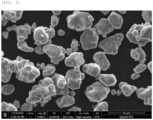
FIG. 2 is a scanning electron microscope image of a positive electrode active material prepared in Example 1 of the present invention. -
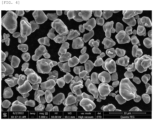
FIG. 3 is a scanning electron microscope image of a positive electrode active material prepared in Example 2 of the present invention. -
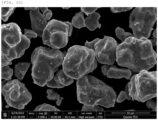
FIG. 4 is a scanning electron microscope image of a positive electrode active material prepared in Example 3 of the present invention. -
FIG. 5 is a scanning electron microscope image of a positive electrode active material prepared in Example 4 of the present invention. -
FIG. 6 is a scanning electron microscope image of a positive electrode active material prepared in Example 5 of the present invention. -
FIG. 7 is a scanning electron microscope image of a positive electrode active material prepared in Example 6 of the present invention. -
FIG. 8 is a scanning electron microscope image of a positive electrode active material prepared in Example 7 of the present invention. -
FIG. 9 is a scanning electron microscope image of a positive electrode active material prepared in Comparative Example 1 of the present invention. -
FIG. 10 is a scanning electron microscope image of a positive electrode active material prepared in Comparative Example 2 of the present invention. -
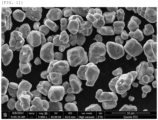
FIG. 11 is a scanning electron microscope image of a positive electrode active material prepared in Comparative Example 3 of the present invention. -
FIG. 12 is a scanning electron microscope image of a positive electrode active material prepared in Comparative Example 4 of the present invention. - Hereinafter, the present invention will be described in more detail to allow for a clearer understanding of the present invention.
- It will be understood that words or terms used in the specification and claims shall not be interpreted as the meaning defined in commonly used dictionaries, and it will be further understood that the words or terms should be interpreted as having a meaning that is consistent with their meaning in the context of the relevant art and the technical idea of the invention, based on the principle that an inventor may properly define the meaning of the words or terms to best explain the invention.
- In the present invention, the expression 'primary particle' denotes a smallest particle unit which is distinguished as one body when a cross section of a positive electrode active material is observed through a scanning electron microscope (SEM), wherein it may be composed of a plurality of crystallites.
- In the present invention, the expression 'secondary particle' denotes a secondary structure formed by aggregation of a plurality of primary particles. An average particle diameter of the secondary particle may be measured using a particle size analyzer.
- The terms 'D10', 'D50', and 'D90' in the present invention denote particle diameters at 10% (D10), 50% (D50), and 90% (D90) of cumulative distribution of volume according to the particle diameter, respectively. After dispersing measurement target powder in a dispersion medium, the dispersion medium is introduced into a commercial laser diffraction particle size measurement instrument (e.g., mastersizer 3000 by Malvern Panalytical Ltd.), a cumulative distribution of volume according to a particle diameter is calculated by measuring a difference in diffraction patterns due to a particle size when particles pass through a laser beam, and the D10, D50, and D90 may be measured by calculating particle diameters at 10%, 50%, and 90% of the cumulative distribution of volume according to the particle diameter using the measurement instrument. Also, the D50 in the present invention may be expressed as an average particle diameter.
- The expression 'form of a single particle' in the present invention has a meaning including that a particle of a positive electrode active material and/or a lithium transition metal composite oxide is both a single particle and a form in which 2 to 10 particles are aggregated. That is, in the positive electrode active material in a form of a single particle and/or lithium transition metal composite oxide in a form of a single particle of the present invention, a particle of the positive electrode active material and/or lithium transition metal composite oxide may include at least one selected from the group consisting of a single particle and a particle in which 2 to 10 particles are aggregated.
- The present invention provides a positive electrode active material.
- According to an embodiment of the present invention, the positive electrode active material includes a lithium transition metal composite oxide in a form of a single particle which contains nickel, cobalt, and manganese, wherein the lithium transition metal composite oxide contains 60 mol% or more of the nickel among total transition metals, has a D50 of 5 µm or more, and may have a rolling density calculated by the following
Equation 3 of 3.56 g/cm3 or more when a pellet is formed by applying a force until the force reaches 9,000 kgf using an automatic pellet press.Rolling density (g/cm3) = positive electrode active material weight (g)/pellet volume (cm3) - According to an embodiment of the present invention, the positive electrode active material may include a lithium transition metal composite oxide in a form of a single particle. As a specific example, the lithium transition metal composite oxide in the form of a single particle may be a single particle or a secondary particle in which 10 or less primary particles are aggregated. With respect to a conventional positive electrode active material in a form of a secondary particle in which more than 10 primary particles were aggregated, porosity had to be increased in order to minimize cracks which were caused by pressure during rolling for preparation of an electrode, and this eventually causes a decrease in energy density of a lithium secondary battery. However, in a case in which the lithium transition metal composite oxide has the form of a single particle or a secondary particle in which 10 or less primary particles are aggregated as in the positive electrode active material of the present invention, when charging and discharging a lithium secondary battery, cracks due to a volume change in a unit lattice may be minimized, particularly, cracks caused by the pressure during rolling for the preparation of the electrode may be minimized. Thus, in a case in which the positive electrode active material of the present invention is used, since rolling may be performed to have lower porosity during the rolling for the preparation of the electrode, energy density of the lithium secondary battery may be improved.
- According to an embodiment of the present invention, the lithium transition metal composite oxide may be a high nickel-based lithium transition metal composite oxide which contains nickel and has a nickel (Ni) content of 60 mol% or more based on total transition metals. In this case, high energy density may be ensured due to the high nickel content.
- According to an embodiment of the present invention, the lithium transition metal composite oxide may have an average composition represented by
Formula 1 below.
[Formula 1] LixNiaCobMncM1 dO2
- In
Formula 1, M1 is at least one selected from the group consisting of aluminum (Al), zirconium (Zr), boron (B), tungsten (W), molybdenum (Mo), chromium (Cr), niobium (Nb), magnesium (Mg), hafnium (Hf), tantalum (Ta), lanthanum (La), titanium (Ti), strontium (Sr), barium (Ba), cerium (Ce), fluorine (F), phosphorus (P), sulfur (S), and yttrium (Y), and 0.9≤x≤1.3, 0.6≤a<1.0, 0<b<0.4, 0<c<0.4, 0≤d≤0.2, and a+b+c+d=1. - According to an embodiment of the present invention, M1 in
Formula 1 may be a doping element that may be included in the lithium transition metal composite oxide, and may be appropriately selected as needed. - According to an embodiment of the present invention, in
Formula 1, x is a molar ratio of lithium to transition metals in the lithium transition metal composite oxide, wherein x may be 0.9 or more, 0.95 or more, or 1.0 or more, and also, may be 1.1 or less, 1.07 or less, 1.05 or less, or 1.03 or less. - According to an embodiment of the present invention, in
Formula 1, a, b, c, and d may be mole fractions of nickel (Ni), cobalt (Co), manganese (Mn), and the doping element (M1) among the transition metals, respectively. As a specific example, a is the mole fraction of the nickel (Ni) among the transition metals, wherein a may be 0.6 or more, 0.7 or more, 0.8 or more, 0.85 or more, 0.88 or more, 0.90 or more, 0.91 or more, 0.92 or more, 0.93 or more, 0.94 or more, 0.95 or more, or 0.96 or more, and also, may be less than 1.0, 0.99 or less, 0.98 or less, 0.97 or less, or 0.96 or less. Also, b is the mole fraction of the cobalt (Co) among the transition metals, wherein b may be greater than 0, 0.01 or more, 0.02 or more, or 0.03 or more, and also, may be less than 0.4, 0.3 or less, 0.2 or less, 0.1 or less, 0.09 or less, 0.08 or less, 0.07 or less, 0.06 or less, or 0.05 or less. c is the mole fraction of the manganese (Mn) among the transition metals, wherein c may be greater than 0, 0.01 or more, or 0.05 or more, and also, may be less than 0.4, 0.3 or less, 0.2 or less, 0.1 or less, 0.09 or less, 0.08 or less, 0.07 or less, 0.06 or less, or 0.05 or less. d is the mole fraction of the doping element (M1) among the transition metals, wherein d may be 0, 0.01 or more, 0.02 or more, 0.03 or more, 0.04 or more, 0.05 or more, 0.06 or more, 0.07 or more, 0.08 or more, 0.09 or more, 0.10 or more, 0.11 or more, 0.12 or more, 0.13 or more, 0.14 or more, 0.15 or more, 0.16 or more, 0.17 or more, 0.18 or more, or 0.19 or more, and also, may be less than 0.20, 0.19 or less, 0.18 or less, 0.17 or less, 0.16 or less, 0.15 or less, 0.14 or less, 0.13 or less, 0.12 or less, 0.11 or less, 0.10 or less, 0.09 or less, 0.08 or less, 0.07 or less, 0.06 or less, 0.05 or less, 0.04 or less, 0.03 or less, 0.02 or less, or 0.01 or less. - According to an embodiment of the present invention, the positive electrode active material may have a D50 of 5 µm or more. Conventionally, when preparing a positive electrode active material in a form of a single particle, since, after a precursor in a form of a hydroxide has been mixed with a lithium compound and expanded secondary particles have been prepared by over-sintering the mixture, the secondary particles have been ground to prepare the positive electrode active material in the form of a single particle, the positive electrode active material in the form of a single particle, as a small particle having a D50 of about 1 µm to 4 µm, has been prepared, and thus, there was a limit to increase the D50 of the positive electrode active material in the form of a single particle. However, since the positive electrode active material according to the present invention is prepared by a method of preparing a positive electrode active material as described subsequently, it may have a D50 of 5 µm or more while being in the form of a single particle. Since the positive electrode active material of the present invention has a D50 of 5 µm or more while being in the form of a single particle, it may further minimize occurrence of cracks in the positive electrode active material and, in terms of improving the rolling density, it is more advantageous than the positive electrode active material in the form of a single particle, as the small particle having a D50 of about 1 µm to 4 µm. That is, the positive electrode active material of the present invention is characterized in that it is in the form of a single particle and has a D50 of 5 µm or more. As a specific example, the positive electrode active material may have a D50 of 5 µm or more, 5.1 µm or more, 5.2 µm or more, 5.3 µm or more, 5.4 µm or more, 5.5 µm or more, 5.6 µm or more, 5.7 µm or more, 5.8 µm or more, 5.9 µm or more, 6.0 µm or more, 6.1 µm or more, 6.2 µm or more, 6.3 µm or more, 6.4 µm or more, 6.5 µm or more, 6.6 µm or more, 6.7 µm or more, 6.8 µm or more, 6.9 µm or more, or 7.0 µm or more. Also, the positive electrode active material, in terms of distinguishing it from a positive electrode active material in a form of a secondary particle, as a large particle with a D50 of about 10 µm or more, may have a D50 of 9 µm or less, 8.9 µm or less, 8.8 µm or less, 8.7 µm or less, 8.6 µm or less. 8.5 µm or less, 8.4 µm or less, 8.3 µm or less, 8.2 µm or less, 8.1 µm or less, 8.0 µm or less, 7.9 µm or less, 7.8 µm or less, 7.7 µm or less, 7.6 µm or less, 7.5 µm or less, 7.4 µm or less, 7.3 µm or less, 7.2 µm or less, 7.1 µm or less, 7.0 µm or less, or 6.5 µm or less, and, in the present invention, in order to distinguish the positive electrode active material having the above D50 from the small particle-sized positive electrode active material and the large particle-sized positive electrode active material, the positive electrode active material may be referred to as a positive electrode active material of a medium-sized single particle.
- According to an embodiment of the present invention, when a pellet is formed by applying a force until the force reaches 9,000 kgf using an automatic pellet press, the positive electrode active material may have a rolling density calculated by
Equation 3 of 3.56 g/cm3 or more. In this case, when a positive electrode is formed by using the positive electrode active material alone or by mixing the positive electrode active material with the small particle-sized or large particle-sized positive electrode active material, porosity of the positive electrode may be further reduced by minimizing the occurrence of cracks due to rolling, and accordingly, since a larger amount of the positive electrode active material may be included in the same volume of a positive electrode active material layer, the energy density of the lithium secondary battery may be further improved. - According to an embodiment of the present invention, the positive electrode active material needs to have a rolling density of 3.56 g/cm3 or more. This is the minimum standard for achieving an effect according to the present invention, wherein the rolling density must be 3.56 g/cm3 or more to achieve the energy density according to the present invention. As a specific example, the positive electrode active material may have a rolling density of 3.57 g/cm3 or more, 3.58 g/cm3 or more, 3.59 g/cm3 or more, 3.60 g/cm3 or more, 3.61 g/cm3 or more, 3.62 g/cm3 or more, 3.63 g/cm3 or more, 3.64 g/cm3 or more, 3.65 g/cm3 or more, 3.66 g/cm3, or more, or 3.67 g/cm3 or more, and, since the rolling density may be significantly improved within this range during preparation of the positive electrode, the energy density of the lithium secondary battery may be increased, and, accordingly, capacity characteristics may be further improved. Also, the positive electrode active material may have a rolling density of 3.80 g/cm3 or less, 3.75 g/cm3 or less, 3.74 g/cm3 or less, 3.73 g/cm3 or less, or 3.72 g/cm3 or less.
- According to an embodiment of the present invention, the positive electrode active material may be one in which, particularly, the cumulative distribution of volume according to the particle diameter of the positive electrode active material particle is adjusted in addition to the nickel content, the D50, and the rolling density. As a specific example, with respect to the positive electrode active material, a mode in the cumulative distribution of volume according to the particle diameter of the positive electrode active material particle may be greater than the D50.
- In a positive electrode active material as an aggregate of a plurality of particles constituting a cumulative distribution of volume according to a particle diameter, in a case in which a mode in the cumulative distribution of volume according to the particle diameter is greater than D50 as in the positive electrode active material of the present invention, since an amount of fine powder having a relatively small particle diameter is high, pores between positive electrode active material particles may be minimized when a positive electrode active material layer is formed by using the positive electrode active material, and, accordingly, a larger amount of the positive electrode active material particles may be included in the same volume to ensure higher energy density. Thus, even if the positive electrode active material has the same D50, since the energy density varies depending on a difference between the mode and the D50 in the cumulative distribution of volume according to the particle diameter, it is important to control this and the positive electrode active material according to the present application may further improve the energy density of the lithium secondary battery by adjusting the mode in the cumulative distribution of volume according to the particle diameter to be greater than the D50 in addition to the nickel content, D50, and rolling density.
- According to an embodiment of the present invention, the positive electrode active material may have a negative skewness value calculated by
Equation 1 below of greater than 0.
- Typically, skewness is a statistical measure of asymmetry of a specific distribution, wherein, if a skewness value is positive, it is indicated as positive skewness, and, if the skewness value is negative, it is indicated as negative skewness. However, since the positive skewness and negative skewness expressed by a conventional method are expressed in the form of a cube of deviation from an average, the skewness value becomes larger as the skewness is increased, and thus, it is not appropriate to determine the amount of the fine powder of the positive electrode active material in the present invention. Therefore, in the present invention, the negative skewness is newly defined and represented by
Equation 1 above. According toEquation 1 above, the negative skewness in the present invention is expressed as a ratio of a difference between the mode and D10 to the D50. The amount of the fine powder of the positive electrode active material, as the aggregate of the plurality of particles constituting the cumulative distribution of volume according to the particle diameter, may be indirectly confirmed by comparing the difference between the mode and the D10 corresponding to a fine powder region based on the D50. - According to an embodiment of the present invention, the positive electrode active material may have a negative skewness value calculated by
Equation 1 of greater than 0, 0.10 or more, 0.20 or more, 0.30 or more, 0.40 or more, or 0.45 or more, and, also, of 0.75 or less, 0.70 or less, 0.65 or less, 0.60 or less, 0.59 or less, 0.58 or less, 0.57 or less, 0.56 or less, or 0.55 or less, and, within this range, it is possible to minimize the cracks caused by the pressure during the rolling for the preparation of the electrode, maximize the energy density of the lithium secondary battery, and secure the capacity characteristics by appropriately adjusting the amount of the fine powder having a relatively small particle diameter. - According to an embodiment of the present invention, the positive electrode active material may have a mode in the cumulative distribution of volume according to the particle diameter of 5.5 µm or more, 5.6 µm or more, 5.7 µm or more, 5.8 µm or more, 5.9 µm or more, 6.0 µm or more, 6.1 µm or more, 6.2 µm or more, 6.3 µm or more, 6.4 µm or more, 6.5 µm or more, 6.6 µm or more, 6.7 µm or more, 6.8 µm or more, 6.9 µm or more, 7.0 µm or more, 7.1 µm or more, 7.2 µm or more, 7.3 µm or more, 7.4 µm or more, or 7.5 µm or more, and, also, of 9.5 µm or less, 9.4 µm or less, 9.3 µm or less, 9.2 µm or less, 9.1 µm or less, 9.0 µm or less, 8.9 µm or less, 8.8 µm or less, 8.7 µm or less, 8.6 µm or less, 8.5 µm or less, 8.4 µm or less, 8.3 µm or less, 8.2 µm or less, 8.1 µm or less, 8.0 µm or less, 7.9 µm or less, 7.8 µm or less, 7.7 µm or less, 7.6 µm or less, 7.5 µm or less, or 7.0 µm or less, and, within this range, in addition to the nickel content, D50, and rolling density, the energy density of the lithium secondary battery may be further improved.
- According to an embodiment of the present invention, the positive electrode active material may have a D10 in the cumulative distribution of volume according to the particle diameter of 3.0 µm or more, 3.1 µm or more, 3.2 µm or more, 3.3 µm or more, 3.4 µm or more, or 3.5 µm or more, and, also, of 6.0 µm or less, 5.5 µm or less, or 5.0 µm or less, and the energy density of the lithium secondary battery may be further improved by adjusting a fine powder size within this range.
- According to an embodiment of the present invention, the positive electrode active material may have a difference between the mode and the D50 of 1.0 µm or less, 0.9 µm or less, 0.8 µm or less, 0.7 µm or less, 0.6 µm or less, or 0.5 µm or less, and, also, of 0.1 µm or more, 0.2 µm or more, 0.3 µm or more, or 0.4 µm or more, and, within this range, in addition to the nickel content, D50, and rolling density, the energy density of the lithium secondary battery may be further improved.
- The present invention provides a method of preparing a positive electrode active material which is for preparing the above positive electrode active material.
- According to an embodiment of the present invention, the method of preparing a positive electrode active material includes the steps of: mixing a positive electrode active material precursor, which contains nickel, cobalt, and manganese and contains 60 mol% or more of the nickel among transition metals, and a lithium raw material and performing primary sintering to prepare a pre-sintered product (S10); and performing secondary sintering on the pre-sintered product prepared in step (S10) to prepare a lithium transition metal composite oxide in a form of a single particle (S20), wherein the secondary sintering may be performed at a lower temperature than the primary sintering. As described above, since the secondary sintering is performed at a lower temperature than the primary sintering, a positive electrode active material having a D50 of µm or more and a rolling density calculated by
Equation 3 of 3.56 g/cm3 or more, when a pellet is formed by applying a force until the force reaches 9,000 kgf using an automatic pellet press, may be prepared. - According to an embodiment of the present invention, a temperature difference between the primary sintering of step (S10) and the secondary sintering of step (S20) may be 10°C or higher, 20°C or higher, 30°C or higher, 40°C or higher, or 50°C or higher, and also, may be 300°C or less, 250°C or less, 200°C or less, 150°C or less, or 100°C or less. As a specific example, the primary sintering of step (S10) may be performed at a temperature of 800°C to 1,000°C, and, as a more specific example, the primary sintering of step (S10) may be performed in a temperature range of 800°C to 1,000°C, 830°C to 950°C, or 850°C to 900°C. Also, the secondary sintering of step (S20) may be performed at a temperature of 600°C to 900°C, and, as a more specific example, the secondary sintering of step (S20) may be performed in a temperature range of 600°C to 900°C, 650°C to 850°C, or 700°C to 800°C.
- According to an embodiment of the present invention, in the pre-sintered product prepared by the primary sintering of step (S10), since particles may be aggregated with each other, the secondary sintering of step (S20) may be performed on a form of a ground product by grinding the pre-sintered product prepared in step (S10).
- According to an embodiment of the present invention, the positive electrode active material precursor, which contains nickel, cobalt, and manganese and contains 60 mol% or more of the nickel among the transition metals, may be a transition metal hydroxide or a transition metal oxide. As a specific example, the transition metal hydroxide may have an average composition represented by
Formula 2 below, and the transition metal oxide may have an average composition represented byFormula 3 below.
[Formula 2] Nia'Cob'Mnc'(OH)2
[Formula 3] Nia"Cob"Mnc"O
- In
Formula 2, 0.6≤a'<1.0, 0<b'<0.4, 0<c'<0.4, and a'+b'+c'=1, and, inFormula 3, 0.6≤a"<1.0, 0<b"<0.4, 0<c"<0.4, and a"+b"+c"=1. - According to an embodiment of the present invention, in
Formulae - According to an embodiment of the present invention, the transition metal oxide may be prepared by sintering the transition metal hydroxide. As a specific example, the transition metal oxide may be prepared from a step of sintering a transition metal hydroxide, which contains nickel, cobalt, and manganese and contains 60 mol% or more of the nickel among transition metals, in an air or oxygen atmosphere (S1). In this case, the sintering in step (S1) may be performed at a temperature of 800°C or higher, as a specific example, may be performed at a temperature of 800°C or higher, 850°C or higher, 900°C or higher, 950°C or higher, or 1,000°C or higher, and, also, may be performed at a temperature of 1,200°C or less, 1,150°C or less, 1,100°C or less, or 1,050°C or less.
- According to an embodiment of the present invention, it may be more desirable to use the transition metal oxide as the positive electrode active material precursor, which contains nickel, cobalt, and manganese and contains 60 mol% or more of the nickel among the transition metals, from the viewpoint of securing higher rolling density for the positive electrode active material of a medium-sized single particle according to the present invention.
- According to an embodiment of the present invention, step (S1) may be performed by including the steps of: mixing a transition metal hydroxide and a doping raw material (S1-1); and preparing a transition metal oxide by sintering the mixture mixed in step (S1-1) in an air or oxygen atmosphere (S1-2). In this case, the doping raw material may include at least one doping element selected from a group consisting of Li, Al, Zr, B, W, Mo, Cr, Nb, Mg, Hf, Ta, La, Ti, Sr, Ba, Ce, F, P, S, and Y.
- According to an embodiment of the present invention, during the mixing of the positive electrode active material precursor and the lithium raw material in step (S10), a molar ratio (Li/ M) of lithium (Li) of the lithium raw material to the transition metals (M) of the positive electrode active material precursor may be in a range of 0.9 to 1.3. As a specific example, the Li/M may be 0.9 or more, 0.95 or more, or 1.0 or more, and also, may be 1.1 or less, 1.07 or less, 1.05 or less, or 1.03 or less, and the Li/M may be adjusted depending on a nickel content in the transition metals.
- The present invention provides a positive electrode including the positive electrode active material.
- According to an embodiment of the present invention, the positive electrode may include a positive electrode collector and a positive electrode active material layer formed on the positive electrode collector, wherein the positive electrode active material layer may include the above positive electrode active material.
- According to an embodiment of the present invention, the positive electrode collector may include a metal having high conductivity, and is not particularly limited as long as it has no reactivity in a voltage range of the battery and the positive electrode active material layer is easily adhered thereto. As the positive electrode collector, for example, stainless steel, aluminum, nickel, titanium, fired carbon, or aluminum or stainless steel that is surface-treated with one of carbon, nickel, titanium, silver, or the like may be used. Also, the positive electrode collector may typically have a thickness of 3 µm to 500 µm, and microscopic irregularities may be formed on the surface of the collector to improve the adhesion of the positive electrode active material. The positive electrode collector, for example, may be used in various shapes such as that of a film, a sheet, a foil, a net, a porous body, a foam body, a non-woven fabric body, and the like.
- According to an embodiment of the present invention, the positive electrode active material layer may optionally include a conductive agent and a binder in addition to the positive electrode active material, if necessary. In this case, the positive electrode active material may be included in an amount of 80 wt% to 99 wt%, for example, 85 wt% to 98.5 wt% based on a total weight of the positive electrode active material layer, and excellent capacity characteristics may be obtained within this range.
- According to an embodiment of the present invention, the conductive agent is used to provide conductivity to the electrode, wherein any conductive agent may be used without particular limitation as long as it has suitable electron conductivity without causing adverse chemical changes in the battery. Specific examples of the conductive agent may be graphite such as natural graphite or artificial graphite; carbon based materials such as carbon black, acetylene black, Ketjen black, channel black, furnace black, lamp black, thermal black, and carbon fibers; powder or fibers of metal such as copper, nickel, aluminum, and silver; conductive tubes such as carbon nanotubes; conductive whiskers such as zinc oxide whiskers and potassium titanate whiskers; conductive metal oxides such as titanium oxide; or conductive polymers such as polyphenylene derivatives, and any one thereof or a mixture of two or more thereof may be used. The conductive agent may be included in an amount of 0.1 wt% to 15 wt% based on the total weight of the positive electrode active material layer.
- According to an embodiment of the present invention, the binder improves the adhesion between positive electrode active material particles and the adhesion between the positive electrode active material and the current collector. Specific examples of the binder may be polyvinylidene fluoride (PVDF), polyvinylidene fluoride-hexafluoropropylene copolymer (PVDF-co-HFP), polyvinyl alcohol, polyacrylonitrile, polymethylmethacrylate, carboxymethyl cellulose (CMC), starch, hydroxypropyl cellulose, regenerated cellulose, polyvinylpyrrolidone, polytetrafluoroethylene, polyethylene, polypropylene, an ethylene-propylene-diene polymer (EPDM), a sulfonated EPDM, a styrene-butadiene rubber (SBR), a fluorine rubber, poly acrylic acid, and a polymer having hydrogen thereof substituted with lithium (Li), sodium (Na), or calcium (Ca), or various copolymers thereof, and any one thereof or a mixture of two or more thereof may be used. The binder may be included in an amount of 0.1 wt% to 15 wt% based on the total weight of the positive electrode active material layer.
- According to an embodiment of the present invention, the positive electrode may be prepared according to a typical method of preparing a positive electrode except that the above-described positive electrode active material is used. Specifically, a composition for forming a positive electrode active material layer, which is prepared by dissolving or dispersing the positive electrode active material as well as optionally the binder and the conductive agent in a solvent, is coated on the positive electrode collector, and the positive electrode may then be prepared by drying and rolling the coated positive electrode collector, or the positive electrode may be prepared by casting the composition for forming a positive electrode active material layer on a separate support and then laminating a film separated from the support on the positive electrode collector.
- According to an embodiment of the present invention, the solvent may be a solvent normally used in the art, and may include dimethyl sulfoxide (DMSO), isopropyl alcohol, N-methylpyrrolidone (NMP), dimethyl formamide (DMF), acetone, or water, and any one thereof or a mixture of two or more thereof may be used. An amount of the solvent used may be sufficient if the solvent may dissolve or disperse the positive electrode active material, the conductive agent, the binder, and the dispersant in consideration of a coating thickness of a slurry and manufacturing yield, and may allow to have a viscosity that may provide excellent thickness uniformity during the subsequent coating for the preparation of the positive electrode.
- The present invention provides a lithium secondary battery including the positive electrode.
- According to an embodiment of the present invention, the lithium secondary battery may include the positive electrode; a negative electrode; a separator disposed between the positive electrode and the negative electrode, and an electrolyte. Also, the lithium secondary battery may further optionally include a battery container accommodating an electrode assembly of the positive electrode, the negative electrode, and the separator, and a sealing member sealing the battery container.
- According to an embodiment of the present invention, the negative electrode may include a negative electrode collector and a negative electrode active material layer disposed on the negative electrode collector.
- According to an embodiment of the present invention, the negative electrode collector is not particularly limited as long as it has high conductivity without causing adverse chemical changes in the battery, and, for example, copper, stainless steel, aluminum, nickel, titanium, fired carbon, copper or stainless steel that is surface-treated with one of carbon, nickel, titanium, silver, or the like, and an aluminum-cadmium alloy may be used. Also, the negative electrode collector may typically have a thickness of 3 µm to 500 µm, and, similar to the positive electrode collector, microscopic irregularities may be formed on the surface of the collector to improve the adhesion of a negative electrode active material. The negative electrode collector, for example, may be used in various shapes such as that of a film, a sheet, a foil, a net, a porous body, a foam body, a non-woven fabric body, and the like.
- According to an embodiment of the present invention, the negative electrode active material layer may optionally include a binder and a conductive agent in addition to the negative electrode active material.
- According to an embodiment of the present invention, a compound capable of reversibly intercalating and deintercalating lithium may be used as the negative electrode active material. Specific examples of the negative electrode active material may be a carbonaceous material such as artificial graphite, natural graphite, graphitized carbon fibers, and amorphous carbon; a metallic compound alloyable with lithium such as silicon (Si), aluminum (Al), tin (Sn), lead (Pb), zinc (Zn), bismuth (Bi), indium (In), magnesium (Mg), gallium (Ga), cadmium (Cd), a Si alloy, a Sn alloy, or an Al alloy; a metal oxide which may be doped and undoped with lithium such as SiOβ(0<β<2), SnO2, vanadium oxide, and lithium vanadium oxide; or a composite including the metallic compound and the carbonaceous material such as a Si-C composite or a Sn-C composite, and any one thereof or a mixture of two or more thereof may be used. Also, a metallic lithium thin film may be used as the negative electrode active material. Furthermore, both low crystalline carbon and high crystalline carbon may be used as the carbon material. Typical examples of the low crystalline carbon may be soft carbon and hard carbon, and typical examples of the high crystalline carbon may be irregular, planar, flaky, spherical, or fibrous natural graphite or artificial graphite, Kish graphite, pyrolytic carbon, mesophase pitch-based carbon fibers, meso-carbon microbeads, mesophase pitches, and high-temperature sintered carbon such as petroleum or coal tar pitch derived cokes. The negative electrode active material may be included in an amount of 80 wt% to 99 wt% based on a total weight of the negative electrode active material layer.
- According to an embodiment of the present invention, the binder of the negative electrode active material layer is a component that assists in the binding between the conductive agent, the active material, and the current collector, wherein the binder is typically added in an amount of 0.1 wt% to 10 wt% based on the total weight of the negative electrode active material layer. Examples of the binder may be polyvinylidene fluoride (PVDF), polyvinyl alcohol, carboxymethyl cellulose (CMC), starch, hydroxypropyl cellulose, regenerated cellulose, polyvinylpyrrolidone, polytetrafluoroethylene, polyethylene, polypropylene, an ethylene-propylene-diene polymer (EPDM), a sulfonated-EPDM, a styrene-butadiene rubber, a nitrile-butadiene rubber, a fluorine rubber, and various copolymers thereof.
- According to an embodiment of the present invention, the conductive agent of the negative electrode active material layer is a component for further improving conductivity of the negative electrode active material, wherein the conductive agent may be added in an amount of 10 wt% or less, for example, 5 wt% or less based on the total weight of the negative electrode active material layer. The conductive agent is not particularly limited as long as it has conductivity without causing adverse chemical changes in the battery, and, for example, a conductive material, such as: graphite such as natural graphite or artificial graphite; carbon black such as acetylene black, Ketjen black, channel black, furnace black, lamp black, and thermal black; conductive fibers such as carbon fibers or metal fibers; fluorocarbon; metal powder such as aluminum powder and nickel powder; conductive whiskers such as zinc oxide whiskers and potassium titanate whiskers; conductive metal oxide such as titanium oxide; or polyphenylene derivatives, may be used.
- According to an embodiment of the present invention, the negative electrode may be prepared by coating a composition for forming a negative electrode active material layer, which is prepared by dissolving or dispersing optionally the binder and the conductive agent as well as the negative electrode active material in a solvent, on the negative electrode collector and drying the coated negative electrode collector, or may be prepared by casting the composition for forming a negative electrode active material layer on a separate support and then laminating a film separated from the support on the negative electrode collector.
- According to an embodiment of the present invention, the separator separates the negative electrode and the positive electrode and provides a movement path of lithium ions, wherein any separator may be used as the separator without particular limitation as long as it is typically used in a lithium secondary battery, and particularly, a separator having high moisture-retention ability for an electrolyte as well as low resistance to the transfer of electrolyte ions may be used. Specifically, a porous polymer film, for example, a porous polymer film prepared from a polyolefin-based polymer, such as an ethylene homopolymer, a propylene homopolymer, an ethylene/butene copolymer, an ethylene/hexene copolymer, and an ethylene/methacrylate copolymer, or a laminated structure having two or more layers thereof may be used. Also, a typical porous nonwoven fabric, for example, a nonwoven fabric formed of high melting point glass fibers or polyethylene terephthalate fibers may be used. Furthermore, a coated separator including a ceramic component or a polymer material may be used to secure heat resistance or mechanical strength, and the separator having a single layer or multilayer structure may be optionally used.
- According to an embodiment of the present invention, the electrolyte may include an organic liquid electrolyte, an inorganic liquid electrolyte, a solid polymer electrolyte, a gel-type polymer electrolyte, a solid inorganic electrolyte, or a molten-type inorganic electrolyte which may be used in the preparation of the lithium secondary battery, but the present invention is not limited thereto. As a specific example, the electrolyte may include an organic solvent and a lithium salt.
- According to an embodiment of the present invention, any organic solvent may be used as the organic solvent without particular limitation so long as it may function as a medium through which ions involved in an electrochemical reaction of the battery may move. Specifically, an ester-based solvent such as methyl acetate, ethyl acetate, γ-butyrolactone, and ε-caprolactone; an ether-based solvent such as dibutyl ether or tetrahydrofuran; a ketone-based solvent such as cyclohexanone; an aromatic hydrocarbon-based solvent such as benzene and fluorobenzene; or a carbonate-based solvent such as dimethyl carbonate (DMC), diethyl carbonate (DEC), methylethyl carbonate (MEC), ethylmethyl carbonate (EMC), ethylene carbonate (EC), and propylene carbonate (PC); an alcohol-based solvent such as ethyl alcohol and isopropyl alcohol; nitriles such as R-CN (where R is a linear, branched, or cyclic C2-C20 hydrocarbon group and may include a double-bond aromatic ring or ether bond); amides such as dimethylformamide; dioxolanes such as 1,3-dioxolane; or sulfolanes may be used as the organic solvent. Among these solvents, the carbonate-based solvent is preferable, and a mixture of a cyclic carbonate (e.g., ethylene carbonate or propylene carbonate) having high ionic conductivity and high dielectric constant, which may increase charge/discharge performance of the battery, and a low-viscosity linear carbonate-based compound (e.g., ethylmethyl carbonate, dimethyl carbonate, or diethyl carbonate) is more preferable.
- According to an embodiment of the present invention, the lithium salt may be used without particular limitation as long as it is a compound capable of providing lithium ions used in the lithium secondary battery. Specifically, an anion of the lithium salt may be at least one selected from the group consisting of F-, Cl-, Br-, I-, NO3 -, N(CN)2 -, BF4 -, CF3CF2SO3 -, (CF3SO2)2N-, (FSO2)2N-, CF3CF2(CF3)2CO-, (CF3SO2)2CH-, (SF5)3C-, (CF3SO2)3C-, CF3(CF2)7SO3 -, CF3CO2 -, CH3CO2 -, SCN-, and (CF3CF2SO2)2N-, and LiPF6, LiClO4, LiAsF6, LiBF4, LiSbF6, LiAlO4, LiAlCl4, LiCF3SO3, LiC4F9SO3, LiN(C2F5SO3)2, LiN(C2F5SO2)2, LiN(CF3SO2)2, LiCl, LiI, or LiB(C2O4)2 may be used as the lithium salt. The lithium salt may be used in a concentration range of 0.1 M to 2.0 M. If the concentration of the lithium salt is included within the above range, since the electrolyte may have appropriate conductivity and viscosity, excellent performance of the electrolyte may be obtained and lithium ions may effectively move.
- According to an embodiment of the present invention, in order to improve life characteristics of the battery, suppress the reduction in battery capacity, and improve discharge capacity of the battery, at least one additive, for example, a halo-alkylene carbonate-based compound such as difluoroethylene carbonate, pyridine, triethylphosphite, triethanolamine, cyclic ether, ethylenediamine, n-glyme, hexaphosphorictriamide, a nitrobenzene derivative, sulfur, a quinone imine dye, N-substituted oxazolidinone, N,N-substituted imidazolidine, ethylene glycol dialkyl ether, an ammonium salt, pyrrole, 2-methoxy ethanol, or aluminum trichloride, may be further included in the electrolyte in addition to the above electrolyte components. In this case, the additive may be included in an amount of 0.1 wt% to 5 wt% based on a total weight of the electrolyte.
- Since the lithium secondary battery including the positive electrode active material according to the present invention stably exhibits excellent capacity characteristics, output characteristics, and life characteristics, the lithium secondary battery is suitable for portable devices, such as mobile phones, notebook computers, and digital cameras, and electric cars such as hybrid electric vehicles (HEVs) and electric vehicles (EVs).
- A shape of the lithium secondary battery of the present invention is not particularly limited, but a cylindrical type using a can, a prismatic type, a pouch type, or a coin type may be used.
- The lithium secondary battery according to the present invention may not only be used in a battery cell that is used as a power source of a small device, but may also be used as a unit cell in a medium and large sized battery module including a plurality of battery cells.
- Thus, according to an embodiment of the present invention, a battery module including the lithium secondary battery as a unit cell and a battery pack including the battery module are provided.
- According to an embodiment of the present invention, the battery module or the battery pack may be used as a power source of at least one medium and large sized device of a power tool; electric cars including an electric vehicle (EV), a hybrid electric vehicle, and a plug-in hybrid electric vehicle (PHEV); or a power storage system.
- Hereinafter, examples of the present invention will be described in detail in such a manner that it may easily be carried out by a person with ordinary skill in the art to which the present invention pertains. The invention may, however, be embodied in many different forms and should not be construed as being limited to the examples set forth herein.
- A transition metal composite hydroxide (D50: 7 µm) having a composition represented by Ni0.96Co0.03Mn0.01(OH)2 was sintered at 1,020°C for 9 hours in an air atmosphere to prepare a transition metal composite oxide having a composition represented by Ni0.96CO0.03Mn0.01O.
- The prepared transition metal composite oxide and LiOH were mixed such that a molar ratio (Li/Me) of lithium (Li) to transition metals (Me) was 1, and the mixture was primarily sintered at 800°C for 12 hours in an oxygen atmosphere, then ground using a jet mill, and secondarily sintered at 700°C for 12 hours in an oxygen atmosphere to prepare a positive electrode active material as a lithium transition metal composite oxide in a form of a single particle which had a composition represented by LiNi0.96Co0.03Mn0.01O2.
- A positive electrode active material, as a lithium transition metal composite oxide in a form of a single particle which had a composition represented by LiNi0.96CO0.03Mn0.01O2, was prepared in the same manner as in Example 1 except that, in Example 1, the primary sintering was performed at 850°C instead of 800°C.
- A positive electrode active material, as a lithium transition metal composite oxide in a form of a single particle which had a composition represented by LiNi0.96CO0.03Mn0.01O2, was prepared in the same manner as in Example 1 except that, in Example 1, the secondary sintering was performed at 750°C instead of 700°C.
- A transition metal composite hydroxide (D50: 9 µm) having a composition represented by Ni0.89Co0.03Mn0.08(OH)2 was sintered at 1,020°C for 9 hours in an air atmosphere to prepare a transition metal composite oxide having a composition represented by Ni0.89Co0.03Mn0.08O.
- The prepared transition metal composite oxide and LiOH were mixed such that a molar ratio (Li/Me) of lithium (Li) to transition metals (Me) was 1, and the mixture was primarily sintered at 900°C for 12 hours in an oxygen atmosphere, then ground using a jet mill, and secondarily sintered at 800°C for 12 hours in an oxygen atmosphere to prepare a positive electrode active material as a lithium transition metal composite oxide in a form of a single particle which had a composition represented by LiNi0.89Co0.03Mn0.08O2.
- A transition metal composite hydroxide (D50: 7 µm) having a composition represented by Ni0.96Co0.03Mn0.01(OH)2 was sintered at 1,020°C for 9 hours in an air atmosphere to prepare a transition metal composite oxide having a composition represented by Ni0.96Co0.03Mn0.01O.
- The prepared transition metal composite oxide and LiOH were mixed such that a molar ratio (Li/Me) of lithium (Li) to transition metals (Me) was 1.05, and the mixture was primarily sintered at 800°C for 12 hours in an oxygen atmosphere, then ground using a jet mill, and secondarily sintered at 700°C for 12 hours in an oxygen atmosphere to prepare a positive electrode active material as a lithium transition metal composite oxide in a form of a single particle which had a composition represented by Li1.05Ni0.96Co0.03Mn0.01O2.
- A transition metal composite hydroxide (D50: 7 µm) having a composition represented by Ni0.96Co0.03Mn0.01(OH)2 and LiOH were mixed such that a molar ratio (Li/Me) of lithium (Li) to transition metals (Me) was 1, and the mixture was primarily sintered at 830°C for 12 hours in an oxygen atmosphere, then ground using a jet mill, and secondarily sintered at 770°C for 12 hours in an oxygen atmosphere to prepare a positive electrode active material as a lithium transition metal composite oxide in a form of a single particle which had a composition represented by LiNi0.96Co0.03Mn0.01O2.
- A transition metal composite hydroxide (D50: 4.5 µm) having a composition represented by Ni0.885Co0.035Mn0.08(OH)2 and LiOH were mixed such that a molar ratio (Li/Me) of lithium (Li) to transition metals (Me) was 1, and the mixture was primarily sintered at 900°C for 12 hours in an oxygen atmosphere, then ground using a jet mill, and secondarily sintered at 800°C for 12 hours in an oxygen atmosphere to prepare a positive electrode active material as a lithium transition metal composite oxide in a form of a single particle which had a composition represented by LiNi0.885Co0.035Mn0.08O2.
- A positive electrode active material, as a lithium transition metal composite oxide in a form of a single particle which had a composition represented by LiNi0.96CO0.03Mn0.01O2, was prepared in the same manner as in Example 1 except that, in Example 1, the primary sintering was performed at 700°C instead of 800°C, and the secondary sintering was performed at 800°C instead of 700°C.
- A positive electrode active material, as a lithium transition metal composite oxide in a form of a single particle which had a composition represented by LiNi0.96CO0.03Mn0.01O2, was prepared in the same manner as in Example 1 except that, in Example 1, the primary sintering was performed at 1,020°C instead of 800°C.
- A positive electrode active material, as a lithium transition metal composite oxide in a form of a single particle which had a composition represented by LiNi0.96Co0.03Mn0.01O2, was prepared in the same manner as in Example 6 except that, in Example 6, the primary sintering was performed at 770°C instead of 830°C.
- A positive electrode active material, as a lithium transition metal composite oxide in a form of a single particle which had a composition represented by LiNi0.885Co0.035Mn0.08O2, was prepared in the same manner as in Example 1 except that, in Example 7, the primary sintering was performed at 850°C instead of 900°C.
- Each of the positive electrode active material precursors, as transition metal complex oxides and transition metal composite hydroxides before mixing with the lithium compound during the preparation of the positive electrode active materials of Examples 1 to 7 and Comparative Examples 1 to 4, and the positive electrode active materials prepared in Examples 1 to 7 and Comparative Examples 1 to 4 was imaged using a scanning electron microscope (SEM, FEI, Inspect F), and these images are illustrated in
FIGS. 2 to 12 , respectively. - Also, for the positive electrode active materials prepared in Examples 1 to 7 and Comparative Examples 1 to 4, D10, D50, D90, and a mode in a cumulative distribution of volume according to a particle diameter were measured using a particle size analyzer (PSD, Malvern Panalytical Ltd., martersizer 3000) and illustrated in
FIG. 1 and Table 1, and a negative skewness value was calculated usingEquation 1 below and presented together in Table 1 below.
[Table 1] Category D10 (µm) D50 (µm) D90 (µm) Mode (um) Negative skewness Example 1 3.18 6.14 10.21 6.54 0.547 Example 2 4.94 7.19 10.57 7.78 0.395 Example 3 4.32 7.20 11.39 7.78 0.481 Example 4 3.54 7.11 11.45 7.78 0.596 Example 5 4.79 7.36 11.21 7.78 0.406 Example 6 3.44 5.62 9.46 6.00 0.456 Example 7 3.29 5.63 8.62 6.00 0.481 Comparative Example 1 3.65 6.23 10.50 6.54 0.464 Comparative Example 2 6.13 9.69 14.99 11.00 0.503 Comparative Example 3 2.82 4.57 7.56 4.62 0.395 Comparative Example 4 2.34 3.64 5.63 3.89 0.426 - As illustrated in
FIGS. 2 to 12 , it may be confirmed that the positive electrode active materials prepared in Examples 1 to 7 and Comparative Examples 1 to 4 were all prepared as positive electrode active materials in the form of a single particle which were defined in the present invention. - Also, as illustrated in Table 1, it may be confirmed that the positive electrode active materials prepared in Examples 1 to 7 had a D50 of 5 µm or more and a negative skewness calculated by
Equation 1 of 0.4 or more, and it may be confirmed that the positive electrode active materials prepared in Comparative Examples 3 and 4 had a D50 of less than 5 µm. - Using an automatic pellet press (Auto Pellet Press, Carver, 3887.4), a zero point of thickness was adjusted for a circular pellet holder having a diameter of 13 mm using a cylindrical mold. Subsequently, 3 g of each of the positive electrode active materials prepared in Examples 1 to 7 and Comparative Examples 1 to 4 was put into the circular pellet holder, and a force was applied until it reached 9,000 kgf to measure a thickness of a formed pellet. Subsequently, a pellet volume was calculated using
Equation 2 below, rolling density was calculated usingEquation 3 below, and the results thereof are presented in Table 2 below.Pellet volume (cm3) = π(radius of circular pellet holder)2 × pellet thickness Rolling density (g/cm3) = positive electrode active material weight (g)/pellet volume (cm3) [Table 2] Category Rolling density (g/cm3) Example 1 3.72 Example 2 3.59 Example 3 3.61 Example 4 3.67 Example 5 3.62 Example 6 3.56 Example 7 3.65 Comparative Example 1 3.53 Comparative Example 2 3.53 Comparative Example 3 3.51 Comparative Example 4 3.54 - As illustrated in Table 2, it may be confirmed that the positive electrode active materials prepared in Examples 1 to 7 had a D50 of 5 µm or more while being in the form of a single particle through adjustment of the primary sintering temperature and the secondary sintering temperature, had an appropriately adjusted amount of the fine powder according to the negative skewness value, and had a rolling density calculated by
Equation 3 of 3.56 g/cm3 or more. From these results, in a case in which the positive electrode active material according to the present invention is used, it is expected that rolling density during preparation of a positive electrode may be improved to increase energy density of a lithium secondary battery and, accordingly, capacity characteristics may be improved. - In contrast, the secondary sintering temperature was higher than the primary sintering temperature with respect to the positive electrode active material prepared in Comparative Example 1, and the secondary sintering temperature was lower than the primary sintering temperature with respect to the positive electrode active material prepared in Comparative Example 2, but, since a difference between these temperatures was excessively large, rolling density was shown to be 3.53 g/cm3 even though D50 was 5 µm or more while being in the form of a single particle and the amount of the fine powder according to the negative skewness value was adjusted to an appropriate level, and thus, it may be confirmed that it not only did not meet the minimum standard to achieve the effect according to the present invention, but there was also a difference of at least 0.06 g/cm3 and up to 0.19 g/cm3 in comparison to Examples 1 and 2 using the positive electrode active material precursor and lithium raw material of the same composition.
- Also, since the primary sintering temperature and the secondary sintering temperature were the same with respect to the positive electrode active material prepared in Comparative Example 3, D50 was less than 5 µm as shown in Table 1, and, accordingly, it may be confirmed that rolling density was also low, particularly, a difference in rolling density relative to Example 6 using the positive electrode active material precursor and lithium raw material of the same composition was 0.05 g/cm3.
- Furthermore, since the secondary sintering temperature was lower than the primary sintering temperature with respect to the positive electrode active material prepared in Comparative Example 4, but the sintering temperature suitable for the transition metal hydroxide, as the positive electrode active material precursor, was not sufficiently secured, D50 was less than 5 µm as shown in Table 1, and, accordingly, it may be confirmed that rolling density was also low, particularly, a difference in rolling density relative to Example 7 using the positive electrode active material precursor and lithium raw material of the same composition was 0.11 g/cm3.
Claims (11)
- A positive electrode active material comprising a lithium transition metal composite oxide in a form of a single particle which contains nickel, cobalt, and manganese,wherein the lithium transition metal composite oxide contains 60 mol% or more of the nickel among total transition metals,has a D50 of 5 µm or more, andhas a rolling density calculated by Equation 3 of 3.56 g/cm3 or more when a pellet is formed by applying a force until the force reaches 9,000 kgf using an automatic pellet press.
Rolling density (g/cm3) = positive electrode active material weight (g)/pellet volume (cm3) - The positive electrode active material of claim 1, wherein the lithium transition metal composite oxide in the form of a single particle is a single particle or a secondary particle in which 10 or less primary particles are aggregated.
- The positive electrode active material of claim 1, wherein the lithium transition metal composite oxide has an average composition represented by Formula 1:
[Formula 1] LixNiaCobMncM1 dO2
wherein, in Formula 1,M1 is at least one selected from the group consisting of aluminum (Al), zirconium (Zr), boron (B), tungsten (W), molybdenum (Mo), chromium (Cr), niobium (Nb), magnesium (Mg), hafnium (Hf), tantalum (Ta), lanthanum (La), titanium (Ti), strontium (Sr), barium (Ba), cerium (Ce), fluorine (F), phosphorus (P), sulfur (S), and yttrium (Y), and0.9≤x≤1.3, 0.6≤a<1.0, 0<b<0.4, 0<c<0.4, 0≤d≤0.2, and a+b+c+d=1. - The positive electrode active material of claim 3, wherein x is in a range of 0.9 to 1.1.
- The positive electrode active material of claim 1, wherein the D50 is in a range of 5 µm to 9 µm.
- The positive electrode active material of claim 1, wherein the rolling density is in a range of 3.56 g/cm3 to 3.80 g/cm3.
- The positive electrode active material of claim 1, wherein a mode in a cumulative distribution of volume according to a particle diameter is greater than the D50.
- The positive electrode active material of claim 7, wherein the positive electrode active material has a negative skewness value calculated by Equation 1 of greater than 0.

- The positive electrode active material of claim 8, wherein the negative skewness value is in a range of 0.40 to 0.75.
- A positive electrode comprising the positive electrode active material of any one of claims 1 to 9.
- A lithium secondary battery comprising the positive electrode of claim 10; a negative electrode; a separator disposed between the positive electrode and the negative electrode, and an electrolyte.
Applications Claiming Priority (2)
| Application Number | Priority Date | Filing Date | Title |
|---|---|---|---|
| KR1020220113918A KR20240035001A (en) | 2022-09-08 | 2022-09-08 | Positive electrode active material, positive electrode and lithium secondary battery comprising the active material |
| PCT/KR2023/013250 WO2024053995A1 (en) | 2022-09-08 | 2023-09-05 | Cathode active material, cathode comprising same, and lithium secondary battery |
Publications (2)
| Publication Number | Publication Date |
|---|---|
| EP4553928A1 true EP4553928A1 (en) | 2025-05-14 |
| EP4553928A4 EP4553928A4 (en) | 2025-10-15 |
Family
ID=90191486
Family Applications (1)
| Application Number | Title | Priority Date | Filing Date |
|---|---|---|---|
| EP23863467.9A Pending EP4553928A4 (en) | 2022-09-08 | 2023-09-05 | CATHODE ACTIVE MATERIAL, CATHODE COMPRISING SAME AND LITHIUM SECONDARY BATTERY |
Country Status (6)
| Country | Link |
|---|---|
| US (1) | US20260051490A1 (en) |
| EP (1) | EP4553928A4 (en) |
| JP (1) | JP2025527827A (en) |
| KR (1) | KR20240035001A (en) |
| CN (1) | CN119698701A (en) |
| WO (1) | WO2024053995A1 (en) |
Cited By (2)
| Publication number | Priority date | Publication date | Assignee | Title |
|---|---|---|---|---|
| EP4604212A4 (en) * | 2022-12-02 | 2025-10-15 | Lg Energy Solution Ltd | CATHODE ACTIVE MATERIAL, PREPARATION METHOD THEREOF, CATHODE COMPRISING SAME, AND LITHIUM SECONDARY BATTERY |
| EP4553927A4 (en) * | 2022-09-02 | 2025-10-29 | Lg Chemical Ltd | Cathode active material precursor, manufacturing process therefor, method for producing a cathode active material therewith and cathode active material |
Families Citing this family (2)
| Publication number | Priority date | Publication date | Assignee | Title |
|---|---|---|---|---|
| KR102811915B1 (en) * | 2023-01-02 | 2025-05-27 | 주식회사 엘지화학 | Positive electrode active material, positive electrode and lithium secondary battery comprising the same |
| CN120390995A (en) * | 2023-01-02 | 2025-07-29 | 株式会社Lg化学 | Positive electrode active material, positive electrode containing the same, and lithium secondary battery |
Family Cites Families (11)
| Publication number | Priority date | Publication date | Assignee | Title |
|---|---|---|---|---|
| US8871113B2 (en) * | 2010-03-31 | 2014-10-28 | Samsung Sdi Co., Ltd. | Positive active material, and positive electrode and lithium battery including positive active material |
| KR101785262B1 (en) | 2013-07-08 | 2017-10-16 | 삼성에스디아이 주식회사 | Positive electrode active material, preparing method thereof, positive electrode including the same, and lithium secondary battery employing the positive electrode |
| KR101833614B1 (en) | 2016-04-19 | 2018-02-28 | 주식회사 엘지화학 | Composite transition metal oxide precursor having high structural stability and preparing method thereof, and cathode active material using the same |
| KR102479723B1 (en) * | 2017-01-17 | 2022-12-21 | 삼성전자주식회사 | Electrode active material, lithium secondary battery containing the material, and method of manufacturing the material |
| KR20190131842A (en) * | 2018-05-17 | 2019-11-27 | 주식회사 엘지화학 | Positive electrode active material for secondary battery, method for preparing the same and lithium secondary battery comprising the same |
| KR102771682B1 (en) * | 2018-10-26 | 2025-02-25 | 주식회사 엘지에너지솔루션 | Positive electrode active material for secondary battery, method for preparing the same and lithium secondary battery comprising the same |
| KR102543571B1 (en) * | 2018-12-10 | 2023-06-15 | 주식회사 엘지에너지솔루션 | Positive electrode material, producing method thereof, positive electrode and lithium secondary battery comprising the same |
| KR102195186B1 (en) * | 2019-02-18 | 2020-12-28 | 주식회사 에스엠랩 | A cathode active material, method of preparing the same, and lithium secondary battery comprising a cathode comprising the cathode active material |
| CN114478743A (en) | 2019-12-17 | 2022-05-13 | 北京志道生物科技有限公司 | IL-2 derivatives |
| EP4220772B1 (en) * | 2020-10-29 | 2026-02-25 | LG Energy Solution, Ltd. | Positive electrode active material for lithium secondary battery, method for preparing the same and lithium secondary battery comprising the same |
| WO2022098136A1 (en) * | 2020-11-05 | 2022-05-12 | 주식회사 엘지에너지솔루션 | Cathode active material for lithium secondary battery, manufacturing method therefor, and lithium secondary battery including same |
-
2022
- 2022-09-08 KR KR1020220113918A patent/KR20240035001A/en active Pending
-
2023
- 2023-09-05 EP EP23863467.9A patent/EP4553928A4/en active Pending
- 2023-09-05 CN CN202380059530.0A patent/CN119698701A/en active Pending
- 2023-09-05 JP JP2025512802A patent/JP2025527827A/en active Pending
- 2023-09-05 US US19/104,428 patent/US20260051490A1/en active Pending
- 2023-09-05 WO PCT/KR2023/013250 patent/WO2024053995A1/en not_active Ceased
Cited By (3)
| Publication number | Priority date | Publication date | Assignee | Title |
|---|---|---|---|---|
| EP4553927A4 (en) * | 2022-09-02 | 2025-10-29 | Lg Chemical Ltd | Cathode active material precursor, manufacturing process therefor, method for producing a cathode active material therewith and cathode active material |
| EP4604212A4 (en) * | 2022-12-02 | 2025-10-15 | Lg Energy Solution Ltd | CATHODE ACTIVE MATERIAL, PREPARATION METHOD THEREOF, CATHODE COMPRISING SAME, AND LITHIUM SECONDARY BATTERY |
| EP4601039A4 (en) * | 2022-12-02 | 2025-10-15 | Lg Energy Solution Ltd | POSITIVE ELECTRODE ACTIVE MATERIAL, POSITIVE ELECTRODE SUSPENSION COMPRISING SAME, POSITIVE ELECTRODE, AND LITHIUM SECONDARY BATTERY |
Also Published As
| Publication number | Publication date |
|---|---|
| US20260051490A1 (en) | 2026-02-19 |
| CN119698701A (en) | 2025-03-25 |
| EP4553928A4 (en) | 2025-10-15 |
| KR20240035001A (en) | 2024-03-15 |
| WO2024053995A1 (en) | 2024-03-14 |
| JP2025527827A (en) | 2025-08-22 |
Similar Documents
| Publication | Publication Date | Title |
|---|---|---|
| EP4266418B1 (en) | Cathode active material for secondary battery, preparation method therefor, and lithium secondary battery comprising same | |
| EP4372843A2 (en) | Positive electrode active material for secondary battery, method of preparing the same, and lithium secondary battery including the positive electrode active material | |
| EP3570352A1 (en) | Lithium secondary battery cathode active material, preparation method therefor, lithium secondary battery cathode comprising same, and lithium secondary battery | |
| EP3876315A1 (en) | Lithium secondary battery | |
| EP4451387A1 (en) | Cathode active material, preparation method therefor, and cathode and lithium secondary battery, which comprise same | |
| EP4273959A1 (en) | Positive electrode active material for lithium secondary battery, manufacturing method therefor, positive electrode for lithium secondary battery, comprising same, and lithium secondary battery | |
| US20260051490A1 (en) | Positive Electrode Active Material, and Positive Electrode and Lithium Secondary Battery Which Include the Same | |
| EP4047693A1 (en) | Cathode active material for lithium secondary battery and method for preparing cathode active material | |
| EP4415072A1 (en) | Cathode active material, preparation method therefor, and lithium secondary battery comprising same | |
| EP4693422A1 (en) | Cathode active material, cathode, and lithium secondary battery | |
| EP4553927A1 (en) | Cathode active material precursor, preparation method therefor, method for preparing cathode active material by using same, and cathode active material | |
| EP4668361A1 (en) | Cathode active material, preparation method therefor, and cathode and lithium secondary battery which comprise same | |
| EP4672366A1 (en) | POSITIVE ELECTRODE MATERIAL AND POSITIVE ELECTRODE AND LITHIUM SECONDARY BATTERY WITH IT | |
| EP4318653A1 (en) | Positive electrode active material for lithium secondary battery, and positive electrode and lithium secondary battery comprising same | |
| EP4629338A1 (en) | Positive electrode active material, positive electrode comprising same, and lithium secondary battery | |
| EP4625545A1 (en) | Positive electrode active material, positive electrode comprising same, and lithium secondary battery | |
| EP4625544A1 (en) | Positive electrode active material, positive electrode comprising same, and lithium secondary battery | |
| EP4625543A1 (en) | Cathode active material, cathode comprising same, and lithium secondary battery | |
| EP4668363A1 (en) | Positive electrode active material, and positive electrode and lithium secondary battery comprising same | |
| EP4708388A1 (en) | Positive electrode active material, and positive electrode and lithium secondary battery comprising same | |
| EP4708398A1 (en) | Positive electrode active material, method for producing same, positive electrode comprising positive electrode active material, and lithium secondary battery comprising positive electrode active material | |
| CA3289904A1 (en) | Positive electrode active material, positive electrode, and lithium secondary battery | |
| CA3289991A1 (en) | Positive electrode active material, positive electrode, and lithium secondary battery | |
| CA3289447A1 (en) | Positive electrode active material, positive electrode, and lithium secondary battery | |
| CA3289981A1 (en) | Positive electrode active material, positive electrode, and lithium secondary battery |
Legal Events
| Date | Code | Title | Description |
|---|---|---|---|
| STAA | Information on the status of an ep patent application or granted ep patent |
Free format text: STATUS: THE INTERNATIONAL PUBLICATION HAS BEEN MADE |
|
| PUAI | Public reference made under article 153(3) epc to a published international application that has entered the european phase |
Free format text: ORIGINAL CODE: 0009012 |
|
| STAA | Information on the status of an ep patent application or granted ep patent |
Free format text: STATUS: REQUEST FOR EXAMINATION WAS MADE |
|
| 17P | Request for examination filed |
Effective date: 20250206 |
|
| AK | Designated contracting states |
Kind code of ref document: A1 Designated state(s): AL AT BE BG CH CY CZ DE DK EE ES FI FR GB GR HR HU IE IS IT LI LT LU LV MC ME MK MT NL NO PL PT RO RS SE SI SK SM TR |
|
| REG | Reference to a national code |
Ref country code: DE Ref legal event code: R079 Free format text: PREVIOUS MAIN CLASS: H01M0004525000 Ipc: C01G0053420000 |
|
| A4 | Supplementary search report drawn up and despatched |
Effective date: 20250911 |
|
| RIC1 | Information provided on ipc code assigned before grant |
Ipc: C01G 53/42 20250101AFI20250905BHEP Ipc: C01G 53/506 20250101ALI20250905BHEP Ipc: H01M 4/525 20100101ALI20250905BHEP Ipc: H01M 4/505 20100101ALI20250905BHEP Ipc: H01M 4/131 20100101ALI20250905BHEP Ipc: H01M 10/052 20100101ALI20250905BHEP Ipc: H01M 4/02 20060101ALI20250905BHEP |
|
| DAV | Request for validation of the european patent (deleted) | ||
| DAX | Request for extension of the european patent (deleted) |