EP4553603A1 - Method for assisting a pilot in controlling an aircraft, assistance system for an aircraft pilot, and aircraft - Google Patents
Method for assisting a pilot in controlling an aircraft, assistance system for an aircraft pilot, and aircraft Download PDFInfo
- Publication number
- EP4553603A1 EP4553603A1 EP24202046.9A EP24202046A EP4553603A1 EP 4553603 A1 EP4553603 A1 EP 4553603A1 EP 24202046 A EP24202046 A EP 24202046A EP 4553603 A1 EP4553603 A1 EP 4553603A1
- Authority
- EP
- European Patent Office
- Prior art keywords
- control
- aircraft
- limitations
- pilot
- momentary
- Prior art date
- Legal status (The legal status is an assumption and is not a legal conclusion. Google has not performed a legal analysis and makes no representation as to the accuracy of the status listed.)
- Pending
Links
Images

Classifications
-
- G—PHYSICS
- G05—CONTROLLING; REGULATING
- G05D—SYSTEMS FOR CONTROLLING OR REGULATING NON-ELECTRIC VARIABLES
- G05D1/00—Control of position, course, altitude or attitude of land, water, air or space vehicles, e.g. using automatic pilots
- G05D1/80—Arrangements for reacting to or preventing system or operator failure
- G05D1/82—Limited authority control, e.g. enforcing a flight envelope
-
- B—PERFORMING OPERATIONS; TRANSPORTING
- B64—AIRCRAFT; AVIATION; COSMONAUTICS
- B64C—AEROPLANES; HELICOPTERS
- B64C13/00—Control systems or transmitting systems for actuating flying-control surfaces, lift-increasing flaps, air brakes, or spoilers
-
- B—PERFORMING OPERATIONS; TRANSPORTING
- B64—AIRCRAFT; AVIATION; COSMONAUTICS
- B64C—AEROPLANES; HELICOPTERS
- B64C29/00—Aircraft capable of landing or taking-off vertically, e.g. vertical take-off and landing [VTOL] aircraft
-
- B—PERFORMING OPERATIONS; TRANSPORTING
- B64—AIRCRAFT; AVIATION; COSMONAUTICS
- B64D—EQUIPMENT FOR FITTING IN OR TO AIRCRAFT; FLIGHT SUITS; PARACHUTES; ARRANGEMENT OR MOUNTING OF POWER PLANTS OR PROPULSION TRANSMISSIONS IN AIRCRAFT
- B64D43/00—Arrangements or adaptations of instruments
-
- B—PERFORMING OPERATIONS; TRANSPORTING
- B64—AIRCRAFT; AVIATION; COSMONAUTICS
- B64D—EQUIPMENT FOR FITTING IN OR TO AIRCRAFT; FLIGHT SUITS; PARACHUTES; ARRANGEMENT OR MOUNTING OF POWER PLANTS OR PROPULSION TRANSMISSIONS IN AIRCRAFT
- B64D45/00—Aircraft indicators or protectors not otherwise provided for
-
- G—PHYSICS
- G01—MEASURING; TESTING
- G01C—MEASURING DISTANCES, LEVELS OR BEARINGS; SURVEYING; NAVIGATION; GYROSCOPIC INSTRUMENTS; PHOTOGRAMMETRY OR VIDEOGRAMMETRY
- G01C23/00—Combined instruments indicating more than one navigational value, e.g. for aircraft; Combined measuring devices for measuring two or more variables of movement, e.g. distance, speed or acceleration
- G01C23/005—Flight directors
-
- G—PHYSICS
- G05—CONTROLLING; REGULATING
- G05D—SYSTEMS FOR CONTROLLING OR REGULATING NON-ELECTRIC VARIABLES
- G05D2105/00—Specific applications of the controlled vehicles
- G05D2105/20—Specific applications of the controlled vehicles for transportation
- G05D2105/22—Specific applications of the controlled vehicles for transportation of humans
-
- G—PHYSICS
- G05—CONTROLLING; REGULATING
- G05D—SYSTEMS FOR CONTROLLING OR REGULATING NON-ELECTRIC VARIABLES
- G05D2109/00—Types of controlled vehicles
- G05D2109/20—Aircraft, e.g. drones
- G05D2109/25—Rotorcrafts
- G05D2109/254—Flying platforms, e.g. multicopters
Definitions
- the present invention relates to a method for assisting a pilot in controlling an aircraft having a plurality of lift-generating propulsion devices.
- the method substantially comprises a method step in which a plurality of momentary control limitations are calculated and a further method step in which the calculated control limitations are displayed by a display device.
- the invention also relates to an assistance system with a calculation device and a display device, wherein the assistance system is preferably configured to carry out the aforementioned method.
- An aircraft with such an assistance system is also the subject of the present invention.
- Aircrafts with fly-by-wire controls in particular those with electric propulsion along with vertical take-off and landing (eVTOL) mechanism, often do not provide direct haptic feedback that allows the pilot to judge whether a requested control input can be executed with full or only partial power (or not at all). Even if a control input can be fully executed, i.e. if the aircraft can reach a flight state requested by the pilot, the remaining margin of control may not be obviously recognizable to the pilot under the given circumstances. In other words, the pilot may not realize whether or what control margin remains to control the aircraft.
- eVTOL vertical take-off and landing
- haptic feedback in particular haptic feedback via the control stick of the aircraft, is known from the prior art.
- actuators cause force feedback that is transferred from the control stick to the pilot.
- a control input relating to the roll or pitch axis in hover mode can reduce the control reserve along the yaw axis significantly more than on the roll and pitch axis.
- N propulsion devices in the form of actuators (rotors or propellers together with a propulsion motor; N ⁇ N ), each of which can be controlled by regulating the respective rotor revolutions per minute (RPM).
- a method is proposed which is suitable for assisting a pilot in controlling an aircraft with a plurality of lift-generating propulsion devices.
- the method is preferably applicable to aircraft having a plurality of propulsion devices, in particular a plurality of rotors.
- the propulsion devices are configured to generate lift in such a way that the aircraft can take off and/or land, for example take off vertically and/or land vertically.
- the propulsion devices can also be configured to generate forward drive.
- the aircraft can, for example, be a multicopter, in particular an eVTOL, with several rotors.
- each of the propulsion devices has an invariable angle of inclination in relation to the aircraft.
- the method comprises a method step in which momentary control limitations of the aircraft are calculated.
- the calculation can, for example, be performed by a calculation device.
- control limitation refers to the physical limitation for controlling the aircraft. This means, for example, that control of the aircraft outside the control limitation is physically impossible and/or leads to the aircraft crashing.
- the control limitations can, in particular, correspond to the flight states physically achievable by the aircraft.
- the control limitations can be, for example, the limitation of a maximum roll angle in relation to the roll axis of the aircraft, a maximum pitch angle in relation to the pitch axis of the aircraft, a maximum yaw angle in relation to the yaw axis of the aircraft, and/or a maximum total thrust.
- the control limitations can be configured as a limitation of the roll rate, the pitch rate and/or the yaw rate around the corresponding aircraft axis.
- Other forms of limitation for example the limitation of the maximum rotational acceleration and/or the maximum torques around the corresponding aircraft axis, are also possible as control limitations.
- the term "momentary” is understood to mean the current state in terms of time. This means, for example, that the result of the momentary calculation may deviate from a result of the same calculation in the past and/or in the future, in particular, in a past and/or future time step.
- the momentary control limitations are calculated in each case with respect to a control of the aircraft about its roll axis, with respect to a control of the aircraft about its pitch axis, with respect to a control of the aircraft about its yaw axis, and with respect to a control of the total thrust of all propulsion devices.
- the physical fact is taken into account according to which an aircraft, in particular an eVTOL, with several lift-generating propulsion devices, preferably in a multicopter, all of the aforementioned control parameters influence each other or are dependent on each other.
- the control of the aircraft around its roll axis, its pitch axis and/or its yaw axis can in particular depend on the arrangement and/or the momentary thrust output of the individual propulsion devices.
- the calculated control limitations are displayed by a display device.
- the display can, for example, take the form of a scale. By displaying the calculated control limitations, these can be made accessible to the pilot by technical means.
- the resulting technical contribution of the invention improves the human-machine interaction between pilot and aircraft in such a way that the pilot knows the physical performance limitations of the aircraft to be controlled at all the times.
- the method according to the invention has the advantageously effect that the pilot is permanently informed of the current limitations or control limitations of the aircraft by the aforementioned technical measures. This enables the pilot to control the aircraft within its physical capabilities at all times. In particular, based on the displayed calculated control limitations the pilot is enabled to control the aircraft within its physical capabilities all the time. In other words, the method according to the invention avoids operating the aircraft outside its physical capabilities, which simultaneously reduces the risk of a potential crash. Accordingly, the method according to the invention has, among other things, the advantage that flight safety is increased without the overall weight of the aircraft having to be increased by additional components.
- control limitations are calculated as a function of the current flight state of the aircraft.
- the current position of the aircraft in space and/or the airflow towards the aircraft can be detected by sensors.
- the current control limitations can be calculated as a function of the aircraft's control system.
- control of the aircraft can, in particular, refer to the control of the aircraft about its roll axis, about its pitch axis, about its yaw axis and/or about the control of the total thrust of all propulsion devices.
- the momentary control limitations can be calculated as a function of the pilot's momentary control inputs and/or as a function of the momentary control signals.
- the control signals can, for example, be signals from a flight control computer to the propulsion devices.
- the target rotation speeds of the rotors and/or the control of the propulsion devices corresponding to the target rotation speeds of the rotors can be control signals within the meaning of the present invention.
- the aforementioned embodiment advantageously has the effect that all current control parameters are taken into account when calculating the current control limitations.
- this has the advantage that the physically present flight state of the aircraft can be recorded particularly accurately by technical means in order to increase the precision of the calculated control limitations.
- the calculation of the control limitations is performed dynamically.
- the calculation of the control limitations is performed repeatedly over time.
- the calculation of the control limitations is performed periodically, for example repeatedly at predefined time intervals.
- the time interval between the individual calculation steps is chosen to be so short that the calculation of the control limitations is performed in real time.
- a dynamic, in particular periodic, calculation of the control limitations advantageously ensures that the calculated control limitations always correspond to the current flight state of the aircraft. This has the advantage that the control limitations provided by the method, sufficiently precisely correspond to the current maximum physically achievable flight state of the aircraft. As a result, flight safety can be further increased.
- each of the calculated control limitations is displayed separately.
- each of the calculated control limitations is displayed separately, in particular at a distance, from the other calculated control limitations.
- Such a display advantageously has the effect that the individual control limitations can be recognized particularly easily by the pilot. This can have the advantage of further increasing the flight safety.
- the calculated control limitations are displayed at least partially overlaid. This has the advantage that the display of the calculated control limitations requires less display area. In this respect, further information can be displayed in addition to the calculated control limitations.
- neutral control values can be displayed.
- the term "neutral control value” is understood to mean the neutral output value of the corresponding control parameter.
- the neutral control value for controlling the aircraft about its roll axis is a roll angle of 0°.
- the neutral control value for controlling the aircraft in relation to the corresponding aircraft axis can also be a rotational speed of 0 °/s, a rotational acceleration of 0 °/s 2 , and/or a torque of 0 Nm.
- the neutral control value in relation to the total thrust of all propulsion devices can be 0 Newton (N). In other words, the propulsion devices generate no or negligible lift when the neutral control value is present.
- the calculated control limitations are each displayed in relation to the respective neutral control value.
- a control limitation in which the control of the aircraft is not restricted at all or only slightly restricted can be displayed further away from the displayed neutral control value than a control limitation in which the control of the aircraft is severely restricted.
- Such a display can advantageously ensure that the individual control limitations can be recognized particularly easily by the pilot. This can have the advantage of further increasing flight safety by providing the pilot with a better overview of the control limits of the aircraft. In other words, the resulting technical contribution improves the human-machine interaction between pilot and aircraft in such a way that the pilot knows the physical performance limitations in relation to the neutral control value of the aircraft to be controlled at all times.
- an area within the corresponding control limitation can be visually displayed differently than an area outside the corresponding control limitation.
- the areas within each of the control limitations are visually indicated differently with respect to the areas outside the corresponding control limitations.
- the visual differentiation can be realized, for example, by using different colors and/or different graphic structures.
- the area inside the control limitations can be displayed in green color.
- the area outside the control limitations can be displayed in black.
- the visually differentiated display can advantageously ensure that the control areas within the individual control limitations can be recognized particularly easily by the pilot. Accordingly, this can further increase flight safety by providing the pilot with a better overview of the control limits of the aircraft. In other words, the resulting technical contribution improves the human-machine interaction between pilot and aircraft in such a way that the pilot can recognize the physical performance limitations of the aircraft more easily.
- At least one of the control limitations can have an upper control limit and a lower control limit.
- all control limitations each comprise an upper control limit and a lower control limit.
- the upper control limit can be a maximum control value.
- the upper control limit for controlling the aircraft around its roll axis is a maximum roll angle that the aircraft can achieve.
- the lower control limit is preferably the maximum roll angle in the opposite direction.
- the upper and lower control limit in relation to the pitch axis and/or yaw axis of the aircraft can also be a maximum rotational speed in a first rotational direction, a maximum rotational acceleration in the first rotational direction, and/or a maximum torque in a first direction.
- the lower control limit can be a maximum rotational speed in a second rotational direction opposite to the first rotational direction. It is also conceivable that the lower control limit in relation to the corresponding aircraft axis is a maximum rotational acceleration in the second direction of rotation and/or a maximum torque in a second direction. With respect to the total thrust of all propulsion devices, the upper control limit can correspond to the maximum thrust. In other words, the propulsion devices generate the maximum possible lift at the upper control limit.
- the upper and/or lower control limit for at least one of the control limitations is visually emphasized when displayed.
- the respective upper and/or lower control limits are highlighted for all control limitations.
- the upper and lower control limits can, for example, be visually highlighted using signal colors like red, and/or a particularly conspicuous graphic display, such as flashing.
- the upper and lower control limits can also be indicated by displaying numerical values, in particular dynamically varying numerical values.
- the visual highlighting can advantageously have the effect that the corresponding control limitations can be recognized particularly easily by the pilot. Accordingly, this can further increase flight safety by providing the pilot with a better overview of the control limits of the aircraft. In other words, the resulting technical contribution improves the human-machine interaction between pilot and aircraft in such a way that the pilot knows the physical performance limitations of the aircraft to be controlled at all times.
- the upper control limit and the lower control limit can be displayed as parallel lines.
- the upper control limit and the lower control limit can be displayed at a distance in relation to the respective neutral control values.
- the distance between the control limitations and the neutral control value varies depending on the calculated momentary control limitation.
- a momentary control value is displayed for the control of the aircraft about its roll axis, for the control of the aircraft about its pitch axis, for the control of the aircraft about its yaw axis and/or for the control of the total thrust of all propulsion devices.
- This can advantageously enable the pilot to assess his current control inputs in relation to the calculated control limitations.
- such an embodiment uses technical means to inform the pilot of the relationship between his control inputs and the physically possible flight control of the aircraft. This can have the advantage of further increasing flight safety by providing the pilot with a better overview of the control limits of the aircraft.
- the resulting technical contribution improves the human-machine interaction between pilot and aircraft in such a way that the pilot knows the physical performance limitations in relation to the momentary control value of the aircraft.
- the display of the momentary control value changes as soon as the corresponding momentary control value reaches the calculated control limitation. This allows to signalize to the pilot visually by technical means that the pilot has exhausted the physically possible control potential of the aircraft with his control inputs. Alternatively or additionally, the technical means can also provide haptic and/or acoustic signals to the pilot.
- a graphic marker is used to indicate the momentary control value of the control component/ control parameters in question (for example, control of the aircraft around its roll axis, pitch axis, yaw axis and/or of the total thrust).
- the control value of the component can be dynamically and numerically displayed above or below depending on the position of the graphic marker.
- the control value of the component can be displayed in combination with displaying the upper and lower limits of the control limitations.
- the color of the marker e.g. an arrow or triangle, is preferably changed as a function of a distance of the associated value from the momentary control limitation.
- the control of the aircraft can be described by a vector.
- the vector can correspond to the current flight state of the aircraft.
- the vector comprises four components, namely the three components of a torque around the respective aircraft axes and the total thrust of all propulsion devices.
- the three components comprising the torques may depend on the arrangement and/or the momentary thrust of the individual propulsion devices.
- the momentary limitations of each of the four components of the vector are determined in particular.
- the "vector" comprises an instantaneous single value for every control parameter for a specific time stamp.
- the vector ⁇ can comprise specific values for control parameters for controlling the aircraft around its roll axis, for controlling the aircraft around its pitch axis, for controlling the aircraft around its yaw axis and for controlling the total thrust of all propulsion devices.
- the specific values for control parameters for controlling the aircraft around an axis can have one of the units of degrees, degrees/s, degrees/s 2 or radians, radians/s or radians/s 2 .
- the specific value for the control parameter for controlling the total thrust of all propulsion devices can have the unit Newton (N).
- the values of the control parameters within the vector ⁇ can be different from the values of the control parameters within the vector ⁇ at t 0 .
- the square of the vector RPM cmd here means squaring element by element.
- the motor matrix M preferably depends on the position of the individual motors (or the respective rotors) in the aircraft as well as on the torque and thrust that can be generated by the motors/rotors. Alternatively or additionally, the motor matrix M can also depend on the health conditions of the individual motors.
- the health condition of the individual motors can be represented by weights whose values ranging for example, between [0,1]. It should be noted that these values can vary depending on various factors such as air density or (electrical) voltage. In general, however, the motor matrix M for given conditions can be approximated by a constant matrix. In the following, it is assumed that a suitable matrix M is given or known.
- the set of all possible permutations of the vector ⁇ is enclosed by a 4-dimensional convex hull, a so-called 4D polytope, which defines the control limitations of the aircraft.
- the 4D polytope defines the control volume of the control limitations/parameters.
- the control parameters must be within this control volume. If the control parameters (torque in each aircraft axes or total thrust) fall or exceed outside the control volume, there occurs a degradation of the performance of the aircraft.
- the display of the control parameters can indicate the stable or unstable operating state of the overall aircraft system or the flight control system.
- the pilot can manually recover the aircraft using the pilot control stick and thrust regulator or the pilot can push a recovery button such that the aircraft can automatically recover its control state.
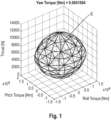
- An advantageous embodiment of the invention now provides for this 4D polytope to be approximated by a 4D hyperellipsoid with the best possible fit (e.g. according to the method of least squares). For illustration, reference is made to the description of the figures below, in particular Figure 1 .
- One possible aspect of the present invention now consists in calculating the current control limitations mentioned, e.g. on the basis of the hyperellipsoid representation explained above, and using them for the display.
- the aim is to dynamically display to the pilot the current remaining control margin for each of the four available degrees of freedom (here corresponding to roll, pitch, yaw and lift/total thrust).
- the control limitations for all axes can be calculated epoch by epoch.
- the two individual control limits (upper and lower control limitations) for each of the axes are obtained by determining the two intersection points of the line along the control axis through ⁇ Cmd with the hyperellipsoid in the 4-dimensional torque-thrust space.
- the assistance system according to the invention realizes the same inventive idea as one of the aforementioned methods.
- the assistance system according to the invention is configured to carry out one of the aforementioned methods.
- all of the aforementioned features, combinations of features and advantages can also be combined with the assistance system or apply to the assistance system.
- the assistance system is configured in particular to support a pilot in controlling an aircraft.
- the assistance system comprises at least one calculation device and one display device.
- the calculation device and the display device are preferably connected to each other in a signal-communicating manner. Independently of the aforementioned, the calculation device and the display device can be spatially spaced apart from each other or can be formed within a common apparatus.
- the calculation device is configured to calculate the momentary control limitations for controlling the aircraft about its roll axis, for controlling the aircraft about its pitch axis, for controlling the aircraft about its yaw axis and for controlling the total thrust of all propulsion devices.
- the calculation device can be, for example, a processor and/or a computer.
- the display device is configured to display the calculated control limitations, in particular the control limitations calculated by the calculation device.
- the display device can, for example, be a display, in particular a head-up display (HUD) and/or a touchpad with display functionality.
- HUD head-up display
- the assistance system comprises an input device.
- the input device is configured as a pilot control stick (PCS).
- PCS pilot control stick
- the input device can be directly or indirectly, connected and/or connectable to the calculation device in a signal-communicating manner.
- the input device can be indirectly connected to the calculation device via one or more other devices.
- the input device can be directly or indirectly connected and/or connectable to the display device in a signal-communicating manner.
- the input device can be indirectly connected to the display device via one or more other devices.
- the input device is connected and/or can be connected to the calculation device in a signaling-communicating manner.
- the calculation device can be connected and/or connectable to the display device in a signal-communicating manner.
- the input device can, for example, be configured to receive the pilot's control commands.
- the pilot's control commands received by the input device are then provided to the calculation device as control input, in particular as signals that correspond to the control input.
- the pilot's control commands can be measured from various sensors, for example a force sensor or position sensor or any other type, associated with the pilot control stick (PCS) where these sensor signals are then processed to generate the control input by the calculation device.
- PCS pilot control stick
- the calculation device can transmit the control input to the display device in modified and/or unmodified form.
- the calculation device can modify, in particular edit and/or process the control input as part of a control method.
- the control method can have a pseudo-control, so that the control method represents a type of mapping specification from control inputs and state towards pseudo-control.
- the aircraft according to the invention realises the same inventive idea as one of the aforementioned methods and/or one of the aforementioned assistance systems.
- the aircraft according to the invention preferably comprises one of the aforementioned assistance systems.
- all of the aforementioned features, combinations of features and advantages can also be realised/combined with or by the aircraft.
- the aircraft in addition to one of the aforementioned assistance systems, the aircraft comprises a plurality of lift-generating propulsion devices. At least one of the plurality of lift-generating propulsion devices comprises a rotor and an electric motor for driving the rotor. Preferably, each of the plurality of lift-generating propulsion devices comprises a rotor and an electric motor for driving the corresponding rotor.
- the propulsion devices are arranged and/or configured on the aircraft in such a way that the propulsion devices generate the lift necessary to maintain the aircraft in a substantially stationary hovering position.
- the propulsion devices are arranged and/or configured on the aircraft in such a way that the propulsion devices can generate a vertical lift force.
- Aspect 1 Method of assisting a pilot in controlling an aircraft having a plurality of lift-generating propulsion devices, the method comprising the following method steps, calculation of momentary control limitations for each: a control of the aircraft around its roll axis, a control of the aircraft around its pitch axis, a control of the aircraft around its yaw axis and a control of the total thrust T of all propulsion devices, and display of the calculated control limitations by a display device.
- Aspect 6 Method according to one of the preceding aspects, wherein at least one of the control limitations is displayed relative to a neutral control value.
- Aspect 7 Method according to one of the preceding aspects, wherein for at least one control limitation, preferably for all control limitations, an area within the corresponding control limitation is visually displayed differently than an area outside the corresponding control limitation.
- Aspect 8 Method according to one of the preceding aspects, wherein at least one of the control limitations, preferably all of the control limitations, has an upper control limit and a lower control limit.
- Aspect 10 Method according to one of the aspects 8 or 9, wherein the upper control limit and the lower control limit are shown as parallel lines within a display field.
- Aspect 11 Method according to one of the preceding aspects, wherein a momentary control value is displayed for the control of the aircraft about its roll axis, for the control of the aircraft about its pitch axis, for the control of the aircraft about its yaw axis and/or for the control of the total thrust T of all propulsion devices.
- Aspect 12 Method according to aspect 11, wherein the graphical representation of the momentary control value changes as soon as the momentary control value reaches the respective control limitation.
- Aspect 13 Method according to one of the preceding aspects, wherein the control of the aircraft is described by a vector comprising four components, namely the three components of a torque about the respective aircraft axes and the total thrust, wherein the three components of torque being dependent on the arrangement and the momentary thrust of the individual propulsion devices, and the momentary limitations of the vector with respect to each of the four components are determined to calculate the control limitations.
- Aspect 14 Assistance system for assisting a pilot in controlling an aircraft, the assistance system comprising: a calculation device for the calculation of momentary control limitations for each: a control of the aircraft around its roll axis, a control of the aircraft around its pitch axis, a control of the aircraft around its yaw axis and a control of the total thrust T of all propulsion devices, and a display device for displaying the calculated control limitations.
- Aspect 17 Assistance system according to one of the aspects 14 to 16, wherein the assistance system comprises an input device, preferably a joystick, wherein the input device is connected to the calculation device in a signaling-communicating manner and wherein the input device is configured to receive control commands from the pilot in order to provide the pilot's control commands to the calculation device as a control input.
- Aspect 18 Aircraft comprising an assistance system according to one of aspects 14 to 17, wherein the aircraft comprises a plurality of lift-generating propulsion devices.
- Aspect 19 Aircraft according to aspect 18, wherein each of the plurality of propulsion devices comprises a rotor and an electric motor for driving the corresponding rotor.
- Aspect 20 Aircraft according to one of the aspects 18 or 19, wherein the propulsion devices are arranged such that the propulsion devices generate a vertical lift force.
- Figure 1 shows the ellipsoid E as described above for an aircraft in a pseudo-3D representation in a torque-thrust space, in which one dimension, in this case the yaw torque, is specified in a fixed manner. Accordingly, the ellipsoid E symbolizes the currently available control volume in the remaining three spatial directions thrust, pitch torque and roll torque.
- the ellipsoid E describes the momentary control limitations of a flight state vector ⁇ (not shown in Figure 1 ), which - starting from a center point of the ellipsoid E - can only lie on its surface or in its interior.
- the vector ⁇ representing the state of the aircraft in terms of its pitch, roll, yaw and total thrust at a particular point of flight time and the vector ⁇ lying within the boundary or limits of the ellipsoid is desirable for a stable flight state.
- the control parameters lying within the ellipsoid will indicate the operable control volume of the aircraft for achieving stable flight conditions. Outside the interior of the ellipsoid defines the unstable and undesirable aircraft region.
- the interior of the ellipsoid E indicates the physically accessible control range of the aircraft, i.e. those flight states that the pilot can currently realize with the aircraft.
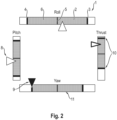
- Figure 2 shows a corresponding representation as can be generated, for example, by means of the method according to the invention and/or the assistance system 1, in particular the display device 29 (see Figure 5 ).
- the current control limitations of the control volume for each component of the flight condition vector ⁇ are dynamically displayed to the pilot.
- a fixed rectangular display area 2 is provided on a display 1 of the assistance system for each component, i.e. for each control parameter of the aircraft 20 in relation to the roll axis x, the pitch axis y and the yaw axis z (see Figure 5 ), which is only explicitly referred to for the roll moment.
- the displays respectively the display areas 2 for the individual components are arranged around a central display area 2a, in which central display area 2a further control-relevant displays may be presented (not shown).
- the dynamically calculated control value limitations for the relevant component are displayed in red (at 3 and 4), with one of these limitations indicating the possible lower limit for the relevant component and the other limit indicating the associated upper limit.
- Reference sign 5 shows the average value (mean value of lower limit 4 and upper limit 3).
- the area 6 between the limitations 3 and 4 is colored green and represents the physically achievable control range for the aircraft (in relation to the component in question).
- Reference sign 8 denotes a momentary control value which indicates the currently controlled value of the component of the relevant control limitation 3, 4, in particular with respect to the upper control limit 3 and the lower control limit 4.
- the momentary control value 8 is white, but changes color (limited momentary control value 9) when it approaches one of the control limitations 3, 4. This is shown symbolically in Figure 2 for the control in relation to the pitch axis ("pitch") and for the control in relation to the yaw axis ("yaw").
- the momentary control value 8 in relation to the pitch axis is still a long way away from the control limitations 3, 4.
- the limited momentary control value 9 in relation to the yaw axis (“yaw”) has already reached the left-hand control limit and is shown in a different color accordingly.
- the relevant limited momentary control value 9 is colored differently, preferably red, and is located at or on the relevant control limitation.
- the thrust is almost at or near its maximum possible value. Accordingly, the momentary control value of the thrust is positioned and also displayed differently.
- the frame of the momentary control value is somewhat thicker and the coloring can also be selected differently.
- the momentary control value can be colored yellow.
- control limitations 3 and 4 as well as the area 6 within the control limitations 3, 4 and the neutral control value 5 are movable dynamically within the (fixed) display fields 2, depending on the current flight status or pilot control command.
- the display within the display fields 2 does not have to be symmetrical with respect to the field boundaries (rectangular outline), especially for the thrust.
- the momentary control value 8 denotes a current commanded pitch torque (element of the 4x1 vector ⁇ ; not shown) on the aircraft fuselage or its display, which - like all other components - is provided at a preferably constant update rate, in particular by the aforementioned calculation device (see Figure 5 ), e.g. by a flight control law implemented there.
- the commanded roll, yaw and thrust value (also elements of the vector ⁇ ) is shown in the other three displays or display fields 2, as already described.
- the thick, preferably red, bars or lines indicate the current control limitation for the thrust according to reference sign 10. These bars (corresponding to the aforementioned limitations 3, 4) are continuously moving depending on the state of the aircraft and the pilot's inputs, thus increasing and decreasing the control volume on the respective axis. This also applies analogously to the displays for roll, pitch and yaw.
- the available control volume is preferably displayed in green (see hatched area described by the reference sign 11 in Figure 2 ).
- the corresponding area in relation to the control around the roll axis of the aircraft changes its size dynamically depending on the position of the limitation bars (control limitations 3, 4).
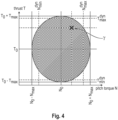
- Figure 4 shows a 2D representation illustrating the calculation of the dynamic limitations, as described mathematically in detail above.
- the scalar values N 0 and T 0 indicate the centre of the hyperellipsoid, which is located at the intersection of the two associated lines.
- the scalar values N max and T max describe the corresponding half-axis length of the hyperellipsoid E. The same applies to the other axes not shown here (roll and pitch).
- N max dyn N min dyn
- T max dyn T min dyn
- the momentary control limitation T max dyn and T min dyn for the thrust results by running from ⁇ parallel to the ordinate to the points of intersection with the ellipsoid E.
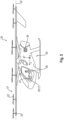
- FIG 5 schematically shows an example of an aircraft 20 in the form of an eVTOL.
- the aircraft 20 has a plurality of propulsion devices 21.
- Each of the propulsion devices 21 comprises a propeller or rotor 22 with a fixed pitch and an electric motor 23 for driving the rotor 22.
- the rotors 22 are all arranged in or parallel to a common level 24, with the rotor blades inclined relative to the level 24 or relative to a support structure (fixed pitch angle).
- the aircraft fuselage 25 including a cockpit is located below the level 24.
- a pilot 26 flies or controls the aircraft 20 by using an input device 27 in the form of a control stick 27.
- the aircraft 20 further comprises a calculation device 28.
- the calculation device 28 is connected to the input device 27 in a signal-communicating manner.
- Reference sign 29 denotes a display device, which in the embodiment example shown in Figure 5 is configured as a display (screen) 29.
- the display device 29 is in turn connected to the calculation device 28 in a signal-communicating manner.
- the calculation device 28, the input device 27 and the display device 29 together commonly form an assistance system 1.
- the calculation device 28 receives the corresponding control signals and can perform the calculations as part of the method described above.
- the dynamically calculated momentary control limitations can then be shown to the pilot 26 via the display 29.
Landscapes
- Engineering & Computer Science (AREA)
- Aviation & Aerospace Engineering (AREA)
- Radar, Positioning & Navigation (AREA)
- Remote Sensing (AREA)
- Physics & Mathematics (AREA)
- General Physics & Mathematics (AREA)
- Automation & Control Theory (AREA)
- Traffic Control Systems (AREA)
Abstract
Description
- The present invention relates to a method for assisting a pilot in controlling an aircraft having a plurality of lift-generating propulsion devices. The method substantially comprises a method step in which a plurality of momentary control limitations are calculated and a further method step in which the calculated control limitations are displayed by a display device.
- The invention also relates to an assistance system with a calculation device and a display device, wherein the assistance system is preferably configured to carry out the aforementioned method.
- An aircraft with such an assistance system is also the subject of the present invention.
- Aircrafts with fly-by-wire controls, in particular those with electric propulsion along with vertical take-off and landing (eVTOL) mechanism, often do not provide direct haptic feedback that allows the pilot to judge whether a requested control input can be executed with full or only partial power (or not at all). Even if a control input can be fully executed, i.e. if the aircraft can reach a flight state requested by the pilot, the remaining margin of control may not be obviously recognizable to the pilot under the given circumstances. In other words, the pilot may not realize whether or what control margin remains to control the aircraft.
- The use of haptic feedback, in particular haptic feedback via the control stick of the aircraft, is known from the prior art. Here, actuators cause force feedback that is transferred from the control stick to the pilot.
- However, in eVTOL aircraft, especially in aircraft with a multi-rotor design and/or with a large number of propulsion devices that have a fixed and/or adjustable pitch or angle of attack for the individual propulsion devices, there is no clear independence between the control axes. For example, a control input relating to the roll or pitch axis in hover mode can reduce the control reserve along the yaw axis significantly more than on the roll and pitch axis. This results from the fact that such an aircraft can have N propulsion devices in the form of actuators (rotors or propellers together with a propulsion motor;

- Finally, the force feedback known from the prior art can be ambiguous and confusing for the pilot of an eVTOL aircraft. In terms of flight safety, this represents an intolerable inconsistency in human-machine interaction.
- Irrespective of the aforementioned disadvantage, the introduction of active feedback using actuators inevitably increases the weight and complexity of the respective aircraft. Furthermore, the large number of additional components also increases the potential for possible sources of error.
- It is an object of the present invention to satisfy the aforementioned needs of the prior art and/or to eliminate the associated disadvantages. In particular, it is an object of the present invention to provide a method, an assistance system and an aircraft with which the flight safety is increased within the interaction between the pilot and the aircraft without the overall weight of the aircraft having to be increased.
- This object is solved by a method according to
claim 1. Advantageous further embodiments of the method according to the invention are the subject-matter ofdependent claims 2 to 12 and/or are explained in the following description. - In order to solve the above-mentioned object, according to the invention, a method is proposed which is suitable for assisting a pilot in controlling an aircraft with a plurality of lift-generating propulsion devices. In other words, the method is preferably applicable to aircraft having a plurality of propulsion devices, in particular a plurality of rotors. The propulsion devices are configured to generate lift in such a way that the aircraft can take off and/or land, for example take off vertically and/or land vertically. Depending on the angle of inclination of the propulsion devices in relation to the aircraft and/or the angle of inclination of the aircraft in space, the propulsion devices can also be configured to generate forward drive. The aircraft can, for example, be a multicopter, in particular an eVTOL, with several rotors. Preferably, each of the propulsion devices has an invariable angle of inclination in relation to the aircraft.
- According to the invention, the method comprises a method step in which momentary control limitations of the aircraft are calculated. The calculation can, for example, be performed by a calculation device.
- For the purposes of the present invention, the term "control limitation" refers to the physical limitation for controlling the aircraft. This means, for example, that control of the aircraft outside the control limitation is physically impossible and/or leads to the aircraft crashing. The control limitations can, in particular, correspond to the flight states physically achievable by the aircraft. The control limitations can be, for example, the limitation of a maximum roll angle in relation to the roll axis of the aircraft, a maximum pitch angle in relation to the pitch axis of the aircraft, a maximum yaw angle in relation to the yaw axis of the aircraft, and/or a maximum total thrust. Alternatively or additionally, the control limitations can be configured as a limitation of the roll rate, the pitch rate and/or the yaw rate around the corresponding aircraft axis. Other forms of limitation, for example the limitation of the maximum rotational acceleration and/or the maximum torques around the corresponding aircraft axis, are also possible as control limitations.
- For the purposes of the present invention, the term "momentary" is understood to mean the current state in terms of time. This means, for example, that the result of the momentary calculation may deviate from a result of the same calculation in the past and/or in the future, in particular, in a past and/or future time step.
- According to the invention, the momentary control limitations are calculated in each case with respect to a control of the aircraft about its roll axis, with respect to a control of the aircraft about its pitch axis, with respect to a control of the aircraft about its yaw axis, and with respect to a control of the total thrust of all propulsion devices. Thereby, the physical fact is taken into account according to which an aircraft, in particular an eVTOL, with several lift-generating propulsion devices, preferably in a multicopter, all of the aforementioned control parameters influence each other or are dependent on each other. The control of the aircraft around its roll axis, its pitch axis and/or its yaw axis can in particular depend on the arrangement and/or the momentary thrust output of the individual propulsion devices.
- In a further method step of the method according to the invention, the calculated control limitations are displayed by a display device. The display can, for example, take the form of a scale. By displaying the calculated control limitations, these can be made accessible to the pilot by technical means.
- The resulting technical contribution of the invention improves the human-machine interaction between pilot and aircraft in such a way that the pilot knows the physical performance limitations of the aircraft to be controlled at all the times. The method according to the invention has the advantageously effect that the pilot is permanently informed of the current limitations or control limitations of the aircraft by the aforementioned technical measures. This enables the pilot to control the aircraft within its physical capabilities at all times. In particular, based on the displayed calculated control limitations the pilot is enabled to control the aircraft within its physical capabilities all the time. In other words, the method according to the invention avoids operating the aircraft outside its physical capabilities, which simultaneously reduces the risk of a potential crash. Accordingly, the method according to the invention has, among other things, the advantage that flight safety is increased without the overall weight of the aircraft having to be increased by additional components.
- In an exemplary embodiment of the method according to the invention, the control limitations are calculated as a function of the current flight state of the aircraft. Thereby, for example, the current position of the aircraft in space and/or the airflow towards the aircraft can be detected by sensors. Alternatively or additionally, the current control limitations can be calculated as a function of the aircraft's control system.
- The term "control of the aircraft" can, in particular, refer to the control of the aircraft about its roll axis, about its pitch axis, about its yaw axis and/or about the control of the total thrust of all propulsion devices. Independently of the above, the momentary control limitations can be calculated as a function of the pilot's momentary control inputs and/or as a function of the momentary control signals. The control signals can, for example, be signals from a flight control computer to the propulsion devices. In particular, the target rotation speeds of the rotors and/or the control of the propulsion devices corresponding to the target rotation speeds of the rotors can be control signals within the meaning of the present invention.
- The aforementioned embodiment advantageously has the effect that all current control parameters are taken into account when calculating the current control limitations. Among other things, this has the advantage that the physically present flight state of the aircraft can be recorded particularly accurately by technical means in order to increase the precision of the calculated control limitations.
- According to a further exemplary embodiment, the calculation of the control limitations is performed dynamically. In other words, the calculation of the control limitations is performed repeatedly over time. Preferably, the calculation of the control limitations is performed periodically, for example repeatedly at predefined time intervals. Preferably, the time interval between the individual calculation steps is chosen to be so short that the calculation of the control limitations is performed in real time.
- A dynamic, in particular periodic, calculation of the control limitations advantageously ensures that the calculated control limitations always correspond to the current flight state of the aircraft. This has the advantage that the control limitations provided by the method, sufficiently precisely correspond to the current maximum physically achievable flight state of the aircraft. As a result, flight safety can be further increased.
- Preferably, each of the calculated control limitations is displayed separately. In other words, each of the calculated control limitations is displayed separately, in particular at a distance, from the other calculated control limitations. Such a display advantageously has the effect that the individual control limitations can be recognized particularly easily by the pilot. This can have the advantage of further increasing the flight safety. Alternatively, it is also conceivable that the calculated control limitations are displayed at least partially overlaid. This has the advantage that the display of the calculated control limitations requires less display area. In this respect, further information can be displayed in addition to the calculated control limitations.
- In a further exemplary embodiment, neutral control values can be displayed. For the purposes of the present invention, the term "neutral control value" is understood to mean the neutral output value of the corresponding control parameter. For example, the neutral control value for controlling the aircraft about its roll axis is a roll angle of 0°. The same can also apply to neutral control values for controlling the aircraft about its pitch axis and/or yaw axis. Alternatively or additionally, the neutral control value for controlling the aircraft in relation to the corresponding aircraft axis can also be a rotational speed of 0 °/s, a rotational acceleration of 0 °/s2, and/or a torque of 0 Nm. The neutral control value in relation to the total thrust of all propulsion devices can be 0 Newton (N). In other words, the propulsion devices generate no or negligible lift when the neutral control value is present.
- Preferably, the calculated control limitations are each displayed in relation to the respective neutral control value. For example, a control limitation in which the control of the aircraft is not restricted at all or only slightly restricted, can be displayed further away from the displayed neutral control value than a control limitation in which the control of the aircraft is severely restricted. Such a display can advantageously ensure that the individual control limitations can be recognized particularly easily by the pilot. This can have the advantage of further increasing flight safety by providing the pilot with a better overview of the control limits of the aircraft. In other words, the resulting technical contribution improves the human-machine interaction between pilot and aircraft in such a way that the pilot knows the physical performance limitations in relation to the neutral control value of the aircraft to be controlled at all times.
- In a further exemplary embodiment of the method, for at least one control limitation, an area within the corresponding control limitation can be visually displayed differently than an area outside the corresponding control limitation. Preferably, the areas within each of the control limitations are visually indicated differently with respect to the areas outside the corresponding control limitations. The visual differentiation can be realized, for example, by using different colors and/or different graphic structures. For example, the area inside the control limitations can be displayed in green color. The area outside the control limitations can be displayed in black. The visually differentiated display can advantageously ensure that the control areas within the individual control limitations can be recognized particularly easily by the pilot. Accordingly, this can further increase flight safety by providing the pilot with a better overview of the control limits of the aircraft. In other words, the resulting technical contribution improves the human-machine interaction between pilot and aircraft in such a way that the pilot can recognize the physical performance limitations of the aircraft more easily.
- At least one of the control limitations can have an upper control limit and a lower control limit. Preferably, all control limitations each comprise an upper control limit and a lower control limit.
- In particular, the upper control limit can be a maximum control value. For example, the upper control limit for controlling the aircraft around its roll axis is a maximum roll angle that the aircraft can achieve. The lower control limit is preferably the maximum roll angle in the opposite direction. The same can also apply to the upper and lower control limit in relation to the pitch axis and/or yaw axis of the aircraft. Alternatively or additionally, the upper control limit in relation to the corresponding aircraft axis can also be a maximum rotational speed in a first rotational direction, a maximum rotational acceleration in the first rotational direction, and/or a maximum torque in a first direction. In relation to the corresponding aircraft axis, the lower control limit can be a maximum rotational speed in a second rotational direction opposite to the first rotational direction. It is also conceivable that the lower control limit in relation to the corresponding aircraft axis is a maximum rotational acceleration in the second direction of rotation and/or a maximum torque in a second direction. With respect to the total thrust of all propulsion devices, the upper control limit can correspond to the maximum thrust. In other words, the propulsion devices generate the maximum possible lift at the upper control limit.
- Preferably, the upper and/or lower control limit for at least one of the control limitations is visually emphasized when displayed. Particularly preferred, the respective upper and/or lower control limits are highlighted for all control limitations. The upper and lower control limits can, for example, be visually highlighted using signal colors like red, and/or a particularly conspicuous graphic display, such as flashing. Additionally or alternatively, the upper and lower control limits can also be indicated by displaying numerical values, in particular dynamically varying numerical values. The visual highlighting can advantageously have the effect that the corresponding control limitations can be recognized particularly easily by the pilot. Accordingly, this can further increase flight safety by providing the pilot with a better overview of the control limits of the aircraft. In other words, the resulting technical contribution improves the human-machine interaction between pilot and aircraft in such a way that the pilot knows the physical performance limitations of the aircraft to be controlled at all times.
- Regardless of the above, the upper control limit and the lower control limit can be displayed as parallel lines. Alternatively or additionally, the upper control limit and the lower control limit can be displayed at a distance in relation to the respective neutral control values. Preferably, the distance between the control limitations and the neutral control value varies depending on the calculated momentary control limitation.
- In a further exemplary embodiment of the method, a momentary control value is displayed for the control of the aircraft about its roll axis, for the control of the aircraft about its pitch axis, for the control of the aircraft about its yaw axis and/or for the control of the total thrust of all propulsion devices. This can advantageously enable the pilot to assess his current control inputs in relation to the calculated control limitations. In other words, such an embodiment uses technical means to inform the pilot of the relationship between his control inputs and the physically possible flight control of the aircraft. This can have the advantage of further increasing flight safety by providing the pilot with a better overview of the control limits of the aircraft. In other words, the resulting technical contribution improves the human-machine interaction between pilot and aircraft in such a way that the pilot knows the physical performance limitations in relation to the momentary control value of the aircraft.
- In an advantageous further development of the aforementioned embodiment, the display of the momentary control value changes as soon as the corresponding momentary control value reaches the calculated control limitation. This allows to signalize to the pilot visually by technical means that the pilot has exhausted the physically possible control potential of the aircraft with his control inputs. Alternatively or additionally, the technical means can also provide haptic and/or acoustic signals to the pilot.
- Another advantageous further development of the method according to the invention provides that a graphic marker is used to indicate the momentary control value of the control component/ control parameters in question (for example, control of the aircraft around its roll axis, pitch axis, yaw axis and/or of the total thrust). The control value of the component can be dynamically and numerically displayed above or below depending on the position of the graphic marker. The control value of the component can be displayed in combination with displaying the upper and lower limits of the control limitations. The color of the marker, e.g. an arrow or triangle, is preferably changed as a function of a distance of the associated value from the momentary control limitation. Thereby, a display color of the marker can correspond to a display color of the corresponding control limitation when the current control limitation is reached, e.g. is changed to red, while the display color otherwise for example is green. When approaching the control limitation, intermediate colors can also be used, e.g. yellow and/or orange. Most preferably, an acoustic, visual and/or haptic alarm is also triggered when the current control limitation is reached. The marker itself can also be displayed flashing in this case. This can have the advantage of further increasing flight safety by providing the pilot with a better overview of the control limits of the aircraft. In other words, the resulting technical contribution improves the human-machine interaction between pilot and aircraft in such a way that the pilot knows the physical performance limitations of the aircraft to be controlled at all times.In an exemplary further development of the method, the displays for the individual control limitations can be arranged around a central display area. The said central display area can advantageously be used in the conventional manner for displaying instruments etc. of the aircraft. In particular, the so-called "Basic T" familiar to the pilot, preferably comprising a display for the artificial horizon, altimeter, airspeed indicator and gyro, can be displayed in the central display area in order to (also) provide the pilot with the cockpit design familiar from other aircraft. This can make piloting the aircraft even easier.
- In a further exemplary embodiment of the method, the control of the aircraft can be described by a vector. In particular, the vector can correspond to the current flight state of the aircraft. Preferably, the vector comprises four components, namely the three components of a torque around the respective aircraft axes and the total thrust of all propulsion devices. The three components comprising the torques may depend on the arrangement and/or the momentary thrust of the individual propulsion devices. To calculate the control limitations, the momentary limitations of each of the four components of the vector are determined in particular.
- For an exemplary calculation of the vector, a three-dimensional torque vector τ (roll, pitch and yaw torque in the unit Nm), which acts on the aircraft body, and the total thrust T (in the unit Newton), which is generated by all propulsion devices in the rotor plane as a whole, can be mathematically related to the individual actuator speed commands via the so-called motor matrix M:

- In the sense of this invention the "vector" comprises an instantaneous single value for every control parameter for a specific time stamp. For example, at a momentary timestamp t0 the vector γ can comprise specific values for control parameters for controlling the aircraft around its roll axis, for controlling the aircraft around its pitch axis, for controlling the aircraft around its yaw axis and for controlling the total thrust of all propulsion devices. The specific values for control parameters for controlling the aircraft around an axis can have one of the units of degrees, degrees/s, degrees/s2 or radians, radians/s or radians/s2. The specific value for the control parameter for controlling the total thrust of all propulsion devices can have the unit Newton (N).
- At a time stamp t1 following the time stamp t0, the values of the control parameters within the vector γ can be different from the values of the control parameters within the vector γ at t0.
- The vector RPM cmd ; with RPM min ≤ RPM cmd ≤ RPM max can contain the speed commands (for example in the unit of revolutions per minute) and preferably has the dimension N (N= number of propulsion devices), the motor matrix M is a 4 x N-matrix, and the vector γ has the dimension 4 (containing the three-dimensional torque vector τ and the total thrust T). The square of the vector RPM cmd here means squaring element by element. The motor matrix M preferably depends on the position of the individual motors (or the respective rotors) in the aircraft as well as on the torque and thrust that can be generated by the motors/rotors. Alternatively or additionally, the motor matrix M can also depend on the health conditions of the individual motors. The health condition of the individual motors can be represented by weights whose values ranging for example, between [0,1]. It should be noted that these values can vary depending on various factors such as air density or (electrical) voltage. In general, however, the motor matrix M for given conditions can be approximated by a constant matrix. In the following, it is assumed that a suitable matrix M is given or known.
- As a result of the lower or upper RPM limitations RPM min, RPM max , the set of all possible permutations of the vector γ is enclosed by a 4-dimensional convex hull, a so-called 4D polytope, which defines the control limitations of the aircraft. In other words, the 4D polytope defines the control volume of the control limitations/parameters. For a stable and controlled aircraft, the control parameters must be within this control volume. If the control parameters (torque in each aircraft axes or total thrust) fall or exceed outside the control volume, there occurs a degradation of the performance of the aircraft. The display of the control parameters can indicate the stable or unstable operating state of the overall aircraft system or the flight control system. This helps the pilot to take necessary action to bring the aircraft stable again or to bring the aircraft back within the 4D polytope. For example, the pilot can manually recover the aircraft using the pilot control stick and thrust regulator or the pilot can push a recovery button such that the aircraft can automatically recover its control state. An advantageous embodiment of the invention now provides for this 4D polytope to be approximated by a 4D hyperellipsoid with the best possible fit (e.g. according to the method of least squares). For illustration, reference is made to the description of the figures below, in particular
Figure 1 . - The constraint of the vector γ to this 4D hyperellipsoid can be expressed as a quadratic inequality:


- It is important to note that the values for the maximum and centre of the ellipsoid axes are constant, while the current limitations along each axis are highly dynamic and constantly changing, depending on the value of the 4D vector γCmd currently commanded (by the pilot), i.e. depending on a current control input. A good example is a situation with a maximum thrust command that leaves no more room for roll and pitch commands or corresponding manoeuvres, as all motors are already running at full speed and there is no more speed difference available to transfer a roll or pitch moment to the aircraft body.
- One possible aspect of the present invention now consists in calculating the current control limitations mentioned, e.g. on the basis of the hyperellipsoid representation explained above, and using them for the display. Basically, the aim is to dynamically display to the pilot the current remaining control margin for each of the four available degrees of freedom (here corresponding to roll, pitch, yaw and lift/total thrust). For a given γCmd at any epoch, i.e. in a given time interval, the control limitations for all axes can be calculated epoch by epoch. These dynamically calculated control limitations can then be displayed to the pilot.
- The two individual control limits (upper and lower control limitations) for each of the axes are obtained by determining the two intersection points of the line along the control axis through γCmd with the hyperellipsoid in the 4-dimensional torque-thrust space.
- Assuming that τ = γ - γ 0 , the intersection points of a general ratio κ of the ellipsoid along a search direction v are to be found. The following then applies:

- This leads to solutions of the type

- If one, in order to find all solutions, for the search directions v successively select all unit directions (i.e. v = (1,0,0,0) T , (0,1,0,0) T etc.) and additionally set κ = 1, the calculations are simplified (with a slight misuse of the notation) as follows:
- The dynamic upper and lower control limits


- whereby γ max = (L max, M max, N max, T max)T and (.)2 denotes element-by-element squaring, and the square root is also carried out element by element. In other words, (.)2 involves taking each corresponding pair of elements from the two vectors γ and γ 0, computing their difference and then squaring the result of each difference. The dynamically determined control limitations can then be graphically displayed to the pilot as described in detail above.
- The task of the invention formulated at the beginning is also solved with an assistance system according to claim 13. Advantageous further developments of the assistance system according to the invention are explained in the following description.
- The assistance system according to the invention realizes the same inventive idea as one of the aforementioned methods. In particular, the assistance system according to the invention is configured to carry out one of the aforementioned methods. In this respect, all of the aforementioned features, combinations of features and advantages can also be combined with the assistance system or apply to the assistance system.
- The assistance system is configured in particular to support a pilot in controlling an aircraft. The assistance system comprises at least one calculation device and one display device. The calculation device and the display device are preferably connected to each other in a signal-communicating manner. Independently of the aforementioned, the calculation device and the display device can be spatially spaced apart from each other or can be formed within a common apparatus.
- According to the invention, the calculation device is configured to calculate the momentary control limitations for controlling the aircraft about its roll axis, for controlling the aircraft about its pitch axis, for controlling the aircraft about its yaw axis and for controlling the total thrust of all propulsion devices. The calculation device can be, for example, a processor and/or a computer.
- The display device is configured to display the calculated control limitations, in particular the control limitations calculated by the calculation device. The display device can, for example, be a display, in particular a head-up display (HUD) and/or a touchpad with display functionality.
- In a further exemplary development of the assistance system according to the invention, the assistance system comprises an input device. Preferably, the input device is configured as a pilot control stick (PCS). The input device can be directly or indirectly, connected and/or connectable to the calculation device in a signal-communicating manner. For example, the input device can be indirectly connected to the calculation device via one or more other devices. Irrespective of the aforementioned, the input device can be directly or indirectly connected and/or connectable to the display device in a signal-communicating manner. For example, the input device can be indirectly connected to the display device via one or more other devices. Preferably, the input device is connected and/or can be connected to the calculation device in a signaling-communicating manner. For its part, the calculation device can be connected and/or connectable to the display device in a signal-communicating manner. The input device can, for example, be configured to receive the pilot's control commands. Preferably, the pilot's control commands received by the input device are then provided to the calculation device as control input, in particular as signals that correspond to the control input. The pilot's control commands can be measured from various sensors, for example a force sensor or position sensor or any other type, associated with the pilot control stick (PCS) where these sensor signals are then processed to generate the control input by the calculation device.
- The calculation device can transmit the control input to the display device in modified and/or unmodified form. The calculation device can modify, in particular edit and/or process the control input as part of a control method. For example, the control method can have a pseudo-control, so that the control method represents a type of mapping specification from control inputs and state towards pseudo-control.
- The task of the invention formulated at the beginning is also solved with an aircraft according to claim 15. Advantageous further embodiments of the aircraft according to the invention are explained in the following description.
- The aircraft according to the invention realises the same inventive idea as one of the aforementioned methods and/or one of the aforementioned assistance systems. The aircraft according to the invention preferably comprises one of the aforementioned assistance systems. In this respect, all of the aforementioned features, combinations of features and advantages can also be realised/combined with or by the aircraft.
- According to the invention, in addition to one of the aforementioned assistance systems, the aircraft comprises a plurality of lift-generating propulsion devices. At least one of the plurality of lift-generating propulsion devices comprises a rotor and an electric motor for driving the rotor. Preferably, each of the plurality of lift-generating propulsion devices comprises a rotor and an electric motor for driving the corresponding rotor.
- In an exemplary embodiment of the aircraft, the propulsion devices are arranged and/or configured on the aircraft in such a way that the propulsion devices generate the lift necessary to maintain the aircraft in a substantially stationary hovering position. In other words, the propulsion devices are arranged and/or configured on the aircraft in such a way that the propulsion devices can generate a vertical lift force.
- The invention as well as advantageous further embodiments of the invention can also be described by way of examples by the following aspects. The features listed in the aspects can be combined with the aforementioned features.
Aspect 1Method of assisting a pilot in controlling an aircraft having a plurality of lift-generating propulsion devices, the method comprising the following method steps, calculation of momentary control limitations for each: a control of the aircraft around its roll axis, a control of the aircraft around its pitch axis, a control of the aircraft around its yaw axis and a control of the total thrust T of all propulsion devices, and display of the calculated control limitations by a display device. Aspect 2Method according to aspect 1, wherein the calculation of the control limitations is performed as a function of the momentary flight state of the aircraft and/or the momentary control of the aircraft, preferably as a function of the control of the aircraft around its roll axis, around its pitch axis, around its yaw axis and the total thrust T of all propulsion devices.Aspect 3 Method according to one of the preceding aspects, wherein the calculation of the control limitations is performed dynamically, preferably periodically. Aspect 4 Method according to one of the preceding aspects, wherein the control limitations correspond to the flight states physically achievable by the aircraft. Aspect 5Method according to one of the preceding aspects, wherein each of the calculated control limitations is displayed separately from the respective other calculated control limitations. Aspect 6 Method according to one of the preceding aspects, wherein at least one of the control limitations is displayed relative to a neutral control value. Aspect 7 Method according to one of the preceding aspects, wherein for at least one control limitation, preferably for all control limitations, an area within the corresponding control limitation is visually displayed differently than an area outside the corresponding control limitation. Aspect 8 Method according to one of the preceding aspects, wherein at least one of the control limitations, preferably all of the control limitations, has an upper control limit and a lower control limit. Aspect 9Method according to aspect 8, wherein for at least one control limit, preferably for all control limitations, the upper control limit and/or the lower control limit is graphically highlighted, preferably highlighted by a signal color. Aspect 10Method according to one of the aspects 8 or 9, wherein the upper control limit and the lower control limit are shown as parallel lines within a display field.Aspect 11Method according to one of the preceding aspects, wherein a momentary control value is displayed for the control of the aircraft about its roll axis, for the control of the aircraft about its pitch axis, for the control of the aircraft about its yaw axis and/or for the control of the total thrust T of all propulsion devices. Aspect 12Method according to aspect 11, wherein the graphical representation of the momentary control value changes as soon as the momentary control value reaches the respective control limitation.Aspect 13 Method according to one of the preceding aspects, wherein the control of the aircraft is described by a vector comprising four components, namely the three components of a torque about the respective aircraft axes and the total thrust, wherein the three components of torque being dependent on the arrangement and the momentary thrust of the individual propulsion devices, and the momentary limitations of the vector with respect to each of the four components are determined to calculate the control limitations. Aspect 14 Assistance system for assisting a pilot in controlling an aircraft, the assistance system comprising: a calculation device for the calculation of momentary control limitations for each: a control of the aircraft around its roll axis, a control of the aircraft around its pitch axis, a control of the aircraft around its yaw axis and a control of the total thrust T of all propulsion devices, and a display device for displaying the calculated control limitations. Aspect 15 Assistance system according to aspect 14, wherein the assistance system is configured to perform the method according to one of aspects 1 to 13.Aspect 16 Assistance system according to one of the aspects 14 or 15, wherein the computing device and the display device are connected to each other in a signal-communicating manner. Aspect 17 Assistance system according to one of the aspects 14 to 16, wherein the assistance system comprises an input device, preferably a joystick, wherein the input device is connected to the calculation device in a signaling-communicating manner and wherein the input device is configured to receive control commands from the pilot in order to provide the pilot's control commands to the calculation device as a control input. Aspect 18 Aircraft comprising an assistance system according to one of aspects 14 to 17, wherein the aircraft comprises a plurality of lift-generating propulsion devices. Aspect 19 Aircraft according to aspect 18, wherein each of the plurality of propulsion devices comprises a rotor and an electric motor for driving the corresponding rotor. Aspect 20Aircraft according to one of the aspects 18 or 19, wherein the propulsion devices are arranged such that the propulsion devices generate a vertical lift force. - The different and exemplary features described above can be combined with one another in accordance with the invention insofar as this is technically expedient and suitable. In particular, features disclosed in connection with a method can also be combined with device features and vice versa. Further combinable features, advantages and embodiments of the invention are disclosed within the following description of examples of embodiments and with reference to the figures. It shows:
- Figure 1
- shows a (hyper)ellipsoid for an aircraft in a pseudo-3D representation in a torque-thrust space;
- Figure 2
- shows an embodiment example of a dynamic representation of control limitations, as can be generated using an embodiment example of a method for assisting a pilot and/or an embodiment example of an assistance system;
- Figure 3
- shows a representation analogous to
Figure 2 for two different points in time (epochs); - Figure 4
- schematically shows a 2D representation for illustrating the exemplary calculation of the control limitations; and
- Figure 5
- shows an example of an aircraft.
- As an example,
Figure 1 shows the ellipsoid E as described above for an aircraft in a pseudo-3D representation in a torque-thrust space, in which one dimension, in this case the yaw torque, is specified in a fixed manner. Accordingly, the ellipsoid E symbolizes the currently available control volume in the remaining three spatial directions thrust, pitch torque and roll torque. - The ellipsoid E describes the momentary control limitations of a flight state vector γ (not shown in
Figure 1 ), which - starting from a center point of the ellipsoid E - can only lie on its surface or in its interior. The vector γ representing the state of the aircraft in terms of its pitch, roll, yaw and total thrust at a particular point of flight time and the vector γ lying within the boundary or limits of the ellipsoid is desirable for a stable flight state. The control parameters lying within the ellipsoid will indicate the operable control volume of the aircraft for achieving stable flight conditions. Outside the interior of the ellipsoid defines the unstable and undesirable aircraft region. The interior of the ellipsoid E indicates the physically accessible control range of the aircraft, i.e. those flight states that the pilot can currently realize with the aircraft. - Based on this mathematical-physical fact, the basic situation according to
Figure 1 can now be clearly and easily shown to the pilot by technical means, preferably with anassistance system 1 and particularly preferably with a display device 29 (seeFigure 5 ). The resulting technical contribution improves the human-machine interaction between pilot and aircraft in such a way that the pilot knows the physical performance limitations of the aircraft to be controlled at all times. This prevents the pilot from oversteering the aircraft, which could lead to a crash. -
Figure 2 shows a corresponding representation as can be generated, for example, by means of the method according to the invention and/or theassistance system 1, in particular the display device 29 (seeFigure 5 ). - In the course of the present invention and if configured accordingly, the current control limitations of the control volume for each component of the flight condition vector γ (not shown in
Figure 2 ) are dynamically displayed to the pilot. For this purpose, a fixedrectangular display area 2 is provided on adisplay 1 of the assistance system for each component, i.e. for each control parameter of theaircraft 20 in relation to the roll axis x, the pitch axis y and the yaw axis z (seeFigure 5 ), which is only explicitly referred to for the roll moment. The displays respectively thedisplay areas 2 for the individual components are arranged around a central display area 2a, in which central display area 2a further control-relevant displays may be presented (not shown). Within adisplay area 2, the dynamically calculated control value limitations for the relevant component are displayed in red (at 3 and 4), with one of these limitations indicating the possible lower limit for the relevant component and the other limit indicating the associated upper limit.Reference sign 5 shows the average value (mean value of lower limit 4 and upper limit 3). The area 6 between the limitations 3 and 4 is colored green and represents the physically achievable control range for the aircraft (in relation to the component in question). - Reference sign 8 denotes a momentary control value which indicates the currently controlled value of the component of the relevant control limitation 3, 4, in particular with respect to the upper control limit 3 and the lower control limit 4. The momentary control value 8 is white, but changes color (limited momentary control value 9) when it approaches one of the control limitations 3, 4. This is shown symbolically in
Figure 2 for the control in relation to the pitch axis ("pitch") and for the control in relation to the yaw axis ("yaw"). The momentary control value 8 in relation to the pitch axis is still a long way away from the control limitations 3, 4. The limitedmomentary control value 9 in relation to the yaw axis ("yaw") has already reached the left-hand control limit and is shown in a different color accordingly. - In other words, the yaw-moment has reached its maximum (or minimum) permissible value; more control input γCmd in this direction is currently no longer possible. Accordingly, the relevant limited
momentary control value 9 is colored differently, preferably red, and is located at or on the relevant control limitation. - The thrust is almost at or near its maximum possible value. Accordingly, the momentary control value of the thrust is positioned and also displayed differently. In particular, the frame of the momentary control value is somewhat thicker and the coloring can also be selected differently. For example, the momentary control value can be colored yellow.
- The momentary control values for roll and pitch are close to the
neutral control value 5 and are therefore colored white. - The control limitations 3 and 4 as well as the area 6 within the control limitations 3, 4 and the
neutral control value 5 are movable dynamically within the (fixed)display fields 2, depending on the current flight status or pilot control command. The display within the display fields 2 does not have to be symmetrical with respect to the field boundaries (rectangular outline), especially for the thrust. - The following special circumstances in
Figure 2 are also explicitly marked there:
The momentary control value 8 denotes a current commanded pitch torque (element of the 4x1 vector γ; not shown) on the aircraft fuselage or its display, which - like all other components - is provided at a preferably constant update rate, in particular by the aforementioned calculation device (seeFigure 5 ), e.g. by a flight control law implemented there. The commanded roll, yaw and thrust value (also elements of the vector γ) is shown in the other three displays ordisplay fields 2, as already described. - At the limited
momentary control value 9, none of the four commanded torque/thrust values (elements of the vector γ) can exceed the hyperellipse of the control volume and thus the dynamic limitations (see also reference signs 3, 4), as shown inFigure 2 for the yaw value as an example. - The thick, preferably red, bars or lines indicate the current control limitation for the thrust according to
reference sign 10. These bars (corresponding to the aforementioned limitations 3, 4) are continuously moving depending on the state of the aircraft and the pilot's inputs, thus increasing and decreasing the control volume on the respective axis. This also applies analogously to the displays for roll, pitch and yaw. - This can also be seen in
Figure 3 , in which the thick bars for the upper control limit 3 and the lower control limit 4 change dynamically between an epoch (time) k and a later epoch (time)k+ 1. It can be seen, for example, that the control volume, in particularly with respect to the yaw axis, is significantly smaller in epoch k+1 (on the right ofFigure 3 ) than in epoch k (to the left) due to the large roll and pitch commands. - The available control volume is preferably displayed in green (see hatched area described by the
reference sign 11 inFigure 2 ). The corresponding area in relation to the control around the roll axis of the aircraft (see reference sign 6) changes its size dynamically depending on the position of the limitation bars (control limitations 3, 4). -
Figure 4 shows a 2D representation illustrating the calculation of the dynamic limitations, as described mathematically in detail above. - Only the thrust (Y-axis) and the pitching moment (X-axis) are shown here as examples. The scalar values N0 and T0 indicate the centre of the hyperellipsoid, which is located at the intersection of the two associated lines. The scalar values Nmax and Tmax describe the corresponding half-axis length of the hyperellipsoid E. The same applies to the other axes not shown here (roll and pitch).
- Depending on the position of the vector γ, there are dynamic upper and lower control limitations for the individual components of the vector γ, marked in
Figure 4 as


- For example, the momentary control limitation


Figure 4 ). -
Figure 5 schematically shows an example of anaircraft 20 in the form of an eVTOL. Theaircraft 20 has a plurality ofpropulsion devices 21. Each of thepropulsion devices 21 comprises a propeller orrotor 22 with a fixed pitch and anelectric motor 23 for driving therotor 22. Therotors 22 are all arranged in or parallel to acommon level 24, with the rotor blades inclined relative to thelevel 24 or relative to a support structure (fixed pitch angle). - The
aircraft fuselage 25 including a cockpit is located below thelevel 24. Apilot 26 flies or controls theaircraft 20 by using aninput device 27 in the form of acontrol stick 27. Theaircraft 20 further comprises acalculation device 28. Thecalculation device 28 is connected to theinput device 27 in a signal-communicating manner.Reference sign 29 denotes a display device, which in the embodiment example shown inFigure 5 is configured as a display (screen) 29. Thedisplay device 29 is in turn connected to thecalculation device 28 in a signal-communicating manner. Thecalculation device 28, theinput device 27 and thedisplay device 29 together commonly form anassistance system 1. - If the
pilot 26 now moves thecontrol stick 27 in order to control theaircraft 20, thecalculation device 28 receives the corresponding control signals and can perform the calculations as part of the method described above. The dynamically calculated momentary control limitations can then be shown to thepilot 26 via thedisplay 29. -
- 1
- assistance system
- 2/2a
- display area
- 3
- upper control limit
- 4
- lower control limit
- 5
- neutral control value
- 6
- area within the control limitation
- 7
- -
- 8
- momentary control value
- 9
- limited momentary control value
- 20
- aircraft
- 21
- propulsion devices
- 22
- rotor
- 23
- motor / electric motor
- 24
- level
- 25
- aircraft fuselage
- 26
- pilot
- 27
- input device / joystick
- 28
- calculation device
- 29
- display device
- E
- ellipsoid
- γ
- vector
- T
- thrust
- x
- roll axis of the aircraft
- y
- pitch axis of the aircraft
- z
- yaw axis of the aircraft
Claims (15)
- Method for assisting a pilot (26) in controlling an aircraft (20) having a plurality of lift-generating propulsion devices (21), the method comprising the following method steps,(a) calculation of momentary control limitations (3, 4) for each(a1) control of the aircraft around its roll axis (x),(a2) control of the aircraft around its pitch axis (y),(a3) control of the aircraft around its yaw axis (z) and(a4) a control of the total thrust (T) of all propulsion devices (21), and(b) display of the calculated control limitations (3, 4) by a display device (29) in order to enable the pilot (26) to control the aircraft (20) within its physical capabilities at all times.
- Method according to claim 1, wherein the calculation of the control limitations (3, 4) is performed as a function of the momentary flight state of the aircraft (20) and/or the momentary control of the aircraft (20), preferably as a function of the control of the aircraft about its roll axis (x), about its pitch axis (y), about its yaw axis (z) and the total thrust (T) of all propulsion devices (21).
- Method according to one of the preceding claims, wherein the calculation of the control limitations (3, 4) is performed dynamically, preferably periodically.
- Method according to one of the preceding claims, wherein the control limitations (3, 4) correspond to the flight states physically achievable by the aircraft (20).
- Method according to one of the preceding claims, wherein each of the calculated control limitations (3, 4) is displayed separately from the respective other calculated control limitations (3, 4).
- Method according to one of the preceding claims, wherein at least one of the control limitations (3, 4) is indicated relative to a neutral control value (5).
- Method according to one of the preceding claims, wherein for at least one control limitation (3, 4), preferably for all control limitations (3, 4), an area within the corresponding control limitation (3, 4) is visually displayed differently than an area outside the corresponding control limitation (3, 4).
- Method according to one of the preceding claims, wherein at least one of the control limitations (3, 4), preferably all of the control limitations (3, 4), has an upper control limit (3) and a lower control limit (4).
- Method according to claim 8, wherein for at least one control limitation (3, 4), preferably for all control limitations (3, 4), the upper control limit (3) and/or the lower control limit (4) is graphically highlighted, preferably highlighted by a signal color.
- Method according to one of the preceding claims, wherein a momentary control value (8) is displayed for controlling the aircraft about its roll axis (x), for controlling the aircraft about its pitch axis (y), for controlling the aircraft about its yaw axis (z) and/or for controlling the total thrust (T) of all propulsion devices (21).
- Method according to claim 10, wherein the graphical representation of the momentary control value (8) changes as soon as the momentary control value (8) reaches the respective control limitation (3, 4).
- Method according to one of the preceding claims, wherein the control of the aircraft is described by a vector (y), which vector (γ) comprises four components, namely the three components of a torque (τ) around the respective aircraft axes (x, y, z) and the total thrust (T), wherein the three components of the torque (τ) are dependent on the arrangement and the momentary thrust of the individual propulsion devices (21), and the momentary limitations of the vector γ with respect to each of the four components are determined in order to calculate the control limitations (3, 4).
- Assistance system (1) for assisting a pilot (26) in controlling an aircraft (20), the assistance system (1) comprising,(a) a calculation device (28) for calculating momentary control limitations (3, 4) for each of the following(a1) control of the aircraft around its roll axis (x),(a2) control of the aircraft around its pitch axis (y),(a3) control of the aircraft around its yaw axis (z) and(a4) a control of the total thrust (T) of all propulsion devices (21), and(b) a display device (29) for displaying the calculated control limitations (3, 4) in order to enable the pilot (26) to control the aircraft (20) within its physical capabilities at all times.
- Assistance system according to claim 13, wherein the computing device and the display device are connected to each other in a signal-communicating manner.
- Aircraft (20) with an assistance system (1) according to claim 13 or 14, wherein the aircraft (20) comprises a plurality of lift-generating propulsion devices (21).
Applications Claiming Priority (1)
| Application Number | Priority Date | Filing Date | Title |
|---|---|---|---|
| DE102023130995.1A DE102023130995B3 (en) | 2023-11-08 | 2023-11-08 | Method for assisting a pilot in controlling an aircraft, assistance system for an aircraft pilot, and aircraft |
Publications (1)
| Publication Number | Publication Date |
|---|---|
| EP4553603A1 true EP4553603A1 (en) | 2025-05-14 |
Family
ID=92895540
Family Applications (1)
| Application Number | Title | Priority Date | Filing Date |
|---|---|---|---|
| EP24202046.9A Pending EP4553603A1 (en) | 2023-11-08 | 2024-09-23 | Method for assisting a pilot in controlling an aircraft, assistance system for an aircraft pilot, and aircraft |
Country Status (4)
| Country | Link |
|---|---|
| US (1) | US20250146839A1 (en) |
| EP (1) | EP4553603A1 (en) |
| CN (1) | CN119960480A (en) |
| DE (1) | DE102023130995B3 (en) |
Families Citing this family (2)
| Publication number | Priority date | Publication date | Assignee | Title |
|---|---|---|---|---|
| US20250198799A1 (en) * | 2023-12-18 | 2025-06-19 | The Charles Stark Draper Laboratory, Inc. | Display technologies |
| CN120740378B (en) * | 2025-08-20 | 2025-11-28 | 奥瑞思智能科技(天津)有限公司 | A method for generating human-computer interaction commands for remote collaborative control of target drones |
Citations (2)
| Publication number | Priority date | Publication date | Assignee | Title |
|---|---|---|---|---|
| US20130134255A1 (en) * | 2011-07-12 | 2013-05-30 | Bell Helicopter Textron Inc. | Pilot cyclic control margin display |
| CN114056554A (en) * | 2020-08-04 | 2022-02-18 | 沃科波特有限公司 | Aircraft, flight control device and method for determining a maneuver reserve in an aircraft |
Family Cites Families (6)
| Publication number | Priority date | Publication date | Assignee | Title |
|---|---|---|---|---|
| JPH062190B2 (en) * | 1987-04-24 | 1994-01-12 | 双葉電子工業株式会社 | Radio transmitter |
| WO2013174751A2 (en) * | 2012-05-21 | 2013-11-28 | E-Volo Gmbh | Method for controlling an aircraft in the form of a multicopter and corresponding control system |
| EP3170746A1 (en) * | 2015-11-19 | 2017-05-24 | HW Aviation AG | Method for controlling a multicopter and device for carrying out the method |
| DE102018129211A1 (en) * | 2018-11-20 | 2020-05-20 | Volocopter Gmbh | Bus system for the electrical supply of a plurality of loads and aircraft equipped with them |
| DE102020200056B4 (en) * | 2020-01-07 | 2025-08-14 | Volkswagen Aktiengesellschaft | Control unit for continuous control signal verification of multi-rotor aircraft before and during flight operations |
| DE102021111104B4 (en) * | 2021-04-29 | 2024-08-29 | Volocopter Gmbh | Method and control unit for controlling an overdetermined system, system and aircraft |
-
2023
- 2023-11-08 DE DE102023130995.1A patent/DE102023130995B3/en active Active
-
2024
- 2024-09-19 US US18/890,417 patent/US20250146839A1/en active Pending
- 2024-09-23 EP EP24202046.9A patent/EP4553603A1/en active Pending
- 2024-11-08 CN CN202411593431.3A patent/CN119960480A/en active Pending
Patent Citations (2)
| Publication number | Priority date | Publication date | Assignee | Title |
|---|---|---|---|---|
| US20130134255A1 (en) * | 2011-07-12 | 2013-05-30 | Bell Helicopter Textron Inc. | Pilot cyclic control margin display |
| CN114056554A (en) * | 2020-08-04 | 2022-02-18 | 沃科波特有限公司 | Aircraft, flight control device and method for determining a maneuver reserve in an aircraft |
Also Published As
| Publication number | Publication date |
|---|---|
| DE102023130995B3 (en) | 2025-02-06 |
| US20250146839A1 (en) | 2025-05-08 |
| CN119960480A (en) | 2025-05-09 |
Similar Documents
| Publication | Publication Date | Title |
|---|---|---|
| EP4553603A1 (en) | Method for assisting a pilot in controlling an aircraft, assistance system for an aircraft pilot, and aircraft | |
| US20250019090A1 (en) | Dynamic flight envelope protection and degraded flight state operations in a vehicle control and interface system | |
| Lombaerts et al. | Control concepts for simplified vehicle operations of a quadrotor eVTOL vehicle | |
| EP3370129B1 (en) | Rotorcraft control mode transition smoothing | |
| US9383756B2 (en) | Automatic flight control method for a rotorcraft enabling the rotorcraft to maintain a path by tracking manual flight controls | |
| US20050004721A1 (en) | Constant vertical state maintaining cueing system | |
| EP3357809B1 (en) | System and method for stabilizing longitudinal acceleration of a rotorcraft | |
| US20240053770A1 (en) | Vehicle control loops and interfaces | |
| CN121605070A (en) | System and method for control margin display for EVTOL aircraft | |
| WO2025116984A2 (en) | Automated and user assisted air vehicle emergency management | |
| EP3805893B1 (en) | Method of controlling an actuator system and aircraft using same | |
| CN106662870A (en) | Method and apparatus for generating a resulting setpoint trajectory for an aircraft, related computer program product, and aircraft | |
| EP0743244A1 (en) | Autopilot/flight director overspeed protection system | |
| EP3599160B1 (en) | System and method for rotorcraft flight control | |
| US11983017B2 (en) | Method for determining a maneuvering reserve in an aircraft, flight control device in an aircraft and appropriately equipped aircraft | |
| EP3613671B1 (en) | Rotorcraft control mode transition smoothing | |
| US20200031490A1 (en) | System and Method for Tail Rotor Margin Awareness | |
| JPH09510933A (en) | Helicopter autopilot for controlling airspeed | |
| US11136136B2 (en) | System and method for flight mode annunciation | |
| EP3677505B1 (en) | System and method for controlling rotorcraft | |
| EP2546141B1 (en) | System and method for limiting cyclic control inputs | |
| CN116685527B (en) | Indicator for a hovering aircraft and method for assisting in performing the operation of the aircraft | |
| RU2716886C1 (en) | Command-and-flight indicator | |
| EP3575213A1 (en) | System and method for controlling rotorcraft | |
| Kaneshige et al. | Simplified vehicle control concept for a lift plus cruise evtol vehicle |
Legal Events
| Date | Code | Title | Description |
|---|---|---|---|
| PUAI | Public reference made under article 153(3) epc to a published international application that has entered the european phase |
Free format text: ORIGINAL CODE: 0009012 |
|
| STAA | Information on the status of an ep patent application or granted ep patent |
Free format text: STATUS: THE APPLICATION HAS BEEN PUBLISHED |
|
| AK | Designated contracting states |
Kind code of ref document: A1 Designated state(s): AL AT BE BG CH CY CZ DE DK EE ES FI FR GB GR HR HU IE IS IT LI LT LU LV MC ME MK MT NL NO PL PT RO RS SE SI SK SM TR |
|
| 19U | Interruption of proceedings before grant |
Effective date: 20250301 |
|
| 19W | Proceedings resumed before grant after interruption of proceedings |
Effective date: 20250801 |
|
| RAP3 | Party data changed (applicant data changed or rights of an application transferred) |
Owner name: VOLOCOPTER TECHNOLOGIES GMBH |
|
| STAA | Information on the status of an ep patent application or granted ep patent |
Free format text: STATUS: REQUEST FOR EXAMINATION WAS MADE |
|
| 17P | Request for examination filed |
Effective date: 20251021 |
|
| GRAP | Despatch of communication of intention to grant a patent |
Free format text: ORIGINAL CODE: EPIDOSNIGR1 |
|
| STAA | Information on the status of an ep patent application or granted ep patent |
Free format text: STATUS: GRANT OF PATENT IS INTENDED |
|
| RIC1 | Information provided on ipc code assigned before grant |
Ipc: G05D 1/82 20240101AFI20260225BHEP Ipc: G01C 1/00 20060101ALI20260225BHEP Ipc: B64C 13/00 20060101ALI20260225BHEP Ipc: G01C 23/00 20060101ALI20260225BHEP Ipc: G05D 105/22 20240101ALI20260225BHEP Ipc: G05D 109/25 20240101ALI20260225BHEP |
|
| INTG | Intention to grant announced |
Effective date: 20260311 |