EP4553042A1 - Method for preparing nanodiamonds - Google Patents
Method for preparing nanodiamonds Download PDFInfo
- Publication number
- EP4553042A1 EP4553042A1 EP23208593.6A EP23208593A EP4553042A1 EP 4553042 A1 EP4553042 A1 EP 4553042A1 EP 23208593 A EP23208593 A EP 23208593A EP 4553042 A1 EP4553042 A1 EP 4553042A1
- Authority
- EP
- European Patent Office
- Prior art keywords
- fused
- aromatic rings
- group
- ring
- process according
- Prior art date
- Legal status (The legal status is an assumption and is not a legal conclusion. Google has not performed a legal analysis and makes no representation as to the accuracy of the status listed.)
- Withdrawn
Links
Classifications
-
- C—CHEMISTRY; METALLURGY
- C01—INORGANIC CHEMISTRY
- C01B—NON-METALLIC ELEMENTS; COMPOUNDS THEREOF; METALLOIDS OR COMPOUNDS THEREOF NOT COVERED BY SUBCLASS C01C
- C01B32/00—Carbon; Compounds thereof
- C01B32/25—Diamond
- C01B32/26—Preparation
-
- B—PERFORMING OPERATIONS; TRANSPORTING
- B01—PHYSICAL OR CHEMICAL PROCESSES OR APPARATUS IN GENERAL
- B01J—CHEMICAL OR PHYSICAL PROCESSES, e.g. CATALYSIS OR COLLOID CHEMISTRY; THEIR RELEVANT APPARATUS
- B01J3/00—Processes of utilising sub-atmospheric or super-atmospheric pressure to effect chemical or physical change of matter; Apparatus therefor
- B01J3/06—Processes using ultra-high pressure, e.g. for the formation of diamonds; Apparatus therefor, e.g. moulds or dies
-
- B—PERFORMING OPERATIONS; TRANSPORTING
- B01—PHYSICAL OR CHEMICAL PROCESSES OR APPARATUS IN GENERAL
- B01J—CHEMICAL OR PHYSICAL PROCESSES, e.g. CATALYSIS OR COLLOID CHEMISTRY; THEIR RELEVANT APPARATUS
- B01J3/00—Processes of utilising sub-atmospheric or super-atmospheric pressure to effect chemical or physical change of matter; Apparatus therefor
- B01J3/06—Processes using ultra-high pressure, e.g. for the formation of diamonds; Apparatus therefor, e.g. moulds or dies
- B01J3/062—Processes using ultra-high pressure, e.g. for the formation of diamonds; Apparatus therefor, e.g. moulds or dies characterised by the composition of the materials to be processed
Definitions
- the present invention relates to a method for preparing nanodiamonds.
- Nanodiamonds have excellent mechanical and optical properties, large surface area, easy bioconjugation and high biocompatibility, which makes them appealing for various biomedical applications from drug delivery to diagnostics, but also for spintronic and photonic applications.
- color centers e.g. nitrogen-vacancy (NV) center, silicon-vacancy (SiV) center
- NV nitrogen-vacancy
- SiV silicon-vacancy
- the nitrogen-vacancy center is a point defect consisting of a substitutional nitrogen and a nearby vacancy revealing stable fluorescence without photobleaching or photoblinking, far-red emission, long lifetime, and high quantum efficiency. Consequently, nanodiamonds with these defects have attracted much attention for bioimaging applications.
- nanodiamonds are typically prepared by a so called detonation method (“detonation nanodiamonds”) or by a high pressure high temperature (HPHT) method (“HPHT nanodiamonds”).
- precursor materials are exposed to pressures of at least 7 GPa and temperatures up to 2200 °C, optionally in the presence of metal catalysts (e.g. Fe/Ni).
- metal catalysts e.g. Fe/Ni
- this approach yields microdiamonds, which are further processed by high energy ball milling to break the microdiamonds to nanodiamonds.
- the ground carbon material may have a high content of metal impurities which in turn may adversely affect its performance in the intended applications.
- the high energy impact during the ball milling treatment may promote the formation of a non-diamond layer on the particle surface.
- ball-milled nanodiamonds exhibit non-uniform shapes with sharp edges which make them less suitable for biomedical applications or quantum sensing in cells. Additionally, ball-milling of micron-sized fluorescence nanodiamonds results in nanodiamonds with non-uniform photoluminescence properties and non-uniform distribution of color centers.
- HPHT high pressure high temperature
- diamond-containing materials might be prepared by HPHT methods in the absence of metal catalysts.
- V.A. Davydov et al. "Conversion of polycyclic aromatic hydrocarbons to graphite and diamond at high pressures", Carbon, 2005, 42, pp.261-269 , describe a preparation method wherein the polycyclic aromatic hydrocarbons naphthalene, anthracene, pentacene, perylene, and coronene were submitted to temperatures up to 1500 °C at 8 GPa. Diamonds in the form of single crystals having a crystal size of 5 to 40 ⁇ m are obtained.
- WO 2018/122321 A1 describes a method of forming polycrystalline diamond, comprising (i) placing a plurality of graphene nano-platelets into a capsule; and (ii) subjecting the platelets to a pressure of around 10 GPa to around 20 GPa and a temperature of around 1600 °C to around 3000 °C to convert the graphene platelets to nano-polycrystalline diamond.
- the X-Y (i.e. in-plane) dimension of the graphene nano-platelets used as diamond precursors ranges from 20 nm to 25000 nm.
- the polycrystalline diamond obtained by said process is a mass of sintered diamond grains being directly inter-bonded with each other.
- nanodiamond particles having an average particle size of less than 20 nm or even less than 10 nm (“sub-10 nm NDs").
- Small sized (less than 10 nm) and round shaped NDs are in particular critical for those biological applications which require the NDs to pass through the cell membrane.
- nanodiamonds prepared via HPHT methods typically have an average particle size well above 10 nm.
- the HPHT micro- and nanodiamonds might be subjected to a ball milling post-treatment which, however, is laborious and may result in nanodiamonds having a high level of metal contaminants or promote the formation of a non-diamond structure on the particle surface.
- a non-HPHT process for preparing nanodiamonds is described by R.S. Ruoff et al., "Sub-4 nm Nanodiamonds from Graphene Oxide and Nitrated Polycyclic Aromatic Hydrocarbons at 423 K", ACS Nano, 2021, 15, 11, 17392-17400 .
- Graphene oxide and nitrated naphthalene, anthracene, phenanthrene, and pyrene are subjected to a hydrothermal treatment at 423 K and transformed into nanodiamonds having diameters of less than 4 nm.
- the nanoparticles have a structure in which the outer layer is made of amorphous carbon.
- the nanoparticles are themselves embedded in a significant amount of amorphous carbon, originating mainly from residues.
- the residues include amorphous carbon, nitric salts, and precursors that have been modified during the hydrothermal process.
- An object of the present invention is to provide diamonds of defined particle shape and narrow particle size distribution.
- the diamonds should be obtainable at high yield and high purity (e.g. low amount of amorphous or graphitic carbon) and have a small particle size (e.g. less than 20 nm).
- the object is solved by a process for preparing diamond particles, comprising
- a fused aromatic ring is an aromatic ring that shares with a neighbouring aromatic ring two of its ring atoms and one bond (wherein the shared ring atoms are adjacent ring atoms and the shared bond connects the shared ring atoms).
- a six-membered aromatic ring can be fused to up to six other aromatic rings which, in turn, can be fused to further aromatic rings.
- the polycyclic aromatic compound used in the HPHT process of the present invention as a diamond precursor material can be transformed to diamond particles having a narrow particle size distribution and an average particle size of less than 20 nm or even less than 10 nm without using a metal catalyst. Furthermore, as the diamond particles obtained by the HPHT treatment already have an average particle size of less than 20 nm, no ball-milling post treatment is necessary.
- the diamond particles obtainable by the process of the present invention have a very low amount of or even no metal contaminants.
- the diamonds are obtained at high yield whereas the amount of non-diamond carbon (such as graphitic carbon) is very low.
- the polycyclic aromatic compound used as a diamond precursor material contains from 10 to 200 fused six-membered aromatic rings. Accordingly, each of these fused six-membered aromatic rings shares with a neighbouring aromatic ring to which it is fused two ring atoms and one bond (wherein the shared ring atoms are adjacent ring atoms and the shared bond connects the shared ring atoms).
- polycyclic aromatic compounds are known to the skilled person and are commercially available or can be prepared by commonly known synthesis methods which are described e.g. in the following publications:
- a ring atom of one of the fused six-membered aromatic rings might be referred to as
- a non-shared ring atom and a twofold-shared ring atom might also be referred to as edge-located ring atoms as they are located on an edge of the polycyclic aromatic compound.
- a threefold-shared ring atom might also be referred to as an internal ring atom as it is located in the internal part of the polycyclic aromatic compound.
- Non-shared, twofold-shared and threefold-shared ring atoms are illustrated by the following Formula (i) which is a cutout from a larger polycyclic aromatic compound:
- the polycyclic aromatic compound may contain from 10 to 100, more preferably 12 to 55 fused six-membered aromatic rings.
- the polycyclic aromatic compound may contain, in addition to the fused six-membered aromatic rings, fused five-membered aromatic rings.
- the polycyclic aromatic compound does not contain any fused aromatic rings other than the six-membered aromatic rings.
- Each of the fused six-membered aromatic rings of the polycyclic aromatic compound can be a ring containing no ring atoms other than carbon (aromatic all-carbon ring) or a heteroaromatic ring comprising at least one, preferably one or two heteroatom (i.e. non-carbon) ring atoms e.g. nitrogen or boron atoms.
- At least one of the fused six-membered aromatic rings of the polycyclic aromatic compound might be a six-membered heteroaromatic ring.
- the one or more six-membered heteroaromatic rings may comprise at least one, preferably one or two heteroatom (i.e. non-carbon) ring atoms.
- the heteroatom is nitrogen or boron, more preferably nitrogen.
- non-carbon defect atoms such as N or B
- N or B can be introduced into the diamond lattice, thereby obtaining diamond particles which comprise color centers.
- none of the fused six-membered aromatic rings may comprise a ring atom other than carbon.
- At least one of the fused six-membered aromatic rings is a fully fused aromatic ring (i.e. an aromatic ring being fused to six other aromatic rings). More preferably, two or more of the fused six-membered aromatic rings are fully fused aromatic rings.
- the polycyclic aromatic compound complies with the following requirement: N RA ⁇ 2 + N RA ⁇ 3 > N RA ⁇ 1 wherein
- the polycyclic aromatic compound complies with the following requirement: N RA ⁇ 3 ⁇ N RA ⁇ 2 wherein N(RA-3) and N(RA-2) have the same meaning as outlined above.
- the polycyclic aromatic compound complies with the following requirements: N RA ⁇ 2 + N RA ⁇ 3 > N RA ⁇ 1 ; and N RA ⁇ 3 ⁇ N RA ⁇ 2
- At least one of the fused six-membered aromatic rings is a substituted aromatic ring to which at least one substituent R S is attached, wherein the substituent R S is selected from a C 1-20 alkyl group (e.g. C 1-4 alkyl); an aryl (e.g. phenyl) group; an amine group; a carboxylic acid group (-COOH) or a salt or an ester (e.g. a C 1-4 alkyl ester) thereof; a silyl group; a germanyl group; and a boron-containing group.
- a C 1-20 alkyl group e.g. C 1-4 alkyl
- an aryl e.g. phenyl
- an amine group e.g. a carboxylic acid group (-COOH) or a salt or an ester (e.g. a C 1-4 alkyl ester) thereof
- a silyl group e.g. a germanyl group
- the amine group might have the following formula: -N(R 1 )(R 2 ) wherein R 1 and R 2 are, independently from each other, hydrogen, C 1-4 alkyl or aryl (e.g. phenyl).
- the silyl group might have the following formula: -Si(R 1 ) x (OR 2 ) y wherein
- the germanyl group might have the following formula: -Ge(R 1 ) x (OR 2 ) y wherein
- the boron-containing group might be a boronic acid group or a boronic acid ester group.
- the one or more substituents R S are heteroatom-containing substituents, non-carbon atoms can be introduced into the diamond lattice, thereby obtaining heteroatom-doped diamond particles.
- the presence of substituents R S may improve solubility of the polycyclic aromatic compound in solvents and thereby assist in preparing a homogeneous mixture of the polycyclic aromatic compound with a second compound.
- the diamond precursor material comprises a mixture of the polycyclic aromatic compound and a second compound (e.g. a mixture of a heteroatom-free polycyclic aromatic compound and a heteroatom-containing compound)
- both compounds can be dissolved in an appropriate solvent, followed by evaporating the solvent, thereby obtaining a very homogeneous powder mixture of these compounds which is subsequently subjected to the high-pressure high-temperature treatment.
- none of the fused six-membered aromatic rings of the polycyclic aromatic compound is a substituted aromatic ring.
- the polycyclic aromatic compound may have one of the following Formulas (I) to (XVI): wherein in each of the Formulas (I) to (XVI)
- the subsituent R S might be selected from a C 1-20 alkyl group (e.g. C 1-4 alkyl); an aryl (e.g. phenyl) group; an amine group; a carboxylic acid group (-COOH) or a salt or an ester (e.g. a C 1-4 alkyl ester) thereof; a silyl group; a germanyl group; and a boron-containing group.
- a C 1-20 alkyl group e.g. C 1-4 alkyl
- an aryl e.g. phenyl
- an amine group e.g. a carboxylic acid group (-COOH) or a salt or an ester (e.g. a C 1-4 alkyl ester) thereof
- a silyl group e.g. a germanyl group
- germanyl group e.g. boron-containing group
- Exemplary amine, silyl, germanyl and boron-containing groups include those mentioned above.
- the residues R are, independently from each other, hydrogen or a C 1-20 alkyl group (e.g. C 1-4 alkyl).
- the polycyclic aromatic compound comprises an edge part having one of the following Formulas (a) and (b) it might be preferred that the adjacent groups R in Formulas (a) and (b) are hydrogen.
- the dotted lines in Formulas (a) and (b) represent bonds to other ring atoms of the fused six-membered aromatic rings.
- An exemplary polycyclic aromatic compound of Formula (II) may have the following Formula (Ila): wherein
- An exemplary polycyclic aromatic compound of Formula (III) may have the following Formula (IIIa): wherein the residues R are, independently from each other, hydrogen or the above-mentioned substituent R S .
- An exemplary polycyclic aromatic compound of Formula (VII) may have the following Formula (VIIa): wherein the residues R are, independently from each other, hydrogen or the above-mentioned substituent R S .
- An exemplary polycyclic aromatic compound of Formula (XI) may have the following Formula (XIa): wherein the residues R are, independently from each other, hydrogen or the above-mentioned substituent R S .
- An exemplary polycyclic aromatic compound of Formula (XII) may have the following Formula (Xlla): wherein the residues R are, independently from each other, hydrogen or the above-mentioned substituent R S .
- the residues R are, independently from each other, hydrogen or a C 1-20 alkyl group (e.g. C 1-4 alkyl) in each of the Formulas (Ila), (IIIa), (VIIa), (XIa) and (Xlla).
- a C 1-20 alkyl group e.g. C 1-4 alkyl
- the polycyclic aromatic compound used in the process of the present invention is preferably not a carbon nanotube or a fullerene.
- the diamond precursor material may comprise a heteroatom-containing dopant compound.
- the heteroatom-containing dopant compound may assist in introducing heteroatoms into the diamond particles.
- the heteroatom is preferably selected from nitrogen, silicon, germanium and boron.
- the heteroatom-containing dopant compound differs from the polycyclic aromatic compound.
- the polycyclic aromatic compound may comprise no atoms other than carbon and hydrogen.
- the polycyclic aromatic compound may comprise one or more heteroatoms (preferably selected from nitrogen, silicon, germanium and boron) which are different from the one or more heteroatoms being present in the heteroatom-containing dopant compound.
- the heteroatom-containing dopant compound might be selected from one or more of the following compounds:
- the silane might be tetraphenyl silane or tetrakis(trimethylsilyl)silane.
- An exemplary amine is triphenylamine.
- Exemplary nitrogen-containing polycyclic aromatic compounds are acridine and a cyanoanthracene.
- the diamond precursor material comprises both the polycyclic aromatic compound and the heteroatom-containing dopant compound, it is preferred to provide an intimate mixture of these compounds.
- the diamond precursor material might be prepared by dissolving or dispersing the polycyclic aromatic compound and the heteroatom containing dopant compound in a liquid medium, followed by evaporating the liquid medium, thereby obtaining a mixture of the polycyclic aromatic compound and the heteroatom containing dopant compound.
- the diamond precursor material is subjected to a pressure of at least 8 GPa and a temperature of at least 900°C.
- said treatment of the diamond precursor material is carried out in a press cell.
- Press cells for HPHT processes at a pressure of at least 8 GPa and a temperature of at least 900°C are known to the skilled person.
- the process might be carried out in a multi-anvil press.
- the multi-anvil press may comprise four or more anvils.
- Multi-anvil presses are well known to the skilled person, see e.g. R.C. Liebermann, "Multi-anvil, high pressure apparatus: a half-century of development and progress", High Pressure Research, Vol. 31, No. 4, 2011, pp. 493-532 .
- the pressure is at least 10 GPa and the temperature is at least 1100°C.
- the diamond precursor material might be subjected to a pressure of at least 8 GPa, more preferably at least 10 GPa and subsequently heated at said pressure to a temperature of at least 900°C, more preferably at least 1100°C.
- the time needed for transforming the diamond precursor material into diamond particles can be determined by routine experiments.
- the diamond particles might be post-treated by a liquid or gaseous post-treatment medium containing one or more oxidants.
- a liquid or gaseous post-treatment medium containing one or more oxidants.
- Such post-treatment media are known to the skilled person and assist in removing non-diamond residues (e.g. graphitic or amorphous carbon residues).
- An exemplary liquid post-treatment medium can be an aqueous composition comprising HNO 3 , H 2 SO 4 and optionally HClO 4 .
- the post-treatment might be carried out at a temperature of 70-100°C. However, higher or lower post-treatment temperatures might be used as well.
- the gaseous post-treatment medium might be an oxygen-containing gas (e.g. air).
- the post-treatment might be carried out at a temperature of 400-600°C. However, higher or lower post-treatment temperatures might be used as well.
- the process may include a post-treatment of the diamond particles by sonication.
- the diamond particles obtained by the process of the present invention may have an average particle size, based on a particle size number distribution, of less than 50 nm, more preferably less than 20nm, even more preferably less than 10 nm.
- the average particle size might be determined by transmission electron microscopy according to ISO 21363:2020.
- the polycyclic aromatic compounds used in the HPHT process of the present invention as a diamond precursor material can be transformed to diamond particles having a narrow particle size distribution and an average particle size of less than 50 nm or even less than 20 nm without using a metal catalyst.
- the diamond particles obtained by the process of the present invention already have a small average particle size, no ball-milling post treatment is necessary. Accordingly, apart from having a small average particle size (which is needed for some applications of nanodiamonds) and a narrow particle size distribution, the diamond particles obtainable by the process of the present invention have a very low amount of or even no metal contaminants.
- the diamonds are obtained at high yield whereas the amount of non-diamond carbon (such as graphitic) is very low.
- the diamond particles might be present in the form of a powder or might be dispersed in a liquid (e.g. aqeous) dispersion medium.
- a liquid e.g. aqeous
- the present invention also relates to the use of the polycyclic aromatic compound described above as a precursor in diamond particle synthesis, in particular HPHT (high pressure high temperature) diamond particle synthesis.
- HPHT high pressure high temperature
- a multi anvil cell was charged with 8 g of a polycyclic aromatic compound containing 34 fused aromatic rings and having the following Formula:
- the polycyclic aromatic compound was prepared as described by K. Müllen et al., Angew. Chem. Int. Ed. Engl., 1997, 36, No. 15, pp. 1604-1607 .
- the obtained powder was analyzed by Raman spectroscopy, X-ray diffraction (XRD), selected area electron diffraction (SAED) and transmission electron microscopy (TEM).
- XRD X-ray diffraction
- SAED selected area electron diffraction
- TEM transmission electron microscopy
- Raman spectroscopy was conducted using a customized confocal microscope with 532 nm excitation laser (LaserQuantum Tau532) typically operating at 30 mW output power focused onto the sample using a 10 ⁇ Mitutoyo air objective with long working distance.
- the high resolution Transmission electron microscopy (TEM) images and selected-area electron diffraction (SAED) were obtained with a field-emission transmission electron microscopy (FE-TEM, Tecnai G2 F20 U-TWIN).
- X-ray powder diffraction (XRPD) analysis also confirmed the diamond lattice, showing the relevant peaks of the D111 (2.07 ⁇ ), D220 (1.26 ⁇ ) and D311 (1.08 ⁇ ) planes of the crystals.
- SAED Selected area electron diffraction
- TEM analysis showed nanodiamond particles of narrow size distribution with diameters of ⁇ 5 nm and uniform, almost spherical shapes.
- Example IE1 The same multi anvil cell as used in Inventive Example IE1 was charged with 8 g of the polycyclic aromatic compound. Pressure was applied up to the set-point of 19 GPa. At the set pressure, the sample was heated with a heating rate of 100 K/min and held at 1600 °C for 2 h. A powder was obtained which was subjected to a post-treatment with a HClO 4 /H 2 SO 4 /HNO 3 mixture (vol. ratio 1:1:1) at 90 °C for about 4 h.
- TEM analysis showed nanodiamond particles of narrow size distribution with diameters of ⁇ 15 nm and uniform, almost spherical shapes.
- a multi anvil cell was charged with 8 g of a polycyclic aromatic compound containing 12 fused aromatic rings and having the following Formula:
- the polycyclic aromatic compound was prepared as described by K. Müllen et al., J. Am. Chem. Soc., 2021, 143, pp. 10403-10412 and Supporting Information.
- the obtained powder was analyzed by Raman spectroscopy under the same measuring conditions as in Inventive Example IE1.
- a multi anvil cell was charged with 8 g of coronene which is a polycyclic aromatic compound containing 7 fused aromatic rings and has the following Formula:
- the obtained powder was analyzed by Raman spectroscopy and X-ray diffraction (XRD) under the same measuring conditions as in Inventive Example IE1.
- X-ray powder diffraction (XRPD) analysis confirmed the presence of graphitic material, showing the relevant peak of the G002 plane at 26 °. Additionally, a peak of rather low intensity at 44 ° was detected, said peak originating from the D111 plane of the diamond structure. Accordingly, the powder obtained in Comparative Example 1 was mainly made of a graphitic material, whereas diamond particles were only present in minor amounts.
- Table 1 The precursor materials, pressure and temperature conditions and properties of the products of Inventive Examples 1-3 and Comparative Example 1 are summarized in Table 1.
- Table 1 Precursor materials, pressure and temperature conditions and product properties Number of fused six-membered aromatic rings of the polycyclic aromatic precursor compound HPHT Conditions (Pressure and Temperature)
- Product Inventive Example 1 34 12 GPa, 1200 °C Nanodiamond particles of high purity, no graphitic carbon detected Narrow size distribution with diameters of ⁇ 5 nm and uniform, almost spherical shapes
- Inventive Example 2 34 19 GPa, 1600 °C Nanodiamond particles of high purity, no graphitic carbon detected Narrow size distribution with diameters of ⁇ 15 nm and uniform, almost spherical shapes
- Inventive Example 3 12 12 GPa, 1200 °C Nanodiamond particles of high purity, no graphitic carbon detected Comparative Example 1 7 12 GPa, 1200 °C Graphitic material as main component, diamond material only in minor amounts
- the polycyclic aromatic compound used in the HPHT process of the present invention as a diamond precursor material can be transformed to diamond particles having a narrow particle size distribution and an average particle size of less than 20 nm or even less than 10 nm without using a metal catalyst. Furthermore, as the diamond particles obtained by the HPHT treatment already have an average particle size of less than 20 nm, no ball-milling post treatment is necessary.
- the diamonds are obtained at high yield whereas the amount of non-diamond carbon (such as graphitic carbon) is very low.
Landscapes
- Chemical & Material Sciences (AREA)
- Organic Chemistry (AREA)
- Chemical Kinetics & Catalysis (AREA)
- Life Sciences & Earth Sciences (AREA)
- General Life Sciences & Earth Sciences (AREA)
- Geology (AREA)
- Inorganic Chemistry (AREA)
- Carbon And Carbon Compounds (AREA)
Abstract
The present invention relates to a process for preparing diamond particles, comprising
subjecting a nanodiamond precursor material to a pressure of at least 8 GPa and a temperature of at least 900°C,
wherein the diamond precursor material comprises a polycyclic aromatic compound which contains from 10 to 200 fused six-membered aromatic rings.
subjecting a nanodiamond precursor material to a pressure of at least 8 GPa and a temperature of at least 900°C,
wherein the diamond precursor material comprises a polycyclic aromatic compound which contains from 10 to 200 fused six-membered aromatic rings.
Description
- The present invention relates to a method for preparing nanodiamonds.
- Nanodiamonds (NDs) have excellent mechanical and optical properties, large surface area, easy bioconjugation and high biocompatibility, which makes them appealing for various biomedical applications from drug delivery to diagnostics, but also for spintronic and photonic applications.
- By introducing non-carbon defect atoms (such as N, Si, Ge, B, etc.) and vacancy centers into the nanodiamond lattice, color centers (e.g. nitrogen-vacancy (NV) center, silicon-vacancy (SiV) center) are formed that provide several unique properties such as emission and magneto-optical features. The nitrogen-vacancy center is a point defect consisting of a substitutional nitrogen and a nearby vacancy revealing stable fluorescence without photobleaching or photoblinking, far-red emission, long lifetime, and high quantum efficiency. Consequently, nanodiamonds with these defects have attracted much attention for bioimaging applications.
- Commercially available nanodiamonds are typically prepared by a so called detonation method ("detonation nanodiamonds") or by a high pressure high temperature (HPHT) method ("HPHT nanodiamonds").
- According to the detonation method, explosives like TNT detonate in a closed chamber, resulting in very high temperatures and pressures inside the reaction vessel. As a result, nanodiamonds are formed in larger clusters with sizes down to 5 nm of a single nanodiamond. The main disadvantage of this technique is the formation of graphitic shells and soot-like structures (≈ 25 wt%) which surround the nanodiamond particles and the less crystalline structure of the nanodiamonds, which may result in less stable color centers.
- According to the high-pressure high-temperature (HPHT) method, precursor materials are exposed to pressures of at least 7 GPa and temperatures up to 2200 °C, optionally in the presence of metal catalysts (e.g. Fe/Ni). Typically, this approach yields microdiamonds, which are further processed by high energy ball milling to break the microdiamonds to nanodiamonds. As a result of the ball milling post-treatment for reducing diamond particle size, the ground carbon material may have a high content of metal impurities which in turn may adversely affect its performance in the intended applications. The high energy impact during the ball milling treatment may promote the formation of a non-diamond layer on the particle surface. Furthermore, ball-milled nanodiamonds exhibit non-uniform shapes with sharp edges which make them less suitable for biomedical applications or quantum sensing in cells. Additionally, ball-milling of micron-sized fluorescence nanodiamonds results in nanodiamonds with non-uniform photoluminescence properties and non-uniform distribution of color centers.
- Reviews on properties, applications and preparation methods of nanodiamonds are provided by the following publications:
- Xi-Gui Yang et at., "Nanodiamonds: Synthesis, properties and applications in nanomedicine", Materials & Design, 2021, 210, 110091;
- T. Weil, Y. Wu, "Recent Developments of Nanodiamond Quantum Sensors for Biological Applications", Adv. Sci., 2022, 9, 2200059;
- E.K.-H. Chow et al., "Nanodiamonds: The intersection of nanotechnology, drug development, and personalized medicine", Sci. Adv. 2015; 1 :e1500439;
- E.K.-H. Chow et al, "Biomedical applications of nanodiamonds: From drug-delivery to diagnostics", SLAS Technology 28 (2023) 214-222;
- A. Miotello et al., "Nanodiamonds: Synthesis and Application in Sensing, Catalysis, and the Possible Connection with Some Processes Occurring in Space"; Appl. Sci., 2020, 10, 4094.
- As mentioned above, high pressure high temperature (HPHT) methods for preparing diamonds are typically carried out in the presence of metal catalyst, thereby resulting in diamonds having a high level of metal contaminants which need to be removed by a laborious post-treatment.
- However, it is also known that diamond-containing materials might be prepared by HPHT methods in the absence of metal catalysts.
- V.A. Davydov et al., "Conversion of polycyclic aromatic hydrocarbons to graphite and diamond at high pressures", Carbon, 2005, 42, pp.261-269, describe a preparation method wherein the polycyclic aromatic hydrocarbons naphthalene, anthracene, pentacene, perylene, and coronene were submitted to temperatures up to 1500 °C at 8 GPa. Diamonds in the form of single crystals having a crystal size of 5 to 40 µm are obtained.
- Xi-Gui Yang et al., "Two-step high-pressure high-temperature synthesis of nanodiamonds from naphthalene", Chin. Phys. B Vol. 29, No. 10 (2020) 108102, describe a two-step HPHT method for synthesizing nanodiamonds from a naphthalene precursor. This method includes a carbonization step at 11.5 GPa and 700 °C and a subsequent diamondation step at 11.5 GPa and 1700 °C, and results in diamond particles having an average size of 62 nm to 457 nm.
-
WO 2018/122321 A1 describes a method of forming polycrystalline diamond, comprising (i) placing a plurality of graphene nano-platelets into a capsule; and (ii) subjecting the platelets to a pressure of around 10 GPa to around 20 GPa and a temperature of around 1600 °C to around 3000 °C to convert the graphene platelets to nano-polycrystalline diamond. The X-Y (i.e. in-plane) dimension of the graphene nano-platelets used as diamond precursors ranges from 20 nm to 25000 nm. The polycrystalline diamond obtained by said process is a mass of sintered diamond grains being directly inter-bonded with each other. - For some applications, in particular biological applications, it is preferred or even necessary to use nanodiamond particles having an average particle size of less than 20 nm or even less than 10 nm ("sub-10 nm NDs"). Small sized (less than 10 nm) and round shaped NDs are in particular critical for those biological applications which require the NDs to pass through the cell membrane.
- As mentioned above, nanodiamonds prepared via HPHT methods typically have an average particle size well above 10 nm. For providing nanodiamonds having an average particle size of less than 10 nm, the HPHT micro- and nanodiamonds might be subjected to a ball milling post-treatment which, however, is laborious and may result in nanodiamonds having a high level of metal contaminants or promote the formation of a non-diamond structure on the particle surface.
- S. Stehlik et al., "Size and Purity Control of HPHT Nanodiamonds down to 1 nm", J. Phys. Chem. C, 2015, 119, 27708-27720, describe a process wherein HPHT nanodiamonds are subjected to a thermal treatment at 450°C and subsequently centrifuged so as to separate a nanodiamond fraction having an average particle size of less than 10 nm.
- A non-HPHT process for preparing nanodiamonds is described by R.S. Ruoff et al., "Sub-4 nm Nanodiamonds from Graphene Oxide and Nitrated Polycyclic Aromatic Hydrocarbons at 423 K", ACS Nano, 2021, 15, 11, 17392-17400. Graphene oxide and nitrated naphthalene, anthracene, phenanthrene, and pyrene are subjected to a hydrothermal treatment at 423 K and transformed into nanodiamonds having diameters of less than 4 nm. The nanoparticles have a structure in which the outer layer is made of amorphous carbon. In addition, the nanoparticles are themselves embedded in a significant amount of amorphous carbon, originating mainly from residues. The residues include amorphous carbon, nitric salts, and precursors that have been modified during the hydrothermal process.
- An object of the present invention is to provide diamonds of defined particle shape and narrow particle size distribution. The diamonds should be obtainable at high yield and high purity (e.g. low amount of amorphous or graphitic carbon) and have a small particle size (e.g. less than 20 nm).
- The object is solved by a process for preparing diamond particles, comprising
- subjecting a diamond precursor material to a pressure of at least 8 GPa and a temperature of at least 900°C,
- wherein the diamond precursor material comprises a polycyclic aromatic compound which contains from 10 to 200 fused six-membered aromatic rings.
- As known to the skilled person, a fused aromatic ring is an aromatic ring that shares with a neighbouring aromatic ring two of its ring atoms and one bond (wherein the shared ring atoms are adjacent ring atoms and the shared bond connects the shared ring atoms). In principle, a six-membered aromatic ring can be fused to up to six other aromatic rings which, in turn, can be fused to further aromatic rings.
- The polycyclic aromatic compound used in the HPHT process of the present invention as a diamond precursor material can be transformed to diamond particles having a narrow particle size distribution and an average particle size of less than 20 nm or even less than 10 nm without using a metal catalyst. Furthermore, as the diamond particles obtained by the HPHT treatment already have an average particle size of less than 20 nm, no ball-milling post treatment is necessary.
- Accordingly, apart from having an average particle size of less than 20 nm or even less than 10 nm (which is needed for some applications of nanodiamonds) and a narrow particle size distribution, the diamond particles obtainable by the process of the present invention have a very low amount of or even no metal contaminants.
- Furthermore, although no metal catalyst is used in the process of the present invention, the diamonds are obtained at high yield whereas the amount of non-diamond carbon (such as graphitic carbon) is very low.
- As mentioned above, the polycyclic aromatic compound used as a diamond precursor material contains from 10 to 200 fused six-membered aromatic rings. Accordingly, each of these fused six-membered aromatic rings shares with a neighbouring aromatic ring to which it is fused two ring atoms and one bond (wherein the shared ring atoms are adjacent ring atoms and the shared bond connects the shared ring atoms).
- Such polycyclic aromatic compounds are known to the skilled person and are commercially available or can be prepared by commonly known synthesis methods which are described e.g. in the following publications:
- K. Müllen et al., "From Nanographene and Graphene Nanoribbons to Graphene Sheets: Chemical Synthesis", Angew. Chem. Int. Ed., 2012, 51, 7640-7654;
- K. Müllen et al., "Graphene as Potential Material for Electronics", Chem. Rev., 2007, 107, 718-747;
- K. Müllen et al., "New advances in nanographene chemistry", Chem. Soc. Rev., 2015, 44, 6616-6643;
- K. Müllen et al., "Large polycyclic aromatic hydrocarbons: Synthesis and discotic organization", Pure Appl. Chem., Vol. 81, No. 12, pp. 2203-2224, 2009;
- A. Tran-Van, H.A. Wegner, "Strategies in Organic Synthesis for Condensed Arenes, Coronene, and Graphene", Top. Curr. Chem., 2014, 349, 121-158.
- In the following, a six-membered aromatic ring might also be referred to as
- a "sixfold fused" or "fully fused" six-membered aromatic ring if being fused to six other aromatic rings; and
- a "partially fused" six-membered aromatic ring if being fused to less than six other aromatic rings.
- A ring atom of one of the fused six-membered aromatic rings might be referred to as
- a "non-shared" ring atom RA-1 if not being shared with another fused aromatic ring;
- a "twofold-shared" ring atom RA-2 if being shared with exactly one other fused aromatic ring;
- a "threefold-shared" ring atom RA-3 if being shared with exactly two other fused aromatic rings.
- A non-shared ring atom and a twofold-shared ring atom might also be referred to as edge-located ring atoms as they are located on an edge of the polycyclic aromatic compound. A threefold-shared ring atom might also be referred to as an internal ring atom as it is located in the internal part of the polycyclic aromatic compound.
- Non-shared, twofold-shared and threefold-shared ring atoms are illustrated by the following Formula (i) which is a cutout from a larger polycyclic aromatic compound:

- According to an exemplary embodiment, the polycyclic aromatic compound may contain from 10 to 100, more preferably 12 to 55 fused six-membered aromatic rings.
- Optionally, the polycyclic aromatic compound may contain, in addition to the fused six-membered aromatic rings, fused five-membered aromatic rings.
- In an exemplary embodiment, the polycyclic aromatic compound does not contain any fused aromatic rings other than the six-membered aromatic rings.
- Each of the fused six-membered aromatic rings of the polycyclic aromatic compound can be a ring containing no ring atoms other than carbon (aromatic all-carbon ring) or a heteroaromatic ring comprising at least one, preferably one or two heteroatom (i.e. non-carbon) ring atoms e.g. nitrogen or boron atoms.
- According to an exemplary embodiment, at least one of the fused six-membered aromatic rings of the polycyclic aromatic compound might be a six-membered heteroaromatic ring. The one or more six-membered heteroaromatic rings may comprise at least one, preferably one or two heteroatom (i.e. non-carbon) ring atoms. Preferably, the heteroatom is nitrogen or boron, more preferably nitrogen.
- If one or more heteroaromatic rings are present in the polycyclic aromatic compound, non-carbon defect atoms (such as N or B) can be introduced into the diamond lattice, thereby obtaining diamond particles which comprise color centers.
- Alternatively, none of the fused six-membered aromatic rings may comprise a ring atom other than carbon.
- Preferably, at least one of the fused six-membered aromatic rings is a fully fused aromatic ring (i.e. an aromatic ring being fused to six other aromatic rings). More preferably, two or more of the fused six-membered aromatic rings are fully fused aromatic rings.
- According to an exemplary embodiment, the polycyclic aromatic compound complies with the following requirement:

- N(RA-2) is the total number of the twofold-shared ring atoms of the fused six-membered aromatic rings,
- N(RA-3) is the total number of the threefold-shared ring atoms of the fused six-membered aromatic rings,
- N(RA-1) is the total number of the non-shared ring atoms of the fused six-membered aromatic rings.
- According to an exemplary embodiment, the polycyclic aromatic compound complies with the following requirement:

- Preferably, the following requirement is met: N(RA-3) > N(RA-2)
- In an exemplary embodiment, the polycyclic aromatic compound complies with the following requirements:


- Preferably, the following requirements are met:


- According to an exemplary embodiment, at least one of the fused six-membered aromatic rings is a substituted aromatic ring to which at least one substituent RS is attached, wherein the substituent RS is selected from a C1-20 alkyl group (e.g. C1-4 alkyl); an aryl (e.g. phenyl) group; an amine group; a carboxylic acid group (-COOH) or a salt or an ester (e.g. a C1-4 alkyl ester) thereof; a silyl group; a germanyl group; and a boron-containing group.
- The amine group might have the following formula:
-N(R1)(R2)
wherein R1 and R2 are, independently from each other, hydrogen, C1-4 alkyl or aryl (e.g. phenyl). - The silyl group might have the following formula:
-Si(R1)x(OR2)y
wherein - x is 0, 1, 2 or 3; y is 0, 1, 2, or 3, under the provision that x + y = 3;
- R1 and R2 are, independently from each other, C1-4 alkyl or aryl (e.g. phenyl).
- According to an exemplary embodiment, the silyl group might be -Si(R1)3 (i.e. x=3; y=0).
- The germanyl group might have the following formula:
-Ge(R1)x(OR2)y
wherein - x is 0, 1, 2 or 3; y is 0, 1, 2, or 3, under the provision that x + y = 3;
- R1 and R2 are, independently from each other, C1-4 alkyl or aryl (e.g. phenyl).
- According to an exemplary embodiment, the germanyl group might be -Ge(R1)3 (i.e. x=3; y=0).
- The boron-containing group might be a boronic acid group or a boronic acid ester group.
- If the one or more substituents RS are heteroatom-containing substituents, non-carbon atoms can be introduced into the diamond lattice, thereby obtaining heteroatom-doped diamond particles.
- Furthermore, the presence of substituents RS may improve solubility of the polycyclic aromatic compound in solvents and thereby assist in preparing a homogeneous mixture of the polycyclic aromatic compound with a second compound. Accordingly, if the diamond precursor material comprises a mixture of the polycyclic aromatic compound and a second compound (e.g. a mixture of a heteroatom-free polycyclic aromatic compound and a heteroatom-containing compound), both compounds can be dissolved in an appropriate solvent, followed by evaporating the solvent, thereby obtaining a very homogeneous powder mixture of these compounds which is subsequently subjected to the high-pressure high-temperature treatment.
- Alternatively, according to an exemplary embodiment, none of the fused six-membered aromatic rings of the polycyclic aromatic compound is a substituted aromatic ring.
- The polycyclic aromatic compound may have one of the following Formulas (I) to (XVI):


- the residues R are, independently from each other, hydrogen or a substituent RS,
wherein in Formula (II) - the ring atoms X are, independently from each other, are C or N.
- As mentioned above, the subsituent RS might be selected from a C1-20 alkyl group (e.g. C1-4 alkyl); an aryl (e.g. phenyl) group; an amine group; a carboxylic acid group (-COOH) or a salt or an ester (e.g. a C1-4 alkyl ester) thereof; a silyl group; a germanyl group; and a boron-containing group.
- Exemplary amine, silyl, germanyl and boron-containing groups include those mentioned above.
- According to an exemplary embodiment, the residues R are, independently from each other, hydrogen or a C1-20 alkyl group (e.g. C1-4 alkyl).
- If the polycyclic aromatic compound comprises an edge part having one of the following Formulas (a) and (b)


- An exemplary polycyclic aromatic compound of Formula (II) may have the following Formula (Ila):

- the residues R are, independently from each other, hydrogen or the above-mentioned substituent RS,
- the ring atoms X are, independently from each other, C or N.
- An exemplary polycyclic aromatic compound of Formula (III) may have the following Formula (IIIa):

the residues R are, independently from each other, hydrogen or the above-mentioned substituent RS. - An exemplary polycyclic aromatic compound of Formula (VII) may have the following Formula (VIIa):

the residues R are, independently from each other, hydrogen or the above-mentioned substituent RS. - An exemplary polycyclic aromatic compound of Formula (XI) may have the following Formula (XIa):

the residues R are, independently from each other, hydrogen or the above-mentioned substituent RS. - An exemplary polycyclic aromatic compound of Formula (XII) may have the following Formula (Xlla):

the residues R are, independently from each other, hydrogen or the above-mentioned substituent RS. - According to an exemplary embodiment, the residues R are, independently from each other, hydrogen or a C1-20 alkyl group (e.g. C1-4 alkyl) in each of the Formulas (Ila), (IIIa), (VIIa), (XIa) and (Xlla).
- The polycyclic aromatic compound used in the process of the present invention is preferably not a carbon nanotube or a fullerene.
- In addition to the polycyclic aromatic compound, the diamond precursor material may comprise a heteroatom-containing dopant compound.
- The heteroatom-containing dopant compound may assist in introducing heteroatoms into the diamond particles. The heteroatom is preferably selected from nitrogen, silicon, germanium and boron.
- The heteroatom-containing dopant compound, if present, differs from the polycyclic aromatic compound. As an example, the polycyclic aromatic compound may comprise no atoms other than carbon and hydrogen. Alternatively, the polycyclic aromatic compound may comprise one or more heteroatoms (preferably selected from nitrogen, silicon, germanium and boron) which are different from the one or more heteroatoms being present in the heteroatom-containing dopant compound.
- The heteroatom-containing dopant compound might be selected from one or more of the following compounds:
- a silane,
- an amine N(R1)(R2)(R3),
wherein R1, R2 and R3 are, independently from each other, selected from aryl (e.g. phenyl) and C1-20 alkyl, - a nitrogen-containing polycyclic aromatic compound comprising 2 to 4 (e.g. 3) fused aromatic rings, wherein at least one of the fused aromatic rings comprises nitrogen as a ring atom and/or is substituted with a cyano (i.e. -CN) group.
- The silane might be tetraphenyl silane or tetrakis(trimethylsilyl)silane.
- An exemplary amine is triphenylamine.
- Exemplary nitrogen-containing polycyclic aromatic compounds are acridine and a cyanoanthracene.
- If the diamond precursor material comprises both the polycyclic aromatic compound and the heteroatom-containing dopant compound, it is preferred to provide an intimate mixture of these compounds.
- The diamond precursor material might be prepared by dissolving or dispersing the polycyclic aromatic compound and the heteroatom containing dopant compound in a liquid medium, followed by evaporating the liquid medium, thereby obtaining a mixture of the polycyclic aromatic compound and the heteroatom containing dopant compound.
- As indicated above, the diamond precursor material is subjected to a pressure of at least 8 GPa and a temperature of at least 900°C.
- Typically, said treatment of the diamond precursor material is carried out in a press cell.
- Press cells for HPHT processes at a pressure of at least 8 GPa and a temperature of at least 900°C are known to the skilled person.
- The process might be carried out in a multi-anvil press. The multi-anvil press may comprise four or more anvils. Multi-anvil presses are well known to the skilled person, see e.g. R.C. Liebermann, "Multi-anvil, high pressure apparatus: a half-century of development and progress", High Pressure Research, Vol. 31, No. 4, 2011, pp. 493-532.
- According to an exemplary embodiment, the pressure is at least 10 GPa and the temperature is at least 1100°C.
- The diamond precursor material might be subjected to a pressure of at least 8 GPa, more preferably at least 10 GPa and subsequently heated at said pressure to a temperature of at least 900°C, more preferably at least 1100°C.
- The time needed for transforming the diamond precursor material into diamond particles can be determined by routine experiments.
- Optionally, the diamond particles might be post-treated by a liquid or gaseous post-treatment medium containing one or more oxidants. Such post-treatment media are known to the skilled person and assist in removing non-diamond residues (e.g. graphitic or amorphous carbon residues).
- An exemplary liquid post-treatment medium can be an aqueous composition comprising HNO3, H2SO4 and optionally HClO4. The post-treatment might be carried out at a temperature of 70-100°C. However, higher or lower post-treatment temperatures might be used as well.
- The gaseous post-treatment medium might be an oxygen-containing gas (e.g. air). The post-treatment might be carried out at a temperature of 400-600°C. However, higher or lower post-treatment temperatures might be used as well.
- Optionally, the process may include a post-treatment of the diamond particles by sonication.
- The diamond particles obtained by the process of the present invention may have an average particle size, based on a particle size number distribution, of less than 50 nm, more preferably less than 20nm, even more preferably less than 10 nm. The average particle size might be determined by transmission electron microscopy according to ISO 21363:2020.
- As already mentioned above, the polycyclic aromatic compounds used in the HPHT process of the present invention as a diamond precursor material can be transformed to diamond particles having a narrow particle size distribution and an average particle size of less than 50 nm or even less than 20 nm without using a metal catalyst. Furthermore, as the diamond particles obtained by the process of the present invention already have a small average particle size, no ball-milling post treatment is necessary. Accordingly, apart from having a small average particle size (which is needed for some applications of nanodiamonds) and a narrow particle size distribution, the diamond particles obtainable by the process of the present invention have a very low amount of or even no metal contaminants. Furthermore, although no metal catalyst is used in the process of the present invention, the diamonds are obtained at high yield whereas the amount of non-diamond carbon (such as graphitic) is very low.
- The diamond particles might be present in the form of a powder or might be dispersed in a liquid (e.g. aqeous) dispersion medium.
- The present invention also relates to the use of the polycyclic aromatic compound described above as a precursor in diamond particle synthesis, in particular HPHT (high pressure high temperature) diamond particle synthesis.
- With regard to preferred properties of the polycyclic aromatic compound, reference can be made to the statements made above.
- A multi anvil cell was charged with 8 g of a polycyclic aromatic compound containing 34 fused aromatic rings and having the following Formula:

- The polycyclic aromatic compound was prepared as described by K. Müllen et al., Angew. Chem. Int. Ed. Engl., 1997, 36, No. 15, pp. 1604-1607.
- Pressure was applied up to the set-point of 12 GPa. At the set pressure, the sample was heated with a heating rate of 100 K/min and held at 1200 °C for 2 h. A powder was obtained which was subjected to a post-treatment with a HClO4/H2SO4/HNO3 mixture (vol. ratio 1:1:1) at 90 °C for about 4 h.
- The obtained powder was analyzed by Raman spectroscopy, X-ray diffraction (XRD), selected area electron diffraction (SAED) and transmission electron microscopy (TEM).
- Raman spectroscopy was conducted using a customized confocal microscope with 532 nm excitation laser (LaserQuantum Tau532) typically operating at 30 mW output power focused onto the sample using a 10× Mitutoyo air objective with long working distance. The high resolution Transmission electron microscopy (TEM) images and selected-area electron diffraction (SAED) were obtained with a field-emission transmission electron microscopy (FE-TEM, Tecnai G2 F20 U-TWIN). Powder X-ray diffraction (PXRD) measurements were performed on a Rigaku SmartLab spectrometer using a Cu K-α anode (λ = 1.5406 Å). The powders were placed on a zero reflection Si substrate.
- Raman analysis confirmed the diamond lattice with a peak at 1324 cm-1. No graphitic material was detected, as the G peak (~ 1590 - 1620 cm-1) was missing in the Raman spectrum.
- X-ray powder diffraction (XRPD) analysis also confirmed the diamond lattice, showing the relevant peaks of the D111 (2.07 Å), D220 (1.26 Å) and D311 (1.08 Å) planes of the crystals.
- Selected area electron diffraction (SAED) proved again the presence of the diamond lattice by showing the according D111, D220 and D311 reflections.
- TEM analysis showed nanodiamond particles of narrow size distribution with diameters of ≈ 5 nm and uniform, almost spherical shapes.
- The same polycyclic aromatic compound as in Inventive Example IE1 was used.
- The same multi anvil cell as used in Inventive Example IE1 was charged with 8 g of the polycyclic aromatic compound. Pressure was applied up to the set-point of 19 GPa. At the set pressure, the sample was heated with a heating rate of 100 K/min and held at 1600 °C for 2 h. A powder was obtained which was subjected to a post-treatment with a HClO4/H2SO4/HNO3 mixture (vol. ratio 1:1:1) at 90 °C for about 4 h.
- Again, the obtained powder was analyzed by Raman spectroscopy, X-ray diffraction (XRD), selected area electron diffraction (SAED) and transmission electron microscopy (TEM) under the same measuring conditions as in Inventive Example IE1.
- Raman analysis confirmed the diamond lattice with a peak at 1333 cm-1. No graphitic material was detected, as the G peak (~ 1590 - 1620 cm-1) was missing in the Raman spectrum.
- XRPD analysis also confirmed the diamond lattice, showing the relevant peaks of the D111 (2.06 Å), D220 (1.26 Å) and D311 (1.08 Å) plane of the crystals. Selected area electron diffraction (SAED) proved again the presence of the diamond lattice by showing the D111, D220 and D311 reflections.
- TEM analysis showed nanodiamond particles of narrow size distribution with diameters of ≈ 15 nm and uniform, almost spherical shapes.
- A multi anvil cell was charged with 8 g of a polycyclic aromatic compound containing 12 fused aromatic rings and having the following Formula:

- The polycyclic aromatic compound was prepared as described by K. Müllen et al., J. Am. Chem. Soc., 2021, 143, pp. 10403-10412 and Supporting Information.
- Pressure was applied up to the set-point of 12 GPa. At the set pressure, the sample was heated with a heating rate of 100 K/min and held at 1200 °C for 2 h. A powder was obtained which was subjected to a post-treatment with a HClO4/H2SO4/HNO3 mixture (vol. ratio 1:1:1) at 90 °C for about 4 h.
- The obtained powder was analyzed by Raman spectroscopy under the same measuring conditions as in Inventive Example IE1.
- Raman analysis confirmed the diamond lattice with a peak at 1333 cm-1. No graphitic material was detected, as the G peak (~ 1590 - 1620 cm-1) was missing in the Raman spectrum.
- A multi anvil cell was charged with 8 g of coronene which is a polycyclic aromatic compound containing 7 fused aromatic rings and has the following Formula:

- Pressure was applied up to the set-point of 12 GPa. At the set pressure, the sample was heated with a heating rate of 100 K/min and held at 1200 °C for 2 h. A powder was obtained which was subjected to a post-treatment with a HClO4/H2SO4/HNO3 mixture (vol. ratio 1:1:1) at 90 °C.
- The obtained powder was analyzed by Raman spectroscopy and X-ray diffraction (XRD) under the same measuring conditions as in Inventive Example IE1.
- Raman analysis showed two peaks at 1372 cm-1 and 1613 cm-1 corresponding to the D and G peaks of graphitic materials. No diamond peak (~ 1333 cm-1) was detected.
- X-ray powder diffraction (XRPD) analysis confirmed the presence of graphitic material, showing the relevant peak of the G002 plane at 26 °. Additionally, a peak of rather low intensity at 44 ° was detected, said peak originating from the D111 plane of the diamond structure. Accordingly, the powder obtained in Comparative Example 1 was mainly made of a graphitic material, whereas diamond particles were only present in minor amounts.
- The precursor materials, pressure and temperature conditions and properties of the products of Inventive Examples 1-3 and Comparative Example 1 are summarized in Table 1.
Table 1: Precursor materials, pressure and temperature conditions and product properties Number of fused six-membered aromatic rings of the polycyclic aromatic precursor compound HPHT Conditions (Pressure and Temperature) Product Inventive Example 1 34 12 GPa, 1200 °C Nanodiamond particles of high purity, no graphitic carbon detected Narrow size distribution with diameters of ≈ 5 nm and uniform, almost spherical shapes Inventive Example 2 34 19 GPa, 1600 °C Nanodiamond particles of high purity, no graphitic carbon detected Narrow size distribution with diameters of ≈ 15 nm and uniform, almost spherical shapes Inventive Example 3 12 12 GPa, 1200 °C Nanodiamond particles of high purity, no graphitic carbon detected Comparative Example 1 7 12 GPa, 1200 °C Graphitic material as main component, diamond material only in minor amounts - The polycyclic aromatic compound used in the HPHT process of the present invention as a diamond precursor material can be transformed to diamond particles having a narrow particle size distribution and an average particle size of less than 20 nm or even less than 10 nm without using a metal catalyst. Furthermore, as the diamond particles obtained by the HPHT treatment already have an average particle size of less than 20 nm, no ball-milling post treatment is necessary.
- Furthermore, although no metal catalyst is used in the process of the present invention, the diamonds are obtained at high yield whereas the amount of non-diamond carbon (such as graphitic carbon) is very low.
Claims (13)
- A process for preparing diamond particles, comprisingsubjecting a diamond precursor material to a pressure of at least 8 GPa and a temperature of at least 900°C,wherein the diamond precursor material comprises a polycyclic aromatic compound which contains from 10 to 200 fused six-membered aromatic rings.
- The process according to claim 1, wherein the polycyclic aromatic compound does not contain any fused aromatic rings other than the six-membered aromatic rings.
- The process according to claim 1 or 2, wherein at least one of the fused six-membered aromatic rings is a six-membered heteroaromatic ring.
- The process according to claim 3, wherein the one or more six-membered heteroaromatic rings comprise at least one, preferably one or two non-carbon ring atoms, wherein the non-carbon ring atoms are selected from nitrogen and boron.
- The process according to claim 1 or 2, wherein none of the fused six-membered aromatic rings comprises a ring atom other than carbon.
- The process according to one of the preceding claims, wherein at least one of the fused six-membered aromatic rings is a substituted aromatic ring to which at least one substituent RS is attached, wherein the substituent RS is selected from a C1-20 alkyl group; an aryl (e.g. phenyl) group; an amine group; a carboxylic acid group (-COOH) or a salt or an ester thereof; a silyl group; a germanyl group; and a boron-containing group.
- The process according to one of the claims 1 to 5, wherein none of the fused six-membered aromatic rings is a substituted aromatic ring.
- The process according to one of the preceding claims, wherein the polycyclic aromatic compound complies with the following requirement:
 N(RA-2) is the total number of twofold-shared ring atoms of the fused six-membered aromatic rings, wherein a twofold-shared ring atom of one of the six-membered aromatic rings is a ring atom being shared with exactly one other fused aromatic ring;N(RA-3) is the total number of threefold-shared ring atoms of the fused six-membered aromatic rings, wherein a threefold-shared ring atom of one of the six-membered aromatic rings is a ring atom being shared with two other fused aromatic rings;N(RA-1) is the total number of non-shared ring atoms of the fused six-membered aromatic rings, wherein a non-shared ring atom of one of the six-membered aromatic rings is a ring atom not being shared with another fused aromatic ring.
 - The process according to one of the preceding claims, wherein the polycyclic aromatic compound has one of the following Formulas (I) to (XVI):


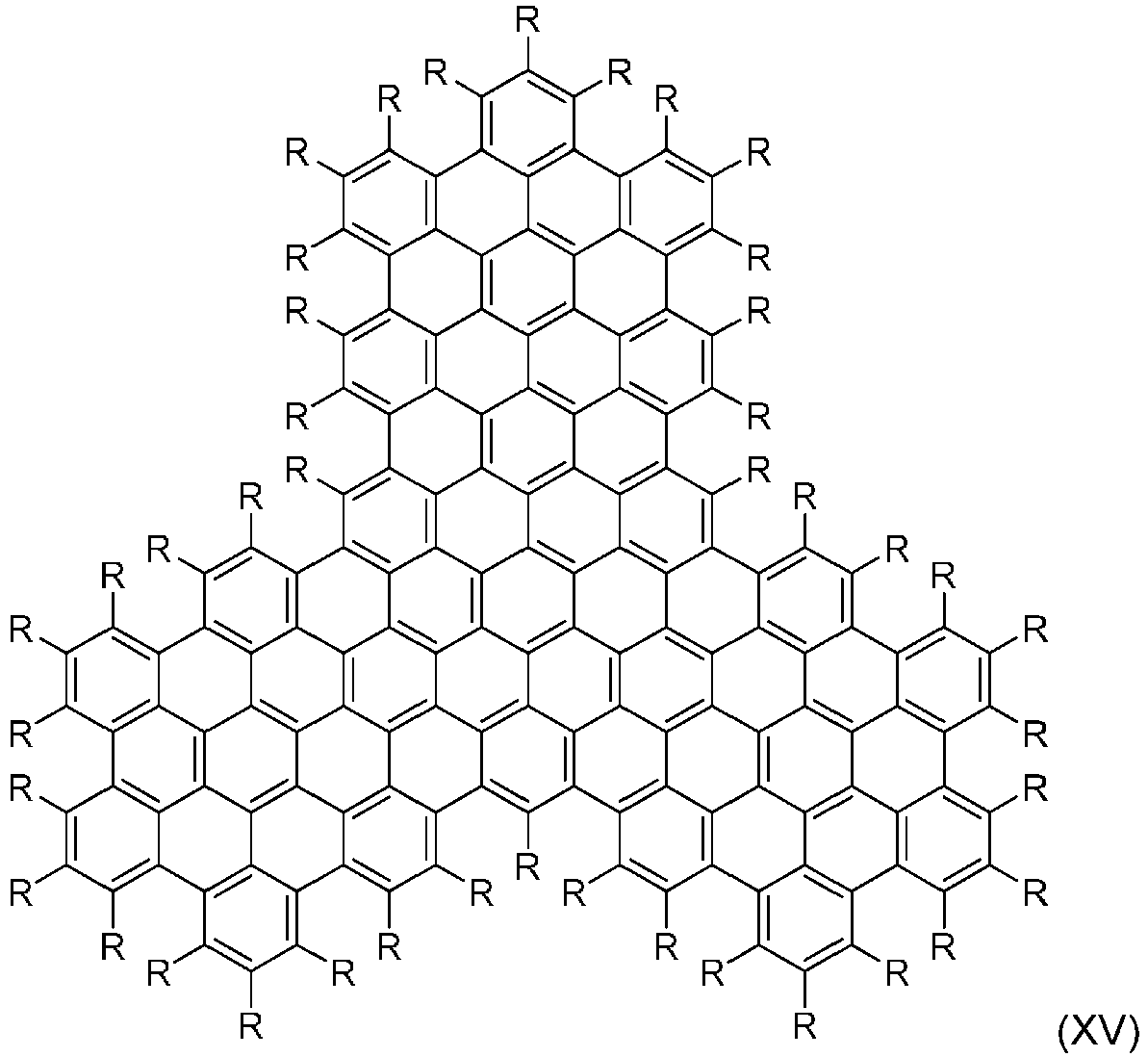
 the residues R are, independently from each other, hydrogen or a substituent RS, wherein the subsituent RS is selected from a C1-20 alkyl group; an aryl group; an amine group; a carboxylic acid group or a salt or an ester thereof; a silyl group; a germanyl group; and a boron-containing group,
wherein in Formula (II)the ring atoms X are, independently from each other, C or N. - The process according to one of the preceding claims, wherein the diamond precursor material additionally comprises a heteroatom-containing dopant compound, wherein the heteroatom is selected from nitrogen, silicon, germanium and boron.
- The process according to claim 10, wherein the heteroatom-containing dopant compound is selected from one or more of the following compounds:- a silane,- an amine N(R1)(R2)(R3), wherein R1, R2 and R3 are, independently from each other, selected from aryl and C1-20 alkyl,- a nitrogen-containing polycyclic aromatic compound comprising 2 to 4 fused aromatic rings, wherein at least one of the fused aromatic rings comprises nitrogen as a ring atom and/or is substituted with a cyano group.
- The process according to one of the preceding claims, wherein the the process is carried out in a multi-anvil press.
- Use of the polycyclic aromatic compound according to one of the claims 1 to 9 as a precusor in diamond particle synthesis.
Priority Applications (2)
| Application Number | Priority Date | Filing Date | Title |
|---|---|---|---|
| EP23208593.6A EP4553042A1 (en) | 2023-11-08 | 2023-11-08 | Method for preparing nanodiamonds |
| PCT/EP2024/081561 WO2025099183A1 (en) | 2023-11-08 | 2024-11-07 | Method for preparing nanodiamonds |
Applications Claiming Priority (1)
| Application Number | Priority Date | Filing Date | Title |
|---|---|---|---|
| EP23208593.6A EP4553042A1 (en) | 2023-11-08 | 2023-11-08 | Method for preparing nanodiamonds |
Publications (1)
| Publication Number | Publication Date |
|---|---|
| EP4553042A1 true EP4553042A1 (en) | 2025-05-14 |
Family
ID=88746003
Family Applications (1)
| Application Number | Title | Priority Date | Filing Date |
|---|---|---|---|
| EP23208593.6A Withdrawn EP4553042A1 (en) | 2023-11-08 | 2023-11-08 | Method for preparing nanodiamonds |
Country Status (1)
| Country | Link |
|---|---|
| EP (1) | EP4553042A1 (en) |
Citations (1)
| Publication number | Priority date | Publication date | Assignee | Title |
|---|---|---|---|---|
| WO2018122321A1 (en) | 2016-12-31 | 2018-07-05 | Element Six (Uk) Limited | A method of making a polycrystalline super hard constructions |
-
2023
- 2023-11-08 EP EP23208593.6A patent/EP4553042A1/en not_active Withdrawn
Patent Citations (1)
| Publication number | Priority date | Publication date | Assignee | Title |
|---|---|---|---|---|
| WO2018122321A1 (en) | 2016-12-31 | 2018-07-05 | Element Six (Uk) Limited | A method of making a polycrystalline super hard constructions |
Non-Patent Citations (20)
| Title |
|---|
| A. MIOTELLO ET AL.: "Nanodiamonds: Synthesis and Application in Sensing, Catalysis, and the Possible Connection with Some Processes Occurring in Space", APPL. SCI., vol. 10, 2020, pages 4094 |
| A. TRAN-VANH.A. WEGNER: "Strategies in Organic Synthesis for Condensed Arenes, Coronene, and Graphene", TOP. CURR. CHEM., vol. 349, 2014, pages 121 - 158 |
| DAVYDOV V A ET AL: "Nanosized carbon forms in the processes of pressure-temperature-induced transformations of hydrocarbons", CARBON, ELSEVIER OXFORD, GB, vol. 44, no. 10, 1 August 2006 (2006-08-01), pages 2015 - 2020, XP025011166, ISSN: 0008-6223, [retrieved on 20060801], DOI: 10.1016/J.CARBON.2006.01.012 * |
| E.K.-H. CHOW ET AL.: "Biomedical applications of nanodiamonds: From drug-delivery to diagnostics", SLAS TECHNOLOGY, vol. 28, 2023, pages 214 - 222 |
| E.K.-H. CHOW ET AL.: "Nanodiamonds: The intersection of nanotechnology, drug development, and personalized medicine", SCI. ADV, vol. 1, 2015, pages e1500439 |
| K. MULLEN ET AL., ANGEW. CHEM. INT. ED. ENGL., vol. 36, no. 15, 1997, pages 1604 - 1607 |
| K. MULLEN ET AL., J. AM. CHEM. SOC., vol. 143, 2021, pages 10403 - 10412 |
| K. MULLEN ET AL.: "From Nanographene and Graphene Nanoribbons to Graphene Sheets: Chemical Synthesis", ANGEW. CHEM. INT. ED., vol. 51, 2012, pages 7640 - 7654, XP072081572, DOI: 10.1002/anie.201201084 |
| K. MULLEN ET AL.: "Graphene as Potential Material for Electronics", CHEM. REV., vol. 107, 2007, pages 718 - 747 |
| K. MULLEN ET AL.: "Large polycyclic aromatic hydrocarbons: Synthesis and discotic organization", PURE APPL. CHEM., vol. 81, no. 12, 2009, pages 2203 - 2224 |
| K. MULLEN ET AL.: "New advances in nanographene chemistry", CHEM. SOC. REV., vol. 44, 2015, pages 6616 - 6643 |
| R.C. LIEBERMANN: "Multi-anvil, high pressure apparatus: a half-century of development and progress", HIGH PRESSURE RESEARCH, vol. 31, no. 4, 2011, pages 493 - 532 |
| R.S. RUOFF ET AL.: "Sub 4 nm Nanodiamonds from Graphene Oxide and Nitrated Polycyclic Aromatic Hydrocarbons at 423 K", ACS NANO, vol. 15, no. 11, 2021, pages 17392 - 17400 |
| S. STEHLIK ET AL.: "Size and Purity Control of HPHT Nanodiamonds down to 1 nm", J. PHYS. CHEM. C, vol. 119, 2015, pages 27708 - 27720 |
| SHUANGSHUANG ZHANG ET AL: "Narrow-gap Semiconducting Superhard Amorphous Carbon with Superior Toughness", ARXIV.ORG, CORNELL UNIVERSITY LIBRARY, 201 OLIN LIBRARY CORNELL UNIVERSITY ITHACA, NY 14853, 15 June 2021 (2021-06-15), XP081989978 * |
| T. WEILY. WU: "Recent Developments of Nanodiamond Quantum Sensors for Biological Applications", ADV. SCI., vol. 9, 2022, pages 2200059 |
| V.A. DAVYDOV ET AL.: "Conversion of polycyclic aromatic hydrocarbons to graphite and diamond at high pressures", CARBON, vol. 42, 2005, pages 261 - 269, XP004483336, DOI: 10.1016/j.carbon.2003.10.026 |
| XI-GUI YANG ET AL.: "Two-step high-pressure high-temperature synthesis of nanodiamonds from naphthalene", CHIN. PHYS. B, vol. 29, no. 10, 2020, pages 108102 |
| XI-GUI YANG: "Nanodiamonds: Synthesis, properties and applications in nanomedicine", MATERIALS & DESIGN, vol. 210, 2021, pages 110091 |
| YAN WANG: "Hydrogenation of Hexa- peri -hexabenzocoronene: An Entry to Nanographanes and Nanodiamonds", ACS NANO, vol. 17, no. 19, 20 September 2023 (2023-09-20), US, pages 18832 - 18842, XP093153561, ISSN: 1936-0851, Retrieved from the Internet <URL:https://pubs.acs.org/doi/pdf/10.1021/acsnano.3c03538> DOI: 10.1021/acsnano.3c03538 * |
Similar Documents
| Publication | Publication Date | Title |
|---|---|---|
| Ekimov et al. | High‐Pressure Synthesis of Boron‐Doped Ultrasmall Diamonds from an Organic Compound | |
| US9192899B2 (en) | High-hardness conductive diamond polycrystalline body and method of producing the same | |
| Fang et al. | Experimental study on the stability of graphitic C3N4 under high pressure and high temperature | |
| Gao et al. | High-yield synthesis of boron nitride nanosheets with strong ultraviolet cathodoluminescence emission | |
| US8883114B2 (en) | Production of ultra-thin nano-scaled graphene platelets from meso-carbon micro-beads | |
| CN103569976B (en) | Ultrahigh hardness nano twin crystal boron nitride block materials and synthetic method thereof | |
| Wu et al. | Tuning the electronic structure, bandgap energy and photoluminescence properties of hexagonal boron nitride nanosheets via a controllable Ce 3+ ions doping | |
| Kumaresan et al. | Thermal plasma arc discharge method for high-yield production of hexagonal AlN nanoparticles: synthesis and characterization | |
| Palyanov et al. | High-pressure synthesis and characterization of diamond from an Mg–Si–C system | |
| JP2017160114A (en) | Method for producing synthetic diamonds | |
| CN111356792A (en) | Diamond polycrystal and method for producing diamond polycrystal | |
| Hasan et al. | Synthesis of nanostructured lanthanum hexaboride via simple borothermal routes at low temperatures | |
| CN1173879C (en) | Method for preparing nitride superfine powder and nitride crystal under hydrothermal condition | |
| Shen et al. | Synthesis of single-crystalline wurtzite aluminum nitride nanowires by direct arc discharge | |
| CN1323738A (en) | Prepn. of nanometer boron nitride micro powder | |
| Yuan et al. | Facile synthesis of flake-like FeSe 2 particles in open-air conditions | |
| WO2025099183A1 (en) | Method for preparing nanodiamonds | |
| CN111792665B (en) | Method for high-pressure solid-phase synthesis of copper-cesium-iodide lead-free quantum dots | |
| K Brantov | Perspective methods for producing composite materials based on carbon, silicon and silicon carbide: Progress and challenges | |
| Chen et al. | Construction of EuF 3 hollow sub-microspheres and single-crystal hexagonal microdiscs via Ostwald ripening and oriented attachment | |
| Soltani et al. | The effect of thermal shock-based heat-treatment on the cost-effective and low-temperature synthesis of needle-like r-BN | |
| Zhu et al. | Tunable violet–blue emission from 3C-SiC nanowires | |
| Rajesh et al. | Extended vapor–liquid–solid growth of silicon carbide nanowires | |
| Liu et al. | Gd-doped diamond synthesized using Gd@ C 82 under high pressure and high temperature | |
| CN1225308C (en) | High temperature and high pressure synthesis method of cubic phase boron carbon nitrogen crystal under the action of catalyst |
Legal Events
| Date | Code | Title | Description |
|---|---|---|---|
| PUAI | Public reference made under article 153(3) epc to a published international application that has entered the european phase |
Free format text: ORIGINAL CODE: 0009012 |
|
| STAA | Information on the status of an ep patent application or granted ep patent |
Free format text: STATUS: THE APPLICATION HAS BEEN PUBLISHED |
|
| AK | Designated contracting states |
Kind code of ref document: A1 Designated state(s): AL AT BE BG CH CY CZ DE DK EE ES FI FR GB GR HR HU IE IS IT LI LT LU LV MC ME MK MT NL NO PL PT RO RS SE SI SK SM TR |
|
| STAA | Information on the status of an ep patent application or granted ep patent |
Free format text: STATUS: THE APPLICATION IS DEEMED TO BE WITHDRAWN |
|
| 18D | Application deemed to be withdrawn |
Effective date: 20251115 |