EP4552875A1 - Vehicle curtain system - Google Patents
Vehicle curtain system Download PDFInfo
- Publication number
- EP4552875A1 EP4552875A1 EP24211255.5A EP24211255A EP4552875A1 EP 4552875 A1 EP4552875 A1 EP 4552875A1 EP 24211255 A EP24211255 A EP 24211255A EP 4552875 A1 EP4552875 A1 EP 4552875A1
- Authority
- EP
- European Patent Office
- Prior art keywords
- series
- connectors
- fabric
- vehicle
- curtain
- Prior art date
- Legal status (The legal status is an assumption and is not a legal conclusion. Google has not performed a legal analysis and makes no representation as to the accuracy of the status listed.)
- Granted
Links
Images

Classifications
-
- B—PERFORMING OPERATIONS; TRANSPORTING
- B60—VEHICLES IN GENERAL
- B60J—WINDOWS, WINDSCREENS, NON-FIXED ROOFS, DOORS, OR SIMILAR DEVICES FOR VEHICLES; REMOVABLE EXTERNAL PROTECTIVE COVERINGS SPECIALLY ADAPTED FOR VEHICLES
- B60J1/00—Windows; Windscreens; Accessories therefor
- B60J1/20—Accessories, e.g. wind deflectors, blinds
- B60J1/2011—Blinds; curtains or screens reducing heat or light intensity
-
- A—HUMAN NECESSITIES
- A47—FURNITURE; DOMESTIC ARTICLES OR APPLIANCES; COFFEE MILLS; SPICE MILLS; SUCTION CLEANERS IN GENERAL
- A47H—FURNISHINGS FOR WINDOWS OR DOORS
- A47H1/00—Curtain suspension devices
- A47H1/04—Curtain rails
- A47H1/06—Curtain rails fixed
Definitions
- the disclosure relates generally to land vehicle cabin equipment.
- the disclosure relates to a vehicle equipped with a curtain system.
- the disclosure can be applied to heavy-duty vehicles, such as trucks, buses, and construction equipment, among other vehicle types.
- heavy-duty vehicles such as trucks, buses, and construction equipment, among other vehicle types.
- the disclosure may be described with respect to a particular vehicle, the disclosure is not restricted to any particular vehicle.
- a curtain system generally comprises one or more pieces of fabric suspended below a guiding rail. Runners glide in the rail as the piece of fabric is pulled by a user. The piece of fabric may be deployed to cover substantially the entirety of one or more windows. The piece of fabric may be retracted in a storing configuration, generally out of the sight of the driver of the vehicle.
- a vehicle comprises a windscreen and a side door having a window, the vehicle further comprising a curtain assembly, the curtain assembly comprising: a rail located above the window; a series of first connectors located above the windscreen; a curtain comprising: a piece of fabric; a series of runners fixed to the piece of fabric, the runners of the series of runners being engaged and slidable in the rail; and a series of second connectors fixed to the piece of fabric, each second connector of the series of second connectors being releasably engageable with a respective first connector of the series of first connectors.
- This disclosure aims at preventing a rail from interfering with the deployment of an airbag which may be arranged laterally above the door, in the A-pillar of the vehicle, or above the windscreen. Additionally, a rail having the size of the door is easier to handle when assembling the vehicle and is less prone to damage before being fixed to the vehicle. Furthermore, the design of the present disclosure is simple and cost-efficient.
- a rail is intended to depict any design of elongated rigid material, which may comprise an elongated metallic or plastic profile.
- Runners also known as gliders
- Runners are attached to the fabric and configured to slide along/in the rail. At one corner of the fabric, one runner may be fixed to the rail so as to arrest the movement of the fabric as it is being pulled to be deployed.
- the rail is arranged above the windscreen and the first/second connectors are arranged above the door.
- the rail is replaced with connectors of the same or of a different nature than the first connectors and the runners of the curtain assembly are replaced with connectors of the same or of a different nature than the second connectors.
- first connectors are rings
- second connectors are hooks releasably engageable in the rings.
- the rings may be provided on the curtain assembly as second connectors and the hooks may be provided above the windscreen as first connectors. Hooks and rings are a reliable and easy choice of design for the fixation of the curtain.
- the hooks may be made of the same or of a different material than the rings.
- the hooks and/or the rings may be made of plastic or metallic material.
- first connectors are permanent magnets of a first polarity
- second connectors are permanent magnets of a second polarity opposite the first polarity.
- the use of magnets may make the system more user friendly as it does not require a precise positioning of the connectors with respect to one another, making the fixation of the curtain faster.
- first connectors and the second connectors are hook-and-loop fasteners. This constitutes a further alternative design which may be convenient to use.
- the vehicle further comprises an airbag arranged above the window or along an A-pilar of the vehicle, the airbag being enclosed in a housing remote from the rail.
- the airbag may be configured to be deployed in case of an impact or a rollover.
- the curtain comprises snap buttons enabling to hold the curtain in a retracted configuration, at least one of which being located between two adjacent second connectors.
- This design may be convenient to prevent the runners from inadvertently sliding along the rail as the vehicle is moving. Snap buttons may also avoid a portion of the curtain (aimed at covering part of all of the windscreen when deployed) to be hanging down when the curtain assembly is retracted.
- the side door is a first side door
- the window is a first window
- the curtain assembly is a first assembly
- the rail is a first rail
- the series of first connectors is a first series of first connectors
- the curtain is a first curtain
- the piece of fabric is a first piece of fabric
- the series of runners is a first series of runners
- the series of second connectors is a first series of second connectors
- the vehicle further comprising a second side door having a second window, and a second curtain assembly
- the second curtain assembly comprising: a second rail located above the second window; a second series of first connectors located above the windscreen; a second curtain comprising: a second piece of fabric; a second series of runners fixed to the second piece of fabric, the runners of the second series of runners being engaged and slidable in the second rail; and a second series of second connectors fixed to the second piece of fabric, each second connector of the second series of second connectors being releasably engageable with a respective first connector
- the left-hand side door and at least part of the windscreen can be covered with a left curtain assembly while the right-hand side door and at least part of the windscreen can be covered with a right curtain assembly.
- first connectors of the second series are rings and the second connectors of the second series are hooks releasably engageable in the rings.
- first connectors of the second series are permanent magnets of a first polarity
- second connectors of the second series are permanent magnets of a second polarity opposite the first polarity
- first connectors of the second series and the second connectors of the second series are hook-and-loop fasteners.
- first and second series of first and second connectors, and the first and second pieces of fabric are configured such that as the second connectors of the first series engage the first connectors of the first series and as the second connectors of the second series engage the first connectors of the second series, the first and second pieces of fabric cover together substantially the entirety of the windscreen and of the first and second windows.
- the first curtain comprises a third series of first connectors and the second curtain comprises a third series of second connectors configured to be releasably engaged with the first connectors of the third series of first connectors.
- first and second series of first, second and third connectors, and the first and second pieces of fabric are configured such that as the second connectors of the first series engage the first connectors of the first series and as the second connectors of the second series engage the first connectors of the second series, the second connectors of the third series can engage the first connectors of the third series.
- the third series of connectors is one of: hooks and rings combination; magnets of opposite polarities; or hook-and-loop fasteners.
- first and second series of first and second connectors, and the first and second pieces of fabric are configured such that as the second connectors of the first series engage the first connectors of the first series and as the second connectors of the second series engage the first connectors of the second series, the first and second pieces of fabric are adjacent to one another along a substantially vertical line.
- the vertical line is substantially centered with respect to the windscreen.
- the vertical line is offset from the center, for example within a range of 30-70% of the lateral dimension of the windscreen.
- the vehicle is an electric-motor or hybrid-motor truck.
- the vehicle may have an internal combustion engine.
- the disclosure relates to a method for closing a curtain assembly in a vehicle, the vehicle comprising a windscreen and a side door having a window, the vehicle further comprising a curtain assembly, the curtain assembly comprising: a rail located above the window; a series of first connectors located above the windscreen; a curtain comprising: a piece of fabric; a series of runners fixed to the piece of fabric, the runners of the series of runners being engaged and slidable in the rail; and a series of second connectors fixed to the piece of fabric, each second connector of the series of second connectors being releasably engageable with a respective first connector of the series of first connectors, the method comprising: pulling the curtain so that the runners slide in the rail; and then connecting each second connector to a first connector.
- the side door is a first side door
- the window is a first window
- the curtain assembly is a first assembly
- the rail is a first rail
- the series of first connectors is a first series of first connectors
- the curtain is a first curtain
- the piece of fabric is a first piece of fabric
- the series of runners is a first series of runners
- the series of second connectors is a first series of second connectors
- the vehicle further comprising a second side door having a second window, and a second curtain assembly
- the second curtain assembly comprising: a second rail located above the second window; a second series of first connectors located above the windscreen; a second curtain comprising: a second piece of fabric; a second series of runners fixed to the second piece of fabric, the runners of the second series of runners being engaged and slidable in the second rail; and a second series of second connectors fixed to the second piece of fabric, each second connector of the second series of second connectors being releasably engageable with a respective first connector
- the method further comprises connecting the first piece of fabric to the second piece of fabric.
- Another method may relate to opening the curtain system by performing the steps of the methos above in a reverse order.
- FIG. 1 is a schematic view of a vehicle 1 according to an example.
- the vehicle 1 is represented with a point of view located inside the cabin of the vehicle.
- FIG. 1 represents schematically that the vehicle comprises a windscreen 2, a first door 4 and a second door 6.
- the first door 4 is a left door and a driver's door.
- the first door 4 is a right door and/or a passenger's door.
- the first door 4 has a first window 8 and the second door has a second window 10.
- the doors 4, 6 may contain any appropriate means for opening, closing, locking the door, as well as additional equipment, such as controllers, handle, airbag, storage compartments, etc.
- the windows 8, 10 may contain a slidable glass.
- a driver's seat 9 and a steering wheel 11 are shown.
- the windows 8, 10 are separated from the windscreen by A-pillars 12, 14.
- the vehicle 1 may comprise a first curtain assembly 16 and a second curtain assembly 36.
- a single curtain assembly is provided, which may be intended to cover the integrality of the windows and windscreen.
- the second curtain assembly 36 may mirror the first curtain assembly 16.
- the second assembly 36 may be different from the first curtain assembly 16, for instance in terms of lengths of the curtain, material used, or technology used for the connectors.
- the first curtain assembly 16 comprises a rail 18 that extends above the window 8.
- the rail 18 may be parallel to a top edge of the window 8.
- a series of first connectors 20 may be positioned above the windscreen 2.
- the first connectors 20 may be evenly spread or unevenly distributed above the windscreen 2.
- the first connectors 20 may comprise any number of connectors, for instance comprised between one and twenty connectors, more preferably comprised between three and six connectors.
- the first connectors 20 may have a ring shape, a hook shape, a hook-and-loop shape, or any other shape. They may be a combination of those.
- the first connectors 20 may be substantially aligned parallel to a top edge of the windscreen.
- the first connectors 20 may be molded into a storage shelf or the trim above the windscreen, and hence in some examples, the first connectors 20 are integrated to other elements of the vehicle and do not constitute a separate piece.
- a piece of fabric 22, a series of runners 24 and a series of second connectors 26 may constitute a first curtain 28.
- the runners 24 are fixed to the piece of fabric 22 and slide along or in the rail 18.
- One of the runners 24, for instance the one arranged at a rearrest position of the fabric, may be fixed to the rail so as to serve as a stopper when the curtain is being pulled.
- the second connectors 26 are intended to be releasably attached to the first connectors 20.
- the number of first connectors 20 can equate the number of second connectors 26. Alternatively, there may be more first connectors 20 than second connectors 26 to offer some flexibility to the user when positioning the curtain. In yet another alternative, the number of second connectors 26 is greater than the number of first connectors 20.
- the first and second connectors 20, 26 may be spaced apart (one along the windscreen, the other along the curtain) in such a way that each second connector 26 can be engaged with one first connector 20.
- the first curtain 28 is shown in a retracted configuration where the runners are positioned in a rear zone of the rail 18 and the second connectors 26 are not engaged in the first connectors 20.
- the piece of fabric 22 may be arranged in a position that does not hinder the view through the window, for example in a position behind the seat 9.
- the vehicle may comprise a second curtain assembly 36.
- This second curtain assembly 36 is here shown in a deployed configuration.
- the piece of fabric 42 extends over the entirety of the window 10 and part of the windscreen 2.
- Runners 44 fixed to the piece of fabric 42 are engaged in the rail 38, while second connectors 46 (of a second series of second connectors, distinct from the first series present in the first curtain) are engaged with first connectors 40 (of a second series of first connectors, distinct from the first series 20).
- the piece of fabric 42, the runners 44 and the second connectors 46 constitute a second curtain 48.
- the piece of fabric 42 extends up to a substantially vertical line A which may be in the middle of the windscreen 2.
- the vertical line A is offset to the left or the right.
- the vertical line A may take any position from one of the A-pillar 12 to the other A-pillar 14.
- the vertical line A is in a range of 30%-70% of the width of the windscreen (i.e., the value of D on FIG. 1 , which locates the vertical line A with respect to the A-pillar 14, is comprised between 30% and 70% of the total width of the windscreen).
- the first and second curtain assembly do not mirror each other.
- the first piece of fabric 22 When the first curtain 28 is deployed, the first piece of fabric 22 can be positioned adjacent to the second piece of fabric 44 (in its deployed configuration). Hence, an edge of the piece of fabric 22 is substantially aligned with the vertical line A.
- the first and second curtain may be connected together at this junction.
- a third series of connectors 60, 62 may be provided to that end.
- the first series of connectors 20, 26, the second series of connectors 40, 46 and/or the third series of connectors 60, 62 may be chosen amongst: hooks and rings combination; magnets of opposite polarities; hook-and-loop fasteners; snap-buttons; or any combination thereof; or any equivalent fixation means that are releasably engaging one another by a user hand.
- At least one of these snap-button elements 70 may be provided between two second connectors 26, 46 and at least one corresponding snap-button element may be fixed to the piece of fabric 22, 42 or may be fixed to a wall of the cabin of the vehicle.
- An airbag 50 can be positioned in or nearby the A-pillar 12.
- a housing 52 receives the airbag 50, the housing being remote from the rail such that a cover of the housing and the airbag 50 can be deployed without interference from the rail. Hence, the cover of the housing may be pushed out, or pivoted out, and the airbag can have a trajectory that does not cross the space occupied by the rail.
- a similar airbag assembly can be provided in or nearby the other A-pillar 14. Alternatively or in addition to those airbags, airbags can be provided above and parallel to the rails 18, 38. The absence of a single rail extending above the side window and the windscreen facilitates the deployment of such airbags as well.
- FIG. 2 shows an example of runners 24, 44 engaged in a rail 18, 38. As an upper portion of the runners 24, 44 is slidingly received in the rail 18, 38, a lower portion of the runners 24, 44 is fixed to the piece of fabric 22, 42 (not shown).
- FIG. 3 shows an example of second connectors 26, 46 which are here shown as plastic hooks attached to the piece of fabric 22, 42.
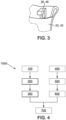
- FIG. 4 shows an example of a method 1000 for closing a curtain assembly 16, 36 as shown in FIG. 1 .
- Optional steps are illustrated in dash lines.
- the method may comprise the detachment 100 of the first curtain 28 and/or the detachment 400 of the second curtain 48 from their retracted configuration (optional snap-buttons 70, 72 discussed above).
- the first curtain 28 is then pulled forward 200, making the runners 24 slide in the rail 18.
- the second connectors 26 are then fixed to the first connectors 20 at step 300.
- the vehicle comprises a second curtain assembly 36
- the second curtain 48 is pulled forward at step 500 and the second connectors 46 are then attached to the first connectors 40 at step 600.
- step 700 the first piece of fabric 22 is connected to the second piece of fabric 42 by means of third connectors 60, 62.
- the disclosure also relates to a method for opening the curtain assembly, by performing the steps of method 1000 in a reverse order.
- Relative terms such as “below” or “above” or “upper” or “lower” or “horizontal” or “vertical” may be used herein to describe a relationship of one element to another element as illustrated in the Figures in a normal orientation of a vehicle. It will be understood that when an element is referred to as being “connected” or “coupled” to another element, it can be directly connected or coupled to the other element, or intervening elements may be present. In contrast, when an element is referred to as being “directly connected” or “directly coupled” to another element, there are no intervening elements present.
Landscapes
- Engineering & Computer Science (AREA)
- Mechanical Engineering (AREA)
- Curtains And Furnishings For Windows Or Doors (AREA)
- Air Bags (AREA)
Abstract
Description
- The disclosure relates generally to land vehicle cabin equipment. In particular aspects, the disclosure relates to a vehicle equipped with a curtain system. The disclosure can be applied to heavy-duty vehicles, such as trucks, buses, and construction equipment, among other vehicle types. Although the disclosure may be described with respect to a particular vehicle, the disclosure is not restricted to any particular vehicle.
- Vehicles may be equipped with a curtain system enabled to provide privacy to an occupant. A curtain system generally comprises one or more pieces of fabric suspended below a guiding rail. Runners glide in the rail as the piece of fabric is pulled by a user. The piece of fabric may be deployed to cover substantially the entirety of one or more windows. The piece of fabric may be retracted in a storing configuration, generally out of the sight of the driver of the vehicle.
- According to a first aspect of the disclosure, a vehicle comprises a windscreen and a side door having a window, the vehicle further comprising a curtain assembly, the curtain assembly comprising: a rail located above the window; a series of first connectors located above the windscreen; a curtain comprising: a piece of fabric; a series of runners fixed to the piece of fabric, the runners of the series of runners being engaged and slidable in the rail; and a series of second connectors fixed to the piece of fabric, each second connector of the series of second connectors being releasably engageable with a respective first connector of the series of first connectors.
- This disclosure aims at preventing a rail from interfering with the deployment of an airbag which may be arranged laterally above the door, in the A-pillar of the vehicle, or above the windscreen. Additionally, a rail having the size of the door is easier to handle when assembling the vehicle and is less prone to damage before being fixed to the vehicle. Furthermore, the design of the present disclosure is simple and cost-efficient.
- In the present disclosure, a rail is intended to depict any design of elongated rigid material, which may comprise an elongated metallic or plastic profile. Runners (also known as gliders) are attached to the fabric and configured to slide along/in the rail. At one corner of the fabric, one runner may be fixed to the rail so as to arrest the movement of the fabric as it is being pulled to be deployed.
- In an alternative arrangement, the rail is arranged above the windscreen and the first/second connectors are arranged above the door. In yet another alternative arrangement, the rail is replaced with connectors of the same or of a different nature than the first connectors and the runners of the curtain assembly are replaced with connectors of the same or of a different nature than the second connectors.
- In another aspect, the first connectors are rings, and the second connectors are hooks releasably engageable in the rings. Alternatively, the rings may be provided on the curtain assembly as second connectors and the hooks may be provided above the windscreen as first connectors. Hooks and rings are a reliable and easy choice of design for the fixation of the curtain. The hooks may be made of the same or of a different material than the rings. For instance, the hooks and/or the rings may be made of plastic or metallic material.
- In another aspect, the first connectors are permanent magnets of a first polarity, and the second connectors are permanent magnets of a second polarity opposite the first polarity. The use of magnets may make the system more user friendly as it does not require a precise positioning of the connectors with respect to one another, making the fixation of the curtain faster.
- In another aspect, the first connectors and the second connectors are hook-and-loop fasteners. This constitutes a further alternative design which may be convenient to use.
- In another aspect, the vehicle further comprises an airbag arranged above the window or along an A-pilar of the vehicle, the airbag being enclosed in a housing remote from the rail. The airbag may be configured to be deployed in case of an impact or a rollover.
- In another aspect, the curtain comprises snap buttons enabling to hold the curtain in a retracted configuration, at least one of which being located between two adjacent second connectors. This design may be convenient to prevent the runners from inadvertently sliding along the rail as the vehicle is moving. Snap buttons may also avoid a portion of the curtain (aimed at covering part of all of the windscreen when deployed) to be hanging down when the curtain assembly is retracted.
- In another aspect, the side door is a first side door, the window is a first window, the curtain assembly is a first assembly, the rail is a first rail, the series of first connectors is a first series of first connectors, the curtain is a first curtain, the piece of fabric is a first piece of fabric, the series of runners is a first series of runners and the series of second connectors is a first series of second connectors, the vehicle further comprising a second side door having a second window, and a second curtain assembly, the second curtain assembly comprising: a second rail located above the second window; a second series of first connectors located above the windscreen; a second curtain comprising: a second piece of fabric; a second series of runners fixed to the second piece of fabric, the runners of the second series of runners being engaged and slidable in the second rail; and a second series of second connectors fixed to the second piece of fabric, each second connector of the second series of second connectors being releasably engageable with a respective first connector of the second series of first connectors.
- In such a case, the left-hand side door and at least part of the windscreen can be covered with a left curtain assembly while the right-hand side door and at least part of the windscreen can be covered with a right curtain assembly.
- In another aspect, the first connectors of the second series are rings and the second connectors of the second series are hooks releasably engageable in the rings.
- In another aspect, the first connectors of the second series are permanent magnets of a first polarity, and the second connectors of the second series are permanent magnets of a second polarity opposite the first polarity.
- In another aspect, the first connectors of the second series and the second connectors of the second series are hook-and-loop fasteners.
- In another aspect, the first and second series of first and second connectors, and the first and second pieces of fabric are configured such that as the second connectors of the first series engage the first connectors of the first series and as the second connectors of the second series engage the first connectors of the second series, the first and second pieces of fabric cover together substantially the entirety of the windscreen and of the first and second windows.
- In another aspect, the first curtain comprises a third series of first connectors and the second curtain comprises a third series of second connectors configured to be releasably engaged with the first connectors of the third series of first connectors.
- This can help to prevent any light from penetrating into the vehicle at the junction of the two curtains.
- In another aspect, the first and second series of first, second and third connectors, and the first and second pieces of fabric are configured such that as the second connectors of the first series engage the first connectors of the first series and as the second connectors of the second series engage the first connectors of the second series, the second connectors of the third series can engage the first connectors of the third series.
- In another aspect, the third series of connectors is one of: hooks and rings combination; magnets of opposite polarities; or hook-and-loop fasteners.
- In another aspect, the first and second series of first and second connectors, and the first and second pieces of fabric are configured such that as the second connectors of the first series engage the first connectors of the first series and as the second connectors of the second series engage the first connectors of the second series, the first and second pieces of fabric are adjacent to one another along a substantially vertical line.
- In another aspect, the vertical line is substantially centered with respect to the windscreen. In an alternative example, the vertical line is offset from the center, for example within a range of 30-70% of the lateral dimension of the windscreen.
- In another aspect, the vehicle is an electric-motor or hybrid-motor truck. Alternatively, the vehicle may have an internal combustion engine.
- In another aspect, the disclosure relates to a method for closing a curtain assembly in a vehicle, the vehicle comprising a windscreen and a side door having a window, the vehicle further comprising a curtain assembly, the curtain assembly comprising: a rail located above the window; a series of first connectors located above the windscreen; a curtain comprising: a piece of fabric; a series of runners fixed to the piece of fabric, the runners of the series of runners being engaged and slidable in the rail; and a series of second connectors fixed to the piece of fabric, each second connector of the series of second connectors being releasably engageable with a respective first connector of the series of first connectors, the method comprising: pulling the curtain so that the runners slide in the rail; and then connecting each second connector to a first connector.
- In another aspect, the side door is a first side door, the window is a first window, the curtain assembly is a first assembly, the rail is a first rail, the series of first connectors is a first series of first connectors, the curtain is a first curtain, the piece of fabric is a first piece of fabric, the series of runners is a first series of runners and the series of second connectors is a first series of second connectors, the vehicle further comprising a second side door having a second window, and a second curtain assembly, the second curtain assembly comprising: a second rail located above the second window; a second series of first connectors located above the windscreen; a second curtain comprising: a second piece of fabric; a second series of runners fixed to the second piece of fabric, the runners of the second series of runners being engaged and slidable in the second rail; and a second series of second connectors fixed to the second piece of fabric, each second connector of the second series of second connectors being releasably engageable with a respective first connector of the second series of first connectors, the method further comprising: pulling the second curtain so that the runners of the second series of runners slide in the second rail; and then connecting each second connector of the second series of second connectors to a first connector of the second series of first connectors.
- In another aspect, the method further comprises connecting the first piece of fabric to the second piece of fabric.
- Another method may relate to opening the curtain system by performing the steps of the methos above in a reverse order.
- The disclosed aspects, examples (including any preferred examples), and/or accompanying claims may be suitably combined with each other as would be apparent to anyone of ordinary skill in the art. Additional features and advantages are disclosed in the following description, claims, and drawings, and in part will be readily apparent therefrom to those skilled in the art or recognized by practicing the disclosure as described herein.
- Examples are described in more detail below with reference to the appended drawings.
-
FIG. 1 is a schematic view of a portion of a vehicle according to an example. -
FIG. 2 is an example of a runners engaged in a rail. -
FIG. 3 is an example of a second connector. -
FIG. 4 is an exemplary method for operating the vehicle curtain system of the present disclosure. - The detailed description set forth below provides information and examples of the disclosed technology with sufficient detail to enable those skilled in the art to practice the disclosure.
-
FIG. 1 is a schematic view of avehicle 1 according to an example. Thevehicle 1 is represented with a point of view located inside the cabin of the vehicle. -
FIG. 1 represents schematically that the vehicle comprises awindscreen 2, afirst door 4 and asecond door 6. In this illustration, thefirst door 4 is a left door and a driver's door. In another example, thefirst door 4 is a right door and/or a passenger's door. - The
first door 4 has a first window 8 and the second door has asecond window 10. Thedoors windows 8, 10 may contain a slidable glass. - For illustration purposes, a driver's seat 9 and a
steering wheel 11 are shown. - The
windows 8, 10 are separated from the windscreen by A-pillars 12, 14. - The
vehicle 1 may comprise afirst curtain assembly 16 and asecond curtain assembly 36. In an alternative design, a single curtain assembly is provided, which may be intended to cover the integrality of the windows and windscreen. Thesecond curtain assembly 36 may mirror thefirst curtain assembly 16. In some examples, thesecond assembly 36 may be different from thefirst curtain assembly 16, for instance in terms of lengths of the curtain, material used, or technology used for the connectors. - The
first curtain assembly 16 comprises arail 18 that extends above the window 8. Therail 18 may be parallel to a top edge of the window 8. A series offirst connectors 20 may be positioned above thewindscreen 2. Thefirst connectors 20 may be evenly spread or unevenly distributed above thewindscreen 2. Thefirst connectors 20 may comprise any number of connectors, for instance comprised between one and twenty connectors, more preferably comprised between three and six connectors. Thefirst connectors 20 may have a ring shape, a hook shape, a hook-and-loop shape, or any other shape. They may be a combination of those. Thefirst connectors 20 may be substantially aligned parallel to a top edge of the windscreen. Thefirst connectors 20 may be molded into a storage shelf or the trim above the windscreen, and hence in some examples, thefirst connectors 20 are integrated to other elements of the vehicle and do not constitute a separate piece. - A piece of
fabric 22, a series ofrunners 24 and a series ofsecond connectors 26 may constitute afirst curtain 28. Therunners 24 are fixed to the piece offabric 22 and slide along or in therail 18. One of therunners 24, for instance the one arranged at a rearrest position of the fabric, may be fixed to the rail so as to serve as a stopper when the curtain is being pulled. - The
second connectors 26 are intended to be releasably attached to thefirst connectors 20. The number offirst connectors 20 can equate the number ofsecond connectors 26. Alternatively, there may be morefirst connectors 20 thansecond connectors 26 to offer some flexibility to the user when positioning the curtain. In yet another alternative, the number ofsecond connectors 26 is greater than the number offirst connectors 20. The first andsecond connectors second connector 26 can be engaged with onefirst connector 20. - The
first curtain 28 is shown in a retracted configuration where the runners are positioned in a rear zone of therail 18 and thesecond connectors 26 are not engaged in thefirst connectors 20. In this configuration, the piece offabric 22 may be arranged in a position that does not hinder the view through the window, for example in a position behind the seat 9. - As illustrated in
FIG. 1 , the vehicle may comprise asecond curtain assembly 36. Thissecond curtain assembly 36 is here shown in a deployed configuration. The piece of fabric 42 extends over the entirety of thewindow 10 and part of thewindscreen 2.Runners 44 fixed to the piece of fabric 42 are engaged in the rail 38, while second connectors 46 (of a second series of second connectors, distinct from the first series present in the first curtain) are engaged with first connectors 40 (of a second series of first connectors, distinct from the first series 20). The piece of fabric 42, therunners 44 and the second connectors 46 constitute asecond curtain 48. - As visible on
FIG. 1 , the piece of fabric 42 extends up to a substantially vertical line A which may be in the middle of thewindscreen 2. In an alternative example, the vertical line A is offset to the left or the right. For example, the vertical line A may take any position from one of the A-pillar 12 to the other A-pillar 14. Preferably the vertical line A is in a range of 30%-70% of the width of the windscreen (i.e., the value of D onFIG. 1 , which locates the vertical line A with respect to the A-pillar 14, is comprised between 30% and 70% of the total width of the windscreen). In such a case, the first and second curtain assembly do not mirror each other. In some examples, it may be advantageous to provide a curtain system where the vertical line A is at a specific location for accessibility reasons, for instance when the dashboard or other equipment of the vehicle restrain the access to a central position of the windscreen. - When the
first curtain 28 is deployed, the first piece offabric 22 can be positioned adjacent to the second piece of fabric 44 (in its deployed configuration). Hence, an edge of the piece offabric 22 is substantially aligned with the vertical line A. The first and second curtain may be connected together at this junction. A third series ofconnectors - The first series of
connectors connectors - The first and/or the
second curtain means 70, 72 intended to maintain the curtain in its open/retracted configuration, such as for example snap-buttons, a holding strap or equivalent. - At least one of these snap-button elements 70 may be provided between two
second connectors 26, 46 and at least one corresponding snap-button element may be fixed to the piece offabric 22, 42 or may be fixed to a wall of the cabin of the vehicle. - An airbag 50 can be positioned in or nearby the A-pillar 12. A housing 52 receives the airbag 50, the housing being remote from the rail such that a cover of the housing and the airbag 50 can be deployed without interference from the rail. Hence, the cover of the housing may be pushed out, or pivoted out, and the airbag can have a trajectory that does not cross the space occupied by the rail. A similar airbag assembly can be provided in or nearby the other A-pillar 14. Alternatively or in addition to those airbags, airbags can be provided above and parallel to the
rails 18, 38. The absence of a single rail extending above the side window and the windscreen facilitates the deployment of such airbags as well. -
FIG. 2 shows an example ofrunners rail 18, 38. As an upper portion of therunners rail 18, 38, a lower portion of therunners fabric 22, 42 (not shown). -
FIG. 3 shows an example ofsecond connectors 26, 46 which are here shown as plastic hooks attached to the piece offabric 22, 42. -
FIG. 4 shows an example of amethod 1000 for closing acurtain assembly FIG. 1 . Optional steps are illustrated in dash lines. - The method may comprise the
detachment 100 of thefirst curtain 28 and/or thedetachment 400 of thesecond curtain 48 from their retracted configuration (optional snap-buttons 70, 72 discussed above). - The
first curtain 28 is then pulled forward 200, making therunners 24 slide in therail 18. Thesecond connectors 26 are then fixed to thefirst connectors 20 atstep 300. - If the vehicle comprises a
second curtain assembly 36, thesecond curtain 48 is pulled forward atstep 500 and the second connectors 46 are then attached to the first connectors 40 atstep 600. - Optionally, in
step 700, the first piece offabric 22 is connected to the second piece of fabric 42 by means ofthird connectors - The disclosure also relates to a method for opening the curtain assembly, by performing the steps of
method 1000 in a reverse order. - The terminology used herein is for the purpose of describing particular aspects only and is not intended to be limiting of the disclosure. As used herein, the singular forms "a," "an," and "the" are intended to include the plural forms as well, unless the context clearly indicates otherwise. As used herein, the term "and/or" includes any and all combinations of one or more of the associated listed items. It will be further understood that the terms "comprises," "comprising," "includes," and/or "including" when used herein specify the presence of stated features, integers, actions, steps, operations, elements, and/or components, but do not preclude the presence or addition of one or more other features, integers, actions, steps, operations, elements, components, and/or groups thereof.
- It will be understood that, although the terms first, second, etc., may be used herein to describe various elements, these elements should not be limited by these terms. These terms are only used to distinguish one element from another. For example, a first element could be termed a second element, and, similarly, a second element could be termed a first element without departing from the scope of the present disclosure.
- Relative terms such as "below" or "above" or "upper" or "lower" or "horizontal" or "vertical" may be used herein to describe a relationship of one element to another element as illustrated in the Figures in a normal orientation of a vehicle. It will be understood that when an element is referred to as being "connected" or "coupled" to another element, it can be directly connected or coupled to the other element, or intervening elements may be present. In contrast, when an element is referred to as being "directly connected" or "directly coupled" to another element, there are no intervening elements present.
- Unless otherwise defined, all terms (including technical and scientific terms) used herein have the same meaning as commonly understood by one of ordinary skill in the art to which this disclosure belongs. It will be further understood that terms used herein should be interpreted as having a meaning consistent with their meaning in the context of this specification and the relevant art and will not be interpreted in an idealized or overly formal sense unless expressly so defined herein.
- It is to be understood that the present disclosure is not limited to the aspects described above and illustrated in the drawings; rather, the skilled person will recognize that many changes and modifications may be made within the scope of the present disclosure and appended claims. In the drawings and specification, there have been disclosed aspects for purposes of illustration only and not for purposes of limitation, the scope of the disclosure being set forth in the following claims.
Claims (20)
- A vehicle comprising a windscreen and a side door having a window, the vehicle further comprising a curtain assembly, the curtain assembly comprising:a rail located above the window;a series of first connectors located above the windscreen; anda curtain comprising:a piece of fabric;a series of runners fixed to the piece of fabric, the runners of the series of runners being engaged and slidable in the rail; anda series of second connectors fixed to the piece of fabric, each second connector of the series of second connectors being releasably engageable with a respective first connector of the series of first connectors.
- The vehicle of claim 1, wherein the first connectors are rings, and the second connectors are hooks releasably engageable in the rings.
- The vehicle of claim 1, wherein the first connectors are permanent magnets of a first polarity, and the second connectors are permanent magnets of a second polarity opposite the first polarity.
- The vehicle of claim 1, wherein the first connectors and the second connectors are hook-and-loop fasteners.
- The vehicle of claim 1, further comprising an airbag arranged above the window or along an A-pillar of the vehicle, the airbag being enclosed in a housing remote from the rail.
- The vehicle of claim 1, wherein the curtain comprises snap buttons enabled to hold the curtain in a retracted configuration, at least one of which being located between two adjacent second connectors.
- The vehicle of claim 1, wherein the side door is a first side door, the window is a first window, the curtain assembly is a first assembly, the rail is a first rail, the series of first connectors is a first series of first connectors, the curtain is a first curtain, the piece of fabric is a first piece of fabric, the series of runners is a first series of runners and the series of second connectors is a first series of second connectors, the vehicle further comprising a second side door having a second window, and a second curtain assembly, the second curtain assembly comprising:a second rail located above the second window;a second series of first connectors located above the windscreen;a second curtain comprising:a second piece of fabric;a second series of runners fixed to the second piece of fabric, the runners of the second series of runners being engaged and slidable in the second rail; anda second series of second connectors fixed to the second piece of fabric, each second connector of the second series of second connectors being releasably engageable with a respective first connector of the second series of first connectors.
- The vehicle of claim 6, wherein the first connectors of the second series are rings and the second connectors of the second series are hooks releasably engageable in the rings.
- The vehicle of claim 6, wherein the first connectors of the second series are permanent magnets of a first polarity, and the second connectors of the second series are permanent magnets of a second polarity opposite the first polarity.
- The vehicle of claim 6, wherein the first connectors of the second series and the second connectors of the second series are hook-and-loop fasteners.
- The vehicle of claim 6, wherein the first and second series of first and second connectors, and the first and second pieces of fabric are configured such that as the second connectors of the first series engage the first connectors of the first series and as the second connectors of the second series engage the first connectors of the second series, the first and second pieces of fabric cover together substantially the entirety of the windscreen and of the first and second windows.
- The vehicle of claim 6, wherein the first curtain comprises a third series of first connectors and the second curtain comprises a third series of second connectors configured to be releasably engaged with the first connectors of the third series of first connectors.
- The vehicle of claim 12, wherein the first and second series of first, second and third connectors, and the first and second pieces of fabric are configured such that as the second connectors of the first series engage the first connectors of the first series and as the second connectors of the second series engage the first connectors of the second series, the second connectors of the third series can engage the first connectors of the third series.
- The vehicle of claim 12, wherein the third series of connectors is one of: hooks and rings combination; magnets of opposite polarities; or hook-and-loop fasteners.
- The vehicle of claim 6, wherein the first and second series of first and second connectors, and the first and second pieces of fabric are configured such that as the second connectors of the first series engage the first connectors of the first series and as the second connectors of the second series engage the first connectors of the second series, the first and second pieces of fabric are adjacent to one another along a substantially vertical line.
- The vehicle of claim 15, wherein the vertical line is substantially centered with respect to the windscreen.
- The vehicle of claim 1, wherein the vehicle is an electric-motor or hybrid-motor truck.
- A method for closing a curtain assembly in a vehicle, the vehicle comprising a windscreen and a side door having a window, the vehicle further comprising a curtain assembly, the curtain assembly comprising:a rail located above the window;a series of first connectors located above the windscreen;a curtain comprising:a piece of fabric; anda series of runners fixed to the piece of fabric, the runners of the series of runners being engaged and slidable in the rail; anda series of second connectors fixed to the piece of fabric, each second connector of the series of second connectors being releasably engageable with a respective first connector of the series of first connectors;the method comprising:pulling the curtain so that the runners slide in the rail; andconnecting each second connector to a first connector.
- The method of claim 18, wherein the side door is a first side door, the window is a first window, the curtain assembly is a first assembly, the rail is a first rail, the series of first connectors is a first series of first connectors, the curtain is a first curtain, the piece of fabric is a first piece of fabric, the series of runners is a first series of runners and the series of second connectors is a first series of second connectors, the vehicle further comprising a second side door having a second window, and a second curtain assembly, the second curtain assembly comprising:a second rail located above the second window;a second series of first connectors located above the windscreen;a second curtain comprising:a second piece of fabric;a second series of runners fixed to the second piece of fabric, the runners of the second series of runners being engaged and slidable in the second rail; anda second series of second connectors fixed to the second piece of fabric, each second connector of the second series of second connectors being releasably engageable with a respective first connector of the second series of first connectors;the method further comprising:pulling the second curtain so that the runners of the second series of runners slide in the second rail; andconnecting each second connector of the second series of second connectors to a first connector of the second series of first connectors.
- The method of claim 19, further comprising connecting the first piece of fabric to the second piece of fabric.
Applications Claiming Priority (1)
| Application Number | Priority Date | Filing Date | Title |
|---|---|---|---|
| US18/503,520 US12545085B2 (en) | 2023-11-07 | 2023-11-07 | Vehicle curtain system |
Publications (2)
| Publication Number | Publication Date |
|---|---|
| EP4552875A1 true EP4552875A1 (en) | 2025-05-14 |
| EP4552875B1 EP4552875B1 (en) | 2026-05-13 |
Family
ID=93432287
Family Applications (1)
| Application Number | Title | Priority Date | Filing Date |
|---|---|---|---|
| EP24211255.5A Active EP4552875B1 (en) | 2023-11-07 | 2024-11-06 | Vehicle curtain system |
Country Status (2)
| Country | Link |
|---|---|
| US (1) | US12545085B2 (en) |
| EP (1) | EP4552875B1 (en) |
Families Citing this family (1)
| Publication number | Priority date | Publication date | Assignee | Title |
|---|---|---|---|---|
| US12545085B2 (en) * | 2023-11-07 | 2026-02-10 | Volvo Truck Corporation | Vehicle curtain system |
Citations (3)
| Publication number | Priority date | Publication date | Assignee | Title |
|---|---|---|---|---|
| US4226460A (en) * | 1977-09-01 | 1980-10-07 | Werner Schmidt | Long-distance truck cabin |
| DE102010008238A1 (en) * | 2010-02-17 | 2011-08-18 | Schlier, Erwin, 84329 | Curtain device for cabin of vehicle, comprises curtain surface and mounting unit which is provided for attachment of curtain surface at upper area of cabin in detached manner |
| EP3929009A1 (en) * | 2020-06-25 | 2021-12-29 | Volvo Truck Corporation | Motor vehicle having a darkening device covering a display device in closed position |
Family Cites Families (38)
| Publication number | Priority date | Publication date | Assignee | Title |
|---|---|---|---|---|
| US1426969A (en) * | 1922-08-22 | Folding curtain foe automobiles | ||
| US926118A (en) * | 1908-11-05 | 1909-06-29 | Herman M Hoelscher | Folding or collapsible top for automobiles. |
| US1024305A (en) * | 1912-01-19 | 1912-04-23 | Clarence S Applas | Vehicle-curtain. |
| US1601443A (en) * | 1922-09-15 | 1926-09-28 | Haver James | Vehicle curtain |
| US1753795A (en) * | 1926-12-13 | 1930-04-08 | Gen Motors Corp | Door curtain |
| US2412608A (en) * | 1942-06-25 | 1946-12-17 | Annette E Fridolph | Combined header and supporting member |
| US2496910A (en) * | 1946-10-23 | 1950-02-07 | Annette E Fridolph | Structural strip member for interior wall decoration |
| US2782846A (en) * | 1954-07-15 | 1957-02-26 | Bussard John Arthur | Refrigerator curtains and mountings |
| US2934782A (en) * | 1957-09-19 | 1960-05-03 | William C Wootton | Slider for installation of curtains |
| US3709553A (en) * | 1971-02-17 | 1973-01-09 | C Churchill | Golf car rain coat |
| US4109957A (en) * | 1977-06-13 | 1978-08-29 | Polizzi Joseph R | Quickly removable windshield curtain |
| US4230171A (en) * | 1979-02-28 | 1980-10-28 | Baker Sr George H | Drapery pleating apparatus and method |
| US5111867A (en) * | 1986-05-23 | 1992-05-12 | Utility Trailer Manufacturing Co. | Heavy curtain support roller device |
| US4720137A (en) * | 1986-07-22 | 1988-01-19 | Trans-Aire International, Inc. | Curtain-hanging means for recreational vehicles |
| US4972895A (en) * | 1989-11-01 | 1990-11-27 | Meshaka Leeia B | Drapery snap attachments |
| US5085473A (en) * | 1990-10-09 | 1992-02-04 | Yuhe Yang | Air actuated car curtain device |
| US5639524A (en) * | 1991-08-26 | 1997-06-17 | Lin; Frederick Tsun-Te | Ray-shield sheets for glass surface advertisement and art exhibition |
| US5259520A (en) * | 1992-02-26 | 1993-11-09 | Zenith Products Corp. | Curtain rod assembly and cover |
| JP2872555B2 (en) * | 1993-12-08 | 1999-03-17 | ワイケイケイ株式会社 | Anchor |
| US5676189A (en) * | 1994-08-16 | 1997-10-14 | Arbor Marketing Limited | Motorized drapery track assembly |
| US5509713A (en) * | 1994-10-25 | 1996-04-23 | Hou; Hsien-Te | Window sunshade for cars |
| US5937929A (en) * | 1997-11-06 | 1999-08-17 | Chen; Ing-Wen | Car curtain |
| US6044891A (en) * | 1997-12-18 | 2000-04-04 | Guo; Hongshi | Vehicle curtain |
| US6182739B1 (en) * | 1997-12-19 | 2001-02-06 | Gary F. Jones | Snap mounted drapery system |
| JP2001120311A (en) * | 1999-10-27 | 2001-05-08 | Ykk Corp | Anchor |
| US6438796B1 (en) * | 2001-04-10 | 2002-08-27 | Henry A. Davidson | Integrally molded stud fitting for drapery track |
| US20050057023A1 (en) * | 2003-09-16 | 2005-03-17 | Burton Thomas C. | Anti-twisting inflatable curtain assembly |
| US20050194108A1 (en) * | 2004-03-08 | 2005-09-08 | Chen-Hsing Lin | Automobile curtain device |
| US20070277944A1 (en) * | 2006-05-31 | 2007-12-06 | Hans Wu | Curtain track assembly |
| US8251433B2 (en) * | 2008-08-25 | 2012-08-28 | Boer James R | Motor vehicle windshield and window kit |
| US7946615B2 (en) * | 2008-09-12 | 2011-05-24 | Mazda Motor Corporation | Attachment structure of curtain-shaped cover member of vehicle |
| US20130068406A1 (en) * | 2011-09-16 | 2013-03-21 | Paul Lin | Electric sunshade assembly |
| US8910697B1 (en) * | 2012-11-30 | 2014-12-16 | Linda Dollahan Shirk | Drapery system |
| US9050879B2 (en) * | 2013-10-16 | 2015-06-09 | Fifon, Inc. | Golf cart enclosure |
| US9156334B1 (en) * | 2014-06-30 | 2015-10-13 | Nissan North America, Inc. | Vehicle body structure |
| US20160374496A1 (en) * | 2014-09-08 | 2016-12-29 | Robert Marcinik | Drapery track system |
| WO2018114650A1 (en) * | 2016-12-21 | 2018-06-28 | Silent Gliss International Ag | System for suspension of a curtain |
| US12545085B2 (en) * | 2023-11-07 | 2026-02-10 | Volvo Truck Corporation | Vehicle curtain system |
-
2023
- 2023-11-07 US US18/503,520 patent/US12545085B2/en active Active
-
2024
- 2024-11-06 EP EP24211255.5A patent/EP4552875B1/en active Active
Patent Citations (3)
| Publication number | Priority date | Publication date | Assignee | Title |
|---|---|---|---|---|
| US4226460A (en) * | 1977-09-01 | 1980-10-07 | Werner Schmidt | Long-distance truck cabin |
| DE102010008238A1 (en) * | 2010-02-17 | 2011-08-18 | Schlier, Erwin, 84329 | Curtain device for cabin of vehicle, comprises curtain surface and mounting unit which is provided for attachment of curtain surface at upper area of cabin in detached manner |
| EP3929009A1 (en) * | 2020-06-25 | 2021-12-29 | Volvo Truck Corporation | Motor vehicle having a darkening device covering a display device in closed position |
Also Published As
| Publication number | Publication date |
|---|---|
| US20250144983A1 (en) | 2025-05-08 |
| EP4552875B1 (en) | 2026-05-13 |
| US12545085B2 (en) | 2026-02-10 |
Similar Documents
| Publication | Publication Date | Title |
|---|---|---|
| US5288122A (en) | Load restraining device | |
| US3276512A (en) | Cover for the interior of an automobile | |
| EP4552875B1 (en) | Vehicle curtain system | |
| US9340143B2 (en) | Adjustable cargo track system on side panel | |
| US10131262B2 (en) | Armrest with cup holder assembly | |
| US20140042781A1 (en) | Vehicle seat and trim | |
| US10611314B2 (en) | Vehicle privacy screen | |
| US20010033084A1 (en) | School bus driver shield | |
| US20130320694A1 (en) | Integrated cargo area container system | |
| US20090084922A1 (en) | Retractable accessory hook for a vehicle | |
| US8820597B2 (en) | Vehicle garment hook and guard mounting assembly | |
| US11046276B2 (en) | Window net door attachment | |
| EP1375254A1 (en) | Protection system for vehicle loading space | |
| JP2015508724A (en) | Vehicle with removable multi-altitude hardtop and lower safety compartment | |
| EP2329992B1 (en) | Load bearing trim element for a vehicle | |
| EP2062783B1 (en) | Improvements in or relating to luggage restraints | |
| EP3543071B1 (en) | Guide rail arrangement | |
| WO2010120740A2 (en) | Vehicle barrier | |
| WO2003089273A1 (en) | Extrusion for the siderail of a vehicle with head impact countermeasure and support for components | |
| US8876183B2 (en) | High retention trim attachment system | |
| US20100001548A1 (en) | Vehicular sun visor | |
| EP0515481A1 (en) | LOAD LOCKING DEVICE. | |
| US20130221697A1 (en) | Multi-functional cargo retention net | |
| CN106143325A (en) | Multi-functional/position convering system for cargo district | |
| CN106166988A (en) | Integrated cargo hold cover plate |
Legal Events
| Date | Code | Title | Description |
|---|---|---|---|
| PUAI | Public reference made under article 153(3) epc to a published international application that has entered the european phase |
Free format text: ORIGINAL CODE: 0009012 |
|
| STAA | Information on the status of an ep patent application or granted ep patent |
Free format text: STATUS: THE APPLICATION HAS BEEN PUBLISHED |
|
| AK | Designated contracting states |
Kind code of ref document: A1 Designated state(s): AL AT BE BG CH CY CZ DE DK EE ES FI FR GB GR HR HU IE IS IT LI LT LU LV MC ME MK MT NL NO PL PT RO RS SE SI SK SM TR |
|
| STAA | Information on the status of an ep patent application or granted ep patent |
Free format text: STATUS: REQUEST FOR EXAMINATION WAS MADE |
|
| 17P | Request for examination filed |
Effective date: 20251015 |
|
| RIC1 | Information provided on ipc code assigned before grant |
Ipc: B60J 1/20 20060101AFI20251016BHEP |
|
| GRAP | Despatch of communication of intention to grant a patent |
Free format text: ORIGINAL CODE: EPIDOSNIGR1 |
|
| STAA | Information on the status of an ep patent application or granted ep patent |
Free format text: STATUS: GRANT OF PATENT IS INTENDED |
|
| INTG | Intention to grant announced |
Effective date: 20251124 |
|
| GRAS | Grant fee paid |
Free format text: ORIGINAL CODE: EPIDOSNIGR3 |
|
| GRAA | (expected) grant |
Free format text: ORIGINAL CODE: 0009210 |
|
| STAA | Information on the status of an ep patent application or granted ep patent |
Free format text: STATUS: THE PATENT HAS BEEN GRANTED |
|
| AK | Designated contracting states |
Kind code of ref document: B1 Designated state(s): AL AT BE BG CH CY CZ DE DK EE ES FI FR GB GR HR HU IE IS IT LI LT LU LV MC ME MK MT NL NO PL PT RO RS SE SI SK SM TR |
|
| REG | Reference to a national code |
Ref country code: CH Ref legal event code: F10 Free format text: ST27 STATUS EVENT CODE: U-0-0-F10-F00 (AS PROVIDED BY THE NATIONAL OFFICE) Effective date: 20260513 |