EP4552812A1 - Electric hair-cutting device with separate driving members for shaving unit and hair-trimming unit - Google Patents
Electric hair-cutting device with separate driving members for shaving unit and hair-trimming unit Download PDFInfo
- Publication number
- EP4552812A1 EP4552812A1 EP24165406.0A EP24165406A EP4552812A1 EP 4552812 A1 EP4552812 A1 EP 4552812A1 EP 24165406 A EP24165406 A EP 24165406A EP 4552812 A1 EP4552812 A1 EP 4552812A1
- Authority
- EP
- European Patent Office
- Prior art keywords
- hair
- unit
- shaving
- trimming
- main housing
- Prior art date
- Legal status (The legal status is an assumption and is not a legal conclusion. Google has not performed a legal analysis and makes no representation as to the accuracy of the status listed.)
- Withdrawn
Links
Images



Classifications
-
- B—PERFORMING OPERATIONS; TRANSPORTING
- B26—HAND CUTTING TOOLS; CUTTING; SEVERING
- B26B—HAND-HELD CUTTING TOOLS NOT OTHERWISE PROVIDED FOR
- B26B19/00—Clippers or shavers operating with a plurality of cutting edges, e.g. hair clippers, dry shavers
- B26B19/38—Details of, or accessories for, hair clippers, or dry shavers, e.g. housings, casings, grips, guards
- B26B19/3853—Housing or handle
- B26B19/386—Means for attaching the head thereto
-
- B—PERFORMING OPERATIONS; TRANSPORTING
- B26—HAND CUTTING TOOLS; CUTTING; SEVERING
- B26B—HAND-HELD CUTTING TOOLS NOT OTHERWISE PROVIDED FOR
- B26B19/00—Clippers or shavers operating with a plurality of cutting edges, e.g. hair clippers, dry shavers
- B26B19/14—Clippers or shavers operating with a plurality of cutting edges, e.g. hair clippers, dry shavers of the rotary-cutter type; Cutting heads therefor; Cutters therefor
-
- B—PERFORMING OPERATIONS; TRANSPORTING
- B26—HAND CUTTING TOOLS; CUTTING; SEVERING
- B26B—HAND-HELD CUTTING TOOLS NOT OTHERWISE PROVIDED FOR
- B26B19/00—Clippers or shavers operating with a plurality of cutting edges, e.g. hair clippers, dry shavers
- B26B19/38—Details of, or accessories for, hair clippers, or dry shavers, e.g. housings, casings, grips, guards
- B26B19/3806—Accessories
- B26B19/3826—Separate accessories
Definitions
- the invention relates to an electric hair-cutting device comprising a main housing, a shaving unit and a hair-trimming unit, wherein the shaving unit and the hair-trimming unit can be interchangeably coupled to a coupling side of the main housing, and wherein:
- This known hair-cutting device comprises a main housing, a shaving unit, a hair-clipper unit and a nose-hair trimming unit.
- the shaving unit has three shaving heads of a rotary type.
- the hair-clipper unit has a stationary cutting member with a linear array of cutting teeth and a movable cutting member with a linear array of cutting teeth which is arranged to linearly reciprocate relative to the stationary cutting member.
- the nose-hair trimming unit is of a rotary type.
- the shaving unit, the hair-clipper unit and the nose-hair trimming unit can be interchangeably coupled to the main housing.
- the main housing comprises three main transmission shafts which are configured and arranged to drive the three shaving heads of the shaving unit when the shaving unit is coupled to the main housing.
- the main housing further comprises an eccentric transmission shaft which is arranged centrally between the three main transmission shafts.
- the eccentric transmission shaft comprises an eccentrically arranged driving member which is configured to drive the movable cutting member of the hair-clipper unit when the hair-clipper unit is coupled to the main housing and to drive the nose-hair trimming unit when the nose-hair trimming unit is coupled to the main housing.
- the nose-hair trimming unit comprises a rotatable driven member which is couplable to the eccentrically arranged driving member.
- the rotatable driven member comprises an eccentrically arranged coupling cavity configured and arranged to receive the eccentrically arranged driving member of the eccentric transmission shaft.
- a disadvantage of the eccentrically arranged coupling cavity of the rotatable driven member of the nose-hair trimming unit is that the driven member will be asymmetrically loaded when being driven by the eccentric transmission shaft. Said asymmetrical load will result in vibrations of the nose-hair trimming unit and excessive wear of the bearing of the driven member.
- An object of the present invention is to provide an electric hair-cutting device as described in the section "field of the invention" which does not have the disadvantage of the known hair-cutting device as described herein before.
- An object of the present invention therefore is to provide an electric hair-cutting device comprising a main housing, a shaving unit having at least two shaving heads of a rotary type, and a hair-trimming unit of a rotary type, wherein the shaving unit and the hair-trimming unit can be interchangeably coupled to the main housing, wherein the main housing comprises, for each of the shaving heads of the shaving unit, a separate rotatable shaving-head driving member and, for the hair-trimming unit, a separate rotatable hair-trimming unit driving member, and wherein the rotary-type hair-trimming unit can be driven by the hair-trimming unit driving member of the main housing without the occurrence of any significant asymmetrical loads on the driven member of the hair-trimming unit.
- an electric hair-cutting device as described in the section "field of the invention” is characterized in that:
- the N primary engagement elements are arranged in mutually rotationally symmetrical positions relative to the first axis of rotation of the driven member and the N secondary engagement elements are arranged in mutually rotationally symmetrical positions relative to the second axis of rotation of the hair-trimming unit driving member, said driving torque will be transferred in a rotationally symmetrical way from the hair-trimming unit driving member to the driven member via the mutually engaging primary and secondary engagement elements.
- the driving torque will be introduced in a rotationally symmetrical way into the hair-trimming unit, so that the driving torque will not result in any significant vibrations of the hair-trimming unit or excessive wear of the bearing of the driven member of the hair-trimming unit.
- the hair-trimming unit of the electric hair-cutting device in accordance with the invention may be of any known type comprising an external trimming-unit member with hair-entry openings and an internal trimming-unit member which is rotatable relative to the external trimming-unit member and comprising a rotatable driven member connected to the internal trimming-unit member.
- the hair-trimming unit is a nose-hair trimming unit of a rotary type.
- the shaving unit of the electric hair-cutting device in accordance with the invention comprises at least two shaving heads of a rotary type each having an external shaving-head member with hair-entry openings and an internal shaving-head member which is rotatable relative to the external shaving-head member, and comprises for each respective shaving head a separate rotatable driven member connected to the internal shaving-head member of the respective shaving head.
- the shaving unit comprises two shaving heads of the rotary type.
- the main housing comprises two shaving-head driving members and the hair-trimming unit driving member may be arranged centrally between the two shaving-head driving members.
- the two shaving-head driving members and the hair-trimming unit driving member may be arranged in a mutually aligned configuration or substantially aligned configuration.
- the electric hair-cutting device in accordance with the invention may have an additional hair-cutting unit and/or a skin-treatment unit, such as a brushing unit, that can be alternatively coupled to the coupling side of the main housing instead of the shaving unit or the hair-trimming unit.
- the additional hair-cutting unit and/or the skin-treatment unit may comprise a rotatable driven member configured and arranged to be driven by the hair-trimming unit driving member of the main housing when the additional hair-cutting unit or the skin-treatment unit is coupled to the main housing.
- the additional hair-cutting unit may be of a linearly reciprocating type comprising a movable cutting member which is arranged to be linearly reciprocating relative to a stationary cutting member.
- the additional hair-cutting unit may have a transmission system to convert a rotation of the driven member into a linearly reciprocating motion of the movable cutting member.
- the skin-treatment unit may be of a rotary or linearly reciprocating type.
- the first coupling member of the main housing, the second coupling member of the shaving unit, which is releasably couplable to the first coupling member, and the third coupling member of the hair-trimming unit, which is releasably couplable to the first coupling member may be of any suitable type known to the skilled person.
- the first coupling member may be configured and arranged to operate as a releasable snap-fit connection in cooperation with each of the second and third coupling members, which enables an easy and convenient coupling and decoupling of the shaving unit and the hair-trimming unit to and from the main housing.
- the interaction of the at least one latching element of the locking member of the first coupling member with the at least one first latching recess of the second coupling member and the at least one second latching recess of the third coupling member, as realized in the coupled position of the locking member, provides a firm coupling of the main housing with, respectively, the shaving unit and the hair-trimming unit.
- the locking member of the first coupling member may comprise a plurality of latching elements
- the second coupling member may comprise, for each of the latching elements of the locking member, a separate first latching recess
- the third coupling member may comprise, for each of the latching elements of the locking member, a separate second latching recess.
- the first and second latching recesses may be arranged at a distance from each other on a housing or frame of, respectively, the shaving unit and the hair-trimming unit. The shaving unit and the hair-trimming unit can each be easily decoupled from the main housing by displacing the locking member of the first coupling member from the coupled position to the decoupled position.
- the plate-shaped locking member results in a firm and compact structure of the first coupling member and allows the provision of a relatively large number of latching elements at a distance from each other on the locking member.
- the first and second openings in the plate-shaped locking member allow the plate-shaped locking member to extend over a major portion of the coupling side of the main housing, while still allowing the arrangement of the shaving-head driving members and the hair-trimming unit driving member at the coupling side of the main housing.
- the arrangement of two or more latching elements on the circumferential edge of the plate-shaped locking member and corresponding first and second latching recesses on the inner side of the circumferential flange of the housings of the shaving unit and the hair-trimming unit provides a highly stable and firm coupling between the main housing and, respectively, the shaving unit and the hair-trimming unit.
- the latching elements are arranged on mutually opposite portions of the circumferential edge of the plate-shaped locking member.
- the latching elements are provided on at least three of the four side edges of the plate-shaped locking member.
- the locking member is biased by spring force from the decoupled position to the coupled position, and the locking member comprises a user operable knob arranged to protrude via an opening in the main housing in the coupled position and to be pressable into the opening against said spring force.
- the spring force reliably maintains the locking member in the coupled position during operation of the electric hair-cutting device.
- a user of the electric hair-cutting device can easily decouple the shaving unit or the hair-trimming unit from the main housing by pressing the user operable knob into the opening in the main housing against the spring force.
- Figs. 1a and 1b show an embodiment of an electric hair-cutting device 1 according to the invention.
- the electric hair-cutting device 1 comprises a main housing 3, which is configured to be held by a hand of a user.
- the main housing 3 accommodates an electric motor, a battery configured to power the electric motor, and electronic components configured to control the electric motor.
- These parts of the electric hair-cutting device 1 accommodated by the main housing 3 are well known to the skilled person and, therefore, are not shown in detail in Figs. 1a, 1b and will not be described in further detail.
- the electric hair-cutting device 1 comprises a shaving unit 5 and a hair-trimming unit 7.
- a user of the electric hair-cutting device 1 can interchangeably couple the shaving unit 5 and the hair-trimming unit 7 to a coupling side 9 of the main housing 3.
- Fig. 1a shows the electric hair-cutting device 1 with the shaving unit 5 coupled to the coupling side 9 of the main housing 3.
- Fig. 1b shows the electric hair-cutting device 1 with the hair-trimming unit 7 coupled to the coupling side 9 of the main housing 3.
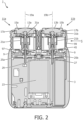
- Fig. 2 shows a schematic cross section of the electric hair-cutting device 1 in its configuration as shown in Fig. 1a , i.e., with the shaving unit 5 coupled to the main housing 3.
- the shaving unit 5 comprises two shaving heads 11a, 1 1b of a rotary type, which are well known to the skilled person and, therefore, will not be discussed in much detail.
- Each shaving head 11a, 11b comprises an external shaving-head member 13a, 13b having an annular shaving area 15a, 15b with hair-entry openings (not shown), and an internal shaving-head member 17a, 17b which, in an assembled condition of the shaving unit 5, is covered by the external shaving-head member 13a, 13b and rotatable relative to the external shaving-head member 13a, 13b about a central axis 19a, 19b of the shaving head 11a, 11b.
- the main housing 3 comprises, for each of the shaving heads 11a, 11b of the shaving unit 5, a separate shaving-head driving member 21a, 21b which is rotatable by the electric motor 23 and arranged at the coupling side 9 of the main housing 3.
- each shaving-head driving member 21a, 21b is connected to a respective one of two driven gear wheels 25a, 25b, which each engage a driving gear wheel 27 mounted centrally between the two driven gear wheels 25a, 25b onto a motor shaft 29 of the electric motor 23.
- the shaving unit 5 comprises, for each respective shaving head 11a, 11b, a separate rotatable driven member 31a, 31b which is connected to the internal shaving-head member 17a, 17b of the respective shaving head 11a, 11b.
- the shaving-head driving members 21a, 21b of the main housing 3 are each coupled to a respective one of the driven members 31a, 31b of the shaving unit 5 allowing the electric motor 23 to drive the internal shaving-head members 17a, 17b of the shaving unit 5 into rotation relative to the external shaving-head members 13a, 13b.
- Fig. 3 shows a schematic cross section of the electric hair-cutting device 1 in its configuration as shown in Fig. 1b , i.e., with the hair-trimming unit 7 coupled to the main housing 3.
- the hair-trimming unit 7 comprises an external trimming-unit member 33 with hair-entry openings 35 and an internal trimming-unit member 37 which is rotatable relative to the external trimming-unit member 33.
- the hair-trimming unit 7 is a nose-hair trimming unit, wherein the internal trimming-unit member 37 is rotatable about a central axis 39 of the hair-trimming unit 7.
- a nose-hair trimming unit is well known to the skilled person and, therefore, will not be discussed in much detail.
- the hair-trimming unit 7 comprises a driven member 41 which is rotatable about a first axis of rotation 43 and connected to the internal trimming-unit member 37.
- the first axis of rotation 43 coincides with the central axis 39 of the hair-trimming unit 7.
- the main housing 3 comprises a separate hair-trimming unit driving member 45 which is rotatable by the electric motor 23 about a second axis of rotation 47 and arranged at the coupling side 9 of the main housing 3.
- the hair-trimming unit driving member 45 is connected to an end portion of the motor shaft 29 of the electric motor 23 axially adjacent to the driving gear wheel 27.
- the hair-trimming unit driving member 45 of the main housing 3 is coupled to the driven member 41 of the hair-trimming unit 7 allowing the electric motor 23 to drive the internal trimming-unit member 37 of the hair-trimming unit 7 into rotation relative to the external trimming-unit member 33.
- the shaving unit 5 comprises two shaving heads 11a, 11b and the main housing 3 comprises two shaving-head driving members 21a, 21b.
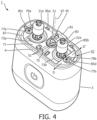
- the arrangement of the two shaving-head driving members 21a, 21b and the hair-trimming unit driving member 45 at the coupling side 9 of the main housing 3 is shown in detail.
- the hair-trimming unit driving member 45 is arranged centrally between the two shaving-head driving members 21a, 21b.
- the two shaving-head driving members 21a, 21b and the hair-trimming unit driving member 45 are arranged approximately in a mutually aligned configuration.
- the shaving unit may have more than two shaving heads.
- the main housing may have three shaving-head driving members arranged in a corresponding triangular configuration at the coupling side of the main housing, and the hair-trimming unit driving member may be arranged in a central position between the three shaving-head driving members.
- FIG. 5a shows the configuration of the electric hair-cutting device 1 of Fig. 1b in engagement with the driven member 41 of the hair-trimming unit 7.
- the driven member 41 of the hair-trimming unit 7 has three primary engagement elements 49 configured and arranged to engage three corresponding secondary engagement elements 51 of the hair-trimming unit driving member 45 of the main housing 3 when the hair-trimming unit 7 is coupled to the main housing 3, as shown in Fig. 5a .
- the secondary engagement elements 51 of the hair-trimming unit driving member 45 are also visible in Fig. 4 .
- the primary engagement elements 49 are arranged in mutually rotationally symmetrical positions relative to the first axis of rotation 43 of the driven member 41 of the hair-trimming unit 7.
- the secondary engagement elements 51 are arranged in mutually rotationally symmetrical positions relative to the second axis of rotation 47 of the hair-trimming unit driving member 45 of the main housing 7.
- the three primary engagement elements 49 are arranged in angular positions mutually enclosing 120° about the first axis of rotation 43, and the three secondary engagement elements 51 are arranged in angular positions mutually enclosing 120° about the second axis of rotation 47.
- a driving torque, indicated by the arrow T in Fig. 5a , generated by the electric motor 23 will be transferred to the internal trimming-unit member 37 of the hair-trimming unit 7 via the mutually engaging secondary engagement elements 51 of the hair-trimming unit driving member 45 of the main housing 3 and the primary engagement elements 49 of the driven member 41 of the hair-trimming unit 7.
- the driving torque T will be transferred in a rotationally symmetrical way from the hair-trimming unit driving member 45 to the driven member 41 via the mutually engaging primary and secondary engagement elements 49, 51.
- the driving torque T will be introduced into the hair-trimming unit 7 in a rotationally symmetrical way relative to the first axis of rotation 43 of the driven member 41 of the hair-trimming unit 7, so that the driving torque T will not result in any significant vibrations of the hair-trimming unit 7 or excessive wear of the bearing of the driven member 41 of the hair-trimming unit 7.
- At least two primary engagement elements are arranged on the driven member 41 of the hair-trimming unit 7 in mutually rotationally symmetrical positions relative to the first axis of rotation 43, and at least two corresponding secondary engagement elements are arranged on the hair-trimming unit driving member 45 of the main housing 3 in mutually rotationally symmetrical positions relative to the second axis of rotation 47.
- the primary engagement elements may be arranged in angular positions mutually enclosing 180° about the first axis of rotation 43
- the secondary engagement elements may be arranged in angular positions mutually enclosing 180° about the second axis of rotation 47.
- the primary engagement elements may be arranged in angular positions mutually enclosing 90° about the first axis of rotation 43, and the secondary engagement elements may be arranged in angular positions mutually enclosing 90° about the second axis of rotation 47.
- the main housing 3 is provided with a first coupling member 61 arranged at the coupling side 9 of the main housing 3
- the shaving unit 5 is provided with a second coupling member 63 which is releasably couplable to the first coupling member 61 of the main housing 3
- the hair-trimming unit 7 is provided with a third coupling member 65 which is releasably couplable to the first coupling member 61 of the main housing 3.
- the first coupling member of the main housing 3 is generally indicated by reference number 61 in Figs. 4 , 5a and 5b .
- the second and third coupling members of, respectively, the shaving unit 5 and the hair-trimming unit 7 are generally indicated by reference numbers 63 and 65 in Figs. 5a and 5b .
- a preferred embodiment of the first, second and third coupling members 61, 63, 65 will be described in detail in the following with reference to Figs. 4 , 5a and 5b .
- the second and third coupling members 63, 65 are preferably identical to allow each of the shaving unit 5 and the hair-trimming unit 7 to be coupled to the (same) first coupling member 61 of the main housing 3. Therefore, in the following the preferred embodiment of the second and third coupling members 63, 65 will be described only in relation to the third coupling member 65 of the hair-trimming unit 7 as shown in Figs. 5a and 5b .
- the first coupling member 61 of the main housing 3 comprises a locking member 71 which is guided at the coupling side 9 of the main housing 3 to be displaceable in a displacement direction D perpendicular to the second axis of rotation 47 of the hair-trimming unit driving member 45 from a coupled position with respect to the third coupling member 65 of the hair-trimming unit 7 to a decoupled position with respect to the third coupling member 65.
- the locking member 71 is also displaceable in a displacement direction D' opposite to said displacement direction D from the decoupled position to the coupled position.
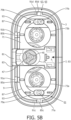
- the coupled position is shown in Fig. 5a and the decoupled position is shown in Fig. 5b .
- Fig. 5a The coupled position is shown in Fig. 5a and the decoupled position is shown in Fig. 5b .
- the locking member 71 is plate-shaped and extends perpendicularly to the second axis of rotation 47.
- the plate-shaped locking member 71 comprises, for each respective one of the shaving-head driving members 21a, 21b, a separate first opening 73a, 73b through which the respective shaving-head driving member 21a, 21b extends.
- the plate-shaped locking member 71 further comprises a second opening 75 through which the hair-trimming unit driving member 45 extends.
- the coupling side 9 of the main housing 3 comprises a pair of guiding elements 77a, 77b which are in engagement with a pair of guiding slots 79a, 79b provided in the plate-shaped locking member 71 for linearly guiding the plate-shaped locking member 71 in the displacement directions D, D'.
- the plate-shaped locking member 71 is biased by spring force F S from the decoupled position shown in Fig. 5b to the coupled position shown in Fig. 5a .
- a mechanical biasing spring providing the spring force Fs is arranged below the plate-shaped locking member 71 and is not shown in the figures.
- the first coupling member 61 of the main housing 3 further comprises a user operable knob 81 which is arranged to protrude, in the coupled position shown in Figs.
- the plate-shaped locking member 71 of the first coupling member 61 comprises in this embodiment four latching elements 85a, 85b, 85c and 85d.
- the four latching elements 85a-85d are provided on a circumferential edge 87 of the plate-shaped locking member 71.
- the third coupling member 65 of the hair-trimming unit 7 comprises, for each respective one of the latching elements 85a-85d of the plate-shaped locking member 71, a corresponding latching recess 91a, 91b, 91c, 91d.
- the four latching recesses 91a-91d are provided on an inner side of a circumferential flange 93 of a housing 95 of the hair-trimming unit 7.
- the circumferential flange 93 and the housing 95 of the hair-trimming unit 7 are also shown in Fig. 3 .
- the latching recesses 91a-91d are configured and arranged, when the hair-trimming unit 7 is arranged at the coupling side 9 of the main housing 3, to each receive and thereby retain a respective one of the latching elements 85a-85d of the plate-shaped locking member 71 in the coupled position of the plate-shaped locking member 71 as shown in Fig.
- the user needs to arrange the hair-trimming unit 7 at the coupling side 9 of the main housing 3 while pressing the knob 81 against the spring force Fs.
- the latching elements 85a-85d may be brought into positions relative to the latching recesses 91a-91d wherein they can be received by the latching recesses 91a-91d when the user subsequently releases the knob 81.
- the hair-trimming unit 7 is coupled again to the main housing 3.
- the second coupling member 63 of the shaving unit 5 comprises, for each respective one of the latching elements 85a-85d of the plate-shaped locking member 71, a corresponding latching recess similar to the latching recesses 91a-91d of the third coupling member 65 of the hair-trimming unit 7.
- the four latching recesses of the second coupling member 63 may be provided, in a similar way to the latching recesses 91a-91d of the third coupling member 65, on an inner side of a circumferential flange 97 of a housing 99 of the shaving unit 5.
- the circumferential flange 97 and the housing 99 of the shaving unit 5 are shown in Fig. 2 .
- the first coupling member of the main housing 3, the second coupling member of the shaving unit 5 and the third coupling member of the hair-trimming unit 7 may be of any suitable type known to the skilled person.
- the locking member may comprise at least one latching element
- the second coupling member of the shaving unit 5 may comprise at least one first latching recess configured and arranged to interact with the at least one latching element
- the third coupling member of the hair-trimming unit 7 may comprise at least one second latching recess configured and arranged to interact with the at least one latching element, i.e., in a way as described hereinbefore with respect to the latching recesses 91a-91d of the third coupling member 65
- the locking member preferably has two or more latching elements arranged at a distance from each other to interact with a corresponding number of latching recesses on the second and third coupling members.
- the locking member of the first coupling member may have any suitable supporting structure configured to support the one or more latching elements and to be guided in a displaceable way at the coupling side 9 of the main housing 3.
- a plate-shaped locking member such as the plate-shaped locking member 71 of the first coupling member 61 described hereinbefore, has the advantage that it has a simple and firm structure and is able to support a relatively large number of latching elements.
- the latching elements 85a-85d may be arranged at a relatively large distance from each other, which will increase the firmness and stability of the coupling between the main housing 3 and, respectively, the shaving unit 5 and the hair-trimming unit 7.
Landscapes
- Life Sciences & Earth Sciences (AREA)
- Forests & Forestry (AREA)
- Engineering & Computer Science (AREA)
- Mechanical Engineering (AREA)
- Dry Shavers And Clippers (AREA)
Abstract
The invention provides an electric hair-cutting device (1) having a shaving unit (5) and a hair-trimming unit (7) which can be interchangeably coupled to a main housing with an electric motor (23). The shaving unit comprises at least two shaving heads (11a, 11b) of a rotary type and, for each shaving head, a separate rotatable driven member (31a, 31b). The hair-trimming unit is also of a rotary type, such as a nose-hair trimming unit, and also comprises a driven member (41) which is rotatable about a first axis of rotation (43). The main housing comprises, for each of the shaving heads, a separate shaving-head driving member (21a, 21b) rotatable by the electric motor and, for the hair-trimming unit, a separate hair-trimming unit driving member (45) rotatable by the electric motor about a second axis of rotation (47). The driven member of the hair-trimming unit has a number N of primary engagement elements (49) for engaging a number N of corresponding secondary engagement elements (51) of the hair-trimming unit driving member, wherein N is at least two. The primary and secondary engagement elements are arranged in mutually rotationally symmetrical positions relative to, respectively, the first axis of rotation and the second axis of rotation.
Description
- The invention relates to an electric hair-cutting device comprising a main housing, a shaving unit and a hair-trimming unit, wherein the shaving unit and the hair-trimming unit can be interchangeably coupled to a coupling side of the main housing, and wherein:
- the main housing accommodates an electric motor and has a first coupling member arranged at the coupling side;
- the shaving unit comprises at least two shaving heads each having an external shaving-head member with hair-entry openings and an internal shaving-head member which is rotatable relative to the external shaving-head member;
- the shaving unit comprises a second coupling member, which is releasably couplable to the first coupling member, and for each respective shaving head a separate rotatable driven member connected to the internal shaving-head member of the respective shaving head;
- the hair-trimming unit comprises an external trimming-unit member with hair-entry openings and an internal trimming-unit member which is rotatable relative to the external trimming-unit member;
- the hair-trimming unit comprises a third coupling member, which is releasably couplable to the first coupling member, and a driven member which is rotatable about a first axis of rotation and connected to the internal trimming-unit member;
- the main housing comprises, for each of the shaving heads of the shaving unit, a separate shaving-head driving member rotatable by the electric motor and arranged at the coupling side;
- the main housing comprises a separate hair-trimming unit driving member rotatable by the electric motor about a second axis of rotation and arranged at the coupling side;
- when the shaving unit is coupled to the main housing, the shaving-head driving members are each coupled to a respective one of the driven members of the shaving unit allowing the electric motor to drive the internal shaving-head members of the shaving unit; and
- when the hair-trimming unit is coupled to the main housing, the hair-trimming unit driving member is coupled to the driven member of the hair-trimming unit allowing the electric motor to drive the internal trimming-unit member
- An electric hair-cutting device as described in the section "field of the invention" is disclosed by
CN220074756U . This known hair-cutting device comprises a main housing, a shaving unit, a hair-clipper unit and a nose-hair trimming unit. The shaving unit has three shaving heads of a rotary type. The hair-clipper unit has a stationary cutting member with a linear array of cutting teeth and a movable cutting member with a linear array of cutting teeth which is arranged to linearly reciprocate relative to the stationary cutting member. The nose-hair trimming unit is of a rotary type. The shaving unit, the hair-clipper unit and the nose-hair trimming unit can be interchangeably coupled to the main housing. The main housing comprises three main transmission shafts which are configured and arranged to drive the three shaving heads of the shaving unit when the shaving unit is coupled to the main housing. The main housing further comprises an eccentric transmission shaft which is arranged centrally between the three main transmission shafts. The eccentric transmission shaft comprises an eccentrically arranged driving member which is configured to drive the movable cutting member of the hair-clipper unit when the hair-clipper unit is coupled to the main housing and to drive the nose-hair trimming unit when the nose-hair trimming unit is coupled to the main housing. By the eccentrically arranged driving member a rotation of the eccentric transmission shaft is converted into a linear reciprocating motion of the movable cutting member of the hair-clipper unit. To enable the eccentrically arranged driving member to generate a rotary motion of the nose-hair trimming unit, the nose-hair trimming unit comprises a rotatable driven member which is couplable to the eccentrically arranged driving member. The rotatable driven member comprises an eccentrically arranged coupling cavity configured and arranged to receive the eccentrically arranged driving member of the eccentric transmission shaft. A disadvantage of the eccentrically arranged coupling cavity of the rotatable driven member of the nose-hair trimming unit is that the driven member will be asymmetrically loaded when being driven by the eccentric transmission shaft. Said asymmetrical load will result in vibrations of the nose-hair trimming unit and excessive wear of the bearing of the driven member. - It is an object of the present invention to provide an electric hair-cutting device as described in the section "field of the invention" which does not have the disadvantage of the known hair-cutting device as described herein before. An object of the present invention therefore is to provide an electric hair-cutting device comprising a main housing, a shaving unit having at least two shaving heads of a rotary type, and a hair-trimming unit of a rotary type, wherein the shaving unit and the hair-trimming unit can be interchangeably coupled to the main housing, wherein the main housing comprises, for each of the shaving heads of the shaving unit, a separate rotatable shaving-head driving member and, for the hair-trimming unit, a separate rotatable hair-trimming unit driving member, and wherein the rotary-type hair-trimming unit can be driven by the hair-trimming unit driving member of the main housing without the occurrence of any significant asymmetrical loads on the driven member of the hair-trimming unit.
- To achieve the above-mentioned object, an electric hair-cutting device as described in the section "field of the invention" is characterized in that:
- the driven member of the hair-trimming unit has a number N of primary engagement elements configured and arranged to engage a number N of corresponding secondary engagement elements of the hair-trimming unit driving member when the hair-trimming unit is coupled to the main housing, wherein N is at least two;
- the N primary engagement elements are arranged in mutually rotationally symmetrical positions relative to the first axis of rotation; and
- the N secondary engagement elements are arranged in mutually rotationally symmetrical positions relative to the second axis of rotation.
- When the hair-trimming unit is coupled to the main housing and the hair-trimming unit driving member is rotated by the electric motor, a driving torque exerted by the electric motor will be transferred to the rotatable internal trimming-unit member of the hair-trimming unit via the mutually engaging N primary engagement elements of the driven member of the hair-trimming unit and N secondary engagement elements of the hair-trimming unit driving member of the main housing. Because the N primary engagement elements are arranged in mutually rotationally symmetrical positions relative to the first axis of rotation of the driven member and the N secondary engagement elements are arranged in mutually rotationally symmetrical positions relative to the second axis of rotation of the hair-trimming unit driving member, said driving torque will be transferred in a rotationally symmetrical way from the hair-trimming unit driving member to the driven member via the mutually engaging primary and secondary engagement elements. Thus, the driving torque will be introduced in a rotationally symmetrical way into the hair-trimming unit, so that the driving torque will not result in any significant vibrations of the hair-trimming unit or excessive wear of the bearing of the driven member of the hair-trimming unit.
- The hair-trimming unit of the electric hair-cutting device in accordance with the invention may be of any known type comprising an external trimming-unit member with hair-entry openings and an internal trimming-unit member which is rotatable relative to the external trimming-unit member and comprising a rotatable driven member connected to the internal trimming-unit member. In a preferred embodiment of the hair-cutting device in accordance with the invention, the hair-trimming unit is a nose-hair trimming unit of a rotary type.
- The shaving unit of the electric hair-cutting device in accordance with the invention comprises at least two shaving heads of a rotary type each having an external shaving-head member with hair-entry openings and an internal shaving-head member which is rotatable relative to the external shaving-head member, and comprises for each respective shaving head a separate rotatable driven member connected to the internal shaving-head member of the respective shaving head. In an embodiment, the shaving unit comprises two shaving heads of the rotary type. In this embodiment, the main housing comprises two shaving-head driving members and the hair-trimming unit driving member may be arranged centrally between the two shaving-head driving members. In particular, in this embodiment the two shaving-head driving members and the hair-trimming unit driving member may be arranged in a mutually aligned configuration or substantially aligned configuration.
- In addition to the shaving unit and the hair-trimming unit, the electric hair-cutting device in accordance with the invention may have an additional hair-cutting unit and/or a skin-treatment unit, such as a brushing unit, that can be alternatively coupled to the coupling side of the main housing instead of the shaving unit or the hair-trimming unit. The additional hair-cutting unit and/or the skin-treatment unit may comprise a rotatable driven member configured and arranged to be driven by the hair-trimming unit driving member of the main housing when the additional hair-cutting unit or the skin-treatment unit is coupled to the main housing. The additional hair-cutting unit may be of a linearly reciprocating type comprising a movable cutting member which is arranged to be linearly reciprocating relative to a stationary cutting member. In this case the additional hair-cutting unit may have a transmission system to convert a rotation of the driven member into a linearly reciprocating motion of the movable cutting member. The skin-treatment unit may be of a rotary or linearly reciprocating type.
- In accordance with the invention, the first coupling member of the main housing, the second coupling member of the shaving unit, which is releasably couplable to the first coupling member, and the third coupling member of the hair-trimming unit, which is releasably couplable to the first coupling member, may be of any suitable type known to the skilled person. For example, the first coupling member may be configured and arranged to operate as a releasable snap-fit connection in cooperation with each of the second and third coupling members, which enables an easy and convenient coupling and decoupling of the shaving unit and the hair-trimming unit to and from the main housing.
- In a preferred embodiment of the electric hair-cutting device in accordance with the invention:
- the first coupling member comprises a locking member which is guided at the coupling side of the main housing to be displaceable in a displacement direction perpendicular to the second axis of rotation from a coupled position to a decoupled position and vice-versa;
- the locking member comprises at least one latching element;
- the second coupling member comprises at least one first latching recess configured and arranged, when the shaving unit is arranged at the coupling side, to receive the at least one latching element in the coupled position of the locking member and to release the at least one latching element in the decoupled position of the locking member; and
- the third coupling member comprises at least one second latching recess configured and arranged, when the hair-trimming unit is arranged at the coupling side, to receive the at least one latching element in the coupled position of the locking member and to release the at least one latching element in the decoupled position of the locking member.
- The interaction of the at least one latching element of the locking member of the first coupling member with the at least one first latching recess of the second coupling member and the at least one second latching recess of the third coupling member, as realized in the coupled position of the locking member, provides a firm coupling of the main housing with, respectively, the shaving unit and the hair-trimming unit. To increase the firmness of the coupling between the first coupling member and second and third coupling members, the locking member of the first coupling member may comprise a plurality of latching elements, the second coupling member may comprise, for each of the latching elements of the locking member, a separate first latching recess, and the third coupling member may comprise, for each of the latching elements of the locking member, a separate second latching recess. The first and second latching recesses may be arranged at a distance from each other on a housing or frame of, respectively, the shaving unit and the hair-trimming unit. The shaving unit and the hair-trimming unit can each be easily decoupled from the main housing by displacing the locking member of the first coupling member from the coupled position to the decoupled position.
- In a further embodiment of the electric hair-cutting device according to the invention:
- the locking member is plate-shaped and extends perpendicularly to the second axis of rotation;
- the plate-shaped locking member comprises, for each respective one of the shaving-head driving members, a separate first opening through which the respective shaving-head driving member extends;
- the plate-shaped locking member comprises a second opening through which the hair-trimming unit driving member extends.
- The plate-shaped locking member results in a firm and compact structure of the first coupling member and allows the provision of a relatively large number of latching elements at a distance from each other on the locking member. The first and second openings in the plate-shaped locking member allow the plate-shaped locking member to extend over a major portion of the coupling side of the main housing, while still allowing the arrangement of the shaving-head driving members and the hair-trimming unit driving member at the coupling side of the main housing.
- In a yet further embodiment of the electric hair-cutting device according to the invention:
- the plate-shaped locking member comprises two or more latching elements provided on a circumferential edge of the plate-shaped locking member;
- the second coupling member comprises, for each respective one of the latching elements, a corresponding first latching recess provided on an inner side of a circumferential flange of a housing of the shaving unit; and
- the third coupling member comprises, for each respective one of the latching elements, a corresponding second latching recess provided on an inner side of a circumferential flange of a housing of the hair-trimming unit.
- The arrangement of two or more latching elements on the circumferential edge of the plate-shaped locking member and corresponding first and second latching recesses on the inner side of the circumferential flange of the housings of the shaving unit and the hair-trimming unit provides a highly stable and firm coupling between the main housing and, respectively, the shaving unit and the hair-trimming unit. Preferably, the latching elements are arranged on mutually opposite portions of the circumferential edge of the plate-shaped locking member. In embodiments wherein the plate-shaped locking member is square or rectangular, preferably the latching elements are provided on at least three of the four side edges of the plate-shaped locking member.
- In a preferred embodiment of the electric hair-cutting device according to the invention, the locking member is biased by spring force from the decoupled position to the coupled position, and the locking member comprises a user operable knob arranged to protrude via an opening in the main housing in the coupled position and to be pressable into the opening against said spring force. The spring force reliably maintains the locking member in the coupled position during operation of the electric hair-cutting device. A user of the electric hair-cutting device can easily decouple the shaving unit or the hair-trimming unit from the main housing by pressing the user operable knob into the opening in the main housing against the spring force.
- The above-described and other aspects of the invention will be apparent from and elucidated with reference to the following detailed description of embodiments of an electric hair-cutting device in accordance with the invention.
- The invention will be explained in greater detail with reference to the figures, in which equal or similar features are indicated by the same reference numbers, and in which:
-
Fig. 1a shows an embodiment of an electric hair-cutting device according to the invention with a shaving unit coupled to a main housing; -
Fig. 1b shows the electric hair-cutting device ofFig. 1a with a hair-trimming unit coupled to the main housing; -
Fig. 2 shows a schematic cross section of the electric hair-cutting device in its configuration shown inFig. 1a ; -
Fig. 3 shows a schematic cross section of the electric hair-cutting device in its configuration shown inFig. 1b ; -
Fig. 4 is a perspective view of the main housing of the electric hair-cutting device ofFigs. 1a and 1b ; -
Fig. 5a shows a cross section of the electric hair-cutting device along the line V-V inFig. 3 , wherein a coupling member of the hair-trimming unit is coupled to a coupling member of the main housing; and -
Fig. 5b shows the cross section ofFig. 5a , wherein the coupling member of the hair-trimming unit is decoupled from the coupling member of the main housing. -
Figs. 1a and 1b show an embodiment of an electric hair-cuttingdevice 1 according to the invention. The electric hair-cuttingdevice 1 comprises amain housing 3, which is configured to be held by a hand of a user. Themain housing 3 accommodates an electric motor, a battery configured to power the electric motor, and electronic components configured to control the electric motor. These parts of the electric hair-cuttingdevice 1 accommodated by themain housing 3 are well known to the skilled person and, therefore, are not shown in detail inFigs. 1a, 1b and will not be described in further detail. - The electric hair-cutting
device 1 comprises ashaving unit 5 and a hair-trimmingunit 7. A user of the electric hair-cuttingdevice 1 can interchangeably couple theshaving unit 5 and the hair-trimmingunit 7 to acoupling side 9 of themain housing 3.Fig. 1a shows the electric hair-cuttingdevice 1 with theshaving unit 5 coupled to thecoupling side 9 of themain housing 3.Fig. 1b shows the electric hair-cuttingdevice 1 with the hair-trimmingunit 7 coupled to thecoupling side 9 of themain housing 3. -
Fig. 2 shows a schematic cross section of the electric hair-cuttingdevice 1 in its configuration as shown inFig. 1a , i.e., with theshaving unit 5 coupled to themain housing 3. In the embodiment shown, theshaving unit 5 comprises two shavingheads head head member annular shaving area head member shaving unit 5, is covered by the external shaving-head member head member central axis head - As shown in
Fig. 2 , themain housing 3 comprises, for each of the shaving heads 11a, 11b of theshaving unit 5, a separate shaving-head driving member electric motor 23 and arranged at thecoupling side 9 of themain housing 3. In the embodiment shown, each shaving-head driving member gear wheels driving gear wheel 27 mounted centrally between the two drivengear wheels motor shaft 29 of theelectric motor 23. Theshaving unit 5 comprises, for eachrespective shaving head member head member respective shaving head Fig. 2 , when theshaving unit 5 is coupled to themain housing 3, the shaving-head driving members main housing 3 are each coupled to a respective one of the drivenmembers shaving unit 5 allowing theelectric motor 23 to drive the internal shaving-head members shaving unit 5 into rotation relative to the external shaving-head members -
Fig. 3 shows a schematic cross section of the electric hair-cuttingdevice 1 in its configuration as shown inFig. 1b , i.e., with the hair-trimmingunit 7 coupled to themain housing 3. The hair-trimmingunit 7 comprises an external trimming-unit member 33 with hair-entry openings 35 and an internal trimming-unit member 37 which is rotatable relative to the external trimming-unit member 33. In the embodiment shown, the hair-trimmingunit 7 is a nose-hair trimming unit, wherein the internal trimming-unit member 37 is rotatable about acentral axis 39 of the hair-trimmingunit 7. Such a nose-hair trimming unit is well known to the skilled person and, therefore, will not be discussed in much detail. - As shown in
Fig. 3 , the hair-trimmingunit 7 comprises a drivenmember 41 which is rotatable about a first axis ofrotation 43 and connected to the internal trimming-unit member 37. In the embodiment shown, the first axis ofrotation 43 coincides with thecentral axis 39 of the hair-trimmingunit 7. Themain housing 3 comprises a separate hair-trimmingunit driving member 45 which is rotatable by theelectric motor 23 about a second axis ofrotation 47 and arranged at thecoupling side 9 of themain housing 3. In the embodiment shown, the hair-trimmingunit driving member 45 is connected to an end portion of themotor shaft 29 of theelectric motor 23 axially adjacent to thedriving gear wheel 27. As shown inFig. 3 , when the hair-trimmingunit 7 is coupled to themain housing 3, the hair-trimmingunit driving member 45 of themain housing 3 is coupled to the drivenmember 41 of the hair-trimmingunit 7 allowing theelectric motor 23 to drive the internal trimming-unit member 37 of the hair-trimmingunit 7 into rotation relative to the external trimming-unit member 33. - In the embodiment of the electric hair-cutting
device 1 as described herein before, theshaving unit 5 comprises two shavingheads main housing 3 comprises two shaving-head driving members main housing 3 of the electric hair-cuttingdevice 1 shown inFig. 4 , the arrangement of the two shaving-head driving members unit driving member 45 at thecoupling side 9 of themain housing 3 is shown in detail. As shown inFig. 4 , in this embodiment the hair-trimmingunit driving member 45 is arranged centrally between the two shaving-head driving members head driving members unit driving member 45 are arranged approximately in a mutually aligned configuration. In alternative embodiments of an electric hair-cutting device according to the invention, the shaving unit may have more than two shaving heads. For example, in an embodiment wherein the shaving unit has three shaving heads arranged in a triangular configuration, the main housing may have three shaving-head driving members arranged in a corresponding triangular configuration at the coupling side of the main housing, and the hair-trimming unit driving member may be arranged in a central position between the three shaving-head driving members. - In the cross section of the electric hair-cutting
device 1 as shown inFig. 5a , the configuration of the electric hair-cuttingdevice 1 ofFig. 1b is shown, i.e., with the hair-trimmingunit 7 coupled to themain housing 3.Fig. 5a shows the hair-trimmingunit driving member 45 of themain housing 3 in engagement with the drivenmember 41 of the hair-trimmingunit 7. The drivenmember 41 of the hair-trimmingunit 7 has threeprimary engagement elements 49 configured and arranged to engage three correspondingsecondary engagement elements 51 of the hair-trimmingunit driving member 45 of themain housing 3 when the hair-trimmingunit 7 is coupled to themain housing 3, as shown inFig. 5a . Thesecondary engagement elements 51 of the hair-trimmingunit driving member 45 are also visible inFig. 4 . Theprimary engagement elements 49 are arranged in mutually rotationally symmetrical positions relative to the first axis ofrotation 43 of the drivenmember 41 of the hair-trimmingunit 7. Thesecondary engagement elements 51 are arranged in mutually rotationally symmetrical positions relative to the second axis ofrotation 47 of the hair-trimmingunit driving member 45 of themain housing 7. In the embodiment shown inFig. 5a , the threeprimary engagement elements 49 are arranged in angular positions mutually enclosing 120° about the first axis ofrotation 43, and the threesecondary engagement elements 51 are arranged in angular positions mutually enclosing 120° about the second axis ofrotation 47. - When the hair-trimming
unit driving member 45 is rotated by theelectric motor 23, a driving torque, indicated by the arrow T inFig. 5a , generated by theelectric motor 23 will be transferred to the internal trimming-unit member 37 of the hair-trimmingunit 7 via the mutually engagingsecondary engagement elements 51 of the hair-trimmingunit driving member 45 of themain housing 3 and theprimary engagement elements 49 of the drivenmember 41 of the hair-trimmingunit 7. As a result of the rotationally symmetrical arrangement of theprimary engagement elements 49 relative to the first axis ofrotation 43 of the drivenmember 41 and the rotationally symmetrical arrangement of thesecondary engagement elements 51 relative to the second axis ofrotation 47 of the hair-trimmingunit driving member 45, the driving torque T will be transferred in a rotationally symmetrical way from the hair-trimmingunit driving member 45 to the drivenmember 41 via the mutually engaging primary andsecondary engagement elements unit 7 in a rotationally symmetrical way relative to the first axis ofrotation 43 of the drivenmember 41 of the hair-trimmingunit 7, so that the driving torque T will not result in any significant vibrations of the hair-trimmingunit 7 or excessive wear of the bearing of the drivenmember 41 of the hair-trimmingunit 7. - It is noted that, according to the invention, at least two primary engagement elements are arranged on the driven
member 41 of the hair-trimmingunit 7 in mutually rotationally symmetrical positions relative to the first axis ofrotation 43, and at least two corresponding secondary engagement elements are arranged on the hair-trimmingunit driving member 45 of themain housing 3 in mutually rotationally symmetrical positions relative to the second axis ofrotation 47. For example, in an embodiment with two primary engagement elements and two secondary engagement elements, the primary engagement elements may be arranged in angular positions mutually enclosing 180° about the first axis ofrotation 43, and the secondary engagement elements may be arranged in angular positions mutually enclosing 180° about the second axis ofrotation 47. In an alternative embodiment with four primary engagement elements and four secondary engagement elements, the primary engagement elements may be arranged in angular positions mutually enclosing 90° about the first axis ofrotation 43, and the secondary engagement elements may be arranged in angular positions mutually enclosing 90° about the second axis ofrotation 47. - To enable the user of the electric hair-cutting
device 1 to interchangeably couple theshaving unit 5 and the hair-trimmingunit 7 to thecoupling side 9 of themain housing 3, themain housing 3 is provided with afirst coupling member 61 arranged at thecoupling side 9 of themain housing 3, theshaving unit 5 is provided with a second coupling member 63 which is releasably couplable to thefirst coupling member 61 of themain housing 3, and the hair-trimmingunit 7 is provided with a third coupling member 65 which is releasably couplable to thefirst coupling member 61 of themain housing 3. The first coupling member of themain housing 3 is generally indicated byreference number 61 inFigs. 4 ,5a and5b . The second and third coupling members of, respectively, theshaving unit 5 and the hair-trimmingunit 7 are generally indicated by reference numbers 63 and 65 inFigs. 5a and5b . A preferred embodiment of the first, second andthird coupling members 61, 63, 65 will be described in detail in the following with reference toFigs. 4 ,5a and5b . It will be clear for the skilled person that, for practical reasons, the second and third coupling members 63, 65 are preferably identical to allow each of theshaving unit 5 and the hair-trimmingunit 7 to be coupled to the (same)first coupling member 61 of themain housing 3. Therefore, in the following the preferred embodiment of the second and third coupling members 63, 65 will be described only in relation to the third coupling member 65 of the hair-trimmingunit 7 as shown inFigs. 5a and5b . - As shown in
Figs. 4 ,5a and5b , thefirst coupling member 61 of themain housing 3 comprises a lockingmember 71 which is guided at thecoupling side 9 of themain housing 3 to be displaceable in a displacement direction D perpendicular to the second axis ofrotation 47 of the hair-trimmingunit driving member 45 from a coupled position with respect to the third coupling member 65 of the hair-trimmingunit 7 to a decoupled position with respect to the third coupling member 65. The lockingmember 71 is also displaceable in a displacement direction D' opposite to said displacement direction D from the decoupled position to the coupled position. The coupled position is shown inFig. 5a and the decoupled position is shown inFig. 5b . As shown inFig. 4 , in this embodiment the lockingmember 71 is plate-shaped and extends perpendicularly to the second axis ofrotation 47. The plate-shaped lockingmember 71 comprises, for each respective one of the shaving-head driving members first opening head driving member member 71 further comprises asecond opening 75 through which the hair-trimmingunit driving member 45 extends. Thecoupling side 9 of themain housing 3 comprises a pair of guidingelements slots member 71 for linearly guiding the plate-shaped lockingmember 71 in the displacement directions D, D'. The plate-shaped lockingmember 71 is biased by spring force FS from the decoupled position shown inFig. 5b to the coupled position shown inFig. 5a . A mechanical biasing spring providing the spring force Fs is arranged below the plate-shaped lockingmember 71 and is not shown in the figures. Thefirst coupling member 61 of themain housing 3 further comprises a useroperable knob 81 which is arranged to protrude, in the coupled position shown inFigs. 4 and5a , via anopening 83 in themain housing 3. A user may press theknob 81 into theopening 83 against the spring force Fs, whereby the plate-shaped lockingmember 71 is displaced from the coupled position shown inFig. 5a to the decoupled position shown inFig. 5b . - As shown in
Figs. 4 ,5a and5b , the plate-shaped lockingmember 71 of thefirst coupling member 61 comprises in this embodiment fourlatching elements latching elements 85a-85d are provided on acircumferential edge 87 of the plate-shaped lockingmember 71. As shown inFigs. 5a and5b , the third coupling member 65 of the hair-trimmingunit 7 comprises, for each respective one of thelatching elements 85a-85d of the plate-shaped lockingmember 71, acorresponding latching recess latching recesses 91a-91d are provided on an inner side of acircumferential flange 93 of ahousing 95 of the hair-trimmingunit 7. Thecircumferential flange 93 and thehousing 95 of the hair-trimmingunit 7 are also shown inFig. 3 . The latching recesses 91a-91d are configured and arranged, when the hair-trimmingunit 7 is arranged at thecoupling side 9 of themain housing 3, to each receive and thereby retain a respective one of thelatching elements 85a-85d of the plate-shaped lockingmember 71 in the coupled position of the plate-shaped lockingmember 71 as shown inFig. 5a , and to release the respective one of thelatching elements 85a-85d in the decoupled position of the plate-shaped lockingmember 71 as shown inFig. 5b . Thus, when the user presses theknob 81 into theopening 83 of themain housing 3 against the spring force Fs, the plate-shaped lockingmember 71 is displaced from the coupled position shown inFig. 5a to the decoupled position shown inFig. 5b , so that the latchingelements 85a-85d are released from the latching recesses 91a-91d and the user is enabled to decouple and remove the hair-trimmingunit 7 from themain housing 3. To couple the hair-trimmingunit 7 to themain housing 3, the user needs to arrange the hair-trimmingunit 7 at thecoupling side 9 of themain housing 3 while pressing theknob 81 against the spring force Fs. Thereby, the latchingelements 85a-85d may be brought into positions relative to the latching recesses 91a-91d wherein they can be received by the latching recesses 91a-91d when the user subsequently releases theknob 81. Thereby, the hair-trimmingunit 7 is coupled again to themain housing 3. - It will be clear for the skilled person that the second coupling member 63 of the
shaving unit 5 comprises, for each respective one of thelatching elements 85a-85d of the plate-shaped lockingmember 71, a corresponding latching recess similar to the latching recesses 91a-91d of the third coupling member 65 of the hair-trimmingunit 7. The four latching recesses of the second coupling member 63 may be provided, in a similar way to the latching recesses 91a-91d of the third coupling member 65, on an inner side of acircumferential flange 97 of ahousing 99 of theshaving unit 5. Thecircumferential flange 97 and thehousing 99 of theshaving unit 5 are shown inFig. 2 . - As discussed in the section "Summary of the invention" the first coupling member of the
main housing 3, the second coupling member of theshaving unit 5 and the third coupling member of the hair-trimmingunit 7 may be of any suitable type known to the skilled person. In embodiments wherein the first coupling member of themain housing 3 comprises a locking member which is guided at thecoupling side 9 of themain housing 3 to be displaceable in a way similar to the plate-shape locking member 71 of thefirst coupling member 61 described hereinbefore, the locking member may comprise at least one latching element, the second coupling member of theshaving unit 5 may comprise at least one first latching recess configured and arranged to interact with the at least one latching element, and the third coupling member of the hair-trimmingunit 7 may comprise at least one second latching recess configured and arranged to interact with the at least one latching element, i.e., in a way as described hereinbefore with respect to the latching recesses 91a-91d of the third coupling member 65. Although a locking member with a single latching element for interaction with a single latching recess on each of the second and third coupling members can provide a firm coupling between themain housing 3 and, respectively, theshaving unit 5 and the hair-trimmingunit 7, the locking member preferably has two or more latching elements arranged at a distance from each other to interact with a corresponding number of latching recesses on the second and third coupling members. Instead of being plate-shaped, the locking member of the first coupling member may have any suitable supporting structure configured to support the one or more latching elements and to be guided in a displaceable way at thecoupling side 9 of themain housing 3. A plate-shaped locking member, such as the plate-shaped lockingmember 71 of thefirst coupling member 61 described hereinbefore, has the advantage that it has a simple and firm structure and is able to support a relatively large number of latching elements. By providing thelatching elements 85a-85d on thecircumferential edge 87 of the plate-shaped lockingmember 71, the latchingelements 85a-85d may be arranged at a relatively large distance from each other, which will increase the firmness and stability of the coupling between themain housing 3 and, respectively, theshaving unit 5 and the hair-trimmingunit 7. - Variations to the disclosed embodiments can be understood and effected by those skilled in the art in practicing the principles and techniques described herein, from a study of the drawings, the disclosure and the appended claims. In the claims, the word "comprising" does not exclude other elements or steps, and the indefinite article "a" or "an" does not exclude a plurality. The mere fact that certain measures are recited in mutually different dependent claims does not indicate that a combination of these measures cannot be used to advantage. Any reference numbers in the claims should not be construed as limiting the scope of the claims.
Claims (6)
- An electric hair-cutting device (1) comprising a main housing (3), a shaving unit (5) and a hair-trimming unit (7), wherein the shaving unit and the hair-trimming unit can be interchangeably coupled to a coupling side (9) of the main housing, and wherein:- the main housing accommodates an electric motor (23) and has a first coupling member (61) arranged at the coupling side;- the shaving unit comprises at least two shaving heads (11a, 11b) each having an external shaving-head member (13a, 13b) with hair-entry openings and an internal shaving-head member (17a, 17b) which is rotatable relative to the external shaving-head member;- the shaving unit comprises a second coupling member (63), which is releasably couplable to the first coupling member, and for each respective shaving head a separate rotatable driven member (31a, 31b) connected to the internal shaving-head member of the respective shaving head;- the hair-trimming unit comprises an external trimming-unit member (33) with hair-entry openings (35) and an internal trimming-unit member (37) which is rotatable relative to the external trimming-unit member;- the hair-trimming unit comprises a third coupling member (65), which is releasably couplable to the first coupling member, and a driven member (41) which is rotatable about a first axis of rotation (43) and connected to the internal trimming-unit member;- the main housing comprises, for each of the shaving heads of the shaving unit, a separate shaving-head driving member (21a, 21b) rotatable by the electric motor and arranged at the coupling side;- the main housing comprises a separate hair-trimming unit driving member (45) rotatable by the electric motor about a second axis of rotation (47) and arranged at the coupling side;- when the shaving unit is coupled to the main housing, the shaving-head driving members are each coupled to a respective one of the driven members of the shaving unit allowing the electric motor to drive the internal shaving-head members of the shaving unit; and- when the hair-trimming unit is coupled to the main housing, the hair-trimming unit driving member is coupled to the driven member of the hair-trimming unit allowing the electric motor to drive the internal trimming-unit member;characterized in that:- the driven member (41) of the hair-trimming unit (7) has a number N of primary engagement elements (49) configured and arranged to engage a number N of corresponding secondary engagement elements (51) of the hair-trimming unit driving member (45) when the hair-trimming unit is coupled to the main housing (3), wherein N is at least two;- the N primary engagement elements are arranged in mutually rotationally symmetrical positions relative to the first axis of rotation (43); and- the N secondary engagement elements are arranged in mutually rotationally symmetrical positions relative to the second axis of rotation (47).
- The electric hair-cutting device (1) as claimed in claim 1, wherein the hair-trimming unit (7) is a nose-hair trimming unit.
- The electric hair-cutting device (1) as claimed in claim 1 or 2, wherein:- the first coupling member (61) comprises a locking member (71) which is guided at the coupling side (9) of the main housing (3) to be displaceable in a displacement direction (D, D') perpendicular to the second axis of rotation (47) from a coupled position to a decoupled position and vice-versa;- the locking member comprises at least one latching element (85a, 85b, 85c, 85d);- the second coupling member (63) comprises at least one first latching recess configured and arranged, when the shaving unit (5) is arranged at the coupling side, to receive the at least one latching element in the coupled position of the locking member and to release the at least one latching element in the decoupled position of the locking member; and- the third coupling member (65) comprises at least one second latching recess (91a, 91b, 91c, 91d) configured and arranged, when the hair-trimming unit (7) is arranged at the coupling side, to receive the at least one latching element in the coupled position of the locking member and to release the at least one latching element in the decoupled position of the locking member.
- The electric hair-cutting device (1) as claimed in claim 3, wherein:- the locking member (71) is plate-shaped and extends perpendicularly to the second axis of rotation (47);- the plate-shaped locking member comprises, for each respective one of the shaving-head driving members (21a, 21b), a separate first opening (73a, 73b) through which the respective shaving-head driving member extends;- the plate-shaped locking member comprises a second opening (75) through which the hair-trimming unit driving member (45) extends.
- The electric hair-cutting device (1) as claimed in claim 4, wherein:- the plate-shaped locking member (71) comprises two or more latching elements (85a, 85b, 85c, 85d) provided on a circumferential edge (87) of the plate-shaped locking member;- the second coupling member (63) comprises, for each respective one of the latching elements, a corresponding first latching recess provided on an inner side of a circumferential flange (97) of a housing (99) of the shaving unit (5); and- the third coupling member (65) comprises, for each respective one of the latching elements, a corresponding second latching recess (91a, 91b, 91c, 91d) provided on an inner side of a circumferential flange (93) of a housing (95) of the hair-trimming unit (7).
- The electric hair-cutting device (1) as claimed in any of the claims 3-5, wherein:- the locking member (71) is biased by spring force (FS) from the decoupled position to the coupled position; and- the locking member comprises a user operable knob (81) arranged to protrude via an opening (83) in the main housing (3) in the coupled position and to be pressable into the opening against said spring force.
Priority Applications (3)
| Application Number | Priority Date | Filing Date | Title |
|---|---|---|---|
| PCT/EP2024/081485 WO2025103865A1 (en) | 2023-11-13 | 2024-11-07 | Electric hair-cutting device with separate driving members for shaving unit and hair-trimming unit |
| CN202411606876.0A CN119974070A (en) | 2023-11-13 | 2024-11-12 | Electric hair cutting device with independent drive means for shaving unit and hair trimming unit |
| CN202422749214.0U CN223734930U (en) | 2023-11-13 | 2024-11-12 | An electric hair cutting device with independent drive components for the shaving unit and the hair trimming unit. |
Applications Claiming Priority (2)
| Application Number | Priority Date | Filing Date | Title |
|---|---|---|---|
| CN2023131319 | 2023-11-13 | ||
| CN2024077018 | 2024-02-08 |
Publications (1)
| Publication Number | Publication Date |
|---|---|
| EP4552812A1 true EP4552812A1 (en) | 2025-05-14 |
Family
ID=90365492
Family Applications (1)
| Application Number | Title | Priority Date | Filing Date |
|---|---|---|---|
| EP24165406.0A Withdrawn EP4552812A1 (en) | 2023-11-13 | 2024-03-22 | Electric hair-cutting device with separate driving members for shaving unit and hair-trimming unit |
Country Status (2)
| Country | Link |
|---|---|
| EP (1) | EP4552812A1 (en) |
| CN (1) | CN119974070A (en) |
Citations (4)
| Publication number | Priority date | Publication date | Assignee | Title |
|---|---|---|---|---|
| CN104493848A (en) * | 2014-12-19 | 2015-04-08 | 浙江金达电机电器有限公司 | Integral shaving and haircutting device |
| US20180281212A1 (en) * | 2016-09-29 | 2018-10-04 | Zhejiang Jinda Motors And Electric Appliances Co., Ltd. | Multifunctional electric groomer |
| CN213005425U (en) * | 2020-09-12 | 2021-04-20 | 成钟佳 | Portable two-in-one shaver |
| CN220074756U (en) | 2023-06-15 | 2023-11-24 | 温州卓创电器有限公司 | Three-in-one shaving device |
-
2024
- 2024-03-22 EP EP24165406.0A patent/EP4552812A1/en not_active Withdrawn
- 2024-11-12 CN CN202411606876.0A patent/CN119974070A/en active Pending
Patent Citations (4)
| Publication number | Priority date | Publication date | Assignee | Title |
|---|---|---|---|---|
| CN104493848A (en) * | 2014-12-19 | 2015-04-08 | 浙江金达电机电器有限公司 | Integral shaving and haircutting device |
| US20180281212A1 (en) * | 2016-09-29 | 2018-10-04 | Zhejiang Jinda Motors And Electric Appliances Co., Ltd. | Multifunctional electric groomer |
| CN213005425U (en) * | 2020-09-12 | 2021-04-20 | 成钟佳 | Portable two-in-one shaver |
| CN220074756U (en) | 2023-06-15 | 2023-11-24 | 温州卓创电器有限公司 | Three-in-one shaving device |
Also Published As
| Publication number | Publication date |
|---|---|
| CN119974070A (en) | 2025-05-13 |
Similar Documents
| Publication | Publication Date | Title |
|---|---|---|
| US11312033B2 (en) | Rotary electric shaver | |
| CN105075070B (en) | Motor with internal rotor and external stator | |
| EP1334789B1 (en) | Handle arrangement for a reciprocating saw | |
| US11850763B2 (en) | Hair cutting unit having a coupling structure | |
| EP0860247A1 (en) | Electric shaver | |
| EP3747606B1 (en) | Rotary electric shaver | |
| KR0129675B1 (en) | Rotor for electric motor | |
| KR101038441B1 (en) | Shaving device | |
| MXPA01007475A (en) | An inner cutter for an electric rotary shaver and an electric rotary shaver. | |
| US20180207818A1 (en) | Attachment of electric hair trimmer | |
| CN111975720B (en) | electrical tools | |
| WO1999050033A1 (en) | Shaving apparatus | |
| EP4552812A1 (en) | Electric hair-cutting device with separate driving members for shaving unit and hair-trimming unit | |
| US20220080561A1 (en) | Powered ratchet wrench | |
| CN109262662B (en) | Coupling unit | |
| WO2025103865A1 (en) | Electric hair-cutting device with separate driving members for shaving unit and hair-trimming unit | |
| JPS60212188A (en) | Razor unit | |
| JP3528201B2 (en) | Electric razor | |
| JP5764034B2 (en) | Electric tool | |
| JPH08242570A (en) | Step motor | |
| JPH0857169A (en) | Safety razor | |
| US12096845B2 (en) | Interface for attaching a brush to a skin treatment device | |
| JP3430954B2 (en) | Electric power steering device | |
| US20230034082A1 (en) | Damper device | |
| JP2020191695A (en) | Rotor structure of electric motor |
Legal Events
| Date | Code | Title | Description |
|---|---|---|---|
| PUAI | Public reference made under article 153(3) epc to a published international application that has entered the european phase |
Free format text: ORIGINAL CODE: 0009012 |
|
| STAA | Information on the status of an ep patent application or granted ep patent |
Free format text: STATUS: THE APPLICATION HAS BEEN PUBLISHED |
|
| AK | Designated contracting states |
Kind code of ref document: A1 Designated state(s): AL AT BE BG CH CY CZ DE DK EE ES FI FR GB GR HR HU IE IS IT LI LT LU LV MC ME MK MT NL NO PL PT RO RS SE SI SK SM TR |
|
| STAA | Information on the status of an ep patent application or granted ep patent |
Free format text: STATUS: THE APPLICATION IS DEEMED TO BE WITHDRAWN |
|
| 18D | Application deemed to be withdrawn |
Effective date: 20251115 |