EP4552642A1 - Agent for reducing blood myostatin level - Google Patents
Agent for reducing blood myostatin level Download PDFInfo
- Publication number
- EP4552642A1 EP4552642A1 EP23835561.4A EP23835561A EP4552642A1 EP 4552642 A1 EP4552642 A1 EP 4552642A1 EP 23835561 A EP23835561 A EP 23835561A EP 4552642 A1 EP4552642 A1 EP 4552642A1
- Authority
- EP
- European Patent Office
- Prior art keywords
- salt
- myostatin
- solvate
- benzoxazol
- methoxyphenoxy
- Prior art date
- Legal status (The legal status is an assumption and is not a legal conclusion. Google has not performed a legal analysis and makes no representation as to the accuracy of the status listed.)
- Pending
Links
Images
Classifications
-
- C—CHEMISTRY; METALLURGY
- C07—ORGANIC CHEMISTRY
- C07D—HETEROCYCLIC COMPOUNDS
- C07D263/00—Heterocyclic compounds containing 1,3-oxazole or hydrogenated 1,3-oxazole rings
- C07D263/52—Heterocyclic compounds containing 1,3-oxazole or hydrogenated 1,3-oxazole rings condensed with carbocyclic rings or ring systems
- C07D263/54—Benzoxazoles; Hydrogenated benzoxazoles
- C07D263/58—Benzoxazoles; Hydrogenated benzoxazoles with hetero atoms or with carbon atoms having three bonds to hetero atoms with at the most one bond to halogen, e.g. ester or nitrile radicals, directly attached in position 2
-
- A—HUMAN NECESSITIES
- A61—MEDICAL OR VETERINARY SCIENCE; HYGIENE
- A61K—PREPARATIONS FOR MEDICAL, DENTAL OR TOILETRY PURPOSES
- A61K31/00—Medicinal preparations containing organic active ingredients
- A61K31/33—Heterocyclic compounds
- A61K31/395—Heterocyclic compounds having nitrogen as a ring hetero atom, e.g. guanethidine or rifamycins
- A61K31/41—Heterocyclic compounds having nitrogen as a ring hetero atom, e.g. guanethidine or rifamycins having five-membered rings with two or more ring hetero atoms, at least one of which being nitrogen, e.g. tetrazole
- A61K31/42—Oxazoles
- A61K31/423—Oxazoles condensed with carbocyclic rings
-
- A—HUMAN NECESSITIES
- A61—MEDICAL OR VETERINARY SCIENCE; HYGIENE
- A61P—SPECIFIC THERAPEUTIC ACTIVITY OF CHEMICAL COMPOUNDS OR MEDICINAL PREPARATIONS
- A61P21/00—Drugs for disorders of the muscular or neuromuscular system
-
- A—HUMAN NECESSITIES
- A61—MEDICAL OR VETERINARY SCIENCE; HYGIENE
- A61P—SPECIFIC THERAPEUTIC ACTIVITY OF CHEMICAL COMPOUNDS OR MEDICINAL PREPARATIONS
- A61P21/00—Drugs for disorders of the muscular or neuromuscular system
- A61P21/06—Anabolic agents
-
- A—HUMAN NECESSITIES
- A61—MEDICAL OR VETERINARY SCIENCE; HYGIENE
- A61P—SPECIFIC THERAPEUTIC ACTIVITY OF CHEMICAL COMPOUNDS OR MEDICINAL PREPARATIONS
- A61P43/00—Drugs for specific purposes, not provided for in groups A61P1/00-A61P41/00
Definitions
- the present invention relates to an agent for reducing a blood myostatin level.
- Myostatin is a secretory protein produced from a skeletal muscle cell and suppresses the growth of a skeletal muscle, and the protein belongs to a TGF- ⁇ superfamily. It has been known from the phenotype of myostatin gene abnormality in an animal and a human, and observation with an animal model that the inhibition of myostatin shows muscle hypertrophy.
- myostatin Attention has been paid to the function of myostatin, and the application of its inhibition to the treatment of an amyotrophic disease such as muscular dystrophy has been expected.
- a drug that exhibits muscle hypertrophy in an animal model such as a neutralizing antibody for myostatin, an antagonist for myostatin such as a soluble activin IIB receptor, or an analog of follistatin serving as a physiological antagonist in the TGF- ⁇ superfamily.
- no drug has been known that was put into practical use as a therapeutic drug for a human.
- Non Patent Document 1 fenofibrate known as a PPAR ⁇ agonist suppresses the expression of myostatin
- Patent Document 1 discloses that a compound represented by the following formula (1), a salt thereof, or a solvate thereof has a selective PPAR ⁇ -activating effect, and is hence useful as a preventive and/or therapeutic drug for hyperlipidemia, arteriosclerosis, diabetes, a diabetic complication (e.g., diabetic nephropathy), inflammation, a heart disease, or the like that is not accompanied by a weight gain or obesity in a mammal including a human: where R 1 and R 2 may be identical to or different from each other, and each represents a hydrogen atom, a methyl group, or an ethyl group, R 3a , R 3b , R 4a , and R 4b may be identical to or different from each other, and each represents a hydrogen atom, a halogen atom, a nitro group, a hydroxy group, a C 1-4 alkyl group, a trifluoromethyl group, a C 1-4 alkoxy group, a C 1-4
- Patent Document 1 WO 2005/023777 A1
- An objective of the present invention is to provide a novel preventive and/or therapeutic agent useful in the prevention and/or treatment of a disease on which a therapeutic effect can be expected by inhibition of myostatin.
- the present invention provides the following [1] to [28].
- the present invention provides a novel agent useful in the prevention and/or treatment of a disease on which a therapeutic effect can be expected by the inhibition of myostatin.
- the present invention provides a novel preventive and/or therapeutic alternative to a patient of the disease on which the therapeutic effect can be expected by inhibition of myostatin.
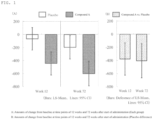
- FIG. 1 shows the amounts of a change in fasting blood myostatin concentration (pg/mL) at the time of the administration of the compound A (0.4 mg per day) to a patient of a nonalcoholic fatty liver disease.
- the compound A may be produced in accordance with, for example, a method described in WO 2005/023777 A1 .
- the compound may be formulated to a preparation in accordance with a method described in a literature.
- a preparation containing the compound A is approved as a therapeutic agent for hyperlipidemia "PARMODIA (registered trademark) TABLET” in Japan, and the "PARMODIA TABLET” may be used.
- a salt or a solvate of the compound A may be used.
- the salt and the solvate may each be produced by an ordinary method.
- the salt of the compound A is not particularly limited as long as the salt is pharmaceutically acceptable, examples thereof include: alkali metal salts, such as a sodium salt and a potassium salt; alkaline earth metal salts, such as a calcium salt and a magnesium salt; organic base salts, such as an ammonium salt and a trialkylamine salt; mineral acid salts, such as a hydrochloride and a sulfate; and organic acid salts such as an acetate.
- the solvate of the compound A or of the salt thereof may include a hydrate and an alcohol adduct (e.g., an ethanol adduct).
- the compound A reduces a blood myostatin concentration. It is conceivable from the fact that the administration of the compound A reduces the blood myostatin concentration that the compound A has a suppressing effect on the synthesis of myostatin in a body or a promoting effect on the discharge of myostatin. Accordingly, the compound A, a salt thereof, or a solvate thereof may be an active ingredient of an agent for reducing a blood myostatin level.
- the compound A, a salt thereof, or a solvate thereof is useful in the prevention and/or treatment of a disease whose symptom is alleviated or improved by the inhibition of myostatin through its reduction in blood myostatin concentration.
- agent for reducing a blood myostatin level refers to, for example, an agent whose application reduces a blood myostatin level to alleviate or improve the symptom of, for example, a disease whose symptom is alleviated or improved by the inhibition of myostatin.
- myostatin inhibitor refers to, for example, an agent that inhibits the function of myostatin in a living organism to alleviate or improve the symptom of, for example, a disease whose symptom is alleviated or improved by the inhibition of myostatin.
- the mode of inhibition of myostatin function is not particularly limited, and examples thereof include: the suppression of the expression of myostatin or the inhibition of the expression; the inhibition of the binding thereof to a myostatin receptor; the competitive inhibition of the binding to the myostatin receptor; and the decomposition of myostatin.
- disease whose symptom is alleviated or improved by the inhibition of myostatin refers to, for example, an amyotrophic disease or a cancer cachexia. Reduction in body fat can be expected from the inhibition of myostatin.
- amyotrophic disease may include: a disease resulting from myogenic amyotrophy such as muscular dystrophy; a disease resulting from neurogenic amyotrophy, such as amyotrophic lateral sclerosis (ALS), spinal muscular atrophy (SMA), or spinal and bulbar muscular atrophy; and sarcopenia. Of those, muscular dystrophy or sarcopenia is preferred in the present invention.
- the muscular dystrophy is a generic term for hereditary muscle diseases in each of which amyotrophy and muscle weakness gradually progress while the destruction, degeneration (myonecrosis), and regeneration of muscle fibers are repeated, and the dystrophy shows a so-called dystrophy change in which the loss of the structure of a muscle fiber bundle, which is characterized by variation in size of the muscle fibers, the formation thereof into circles, an increase in central nuclei thereof, the hyperplasia of the connective tissues thereof, and the fatty metamorphosis thereof, occurs.
- Examples of the muscular dystrophy may include: chromosomal recessive hereditary muscular dystrophy, such as Duchenne muscular dystrophy or Becker muscular dystrophy; congenital muscular dystrophy, such as Fukuyama muscular dystrophy, Ullrich muscular dystrophy, merosin deficiency, integrin deficiency, or Walker-Warburg syndrome; limb-girdle muscular dystrophy; Miyoshi muscular dystrophy; facioscapulohumeral muscular dystrophy; and myotonic dystrophy.
- a chromosomal recessive hereditary muscular dystrophy such as Duchenne muscular dystrophy or Becker muscular dystrophy
- Duchenne muscular dystrophy is more preferred.
- the compound A, a salt thereof, or a solvate thereof, when used as a drug may be formulated into a preparation, such as a tablet, a capsule, a granule, a powder, a lotion, an ointment, an injection, or a suppository, through use of any other pharmaceutically acceptable carrier as required.
- a preparation such as a tablet, a capsule, a granule, a powder, a lotion, an ointment, an injection, or a suppository, through use of any other pharmaceutically acceptable carrier as required.
- Those preparations may each be produced by a known method.
- Examples of the pharmaceutically acceptable carrier may include an excipient, a disintegrator, a binder, a lubricant, a plasticizer, a glidant, a diluent, a solubilizer, a suspending agent, an isotonizing agent, a pH adjuster, a buffer, a stabilizer, a coating agent, a colorant, a taste-masking agent, and an odor-masking agent.
- the compound A, a salt thereof, or a solvate thereof may be administered orally or parenterally, and oral administration is preferred.
- the therapeutically effective dose of the compound A, the salt thereof, or the solvate thereof, and the number of times of the administration thereof may be appropriately set by a person skilled in the art, though the dose and the number vary depending on, for example, the body weight, age, sex, and symptom of a patient.
- the compound A may be administered in a dose of from 0.05 mg to 0.8 mg per day in one to three portions, and is administered preferably in a dose of from 0.1 mg to 0.4 mg per day in one or two portions, more preferably in a dose of from 0.2 mg to 0.4 mg per day in 1 or 2 portions.
- FIG. 1 shows the amounts of a change (pg/mL) from the baselines of blood myostatin concentrations at the time points of 12 weeks and 72 weeks after the start of the administration.
- the numerical values of the baselines are shown in Table 1.
- Table 1 Baseline (pg/mL) Placebo Compound A n 59 57 Mean 3708.08 3812.41 SD 1149.62 1362.47
- the administration of the compound A reduced the fasting blood myostatin concentration at 12 weeks and 72 weeks from the administration in a stepwise manner as compared to the placebo administration. Accordingly, it was found that the compound A is useful as a preventive and/or therapeutic agent for a disease whose symptom was alleviated or improved by inhibition of myostatin.
- the present invention was completed on the basis that it was found for the first time that the compound A has a reducing effect on a fasting blood myostatin concentration.
- the present invention is useful as a drug for preventing and/or treating a disease whose symptom is alleviated or improved by inhibition of myostatin.
Landscapes
- Health & Medical Sciences (AREA)
- Chemical & Material Sciences (AREA)
- Organic Chemistry (AREA)
- Animal Behavior & Ethology (AREA)
- Pharmacology & Pharmacy (AREA)
- Life Sciences & Earth Sciences (AREA)
- Medicinal Chemistry (AREA)
- General Health & Medical Sciences (AREA)
- Public Health (AREA)
- Veterinary Medicine (AREA)
- Nuclear Medicine, Radiotherapy & Molecular Imaging (AREA)
- Engineering & Computer Science (AREA)
- Bioinformatics & Cheminformatics (AREA)
- General Chemical & Material Sciences (AREA)
- Chemical Kinetics & Catalysis (AREA)
- Physical Education & Sports Medicine (AREA)
- Orthopedic Medicine & Surgery (AREA)
- Neurology (AREA)
- Epidemiology (AREA)
- Endocrinology (AREA)
- Pharmaceuticals Containing Other Organic And Inorganic Compounds (AREA)
- Acyclic And Carbocyclic Compounds In Medicinal Compositions (AREA)
- Heterocyclic Carbon Compounds Containing A Hetero Ring Having Nitrogen And Oxygen As The Only Ring Hetero Atoms (AREA)
Abstract
Description
- The present invention relates to an agent for reducing a blood myostatin level.
- Myostatin (another name: growth differentiation factor-8 (GDF8)) is a secretory protein produced from a skeletal muscle cell and suppresses the growth of a skeletal muscle, and the protein belongs to a TGF-β superfamily. It has been known from the phenotype of myostatin gene abnormality in an animal and a human, and observation with an animal model that the inhibition of myostatin shows muscle hypertrophy.
- Attention has been paid to the function of myostatin, and the application of its inhibition to the treatment of an amyotrophic disease such as muscular dystrophy has been expected. An attempt has heretofore been made to develop a drug that exhibits muscle hypertrophy in an animal model, such as a neutralizing antibody for myostatin, an antagonist for myostatin such as a soluble activin IIB receptor, or an analog of follistatin serving as a physiological antagonist in the TGF-β superfamily. However, no drug has been known that was put into practical use as a therapeutic drug for a human.
- As other approaches, attention has been paid to the fact that fenofibrate known as a PPARα agonist suppresses the expression of myostatin (Non Patent Document 1), and an investigation on its effect on a Duchenne muscular dystrophy model animal has been reported (Non Patent Document 2). However, each of those investigations is an investigation in a rodent animal model, and hence a clinical effect of fenofibrate in a human is uncertain.
- Meanwhile, Patent Document 1 discloses that a compound represented by the following formula (1), a salt thereof, or a solvate thereof has a selective PPARα-activating effect, and is hence useful as a preventive and/or therapeutic drug for hyperlipidemia, arteriosclerosis, diabetes, a diabetic complication (e.g., diabetic nephropathy), inflammation, a heart disease, or the like that is not accompanied by a weight gain or obesity in a mammal including a human:

- However, there is no description or suggestion of what effect such a compound has on myostatin.
- [Patent Document 1]
WO 2005/023777 A1 -
- [Non Patent Document 1] Am J Physiol-Endoclinol Metab. (2011) 300, E790-E799
- [Non Patent Document 2] Br J Pharmacol. (2021) 179, 1237-1250
- An objective of the present invention is to provide a novel preventive and/or therapeutic agent useful in the prevention and/or treatment of a disease on which a therapeutic effect can be expected by inhibition of myostatin.
- To achieve the above objective, the present inventors made energetic investigations, and as a result, found that to their complete surprise, a compound disclosed as Example 85 in Patent Document 1 described above, that is, (R)-2-[3-[[N-(benzoxazol-2-yl)-N-3-(4-methoxyphenoxy)propyl]aminomethyl]phenoxy]butyric acid (hereinafter may be referred to as "compound A" or "pemafibrate") reduced a blood myostatin concentration, and was hence useful in the prevention and/or treatment of a disease on which a therapeutic effect was expected by the inhibition of myostatin. In this way, the inventors completed the present invention.
- That is, the present invention provides the following [1] to [28].
- [1] An agent for reducing a blood myostatin level, comprising, as an active ingredient, (R)-2-[3-[[N-(benzoxazol-2-yl)-N-3-(4-methoxyphenoxy)propyl]aminomethyl]phenoxy]butyric acid, a salt thereof, or a solvate thereof.
- [2] An inhibitor of myostatin, comprising (R)-2-[3-[[N-(benzoxazol-2-yl)-N-3-(4-methoxyphenoxy)propyl]aminomethyl]phenoxy]butyric acid, a salt thereof, or a solvate thereof, as an active ingredient.
- [3] An agent for preventing and/or treating an amyotrophic disease, comprising (R)-2-[3-[[N-(benzoxazol-2-yl)-N-3-(4-methoxyphenoxy)propyl]aminomethyl]phenoxy]butyric acid, a salt thereof, or a solvate thereof, as an active ingredient.
- [4] The agent according to [3], wherein the amyotrophic disease is Duchenne muscular dystrophy.
- [5] The agent according to [3], wherein the amyotrophic disease is sarcopenia.
- [6] A pharmaceutical composition for preventing and/or treating an amyotrophic disease, comprising a therapeutically effective dose of (R)-2-[3-[[N-(benzoxazol-2-yl)-N-3-(4-methoxyphenoxy)propyl]aminomethyl]phenoxy]butyric acid, a salt thereof, or a solvate thereof.
- [7] The pharmaceutical composition according to [6], wherein the amyotrophic disease is Duchenne muscular dystrophy.
- [8] The pharmaceutical composition according to [6], wherein the amyotrophic disease is sarcopenia.
- [9] A method of reducing a blood myostatin level, comprising administering an effective dose of (R)-2-[3-[[N-(benzoxazol-2-yl)-N-3-(4-methoxyphenoxy)propyl]aminomethyl]phenoxy]butyric acid, a salt thereof, or a solvate thereof to a patient in need thereof.
- [10] A method of inhibiting myostatin, comprising administering an effective dose of (R)-2-[3-[[N-(benzoxazol-2-yl)-N-3-(4-methoxyphenoxy)propyl]aminomethyl]phenoxy]butyric acid, a salt thereof, or a solvate thereof to a patient in need thereof.
- [11] A method of preventing and/or treating an amyotrophic disease, comprising administering an effective dose of (R)-2-[3-[[N-(benzoxazol-2-yl)-N-3-(4-methoxyphenoxy)propyl]aminomethyl]phenoxy]butyric acid, a salt thereof, or a solvate thereof to a patient in need thereof.
- [12] The method according to [11], wherein the amyotrophic disease is Duchenne muscular dystrophy.
- [13] The method according to [11], wherein the amyotrophic disease is sarcopenia.
- [14] Use of (R)-2-[3-[[N-(benzoxazol-2-yl)-N-3-(4-methoxyphenoxy)propyl]aminomethyl]phenoxy]butyric acid, a salt thereof, or a solvate thereof for reducing a blood myostatin level.
- [15] Use of (R)-2-[3-[[N-(benzoxazol-2-yl)-N-3-(4-methoxyphenoxy)propyl]aminomethyl]phenoxy]butyric acid, a salt thereof, or a solvate thereof for inhibiting myostatin.
- [16] Use of (R)-2-[3-[[N-(benzoxazol-2-yl)-N-3-(4-methoxyphenoxy)propyl]aminomethyl]phenoxy]butyric acid, a salt thereof, or a solvate thereof for preventing and/or treating an amyotrophic disease.
- [17] The use according to [16], wherein the amyotrophic disease is Duchenne muscular dystrophy.
- [18] The use according to [16], wherein the amyotrophic disease is sarcopenia.
- [19] Use of (R)-2-[3-[[N-(benzoxazol-2-yl)-N-3-(4-methoxyphenoxy)propyl]aminomethyl]phenoxy]butyric acid, a salt thereof, or a solvate thereof for production of an agent for reducing a blood myostatin level.
- [20] Use of (R)-2-[3-[[N-(benzoxazol-2-yl)-N-3-(4-methoxyphenoxy)propyl]aminomethyl]phenoxy]butyric acid, a salt thereof, or a solvate thereof for production of a myostatin inhibitor.
- [21] Use of (R)-2-[3-[[N-(benzoxazol-2-yl)-N-3-(4-methoxyphenoxy)propyl]aminomethyl]phenoxy]butyric acid, a salt thereof, or a solvate thereof for production of a pharmaceutical composition for preventing and/or treating an amyotrophic disease.
- [22] The use according to [21], wherein the amyotrophic disease is Duchenne muscular dystrophy.
- [23] The use according to [21], wherein the amyotrophic disease is sarcopenia.
- [24] (R)-2-[3-[[N-(Benzoxazol-2-yl)-N-3-(4-methoxyphenoxy)propyl]aminomethyl]phenoxy]butyric acid, a salt thereof, or a solvate thereof for use in reduction of a blood myostatin level.
- [25] (R)-2-[3-[[N-(Benzoxazol-2-yl)-N-3-(4-methoxyphenoxy)propyl]aminomethyl]phenoxy]butyric acid, a salt thereof, or a solvate thereof for use in inhibition of myostatin.
- [26] (R)-2-[3-[[N-(Benzoxazol-2-yl)-N-3-(4-methoxyphenoxy)propyl]aminomethyl]phenoxy]butyric acid, a salt thereof, or a solvate thereof for use in prevention and/or treatment of an amyotrophic disease.
- [27] The (R)-2-[3-[[N-(benzoxazol-2-yl)-N-3-(4-methoxyphenoxy)propyl]aminomethyl]phenoxy]butyric acid, a salt thereof, or a solvate thereof according to [26], wherein the amyotrophic disease is Duchenne muscular dystrophy.
- [28] The (R)-2-[3-[[N-(benzoxazol-2-yl)-N-3-(4-methoxyphenoxy)propyl]aminomethyl]phenoxy]butyric acid, a salt thereof, or a solvate thereof according to [26], wherein the amyotrophic disease is sarcopenia.
- The present invention provides a novel agent useful in the prevention and/or treatment of a disease on which a therapeutic effect can be expected by the inhibition of myostatin. The present invention provides a novel preventive and/or therapeutic alternative to a patient of the disease on which the therapeutic effect can be expected by inhibition of myostatin.
-
FIG. 1 shows the amounts of a change in fasting blood myostatin concentration (pg/mL) at the time of the administration of the compound A (0.4 mg per day) to a patient of a nonalcoholic fatty liver disease. - (R)-2-[3-[[N-(Benzoxazol-2-yl)-N-3-(4-methoxyphenoxy)propyl]aminomethyl]phenoxy]butyric acid (compound A) to be used in the present invention is represented by the following chemical formula (A):

- The compound A may be produced in accordance with, for example, a method described in
WO 2005/023777 A1 . The compound may be formulated to a preparation in accordance with a method described in a literature. A preparation containing the compound A is approved as a therapeutic agent for hyperlipidemia "PARMODIA (registered trademark) TABLET" in Japan, and the "PARMODIA TABLET" may be used. - In one embodiment of the present invention, a salt or a solvate of the compound A may be used. The salt and the solvate may each be produced by an ordinary method. While the salt of the compound A is not particularly limited as long as the salt is pharmaceutically acceptable, examples thereof include: alkali metal salts, such as a sodium salt and a potassium salt; alkaline earth metal salts, such as a calcium salt and a magnesium salt; organic base salts, such as an ammonium salt and a trialkylamine salt; mineral acid salts, such as a hydrochloride and a sulfate; and organic acid salts such as an acetate. Examples of the solvate of the compound A or of the salt thereof may include a hydrate and an alcohol adduct (e.g., an ethanol adduct).
- As described in Examples described hereafter, the compound A reduces a blood myostatin concentration. It is conceivable from the fact that the administration of the compound A reduces the blood myostatin concentration that the compound A has a suppressing effect on the synthesis of myostatin in a body or a promoting effect on the discharge of myostatin. Accordingly, the compound A, a salt thereof, or a solvate thereof may be an active ingredient of an agent for reducing a blood myostatin level. The compound A, a salt thereof, or a solvate thereof is useful in the prevention and/or treatment of a disease whose symptom is alleviated or improved by the inhibition of myostatin through its reduction in blood myostatin concentration.
- Unless otherwise stated, the term "agent for reducing a blood myostatin level" as used herein refers to, for example, an agent whose application reduces a blood myostatin level to alleviate or improve the symptom of, for example, a disease whose symptom is alleviated or improved by the inhibition of myostatin.
- Unless otherwise stated, the term "myostatin inhibitor" as used herein refers to, for example, an agent that inhibits the function of myostatin in a living organism to alleviate or improve the symptom of, for example, a disease whose symptom is alleviated or improved by the inhibition of myostatin. The mode of inhibition of myostatin function is not particularly limited, and examples thereof include: the suppression of the expression of myostatin or the inhibition of the expression; the inhibition of the binding thereof to a myostatin receptor; the competitive inhibition of the binding to the myostatin receptor; and the decomposition of myostatin.
- The term "disease whose symptom is alleviated or improved by the inhibition of myostatin" as used herein refers to, for example, an amyotrophic disease or a cancer cachexia. Reduction in body fat can be expected from the inhibition of myostatin.
- Examples of the amyotrophic disease may include: a disease resulting from myogenic amyotrophy such as muscular dystrophy; a disease resulting from neurogenic amyotrophy, such as amyotrophic lateral sclerosis (ALS), spinal muscular atrophy (SMA), or spinal and bulbar muscular atrophy; and sarcopenia. Of those, muscular dystrophy or sarcopenia is preferred in the present invention.
- The muscular dystrophy is a generic term for hereditary muscle diseases in each of which amyotrophy and muscle weakness gradually progress while the destruction, degeneration (myonecrosis), and regeneration of muscle fibers are repeated, and the dystrophy shows a so-called dystrophy change in which the loss of the structure of a muscle fiber bundle, which is characterized by variation in size of the muscle fibers, the formation thereof into circles, an increase in central nuclei thereof, the hyperplasia of the connective tissues thereof, and the fatty metamorphosis thereof, occurs.
- Examples of the muscular dystrophy may include: chromosomal recessive hereditary muscular dystrophy, such as Duchenne muscular dystrophy or Becker muscular dystrophy; congenital muscular dystrophy, such as Fukuyama muscular dystrophy, Ullrich muscular dystrophy, merosin deficiency, integrin deficiency, or Walker-Warburg syndrome; limb-girdle muscular dystrophy; Miyoshi muscular dystrophy; facioscapulohumeral muscular dystrophy; and myotonic dystrophy. Of those, a chromosomal recessive hereditary muscular dystrophy, such as Duchenne muscular dystrophy or Becker muscular dystrophy, is preferred in the present invention, and Duchenne muscular dystrophy is more preferred.
- In one aspect of the present invention, the compound A, a salt thereof, or a solvate thereof, when used as a drug, may be formulated into a preparation, such as a tablet, a capsule, a granule, a powder, a lotion, an ointment, an injection, or a suppository, through use of any other pharmaceutically acceptable carrier as required. Those preparations may each be produced by a known method. Examples of the pharmaceutically acceptable carrier may include an excipient, a disintegrator, a binder, a lubricant, a plasticizer, a glidant, a diluent, a solubilizer, a suspending agent, an isotonizing agent, a pH adjuster, a buffer, a stabilizer, a coating agent, a colorant, a taste-masking agent, and an odor-masking agent.
- In one aspect of the present invention, the compound A, a salt thereof, or a solvate thereof may be administered orally or parenterally, and oral administration is preferred. The therapeutically effective dose of the compound A, the salt thereof, or the solvate thereof, and the number of times of the administration thereof may be appropriately set by a person skilled in the art, though the dose and the number vary depending on, for example, the body weight, age, sex, and symptom of a patient. For example, for a normal adult, the compound A may be administered in a dose of from 0.05 mg to 0.8 mg per day in one to three portions, and is administered preferably in a dose of from 0.1 mg to 0.4 mg per day in one or two portions, more preferably in a dose of from 0.2 mg to 0.4 mg per day in 1 or 2 portions.
- The present invention is more specifically described below by way of Examples. However, these Examples are not intended to limit the present invention.
- An effect on blood myostatin at the time of the oral administration of 0.4 mg per day of the compound A (a 0.2-mg tablet of the compound A was administered twice a day at the time of fasting) to a patient of a nonalcoholic fatty liver disease (NAFLD) for 72 weeks was investigated by comparison to the administration of a placebo.
-
FIG. 1 shows the amounts of a change (pg/mL) from the baselines of blood myostatin concentrations at the time points of 12 weeks and 72 weeks after the start of the administration. The numerical values of the baselines are shown in Table 1.Table 1 Baseline (pg/mL) Placebo Compound A n 59 57 Mean 3708.08 3812.41 SD 1149.62 1362.47 - It was clear from
FIG. 1 that the administration of the compound A reduced the fasting blood myostatin concentration at 12 weeks and 72 weeks from the administration in a stepwise manner as compared to the placebo administration. Accordingly, it was found that the compound A is useful as a preventive and/or therapeutic agent for a disease whose symptom was alleviated or improved by inhibition of myostatin. - The present invention was completed on the basis that it was found for the first time that the compound A has a reducing effect on a fasting blood myostatin concentration. The present invention is useful as a drug for preventing and/or treating a disease whose symptom is alleviated or improved by inhibition of myostatin.
Claims (20)
- An agent for reducing a blood myostatin level, comprising, as an active ingredient, (R)-2-[3-[[N-(benzoxazol-2-yl)-N-3-(4-methoxyphenoxy)propyl]aminomethyl]phenoxy]butyric acid, a salt thereof, or a solvate thereof.
- An inhibitor of myostatin, comprising (R)-2-[3-[[N-(benzoxazol-2-yl)-N-3-(4-methoxyphenoxy)propyl]aminomethyl]phenoxy]butyric acid, a salt thereof, or a solvate thereof, as an active ingredient.
- An agent for prevention and/or treatment of an amyotrophic disease, comprising (R)-2-[3-[[N-(benzoxazol-2-yl)-N-3-(4-methoxyphenoxy)propyl]aminomethyl]phenoxy]butyric acid, a salt thereof, or a solvate thereof, as an active ingredient,.
- The agent according to claim 3, wherein the amyotrophic disease is Duchenne muscular dystrophy.
- The agent according to claim 3, wherein the amyotrophic disease is sarcopenia.
- A method of reducing a blood myostatin level, comprising administering an effective dose of (R)-2-[3-[[N-(benzoxazol-2-yl)-N-3-(4-methoxyphenoxy)propyl]aminomethyl]phenoxy]butyric acid, a salt thereof, or a solvate thereof to a patient in need thereof.
- A method of inhibiting myostatin, comprising administering an effective dose of (R)-2-[3-[[N-(benzoxazol-2-yl)-N-3-(4-methoxyphenoxy)propyl]aminomethyl]phenoxy]butyric acid, a salt thereof, or a solvate thereof to a patient in need thereof.
- A method of preventing and/or treating an amyotrophic disease, comprising administering an effective dose of (R)-2-[3-[[N-(benzoxazol-2-yl)-N-3-(4-methoxyphenoxy)propyl]aminomethyl]phenoxy]butyric acid, a salt thereof, or a solvate thereof to a patient in need thereof.
- The method according to claim 8, wherein the amyotrophic disease is Duchenne muscular dystrophy.
- The method according to claim 8, wherein the amyotrophic disease is sarcopenia.
- Use of (R)-2-[3-[[N-(benzoxazol-2-yl)-N-3-(4-methoxyphenoxy)propyl]aminomethyl]phenoxy]butyric acid, a salt thereof, or a solvate thereof for production of an agent for reducing a blood myostatin level.
- Use of (R)-2-[3-[[N-(benzoxazol-2-yl)-N-3-(4-methoxyphenoxy)propyl]aminomethyl]phenoxy]butyric acid, a salt thereof, or a solvate thereof for production of an inhibitor of myostatin.
- Use of (R)-2-[3-[[N-(benzoxazol-2-yl)-N-3-(4-methoxyphenoxy)propyl]aminomethyl]phenoxy]butyric acid, a salt thereof, or a solvate thereof for production of a pharmaceutical composition for preventing and/or treating an amyotrophic disease.
- The use according to claim 13, wherein the amyotrophic disease is Duchenne muscular dystrophy.
- The use according to claim 13, wherein the amyotrophic disease is sarcopenia.
- (R)-2-[3-[[N-(benzoxazol-2-yl)-N-3-(4-methoxyphenoxy)propyl]aminomethyl]phenoxy]butyric acid, a salt thereof, or a solvate thereof for use in reduction of a blood myostatin level.
- (R)-2-[3-[[N-(benzoxazol-2-yl)-N-3-(4-methoxyphenoxy)propyl]aminomethyl]phenoxy]butyric acid, a salt thereof, or a solvate thereof for use in inhibition of myostatin.
- (R)-2-[3-[[N-(benzoxazol-2-yl)-N-3-(4-methoxyphenoxy)propyl]aminomethyl]phenoxy]butyric acid, a salt thereof, or a solvate thereof for use in prevention and/or treatment of an amyotrophic disease.
- The (R)-2-[3-[[N-(benzoxazol-2-yl)-N-3-(4-methoxyphenoxy)propyl]aminomethyl]phenoxy]butyric acid, a salt thereof, or a solvate thereof according to claim 18, wherein the amyotrophic disease is Duchenne muscular dystrophy.
- The (R)-2-[3-[[N-(benzoxazol-2-yl)-N-3-(4-methoxyphenoxy)propyl]aminomethyl]phenoxy]butyric acid, a salt thereof, or a solvate thereof according to claim 18, wherein the amyotrophic disease is sarcopenia.
Applications Claiming Priority (2)
| Application Number | Priority Date | Filing Date | Title |
|---|---|---|---|
| JP2022109010 | 2022-07-06 | ||
| PCT/JP2023/024914 WO2024010030A1 (en) | 2022-07-06 | 2023-07-05 | Agent for reducing blood myostatin level |
Publications (2)
| Publication Number | Publication Date |
|---|---|
| EP4552642A1 true EP4552642A1 (en) | 2025-05-14 |
| EP4552642A4 EP4552642A4 (en) | 2026-01-07 |
Family
ID=89453513
Family Applications (1)
| Application Number | Title | Priority Date | Filing Date |
|---|---|---|---|
| EP23835561.4A Pending EP4552642A4 (en) | 2022-07-06 | 2023-07-05 | Agents to lower myostatin levels in the blood |
Country Status (8)
| Country | Link |
|---|---|
| US (1) | US20260124181A1 (en) |
| EP (1) | EP4552642A4 (en) |
| JP (1) | JPWO2024010030A1 (en) |
| KR (1) | KR20250029790A (en) |
| CN (1) | CN119486731A (en) |
| JO (1) | JOP20240293A1 (en) |
| TW (1) | TW202408499A (en) |
| WO (1) | WO2024010030A1 (en) |
Family Cites Families (3)
| Publication number | Priority date | Publication date | Assignee | Title |
|---|---|---|---|---|
| BRPI0413991B8 (en) | 2003-09-03 | 2021-05-25 | Kowa Co | ppar activator compound and pharmaceutical composition containing the same |
| TWI696462B (en) * | 2013-07-10 | 2020-06-21 | 日商興和股份有限公司 | The therapeutic agent for nonalcoholic fatty liver disease |
| CA3216699A1 (en) * | 2021-04-28 | 2022-11-03 | Kowa Company, Ltd. | Blood carnitine-increasing agent |
-
2023
- 2023-07-05 WO PCT/JP2023/024914 patent/WO2024010030A1/en not_active Ceased
- 2023-07-05 KR KR1020247041107A patent/KR20250029790A/en active Pending
- 2023-07-05 EP EP23835561.4A patent/EP4552642A4/en active Pending
- 2023-07-05 TW TW112124999A patent/TW202408499A/en unknown
- 2023-07-05 US US18/877,377 patent/US20260124181A1/en active Pending
- 2023-07-05 CN CN202380052046.5A patent/CN119486731A/en active Pending
- 2023-07-05 JP JP2024532607A patent/JPWO2024010030A1/ja active Pending
-
2024
- 2024-12-30 JO JOJO/P/2024/0293A patent/JOP20240293A1/en unknown
Also Published As
| Publication number | Publication date |
|---|---|
| JOP20240293A1 (en) | 2024-12-30 |
| KR20250029790A (en) | 2025-03-05 |
| TW202408499A (en) | 2024-03-01 |
| US20260124181A1 (en) | 2026-05-07 |
| WO2024010030A1 (en) | 2024-01-11 |
| JPWO2024010030A1 (en) | 2024-01-11 |
| EP4552642A4 (en) | 2026-01-07 |
| CN119486731A (en) | 2025-02-18 |
Similar Documents
| Publication | Publication Date | Title |
|---|---|---|
| JP7069253B2 (en) | 2-((1- (2 (4-fluorophenyl) -2-oxoethyl) piperidine-4-yl) methyl) isoindoline-1-one for the treatment of schizophrenia | |
| CA2153340C (en) | Application of riluzole in the treatment of parkinson's desease and parkinsonian syndromes | |
| US20230372275A1 (en) | Compositions and Methods of Treating or Preventing Fibrotic Lung Diseases | |
| JP7065839B2 (en) | How to Treat Acute Kidney Injury | |
| TW202011965A (en) | Use of neutrophil elastase inhibitors in liver disease | |
| US20260027088A1 (en) | Inhibitors of Glutathione S-Transferases (GSTS) and NAD(P)H:Quinone Oxidoreductase 1 (NQO1), Pharmaceutical Compositions, and Uses in Managing Cancer | |
| JPH10507777A (en) | Phenoxypiperazine derivatives for treating dopaminergic disorders | |
| JP2022533981A5 (en) | ||
| US20090176846A1 (en) | N-hydroxy-4- {5- [4- (5-isopropyl-2-methyl-1, 3-thiazol-4-yl) phenoxy] pentoxy} benzamidine 2 methanesulfonic acid salt | |
| RU2468015C2 (en) | Polymorphic forms of deferasirox (icl670a) | |
| JP3448869B2 (en) | Prevention and treatment of diabetic complications | |
| US20260124181A1 (en) | Agent for reducing blood myostatin level | |
| US20200222366A1 (en) | Compound for treating osteoarthritis | |
| US20260069585A1 (en) | ISOQUINOLINE COMPOUNDS AND THEIR USE IN TREATING AhR MEDIATED DISEASES | |
| JP4235000B2 (en) | Treatment for glomerular diseases | |
| EP4706656A1 (en) | Combination therapy of dacomitinib and nintedanib for prevention or treatment of pulmonary fibrosis | |
| EP4470563A1 (en) | New therapy and prevention for suppressing aging-related disorders including sarcopenia | |
| US20260069553A1 (en) | TAPINAROF AND ANALOGS THEREOF FOR USE IN TREATING AhR MEDIATED DISEASES | |
| JP5148941B2 (en) | Antitumor agent comprising sulfostine and sulfostine-related compounds as active ingredients | |
| WO2022109292A1 (en) | Methods and materials for inhibiting cb1 activity | |
| EP4525864A2 (en) | Compounds and pharmaceutical compositions useful for managing sickle cell disease and conditions related thereto | |
| JP2005531622A5 (en) | ||
| FR2700115A1 (en) | Use of anticonvulsants carbamazepine and oxcarbazepine |
Legal Events
| Date | Code | Title | Description |
|---|---|---|---|
| STAA | Information on the status of an ep patent application or granted ep patent |
Free format text: STATUS: THE INTERNATIONAL PUBLICATION HAS BEEN MADE |
|
| PUAI | Public reference made under article 153(3) epc to a published international application that has entered the european phase |
Free format text: ORIGINAL CODE: 0009012 |
|
| STAA | Information on the status of an ep patent application or granted ep patent |
Free format text: STATUS: REQUEST FOR EXAMINATION WAS MADE |
|
| 17P | Request for examination filed |
Effective date: 20241119 |
|
| AK | Designated contracting states |
Kind code of ref document: A1 Designated state(s): AL AT BE BG CH CY CZ DE DK EE ES FI FR GB GR HR HU IE IS IT LI LT LU LV MC ME MK MT NL NO PL PT RO RS SE SI SK SM TR |
|
| DAV | Request for validation of the european patent (deleted) | ||
| DAX | Request for extension of the european patent (deleted) | ||
| A4 | Supplementary search report drawn up and despatched |
Effective date: 20251205 |
|
| RIC1 | Information provided on ipc code assigned before grant |
Ipc: A61K 31/423 20060101AFI20251201BHEP Ipc: A61P 21/06 20060101ALI20251201BHEP Ipc: A61P 43/00 20060101ALI20251201BHEP |