EP4550608A2 - Parameterization for grid-code compliant low voltage ac microgrid controller - Google Patents
Parameterization for grid-code compliant low voltage ac microgrid controller Download PDFInfo
- Publication number
- EP4550608A2 EP4550608A2 EP24208184.2A EP24208184A EP4550608A2 EP 4550608 A2 EP4550608 A2 EP 4550608A2 EP 24208184 A EP24208184 A EP 24208184A EP 4550608 A2 EP4550608 A2 EP 4550608A2
- Authority
- EP
- European Patent Office
- Prior art keywords
- der
- pcc
- microgrid
- controller
- curves
- Prior art date
- Legal status (The legal status is an assumption and is not a legal conclusion. Google has not performed a legal analysis and makes no representation as to the accuracy of the status listed.)
- Pending
Links
Images







Classifications
-
- H—ELECTRICITY
- H02—GENERATION; CONVERSION OR DISTRIBUTION OF ELECTRIC POWER
- H02J—ELECTRIC POWER NETWORKS; CIRCUIT ARRANGEMENTS OR SYSTEMS FOR SUPPLYING OR DISTRIBUTING ELECTRIC POWER; SYSTEMS FOR STORING ELECTRIC ENERGY
- H02J3/00—Circuit arrangements for AC mains or AC distribution networks
- H02J3/38—Arrangements for feeding a single network from two or more generators or sources in parallel; Arrangements for feeding already energised networks from additional generators or sources in parallel
- H02J3/46—Controlling the sharing of generated power between the generators, sources or networks
- H02J3/466—Scheduling or selectively controlling the operation of the generators or sources, e.g. connecting or disconnecting generators to meet a demand
-
- H—ELECTRICITY
- H02—GENERATION; CONVERSION OR DISTRIBUTION OF ELECTRIC POWER
- H02J—ELECTRIC POWER NETWORKS; CIRCUIT ARRANGEMENTS OR SYSTEMS FOR SUPPLYING OR DISTRIBUTING ELECTRIC POWER; SYSTEMS FOR STORING ELECTRIC ENERGY
- H02J13/00—Circuit arrangements for providing remote monitoring or remote control of equipment in a power distribution network
- H02J13/14—Circuit arrangements for providing remote monitoring or remote control of equipment in a power distribution network the power network being locally controlled, e.g. home energy management systems [HEMS]
-
- H—ELECTRICITY
- H02—GENERATION; CONVERSION OR DISTRIBUTION OF ELECTRIC POWER
- H02J—ELECTRIC POWER NETWORKS; CIRCUIT ARRANGEMENTS OR SYSTEMS FOR SUPPLYING OR DISTRIBUTING ELECTRIC POWER; SYSTEMS FOR STORING ELECTRIC ENERGY
- H02J3/00—Circuit arrangements for AC mains or AC distribution networks
- H02J3/28—Arrangements for balancing of the load in networks by storage of energy
- H02J3/32—Arrangements for balancing of the load in networks by storage of energy using batteries or super capacitors with converting means
-
- H—ELECTRICITY
- H02—GENERATION; CONVERSION OR DISTRIBUTION OF ELECTRIC POWER
- H02J—ELECTRIC POWER NETWORKS; CIRCUIT ARRANGEMENTS OR SYSTEMS FOR SUPPLYING OR DISTRIBUTING ELECTRIC POWER; SYSTEMS FOR STORING ELECTRIC ENERGY
- H02J3/00—Circuit arrangements for AC mains or AC distribution networks
- H02J3/38—Arrangements for feeding a single network from two or more generators or sources in parallel; Arrangements for feeding already energised networks from additional generators or sources in parallel
- H02J3/381—Dispersed generators
-
- H—ELECTRICITY
- H02—GENERATION; CONVERSION OR DISTRIBUTION OF ELECTRIC POWER
- H02J—ELECTRIC POWER NETWORKS; CIRCUIT ARRANGEMENTS OR SYSTEMS FOR SUPPLYING OR DISTRIBUTING ELECTRIC POWER; SYSTEMS FOR STORING ELECTRIC ENERGY
- H02J3/00—Circuit arrangements for AC mains or AC distribution networks
- H02J3/38—Arrangements for feeding a single network from two or more generators or sources in parallel; Arrangements for feeding already energised networks from additional generators or sources in parallel
- H02J3/46—Controlling the sharing of generated power between the generators, sources or networks
-
- H—ELECTRICITY
- H02—GENERATION; CONVERSION OR DISTRIBUTION OF ELECTRIC POWER
- H02J—ELECTRIC POWER NETWORKS; CIRCUIT ARRANGEMENTS OR SYSTEMS FOR SUPPLYING OR DISTRIBUTING ELECTRIC POWER; SYSTEMS FOR STORING ELECTRIC ENERGY
- H02J7/00—Circuit arrangements for charging or discharging batteries or for supplying loads from batteries
- H02J7/80—Circuit arrangements for charging or discharging batteries or for supplying loads from batteries including monitoring or indicating arrangements
- H02J7/82—Control of state of charge [SOC]
-
- H—ELECTRICITY
- H02—GENERATION; CONVERSION OR DISTRIBUTION OF ELECTRIC POWER
- H02J—ELECTRIC POWER NETWORKS; CIRCUIT ARRANGEMENTS OR SYSTEMS FOR SUPPLYING OR DISTRIBUTING ELECTRIC POWER; SYSTEMS FOR STORING ELECTRIC ENERGY
- H02J7/00—Circuit arrangements for charging or discharging batteries or for supplying loads from batteries
- H02J7/90—Regulation of charging or discharging current or voltage
- H02J7/933—Regulation of charging or discharging current or voltage the cycle being controlled or terminated in response to electric parameters
-
- H—ELECTRICITY
- H02—GENERATION; CONVERSION OR DISTRIBUTION OF ELECTRIC POWER
- H02J—ELECTRIC POWER NETWORKS; CIRCUIT ARRANGEMENTS OR SYSTEMS FOR SUPPLYING OR DISTRIBUTING ELECTRIC POWER; SYSTEMS FOR STORING ELECTRIC ENERGY
- H02J2101/00—Supply or distribution of decentralised, dispersed or local electric power generation
- H02J2101/20—Dispersed power generation using renewable energy sources
-
- H—ELECTRICITY
- H02—GENERATION; CONVERSION OR DISTRIBUTION OF ELECTRIC POWER
- H02J—ELECTRIC POWER NETWORKS; CIRCUIT ARRANGEMENTS OR SYSTEMS FOR SUPPLYING OR DISTRIBUTING ELECTRIC POWER; SYSTEMS FOR STORING ELECTRIC ENERGY
- H02J2101/00—Supply or distribution of decentralised, dispersed or local electric power generation
- H02J2101/20—Dispersed power generation using renewable energy sources
- H02J2101/22—Solar energy
- H02J2101/24—Photovoltaics
-
- H—ELECTRICITY
- H02—GENERATION; CONVERSION OR DISTRIBUTION OF ELECTRIC POWER
- H02J—ELECTRIC POWER NETWORKS; CIRCUIT ARRANGEMENTS OR SYSTEMS FOR SUPPLYING OR DISTRIBUTING ELECTRIC POWER; SYSTEMS FOR STORING ELECTRIC ENERGY
- H02J2103/00—Details of circuit arrangements for mains or AC distribution networks
- H02J2103/30—Simulating, planning, modelling, reliability check or computer assisted design [CAD] of electric power networks
-
- H—ELECTRICITY
- H02—GENERATION; CONVERSION OR DISTRIBUTION OF ELECTRIC POWER
- H02J—ELECTRIC POWER NETWORKS; CIRCUIT ARRANGEMENTS OR SYSTEMS FOR SUPPLYING OR DISTRIBUTING ELECTRIC POWER; SYSTEMS FOR STORING ELECTRIC ENERGY
- H02J2103/00—Details of circuit arrangements for mains or AC distribution networks
- H02J2103/30—Simulating, planning, modelling, reliability check or computer assisted design [CAD] of electric power networks
- H02J2103/35—Grid-level management of power transmission or distribution systems, e.g. load flow analysis or active network management
-
- H—ELECTRICITY
- H02—GENERATION; CONVERSION OR DISTRIBUTION OF ELECTRIC POWER
- H02J—ELECTRIC POWER NETWORKS; CIRCUIT ARRANGEMENTS OR SYSTEMS FOR SUPPLYING OR DISTRIBUTING ELECTRIC POWER; SYSTEMS FOR STORING ELECTRIC ENERGY
- H02J2105/00—Networks for supplying or distributing electric power characterised by their spatial reach or by the load
- H02J2105/10—Local stationary networks having a local or delimited stationary reach
Definitions
- Embodiments of the present disclosure relate to a method, device and computer-readable medium for operating a low voltage AC microgrid controller.
- a microgrid is a local electrical grid with defined electrical boundaries, acting as a single controllable entity.
- a microgrid can include distributed energy resources (DERs), such as photovoltaic devices (PVs), wind turbines, battery energy storage systems (BESS's), and loads.
- DERs distributed energy resources
- PVs photovoltaic devices
- BESS's battery energy storage systems
- a microgrid can operate in either grid connected mode or island mode. In the grid connected mode, the microgrid operates connected to and synchronous with the traditional wide area grid (macro-grid). In the island mode, there is no support from the wide area grid, and the microgrid functions autonomously.
- Microgrid configuration can be direct current (DC), alternating current (AC), or hybrid. An AC microgrid can be operated in conjunction with a wide area grid.
- microgrid controller needs to manage the DERs in the microgrid while complying with a given grid code.
- the microgrid controller also needs to sort through input data from the DERs to obtain the data relevant to managing the microgrid.
- Embodiments of the present disclosure provide a method for operating a controller for a microgrid.
- the method includes obtaining a set of parameter data characterizing one or more regulation curves of one or more national grid codes.
- the one or more regulation curves relate to a set of functional variables for point of common coupling (PCC) functions performed by the controller.
- the method further includes configuring messages to a plurality of distributed energy resources (DERs) interconnected to the PCC. The messages are configured for reading input data from registers of each DER.
- the method further includes performing the PCC functions to control the microgrid according to at least one of the one or more regulations curves, based on a subset of the input data from each DER that relates to the set of functional variables.
- PCC point of common coupling
- the microgrid controller 180 can regulate the power flow from the DERs, and maintain quality and reliability of the microgrid. Power generated by the DERs is controlled according to the load demand.
- the aims of any control technique can include, for example, maintaining a constant voltage and a constant frequency of the microgrid.
- Exemplary grid codes include the American IEEE 1547 code, the Italian CE10-16 code, and the German VDE AR4110 code.
- Each grid code can specify a number of regulation curves.
- the regulation curves characterize functional variables that are important for PCC management, such as voltage, frequency, active power, reactive power, and the like.
- Exemplary regulation curves can include reactive power vs voltage curve (Volt-Var), reactive power vs active power curve (Watt-Var), reactive power vs power factor curve (PF-Var), active power vs voltage curve (Volt-Watt), frequency droop curve, voltage ride-through curves, and the like.
- the grid code may have a priority list setting power priorities.
- a microgrid controller can obtain input data from the DERs by accessing the registers of the DERs.
- Each DER manufacturer can have its own register maps (e.g., Modbus register maps).
- a Modbus register map can include a list defining what the data are, where the data are stored (e.g., in which registers), and how the data are stored. Since the field of microgrid is still in its infancy, there are no concrete rules yet in terms of which DERs can be included in the aggregate power control loop at the PCC.
- microgrid controllers need to sort through various load, source, and storage devices on a case-by-case basis to meet power requirements at the PCC. There is a need to streamline the parameterization of functions between national grid codes and the classification process for various types of DERs.
- Embodiments of the present disclosure provide a method of initializing a low-voltage AC microgrid controller that can be readily adapted to comply with a variety of national grid codes and to read relevant data from a variety of DERs.
- a generic data structure can be configured for holding parameterized data characterizing the regulation curves of various grid codes, and for storing register maps of the DERs for parsing relevant data from the DERs. As DERs enter and leave the microgrid, the microgrid controller can dynamically reshape the aggregate boundaries of the PCC control loop.
- the more prominent national grid codes such as the American IEEE 1547 code, the Italian CEI0-16 code, and the German VDE AR4110 code
- the more prominent national grid codes can be parameterized and preloaded into the microgrid controller as a library of national grid codes.
- Any new grid code can be parameterized by users (e.g., engineers) using the same generic data structure, and can be added to the library of national grid codes.
- the regulation curves of various grid codes often complement with one another. When there are overlaps, priorities can be set in a case structure. Adhering to one grid code may not preclude functions of another.
- the microgrid controller can define a set of functional variables for PCC functions performed by the microgrid controller for managing the microgrid.
- a lookup table can be provided for linking the registers of a given DER to the set of functional variables.
- Read messages can be configured to read input data at all registers.
- a parser can sort through the larger set of input data to obtain a smaller subset of the input data that are related to the functional variables for the PCC functions, such as voltage, current, frequency, and the like.
- Embodiments of the present disclosure can streamline the characterization process for various national grid codes, and streamline the classification process for various types of DERs, which can afford robust control at the PCC while allowing for organic DER growth at industrial sites.
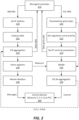
- FIG. 2 shows an exemplary flowchart illustrating a method of operating a microgrid controller 210 according to some embodiments.
- the controller 210 is configured to run two programs in parallel.
- a first program e.g., a programmable logic controller program, or PLC PRG
- PLC PRG programmable logic controller program
- MB PRG Modbus program
- the PLC program and the Modbus program can run at their own rate, and can share data through the global variables.
- the PLC program can parameterize the regulation curves of one or more national grid codes, such as the American IEEE 1547 code, the Italian CEI0-16 code, the German VDE AR4110 code, and the like. Some national grid codes may have multiple regulation curves.
- the PLC program can set regulation curve priorities among multiple regulation curves.
- the PLC program can set ride through (RT) and trip parameters (e.g., low voltage ride through or LVRT, high voltage ride through or HVRT). Steps 220, 222, and 224 are the initialization steps for parameterizing national grid codes, which will be described in more detail below.
- the parameters that characterize the regulation curves and ride through timers for the new code can be stored in the controller 210. If a grid code has already been parameterized and loaded in the controller 210, the PLC program can skip steps 222 and 224, and go to step 226.
- the Modbus program can set IP addresses for the registers of each DER.
- a lookup table can be used to map the functional variables for PCC functions to the register addresses of each DER. Steps 230 and 232 are the initialization steps for Modbus communication with the DERs, which will be described in more detail below. If it is a new DER that just entered the microgrid, the mapping data for the register addresses can be stored in the controller 210.
- the microgrid controller 210 can run the cyclical steps 226, 228, 234, 236, 238, and 240 to manage the microgrid.
- an energy management state machine (EMSM) can select which PCC functions to run by the state and user preference (e.g., U.S. Patent Application Serial No. 18/363,375 filed on August 1, 2023 , entitled “ENERGY MANAGEMENT STATE MACHINE FOR MICROGRIDS," describes a EMSM, the content of which is incorporated herein by reference).
- the active power and reactive power (PQ) de-aggregation is performed to allocate the active power and the reactive power to individual DERs.
- the PQ de-aggregation step 228 is described in more detail below.
- PQ aggregator is updated. For example, if a new DER has entered the microgrid, the microgrid controller 210 can update the aggregate PQ polygon characteristics, and update the polling rate on DERs according to the number of devices active in the microgrid.
- input data are read from the registers of each DER. The input data are parsed to obtain a subset of the input data that relates to the functional variables for PCC functions. The subset of the input data is input into the EMSM 226.
- the Modbus channel repeats its tasks continuously by first polling the breaker at the PCC, then the DERs, and finally sending commands.
- the data relating to the functional variables for PCC functions such as voltage (V), frequency (f), active power (P), reactive power (Q), etc., are measured at the PCC.
- the PQ de-aggregation step 228 can also check the state of charge (S.O.C.) of each DER and classify as charged, balanced, or empty, which affects the PQ aggregator as described in more detail below.
- S.O.C. state of charge
- the PLC program can pre-load characteristics of popular national electric grid codes for some distributed generation sites, such as the American IEEE 1547 code, the Italian CE10-16 code, the German VDE AR4110 code, and the like. Studying the various regulation curves of the various grid codes, some common patterns can be observed.
- FIGS. 3 , 4 , and 5 show some exemplary regulation curves of the IEEE 1547 code.
- FIG. 3 shows two active power vs voltage curves (Volt-Watt);
- FIG. 4 shows an reactive power vs voltage curve (Volt-Var);
- FIG. 5 shows an reactive power vs active power curve (Watt-Var).
- each of these regulation curves includes several piecewise linear regions.
- each Volt-Watt curve shown in FIG. 3 has a first horizontal linear region for V ⁇ V 1 , a second linear region for V 1 ⁇ V ⁇ V 2 , and a third horizontal linear region for V > V 2 .
- One or two end points delineate each piecewise linear region.
- the first linear region is defined by the end point (P 1 ,V 1 )
- the second linear region is defined by the end points (P 1 ,V 1 ) and (P 2 ,V 2 )
- the third linear region is defined by the end point (P 2 ,V 2 ).
- each regulation curve can be defined with variables in the form (X,Y), such as (P,V) for the Volt-Watt curve shown in FIG. 3 , (V,Q) for the Volt-Var curve shown in FIG. 4 , and (P,Q) for the Watt-Var curve shown in FIG. 5 .
- An array parser can assign endpoints for each piecewise linear region. For example, the logic to specify each linear region in the Volt-Watt curve shown in FIG.
- X variable is the voltage V
- Y variable is the active power P.
- Table 1 is from the IEEE 1547 code that specifies the settings for the end points of the piecewise regions, e.g., (P 1 ,V 1 ) and (P 2 ,V 2 ), for category A and category B devices.
- a grid code may include several settings for a given regulation curve.
- the IEEE 1547 code includes three tables for the voltage-active power settings.
- each of the settings can be parameterized and saved in the controller.
- Table 1 Voltage-active power parameters Values for DER Category A Category B V 1 1.05 V N 1.05 V N P 1 P rated P rated V 2 1.1 V N 1.1 V N P 2 (applicable to DER that can only generate active power) The lesser of 0.2 P rated or P min The lesser of 0.2 P rated or P min P' 2 (applicable to DER that can generate and absorb active power) P ' rated P ' rated Open loop response time 90 s 90 s
- the X variable is the voltage V
- the Y variable is the reactive power Q.
- Table 2 is from the IEEE 1547 code that specifies settings for the end points of the piecewise regions, e.g., (V 1 ,Q 1 ), (V 2 ,Q 2 ), (V 3 ,Q 3 ), and (V 4 ,Q 4 ).
- the piecewise linear regions can be classified in a similar way.
- the X variable is the active power (P)
- the Y variable is the reactive power (Q).
- Table 3 is from the IEEE 1547 code that specifies settings for the end points of the piecewise regions, e.g., (P 1 ,Q 1 ), (P 2 ,Q 2 ), (P 3 ,Q 3 ), (P 1 ',Q 1 '), (P 2 ',Q 2 '), and (P 3 ',Q 3 ').
- FIG. 6 shows the Volt-Var curve of the Italian CEI0-16 code.
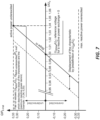
- FIG. 7 shows the Volt-Var curve of the German VDE-AR4110 code (the positive vertical axis represents injection or under-excited region; the negative vertical axis represents absorption or over-excited region). Comparing the Volt-Var curves shown in FIGS. 4 , 6 and 7 , it can be noted that the Volt-Var curves for the IEEE 1547 code, the CE10-16 code, and the VDE-AR4110 code follow the same form.
- the values of the parameters (X1, Y1), (X2, Y2), (X3, Y3), and (X4, Y4), which define the end points of the piecewise linear regions can be updated to fit a given regulation curve of a given regional standard.
- the updated parameters can stretch, shrink, or shift a regulation curve to new settings to comply with a given code.
- the IEEE1547 code does not have a priority list on regulation curves, deferring instead to distribution system operators (DSOs) to select a reactive power regulation curve and to choose between a constant P or Volt-Watt real power curve.
- DSOs distribution system operators
- a case structure is deployed to select between the limited number of choices.
- the CEI grid code has a default priority list on regulation curves, although this may be changed with priority coils as needed, leaving the controller to determine which curves to follow.
- an algorithm calculates a ⁇ p word' and ⁇ q word' based on priorities. They are an important tool used to select which functions will provide power setpoints.
- the ⁇ p word' involves nested if loops, often choosing between conflicting setpoints.
- the Volt-Watt curve uses optimal energy setpoints to track when voltage is not high, but shifts to absorb more power as V(PCC) approaches 1.1*Vpu.
- low-voltage ride through also referred to as under-voltage ride through (UVRT) or fault ride through (FRT)
- UVRT under-voltage ride through
- FRT fault ride through
- An electrical generator may not immediately disconnect from the grid in the event of a voltage drop (also referred to as a voltage sag), but can continue to work for a certain period of time.
- high voltage ride through relates to handling of a voltage rise or swell.
- the state machine can enter a condition in which it would trip if the disturbance persists until a timer expires.
- a technique is deployed to tabulate the (X,Y) thresholds for ride through curves in a similar way as the regulation curves.
- the ride-through timer (the Y threshold) can be dependent on the severity of the voltage (or frequency) disturbance (the X threshold), as discussed below.
- FIG. 8 shows a low voltage ride through (LVRT) curve from the IEEE 1547 code.
- the vertical axis is the residual voltage (normalized).
- the horizontal axis is the minimum duration (referred to as trip timer or ride through timer). Note that there are several step changes in the LVRT curve.
- the trip timer depends on the severity of the voltage drop from the normal operating condition.
- Table 4 is from the IEEE 1547 code that summarizes the trip timer for the various conditions.
- the shaded voltage band 810 between the values of 0.88 and 1.00 is the normal operating voltage range.
- the shaded voltage band 820 between the values of 0.00 and 0.05 is the momentary cessation voltage range.
- the microgrid is in a momentary cessation mode.
- the trip timer is 10 seconds.
- the trip timer is also 10 seconds.
- each step can be programmed with a unique timer that is independent of timers in adjacent regions. For example, a deviation below 0.5 for less than one second cannot reset the longer timer affected by disturbance 0.50 ⁇ V ⁇ 0.88.
- FIG. 9 shows an LVRT curve from the CEI0-16 code.
- the trip timer has a linear relationship with the voltage. According to some embodiments, this is implemented with a sliding timer, with the trip timer (duration) inversely proportional to the voltage sag (i.e., the smaller the deviation from the normal operating voltage, the longer the trip timer).
- the timer can continuously adjust its hold time while voltage remains in the ride-through region.
- the trip timer (the duration of a voltage ride through) and the voltage thresholds to enter and remain in such a state are parameterized according to national grid codes (e.g., the IEEE 1547 code or the CEI0-16 code) or user configuration.
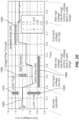
- FIG. 10 illustrates an example of voltage ride through according to the IEEE 1547 code.
- the solid curve 1002 is the grid voltage (normalized) plotted as a function of time.
- the voltage band indicated by the vertical double arrow 1030 is the normal operating voltage range (e.g., between the values of 0.88 and 1.1).
- the voltage band indicated by the vertical double arrow 1010 is the high voltage ride through (HVRT) voltage range (e.g., between the values of 1.1 and 1.3).
- the voltage band indicated by the vertical double arrow 1020 is the low voltage ride through (LVRT) voltage range (e.g., between the values of 0.5 and 0.88).
- the horizontal arrow 1040 indicates the LVRT timer limit.
- the system does not trip. With the LVRT control, the voltage is back to the normal operating range.
- the horizontal arrow 1050 indicates the HVRT timer limit. Because the time duration in which the PCC voltage stays in the HVRT voltage range exceeds the HVRT timer limit, the microgrid breaker at PCC is tripped.
- the algorithm can support a variety of national grid codes. Similar to the regulation curves, the various piecewise linear regions of a voltage ride through curve are delineated by end points. These end points can be captured by an array of V1,T1... Vn,Tn, for code-specific trip time regions vs Vpcc.
- Table 5 shows the settings for V1,T1...Vn,Tn, for the England code, the German code, the Italian code, and the American code.
- Table 5 National Code V5 T5 V4 T4 V3 T3 V2 T2 V1 T1 England (4) 0.95 300 0.85 60 0.85 2.2 0.15 0.15 0.15 0 German (3) 0.95 300 0.85 60 0.85 3.0 0.15 0.15 0.15 0 Italian (2) 0.92 180 0.85 60 0.85 1.5 0.15 0.2 0.15 0 U.S.A. (1) 0.88 20 0.7 20 0.7 10 0.5 10 0.5 1
- the piecewise linear regions include horizontal and vertical sections.
- the LVRT curve includes a linear region defined by the end points 930 and 940. This region is rather broad (e.g., in the voltage range 0.15 ⁇ V ⁇ 0.85). It may require sharp response time at the low voltage end (e.g., trip timer ⁇ 200 ms). In the voltage range close to the normal range (e.g., 0.85 ⁇ V ⁇ 1.15), the trip timer is between 1.0 - 1.5 seconds.
- the next statement in the code considers the horizontal and linear regions as such: (V-V2)*(T3-T2)/(V3-V2) + T2. This handles the horizontal section between the end points 854 and 856 in FIG. 8 or between the ends points 920 and 930 in FIG. 9 , as well as the linear section between the end points 930 and 940 in FIG. 9 .
- the trip timer may be calculated in the PLC, and then delivered to a relay as the trip timer parameter in the UV function. This may ensure that the timer is executed faithfully so long as the voltage is sampled and held for at least a cycle (100-150 ms), and the parameter T,uv is updated before the relay expires.
- the IP addresses of the registers are decoded to double word.
- the IP addresses can be sorted in chronological order, from the first register to the last register.
- the size of the address space needed can be calculated as the length (NB) from the first register's address to the last register's address.
- Messages are then crafted.
- time for consecutive read messages can increment by ten milliseconds for each DER (e.g., at twice the rate of PCC measurements taken at the circuit breaker).
- Each message can be active for 5 ms duration. Any error can be decoded into a string to check packets on the network LAN.
- FIGS. 11A and 11B illustrate consecutive read messages to a plurality DERs 1110, 1120, and 1130 (e.g, PV1, BESS1, BESS2) according to some embodiments.
- the read message to the DER 1110 is at 150 ms
- the read message to the DER 1120 is at 160 ms
- the read message to the DER 1130 is at 170 ms, and so on.
- Each read message is active for 5 ms.
- a set of functional variables is defined based on the PCC functions. Each functional variable is assigned to a respective register of a DER, so that the controller can locate the relevant input data.
- mappings are made for each DER pointing from the functional variables for PCC functions towards their Modbus register addresses.
- Table 6 shows an example of Modbus mapping for a generic DER according to some embodiments.
- a lookup table can be used to match the name and IP address of each DER's registers. The user can then connect the registers of interest to PCC functions with register address pointers available in global variables.
- all of the input data measured from a DER at the PCC are assigned to a data array data_read_grid.
- a parser can sort through the data array data_read_grid to generate a smaller data array data_in_pcc, which includes only those data relating to the functional variables, such as voltage, current, frequency, and the like.
- the data in the smaller data array data_in_pcc is a subset of the input data in the larger data array data_read_grid.
- a for loop is run for each device within the microgrid's control, starting with the PCC breaker and then moving to storage devices.
- the input array data_read_grid can be set up for reading large swathes of data from each DER.
- the size of the read message can be determined by the length (NB) from the address of the first register to the address of the last register.
- the input array data_read_grid would need to be equal to or larger than the number of bytes read by the message.
- the large swathes of data in the input array data_read_grid can be sorted by the parser into the smaller data array data_in_pcc, as described above.
- the address array is equal in size to the data array data_in_pcc, ensuring that each functional variable is linked to an address pointer. This condition can be met for all devices complying to a standard "class" (e.g., load, generation, or storage) within the microgrid.
- a standard "class" e.g., load, generation, or storage
- the controller can update the aggregate PQ polygon characteristics and manage the power traffic on the bus accordingly. If a DER has entered or left the microgrid, the MB_PRG and subordinate functions can update the polling rate on DERs according to the number of DERs active in the loop (e.g., as illustrated in FIGS. 11A and 11B ). The controller can dynamically update its control loop and the aggregate PQ boundaries as the functional parameters change in the microgrid, as discussed in more detail below.
- the controller defines all DERs in the microgrid, and sets the functional parameters in global variables to address a minimum data array needed for each DER according to its class.
- this process can include the following steps: (i) identifying the grid code and any categories of the DERs, (ii) defining the nominal voltage and the nominal frequency, (iii) providing addresses of the input registers of each DER (e.g., according to Table 6), and (iv) determining how many DERs of each class (e.g., loads, PVs, BESS's) in the microgrid.
- a microgrid can include up to 30 loads, 3 PVs, 3 BESS's, and 1 circuit breaker.
- the addresses of the following holding registers in the Modbus map can be specified: the trip coil (e.g., the circuit breaker) at the PCC, PQ setpoints for all BESS's, and the load coils in case of demand response.
- Input registers are found in Table 6.
- Table 6 Name comments type register unit PCC_Frequency Frequency of PCC Float 0 Hz
- PCC_Breaker Operate the breaker Coil 1 bool PCC_V_RMS_A RMS of PCC Va Float 2 p.u.
- the communication channel of the controller can check incoming data from the DERs to verify whether register addresses are set properly. If invalid register addresses are found, the DER can be disabled. Disabling or changing any DER within the microgrid can trigger a reinitialization. Reshaping of microgrid size by the quantity of valid devices is performed by a subordinate PLC function ⁇ Read Maps.' The evolution of the microgrid as controllable devices change over time is reported to the PQ polygon. The controller can use updated DER conditions to define aggregate bounds on the microgrid as the sum of the powers available in individual DERs, as described in more detail below. The simplicity in aggregate is made possible by the generic data structure provided according to embodiments of this disclosure.
- Devices of all classes can constantly reshape the PQ polygon as the microgrid evolves.
- the controller when a new device is activated, the controller first parses its Modbus map for all registers to data needed to comply with the data type for the device's class. If the new DER is approved, the controller can add the new DER's rated power to the PCC aggregate, and can poll for it in the next DER time slot (as illustrated in FIGS. 11A and 11B ). Conversely, if the new DER is found not in compliance, the controller can remove the new DER's rated power from the PCC aggregate, and can slow down the polling rate of the new DER by 100 times. This can free up a DER time slot on the message queue to poll for other devices and optimize throughput.
- controller After the controller has read the data from the DERs in the microgrid, run the PCC functions, and calculated the output from the aggregate P & Q proportional-integral (PI) controller (e.g., performed by the EMSM 226 in FIG. 2 ), setpoints are distributed to dispatchable generation or (charged) storage units.
- the controller can determine which storage units are charged based on their state of charge (S.O.C.), which can influence the aggregate PQ polygon.
- the allocation of power provided by the storage units is determined according to the fractional state of charge (S.O.C.) of each storage unit relative to the total S.O.C. cumulated in all storage units.
- the controller can dynamically classify each storage unit in the microgrid as "generation only” (gen), "balanced,” or “absorption only” (abs), based on the fractional S.O.C. of each storage unit. For example, if the fractional S.O.C. of a storage unit is greater than a first threshold (e.g. 80%), that storage unit can be classified as "generation only”; if the fractional S.O.C. is less than a second threshold (e.g. 20%), that storage unit can be classified as "absorption only”; if the fractional S.O.C.
- a first threshold e.g. 80%
- a second threshold e.g. 20%
- P pcc(gen) is the total active power generated (maximum magnitude of positive active power) at the PCC
- P pcc(abs) is the total active power available
- the controller When absorbing power from the PCC, the reciprocal of S.O.C. can be used to determine which storage units are optimal for power storage (to be charged). For example, the storage units that have the lowest charge can be designated for power storage. According to some embodiments, if real power is to be absorbed at the PCC, the controller makes use of the parameter bess[n]_true_soc, defined as follows:
- P bess n P pcc abs ⁇ true S . O . C . bess n total true S . O . C . bess 1 ... n
- P bess(n) is the power setpoint for the storage unit BESS(n).
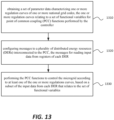
- FIG. 13 is a flowchart illustrating a method of operating a microgrid controller according to some embodiments.
- the method includes, at 1310, obtaining a set of parameter data characterizing one or more regulation curves of one or more national grid codes.
- the one or more regulation curves relate to a set of functional variables for point of common coupling (PCC) functions performed by the controller.
- the method further includes, at 1320, configuring messages to a plurality of distributed energy resources (DERs) interconnected to the PCC. The messages are configured for reading input data from registers of each DER.
- the method further includes, at 1330, performing the PCC functions to control the microgrid according to at least one of the one or more regulations curves, based on a subset of the input data from each DER that relates to the set of functional variables.
- DERs distributed energy resources
- the method further includes, obtaining a register mapping for each respective DER, the register mapping linking a subset of the registers of the respective DER to the set of functional variables, and parsing the input data to obtain the subset of the input data using the register mapping.
- Each DER of the plurality of DERs can be classified into one of a load, a source, or a storage.
- each respective regulation curve specifies a relationship between two functional variables of the set of functional variables.
- Each respective regulation curve includes piecewise linear regions delineated by a plurality of end points.
- the set of parameter data can include coordinates of the plurality of end points delineating the piecewise linear regions.
- the one or more national grid codes can be selected from a predefined library of national grid codes.
- the predefined library of national grid codes can include, for example, the IEEE 1547 Code, the CE10-16 Code, or the VDE AR4110 Code.
- the set of parameter data characterizing the one or more regulation curves of the one or more national grid codes can be preloaded in the controller.
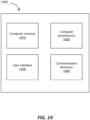
- FIG. 14 is a simplified block diagram of a controller 1400 for controlling a microgrid according to some embodiments.
- the controller 1400 includes a computer memory 1410 and one or more computer processors 1420.
- the computer memory 1410 can be configured to store a set of parameter data characterizing one or more regulation curves of one or more national grid codes.
- the one or more regulation curves relate to a set of functional variables for PCC functions.
- the one or more computer processors can be configured to send messages to the plurality of DERs for reading input data from registers of each DER, and perform the PCC functions to control the microgrid according to at least one of the one or more regulations curves, based on a subset of the input data from each DER that relates to the set of functional variables.
- the controller 1400 can further include a user interface 1430.
- the user interface 1430 can allow a user to enter parameter data characterizing additional regulation curves of additional national grid codes, which can be saved in the computer memory 1410.
- the controller 1400 can further include communication devices 1440.
- the communication devices 1440 can include wired and/or wireless communication devices for communicating with the DERs or the outside world.
- embodiments of the present disclosure provide a method of initializing a low-voltage AC microgrid controller that can be readily adapted to comply with a variety of national grid codes and to read relevant data from a variety of DERs.
- the microgrid controller can dynamically reshape the aggregate boundaries of the PCC control loop.
- Embodiments of the present disclosure can afford robust control at the PCC while allowing for organic DER growth at industrial sites.
- the recitation of "at least one of A, B and C” should be interpreted as one or more of a group of elements consisting of A, B and C, and should not be interpreted as requiring at least one of each of the listed elements A, B and C, regardless of whether A, B and C are related as categories or otherwise.
- the recitation of "A, B and/or C" or "at least one of A, B or C” should be interpreted as including any singular entity from the listed elements, e.g., A, any subset from the listed elements, e.g., A and B, or the entire list of elements A, B and C.
Landscapes
- Engineering & Computer Science (AREA)
- Power Engineering (AREA)
- Supply And Distribution Of Alternating Current (AREA)
- Feedback Control In General (AREA)
Abstract
Description
- Embodiments of the present disclosure relate to a method, device and computer-readable medium for operating a low voltage AC microgrid controller.
- A microgrid is a local electrical grid with defined electrical boundaries, acting as a single controllable entity. A microgrid can include distributed energy resources (DERs), such as photovoltaic devices (PVs), wind turbines, battery energy storage systems (BESS's), and loads. A microgrid can operate in either grid connected mode or island mode. In the grid connected mode, the microgrid operates connected to and synchronous with the traditional wide area grid (macro-grid). In the island mode, there is no support from the wide area grid, and the microgrid functions autonomously. Microgrid configuration can be direct current (DC), alternating current (AC), or hybrid. An AC microgrid can be operated in conjunction with a wide area grid.
- Various countries and regions in the world have developed their own grid codes for microgrids, such as the American IEEE 1547 code, the Italian CEI0-16 code, and the German VDE AR4110 code. Each grid code can specify a number of regulation curves for managing microgrids. A microgrid controller needs to manage the DERs in the microgrid while complying with a given grid code. The microgrid controller also needs to sort through input data from the DERs to obtain the data relevant to managing the microgrid.
- Embodiments of the present disclosure provide a method for operating a controller for a microgrid. The method includes obtaining a set of parameter data characterizing one or more regulation curves of one or more national grid codes. The one or more regulation curves relate to a set of functional variables for point of common coupling (PCC) functions performed by the controller. The method further includes configuring messages to a plurality of distributed energy resources (DERs) interconnected to the PCC. The messages are configured for reading input data from registers of each DER. The method further includes performing the PCC functions to control the microgrid according to at least one of the one or more regulations curves, based on a subset of the input data from each DER that relates to the set of functional variables.
- Subject matter of the present disclosure will be described in even greater detail below based on the exemplary figures. All features described and/or illustrated herein can be used alone or combined in different combinations. The features and advantages of various embodiments will become apparent by reading the following detailed description with reference to the attached drawings, which illustrate the following:
-
FIG. 1 shows an exemplary structure of an AC microgrid according to some embodiments; -
FIG. 2 shows an exemplary flowchart illustrating a method of operating a microgrid controller according to some embodiments; -
FIG. 3 shows two active power vs voltage curves (Volt-Watt) of the IEEE 1547 code; -
FIG. 4 shows an reactive power vs voltage curve (Volt-Var) of the IEEE 1547 code; -
FIG. 5 shows an reactive power vs active power curve (Watt-Var) of the IEEE 1547 code; -
FIG. 6 shows the Volt-Var curve of the Italian CEI0-16 code; -
FIG. 7 shows the Volt-Var curve of the German VDE-AR4110 code; -
FIG. 8 shows a low voltage ride through curve from the IEEE 1547 code; -
FIG. 9 shows a low voltage ride through curve from the CEI0-16 code; -
FIG. 10 illustrates an example of low voltage ride through and high voltage ride through according to the IEEE 1547 code, according to some embodiments; -
FIGS. 11A and 11B illustrate consecutive read messages to a plurality DERs according to some embodiments; -
FIG. 12 shows an exemplary PQ polygon according to some embodiments; -
FIG. 13 is a flowchart illustrating a method of operating a microgrid controller according to some embodiments; and -
FIG. 14 is a simplified block diagram of a controller for controlling a microgrid according to some embodiments. -
FIG. 1 shows an exemplary structure of anAC microgrid 100. In this example, themicrogrid 100 includes a number of DERs, for example aPV system 110, three BESS's 120, 122, and 124 (e.g., a lithium ion battery, a lead acid battery, and a NaNiCl2 battery), and aload bank 130. The DERs are interconnected via anAC bus 140. Theconnection point 160 is referred to as the point of common coupling (PCC). Themicrogrid 100 can be coupled to awide area grid 170. Acircuit breaker 150 can be disposed at the PCC 160. Amicrogrid controller 180 can be coupled to the PCC 160. Themicrogrid controller 180 can regulate the power flow from the DERs, and maintain quality and reliability of the microgrid. Power generated by the DERs is controlled according to the load demand. The aims of any control technique can include, for example, maintaining a constant voltage and a constant frequency of the microgrid. - Various countries and regions in the world have developed their own grid codes for microgrids. Exemplary grid codes include the American IEEE 1547 code, the Italian CE10-16 code, and the German VDE AR4110 code. Each grid code can specify a number of regulation curves. The regulation curves characterize functional variables that are important for PCC management, such as voltage, frequency, active power, reactive power, and the like. Exemplary regulation curves can include reactive power vs voltage curve (Volt-Var), reactive power vs active power curve (Watt-Var), reactive power vs power factor curve (PF-Var), active power vs voltage curve (Volt-Watt), frequency droop curve, voltage ride-through curves, and the like. When regulation curves of a given grid code overlap in the control of one or more functional variables, the grid code may have a priority list setting power priorities.
- A microgrid controller can obtain input data from the DERs by accessing the registers of the DERs. Each DER manufacturer can have its own register maps (e.g., Modbus register maps). A Modbus register map can include a list defining what the data are, where the data are stored (e.g., in which registers), and how the data are stored. Since the field of microgrid is still in its infancy, there are no concrete rules yet in terms of which DERs can be included in the aggregate power control loop at the PCC. Currently, microgrid controllers need to sort through various load, source, and storage devices on a case-by-case basis to meet power requirements at the PCC. There is a need to streamline the parameterization of functions between national grid codes and the classification process for various types of DERs.
- Embodiments of the present disclosure provide a method of initializing a low-voltage AC microgrid controller that can be readily adapted to comply with a variety of national grid codes and to read relevant data from a variety of DERs.
- A generic data structure can be configured for holding parameterized data characterizing the regulation curves of various grid codes, and for storing register maps of the DERs for parsing relevant data from the DERs. As DERs enter and leave the microgrid, the microgrid controller can dynamically reshape the aggregate boundaries of the PCC control loop.
- It is noted that the regulation curves of various national grid codes can have some common trends. For example, most regulation curves include piecewise linear regions, so that they can be characterized by a set of end points delineating the piecewise linear regions. Some regulation curves, such as the Volt-Var curve or the low voltage ride through curve, can have the same form across different national grid codes, only differing in the coordinate values of the end points. According to some embodiments, each regulation curve can be parametrized by the set of end points. The parameters are stored with a generic data structure defined by a set of functional variables.
- According to some embodiments, the more prominent national grid codes, such as the American IEEE 1547 code, the Italian CEI0-16 code, and the German VDE AR4110 code, can be parameterized and preloaded into the microgrid controller as a library of national grid codes. Any new grid code can be parameterized by users (e.g., engineers) using the same generic data structure, and can be added to the library of national grid codes. The regulation curves of various grid codes often complement with one another. When there are overlaps, priorities can be set in a case structure. Adhering to one grid code may not preclude functions of another.
- According to some embodiments, the microgrid controller can define a set of functional variables for PCC functions performed by the microgrid controller for managing the microgrid. A lookup table can be provided for linking the registers of a given DER to the set of functional variables. Read messages can be configured to read input data at all registers. A parser can sort through the larger set of input data to obtain a smaller subset of the input data that are related to the functional variables for the PCC functions, such as voltage, current, frequency, and the like. Embodiments of the present disclosure can streamline the characterization process for various national grid codes, and streamline the classification process for various types of DERs, which can afford robust control at the PCC while allowing for organic DER growth at industrial sites.
-
FIG. 2 shows an exemplary flowchart illustrating a method of operating amicrogrid controller 210 according to some embodiments. Thecontroller 210 is configured to run two programs in parallel. On the right hand side, a first program (e.g., a programmable logic controller program, or PLC PRG) can load tabulated characteristics from national grid codes and set parameters for PCC functions. On the left hand side, a second program (e.g., a Modbus program, or MB PRG) can perform data acquisition with Modbus subordinate functions. The PLC program and the Modbus program can run at their own rate, and can share data through the global variables. - For example, on the right hand side, at 220, the PLC program can parameterize the regulation curves of one or more national grid codes, such as the American IEEE 1547 code, the Italian CEI0-16 code, the German VDE AR4110 code, and the like. Some national grid codes may have multiple regulation curves. At 222, the PLC program can set regulation curve priorities among multiple regulation curves. At 224, the PLC program can set ride through (RT) and trip parameters (e.g., low voltage ride through or LVRT, high voltage ride through or HVRT).
Steps controller 210. If a grid code has already been parameterized and loaded in thecontroller 210, the PLC program can skipsteps - On the left hand side, at 230, the Modbus program can set IP addresses for the registers of each DER. At 232, a lookup table can be used to map the functional variables for PCC functions to the register addresses of each DER.
Steps controller 210. - Once the initialization steps 220, 222, 224, 230, and 232 have been performed, the
microgrid controller 210 can run thecyclical steps U.S. Patent Application Serial No. 18/363,375 filed on August 1, 2023 PQ de-aggregation step 228 is described in more detail below. - On the left hand side, at 234, PQ aggregator is updated. For example, if a new DER has entered the microgrid, the
microgrid controller 210 can update the aggregate PQ polygon characteristics, and update the polling rate on DERs according to the number of devices active in the microgrid. At 236, input data are read from the registers of each DER. The input data are parsed to obtain a subset of the input data that relates to the functional variables for PCC functions. The subset of the input data is input into theEMSM 226. At 238, the Modbus channel repeats its tasks continuously by first polling the breaker at the PCC, then the DERs, and finally sending commands. At 240, the data relating to the functional variables for PCC functions, such as voltage (V), frequency (f), active power (P), reactive power (Q), etc., are measured at the PCC. ThePQ de-aggregation step 228 can also check the state of charge (S.O.C.) of each DER and classify as charged, balanced, or empty, which affects the PQ aggregator as described in more detail below. - According to some embodiments, for
step 220 inFIG. 2 , the PLC program can pre-load characteristics of popular national electric grid codes for some distributed generation sites, such as the American IEEE 1547 code, the Italian CE10-16 code, the German VDE AR4110 code, and the like. Studying the various regulation curves of the various grid codes, some common patterns can be observed. -
FIGS. 3 ,4 , and5 show some exemplary regulation curves of the IEEE 1547 code.FIG. 3 shows two active power vs voltage curves (Volt-Watt);FIG. 4 shows an reactive power vs voltage curve (Volt-Var); andFIG. 5 shows an reactive power vs active power curve (Watt-Var). Note that each of these regulation curves includes several piecewise linear regions. For example, each Volt-Watt curve shown inFIG. 3 has a first horizontal linear region for V < V1, a second linear region for V1 < V < V2, and a third horizontal linear region for V > V2. One or two end points delineate each piecewise linear region. For example, the first linear region is defined by the end point (P1,V1), the second linear region is defined by the end points (P1,V1) and (P2,V2), and the third linear region is defined by the end point (P2,V2). - According to some embodiments, each regulation curve can be defined with variables in the form (X,Y), such as (P,V) for the Volt-Watt curve shown in
FIG. 3 , (V,Q) for the Volt-Var curve shown inFIG. 4 , and (P,Q) for the Watt-Var curve shown inFIG. 5 . An array parser can assign endpoints for each piecewise linear region. For example, the logic to specify each linear region in the Volt-Watt curve shown inFIG. 3 can be as follows: if X < X1 < then Y = Y1; if X1 < X < X2 then Y = (X-X1) * (Y2-Y1)/(X2-X1); if X > X2 then Y = Y2. Here, the X variable is the voltage V, and the Y variable is the active power P. Table 1 is from the IEEE 1547 code that specifies the settings for the end points of the piecewise regions, e.g., (P1,V1) and (P2,V2), for category A and category B devices. A grid code may include several settings for a given regulation curve. For example, the IEEE 1547 code includes three tables for the voltage-active power settings. In some embodiments, each of the settings can be parameterized and saved in the controller.Table 1 Voltage-active power parameters Values for DER Category A Category B V1 1.05 V N 1.05 V N P 1 P rated P rated V 2 1.1 V N 1.1 V N P 2 (applicable to DER that can only generate active power) The lesser of 0.2 P rated or P min The lesser of 0.2 P rated or P min P'2 (applicable to DER that can generate and absorb active power) P'rated P'rated Open loop response time 90 s 90 s - As another example, for the Volt-Var curve shown in
FIG. 4 , the logic to classify each linear region can be as follows: if X < X1 < then Y = Y1; if X1 < X < X2 then Y = (X-X1) * (Y2-Y1)/(X2-X1); if X2 < X < X3 then Y = Y2; if X3 < X < X4, then Y = (X-X3) * (Y4-Y3)/(X4-X3); if X > X4, then Y = Y4. Here, the X variable is the voltage V, and the Y variable is the reactive power Q. Table 2 is from the IEEE 1547 code that specifies settings for the end points of the piecewise regions, e.g., (V1,Q1), (V2,Q2), (V3,Q3), and (V4,Q4).Table 2 Voltage-reactive power parameters Default values for DER Category A Category B V ref V N V N V 2 V N 0.98 V N Q 2 0 0 V 3 V N 1.02 V N Q 3 0 0 V 1 0.9 V N 0.92 V N Q 1 25% of nameplate apparent power rating, 44% of nameplate apparent power rating, injection injection V 4 1.1 V N 1.08 V N Q 4 25% of nameplate apparent power rating, 44% of nameplate apparent power rating, absorption absorption Open loop response time, T r 10 s 5 s - For the Watt-Var curve shown in
FIG. 5 , the piecewise linear regions can be classified in a similar way. Here, the X variable is the active power (P), and the Y variable is the reactive power (Q). Table 3 is from the IEEE 1547 code that specifies settings for the end points of the piecewise regions, e.g., (P1,Q1), (P2,Q2), (P3,Q3), (P1',Q1'), (P2',Q2'), and (P3',Q3').Table 3 Active power-reactive power parameters Default values for DER Category A Category B P 3 P rated P2 0.5 P rated P 1 The greater of 0.2 P rated and P min P'1 The lesser of 0.2 P'rated and P' min P' 2 0.5 P'rated P'3 P'rated Q 3 25% of nameplate apparent power rating, 44% of nameplate apparent power rating, absorption absorption Q 2 0 Q 1 0 Q'1 0 Q'2 0 Q'3 44% of nameplate apparent power rating, injection NOTE- P rated is the nampeplate active power rating of the DER. P'rated is the maximum active power that the DER can absorb. P min is the minimum active power output of the DER. P'min is the minimum, in amplitude, active power that the DER can absorb. P' parameters are negative in value. - Regulation curves across different national grid codes may have similar trends.
FIG. 6 shows the Volt-Var curve of the Italian CEI0-16 code.FIG. 7 shows the Volt-Var curve of the German VDE-AR4110 code (the positive vertical axis represents injection or under-excited region; the negative vertical axis represents absorption or over-excited region). Comparing the Volt-Var curves shown inFIGS. 4 ,6 and7 , it can be noted that the Volt-Var curves for the IEEE 1547 code, the CE10-16 code, and the VDE-AR4110 code follow the same form. According to some embodiments, the values of the parameters (X1, Y1), (X2, Y2), (X3, Y3), and (X4, Y4), which define the end points of the piecewise linear regions, can be updated to fit a given regulation curve of a given regional standard. Thus, the updated parameters can stretch, shrink, or shift a regulation curve to new settings to comply with a given code. - Even a complete characterization of one code may still leave some parameters unaccounted for. For example, the IEEE1547 code does not have a priority list on regulation curves, deferring instead to distribution system operators (DSOs) to select a reactive power regulation curve and to choose between a constant P or Volt-Watt real power curve. According to some embodiments, a case structure is deployed to select between the limited number of choices. The CEI grid code has a default priority list on regulation curves, although this may be changed with priority coils as needed, leaving the controller to determine which curves to follow.
- According to some embodiments, an algorithm calculates a `p word' and `q word' based on priorities. They are an important tool used to select which functions will provide power setpoints. The `q word' is a prioritized byte of data made up of bitwise, binary elements or flags. For example: q-word := q-
const + 2*q-pf + 4*q-v + ... Curves are assigned significance (MSB through LSB) based on power priority flags. In this case, Volt-Var flag, q-v is the MSB. When active, the q-word > 3 and Volt-Var is executed. When the q-word < 1, a default setpoint is used. The `p word' involves nested if loops, often choosing between conflicting setpoints. For example, the Volt-Watt curve uses optimal energy setpoints to track when voltage is not high, but shifts to absorb more power as V(PCC) approaches 1.1*Vpu. - The term low-voltage ride through (LVRT), also referred to as under-voltage ride through (UVRT) or fault ride through (FRT), describes a minimum tolerance of electrical systems in electrical networks against short-term voltage drops. An electrical generator may not immediately disconnect from the grid in the event of a voltage drop (also referred to as a voltage sag), but can continue to work for a certain period of time. The term high voltage ride through (HVRT) relates to handling of a voltage rise or swell.
- When the voltage or frequency falls out of the normal operating region, the state machine can enter a condition in which it would trip if the disturbance persists until a timer expires. According to some embodiments, for
step 222 inFIG. 2 , a technique is deployed to tabulate the (X,Y) thresholds for ride through curves in a similar way as the regulation curves. The ride-through timer (the Y threshold) can be dependent on the severity of the voltage (or frequency) disturbance (the X threshold), as discussed below. -
FIG. 8 shows a low voltage ride through (LVRT) curve from the IEEE 1547 code. The vertical axis is the residual voltage (normalized). The horizontal axis is the minimum duration (referred to as trip timer or ride through timer). Note that there are several step changes in the LVRT curve. The trip timer depends on the severity of the voltage drop from the normal operating condition. Table 4 is from the IEEE 1547 code that summarizes the trip timer for the various conditions.Table 4 Test condition Residual voltage (p.u.) Minimum duartion a (s) From-To time Required DER mode of operationb A 0.88-1.00 5 t 0 -t 1 Continuous Operation B 0.00-0.05 1 t 1 -t 2 Momentary Cessation C 0.00-0.50 10 t 1 -t 3 Mandatory Operationc C' 0.52-0.70 10 t 1 -t 3 Mandatory Operationd D 0.50-0.70 20 t1-t4 Mandatory Operation E 0.88-1.00 120 t 4 -t 5 Continuous Operation - In
FIG. 8 , the shadedvoltage band 810 between the values of 0.88 and 1.00 is the normal operating voltage range. When the residual voltage lies within the voltage band 810 (test conditions A and E in Table 4), the microgrid is in continuous operation mode. The shadedvoltage band 820 between the values of 0.00 and 0.05 is the momentary cessation voltage range. When the voltage lies between 0.00 and 0.05 (test condition B in Table 4), the microgrid is in a momentary cessation mode. When the voltage lies between 0.00 and 0.50 (test condition C in Table 4), the trip timer is 10 seconds. When the voltage lies between 0.52 and 0.70 (test condition C' in Table 4), the trip timer is also 10 seconds. When the voltage lies between 0.50 and 0.70 (test condition D in Table 4), the trip timer is 20 seconds. According to some embodiments, each step can be programmed with a unique timer that is independent of timers in adjacent regions. For example, a deviation below 0.5 for less than one second cannot reset the longer timer affected by disturbance 0.50 < V < 0.88. -
FIG. 9 shows an LVRT curve from the CEI0-16 code. Note that the trip timer has a linear relationship with the voltage. According to some embodiments, this is implemented with a sliding timer, with the trip timer (duration) inversely proportional to the voltage sag (i.e., the smaller the deviation from the normal operating voltage, the longer the trip timer). The timer can continuously adjust its hold time while voltage remains in the ride-through region. According to some embodiments, the trip timer (the duration of a voltage ride through) and the voltage thresholds to enter and remain in such a state are parameterized according to national grid codes (e.g., the IEEE 1547 code or the CEI0-16 code) or user configuration. -
FIG. 10 illustrates an example of voltage ride through according to the IEEE 1547 code. Thesolid curve 1002 is the grid voltage (normalized) plotted as a function of time. The voltage band indicated by the verticaldouble arrow 1030 is the normal operating voltage range (e.g., between the values of 0.88 and 1.1). The voltage band indicated by the verticaldouble arrow 1010 is the high voltage ride through (HVRT) voltage range (e.g., between the values of 1.1 and 1.3). The voltage band indicated by the verticaldouble arrow 1020 is the low voltage ride through (LVRT) voltage range (e.g., between the values of 0.5 and 0.88). Thehorizontal arrow 1040 indicates the LVRT timer limit. In this example, because the time duration in which measured PCC voltage stays in the LVRT voltage range is below the LVRT timer limit, the system does not trip. With the LVRT control, the voltage is back to the normal operating range. Thehorizontal arrow 1050 indicates the HVRT timer limit. Because the time duration in which the PCC voltage stays in the HVRT voltage range exceeds the HVRT timer limit, the microgrid breaker at PCC is tripped. - Below is an exemplary algorithm for setting the parameters for LVRT trip timer. The algorithm can support a variety of national grid codes. Similar to the regulation curves, the various piecewise linear regions of a voltage ride through curve are delineated by end points. These end points can be captured by an array of V1,T1... Vn,Tn, for code-specific trip time regions vs Vpcc.
IF F_in_range AND NOT V_in_range THEN
      grid_modes := 2;
      T,uv := ET_VRT(V_grid);
      (*Identify Trip Time Array by Code*)
      CASE reg_code OF
| National Code | V5 | T5 | V4 | T4 | V3 | T3 | V2 | T2 | V1 | T1 |
| England (4) | 0.95 | 300 | 0.85 | 60 | 0.85 | 2.2 | 0.15 | 0.15 | 0.15 | 0 |
| German (3) | 0.95 | 300 | 0.85 | 60 | 0.85 | 3.0 | 0.15 | 0.15 | 0.15 | 0 |
| Italian (2) | 0.92 | 180 | 0.85 | 60 | 0.85 | 1.5 | 0.15 | 0.2 | 0.15 | 0 |
| U.S.A. (1) | 0.88 | 20 | 0.7 | 20 | 0.7 | 10 | 0.5 | 10 | 0.5 | 1 |

FOR read_count := 0 TO pcc_size BY 1 DO
 pcc_map_index := (pcc_addr_index[read_count] - start_address[0])/2;
 data_in_pcc[read_count] := pcc_input_regs[pcc_map_index]; END_FOR;
 FOR read_count := 0 TO bess_size BY 1 DO
 bess1_map_index:=(bess1_addr_index[read_count] - start_address[1])/2;
 data_in_bess1[read_count] := bess1_in_regs[bess1_map_index]; END_FOR;
| Name | comments | type | register | unit | |
| PCC_Frequency | Frequency of | Float | 0 | Hz | |
| PCC_Breaker | Operate the | Coil | 1 | bool | |
| PCC_V_RMS_A | RMS of | Float | 2 | p.u. | |
| PCC_V_RMS_B | RMS of PCC Vb | Float | 4 | p.u. | |
| PCC_V_RMS_C | RMS of PCC Vc | Float | 6 | p.u. | |
| PCC_V_pos | Positive sequence voltage of PCC | Float | 8 | V. | |
| PCC_P | Real power of PCC | Float | 10 | p.u. | |
| PCC_Q | Reactive power of PCC | Float | 12 | p.u. | |
| BESS1_SOC | State of charge for | Float | 60 | % | |
| BESS2_SOC | State of charge for | Float | 80 | % | |
| PV_P | Real power of | Float | 100 | p.u. | |
| PV_Q | PV reactive power | Float | 102 | p.u. |
fractional


 If PCC Pref > 0 Then
 BESS1_true_soc := data_in_bess1[soc];
 ELSIF PCC Pref < 0 Then
 BESS1_true_soc := 100 - data_in_bess1[soc].

Claims (14)
- A method for operating a controller for a microgrid, the method comprising:obtaining a set of parameter data characterizing one or more regulation curves of one or more national grid codes, the one or more regulation curves relating to a set of functional variables for point of common coupling (PCC) functions performed by the controller;configuring messages to a plurality of distributed energy resources (DERs) interconnected to the PCC, the messages for reading input data from registers of each DER; andperforming the PCC functions to control the microgrid according to at least one of the one or more regulations curves, based on a subset of the input data from each DER that relates to the set of functional variables.
- The method of claim 1, further comprising:obtaining a register mapping for each respective DER, the register mapping linking a subset of the registers of the respective DER to the set of functional variables; andparsing the input data from the respective DER to obtain the subset of the input data using the register mapping.
- The method of claim 2, wherein each DER of the plurality of DERs is classified into one of a load, a source, or a storage.
- The method of claim 1, wherein each respective regulation curve specifies a relationship between two functional variables of the set of functional variables, and each respective regulation curve comprises piecewise linear regions delineated by a plurality of end points, and wherein the set of parameter data includes coordinates of the plurality of end points delineating the piecewise linear regions.
- The method of claim 4, wherein the one or more regulation curves include one or more of a reactive power vs voltage curve (Volt-Var), a reactive power vs active power curve (Watt-Var), a reactive power vs power factor curve (PF-Var), an active power vs voltage curve (Volt-Watt), a low voltage ride-through (LVRT) curve, a high voltage ride-through (HVRT) curve, or a frequency droop curve.
- The method of claim 1, wherein the one or more national grid codes are selected from a predefined library of national grid codes.
- The method of claim 6, wherein the one or more national grid codes include two or more different national grid codes, wherein the one or more regulation curves include a plurality of regulation curves of the two or more different national grid codes, and wherein the set of parameter data characterizing the plurality of regulation curves have a common data format across the different national grid codes.
- The method of claim 1, wherein the set of parameter data characterizing the one or more regulation curves of the one or more national grid codes is preloaded in the controller.
- The method of claim 1, further comprising:receiving from a user additional parameter data characterizing one or more additional regulation curves of one or more additional national grid codes; andsaving the additional parameter data in the controller.
- The method of claim 1, further comprising:allocating aggregate active power among the plurality of DERs based on a fractional state of charge (S.O.C.) of each DER relative to a total S.O.C.cumulated in the plurality of DERs.
- The method of claim 10, further comprising:
upon detecting one of (i) a new DER entering the microgrid, (ii) an existing DER leaving the microgrid, or (iii) a change in any of the plurality of DERs, updating the allocation of aggregate active power. - A controller for controlling a microgrid, the microgrid including a plurality of distributed energy resources (DERs) interconnected to a point of common coupling (PCC), the controller comprising:a memory configured to store a set of parameter data characterizing one ormore regulation curves of one or more national grid codes, the one or more regulation curves relating to a set of functional variables for PCC functions; andone or more processors configured tosend messages to the plurality of DERs for reading input data from registers of each DER; andperform the PCC functions to control the microgrid according to at least one of the one or more regulations curves, based on a subset of the input data from each DER that relates to the set of functional variables.
- The controller of claim 12, wherein:the memory is further configured to store a register mapping for each respective DER, the register mapping linking a subset of the registers of the respective DER to the set of functional variables; andthe one or more processors are further configured to parse the input data from respective DER to obtain the subset of the input data using the register mapping.
- A non-transitory computer-readable medium having instructions stored thereon which, upon being executed by one or more hardware processors, causing performance of a method for operating a controller for a microgrid, the method comprising:obtaining a set of parameter data characterizing one or more regulation curves of one or more national grid codes, the one or more regulation curves relating to a set of functional variables for point of common coupling (PCC) functions performed by the controller;configuring messages to a plurality of distributed energy resources (DERs) interconnected to the PCC, the messages for reading input data from registers of each DER; andperforming the PCC functions to control the microgrid according to at least one of the one or more regulations curves, based on a subset of the input data from each DER that relates to the set of functional variables.
Applications Claiming Priority (1)
| Application Number | Priority Date | Filing Date | Title |
|---|---|---|---|
| US18/495,365 US20250141232A1 (en) | 2023-10-26 | 2023-10-26 | Parameterization for Code-Compliant Low Voltage AC Microgrid Controller |
Publications (2)
| Publication Number | Publication Date |
|---|---|
| EP4550608A2 true EP4550608A2 (en) | 2025-05-07 |
| EP4550608A3 EP4550608A3 (en) | 2025-06-11 |
Family
ID=93257545
Family Applications (1)
| Application Number | Title | Priority Date | Filing Date |
|---|---|---|---|
| EP24208184.2A Pending EP4550608A3 (en) | 2023-10-26 | 2024-10-22 | Parameterization for grid-code compliant low voltage ac microgrid controller |
Country Status (3)
| Country | Link |
|---|---|
| US (1) | US20250141232A1 (en) |
| EP (1) | EP4550608A3 (en) |
| CN (1) | CN119906094A (en) |
Family Cites Families (5)
| Publication number | Priority date | Publication date | Assignee | Title |
|---|---|---|---|---|
| US5768148A (en) * | 1996-04-03 | 1998-06-16 | General Electric Company | Man machine interface for power management control systems |
| WO2015086022A1 (en) * | 2013-12-11 | 2015-06-18 | Vestas Wind Systems A/S | A wind power plant, and a method for controlling a reactive current injection in a wind power plant |
| US10447040B2 (en) * | 2014-10-15 | 2019-10-15 | Cummins Power Generation Ip, Inc. | Programmable inverter for controllable grid response |
| EP4035244A1 (en) * | 2019-09-23 | 2022-08-03 | Vestas Wind Systems A/S | Method of controlling a wind power plant |
| WO2022174076A1 (en) * | 2021-02-12 | 2022-08-18 | Doosan Gridtech, Inc. | A hierarchical control system for optimal management of energy resources |
-
2023
- 2023-10-26 US US18/495,365 patent/US20250141232A1/en active Pending
-
2024
- 2024-10-22 EP EP24208184.2A patent/EP4550608A3/en active Pending
- 2024-10-25 CN CN202411503716.3A patent/CN119906094A/en active Pending
Also Published As
| Publication number | Publication date |
|---|---|
| US20250141232A1 (en) | 2025-05-01 |
| CN119906094A (en) | 2025-04-29 |
| EP4550608A3 (en) | 2025-06-11 |
Similar Documents
| Publication | Publication Date | Title |
|---|---|---|
| EP2654165B1 (en) | System and method for setting up, commissioning and operating a wind power plant | |
| AU2020294331A1 (en) | Systems and methods for grid operating systems in electric power systems | |
| EP2506384A1 (en) | System and method for operating a tap changer | |
| US10069687B2 (en) | Configuration module for automatically configuring the communication capabilities of an intelligent electronic device | |
| US10931109B2 (en) | Contingency based load shedding system for both active and reactive power | |
| US11038352B1 (en) | Control system with load selection strategy that minimizes load overshed | |
| US10992134B2 (en) | Load shedding system for both active and reactive power based on system perturbation | |
| EP4550608A2 (en) | Parameterization for grid-code compliant low voltage ac microgrid controller | |
| CN117996910A (en) | Electric vehicle charger with load shedding | |
| CN110061475A (en) | A kind of phase modifier field loss protection method and system based on to systematic influence degree | |
| WO2020025169A1 (en) | Adaptive voltage bandwidth for a voltage regulation device | |
| CN202798145U (en) | IEC 61850-based transformer protection fixed value automatic generation system | |
| CN206575224U (en) | A kind of intelligent power distribution equipment for platform area charging pile | |
| DE102014214906A1 (en) | Method for stabilizing an energy distribution network | |
| CN118213996B (en) | Power supply control method, device, medium and electronic equipment | |
| US11146102B2 (en) | Method and control center arrangement for the control of an electrical energy transmission grid, and computer program product | |
| Armenakis et al. | System Implementation and Preliminary Results of a Community Battery Energy Storage System | |
| de Campos et al. | Information Integration Issues for Monitoring Performance Metrics of a Microgrid | |
| CN120675069A (en) | Electric energy data dynamic management and control system and method | |
| CN121461352A (en) | High-frequency oscillation suppression method, reactive compensation system, device and storage medium | |
| CN119742798A (en) | A method, system and device for voltage adaptive control of a flexible voltage regulating device | |
| Krishnan et al. | Real-Time Co-Simulation for DC Microgrid Energy Management with Communication Delays | |
| CN107276084A (en) | Interruption load control device for power system | |
| CN118735332A (en) | Method and device for determining voltage quality of distribution network and distribution network evaluation system | |
| CN121279831A (en) | Comprehensive energy self-adaptive scheduling method based on weather prediction |
Legal Events
| Date | Code | Title | Description |
|---|---|---|---|
| PUAI | Public reference made under article 153(3) epc to a published international application that has entered the european phase |
Free format text: ORIGINAL CODE: 0009012 |
|
| STAA | Information on the status of an ep patent application or granted ep patent |
Free format text: STATUS: THE APPLICATION HAS BEEN PUBLISHED |
|
| AK | Designated contracting states |
Kind code of ref document: A2 Designated state(s): AL AT BE BG CH CY CZ DE DK EE ES FI FR GB GR HR HU IE IS IT LI LT LU LV MC ME MK MT NL NO PL PT RO RS SE SI SK SM TR |
|
| PUAL | Search report despatched |
Free format text: ORIGINAL CODE: 0009013 |
|
| AK | Designated contracting states |
Kind code of ref document: A3 Designated state(s): AL AT BE BG CH CY CZ DE DK EE ES FI FR GB GR HR HU IE IS IT LI LT LU LV MC ME MK MT NL NO PL PT RO RS SE SI SK SM TR |
|
| RIC1 | Information provided on ipc code assigned before grant |
Ipc: H02J 3/46 20060101ALI20250508BHEP Ipc: H02J 3/38 20060101AFI20250508BHEP |
|
| STAA | Information on the status of an ep patent application or granted ep patent |
Free format text: STATUS: REQUEST FOR EXAMINATION WAS MADE |
|
| 17P | Request for examination filed |
Effective date: 20251127 |