EP4550458A1 - Positive electrode active material for lithium secondary battery and preparation method therefor - Google Patents
Positive electrode active material for lithium secondary battery and preparation method therefor Download PDFInfo
- Publication number
- EP4550458A1 EP4550458A1 EP22953524.0A EP22953524A EP4550458A1 EP 4550458 A1 EP4550458 A1 EP 4550458A1 EP 22953524 A EP22953524 A EP 22953524A EP 4550458 A1 EP4550458 A1 EP 4550458A1
- Authority
- EP
- European Patent Office
- Prior art keywords
- single crystal
- active material
- cathode active
- particularly preferably
- bet
- Prior art date
- Legal status (The legal status is an assumption and is not a legal conclusion. Google has not performed a legal analysis and makes no representation as to the accuracy of the status listed.)
- Pending
Links
Images


Classifications
-
- C—CHEMISTRY; METALLURGY
- C01—INORGANIC CHEMISTRY
- C01G—COMPOUNDS CONTAINING METALS NOT COVERED BY SUBCLASSES C01D OR C01F
- C01G53/00—Compounds of nickel
- C01G53/80—Compounds containing nickel, with or without oxygen or hydrogen, and containing one or more other elements
- C01G53/84—Hydroxides
-
- C—CHEMISTRY; METALLURGY
- C01—INORGANIC CHEMISTRY
- C01G—COMPOUNDS CONTAINING METALS NOT COVERED BY SUBCLASSES C01D OR C01F
- C01G53/00—Compounds of nickel
- C01G53/40—Complex oxides containing nickel and at least one other metal element
- C01G53/42—Complex oxides containing nickel and at least one other metal element containing alkali metals, e.g. LiNiO2
-
- C—CHEMISTRY; METALLURGY
- C01—INORGANIC CHEMISTRY
- C01G—COMPOUNDS CONTAINING METALS NOT COVERED BY SUBCLASSES C01D OR C01F
- C01G53/00—Compounds of nickel
- C01G53/40—Complex oxides containing nickel and at least one other metal element
- C01G53/42—Complex oxides containing nickel and at least one other metal element containing alkali metals, e.g. LiNiO2
- C01G53/44—Complex oxides containing nickel and at least one other metal element containing alkali metals, e.g. LiNiO2 containing manganese
- C01G53/50—Complex oxides containing nickel and at least one other metal element containing alkali metals, e.g. LiNiO2 containing manganese of the type (MnO2)n-, e.g. Li(NixMn1-x)O2 or Li(MyNixMn1-x-y)O2
- C01G53/502—Complex oxides containing nickel and at least one other metal element containing alkali metals, e.g. LiNiO2 containing manganese of the type (MnO2)n-, e.g. Li(NixMn1-x)O2 or Li(MyNixMn1-x-y)O2 containing lithium and cobalt
- C01G53/504—Complex oxides containing nickel and at least one other metal element containing alkali metals, e.g. LiNiO2 containing manganese of the type (MnO2)n-, e.g. Li(NixMn1-x)O2 or Li(MyNixMn1-x-y)O2 containing lithium and cobalt with the molar ratio of nickel with respect to all the metals other than alkali metals higher than or equal to 0.5, e.g. Li(MzNixCoyMn1-x-y-z)O2 with x ≥ 0.5
- C01G53/506—Complex oxides containing nickel and at least one other metal element containing alkali metals, e.g. LiNiO2 containing manganese of the type (MnO2)n-, e.g. Li(NixMn1-x)O2 or Li(MyNixMn1-x-y)O2 containing lithium and cobalt with the molar ratio of nickel with respect to all the metals other than alkali metals higher than or equal to 0.5, e.g. Li(MzNixCoyMn1-x-y-z)O2 with x ≥ 0.5 with the molar ratio of nickel with respect to all the metals other than alkali metals higher than or equal to 0.8, e.g. Li(MzNixCoyMn1-x-y-z)O2 with x ≥ 0.8
-
- H—ELECTRICITY
- H01—ELECTRIC ELEMENTS
- H01M—PROCESSES OR MEANS, e.g. BATTERIES, FOR THE DIRECT CONVERSION OF CHEMICAL ENERGY INTO ELECTRICAL ENERGY
- H01M10/00—Secondary cells; Manufacture thereof
- H01M10/05—Accumulators with non-aqueous electrolyte
- H01M10/052—Li-accumulators
- H01M10/0525—Rocking-chair batteries, i.e. batteries with lithium insertion or intercalation in both electrodes; Lithium-ion batteries
-
- H—ELECTRICITY
- H01—ELECTRIC ELEMENTS
- H01M—PROCESSES OR MEANS, e.g. BATTERIES, FOR THE DIRECT CONVERSION OF CHEMICAL ENERGY INTO ELECTRICAL ENERGY
- H01M4/00—Electrodes
- H01M4/02—Electrodes composed of, or comprising, active material
- H01M4/36—Selection of substances as active materials, active masses, active liquids
-
- H—ELECTRICITY
- H01—ELECTRIC ELEMENTS
- H01M—PROCESSES OR MEANS, e.g. BATTERIES, FOR THE DIRECT CONVERSION OF CHEMICAL ENERGY INTO ELECTRICAL ENERGY
- H01M4/00—Electrodes
- H01M4/02—Electrodes composed of, or comprising, active material
- H01M4/36—Selection of substances as active materials, active masses, active liquids
- H01M4/362—Composites
- H01M4/364—Composites as mixtures
-
- H—ELECTRICITY
- H01—ELECTRIC ELEMENTS
- H01M—PROCESSES OR MEANS, e.g. BATTERIES, FOR THE DIRECT CONVERSION OF CHEMICAL ENERGY INTO ELECTRICAL ENERGY
- H01M4/00—Electrodes
- H01M4/02—Electrodes composed of, or comprising, active material
- H01M4/36—Selection of substances as active materials, active masses, active liquids
- H01M4/362—Composites
- H01M4/366—Composites as layered products
-
- H—ELECTRICITY
- H01—ELECTRIC ELEMENTS
- H01M—PROCESSES OR MEANS, e.g. BATTERIES, FOR THE DIRECT CONVERSION OF CHEMICAL ENERGY INTO ELECTRICAL ENERGY
- H01M4/00—Electrodes
- H01M4/02—Electrodes composed of, or comprising, active material
- H01M4/36—Selection of substances as active materials, active masses, active liquids
- H01M4/48—Selection of substances as active materials, active masses, active liquids of inorganic oxides or hydroxides
- H01M4/50—Selection of substances as active materials, active masses, active liquids of inorganic oxides or hydroxides of manganese
- H01M4/505—Selection of substances as active materials, active masses, active liquids of inorganic oxides or hydroxides of manganese of mixed oxides or hydroxides containing manganese for inserting or intercalating light metals, e.g. LiMn2O4 or LiMn2OxFy
-
- H—ELECTRICITY
- H01—ELECTRIC ELEMENTS
- H01M—PROCESSES OR MEANS, e.g. BATTERIES, FOR THE DIRECT CONVERSION OF CHEMICAL ENERGY INTO ELECTRICAL ENERGY
- H01M4/00—Electrodes
- H01M4/02—Electrodes composed of, or comprising, active material
- H01M4/36—Selection of substances as active materials, active masses, active liquids
- H01M4/48—Selection of substances as active materials, active masses, active liquids of inorganic oxides or hydroxides
- H01M4/52—Selection of substances as active materials, active masses, active liquids of inorganic oxides or hydroxides of nickel, cobalt or iron
- H01M4/525—Selection of substances as active materials, active masses, active liquids of inorganic oxides or hydroxides of nickel, cobalt or iron of mixed oxides or hydroxides containing iron, cobalt or nickel for inserting or intercalating light metals, e.g. LiNiO2, LiCoO2 or LiCoOxFy
-
- C—CHEMISTRY; METALLURGY
- C01—INORGANIC CHEMISTRY
- C01G—COMPOUNDS CONTAINING METALS NOT COVERED BY SUBCLASSES C01D OR C01F
- C01G53/00—Compounds of nickel
- C01G53/80—Compounds containing nickel, with or without oxygen or hydrogen, and containing one or more other elements
- C01G53/82—Compounds containing nickel, with or without oxygen or hydrogen, and containing two or more other elements
-
- C—CHEMISTRY; METALLURGY
- C01—INORGANIC CHEMISTRY
- C01P—INDEXING SCHEME RELATING TO STRUCTURAL AND PHYSICAL ASPECTS OF SOLID INORGANIC COMPOUNDS
- C01P2002/00—Crystal-structural characteristics
- C01P2002/50—Solid solutions
- C01P2002/52—Solid solutions containing elements as dopants
-
- C—CHEMISTRY; METALLURGY
- C01—INORGANIC CHEMISTRY
- C01P—INDEXING SCHEME RELATING TO STRUCTURAL AND PHYSICAL ASPECTS OF SOLID INORGANIC COMPOUNDS
- C01P2002/00—Crystal-structural characteristics
- C01P2002/50—Solid solutions
- C01P2002/52—Solid solutions containing elements as dopants
- C01P2002/54—Solid solutions containing elements as dopants one element only
-
- C—CHEMISTRY; METALLURGY
- C01—INORGANIC CHEMISTRY
- C01P—INDEXING SCHEME RELATING TO STRUCTURAL AND PHYSICAL ASPECTS OF SOLID INORGANIC COMPOUNDS
- C01P2004/00—Particle morphology
- C01P2004/01—Particle morphology depicted by an image
- C01P2004/03—Particle morphology depicted by an image obtained by SEM
-
- C—CHEMISTRY; METALLURGY
- C01—INORGANIC CHEMISTRY
- C01P—INDEXING SCHEME RELATING TO STRUCTURAL AND PHYSICAL ASPECTS OF SOLID INORGANIC COMPOUNDS
- C01P2004/00—Particle morphology
- C01P2004/50—Agglomerated particles
-
- C—CHEMISTRY; METALLURGY
- C01—INORGANIC CHEMISTRY
- C01P—INDEXING SCHEME RELATING TO STRUCTURAL AND PHYSICAL ASPECTS OF SOLID INORGANIC COMPOUNDS
- C01P2004/00—Particle morphology
- C01P2004/60—Particles characterised by their size
- C01P2004/61—Micrometer sized, i.e. from 1-100 micrometer
-
- C—CHEMISTRY; METALLURGY
- C01—INORGANIC CHEMISTRY
- C01P—INDEXING SCHEME RELATING TO STRUCTURAL AND PHYSICAL ASPECTS OF SOLID INORGANIC COMPOUNDS
- C01P2006/00—Physical properties of inorganic compounds
- C01P2006/40—Electric properties
-
- H—ELECTRICITY
- H01—ELECTRIC ELEMENTS
- H01M—PROCESSES OR MEANS, e.g. BATTERIES, FOR THE DIRECT CONVERSION OF CHEMICAL ENERGY INTO ELECTRICAL ENERGY
- H01M4/00—Electrodes
- H01M4/02—Electrodes composed of, or comprising, active material
- H01M2004/021—Physical characteristics, e.g. porosity, surface area
-
- H—ELECTRICITY
- H01—ELECTRIC ELEMENTS
- H01M—PROCESSES OR MEANS, e.g. BATTERIES, FOR THE DIRECT CONVERSION OF CHEMICAL ENERGY INTO ELECTRICAL ENERGY
- H01M4/00—Electrodes
- H01M4/02—Electrodes composed of, or comprising, active material
- H01M2004/026—Electrodes composed of, or comprising, active material characterised by the polarity
- H01M2004/028—Positive electrodes
-
- Y—GENERAL TAGGING OF NEW TECHNOLOGICAL DEVELOPMENTS; GENERAL TAGGING OF CROSS-SECTIONAL TECHNOLOGIES SPANNING OVER SEVERAL SECTIONS OF THE IPC; TECHNICAL SUBJECTS COVERED BY FORMER USPC CROSS-REFERENCE ART COLLECTIONS [XRACs] AND DIGESTS
- Y02—TECHNOLOGIES OR APPLICATIONS FOR MITIGATION OR ADAPTATION AGAINST CLIMATE CHANGE
- Y02E—REDUCTION OF GREENHOUSE GAS [GHG] EMISSIONS, RELATED TO ENERGY GENERATION, TRANSMISSION OR DISTRIBUTION
- Y02E60/00—Enabling technologies; Technologies with a potential or indirect contribution to GHG emissions mitigation
- Y02E60/10—Energy storage using batteries
Definitions
- the present invention relates to a cathode (positive electrode) active material, a method for preparing the same and a lithium secondary battery comprising the cathode active material.
- Lithium-ion batteries are green secondary batteries having prominent advantages such as high operational voltage, high energy density, good cycle life, low self-discharge, and no memory effect, and have been rapidly developed.
- ternary layered materials Nickel-Cobalt-Manganese, NCMs
- NCMs Nickel-Cobalt-Manganese
- the stability of the material decreases gradually with the increase of the nickel content in NCMs.
- the reaction between the highly active Ni 4+ produced during the charging process and the electrolyte will generate a NiO-like rock-salt phase, which seriously damages the structure of the layered material, causes the collapse of the cathode structure, and in turn induces the dissolution of transition metal ions, phase transformation and lattice oxygen precipitation.
- the "secondary particles" of conventional agglomerated NCMs typically consist of many nanoscaled "primary particles".
- microcracks in the secondary particles.
- the microcracks formed will expose fresh interface inside the secondary particles, and further accelerate the degradation of the properties. It is noted that the higher the nickel content is, the more obvious the destructive effect of the cracks is.
- the main reason for the decrease in the cycle life of NCMs, especially high-nickel NCMs is microcracks, which will simultaneously reduce the thermal stability, structural stability and cycle stability of the cathode material.
- Patent CN 109962221 B uses single crystal-like materials doped with agglomerate, the main ingredients of which are lithium manganese iron phosphate materials in a single crystal form and a multiple-element material in an agglomerated form.
- the multiple-element material and the lithium manganese iron phosphate belong to two different cathode materials with different test voltages and use ranges. Therefore, forcibly mixing the two materials together will inevitably sacrifice their respective advantages and cause waste of resources.
- Patent No. CN 107154491 B two materials with different conductivities are mixed together, although the capacities of the two materials are considered respectively, the effect of the Ni content of the two different materials on the final product is not taken into account. Since the two materials are mixed together, the claimed range for the particle size is also relatively wide and the effect on the final product can hardly be determined.
- An object of the present invention is to overcome the shortcomings in the prior art and effectively enhance the deficiencies of the blended product such as low capacity and poor cycle life.
- the present invention effectively improves the capacity of the cathode active material by rendering the Ni content in small particles higher than the Ni content in large particles.
- the cathode active material provided by the present invention has properties such as high compaction density, high capacity and high stability.
- the present invention provides a cathode active material for lithium secondary battery, wherein the cathode active material comprises agglomerated particles represented by Formula A1 and single crystal particles represented by Formula A2
- A1 Li 1+a1 Ni x1 Co y1 M z1 M' 1-x1-y1-z1 O 2
- A2 Li 1+a2 Ni x2 Co y2 M z2 M' 1-x2-y2-z2 O 2
- the present invention also provides a method for preparing a cathode active material, including the steps of: i) preparing an agglomerated particle precursor represented by Formula A3 and a single crystal particle precursor represented by Formula A4 separately by a liquid-phase co-precipitation process
- A3 Ni x1 Co y1 M z1 M' 1-x1-y1-z1 (OH) 2
- A4 Ni x2 Co y2 M z2 M' 1-x2-y2-z2 (OH) 2
- a method for preparing a cathode active material including the steps of: i) preparing an agglomerated particle precursor represented by Formula A3 and a single crystal particle precursor represented by Formula A4 separately by a liquid-phase co-precipitation process
- A3 Ni x1 Co y1 M z1 M' 1-x1-y1-z1 (OH) 2
- A4 Ni x2 Co y2 M z2 M' 1-x2-y2-z2 (OH) 2
- the present invention also provides a lithium secondary battery comprising the cathode active material according to the present invention or the cathode active material prepared by the preparation method according to the present invention.
- the present invention provides a cathode active material for lithium secondary battery, wherein the cathode active material comprises agglomerated particles represented by Formula A1 and single crystal particles represented by Formula A2
- A1 Li 1+a1 Ni x1 Co y1 M z1 M' 1-x1-y1-z1 O 2
- A2 Li 1+a2 Ni x2 Co y2 M z2 M' 1-x2-y2-z2 O 2
- a2 > a1, preferably 0.01 ⁇ a2-a1 ⁇ 0.20, more preferably 0.01 ⁇ a2-a1 ⁇ 0.12, and particularly preferably 0.01 ⁇ a2-a1 ⁇ 0.07, especially preferably 0.01 ⁇ a2-a1 ⁇ 0.04.
- the agglomerated particles have a particle size D 50 of 6 to 30 ⁇ m, preferably 8 to 25 ⁇ m, more preferably 9 to 20 ⁇ m, and particularly preferably 10 to 18 ⁇ m.
- the single crystal particles have a particle size D 50 of 0.1 to 10 ⁇ m, preferably 0.5 to 8.0 ⁇ m, more preferably 1.0 to 6.0 ⁇ m, and particularly preferably 1.5 to 4.5 ⁇ m.
- the agglomerated particles are present in an amount of 20 to 90%, preferably 45 to 85%, more preferably 50 to 80 %, and particularly preferably 60 to 80%, the single crystal particles are present in an amount of 10 to 80%, preferably 10 to 70 %, more preferably 15 to 60 %, and particularly preferably 20 to 40 %, based on the weight of the cathode active material.
- the agglomerated particles have a coating layer containing at least one coating element selected from the group consisting of: B, F, Mg, Al, Si, P, Ca, Ti, V, Cr, Fe, Ga, Sr, Y, Zr, Nb, Mo, Sn, Ba, La, Ce, and W, wherein the coating element is present in an amount of 0.1 to 2 mol%, and preferably about 1 mol%, based on the agglomerated particles; and/or, the single crystal particles have a coating layer containing at least one coating element selected from the group consisting of: B, F, Mg, Al, Si, P, Ca, Ti, V, Cr, Fe, Ga, Sr, Y, Zr, Nb, Mo, Sn, Ba, La, Ce, and W, wherein the coating element is present in an amount of 0.1 to 2 mol%, and preferably about 1 mol%, based on the single crystal particles; with the proviso that
- the cathode active material has specific surface areas BET before and BET after before and after sintering at 600°C in an air atmosphere for 8 hours, which satisfy: preferably, BET after ⁇ BET before / BET before ⁇ 50 % , BET after ⁇ BET before / BET before ⁇ 30 % .
- the present invention uses single crystal particles with rounded surfaces and agglomerated particles with high particle strength, in combination with an optimal blending ratio, the controlled finished material exhibits a stable crystal structure, thereby reducing the change in surface porosity of the finished product during further sintering.
- the agglomerated particles have specific surface areas BET before and BET after before and after sintering at 600°C in an air atmosphere for 8 hours, which satisfy: preferably, BET after ⁇ BET before / BET before ⁇ 15 % , 40 % ⁇ BET after ⁇ BET before / BET before ⁇ 20 % .
- Agglomerated particles consist of many nanoscaled particles.
- the surface of the nanoparticles should not have excessive voids, and the BET of the material is required to be controlled within a certain range. Under normal circumstances, after sintering at a high temperature, the BET of the material will further decrease.
- the BET of the material by controlling the crystallinity and orientation of the nano-grains on the surface of the material, in combination with in-situ melting surface treatment, a good surface /interface protection effect can be achieved according to the present invention.
- the BET of the material surface does not decrease, but increases. The inventors further found that after the agglomerated particles with such surface BET property are blended with single crystal particles, the cathode material exhibits relatively excellent compression-resistant property, better discharge capacity and cycle performance.
- the single crystal particles have specific surface areas BET before and BET after before and after sintering at 600°C in an air atmosphere for 8 hours, which satisfy: preferably, BET before ⁇ BET after / BET before ⁇ 15 % , 0 % ⁇ BET before ⁇ BET after / BET before ⁇ 10 % .
- the single crystal particles of the present invention have properties such as good crystallinity and rounded surface, they are relatively stable in structure. During the high-temperature sintering, the material does not collapse or close to a large extent, and has less change in BET as compared with the BET of the un-sintered material.
- the cathode active material does not comprise nickel-free active materials, such as lithium manganese iron phosphate.
- the cathode active material consists of the agglomerated particles represented by Formula A1 and the single crystal particles represented by Formula A2.
- the present invention further provides a method for preparing a cathode active material, including the steps of: i) preparing an agglomerated particle precursor represented by Formula A3 and a single crystal particle precursor represented by Formula A4 separately by a liquid-phase co-precipitation process
- A3 Ni x1 Co y1 M z1 M' 1-x1-y1-z1 (OH) 2
- A4 Ni x2 Co y2 M z2 M' 1-x2-y2-z2 (OH) 2
- a method for preparing a cathode active material including the steps of: i) preparing an agglomerated particle precursor represented by Formula A3 and a single crystal particle precursor represented by Formula A4 separately by a liquid-phase co-precipitation process
- A3 Ni x1 Co y1 M z1 M' 1-x1-y1-z1 (OH) 2
- A4 Ni x2 Co y2 M z2 M' 1-x2-y2-z2 (OH) 2
- r2 > r1, preferably 0.01 ⁇ r2-r1 ⁇ 0.20, more preferably 0.01 ⁇ r2-r1 ⁇ 0.12, particularly preferably 0.01 ⁇ r2-r1 ⁇ 0.07, and especially preferably 0.01 ⁇ r2-r1 ⁇ 0.04.
- the agglomerated particle precursor has a particle size D 50 of 6.5 to 30.5 ⁇ m, preferably 8.5 to 25.5 ⁇ m, more preferably 9.5 to 20.5 ⁇ m, and particularly preferably 10.5 to 18.5 ⁇ m.
- the agglomerated particles have a particle size D 50 of 6 to 30 ⁇ m, preferably 8 to 25 ⁇ m, more preferably 9 to 20 ⁇ m, and particularly preferably 10 to 18 ⁇ m.
- the single crystal particle precursor has a particle size D 50 of 0.1 to 30.5 ⁇ m, preferably 1.0 to 17.3 ⁇ m, more preferably 1.0 to 9.3 ⁇ m, and particularly preferably 1.0 to 6.0 ⁇ m.
- the single crystal particles have a particle size D 50 of 0.1 to 10 ⁇ m, preferably 0.5 to 8.0 ⁇ m, more preferably 1.0 to 6.0 ⁇ m, and particularly preferably 1.5 to 4.5 ⁇ m.
- the agglomerated particles are present in an amount of 20 to 90%, preferably 45 to 85 %, more preferably 50 to 80 %, and particularly preferably 60 to 80 %
- the single crystal particles are present in an amount of 10 to 80%, preferably 10 to 70 %, more preferably 15 to 60 %, and particularly preferably 20 to 40 %, based on the weight of the cathode active material.
- the agglomerated particles are mixed with a coating precursor comprising at least one coating element selected from the group consisting of: B, F, Mg, Al, Si, P, Ca, Ti, V, Cr, Fe, Ga, Sr, Y, Zr, Nb, Mo, Sn, Ba, La, Ce, and W, and then a secondary sintering is performed at the sintering temperature T3 in a sintering atmosphere of air or oxygen, preferably oxygen, to obtain secondarily sintered agglomerated particles, wherein 250°C ⁇ T3 ⁇ 800°C, preferably 250°C ⁇ T3 ⁇ 600°C, more preferably 250°C ⁇ T3 ⁇ 480°C, and particularly preferably 250°C ⁇ T3 ⁇ 450°C, wherein the coating element is present in an amount of 0.1 to 2 mol%, preferably about 1 mol%, based on the agglomerated particles; and
- the present invention further provides a lithium secondary battery comprising the cathode active material according to the present invention or the cathode active material prepared by the preparation method according to the present invention.
- an agglomerated cathode precursor (10.5 ⁇ m) having a composition of Ni 0.83 Co 0.11 Mn 0.06 (OH) 2 and a single crystal cathode precursor (4 ⁇ m) having a composition of Ni 0.86 Co 0.08 Mn 0.06 (OH) 2 were separately prepared by a liquid-phase co-precipitation process.
- LiOH and Ni 0.83 Co 0.11 Mn 0.06 (OH) 2 were mixed at a molar ratio of 1.08.
- the mixed material was sintered for the first time in an oxygen atmosphere at a sintering temperature of 750°C.
- the sintered material was crushed, and the crushed material was added with boric acid containing 1 mol% of B, and sintered for the second time at a sintering temperature of 400°C to obtain a large agglomerated particle material with a D 50 of 10.0 ⁇ m, as shown in Figure 1 .
- the agglomerated material was treated at 600°C for 8 hours, and had a BET increased by a change rate of 35%.
- LiOH and Ni 0.86 Co 0.08 Mn 0.06 (OH) 2 were mixed at a molar ratio of 1.12.
- the mixed material was sintered for the first time in an oxygen atmosphere at a sintering temperature of 812°C.
- the sintered material was crushed, and the crushed material was added with Al 2 O 3 containing 1 mol% of Al, and sintered for the second time at a sintering temperature of 620°C to obtain a small single crystal particle material with a D 50 of 3.5 ⁇ m, as shown in Figure 2 .
- the single crystal material was treated at 600°C for 8 hours, and had a BET decreased by a change rate of 2%.
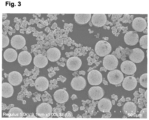
- the above-mentioned large agglomerated particles and small single crystal particles were mixed in a mass ratio of 7 : 3 to obtain a cathode active material for lithium secondary battery, as shown in Figure 3 .
- the cathode active material was treated at 600°C for 8 hours, and had a BET increased by a change rate of 24%.
- an agglomerated cathode precursor (10.5 ⁇ m) having a composition of Ni 0.83 Co 0.11 Mn 0.06 (OH) 2 and a single crystal cathode precursor (4 ⁇ m) having a composition of Ni 0.86 Co 0.08 Mn 0.06 (OH) 2 were separately prepared by a liquid-phase co-precipitation process.
- LiOH and Ni 0.83 Co 0.11 Mn 0.06 (OH) 2 were mixed at a molar ratio of 1.06.
- the mixed material was sintered for the first time in an oxygen atmosphere at a sintering temperature of 745°C.
- the sintered material was crushed, and the crushed material was added with boric acid containing 0.8 mol% of B, and sintered for the second time at a sintering temperature of 380°C to obtain a large agglomerated particle material with a D 50 of 10.0 ⁇ m.
- the agglomerated material was treated at 600°C for 8 hours, and had a BET increased by a change rate of 24%.
- LiOH and Ni 0.86 Co 0.08 Mn 0.06 (OH) 2 were mixed at a molar ratio of 1.12.
- the mixed material was sintered for the first time in an oxygen atmosphere at a sintering temperature of 812°C.
- the sintered material was crushed, and the crushed material was added with Al 2 O 3 containing 1.2 mol% of Al, and sintered for the second time at a sintering temperature of 610°C to obtain a small single crystal particle material with a D 50 of 3.5 ⁇ m.
- the single crystal material was treated at 600°C for 8 hours, and had a BET decreased by a change rate of 3%.
- the above-mentioned large agglomerated particles and small single crystal particles were mixed in a mass ratio of 8 : 2 to obtain a cathode active material for lithium secondary battery.
- the cathode active material was treated at 600°C for 8 hours, and had a BET increased by a change rate of 19%.
- LiOH and Ni 0.86 Co 0.11 Mn 0.03 (OH) 2 were mixed at a molar ratio of 1.06.
- the mixed material was sintered for the first time in an oxygen atmosphere at a sintering temperature of 725°C.
- the sintered material was crushed, and the crushed material was added with boric acid containing 0.8 mol% of B, and sintered for the second time at a sintering temperature of 380°C to obtain a large agglomerated particle material with a D 50 of 10.0 ⁇ m.
- the agglomerated material was treated at 600°C for 8 hours, and had a BET increased by a change rate of 26%.
- LiOH and Ni 0.88 Co 0.08 Mn 0.04 (OH) 2 were mixed at a molar ratio of 1.11.
- the mixed material was sintered for the first time in an oxygen atmosphere at a sintering temperature of 805°C.
- the sintered material was crushed, and the crushed material was added with Al 2 O 3 containing 1.0 mol% of Al, and sintered for the second time at a sintering temperature of 610°C to obtain a small single crystal particle material with a D 50 of 3.5 ⁇ m.
- the single crystal material was treated at 600°C for 8 hours, and had a BET decreased by a change rate of 2%.
- the above-mentioned large agglomerated particles and small single crystal particles were mixed in a mass ratio of 7 : 3 to obtain a cathode active material for lithium secondary battery.
- the cathode active material was treated at 600°C for 8 hours, and had a BET increased by a change rate of 20%.
- an agglomerated cathode precursor (10.5 ⁇ m) having a composition of Ni 0.86 Co 0.11 Mn 0.03 (OH) 2 and a single crystal cathode precursor (4 ⁇ m) having a composition of Ni 0.88 Co 0.08 Mn 0.04 (OH) 2 were separately prepared by a liquid-phase co-precipitation process.
- LiOH and Ni 0.86 Co 0.11 Mn 0.03 (OH) 2 were mixed at a molar ratio of 1.06.
- the mixed material was sintered for the first time in an oxygen atmosphere at a sintering temperature of 685°C.
- the sintered material was crushed, and the crushed material was added with boric acid containing 0.8 mol% of B, and sintered for the second time at a sintering temperature of 380°C to obtain a large agglomerated particle material with a D 50 of 10.0 ⁇ m.
- the agglomerated material was treated at 600°C for 8 hours, and had a BET increased by a change rate of 26%.
- LiOH and Ni 0.88 Co 0.08 Mn 0.04 (OH) 2 were mixed at a molar ratio of 1.11.
- the mixed material was sintered for the first time in an oxygen atmosphere at a sintering temperature of 805°C.
- the sintered material was crushed, and the crushed material was added with Al 2 O 3 containing 1.0 mol% of Al, and sintered for the second time at a sintering temperature of 610°C to obtain a small single crystal particle material with a D 50 of 3.5 ⁇ m.
- the single crystal material was treated at 600°C for 8 hours, and had a BET decreased by a change rate of 2%.
- the above-mentioned large agglomerated particles and small single crystal particles were mixed in a mass ratio of 3 : 7 to obtain a cathode active material for lithium secondary battery.
- the cathode active material was treated at 600°C for 8 hours, and had a BET increased by a change rate of 6%.
- an agglomerated cathode precursor (10.5 ⁇ m) having a composition of Ni 0.88 Co 0.10 Mn 0.02 (OH) 2 and a single crystal cathode precursor (4 ⁇ m) having a composition of Ni 0.90 Co 0.08 Mn 0.02 (OH) 2 were separately prepared by a liquid-phase co-precipitation process.
- LiOH and Ni 0.88 Co 0.10 Mn 0.02 (OH) 2 were mixed at a molar ratio of 1.08.
- the mixed material was sintered for the first time in an oxygen atmosphere at a sintering temperature of 780°C.
- the sintered material was crushed, and the crushed material was added with boric acid containing 1 mol% of B, and sintered for the second time at a sintering temperature of 400°C to obtain a large agglomerated particle material with a D 50 of 10.0 ⁇ m.
- the agglomerated material was treated at 600°C for 8 hours, and had a BET increased by a change rate of 32%.
- LiOH and Ni 0.90 Co 0.08 Mn 0.02 (OH) 2 were mixed at a molar ratio of 1.12.
- the mixed material was sintered for the first time in an oxygen atmosphere at a sintering temperature of 812°C.
- the sintered material was crushed, and the crushed material was added with Al 2 O 3 containing 1 mol% of Al, and sintered for the second time at a sintering temperature of 620°C to obtain a small single crystal particle material with a D 50 of 3.5 ⁇ m.
- the single crystal material was treated at 600°C for 8 hours, and had a BET decreased by a change rate of 2%.
- the above-mentioned large agglomerated particles and small single crystal particles were mixed in a mass ratio of 7 : 3 to obtain a cathode active material for lithium secondary battery.
- the cathode active material was treated at 600°C for 8 hours, and had a BET increased by a change rate of 22%.
- an agglomerated cathode precursor (10.5 ⁇ m) having a composition of Ni 0.83 Co 0.11 Mn 0.06 (OH) 2 and a single crystal cathode precursor (4 ⁇ m) having a composition of Ni 0.86 Co 0.08 Mn 0.06 (OH) 2 were separately prepared by a liquid-phase co-precipitation process.
- LiOH and Ni 0.83 Co 0.11 Mn 0.06 (OH) 2 were mixed at a molar ratio of 1.08.
- the mixed material was sintered for the first time in an oxygen atmosphere at a sintering temperature of 750°C.
- the sintered material was crushed, and the crushed material was added with boric acid containing 1 mol% of B, and sintered for the second time at a sintering temperature of 400°C to obtain a large agglomerated particle material with a D 50 of 10.0 ⁇ m.
- the agglomerated material was treated at 600°C for 8 hours, and had a BET increased by a change rate of 35%.
- LiOH and Ni 0.86 Co 0.08 Mn 0.06 (OH) 2 were mixed at a molar ratio of 1.12.
- the mixed material was sintered for the first time in an oxygen atmosphere at a sintering temperature of 812°C.
- the sintered material was crushed, and the crushed material was added with boric acid containing 0.4 mol% of B, and sintered for the second time at a sintering temperature of 400°C to obtain a small single crystal particle material with a D 50 of 3.5 ⁇ m.
- the single crystal material was treated at 600°C for 8 hours, and had a BET increased by a change rate of 9%.
- the above-mentioned large agglomerated particles and small single crystal particles were mixed in a mass ratio of 7 : 3 to obtain a cathode active material for lithium secondary battery.
- the cathode active material was treated at 600°C for 8 hours, and had a BET increased by a change rate of 27%.
- an agglomerated cathode precursor (10.5 ⁇ m) having a composition of Ni 0.83 Co 0.11 Mn 0.06 (OH) 2 and a single crystal cathode precursor (4 ⁇ m) having a composition of Ni 0.86 Co 0.08 Mn 0.06 (OH) 2 were separately prepared by a liquid-phase co-precipitation process.
- LiOH and Ni 0.83 Co 0.11 Mn 0.06 (OH) 2 were mixed at a molar ratio of 1.08.
- the mixed material was sintered for the first time in an oxygen atmosphere at a sintering temperature of 750°C.
- the sintered material was crushed, and the crushed material was added with boric acid containing 0.5 mol% of B, and sintered for the second time at a sintering temperature of 400°C to obtain a large agglomerated particle material with a D 50 of 10.0 ⁇ m.
- the agglomerated material was treated at 600°C for 8 hours, and had a BET increased by a change rate of 11%.
- LiOH and Ni 0.86 Co 0.08 Mn 0.06 (OH) 2 were mixed at a molar ratio of 1.12.
- the mixed material was sintered for the first time in an oxygen atmosphere at a sintering temperature of 812°C.
- the sintered material was crushed, and the crushed material was added with Al 2 O 3 containing 1 mol% of Al, and sintered for the second time at a sintering temperature of 620°C to obtain a small single crystal particle material with a D 50 of 3.5 ⁇ m.
- the single crystal material was treated at 600°C for 8 hours, and had a BET decreased by a change rate of 2%.
- the above-mentioned large agglomerated particles and small single crystal particles were mixed in a mass ratio of 7 : 3 to obtain a cathode active material for lithium secondary battery.
- the cathode active material was treated at 600°C for 8 hours, and had a BET increased by a change rate of 7%.
- an agglomerated cathode precursor (10.5 ⁇ m) having a composition of Ni 0.83 Co 0.11 Mn 0.06 (OH) 2 and a single crystal cathode precursor (4 ⁇ m) having a composition of Ni 0.86 Co 0.08 Mn 0.06 (OH) 2 were separately prepared by a liquid-phase co-precipitation process.
- LiOH and Ni 0.83 Co 0.11 Mn 0.06 (OH) 2 were mixed at a molar ratio of 1.08.
- the mixed material was sintered for the first time in an oxygen atmosphere at a sintering temperature of 750°C.
- the sintered material was crushed, and the crushed material was added with Al 2 O 3 containing 1 mol% of Al, and sintered for the second time at a sintering temperature of 620°C to obtain a large agglomerated particle material with a D 50 of 10.0 ⁇ m.
- the agglomerated material was treated at 600°C for 8 hours, and had a BET decreased by a change rate of 3%.
- LiOH and Ni 0.86 Co 0.08 Mn 0.06 (OH) 2 were mixed at a molar ratio of 1.12.
- the mixed material was sintered for the first time in an oxygen atmosphere at a sintering temperature of 812°C.
- the sintered material was crushed, and the crushed material was added with Al 2 O 3 containing 1 mol% of Al, and sintered for the second time at a sintering temperature of 620°C to obtain a small single crystal particle material with a D 50 of 3.5 ⁇ m.
- the single crystal material was treated at 600°C for 8 hours, and had a BET decreased by a change rate of 2%.
- the above-mentioned large agglomerated particles and small single crystal particles were mixed in a mass ratio of 7 : 3 to obtain a cathode active material for lithium secondary battery.
- the cathode active material was treated at 600°C for 8 hours, and had a BET decreased by a change rate of 3%.
Landscapes
- Chemical & Material Sciences (AREA)
- Chemical Kinetics & Catalysis (AREA)
- Electrochemistry (AREA)
- General Chemical & Material Sciences (AREA)
- Composite Materials (AREA)
- Inorganic Chemistry (AREA)
- Organic Chemistry (AREA)
- Engineering & Computer Science (AREA)
- Materials Engineering (AREA)
- Manufacturing & Machinery (AREA)
- Battery Electrode And Active Subsutance (AREA)
- Inorganic Compounds Of Heavy Metals (AREA)
Abstract
Description
- The present invention relates to a cathode (positive electrode) active material, a method for preparing the same and a lithium secondary battery comprising the cathode active material.
- In recent years, with the deterioration of the energy and environment crisis, natural energy sources such as wind power and solar power have been vigorously developed. However, these energy sources have low efficiency, and are unable to make up for the shortage of the energy resources usage on a large scale. Lithium-ion batteries are green secondary batteries having prominent advantages such as high operational voltage, high energy density, good cycle life, low self-discharge, and no memory effect, and have been rapidly developed.
- In the field of lithium-ion batteries, ternary layered materials (Nickel-Cobalt-Manganese, NCMs) have great potential for development due to their high specific capacity and stability. However, the stability of the material decreases gradually with the increase of the nickel content in NCMs. The reaction between the highly active Ni4+ produced during the charging process and the electrolyte will generate a NiO-like rock-salt phase, which seriously damages the structure of the layered material, causes the collapse of the cathode structure, and in turn induces the dissolution of transition metal ions, phase transformation and lattice oxygen precipitation. At present, the "secondary particles" of conventional agglomerated NCMs typically consist of many nanoscaled "primary particles". During the charging and discharging process, the change in lattice parameters will lead to the formation of microcracks in the secondary particles. The microcracks formed will expose fresh interface inside the secondary particles, and further accelerate the degradation of the properties. It is noted that the higher the nickel content is, the more obvious the destructive effect of the cracks is. In summary, the main reason for the decrease in the cycle life of NCMs, especially high-nickel NCMs, is microcracks, which will simultaneously reduce the thermal stability, structural stability and cycle stability of the cathode material.
- At present, in order to minimize the generation of microcracks in high-nickel agglomerated materials, in most studies, technologies such as coating and doping are applied to improve the strength of large particles. However, during the preparation of the batteries, it is very difficult to increase the compaction density. At the same nickel content, the capacity of small agglomerated particles is higher than that of large particles, but the properties such as the cycle life and gas production are reduced. The morphology of small single crystal particles is different from that of small agglomerated particles, and the particle strength thereof is relatively high. However, the properties such as capacity and gas production can hardly reach the desired level, and there are also major problems in screening and pulping.
- Patent
CN 109962221 B uses single crystal-like materials doped with agglomerate, the main ingredients of which are lithium manganese iron phosphate materials in a single crystal form and a multiple-element material in an agglomerated form. The multiple-element material and the lithium manganese iron phosphate belong to two different cathode materials with different test voltages and use ranges. Therefore, forcibly mixing the two materials together will inevitably sacrifice their respective advantages and cause waste of resources. As disclosed in Patent No.CN 107154491 B , two materials with different conductivities are mixed together, although the capacities of the two materials are considered respectively, the effect of the Ni content of the two different materials on the final product is not taken into account. Since the two materials are mixed together, the claimed range for the particle size is also relatively wide and the effect on the final product can hardly be determined. - An object of the present invention is to overcome the shortcomings in the prior art and effectively enhance the deficiencies of the blended product such as low capacity and poor cycle life. The present invention effectively improves the capacity of the cathode active material by rendering the Ni content in small particles higher than the Ni content in large particles. In addition, by preparing large agglomerated particles and small single crystal particles and controlling their different surface characteristics, the generation of microcracks in the large agglomerated particles can be effectively inhibited, so as to improve the stability of the cathode active material during long-term cycles. The cathode active material provided by the present invention has properties such as high compaction density, high capacity and high stability.
- In one aspect, the present invention provides a cathode active material for lithium secondary battery, wherein the cathode active material comprises agglomerated particles represented by Formula A1 and single crystal particles represented by Formula A2
A1: Li1+a1Nix1Coy1Mz1M'1-x1-y1-z1O2 A2: Li1+a2Nix2Coy2Mz2M'1-x2-y2-z2O2 - M is one or two elements selected from Mn and Al,
- M' is one or more elements selected from B, F, Mg, Si, P, Ca, Ti, V, Cr, Fe, Ga, Sr, Y, Zr, Nb, Mo, Sn, Ba, La, Ce, and W,
- -0.03 ≤ a1 ≤ 0.20, 0.30 ≤ x1 ≤ 0.99, 0 ≤ y1 ≤ 0.30, 0 ≤ z1 ≤ 0.30, 0 ≤ 1-x1-y1-z1 ≤ 0.10,
- -0.03 ≤ a2 ≤ 0.20, 0.31 ≤ x2 ≤ 1.00, 0 ≤ y2 ≤ 0.30, 0 ≤ z2 ≤ 0.30, 0 ≤ 1-x2-y2-z2 ≤ 0.10,
- with the proviso that: 0 < x2-x1 ≤ 0.5.
- In another aspect, the present invention also provides a method for preparing a cathode active material, including the steps of:
i) preparing an agglomerated particle precursor represented by Formula A3 and a single crystal particle precursor represented by Formula A4 separately by a liquid-phase co-precipitation processA3: Nix1Coy1Mz1M'1-x1-y1-z1(OH)2 A4: Nix2Coy2Mz2M'1-x2-y2-z2(OH)2 - M is one or two elements selected from Mn and Al,
- M' is one or more elements selected from B, F, Mg, Si, P, Ca, Ti, V, Cr, Fe, Ga, Sr, Y, Zr, Nb, Mo, Sn, Ba, La, Ce, and W,
-


-


- with the proviso that: 0 < x2-x1 ≤ 0.5;
- In still another aspect, the present invention also provides a lithium secondary battery comprising the cathode active material according to the present invention or the cathode active material prepared by the preparation method according to the present invention.
-
-
Figures 1 to 3 show SEM photographs for the large agglomerated particles A1 and the small single crystal particles A2 in Example 1 as well as the SEM photograph for the blend of the above two particles, respectively; -
Figure 4 shows the charge-discharge curves of Example 1, Comparative Example 1, and Comparative Example 2; and -
Figure 5 shows the cycle life of Example 1, Comparative Example 1, and Comparative Example 2. - Unless otherwise indicated, all publications, patent applications, patents, and other references mentioned herein are expressly incorporated by reference in their entirety for all purposes as if they are fully set forth.
- Unless otherwise defined, all technical and scientific terms used herein have the same meaning as commonly understood by those ordinary skilled in the art to which the present invention belongs. In the event of a conflict, the present description, including definitions, shall prevail.
- If quantities, concentrations, or other values or parameters are given as a range, a preferred range, or a series of preferred upper limit and preferred lower limits, it should be understood that all ranges formed by combination of the upper limit or a preferred value of/in any range with the lower limit or preferred value or a preferred value of/in the range are specifically disclosed, regardless whether these ranges are separately disclosed or not. When a numerical range is mentioned, unless otherwise indicated, the range includes its endpoints and all integers and fractions within the range.
- In one aspect, the present invention provides a cathode active material for lithium secondary battery, wherein the cathode active material comprises agglomerated particles represented by Formula A1 and single crystal particles represented by Formula A2
A1: Li1+a1Nix1Coy1Mz1M'1-x1-y1-z1O2 A2: Li1+a2Nix2Coy2Mz2M'1-x2-y2-z2O2 - M is one or two elements selected from Mn and Al,
- M' is one or more elements selected from B, F, Mg, Si, P, Ca, Ti, V, Cr, Fe, Ga, Sr, Y, Zr, Nb, Mo, Sn, Ba, La, Ce, and W,
- -0.03 ≤ a1 ≤ 0.20, preferably -0.01 ≤ a1 ≤ 0.14, more preferably 0 ≤ a1 ≤ 0.10, and particularly preferably 0.01 ≤ a1 ≤ 0.08,
- 0.30 ≤ x1 ≤ 0.99, preferably 0.57 ≤ x1 ≤ 0.99, more preferably 0.72 ≤ x1 ≤ 0.99, and particularly preferably 0.80 ≤ x1 ≤ 0.99,
- 0 < y1 ≤ 0.30, preferably 0 ≤ y1 ≤ 0.21, more preferably 0 ≤ y1 ≤ 0.15, and particularly preferably 0 < y1 ≤ 0.10,
- 0 ≤ z1 ≤ 0.30, preferably 0 ≤ z1 ≤ 0.18, more preferably 0 ≤ z1 ≤ 0.11, and particularly preferably 0 ≤ z1 ≤ 0.06,
- 0 ≤ 1-x1-y1-z1 ≤ 0.10, preferably 0 ≤ 1-x1-y1-z1 ≤ 0.08, more preferably 0 ≤ 1-x1-y1-z1 ≤ 0.05, and particularly preferably 0 ≤ 1-x1-y1-z1 ≤ 0.03,
- -0.03 ≤ a2 ≤ 0.20, preferably -0.02 ≤ a2 ≤ 0.16, more preferably -0.01 ≤ a2 ≤ 0.14, and particularly preferably 0 ≤ a2 ≤ 0.08,
- 0.31 ≤ x2 ≤ 1.00, preferably 0.59 ≤ x2 ≤ 0.995, more preferably 0.75 ≤ x2 ≤ 0.995, and particularly preferably 0.81 ≤ x2 ≤ 0.995,
- 0 ≤ y2 ≤ 0.30, preferably 0 ≤ y2 ≤ 0.21, more preferably 0 ≤ y2 ≤ 0.15, and particularly preferably 0 ≤ y2 ≤ 0.10,
- 0 ≤ z2 ≤ 0.30, preferably 0 ≤ z2 ≤ 0.18, more preferably 0 ≤ z2 ≤ 0.11, and particularly preferably 0 ≤ z2 ≤ 0.08,
- 0 ≤ 1-x2-y2-z2 ≤ 0.10, preferably 0 ≤ 1-x2-y2-z2 ≤ 0.08, more preferably 0 ≤ 1-x2-y2-z2 ≤ 0.05, and particularly preferably 0 ≤ 1-x2-y2-z2 ≤ 0.03,
- with the proviso that: 0 < x2-x1 ≤ 0.5, preferably 0.01 ≤ x2-x1 ≤ 0.27, more preferably 0.01 ≤ x2-x1 ≤ 0.2, further preferably 0.015 ≤ x2-x1 ≤ 0.20, and particularly preferably 0.02 ≤ x2-x1 ≤ 0.15.
- According to one embodiment of the cathode active material of the present invention, a2 > a1, preferably 0.01 ≤ a2-a1 ≤ 0.20, more preferably 0.01 ≤ a2-a1 ≤ 0.12, and particularly preferably 0.01 ≤ a2-a1 ≤ 0.07, especially preferably 0.01 ≤ a2-a1 ≤ 0.04.
- According to another embodiment of the cathode active material of the present invention, the agglomerated particles have a particle size D50 of 6 to 30 µm, preferably 8 to 25 µm, more preferably 9 to 20 µm, and particularly preferably 10 to 18 µm.
- According to another embodiment of the cathode active material of the present invention, the single crystal particles have a particle size D50 of 0.1 to 10 µm, preferably 0.5 to 8.0 µm, more preferably 1.0 to 6.0 µm, and particularly preferably 1.5 to 4.5 µm.
- According to another embodiment of the cathode active material of the present invention, the agglomerated particles are present in an amount of 20 to 90%, preferably 45 to 85%, more preferably 50 to 80 %, and particularly preferably 60 to 80%, the single crystal particles are present in an amount of 10 to 80%, preferably 10 to 70 %, more preferably 15 to 60 %, and particularly preferably 20 to 40 %, based on the weight of the cathode active material.
- According to another embodiment of the cathode active material of the present invention, the agglomerated particles have a coating layer containing at least one coating element selected from the group consisting of: B, F, Mg, Al, Si, P, Ca, Ti, V, Cr, Fe, Ga, Sr, Y, Zr, Nb, Mo, Sn, Ba, La, Ce, and W, wherein the coating element is present in an amount of 0.1 to 2 mol%, and preferably about 1 mol%, based on the agglomerated particles; and/or, the single crystal particles have a coating layer containing at least one coating element selected from the group consisting of: B, F, Mg, Al, Si, P, Ca, Ti, V, Cr, Fe, Ga, Sr, Y, Zr, Nb, Mo, Sn, Ba, La, Ce, and W, wherein the coating element is present in an amount of 0.1 to 2 mol%, and preferably about 1 mol%, based on the single crystal particles; with the proviso that: the coating element contained in the coating layer of the agglomerated particles is different from the coating element contained in the coating layer of the single crystal particles.
- According to another embodiment of the cathode active material of the present invention, the cathode active material has specific surface areas BETbefore and BETafter before and after sintering at 600°C in an air atmosphere for 8 hours, which satisfy: preferably,


- The present invention uses single crystal particles with rounded surfaces and agglomerated particles with high particle strength, in combination with an optimal blending ratio, the controlled finished material exhibits a stable crystal structure, thereby reducing the change in surface porosity of the finished product during further sintering.
- According to another embodiment of the cathode active material of the present invention, the agglomerated particles have specific surface areas BETbefore and BETafter before and after sintering at 600°C in an air atmosphere for 8 hours, which satisfy: preferably,


- Agglomerated particles consist of many nanoscaled particles. In order to maintain good cycle performance, the surface of the nanoparticles should not have excessive voids, and the BET of the material is required to be controlled within a certain range. Under normal circumstances, after sintering at a high temperature, the BET of the material will further decrease. However, by controlling the crystallinity and orientation of the nano-grains on the surface of the material, in combination with in-situ melting surface treatment, a good surface /interface protection effect can be achieved according to the present invention. Moreover, it is unexpectedly found that the BET of the material surface does not decrease, but increases. The inventors further found that after the agglomerated particles with such surface BET property are blended with single crystal particles, the cathode material exhibits relatively excellent compression-resistant property, better discharge capacity and cycle performance.
- According to another embodiment of the cathode active material of the present invention, the single crystal particles have specific surface areas BETbefore and BETafter before and after sintering at 600°C in an air atmosphere for 8 hours, which satisfy: preferably,


- Since the single crystal particles of the present invention have properties such as good crystallinity and rounded surface, they are relatively stable in structure. During the high-temperature sintering, the material does not collapse or close to a large extent, and has less change in BET as compared with the BET of the un-sintered material.
- According to another embodiment of the cathode active material of the present invention, the cathode active material does not comprise nickel-free active materials, such as lithium manganese iron phosphate.
- According to another embodiment of the cathode active material of the present invention, the cathode active material consists of the agglomerated particles represented by Formula A1 and the single crystal particles represented by Formula A2.
- In another aspect, the present invention further provides a method for preparing a cathode active material, including the steps of:
i) preparing an agglomerated particle precursor represented by Formula A3 and a single crystal particle precursor represented by Formula A4 separately by a liquid-phase co-precipitation processA3: Nix1Coy1Mz1M'1-x1-y1-z1(OH)2 A4: Nix2Coy2Mz2M'1-x2-y2-z2(OH)2 - M is one or two elements selected from Mn and Al,
- M' is one or more elements selected from B, F, Mg, Si, P, Ca, Ti, V, Cr, Fe, Ga, Sr, Y, Zr, Nb, Mo, Sn, Ba, La, Ce, and W,
- 0.30 ≤ x1 ≤ 0.99, preferably 0.57 ≤ x1 ≤ 0.99, more preferably 0.72 ≤ x1 ≤ 0.99, and particularly preferably 0.80 ≤ x1 ≤ 0.99,
- 0 ≤ y1 ≤ 0.30, preferably 0 ≤ y1 ≤ 0.21, more preferably 0 ≤ y1 ≤ 0.15, and particularly preferably 0 < y1 ≤ 0.10,
- 0 ≤ z1 ≤ 0.30, preferably 0 ≤ z1 ≤ 0.18, more preferably 0 ≤ z1 ≤ 0.11, and particularly preferably 0 ≤ z1 ≤ 0.06,
- 0 ≤ 1-x1-y1-z1 ≤ 0.10, preferably 0 ≤ 1-x1-y1-z1 ≤ 0.08, more preferably 0 ≤ 1-x1-y1-z1 ≤ 0.05, and particularly preferably 0 ≤ 1-x1-y1-z1 ≤ 0.03,
- 0.31 ≤ x2 ≤ 1.00, preferably 0.59 ≤ x2 ≤ 0.995, more preferably 0.75 ≤ x2 ≤ 0.995, and particularly preferably 0.81 ≤ x2 ≤ 0.995,
- 0 ≤ y2 ≤ 0.30, preferably 0 ≤ y2 ≤ 0.21, more preferably 0 ≤ y2 ≤ 0.15, and particularly preferably 0 ≤ y2 ≤ 0.10,
- 0 ≤ z2 ≤ 0.30, preferably 0 ≤ z2 ≤ 0.18, more preferably 0 ≤ z2 ≤ 0.11, and particularly preferably 0 ≤ z2 ≤ 0.08,
- 0 ≤ 1-x2-y2-z2 ≤ 0.10, preferably 0 ≤ 1-x2-y2-z2 ≤ 0.08, more preferably 0 ≤ 1-x2-y2-z2 ≤ 0.05, and particularly preferably 0 ≤ 1-x2-y2-z2 ≤ 0.03,
- with the proviso that: 0 < x2-x1 ≤ 0.5, preferably 0.01 ≤ x2-x1 ≤ 0.27, more preferably 0.01 ≤ x2-x1 ≤ 0.20, further preferably 0.015 ≤ x2-x1 ≤ 0.20, and particularly preferably 0.02 ≤ x2-x1 ≤ 0.15;
- According to another embodiment of the method according to the present invention, r2 > r1, preferably 0.01 ≤ r2-r1 ≤ 0.20, more preferably 0.01 ≤ r2-r1 ≤ 0.12, particularly preferably 0.01 ≤ r2-r1 ≤ 0.07, and especially preferably 0.01 ≤ r2-r1 ≤ 0.04.
- According to another embodiment of the method according to the present invention, the agglomerated particle precursor has a particle size D50 of 6.5 to 30.5 µm, preferably 8.5 to 25.5 µm, more preferably 9.5 to 20.5 µm, and particularly preferably 10.5 to 18.5 µm. The agglomerated particles have a particle size D50 of 6 to 30 µm, preferably 8 to 25 µm, more preferably 9 to 20 µm, and particularly preferably 10 to 18 µm.
- According to another embodiment of the method according to the present invention, the single crystal particle precursor has a particle size D50 of 0.1 to 30.5 µm, preferably 1.0 to 17.3 µm, more preferably 1.0 to 9.3 µm, and particularly preferably 1.0 to 6.0 µm. The single crystal particles have a particle size D50 of 0.1 to 10 µm, preferably 0.5 to 8.0 µm, more preferably 1.0 to 6.0 µm, and particularly preferably 1.5 to 4.5 µm.
- According to another embodiment of the method according to the present invention, the agglomerated particles are present in an amount of 20 to 90%, preferably 45 to 85 %, more preferably 50 to 80 %, and particularly preferably 60 to 80 %, the single crystal particles are present in an amount of 10 to 80%, preferably 10 to 70 %, more preferably 15 to 60 %, and particularly preferably 20 to 40 %, based on the weight of the cathode active material.
- According to another embodiment of the method according to the present invention, prior to Step iv), the agglomerated particles are mixed with a coating precursor comprising at least one coating element selected from the group consisting of: B, F, Mg, Al, Si, P, Ca, Ti, V, Cr, Fe, Ga, Sr, Y, Zr, Nb, Mo, Sn, Ba, La, Ce, and W, and then a secondary sintering is performed at the sintering temperature T3 in a sintering atmosphere of air or oxygen, preferably oxygen, to obtain secondarily sintered agglomerated particles, wherein 250°C ≤ T3 ≤ 800°C, preferably 250°C ≤ T3 ≤ 600°C, more preferably 250°C ≤ T3 ≤ 480°C, and particularly preferably 250°C ≤ T3 ≤ 450°C, wherein the coating element is present in an amount of 0.1 to 2 mol%, preferably about 1 mol%, based on the agglomerated particles; and/or, in addition, the single crystal particles are mixed with a coating precursor comprising at least one coating element selected from the group consisting of: B, F, Mg, Al, Si, P, Ca, Ti, V, Cr, Fe, Ga, Sr, Y, Zr, Nb, Mo, Sn, Ba, La, Ce, and W, and then a secondary sintering is performed at the sintering temperature T4 in a sintering atmosphere of air or oxygen, preferably oxygen, to obtain secondarily sintered single crystal particles, wherein 300°C ≤ T4 ≤ 900°C, preferably 460°C ≤ T4 ≤ 800°C, more preferably 550°C ≤ T4 ≤ 750°C, and particularly preferably 600°C ≤ T4 ≤ 750°C, wherein the coating element is present in an amount of 0.1 to 2 mol%, preferably about 1 mol%, based on the single crystal particles; with the proviso that: the coating element contained in the coating precursor of the agglomerated particles is different from the coating element contained in the coating precursor of the single crystal particles.
- In another aspect, the present invention further provides a lithium secondary battery comprising the cathode active material according to the present invention or the cathode active material prepared by the preparation method according to the present invention.
- Firstly, an agglomerated cathode precursor (10.5 µm) having a composition of Ni0.83Co0.11Mn0.06(OH)2 and a single crystal cathode precursor (4 µm) having a composition of Ni0.86Co0.08Mn0.06(OH)2 were separately prepared by a liquid-phase co-precipitation process.
- LiOH and Ni0.83Co0.11Mn0.06(OH)2 were mixed at a molar ratio of 1.08. The mixed material was sintered for the first time in an oxygen atmosphere at a sintering temperature of 750°C. The sintered material was crushed, and the crushed material was added with boric acid containing 1 mol% of B, and sintered for the second time at a sintering temperature of 400°C to obtain a large agglomerated particle material with a D50 of 10.0 µm, as shown in
Figure 1 . The agglomerated material was treated at 600°C for 8 hours, and had a BET increased by a change rate of 35%. - LiOH and Ni0.86Co0.08Mn0.06(OH)2 were mixed at a molar ratio of 1.12. The mixed material was sintered for the first time in an oxygen atmosphere at a sintering temperature of 812°C. The sintered material was crushed, and the crushed material was added with Al2O3 containing 1 mol% of Al, and sintered for the second time at a sintering temperature of 620°C to obtain a small single crystal particle material with a D50 of 3.5 µm, as shown in
Figure 2 . The single crystal material was treated at 600°C for 8 hours, and had a BET decreased by a change rate of 2%. - The above-mentioned large agglomerated particles and small single crystal particles were mixed in a mass ratio of 7 : 3 to obtain a cathode active material for lithium secondary battery, as shown in
Figure 3 . The cathode active material was treated at 600°C for 8 hours, and had a BET increased by a change rate of 24%. - Firstly, an agglomerated cathode precursor (10.5 µm) having a composition of Ni0.83Co0.11Mn0.06(OH)2 and a single crystal cathode precursor (4 µm) having a composition of Ni0.86Co0.08Mn0.06(OH)2 were separately prepared by a liquid-phase co-precipitation process.
- LiOH and Ni0.83Co0.11Mn0.06(OH)2 were mixed at a molar ratio of 1.06. The mixed material was sintered for the first time in an oxygen atmosphere at a sintering temperature of 745°C. The sintered material was crushed, and the crushed material was added with boric acid containing 0.8 mol% of B, and sintered for the second time at a sintering temperature of 380°C to obtain a large agglomerated particle material with a D50 of 10.0 µm. The agglomerated material was treated at 600°C for 8 hours, and had a BET increased by a change rate of 24%.
- LiOH and Ni0.86Co0.08Mn0.06(OH)2 were mixed at a molar ratio of 1.12. The mixed material was sintered for the first time in an oxygen atmosphere at a sintering temperature of 812°C. The sintered material was crushed, and the crushed material was added with Al2O3 containing 1.2 mol% of Al, and sintered for the second time at a sintering temperature of 610°C to obtain a small single crystal particle material with a D50 of 3.5 µm. The single crystal material was treated at 600°C for 8 hours, and had a BET decreased by a change rate of 3%.
- The above-mentioned large agglomerated particles and small single crystal particles were mixed in a mass ratio of 8 : 2 to obtain a cathode active material for lithium secondary battery. The cathode active material was treated at 600°C for 8 hours, and had a BET increased by a change rate of 19%.
- Firstly, an agglomerated cathode precursor (10.5 µm) having a composition of Ni0.86Co0.11Mn0.03(OH)2 and a single crystal cathode precursor (4 µm) having a composition of Ni0.88Co0.08Mn0.04(OH)2 were separately prepared by a liquid-phase co-precipitation process.
- LiOH and Ni0.86Co0.11Mn0.03(OH)2 were mixed at a molar ratio of 1.06. The mixed material was sintered for the first time in an oxygen atmosphere at a sintering temperature of 725°C. The sintered material was crushed, and the crushed material was added with boric acid containing 0.8 mol% of B, and sintered for the second time at a sintering temperature of 380°C to obtain a large agglomerated particle material with a D50 of 10.0 µm. The agglomerated material was treated at 600°C for 8 hours, and had a BET increased by a change rate of 26%.
- LiOH and Ni0.88Co0.08Mn0.04(OH)2 were mixed at a molar ratio of 1.11. The mixed material was sintered for the first time in an oxygen atmosphere at a sintering temperature of 805°C. The sintered material was crushed, and the crushed material was added with Al2O3 containing 1.0 mol% of Al, and sintered for the second time at a sintering temperature of 610°C to obtain a small single crystal particle material with a D50 of 3.5 µm. The single crystal material was treated at 600°C for 8 hours, and had a BET decreased by a change rate of 2%.
- The above-mentioned large agglomerated particles and small single crystal particles were mixed in a mass ratio of 7 : 3 to obtain a cathode active material for lithium secondary battery. The cathode active material was treated at 600°C for 8 hours, and had a BET increased by a change rate of 20%.
- Firstly, an agglomerated cathode precursor (10.5 µm) having a composition of Ni0.86Co0.11Mn0.03(OH)2 and a single crystal cathode precursor (4 µm) having a composition of Ni0.88Co0.08Mn0.04(OH)2 were separately prepared by a liquid-phase co-precipitation process.
- LiOH and Ni0.86Co0.11Mn0.03(OH)2 were mixed at a molar ratio of 1.06. The mixed material was sintered for the first time in an oxygen atmosphere at a sintering temperature of 685°C. The sintered material was crushed, and the crushed material was added with boric acid containing 0.8 mol% of B, and sintered for the second time at a sintering temperature of 380°C to obtain a large agglomerated particle material with a D50 of 10.0 µm. The agglomerated material was treated at 600°C for 8 hours, and had a BET increased by a change rate of 26%.
- LiOH and Ni0.88Co0.08Mn0.04(OH)2 were mixed at a molar ratio of 1.11. The mixed material was sintered for the first time in an oxygen atmosphere at a sintering temperature of 805°C. The sintered material was crushed, and the crushed material was added with Al2O3 containing 1.0 mol% of Al, and sintered for the second time at a sintering temperature of 610°C to obtain a small single crystal particle material with a D50 of 3.5 µm. The single crystal material was treated at 600°C for 8 hours, and had a BET decreased by a change rate of 2%.
- The above-mentioned large agglomerated particles and small single crystal particles were mixed in a mass ratio of 3 : 7 to obtain a cathode active material for lithium secondary battery. The cathode active material was treated at 600°C for 8 hours, and had a BET increased by a change rate of 6%.
- Firstly, an agglomerated cathode precursor (10.5 µm) having a composition of Ni0.88Co0.10Mn0.02(OH)2 and a single crystal cathode precursor (4 µm) having a composition of Ni0.90Co0.08Mn0.02(OH)2 were separately prepared by a liquid-phase co-precipitation process.
- LiOH and Ni0.88Co0.10Mn0.02(OH)2 were mixed at a molar ratio of 1.08. The mixed material was sintered for the first time in an oxygen atmosphere at a sintering temperature of 780°C. The sintered material was crushed, and the crushed material was added with boric acid containing 1 mol% of B, and sintered for the second time at a sintering temperature of 400°C to obtain a large agglomerated particle material with a D50 of 10.0 µm. The agglomerated material was treated at 600°C for 8 hours, and had a BET increased by a change rate of 32%.
- LiOH and Ni0.90Co0.08Mn0.02(OH)2 were mixed at a molar ratio of 1.12. The mixed material was sintered for the first time in an oxygen atmosphere at a sintering temperature of 812°C. The sintered material was crushed, and the crushed material was added with Al2O3 containing 1 mol% of Al, and sintered for the second time at a sintering temperature of 620°C to obtain a small single crystal particle material with a D50 of 3.5 µm. The single crystal material was treated at 600°C for 8 hours, and had a BET decreased by a change rate of 2%.
- The above-mentioned large agglomerated particles and small single crystal particles were mixed in a mass ratio of 7 : 3 to obtain a cathode active material for lithium secondary battery. The cathode active material was treated at 600°C for 8 hours, and had a BET increased by a change rate of 22%.
- Firstly, an agglomerated cathode precursor (10.5 µm) having a composition of Ni0.83Co0.11Mn0.06(OH)2 and a single crystal cathode precursor (4 µm) having a composition of Ni0.86Co0.08Mn0.06(OH)2 were separately prepared by a liquid-phase co-precipitation process.
- LiOH and Ni0.83Co0.11Mn0.06(OH)2 were mixed at a molar ratio of 1.08. The mixed material was sintered for the first time in an oxygen atmosphere at a sintering temperature of 750°C. The sintered material was crushed, and the crushed material was added with boric acid containing 1 mol% of B, and sintered for the second time at a sintering temperature of 400°C to obtain a large agglomerated particle material with a D50 of 10.0 µm. The agglomerated material was treated at 600°C for 8 hours, and had a BET increased by a change rate of 35%.
- LiOH and Ni0.86Co0.08Mn0.06(OH)2 were mixed at a molar ratio of 1.12. The mixed material was sintered for the first time in an oxygen atmosphere at a sintering temperature of 812°C. The sintered material was crushed, and the crushed material was added with boric acid containing 0.4 mol% of B, and sintered for the second time at a sintering temperature of 400°C to obtain a small single crystal particle material with a D50 of 3.5 µm. The single crystal material was treated at 600°C for 8 hours, and had a BET increased by a change rate of 9%.
- The above-mentioned large agglomerated particles and small single crystal particles were mixed in a mass ratio of 7 : 3 to obtain a cathode active material for lithium secondary battery. The cathode active material was treated at 600°C for 8 hours, and had a BET increased by a change rate of 27%.
- Firstly, an agglomerated cathode precursor (10.5 µm) having a composition of Ni0.83Co0.11Mn0.06(OH)2 and a single crystal cathode precursor (4 µm) having a composition of Ni0.86Co0.08Mn0.06(OH)2 were separately prepared by a liquid-phase co-precipitation process.
- LiOH and Ni0.83Co0.11Mn0.06(OH)2 were mixed at a molar ratio of 1.08. The mixed material was sintered for the first time in an oxygen atmosphere at a sintering temperature of 750°C. The sintered material was crushed, and the crushed material was added with boric acid containing 0.5 mol% of B, and sintered for the second time at a sintering temperature of 400°C to obtain a large agglomerated particle material with a D50 of 10.0 µm. The agglomerated material was treated at 600°C for 8 hours, and had a BET increased by a change rate of 11%.
- LiOH and Ni0.86Co0.08Mn0.06(OH)2 were mixed at a molar ratio of 1.12. The mixed material was sintered for the first time in an oxygen atmosphere at a sintering temperature of 812°C. The sintered material was crushed, and the crushed material was added with Al2O3 containing 1 mol% of Al, and sintered for the second time at a sintering temperature of 620°C to obtain a small single crystal particle material with a D50 of 3.5 µm. The single crystal material was treated at 600°C for 8 hours, and had a BET decreased by a change rate of 2%.
- The above-mentioned large agglomerated particles and small single crystal particles were mixed in a mass ratio of 7 : 3 to obtain a cathode active material for lithium secondary battery. The cathode active material was treated at 600°C for 8 hours, and had a BET increased by a change rate of 7%.
- Firstly, an agglomerated cathode precursor (10.5 µm) having a composition of Ni0.83Co0.11Mn0.06(OH)2 and a single crystal cathode precursor (4 µm) having a composition of Ni0.86Co0.08Mn0.06(OH)2 were separately prepared by a liquid-phase co-precipitation process.
- LiOH and Ni0.83Co0.11Mn0.06(OH)2 were mixed at a molar ratio of 1.08. The mixed material was sintered for the first time in an oxygen atmosphere at a sintering temperature of 750°C. The sintered material was crushed, and the crushed material was added with Al2O3 containing 1 mol% of Al, and sintered for the second time at a sintering temperature of 620°C to obtain a large agglomerated particle material with a D50 of 10.0 µm. The agglomerated material was treated at 600°C for 8 hours, and had a BET decreased by a change rate of 3%.
- LiOH and Ni0.86Co0.08Mn0.06(OH)2 were mixed at a molar ratio of 1.12. The mixed material was sintered for the first time in an oxygen atmosphere at a sintering temperature of 812°C. The sintered material was crushed, and the crushed material was added with Al2O3 containing 1 mol% of Al, and sintered for the second time at a sintering temperature of 620°C to obtain a small single crystal particle material with a D50 of 3.5 µm. The single crystal material was treated at 600°C for 8 hours, and had a BET decreased by a change rate of 2%.
- The above-mentioned large agglomerated particles and small single crystal particles were mixed in a mass ratio of 7 : 3 to obtain a cathode active material for lithium secondary battery. The cathode active material was treated at 600°C for 8 hours, and had a BET decreased by a change rate of 3%.
- Firstly, an agglomerated cathode precursor (10.5 µm) having a composition of Ni0.83Co0.11Mn0.06(OH)2 and a single crystal cathode precursor (4 µm) having a composition of Ni0.86Co0.08Mn0.06(OH)2 were separately prepared by a liquid-phase co-precipitation process.
- LiOH and Ni0.83Co0.11Mn0.06(OH)2 were mixed at a molar ratio of 1.08. The mixed material was sintered for the first time in an oxygen atmosphere at a sintering temperature of 750°C. The sintered material was crushed, and the crushed material was added with boric acid containing 0.5 mol% of B, and sintered for the second time at a sintering temperature of 400°C to obtain a large agglomerated particle material with a D50 of 10.0 µm. The agglomerated material was treated at 600°C for 8 hours, and had a BET increased by a change rate of 11%.
- LiOH and Ni0.86Co0.08Mn0.06(OH)2 were mixed at a molar ratio of 1.12. The mixed material was sintered for the first time in an oxygen atmosphere at a sintering temperature of 812°C. The sintered material was crushed, and the crushed material was added with boric acid containing 0.4 mol% of B, and sintered for the second time at a sintering temperature of 400°C to obtain a small single crystal particle material with a D50 of 3.5 µm. The single crystal material was treated at 600°C for 8 hours, and had a BET increased by a change rate of 9%.
- The above-mentioned large agglomerated particles and small single crystal particles were mixed in a mass ratio of 7 : 3 to obtain a cathode active material for lithium secondary battery. The cathode active material was treated at 600°C for 8 hours, and had a BET increased by a change rate of 10%.
- Firstly, an agglomerated cathode precursor (10.5 µm) having a composition of Ni0.83Co0.11Mn0.06(OH)2 and a single crystal cathode precursor (4 µm) having a composition of Ni0.84Co0.08Mn0.08(OH)2 were separately prepared by a liquid-phase co-precipitation process.
- LiOH and Ni0.83Co0.11Mn0.06(OH)2 were mixed at a molar ratio of 1.08. The mixed material was sintered for the first time in an oxygen atmosphere at a sintering temperature of 750°C. The sintered material was crushed, and the crushed material was added with boric acid containing 0.5 mol% of B, and sintered for the second time at a sintering temperature of 400°C to obtain a large agglomerated particle material with a D50 of 10.0 µm. The agglomerated material was treated at 600°C for 8 hours, and had a BET increased by a change rate of 35%.
- LiOH and Ni0.84Co0.08Mn0.08(OH)2 were mixed at a molar ratio of 1.12. The mixed material was sintered for the first time in an oxygen atmosphere at a sintering temperature of 812°C. The sintered material was crushed, and the crushed material was added with boric acid containing 0.4 mol% of B, and sintered for the second time at a sintering temperature of 400°C to obtain a small single crystal particle material with a D50 of 3.5 µm. The single crystal material was treated at 600°C for 8 hours, and had a BET decreased by a change rate of 2%.
- The above-mentioned large agglomerated particles and small single crystal particles were mixed in a mass ratio of 7 : 3 to obtain a cathode active material for lithium secondary battery. The cathode active material was treated at 600°C for 8 hours, and had a BET increased by a change rate of 24%.
- Firstly, an agglomerated cathode precursor (10.5 µm) having a composition of Ni0.83Co0.11Mn0.06(OH)2 and a single crystal cathode precursor (4 µm) having a composition of Ni0.80Co0.11Mn0.09(OH)2 were separately prepared by a liquid-phase co-precipitation process.
- LiOH and Ni0.83Co0.11Mn0.06(OH)2 were mixed at a molar ratio of 1.08. The mixed material was sintered for the first time in an oxygen atmosphere at a sintering temperature of 750°C. The sintered material was crushed, and the crushed material was added with boric acid containing 1 mol% of B, and sintered for the second time at a sintering temperature of 400°C to obtain a large agglomerated particle material with a D50 of 10.0 µm. The agglomerated material was treated at 600°C for 8 hours, and had a BET increased by a change rate of 35%.
- LiOH andNi0.80Co0.11Mn0.09(OH)2 were mixed at a molar ratio of 1.12. The mixed material was sintered for the first time in an oxygen atmosphere at a sintering temperature of 820°C. The sintered material was crushed, and the crushed material was added with Al2O3 containing 1 mol% of Al, and sintered for the second time at a sintering temperature of 620°C to obtain a small single crystal particle material with a D50 of 3.5 µm. The single crystal material was treated at 600°C for 8 hours, and had a BET decreased by a change rate of 2%.
- The above-mentioned large agglomerated particles and small single crystal particles were mixed in a mass ratio of 7 : 3 to obtain a cathode active material for lithium secondary battery. The cathode active material was treated at 600°C for 8 hours, and had a BET increased by a change rate of 25%.
- Firstly, an agglomerated cathode precursor (10.5 µm) having a composition of Ni0.83Co0.11Mn0.06(OH)2 and a single crystal cathode precursor (4 µm) having a composition of Ni0.83Co0.11Mn0.06(OH)2 were separately prepared by a liquid-phase co-precipitation process.
- LiOH and Ni0.83Co0.11Mn0.06(OH)2 were mixed at a molar ratio of 1.08. The mixed material was sintered for the first time in an oxygen atmosphere at a sintering temperature of 750°C. The sintered material was crushed, and the crushed material was added with boric acid containing 1 mol% of B, and sintered for the second time at a sintering temperature of 400°C to obtain a large agglomerated particle material with a D50 of 10.0 µm. The agglomerated material was treated at 600°C for 8 hours, and had a BET increased by a change rate of 35%.
- LiOH and Ni0.83Co0.11Mn0.06(OH)2 were mixed at a molar ratio of 1.12. The mixed material was sintered for the first time in an oxygen atmosphere at a sintering temperature of 816°C. The sintered material was crushed, and the crushed material was added with Al2O3 containing 1 mol% of Al, and sintered for the second time at a sintering temperature of 620°C to obtain a small single crystal particle material with a D50 of 3.5 µm. The single crystal material was treated at 600°C for 8 hours, and had a BET decreased by a change rate of 2%.
- The above-mentioned large agglomerated particles and small single crystal particles were mixed in a mass ratio of 7 : 3 to obtain a cathode active material for lithium secondary battery. The cathode active material was treated at 600°C for 8 hours, and had a BET increased by a change rate of 25%.
- Tri-star 3020 Specific Surface Area Analyzer was used for the test. 3 g of sample was weighed. A sample tube was installed on the vacuum joint at the port of a degassing station. The heating temperature was set at 300°C, and the degassing time was set as 120 minutes. After degassing, the sample tube was cooled. The mass of the empty sample tube and the mass of the sample and the sample tube after degassing were input through the software interface of the analyzer. The specific surface area data (BET method) calculated and output by the software was recorded, and the specific surface area test for the cathode material sample was completed.
- Mastersizer 2000 Laser Particle Size Analyzer was used for the test. The following modifications were made to the item of "Measurement" in the software: both "Sample Measurement Time" and "Background Measurement Time" in the item of "Measurement Times" were set to 6 seconds. "Repeat Times" were set to 3 times, and "Delay Time" was set to 5 seconds in the item of "Repeat Measurement". "Generate Average Result Record from Measurements" was clicked. Next, "Start" was clicked to automatically measure the background. After the automatic measurement was completed, 40 ml of sodium pyrophosphate was initially added, and a small amount of sample was then added by a spatula. "Start" was clicked until the obscuration reached 1/2 of the visually perceived range between 10 to 20%. Finally, the three results and the average value thereof were recorded.
- Firstly, a composite nickel-cobalt-manganese multi-element cathode active material for non-aqueous electrolyte secondary batteries, acetylene black and polyvinylidene fluoride (PVDF) were mixed and coated on an aluminum foil, and dried in an oven. The dried cathode sheet, separator, anode sheet and electrolyte were assembled into a 2025 Type button-type battery in an Ar-filled glove box having both the moisture content and the oxygen content of less than 5 ppm.
- The button-type battery was placed for 2 hours after fabrication. After the open circuit voltage was stabilized, the cathode was charged to a cut-off voltage of 4.3V at a current density of 0.1C, then charged at a constant voltage for 30 minutes, and subsequently discharged to a cut-off voltage of 3.0 V at the same current density; this process was performed one more time in the same manner, and the discharge capacity was regarded as the initial discharge capacity.
Figure 4 shows the charge-discharge curves of the button-type batteries prepared from the cathode materials in Example 1, and Comparative Examples 1 and 2. It can be seen that the cathode material in Example 1 has a higher initial discharge capacity as compared with that in the Comparative Examples. - A cathode material Lithium Nickel Cobalt Manganese Oxide, an anode material graphite, a conductive agent carbon black, and a binder PVDF were dried in a vacuum oven at 120°C for 12 hours. The oven-dried cathode material, conductive agent carbon black, PVDF, and NMP were mixed uniformly to prepare a cathode slurry. The slurry was coated on an aluminum foil by a coater for lithium batteries, and dried. The electrode sheet was cut by an electrode sheet cutter, and rolled by an electrode sheet roller.
- 950 g of dried artificial graphite, 13 g of Super-P, 14 g of CMC, 46 g of SBR solution and 1200 g of deionized water were mixed uniformly to prepare an anode slurry. The slurry was coated on a copper foil by a coater for lithium batteries, and dried. The anode sheet obtained after coating was dried in a vacuum oven, cut by an electrode sheet cutter, and rolled by an electrode sheet roller.
- The above-mentioned cathode sheet and anode sheet were wound by a conventional preparation method, and an electrolyte was injected to make a full battery. The initial thickness of the full battery after formation was measured, stored in a constant-temperature cabinet at 45°C for 7 days, and then the thickness of the full battery was measured again. The increase rate of the thickness was used to characterize the gas production of the cathode material in the full battery.
Figure 5 shows the change in cycle life for the full batteries prepared from the cathode materials in Example 1, Comparative Examples 1 and 2. It can be seen that the full battery prepared from the cathode material in Example 1 shows a better stability and a longer cycle life.Type of Particles Ni Content D50 Blending Ratio of large to small particles Change in BET Change in BET of agglomerated particles Change in BET of single crystal particles Compaction Density Initial Charge Capacity Cycle Life Gas Production / mol% µm / % % % g/cm3 mAh/g % % Example 1 large agglomerated particles 83 10 7:3 increased by 24 increased by 35 decreased by 2 3.55 214.3 97.4 7.2 small single crystal particles 86 3.5 Example 2 large agglomerated particles 83 10 8 : 2 increased by 19 increased by 24 decreased by 3 3.48 215.2 97.0 8.5 small single crystal particles 86 3.5 Example 3 large agglomerated particles 86 10 7:3 increased by 20 increased by 26 decreased by 2 3.56 216.7 96.9 9.3 small single crystal particles 88 3.5 Example 4 large agglomerated particles 86 10 3 : 7 increased by 6 increased by 26 decreased by 2 3.67 215.6 96.5 6.4 small single crystal particles 88 3.5 Example 5 large agglomerated particles 88 10 7 : 3 increased by 22 increased by 32 decreased by 2 3.58 217.5 97.3 10.6 small single crystal particles 90 3.5 Example 6 large agglomerated particles 83 10 7 : 3 increased by 27 increased by 35 increased by 9 3.61 215.0 94.3 12.7 small single crystal particles 86 3.5 Example 7 large agglomerated particles 83 10 7 : 3 increased by 7 increased by 11 decreased by 2 3.60 214.5 95.6 11.4 small single crystal particles 86 3.5 Example 8 large agglomerated particles 83 10 7 : 3 decreased by 3 decreased by 3 decreased by 2 3.57 214.2 93.3 10.3 small single crystal particles 86 3.5 Example 9 large agglomerated particles 83 10 7 : 3 increased by 10 increased by 11 increased by 9 3.62 213.5 94.4 11.6 small single crystal particles 86 3.5 Example 10 large agglomerated particles 83 10 7 : 3 increased by 24 increased by 35 decreased by 2 3.55 212.8 95.3 8.9 small single crystal particles 84 3.5 Comparative Example 1 large agglomerated particles 83 10 7:3 increased by 25 increased by 35 decreased by 2 3.53 209.7 95.2 7.6 small single crystal particles 80 3.5 Comparative Example 2 large agglomerated particles 83 10 7:3 increased by 25 increased by 35 decreased by 2 3.47 212.3 94.8 10.7 small single crystal particles 83 3.5 - The cathode active material and the lithium ion battery thereof provided by the present invention achieve the following beneficial effects:
- 1) As compared with the agglomerated material, the single crystal material with the same nickel content has better cycle life and lower gas production performance. Therefore, the incorporation of single crystal material can effectively improve the properties of the blended materials, such as cycle life and gas production;
- 2) Due to its special single crystal morphology, the single crystal material has a lower capacity per gram than that of the agglomerated material with the same nickel content. Therefore, the present invention adopts the single crystal material with a slightly higher nickel content to make up for its shortcoming of low capacity per gram. At the same time, its properties such as cycle life and gas production are maintained at the same level as the agglomerated material with a lower nickel content;
- 3) The blended small particle single crystal material can enter the voids between the large agglomerated particles, exert synergistic effects of mutual supporting and filling together with the large agglomerated particles, and thereby effectively improve the compaction density of the material; and
- 4) The problems in single crystal materials, such as poor fluidity, difficulty in screening and pulping, can be effectively overcome by adding a small amount of large agglomerated spherical particles in a system mainly comprising small single crystal particles.
- Although specific embodiments have been described, these embodiments have been presented by way of example only and are not intended to limit the scope of the invention. The appended claims and their equivalents are intended to cover all modifications, substitutions, and alterations that fall within the scope and spirit of the invention.
ii) mixing a lithium source with the agglomerated particle precursor at a molar ratio of r1, and optionally incorporating M' as a doping element, wherein 0.97 ≤ r1 ≤ 1.20; then performing a primary sintering at the sintering temperature T1 in a sintering atmosphere of air or oxygen, wherein 600°C ≤ T1 ≤ 1000°C; and then obtaining agglomerated particles via crushing;
iii) mixing a lithium source with the single crystal particle precursor at a molar ratio of r2, and optionally incorporating M' as a doping element, wherein 0.97 ≤ r2 ≤ 1.20; then performing a primary sintering at the sintering temperature T2 in a sintering atmosphere of air or oxygen, wherein 650°C ≤ T2 ≤ 1050°C; and then obtaining single crystal particles via crushing; and
iv) blending the agglomerated particles of Step ii) with the single crystal particles of Step iii) to obtain the cathode active material.
ii) mixing a lithium source with the agglomerated particle precursor at a molar ratio of r1, and optionally incorporating M' as a doping element, wherein 0.97 ≤ r1 ≤ 1.20, preferably 0.99 ≤ r1 ≤ 1.14, more preferably 1.00 ≤ r1 ≤ 1.10, and particularly preferably 1.01 ≤ r1 ≤ 1.08; then performing a primary sintering at the sintering temperature T1 in a sintering atmosphere of air or oxygen, preferably oxygen, wherein 600°C ≤ T1 ≤ 1000°C, preferably 675°C ≤ T1 ≤ 875°C, more preferably 690°C ≤ T1 ≤ 800°C, and particularly preferably 690°C ≤ T1 ≤ 780°C; and then obtaining agglomerated particles via crushing;
iii) mixing a lithium source with the single crystal particle precursor at a molar ratio of r2, and optionally incorporating M' as a doping element, wherein 0.97 ≤ r2 ≤ 1.20, preferably 0.98 ≤ r2 ≤ 1.16, more preferably 0.99 ≤ r2 ≤ 1.14, and particularly preferably 1.00 ≤ r2 ≤ 1.08; then performing a primary sintering at the sintering temperature T2 in a sintering atmosphere of air or oxygen, preferably oxygen, wherein 650°C ≤ T2 ≤ 1050°C, preferably 730°C ≤ T2 ≤ 930°C, more preferably 750°C ≤ T2 ≤ 930°C, and particularly preferably 750°C ≤ T2 ≤ 900°C; and then obtaining single crystal particles via crushing; and
iv) blending the agglomerated particles of Step ii) with the single crystal particles of Step iii) to obtain the cathode active material.
Claims (28)
- A cathode active material for lithium secondary battery, wherein the cathode active material comprises agglomerated particles represented by Formula A1 and single crystal particles represented by Formula A2
A1: Li1+a1Nix1Coy1Mz1M'1-x1-y1-z1O2 A2: Li1+a2Nix2Coy2Mz2M'1-x2-y2-z2O2 M is one or two elements selected from Mn and Al,M' is one or more elements selected from B, F, Mg, Si, P, Ca, Ti, V, Cr, Fe, Ga, Sr, Y, Zr, Nb, Mo, Sn, Ba, La, Ce, and W,-0.03 ≤ a1 ≤ 0.20, preferably -0.01 ≤ a1 ≤ 0.14, more preferably 0 ≤ a1 ≤ 0.10, and particularly preferably 0.01 ≤ a1 ≤ 0.08,0.30 ≤ x1 ≤ 0.99, preferably 0.57 ≤ x1 ≤ 0.99, more preferably 0.72 ≤ x1 ≤ 0.99, and particularly preferably 0.80 ≤ x1 ≤ 0.99,0 < y1 ≤ 0.30, preferably 0 ≤ y1 ≤ 0.21, more preferably 0 ≤ y1 ≤ 0.15, and particularly preferably 0 < y1 ≤ 0.10,0 ≤ z1 ≤ 0.30, preferably 0 ≤ z1 ≤ 0.18, more preferably 0 ≤ z1 ≤ 0.11, and particularly preferably 0 ≤ z1 ≤ 0.06,0 ≤ 1-x1-y1-z1 ≤ 0.10, preferably 0 ≤ 1-x1-y1-z1 ≤ 0.08, more preferably 0 ≤ 1-x1-y1-z1 ≤ 0.05, and particularly preferably 0 ≤ 1-x1-y1-z1 ≤ 0.03,-0.03 ≤ a2 ≤ 0.20, preferably -0.02 ≤ a2 ≤ 0.16, more preferably -0.01 ≤ a2 ≤ 0.14, and particularly preferably 0 ≤ a2 ≤ 0.08,0.31 ≤ x2 ≤ 1.00, preferably 0.59 ≤ x2 ≤ 0.995, more preferably 0.75 ≤ x2 ≤ 0.995, and particularly preferably 0.81 ≤ x2 ≤ 0.995,0 ≤ y2 ≤ 0.30, preferably 0 ≤ y2 ≤ 0.21, more preferably 0 ≤ y2 ≤ 0.15, and particularly preferably 0 ≤ y2 ≤ 0.10,0 ≤ z2 ≤ 0.30, preferably 0 ≤ z2 ≤ 0.18, more preferably 0 ≤ z2 ≤ 0.11, and particularly preferably 0 ≤ z2 ≤ 0.08,0 ≤ 1-x2-y2-z2 ≤ 0.10, preferably 0 ≤ 1-x2-y2-z2 ≤ 0.08, more preferably 0 ≤ 1-x2-y2-z2 ≤ 0.05, and particularly preferably 0 ≤ 1-x2-y2-z2 ≤ 0.03,with the proviso that: 0 < x2-x1 ≤ 0.5, preferably 0.01 ≤ x2-x1 ≤ 0.27, more preferably 0.01 ≤ x2-x1 ≤ 0.2, further preferably 0.015 ≤ x2-x1 ≤ 0.20, and particularly preferably 0.02 ≤ x2-x1 ≤ 0.15. - The cathode active material according to claim 1, wherein a2 > a1, preferably 0.01 ≤ a2-a1 ≤ 0.20, more preferably 0.01 ≤ a2-a1 ≤ 0.12, particularly preferably 0.01 ≤ a2-a1 ≤ 0.07, and especially preferably 0.01 ≤ a2-a1 ≤ 0.04.
- The cathode active material according to claim 1 or 2, wherein the agglomerated particles have a particle size D50 of 6 to 30 µm, preferably 8 to 25 µm, more preferably 9 to 20 µm, and particularly preferably 10 to 18 µm.
- The cathode active material according to any one of claims 1 to 3, wherein the single crystal particles have a particle size D50 of 0.1 to 10 µm, preferably 0.5 to 8.0 µm, more preferably 1.0 to 6.0 µm, and particularly preferably 1.5 to 4.5 µm.
- The cathode active material according to any one of claims 1 to 4, wherein the agglomerated particles are present in an amount of 20 to 90%, preferably 45 to 85%, more preferably 50 to 80 %, and particularly preferably 60 to 80%, based on the weight of the cathode active material.
- The cathode active material according to any one of claims 1 to 5, wherein the single crystal particles are present in an amount of 10 to 80%, preferably 10 to 70 %, more preferably 15 to 60 %, and particularly preferably 20 to 40 %, based on the weight of the cathode active material.
- The cathode active material according to any one of claims 1 to 6, wherein the agglomerated particles have a coating layer containing at least one coating element selected from the group consisting of: B, F, Mg, Al, Si, P, Ca, Ti, V, Cr, Fe, Ga, Sr, Y, Zr, Nb, Mo, Sn, Ba, La, Ce, and W, wherein the coating element is present in an amount of 0.1 to 2 mol%, and preferably about 1 mol%, based on the agglomerated particles.
- The cathode active material according to any one of claims 1 to 7, wherein the single crystal particles have a coating layer containing at least one coating element selected from the group consisting of: B, F, Mg, Al, Si, P, Ca, Ti, V, Cr, Fe, Ga, Sr, Y, Zr, Nb, Mo, Sn, Ba, La, Ce, and W, wherein the coating element is present in an amount of 0.1 to 2 mol%, and preferably about 1 mol%, based on the single crystal particles.
- The cathode active material according to any one of claims 1 to 8, wherein both the agglomerated particles and the single crystal particles respectively have a coating layer containing at least one coating element selected from the group consisting of: B, F, Mg, Al, Si, P, Ca, Ti, V, Cr, Fe, Ga, Sr, Y, Zr, Nb, Mo, Sn, Ba, La, Ce, and W, wherein the coating element is present in an amount of 0.1 to 2 mol%, and preferably about 1 mol%, based on the agglomerated particles and the single crystal particles respectively.
- The cathode active material according to claim 9, wherein the coating element contained in the coating layer of the agglomerated particles is different from the coating element contained in the coating layer of the single crystal particles.
- The cathode active material according to any one of claims 1 to 10, wherein the cathode active material has specific surface areas BETbefore and BETafter before and after sintering at 600°C in an air atmosphere for 8 hours, which satisfy: preferably,


- The cathode active material according to any one of claims 1 to 11, wherein the agglomerated particles have specific surface areas BETbefore and BETafter before and after sintering at 600°C in an air atmosphere for 8 hours, which satisfy: preferably,


- The cathode active material according to any one of claims 1 to 12, wherein the single crystal particles have specific surface areas BETbefore and BETafter before and after sintering at 600°C in an air atmosphere for 8 hours, which satisfy: preferably,


- The cathode active material according to any one of claims 1 to 13, wherein the cathode active material does not comprise nickel-free active materials, such as lithium manganese iron phosphate.
- The cathode active material according to any one of claims 1 to 14, wherein the cathode active material consists of the agglomerated particles represented by Formula A1 and the single crystal particles represented by Formula A2.
- A method for preparing a cathode active material, including the steps of:i) preparing an agglomerated particle precursor represented by Formula A3 and a single crystal particle precursor represented by Formula A4 separately by a liquid-phase co-precipitation process
A3: Nix1Coy1Mz1M'1-x1-y1-z1(OH)2 A4: Nix2Coy2Mz2M'1-x2-y2-z2(OH)2 M is one or two elements selected from Mn and Al,M' is one or more elements selected from B, F, Mg, Si, P, Ca, Ti, V, Cr, Fe, Ga, Sr, Y, Zr, Nb, Mo, Sn, Ba, La, Ce, and W,0.30 ≤ x1 ≤ 0.99, preferably 0.57 ≤ x1 ≤ 0.99, more preferably 0.72 ≤ x1 ≤ 0.99, and particularly preferably 0.80 ≤ x1 ≤ 0.99,0 ≤ y1 ≤ 0.30, preferably 0 ≤ y1 ≤ 0.21, more preferably 0 ≤ y1 ≤ 0.15, and particularly preferably 0 < y1 ≤ 0.10,0 ≤ z1 ≤ 0.30, preferably 0 ≤ z1 ≤ 0.18, more preferably 0 ≤ z1 ≤ 0.11, and particularly preferably 0 ≤ z1 ≤ 0.06,0 ≤ 1-x1-y1-z1 ≤ 0.10, preferably 0 ≤ 1-x1-y1-z1 ≤ 0.08, more preferably 0 ≤ 1-x1-y1-z1 ≤ 0.05, and particularly preferably 0 ≤ 1-x1-y1-z1 ≤ 0.03,0.31 ≤ x2 ≤ 1.00, preferably 0.59 ≤ x2 ≤ 0.995, more preferably 0.75 ≤ x2 ≤ 0.995, and particularly preferably 0.81 ≤ x2 ≤ 0.995,0 ≤ y2 ≤ 0.30, preferably 0 ≤ y2 ≤ 0.21, more preferably 0 ≤ y2 ≤ 0.15, and particularly preferably 0 ≤ y2 ≤ 0.10,0 ≤ z2 ≤ 0.30, preferably 0 ≤ z2 ≤ 0.18, more preferably 0 ≤ z2 ≤ 0.11, and particularly preferably 0 ≤ z2 ≤ 0.08,0 ≤ 1-x2-y2-z2 ≤ 0.10, preferably 0 ≤ 1-x2-y2-z2 ≤ 0.08, more preferably 0 ≤ 1-x2-y2-z2 ≤ 0.05, and particularly preferably 0 ≤ 1-x2-y2-z2 ≤ 0.03,with the proviso that: 0 < x2-x1 ≤ 0.5, preferably 0.01 ≤ x2-x1 ≤ 0.27, more preferably 0.01 ≤ x2-x1 ≤ 0.20, further preferably 0.015 ≤ x2-x1 ≤ 0.20, and particularly preferably 0.02 ≤ x2-x1 ≤ 0.15;ii) mixing a lithium source with the agglomerated particle precursor at a molar ratio of r1, and optionally incorporating M' as a doping element, wherein 0.97 ≤ r1 ≤ 1.20, preferably 0.99 ≤ r1 ≤ 1.14, more preferably 1.00 ≤ r1 ≤ 1.10, and particularly preferably 1.01 ≤ r1 ≤ 1.08; then performing a primary sintering at the sintering temperature T1 in a sintering atmosphere of air or oxygen, preferably oxygen, wherein 600°C ≤ T1 ≤ 1000°C, preferably 675°C ≤ T1 ≤ 875°C, more preferably 690°C ≤ T1 ≤ 800°C, and particularly preferably 690°C ≤ T1 ≤ 780°C; and then obtaining agglomerated particles via crushing;iii) mixing a lithium source with the single crystal particle precursor at a molar ratio of r2, and optionally incorporating M' as a doping element, wherein 0.97 ≤ r2 ≤ 1.20, preferably 0.98 ≤ r2 ≤ 1.16, more preferably 0.99 ≤ r2 ≤ 1.14, and particularly preferably 1.00 ≤ r2 ≤ 1.08; then performing a primary sintering at the sintering temperature T2 in a sintering atmosphere of air or oxygen, preferably oxygen, wherein 650°C ≤ T2 ≤ 1050°C, preferably 730°C ≤ T2 ≤ 930°C, more preferably 750°C ≤ T2 ≤ 930°C, and particularly preferably 750°C ≤ T2 ≤ 900°C; and then obtaining single crystal particles via crushing; andiv) blending the agglomerated particles of Step ii) with the single crystal particles of Step iii) to obtain the cathode active material. - The method according to claim 16, wherein r2 > r1, preferably 0.01 ≤ r2-r1 ≤ 0.20, more preferably 0.01 ≤ r2-r1 ≤ 0.12, particularly preferably 0.01 ≤ r2-r1 ≤ 0.07, and especially preferably 0.01 ≤ r2-r1 ≤ 0.04.
- The method according to claim 16 or 17, wherein the agglomerated particle precursor has a particle size D50 of 6.5 to 30.5 µm, preferably 8.5 to 25.5 µm, more preferably 9.5 to 20.5 µm, and particularly preferably 10.5 to 18.5 µm.
- The method according to any one of claims 16 to 18, wherein the agglomerated particles have a particle size D50 of 6 to 30 µm, preferably 8 to 25 µm, more preferably 9 to 20 µm, and particularly preferably 10 to 18 µm.
- The method according to any one of claims 16 to 19, wherein the single crystal particle precursor has a particle size D50 of 0.1 to 30.5 µm, preferably 1.0 to 17.3 µm, more preferably 1.0 to 9.3 µm, and particularly preferably 1.0 to 6.0 µm.
- The method according to any one of claims 16 to 20, wherein the single crystal particles have a particle size D50 of 0.1 to 10 µm, preferably 0.5 to 8.0 µm, more preferably 1.0 to 6.0 µm, and particularly preferably 1.5 to 4.5 µm.
- The method according to any one of claims 16 to 21, wherein the agglomerated particles are present in an amount of 20 to 90%, preferably 45 to 85 %, more preferably 50 to 80 %, and particularly preferably 60 to 80 %, based on the weight of the cathode active material.
- The method according to any one of claims 16 to 22, wherein the single crystal particles are present in an amount of 10 to 80%, preferably 10 to 70 %, more preferably 15 to 60 %, and particularly preferably 20 to 40 %, based on the weight of the cathode active material.
- The method according to any one of claims 16 to 23, wherein, prior to Step iv), the agglomerated particles are mixed with a coating precursor comprising at least one coating element selected from the group consisting of: B, F, Mg, Al, Si, P, Ca, Ti, V, Cr, Fe, Ga, Sr, Y, Zr, Nb, Mo, Sn, Ba, La, Ce, and W, and then a secondary sintering is performed at the sintering temperature T3 in a sintering atmosphere of air or oxygen, preferably oxygen, to obtain secondarily sintered agglomerated particles, wherein 250°C ≤ T3 ≤ 800°C, preferably 250°C ≤ T3 ≤ 600°C, more preferably 250°C ≤ T3 ≤ 480°C, and particularly preferably 250°C ≤ T3 ≤ 400°C, wherein the coating element is present in an amount of 0.1 to 2 mol%, and preferably about 1 mol%, based on the agglomerated particles.
- The method according to any one of claims 16 to 24, wherein, prior to Step iv), the single crystal particles are mixed with a coating precursor comprising at least one coating element selected from the group consisting of: B, F, Mg, Al, Si, P, Ca, Ti, V, Cr, Fe, Ga, Sr, Y, Zr, Nb, Mo, Sn, Ba, La, Ce, and W, and then a secondary sintering is performed at the sintering temperature T4 in a sintering atmosphere of air or oxygen, preferably oxygen, to obtain secondarily sintered single crystal particles, wherein 300°C ≤ T4 ≤ 900°C, preferably 460°C ≤ T4 ≤ 800°C, more preferably 550°C ≤ T4 ≤ 750°C, and particularly preferably 600°C ≤ T4 ≤ 750°C, wherein the coating element is present in an amount of 0.1 to 2 mol%, preferably about 1 mol%, based on the single crystal particles.
- The method according to any one of claims 16 to 25, wherein prior to Step iv), the agglomerated particles are mixed with a coating precursor comprising at least one coating element selected from the group consisting of: B, F, Mg, Al, Si, P, Ca, Ti, V, Cr, Fe, Ga, Sr, Y, Zr, Nb, Mo, Sn, Ba, La, Ce, and W, and then a secondary sintering is performed at the sintering temperature T3 in a sintering atmosphere of air or oxygen, preferably oxygen, to obtain secondarily sintered agglomerated particles, wherein 250°C ≤ T3 ≤ 800°C, preferably 250°C ≤ T3 ≤ 600°C, more preferably 250°C ≤ T3 ≤ 480°C, and particularly preferably 250°C ≤ T3 ≤ 450°C; and in addition, the single crystal particles are mixed with a coating precursor comprising at least one coating element selected from the group consisting of: B, F, Mg, Al, Si, P, Ca, Ti, V, Cr, Fe, Ga, Sr, Y, Zr, Nb, Mo, Sn, Ba, La, Ce, and W, and then a secondary sintering is performed at the sintering temperature T4 in a sintering atmosphere of air or oxygen, preferably oxygen, to obtain secondarily sintered single crystal particles, wherein 250°C ≤ T4 ≤ 900°C, preferably 250°C ≤ T4 ≤ 750°C, more preferably 250°C ≤ T4 ≤ 700°C, and particularly preferably 300°C ≤ T4 ≤ 700°C, the coating element is present in an amount of 0.1 to 2 mol%, and preferably about 1 mol%, based on the agglomerated particles and the single crystal particles respectively.
- The method according to claim 26, wherein the coating element contained in the coating precursor of the agglomerated particles is different from the coating element contained in the coating precursor of the single crystal particles.
- A lithium secondary battery comprising the cathode active material according to any one of claims 1 to 13 or the cathode active material prepared by the method according to any one of claims 16 to 27.
Applications Claiming Priority (1)
| Application Number | Priority Date | Filing Date | Title |
|---|---|---|---|
| PCT/CN2022/109897 WO2024026713A1 (en) | 2022-08-03 | 2022-08-03 | Positive electrode active material for lithium secondary battery and preparation method therefor |
Publications (2)
| Publication Number | Publication Date |
|---|---|
| EP4550458A1 true EP4550458A1 (en) | 2025-05-07 |
| EP4550458A4 EP4550458A4 (en) | 2025-09-03 |
Family
ID=89848349
Family Applications (1)
| Application Number | Title | Priority Date | Filing Date |
|---|---|---|---|
| EP22953524.0A Pending EP4550458A4 (en) | 2022-08-03 | 2022-08-03 | Positive electrode active material for lithium secondary batteries and manufacturing method therefor |
Country Status (5)
| Country | Link |
|---|---|
| US (1) | US20250183294A1 (en) |
| EP (1) | EP4550458A4 (en) |
| JP (1) | JP7785237B2 (en) |
| KR (1) | KR20250034171A (en) |
| WO (1) | WO2024026713A1 (en) |
Family Cites Families (8)
| Publication number | Priority date | Publication date | Assignee | Title |
|---|---|---|---|---|
| CN107154491B (en) | 2016-03-04 | 2020-12-22 | 中国科学院宁波材料技术与工程研究所 | A high-efficiency lithium-ion battery cathode material and its preparation method and application |
| US11777075B2 (en) * | 2017-12-04 | 2023-10-03 | Samsung Sdi Co., Ltd. | Positive active material for rechargeable lithium battery, preparing method thereof and rechargeable lithium battery comprising positive electrode including positive active material |
| CN111384372B (en) * | 2018-12-29 | 2021-03-23 | 宁德时代新能源科技股份有限公司 | A high compaction density positive electrode material and electrochemical energy storage device |
| CN109962221B (en) | 2019-02-20 | 2020-03-17 | 江西星盈科技有限公司 | Composite positive electrode material, positive plate, preparation method of positive plate and lithium ion battery |
| CN110380034A (en) * | 2019-07-23 | 2019-10-25 | 合肥国轩高科动力能源有限公司 | A positive electrode material for a lithium-ion battery, a full battery containing the same, and a method for making the same |
| WO2021045025A1 (en) * | 2019-09-06 | 2021-03-11 | 日立金属株式会社 | Positive electrode active material for lithium ion secondary batteries, method for producing same, and lithium ion secondary battery |
| CN112151793A (en) * | 2020-10-22 | 2020-12-29 | 珠海冠宇电池股份有限公司 | Positive plate capable of discharging at high rate and lithium ion battery comprising same |
| CN112151794A (en) * | 2020-10-22 | 2020-12-29 | 珠海冠宇电池股份有限公司 | A positive electrode sheet capable of high rate discharge and a lithium ion battery comprising the positive electrode sheet |
-
2022
- 2022-08-03 JP JP2025504819A patent/JP7785237B2/en active Active
- 2022-08-03 EP EP22953524.0A patent/EP4550458A4/en active Pending
- 2022-08-03 KR KR1020257005493A patent/KR20250034171A/en active Pending
- 2022-08-03 WO PCT/CN2022/109897 patent/WO2024026713A1/en not_active Ceased
-
2025
- 2025-02-03 US US19/043,981 patent/US20250183294A1/en active Pending
Also Published As
| Publication number | Publication date |
|---|---|
| KR20250034171A (en) | 2025-03-10 |
| JP2025525075A (en) | 2025-08-01 |
| JP7785237B2 (en) | 2025-12-12 |
| EP4550458A4 (en) | 2025-09-03 |
| WO2024026713A1 (en) | 2024-02-08 |
| US20250183294A1 (en) | 2025-06-05 |
Similar Documents
| Publication | Publication Date | Title |
|---|---|---|
| EP3930051B1 (en) | Positive electrode material and application thereof | |
| CN115571927B (en) | A composite in-situ coated high nickel single crystal positive electrode material and preparation method thereof | |
| CN115911358B (en) | Positive electrode active materials, batteries and their preparation methods | |
| CN116789185B (en) | Positive electrode active materials for lithium secondary batteries and their preparation methods | |
| EP4280299B1 (en) | Positive electrode material and preparation method therefor, positive electrode plate, and battery | |
| EP4614593A1 (en) | Positive electrode active material, method for preparing same, and lithium secondary battery comprising same positive electrode active material | |
| CN115548329B (en) | Positive electrode active material and electrochemical device | |
| US20260031347A1 (en) | Pressure-resistant positive active material and electrochemical energy storage apparatus | |
| KR20220089243A (en) | Cathode active material, and lithium ion battery including the same | |
| CN115117316B (en) | A phosphorus-containing substance coated positive electrode material and its preparation method and application | |
| EP4403522A1 (en) | Positive electrode ncm-based active material, positive electrode, and battery | |
| EP4696656A1 (en) | Positive electrode active material, secondary battery, and electric device | |
| CN119133429B (en) | Positive electrode material, preparation method thereof, lithium ion battery and power utilization device | |
| JP2025501057A (en) | Positive electrode active material and lithium ion battery | |
| EP4604187A1 (en) | Positive electrode material and preparation method therefor, and secondary battery | |
| EP4550458A1 (en) | Positive electrode active material for lithium secondary battery and preparation method therefor | |
| EP4734176A1 (en) | Positive electrode material, positive electrode sheet and lithium ion battery | |
| EP4723221A1 (en) | Positive electrode active material, and preparation method therefor and use thereof | |
| CN118486814A (en) | Single crystal positive electrode material and preparation method thereof, and lithium ion battery | |
| US20260125281A1 (en) | Cathode material and preparation method thereof, lithium-ion battery, and electrical device | |
| CN119092658B (en) | Positive electrode active material, nickel electrode, and alkaline storage battery | |
| EP4604245A1 (en) | Halide solid electrolyte, method for preparing same, and secondary battery including same | |
| EP4528858A1 (en) | Multi-element positive electrode material and preparation method therefor, and lithium ion battery | |
| CN119786598A (en) | Sodium ion battery, battery pack and energy storage system | |
| CN121839637A (en) | Cathode material without negative sodium and electricity, and synthetic method and application thereof |
Legal Events
| Date | Code | Title | Description |
|---|---|---|---|
| STAA | Information on the status of an ep patent application or granted ep patent |
Free format text: STATUS: THE INTERNATIONAL PUBLICATION HAS BEEN MADE |
|
| PUAI | Public reference made under article 153(3) epc to a published international application that has entered the european phase |
Free format text: ORIGINAL CODE: 0009012 |
|
| STAA | Information on the status of an ep patent application or granted ep patent |
Free format text: STATUS: REQUEST FOR EXAMINATION WAS MADE |
|
| 17P | Request for examination filed |
Effective date: 20250109 |
|
| AK | Designated contracting states |
Kind code of ref document: A1 Designated state(s): AL AT BE BG CH CY CZ DE DK EE ES FI FR GB GR HR HU IE IS IT LI LT LU LV MC MK MT NL NO PL PT RO RS SE SI SK SM TR |
|
| STAA | Information on the status of an ep patent application or granted ep patent |
Free format text: STATUS: EXAMINATION IS IN PROGRESS |
|
| A4 | Supplementary search report drawn up and despatched |
Effective date: 20250730 |
|
| RIC1 | Information provided on ipc code assigned before grant |
Ipc: H01M 4/525 20100101AFI20250725BHEP Ipc: H01M 4/36 20060101ALI20250725BHEP Ipc: H01M 10/0525 20100101ALI20250725BHEP Ipc: C01G 53/42 20250101ALI20250725BHEP Ipc: C01G 53/84 20250101ALI20250725BHEP |
|
| 17Q | First examination report despatched |
Effective date: 20250811 |
|
| DAV | Request for validation of the european patent (deleted) | ||
| DAX | Request for extension of the european patent (deleted) |