EP4550283A1 - Key unit - Google Patents
Key unit Download PDFInfo
- Publication number
- EP4550283A1 EP4550283A1 EP24202137.6A EP24202137A EP4550283A1 EP 4550283 A1 EP4550283 A1 EP 4550283A1 EP 24202137 A EP24202137 A EP 24202137A EP 4550283 A1 EP4550283 A1 EP 4550283A1
- Authority
- EP
- European Patent Office
- Prior art keywords
- vehicle
- radio waves
- key
- antenna
- interference
- Prior art date
- Legal status (The legal status is an assumption and is not a legal conclusion. Google has not performed a legal analysis and makes no representation as to the accuracy of the status listed.)
- Withdrawn
Links
Images



Classifications
-
- B—PERFORMING OPERATIONS; TRANSPORTING
- B60—VEHICLES IN GENERAL
- B60R—VEHICLES, VEHICLE FITTINGS, OR VEHICLE PARTS, NOT OTHERWISE PROVIDED FOR
- B60R25/00—Fittings or systems for preventing or indicating unauthorised use or theft of vehicles
- B60R25/20—Means to switch the anti-theft system on or off
- B60R25/24—Means to switch the anti-theft system on or off using electronic identifiers containing a code not memorised by the user
- B60R25/245—Means to switch the anti-theft system on or off using electronic identifiers containing a code not memorised by the user where the antenna reception area plays a role
-
- B—PERFORMING OPERATIONS; TRANSPORTING
- B60—VEHICLES IN GENERAL
- B60R—VEHICLES, VEHICLE FITTINGS, OR VEHICLE PARTS, NOT OTHERWISE PROVIDED FOR
- B60R25/00—Fittings or systems for preventing or indicating unauthorised use or theft of vehicles
- B60R25/30—Detection related to theft or to other events relevant to anti-theft systems
- B60R25/31—Detection related to theft or to other events relevant to anti-theft systems of human presence inside or outside the vehicle
-
- E—FIXED CONSTRUCTIONS
- E05—LOCKS; KEYS; WINDOW OR DOOR FITTINGS; SAFES
- E05B—LOCKS; ACCESSORIES THEREFOR; HANDCUFFS
- E05B19/00—Keys; Accessories therefor
- E05B19/0005—Key safes
-
- G—PHYSICS
- G07—CHECKING-DEVICES
- G07C—TIME OR ATTENDANCE REGISTERS; REGISTERING OR INDICATING THE WORKING OF MACHINES; GENERATING RANDOM NUMBERS; VOTING OR LOTTERY APPARATUS; ARRANGEMENTS, SYSTEMS OR APPARATUS FOR CHECKING NOT PROVIDED FOR ELSEWHERE
- G07C9/00—Individual registration on entry or exit
- G07C9/00174—Electronically operated locks; Circuits therefor; Nonmechanical keys therefor, e.g. passive or active electrical keys or other data carriers without mechanical keys
- G07C9/00309—Electronically operated locks; Circuits therefor; Nonmechanical keys therefor, e.g. passive or active electrical keys or other data carriers without mechanical keys operated with bidirectional data transmission between data carrier and locks
-
- G—PHYSICS
- G07—CHECKING-DEVICES
- G07C—TIME OR ATTENDANCE REGISTERS; REGISTERING OR INDICATING THE WORKING OF MACHINES; GENERATING RANDOM NUMBERS; VOTING OR LOTTERY APPARATUS; ARRANGEMENTS, SYSTEMS OR APPARATUS FOR CHECKING NOT PROVIDED FOR ELSEWHERE
- G07C9/00—Individual registration on entry or exit
- G07C9/00174—Electronically operated locks; Circuits therefor; Nonmechanical keys therefor, e.g. passive or active electrical keys or other data carriers without mechanical keys
- G07C9/00896—Electronically operated locks; Circuits therefor; Nonmechanical keys therefor, e.g. passive or active electrical keys or other data carriers without mechanical keys specially adapted for particular uses
-
- G—PHYSICS
- G07—CHECKING-DEVICES
- G07C—TIME OR ATTENDANCE REGISTERS; REGISTERING OR INDICATING THE WORKING OF MACHINES; GENERATING RANDOM NUMBERS; VOTING OR LOTTERY APPARATUS; ARRANGEMENTS, SYSTEMS OR APPARATUS FOR CHECKING NOT PROVIDED FOR ELSEWHERE
- G07C9/00—Individual registration on entry or exit
- G07C9/00174—Electronically operated locks; Circuits therefor; Nonmechanical keys therefor, e.g. passive or active electrical keys or other data carriers without mechanical keys
- G07C9/00896—Electronically operated locks; Circuits therefor; Nonmechanical keys therefor, e.g. passive or active electrical keys or other data carriers without mechanical keys specially adapted for particular uses
- G07C9/00912—Electronically operated locks; Circuits therefor; Nonmechanical keys therefor, e.g. passive or active electrical keys or other data carriers without mechanical keys specially adapted for particular uses for safes, strong-rooms, vaults or the like
-
- G—PHYSICS
- G07—CHECKING-DEVICES
- G07C—TIME OR ATTENDANCE REGISTERS; REGISTERING OR INDICATING THE WORKING OF MACHINES; GENERATING RANDOM NUMBERS; VOTING OR LOTTERY APPARATUS; ARRANGEMENTS, SYSTEMS OR APPARATUS FOR CHECKING NOT PROVIDED FOR ELSEWHERE
- G07C9/00—Individual registration on entry or exit
- G07C9/00174—Electronically operated locks; Circuits therefor; Nonmechanical keys therefor, e.g. passive or active electrical keys or other data carriers without mechanical keys
- G07C9/00944—Details of construction or manufacture
-
- H—ELECTRICITY
- H04—ELECTRIC COMMUNICATION TECHNIQUE
- H04B—TRANSMISSION
- H04B17/00—Monitoring; Testing
- H04B17/30—Monitoring; Testing of propagation channels
- H04B17/309—Measuring or estimating channel quality parameters
- H04B17/318—Received signal strength
-
- H—ELECTRICITY
- H04—ELECTRIC COMMUNICATION TECHNIQUE
- H04K—SECRET COMMUNICATION; JAMMING OF COMMUNICATION
- H04K3/00—Jamming of communication; Counter-measures
- H04K3/40—Jamming having variable characteristics
- H04K3/42—Jamming having variable characteristics characterized by the control of the jamming frequency or wavelength
-
- B—PERFORMING OPERATIONS; TRANSPORTING
- B60—VEHICLES IN GENERAL
- B60R—VEHICLES, VEHICLE FITTINGS, OR VEHICLE PARTS, NOT OTHERWISE PROVIDED FOR
- B60R2325/00—Indexing scheme relating to vehicle anti-theft devices
- B60R2325/10—Communication protocols, communication systems of vehicle anti-theft devices
- B60R2325/103—Near field communication [NFC]
-
- B—PERFORMING OPERATIONS; TRANSPORTING
- B60—VEHICLES IN GENERAL
- B60R—VEHICLES, VEHICLE FITTINGS, OR VEHICLE PARTS, NOT OTHERWISE PROVIDED FOR
- B60R2325/00—Indexing scheme relating to vehicle anti-theft devices
- B60R2325/20—Communication devices for vehicle anti-theft devices
- B60R2325/205—Mobile phones
-
- G—PHYSICS
- G07—CHECKING-DEVICES
- G07C—TIME OR ATTENDANCE REGISTERS; REGISTERING OR INDICATING THE WORKING OF MACHINES; GENERATING RANDOM NUMBERS; VOTING OR LOTTERY APPARATUS; ARRANGEMENTS, SYSTEMS OR APPARATUS FOR CHECKING NOT PROVIDED FOR ELSEWHERE
- G07C9/00—Individual registration on entry or exit
- G07C9/00174—Electronically operated locks; Circuits therefor; Nonmechanical keys therefor, e.g. passive or active electrical keys or other data carriers without mechanical keys
- G07C2009/00753—Electronically operated locks; Circuits therefor; Nonmechanical keys therefor, e.g. passive or active electrical keys or other data carriers without mechanical keys operated by active electrical keys
- G07C2009/00769—Electronically operated locks; Circuits therefor; Nonmechanical keys therefor, e.g. passive or active electrical keys or other data carriers without mechanical keys operated by active electrical keys with data transmission performed by wireless means
- G07C2009/00793—Electronically operated locks; Circuits therefor; Nonmechanical keys therefor, e.g. passive or active electrical keys or other data carriers without mechanical keys operated by active electrical keys with data transmission performed by wireless means by Hertzian waves
-
- G—PHYSICS
- G07—CHECKING-DEVICES
- G07C—TIME OR ATTENDANCE REGISTERS; REGISTERING OR INDICATING THE WORKING OF MACHINES; GENERATING RANDOM NUMBERS; VOTING OR LOTTERY APPARATUS; ARRANGEMENTS, SYSTEMS OR APPARATUS FOR CHECKING NOT PROVIDED FOR ELSEWHERE
- G07C9/00—Individual registration on entry or exit
- G07C9/00174—Electronically operated locks; Circuits therefor; Nonmechanical keys therefor, e.g. passive or active electrical keys or other data carriers without mechanical keys
- G07C9/00896—Electronically operated locks; Circuits therefor; Nonmechanical keys therefor, e.g. passive or active electrical keys or other data carriers without mechanical keys specially adapted for particular uses
- G07C2009/00936—Electronically operated locks; Circuits therefor; Nonmechanical keys therefor, e.g. passive or active electrical keys or other data carriers without mechanical keys specially adapted for particular uses for key cabinets
-
- G—PHYSICS
- G07—CHECKING-DEVICES
- G07C—TIME OR ATTENDANCE REGISTERS; REGISTERING OR INDICATING THE WORKING OF MACHINES; GENERATING RANDOM NUMBERS; VOTING OR LOTTERY APPARATUS; ARRANGEMENTS, SYSTEMS OR APPARATUS FOR CHECKING NOT PROVIDED FOR ELSEWHERE
- G07C2209/00—Indexing scheme relating to groups G07C9/00 - G07C9/38
- G07C2209/60—Indexing scheme relating to groups G07C9/00174 - G07C9/00944
- G07C2209/63—Comprising locating means for detecting the position of the data carrier, i.e. within the vehicle or within a certain distance from the vehicle
Definitions
- This disclosure relates to a key unit for locking and unlocking a door lock of a vehicle.
- Reference 1 discloses a key storage unit.
- the key storage unit includes a housing unit capable of housing an electronic key that transmits and receives radio waves having two different frequencies related to smart communication.
- the housing unit is covered with an attenuation material capable of attenuating the radio waves having one of the two frequencies to a level at which communication cannot be performed.
- a terminal carried by a user and the key storage unit communicate with each other by near field communication, and when the terminal is authenticated by the communication, an electronic key is operated by a key operation mechanism mounted on the key storage unit, and wireless radio waves (radio waves not attenuated by the attenuation material) are transmitted, thereby locking and unlocking the vehicle.
- the key storage unit is locked, and is unlocked when the terminal is authenticated, and an engine can be started by taking out the electronic key from the key storage unit.
- the terminal By registering a target terminal in a control unit disposed outside the housing unit, the terminal can be used as a digital key serving as a key of the vehicle.
- a characteristic configuration of a key unit disclosed here is that a key unit that houses an electronic key of a vehicle includes: an interference antenna configured to propagate, in the air, interference radio waves interfering with communication performed using a first frequency band between a transmission antenna of the vehicle and the electronic key; a communication antenna configured to communicate with a mobile terminal in a second frequency band different from the first frequency band; and a control unit configured to control an output of the interference antenna according to a communication content in the second frequency band.
- the interference radio waves are propagated in the air from the interference antenna to the first frequency band used for the communication between the transmission antenna of the vehicle and the electronic key, thereby interfering with the communication between the transmission antenna of the vehicle and the electronic key.
- the radio waves in the second frequency band can be received by the communication antenna. Therefore, when the radio waves are received, the propagation of the interference radio waves in the air is stopped, and an engine can be started using the first frequency band. Accordingly, it is not necessary to provide a mechanism for shielding the radio waves in the first frequency band or to take out the electronic key from a place for shielding the radio waves in the first frequency band, and thus the key unit can be easily used.
- a key unit disclosed here can lock and unlock a door lock of a vehicle from outside the vehicle in a state where an electronic key is provided in a vehicle cabin.
- a key unit 1 of the embodiment will be described.
- the key unit 1 is not limited to the following embodiments, and various modifications can be made without departing from the gist of the key unit 1.
- Fig. 1 is a diagram showing a vehicle 2 including the key unit 1.
- the key unit 1 is provided in a vehicle cabin 2A of the vehicle 2.
- the key unit 1 may be disposed in a space between a driver seat and a front passenger seat of the vehicle cabin 2A, or may be disposed in a glove box.
- the key unit 1 can perform the locking and unlocking of the door lock of the vehicle 2.
- the door lock of the vehicle 2 means a lock mechanism provided on a door of the vehicle 2, and the locking and unlocking of the door lock of the vehicle 2 means locking or unlocking of the lock mechanism (door lock) of the door of the vehicle 2.
- the locking and unlocking of the door lock includes locking and unlocking of a lock mechanism of a trunk of the vehicle 2.
- Fig. 1 shows the vehicle 2 including a hinge door
- the key unit 1 can lock and unlock a lock mechanism of the slide door or the back door.
- the key unit 1 can open and close the slide door or the back door.
- “making the lock mechanism in a locked state” is referred to as “locking the door lock”
- “making the lock mechanism in an unlocked state” is referred to as "unlocking the door lock”.
- the key unit 1 can house an electronic key 3 capable of locking and unlocking the door lock of the vehicle 2.
- the electronic key 3 is a key that is associated with the vehicle 2, and is a key capable of locking and unlocking the door lock of the vehicle 2 by pressing a locking and unlocking switch (described later) of the electronic key 3 or touching a predetermined portion of the door, or capable of starting or stopping an engine by pressing an engine start button.
- the key unit 1 is provided with a housing unit 4 (see Fig. 2 ) therein, and the electronic key 3 can be housed in the housing unit 4.
- Fig. 2 is a schematic diagram showing the configuration of the key unit 1.
- the key unit 1 includes an interference antenna 10, a near field communication antenna (an example of a "communication antenna") 12, a control unit 14, and an operation mechanism 16.
- each functional unit is constructed by hardware, software, or both of them using a CPU as a core member.
- a key system 2B of the vehicle 2 and the electronic key 3 communicate with each other via radio waves.
- radio waves in a low frequency (LF) band of 30 kHz to 300 kHz or a very low frequency (VLF) band (an example of a "first frequency band") of 3 kHz to 30 kHz are used for communication from the vehicle 2 to the electronic key 3
- radio waves in a radio frequency (RF) band of several hundred MHz are used for communication from the electronic key 3 to the vehicle 2.
- the key system 2B of the vehicle 2 includes a transmission antenna 2L for transmitting the radio waves in the LF band or the VLF band and an RF reception antenna 2R for receiving the radio waves in the RF band.
- the electronic key 3 includes a reception antenna 3L for receiving the radio waves in the LF band or the VLF band and an RF transmission antenna 3R for transmitting the radio waves in the RF band.
- the electronic key 3 when the electronic key 3 is in the vehicle cabin 2A, an alarm is generated when a user leaves the vehicle. There is a case where the door lock in the unlocked state cannot be locked from the outside of the vehicle, or there is a case where the door lock in the locked state cannot be unlocked from the outside of the vehicle. Further, the electronic key 3 may communicate at predetermined time intervals after the authentication by the key system 2B of the vehicle 2. The key unit 1 interferes with communication between the electronic key 3 and the key unit 1 such that the door lock of the vehicle 2 can be locked or unlocked from the outside of the vehicle even when the electronic key 3 is in the vehicle cabin 2A.
- Such interference is implemented by propagating interference radio waves from the interference antenna 10 in the air.
- the interference antenna 10 propagates, in the air, the interference radio waves interfering with communication performed using the first frequency band between the transmission antenna 2L of the key system 2B of the vehicle 2 and the reception antenna 3L of the electronic key 3.
- the electronic key 3 is housed in the housing unit 4 of the key unit 1, and the interference antenna 10 is also provided in the key unit 1. Therefore, the interference radio waves (the radio waves in the same frequency band as the first frequency band or the radio waves in the frequency band corresponding to the multiplication of the first frequency band) may be an output having an intensity that reaches the reception antenna 3L at least.
- the reception antenna 3L cannot receive the radio waves from the transmission antenna 2L due to such interference radio waves.
- the near field communication antenna 12 communicates with a mobile terminal 5 outside the vehicle in a second frequency band different from the first frequency band.
- the second frequency band may be, for example, an ultra high frequency (UHF) band.
- the mobile terminal 5 is the mobile terminal 5 carried by the user who performs locking and unlocking of the door lock of the vehicle 2, and corresponds to, for example, a smartphone or a personal computer.
- the user is a user who owns the registered mobile terminal 5.
- An application capable of communicating with the key unit 1 is installed in the mobile terminal 5 in advance, and a locking and unlocking command for locking or unlocking the door lock is input via the application.
- radio waves (command radio waves) in the UHF band is output from the mobile terminal 5.
- Such communication using the radio waves in the UHF band can use so-called near field communication.
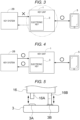
- Fig. 3 shows a schematic diagram of such a communication state. That is, as shown in Fig. 3 , when interference radio waves are output from the interference antenna 10 of the key unit 1, communication from the key system 2B to the key unit 1 cannot be performed (indicated by "x" in Fig. 3 ). In this case, the key unit 1 and the mobile terminal 5 can communicate with each other (indicated by "o” in Fig. 3 ). The communication (information) transmitted from the vehicle 2 to the electronic key 3 cannot be received, but the communication (information) transmitted from the electronic key 3 to the vehicle 2 can be transmitted.
- the control unit 14 controls the output of the interference antenna according to a communication content in the second frequency band.
- a communication content includes a case where the radio waves (command radio waves) in the UHF band are received from the mobile terminal 5 and a case where the radio waves are not received.
- control the output of the interference antenna includes control to cause the interference antenna 10 to output the interference radio waves and control to stop the output of the interference radio waves.
- the control unit 14 stops the output of the interference radio waves when it is determined that the user is in the vehicle cabin 2A.
- the control unit 14 when the control unit 14 receives the radio waves (unlocking command) in the UHF band from the mobile terminal 5 and it is determined that the user is in the vehicle cabin 2A, the control unit 14 causes the interference antenna 10 to stop the output of the interference radio waves. In addition, when the control unit 14 receives the radio waves (unlocking command) in the UHF band from the mobile terminal 5 and it is not determined that the user is in the vehicle cabin 2A, the control unit 14 causes the interference antenna 10 to output the interference radio waves. Further, when the control unit 14 does not receive the radio waves (unlocking command) in the UHF band from the mobile terminal 5, the control unit 14 causes the interference antenna 10 to output the interference radio waves. When the output of the interference radio waves from the interference antenna 10 is stopped, as shown in Fig.
- communication from the key system 2B to the key unit 1 can be performed (indicated by "o” in Fig. 4 ), and communication from the key unit 1 to the key system 2B can also be performed (indicated by "o” in Fig. 4 ).
- the key unit 1 and the mobile terminal 5 can communicate with each other (indicated by "o” in Fig. 4 ).
- Whether the user is in the vehicle cabin 2A can be determined based on, for example, an intensity of the communication performed between the near field communication antenna 12 and the mobile terminal 5.
- a seating sensor load sensor
- a state where it is determined that the user is in the vehicle cabin 2A can be specified based on the intensity of such communication and a detection result of the seating sensor.
- the control unit 14 causes the interference radio waves to be output when the radio waves in the second frequency band are not received in a state where the mobile terminal 5 is away from the vehicle 2 and it is determined that no user is in the vehicle cabin 2A.
- the state where the mobile terminal 5 is away from the vehicle 2 corresponds to a state where the mobile terminal 5 is gradually away from the key unit 1, and a state where the mobile terminal 5 is away from the key unit 1 by a predetermined distance (for example, several meters) or more.
- Whether the user is in the vehicle cabin 2A can be specified based on, for example, the intensity of the communication performed between the near field communication antenna 12 and the mobile terminal 5 or the detection result of the seating sensor (load sensor) in the seat of the vehicle 2 as described above.
- the control unit 14 causes the interference antenna 10 to propagate the interference radio waves in the air.
- the operation mechanism 16 operates the locking and unlocking switch provided in the electronic key 3 according to the locking and unlocking command.
- the locking and unlocking command is acquired by a signal processing unit (not shown) from the radio waves of the second frequency band from the mobile terminal 5 received by the near field communication antenna 12.
- the locking and unlocking switch is a generic term for a locking switch 3A and an unlocking switch 3B, and is described as the locking and unlocking switches 3A and 3B when they are not particularly distinguished.
- the operation mechanism 16 of the embodiment includes a locking switch operation unit 16A that presses the locking switch 3A, and an unlocking switch operation unit 16B that presses the unlocking switch 3B.
- the locking and unlocking command is the locking command
- the operation mechanism 16 is configured such that the locking switch operation unit 16A of the operation mechanism 16 presses the locking switch 3A of the electronic key 3
- the locking and unlocking command is the unlocking command
- the operation mechanism 16 is configured such that the unlocking switch operation unit 16B of the operation mechanism 16 presses the unlocking switch 3B of the electronic key 3.
- the locking switch operation unit 16A and the unlocking switch operation unit 16B return to their original positions (positions where they are not pressed) after the locking switch 3A and the unlocking switch 3B are pressed, respectively.
- the state of the key unit 1 will be described with reference to a timing chart of Fig. 6 .
- the door lock of the vehicle 2 is in the locked state, and in a state where the engine cannot be started (in Fig. 6 , as the state of the vehicle 2, a lock state is indicated as "locked”, and whether the engine can be started is indicated as "no").
- the interference radio waves are propagated in the air from the interference antenna 10 of the key unit 1 (#1). Accordingly, the communication between the reception antenna 3L of the electronic key 3 and the transmission antenna 2L of the vehicle 2 is interfered (#2), and the reception antenna 3L cannot respond to the signal from the transmission antenna 2L of the vehicle 2 (#3, #4, #5, #6).
- the near field communication antenna 12 of the key unit 1 receives the command radio waves (#8).
- the unlocking switch operation unit 16B of the operation mechanism 16 presses the unlocking switch 3B. Accordingly, an unlocking request is output from the RF transmission antenna 3R of the electronic key 3 (#9).
- the unlocking request is received (#10), the vehicle 2 unlocks the door lock.
- the key unit 1 determines whether there is a user in the vehicle cabin 2A. When it is determined that the user is in the vehicle cabin 2A (#11), the key unit 1 stops the propagation of the interference radio waves from the interference antenna 10 in the air (#12). Accordingly, the interference of the electronic key 3 to the reception antenna 3L can be released (#13), and the radio waves from the transmission antenna 2L of the vehicle 2 can be received.
- the communication between the vehicle 2 and the electronic key 3 is performed. Specifically, the communication from the vehicle 2 to the electronic key 3 is performed by a reception antenna 5L of the electronic key 3 receiving the radio waves from the transmission antenna 2L of the vehicle 2, and the communication from the electronic key 3 to the vehicle 2 is performed by the RF reception antenna 2R of the vehicle 2 receiving radio waves from an RF transmission antenna 5R of the electronic key 3 (#20 to #34).
- the engine of the vehicle 2 can be started (in Fig. 6 , as the state of the vehicle 2, the lock state is indicated as "unlocked (locked)", and whether the engine can be started is indicated as "yes").
- the interference radio waves are output from the interference antenna 10 of the key unit 1 (#41). Accordingly, the communication between the reception antenna 3L of the electronic key 3 and the transmission antenna 2L of the vehicle 2 is interfered (#42), and the reception antenna 3L cannot respond to the signal from the transmission antenna 2L of the vehicle 2 (#43).
- the near field communication antenna 12 of the key unit 1 receives the command radio waves (#45).
- the locking switch operation unit 16A of the operation mechanism 16 presses the locking switch 3A. Accordingly, a locking request is output from the RF transmission antenna 3R of the electronic key 3 (#46).
- the vehicle 2 locks the door lock (in Fig. 6 , as the state of the vehicle 2, the lock state is indicated as “locked”, and whether the engine can be started is indicated as "no").
- the number of times of communication related to locking, unlocking, and engine start shown in Fig. 6 is an example, and can be appropriately changed.
- the control unit 14 stops the output of the interference radio waves when it is determined that the user is in the vehicle cabin 2A. However, regardless of whether it is determined that the user is in the vehicle cabin 2A, the output of the interference radio waves may be stopped when the radio waves in the second frequency band are received. in a state where it is determined that the user is in the vehicle cabin 2A, the output of the interference radio waves may be stopped when the radio waves in the second frequency band are received. When it is determined that the mobile terminal 5 is close to the vehicle 2, the output of the interference radio waves may be stopped.
- the control unit 14 causes the interference radio waves to be output when the radio waves in the second frequency band are not received in a state where the mobile terminal 5 is away from the vehicle 2 and it is determined that no user is in the vehicle cabin 2A.
- the control unit 14 may cause the interference radio waves to be output when the radio waves in the second frequency band are not received regardless of whether it is determined that no user is in the vehicle cabin 2A.
- the interference radio waves may be output.
- the control unit 14 may cause the interference radio waves to be output when the radio waves in the second frequency band are not received regardless of whether the mobile terminal 5 is away from the vehicle 2 and regardless of whether it is determined that no user is in the vehicle cabin 2A.
- the key unit 1 includes the operation mechanism 16 that operates the locking and unlocking switches 3A and 3B provided in the electronic key 3 according to a locking and unlocking command.
- the key unit 1 may not include the operation mechanism 16.
- the operation mechanism 16 may operate only one of the locking switch 3Aand the unlocking switch 3B.
- the unlocking switch operation unit 16B of the operation mechanism 16 may operate the unlocking switch 3B when the intensity of the communication performed between the near field communication antenna 12 and the mobile terminal 5 exceeds a preset value, and the locking switch operation unit 16A of the operation mechanism 16 may operate the locking switch 3A when the intensity of the communication is equal to or less than the preset value.
- a distance from the near field communication antenna 12 to the mobile terminal 5 may be calculated based on the intensity of the communication performed between the near field communication antenna 12 and the mobile terminal 5, the unlocking switch operation unit 16B of the operation mechanism 16 may operate the unlocking switch 3B when the calculated distance exceeds a preset value, and the locking switch operation unit 16A of the operation mechanism 16 may operate the locking switch 3A when the calculated distance is equal to or less than the preset value.
- a plurality of antennas may be used, or an antenna different from the near field communication antenna 12 may be used.
- the control unit 14 determines whether the user is in the vehicle cabin 2A based on the intensity of the communication performed between the near field communication antenna 12 and the mobile terminal 5. However, the control unit 14 may determine whether the user is in the vehicle cabin 2A based on the detection result of the seating sensor provided in the seat as described above, or may determine whether the user is in the vehicle cabin 2A based on a captured image of the vehicle cabin 2A. A sensor capable of detecting that a steering wheel of the vehicle 2 is gripped may be provided in the steering wheel, and it may be determined whether the user is in the vehicle cabin 2A based on the detection result of the sensor. Further, the mobile terminal 5 may determine that the user is in the vehicle cabin 2A by, for example, bringing the mobile terminal 5 close to the key unit 1.
- the control unit 14 causes the interference antenna 10 to stop the output of the interference radio waves when the radio waves (unlocking command) in the UHF band are received from the mobile terminal 5 and it is determined that the user is in the vehicle cabin 2A, causes the interference antenna 10 to output the interference radio waves when the radio waves (unlocking command) in the UHF band are received from the mobile terminal 5 and it is not determined that the user is in the vehicle cabin 2A, and causes the interference antenna 10 to output the interference radio waves when the radio waves (unlocking command) in the UHF band is not received from the mobile terminal 5.
- the control unit 14 may cause the interference radio waves to be output or stopped depending on whether command radio waves including information indicating whether to output or stop the interference radio waves are received from the mobile terminal 5.
- the key unit 1 includes a power source (battery) and can continue to output the interference radio waves even when a power supply from the vehicle 2 is cut off.
- a power source battery
- the key unit 1 is basically supplied with power from the vehicle 2, but when a third party enters the vehicle 2 and cuts off the power supply to the key unit 1, the output of the interference radio waves is stopped.
- the key unit 1 includes the power source (battery), even when the power supply is unintentionally cut off, it is possible to prevent the engine start by continuously outputting the interference radio waves.
- an authentication unit that authenticates whether the mobile terminal 5 is registered in the key unit 1 in advance may be provided. Accordingly, only the specific mobile terminal 5 can be used.
- each functional unit can also implement the above functions and control.
- the control unit 14, the near field communication antenna 12, and the like can be implemented as separate units.
- the key unit 1 may monitor a power source state of the vehicle 2 and control whether to output jamming according to the power source state of the vehicle 2. In such a case, the disclosure can be applied to a case where it is desired to output jamming in the engine start state.
- the key unit 1 may perform locking and unlocking control by inputting an electric signal to the vehicle 2 in a wired or wireless manner instead of pressing a button. Such a function may be added to the key unit 1. Accordingly, the key unit 1 can be used by modifying the vehicle 2 (directly inputting an electric signal to a locking and unlocking control device), not through the electronic key 3.
- the key unit 1 has been described above, according to the key unit 1, it is possible to automatically control the locking and unlocking of the door lock based on a request from the mobile terminal 5 or approach determination to the vehicle 2. In this case, it can be performed based on an intensity of radio waves or a distance to the user. After it is determined whether the user is in the vehicle cabin, it is possible to start the engine or stop jamming in response to the request from the mobile terminal 5. Whether the user is in the vehicle cabin can be determined based on an intensity of radio waves, a distance, an image, a sensor, and super-proximity communication. The request from the mobile terminal 5 may stop jamming after receiving the request from the mobile terminal 5, and start the engine by an electric signal directly from the key unit 1.
- the interference radio waves are propagated in the air from the interference antenna 10 to the first frequency band used for the communication between the transmission antenna 2L of the vehicle 2 and the electronic key 3, thereby interfering with the communication between the transmission antenna 2L of the vehicle 2 and the electronic key 3.
- the command radio waves using the second frequency band can be received by the near field communication antenna (communication antenna) 12. Therefore, when the command radio waves are received, the propagation of the interference radio waves in the air can be stopped, and the communication between the transmission antenna 2L of the vehicle 2 and the electronic key 3 can be used in the first frequency band to start the engine. Accordingly, it is not necessary to provide a mechanism for shielding the radio waves in the first frequency band or to take out the electronic key 3 from a place for shielding the radio waves in the first frequency band, and thus the key unit 1 can be easily used.
- control unit 14 stops the output of the interference radio waves when it is determined that a user is in the vehicle cabin 2A.
- control unit 14 causes the interference radio waves to be output when the radio waves of the second frequency band is not received in a state where the mobile terminal 5 is away from the vehicle 2 and it is determined that the user is not present in the vehicle cabin 2A.
- control unit 14 determines whether the user is in the vehicle cabin 2A based on an intensity of communication performed between the near field communication antenna (communication antenna) 12 and the mobile terminal 5.
- the technique disclosed here can be used in a key unit that performs locking and unlocking of a door lock of a vehicle.
Landscapes
- Engineering & Computer Science (AREA)
- Physics & Mathematics (AREA)
- General Physics & Mathematics (AREA)
- Computer Networks & Wireless Communication (AREA)
- Mechanical Engineering (AREA)
- Signal Processing (AREA)
- Quality & Reliability (AREA)
- Electromagnetism (AREA)
- Manufacturing & Machinery (AREA)
- Lock And Its Accessories (AREA)
Abstract
A key unit (1) that houses an electronic key (3) of a vehicle (2) includes: an interference antenna (10) configured to propagate, in the air, interference radio waves interfering with communication performed using a first frequency band between a transmission antenna of the vehicle and the electronic key; a communication antenna (12) configured to communicate with a mobile terminal (5) in a second frequency band different from the first frequency band; and a control unit (14) configured to control an output of the interference antenna according to a communication content in the second frequency band.
Description
- This disclosure relates to a key unit for locking and unlocking a door lock of a vehicle.
- In the related art, an electronic key capable of locking and unlocking a door lock of a vehicle is used. On the other hand, in recent years, car sharing in which one vehicle is shared and used has become widespread. When such car sharing is used, since the transfer of the electronic key is troublesome, a technique capable of easily using the car sharing has been studied (for example, see
JP 2023-9917A -
Reference 1 discloses a key storage unit. The key storage unit includes a housing unit capable of housing an electronic key that transmits and receives radio waves having two different frequencies related to smart communication. The housing unit is covered with an attenuation material capable of attenuating the radio waves having one of the two frequencies to a level at which communication cannot be performed. A terminal carried by a user and the key storage unit communicate with each other by near field communication, and when the terminal is authenticated by the communication, an electronic key is operated by a key operation mechanism mounted on the key storage unit, and wireless radio waves (radio waves not attenuated by the attenuation material) are transmitted, thereby locking and unlocking the vehicle. In addition, the key storage unit is locked, and is unlocked when the terminal is authenticated, and an engine can be started by taking out the electronic key from the key storage unit. By registering a target terminal in a control unit disposed outside the housing unit, the terminal can be used as a digital key serving as a key of the vehicle. - In the key storage unit described in
Reference 1, it is necessary to take out the electronic key from the housing unit at the time of starting the engine. In addition, when the vehicle is used in the car sharing, it is necessary to store the electronic key in the key storage unit when the vehicle is returned. Therefore, when the engine is started or when the vehicle is returned, troublesome work is generated for the user. - A need thus exists for a key unit that can be easily used.
- A characteristic configuration of a key unit disclosed here is that a key unit that houses an electronic key of a vehicle includes: an interference antenna configured to propagate, in the air, interference radio waves interfering with communication performed using a first frequency band between a transmission antenna of the vehicle and the electronic key; a communication antenna configured to communicate with a mobile terminal in a second frequency band different from the first frequency band; and a control unit configured to control an output of the interference antenna according to a communication content in the second frequency band.
- According to this characteristic configuration, the interference radio waves are propagated in the air from the interference antenna to the first frequency band used for the communication between the transmission antenna of the vehicle and the electronic key, thereby interfering with the communication between the transmission antenna of the vehicle and the electronic key. Even when the interference radio waves are propagated in the air, the radio waves in the second frequency band can be received by the communication antenna. Therefore, when the radio waves are received, the propagation of the interference radio waves in the air is stopped, and an engine can be started using the first frequency band. Accordingly, it is not necessary to provide a mechanism for shielding the radio waves in the first frequency band or to take out the electronic key from a place for shielding the radio waves in the first frequency band, and thus the key unit can be easily used.
- The foregoing and additional features and characteristics of this disclosure will become more apparent from the following detailed description considered with the reference to the accompanying drawings, wherein:
-
Fig. 1 is a diagram showing a vehicle including a key unit; -
Fig. 2 is a schematic diagram showing a configuration of the key unit; -
Fig. 3 is a diagram showing a communication state when interference radio waves are output; -
Fig. 4 is a diagram showing a communication state when no interference radio wave is output; -
Fig. 5 is a diagram showing an example of an operation mechanism; and -
Fig. 6 is a timing chart. - A key unit disclosed here can lock and unlock a door lock of a vehicle from outside the vehicle in a state where an electronic key is provided in a vehicle cabin. Hereinafter, a
key unit 1 of the embodiment will be described. However, thekey unit 1 is not limited to the following embodiments, and various modifications can be made without departing from the gist of thekey unit 1. -
Fig. 1 is a diagram showing avehicle 2 including thekey unit 1. As shown inFig. 1 , thekey unit 1 is provided in avehicle cabin 2A of thevehicle 2. Although not particularly limited, thekey unit 1 may be disposed in a space between a driver seat and a front passenger seat of thevehicle cabin 2A, or may be disposed in a glove box. - As described above, the
key unit 1 can perform the locking and unlocking of the door lock of thevehicle 2. The door lock of thevehicle 2 means a lock mechanism provided on a door of thevehicle 2, and the locking and unlocking of the door lock of thevehicle 2 means locking or unlocking of the lock mechanism (door lock) of the door of thevehicle 2. The locking and unlocking of the door lock includes locking and unlocking of a lock mechanism of a trunk of thevehicle 2. AlthoughFig. 1 shows thevehicle 2 including a hinge door, when thevehicle 2 includes a slide door or a back door, thekey unit 1 can lock and unlock a lock mechanism of the slide door or the back door. When thevehicle 2 includes a slide door or a back door, thekey unit 1 can open and close the slide door or the back door. Hereinafter, "making the lock mechanism in a locked state" is referred to as "locking the door lock", and "making the lock mechanism in an unlocked state" is referred to as "unlocking the door lock". - The
key unit 1 can house anelectronic key 3 capable of locking and unlocking the door lock of thevehicle 2. Theelectronic key 3 is a key that is associated with thevehicle 2, and is a key capable of locking and unlocking the door lock of thevehicle 2 by pressing a locking and unlocking switch (described later) of theelectronic key 3 or touching a predetermined portion of the door, or capable of starting or stopping an engine by pressing an engine start button. Thekey unit 1 is provided with a housing unit 4 (seeFig. 2 ) therein, and theelectronic key 3 can be housed in thehousing unit 4. - Next, a configuration of the
key unit 1 will be described.Fig. 2 is a schematic diagram showing the configuration of thekey unit 1. As shown inFig. 2 , thekey unit 1 includes aninterference antenna 10, a near field communication antenna (an example of a "communication antenna") 12, acontrol unit 14, and anoperation mechanism 16. In order to perform processing related to the locking and unlocking of the door lock of thevehicle 2, each functional unit is constructed by hardware, software, or both of them using a CPU as a core member. - A
key system 2B of thevehicle 2 and theelectronic key 3 communicate with each other via radio waves. Specifically, for example, radio waves in a low frequency (LF) band of 30 kHz to 300 kHz or a very low frequency (VLF) band (an example of a "first frequency band") of 3 kHz to 30 kHz are used for communication from thevehicle 2 to theelectronic key 3, and radio waves in a radio frequency (RF) band of several hundred MHz are used for communication from theelectronic key 3 to thevehicle 2. Therefore, thekey system 2B of thevehicle 2 includes atransmission antenna 2L for transmitting the radio waves in the LF band or the VLF band and anRF reception antenna 2R for receiving the radio waves in the RF band. Theelectronic key 3 includes areception antenna 3L for receiving the radio waves in the LF band or the VLF band and anRF transmission antenna 3R for transmitting the radio waves in the RF band. - In general, when the
electronic key 3 is in thevehicle cabin 2A, an alarm is generated when a user leaves the vehicle. There is a case where the door lock in the unlocked state cannot be locked from the outside of the vehicle, or there is a case where the door lock in the locked state cannot be unlocked from the outside of the vehicle. Further, theelectronic key 3 may communicate at predetermined time intervals after the authentication by thekey system 2B of thevehicle 2. Thekey unit 1 interferes with communication between theelectronic key 3 and thekey unit 1 such that the door lock of thevehicle 2 can be locked or unlocked from the outside of the vehicle even when theelectronic key 3 is in thevehicle cabin 2A. - Such interference is implemented by propagating interference radio waves from the
interference antenna 10 in the air. Theinterference antenna 10 propagates, in the air, the interference radio waves interfering with communication performed using the first frequency band between thetransmission antenna 2L of thekey system 2B of thevehicle 2 and thereception antenna 3L of theelectronic key 3. Here, theelectronic key 3 is housed in thehousing unit 4 of thekey unit 1, and theinterference antenna 10 is also provided in thekey unit 1. Therefore, the interference radio waves (the radio waves in the same frequency band as the first frequency band or the radio waves in the frequency band corresponding to the multiplication of the first frequency band) may be an output having an intensity that reaches thereception antenna 3L at least. For example, it is preferable that thereception antenna 3L cannot receive the radio waves from thetransmission antenna 2L due to such interference radio waves. - The near
field communication antenna 12 communicates with amobile terminal 5 outside the vehicle in a second frequency band different from the first frequency band. The second frequency band may be, for example, an ultra high frequency (UHF) band. Themobile terminal 5 is themobile terminal 5 carried by the user who performs locking and unlocking of the door lock of thevehicle 2, and corresponds to, for example, a smartphone or a personal computer. The user is a user who owns the registeredmobile terminal 5. An application capable of communicating with thekey unit 1 is installed in themobile terminal 5 in advance, and a locking and unlocking command for locking or unlocking the door lock is input via the application. When the locking and unlocking command is input to themobile terminal 5, radio waves (command radio waves) in the UHF band is output from themobile terminal 5. Such communication using the radio waves in the UHF band can use so-called near field communication. -
Fig. 3 shows a schematic diagram of such a communication state. That is, as shown inFig. 3 , when interference radio waves are output from theinterference antenna 10 of thekey unit 1, communication from thekey system 2B to thekey unit 1 cannot be performed (indicated by "x" inFig. 3 ). In this case, thekey unit 1 and themobile terminal 5 can communicate with each other (indicated by "o" inFig. 3 ). The communication (information) transmitted from thevehicle 2 to theelectronic key 3 cannot be received, but the communication (information) transmitted from theelectronic key 3 to thevehicle 2 can be transmitted. - Returning to
Fig. 2 , thecontrol unit 14 controls the output of the interference antenna according to a communication content in the second frequency band. "According to a communication content" includes a case where the radio waves (command radio waves) in the UHF band are received from themobile terminal 5 and a case where the radio waves are not received. In addition, "control the output of the interference antenna" includes control to cause theinterference antenna 10 to output the interference radio waves and control to stop the output of the interference radio waves. Thecontrol unit 14 stops the output of the interference radio waves when it is determined that the user is in thevehicle cabin 2A. - Accordingly, when the
control unit 14 receives the radio waves (unlocking command) in the UHF band from themobile terminal 5 and it is determined that the user is in thevehicle cabin 2A, thecontrol unit 14 causes theinterference antenna 10 to stop the output of the interference radio waves. In addition, when thecontrol unit 14 receives the radio waves (unlocking command) in the UHF band from themobile terminal 5 and it is not determined that the user is in thevehicle cabin 2A, thecontrol unit 14 causes theinterference antenna 10 to output the interference radio waves. Further, when thecontrol unit 14 does not receive the radio waves (unlocking command) in the UHF band from themobile terminal 5, thecontrol unit 14 causes theinterference antenna 10 to output the interference radio waves. When the output of the interference radio waves from theinterference antenna 10 is stopped, as shown inFig. 4 , communication from thekey system 2B to thekey unit 1 can be performed (indicated by "o" inFig. 4 ), and communication from thekey unit 1 to thekey system 2B can also be performed (indicated by "o" inFig. 4 ). In this case, thekey unit 1 and themobile terminal 5 can communicate with each other (indicated by "o" inFig. 4 ). - Whether the user is in the
vehicle cabin 2A can be determined based on, for example, an intensity of the communication performed between the nearfield communication antenna 12 and themobile terminal 5. Alternatively, a seating sensor (load sensor) can be provided in a seat of thevehicle 2, and it can be determined whether the user is in thevehicle cabin 2A based on a load detected by the seating sensor. Accordingly, a state where it is determined that the user is in thevehicle cabin 2A can be specified based on the intensity of such communication and a detection result of the seating sensor. - It is preferable that the
control unit 14 causes the interference radio waves to be output when the radio waves in the second frequency band are not received in a state where themobile terminal 5 is away from thevehicle 2 and it is determined that no user is in thevehicle cabin 2A. The state where themobile terminal 5 is away from thevehicle 2 corresponds to a state where themobile terminal 5 is gradually away from thekey unit 1, and a state where themobile terminal 5 is away from thekey unit 1 by a predetermined distance (for example, several meters) or more. Whether the user is in thevehicle cabin 2A can be specified based on, for example, the intensity of the communication performed between the nearfield communication antenna 12 and themobile terminal 5 or the detection result of the seating sensor (load sensor) in the seat of thevehicle 2 as described above. - In the state where the
mobile terminal 5 is gradually away from thekey unit 1 or the state where themobile terminal 5 is away from thekey unit 1 by the predetermined distance (for example, several meters) or more and in the state where it is determined that no user is in thevehicle cabin 2A, when the nearfield communication antenna 12 does not receive the radio waves in the second frequency band from themobile terminal 5, thecontrol unit 14 causes theinterference antenna 10 to propagate the interference radio waves in the air. - The
operation mechanism 16 operates the locking and unlocking switch provided in theelectronic key 3 according to the locking and unlocking command. As described above, the locking and unlocking command is acquired by a signal processing unit (not shown) from the radio waves of the second frequency band from themobile terminal 5 received by the nearfield communication antenna 12. At this time, it is preferable to determine whether the locking and unlocking command is a locking command for locking the door lock or an unlocking command for unlocking the door lock. In the embodiment, the locking and unlocking switch is a generic term for alocking switch 3A and an unlockingswitch 3B, and is described as the locking and unlockingswitches - As shown in
Fig. 5 , theoperation mechanism 16 of the embodiment includes a lockingswitch operation unit 16A that presses the lockingswitch 3A, and an unlockingswitch operation unit 16B that presses the unlockingswitch 3B. When the locking and unlocking command is the locking command, as shown inFIG. 5 , theoperation mechanism 16 is configured such that the lockingswitch operation unit 16A of theoperation mechanism 16 presses the lockingswitch 3A of theelectronic key 3, and when the locking and unlocking command is the unlocking command, theoperation mechanism 16 is configured such that the unlockingswitch operation unit 16B of theoperation mechanism 16 presses the unlockingswitch 3B of theelectronic key 3. The lockingswitch operation unit 16A and the unlockingswitch operation unit 16B return to their original positions (positions where they are not pressed) after the lockingswitch 3A and the unlockingswitch 3B are pressed, respectively. - Next, the state of the
key unit 1 will be described with reference to a timing chart ofFig. 6 . Here, the door lock of thevehicle 2 is in the locked state, and in a state where the engine cannot be started (inFig. 6 , as the state of thevehicle 2, a lock state is indicated as "locked", and whether the engine can be started is indicated as "no"). In such a state, the interference radio waves are propagated in the air from theinterference antenna 10 of the key unit 1 (#1). Accordingly, the communication between thereception antenna 3L of theelectronic key 3 and thetransmission antenna 2L of thevehicle 2 is interfered (#2), and thereception antenna 3L cannot respond to the signal from thetransmission antenna 2L of the vehicle 2 (#3, #4, #5, #6). - In a state where the interference radio waves are propagated in the air from the
interference antenna 10 of thekey unit 1, when the radio waves (the unlocking command of the door lock) in the second frequency band are output from the nearfield communication antenna 12 of the mobile terminal 5 (#7), the nearfield communication antenna 12 of thekey unit 1 receives the command radio waves (#8). When thekey unit 1 receives the radio waves (unlocking command) in the second frequency band, the unlockingswitch operation unit 16B of theoperation mechanism 16 presses the unlockingswitch 3B. Accordingly, an unlocking request is output from theRF transmission antenna 3R of the electronic key 3 (#9). When the unlocking request is received (#10), thevehicle 2 unlocks the door lock. - Further, the
key unit 1 determines whether there is a user in thevehicle cabin 2A. When it is determined that the user is in thevehicle cabin 2A (#11), thekey unit 1 stops the propagation of the interference radio waves from theinterference antenna 10 in the air (#12). Accordingly, the interference of theelectronic key 3 to thereception antenna 3L can be released (#13), and the radio waves from thetransmission antenna 2L of thevehicle 2 can be received. - Thereafter, the communication between the
vehicle 2 and theelectronic key 3 is performed. Specifically, the communication from thevehicle 2 to theelectronic key 3 is performed by a reception antenna 5L of theelectronic key 3 receiving the radio waves from thetransmission antenna 2L of thevehicle 2, and the communication from theelectronic key 3 to thevehicle 2 is performed by theRF reception antenna 2R of thevehicle 2 receiving radio waves from an RF transmission antenna 5R of the electronic key 3 (#20 to #34). In this state, the engine of thevehicle 2 can be started (inFig. 6 , as the state of thevehicle 2, the lock state is indicated as "unlocked (locked)", and whether the engine can be started is indicated as "yes"). - Thereafter, when the
vehicle 2 is parked and the user is not present in thevehicle cabin 2A (#40), the interference radio waves are output from theinterference antenna 10 of the key unit 1 (#41). Accordingly, the communication between thereception antenna 3L of theelectronic key 3 and thetransmission antenna 2L of thevehicle 2 is interfered (#42), and thereception antenna 3L cannot respond to the signal from thetransmission antenna 2L of the vehicle 2 (#43). - Then, when the radio waves (the locking command of the door lock) in the second frequency band are output from the near
field communication antenna 12 of the mobile terminal 5 (#44), the nearfield communication antenna 12 of thekey unit 1 receives the command radio waves (#45). When thekey unit 1 receives the radio waves (locking command) in the second frequency band, the lockingswitch operation unit 16A of theoperation mechanism 16 presses the lockingswitch 3A. Accordingly, a locking request is output from theRF transmission antenna 3R of the electronic key 3 (#46). When the locking request is received (#47), thevehicle 2 locks the door lock (inFig. 6 , as the state of thevehicle 2, the lock state is indicated as "locked", and whether the engine can be started is indicated as "no"). - The number of times of communication related to locking, unlocking, and engine start shown in
Fig. 6 is an example, and can be appropriately changed. - Next, another embodiment of the
key unit 1 will be described. - In the above embodiment, the
control unit 14 stops the output of the interference radio waves when it is determined that the user is in thevehicle cabin 2A. However, regardless of whether it is determined that the user is in thevehicle cabin 2A, the output of the interference radio waves may be stopped when the radio waves in the second frequency band are received. in a state where it is determined that the user is in thevehicle cabin 2A, the output of the interference radio waves may be stopped when the radio waves in the second frequency band are received. When it is determined that themobile terminal 5 is close to thevehicle 2, the output of the interference radio waves may be stopped. - In the above embodiment, the
control unit 14 causes the interference radio waves to be output when the radio waves in the second frequency band are not received in a state where themobile terminal 5 is away from thevehicle 2 and it is determined that no user is in thevehicle cabin 2A. However, in a state where themobile terminal 5 is away from thevehicle 2, thecontrol unit 14 may cause the interference radio waves to be output when the radio waves in the second frequency band are not received regardless of whether it is determined that no user is in thevehicle cabin 2A. Regardless of whether themobile terminal 5 is away from thevehicle 2, in a state where it is determined that no user is in thevehicle cabin 2A, when the radio waves in the second frequency band are not received, the interference radio waves may be output. Further, thecontrol unit 14 may cause the interference radio waves to be output when the radio waves in the second frequency band are not received regardless of whether themobile terminal 5 is away from thevehicle 2 and regardless of whether it is determined that no user is in thevehicle cabin 2A. - In the above embodiment, the
key unit 1 includes theoperation mechanism 16 that operates the locking and unlockingswitches electronic key 3 according to a locking and unlocking command. However, thekey unit 1 may not include theoperation mechanism 16. Theoperation mechanism 16 may operate only one of the locking switch 3Aand the unlockingswitch 3B. - Instead of the locking and unlocking command, the unlocking
switch operation unit 16B of theoperation mechanism 16 may operate the unlockingswitch 3B when the intensity of the communication performed between the nearfield communication antenna 12 and themobile terminal 5 exceeds a preset value, and the lockingswitch operation unit 16A of theoperation mechanism 16 may operate the lockingswitch 3A when the intensity of the communication is equal to or less than the preset value. - Further, a distance from the near
field communication antenna 12 to themobile terminal 5 may be calculated based on the intensity of the communication performed between the nearfield communication antenna 12 and themobile terminal 5, the unlockingswitch operation unit 16B of theoperation mechanism 16 may operate the unlockingswitch 3B when the calculated distance exceeds a preset value, and the lockingswitch operation unit 16A of theoperation mechanism 16 may operate the lockingswitch 3A when the calculated distance is equal to or less than the preset value. In such a case, it is also possible to provide an antenna different from the nearfield communication antenna 12 and calculate a distance to themobile terminal 5 by the antenna. When a position of the user with respect to thevehicle 2 is determined based on the distance or the communication intensity, a plurality of antennas may be used, or an antenna different from the nearfield communication antenna 12 may be used. - In the above embodiment, the
control unit 14 determines whether the user is in thevehicle cabin 2A based on the intensity of the communication performed between the nearfield communication antenna 12 and themobile terminal 5. However, thecontrol unit 14 may determine whether the user is in thevehicle cabin 2A based on the detection result of the seating sensor provided in the seat as described above, or may determine whether the user is in thevehicle cabin 2A based on a captured image of thevehicle cabin 2A. A sensor capable of detecting that a steering wheel of thevehicle 2 is gripped may be provided in the steering wheel, and it may be determined whether the user is in thevehicle cabin 2A based on the detection result of the sensor. Further, themobile terminal 5 may determine that the user is in thevehicle cabin 2A by, for example, bringing themobile terminal 5 close to thekey unit 1. - In the above embodiment, the
control unit 14 causes theinterference antenna 10 to stop the output of the interference radio waves when the radio waves (unlocking command) in the UHF band are received from themobile terminal 5 and it is determined that the user is in thevehicle cabin 2A, causes theinterference antenna 10 to output the interference radio waves when the radio waves (unlocking command) in the UHF band are received from themobile terminal 5 and it is not determined that the user is in thevehicle cabin 2A, and causes theinterference antenna 10 to output the interference radio waves when the radio waves (unlocking command) in the UHF band is not received from themobile terminal 5. However, thecontrol unit 14 may cause the interference radio waves to be output or stopped depending on whether command radio waves including information indicating whether to output or stop the interference radio waves are received from themobile terminal 5. - The
key unit 1 includes a power source (battery) and can continue to output the interference radio waves even when a power supply from thevehicle 2 is cut off. When thekey unit 1 does not include a power source (battery), thekey unit 1 is basically supplied with power from thevehicle 2, but when a third party enters thevehicle 2 and cuts off the power supply to thekey unit 1, the output of the interference radio waves is stopped. However, since thekey unit 1 includes the power source (battery), even when the power supply is unintentionally cut off, it is possible to prevent the engine start by continuously outputting the interference radio waves. - In addition to registering the
mobile terminal 5 in thekey unit 1 in advance, an authentication unit that authenticates whether themobile terminal 5 is registered in thekey unit 1 in advance may be provided. Accordingly, only the specificmobile terminal 5 can be used. - In the
key unit 1, the above functional units can be separately provided. In this case, each functional unit can also implement the above functions and control. In this case, thecontrol unit 14, the nearfield communication antenna 12, and the like can be implemented as separate units. - The
key unit 1 may monitor a power source state of thevehicle 2 and control whether to output jamming according to the power source state of thevehicle 2. In such a case, the disclosure can be applied to a case where it is desired to output jamming in the engine start state. - The
key unit 1 may perform locking and unlocking control by inputting an electric signal to thevehicle 2 in a wired or wireless manner instead of pressing a button. Such a function may be added to thekey unit 1. Accordingly, thekey unit 1 can be used by modifying the vehicle 2 (directly inputting an electric signal to a locking and unlocking control device), not through theelectronic key 3. - Although the
key unit 1 has been described above, according to thekey unit 1, it is possible to automatically control the locking and unlocking of the door lock based on a request from themobile terminal 5 or approach determination to thevehicle 2. In this case, it can be performed based on an intensity of radio waves or a distance to the user. After it is determined whether the user is in the vehicle cabin, it is possible to start the engine or stop jamming in response to the request from themobile terminal 5. Whether the user is in the vehicle cabin can be determined based on an intensity of radio waves, a distance, an image, a sensor, and super-proximity communication. The request from themobile terminal 5 may stop jamming after receiving the request from themobile terminal 5, and start the engine by an electric signal directly from thekey unit 1. - An overview of the
key unit 1 described above will be described below. - (1) The
key unit 1 is thekey unit 1 that houses theelectronic key 3 of thevehicle 2. Thekey unit 1 includes: theinterference antenna 10 configured to propagate, in the air, interference radio waves interfering with communication performed using a first frequency band between the transmission antenna of thevehicle 2 and theelectronic key 3; the near field communication antenna (communication antenna) 12 configured to communicate with themobile terminal 5 in a second frequency band different from the first frequency band; and thecontrol unit 14 configured to control an output of the interference antenna according to a communication content in the second frequency band. - According to this configuration, the interference radio waves are propagated in the air from the
interference antenna 10 to the first frequency band used for the communication between thetransmission antenna 2L of thevehicle 2 and theelectronic key 3, thereby interfering with the communication between thetransmission antenna 2L of thevehicle 2 and theelectronic key 3. Even when the interference radio waves are propagated in the air, the command radio waves using the second frequency band can be received by the near field communication antenna (communication antenna) 12. Therefore, when the command radio waves are received, the propagation of the interference radio waves in the air can be stopped, and the communication between thetransmission antenna 2L of thevehicle 2 and theelectronic key 3 can be used in the first frequency band to start the engine. Accordingly, it is not necessary to provide a mechanism for shielding the radio waves in the first frequency band or to take out theelectronic key 3 from a place for shielding the radio waves in the first frequency band, and thus thekey unit 1 can be easily used. - (2) In the
key unit 1 according to (1), it is preferable that thecontrol unit 14 stops the output of the interference radio waves when it is determined that a user is in thevehicle cabin 2A. - According to this configuration, since the output of the interference radio waves is stopped under a condition that the user is in the
vehicle cabin 2A, it is possible to permit the start of the engine, for example, only when the user gets in thevehicle cabin 2A. Accordingly, security can be improved. - (3) In the
key unit 1 according to (1) or (2), it is preferable that thecontrol unit 14 causes the interference radio waves to be output when the radio waves of the second frequency band is not received in a state where themobile terminal 5 is away from thevehicle 2 and it is determined that the user is not present in thevehicle cabin 2A. - According to this configuration, since the output of the interference radio waves is performed under a condition that no user is in the
vehicle cabin 2A, it is possible to avoid a situation in which the door lock of thevehicle 2 cannot be locked due to the presence of theelectronic key 3 in thevehicle cabin 2A. - (4) In the
key unit 1 according to (2) or (3), it is preferable that thecontrol unit 14 determines whether the user is in thevehicle cabin 2A based on an intensity of communication performed between the near field communication antenna (communication antenna) 12 and themobile terminal 5. - According to this configuration, in order to determine whether the user is in the
vehicle cabin 2A, for example, it is not necessary to provide a seating sensor that detects whether the user is seated on the seat or a camera that captures an image of the user seated on the seat, and thus it is possible to determine whether the user is in thevehicle cabin 2A with an inexpensive configuration. - The technique disclosed here can be used in a key unit that performs locking and unlocking of a door lock of a vehicle.
Claims (4)
- A key unit (1) that houses an electronic key (3) of a vehicle (2), the key unit comprising:an interference antenna (10) configured to propagate, in the air, interference radio waves interfering with communication performed using a first frequency band between a transmission antenna of the vehicle and the electronic key;a communication antenna (12) configured to communicate with a mobile terminal (5) in a second frequency band different from the first frequency band; anda control unit (14) configured to control an output of the interference antenna according to a communication content in the second frequency band.
- The key unit according to claim 1, wherein
the control unit stops the output of the interference radio waves when it is determined that a user is in a vehicle cabin (2A). - The key unit according to claim 1, wherein
in a state where the mobile terminal is away from the vehicle and it is determined that no user is in a vehicle cabin, the control unit causes the interference radio waves to be output when radio waves in the second frequency band are not received. - The key unit according to claim 2 or 3, wherein
the control unit determines whether the user is in the vehicle cabin based on an intensity of communication performed between the communication antenna and the mobile terminal.
Applications Claiming Priority (1)
| Application Number | Priority Date | Filing Date | Title |
|---|---|---|---|
| JP2023185608A JP2025074649A (en) | 2023-10-30 | 2023-10-30 | Key Unit |
Publications (1)
| Publication Number | Publication Date |
|---|---|
| EP4550283A1 true EP4550283A1 (en) | 2025-05-07 |
Family
ID=92900068
Family Applications (1)
| Application Number | Title | Priority Date | Filing Date |
|---|---|---|---|
| EP24202137.6A Withdrawn EP4550283A1 (en) | 2023-10-30 | 2024-09-24 | Key unit |
Country Status (4)
| Country | Link |
|---|---|
| US (1) | US20250136048A1 (en) |
| EP (1) | EP4550283A1 (en) |
| JP (1) | JP2025074649A (en) |
| CN (1) | CN119920032A (en) |
Citations (6)
| Publication number | Priority date | Publication date | Assignee | Title |
|---|---|---|---|---|
| DE102017107108B4 (en) * | 2017-04-03 | 2019-05-23 | INVERS GmbH | Method and device for temporarily blocking a motor vehicle |
| WO2021025953A1 (en) * | 2019-08-06 | 2021-02-11 | Firstech, LLC | Interfering radio and vehicle key locker |
| US20210188211A1 (en) * | 2018-06-01 | 2021-06-24 | Huf Hülsbeck & Fürst Gmbh & Co. Kg | Authentication System and Corresponding Security Method |
| JP2021167151A (en) * | 2020-04-10 | 2021-10-21 | 衛 飯田 | Vehicle electronic key housing case |
| JP2023009917A (en) | 2021-07-08 | 2023-01-20 | 株式会社東海理化電機製作所 | Key storage unit and sharing system |
| WO2023168512A1 (en) * | 2022-03-10 | 2023-09-14 | Light Wave Technology Inc. | Multiuser authenticating system and method for keyless entry and starting a vehicle |
-
2023
- 2023-10-30 JP JP2023185608A patent/JP2025074649A/en active Pending
-
2024
- 2024-09-23 US US18/893,016 patent/US20250136048A1/en active Pending
- 2024-09-24 EP EP24202137.6A patent/EP4550283A1/en not_active Withdrawn
- 2024-10-29 CN CN202411520310.6A patent/CN119920032A/en active Pending
Patent Citations (6)
| Publication number | Priority date | Publication date | Assignee | Title |
|---|---|---|---|---|
| DE102017107108B4 (en) * | 2017-04-03 | 2019-05-23 | INVERS GmbH | Method and device for temporarily blocking a motor vehicle |
| US20210188211A1 (en) * | 2018-06-01 | 2021-06-24 | Huf Hülsbeck & Fürst Gmbh & Co. Kg | Authentication System and Corresponding Security Method |
| WO2021025953A1 (en) * | 2019-08-06 | 2021-02-11 | Firstech, LLC | Interfering radio and vehicle key locker |
| JP2021167151A (en) * | 2020-04-10 | 2021-10-21 | 衛 飯田 | Vehicle electronic key housing case |
| JP2023009917A (en) | 2021-07-08 | 2023-01-20 | 株式会社東海理化電機製作所 | Key storage unit and sharing system |
| WO2023168512A1 (en) * | 2022-03-10 | 2023-09-14 | Light Wave Technology Inc. | Multiuser authenticating system and method for keyless entry and starting a vehicle |
Also Published As
| Publication number | Publication date |
|---|---|
| US20250136048A1 (en) | 2025-05-01 |
| CN119920032A (en) | 2025-05-02 |
| JP2025074649A (en) | 2025-05-14 |
Similar Documents
| Publication | Publication Date | Title |
|---|---|---|
| KR101771376B1 (en) | Vehicle control system to prevent relay attack | |
| EP2492877B1 (en) | Electronic key system | |
| US20090096578A1 (en) | Smart entry system | |
| JP5600532B2 (en) | Electronic key system | |
| US20220198856A1 (en) | Communication control system and communication control method | |
| US9786110B2 (en) | On-vehicle apparatus control system and on-vehicle control device | |
| JP2016079600A (en) | Vehicle verification system | |
| KR102225967B1 (en) | Defense of a relay attack | |
| KR101618536B1 (en) | On-board apparatus control system | |
| US11691595B2 (en) | Vehicle control system, mobile terminal, and in-vehicle device | |
| JP2021167151A (en) | Vehicle electronic key housing case | |
| JP7441117B2 (en) | Vehicle control system, vehicle control method, vehicle control program and key storage box | |
| JP2019016840A (en) | Portable device, and control method of portable device | |
| US20190381972A1 (en) | Portable device, on-board device, and wireless communication system for vehicles | |
| JP2018534540A (en) | Method and apparatus for locating a portable radio unit | |
| CN111163977A (en) | Access systems and access verification methods | |
| US9126564B2 (en) | Communication apparatus for vehicle | |
| TWI741901B (en) | Intelligent key storage box for vehicles | |
| JP2010216079A (en) | Door lock control device and method and portable information processor | |
| JP7632212B2 (en) | Information processing device, vehicle, terminal, information processing method, and information processing program | |
| US20250136048A1 (en) | Key unit | |
| JP2002540320A (en) | Keyless type access check device for automobile | |
| JP2017125307A (en) | Electronic key | |
| JP2004300803A (en) | Wireless encryption verification key device for vehicles | |
| JP2023129010A (en) | Vehicle electronic key system |
Legal Events
| Date | Code | Title | Description |
|---|---|---|---|
| PUAI | Public reference made under article 153(3) epc to a published international application that has entered the european phase |
Free format text: ORIGINAL CODE: 0009012 |
|
| STAA | Information on the status of an ep patent application or granted ep patent |
Free format text: STATUS: THE APPLICATION HAS BEEN PUBLISHED |
|
| AK | Designated contracting states |
Kind code of ref document: A1 Designated state(s): AL AT BE BG CH CY CZ DE DK EE ES FI FR GB GR HR HU IE IS IT LI LT LU LV MC ME MK MT NL NO PL PT RO RS SE SI SK SM TR |
|
| STAA | Information on the status of an ep patent application or granted ep patent |
Free format text: STATUS: THE APPLICATION IS DEEMED TO BE WITHDRAWN |
|
| 18D | Application deemed to be withdrawn |
Effective date: 20251108 |