EP4550226A2 - Corrosion damage estimation - Google Patents
Corrosion damage estimation Download PDFInfo
- Publication number
- EP4550226A2 EP4550226A2 EP25164266.6A EP25164266A EP4550226A2 EP 4550226 A2 EP4550226 A2 EP 4550226A2 EP 25164266 A EP25164266 A EP 25164266A EP 4550226 A2 EP4550226 A2 EP 4550226A2
- Authority
- EP
- European Patent Office
- Prior art keywords
- data
- corrosion
- data points
- parameters
- trained
- Prior art date
- Legal status (The legal status is an assumption and is not a legal conclusion. Google has not performed a legal analysis and makes no representation as to the accuracy of the status listed.)
- Pending
Links
Images




Classifications
-
- G—PHYSICS
- G06—COMPUTING OR CALCULATING; COUNTING
- G06F—ELECTRIC DIGITAL DATA PROCESSING
- G06F18/00—Pattern recognition
- G06F18/20—Analysing
- G06F18/21—Design or setup of recognition systems or techniques; Extraction of features in feature space; Blind source separation
- G06F18/214—Generating training patterns; Bootstrap methods, e.g. bagging or boosting
-
- G—PHYSICS
- G01—MEASURING; TESTING
- G01N—INVESTIGATING OR ANALYSING MATERIALS BY DETERMINING THEIR CHEMICAL OR PHYSICAL PROPERTIES
- G01N17/00—Investigating resistance of materials to the weather, to corrosion, or to light
-
- G—PHYSICS
- G01—MEASURING; TESTING
- G01N—INVESTIGATING OR ANALYSING MATERIALS BY DETERMINING THEIR CHEMICAL OR PHYSICAL PROPERTIES
- G01N17/00—Investigating resistance of materials to the weather, to corrosion, or to light
- G01N17/006—Investigating resistance of materials to the weather, to corrosion, or to light of metals
-
- G—PHYSICS
- G06—COMPUTING OR CALCULATING; COUNTING
- G06F—ELECTRIC DIGITAL DATA PROCESSING
- G06F17/00—Digital computing or data processing equipment or methods, specially adapted for specific functions
- G06F17/10—Complex mathematical operations
- G06F17/17—Function evaluation by approximation methods, e.g. inter- or extrapolation, smoothing, least mean square method
- G06F17/175—Function evaluation by approximation methods, e.g. inter- or extrapolation, smoothing, least mean square method of multidimensional data
-
- G—PHYSICS
- G06—COMPUTING OR CALCULATING; COUNTING
- G06F—ELECTRIC DIGITAL DATA PROCESSING
- G06F18/00—Pattern recognition
- G06F18/10—Pre-processing; Data cleansing
-
- G—PHYSICS
- G06—COMPUTING OR CALCULATING; COUNTING
- G06F—ELECTRIC DIGITAL DATA PROCESSING
- G06F18/00—Pattern recognition
- G06F18/20—Analysing
- G06F18/21—Design or setup of recognition systems or techniques; Extraction of features in feature space; Blind source separation
- G06F18/211—Selection of the most significant subset of features
- G06F18/2113—Selection of the most significant subset of features by ranking or filtering the set of features, e.g. using a measure of variance or of feature cross-correlation
-
- G—PHYSICS
- G06—COMPUTING OR CALCULATING; COUNTING
- G06F—ELECTRIC DIGITAL DATA PROCESSING
- G06F18/00—Pattern recognition
- G06F18/20—Analysing
- G06F18/22—Matching criteria, e.g. proximity measures
-
- G—PHYSICS
- G06—COMPUTING OR CALCULATING; COUNTING
- G06F—ELECTRIC DIGITAL DATA PROCESSING
- G06F18/00—Pattern recognition
- G06F18/20—Analysing
- G06F18/24—Classification techniques
- G06F18/241—Classification techniques relating to the classification model, e.g. parametric or non-parametric approaches
- G06F18/2413—Classification techniques relating to the classification model, e.g. parametric or non-parametric approaches based on distances to training or reference patterns
- G06F18/24147—Distances to closest patterns, e.g. nearest neighbour classification
-
- G—PHYSICS
- G06—COMPUTING OR CALCULATING; COUNTING
- G06N—COMPUTING ARRANGEMENTS BASED ON SPECIFIC COMPUTATIONAL MODELS
- G06N20/00—Machine learning
Definitions
- the present disclosure relates generally to the field of corrosion estimation and, more specifically, to a nonlinear regression tool for estimating corrosion damage.
- Corrosion is a major factor for determining the overall lifetime and maintenance schedule of a vehicle.
- There are numerous different types of corrosion including but not limited to galvanic, crevice, erosion, and filiform.
- Galvanic corrosion occurs when two dissimilar materials are placed in contact and a differential in voltages across them drives a small current flow. Crevice corrosion occurs to metal surfaces where a stagnant solution remains in contact. Erosion occurs from external forces such as sand or other debris moves against the metal surface.
- Filiform corrosion is the interaction between a coating and a base metal. Pitting occurs when cavities are produced in a material. Each of these forms of corrosion can be influenced by environmental conditions.
- One design method analyzes the effect of corrosion after fully designing the vehicle. After the design is complete, corrosion damage rates and features are ascertained through testing. However, the testing is expensive and can be labor intensive. Further, issues that are discovered during the testing require design changes which are expensive to implement after the design of the vehicle is complete.
- One aspect is directed to a method of estimating corrosion of a material.
- the method comprises: obtaining corrosion data comprising a plurality of data points; generating additional data points based on the data points and additional data obtained from one or more remote sources; aggregating the data points and the additional data points into a trained data model; receiving an input of one or more environmental parameters; determining a set of the data points from the trained data model that are closest to the one or more environmental parameters; and determining a corrosion estimate for the material based on the set of the data points from the trained data model.
- the method further comprises applying k-nearest neighbors (KNN) nonlinear regression and determining the set of the data points from the trained data model that are closest to the one or more environmental parameters.
- KNN k-nearest neighbors
- the method further comprises filtering the trained model and removing the data points unrelated to the one or more environmental parameters prior to applying the KNN nonlinear regression.
- the method further comprises normalizing distances between the filtered data points.
- the method further comprises determining a confidence level of the corrosion estimate based on the normalized distances.
- the method further comprises determining one or more of a corrosion mass loss rate, a corrosion current density, and a degree of corrosion.
- generating the additional data points comprises: selecting one of the data points; obtaining one or more environmental conditions at a date, time, and geographic location when the data point was collected; and interpolating the data point and the one or more environmental conditions and generating the additional data points.
- the data points comprise sensor data and observational data and generating the additional data points using just the sensor data.
- obtaining corrosion data comprises receiving parameters of and filtering the data points by the material and a corrosion type.
- the method further comprises determining additional environmental parameters based on an analysis of the trained data model, the additional environmental parameters being different than the received environmental parameters.
- One aspect is directed to a method of estimating corrosion of a material.
- the method comprises: receiving corrosion data comprising data points of measurement data and observational data; determining additional data points based on the corrosion data and environmental conditions from a date and time when the corrosion data was observed; aggregating the corrosion data and the additional data into a trained data model; receiving from a user device one or more environmental parameters; filtering the trained data model and generating remaining data points by removing the data points unrelated to the one or more environmental parameters; determining a distance between the remaining data points and the one or more environmental parameters; selecting a group of the remaining data points that are nearest to the one or more environmental parameters; based on the group of the remaining data points, determining a corrosion estimate; and transmitting an output display to the user device.
- the method further comprises applying KNN nonlinear regression and determining the distance between the remaining data points and the one or more environmental parameters.
- the method further comprises normalizing distances between the remaining data points.
- the method further comprises determining a confidence level of the corrosion estimate based on the normalized distances.
- the method further comprises determining a corrosion mass loss rate.
- determining the additional data points comprises: selecting one of the data points; obtaining the environmental conditions from the date and time when the corrosion data was observed; and interpolating the data point and the one or more environmental conditions and generating the additional data points.
- the data points comprise sensor data and observational data and determining the additional data points using just the sensor data.
- One aspect is directed to a (optionally, non-transitory) computer readable medium comprising instructions stored thereon that, when executed by processing circuitry of a computing device, configured the computing device to: obtain corrosion data comprising a plurality of data points; generate additional data points based on the data points and additional data obtained from one or more remote sources; aggregate the data points and the additional data points into a trained data model; receiving an input of one or more environmental parameters; filtering the trained data model and removing the data points unrelated to the one or more environmental parameters; apply KNN nonlinear regression and determine a set of the data points from the filtered trained data model that are closest to the one or more environmental parameters; and determine a corrosion estimate for the material based on the set of the data points from the trained data model.
- the computing device is further configured to normalize the filtered data points to equally weight the data points related to the one or more environmental parameters.
- the computing device is further configured to determine a confidence level of the corrosion estimate based on the normalized distances.
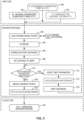
- Figure 1 illustrates an overview of a method of estimating corrosion.
- the method includes obtaining data regarding corrosion (block 100).
- the data is obtained from various sources, such as but not limited to sensors and observational data.
- the data is then trained to provide for a more complete data set (block 102).
- the trained data is then used to estimate the expected amount of corrosion for a given situation (block 104).
- the corrosion estimation applies to the expected effect of one or more parameters on a material.
- the material just includes a metal.
- the material includes a base metal and a finish.
- the material includes a base metal, a finish, and an installation interface such as a rivet.
- FIG. 2 illustrates one example of the steps for obtaining the data.
- the data comprises data points that are received from one or more sources (block 110).
- the sources include but are not limited to sensor data and observational data. Specific examples include sensor measurements from exposed corrosion sites, measurements from outdoor exposure and chamber tests, measurements and/or observations from decommissioned and in service aircraft, and various other new data sources that become available. Specific examples of sensors that can supply data include but are not limited to Luna Innovations L2SA sensors and Luna Innovations Acuity sensors which measure corrosion rate as well as surrounding environmental parameters.
- the collected data points are filtered to remove damaged data (block 112).
- the filtering can be based on various factors including but not limited to data quality, conditions during testing that could adversely affect the data, and calculation checks on the sensors and/or observational equipment.
- the filtering removes damaged data to ensure the accuracy of the remaining data.
- the method further determines whether to accept the data (block 114).
- the acceptance analyzes whether the data has already been trained, or if there is already enough data for a given parameter that provides for a sufficient degree of accuracy when estimating the corrosion. If the data is accepted, the data is stored and used for corrosion estimation (block 116). If not accepted, the data is discarded (block 118).
- Figure 2 includes a method in which data from different sources are included in a single data pipeline and stored together as a single data set. Other methods can segregate the data dependent upon the source.
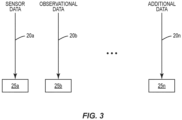
- Figure 3 schematically illustrates different data pipelines 20a, 20b ...20n each gathering data from different sources (e.g., exposed, chamber, on-aircraft, corrosion type). Other examples of data from various pipelines 20 include data from cabinet tests performed in lab, data from outdoor exposure testing, chemical composition data, physical material properties data stored in a database or model source. Each pipeline is analyzed as illustrated in Figure 2 and separately stored as data sets 25a, 25b, etc. for use in the corrosion determination process.
- the data can be obtained as various timing frequencies.
- the data is continuously collected and stored.
- the stored data is then periodically scraped and used for analysis.
- Another example obtains the data on an as-needed basis.
- the data is trained.
- One example of the training process is illustrated in Figure 4 .
- the training process consumes the one or more data sets 25 from the one or more data pipelines 20 and aggregates interpolated forms of the data together into a single trained data model 35 that is used subsequently by the estimation process.
- the training process differs based on the categorical nature of the data set 25.
- data sets 25 from two primary sources are used including a data set 25a of sensor measurements from exposed sites and a data set 25b of chamber/on-aircraft data.
- the appropriate date/time range and geographic location is associated with the data (block 202).
- the additional data is weather data from the time and location when the data was gathered.
- Other examples of additional data include but are not limited to chemical composition data, species concentration data, and physical material properties data from a different database or model sources.
- Additional data is gathered from one or more data sources 52 (block 204).
- the remote sources 52 can include various data sources including but not limited to sites available through the network (e.g., Internet), different databases, and different model sources.
- remote sources 52 for weather include but are not limited to the National Oceanic and Atmospheric Administration (NOAA), Integrated Surface Database (ISD), Meteorological Assimilation Data Ingest System (MADIS), PRISM, and a number of other external or internal sources to retrieve associated weather data for the same date and time range.
- Data sources 52 can also provide additional environmental conditions such as but not limited to other weather conditions, pollution levels, salt exposure based on closeness to an ocean, and erosion exposure.
- An interpolation step is performed to interpolate the additional data (block 206). The interpolation generates an estimated set of additional data. For the example of using weather sources, this includes interpolation in time from weather measurements taken near the same time to determine an estimate at the same date/time as the measurement for a data point. Additionally or alternatively, this includes geographic interpolation.
- the interpolation step is supplemented with thermodynamic or physical calculations.
- One example includes determining an on-aircraft external temperature based on known surface ground temperature measurements.
- the process generates missing or supplemental parameters (block 208).
- thermodynamic, chemical, or physical calculations or experimental tables or data are used to determine additional environmental parameters of interest.
- One example includes the calculation of the absolute humidity at the measurement point from the relative humidity, temperature, and pressure.
- additional parameters are determined using physical models.
- the training of the observational data set 25b is different than the training of the sensor data set 25a.
- the training for this type of data is different because there are no further available sources 52 for correlating the measurements with additional data. Instead of using data sources 52, the process calculates supplemental values via thermodynamic or physical calculations (block 212).
- the data is aggregated together (block 214) into a common file or database as a trained data model 35.
- the trained data model 35 can be in a format that provides for querying for subsequent processing.
- additional sources of data are included for training.
- the process would be similar for each source, wherein the data pipeline would be expanded to include accepting/rejecting/filtering/storing the new source, and the training process augmented to aggregate the new source, possibly adding supplemental values and/or querying additional internal/external sources to correlate additional interpolated data to the aggregated form. Additional processing steps may be required in the training such as image analysis for photographic observations of corrosion damage.
- the estimation process includes user input 40 of one or more parameters regarding the corrosion.
- user inputs 40 include but are not limited to material parameters (e.g., substrate, finish), environmental parameters (e.g., temperature, relative humidity), corrosion type (e.g., galvanic, pitting, filiform), and testing site parameters (exposed, in-flight, chamber).
- material parameters e.g., substrate, finish
- environmental parameters e.g., temperature, relative humidity
- corrosion type e.g., galvanic, pitting, filiform
- testing site parameters e.g., galvanic, pitting, filiform
- testing site parameters exposed, in-flight, chamber.
- Figure 5 includes an example with three different types of user inputs 40: material parameters 40a; environmental parameters 40b; and corrosion type 40c.
- the material parameters 40a include one or more of a base metal, finish, and installation interface (e.g., rivet).
- the estimation process in block 104 could be performed using any of a number of different approaches, including but not limited to learning methods such as k-Nearest Neighbors (KNN), neural networks, specialized neural networks such as convolutional neural networks (CNNs), or statistical approaches including statistical regression models, Bayesian inference statistics models, Kriging models, or other approaches.
- KNN k-Nearest Neighbors
- CNN convolutional neural networks
- statistical approaches including statistical regression models, Bayesian inference statistics models, Kriging models, or other approaches.
- KNN k-Nearest Neighbors
- the data points from the trained data model 35 are used for the analysis (block 300).
- the data points are filtered to remove data that is not applicable to the parameters in the user input 40 (block 302).
- the filtering occurs for one or more of the user inputs 40.
- Filtering parameters include but are not limited to material, surface treatment, surface finish, and corrosion type.
- the filtering applies to the material parameters 40a and corrosion type 40c. It is understood that filtering can occur to various user inputs.
- distances between the user inputs 40 and the data points are measured and normalized (block 304). Normalizing the distances provides for equal weight for each of the user inputs 40 (block 304). In one example, one or more additional weighting schemes are applied when higher confidence is known in particular predictors.
- a baseline of the distances is set by initializing the distances (block 306).
- the environmental parameters 40b are analyzed after filtering of the other user inputs 40a, 40c (block 310).
- the parameters are individually selected (block 312), point distances are calculated for the points (block 314), and the distances are sorted (block 316).
- the nearest points are determined and weighted (block 320). In one example, the distances are computed and sorted in ascending order.
- the first k points of the ascending order are selected.
- One or more statistical values are computed based on the selected distances (block 322). Examples include statistical values such as a mean, median, inverse-linear weighted average or other approach which is applied to calculate the desired corrosion rate or feature of interest.
- a corrosion estimate is output (block 324).
- the feature includes an image.
- the process includes additional steps of image analysis to determine or predict the desired feature.
- the final predicted rate or feature is then published to the user.
- the image features of interest include predicted corrosion area, shape of area around a geometric feature or across a surface, severity of corrosion across a surface, presence/absence/amount of various features such as crevices and/or crack formation, and geometric distribution of any damage across the surface.
- Image features can also include a surface that includes a geometric part or component such as a rivet, bolt, hole, punch-out, coupon, seam, weld, split, join, or bonding, etc.
- Figure 6 illustrates an example of an input display 75 configured for a user device 70.
- the input display 75 provides for a user to enter the user inputs 40.
- the user specifies the type of environment and any known environmental parameters.
- Figure 6 generically illustrates the user inputs with "x" as the input.
- one or more material parameters 40 are also input by the user. Unknown parameters are left blank.
- the estimation process then computes the resulting corrosion rate and transmits the input display 75 to the user device 70.
- Figure 7 illustrates an example with the calculated values shown generically as "y”.
- the output display 76 corresponds to the input display 75 and includes the generated corrosion estimation 77 and environmental parameters 78.
- the corrosion estimation is one or more of a corrosion mass loss rate and a corrosion current density.
- the output includes a degree of corrosion that includes one or more of mass loss, corrosion area, and pit depth.
- the output display 76 also includes a confidence value 79 computed from the size of the normalized distances found.
- the confidence value 79 can be a statistical determination of the expected accuracy of the corrosion estimation 77 and based on the number of data points from the trained data model 35. The confidence value 79 is higher when based on a larger number of data points. In one example, the confidence value 79 is higher when the normalized distances away from the nearest points found are smaller.
- the present methodology provides for calculating additional parameters to provide for a more completed trained data model 35 to increase the confidence value of the final corrosion estimation.
- the estimation method and system alleviates the challenges of previous methods by applying a nonlinear regression model to estimate the corrosion damage or expected degradation features for a particular metal or coating in a particular environment. This allows corrosion risk to be rapidly calculated much earlier in the design process to identify and avoid problematic designs and expensive design changes after manufacturing has begun.
- Figure 8 illustrates a computing device 90 configured to perform the corrosion estimations.
- the computing device 90 can include a variety of different forms, including but not limited to a server computer, a workstation computer, a desktop computer, a smartphone, tablet computer, and a laptop computer.
- the computing device 90 can include one or more of each of a number of components such as, for example, processing circuitry 95 (e.g., processor unit) connected to a memory circuitry 96 (e.g., storage device).
- processing circuitry 95 e.g., processor unit
- memory circuitry 96 e.g., storage device
- the processing circuitry 95 may be composed of one or more processors alone or in combination with one or more memories.
- the processing circuitry 95 is generally computer hardware that is capable of processing information such as, for example, data, computer programs and/or other suitable electronic information.
- the processing circuitry 95 is composed of a collection of electronic circuits some of which may be packaged as an integrated circuit or multiple interconnected integrated circuits (an integrated circuit at times more commonly referred to as a "chip").
- the processing circuitry 95 may be configured to execute computer programs 97, which may be stored onboard the processing circuitry 95 or otherwise stored in the memory circuitry 96 (of the same or another device).
- processing circuitry 95 may be capable of executing a computer program 97 to perform one or more functions
- processing circuitry 95 of various examples may be capable of performing one or more functions without the aid of a computer program 97. In either instance, the processing circuitry 95 may be appropriately programmed to perform functions or operations according to example implementations of the present disclosure.
- the memory circuitry 96 is generally computer hardware that is capable of storing information such as, for example, data, computer programs (e.g., computer-readable program code 97) and/or other suitable information either on a temporary basis and/or a permanent basis.
- the memory circuitry 96 may include volatile and/or non-volatile memory and may be fixed or removable. Examples of suitable memory circuitry 96 include random access memory (RAM), read-only memory (ROM), a hard drive, a flash memory, a thumb drive, a removable computer diskette, an optical disk, a magnetic tape or some combination of the above.
- Optical disks may include compact disk-read only memory (CD-ROM), compact disk-read/write (CD-R/W), DVD or the like.
- the memory circuitry 96 may be referred to as a computer-readable storage medium.
- the computer-readable storage medium is a (optionally, non-transitory) device capable of storing information and is distinguishable from computer-readable transmission media such as electronic transitory signals capable of carrying information from one location to another.
- Computer-readable medium as described herein may generally refer to a computer-readable storage medium or computer-readable transmission medium.
- the processing circuitry 95 may also be connected to one or more interfaces for displaying, transmitting and/or receiving information, such as the input and output displays 75, 76.
- the interfaces include a communications interface circuitry 92 configured to transmit and/or receive information, such as to and/or from the remote sources 52, user devices 70, other apparatus(es), network(s) or the like.
- the communications interface circuitry 92 may be configured to transmit and/or receive information by physical (wired) and/or wireless communications links. Examples of suitable communication interfaces include a network interface controller (NIC), wireless NIC (WNIC) or the like.
- the communications interface circuitry 92 may have one or more transmitters 93.
- the communications interface circuitry 92 may have one or more receivers 94.
- program code instructions 97 may be stored in the memory circuitry 96 and executed by processing circuitry 95 that is thereby programmed, to implement functions of the systems, subsystems, tools and their respective elements described herein.
- program code instructions may be loaded onto a computing device or other programmable apparatus from a computer-readable storage medium to produce a particular machine, such that the particular machine becomes a means for implementing the functions specified herein.
- These program code instructions may also be stored in a computer-readable storage medium that can direct a computer, a processing circuitry or other programmable apparatus to function in a particular manner to thereby generate a particular machine or particular article of manufacture.
- the instructions stored in the computer-readable storage medium may produce an article of manufacture, where the article of manufacture becomes a means for implementing functions described herein.
- the program code instructions may be retrieved from a computer-readable storage medium and loaded into a computer, processing circuitry or other programmable apparatus to configure the computer, processing circuitry or other programmable apparatus to execute operations to be performed on or by the computer, processing circuitry or other programmable apparatus.
- Retrieval, loading and execution of the program code instructions may be performed sequentially such that one instruction is retrieved, loaded and executed at a time. In some example implementations, retrieval, loading and/or execution may be performed in parallel such that multiple instructions are retrieved, loaded, and/or executed together. Execution of the program code instructions may produce a computer-implemented process such that the instructions executed by the computer, processing circuitry or other programmable apparatus provide operations for implementing functions described herein.
- a computing device 90 may include a processing circuitry 95 and a memory circuitry 96 coupled to the processing circuitry 95, where the processing circuitry 95 is configured to execute computer-readable program code 97 stored in the memory circuitry 96. It will also be understood that one or more functions, and combinations of functions, may be implemented by special purpose hardware-based computer systems and/or processing circuitry which perform the specified functions, or combinations of special purpose hardware and program code instructions.
- the methods are used to determine corrosion estimates for materials on a vehicle.
- Vehicles include but are not limited to manned aircraft, unmanned aircraft, manned spacecraft, unmanned spacecraft, manned rotorcraft, unmanned rotorcraft, satellites, rockets, missiles, manned terrestrial vehicles, unmanned terrestrial vehicles, manned surface water borne vehicles, unmanned surface water borne vehicles, manned sub-surface water borne vehicles, unmanned sub-surface water borne vehicles, and combinations thereof.
- the corrosion estimation can also be used to determine corrosion for a variety of other objects and in a variety of other contexts and environments.
Landscapes
- Engineering & Computer Science (AREA)
- Theoretical Computer Science (AREA)
- Physics & Mathematics (AREA)
- Data Mining & Analysis (AREA)
- General Physics & Mathematics (AREA)
- Life Sciences & Earth Sciences (AREA)
- General Engineering & Computer Science (AREA)
- Computer Vision & Pattern Recognition (AREA)
- Artificial Intelligence (AREA)
- Evolutionary Computation (AREA)
- Software Systems (AREA)
- Evolutionary Biology (AREA)
- Bioinformatics & Computational Biology (AREA)
- Bioinformatics & Cheminformatics (AREA)
- Mathematical Physics (AREA)
- Mathematical Analysis (AREA)
- Computational Mathematics (AREA)
- Pure & Applied Mathematics (AREA)
- Mathematical Optimization (AREA)
- Environmental & Geological Engineering (AREA)
- Chemical & Material Sciences (AREA)
- Medical Informatics (AREA)
- Computing Systems (AREA)
- Biodiversity & Conservation Biology (AREA)
- Ecology (AREA)
- Pathology (AREA)
- Environmental Sciences (AREA)
- Health & Medical Sciences (AREA)
- Immunology (AREA)
- Analytical Chemistry (AREA)
- Biochemistry (AREA)
- General Health & Medical Sciences (AREA)
- Algebra (AREA)
- Databases & Information Systems (AREA)
- Testing Resistance To Weather, Investigating Materials By Mechanical Methods (AREA)
- Investigating And Analyzing Materials By Characteristic Methods (AREA)
Abstract
Description
- The present disclosure relates generally to the field of corrosion estimation and, more specifically, to a nonlinear regression tool for estimating corrosion damage.
- Corrosion is a major factor for determining the overall lifetime and maintenance schedule of a vehicle. There are numerous different types of corrosion including but not limited to galvanic, crevice, erosion, and filiform. Galvanic corrosion occurs when two dissimilar materials are placed in contact and a differential in voltages across them drives a small current flow. Crevice corrosion occurs to metal surfaces where a stagnant solution remains in contact. Erosion occurs from external forces such as sand or other debris moves against the metal surface. Filiform corrosion is the interaction between a coating and a base metal. Pitting occurs when cavities are produced in a material. Each of these forms of corrosion can be influenced by environmental conditions.
- The effects of corrosion are analyzed during the initial design of a vehicle. Current analysis relies heavily on the expertise of the designers and utilizes their previous experiences in vehicle design, subjective decision making, and tribal knowledge. Unfortunately, many designers do not have the necessary expertise that is obtained through extensive training and work experience.
- One design method analyzes the effect of corrosion after fully designing the vehicle. After the design is complete, corrosion damage rates and features are ascertained through testing. However, the testing is expensive and can be labor intensive. Further, issues that are discovered during the testing require design changes which are expensive to implement after the design of the vehicle is complete.
- Several efforts have explored modeling to predict corrosion damage in lieu of testing. However, due to the complex physics of corrosion behavior and the long duration required for corrosion to transpire for measurement and comparison, modeling approaches have frequently been very limited in capability, and remain a research activity. Some current modeling approaches are based on a diffusion process and do not capture the complicated interaction with various elements in base alloys and chemicals in the coating. Other existing modeling approaches can be very computationally expensive and require significant resources for a single calculation. Computational models are notoriously difficult to predict and for which data is often scarce. The complex physics involved necessitates computationally expensive first-principles modeling, which can take lengthy time frames for a single solution. This can also require a large amount of data that may not be available early in the conceptual design of a new design. Empirical models have also been developed, but require substantial and expensive testing to construct, and may take very long periods of time to compare and validate due to the typical time scale for corrosion damage to transpire.
- One aspect is directed to a method of estimating corrosion of a material. The method comprises: obtaining corrosion data comprising a plurality of data points; generating additional data points based on the data points and additional data obtained from one or more remote sources; aggregating the data points and the additional data points into a trained data model; receiving an input of one or more environmental parameters; determining a set of the data points from the trained data model that are closest to the one or more environmental parameters; and determining a corrosion estimate for the material based on the set of the data points from the trained data model.
- In another aspect, the method further comprises applying k-nearest neighbors (KNN) nonlinear regression and determining the set of the data points from the trained data model that are closest to the one or more environmental parameters.
- In another aspect, the method further comprises filtering the trained model and removing the data points unrelated to the one or more environmental parameters prior to applying the KNN nonlinear regression.
- In another aspect, the method further comprises normalizing distances between the filtered data points.
- In another aspect, the method further comprises determining a confidence level of the corrosion estimate based on the normalized distances.
- In another aspect, the method further comprises determining one or more of a corrosion mass loss rate, a corrosion current density, and a degree of corrosion.
- In another aspect, generating the additional data points comprises: selecting one of the data points; obtaining one or more environmental conditions at a date, time, and geographic location when the data point was collected; and interpolating the data point and the one or more environmental conditions and generating the additional data points.
- In another aspect, the data points comprise sensor data and observational data and generating the additional data points using just the sensor data.
- In another aspect, obtaining corrosion data comprises receiving parameters of and filtering the data points by the material and a corrosion type.
- In another aspect, the method further comprises determining additional environmental parameters based on an analysis of the trained data model, the additional environmental parameters being different than the received environmental parameters.
- One aspect is directed to a method of estimating corrosion of a material. The method comprises: receiving corrosion data comprising data points of measurement data and observational data; determining additional data points based on the corrosion data and environmental conditions from a date and time when the corrosion data was observed; aggregating the corrosion data and the additional data into a trained data model; receiving from a user device one or more environmental parameters; filtering the trained data model and generating remaining data points by removing the data points unrelated to the one or more environmental parameters; determining a distance between the remaining data points and the one or more environmental parameters; selecting a group of the remaining data points that are nearest to the one or more environmental parameters; based on the group of the remaining data points, determining a corrosion estimate; and transmitting an output display to the user device.
- In another aspect, the method further comprises applying KNN nonlinear regression and determining the distance between the remaining data points and the one or more environmental parameters.
- In another aspect, the method further comprises normalizing distances between the remaining data points.
- In another aspect, the method further comprises determining a confidence level of the corrosion estimate based on the normalized distances.
- In another aspect, the method further comprises determining a corrosion mass loss rate.
- In another aspect, determining the additional data points comprises: selecting one of the data points; obtaining the environmental conditions from the date and time when the corrosion data was observed; and interpolating the data point and the one or more environmental conditions and generating the additional data points.
- In another aspect, the data points comprise sensor data and observational data and determining the additional data points using just the sensor data.
- One aspect is directed to a (optionally, non-transitory) computer readable medium comprising instructions stored thereon that, when executed by processing circuitry of a computing device, configured the computing device to: obtain corrosion data comprising a plurality of data points; generate additional data points based on the data points and additional data obtained from one or more remote sources; aggregate the data points and the additional data points into a trained data model; receiving an input of one or more environmental parameters; filtering the trained data model and removing the data points unrelated to the one or more environmental parameters; apply KNN nonlinear regression and determine a set of the data points from the filtered trained data model that are closest to the one or more environmental parameters; and determine a corrosion estimate for the material based on the set of the data points from the trained data model.
- In another aspect, the computing device is further configured to normalize the filtered data points to equally weight the data points related to the one or more environmental parameters.
- In another aspect, the computing device is further configured to determine a confidence level of the corrosion estimate based on the normalized distances.
- The features, functions and advantages that have been discussed can be achieved independently in various aspects or may be combined in yet other aspects, further details of which can be seen with reference to the following description and the drawings.
-
-
Figure 1 is a flowchart diagram of a method of estimating corrosion of a material. -
Figure 2 is a flowchart diagram of a method of obtaining data. -
Figure 3 is a schematic diagram of pipelines for gathering data from different sources. -
Figure 4 is a flowchart diagram of a method of generating a trained data model. -
Figure 5 is a flowchart diagram of a method of determining a corrosion estimate. -
Figure 6 is a graphic user interface of an input display for a user to enter one or more parameters. -
Figure 7 is a graphical user interface of an output display to display parameters to a user. -
Figure 8 is a schematic diagram of a computing device. -
Figure 1 illustrates an overview of a method of estimating corrosion. The method includes obtaining data regarding corrosion (block 100). The data is obtained from various sources, such as but not limited to sensors and observational data. The data is then trained to provide for a more complete data set (block 102). The trained data is then used to estimate the expected amount of corrosion for a given situation (block 104). - The corrosion estimation applies to the expected effect of one or more parameters on a material. In one example, the material just includes a metal. In another example, the material includes a base metal and a finish. In another example, the material includes a base metal, a finish, and an installation interface such as a rivet.
-
Figure 2 illustrates one example of the steps for obtaining the data. The data comprises data points that are received from one or more sources (block 110). The sources include but are not limited to sensor data and observational data. Specific examples include sensor measurements from exposed corrosion sites, measurements from outdoor exposure and chamber tests, measurements and/or observations from decommissioned and in service aircraft, and various other new data sources that become available. Specific examples of sensors that can supply data include but are not limited to Luna Innovations L2SA sensors and Luna Innovations Acuity sensors which measure corrosion rate as well as surrounding environmental parameters. - The collected data points are filtered to remove damaged data (block 112). The filtering can be based on various factors including but not limited to data quality, conditions during testing that could adversely affect the data, and calculation checks on the sensors and/or observational equipment. The filtering removes damaged data to ensure the accuracy of the remaining data.
- The method further determines whether to accept the data (block 114). The acceptance analyzes whether the data has already been trained, or if there is already enough data for a given parameter that provides for a sufficient degree of accuracy when estimating the corrosion. If the data is accepted, the data is stored and used for corrosion estimation (block 116). If not accepted, the data is discarded (block 118).
-
Figure 2 includes a method in which data from different sources are included in a single data pipeline and stored together as a single data set. Other methods can segregate the data dependent upon the source.Figure 3 schematically illustratesdifferent data pipelines Figure 2 and separately stored asdata sets - The data can be obtained as various timing frequencies. In one example, the data is continuously collected and stored. The stored data is then periodically scraped and used for analysis. Another example obtains the data on an as-needed basis.
- After the data has been obtained and then stored in one or more data sets 25, the data is trained. One example of the training process is illustrated in
Figure 4 . The training process consumes the one or more data sets 25 from the one or more data pipelines 20 and aggregates interpolated forms of the data together into a single traineddata model 35 that is used subsequently by the estimation process. In one example as illustrated inFigure 4 , the training process differs based on the categorical nature of the data set 25. In this example, data sets 25 from two primary sources are used including adata set 25a of sensor measurements from exposed sites and adata set 25b of chamber/on-aircraft data. - For the
sensor data set 25a, the appropriate date/time range and geographic location is associated with the data (block 202). In one example, the additional data is weather data from the time and location when the data was gathered. Other examples of additional data include but are not limited to chemical composition data, species concentration data, and physical material properties data from a different database or model sources. Additional data is gathered from one or more data sources 52 (block 204). Theremote sources 52 can include various data sources including but not limited to sites available through the network (e.g., Internet), different databases, and different model sources. Examples ofremote sources 52 for weather include but are not limited to the National Oceanic and Atmospheric Administration (NOAA), Integrated Surface Database (ISD), Meteorological Assimilation Data Ingest System (MADIS), PRISM, and a number of other external or internal sources to retrieve associated weather data for the same date and time range.Data sources 52 can also provide additional environmental conditions such as but not limited to other weather conditions, pollution levels, salt exposure based on closeness to an ocean, and erosion exposure. An interpolation step is performed to interpolate the additional data (block 206). The interpolation generates an estimated set of additional data. For the example of using weather sources, this includes interpolation in time from weather measurements taken near the same time to determine an estimate at the same date/time as the measurement for a data point. Additionally or alternatively, this includes geographic interpolation. - In one example, the interpolation step is supplemented with thermodynamic or physical calculations. One example includes determining an on-aircraft external temperature based on known surface ground temperature measurements.
- The process generates missing or supplemental parameters (block 208). In one example, thermodynamic, chemical, or physical calculations or experimental tables or data are used to determine additional environmental parameters of interest. One example includes the calculation of the absolute humidity at the measurement point from the relative humidity, temperature, and pressure. In another example, additional parameters are determined using physical models.
- The training of the
observational data set 25b is different than the training of thesensor data set 25a. The training for this type of data is different because there are no furtheravailable sources 52 for correlating the measurements with additional data. Instead of usingdata sources 52, the process calculates supplemental values via thermodynamic or physical calculations (block 212). - After the additional data is determined for the
different data sets data model 35. The traineddata model 35 can be in a format that provides for querying for subsequent processing. -
Figure 4 includes an example with the different data sets 25 trained in different manners. In another example, the different data sets 25 are treated in a common manner. This can include the interpolation based on additional data to calculate additional parameters, or the calculation of additional parameters based on calculations. In another example, no interpolation is performed for one or more of the data sets 25. - In another example, additional sources of data are included for training. The process would be similar for each source, wherein the data pipeline would be expanded to include accepting/rejecting/filtering/storing the new source, and the training process augmented to aggregate the new source, possibly adding supplemental values and/or querying additional internal/external sources to correlate additional interpolated data to the aggregated form. Additional processing steps may be required in the training such as image analysis for photographic observations of corrosion damage.
- Once the training process has been completed, the trained
data model 35 provides a data source for the estimation process. The estimation process includesuser input 40 of one or more parameters regarding the corrosion. Examples ofuser inputs 40 include but are not limited to material parameters (e.g., substrate, finish), environmental parameters (e.g., temperature, relative humidity), corrosion type (e.g., galvanic, pitting, filiform), and testing site parameters (exposed, in-flight, chamber). The number and type ofuser inputs 40 can vary.Figure 5 includes an example with three different types of user inputs 40:material parameters 40a;environmental parameters 40b; andcorrosion type 40c. In one example, thematerial parameters 40a include one or more of a base metal, finish, and installation interface (e.g., rivet). - The estimation process in
block 104 could be performed using any of a number of different approaches, including but not limited to learning methods such as k-Nearest Neighbors (KNN), neural networks, specialized neural networks such as convolutional neural networks (CNNs), or statistical approaches including statistical regression models, Bayesian inference statistics models, Kriging models, or other approaches. A single instance of this implementation of the estimation process inblock 102 is shown inFig. 5 , wherein a k-Nearest Neighbors (KNN) approach has been used. - As illustrated in
Figure 5 , the data points from the traineddata model 35 are used for the analysis (block 300). The data points are filtered to remove data that is not applicable to the parameters in the user input 40 (block 302). In one example, the filtering occurs for one or more of theuser inputs 40. Filtering parameters include but are not limited to material, surface treatment, surface finish, and corrosion type. In one example, the filtering applies to thematerial parameters 40a andcorrosion type 40c. It is understood that filtering can occur to various user inputs. - After filtering, distances between the
user inputs 40 and the data points are measured and normalized (block 304). Normalizing the distances provides for equal weight for each of the user inputs 40 (block 304). In one example, one or more additional weighting schemes are applied when higher confidence is known in particular predictors. A baseline of the distances is set by initializing the distances (block 306). - In this example, the
environmental parameters 40b are analyzed after filtering of theother user inputs environmental parameters 40b, the parameters are individually selected (block 312), point distances are calculated for the points (block 314), and the distances are sorted (block 316). Once the parameters have been analyzed, the nearest points are determined and weighted (block 320). In one example, the distances are computed and sorted in ascending order. - In one example, the first k points of the ascending order are selected. One or more statistical values are computed based on the selected distances (block 322). Examples include statistical values such as a mean, median, inverse-linear weighted average or other approach which is applied to calculate the desired corrosion rate or feature of interest. A corrosion estimate is output (block 324).
- In one example, the feature includes an image. The process includes additional steps of image analysis to determine or predict the desired feature. The final predicted rate or feature is then published to the user. In one example, the image features of interest include predicted corrosion area, shape of area around a geometric feature or across a surface, severity of corrosion across a surface, presence/absence/amount of various features such as crevices and/or crack formation, and geometric distribution of any damage across the surface. Image features can also include a surface that includes a geometric part or component such as a rivet, bolt, hole, punch-out, coupon, seam, weld, split, join, or bonding, etc.
-
Figure 6 illustrates an example of aninput display 75 configured for auser device 70. Theinput display 75 provides for a user to enter theuser inputs 40. In this example, the user specifies the type of environment and any known environmental parameters.Figure 6 generically illustrates the user inputs with "x" as the input. In one example, one ormore material parameters 40 are also input by the user. Unknown parameters are left blank. The estimation process then computes the resulting corrosion rate and transmits theinput display 75 to theuser device 70.Figure 7 illustrates an example with the calculated values shown generically as "y". Theoutput display 76 corresponds to theinput display 75 and includes the generatedcorrosion estimation 77 andenvironmental parameters 78. In one example, the corrosion estimation is one or more of a corrosion mass loss rate and a corrosion current density. In one example, the output includes a degree of corrosion that includes one or more of mass loss, corrosion area, and pit depth. Theoutput display 76 also includes aconfidence value 79 computed from the size of the normalized distances found. Theconfidence value 79 can be a statistical determination of the expected accuracy of thecorrosion estimation 77 and based on the number of data points from the traineddata model 35. Theconfidence value 79 is higher when based on a larger number of data points. In one example, theconfidence value 79 is higher when the normalized distances away from the nearest points found are smaller. The present methodology provides for calculating additional parameters to provide for a more completed traineddata model 35 to increase the confidence value of the final corrosion estimation. - In one example, the estimation method and system alleviates the challenges of previous methods by applying a nonlinear regression model to estimate the corrosion damage or expected degradation features for a particular metal or coating in a particular environment. This allows corrosion risk to be rapidly calculated much earlier in the design process to identify and avoid problematic designs and expensive design changes after manufacturing has begun.
-
Figure 8 illustrates acomputing device 90 configured to perform the corrosion estimations. Thecomputing device 90 can include a variety of different forms, including but not limited to a server computer, a workstation computer, a desktop computer, a smartphone, tablet computer, and a laptop computer. Thecomputing device 90 can include one or more of each of a number of components such as, for example, processing circuitry 95 (e.g., processor unit) connected to a memory circuitry 96 (e.g., storage device). - The
processing circuitry 95 may be composed of one or more processors alone or in combination with one or more memories. Theprocessing circuitry 95 is generally computer hardware that is capable of processing information such as, for example, data, computer programs and/or other suitable electronic information. Theprocessing circuitry 95 is composed of a collection of electronic circuits some of which may be packaged as an integrated circuit or multiple interconnected integrated circuits (an integrated circuit at times more commonly referred to as a "chip"). Theprocessing circuitry 95 may be configured to executecomputer programs 97, which may be stored onboard theprocessing circuitry 95 or otherwise stored in the memory circuitry 96 (of the same or another device). - The
processing circuitry 95 may be a number of processors, a multi-core processor or some other type of processor, depending on the particular implementation. Further, theprocessing circuitry 95 may be implemented using a number of heterogeneous processor systems in which a main processor is present with one or more secondary processors on a single chip. As another illustrative example, theprocessing circuitry 95 may be a symmetric multi-processor system containing multiple processors of the same type. In yet another example, theprocessing circuitry 95 may be embodied as or otherwise include one or more ASICs, FPGAs or the like. Thus, although theprocessing circuitry 95 may be capable of executing acomputer program 97 to perform one or more functions, theprocessing circuitry 95 of various examples may be capable of performing one or more functions without the aid of acomputer program 97. In either instance, theprocessing circuitry 95 may be appropriately programmed to perform functions or operations according to example implementations of the present disclosure. - The
memory circuitry 96 is generally computer hardware that is capable of storing information such as, for example, data, computer programs (e.g., computer-readable program code 97) and/or other suitable information either on a temporary basis and/or a permanent basis. Thememory circuitry 96 may include volatile and/or non-volatile memory and may be fixed or removable. Examples ofsuitable memory circuitry 96 include random access memory (RAM), read-only memory (ROM), a hard drive, a flash memory, a thumb drive, a removable computer diskette, an optical disk, a magnetic tape or some combination of the above. Optical disks may include compact disk-read only memory (CD-ROM), compact disk-read/write (CD-R/W), DVD or the like. In various instances, thememory circuitry 96 may be referred to as a computer-readable storage medium. The computer-readable storage medium is a (optionally, non-transitory) device capable of storing information and is distinguishable from computer-readable transmission media such as electronic transitory signals capable of carrying information from one location to another. Computer-readable medium as described herein may generally refer to a computer-readable storage medium or computer-readable transmission medium. - In addition to the
memory circuitry 96, theprocessing circuitry 95 may also be connected to one or more interfaces for displaying, transmitting and/or receiving information, such as the input andoutput displays communications interface circuitry 92 configured to transmit and/or receive information, such as to and/or from theremote sources 52,user devices 70, other apparatus(es), network(s) or the like. Thecommunications interface circuitry 92 may be configured to transmit and/or receive information by physical (wired) and/or wireless communications links. Examples of suitable communication interfaces include a network interface controller (NIC), wireless NIC (WNIC) or the like. Thecommunications interface circuitry 92 may have one ormore transmitters 93. Thecommunications interface circuitry 92 may have one ormore receivers 94. - As indicated above,
program code instructions 97 may be stored in thememory circuitry 96 and executed by processingcircuitry 95 that is thereby programmed, to implement functions of the systems, subsystems, tools and their respective elements described herein. - As will be appreciated, program code instructions may be loaded onto a computing device or other programmable apparatus from a computer-readable storage medium to produce a particular machine, such that the particular machine becomes a means for implementing the functions specified herein. These program code instructions may also be stored in a computer-readable storage medium that can direct a computer, a processing circuitry or other programmable apparatus to function in a particular manner to thereby generate a particular machine or particular article of manufacture. The instructions stored in the computer-readable storage medium may produce an article of manufacture, where the article of manufacture becomes a means for implementing functions described herein. The program code instructions may be retrieved from a computer-readable storage medium and loaded into a computer, processing circuitry or other programmable apparatus to configure the computer, processing circuitry or other programmable apparatus to execute operations to be performed on or by the computer, processing circuitry or other programmable apparatus.
- Retrieval, loading and execution of the program code instructions may be performed sequentially such that one instruction is retrieved, loaded and executed at a time. In some example implementations, retrieval, loading and/or execution may be performed in parallel such that multiple instructions are retrieved, loaded, and/or executed together. Execution of the program code instructions may produce a computer-implemented process such that the instructions executed by the computer, processing circuitry or other programmable apparatus provide operations for implementing functions described herein.
- Execution of instructions by a processing circuitry, or storage of instructions in a computer-readable storage medium, supports combinations of operations for performing the specified functions. In this manner, a
computing device 90 may include aprocessing circuitry 95 and amemory circuitry 96 coupled to theprocessing circuitry 95, where theprocessing circuitry 95 is configured to execute computer-readable program code 97 stored in thememory circuitry 96. It will also be understood that one or more functions, and combinations of functions, may be implemented by special purpose hardware-based computer systems and/or processing circuitry which perform the specified functions, or combinations of special purpose hardware and program code instructions. - In one example, the methods are used to determine corrosion estimates for materials on a vehicle. Vehicles include but are not limited to manned aircraft, unmanned aircraft, manned spacecraft, unmanned spacecraft, manned rotorcraft, unmanned rotorcraft, satellites, rockets, missiles, manned terrestrial vehicles, unmanned terrestrial vehicles, manned surface water borne vehicles, unmanned surface water borne vehicles, manned sub-surface water borne vehicles, unmanned sub-surface water borne vehicles, and combinations thereof. The corrosion estimation can also be used to determine corrosion for a variety of other objects and in a variety of other contexts and environments.
- Further, the disclosure comprises the subject matter described in the following clauses:
- Clause 1. A method of estimating corrosion of a material, the method comprising: obtaining corrosion data comprising a plurality of data points; generating additional data points based on the data points and additional data obtained from one or more remote sources; aggregating the data points and the additional data points into a trained data model; receiving an input of one or more environmental parameters; determining a set of the data points from the trained data model that are closest to the one or more environmental parameters; and determining a corrosion estimate for the material based on the set of the data points from the trained data model.
-
Clause 2. The method of clause 1, further comprising applying k-nearest neighbors 'KNN' nonlinear regression and determining the set of the data points from the trained data model that are closest to the one or more environmental parameters. -
Clause 3. The method ofclause 2, further comprising filtering the trained data model and removing the data points unrelated to the one or more environmental parameters prior to applying the KNN nonlinear regression. - Clause 4. The method of
clause 3, further comprising normalizing distances between the filtered data points. - Clause 5. The method of clause 4, further comprising determining a confidence level of the corrosion estimate based on the normalized distances.
- Clause 6. The method of any preceding clause, further comprising determining one or more of a corrosion mass loss rate, a corrosion current density, and a degree of corrosion.
- Clause 7. The method of any preceding clause, wherein generating the additional data points comprises: selecting one of the data points; obtaining one or more environmental conditions at a date, time, and geographic location when the data point was collected; and interpolating the data point and the one or more environmental conditions and generating the additional data points. Clause 8. The method of any preceding clause, wherein the data points comprise sensor data and observational data and generating the additional data points using just the sensor data.
- Clause 9. The method of any preceding clause, wherein obtaining corrosion data comprises receiving parameters of and filtering the data points by the material and a corrosion type.
- Clause 10. The method of any preceding clause, further comprising determining additional environmental parameters based on an analysis of the trained data model, the additional environmental parameters being different than the received environmental parameters.
- Clause 10a. A computer readable medium comprising instructions stored thereon that, when executed by processing circuitry of a computing device, cause the computing device to carry out the steps of the method of any of clauses 1 to 10.
- Clause 11. A method of estimating corrosion of a material, the method comprising: receiving corrosion data comprising data points of measurement data and observational data; determining additional data points based on the corrosion data and environmental conditions from a date and time when the corrosion data was observed; aggregating the corrosion data and the additional data into a trained data model; receiving from a user device one or more environmental parameters; filtering the trained data model and generating remaining data points by removing the data points unrelated to the one or more environmental parameters; determining a distance between the remaining data points and the one or more environmental parameters; selecting a group of the remaining data points that are nearest to the one or more environmental parameters; based on the group of the remaining data points, determining a corrosion estimate; and transmitting an output display to the user device.
- Clause 12. The method of clause 11, further comprising applying KNN nonlinear regression and determining the distance between the remaining data points and the one or more environmental parameters.
- Clause 13. The method of clause 11 or clause 12, further comprising normalizing distances between the remaining data points.
- Clause 14. The method of clause 13, further comprising determining a confidence level of the corrosion estimate based on the normalized distances.
- Clause 14a. The method of clause 14, wherein the output display comprises the confidence value level.
- Clause 15. The method of any of clauses 11 to 14a, further comprising determining a corrosion mass loss rate.
- Clause 15a. The method of any preceding clause, wherein the output display comprises the corrosion estimation and the one or more environmental parameters, optionally wherein the corrosion estimation is one or more of a or the corrosion mass loss rate and a corrosion current density.
- Clause 16. The method of any of clauses 11 to 15a, wherein determining the additional data points comprises: selecting one of the data points; obtaining the environmental conditions from the date and time when the corrosion data was observed; and interpolating the data point and the one or more environmental conditions and generating the additional data points.
- Clause 17. The method of any of clauses 11 to 16, wherein the data points comprise sensor data and observational data and determining the additional data points using just the sensor data.
- Clause 17a. A computer readable medium comprising instructions stored thereon that, when executed by processing circuitry of a computing device, cause the computing device to carry out the steps of the method of any of clauses 11 to 17.
- Clause 18. A computer readable medium comprising instructions stored thereon that, when executed by processing circuitry of a computing device, configured the computing device to: obtain corrosion data comprising a plurality of data points; generate additional data points based on the data points and additional data obtained from one or more remote sources; aggregate the data points and the additional data points into a trained data model; receiving an input of one or more environmental parameters; filtering the trained data model and removing the data points unrelated to the one or more environmental parameters; apply KNN nonlinear regression and determine a set of the data points from the filtered trained data model that are closest to the one or more environmental parameters; and determine a corrosion estimate for the material based on the set of the data points from the trained data model.
- Clause 18a. The computer readable medium of clause 18, wherein the computer readable medium is a non-transitory computer readable medium.
- Clause 19. The method of clause 18 or clause 18a, wherein the computing device is further configured to normalize the filtered data points to equally weight the data points related to the one or more environmental parameters.
- Clause 20. The method of clause 19, wherein the computing device is further configured to determine a confidence level of the corrosion estimate based on the normalized distances.
- Clause 21. A (optionally, non-transitory) computer readable medium comprising instructions stored thereon that, when executed by processing circuitry of a computing device, cause the computing device to: obtain corrosion data comprising a plurality of data points; generate additional data points based on the data points and additional data obtained from one or more remote sources; aggregate the data points and the additional data points into a trained data model; receiving an input of one or more environmental parameters; filtering the trained data model and removing the data points unrelated to the one or more environmental parameters; apply KNN nonlinear regression and determine a set of the data points from the filtered trained data model that are closest to the one or more environmental parameters; and determine a corrosion estimate for the material based on the set of the data points from the trained data model.
- Clause 22. The method of clause 21, wherein the computing device is further caused to normalize the filtered data points to equally weight the data points related to the one or more environmental parameters.
- Clause 23. The method of claim 22, wherein the computing device is further caused to determine a confidence level of the corrosion estimate based on the normalized distances.
- The present invention may be carried out in other ways than those specifically set forth herein without departing from essential characteristics of the present invention. The present examples are to be considered in all respects as illustrative and not restrictive, and all changes coming within the meaning and equivalency range of the appended claims are intended to be embraced therein.
- Aspects and features of the present disclosure are set forth in the following numbered items which contain the subject matter of the claims of the parent application as filed:
- 1. A method of estimating corrosion of a material, the method comprising:
- obtaining corrosion data comprising a plurality of data points;
- generating additional data points based on the data points and additional data obtained from one or more remote sources (52);
- aggregating the data points and the additional data points into a trained data model (35);
- receiving an input (40) of one or more environmental parameters;
- determining a set of the data points from the trained data model (35) that are closest to the one or more environmental parameters; and
- determining a corrosion estimate for the material based on the set of the data points from the trained data model (35).
- 2. The method of item 1, further comprising applying k-nearest neighbors 'KNN' nonlinear regression and determining the set of the data points from the trained data model (35) that are closest to the one or more environmental parameters.
- 3. The method of
item 2, further comprising filtering the trained data model and removing the data points unrelated to the one or more environmental parameters prior to applying the KNN nonlinear regression. - 4. The method of
item 3, further comprising normalizing distances between the filtered data points. - 5. The method of item 4, further comprising determining a confidence level of the corrosion estimate based on the normalized distances.
- 6. The method of any preceding item, further comprising determining one or more of a corrosion mass loss rate, a corrosion current density, and a degree of corrosion.
- 7. The method of any preceding item, wherein generating the additional data points comprises:
- selecting one of the data points;
- obtaining one or more environmental conditions at a date, time, and geographic location when the data point was collected; and
- interpolating the data point and the one or more environmental conditions and generating the additional data points.
- 8. The method of any preceding item, wherein the data points comprise sensor data and observational data and generating the additional data points using just the sensor data.
- 9. The method of any preceding item, wherein obtaining corrosion data comprises receiving parameters of and filtering the data points by the material and a corrosion type.
- 10. The method of any preceding item, further comprising determining additional environmental parameters based on an analysis of the trained data model, the additional environmental parameters being different than the received environmental parameters.
- 11. A method of estimating corrosion of a material, the method comprising:
- receiving corrosion data comprising data points of measurement data and observational data;
- determining additional data points based on the corrosion data and environmental conditions from a date and time when the corrosion data was observed;
- aggregating the corrosion data and the additional data into a trained data model;
- receiving from a user device one or more environmental parameters;
- filtering the trained data model and generating remaining data points by removing the data points unrelated to the one or more environmental parameters;
- determining a distance between the remaining data points and the one or more environmental parameters;
- selecting a group of the remaining data points that are nearest to the one or more environmental parameters;
- based on the group of the remaining data points, determining a corrosion estimate; and
- transmitting an output display to the user device.
- 12. The method of item 11, further comprising applying KNN nonlinear regression and determining the distance between the remaining data points and the one or more environmental parameters.
- 13. The method of item 11 or item 12, further comprising normalizing distances between the remaining data points, and optionally further comprising determining a confidence level of the corrosion estimate based on the normalized distances.
- 14. A computer readable medium comprising instructions stored thereon that, when executed by processing circuitry of a computing device, cause the computing device to:
- obtain corrosion data comprising a plurality of data points;
- generate additional data points based on the data points and additional data obtained from one or more remote sources (52);
- aggregate the data points and the additional data points into a trained data model (35);
- receiving an input (40) of one or more environmental parameters;
- filtering the trained data model and removing the data points unrelated to the one or more environmental parameters;
- apply KNN nonlinear regression and determine a set of the data points from the filtered trained data model (35) that are closest to the one or more environmental parameters; and
- determine a corrosion estimate for the material based on the set of the data points from the trained data model (35).
- 15. The method of item 14, wherein the computing device is further caused to normalize the filtered data points to equally weight the data points related to the one or more environmental parameters, and optionally wherein the computing device is further caused to determine a confidence level of the corrosion estimate based on the normalized distances.
Claims (15)
- A computer-implemented method of estimating corrosion of a material, the method comprising:obtaining (100, 110) corrosion data comprising a plurality of data points;generating additional data points based on the data points and additional data obtained from one or more sources (52);aggregating (214) the data points and the additional data points into a trained data model (35);receiving one or more parameters regarding the corrosion;determining a set of the data points from the trained data model (35) that are nearest to the one or more parameters; anddetermining (104) a corrosion estimate for the material based on the set of the data points from the trained data model (35).
- The method of claim 1, further comprising applying k-nearest neighbors 'KNN' nonlinear regression and determining the set of the data points from the trained data model (35) that are nearest to the one or more parameters.
- The method of claim 2, further comprising filtering (112, 302) the trained data model and removing the data points unrelated to the one or more parameters prior to applying the KNN nonlinear regression.
- The method of claim 3, further comprising:normalizing (304) distances between the filtered data points; andoptionally determining a confidence level (79) of the corrosion estimate based on the normalized distances.
- The method of any preceding claim, further comprising determining one or more of a corrosion mass loss rate, a corrosion current density, and a degree of corrosion.
- The method of any preceding claim, wherein generating the additional data points comprises:selecting one of the data points;obtaining one or more environmental conditions at a date, time, and geographic location when the data point was collected; andinterpolating the data point and the one or more environmental conditions and generating the additional data points.
- The method of any preceding claim, wherein:the data points comprise sensor data and observational data and generating the additional data points using just the sensor data; and/orobtaining corrosion data comprises receiving parameters of and filtering the data points by the material and a corrosion type.
- The method of any preceding claim, wherein the parameters comprise one or more of:environmental parameters;material parameters;corrosion type; and/ortesting site parameters.
- The method of any preceding claim, wherein the parameters comprise environmental parameters, and the method further comprises:
determining additional environmental parameters based on an analysis of the trained data model, the additional environmental parameters being different than the received environmental parameters. - The method of any preceding claim, wherein the step of receiving one or more parameters comprises:
receiving an input (40) of the one or more parameters. - The method of claim 10, wherein the input (40) is a user input (40), and wherein the step of receiving an input (40) of the one or more parameters comprises:
receiving, from a user device (70), the user input (40), wherein the user input (40) comprises the one or more parameters. - The method of any preceding claim, wherein the one or more parameters regarding the corrosion comprise environmental parameters, and wherein the method further comprises:
transmitting (324) an output display (76) to a or the user device (70), optionally wherein the output display (76) comprises:the corrosion estimate (77); andthe environmental parameters (78). - A computer readable medium (96) comprising instructions stored thereon that, when executed by processing circuitry of a computing device, cause the computing device to:obtain (100, 110) corrosion data comprising a plurality of data points;generate additional data points based on the data points and additional data obtained from one or more sources (52);aggregate (214) the data points and the additional data points into a trained data model (35);receive one or more parameters regarding the corrosion;determine a set of the data points from the trained data model (35) that are nearest to the one or more parameters; anddetermine (104) a corrosion estimate for a material based on the set of the data points from the trained data model (35).
- The computer readable medium (96) of claim 13, comprising instructions stored thereon that, when executed by the processing circuitry of the computing device, cause the computing device to:
determine one or more of a corrosion mass loss rate, a corrosion current density, and a degree of corrosion. - The computer readable medium (96) of claim 13 or claim 14, comprising instructions stored thereon that, when executed by the processing circuitry of the computing device, cause the computing device to generate the additional data points by:selecting one of the data points;obtaining one or more environmental conditions at a date, time, and geographic location when the data point was collected; andinterpolating the data point and the one or more environmental conditions and generating the additional data points.
Applications Claiming Priority (2)
| Application Number | Priority Date | Filing Date | Title |
|---|---|---|---|
| US17/943,632 US20240085309A1 (en) | 2022-09-13 | 2022-09-13 | Corrosion Damage Estimation |
| EP23188055.0A EP4339593B1 (en) | 2022-09-13 | 2023-07-27 | Corrosion damage estimation |
Related Parent Applications (2)
| Application Number | Title | Priority Date | Filing Date |
|---|---|---|---|
| EP23188055.0A Division EP4339593B1 (en) | 2022-09-13 | 2023-07-27 | Corrosion damage estimation |
| EP23188055.0A Division-Into EP4339593B1 (en) | 2022-09-13 | 2023-07-27 | Corrosion damage estimation |
Publications (2)
| Publication Number | Publication Date |
|---|---|
| EP4550226A2 true EP4550226A2 (en) | 2025-05-07 |
| EP4550226A3 EP4550226A3 (en) | 2025-06-25 |
Family
ID=87517364
Family Applications (2)
| Application Number | Title | Priority Date | Filing Date |
|---|---|---|---|
| EP25164266.6A Pending EP4550226A3 (en) | 2022-09-13 | 2023-07-27 | Corrosion damage estimation |
| EP23188055.0A Active EP4339593B1 (en) | 2022-09-13 | 2023-07-27 | Corrosion damage estimation |
Family Applications After (1)
| Application Number | Title | Priority Date | Filing Date |
|---|---|---|---|
| EP23188055.0A Active EP4339593B1 (en) | 2022-09-13 | 2023-07-27 | Corrosion damage estimation |
Country Status (4)
| Country | Link |
|---|---|
| US (1) | US20240085309A1 (en) |
| EP (2) | EP4550226A3 (en) |
| JP (1) | JP2024045036A (en) |
| CN (1) | CN117708580A (en) |
Families Citing this family (1)
| Publication number | Priority date | Publication date | Assignee | Title |
|---|---|---|---|---|
| US12461015B2 (en) * | 2023-07-14 | 2025-11-04 | The Boeing Company | Method for determining corrosion of an object |
Family Cites Families (8)
| Publication number | Priority date | Publication date | Assignee | Title |
|---|---|---|---|---|
| US5854557A (en) * | 1993-04-16 | 1998-12-29 | Tiefnig; Eugen | Corrosion measurement system |
| AT401579B (en) * | 1993-04-16 | 1996-10-25 | Tiefnig Eugen | METHOD AND DEVICE FOR DETERMINING CORROSIVITY |
| US6144026A (en) * | 1997-10-17 | 2000-11-07 | Blue Road Research | Fiber optic grating corrosion and chemical sensor |
| US8185326B2 (en) * | 2009-02-23 | 2012-05-22 | The Boeing Company | Corrosion detection and monitoring system |
| US20110054806A1 (en) * | 2009-06-05 | 2011-03-03 | Jentek Sensors, Inc. | Component Adaptive Life Management |
| US10472096B2 (en) * | 2017-05-30 | 2019-11-12 | The Boeing Company | Advanced analytic methods and systems utilizing trust-weighted machine learning models |
| WO2019210389A1 (en) * | 2018-05-03 | 2019-11-07 | Pouria Ghods | Construction material assessment method and systems |
| US12299592B2 (en) * | 2020-11-23 | 2025-05-13 | Dell Products L.P. | System and method for improving reliability of an information handling system |
-
2022
- 2022-09-13 US US17/943,632 patent/US20240085309A1/en active Pending
-
2023
- 2023-07-04 CN CN202310815584.7A patent/CN117708580A/en active Pending
- 2023-07-27 EP EP25164266.6A patent/EP4550226A3/en active Pending
- 2023-07-27 EP EP23188055.0A patent/EP4339593B1/en active Active
- 2023-09-12 JP JP2023147299A patent/JP2024045036A/en active Pending
Also Published As
| Publication number | Publication date |
|---|---|
| CN117708580A (en) | 2024-03-15 |
| EP4339593A1 (en) | 2024-03-20 |
| EP4339593B1 (en) | 2025-04-23 |
| US20240085309A1 (en) | 2024-03-14 |
| JP2024045036A (en) | 2024-04-02 |
| EP4550226A3 (en) | 2025-06-25 |
Similar Documents
| Publication | Publication Date | Title |
|---|---|---|
| Sankararaman et al. | Why is the remaining useful life prediction uncertain? | |
| Haq et al. | Efficiency of artificial neural networks for glacier ice-thickness estimation: a case study in western Himalaya, India | |
| US11423785B2 (en) | Multi satellite detection and tracking of moving objects | |
| González‐Abad et al. | Using explainability to inform statistical downscaling based on deep learning beyond standard validation approaches | |
| US20120265512A1 (en) | Updating geological facies models using the ensemble kalman filter | |
| US20170017732A1 (en) | Parameter-dependent model-blending with multi-expert based machine learning and proxy sites | |
| Riggs et al. | RODEO: An algorithm and Google Earth Engine application for river discharge retrieval from Landsat | |
| US11416007B2 (en) | Computer-implemented method and system for evaluating uncertainty in trajectory prediction | |
| Khlamov et al. | The astronomical object recognition and its near-zero motion detection in series of images by in situ modeling | |
| Mehta et al. | Adaptive sampling design for multi-task learning of gaussian processes in manufacturing | |
| EP4339593A1 (en) | Corrosion damage estimation | |
| CN111680398B (en) | A single machine performance degradation prediction method based on Holt-Winters model | |
| WO2024153581A1 (en) | Systems and methods for estimating floods | |
| Bratan et al. | Synthesis of lunberger stochastic observer for estimation of the grinding operation state | |
| CN111967677A (en) | Prediction method and device for unconventional resource dessert distribution | |
| Rajabi et al. | Comparison of Lars-WG and SDSM downscaling models in Kermanshah (Iran) | |
| EP4492039A1 (en) | Method for determining corrosion of an object | |
| Sankararaman et al. | Uncertainty in prognostics and health management: An overview | |
| CN116151975B (en) | Transaction abnormality alarm method and device | |
| CN108197809B (en) | A real-time scheduling method for weight-sharing deep networks based on optimal dimension transformation | |
| Ercan et al. | Robust optimal sensor placement for response reconstruction using output only vibration measurements | |
| Bouatay et al. | An approach for imperfection propagation: Application to land cover change prediction | |
| Kardiana et al. | Geographically and temporally weighted regression modeling in statistical downscaling modeling for the estimation of monthly rainfall | |
| JIANG et al. | Geostatistical analysis and deep learning based prediction for corrosion surfaces of steel plates | |
| US20120323544A1 (en) | Reservoir calibration parameterization method |
Legal Events
| Date | Code | Title | Description |
|---|---|---|---|
| PUAI | Public reference made under article 153(3) epc to a published international application that has entered the european phase |
Free format text: ORIGINAL CODE: 0009012 |
|
| STAA | Information on the status of an ep patent application or granted ep patent |
Free format text: STATUS: THE APPLICATION HAS BEEN PUBLISHED |
|
| AC | Divisional application: reference to earlier application |
Ref document number: 4339593 Country of ref document: EP Kind code of ref document: P |
|
| AK | Designated contracting states |
Kind code of ref document: A2 Designated state(s): AL AT BE BG CH CY CZ DE DK EE ES FI FR GB GR HR HU IE IS IT LI LT LU LV MC ME MK MT NL NO PL PT RO RS SE SI SK SM TR |
|
| REG | Reference to a national code |
Ref country code: DE Ref legal event code: R079 Free format text: PREVIOUS MAIN CLASS: G06N0020000000 Ipc: G01N0017000000 |
|
| PUAL | Search report despatched |
Free format text: ORIGINAL CODE: 0009013 |
|
| AK | Designated contracting states |
Kind code of ref document: A3 Designated state(s): AL AT BE BG CH CY CZ DE DK EE ES FI FR GB GR HR HU IE IS IT LI LT LU LV MC ME MK MT NL NO PL PT RO RS SE SI SK SM TR |
|
| RIC1 | Information provided on ipc code assigned before grant |
Ipc: G06N 20/00 20190101ALI20250519BHEP Ipc: G01N 17/00 20060101AFI20250519BHEP |
|
| STAA | Information on the status of an ep patent application or granted ep patent |
Free format text: STATUS: REQUEST FOR EXAMINATION WAS MADE |
|
| 17P | Request for examination filed |
Effective date: 20251112 |
|
| STAA | Information on the status of an ep patent application or granted ep patent |
Free format text: STATUS: EXAMINATION IS IN PROGRESS |
|
| 17Q | First examination report despatched |
Effective date: 20260225 |