EP4550202A1 - Method, system and apparatus for predicting age range or gender of user, and medium - Google Patents
Method, system and apparatus for predicting age range or gender of user, and medium Download PDFInfo
- Publication number
- EP4550202A1 EP4550202A1 EP23829785.7A EP23829785A EP4550202A1 EP 4550202 A1 EP4550202 A1 EP 4550202A1 EP 23829785 A EP23829785 A EP 23829785A EP 4550202 A1 EP4550202 A1 EP 4550202A1
- Authority
- EP
- European Patent Office
- Prior art keywords
- gesture
- user
- module
- information
- gender
- Prior art date
- Legal status (The legal status is an assumption and is not a legal conclusion. Google has not performed a legal analysis and makes no representation as to the accuracy of the status listed.)
- Pending
Links
Images





Classifications
-
- G—PHYSICS
- G06—COMPUTING OR CALCULATING; COUNTING
- G06F—ELECTRIC DIGITAL DATA PROCESSING
- G06F30/00—Computer-aided design [CAD]
- G06F30/20—Design optimisation, verification or simulation
- G06F30/27—Design optimisation, verification or simulation using machine learning, e.g. artificial intelligence, neural networks, support vector machines [SVM] or training a model
-
- G—PHYSICS
- G06—COMPUTING OR CALCULATING; COUNTING
- G06N—COMPUTING ARRANGEMENTS BASED ON SPECIFIC COMPUTATIONAL MODELS
- G06N3/00—Computing arrangements based on biological models
- G06N3/02—Neural networks
- G06N3/08—Learning methods
-
- G—PHYSICS
- G06—COMPUTING OR CALCULATING; COUNTING
- G06F—ELECTRIC DIGITAL DATA PROCESSING
- G06F3/00—Input arrangements for transferring data to be processed into a form capable of being handled by the computer; Output arrangements for transferring data from processing unit to output unit, e.g. interface arrangements
- G06F3/01—Input arrangements or combined input and output arrangements for interaction between user and computer
- G06F3/048—Interaction techniques based on graphical user interfaces [GUI]
- G06F3/0487—Interaction techniques based on graphical user interfaces [GUI] using specific features provided by the input device, e.g. functions controlled by the rotation of a mouse with dual sensing arrangements, or of the nature of the input device, e.g. tap gestures based on pressure sensed by a digitiser
- G06F3/0488—Interaction techniques based on graphical user interfaces [GUI] using specific features provided by the input device, e.g. functions controlled by the rotation of a mouse with dual sensing arrangements, or of the nature of the input device, e.g. tap gestures based on pressure sensed by a digitiser using a touch-screen or digitiser, e.g. input of commands through traced gestures
- G06F3/04883—Interaction techniques based on graphical user interfaces [GUI] using specific features provided by the input device, e.g. functions controlled by the rotation of a mouse with dual sensing arrangements, or of the nature of the input device, e.g. tap gestures based on pressure sensed by a digitiser using a touch-screen or digitiser, e.g. input of commands through traced gestures for inputting data by handwriting, e.g. gesture or text
-
- G—PHYSICS
- G06—COMPUTING OR CALCULATING; COUNTING
- G06N—COMPUTING ARRANGEMENTS BASED ON SPECIFIC COMPUTATIONAL MODELS
- G06N3/00—Computing arrangements based on biological models
- G06N3/02—Neural networks
- G06N3/04—Architecture, e.g. interconnection topology
- G06N3/044—Recurrent networks, e.g. Hopfield networks
-
- G—PHYSICS
- G06—COMPUTING OR CALCULATING; COUNTING
- G06N—COMPUTING ARRANGEMENTS BASED ON SPECIFIC COMPUTATIONAL MODELS
- G06N3/00—Computing arrangements based on biological models
- G06N3/02—Neural networks
- G06N3/04—Architecture, e.g. interconnection topology
- G06N3/045—Combinations of networks
-
- G—PHYSICS
- G06—COMPUTING OR CALCULATING; COUNTING
- G06N—COMPUTING ARRANGEMENTS BASED ON SPECIFIC COMPUTATIONAL MODELS
- G06N3/00—Computing arrangements based on biological models
- G06N3/02—Neural networks
- G06N3/08—Learning methods
- G06N3/084—Backpropagation, e.g. using gradient descent
-
- G—PHYSICS
- G06—COMPUTING OR CALCULATING; COUNTING
- G06F—ELECTRIC DIGITAL DATA PROCESSING
- G06F2119/00—Details relating to the type or aim of the analysis or the optimisation
- G06F2119/02—Reliability analysis or reliability optimisation; Failure analysis, e.g. worst case scenario performance, failure mode and effects analysis [FMEA]
Definitions
- This application relates to a user information prediction, and in particular, to a method, a system, and an apparatus for predicting an age interval or a gender of a user, and a medium.
- An age interval and a gender of a user are important user information. However, in many cases, the user may not provide age interval or gender information. In this case, the age interval or gender information of the user needs to be predicted.
- a current model usually performs a prediction based on image, voice, or action information of the user.
- a model may need to collect and process more user data (sometimes even by using an additional sensor module), thereby adversely affecting user privacy preserving, device costs and complexity, device processing capability, power consumption, etc.
- gesture information of a user is used, to implement a solution for predicting an age interval or a gender of the user with a smaller data collection amount and without an additional sensor.
- a method for predicting an age interval or a gender of a user including: receiving a gesture input of the user on a touch panel of user equipment; generating gesture information based on the gesture input of the user, where the gesture information includes two or more of a gesture event type, a gesture location, gesture duration, average pressing pressure, an average pressing area, a gesture timestamp, and an associated service identifier; and predicting at least one of the age interval and the gender of the user based on the gesture information by using a machine learning model.
- the machine learning model predicts at least one of the age interval and the gender of the user based on one or more of a trace feature, a timing feature, and a category feature that are of the gesture input.
- the machine learning model includes a trace module, and the trace module is configured to generate a trace feature code of the gesture input based on the gesture event type, gesture start coordinates, and/or gesture end coordinates.
- the trace module is configured to: convert the gesture event type, the gesture start coordinates, and/or the gesture end coordinates into a trace image; and generate a trace feature code of the gesture input based on the trace image by using a CNN-based model.
- the machine learning model includes a timing module, and the timing module is configured to generate a timing feature code of the gesture input based on the gesture duration, the average pressing pressure, the average pressing area, and/or the gesture timestamp.
- the timing module is configured to: generate sampling information based on the gesture duration, the average pressing pressure, the average pressing area, and/or the gesture timestamp and based on a convolution algorithm; and input the sampling information into an attention mechanism, to generate the timing feature code of the gesture input.
- the machine learning model includes a category module, and the category module is configured to: perform word embedding on the associated service identifier of the gesture input, to generate a word embedding representation; generate one or more manual features based on the gesture information; concatenate the manual feature and the word embedding representation; and input a concatenated output to a wide neural network model, to generate the category feature code.
- the category module is configured to: perform word embedding on the associated service identifier of the gesture input, to generate a word embedding representation; generate one or more manual features based on the gesture information; concatenate the manual feature and the word embedding representation; and input a concatenated output to a wide neural network model, to generate the category feature code.
- the method further includes: concatenating feature codes of two or more of the trace feature, the timing feature, and the category feature, to generate a gesture feature code.
- the method further includes: predicting both the age interval and the gender of the user based on the gesture information by using a multi-gate mixture-of-experts module of the machine learning model.
- the method further includes: preliminarily obtaining the age interval of the user through division by using an XGBoost model.
- the method further includes: predicting at least one of the age interval and the gender of the user based on a combination of the gesture information of the user and one or more of posture information, action information, and voice information of the user.
- the method further includes: determining an identity authentication method for the user based on at least one of the predicted age interval and the predicted gender of the user.
- the method further includes: generating a recommendation for the user based on at least one of the predicted age interval and the predicted gender of the user.
- a system for predicting an age interval or a gender of a user including: a gesture input receiving module, configured to receive a gesture input of the user on a touch panel of user equipment; a gesture information generation module, configured to generate gesture information based on the gesture input of the user, where the gesture information includes two or more of a gesture event type, a gesture location, gesture duration, average pressing pressure, an average pressing area, a gesture timestamp, and an associated service identifier; and a prediction module, configured to predict at least one of the age interval and the gender of the user based on the gesture information by using a machine learning model.
- the machine learning model includes one or more of a trace module, a timing module, and a category module.
- an apparatus for predicting an age interval or a gender of a user including: a memory; and a processor.
- the processor is configured to perform the above-mentioned method.
- a computer-readable storage medium storing instructions.
- the instructions When the instructions are executed by a computer, the computer is enabled to perform the above-mentioned method.
- one or more of the following technical effects can be achieved: There is no dependence on an additional sensor and/or collection of additional information; user privacy is better preserved; costs of the user equipment are lower; an application scope is wider; and/or occupation of a processor is reduced, system performance is improved, and power consumption is reduced.
- An age interval and a gender of a user are important user information. However, in many cases, the user may not provide age interval or gender information. In this case, the age interval or gender information of the user needs to be predicted.
- the machine learning model predicts the age interval or the gender of the user based on one or more types of data (for example, user data).
- the machine learning model can predict the age interval or the gender of the user based on posture data of the user.
- the posture data of the user can include hand action information, buttock action information, arm action information, wrist action information, and chest action information of the user during walking.
- users of different age intervals for example, the aged, the young, and the children
- users of different genders may also have different postures. Therefore, the machine learning model is trained based on posture data of a plurality of users, to obtain a machine learning model that predicts the age interval or the gender of the user based on the posture data.
- the posture data of the user usually need to be collected by using a sensor such as an accelerometer and a gyroscope. Therefore, to collect the posture data of the user, not only the user equipment needs to have the sensor, but also the user needs to grant authorization to use the sensor to collect information. In addition, a processor processing capability is required, and power needs to be consumed, to collect data and process the collected data.
- a sensor such as an accelerometer and a gyroscope. Therefore, to collect the posture data of the user, not only the user equipment needs to have the sensor, but also the user needs to grant authorization to use the sensor to collect information.
- a processor processing capability is required, and power needs to be consumed, to collect data and process the collected data.
- the machine learning model can predict the age interval or the gender of the user based on voice data of the user.
- the voice data of the user can include, for example, voice data of the user.
- the voice data are of a common data type that can be used to picture the user.
- the user can be led to say a specific statement, to improve prediction accuracy.
- a prediction can be performed based on a randomly collected user voice. It can be understood that voices of users of different age intervals and different genders have respective features, and therefore, the age interval and/or the gender of the user can be predicted based on the voice data.
- a prediction can be performed by using various machine learning models such as a deep learning voice network.
- the voice data of the user usually need to be collected by using a dedicated element such as a microphone (for example, a built-in microphone in the user equipment such as a smartphone).
- a dedicated element such as a microphone
- the user equipment needs to have a microphone, and the user needs to grant authorization to use the microphone to collect a voice.
- a processor processing capability is required, and power needs to be consumed, to collect data and process the collected data.
- the machine learning model can predict the age interval or the gender of the user based on action data of the user.
- the action data of the user can include, for example, various conceivable action data of an air write action, an eye movement, a shake movement, a free movement, etc. of the user.
- the action data of the user can be usually collected by using an image acquisition device (for example, a camera), and are different from the above-mentioned posture data collected by the accelerometer and the gyroscope.
- an image acquisition device for example, a camera
- actions of the users of different age intervals and different genders have respective features (for example, in terms of an action frequency, an action amplitude, or an action habit). Therefore, the age interval and/or the gender of the user can be predicted based on the action data.
- a prediction can be performed by using various machine learning models such as various image processing models.
- the action data of the user usually need to be collected by using a dedicated element such as the image acquisition device (for example, the camera).
- the user equipment needs to have an image acquisition device, and the user needs to grant authorization to use the device to capture a user image.
- a processor processing capability is required, and power needs to be consumed, to collect data and process the collected data.
- a dedicated sensor or a data collection element is usually needed to collect corresponding data, to adversely affecting device costs, user privacy, device performance, and power consumption.
- the inventor creatively recognizes that users of different age intervals and genders may also have different gesture behavior habits. For example, an operating frequency of the aged is usually relatively slow. Pressing pressure of the children and the female is usually relatively small. The users of different age intervals and genders usually also tap different services.
- the embodiments of this specification provide a solution for predicting an age interval and/or a gender of a user based on gesture data.
- this solution not only an idea that can be used to predict the age interval and/or the gender of the user and that is not found in the conventional technology is put forward, but also the above-mentioned problem is resolved in comparison with an existing solution.
- the age interval can be first obtained through division.
- the following several solutions for obtaining age intervals through division can be used: Solution 1: six years old to 10 years old, 10 years old to 20 years old, 20 years old to 30 years old, 30 years old to 40 years old, 40 years old to 50 years old, 50 years old to 60 years old, and over 60 years old.
- Solution 2 six years old to 20 years old, 20 years old to 50 years old, and over 50 years old.
- Solution 3 six years old to 40 years old, 40 years old to 60 years old, over 60 years old; and so on.
- age intervals can be obtained through division based on experience. For example, a developer and/or a user of a prediction system can set the age interval of the user based on experience or historical data of the developer and/or the user of the prediction system. However, if the age intervals are obtained through division based on subjective experience, most proper age intervals may be unable to be obtained through division.
- the age interval of the user can be first obtained through division by using the machine learning model, so that prominent age ranges with a more uniform feature are classified into the same age interval, to improve system performance in a subsequent prediction process.
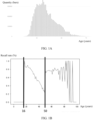
- FIG. 1A is a schematic diagram of an example of a data amount of a user according to an embodiment of this specification.
- a horizontal axis represents an age (calculated in years), and a vertical axis represents a data amount of a user at the age.
- the data amount is calculated by using a quantity of data points (a quantity of bars), and represents a quantity of bars of available data of the user.
- the data amount can be, for example, from a test dataset.
- a data amount of a user under 6 years old and a user over 65 years old is relatively small, and a data amount of a user in a middle range (especially 20 years old to 40 years old) is relatively large.
- FIG. 1B shows a recall rate when a machine learning model preliminarily obtains an age interval of a user in FIG. 1A through division.
- a horizontal axis represents an age (calculated in years), and a vertical axis represents a recall rate of an age interval predicted by using the machine learning model.
- the machine learning model can be, for example, any known machine learning model, for example, an XGBoost model.
- the recall rate is a recall rate when it is assumed that age intervals are 6 years old to 16 years old (the teenagers), 17 years old to 50 years old (the adults), and 51 years old to 100 years old (the aged) that are obtained through division.
- a recall rate of 16 years old is very high, and a recall rate of 50 years old is very low. It can be seen that users of different age intervals have clear differences. Based on the above-mentioned result, it is relatively proper to obtain age intervals of training data through division into 6 years old to 16 years old (the teenagers), 17 years old to 50 years old (the adults), and 51 years old to 100 years old (the aged). The age intervals are preliminarily obtained through division based on performance of recall rates, to improve system performance when the age intervals are subsequently predicted.
- a machine learning model that predicts at least one of an age interval or a gender of a user based on gesture information.
- the gesture information can be generated based on a gesture input of the user on a touch panel of user equipment.
- the user equipment can be any computing device with a touch panel, and includes but is not limited to a smartphone, a tablet computer, a notebook computer, a stationary computer, an embedded computer, or various types of internet of things (IoT) devices.
- the touch panel can receive a touch input of the user, and convert the touch input of the user into information such as a coordinate point.
- Examples of the gesture input can include but are not limited to a touch gesture, a tap gesture, a page turn gesture, a swipe gesture, a sweep gesture, or a key gesture.
- the gesture input can include a single-point gesture input and a multi-point gesture input (for example, a multi-point touch input or a multi-point slide input).
- the gesture input used in the embodiments of this specification can be a single-point gesture input.
- the gesture input used in the embodiments of this specification can further include a multi-point gesture input.
- the gesture input can include a tap input and a slide input.
- the tap input is usually only related to a static coordinate point (which can be a plurality of static coordinate points in a case of a multi-point input).
- the slide input can be related to dynamic coordinate points, the dynamic coordinate points constitute an action path of the input gesture, and the path usually has a start and an end.
- FIG. 2 shows an example of a data structure of gesture information according to an embodiment of this specification.
- the gesture information can include one or more of an event type, start coordinates (which can be represented by a start horizontal coordinate and a start vertical coordinate), end coordinates (which can be represented by an end horizontal coordinate and an end vertical coordinate), gesture duration, average pressing pressure, an average pressing area, a gesture timestamp, an associated service identifier (for example, indexes 0 to 9 in FIG. 2 ), etc.
- the gesture information can further include information derived from the above-mentioned information.
- the gesture information can further include any other information that is associated with a gesture on a touchscreen of user equipment and that can be conceived by a person skilled in the art.
- the event type can indicate a type of an event, for example, a tap event and a slide event.
- the start coordinates are coordinates of a start of a slide path.
- the start coordinates are coordinates of a tapped point.
- the end coordinates are coordinates of an end of the slide path.
- the end coordinates do not need to be included (a corresponding value can be set to null), or the end coordinates can be the same as the start coordinates.
- the gesture duration can be duration from a moment at which a finger starts to touch the touchscreen to a moment at which the finger leaves the touchscreen.
- the average pressing pressure can be an average value of pressing pressure of the finger on the touchscreen during the gesture duration.
- the average pressing area can be an average value of contact areas between the finger and the touchscreen during the gesture duration.
- the gesture timestamp can be a timestamp when the finger touches the touchscreen.
- the associated service identifier can indicate a service when a user interacts with the touchscreen by using a gesture input.
- the associated service identifier can be an identifier of a service displayed on the touchscreen when a gesture just touches the touchscreen or during the gesture duration.
- the identifier can be an application ID (for example, an app ID).
- the identifier can be a page ID, a page URI, etc.
- the gesture information can be of a data structure shown in FIG. 2 .
- the data structure can be an MxN matrix.
- M is a feature quantity
- N is a data point quantity.
- M can be 10 (that is, the above-mentioned 10 features of the gesture information, as shown by the indexes 0 to 9)
- N can be 200, that is, 200 times of interaction (for example, 200 times of recent interaction) between the user and the touchscreen. It can be understood that more or fewer features can be selected based on a specific case. In addition, more or less data points can be used in each matrix.
- FIG. 3 is a block diagram of an architecture of a machine learning model for predicting an age interval and/or a gender of a user according to a preferred embodiment of this specification.
- the machine learning model can include a module (may be briefly referred to as a "gesture feature module") for encoding one or more types of gesture features, for example, one or more of a trace module 302, a timing module 304, and a category module 306.
- the trace module 302, the timing module 304, and the category module 306 can receive gesture information 301, and respectively generate a trace feature, a timing feature, and a feature code of a category feature based on the gesture information.
- the machine learning model can include a concatenation module 308.
- Feature codes output by the plurality of gesture feature modules can be concatenated by the concatenation module 308, to form a combined gesture feature code.
- the combined gesture feature code can be used to predict one or two of the age interval and the gender.
- One or more of the trace module 302, the timing module 304, and the category module 306 and the concatenation module 308 jointly constitute a combined feature code module 310, configured to: generate the combined gesture feature code based on the gesture information, and output the combined gesture feature code to a classification module 312.
- an output of the gesture feature module is a gesture feature code input to the classification module 312.
- the generated gesture feature code is input to the classification module 312, to generate a prediction of at least one of an age interval 313 and a gender 315 of the user based on the gesture feature code.
- the classification module 312 can be a multi-task classification module. When only one of the age interval and the gender is predicted, the classification module 312 can be a single-task classification module.
- FIG. 4 is a schematic block diagram of an example structure of a trace module according to an embodiment of this specification.
- the trace module can receive information related to a trace of a gesture, that is, trace information 401 of the gesture.
- the trace information can include, for example, a gesture event type, gesture start coordinates (including a horizontal coordinate and a vertical coordinate), and/or gesture end coordinates (including a horizontal coordinate and a vertical coordinate), and does not need to include the gesture end coordinates for an event of a tap type. It can be understood that the trace information can include more or less information.
- features 0 to 4 in a data structure shown in FIG. 3 can be used, to form a 200x5 trace information matrix.
- the trace module can include an image conversion module 402 and an image processing module 404.
- the image conversion module 402 converts the trace information into a trace image, to perform processing. Specifically, a touch panel can be converted into a canvas of a specified size, for example, 100x50. Then, the trace information can be converted into the trace image on the canvas.
- FIG. 5 is a schematic diagram of an example of converting trace information into a trace image according to an embodiment of this specification.
- the trace image can be a curve segment on the canvas, for example, a straight segment from a start (x1, y1) to an end (x2, y2).
- 1 can be assigned to a point on the curve segment, and 0 can be assigned to a point not on the curve segment, to obtain a 100x50 matrix. Therefore, the original 200x5 trace information matrix can be converted into a 200x100x50 trace image matrix.
- the trace image can be a point (not shown in FIG. 5 ) on the canvas.
- 1 may be assigned to only one element (that is, a point corresponding to start coordinates) in the 100x50 matrix, and 0 may be assigned to the other elements in the 100x50 matrix.
- the image processing module can be a convolutional neural network (CNN) model, or any other CNN-based model. Any other image processing model that can be conceived by a person skilled in the art can also be used.
- CNN convolutional neural network
- a code of a trace feature of a gesture input namely, a trace feature code, can be generated by using the image processing model.
- FIG. 6 is a schematic block diagram of an example structure of a timing module according to an embodiment of this specification.
- the timing module can receive information related to a timing or a time of a gesture, that is, timing information of the gesture.
- the timing information can include, for example, gesture duration, average pressing pressure, an average pressing area, and a timestamp. It can be understood that the timing information can include more or less information.
- features with indexes 5 to 8 in a data structure shown in FIG. 4 can be used, to form a 200x4 timing information matrix.
- the timing module can include a convolution module 602 and an attention mechanism module 604.
- the convolution module 602 can execute a convolution algorithm based on the timing information, to generate sampling information. For example, a 200x64 sampling information matrix can be obtained based on the 200x4 timing information matrix by using the convolution module.
- the convolution module 602 can perform convolution on a matrix of timing information 601.
- the timing information matrix can be processed by using a convolutional neural network with a 1x1 convolutional kernel. Convolution can alternatively be performed by using another convolutional kernel.
- the sampling information can be generated through convolution.
- the attention mechanism module 604 can generate processing for the sampling information, to generate a timing feature code of the gesture information.
- the attention mechanism module 604 can perform processing based on the sampling information and a corresponding location code 603 by using a plurality of attention mechanism layers 606, and each attention mechanism layer 606 can include, for example, a single-head or multi-head attention mechanism unit, a summation and normalization unit, and a feedforward network.
- each attention mechanism layer 606 can include, for example, a single-head or multi-head attention mechanism unit, a summation and normalization unit, and a feedforward network.
- references can be made to a transformer model or a variant of the transformer model, for example, references can be made to a paper "Attention is all you need" published by Ashish Vaswani et al. in 2017 (references can be made to https://arxiv.org/abs/1706.03762).
- FIG. 7 is a schematic block diagram of an example structure of a category module according to an embodiment of this specification.
- the category module can receive information related to a category of a gesture, that is, category information 701 of the gesture.
- the category information is an associated service identifier, for example, an app ID of a gesture input.
- the category information can include more or less information. It can be assumed that patterns of gesture behaviors of users of different age intervals and/or different genders in different services may be different. Therefore, the category information such as the service identifier is added, to help identify an age interval and/or a gender of the user.
- a feature with an index 9 in a data structure shown in FIG. 4 can be used, to form a 200x1 timing information matrix.
- the category module can include a word embedding module 702, and the word embedding module can generate a word embedding representation of the category information (for example, the associated service identifier). Because the category information such as the service identifier may have no clear meaning, the word embedding representation of the category information can be generated based on a simple word embedding algorithm.
- the category module can further include a manual feature generation module 704.
- the manual feature generation module can generate a specified manual feature based on gesture information 703.
- the gesture information is, for example, manual information shown in FIG. 2 .
- Examples of the manual feature can include but are not limited to a gesture slide speed, pressing pressure, and a gesture input frequency.
- the gesture slide speed can be obtained by dividing a slide distance (for example, a straight line distance from a start of a gesture to an end of the gesture) by gesture duration. For an event of a tap type, a gesture slide speed does not need to be calculated.
- the pressing pressure can be obtained by dividing pressing pressure of the gesture by a pressing area.
- the gesture input frequency can be obtained by counting a gesture operation within a unit time.
- a statistical value can be calculated for each manual feature, and is used as an actually used manual feature. For example, a maximum value, a minimum value, a median value, an average value, a variance, etc. of each manual feature can be calculated.
- the category module can further include a concatenation module 706 and a wide neural network module 708.
- the concatenation module 706 can generate a concatenated category feature representation based on the manual feature and the word embedding representation of the associated service identifier.
- the concatenated category feature representation is input to the wide neural network module 708, to generate a category feature code 709.
- the wide neural network module 708 can include a fully connected layer. The inventor finds that a wide neural network performs well for the category feature. A specific implementation of the wide neural network is omitted here for simplicity.
- a trace feature code generated by the trace module 302 can be concatenated by the concatenation module 308, to generate the concatenated code and use the concatenated code as a final gesture feature code.
- the machine learning model can include any one module or any two modules.
- the concatenation module can concatenate only feature codes from the two modules.
- the concatenation module does not need to be included.
- FIG. 8 is a schematic block diagram of an example structure of a classification module according to an embodiment of this specification.
- the classification module can be a multi-task classification module.
- the classification module can be a single-task classification module.
- the multi-task classification module can be a multi-gate mixture-of-experts (MMoE) module.
- MoE multi-gate mixture-of-experts
- the MMoE model can further improve prediction performance of each task based on the association.
- the above-mentioned generated gesture feature code can be used as an input 801, and is input to the MMoE model.
- the MMoE model can include an age gate 802, a gender gate 804, and a mixture-of-experts network including a plurality of experts (for example, an expert 0 806, an expert 1 808, and an expert 2 810, where the plurality of experts are not limited thereto in this application), and outputs are summarized in a weighted manner and input to an age pyramid 812 and a gender pyramid 814, to separately generate predictions of an age interval 815 and a gender 817.
- any other used multi-task classification model that can be conceived by a person skilled in the art can be used.
- the classification module is a single-task classification module
- any proper single-task classification module that can be conceived by a person skilled in the art can be used.
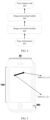
- FIG. 9 is a flowchart of an example method for predicting an age interval or a gender of a user according to an embodiment of this specification.
- One or more steps of the example method can be implemented, for example, by the machine learning model described above with reference to FIG. 3 .
- the method can include: Operation 902: Receive a gesture input of the user on a touch panel of user equipment.
- the machine learning model when the machine learning model is implemented on the user equipment, the user input on the touch panel from the user can be directly received.
- the machine learning model is implemented on a server, a user input of the user on an application and/or a page can be received.
- the server can receive a history that is of the gesture input and that is stored in the user equipment.
- posture information an accelerometer or a gyroscope is needed
- voice information a microphone is needed
- action information a camera is needed
- data of the accelerometer, the gyroscope, the microphone, or the camera are not necessary for an online shopping behavior of the user.
- a gesture input namely, a touch input
- a corresponding service for example, tap and slide to browse, select, and buy an article in the online shopping application.
- this embodiment of this specification provides another idea of predicting the age interval and/or the gender of the user.
- the solution based on the gesture information in this embodiment of this specification does not depend on an additional sensor and/or collection of additional information.
- the user can be notified that gesture information of the user is to be used to predict the age interval and/or the gender of the user.
- definite authorization of the user can be requested before the gesture information of the user is used.
- the method can further include: Operation 904: Generate gesture information based on the gesture input of the user, where the gesture information includes two or more of a gesture event type, a gesture location, gesture duration, average pressing pressure, an average pressing area, a gesture timestamp, and an associated service identifier.
- the gesture event type and the gesture location can be used as trace features of the gesture input
- the gesture duration, the average pressing pressure, the average pressing area, and the gesture timestamp can be used as a timing features of the gesture input
- the associated service identifier can be used as a category feature of the gesture input.
- the method can further include: Operation 906: Predict at least one of the age interval and the gender of the user based on the gesture information by using the machine learning model.
- the machine learning model predicts the age interval of the user based on one or more of the trace feature, the timing feature, and the category feature that are of the gesture input.
- the machine learning model predicts the age interval or the gender of the user based on a combination of three of the trace feature, the timing feature, and the category feature that are of the gesture input.
- the machine learning model can include a trace module, and the trace module is configured to generate a trace feature code of the gesture input based on the gesture event type, gesture start coordinates, and/or gesture end coordinates.
- the trace module can be configured to: convert the gesture event type, the gesture start coordinates, and/or the gesture end coordinates into a trace image; and generate a trace feature code of the gesture input based on the trace image by using a CNN-based model.
- the machine learning model can include a timing module, and the timing module is configured to generate a timing feature code of the gesture input based on the gesture duration, the average pressing pressure, the average pressing area, and/or the gesture timestamp.
- the timing module can be configured to: generate sampling information based on the gesture duration, the average pressing pressure, the average pressing area, and/or the gesture timestamp and based on a convolution algorithm; and input the sampling information into an attention mechanism, to generate the timing feature code of the gesture input.
- the timing module can be configured to: generate sampling information based on the gesture duration, the average pressing pressure, the average pressing area, and/or the gesture timestamp and based on a convolution algorithm; and input the sampling information into an attention mechanism, to generate the timing feature code of the gesture input.
- the machine learning model can include a category module, and the category module is configured to: perform word embedding on the associated service identifier of the gesture input, to generate a word embedding representation; generate one or more manual features based on the gesture information; concatenate the manual feature and the word embedding representation; and input a concatenated output to a wide neural network model, to generate the category feature code.
- category module is configured to: perform word embedding on the associated service identifier of the gesture input, to generate a word embedding representation; generate one or more manual features based on the gesture information; concatenate the manual feature and the word embedding representation; and input a concatenated output to a wide neural network model, to generate the category feature code.
- the machine learning model can further include a concatenation module, and the concatenation module is configured to concatenate feature codes of two or more of the trace feature, the timing feature, and the category feature, to generate a gesture feature code.
- concatenation does not need to be performed, and the machine learning model does not need to include the concatenation module.
- the machine learning model can further include a multi-gate mixture-of-experts module, configured to predict both the age interval and the gender of the user based on the gesture information by using a multi-gate mixture-of-experts module of the machine learning model.
- a multi-gate mixture-of-experts module configured to predict both the age interval and the gender of the user based on the gesture information by using a multi-gate mixture-of-experts module of the machine learning model.
- another multi-task classification module can be used to predict both the age interval and the gender. When only one of the age interval and the gender is predicted, a single-task classification module can be used to perform a prediction.
- the age interval of the user Before the age interval is predicted, the age interval of the user can be preliminarily obtained through division by using an XGBoost model.
- the age interval is preliminarily obtained through division, to predict the age interval more accurately.
- At least one of the age interval and the gender of the user can be further predicted based on a combination of the gesture information of the user and one or more of posture information, action information, and voice information of the user.
- the gesture information described in this embodiment of this specification can be combined with the posture information, the action information, and the voice information that are mentioned above, to predict the age interval or the gender based on more types of information, thereby further improving prediction accuracy.
- the method can further include: After the age interval and the gender of the user are predicted, an identity authentication method for the user can be determined based on at least one of the predicted age interval and the predicted gender of the user; or identity authentication can be performed on the user (not shown in FIG. 9 ),
- a prompt or a guide can be specifically provided to a teenager.
- the teenager user can be prompted that a physical identity card is not needed, and an identity card number can be found on a hukou page.
- the teenager can be prompted to request a parent to assist in or guarantee execution of identity authentication, etc.
- some aged users may have poor vision. Therefore, when the aged user is recognized, a displayed font and icon can be enlarged, and face scanning duration for authentication can be prolonged.
- the method can further include: after the age interval or gender of the user is predicted, generating a recommendation for the user based on at least one of the predicted age interval and the predicted gender of the user.
- a product or a service that is more likely to be of interest to the teenager can be recommended to the teenager user; and a product or a service that is more likely to be of interest to the female can be recommended to a female user.
- the recommendation can be provided based on the age interval, the gender, or a combination of the age interval and the gender in any proper method that can be conceived by a person skilled in the art.
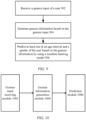
- FIG. 10 is a schematic block diagram of an example system for predicting an age interval or a gender of a user according to an embodiment of this specification.
- FIG. 10 For specific descriptions of modules of the system, references can be made to the above-mentioned method described in FIG. 9 and specific details of the above-mentioned machine learning model and the modules of the machine learning model described in FIG. 2 to FIG. 8 .
- the system can include a gesture input receiving module 1002, configured to receive a gesture input of the user on a touch panel of user equipment.
- a gesture input receiving module 1002 configured to receive a gesture input of the user on a touch panel of user equipment.
- the system can further include a gesture information generation module 1004, configured to generate gesture information based on the gesture input of the user.
- the gesture information includes two or more of a gesture event type, a gesture location, gesture duration, average pressing pressure, an average pressing area, a gesture timestamp, and an associated service identifier.
- the gesture event type and the gesture location can be used as trace features of the gesture input, the gesture duration, the average pressing pressure, the average pressing area, and the gesture timestamp can be used as a timing features of the gesture input, and the associated service identifier can be used as a category feature of the gesture input.
- the system can further include a prediction module 1006, configured to predict at least one of the age interval and the gender of the user based on the gesture information by using a machine learning model.
- a prediction module 1006 configured to predict at least one of the age interval and the gender of the user based on the gesture information by using a machine learning model.
- the machine learning model predicts the age interval of the user based on one or more of the trace feature, the timing feature, and the category feature that are of the gesture input.
- the machine learning model can predict the age interval or the gender of the user based on a combination of three of the trace feature, the timing feature, and the category feature that are of the gesture input.
- the machine learning model can include a trace module, and the trace module is configured to generate a trace feature code of the gesture input based on the gesture event type, gesture start coordinates, and/or gesture end coordinates.
- the trace module can be configured to: convert the gesture event type, the gesture start coordinates, and/or the gesture end coordinates into a trace image; and generate a trace feature code of the gesture input based on the trace image by using a CNN-based model.
- the machine learning model can include a timing module, and the timing module is configured to generate a timing feature code of the gesture input based on the gesture duration, the average pressing pressure, the average pressing area, and/or the gesture timestamp.
- the timing module can be configured to: generate sampling information based on the gesture duration, the average pressing pressure, the average pressing area, and/or the gesture timestamp and based on a convolution algorithm; and input the sampling information into an attention mechanism, to generate the timing feature code of the gesture input.
- the timing module can be configured to: generate sampling information based on the gesture duration, the average pressing pressure, the average pressing area, and/or the gesture timestamp and based on a convolution algorithm; and input the sampling information into an attention mechanism, to generate the timing feature code of the gesture input.
- the machine learning model can include a category module, and the category module is configured to: perform word embedding on the associated service identifier of the gesture input, to generate a word embedding representation; generate one or more manual features based on the gesture information; concatenate the manual feature and the word embedding representation; and input a concatenated output to a wide neural network model, to generate the category feature code.
- category module is configured to: perform word embedding on the associated service identifier of the gesture input, to generate a word embedding representation; generate one or more manual features based on the gesture information; concatenate the manual feature and the word embedding representation; and input a concatenated output to a wide neural network model, to generate the category feature code.
- the machine learning model can further include a concatenation module, and the concatenation module is configured to concatenate feature codes of two or more of the trace feature, the timing feature, and the category feature, to generate a gesture feature code.
- concatenation does not need to be performed, and the machine learning model does not need to include the concatenation module.
- the machine learning model can further include a multi-gate mixture-of-experts module, configured to predict both the age interval and the gender of the user based on the gesture information by using a multi-gate mixture-of-experts module of the machine learning model.
- a multi-gate mixture-of-experts module configured to predict both the age interval and the gender of the user based on the gesture information by using a multi-gate mixture-of-experts module of the machine learning model.
- another multi-task classification module can be used to predict both the age interval and the gender. When only one of the age interval and the gender is predicted, a single-task classification module can be used to perform a prediction.
- the system can further include an age interval division module (not shown in FIG. 10 ).
- the age interval division module can preliminarily obtain the age interval of the user through division by using an XGBoost model. The age interval is preliminarily obtained through division, to predict the age interval more accurately.
- At least one of the age interval and the gender of the user can be further predicted based on a combination of the gesture information of the user and one or more of posture information, action information, and voice information of the user.
- the system can further include a user authentication module (not shown in FIG. 10 ), configured to: determine an identity authentication method for the user based on at least one of the predicted age interval and the predicted gender of the user, and/or perform authentication on the user.
- a user authentication module configured to: determine an identity authentication method for the user based on at least one of the predicted age interval and the predicted gender of the user, and/or perform authentication on the user.
- the system can further include a recommendation module (not shown in FIG. 10 ), configured to generate a recommendation for the user based on at least one of the predicted age interval and the predicted gender of the user.
- a recommendation module (not shown in FIG. 10 ), configured to generate a recommendation for the user based on at least one of the predicted age interval and the predicted gender of the user.
- FIG. 11 is a schematic block diagram of an apparatus 1100 for implementing a method according to one or more embodiments of this specification.
- the apparatus can be configured to implement, for example, any of the method and the system described in this specification.
- the apparatus can be further implemented as any computing device or resource allocation device described in this specification.
- the apparatus can include a processor 1110 and a memory 1115, and the processor is configured to perform any method described above.
- the memory can store, for example, gesture information.
- the memory can be further configured to store any instruction, variable, intermediate data, etc. that can be used in an execution process of the method.
- the apparatus 1100 can include a network connection element 1125, for example, can include a network connection device connected to another device through a wired connection or a wireless connection.
- the wireless connection can be, for example, a Wi-Fi connection, a Bluetooth connection, or a 3G/4G/5G network connection.
- the apparatus 1100 can be connected to a network by using the network connection element, to obtain data (for example, a user interaction history) and various other data.
- the apparatus 1100 can further receive an input of the user from another device through the network connection element or transmit data to another device for display.
- the apparatus When an apparatus for implementing a machine learning model is implemented on user equipment, the apparatus further includes a touch panel, configured to receive a gesture input of the user.
- the apparatus can further include another peripheral element 1120, for example, an input apparatus (a keyboard or a mouse) or an output apparatus (for example, a display).
- the apparatus can include a touchscreen.
- the user can input a weight of each target by using the input apparatus.
- Corresponding information such as a resource allocation result can also be output to the user through the output apparatus.
- Each of these modules can communicate with one another directly or indirectly, for example, through one or more buses (for example, a bus 1105).
- buses for example, a bus 1105.
- the apparatus can be a physical computing device or virtual computing device with a computing capability.
- the physical computing device can include but are not limited to a mainframe computer, a minicomputer, or a personal computer.
- Examples of the virtual computing device can include various types of virtual machines (for example, a vmware virtual machine or a virtualbox virtual machine) or virtual containers (for example, a virtual container such as docker).
- the apparatus 1100 shown above is a single computing device, it should be understood that the apparatus 1100 can be actually a set of computing devices such as a computing device cluster, a virtual machine cluster, a computing cloud, and a storage cloud.
- This application further discloses a computer-readable storage medium that includes computer-executable instructions stored in the computer-readable storage medium.
- the processor is enabled to perform the method in the embodiments described in this specification.
- this application further discloses an apparatus.
- the apparatus includes a processor and a memory that stores computer-executable instructions.
- the processor is enabled to perform the method in the embodiments described in this specification.
- the system includes an apparatus for implementing the method in the embodiments described in this specification.
- the method according to one or more embodiments of this specification can be implemented by software, firmware, or a combination thereof.
Landscapes
- Engineering & Computer Science (AREA)
- Theoretical Computer Science (AREA)
- Physics & Mathematics (AREA)
- General Engineering & Computer Science (AREA)
- Evolutionary Computation (AREA)
- General Physics & Mathematics (AREA)
- Software Systems (AREA)
- Artificial Intelligence (AREA)
- Computing Systems (AREA)
- Mathematical Physics (AREA)
- General Health & Medical Sciences (AREA)
- Molecular Biology (AREA)
- Computational Linguistics (AREA)
- Biophysics (AREA)
- Biomedical Technology (AREA)
- Data Mining & Analysis (AREA)
- Life Sciences & Earth Sciences (AREA)
- Health & Medical Sciences (AREA)
- Human Computer Interaction (AREA)
- Computer Vision & Pattern Recognition (AREA)
- Medical Informatics (AREA)
- Computer Hardware Design (AREA)
- Geometry (AREA)
- User Interface Of Digital Computer (AREA)
Abstract
Description
- This application relates to a user information prediction, and in particular, to a method, a system, and an apparatus for predicting an age interval or a gender of a user, and a medium.
- An age interval and a gender of a user are important user information. However, in many cases, the user may not provide age interval or gender information. In this case, the age interval or gender information of the user needs to be predicted.
- A current model usually performs a prediction based on image, voice, or action information of the user. However, such a model may need to collect and process more user data (sometimes even by using an additional sensor module), thereby adversely affecting user privacy preserving, device costs and complexity, device processing capability, power consumption, etc.
- Therefore, a solution in which the age interval and/or the gender of the user can be efficiently predicted at low costs is needed.
- To overcome a disadvantage in the conventional technology, in one or more embodiments of this specification, gesture information of a user is used, to implement a solution for predicting an age interval or a gender of the user with a smaller data collection amount and without an additional sensor.
- One or more embodiments of this specification achieve the above-mentioned objectives by using the following technical solutions.
- In an aspect, a method for predicting an age interval or a gender of a user is provided, including: receiving a gesture input of the user on a touch panel of user equipment; generating gesture information based on the gesture input of the user, where the gesture information includes two or more of a gesture event type, a gesture location, gesture duration, average pressing pressure, an average pressing area, a gesture timestamp, and an associated service identifier; and predicting at least one of the age interval and the gender of the user based on the gesture information by using a machine learning model.
- Preferably, the machine learning model predicts at least one of the age interval and the gender of the user based on one or more of a trace feature, a timing feature, and a category feature that are of the gesture input.
- Preferably, the machine learning model includes a trace module, and the trace module is configured to generate a trace feature code of the gesture input based on the gesture event type, gesture start coordinates, and/or gesture end coordinates.
- Preferably, the trace module is configured to: convert the gesture event type, the gesture start coordinates, and/or the gesture end coordinates into a trace image; and generate a trace feature code of the gesture input based on the trace image by using a CNN-based model.
- Preferably, the machine learning model includes a timing module, and the timing module is configured to generate a timing feature code of the gesture input based on the gesture duration, the average pressing pressure, the average pressing area, and/or the gesture timestamp.
- Preferably, the timing module is configured to: generate sampling information based on the gesture duration, the average pressing pressure, the average pressing area, and/or the gesture timestamp and based on a convolution algorithm; and input the sampling information into an attention mechanism, to generate the timing feature code of the gesture input.
- Preferably, the machine learning model includes a category module, and the category module is configured to: perform word embedding on the associated service identifier of the gesture input, to generate a word embedding representation; generate one or more manual features based on the gesture information; concatenate the manual feature and the word embedding representation; and input a concatenated output to a wide neural network model, to generate the category feature code.
- Preferably, the method further includes: concatenating feature codes of two or more of the trace feature, the timing feature, and the category feature, to generate a gesture feature code.
- Preferably, the method further includes: predicting both the age interval and the gender of the user based on the gesture information by using a multi-gate mixture-of-experts module of the machine learning model.
- Preferably, the method further includes: preliminarily obtaining the age interval of the user through division by using an XGBoost model.
- Preferably, the method further includes: predicting at least one of the age interval and the gender of the user based on a combination of the gesture information of the user and one or more of posture information, action information, and voice information of the user.
- Preferably, the method further includes: determining an identity authentication method for the user based on at least one of the predicted age interval and the predicted gender of the user.
- Preferably, the method further includes: generating a recommendation for the user based on at least one of the predicted age interval and the predicted gender of the user.
- According to another aspect, a system for predicting an age interval or a gender of a user is provided, including: a gesture input receiving module, configured to receive a gesture input of the user on a touch panel of user equipment; a gesture information generation module, configured to generate gesture information based on the gesture input of the user, where the gesture information includes two or more of a gesture event type, a gesture location, gesture duration, average pressing pressure, an average pressing area, a gesture timestamp, and an associated service identifier; and a prediction module, configured to predict at least one of the age interval and the gender of the user based on the gesture information by using a machine learning model.
- Preferably, the machine learning model includes one or more of a trace module, a timing module, and a category module.
- According to still another aspect, an apparatus for predicting an age interval or a gender of a user is provided, including: a memory; and a processor. The processor is configured to perform the above-mentioned method.
- According to yet another aspect, a computer-readable storage medium storing instructions is provided. When the instructions are executed by a computer, the computer is enabled to perform the above-mentioned method.
- Compared with the conventional technology, in one or more embodiments of this specification, one or more of the following technical effects can be achieved: There is no dependence on an additional sensor and/or collection of additional information; user privacy is better preserved; costs of the user equipment are lower; an application scope is wider; and/or occupation of a processor is reduced, system performance is improved, and power consumption is reduced.
-
-
FIG. 1A is a schematic diagram of an example of a data amount of a user according to an embodiment of this specification; -
FIG. 1B shows a recall rate when a machine learning model preliminarily obtains an age interval of a user inFIG. 1A through division; -
FIG. 2 shows an example of a data structure of gesture information according to an embodiment of this specification; -
FIG. 3 is a block diagram of an architecture of a machine learning model for predicting an age interval and/or a gender of a user according to a preferred embodiment of this specification; -
FIG. 4 is a schematic block diagram of an example structure of a trace module according to an embodiment of this specification; -
FIG. 5 is a schematic diagram of an example of converting trace information into a trace image according to an embodiment of this specification; -
FIG. 6 is a schematic block diagram of an example structure of a timing module according to an embodiment of this specification; -
FIG. 7 is a schematic block diagram of an example structure of a category module according to an embodiment of this specification; -
FIG. 8 is a schematic block diagram of an example structure of a classification module according to an embodiment of this specification; -
FIG. 9 is a flowchart of an example method for predicting an age interval or a gender of a user according to an embodiment of this specification; -
FIG. 10 is a schematic block diagram of an example system for predicting an age interval or a gender of a user according to an embodiment of this specification; and -
FIG. 11 is a schematic block diagram of an apparatus for implementing a method according to one or more embodiments of this specification. - Content of the following specific implementations is sufficient to enable any person skilled in the art to understand and implement technical content of one or more embodiments of this specification, and according to the specification, claims, and accompanying drawings disclosed in this specification, a person skilled in the art can easily understand related objectives and advantages of one or more embodiments of this specification.
- An age interval and a gender of a user are important user information. However, in many cases, the user may not provide age interval or gender information. In this case, the age interval or gender information of the user needs to be predicted.
- To predict age interval or the gender of the user, machine learning models are increasingly used in recent years. The machine learning model predicts the age interval or the gender of the user based on one or more types of data (for example, user data).
- In a solution, the machine learning model can predict the age interval or the gender of the user based on posture data of the user.
- For example, the posture data of the user can include hand action information, buttock action information, arm action information, wrist action information, and chest action information of the user during walking. It can be conceived that users of different age intervals (for example, the aged, the young, and the children) may have different postures, and users of different genders may also have different postures. Therefore, the machine learning model is trained based on posture data of a plurality of users, to obtain a machine learning model that predicts the age interval or the gender of the user based on the posture data.
- However, the posture data of the user usually need to be collected by using a sensor such as an accelerometer and a gyroscope. Therefore, to collect the posture data of the user, not only the user equipment needs to have the sensor, but also the user needs to grant authorization to use the sensor to collect information. In addition, a processor processing capability is required, and power needs to be consumed, to collect data and process the collected data.
- In another solution, the machine learning model can predict the age interval or the gender of the user based on voice data of the user.
- The voice data of the user can include, for example, voice data of the user. The voice data are of a common data type that can be used to picture the user. In an example, the user can be led to say a specific statement, to improve prediction accuracy. In an alternative example, a prediction can be performed based on a randomly collected user voice. It can be understood that voices of users of different age intervals and different genders have respective features, and therefore, the age interval and/or the gender of the user can be predicted based on the voice data. A prediction can be performed by using various machine learning models such as a deep learning voice network.
- Similarly, the voice data of the user usually need to be collected by using a dedicated element such as a microphone (for example, a built-in microphone in the user equipment such as a smartphone). Similarly, the user equipment needs to have a microphone, and the user needs to grant authorization to use the microphone to collect a voice. In addition, a processor processing capability is required, and power needs to be consumed, to collect data and process the collected data.
- In still another solution, the machine learning model can predict the age interval or the gender of the user based on action data of the user.
- The action data of the user can include, for example, various conceivable action data of an air write action, an eye movement, a shake movement, a free movement, etc. of the user. The action data of the user can be usually collected by using an image acquisition device (for example, a camera), and are different from the above-mentioned posture data collected by the accelerometer and the gyroscope. It can be understood that actions of the users of different age intervals and different genders have respective features (for example, in terms of an action frequency, an action amplitude, or an action habit). Therefore, the age interval and/or the gender of the user can be predicted based on the action data. A prediction can be performed by using various machine learning models such as various image processing models.
- Similarly, the action data of the user usually need to be collected by using a dedicated element such as the image acquisition device (for example, the camera). Similarly, the user equipment needs to have an image acquisition device, and the user needs to grant authorization to use the device to capture a user image. In addition, a processor processing capability is required, and power needs to be consumed, to collect data and process the collected data.
- It can be seen that in the above-mentioned descriptions, a dedicated sensor or a data collection element is usually needed to collect corresponding data, to adversely affecting device costs, user privacy, device performance, and power consumption.
- To resolve the above-mentioned problem, the inventor creatively recognizes that users of different age intervals and genders may also have different gesture behavior habits. For example, an operating frequency of the aged is usually relatively slow. Pressing pressure of the children and the female is usually relatively small. The users of different age intervals and genders usually also tap different services.
- Therefore, the embodiments of this specification provide a solution for predicting an age interval and/or a gender of a user based on gesture data. In this solution, not only an idea that can be used to predict the age interval and/or the gender of the user and that is not found in the conventional technology is put forward, but also the above-mentioned problem is resolved in comparison with an existing solution.
- To predict the age interval of the user, the age interval can be first obtained through division. There are many manners of obtaining the age interval through division. For example, the following several solutions for obtaining age intervals through division can be used: Solution 1: six years old to 10 years old, 10 years old to 20 years old, 20 years old to 30 years old, 30 years old to 40 years old, 40 years old to 50 years old, 50 years old to 60 years old, and over 60 years old. Solution 2: six years old to 20 years old, 20 years old to 50 years old, and over 50 years old. Solution 3: six years old to 40 years old, 40 years old to 60 years old, over 60 years old; and so on.
- It can be appreciated that different solutions for obtaining age intervals through division may also affect performance of the machine learning model when the age intervals are predicted. For example, if age ranges without a significant uniform feature are classified into one age interval, a prediction of the age interval may be adversely affected.
- Usually, age intervals can be obtained through division based on experience. For example, a developer and/or a user of a prediction system can set the age interval of the user based on experience or historical data of the developer and/or the user of the prediction system. However, if the age intervals are obtained through division based on subjective experience, most proper age intervals may be unable to be obtained through division.
- In a preferred example of this specification, the age interval of the user can be first obtained through division by using the machine learning model, so that prominent age ranges with a more uniform feature are classified into the same age interval, to improve system performance in a subsequent prediction process.
-
FIG. 1A is a schematic diagram of an example of a data amount of a user according to an embodiment of this specification. InFIG. 1A , a horizontal axis represents an age (calculated in years), and a vertical axis represents a data amount of a user at the age. The data amount is calculated by using a quantity of data points (a quantity of bars), and represents a quantity of bars of available data of the user. The data amount can be, for example, from a test dataset. - As shown in
FIG. 1A , because of availability of data, a data amount of a user under 6 years old and a user over 65 years old is relatively small, and a data amount of a user in a middle range (especially 20 years old to 40 years old) is relatively large. -
FIG. 1B shows a recall rate when a machine learning model preliminarily obtains an age interval of a user inFIG. 1A through division. InFIG. 1B , a horizontal axis represents an age (calculated in years), and a vertical axis represents a recall rate of an age interval predicted by using the machine learning model. - The machine learning model can be, for example, any known machine learning model, for example, an XGBoost model. The recall rate is a recall rate when it is assumed that age intervals are 6 years old to 16 years old (the teenagers), 17 years old to 50 years old (the adults), and 51 years old to 100 years old (the aged) that are obtained through division.
- As shown in
FIG. 1B , a recall rate of 16 years old is very high, and a recall rate of 50 years old is very low. It can be seen that users of different age intervals have clear differences. Based on the above-mentioned result, it is relatively proper to obtain age intervals of training data through division into 6 years old to 16 years old (the teenagers), 17 years old to 50 years old (the adults), and 51 years old to 100 years old (the aged). The age intervals are preliminarily obtained through division based on performance of recall rates, to improve system performance when the age intervals are subsequently predicted. - As described above, in the embodiments of this specification, a machine learning model that predicts at least one of an age interval or a gender of a user based on gesture information is proposed. The gesture information can be generated based on a gesture input of the user on a touch panel of user equipment.
- The user equipment can be any computing device with a touch panel, and includes but is not limited to a smartphone, a tablet computer, a notebook computer, a stationary computer, an embedded computer, or various types of internet of things (IoT) devices. The touch panel can receive a touch input of the user, and convert the touch input of the user into information such as a coordinate point.
- The touch panel can be a touchscreen, namely, a device that has both a touch function and a display function. Alternatively, the touch panel does not need to have the display function. The following provides descriptions by using the touchscreen as an example.
- Examples of the gesture input can include but are not limited to a touch gesture, a tap gesture, a page turn gesture, a swipe gesture, a sweep gesture, or a key gesture.
- Based on a quantity of input points, the gesture input can include a single-point gesture input and a multi-point gesture input (for example, a multi-point touch input or a multi-point slide input). The gesture input used in the embodiments of this specification can be a single-point gesture input. In some cases, the gesture input used in the embodiments of this specification can further include a multi-point gesture input.
- Based on an event type, the gesture input can include a tap input and a slide input. The tap input is usually only related to a static coordinate point (which can be a plurality of static coordinate points in a case of a multi-point input). The slide input can be related to dynamic coordinate points, the dynamic coordinate points constitute an action path of the input gesture, and the path usually has a start and an end.
-
FIG. 2 shows an example of a data structure of gesture information according to an embodiment of this specification. - As shown in
FIG. 2 , in an example in this specification, the gesture information can include one or more of an event type, start coordinates (which can be represented by a start horizontal coordinate and a start vertical coordinate), end coordinates (which can be represented by an end horizontal coordinate and an end vertical coordinate), gesture duration, average pressing pressure, an average pressing area, a gesture timestamp, an associated service identifier (for example,indexes 0 to 9 inFIG. 2 ), etc. The gesture information can further include information derived from the above-mentioned information. The gesture information can further include any other information that is associated with a gesture on a touchscreen of user equipment and that can be conceived by a person skilled in the art. - As described above, the event type can indicate a type of an event, for example, a tap event and a slide event.
- For an event of a slide type, the start coordinates are coordinates of a start of a slide path. For an event of a tap type, the start coordinates are coordinates of a tapped point.
- For the event of the slide type, the end coordinates are coordinates of an end of the slide path. For the event of the tap type, the end coordinates do not need to be included (a corresponding value can be set to null), or the end coordinates can be the same as the start coordinates.
- The gesture duration can be duration from a moment at which a finger starts to touch the touchscreen to a moment at which the finger leaves the touchscreen.
- The average pressing pressure can be an average value of pressing pressure of the finger on the touchscreen during the gesture duration.
- The average pressing area can be an average value of contact areas between the finger and the touchscreen during the gesture duration.
- The gesture timestamp can be a timestamp when the finger touches the touchscreen.
- The associated service identifier can indicate a service when a user interacts with the touchscreen by using a gesture input. For example, the associated service identifier can be an identifier of a service displayed on the touchscreen when a gesture just touches the touchscreen or during the gesture duration. For an application, the identifier can be an application ID (for example, an app ID). For a page (for example, an intra-application page or a web page), the identifier can be a page ID, a page URI, etc.
- In a preferred example, the gesture information can be of a data structure shown in
FIG. 2 . The data structure can be an MxN matrix. Here, M is a feature quantity, and N is a data point quantity. For example, M can be 10 (that is, the above-mentioned 10 features of the gesture information, as shown by theindexes 0 to 9), and N can be 200, that is, 200 times of interaction (for example, 200 times of recent interaction) between the user and the touchscreen. It can be understood that more or fewer features can be selected based on a specific case. In addition, more or less data points can be used in each matrix. - Any other data structure that can be conceived by a person skilled in the art can also be used.
-
FIG. 3 is a block diagram of an architecture of a machine learning model for predicting an age interval and/or a gender of a user according to a preferred embodiment of this specification. - As shown in
FIG. 3 , in the preferred embodiment, the machine learning model can include a module (may be briefly referred to as a "gesture feature module") for encoding one or more types of gesture features, for example, one or more of atrace module 302, atiming module 304, and acategory module 306. Thetrace module 302, thetiming module 304, and thecategory module 306 can receivegesture information 301, and respectively generate a trace feature, a timing feature, and a feature code of a category feature based on the gesture information. - It should be appreciated that although all the three modules are described in this specification and shown in the accompanying drawings, it should be appreciated that a prediction of the age interval/gender in this embodiment of this specification can be implemented by using only one or any two of these modules.
- When there are a plurality of gesture feature modules, the machine learning model can include a
concatenation module 308. Feature codes output by the plurality of gesture feature modules can be concatenated by theconcatenation module 308, to form a combined gesture feature code. The combined gesture feature code can be used to predict one or two of the age interval and the gender. One or more of thetrace module 302, thetiming module 304, and thecategory module 306 and theconcatenation module 308 jointly constitute a combined feature code module 310, configured to: generate the combined gesture feature code based on the gesture information, and output the combined gesture feature code to aclassification module 312. - When there is only one gesture feature module (that is, there is only one of the
trace module 302, thetiming module 304, and the category module 306), the machine learning model does not need to include theconcatenation module 308. In this case, an output of the gesture feature module is a gesture feature code input to theclassification module 312. - The generated gesture feature code is input to the
classification module 312, to generate a prediction of at least one of anage interval 313 and agender 315 of the user based on the gesture feature code. - When both the age interval and the gender are predicted, the
classification module 312 can be a multi-task classification module. When only one of the age interval and the gender is predicted, theclassification module 312 can be a single-task classification module. - The following describes, one by one, modules shown in
FIG. 2 . -
FIG. 4 is a schematic block diagram of an example structure of a trace module according to an embodiment of this specification. - As shown in
FIG. 4 , the trace module can receive information related to a trace of a gesture, that is,trace information 401 of the gesture. The trace information can include, for example, a gesture event type, gesture start coordinates (including a horizontal coordinate and a vertical coordinate), and/or gesture end coordinates (including a horizontal coordinate and a vertical coordinate), and does not need to include the gesture end coordinates for an event of a tap type. It can be understood that the trace information can include more or less information. - In an example, features 0 to 4 in a data structure shown in
FIG. 3 can be used, to form a 200x5 trace information matrix. - The trace module can include an
image conversion module 402 and animage processing module 404. - In this embodiment of this specification, the
image conversion module 402 converts the trace information into a trace image, to perform processing. Specifically, a touch panel can be converted into a canvas of a specified size, for example, 100x50. Then, the trace information can be converted into the trace image on the canvas. -
FIG. 5 is a schematic diagram of an example of converting trace information into a trace image according to an embodiment of this specification. - For example, as shown in
FIG. 5 , for an event of a slide type, the trace image can be a curve segment on the canvas, for example, a straight segment from a start (x1, y1) to an end (x2, y2). For example, on the canvas representing the touch panel, 1 can be assigned to a point on the curve segment, and 0 can be assigned to a point not on the curve segment, to obtain a 100x50 matrix. Therefore, the original 200x5 trace information matrix can be converted into a 200x100x50 trace image matrix. - For an event of a tap type, the trace image can be a point (not shown in
FIG. 5 ) on the canvas. In this case, 1 may be assigned to only one element (that is, a point corresponding to start coordinates) in the 100x50 matrix, and 0 may be assigned to the other elements in the 100x50 matrix. - Then, the trace image matrix can be input to the
image processing module 404 for processing. The image processing module can be a convolutional neural network (CNN) model, or any other CNN-based model. Any other image processing model that can be conceived by a person skilled in the art can also be used. - A code of a trace feature of a gesture input, namely, a trace feature code, can be generated by using the image processing model.
-
FIG. 6 is a schematic block diagram of an example structure of a timing module according to an embodiment of this specification. - As shown in
FIG. 6 , the timing module can receive information related to a timing or a time of a gesture, that is, timing information of the gesture. The timing information can include, for example, gesture duration, average pressing pressure, an average pressing area, and a timestamp. It can be understood that the timing information can include more or less information. - In an example, features with
indexes 5 to 8 in a data structure shown inFIG. 4 can be used, to form a 200x4 timing information matrix. - As shown in
FIG. 6 , the timing module can include a convolution module 602 and anattention mechanism module 604. The convolution module 602 can execute a convolution algorithm based on the timing information, to generate sampling information. For example, a 200x64 sampling information matrix can be obtained based on the 200x4 timing information matrix by using the convolution module. - The convolution module 602 can perform convolution on a matrix of
timing information 601. The timing information matrix can be processed by using a convolutional neural network with a 1x1 convolutional kernel. Convolution can alternatively be performed by using another convolutional kernel. The sampling information can be generated through convolution. - The
attention mechanism module 604 can generate processing for the sampling information, to generate a timing feature code of the gesture information. - As shown in
FIG. 6 , theattention mechanism module 604 can perform processing based on the sampling information and acorresponding location code 603 by using a plurality of attention mechanism layers 606, and eachattention mechanism layer 606 can include, for example, a single-head or multi-head attention mechanism unit, a summation and normalization unit, and a feedforward network. For a specific implementation of the attention mechanism module 604 (including the location code 603), references can be made to a transformer model or a variant of the transformer model, for example, references can be made to a paper "Attention is all you need" published by Ashish Vaswani et al. in 2017 (references can be made to https://arxiv.org/abs/1706.03762). -
FIG. 7 is a schematic block diagram of an example structure of a category module according to an embodiment of this specification. - As shown in
FIG. 7 , the category module can receive information related to a category of a gesture, that is,category information 701 of the gesture. In this embodiment of this specification, the category information is an associated service identifier, for example, an app ID of a gesture input. The category information can include more or less information. It can be assumed that patterns of gesture behaviors of users of different age intervals and/or different genders in different services may be different. Therefore, the category information such as the service identifier is added, to help identify an age interval and/or a gender of the user. - In an example, a feature with an
index 9 in a data structure shown inFIG. 4 can be used, to form a 200x1 timing information matrix. - In addition, the category module can include a
word embedding module 702, and the word embedding module can generate a word embedding representation of the category information (for example, the associated service identifier). Because the category information such as the service identifier may have no clear meaning, the word embedding representation of the category information can be generated based on a simple word embedding algorithm. - The category module can further include a manual
feature generation module 704. The manual feature generation module can generate a specified manual feature based ongesture information 703. The gesture information is, for example, manual information shown inFIG. 2 . - Examples of the manual feature can include but are not limited to a gesture slide speed, pressing pressure, and a gesture input frequency.
- The gesture slide speed can be obtained by dividing a slide distance (for example, a straight line distance from a start of a gesture to an end of the gesture) by gesture duration. For an event of a tap type, a gesture slide speed does not need to be calculated.
- The pressing pressure can be obtained by dividing pressing pressure of the gesture by a pressing area.
- The gesture input frequency can be obtained by counting a gesture operation within a unit time.
- In specific applications, a statistical value can be calculated for each manual feature, and is used as an actually used manual feature. For example, a maximum value, a minimum value, a median value, an average value, a variance, etc. of each manual feature can be calculated.
- Any other manual feature that can be conceived by a person skilled in the art can be used.
- As shown in
FIG. 7 , the category module can further include aconcatenation module 706 and a wideneural network module 708. Theconcatenation module 706 can generate a concatenated category feature representation based on the manual feature and the word embedding representation of the associated service identifier. - Subsequently, the concatenated category feature representation is input to the wide
neural network module 708, to generate a category feature code 709. The wideneural network module 708 can include a fully connected layer. The inventor finds that a wide neural network performs well for the category feature. A specific implementation of the wide neural network is omitted here for simplicity. - As described above, as shown in
FIG. 3 , a trace feature code generated by thetrace module 302, a timing feature code generated by thetiming module 304, and a category feature code generated by thecategory module 306 can be concatenated by theconcatenation module 308, to generate the concatenated code and use the concatenated code as a final gesture feature code. - It should be understood that although all the three modules are shown in
FIG. 3 , the machine learning model can include any one module or any two modules. When only two modules are included, the concatenation module can concatenate only feature codes from the two modules. When only one module is included, the concatenation module does not need to be included. -
FIG. 8 is a schematic block diagram of an example structure of a classification module according to an embodiment of this specification. - As described above, when both the age interval and the gender are predicted, the classification module can be a multi-task classification module. When only one of the age interval and the gender is predicted, the classification module can be a single-task classification module.
- When the classification module is a multi-task classification module, the multi-task classification module can be a multi-gate mixture-of-experts (MMoE) module.
- Because there is also an association between the age interval and the gender in terms of the gesture (for example, a feature difference between an adult male and a teenager female is clearer), the MMoE model can further improve prediction performance of each task based on the association.
- As shown in
FIG. 8 , the above-mentioned generated gesture feature code can be used as aninput 801, and is input to the MMoE model. The MMoE model can include anage gate 802, agender gate 804, and a mixture-of-experts network including a plurality of experts (for example, anexpert 0 806, anexpert 1 808, and anexpert 2 810, where the plurality of experts are not limited thereto in this application), and outputs are summarized in a weighted manner and input to anage pyramid 812 and a gender pyramid 814, to separately generate predictions of anage interval 815 and agender 817. For more details of the MoME model, references can be made to a paper "Modeling Task Relationships in Multi-task Learning with Multi-gate Mixture-of-Experts" published by Jiaqi Ma et al. in 2018 (for example, references can be made to https://dl.acm.org/doi/10.1145/3219819.3220007). - Alternatively, any other used multi-task classification model that can be conceived by a person skilled in the art can be used.
- When the classification module is a single-task classification module, any proper single-task classification module that can be conceived by a person skilled in the art can be used.
- Each constituent module of the machine learning model that predicts the age or the gender of the user based on the gesture information of the user is described in detail above. The following describes an example method and system for predicting an age and/or a gender of a user by using a machine learning model. It should be appreciated that in the following method and system, some implementation details are omitted. For descriptions of these implementation details, references can be made to the above-mentioned descriptions.
-
FIG. 9 is a flowchart of an example method for predicting an age interval or a gender of a user according to an embodiment of this specification. One or more steps of the example method can be implemented, for example, by the machine learning model described above with reference toFIG. 3 . - The method can include: Operation 902: Receive a gesture input of the user on a touch panel of user equipment.
- For example, when the machine learning model is implemented on the user equipment, the user input on the touch panel from the user can be directly received. When the machine learning model is implemented on a server, a user input of the user on an application and/or a page can be received. Alternatively, the server can receive a history that is of the gesture input and that is stored in the user equipment.
- It should be noted that, different from posture information (an accelerometer or a gyroscope is needed), voice information (a microphone is needed), and action information (a camera is needed) that are described above, not only an additional sensor or a dedicated data collection device needs to be used for the above-mentioned information, but also the above-mentioned information is independent of a use process of the user. In other words, the user may not need to provide the information for a normal use service originally. For example, for an online shopping application, data of the accelerometer, the gyroscope, the microphone, or the camera are not necessary for an online shopping behavior of the user. However, in most cases, especially in a currently popular smart device with a touchscreen, the user needs to perform a gesture input (namely, a touch input) on the touchscreen, to use a corresponding service, for example, tap and slide to browse, select, and buy an article in the online shopping application.
- Therefore, this embodiment of this specification provides another idea of predicting the age interval and/or the gender of the user. In addition, compared with a solution in which the posture information, the voice information, and the action information are used, the solution based on the gesture information in this embodiment of this specification does not depend on an additional sensor and/or collection of additional information.
- In addition, because there is no dependence on the additional sensor and/or collection of the additional information, less user data needs to be collected, to preserve user privacy; no additional sensor is needed, so that costs of the user equipment are lower; no additional sensor is needed, so that this embodiment of this specification has a wider application scope, for example, can be applied to some internet of things devices with only a touchscreen; and no additional information needs to be collected and processed, to reduce occupation of a processor, improve system performance, and reduce power consumption.
- In a preferred embodiment, the user can be notified that gesture information of the user is to be used to predict the age interval and/or the gender of the user. In a more preferred embodiment, definite authorization of the user can be requested before the gesture information of the user is used.
- The method can further include: Operation 904: Generate gesture information based on the gesture input of the user, where the gesture information includes two or more of a gesture event type, a gesture location, gesture duration, average pressing pressure, an average pressing area, a gesture timestamp, and an associated service identifier. As described above, the gesture event type and the gesture location (including start coordinates and end coordinates of a gesture path) can be used as trace features of the gesture input, the gesture duration, the average pressing pressure, the average pressing area, and the gesture timestamp can be used as a timing features of the gesture input, and the associated service identifier can be used as a category feature of the gesture input.
- The method can further include: Operation 906: Predict at least one of the age interval and the gender of the user based on the gesture information by using the machine learning model.
- As described above, the machine learning model predicts the age interval of the user based on one or more of the trace feature, the timing feature, and the category feature that are of the gesture input. The machine learning model predicts the age interval or the gender of the user based on a combination of three of the trace feature, the timing feature, and the category feature that are of the gesture input.
- The machine learning model can include a trace module, and the trace module is configured to generate a trace feature code of the gesture input based on the gesture event type, gesture start coordinates, and/or gesture end coordinates. Specifically, the trace module can be configured to: convert the gesture event type, the gesture start coordinates, and/or the gesture end coordinates into a trace image; and generate a trace feature code of the gesture input based on the trace image by using a CNN-based model. For more details of the trace module, references can be made to the above-mentioned descriptions in
FIG. 4 and FIG. 5 . - The machine learning model can include a timing module, and the timing module is configured to generate a timing feature code of the gesture input based on the gesture duration, the average pressing pressure, the average pressing area, and/or the gesture timestamp. Specifically, the timing module can be configured to: generate sampling information based on the gesture duration, the average pressing pressure, the average pressing area, and/or the gesture timestamp and based on a convolution algorithm; and input the sampling information into an attention mechanism, to generate the timing feature code of the gesture input. For more details of the timing module, references can be made to the above-mentioned descriptions in
FIG. 6 . - The machine learning model can include a category module, and the category module is configured to: perform word embedding on the associated service identifier of the gesture input, to generate a word embedding representation; generate one or more manual features based on the gesture information; concatenate the manual feature and the word embedding representation; and input a concatenated output to a wide neural network model, to generate the category feature code. For more details of the category module, references can be made to the above-mentioned descriptions in
FIG. 7 . - The machine learning model can further include a concatenation module, and the concatenation module is configured to concatenate feature codes of two or more of the trace feature, the timing feature, and the category feature, to generate a gesture feature code. When only one feature is used, concatenation does not need to be performed, and the machine learning model does not need to include the concatenation module.
- The machine learning model can further include a multi-gate mixture-of-experts module, configured to predict both the age interval and the gender of the user based on the gesture information by using a multi-gate mixture-of-experts module of the machine learning model. In an alternative embodiment, another multi-task classification module can be used to predict both the age interval and the gender. When only one of the age interval and the gender is predicted, a single-task classification module can be used to perform a prediction.
- Before the age interval is predicted, the age interval of the user can be preliminarily obtained through division by using an XGBoost model. The age interval is preliminarily obtained through division, to predict the age interval more accurately.
- At least one of the age interval and the gender of the user can be further predicted based on a combination of the gesture information of the user and one or more of posture information, action information, and voice information of the user. The gesture information described in this embodiment of this specification can be combined with the posture information, the action information, and the voice information that are mentioned above, to predict the age interval or the gender based on more types of information, thereby further improving prediction accuracy.
- The method can further include: After the age interval and the gender of the user are predicted, an identity authentication method for the user can be determined based on at least one of the predicted age interval and the predicted gender of the user; or identity authentication can be performed on the user (not shown in
FIG. 9 ), - For example, some teenage users may not have an identity card or have sufficient knowledge to complete identity authentication. In this case, a prompt or a guide can be specifically provided to a teenager. For example, the teenager user can be prompted that a physical identity card is not needed, and an identity card number can be found on a hukou page. For another example, the teenager can be prompted to request a parent to assist in or guarantee execution of identity authentication, etc.
- For another example, some aged users may have poor vision. Therefore, when the aged user is recognized, a displayed font and icon can be enlarged, and face scanning duration for authentication can be prolonged.
- The method can further include: after the age interval or gender of the user is predicted, generating a recommendation for the user based on at least one of the predicted age interval and the predicted gender of the user.
- For example, a product or a service that is more likely to be of interest to the teenager can be recommended to the teenager user; and a product or a service that is more likely to be of interest to the female can be recommended to a female user. The recommendation can be provided based on the age interval, the gender, or a combination of the age interval and the gender in any proper method that can be conceived by a person skilled in the art.
-
FIG. 10 is a schematic block diagram of an example system for predicting an age interval or a gender of a user according to an embodiment of this specification. For specific descriptions of modules of the system, references can be made to the above-mentioned method described inFIG. 9 and specific details of the above-mentioned machine learning model and the modules of the machine learning model described inFIG. 2 to FIG. 8 . - As shown in
FIG. 10 , the system can include a gesture input receiving module 1002, configured to receive a gesture input of the user on a touch panel of user equipment. For specific details of the operation of the module, references can be made to the above-mentioned descriptions of operation 902. - The system can further include a gesture information generation module 1004, configured to generate gesture information based on the gesture input of the user. The gesture information includes two or more of a gesture event type, a gesture location, gesture duration, average pressing pressure, an average pressing area, a gesture timestamp, and an associated service identifier. The gesture event type and the gesture location (including start coordinates and end coordinates of a gesture path) can be used as trace features of the gesture input, the gesture duration, the average pressing pressure, the average pressing area, and the gesture timestamp can be used as a timing features of the gesture input, and the associated service identifier can be used as a category feature of the gesture input. For details of the operation of the module, references can be made to the above-mentioned descriptions of
operation 904. - The system can further include a
prediction module 1006, configured to predict at least one of the age interval and the gender of the user based on the gesture information by using a machine learning model. For specific details of the operation of the module, references can be made to the above-mentioned descriptions of operation 906. As described above, the machine learning model predicts the age interval of the user based on one or more of the trace feature, the timing feature, and the category feature that are of the gesture input. The machine learning model can predict the age interval or the gender of the user based on a combination of three of the trace feature, the timing feature, and the category feature that are of the gesture input. - The machine learning model can include a trace module, and the trace module is configured to generate a trace feature code of the gesture input based on the gesture event type, gesture start coordinates, and/or gesture end coordinates. Specifically, the trace module can be configured to: convert the gesture event type, the gesture start coordinates, and/or the gesture end coordinates into a trace image; and generate a trace feature code of the gesture input based on the trace image by using a CNN-based model. For more details of the trace module, references can be made to the above-mentioned descriptions in
FIG. 4 and FIG. 5 . - The machine learning model can include a timing module, and the timing module is configured to generate a timing feature code of the gesture input based on the gesture duration, the average pressing pressure, the average pressing area, and/or the gesture timestamp. Specifically, the timing module can be configured to: generate sampling information based on the gesture duration, the average pressing pressure, the average pressing area, and/or the gesture timestamp and based on a convolution algorithm; and input the sampling information into an attention mechanism, to generate the timing feature code of the gesture input. For more details of the timing module, references can be made to the above-mentioned descriptions in
FIG. 6 . - The machine learning model can include a category module, and the category module is configured to: perform word embedding on the associated service identifier of the gesture input, to generate a word embedding representation; generate one or more manual features based on the gesture information; concatenate the manual feature and the word embedding representation; and input a concatenated output to a wide neural network model, to generate the category feature code. For more details of the category module, references can be made to the above-mentioned descriptions in
FIG. 7 . - The machine learning model can further include a concatenation module, and the concatenation module is configured to concatenate feature codes of two or more of the trace feature, the timing feature, and the category feature, to generate a gesture feature code. When only one feature is used, concatenation does not need to be performed, and the machine learning model does not need to include the concatenation module.
- The machine learning model can further include a multi-gate mixture-of-experts module, configured to predict both the age interval and the gender of the user based on the gesture information by using a multi-gate mixture-of-experts module of the machine learning model. In an alternative embodiment, another multi-task classification module can be used to predict both the age interval and the gender. When only one of the age interval and the gender is predicted, a single-task classification module can be used to perform a prediction.
- The system can further include an age interval division module (not shown in
FIG. 10 ). For example, before the age interval is predicted, the age interval division module can preliminarily obtain the age interval of the user through division by using an XGBoost model. The age interval is preliminarily obtained through division, to predict the age interval more accurately. - At least one of the age interval and the gender of the user can be further predicted based on a combination of the gesture information of the user and one or more of posture information, action information, and voice information of the user.
- The system can further include a user authentication module (not shown in
FIG. 10 ), configured to: determine an identity authentication method for the user based on at least one of the predicted age interval and the predicted gender of the user, and/or perform authentication on the user. For specific details of the operation of the user authentication module, references can be made to the above-mentioned descriptions inFIG. 9 . - The system can further include a recommendation module (not shown in
FIG. 10 ), configured to generate a recommendation for the user based on at least one of the predicted age interval and the predicted gender of the user. For specific details of the operation of the recommendation module, references can be made to the above-mentioned descriptions inFIG. 9 . -
FIG. 11 is a schematic block diagram of anapparatus 1100 for implementing a method according to one or more embodiments of this specification. The apparatus can be configured to implement, for example, any of the method and the system described in this specification. The apparatus can be further implemented as any computing device or resource allocation device described in this specification. The apparatus can include aprocessor 1110 and amemory 1115, and the processor is configured to perform any method described above. The memory can store, for example, gesture information. The memory can be further configured to store any instruction, variable, intermediate data, etc. that can be used in an execution process of the method. - The
apparatus 1100 can include anetwork connection element 1125, for example, can include a network connection device connected to another device through a wired connection or a wireless connection. The wireless connection can be, for example, a Wi-Fi connection, a Bluetooth connection, or a 3G/4G/5G network connection. For example, theapparatus 1100 can be connected to a network by using the network connection element, to obtain data (for example, a user interaction history) and various other data. Theapparatus 1100 can further receive an input of the user from another device through the network connection element or transmit data to another device for display. - When an apparatus for implementing a machine learning model is implemented on user equipment, the apparatus further includes a touch panel, configured to receive a gesture input of the user. The apparatus can further include another
peripheral element 1120, for example, an input apparatus (a keyboard or a mouse) or an output apparatus (for example, a display). The apparatus can include a touchscreen. For example, the user can input a weight of each target by using the input apparatus. Corresponding information such as a resource allocation result can also be output to the user through the output apparatus. - Each of these modules can communicate with one another directly or indirectly, for example, through one or more buses (for example, a bus 1105).
- The apparatus can be a physical computing device or virtual computing device with a computing capability. Examples of the physical computing device can include but are not limited to a mainframe computer, a minicomputer, or a personal computer. Examples of the virtual computing device can include various types of virtual machines (for example, a vmware virtual machine or a virtualbox virtual machine) or virtual containers (for example, a virtual container such as docker).
- It should be understood that, although the
apparatus 1100 shown above is a single computing device, it should be understood that theapparatus 1100 can be actually a set of computing devices such as a computing device cluster, a virtual machine cluster, a computing cloud, and a storage cloud. - This application further discloses a computer-readable storage medium that includes computer-executable instructions stored in the computer-readable storage medium. When the computer-executable instructions are executed by a processor, the processor is enabled to perform the method in the embodiments described in this specification.
- In addition, this application further discloses an apparatus. The apparatus includes a processor and a memory that stores computer-executable instructions. When the computer-executable instructions are executed by a processor, the processor is enabled to perform the method in the embodiments described in this specification.
- This application further discloses a system. The system includes an apparatus for implementing the method in the embodiments described in this specification.
- The method according to one or more embodiments of this specification can be implemented by software, firmware, or a combination thereof.
- The embodiments of this specification are described in a progressive way. For same or similar parts in the embodiments, references can be made to each other. Each embodiment focuses on a difference from another embodiment. Particularly, some apparatus and system embodiments are briefly described because they are basically similar to some method embodiments. For related parts, references can be made to related descriptions in some method embodiments.
- Some specific embodiments of this specification are described above. Other embodiments fall within the scope of the appended claims. In some cases, actions or steps described in the claims can be performed in a sequence different from that in the embodiments and desired results can still be achieved. In addition, the process depicted in the accompanying drawings does not necessarily need a particular sequence to achieve the desired results. In some implementations, multi-tasking and parallel processing are feasible or may be advantageous.
- The element described in a singular form in this specification or only one element displayed in the accompanying drawings does not mean that a quantity of elements is limited to one. In addition, separate modules or elements described or shown in this specification can be combined into a single module or element, and a single module or element described or shown in this specification can be split into a plurality of modules or elements.
- It should be further understood that the terms and expressions used in this specification are merely used for description, and one or more embodiments of this specification are not limited to these terms and expressions. Use of these terms and expressions does not indicate to rule out an equivalent feature of any illustration and descriptions (or partial illustration and descriptions), and it should be recognized that various modifications that may exist also need to be included within the scope of the claims. Other modifications, changes, and replacements may also exist. Correspondingly, the claims shall be deemed to cover all these equivalents.
- Similarly, it should be noted that, although the above-mentioned descriptions are provided with reference to current specific embodiments, a person of ordinary skill in the art should recognize that the above-mentioned embodiments are merely intended to describe one or more embodiments of this specification, and can make various equivalent changes or substitutions without departing from the spirit of this application. Therefore, all changes and variations made to the above-mentioned embodiments within the scope of the substantive spirit of the present invention fall within the scope of the claims of this application.
Claims (17)
- A method for predicting an age interval or a gender of a user, comprising:receiving a gesture input of the user on a touch panel of user equipment;generating gesture information based on the gesture input of the user, wherein the gesture information comprises two or more of a gesture event type, a gesture location, gesture duration, average pressing pressure, an average pressing area, a gesture timestamp, and an associated service identifier; andpredicting at least one of the age interval and the gender of the user based on the gesture information by using a machine learning model.
- The method according to claim 1, wherein the machine learning model predicts at least one of the age interval and the gender of the user based on one or more of a trace feature, a timing feature, and a category feature that are of the gesture input.
- The method according to claim 2, wherein the machine learning model comprises a trace module, and the trace module is configured to generate a trace feature code of the gesture input based on the gesture event type, gesture start coordinates, and/or gesture end coordinates.
- The method according to claim 3, wherein the trace module is configured to:convert the gesture event type, the gesture start coordinates, and/or the gesture end coordinates into a trace image; andgenerate a trace feature code of the gesture input based on the trace image by using a CNN-based model.
- The method according to claim 2, wherein the machine learning model comprises a timing module, and the timing module is configured to generate a timing feature code of the gesture input based on the gesture duration, the average pressing pressure, the average pressing area, and/or the gesture timestamp.
- The method according to claim 5, wherein the timing module is configured to:generate sampling information based on the gesture duration, the average pressing pressure, the average pressing area, and/or the gesture timestamp and based on a convolution algorithm; andinput the sampling information into an attention mechanism, to generate the timing feature code of the gesture input.
- The method according to claim 2, wherein the machine learning model comprises a category module, and the category module is configured to:perform word embedding on the associated service identifier of the gesture input, to generate a word embedding representation;generate one or more manual features based on the gesture information;concatenate the manual feature and the word embedding representation; andinput a concatenated output to a wide neural network model, to generate the category feature code.
- The method according to claim 2, further comprising:
concatenating feature codes of two or more of the trace feature, the timing feature, and the category feature, to generate a gesture feature code. - The method according to claim 1, further comprising:
predicting both the age interval and the gender of the user based on the gesture information by using a multi-gate mixture-of-experts module of the machine learning model. - The method according to claim 1, further comprising:
preliminarily obtaining the age interval of the user through division by using an XGBoost model. - The method according to claim 1, further comprising:
predicting at least one of the age interval and the gender of the user based on a combination of the gesture information of the user and one or more of posture information, action information, and voice information of the user. - The method according to claim 1, further comprising:
determining an identity authentication method for the user based on at least one of the predicted age interval and the predicted gender of the user. - The method according to claim 1, further comprising:
generating a recommendation for the user based on at least one of the predicted age interval and the predicted gender of the user. - A system for predicting an age interval or a gender of a user, comprising:a gesture input receiving module, configured to receive a gesture input of the user on a touch panel of user equipment;a gesture information generation module, configured to generate gesture information based on the gesture input of the user, wherein the gesture information comprises two or more of a gesture event type, a gesture location, gesture duration, average pressing pressure, an average pressing area, a gesture timestamp, and an associated service identifier; anda prediction module, configured to predict at least one of the age interval and the gender of the user based on the gesture information by using a machine learning model.
- The system according to claim 14, wherein the machine learning model comprises one or more of a trace module, a timing module, and a category module.
- An apparatus for predicting an age interval or a gender of a user, comprising:a memory; anda processor, wherein the processor is configured to perform the method according to any one of claims 1 to 13.
- A computer-readable storage medium storing instructions, wherein when the instructions are executed by a computer, the computer is enabled to perform the method according to any one of claims 1 to 13.
Applications Claiming Priority (2)
| Application Number | Priority Date | Filing Date | Title |
|---|---|---|---|
| CN202210768050.9A CN115081334B (en) | 2022-06-30 | 2022-06-30 | Method, system, device and medium for predicting age group or gender of a user |
| PCT/CN2023/095212 WO2024001599A1 (en) | 2022-06-30 | 2023-05-19 | Method, system and apparatus for predicting age range or gender of user, and medium |
Publications (2)
| Publication Number | Publication Date |
|---|---|
| EP4550202A4 EP4550202A4 (en) | 2025-05-07 |
| EP4550202A1 true EP4550202A1 (en) | 2025-05-07 |
Family
ID=83257033
Family Applications (1)
| Application Number | Title | Priority Date | Filing Date |
|---|---|---|---|
| EP23829785.7A Pending EP4550202A1 (en) | 2022-06-30 | 2023-05-19 | Method, system and apparatus for predicting age range or gender of user, and medium |
Country Status (3)
| Country | Link |
|---|---|
| EP (1) | EP4550202A1 (en) |
| CN (1) | CN115081334B (en) |
| WO (1) | WO2024001599A1 (en) |
Families Citing this family (2)
| Publication number | Priority date | Publication date | Assignee | Title |
|---|---|---|---|---|
| CN115081334B (en) * | 2022-06-30 | 2024-11-26 | 支付宝(杭州)信息技术有限公司 | Method, system, device and medium for predicting age group or gender of a user |
| CN115983878B (en) * | 2022-09-30 | 2025-11-28 | 上海淇毓信息科技有限公司 | Service providing method and device based on multi-dimensional time sequence characteristic data matrix |
Family Cites Families (17)
| Publication number | Priority date | Publication date | Assignee | Title |
|---|---|---|---|---|
| CN103530540B (en) * | 2013-09-27 | 2017-02-22 | 西安交通大学 | User identity attribute detection method based on man-machine interaction behavior characteristics |
| CN104239416A (en) * | 2014-08-19 | 2014-12-24 | 北京奇艺世纪科技有限公司 | User identification method and system |
| US10514766B2 (en) * | 2015-06-09 | 2019-12-24 | Dell Products L.P. | Systems and methods for determining emotions based on user gestures |
| CN109407914A (en) * | 2017-08-18 | 2019-03-01 | 阿里巴巴集团控股有限公司 | User characteristics recognition methods, device, equipment, medium and operating system |
| CN108153478A (en) * | 2018-01-19 | 2018-06-12 | 北京小米移动软件有限公司 | The processing method of touch and terminal of terminal |
| CN108694315A (en) * | 2018-05-15 | 2018-10-23 | 浙江大学 | A kind of child mobile phone user identification method based on interbehavior |
| KR102210772B1 (en) * | 2018-12-28 | 2021-02-01 | 아주대학교산학협력단 | Apparatus and method for classfying user's gender identity based on online data |
| KR20200087348A (en) * | 2018-12-31 | 2020-07-21 | 네오데우스 주식회사 | Age/Emotion/Gender Classification System using depthwise separable convolutional neural network AI |
| CN110119433B (en) * | 2019-05-13 | 2021-06-08 | 上海连尚网络科技有限公司 | Method and apparatus for predicting gender |
| US20210312487A1 (en) * | 2019-12-03 | 2021-10-07 | Click Therapeutics, Inc. | Apparatus, system, and method for determining demographic information to facilitate mobile application user engagement |
| CN112380512B (en) * | 2020-11-02 | 2022-06-14 | 广州光达创新科技有限公司 | Convolutional neural network dynamic gesture authentication method and device, storage medium and equipment |
| KR102253279B1 (en) * | 2020-12-11 | 2021-05-18 | 고태건 | Kiosk-based unmanned payment system using artificial intelligence and its method |
| CN112382301B (en) * | 2021-01-12 | 2021-05-14 | 北京快鱼电子股份公司 | Method and system for gender recognition of noisy speech based on lightweight neural network |
| CN114358807B (en) * | 2021-03-12 | 2024-11-12 | 上海序言泽网络科技有限公司 | User profiling method and system based on predictable user characteristic attributes |
| CN114038044A (en) * | 2021-11-23 | 2022-02-11 | 携程旅游信息技术(上海)有限公司 | Face gender and age identification method and device, electronic equipment and storage medium |
| CN114272612B (en) * | 2021-12-14 | 2026-03-20 | Oppo广东移动通信有限公司 | Identification methods, devices, storage media and terminals |
| CN115081334B (en) * | 2022-06-30 | 2024-11-26 | 支付宝(杭州)信息技术有限公司 | Method, system, device and medium for predicting age group or gender of a user |
-
2022
- 2022-06-30 CN CN202210768050.9A patent/CN115081334B/en active Active
-
2023
- 2023-05-19 WO PCT/CN2023/095212 patent/WO2024001599A1/en not_active Ceased
- 2023-05-19 EP EP23829785.7A patent/EP4550202A1/en active Pending
Also Published As
| Publication number | Publication date |
|---|---|
| CN115081334B (en) | 2024-11-26 |
| EP4550202A4 (en) | 2025-05-07 |
| CN115081334A (en) | 2022-09-20 |
| WO2024001599A1 (en) | 2024-01-04 |
Similar Documents
| Publication | Publication Date | Title |
|---|---|---|
| US10838967B2 (en) | Emotional intelligence for a conversational chatbot | |
| US20210264106A1 (en) | Cross Data Set Knowledge Distillation for Training Machine Learning Models | |
| EP4409466A1 (en) | Techniques for input classification and responses using generative neural networks | |
| US20210286851A1 (en) | Guided query recommendations | |
| US20240354379A1 (en) | Guardrail machine learning model for automated software | |
| KR20190030140A (en) | Method for eye-tracking and user terminal for executing the same | |
| CN112364799A (en) | Gesture recognition method and device | |
| US12182216B2 (en) | Machine learning model and encoder to predict online user journeys | |
| CN111383138B (en) | Catering data processing method, device, computer equipment and storage medium | |
| CN114238766B (en) | Material recommendation method, material recommendation device and electronic equipment | |
| US20230351211A1 (en) | Scoring correlated independent variables for elimination from a dataset | |
| KR20190067433A (en) | Method for providing text-reading based reward advertisement service and user terminal for executing the same | |
| CN112084959B (en) | Crowd image processing method and device | |
| CN113850160A (en) | Method and device for counting repetitive actions | |
| Liang et al. | Constructing an adaptive optimization model for ribbon recommendation and interface for user habits | |
| WO2024001599A1 (en) | Method, system and apparatus for predicting age range or gender of user, and medium | |
| US20210374778A1 (en) | User experience management system | |
| CN118585071A (en) | Active interaction system of multimodal large model based on AR glasses | |
| CN111785372A (en) | Collaborative filtering disease prediction system based on association rule and electronic equipment thereof | |
| CN113382087A (en) | Push time prediction method, device, equipment, storage medium and program product | |
| CN113486260A (en) | Interactive information generation method and device, computer equipment and storage medium | |
| CN111639318A (en) | Wind control method based on gesture monitoring on mobile terminal and related device | |
| CN120724114A (en) | Content recommendation method, device, electronic device, medium and program product | |
| CN117617975B (en) | Mental state analysis system, electronic equipment and storage medium | |
| CN113127272A (en) | Screen detection method and electronic equipment for screen detection |
Legal Events
| Date | Code | Title | Description |
|---|---|---|---|
| STAA | Information on the status of an ep patent application or granted ep patent |
Free format text: STATUS: THE INTERNATIONAL PUBLICATION HAS BEEN MADE |
|
| PUAI | Public reference made under article 153(3) epc to a published international application that has entered the european phase |
Free format text: ORIGINAL CODE: 0009012 |
|
| STAA | Information on the status of an ep patent application or granted ep patent |
Free format text: STATUS: REQUEST FOR EXAMINATION WAS MADE |
|
| 17P | Request for examination filed |
Effective date: 20241223 |
|
| A4 | Supplementary search report drawn up and despatched |
Effective date: 20250219 |
|
| AK | Designated contracting states |
Kind code of ref document: A1 Designated state(s): AL AT BE BG CH CY CZ DE DK EE ES FI FR GB GR HR HU IE IS IT LI LT LU LV MC ME MK MT NL NO PL PT RO RS SE SI SK SM TR |
|
| DAV | Request for validation of the european patent (deleted) | ||
| DAX | Request for extension of the european patent (deleted) | ||
| GRAP | Despatch of communication of intention to grant a patent |
Free format text: ORIGINAL CODE: EPIDOSNIGR1 |
|
| STAA | Information on the status of an ep patent application or granted ep patent |
Free format text: STATUS: GRANT OF PATENT IS INTENDED |
|
| INTG | Intention to grant announced |
Effective date: 20260219 |