EP4549959A1 - Power distribution busway testing - Google Patents
Power distribution busway testing Download PDFInfo
- Publication number
- EP4549959A1 EP4549959A1 EP24209433.2A EP24209433A EP4549959A1 EP 4549959 A1 EP4549959 A1 EP 4549959A1 EP 24209433 A EP24209433 A EP 24209433A EP 4549959 A1 EP4549959 A1 EP 4549959A1
- Authority
- EP
- European Patent Office
- Prior art keywords
- busway
- joints
- power
- power flow
- distribution system
- Prior art date
- Legal status (The legal status is an assumption and is not a legal conclusion. Google has not performed a legal analysis and makes no representation as to the accuracy of the status listed.)
- Pending
Links
Images



Classifications
-
- G—PHYSICS
- G01—MEASURING; TESTING
- G01R—MEASURING ELECTRIC VARIABLES; MEASURING MAGNETIC VARIABLES
- G01R31/00—Arrangements for testing electric properties; Arrangements for locating electric faults; Arrangements for electrical testing characterised by what is being tested not provided for elsewhere
- G01R31/50—Testing of electric apparatus, lines, cables or components for short-circuits, continuity, leakage current or incorrect line connections
- G01R31/62—Testing of transformers
-
- G—PHYSICS
- G01—MEASURING; TESTING
- G01R—MEASURING ELECTRIC VARIABLES; MEASURING MAGNETIC VARIABLES
- G01R19/00—Arrangements for measuring currents or voltages or for indicating presence or sign thereof
- G01R19/25—Arrangements for measuring currents or voltages or for indicating presence or sign thereof using digital measurement techniques
- G01R19/2513—Arrangements for monitoring electric power systems, e.g. power lines or loads; Logging
-
- G—PHYSICS
- G01—MEASURING; TESTING
- G01R—MEASURING ELECTRIC VARIABLES; MEASURING MAGNETIC VARIABLES
- G01R31/00—Arrangements for testing electric properties; Arrangements for locating electric faults; Arrangements for electrical testing characterised by what is being tested not provided for elsewhere
- G01R31/50—Testing of electric apparatus, lines, cables or components for short-circuits, continuity, leakage current or incorrect line connections
- G01R31/58—Testing of lines, cables or conductors
-
- H—ELECTRICITY
- H02—GENERATION; CONVERSION OR DISTRIBUTION OF ELECTRIC POWER
- H02J—ELECTRIC POWER NETWORKS; CIRCUIT ARRANGEMENTS OR SYSTEMS FOR SUPPLYING OR DISTRIBUTING ELECTRIC POWER; SYSTEMS FOR STORING ELECTRIC ENERGY
- H02J3/00—Circuit arrangements for AC mains or AC distribution networks
- H02J3/001—Arrangements for handling faults or abnormalities, e.g. emergencies or contingencies
- H02J3/0012—Arrangements for handling faults or abnormalities, e.g. emergencies or contingencies characterised by the contingency detection means in AC networks, e.g. using phasor measurement units [PMU], synchrophasors or contingency analysis
-
- H—ELECTRICITY
- H02—GENERATION; CONVERSION OR DISTRIBUTION OF ELECTRIC POWER
- H02J—ELECTRIC POWER NETWORKS; CIRCUIT ARRANGEMENTS OR SYSTEMS FOR SUPPLYING OR DISTRIBUTING ELECTRIC POWER; SYSTEMS FOR STORING ELECTRIC ENERGY
- H02J3/00—Circuit arrangements for AC mains or AC distribution networks
- H02J3/38—Arrangements for feeding a single network from two or more generators or sources in parallel; Arrangements for feeding already energised networks from additional generators or sources in parallel
- H02J3/40—Synchronisation of generators for connection to a network or to another generator
Definitions
- Electrical distribution systems deliver power from an electrical power system to a load.
- Electrical distribution systems such as those found in data centers for delivering electrical power from electrical power systems to loads, such as server racks, typically include power distribution busways.
- Power distribution busways are often modular and include busway sections interconnected with busway joints. The installation of these busway sections and joints requires following specific installation guidelines, such as proper alignment of the two adjoining busway sections per the manufacturer's instructions, proper mating hardware to be installed per the manufacturer's instructions, proper cleaning of the adjoining busway sections, proper prepping of the adjoining busway sections per manufacturer's instructions, as well as torquing procedures for proper installation.
- Generally disclosed herein are systems and methods for synthesizing low-voltage power flow in an electrical distribution system to verify the connections of the joints in the electrical distribution system are made properly.
- Electrical distribution systems commonly include joints where sections of the electrical distribution system are joined together. Improper installation of the joints or faulty components within the joints may lead to risks such as damage or failure to the electrical distribution system or attached equipment and fire. To reduce these risks, the joints may be tested using a synthesized low-voltage power flow generated by an electrical power generation unit to identify excessive heat or voltage drop anomalies indicating improperly installed and/or faulty joints.
- An aspect of the disclosure provides a method for synthesizing low-voltage power flow in an electrical distribution system.
- the method may comprise: connecting a generator to the electrical distribution system, the generator including a voltage regulator and excitation system; shorting the electrical distribution system with a shunt; setting an output voltage of the generator using the voltage regulator; setting an output current of the generator using the excitation system; and generating, by the generator, a power flow having the set output voltage and the set output current, the power flow being supplied to the electrical distribution system.
- the electrical distribution system includes a power distribution busway comprising a plurality of busway sections interconnected by a plurality of busway joints.
- the plurality of busway joints are mechanical joints and/or compression joints.
- the plurality of busway sections and the plurality of busway joints each include three or more power rails. In some examples, the plurality of busway sections and the plurality of busway joints each include at least a positive rail, a negative rail, and a ground rail. In some examples, the shunt is attached between power rails of a busway section of the plurality of busway sections at an end of the power distribution busway.
- the method includes testing the plurality of busway joints.
- the testing comprises measuring, for each of the plurality of busway joints, a voltage drop of the power flow across the respective busway joint; and identifying defective and/or improperly installed busway joints based on the measured voltage drops, wherein each busway joint of the plurality of busway joints having a measured voltage drop greater than a threshold value is identified as defective and/or improperly installed.
- the testing comprises thermal scanning of each of the plurality of busway joints to determine a temperature of each of the plurality of busway joints.
- each busway joint of the plurality of busways joints having a temperature greater than a threshold value is identified as defective and/or improperly installed.
- the electrical distribution system includes a power distribution busway comprising two or more branches, wherein each branch includes one or more busway joints and one or more busway sections.
- the method further comprises directing the power flow to a first of the two or more branches; and testing the one or more busway joints within the first of the two or more branches.
- the method further comprises directing the power flow to a second of the two or more branches; and testing the one or more busway joints within the second of the two or more branches.
- the electrical distribution system further includes a current transformer, and the method further comprises testing the current transformer.
- the testing comprises measuring the power flow through the current transformer; and identifying the current transformer as defective and/or improperly installed based on the measured power flow by comparing the measured power flow against expected power flow through the current transformer. In some examples, the testing comprises thermal scanning the current transformer to determine a temperature; and identifying the current transformer as defective and/or improperly installed based on the temperature being greater than a threshold value.
- the electrical distribution system further includes cable terminations, the method further comprising testing the cable terminations.
- the testing comprises, for each of the cable terminations, a voltage drop of the power flow across the respective cable termination; and identifying defective and/or improperly installed cable terminations based on the measured voltage drops, wherein each cable termination of the cable terminations having a measured voltage drop greater than a threshold value is identified as defective and/or improperly installed.
- the testing comprises thermal scanning of each of the cable terminations to determine a temperature of each of the cable terminations, wherein each cable termination of the cable terminations having a temperature greater than a threshold value is identified as defective and/or improperly installed.
- the method may include connecting a generator to the electrical distribution system.
- the generator may include a voltage regulator and excitation system.
- the electrical distribution system may be shorted with a shunt.
- the output voltage of the generator may be manually set using the voltage regulator.
- the output current of the generator may be set using the excitation system.
- the generator may then generate a power flow with the set output voltage and the set output current.
- the power flow may be supplied to the electrical distribution system.
- the present disclosure relates to systems and methods for synthesizing low-voltage power flow in an electrical distribution system to verify the connections of the joints in the electrical distribution system are made properly and operating as intended.
- Techniques to locate and identify improperly installed and defective joints in an electric distribution system include voltage drop detection methods (e.g., measuring the voltage drop of a power flow across a joint) and thermal scanning under full or partial load to validate joint connections utilizing system resistance, require the use of load banks and the delivery of full or partial power to the electrical distribution system to validate this installation.
- Partial power may be considered any power level >40% of full power (Wmax).
- a synthetic load is normally attached to the electrical distribution system.
- a synthetic load may include a load bank capable of safely dissipating the power delivered to the electrical distribution system during testing as heat.
- load bank capable of safely dissipating the power delivered to the electrical distribution system during testing as heat.
- load banks are expensive to purchase and/or rent.
- load banks can add significant delays and costs to the installation of electrical distribution systems.
- utilizing load banks introduces safety risks and human error risks from continuously relocating the load bank to different electrical distribution systems and circuits.
- the technology described herein may synthesize low-voltage power flow in an electrical distribution system, such as a power distribution busway, to verify proper joint connections and functionality without the need for a synthetic load.
- an electrical distribution system such as a power distribution busway
- significant cost and time savings may be achieved.
- applying a synthesized low-voltage power flow reduces the risk of damage to the power distribution busway dielectrically.
- synthesizing a low-voltage power flow in the power distribution busway minimizes the risks involved in applying a high-voltage signal to an electrical distribution system, such as overheating and fire hazards, as only a low-voltage signal is provided.
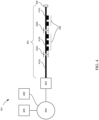
- FIG. 1 is an illustration of an electrical distribution system 101, including a power distribution busway 102.
- a power source illustrated as generator 104
- generator 104 is connected to the power distribution busway 102 via transformer 103.
- the amount of power flow output by the generator 104 onto the power distribution busway 102 is typically controlled by an automatic voltage regulator 105.
- the automatic voltage regulator 105 is illustrated as being a distinct component from the generator 104, the automatic voltage regulator 105 may be a component of the generator.
- the transformer 103 may be configured to adjust the voltage level of the power flow generated by the generator 104, such as by increasing or decreasing the voltage level and delivering power to the load(s).
- an electrical distribution system may have no transformers or more than one transformer.
- the power distribution busway 102 includes busway sections 112a, 112b, and 112c.
- the busway sections 112a, 112b, and 112c are connected via busway joints 122a and 122b.
- the busway joints may be compression joints, mechanical joints, or other such components capable of connecting two or more busway sections together, such as cable joints.
- the power distribution busway 102 may include rails to carry the power flow. Each rail may carry a power phase, neutral, and/or ground.
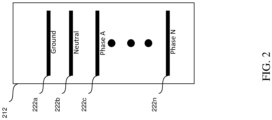
- the busway may include rails 222a-222n. Rail 222a carries ground, rail 222b carries neutral, 222c carries phase A, and 222n carries phase N.
- busway section 212 is illustrated as carrying "N" phases, a typical busway section may include 1 - 3 phases, for a total of between 3 and 5 rails. In some instances, each branch of a busway section may have the same or a different number of rails relative to another busway section.
- Each busway section may include bus taps.
- busway sections 112b and 112c include bus taps 106.
- Busway section 112b includes three bus taps 106, and busway section 112c includes two bus taps 106.
- the bus taps may be connection points for loads.
- the bus taps may deliver power flow from the power distribution busway 102 to loads, such as server racks.
- an intermediary connection such as a wire, bus, or other such connection mechanism, may connect the bus tap to the loads.
- Each bus tap may connect to any number of loads.
- power distribution busway 102 is merely for example purposes and may be configured to include more or fewer busway sections, busway joints, and bus taps.
- a power distribution busway may include any number of busway sections joined together by busway joints.
- Each busway section may include any number of busway taps.
- each busway joint may join more than two busways such that the power distribution busway may split into any number of branches.
- a busway joint may connect three busway sections, thereby splitting the busway into two separate branches.
- FIG. 3 illustrates the configuration of an electrical distribution system 301 attached to a load bank 309 for testing busway joint connections.
- the electrical distribution system 301 may be compared with electrical distribution system 101.
- electrical distribution system 301 includes a power source, illustrated as generator 304, connected to the power distribution busway 302 via transformer 303.
- An automatic voltage regulator 305 may control the amount of power flow output by the generator 304 onto the power distribution busway 302.
- the power distribution busway 302 includes busway sections 312a, 312b, and 312c.
- the busway sections 312a, 312b, and 312c are connected via busway joints 322a and 322b.
- the busway sections include bus taps 306.
- a synthetic load-load bank 309 is attached to a bus tap positioned at the end of the power distribution busway 302.
- the bus tap to which load bank 309 is connected is referred to as end tap 308.
- end tap 308 To test the integrity of the busway joints 322a and 322b, full or partial power flow is pulled through the electrical distribution system 301 by the load bank 309 from the generator 304.
- the voltage of the signal output by the generator 304 is controlled by the automatic voltage regulator 305.
- known techniques may be used to locate and identify improperly installed and defective busway joints in the power distribution busway 302. Such techniques may include voltage drop detection methods and thermal scanning.
- the power source may be converted to or otherwise made to act as a constant current source. Additionally, the end of the distribution path of the power distribution busway may be shorted by placing a shunt between power rails at the end of the power distribution busway.
- FIG. 4 illustrates the configuration of an electrical distribution system 401 having shorted power rails and a power source configured to act as a constant current source.
- the electrical distribution system 401 may be compared with electrical distribution system 101.
- electrical distribution system 401 includes a power source, illustrated as generator 404, connected to the power distribution busway 402 via transformer 403.
- the power distribution busway 402 includes busway sections 412a, 412b, and 412c.
- the busway sections 412a, 412b, and 412c are connected via busway joints 422a and 422b.
- the busway sections include bus taps 406.
- a shunt 408 is placed across, or otherwise attached to, the rails of busway section 412c. In instances where a power distribution busway includes more than one branch, shunts may be placed at the end of each branch.
- the automatic voltage regulator 405 may be placed into a manual mode.
- An excitation system, in this example, variable power supply 409, is connected to generator 404. Although FIG. 4 illustrates the variable power supply 409 as being external to generator 404, the excitation system may be integrated into generator 404.
- the voltage regulator 405 of the generator 404 may be manually set.
- the voltage may be set to a low voltage level, such as between 1V and 50V.
- the voltage level may be dependent on the circuit impedance (e.g., impedance of the busway sections, busway joints, etc.) and current supplied by the excitation system. In such an instance, the voltage level would equal circuit impedance x current.
- the excitation system may be configured to deliver a power flow having a particular amount of current at the manually set voltage level (e.g., 1V to 50V) to the power distribution busway.
- the amount of current (amperage) that is delivered from the excitation system must be within the generator's continuous current maximum limit.
- the current applied to the power distribution busway 402 within a power flow may be a constant current.
- the generator 404 operates as a constant current source.
- the current output by the generator 404 is described as a constant current, the current level may be ramped up to the constant level. The current may then be maintained at a constant level long enough to generate heat in the electrical distribution system 401, including the power distribution busway 402, so that heat anomalies may be detected.
- heat and/or voltage drop anomalies may be detected using detection techniques, such as thermal scanning or voltage drop detection methods.
- voltage drop anomalies may be detected by measuring, at the busway joints, such as busway joints 422a and 422b, a voltage drop of the power flow across the respective busway joints.
- a defective or improperly installed busway joint may be determined by comparing the measured voltage drops to a threshold value. When the voltage drop across a busway joint is greater than, and in some instances, equal to, the threshold value, the busway joint may be identified as defective and/or improperly installed.
- heat anomalies may be detected by measuring the temperature of the busway joints. When the measured temperature is greater than, and in some instances, equal to, a threshold value, the busway joint may be identified as defective and/or improperly installed.
- the technology is described herein as being used to test a power distribution busway, the technology can be used to test other electrical distribution systems that include joints such as cable terminations.
- bus joints and other joints are described as being tested, other components, such as measurement sensors, current transformers, cable terminations, etc., can be tested for proper installation using the methods described herein.
- the power flow through the current transformer may be measured. The measured power flow may then be compared against the expected power flow to determine if they match or are within a threshold value of each other. If the values do not match or are outside of the threshold value, the current transformer may be identified as defective and/or improperly installed.
- FIG. 5 depicts a flow diagram illustrating an example method 500 for synthesizing low-voltage power flow in an electrical distribution system.
- the operations involved in the following methods need not be performed in the precise order described. Rather, various operations may be handled in a different order or simultaneously, and operations may be added or omitted.
- the method may include connecting a generator to an electrical distribution system, as shown in block 501.
- the generator may include or otherwise be attached to a voltage regulator and excitation system.
- the electrical distribution system may be shorted with a shunt, as shown in block 503.
- the shunt may be placed across rails that carry the power flow, such as rails with busway sections of a power distribution busway.
- the output voltage of the generator may be manually set using the voltage regulator, and the output current of the generator may be set using the excitation system.
- the excitation system may be, for example, a variable power supply.
- the generator may then generate a power flow having the set output voltage and the set output current, as shown in block 509.
- the power flow may be supplied to the electrical distribution system.
- one or more components of the electrical distribution system may be tested to verify whether they are operating as intended, as shown in block 511. Such verification may include determining whether the component is installed correctly.
Landscapes
- Physics & Mathematics (AREA)
- General Physics & Mathematics (AREA)
- Engineering & Computer Science (AREA)
- Power Engineering (AREA)
- Tests Of Circuit Breakers, Generators, And Electric Motors (AREA)
Abstract
Generally disclosed herein is a method for synthesizing low-voltage power flow in an electrical distribution system. The method may include connecting a generator to the electrical distribution system. The generator may include a voltage regulator and excitation system. The electrical distribution system may be shorted with a shunt. The output voltage of the generator may be manually set using the voltage regulator. The output current of the generator may be set using the excitation system. The generator may then generate a power flow with the set output voltage and the set output current. The power flow may be supplied to the electrical distribution system.
Description
- Electrical distribution systems deliver power from an electrical power system to a load. Electrical distribution systems, such as those found in data centers for delivering electrical power from electrical power systems to loads, such as server racks, typically include power distribution busways. Power distribution busways are often modular and include busway sections interconnected with busway joints. The installation of these busway sections and joints requires following specific installation guidelines, such as proper alignment of the two adjoining busway sections per the manufacturer's instructions, proper mating hardware to be installed per the manufacturer's instructions, proper cleaning of the adjoining busway sections, proper prepping of the adjoining busway sections per manufacturer's instructions, as well as torquing procedures for proper installation.
- To check for proper installation of power distribution busways including installation of the joints and busway sections, testing and commissioning steps may be taken. Such testing and commissioning may include torque verification, alignment verification, digital low-resistance ohmmeter testing, insulation resistance testing, infrared thermography, and power (current) injection testing. Current methods of testing the installation of joints typically include bus torquing, voltage drop detection methods (e.g., measuring the voltage drop of a power flow across a joint), and thermal scanning under full or partial load to validate joint connections utilizing system resistance to locate and identify improperly installed, or defective, joints.
- Generally disclosed herein are systems and methods for synthesizing low-voltage power flow in an electrical distribution system to verify the connections of the joints in the electrical distribution system are made properly. Electrical distribution systems commonly include joints where sections of the electrical distribution system are joined together. Improper installation of the joints or faulty components within the joints may lead to risks such as damage or failure to the electrical distribution system or attached equipment and fire. To reduce these risks, the joints may be tested using a synthesized low-voltage power flow generated by an electrical power generation unit to identify excessive heat or voltage drop anomalies indicating improperly installed and/or faulty joints.
- An aspect of the disclosure provides a method for synthesizing low-voltage power flow in an electrical distribution system. The method may comprise: connecting a generator to the electrical distribution system, the generator including a voltage regulator and excitation system; shorting the electrical distribution system with a shunt; setting an output voltage of the generator using the voltage regulator; setting an output current of the generator using the excitation system; and generating, by the generator, a power flow having the set output voltage and the set output current, the power flow being supplied to the electrical distribution system.
- In some instances, prior to setting the output voltage of the regulator, disabling automatic voltage regulation of the voltage regulator.
- In some instances, the electrical distribution system includes a power distribution busway comprising a plurality of busway sections interconnected by a plurality of busway joints. In some examples, the plurality of busway joints are mechanical joints and/or compression joints.
- In some instances, the plurality of busway sections and the plurality of busway joints each include three or more power rails. In some examples, the plurality of busway sections and the plurality of busway joints each include at least a positive rail, a negative rail, and a ground rail. In some examples, the shunt is attached between power rails of a busway section of the plurality of busway sections at an end of the power distribution busway.
- In some instances, the method includes testing the plurality of busway joints.
- In some examples, the testing comprises measuring, for each of the plurality of busway joints, a voltage drop of the power flow across the respective busway joint; and identifying defective and/or improperly installed busway joints based on the measured voltage drops, wherein each busway joint of the plurality of busway joints having a measured voltage drop greater than a threshold value is identified as defective and/or improperly installed.
- In some examples, the testing comprises thermal scanning of each of the plurality of busway joints to determine a temperature of each of the plurality of busway joints. In some examples, each busway joint of the plurality of busways joints having a temperature greater than a threshold value is identified as defective and/or improperly installed.
- In some instances, the electrical distribution system includes a power distribution busway comprising two or more branches, wherein each branch includes one or more busway joints and one or more busway sections.
- In some examples, the method further comprises directing the power flow to a first of the two or more branches; and testing the one or more busway joints within the first of the two or more branches.
- In some examples, the method further comprises directing the power flow to a second of the two or more branches; and testing the one or more busway joints within the second of the two or more branches.
- In some instances, the electrical distribution system further includes a current transformer, and the method further comprises testing the current transformer.
- In some examples, the testing comprises measuring the power flow through the current transformer; and identifying the current transformer as defective and/or improperly installed based on the measured power flow by comparing the measured power flow against expected power flow through the current transformer. In some examples, the testing comprises thermal scanning the current transformer to determine a temperature; and identifying the current transformer as defective and/or improperly installed based on the temperature being greater than a threshold value.
- In some instances, the electrical distribution system further includes cable terminations, the method further comprising testing the cable terminations. In some examples, the testing comprises, for each of the cable terminations, a voltage drop of the power flow across the respective cable termination; and identifying defective and/or improperly installed cable terminations based on the measured voltage drops, wherein each cable termination of the cable terminations having a measured voltage drop greater than a threshold value is identified as defective and/or improperly installed. In some examples, the testing comprises thermal scanning of each of the cable terminations to determine a temperature of each of the cable terminations, wherein each cable termination of the cable terminations having a temperature greater than a threshold value is identified as defective and/or improperly installed.
-
-
FIG. 1 is an illustration of an electrical distribution system including a power distribution busway in accordance with aspects of the disclosure. -
FIG. 2 is an illustration of rails within a cutaway view of an example busway section in accordance with aspects of the disclosure. -
FIG. 3 is an example configuration of an electrical distribution system attached to a load bank for testing busway joint connections. -
FIG. 4 illustrates a configuration of an electrical distribution system having shorted power rails and a power source configured to act as a constant current source for use in testing according to aspects of the disclosure. -
FIG. 5 is a flow chart illustrating a method for synthesizing a low-voltage power flow in an electrical distribution system in accordance with aspects of the disclosure. - Generally disclosed herein is a method for synthesizing low-voltage power flow in an electrical distribution system. The method may include connecting a generator to the electrical distribution system. The generator may include a voltage regulator and excitation system. The electrical distribution system may be shorted with a shunt. The output voltage of the generator may be manually set using the voltage regulator. The output current of the generator may be set using the excitation system. The generator may then generate a power flow with the set output voltage and the set output current. The power flow may be supplied to the electrical distribution system. The present disclosure relates to systems and methods for synthesizing low-voltage power flow in an electrical distribution system to verify the connections of the joints in the electrical distribution system are made properly and operating as intended. Techniques to locate and identify improperly installed and defective joints in an electric distribution system include voltage drop detection methods (e.g., measuring the voltage drop of a power flow across a joint) and thermal scanning under full or partial load to validate joint connections utilizing system resistance, require the use of load banks and the delivery of full or partial power to the electrical distribution system to validate this installation.
- As used herein, full power (Wmax) may be considered the power level at the maximum rated voltage (Vmax) and maximum rated current (Imax) of a power distribution busway, where Wmax = Vmax*Imax. Partial power may be considered any power level >40% of full power (Wmax). Low power may be considered any power level <=40% of full power (Wmax). In instances where multiple phases of power are provided, Wmax =Vmax*Imax*√3.
- To flow full or partial power through the electrical distribution system, a synthetic load, sometimes referred to as a substitute load, is normally attached to the electrical distribution system. For example, a synthetic load may include a load bank capable of safely dissipating the power delivered to the electrical distribution system during testing as heat. In this regard, while some power may be dissipated by the electrical distribution system itself, such dissipation would account for only a fraction of the full power. Thus, much of the delivered power would be dissipated by the load bank. However, such load banks are expensive to purchase and/or rent. Additionally, the use of load banks can add significant delays and costs to the installation of electrical distribution systems. Moreover, utilizing load banks introduces safety risks and human error risks from continuously relocating the load bank to different electrical distribution systems and circuits.
- The technology described herein may synthesize low-voltage power flow in an electrical distribution system, such as a power distribution busway, to verify proper joint connections and functionality without the need for a synthetic load. Thus, significant cost and time savings may be achieved. Further, applying a synthesized low-voltage power flow reduces the risk of damage to the power distribution busway dielectrically. Additionally, synthesizing a low-voltage power flow in the power distribution busway minimizes the risks involved in applying a high-voltage signal to an electrical distribution system, such as overheating and fire hazards, as only a low-voltage signal is provided.
-
FIG. 1 is an illustration of anelectrical distribution system 101, including apower distribution busway 102. A power source, illustrated asgenerator 104, is connected to thepower distribution busway 102 viatransformer 103. The amount of power flow output by thegenerator 104 onto thepower distribution busway 102 is typically controlled by anautomatic voltage regulator 105. Although theautomatic voltage regulator 105 is illustrated as being a distinct component from thegenerator 104, theautomatic voltage regulator 105 may be a component of the generator. - The
transformer 103 may be configured to adjust the voltage level of the power flow generated by thegenerator 104, such as by increasing or decreasing the voltage level and delivering power to the load(s). In some instances, an electrical distribution system may have no transformers or more than one transformer. - The
power distribution busway 102 includesbusway sections busway sections busway joints - The
power distribution busway 102 may include rails to carry the power flow. Each rail may carry a power phase, neutral, and/or ground. For instance, and as illustrated in the cutaway view of anexample busway section 212 ofFIG. 2 , the busway may includerails 222a-222n.Rail 222a carries ground,rail 222b carries neutral, 222c carries phase A, and 222n carries phase N. Althoughbusway section 212 is illustrated as carrying "N" phases, a typical busway section may include 1 - 3 phases, for a total of between 3 and 5 rails. In some instances, each branch of a busway section may have the same or a different number of rails relative to another busway section. - Each busway section may include bus taps. For instance, and referring back to
FIG. 1 ,busway sections Busway section 112b includes three bus taps 106, andbusway section 112c includes two bus taps 106. The bus taps may be connection points for loads. In this regard, the bus taps may deliver power flow from thepower distribution busway 102 to loads, such as server racks. In some instances, an intermediary connection, such as a wire, bus, or other such connection mechanism, may connect the bus tap to the loads. Each bus tap may connect to any number of loads. - The illustration of
power distribution busway 102 is merely for example purposes and may be configured to include more or fewer busway sections, busway joints, and bus taps. For example, a power distribution busway may include any number of busway sections joined together by busway joints. Each busway section may include any number of busway taps. Moreover, each busway joint may join more than two busways such that the power distribution busway may split into any number of branches. For instance, a busway joint may connect three busway sections, thereby splitting the busway into two separate branches. -
FIG. 3 illustrates the configuration of anelectrical distribution system 301 attached to aload bank 309 for testing busway joint connections. Theelectrical distribution system 301 may be compared withelectrical distribution system 101. In this regard,electrical distribution system 301 includes a power source, illustrated asgenerator 304, connected to thepower distribution busway 302 viatransformer 303. Anautomatic voltage regulator 305 may control the amount of power flow output by thegenerator 304 onto thepower distribution busway 302. Thepower distribution busway 302 includesbusway sections busway sections busway joints - As further shown in
FIG. 3 , a synthetic load-load bank 309 is attached to a bus tap positioned at the end of thepower distribution busway 302. The bus tap to whichload bank 309 is connected is referred to asend tap 308. To test the integrity of thebusway joints electrical distribution system 301 by theload bank 309 from thegenerator 304. The voltage of the signal output by thegenerator 304 is controlled by theautomatic voltage regulator 305. While the load bank is pulling full or partial power flow through the power distribution busway, known techniques may be used to locate and identify improperly installed and defective busway joints in thepower distribution busway 302. Such techniques may include voltage drop detection methods and thermal scanning. - To synthesize low-voltage power flow, and thereby remove the need for a synthetic load when testing the integrity of busway joints, the power source may be converted to or otherwise made to act as a constant current source. Additionally, the end of the distribution path of the power distribution busway may be shorted by placing a shunt between power rails at the end of the power distribution busway.
- For example,
FIG. 4 illustrates the configuration of anelectrical distribution system 401 having shorted power rails and a power source configured to act as a constant current source. Theelectrical distribution system 401 may be compared withelectrical distribution system 101. In this regard,electrical distribution system 401 includes a power source, illustrated asgenerator 404, connected to thepower distribution busway 402 viatransformer 403. Thepower distribution busway 402 includesbusway sections busway sections busway joints - As further shown in
FIG. 4 , ashunt 408 is placed across, or otherwise attached to, the rails ofbusway section 412c. In instances where a power distribution busway includes more than one branch, shunts may be placed at the end of each branch. Theautomatic voltage regulator 405 may be placed into a manual mode. An excitation system, in this example,variable power supply 409, is connected togenerator 404. AlthoughFIG. 4 illustrates thevariable power supply 409 as being external togenerator 404, the excitation system may be integrated intogenerator 404. - By disabling any automatic voltage regulation features of the generator and using the generator's excitation system, a power flow having a large current and low voltage may be output by the generator. In this regard, the
voltage regulator 405 of thegenerator 404 may be manually set. For example, the voltage may be set to a low voltage level, such as between 1V and 50V. In other instances, the voltage level may be dependent on the circuit impedance (e.g., impedance of the busway sections, busway joints, etc.) and current supplied by the excitation system. In such an instance, the voltage level would equal circuit impedance x current. - The excitation system may be configured to deliver a power flow having a particular amount of current at the manually set voltage level (e.g., 1V to 50V) to the power distribution busway. The amount of current (amperage) that is delivered from the excitation system must be within the generator's continuous current maximum limit. The current applied to the
power distribution busway 402 within a power flow may be a constant current. Thus, by manually setting the voltage and using thevariable power supply 409, thegenerator 404 operates as a constant current source. Although the current output by thegenerator 404 is described as a constant current, the current level may be ramped up to the constant level. The current may then be maintained at a constant level long enough to generate heat in theelectrical distribution system 401, including thepower distribution busway 402, so that heat anomalies may be detected. - By shorting the power distribution busway with a shunt and delivering a power flow having a particular level of current at a low voltage to the power distribution busway, the electrical characteristics of the power distribution busway, including those of the connection joints, would be comparable to electrical characteristics if full or partial power was delivered to the power distribution bus. Thus, heat and/or voltage drop anomalies may be detected using detection techniques, such as thermal scanning or voltage drop detection methods.
- In some instances, voltage drop anomalies may be detected by measuring, at the busway joints, such as
busway joints - In some examples, heat anomalies may be detected by measuring the temperature of the busway joints. When the measured temperature is greater than, and in some instances, equal to, a threshold value, the busway joint may be identified as defective and/or improperly installed.
- Although the technology is described herein as being used to test a power distribution busway, the technology can be used to test other electrical distribution systems that include joints such as cable terminations. Moreover, although bus joints and other joints are described as being tested, other components, such as measurement sensors, current transformers, cable terminations, etc., can be tested for proper installation using the methods described herein. For instance, to test current transformers, the power flow through the current transformer may be measured. The measured power flow may then be compared against the expected power flow to determine if they match or are within a threshold value of each other. If the values do not match or are outside of the threshold value, the current transformer may be identified as defective and/or improperly installed.
- In some instances, the power flow delivered by the
generator 404 can be diverted to other parts of theelectrical distribution system 401 by closing and opening circuit breakers (not shown). By doing such, the power flow may be delivered to different devices and or branches within theelectrical distribution system 401, including in thepower distribution busway 402. Thus, a portion of the components within theelectrical distribution system 401 can be tested. Moreover, by modifying the power system state by opening and closing breakers, the synthesized low-voltage power flow can also be diverted to various locations within theelectrical distribution system 401, such as medium voltage and high voltage locations, to test components in those locations. Moreover, although the synthesized power flow described herein is described as low-voltage (e.g., <= 1,000V, higher-voltage power flows (>1,000 volts) may also be synthesized. -
FIG. 5 depicts a flow diagram illustrating anexample method 500 for synthesizing low-voltage power flow in an electrical distribution system. The operations involved in the following methods need not be performed in the precise order described. Rather, various operations may be handled in a different order or simultaneously, and operations may be added or omitted. - The method may include connecting a generator to an electrical distribution system, as shown in
block 501. The generator may include or otherwise be attached to a voltage regulator and excitation system. The electrical distribution system may be shorted with a shunt, as shown inblock 503. As explained herein, the shunt may be placed across rails that carry the power flow, such as rails with busway sections of a power distribution busway. - As shown in
blocks block 509. The power flow may be supplied to the electrical distribution system. With the power flow being supplied to the electrical distribution system, or after the power flow has been supplied to the electrical distribution system, one or more components of the electrical distribution system may be tested to verify whether they are operating as intended, as shown inblock 511. Such verification may include determining whether the component is installed correctly. - Although the technology herein has been described with reference to particular examples, it is to be understood that these examples are merely illustrative of the principles and applications of the present technology. It is, therefore, to be understood that numerous modifications may be made and that other arrangements may be devised without departing from the spirit and scope of the present technology as defined by the appended claims.
- Unless otherwise stated, the foregoing alternative examples are not mutually exclusive but may be implemented in various combinations to achieve unique advantages. As these and other variations and combinations of the features discussed above can be utilized without departing from the subject matter defined by the claims, the foregoing description should be taken by way of illustration rather than by way of limitation of the subject matter defined by the claims. In addition, the provision of the examples described herein, as well as clauses phrased as "such as," "including," and the like, should not be interpreted as limiting the subject matter of the claims to the specific examples; rather, the examples are intended to illustrate only one of many possible implementations. Further, the same reference numbers in different drawings can identify the same or similar elements.
Claims (15)
- A method for synthesizing low-voltage power flow in an electrical distribution system, the method comprising:connecting a generator to the electrical distribution system, the generator including a voltage regulator and excitation system;shorting the electrical distribution system with a shunt;setting an output voltage of the generator using the voltage regulator;setting an output current of the generator using the excitation system; andgenerating, by the generator, a power flow having the set output voltage and the set output current, the power flow being supplied to the electrical distribution system.
- The method of claim 1, further comprising, prior to setting the output voltage of the regulator, disabling automatic voltage regulation of the voltage regulator.
- The method of claim 1 or claim 2, wherein the electrical distribution system includes a power distribution busway comprising a plurality of busway sections interconnected by a plurality of busway joints.
- The method of claim 3, wherein the plurality of busway joints are mechanical joints and/or compression joints.
- The method of claim 3 or claim 4, wherein the plurality of busway sections and the plurality of busway joints each include three or more power rails.
- The method of claim 5, wherein the plurality of busway sections and the plurality of busway joints each include at least a positive rail, a negative rail, and a ground rail; and/or
wherein the shunt is attached between power rails of a busway section of the plurality of busway sections at an end of the power distribution busway. - The method of one of claims 3 to 6, further comprising testing the plurality of busway joints.
- The method of claim 7, wherein the testing comprises:measuring, for each of the plurality of busway joints, a voltage drop of the power flow across the respective busway joint; andidentifying defective and/or improperly installed busway joints based on the measured voltage drops, wherein each busway joint of the plurality of busway joints having a measured voltage drop greater than a threshold value is identified as defective and/or improperly installed.
- The method of claim 7 or claim 8, wherein the testing comprises:thermal scanning of each of the plurality of busway joints to determine a temperature of each of the plurality of busway joints; andwherein optionally each busway joint of the plurality of busways joints having a temperature greater than a threshold value is identified as defective and/or improperly installed.
- The method of one of claims 1 to 9, wherein the electrical distribution system includes a power distribution busway comprising two or more branches, wherein each branch includes one or more busway joints and one or more busway sections.
- The method of claim 10, further comprising:directing the power flow to a first of the two or more branches; andtesting the one or more busway joints within the first of the two or more branches; and optionally further comprising:directing the power flow to a second of the two or more branches; andtesting the one or more busway joints within the second of the two or more branches.
- The method of one of claims 1 to 11, wherein the electrical distribution system further includes a current transformer, the method further comprising:
testing the current transformer. - The method of claim 12, wherein the testing comprises:measuring the power flow through the current transformer; andidentifying the current transformer as defective and/or improperly installed based on the measured power flow by comparing the measured power flow against expected power flow through the current transformer; and/or
wherein the testing comprises:thermal scanning the current transformer to determine a temperature; andidentifying the current transformer as defective and/or improperly installed based on the temperature being greater than a threshold value. - The method of one of claims 1 to 13, wherein the electrical distribution system further includes cable terminations, the method further comprising:
testing the cable terminations. - The method of claim 14, wherein the testing comprises:for each of the cable terminations, a voltage drop of the power flow across the respective cable termination; andidentifying defective and/or improperly installed cable terminations based on the measured voltage drops, wherein each cable termination of the cable terminations having a measured voltage drop greater than a threshold value is identified as defective and/or improperly installed; and/or
wherein the testing comprises:
thermal scanning of each of the cable terminations to determine a temperature of each of the cable terminations, wherein each cable termination of the cable terminations having a temperature greater than a threshold value is identified as defective and/or improperly installed.
Applications Claiming Priority (1)
| Application Number | Priority Date | Filing Date | Title |
|---|---|---|---|
| US18/385,163 US12566221B2 (en) | 2023-10-30 | 2023-10-30 | Power distribution busway testing |
Publications (1)
| Publication Number | Publication Date |
|---|---|
| EP4549959A1 true EP4549959A1 (en) | 2025-05-07 |
Family
ID=93333868
Family Applications (1)
| Application Number | Title | Priority Date | Filing Date |
|---|---|---|---|
| EP24209433.2A Pending EP4549959A1 (en) | 2023-10-30 | 2024-10-29 | Power distribution busway testing |
Country Status (2)
| Country | Link |
|---|---|
| US (1) | US12566221B2 (en) |
| EP (1) | EP4549959A1 (en) |
Citations (2)
| Publication number | Priority date | Publication date | Assignee | Title |
|---|---|---|---|---|
| US2928996A (en) * | 1951-09-13 | 1960-03-15 | Markowitz Oscar | Techniques to deactivate a generator after a fault |
| US20190190219A1 (en) * | 2017-12-14 | 2019-06-20 | Veris Industries, Llc | Electrical fault detection for a modular busway |
Family Cites Families (8)
| Publication number | Priority date | Publication date | Assignee | Title |
|---|---|---|---|---|
| US7991588B1 (en) * | 2007-05-01 | 2011-08-02 | Exaflop Llc | Power consumption measurement |
| CN104810942B (en) | 2015-04-15 | 2017-03-01 | 新疆金风科技股份有限公司 | Permanent magnet direct-driving aerogenerator, system and its stator |
| CN204858910U (en) | 2015-08-11 | 2015-12-09 | 大唐陈村水力发电厂 | A Generator Stator Drying System Based on Constant Voltage Mode of Excitation Device |
| US9899953B2 (en) * | 2016-06-27 | 2018-02-20 | Rockwell Automation Technologies, Inc. | Method and apparatus for detecting ground faults in inverter outputs on a shared DC bus |
| EP3267211A1 (en) * | 2016-07-06 | 2018-01-10 | NKT HV Cables GmbH | A high voltage unit for testing capability of a high voltage component to withstand operational conditions |
| KR101968969B1 (en) * | 2016-10-11 | 2019-04-15 | 주식회사 아모센스 | Apparatus and method for diagnosing a failure of electromagnetic inductive power supply apparatus |
| US11372060B2 (en) * | 2017-10-20 | 2022-06-28 | Abb Power Electronics Inc. | Busway joint connection monitoring system and methods of assembling the same |
| US11349335B2 (en) * | 2019-11-25 | 2022-05-31 | Cyber Power Systems, Inc. | Power supplying device |
-
2023
- 2023-10-30 US US18/385,163 patent/US12566221B2/en active Active
-
2024
- 2024-10-29 EP EP24209433.2A patent/EP4549959A1/en active Pending
Patent Citations (2)
| Publication number | Priority date | Publication date | Assignee | Title |
|---|---|---|---|---|
| US2928996A (en) * | 1951-09-13 | 1960-03-15 | Markowitz Oscar | Techniques to deactivate a generator after a fault |
| US20190190219A1 (en) * | 2017-12-14 | 2019-06-20 | Veris Industries, Llc | Electrical fault detection for a modular busway |
Also Published As
| Publication number | Publication date |
|---|---|
| US20250138107A1 (en) | 2025-05-01 |
| US12566221B2 (en) | 2026-03-03 |
Similar Documents
| Publication | Publication Date | Title |
|---|---|---|
| US10658838B2 (en) | Method and system for establishing a power feed to systems during operation | |
| US7791351B2 (en) | Method for detecting electrical ground faults | |
| EP2216879A2 (en) | Method and apparatus for testing uniterruptible power supply | |
| JP4109970B2 (en) | Test apparatus and test method for electrical equipment protection circuit | |
| US8994213B1 (en) | System and method for establishing a power feed from a source panel | |
| BRPI0609789A2 (en) | apparatus for selecting and providing a differential relay and method for selecting and providing a differential relay microcontroller with an operating vector group compensation adjustment pair | |
| CN101680933A (en) | Method for diagnosing defective components in a stand-alone system powered by an intermittent power source | |
| CN111527661B (en) | Fault location in multi-terminal tapped lines | |
| US6496015B2 (en) | Method of performing a dielectric voltage-withstand test on a wire harness | |
| EP4549959A1 (en) | Power distribution busway testing | |
| CN111060759B (en) | Power distribution cabinet test system and test method | |
| JP4500130B2 (en) | Method and apparatus for checking wiring connection of outlet with ground electrode | |
| KR100317985B1 (en) | Load tester for automatic voltage regulator and method for the same | |
| JP2007132665A (en) | Operation test method for ground fault direction relay | |
| KR20210083013A (en) | Micro Protective Device and Method thereof and Artificial Fault Generator for the Micro Smart Grid Simulator and, Micro Performance Evaluation System of the Micro Protective Device | |
| CN113253013A (en) | Low-pressure pressurization control method for converter valve of converter station | |
| Kim et al. | Verification of insulated overhead cables and underground cable systems for MVDC applications | |
| US12504469B2 (en) | Continuously variable electronic load tester for use with nuclear instrumentation system high voltage power supplies | |
| Cassidy et al. | Substation Through Fault Testing | |
| Ernst et al. | Commission testing methods for protection systems | |
| US20180095485A1 (en) | Methods and systems for using a tapped transformer to generate voltage sags | |
| Erşan | Development of an Semi-Automatic Test Program Set for Traction Inverters | |
| Blais | Development and Installation of 138-kV Cable for Tests at EEI Waltz Mill Station: Cable 24 | |
| Kotarba et al. | Automatic measurement system for electrical verification of the LHC superconducting circuits | |
| Schmidt | Commissioning the electrical circuits: Powering, Protection and Interlocks |
Legal Events
| Date | Code | Title | Description |
|---|---|---|---|
| PUAI | Public reference made under article 153(3) epc to a published international application that has entered the european phase |
Free format text: ORIGINAL CODE: 0009012 |
|
| STAA | Information on the status of an ep patent application or granted ep patent |
Free format text: STATUS: THE APPLICATION HAS BEEN PUBLISHED |
|
| AK | Designated contracting states |
Kind code of ref document: A1 Designated state(s): AL AT BE BG CH CY CZ DE DK EE ES FI FR GB GR HR HU IE IS IT LI LT LU LV MC ME MK MT NL NO PL PT RO RS SE SI SK SM TR |
|
| STAA | Information on the status of an ep patent application or granted ep patent |
Free format text: STATUS: REQUEST FOR EXAMINATION WAS MADE |
|
| 17P | Request for examination filed |
Effective date: 20251106 |