EP4549862A1 - Gas injection nozzle for drying electrode plate and drying apparatus for electrode plate including the same - Google Patents
Gas injection nozzle for drying electrode plate and drying apparatus for electrode plate including the same Download PDFInfo
- Publication number
- EP4549862A1 EP4549862A1 EP24209354.0A EP24209354A EP4549862A1 EP 4549862 A1 EP4549862 A1 EP 4549862A1 EP 24209354 A EP24209354 A EP 24209354A EP 4549862 A1 EP4549862 A1 EP 4549862A1
- Authority
- EP
- European Patent Office
- Prior art keywords
- drying
- plate
- electrode plate
- gas
- injection nozzle
- Prior art date
- Legal status (The legal status is an assumption and is not a legal conclusion. Google has not performed a legal analysis and makes no representation as to the accuracy of the status listed.)
- Pending
Links
Images








Classifications
-
- H—ELECTRICITY
- H01—ELECTRIC ELEMENTS
- H01M—PROCESSES OR MEANS, e.g. BATTERIES, FOR THE DIRECT CONVERSION OF CHEMICAL ENERGY INTO ELECTRICAL ENERGY
- H01M4/00—Electrodes
- H01M4/02—Electrodes composed of, or comprising, active material
- H01M4/04—Processes of manufacture in general
-
- B—PERFORMING OPERATIONS; TRANSPORTING
- B05—SPRAYING OR ATOMISING IN GENERAL; APPLYING FLUENT MATERIALS TO SURFACES, IN GENERAL
- B05B—SPRAYING APPARATUS; ATOMISING APPARATUS; NOZZLES
- B05B1/00—Nozzles, spray heads or other outlets, with or without auxiliary devices such as valves, heating means
- B05B1/02—Nozzles, spray heads or other outlets, with or without auxiliary devices such as valves, heating means designed to produce a jet, spray, or other discharge of particular shape or nature, e.g. in single drops, or having an outlet of particular shape
- B05B1/04—Nozzles, spray heads or other outlets, with or without auxiliary devices such as valves, heating means designed to produce a jet, spray, or other discharge of particular shape or nature, e.g. in single drops, or having an outlet of particular shape in flat form, e.g. fan-like, sheet-like
- B05B1/044—Slits, e.g. narrow openings defined by two straight and parallel lips; Elongated outlets for producing very wide discharges, e.g. fluid curtains
-
- B—PERFORMING OPERATIONS; TRANSPORTING
- B05—SPRAYING OR ATOMISING IN GENERAL; APPLYING FLUENT MATERIALS TO SURFACES, IN GENERAL
- B05B—SPRAYING APPARATUS; ATOMISING APPARATUS; NOZZLES
- B05B1/00—Nozzles, spray heads or other outlets, with or without auxiliary devices such as valves, heating means
- B05B1/14—Nozzles, spray heads or other outlets, with or without auxiliary devices such as valves, heating means with multiple outlet openings; with strainers in or outside the outlet opening
-
- B—PERFORMING OPERATIONS; TRANSPORTING
- B05—SPRAYING OR ATOMISING IN GENERAL; APPLYING FLUENT MATERIALS TO SURFACES, IN GENERAL
- B05B—SPRAYING APPARATUS; ATOMISING APPARATUS; NOZZLES
- B05B1/00—Nozzles, spray heads or other outlets, with or without auxiliary devices such as valves, heating means
- B05B1/34—Nozzles, spray heads or other outlets, with or without auxiliary devices such as valves, heating means designed to influence the nature of flow of the liquid or other fluent material, e.g. to produce swirl
- B05B1/3402—Nozzles, spray heads or other outlets, with or without auxiliary devices such as valves, heating means designed to influence the nature of flow of the liquid or other fluent material, e.g. to produce swirl to avoid or reduce turbulence, e.g. with fluid flow straightening means
-
- B—PERFORMING OPERATIONS; TRANSPORTING
- B05—SPRAYING OR ATOMISING IN GENERAL; APPLYING FLUENT MATERIALS TO SURFACES, IN GENERAL
- B05D—PROCESSES FOR APPLYING FLUENT MATERIALS TO SURFACES, IN GENERAL
- B05D1/00—Processes for applying liquids or other fluent materials
- B05D1/02—Processes for applying liquids or other fluent materials performed by spraying
-
- F—MECHANICAL ENGINEERING; LIGHTING; HEATING; WEAPONS; BLASTING
- F26—DRYING
- F26B—DRYING SOLID MATERIALS OR OBJECTS BY REMOVING LIQUID THEREFROM
- F26B13/00—Machines and apparatus for drying fabrics, fibres, yarns, or other materials in long lengths, with progressive movement
- F26B13/10—Arrangements for feeding, heating or supporting materials; Controlling movement, tension or position of materials
-
- F—MECHANICAL ENGINEERING; LIGHTING; HEATING; WEAPONS; BLASTING
- F26—DRYING
- F26B—DRYING SOLID MATERIALS OR OBJECTS BY REMOVING LIQUID THEREFROM
- F26B21/00—Arrangements for supplying or controlling air or other gases for drying solid materials or objects
- F26B21/50—Ducting arrangements from the source of air or other gases to the materials or objects being dried
-
- H—ELECTRICITY
- H01—ELECTRIC ELEMENTS
- H01M—PROCESSES OR MEANS, e.g. BATTERIES, FOR THE DIRECT CONVERSION OF CHEMICAL ENERGY INTO ELECTRICAL ENERGY
- H01M4/00—Electrodes
- H01M4/02—Electrodes composed of, or comprising, active material
- H01M4/04—Processes of manufacture in general
- H01M4/0471—Processes of manufacture in general involving thermal treatment, e.g. firing, sintering, backing particulate active material, thermal decomposition, pyrolysis
-
- Y—GENERAL TAGGING OF NEW TECHNOLOGICAL DEVELOPMENTS; GENERAL TAGGING OF CROSS-SECTIONAL TECHNOLOGIES SPANNING OVER SEVERAL SECTIONS OF THE IPC; TECHNICAL SUBJECTS COVERED BY FORMER USPC CROSS-REFERENCE ART COLLECTIONS [XRACs] AND DIGESTS
- Y02—TECHNOLOGIES OR APPLICATIONS FOR MITIGATION OR ADAPTATION AGAINST CLIMATE CHANGE
- Y02E—REDUCTION OF GREENHOUSE GAS [GHG] EMISSIONS, RELATED TO ENERGY GENERATION, TRANSMISSION OR DISTRIBUTION
- Y02E60/00—Enabling technologies; Technologies with a potential or indirect contribution to GHG emissions mitigation
- Y02E60/10—Energy storage using batteries
-
- Y—GENERAL TAGGING OF NEW TECHNOLOGICAL DEVELOPMENTS; GENERAL TAGGING OF CROSS-SECTIONAL TECHNOLOGIES SPANNING OVER SEVERAL SECTIONS OF THE IPC; TECHNICAL SUBJECTS COVERED BY FORMER USPC CROSS-REFERENCE ART COLLECTIONS [XRACs] AND DIGESTS
- Y02—TECHNOLOGIES OR APPLICATIONS FOR MITIGATION OR ADAPTATION AGAINST CLIMATE CHANGE
- Y02P—CLIMATE CHANGE MITIGATION TECHNOLOGIES IN THE PRODUCTION OR PROCESSING OF GOODS
- Y02P70/00—Climate change mitigation technologies in the production process for final industrial or consumer products
- Y02P70/50—Manufacturing or production processes characterised by the final manufactured product
Definitions
- the disclosure and implementations disclosed in this patent document generally relate to a gas injection nozzle used to dry an electrode plate and a drying apparatus for the electrode plate including the same.
- the gas injection nozzle and the electrode plate manufactured by the drying apparatus for the electrode plate including the same in the present disclosure may be widely applied in the field of secondary battery technology, such as pouch-type secondary batteries and square-shaped secondary batteries.
- a secondary battery cell is capable of being charged and discharged unlike primary batteries, and may be applied to devices within various fields such as a digital camera, a mobile phone, a laptop computer, a hybrid vehicle, an electric vehicle, and an energy storage device, and the like.
- a secondary battery is classified into a pouch-type secondary battery and a can-type secondary battery, and has a structure in which an electrode assembly and an electrolyte are accommodated inside a case.
- the electrode assembly has a structure in which electrode plates and separators are alternately stacked.
- the electrode plate may include a cathode plate and an anode plate.
- the electrode plate includes a sheet or film-shaped current collector, and a cathode active material and an anode active material applied to the current collector.
- the anode plate may be formed by applying the anode active material to a copper sheet
- the cathode plate may be formed by applying a cathode active material to an aluminum sheet.
- An electrode plate is manufactured through a coating process of coating an active material on the current collector and a drying process of drying the active material. The coating process and the drying process have a significant impact on the quality of secondary batteries.
- drying gas such as hot air is injected onto a sheet of the current collector coated with the active material to dry the active material.
- drying gas such as hot air is injected onto a sheet of the current collector coated with the active material to dry the active material.
- the quality of the electrode plate may be not uniform because a degree of drying and drying efficiency vary, depending on the position of the electrode plate.
- a gas injection nozzle for drying an electrode plate and a drying apparatus for the electrode plate including the same, which may reduce a deviation in a flow rate and/or flow velocity depending on the position of the electrode plate.
- a gas injection nozzle for drying an electrode plate and a drying apparatus for the electrode plate including the same, which may reduce a deviation in drying efficiency and drying quality depending on the position of the electrode plate.
- a gas injection nozzle for drying an electrode plate and a drying apparatus for the electrode plate including the same which may improve the quality of electrode plate even for a wide electrode plate.
- An electrode plate manufactured by a gas injection nozzle for drying an electrode plate and a drying apparatus for the electrode plate including the same, and a battery cell including the same may be widely applied to devices within green technology fields such as an electric vehicle, a battery charging station, and solar and wind power generation using other batteries. Additionally, the electrode plate manufactured according to the present disclosure and the battery cell including the same may be used in an eco-friendly electric vehicle, a hybrid vehicle, and the like, to prevent a climate change by suppressing air pollution and greenhouse gas emissions.
- a gas injection nozzle for drying electrode plate includes: a nozzle body having a flow space through which drying gas flows, the flow space being formed between a first plate and a second plate spaced apart from the first plate in a first direction; at least one inlet hole formed in the first plate and configured to allow the drying gas to flow into the flow space from the outside of the nozzle body; and a plurality of injection holes formed in the second plate and configured to inject the drying gas from inside of the flow space to the outside, and the at least one inlet hole may have a slit shape crossing the first plate in a second direction, which second direction is a longitudinal direction of the nozzle body.
- the gas injection nozzle for drying an electrode plate may include: a deflector disposed between the first plate and the second plate and configured to change a flow direction of the drying gas introduced through the at least one inlet hole.
- the deflector may have a shape crossing the nozzle body in the second direction and may be disposed in a position facing the at least one inlet hole along (based on) the first direction.
- a first height between the deflector and the first plate may have a value equal to or less than a second height between the deflector and the second plate.
- a first height between the deflector and the first plate may have a value of 1/2 or less of the second height between the deflector and the second plate.
- a width of the deflector may have a value of 10% or more and 90% or less of a width of the first plate.
- the plurality of injection holes may have a circular shape.
- a drying apparatus for an electrode plate includes: a chamber having a gas supply space through which drying gas for drying the electrode plate flows; and a plurality of gas injection nozzles coupled to the chamber to communicate with the gas supply space of the chamber, wherein the plurality of gas injection nozzles may include: a nozzle body having a flow space through which drying gas flows, between a first plate and a second plate spaced apart from the first plate in a first direction; at least one inlet hole formed in the first plate and configured to allow the drying gas to flow into the flow space from the outside of the nozzle body; and a plurality of injection holes formed in the second plate and configured to inject the drying gas into the flow space to the outside, and the at least one inlet hole may have a slit shape crossing the first plate in a second direction, which second direction is a longitudinal direction of the nozzle body.
- the plurality of gas injection nozzles may further include: a deflector disposed between the first plate and the second plate to change a flow direction of the drying gas introduced through the at least one inlet hole.
- the plurality of gas injection nozzles may have a shape extending in a second direction, which corresponds to a width direction of the electrode plate, and may be spaced apart from each other in a third direction, which is a transport direction of the electrode plate, and the first direction, the second direction and the third direction may be perpendicular to each other.
- the chamber may include an inlet port configured to supply the drying gas to the gas supply space from the outside of the chamber, and a dispersion plate disposed between the inlet port and the first plate, and the dispersion plate may include a plurality of dispersion holes configured to communicate with the drying gas between the inlet port and the inlet hole.
- the inlet port may be configured to supply the drying gas in the second direction, and the plurality of dispersion holes may have a slit shape crossing the dispersion plate in the third direction.
- the inlet port may be configured to supply the drying gas in the second direction, and the plurality of dispersion holes may have a slit shape crossing the dispersion plate in the second direction.
- the chamber may include a first chamber in which drying gas injected onto a first surface of the electrode plate flows, and a second chamber in which drying gas injected onto a second surface of the electrode plate flows, and the plurality of gas injection nozzles may be installed in at least one of the first chamber or the second chamber.
- a system for drying an electrode in particular for drying a cathode and/or an anode of a battery, comprises such an electrode and the gas injection nozzle as defined above, or the drying apparatus as defined above.
- a method for preparing a dried electrode plate in particular for preparing a dried cathode and/or a dried anode of a battery, comprises providing an electrode plate to be dried, and using the gas injection nozzle as defined above, or the drying apparatus as defined above to let drying gas flow for drying the electrode plate.
- an occurrence of defects such as cracks and bending on both side parts of an electrode plate, even for wide electrode plates, may be reduced, and the quality of the electrode plate may be improved even for wide electrode plates.
- ordinal numbers such as “first” and “second” may be used to distinguish between components. These ordinal numbers are used to distinguish the same or similar components from each other, and the meaning of the terms should not be construed as limited by the use of these ordinal numbers. For example, the components combined with these ordinal numbers should not be construed as limiting the order of use or arrangement of the components. If necessary, the ordinal numbers may be used interchangeably.
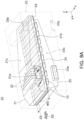
- FIG. 1 is a perspective view illustrating a drying apparatus 200 for an electrode plate according to one embodiment.
- the drying apparatus 200 for an electrode plate may include a chamber through which drying gas flows, and a plurality of gas injection nozzles coupled to the chamber.
- the chamber may include a first chamber 210 and a second chamber 230, and the gas injection nozzle may include a first injection nozzle 100 and a second injection nozzle 240.
- An electrode plate ES may include a cathode plate and an anode plate.
- the electrode plate ES may include a current collector in the form of a sheet or a film, and a cathode active material or an anode active material applied to the current collector.
- the anode plate may be formed by applying the anode active material to a copper sheet
- the cathode plate may be formed by applying the cathode active material to an aluminum sheet.
- the electrode plate ES may be manufactured through a coating process of coating the active material and a drying process of drying the active material.
- the drying apparatus 200 for an electrode plate according to one embodiment of the present disclosure may be applied to the drying process of the electrode plate ES.
- the drying apparatus 200 for an electrode plate according to one embodiment may be applied to the drying process of the anode plate, but may be also applicable to the drying process of the cathode plate.
- a gas supply space in which drying gas for drying the electrode plate ES flows may be formed in the chamber.
- the gas supply space may include a first gas supply space 215 formed in the first chamber 210 and a second gas supply space 235 formed in the second chamber 230.
- the drying gas may include hot air having a predetermined temperature, but the temperature, composition, and physical properties of the drying gas may be variously changed.
- the first chamber 210 and the second chamber 230 may be disposed on the two opposite surfaces of the electrode plate ES to be dried, respectively.
- the first chamber 210 may be configured to allow drying gas injected onto a first surface of the electrode plate ES to flow
- the second chamber 230 may be configured to allow drying gas injected onto a second surface of the electrode plate ES to flow.
- the first surface and the second surface of the electrode plate ES may correspond to an upper (e.g., top) surface and a lower (e.g., bottom) surface of the electrode plate ES, respectively.
- the first chamber 210 and the second chamber 230 may be spaced apart from each other by a predetermined interval, and the electrode plate ES may be disposed and/or move between the first chamber 210 and the second chamber 230 in a transport direction SS.
- the transport direction SS of the electrode plate ES may correspond to a third direction (X-direction).
- Each of the first chamber 210 and the second chamber 230 may include an inlet port for supplying the drying gas to the gas supply space from the outside of the chamber.
- the first chamber 210 may include a first inlet port 211 configured to supply the drying gas to the first gas supply space 215 from the outside of the first chamber 210
- the second chamber 230 may include a second inlet port 231 configured to supply the drying gas to the second gas supply space 235 from the outside of the second chamber 230.
- Each of the first inlet port 211 and the second inlet port 231 may be disposed on one side of the first chamber 210 and one side of the second chamber 230, respectively, and may be configured to supply the drying gas in a longitudinal direction (or second direction) (Y-direction) of the gas injection nozzle.
- a supply direction of the drying gas may correspond to a direction, perpendicular to the transport direction SS of the electrode plate ES, that is, a width direction of the electrode plate ES.
- the first chamber 210 and the second chamber 230 may be disposed in a main chamber 250.
- the main chamber 250 may include an exhaust port for discharging the drying gas injected onto the electrode plate ES through the gas injection nozzle 100 to the outside of the main chamber 250.
- the exhaust port may include a first exhaust port 251 disposed at the first chamber 210 and a second exhaust port 252 disposed at the second chamber 230.
- Guide vanes may be disposed in the first exhaust port 251 and the second exhaust port 252 to guide and stabilize a gas flow.
- the guide vanes installed in the first exhaust port 251 and the second exhaust port 252 may include a shape divided into a plurality of zones, like a guide vane 22 illustrated in FIG. 8A .
- the plurality of gas injection nozzles may be coupled to the first chamber 210 and/or the second chamber 230 so as to communicate with the first gas supply space 215 of the first chamber 210 and/or the second gas supply space 235 of the second chamber 230.
- the gas injection nozzle may include a plurality of first injection nozzles 100 disposed in the first chamber 210 and a plurality of second injection nozzles 240 disposed in the second chamber 230.
- the first injection nozzle 100 and the second injection nozzle 240 may be disposed in positions corresponding to each other to inject the drying gas from an upper side and a lower side of the electrode plate ES, and may have the same number.
- the arrangement position and the number of the first injection nozzle 100 and the second injection nozzle 240 are not limited thereto.
- the first injection nozzle 100 may be installed on a base plate 212 of the first chamber 210.
- the base plate 212 may be configured as a surface of the first chamber 210 opposing the electrode plate ES.
- the second injection nozzle 240 may also be installed on a surface of the second chamber 230 opposing the electrode plate ES.
- the first injection nozzle 100 and the second injection nozzle 240 may have a shape extending in a width direction (Y-direction) of the electrode plate ES, a direction perpendicular to the transport direction SS (i.e., the third direction) of the electrode plate ES. That is, a longitudinal direction (Y-direction) of the first injection nozzle 100 and the second injection nozzle 240 may correspond to the width direction of the electrode plate ES.
- the plurality of first injection nozzles 100 may be spaced apart from each other in the third direction (X-direction), the transport direction SS of the electrode plate ES.
- the plurality of second injection nozzles 240 may be spaced apart from each other in the third direction (X-direction), the transport direction SS of the electrode plate ES.
- a width of the electrode plate ES When a width of the electrode plate ES is large, i.e., when the electrode plate is wide, a length of each of the first injection nozzle 100 and a length of the second injection nozzle 240 also become longer.
- the length of the first injection nozzle 100 and the length of the second injection nozzle 240 increase, in the longitudinal direction (second direction) (Y-direction) of the injection nozzle, a deviation in a flow rate and/or flow velocity between a central portion and both side parts, or a deviation in a flow rate and/or flow velocity between both side parts may increase.
- a drying deviation may increase depending on a width directional (Y-direction) position of the electrode plate ES, and the quality of the electrode plate ES may deteriorate.
- the drying apparatus 200 for an electrode plate of the present disclosure may reduce the deviation in the flow rate and/or flow velocity by improving the gas injection nozzle 100, thereby improving the quality of the electrode plate ES not only when a width WS of the electrode plate ES is narrow, but also when the width WS of the electrode plate ES is wide.
- the drying apparatus 200 for an electrode plate of the present disclosure may be applied to an electrode plate ES having a wide width, such as an electrode plate ES having the width WS of 700 mm or more, 1000 mm or more, 1200 mm or more, or 1500 mm or more.
- the width WS of the electrode plate ES applied to the drying apparatus 200 for an electrode plate of the present disclosure may have a value of 700 mm or less.
- the first inlet port 211 and the second inlet port 231 may be configured to supply the drying gas in the second direction (Y-direction), the longitudinal direction of the gas injection nozzle.
- the drying gas may flow into the gas injection nozzle and may be injected in a first direction (Z-direction). That is, the first direction (Z-direction), an injection direction of the drying gas injected through the gas injection nozzle 100, may be different from the second direction (Y-direction) in which the drying gas flows into the first chamber 210 and the second chamber 230.
- the drying gas since the drying gas is injected through the gas injection nozzle 100 after changing a direction thereof, it may be possible to reduce the deviation in the flow rate and/or flow velocity depending on the width directional (Y-direction) position of the electrode plate ES.
- the first injection nozzle 100 and the second injection nozzle 240 may have different configurations.
- the first injection nozzle 100 and the second injection nozzle 240 may have the same configuration.
- the first injection nozzle 100 may have a shape including a circular perforated hole (corresponding to an injection hole 125 described below)
- the second injection nozzle 240 may have a shape including a Coanda nozzle i.e., a nozzle having a shape that takes advantage of the Coanda effect.
- both the first injection nozzle 100 and the second injection nozzle 240 may have a shape including a circular perforated hole.
- a plurality of gas injection nozzles of the present disclosure may be installed in at least one of the first chamber 210 and/or the second chamber 230.
- a gas injection nozzle is the first injection nozzle 100 installed in the first chamber 210
- the gas injection nozzle of the present disclosure may also be applied to the second injection nozzle 240 installed in the second chamber 230.
- reference numeral '100' of the first injection nozzle 100 will be used for the gas injection nozzle.
- FIG. 2 is a perspective view illustrating a gas injection nozzle 100 for drying an electrode plate according to one embodiment
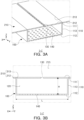
- FIG. 3A is a perspective partially cut-away view of a gas injection nozzle 100 for drying an electrode plate according to one embodiment
- FIG. 3B is a cross-sectional view taken along line I-I' of FIG. 1 , which illustrates a cross-section of the gas injection nozzle 100 illustrated in FIG. 3A .
- a gas injection nozzle 100 may be coupled to a chamber (e.g., the first chamber 210) configured to supply drying gas for drying the electrode plate ES.
- a chamber e.g., the first chamber 210
- the chamber will be described using the first chamber 210 as an example.
- 'chamber' may refer to the second chamber 230.
- the gas injection nozzle 100 may include a nozzle body 110.
- the nozzle body 110 may form a flow space 120 in which drying gas introduced from the outside of the nozzle body 110 flows.
- the nozzle body 110 may include a first plate 111 and a second plate 112.
- the nozzle body 110 may include a plurality of side plates 113 connecting edges of the first plate 111 and edges of the second plate 112.
- the nozzle body 110 may have a shape formed by the first plate 111, the second plate 112, and the plurality of side plates 113.
- the nozzle body 110 has a rectangular parallelepiped shape having a height "H" in the first direction (Z-direction), a length "W” in the second direction (Y-direction), and a width "L” in a third direction (X-direction).
- the first plate 111 and the second plate 112 may be disposed on an upper (or top) surface and a lower (or bottom) surface of the nozzle body 110, and four side plates 113 may be disposed on a side surface of the nozzle body 110.
- the width L of the nozzle body 110 may correspond to the transport direction SS of the electrode plate ES, and the length W of the nozzle body 110 may correspond to a width direction (Y-direction) of the electrode plate ES.
- the first plate 111 may have a flat plate shape, and as an example, may have a square plate shape.
- the second plate 112 may be spaced apart from the first plate 111 in the first direction (Z-direction).
- the second plate 112 may have a flat plate shape, and as an example, may have a square plate shape.
- the side plate 113 may connect the edge of the first plate 111 and the edge of the second plate 112.
- the side plate 113 may extend from the edge of the first plate 111 in the first direction (Z-direction).
- An end of the first plate 111 and an end of the second plate 112 may be connected by the plurality of side plates 113.
- the first plate 111 and the second plate 112 may be connected by four side plates 113.
- a flow space 120 in which the drying gas introduced from the first chamber 210 flows may be formed between the first plate 111 and the second plate 112.
- the flow space 120 may be surrounded by the first plate 111, the second plate 112, and the plurality of side plates 113.
- the nozzle body 110 may be coupled to a chamber (e.g., the first chamber 210).
- the nozzle body 110 may be coupled to an opening 213 formed in the base plate 212 in the outside of the chamber.
- the first plate 111 may form the same plane as that of the base plate 212. That is, the first plate 111 and the base plate 212 may be disposed at the same height.
- the arrangement position of the first plate 111 is not limited thereto, and the first plate 111 may be disposed to protrude into the first gas supply space 215 of the first chamber 210.
- the nozzle body 110 may include at least one inlet hole 130 formed in the first plate 111 and a plurality of injection holes 140 formed in the second plate 112.
- At least one inlet hole 130 formed in the first plate 111 may be configured to allow the drying gas to flow into the flow space 120 from the outside of the nozzle body 110. At least one inlet hole 130 may have a slit shape crossing the first plate 111 in the second direction (Y-direction), a longitudinal direction of the nozzle body 110.
- FIGS. 2 , 3A and 3B illustrate a configuration in which one inlet hole 130 is installed in the first plate 111, but the number of inlet holes 130 installed in the first plate 111 is not limited thereto. For example, two or more inlet holes 130 may be disposed in the first plate 111.
- the plurality of injection holes 140 formed in the second plate 112 may be configured to inject the drying gas in the flow space 120 to the outside.
- the plurality of injection holes 140 may be formed of a plurality of perforated holes perforated in the second plate 112.
- the plurality of injection holes 140 may have a circular shape, but the present disclosure is not limited thereto.
- the shape of the plurality of injection holes 140 may be changed in various manners, such as oval or square.
- the number and arrangement of the plurality of injection holes 140 are not limited to those illustrated in FIG. 3A , and various changes thereof may be possible.
- a total cross-sectional area of the plurality of injection holes 140 may have a value larger than a value of a total cross-sectional area of at least one inlet hole 130. Accordingly, the drying gas may pass through the injection hole 140 and may be simultaneously injected onto the electrode plate ES at reduced flow rate, thereby drying the electrode plate ES.
- the drying gas may pass through at least one inlet hole 130 including a slit-shaped hole, and the drying gas introduced into the flow space 120 through the slit-shaped inlet hole 130 may be dispersed and uniformized (become more uniform or uniform) in the flow space 120 and may then be injected through the injection hole 140. Accordingly, the drying gas may be injected onto the electrode plate ES with little deviation in the flow rate and/or flow velocity in the longitudinal direction (Y-direction) of the gas injection nozzle 100, that is, the width direction of the electrode plate ES. Accordingly, according to one embodiment, even for wide electrode plates ES, the occurrence of defects such as cracks and bending on both side parts of the electrode plate ES may be reduced, and even for wide electrode plates ES, the quality of the electrode plate ES may be improved.
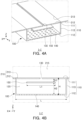
- FIG. 4A is a perspective partially cut-away view of a gas injection nozzle 100 for drying an electrode plate according to a modified embodiment of FIG. 3A
- FIG. 4B is a cross-sectional view taken along line I-I' of FIG. 1 , which illustrates a cross-section of the gas injection nozzle 100 illustrated in FIG. 4A .
- a gas injection nozzle 100 illustrated in FIGS. 4A and 4B may include a nozzle body 110 including a first plate 111 and a second plate 112, and may include at least one slit-shaped inlet hole 130 formed in the first plate 111 and a plurality of injection holes 140 formed in the second plate 112.
- the gas injection nozzle 100 illustrated in FIGS. 4A and 4B has a difference therefrom in that the gas injection nozzle 100 further includes a deflector 150. Accordingly, a configuration different from the gas injection nozzle 100 illustrated in FIGS. 3A and 3B will be mainly described.
- the deflector 150 may be disposed between the first plate 111 and the second plate 112 so that a flow direction of the drying gas illustrated through at least one inlet hole 130 may be changed. That is, the deflector 150 may prevent the drying gas passing through the inlet hole 130 from flowing in the first direction (Z-direction), and thus, a phenomenon in which the drying gas passing through the inlet hole 130 is directly injected through the injection hole 140 may be limited.
- the deflector 150 may have a shape crossing between the first plate 111 and the second plate 112 in the second direction (Y-direction), the width direction of the electrode plate.
- the first plate 111 and the deflector 150 may be spaced apart from each other in the first direction (Z-direction).
- the deflector 150 and the second plate 112 may also be spaced apart from each other in the first direction (Z-direction).
- the first plate 111 and the deflector 150 may be spaced apart from each other by a first height H1, and the deflector 150 and the second plate 112 may be spaced apart from each other by a second height H2.
- the deflector 150 may be disposed in a position facing at least one inlet hole 130 along (based on) the first direction (Z-direction). That is, at least the inlet hole 130 and the deflector 150 may be disposed in positions corresponding to each other in the third direction (X-direction). Accordingly, the drying gas passing through the inlet hole 130 may hit the deflector 150 to change a direction thereof, so that the drying gas may flow to both sides of the deflector 150. After the flow of the drying gas may be dispersed to both sides of the deflector 150, the drying gas may move to a lower side of the deflector 150 and then pass through the injection hole 140.
- the deflector 150 may be positioned closer to the upper plate 111 as illustrated in FIG. 4B . That is, the first height H1 between the deflector 150 and the first plate 111 may have a value equal to or less than the second height H2 between the deflector 150 and the second plate 112. When the first height H1 is larger than the second height H2, since the distance between the at least one inlet hole 130 and the deflector 150 increases, the effect of dispersing the drying gas may be reduced due to the drying gas hitting the deflector 150 to change the direction thereof.
- the embodiment of the present disclosure does not exclude a case in which the first height H1 is equal to the second height H2 or a case in which the first height H1 is larger than the second height H2, however, in those cases the improvement in terms of making the flow rate and velocity of the drying gas more uniform may be reduced as compared to the case illustrated in FIG. 4A wherein the first H1 is less than the second height H2.
- the first height may be 1/2 or less of the second height.
- a width L1 of the deflector 150 may have a value of 10% or more and 90% or less of a width L of the first plate 111.
- the width L1 of the deflector 150 may have a value of 10% or more, 20% or more, 30% or more, 40% or more, or 50% or more of the width L of the first plate 111.
- the width L1 of the deflector 150 may have a value of 90% or less, 80% or less, 70% or less, 60% or less, and 50% or less of the width L of the first plate 111.
- the width L1 of the deflector 150 is more than 90% of the width L of the first plate 111, after the drying gas hits the deflector 150, the drying gas flows over a long distance in the space between the deflector 150 and the first plate 111. Therefore, flow resistance may be increased to reduce the effect of changing the flow direction thereof.
- the drying gas may move to the lower side of the deflector 150, so that the flow or flow velocity of the drying gas is sufficiently dispersed and/or uniformized in the flow space 120, and the drying gas may then be injected through the injection hole 140.
- FIG. 5A is a perspective view illustrating a drying apparatus 200 for an electrode plate according to another embodiment
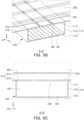
- FIG. 5B is a perspective partially cut-away view taken along line II-II' of FIG. 5A , which illustrates cross-sections of a dispersion plate 220 and a gas injection nozzle 100
- FIG. 5C is a cross-sectional view taken along line II-II' of FIG. 5A , which illustrates a cross-section of the gas injection nozzle 100 illustrated in FIG. 5B .
- the drying apparatus 200 for an electrode plate illustrated in FIG. 5A has a difference therefrom only in that the dispersion plate 220 is disposed in the chamber 210 and in the number of at least one inlet hole 130. Accordingly, descriptions of identical or similar components will be omitted and only different components will be described.
- the dispersion plate 220 may be disposed in a gas supply space 215 formed in a chamber (e.g., the first chamber 210).
- the dispersion plate 220 may be disposed in a position spaced apart from the first plate 111 in the first direction (Z-direction), between the inlet port 211 and the first plate 111.
- the dispersion plate 220 may be disposed in parallel with the first plate 111.
- the dispersion plate 220 may include a plurality of dispersion holes 221 configured to communicate with the drying gas between the inlet port 211 of the chamber 210 and the inlet hole 130 formed in the first plate 111. Accordingly, the drying gas introduced into the gas supply space 215 through the inlet port 211 may be dispersed through the plurality of dispersion holes 221 and may then flow toward the inlet hole 130.
- the inlet port 211 may be configured to supply the drying gas in the second direction (Y-direction), the width direction of the electrode plate ES, and the plurality of dispersion holes 221 may have a slit shape crossing the dispersion plate 220 in the third direction (X-direction), the transport direction SS of the electrode plate ES. That is, a direction in which the drying gas flows through the inlet port 211 and a direction in which the dispersion hole 221 extends may intersect each other.
- the first plate 111 may have a plurality of inlet holes 130 formed therein.
- the inlet hole 130 may have a slit shape crossing the first plate 111 in the second direction.
- the plurality of injection holes 140 formed in the second plate 112 may be formed of circular perforated holes. Since the configuration of the plurality of injection holes 140 is the same as the configuration of the injection hole 140 illustrated in FIGS. 3A and 3B , detailed description thereof will be omitted.
- the drying gas introduced into the gas supply space 215 through the inlet port 211 may be dispersed and uniformized while passing through the dispersion hole 221 of the dispersion plate 220, and then the drying gas may be introduced into the gas injection nozzle 100. Additionally, the drying gas introduced into the flow space 120 through the slit-shaped inlet hole 130 may be dispersed and uniformized in the flow space 120 and may then be injected through the injection hole 140.
- FIG. 6A is a perspective view illustrating a drying apparatus 200 for an electrode plate according to another embodiment
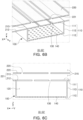
- FIG. 6B is a perspective partially cut-away view taken along line III-III' of FIG. 6A , which illustrates cross-sections of a dispersion plate 220 and a gas injection nozzle 100
- FIG. 6C is a cross-sectional view taken along line III-III' of FIG. 6A , which illustrates a cross-section of the gas injection nozzle 100 illustrated in FIG. 6B .
- the drying apparatus 200 for an electrode plate illustrated in FIGS. 6A to 6C has a difference therefrom only in direction in which a plurality of dispersion holes 221 formed in the dispersion plate 220 extends.
- a plurality of dispersion holes 221 may have a slit shape crossing the dispersion plate 220 in the second direction (Y-direction), the width direction of the electrode plate ES.
- a direction in which the dispersion hole 221 extends may be configured in the same direction as a flow direction of the drying gas through an inlet port 211.
- FIG. 7A is a perspective partially cut-away view of a gas injection nozzle 100 for drying an electrode plate according to a modified embodiment of FIG. 5B
- FIG. 7B is a cross-sectional view taken along line II-II' of FIG. 5A , which illustrates a cross-section of the gas injection nozzle 100 illustrated in FIG. 7A .
- the gas injection nozzle 100 illustrated in FIGS. 7A and 7B has a difference therefrom in that the gas injection nozzle 100 further includes a deflector 150. That is, the deflector 150 may also be applied to one embodiment including a dispersion plate 220.
- the deflector 150 may be disposed between the first plate 111 and the second plate 112 and may change the flow direction of the drying gas introduced through at least one inlet hole 130. Accordingly, after the drying gas passing through the inlet hole 130 hits the deflector 150 to change the direction thereof, the drying gas may flow to both sides of the deflector 150. The flow of the drying gas may be dispersed to both sides of the deflector 150 and may then move to a lower side of the deflector 150 and pass through the injection hole 140.
- the deflector 150 may also be applied to the gas injection nozzle 100 illustrated in FIGS. 6B and 6C .
- the drying gas introduced into the gas supply space 215 through the inlet port 211 may be dispersed and uniformized while passing through the dispersion hole 221 of the dispersion plate 220, and then the drying gas may be introduced into the gas injection nozzle 100. Additionally, after the drying gas introduced into the flow space 120 through the slit-shaped inlet hole 130 hits the deflector 150 to change the direction thereof, the drying gas may move to a lower side of the deflector 150. Accordingly, the drying gas may be injected through the injection hole 140 after the flow or flow velocity of the drying gas is sufficiently dispersed and/or uniformized in the flow space 120.
- FIG. 8A is a perspective view illustrating a drying apparatus 20 for an electrode plate according to a first comparative example
- FIG. 8B is a cross-sectional view taken along line IV-IV' of FIG. 8A , which illustrates a state in which the gas injection nozzle is disposed in the drying apparatus 20 for an electrode plate according to the first comparative example
- FIG. 8C is a perspective partially cut-away view of the gas injection nozzle illustrated in FIG. 8B .
- the drying apparatus 20 for an electrode plate according to the first comparative example has a difference therefrom in that it includes a guide vane 22 and, also, a difference in the configuration of the gas injection nozzle (or the first injection nozzle 10). Detailed descriptions of identical or similar configurations in both drying apparatuses will be omitted.
- the drying apparatus 20 for an electrode plate according to the first comparative example accommodates a first chamber 21 and a second chamber 23 in a main chamber 25.
- An electrode plate ES to be dried may be disposed between the first chamber 21 and the second chamber 23.
- the first chamber 21 has a first inlet port 21a through which drying gas flows, and the drying gas introduced through the first inlet port 21a may be accommodated in a first gas supply space 21c.
- the first chamber 21 may have the guide vane 22 installed in a portion of the first gas supply space 21c adjacent to the first inlet port 21a.
- the guide vane 22 may have a shape divided into a plurality of zones in order to disperse the gas introduced into the first inlet port 21a.
- the second chamber 23 may have a second inlet port 23a through which the drying gas flows, and the drying gas introduced through the second inlet port 23a may be accommodated in a second gas supply space 23c.
- a guide vane may also be installed in the second chamber 23 in a portion of the second gas supply space 23c adjacent to the second inlet port 23a.
- the gas injection nozzle may include a first injection nozzle 10 installed in the first chamber 21 and a second injection nozzle 24 installed in the second chamber 23.
- the first injection nozzle 10 may be coupled to a base plate 21b of the first chamber 21.
- the drying gas injected from the gas injection nozzle may dry the electrode plate ES and may then be discharged to the outside of the main chamber 25 through a first exhaust port 25a and a second exhaust port 25b.
- reference numeral ⁇ 10' of the first injection nozzle 10 will be used for the gas injection nozzle.
- the gas injection nozzle 10 for drying the electrode plate according to the first comparative example may include a nozzle body 11 coupled to the base plate 21b of the first chamber 21.
- a guide vane 22 may be installed in the first gas supply space 21c of the first chamber 21.
- the nozzle body 11 may include a first plate 11a on which an inlet hole 13 is formed and a second plate 11b on which an injection hole 14 is formed.
- the inlet hole 13 may include a plurality of perforated holes perforated in the first plate 11a.
- the injection hole 14 may include a plurality of perforated holes perforated in the second plate 11b.
- the inlet hole 13 and the injection hole 14 may each be formed as circular holes.
- FIG. 9 is a cross-sectional view taken along line IV-IV' of FIG. 8A , which illustrates a state in which the gas injection nozzle 10 is disposed in the drying apparatus 20 for an electrode plate according to a second comparative example.
- FIG. 10A is a view illustrating a simulation result of the flow of drying gas with respect to the gas injection nozzle 100 of a first inventive example illustrated in FIGS. 1 to 3B
- FIG. 10B is a view illustrating a simulation result of the flow of drying gas with respect to the gas injection nozzle 100 of a second inventive example illustrated in FIGS. 5A to 5C
- FIG. 10C is a view illustrating a simulation result of the flow of drying gas with respect to the gas injection nozzle 100 of a third inventive example illustrated in FIGS. 6A to 6C .
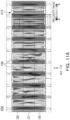
- FIG. 11A is a view illustrating a simulation result of the flow of drying gas with respect to the gas injection nozzle 10 of the first comparative example illustrated in FIGS. 8A to 8C
- FIG. 11B is a view illustrating a simulation result of the flow of drying gas with respect to the gas injection nozzle 10 of the second comparative example illustrated in FIG. 9 .
- FIGS. 10A to 10C , 11A and 11B illustrate flow velocity of an upper side 5 mm away from a surface of an electrode plate when drying gas is injected from gas injection nozzles 100 and 10 disposed in first chambers 210 and 21.
- a region in which the flow velocity of drying gas is measured may be partitioned into a first part DS adjacent to first inlet ports 211 and 21a in the width direction (Y-direction) of an electrode plate, a second part CT disposed in a central portion of the electrode plate in the width direction (Y-direction), and a third part OS disposed away from the first inlet ports 211 and 21a.
- FIG. 10A is a simulation result for a first inventive example in which the gas injection nozzle 100 illustrated in FIGS. 3A and 3B is installed in the first chamber 210 of the drying apparatus 200 for an electrode plate illustrated in FIG. 1 .
- FIG. 10B is a simulation result for a second inventive embodiment in which the gas injection nozzle 100 illustrated in FIGS. 5B and 5C is installed in the first chamber 210 of the drying apparatus 200 for an electrode plate illustrated in FIG. 5A .
- FIG. 10C is a simulation result for a third inventive example in which the gas injection nozzle 100 illustrated in FIGS. 6B and 6C is installed in the first chamber 210 of the drying apparatus 200 for an electrode plate illustrated in FIG. 6A .
- FIG. 11A is a simulation result for the first comparative example in which the gas injection nozzle 10 illustrated in FIGS. 8B and 8C is installed in the first chamber 21 of the drying apparatus 20 for an electrode plate illustrated in FIG. 8A .
- FIG. 11B is a simulation result for the second comparative example in which the gas injection nozzle 10 illustrated in FIG. 9 is installed in a state in which the guide vane 22 is not disposed in the first chamber 21 of the drying apparatus 20 for an electrode plate illustrated in FIG. 8A .
- the first comparative example and the second comparative example have the same configuration of the gas injection nozzle 10, and are different only in whether or not the guide vane 22 is installed.
- FIGS. 10A to 10C and the comparative examples of FIGS. 11A and 11B were tested under the same conditions except for the structure of the gas injection nozzle.
- a cross-sectional area of the first inlet ports 211 and 21a disposed in the first chambers 210 and 21 is 321,000 mm 2 (square millimeter), and an airflow rate thereof was 119 CMM (cubic meter minute) .
- the simulation was conducted under room temperature conditions.
- a width WS of the electrode plate was approximately 1,500 mm, and 10 gas injection nozzles 100 and 10 were disposed in the first chambers 210 and 21.
- a width of slit in the dispersion hole 221 of the dispersion plate 220 was 4 mm, and a total cross-sectional area of the dispersion hole 221 was 132,000 mm 2 (square millimeter).
- the inlet hole 130 included one slit-shaped hole.
- a width of the slit of the inlet hole 130 was 4 mm, and a total cross-sectional area of the inlet hole 130 was approximately 5,950 mm 2 .
- Diameters of each injection hole 140 was 10 mm, and a total cross-sectional area of the plurality of injection holes 140 was 53,780 mm 2 (square millimeter).
- the inlet hole 130 included two slit-shaped holes. Widths of slits of each inlet hole 130 was 4 mm, and a total cross-sectional area of the inlet hole 130 was approximately 11,900 mm 2 . Diameters of each injection hole 140 was 10 mm, and a total cross-sectional area of the plurality of injection holes 140 was 53,780 mm 2 (square millimeter).
- each inlet hole 13 was 8 mm, and a total cross-sectional area of the plurality of inlet holes 13 was 36,850 mm 2 (square millimeter), and diameters of each injection hole 14 was 10 mm, and a total cross-sectional area of the plurality of injection holes 14 was 53,780 mm 2 (square millimeter).
- the velocity deviation of the widthwise side parts DS and OS and the widthwise central portion CT of the electrode plate tended to decrease as a whole.
- Table 1 below illustrates average flow velocity and deviation for the first to third inventive examples and the first and second comparative examples.
- Table 1 illustrates results of quantifying the average flow velocity in the width direction of the electrode plate in an upper side 5 mm away from a surface of the electrode plate.
- the drying gas may be injected onto the electrode plate with little deviation in the flow rate and/or flow velocity in the width direction of the electrode plate. Accordingly, even for wide electrode plates, the occurrence of defects such as cracks and bending on both side parts of the electrode plate may be reduced, and even for wide electrode plates, the quality of the electrode plate may be improved.
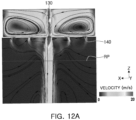
- FIG. 12A is a view illustrating a simulation result of the flow of drying gas with respect to the gas injection nozzle 100 illustrated in FIGS. 3A and 3B
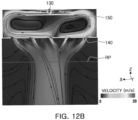
- FIG. 12B is a view illustrating a simulation result of the flow of drying gas with respect to the gas injection nozzle 100 illustrated in FIGS. 4A and 4B .
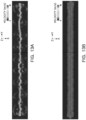
- FIG. 13A is a view illustrating a result of simulating the flow of drying gas with respect to the gas injection nozzle 100 illustrated in FIGS. 3A and 3B in another direction
- FIG. 13B is a view illustrating a result of simulating the flow of drying gas with respect to the gas injection nozzle 100 illustrated in FIGS. 4A and 4B in another direction.
- FIGS. 12A and 13A are flow simulation results of drying gas for one embodiment in which the deflector 150 is not disposed
- FIGS. 12B and 13B are flow simulation results of drying gas for one embodiment in which the deflector 150 is disposed.
Landscapes
- Engineering & Computer Science (AREA)
- Mechanical Engineering (AREA)
- General Engineering & Computer Science (AREA)
- Manufacturing & Machinery (AREA)
- Chemical & Material Sciences (AREA)
- Chemical Kinetics & Catalysis (AREA)
- Electrochemistry (AREA)
- General Chemical & Material Sciences (AREA)
- Physics & Mathematics (AREA)
- Fluid Mechanics (AREA)
- Textile Engineering (AREA)
- Drying Of Solid Materials (AREA)
Abstract
The present disclosure provides a gas injection nozzle (100) for drying an electrode plate including: a nozzle body (110) having a flow space (120) through which drying gas flows, the flow space being formed between a first plate (111) and a second plate (112) spaced apart from the first plate (111) in a first direction; at least one inlet hole (130) formed in the first plate (111) and configured to allow the drying gas to flow into the flow space (120) from the outside of the nozzle body (110); and a plurality of injection holes (140) formed in the second plate (112) and configured to inject the drying gas from inside of the flow space (120) to the outside, wherein the at least one inlet hole (130) has a slit shape crossing the first plate (111) in a second direction, a longitudinal direction of the nozzle body (110).
Description
- The disclosure and implementations disclosed in this patent document generally relate to a gas injection nozzle used to dry an electrode plate and a drying apparatus for the electrode plate including the same. The gas injection nozzle and the electrode plate manufactured by the drying apparatus for the electrode plate including the same in the present disclosure may be widely applied in the field of secondary battery technology, such as pouch-type secondary batteries and square-shaped secondary batteries.
- A secondary battery cell is capable of being charged and discharged unlike primary batteries, and may be applied to devices within various fields such as a digital camera, a mobile phone, a laptop computer, a hybrid vehicle, an electric vehicle, and an energy storage device, and the like.
- A secondary battery is classified into a pouch-type secondary battery and a can-type secondary battery, and has a structure in which an electrode assembly and an electrolyte are accommodated inside a case. The electrode assembly has a structure in which electrode plates and separators are alternately stacked. The electrode plate may include a cathode plate and an anode plate. Generally, the electrode plate includes a sheet or film-shaped current collector, and a cathode active material and an anode active material applied to the current collector. For example, the anode plate may be formed by applying the anode active material to a copper sheet, and the cathode plate may be formed by applying a cathode active material to an aluminum sheet. An electrode plate is manufactured through a coating process of coating an active material on the current collector and a drying process of drying the active material. The coating process and the drying process have a significant impact on the quality of secondary batteries.
- In the drying process, drying gas such as hot air is injected onto a sheet of the current collector coated with the active material to dry the active material. In the drying process, when a deviation in a flow rate and/or flow velocity of the drying gas varies greatly depending on the position of the electrode plate, there may be a problem in that the quality of the electrode plate may be not uniform because a degree of drying and drying efficiency vary, depending on the position of the electrode plate.
- Additionally, when a deviation in the flow rate and/or flow velocity of the drying gas is large, cracks, bending, and the like, may occur in the electrode plate depending on the position of the electrode plate, which may deteriorate the quality of the electrode plate.
- A distance between side parts of an electrode plate is short, and accordingly, a flow rate and/or flow velocity difference between a central part of the electrode plate and both side parts thereof may not be large. However, when a width of the electrode plate is wide, a large deviation in the flow rate and/or flow velocity may occur between the center portion and both side parts of the electrode plate along (based on) a width direction of the electrode plate. In this case, a drying deviation in the width direction of the electrode plate may increase and the quality of the electrode plate may deteriorate.
- According to an aspect of the present disclosure, provided is a gas injection nozzle for drying an electrode plate and a drying apparatus for the electrode plate including the same, which may reduce a deviation in a flow rate and/or flow velocity depending on the position of the electrode plate.
- According to an aspect of the present disclosure, provided is a gas injection nozzle for drying an electrode plate and a drying apparatus for the electrode plate including the same, which may reduce a deviation in drying efficiency and drying quality depending on the position of the electrode plate.
- According to an aspect of the present disclosure, provided is a gas injection nozzle for drying an electrode plate and a drying apparatus for the electrode plate including the same, which may improve the quality of electrode plate even for a wide electrode plate.
- An electrode plate manufactured by a gas injection nozzle for drying an electrode plate and a drying apparatus for the electrode plate including the same, and a battery cell including the same may be widely applied to devices within green technology fields such as an electric vehicle, a battery charging station, and solar and wind power generation using other batteries. Additionally, the electrode plate manufactured according to the present disclosure and the battery cell including the same may be used in an eco-friendly electric vehicle, a hybrid vehicle, and the like, to prevent a climate change by suppressing air pollution and greenhouse gas emissions.
- A gas injection nozzle for drying electrode plate according to the present disclosure includes: a nozzle body having a flow space through which drying gas flows, the flow space being formed between a first plate and a second plate spaced apart from the first plate in a first direction; at least one inlet hole formed in the first plate and configured to allow the drying gas to flow into the flow space from the outside of the nozzle body; and a plurality of injection holes formed in the second plate and configured to inject the drying gas from inside of the flow space to the outside, and the at least one inlet hole may have a slit shape crossing the first plate in a second direction, which second direction is a longitudinal direction of the nozzle body.
- In one embodiment, the gas injection nozzle for drying an electrode plate may include: a deflector disposed between the first plate and the second plate and configured to change a flow direction of the drying gas introduced through the at least one inlet hole.
- In one embodiment, the deflector may have a shape crossing the nozzle body in the second direction and may be disposed in a position facing the at least one inlet hole along (based on) the first direction.
- In one embodiment, a first height between the deflector and the first plate may have a value equal to or less than a second height between the deflector and the second plate.
- In an embodiment, a first height between the deflector and the first plate may have a value of 1/2 or less of the second height between the deflector and the second plate.
- In one embodiment, a width of the deflector may have a value of 10% or more and 90% or less of a width of the first plate.
- In one embodiment, the plurality of injection holes may have a circular shape.
- A drying apparatus for an electrode plate according to the present disclosure includes: a chamber having a gas supply space through which drying gas for drying the electrode plate flows; and a plurality of gas injection nozzles coupled to the chamber to communicate with the gas supply space of the chamber, wherein the plurality of gas injection nozzles may include: a nozzle body having a flow space through which drying gas flows, between a first plate and a second plate spaced apart from the first plate in a first direction; at least one inlet hole formed in the first plate and configured to allow the drying gas to flow into the flow space from the outside of the nozzle body; and a plurality of injection holes formed in the second plate and configured to inject the drying gas into the flow space to the outside, and the at least one inlet hole may have a slit shape crossing the first plate in a second direction, which second direction is a longitudinal direction of the nozzle body.
- In one embodiment, the plurality of gas injection nozzles may further include: a deflector disposed between the first plate and the second plate to change a flow direction of the drying gas introduced through the at least one inlet hole.
- In one embodiment, the plurality of gas injection nozzles may have a shape extending in a second direction, which corresponds to a width direction of the electrode plate, and may be spaced apart from each other in a third direction, which is a transport direction of the electrode plate, and the first direction, the second direction and the third direction may be perpendicular to each other.
- In one embodiment, the chamber may include an inlet port configured to supply the drying gas to the gas supply space from the outside of the chamber, and a dispersion plate disposed between the inlet port and the first plate, and the dispersion plate may include a plurality of dispersion holes configured to communicate with the drying gas between the inlet port and the inlet hole.
- In one embodiment, the inlet port may be configured to supply the drying gas in the second direction, and the plurality of dispersion holes may have a slit shape crossing the dispersion plate in the third direction.
- In one embodiment, the inlet port may be configured to supply the drying gas in the second direction, and the plurality of dispersion holes may have a slit shape crossing the dispersion plate in the second direction.
- In one embodiment, the chamber may include a first chamber in which drying gas injected onto a first surface of the electrode plate flows, and a second chamber in which drying gas injected onto a second surface of the electrode plate flows, and the plurality of gas injection nozzles may be installed in at least one of the first chamber or the second chamber.
- A system for drying an electrode, in particular for drying a cathode and/or an anode of a battery, comprises such an electrode and the gas injection nozzle as defined above, or the drying apparatus as defined above.
- A method for preparing a dried electrode plate, in particular for preparing a dried cathode and/or a dried anode of a battery, comprises providing an electrode plate to be dried, and using the gas injection nozzle as defined above, or the drying apparatus as defined above to let drying gas flow for drying the electrode plate.
- According to one embodiment of the present disclosure, it may be possible to reduce a deviation in a flow rate and/or flow velocity depending on a position of an electrode plate.
- According to one embodiment of the present disclosure, it may be possible to reduce a deviation in drying efficiency and drying quality depending on a position of an electrode plate.
- According to one embodiment of the present disclosure, an occurrence of defects such as cracks and bending on both side parts of an electrode plate, even for wide electrode plates, may be reduced, and the quality of the electrode plate may be improved even for wide electrode plates.
- Certain aspects, features, and advantages of the present disclosure are illustrated by the following detailed description with reference to the accompanying drawings.
-
FIG. 1 is a perspective view illustrating a drying apparatus for an electrode plate according to one embodiment. -
FIG. 2 is a perspective view illustrating a gas injection nozzle for drying an electrode plate according to one embodiment. -
FIG. 3A is a perspective partially cut-away view of a gas injection nozzle for drying an electrode plate according to one embodiment. -
FIG. 3B is a cross-sectional view taken along line I-I' ofFIG. 1 , which illustrates a cross-section of the gas injection nozzle illustrated inFIG. 3A . -
FIG. 4A is a perspective partially cut-away view of a gas injection nozzle for drying an electrode plate according to a modified embodiment ofFIG. 3A . -
FIG. 4B is a cross-sectional view taken along line I-I' ofFIG. 1 , which illustrates a cross-section of the gas injection nozzle illustrated inFIG. 4A . -
FIG. 5A is a perspective view illustrating a drying apparatus for an electrode plate according to another embodiment. -
FIG. 5B is a perspective partially cut-away view taken along line II-II' ofFIG. 5A , which illustrates cross-sections of a dispersion plate and a gas injection nozzle. -
FIG. 5C is a cross-sectional view taken along line II-II' ofFIG. 5A , which illustrates a cross-section of the gas injection nozzle illustrated inFIG. 5B . -
FIG. 6A is a perspective view illustrating a drying apparatus for an electrode plate according to another embodiment. -
FIG. 6B is a perspective partially cut-away view taken along line III-III' ofFIG. 6A , which illustrates cross-sections of a dispersion plate and a gas injection nozzle. -
FIG. 6C is a cross-sectional view taken along line III-III' ofFIG. 6A , which illustrates a cross-section of the gas injection nozzle illustrated inFIG. 6B . -
FIG. 7A is a perspective partially cut-away view of a gas injection nozzle for drying an electrode plate according to a modified embodiment ofFIG. 5B . -
FIG. 7B is a cross-sectional view taken along line II-II' ofFIG. 5A , which illustrates a cross-section of the gas injection nozzle illustrated inFIG. 7A . -
FIG. 8A is a perspective view illustrating a drying apparatus for an electrode plate according to a first comparative example. -
FIG. 8B is a cross-sectional view taken along line IV-IV' ofFIG. 8A , which illustrates a state in which the gas injection nozzle is disposed in the drying apparatus for an electrode plate according to the first comparative example. -
FIG. 8C is a perspective partially cut-away view of the gas injection nozzle illustrated inFIG. 8B . -
FIG. 9 is a cross-sectional view taken along line IV-IV' ofFIG. 8A , which illustrates a state in which the gas injection nozzle is disposed in the drying apparatus for an electrode plate according to a second comparative example. -
FIG. 10A is a view illustrating a simulation result of the flow of drying gas with respect to the gas injection nozzle of a first inventive example illustrated inFIGS. 1 to 3B . -
FIG. 10B is a view illustrating a simulation result of the flow of drying gas with respect to the gas injection nozzle of a second inventive example illustrated inFIGS. 5A to 5C . -
FIG. 10C is a view illustrating a simulation result of the flow of drying gas with respect to the gas injection nozzle of a third inventive example illustrated inFIGS. 6A to 6C . -
FIG. 11A is a view illustrating a simulation result of the flow of drying gas with respect to the gas injection nozzle of the first comparative example illustrated inFIGS. 8A to 8C . -
FIG. 11B is a view illustrating a simulation result of the flow of drying gas with respect to the gas injection nozzle of the second comparative example illustrated inFIG. 9 . -
FIG. 12A is a view illustrating a simulation result of the flow of drying gas with respect to the gas injection nozzle illustrated inFIGS. 3A and 3B . -
FIG. 12B is a view illustrating a simulation result of the flow of drying gas with respect to the gas injection nozzle illustrated inFIGS. 4A and 4B . -
FIG. 13A is a view illustrating a result of simulating the flow of drying gas with respect to the gas injection nozzle illustrated inFIGS. 3A and 3B in another direction. -
FIG. 13B is a view illustrating a result of simulating the flow of drying gas with respect to the gas injection nozzle illustrated inFIGS. 4A and 4B in another direction. - The same reference numeral or symbol written in each accompanying drawing of the specification refers to parts or components that perform substantially the same function. The present inventive concept is described using the same reference numeral or symbol even in different exemplary embodiments for easy description and appreciation. In this aspect, although all components having the same reference numeral are illustrated in a plurality of drawings, the plurality of drawings do not necessarily refer to a single exemplary embodiment.
- Hereinafter, the singular also includes the plural unless specifically stated otherwise in the phrase. It will be further understood that the terms "comprises," "comprising," "includes" and/or "including", when used herein, specify the presence of stated features, integers, steps, operations, elements, components and/or combinations thereof, but do not preclude the presence or addition of one or more other features, integers, steps, operations, elements, components, and/or groups thereof.
- In addition, it should be noted in advance that the expressions such as "above," "upper," "below", "beneath," "lower," "side," "front," and "rear" are based on the direction illustrated in the drawings, and may be expressed differently if the direction of the object is changed.
- In addition, in the present specification and claims, terms including ordinal numbers such as "first" and "second" may be used to distinguish between components. These ordinal numbers are used to distinguish the same or similar components from each other, and the meaning of the terms should not be construed as limited by the use of these ordinal numbers. For example, the components combined with these ordinal numbers should not be construed as limiting the order of use or arrangement of the components. If necessary, the ordinal numbers may be used interchangeably.
- Hereinafter, the present disclosure will be described in detail with reference to the attached drawings. However, this is merely illustrative and the present disclosure is not limited to the specific embodiments described by way of example.
-
FIG. 1 is a perspective view illustrating adrying apparatus 200 for an electrode plate according to one embodiment. - Referring to
FIG. 1 , the dryingapparatus 200 for an electrode plate according to one embodiment of the present disclosure may include a chamber through which drying gas flows, and a plurality of gas injection nozzles coupled to the chamber. The chamber may include afirst chamber 210 and asecond chamber 230, and the gas injection nozzle may include afirst injection nozzle 100 and asecond injection nozzle 240. - An electrode plate ES may include a cathode plate and an anode plate. The electrode plate ES may include a current collector in the form of a sheet or a film, and a cathode active material or an anode active material applied to the current collector. For example, the anode plate may be formed by applying the anode active material to a copper sheet, and the cathode plate may be formed by applying the cathode active material to an aluminum sheet. The electrode plate ES may be manufactured through a coating process of coating the active material and a drying process of drying the active material. The drying
apparatus 200 for an electrode plate according to one embodiment of the present disclosure may be applied to the drying process of the electrode plate ES. The dryingapparatus 200 for an electrode plate according to one embodiment may be applied to the drying process of the anode plate, but may be also applicable to the drying process of the cathode plate. - A gas supply space in which drying gas for drying the electrode plate ES flows may be formed in the chamber. The gas supply space may include a first
gas supply space 215 formed in thefirst chamber 210 and a secondgas supply space 235 formed in thesecond chamber 230. - The drying gas may include hot air having a predetermined temperature, but the temperature, composition, and physical properties of the drying gas may be variously changed. The
first chamber 210 and thesecond chamber 230 may be disposed on the two opposite surfaces of the electrode plate ES to be dried, respectively. For example, thefirst chamber 210 may be configured to allow drying gas injected onto a first surface of the electrode plate ES to flow, and thesecond chamber 230 may be configured to allow drying gas injected onto a second surface of the electrode plate ES to flow. The first surface and the second surface of the electrode plate ES may correspond to an upper (e.g., top) surface and a lower (e.g., bottom) surface of the electrode plate ES, respectively. Thefirst chamber 210 and thesecond chamber 230 may be spaced apart from each other by a predetermined interval, and the electrode plate ES may be disposed and/or move between thefirst chamber 210 and thesecond chamber 230 in a transport direction SS. The transport direction SS of the electrode plate ES may correspond to a third direction (X-direction). - Each of the
first chamber 210 and thesecond chamber 230 may include an inlet port for supplying the drying gas to the gas supply space from the outside of the chamber. For example, thefirst chamber 210 may include afirst inlet port 211 configured to supply the drying gas to the firstgas supply space 215 from the outside of thefirst chamber 210, and thesecond chamber 230 may include asecond inlet port 231 configured to supply the drying gas to the secondgas supply space 235 from the outside of thesecond chamber 230. Each of thefirst inlet port 211 and thesecond inlet port 231 may be disposed on one side of thefirst chamber 210 and one side of thesecond chamber 230, respectively, and may be configured to supply the drying gas in a longitudinal direction (or second direction) (Y-direction) of the gas injection nozzle. A supply direction of the drying gas may correspond to a direction, perpendicular to the transport direction SS of the electrode plate ES, that is, a width direction of the electrode plate ES. - The
first chamber 210 and thesecond chamber 230 may be disposed in amain chamber 250. Themain chamber 250 may include an exhaust port for discharging the drying gas injected onto the electrode plate ES through thegas injection nozzle 100 to the outside of themain chamber 250. The exhaust port may include afirst exhaust port 251 disposed at thefirst chamber 210 and asecond exhaust port 252 disposed at thesecond chamber 230. Guide vanes may be disposed in thefirst exhaust port 251 and thesecond exhaust port 252 to guide and stabilize a gas flow. For example, the guide vanes installed in thefirst exhaust port 251 and thesecond exhaust port 252 may include a shape divided into a plurality of zones, like aguide vane 22 illustrated inFIG. 8A . - The plurality of gas injection nozzles may be coupled to the
first chamber 210 and/or thesecond chamber 230 so as to communicate with the firstgas supply space 215 of thefirst chamber 210 and/or the secondgas supply space 235 of thesecond chamber 230. The gas injection nozzle may include a plurality offirst injection nozzles 100 disposed in thefirst chamber 210 and a plurality ofsecond injection nozzles 240 disposed in thesecond chamber 230. Thefirst injection nozzle 100 and thesecond injection nozzle 240 may be disposed in positions corresponding to each other to inject the drying gas from an upper side and a lower side of the electrode plate ES, and may have the same number. However, the arrangement position and the number of thefirst injection nozzle 100 and thesecond injection nozzle 240 are not limited thereto. - The
first injection nozzle 100 may be installed on abase plate 212 of thefirst chamber 210. Thebase plate 212 may be configured as a surface of thefirst chamber 210 opposing the electrode plate ES. Thesecond injection nozzle 240 may also be installed on a surface of thesecond chamber 230 opposing the electrode plate ES. - The
first injection nozzle 100 and thesecond injection nozzle 240 may have a shape extending in a width direction (Y-direction) of the electrode plate ES, a direction perpendicular to the transport direction SS (i.e., the third direction) of the electrode plate ES. That is, a longitudinal direction (Y-direction) of thefirst injection nozzle 100 and thesecond injection nozzle 240 may correspond to the width direction of the electrode plate ES. The plurality offirst injection nozzles 100 may be spaced apart from each other in the third direction (X-direction), the transport direction SS of the electrode plate ES. The plurality ofsecond injection nozzles 240 may be spaced apart from each other in the third direction (X-direction), the transport direction SS of the electrode plate ES. - When a width of the electrode plate ES is large, i.e., when the electrode plate is wide, a length of each of the
first injection nozzle 100 and a length of thesecond injection nozzle 240 also become longer. When the length of thefirst injection nozzle 100 and the length of thesecond injection nozzle 240 increase, in the longitudinal direction (second direction) (Y-direction) of the injection nozzle, a deviation in a flow rate and/or flow velocity between a central portion and both side parts, or a deviation in a flow rate and/or flow velocity between both side parts may increase. In this case, a drying deviation may increase depending on a width directional (Y-direction) position of the electrode plate ES, and the quality of the electrode plate ES may deteriorate. The dryingapparatus 200 for an electrode plate of the present disclosure may reduce the deviation in the flow rate and/or flow velocity by improving thegas injection nozzle 100, thereby improving the quality of the electrode plate ES not only when a width WS of the electrode plate ES is narrow, but also when the width WS of the electrode plate ES is wide. The dryingapparatus 200 for an electrode plate of the present disclosure may be applied to an electrode plate ES having a wide width, such as an electrode plate ES having the width WS of 700 mm or more, 1000 mm or more, 1200 mm or more, or 1500 mm or more. However, the width WS of the electrode plate ES applied to thedrying apparatus 200 for an electrode plate of the present disclosure may have a value of 700 mm or less. - Meanwhile, the
first inlet port 211 and thesecond inlet port 231 may be configured to supply the drying gas in the second direction (Y-direction), the longitudinal direction of the gas injection nozzle. After the drying gas flows into thefirst chamber 210 and thesecond chamber 230 in the second direction (Y-direction) and then flows and disperses in the firstgas supply space 215 and the secondgas supply space 235, the drying gas may flow into the gas injection nozzle and may be injected in a first direction (Z-direction). That is, the first direction (Z-direction), an injection direction of the drying gas injected through thegas injection nozzle 100, may be different from the second direction (Y-direction) in which the drying gas flows into thefirst chamber 210 and thesecond chamber 230. Accordingly, according to one embodiment of the present disclosure, it may be possible to reduce the influence of the pressure and/or flow velocity of gas flowing into thefirst chamber 210 and thesecond chamber 230 on the flow rate and/or flow velocity of gas injected through thegas injection nozzle 100. That is, since the drying gas is injected through thegas injection nozzle 100 after changing a direction thereof, it may be possible to reduce the deviation in the flow rate and/or flow velocity depending on the width directional (Y-direction) position of the electrode plate ES. - The
first injection nozzle 100 and thesecond injection nozzle 240 may have different configurations. Thefirst injection nozzle 100 and thesecond injection nozzle 240 may have the same configuration. For example, thefirst injection nozzle 100 may have a shape including a circular perforated hole (corresponding to an injection hole 125 described below), and thesecond injection nozzle 240 may have a shape including a Coanda nozzle i.e., a nozzle having a shape that takes advantage of the Coanda effect. Alternatively, both thefirst injection nozzle 100 and thesecond injection nozzle 240 may have a shape including a circular perforated hole. - A plurality of gas injection nozzles of the present disclosure may be installed in at least one of the
first chamber 210 and/or thesecond chamber 230. However, for convenience of explanation in the present disclosure below, a case in which a gas injection nozzle is thefirst injection nozzle 100 installed in thefirst chamber 210 will be described, but the gas injection nozzle of the present disclosure may also be applied to thesecond injection nozzle 240 installed in thesecond chamber 230. Hereinafter, reference numeral '100' of thefirst injection nozzle 100 will be used for the gas injection nozzle. -
FIG. 2 is a perspective view illustrating agas injection nozzle 100 for drying an electrode plate according to one embodiment,FIG. 3A is a perspective partially cut-away view of agas injection nozzle 100 for drying an electrode plate according to one embodiment, andFIG. 3B is a cross-sectional view taken along line I-I' ofFIG. 1 , which illustrates a cross-section of thegas injection nozzle 100 illustrated inFIG. 3A . - Referring to
FIGS. 2 ,3A and 3B together withFIG. 1 , agas injection nozzle 100 according to one embodiment may be coupled to a chamber (e.g., the first chamber 210) configured to supply drying gas for drying the electrode plate ES. In the following description, the chamber will be described using thefirst chamber 210 as an example. However, when thegas injection nozzle 100 according to one embodiment is applied to a second injection nozzle, 'chamber' may refer to thesecond chamber 230. - The
gas injection nozzle 100 according to one embodiment may include anozzle body 110. Thenozzle body 110 may form aflow space 120 in which drying gas introduced from the outside of thenozzle body 110 flows. - The
nozzle body 110 may include afirst plate 111 and asecond plate 112. Thenozzle body 110 may include a plurality ofside plates 113 connecting edges of thefirst plate 111 and edges of thesecond plate 112. Thenozzle body 110 may have a shape formed by thefirst plate 111, thesecond plate 112, and the plurality ofside plates 113. - As an example, the
nozzle body 110 has a rectangular parallelepiped shape having a height "H" in the first direction (Z-direction), a length "W" in the second direction (Y-direction), and a width "L" in a third direction (X-direction). When thenozzle body 110 has a rectangular parallelepiped shape, thefirst plate 111 and thesecond plate 112 may be disposed on an upper (or top) surface and a lower (or bottom) surface of thenozzle body 110, and fourside plates 113 may be disposed on a side surface of thenozzle body 110. The width L of thenozzle body 110 may correspond to the transport direction SS of the electrode plate ES, and the length W of thenozzle body 110 may correspond to a width direction (Y-direction) of the electrode plate ES. - The
first plate 111 may have a flat plate shape, and as an example, may have a square plate shape. Thesecond plate 112 may be spaced apart from thefirst plate 111 in the first direction (Z-direction). Thesecond plate 112 may have a flat plate shape, and as an example, may have a square plate shape. - The
side plate 113 may connect the edge of thefirst plate 111 and the edge of thesecond plate 112. Theside plate 113 may extend from the edge of thefirst plate 111 in the first direction (Z-direction). An end of thefirst plate 111 and an end of thesecond plate 112 may be connected by the plurality ofside plates 113. When thefirst plate 111 and thesecond plate 112 have a square plate shape, thefirst plate 111 and thesecond plate 112 may be connected by fourside plates 113. - A
flow space 120 in which the drying gas introduced from thefirst chamber 210 flows may be formed between thefirst plate 111 and thesecond plate 112. Theflow space 120 may be surrounded by thefirst plate 111, thesecond plate 112, and the plurality ofside plates 113. - The
nozzle body 110 may be coupled to a chamber (e.g., the first chamber 210). Thenozzle body 110 may be coupled to anopening 213 formed in thebase plate 212 in the outside of the chamber. Thefirst plate 111 may form the same plane as that of thebase plate 212. That is, thefirst plate 111 and thebase plate 212 may be disposed at the same height. However, the arrangement position of thefirst plate 111 is not limited thereto, and thefirst plate 111 may be disposed to protrude into the firstgas supply space 215 of thefirst chamber 210. - The
nozzle body 110 may include at least oneinlet hole 130 formed in thefirst plate 111 and a plurality of injection holes 140 formed in thesecond plate 112. - At least one
inlet hole 130 formed in thefirst plate 111 may be configured to allow the drying gas to flow into theflow space 120 from the outside of thenozzle body 110. At least oneinlet hole 130 may have a slit shape crossing thefirst plate 111 in the second direction (Y-direction), a longitudinal direction of thenozzle body 110.FIGS. 2 ,3A and 3B illustrate a configuration in which oneinlet hole 130 is installed in thefirst plate 111, but the number of inlet holes 130 installed in thefirst plate 111 is not limited thereto. For example, two or more inlet holes 130 may be disposed in thefirst plate 111. - The plurality of injection holes 140 formed in the
second plate 112 may be configured to inject the drying gas in theflow space 120 to the outside. The plurality of injection holes 140 may be formed of a plurality of perforated holes perforated in thesecond plate 112. The plurality of injection holes 140 may have a circular shape, but the present disclosure is not limited thereto. For example, the shape of the plurality of injection holes 140 may be changed in various manners, such as oval or square. The number and arrangement of the plurality of injection holes 140 are not limited to those illustrated inFIG. 3A , and various changes thereof may be possible. - A total cross-sectional area of the plurality of injection holes 140 may have a value larger than a value of a total cross-sectional area of at least one
inlet hole 130. Accordingly, the drying gas may pass through theinjection hole 140 and may be simultaneously injected onto the electrode plate ES at reduced flow rate, thereby drying the electrode plate ES. - As described above, according to one embodiment of the present disclosure, the drying gas may pass through at least one
inlet hole 130 including a slit-shaped hole, and the drying gas introduced into theflow space 120 through the slit-shapedinlet hole 130 may be dispersed and uniformized (become more uniform or uniform) in theflow space 120 and may then be injected through theinjection hole 140. Accordingly, the drying gas may be injected onto the electrode plate ES with little deviation in the flow rate and/or flow velocity in the longitudinal direction (Y-direction) of thegas injection nozzle 100, that is, the width direction of the electrode plate ES. Accordingly, according to one embodiment, even for wide electrode plates ES, the occurrence of defects such as cracks and bending on both side parts of the electrode plate ES may be reduced, and even for wide electrode plates ES, the quality of the electrode plate ES may be improved. -
FIG. 4A is a perspective partially cut-away view of agas injection nozzle 100 for drying an electrode plate according to a modified embodiment ofFIG. 3A , andFIG. 4B is a cross-sectional view taken along line I-I' ofFIG. 1 , which illustrates a cross-section of thegas injection nozzle 100 illustrated inFIG. 4A . - Similarly to the
gas injection nozzle 100 illustrated inFIGS. 3A and 3B , agas injection nozzle 100 illustrated inFIGS. 4A and 4B may include anozzle body 110 including afirst plate 111 and asecond plate 112, and may include at least one slit-shapedinlet hole 130 formed in thefirst plate 111 and a plurality of injection holes 140 formed in thesecond plate 112. As compared to thegas injection nozzle 100 illustrated inFIGS. 3A and 3B , thegas injection nozzle 100 illustrated inFIGS. 4A and 4B has a difference therefrom in that thegas injection nozzle 100 further includes adeflector 150. Accordingly, a configuration different from thegas injection nozzle 100 illustrated inFIGS. 3A and 3B will be mainly described. - The
deflector 150 may be disposed between thefirst plate 111 and thesecond plate 112 so that a flow direction of the drying gas illustrated through at least oneinlet hole 130 may be changed. That is, thedeflector 150 may prevent the drying gas passing through theinlet hole 130 from flowing in the first direction (Z-direction), and thus, a phenomenon in which the drying gas passing through theinlet hole 130 is directly injected through theinjection hole 140 may be limited. - The
deflector 150 may have a shape crossing between thefirst plate 111 and thesecond plate 112 in the second direction (Y-direction), the width direction of the electrode plate. Thefirst plate 111 and thedeflector 150 may be spaced apart from each other in the first direction (Z-direction). Thedeflector 150 and thesecond plate 112 may also be spaced apart from each other in the first direction (Z-direction). Thefirst plate 111 and thedeflector 150 may be spaced apart from each other by a first height H1, and thedeflector 150 and thesecond plate 112 may be spaced apart from each other by a second height H2. - The
deflector 150 may be disposed in a position facing at least oneinlet hole 130 along (based on) the first direction (Z-direction). That is, at least theinlet hole 130 and thedeflector 150 may be disposed in positions corresponding to each other in the third direction (X-direction). Accordingly, the drying gas passing through theinlet hole 130 may hit thedeflector 150 to change a direction thereof, so that the drying gas may flow to both sides of thedeflector 150. After the flow of the drying gas may be dispersed to both sides of thedeflector 150, the drying gas may move to a lower side of thedeflector 150 and then pass through theinjection hole 140. - The
deflector 150 may be positioned closer to theupper plate 111 as illustrated inFIG. 4B . That is, the first height H1 between thedeflector 150 and thefirst plate 111 may have a value equal to or less than the second height H2 between thedeflector 150 and thesecond plate 112. When the first height H1 is larger than the second height H2, since the distance between the at least oneinlet hole 130 and thedeflector 150 increases, the effect of dispersing the drying gas may be reduced due to the drying gas hitting thedeflector 150 to change the direction thereof. However, the embodiment of the present disclosure does not exclude a case in which the first height H1 is equal to the second height H2 or a case in which the first height H1 is larger than the second height H2, however, in those cases the improvement in terms of making the flow rate and velocity of the drying gas more uniform may be reduced as compared to the case illustrated inFIG. 4A wherein the first H1 is less than the second height H2. In some embodiments, the first height may be 1/2 or less of the second height. - Meanwhile, a width L1 of the
deflector 150 may have a value of 10% or more and 90% or less of a width L of thefirst plate 111. For example, the width L1 of thedeflector 150 may have a value of 10% or more, 20% or more, 30% or more, 40% or more, or 50% or more of the width L of thefirst plate 111. Additionally, the width L1 of thedeflector 150 may have a value of 90% or less, 80% or less, 70% or less, 60% or less, and 50% or less of the width L of thefirst plate 111. When the width L1 of thedeflector 150 is less than 10% of the width L of thefirst plate 111, the effect of changing a flow direction of the drying gas through thedeflector 150 may be reduced. Conversely, when the width L1 of thedeflector 150 is more than 90% of the width L of thefirst plate 111, after the drying gas hits thedeflector 150, the drying gas flows over a long distance in the space between thedeflector 150 and thefirst plate 111. Therefore, flow resistance may be increased to reduce the effect of changing the flow direction thereof. - As described above, according to one embodiment of the present disclosure, after the drying gas hits the
deflector 150 to change the direction thereof, the drying gas may move to the lower side of thedeflector 150, so that the flow or flow velocity of the drying gas is sufficiently dispersed and/or uniformized in theflow space 120, and the drying gas may then be injected through theinjection hole 140. -
FIG. 5A is a perspective view illustrating adrying apparatus 200 for an electrode plate according to another embodiment,FIG. 5B is a perspective partially cut-away view taken along line II-II' ofFIG. 5A , which illustrates cross-sections of adispersion plate 220 and agas injection nozzle 100, andFIG. 5C is a cross-sectional view taken along line II-II' ofFIG. 5A , which illustrates a cross-section of thegas injection nozzle 100 illustrated inFIG. 5B . - As compared to the
drying apparatus 200 for an electrode plate illustrated inFIG. 1 , the dryingapparatus 200 for an electrode plate illustrated inFIG. 5A has a difference therefrom only in that thedispersion plate 220 is disposed in thechamber 210 and in the number of at least oneinlet hole 130. Accordingly, descriptions of identical or similar components will be omitted and only different components will be described. - Referring to
FIGS. 5A to 5C , thedispersion plate 220 may be disposed in agas supply space 215 formed in a chamber (e.g., the first chamber 210). Thedispersion plate 220 may be disposed in a position spaced apart from thefirst plate 111 in the first direction (Z-direction), between theinlet port 211 and thefirst plate 111. Thedispersion plate 220 may be disposed in parallel with thefirst plate 111. - The
dispersion plate 220 may include a plurality ofdispersion holes 221 configured to communicate with the drying gas between theinlet port 211 of thechamber 210 and theinlet hole 130 formed in thefirst plate 111. Accordingly, the drying gas introduced into thegas supply space 215 through theinlet port 211 may be dispersed through the plurality ofdispersion holes 221 and may then flow toward theinlet hole 130. - The
inlet port 211 may be configured to supply the drying gas in the second direction (Y-direction), the width direction of the electrode plate ES, and the plurality of dispersion holes 221 may have a slit shape crossing thedispersion plate 220 in the third direction (X-direction), the transport direction SS of the electrode plate ES. That is, a direction in which the drying gas flows through theinlet port 211 and a direction in which thedispersion hole 221 extends may intersect each other. - Meanwhile, as illustrated in
FIGS. 5B and 5C , thefirst plate 111 may have a plurality of inlet holes 130 formed therein. Theinlet hole 130 may have a slit shape crossing thefirst plate 111 in the second direction. - The plurality of injection holes 140 formed in the
second plate 112 may be formed of circular perforated holes. Since the configuration of the plurality of injection holes 140 is the same as the configuration of theinjection hole 140 illustrated inFIGS. 3A and 3B , detailed description thereof will be omitted. - As described above, according to one embodiment of the present disclosure, the drying gas introduced into the
gas supply space 215 through theinlet port 211 may be dispersed and uniformized while passing through thedispersion hole 221 of thedispersion plate 220, and then the drying gas may be introduced into thegas injection nozzle 100. Additionally, the drying gas introduced into theflow space 120 through the slit-shapedinlet hole 130 may be dispersed and uniformized in theflow space 120 and may then be injected through theinjection hole 140. -
FIG. 6A is a perspective view illustrating adrying apparatus 200 for an electrode plate according to another embodiment,FIG. 6B is a perspective partially cut-away view taken along line III-III' ofFIG. 6A , which illustrates cross-sections of adispersion plate 220 and agas injection nozzle 100, andFIG. 6C is a cross-sectional view taken along line III-III' ofFIG. 6A , which illustrates a cross-section of thegas injection nozzle 100 illustrated inFIG. 6B . - As compared to the
drying apparatus 200 for an electrode plate illustrated inFIGS. 5A to 5C , the dryingapparatus 200 for an electrode plate illustrated inFIGS. 6A to 6C has a difference therefrom only in direction in which a plurality of dispersion holes 221 formed in thedispersion plate 220 extends. - As illustrated in
FIGS. 6A to 6C , a plurality of dispersion holes 221 may have a slit shape crossing thedispersion plate 220 in the second direction (Y-direction), the width direction of the electrode plate ES. In this manner, a direction in which thedispersion hole 221 extends may be configured in the same direction as a flow direction of the drying gas through aninlet port 211. -
FIG. 7A is a perspective partially cut-away view of agas injection nozzle 100 for drying an electrode plate according to a modified embodiment ofFIG. 5B , andFIG. 7B is a cross-sectional view taken along line II-II' ofFIG. 5A , which illustrates a cross-section of thegas injection nozzle 100 illustrated inFIG. 7A . - As compared to the
gas injection nozzle 100 illustrated inFIGS. 5B and 5C , thegas injection nozzle 100 illustrated inFIGS. 7A and 7B has a difference therefrom in that thegas injection nozzle 100 further includes adeflector 150. That is, thedeflector 150 may also be applied to one embodiment including adispersion plate 220. - The
deflector 150 may be disposed between thefirst plate 111 and thesecond plate 112 and may change the flow direction of the drying gas introduced through at least oneinlet hole 130. Accordingly, after the drying gas passing through theinlet hole 130 hits thedeflector 150 to change the direction thereof, the drying gas may flow to both sides of thedeflector 150. The flow of the drying gas may be dispersed to both sides of thedeflector 150 and may then move to a lower side of thedeflector 150 and pass through theinjection hole 140. - The
deflector 150 may also be applied to thegas injection nozzle 100 illustrated inFIGS. 6B and 6C . - In this manner, according to one embodiment of the present disclosure, the drying gas introduced into the
gas supply space 215 through theinlet port 211 may be dispersed and uniformized while passing through thedispersion hole 221 of thedispersion plate 220, and then the drying gas may be introduced into thegas injection nozzle 100. Additionally, after the drying gas introduced into theflow space 120 through the slit-shapedinlet hole 130 hits thedeflector 150 to change the direction thereof, the drying gas may move to a lower side of thedeflector 150. Accordingly, the drying gas may be injected through theinjection hole 140 after the flow or flow velocity of the drying gas is sufficiently dispersed and/or uniformized in theflow space 120. -
FIG. 8A is a perspective view illustrating a dryingapparatus 20 for an electrode plate according to a first comparative example,FIG. 8B is a cross-sectional view taken along line IV-IV' ofFIG. 8A , which illustrates a state in which the gas injection nozzle is disposed in the dryingapparatus 20 for an electrode plate according to the first comparative example, andFIG. 8C is a perspective partially cut-away view of the gas injection nozzle illustrated inFIG. 8B . - Referring to
FIG. 8A , as compared to thedrying apparatus 200 for an electrode plate according to one embodiment illustrated inFIG. 1 , the dryingapparatus 20 for an electrode plate according to the first comparative example has a difference therefrom in that it includes aguide vane 22 and, also, a difference in the configuration of the gas injection nozzle (or the first injection nozzle 10). Detailed descriptions of identical or similar configurations in both drying apparatuses will be omitted. - The drying
apparatus 20 for an electrode plate according to the first comparative example accommodates afirst chamber 21 and asecond chamber 23 in amain chamber 25. An electrode plate ES to be dried may be disposed between thefirst chamber 21 and thesecond chamber 23. - The
first chamber 21 has afirst inlet port 21a through which drying gas flows, and the drying gas introduced through thefirst inlet port 21a may be accommodated in a firstgas supply space 21c. Thefirst chamber 21 may have theguide vane 22 installed in a portion of the firstgas supply space 21c adjacent to thefirst inlet port 21a. Theguide vane 22 may have a shape divided into a plurality of zones in order to disperse the gas introduced into thefirst inlet port 21a. - The
second chamber 23 may have asecond inlet port 23a through which the drying gas flows, and the drying gas introduced through thesecond inlet port 23a may be accommodated in a secondgas supply space 23c. A guide vane may also be installed in thesecond chamber 23 in a portion of the secondgas supply space 23c adjacent to thesecond inlet port 23a. - The gas injection nozzle may include a
first injection nozzle 10 installed in thefirst chamber 21 and asecond injection nozzle 24 installed in thesecond chamber 23. Thefirst injection nozzle 10 may be coupled to abase plate 21b of thefirst chamber 21. The drying gas injected from the gas injection nozzle may dry the electrode plate ES and may then be discharged to the outside of themain chamber 25 through afirst exhaust port 25a and asecond exhaust port 25b. In the comparative example, reference numeral `10' of thefirst injection nozzle 10 will be used for the gas injection nozzle. - Referring to
FIGS. 8B and 8C , thegas injection nozzle 10 for drying the electrode plate according to the first comparative example may include anozzle body 11 coupled to thebase plate 21b of thefirst chamber 21. Aguide vane 22 may be installed in the firstgas supply space 21c of thefirst chamber 21. - The
nozzle body 11 may include afirst plate 11a on which aninlet hole 13 is formed and asecond plate 11b on which aninjection hole 14 is formed. Theinlet hole 13 may include a plurality of perforated holes perforated in thefirst plate 11a. Theinjection hole 14 may include a plurality of perforated holes perforated in thesecond plate 11b. Theinlet hole 13 and theinjection hole 14 may each be formed as circular holes. -
FIG. 9 is a cross-sectional view taken along line IV-IV' ofFIG. 8A , which illustrates a state in which thegas injection nozzle 10 is disposed in the dryingapparatus 20 for an electrode plate according to a second comparative example. - As compared to the first comparative example illustrated in
FIGS. 8A to 8C , in the dryingapparatus 20 for an electrode plate according to the second comparative example illustrated inFIG. 9 , a state in which theguide vane 22 is not disposed in the firstgas supply space 21c of thefirst chamber 21 is illustrated. - In the drying
apparatus 20 for an electrode plate according to the second comparative example illustrated inFIG. 9 , since thegas injection nozzle 10 has the same configuration as the first comparative example illustrated inFIGS. 8A to 8C , detailed descriptions thereof is omitted. - Hereinafter, embodiments of the present disclosure will be further described with reference to specific experimental examples. Inventive examples and comparative examples included in the experimental examples are merely illustrative of the present disclosure.
-
FIG. 10A is a view illustrating a simulation result of the flow of drying gas with respect to thegas injection nozzle 100 of a first inventive example illustrated inFIGS. 1 to 3B ,FIG. 10B is a view illustrating a simulation result of the flow of drying gas with respect to thegas injection nozzle 100 of a second inventive example illustrated inFIGS. 5A to 5C , andFIG. 10C is a view illustrating a simulation result of the flow of drying gas with respect to thegas injection nozzle 100 of a third inventive example illustrated inFIGS. 6A to 6C . -
FIG. 11A is a view illustrating a simulation result of the flow of drying gas with respect to thegas injection nozzle 10 of the first comparative example illustrated inFIGS. 8A to 8C , andFIG. 11B is a view illustrating a simulation result of the flow of drying gas with respect to thegas injection nozzle 10 of the second comparative example illustrated inFIG. 9 . -
FIGS. 10A to 10C ,11A and11B illustrate flow velocity of anupper side 5 mm away from a surface of an electrode plate when drying gas is injected fromgas injection nozzles first chambers first inlet ports first inlet ports -
FIG. 10A is a simulation result for a first inventive example in which thegas injection nozzle 100 illustrated inFIGS. 3A and 3B is installed in thefirst chamber 210 of thedrying apparatus 200 for an electrode plate illustrated inFIG. 1 .FIG. 10B is a simulation result for a second inventive embodiment in which thegas injection nozzle 100 illustrated inFIGS. 5B and 5C is installed in thefirst chamber 210 of thedrying apparatus 200 for an electrode plate illustrated inFIG. 5A .FIG. 10C is a simulation result for a third inventive example in which thegas injection nozzle 100 illustrated inFIGS. 6B and 6C is installed in thefirst chamber 210 of thedrying apparatus 200 for an electrode plate illustrated inFIG. 6A . -
FIG. 11A is a simulation result for the first comparative example in which thegas injection nozzle 10 illustrated inFIGS. 8B and 8C is installed in thefirst chamber 21 of the dryingapparatus 20 for an electrode plate illustrated inFIG. 8A .FIG. 11B is a simulation result for the second comparative example in which thegas injection nozzle 10 illustrated inFIG. 9 is installed in a state in which theguide vane 22 is not disposed in thefirst chamber 21 of the dryingapparatus 20 for an electrode plate illustrated inFIG. 8A . The first comparative example and the second comparative example have the same configuration of thegas injection nozzle 10, and are different only in whether or not theguide vane 22 is installed. - The inventive examples of
FIGS. 10A to 10C and the comparative examples ofFIGS. 11A and11B were tested under the same conditions except for the structure of the gas injection nozzle. - In the examples of
FIGS. 10A to 10C and the comparative examples ofFIGS. 11A and11B , a cross-sectional area of thefirst inlet ports first chambers FIGS. 10A to 10C and the comparative examples ofFIGS. 11A and11B , a width WS of the electrode plate was approximately 1,500 mm, and 10gas injection nozzles first chambers - In the second inventive example in
FIG. 10B and the third inventive example inFIG. 10C , a width of slit in thedispersion hole 221 of thedispersion plate 220 was 4 mm, and a total cross-sectional area of thedispersion hole 221 was 132,000 mm2 (square millimeter). - In the
gas injection nozzle 100 of the first inventive example, theinlet hole 130 included one slit-shaped hole. A width of the slit of theinlet hole 130 was 4 mm, and a total cross-sectional area of theinlet hole 130 was approximately 5,950 mm2. Diameters of eachinjection hole 140 was 10 mm, and a total cross-sectional area of the plurality of injection holes 140 was 53,780 mm2 (square millimeter). - In the
gas injection nozzle 100 of the second and third inventive examples, theinlet hole 130 included two slit-shaped holes. Widths of slits of eachinlet hole 130 was 4 mm, and a total cross-sectional area of theinlet hole 130 was approximately 11,900 mm2. Diameters of eachinjection hole 140 was 10 mm, and a total cross-sectional area of the plurality of injection holes 140 was 53,780 mm2 (square millimeter). - In the first comparative example of
FIG. 11A and the second comparative example ofFIG. 11B , the samegas injection nozzle 10 was disposed. In eachgas injection nozzle 10, diameters of eachinlet hole 13 was 8 mm, and a total cross-sectional area of the plurality of inlet holes 13 was 36,850 mm2 (square millimeter), and diameters of eachinjection hole 14 was 10 mm, and a total cross-sectional area of the plurality of injection holes 14 was 53,780 mm2 (square millimeter). - In the case of the first and second comparative examples illustrated in
FIGS. 11A and11B , when viewed as a whole, the flow velocity of the second part CT disposed in a central portion of the electrode plate in the width direction (Y-direction) was low, while the flow velocity of the first part DS and the third part OS disposed at both sides of the electrode plate in the width direction (Y-direction) tended to be high. That is, in the case of the first and second comparative examples, a large velocity deviation occurred between the widthwise side parts DS and OS and the widthwise central portion CT of the electrode plate. - On the other hand, in the case of the first to third inventive examples illustrated in
FIGS. 10A to 10C , when viewed as a whole, it may be confirmed that a velocity deviation between the second part CT disposed in the central portion of the electrode plate in the width direction (Y-direction) and the first and third parts DS and OS disposed on both sides of the electrode plate in the width direction (Y-direction) was reduced. In addition, it was confirmed that the velocity deviation between the first part DS and the third part OS disposed on both sides of the electrode plate in the width direction was reduced. - That is, in the case of the first to third inventive examples, it was confirmed that as compared to the first and second comparative examples, the velocity deviation of the widthwise side parts DS and OS and the widthwise central portion CT of the electrode plate tended to decrease as a whole.
- Table 1 below illustrates average flow velocity and deviation for the first to third inventive examples and the first and second comparative examples. Table 1 illustrates results of quantifying the average flow velocity in the width direction of the electrode plate in an
upper side 5 mm away from a surface of the electrode plate. - As may be seen in Table 1, in the case of the first to third inventive examples, it was confirmed that the flow velocity deviation in the width direction of the electrode plate was greatly reduced as compared to the first and second comparative examples, and the flow rate deviation was also reduced accordingly.
Table 1: DIVISION FIRST INVENTIVE EXAMPLE SECOND INVENTIVE EXAMPLE THIRD INVENTIVE EXAMPLE FIRST COMPARATIV E EXAMPLE SECOND COMPARATIV E EXAMPLE UPPER PORTION 5 MM AWAY FROM SURFACE OF ELECTRODE PLATE AVERAGE VELOCITY (m/s) 2.95 2.45 2.46 2.05 2.07 STANDARD DEVIATION (m/s) 1.08 0.83 0.84 1.00 1.00 STANDARD DEVIATION / AVERAGE 0.37 0.34 034 0.49 0.49 OS AVERAGE VELOCITY (m/s) 302 2_54 2.54 2.28 2.29 CT AVERAGE VELOCITY (m/s) 2.73 2.33 2.32 1.77 1.81 DS AVERAGE VELOCITY (m/s) 3.09 2.48 252 2.09 212 OS-CT DEVIATION RATE (%) 10 8 9 22 21 OS-DS DEVIATION RATE (%) 2 2 1 8 7 - As described above, according to one embodiment of the present disclosure, the drying gas may be injected onto the electrode plate with little deviation in the flow rate and/or flow velocity in the width direction of the electrode plate. Accordingly, even for wide electrode plates, the occurrence of defects such as cracks and bending on both side parts of the electrode plate may be reduced, and even for wide electrode plates, the quality of the electrode plate may be improved.
-
FIG. 12A is a view illustrating a simulation result of the flow of drying gas with respect to thegas injection nozzle 100 illustrated inFIGS. 3A and 3B , andFIG. 12B is a view illustrating a simulation result of the flow of drying gas with respect to thegas injection nozzle 100 illustrated inFIGS. 4A and 4B . -
FIG. 13A is a view illustrating a result of simulating the flow of drying gas with respect to thegas injection nozzle 100 illustrated inFIGS. 3A and 3B in another direction, andFIG. 13B is a view illustrating a result of simulating the flow of drying gas with respect to thegas injection nozzle 100 illustrated inFIGS. 4A and 4B in another direction. -
FIGS. 12A and13A are flow simulation results of drying gas for one embodiment in which thedeflector 150 is not disposed, andFIGS. 12B and13B are flow simulation results of drying gas for one embodiment in which thedeflector 150 is disposed. - As in the embodiment illustrated in
FIGS. 12B and13B , it may be confirmed that when thedeflector 150 is disposed, the drying gas passing through theinlet hole 130 does not flow directly to theinjection hole 140 but moves in the horizontal direction. Thus, the flow velocity decreased and the uniformity of the flow increased. Specifically, as compared to the case in which thedeflector 150 is not disposed, in the case of adding thedeflector 150, it was confirmed that the flow deviation is improved by approximately 30% or more and a maximum velocity is reduced approximately 70%. - The embodiments described above are merely an example of applying the principles of the present disclosure. Additionally, the above-described embodiments may be implemented by deleting some components, and each embodiment may be implemented in combination with each other. Furthermore, the embodiments may be combined to form additional embodiments.
Claims (15)
- A gas injection nozzle (100) for drying an electrode plate, the gas injection nozzle comprising:a nozzle body (110) having a flow space (120) through which drying gas flows, the flow space being formed between a first plate (111) and a second plate (112) spaced apart from the first plate (111) in a first direction;at least one inlet hole (130) formed in the first plate (111) and configured to allow the drying gas to flow into the flow space (120) from the outside of the nozzle body (110); anda plurality of injection holes (140) formed in the second plate (112) and configured to inject the drying gas from inside of the flow space (120) to the outside,wherein the at least one inlet hole (130) has a slit shape crossing the first plate (111) in a second direction, which is a longitudinal direction of the nozzle body (110).
- The gas injection nozzle (100) for drying an electrode plate of claim 1, further comprising:
a deflector (150) disposed between the first plate (111) and the second plate (112) and configured to change a flow direction of the drying gas introduced through the at least one inlet hole (130). - The gas injection nozzle (100) for drying an electrode plate of claim 2, wherein the deflector (150) has a shape crossing the nozzle body (110) in the second direction and is disposed in a position facing the at least one inlet hole (130) along the first direction.
- The gas injection nozzle (100) for drying an electrode plate of claim 2 or 3, wherein a first height between the deflector (150) and the first plate (111) has a value equal to or less than a second height between the deflector (150) and the second plate (112).
- The gas injection nozzle (100) for drying an electrode plate of any one of claims 2 to 4, wherein a first height between the deflector and the first plate has a value of 1/2 or less of the second height between the deflector and the second plate.
- The gas injection nozzle (100) for drying an electrode plate of any one of claims 2 to 5, wherein a width of the deflector (150) has a value of 10% or more and 90% or less of a width of the first plate (111).
- The gas injection nozzle (100) for drying an electrode plate of any one of the preceding claims, wherein the plurality of injection holes (140) have a circular shape.
- A drying apparatus (200) for an electrode plate, comprising:a chamber (210, 250) having a gas supply space (215, 235) through which drying gas for drying the electrode plate flows; anda plurality of gas injection nozzles (100) according to any one of claims 1 to 7, coupled to the chamber (210, 250) to communicate with the gas supply space (215, 235) of the chamber (210, 250).
- The drying apparatus (200) for an electrode plate of claim 8, wherein the plurality of gas injection nozzles (100) have a shape extending in a second direction, which corresponds to a width direction of the electrode plate, and are spaced apart from each other in a third direction, which is a transport direction of the electrode plate, and
the first direction, the second direction and the third direction are perpendicular to each other. - The drying apparatus (200) for an electrode plate of claim 8 or 9, wherein the chamber (210, 250) includes an inlet port (211, 231) configured to supply the drying gas to the gas supply space (215, 235) from the outside of the chamber (210, 250), and a dispersion plate (220) disposed between the inlet port (211, 231) and the first plate (111), and
the dispersion plate (220) includes a plurality of dispersion holes (221) configured to communicate with the drying gas between the inlet port (211, 231) and the inlet hole (130). - The drying apparatus (200) for an electrode plate of claim 10, wherein the inlet port (211, 231) is configured to supply the drying gas in the second direction, and
the plurality of dispersion holes (221) have a slit shape crossing the dispersion plate (220) in the third direction. - The drying apparatus (200) for an electrode plate of claim 10 or 11, wherein the inlet port (211, 231) is configured to supply the drying gas in the second direction, and
the plurality of dispersion holes (221) have a slit shape crossing the dispersion plate (220) in the second direction. - The drying apparatus (200) for an electrode plate of any one of claims 8 to 12, wherein the chamber (210, 250) includes a first chamber (210) in which drying gas injected onto a first surface of the electrode plate flows, and a second chamber (230) in which drying gas injected onto a second surface of the electrode plate flows, and
the plurality of gas injection nozzles (100) are installed in at least one of the first chamber (210) or the second chamber (230). - A system for drying an electrode, in particular for drying a cathode and/or an anode of a battery, the system comprising said electrode and the gas injection nozzle (100) according to any one of claims 1 to 7, or the drying apparatus (200) according to any one of claims 8 to 13.
- A method for preparing a dried electrode plate, in particular for preparing a dried cathode and/or a dried anode of a battery, the method comprising:providing an electrode plate (ES) to be dried,using the gas injection nozzle (100) according to any one of claims 1 to 7, or the drying apparatus (200) according to any one of claims 8 to 13 to let drying gas flow for drying the electrode plate (ES).
Applications Claiming Priority (1)
| Application Number | Priority Date | Filing Date | Title |
|---|---|---|---|
| KR1020230150266A KR20250064468A (en) | 2023-11-02 | 2023-11-02 | Gas Injection Nozzle For Drying Electrode Plate And Drying Apparatus For Electrode Plate Including The Same |
Publications (1)
| Publication Number | Publication Date |
|---|---|
| EP4549862A1 true EP4549862A1 (en) | 2025-05-07 |
Family
ID=93333687
Family Applications (1)
| Application Number | Title | Priority Date | Filing Date |
|---|---|---|---|
| EP24209354.0A Pending EP4549862A1 (en) | 2023-11-02 | 2024-10-29 | Gas injection nozzle for drying electrode plate and drying apparatus for electrode plate including the same |
Country Status (4)
| Country | Link |
|---|---|
| US (1) | US20250144643A1 (en) |
| EP (1) | EP4549862A1 (en) |
| KR (1) | KR20250064468A (en) |
| CN (1) | CN119926764A (en) |
Citations (5)
| Publication number | Priority date | Publication date | Assignee | Title |
|---|---|---|---|---|
| US3577651A (en) * | 1968-12-05 | 1971-05-04 | Ind Air Co Inc | Apparatus for air-treating sheet material surfaces and the like |
| JP3028175B2 (en) * | 1994-02-21 | 2000-04-04 | 株式会社ヒラノテクシード | Web heat treatment equipment |
| KR100914787B1 (en) * | 2006-05-30 | 2009-08-31 | 주식회사 엘지화학 | Air floatation oven |
| JP5522213B2 (en) * | 2012-07-31 | 2014-06-18 | トヨタ自動車株式会社 | Sheet substrate drying equipment |
| KR20230053409A (en) * | 2021-10-14 | 2023-04-21 | 율촌화학 주식회사 | Air jetting structure |
-
2023
- 2023-11-02 KR KR1020230150266A patent/KR20250064468A/en active Pending
-
2024
- 2024-10-29 EP EP24209354.0A patent/EP4549862A1/en active Pending
- 2024-10-30 US US18/932,523 patent/US20250144643A1/en active Pending
- 2024-10-31 CN CN202411534892.3A patent/CN119926764A/en active Pending
Patent Citations (5)
| Publication number | Priority date | Publication date | Assignee | Title |
|---|---|---|---|---|
| US3577651A (en) * | 1968-12-05 | 1971-05-04 | Ind Air Co Inc | Apparatus for air-treating sheet material surfaces and the like |
| JP3028175B2 (en) * | 1994-02-21 | 2000-04-04 | 株式会社ヒラノテクシード | Web heat treatment equipment |
| KR100914787B1 (en) * | 2006-05-30 | 2009-08-31 | 주식회사 엘지화학 | Air floatation oven |
| JP5522213B2 (en) * | 2012-07-31 | 2014-06-18 | トヨタ自動車株式会社 | Sheet substrate drying equipment |
| KR20230053409A (en) * | 2021-10-14 | 2023-04-21 | 율촌화학 주식회사 | Air jetting structure |
Also Published As
| Publication number | Publication date |
|---|---|
| US20250144643A1 (en) | 2025-05-08 |
| KR20250064468A (en) | 2025-05-09 |
| CN119926764A (en) | 2025-05-06 |
Similar Documents
| Publication | Publication Date | Title |
|---|---|---|
| KR101693993B1 (en) | Bipolar plate for fuel cell | |
| US9614206B2 (en) | Middle or large-sized battery pack case providing improved distribution uniformity in coolant flux | |
| US12516882B2 (en) | Drying device and electrode plate manufacturing apparatus | |
| US20230304736A1 (en) | Air outlet apparatus and drying device | |
| CN217747927U (en) | Coating machine oven tuyere | |
| JP2014022149A (en) | Apparatus of manufacturing electrode for battery, nozzle for manufacturing electrode for battery and method of manufacturing electrode for battery | |
| WO2023246220A1 (en) | Electrode plate drying apparatus, battery production device, and electrode plate drying method | |
| KR20170024669A (en) | Device for Manufacturing Electrode Sheet by Coating Electrode Mixture on Both Sides in Spray Manner | |
| EP4549862A1 (en) | Gas injection nozzle for drying electrode plate and drying apparatus for electrode plate including the same | |
| KR20220120027A (en) | Air breathing polymer electrolyte membrane fuel cell with porous flow field | |
| US20190245236A1 (en) | Polymer electrolyte fuel cell stack | |
| CN113714068A (en) | High-voltage corona carbon-coating current collector coating process | |
| JP6119707B2 (en) | Fuel cell and fuel cell manufacturing method | |
| EP4549861A1 (en) | Gas injection nozzle for drying electrode plate and drying apparatus for electrode plate including the same | |
| EP4549860A1 (en) | Gas injection nozzle for drying electrode plate and drying apparatus for electrode plate including the same | |
| CN113571729B (en) | Bipolar plates and stack structures for fuel cells | |
| CN107665999A (en) | The optimization structure of Proton Exchange Membrane Fuel Cells monoblock type cathode flow channels | |
| EP4328533A1 (en) | Electrode plate drying apparatus, battery production device, and electrode plate drying method | |
| CN118970350A (en) | Batteries and battery packs | |
| EP3823069B1 (en) | Drying method of fuel cell and drying apparatus of fuel cell | |
| CN221387313U (en) | Air-out device and coating oven | |
| JP4249563B2 (en) | Fuel cell and operation method thereof | |
| CN222919008U (en) | Coating and drying equipment | |
| CN116487626B (en) | Separator, single cell and fuel cell | |
| CN224004170U (en) | Air knife |
Legal Events
| Date | Code | Title | Description |
|---|---|---|---|
| PUAI | Public reference made under article 153(3) epc to a published international application that has entered the european phase |
Free format text: ORIGINAL CODE: 0009012 |
|
| STAA | Information on the status of an ep patent application or granted ep patent |
Free format text: STATUS: THE APPLICATION HAS BEEN PUBLISHED |
|
| AK | Designated contracting states |
Kind code of ref document: A1 Designated state(s): AL AT BE BG CH CY CZ DE DK EE ES FI FR GB GR HR HU IE IS IT LI LT LU LV MC ME MK MT NL NO PL PT RO RS SE SI SK SM TR |
|
| STAA | Information on the status of an ep patent application or granted ep patent |
Free format text: STATUS: REQUEST FOR EXAMINATION WAS MADE |
|
| 17P | Request for examination filed |
Effective date: 20250826 |