EP4549458A1 - Method for stabilizing hemoglobin a2 and hemoglobin f, method of producing hemoglobin solution, and hemoglobin solution - Google Patents

Method for stabilizing hemoglobin a2 and hemoglobin f, method of producing hemoglobin solution, and hemoglobin solution Download PDF

Info

Publication number
EP4549458A1
EP4549458A1 EP24209906.7A EP24209906A EP4549458A1 EP 4549458 A1 EP4549458 A1 EP 4549458A1 EP 24209906 A EP24209906 A EP 24209906A EP 4549458 A1 EP4549458 A1 EP 4549458A1
Authority
EP
European Patent Office
Prior art keywords
solution
hemoglobin
hbf
hba2
concentration
Prior art date
Legal status (The legal status is an assumption and is not a legal conclusion. Google has not performed a legal analysis and makes no representation as to the accuracy of the status listed.)
Pending
Application number
EP24209906.7A
Other languages
German (de)
French (fr)
Inventor
Chie Amano
Kazumasa Omoto
Current Assignee (The listed assignees may be inaccurate. Google has not performed a legal analysis and makes no representation or warranty as to the accuracy of the list.)
Arkray Inc
Original Assignee
Arkray Inc
Priority date (The priority date is an assumption and is not a legal conclusion. Google has not performed a legal analysis and makes no representation as to the accuracy of the date listed.)
Filing date
Publication date
Application filed by Arkray Inc filed Critical Arkray Inc
Publication of EP4549458A1 publication Critical patent/EP4549458A1/en
Pending legal-status Critical Current

Links

Images

Classifications

    • GPHYSICS
    • G01MEASURING; TESTING
    • G01NINVESTIGATING OR ANALYSING MATERIALS BY DETERMINING THEIR CHEMICAL OR PHYSICAL PROPERTIES
    • G01N33/00Investigating or analysing materials by specific methods not covered by groups G01N1/00 - G01N31/00
    • G01N33/48Biological material, e.g. blood, urine; Haemocytometers
    • G01N33/50Chemical analysis of biological material, e.g. blood, urine; Testing involving biospecific ligand binding methods; Immunological testing
    • G01N33/72Chemical analysis of biological material, e.g. blood, urine; Testing involving biospecific ligand binding methods; Immunological testing involving blood pigments, e.g. haemoglobin, bilirubin or other porphyrins; involving occult blood
    • G01N33/721Haemoglobin
    • CCHEMISTRY; METALLURGY
    • C07ORGANIC CHEMISTRY
    • C07KPEPTIDES
    • C07K14/00Peptides having more than 20 amino acids; Gastrins; Somatostatins; Melanotropins; Derivatives thereof
    • C07K14/795Porphyrin- or corrin-ring-containing peptides
    • C07K14/805Haemoglobins; Myoglobins
    • GPHYSICS
    • G01MEASURING; TESTING
    • G01NINVESTIGATING OR ANALYSING MATERIALS BY DETERMINING THEIR CHEMICAL OR PHYSICAL PROPERTIES
    • G01N1/00Sampling; Preparing specimens for investigation
    • G01N1/28Preparing specimens for investigation including physical details of (bio-)chemical methods covered elsewhere, e.g. G01N33/50, C12Q
    • G01N1/38Diluting, dispersing or mixing samples
    • GPHYSICS
    • G01MEASURING; TESTING
    • G01NINVESTIGATING OR ANALYSING MATERIALS BY DETERMINING THEIR CHEMICAL OR PHYSICAL PROPERTIES
    • G01N33/00Investigating or analysing materials by specific methods not covered by groups G01N1/00 - G01N31/00
    • G01N33/48Biological material, e.g. blood, urine; Haemocytometers
    • G01N33/50Chemical analysis of biological material, e.g. blood, urine; Testing involving biospecific ligand binding methods; Immunological testing
    • G01N33/96Chemical analysis of biological material, e.g. blood, urine; Testing involving biospecific ligand binding methods; Immunological testing involving blood or serum control standard
    • GPHYSICS
    • G01MEASURING; TESTING
    • G01NINVESTIGATING OR ANALYSING MATERIALS BY DETERMINING THEIR CHEMICAL OR PHYSICAL PROPERTIES
    • G01N1/00Sampling; Preparing specimens for investigation
    • G01N1/28Preparing specimens for investigation including physical details of (bio-)chemical methods covered elsewhere, e.g. G01N33/50, C12Q
    • G01N2001/2893Preparing calibration standards
    • GPHYSICS
    • G01MEASURING; TESTING
    • G01NINVESTIGATING OR ANALYSING MATERIALS BY DETERMINING THEIR CHEMICAL OR PHYSICAL PROPERTIES
    • G01N2333/00Assays involving biological materials from specific organisms or of a specific nature
    • G01N2333/795Porphyrin- or corrin-ring-containing peptides
    • G01N2333/805Haemoglobins; Myoglobins
    • GPHYSICS
    • G01MEASURING; TESTING
    • G01NINVESTIGATING OR ANALYSING MATERIALS BY DETERMINING THEIR CHEMICAL OR PHYSICAL PROPERTIES
    • G01N2496/00Reference solutions for assays of biological material

Definitions

  • the present disclosure relates to a method for stabilizing hemoglobin A2 and hemoglobin F, a method of producing a hemoglobin solution, and a hemoglobin solution.
  • Precision control substances are used for ensuring test results at clinical examination sites.
  • precision control substances are sold in a freeze-dried state, and are dissolved in purified water or the like for use. Remaining precision control substances are stored by refrigeration, and are used at a later date. Accordingly, precision control substances in liquid form are expected to be stable for a long period.
  • JP-A Japanese Patent Application Laid-Open ( JP-A) No. 2016-075504 describes a control sample of hemoglobin (hereinafter, also referred to as "Hb") F, characterized in that sucrose is contained as a stabilizer in a mixed hemolysate containing a hemolysate of human red blood cells and human umbilical cord blood.
  • Hb hemoglobin
  • JP 2016-075504 A describes that there are hemoglobins that are stabilized by sucrose and that are not stabilized by sucrose since different types of hemoglobins have different molecular charges. Accordingly, it seems to be difficult to stabilize different types of hemoglobins simultaneously by simply adding sucrose.
  • the present disclosure relates to provision of a method for stabilizing HbA2 and HbF, a method of producing an Hb solution, and an Hb solution, in which HbA2 and HbF in an Hb solution can be stabilized.
  • Means for solving the foregoing problem include the following aspects.
  • the present disclosure provides a method for stabilizing HbA2 and HbF, a method of producing an Hb solution, and an Hb solution, in which HbA2 and HbF in an Hb solution can be stabilized.
  • a numerical range indicated using “(from) ... to” includes the numerical values described before and after “to” as the minimum value and the maximum value, respectively.
  • the upper limit value or the lower limit value of one numerical range may be replaced with the upper limit value or the lower limit value of another numerical range described in a stepwise manner. Further, in numerical ranges described herein, the upper limit value or the lower limit value of a numerical range may be replaced with a value described in the Examples section.
  • the total amount of Hb in a solution is measured by a cyanmethemoglobin method.
  • the total amount of Hb can be measured with HEMOGLOBIN TEST WAKO (FUJIFILM Wako Pure Chemical Corporation).
  • the proportions of HbA2 and HbF in Hb are measured based on the peak area ratios obtained by high-performance liquid chromatography.
  • pH refers to the pH at 25°C, unless otherwise specified.
  • a method for stabilizing HbA2 and HbF according to the present disclosure includes preparing a solution containing a buffer, sucrose, and Hb, in which the pH of the solution is from 6.0 to 9.6, the concentration of the buffer in the solution is from 5 to 150 mM, the concentration of the Hb in the solution is from 5 to 20 g/L, and the Hb contains at least HbA2 and HbF.
  • the solution containing a buffer, sucrose, and Hb to be prepared is also referred to as "Hb solution”.
  • both HbA2 and HbF can be stabilized even when the Hb solution is stored for a long period. While it is presumed that different types of hemoglobins have different charges and thereby have different stabilizing conditions, it is believed that both HbA2 and HbF hardly change in their charge states in a solution containing sucrose and having a pH, buffer concentration, and Hb concentration within the foregoing ranges, whereby both can be stably present for a long period. Therefore, for example, a precision control substance containing HbA2 and HbF that are stable for a long period can be produced.
  • the precision control substance can be stored by refrigeration from the time of preparation (dissolution) until it is depleted. Therefore, in routinely conducting accuracy management, cost for the accuracy management can be reduced, and processes for preparation at the time of use or for frozen storage in small portions after the preparation can be omitted, whereby ease of handling is also improved.
  • embodiments of the present disclosure are not limited by the foregoing mechanisms.
  • the expression that HbA2 and HbF are "stable" refers to a state in which the variations in the proportions (%) of HbA2 and HbF with respect to the total Hb before and after storage of the Hb solution are small, in other words, the variations are within predetermined ranges.
  • JP 2016-075504 A describes that sucrose exhibited a stabilizing effect on HbA1c and HbF, whereas no practical stabilizing effect was exhibited on HbA1A by sucrose. Further, it is described that different types of hemoglobins have different charges, that the difference in the charges has a large influence on the manner of detection in high-performance liquid chromatography, and that, while one of the conditions required for an Hb stabilizer is that it does not affect the charge state of the Hb easily, this is difficult to predict from the correlation between the charge state of the Hb and the saccharide molecule used as the stabilizer.
  • the inventors have focused on two types of hemoglobins, namely HbA2 and HbF, and have investigated for a method for stabilizing both HbA2 and HbF for a long period.
  • the method according to the present disclosure is particularly useful in that both HbA2 and HbF can be stabilized for a long period.
  • the Hb solution contains at least HbA2 and HbF, and may or may not contain any other Hb, such as HbA0 or HbA1.
  • the Hb solution typically contains other hemoglobins derived from blood, such as HbA0 and HbA1.
  • the concentration of the Hb in the Hb solution (that is, the total Hb concentration) is from 5 to 20 g/L.
  • the Hb concentration in the Hb solution is preferably from 10 to 20 g/L, more preferably from 10 to 18 g/L.
  • the Hb concentration is preferably from 10 to 20 g/L, more preferably from 10 to 18 g/L.
  • the buffer is a Tris buffer solution
  • the Hb concentration is preferably from 10 to 20 g/L.
  • the buffer is a carbonic acid-bicarbonate buffer solution
  • the Hb concentration is preferably from 10 to 20 g/L.
  • the origins of the HbA2 and HbF are not particularly limited. Examples thereof include human and non-human animal blood, and human blood is preferable. Examples of the non-human animal include a non-human mammal (monkey, dog, cat, mouse, rat, rabbit, cow, horse, pig, sheep, etc.) and a bird (chicken, quail, etc.).
  • the Hb solution contains a buffer.
  • the buffer include a phosphate buffer solution, a Tris buffer solution (e.g., Tris-HCl, TBS, TBS(-)-T, TAE, TBE, or TE), and a carbonic acid-bicarbonate buffer solution.
  • Tris buffer solution e.g., Tris-HCl, TBS, TBS(-)-T, TAE, TBE, or TE
  • a carbonic acid-bicarbonate buffer solution e.g., Tris-HCl, TBS, TBS(-)-T, TAE, TBE, or TE
  • a carbonic acid-bicarbonate buffer solution e.g., Tris-HCl, TBS, TBS(-)-T, TAE, TBE, or TE
  • the Hb solution contains sucrose.
  • the sucrose serves as a stabilizer of Hb.
  • the concentration of the sucrose in the solution is preferably from 5 to 20% (w/v), more preferably from 6 to 18% (w/v), still more preferably from 7 to 15% (w/v).
  • the amount of the sucrose is preferably from 5 to 20 times, more preferably from 6 to 18 times, still more preferably from 7 to 15 times the amount of the Hb in the Hb solution on a mass basis.
  • the pH of the Hb solution is from 6.0 to 9.6. From the viewpoint of stabilizing HbA2 and HbF more favorably, the pH of the Hb solution is preferably from 7.0 to 9.2, more preferably from 7.5 to 9.0.
  • the pH of the Hb solution is from 7.0 to 9.2 (more preferably from 7.0 to 9.0), that the concentration of the buffer is from 5 to 150 mM (preferably from 5 to 100 mM, more preferably from 5 to 50 mM), and that the Hb concentration is from 10 to 20 g/L (preferably from 10 to 18 g/L).
  • the method for stabilizing HbA2 and HbF in this embodiment includes preparing a solution containing a buffer, sucrose, and Hb.
  • the preparation method is not particularly limited, and the buffer, the sucrose, and the Hb may be mixed by any method.
  • the Hb solution can be prepared by mixing a buffer, a sucrose solution, and a solution containing Hb including HbA2 and HbF.
  • the Hb solution can be prepared by mixing a buffer, a sucrose solution, a solution containing HbA2, and a solution containing HbF. The order of the mixing is not particularly limited.
  • the prepared Hb solution is preferably stable for 21 days or more, for example, when the solution is stored at 8°C after preparation.
  • the variable value of the proportion of the HbA2 in the Hb solution after 21 days of storage at 8°C after preparation is preferably less than 0.25%, more preferably less than 0.21%.
  • the variable value of the proportion of the HbF in the Hb solution after 21 days of storage at 8°C after preparation is preferably less than 0.60%, more preferably less than 0.40%, still more preferably less than 0.36%.
  • the "variable value" of the proportion of the HbA2 or the proportion of the HbF is determined as follows.
  • the proportions (%) of each of the HbA2 and the HbF in the Hb solution immediately after the preparation and after the storage are determined by high-performance liquid chromatography.
  • the absolute difference between the proportion after the storage and the proportion before the storage is determined, and defined as the variable value of each of the proportions (%) of HbA2 and HbF.
  • Conditions of the high-performance liquid chromatography in the measurement of the variable value are the same as or equivalent to the method described in Example 1.
  • a method of producing an Hb solution in an embodiment of the present disclosure includes preparing a solution containing a buffer, sucrose, and Hb, in which the pH of the solution is from 6.0 to 9.6, the concentration of the buffer in the solution is from 5 to 150 mM, the concentration of the Hb in the solution is from 5 to 20 g/L, and the Hb contains at least HbA2 and HbF.
  • the content described in the section "Method for Stabilizing HbA2 and HbF" can apply to the details of the buffer, the sucrose, the Hb, the Hb solution, and the preparation methods thereof in this embodiment.
  • An Hb solution in an embodiment of the present disclosure is an Hb solution containing a buffer, sucrose, and Hb, in which the solution has a pH of from 6.0 to 9.6, the concentration of the buffer in the solution is from 5 to 150 mM, the concentration of the Hb in the solution is from 5 to 20 g/L, and the Hb contains at least HbA2 and HbF.
  • the content described in the section "Method for Sabilizing HbA2 and HbF" can apply to the details of the buffer, the sucrose, the Hb, the Hb solution, and the preparation methods thereof in this embodiment.
  • the Hb solution according to this embodiment is used as a precision control substance.
  • a precision control substance is a sample having a known composition, which is used for accuracy management of analyses, and the precision control substance in this aspect refers to a sample in which the compositions of HbA2 and HbF (that is, the proportions (%) thereof with respect to the total Hb in the precision control substance) are known.
  • the eluent A was adjusted so as to have a pH of 5.08, the eluent B was adjusted so as to have a pH of 8.0, and the eluent C was adjusted so as to have a pH of 6.82.
  • the eluent A had the minimum elution power of Hb and the eluent B had the maximum elution power of Hb, among these eluents.
  • the eluent A was allowed to flow in the high-performance liquid chromatography apparatus described in (1) to equilibrate the column. Thereafter, the hemolyzed blood specimen was introduced into the column. Then, the eluent A was allowed to flow for 13 seconds, thereby eluting HbA1a, HbA1b, HbF, and HbA1c. Next, a mixture containing the eluent A and the eluent C in a 1:9 ratio was allowed to flow for 5 seconds, thereby eluting HbA0. Next, the eluent C was allowed to flow for 5 seconds, thereby eluting HbA2.
  • the eluent B was allowed to flow for 2 seconds, thereby eluting the entire Hb remaining in the column, and thereafter the eluent A was allowed to flow for 5 seconds.
  • a chromatogram was generated from the absorbance detected by the optical detector at a detection wavelength of 420 nm.
  • HbA 2 % Total area of HbA2 / Total area of total Hb ⁇ 100
  • HbF % Total area of HbF / Total area of total Hb ⁇ 100
  • the proportion (%) of HbA2 was determined before and after storage of the specimen at 8°C for 21 days.
  • the variable value of the proportion (%) of HbF was also determined by the same method.
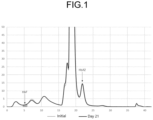
  • FIG. 1 is a chromatogram under conditions of 100 mM Tris-HCl (pH 8.2) and an Hb concentration of 10 g/L.
  • the dotted line indicates a chromatogram on day 0 (the day of preparation), and the solid line indicates a chromatogram on day 21.
  • the peaks of HbA2 and the amounts of HbF on day 0 and day 21 match, suggesting that the specimen is stable.
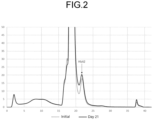
  • FIG. 2 is a chromatogram under conditions of a 250 mM phosphate buffer solution (pH 6.0) and an Hb concentration of 5 g/L.
  • the dotted line indicates a chromatogram on day 0 (the day of preparation), and the solid line indicates a chromatogram on day 21.
  • the peaks of HbA2 on day 0 and day 21 do not match, suggesting that the specimen is not stable.
  • the Example suggests that HbA2 and HbF in the Hb solutions having a pH of from 6.0 to 9.6, a buffer concentration of from 5 to 150 mM, and an Hb concentration of from 5 to 20 g/L are stable at 8°C for 21 days.
  • An apparatus ADAMS HA-8180T (manufactured by ARKRAY Inc.) was used as the high-performance liquid chromatography apparatus.
  • a COLUMN UNIT 80T (manufactured by ARKRAY Inc.), which is a column filled with 0.45 ml of a hydrophilic polymer composed of a methacrylic acid ester copolymer as a filler, was used for the apparatus.
  • 80A as an eluent A
  • 80B as an eluent B
  • 80CT as an eluent C
  • 80H was used as a hemolysis/cleaning solution.
  • the composition and pH of each of 80A, 80B, 80CT, and 80H are as follows. The reagents were allowed to flow in the column at a flow rate of 1.7 ml/min.
  • variable values of the proportions (%) of HbA2 and HbF were determined in the same manner as in Example 1.
  • variable values of the proportion (%) of HbA2 and the proportion (%) of HbF of the specimens are shown in the Table below.
  • the standard range of the variable value of the proportion (%) of HbA2 was set to less than 0.25%.
  • the standard range of the variable value of the proportion (%) of HbF was set to less than 0.60%.
  • the variable values of the proportions of HbA2 and HbF were confirmed to be within the standard ranges.

Landscapes

  • Health & Medical Sciences (AREA)
  • Chemical & Material Sciences (AREA)
  • Life Sciences & Earth Sciences (AREA)
  • Engineering & Computer Science (AREA)
  • Hematology (AREA)
  • Molecular Biology (AREA)
  • Biochemistry (AREA)
  • General Health & Medical Sciences (AREA)
  • Immunology (AREA)
  • Urology & Nephrology (AREA)
  • Biomedical Technology (AREA)
  • Medicinal Chemistry (AREA)
  • Organic Chemistry (AREA)
  • General Physics & Mathematics (AREA)
  • Pathology (AREA)
  • Analytical Chemistry (AREA)
  • Physics & Mathematics (AREA)
  • Gastroenterology & Hepatology (AREA)
  • Genetics & Genomics (AREA)
  • Biophysics (AREA)
  • Biotechnology (AREA)
  • Cell Biology (AREA)
  • Microbiology (AREA)
  • Proteomics, Peptides & Aminoacids (AREA)
  • Food Science & Technology (AREA)
  • Medicines Containing Material From Animals Or Micro-Organisms (AREA)
  • Investigating Or Analysing Biological Materials (AREA)
  • Peptides Or Proteins (AREA)

Abstract

A method for stabilizing hemoglobin A2 and hemoglobin F and a method of producing a hemoglobin solution, the methods including preparing a solution containing a buffer, sucrose, and hemoglobin, wherein: the solution has a pH of from 6.0 to 9.6, a concentration of the buffer in the solution is from 5 to 150 mM, a concentration of the hemoglobin in the solution is from 5 to 20 g/L, and the hemoglobin contains at least hemoglobin A2 and hemoglobin F; and a hemoglobin solution, are provided.

Description

    BACKGROUND Technical Field
  • The present disclosure relates to a method for stabilizing hemoglobin A2 and hemoglobin F, a method of producing a hemoglobin solution, and a hemoglobin solution.
  • Related Art
  • Precision control substances are used for ensuring test results at clinical examination sites. In general, precision control substances are sold in a freeze-dried state, and are dissolved in purified water or the like for use. Remaining precision control substances are stored by refrigeration, and are used at a later date. Accordingly, precision control substances in liquid form are expected to be stable for a long period.
  • Japanese Patent Application Laid-Open ( JP-A) No. 2016-075504 describes a control sample of hemoglobin (hereinafter, also referred to as "Hb") F, characterized in that sucrose is contained as a stabilizer in a mixed hemolysate containing a hemolysate of human red blood cells and human umbilical cord blood.
  • SUMMARY OF THE INVENTION Technical Problem
  • JP 2016-075504 A describes that there are hemoglobins that are stabilized by sucrose and that are not stabilized by sucrose since different types of hemoglobins have different molecular charges. Accordingly, it seems to be difficult to stabilize different types of hemoglobins simultaneously by simply adding sucrose.
  • The present disclosure relates to provision of a method for stabilizing HbA2 and HbF, a method of producing an Hb solution, and an Hb solution, in which HbA2 and HbF in an Hb solution can be stabilized.
  • Solution to Problem
  • Means for solving the foregoing problem include the following aspects.
    1. (1) A method for stabilizing hemoglobin A2 and hemoglobin F, the method including preparing a solution containing a buffer, sucrose, and hemoglobin, wherein:
      • the solution has a pH of from 6.0 to 9.6,
      • a concentration of the buffer in the solution is from 5 to 150 mM,
      • a concentration of the hemoglobin in the solution is from 5 to 20 g/L, and
      • the hemoglobin contains at least hemoglobin A2 and hemoglobin F.
    2. (2) The method for stabilizing hemoglobin A2 and hemoglobin F according to (1), wherein a concentration of the sucrose in the solution is from 5 to 20% (w/v).
    3. (3) A method of producing a hemoglobin solution, the method including preparing a solution containing a buffer, sucrose, and hemoglobin, wherein:
      • the solution has a pH of from 6.0 to 9.6,
      • a concentration of the buffer in the solution is from 5 to 150 mM,
      • a concentration of the hemoglobin in the solution is from 5 to 20 g/L, and
      • the hemoglobin contains at least hemoglobin A2 and hemoglobin F.
    4. (4) The method of producing a hemoglobin solution according to (3), wherein a concentration of the sucrose in the solution is from 5 to 20% (w/v).
    5. (5) A hemoglobin solution, containing a buffer, sucrose, and hemoglobin, wherein:
      • the solution has a pH of from 6.0 to 9.6,
      • a concentration of the buffer in the solution is from 5 to 150 mM,
      • a concentration of the hemoglobin in the solution is from 5 to 20 g/L, and
      • the hemoglobin contains at least hemoglobin A2 and hemoglobin F.
    6. (6) The hemoglobin solution according to (5), wherein a concentration of the sucrose in the solution is from 5 to 20% (w/v).
    7. (7) The hemoglobin solution according to (5) or (6), wherein the hemoglobin solution is used as a precision control substance.
    Advantageous Effects of Invention
  • The present disclosure provides a method for stabilizing HbA2 and HbF, a method of producing an Hb solution, and an Hb solution, in which HbA2 and HbF in an Hb solution can be stabilized.
  • BRIEF DESCRIPTION OF THE DRAWINGS
    • FIG. 1 shows a chromatogram of high-performance liquid chromatography performed in Example 1 using 100 mM Tris-HCl (pH 8.2) at an Hb concentration of 10 g/L.
    • FIG. 2 shows a chromatogram of high-performance liquid chromatography performed in Example 1 using a 250 mM phosphate buffer solution (pH 6.0) at an Hb concentration of 5 g/L.
    DETAILED DESCRIPTION OF THE INVENTION
  • Hereinafter, embodiments of the present disclosure will be described in detail. However, embodiments of the present disclosure are not limited to the following embodiments. Components (including element steps and the like) in the following embodiments are not essential unless otherwise specified. The same applies to numerical values and their ranges, and the numerical values and their ranges do not limit the embodiments of the present disclosure.
  • In the present disclosure, an element described in a singular form does not eliminate the presence of plural elements as long as there is no technical contradiction, unless otherwise specified.
  • In the present disclosure, a numerical range indicated using "(from) ... to" includes the numerical values described before and after "to" as the minimum value and the maximum value, respectively.
  • In numerical ranges described herein in a stepwise manner, the upper limit value or the lower limit value of one numerical range may be replaced with the upper limit value or the lower limit value of another numerical range described in a stepwise manner. Further, in numerical ranges described herein, the upper limit value or the lower limit value of a numerical range may be replaced with a value described in the Examples section.
  • In the present disclosure, a combination of two or more preferable aspects is a more preferred aspect.
  • In the present disclosure, the total amount of Hb in a solution is measured by a cyanmethemoglobin method. Specifically, for example, the total amount of Hb can be measured with HEMOGLOBIN TEST WAKO (FUJIFILM Wako Pure Chemical Corporation).
  • In the present disclosure, the proportions of HbA2 and HbF in Hb are measured based on the peak area ratios obtained by high-performance liquid chromatography.
  • In the description of embodiments of the present disclosure, pH refers to the pH at 25°C, unless otherwise specified.
  • <Method for Stabilizing HbA2 and HbF>
  • A method for stabilizing HbA2 and HbF according to the present disclosure includes preparing a solution containing a buffer, sucrose, and Hb, in which the pH of the solution is from 6.0 to 9.6, the concentration of the buffer in the solution is from 5 to 150 mM, the concentration of the Hb in the solution is from 5 to 20 g/L, and the Hb contains at least HbA2 and HbF. In the present disclosure, the solution containing a buffer, sucrose, and Hb to be prepared is also referred to as "Hb solution".
  • The inventors have found that, by preparing an Hb solution under the foregoing specific conditions, both HbA2 and HbF can be stabilized even when the Hb solution is stored for a long period. While it is presumed that different types of hemoglobins have different charges and thereby have different stabilizing conditions, it is believed that both HbA2 and HbF hardly change in their charge states in a solution containing sucrose and having a pH, buffer concentration, and Hb concentration within the foregoing ranges, whereby both can be stably present for a long period. Therefore, for example, a precision control substance containing HbA2 and HbF that are stable for a long period can be produced. Further, for example, the precision control substance can be stored by refrigeration from the time of preparation (dissolution) until it is depleted. Therefore, in routinely conducting accuracy management, cost for the accuracy management can be reduced, and processes for preparation at the time of use or for frozen storage in small portions after the preparation can be omitted, whereby ease of handling is also improved. However, it is noted that embodiments of the present disclosure are not limited by the foregoing mechanisms. In the present disclosure, the expression that HbA2 and HbF are "stable" refers to a state in which the variations in the proportions (%) of HbA2 and HbF with respect to the total Hb before and after storage of the Hb solution are small, in other words, the variations are within predetermined ranges.
  • JP 2016-075504 A describes that sucrose exhibited a stabilizing effect on HbA1c and HbF, whereas no practical stabilizing effect was exhibited on HbA1A by sucrose. Further, it is described that different types of hemoglobins have different charges, that the difference in the charges has a large influence on the manner of detection in high-performance liquid chromatography, and that, while one of the conditions required for an Hb stabilizer is that it does not affect the charge state of the Hb easily, this is difficult to predict from the correlation between the charge state of the Hb and the saccharide molecule used as the stabilizer. On the other hand, the inventors have focused on two types of hemoglobins, namely HbA2 and HbF, and have investigated for a method for stabilizing both HbA2 and HbF for a long period. The method according to the present disclosure is particularly useful in that both HbA2 and HbF can be stabilized for a long period.
  • (Hemoglobin)
  • The Hb solution contains at least HbA2 and HbF, and may or may not contain any other Hb, such as HbA0 or HbA1. The Hb solution typically contains other hemoglobins derived from blood, such as HbA0 and HbA1.
  • The concentration of the Hb in the Hb solution (that is, the total Hb concentration) is from 5 to 20 g/L. From the viewpoint of stabilizing HbA2 and HbF more favorably, the Hb concentration in the Hb solution is preferably from 10 to 20 g/L, more preferably from 10 to 18 g/L. In particular, in a case in which a buffer described below is a phosphate buffer solution, the Hb concentration is preferably from 10 to 20 g/L, more preferably from 10 to 18 g/L. In a case in which the buffer is a Tris buffer solution, the Hb concentration is preferably from 10 to 20 g/L. In a case in which the buffer is a carbonic acid-bicarbonate buffer solution, the Hb concentration is preferably from 10 to 20 g/L.
  • The origins of the HbA2 and HbF are not particularly limited. Examples thereof include human and non-human animal blood, and human blood is preferable. Examples of the non-human animal include a non-human mammal (monkey, dog, cat, mouse, rat, rabbit, cow, horse, pig, sheep, etc.) and a bird (chicken, quail, etc.).
  • The HbA2 may be, for example, HbA2 obtained from human peripheral blood. The HbF may be, for example, HbF obtained from human peripheral blood, or human umbilical cord blood, which is rich in HbF. The origins of the HbA2 and the HbF may be the same sample, or may be separate samples. It is simple to prepare the Hb solution containing HbA2 and HbF from one sample. Further, by a method of mixing HbA2 and HbF obtained from separate samples allows for adjusting the concentrations and proportions of HbA2 and HbF easily.
  • For example, the HbA2 and HbF may be obtained by hemolyzing human or non-human animal blood to extract Hb. The hemolysis may be performed by, for example, adding EDTA to a precipitate obtained by centrifugation of whole blood obtained by blood drawing, and freezing and thawing the resultant. The HbA2 and HbF may also be obtained by purifying the solution obtained by hemolysis as described above by dialysis or the like.
  • (Buffer)
  • The Hb solution contains a buffer. Examples of the buffer include a phosphate buffer solution, a Tris buffer solution (e.g., Tris-HCl, TBS, TBS(-)-T, TAE, TBE, or TE), and a carbonic acid-bicarbonate buffer solution. From the viewpoint of stabilizing HbA2 and HbF more favorably, a Tris buffer solution is preferable, and Tris-HCl is more preferable.
  • The concentration of the buffer in the Hb solution is from 5 to 150 mM. From the viewpoint of stabilizing HbA2 and HbF more favorably, the concentration is preferably from 5 to 100 mM, more preferably from 5 to 50 mM, still more preferably from 5 to 30 mM. In particular, in a case in which the buffer is a phosphate buffer solution, the concentration of the buffer is preferably from 5 to 100 mM, more preferably from 5 to 50 mM. In a case in which the buffer is a Tris buffer solution, the concentration of the buffer is preferably from 5 to 100 mM. In a case in which the buffer is a carbonic acid-bicarbonate buffer solution, the concentration of the buffer is preferably from 5 to 100 mM, more preferably from 5 to 50 mM, still more preferably from 5 to 30 mM.
  • (Sucrose)
  • The Hb solution contains sucrose. The sucrose serves as a stabilizer of Hb. The concentration of the sucrose in the solution is preferably from 5 to 20% (w/v), more preferably from 6 to 18% (w/v), still more preferably from 7 to 15% (w/v).
  • The amount of the sucrose is preferably from 5 to 20 times, more preferably from 6 to 18 times, still more preferably from 7 to 15 times the amount of the Hb in the Hb solution on a mass basis.
  • (Hb Solution)
  • The pH of the Hb solution is from 6.0 to 9.6. From the viewpoint of stabilizing HbA2 and HbF more favorably, the pH of the Hb solution is preferably from 7.0 to 9.2, more preferably from 7.5 to 9.0.
  • From the viewpoint of stabilizing HbA2 and HbF more favorably, it is preferable that the pH of the Hb solution is from 7.0 to 9.2 (more preferably from 7.0 to 9.0), that the concentration of the buffer is from 5 to 150 mM (preferably from 5 to 100 mM, more preferably from 5 to 50 mM), and that the Hb concentration is from 10 to 20 g/L (preferably from 10 to 18 g/L).
  • The method for stabilizing HbA2 and HbF in this embodiment includes preparing a solution containing a buffer, sucrose, and Hb. The preparation method is not particularly limited, and the buffer, the sucrose, and the Hb may be mixed by any method. In one aspect, the Hb solution can be prepared by mixing a buffer, a sucrose solution, and a solution containing Hb including HbA2 and HbF. In another aspect, the Hb solution can be prepared by mixing a buffer, a sucrose solution, a solution containing HbA2, and a solution containing HbF. The order of the mixing is not particularly limited.
  • The prepared Hb solution is preferably stable for 21 days or more, for example, when the solution is stored at 8°C after preparation. For example, the variable value of the proportion of the HbA2 in the Hb solution after 21 days of storage at 8°C after preparation is preferably less than 0.25%, more preferably less than 0.21%. The variable value of the proportion of the HbF in the Hb solution after 21 days of storage at 8°C after preparation is preferably less than 0.60%, more preferably less than 0.40%, still more preferably less than 0.36%. The "variable value" of the proportion of the HbA2 or the proportion of the HbF is determined as follows. The proportions (%) of each of the HbA2 and the HbF in the Hb solution immediately after the preparation and after the storage are determined by high-performance liquid chromatography. The absolute difference between the proportion after the storage and the proportion before the storage is determined, and defined as the variable value of each of the proportions (%) of HbA2 and HbF. Conditions of the high-performance liquid chromatography in the measurement of the variable value are the same as or equivalent to the method described in Example 1.
  • <Method of Producing Hemoglobin Solution>
  • A method of producing an Hb solution in an embodiment of the present disclosure includes preparing a solution containing a buffer, sucrose, and Hb, in which the pH of the solution is from 6.0 to 9.6, the concentration of the buffer in the solution is from 5 to 150 mM, the concentration of the Hb in the solution is from 5 to 20 g/L, and the Hb contains at least HbA2 and HbF. The content described in the section "Method for Stabilizing HbA2 and HbF" can apply to the details of the buffer, the sucrose, the Hb, the Hb solution, and the preparation methods thereof in this embodiment.
  • <Hemoglobin Solution>
  • An Hb solution in an embodiment of the present disclosure is an Hb solution containing a buffer, sucrose, and Hb, in which the solution has a pH of from 6.0 to 9.6, the concentration of the buffer in the solution is from 5 to 150 mM, the concentration of the Hb in the solution is from 5 to 20 g/L, and the Hb contains at least HbA2 and HbF. The content described in the section "Method for Sabilizing HbA2 and HbF" can apply to the details of the buffer, the sucrose, the Hb, the Hb solution, and the preparation methods thereof in this embodiment.
  • In one aspect, the Hb solution according to this embodiment is used as a precision control substance. A precision control substance is a sample having a known composition, which is used for accuracy management of analyses, and the precision control substance in this aspect refers to a sample in which the compositions of HbA2 and HbF (that is, the proportions (%) thereof with respect to the total Hb in the precision control substance) are known.
  • Examples
  • Next, embodiments of the present disclosure are specifically described with reference to the Examples. However, embodiments of the present disclosure are not limited to these Examples.
  • 1. Preparation of Hb Solution <Hemolysis>
    1. (1) Human whole blood was centrifuged (10000 g, 10 minutes, 4°C), and the supernatant was removed.
    2. (2) The precipitate was suspended with the same amount of saline as the whole blood.
    3. (3) The suspension from the procedure (2) was centrifuged (10000 g, 10 minutes, 4°C), and the supernatant was removed.
    4. (4) Procedures (2) and (3) were repeated.
    5. (5) The precipitate was suspended with 20 mM EDTA-NaOH (pH 7.0) that is 1.3 times the amount of the whole blood.
    6. (6) The solution from the procedure (5) was frozen at -80°C.
    <Purification>
  • (7) After confirming that the solution from the procedure (6) was completely frozen, the solution was thawed in a water bath at room temperature (about 25°C). The resultant is referred to as "hemolysis specimen".
  • (8) The hemolysis specimen was placed in a dialysis membrane having a molecular weight cutoff of 3500, and dialyzed with purified water as an external fluid.
  • (9) The external fluid was exchanged (volume of external fluid: 85 times or more the volume of the internal fluid, 3 hours or more/time, 6 times).
  • (10) The internal fluid recovered was centrifuged (40000 g, 10 minutes, 4°C), and the supernatant was recovered. The supernatant is referred to as "solution A".
  • (11) The Hb concentration in the solution A was measured with HEMOGLOBIN TEST WAKO (FUJIFILM Wako Pure Chemical Corporation) (cyanmethemoglobin method).
  • (12) A 28% (w/v) sucrose solution, a 0.5 M buffer solution, and the solution A that has been quantified in the procedure (11) were mixed such that the final concentrations of the components were adjusted to the designated concentrations.
  • 2. Evaluation [Example 1] <Test Conditions>
    • Phosphate buffer solution: 5 to 250 mM (pH 6.0, 7.0, 7.5, 8.0, 8.2)
    • Tris-HCl: 5 to 250 mM (pH 7.5, 8.0, 8.2, 9.0)
    • Carbonic acid-bicarbonate buffer solution: from 5 to 250 mM (pH 9.2, 9.6)
    • Final concentration of sucrose: 7% (w/v)
    • Hb concentration: from 5 to 20 g/L
    <High-Performance Liquid Chromatography>
    1. (1) The proportions of HbA2 and HbF in each specimen were measured (n = 3) using a calibrated high-performance liquid chromatography apparatus.
    2. (2) The specimens were stored at 8°C for 21 days.
    3. (3) The proportions of HbA2 and HbF in each specimen after the storage were measured (n = 3) using the calibrated high-performance liquid chromatography apparatus.
    4. (4) The variable value of the average values of the measurement values (n = 3) of each of the HbA2 proportion (%) and the HbF proportion (%) before and after the storage was calculated.
    <High-Performance Liquid Chromatography Apparatus> (1) High-performance liquid chromatography apparatus
  • A commercially available cation exchange chromatography column filled with a hydrophilic polymer composed of a methacrylic acid ester copolymer was connected to a commercially available high-performance liquid chromatography apparatus. An optical detector (specifically, absorption spectrometer) for detecting the concentration of the Hb that flows in the flow path was attached at a predetermined position of the flow path downstream of the cation exchange chromatography column.
  • (2) Eluent
  • Three types of eluents were prepared as aqueous solutions having the compositions shown in Table 1 below. [Table 1]
    Raw material Concentration (% by mass)
    Eluent A Eluent B Eluent C
    Sodium dihydrogen phosphate dihydrate 1.44 0.02 0.12
    Disodium hydrogen phosphate 0.16 0.50 0.33
  • The eluent A was adjusted so as to have a pH of 5.08, the eluent B was adjusted so as to have a pH of 8.0, and the eluent C was adjusted so as to have a pH of 6.82. The eluent A had the minimum elution power of Hb and the eluent B had the maximum elution power of Hb, among these eluents.
  • (3) Chromatogram
  • The eluent A was allowed to flow in the high-performance liquid chromatography apparatus described in (1) to equilibrate the column. Thereafter, the hemolyzed blood specimen was introduced into the column. Then, the eluent A was allowed to flow for 13 seconds, thereby eluting HbA1a, HbA1b, HbF, and HbA1c. Next, a mixture containing the eluent A and the eluent C in a 1:9 ratio was allowed to flow for 5 seconds, thereby eluting HbA0. Next, the eluent C was allowed to flow for 5 seconds, thereby eluting HbA2. The eluent B was allowed to flow for 2 seconds, thereby eluting the entire Hb remaining in the column, and thereafter the eluent A was allowed to flow for 5 seconds. During the elution, a chromatogram was generated from the absorbance detected by the optical detector at a detection wavelength of 420 nm.
  • The proportion (%) of HbA2 and the proportion (%) of HbF were determined by the following expressions. HbA 2 % = Total area of HbA2 / Total area of total Hb × 100
    Figure imgb0001
    HbF % = Total area of HbF / Total area of total Hb × 100
    Figure imgb0002
  • <Calculation of Variable Value>
  • The proportion (%) of HbA2 was determined before and after storage of the specimen at 8°C for 21 days. The absolute value between the average value after the storage (n = 3) and the average value before the storage (n = 3) was determined, and was defined as the variable value of the proportion (%) of HbA2. The variable value of the proportion (%) of HbF was also determined by the same method.
  • <Results>
    • The variable values of the proportion (%) of each of HbA2 and HbF are shown in the following Tables. In the Tables, "ND" means that no detection result was obtained owing to the peak being outside the measurement range, although the measurement was performed. "-" means that no measurement was performed. The standard range of the variable value of the proportion (%) of HbA2 was set to less than 0.25%. The standard range of the variable value of the proportion (%) of HbF was set to less than 0.60%.
    Figure imgb0003
    Figure imgb0004
    [Table 4]
    HbA2 carbonic acid-bicarbonate buffer solution PH 9.2 PH 9.6
    Buffer solution concentration (mM) 5 10 30 50 100 250 5 10 30 50 100 250
    Hb 20 g/L 0.00 0.01 - 0.09 0.01 0.02 0.01 0.01 - 0.10 0.06 0.12
    Hb 18 g/L 0.03 0.02 - 0.12 0.02 0.02 0.01 0.02 - 0.12 0.03 0.11
    Hb 10 g/L 0.01 0.01 0.05 0.12 0.01 0.02 0.00 0.01 0.00 0.16 0.08 0.25
    Hb 5 g/L 0.01 0.02 0.07 0.09 0.04 0.16 0.01 0.01 0.07 0.16 0.16 ND
    Figure imgb0005
    Figure imgb0006
    [Table 7]
    HbF carbonic acid-bicarbonate buffer solution PH 9.2 PH 9.6
    Buffer solution concentration (mM) 5 10 30 50 100 250 5 10 30 50 100 250
    Hb 20 gIL 0.03 0.01 - 0.04 0.02 0.04 0.03 0.02 - 0.07 0.03 0.03
    Hb 18 g/L 0.02 0.02 - 0.05 0.02 0.01 0.01 0.01 - 0.06 0.03 0.04
    Hb 10 g/L 0.02 0.04 0.02 0.05 - - 0.01 0.03 0.07 0.08 - 0.61
    Hb 5 g/L 0.04 0.02 0.04 0.09 0.02 0.09 0.02 0.04 0.09 029 0.18 0.28
  • An example of the chromatograms is shown in FIG. 1. FIG. 1 is a chromatogram under conditions of 100 mM Tris-HCl (pH 8.2) and an Hb concentration of 10 g/L. The dotted line indicates a chromatogram on day 0 (the day of preparation), and the solid line indicates a chromatogram on day 21. The peaks of HbA2 and the amounts of HbF on day 0 and day 21 match, suggesting that the specimen is stable.
  • Another example of the chromatograms is illustrated in FIG. 2. FIG. 2 is a chromatogram under conditions of a 250 mM phosphate buffer solution (pH 6.0) and an Hb concentration of 5 g/L. The dotted line indicates a chromatogram on day 0 (the day of preparation), and the solid line indicates a chromatogram on day 21. The peaks of HbA2 on day 0 and day 21 do not match, suggesting that the specimen is not stable.
  • The Example suggests that HbA2 and HbF in the Hb solutions having a pH of from 6.0 to 9.6, a buffer concentration of from 5 to 150 mM, and an Hb concentration of from 5 to 20 g/L are stable at 8°C for 21 days.
  • [Example 2] <Test Conditions>
    • Tris buffer solution: 25 mM (pH 8.8)
    • Final concentration of sucrose: 7% (w/v)
    • Hb concentration: from 13 to 18 g/L
    <High-Performance Liquid Chromatography>
    1. (1) The proportions of HbA2 and HbF in each specimen were measured (n = 3) using a calibrated high-performance liquid chromatography apparatus.
    2. (2) The specimens were stored at 8°C for 21 days.
    3. (3) The proportions of HbA2 and HbF in each specimen after the storage were measured (n = 3) using the calibrated high-performance liquid chromatography apparatus.
    4. (4) The variable value of the average values of the measurement values (n = 3) of each of the HbA2 proportion (%) and the HbF proportion (%) before and after the storage was calculated.
    <High-Performance Liquid Chromatography Apparatus>
  • An apparatus ADAMS HA-8180T (manufactured by ARKRAY Inc.) was used as the high-performance liquid chromatography apparatus. A COLUMN UNIT 80T (manufactured by ARKRAY Inc.), which is a column filled with 0.45 ml of a hydrophilic polymer composed of a methacrylic acid ester copolymer as a filler, was used for the apparatus. As reagents, 80A as an eluent A, 80B as an eluent B, and 80CT as an eluent C (manufactured by ARKRAY Inc.), were used for the elution of Hb from the column, and 80H was used as a hemolysis/cleaning solution. The composition and pH of each of 80A, 80B, 80CT, and 80H are as follows. The reagents were allowed to flow in the column at a flow rate of 1.7 ml/min.
    • Eluent A (80A): phosphate buffer solution (pH 5.35 ± 0.05)
    • Eluent B (80B): phosphate buffer solution (pH 8.05 ± 0.20)
    • Eluent C (80CT): phosphate buffer solution (pH 7.0 to 7.4)
    • Hemolysis/cleaning solution (80H): phosphate buffer solution containing a surfactant (pH 7.5 ±0.1)
    <Calculation of Variable Value>
  • The variable values of the proportions (%) of HbA2 and HbF were determined in the same manner as in Example 1.
  • <Results>
  • The variable values of the proportion (%) of HbA2 and the proportion (%) of HbF of the specimens are shown in the Table below. The standard range of the variable value of the proportion (%) of HbA2 was set to less than 0.25%. The standard range of the variable value of the proportion (%) of HbF was set to less than 0.60%. The variable values of the proportions of HbA2 and HbF were confirmed to be within the standard ranges. [Table 8]
    Variable value Day 21
    HbA2 [%] 0.10
    HbF [%] 0.04

Claims (7)

  1. A method for stabilizing hemoglobin A2 and hemoglobin F, the method comprising preparing a solution containing a buffer, sucrose, and hemoglobin, wherein:
    the solution has a pH of from 6.0 to 9.6,
    a concentration of the buffer in the solution is from 5 to 150 mM,
    a concentration of the hemoglobin in the solution is from 5 to 20 g/L, and
    the hemoglobin contains at least hemoglobin A2 and hemoglobin F.
  2. The method for stabilizing hemoglobin A2 and hemoglobin F according to claim 1, wherein a concentration of the sucrose in the solution is from 5 to 20% (w/v).
  3. A method of producing a hemoglobin solution, the method comprising preparing a solution containing a buffer, sucrose, and hemoglobin, wherein:
    the solution has a pH of from 6.0 to 9.6,
    a concentration of the buffer in the solution is from 5 to 150 mM,
    a concentration of the hemoglobin in the solution is from 5 to 20 g/L, and
    the hemoglobin contains at least hemoglobin A2 and hemoglobin F.
  4. The method of producing a hemoglobin solution according to claim 3, wherein a concentration of the sucrose in the solution is from 5 to 20% (w/v).
  5. A hemoglobin solution, comprising a buffer, sucrose, and hemoglobin, wherein:
    the solution has a pH of from 6.0 to 9.6,
    a concentration of the buffer in the solution is from 5 to 150 mM,
    a concentration of the hemoglobin in the solution is from 5 to 20 g/L, and
    the hemoglobin contains at least hemoglobin A2 and hemoglobin F.
  6. The hemoglobin solution according to claim 5, wherein a concentration of the sucrose in the solution is from 5 to 20% (w/v).
  7. The hemoglobin solution according to claim 5 or 6, wherein the hemoglobin solution is used as a precision control substance.
EP24209906.7A 2023-10-30 2024-10-30 Method for stabilizing hemoglobin a2 and hemoglobin f, method of producing hemoglobin solution, and hemoglobin solution Pending EP4549458A1 (en)

Applications Claiming Priority (1)

Application Number Priority Date Filing Date Title
JP2023185918 2023-10-30

Publications (1)

Publication Number Publication Date
EP4549458A1 true EP4549458A1 (en) 2025-05-07

Family

ID=93335079

Family Applications (1)

Application Number Title Priority Date Filing Date
EP24209906.7A Pending EP4549458A1 (en) 2023-10-30 2024-10-30 Method for stabilizing hemoglobin a2 and hemoglobin f, method of producing hemoglobin solution, and hemoglobin solution

Country Status (4)

Country Link
US (1) US20250138030A1 (en)
EP (1) EP4549458A1 (en)
JP (1) JP2025075021A (en)
CN (1) CN119912556A (en)

Families Citing this family (1)

* Cited by examiner, † Cited by third party
Publication number Priority date Publication date Assignee Title
JP2019180427A (en) * 2018-03-30 2019-10-24 株式会社三洋物産 Game machine

Citations (3)

* Cited by examiner, † Cited by third party
Publication number Priority date Publication date Assignee Title
EP1191037A1 (en) * 1999-07-01 2002-03-27 International Reagents Corporation Means of stabilizing hemoglobins
JP2016075504A (en) 2014-10-03 2016-05-12 株式会社ビー・エム・エル Management sample of hemoglobin F
CN107266563A (en) * 2017-08-01 2017-10-20 四川沃文特生物技术有限公司 A kind of preparation method of hemoglobin quality-control product

Patent Citations (3)

* Cited by examiner, † Cited by third party
Publication number Priority date Publication date Assignee Title
EP1191037A1 (en) * 1999-07-01 2002-03-27 International Reagents Corporation Means of stabilizing hemoglobins
JP2016075504A (en) 2014-10-03 2016-05-12 株式会社ビー・エム・エル Management sample of hemoglobin F
CN107266563A (en) * 2017-08-01 2017-10-20 四川沃文特生物技术有限公司 A kind of preparation method of hemoglobin quality-control product

Also Published As

Publication number Publication date
JP2025075021A (en) 2025-05-14
US20250138030A1 (en) 2025-05-01
CN119912556A (en) 2025-05-02

Similar Documents

Publication Publication Date Title
EP2960648B1 (en) Measurement method, measurement apparatus, and eluent for the analysis of hemoglobins
Spicer et al. A simplified assay of hemoglobin AIc in diabetic patients by use of isoelectric focusing and quantitative microdensitometry
US8789405B2 (en) Calibration method in measurement of hemoglobin A1c
JP6786917B2 (en) Hemoglobin preparation solution and hemoglobin measurement liquid chromatography method
CN109633010B (en) A kit and method for determining glycosylated hemoglobin in whole blood
US20250138030A1 (en) Method for stabilizing hemoglobin a2 and hemoglobin f, method of producing hemoglobin solution, and hemoglobin solution
JPH04504306A (en) Stable hemoglobin reference solution
EP4549948A1 (en) Method of producing solution containing hemoglobin a2, method of producing solution containing hemoglobin a2 and hemoglobin f, and method of producing hemoglobin precision control substance
KR101810264B1 (en) Method of analyzing hemoglobins
EP3855187B1 (en) Artificial feces, and method for managing accuracy of fecal occult blood test using same
JP4404429B2 (en) Method for measuring hemoglobins
EP4011473B1 (en) Method for measurement of hemoglobin
Dahl-Jørgensen et al. HbA1 determination by agar gel electrophoresis after elimination of labile HbA1: a comparison with ion-exchange chromatography
JP3686482B2 (en) Control sample of hemoglobin A1C
JP2002082105A (en) Filler for liquid chromatography, column, and method for measuring hemoglobins using the same
CN115372486A (en) Glycosylated hemoglobin detection kit and application thereof
JP2023140054A (en) How to measure hemoglobin F
EP4119941A1 (en) Hemoglobin assay method
EP3851850A1 (en) Reagent and method for measuring hemoglobins
US20020125193A1 (en) Electrochemical analysis of coenzyme Q10 and reduced coenzyme Q10
Maeda et al. Automated determination of 5-fluorouracil and its metabolite in urine by high-performance liquid chromatography with column switching
JP7547952B2 (en) Hemoglobin preparation and method for measuring hemoglobins using the hemoglobin preparation
Weidel et al. The effects of experimental malnutrition on albumin metabolism and distribution in rabbits
US20240353379A1 (en) Method of treating measurement flow channel and liquid chromatography device
WO2024140721A1 (en) Reagent for detecting glycated hemoglobin, detection method, and use

Legal Events

Date Code Title Description
PUAI Public reference made under article 153(3) epc to a published international application that has entered the european phase

Free format text: ORIGINAL CODE: 0009012

STAA Information on the status of an ep patent application or granted ep patent

Free format text: STATUS: THE APPLICATION HAS BEEN PUBLISHED

AK Designated contracting states

Kind code of ref document: A1

Designated state(s): AL AT BE BG CH CY CZ DE DK EE ES FI FR GB GR HR HU IE IS IT LI LT LU LV MC ME MK MT NL NO PL PT RO RS SE SI SK SM TR

STAA Information on the status of an ep patent application or granted ep patent

Free format text: STATUS: REQUEST FOR EXAMINATION WAS MADE

17P Request for examination filed

Effective date: 20251107