EP4549410A1 - Microcrystalline glass, preparation method, microcrystalline glass product, and electronic device - Google Patents
Microcrystalline glass, preparation method, microcrystalline glass product, and electronic device Download PDFInfo
- Publication number
- EP4549410A1 EP4549410A1 EP23838494.5A EP23838494A EP4549410A1 EP 4549410 A1 EP4549410 A1 EP 4549410A1 EP 23838494 A EP23838494 A EP 23838494A EP 4549410 A1 EP4549410 A1 EP 4549410A1
- Authority
- EP
- European Patent Office
- Prior art keywords
- glass
- nanocrystal
- alkaline earth
- metal oxide
- earth metal
- Prior art date
- Legal status (The legal status is an assumption and is not a legal conclusion. Google has not performed a legal analysis and makes no representation as to the accuracy of the status listed.)
- Pending
Links
Images


Classifications
-
- C—CHEMISTRY; METALLURGY
- C03—GLASS; MINERAL OR SLAG WOOL
- C03C—CHEMICAL COMPOSITION OF GLASSES, GLAZES OR VITREOUS ENAMELS; SURFACE TREATMENT OF GLASS; SURFACE TREATMENT OF FIBRES OR FILAMENTS MADE FROM GLASS, MINERALS OR SLAGS; JOINING GLASS TO GLASS OR OTHER MATERIALS
- C03C3/00—Glass compositions
- C03C3/12—Silica-free oxide glass compositions
- C03C3/14—Silica-free oxide glass compositions containing boron
- C03C3/145—Silica-free oxide glass compositions containing boron containing aluminium or beryllium
-
- C—CHEMISTRY; METALLURGY
- C03—GLASS; MINERAL OR SLAG WOOL
- C03C—CHEMICAL COMPOSITION OF GLASSES, GLAZES OR VITREOUS ENAMELS; SURFACE TREATMENT OF GLASS; SURFACE TREATMENT OF FIBRES OR FILAMENTS MADE FROM GLASS, MINERALS OR SLAGS; JOINING GLASS TO GLASS OR OTHER MATERIALS
- C03C10/00—Devitrified glass ceramics, i.e. glass ceramics having a crystalline phase dispersed in a glassy phase and constituting at least 50% by weight of the total composition
-
- C—CHEMISTRY; METALLURGY
- C03—GLASS; MINERAL OR SLAG WOOL
- C03C—CHEMICAL COMPOSITION OF GLASSES, GLAZES OR VITREOUS ENAMELS; SURFACE TREATMENT OF GLASS; SURFACE TREATMENT OF FIBRES OR FILAMENTS MADE FROM GLASS, MINERALS OR SLAGS; JOINING GLASS TO GLASS OR OTHER MATERIALS
- C03C21/00—Treatment of glass, not in the form of fibres or filaments, by diffusing ions or metals in the surface
- C03C21/001—Treatment of glass, not in the form of fibres or filaments, by diffusing ions or metals in the surface in liquid phase, e.g. molten salts, solutions
- C03C21/002—Treatment of glass, not in the form of fibres or filaments, by diffusing ions or metals in the surface in liquid phase, e.g. molten salts, solutions to perform ion-exchange between alkali ions
-
- C—CHEMISTRY; METALLURGY
- C03—GLASS; MINERAL OR SLAG WOOL
- C03B—MANUFACTURE, SHAPING, OR SUPPLEMENTARY PROCESSES
- C03B19/00—Other methods of shaping glass
- C03B19/02—Other methods of shaping glass by casting molten glass, e.g. injection moulding
-
- C—CHEMISTRY; METALLURGY
- C03—GLASS; MINERAL OR SLAG WOOL
- C03B—MANUFACTURE, SHAPING, OR SUPPLEMENTARY PROCESSES
- C03B32/00—Thermal after-treatment of glass products not provided for in groups C03B19/00, C03B25/00 - C03B31/00 or C03B37/00, e.g. crystallisation, eliminating gas inclusions or other impurities; Hot-pressing vitrified, non-porous, shaped glass products
- C03B32/02—Thermal crystallisation, e.g. for crystallising glass bodies into glass-ceramic articles
-
- C—CHEMISTRY; METALLURGY
- C03—GLASS; MINERAL OR SLAG WOOL
- C03B—MANUFACTURE, SHAPING, OR SUPPLEMENTARY PROCESSES
- C03B5/00—Melting in furnaces; Furnaces so far as specially adapted for glass manufacture
- C03B5/16—Special features of the melting process; Auxiliary means specially adapted for glass-melting furnaces
-
- C—CHEMISTRY; METALLURGY
- C03—GLASS; MINERAL OR SLAG WOOL
- C03C—CHEMICAL COMPOSITION OF GLASSES, GLAZES OR VITREOUS ENAMELS; SURFACE TREATMENT OF GLASS; SURFACE TREATMENT OF FIBRES OR FILAMENTS MADE FROM GLASS, MINERALS OR SLAGS; JOINING GLASS TO GLASS OR OTHER MATERIALS
- C03C10/00—Devitrified glass ceramics, i.e. glass ceramics having a crystalline phase dispersed in a glassy phase and constituting at least 50% by weight of the total composition
- C03C10/0054—Devitrified glass ceramics, i.e. glass ceramics having a crystalline phase dispersed in a glassy phase and constituting at least 50% by weight of the total composition containing PbO, SnO2, B2O3
-
- H—ELECTRICITY
- H04—ELECTRIC COMMUNICATION TECHNIQUE
- H04M—TELEPHONIC COMMUNICATION
- H04M1/00—Substation equipment, e.g. for use by subscribers
- H04M1/02—Constructional features of telephone sets
- H04M1/0202—Portable telephone sets, e.g. cordless phones, mobile phones or bar type handsets
- H04M1/026—Details of the structure or mounting of specific components
-
- H—ELECTRICITY
- H04—ELECTRIC COMMUNICATION TECHNIQUE
- H04M—TELEPHONIC COMMUNICATION
- H04M1/00—Substation equipment, e.g. for use by subscribers
- H04M1/02—Constructional features of telephone sets
- H04M1/0202—Portable telephone sets, e.g. cordless phones, mobile phones or bar type handsets
- H04M1/026—Details of the structure or mounting of specific components
- H04M1/0266—Details of the structure or mounting of specific components for a display module assembly
-
- H—ELECTRICITY
- H04—ELECTRIC COMMUNICATION TECHNIQUE
- H04M—TELEPHONIC COMMUNICATION
- H04M1/00—Substation equipment, e.g. for use by subscribers
- H04M1/02—Constructional features of telephone sets
- H04M1/18—Telephone sets specially adapted for use in ships, mines, or other places exposed to adverse environment
-
- H—ELECTRICITY
- H04—ELECTRIC COMMUNICATION TECHNIQUE
- H04M—TELEPHONIC COMMUNICATION
- H04M1/00—Substation equipment, e.g. for use by subscribers
- H04M1/02—Constructional features of telephone sets
- H04M1/18—Telephone sets specially adapted for use in ships, mines, or other places exposed to adverse environment
- H04M1/185—Improving the shock resistance of the housing, e.g. by increasing the rigidity
-
- C—CHEMISTRY; METALLURGY
- C03—GLASS; MINERAL OR SLAG WOOL
- C03C—CHEMICAL COMPOSITION OF GLASSES, GLAZES OR VITREOUS ENAMELS; SURFACE TREATMENT OF GLASS; SURFACE TREATMENT OF FIBRES OR FILAMENTS MADE FROM GLASS, MINERALS OR SLAGS; JOINING GLASS TO GLASS OR OTHER MATERIALS
- C03C2203/00—Production processes
- C03C2203/10—Melting processes
-
- C—CHEMISTRY; METALLURGY
- C03—GLASS; MINERAL OR SLAG WOOL
- C03C—CHEMICAL COMPOSITION OF GLASSES, GLAZES OR VITREOUS ENAMELS; SURFACE TREATMENT OF GLASS; SURFACE TREATMENT OF FIBRES OR FILAMENTS MADE FROM GLASS, MINERALS OR SLAGS; JOINING GLASS TO GLASS OR OTHER MATERIALS
- C03C2203/00—Production processes
- C03C2203/50—After-treatment
- C03C2203/52—Heat-treatment
Definitions
- This application relates to the field of nanocrystal glass preparation technologies, and in particular, to nanocrystal glass, a preparation method, a nanocrystal glass product, and an electronic device.
- a mobile phone is used as an example.
- a size of a screen of the mobile phone continuously increases, a cover plate of the mobile phone is also increasingly large, and use of 3D glass is gradually increased. Therefore, a consumer has a higher requirement for performance such as drop resistance and scratch resistance of the glass. Therefore, nanocrystal glass with higher mechanical performance is required to meet a user requirement.
- this application provides nanocrystal glass, a preparation method, a nanocrystal glass product, and an electronic device, to provide the nanocrystal glass that is more resistant to dropping and scratching, thereby resolving a problem that mechanical strength of existing glass cannot meet a user requirement.
- Some implementations of this application provide nanocrystal glass.
- the following describes this application from a plurality of aspects.
- references may be made to each other.
- this application provides nanocrystal glass.
- the nanocrystal glass includes the following components in terms of mole percents of oxides:
- the nanocrystal glass in this embodiment of this application in a preparation process of the nanocrystal glass components such as an alkali metal and an alkaline earth metal are introduced into a calcium-aluminum binary system to improve glass-forming performance of the calcium-aluminum binary system and expand a glass-forming area of calcium aluminate glass, to obtain the calcium aluminate glass.
- the calcium aluminate glass has higher mechanical strength, and has better anti-fall performance and scratch resistance than those of conventional silicate glass and perhafnate glass.
- a temperature for glass melting is reduced, thereby reducing energy consumption.
- the alkaline earth metal oxide includes one or more of MgO, SrO, and BaO.
- the alkaline earth metal oxide includes at least two of MgO, SrO, and BaO, and content of various types of alkaline earth metal ions is 2%-10% in terms of mole percents.
- the alkali metal oxide includes one or more of Li 2 O, Na 2 O, and K 2 O.
- the alkali metal oxide includes: Li 2 O: 1%-10%; Na 2 O: 2%-10%; and K 2 O: 0%-10%. Proportions of the components further improve the glass-forming performance of the calcium-aluminum binary system.
- the nanocrystal glass includes nanocrystalline particles, and the nanocrystalline particles may be of one or more crystal phases of CaAl 2 O 4 , MgAl 2 O 4 , and SrAl 2 O 4 .
- an average particle size of the nanocrystalline particles is 1 nm-100 nm.
- content of the nanocrystalline particles accounts for 50% or more of a total amount of the entire nanocrystal glass.
- the average particle size of the nanocrystalline particles is 1 nm-50 nm, and the content of the nanocrystalline particles accounts for 80% or more of the total amount of the entire nanocrystal glass. Therefore, an increase in the content of the nanocrystalline particles can effectively improve the hardness of the nanocrystal glass.
- Vickers hardness of the nanocrystal glass is 8.4 Gpa-9.1 Gpa.
- Young's modulus of the nanocrystal glass is 110 GPa-129 GPa.
- this application further provides a preparation method for nanocrystal glass, including:
- components such as an alkali metal and an alkaline earth metal are introduced into a calcium-aluminum binary system to improve glass-forming performance of the calcium-aluminum binary system and expand a glass-forming area of calcium aluminate glass, to obtain the calcium aluminate glass.
- the calcium aluminate glass has higher mechanical strength, and has better anti-fall performance and scratch resistance than those of conventional silicate glass and perhafnate glass.
- a temperature for glass melting is reduced, thereby reducing energy consumption.
- the melting the mixed powder to obtain glass melt includes: placing the mixed powder in a crucible, then placing the crucible in a melting furnace, and performing melting for 1 h-3 h at 1400°C-1600°C to obtain the glass melt.
- the pouring the glass melt to obtain a glass precursor includes: pouring the glass melt on a preheated mold to obtain a uniform glass precursor.
- the performing annealing processing on the glass precursor, and cooling to a room temperature, to obtain the nanocrystal glass includes: transferring the glass precursor to a muffle furnace for annealing processing, where the annealing processing means that a temperature of the muffle furnace is cooled to a temperature 30°C-50°C below a glass transition temperature, the temperature is maintained for 3 h-8 h, stepped cooling is performed at a cooling rate of 0.1°C/h-10°C/h, and a temperature of each phase is maintained for 3 h-8 h, until the temperature is cooled to a room temperature, to obtain the nanocrystal glass.
- a manner of introducing Al 2 O 3 is Al 2 O 3 or Al(OH) 3
- a manner of introducing CaO is CaCO 3
- a manner of introducing the alkaline earth metal oxide is an alkaline earth metal carbonate
- a manner of introducing the alkali metal oxide is an alkali metal carbonate
- a manner of introducing B 2 O 3 is B(OH) 3
- the alkaline earth metal carbonate includes one or more of MgCO 3 , SrCO 3 , and BaCO 3 .
- the alkaline earth metal carbonate includes MgCO 3 , SrCO 3 , and BaCO 3 , and content of various types of alkaline earth metal ions is separately 2%-10% in terms of mole percents.
- the alkali metal carbonate includes one or more of Li 2 CO 3 , Na 2 CO 3 , and K 2 CO 3 .
- An alkaline earth metal including the components can effectively improve glass-forming performance of the calcium-aluminum binary system and hardness of the nanocrystal glass.
- mole percents of components of the alkali metal oxide are respectively: Li 2 O: 1%-10%; Na 2 O: 2%-10%; and K 2 O: 0%-10%.
- this application further provides a nanocrystal glass product, where the nanocrystal glass product is made of the nanocrystal glass according to any one of the first aspect and the embodiments thereof.
- this application further provides an electronic device, including:
- Nanocrystal glass (Nanocrystal glass) is also referred to as ceramic glass, is an inorganic non-metallic material, and is a new material that has both a glass characteristic and a ceramic characteristic. There is no regular atomic arrangement in common glass, which is also a reason for glass fragility.
- the nanocrystal glass like ceramic, contains crystals, and atomic arrangement of the crystals is regular. Therefore, the nanocrystal glass has higher brightness than that of the ceramic and stronger toughness than that of glass.
- Calcium aluminate glass is a kind of nanocrystal glass, and has better mechanical performance than conventional glass.
- a glass-forming area of a calcium-aluminum binary system is extremely limited, and glass-forming can be implemented only when content of CaO is in a range of 61 mol%-66 mol%. Consequently, glass-forming performance of conventional calcium aluminate glass is poor, which affects application of glass of this system
- this application provides nanocrystal glass.
- components such as an alkali metal and an alkaline earth metal are introduced into glass of the calcium-aluminum binary system.
- glass-forming performance of the nanocrystal glass is improved, and the glass-forming area of the calcium aluminate glass is expanded, so that the nanocrystal glass provided in this application is obtained.
- the nanocrystal glass provided in this application has higher mechanical strength, and anti-fall performance and scratch resistance of the nanocrystal glass are better than those of the conventional glass.
- the nanocrystal glass in this application may be applied to an electronic device.
- the nanocrystal glass may be fabricated into a cover plate of the electronic device, for example, glass of a front cover plate of a screen or a rear cover (a backplane) of a mobile phone, and fabricated into a housing and the like.
- the following describes an application scenario of the nanocrystal glass of embodiments of this application by using an example in which the nanocrystal glass is applied to a mobile phone.
- FIG. 1 is a schematic diagram of a structure of a mobile phone according to an embodiment of this application.
- a mobile phone 100 may include a rear cover, a display screen, a main middle frame, a camera protective cover plate, and the like. Some or all of these components may be made of the nanocrystal glass.
- FIG. 2A is an exploded view of a partial structure of a mobile phone according to an embodiment of this application.
- the mobile phone 100 may include a main middle frame 10, a rear cover 20, and a display screen 30, where the rear cover 20 and the display screen 30 are respectively disposed on two sides of the main middle frame 10, to seal and cover components disposed inside the middle frame.
- the display screen 30 and/or the rear cover 20 may be made of the nanocrystal glass.
- the display screen 30 and/or the rear cover 20 may be completely made of the nanocrystal glass or may be partially made of the nanocrystal glass.
- the display screen 200 may be a touch screen
- FIG. 2B is a schematic diagram of another structure of a mobile phone according to an embodiment of this application.
- a camera protective cover 21 is disposed on the rear cover 20 of the mobile phone 100, and the camera protective cover 21 is configured to cover a camera assembly to better protect the camera assembly.
- the camera protective cover may be completely or partially made of the nanocrystal glass of this application. In this embodiment of this application, the camera protective cover is not limited to a form shown in FIG. 2A .
- the nanocrystal glass with excellent anti-fall performance is used for the mobile phone of this application, so that the mobile phone has performance such as drop resistance and scratch resistance, thereby improving reliability of a terminal product and improving user experience.
- the electronic device may alternatively be a notebook computer, a tablet computer, a desktop computer, or another electronic device, or may be a smart wearable device, for example, a watch or a wristband.
- a type of the electronic device is not limited in this application.
- the nanocrystal glass may be further applied to another scenario, for example, applied to a part that can be made of glass in a vehicle.
- a vehicle light cover, a windshield, glass of an in-vehicle instrument panel, or the like may be made of the nanocrystal glass in this application.
- the nanocrystal glass may also be processed into glass products with different dimensions for use in different devices, for example, may be fabricated into a 2D, 2.5D, or 3D glass product.
- This application sets no limitation on application of the nanocrystal glass and a form of the glass product.
- the nanocrystal glass includes components shown in Table 1 in terms of mole percents of oxides.
- Table 1 Serial number Component mol% 1 Al 2 O 3 30-55 2 CaO 25-55 3 Alkaline earth metal oxide 8-20 4 Alkali metal oxide 3-15 5 B 2 O 3 0-10 6 Sb 2 O 3 0-1
- alkaline earth metal ions such as magnesium oxide (MgO), strontium oxide (SrO), and barium oxide (BaO) are added to a glass system that contains Al 2 O 3 and CaO, to improve a glass-forming ability.
- Glass is an amorphous substance.
- Mg ions free oxygen atoms in a glass network are attracted to form a plurality of tetrahedral or hexahedral structures. In this way, a network structure tends to be tight, and it is easier to form the glass.
- a structure of magnesium oxide (MgO) in the glass is relatively complex. Usually, a coordination form in the glass network changes with alkali metal content.
- penta-coordinated and hexa-coordinated Mg has a similar effect to an alkali metal, and mainly plays a role of destroying a structure of the glass network.
- tetra-coordinated Mg exists in the glass in a form of a [MgO 4 ] structural unit, to enhance connection between glass network formers.
- Strontium oxide (SrO) has important biological activity, and can improve compatibility of glass with biological cells in biological glass.
- Barium oxide (BaO) may mainly improve glass refractive index and optical absorptivity, and reduce a temperature for glass melting.
- Alkali metal ions are added to the glass system containing Al 2 O 3 and CaO, to reduce glass melting viscosity layers and improve the glass-forming ability.
- Li 2 O, Na 2 O, and K 2 O are network modifiers, which can reduce the glass melting viscosity layers and promotes rapid glass melting and clarification.
- Li 2 O and Na 2 O play a role of enabling the glass to contain enough Li + and Na + to be respectively exchanged with Na + and K + in molten potassium salt, to generate high compressive stress on a surface of the glass.
- the alkaline earth metal ion components and the alkali metal ion components are simultaneously added to the glass system of Al 2 O 3 and CaO, to form mixed cation effects in the original calcium aluminate glass, including a mixed alkali effect and a mixed alkaline earth effect.
- Generation of the mixed cation effects can effectively improve glass-forming performance of the glass, and reduce the temperature and energy consumption for glass melting.
- the components are proportioned based on the component content in Table 1 to obtain the nanocrystal glass. Therefore, glass-forming performance of the glass can be effectively improved, the glass-forming area of the calcium aluminate glass is expanded, strong compressive stress is generated on the surface of the glass, mechanical strength of the nanocrystal glass is improved, anti-fall performance and scratch resistance of the nanocrystal glass are better than those of conventional nanocrystal glass, and the temperature and the energy consumption for glass melting can be reduced.
- the alkaline earth metal oxide includes one or more of MgO, SrO, and BaO.
- the alkaline earth metal oxide includes at least two of MgO, SrO, and BaO, and content of various types of alkaline earth metal ions is 2%-10% in terms of mole percents. This proportion can expand a glass-forming area of a calcium-aluminum binary system, thereby improving the glass-forming ability, and improving mechanical performance of the nanocrystal glass.
- a manner of introducing MgO may be MgCO 3
- a manner of introducing SrO is SrCO 3
- a manner of introducing BaO is BaCO 3
- the alkaline earth metal oxide may alternatively be introduced in another manner, for example, in a manner of introducing a metal oxide, for example, directly introducing MgO, SrO, and BaO.
- a manner of introducing the metal oxide is not limited in this application.
- the alkali metal oxide includes one or more of Li 2 O, Na 2 O, and K 2 O.
- Mole percents of the components in the alkali metal oxide may be as follows: A mole percent of Li 2 O is 1%-10%.
- the mole percent of Li 2 O may be 1%, 2%, 3%, 4%, 5%, 6%, 7%, 8%, 9%, 10%, or the like; a mole percent of Na 2 O is 2%-10%, for example, may be 2%, 3%, 4%, 5%, 6%, 7%, 8%, 9%, 10%, or the like; and a mole percent of K 2 O is 0%-10%, for example, may be 1%, 2%, 3%, 4%, 5%, 6%, 7%, 8%, 9%, 10%, or the like.
- FIG. 3 shows a scanning electron microscope photo of a microstructure of nanocrystal glass according to an embodiment of this application.
- the nanocrystalline particles may be of one or more crystal phases of CaAl 2 O 4 , MgAl 2 O 4 , and SrAl 2 O 4 .
- a particle size of the nanocrystalline particles may be several to hundreds of nanometers.
- an average particle size of the nanocrystalline particles is 1 nm-100 nm, and nanocrystalline content may account for 50% or more of the entire nanocrystal glass.
- the average particle size of the nanocrystalline particles is 1 nm-50 nm, and the nanocrystalline content may account for 80% or more of the entire nanocrystal glass. Therefore, strength of the nanocrystal glass is greatly improved.
- the glass obtained after microcrystallization may be a transparent glass material.
- the transparent glass material is applied to the glass of the cover plate of the mobile phone shown in FIG. 1 , thereby improving anti-fall performance of the cover plate of the mobile phone with high transmittance.
- the transparent glass material is applied to the camera protective cover shown in FIG. 2B , so that the camera protective cover has high transmittance while resisting falling, thereby better meeting a requirement of a camera for light transmission.
- FIG. 4 shows a curve chart of transmittance of nanocrystal glass according to an embodiment of this application.
- transmittance of the nanocrystal glass in this application may be 90% or more within a visible light range, which can meet optical requirements of the electronic device for display and shooting, and is applicable to fabricating the cover plate of the display screen and the camera protective cover plate of the electronic device.
- the glass obtained after microcrystallization may alternatively be a non-transparent material.
- the non-transparent material may be used to fabricate the backplane of the mobile phone shown in FIG. 1 .
- the transparent glass material or the non-transparent glass material may be obtained by adjusting the components in the entire glass system.
- Sb 2 O 3 of 0 mol%-1 mol%, for example, 0.1 mol%, 0.2 mol%, 0.3 mol%, 0.4 mol%, 0.5 mol%, 0.6 mol%, 0.7 mol%, 0.8 mol%, 0.9 mol%, or 1 mol%, may be added, and the heat treatment temperature and duration may be adjusted, to obtain the transparent glass material.
- Sb 2 O 3 may not be added, and the heat treatment temperature and duration are appropriately adjusted, to obtain the non-transparent glass material.
- B 2 O 3 in the calcium aluminate glass is used as a network former of basic glass.
- content of B 2 O 3 may be 1 mol%, 2 mol%, 3 mol%, 4 mol%, 5 mol%, 6 mol%, 7 mol%, 8 mol%, 9 mol%, or 10 mol%. This proportion can reduce glass viscosity, facilitate glass production, and change glass-forming performance of the glass.
- low-temperature chemical strengthening may be further performed on the nanocrystal glass after the nanocrystal glass is prepared, to obtain strengthened nanocrystal glass.
- the nanocrystal glass may be immersed in a bath of an ion exchange solution, the ion exchange solution may be sprayed on the nanocrystal glass, or the ion exchange solution may be physically applied to the nanocrystal glass in any other manner, so that the nanocrystal glass contacts the ion exchange solution.
- a compressive stress layer may be formed on a surface of the nanocrystal glass, so that mechanical performance of the strengthened nanocrystal glass is further improved.
- ion exchange chemical strengthening may be divided into a plurality of strengthening steps. For example, when chemical strengthening is performed for two times, a temperature and duration for each time may be adjusted based on different requirements, thereby further improving an ion exchange depth and surface compressive stress, and improving mechanical performance of the nanocrystal glass.
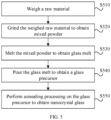
- FIG. 5 is a flowchart of a preparation method for nanocrystal glass according to an embodiment of this application. As shown in FIG. 5 , the preparation method includes S510-S540.
- the raw material may include Al 2 O 3 or Al(OH) 3 , CaCO 3 , an alkaline earth metal carbonate, an alkali metal carbonate, B(OH) 3 , and Sb 2 O 3 raw material.
- Al(OH) 3 serves as an introduction form of Al 2 O 3
- CaCO 3 serves as an introduction form of CaO
- B(OH) 3 serves as an introduction form of B 2 O 3 .
- addition amounts of the components of the raw material are respectively: Al 2 O 3 : 30%-55%, for example, 30%, 35%, 40%, 45%, 50%, or 55%; CaO: 25%-55%, for example, 25%, 30%, 35%, 45%, 50%, or 55%; an alkaline earth metal oxide: 8%-20%, for example, 8%, 9%, 10%, 11%, 12%, 13%, 14%, 15%, 16%, 17%, 18%, 19%, or 20%; an alkali metal oxide: 3%-15%, for example, 3%, 4%, 5%, 6%, 7%, 8%, 9%, 10%, 11%, 12%, 13%, 14%, or 15%; B 2 O 3 : 0%-10%, for example, 1%, 2%, 3%, 4%, 5%, 6%, 7%, 8%, 9%, or 10%; and Sb 2 O 3 : 0%-1%, for example, 0.1%, 0.2%, 0.3%, 0.4%
- a defect in the glass may be eliminated by adding Sb 2 O 3 , so that the glass is colorless and transparent, and a problem that the calcium aluminate glass is brown is improved. In this way, the glass has better transmittance, and the optical requirements of the electronic device for display and shooting can be met.
- B 2 O 3 within 10% limited in this application is added, to effectively change glass-forming performance of the entire glass system, and properly reduce glass viscosity, thereby resolving a problem that processing is affected by excessively high viscosity in a process.
- the alkaline earth metal carbonate may be one or more of MgCO 3 , SrCO 3 , and BaCO 3 . That is, the alkaline earth metal carbonate serves as an introduction form of the alkaline earth metal oxide.
- content of various types of alkaline earth metal ions separately accounts for 2%-10%, for example, 2%, 3%, 4%, 5%, 6%, 7%, 8%, 9%, or 10% of a total amount of the raw material in terms of mole percents of oxides.
- a total amount of the alkaline earth metal oxide accounts for 8%-20% of the total amount of the raw material.
- the proportions can enhance connection between glass network formers, improve mechanical performance of the nanocrystal glass, improve glass refractive index and optical absorptivity, and reduce a temperature for glass melting, thereby reducing melting energy consumption.
- the alkali metal oxide includes one or more of Li 2 O, Na 2 O, and K 2 O.
- percentages of metal ion oxides in the total amount of the raw material are: Li 2 O: 1%-10%, for example, 1%, 2%, 3%, 4%, 5%, 6%, 7%, 8%, 9%, or 10%; Na 2 O: 2%-10%, for example, 2%, 3%, 4%, 5%, 6%, 7%, 8%, 9%, or 10%; and K 2 O: 0%-10%, for example, 1%, 2%, 3%, 4%, 5%, 6%, 7%, 8%, 9%, or 10%.
- Total content of the alkali metal oxides accounts for 3%-15% of the total amount of the raw material.
- the proportions can reduce glass melting viscosity layers, promote rapid glass melting and clarification, generate high compressive stress on a surface of the glass, and improve mechanical performance.
- the weighed raw material is mixed and fully ground to form the mixed powder.
- the mixed powder may be placed in a crucible, the crucible is placed in a melting furnace, and melting is performed for 1 h-3 h at a temperature of 1400°C-1600°C to obtain the glass melt.
- a melting temperature may be 1410°C, 1450°C 1500°C, 1550°C, 1600°C, or the like.
- Melting duration may be 1 h, 1.5 h, 2 h, 2.5 h, or 3 h.
- the glass melt may be poured on a preheated mold, to prevent an excessively large temperature difference from affecting a glass-forming effect. In this way, a transparent and uniform glass precursor is obtained.
- S550 Perform annealing processing on the glass precursor to obtain nanocrystal glass.
- the glass precursor is transferred to a muffle furnace for annealing processing, where an annealing temperature is a temperature 30°C-50°C below a glass transition temperature (Tg); and the temperature is maintained for 3 h-8 h, stepped cooling is performed at a cooling rate of 0.1°C/h-10°C/h, and a temperature of each phase is maintained for 3 h-8 h, and then the temperature is cooled to a room temperature, to obtain the nanocrystal glass.
- the nanocrystal glass is processed to obtain a glass product.
- the nanocrystal glass that is taken out may be processed into a glass sheet product having a thickness of 0.5 mm-1 mm.
- the cooling rate may be 0.5°C/h, 1°C/h, 1.5°C/h, 2°C/h, 3°C/h, 4°C/h, 5°C/h, 6°C/h, 7°C/h, 8°C/h, 9°C/h, 10°C/h, or the like.
- a step method not mentioned in this application may use a method in the conventional technology. Details are not described in this application.
- the following describes a performance indicator of the nanocrystal glass in embodiments of this application.
- the molten potassium salt may be potassium nitrate, and ion exchange is performed at a temperature of 350°C-600°C for 0.5 hours-3 hours.
- Two-stage ion exchange includes: performing, in first molten salt for the first time, ion exchange on the glass obtained after heat treatment, and then performing ion exchange in second molten salt for the second time.
- the first molten salt is mixed molten salt of potassium nitrate and sodium nitrate, and ion exchange is performed at a temperature of 350°C-600°C for 0.5 h-3 h for the first time; and the second molten salt is potassium nitrate, and ion exchange is performed at a temperature of 350°C-600°C for 0.5 h-3 h for the second time.
- Table 2 is a parameter data table corresponding to the foregoing implementation steps used in seven different embodiments.
- Table 2 Embodiment 1 2 3 4 5 6 7 Al 2 O 3 (mol%) 30 30 36.5 37 40.5 45.5 55 CaO (mol%) 38 55 45 45 35 26 26 Mg (mol%) 10 7 10 10 3 10 / Sr (mol%) / / / / 3 5 / Ba (mol%) 5 / / / 3 / 7 Li (mol%) 3 / / / 5 / 3 Na (mol%) 10 3 4 4 7 5 5 K (mol%) / / / / / 5 / B 2 O 3 (mol%) 3 4 4 4 3 3 3 3 Sb 2 O 3 (mol%) 1 1 0.5 0 0.5 0.5 1 Temperature for heat treatment (°C) 800 820 850 840 850 870 900 Duration for heat treatment (h) 6 6 6 6 6 6 6 6 6 6 Vickers hardness after heat treatment (GPa) 7.9 8.1 8.4 8.4 8.5 8.5 8.6
- the nanocrystal glass in this embodiment of this application has high Vickers hardness and Young's modulus, and the Vickers hardness and the Young's modulus of the nanocrystal glass are respectively 8.4 GPa-9.1 GPa and 110 GPa-129 GPa.
- a test standard for the Vickers hardness is based on a method in the national standard GB/T 37900-2019, where a pressure used is 0.1 kgf and pressure maintaining duration is 10s.
- a test of the Young's modulus refer to a method in the national standard GB/T 7962.6-2010.
- the nanocrystal glass obtained based on the preparation method for nanocrystal glass in this embodiment of this application has higher Vickers hardness and Young's modulus.
- the Vickers hardness and the Young's modulus of the nanocrystal glass are respectively 8.4 GPa-9.1 GPa and 110 GPa-129 GPa, which are far higher than Vickers hardness and Young's modulus of glass in the conventional technology.
Landscapes
- Chemical & Material Sciences (AREA)
- Engineering & Computer Science (AREA)
- Materials Engineering (AREA)
- Organic Chemistry (AREA)
- Life Sciences & Earth Sciences (AREA)
- Chemical Kinetics & Catalysis (AREA)
- General Chemical & Material Sciences (AREA)
- Geochemistry & Mineralogy (AREA)
- Ceramic Engineering (AREA)
- Crystallography & Structural Chemistry (AREA)
- Signal Processing (AREA)
- Physics & Mathematics (AREA)
- Thermal Sciences (AREA)
- Dispersion Chemistry (AREA)
- Manufacturing & Machinery (AREA)
- Glass Compositions (AREA)
Abstract
Description
- This application claims priority to
Chinese Patent Application No. 202210822084.1, filed with the China National Intellectual Property Administration on July 12, 2022 - This application relates to the field of nanocrystal glass preparation technologies, and in particular, to nanocrystal glass, a preparation method, a nanocrystal glass product, and an electronic device.
- In recent years, with rapid development of electronic devices, people have increasingly high requirements for anti-fall performance of the electronic devices. A mobile phone is used as an example. As a size of a screen of the mobile phone continuously increases, a cover plate of the mobile phone is also increasingly large, and use of 3D glass is gradually increased. Therefore, a consumer has a higher requirement for performance such as drop resistance and scratch resistance of the glass. Therefore, nanocrystal glass with higher mechanical performance is required to meet a user requirement.
- In view of this, this application provides nanocrystal glass, a preparation method, a nanocrystal glass product, and an electronic device, to provide the nanocrystal glass that is more resistant to dropping and scratching, thereby resolving a problem that mechanical strength of existing glass cannot meet a user requirement.
- Some implementations of this application provide nanocrystal glass. The following describes this application from a plurality of aspects. For implementations and beneficial effects of the following plurality of aspects, references may be made to each other.
- According to a first aspect, this application provides nanocrystal glass. The nanocrystal glass includes the following components in terms of mole percents of oxides:
- Al2O3: 30%-55%;
- CaO: 25%-55%;
- an alkaline earth metal oxide: 8%-20%;
- an alkali metal oxide: 3%-15%;
- B2O3: 0%-10%; and
- Sb2O3: 0%-1%.
- According to the nanocrystal glass in this embodiment of this application, in a preparation process of the nanocrystal glass components such as an alkali metal and an alkaline earth metal are introduced into a calcium-aluminum binary system to improve glass-forming performance of the calcium-aluminum binary system and expand a glass-forming area of calcium aluminate glass, to obtain the calcium aluminate glass. The calcium aluminate glass has higher mechanical strength, and has better anti-fall performance and scratch resistance than those of conventional silicate glass and perhafnate glass. In addition, a temperature for glass melting is reduced, thereby reducing energy consumption.
- In an embodiment of the first aspect of this application, the alkaline earth metal oxide includes one or more of MgO, SrO, and BaO.
- In an embodiment of the first aspect of this application, the alkaline earth metal oxide includes at least two of MgO, SrO, and BaO, and content of various types of alkaline earth metal ions is 2%-10% in terms of mole percents. By adding an alkaline earth metal including the components, glass-forming performance of the calcium-aluminum binary system can be effectively improved, and hardness of the nanocrystal glass can be improved.
- In an embodiment of the first aspect of this application, the alkali metal oxide includes one or more of Li2O, Na2O, and K2O.
- In an embodiment of the first aspect of this application, in terms of mole percents of components, the alkali metal oxide includes: Li2O: 1%-10%; Na2O: 2%-10%; and K2O: 0%-10%. Proportions of the components further improve the glass-forming performance of the calcium-aluminum binary system.
- In an embodiment of the first aspect of this application, the nanocrystal glass includes nanocrystalline particles, and the nanocrystalline particles may be of one or more crystal phases of CaAl2O4, MgAl2O4, and SrAl2O4.
- In an embodiment of the first aspect of this application, an average particle size of the nanocrystalline particles is 1 nm-100 nm.
- In an embodiment of the first aspect of this application, content of the nanocrystalline particles accounts for 50% or more of a total amount of the entire nanocrystal glass.
- In an embodiment of the first aspect of this application, the average particle size of the nanocrystalline particles is 1 nm-50 nm, and the content of the nanocrystalline particles accounts for 80% or more of the total amount of the entire nanocrystal glass. Therefore, an increase in the content of the nanocrystalline particles can effectively improve the hardness of the nanocrystal glass.
- In an embodiment of the first aspect of this application, Vickers hardness of the nanocrystal glass is 8.4 Gpa-9.1 Gpa.
- In an embodiment of the first aspect of this application, Young's modulus of the nanocrystal glass is 110 GPa-129 GPa.
- According to a second aspect, this application further provides a preparation method for nanocrystal glass, including:
- weighing a raw material, where, in terms of mole percents of oxides, components of the raw material are: Al2O3: 30%-55%; CaO: 25%-55%; an alkaline earth metal oxide: 8%-20%; an alkali metal oxide: 3%-15%; B2O3: 0%-10%; and Sb2O3: 0%-1%;
- grinding the weighed raw material to obtain mixed powder;
- melting the mixed powder to obtain glass melt;
- pouring the glass melt to obtain a glass precursor; and
- performing annealing processing on the glass precursor to obtain the nanocrystal glass.
- In the preparation method for nanocrystal glass in this embodiment of this application, components such as an alkali metal and an alkaline earth metal are introduced into a calcium-aluminum binary system to improve glass-forming performance of the calcium-aluminum binary system and expand a glass-forming area of calcium aluminate glass, to obtain the calcium aluminate glass. The calcium aluminate glass has higher mechanical strength, and has better anti-fall performance and scratch resistance than those of conventional silicate glass and perhafnate glass. In addition, a temperature for glass melting is reduced, thereby reducing energy consumption.
- In an embodiment of the second aspect of this application, the melting the mixed powder to obtain glass melt includes:
placing the mixed powder in a crucible, then placing the crucible in a melting furnace, and performing melting for 1 h-3 h at 1400°C-1600°C to obtain the glass melt. - In an embodiment of the second aspect of this application, the pouring the glass melt to obtain a glass precursor includes:
pouring the glass melt on a preheated mold to obtain a uniform glass precursor. - In an embodiment of the second aspect of this application, the performing annealing processing on the glass precursor, and cooling to a room temperature, to obtain the nanocrystal glass includes:
transferring the glass precursor to a muffle furnace for annealing processing, where the annealing processing means that a temperature of the muffle furnace is cooled to atemperature 30°C-50°C below a glass transition temperature, the temperature is maintained for 3 h-8 h, stepped cooling is performed at a cooling rate of 0.1°C/h-10°C/h, and a temperature of each phase is maintained for 3 h-8 h, until the temperature is cooled to a room temperature, to obtain the nanocrystal glass. - In an embodiment of the second aspect of this application, a manner of introducing Al2O3 is Al2O3 or Al(OH)3, a manner of introducing CaO is CaCO3, a manner of introducing the alkaline earth metal oxide is an alkaline earth metal carbonate, a manner of introducing the alkali metal oxide is an alkali metal carbonate, and a manner of introducing B2O3 is B(OH)3. In an embodiment of the second aspect of this application, the alkaline earth metal carbonate includes one or more of MgCO3, SrCO3, and BaCO3.
- In an embodiment of the second aspect of this application, the alkaline earth metal carbonate includes MgCO3, SrCO3, and BaCO3, and content of various types of alkaline earth metal ions is separately 2%-10% in terms of mole percents. By adding an alkaline earth metal including the components, glass-forming performance of the calcium-aluminum binary system can be effectively improved, hardness of the nanocrystal glass can be improved, and a temperature and energy consumption for glass melting can be reduced.
- In an embodiment of the second aspect of this application, the alkali metal carbonate includes one or more of Li2CO3, Na2CO3, and K2CO3. An alkaline earth metal including the components can effectively improve glass-forming performance of the calcium-aluminum binary system and hardness of the nanocrystal glass.
- In an embodiment of the second aspect of this application, mole percents of components of the alkali metal oxide are respectively: Li2O: 1%-10%; Na2O: 2%-10%; and K2O: 0%-10%.
- According to a third aspect, this application further provides a nanocrystal glass product, where the nanocrystal glass product is made of the nanocrystal glass according to any one of the first aspect and the embodiments thereof.
- According to a fourth aspect, this application further provides an electronic device, including:
- a main middle frame;
- a cover plate, where the cover plate is disposed on a side of the main middle frame; and
- a display screen, where the display screen is disposed on a side that is of the main middle frame and that is opposite to the cover plate;
- where at least one of the cover plate and the display screen includes the nanocrystal glass according to any one of the first aspect and the embodiments thereof.
-
-
FIG. 1 is a schematic diagram of a structure of a mobile phone according to an embodiment of this application; -
FIG. 2A is an exploded view of a structure of a mobile phone according to an embodiment of this application; -
FIG. 2B is a schematic diagram of another structure of a mobile phone according to an embodiment of this application; -
FIG. 3 shows a scanning electron microscope photo of a microstructure of nanocrystal glass according to an embodiment of this application; -
FIG. 4 shows a curve chart of transmittance of nanocrystal glass according to an embodiment of this application; and -
FIG. 5 is a flowchart of a preparation method for nanocrystal glass according to an embodiment of this application. - The following clearly and completely describes embodiments of this application with reference to the accompanying drawings.
- Nanocrystal glass (Nanocrystal glass) is also referred to as ceramic glass, is an inorganic non-metallic material, and is a new material that has both a glass characteristic and a ceramic characteristic. There is no regular atomic arrangement in common glass, which is also a reason for glass fragility. The nanocrystal glass, like ceramic, contains crystals, and atomic arrangement of the crystals is regular. Therefore, the nanocrystal glass has higher brightness than that of the ceramic and stronger toughness than that of glass.
- To facilitate understanding of the technical solutions of this application, the following first describes the technical problem of this application.
- Calcium aluminate glass is a kind of nanocrystal glass, and has better mechanical performance than conventional glass. However, a glass-forming area of a calcium-aluminum binary system is extremely limited, and glass-forming can be implemented only when content of CaO is in a range of 61 mol%-66 mol%. Consequently, glass-forming performance of conventional calcium aluminate glass is poor, which affects application of glass of this system
- To resolve the foregoing technical problem, this application provides nanocrystal glass. In a process of preparing the nanocrystal glass, components such as an alkali metal and an alkaline earth metal are introduced into glass of the calcium-aluminum binary system. In this way, glass-forming performance of the nanocrystal glass is improved, and the glass-forming area of the calcium aluminate glass is expanded, so that the nanocrystal glass provided in this application is obtained. The nanocrystal glass provided in this application has higher mechanical strength, and anti-fall performance and scratch resistance of the nanocrystal glass are better than those of the conventional glass.
- The nanocrystal glass in this application may be applied to an electronic device. For example, the nanocrystal glass may be fabricated into a cover plate of the electronic device, for example, glass of a front cover plate of a screen or a rear cover (a backplane) of a mobile phone, and fabricated into a housing and the like.
- The following describes an application scenario of the nanocrystal glass of embodiments of this application by using an example in which the nanocrystal glass is applied to a mobile phone.
- Referring to
FIG. 1, FIG. 1 is a schematic diagram of a structure of a mobile phone according to an embodiment of this application. As shown inFIG. 1 , amobile phone 100 may include a rear cover, a display screen, a main middle frame, a camera protective cover plate, and the like. Some or all of these components may be made of the nanocrystal glass. - Referring to
FIG. 2A, FIG. 2A is an exploded view of a partial structure of a mobile phone according to an embodiment of this application. As shown inFIG. 2A , themobile phone 100 may include a mainmiddle frame 10, arear cover 20, and adisplay screen 30, where therear cover 20 and thedisplay screen 30 are respectively disposed on two sides of the mainmiddle frame 10, to seal and cover components disposed inside the middle frame. Thedisplay screen 30 and/or therear cover 20 may be made of the nanocrystal glass. In this embodiment of the present invention, thedisplay screen 30 and/or therear cover 20 may be completely made of the nanocrystal glass or may be partially made of the nanocrystal glass. In this embodiment of the present invention, thedisplay screen 200 may be a touch screen - In an embodiment of this application,
FIG. 2B is a schematic diagram of another structure of a mobile phone according to an embodiment of this application. A cameraprotective cover 21 is disposed on therear cover 20 of themobile phone 100, and the cameraprotective cover 21 is configured to cover a camera assembly to better protect the camera assembly. The camera protective cover may be completely or partially made of the nanocrystal glass of this application. In this embodiment of this application, the camera protective cover is not limited to a form shown inFIG. 2A . - The nanocrystal glass with excellent anti-fall performance is used for the mobile phone of this application, so that the mobile phone has performance such as drop resistance and scratch resistance, thereby improving reliability of a terminal product and improving user experience.
- In some embodiments of this application, the electronic device may alternatively be a notebook computer, a tablet computer, a desktop computer, or another electronic device, or may be a smart wearable device, for example, a watch or a wristband. A type of the electronic device is not limited in this application.
- In some embodiments, the nanocrystal glass may be further applied to another scenario, for example, applied to a part that can be made of glass in a vehicle. For example, a vehicle light cover, a windshield, glass of an in-vehicle instrument panel, or the like may be made of the nanocrystal glass in this application.
- In some embodiments, the nanocrystal glass may also be processed into glass products with different dimensions for use in different devices, for example, may be fabricated into a 2D, 2.5D, or 3D glass product. This application sets no limitation on application of the nanocrystal glass and a form of the glass product.
- The following describes in detail the nanocrystal glass in embodiments of this application with reference to the accompanying drawings.
- In this embodiment of this application, the nanocrystal glass includes components shown in Table 1 in terms of mole percents of oxides.
Table 1 Serial number Component mol% 1 Al2O3 30-55 2 CaO 25-55 3 Alkaline earth metal oxide 8-20 4 Alkali metal oxide 3-15 5 B2O3 0-10 6 Sb2O3 0-1 - In this embodiment of this application, alkaline earth metal ions such as magnesium oxide (MgO), strontium oxide (SrO), and barium oxide (BaO) are added to a glass system that contains Al2O3 and CaO, to improve a glass-forming ability. Glass is an amorphous substance. After cations with high field strength, such as, Mg ions, are added, free oxygen atoms in a glass network are attracted to form a plurality of tetrahedral or hexahedral structures. In this way, a network structure tends to be tight, and it is easier to form the glass. A structure of magnesium oxide (MgO) in the glass is relatively complex. Usually, a coordination form in the glass network changes with alkali metal content. In the glass network, penta-coordinated and hexa-coordinated Mg has a similar effect to an alkali metal, and mainly plays a role of destroying a structure of the glass network. However, tetra-coordinated Mg exists in the glass in a form of a [MgO4] structural unit, to enhance connection between glass network formers. Strontium oxide (SrO) has important biological activity, and can improve compatibility of glass with biological cells in biological glass. Barium oxide (BaO) may mainly improve glass refractive index and optical absorptivity, and reduce a temperature for glass melting.
- Alkali metal ions are added to the glass system containing Al2O3 and CaO, to reduce glass melting viscosity layers and improve the glass-forming ability. Li2O, Na2O, and K2O are network modifiers, which can reduce the glass melting viscosity layers and promotes rapid glass melting and clarification. In addition, as necessary components, Li2O and Na2O play a role of enabling the glass to contain enough Li+ and Na+ to be respectively exchanged with Na+ and K+ in molten potassium salt, to generate high compressive stress on a surface of the glass.
- In addition, the alkaline earth metal ion components and the alkali metal ion components are simultaneously added to the glass system of Al2O3 and CaO, to form mixed cation effects in the original calcium aluminate glass, including a mixed alkali effect and a mixed alkaline earth effect. Generation of the mixed cation effects can effectively improve glass-forming performance of the glass, and reduce the temperature and energy consumption for glass melting.
- In this embodiment of this application, the components are proportioned based on the component content in Table 1 to obtain the nanocrystal glass. Therefore, glass-forming performance of the glass can be effectively improved, the glass-forming area of the calcium aluminate glass is expanded, strong compressive stress is generated on the surface of the glass, mechanical strength of the nanocrystal glass is improved, anti-fall performance and scratch resistance of the nanocrystal glass are better than those of conventional nanocrystal glass, and the temperature and the energy consumption for glass melting can be reduced.
- In an embodiment of this application, the alkaline earth metal oxide includes one or more of MgO, SrO, and BaO. The alkaline earth metal oxide includes at least two of MgO, SrO, and BaO, and content of various types of alkaline earth metal ions is 2%-10% in terms of mole percents. This proportion can expand a glass-forming area of a calcium-aluminum binary system, thereby improving the glass-forming ability, and improving mechanical performance of the nanocrystal glass.
- In this embodiment of this application, a manner of introducing MgO may be MgCO3, a manner of introducing SrO is SrCO3, and a manner of introducing BaO is BaCO3. In some embodiments, the alkaline earth metal oxide may alternatively be introduced in another manner, for example, in a manner of introducing a metal oxide, for example, directly introducing MgO, SrO, and BaO. A manner of introducing the metal oxide is not limited in this application.
- In another embodiment of this application, the alkali metal oxide includes one or more of Li2O, Na2O, and K2O. Mole percents of the components in the alkali metal oxide may be as follows: A mole percent of Li2O is 1%-10%. In an embodiment of this application, the mole percent of Li2O may be 1%, 2%, 3%, 4%, 5%, 6%, 7%, 8%, 9%, 10%, or the like; a mole percent of Na2O is 2%-10%, for example, may be 2%, 3%, 4%, 5%, 6%, 7%, 8%, 9%, 10%, or the like; and a mole percent of K2O is 0%-10%, for example, may be 1%, 2%, 3%, 4%, 5%, 6%, 7%, 8%, 9%, 10%, or the like.
- Referring to
FIG. 3, FIG. 3 shows a scanning electron microscope photo of a microstructure of nanocrystal glass according to an embodiment of this application. As shown inFIG. 3 , after heat treatment of different duration and temperatures is performed on the nanocrystal glass having the foregoing components, nanocrystalline particles in the figure may be obtained. The nanocrystalline particles may be of one or more crystal phases of CaAl2O4, MgAl2O4, and SrAl2O4. A particle size of the nanocrystalline particles may be several to hundreds of nanometers. In an embodiment of this application, an average particle size of the nanocrystalline particles is 1 nm-100 nm, and nanocrystalline content may account for 50% or more of the entire nanocrystal glass. In another embodiment of this application, the average particle size of the nanocrystalline particles is 1 nm-50 nm, and the nanocrystalline content may account for 80% or more of the entire nanocrystal glass. Therefore, strength of the nanocrystal glass is greatly improved. - In an embodiment of this application, the glass obtained after microcrystallization may be a transparent glass material. The transparent glass material is applied to the glass of the cover plate of the mobile phone shown in
FIG. 1 , thereby improving anti-fall performance of the cover plate of the mobile phone with high transmittance. The transparent glass material is applied to the camera protective cover shown inFIG. 2B , so that the camera protective cover has high transmittance while resisting falling, thereby better meeting a requirement of a camera for light transmission. - Referring to
FIG. 4, FIG. 4 shows a curve chart of transmittance of nanocrystal glass according to an embodiment of this application. As shown inFIG. 4 , transmittance of the nanocrystal glass in this application may be 90% or more within a visible light range, which can meet optical requirements of the electronic device for display and shooting, and is applicable to fabricating the cover plate of the display screen and the camera protective cover plate of the electronic device. - In some embodiments, the glass obtained after microcrystallization may alternatively be a non-transparent material. The non-transparent material may be used to fabricate the backplane of the mobile phone shown in
FIG. 1 . - In this embodiment of this application, the transparent glass material or the non-transparent glass material may be obtained by adjusting the components in the entire glass system. For example, when the transparent glass material is prepared, in a process of preparing the nanocrystal glass, Sb2O3 of 0 mol%-1 mol%, for example, 0.1 mol%, 0.2 mol%, 0.3 mol%, 0.4 mol%, 0.5 mol%, 0.6 mol%, 0.7 mol%, 0.8 mol%, 0.9 mol%, or 1 mol%, may be added, and the heat treatment temperature and duration may be adjusted, to obtain the transparent glass material. When the non-transparent glass material is prepared, Sb2O3 may not be added, and the heat treatment temperature and duration are appropriately adjusted, to obtain the non-transparent glass material.
- In this embodiment of this application, B2O3 in the calcium aluminate glass is used as a network former of basic glass. In this embodiment of this application, content of B2O3 may be 1 mol%, 2 mol%, 3 mol%, 4 mol%, 5 mol%, 6 mol%, 7 mol%, 8 mol%, 9 mol%, or 10 mol%. This proportion can reduce glass viscosity, facilitate glass production, and change glass-forming performance of the glass.
- In some embodiments, to further improve hardness of the nanocrystal glass, low-temperature chemical strengthening (ion exchange chemical strengthening) may be further performed on the nanocrystal glass after the nanocrystal glass is prepared, to obtain strengthened nanocrystal glass. For example, the nanocrystal glass may be immersed in a bath of an ion exchange solution, the ion exchange solution may be sprayed on the nanocrystal glass, or the ion exchange solution may be physically applied to the nanocrystal glass in any other manner, so that the nanocrystal glass contacts the ion exchange solution. By performing ion exchange chemical strengthening on the nanocrystal glass, a compressive stress layer may be formed on a surface of the nanocrystal glass, so that mechanical performance of the strengthened nanocrystal glass is further improved.
- In some embodiments, ion exchange chemical strengthening may be divided into a plurality of strengthening steps. For example, when chemical strengthening is performed for two times, a temperature and duration for each time may be adjusted based on different requirements, thereby further improving an ion exchange depth and surface compressive stress, and improving mechanical performance of the nanocrystal glass.
- The following describes a preparation method for nanocrystal glass in this application with reference to a specific embodiment.
- Referring to
FIG. 5, FIG. 5 is a flowchart of a preparation method for nanocrystal glass according to an embodiment of this application. As shown inFIG. 5 , the preparation method includes S510-S540. - S510: Weigh a raw material.
- In this embodiment of this application, the raw material may include Al2O3 or Al(OH)3, CaCO3, an alkaline earth metal carbonate, an alkali metal carbonate, B(OH)3, and Sb2O3 raw material. Al(OH)3 serves as an introduction form of Al2O3, CaCO3 serves as an introduction form of CaO, and B(OH)3 serves as an introduction form of B2O3. In terms of mole percents of oxides, addition amounts of the components of the raw material are respectively: Al2O3: 30%-55%, for example, 30%, 35%, 40%, 45%, 50%, or 55%; CaO: 25%-55%, for example, 25%, 30%, 35%, 45%, 50%, or 55%; an alkaline earth metal oxide: 8%-20%, for example, 8%, 9%, 10%, 11%, 12%, 13%, 14%, 15%, 16%, 17%, 18%, 19%, or 20%; an alkali metal oxide: 3%-15%, for example, 3%, 4%, 5%, 6%, 7%, 8%, 9%, 10%, 11%, 12%, 13%, 14%, or 15%; B2O3: 0%-10%, for example, 1%, 2%, 3%, 4%, 5%, 6%, 7%, 8%, 9%, or 10%; and Sb2O3: 0%-1%, for example, 0.1%, 0.2%, 0.3%, 0.4%, 0.5%, 0.6%, 0.7%, 0.8%, 0.9%, or 1%.
- In this embodiment of this application, a defect in the glass may be eliminated by adding Sb2O3, so that the glass is colorless and transparent, and a problem that the calcium aluminate glass is brown is improved. In this way, the glass has better transmittance, and the optical requirements of the electronic device for display and shooting can be met.
- In this embodiment of this application, B2O3 within 10% limited in this application is added, to effectively change glass-forming performance of the entire glass system, and properly reduce glass viscosity, thereby resolving a problem that processing is affected by excessively high viscosity in a process.
- In this embodiment of this application, the alkaline earth metal carbonate may be one or more of MgCO3, SrCO3, and BaCO3. That is, the alkaline earth metal carbonate serves as an introduction form of the alkaline earth metal oxide. When two or more components are included in the alkaline earth metal oxide, content of various types of alkaline earth metal ions separately accounts for 2%-10%, for example, 2%, 3%, 4%, 5%, 6%, 7%, 8%, 9%, or 10% of a total amount of the raw material in terms of mole percents of oxides. A total amount of the alkaline earth metal oxide accounts for 8%-20% of the total amount of the raw material. The proportions can enhance connection between glass network formers, improve mechanical performance of the nanocrystal glass, improve glass refractive index and optical absorptivity, and reduce a temperature for glass melting, thereby reducing melting energy consumption.
- In an embodiment of this application, the alkali metal oxide includes one or more of Li2O, Na2O, and K2O. When there are a plurality of alkali metal oxides, percentages of metal ion oxides in the total amount of the raw material are: Li2O: 1%-10%, for example, 1%, 2%, 3%, 4%, 5%, 6%, 7%, 8%, 9%, or 10%; Na2O: 2%-10%, for example, 2%, 3%, 4%, 5%, 6%, 7%, 8%, 9%, or 10%; and K2O: 0%-10%, for example, 1%, 2%, 3%, 4%, 5%, 6%, 7%, 8%, 9%, or 10%. Total content of the alkali metal oxides accounts for 3%-15% of the total amount of the raw material. The proportions can reduce glass melting viscosity layers, promote rapid glass melting and clarification, generate high compressive stress on a surface of the glass, and improve mechanical performance.
- S520: Grind the weighed raw material to obtain mixed powder.
- The weighed raw material is mixed and fully ground to form the mixed powder.
- S530: Melt the mixed powder to obtain glass melt.
- In this embodiment of this application, the mixed powder may be placed in a crucible, the crucible is placed in a melting furnace, and melting is performed for 1 h-3 h at a temperature of 1400°C-1600°C to obtain the glass melt. A melting temperature may be 1410°C, 1450°C 1500°C, 1550°C, 1600°C, or the like. Melting duration may be 1 h, 1.5 h, 2 h, 2.5 h, or 3 h.
- S540: Pour the glass melt to obtain a glass precursor.
- In this embodiment of this application, the glass melt may be poured on a preheated mold, to prevent an excessively large temperature difference from affecting a glass-forming effect. In this way, a transparent and uniform glass precursor is obtained.
- S550: Perform annealing processing on the glass precursor to obtain nanocrystal glass.
- In an embodiment of this application, the glass precursor is transferred to a muffle furnace for annealing processing, where an annealing temperature is a
temperature 30°C-50°C below a glass transition temperature (Tg); and the temperature is maintained for 3 h-8 h, stepped cooling is performed at a cooling rate of 0.1°C/h-10°C/h, and a temperature of each phase is maintained for 3 h-8 h, and then the temperature is cooled to a room temperature, to obtain the nanocrystal glass. The nanocrystal glass is processed to obtain a glass product. For example, the nanocrystal glass that is taken out may be processed into a glass sheet product having a thickness of 0.5 mm-1 mm. - In an embodiment of this application, the cooling rate may be 0.5°C/h, 1°C/h, 1.5°C/h, 2°C/h, 3°C/h, 4°C/h, 5°C/h, 6°C/h, 7°C/h, 8°C/h, 9°C/h, 10°C/h, or the like.
- It should be noted that in the foregoing description of the nanocrystal glass, example proportions of the chemical components and a reason why the chemical components can improve glass-forming performance and mechanical performance of the nanocrystal glass are already described in detail. For details, refer to specific descriptions of the nanocrystal glass. Details are not described herein again.
- In addition, a step method not mentioned in this application may use a method in the conventional technology. Details are not described in this application.
- With reference to a specific embodiment, the following describes a performance indicator of the nanocrystal glass in embodiments of this application.
- Implementation steps of the specific embodiment are as follows. For specific parameter values, refer to Table 2.
- 1) Weigh a raw material. The raw material is weighed based on mole percents of metal oxides shown in Table 2.
- 2) Uniformly mix the weighed raw material, maintain a temperature at 1600°C for 2 hours for melting, then perform pouring molding, perform annealing to maintain the temperature at 700°C for 5 h, and cool the temperature to a room temperature at a cooling rate of 1°C per minute, to obtain calcium aluminate glass.
- 3) Process an obtained glass precursor into a 10 mm×10 mm×1 mm glass sheet, and polish both sides of the glass sheet.
- 4) Perform heat treatment on the calcium aluminate glass for microcrystallization (heat treatment conditions in embodiments are shown in Table 2), where tested Vickers hardness and Young's modulus of glass obtained after heat treatment are respectively listed in Table 2.
- 5) Further perform ion exchange strengthening on the glass sheet obtained after heat treatment. Ion exchange conditions are shown in Table 2, and Vickers hardness of strengthened calcium aluminate nanocrystal glass is shown in Table 2. One-stage ion exchange in Table 2 includes: performing, in molten potassium salt, ion exchange on the glass obtained after heat treatment.
- In this embodiment, the molten potassium salt may be potassium nitrate, and ion exchange is performed at a temperature of 350°C-600°C for 0.5 hours-3 hours. Two-stage ion exchange includes: performing, in first molten salt for the first time, ion exchange on the glass obtained after heat treatment, and then performing ion exchange in second molten salt for the second time. The first molten salt is mixed molten salt of potassium nitrate and sodium nitrate, and ion exchange is performed at a temperature of 350°C-600°C for 0.5 h-3 h for the first time; and the second molten salt is potassium nitrate, and ion exchange is performed at a temperature of 350°C-600°C for 0.5 h-3 h for the second time.
- Table 2 is a parameter data table corresponding to the foregoing implementation steps used in seven different embodiments.
Table 2 Embodiment 1 2 3 4 5 6 7 Al2O3 (mol%) 30 30 36.5 37 40.5 45.5 55 CaO (mol%) 38 55 45 45 35 26 26 Mg (mol%) 10 7 10 10 3 10 / Sr (mol%) / / / / 3 5 / Ba (mol%) 5 / / / 3 / 7 Li (mol%) 3 / / / 5 / 3 Na (mol%) 10 3 4 4 7 5 5 K (mol%) / / / / / 5 / B2O3 (mol%) 3 4 4 4 3 3 3 Sb2O3 (mol%) 1 1 0.5 0 0.5 0.5 1 Temperature for heat treatment (°C) 800 820 850 840 850 870 900 Duration for heat treatment (h) 6 6 6 6 6 6 6 Vickers hardness after heat treatment (GPa) 7.9 8.1 8.4 8.4 8.5 8.5 8.6 Young's modulus after heat treatment (GPa) 110 113 121 120 122 125 129 Temperature for one-stage ion exchange (°C) 420 420 420 420 420 450 420 Duration for one-stage ion exchange (h) 0.5 2 2 3 1 2 1.5 Temperature for two-stage ion exchange (°C) 450 / / / 430 / 500 Duration for two-stage ion exchange (h) 1 / / / 2 / 1 Vickers hardness after ion exchange (GPa) 8.4 8.7 9.0 8.9 9.0 9.1 9.1 - It can be learned from Table 2 that the nanocrystal glass in this embodiment of this application has high Vickers hardness and Young's modulus, and the Vickers hardness and the Young's modulus of the nanocrystal glass are respectively 8.4 GPa-9.1 GPa and 110 GPa-129 GPa.
- A test standard for the Vickers hardness is based on a method in the national standard GB/T 37900-2019, where a pressure used is 0.1 kgf and pressure maintaining duration is 10s. For a test of the Young's modulus, refer to a method in the national standard GB/T 7962.6-2010.
- In addition, hardness of the nanocrystal glass in this application is compared with that of conventional silicate glass in the conventional technology. Same test methods are used, and conventional commercial nanocrystal glass is used as a comparative example. In the comparative example, Vickers hardness and Young's modulus after chemical strengthening of the glass are respectively 6.3 GPa and 100 GPa.
- It can be learned from Table 2 and a test result of the nanocrystal glass in the comparative example that the nanocrystal glass obtained based on the preparation method for nanocrystal glass in this embodiment of this application has higher Vickers hardness and Young's modulus. The Vickers hardness and the Young's modulus of the nanocrystal glass are respectively 8.4 GPa-9.1 GPa and 110 GPa-129 GPa, which are far higher than Vickers hardness and Young's modulus of glass in the conventional technology.
- Although this application has been illustrated or described with reference to some preferred embodiments of this application, a person of ordinary skill in the art should understand that various modifications may be made to forms and details without departing from the spirit and scope of this application.
Claims (22)
- Nanocrystal glass, wherein the nanocrystal glass comprises the following components in terms of mole percents of oxides:Al2O3: 30%-55%;CaO: 25%-55%;an alkaline earth metal oxide: 8%-20%;an alkali metal oxide: 3%-15%;B2O3: 0%-10%; andSb2O3: 0%-1%.
- The nanocrystal glass according to claim 1, wherein the alkaline earth metal oxide comprises one or more of MgO, SrO, and BaO.
- The nanocrystal glass according to claim 1 or 2, wherein the alkaline earth metal oxide comprises at least two of MgO, SrO, and BaO, and content of various types of alkaline earth metal ions is 2%-10% in terms of mole percents.
- The nanocrystal glass according to any one of claims 1-3, wherein the alkali metal oxide comprises one or more of Li2O, Na2O, and K2O.
- The nanocrystal glass according to claim 4, wherein, in terms of mole percents of components, the alkali metal oxide comprises:Li2O: 1%-10%;Na2O: 2%-10%; andK2O: 0%-10%.
- The nanocrystal glass according to claim 1, comprising nanocrystalline particles, wherein the nanocrystalline particles may be of one or more crystal phases of CaAl2O4, MgAl2O4, and SrAl2O4.
- The nanocrystal glass according to claim 6, wherein an average particle size of the nanocrystalline particles is 1 nm-100 nm.
- The nanocrystal glass according to claim 6 or 7, wherein content of the nanocrystalline particles accounts for 50% or more of a total amount of the entire nanocrystal glass.
- The nanocrystal glass according to claim 7 or 8, wherein the average particle size of the nanocrystalline particles is 1 nm-50 nm, and the content of the nanocrystalline particles accounts for 80% or more of the total amount of the entire nanocrystal glass.
- The nanocrystal glass according to any one of claims 1-9, wherein Vickers hardness of the nanocrystal glass is 8.4 Gpa-9.1 Gpa.
- The nanocrystal glass according to any one of claims 1-10, wherein Young's modulus of the nanocrystal glass is 110 GPa-129 GPa.
- A preparation method for nanocrystal glass, comprising:weighing a raw material, wherein, in terms of mole percents of oxides, components of the raw material are: Al2O3: 30%-55%; CaO: 25%-55%; an alkaline earth metal oxide: 8%-20%; an alkali metal oxide: 3%-15%; B2O3: 0%-10%; and Sb2O3: 0%-1%;grinding the weighed raw material to obtain mixed powder;melting the mixed powder to obtain glass melt;pouring the glass melt to obtain a glass precursor; andperforming annealing and heat treatment on the glass precursor to obtain the nanocrystal glass.
- The method according to claim 12, wherein the melting the mixed powder to obtain glass melt comprises:
placing the mixed powder in a crucible, then placing the crucible in a melting furnace, and performing melting for 1 h-3 h at 1400°C-1600°C to obtain the glass melt. - The method according to claim 12, wherein the pouring the glass melt to obtain a glass precursor comprises:
pouring the glass melt on a preheated mold to obtain a uniform glass precursor - The method according to claim 12, wherein the performing annealing and heat treatment on the glass precursor to obtain the nanocrystal glass comprises:
transferring the glass precursor to a muffle furnace for annealing processing, wherein the annealing processing means that a temperature of the muffle furnace is cooled to a temperature 30°C-50°C below a glass transition temperature, the temperature is maintained for 3 h-8 h, stepped cooling is performed at a cooling rate of 0.1°C/h-10°C/h, and a temperature of each phase is maintained for 3 h-8 h, until the temperature is cooled to a room temperature, to obtain the nanocrystal glass. - The method according to claim 12, wherein a manner of introducing Al2O3 is Al2O3 or Al(OH)3, a manner of introducing CaO is CaCO3, a manner of introducing the alkaline earth metal oxide is an alkaline earth metal carbonate, a manner of introducing the alkali metal oxide is an alkali metal carbonate, and a manner of introducing B2O3 is B(OH)3.
- The method according to claim 16, wherein the alkaline earth metal carbonate comprises one or more of MgCO3, SrCO3, and BaCO3.
- The method according to claim 17, wherein the alkaline earth metal carbonate comprises MgCO3, SrCO3, and BaCO3, and content of various types of alkaline earth metal ions separately accounts for 2%-10% of a total amount of the raw material in terms of mole percents of oxides.
- The method according to any one of claims 16-18, wherein the alkali metal carbonate comprises one or more of Li2CO3, Na2CO3, and K2CO3.
- The method according to claim 18, wherein mole percents of components of the alkali metal oxide are respectively: Li2O: 1%-10%; Na2O: 2%-10%; and K2O: 0%-10%.
- A nanocrystal glass product, wherein the nanocrystal glass product is made of the nanocrystal glass according to any one of claims 1-11.
- An electronic device, comprising:a main middle frame;a cover plate, wherein the cover plate is disposed on a side of the main middle frame; anda display screen, wherein the display screen is disposed on a side that is of the main middle frame and that is opposite to the cover plate;wherein at least one of the cover plate and the display screen comprises the nanocrystal glass according to any one of claims 1-11.
Applications Claiming Priority (2)
| Application Number | Priority Date | Filing Date | Title |
|---|---|---|---|
| CN202210822084.1A CN117430332B (en) | 2022-07-12 | 2022-07-12 | Microcrystalline glass, preparation method, microcrystalline glass product and electronic equipment |
| PCT/CN2023/089841 WO2024011993A1 (en) | 2022-07-12 | 2023-04-21 | Microcrystalline glass, preparation method, microcrystalline glass product, and electronic device |
Publications (2)
| Publication Number | Publication Date |
|---|---|
| EP4549410A1 true EP4549410A1 (en) | 2025-05-07 |
| EP4549410A4 EP4549410A4 (en) | 2025-10-15 |
Family
ID=89535403
Family Applications (1)
| Application Number | Title | Priority Date | Filing Date |
|---|---|---|---|
| EP23838494.5A Pending EP4549410A4 (en) | 2022-07-12 | 2023-04-21 | MICROCRYSTALLINE GLASS, PREPARATION METHOD, MICROCRYSTALLINE GLASS PRODUCT, AND ELECTRONIC DEVICE |
Country Status (4)
| Country | Link |
|---|---|
| US (1) | US20250326681A1 (en) |
| EP (1) | EP4549410A4 (en) |
| CN (2) | CN117430332B (en) |
| WO (1) | WO2024011993A1 (en) |
Families Citing this family (1)
| Publication number | Priority date | Publication date | Assignee | Title |
|---|---|---|---|---|
| CN121517203B (en) * | 2026-01-16 | 2026-04-14 | 武汉理工大学 | A high-strength mid-infrared transparent calcium aluminum ceramic and its preparation method |
Family Cites Families (6)
| Publication number | Priority date | Publication date | Assignee | Title |
|---|---|---|---|---|
| US3635739A (en) * | 1969-06-04 | 1972-01-18 | Corning Glass Works | Silica-free calcium aluminate glass-ceramic articles |
| JP2002145642A (en) * | 2000-11-09 | 2002-05-22 | Ohara Inc | Light emissive crystallized glass |
| JP2007197249A (en) * | 2006-01-26 | 2007-08-09 | Ohara Inc | Glass ceramic and method for producing glass ceramic |
| JP2010052953A (en) * | 2008-08-26 | 2010-03-11 | Nippon Electric Glass Co Ltd | Glass ceramic composition for wiring board and glass ceramic sintered body |
| CN103951185A (en) * | 2014-04-02 | 2014-07-30 | 中国科学院上海光学精密机械研究所 | Neodymium-doped calcium aluminate glass and preparation method thereof |
| CN104692657A (en) * | 2015-02-10 | 2015-06-10 | 中国科学院上海光学精密机械研究所 | Neodymium-doped low germanium-aluminum-gallium salt laser glass and preparation method thereof |
-
2022
- 2022-07-12 CN CN202210822084.1A patent/CN117430332B/en active Active
-
2023
- 2023-04-21 WO PCT/CN2023/089841 patent/WO2024011993A1/en not_active Ceased
- 2023-04-21 EP EP23838494.5A patent/EP4549410A4/en active Pending
- 2023-04-21 CN CN202380053587.XA patent/CN119630615A/en active Pending
- 2023-04-21 US US18/992,411 patent/US20250326681A1/en active Pending
Also Published As
| Publication number | Publication date |
|---|---|
| CN119630615A (en) | 2025-03-14 |
| WO2024011993A1 (en) | 2024-01-18 |
| CN117430332B (en) | 2025-01-07 |
| CN117430332A (en) | 2024-01-23 |
| EP4549410A4 (en) | 2025-10-15 |
| US20250326681A1 (en) | 2025-10-23 |
Similar Documents
| Publication | Publication Date | Title |
|---|---|---|
| EP3851420B1 (en) | Aluminosilicate microcrystalline glass, preparation method therefor and product thereof | |
| CN110217994B (en) | Microcrystalline glass for chemical strengthening, chemically strengthened glass, application thereof, and electronic device | |
| US12583786B2 (en) | Multi-nucleus composite transparent glass- ceramic and preparation method therefor | |
| US8691711B2 (en) | Glass for display device and glass plate | |
| US20230174413A1 (en) | Microcrystalline glass, and microcrystalline glass product and manufacturing method therefor | |
| CN110845153A (en) | Reinforced microcrystalline glass with high-pressure stress layer depth and preparation method thereof | |
| US12565440B2 (en) | Method for producing crystallized glass member having curved shape | |
| KR20160067174A (en) | Crack-resistant glass-ceramic articles and methods for making the same | |
| CN107935378B (en) | High-strength glass for display device and preparation method thereof | |
| KR102237169B1 (en) | Glass composition for chemically strengthened alkali-aluminosilicate glass and method for the manufacture thereof | |
| WO2020192486A1 (en) | Glass ceramic and preparation method therefor, and terminal | |
| KR20230042697A (en) | Chemically strengthened crystallized glass and its manufacturing method | |
| EP4538242A1 (en) | Glass-ceramic having excellent acid and alkali resistance, and preparation method therefor and use thereof | |
| CN115636589A (en) | Glass ceramics, glass ceramics product and manufacturing method thereof | |
| JP2026508626A (en) | Microcrystalline glass, chemically strengthened microcrystalline glass, cover glass and electronic device | |
| CN114516724A (en) | Glass ceramics, reinforced glass ceramics and terminal | |
| JP2023086706A (en) | Glass-ceramic cover plate, method of manufacture and use thereof, and digital display device comprising said cover plate | |
| CN113880438B (en) | Glass ceramics and terminal | |
| US20250326681A1 (en) | Nanocrystal glass, preparation method, nanocrystal glass product, and electronic device | |
| EP4650329A1 (en) | Glass ceramic and preparation method therefor, glass cover plate, and electronic device | |
| CN114426398B (en) | Microcrystalline glass, preparation method of microcrystalline glass and electronic equipment | |
| US11897808B2 (en) | Tunable glass compositions having improved mechanical durability | |
| JP7722389B2 (en) | Chemically strengthened glass and electronic equipment housings | |
| EP4647406A1 (en) | Basic glass, microcrystalline glass and preparation method therefor, glass product and terminal device | |
| CN119683858A (en) | Glass-ceramics and its preparation method and application |
Legal Events
| Date | Code | Title | Description |
|---|---|---|---|
| STAA | Information on the status of an ep patent application or granted ep patent |
Free format text: STATUS: THE INTERNATIONAL PUBLICATION HAS BEEN MADE |
|
| PUAI | Public reference made under article 153(3) epc to a published international application that has entered the european phase |
Free format text: ORIGINAL CODE: 0009012 |
|
| STAA | Information on the status of an ep patent application or granted ep patent |
Free format text: STATUS: REQUEST FOR EXAMINATION WAS MADE |
|
| 17P | Request for examination filed |
Effective date: 20250130 |
|
| AK | Designated contracting states |
Kind code of ref document: A1 Designated state(s): AL AT BE BG CH CY CZ DE DK EE ES FI FR GB GR HR HU IE IS IT LI LT LU LV MC ME MK MT NL NO PL PT RO RS SE SI SK SM TR |
|
| REG | Reference to a national code |
Ref country code: DE Ref legal event code: R079 Free format text: PREVIOUS MAIN CLASS: C03C0003253000 Ipc: C03C0010020000 |
|
| A4 | Supplementary search report drawn up and despatched |
Effective date: 20250912 |
|
| RIC1 | Information provided on ipc code assigned before grant |
Ipc: C03C 10/02 20060101AFI20250908BHEP Ipc: C03C 3/145 20060101ALI20250908BHEP |
|
| DAV | Request for validation of the european patent (deleted) | ||
| DAX | Request for extension of the european patent (deleted) | ||
| GRAP | Despatch of communication of intention to grant a patent |
Free format text: ORIGINAL CODE: EPIDOSNIGR1 |
|
| STAA | Information on the status of an ep patent application or granted ep patent |
Free format text: STATUS: GRANT OF PATENT IS INTENDED |
|
| RIC1 | Information provided on ipc code assigned before grant |
Ipc: C03C 10/02 20060101AFI20260209BHEP Ipc: C03C 3/145 20060101ALI20260209BHEP |
|
| INTG | Intention to grant announced |
Effective date: 20260302 |