EP4549341A1 - Transport device, transport system, and transport method - Google Patents
Transport device, transport system, and transport method Download PDFInfo
- Publication number
- EP4549341A1 EP4549341A1 EP22949298.8A EP22949298A EP4549341A1 EP 4549341 A1 EP4549341 A1 EP 4549341A1 EP 22949298 A EP22949298 A EP 22949298A EP 4549341 A1 EP4549341 A1 EP 4549341A1
- Authority
- EP
- European Patent Office
- Prior art keywords
- conveyance
- cart
- target object
- section
- category
- Prior art date
- Legal status (The legal status is an assumption and is not a legal conclusion. Google has not performed a legal analysis and makes no representation as to the accuracy of the status listed.)
- Pending
Links
Images




Classifications
-
- B—PERFORMING OPERATIONS; TRANSPORTING
- B65—CONVEYING; PACKING; STORING; HANDLING THIN OR FILAMENTARY MATERIAL
- B65G—TRANSPORT OR STORAGE DEVICES, e.g. CONVEYORS FOR LOADING OR TIPPING, SHOP CONVEYOR SYSTEMS OR PNEUMATIC TUBE CONVEYORS
- B65G1/00—Storing articles, individually or in orderly arrangement, in warehouses or magazines
- B65G1/02—Storage devices
- B65G1/04—Storage devices mechanical
- B65G1/137—Storage devices mechanical with arrangements or automatic control means for selecting which articles are to be removed
- B65G1/1371—Storage devices mechanical with arrangements or automatic control means for selecting which articles are to be removed with data records
-
- B—PERFORMING OPERATIONS; TRANSPORTING
- B62—LAND VEHICLES FOR TRAVELLING OTHERWISE THAN ON RAILS
- B62B—HAND-PROPELLED VEHICLES, e.g. HAND CARTS OR PERAMBULATORS; SLEDGES
- B62B5/00—Accessories or details specially adapted for hand carts
- B62B5/0096—Identification of the cart or merchandise, e.g. by barcodes or radio frequency identification [RFID]
-
- B—PERFORMING OPERATIONS; TRANSPORTING
- B65—CONVEYING; PACKING; STORING; HANDLING THIN OR FILAMENTARY MATERIAL
- B65G—TRANSPORT OR STORAGE DEVICES, e.g. CONVEYORS FOR LOADING OR TIPPING, SHOP CONVEYOR SYSTEMS OR PNEUMATIC TUBE CONVEYORS
- B65G1/00—Storing articles, individually or in orderly arrangement, in warehouses or magazines
-
- B—PERFORMING OPERATIONS; TRANSPORTING
- B65—CONVEYING; PACKING; STORING; HANDLING THIN OR FILAMENTARY MATERIAL
- B65G—TRANSPORT OR STORAGE DEVICES, e.g. CONVEYORS FOR LOADING OR TIPPING, SHOP CONVEYOR SYSTEMS OR PNEUMATIC TUBE CONVEYORS
- B65G1/00—Storing articles, individually or in orderly arrangement, in warehouses or magazines
- B65G1/02—Storage devices
- B65G1/04—Storage devices mechanical
- B65G1/0492—Storage devices mechanical with cars adapted to travel in storage aisles
-
- G—PHYSICS
- G05—CONTROLLING; REGULATING
- G05D—SYSTEMS FOR CONTROLLING OR REGULATING NON-ELECTRIC VARIABLES
- G05D1/00—Control of position, course, altitude or attitude of land, water, air or space vehicles, e.g. using automatic pilots
- G05D1/20—Control system inputs
- G05D1/24—Arrangements for determining position or orientation
- G05D1/244—Arrangements for determining position or orientation using passive navigation aids external to the vehicle, e.g. markers, reflectors or magnetic means
- G05D1/2446—Arrangements for determining position or orientation using passive navigation aids external to the vehicle, e.g. markers, reflectors or magnetic means the passive navigation aids having encoded information, e.g. QR codes or ground control points
-
- G—PHYSICS
- G05—CONTROLLING; REGULATING
- G05D—SYSTEMS FOR CONTROLLING OR REGULATING NON-ELECTRIC VARIABLES
- G05D1/00—Control of position, course, altitude or attitude of land, water, air or space vehicles, e.g. using automatic pilots
- G05D1/60—Intended control result
- G05D1/656—Interaction with payloads or external entities
- G05D1/667—Delivering or retrieving payloads
-
- G—PHYSICS
- G06—COMPUTING OR CALCULATING; COUNTING
- G06Q—INFORMATION AND COMMUNICATION TECHNOLOGY [ICT] SPECIALLY ADAPTED FOR ADMINISTRATIVE, COMMERCIAL, FINANCIAL, MANAGERIAL OR SUPERVISORY PURPOSES; SYSTEMS OR METHODS SPECIALLY ADAPTED FOR ADMINISTRATIVE, COMMERCIAL, FINANCIAL, MANAGERIAL OR SUPERVISORY PURPOSES, NOT OTHERWISE PROVIDED FOR
- G06Q10/00—Administration; Management
- G06Q10/08—Logistics, e.g. warehousing, loading or distribution; Inventory or stock management
- G06Q10/087—Inventory or stock management, e.g. order filling, procurement or balancing against orders
-
- G—PHYSICS
- G05—CONTROLLING; REGULATING
- G05D—SYSTEMS FOR CONTROLLING OR REGULATING NON-ELECTRIC VARIABLES
- G05D2105/00—Specific applications of the controlled vehicles
- G05D2105/20—Specific applications of the controlled vehicles for transportation
- G05D2105/28—Specific applications of the controlled vehicles for transportation of freight
-
- G—PHYSICS
- G05—CONTROLLING; REGULATING
- G05D—SYSTEMS FOR CONTROLLING OR REGULATING NON-ELECTRIC VARIABLES
- G05D2107/00—Specific environments of the controlled vehicles
- G05D2107/70—Industrial sites, e.g. warehouses or factories
-
- G—PHYSICS
- G05—CONTROLLING; REGULATING
- G05D—SYSTEMS FOR CONTROLLING OR REGULATING NON-ELECTRIC VARIABLES
- G05D2109/00—Types of controlled vehicles
- G05D2109/10—Land vehicles
-
- G—PHYSICS
- G05—CONTROLLING; REGULATING
- G05D—SYSTEMS FOR CONTROLLING OR REGULATING NON-ELECTRIC VARIABLES
- G05D2111/00—Details of signals used for control of position, course, altitude or attitude of land, water, air or space vehicles
- G05D2111/10—Optical signals
Definitions
- the present description discloses a conveyance device, a conveyance system, and a conveyance method.
- Patent Literature 1 discloses that an identification sign is provided on a cart, which is associated with the identification information of the cart itself and the conveyance destination information of the cart, and that a conveyance device reads the conveyance destination information contained in the identification sign and conveys the cart to the conveyance destination.
- Patent Literature 1 JP-A-2021-86205
- the main purpose of the present disclosure is to convey a conveyance target object by category more efficiently.
- a conveyance device of the present disclosure is a conveyance device configured to convey a cart loaded with a conveyance target object, the device including:
- This conveyance device reads identification information, acquires category information of the conveyance target object from the read identification information, acquires a conveyance destination corresponding to the acquired category information, and conveys the cart to the acquired conveyance destination.
- This conveyance device reads identification information, acquires category information of the conveyance target object from the read identification information, acquires a conveyance destination corresponding to the acquired category information, and conveys the cart to the acquired conveyance destination.
- a conveyance system of the present disclosure is a conveyance device configured to convey a cart loaded with a conveyance target object, the system including:
- This conveyance system has the same effects as the conveyance device of the present disclosure.
- a conveyance method of the present disclosure is a method for conveying a cart loaded with a conveyance target object, the method including:
- This conveyance method has the same effects as the conveyance device and the conveyance system of the present disclosure.
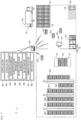
- Fig. 1 is a schematic view showing an example of conveyance system 1.
- Fig. 2 is a perspective view showing an example of basket cart 12.
- Fig. 3 is a perspective view showing an example of conveyance robot 40.
- Fig. 4 is a side view showing a state in which conveyance robot 40 is connected to basket cart 12.
- Fig. 5 is a front view showing a state in which conveyance robot 40 is connected to basket cart 12.
- the X-axis direction (left-right direction), Y-axis direction (front-rear direction), and Z-axis direction (up-down direction) are as shown in Figs. 3 to 5 .
- Conveyance system 1 is designed to automatically convey product 17 (conveyance target object) from warehouse 20 to sales section 30 for each category in store 10.
- the category is information for classifying product 17.
- the category can be freely set.
- the category may be set by an operator.
- the category may be a type of product 17 (for example, beverages, kitchenware, home appliances, daily necessities, and the like) or a symbol for classifying product 17, or the like.
- the category may be information indicating another classification.
- conveyance system 1 includes conveyance robot 40 and management device 60.
- Product placement area 21 is a place for temporarily storing product 17 (basket cart 12) delivered by delivery vehicle 18.
- Temporary placement area 22 is a place for temporarily placing product 17 (basket cart 12) that cannot be conveyed to sales section 30.
- Standby space 23 is a place for conveyance robot 40 to stand by when conveyance robot 40 is not conveying basket cart 12 (product 17).
- a charging device (not shown) is placed in standby space 23.
- the charging device is provided in standby space 23 and charges the driving storage battery provided in conveyance robot 40 when conveyance robot 40 is in standby.
- This charging device charges storage batteries using a wireless charging method, for example, either electromagnetic induction, magnetic field resonance, or electric field coupling.
- the charging device may be wired by a plug system to charge the storage battery.
- the charging device may, for example, start charging when receiving a signal from conveyance robot 40, or may start charging when detecting conveyance robot 40 with a sensor not shown.
- Sales section 30 is a place where conveyed product 17 is displayed for sale.
- Sales section 30 has multiple display shelves 31 for displaying product 17 (see Fig. 2 ) by category, as shown in Fig. 1 .
- the operator displays conveyed product 17 in a state of being placed on basket cart 12, on display shelves 31.
- conveyance areas (conveyance areas E1 to E7 in the present embodiment) are defined according to the category of product 17.
- Conveyance areas E1 to E7 are the areas in front of each of display shelves 31.
- Conveyance areas E1 to E7 each have at least one cart placement location (conveyance area E1 has cart placement locations P1 to P4, conveyance area E2 has cart placement locations P1 to P6, conveyance area E3 has cart placement locations P1 to P4, and conveyance areas E4 to E7 have cart placement locations P1 to P7). These cart placement locations are lined up along display shelves 31 of product 17 in the corresponding conveyance area.
- Basket cart 12 has loading portion 13, casters 14, and fence members 15, as shown in Fig. 2 .
- Loading portion 13 is a flat plate-shaped member on which an article is loaded.
- Caster 14 has a wheel that enables basket cart 12 to travel and is provided at the four corners on the lower surface of loading portion 13.
- Fence member 15 is a member to prevent product 17 placed on loading portion 13 from falling from loading portion 13, and is placed to stand up from the upper periphery of loading portion 13.
- Marker M is attached to basket cart 12.
- Marker M is a recognition target that indicates the ID (identification information) of product 17 placed on basket cart 12.
- Marker M is, for example, an AR marker.
- Marker M for example, is created by the operator and attached to basket cart 12 at the timing when product 17 (basket cart 12) is delivered by delivery vehicle 18 and placed in product placement area 21. Marker M is attached to the side surface of loading portion 13 so that marker M can be recognized by conveyance robot 40.
- Conveyance robot 40 is a vehicle that automatically conveys basket cart 12 as a conveyance item.
- This conveyance robot 40 enters the space between casters 14 on the lower surface side of loading portion 13 of basket cart 12, engages with engaged portion 16, connects to basket cart 12, and tows basket cart 12.
- This conveyance robot 40 is configured, for example, as an autonomous mobile robot (AMR) that detects the surroundings thereof and moves along a free route.
- AMR autonomous mobile robot
- conveyance robot 40 has vehicle body section 41, control section 42, storage section 43, loading section 44, communication section 53, drive section 55, traveling wheels 56, imaging section 57, and distance detection section 58.
- Vehicle body section 41 is an enclosure that has a substantially L-shaped shape in frontal view and can dive into the lower surface of basket cart 12.
- Vehicle body section 41 has horizontal section 41a and upright section 41b.
- Horizontal section 41a is a flat plate portion that can dive into the lower surface of basket cart 12.
- Horizontal section 41a has traveling wheels 56 on the lower surface side and loading section 44 on the upper surface side.
- Upright section 41b is connected to the end of horizontal section 41a and stands higher than horizontal section 41a.
- the interior of upright section 41b houses control section 42, storage section 43, communication section 53, and storage batteries.
- Control section 42 is a controller that controls the entire device of conveyance robot 40. This control section 42 outputs control signals, and the like to drive section 55, imaging section 57, and communication section 53, and also receives data and signals from imaging section 57, distance detection section 58, and communication section 53. Control section 42 acquires images of the surroundings from imaging section 57 (first camera 57a and second camera 57b) as well as the distance to surrounding objects from distance detection section 58 every predetermined time (minute time) while conveyance robot 40 is traveling, and recognizes the self-position (3D coordinates) of conveyance robot 40 in store 10 based on the surrounding images, map information, and drive status of drive section 55.
- Storage section 43 stores various application programs and various data files. Storage section 43 stores, for example, location information including the location of the conveyance destination when moving basket cart 12 and map information of store 10. The location information and map information is acquired via communication from management device 60.
- Loading section 44 is connected to basket cart 12 by moving upward from vehicle body section 41 (horizontal section 41a) of conveyance robot 40 and engaging with engaged portion 16 of basket cart 12 (see Figs. 4 and 5 ).
- Loading section 44 has lifting and lowering section 45, elastic support member 47, coupling member 51, and engaging member 52.
- Lifting and lowering section 45 is a substantially rectangular-shaped member that can move vertically with respect to vehicle body section 41 by using motor 46a of lifting and lowering device 46 as a drive source.
- Elastic support member 47 is a member that elastically supports loading portion 13 of basket cart 12 from the lower surface. Elastic support members 47 are provided at each of the four corners of lifting and lowering section 45.
- Coupling member 51 is a member for coupling elastic support members 47 lined up on the left and right.
- Engaging member 52 engages with engaged portion 16 formed on the lower surface of loading portion 13 in basket cart 12 when basket cart 12 is conveyed.
- Engaging member 52 is a pin-shaped member protruding upward from coupling member 51.
- Engaging member 52 is positioned lower than the bottom of basket cart 12 (loading portion 13) when lifting and lowering section 45 is positioned at the lowest position by lifting and lowering device 46. The position of engaging member 52 at this time is referred to as an initial position.
- engaging member 52 engages with engaged portion 16 (see Figs. 4 and 5 ).
- Communication section 53 is an interface that wirelessly exchanges information with external devices such as management device 60.
- Control section 42 exchanges information with management device 60 via communication section 53.
- Drive section 55 includes motors that are connected to respective traveling wheels 56 and travel and drive conveyance robot 40 by rotating and driving connected traveling wheels 56.
- Conveyance robot 40 has four traveling wheels 56 and moves by rotational drive of traveling wheels 56.
- Traveling wheels 56 may be mecanum wheels or omni wheels that can move vertically and horizontally with four independently driven wheels. Due to the degree of freedom of movement, it is more preferable that traveling wheels 56 be mecanum wheels.
- Imaging section 57 is capable of detecting objects around conveyance robot 40 and the distances thereof, as well as reading marker M attached to basket cart 12.
- Imaging section 57 has first camera 57a and second camera 57b.
- First and second cameras 57a and 57b are configured as stereo cameras, for example.
- First camera 57a is provided on the left side of horizontal section 41a and second camera 57b is provided on the left side of upright section 41b.
- First and second cameras 57a and 57b output image data and distance data to objects around conveyance robot 40 to control section 42.
- Distance detection section 58 is capable of detecting the distance to objects around conveyance robot 40.
- Distance detection section 58 has first distance sensor 58a and second distance sensor 58b.
- First and second distance sensors 58a and 58b are configured as light detection and ranging (LiDAR), for example.
- First and second distance sensors 58a and 58b are provided on the front and rear surfaces of horizontal section 41a, respectively.
- First and second distance sensors 58a and 58b output distance data to objects around conveyance robot 40 and the shape data to control section 42.
- Management device 60 is configured as a computer that controls entire conveyance system 1. As shown in Fig. 1 , management device 60 has control section 61, storage section 62, communication section 67, and input section 68. Control section 61 has CPU and controls the entire device. Storage section 62 stores various application programs and various data files. Storage section 62 stores ID-specific category information 64, category-specific conveyance area information 63, placement location usage information 65, and map information 66. Category-specific conveyance area information 63 is information in which category of product 17 and the conveyance area are associated with each other. ID-specific category information 64 is information in which the ID of product 17 and the category of product 17 are associated with each other. Placement location usage information 65 is information indicating the occupancy status of the basket cart placement location for each conveyance area.
- Map information 66 is information on the map of store 10.
- Communication section 67 communicates wirelessly with external devices such as conveyance robot 40.
- Input section 68 accepts operations by the operator and is, for example, a keyboard or a mouse.
- Fig. 6 is a flowchart showing an example of a routine for creating category-specific conveyance area information.
- Fig. 7 is a view showing an example of screen Im1 for creating category-specific conveyance area information.
- Fig. 8 is a view showing an example of category-specific conveyance area information 63.
- the routine for creating category-specific conveyance area information is executed by control section 61 of management device 60 after the operator inputs a start instruction for creating category-specific conveyance area information.
- control section 61 determines whether category-specific conveyance area information 63 is stored in storage section 62 (S100). If a positive determination is made in S100, control section 61 determines whether an update instruction is input from the operator (S110). The update instruction is an instruction to change the correspondence relationship between the category of product 17 and the conveyance area of product 17 in the already created category-specific conveyance area information 63. After a negative determination is made in S100 or a positive determination is made in S110, control section 61 displays screen Im1 for creating category-specific conveyance area information as shown in Fig. 7 on a display device (not shown) (S120). Control section 61 then accepts the input of the conveyance area of product 17 for the category of product 17 (S130).
- the category of product 17 accepts the operation of the operator and is pre-registered in storage section 62.
- the conveyance area is input, for example, by the operator selecting from a pull-down menu.
- Control section 61 then stores the category of product 17 and the conveyance area of product 17 associated with each other in storage section 62 (S140).
- An example of category-specific conveyance area information 63 created in this way is shown in Fig. 8 . After negative determination is made in S110 or after S140, control section 61 ends this routine.
- Fig. 9 is a flowchart showing an example of a routine for creating ID-specific category information.
- Fig. 10 is a view showing an example of screen Im2 for creating ID-specific category information.
- Fig. 11 is a view showing an example of ID-specific category information 64.
- the routine for creating ID-specific category information is executed by control section 61 of management device 60 after the start instruction for creating ID-specific category information is input by the operator.
- control section 61 determines whether ID-specific category information 64 is stored in storage section 62 (S200). If a positive determination is made in S200, control section 61 determines whether an update instruction is input from the operator (S210). An update instruction is an instruction to change or add the correspondence relationship between the ID of product 17 and the category of product 17 in the already created ID-specific category information 64. After a negative determination is made in S200 or a positive determination is made in S210, control section 61 displays screen Im2 for creating ID-specific category information as shown in Fig. 10 on a display device (not shown) (S220). Control section 61 then accepts input of the ID of product 17 (S230).
- the ID of product 17 is input, for example, by the operator reading the barcode (not shown) attached to product 17.
- Control section 61 accepts input of the category of product 17 (S240).
- the input of the category of product 17 is performed, for example, by the operator selecting from a pull-down menu.
- Control section 61 then stores the ID of product 17 and the category of product 17 associated with each other in storage section 62 (S250).
- An example of ID-specific category information 64 created in this way is shown in Fig. 11 . After a negative determination is made in S210 or after S250, control section 61 ends this routine.
- Fig. 12 is a flowchart showing an example of a cart conveyance routine.
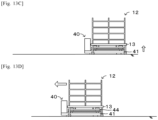
- Figs. 13A to 13D are views showing how conveyance robot 40 connects to and conveys (tows) basket cart 12.
- Fig. 14 is a flowchart showing an example of a routine for determining a conveyance destination.
- Fig. 15 is a view showing an example of placement location usage information 65.
- the cart conveyance routine is executed by control section 42 of conveyance robot 40 when control section 42 receives a cart conveyance instruction from control section 61 of management device 60.
- the cart conveyance instruction is sent via wireless communication to a selected one of conveyance robots 40 among multiple conveyance robots 40. Selection of conveyance robot 40 to be instructed to convey is performed based on the operational status of each of conveyance robots 40.
- control section 42 controls drive section 55 so that conveyance robot 40 moves to the front of product placement area 21, as shown in Fig. 13A (S300).
- Control section 42 controls drive section 55 so that the estimated self-position moves to the front of product placement area 21 while estimating the self-position in store 10 based on the data input from imaging section 57.
- control section 42 causes second camera 57b to capture images of product placement area 21 (S310). Control section 42 then determines whether marker M is detected in the image of product placement area 21 captured in S310 (S320). If a negative determination is made in S320, control section 42 determines that there is no basket cart 12 in product placement area 21, and causes drive section 55 to move the cart to standby space 23. On the other hand, if a positive determination is made in S320, control section 42 determines that there is basket cart 12 in product placement area 21 and reads the ID of product 17 from detected marker M (S330).
- Control section 42 then transmits the ID of product 17 read in S330 to management device 60 (S340). Control section 42 then acquires the conveyance destination of product 17 (basket cart 12) from management device 60 (S350). The conveyance destination of product 17 (basket cart 12) is determined by the routine for determining a conveyance destination (see Fig. 14 ) executed by management device 60.
- the routine for determining a conveyance destination which is executed by control section 61 of management device 60, is described here. This routine is executed after receiving the ID of product 17 from control section 42 of conveyance robot 40.
- control section 61 refers to ID-specific category information 64 shown in Fig. 11 to acquire the category of product 17 corresponding to the ID of product 17 received from control section 42 (S400).
- control section 61 refers to category-specific conveyance area information 63 shown in Fig. 8 to acquire the conveyance area of product 17 (S410).
- control section 61 refers to placement location usage information 65 shown in Fig. 15 to determine whether there are any vacant cart placement locations in the conveyance area acquired in S410 (S420).
- a conveyance destination is determined from among the vacant cart placement locations in the conveyance area acquired in S410 (S430).
- the conveyance area is the area in front of display shelves 31, and the cart placement locations are lined up along the front of display shelves 31.
- Control section 61 determines the conveyance destination of products 17 (basket carts 12) so that products 17 (basket carts 12) are placed in a predetermined order (in the present embodiment, from the back) at such a cart placement location. This causes at least one product 17 of the same category to be conveyed to one conveyance area by at least one basket cart 12. Also, when there are basket carts 12 already conveyed in the conveyance area, basket carts 12 can be conveyed without interfering with each other.
- Control section 61 then updates placement location usage information 65 (S440). Specifically, control section 61 updates the placement location usage information 65 so that the usage status of the placement location determined as the conveyance destination of product 17 (basket cart 12) in S430 becomes "occupied”. On the other hand, if a negative determination is made in S420, control section 61 determines temporary placement area 22 as the conveyance destination of product 17 (S450). Control section 61 then transmits the conveyance destination of product 17 (basket cart 12) determined in S430 or S450 to conveyance robot 40 (S460). After S460, control section 61 ends this routine.
- control section 61 refers to ID-specific category information 64 shown in Fig. 11 to acquire "beverage” as the category of product 17 (S400). Then, control section 61 refers to category-specific conveyance area information 63 shown in Fig. 8 to acquire conveyance area E1 as the conveyance area for product 17 (S410). Next, control section 61 refers to placement location usage information 65 shown in Fig. 15 to determine whether there is a placement location whose usage status is "vacant" in conveyance area E1 (S420).
- Control section 61 makes a negative determination because there are no placement locations in conveyance area E1 whose usage status is "vacant”. Next, control section 61 determines temporary placement area 22 as a conveyance destination (S450) and transmits the determined conveyance destination of product 17 (basket cart 12) to conveyance robot 40 (S460). After S460, control section 61 ends this routine.
- control section 61 refers to ID-specific category information 64 shown in Fig. 11 to acquire "daily necessities" as the category of product 17 (S400). Then, control section 61 refers to category-specific conveyance area information 63 shown in Fig. 8 to acquire conveyance area E4 as the conveyance area for product 17 (S410). Next, control section 61 refers to placement location usage information 65 shown in Fig. 15 to determine whether there is a placement location whose usage status is "vacant" in conveyance area E4 (S420).
- Control section 61 makes a positive determination because there is a placement location whose usage status is "vacant" in conveyance area E4.
- control section 61 refers to map information 66 to determine the conveyance destination in conveyance area E4 at the back (in the present embodiment, cart placement location P4) (S450).
- control section 61 updates placement location usage information 65 so that the usage status of cart placement location P4 in conveyance area E4 is "occupied” (S440).
- Control section 61 then transmits the determined conveyance destination of product 17 (basket cart 12) to conveyance robot 40 (S460). After S460, control section 61 ends this routine.
- control section 42 After acquiring the conveyance destination of product 17 (basket cart 12) from management device 60 (S350), control section 42 connects engaging member 52 to basket cart 12 (S360). This process is executed as follows. That is, first, control section 42 controls drive section 55 so that vehicle body section 41 (horizontal section 41a) dives below basket cart 12 (loading portion 13), as shown in Fig. 13B . Next, control section 42 controls lifting and lowering device 46 so that engaging member 52 is lifted and engages with engaged portion 16, as shown in Fig. 13C .
- control section 42 searches for a route from the current location to the conveyance destination based on the map information, and controls drive section 55 so that basket cart 12 is conveyed to the conveyance destination according to the route (see Fig. 13D , S370).
- Control section 42 determines whether other conveyance instructions are input from management device 60 (S380). If a positive determination is made in S380, control section 42 repeats the process from S300 onward. On the other hand, if a positive determination is made in S380, control section 42 causes drive section 55 to move to standby space 23 (S390). After S390, control section 42 ends this routine.
- conveyance system 1 corresponds to a conveyance system
- conveyance robot 40 corresponds to a conveyance device
- engaging member 52 and drive section 55 correspond to a drive section
- second camera 57b and control section 42 correspond to an acquisition section
- control section 42 corresponds to a control section
- management device 60 corresponds to a determination section
- control section 61 and input section 68 correspond to an update section.
- conveyance robot 40 reads the ID of product 17 as identification information from marker M, acquires the category information of product 17 from the read ID of product 17 and the conveyance destination corresponding to the acquired category information, and conveys basket cart 12 to the acquired conveyance destination.
- the identification information is information for identifying the category of the conveyance target object (product 17), and includes the ID of the conveyance target object, as well as the name of the conveyance target object and the category information indicating the category of the conveyance target object.
- the identification information need only be recorded in an optically, magnetically, electrically, or mechanically readable manner, such as a code, tag, or IC chip, in addition to marker M.
- a conveyance area of the conveyance destination of product 17 is associated with each category of product 17, one conveyance area has at least one cart placement location where a cart can be parked, and the determination section determines the corresponding conveyance area based on the category information and determines a vacant parking place in the determined conveyance area among the cart placement locations as the conveyance destination. Therefore, at least one product 17 of the same category can be conveyed to one conveyance area by at least one basket cart 12. Also, when there are basket carts 12 already conveyed in the conveyance area, basket carts 12 can be conveyed without interfering with each other.
- storage section 62 of management device 60 stores category-specific conveyance area information 63 in which the category of product 17 and the conveyance area are stored in association with each other.
- Control section 61 updates the correspondence relationship between the category of product 17 and the conveyance area in category-specific conveyance area information 63 in response to receiving an instruction to change the category of product 17 corresponding to the conveyance area from the operator via input section 68. Therefore, it is relatively easy to respond when product 17 belonging to a certain category has to be conveyed to a different conveyance destination from the conventional art.
- marker M is provided on basket cart 12.
- marker M may be provided on product 17.
- marker M may be attached to product 17.
- an image of the outer box of product 17 (hereinafter, referred to as an outer box image) may be captured to acquire the ID and category of product 17 in question.
- the ID and category of product 17 need only be acquired by reading the barcode or two-dimensional code on the outer box of product 17 or by reading the text or picture on the outer box of product 17.
- control section 61 need only determine the delivery destination of product 17 (basket cart 12) as follows.
- control section 61 accepts an input from the operator and stores the outer box image of product 17, and the ID and category of product 17 associated with each other in storage section 62 in advance. Control section 61 then inputs the outer box image captured by control section 42 of conveyance robot 40. Next, control section 61 acquires the ID and category of product 17 corresponding to the outer box image of product 17 input from control section 42 by comparing the outer box image of product 17 input from control section 42 with the outer box image of product 17 stored in storage section 62. Control section 61 then executes the routine for determining a conveyance destination of the embodiment described above to determine the conveyance destination of product 17 (basket cart 12). When the category of product 17 is acquired, control section 61 need only execute the process of S410 to S460 of the routine for determining a conveyance destination.
- the ID of product 17 is input by the operator by reading the barcode of product 17.
- the operator may set the ID of product 17 freely and input the ID of product 17 via input section 68 (keyboard, and the like).
- basket cart 12 is towed by conveyance robot 40.
- conveyance robot 40 may lift and convey basket cart 12.
- conveyance robot 40 is connected to basket cart 12 by engaging engaging member 52 with engaged portion 16.
- conveyance robot 40 does not have to be equipped with engaging member 52, and basket cart 12 does not have to be equipped with engaged portion 16.
- conveyance robot 40 may be equipped with a loading portion having a support member that can be lifted and lowered and connected to basket cart 12 when the lifted support member makes contact with the bottom of basket cart 12.
- marker M is assumed to contain information indicating the ID of product 17.
- marker M may also contain information indicating the category of product 17.
- the routine for creating ID-specific category information does not need to be executed, and ID-specific category information 64 does not need to be stored in storage section 62.
- control section 61 need only execute the process of S410 to S460 in the routine for determining a conveyance destination, and determine the conveyance destination of product 17 (basket cart 12) based on the category information acquired from marker M.
- second camera 57a is used to capture an image of product placement area 21.
- first camera 57b may be used to capture an image of product placement area 21.
- conveyance system 1 may also be conveyance robot 40 or a conveyance method.
- conveyance system 10: store, 12: basket cart, 13: loading portion, 14: caster, 15: fence member, 16: engaged portion, 17: product, 18: delivery vehicle, 20: warehouse, 21: product placement area, 22: temporary placement area, 23: standby space, 24: door, 25: wall portion, 30: sales section, 31: display shelf, 40: conveyance robot, 41: vehicle body section, 41a: horizontal section, 41b: upright section, 42: control section, 43: storage section, 44: loading section, 45: lifting and lowering section, 46: lifting and lowering device, 46a: motor, 47: elastic support member, 51: coupling member, 52: engaging member, 53: communication section, 55: drive section, 56: traveling wheel, 57: imaging section, 57a: first camera, 57b: second camera, 58: distance detection section, 58a: first distance sensor, 58b: second distance sensor, 60: management device, 61: control section, 62: storage section, 63: category-specific conveyance area information, 64: ID-specific category information, 64
Landscapes
- Engineering & Computer Science (AREA)
- Mechanical Engineering (AREA)
- Business, Economics & Management (AREA)
- Physics & Mathematics (AREA)
- General Physics & Mathematics (AREA)
- Combustion & Propulsion (AREA)
- Transportation (AREA)
- Chemical & Material Sciences (AREA)
- Radar, Positioning & Navigation (AREA)
- Remote Sensing (AREA)
- Aviation & Aerospace Engineering (AREA)
- Automation & Control Theory (AREA)
- Economics (AREA)
- Development Economics (AREA)
- Quality & Reliability (AREA)
- Accounting & Taxation (AREA)
- Entrepreneurship & Innovation (AREA)
- Human Resources & Organizations (AREA)
- Marketing (AREA)
- Operations Research (AREA)
- Finance (AREA)
- Strategic Management (AREA)
- Tourism & Hospitality (AREA)
- General Business, Economics & Management (AREA)
- Theoretical Computer Science (AREA)
- Warehouses Or Storage Devices (AREA)
- Management, Administration, Business Operations System, And Electronic Commerce (AREA)
- Control Of Position, Course, Altitude, Or Attitude Of Moving Bodies (AREA)
Abstract
Description
- The present description discloses a conveyance device, a conveyance system, and a conveyance method.
- There has been known a conveyance system including a cart on which a conveyance target object can be loaded and a conveyance device that conveys the cart to a destination. For example,
Patent Literature 1 discloses that an identification sign is provided on a cart, which is associated with the identification information of the cart itself and the conveyance destination information of the cart, and that a conveyance device reads the conveyance destination information contained in the identification sign and conveys the cart to the conveyance destination. - Patent Literature 1:
JP-A-2021-86205 - It is desired to convey a conveyance target object by category more efficiently.
- The main purpose of the present disclosure is to convey a conveyance target object by category more efficiently.
- A conveyance device of the present disclosure is a conveyance device configured to convey a cart loaded with a conveyance target object, the device including:
- a drive section configured to be connected to the cart and travel;
- a reading section configured to read identification information that is provided on the cart or the conveyance target object and that is for identifying category information of the conveyance target object; and
- a control section configured to acquire the category information of the conveyance target object from the identification information read by the reading section, acquire a conveyance destination of the conveyance target object based on the acquired category information, and control the drive section to convey the cart to the acquired conveyance destination.
- This conveyance device reads identification information, acquires category information of the conveyance target object from the read identification information, acquires a conveyance destination corresponding to the acquired category information, and conveys the cart to the acquired conveyance destination. Thus, it is possible to convey a conveyance target object by category more efficiently.
- A conveyance system of the present disclosure is a conveyance device configured to convey a cart loaded with a conveyance target object, the system including:
- a determination section configured to determine a conveyance destination of the conveyance target object based on category information, and
- a conveyance device that includes:
- a drive section configured to be connected to the cart and travel;
- a reading section configured to read identification information that is provided on the cart or the conveyance target object and that is for identifying the category information of the conveyance target object; and
- a control section configured to acquire the category information of the conveyance target object from the identification information read by the reading section, acquire a conveyance destination of the conveyance target object determined by the determination section based on the acquired category information, and control the drive section so that the cart is conveyed to the acquired conveyance destination.
- This conveyance system has the same effects as the conveyance device of the present disclosure.
- A conveyance method of the present disclosure is a method for conveying a cart loaded with a conveyance target object, the method including:
- reading identification information that is provided on the cart or the conveyance target object and that is for identifying category information of the conveyance target object to acquire the category information of the conveyance target object from the identification information;
- determining a conveyance destination of the conveyance target object based on the acquired category information; and
- conveying the cart to the determined conveyance destination.
- This conveyance method has the same effects as the conveyance device and the conveyance system of the present disclosure.
-
-
Fig. 1 is a schematic view showing an example ofconveyance system 1. -
Fig. 2 is a perspective view showing an example ofbasket cart 12. -
Fig. 3 is a perspective view showing an example ofconveyance robot 40. -
Fig. 4 is a side view showing a state in whichconveyance robot 40 is connected tobasket cart 12. -
Fig. 5 is a front view showing a state in whichconveyance robot 40 is connected tobasket cart 12. -
Fig. 6 is a flowchart showing an example of a routine for creating category-specific conveyance area information. -
Fig. 7 is a view showing an example of screen Im1 for creating category-specific conveyance area information. -
Fig. 8 is a view showing an example of category-specificconveyance area information 63. -
Fig. 9 is a flowchart showing an example of a routine for creating ID-specific category information. -
Fig. 10 is a view showing an example of screen Im2 for creating ID-specific category information. -
Fig. 11 is a view showing an example of ID-specific category information 64. -
Fig. 12 is a flowchart showing an example of a cart conveyance routine. -
Fig. 13A is a view showing howconveyance robot 40 connects to and conveys (tows)basket cart 12. -
Fig. 13B is a view showing howconveyance robot 40 connects to and conveys (tows)basket cart 12. -
Fig. 13C is a view showing howconveyance robot 40 connects to and conveys (tows)basket cart 12. -
Fig. 13D is a view showing howconveyance robot 40 connects to and conveys (tows)basket cart 12. -
Fig. 14 is a flowchart showing an example of a routine for determining a conveyance destination. -
Fig. 15 is a view showing an example of placementlocation usage information 65. - Next, an embodiment for carrying out the invention of the present disclosure will be described with reference to the drawings.
Fig. 1 is a schematic view showing an example ofconveyance system 1.Fig. 2 is a perspective view showing an example ofbasket cart 12.Fig. 3 is a perspective view showing an example ofconveyance robot 40.Fig. 4 is a side view showing a state in whichconveyance robot 40 is connected tobasket cart 12.Fig. 5 is a front view showing a state in whichconveyance robot 40 is connected tobasket cart 12. The X-axis direction (left-right direction), Y-axis direction (front-rear direction), and Z-axis direction (up-down direction) are as shown inFigs. 3 to 5 . -
Conveyance system 1 is designed to automatically convey product 17 (conveyance target object) fromwarehouse 20 tosales section 30 for each category instore 10. The category is information for classifyingproduct 17. For example, the category can be freely set. For example, the category may be set by an operator. In addition, for example, the category may be a type of product 17 (for example, beverages, kitchenware, home appliances, daily necessities, and the like) or a symbol for classifyingproduct 17, or the like. The category may be information indicating another classification. As shown inFig. 1 ,conveyance system 1 includesconveyance robot 40 andmanagement device 60. - Prior to the description of
conveyance system 1,store 10 to whichconveyance system 1 is applied and product 17 (basket cart 12), which is the conveyance target object byconveyance system 1, are described.Store 10 haswarehouse 20 for temporarily storing product 17 (basket cart 12) andsales section 30 for sellingproduct 17.Warehouse 20 is a place for temporarily storingproduct 17 to be sold onsales section 30.Product 17 stored inwarehouse 20 are delivered bydelivery vehicle 18 while being placed onbasket cart 12.Warehouse 20 hasproduct placement area 21,temporary placement area 22, andstandby space 23, as shown inFig. 1 . -
Product placement area 21 is a place for temporarily storing product 17 (basket cart 12) delivered bydelivery vehicle 18.Temporary placement area 22 is a place for temporarily placing product 17 (basket cart 12) that cannot be conveyed tosales section 30.Standby space 23 is a place forconveyance robot 40 to stand by whenconveyance robot 40 is not conveying basket cart 12 (product 17). In addition, a charging device (not shown) is placed instandby space 23. The charging device is provided instandby space 23 and charges the driving storage battery provided inconveyance robot 40 whenconveyance robot 40 is in standby. This charging device charges storage batteries using a wireless charging method, for example, either electromagnetic induction, magnetic field resonance, or electric field coupling. Alternatively, the charging device may be wired by a plug system to charge the storage battery. The charging device may, for example, start charging when receiving a signal fromconveyance robot 40, or may start charging when detectingconveyance robot 40 with a sensor not shown. -
Sales section 30 is a place where conveyedproduct 17 is displayed for sale.Sales section 30 hasmultiple display shelves 31 for displaying product 17 (seeFig. 2 ) by category, as shown inFig. 1 . Onsales section 30, the operator displays conveyedproduct 17 in a state of being placed onbasket cart 12, ondisplay shelves 31. Onsales section 30, conveyance areas (conveyance areas E1 to E7 in the present embodiment) are defined according to the category ofproduct 17. Conveyance areas E1 to E7 are the areas in front of each ofdisplay shelves 31. Conveyance areas E1 to E7 each have at least one cart placement location (conveyance area E1 has cart placement locations P1 to P4, conveyance area E2 has cart placement locations P1 to P6, conveyance area E3 has cart placement locations P1 to P4, and conveyance areas E4 to E7 have cart placement locations P1 to P7). These cart placement locations are lined up alongdisplay shelves 31 ofproduct 17 in the corresponding conveyance area. -
Basket cart 12 has loadingportion 13,casters 14, andfence members 15, as shown inFig. 2 .Loading portion 13 is a flat plate-shaped member on which an article is loaded. On the lower surface of loadingportion 13, there is grid-like downward protruding engaged portion 16 (seeFig. 5 ).Caster 14 has a wheel that enablesbasket cart 12 to travel and is provided at the four corners on the lower surface of loadingportion 13.Fence member 15 is a member to preventproduct 17 placed on loadingportion 13 from falling from loadingportion 13, and is placed to stand up from the upper periphery of loadingportion 13. Marker M is attached tobasket cart 12. Marker M is a recognition target that indicates the ID (identification information) ofproduct 17 placed onbasket cart 12. Marker M is, for example, an AR marker. Marker M, for example, is created by the operator and attached to basket cart 12 at the timing when product 17 (basket cart 12) is delivered bydelivery vehicle 18 and placed inproduct placement area 21. Marker M is attached to the side surface of loadingportion 13 so that marker M can be recognized byconveyance robot 40. -
Conveyance robot 40 is a vehicle that automatically conveysbasket cart 12 as a conveyance item. Thisconveyance robot 40 enters the space betweencasters 14 on the lower surface side of loadingportion 13 ofbasket cart 12, engages with engagedportion 16, connects tobasket cart 12, and towsbasket cart 12. Thisconveyance robot 40 is configured, for example, as an autonomous mobile robot (AMR) that detects the surroundings thereof and moves along a free route. As shown inFig. 3 ,conveyance robot 40 hasvehicle body section 41,control section 42,storage section 43,loading section 44,communication section 53,drive section 55, travelingwheels 56,imaging section 57, anddistance detection section 58. -
Vehicle body section 41 is an enclosure that has a substantially L-shaped shape in frontal view and can dive into the lower surface ofbasket cart 12.Vehicle body section 41 hashorizontal section 41a andupright section 41b.Horizontal section 41a is a flat plate portion that can dive into the lower surface ofbasket cart 12.Horizontal section 41a has travelingwheels 56 on the lower surface side andloading section 44 on the upper surface side.Upright section 41b is connected to the end ofhorizontal section 41a and stands higher thanhorizontal section 41a. The interior ofupright section 41b housescontrol section 42,storage section 43,communication section 53, and storage batteries. -
Control section 42 is a controller that controls the entire device ofconveyance robot 40. Thiscontrol section 42 outputs control signals, and the like to drivesection 55,imaging section 57, andcommunication section 53, and also receives data and signals fromimaging section 57,distance detection section 58, andcommunication section 53.Control section 42 acquires images of the surroundings from imaging section 57 (first camera 57a andsecond camera 57b) as well as the distance to surrounding objects fromdistance detection section 58 every predetermined time (minute time) whileconveyance robot 40 is traveling, and recognizes the self-position (3D coordinates) ofconveyance robot 40 instore 10 based on the surrounding images, map information, and drive status ofdrive section 55. -
Storage section 43 stores various application programs and various data files.Storage section 43 stores, for example, location information including the location of the conveyance destination when movingbasket cart 12 and map information ofstore 10. The location information and map information is acquired via communication frommanagement device 60. -
Loading section 44 is connected to basket cart 12 by moving upward from vehicle body section 41 (horizontal section 41a) ofconveyance robot 40 and engaging with engagedportion 16 of basket cart 12 (seeFigs. 4 and5 ).Loading section 44 has lifting and loweringsection 45,elastic support member 47,coupling member 51, and engagingmember 52. Lifting and loweringsection 45 is a substantially rectangular-shaped member that can move vertically with respect tovehicle body section 41 by usingmotor 46a of lifting and loweringdevice 46 as a drive source. -
Elastic support member 47 is a member that elastically supports loadingportion 13 of basket cart 12 from the lower surface.Elastic support members 47 are provided at each of the four corners of lifting and loweringsection 45. Couplingmember 51 is a member for couplingelastic support members 47 lined up on the left and right. Engagingmember 52 engages with engagedportion 16 formed on the lower surface of loadingportion 13 inbasket cart 12 whenbasket cart 12 is conveyed. Engagingmember 52 is a pin-shaped member protruding upward from couplingmember 51. Engagingmember 52 is positioned lower than the bottom of basket cart 12 (loading portion 13) when lifting and loweringsection 45 is positioned at the lowest position by lifting and loweringdevice 46. The position of engagingmember 52 at this time is referred to as an initial position. On the other hand, in a state where vehicle body section 41 (horizontal section 41a) is under basket cart 12 (loading portion 13) and lifting and loweringdevice 46 lifts lifting and lowering section 45 (engaging member 52), engagingmember 52 engages with engaged portion 16 (seeFigs. 4 and5 ). -
Communication section 53 is an interface that wirelessly exchanges information with external devices such asmanagement device 60.Control section 42 exchanges information withmanagement device 60 viacommunication section 53. -
Drive section 55 includes motors that are connected to respective travelingwheels 56 and travel and driveconveyance robot 40 by rotating and driving connected travelingwheels 56.Conveyance robot 40 has four travelingwheels 56 and moves by rotational drive of travelingwheels 56. Travelingwheels 56 may be mecanum wheels or omni wheels that can move vertically and horizontally with four independently driven wheels. Due to the degree of freedom of movement, it is more preferable that travelingwheels 56 be mecanum wheels. -
Imaging section 57 is capable of detecting objects aroundconveyance robot 40 and the distances thereof, as well as reading marker M attached tobasket cart 12.Imaging section 57 hasfirst camera 57a andsecond camera 57b. First andsecond cameras First camera 57a is provided on the left side ofhorizontal section 41a andsecond camera 57b is provided on the left side ofupright section 41b. First andsecond cameras conveyance robot 40 to controlsection 42. -
Distance detection section 58 is capable of detecting the distance to objects aroundconveyance robot 40.Distance detection section 58 hasfirst distance sensor 58a andsecond distance sensor 58b. First andsecond distance sensors second distance sensors horizontal section 41a, respectively. First andsecond distance sensors conveyance robot 40 and the shape data to controlsection 42. -
Management device 60 is configured as a computer that controlsentire conveyance system 1. As shown inFig. 1 ,management device 60 has control section 61,storage section 62,communication section 67, andinput section 68. Control section 61 has CPU and controls the entire device.Storage section 62 stores various application programs and various data files.Storage section 62 stores ID-specific category information 64, category-specificconveyance area information 63, placementlocation usage information 65, and mapinformation 66. Category-specificconveyance area information 63 is information in which category ofproduct 17 and the conveyance area are associated with each other. ID-specific category information 64 is information in which the ID ofproduct 17 and the category ofproduct 17 are associated with each other. Placementlocation usage information 65 is information indicating the occupancy status of the basket cart placement location for each conveyance area. This information is used to manage the conveyance ofproduct 17.Map information 66 is information on the map ofstore 10.Communication section 67 communicates wirelessly with external devices such asconveyance robot 40.Input section 68 accepts operations by the operator and is, for example, a keyboard or a mouse. - Next, the operation of
conveyance system 1 configured as above will be described. First, the process of creating category-specificconveyance area information 63 is described with reference toFigs. 6 to 8 .Fig. 6 is a flowchart showing an example of a routine for creating category-specific conveyance area information.Fig. 7 is a view showing an example of screen Im1 for creating category-specific conveyance area information.Fig. 8 is a view showing an example of category-specificconveyance area information 63. The routine for creating category-specific conveyance area information is executed by control section 61 ofmanagement device 60 after the operator inputs a start instruction for creating category-specific conveyance area information. - When this routine is started, control section 61 determines whether category-specific
conveyance area information 63 is stored in storage section 62 (S100). If a positive determination is made in S100, control section 61 determines whether an update instruction is input from the operator (S110). The update instruction is an instruction to change the correspondence relationship between the category ofproduct 17 and the conveyance area ofproduct 17 in the already created category-specificconveyance area information 63. After a negative determination is made in S100 or a positive determination is made in S110, control section 61 displays screen Im1 for creating category-specific conveyance area information as shown inFig. 7 on a display device (not shown) (S120). Control section 61 then accepts the input of the conveyance area ofproduct 17 for the category of product 17 (S130). The category ofproduct 17 accepts the operation of the operator and is pre-registered instorage section 62. The conveyance area is input, for example, by the operator selecting from a pull-down menu. Control section 61 then stores the category ofproduct 17 and the conveyance area ofproduct 17 associated with each other in storage section 62 (S140). An example of category-specificconveyance area information 63 created in this way is shown inFig. 8 . After negative determination is made in S110 or after S140, control section 61 ends this routine. - Next, the process of creating ID-
specific category information 64 is described with reference toFigs. 9 to 11 .Fig. 9 is a flowchart showing an example of a routine for creating ID-specific category information.Fig. 10 is a view showing an example of screen Im2 for creating ID-specific category information.Fig. 11 is a view showing an example of ID-specific category information 64. The routine for creating ID-specific category information is executed by control section 61 ofmanagement device 60 after the start instruction for creating ID-specific category information is input by the operator. - When this routine is started, control section 61 determines whether ID-
specific category information 64 is stored in storage section 62 (S200). If a positive determination is made in S200, control section 61 determines whether an update instruction is input from the operator (S210). An update instruction is an instruction to change or add the correspondence relationship between the ID ofproduct 17 and the category ofproduct 17 in the already created ID-specific category information 64. After a negative determination is made in S200 or a positive determination is made in S210, control section 61 displays screen Im2 for creating ID-specific category information as shown inFig. 10 on a display device (not shown) (S220). Control section 61 then accepts input of the ID of product 17 (S230). The ID ofproduct 17 is input, for example, by the operator reading the barcode (not shown) attached toproduct 17. Control section 61 then accepts input of the category of product 17 (S240). The input of the category ofproduct 17 is performed, for example, by the operator selecting from a pull-down menu. Control section 61 then stores the ID ofproduct 17 and the category ofproduct 17 associated with each other in storage section 62 (S250). An example of ID-specific category information 64 created in this way is shown inFig. 11 . After a negative determination is made in S210 or after S250, control section 61 ends this routine. - Next, the process of conveying product 17 (basket cart 12) from
warehouse 20 tosales section 30 by usingconveyance robot 40 instore 10 will be described with reference toFigs. 12 to 15 .Fig. 12 is a flowchart showing an example of a cart conveyance routine.Figs. 13A to 13D are views showing howconveyance robot 40 connects to and conveys (tows)basket cart 12.Fig. 14 is a flowchart showing an example of a routine for determining a conveyance destination.Fig. 15 is a view showing an example of placementlocation usage information 65. - The cart conveyance routine is executed by
control section 42 ofconveyance robot 40 whencontrol section 42 receives a cart conveyance instruction from control section 61 ofmanagement device 60. The cart conveyance instruction is sent via wireless communication to a selected one ofconveyance robots 40 amongmultiple conveyance robots 40. Selection ofconveyance robot 40 to be instructed to convey is performed based on the operational status of each ofconveyance robots 40. - When this routine is started,
control section 42 controls drivesection 55 so thatconveyance robot 40 moves to the front ofproduct placement area 21, as shown inFig. 13A (S300).Control section 42 controls drivesection 55 so that the estimated self-position moves to the front ofproduct placement area 21 while estimating the self-position instore 10 based on the data input fromimaging section 57. - Next,
control section 42 causessecond camera 57b to capture images of product placement area 21 (S310).Control section 42 then determines whether marker M is detected in the image ofproduct placement area 21 captured in S310 (S320). If a negative determination is made in S320,control section 42 determines that there is nobasket cart 12 inproduct placement area 21, and causes drivesection 55 to move the cart tostandby space 23. On the other hand, if a positive determination is made in S320,control section 42 determines that there isbasket cart 12 inproduct placement area 21 and reads the ID ofproduct 17 from detected marker M (S330). -
Control section 42 then transmits the ID ofproduct 17 read in S330 to management device 60 (S340).Control section 42 then acquires the conveyance destination of product 17 (basket cart 12) from management device 60 (S350). The conveyance destination of product 17 (basket cart 12) is determined by the routine for determining a conveyance destination (seeFig. 14 ) executed bymanagement device 60. - The routine for determining a conveyance destination, which is executed by control section 61 of
management device 60, is described here. This routine is executed after receiving the ID ofproduct 17 fromcontrol section 42 ofconveyance robot 40. - When this routine is started, control section 61 refers to ID-
specific category information 64 shown inFig. 11 to acquire the category ofproduct 17 corresponding to the ID ofproduct 17 received from control section 42 (S400). Next, control section 61 refers to category-specificconveyance area information 63 shown inFig. 8 to acquire the conveyance area of product 17 (S410). - Next, control section 61 refers to placement
location usage information 65 shown inFig. 15 to determine whether there are any vacant cart placement locations in the conveyance area acquired in S410 (S420). - If a positive determination is made in S410, a conveyance destination is determined from among the vacant cart placement locations in the conveyance area acquired in S410 (S430). The conveyance area is the area in front of
display shelves 31, and the cart placement locations are lined up along the front ofdisplay shelves 31. Control section 61 determines the conveyance destination of products 17 (basket carts 12) so that products 17 (basket carts 12) are placed in a predetermined order (in the present embodiment, from the back) at such a cart placement location. This causes at least oneproduct 17 of the same category to be conveyed to one conveyance area by at least onebasket cart 12. Also, when there arebasket carts 12 already conveyed in the conveyance area,basket carts 12 can be conveyed without interfering with each other. - Control section 61 then updates placement location usage information 65 (S440). Specifically, control section 61 updates the placement
location usage information 65 so that the usage status of the placement location determined as the conveyance destination of product 17 (basket cart 12) in S430 becomes "occupied". On the other hand, if a negative determination is made in S420, control section 61 determinestemporary placement area 22 as the conveyance destination of product 17 (S450). Control section 61 then transmits the conveyance destination of product 17 (basket cart 12) determined in S430 or S450 to conveyance robot 40 (S460). After S460, control section 61 ends this routine. - Here, a specific example of when the process from S400 to S460 is executed to convey
basket cart 12 totemporary placement area 22 or to the conveyance area (cart placement location) is described. - First, the case of conveying
basket cart 12 totemporary placement area 22 is described. In this case, marker M onbasket cart 12 contains 005 as the ID ofproduct 17. In this case, control section 61 refers to ID-specific category information 64 shown inFig. 11 to acquire "beverage" as the category of product 17 (S400). Then, control section 61 refers to category-specificconveyance area information 63 shown inFig. 8 to acquire conveyance area E1 as the conveyance area for product 17 (S410). Next, control section 61 refers to placementlocation usage information 65 shown inFig. 15 to determine whether there is a placement location whose usage status is "vacant" in conveyance area E1 (S420). Control section 61 makes a negative determination because there are no placement locations in conveyance area E1 whose usage status is "vacant". Next, control section 61 determinestemporary placement area 22 as a conveyance destination (S450) and transmits the determined conveyance destination of product 17 (basket cart 12) to conveyance robot 40 (S460). After S460, control section 61 ends this routine. - Next, the case of conveying
basket cart 12 to a cart placement location is described. In this case, marker M onbasket cart 12 contains 019 as the ID ofproduct 17. In this case, control section 61 refers to ID-specific category information 64 shown inFig. 11 to acquire "daily necessities" as the category of product 17 (S400). Then, control section 61 refers to category-specificconveyance area information 63 shown inFig. 8 to acquire conveyance area E4 as the conveyance area for product 17 (S410). Next, control section 61 refers to placementlocation usage information 65 shown inFig. 15 to determine whether there is a placement location whose usage status is "vacant" in conveyance area E4 (S420). Control section 61 makes a positive determination because there is a placement location whose usage status is "vacant" in conveyance area E4. Next, control section 61 refers to mapinformation 66 to determine the conveyance destination in conveyance area E4 at the back (in the present embodiment, cart placement location P4) (S450). Next, control section 61 updates placementlocation usage information 65 so that the usage status of cart placement location P4 in conveyance area E4 is "occupied" (S440). Control section 61 then transmits the determined conveyance destination of product 17 (basket cart 12) to conveyance robot 40 (S460). After S460, control section 61 ends this routine. - The description is returned to the description of the cart conveyance routine. After acquiring the conveyance destination of product 17 (basket cart 12) from management device 60 (S350),
control section 42 connects engagingmember 52 to basket cart 12 (S360). This process is executed as follows. That is, first,control section 42 controls drivesection 55 so that vehicle body section 41 (horizontal section 41a) dives below basket cart 12 (loading portion 13), as shown inFig. 13B . Next,control section 42 controls lifting and loweringdevice 46 so that engagingmember 52 is lifted and engages with engagedportion 16, as shown inFig. 13C . - Next,
control section 42 searches for a route from the current location to the conveyance destination based on the map information, and controls drivesection 55 so thatbasket cart 12 is conveyed to the conveyance destination according to the route (seeFig. 13D , S370). -
Control section 42 then determines whether other conveyance instructions are input from management device 60 (S380). If a positive determination is made in S380,control section 42 repeats the process from S300 onward. On the other hand, if a positive determination is made in S380,control section 42 causes drivesection 55 to move to standby space 23 (S390). After S390,control section 42 ends this routine. - Here, a correspondence relationship between the elements of the present embodiment and the elements of the present disclosure will be clarified. In the present embodiment,
conveyance system 1 corresponds to a conveyance system,conveyance robot 40 corresponds to a conveyance device, engagingmember 52 anddrive section 55 correspond to a drive section,second camera 57b andcontrol section 42 correspond to an acquisition section, andcontrol section 42 corresponds to a control section. In addition,management device 60 corresponds to a determination section, and control section 61 andinput section 68 correspond to an update section. - In
conveyance system 1 described in detail above,conveyance robot 40 reads the ID ofproduct 17 as identification information from marker M, acquires the category information ofproduct 17 from the read ID ofproduct 17 and the conveyance destination corresponding to the acquired category information, and conveysbasket cart 12 to the acquired conveyance destination. Thus,product 17 can be conveyed more efficiently by category. Here, the identification information is information for identifying the category of the conveyance target object (product 17), and includes the ID of the conveyance target object, as well as the name of the conveyance target object and the category information indicating the category of the conveyance target object. The identification information need only be recorded in an optically, magnetically, electrically, or mechanically readable manner, such as a code, tag, or IC chip, in addition to marker M. - In
conveyance system 1, a conveyance area of the conveyance destination ofproduct 17 is associated with each category ofproduct 17, one conveyance area has at least one cart placement location where a cart can be parked, and the determination section determines the corresponding conveyance area based on the category information and determines a vacant parking place in the determined conveyance area among the cart placement locations as the conveyance destination. Therefore, at least oneproduct 17 of the same category can be conveyed to one conveyance area by at least onebasket cart 12. Also, when there arebasket carts 12 already conveyed in the conveyance area,basket carts 12 can be conveyed without interfering with each other. In addition, in the embodiment described above,storage section 62 ofmanagement device 60 stores category-specificconveyance area information 63 in which the category ofproduct 17 and the conveyance area are stored in association with each other. Control section 61 updates the correspondence relationship between the category ofproduct 17 and the conveyance area in category-specificconveyance area information 63 in response to receiving an instruction to change the category ofproduct 17 corresponding to the conveyance area from the operator viainput section 68. Therefore, it is relatively easy to respond whenproduct 17 belonging to a certain category has to be conveyed to a different conveyance destination from the conventional art. - The present disclosure is not limited to the embodiment described above at all, and needless to say, the present disclosure can be carried out in various forms as long as the forms belong to the technical scope of the present disclosure.
- In the embodiment described above, marker M is provided on
basket cart 12. However, marker M may be provided onproduct 17. In this case, marker M may be attached toproduct 17. Alternatively, an image of the outer box of product 17 (hereinafter, referred to as an outer box image) may be captured to acquire the ID and category ofproduct 17 in question. For example, the ID and category ofproduct 17 need only be acquired by reading the barcode or two-dimensional code on the outer box ofproduct 17 or by reading the text or picture on the outer box ofproduct 17. In the latter case, control section 61 need only determine the delivery destination of product 17 (basket cart 12) as follows. In other words, control section 61 accepts an input from the operator and stores the outer box image ofproduct 17, and the ID and category ofproduct 17 associated with each other instorage section 62 in advance. Control section 61 then inputs the outer box image captured bycontrol section 42 ofconveyance robot 40. Next, control section 61 acquires the ID and category ofproduct 17 corresponding to the outer box image ofproduct 17 input fromcontrol section 42 by comparing the outer box image ofproduct 17 input fromcontrol section 42 with the outer box image ofproduct 17 stored instorage section 62. Control section 61 then executes the routine for determining a conveyance destination of the embodiment described above to determine the conveyance destination of product 17 (basket cart 12). When the category ofproduct 17 is acquired, control section 61 need only execute the process of S410 to S460 of the routine for determining a conveyance destination. - In the embodiment described above, in S230 of the routine for creating ID-specific category information, the ID of
product 17 is input by the operator by reading the barcode ofproduct 17. However, the operator may set the ID ofproduct 17 freely and input the ID ofproduct 17 via input section 68 (keyboard, and the like). - In the embodiment described above,
basket cart 12 is towed byconveyance robot 40. However,conveyance robot 40 may lift and conveybasket cart 12. In the embodiment described above,conveyance robot 40 is connected to basket cart 12 by engaging engagingmember 52 with engagedportion 16. However,conveyance robot 40 does not have to be equipped with engagingmember 52, andbasket cart 12 does not have to be equipped with engagedportion 16. In this case,conveyance robot 40 may be equipped with a loading portion having a support member that can be lifted and lowered and connected tobasket cart 12 when the lifted support member makes contact with the bottom ofbasket cart 12. - In the embodiment described above, marker M is assumed to contain information indicating the ID of
product 17. However, marker M may also contain information indicating the category ofproduct 17. In this case, the routine for creating ID-specific category information does not need to be executed, and ID-specific category information 64 does not need to be stored instorage section 62. In this case, control section 61 need only execute the process of S410 to S460 in the routine for determining a conveyance destination, and determine the conveyance destination of product 17 (basket cart 12) based on the category information acquired from marker M. - In the embodiment described above,
second camera 57a is used to capture an image ofproduct placement area 21. However,first camera 57b may be used to capture an image ofproduct placement area 21. - In the embodiment described above, the present disclosure is described as
conveyance system 1, but may also beconveyance robot 40 or a conveyance method. - 1: conveyance system, 10: store, 12: basket cart, 13: loading portion, 14: caster, 15: fence member, 16: engaged portion, 17: product, 18: delivery vehicle, 20: warehouse, 21: product placement area, 22: temporary placement area, 23: standby space, 24: door, 25: wall portion, 30: sales section, 31: display shelf, 40: conveyance robot, 41: vehicle body section, 41a: horizontal section, 41b: upright section, 42: control section, 43: storage section, 44: loading section, 45: lifting and lowering section, 46: lifting and lowering device, 46a: motor, 47: elastic support member, 51: coupling member, 52: engaging member, 53: communication section, 55: drive section, 56: traveling wheel, 57: imaging section, 57a: first camera, 57b: second camera, 58: distance detection section, 58a: first distance sensor, 58b: second distance sensor, 60: management device, 61: control section, 62: storage section, 63: category-specific conveyance area information, 64: ID-specific category information, 65: placement location usage information, 66: map information, 67: communication section, 68: input section, E1 to E7: conveyance area, Im1: screen for creating category-specific conveyance area information, Im2: screen for creating ID-specific category information, M: marker, P1 to P7: cart placement location.
Claims (5)
- A conveyance device configured to convey a cart loaded with a conveyance target object, the device comprising:a drive section configured to be connected to the cart and travel;a reading section configured to read identification information that is provided on the cart or the conveyance target object and that is for identifying category information of the conveyance target object; anda control section configured to acquire the category information of the conveyance target object from the identification information read by the reading section, acquire a conveyance destination of the conveyance target object based on the acquired category information, and control the drive section to convey the cart to the acquired conveyance destination.
- A conveyance system configured to convey a cart loaded with a conveyance target object, the system comprising:a determination section configured to determine a conveyance destination of the conveyance target object based on category information of the conveyance target object; anda conveyance device that includes:a drive section configured to be connected to the cart and travel;a reading section configured to read identification information that is provided on the cart or the conveyance target object and that is for identifying the category information of the conveyance target object; anda control section configured to acquire the category information of the conveyance target object from the identification information read by the reading section, acquire a conveyance destination of the conveyance target object determined by the determination section based on the acquired category information, and control the drive section to convey the cart to the acquired conveyance destination.
- The conveyance system according to Claim 2, whereineach category is associated with a conveyance area of the conveyance destination of the conveyance target object,one conveyance area includes at least one parking place where the cart can be parked, andthe determination section is configured to determine a corresponding conveyance area based on the category information, and determine, as the conveyance destination, a vacant parking place among the parking places in the determined conveyance area.
- The conveyance system according to Claim 2 or 3, whereineach category is associated with a conveyance area of the conveyance destination of the conveyance target object, andthe system further comprises an update section configured to update a correspondence relationship between the category information and the conveyance area in response to receiving an instruction to change a category corresponding to the conveyance area.
- A conveyance method for conveying a cart loaded with a conveyance target object, the method comprising:reading identification information that is provided on the cart or the conveyance target object and that is for identifying category information of the conveyance target object to acquire the category information of the conveyance target object from the identification information;determining a conveyance destination of the conveyance target object based on the acquired category information; andconveying the cart to the determined conveyance destination.
Applications Claiming Priority (1)
| Application Number | Priority Date | Filing Date | Title |
|---|---|---|---|
| PCT/JP2022/025706 WO2024004021A1 (en) | 2022-06-28 | 2022-06-28 | Transport device, transport system, and transport method |
Publications (2)
| Publication Number | Publication Date |
|---|---|
| EP4549341A1 true EP4549341A1 (en) | 2025-05-07 |
| EP4549341A4 EP4549341A4 (en) | 2025-08-13 |
Family
ID=89382169
Family Applications (1)
| Application Number | Title | Priority Date | Filing Date |
|---|---|---|---|
| EP22949298.8A Pending EP4549341A4 (en) | 2022-06-28 | 2022-06-28 | TRANSPORT DEVICE, TRANSPORT SYSTEM AND TRANSPORT METHOD |
Country Status (4)
| Country | Link |
|---|---|
| US (1) | US20250368443A1 (en) |
| EP (1) | EP4549341A4 (en) |
| JP (1) | JP7809204B2 (en) |
| WO (1) | WO2024004021A1 (en) |
Families Citing this family (1)
| Publication number | Priority date | Publication date | Assignee | Title |
|---|---|---|---|---|
| JP7575837B1 (en) * | 2024-06-20 | 2024-10-30 | 株式会社LexxPluss | Transport vehicle control system and transport vehicle control method |
Family Cites Families (7)
| Publication number | Priority date | Publication date | Assignee | Title |
|---|---|---|---|---|
| JP3430100B2 (en) * | 1999-12-14 | 2003-07-28 | 株式会社エイティーアンドシー | Product shipping sorting system |
| JP2009298556A (en) * | 2008-06-13 | 2009-12-24 | Seibu Electric & Mach Co Ltd | Method for sorting goods by shipping destination |
| JP5304723B2 (en) * | 2010-05-17 | 2013-10-02 | 株式会社安川電機 | Self-propelled conveying device and cart conveying method |
| JP2020509981A (en) * | 2017-03-14 | 2020-04-02 | シーグリッド コーポレーション | Case picking for robots |
| JP7004248B2 (en) * | 2018-02-22 | 2022-02-04 | 株式会社リコー | Coupling device, connecting mobile device and autonomous mobile device |
| JP2021086205A (en) | 2019-11-25 | 2021-06-03 | 株式会社リコー | Identification member, autonomous mobile device, connection system and connection method |
| JP7421658B2 (en) * | 2020-08-21 | 2024-01-24 | 株式会社Fuji | Control device, delivery system and control method |
-
2022
- 2022-06-28 EP EP22949298.8A patent/EP4549341A4/en active Pending
- 2022-06-28 US US18/873,771 patent/US20250368443A1/en active Pending
- 2022-06-28 JP JP2024530118A patent/JP7809204B2/en active Active
- 2022-06-28 WO PCT/JP2022/025706 patent/WO2024004021A1/en not_active Ceased
Also Published As
| Publication number | Publication date |
|---|---|
| WO2024004021A1 (en) | 2024-01-04 |
| US20250368443A1 (en) | 2025-12-04 |
| JPWO2024004021A1 (en) | 2024-01-04 |
| JP7809204B2 (en) | 2026-01-30 |
| EP4549341A4 (en) | 2025-08-13 |
Similar Documents
| Publication | Publication Date | Title |
|---|---|---|
| US12530687B2 (en) | Item-identifying carts | |
| US11889933B2 (en) | Resolving events in item-identifying carts | |
| US20190292030A1 (en) | Systems, devices and methods of controlling motorized transport units in a retail shopping facility | |
| US9371184B1 (en) | Mobile drive unit charging | |
| CN105404250A (en) | In-coming and shipment auxiliary system, unmanned carrying vehicle and in-coming and shipment auxiliary method | |
| US11393253B1 (en) | Using sensor data to determine activity | |
| JP7226268B2 (en) | Transport system, transport method and program | |
| US11620822B1 (en) | Resolving events in item-identifying carts | |
| US11727224B1 (en) | Determining RFID-tag locations in a facility | |
| US20210133674A1 (en) | Picking work assistance device and computer-readable recording medium having stored thereon picking work assistance program | |
| US20170200115A1 (en) | Systems and methods of consolidating product orders | |
| EP3891672A1 (en) | Customer assisted robot picking | |
| US20250368443A1 (en) | Transport device, transport system, and transport method | |
| US12572881B2 (en) | Control device, delivery system, control method, and display plate | |
| US20230278838A1 (en) | Portable survey unit and method | |
| US12299728B1 (en) | Resolving events in item-identifying carts | |
| JP7815426B2 (en) | Conveying device and conveying method | |
| EP4628427A1 (en) | Automatic moving device, management device, conveyance system, and control method and management method of automatic moving device | |
| JP7481058B1 (en) | TRANSPORT SYSTEM, TRANSPORT CONTROL METHOD, AND PROGRAM | |
| KR102964707B1 (en) | A material storage and retrieval system including material handling vehicles, mobile storage carts, transporters, and material handling vehicles | |
| CN118002492A (en) | Logistics systems and processing methods | |
| WO2025046803A1 (en) | Automatic movement device, management device, conveyance system, control method, and management method | |
| WO2025150194A1 (en) | Information processing device, autonomous mobile device, conveyance system, and information processing method | |
| WO2025094230A1 (en) | Transport system, automated guided vehicle, and position identification method | |
| WO2025141877A1 (en) | Conveyance position display method and conveyance system |
Legal Events
| Date | Code | Title | Description |
|---|---|---|---|
| STAA | Information on the status of an ep patent application or granted ep patent |
Free format text: STATUS: THE INTERNATIONAL PUBLICATION HAS BEEN MADE |
|
| PUAI | Public reference made under article 153(3) epc to a published international application that has entered the european phase |
Free format text: ORIGINAL CODE: 0009012 |
|
| STAA | Information on the status of an ep patent application or granted ep patent |
Free format text: STATUS: REQUEST FOR EXAMINATION WAS MADE |
|
| 17P | Request for examination filed |
Effective date: 20241210 |
|
| AK | Designated contracting states |
Kind code of ref document: A1 Designated state(s): AL AT BE BG CH CY CZ DE DK EE ES FI FR GB GR HR HU IE IS IT LI LT LU LV MC MK MT NL NO PL PT RO RS SE SI SK SM TR |
|
| REG | Reference to a national code |
Ref country code: DE Ref legal event code: R079 Free format text: PREVIOUS MAIN CLASS: B65G0001000000 Ipc: G06Q0010087000 |
|
| A4 | Supplementary search report drawn up and despatched |
Effective date: 20250714 |
|
| RIC1 | Information provided on ipc code assigned before grant |
Ipc: G06Q 10/087 20230101AFI20250708BHEP Ipc: B65G 1/00 20060101ALI20250708BHEP Ipc: B62B 5/00 20060101ALI20250708BHEP Ipc: G05D 1/00 20240101ALI20250708BHEP |
|
| DAV | Request for validation of the european patent (deleted) | ||
| DAX | Request for extension of the european patent (deleted) |