EP4549273A1 - Control device and control method for motorcyclist assistance system - Google Patents
Control device and control method for motorcyclist assistance system Download PDFInfo
- Publication number
- EP4549273A1 EP4549273A1 EP23738147.0A EP23738147A EP4549273A1 EP 4549273 A1 EP4549273 A1 EP 4549273A1 EP 23738147 A EP23738147 A EP 23738147A EP 4549273 A1 EP4549273 A1 EP 4549273A1
- Authority
- EP
- European Patent Office
- Prior art keywords
- vehicle
- control operation
- motorcycle
- speed control
- necessity
- Prior art date
- Legal status (The legal status is an assumption and is not a legal conclusion. Google has not performed a legal analysis and makes no representation as to the accuracy of the status listed.)
- Granted
Links
Images


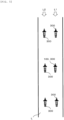

Classifications
-
- B—PERFORMING OPERATIONS; TRANSPORTING
- B60—VEHICLES IN GENERAL
- B60W—CONJOINT CONTROL OF VEHICLE SUB-UNITS OF DIFFERENT TYPE OR DIFFERENT FUNCTION; CONTROL SYSTEMS SPECIALLY ADAPTED FOR HYBRID VEHICLES; ROAD VEHICLE DRIVE CONTROL SYSTEMS FOR PURPOSES NOT RELATED TO THE CONTROL OF A PARTICULAR SUB-UNIT
- B60W30/00—Purposes of road vehicle drive control systems not related to the control of a particular sub-unit, e.g. of systems using conjoint control of vehicle sub-units
- B60W30/18—Propelling the vehicle
- B60W30/18009—Propelling the vehicle related to particular drive situations
- B60W30/181—Preparing for stopping
-
- G—PHYSICS
- G08—SIGNALLING
- G08G—TRAFFIC CONTROL SYSTEMS
- G08G1/00—Traffic control systems for road vehicles
- G08G1/22—Platooning, i.e. convoy of communicating vehicles
-
- B—PERFORMING OPERATIONS; TRANSPORTING
- B60—VEHICLES IN GENERAL
- B60W—CONJOINT CONTROL OF VEHICLE SUB-UNITS OF DIFFERENT TYPE OR DIFFERENT FUNCTION; CONTROL SYSTEMS SPECIALLY ADAPTED FOR HYBRID VEHICLES; ROAD VEHICLE DRIVE CONTROL SYSTEMS FOR PURPOSES NOT RELATED TO THE CONTROL OF A PARTICULAR SUB-UNIT
- B60W30/00—Purposes of road vehicle drive control systems not related to the control of a particular sub-unit, e.g. of systems using conjoint control of vehicle sub-units
- B60W30/14—Adaptive cruise control
-
- B—PERFORMING OPERATIONS; TRANSPORTING
- B60—VEHICLES IN GENERAL
- B60W—CONJOINT CONTROL OF VEHICLE SUB-UNITS OF DIFFERENT TYPE OR DIFFERENT FUNCTION; CONTROL SYSTEMS SPECIALLY ADAPTED FOR HYBRID VEHICLES; ROAD VEHICLE DRIVE CONTROL SYSTEMS FOR PURPOSES NOT RELATED TO THE CONTROL OF A PARTICULAR SUB-UNIT
- B60W30/00—Purposes of road vehicle drive control systems not related to the control of a particular sub-unit, e.g. of systems using conjoint control of vehicle sub-units
- B60W30/14—Adaptive cruise control
- B60W30/16—Control of distance between vehicles, e.g. keeping a distance to preceding vehicle
-
- B—PERFORMING OPERATIONS; TRANSPORTING
- B60—VEHICLES IN GENERAL
- B60W—CONJOINT CONTROL OF VEHICLE SUB-UNITS OF DIFFERENT TYPE OR DIFFERENT FUNCTION; CONTROL SYSTEMS SPECIALLY ADAPTED FOR HYBRID VEHICLES; ROAD VEHICLE DRIVE CONTROL SYSTEMS FOR PURPOSES NOT RELATED TO THE CONTROL OF A PARTICULAR SUB-UNIT
- B60W50/00—Details of control systems for road vehicle drive control not related to the control of a particular sub-unit, e.g. process diagnostic or vehicle driver interfaces
- B60W50/08—Interaction between the driver and the control system
- B60W50/082—Selecting or switching between different modes of propelling
-
- B—PERFORMING OPERATIONS; TRANSPORTING
- B62—LAND VEHICLES FOR TRAVELLING OTHERWISE THAN ON RAILS
- B62J—CYCLE SADDLES OR SEATS; AUXILIARY DEVICES OR ACCESSORIES SPECIALLY ADAPTED TO CYCLES AND NOT OTHERWISE PROVIDED FOR, e.g. ARTICLE CARRIERS OR CYCLE PROTECTORS
- B62J45/00—Electrical equipment arrangements specially adapted for use as accessories on cycles, not otherwise provided for
- B62J45/20—Cycle computers as cycle accessories
-
- B—PERFORMING OPERATIONS; TRANSPORTING
- B60—VEHICLES IN GENERAL
- B60W—CONJOINT CONTROL OF VEHICLE SUB-UNITS OF DIFFERENT TYPE OR DIFFERENT FUNCTION; CONTROL SYSTEMS SPECIALLY ADAPTED FOR HYBRID VEHICLES; ROAD VEHICLE DRIVE CONTROL SYSTEMS FOR PURPOSES NOT RELATED TO THE CONTROL OF A PARTICULAR SUB-UNIT
- B60W2300/00—Indexing codes relating to the type of vehicle
- B60W2300/36—Cycles; Motorcycles; Scooters
-
- B—PERFORMING OPERATIONS; TRANSPORTING
- B60—VEHICLES IN GENERAL
- B60Y—INDEXING SCHEME RELATING TO ASPECTS CROSS-CUTTING VEHICLE TECHNOLOGY
- B60Y2200/00—Type of vehicle
- B60Y2200/10—Road Vehicles
Definitions
- the present invention relates to a controller for a rider-assistance system of a motorcycle and a control method for a rider-assistance system of a motorcycle.
- a controller executes speed control operation of an own vehicle on the basis of surrounding environment information of the own vehicle that is acquired during travel of the own vehicle (for example, see PTL 1).
- the speed control operation of the own vehicle is executed in the rider-assistance system in an enabled state of a group travel mode as a mode in which plural motorcycles including the own vehicle travel in a group.
- the own vehicle has to stop or become a crawl during execution of such speed control operation, it is desirable that the own vehicle can stop or become the crawl automatically.
- the motorcycle has a small body size, and a degree of freedom in a travel position thereof is high. Accordingly, in the case where the control operation is executed during the group travel in a similar manner to that executed while the group travel is not made, it may be difficult for the own vehicle to stop or become the crawl with appropriate behavior.
- the invention has been made with the above-described problem as the background and therefore obtains a controller capable of improving assistance performance for a rider.
- the invention also obtains a control method capable of improving the assistance performance for the rider.
- a controller is a controller for a rider-assistance system, includes: an acquisition section that acquires surrounding environment information of an own vehicle during travel of the own vehicle; and a speed control execution section that executes speed control operation of the own vehicle on the basis of the surrounding environment information acquired by the acquisition section, and further includes a determination section that determines presence or absence of necessity to stop the own vehicle or make the own vehicle become a crawl during the travel of the own vehicle.
- the speed control execution section executes first speed control operation as the speed control operation to adjust a positional relationship between the own vehicle and another vehicle traveling around the own vehicle in a state where a group travel mode is disabled, the group travel mode being a mode in which plural motorcycles including the own vehicle travel in a group, executes first automatic control operation as control operation to automatically stop the own vehicle or to automatically make the own vehicle become the crawl in the case where the determination section determines the presence of the necessity during execution of the first speed control operation, executes second speed control operation as the speed control operation to adjust the positional relationship between the own vehicle and the motorcycle, which is other than the own vehicle, of the plural motorcycles traveling in the group in an enabled state of the group travel mode, executes second automatic control operation as the control operation to automatically stop the own vehicle or to automatically make the own vehicle become the crawl in the case where the determination section determines the presence of the necessity during execution of the second speed control operation, and changes behavior of the own vehicle between the first automatic control operation and the second automatic control operation.
- a control method is a control method for a rider-assistance system, includes: an acquisition step in which an acquisition section of a controller acquires surrounding environment information of an own vehicle during travel of the own vehicle; and a speed control execution step in which a speed control execution section of the controller executes speed control operation of the own vehicle on the basis of the surrounding environment information acquired in the acquisition step, and further includes: a determination step in which a determination section of the controller determines presence or absence of necessity to stop the own vehicle or make the own vehicle become a crawl during the travel of the own vehicle.
- the speed control execution section executes first speed control operation as the speed control operation to adjust a positional relationship between the own vehicle and another vehicle traveling around the own vehicle in a state where a group travel mode is disabled, the group travel mode being a mode in which plural motorcycles including the own vehicle travel in a group, executes first automatic control operation as control operation to automatically stop the own vehicle or to automatically make the own vehicle become the crawl in the case where the presence of the necessity is determined in the determination step during execution of the first speed control operation, executes second speed control operation as the speed control operation to adjust the positional relationship between the own vehicle and the motorcycle, which is other than the own vehicle, of the plural motorcycles traveling in the group in an enabled state of the group travel mode, executes second automatic control operation as control operation to automatically stop the own vehicle or to automatically make the own vehicle become the crawl in the case where the presence of the necessity is determined in the determination step during execution of the second speed control operation, and changes behavior of the own vehicle between the first automatic control operation and the second automatic control operation.
- the speed control execution section executes the first speed control operation to adjust the positional relationship between the own vehicle and the other vehicle traveling around the own vehicle in the disabled state of the group travel mode, executes the first automatic control operation as the control operation to automatically stop the own vehicle or to automatically make the own vehicle become the crawl in the case where the presence of the necessity to stop the own vehicle or make the own vehicle become the crawl is determined during the execution of the first speed control operation, executes the second speed control operation to adjust the positional relationship between the own vehicle and the other motorcycle traveling in the group in the enabled state of the group travel mode, executes the second automatic control operation as the control operation to automatically stop the own vehicle or to automatically make the own vehicle become the crawl in the case where the presence of the necessity to stop the own vehicle or make the own vehicle become the crawl is determined during the execution of the second speed control operation, and changes the behavior of the own vehicle between the first automatic control operation and the second automatic control operation. Accordingly, in the state where the group travel is made, the own vehicle can stop or become the crawl with the first automatic control operation as the control operation to automatically stop
- the controller and the control method according to the invention are used for a rider-assistance system of a two-wheeled motor vehicle.
- the controller and the control method according to the invention may be used for a rider-assistance system of a motorcycle other than the two-wheeled motor vehicle.
- the motorcycles include a vehicle having an engine as a power source, a vehicle having an electric motor as the power source, and the like. Examples of the motorcycles are a three-wheeled motor vehicle, a motorbike, a scooter, and an electric scooter.
- Fig. 1 is a view illustrating a mounted state of the rider-assistance system according to the embodiment of the invention to a motorcycle.
- Fig. 2 is a diagram illustrating a system configuration of the rider-assistance system according to the embodiment of the invention.
- Fig. 3 to Fig. 5 are views for explaining a configuration of the rider-assistance system according to the embodiment of the invention.
- a rider-assistance system 1 is mounted to a motorcycle 100.
- the rider-assistance system 1 includes a surrounding environment sensor 11, a vehicle behavior sensor 12, a setting input device 13, a communication device 14, a positioning sensor 15, a controller (ECU) 20, a brake system 30, a drive system 40, and a notification device 50 when necessary.
- the motorcycle 100 corresponds to the "own vehicle" in the invention.
- the controller 20 executes rider-assistance operation to assist a rider of the motorcycle 100 in driving by using output of the surrounding environment sensor 11, the vehicle behavior sensor 12, the setting input device 13, the communication device 14, and/or the positioning sensor 15.
- the controller 20 executes the rider-assistance operation by outputting control commands to various devices (for example, the brake system 30, the drive system 40, the notification device 50, and the like).
- the controller 20 receives output of various sensors (not illustrated) for detecting other types of information (for example, information on an operation state of the brake system 30 by the rider, information on an operation state of the drive system 40 by the rider, and the like).
- Each component of the rider-assistance system 1 may exclusively be used for the rider-assistance system 1 or may be shared with another system.
- the surrounding environment sensor 11 at least includes a detection section 11a that detects surrounding environment in front of the motorcycle 100.
- the surrounding environment sensor 11 may include a detection section 11b that detects the surrounding environment behind the motorcycle 100, may include a detection section 11c that detects the surrounding environment to the left of the motorcycle 100, or may include a detection section 11d that detects the surrounding environment to the right of the motorcycle 100.
- Each of the detection sections 11a, 11b, 11c, 11d is a radar, a Lidar sensor, an ultrasonic sensor, a camera, or the like, for example. At least a part of each of the detection section 11c and the detection section 11d may be substituted by the detection section 11a or the detection section 11b.
- Examples of the vehicle behavior sensor 12 are a vehicle speed sensor and an inertial measurement unit (IMU).
- the vehicle speed sensor detects a speed that is generated to the motorcycle 100.
- the vehicle speed sensor may detect another physical quantity that can substantially be converted to the speed generated to the motorcycle 100.
- the IMU detects acceleration in three axes (a front-rear direction, a vehicle width direction, and a vehicle height direction) and angular velocities in three axes (roll, pitch, and yaw) generated to the motorcycle 100.
- the IMU may detect other physical quantities that can substantially be converted to the three-axis acceleration and the three-axis angular velocities generated to the motorcycle 100.
- the IMU may partially detect the three-axis acceleration and the three-axis angular velocities.
- the setting input device 13 accepts input of various settings by the rider.
- the rider can switch to enable or disable any of various types of the rider-assistance operation by using the setting input device 13.
- the rider can set various modes or various control parameters (for example, allowable values or the like) that are used in the various types of the rider-assistance operation by using the setting input device 13.
- the setting input device 13 may accept an operation by the rider's body (for example, a hand, a foot, or the like) or may accept voice produced by the rider.
- the setting input device 13 may be provided to the motorcycle 100 or may be provided to an accessory (for example, a helmet, a glove, or the like) that is associated with the motorcycle 100.
- the communication device 14 communicates wirelessly with another communication device provided to a surrounding vehicle around the motorcycle 100 and/or another communication device provided to a road facility (for example, a traffic light, a traffic sign, a guardrail, a utility pole, or the like).
- a road facility for example, a traffic light, a traffic sign, a guardrail, a utility pole, or the like.
- the other communication device provided to the surrounding vehicle transmits, to the communication device 14, travel state information of the surrounding vehicle detected by the surrounding vehicle, surrounding environment information of the surrounding vehicle detected by the surrounding vehicle, or the like.
- the other communication device provided to the road facility transmits, to the communication device 14, state information of the road facility, surrounding environment information of the road facility detected by the road facility, or the like.
- the positioning sensor 15 receives positioning signals that are transmitted from plural communications satellites to identify a position of the motorcycle 100 on a global positioning system.
- the position of the motorcycle 100 is matched against map information to acquire positional information on a map.
- the controller 20 at least includes an acquisition section 21, a speed control execution section 22, and a determination section 23.
- the controller 20 as a whole or each of the sections of the controller 20 may collectively be provided in a single casing or may separately be provided in plural casings.
- the controller 20 as a whole or each of the sections of the controller 20 may be a microcomputer, a microprocessor unit, or the like, may be one whose firmware or the like can be updated, or may be a program module or the like that is executed by a command from a CPU or the like, for example.
- the acquisition section 21 acquires surrounding environment information of the motorcycle 100 on the basis of the output of the surrounding environment sensor 11.
- the surrounding environment information includes positional relationship information between the motorcycle 100 and a target (for example, a vehicle, an obstacle, the road facility, a person, an animal, or the like) that is positioned around the motorcycle 100.
- a target for example, a vehicle, an obstacle, the road facility, a person, an animal, or the like
- the positional relationship information are information on a relative position, a relative distance, a relative speed, relative acceleration, relative jerk, a passing time difference, and a predicted time until a collision.
- the positional relationship information may be information on another physical quantity that can substantially be converted to one of those.
- the acquisition section 21 may acquire the surrounding environment information of the motorcycle 100 on the basis of the output of the communication device 14.
- the speed control execution section 22 executes, as the rider-assistance operation, speed control operation of the motorcycle 100 on the basis of the surrounding environment information (in particular, the positional relationship information) that is acquired by the acquisition section 21.
- the speed control execution section 22 outputs the control command to the brake system 30 or the drive system 40.
- the brake system 30 brakes the motorcycle 100.
- the drive system 40 as a power source of the motorcycle 100 drives the motorcycle 100.
- the brake system 30 may be controlled to generate or increase deceleration, or may be controlled to generate or increase the acceleration.
- the drive system 40 may be controlled to generate or increase the acceleration, or may be controlled to generate or increase the deceleration.
- the notification device 50 may warn or notify the rider of the information by display (that is, a sensation through a visual organ as a sensory organ), may warn or notify the rider of the information by sound (that is, a sensation through an auditory organ as the sensory organ), or may warn or notify the rider of the information by vibration (that is, a sensation through a tactile organ as the sensory organ).
- Examples of the notification device 50 are a display, a lamp, a speaker, and a vibrator.
- the notification device 50 may be provided to the motorcycle 100 or may be provided to the accessory (for example, the helmet, the glove, or the like) that is associated with the motorcycle 100.
- notification operation may warn or notify the rider of the information by generating the instantaneous deceleration or acceleration to the motorcycle 100. That is, the brake system 30 or the drive system 40 may constitute the notification device 50.
- the speed control execution section 22 causes the motorcycle 100 to execute first speed control operation.
- the first speed control operation is the speed control operation to adjust a positional relationship between the motorcycle 100 and a target vehicle, that is, another vehicle 200 traveling in front of the motorcycle 100 on the basis of positional relationship information therebetween.
- the positional relationship information between the motorcycle 100 and the other vehicle 200 traveling at a position other than the front of the motorcycle 100 may be taken into consideration.
- the first speed control operation may be the speed control operation to adjust the positional relationship between the motorcycle 100 and the other vehicle 200 traveling at the position other than the front of the motorcycle 100 only on the basis of the positional relationship information therebetween.
- the determination section 23 determines whether the group travel mode is enabled during the travel of the motorcycle 100.
- the group travel mode is a mode in which plural motorcycles 300 including the motorcycle 100 travel in a group, that is, travel in formation as a group.
- the group travel mode is automatically switched between being enabled or being disabled by the speed control execution section 22 on the basis of the surrounding environment information that is acquired by the acquisition section 21.
- the determination section 23 determines whether the group travel mode is enabled on the basis of the switching information.
- the speed control execution section 22 determines whether the travel of the plural motorcycles 300 including the motorcycle 100 in a particular aspect (for example, an aspect as illustrated in Fig. 4 in which two vehicle lines L1, L2 are formed such that the plural motorcycles 300 including the motorcycle 100 travel in a zig-zag manner, or an aspect as illustrated in Fig.
- the speed control execution section 22 automatically enables the group travel mode.
- the speed control execution section 22 may identify the other motorcycle 300 that is positioned in a travel lane L in which the motorcycle 100 travels, and may set only the identified other motorcycle 300 as a determination target.
- the speed control execution section 22 may identify the other motorcycle 300 that keeps positioned around the motorcycle 100 over the reference time or the reference travel distance without using information on a boundary of the travel lane L, and may set the identified other motorcycle 300 as the determination target.
- the group travel mode is switched between being enabled or being disabled by the setting input by the rider, and the determination section 23 determines whether the group travel mode is enabled on the basis of the output of the setting input device 13 that is acquired by the acquisition section 21.
- the speed control execution section 22 may automatically suggest to enable and/or disable the group travel mode on the basis of the surrounding environment information that is acquired by the acquisition section 21, and the suggestion may be confirmed by the rider's setting input of acceptance.
- the speed control execution section 22 causes the motorcycle 100 to execute second speed control operation in the case where the group travel mode is enabled.
- the second speed control operation is the speed control operation to adjust the positional relationship between the motorcycle 100 and the target vehicle, that is, the other motorcycle 300 traveling in the group with the motorcycle 100 and traveling ahead of the motorcycle 100 on the basis of the positional relationship information therebetween.
- the positional relationship information between the motorcycle 100 and the other vehicle 300 which travels in the group with the motorcycle 100 and travels at a position other than the front of the motorcycle 100, may be taken into consideration.
- the second speed control operation may be the speed control operation to adjust the positional relationship between the motorcycle 100 and the other motorcycle 300, which travels in the group with the motorcycle 100 and travels at the position other than the front of the motorcycle 100, only on the basis of the positional relationship information therebetween.
- Whether the other motorcycle 300 is the vehicle traveling in the group with the motorcycle 100 may be determined on the basis of information on an elapsed time of the positional relationship with the motorcycle 100 or may be determined on the basis of information that is registered in advance by the rider.
- Examples of the information that is registered in advance by the rider are: information on arrangement (for example, the top, the middle, the last, an order from the top or the last, a right vehicle line, a left vehicle line, or the like) of the motorcycle 100 in the formation that is formed by the group travel; and information used to identify the other motorcycle 300 that belongs to the group (for example, a vehicle type, a color, license plate information, or the like).
- the positional relationship adjustment may be adjustment of the positional relationship between the motorcycle 100 and the target vehicle (that is, the other vehicle 200 or the other motorcycle 300) by causing the motorcycle 100 to automatically generate the deceleration or the acceleration without relying on the rider's operation of the brake system 30 and the drive system 40 (for example, adaptive cruise control operation to set the target vehicle as a speed following target, operation to actuate the brake system 30 in a state where the rider operates the drive system 40 in order to respectively control an inter-vehicular distance with or a passing time difference from the target vehicle to a distance or a time difference corresponding to an operation amount of the drive system 40, operation to actuate the drive system 40 in a state where the rider operates the brake system 30 in order to respectively control the inter-vehicular distance with or the passing time difference from the target vehicle to the distance or the time difference corresponding to an operation amount of the brake system 30, or the like), may be adjustment of the positional relationship between the motorcycle 100 and the target vehicle by automatically increasing or reducing a braking force
- the determination section 23 determines presence or absence of necessity to stop the motorcycle 100 or make the motorcycle 100 become a crawl during the travel of the motorcycle 100. In the case where the determination section 23 determines the presence of the necessity to stop the motorcycle 100 or make the motorcycle 100 become the crawl during the execution of the first speed control operation, the speed control execution section 22 executes first automatic control operation that is control operation to automatically stop the motorcycle 100 or to automatically make the motorcycle 100 become the crawl. In the case where the determination section 23 determines the absence of the necessity to stop the motorcycle 100 or make the motorcycle 100 become the crawl during the execution of the first speed control operation, the speed control execution section 22 does not execute the first automatic control operation but continues the first speed control operation.
- the speed control execution section 22 executes second automatic control operation that is control operation to automatically stop the motorcycle 100 or to automatically make the motorcycle 100 become the crawl.
- the speed control execution section 22 does not execute the second automatic control operation but continues the second speed control operation.
- the speed control execution section 22 makes behavior of the motorcycle 100 differ between the first automatic control operation and the second automatic control operation.
- the determination section 23 determines the presence or the absence of the necessity to stop the motorcycle 100 or make the motorcycle 100 become the crawl on the basis of the output of the vehicle behavior sensor 12 of the motorcycle 100.
- the output of the vehicle behavior sensor 12 is information indicating that the speed of the motorcycle 100 falls below a reference value at the time point or in the future
- the determination section 23 determines the presence of the necessity to stop the motorcycle 100 or make the motorcycle 100 become the crawl.
- the determination section 23 determines the presence or the absence of the necessity to stop the motorcycle 100 or make the motorcycle 100 become the crawl on the basis of the output of the surrounding environment sensor 11.
- the determination section 23 determines the presence of the necessity to stop the motorcycle 100 or make the motorcycle 100 become the crawl in the case where the output of the surrounding environment sensor 11 is information indicating that there is a vehicle (for example, the other motorcycle 300 that travels with the motorcycle 100 in the group, the other vehicle 200 that does not travel with the motorcycle 100 in the group, or the like) that is stopped or becomes a crawl in front of the motorcycle 100.
- the determination section 23 determines the presence or the absence of the necessity to stop the motorcycle 100 or make the motorcycle 100 become the crawl on the basis of the output of the communication device 14.
- the determination section 23 determines the presence of the necessity to stop the motorcycle 100 or make the motorcycle 100 become the crawl in the case where the output of the communication device 14 is information indicating that there is the vehicle (for example, the other motorcycle 300 that travels with the motorcycle 100 in the group, the other vehicle 200 that does not travel with the motorcycle 100 in the group, or the like) that is stopped or becomes the crawl in front of the motorcycle 100.
- the determination section 23 determines the presence of the necessity to stop the motorcycle 100 or make the motorcycle 100 become the crawl. In the case where the output of the communication device 14 is the information indicating that the display color of the traffic light ahead of the motorcycle 100 is red or yellow, the determination section 23 determines the presence of the necessity to stop the motorcycle 100 or make the motorcycle 100 become the crawl. In the case where the output of the communication device 14 is the information indicating that there is the stop line ahead of the motorcycle 100, the determination section 23 determines the presence of the necessity to stop the motorcycle 100 or make the motorcycle 100 become the crawl.
- the determination section 23 determines the presence of the necessity to stop the motorcycle 100 or make the motorcycle 100 become the crawl. In the case where the output of the communication device 14 is information indicating that a traffic jam or a traffic accident occurs ahead of the motorcycle 100, the determination section 23 determines the presence of the necessity to stop the motorcycle 100 or make the motorcycle 100 become the crawl. In the case where the output of the communication device 14 is information indicating that roadwork is performed ahead of the motorcycle 100, the determination section 23 determines the presence of the necessity to stop the motorcycle 100 or make the motorcycle 100 become the crawl.
- the determination section 23 determines the presence or the absence of the necessity to stop the motorcycle 100 or make the motorcycle 100 become the crawl on the basis of the map information.
- the positional information of the motorcycle 100 on the map which is acquired on the basis of the output of the positioning sensor 15 and the map information, is the information indicating that there is the stop line ahead of the motorcycle 100
- the determination section 23 determines the presence of the necessity to stop the motorcycle 100 or make the motorcycle 100 become the crawl.
- the determination section 23 determines the presence of the necessity to stop the motorcycle 100 or make the motorcycle 100 become the crawl.
- the speed control execution section 22 adjusts the positional relationship between the motorcycle 100 and the other vehicle 200 as the target vehicle, which travels ahead of the motorcycle 100, in the first automatic control operation, and adjusts the positional relationship between the motorcycle 100 and the other motorcycle 300 as the target vehicle, which travels ahead of the motorcycle 100, in the second automatic control operation.
- the target vehicle in the second automatic control operation may be the other motorcycle 300 that belongs to the vehicle line L1, to which the motorcycle 100 belongs, and travels ahead of the motorcycle 100, or may be the other motorcycle 300 that belongs to the different vehicle line L2 from the vehicle line L1, to which the motorcycle 100 belongs, and travels ahead of the motorcycle 100.
- the speed control execution section 22 makes the positional relationship between the motorcycle 100 and the target vehicle in an advancing direction, which is adjusted in the second automatic control operation, have an approaching tendency when compared to the positional relationship between the motorcycle 100 and the target vehicle in the advancing direction, which is adjusted in the first automatic control operation.
- the speed control execution section 22 controls the speed of the motorcycle 100 in the first automatic control operation such that the inter-vehicular distance or the passing time difference from the target vehicle (that is, the other vehicle 200 traveling ahead of the motorcycle 100) is increased (that is, shows a separating tendency), and controls the speed of the motorcycle 100 in the second automatic control operation such that the inter-vehicular distance or the passing time difference from the target vehicle (that is, the other motorcycle 300 traveling ahead of the motorcycle 100) is reduced (that is, shows the approaching tendency).
- the speed control execution section 22 makes the other motorcycle 300, which is the target vehicle for the positional relationship adjustment, differ between the second speed control operation, which is executed when the determination section 23 determines the absence of the necessity to stop the motorcycle 100 or make the motorcycle 100 become the crawl, and the second automatic control operation. More specifically, in the aspect illustrated in Fig. 4 , in the second speed control operation, which is executed when the determination section 23 determines the absence of the necessity to stop the motorcycle 100 or make the motorcycle 100 become the crawl, the speed control execution section 22 controls the speed of the motorcycle 100 with the other motorcycle 300, which belongs to the different vehicle line L2 from the vehicle line L1, to which the motorcycle 100 belongs, and travels ahead of the motorcycle 100, being the target vehicle for the positional relationship adjustment.
- the speed control execution section 22 controls the speed of the motorcycle 100 with the other motorcycle 300, which belongs to the vehicle line L1, to which the motorcycle 100 belongs, and travels ahead of the motorcycle 100, being the target vehicle for the positional relationship adjustment. Furthermore, in the aspect illustrated in Fig. 5 , in the second speed control operation, which is executed when the determination section 23 determines the absence of the necessity to stop the motorcycle 100 or make the motorcycle 100 become the crawl, the speed control execution section 22 controls the speed of the motorcycle 100 with the other motorcycle 300, which travels on a side of the motorcycle 100, being the target vehicle for the positional relationship adjustment. In the second automatic control operation, the speed control execution section 22 controls the speed of the motorcycle 100 with the other motorcycle 300, which travels ahead of the motorcycle 100, being the target vehicle for the positional relationship adjustment.
- the speed control execution section 22 adjusts the positional relationship between the motorcycle 100 and the other vehicle 200 as the target vehicle, which travels ahead of the motorcycle 100, in the first automatic control operation, and adjusts the positional relationship between the motorcycle 100 and the other motorcycle 300 as the target vehicle, which travels on the side of the motorcycle 100, in the second automatic control operation.
- the speed control execution section 22 prohibits the motorcycle 100 from overtaking the target vehicle or traveling side by side with the target vehicle.
- the speed control execution section 22 allows the motorcycle 100 to overtake the target vehicle or travel side by side with the target vehicle.
- the speed control execution section 22 makes the positional relationship between the motorcycle 100 and the target vehicle in the advancing direction, which is adjusted in the second automatic control operation, have the approaching tendency when compared to the positional relationship between the motorcycle 100 and the target vehicle in the advancing direction, which is adjusted in the second speed control operation executed when the determination section 23 determines the absence of the necessity to stop the motorcycle 100 or make the motorcycle 100 become the crawl.
- the speed control execution section 22 controls the speed of the motorcycle 100 to be in a state where an allowable value of the inter-vehicular distance or the passing time difference from the target vehicle (that is, the other motorcycle 300 that travels on the side of the motorcycle 100) in the advancing direction is large (that is, in the separating tendency state).
- the speed control execution section 22 controls the speed of the motorcycle 100 to be in a state where the allowable value of the inter-vehicular distance or the passing time difference from the target vehicle (that is, the other motorcycle 300 that travels on the side of the motorcycle 100) in the advancing direction is small (that is, in the approaching tendency state).
- the speed control execution section 22 may set the other motorcycle 300, which travels ahead of the motorcycle 100, as the target vehicle in addition to the other motorcycle 300, which travels on the side of the motorcycle 100.
- the speed control execution section 22 adjusts the positional relationship between the motorcycle 100 and the target vehicle on the basis of surrounding environment information of a first range in the surroundings of the motorcycle 100.
- the speed control execution section 22 adjusts the positional relationship between the motorcycle 100 and the target vehicle on the basis of surrounding environment information of a second range, which differs from the first range, in the surroundings of the motorcycle 100.
- the speed control execution section 22 adjusts the positional relationship on the basis of the output of the detection section, a detection range of which is the first range, in the surrounding environment sensor 11.
- the speed control execution section 22 adjusts the positional relationship on the basis of the output of another detection section, a detection range of which is the second range, in the surrounding environment sensor 11.
- the surrounding environment information may be acquired by the common detection section, and only the area, which is used for the adjustment of the positional relationship, in the acquired surrounding environment information may be switched therebetween.
- a support mechanism of the common detection section may be driven to change the detection range.
- the first range and the second range may partially overlap each other or may not overlap each other at all.
- the speed control execution section 22 changes an allowable value of a speed change state amount, which is generated to the motorcycle 100, between the second automatic control operation and each or one of the first automatic control operation and the second speed control operation.
- the second speed control operation is executed when the determination section 23 determines the absence of the necessity to stop the motorcycle 100 or make the motorcycle 100 become the crawl.
- the speed control execution section 22 controls the speed of the motorcycle 100 in a state of increasing or reducing an allowable value of the deceleration and/or an allowable value of a differential value of the deceleration in comparison with that in the first automatic control operation and/or the second speed control operation, which is executed when the determination section 23 determines the absence of the necessity to stop the motorcycle 100 or make the motorcycle 100 become the crawl.
- Fig. 6 is a chart illustrating an operation flow of the controller in the rider-assistance system according to the embodiment of the invention.
- the controller 20 executes the operation flow illustrated in Fig. 6 during the travel of the motorcycle 100.
- step S101 the acquisition section 21 acquires the surrounding environment information of the motorcycle 100 during the travel of the motorcycle 100.
- the acquisition section 21 also acquires the various types of the information when necessary.
- step S102 the determination section 23 determines whether the group travel mode is enabled during the travel of the motorcycle 100. If the group travel mode is disabled, the processing proceeds to step S103. If the group travel mode is enabled, the processing proceeds to step S106.
- step S103 the speed control execution section 22 causes the motorcycle 100 to execute the first speed control operation.
- step S104 the determination section 23 determines the presence or the absence of the necessity to stop the motorcycle 100 or make the motorcycle 100 become the crawl during the travel of the motorcycle 100. If the necessity to stop the motorcycle 100 or make the motorcycle 100 become the crawl is absent, the first speed control operation is continued. If the necessity to stop the motorcycle 100 or make the motorcycle 100 become the crawl is present, the processing proceeds to step S105.
- step S105 the speed control execution section 22 causes the motorcycle 100 to execute the first automatic control operation.
- step S106 the speed control execution section 22 causes the motorcycle 100 to execute the second speed control operation.
- step S107 the determination section 23 determines the presence or the absence of the necessity to stop the motorcycle 100 or make the motorcycle 100 become the crawl during the travel of the motorcycle 100. If the necessity to stop the motorcycle 100 or make the motorcycle 100 become the crawl is absent, the second speed control operation is continued. If the necessity to stop the motorcycle 100 or make the motorcycle 100 become the crawl is present, the processing proceeds to step S108.
- step S108 the speed control execution section 22 causes the motorcycle 100 to execute the second automatic control operation.
- the speed control execution section 22 executes the first speed control operation to adjust the positional relationship between the motorcycle 100 and the other vehicle 200, which travels around the motorcycle 100, in the disabled state of the group travel mode.
- the speed control execution section 22 executes the first automatic control operation as the control operation to automatically stop the motorcycle 100 or to automatically make the motorcycle 100 become the crawl.
- the speed control execution section 22 executes the second speed control operation to adjust the positional relationship between the motorcycle 100 and the other motorcycle 300, which travels in the group.
- the speed control execution section 22 executes the second automatic control operation as the control operation to automatically stop the motorcycle 100 or to automatically make the motorcycle 100 become the crawl.
- the behavior of the motorcycle 100 is changed between the first automatic control operation and the second automatic control operation. Accordingly, in the state where the group travel is made, the motorcycle 100 can stop or become the crawl with the different behavior from that in the state where the group travel is not made. As a result, assistance performance for the rider is improved.
- the determination section 23 determines the presence of the necessity to stop the motorcycle 100 or make the motorcycle 100 become the crawl.
- the first speed control operation is switched to the first automatic control operation unconditionally, or the second speed control operation is switched to the second automatic control operation unconditionally.
- the switching may automatically be suggested, and such suggestion may be confirmed by the rider's setting input of acceptance.
- the determination section 23 may determine the presence of the necessity to stop the motorcycle 100 or make the motorcycle 100 become the crawl.
- the determination section 23 may determine the presence of the necessity to stop the motorcycle 100 or make the motorcycle 100 become the crawl. Moreover, the rider may be notified of each type of the switching via the notification device 50. The rider may be able to manually input various settings (for example, a setting of the control parameter to control the behavior of the motorcycle 100 in the second automatic control operation, a setting of which of the aspect illustrated in Fig. 4 and the aspect illustrated in Fig. 5 is adopted for the travel of the motorcycle 100 in the second speed control operation, a setting of which of the aspect illustrated in Fig. 4 and the aspect illustrated in Fig. 5 is adopted to stop the motorcycle 100 or make the motorcycle 100 become the crawl in the second automatic control operation, and the like) of each of the control operation.
- Reference Signs List for example, a setting of the control parameter to control the behavior of the motorcycle 100 in the second automatic control operation, a setting of which of the aspect illustrated in Fig. 4 and the aspect illustrated in Fig. 5 is adopted for the travel of the motorcycle 100 in the second speed control operation, a setting of
Landscapes
- Engineering & Computer Science (AREA)
- Mechanical Engineering (AREA)
- Automation & Control Theory (AREA)
- Transportation (AREA)
- Physics & Mathematics (AREA)
- General Physics & Mathematics (AREA)
- Human Computer Interaction (AREA)
- Traffic Control Systems (AREA)
- Control Of Driving Devices And Active Controlling Of Vehicle (AREA)
Abstract
Description
- The present invention relates to a controller for a rider-assistance system of a motorcycle and a control method for a rider-assistance system of a motorcycle.
- In some conventional rider-assistance systems, a controller executes speed control operation of an own vehicle on the basis of surrounding environment information of the own vehicle that is acquired during travel of the own vehicle (for example, see PTL 1).
- PTL 1:
WO2018/197965A1 - It is assumed that the speed control operation of the own vehicle is executed in the rider-assistance system in an enabled state of a group travel mode as a mode in which plural motorcycles including the own vehicle travel in a group. In addition, in the case where the own vehicle has to stop or become a crawl during execution of such speed control operation, it is desirable that the own vehicle can stop or become the crawl automatically. Unlike other vehicles (for example, a passenger car, a truck, and the like), the motorcycle has a small body size, and a degree of freedom in a travel position thereof is high. Accordingly, in the case where the control operation is executed during the group travel in a similar manner to that executed while the group travel is not made, it may be difficult for the own vehicle to stop or become the crawl with appropriate behavior.
- The invention has been made with the above-described problem as the background and therefore obtains a controller capable of improving assistance performance for a rider. The invention also obtains a control method capable of improving the assistance performance for the rider.
- A controller according to the invention is a controller for a rider-assistance system, includes: an acquisition section that acquires surrounding environment information of an own vehicle during travel of the own vehicle; and a speed control execution section that executes speed control operation of the own vehicle on the basis of the surrounding environment information acquired by the acquisition section, and further includes a determination section that determines presence or absence of necessity to stop the own vehicle or make the own vehicle become a crawl during the travel of the own vehicle. The speed control execution section executes first speed control operation as the speed control operation to adjust a positional relationship between the own vehicle and another vehicle traveling around the own vehicle in a state where a group travel mode is disabled, the group travel mode being a mode in which plural motorcycles including the own vehicle travel in a group, executes first automatic control operation as control operation to automatically stop the own vehicle or to automatically make the own vehicle become the crawl in the case where the determination section determines the presence of the necessity during execution of the first speed control operation, executes second speed control operation as the speed control operation to adjust the positional relationship between the own vehicle and the motorcycle, which is other than the own vehicle, of the plural motorcycles traveling in the group in an enabled state of the group travel mode, executes second automatic control operation as the control operation to automatically stop the own vehicle or to automatically make the own vehicle become the crawl in the case where the determination section determines the presence of the necessity during execution of the second speed control operation, and changes behavior of the own vehicle between the first automatic control operation and the second automatic control operation.
- A control method according to the invention is a control method for a rider-assistance system, includes: an acquisition step in which an acquisition section of a controller acquires surrounding environment information of an own vehicle during travel of the own vehicle; and a speed control execution step in which a speed control execution section of the controller executes speed control operation of the own vehicle on the basis of the surrounding environment information acquired in the acquisition step, and further includes: a determination step in which a determination section of the controller determines presence or absence of necessity to stop the own vehicle or make the own vehicle become a crawl during the travel of the own vehicle. In the speed control execution step, the speed control execution section executes first speed control operation as the speed control operation to adjust a positional relationship between the own vehicle and another vehicle traveling around the own vehicle in a state where a group travel mode is disabled, the group travel mode being a mode in which plural motorcycles including the own vehicle travel in a group, executes first automatic control operation as control operation to automatically stop the own vehicle or to automatically make the own vehicle become the crawl in the case where the presence of the necessity is determined in the determination step during execution of the first speed control operation, executes second speed control operation as the speed control operation to adjust the positional relationship between the own vehicle and the motorcycle, which is other than the own vehicle, of the plural motorcycles traveling in the group in an enabled state of the group travel mode, executes second automatic control operation as control operation to automatically stop the own vehicle or to automatically make the own vehicle become the crawl in the case where the presence of the necessity is determined in the determination step during execution of the second speed control operation, and changes behavior of the own vehicle between the first automatic control operation and the second automatic control operation.
- In the controller and the control method according to the invention, the speed control execution section executes the first speed control operation to adjust the positional relationship between the own vehicle and the other vehicle traveling around the own vehicle in the disabled state of the group travel mode, executes the first automatic control operation as the control operation to automatically stop the own vehicle or to automatically make the own vehicle become the crawl in the case where the presence of the necessity to stop the own vehicle or make the own vehicle become the crawl is determined during the execution of the first speed control operation, executes the second speed control operation to adjust the positional relationship between the own vehicle and the other motorcycle traveling in the group in the enabled state of the group travel mode, executes the second automatic control operation as the control operation to automatically stop the own vehicle or to automatically make the own vehicle become the crawl in the case where the presence of the necessity to stop the own vehicle or make the own vehicle become the crawl is determined during the execution of the second speed control operation, and changes the behavior of the own vehicle between the first automatic control operation and the second automatic control operation. Accordingly, in the state where the group travel is made, the own vehicle can stop or become the crawl with the different behavior from that in the state where the group travel is not made. As a result, assistance performance for a rider is improved.
-
-
Fig. 1 is a view illustrating a mounted state of a rider-assistance system according to an embodiment of the invention to a motorcycle. -
Fig. 2 is a diagram illustrating a system configuration of the rider-assistance system according to the embodiment of the invention. -
Fig. 3 is a view for explaining a configuration of the rider-assistance system according to the embodiment of the invention. -
Fig. 4 is a view for explaining the configuration of the rider-assistance system according to the embodiment of the invention. -
Fig. 5 is a view for explaining the configuration of the rider-assistance system according to the embodiment of the invention. -
Fig. 6 is a chart illustrating an operation flow of a controller for the rider-assistance system according to the embodiment of the invention. - A description will hereinafter be made on a controller and a control method according to the invention with reference to the drawings.
- A configuration, operation, and the like, which will be described below, merely constitute one example, and the controller and the control method according to the invention are not limited to a case with such a configuration, such operation, and the like.
- For example, a description will hereinafter be made on a case where the controller and the control method according to the invention are used for a rider-assistance system of a two-wheeled motor vehicle. However, the controller and the control method according to the invention may be used for a rider-assistance system of a motorcycle other than the two-wheeled motor vehicle. The motorcycles include a vehicle having an engine as a power source, a vehicle having an electric motor as the power source, and the like. Examples of the motorcycles are a three-wheeled motor vehicle, a motorbike, a scooter, and an electric scooter.
- The same or similar description will appropriately be simplified or will not be made below. In the drawings, the same or similar portions will be denoted by the same reference sign or will not be denoted by a reference sign. A detailed structure will appropriately be illustrated in a simplified manner or will not be illustrated.
- A description will hereinafter be made on a rider-assistance system according to an embodiment.
- A description will be made on a configuration of the rider-assistance system according to the embodiment.
-
Fig. 1 is a view illustrating a mounted state of the rider-assistance system according to the embodiment of the invention to a motorcycle.Fig. 2 is a diagram illustrating a system configuration of the rider-assistance system according to the embodiment of the invention.Fig. 3 to Fig. 5 are views for explaining a configuration of the rider-assistance system according to the embodiment of the invention. - As illustrated in
Fig. 1 and Fig. 2 , a rider-assistance system 1 is mounted to amotorcycle 100. For example, the rider-assistance system 1 includes a surroundingenvironment sensor 11, avehicle behavior sensor 12, asetting input device 13, acommunication device 14, apositioning sensor 15, a controller (ECU) 20, abrake system 30, adrive system 40, and anotification device 50 when necessary. Themotorcycle 100 corresponds to the "own vehicle" in the invention. - In the rider-
assistance system 1, thecontroller 20 executes rider-assistance operation to assist a rider of themotorcycle 100 in driving by using output of the surroundingenvironment sensor 11, thevehicle behavior sensor 12, thesetting input device 13, thecommunication device 14, and/or thepositioning sensor 15. Thecontroller 20 executes the rider-assistance operation by outputting control commands to various devices (for example, thebrake system 30, thedrive system 40, thenotification device 50, and the like). When necessary, thecontroller 20 receives output of various sensors (not illustrated) for detecting other types of information (for example, information on an operation state of thebrake system 30 by the rider, information on an operation state of thedrive system 40 by the rider, and the like). Each component of the rider-assistance system 1 may exclusively be used for the rider-assistance system 1 or may be shared with another system. - The surrounding
environment sensor 11 at least includes adetection section 11a that detects surrounding environment in front of themotorcycle 100. The surroundingenvironment sensor 11 may include adetection section 11b that detects the surrounding environment behind themotorcycle 100, may include adetection section 11c that detects the surrounding environment to the left of themotorcycle 100, or may include adetection section 11d that detects the surrounding environment to the right of themotorcycle 100. Each of thedetection sections detection section 11c and thedetection section 11d may be substituted by thedetection section 11a or thedetection section 11b. - Examples of the
vehicle behavior sensor 12 are a vehicle speed sensor and an inertial measurement unit (IMU). The vehicle speed sensor detects a speed that is generated to themotorcycle 100. The vehicle speed sensor may detect another physical quantity that can substantially be converted to the speed generated to themotorcycle 100. The IMU detects acceleration in three axes (a front-rear direction, a vehicle width direction, and a vehicle height direction) and angular velocities in three axes (roll, pitch, and yaw) generated to themotorcycle 100. The IMU may detect other physical quantities that can substantially be converted to the three-axis acceleration and the three-axis angular velocities generated to themotorcycle 100. Alternatively, the IMU may partially detect the three-axis acceleration and the three-axis angular velocities. - The setting
input device 13 accepts input of various settings by the rider. For example, the rider can switch to enable or disable any of various types of the rider-assistance operation by using thesetting input device 13. In addition, for example, the rider can set various modes or various control parameters (for example, allowable values or the like) that are used in the various types of the rider-assistance operation by using the settinginput device 13. The settinginput device 13 may accept an operation by the rider's body (for example, a hand, a foot, or the like) or may accept voice produced by the rider. In addition, the settinginput device 13 may be provided to themotorcycle 100 or may be provided to an accessory (for example, a helmet, a glove, or the like) that is associated with themotorcycle 100. - The
communication device 14 communicates wirelessly with another communication device provided to a surrounding vehicle around themotorcycle 100 and/or another communication device provided to a road facility (for example, a traffic light, a traffic sign, a guardrail, a utility pole, or the like). For example, the other communication device provided to the surrounding vehicle transmits, to thecommunication device 14, travel state information of the surrounding vehicle detected by the surrounding vehicle, surrounding environment information of the surrounding vehicle detected by the surrounding vehicle, or the like. For example, the other communication device provided to the road facility transmits, to thecommunication device 14, state information of the road facility, surrounding environment information of the road facility detected by the road facility, or the like. - The
positioning sensor 15 receives positioning signals that are transmitted from plural communications satellites to identify a position of themotorcycle 100 on a global positioning system. The position of themotorcycle 100 is matched against map information to acquire positional information on a map. - The
controller 20 at least includes anacquisition section 21, a speedcontrol execution section 22, and adetermination section 23. Thecontroller 20 as a whole or each of the sections of thecontroller 20 may collectively be provided in a single casing or may separately be provided in plural casings. In addition, thecontroller 20 as a whole or each of the sections of thecontroller 20 may be a microcomputer, a microprocessor unit, or the like, may be one whose firmware or the like can be updated, or may be a program module or the like that is executed by a command from a CPU or the like, for example. - During travel of the
motorcycle 100, theacquisition section 21 acquires surrounding environment information of themotorcycle 100 on the basis of the output of the surroundingenvironment sensor 11. The surrounding environment information includes positional relationship information between themotorcycle 100 and a target (for example, a vehicle, an obstacle, the road facility, a person, an animal, or the like) that is positioned around themotorcycle 100. Examples of the positional relationship information are information on a relative position, a relative distance, a relative speed, relative acceleration, relative jerk, a passing time difference, and a predicted time until a collision. The positional relationship information may be information on another physical quantity that can substantially be converted to one of those. During the travel of themotorcycle 100, theacquisition section 21 may acquire the surrounding environment information of themotorcycle 100 on the basis of the output of thecommunication device 14. - The speed
control execution section 22 executes, as the rider-assistance operation, speed control operation of themotorcycle 100 on the basis of the surrounding environment information (in particular, the positional relationship information) that is acquired by theacquisition section 21. When executing the speed control operation, the speedcontrol execution section 22 outputs the control command to thebrake system 30 or thedrive system 40. Thebrake system 30 brakes themotorcycle 100. Thedrive system 40 as a power source of themotorcycle 100 drives themotorcycle 100. Thebrake system 30 may be controlled to generate or increase deceleration, or may be controlled to generate or increase the acceleration. Thedrive system 40 may be controlled to generate or increase the acceleration, or may be controlled to generate or increase the deceleration. - When executing the rider-assistance operation, the speed
control execution section 22 outputs the control command to thenotification device 50 as necessary. Thenotification device 50 may warn or notify the rider of the information by display (that is, a sensation through a visual organ as a sensory organ), may warn or notify the rider of the information by sound (that is, a sensation through an auditory organ as the sensory organ), or may warn or notify the rider of the information by vibration (that is, a sensation through a tactile organ as the sensory organ). Examples of thenotification device 50 are a display, a lamp, a speaker, and a vibrator. Thenotification device 50 may be provided to themotorcycle 100 or may be provided to the accessory (for example, the helmet, the glove, or the like) that is associated with themotorcycle 100. In addition, notification operation may warn or notify the rider of the information by generating the instantaneous deceleration or acceleration to themotorcycle 100. That is, thebrake system 30 or thedrive system 40 may constitute thenotification device 50. - As illustrated in
Fig. 3 , in the case where a group travel mode, which will be described below, is disabled, the speedcontrol execution section 22 causes themotorcycle 100 to execute first speed control operation. The first speed control operation is the speed control operation to adjust a positional relationship between themotorcycle 100 and a target vehicle, that is, anothervehicle 200 traveling in front of themotorcycle 100 on the basis of positional relationship information therebetween. In the positional relationship adjustment, the positional relationship information between themotorcycle 100 and theother vehicle 200 traveling at a position other than the front of themotorcycle 100 may be taken into consideration. The first speed control operation may be the speed control operation to adjust the positional relationship between themotorcycle 100 and theother vehicle 200 traveling at the position other than the front of themotorcycle 100 only on the basis of the positional relationship information therebetween. - The
determination section 23 determines whether the group travel mode is enabled during the travel of themotorcycle 100. As illustrated inFig. 4 andFig. 5 , the group travel mode is a mode in whichplural motorcycles 300 including themotorcycle 100 travel in a group, that is, travel in formation as a group. - For example, the group travel mode is automatically switched between being enabled or being disabled by the speed
control execution section 22 on the basis of the surrounding environment information that is acquired by theacquisition section 21. Thedetermination section 23 determines whether the group travel mode is enabled on the basis of the switching information. The speedcontrol execution section 22 determines whether the travel of theplural motorcycles 300 including themotorcycle 100 in a particular aspect (for example, an aspect as illustrated inFig. 4 in which two vehicle lines L1, L2 are formed such that theplural motorcycles 300 including themotorcycle 100 travel in a zig-zag manner, or an aspect as illustrated inFig. 5 in which the two vehicle lines L1, L2 are formed such that two each of theplural motorcycles 300 including themotorcycle 100 travel side by side) continues over a reference time or a reference travel distance on the basis of the surrounding environment information that is acquired by theacquisition section 21. Then, if the determination is positive, the speedcontrol execution section 22 automatically enables the group travel mode. The speedcontrol execution section 22 may identify theother motorcycle 300 that is positioned in a travel lane L in which themotorcycle 100 travels, and may set only the identifiedother motorcycle 300 as a determination target. Alternatively, the speedcontrol execution section 22 may identify theother motorcycle 300 that keeps positioned around themotorcycle 100 over the reference time or the reference travel distance without using information on a boundary of the travel lane L, and may set the identifiedother motorcycle 300 as the determination target. - For example, the group travel mode is switched between being enabled or being disabled by the setting input by the rider, and the
determination section 23 determines whether the group travel mode is enabled on the basis of the output of the settinginput device 13 that is acquired by theacquisition section 21. Here, the speedcontrol execution section 22 may automatically suggest to enable and/or disable the group travel mode on the basis of the surrounding environment information that is acquired by theacquisition section 21, and the suggestion may be confirmed by the rider's setting input of acceptance. - The speed
control execution section 22 causes themotorcycle 100 to execute second speed control operation in the case where the group travel mode is enabled. The second speed control operation is the speed control operation to adjust the positional relationship between themotorcycle 100 and the target vehicle, that is, theother motorcycle 300 traveling in the group with themotorcycle 100 and traveling ahead of themotorcycle 100 on the basis of the positional relationship information therebetween. In the positional relationship adjustment, the positional relationship information between themotorcycle 100 and theother vehicle 300, which travels in the group with themotorcycle 100 and travels at a position other than the front of themotorcycle 100, may be taken into consideration. The second speed control operation may be the speed control operation to adjust the positional relationship between themotorcycle 100 and theother motorcycle 300, which travels in the group with themotorcycle 100 and travels at the position other than the front of themotorcycle 100, only on the basis of the positional relationship information therebetween. Whether theother motorcycle 300 is the vehicle traveling in the group with themotorcycle 100 may be determined on the basis of information on an elapsed time of the positional relationship with themotorcycle 100 or may be determined on the basis of information that is registered in advance by the rider. Examples of the information that is registered in advance by the rider are: information on arrangement (for example, the top, the middle, the last, an order from the top or the last, a right vehicle line, a left vehicle line, or the like) of themotorcycle 100 in the formation that is formed by the group travel; and information used to identify theother motorcycle 300 that belongs to the group (for example, a vehicle type, a color, license plate information, or the like). - The positional relationship adjustment may be adjustment of the positional relationship between the motorcycle 100 and the target vehicle (that is, the other vehicle 200 or the other motorcycle 300) by causing the motorcycle 100 to automatically generate the deceleration or the acceleration without relying on the rider's operation of the brake system 30 and the drive system 40 (for example, adaptive cruise control operation to set the target vehicle as a speed following target, operation to actuate the brake system 30 in a state where the rider operates the drive system 40 in order to respectively control an inter-vehicular distance with or a passing time difference from the target vehicle to a distance or a time difference corresponding to an operation amount of the drive system 40, operation to actuate the drive system 40 in a state where the rider operates the brake system 30 in order to respectively control the inter-vehicular distance with or the passing time difference from the target vehicle to the distance or the time difference corresponding to an operation amount of the brake system 30, or the like), may be adjustment of the positional relationship between the motorcycle 100 and the target vehicle by automatically increasing or reducing a braking force generated to the motorcycle 100 in order to correct excess or deficiency of the rider's operation of the brake system 30, or may be adjustment of the positional relationship between the motorcycle 100 and the target vehicle by automatically increasing or reducing drive power generated to the motorcycle 100 in order to correct excess or deficiency of the rider's operation of the drive system 40.
- The
determination section 23 determines presence or absence of necessity to stop themotorcycle 100 or make themotorcycle 100 become a crawl during the travel of themotorcycle 100. In the case where thedetermination section 23 determines the presence of the necessity to stop themotorcycle 100 or make themotorcycle 100 become the crawl during the execution of the first speed control operation, the speedcontrol execution section 22 executes first automatic control operation that is control operation to automatically stop themotorcycle 100 or to automatically make themotorcycle 100 become the crawl. In the case where thedetermination section 23 determines the absence of the necessity to stop themotorcycle 100 or make themotorcycle 100 become the crawl during the execution of the first speed control operation, the speedcontrol execution section 22 does not execute the first automatic control operation but continues the first speed control operation. In the case where thedetermination section 23 determines the presence of the necessity to stop themotorcycle 100 or make themotorcycle 100 become the crawl during the execution of the second speed control operation, the speedcontrol execution section 22 executes second automatic control operation that is control operation to automatically stop themotorcycle 100 or to automatically make themotorcycle 100 become the crawl. In the case where thedetermination section 23 determines the absence of the necessity to stop themotorcycle 100 or make themotorcycle 100 become the crawl during the execution of the second speed control operation, the speedcontrol execution section 22 does not execute the second automatic control operation but continues the second speed control operation. The speedcontrol execution section 22 makes behavior of themotorcycle 100 differ between the first automatic control operation and the second automatic control operation. - For example, the
determination section 23 determines the presence or the absence of the necessity to stop themotorcycle 100 or make themotorcycle 100 become the crawl on the basis of the output of thevehicle behavior sensor 12 of themotorcycle 100. In the case where the output of thevehicle behavior sensor 12 is information indicating that the speed of themotorcycle 100 falls below a reference value at the time point or in the future, thedetermination section 23 determines the presence of the necessity to stop themotorcycle 100 or make themotorcycle 100 become the crawl. - For example, the
determination section 23 determines the presence or the absence of the necessity to stop themotorcycle 100 or make themotorcycle 100 become the crawl on the basis of the output of the surroundingenvironment sensor 11. Thedetermination section 23 determines the presence of the necessity to stop themotorcycle 100 or make themotorcycle 100 become the crawl in the case where the output of the surroundingenvironment sensor 11 is information indicating that there is a vehicle (for example, theother motorcycle 300 that travels with themotorcycle 100 in the group, theother vehicle 200 that does not travel with themotorcycle 100 in the group, or the like) that is stopped or becomes a crawl in front of themotorcycle 100. In the case where the output of the surroundingenvironment sensor 11 is information indicating that the vehicle traveling in front of themotorcycle 100 is decelerated at high deceleration, thedetermination section 23 determines the presence of the necessity to stop themotorcycle 100 or make themotorcycle 100 become the crawl. In the case where the output of the surroundingenvironment sensor 11 is information indicating that a display color of the traffic light ahead of themotorcycle 100 is red or yellow, thedetermination section 23 determines the presence of the necessity to stop themotorcycle 100 or make themotorcycle 100 become the crawl. In the case where the output of the surroundingenvironment sensor 11 is information indicating that there is a stop line ahead of themotorcycle 100, thedetermination section 23 determines the presence of the necessity to stop themotorcycle 100 or make themotorcycle 100 become the crawl. In the case where the output of the surroundingenvironment sensor 11 is information indicating that there is a stop or crawl sign ahead of themotorcycle 100, thedetermination section 23 determines the presence of the necessity to stop themotorcycle 100 or make themotorcycle 100 become the crawl. - For example, the
determination section 23 determines the presence or the absence of the necessity to stop themotorcycle 100 or make themotorcycle 100 become the crawl on the basis of the output of thecommunication device 14. Thedetermination section 23 determines the presence of the necessity to stop themotorcycle 100 or make themotorcycle 100 become the crawl in the case where the output of thecommunication device 14 is information indicating that there is the vehicle (for example, theother motorcycle 300 that travels with themotorcycle 100 in the group, theother vehicle 200 that does not travel with themotorcycle 100 in the group, or the like) that is stopped or becomes the crawl in front of themotorcycle 100. In the case where the output of thecommunication device 14 is the information indicating that the vehicle traveling in front of themotorcycle 100 is decelerated at the high deceleration, thedetermination section 23 determines the presence of the necessity to stop themotorcycle 100 or make themotorcycle 100 become the crawl. In the case where the output of thecommunication device 14 is the information indicating that the display color of the traffic light ahead of themotorcycle 100 is red or yellow, thedetermination section 23 determines the presence of the necessity to stop themotorcycle 100 or make themotorcycle 100 become the crawl. In the case where the output of thecommunication device 14 is the information indicating that there is the stop line ahead of themotorcycle 100, thedetermination section 23 determines the presence of the necessity to stop themotorcycle 100 or make themotorcycle 100 become the crawl. In the case where the output of thecommunication device 14 is the information indicating that there is the stop or crawl sign ahead of themotorcycle 100, thedetermination section 23 determines the presence of the necessity to stop themotorcycle 100 or make themotorcycle 100 become the crawl. In the case where the output of thecommunication device 14 is information indicating that a traffic jam or a traffic accident occurs ahead of themotorcycle 100, thedetermination section 23 determines the presence of the necessity to stop themotorcycle 100 or make themotorcycle 100 become the crawl. In the case where the output of thecommunication device 14 is information indicating that roadwork is performed ahead of themotorcycle 100, thedetermination section 23 determines the presence of the necessity to stop themotorcycle 100 or make themotorcycle 100 become the crawl. - For example, the
determination section 23 determines the presence or the absence of the necessity to stop themotorcycle 100 or make themotorcycle 100 become the crawl on the basis of the map information. In the case where the positional information of themotorcycle 100 on the map, which is acquired on the basis of the output of thepositioning sensor 15 and the map information, is the information indicating that there is the stop line ahead of themotorcycle 100, thedetermination section 23 determines the presence of the necessity to stop themotorcycle 100 or make themotorcycle 100 become the crawl. In the case where the positional information of themotorcycle 100 on the map, which is acquired on the basis of the output of thepositioning sensor 15 and the map information, is information indicating that themotorcycle 100 travels in an area where the stop or becoming the crawl is required, thedetermination section 23 determines the presence of the necessity to stop themotorcycle 100 or make themotorcycle 100 become the crawl. - For example, the speed
control execution section 22 adjusts the positional relationship between themotorcycle 100 and theother vehicle 200 as the target vehicle, which travels ahead of themotorcycle 100, in the first automatic control operation, and adjusts the positional relationship between themotorcycle 100 and theother motorcycle 300 as the target vehicle, which travels ahead of themotorcycle 100, in the second automatic control operation. In an aspect illustrated inFig. 4 orFig. 5 , the target vehicle in the second automatic control operation may be theother motorcycle 300 that belongs to the vehicle line L1, to which themotorcycle 100 belongs, and travels ahead of themotorcycle 100, or may be theother motorcycle 300 that belongs to the different vehicle line L2 from the vehicle line L1, to which themotorcycle 100 belongs, and travels ahead of themotorcycle 100. The speedcontrol execution section 22 makes the positional relationship between themotorcycle 100 and the target vehicle in an advancing direction, which is adjusted in the second automatic control operation, have an approaching tendency when compared to the positional relationship between themotorcycle 100 and the target vehicle in the advancing direction, which is adjusted in the first automatic control operation. More specifically, the speedcontrol execution section 22 controls the speed of themotorcycle 100 in the first automatic control operation such that the inter-vehicular distance or the passing time difference from the target vehicle (that is, theother vehicle 200 traveling ahead of the motorcycle 100) is increased (that is, shows a separating tendency), and controls the speed of themotorcycle 100 in the second automatic control operation such that the inter-vehicular distance or the passing time difference from the target vehicle (that is, theother motorcycle 300 traveling ahead of the motorcycle 100) is reduced (that is, shows the approaching tendency). In addition, the speedcontrol execution section 22 makes theother motorcycle 300, which is the target vehicle for the positional relationship adjustment, differ between the second speed control operation, which is executed when thedetermination section 23 determines the absence of the necessity to stop themotorcycle 100 or make themotorcycle 100 become the crawl, and the second automatic control operation. More specifically, in the aspect illustrated inFig. 4 , in the second speed control operation, which is executed when thedetermination section 23 determines the absence of the necessity to stop themotorcycle 100 or make themotorcycle 100 become the crawl, the speedcontrol execution section 22 controls the speed of themotorcycle 100 with theother motorcycle 300, which belongs to the different vehicle line L2 from the vehicle line L1, to which themotorcycle 100 belongs, and travels ahead of themotorcycle 100, being the target vehicle for the positional relationship adjustment. In the second automatic control operation, the speedcontrol execution section 22 controls the speed of themotorcycle 100 with theother motorcycle 300, which belongs to the vehicle line L1, to which themotorcycle 100 belongs, and travels ahead of themotorcycle 100, being the target vehicle for the positional relationship adjustment. Furthermore, in the aspect illustrated inFig. 5 , in the second speed control operation, which is executed when thedetermination section 23 determines the absence of the necessity to stop themotorcycle 100 or make themotorcycle 100 become the crawl, the speedcontrol execution section 22 controls the speed of themotorcycle 100 with theother motorcycle 300, which travels on a side of themotorcycle 100, being the target vehicle for the positional relationship adjustment. In the second automatic control operation, the speedcontrol execution section 22 controls the speed of themotorcycle 100 with theother motorcycle 300, which travels ahead of themotorcycle 100, being the target vehicle for the positional relationship adjustment. - For example, the speed
control execution section 22 adjusts the positional relationship between themotorcycle 100 and theother vehicle 200 as the target vehicle, which travels ahead of themotorcycle 100, in the first automatic control operation, and adjusts the positional relationship between themotorcycle 100 and theother motorcycle 300 as the target vehicle, which travels on the side of themotorcycle 100, in the second automatic control operation. In the aspect illustrated inFig. 4 , in the second speed control operation, which is executed when thedetermination section 23 determines the absence of the necessity to stop themotorcycle 100 or make themotorcycle 100 become the crawl, the speedcontrol execution section 22 prohibits themotorcycle 100 from overtaking the target vehicle or traveling side by side with the target vehicle. In the second automatic control operation, the speedcontrol execution section 22 allows themotorcycle 100 to overtake the target vehicle or travel side by side with the target vehicle. In the aspect illustrated inFig. 5 , the speedcontrol execution section 22 makes the positional relationship between themotorcycle 100 and the target vehicle in the advancing direction, which is adjusted in the second automatic control operation, have the approaching tendency when compared to the positional relationship between themotorcycle 100 and the target vehicle in the advancing direction, which is adjusted in the second speed control operation executed when thedetermination section 23 determines the absence of the necessity to stop themotorcycle 100 or make themotorcycle 100 become the crawl. More specifically, in the second speed control operation, which is executed when thedetermination section 23 determines the absence of the necessity to stop themotorcycle 100 or make themotorcycle 100 become the crawl, the speedcontrol execution section 22 controls the speed of themotorcycle 100 to be in a state where an allowable value of the inter-vehicular distance or the passing time difference from the target vehicle (that is, theother motorcycle 300 that travels on the side of the motorcycle 100) in the advancing direction is large (that is, in the separating tendency state). In the second automatic control operation, the speedcontrol execution section 22 controls the speed of themotorcycle 100 to be in a state where the allowable value of the inter-vehicular distance or the passing time difference from the target vehicle (that is, theother motorcycle 300 that travels on the side of the motorcycle 100) in the advancing direction is small (that is, in the approaching tendency state). Here, in the second speed control operation and/or the second automatic control operation, which is executed when thedetermination section 23 determines the absence of the necessity to stop themotorcycle 100 or make themotorcycle 100 become the crawl, the speedcontrol execution section 22 may set theother motorcycle 300, which travels ahead of themotorcycle 100, as the target vehicle in addition to theother motorcycle 300, which travels on the side of themotorcycle 100. - For example, in the second speed control operation, which is executed when the
determination section 23 determines the absence of the necessity to stop themotorcycle 100 or make themotorcycle 100 become the crawl, the speedcontrol execution section 22 adjusts the positional relationship between themotorcycle 100 and the target vehicle on the basis of surrounding environment information of a first range in the surroundings of themotorcycle 100. In the second automatic control operation, the speedcontrol execution section 22 adjusts the positional relationship between themotorcycle 100 and the target vehicle on the basis of surrounding environment information of a second range, which differs from the first range, in the surroundings of themotorcycle 100. More specifically, in the second speed control operation, which is executed when thedetermination section 23 determines the absence of the necessity to stop themotorcycle 100 or make themotorcycle 100 become the crawl, the speedcontrol execution section 22 adjusts the positional relationship on the basis of the output of the detection section, a detection range of which is the first range, in the surroundingenvironment sensor 11. In the second automatic control operation, the speedcontrol execution section 22 adjusts the positional relationship on the basis of the output of another detection section, a detection range of which is the second range, in the surroundingenvironment sensor 11. In the second speed control operation, which is executed when thedetermination section 23 determines the absence of the necessity to stop themotorcycle 100 or make themotorcycle 100 become the crawl, and the second automatic control operation, the surrounding environment information may be acquired by the common detection section, and only the area, which is used for the adjustment of the positional relationship, in the acquired surrounding environment information may be switched therebetween. In the second speed control operation, which is executed when thedetermination section 23 determines the absence of the necessity to stop themotorcycle 100 or make themotorcycle 100 become the crawl, and the second automatic control operation, a support mechanism of the common detection section may be driven to change the detection range. The first range and the second range may partially overlap each other or may not overlap each other at all. - For example, the speed
control execution section 22 changes an allowable value of a speed change state amount, which is generated to themotorcycle 100, between the second automatic control operation and each or one of the first automatic control operation and the second speed control operation. The second speed control operation is executed when thedetermination section 23 determines the absence of the necessity to stop themotorcycle 100 or make themotorcycle 100 become the crawl. More specifically, in the second automatic control operation, the speedcontrol execution section 22 controls the speed of themotorcycle 100 in a state of increasing or reducing an allowable value of the deceleration and/or an allowable value of a differential value of the deceleration in comparison with that in the first automatic control operation and/or the second speed control operation, which is executed when thedetermination section 23 determines the absence of the necessity to stop themotorcycle 100 or make themotorcycle 100 become the crawl. - A description will be made on operation of the rider-assistance system according to the embodiment.
-
Fig. 6 is a chart illustrating an operation flow of the controller in the rider-assistance system according to the embodiment of the invention. - The
controller 20 executes the operation flow illustrated inFig. 6 during the travel of themotorcycle 100. - In step S101, the
acquisition section 21 acquires the surrounding environment information of themotorcycle 100 during the travel of themotorcycle 100. Theacquisition section 21 also acquires the various types of the information when necessary. - In step S102, the
determination section 23 determines whether the group travel mode is enabled during the travel of themotorcycle 100. If the group travel mode is disabled, the processing proceeds to step S103. If the group travel mode is enabled, the processing proceeds to step S106. - In step S103, the speed
control execution section 22 causes themotorcycle 100 to execute the first speed control operation. - In step S104, the
determination section 23 determines the presence or the absence of the necessity to stop themotorcycle 100 or make themotorcycle 100 become the crawl during the travel of themotorcycle 100. If the necessity to stop themotorcycle 100 or make themotorcycle 100 become the crawl is absent, the first speed control operation is continued. If the necessity to stop themotorcycle 100 or make themotorcycle 100 become the crawl is present, the processing proceeds to step S105. - In step S105, the speed
control execution section 22 causes themotorcycle 100 to execute the first automatic control operation. - In step S106, the speed
control execution section 22 causes themotorcycle 100 to execute the second speed control operation. - In step S107, the
determination section 23 determines the presence or the absence of the necessity to stop themotorcycle 100 or make themotorcycle 100 become the crawl during the travel of themotorcycle 100. If the necessity to stop themotorcycle 100 or make themotorcycle 100 become the crawl is absent, the second speed control operation is continued. If the necessity to stop themotorcycle 100 or make themotorcycle 100 become the crawl is present, the processing proceeds to step S108. - In step S108, the speed
control execution section 22 causes themotorcycle 100 to execute the second automatic control operation. - A description will be made on effects of the rider-assistance system according to the embodiment.
- In the rider-
assistance system 1, the speedcontrol execution section 22 executes the first speed control operation to adjust the positional relationship between themotorcycle 100 and theother vehicle 200, which travels around themotorcycle 100, in the disabled state of the group travel mode. When the presence of the necessity to stop themotorcycle 100 or make themotorcycle 100 become the crawl is determined during the execution of the first speed control operation, the speedcontrol execution section 22 executes the first automatic control operation as the control operation to automatically stop themotorcycle 100 or to automatically make themotorcycle 100 become the crawl. In the enabled state of the group travel mode, the speedcontrol execution section 22 executes the second speed control operation to adjust the positional relationship between themotorcycle 100 and theother motorcycle 300, which travels in the group. When the presence of the necessity to stop themotorcycle 100 or make themotorcycle 100 become the crawl is determined during the execution of the second speed control operation, the speedcontrol execution section 22 executes the second automatic control operation as the control operation to automatically stop themotorcycle 100 or to automatically make themotorcycle 100 become the crawl. In this way, the behavior of themotorcycle 100 is changed between the first automatic control operation and the second automatic control operation. Accordingly, in the state where the group travel is made, themotorcycle 100 can stop or become the crawl with the different behavior from that in the state where the group travel is not made. As a result, assistance performance for the rider is improved. - The description has been made so far on the embodiment. However, only a part of the embodiment may be implemented, parts of the embodiment may be combined, or a part of the embodiment may be modified to another aspect. In other words, the invention is not limited to the embodiment that has been described.
- For example, the description has been made so far on the case where, when the
determination section 23 determines the presence of the necessity to stop themotorcycle 100 or make themotorcycle 100 become the crawl, the first speed control operation is switched to the first automatic control operation unconditionally, or the second speed control operation is switched to the second automatic control operation unconditionally. However, the switching may automatically be suggested, and such suggestion may be confirmed by the rider's setting input of acceptance. In addition, in the case where the rider instructs switching to the first automatic control operation by a setting operation on the settinginput device 13 during the execution of the first speed control operation, thedetermination section 23 may determine the presence of the necessity to stop themotorcycle 100 or make themotorcycle 100 become the crawl. Furthermore, in the case where the rider instructs switching to the second automatic control operation by the setting operation on the settinginput device 13 during the execution of the second speed control operation, thedetermination section 23 may determine the presence of the necessity to stop themotorcycle 100 or make themotorcycle 100 become the crawl. Moreover, the rider may be notified of each type of the switching via thenotification device 50. The rider may be able to manually input various settings (for example, a setting of the control parameter to control the behavior of themotorcycle 100 in the second automatic control operation, a setting of which of the aspect illustrated inFig. 4 and the aspect illustrated inFig. 5 is adopted for the travel of themotorcycle 100 in the second speed control operation, a setting of which of the aspect illustrated inFig. 4 and the aspect illustrated inFig. 5 is adopted to stop themotorcycle 100 or make themotorcycle 100 become the crawl in the second automatic control operation, and the like) of each of the control operation. Reference Signs List -
- 1: Rider-assistance system
- 11: Surrounding environment sensor
- 12: Vehicle behavior sensor
- 13: Setting input device
- 14: Communication device
- 15: Positioning sensor
- 20: Controller
- 21: Acquisition section
- 22: Speed control execution section
- 23: Determination section
- 30: Brake system
- 40: Drive system
- 50: Notification device
- 100, 300: Motorcycle
- 200: Other vehicle
- L: Travel lane
- L1, L2: Vehicle line
Claims (15)
- A controller (20) for a rider-assistance system (1), the controller (20) comprising:an acquisition section (21) that acquires surrounding environment information of an own vehicle (100) during travel of the own vehicle (100); anda speed control execution section (22) that executes speed control operation of the own vehicle (100) on the basis of the surrounding environment information acquired by the acquisition section (21), and further comprising:a determination section (23) that determines presence or absence of necessity to stop the own vehicle (100) or make the own vehicle (100) become a crawl during the travel of the own vehicle (100), whereinthe speed control execution section (22)executes first speed control operation as the speed control operation to adjust a positional relationship between the own vehicle (100) and another vehicle (200) traveling around the own vehicle (100) in a disabled state of a group travel mode as a mode in which plural motorcycles (300) including the own vehicle (100) travel in a group,executes first automatic control operation as control operation to cause the own vehicle (100) to automatically stop or to automatically become the crawl in the case where the determination section (23) determines the presence of the necessity during execution of the first speed control operation,executes second speed control operation as the speed control operation to adjust the positional relationship between the own vehicle (100) and the motorcycle (300), which is other than the own vehicle (100), of the plural motorcycles (300) traveling in the group in an enabled state of the group travel mode,executes second automatic control operation as the control operation to cause the own vehicle (100) to automatically stop or to automatically become the crawl in the case where the determination section (23) determines the presence of the necessity during execution of the second speed control operation, andchanges behavior of the own vehicle (100) between the first automatic control operation and the second automatic control operation.
- The controller (20) according to claim 1, wherein
in the second automatic control operation, the speed control execution section (22) adjusts the positional relationship between the own vehicle (100) and the other motorcycle (300) that travels ahead of the own vehicle (100). - The controller (20) according to claim 2, whereinthe speed control execution section (22)adjusts a positional relationship between the own vehicle (100) and the another vehicle (200) traveling ahead of the own vehicle (100) in the first automatic control operation, andmakes the positional relationship between the own vehicle (100) and the other motorcycle (300) in an advancing direction, which is adjusted in the second automatic control operation, have an approaching tendency when compared to the positional relationship between the own vehicle (100) and the another vehicle (200) in the advancing direction, which is adjusted in the first automatic control operation.
- The controller (20) according to claim 2, wherein
the speed control execution section (22) changes the other motorcycle (300) as a target vehicle for adjustment of the positional relationship between the second speed control operation, which is executed when the determination section (23) determines the absence of the necessity, and the second automatic control operation. - The controller (20) according to claim 1, wherein
in the second automatic control operation, the speed control execution section (22) adjusts the positional relationship between the own vehicle (100) and the other motorcycle (300) that travels on a side of the own vehicle (100). - The controller (20) according to claim 5, wherein
the speed control execution section (22) prohibits the own vehicle (100) from overtaking the other motorcycle (300) or traveling side by side with the other motorcycle (300) in the second speed control operation, which is executed when the determination section (23) determines the absence of the necessity, and allows the own vehicle (100) to overtake the other motorcycle (300) or travel side by side with the other motorcycle (300) in the second automatic control operation. - The controller (20) according to claim 5, wherein
the speed control execution section (22) makes the positional relationship between the own vehicle (100) and the other motorcycle (300) in the advancing direction, which is adjusted in the second automatic control operation, have an approaching tendency when compared to the positional relationship between the own vehicle (100) and the other motorcycle (300) in the advancing direction, which is adjusted in the second speed control operation executed when the determination section (23) determines the absence of the necessity. - The controller (20) according to claim 5, wherein
the speed control execution section (22) changes the other motorcycle (300) as a target vehicle for adjustment of the positional relationship between the second speed control operation, which is executed when the determination section (23) determines the absence of the necessity, and the second automatic control operation. - The controller (20) according to claim 1, wherein
the speed control execution section (22) adjusts the positional relationship on the basis of the surrounding environment information of a first range in surroundings of the own vehicle (100) in the second speed control operation, which is executed when the determination section (23) determines the absence of the necessity, and adjusts the positional relationship between the own vehicle (100) and the other motorcycle (300) on the basis of the surrounding environment information of a second range, which differs from the first range, in the surroundings of the own vehicle (100) in the second automatic control operation. - The controller (20) according to claim 1, wherein
the speed control execution section (22) changes an allowable value of a speed change state amount, which is generated to the own vehicle (100), between the second automatic control operation and each or one of the first automatic control operation and the second speed control operation, which is executed when the determination section (23) determines the absence of the necessity. - The controller (20) according to any one of claims 1 to 10, wherein
the determination section (23) determines the presence or the absence of the necessity on the basis of output of a vehicle behavior sensor (12) that is mounted to the own vehicle (100). - The controller (20) according to any one of claims 1 to 10, wherein
the determination section (23) determines the presence or the absence of the necessity on the basis of output of a surrounding environment sensor (11) that is mounted to the own vehicle (100). - The controller (20) according to any one of claims 1 to 10, wherein
the determination section (23) determines the presence or the absence of the necessity on the basis of output of a communication device (14) that communicates with a surrounding vehicle and/or a road facility wirelessly. - The controller (20) according to any one of claims 1 to 10, wherein
the determination section (23) determines the presence or the absence of the necessity on the basis of map information. - A control method for a rider-assistance system (1) comprising:an acquisition step (S101) in which an acquisition section (21) of a controller (20) acquires surrounding environment information of an own vehicle (100) during travel of the own vehicle (100); anda speed control execution step (S103, S105, S106, S108) in which a speed control execution section (22) of the controller (20) executes speed control operation of the own vehicle (100) on the basis of the surrounding environment information acquired in the acquisition step (S101), and further comprising:a determination step (S104, S107) in which a determination section (23) of the controller (20) determines presence or absence of necessity to stop the own vehicle (100) or make the own vehicle (100) become a crawl during the travel of the own vehicle (100), whereinin the speed control execution step (S103, S105, S106, S108), the speed control execution section (22)executes first speed control operation as the speed control operation to adjust a positional relationship between the own vehicle (100) and another vehicle (200) traveling around the own vehicle (100) in a disabled state of a group travel mode as a mode in which plural motorcycles (300) including the own vehicle (100) travel in a group,executes first automatic control operation as control operation to cause the own vehicle (100) to automatically stop or to automatically become the crawl in the case where the presence of the necessity is determined in the determination step (S104) during execution of the first speed control operation,executes second speed control operation as the speed control operation to adjust the positional relationship between the own vehicle (100) and the motorcycle (300), which is other than the own vehicle (100), of the plural motorcycles (300) traveling in the group in an enabled state of the group travel mode,executes second automatic control operation as control operation to cause the own vehicle (100) to automatically stop or to automatically become the crawl in the case where the presence of the necessity is determined in the determination step (S107) during execution of the second speed control operation, andchanges behavior of the own vehicle (100) between the first automatic control operation and the second automatic control operation.
Applications Claiming Priority (2)
| Application Number | Priority Date | Filing Date | Title |
|---|---|---|---|
| JP2022106124 | 2022-06-30 | ||
| PCT/IB2023/056078 WO2024003647A1 (en) | 2022-06-30 | 2023-06-13 | Control device and control method for motorcyclist assistance system |
Publications (2)
| Publication Number | Publication Date |
|---|---|
| EP4549273A1 true EP4549273A1 (en) | 2025-05-07 |
| EP4549273B1 EP4549273B1 (en) | 2026-03-25 |
Family
ID=87136947
Family Applications (1)
| Application Number | Title | Priority Date | Filing Date |
|---|---|---|---|
| EP23738147.0A Active EP4549273B1 (en) | 2022-06-30 | 2023-06-13 | Control device and control method for motorcyclist assistance system |
Country Status (4)
| Country | Link |
|---|---|
| US (1) | US20250384774A1 (en) |
| EP (1) | EP4549273B1 (en) |
| JP (1) | JP7797645B6 (en) |
| WO (1) | WO2024003647A1 (en) |
Family Cites Families (9)
| Publication number | Priority date | Publication date | Assignee | Title |
|---|---|---|---|---|
| JP6410509B2 (en) * | 2014-08-04 | 2018-10-24 | 株式会社エフ・シー・シー | Saddle riding |
| JP6495971B2 (en) * | 2017-06-02 | 2019-04-03 | 本田技研工業株式会社 | Vehicle control system, vehicle control method, and vehicle control program |
| JP6573223B2 (en) * | 2017-10-24 | 2019-09-11 | マツダ株式会社 | Vehicle control device |
| DE102019200209A1 (en) * | 2019-01-10 | 2020-07-16 | Robert Bosch Gmbh | Method and device for selecting the target object for automatic distance control of a single-track motor vehicle |
| JPWO2020202283A1 (en) * | 2019-03-29 | 2021-11-25 | 本田技研工業株式会社 | Driving support device for saddle-riding vehicles |
| DE102019205881A1 (en) * | 2019-04-25 | 2020-10-29 | Robert Bosch Gmbh | Method and device for the automatic setting of a speed or distance control system of a single-track motor vehicle |
| JP7044747B2 (en) * | 2019-09-30 | 2022-03-30 | 本田技研工業株式会社 | Driving support system, driving support method |
| JP2021082076A (en) * | 2019-11-20 | 2021-05-27 | ロベルト・ボッシュ・ゲゼルシャフト・ミト・ベシュレンクテル・ハフツングRobert Bosch Gmbh | Control system, control device, and control method |
| JP2022007244A (en) * | 2020-06-26 | 2022-01-13 | ロベルト・ボッシュ・ゲゼルシャフト・ミト・ベシュレンクテル・ハフツング | Control device for saddle riding type vehicle, rider assist system, and method of controlling saddle riding type vehicle |
-
2023
- 2023-06-13 US US18/878,401 patent/US20250384774A1/en active Pending
- 2023-06-13 JP JP2024530063A patent/JP7797645B6/en active Active
- 2023-06-13 WO PCT/IB2023/056078 patent/WO2024003647A1/en not_active Ceased
- 2023-06-13 EP EP23738147.0A patent/EP4549273B1/en active Active
Also Published As
| Publication number | Publication date |
|---|---|
| JP7797645B2 (en) | 2026-01-13 |
| WO2024003647A1 (en) | 2024-01-04 |
| EP4549273B1 (en) | 2026-03-25 |
| JPWO2024003647A1 (en) | 2024-01-04 |
| US20250384774A1 (en) | 2025-12-18 |
| JP7797645B6 (en) | 2026-02-02 |
Similar Documents
| Publication | Publication Date | Title |
|---|---|---|
| US11511761B2 (en) | Vehicle control system and vehicle control method | |
| EP3950449B1 (en) | Control device for controlling operation of motorcycle, and control method | |
| EP4068242B1 (en) | Processor and processing method for rider-assistance system of straddle-type vehicle, rider-assistance system of straddle-type vehicle, and straddle-type vehicle | |
| JP6838821B2 (en) | Vehicle control device | |
| EP4549263A1 (en) | Control device and control method for rider assist system | |
| CN114056314B (en) | Driving support device | |
| JP7656048B2 (en) | Device and method for controlling lean vehicle behavior | |
| KR102060303B1 (en) | Apparatus for controlling autonomous driving and method thereof | |
| JP7222343B2 (en) | Driving support device | |
| EP4467406B1 (en) | Control device and control method for rider assistance system | |
| EP4549272A1 (en) | Motorcycle control device and control method | |
| EP4501727A1 (en) | Control device and control method for saddle riding type vehicle | |
| EP4549273B1 (en) | Control device and control method for motorcyclist assistance system | |
| EP3950450A1 (en) | Control device and control method for controlling actions of motorcycle | |
| EP4331934A1 (en) | Control device and control method for rider assistance system | |
| EP4447019A1 (en) | Assistance system and control method thereof | |
| EP4269203B1 (en) | Control device and control method for rider assistance system | |
| EP4737244A1 (en) | Control device and control method for rider assist system | |
| EP4596349A1 (en) | Control device for saddled vehicle rider assistance system, and control method | |
| EP4446187A1 (en) | Control device and control method for rider assistance system | |
| EP4737243A1 (en) | Control device and control method for rider assistance system | |
| EP4501720A1 (en) | Saddled vehicle behavior control device and control method | |
| EP4269202A1 (en) | Control device and control method for controlling operation of motorcycle | |
| JP2024123085A (en) | Driving Support Devices |
Legal Events
| Date | Code | Title | Description |
|---|---|---|---|
| STAA | Information on the status of an ep patent application or granted ep patent |
Free format text: STATUS: UNKNOWN |
|
| STAA | Information on the status of an ep patent application or granted ep patent |
Free format text: STATUS: THE INTERNATIONAL PUBLICATION HAS BEEN MADE |
|
| PUAI | Public reference made under article 153(3) epc to a published international application that has entered the european phase |
Free format text: ORIGINAL CODE: 0009012 |
|
| STAA | Information on the status of an ep patent application or granted ep patent |
Free format text: STATUS: REQUEST FOR EXAMINATION WAS MADE |
|
| 17P | Request for examination filed |
Effective date: 20250130 |
|
| AK | Designated contracting states |
Kind code of ref document: A1 Designated state(s): AL AT BE BG CH CY CZ DE DK EE ES FI FR GB GR HR HU IE IS IT LI LT LU LV MC ME MK MT NL NO PL PT RO RS SE SI SK SM TR |
|
| DAV | Request for validation of the european patent (deleted) | ||
| DAX | Request for extension of the european patent (deleted) | ||
| GRAP | Despatch of communication of intention to grant a patent |
Free format text: ORIGINAL CODE: EPIDOSNIGR1 |
|
| STAA | Information on the status of an ep patent application or granted ep patent |
Free format text: STATUS: GRANT OF PATENT IS INTENDED |
|
| INTG | Intention to grant announced |
Effective date: 20251120 |
|
| GRAS | Grant fee paid |
Free format text: ORIGINAL CODE: EPIDOSNIGR3 |
|
| GRAA | (expected) grant |
Free format text: ORIGINAL CODE: 0009210 |
|
| STAA | Information on the status of an ep patent application or granted ep patent |
Free format text: STATUS: THE PATENT HAS BEEN GRANTED |
|
| AK | Designated contracting states |
Kind code of ref document: B1 Designated state(s): AL AT BE BG CH CY CZ DE DK EE ES FI FR GB GR HR HU IE IS IT LI LT LU LV MC ME MK MT NL NO PL PT RO RS SE SI SK SM TR |
|
| REG | Reference to a national code |
Ref country code: CH Ref legal event code: F10 Free format text: ST27 STATUS EVENT CODE: U-0-0-F10-F00 (AS PROVIDED BY THE NATIONAL OFFICE) Effective date: 20260325 Ref country code: GB Ref legal event code: FG4D |
|
| REG | Reference to a national code |
Ref country code: DE Ref legal event code: R096 Ref document number: 602023014140 Country of ref document: DE |
|
| REG | Reference to a national code |
Ref country code: IE Ref legal event code: FG4D |