EP4549260A1 - Apparatus and method for distinguishing relay/replay signal in passive keyless entry system - Google Patents
Apparatus and method for distinguishing relay/replay signal in passive keyless entry system Download PDFInfo
- Publication number
- EP4549260A1 EP4549260A1 EP24172154.7A EP24172154A EP4549260A1 EP 4549260 A1 EP4549260 A1 EP 4549260A1 EP 24172154 A EP24172154 A EP 24172154A EP 4549260 A1 EP4549260 A1 EP 4549260A1
- Authority
- EP
- European Patent Office
- Prior art keywords
- signal
- timestamp value
- value
- smart key
- difference
- Prior art date
- Legal status (The legal status is an assumption and is not a legal conclusion. Google has not performed a legal analysis and makes no representation as to the accuracy of the status listed.)
- Pending
Links
Images




Classifications
-
- G—PHYSICS
- G07—CHECKING-DEVICES
- G07C—TIME OR ATTENDANCE REGISTERS; REGISTERING OR INDICATING THE WORKING OF MACHINES; GENERATING RANDOM NUMBERS; VOTING OR LOTTERY APPARATUS; ARRANGEMENTS, SYSTEMS OR APPARATUS FOR CHECKING NOT PROVIDED FOR ELSEWHERE
- G07C9/00—Individual registration on entry or exit
- G07C9/00174—Electronically operated locks; Circuits therefor; Nonmechanical keys therefor, e.g. passive or active electrical keys or other data carriers without mechanical keys
- G07C9/00309—Electronically operated locks; Circuits therefor; Nonmechanical keys therefor, e.g. passive or active electrical keys or other data carriers without mechanical keys operated with bidirectional data transmission between data carrier and locks
-
- H—ELECTRICITY
- H04—ELECTRIC COMMUNICATION TECHNIQUE
- H04W—WIRELESS COMMUNICATION NETWORKS
- H04W12/00—Security arrangements; Authentication; Protecting privacy or anonymity
- H04W12/12—Detection or prevention of fraud
- H04W12/121—Wireless intrusion detection systems [WIDS]; Wireless intrusion prevention systems [WIPS]
- H04W12/122—Counter-measures against attacks; Protection against rogue devices
-
- B—PERFORMING OPERATIONS; TRANSPORTING
- B60—VEHICLES IN GENERAL
- B60R—VEHICLES, VEHICLE FITTINGS, OR VEHICLE PARTS, NOT OTHERWISE PROVIDED FOR
- B60R25/00—Fittings or systems for preventing or indicating unauthorised use or theft of vehicles
- B60R25/01—Fittings or systems for preventing or indicating unauthorised use or theft of vehicles operating on vehicle systems or fittings, e.g. on doors, seats or windscreens
- B60R25/04—Fittings or systems for preventing or indicating unauthorised use or theft of vehicles operating on vehicle systems or fittings, e.g. on doors, seats or windscreens operating on the propulsion system, e.g. engine or drive motor
-
- B—PERFORMING OPERATIONS; TRANSPORTING
- B60—VEHICLES IN GENERAL
- B60R—VEHICLES, VEHICLE FITTINGS, OR VEHICLE PARTS, NOT OTHERWISE PROVIDED FOR
- B60R25/00—Fittings or systems for preventing or indicating unauthorised use or theft of vehicles
- B60R25/20—Means to switch the anti-theft system on or off
- B60R25/24—Means to switch the anti-theft system on or off using electronic identifiers containing a code not memorised by the user
-
- B—PERFORMING OPERATIONS; TRANSPORTING
- B60—VEHICLES IN GENERAL
- B60R—VEHICLES, VEHICLE FITTINGS, OR VEHICLE PARTS, NOT OTHERWISE PROVIDED FOR
- B60R25/00—Fittings or systems for preventing or indicating unauthorised use or theft of vehicles
- B60R25/20—Means to switch the anti-theft system on or off
- B60R25/24—Means to switch the anti-theft system on or off using electronic identifiers containing a code not memorised by the user
- B60R25/246—Means to switch the anti-theft system on or off using electronic identifiers containing a code not memorised by the user characterised by the challenge triggering
-
- B—PERFORMING OPERATIONS; TRANSPORTING
- B60—VEHICLES IN GENERAL
- B60R—VEHICLES, VEHICLE FITTINGS, OR VEHICLE PARTS, NOT OTHERWISE PROVIDED FOR
- B60R25/00—Fittings or systems for preventing or indicating unauthorised use or theft of vehicles
- B60R25/20—Means to switch the anti-theft system on or off
- B60R25/24—Means to switch the anti-theft system on or off using electronic identifiers containing a code not memorised by the user
- B60R25/248—Electronic key extraction prevention
-
- H—ELECTRICITY
- H04—ELECTRIC COMMUNICATION TECHNIQUE
- H04L—TRANSMISSION OF DIGITAL INFORMATION, e.g. TELEGRAPHIC COMMUNICATION
- H04L9/00—Cryptographic mechanisms or cryptographic arrangements for secret or secure communications; Network security protocols
- H04L9/06—Cryptographic mechanisms or cryptographic arrangements for secret or secure communications; Network security protocols the encryption apparatus using shift registers or memories for block-wise or stream coding, e.g. DES systems or RC4; Hash functions; Pseudorandom sequence generators
-
- H—ELECTRICITY
- H04—ELECTRIC COMMUNICATION TECHNIQUE
- H04L—TRANSMISSION OF DIGITAL INFORMATION, e.g. TELEGRAPHIC COMMUNICATION
- H04L9/00—Cryptographic mechanisms or cryptographic arrangements for secret or secure communications; Network security protocols
- H04L9/32—Cryptographic mechanisms or cryptographic arrangements for secret or secure communications; Network security protocols including means for verifying the identity or authority of a user of the system or for message authentication, e.g. authorization, entity authentication, data integrity or data verification, non-repudiation, key authentication or verification of credentials
- H04L9/3297—Cryptographic mechanisms or cryptographic arrangements for secret or secure communications; Network security protocols including means for verifying the identity or authority of a user of the system or for message authentication, e.g. authorization, entity authentication, data integrity or data verification, non-repudiation, key authentication or verification of credentials involving time stamps, e.g. generation of time stamps
-
- H—ELECTRICITY
- H04—ELECTRIC COMMUNICATION TECHNIQUE
- H04W—WIRELESS COMMUNICATION NETWORKS
- H04W12/00—Security arrangements; Authentication; Protecting privacy or anonymity
- H04W12/10—Integrity
-
- B—PERFORMING OPERATIONS; TRANSPORTING
- B60—VEHICLES IN GENERAL
- B60R—VEHICLES, VEHICLE FITTINGS, OR VEHICLE PARTS, NOT OTHERWISE PROVIDED FOR
- B60R2325/00—Indexing scheme relating to vehicle anti-theft devices
- B60R2325/10—Communication protocols, communication systems of vehicle anti-theft devices
- B60R2325/108—Encryption
-
- G—PHYSICS
- G07—CHECKING-DEVICES
- G07C—TIME OR ATTENDANCE REGISTERS; REGISTERING OR INDICATING THE WORKING OF MACHINES; GENERATING RANDOM NUMBERS; VOTING OR LOTTERY APPARATUS; ARRANGEMENTS, SYSTEMS OR APPARATUS FOR CHECKING NOT PROVIDED FOR ELSEWHERE
- G07C9/00—Individual registration on entry or exit
- G07C9/00174—Electronically operated locks; Circuits therefor; Nonmechanical keys therefor, e.g. passive or active electrical keys or other data carriers without mechanical keys
- G07C9/00309—Electronically operated locks; Circuits therefor; Nonmechanical keys therefor, e.g. passive or active electrical keys or other data carriers without mechanical keys operated with bidirectional data transmission between data carrier and locks
- G07C2009/00388—Electronically operated locks; Circuits therefor; Nonmechanical keys therefor, e.g. passive or active electrical keys or other data carriers without mechanical keys operated with bidirectional data transmission between data carrier and locks code verification carried out according to the challenge/response method
- G07C2009/00396—Electronically operated locks; Circuits therefor; Nonmechanical keys therefor, e.g. passive or active electrical keys or other data carriers without mechanical keys operated with bidirectional data transmission between data carrier and locks code verification carried out according to the challenge/response method starting with prompting the keyless data carrier
-
- G—PHYSICS
- G07—CHECKING-DEVICES
- G07C—TIME OR ATTENDANCE REGISTERS; REGISTERING OR INDICATING THE WORKING OF MACHINES; GENERATING RANDOM NUMBERS; VOTING OR LOTTERY APPARATUS; ARRANGEMENTS, SYSTEMS OR APPARATUS FOR CHECKING NOT PROVIDED FOR ELSEWHERE
- G07C9/00—Individual registration on entry or exit
- G07C9/00174—Electronically operated locks; Circuits therefor; Nonmechanical keys therefor, e.g. passive or active electrical keys or other data carriers without mechanical keys
- G07C9/00309—Electronically operated locks; Circuits therefor; Nonmechanical keys therefor, e.g. passive or active electrical keys or other data carriers without mechanical keys operated with bidirectional data transmission between data carrier and locks
- G07C2009/00412—Electronically operated locks; Circuits therefor; Nonmechanical keys therefor, e.g. passive or active electrical keys or other data carriers without mechanical keys operated with bidirectional data transmission between data carrier and locks the transmitted data signal being encrypted
-
- G—PHYSICS
- G07—CHECKING-DEVICES
- G07C—TIME OR ATTENDANCE REGISTERS; REGISTERING OR INDICATING THE WORKING OF MACHINES; GENERATING RANDOM NUMBERS; VOTING OR LOTTERY APPARATUS; ARRANGEMENTS, SYSTEMS OR APPARATUS FOR CHECKING NOT PROVIDED FOR ELSEWHERE
- G07C9/00—Individual registration on entry or exit
- G07C9/00174—Electronically operated locks; Circuits therefor; Nonmechanical keys therefor, e.g. passive or active electrical keys or other data carriers without mechanical keys
- G07C9/00309—Electronically operated locks; Circuits therefor; Nonmechanical keys therefor, e.g. passive or active electrical keys or other data carriers without mechanical keys operated with bidirectional data transmission between data carrier and locks
- G07C2009/00555—Electronically operated locks; Circuits therefor; Nonmechanical keys therefor, e.g. passive or active electrical keys or other data carriers without mechanical keys operated with bidirectional data transmission between data carrier and locks comprising means to detect or avoid relay attacks
Definitions
- the present disclosure relates to a passive keyless entry (PKE) system for a vehicle.
- PKE passive keyless entry
- PKE Passive keyless entry
- the vehicle and the smart key may use two different frequency channel signals to communicate with each other.
- the vehicle may use a low frequency (LF) signal with a short range of two to three meters
- the smart key may use an ultra-high frequency (UHF) signal with a range of approximately 20 to 50 meters to remotely control the vehicle.
- LF low frequency
- UHF ultra-high frequency
- the vehicle's PKE system periodically sends around the vehicle LF signals for confirmation of the smart key presence and/or as wake-up signals, which are received by the smart key that is responsive to the received LF signal for waking up and sending a UHF signal for confirmation of the smart key presence to the vehicle.
- the PKE system of the vehicle Upon confirmation of the smart key presence, the PKE system of the vehicle sends an LF signal including challenge information back to the smart key, and the smart key sends the vehicle a UHF signal including response information in response to the challenge.
- the vehicle's PKE system Upon validation of the received response information, the vehicle's PKE system performs vehicle control, e.g., opening and closing vehicle doors, starting the vehicle, etc.
- Such PKE systems may be vulnerable to relay attacks or replay attacks.
- a relay attack could occur with the user's smart key and the vehicle separated remotely when two signal repeaters are used to amplify and forward signals from the vehicle and the smart key, respectively.
- a replay attack tactic involves the attacker to eavesdrop and store a valid signal at the time it is transmitted, and to later transmit a signal as if it were a legitimate smart key. Because the replay attack sends the original data as it was originally sent and received, the attacker can use even encrypted data without decrypting it for attacks.
- the vehicle In such a relay attack or replay attack, the vehicle cannot determine whether the response signal sent by a smart key in response to a query is actually from a legitimate smart key, resulting in a defeated authentication process of the PKE system.
- the present disclosure in some embodiments relates to an apparatus and method for distinguishing against a relay signal and a replay signal in a passive keyless entry (PKE) system.
- PKE passive keyless entry
- Some embodiments of the present disclosure provide an apparatus and method for accurately distinguishing between normal and relay/replay signals in a PKE system.
- Some embodiments of the present disclosure provide an apparatus and method for preventing theft of a driver's vehicle and theft of items inside the vehicle, and for providing convenience to the driver.
- a method of distinguishing against a relay signal and a replay signal in a passive keyless entry (PKE) system includes generating and transmitting to a smart key, a first signal including a first random number and a first timestamp value, receiving from the smart key, a second signal including a hash value and a second timestamp value, generating a third timestamp value, comparing a difference between the second timestamp value and the first timestamp value with a first threshold, and determining that the relay signal has occurred when the difference between the second timestamp value and the first timestamp value equals to or greater than the first threshold.
- PKE passive keyless entry
- an apparatus for distinguishing against a relay signal and a replay signal in a passive keyless entry (PKE) system includes a memory configured to store commands, and a processor configured to generate and transmit to a smart key, a first signal including a first random number and a first timestamp value, to receive from the smart key, a second signal including a hash value and a second timestamp value, to generate a third timestamp value, to compare a difference between the second timestamp value and the first timestamp value with a first threshold, and to determine that the relay signal has occurred when the difference between the second timestamp value and the first timestamp value equals to or greater than the first threshold.
- PKE passive keyless entry
- a smart key can refer to a PKE device carried by a user and interworking with a PKE system, which may be a dedicated device for PKE services, such as a key fob, or a mobile device running a PKE application.
- PKE PKE
- Some embodiments of the present disclosure may utilize the hash value and information on the time it takes to generate the hash for authentication between the PKE system and the smart key to distinguish relay/replay signals from legitimate signals.
- Some embodiments of the present disclosure may support mutual authentication by using a hash based on a secret key and may support staged checking by breaking down a processing interval and verifying the time taken for the relevant processing, rather than the total processing time.
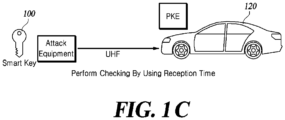
- FIG. 1A to FIG. 1C are illustrative diagrams of an authentication process between a smart key and a PKE system, according to some embodiments of the present disclosure.
- FIG. 1A illustrates an example PKE system.
- the PKE system can be mounted on the vehicle and can control access and startup, such as unlocking or starting the vehicle.
- the PKE system of the vehicle can periodically transmit an LF signal around the vehicle.
- a smart key that receives the LF signal can wake up and transmit a UHF (ultra-high frequency) signal to the PKE system of the vehicle as a response signal to the received LF signal.
- UHF ultra-high frequency
- the PKE system can send the LF signal including query information back to the smart key, which then can send to the vehicle's PKE system the UHF signal including response information corresponding to the query.
- the vehicle's PKE system can decide to authorize the access and startup. This example case sees no delay occurred between the PKE system and the smart key.
- FIG. 1B illustrates another example PKE system.
- FIG. 1B shows attack equipment that may intercept the LF signal with a short range and perform amplification or band conversion, resulting in an extended signal range of the LF signal.
- the PKE system can have difficulty interpreting the UHF signal and checking for the time delay conditions to determine whether access and startup are authorized.
- FIG. 1C illustrates yet another example PKE system.
- Replay attack equipment may be utilized to recycle and re-transmit previously received smart key signals at a later time. Therefore, the PKE system can have difficulty interpreting the UHF signal and checking for time delay conditions to determine whether access and startup are authorized.
- FIG. 2 is a block diagram of a smart key 200 according to some embodiments of the present disclosure.
- the signal receiving unit 202 can receive the LF signal transmitted by the PKE system.
- the PKE system can refer to a smart key system in a vehicle.
- the real-time clock handling unit 206 can generate time information that adjusts the time of a real-time clock embedded in the smart key 200 to the received time of the signal and delivers the generated time information to the signal generating unit 208.
- the random-number generating unit 212 can generate a random number and deliver it to the signal generating unit 208.
- the signal generating unit 208 can use the random number generated by the random-number generating unit 212 and the time information generated by the real-time clock handling unit 206, as bases for converting the data included in the response data into a UHF signal and thereby generating a response UHF signal.
- HSM encryption may be applied to the response UHF signal.
- the signal transmitting unit 210 may transmit the response UHF signal from the signal generating unit 208 to the PKE system.
- FIG. 3 is a block diagram of a PKE system 300 according to some embodiments of the present disclosure.
- a PKE system 300 can include a real-time clock handling unit 302, a random-number generating unit 304, a storage unit 306, a signal generating unit 308, a signal transmitting unit 310, a signal receiving unit 312, a signal interpreting unit 314, an authentication unit 316, a body control unit 318, an engine control unit 320, an HSM 322, and the like.
- the real-time clock handling unit 302 can measure and transmit the current time to the signal generating unit 308.
- the random-number generating unit 304 can generate and deliver a random number to the signal generating unit 308.
- the random-number generating unit 304 may utilize the HSM 322 to generate the random number.
- the storage unit 306 can store the time measured by the real-time clock handling unit 302.
- the signal transmitting unit 310 can transmit the LF signal generated by the signal generating unit 308 to the smart key 200.
- the signal receiving unit 312 can receive a response UHF signal from the smart key 200.
- the response UHF signal may be referred to as a UHF signal or a response signal.
- the signal interpreting unit 314 can convert the response UHF signal into digital data in a decryption process and can extract the visual data and random number data contained in the response signal.
- the signal interpreting unit 314 can utilize the HSM 322 to perform the decryption process.
- the authentication unit 316 can check the random number and visual data, and according to the checking result, can authorize the body control unit 318 and the engine control unit 320 to access and startup, respectively.
- the checking result can be displayed on the system's liquid crystal display (LCD) to notify the user.
- LCD liquid crystal display
- the body control unit 318 can control access to the vehicle according to the checking result of the authentication unit 316.
- the engine control unit 320 can control the vehicle startup according to the checking result of the authentication unit 316.
- FIG. 4 is a flowchart of the operation of a smart key and PKE system according to some embodiments of the present disclosure.
- the PKE system can wait for LF signal transmission for some time in operation S402.
- the PKE system can generate a random number (N A ) for seeding by using the HSM and store it in the storage unit.
- the PKE system can check the current time (T A ) by using the internal real-time clock (RTC) and store it in the storage unit.
- T A current time
- RTC real-time clock
- the PKE system can generate a challenge signal (LF signal) including the random number (N A ) and the timestamp (T A ), and transmit it externally.
- the PKE system may selectively perform HSM-based encryption operation using a pre-shared symmetric key in operation S408 before the LF signal is generated.
- the smart key can receive the challenge signal transmitted by the PKE.
- the smart key may decrypt the received challenge signal by using the HSM.
- the smart key can update the time of the real-time clock in the smart key to the timestamp value (T A ) contained in the received challenge signal.
- the smart key can store a random number (N B ) contained in the challenge signal.
- the smart key can check again the current time (T B ) and calculate a hash value (H B ) for N B .
- a shared secret key (Ks) can be used to calculate the hash value (H B ).
- a shared secret key can be used for hash calculation and a shared symmetric key can be used for encryption using the HSM.
- the smart key can generate a response signal (UHF signal) including the current timestamp (T B ) and the hash (H B ).
- the smart key may selectively perform HSM-based encryption operation using a pre-shared symmetric key in operation S422 before the UHF signal is generated.
- the smart key can transmit the generated response signal (UHF signal) externally.
- the PKE system may receive a response signal from the smart key.
- the PKE system may decrypt the received response signal by using the HSM.
- the PKE system can determine the current time (T C ). In other words, the PKE system can generate the timestamp.
- the PKE system can calculate
- Operation S 434 can be an operation for determining an occurrence of replay attack delay, for example.
- the PKE system can calculate, in operation S436,
- Operation S436 can be an operation for determining an occurrence of relay/replay attack delay, for example.
- the PKE system can compare, in operation S438, the hash (H B ) contained in the received response signal with a hash (H A ) of the random number (N A ).
- H A can be calculated by using a shared secret key that the PKE system can share with the smart key.
- H B and H A are equal, then authentication can be successful and the PKE system can allow access and startup in operation S440.
- Some embodiments of the present disclosure can utilize time synchronization, signal processing time within a smart key, communication link latency, and the like, for attack detection to reduce the time it takes to distinguish between legitimate signals and relay/replay signals.
- Some embodiments of the present disclosure can determine whether attack equipment is utilized, determine whether a signal is recycled, and ensure the confidentiality of signals, all together.
- Some embodiments of the present disclosure can prevent replay attacks and relay attacks by enabling staged checking through segmentation of a comparative verification, such as operations S434 to S438 of FIG. 4 for example.
- the operations illustrated in FIG. 4 can be implemented as computer-readable codes on a computer-readable recording medium.
- the computer-readable recording medium can include any type of recording device on which data that can be read by a computer system are recordable. Examples of computer-readable recording medium include non-transitory medium such as a ROM, a RAM, a CD-ROM, a magnetic tape, a floppy disk, and an optical data storage. Further, a computer-readable recording medium can be distributed in computer systems connected via a network, wherein the computer-readable codes can be stored and executed in a distributed mode.
- components of some embodiments of the present disclosure may utilize integrated circuit structures such as memories, processors, logic circuits, look-up tables, and the like. These integrated circuit structures can perform each of the functions described herein under the control of one or more microprocessors or other control devices. Further, components of some embodiments of the present disclosure may be specifically implemented by a portion of a program or code that includes one or more executable instructions for performing a particular logical function and can be executed by one or more microprocessors or other control devices. Components of some embodiments of the present disclosure may include or be implemented by a central processing unit (CPU), microprocessor, or the like that performs their respective functions. Components of some embodiments of the present disclosure may store instructions executed by one or more processors in one or more memories.
- CPU central processing unit
- Some embodiments of the present disclosure can accurately distinguish against relay signals in a PKE system.
- Some embodiments of the present disclosure can prevent theft of a driver's vehicle and theft of items inside the vehicle, and provide convenience to the driver.
- Some embodiments of the present disclosure can enable a staged checking through segmentation of the comparative verification to accurately distinguish against relay signals.
- Some embodiments of the present disclosure can accurately distinguish against relay signals and replay signals to defend against both relay attacks and replay attacks.
Landscapes
- Engineering & Computer Science (AREA)
- Computer Security & Cryptography (AREA)
- Mechanical Engineering (AREA)
- Computer Networks & Wireless Communication (AREA)
- Signal Processing (AREA)
- Physics & Mathematics (AREA)
- General Physics & Mathematics (AREA)
- Lock And Its Accessories (AREA)
Abstract
Description
- The present disclosure relates to a passive keyless entry (PKE) system for a vehicle.
- The statements in this section merely provide background information related to the present disclosure and do not necessarily constitute prior art.
- Passive keyless entry (PKE) technology seeks to increase user convenience by allowing a user's smart key and the vehicle's PKE system to communicate to enable the vehicle to unlock the vehicle's doors and/or start the vehicle by verifying the proximity of the smart key to the vehicle without the driver directly actuating the PKE device.
- The vehicle and the smart key may use two different frequency channel signals to communicate with each other. For example, the vehicle may use a low frequency (LF) signal with a short range of two to three meters, and the smart key may use an ultra-high frequency (UHF) signal with a range of approximately 20 to 50 meters to remotely control the vehicle. The vehicle's PKE system periodically sends around the vehicle LF signals for confirmation of the smart key presence and/or as wake-up signals, which are received by the smart key that is responsive to the received LF signal for waking up and sending a UHF signal for confirmation of the smart key presence to the vehicle. Upon confirmation of the smart key presence, the PKE system of the vehicle sends an LF signal including challenge information back to the smart key, and the smart key sends the vehicle a UHF signal including response information in response to the challenge. Upon validation of the received response information, the vehicle's PKE system performs vehicle control, e.g., opening and closing vehicle doors, starting the vehicle, etc.
- Such PKE systems may be vulnerable to relay attacks or replay attacks. A relay attack could occur with the user's smart key and the vehicle separated remotely when two signal repeaters are used to amplify and forward signals from the vehicle and the smart key, respectively. A replay attack tactic involves the attacker to eavesdrop and store a valid signal at the time it is transmitted, and to later transmit a signal as if it were a legitimate smart key. Because the replay attack sends the original data as it was originally sent and received, the attacker can use even encrypted data without decrypting it for attacks.
- In such a relay attack or replay attack, the vehicle cannot determine whether the response signal sent by a smart key in response to a query is actually from a legitimate smart key, resulting in a defeated authentication process of the PKE system.
- The present disclosure in some embodiments relates to an apparatus and method for distinguishing against a relay signal and a replay signal in a passive keyless entry (PKE) system.
- Some embodiments of the present disclosure provide an apparatus and method for accurately distinguishing between normal and relay/replay signals in a PKE system.
- Some embodiments of the present disclosure provide an apparatus and method for preventing theft of a driver's vehicle and theft of items inside the vehicle, and for providing convenience to the driver.
- The advantages of some embodiments of the present disclosure are not necessarily limited to those particularly described hereinabove, and the above and other advantages that some embodiments of the present disclosure could achieve can be clearly understood by those skilled in the art from the following detailed description.
- According to some embodiments of the present disclosure, a method of distinguishing against a relay signal and a replay signal in a passive keyless entry (PKE) system, includes generating and transmitting to a smart key, a first signal including a first random number and a first timestamp value, receiving from the smart key, a second signal including a hash value and a second timestamp value, generating a third timestamp value, comparing a difference between the second timestamp value and the first timestamp value with a first threshold, and determining that the relay signal has occurred when the difference between the second timestamp value and the first timestamp value equals to or greater than the first threshold.
- According to some embodiments of the present disclosure, an apparatus for distinguishing against a relay signal and a replay signal in a passive keyless entry (PKE) system, includes a memory configured to store commands, and a processor configured to generate and transmit to a smart key, a first signal including a first random number and a first timestamp value, to receive from the smart key, a second signal including a hash value and a second timestamp value, to generate a third timestamp value, to compare a difference between the second timestamp value and the first timestamp value with a first threshold, and to determine that the relay signal has occurred when the difference between the second timestamp value and the first timestamp value equals to or greater than the first threshold.
-
-
FIG. 1A to FIG. 1C are illustrative diagrams of an authentication process between a smart key and a PKE system, according to some embodiments of the present disclosure. -
FIG. 2 is a block diagram of a smart key according to some embodiments of the present disclosure. -
FIG. 3 is a block diagram of a PKE system according to some embodiments of the present disclosure. -
FIG. 4 is a flowchart of an operation of a smart key and PKE system according to some embodiments of the present disclosure. - Hereinafter, some embodiments of the present disclosure will be described in detail with reference to the accompanying drawings. In the following description, like reference numerals can designate like elements, even though the elements can be shown in different drawings. Further, the following description of some embodiments can omit, for the purpose of clarity and for brevity, a detailed description of related known components and functions when considered obscuring the subject of the present disclosure.
- Various ordinal numbers or alpha codes such as "first", "second", "A", "B", "(a)", "(b)", etc., can be prefixed solely to differentiate one component from the other but not to necessarily imply or suggest the substances, order, or sequence of the components. Throughout this specification, when a part "includes" or "comprises" a component, the part is meant to allow for further including other components and to not exclude other components, unless specifically stated to the contrary. Terms such as "unit," "module," and the like can refer to units in which at least one function or operation is processed and they may be implemented by hardware, software, or a combination thereof.
- Some embodiments of the present disclosure relates to apparatuses and methods for defending against relay and replay attacks when opening a vehicle door with a smart key. As used herein, a smart key can refer to a PKE device carried by a user and interworking with a PKE system, which may be a dedicated device for PKE services, such as a key fob, or a mobile device running a PKE application. Some embodiments of the present disclosure may utilize the hash value and information on the time it takes to generate the hash for authentication between the PKE system and the smart key to distinguish relay/replay signals from legitimate signals. Some embodiments of the present disclosure may support mutual authentication by using a hash based on a secret key and may support staged checking by breaking down a processing interval and verifying the time taken for the relevant processing, rather than the total processing time.
-
FIG. 1A to FIG. 1C are illustrative diagrams of an authentication process between a smart key and a PKE system, according to some embodiments of the present disclosure. -
FIG. 1A illustrates an example PKE system. - The PKE system can be mounted on the vehicle and can control access and startup, such as unlocking or starting the vehicle.
- The PKE system of the vehicle can periodically transmit an LF signal around the vehicle. A smart key that receives the LF signal can wake up and transmit a UHF (ultra-high frequency) signal to the PKE system of the vehicle as a response signal to the received LF signal.
- When the smart key presence is confirmed based on the UHF signal, the PKE system can send the LF signal including query information back to the smart key, which then can send to the vehicle's PKE system the UHF signal including response information corresponding to the query. When the received response information is properly verified, the vehicle's PKE system can decide to authorize the access and startup. This example case sees no delay occurred between the PKE system and the smart key.
-
FIG. 1B illustrates another example PKE system. -
FIG. 1B shows attack equipment that may intercept the LF signal with a short range and perform amplification or band conversion, resulting in an extended signal range of the LF signal. Thus, because the smart key cannot deliver the UHF signal to the PKE system at the correct time, the PKE system can have difficulty interpreting the UHF signal and checking for the time delay conditions to determine whether access and startup are authorized. -
FIG. 1C illustrates yet another example PKE system. - Replay attack equipment may be utilized to recycle and re-transmit previously received smart key signals at a later time. Therefore, the PKE system can have difficulty interpreting the UHF signal and checking for time delay conditions to determine whether access and startup are authorized.
-
FIG. 2 is a block diagram of asmart key 200 according to some embodiments of the present disclosure. - A
smart key 200 according to at least one embodiment of the present disclosure can include asignal receiving unit 202, asignal interpreting unit 204, a real-timeclock handling unit 206, asignal generating unit 208, asignal transmitting unit 210, a random-number generatingunit 212, a hardware security module (HSM) 214, and the like. - The
signal receiving unit 202 can receive the LF signal transmitted by the PKE system. The PKE system can refer to a smart key system in a vehicle. - The
signal interpreting unit 204 can digitize the signal and can extract the received visual data and random number data. TheHSM 214 may be employed for communication using encryption/decryption. TheHSM 214 may be a chip that is housed within thesmart key 200 and can be capable of preventing unauthorized physical access to internally stored information. - The real-time
clock handling unit 206 can generate time information that adjusts the time of a real-time clock embedded in thesmart key 200 to the received time of the signal and delivers the generated time information to thesignal generating unit 208. - The random-
number generating unit 212 can generate a random number and deliver it to thesignal generating unit 208. - The
signal generating unit 208 can use the random number generated by the random-number generating unit 212 and the time information generated by the real-timeclock handling unit 206, as bases for converting the data included in the response data into a UHF signal and thereby generating a response UHF signal. HSM encryption may be applied to the response UHF signal. - The
signal transmitting unit 210 may transmit the response UHF signal from thesignal generating unit 208 to the PKE system. -
FIG. 3 is a block diagram of aPKE system 300 according to some embodiments of the present disclosure. - A
PKE system 300 according to at least one embodiment of the present disclosure can include a real-timeclock handling unit 302, a random-number generating unit 304, astorage unit 306, asignal generating unit 308, asignal transmitting unit 310, asignal receiving unit 312, asignal interpreting unit 314, anauthentication unit 316, abody control unit 318, anengine control unit 320, anHSM 322, and the like. - The real-time
clock handling unit 302 can measure and transmit the current time to thesignal generating unit 308. - The random-
number generating unit 304 can generate and deliver a random number to thesignal generating unit 308. The random-number generating unit 304 may utilize theHSM 322 to generate the random number. - The
storage unit 306 can store the time measured by the real-timeclock handling unit 302. - The
signal generating unit 308 can receive the random number generated by the random-number generating unit 304 and the time data measured by the real-timeclock handling unit 302 to generate challenge data and can convert the challenge data into an LF signal. The data before conversion can be encrypted by theHSM 322. - The
signal transmitting unit 310 can transmit the LF signal generated by thesignal generating unit 308 to thesmart key 200. - The
signal receiving unit 312 can receive a response UHF signal from thesmart key 200. The response UHF signal may be referred to as a UHF signal or a response signal. - The
signal interpreting unit 314 can convert the response UHF signal into digital data in a decryption process and can extract the visual data and random number data contained in the response signal. Thesignal interpreting unit 314 can utilize theHSM 322 to perform the decryption process. - The
authentication unit 316 can check the random number and visual data, and according to the checking result, can authorize thebody control unit 318 and theengine control unit 320 to access and startup, respectively. The checking result can be displayed on the system's liquid crystal display (LCD) to notify the user. - The
body control unit 318 can control access to the vehicle according to the checking result of theauthentication unit 316. - The
engine control unit 320 can control the vehicle startup according to the checking result of theauthentication unit 316. -
FIG. 4 is a flowchart of the operation of a smart key and PKE system according to some embodiments of the present disclosure. - The PKE system can wait for LF signal transmission for some time in operation S402.
- In operation S404, the PKE system can generate a random number (NA) for seeding by using the HSM and store it in the storage unit.
- In operation S406, the PKE system can check the current time (TA) by using the internal real-time clock (RTC) and store it in the storage unit.
- In operation S410, the PKE system can generate a challenge signal (LF signal) including the random number (NA) and the timestamp (TA), and transmit it externally. The PKE system may selectively perform HSM-based encryption operation using a pre-shared symmetric key in operation S408 before the LF signal is generated.
- In operation S412, the smart key can receive the challenge signal transmitted by the PKE.
- In operation S414, the smart key may decrypt the received challenge signal by using the HSM.
- In operation S416, the smart key can update the time of the real-time clock in the smart key to the timestamp value (TA) contained in the received challenge signal.
- In operation S418, the smart key can store a random number (NB) contained in the challenge signal.
- In operation S420, the smart key can check again the current time (TB) and calculate a hash value (HB) for NB. A shared secret key (Ks) can be used to calculate the hash value (HB). In some embodiments of the present disclosure, a shared secret key can be used for hash calculation and a shared symmetric key can be used for encryption using the HSM.
- In operation S424, the smart key can generate a response signal (UHF signal) including the current timestamp (TB) and the hash (HB). The smart key may selectively perform HSM-based encryption operation using a pre-shared symmetric key in operation S422 before the UHF signal is generated.
- In operation S426, the smart key can transmit the generated response signal (UHF signal) externally.
- In operation S428, the PKE system may receive a response signal from the smart key.
- In operation S430, the PKE system may decrypt the received response signal by using the HSM.
- In operation S432, the PKE system can determine the current time (TC). In other words, the PKE system can generate the timestamp.
- In operation S434, the PKE system can calculate |TB-TA|, which can represent the time taken for the smart key to receive the challenge signal and transmit the response signal, and can determine if |TB-TA| is less than a predetermined threshold (Th1). Operation S434 can be an operation for determining an occurrence of replay attack delay, for example.
- If |TB-TA| is less than a set or predetermined threshold (Th1), the PKE system can calculate, in operation S436, |TC-TB|, which can represent the time between the smart key sending the response signal and the PKE system receiving the response signal, and can determine whether |TC-TB| is less than a set or predetermined threshold (Th2). Operation S436 can be an operation for determining an occurrence of relay/replay attack delay, for example.
- If |TC-TB| is less than the set or predetermined threshold (Th2), the PKE system can compare, in operation S438, the hash (HB) contained in the received response signal with a hash (HA) of the random number (NA).
- HA can be calculated by using a shared secret key that the PKE system can share with the smart key.
- If HB and HA are equal, then authentication can be successful and the PKE system can allow access and startup in operation S440.
- However, if |TB -TA| is greater than or equal to the set or predetermined threshold (Th1) in operation S434, or |TC-TB| is greater than or equal to the set or predetermined threshold (Th2) in operation S436, or HB and HA are not equal in operation S438, then authentication can fail and the PKE system can disallow access and startup in operation S442.
- Some embodiments of the present disclosure can utilize time synchronization, signal processing time within a smart key, communication link latency, and the like, for attack detection to reduce the time it takes to distinguish between legitimate signals and relay/replay signals.
- Some embodiments of the present disclosure can determine whether attack equipment is utilized, determine whether a signal is recycled, and ensure the confidentiality of signals, all together.
- Some embodiments of the present disclosure can prevent replay attacks and relay attacks by enabling staged checking through segmentation of a comparative verification, such as operations S434 to S438 of
FIG. 4 for example. - Although the aforementioned drawings present respective operations as being sequentially performed, they can merely instantiate some technical ideas of some embodiments of the present disclosure. Therefore, a person having ordinary skill in the pertinent art can incorporate various modifications, additions, and substitutions in practicing an embodiment of the present disclosure by changing the sequence of operations illustrated in the drawings or by performing one or more of the operations thereof in parallel, without departing from the essential nature of some embodiments of the present disclosure, and hence the operations in the drawings are not necessarily limited to the illustrated chronological sequences.
- The operations illustrated in
FIG. 4 can be implemented as computer-readable codes on a computer-readable recording medium. The computer-readable recording medium can include any type of recording device on which data that can be read by a computer system are recordable. Examples of computer-readable recording medium include non-transitory medium such as a ROM, a RAM, a CD-ROM, a magnetic tape, a floppy disk, and an optical data storage. Further, a computer-readable recording medium can be distributed in computer systems connected via a network, wherein the computer-readable codes can be stored and executed in a distributed mode. - Further, components of some embodiments of the present disclosure may utilize integrated circuit structures such as memories, processors, logic circuits, look-up tables, and the like. These integrated circuit structures can perform each of the functions described herein under the control of one or more microprocessors or other control devices. Further, components of some embodiments of the present disclosure may be specifically implemented by a portion of a program or code that includes one or more executable instructions for performing a particular logical function and can be executed by one or more microprocessors or other control devices. Components of some embodiments of the present disclosure may include or be implemented by a central processing unit (CPU), microprocessor, or the like that performs their respective functions. Components of some embodiments of the present disclosure may store instructions executed by one or more processors in one or more memories.
- Some embodiments of the present disclosure can accurately distinguish against relay signals in a PKE system.
- Some embodiments of the present disclosure can prevent theft of a driver's vehicle and theft of items inside the vehicle, and provide convenience to the driver.
- Some embodiments of the present disclosure can enable a staged checking through segmentation of the comparative verification to accurately distinguish against relay signals.
- Some embodiments of the present disclosure can accurately distinguish against relay signals and replay signals to defend against both relay attacks and replay attacks.
- The advantages and functionalities of some embodiments of the present disclosure are not necessarily limited to those mentioned above, and other unmentioned advantages and functionalities can be clearly understood by those skilled in the art from the above description.
- Although example embodiments of the present disclosure have been described for illustrative purposes, those skilled in the art will appreciate that various modifications, additions, and substitutions are possible, without departing from the idea and scope of the present disclosure. Therefore, example embodiments of the present disclosure have been described for the sake of brevity and clarity. The scope of technical ideas of embodiments of the present disclosure is not necessarily limited by the illustrations. Accordingly, one of ordinary skill would understand the scope of the present disclosure is not to be limited by the above explicitly described embodiments but by the claims and equivalents thereof.
Claims (15)
- A method of operating a passive keyless entry (PKE) system of a vehicle, the method comprising:generating a first signal including a first random number and a first timestamp value;transmitting the first signal to a smart key;receiving from the smart key, a second signal including a second hash value and a second timestamp value;comparing a first difference between the second timestamp value and the first timestamp value with a first threshold; anddetermining that a relay signal has occurred in response to the first difference between the second timestamp value and the first timestamp value being equal to or greater than the first threshold.
- The method of claim 1, wherein the first difference between the second timestamp value and the first timestamp value indicates a first sum of a first time elapsed for the smart key to receive the first signal from the PKE system and a second time elapsed for the smart key to transmit the second signal to the PKE system.
- The method of claim 1 or 2, further comprising:generating a third timestamp value upon receiving the second signal; andin response to the first difference between the second timestamp value and the first timestamp value being less than the first threshold, comparing a second difference between the third timestamp value and the second timestamp value with a second threshold, and determining that one of or both of the relay signal and a replay signal has occurred in response to the second difference between the third timestamp value and the second timestamp value being equal to or greater than the second threshold.
- The method of claim 3, wherein the second difference between the third timestamp value and the second timestamp value indicates a second sum of a second time elapsed for the smart key to transmit the second signal to the PKE system and a third time elapsed for the PKE system to receive the second signal.
- The method of claim 3 or 4, further comprising:generating a first hash value based on the first random number;in response to the second difference between the third timestamp value and the second timestamp value being less than the second threshold, comparing the first hash value with the second hash value contained in the second signal, and allowing access to and startup of the vehicle in response to the first hash value based on the first random number being equal to the second hash value contained in the second signal.
- The method of claim 5, further comprising disallowing access to and startup of the vehicle in response to the first hash value based on the first random number being not equal to the second hash value contained in the second signal.
- The method of one of claims 1-6, wherein the first signal comprises a low frequency signal, and the second signal comprises an ultra-high frequency signal.
- A passive keyless entry (PKE) system for a vehicle, the system comprising:a non-transitory memory configured to store computer-executable code; anda processor configured to execute the code, wherein the code comprises commands for the processor to:generate a first signal including a first random number and a first timestamp value,transmit the first signal to a smart key,receive from the smart key, a second signal including a second hash value and a second timestamp value,generate a third timestamp value upon receiving the second signal,compare a first difference between the second timestamp value and the first timestamp value with a first threshold, anddetermine that a relay signal has occurred in response to the first difference between the second timestamp value and the first timestamp value being equal to or greater than the first threshold.
- The system of claim 8, wherein the first difference between the second timestamp value and the first timestamp value indicates a first sum of a first time elapsed for the smart key to receive the first signal from the PKE system and a second time elapsed for the smart key to transmit the second signal to the PKE system.
- A method of operating a smart key for a vehicle, the method comprising:receiving from a passive keyless entry (PKE) system of the vehicle, a first signal including a first random number and a first timestamp value;generating a second random number and a second timestamp value; andtransmitting to the PKE system, a second signal including a second hash value and the second timestamp value, wherein the PKE system is configured to generate a third timestamp value based on a receipt of the second signal, to compare a first difference between the second timestamp value and the first timestamp value with a first threshold, and to determine that a relay signal has occurred in response to the first difference between the second timestamp value and the first timestamp value being equal to or greater than the first threshold.
- The method of claim 10, wherein the first difference between the second timestamp value and the first timestamp value indicates a first sum for a first time elapsed for the smart key to receive the first signal from the PKE system and a second time elapsed for the smart key to transmit the second signal to the PKE system.
- The method of claim 10 or 11, wherein the PKE system is further configured to compare a second difference between the third timestamp value and the second timestamp value with a second threshold in response to the first difference between the second timestamp value and the first timestamp value being less than the first threshold, and to determine that one of or both of the relay signal and a replay signal has occurred in response to the second difference between the third timestamp value and the second timestamp value being equal to or greater than the second threshold.
- The method of claim 12, wherein the second difference between the third timestamp value and the second timestamp value indicates a second sum of a second time elapsed for the smart key transmit the second signal to the PKE system and a third time elapsed for the PKE system receive the second signal.
- The method of claim 12 or 13, wherein the PKE system is configured to generate a first hash value based on the first random number, to compare the first hash value with the second hash value contained in the second signal in response to the second difference between the third timestamp value and the second timestamp value being less than the second threshold, and to allow access to and startup of the vehicle in response to the first hash value being equal to the second hash value.
- The method of claim 14, wherein the PKE system is configured further to disallow access to and startup of the vehicle in response to the first hash value being not equal to the second hash value.
Applications Claiming Priority (1)
| Application Number | Priority Date | Filing Date | Title |
|---|---|---|---|
| KR1020230148501A KR20250064080A (en) | 2023-10-31 | 2023-10-31 | Apparatus and Method for Distinguishing Relay/Replay Signal in Passive Keyless Entry System |
Publications (1)
| Publication Number | Publication Date |
|---|---|
| EP4549260A1 true EP4549260A1 (en) | 2025-05-07 |
Family
ID=90880665
Family Applications (1)
| Application Number | Title | Priority Date | Filing Date |
|---|---|---|---|
| EP24172154.7A Pending EP4549260A1 (en) | 2023-10-31 | 2024-04-24 | Apparatus and method for distinguishing relay/replay signal in passive keyless entry system |
Country Status (4)
| Country | Link |
|---|---|
| US (1) | US20260001510A1 (en) |
| EP (1) | EP4549260A1 (en) |
| KR (1) | KR20250064080A (en) |
| CN (1) | CN119921937A (en) |
Citations (3)
| Publication number | Priority date | Publication date | Assignee | Title |
|---|---|---|---|---|
| CN107276748A (en) * | 2017-06-01 | 2017-10-20 | 贵州师范大学 | A kind of keyless entry of automobile and the key derivation process of activation system |
| EP3736780A1 (en) * | 2019-05-06 | 2020-11-11 | Universitat Pompeu Fabra | A method for remotely controlling features of a device and a remote keyless entry instrument |
| US20220194316A1 (en) * | 2020-12-23 | 2022-06-23 | Nagravision S.A. | Relay attack prevention |
Family Cites Families (3)
| Publication number | Priority date | Publication date | Assignee | Title |
|---|---|---|---|---|
| EP3419241B1 (en) * | 2017-06-21 | 2019-12-25 | Volvo Car Corporation | Method and system for preventing a physical layer relay attack |
| EP3454502B1 (en) * | 2017-09-07 | 2020-08-05 | Nxp B.V. | Transceiver system |
| US10391975B2 (en) * | 2018-01-30 | 2019-08-27 | Toyota Motor Engineering & Manufacturing North America, Inc. | Method to provide warning to relay attacks on keyless entry and start systems |
-
2023
- 2023-10-31 KR KR1020230148501A patent/KR20250064080A/en active Pending
-
2024
- 2024-04-23 US US18/643,301 patent/US20260001510A1/en active Pending
- 2024-04-24 EP EP24172154.7A patent/EP4549260A1/en active Pending
- 2024-05-30 CN CN202410687056.2A patent/CN119921937A/en active Pending
Patent Citations (3)
| Publication number | Priority date | Publication date | Assignee | Title |
|---|---|---|---|---|
| CN107276748A (en) * | 2017-06-01 | 2017-10-20 | 贵州师范大学 | A kind of keyless entry of automobile and the key derivation process of activation system |
| EP3736780A1 (en) * | 2019-05-06 | 2020-11-11 | Universitat Pompeu Fabra | A method for remotely controlling features of a device and a remote keyless entry instrument |
| US20220194316A1 (en) * | 2020-12-23 | 2022-06-23 | Nagravision S.A. | Relay attack prevention |
Also Published As
| Publication number | Publication date |
|---|---|
| KR20250064080A (en) | 2025-05-09 |
| CN119921937A (en) | 2025-05-02 |
| US20260001510A1 (en) | 2026-01-01 |
Similar Documents
| Publication | Publication Date | Title |
|---|---|---|
| US12089178B2 (en) | Methods and architectures for secure ranging | |
| US11356265B2 (en) | Secure communication between a vehicle and a remote device | |
| CA2554300C (en) | System and method for encrypted smart card pin entry | |
| EP3249420B1 (en) | Secure wireless ranging | |
| US20090153290A1 (en) | Secure interface for access control systems | |
| EP0492692A2 (en) | Remote accessing system | |
| CN116094831A (en) | Modifying security states through security range detection | |
| US20180288092A1 (en) | Protection from relay attacks in wireless communication systems | |
| Patel et al. | On the security of remote key less entry for vehicles | |
| KR20120070808A (en) | Rfid tag device and method of recognizing rfid tag device | |
| US20050250472A1 (en) | User authentication using a wireless device | |
| US20260109322A1 (en) | Systems and methods for a secure keyless system | |
| WO2005052768A1 (en) | Secret information processing system and lsi | |
| WO2018133675A1 (en) | Key update method, device and system | |
| KR102702896B1 (en) | Proximity verification through flight time | |
| US20260001510A1 (en) | Apparatus and method for distinguishing relay/replay signal in passive keyless entry system | |
| EP3736780A1 (en) | A method for remotely controlling features of a device and a remote keyless entry instrument | |
| Bianchi et al. | {SoK}: Stealing Cars Since Remote Keyless Entry Introduction and How to Defend From It | |
| CN112785753B (en) | GPS-based automobile access control system and attack prevention method | |
| RU2274899C2 (en) | Portable device and method for accessing device activated by key data | |
| CN121929101A (en) | Keyless entry method and related device | |
| KR20250170394A (en) | An electronic key device performing a digital key function based on biometric information and a vehicle digital key held by the electronic key device and a method of performing the digital key function of an electronic key device | |
| JP2024055384A (en) | Vehicle control device | |
| Wickramaarachchi | The Role of Cryptographic Techniques in Remote Keyless Entry (RKE) Systems | |
| HK1151910A (en) | Decoupling of measuring the response time of a transponder and its authentication |
Legal Events
| Date | Code | Title | Description |
|---|---|---|---|
| PUAI | Public reference made under article 153(3) epc to a published international application that has entered the european phase |
Free format text: ORIGINAL CODE: 0009012 |
|
| STAA | Information on the status of an ep patent application or granted ep patent |
Free format text: STATUS: THE APPLICATION HAS BEEN PUBLISHED |
|
| AK | Designated contracting states |
Kind code of ref document: A1 Designated state(s): AL AT BE BG CH CY CZ DE DK EE ES FI FR GB GR HR HU IE IS IT LI LT LU LV MC ME MK MT NL NO PL PT RO RS SE SI SK SM TR |
|
| P01 | Opt-out of the competence of the unified patent court (upc) registered |
Free format text: CASE NUMBER: APP_28749/2025 Effective date: 20250617 |
|
| STAA | Information on the status of an ep patent application or granted ep patent |
Free format text: STATUS: REQUEST FOR EXAMINATION WAS MADE |
|
| 17P | Request for examination filed |
Effective date: 20250801 |