EP4548910A2 - Compounds for use on mucosal tissue - Google Patents
Compounds for use on mucosal tissue Download PDFInfo
- Publication number
- EP4548910A2 EP4548910A2 EP24221336.1A EP24221336A EP4548910A2 EP 4548910 A2 EP4548910 A2 EP 4548910A2 EP 24221336 A EP24221336 A EP 24221336A EP 4548910 A2 EP4548910 A2 EP 4548910A2
- Authority
- EP
- European Patent Office
- Prior art keywords
- care formulation
- carbon atoms
- hydrocarbon chains
- mucosal tissue
- mixtures
- Prior art date
- Legal status (The legal status is an assumption and is not a legal conclusion. Google has not performed a legal analysis and makes no representation as to the accuracy of the status listed.)
- Withdrawn
Links
Classifications
-
- A—HUMAN NECESSITIES
- A61—MEDICAL OR VETERINARY SCIENCE; HYGIENE
- A61Q—SPECIFIC USE OF COSMETICS OR SIMILAR TOILETRY PREPARATIONS
- A61Q11/00—Preparations for care of the teeth, of the oral cavity or of dentures; Dentifrices, e.g. toothpastes; Mouth rinses
-
- A—HUMAN NECESSITIES
- A61—MEDICAL OR VETERINARY SCIENCE; HYGIENE
- A61K—PREPARATIONS FOR MEDICAL, DENTAL OR TOILETRY PURPOSES
- A61K31/00—Medicinal preparations containing organic active ingredients
- A61K31/16—Amides, e.g. hydroxamic acids
-
- A—HUMAN NECESSITIES
- A61—MEDICAL OR VETERINARY SCIENCE; HYGIENE
- A61K—PREPARATIONS FOR MEDICAL, DENTAL OR TOILETRY PURPOSES
- A61K31/00—Medicinal preparations containing organic active ingredients
- A61K31/33—Heterocyclic compounds
- A61K31/335—Heterocyclic compounds having oxygen as the only ring hetero atom, e.g. fungichromin
- A61K31/34—Heterocyclic compounds having oxygen as the only ring hetero atom, e.g. fungichromin having five-membered rings with one oxygen as the only ring hetero atom, e.g. isosorbide
- A61K31/341—Heterocyclic compounds having oxygen as the only ring hetero atom, e.g. fungichromin having five-membered rings with one oxygen as the only ring hetero atom, e.g. isosorbide not condensed with another ring, e.g. ranitidine, furosemide, bufetolol, muscarine
-
- A—HUMAN NECESSITIES
- A61—MEDICAL OR VETERINARY SCIENCE; HYGIENE
- A61K—PREPARATIONS FOR MEDICAL, DENTAL OR TOILETRY PURPOSES
- A61K8/00—Cosmetics or similar toiletry preparations
- A61K8/18—Cosmetics or similar toiletry preparations characterised by the composition
- A61K8/30—Cosmetics or similar toiletry preparations characterised by the composition containing organic compounds
- A61K8/40—Cosmetics or similar toiletry preparations characterised by the composition containing organic compounds containing nitrogen
- A61K8/42—Amides
-
- A—HUMAN NECESSITIES
- A61—MEDICAL OR VETERINARY SCIENCE; HYGIENE
- A61K—PREPARATIONS FOR MEDICAL, DENTAL OR TOILETRY PURPOSES
- A61K8/00—Cosmetics or similar toiletry preparations
- A61K8/18—Cosmetics or similar toiletry preparations characterised by the composition
- A61K8/30—Cosmetics or similar toiletry preparations characterised by the composition containing organic compounds
- A61K8/49—Cosmetics or similar toiletry preparations characterised by the composition containing organic compounds containing heterocyclic compounds
- A61K8/4973—Cosmetics or similar toiletry preparations characterised by the composition containing organic compounds containing heterocyclic compounds with oxygen as the only hetero atom
-
- A—HUMAN NECESSITIES
- A61—MEDICAL OR VETERINARY SCIENCE; HYGIENE
- A61P—SPECIFIC THERAPEUTIC ACTIVITY OF CHEMICAL COMPOUNDS OR MEDICINAL PREPARATIONS
- A61P27/00—Drugs for disorders of the senses
- A61P27/02—Ophthalmic agents
- A61P27/04—Artificial tears; Irrigation solutions
-
- A—HUMAN NECESSITIES
- A61—MEDICAL OR VETERINARY SCIENCE; HYGIENE
- A61P—SPECIFIC THERAPEUTIC ACTIVITY OF CHEMICAL COMPOUNDS OR MEDICINAL PREPARATIONS
- A61P27/00—Drugs for disorders of the senses
- A61P27/16—Otologicals
-
- A—HUMAN NECESSITIES
- A61—MEDICAL OR VETERINARY SCIENCE; HYGIENE
- A61Q—SPECIFIC USE OF COSMETICS OR SIMILAR TOILETRY PREPARATIONS
- A61Q19/00—Preparations for care of the skin
- A61Q19/10—Washing or bathing preparations
-
- A—HUMAN NECESSITIES
- A61—MEDICAL OR VETERINARY SCIENCE; HYGIENE
- A61Q—SPECIFIC USE OF COSMETICS OR SIMILAR TOILETRY PREPARATIONS
- A61Q15/00—Anti-perspirants or body deodorants
-
- A—HUMAN NECESSITIES
- A61—MEDICAL OR VETERINARY SCIENCE; HYGIENE
- A61Q—SPECIFIC USE OF COSMETICS OR SIMILAR TOILETRY PREPARATIONS
- A61Q17/00—Barrier preparations; Preparations brought into direct contact with the skin for affording protection against external influences, e.g. sunlight, X-rays or other harmful rays, corrosive materials, bacteria or insect stings
-
- A—HUMAN NECESSITIES
- A61—MEDICAL OR VETERINARY SCIENCE; HYGIENE
- A61Q—SPECIFIC USE OF COSMETICS OR SIMILAR TOILETRY PREPARATIONS
- A61Q19/00—Preparations for care of the skin
Definitions
- ingredients that can be used in care formulations such as oral care formulations, intimate care formulations, eye care formulations, ear care formulations, nasal care formulations, and lubricants for medical devices or medical tools.
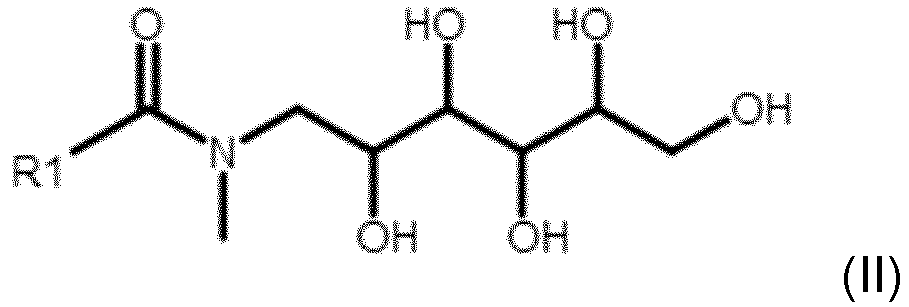
- the present invention relates to the use of compound X selected from compounds of Formula (I) wherein R is selected from saturated hydrocarbon chains having 5 to 23 carbon atoms, unsaturated hydrocarbon chains having 5 to 23 carbon atoms, and mixtures thereof, compounds of Formula (II) wherein R1 is selected from saturated hydrocarbon chains having 5 to 23 carbon atoms, unsaturated hydrocarbon chains having 5 to 23 carbon atoms, and mixtures thereof,
- the compounds used in the present invention have a high renewable carbon content, i.e. they are sustainable.
- the compounds used in the present invention can be incorporated into care formulations such as oral care formulations, intimate care formulations, eye care formulations, ear care formulations, nasal care formulations, and lubricants for medical devices or medical tools.
- the compounds can be used to protect or prevent the mucosal tissue from damage.
- the compounds can be used to protect, maintain or increase the tissue viability and/or tissue integrity of the mucosal tissue.
- compound X is used on mucosal tissue.
- the mucosal tissue is selected from oral mucosal tissue, intimate mucosal tissue, eye mucosal tissue, ear mucosal tissue (including eardrum), and nasal mucosal tissue.
- the mucosal tissue is selected from oral mucosal tissue and intimate mucosal tissue.
- the mucosal tissue is oral mucosal tissue.
- the mucosal tissue is intimate mucosal tissue.
- the mucosal tissue is selected from intimate mucosal tissue, eye mucosal tissue, ear mucosal tissue (including eardrum), and nasal mucosal tissue.
- compound X is applied topically to the mucosal tissue.
- compound X is selected from
- compound X is selected from compounds of Formula (I) and compounds of Formula (II).
- compound X is selected from compounds of Formula (I).
- R in Formula (I) is selected from saturated hydrocarbon chains having 5 to 17 carbon atoms, unsaturated hydrocarbon chains having 5 to 17 carbon atoms, and mixtures thereof. More preferably, R in Formula (I) is selected from saturated hydrocarbon chains having 5 to 13 carbon atoms, unsaturated hydrocarbon chains having 5 to 13 carbon atoms, and mixtures thereof. Particularly preferably, R in Formula (I) is selected from saturated hydrocarbon chains having 7 to 9 carbon atoms, unsaturated hydrocarbon chains having 7 to 9 carbon atoms, and mixtures thereof.
- the weight ratio of compounds according to Formula (I) wherein R is - (CH 2 ) 6 CH 3 and compounds according to Formula (I) wherein R is -(CH 2 ) 8 CH 3 is from 1:9 to 9:1, preferably from 3:7 to 7:3.
- the weight ratio of compounds according to Formula (I) wherein R is -(CH 2 ) 10 CH 3 and compounds according to Formula (I) wherein R is -(CH 2 ) 12 CH 3 is from 1:9 to 9:1, preferably from 3:7 to 7:3.
- the compound of Formula (I) is soluble in water. Therefore, the compound of Formula (I) is suitable for use in mouth wash formulations.
- compound X is selected from compounds of Formula (II).
- R1 in Formula (II) is selected from saturated hydrocarbon chains having 5 to 17 carbon atoms, unsaturated hydrocarbon chains having 5 to 17 carbon atoms, and mixtures thereof. More preferably, R1 in Formula (II) is selected from saturated hydrocarbon chains having 7 to 13 carbon atoms, unsaturated hydrocarbon chains having 7 to 13 carbon atoms, and mixtures thereof. Particularly preferably, R1 in Formula (II) is selected from saturated hydrocarbon chains having 11 to 13 carbon atoms, unsaturated hydrocarbon chains having 11 to 13 carbon atoms, and mixtures thereof.
- Particularly preferred compounds of Formula (II) are capryloyl/caproyl methyl glucamide, lauroyl/myristoyl methyl glucamide, cocoyl methyl glucamide, sunfloweroleyl methyl glucamide, or mixtures thereof.
- Such compounds are commercially available from Clariant (GlucoTain ® Clear, GlucoTain ® Plus, GlucoTain ® Flex, GlucoTain ® Care, GlucoTain ® Sense).
- compound X is selected from glyceryl ethers.
- the glyceryl ethers are mono- or diethers of glycerin and one or more C6-C20 fatty alcohols. More preferably, the glyceryl ethers are mono- or diethers of glycerin and one or more C8-C14 fatty alcohols. Particularly preferably, the glyceryl ethers are monoethers of glycerin and one or more C8 fatty alcohols.
- the glyceryl ethers are selected from ethylhexylglycerin, methylheptylglycerin, caprylyl glyceryl ether, and mixtures thereof.
- compound X is selected from sorbitan esters and isosorbide esters.
- compound X is selected from sorbitan esters.
- the sorbitan esters are mono-, di- or triesters of sorbitan and one or more C6-C20 fatty acids. More preferably, the sorbitan esters are mono- or diesters of sorbitan and one or more C8-C14 fatty acids. Particularly preferably, the sorbitan esters are mono- or diesters of sorbitan and caprylic acid.
- the sorbitan esters are selected from sorbitan caprylate, sorbitan stearate, sorbitan olivate, sorbitan oleate, sorbitan caprate, sorbitan laurate, sorbitan myristate, sorbitan caproate, and mixtures thereof.
- the sorbitan ester is sorbitan caprylate.
- compound X is selected from isosorbide esters.
- the isosorbide esters are mono- or diesters of isosorbide and one or more C6-C20 fatty acids. More preferably, the isosorbide esters are mono- or diesters of isosorbide and one or more C8-C14 fatty acids. Particularly preferably, the isosorbide esters are mono- or diesters of isosorbide and caprylic acid.
- the isosorbide esters are selected from isosorbide caprylate, isosorbide stearate, isosorbide olivate, isosorbide oleate, isosorbide caprate, isosorbide laurate, isosorbide myristate, isosorbide caproate, and mixtures thereof.
- the isosorbide ester is isosorbide caprylate.
- compound X is suitable for use in toothpaste formulations.
- the present invention also relates to compound X as defined herein for use on mucosal tissue.
- the mucosal tissue is selected from oral mucosal tissue, intimate mucosal tissue, eye mucosal tissue, ear mucosal tissue (including eardrum), and nasal mucosal tissue.
- compound X is applied topically to the mucosal tissue.
- compound X is used to protect or prevent the mucosal tissue from damage. In a preferred embodiment, compound X is used to protect, maintain or increase the tissue viability and/or tissue integrity of the mucosal tissue. In at least one embodiment, compound X is used to protect, maintain or increase the tissue viability of the mucosal tissue. In at least one embodiment, compound X is used to protect, maintain or increase the tissue integrity of the mucosal tissue.
- the present invention also relates to a care formulation comprising from 0.1 to 20 wt.-%, preferably from 0.2 to 10 wt.-%, more preferably from 0.3 to 5 wt.-%, even more preferably from 0.4 to 3 wt.-%, particularly preferably from 0.5 to 2 wt.-%, for example from 0.8 to 1.5 wt.-%, based on the total weight of the care formulation, of compound X as defined herein, wherein the care formulation is selected from an oral care formulation, intimate care formulation, eye care formulation, ear care formulation, nasal care formulation, and lubricant for medical devices or medical tools.
- the care formulation is selected from an oral care formulation, intimate care formulation, eye care formulation, ear care formulation, nasal care formulation, and lubricant for medical devices or medical tools.
- the care formulation is selected from an oral care formulation, intimate care formulation, eye care formulation, ear care formulation, and nasal care formulation.
- the care formulation is selected from an oral care formulation and intimate care formulation.
- the care formulation is an oral care formulation.
- the care formulation is an intimate care formulation.
- the care formulation is a lubricant for medical devices or medical tools.
- the care formulation is selected from an intimate care formulation, eye care formulation, ear care formulation, nasal care formulation, and lubricant for medical devices or medical tools.
- the care formulation is for human care or animal care.
- the care formulation is for human care.
- the care formulation is for animal care.
- the oral care formulation is selected from a toothpaste, oral gel, mouth wash, tooth powder, oral spray, oral care wipes, dental wipes, dental floss, and chewing gum.
- the oral care formulation is selected from a toothpaste and mouth wash.
- the oral care formulation is a toothpaste.
- the oral care formulation is a mouth wash.
- the intimate care formulation is selected from an intimate cleansing formulation, intimate deodorant, intimate lubricant, and intimate wipes.
- the intimate care formulation is selected from an intimate cleansing formulation, intimate deodorant, and intimate wipes.
- the eye care formulation is selected from an eye cleansing formulation, lense cleaning formulation, and eye makeup remover.
- the ear care formulation is an ear cleansing formulation.
- the nasal care formulation is a moisturizing nasal care formulation, which is preferably in the form of a spray, gel, cream, or ointment.
- the lubricant for medical devices or medical tools is an ultrasound gel.
- the care formulation comprises a (further) antimicrobial agent.
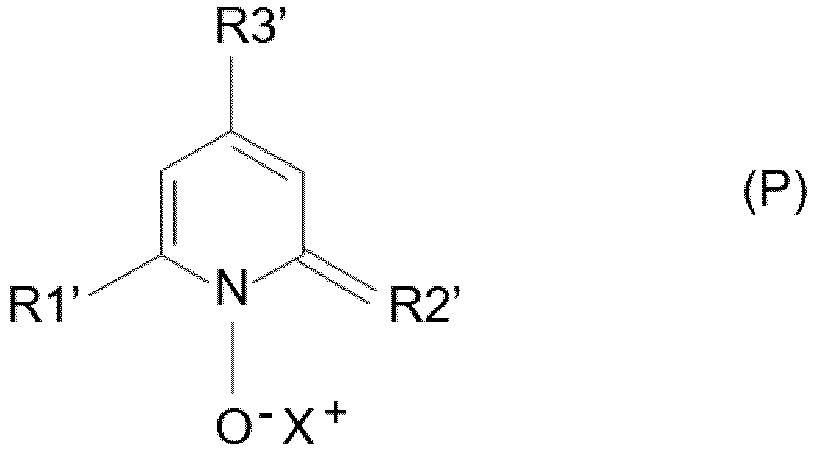
- the antimicrobial agent is selected from aromatic alcohols, organic acids and salts thereof, hydroxamic acids and salts thereof, hydroxyacetophenone, compounds according to Formula (P), alkyl diols, halogenated compounds, isothiazolinones, and mixtures thereof, wherein Formula (P) is as follows: wherein
- R3' is methyl
- the aromatic alcohols are selected from benzyl alcohol, phenoxyethanol, veratryl alcohol, propylene phenoxyethanol, phenethyl alcohol, phenylpropanol, vanillin, 2-methyl-1-phenyl-2-propanol, and mixtures thereof.
- the organic acids and salts thereof are selected from benzoic acid, sorbic acid, dehydroacetic acid, lactic acid, salicylic acid, p-anisic acid, undecylenic acid, glycolic acid, propionic acid, levulinic acid, and mixtures thereof.
- the hydroxamic acid is selected from hydroxamic acids of Formula (III) wherein R 1 is selected from saturated hydrocarbon chains having 5 to 23 carbon atoms, unsaturated hydrocarbon chains having 5 to 23 carbon atoms, and mixtures thereof.
- R 1 in Formula (III) is selected from saturated hydrocarbon chains having 5 to 17 carbon atoms, unsaturated hydrocarbon chains having 5 to 17 carbon atoms, and mixtures thereof. More preferably, R 1 in Formula (III) is selected from saturated hydrocarbon chains having 5 to 13 carbon atoms, unsaturated hydrocarbon chains having 5 to 13 carbon atoms, and mixtures thereof. Particularly preferably, R 1 in Formula (III) is selected from saturated hydrocarbon chains having 7 carbon atoms, unsaturated hydrocarbon chains having 7 carbon atoms, and mixtures thereof.
- Preferred hydroxamic acids are selected from caprylhydroxamic acid, hexanohydroxamic acid, caprohydroxamic acid, laurohydroxamic acid, and mixtures thereof.
- a particularly preferred hydroxamic acid is caprylhydroxamic acid.
- Caprylhydroxamic acid may also be referred to as caprylohydroxamic acid or octanohydroxamic acid.
- Hydroxamic acids are described in, e.g., EP2224973 .
- salts of hydroxamic acids are alkali metal salts of hydroxamic acids (e.g. sodium salts of hydroxamic acids or potassium salts of hydroxamic acids) or alkaline earth metal salts of hydroxamic acids (e.g. magnesium salts of hydroxamic acids or calcium salts of hydroxamic acids).
- the compound according to Formula (P) is selected from 2-hydroxypyridine-N-oxide, 2-pyridinethiol-1-oxide and salts thereof, 1-hydroxy-4-methyl-6-(2,4,4-trimethylpentyl)-2(1H)-pyridone and salts thereof (preferably the monoethanolamine salt), and mixtures thereof.
- Formula (P) discloses and encompasses the tautomeric equivalents of these compounds, since an equilibrium always exists.
- the compound according to Formula (P) is piroctone olamine (Octopirox).
- the alkyl diols are selected from 1,2-pentanediol, 1,2-hexanediol, 1,6-hexanediol, 1,2-octanediol, 1,2-heptanediol, 1,2-decanediol, methylpropanediol, and mixtures thereof.
- the halogenated compounds are selected from chlorhexidine and salts thereof, triclosan, chlorphenesin, trichlorcarban, chloroxylenol, bronopol, climbazole, and mixtures thereof.
- the isothiazolinones are selected from methylisothiazolinone, methylchloroisothiazolinone, benzylisothiazolinone, and mixtures thereof.
- the antimicrobial agent is selected from aromatic alcohols, organic acids and salts thereof, hydroxamic acids and salts thereof, hydroxyacetophenone, hydroxypyridones, alkyl diols, halogenated compounds, isothiazolinones, and mixtures thereof.
- the antimicrobial agent is selected from phenoxyethanol, benzyl alcohol, phenethyl alcohol, benzoic acid and salts thereof, caprylhydroxamic acid, hydroxyacetophenone, piroctone olamine, and mixtures thereof.
- the antimicrobial agent is 1,2-octanediol, in particular bio-based 1,2-octanediol, for example bio-1,2-octanediol as disclosed in WO 2019/152569 .
- the care formulation preferably oral care formulation comprises a solvent.
- the solvent is preferably selected from water, propylene glycol, isopropanol, and mixtures thereof.
- the care formulation preferably oral care formulation comprises a humectant.
- the humectant is preferably selected from sorbitol, glycerol, xylitol, and mixtures thereof.
- the humectant may, for example, be present in an amount of from 10 to 70 wt.-%, preferably from 30 to 60 wt.-%, for example from 40 to 55 wt.-%, based on the total weight of the care formulation, preferably oral care formulation.
- the care formulation preferably oral care formulation comprises an abrasive.
- the abrasive is preferably selected from silica abrasives, hydrated silica, hydrated alumina, calcium abrasives, tricalcium phosphate, hydroxyapatite, dicalcium phosphate dihydrate, calcium pyrophosphate, calcium carbonate, sodium metaphosphate, potassium metaphosphate, aluminum silicate, calcined alumina, bentonite, sodium bicarbonate, and mixtures thereof.
- the abrasive may, for example, be present in an amount of from 10 to 30 wt.-%, preferably from 15 to 25 wt.-%, based on the total weight of the care formulation, preferably oral care formulation.
- the care formulation preferably oral care formulation comprises an anticalculus agent.
- the anticalculus agent is preferably selected from phosphates, polyphosphates, pyrophosphates, e.g. tetrasodium pyrophosphate, polyaminopropanesulfonic acid, hexametaphosphate salts, zinc citrate trihydrate, polypeptides, polyolefin sulfonates, polyolefin phosphates, diphosphonates, and mixtures thereof.
- the anticalculus agent may, for example, be present in an amount of from 0.01 to 20 wt.-%, preferably from 0.1 to 10 wt.-%, based on the total weight of the care formulation, preferably oral care formulation.
- the care formulation preferably oral care formulation comprises a fluoride source.
- the fluoride source is preferably selected from stannous fluoride, sodium fluoride, potassium fluoride, sodium monofluorophosphate, sodium fluorosilicate, ammonium fluorosilicate, amine fluoride, ammonium fluoride, calcium fluoride, aluminum fluoride, fluorohydroxyapatite, and mixtures thereof.
- the fluoride source is preferably selected from stannous fluoride, sodium fluoride, potassium fluoride, sodium monofluorophosphate, sodium fluorosilicate, ammonium fluorosilicate, amine fluoride, ammonium fluoride, and mixtures thereof.
- the fluoride source may, for example, be present in an amount of from 0.01 to 10 wt.-%, preferably from 0.1 to 2 wt.-%, based on the total weight of the care formulation, preferably oral care formulation.
- the fluoride source may, for example, be present in an amount of from 0.01 to 1 wt.-%, preferably from 0.02 to 0.5 wt.-%, more preferably from 0.03 to 0.3 wt.-%, even more preferably from 0.04 to 0.2 wt.-%, particularly preferably from 0.05 to 0.15 wt.-%, based on the total weight of the care formulation, preferably oral care formulation.
- the fluoride source may, for example, be present in an amount of from 0.01 to 0.15 wt.-%, preferably from 0.02 to 0.15 wt.-%, more preferably from 0.03 to 0.15 wt.-%, even more preferably from 0.04 to 0.15 wt.-%, particularly preferably from 0.05 to 0.15 wt.-%, based on the total weight of the care formulation, preferably oral care formulation.
- the care formulation, preferably oral care formulation is a toothpaste
- the toothpaste comprises a fluoride source.
- the care formulation preferably oral care formulation comprises a polymer.
- the polymer is preferably selected from polyethylene glycols, polysaccharides, for example cellulose derivatives, for example carboxymethyl cellulose, hydroxymethyl cellulose, ethyl cellulose, microcrystalline cellulose, or polysaccharide gums, for example xanthan gum, guar gum or carrageenan gum, or polyacrylates or polymers based on N-vinylpyrrolidone, and mixtures thereof.
- the polymer may, for example, be present in an amount of from 0.1 to 10 wt.-%, preferably from 0.5 to 5 wt.-%, based on the total weight of the care formulation, preferably oral care formulation.
- the care formulation preferably oral care formulation comprises an anionic polymer.
- the anionic polymer is preferably selected from polycarboxylates, polyacrylic acids, polyacrylates, polyphosphonic acids, crosslinked carboxyvinyl copolymers, and mixtures thereof.
- the anionic polymer may, for example, be present in an amount of from 1 to 20 wt.-%, preferably from 5 to 15 wt.-%, based on the total weight of the care formulation, preferably oral care formulation.
- the care formulation preferably oral care formulation comprises a thickening agent.
- the thickening agent is preferably selected from silica thickening agents, carboxy vinyl polymers, carrageenan, hydroxyethyl cellulose, salts of cellulose ethers such as sodium carboxymethyl cellulose or sodium carboxymethyl hydroxyethyl cellulose, karaya, gum arabic, gum tragacanth, colloidal magnesium aluminum silicate, and mixtures thereof.
- the thickening agent may, for example, be present in an amount of from 0.1 to 10 wt.-%, preferably from 0.5 to 5 wt.-%, based on the total weight of the care formulation, preferably oral care formulation.
- the care formulation preferably oral care formulation comprises a foaming agent.
- the foaming agent is preferably selected from polyethylene glycol, alginate polymers, and mixtures thereof.
- the foaming agent may, for example, be present in an amount of from 0.1 to 20 wt.-%, preferably from 1 to 10 wt.-%, based on the total weight of the care formulation, preferably oral care formulation.
- the care formulation preferably oral care formulation comprises a surfactant.
- the surfactant may, for example, be present in an amount of from 0.1 to 20 wt.-%, preferably from 1 to 10 wt.-%, based on the total weight of the care formulation, preferably oral care formulation.
- the surfactant is an anionic surfactant.
- the anionic surfactant is preferably selected from alkyl sulfates, for example sodium lauryl sulfate, alkyl ether sulfates, for example sodium laureth-2 sulfate, alkyl aryl sulfonates, for example sodium lauryl benzene sulfonate, alkyl sulfoacetates, for example sodium lauryl sulfoacetate, and mixtures thereof.
- the surfactant is a sulfur-free anionic surfactant.
- the sulfur-free anionic surfactant is preferably selected from taurates, for example sodium methyl cocoyl taurate, glycinates, for example sodium cocoyl glycinate, sarcosinates, for example sodium lauroyl sarcosinate, quaternary ammonium compounds, for example benzalkonium chloride or cetylpyridinium chloride, and mixtures thereof.
- the surfactant is a non-ionic surfactant, for example an alkyl polyglycoside (APG), preferably an alkyl polyglucoside.
- the surfactant is a zwitterionic surfactant, for example a betaine surfactant, for example cocamidopropyl betaine.
- the surfactant is a cationic surfactant.
- the care formulation, preferably oral care formulation comprises a buffer or pH adjusting agent.
- the care formulation, preferably oral care formulation has a pH in the range of from 4 to 8, preferably from 4.5 to 7.5, more preferably from 5 to 7, particularly preferably from 5 to 6, also particularly preferably from 5.5 to 6.5, also particularly preferably from 6 to 7.
- the care formulation, preferably oral care formulation is a toothpaste, and the toothpaste has a pH in the range of from 4 to 8, preferably from 4.5 to 7.5, more preferably from 5 to 7, particularly preferably from 5 to 6, also particularly preferably from 5.5 to 6.5, also particularly preferably from 6 to 7.
- the care formulation preferably oral care formulation comprises a flavoring agent, sweetening agent, and/or pigment or dye.
- flavors are mint, peppermint, spearmint, wintergreen, menthol, or strawberry.
- An example of a sweetening agent is sodium saccharin.
- pigments are titanium dioxide or zinc oxide.
- the care formulation preferably oral care formulation may, for example, be prepared by mixing its ingredients.
- the present invention also relates to the use of a care formulation of the present invention on mucosal tissue.
- a care formulation of the present invention is described further above.
- the mucosal tissue is selected from oral mucosal tissue, intimate mucosal tissue, eye mucosal tissue, ear mucosal tissue (including eardrum), and nasal mucosal tissue.
- the care formulation is applied topically to the mucosal tissue.
- the present invention also relates to a care formulation of the present invention for use on mucosal tissue.
- the mucosal tissue is selected from oral mucosal tissue, intimate mucosal tissue, eye mucosal tissue, ear mucosal tissue (including eardrum), and nasal mucosal tissue.
- the care formulation is applied topically to the mucosal tissue.
- compound X is used to protect or prevent the mucosal tissue from damage. In a preferred embodiment, compound X is used to protect, maintain or increase the tissue viability and/or tissue integrity of the mucosal tissue. In at least one embodiment, compound X is used to protect, maintain or increase the tissue viability of the mucosal tissue. In at least one embodiment, compound X is used to protect, maintain or increase the tissue integrity of the mucosal tissue.
- Molecular weight or "M.Wt.” or “MW” and grammatical equivalents mean the number average molecular weight.
- Viscosity is measured at 25°C using a HAAKE Rotation Viscometer VT 550 with cooling/heating vessel and sensor systems according to DIN 53019 at a shear rate of 12.9 s -1 .
- Capryloyl/Caproyl Anhydro Methyl Glucamide is a mixture of compounds of Formula (I) wherein R is -(CH 2 ) 8 CH 3 and compounds of Formula (I) wherein R is - (CH 2 ) 6 CH 3 .
- Lauroyl/Myristoyl Methyl Glucamide is a mixture of compounds of Formula (II) wherein R1 is -(CH 2 ) 12 CH 3 and compounds of Formula (II) wherein R1 is - (CH 2 ) 10 CH 3 .
- PBS refers to phosphate buffer saline.
- Mucosal tissue models were cultivated in 900 ⁇ l of culture medium in a 6-well plate.
- Tissue models were treated with test material. 3 models were used per substance. 90 ⁇ l of each test material was applied on the surface of the tissue models. The irritation test was performed in two runs: run 1, substances according to Examples 1c, 1d, 1e and 1f and in run 2, substances according to Examples 1g and 1h, with a 2 minutes interval between each substance.
- Tissue viability was assessed 24 hours after exposure using the MTT assay. Models were transferred to a 24-well plate with 200 ⁇ l of MTT solution (1 mg/ml) per well pre-warmed at 37 °C for 30 minutes. Tissue models were incubated in MTT solution for 3 hours at 37 °C, 5% CO 2 and 95% humidity. For extraction, 500 ⁇ l of isopropanol was prepared per well of a 24-well plate, the models were transferred and a further 500 ⁇ l was added to the insert. The plate was sealed with parafilm and incubated on a shaker for 30 minutes. 1000 ⁇ l was then pipetted into the well. From this, 200 ⁇ l was transferred to a 96-well plate and the optical density was measured at 570 nm.
- the test was performed using a human oral tissue model.
- the oral model is a three-dimensional human oral tissue construct composed of normal human keratinocytes. It replicates the structure and function of the natural stratified squamous epithelium of the oral cavity, with a differentiated architecture including basal, spinous, and granular cell layers.
- mucosa tissue viability was conducted according to the protocol as in the experimental design. Briefly, liquid test substances were applied (90 ⁇ !) to the surface of the models. After the respective treatment time of 10 minutes models were washed according to the performed irritation test with PBS. Following a possible post-exposure incubation period at 37 °C and 5% CO 2 tissue viability is assessed using the MTT assay. For that mucosal tissue models were placed in 200 ⁇ l MTT solution (1 mg/mL) (Sigma Aldrich) for 3 h in a humidified atmosphere with 37 °C and 5% CO 2 .
- the MTT reduction was then quantified by extracting the precipitated blue formazan salt with 2 ml 2-propanol and measuring the optical density of the extract at a wavelength of 570 nm using a spectrophotometer in a 96-well plate. After correcting the data using two wells of 2-propanol (200 ⁇ l) as blank the relative tissue viability was calculated for each tissue by normalizing the corrected optical density values to the negative control which was set to 100%.
- the compounds used in the present invention show a good mucosa tissue viability.
- a Maris Aqua Water isotonic solution Diluent Ad 100 % Aloe Barbadensis Leaf Juice Humectant 1.00 % B Mountain pine essential oil Active 0.01 % Pinus Mugo Twig Oil C Velsan Flex Multifunctional 0.50 % Capryloyl / Caproyl Anhydro Methyl Glucamide (and) Water D Nipagin M Sodium Preservative 0.30 % Sodium Methyl Paraben E Citric Acid 10% / NaOH 5% Neutralizing Agent q.s. pH 6.0
- a Water Diluent Ad 100 % NaCl Electrolyte 0.70 % Na-Phosphate Stabilizer 0.10 %
Landscapes
- Health & Medical Sciences (AREA)
- Life Sciences & Earth Sciences (AREA)
- Animal Behavior & Ethology (AREA)
- General Health & Medical Sciences (AREA)
- Public Health (AREA)
- Veterinary Medicine (AREA)
- Chemical & Material Sciences (AREA)
- Medicinal Chemistry (AREA)
- Pharmacology & Pharmacy (AREA)
- Epidemiology (AREA)
- Birds (AREA)
- Engineering & Computer Science (AREA)
- Bioinformatics & Cheminformatics (AREA)
- Chemical Kinetics & Catalysis (AREA)
- General Chemical & Material Sciences (AREA)
- Nuclear Medicine, Radiotherapy & Molecular Imaging (AREA)
- Organic Chemistry (AREA)
- Ophthalmology & Optometry (AREA)
- Dermatology (AREA)
- Oral & Maxillofacial Surgery (AREA)
- Heterocyclic Carbon Compounds Containing A Hetero Ring Having Oxygen Or Sulfur (AREA)
- Cosmetics (AREA)
Abstract

compounds of Formula (II)
glyceryl ethers, sorbitan esters, and isosorbide esters
on mucosal tissue.
Description
- The present invention relates to the use of certain compounds on mucosal tissue, to care formulations comprising these compounds, and to the use of the care formulations on mucosal tissue. The present invention also relates to the compounds for use on mucosal tissue and to the care formulations for use on mucosal tissue.
- Oral care, intimate care, eye care, ear care, and nasal care are important for general hygiene and overall well-being. Oral care includes, among others, brushing the teeth with toothpaste and rinsing the mouth with mouthwash.
- There is an ongoing need for ingredients that can be used in care formulations such as oral care formulations, intimate care formulations, eye care formulations, ear care formulations, nasal care formulations, and lubricants for medical devices or medical tools.
- It has been found that certain compounds are compatible with mucosal tissue and can therefore be used in care formulations such as oral care formulations, intimate care formulations, eye care formulations, ear care formulations, nasal care formulations, and lubricants for medical devices or medical tools.
- Accordingly, the present invention relates to the use of compound X selected from compounds of Formula (I)


- glyceryl ethers, sorbitan esters, and isosorbide esters
- on mucosal tissue.
- Advantageously, the compounds used in the present invention have a high renewable carbon content, i.e. they are sustainable. The compounds used in the present invention can be incorporated into care formulations such as oral care formulations, intimate care formulations, eye care formulations, ear care formulations, nasal care formulations, and lubricants for medical devices or medical tools. Advantageously, the compounds can be used to protect or prevent the mucosal tissue from damage. Advantageously, the compounds can be used to protect, maintain or increase the tissue viability and/or tissue integrity of the mucosal tissue.
- According to the invention, compound X is used on mucosal tissue.
- Preferably, the mucosal tissue is selected from oral mucosal tissue, intimate mucosal tissue, eye mucosal tissue, ear mucosal tissue (including eardrum), and nasal mucosal tissue. In a preferred embodiment, the mucosal tissue is selected from oral mucosal tissue and intimate mucosal tissue. In a particularly preferred embodiment, the mucosal tissue is oral mucosal tissue. In a preferred embodiment, the mucosal tissue is intimate mucosal tissue. In a preferred embodiment, the mucosal tissue is selected from intimate mucosal tissue, eye mucosal tissue, ear mucosal tissue (including eardrum), and nasal mucosal tissue.
- Particularly preferably, compound X is applied topically to the mucosal tissue.
- According to the invention, compound X is selected from
- compounds of Formula (I)

- wherein R is selected from saturated hydrocarbon chains having 5 to 23 carbon atoms, unsaturated hydrocarbon chains having 5 to 23 carbon atoms, and mixtures thereof,
- compounds of Formula (II)

- wherein R1 is selected from saturated hydrocarbon chains having 5 to 23 carbon atoms, unsaturated hydrocarbon chains having 5 to 23 carbon atoms, and mixtures thereof,
- glyceryl ethers, sorbitan esters, and isosorbide esters.
- Preferably, compound X is selected from compounds of Formula (I) and compounds of Formula (II).
- In a preferred embodiment, compound X is selected from compounds of Formula (I).
- Preferably, R in Formula (I) is selected from saturated hydrocarbon chains having 5 to 17 carbon atoms, unsaturated hydrocarbon chains having 5 to 17 carbon atoms, and mixtures thereof. More preferably, R in Formula (I) is selected from saturated hydrocarbon chains having 5 to 13 carbon atoms, unsaturated hydrocarbon chains having 5 to 13 carbon atoms, and mixtures thereof. Particularly preferably, R in Formula (I) is selected from saturated hydrocarbon chains having 7 to 9 carbon atoms, unsaturated hydrocarbon chains having 7 to 9 carbon atoms, and mixtures thereof.
- In at least one embodiment, R in Formula (I) is selected from -(CH2)6CH3, - (CH2)8CH3, and mixtures thereof; or R in Formula (I) is selected from -(CH2)10CH3, -(CH2)12CH3, and mixtures thereof; or R in Formula (I) is selected from - (CH2)7CH=CH2, -(CH2)7CH=CHCH2CH3, and mixtures thereof; or the R-C=O residue in Formula (I) is derived from coconut fatty acids; or the R-C=O residue in Formula (I) is derived from soybean fatty acids.
- In at least one embodiment, R in Formula (I) is selected from -(CH2)6CH3, - (CH2)8CH3, and mixtures thereof. In at least one embodiment, R in Formula (I) is selected from -(CH2)10CH3, -(CH2)12CH3, and mixtures thereof. In at least one embodiment, R in Formula (I) is selected from -(CH2)7CH=CH2, - (CH2)7CH=CHCH2CH3, and mixtures thereof. In at least one embodiment, the R-C=O residue in Formula (I) is derived from coconut fatty acids. In at least one embodiment, the R-C=O residue in Formula (I) is derived from soybean fatty acids.
- As used herein, the expression "the R-C=O residue in Formula (I) is derived from coconut fatty acids" preferably means that the carbon chain length distribution in the R-C=O residue in Formula (I) corresponds to the carbon chain length distribution of the fatty acids (e.g. bound as triglycerides) in coconut oil.
- As used herein, the expression "the R-C=O residue in Formula (I) is derived from soybean fatty acids" preferably means that the carbon chain length distribution in the R-C=O residue in Formula (I) corresponds to the carbon chain length distribution of the fatty acids (e.g. bound as triglycerides) in soybean oil.
- Preferably, the weight ratio of compounds according to Formula (I) wherein R is - (CH2)6CH3 and compounds according to Formula (I) wherein R is -(CH2)8CH3 is from 1:9 to 9:1, preferably from 3:7 to 7:3. Preferably, the weight ratio of compounds according to Formula (I) wherein R is -(CH2)10CH3 and compounds according to Formula (I) wherein R is -(CH2)12CH3 is from 1:9 to 9:1, preferably from 3:7 to 7:3. Preferably, the weight ratio of compounds according to Formula (I) wherein R is -(CH2)7CH=CH2 and compounds according to Formula (I) wherein R is -(CH2)7CH=CHCH2CH3 is from 1:9 to 9:1, preferably from 3:7 to 7:3.
- Advantageously, the compound of Formula (I) is soluble in water. Therefore, the compound of Formula (I) is suitable for use in mouth wash formulations.
- Compounds of Formula (I) are described in, e.g.,
WO 2018/002100 and EP application numberEP21200587.0 - In a preferred embodiment, compound X is selected from compounds of Formula (II).
- Preferably, R1 in Formula (II) is selected from saturated hydrocarbon chains having 5 to 17 carbon atoms, unsaturated hydrocarbon chains having 5 to 17 carbon atoms, and mixtures thereof. More preferably, R1 in Formula (II) is selected from saturated hydrocarbon chains having 7 to 13 carbon atoms, unsaturated hydrocarbon chains having 7 to 13 carbon atoms, and mixtures thereof. Particularly preferably, R1 in Formula (II) is selected from saturated hydrocarbon chains having 11 to 13 carbon atoms, unsaturated hydrocarbon chains having 11 to 13 carbon atoms, and mixtures thereof.
- Also preferably, the R1-C=O residue in Formula (II) is derived from caprylic acid, capric acid, lauric acid, myristic acid, palmitic acid, stearic acid, oleic acid, linoleic acid, linolenic acid, coconut fatty acids, or mixtures thereof. Also preferably, the R1-C=O residue in Formula (II) is derived from 9-decenoic acid, 9-dodecenoic acid, or mixtures thereof.
- Particularly preferred compounds of Formula (II) are capryloyl/caproyl methyl glucamide, lauroyl/myristoyl methyl glucamide, cocoyl methyl glucamide, sunfloweroleyl methyl glucamide, or mixtures thereof. Such compounds are commercially available from Clariant (GlucoTain® Clear, GlucoTain® Plus, GlucoTain® Flex, GlucoTain® Care, GlucoTain® Sense).
- In one embodiment, compound X is selected from glyceryl ethers.
- Preferably, the glyceryl ethers are mono- or diethers of glycerin and one or more C6-C20 fatty alcohols. More preferably, the glyceryl ethers are mono- or diethers of glycerin and one or more C8-C14 fatty alcohols. Particularly preferably, the glyceryl ethers are monoethers of glycerin and one or more C8 fatty alcohols.
- In at least one embodiment, the glyceryl ethers are selected from ethylhexylglycerin, methylheptylglycerin, caprylyl glyceryl ether, and mixtures thereof.
- In one embodiment, compound X is selected from sorbitan esters and isosorbide esters.
- In one embodiment, compound X is selected from sorbitan esters.
- Preferably, the sorbitan esters are mono-, di- or triesters of sorbitan and one or more C6-C20 fatty acids. More preferably, the sorbitan esters are mono- or diesters of sorbitan and one or more C8-C14 fatty acids. Particularly preferably, the sorbitan esters are mono- or diesters of sorbitan and caprylic acid.
- Preferably, the sorbitan esters are selected from sorbitan caprylate, sorbitan stearate, sorbitan olivate, sorbitan oleate, sorbitan caprate, sorbitan laurate, sorbitan myristate, sorbitan caproate, and mixtures thereof. Particularly preferably, the sorbitan ester is sorbitan caprylate.
- In one embodiment, compound X is selected from isosorbide esters.
- Preferably, the isosorbide esters are mono- or diesters of isosorbide and one or more C6-C20 fatty acids. More preferably, the isosorbide esters are mono- or diesters of isosorbide and one or more C8-C14 fatty acids. Particularly preferably, the isosorbide esters are mono- or diesters of isosorbide and caprylic acid.
- Preferably, the isosorbide esters are selected from isosorbide caprylate, isosorbide stearate, isosorbide olivate, isosorbide oleate, isosorbide caprate, isosorbide laurate, isosorbide myristate, isosorbide caproate, and mixtures thereof. Particularly preferably, the isosorbide ester is isosorbide caprylate.
- Advantageously, compound X is suitable for use in toothpaste formulations.
- The present invention also relates to compound X as defined herein for use on mucosal tissue. Preferred embodiments of compound X are described further above. Preferably, the mucosal tissue is selected from oral mucosal tissue, intimate mucosal tissue, eye mucosal tissue, ear mucosal tissue (including eardrum), and nasal mucosal tissue. Particularly preferably, compound X is applied topically to the mucosal tissue.
- In a preferred embodiment, compound X is used to protect or prevent the mucosal tissue from damage. In a preferred embodiment, compound X is used to protect, maintain or increase the tissue viability and/or tissue integrity of the mucosal tissue. In at least one embodiment, compound X is used to protect, maintain or increase the tissue viability of the mucosal tissue. In at least one embodiment, compound X is used to protect, maintain or increase the tissue integrity of the mucosal tissue.
- The present invention also relates to a care formulation comprising from 0.1 to 20 wt.-%, preferably from 0.2 to 10 wt.-%, more preferably from 0.3 to 5 wt.-%, even more preferably from 0.4 to 3 wt.-%, particularly preferably from 0.5 to 2 wt.-%, for example from 0.8 to 1.5 wt.-%, based on the total weight of the care formulation, of compound X as defined herein,
wherein the care formulation is selected from an oral care formulation, intimate care formulation, eye care formulation, ear care formulation, nasal care formulation, and lubricant for medical devices or medical tools. - Preferred embodiments of compound X are described further above.
- According to the invention, the care formulation is selected from an oral care formulation, intimate care formulation, eye care formulation, ear care formulation, nasal care formulation, and lubricant for medical devices or medical tools. In a preferred embodiment, the care formulation is selected from an oral care formulation, intimate care formulation, eye care formulation, ear care formulation, and nasal care formulation. In a more preferred embodiment, the care formulation is selected from an oral care formulation and intimate care formulation. In a particularly preferred embodiment, the care formulation is an oral care formulation. In a preferred embodiment, the care formulation is an intimate care formulation. In a preferred embodiment, the care formulation is a lubricant for medical devices or medical tools. In a preferred embodiment, the care formulation is selected from an intimate care formulation, eye care formulation, ear care formulation, nasal care formulation, and lubricant for medical devices or medical tools.
- Preferably, the care formulation is for human care or animal care. Particularly preferably, the care formulation is for human care. Also particularly preferably, the care formulation is for animal care.
- Preferably, the oral care formulation is selected from a toothpaste, oral gel, mouth wash, tooth powder, oral spray, oral care wipes, dental wipes, dental floss, and chewing gum. In a preferred embodiment, the oral care formulation is selected from a toothpaste and mouth wash. In a particularly preferred embodiment, the oral care formulation is a toothpaste. In another particularly preferred embodiment, the oral care formulation is a mouth wash. Preferably, the intimate care formulation is selected from an intimate cleansing formulation, intimate deodorant, intimate lubricant, and intimate wipes. In one embodiment, the intimate care formulation is selected from an intimate cleansing formulation, intimate deodorant, and intimate wipes. Preferably, the eye care formulation is selected from an eye cleansing formulation, lense cleaning formulation, and eye makeup remover. Preferably, the ear care formulation is an ear cleansing formulation. Preferably, the nasal care formulation is a moisturizing nasal care formulation, which is preferably in the form of a spray, gel, cream, or ointment. Preferably, the lubricant for medical devices or medical tools is an ultrasound gel.
- Optionally, the care formulation comprises a (further) antimicrobial agent.
- In at least one embodiment, the antimicrobial agent is selected from aromatic alcohols, organic acids and salts thereof, hydroxamic acids and salts thereof, hydroxyacetophenone, compounds according to Formula (P), alkyl diols, halogenated compounds, isothiazolinones, and mixtures thereof, wherein Formula (P) is as follows:
- R1'
- is H, an unsubstituted or halogen-substituted, branched or unbranched C1-C20-alkyl radical, an unsubstituted or halogen-substituted C5-C8-cycloalkyl radical, an unsubstituted or halogen-substituted C6-C10-aryl radical or an unsubstituted or halogen-substituted, branched or unbranched C7-C20-aralkyl radical;
- R2'
- is O or S;
- R3'
- is H or a C1-C4-alkyl radical;
- X+
- is a cation.
- Preferably, R3' is methyl.
- In at least one embodiment, the aromatic alcohols are selected from benzyl alcohol, phenoxyethanol, veratryl alcohol, propylene phenoxyethanol, phenethyl alcohol, phenylpropanol, vanillin, 2-methyl-1-phenyl-2-propanol, and mixtures thereof.
- In at least one embodiment, the organic acids and salts thereof are selected from benzoic acid, sorbic acid, dehydroacetic acid, lactic acid, salicylic acid, p-anisic acid, undecylenic acid, glycolic acid, propionic acid, levulinic acid, and mixtures thereof.
- In at least one embodiment, the hydroxamic acid is selected from hydroxamic acids of Formula (III)
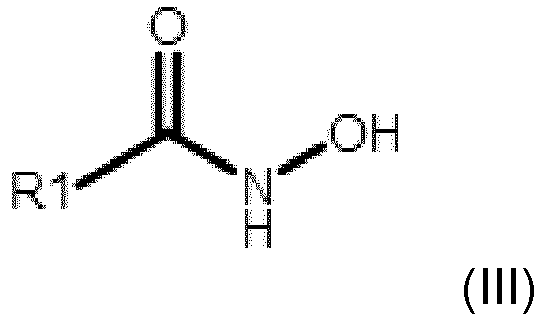
- Preferably, R1 in Formula (III) is selected from saturated hydrocarbon chains having 5 to 17 carbon atoms, unsaturated hydrocarbon chains having 5 to 17 carbon atoms, and mixtures thereof. More preferably, R1 in Formula (III) is selected from saturated hydrocarbon chains having 5 to 13 carbon atoms, unsaturated hydrocarbon chains having 5 to 13 carbon atoms, and mixtures thereof. Particularly preferably, R1 in Formula (III) is selected from saturated hydrocarbon chains having 7 carbon atoms, unsaturated hydrocarbon chains having 7 carbon atoms, and mixtures thereof.
- Preferred hydroxamic acids are selected from caprylhydroxamic acid, hexanohydroxamic acid, caprohydroxamic acid, laurohydroxamic acid, and mixtures thereof. A particularly preferred hydroxamic acid is caprylhydroxamic acid. Caprylhydroxamic acid may also be referred to as caprylohydroxamic acid or octanohydroxamic acid. Hydroxamic acids are described in, e.g.,
EP2224973 . - Examples of salts of hydroxamic acids are alkali metal salts of hydroxamic acids (e.g. sodium salts of hydroxamic acids or potassium salts of hydroxamic acids) or alkaline earth metal salts of hydroxamic acids (e.g. magnesium salts of hydroxamic acids or calcium salts of hydroxamic acids).
- In at least one embodiment, the compound according to Formula (P) is selected from 2-hydroxypyridine-N-oxide, 2-pyridinethiol-1-oxide and salts thereof, 1-hydroxy-4-methyl-6-(2,4,4-trimethylpentyl)-2(1H)-pyridone and salts thereof (preferably the monoethanolamine salt), and mixtures thereof. Formula (P) discloses and encompasses the tautomeric equivalents of these compounds, since an equilibrium always exists. In at least one embodiment, the compound according to Formula (P) is piroctone olamine (Octopirox).
- In at least one embodiment, the alkyl diols are selected from 1,2-pentanediol, 1,2-hexanediol, 1,6-hexanediol, 1,2-octanediol, 1,2-heptanediol, 1,2-decanediol, methylpropanediol, and mixtures thereof.
- In at least one embodiment, the halogenated compounds are selected from chlorhexidine and salts thereof, triclosan, chlorphenesin, trichlorcarban, chloroxylenol, bronopol, climbazole, and mixtures thereof.
- In at least one embodiment, the isothiazolinones are selected from methylisothiazolinone, methylchloroisothiazolinone, benzylisothiazolinone, and mixtures thereof.
- In at least one embodiment, the antimicrobial agent is selected from aromatic alcohols, organic acids and salts thereof, hydroxamic acids and salts thereof, hydroxyacetophenone, hydroxypyridones, alkyl diols, halogenated compounds, isothiazolinones, and mixtures thereof.
- In at least one embodiment, the antimicrobial agent is selected from phenoxyethanol, benzyl alcohol, phenethyl alcohol, benzoic acid and salts thereof, caprylhydroxamic acid, hydroxyacetophenone, piroctone olamine, and mixtures thereof.
- In a preferred embodiment, the antimicrobial agent is 1,2-octanediol, in particular bio-based 1,2-octanediol, for example bio-1,2-octanediol as disclosed in
WO 2019/152569 . - In one embodiment, the care formulation, preferably oral care formulation comprises a solvent. The solvent is preferably selected from water, propylene glycol, isopropanol, and mixtures thereof.
- In one embodiment, the care formulation, preferably oral care formulation comprises a humectant. The humectant is preferably selected from sorbitol, glycerol, xylitol, and mixtures thereof. The humectant may, for example, be present in an amount of from 10 to 70 wt.-%, preferably from 30 to 60 wt.-%, for example from 40 to 55 wt.-%, based on the total weight of the care formulation, preferably oral care formulation.
- In one embodiment, the care formulation, preferably oral care formulation comprises an abrasive. The abrasive is preferably selected from silica abrasives, hydrated silica, hydrated alumina, calcium abrasives, tricalcium phosphate, hydroxyapatite, dicalcium phosphate dihydrate, calcium pyrophosphate, calcium carbonate, sodium metaphosphate, potassium metaphosphate, aluminum silicate, calcined alumina, bentonite, sodium bicarbonate, and mixtures thereof. The abrasive may, for example, be present in an amount of from 10 to 30 wt.-%, preferably from 15 to 25 wt.-%, based on the total weight of the care formulation, preferably oral care formulation.
- In one embodiment, the care formulation, preferably oral care formulation comprises an anticalculus agent. The anticalculus agent is preferably selected from phosphates, polyphosphates, pyrophosphates, e.g. tetrasodium pyrophosphate, polyaminopropanesulfonic acid, hexametaphosphate salts, zinc citrate trihydrate, polypeptides, polyolefin sulfonates, polyolefin phosphates, diphosphonates, and mixtures thereof. The anticalculus agent may, for example, be present in an amount of from 0.01 to 20 wt.-%, preferably from 0.1 to 10 wt.-%, based on the total weight of the care formulation, preferably oral care formulation.
- In one embodiment, the care formulation, preferably oral care formulation comprises a fluoride source. The fluoride source is preferably selected from stannous fluoride, sodium fluoride, potassium fluoride, sodium monofluorophosphate, sodium fluorosilicate, ammonium fluorosilicate, amine fluoride, ammonium fluoride, calcium fluoride, aluminum fluoride, fluorohydroxyapatite, and mixtures thereof. The fluoride source is preferably selected from stannous fluoride, sodium fluoride, potassium fluoride, sodium monofluorophosphate, sodium fluorosilicate, ammonium fluorosilicate, amine fluoride, ammonium fluoride, and mixtures thereof. The fluoride source may, for example, be present in an amount of from 0.01 to 10 wt.-%, preferably from 0.1 to 2 wt.-%, based on the total weight of the care formulation, preferably oral care formulation. The fluoride source may, for example, be present in an amount of from 0.01 to 1 wt.-%, preferably from 0.02 to 0.5 wt.-%, more preferably from 0.03 to 0.3 wt.-%, even more preferably from 0.04 to 0.2 wt.-%, particularly preferably from 0.05 to 0.15 wt.-%, based on the total weight of the care formulation, preferably oral care formulation. The fluoride source may, for example, be present in an amount of from 0.01 to 0.15 wt.-%, preferably from 0.02 to 0.15 wt.-%, more preferably from 0.03 to 0.15 wt.-%, even more preferably from 0.04 to 0.15 wt.-%, particularly preferably from 0.05 to 0.15 wt.-%, based on the total weight of the care formulation, preferably oral care formulation. In a preferred embodiment, the care formulation, preferably oral care formulation is a toothpaste, and the toothpaste comprises a fluoride source.
- In one embodiment, the care formulation, preferably oral care formulation comprises a polymer. The polymer is preferably selected from polyethylene glycols, polysaccharides, for example cellulose derivatives, for example carboxymethyl cellulose, hydroxymethyl cellulose, ethyl cellulose, microcrystalline cellulose, or polysaccharide gums, for example xanthan gum, guar gum or carrageenan gum, or polyacrylates or polymers based on N-vinylpyrrolidone, and mixtures thereof. The polymer may, for example, be present in an amount of from 0.1 to 10 wt.-%, preferably from 0.5 to 5 wt.-%, based on the total weight of the care formulation, preferably oral care formulation.
- In one embodiment, the care formulation, preferably oral care formulation comprises an anionic polymer. The anionic polymer is preferably selected from polycarboxylates, polyacrylic acids, polyacrylates, polyphosphonic acids, crosslinked carboxyvinyl copolymers, and mixtures thereof. The anionic polymer may, for example, be present in an amount of from 1 to 20 wt.-%, preferably from 5 to 15 wt.-%, based on the total weight of the care formulation, preferably oral care formulation.
- In one embodiment, the care formulation, preferably oral care formulation comprises a thickening agent. The thickening agent is preferably selected from silica thickening agents, carboxy vinyl polymers, carrageenan, hydroxyethyl cellulose, salts of cellulose ethers such as sodium carboxymethyl cellulose or sodium carboxymethyl hydroxyethyl cellulose, karaya, gum arabic, gum tragacanth, colloidal magnesium aluminum silicate, and mixtures thereof. The thickening agent may, for example, be present in an amount of from 0.1 to 10 wt.-%, preferably from 0.5 to 5 wt.-%, based on the total weight of the care formulation, preferably oral care formulation.
- In one embodiment, the care formulation, preferably oral care formulation comprises a foaming agent. The foaming agent is preferably selected from polyethylene glycol, alginate polymers, and mixtures thereof. The foaming agent may, for example, be present in an amount of from 0.1 to 20 wt.-%, preferably from 1 to 10 wt.-%, based on the total weight of the care formulation, preferably oral care formulation.
- In one embodiment, the care formulation, preferably oral care formulation comprises a surfactant. The surfactant may, for example, be present in an amount of from 0.1 to 20 wt.-%, preferably from 1 to 10 wt.-%, based on the total weight of the care formulation, preferably oral care formulation. In one embodiment, the surfactant is an anionic surfactant. The anionic surfactant is preferably selected from alkyl sulfates, for example sodium lauryl sulfate, alkyl ether sulfates, for example sodium laureth-2 sulfate, alkyl aryl sulfonates, for example sodium lauryl benzene sulfonate, alkyl sulfoacetates, for example sodium lauryl sulfoacetate, and mixtures thereof. In one embodiment, the surfactant is a sulfur-free anionic surfactant. The sulfur-free anionic surfactant is preferably selected from taurates, for example sodium methyl cocoyl taurate, glycinates, for example sodium cocoyl glycinate, sarcosinates, for example sodium lauroyl sarcosinate, quaternary ammonium compounds, for example benzalkonium chloride or cetylpyridinium chloride, and mixtures thereof. In one embodiment, the surfactant is a non-ionic surfactant, for example an alkyl polyglycoside (APG), preferably an alkyl polyglucoside. In one embodiment, the surfactant is a zwitterionic surfactant, for example a betaine surfactant, for example cocamidopropyl betaine. In one embodiment, the surfactant is a cationic surfactant.
- In one embodiment, the care formulation, preferably oral care formulation comprises a buffer or pH adjusting agent. In a preferred embodiment, the care formulation, preferably oral care formulation has a pH in the range of from 4 to 8, preferably from 4.5 to 7.5, more preferably from 5 to 7, particularly preferably from 5 to 6, also particularly preferably from 5.5 to 6.5, also particularly preferably from 6 to 7. In a preferred embodiment, the care formulation, preferably oral care formulation is a toothpaste, and the toothpaste has a pH in the range of from 4 to 8, preferably from 4.5 to 7.5, more preferably from 5 to 7, particularly preferably from 5 to 6, also particularly preferably from 5.5 to 6.5, also particularly preferably from 6 to 7.
- In one embodiment, the care formulation, preferably oral care formulation comprises a flavoring agent, sweetening agent, and/or pigment or dye. Examples of flavors are mint, peppermint, spearmint, wintergreen, menthol, or strawberry. An example of a sweetening agent is sodium saccharin. Examples of pigments are titanium dioxide or zinc oxide.
- The care formulation, preferably oral care formulation may, for example, be prepared by mixing its ingredients.
- The present invention also relates to the use of a care formulation of the present invention on mucosal tissue. Preferred embodiments of the care formulation are described further above. Preferably, the mucosal tissue is selected from oral mucosal tissue, intimate mucosal tissue, eye mucosal tissue, ear mucosal tissue (including eardrum), and nasal mucosal tissue. Particularly preferably, the care formulation is applied topically to the mucosal tissue.
- The present invention also relates to a care formulation of the present invention for use on mucosal tissue. Preferred embodiments of the care formulation are described further above. Preferably, the mucosal tissue is selected from oral mucosal tissue, intimate mucosal tissue, eye mucosal tissue, ear mucosal tissue (including eardrum), and nasal mucosal tissue. Particularly preferably, the care formulation is applied topically to the mucosal tissue.
- In a preferred embodiment, compound X is used to protect or prevent the mucosal tissue from damage. In a preferred embodiment, compound X is used to protect, maintain or increase the tissue viability and/or tissue integrity of the mucosal tissue. In at least one embodiment, compound X is used to protect, maintain or increase the tissue viability of the mucosal tissue. In at least one embodiment, compound X is used to protect, maintain or increase the tissue integrity of the mucosal tissue.
- In this document, the following definitions apply unless specifically stated otherwise. All percentages are by weight (w/w) of the total composition. All ratios are weight ratios. "wt.-%" means percentage by weight.
- "Molecular weight" or "M.Wt." or "MW" and grammatical equivalents mean the number average molecular weight.
- "Viscosity" is measured at 25°C using a HAAKE Rotation Viscometer VT 550 with cooling/heating vessel and sensor systems according to DIN 53019 at a shear rate of 12.9 s-1.
- The examples which follow are intended to illustrate the subject matter of the invention without restricting it thereto.
- Capryloyl/Caproyl Anhydro Methyl Glucamide is a mixture of compounds of Formula (I) wherein R is -(CH2)8CH3 and compounds of Formula (I) wherein R is - (CH2)6CH3.
- Lauroyl/Myristoyl Methyl Glucamide is a mixture of compounds of Formula (II) wherein R1 is -(CH2)12CH3 and compounds of Formula (II) wherein R1 is - (CH2)10CH3.
- Assessment of test materials on mucosa in vitro tissue models
- PBS refers to phosphate buffer saline.
- Mucosal tissue models were cultivated in 900 µl of culture medium in a 6-well plate.
- Tissue models were treated with test material. 3 models were used per substance. 90 µl of each test material was applied on the surface of the tissue models. The irritation test was performed in two runs: run 1, substances according to Examples 1c, 1d, 1e and 1f and in run 2, substances according to Examples 1g and 1h, with a 2 minutes interval between each substance.
- After substance incubation of 10 minutes at room temperature models were washed. Each model was washed in 3 cups of 50 ml PBS. The model was immersed in the first cup, rotated three times in the cup and the liquid was poured off. The same procedure was followed for cups 2 and 3 and transferred to a fresh prepared 6-well plate with culture medium. For test material according to Example 1h and the positive control, an interval of 3 minutes was set and the samples were rinsed twice with 500 µl PBS before washing with the three cups to remove the viscous substances. In order to avoid remaining substances on the tissue surface, the additional washing step was carried out for these two viscous test materials.
- Tissue viability was assessed 24 hours after exposure using the MTT assay. Models were transferred to a 24-well plate with 200 µl of MTT solution (1 mg/ml) per well pre-warmed at 37 °C for 30 minutes. Tissue models were incubated in MTT solution for 3 hours at 37 °C, 5% CO2 and 95% humidity. For extraction, 500 µl of isopropanol was prepared per well of a 24-well plate, the models were transferred and a further 500 µl was added to the insert. The plate was sealed with parafilm and incubated on a shaker for 30 minutes. 1000 µl was then pipetted into the well. From this, 200 µl was transferred to a 96-well plate and the optical density was measured at 570 nm.
- The test was performed using a human oral tissue model. The oral model is a three-dimensional human oral tissue construct composed of normal human keratinocytes. It replicates the structure and function of the natural stratified squamous epithelium of the oral cavity, with a differentiated architecture including basal, spinous, and granular cell layers.
- The assessment of mucosa tissue viability was conducted according to the protocol as in the experimental design. Briefly, liquid test substances were applied (90 µ!) to the surface of the models. After the respective treatment time of 10 minutes models were washed according to the performed irritation test with PBS. Following a possible post-exposure incubation period at 37 °C and 5% CO2 tissue viability is assessed using the MTT assay. For that mucosal tissue models were placed in 200 µl MTT solution (1 mg/mL) (Sigma Aldrich) for 3 h in a humidified atmosphere with 37 °C and 5% CO2. The MTT reduction was then quantified by extracting the precipitated blue formazan salt with 2 ml 2-propanol and measuring the optical density of the extract at a wavelength of 570 nm using a spectrophotometer in a 96-well plate. After correcting the data using two wells of 2-propanol (200 µl) as blank the relative tissue viability was calculated for each tissue by normalizing the corrected optical density values to the negative control which was set to 100%.
- The results, in particular the normalized mean optical densities, are given in the following Table:
Example Test substance Normalized mean optical density [%] 1a Negative control (PBS) 100 1b Positive control (Sodium Lauryl Sulfate 5%) 31 1c Capryloyl/Caproyl Anhydro Methyl Glucamide 0.5% 102 1d Capryloyl/Caproyl Anhydro Methyl Glucamide 1% 99 1e Capryloyl/Caproyl Anhydro Methyl Glucamide 1.4% 97 1f Sodium Lauroyl Sarcosinate 1% 73 1g Lauroyl/Myristoyl Methyl Glucamide 1% 103 1h Toothpaste + Capryloyl/Caproyl Anhydro Methyl Glucamide 1:1.5 102 - In conclusion, the compounds used in the present invention show a good mucosa tissue viability.
-
A Water Diluent Ad 100 % Tetrasodium Pyrophosphate Active 0.05 % Laponite XLS Active 3.00 % Sodium Magnesium Silicate Sorbitol Humectant 20.00 % B Xanthan Gum Rheology Modifier 0.30 % Polyglykol 400 Humectant 2.00 % PEG-8 Glycerin Humectant 22.82 % C Xylitol Flavor 9.70 % Sodium Saccharin Flavor 0.30 % Sodium Fluoride Active 0.23 % Phenoxetol Preservative 0.60 % Phenoxyethanol D Aristoflex AVS Rheology Modifier 0.40 % Sodium Acryloyldimethyltaurate/VP Crosspolymer E Hydrated Silica Bulking Agent 7.00 % Hydrated Silica Bulking Agent 9.00 % F Velsan Flex Multifunctional 2.00 % Capryloyl/Caproyl Anhydro Methyl Glucamide (and) Water Mint Flavor Flavor 1.00 % Titanium Dioxide Color 0.10 % Glucotain Plus Surfactant 0.50 % Capryolyl/Caproyl Methyl Glucamide (and) Lauroyl/Myristoyl Methyl Glucamide G Lactic Acid 5% / NaOH 5% Neutralizer q.s. pH 6.5 -
A Water Diluent ad 100 % B Xanthan Gum Rheology Modifier 0.05 % Polyglykol 400 Humectant 5.00 % PEG-8 Glycerin Humectant 10.00 % C Xylitol Flavor 10.00 % Aspartame Flavor 0.15 % Benzyl Alcohol Preservative 0.50 % D Mint Flavor Flavor 0.70 % Velsan Flex Multifunctional 1.50 % Capryloyl/Caproyl Anhydro Methyl Glucamide (and) Water E Brilliant Blue (1% solution) Dye 0.03 % F Lactic Acid 5% / NaOH 5% Neutralizer q.s. pH 6.0 -
A Water Diluent Ad 100 % Glycerin 100% Humectant 1.00 % B Salvia Lavandulifolia Leaf Oil Flavor 0.01 % Mentha piperita (peppermint) Oil Flavor 0.02 % Tocopherol Anti-oxidant 0.05 % Velsan Flex Multifunctional 2.00 % Capryloyl/Caproyl Anhydro Methyl Glucamide (and) Water Benzoic Acid Preservative 0.30 % C Sodium Saccharin Flavor 0.20 % Bisabolol Active 0.30 % E Lactic Acid 5% / NaOH 5% Neutralizing Agent q.s. pH 6.0 -
A Water Diluent Ad 100 % Xanthan Gum Rheology Modifier 0.80 % B EDTA-2 Na Chelating Agent 0.10 % Glycerin 100% Humectant 1.00 % C Melaleuca Alternifolia Leaf Oil Active 0.01 % Velsan Flex Multifunctional 2.00 % Capryloyl/Caproyl Anhydro Methyl Glucamide (and) Water D Sodium Benzoate Preservative 0.30 % E Lactic Acid 5% / NaOH 5% Neutralizing Agent q.s. pH 4.0 -
A Water Diluent Ad 100 % Pentylene Glycol Humectant 1.00 % Rosa Damascena Flower Water Humectant 2.00 % B Rosa Damascena Flower Oil Fragrance 0.02 % Velsan Flex Multifunctional 1.00 % Capryloyl/Caproyl Anhydro Methyl Glucamide (and) Water C Sodium Benzoate Preservative 0.30 % D Lactic Acid 10% / NaOH 5% Neutralizing Agent q.s. pH 4.0 -
A Water Diluent Ad 100 % Propanediol Humectant 1.00 % Aloe Barbadensis Leaf Juice Humectant 1.00 % Potassium Lactate Stabilizer 0.10 % B Plantasens Biogum Tara Rheology Modifier 1.50 % Caesalpinia Spinosa Gum C Velsan Flex Multifunctional 1.00 % Capryloyl/Caproyl Anhydro Methyl Glucamide (and) Water Benzoic Acid Preservative 0.30 % D Lactic Acid 10% / NaOH 5% Neutralizing Agent q.s. pH 4.5 -
A Water Diluent Ad 100 % NaCl Electrolyte 0.70 % Na-Phosphate Stabilizer 0.10 % B Velsan Flex Multifunctional 2.00 % Capryloyl/Caproyl Anhydro Methyl Glucamide (and) Water C Nipaguard DMDMH Plus Preservative 0.20 % DMDM Hydantoin D Citric Acid/ NaOH 10% Neutralizing Agent q.s. pH 5.5 -
A Maris Aqua (Sea) Water isotonic solution Diluent Ad 100 % Aloe Barbadensis Leaf Juice Humectant 1.00 % B Mountain pine essential oil Active 0.01 % Pinus Mugo Twig Oil C Velsan Flex Multifunctional 0.50 % Capryloyl/Caproyl Anhydro Methyl Glucamide (and) Water D Nipagin M Sodium Preservative 0.30 % Sodium Methyl Paraben E Citric Acid 10% / NaOH 5% Neutralizing Agent q.s. pH 6.0 -
A Water Diluent Ad 100 % Propanediol Humectant 1.00 % B Motusflex MF Sodium Polyacryloyldimethyl Taurate Rheology Modifier 1.50 % C Velsan Flex Multifunctional 1.00 % Capryloyl/Caproyl Anhydro Methyl Glucamide (and) Water Benzoic Acid Preservative 0.30 % D Citric Acid 10% / NaOH 5% Neutralizing Agent q.s. pH 5.0 -
A Water Diluent Ad 100 % E DTA-2 N a Chelating Agent 0.10 % Glycerin 100% Humectant 1.00 % B Polyquaternium-10 Conditioning Agent 0.10 % C Velsan Flex Multifunctional 2.00 % Capryloyl/Caproyl Anhydro Methyl Glucamide (and) Water D Sodium Benzoate Preservative 0.50 % E Citric Acid / NaOH 10% Neutralizing Agent q.s. pH 5.0 -
A Water Diluent Ad 100 % Chamomilla Recutita Flower Extract Active 0.20 % Glycerin, Aqua, Chamomilla Recutita (Matricaria) Flower Extract B Salvia Triloba (Sage) Leaf Extract (and) Helianthus Annuus (Sunflower) Seed Oil Active 0.05 % Velsan Flex Multifunctional 1.00 % Capryloyl/Caproyl Anhydro Methyl Glucamide (and) Water C Phenoxetol Preservative 0.80 % Phenoxyethanol D Citric Acid / NaOH 10% Neutralizing Agent q.s. pH 6.0 -
A Water Diluent Ad 100 % Aristoflex Silk Rheology Modifier 1.00 % Sodium Polyacryloyldimethyl Taurate Sorbitol 70% Humectant 50.00 % B Salvia Triloba (Sage) Leaf Extract (and) Helianthus Annuus (Sunflower) Seed Oil Active 0.05 % Velsan Flex Multifunctional 2.00 % Capryloyl/Caproyl Anhydro Methyl Glucamide (and) Water Flavoring Oil Flavor 0.20 % C Nipaguard SCE Preservative 1.30 % Sorbitan Caprylate (and) Propanediol (and) Benzoic Acid D Hydrated Silica Bulking Agent 22.00 % E Citric Acid / NaOH 10% Neutralizing Agent q.s. pH 6.0 -
A Water Diluent Ad 100 % NaCl Electrolyte 0.70 % Na-Phosphate Stabilizer 0.10 % B Velsan Flex Multifunctional 0.50 % Capryloyl/Caproyl Anhydro Methyl Glucamide (and) Water C Nipaguard DMDMH Plus Preservative 0.20 % DMDM Hydantoin D Citric Acid / NaOH 10% Neutralizing Agent q.s. pH 6.5
Claims (15)
- Use of compound X selected fromcompounds of Formula (I)
 wherein R is selected from saturated hydrocarbon chains having 5 to 23 carbon atoms, unsaturated hydrocarbon chains having 5 to 23 carbon atoms, and mixtures thereof,compounds of Formula (II)
 wherein R1 is selected from saturated hydrocarbon chains having 5 to 23 carbon atoms, unsaturated hydrocarbon chains having 5 to 23 carbon atoms, and mixtures thereof,glyceryl ethers, sorbitan esters, and isosorbide esterson mucosal tissue.
 - The use according to claim 1, wherein the mucosal tissue is selected from oral mucosal tissue, intimate mucosal tissue, eye mucosal tissue, ear mucosal tissue (including eardrum), and nasal mucosal tissue.
- The use according to claim 1 or 2, wherein compound X is selected from compounds of Formula (I) and compounds of Formula (II).
- The use according to any of claims 1 to 3, whereinR in Formula (I) is selected from saturated hydrocarbon chains having 5 to 17 carbon atoms, unsaturated hydrocarbon chains having 5 to 17 carbon atoms, and mixtures thereof,preferably is selected from saturated hydrocarbon chains having 5 to 13 carbon atoms, unsaturated hydrocarbon chains having 5 to 13 carbon atoms, and mixtures thereof,particularly preferably is selected from saturated hydrocarbon chains having 7 to 9 carbon atoms, unsaturated hydrocarbon chains having 7 to 9 carbon atoms, and mixtures thereof.
- The use according to any of claims 1 to 4, whereinR1 in Formula (II) is selected from saturated hydrocarbon chains having 5 to 17 carbon atoms, unsaturated hydrocarbon chains having 5 to 17 carbon atoms, and mixtures thereof,preferably is selected from saturated hydrocarbon chains having 7 to 13 carbon atoms, unsaturated hydrocarbon chains having 7 to 13 carbon atoms, and mixtures thereof,particularly preferably is selected from saturated hydrocarbon chains having 11 to 13 carbon atoms, unsaturated hydrocarbon chains having 11 to 13 carbon atoms, and mixtures thereof.
- The use according to any of claims 1 to 5, wherein the glyceryl ethers are mono- or diethers of glycerin and one or more C6-C20 fatty alcohols, preferably mono- or diethers of glycerin and one or more C8-C14 fatty alcohols, particularly preferably monoethers of glycerin and one or more C8 fatty alcohols.
- The use according to any of claims 1 to 6, wherein the sorbitan esters are mono-, di- or triesters of sorbitan and one or more C6-C20 fatty acids, preferably mono- or diesters of sorbitan and one or more C8-C14 fatty acids, particularly preferably mono- or diesters of sorbitan and caprylic acid.
- The use according to any of claims 1 to 7, wherein the isosorbide esters are mono- or diesters of isosorbide and one or more C6-C20 fatty acids, preferably mono- or diesters of isosorbide and one or more C8-C14 fatty acids, particularly preferably mono- or diesters of isosorbide and caprylic acid.
- Compound X as defined in any of claims 1 to 8 for use on mucosal tissue.
- A care formulation comprisingfrom 0.1 to 20 wt.-%, preferably from 0.2 to 10 wt.-%, more preferably from 0.3 to 5 wt.-%, even more preferably from 0.4 to 3 wt.-%, particularly preferably from 0.5 to 2 wt.-%, for example from 0.8 to 1.5 wt.-%, based on the total weight of the care formulation, of compound X as defined in any of claims 1 to 8,wherein the care formulation is selected from an oral care formulation, intimate care formulation, eye care formulation, ear care formulation, nasal care formulation, and lubricant for medical devices or medical tools.
- The care formulation according to claim 10, wherein the care formulation is for human care or animal care.
- The care formulation according to claim 10 or 11, wherein the oral care formulation is selected from a toothpaste, oral gel, mouth wash, tooth powder, oral spray, oral care wipes, dental wipes, dental floss, and chewing gum.
- The care formulation according to any of claims 10 to 12, wherein the intimate care formulation is selected from an intimate cleansing formulation, intimate deodorant, intimate lubricant, and intimate wipes.
- Use of a care formulation as defined in any of claims 1 to 8 on mucosal tissue.
- Care formulation as defined in any of claims 1 to 8 for use on mucosal tissue.
Priority Applications (1)
| Application Number | Priority Date | Filing Date | Title |
|---|---|---|---|
| EP24221336.1A EP4548910A3 (en) | 2024-12-19 | 2024-12-19 | Compounds for use on mucosal tissue |
Applications Claiming Priority (1)
| Application Number | Priority Date | Filing Date | Title |
|---|---|---|---|
| EP24221336.1A EP4548910A3 (en) | 2024-12-19 | 2024-12-19 | Compounds for use on mucosal tissue |
Publications (2)
| Publication Number | Publication Date |
|---|---|
| EP4548910A2 true EP4548910A2 (en) | 2025-05-07 |
| EP4548910A3 EP4548910A3 (en) | 2025-07-16 |
Family
ID=93925854
Family Applications (1)
| Application Number | Title | Priority Date | Filing Date |
|---|---|---|---|
| EP24221336.1A Withdrawn EP4548910A3 (en) | 2024-12-19 | 2024-12-19 | Compounds for use on mucosal tissue |
Country Status (1)
| Country | Link |
|---|---|
| EP (1) | EP4548910A3 (en) |
Citations (3)
| Publication number | Priority date | Publication date | Assignee | Title |
|---|---|---|---|---|
| EP2224973A1 (en) | 2007-11-29 | 2010-09-08 | Inolex Investment Corporation | Preservatives for cosmetic, toiletry and pharmaceutical compositions |
| WO2018002100A1 (en) | 2016-06-29 | 2018-01-04 | Clariant International Ltd | Composition for inhibiting micro-organisms |
| WO2019152569A2 (en) | 2018-01-30 | 2019-08-08 | Inolex Investment Corporation | Natural 1,2-alkanediols, compositions having natural 1,2-alkanediols and processes for making the same |
Family Cites Families (4)
| Publication number | Priority date | Publication date | Assignee | Title |
|---|---|---|---|---|
| FR2994386B1 (en) * | 2012-08-07 | 2016-06-24 | Thorel Jean-Noel | INHIBITION OF ADHESION OF PATHOGENIC MICROORGANISMS BY SUCROSE AND / OR SORBITAN ESTER IN THE COSMETIC TREATMENT OF SKIN ATOPIA |
| CH720165A2 (en) * | 2022-10-26 | 2024-04-30 | Chemtek Ug | Compositions with N-acylglycamines |
| US20260199204A1 (en) * | 2022-12-20 | 2026-07-16 | Clariant International Ltd | Antimicrobial combinations |
| CN121419759A (en) * | 2023-03-31 | 2026-01-27 | 科莱恩国际有限公司 | Antimicrobial compounds for oral care |
-
2024
- 2024-12-19 EP EP24221336.1A patent/EP4548910A3/en not_active Withdrawn
Patent Citations (3)
| Publication number | Priority date | Publication date | Assignee | Title |
|---|---|---|---|---|
| EP2224973A1 (en) | 2007-11-29 | 2010-09-08 | Inolex Investment Corporation | Preservatives for cosmetic, toiletry and pharmaceutical compositions |
| WO2018002100A1 (en) | 2016-06-29 | 2018-01-04 | Clariant International Ltd | Composition for inhibiting micro-organisms |
| WO2019152569A2 (en) | 2018-01-30 | 2019-08-08 | Inolex Investment Corporation | Natural 1,2-alkanediols, compositions having natural 1,2-alkanediols and processes for making the same |
Also Published As
| Publication number | Publication date |
|---|---|
| EP4548910A3 (en) | 2025-07-16 |
Similar Documents
| Publication | Publication Date | Title |
|---|---|---|
| JP5548969B2 (en) | Dentifrice composition | |
| US8900644B2 (en) | Oral care compositions containing compounds from magnolia and hops extracts | |
| US11883368B2 (en) | Leave-on oral care compositions | |
| PL200924B1 (en) | Synergistic antiplaque/antigingivitis oral composition | |
| US10610707B2 (en) | Oral care product for sensitive enamel care | |
| DE69305064T2 (en) | PREPARATION AND METHOD FOR ORAL HYGIENE | |
| EP3270873B1 (en) | Calcium-based dentifrices for enhanced uptake of active ingredients | |
| RU2385709C2 (en) | Oral care composition for prevention of dental deposit containing magnolia extract | |
| RU2580642C2 (en) | Oral care compositions | |
| JP2024173940A (en) | Anti-inflammatory Composition | |
| JP2023068100A (en) | Gingival care method | |
| JP7424770B2 (en) | Gingival tissue destruction inhibitor | |
| DE60004998T2 (en) | SYNERGISTIC ANTIBACTERIAL COMBINATION | |
| US12514870B2 (en) | Leave-on oral care compositions | |
| JP2019214538A (en) | Agent for inhibiting entry of periodontal disease bacteria into gingival tissue cell | |
| SK10193A3 (en) | Anticalculus antiplaque compositions using azacycloalkane diphosphonates | |
| EP3223915B1 (en) | Oral care composition | |
| RU2713948C2 (en) | Oral care composition | |
| JP2006182662A (en) | Dentifrice composition | |
| EP4687825A2 (en) | Antimicrobial compounds for oral care | |
| RU2689168C2 (en) | Oral care composition | |
| JP4323979B2 (en) | Oral composition | |
| JP2007161657A (en) | Dentifrice composition | |
| KR102574022B1 (en) | oral composition | |
| JP2000319153A (en) | Oral composition |
Legal Events
| Date | Code | Title | Description |
|---|---|---|---|
| PUAI | Public reference made under article 153(3) epc to a published international application that has entered the european phase |
Free format text: ORIGINAL CODE: 0009012 |
|
| STAA | Information on the status of an ep patent application or granted ep patent |
Free format text: STATUS: THE APPLICATION HAS BEEN PUBLISHED |
|
| AK | Designated contracting states |
Kind code of ref document: A2 Designated state(s): AL AT BE BG CH CY CZ DE DK EE ES FI FR GB GR HR HU IE IS IT LI LT LU LV MC ME MK MT NL NO PL PT RO RS SE SI SK SM TR |
|
| PUAL | Search report despatched |
Free format text: ORIGINAL CODE: 0009013 |
|
| AK | Designated contracting states |
Kind code of ref document: A3 Designated state(s): AL AT BE BG CH CY CZ DE DK EE ES FI FR GB GR HR HU IE IS IT LI LT LU LV MC ME MK MT NL NO PL PT RO RS SE SI SK SM TR |
|
| RIC1 | Information provided on ipc code assigned before grant |
Ipc: A61K 8/42 20060101AFI20250610BHEP Ipc: A61K 8/49 20060101ALI20250610BHEP Ipc: A61K 31/16 20060101ALI20250610BHEP Ipc: A61K 31/341 20060101ALI20250610BHEP Ipc: A61P 27/04 20060101ALI20250610BHEP Ipc: A61P 27/16 20060101ALI20250610BHEP Ipc: A61Q 11/00 20060101ALI20250610BHEP Ipc: A61Q 19/10 20060101ALI20250610BHEP |
|
| STAA | Information on the status of an ep patent application or granted ep patent |
Free format text: STATUS: THE APPLICATION IS DEEMED TO BE WITHDRAWN |
|
| 18D | Application deemed to be withdrawn |
Effective date: 20260117 |