EP4546281A1 - Device and method for training a model for determining a shape of an object, method for operating a computer controlled machine depending on a shape of an object - Google Patents
Device and method for training a model for determining a shape of an object, method for operating a computer controlled machine depending on a shape of an object Download PDFInfo
- Publication number
- EP4546281A1 EP4546281A1 EP23205632.5A EP23205632A EP4546281A1 EP 4546281 A1 EP4546281 A1 EP 4546281A1 EP 23205632 A EP23205632 A EP 23205632A EP 4546281 A1 EP4546281 A1 EP 4546281A1
- Authority
- EP
- European Patent Office
- Prior art keywords
- representation
- shape
- depending
- point cloud
- voxel representation
- Prior art date
- Legal status (The legal status is an assumption and is not a legal conclusion. Google has not performed a legal analysis and makes no representation as to the accuracy of the status listed.)
- Pending
Links
Images

Classifications
-
- G—PHYSICS
- G06—COMPUTING OR CALCULATING; COUNTING
- G06V—IMAGE OR VIDEO RECOGNITION OR UNDERSTANDING
- G06V20/00—Scenes; Scene-specific elements
- G06V20/60—Type of objects
- G06V20/64—Three-dimensional [3D] objects
-
- G—PHYSICS
- G06—COMPUTING OR CALCULATING; COUNTING
- G06V—IMAGE OR VIDEO RECOGNITION OR UNDERSTANDING
- G06V20/00—Scenes; Scene-specific elements
- G06V20/60—Type of objects
- G06V20/64—Three-dimensional [3D] objects
- G06V20/653—Three-dimensional [3D] objects by matching three-dimensional models, e.g. conformal mapping of Riemann surfaces
-
- G—PHYSICS
- G06—COMPUTING OR CALCULATING; COUNTING
- G06T—IMAGE DATA PROCESSING OR GENERATION, IN GENERAL
- G06T7/00—Image analysis
- G06T7/50—Depth or shape recovery
-
- G—PHYSICS
- G06—COMPUTING OR CALCULATING; COUNTING
- G06V—IMAGE OR VIDEO RECOGNITION OR UNDERSTANDING
- G06V10/00—Arrangements for image or video recognition or understanding
- G06V10/70—Arrangements for image or video recognition or understanding using pattern recognition or machine learning
- G06V10/77—Processing image or video features in feature spaces; using data integration or data reduction, e.g. principal component analysis [PCA] or independent component analysis [ICA] or self-organising maps [SOM]; Blind source separation
- G06V10/774—Generating sets of training patterns; Bootstrap methods, e.g. bagging or boosting
-
- G—PHYSICS
- G06—COMPUTING OR CALCULATING; COUNTING
- G06N—COMPUTING ARRANGEMENTS BASED ON SPECIFIC COMPUTATIONAL MODELS
- G06N3/00—Computing arrangements based on biological models
- G06N3/02—Neural networks
- G06N3/04—Architecture, e.g. interconnection topology
- G06N3/045—Combinations of networks
-
- G—PHYSICS
- G06—COMPUTING OR CALCULATING; COUNTING
- G06N—COMPUTING ARRANGEMENTS BASED ON SPECIFIC COMPUTATIONAL MODELS
- G06N3/00—Computing arrangements based on biological models
- G06N3/02—Neural networks
- G06N3/08—Learning methods
-
- G—PHYSICS
- G06—COMPUTING OR CALCULATING; COUNTING
- G06V—IMAGE OR VIDEO RECOGNITION OR UNDERSTANDING
- G06V10/00—Arrangements for image or video recognition or understanding
- G06V10/20—Image preprocessing
- G06V10/22—Image preprocessing by selection of a specific region containing or referencing a pattern; Locating or processing of specific regions to guide the detection or recognition
-
- G—PHYSICS
- G06—COMPUTING OR CALCULATING; COUNTING
- G06V—IMAGE OR VIDEO RECOGNITION OR UNDERSTANDING
- G06V10/00—Arrangements for image or video recognition or understanding
- G06V10/40—Extraction of image or video features
- G06V10/44—Local feature extraction by analysis of parts of the pattern, e.g. by detecting edges, contours, loops, corners, strokes or intersections; Connectivity analysis, e.g. of connected components
-
- G—PHYSICS
- G06—COMPUTING OR CALCULATING; COUNTING
- G06V—IMAGE OR VIDEO RECOGNITION OR UNDERSTANDING
- G06V10/00—Arrangements for image or video recognition or understanding
- G06V10/40—Extraction of image or video features
- G06V10/44—Local feature extraction by analysis of parts of the pattern, e.g. by detecting edges, contours, loops, corners, strokes or intersections; Connectivity analysis, e.g. of connected components
- G06V10/443—Local feature extraction by analysis of parts of the pattern, e.g. by detecting edges, contours, loops, corners, strokes or intersections; Connectivity analysis, e.g. of connected components by matching or filtering
- G06V10/449—Biologically inspired filters, e.g. difference of Gaussians [DoG] or Gabor filters
- G06V10/451—Biologically inspired filters, e.g. difference of Gaussians [DoG] or Gabor filters with interaction between the filter responses, e.g. cortical complex cells
- G06V10/454—Integrating the filters into a hierarchical structure, e.g. convolutional neural networks [CNN]
-
- G—PHYSICS
- G06—COMPUTING OR CALCULATING; COUNTING
- G06V—IMAGE OR VIDEO RECOGNITION OR UNDERSTANDING
- G06V10/00—Arrangements for image or video recognition or understanding
- G06V10/70—Arrangements for image or video recognition or understanding using pattern recognition or machine learning
- G06V10/74—Image or video pattern matching; Proximity measures in feature spaces
- G06V10/75—Organisation of the matching processes, e.g. simultaneous or sequential comparisons of image or video features; Coarse-fine approaches, e.g. multi-scale approaches; using context analysis; Selection of dictionaries
-
- G—PHYSICS
- G06—COMPUTING OR CALCULATING; COUNTING
- G06V—IMAGE OR VIDEO RECOGNITION OR UNDERSTANDING
- G06V10/00—Arrangements for image or video recognition or understanding
- G06V10/70—Arrangements for image or video recognition or understanding using pattern recognition or machine learning
- G06V10/82—Arrangements for image or video recognition or understanding using pattern recognition or machine learning using neural networks
-
- G—PHYSICS
- G06—COMPUTING OR CALCULATING; COUNTING
- G06T—IMAGE DATA PROCESSING OR GENERATION, IN GENERAL
- G06T2207/00—Indexing scheme for image analysis or image enhancement
- G06T2207/10—Image acquisition modality
- G06T2207/10028—Range image; Depth image; 3D point clouds
-
- G—PHYSICS
- G06—COMPUTING OR CALCULATING; COUNTING
- G06T—IMAGE DATA PROCESSING OR GENERATION, IN GENERAL
- G06T2207/00—Indexing scheme for image analysis or image enhancement
- G06T2207/20—Special algorithmic details
- G06T2207/20081—Training; Learning
-
- G—PHYSICS
- G06—COMPUTING OR CALCULATING; COUNTING
- G06T—IMAGE DATA PROCESSING OR GENERATION, IN GENERAL
- G06T2207/00—Indexing scheme for image analysis or image enhancement
- G06T2207/20—Special algorithmic details
- G06T2207/20084—Artificial neural networks [ANN]
-
- G—PHYSICS
- G06—COMPUTING OR CALCULATING; COUNTING
- G06T—IMAGE DATA PROCESSING OR GENERATION, IN GENERAL
- G06T2207/00—Indexing scheme for image analysis or image enhancement
- G06T2207/30—Subject of image; Context of image processing
- G06T2207/30108—Industrial image inspection
-
- G—PHYSICS
- G06—COMPUTING OR CALCULATING; COUNTING
- G06T—IMAGE DATA PROCESSING OR GENERATION, IN GENERAL
- G06T2207/00—Indexing scheme for image analysis or image enhancement
- G06T2207/30—Subject of image; Context of image processing
- G06T2207/30248—Vehicle exterior or interior
- G06T2207/30252—Vehicle exterior; Vicinity of vehicle
-
- G—PHYSICS
- G06—COMPUTING OR CALCULATING; COUNTING
- G06V—IMAGE OR VIDEO RECOGNITION OR UNDERSTANDING
- G06V10/00—Arrangements for image or video recognition or understanding
- G06V10/40—Extraction of image or video features
- G06V10/46—Descriptors for shape, contour or point-related descriptors, e.g. scale invariant feature transform [SIFT] or bags of words [BoW]; Salient regional features
- G06V10/469—Contour-based spatial representations, e.g. vector-coding
-
- G—PHYSICS
- G06—COMPUTING OR CALCULATING; COUNTING
- G06V—IMAGE OR VIDEO RECOGNITION OR UNDERSTANDING
- G06V2201/00—Indexing scheme relating to image or video recognition or understanding
- G06V2201/06—Recognition of objects for industrial automation
-
- G—PHYSICS
- G06—COMPUTING OR CALCULATING; COUNTING
- G06V—IMAGE OR VIDEO RECOGNITION OR UNDERSTANDING
- G06V2201/00—Indexing scheme relating to image or video recognition or understanding
- G06V2201/12—Acquisition of 3D measurements of objects
Definitions
- the invention relates to a device, and a method for training a model, in particular a neural network, for determining a shape of an object, and a method for operating a computer controlled machine depending on a shape of an object.
- a computer implemented method for training a model, in particular a neural network, for determining a shape of an object comprises determining a first point cloud representation of the object depending on a first digital image, wherein the first point cloud representation comprises points that represent a first view of the object, determining a second point cloud representation of the object depending on the second digital image, wherein the second point cloud representation comprises points that represent a second view of the object, determining a first voxel representation of the object depending on the first point cloud representation, wherein the first voxel representation comprises voxels that represent the first view, mapping the first voxel representation with the model to a voxel representation of the shape, providing a ground truth for training the model depending on the first point cloud representation and the second point cloud representation or depending on the first voxel representation and a second voxel representation, wherein the second voxel representation of the object is determined depending on the second point cloud representation, wherein the second voxel representation comprises voxels that represent
- the model may be a diffusion model that is configured to remove noise from a noisy input of the diffusion model, wherein the diffusion model is configured to output the voxel representation of the shape, wherein the noisy input has a plurality of input elements, wherein the noisy input comprises elements that represent the first voxel representation of the object, and elements that represent noise, in particular noise that is randomly sampled from a distribution, wherein the elements that represent the first voxel representation are undisturbed, in particular comprise no additional noise.
- the method may comprise determining a depth image of the object depending on the voxel representation of the shape of the object, providing a pseudo ground truth depth image, and training the model depending on a difference between the depth image and the ground truth depth image. This improves the model further.
- Providing the pseudo ground truth depth image may comprise determining the pseudo ground truth depth image of the object depending on the first digital image and the second digital image, in particular mapping the first digital image and the second digital image with a first artificial neural network, to the pseudo ground truth depth image of the object, wherein the first artificial neural network is configured to map the first digital image to the pseudo ground truth depth image.
- Providing the pseudo ground truth depth image may comprise providing a training data-point comprising the first digital image, and the pseudo ground truth depth image.
- the method may comprise determining a silhouette image of the object depending on the voxel representation of the shape of the object, providing a ground truth silhouette image, and training the model depending on a difference between the silhouette image and the ground truth silhouette image. This improves the model further.
- Providing the ground truth silhouette image may comprise providing a training data-point comprising the first digital image, and the ground truth silhouette image.
- a computer implemented method for operating a computer controlled machine comprises capturing a digital image, in particular with a sensor, determining a point cloud representation of an object depending on the digital image, wherein the point cloud representation comprises points that represent a view of the object, determining a voxel representation of the object depending on the point cloud representation, wherein the voxel representation comprises voxels that represent the view, mapping the voxel representation with a model, in particular a neural network to a voxel representation of the shape, determining the shape depending on the voxel representation of the shape, in particular with an artificial neural network that is configured to map the voxel representation of the shape to the shape, and operating the computer controlled machine depending on the shape.
- a device for operating a computer controlled machine or for training a model, in particular a neural network, for operating a computer controlled machine comprises at least one processor, at least one memory, wherein the at least one processor is configured to execute instructions that, when executed by the at least one processor cause the device to execute a method, wherein the at least one memory comprises the instructions.
- a computer program comprises computer readable instructions that, when executed by a computer, cause the computer to execute a method.
- Figure 1 schematically depicts a device 100.
- the device 100 comprises at least one processor 102, at least one memory 104.
- the at least one memory 104 may comprise is non-transitory memory.
- the at least one memory 104 may comprise transitory memory.
- the device 100 is configured to process digital images.
- the digital images may be captured with a sensor 106 or received from a sensor 106 or read from the at least one memory 104.
- the sensor 106 may be arranged outside of the device 100.
- the device 100 may comprise an interface for the sensor 106.
- the device 100 according to the example comprises the sensor 106.
- the sensor 106 is configured to capture a digital image.
- the sensor 106 may be a camera, a radar sensor, a LiDAR sensor, an ultrasound sensor, an infrared sensor, or a motion sensor.
- the digital image may be a visual image, a radar image, a LiDAR image, an ultrasound image, an infrared image, or a motion image.
- the digital image has three color channels, e.g., red, green, blue, of size N.
- the digital image has pixels that are associated with a depth value indicative of a distance between a sensor for capturing the digital image and an object that the pixel represents in the digital image.
- the device 100 is configured to operate a computer controlled machine 108.
- the device 100 is configured to operate the computer controlled machine 108 depending on the digital image.
- the sensor 106 is configured to capture the digital image in an environment of the computer controlled machine 108.
- the computer controlled machine 108 may be a robot, a vehicle, a domestic appliance, a power tool, a manufacturing machine, a personal assistant or an access control system.
- the at least one processor 102 is configured to execute a method for operating the computer controlled machine 108.
- the device 100 may be part of the computer controlled machine 108.
- the device 100 may be configured to actuate an actuator 110 for moving the computer controlled machine 108.
- the actuator 110 may be arranged outside of the device 100.
- the device 100 may comprise an interface to the actuator 110.
- the device 100 in the example comprises the actuator 110.
- the actuator 110 may be configured to move the robot, or the vehicle or the power tool, or the manufacturing machine or a part thereof.
- the actuator 110 may be configured to move a part of the domestic appliance, the personal assistant or the access control system.
- the device 100 may be configured to actuate the actuator 110 to move the robot, or the vehicle or the power tool, or the manufacturing machine or a part thereof.
- the device 100 may be configured to actuate the actuator 110 to move a part of the domestic appliance, the personal assistant or the access control system.
- the digital image may comprise at least a part of an object.
- the device 100 may be configured to determine a shape of the object depending on the digital image.
- the device 100 may be configured to determine a target position for the computer controlled machine 108 or a part thereof depending on the shape of the object.
- the device 100 may be configured to move the computer controlled machine 108 or the part thereof to the target position.
- the device 100 may be configured determine the target position that avoids a collision with the object and to move the robot or the vehicle to the target position that avoids the collision with the object.
- the object may be a traffic participant.
- the digital image may comprise a first part of the traffic participant without second part of the traffic participant.
- the shape of the object may be the shape of the traffic participant including the second part.
- the target position may be a position that avoids the position of the second part. This means, the target position is determined to avoid the collision with the second part that is invisible in the digital image.
- the part of the robot may be configured to grab the object.
- the device 100 may be configured to determine the target position to grab the object and to move the part of the robot, that is configured to grab the object, to the target position to grab the object.
- the object may be a cup with a handle.
- the digital image may comprise a part of the cup without the handle.
- the shape of the object may be the shape including the handle.
- the target position may be the position of the handle. This means, the target position is determined to grab the cup at the handle that is invisible in the digital image.
- the aim of the method is to complete its 3D shape by predicting the geometry of the unobserved parts with a model.
- a completion task is formulated as a conditional generation problem that produces the complete shape given the input partial point cloud as a condition.
- the model is a denoising diffusion probabilistic model (DDPM).
- the model enables the generation of multiple plausible completions for a single incomplete point cloud, while effectively learning category-specific shape priors solely from partial real-world data without considering complete shapes during the training process.
- the method may make use of additional geometric cues including depth and silhouette information.
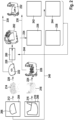
- Figure 2 schematically depicts steps in a method for training the model, in particular a neural network 200, for determining a voxel representation 202 of a shape of an object depending on a first digital image 204 comprising a first view 206 of the object and a second digital image 208 comprising a second view 210 of the object.
- the voxel representation 202 of the shape is a three-dimensional reconstruction of the shape.
- the method is not limited to two views. A number V of views may be used, wherein V is two or larger than two.
- the method is used for determining a shape representation, i.e., the voxel representation 202, from point cloud representations.
- the method uses a transformation from a point cloud to a voxel grid, e.g., with a fixed deterministic algorithm, in particular in a data pre-processing.
- the shape representation is a shape distribution that is learned from real-world observations, i.e., the first digital image 204 and the second digital image 208 of a real-world object.
- the method requires no synthetic data, i.e., no clean synthetic shape of the object.
- the method for training comprises a step 212.
- the step 212 comprises determining a first point cloud representation 214 of the object depending on the first digital image 204.
- the first point cloud representation 214 comprises points that represent the first view 206.
- the first digital image 204 is a real-world digital image, i.e., not a synthetic digital image.
- the method for training comprises a step 216.
- the step 216 comprises determining a second point cloud representation 218 of the object depending on the second digital image 208.
- the second point cloud representation 218 comprises points that represent the second view 210.
- the second digital image 208 is a real-world digital image, i.e., not a synthetic digital image.
- the first point could representation 214 is for example a first noisy point cloud p v 1 ⁇ R N ⁇ 3 , wherein N is the size of the first point cloud.
- the second point cloud representation 218 is for example a second noisy point cloud p v 2 ⁇ R M ⁇ 3 , wherein M is the size of the second point cloud.
- the first noisy point cloud p v 1 and the second noisy point cloud p v 2 show the object for example from two different viewpoints.
- the method for training comprises a step 220.
- the step 220 comprises determining a first voxel representation 222 of the object depending on the first point cloud representation 214.
- the first voxel representation 222 comprises voxels that represent the first view 206.
- the method for training comprises a step 224.
- the step 224 comprises determining a second voxel representation 226 of the object depending on the second point cloud representation 218.
- the second voxel representation 226 comprises voxels that represent the second view 210.
- the first point cloud representation 214 e.g. the noisy point cloud p v 1
- the first voxel representation 222 e.g. an occupancy grid that comprises voxels.
- Each voxel stores a binary value stating with a value TRUE, that at least one point of the noisy point cloud p v 1 falls into that voxel, i.e., that the voxel is occupied, and with a value FALSE, that no point of the noisy point cloud p v 1 falls into that voxel, i.e., that the voxel is unoccupied.
- TRUE a binary voxel representation
- the method for training comprises a step 228.
- the step 228 comprises mapping the first voxel representation 222 with the model to the voxel representation 202 of the shape.
- the model is a diffusion model f ⁇ that is configured to remove noise from a noisy input of the diffusion model.
- the diffusion model f ⁇ according to the example, is configured to output the voxel representation 202 of the shape.
- the noisy input according to an example has a plurality of input elements.
- the noisy input according to an example comprises elements that represent the first voxel representation 222 of the object and elements that represent noise.
- the noise is for example random noise that is sampled from a distribution.
- the elements that represent the first voxel representation 222 are undisturbed, i.e., no noise is added to the elements that represent the first voxel representation 222.
- a forward pass of the diffusion model f ⁇ is a Markov chain, which gradually adds Gaussian noise to corrupt the unoccupied voxels x ⁇ 0 into a standard Gaussian distribution x ⁇ T in T time steps according to a variance schedule ⁇ 1 , ..., ⁇ T .
- x ⁇ t ⁇ 1 q x ⁇ t x ⁇ t ⁇ 1 N 1 ⁇ ⁇ t x ⁇ t ⁇ 1 , ⁇ t I
- N is a normal distribution
- I a unity matrix of appropriate dimension
- the forward process is independent of the conditioning factor c 0 that represents occupied voxels.
- the reverse process is defined as a Markov chain with learned Gaussian transitions which aim to iteratively remove the noise added in the forward process.
- x ⁇ t , c 0 p ⁇ x ⁇ t ⁇ 1 x ⁇ t c 0 N ⁇ ⁇ x ⁇ t c 0 t , ⁇ t 2 I
- p ( x ⁇ T ) is a Gaussian prior
- ⁇ are parameters of the diffusion model f ⁇
- ⁇ ⁇ is a mean value
- ⁇ t 2 a variance of a normal distribution N that are estimated e.g., by the neural network 200.
- the method for training comprises a step 230.
- the step 230 comprises providing a ground truth 232 for the training.
- the ground truth 232 in the example is a voxel representation, e.g., an occupancy grid that comprises voxels.
- the ground truth 232 is determined depending on the first point cloud representation 214 and the second point cloud representation 218.
- the first point cloud representation 214 e.g., the first noisy point cloud p v 1
- the ground truth 232 voxel representation is determined depending on the ground truth point cloud representation p GT .
- the ground truth 232 voxel representation comprises voxels.
- Each voxel of the ground truth 232 voxel representation stores a binary value stating with a value TRUE, that at least one point of the ground truth point cloud representation p GT falls into that voxel, i.e., that the voxel is occupied, and with a value FALSE, that no point of the ground truth point cloud representation p GT falls into that voxel, i.e., that the voxel is unoccupied.
- the voxel representations is not limited to a binary voxel representation. Other values as TRUE and FALSE may be used alike.
- the ground truth 232 is determined depending on the first voxel representation 222 and the second voxel representation 226.
- the voxels of the first voxel representation 222 and the second voxel representation 226 are concatenated into the ground truth 232 voxel representation.
- the method for training comprises a step 234.
- the step 234 comprises determining a depth image 236 of the object depending on the voxel representation 202 of the shape of the object.
- the step 234 comprises determining a silhouette image 238 of the object depending on the voxel representation 202 of the shape of the object.
- a two-dimensional silhouette image 238 is determined with volumetric rendering of the three-dimensional reconstruction of the shape.
- the method for training comprises a step 240.
- the step 240 comprises providing a pseudo ground truth depth image 242 of the object depending on the first digital image 204.
- the first digital image 204 may be mapped with a first artificial neural network to the pseudo ground truth depth image 242 of the object.
- the first artificial neural network may be configured to map a digital image to a depth image.
- the step 240 comprises providing a ground truth silhouette image 244 of the object depending on the first digital image 204.
- the first digital image 204 may be mapped with a second artificial neural network to the ground truth silhouette image 244 of the object.
- the second artificial neural network may be configured to map a digital image to a silhouette image.
- the first digital image 204, the second digital image 208, the pseudo ground truth depth image 242, and the ground truth silhouette image 244 are provided as a data-point of training data.
- the training data may comprise a plurality of data-points.
- the steps of the method for training may be executed for the plurality of data-points, wherein for each data-point, a plurality of voxel representations 202, and a plurality of depth images 236, and a plurality of silhouette images 238 is determined that is associated with the respective data-point.
- the method for training comprises a step 244.
- the step 244 comprises determining parameters of the model, e.g. weights of the neural network 200, depending on a loss.
- the loss in the example depends on a difference between the voxel representation 202 of the shape and the ground truth 232, and the difference between the depth image 236 and the pseudo ground truth depth image 242, and the difference between the silhouette image 238 and the ground truth silhouette image 244 that is determined for at least one pair of the first digital image 204 and the second digital image 208.
- the diffusion model f ⁇ ( x ⁇ t , c 0 , t ) is for example trained by predicting the noise added or predicting the unoccupied voxels x ⁇ 0 depending on, e.g., to minimize, a binary cross-entropy loss L e between the predicted and the ground truth occupancy probabilities L e f ⁇ x ⁇ t c 0 t , x gt wherein x gt is the ground truth for the input x ⁇ t . Since the occupied voxels c 0 are unaffected in the training, the regions of the occupied voxels c 0 are masked out in the training, i.e., not considered for determining the cross-entropy loss.
- the objects shape silhouette is constrained in the example to match the ground truth silhouette.
- the parameters w and q may be solved with a least-squares optimization.
- the combined loss may comprise weighting factors for the loss terms in the combined loss.
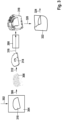
- Figure 3 schematically depicts steps in a method for operating the computer controlled machine 108 depending on a shape of an object.
- the method for operating the computer controlled machine 108 comprises a step 302.
- the step 302 comprises capturing a digital image 304, for example with the sensor 106.
- the method for operating the computer controlled machine 108 comprises a step 306.
- the step 306 comprises determining a point cloud representation 308 of an object depending on the digital image 304.
- the point cloud representation 308 comprises points that represent a view 310 of the object.
- the step 312 comprises determining a voxel representation 314 of the object depending on the point cloud representation 308.
- the voxel representation 314 comprises voxels that represent the view 310.
- the method for determining the shape comprises a step 316.
- the step 316 comprises mapping the voxel representation 314 with the model, e.g. the neural network 200, to a voxel representation 318 of the shape.
- the method for determining the shape comprises a step 320.
- the step 320 comprises determining the shape depending on the voxel representation 318 of the shape.
- Figure 3 depicts a perspective view 322 of the shape.
- the shape is for example determined with an artificial neural network that is configured to map a voxel representation to the shape.
- the method for determining the shape comprises a step 322.
- the step 322 comprises operating the computer controlled machine 108 depending on the shape.
- the target position that avoids a collision with the object is determined and the robot or the vehicle is moved to avoid the target position that avoids the collision with the object.
- the object is the traffic participant.
- the digital image 304 comprises a first part of the traffic participant without second part of the traffic participant.
- the shape of the object is the shape of the traffic participant including the second part.
- the target position may be the position that avoids the position of the second part. This means, the target position is determined to avoid the collision with the second part that is invisible in the digital image.
- the part of the robot may be configured to grab the object.
- the target position to grab the object is determined and the part of the robot, that is configured to grab the object, is moved to the target position to grab the object.
- the object may be the cup with the handle.
- the digital image 304 may comprise a part of the cup without the handle.
- the shape of the object may be the shape including the handle.
- the target position may be the position of the handle. This means, according to the method, the target position is determined to grab the cup at the handle that is invisible in the digital image.
- the at least one memory 104 comprises instructions, that are executable by the at least one processor 102 and that, when executed by the at least one processor 102, cause the device 100 to execute the method for training model, e.g. the neural network 200, and/or the method for operating the computer controlled machine 108.
- the method for operating the computer controlled machine 108 may comprise training the model, e.g. the neural network, according to the method for training the model.
Landscapes
- Engineering & Computer Science (AREA)
- Theoretical Computer Science (AREA)
- Physics & Mathematics (AREA)
- General Physics & Mathematics (AREA)
- Evolutionary Computation (AREA)
- Multimedia (AREA)
- Computer Vision & Pattern Recognition (AREA)
- Software Systems (AREA)
- Health & Medical Sciences (AREA)
- Artificial Intelligence (AREA)
- General Health & Medical Sciences (AREA)
- Computing Systems (AREA)
- Databases & Information Systems (AREA)
- Medical Informatics (AREA)
- Life Sciences & Earth Sciences (AREA)
- Biomedical Technology (AREA)
- Molecular Biology (AREA)
- Mathematical Physics (AREA)
- Computational Linguistics (AREA)
- Biophysics (AREA)
- Data Mining & Analysis (AREA)
- General Engineering & Computer Science (AREA)
- Biodiversity & Conservation Biology (AREA)
- Image Analysis (AREA)
- Image Processing (AREA)
Abstract
Device and computer implemented method for training a model, in particular a neural network (200), for determining a shape of an object, wherein the method comprises determining (212) a first point cloud representation (214) of the object depending on a first digital image (204), wherein the first point cloud representation (214) comprises points that represent a first view (206) of the object, determining (216) a second point cloud representation (218) of the object depending on the second digital image (208), wherein the second point cloud representation (218) comprises points that represent a second view (210) of the object, determining (220) a first voxel representation (222) of the object depending on the first point cloud representation (214), wherein the first voxel representation (222) comprises voxels that represent the first view (206), mapping (228) the first voxel representation (222) with the model to a voxel representation (202) of the shape, providing (230) a ground truth (232) for training the model depending on the first point cloud representation (214) and the second point cloud representation (218) or depending on the first voxel representation (222) and a second voxel representation (226), wherein the second voxel representation (226) of the object is determined depending on the second point cloud representation (218), wherein the second voxel representation (226) comprises voxels that represent the second view (210), wherein the ground truth (232) is a voxel representation that comprises the voxels of the first voxel representation (222) and the second voxel representation (226). Device and computer implemented method for operating a computer controlled machine depending on the shape.
Description
- The invention relates to a device, and a method for training a model, in particular a neural network, for determining a shape of an object, and a method for operating a computer controlled machine depending on a shape of an object.
- A computer implemented method for training a model, in particular a neural network, for determining a shape of an object, comprises determining a first point cloud representation of the object depending on a first digital image, wherein the first point cloud representation comprises points that represent a first view of the object, determining a second point cloud representation of the object depending on the second digital image, wherein the second point cloud representation comprises points that represent a second view of the object, determining a first voxel representation of the object depending on the first point cloud representation, wherein the first voxel representation comprises voxels that represent the first view, mapping the first voxel representation with the model to a voxel representation of the shape, providing a ground truth for training the model depending on the first point cloud representation and the second point cloud representation or depending on the first voxel representation and a second voxel representation, wherein the second voxel representation of the object is determined depending on the second point cloud representation, wherein the second voxel representation comprises voxels that represent the second view, wherein the ground truth is a voxel representation that comprises the voxels of the first voxel representation and the second voxel representation. This provides a model for determining a shape of an object from noisy real-world digital images.
- The model may be a diffusion model that is configured to remove noise from a noisy input of the diffusion model, wherein the diffusion model is configured to output the voxel representation of the shape, wherein the noisy input has a plurality of input elements, wherein the noisy input comprises elements that represent the first voxel representation of the object, and elements that represent noise, in particular noise that is randomly sampled from a distribution, wherein the elements that represent the first voxel representation are undisturbed, in particular comprise no additional noise.
- The method may comprise determining a depth image of the object depending on the voxel representation of the shape of the object, providing a pseudo ground truth depth image, and training the model depending on a difference between the depth image and the ground truth depth image. This improves the model further.
- Providing the pseudo ground truth depth image may comprise determining the pseudo ground truth depth image of the object depending on the first digital image and the second digital image, in particular mapping the first digital image and the second digital image with a first artificial neural network, to the pseudo ground truth depth image of the object, wherein the first artificial neural network is configured to map the first digital image to the pseudo ground truth depth image.
- Providing the pseudo ground truth depth image may comprise providing a training data-point comprising the first digital image, and the pseudo ground truth depth image.
- The method may comprise determining a silhouette image of the object depending on the voxel representation of the shape of the object, providing a ground truth silhouette image, and training the model depending on a difference between the silhouette image and the ground truth silhouette image. This improves the model further.
- Providing the ground truth silhouette image may comprise providing a training data-point comprising the first digital image, and the ground truth silhouette image.
- A computer implemented method for operating a computer controlled machine, in particular a robot, a vehicle, a domestic appliance, a power tool, a manufacturing machine, a personal assistant or an access control system, comprises capturing a digital image, in particular with a sensor, determining a point cloud representation of an object depending on the digital image, wherein the point cloud representation comprises points that represent a view of the object, determining a voxel representation of the object depending on the point cloud representation, wherein the voxel representation comprises voxels that represent the view, mapping the voxel representation with a model, in particular a neural network to a voxel representation of the shape, determining the shape depending on the voxel representation of the shape, in particular with an artificial neural network that is configured to map the voxel representation of the shape to the shape, and operating the computer controlled machine depending on the shape.
- A device for operating a computer controlled machine or for training a model, in particular a neural network, for operating a computer controlled machine, comprises at least one processor, at least one memory, wherein the at least one processor is configured to execute instructions that, when executed by the at least one processor cause the device to execute a method, wherein the at least one memory comprises the instructions.
- A computer program, comprises computer readable instructions that, when executed by a computer, cause the computer to execute a method.
- Further embodiments are derived from the following description and the drawing. In the drawing:
-
Fig. 1 schematically depicts a device, -
Fig. 2 schematically depicts steps in a method for training a neural network for determining a shape of an object, -
Fig. 3 schematically depicts steps in a method for operating a computer controlled machine depending on a shape of an object. -
Figure 1 schematically depicts adevice 100. Thedevice 100 comprises at least oneprocessor 102, at least onememory 104. The at least onememory 104 may comprise is non-transitory memory. The at least onememory 104 may comprise transitory memory. - The
device 100 is configured to process digital images. The digital images may be captured with asensor 106 or received from asensor 106 or read from the at least onememory 104. - The
sensor 106 may be arranged outside of thedevice 100. Thedevice 100 may comprise an interface for thesensor 106. Thedevice 100 according to the example comprises thesensor 106. Thesensor 106 is configured to capture a digital image. Thesensor 106 may be a camera, a radar sensor, a LiDAR sensor, an ultrasound sensor, an infrared sensor, or a motion sensor. The digital image may be a visual image, a radar image, a LiDAR image, an ultrasound image, an infrared image, or a motion image. - According to an example, the digital image has three color channels, e.g., red, green, blue, of size N. According to an example, the digital image has pixels that are associated with a depth value indicative of a distance between a sensor for capturing the digital image and an object that the pixel represents in the digital image.
- The
device 100 is configured to operate a computer controlledmachine 108. Thedevice 100 is configured to operate the computer controlledmachine 108 depending on the digital image. Thesensor 106 is configured to capture the digital image in an environment of the computer controlledmachine 108. - The computer controlled
machine 108 may be a robot, a vehicle, a domestic appliance, a power tool, a manufacturing machine, a personal assistant or an access control system. - The at least one
processor 102 is configured to execute a method for operating the computer controlledmachine 108. - The
device 100 may be part of the computer controlledmachine 108. Thedevice 100 may be configured to actuate anactuator 110 for moving the computer controlledmachine 108. Theactuator 110 may be arranged outside of thedevice 100. Thedevice 100 may comprise an interface to theactuator 110. Thedevice 100 in the example comprises theactuator 110. - The
actuator 110 may be configured to move the robot, or the vehicle or the power tool, or the manufacturing machine or a part thereof. Theactuator 110 may be configured to move a part of the domestic appliance, the personal assistant or the access control system. - The
device 100 may be configured to actuate theactuator 110 to move the robot, or the vehicle or the power tool, or the manufacturing machine or a part thereof. Thedevice 100 may be configured to actuate theactuator 110 to move a part of the domestic appliance, the personal assistant or the access control system. - The digital image may comprise at least a part of an object.
- The
device 100 may be configured to determine a shape of the object depending on the digital image. Thedevice 100 may be configured to determine a target position for the computer controlledmachine 108 or a part thereof depending on the shape of the object. Thedevice 100 may be configured to move the computer controlledmachine 108 or the part thereof to the target position. - For example, the
device 100 may be configured determine the target position that avoids a collision with the object and to move the robot or the vehicle to the target position that avoids the collision with the object. - The object may be a traffic participant. The digital image may comprise a first part of the traffic participant without second part of the traffic participant. The shape of the object may be the shape of the traffic participant including the second part. The target position may be a position that avoids the position of the second part. This means, the target position is determined to avoid the collision with the second part that is invisible in the digital image.
- The part of the robot may be configured to grab the object. For example, the
device 100 may be configured to determine the target position to grab the object and to move the part of the robot, that is configured to grab the object, to the target position to grab the object. - The object may be a cup with a handle. The digital image may comprise a part of the cup without the handle. The shape of the object may be the shape including the handle. The target position may be the position of the handle. This means, the target position is determined to grab the cup at the handle that is invisible in the digital image.
- Given a noisy partial real-world point cloud of an object, the aim of the method is to complete its 3D shape by predicting the geometry of the unobserved parts with a model.
- A completion task is formulated as a conditional generation problem that produces the complete shape given the input partial point cloud as a condition.
- The problem of shape completion is multimodal by its nature. In the example, the model is a denoising diffusion probabilistic model (DDPM).
- The model enables the generation of multiple plausible completions for a single incomplete point cloud, while effectively learning category-specific shape priors solely from partial real-world data without considering complete shapes during the training process.
- To overcome the limitations of working with noisy observations without resorting to training on synthetic data, the method may make use of additional geometric cues including depth and silhouette information.
-
Figure 2 schematically depicts steps in a method for training the model, in particular aneural network 200, for determining avoxel representation 202 of a shape of an object depending on a firstdigital image 204 comprising afirst view 206 of the object and a seconddigital image 208 comprising asecond view 210 of the object. According to an example, thevoxel representation 202 of the shape is a three-dimensional reconstruction of the shape. The method is not limited to two views. A number V of views may be used, wherein V is two or larger than two. - The method is used for determining a shape representation, i.e., the
voxel representation 202, from point cloud representations. This means, the method uses a transformation from a point cloud to a voxel grid, e.g., with a fixed deterministic algorithm, in particular in a data pre-processing. According to an example, the shape representation is a shape distribution that is learned from real-world observations, i.e., the firstdigital image 204 and the seconddigital image 208 of a real-world object. - Learning the shape representation poses a significant challenge, primarily due to the presence of significant noise in the data of the digital images arising from inaccurate sensor measurements, occlusions, and errors involved in the segmentation of objects from three-dimensional scenes or images. The method requires no synthetic data, i.e., no clean synthetic shape of the object.
- The method for training comprises a
step 212. - The
step 212 comprises determining a firstpoint cloud representation 214 of the object depending on the firstdigital image 204. The firstpoint cloud representation 214 comprises points that represent thefirst view 206. The firstdigital image 204 is a real-world digital image, i.e., not a synthetic digital image. - The method for training comprises a
step 216. - The
step 216 comprises determining a secondpoint cloud representation 218 of the object depending on the seconddigital image 208. The secondpoint cloud representation 218 comprises points that represent thesecond view 210. The seconddigital image 208 is a real-world digital image, i.e., not a synthetic digital image. - The first point could
representation 214 is for example a first noisy point cloud p v1 ∈ R N×3, wherein N is the size of the first point cloud. The secondpoint cloud representation 218 is for example a second noisy point cloud p v2 ∈ R M×3 , wherein M is the size of the second point cloud. The first noisy point cloud p v1 and the second noisy point cloud p v2 show the object for example from two different viewpoints. - The method for training comprises a
step 220. - The
step 220 comprises determining afirst voxel representation 222 of the object depending on the firstpoint cloud representation 214. Thefirst voxel representation 222 comprises voxels that represent thefirst view 206. - The method for training comprises a
step 224. - The
step 224 comprises determining asecond voxel representation 226 of the object depending on the secondpoint cloud representation 218. Thesecond voxel representation 226 comprises voxels that represent thesecond view 210. - To simplify the three-dimensional data processing, for example, the first
point cloud representation 214, e.g. the noisy point cloud p v1 , is voxalized into thefirst voxel representation 222, e.g. an occupancy grid that comprises voxels. Each voxel stores a binary value stating with a value TRUE, that at least one point of the noisy point cloud p v1 falls into that voxel, i.e., that the voxel is occupied, and with a value FALSE, that no point of the noisy point cloud p v1 falls into that voxel, i.e., that the voxel is unoccupied. The voxel representations is not limited to a binary voxel representation. Other values as TRUE and FALSE may be used alike. - According to an example, the
first voxel representation 222 is an input x 0 = (c 0, x̃ 0) wherein c 0 represents occupied voxels, and x̃ 0 denotes unoccupied voxels. - The method for training comprises a
step 228. - The
step 228 comprises mapping thefirst voxel representation 222 with the model to thevoxel representation 202 of the shape. - According to an example, the model is a diffusion model fθ that is configured to remove noise from a noisy input of the diffusion model. The diffusion model fθ according to the example, is configured to output the
voxel representation 202 of the shape. - The noisy input according to an example has a plurality of input elements. The noisy input according to an example comprises elements that represent the
first voxel representation 222 of the object and elements that represent noise. The noise is for example random noise that is sampled from a distribution. The elements that represent thefirst voxel representation 222 are undisturbed, i.e., no noise is added to the elements that represent thefirst voxel representation 222. - According to an example, a forward pass of the diffusion model fθ is a Markov chain, which gradually adds Gaussian noise to corrupt the unoccupied voxels x̃ 0 into a standard Gaussian distribution x̃T in T time steps according to a variance schedule β 1, ..., βT. Then the Markov chain and the Gaussian transition probabilities at each time step can be formulated as


- Here, N is a normal distribution, I a unity matrix of appropriate dimension, and the forward process is independent of the conditioning factor c0 that represents occupied voxels.
- According to an example, the reverse process is defined as a Markov chain with learned Gaussian transitions which aim to iteratively remove the noise added in the forward process. The reverse process is conditioned in the example on the conditionig factor c 0 that represents occupied voxels:


- Here, p(x̃ T) is a Gaussian prior, θ are parameters of the diffusion model fθ, µ θ is a mean value and

neural network 200. - The method for training comprises a
step 230. - The
step 230 comprises providing aground truth 232 for the training. Theground truth 232 in the example is a voxel representation, e.g., an occupancy grid that comprises voxels. - According to an example, the
ground truth 232 is determined depending on the firstpoint cloud representation 214 and the secondpoint cloud representation 218. For example, the firstpoint cloud representation 214, e.g., the first noisy point cloud p v1 , and the secondpoint cloud representation 218, e.g., the second noisy point cloud p v2 are concatenated to a ground truth point cloud representation pGT = (p v1 ,p v2 ) ∈ R (N+M)×3. Theground truth 232 voxel representation is determined depending on the ground truth point cloud representation pGT. For example, theground truth 232 voxel representation comprises voxels. Each voxel of theground truth 232 voxel representation stores a binary value stating with a value TRUE, that at least one point of the ground truth point cloud representation pGT falls into that voxel, i.e., that the voxel is occupied, and with a value FALSE, that no point of the ground truth point cloud representation pGT falls into that voxel, i.e., that the voxel is unoccupied. The voxel representations is not limited to a binary voxel representation. Other values as TRUE and FALSE may be used alike. - According to an example, the
ground truth 232 is determined depending on thefirst voxel representation 222 and thesecond voxel representation 226. - According to an example, the voxels of the
first voxel representation 222 and thesecond voxel representation 226 are concatenated into theground truth 232 voxel representation. - The method for training comprises a
step 234. - The
step 234 comprises determining adepth image 236 of the object depending on thevoxel representation 202 of the shape of the object. - For example, the
depth image 236 comprises a depth map that is rendered using the occupancy grid of thevoxel representation 202 of the shape:
- For example a pre-trained Omnidata model is used to determine the depth map as described in Rundi Wu, Xuelin Chen, Yixin Zhuang, and Baoquan Chen. Multimodal shape completion via conditional generative adversarial networks. In Proceedings of the European Conference on Computer Vision (ECCV), 2020.
- The
step 234 comprises determining asilhouette image 238 of the object depending on thevoxel representation 202 of the shape of the object. - This means, for example, a two-
dimensional silhouette image 238 is determined with volumetric rendering of the three-dimensional reconstruction of the shape. - Hence, to render a silhouette pixel, M points are sampled along its ray r. For each of the three-dimensional points mi, its occupancy value ôl may be obtained from the occupancy grid trough trilinear interpolations:


- Since two views v 1 and v 2 are used to form the ground truth occupancy grid, the silhouettes are also rendered for the same viewpoints.
- The method for training comprises a
step 240. - The
step 240 comprises providing a pseudo groundtruth depth image 242 of the object depending on the firstdigital image 204. The firstdigital image 204 may be mapped with a first artificial neural network to the pseudo groundtruth depth image 242 of the object. The first artificial neural network may be configured to map a digital image to a depth image. - The
step 240 comprises providing a groundtruth silhouette image 244 of the object depending on the firstdigital image 204. The firstdigital image 204 may be mapped with a second artificial neural network to the groundtruth silhouette image 244 of the object. The second artificial neural network may be configured to map a digital image to a silhouette image. - According to an example, the first
digital image 204, the seconddigital image 208, the pseudo groundtruth depth image 242, and the groundtruth silhouette image 244 are provided as a data-point of training data. - The training data may comprise a plurality of data-points.
- The steps of the method for training may be executed for the plurality of data-points, wherein for each data-point, a plurality of
voxel representations 202, and a plurality ofdepth images 236, and a plurality ofsilhouette images 238 is determined that is associated with the respective data-point. - The method for training comprises a
step 244. - The
step 244 comprises determining parameters of the model, e.g. weights of theneural network 200, depending on a loss. The loss in the example depends on a difference between thevoxel representation 202 of the shape and theground truth 232, and the difference between thedepth image 236 and the pseudo groundtruth depth image 242, and the difference between thesilhouette image 238 and the groundtruth silhouette image 244 that is determined for at least one pair of the firstdigital image 204 and the seconddigital image 208. - The diffusion model fθ (x̃t, c 0 , t) is for example trained by predicting the noise added or predicting the unoccupied voxels x̃ 0 depending on, e.g., to minimize, a binary cross-entropy loss Le between the predicted and the ground truth occupancy probabilities

- The objects shape silhouette is constrained in the example to match the ground truth silhouette.
- The diffusion model fθ (x̂t, c 0 , t) is for example trained depending on a loss, e.g., to minimize the Ls loss:

j represents the two-dimensional silhouette image 238, and Svj represents the groundtruth silhouette image 244, and V denotes the number of views used. - Although individual silhouette images may lack adequate information, the presence of multiple silhouette images belonging to distinct instances of the same shape shows advantages in learning object shapes.
- Learning the object shape is further improved by the
depth image 236, e.g., the depth map, and the pseudo groundtruth depth image 242. - The diffusion model fθ (x̃t, c 0 , t) is for example trained depending on a scale-invariant loss function Ld, e.g., to minimize the loss function:

j represents thedepth image 236, e.g., the rendered depth map, wherein Dvj represents the pseudo groundtruth depth image 242, e.g., a ground truth depth map, w and q are scale and shift parameters to align D̂vj and Dvj . - The parameters w and q may be solved with a least-squares optimization.
- The diffusion model fθ (x̃t, c0, t) is for example trained depending a combined loss:


- The combined loss may comprise weighting factors for the loss terms in the combined loss.
-
Figure 3 schematically depicts steps in a method for operating the computer controlledmachine 108 depending on a shape of an object. - The method for operating the computer controlled
machine 108 comprises astep 302. - The
step 302 comprises capturing adigital image 304, for example with thesensor 106. - The method for operating the computer controlled
machine 108 comprises astep 306. - The
step 306 comprises determining apoint cloud representation 308 of an object depending on thedigital image 304. Thepoint cloud representation 308 comprises points that represent aview 310 of the object. - The method operating the computer controlled
machine 108 comprises astep 312. - The
step 312 comprises determining avoxel representation 314 of the object depending on thepoint cloud representation 308. Thevoxel representation 314 comprises voxels that represent theview 310. - The method for determining the shape comprises a
step 316. - The
step 316 comprises mapping thevoxel representation 314 with the model, e.g. theneural network 200, to avoxel representation 318 of the shape. - The method for determining the shape comprises a
step 320. - The
step 320 comprises determining the shape depending on thevoxel representation 318 of the shape.Figure 3 depicts aperspective view 322 of the shape. The shape is for example determined with an artificial neural network that is configured to map a voxel representation to the shape. - The method for determining the shape comprises a
step 322. - The
step 322 comprises operating the computer controlledmachine 108 depending on the shape. - For example, the target position that avoids a collision with the object is determined and the robot or the vehicle is moved to avoid the target position that avoids the collision with the object.
- For example, the object is the traffic participant. The
digital image 304 comprises a first part of the traffic participant without second part of the traffic participant. The shape of the object is the shape of the traffic participant including the second part. The target position may be the position that avoids the position of the second part. This means, the target position is determined to avoid the collision with the second part that is invisible in the digital image. - The part of the robot may be configured to grab the object. For example, the target position to grab the object is determined and the part of the robot, that is configured to grab the object, is moved to the target position to grab the object.
- The object may be the cup with the handle. The
digital image 304 may comprise a part of the cup without the handle. The shape of the object may be the shape including the handle. The target position may be the position of the handle. This means, according to the method, the target position is determined to grab the cup at the handle that is invisible in the digital image. - According to an example, the at least one
memory 104 comprises instructions, that are executable by the at least oneprocessor 102 and that, when executed by the at least oneprocessor 102, cause thedevice 100 to execute the method for training model, e.g. theneural network 200, and/or the method for operating the computer controlledmachine 108. - The method for operating the computer controlled
machine 108 may comprise training the model, e.g. the neural network, according to the method for training the model.
Claims (10)
- Computer implemented method for training a model, in particular a neural network (200), for determining a shape of an object, characterized in that the method comprises determining (212) a first point cloud representation (214) of the object depending on a first digital image (204), wherein the first point cloud representation (214) comprises points that represent a first view (206) of the object, determining (216) a second point cloud representation (218) of the object depending on the second digital image (208), wherein the second point cloud representation (218) comprises points that represent a second view (210) of the object, determining (220) a first voxel representation (222) of the object depending on the first point cloud representation (214), wherein the first voxel representation (222) comprises voxels that represent the first view (206), mapping (228) the first voxel representation (222) with the model to a voxel representation (202) of the shape, providing (230) a ground truth (232) for training the model depending on the first point cloud representation (214) and the second point cloud representation (218) or depending on the first voxel representation (222) and a second voxel representation (226), wherein the second voxel representation (226) of the object is determined depending on the second point cloud representation (218), wherein the second voxel representation (226) comprises voxels that represent the second view (210), wherein the ground truth (232) is a voxel representation that comprises the voxels of the first voxel representation (222) and the second voxel representation (226).
- The method according to claim 1, characterized in that the model is a diffusion model that is configured to remove noise from a noisy input of the diffusion model, wherein the diffusion model is configured to output the voxel representation (202) of the shape, wherein the noisy input has a plurality of input elements, wherein the noisy input comprises elements that represent the first voxel representation (222) of the object, and elements that represent noise, in particular noise that is randomly sampled from a distribution, wherein the elements that represent the first voxel representation (222) are undisturbed, in particular comprise no additional noise.
- The method according to one of the preceding claims, characterized in that the method comprises determining (232) a depth image (236) of the object depending on the voxel representation (202) of the shape of the object, providing (240) a pseudo ground truth depth image (242), and training the model depending on a difference between the depth image (236) and the pseudo ground truth depth image (242).
- The method according to claim 3, characterized in that providing (240) the pseudo ground truth depth image (242) comprises determining the pseudo ground truth depth image (242) of the object depending on the first digital image (204), in particular mapping the first digital image (204) with a first artificial neural network, to the pseudo ground truth depth image (242) of the object, wherein the first artificial neural network is configured to map the first digital image (204) to the pseudo ground truth depth image (242).
- The method according to claim 3, characterized in that providing (240) the pseudo ground truth depth image (242) comprises, providing a training data-point comprising the first digital image (204), and the pseudo ground truth depth image (242).
- The method according to one of the preceding claims, characterized in that the method comprises determining (232) a silhouette image (238) of the object depending on the voxel representation (202) of the shape of the object, providing (240) a ground truth silhouette image (244), and training the model depending on a difference between the silhouette image (238) and the ground truth silhouette image (244).
- The method according to claim 6, characterized in that providing (240) the ground truth silhouette image (244) comprises, providing a training data-point comprising the first digital image (204), and the ground truth silhouette image (244).
- Computer implemented method for operating a computer controlled machine, in particular a robot, a vehicle, a domestic appliance, a power tool, a manufacturing machine, a personal assistant or an access control system, characterized by capturing (302) a digital image (304), in particular with a sensor (106), determining (306) a point cloud representation (308) of an object depending on the digital image (304), wherein the point cloud representation (308) comprises points that represent a view (310) of the object, determining (312) a voxel representation (314) of the object depending on the point cloud representation (308), wherein the voxel representation (314) comprises voxels that represent the view (310), mapping (316) the voxel representation (314) with a model, in particular a neural network (200) to a voxel representation (318) of the shape, determining (320) the shape depending on the voxel representation (318) of the shape, in particular with an artificial neural network that is configured to map the voxel representation (318) of the shape to the shape, and operating (322) the computer controlled machine (108) depending on the shape.
- Device (100) for operating a computer controlled machine (108) or for training a model, in particular a neural network (200), for operating a computer controlled machine (108), characterized in that the device (100) comprises at least one processor (102), at least one memory (104), wherein the at least one processor (102) is configured to execute instructions that, when executed by the at least one processor (102) cause the device (100) to execute a method according to one of the preceding claims, wherein the at least one memory (104) comprises the instructions.
- Computer program, characterized in that the computer program comprises computer readable instructions that, when executed by a computer, cause the computer to execute a method according to one of the claims 1 to 8.
Priority Applications (5)
| Application Number | Priority Date | Filing Date | Title |
|---|---|---|---|
| EP23205632.5A EP4546281A1 (en) | 2023-10-24 | 2023-10-24 | Device and method for training a model for determining a shape of an object, method for operating a computer controlled machine depending on a shape of an object |
| US18/917,575 US20250131579A1 (en) | 2023-10-24 | 2024-10-16 | Device and method for training a model for determining a shape of an object, method for operating a computer controlled machine depending on a shape of an object |
| JP2024187015A JP2025072343A (en) | 2023-10-24 | 2024-10-23 | Apparatus and method for training a model to determine the shape of an object, and method for operating a computer-controlled device in response to the shape of an object - Patents.com |
| KR1020240146363A KR20250059342A (en) | 2023-10-24 | 2024-10-24 | Device and method for training a model for determining a shape of an object, method for operating a computer controlled machine depending on a shape of an object |
| CN202411490191.4A CN119888396A (en) | 2023-10-24 | 2024-10-24 | Method for determining object shape and operating machine depending on object shape by training model |
Applications Claiming Priority (1)
| Application Number | Priority Date | Filing Date | Title |
|---|---|---|---|
| EP23205632.5A EP4546281A1 (en) | 2023-10-24 | 2023-10-24 | Device and method for training a model for determining a shape of an object, method for operating a computer controlled machine depending on a shape of an object |
Publications (1)
| Publication Number | Publication Date |
|---|---|
| EP4546281A1 true EP4546281A1 (en) | 2025-04-30 |
Family
ID=88511344
Family Applications (1)
| Application Number | Title | Priority Date | Filing Date |
|---|---|---|---|
| EP23205632.5A Pending EP4546281A1 (en) | 2023-10-24 | 2023-10-24 | Device and method for training a model for determining a shape of an object, method for operating a computer controlled machine depending on a shape of an object |
Country Status (5)
| Country | Link |
|---|---|
| US (1) | US20250131579A1 (en) |
| EP (1) | EP4546281A1 (en) |
| JP (1) | JP2025072343A (en) |
| KR (1) | KR20250059342A (en) |
| CN (1) | CN119888396A (en) |
-
2023
- 2023-10-24 EP EP23205632.5A patent/EP4546281A1/en active Pending
-
2024
- 2024-10-16 US US18/917,575 patent/US20250131579A1/en active Pending
- 2024-10-23 JP JP2024187015A patent/JP2025072343A/en active Pending
- 2024-10-24 KR KR1020240146363A patent/KR20250059342A/en active Pending
- 2024-10-24 CN CN202411490191.4A patent/CN119888396A/en active Pending
Non-Patent Citations (5)
| Title |
|---|
| LINQI ZHOU ET AL: "3D Shape Generation and Completion through Point-Voxel Diffusion", ARXIV.ORG, 11 April 2021 (2021-04-11), XP081934283 * |
| RUNDI WUXUELIN CHENYIXIN ZHUANGBAOQUAN CHEN: "Multimodal shape completion via conditional generative adversarial networks", PROCEEDINGS OF THE EUROPEAN CONFERENCE ON COMPUTER VISION (ECCV, 2020 |
| SHIN DAEYUN ET AL: "Pixels, Voxels, and Views: A Study of Shape Representations for Single View 3D Object Shape Prediction", 2018 IEEE/CVF CONFERENCE ON COMPUTER VISION AND PATTERN RECOGNITION, IEEE, 18 June 2018 (2018-06-18), pages 3061 - 3069, XP033476274, DOI: 10.1109/CVPR.2018.00323 * |
| VARLEY JACOB ET AL: "Shape completion enabled robotic grasping", 2017 IEEE/RSJ INTERNATIONAL CONFERENCE ON INTELLIGENT ROBOTS AND SYSTEMS (IROS), IEEE, 24 September 2017 (2017-09-24), pages 2442 - 2447, XP033266211, DOI: 10.1109/IROS.2017.8206060 * |
| ZHIJIAN LIU ET AL: "Point-Voxel CNN for Efficient 3D Deep Learning", ARXIV.ORG, CORNELL UNIVERSITY LIBRARY, 201 OLIN LIBRARY CORNELL UNIVERSITY ITHACA, NY 14853, 8 July 2019 (2019-07-08), XP081548294 * |
Also Published As
| Publication number | Publication date |
|---|---|
| CN119888396A (en) | 2025-04-25 |
| KR20250059342A (en) | 2025-05-02 |
| US20250131579A1 (en) | 2025-04-24 |
| JP2025072343A (en) | 2025-05-09 |
Similar Documents
| Publication | Publication Date | Title |
|---|---|---|
| EP3979200B1 (en) | Video target tracking method and apparatus, computer device and storage medium | |
| CN115393410B (en) | Monocular view depth estimation method based on nerve radiation field and semantic segmentation | |
| CN117409192B (en) | A data-enhanced infrared small target detection method and device | |
| EP3510561B1 (en) | Predicting depth from image data using a statistical model | |
| US10169676B2 (en) | Shape-based registration for non-rigid objects with large holes | |
| CN115439926B (en) | A method for identifying anomalous behavior in a few samples based on key regions and scene depth | |
| US11810311B2 (en) | Two-stage depth estimation machine learning algorithm and spherical warping layer for equi-rectangular projection stereo matching | |
| CN107507126A (en) | A Method of Restoring 3D Scene Using RGB Image | |
| Periyasamy et al. | How to get the most out of u-net for glacier calving front segmentation | |
| EP3759649B1 (en) | Object recognition from images using cad models as prior | |
| US20230419507A1 (en) | Systems and methods for motion estimation and view prediction | |
| US20210224619A1 (en) | Image processing using generative graphical models | |
| CN112819832B (en) | Fine-grained boundary extraction method for semantic segmentation of urban scenes based on laser point cloud | |
| CN115601506B (en) | Reconstruction method of three-dimensional scene, electronic equipment and medium | |
| Pal et al. | Automated construction progress monitoring of partially completed building elements leveraging geometry modeling and appearance detection with deep learning | |
| CN113870314B (en) | An action transfer model training method and action transfer method | |
| Lee et al. | Learning-based reflection-aware virtual point removal for large-scale 3D point clouds | |
| CN115019135A (en) | Model training method, target detection method, device, electronic equipment and storage medium | |
| EP3992909A1 (en) | Two-stage depth estimation machine learning algorithm and spherical warping layer for equi-rectangular projection stereo matching | |
| Lin et al. | EAGAN: Event‐based attention generative adversarial networks for optical flow and depth estimation | |
| EP4546281A1 (en) | Device and method for training a model for determining a shape of an object, method for operating a computer controlled machine depending on a shape of an object | |
| Harisankar et al. | Unsupervised depth estimation from monocular images for autonomous vehicles | |
| EP2275993A2 (en) | Method for estimating the visibility of features on surfaces of object instances in multi-object scenes and method for perception planning in multi-object scenes | |
| CN118789555B (en) | Robot grasping control method and system based on non-modal segmentation | |
| Wolff et al. | Super-pixel sampler: a data-driven approach for depth sampling and reconstruction |
Legal Events
| Date | Code | Title | Description |
|---|---|---|---|
| PUAI | Public reference made under article 153(3) epc to a published international application that has entered the european phase |
Free format text: ORIGINAL CODE: 0009012 |
|
| STAA | Information on the status of an ep patent application or granted ep patent |
Free format text: STATUS: THE APPLICATION HAS BEEN PUBLISHED |
|
| AK | Designated contracting states |
Kind code of ref document: A1 Designated state(s): AL AT BE BG CH CY CZ DE DK EE ES FI FR GB GR HR HU IE IS IT LI LT LU LV MC ME MK MT NL NO PL PT RO RS SE SI SK SM TR |
|
| STAA | Information on the status of an ep patent application or granted ep patent |
Free format text: STATUS: REQUEST FOR EXAMINATION WAS MADE |
|
| 17P | Request for examination filed |
Effective date: 20251030 |