EP4546229A1 - Lithium battery performance score calculation method and system - Google Patents
Lithium battery performance score calculation method and system Download PDFInfo
- Publication number
- EP4546229A1 EP4546229A1 EP23825748.9A EP23825748A EP4546229A1 EP 4546229 A1 EP4546229 A1 EP 4546229A1 EP 23825748 A EP23825748 A EP 23825748A EP 4546229 A1 EP4546229 A1 EP 4546229A1
- Authority
- EP
- European Patent Office
- Prior art keywords
- lithium battery
- battery performance
- performance
- performance scoring
- metrics
- Prior art date
- Legal status (The legal status is an assumption and is not a legal conclusion. Google has not performed a legal analysis and makes no representation as to the accuracy of the status listed.)
- Pending
Links
Images



Classifications
-
- G—PHYSICS
- G06—COMPUTING OR CALCULATING; COUNTING
- G06Q—INFORMATION AND COMMUNICATION TECHNOLOGY [ICT] SPECIALLY ADAPTED FOR ADMINISTRATIVE, COMMERCIAL, FINANCIAL, MANAGERIAL OR SUPERVISORY PURPOSES; SYSTEMS OR METHODS SPECIALLY ADAPTED FOR ADMINISTRATIVE, COMMERCIAL, FINANCIAL, MANAGERIAL OR SUPERVISORY PURPOSES, NOT OTHERWISE PROVIDED FOR
- G06Q10/00—Administration; Management
- G06Q10/06—Resources, workflows, human or project management; Enterprise or organisation planning; Enterprise or organisation modelling
- G06Q10/063—Operations research, analysis or management
- G06Q10/0639—Performance analysis of employees; Performance analysis of enterprise or organisation operations
- G06Q10/06393—Score-carding, benchmarking or key performance indicator [KPI] analysis
-
- G—PHYSICS
- G06—COMPUTING OR CALCULATING; COUNTING
- G06Q—INFORMATION AND COMMUNICATION TECHNOLOGY [ICT] SPECIALLY ADAPTED FOR ADMINISTRATIVE, COMMERCIAL, FINANCIAL, MANAGERIAL OR SUPERVISORY PURPOSES; SYSTEMS OR METHODS SPECIALLY ADAPTED FOR ADMINISTRATIVE, COMMERCIAL, FINANCIAL, MANAGERIAL OR SUPERVISORY PURPOSES, NOT OTHERWISE PROVIDED FOR
- G06Q10/00—Administration; Management
- G06Q10/04—Forecasting or optimisation specially adapted for administrative or management purposes, e.g. linear programming or "cutting stock problem"
-
- G—PHYSICS
- G01—MEASURING; TESTING
- G01R—MEASURING ELECTRIC VARIABLES; MEASURING MAGNETIC VARIABLES
- G01R31/00—Arrangements for testing electric properties; Arrangements for locating electric faults; Arrangements for electrical testing characterised by what is being tested not provided for elsewhere
- G01R31/36—Arrangements for testing, measuring or monitoring the electrical condition of accumulators or electric batteries, e.g. capacity or state of charge [SoC]
- G01R31/367—Software therefor, e.g. for battery testing using modelling or look-up tables
-
- G—PHYSICS
- G01—MEASURING; TESTING
- G01R—MEASURING ELECTRIC VARIABLES; MEASURING MAGNETIC VARIABLES
- G01R31/00—Arrangements for testing electric properties; Arrangements for locating electric faults; Arrangements for electrical testing characterised by what is being tested not provided for elsewhere
- G01R31/36—Arrangements for testing, measuring or monitoring the electrical condition of accumulators or electric batteries, e.g. capacity or state of charge [SoC]
- G01R31/392—Determining battery ageing or deterioration, e.g. state of health
-
- G—PHYSICS
- G06—COMPUTING OR CALCULATING; COUNTING
- G06Q—INFORMATION AND COMMUNICATION TECHNOLOGY [ICT] SPECIALLY ADAPTED FOR ADMINISTRATIVE, COMMERCIAL, FINANCIAL, MANAGERIAL OR SUPERVISORY PURPOSES; SYSTEMS OR METHODS SPECIALLY ADAPTED FOR ADMINISTRATIVE, COMMERCIAL, FINANCIAL, MANAGERIAL OR SUPERVISORY PURPOSES, NOT OTHERWISE PROVIDED FOR
- G06Q10/00—Administration; Management
- G06Q10/06—Resources, workflows, human or project management; Enterprise or organisation planning; Enterprise or organisation modelling
- G06Q10/063—Operations research, analysis or management
- G06Q10/0639—Performance analysis of employees; Performance analysis of enterprise or organisation operations
-
- G—PHYSICS
- G06—COMPUTING OR CALCULATING; COUNTING
- G06Q—INFORMATION AND COMMUNICATION TECHNOLOGY [ICT] SPECIALLY ADAPTED FOR ADMINISTRATIVE, COMMERCIAL, FINANCIAL, MANAGERIAL OR SUPERVISORY PURPOSES; SYSTEMS OR METHODS SPECIALLY ADAPTED FOR ADMINISTRATIVE, COMMERCIAL, FINANCIAL, MANAGERIAL OR SUPERVISORY PURPOSES, NOT OTHERWISE PROVIDED FOR
- G06Q10/00—Administration; Management
- G06Q10/20—Administration of product repair or maintenance
-
- G—PHYSICS
- G06—COMPUTING OR CALCULATING; COUNTING
- G06Q—INFORMATION AND COMMUNICATION TECHNOLOGY [ICT] SPECIALLY ADAPTED FOR ADMINISTRATIVE, COMMERCIAL, FINANCIAL, MANAGERIAL OR SUPERVISORY PURPOSES; SYSTEMS OR METHODS SPECIALLY ADAPTED FOR ADMINISTRATIVE, COMMERCIAL, FINANCIAL, MANAGERIAL OR SUPERVISORY PURPOSES, NOT OTHERWISE PROVIDED FOR
- G06Q50/00—Information and communication technology [ICT] specially adapted for implementation of business processes of specific business sectors, e.g. utilities or tourism
- G06Q50/06—Energy or water supply
-
- H—ELECTRICITY
- H01—ELECTRIC ELEMENTS
- H01M—PROCESSES OR MEANS, e.g. BATTERIES, FOR THE DIRECT CONVERSION OF CHEMICAL ENERGY INTO ELECTRICAL ENERGY
- H01M10/00—Secondary cells; Manufacture thereof
- H01M10/05—Accumulators with non-aqueous electrolyte
- H01M10/052—Li-accumulators
-
- Y—GENERAL TAGGING OF NEW TECHNOLOGICAL DEVELOPMENTS; GENERAL TAGGING OF CROSS-SECTIONAL TECHNOLOGIES SPANNING OVER SEVERAL SECTIONS OF THE IPC; TECHNICAL SUBJECTS COVERED BY FORMER USPC CROSS-REFERENCE ART COLLECTIONS [XRACs] AND DIGESTS
- Y02—TECHNOLOGIES OR APPLICATIONS FOR MITIGATION OR ADAPTATION AGAINST CLIMATE CHANGE
- Y02E—REDUCTION OF GREENHOUSE GAS [GHG] EMISSIONS, RELATED TO ENERGY GENERATION, TRANSMISSION OR DISTRIBUTION
- Y02E60/00—Enabling technologies; Technologies with a potential or indirect contribution to GHG emissions mitigation
- Y02E60/10—Energy storage using batteries
Definitions
- the present disclosure relates to a field of energy storage technologies, specifically to a lithium battery performance scoring calculation method and a system thereof.
- Lithium batteries are widely used in energy storage due to advantages of high energy density, stable electrochemical properties, less pollution, and long cycle life, etc.
- the lithium batteries also promote sustained and rapid economic development.
- the lithium batteries may slowly undergo irreversible aging, which directly affects practicality, economy, and safety of the lithium batteries. Therefore, being able to accurately and quickly evaluate a real-time performance status of the lithium batteries not only improves safety of related fields, but also saves a lot of money and time in the energy storage field. Therefore, developing a method that can accurately evaluate the performance status of the lithium batteries is of great significance for its practical application.
- a traditional lithium battery performance status evaluation method has great ambiguity, one-sided evaluation metrics, and human influence, and cannot accurately and comprehensively reflect the performance status of the lithium batteries, and an evaluation result is less convincing.
- the present disclosure provides a lithium battery performance scoring calculation method and a system thereof to at least solve the problem that a lithium battery performance status evaluation method in related arts has great ambiguity, one-sided evaluation metrics, and human influence, and cannot accurately and comprehensively reflect the performance status of the lithium batteries, and an evaluation result is less convincing.
- a lithium battery performance scoring calculation method includes:
- a lithium battery performance scoring calculation system includes:
- an electronic device includes a memory, a processor and a computer program stored on the memory and executable by the processor, in which the processor is configured to implement the lithium battery performance scoring calculation method as described in the first aspect of the present disclosure when executing the computer program.
- a non-transitory computer-readable storage medium with a computer program stored thereon is provided.
- the computer program is caused to implement the lithium battery performance scoring calculation method as described in the first aspect of the present disclosure when executed by a processor.
- a computer program product includes a computer program, which causes the lithium battery performance scoring calculation method as described in the first aspect of embodiments of the present disclosure to be implemented when executed by a processor.
- a computer program including computer program codes is provided.
- a computer is caused to implement the lithium battery performance scoring calculation method as described in the first aspect of embodiments of the present disclosure when the computer program codes are running on the computer.
- the present disclosure provides the lithium battery performance scoring calculation method and the system thereof, the method includes acquiring the data during operation of a lithium battery and uploading the data to the lithium battery performance scoring database, constructing the lithium battery performance scoring system based on the lithium battery performance scoring database from the three dimensions of battery nameplate attributes, operational attributes, and environmental attributes, constructing the battery performance scoring calculation model based on the fuzzy comprehensive evaluation method, and calculating the scores of respective performance metrics of the lithium battery.
- the present disclosure may achieve real-time, fast, and accurate calculation of performance of the lithium battery, and evaluate a performance status of the lithium battery, improve a maintenance and repair efficiency of the lithium battery, and ensure safe and stable operation of the lithium battery.
- the present disclosure provides a lithium battery performance scoring calculation method and a system thereof, the method includes acquiring data during operation of a lithium battery and uploading the data to a lithium battery performance scoring database, constructing a lithium battery performance scoring system based on the lithium battery performance scoring database from three dimensions of battery nameplate attributes, operational attributes, and environmental attributes, constructing a battery performance scoring calculation model based on a fuzzy comprehensive evaluation method, and calculating scores of respective performance metrics of the lithium battery.
- the present disclosure may achieve real-time, fast, and accurate calculation of performance of the lithium battery, and evaluate a performance status of the lithium battery, improve a maintenance and repair efficiency of the lithium battery, and ensure safe and stable operation of the lithium battery.
- FIG. 1 is a flowchart illustrating a lithium battery performance scoring calculation method according to an embodiment of the present disclosure. As illustrated in FIG. 1 , the method may include following steps 1 to 3.
- step 1 data during operation of a lithium battery is acquired and the data is uploaded to a lithium battery performance scoring database.
- the data during operation of the lithium battery includes power, voltage, current, temperature, etc., during operation of the lithium battery.
- FIG. 2 is a flowchart illustrating a specific lithium battery performance scoring calculation method according to an embodiment of the present disclosure. As illustrated in FIG. 2 , after uploading the data to the lithium battery performance scoring database, the method further includes: performing cleaning processing on lithium battery performance data in the lithium battery performance scoring database.
- Performing the cleaning processing on the lithium battery performance data in the lithium battery performance scoring database includes: filling in missing values and processing exception values.
- Filling in missing values refers to removing data of the day if the missing values exceeds 5 points, and filling in the missing values using an average of three pieces of data before and after if the missing values below 5 points.
- Processing exception values refers to, for exception values, constructing an identification method for exception values of metrics using statistics analysis, box line diagram method, etc., and deleting or filling exception values as required.
- a lithium battery performance scoring system is constructed based on the lithium battery performance scoring database from three dimensions of battery nameplate attributes, operational attributes, and environmental attributes.
- the method before constructing the lithium battery performance scoring system based on the lithium battery performance scoring database from three dimensions of battery nameplate attributes, operational attributes, and environmental attributes, the method further includes: constructing lithium battery metrics features related to lithium battery performance.
- Methods of constructing the lithium battery metrics features related to lithium battery performance include: descriptive statistics, correlation analysis, data transformation, data coding, binning, and feature combination.
- the nameplate attributes include a battery model number, a battery capacity, a battery manufacturing date, a batch, a manufacturer and a location.
- the operational attributes include a total operational power, a total voltage, a total current, maximum and minimum voltages, and maximum and minimum temperatures;
- the environmental attributes include maximum and minimum external temperatures, maximum and minimum humidifies, and weather data.
- a battery performance scoring calculation model is constructed based on a fuzzy comprehensive evaluation method, and scores of respective performance metrics of the lithium battery are calculated.
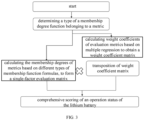
- FIG. 3 is a schematic diagram illustrating a fuzzy comprehensive evaluation model in a lithium battery performance scoring calculation method according to an embodiment of the present disclosure.
- the constructing the battery performance scoring calculation model based on the fuzzy comprehensive evaluation method specifically includes: F1: the lithium battery performance scoring system is divided into levels, including a cell level, a module level, a battery cluster level and a battery container level.
- the method of in the present disclosure not only performs performance evaluation for cell-level, but also performs stepped evaluation for the upper module level, the battery cluster level and the battery container level, allowing for a comprehensive evaluation of the overall performance of the energy storage power station.
- membership functions include “parabolic”, “positive S-line” and “linear”.
- a membership degree is calculated by incorporating each individual metric feature of the lithium battery into a membership function corresponding to the individual metric feature of the lithium battery, and an evaluation matrix A of individual factors at respective levels of the lithium battery is obtained by combining membership degrees.
- A is a matrix of m rows and n columns, m is a number of samples of the lithium battery, n is a number of matrixes of the lithium battery;
- ⁇ 11 is a membership degree of a first feature of a first battery sample;
- ⁇ 1n is a membership degree of an n-th feature of the first battery sample;
- ⁇ mn is a membership degree of an n-th feature of an m-th battery sample.
- weight coefficients of the respective metric features of the lithium battery are calculated using a multiple linear regression method, and a weight coefficient matrix R is constructed by combining weight coefficients that affect performance of the lithium battery
- a comprehensive evaluation index is calculated by multiplying the evaluation matrix of individual factors and a transposed weight coefficient matrix using a fuzzy comprehensive evaluation method, and a battery performance scoring calculation model is built, and scores of respective performance metrics of the lithium battery are obtained by calculation. With obtaining a comprehensive scoring result of different levels of respective performance metric statuses of the lithium battery, accurate evaluation of the performance status of the lithium battery is achieved.
- the calculating the weight coefficients of the respective metric features of the lithium battery using the multiple linear regression method, and constructing the weight coefficient matrix R by combining the weight coefficients that affect performance of the lithium battery, and calculating the comprehensive evaluation index by multiplying the evaluation matrix of individual factors and the transposed weight coefficient matrix using the fuzzy comprehensive evaluation method, building the battery performance scoring calculation model specifically includes followings.
- H3 a metric weight coefficient matrix is constructed.
- y 1 is a comprehensive score of a performance status of a first lithium battery sample
- y m is a comprehensive score of an m-th lithium battery sample
- m is a number of lithium battery samples.
- the method calculates the weight coefficients of metrics of the lithium battery using the multiple linear regression method, the principle of which is to determine the weight coefficients of metrics based on a strength of collinearity between each metric of the lithium battery and other metrics, without influence of human factors.
- the method calculates the weight coefficients of metrics of the lithium battery using the multiple linear regression method, and determines the weight of metrics based on the strength of the collinearity between each metric of the lithium battery and other metrics. That is, the greater the complex correlation coefficient Z between a certain metric and other metrics, the stronger the collinear relationship between the metric and other metrics, the easier the metric is to be represented by a linear combination of other indicators. The more repeated information, the smaller the weight of the metric should be.
- the lithium battery performance scoring calculation method further includes:
- the visual interface includes number of lithium battery devices, distribution topology, temperature, and a performance status result, which is configured to provide lithium battery non-health warnings for a transportation and inspection department.
- Table 1 shows a health status corresponding to an evaluation score, as illustrated in Table 1.
- FIG. 4 is a visual interface diagram for lithium battery performance status analysis in a lithium battery performance scoring calculation method according to an embodiment of the present disclosure. As illustrated in FIG. 4 , the lithium battery performance status comprehensive scoring is accessed to the visual interface for intuitive display of the performance status of the lithium battery.
- the content includes but is not limited to the number, distribution, temperatures, and health status results of the lithium battery devices, etc., which provides the transportation inspection department with lithium battery non-health warnings.
- lithium batteries that are in an unhealthy state, it further focuses on dimensions such as operating years, load capacity ratio, and number of heavy overloads, and performs score analysis from these dimensions.
- a dimension with a lower score is included in the scope of equipment maintenance to assist fault location and improve inspection efficiency.
- the score analysis is performed based on the comprehensive evaluation result, and the dimension with a low score is included in the scope of equipment maintenance to assist in fault location and improve inspection efficiency.
- Big data technology is used to carry out real-time monitoring and early warning of lithium battery performance status, enabling comprehensive interaction between relevant staff and equipment to achieve holographic perception of lithium battery status.
- embodiments of the present disclosure provide a lithium battery performance scoring calculation method.
- the method includes acquiring the data during operation of a lithium battery and uploading the data to the lithium battery performance scoring database, constructing the lithium battery performance scoring system based on the lithium battery performance scoring database from the three dimensions of battery nameplate attributes, operational attributes, and environmental attributes, constructing the battery performance scoring calculation model based on the fuzzy comprehensive evaluation method, and calculating the scores of respective performance metrics of the lithium battery.
- the present disclosure may achieve real-time, fast, and accurate calculation of performance of the lithium battery, and evaluate a performance status of the lithium battery, improve a maintenance and repair efficiency of the lithium battery, and ensure safe and stable operation of the lithium battery.
- the present disclosure may achieve accurate assessment of the performance status of lithium batteries, and develop visual scenarios of lithium battery performance status, and intuitively display the real-time operation status of the lithium battery in an energy storage unit.
- the present disclosure may be applied to support formulation of lithium battery maintenance plan strategies and guide proactive repairs.
- FIG. 5 is a block diagram illustrating a lithium battery performance scoring calculation system according to an embodiment of the present disclosure. As illustrated in FIG. 5 , the system includes:
- the system also includes a cleaning unit, configured to perform cleaning processing on lithium battery performance data uploaded into the lithium battery performance scoring database, specifically including filling in missing values or processing exception values, etc.
- this embodiment also provides an electronic device.
- the electronic device provided in an embodiment includes a memory, a processor, and a computer program stored on the memory and executable by the processor.
- the processor is configured to implement the lithium battery performance scoring calculation method according to Embodiment 1 is implemented when executing the computer program.
- this embodiment also provides a non-transitory computer-readable storage medium.
- the non-transitory computer-readable storage medium provided in this embodiment has a computer program stored thereon.
- the computer program is executed by the processor, the lithium battery performance scoring calculation method as described in Embodiment 1 is implemented.
- this embodiment also provides a computer program product.
- the computer program product provided by this embodiment includes a computer program, in which the computer program causes the lithium battery performance scoring calculation method as described in Embodiment 1 to be implemented when executed by a processor.
- this embodiment also provides a computer program.
- This embodiment provides the computer program, and the computer program includes computer program codes.
- a computer is caused to implement the lithium battery performance scoring calculation method as described in Embodiment 1 when the computer program codes are running on the computer.
Landscapes
- Business, Economics & Management (AREA)
- Engineering & Computer Science (AREA)
- Human Resources & Organizations (AREA)
- Economics (AREA)
- General Physics & Mathematics (AREA)
- Physics & Mathematics (AREA)
- Strategic Management (AREA)
- Entrepreneurship & Innovation (AREA)
- Theoretical Computer Science (AREA)
- General Business, Economics & Management (AREA)
- Marketing (AREA)
- Tourism & Hospitality (AREA)
- Quality & Reliability (AREA)
- Operations Research (AREA)
- Development Economics (AREA)
- Health & Medical Sciences (AREA)
- Educational Administration (AREA)
- Game Theory and Decision Science (AREA)
- Primary Health Care (AREA)
- General Health & Medical Sciences (AREA)
- Water Supply & Treatment (AREA)
- Public Health (AREA)
- Secondary Cells (AREA)
- Testing Electric Properties And Detecting Electric Faults (AREA)
- Tests Of Electric Status Of Batteries (AREA)
Abstract
Disclosed is a lithium battery performance score calculation method and system. The method comprises: acquiring data information during the operation of a lithium battery, and uploading the data to a lithium battery performance score database; using the lithium battery performance score database to construct a lithium battery performance scoring system from three dimensions: battery nameplate attributes, operation attributes and environment attributes; and constructing a battery performance score calculation model by using a fuzzy comprehensive evaluation method and calculating performance index scores of the lithium battery.
Description
- This application is based on and claims priority to
Chinese Patent Application with Application No. 2022107257073, filed on June 24, 2022 - The present disclosure relates to a field of energy storage technologies, specifically to a lithium battery performance scoring calculation method and a system thereof.
- With further development of energy storage industry, more and more new energy power generation such as wind energy and photovoltaics choose to store electrical energy. Lithium batteries are widely used in energy storage due to advantages of high energy density, stable electrochemical properties, less pollution, and long cycle life, etc. The lithium batteries also promote sustained and rapid economic development. However, as the number of charging and discharging cycles of energy storage increases, the lithium batteries may slowly undergo irreversible aging, which directly affects practicality, economy, and safety of the lithium batteries. Therefore, being able to accurately and quickly evaluate a real-time performance status of the lithium batteries not only improves safety of related fields, but also saves a lot of money and time in the energy storage field. Therefore, developing a method that can accurately evaluate the performance status of the lithium batteries is of great significance for its practical application.
- A traditional lithium battery performance status evaluation method has great ambiguity, one-sided evaluation metrics, and human influence, and cannot accurately and comprehensively reflect the performance status of the lithium batteries, and an evaluation result is less convincing.
- The present disclosure provides a lithium battery performance scoring calculation method and a system thereof to at least solve the problem that a lithium battery performance status evaluation method in related arts has great ambiguity, one-sided evaluation metrics, and human influence, and cannot accurately and comprehensively reflect the performance status of the lithium batteries, and an evaluation result is less convincing.
- According to a first aspect of embodiments of the present disclosure, a lithium battery performance scoring calculation method is provided. The method includes:
- acquiring data during operation of a lithium battery and uploading the data to a lithium battery performance scoring database;
- constructing a lithium battery performance scoring system based on the lithium battery performance scoring database from three dimensions of battery nameplate attributes, operational attributes, and environmental attributes;
- constructing a battery performance scoring calculation model based on a fuzzy comprehensive evaluation method, and calculating scores of respective performance metrics of the lithium battery.
- According to a second aspect of embodiments of the present disclosure, a lithium battery performance scoring calculation system is provided. The system includes:
- an acquisition module, configured to acquire data during operation of a lithium battery and upload the data to a lithium battery performance scoring database;
- a constructing module, configured to construct a lithium battery performance scoring system based on the lithium battery performance scoring database from three dimensions of battery nameplate attributes, operational attributes, and environmental attributes; and
- a calculation module, configured to construct a battery performance scoring calculation model based on a fuzzy comprehensive evaluation method, and calculate scores of respective performance metrics of the lithium battery.
- According to a third aspect of embodiments of the present disclosure, an electronic device is provided. The electronic device includes a memory, a processor and a computer program stored on the memory and executable by the processor, in which the processor is configured to implement the lithium battery performance scoring calculation method as described in the first aspect of the present disclosure when executing the computer program.
- According to a fourth aspect of embodiments of the present disclosure, a non-transitory computer-readable storage medium with a computer program stored thereon is provided. The computer program is caused to implement the lithium battery performance scoring calculation method as described in the first aspect of the present disclosure when executed by a processor.
- According to a fifth aspect of embodiments of the present disclosure, a computer program product is provided. The computer program product includes a computer program, which causes the lithium battery performance scoring calculation method as described in the first aspect of embodiments of the present disclosure to be implemented when executed by a processor.
- According to another aspect of embodiments of the present aspect, a computer program including computer program codes is provided. A computer is caused to implement the lithium battery performance scoring calculation method as described in the first aspect of embodiments of the present disclosure when the computer program codes are running on the computer.
- The technical solutions provided by embodiments of the present disclosure at least may have following beneficial effects.
- The present disclosure provides the lithium battery performance scoring calculation method and the system thereof, the method includes acquiring the data during operation of a lithium battery and uploading the data to the lithium battery performance scoring database, constructing the lithium battery performance scoring system based on the lithium battery performance scoring database from the three dimensions of battery nameplate attributes, operational attributes, and environmental attributes, constructing the battery performance scoring calculation model based on the fuzzy comprehensive evaluation method, and calculating the scores of respective performance metrics of the lithium battery. Thus, the present disclosure may achieve real-time, fast, and accurate calculation of performance of the lithium battery, and evaluate a performance status of the lithium battery, improve a maintenance and repair efficiency of the lithium battery, and ensure safe and stable operation of the lithium battery.
- Additional aspects and advantages of the present disclosure will be set forth in part in the following description, and in part will become obvious from the following description, or may be learned by practice of the disclosure.
- The above and/or additional aspects and advantages of the present disclosure will become obvious and easy to understand from the following description of the embodiments in conjunction with the accompanying drawings, in which:
-
FIG. 1 is a flowchart illustrating a lithium battery performance scoring calculation method according to an embodiment of the present disclosure; -
FIG. 2 is a flowchart illustrating a specific lithium battery performance scoring calculation method according to an embodiment of the present disclosure; -
FIG. 3 is a schematic diagram illustrating a fuzzy comprehensive evaluation model in a lithium battery performance scoring calculation method according to an embodiment of the present disclosure; -
FIG. 4 is a visual interface diagram for lithium battery performance status analysis in a lithium battery performance scoring calculation method according to an embodiment of the present disclosure; -
FIG. 5 is a block diagram illustrating a lithium battery performance scoring calculation system according to an embodiment of the present disclosure. - Embodiments of the present disclosure are described in detail below, and examples of embodiments are illustrated in the accompanying drawings, in which the same or similar labels represent the same or similar elements or elements with the same or similar functions. The embodiments described below with reference to the drawings are exemplary, are intended to be configured to explain the present disclosure and are not to be construed as a limitation of the present disclosure.
- The present disclosure provides a lithium battery performance scoring calculation method and a system thereof, the method includes acquiring data during operation of a lithium battery and uploading the data to a lithium battery performance scoring database, constructing a lithium battery performance scoring system based on the lithium battery performance scoring database from three dimensions of battery nameplate attributes, operational attributes, and environmental attributes, constructing a battery performance scoring calculation model based on a fuzzy comprehensive evaluation method, and calculating scores of respective performance metrics of the lithium battery. Thus, the present disclosure may achieve real-time, fast, and accurate calculation of performance of the lithium battery, and evaluate a performance status of the lithium battery, improve a maintenance and repair efficiency of the lithium battery, and ensure safe and stable operation of the lithium battery.
- A lithium battery performance scoring calculation method and a system thereof according to embodiments of the present disclosure are described below with reference to the accompany drawings.
-
FIG. 1 is a flowchart illustrating a lithium battery performance scoring calculation method according to an embodiment of the present disclosure. As illustrated inFIG. 1 , the method may include followingsteps 1 to 3. - At
step 1, data during operation of a lithium battery is acquired and the data is uploaded to a lithium battery performance scoring database. - The data during operation of the lithium battery includes power, voltage, current, temperature, etc., during operation of the lithium battery.
-
FIG. 2 is a flowchart illustrating a specific lithium battery performance scoring calculation method according to an embodiment of the present disclosure. As illustrated inFIG. 2 , after uploading the data to the lithium battery performance scoring database, the method further includes: performing cleaning processing on lithium battery performance data in the lithium battery performance scoring database. - Performing the cleaning processing on the lithium battery performance data in the lithium battery performance scoring database includes: filling in missing values and processing exception values.
- Filling in missing values refers to removing data of the day if the missing values exceeds 5 points, and filling in the missing values using an average of three pieces of data before and after if the missing values below 5 points. Processing exception values refers to, for exception values, constructing an identification method for exception values of metrics using statistics analysis, box line diagram method, etc., and deleting or filling exception values as required.
- At
step 2, a lithium battery performance scoring system is constructed based on the lithium battery performance scoring database from three dimensions of battery nameplate attributes, operational attributes, and environmental attributes. - In an embodiment of the present disclosure, before constructing the lithium battery performance scoring system based on the lithium battery performance scoring database from three dimensions of battery nameplate attributes, operational attributes, and environmental attributes, the method further includes: constructing lithium battery metrics features related to lithium battery performance.
- Methods of constructing the lithium battery metrics features related to lithium battery performance include: descriptive statistics, correlation analysis, data transformation, data coding, binning, and feature combination.
- Furthermore, the nameplate attributes include a battery model number, a battery capacity, a battery manufacturing date, a batch, a manufacturer and a location.
- The operational attributes include a total operational power, a total voltage, a total current, maximum and minimum voltages, and maximum and minimum temperatures;
- The environmental attributes include maximum and minimum external temperatures, maximum and minimum humidifies, and weather data.
- At
step 3, a battery performance scoring calculation model is constructed based on a fuzzy comprehensive evaluation method, and scores of respective performance metrics of the lithium battery are calculated. -
FIG. 3 is a schematic diagram illustrating a fuzzy comprehensive evaluation model in a lithium battery performance scoring calculation method according to an embodiment of the present disclosure. The constructing the battery performance scoring calculation model based on the fuzzy comprehensive evaluation method specifically includes:
F1: the lithium battery performance scoring system is divided into levels, including a cell level, a module level, a battery cluster level and a battery container level. - It should be noted that traditional lithium battery performance evaluation is only for cell-level performance evaluation. As a huge power system, an energy storage power station has integrated operation of a large number of cells. Therefore, the method of in the present disclosure not only performs performance evaluation for cell-level, but also performs stepped evaluation for the upper module level, the battery cluster level and the battery container level, allowing for a comprehensive evaluation of the overall performance of the energy storage power station.
- F2: respective metric features of the lithium battery at different levels are divided into corresponding to different types of membership functions.
- It should be noted that respective individual metrics of the lithium battery may be divided into different types of membership functions. The membership functions include "parabolic", "positive S-line" and "linear".
- F3: a membership degree is calculated by incorporating each individual metric feature of the lithium battery into a membership function corresponding to the individual metric feature of the lithium battery, and an evaluation matrix A of individual factors at respective levels of the lithium battery is obtained by combining membership degrees.
- Further, a formula of the parabolic membership function is provided as:

- where u1(x) is a value of the parabolic membership function, x 1 denotes a numerical lower limit, x 2 denotes an optimal numerical lower limit, x 3 denotes an optimal numerical upper limit, and x 4 denotes a numerical upper limit;
- a formula of the positive S-line membership function is provided as:

- where u2(x) is a value of the positive S-line membership function, x 1 represents a numerical lower limit, and x 4 denotes a numerical upper limit;
- (3) a formula of the linear membership function is provided as:

- where u3(x) is a value of the linear membership function, where,

- where x 4 denotes a numerical upper limit, and x 1 represents a numerical lower limit.
- Specifically, the membership degree is calculated by incorporating a measured value of the metric into the formula of the corresponding membership function according to the membership function and a predefined metric critical value. That is, the value of the parabolic membership function, the value of the positive S-line membership function and the value of the linear membership function form the evaluation matrix A of individual factors provided as:

- F4: weight coefficients of the respective metric features of the lithium battery are calculated using a multiple linear regression method, and a weight coefficient matrix R is constructed by combining weight coefficients that affect performance of the lithium battery
- F5: a comprehensive evaluation index is calculated by multiplying the evaluation matrix of individual factors and a transposed weight coefficient matrix using a fuzzy comprehensive evaluation method, and a battery performance scoring calculation model is built, and scores of respective performance metrics of the lithium battery are obtained by calculation. With obtaining a comprehensive scoring result of different levels of respective performance metric statuses of the lithium battery, accurate evaluation of the performance status of the lithium battery is achieved.
- The calculating the weight coefficients of the respective metric features of the lithium battery using the multiple linear regression method, and constructing the weight coefficient matrix R by combining the weight coefficients that affect performance of the lithium battery, and calculating the comprehensive evaluation index by multiplying the evaluation matrix of individual factors and the transposed weight coefficient matrix using the fuzzy comprehensive evaluation method, building the battery performance scoring calculation model specifically includes followings.
- H1: a linear regression equation between a k-th metric of the lithium battery and other metrics is established, in which a formula of x̂k is provided as:

- where β̂ is a constant term, n is a number of metrics of the lithium battery, x 1, x 2 ......xn are other metrics among the metrics of the lithium battery except x̂k.
- H2: complex correlation coefficients of metrics are calculated,
- in which a formula of a complex correlation coefficient Zk of a k-th metric is provided as:

- where
x k is an average value of xk. - H3: a metric weight coefficient matrix is constructed.
- in which weight coefficients r of respective metrics are obtained by normalizing a reciprocal (1/Zk ) of the complex correlation coefficient of each metric to forming the weight coefficient matrix R provided as:

- where, r 1 is a weight coefficient of a first lithium battery metric, rn is a weight coefficient of an n-th lithium battery metric.
- H4: the comprehensive evaluation index B is synthetized and calculated using a fuzzy matrix; in which a formula of the comprehensive evaluation index B is provided as:

- It should be noted that due to influence of human factors in weight acquisition methods such as an analytic hierarchy process, the method calculates the weight coefficients of metrics of the lithium battery using the multiple linear regression method, the principle of which is to determine the weight coefficients of metrics based on a strength of collinearity between each metric of the lithium battery and other metrics, without influence of human factors.
- The method calculates the weight coefficients of metrics of the lithium battery using the multiple linear regression method, and determines the weight of metrics based on the strength of the collinearity between each metric of the lithium battery and other metrics. That is, the greater the complex correlation coefficient Z between a certain metric and other metrics, the stronger the collinear relationship between the metric and other metrics, the easier the metric is to be represented by a linear combination of other indicators. The more repeated information, the smaller the weight of the metric should be.
- In an embodiment of the present disclosure, the lithium battery performance scoring calculation method further includes:
- classifying, according to an evaluation result, a performance health status of the lithium battery into four levels, including healthy (excellent), sub-health (good), unhealthy (less poor), and seriously unhealthy (poor);
- plotting a visual interface for performance status of the lithium battery.
- The visual interface includes number of lithium battery devices, distribution topology, temperature, and a performance status result, which is configured to provide lithium battery non-health warnings for a transportation and inspection department.
- Specifically, Table 1 shows a health status corresponding to an evaluation score, as illustrated in Table 1.
Comprehensive score range Performance status storing of lithium battery Score>80 points healthy 60<Score<80 sub-healthy 20<Score<60 un healthy Score>25 Seriously unhealthy -
FIG. 4 is a visual interface diagram for lithium battery performance status analysis in a lithium battery performance scoring calculation method according to an embodiment of the present disclosure. As illustrated inFIG. 4 , the lithium battery performance status comprehensive scoring is accessed to the visual interface for intuitive display of the performance status of the lithium battery. The content includes but is not limited to the number, distribution, temperatures, and health status results of the lithium battery devices, etc., which provides the transportation inspection department with lithium battery non-health warnings. - It should be noted that for lithium batteries that are in an unhealthy state, it further focuses on dimensions such as operating years, load capacity ratio, and number of heavy overloads, and performs score analysis from these dimensions. A dimension with a lower score is included in the scope of equipment maintenance to assist fault location and improve inspection efficiency.
- The score analysis is performed based on the comprehensive evaluation result, and the dimension with a low score is included in the scope of equipment maintenance to assist in fault location and improve inspection efficiency. Big data technology is used to carry out real-time monitoring and early warning of lithium battery performance status, enabling comprehensive interaction between relevant staff and equipment to achieve holographic perception of lithium battery status.
- To sum up, embodiments of the present disclosure provide a lithium battery performance scoring calculation method. The method includes acquiring the data during operation of a lithium battery and uploading the data to the lithium battery performance scoring database, constructing the lithium battery performance scoring system based on the lithium battery performance scoring database from the three dimensions of battery nameplate attributes, operational attributes, and environmental attributes, constructing the battery performance scoring calculation model based on the fuzzy comprehensive evaluation method, and calculating the scores of respective performance metrics of the lithium battery. Thus, the present disclosure may achieve real-time, fast, and accurate calculation of performance of the lithium battery, and evaluate a performance status of the lithium battery, improve a maintenance and repair efficiency of the lithium battery, and ensure safe and stable operation of the lithium battery. The present disclosure may achieve accurate assessment of the performance status of lithium batteries, and develop visual scenarios of lithium battery performance status, and intuitively display the real-time operation status of the lithium battery in an energy storage unit. The present disclosure may be applied to support formulation of lithium battery maintenance plan strategies and guide proactive repairs.
-
FIG. 5 is a block diagram illustrating a lithium battery performance scoring calculation system according to an embodiment of the present disclosure. As illustrated inFIG. 5 , the system includes: - an
acquisition module 100, configured to acquire data during operation of a lithium battery and upload the data to a lithium battery performance scoring database; - a
constructing module 200, configured to construct a lithium battery performance scoring system based on the lithium battery performance scoring database from three dimensions of battery nameplate attributes, operational attributes, and environmental attributes; - a
calculation module 300 construct a battery performance scoring calculation model based on a fuzzy comprehensive evaluation method, and calculate scores of respective performance metrics of the lithium battery. - The system also includes a cleaning unit, configured to perform cleaning processing on lithium battery performance data uploaded into the lithium battery performance scoring database, specifically including filling in missing values or processing exception values, etc.
- In summary, according to the lithium battery performance scoring calculation system provided by embodiments of the present disclosure, real-time, fast, and accurate calculation and evaluation of the performance status of the lithium battery are achieved.
- In order to implement the above embodiment, this embodiment also provides an electronic device.
- The electronic device provided in an embodiment includes a memory, a processor, and a computer program stored on the memory and executable by the processor. the processor is configured to implement the lithium battery performance scoring calculation method according to
Embodiment 1 is implemented when executing the computer program. - In order to implement the above embodiment, this embodiment also provides a non-transitory computer-readable storage medium.
- The non-transitory computer-readable storage medium provided in this embodiment has a computer program stored thereon. When the computer program is executed by the processor, the lithium battery performance scoring calculation method as described in
Embodiment 1 is implemented. - In order to implement the above embodiment, this embodiment also provides a computer program product.
- The computer program product provided by this embodiment includes a computer program, in which the computer program causes the lithium battery performance scoring calculation method as described in
Embodiment 1 to be implemented when executed by a processor. - In order to implement the above embodiment, this embodiment also provides a computer program.
- This embodiment provides the computer program, and the computer program includes computer program codes. A computer is caused to implement the lithium battery performance scoring calculation method as described in
Embodiment 1 when the computer program codes are running on the computer. - It should be noted that the foregoing explanation and description of the embodiments of the lithium battery performance scoring calculation method also applies to the lithium battery performance scoring calculation system, the electronic device, the non-transitory computer-readable storage media, and the computer program product and the computer program as described in Embodiments 2-6 of the present disclosure, which will not be described in detail here.
- In descriptions of the specification, descriptions with reference to terms "one embodiment", "some embodiments", "examples", "specific examples" or "some examples" etc. mean specific features, structures, materials or characteristics described in conjunction with the embodiment or example are included in at least one embodiment or example of the present disclosure. In this specification, the schematic representations of the above terms do not have to be the same embodiment or example. Moreover, specific features, structures, materials or characteristics described may be combined in any one or more embodiments or examples in a suitable manner. In addition, those skilled in the art may combine different embodiments or examples and characteristics of different embodiments or examples described in this specification without contradicting each other.
- Any process or method descriptions described in the flowchart or in other ways herein may be understood as a module, a segment or a part of a code including one or more executable instructions configured to implement steps of customized logical functions or processes, and scopes of embodiments of the present disclosure include additional implementations, which may include implement functions not be in the order shown or discussed including the substantially simultaneous manner according to functions involved or in reverse order, which should be understood by those skilled in the art of embodiments of the present disclosure.
Claims (12)
- A lithium battery performance scoring calculation method, comprising:acquiring data during operation of a lithium battery and uploading the data to a lithium battery performance scoring database;constructing a lithium battery performance scoring system based on the lithium battery performance scoring database from three dimensions of battery nameplate attributes, operational attributes, and environmental attributes;constructing a battery performance scoring calculation model based on a fuzzy comprehensive evaluation method, and calculating scores of respective performance metrics of the lithium battery.
- The method according to claim 1, wherein after uploading the data to the lithium battery performance scoring database, the method further comprises: performing cleaning processing on lithium battery performance data in the lithium battery performance scoring database;
wherein performing the cleaning processing on the lithium battery performance data in the lithium battery performance scoring database comprises: filling in missing values or processing exception values. - The method according to claim 1 or 2, wherein before constructing the lithium battery performance scoring system based on the lithium battery performance scoring database from three dimensions of battery nameplate attributes, operational attributes, and environmental attributes, the method further comprises:constructing lithium battery metrics features related to lithium battery performance;wherein, methods of constructing the lithium battery metrics features related to lithium battery performance comprise: descriptive statistics, correlation analysis, data transformation, data coding, binning, and feature combination;the nameplate attributes comprise a battery model number, a battery capacity, a battery manufacturing date, a batch, a manufacturer and a location;the operational attributes comprise a total operational power, a total voltage, a total current, maximum and minimum voltages, and maximum and minimum temperatures;the environmental attributes comprise maximum and minimum external temperatures, maximum and minimum humidities, and weather data.
- The method according to any one of claims 1 to 3, wherein constructing the battery performance scoring calculation model based on the fuzzy comprehensive evaluation method, and calculating the scores of respective performance metrics of the lithium battery comprises:dividing the lithium battery performance scoring system into levels, comprising a cell level, a module level, a battery cluster level and a battery container level;dividing respective metric features of the lithium battery at different levels into corresponding to different types of membership functions;calculating a membership degree by incorporating each individual metric feature of the lithium battery into a membership function corresponding to the individual metric feature of the lithium battery, and obtaining an evaluation matrix A of individual factors at respective levels of the lithium battery by combining membership degrees;calculating weight coefficients of the respective metric features of the lithium battery using a multiple linear regression method, and constructing a weight coefficient matrix R by combining weight coefficients that affect performance of the lithium battery;calculating a comprehensive evaluation index by multiplying the evaluation matrix of individual factors and a transposed weight coefficient matrix using a fuzzy comprehensive evaluation method, building a battery performance scoring calculation model, and calculating scoring results of different levels of performance metrics of the lithium battery;wherein types of the membership function comprise: a parabolic membership function, a positive S-line membership function and a linear membership function.
- The method according to claim 4, wherein a formula of the parabolic membership function is provided as:
 where u1(x) is a value of the parabolic membership function, x 1 denotes a numerical lower limit, x 2 denotes an optimal numerical lower limit, x 3 denotes an optimal numerical upper limit, and x 4 denotes a numerical upper limit;a formula of the positive S-line membership function is provided as:
 where u2(x) is a value of the positive S-line membership function, x 1 represents a numerical lower limit, and x 4 denotes a numerical upper limit;a formula of the linear membership function is provided as:
 where u3(x) is a value of the linear membership function, where,
 where x 4 denotes a numerical upper limit, and x 1 represents a numerical lower limit;the value of the parabolic membership function, the value of the positive S-line membership function and the value of the linear membership function form the evaluation matrix A of individual factors provided as:
 wherein A is a matrix of m rows and n columns, m is a number of samples of the lithium battery, n is a number of matrixes of the lithium battery; µ 11 is a membership degree of a first feature of a first battery sample; µ 1n is a membership degree of an n-th feature of the first battery sample; µmn is a membership degree of an n-th feature of an m-th battery sample.
 - The method according to claim 4, wherein calculating the weight coefficients of the respective metric features of the lithium battery using the multiple linear regression method, and constructing the weight coefficient matrix R by combining the weight coefficients that affect performance of the lithium battery, and calculating the comprehensive evaluation index by multiplying the evaluation matrix of individual factors and the transposed weight coefficient matrix using the fuzzy comprehensive evaluation method, building the battery performance scoring calculation model comprises:H1: establishing a linear regression equation between a k-th metric of the lithium battery and other metrics, wherein a formula of x̂k is provided as:
 where β̂ is a constant term, n is a number of metrics of the lithium battery, x 1, x 2......xn are other metrics among the metrics of the lithium battery except x̂k ;H2: calculating complex correlation coefficients of metrics;wherein a formula of a complex correlation coefficient Zk of a k-th metric is provided as:
 where
wherex̂ k is an average value of xk ;H3: constructing a metric weight coefficient matrix;wherein weight coefficients r of respective metrics are obtained by normalizing a reciprocal (1/Zk ) of the complex correlation coefficient of each metric to forming the weight coefficient matrix R provided as: where, r 1 is a weight coefficient of a first lithium battery metric, rn is a weight coefficient of an n-th lithium battery metric;H4: synthetizing and calculating the comprehensive evaluation index B using a fuzzy matrix; wherein a formula of the comprehensive evaluation index B is provided as:
 where y 1 is a comprehensive score of a performance status of a first lithium battery sample, ym is a comprehensive score of an m-th lithium battery sample, and m is a number of lithium battery samples.
 - The method according to any one of claims 1 to 6, further comprising:classifying, according to an evaluation result, a performance health status of the lithium battery into four levels, comprising healthy, sub-healthy, unhealthy and seriously unhealthy;plotting a visual interface for performance status of the lithium battery;wherein the visual interface comprises number of lithium battery devices, distribution topology, temperature, and a performance status result, which is configured to provide lithium battery non-health warnings for a transportation and inspection department.
- A lithium battery performance scoring calculation system, comprising:an acquisition module, configured to acquire data during operation of a lithium battery and upload the data to a lithium battery performance scoring database;a constructing module, configured to construct a lithium battery performance scoring system based on the lithium battery performance scoring database from three dimensions of battery nameplate attributes, operational attributes, and environmental attributes; anda calculation module, configured to construct a battery performance scoring calculation model based on a fuzzy comprehensive evaluation method, and calculate scores of respective performance metrics of the lithium battery.
- An electronic device, comprising a memory, a processor and a computer program stored on the memory and executable by the processor, wherein the processor is configured to implement the lithium battery performance scoring calculation method according to any one of claims 1 to 7 when executing the computer program.
- A computer-readable storage medium with a computer program stored thereon, wherein the computer program is caused to implement the lithium battery performance scoring calculation method according to any one of claims 1 to 7 when executed by a processor.
- A computer program product, comprising a computer program, which causes the lithium battery performance scoring calculation method according to any one of claims 1 to 7 to be implemented when executed by a processor.
- A computer program comprising computer program codes, causing a computer to implement the lithium battery performance scoring calculation method according to any one of claims 1 to 7 when the computer program codes are running on the computer.
Applications Claiming Priority (2)
| Application Number | Priority Date | Filing Date | Title |
|---|---|---|---|
| CN202210725707.3A CN115187013B (en) | 2022-06-24 | 2022-06-24 | A lithium battery performance scoring calculation method and system |
| PCT/CN2023/072160 WO2023246088A1 (en) | 2022-06-24 | 2023-01-13 | Lithium battery performance score calculation method and system |
Publications (1)
| Publication Number | Publication Date |
|---|---|
| EP4546229A1 true EP4546229A1 (en) | 2025-04-30 |
Family
ID=83515678
Family Applications (1)
| Application Number | Title | Priority Date | Filing Date |
|---|---|---|---|
| EP23825748.9A Pending EP4546229A1 (en) | 2022-06-24 | 2023-01-13 | Lithium battery performance score calculation method and system |
Country Status (5)
| Country | Link |
|---|---|
| US (1) | US20250389776A1 (en) |
| EP (1) | EP4546229A1 (en) |
| JP (1) | JP2025519954A (en) |
| CN (1) | CN115187013B (en) |
| WO (1) | WO2023246088A1 (en) |
Families Citing this family (11)
| Publication number | Priority date | Publication date | Assignee | Title |
|---|---|---|---|---|
| CN115187013B (en) * | 2022-06-24 | 2024-09-20 | 中国华能集团清洁能源技术研究院有限公司 | A lithium battery performance scoring calculation method and system |
| CN116174345A (en) * | 2022-12-03 | 2023-05-30 | 深圳市驰普科达科技有限公司 | A method, device and medium for cascade utilization sorting of vehicle battery modules |
| CN116298977B (en) * | 2023-05-12 | 2023-10-20 | 苏州时代华景新能源有限公司 | Method and system for testing cycle performance of lithium battery |
| CN116718939A (en) * | 2023-06-07 | 2023-09-08 | 苏州瀚腾新能源科技有限公司 | A method for evaluating the health status of new energy batteries |
| CN117388704A (en) * | 2023-09-27 | 2024-01-12 | 希维科技(广州)有限公司 | Battery quality assessment methods, equipment and storage media |
| CN117573007B (en) * | 2023-10-18 | 2025-01-07 | 青海绿能数据有限公司 | Energy storage battery adaptability evaluation method and system under various working conditions |
| CN117993623B (en) * | 2024-04-03 | 2024-06-04 | 南京群顶科技股份有限公司 | Post-evaluation method, device and application of air conditioning operation status |
| CN117991110A (en) * | 2024-04-07 | 2024-05-07 | 青岛能蜂电气有限公司 | Simulation test method for energy storage batteries |
| CN118246818B (en) * | 2024-05-28 | 2024-08-30 | 东北大学 | Dynamic comprehensive evaluation method, device and medium for iron ore powder and electronic equipment |
| CN118585886B (en) * | 2024-07-01 | 2025-07-04 | 深圳市鑫承诺环保产业股份有限公司 | New energy vehicle cylindrical battery shell cleaning evaluation method and system |
| CN120522563B (en) * | 2025-07-24 | 2025-11-14 | 华南理工大学 | Method, system, equipment and medium for evaluating power generation performance of wind driven generator |
Family Cites Families (16)
| Publication number | Priority date | Publication date | Assignee | Title |
|---|---|---|---|---|
| US7072871B1 (en) * | 2001-08-22 | 2006-07-04 | Cadex Electronics Inc. | Fuzzy logic method and apparatus for battery state of health determination |
| CN101067644B (en) * | 2007-04-20 | 2010-05-26 | 杭州高特电子设备有限公司 | Storage battery performance analytical expert diagnosing method |
| JP5343168B2 (en) * | 2010-06-24 | 2013-11-13 | パナソニック株式会社 | Method and system for obtaining the degree of battery degradation |
| CN104268792A (en) * | 2014-09-01 | 2015-01-07 | 国家电网公司 | Comprehensive energy efficiency evaluation model for high-energy-bearing electricity consumption enterprise |
| CN107239652A (en) * | 2017-05-08 | 2017-10-10 | 国电南瑞科技股份有限公司 | A kind of charging station running status methods of risk assessment |
| CN107561452A (en) * | 2017-08-25 | 2018-01-09 | 国网辽宁省电力有限公司锦州供电公司 | A kind of appraisal procedure of batteries health degree |
| CN109061516A (en) * | 2018-10-10 | 2018-12-21 | 哈尔滨理工大学 | A kind of cell health state appraisal procedure based on fuzzy probability Comprehensive Evaluation |
| CN109604186B (en) * | 2018-12-14 | 2021-12-07 | 蓝谷智慧(北京)能源科技有限公司 | Flexible evaluation and sorting method for performance of power battery |
| CN110008235A (en) * | 2019-04-15 | 2019-07-12 | 优必爱信息技术(北京)有限公司 | Power battery health degree evaluation method, apparatus and system |
| CN110175749A (en) * | 2019-04-28 | 2019-08-27 | 国网辽宁省电力有限公司电力科学研究院 | A kind of running state of transformer appraisal procedure based on PMU data |
| CN110488204B (en) * | 2019-07-12 | 2021-07-02 | 武汉大学 | A joint online estimation method of SOH-SOC of energy storage components |
| CN111948546A (en) * | 2020-08-07 | 2020-11-17 | 国网陕西省电力公司汉中供电公司 | Lithium battery health degree evaluation method and system |
| CN113608975A (en) * | 2021-06-30 | 2021-11-05 | 国网山东省电力公司营销服务中心(计量中心) | Method and system for online evaluation of running state of electric energy metering system in electric power spot market |
| CN114441983A (en) * | 2022-01-26 | 2022-05-06 | 国网浙江省电力有限公司嘉兴供电公司 | Monitoring device and monitoring method for health state of storage battery of distribution automation station |
| CN114386537B (en) * | 2022-03-23 | 2023-02-07 | 中国华能集团清洁能源技术研究院有限公司 | Lithium battery fault diagnosis method, device and electronic equipment based on CatBoost |
| CN115187013B (en) * | 2022-06-24 | 2024-09-20 | 中国华能集团清洁能源技术研究院有限公司 | A lithium battery performance scoring calculation method and system |
-
2022
- 2022-06-24 CN CN202210725707.3A patent/CN115187013B/en active Active
-
2023
- 2023-01-13 EP EP23825748.9A patent/EP4546229A1/en active Pending
- 2023-01-13 US US18/878,722 patent/US20250389776A1/en active Pending
- 2023-01-13 WO PCT/CN2023/072160 patent/WO2023246088A1/en not_active Ceased
- 2023-01-13 JP JP2024575783A patent/JP2025519954A/en active Pending
Also Published As
| Publication number | Publication date |
|---|---|
| WO2023246088A1 (en) | 2023-12-28 |
| US20250389776A1 (en) | 2025-12-25 |
| JP2025519954A (en) | 2025-06-26 |
| CN115187013B (en) | 2024-09-20 |
| CN115187013A (en) | 2022-10-14 |
Similar Documents
| Publication | Publication Date | Title |
|---|---|---|
| US20250389776A1 (en) | Lithium Battery Performance Score Calculation Method and System | |
| Yang et al. | A voltage reconstruction model based on partial charging curve for state-of-health estimation of lithium-ion batteries | |
| Ouyang et al. | A dynamic capacity degradation model and its applications considering varying load for a large format Li-ion battery | |
| CN114280479B (en) | A fast sorting method for retired batteries based on electrochemical impedance spectroscopy | |
| CN112834945A (en) | Evaluation model establishing method, battery health state evaluation method and related product | |
| CN111460656B (en) | A method and system for evaluating the operating life of a communication power supply in an electric computer room | |
| Liu et al. | Characterization of aging mechanisms and state of health for second-life 21700 ternary lithium-ion battery | |
| Cao et al. | Non-invasive characteristic curve analysis of lithium-ion batteries enabling degradation analysis and data-driven model construction: a review | |
| Yifan et al. | Innovative fault diagnosis and early warning method based on multifeature fusion model for electric vehicles | |
| CN107422265A (en) | A kind of detection method of cell uniformity | |
| Lu et al. | Deep learning to predict battery voltage behavior after uncertain cycling-induced degradation | |
| Li et al. | Research on safety management strategy for the whole-life-cycle of power batteries in electric vehicles | |
| Guo et al. | Toward accurate and efficient sorting of retired lithium-ion batteries: A data-driven-based electrode aging assessment approach | |
| US20250012868A1 (en) | Method for standardizing decommissioning definition of power batteries and system thereof | |
| Zhang et al. | Method for Estimating the State of Health of Lithium-ion Batteries Based on Differential Thermal Voltammetry and Sparrow Search Algorithm-Elman Neural Network. | |
| CN117970124A (en) | A fuel cell degradation prediction method based on dynamic fusion | |
| Hua et al. | Deep transfer learning-enabled battery health prognosis using impedance spectrum data | |
| US20230160972A1 (en) | Computer-Assisted Method for Determining a Loss Of Capacity of a Battery Store, Computer Program Product and Battery Store | |
| Wu et al. | Screening and echelon utilization of lithium-ion power batteries using clustering and stepwise regrouping approach | |
| CN115508716A (en) | Method for estimating state of storage battery based on discharge voltage drop and alternating current impedance | |
| Sreedevi et al. | Battery life time prediction of electric vehicle using artificial intelligence | |
| CN116298977B (en) | Method and system for testing cycle performance of lithium battery | |
| CN114994556B (en) | Performance evaluation method of battery cluster at multiple scales | |
| Patel et al. | Predicting Remaining Useful Life of Lithium-ion Batteries: A Review of Degradation Mechanisms and Open-source Data Availability | |
| Li et al. | Fast capacity grading and capacity grading-free process for lithium-ion battery production lines |
Legal Events
| Date | Code | Title | Description |
|---|---|---|---|
| STAA | Information on the status of an ep patent application or granted ep patent |
Free format text: STATUS: THE INTERNATIONAL PUBLICATION HAS BEEN MADE |
|
| PUAI | Public reference made under article 153(3) epc to a published international application that has entered the european phase |
Free format text: ORIGINAL CODE: 0009012 |
|
| STAA | Information on the status of an ep patent application or granted ep patent |
Free format text: STATUS: REQUEST FOR EXAMINATION WAS MADE |
|
| 17P | Request for examination filed |
Effective date: 20250123 |
|
| AK | Designated contracting states |
Kind code of ref document: A1 Designated state(s): AL AT BE BG CH CY CZ DE DK EE ES FI FR GB GR HR HU IE IS IT LI LT LU LV MC ME MK MT NL NO PL PT RO RS SE SI SK SM TR |
|
| DAV | Request for validation of the european patent (deleted) | ||
| DAX | Request for extension of the european patent (deleted) |