EP4546191A1 - System and method for data-transfer management - Google Patents
System and method for data-transfer management Download PDFInfo
- Publication number
- EP4546191A1 EP4546191A1 EP23206441.0A EP23206441A EP4546191A1 EP 4546191 A1 EP4546191 A1 EP 4546191A1 EP 23206441 A EP23206441 A EP 23206441A EP 4546191 A1 EP4546191 A1 EP 4546191A1
- Authority
- EP
- European Patent Office
- Prior art keywords
- data
- consent
- user
- transfer
- request
- Prior art date
- Legal status (The legal status is an assumption and is not a legal conclusion. Google has not performed a legal analysis and makes no representation as to the accuracy of the status listed.)
- Pending
Links
Images

Classifications
-
- G—PHYSICS
- G06—COMPUTING OR CALCULATING; COUNTING
- G06F—ELECTRIC DIGITAL DATA PROCESSING
- G06F21/00—Security arrangements for protecting computers, components thereof, programs or data against unauthorised activity
- G06F21/60—Protecting data
- G06F21/62—Protecting access to data via a platform, e.g. using keys or access control rules
- G06F21/6218—Protecting access to data via a platform, e.g. using keys or access control rules to a system of files or objects, e.g. local or distributed file system or database
- G06F21/6245—Protecting personal data, e.g. for financial or medical purposes
-
- G—PHYSICS
- G06—COMPUTING OR CALCULATING; COUNTING
- G06F—ELECTRIC DIGITAL DATA PROCESSING
- G06F21/00—Security arrangements for protecting computers, components thereof, programs or data against unauthorised activity
- G06F21/60—Protecting data
- G06F21/606—Protecting data by securing the transmission between two devices or processes
-
- H—ELECTRICITY
- H04—ELECTRIC COMMUNICATION TECHNIQUE
- H04L—TRANSMISSION OF DIGITAL INFORMATION, e.g. TELEGRAPHIC COMMUNICATION
- H04L67/00—Network arrangements or protocols for supporting network services or applications
- H04L67/01—Protocols
- H04L67/10—Protocols in which an application is distributed across nodes in the network
- H04L67/1097—Protocols in which an application is distributed across nodes in the network for distributed storage of data in networks, e.g. transport arrangements for network file system [NFS], storage area networks [SAN] or network attached storage [NAS]
-
- G—PHYSICS
- G06—COMPUTING OR CALCULATING; COUNTING
- G06F—ELECTRIC DIGITAL DATA PROCESSING
- G06F21/00—Security arrangements for protecting computers, components thereof, programs or data against unauthorised activity
- G06F21/60—Protecting data
- G06F21/64—Protecting data integrity, e.g. using checksums, certificates or signatures
-
- H—ELECTRICITY
- H04—ELECTRIC COMMUNICATION TECHNIQUE
- H04L—TRANSMISSION OF DIGITAL INFORMATION, e.g. TELEGRAPHIC COMMUNICATION
- H04L63/00—Network architectures or network communication protocols for network security
- H04L63/10—Network architectures or network communication protocols for network security for controlling access to devices or network resources
-
- H—ELECTRICITY
- H04—ELECTRIC COMMUNICATION TECHNIQUE
- H04L—TRANSMISSION OF DIGITAL INFORMATION, e.g. TELEGRAPHIC COMMUNICATION
- H04L63/00—Network architectures or network communication protocols for network security
- H04L63/10—Network architectures or network communication protocols for network security for controlling access to devices or network resources
- H04L63/105—Multiple levels of security
-
- H—ELECTRICITY
- H04—ELECTRIC COMMUNICATION TECHNIQUE
- H04L—TRANSMISSION OF DIGITAL INFORMATION, e.g. TELEGRAPHIC COMMUNICATION
- H04L63/00—Network architectures or network communication protocols for network security
- H04L63/20—Network architectures or network communication protocols for network security for managing network security; network security policies in general
-
- H—ELECTRICITY
- H04—ELECTRIC COMMUNICATION TECHNIQUE
- H04L—TRANSMISSION OF DIGITAL INFORMATION, e.g. TELEGRAPHIC COMMUNICATION
- H04L9/00—Cryptographic mechanisms or cryptographic arrangements for secret or secure communications; Network security protocols
- H04L9/32—Cryptographic mechanisms or cryptographic arrangements for secret or secure communications; Network security protocols including means for verifying the identity or authority of a user of the system or for message authentication, e.g. authorization, entity authentication, data integrity or data verification, non-repudiation, key authentication or verification of credentials
- H04L9/3236—Cryptographic mechanisms or cryptographic arrangements for secret or secure communications; Network security protocols including means for verifying the identity or authority of a user of the system or for message authentication, e.g. authorization, entity authentication, data integrity or data verification, non-repudiation, key authentication or verification of credentials using cryptographic hash functions
- H04L9/3239—Cryptographic mechanisms or cryptographic arrangements for secret or secure communications; Network security protocols including means for verifying the identity or authority of a user of the system or for message authentication, e.g. authorization, entity authentication, data integrity or data verification, non-repudiation, key authentication or verification of credentials using cryptographic hash functions involving non-keyed hash functions, e.g. modification detection codes [MDCs], MD5, SHA or RIPEMD
-
- H—ELECTRICITY
- H04—ELECTRIC COMMUNICATION TECHNIQUE
- H04L—TRANSMISSION OF DIGITAL INFORMATION, e.g. TELEGRAPHIC COMMUNICATION
- H04L9/00—Cryptographic mechanisms or cryptographic arrangements for secret or secure communications; Network security protocols
- H04L9/50—Cryptographic mechanisms or cryptographic arrangements for secret or secure communications; Network security protocols using hash chains, e.g. blockchains or hash trees
Definitions
- the invention relates to computer-implemented methods and systems for securing data transfers.
- US patent application US2018082023 AA discloses blockchain-based methods and systems for securing transfers of off-chain data using regulations implemented as smart contracts stored on a blockchain. Specifically, it discloses the implementation of smart contracts in a transaction manager to provide governance and control of the transactions involving the exchange of data, such as controlling data segregation, implementing controls over when, in what manner, and for how long an entity may access and/or store the data.
- the invention addresses the existing problems by the features of the independent claims 1 and 10.
- the features of the dependent claims address preferred embodiments of the invention.
- the invention discloses a computer-implemented method of securing data transfers comprising the steps of defining two or more sets of conditions for executing a data transfer as sequence of user-consent steps in the form of respective smart contracts, receiving a data-transfer request, determining a required security for the data-transfer request, selecting one of the defined sets of conditions according to the determination, requesting user consent according to the sequence defined by the smart contract respective to the selected set of conditions, executing requested data transfer after all requested user consent is approved.
- the invention further discloses a system for securing data transfers comprising interfaces to one or more user systems, one or more interfaces to a database and one or more interfaces to a distributed-ledger system, wherein the system is configured to create, based on input from the user interfaces, two or more sets of conditions for executing a data transfer from/to the database as sequence of user-consent steps in the form of respective smart contracts to be stored on the distributed ledger component, and wherein the system is further configured to determine a required security for the requested data transfer.
- More than one regulation for data transfers is generated to be stored on a distributed ledger.
- More than one regulation for data transfers is generated to be stored on a distributed ledger.
- the flexibility of the system can be technically implemented in a wide variety suiting the particular kinds of data transfers to be executed.
- a determination of a required security level for a requested data-transfer request is performed. This allows, after the subsequential selection based on the determination, to regulate, using smart contracts, the data transfer primarily based on implementing a certain security level; e.g., as inferred from the request and/or the underlying data.
- the implementation of the smart contracts as sequence of user consent requests and approvals makes sure that potentially all parties participating in the data transfer can, by inevitable regulation, influence the execution of all transactions incorporated in the data transfer. Only when all required consent requests are approved, the requested data transfer is executed.
- the disclosed system contributes to the problem solution by providing a middle layer between the components of a blockchain-regulated data-management system.
- this middle layer the disclosed method of securing data transfers can be implemented while ensuring no direct contact between the components of the broader system with regards to data-transfer regulations.
- This serves as an essential filtering component for requests entering the system to prevent external influence on data-transfers.
- This also serves as an independent buffer component that prevents any data leaks that would be possible in a direct component-to-component contact.
- FIG. 1 A schematic of the general architecture of a blockchain-regulated data-management system 100 is depicted in Fig. 1 . Included is also the system 110 of this invention implemented as a middle layer connecting the other system components.
- Essential system components are a distributed ledger subsystem 130, on which smart contracts 131 are executed to regulate data transfers between other system components; one or more localized or distributed database 120, which serves as storage for data to be transferred as regulated by the smart contracts 131; and user subsystems 140, 150 as system access points for parties participating in a data transfer.
- one such user subsystem is sufficient if system 100 is solely used as a one-party storage system. Applicability to a data-transfer system makes two or more such user subsystems reasonable while the amount of different user subsystems can be arbitrarily expanded to enable multi-party data transfers.
- a subsystem 110 the middle layer, is provided to connect database 120, user subsystems 140, 150 and distributed ledger components 130.
- the middle layer 110 comprises interfaces 114, 115 to the system 100 user components 140, 150 respectively. It further comprises an interface 112 to the database 120 and an interface 113 to the distributed ledger 130.
- the middle layer 110 is implemented as a computer-implemented system with capability to use the implementing computer's resources for processing data according to the middle layer 110 configuration.
- Such a configuration comprises the control of data in-/output between middle layer 110 and system components 120, 130, 140, 150 via respective interfaces 112, 113, 114, 115.
- Implementations in personal computing devices, servers (local and/or distributed), mobile computing devices, and other computer systems are considered a matter of preference well known to the person skilled in the art.
- the middle layer 110 is further configured to create, based on input from the user interfaces 114, 115 two or more sets of conditions for executing a data transfer from/to the database 120 as sequence of user-consent steps in the form of respective smart contracts 131 to be stored on the distributed ledger component 130.
- a set of conditions can be implemented by a set of unique identifiers assignable to different users (e.g. IP addresses) and/or a set of unique identifiers assignable to data packages (e.g. their location on a specific database 120, meta data, etc.).
- the set of conditions can comprise a particular sequence for the conditions to be met or, opposing this, a parallel sequence-independent fulfillment of the conditions can be implemented.
- the middle layer 110 is configured for generation of two or more different sets of such conditions translating to multiple smart contracts 131.
- the availability of a multitude of smart contracts 131 provided in this way allows for adapting the system with regards to its data-transfers by selection of the better suited smart contract 131 defined.
- the middle layer 110 is further configured to determine a required security for the requested data transfer. This determination is performed by processing the requests received via user interfaces 114, 115. In one embodiment such requests directly comprise an indication of required security. In one other or additional embodiment, such requests comprise an indication to requested data, wherein the database 120 holds further information about the requested data pertaining to a security requirement, which is supplied to the middle layer 110 via interface 112 for the determination. In a preferred embodiment, the determination is aimed at employing the minimum, maximum, or average of different quantifiable security requirements by different user subsystems 140, 150 and/or the database 120.
- the middle layer 110 is further configured for creating the smart contracts 131 by balancing the determined required data-transfer security and total complexity of the transactions comprised in the data transfer.
- a requested data transfer is understood as a multitude of transactions to performed, wherein a transaction potentially requires approval with regards to the smart contract 131, and wherein one transaction in the case of highest granularity concerns two specific users and one specific set of data. Since every transaction to be regulated by the smart contract 131 implemented in the distributed-ledger 130 adds to the total demand on the ledger 130 system, a trade-off between maximum number of possible transactions, which equals to the highest security, and the minimum amount of required transactions, which equals to highest system 130 efficiency, is to be considered and this is technically implemented in this embodiment.
- the balancing relates to a comparison of security levels determined as required by the middle layer 110 and the security levels attributable to the multiple defined sets of conditions created by the middle layer 110 as smart contracts 131 on the distributed ledger 130.
- the balancing identifies the one of the multiple defined sets of conditions, which can be attributed the lowest security level above the security defined as required.
- the middle layer 110 is further configured to prompt execution of data transfers from/to the database 120 after receiving a prompt from the interface 113 to the distributed-ledger system 130.
- a prompt from the ledger 130 is the result of successful execution of a set of conditions implemented as smart contract 131.
- the middle layer serves as a filter component that prevents prompts to cause data transfers that are not intended by the users of the system. Given that the ledger 130 is a potentially open system, this reduces the risk of unauthorized data access.
- ledger 130 only one interface between ledger 130 and data storage components needs to be provided in case of a distributed data base 120. This reduces the demand on the ledger system 130 as the prompt for data-transfer resulting from any successfully executed smart contract 131 becomes invariant of the data location. Furthermore, any definitions of users and processing required for execution of data transfers can be implemented within the middle layer 110 reducing the requirement on the database 120. Following the data-transfer prompt received by the database 120 the requested data preferably is handled in a way similar to the data-transfer prompts; i.e., via interface 112 over the middle layer 110 to the receiving user 140, 150 via user interfaces 114, 115, which allows for additional data verification and processing within the middle layer 110 independent of the user systems 140, 150.
- the middle layer 110 is further configured to transmit consent-request data to one or more user/users 140, 150 via respective interfaces 114, 115 from the distributed-ledger system 130 and to transmit consent-approval data from the one or more users 140, 150 via respective interfaces 114, 115 to the distributed-ledger system 130.
- the smart contract 131 is implemented as a set of conditions related to consent, e.g. of users participating in a data transfer, and as potentially several different parties are involved in different transactions comprised in the requested data transfer, it is favorable to employ the middle layer 110 as central subsystem for collection and redirection of related consent requests and approvals.
- the specifics of the consent required for successful execution of a smart contract 131 may comprise one or more users, a potential sequence of required user interactions, specific data with regards to which consent is required, etc.
- Implementing the request/approval process within the processing performed by the middle layer 110 reduces the technical demand on the ledger component 130 since it only has to verify the conditions defined by the smart contract 131 without taking care of how consent is approved. Additionally, any changes to the specifics of the users 140, 150 and to meta data relating to specific data stored in the database 120 can be reflected by editing the configuration of the middle layer 110 without requiring transactions on the ledger 130. Similar as for avoiding the direct connection between ledger 130 and database 120, the middle layer 110 contributes to the total system security by preventing direct connections between users 140, 150 and the ledger 130.
- the middle layer 110 is implemented in a hardware environment configured for exclusive execution of the system 110 and the processes required for it.
- Such hardware-implemented layers are known in the prior art.
- a hardware component which is limited in its functions further reduces the risk for outside influence on the system 100 by excluding data connections and/or functionalities not intended by the system 100. Thus, the security can be further increased.
- the middle layer 110 is preferably further configured to execute the method according to the invention, which is further described in the following.
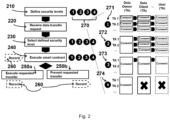
- the computer-implemented method comprises the steps of defining 210 two or more sets of conditions 270 for executing a data transfer as sequence of user-consent steps in the form of respective smart contracts, receiving a data-transfer request 220, determining a required security for the data-transfer request, selecting 230 one of the defined sets of conditions according to the determination, requesting user consent according to the sequence defined by the smart contract respective to the selected set of conditions 240, and executing 250a requested data transfer after all requested user consent is approved. If the set of conditions, in whole or partially, is not fulfilled, e.g. if one consent request is not approved, the method prevents 250b the requested data-transfer instead of executing it.
- the definition 210 of a multitude of sets of conditions as smart contracts strictly limits the content and form of a generic smart contract.
- the defined conditions directly relate to a defined sequence of consent process steps to be performed for the smart contract to be considered successfully executed.
- the consent process is performed by triggering, based on the smart contract, consent requests to be transferred to respective users, and to transfer, after consent, the consent approval from the user back for validation to the smart contract.
- a smart contract defined in this way differentiates, in terms of the set of conditions, the approver of a consent and the object being consented to, e.g. different data assets making up a requested data transfer. Granularity both in user and object of consent are flexible and are the distinguishing factor between the at least two defined sets of conditions.
- the feature of providing multiple sets of conditions defined in this way directly contributes to providing a flexible method adaptable to security and efficiency requirements.
- the security required for the requested data-transfer can be quantified in terms of an arbitrary but comparable measure for the granularity in user interaction and degree of detail in data control. While the providing of two or more defined sets of conditions allows for options in selecting a smart contract to meet required security, the selection process preferably additionally includes the determination of one of the defined smart contracts best fitting the requirement, as measured by mathematical distance of quantifiable security levels.
- the determination of a security required for the requested data-transfer is based on the data-transfer request and/or based on the data to be transferred. While generally, the security required can be just manually selected 230, i.e. by additional user interaction via data transfers to/from a user, without any additional information required to be comprised in the data-transfer request 220, in a preferred aspect of the invention, data pertaining to a required security level is comprised, directly or indirectly, in the received 220 data-transfer request. This data can include a direct relation to a security level previously defined as set of conditions 210. This data can also only include a level of granularity from which an appropriate security level as defined 210 can be matched in an additional step 230.
- the determination of required security level can be dependent on the data to be transferred when the requested transfer is executed 250a.
- the request 220 comprises information about the data requested, i.e. meta data, from which directly or indirectly, a required security level can be determined. This can be the sensitivity of underlying data, their (monetary) value, benchmarking to other (meta) data, and other factors. This can also be/contain information about encryption and/or de-identification of the underlying data. A link to the requested data, from which, e.g. at the storing database, further information about corresponding data pertaining to a security level required, is a viable implementation as well.
- the method further comprises the step of recording 260 approval of user consent after requesting user consent, i.e. during execution of the smart contract 240, and before execution 250a/b of data transfers and/or further comprising the step of recording the execution of data transfer after execution 250a/b of the data transfer.
- every complete execution of such will be stored on the underlying ledger system. It is preferred for reasons of traceability and auditing to optionally include recordings 260 of single consent - request/approvals and/or the result of the execution 250a/b.
- Recording 260 of single consents or a series of consent making up the whole smart contract is additionally beneficial for cases, in which a smart contract was executed 240 with a fraction of the requested consent requests not approved, i.e. yielding a prevention of the requested data transfer 250b.
- a repetition of the same contract could then make use of such recorded 260 partially approved smart contracts to only request additional consent according to what was left to be approved after the first execution. Erroneously non-approved smart contracts can then be repeated/corrected in a very efficient way saving interactions with the ledger and therefore system resources.
- the method step of selecting 230 of a defined set of conditions is performed by balancing data-transfer security and total complexity of the transactions comprised in the requested data transfer.
- the balancing relates to a comparison of security levels determined as required and the security levels attributable to the multiple defined 210 sets of conditions 270 created as smart contracts.
- the balancing identifies the one of the multiple defined sets of conditions, which can be attributed the lowest security level above the security defined as required.
- the multiple defined 210 and subsequently selected 230 security levels 210 are implemented in a way that allows for scaling a reduction in required security of the data transfer to a reduction in process demand on the ledger 130 component.
- security levels 270 as realizable by smart contracts 131 are considered preferred embodiments of the invention. They can be employed in combination to synergetic effect on the efficiency, flexibility and security of the total system.
- One specifically defined security level 271 selectable from a multitude of defined security levels 270 according to the method of the invention reflects a multi-consent single-asset transaction, wherein all single sub-data units making up the total data transfer are required to be consented to by multiple users party to the transfer.
- This is implemented by the method by specifying one sequence 271 of user-consent steps to comprise the request for respective independent consent of two or more users for each single data transaction comprised in the requested data transfer. Only when all user consent requests, i.e. independently from each user to each asset transaction, are approved, the smart contract defined in this way is executed 250a and the transfer is prompted to be executed. In case one single consent request of one single user is not approved, the requested transfer is not executed, i.e. prevented 250b.
- This security level is considered the most secure one giving the parties' total control over what data to which level of granularity is exchanged. As every consent required by the smart contract 131 requires an interaction with the ledger 130, the sequence of system processes implied by this security level is also considered to put the highest technical demand on the ledger component 130.
- One further specifically defined security level 272 selectable from a multitude of defined security levels 270 according to the method of the invention reflects a single-consent single-asset transaction, wherein all single sub-data units making up the total data transfer are required to be consented to by one user party to the transfer while another user party to the transfer is only required to consent once to the transfer of all their data, independent on granularity.
- This is implemented by the method by specifying one sequence 272 of user-consent steps to comprise the request for respective independent consent of one user for each single data transaction comprised in the requested data transfer and one single consent of one or more other user/users to all transactions comprised in the requested data transfer.
- This security level 272 is considered less secure than one reflecting multi-consent single-asset transactions 271, as for one user the control of consenting to data transfers is limited to one interaction only.
- the limitation of interactions is beneficial to the reduction on system demand.
- the implementation of such a security level 272 as described adds flexibility and efficiency to the process.
- One further specifically defined security level 273 selectable from a multitude of defined security levels 270 according to the method of the invention reflects a single-consent multi-asset transaction, wherein all single sub-data units making up the total data transfer are required to be consented to only once by all users party to the transfer. This is implemented by the method by specifying one sequence 273 of user-consent steps to comprise the request for one single respective consent of two or more users to all transactions comprised in the requested data transfer.
- This security level 273 is considered less secure than the security levels 271, 272 previously described, as for all users the control of consenting to data transfers is limited to one interaction only. The limitation of interactions is beneficial to the reduction on system demand.
- One further specifically defined security level 274 selectable from a multitude of defined security levels 270 according to the method of the invention reflects a bulk transaction, wherein all single sub-data units making up the total data transfer are required to be consented to only once by only one user party to the transfer. This is implemented by the method by specifying one sequence 274 of user-consent steps to comprise the request for one single consent of one single user to all transactions comprised in the requested data transfer.
- This security level is considered to provide the least security of the levels discussed 271, 272, 273, as only one user is enabled to influence, via consent to the data transfer, the control over the data.
- a particular use case is found in a scenario where availability of data in a database is considered transfer consent of the data-providing user.
- the data-transfer regulation process can be limited to the least interaction with the system, i.e. one single consent approval of one other user within the smart contract execution 240.
- Any combination of defined security levels 271, 272, 273, 274 can be comprised in the multitude defined 270.
- the consent approval is a passive process.
- a passive consent approval is implemented by verifying only the existence of one historical active consent by the respective user. Every consent request approval subsequent to the first one is then considered to be approved if the one historic consent is not actively withdrawn by the user at the time of the data transfer request and/or execution.
- This implementation allows for reduced redundancy, translating to technical efficiency, in sequential data transfers including at least one of the same users.
- the methods and systems of the invention are of special interest in management of medical-data transfers.
- Medical data has inherent value to its provider and user, since non-negligeable effort, measurements, studies, etc., are required to obtain such data. Additionally, medical data is widely considered of special sensitivity, which imposes a certain requirement on security when such data is dealt with. Since the medical system is usually subject to interactions of many parties (patients, practitioners, data analysts, insurers, etc.) of various interest and access to the medical data, it is particularly demanding on a data-transfer system and methods. Finally, handling of medical data is subject to regulatory constraints, which are implemented differently on regional/national levels and subject to changes over time.
- the provided system and method provide a solution for the above stated aspects in medical-data management by disclosing a flexible, secure and efficient approach, which is enabled for scalability with the user requirements.
Landscapes
- Engineering & Computer Science (AREA)
- Computer Security & Cryptography (AREA)
- Computer Networks & Wireless Communication (AREA)
- Signal Processing (AREA)
- Theoretical Computer Science (AREA)
- Computer Hardware Design (AREA)
- General Engineering & Computer Science (AREA)
- Bioethics (AREA)
- Health & Medical Sciences (AREA)
- General Health & Medical Sciences (AREA)
- Software Systems (AREA)
- Physics & Mathematics (AREA)
- General Physics & Mathematics (AREA)
- Computing Systems (AREA)
- Medical Informatics (AREA)
- Databases & Information Systems (AREA)
- Information Retrieval, Db Structures And Fs Structures Therefor (AREA)
Abstract
A computer-implemented method of securing data transfers is provided. The method comprises the steps of defining two or more sets of conditions for executing a data transfer as sequence of user-consent steps in the form of respective smart contracts, receiving a data-transfer request, determining a required security for the data-transfer request, selecting one of the defined sets of conditions according to the determination, requesting user consent according to the sequence defined by the smart contract respective to the selected set of conditions, executing requested data transfer after all requested user consent is approved. Furthermore, a system for securing data transfers is provided.
Description
- The invention relates to computer-implemented methods and systems for securing data transfers.
- Securing data and their transfers against unintended access is a major objective of modern data management. The explosive rise in data quantity, their value in terms of generation cost and potential impact, and accelerating regulatory and technical demand on their security motivates a recent interest in a systematic yet flexible, future-proof approach to data management. Particularly, management of sensitive data, such as medical data, that underly additional regulatory demands, e. g. General Data protection (GDPR), Health Insurance Portability and Accountability Act (HIPAA), etc., pose a challenge to technical solutions: how to balance technical demand and additional demand imposed by evolving regulatory standards while assuring the security integrity of inherently valuable data content.
- One technical approach is found in the blockchain technology, employing distributed ledgers, that inherently brings about the attributes of decentralization, immutability and tamper-proof verification to an incorporating data-management system - attributes that contribute to addressing the challenge posed above.
- While early generations of blockchain solutions, e. g. around the Bitcoin use cases, specifically when employing proof-of-work consensus algorithms, were considered too technically demanding and too rigid for application in blockchain-assisted data-management, modern solutions, specifically the ones based on proof-of-stake consensus algorithms, provide the required flexibility for practical use.
- Latest approaches to data management incorporating distributed ledgers have recognized that, for security and efficiency reasons, sensitive data is best not to be stored on the ledgers but instead they make use of smart contracts, i.e., blockchain-implemented algorithms, to regulate off-chain data transactions. This combines the benefits of the blockchain technology with conventional data-management means while both reducing the demand on the still resource-intensive processing within a blockchain environment and the potential exposure of the sensitive data in a distributed system.
- Several applications of blockchain-regulated, as opposed to widely used exclusively blockchain-implemented, data-management systems are known in the prior art. Particularly with application to sensitive medical data, US patent application
US2018082023 AA - The definitions of technical terms in the field of blockchain technology described in the referenced disclosure are considered examples of the known prior art and they are considered incorporated into this application by reference.
- While smart contracts are flexibly used in the prior art to implement regulations for a variety of off-chain data transfers, even the most modern blockchain solutions are faced with the inherent technical demand on the blockchain system; i.e., that every transaction subject to smart-contract regulation requires dedicated resources, such as processing time, energy, etc., inherent to the consensus algorithm of the blockchain. For practical application in large-scale data transfers potentially incorporating countless transactions, a reduceable and scalable demand on the system, balanced against an increasable security standard, is considered an unmet need for which exhaustive solutions are not yet anticipated in the prior art.
- The invention addresses the existing problems by the features of the
independent claims 1 and 10. The features of the dependent claims address preferred embodiments of the invention. - The invention discloses a computer-implemented method of securing data transfers comprising the steps of defining two or more sets of conditions for executing a data transfer as sequence of user-consent steps in the form of respective smart contracts, receiving a data-transfer request, determining a required security for the data-transfer request, selecting one of the defined sets of conditions according to the determination, requesting user consent according to the sequence defined by the smart contract respective to the selected set of conditions, executing requested data transfer after all requested user consent is approved.
- The invention further discloses a system for securing data transfers comprising interfaces to one or more user systems, one or more interfaces to a database and one or more interfaces to a distributed-ledger system, wherein the system is configured to create, based on input from the user interfaces, two or more sets of conditions for executing a data transfer from/to the database as sequence of user-consent steps in the form of respective smart contracts to be stored on the distributed ledger component, and wherein the system is further configured to determine a required security for the requested data transfer.
- The stated problem is addressed by the features of the claimed invention in the following ways:
More than one regulation for data transfers is generated to be stored on a distributed ledger. In this way the flexibility of the system can be technically implemented in a wide variety suiting the particular kinds of data transfers to be executed. - Additionally, a determination of a required security level for a requested data-transfer request is performed. This allows, after the subsequential selection based on the determination, to regulate, using smart contracts, the data transfer primarily based on implementing a certain security level; e.g., as inferred from the request and/or the underlying data.
- The implementation of the smart contracts as sequence of user consent requests and approvals makes sure that potentially all parties participating in the data transfer can, by inevitable regulation, influence the execution of all transactions incorporated in the data transfer. Only when all required consent requests are approved, the requested data transfer is executed.
- The stated problem is specifically tackled by not overshooting in security regulation (i.e. translating into required system resources) but still meeting the required approvals on all granular levels of users and data involved.
- The disclosed system contributes to the problem solution by providing a middle layer between the components of a blockchain-regulated data-management system. In this middle layer, the disclosed method of securing data transfers can be implemented while ensuring no direct contact between the components of the broader system with regards to data-transfer regulations. This serves as an essential filtering component for requests entering the system to prevent external influence on data-transfers. This also serves as an independent buffer component that prevents any data leaks that would be possible in a direct component-to-component contact.
- In the following, preferred embodiments of the present invention will be explained with reference to the accompanying figures:
-
Fig. 1 : a schematic depicting the components of the system according to the present invention -
Fig. 2 : flowchart depicting process steps of the methods according to the present invention - Specific embodiments of the present disclosure will be described below.
- It will be obvious to those skilled in the art that such embodiments are merely provided by example, and that various variations, changes, and substitutions may occur to those skilled in the art without departing from the invention. Several alternatives of the described embodiments of the invention may be employed when implementing the invention.
- A schematic of the general architecture of a blockchain-regulated data-
management system 100 is depicted inFig. 1 . Included is also thesystem 110 of this invention implemented as a middle layer connecting the other system components. - Essential system components are a
distributed ledger subsystem 130, on whichsmart contracts 131 are executed to regulate data transfers between other system components; one or more localized ordistributed database 120, which serves as storage for data to be transferred as regulated by thesmart contracts 131; anduser subsystems system 100 is solely used as a one-party storage system. Applicability to a data-transfer system makes two or more such user subsystems reasonable while the amount of different user subsystems can be arbitrarily expanded to enable multi-party data transfers. - According to the invention, a
subsystem 110, the middle layer, is provided to connectdatabase 120,user subsystems ledger components 130. Themiddle layer 110 comprisesinterfaces system 100user components interface 112 to thedatabase 120 and aninterface 113 to thedistributed ledger 130. - The
middle layer 110 is implemented as a computer-implemented system with capability to use the implementing computer's resources for processing data according to themiddle layer 110 configuration. Such a configuration comprises the control of data in-/output betweenmiddle layer 110 andsystem components respective interfaces - The
middle layer 110 is further configured to create, based on input from theuser interfaces database 120 as sequence of user-consent steps in the form of respectivesmart contracts 131 to be stored on thedistributed ledger component 130. Such a set of conditions can be implemented by a set of unique identifiers assignable to different users (e.g. IP addresses) and/or a set of unique identifiers assignable to data packages (e.g. their location on aspecific database 120, meta data, etc.). Additionally, the set of conditions can comprise a particular sequence for the conditions to be met or, opposing this, a parallel sequence-independent fulfillment of the conditions can be implemented. Essential to the underlying invention, themiddle layer 110 is configured for generation of two or more different sets of such conditions translating to multiplesmart contracts 131. The availability of a multitude ofsmart contracts 131 provided in this way allows for adapting the system with regards to its data-transfers by selection of the better suitedsmart contract 131 defined. - The
middle layer 110 is further configured to determine a required security for the requested data transfer. This determination is performed by processing the requests received viauser interfaces database 120 holds further information about the requested data pertaining to a security requirement, which is supplied to themiddle layer 110 viainterface 112 for the determination. In a preferred embodiment, the determination is aimed at employing the minimum, maximum, or average of different quantifiable security requirements bydifferent user subsystems database 120. - In a preferred embodiment, the
middle layer 110 is further configured for creating thesmart contracts 131 by balancing the determined required data-transfer security and total complexity of the transactions comprised in the data transfer. For this, a requested data transfer is understood as a multitude of transactions to performed, wherein a transaction potentially requires approval with regards to thesmart contract 131, and wherein one transaction in the case of highest granularity concerns two specific users and one specific set of data. Since every transaction to be regulated by thesmart contract 131 implemented in the distributed-ledger 130 adds to the total demand on theledger 130 system, a trade-off between maximum number of possible transactions, which equals to the highest security, and the minimum amount of required transactions, which equals tohighest system 130 efficiency, is to be considered and this is technically implemented in this embodiment. The balancing relates to a comparison of security levels determined as required by themiddle layer 110 and the security levels attributable to the multiple defined sets of conditions created by themiddle layer 110 assmart contracts 131 on the distributedledger 130. In a most straight forward implementation, the balancing identifies the one of the multiple defined sets of conditions, which can be attributed the lowest security level above the security defined as required. - In a preferred embodiment, the
middle layer 110 is further configured to prompt execution of data transfers from/to thedatabase 120 after receiving a prompt from theinterface 113 to the distributed-ledger system 130. Preferably, such a prompt from theledger 130 is the result of successful execution of a set of conditions implemented assmart contract 131. Routing the data-transfer prompt viainterfaces 113 over themiddle layer 110 and viainterface 112 to thedatabase 120, as opposed to a direct connection betweenledger 130 anddatabase 120, brings about multiple advantageous effects in line with the invention. Firstly, the middle layer serves as a filter component that prevents prompts to cause data transfers that are not intended by the users of the system. Given that theledger 130 is a potentially open system, this reduces the risk of unauthorized data access. Additionally, only one interface betweenledger 130 and data storage components needs to be provided in case of a distributeddata base 120. This reduces the demand on theledger system 130 as the prompt for data-transfer resulting from any successfully executedsmart contract 131 becomes invariant of the data location. Furthermore, any definitions of users and processing required for execution of data transfers can be implemented within themiddle layer 110 reducing the requirement on thedatabase 120. Following the data-transfer prompt received by thedatabase 120 the requested data preferably is handled in a way similar to the data-transfer prompts; i.e., viainterface 112 over themiddle layer 110 to the receivinguser user interfaces middle layer 110 independent of theuser systems - In one aspect of the invention, the
middle layer 110 is further configured to transmit consent-request data to one or more user/users respective interfaces ledger system 130 and to transmit consent-approval data from the one ormore users respective interfaces ledger system 130. Since thesmart contract 131 is implemented as a set of conditions related to consent, e.g. of users participating in a data transfer, and as potentially several different parties are involved in different transactions comprised in the requested data transfer, it is favorable to employ themiddle layer 110 as central subsystem for collection and redirection of related consent requests and approvals. The specifics of the consent required for successful execution of asmart contract 131 may comprise one or more users, a potential sequence of required user interactions, specific data with regards to which consent is required, etc. Implementing the request/approval process within the processing performed by themiddle layer 110 reduces the technical demand on theledger component 130 since it only has to verify the conditions defined by thesmart contract 131 without taking care of how consent is approved. Additionally, any changes to the specifics of theusers database 120 can be reflected by editing the configuration of themiddle layer 110 without requiring transactions on theledger 130. Similar as for avoiding the direct connection betweenledger 130 anddatabase 120, themiddle layer 110 contributes to the total system security by preventing direct connections betweenusers ledger 130. - In one aspect of the invention, the
middle layer 110 is implemented in a hardware environment configured for exclusive execution of thesystem 110 and the processes required for it. Such hardware-implemented layers are known in the prior art. In the specific case subject to the invention, a hardware component which is limited in its functions further reduces the risk for outside influence on thesystem 100 by excluding data connections and/or functionalities not intended by thesystem 100. Thus, the security can be further increased. - The
middle layer 110 is preferably further configured to execute the method according to the invention, which is further described in the following. - The computer-implemented method of this invention and preferred embodiments are schematically depicted in the flow chart of
FIG. 2 . - The computer-implemented method according to this invention comprises the steps of defining 210 two or more sets of
conditions 270 for executing a data transfer as sequence of user-consent steps in the form of respective smart contracts, receiving a data-transfer request 220, determining a required security for the data-transfer request, selecting 230 one of the defined sets of conditions according to the determination, requesting user consent according to the sequence defined by the smart contract respective to the selected set ofconditions 240, and executing 250a requested data transfer after all requested user consent is approved. If the set of conditions, in whole or partially, is not fulfilled, e.g. if one consent request is not approved, the method prevents 250b the requested data-transfer instead of executing it. Thedefinition 210 of a multitude of sets of conditions as smart contracts strictly limits the content and form of a generic smart contract. The defined conditions directly relate to a defined sequence of consent process steps to be performed for the smart contract to be considered successfully executed. In a generic case the consent process is performed by triggering, based on the smart contract, consent requests to be transferred to respective users, and to transfer, after consent, the consent approval from the user back for validation to the smart contract. A smart contract defined in this way differentiates, in terms of the set of conditions, the approver of a consent and the object being consented to, e.g. different data assets making up a requested data transfer. Granularity both in user and object of consent are flexible and are the distinguishing factor between the at least two defined sets of conditions. Since every consent process, in the general case, requires an interaction with the smart contract, it is of interest to reduce the granularity to a minimum (least consent processes required). This is contra-directive to the aim of maximizing the security of the requested data transfer. Therefore, the feature of providing multiple sets of conditions defined in this way directly contributes to providing a flexible method adaptable to security and efficiency requirements. In the general case, the security required for the requested data-transfer can be quantified in terms of an arbitrary but comparable measure for the granularity in user interaction and degree of detail in data control. While the providing of two or more defined sets of conditions allows for options in selecting a smart contract to meet required security, the selection process preferably additionally includes the determination of one of the defined smart contracts best fitting the requirement, as measured by mathematical distance of quantifiable security levels. - In a preferred embodiment, the determination of a security required for the requested data-transfer is based on the data-transfer request and/or based on the data to be transferred. While generally, the security required can be just manually selected 230, i.e. by additional user interaction via data transfers to/from a user, without any additional information required to be comprised in the data-
transfer request 220, in a preferred aspect of the invention, data pertaining to a required security level is comprised, directly or indirectly, in the received 220 data-transfer request. This data can include a direct relation to a security level previously defined as set ofconditions 210. This data can also only include a level of granularity from which an appropriate security level as defined 210 can be matched in anadditional step 230. Additionally or alternatively, the determination of required security level can be dependent on the data to be transferred when the requested transfer is executed 250a. For this, therequest 220 comprises information about the data requested, i.e. meta data, from which directly or indirectly, a required security level can be determined. This can be the sensitivity of underlying data, their (monetary) value, benchmarking to other (meta) data, and other factors. This can also be/contain information about encryption and/or de-identification of the underlying data. A link to the requested data, from which, e.g. at the storing database, further information about corresponding data pertaining to a security level required, is a viable implementation as well. - In a further preferred aspect of the invention, the method further comprises the step of recording 260 approval of user consent after requesting user consent, i.e. during execution of the
smart contract 240, and beforeexecution 250a/b of data transfers and/or further comprising the step of recording the execution of data transfer afterexecution 250a/b of the data transfer. As inherent to smart contracts, every complete execution of such will be stored on the underlying ledger system. It is preferred for reasons of traceability and auditing to optionally includerecordings 260 of single consent - request/approvals and/or the result of theexecution 250a/b. Recording 260 of single consents or a series of consent making up the whole smart contract is additionally beneficial for cases, in which a smart contract was executed 240 with a fraction of the requested consent requests not approved, i.e. yielding a prevention of the requesteddata transfer 250b. A repetition of the same contract could then make use of such recorded 260 partially approved smart contracts to only request additional consent according to what was left to be approved after the first execution. Erroneously non-approved smart contracts can then be repeated/corrected in a very efficient way saving interactions with the ledger and therefore system resources. - In an additional aspect of the invention, the method step of selecting 230 of a defined set of conditions is performed by balancing data-transfer security and total complexity of the transactions comprised in the requested data transfer. The balancing relates to a comparison of security levels determined as required and the security levels attributable to the multiple defined 210 sets of
conditions 270 created as smart contracts. In a most straight forward implementation, the balancing identifies the one of the multiple defined sets of conditions, which can be attributed the lowest security level above the security defined as required. - Preferably, the multiple defined 210 and subsequently selected 230
security levels 210 are implemented in a way that allows for scaling a reduction in required security of the data transfer to a reduction in process demand on theledger 130 component. For this, the following multitude ofsecurity levels 270 as realizable bysmart contracts 131 are considered preferred embodiments of the invention. They can be employed in combination to synergetic effect on the efficiency, flexibility and security of the total system. - One specifically defined
security level 271 selectable from a multitude of definedsecurity levels 270 according to the method of the invention reflects a multi-consent single-asset transaction, wherein all single sub-data units making up the total data transfer are required to be consented to by multiple users party to the transfer. This is implemented by the method by specifying onesequence 271 of user-consent steps to comprise the request for respective independent consent of two or more users for each single data transaction comprised in the requested data transfer. Only when all user consent requests, i.e. independently from each user to each asset transaction, are approved, the smart contract defined in this way is executed 250a and the transfer is prompted to be executed. In case one single consent request of one single user is not approved, the requested transfer is not executed, i.e. prevented 250b. This security level is considered the most secure one giving the parties' total control over what data to which level of granularity is exchanged. As every consent required by thesmart contract 131 requires an interaction with theledger 130, the sequence of system processes implied by this security level is also considered to put the highest technical demand on theledger component 130. - One further specifically defined
security level 272 selectable from a multitude of definedsecurity levels 270 according to the method of the invention reflects a single-consent single-asset transaction, wherein all single sub-data units making up the total data transfer are required to be consented to by one user party to the transfer while another user party to the transfer is only required to consent once to the transfer of all their data, independent on granularity. This is implemented by the method by specifying onesequence 272 of user-consent steps to comprise the request for respective independent consent of one user for each single data transaction comprised in the requested data transfer and one single consent of one or more other user/users to all transactions comprised in the requested data transfer. Thissecurity level 272 is considered less secure than one reflecting multi-consent single-asset transactions 271, as for one user the control of consenting to data transfers is limited to one interaction only. The limitation of interactions is beneficial to the reduction on system demand. Particularly, in data transfers in which one user contributes a vast fraction of transactions as part of the transfer, and one other party is selective about which of the transactions are to be performed on a case-by-case basis, the implementation of such asecurity level 272 as described adds flexibility and efficiency to the process. For the implementation ofsuch security level 272, it is further preferred if only partial data transfers according to the transactions consented to 240 are executed instep 250a. - One further specifically defined
security level 273 selectable from a multitude of definedsecurity levels 270 according to the method of the invention reflects a single-consent multi-asset transaction, wherein all single sub-data units making up the total data transfer are required to be consented to only once by all users party to the transfer. This is implemented by the method by specifying onesequence 273 of user-consent steps to comprise the request for one single respective consent of two or more users to all transactions comprised in the requested data transfer. Thissecurity level 273 is considered less secure than thesecurity levels security level 273 as described significantly adds to the efficiency to the process. - One further specifically defined
security level 274 selectable from a multitude of definedsecurity levels 270 according to the method of the invention reflects a bulk transaction, wherein all single sub-data units making up the total data transfer are required to be consented to only once by only one user party to the transfer. This is implemented by the method by specifying onesequence 274 of user-consent steps to comprise the request for one single consent of one single user to all transactions comprised in the requested data transfer. This security level is considered to provide the least security of the levels discussed 271, 272, 273, as only one user is enabled to influence, via consent to the data transfer, the control over the data. A particular use case is found in a scenario where availability of data in a database is considered transfer consent of the data-providing user. Therefore, the data-transfer regulation process can be limited to the least interaction with the system, i.e. one single consent approval of one other user within thesmart contract execution 240. Any combination of definedsecurity levels - In one preferred aspect of the invention the consent approval is a passive process. As opposed to active approval that requires the interaction of a user for validation, a passive consent approval is implemented by verifying only the existence of one historical active consent by the respective user. Every consent request approval subsequent to the first one is then considered to be approved if the one historic consent is not actively withdrawn by the user at the time of the data transfer request and/or execution. This implementation allows for reduced redundancy, translating to technical efficiency, in sequential data transfers including at least one of the same users.
- The methods and systems of the invention are of special interest in management of medical-data transfers. Medical data has inherent value to its provider and user, since non-negligeable effort, measurements, studies, etc., are required to obtain such data. Additionally, medical data is widely considered of special sensitivity, which imposes a certain requirement on security when such data is dealt with. Since the medical system is usually subject to interactions of many parties (patients, practitioners, data analysts, insurers, etc.) of various interest and access to the medical data, it is particularly demanding on a data-transfer system and methods. Finally, handling of medical data is subject to regulatory constraints, which are implemented differently on regional/national levels and subject to changes over time.
- The provided system and method provide a solution for the above stated aspects in medical-data management by disclosing a flexible, secure and efficient approach, which is enabled for scalability with the user requirements.
Claims (15)
- Computer-implemented method of securing data transfers comprising the steps:Define two or more sets of conditions for executing a data transfer as sequence of user-consent steps in the form of respective smart contracts,Receive a data-transfer request,Determine a required security for the data-transfer request,Select one of the defined sets of conditions according to the determination,Request user consent according to the sequence defined by the smart contract respective to the selected set of conditions,Execute requested data transfer after all requested user consent is approved.
- Method of claim 1, wherein the determination of a security required for the requested data-transfer is based on the data-transfer request and/or based on the data to be transferred.
- Method of claims 1 or 2, further comprising the step of recording approval of user consent after requesting user consent and before execution of data transfers and/or further comprising the step of recording the execution of data transfer after execution of the data transfer.
- Method according to any of claims 1 to 3, wherein the selection of a defined set of conditions is performed by balancing data-transfer security and total complexity of the transactions comprised in the data transfer.
- Method of claim 4, wherein one sequence of user-consent steps comprises the request for respective independent consent of two or more users for each single data transaction comprised in the requested data transfer.
- Method according to any of claims 4 or 5, wherein one sequence of user-consent steps comprises the request for respective independent consent of one user for each single data transaction comprised in the requested data transfer and one single consent of one or more other user/users to all transactions comprised in the requested data transfer.
- Method according to any of claims 4 to 6, wherein one sequence of user-consent steps comprises the request for one single respective consent of two or more users to all transactions comprised in the requested data transfer.
- Method according to any of claims 4 to 7, wherein one sequence of user-consent steps comprises the request for one single consent of one single user to all transactions comprised in the requested data transfer.
- Method according to any of claims 5 to 8, wherein the consent is a passive consent.
- System 110 for securing data transfers comprising interfaces 114, 115 to one or more user systems 140, 150, one or more interfaces 112 to a database 120 and one or more interfaces 113 to a distributed-ledger system 130, wherein the system 100 is configured to create, based on input from the user interfaces 114, 115, 112, two or more sets of conditions for executing a data transfer from/to the database 120 as sequence of user-consent steps in the form of respective smart contracts 131 to be stored on the distributed ledger component 130, and wherein the system 110 is further configured to determine a required security for the requested data transfer.
- System 110 of claim 10, further configured for creating the smart contracts 131 by balancing the determined required data-transfer security and total complexity of the transactions comprised in the data transfer.
- System 110 according to any of claims 10 or 11, further configured to prompt execution of data transfers from/to the database 120 after receiving a prompt from the interface 113 to the distributed-ledger system 130.
- System 110 according to any of claims 10 to 12, further configured to transmit consent-request data to one or more user/users 140, 150 via respective interfaces 114, 115 from the distributed-ledger system 130 and to transmit consent-approval data from the one or more users 140, 150 via respective interface 113 to the distributed-ledger system 130.
- System 110 according to any of claims 10 to 13, further configured to execute the method of claims 1 to 9.
- Hardware environment configured for exclusive execution of the system 110 according to any of claim 10 to 14.
Priority Applications (3)
| Application Number | Priority Date | Filing Date | Title |
|---|---|---|---|
| EP23206441.0A EP4546191A1 (en) | 2023-10-27 | 2023-10-27 | System and method for data-transfer management |
| US18/909,696 US20250139261A1 (en) | 2023-10-27 | 2024-10-08 | System and method for data-transfer management |
| CN202411489868.2A CN119906721A (en) | 2023-10-27 | 2024-10-24 | System and method for data transmission management |
Applications Claiming Priority (1)
| Application Number | Priority Date | Filing Date | Title |
|---|---|---|---|
| EP23206441.0A EP4546191A1 (en) | 2023-10-27 | 2023-10-27 | System and method for data-transfer management |
Publications (1)
| Publication Number | Publication Date |
|---|---|
| EP4546191A1 true EP4546191A1 (en) | 2025-04-30 |
Family
ID=88598917
Family Applications (1)
| Application Number | Title | Priority Date | Filing Date |
|---|---|---|---|
| EP23206441.0A Pending EP4546191A1 (en) | 2023-10-27 | 2023-10-27 | System and method for data-transfer management |
Country Status (3)
| Country | Link |
|---|---|
| US (1) | US20250139261A1 (en) |
| EP (1) | EP4546191A1 (en) |
| CN (1) | CN119906721A (en) |
Citations (4)
| Publication number | Priority date | Publication date | Assignee | Title |
|---|---|---|---|---|
| US20180082023A1 (en) | 2016-09-16 | 2018-03-22 | International Business Machines Corporation | Secure Distributed Patient Consent and Information Management |
| US20190392162A1 (en) * | 2018-06-25 | 2019-12-26 | Merck Sharp & Dohme Corp. | Dynamic consent enforcement for internet of things |
| US20200364358A1 (en) * | 2019-05-17 | 2020-11-19 | International Business Machines Corporation | Cognitive system for managing consent to user data |
| US20210390196A1 (en) * | 2020-06-15 | 2021-12-16 | Concord Technologies Inc. | Decentralized consent network for decoupling the storage of personally identifiable user data from user profiling data |
Family Cites Families (21)
| Publication number | Priority date | Publication date | Assignee | Title |
|---|---|---|---|---|
| US10832299B1 (en) * | 2015-02-27 | 2020-11-10 | State Farm Mutual Automobile Insurance Company | Data bank for managing streams of personal data |
| US10154044B2 (en) * | 2016-04-15 | 2018-12-11 | International Business Machines Corporation | Method, system, and computer program product for providing security and responsiveness in cloud based data storage and application execution |
| US20190188411A1 (en) * | 2017-12-19 | 2019-06-20 | Vladislav Kroutik | Systems and Methods for Decentralizing Consumer Preferences, Consent and Permissions Management with Reward and Reputation Network for Enterprises Using a Blockchain Ledger |
| US10701054B2 (en) * | 2018-01-31 | 2020-06-30 | Salesforce.Com, Inc. | Systems, methods, and apparatuses for implementing super community and community sidechains with consent management for distributed ledger technologies in a cloud based computing environment |
| FR3079322B1 (en) * | 2018-03-26 | 2021-07-02 | Commissariat Energie Atomique | METHOD AND SYSTEM FOR MANAGING ACCESS TO PERSONAL DATA BY MEANS OF A SMART CONTRACT |
| CN110990407B (en) * | 2018-04-27 | 2020-11-10 | 腾讯科技(深圳)有限公司 | Blockchain-based data storage method, device, server and storage medium |
| US11244059B2 (en) * | 2018-05-17 | 2022-02-08 | International Business Machines Corporation | Blockchain for managing access to medical data |
| EP3850789B1 (en) * | 2018-09-12 | 2026-05-06 | LiveRamp, Inc. | Consent provenance and compliance tracking over a complex consumer data supply chain using blockchain distributed ledger |
| US11170108B2 (en) * | 2018-11-19 | 2021-11-09 | International Business Machines Corporation | Blockchain technique for immutable source control |
| US11899817B2 (en) * | 2019-01-31 | 2024-02-13 | Salesforce, Inc. | Systems, methods, and apparatuses for storing PII information via a metadata driven blockchain using distributed and decentralized storage for sensitive user information |
| DE102019202381A1 (en) * | 2019-02-21 | 2020-08-27 | Robert Bosch Gmbh | Procedure for transferring data |
| US11240003B2 (en) * | 2019-03-26 | 2022-02-01 | International Business Machines Corporation | Consent-based data management |
| US20210099313A1 (en) * | 2019-09-26 | 2021-04-01 | Here Global B.V. | Method, apparatus, and system for providing a consent management system on a crytographic ledger |
| JP7660787B2 (en) * | 2019-10-23 | 2025-04-14 | 賢太郎 新井 | Information processing method, information processing system, and information processing program |
| CA3186249A1 (en) * | 2020-07-20 | 2022-01-27 | Victoria LEMIEUX | Digital ledger based health data sharing and management |
| US11651096B2 (en) * | 2020-08-24 | 2023-05-16 | Burstiq, Inc. | Systems and methods for accessing digital assets in a blockchain using global consent contracts |
| US11928241B2 (en) * | 2021-08-31 | 2024-03-12 | Visa International Service Association | System, method, and computer program product for consent management |
| US20250131994A1 (en) * | 2021-09-14 | 2025-04-24 | University Of Pittsburgh - Of The Commonwealth System Of Higher Education | Non-fungible token system for ensuring ethical, efficient and effective management of biospecimens |
| JP2023092797A (en) * | 2021-12-22 | 2023-07-04 | ソニーグループ株式会社 | Information processing device, information processing method and information processing program |
| US12505248B2 (en) * | 2023-04-27 | 2025-12-23 | Dell Products L.P. | System and method for managing access control of data across a distributed system |
| US12339994B2 (en) * | 2023-04-27 | 2025-06-24 | Dell Products L.P. | System and method for managing access control of sensitive data |
-
2023
- 2023-10-27 EP EP23206441.0A patent/EP4546191A1/en active Pending
-
2024
- 2024-10-08 US US18/909,696 patent/US20250139261A1/en active Pending
- 2024-10-24 CN CN202411489868.2A patent/CN119906721A/en active Pending
Patent Citations (4)
| Publication number | Priority date | Publication date | Assignee | Title |
|---|---|---|---|---|
| US20180082023A1 (en) | 2016-09-16 | 2018-03-22 | International Business Machines Corporation | Secure Distributed Patient Consent and Information Management |
| US20190392162A1 (en) * | 2018-06-25 | 2019-12-26 | Merck Sharp & Dohme Corp. | Dynamic consent enforcement for internet of things |
| US20200364358A1 (en) * | 2019-05-17 | 2020-11-19 | International Business Machines Corporation | Cognitive system for managing consent to user data |
| US20210390196A1 (en) * | 2020-06-15 | 2021-12-16 | Concord Technologies Inc. | Decentralized consent network for decoupling the storage of personally identifiable user data from user profiling data |
Also Published As
| Publication number | Publication date |
|---|---|
| US20250139261A1 (en) | 2025-05-01 |
| CN119906721A (en) | 2025-04-29 |
Similar Documents
| Publication | Publication Date | Title |
|---|---|---|
| US8489415B1 (en) | Systems and methods for the coordination of benefits in healthcare claim transactions | |
| US8321243B1 (en) | Systems and methods for the intelligent coordination of benefits in healthcare transactions | |
| US12094009B2 (en) | Electronic pharmacy adjudication system and associated method and computer program product | |
| US10509779B2 (en) | Self-cleaning token vault | |
| US20180096360A1 (en) | Method and apparatus to enforce smart contract execution hierarchy on blockchain | |
| US20190243572A1 (en) | Blockchain architecture for optimizing system performance and data storage | |
| CN111598575B (en) | Business process control method, device, electronic device and readable storage medium | |
| US10410305B1 (en) | Exception-based integrated patient access workflow | |
| EP3905172B1 (en) | Blockchain-based invoice voiding method and apparatus, and electronic device | |
| US12165756B1 (en) | Alternative therapy identification system | |
| CN117422396A (en) | Business approval processing method, device, computer equipment and storage medium | |
| US7496573B2 (en) | Systems and methods for modeling processing procedures | |
| EP3912109A1 (en) | Data sharing architecture | |
| CN112306648B (en) | Transaction calling method, device, electronic equipment and storage medium | |
| US10546098B2 (en) | Claim reimbursement valuation and remittance validation | |
| US20250139261A1 (en) | System and method for data-transfer management | |
| US20230316407A1 (en) | System, method, and computer program for streamlining authorization for medical payment adjudication | |
| US20200374128A1 (en) | Distributed tiered data exchanges within a blockchain network | |
| US8700562B2 (en) | Systems and methods for online transactional data processing | |
| Geng | Design and Implementation of a Medical Insurance System Based on Blockchain Smart Contract Technology | |
| US20200234377A1 (en) | System for Processing Insurance Transactions | |
| US20150370976A1 (en) | Systems and Methods for Determining Coverage for Medication or Services Related to Specific Conditions or Levels of Care | |
| CN116521343A (en) | Resource interaction information processing method, device, computer equipment and storage medium | |
| US20140236614A1 (en) | Financial Triage | |
| CN115408712A (en) | View creation method and device and related product |
Legal Events
| Date | Code | Title | Description |
|---|---|---|---|
| PUAI | Public reference made under article 153(3) epc to a published international application that has entered the european phase |
Free format text: ORIGINAL CODE: 0009012 |
|
| STAA | Information on the status of an ep patent application or granted ep patent |
Free format text: STATUS: THE APPLICATION HAS BEEN PUBLISHED |
|
| AK | Designated contracting states |
Kind code of ref document: A1 Designated state(s): AL AT BE BG CH CY CZ DE DK EE ES FI FR GB GR HR HU IE IS IT LI LT LU LV MC ME MK MT NL NO PL PT RO RS SE SI SK SM TR |
|
| STAA | Information on the status of an ep patent application or granted ep patent |
Free format text: STATUS: REQUEST FOR EXAMINATION WAS MADE |
|
| 17P | Request for examination filed |
Effective date: 20251030 |
|
| RAP3 | Party data changed (applicant data changed or rights of an application transferred) |
Owner name: FRESENIUS MEDICAL CARE DEUTSCHLAND GMBH |