EP4546158A1 - Information processing device, information processing method, and information processing program - Google Patents
Information processing device, information processing method, and information processing program Download PDFInfo
- Publication number
- EP4546158A1 EP4546158A1 EP22951930.1A EP22951930A EP4546158A1 EP 4546158 A1 EP4546158 A1 EP 4546158A1 EP 22951930 A EP22951930 A EP 22951930A EP 4546158 A1 EP4546158 A1 EP 4546158A1
- Authority
- EP
- European Patent Office
- Prior art keywords
- character string
- unit
- information processing
- skill
- meaning
- Prior art date
- Legal status (The legal status is an assumption and is not a legal conclusion. Google has not performed a legal analysis and makes no representation as to the accuracy of the status listed.)
- Pending
Links
Images




Classifications
-
- G—PHYSICS
- G06—COMPUTING OR CALCULATING; COUNTING
- G06F—ELECTRIC DIGITAL DATA PROCESSING
- G06F16/00—Information retrieval; Database structures therefor; File system structures therefor
- G06F16/90—Details of database functions independent of the retrieved data types
- G06F16/903—Querying
- G06F16/9032—Query formulation
- G06F16/90332—Natural language query formulation or dialogue systems
-
- G—PHYSICS
- G06—COMPUTING OR CALCULATING; COUNTING
- G06F—ELECTRIC DIGITAL DATA PROCESSING
- G06F40/00—Handling natural language data
- G06F40/20—Natural language analysis
- G06F40/205—Parsing
- G06F40/216—Parsing using statistical methods
-
- G—PHYSICS
- G06—COMPUTING OR CALCULATING; COUNTING
- G06F—ELECTRIC DIGITAL DATA PROCESSING
- G06F40/00—Handling natural language data
- G06F40/30—Semantic analysis
-
- G—PHYSICS
- G06—COMPUTING OR CALCULATING; COUNTING
- G06F—ELECTRIC DIGITAL DATA PROCESSING
- G06F40/00—Handling natural language data
- G06F40/30—Semantic analysis
- G06F40/35—Discourse or dialogue representation
Definitions
- the present invention relates to an information processing device, an information processing method, and an information processing program.
- the conventional technology has a challenge in which automatic selection of skills is not available.
- the person using the skill needs to remember the correspondence between the skill calling and the content to be executed before calling the skill.
- the present invention has been made to address the problems above, and an object thereof is to provide an information processing device, an information processing method, and an information processing program capable of enabling automatic skill selection.
- an information processing device of the present invention includes: an acquisition unit configured to acquire a first character string input by a user and a second character string indicating a skill; a vector conversion unit configured to convert the first character string and the second character string acquired by the acquisition unit into vectors; a measurement unit configured to measure a distance between a meaning of a first character string and a meaning of a second character string, wherein the first and second character strings are converted into vectors by the vector conversion unit; a selection unit configured to select a skill based on the distance measured by the measurement unit; and an execution unit configured to execute the skill selected by the selection unit.
- the information processing device vectorizes meanings of an input character string and a character string indicating a skill and measures a distance between the vectors, thereby selecting a skill on the basis of the distance.
- an information processing device 100 includes a communication unit 110, a control unit 120, and a storage unit 130. Note that a plurality of devices may hold these units in a distributed manner. Hereinafter, processing of each of these units will be described.
- the communication unit 110 is implemented by, for example, a network interface card (NIC) and enables communication between the control unit 120 and an external device via an electrical communication line such as a local area network (LAN) or the Internet.
- NIC network interface card
- LAN local area network
- the communication unit 110 enables communication between an external device and the control unit 120.
- the storage unit 130 is implemented by a semiconductor memory element such as a random access memory (RAM) or a flash memory, or a storage device such as a hard disk or an optical disc.
- Information stored in the storage unit 130 includes, for example, data regarding a machine learning algorithm, a learning model, test data, a trained model, and other information required to select skills. Note that the information stored in the storage unit 130 is not limited to the information described above.
- the control unit 120 is implemented by, for example, a central processing unit (CPU), a network processor (NP), or a field programmable gate array (FPGA), and executes a processing program stored in a memory. As illustrated in Fig. 1 , the control unit 120 includes an acquisition unit 121, a vector conversion unit 122, a measurement unit 123, a selection unit 124, and an execution unit 125. Hereinafter, each unit included in the control unit 120 will be described.
- CPU central processing unit
- NP network processor
- FPGA field programmable gate array
- the acquisition unit 121 acquires a first character string input by a user and a second character string indicating a skill. For example, the acquisition unit 121 acquires a set of character strings such as "Let's work! as the first character string and a set of character strings indicating skills as the second character string (such as meeting list, meeting reservation, end of shift, contact information, start of shift, attendance, procurement, basic conversation and others).
- a set of character strings such as "Let's work!” as the first character string and a set of character strings indicating skills as the second character string (such as meeting list, meeting reservation, end of shift, contact information, start of shift, attendance, procurement, basic conversation and others).
- the vector conversion unit 122 converts the first character string and the second character string acquired by the acquisition unit 121 into vectors. For example, the vector conversion unit 122 inputs the first character string and the second character string acquired by the acquisition unit 121 to Sentence Bert trained for the entire language as in Equations (1) and (2), and converts the first character string and the second character string into vectors.
- h ⁇ q SentenceBert x ⁇ q
- h ⁇ s SentenceBert x ⁇ s
- the selection unit 124 selects a skill based on the distance measured by the measurement unit 123. For example, the selection unit 124 selects a skill "Start of Shift" based on the distance measured by the measurement unit 123. That is, the selection unit 124 measures a distance between the input character string and a set of character strings indicating the skill prepared in advance, and selects the closest skill. Furthermore, for example, in a case where the distance measured by the measurement unit 123 is larger than a predetermined value, the selection unit 124 selects a basic conversation.
- the execution unit 125 executes the skill selected by the selection unit 124. For example, the execution unit 125 executes the skill "start of shift" selected by the selection unit 124.
- the information processing device 100 acquires a character string input by the user.
- the information processing device 100 then vectorizes the input character string and the character strings indicating skills, measures the distance, and selects a skill having the closest distance, thereby enabling automatic skill selection.
- the information processing device 100 selects a basic conversation if the distance between the vectorized character strings is larger than a predetermined threshold.
- the acquisition unit 121 acquires a first character string input by the user and a second character string indicating a skill.
- the vector conversion unit 122 then inputs the first character string (input sentence) and the second character string (skill list) acquired by the acquisition unit 121 to Sentence Bert trained for the entire language, and converts them into vectors.
- the measurement unit 123 measures a distance between a vector representing the meaning of the character string and a vector representing the meaning of a skill by measuring a distance between vectors as a cosine distance. Subsequently, the selection unit 124 selects a skill based on the distance measured by the measurement unit 123. At this time, in a case where the distance measured by the measurement unit 123 is larger than a predetermined value, the selection unit 124 selects a basic conversation.
- the acquisition unit 121 acquires, for example, an input in slack by using api of a slack formula called bolt api.
- the vector conversion unit 122 passes the acquired input to Sentence Bert.
- the information processing device 100 also performs processing on the skill list in a similar manner.
- the selection unit 124 selects a skill using the method described above.
- the execution unit 125 executes the selected skill, and the execution result is returned to slack. For example, the information processing device 100 acquires a character string "Let's work! input in slack and selects a skill "Start of Shift", thereby enabling punching into the internal system.
- Evaluation experimental conditions are as follows.
- Finetuning was performed using three types of loss among Cos loss, Triplet loss, and Multiple negative ranking loss (MNR loss) with respect to the Pretrain model. Note that the evaluation was performed with a cosine distance, and the best threshold was adopted.
- MNR loss Multiple negative ranking loss
- Fig. 4 The accuracy of skill selection in test data is shown in Fig. 4 . As illustrated in Fig. 4 , it is confirmed that the method described above is sufficiently effective.
- Steps S11 to S15 below can be executed in different orders. A part of steps may be omitted among steps S11 to S15 below.
- the acquisition unit 121 acquires a first character string input by the user and a second character string indicating a skill (step S11). For example, the acquisition unit 121 acquires a set of character strings such as "Let's work! as the first character string and a set of character strings indicating skills as the second character string (such as meeting list, meeting reservation, end of shift, contact information, start of shift, attendance, procurement, basic conversation and others).
- a set of character strings such as "Let's work!” as the first character string and a set of character strings indicating skills as the second character string (such as meeting list, meeting reservation, end of shift, contact information, start of shift, attendance, procurement, basic conversation and others).
- the vector conversion unit 122 converts the character string and skill acquired by the acquisition unit 121 into vectors (step S12). For example, the vector conversion unit 122 inputs the first character string and the second character string acquired by the acquisition unit 121 to Sentence Bert trained for the entire language, and converts the first character string and the second character string into vectors.
- the measurement unit 123 measures a distance between the vectors converted by the vector conversion unit 122 (step S13). For example, the measurement unit 123 measures a distance between a vector representing the meaning of the character string and a vector representing the meaning of a skill by measuring a distance between vectors as a cosine distance.
- the selection unit 225 selects a skill based on the distance measured by the measurement unit 224 (step S14). For example, the selection unit 124 selects a skill "Start of Shift" based on the distance measured by the measurement unit 123.
- the information processing device 100 includes an acquisition unit 121, a vector conversion unit 122, a measurement unit 123, a selection unit 124, and an execution unit 125.
- the acquisition unit 121 acquires a first character string input by a user and a second character string indicating a skill.
- the vector conversion unit 122 converts the first character string and the second character string acquired by the acquisition unit 121 into vectors.
- the measurement unit 123 measures a distance between a meaning of the first character string and a meaning of the second character string, which have been converted into vectors by the vector conversion unit 122.
- the selection unit 124 selects a skill based on the distance measured by the measurement unit 123.
- the execution unit 125 executes the skill selected by the selection unit 124.
- the measurement unit 123 measures a distance between a meaning of the first character string and a meaning of the second character string, which are converted into vectors, by means of a cosine distance. Accordingly, the information processing device 100 calculates the distance between the meaning of the character string and the meaning of the skill using the cosine distance, and selects the skill, thereby enabling automatic skill selection.
- each of the components of each of the devices illustrated in the drawings is functionally conceptual, and is not required to be physically designed as illustrated.
- a specific form of distribution and integration of each device is not limited to the illustrated aspect, and all or part thereof can be functionally or physically distributed and integrated in any unit according to various loads, usage conditions, and other factors.
- all or any part of the processing functions performed in each device can be implemented by a CPU and a program analyzed and executed by the CPU or can be implemented as hardware by wired logic.
- all or part of the processing described as being automatically performed can be manually performed, or all or part of the processing described as being manually performed can be automatically performed by a known method.
- the processing procedures, control procedures, specific names, and information including various types of data and parameters described above in the specification and drawings can be optionally modified unless otherwise mentioned.
- Fig. 6 is a diagram illustrating an example of the computer that executes the information processing program.
- a computer 1000 includes, for example, a memory 1010, a CPU 1020, a hard disk drive interface 1030, a disk drive interface 1040, a serial port interface 1050, a video adapter 1060, and a network interface 1070. These units are connected by a bus 1080.
- the memory 1010 includes a read only memory (ROM) 1011 and a RAM 1012.
- the ROM 1011 stores, for example, a boot program such as a basic input output system (BIOS).
- BIOS basic input output system
- the hard disk drive interface 1030 is connected to a hard disk drive 1090.
- the disk drive interface 1040 is connected to a disk drive 1100.
- a removable storage medium such as a magnetic disk or an optical disc is inserted into the disk drive 1100.
- the serial port interface 1050 is connected to a mouse 1110 and a keyboard 1120.
- a display 1130 is connected to the video adapter 1060.
- the hard disk drive 1090 stores, for example, an OS 1091, an application program 1092, a program module 1093, and program data 1094. Each table described in the above embodiment is stored in, for example, the hard disk drive 1090 or the memory 1010.
- the information processing program is stored in the hard disk drive 1090 as, for example, the program module including description of commands executable by the computer 1000.
- the program module 1093 in which each processing executed by the computer 1000 described in the embodiment above is described is stored in the hard disk drive 1090.
- Data used for information processing performed by the information processing program is stored in, for example, the hard disk drive 1090 as the program data. Then, the CPU 1020 reads the program module 1093 and the program data 1094 stored in the hard disk drive 1090 to the RAM 1012 as necessary and executes each procedure described above.
- the program module 1093 and the program data 1094 related to the information processing program are not limited to being stored in the hard disk drive 1090, and may be stored in, for example, a removable storage medium and read by the CPU 1020 via the disk drive 1100.
- the program module 1093 and the program data 1094 related to the control program may be stored in another computer connected via a network such as a local area network (LAN) or a wide area network (WAN) and may be read by the CPU 1020 via the network interface 1070.
- LAN local area network
- WAN wide area network
- the "unit (module, or wording with a suffix -er or -or)" described above can be read as, for example, a unit, means or circuit.
- a communication module, a control module, and a storage module may be interchangeable with a communication unit, a control unit, and a storage unit, respectively.
Landscapes
- Engineering & Computer Science (AREA)
- Theoretical Computer Science (AREA)
- Physics & Mathematics (AREA)
- Artificial Intelligence (AREA)
- Computational Linguistics (AREA)
- General Engineering & Computer Science (AREA)
- General Physics & Mathematics (AREA)
- Health & Medical Sciences (AREA)
- General Health & Medical Sciences (AREA)
- Audiology, Speech & Language Pathology (AREA)
- Mathematical Physics (AREA)
- Databases & Information Systems (AREA)
- Data Mining & Analysis (AREA)
- Probability & Statistics with Applications (AREA)
- Machine Translation (AREA)
Abstract
Description
- The present invention relates to an information processing device, an information processing method, and an information processing program.
- In recent years, the performance of natural language processing has greatly improved, leading to widespread use of chatbots in business.
-
- Non Patent Literature 1: Nils Reimers and Iryna Gurevych, Sentence-BERT: Sentence Embeddings using Siamese BERT-Networks
- Non Patent Literature 2: MATTHEW HENDERSON, et al., Efficient Natural Language Response Suggestion for Smart Reply
- However, the conventional technology has a challenge in which automatic selection of skills is not available. For example, the person using the skill needs to remember the correspondence between the skill calling and the content to be executed before calling the skill. Further, for example, it is difficult to explicitly distinguish between basic conversation and skill calling. Considering operations, it is burdensome to repeat learning every time a skill is added, and thus learning without a skill is required.
- The present invention has been made to address the problems above, and an object thereof is to provide an information processing device, an information processing method, and an information processing program capable of enabling automatic skill selection.
- To solve the problems above and achieve the objective, an information processing device of the present invention includes: an acquisition unit configured to acquire a first character string input by a user and a second character string indicating a skill; a vector conversion unit configured to convert the first character string and the second character string acquired by the acquisition unit into vectors; a measurement unit configured to measure a distance between a meaning of a first character string and a meaning of a second character string, wherein the first and second character strings are converted into vectors by the vector conversion unit; a selection unit configured to select a skill based on the distance measured by the measurement unit; and an execution unit configured to execute the skill selected by the selection unit.
- According to the present invention, it is possible to enable automatic skill selection.
-
-
Fig. 1 is a block diagram illustrating one example of a configuration of an information processing device. -
Fig. 2 is a diagram illustrating an overview of processing of the information processing device. -
Fig. 3 is a diagram illustrating an overview of processing of the information processing device. -
Fig. 4 is a diagram illustrating one example of processing results of the information processing device. -
Fig. 5 is a flowchart illustrating one example of a processing flow of the information processing device. -
Fig. 6 is a diagram illustrating one example of a computer that executes an information processing program. - Hereinafter, an embodiment of an information processing device, an information processing method, and an information processing program according to the present application will be described in detail with reference to the drawings. Note that the present invention is not limited to the embodiment. Furthermore, the same elements are denoted by the same reference signs in the description of the drawings, and the overlapping description will be omitted.
- The information processing device according to the present embodiment vectorizes meanings of an input character string and a character string indicating a skill and measures a distance between the vectors, thereby selecting a skill on the basis of the distance.
- A configuration of an information processing device will be described with reference to
Fig. 1 . As illustrated inFig. 1 , aninformation processing device 100 includes a communication unit 110, a control unit 120, and astorage unit 130. Note that a plurality of devices may hold these units in a distributed manner. Hereinafter, processing of each of these units will be described. - The communication unit 110 is implemented by, for example, a network interface card (NIC) and enables communication between the control unit 120 and an external device via an electrical communication line such as a local area network (LAN) or the Internet. For example, the communication unit 110 enables communication between an external device and the control unit 120.
- The
storage unit 130 is implemented by a semiconductor memory element such as a random access memory (RAM) or a flash memory, or a storage device such as a hard disk or an optical disc. Information stored in thestorage unit 130 includes, for example, data regarding a machine learning algorithm, a learning model, test data, a trained model, and other information required to select skills. Note that the information stored in thestorage unit 130 is not limited to the information described above. - The control unit 120 is implemented by, for example, a central processing unit (CPU), a network processor (NP), or a field programmable gate array (FPGA), and executes a processing program stored in a memory. As illustrated in
Fig. 1 , the control unit 120 includes anacquisition unit 121, avector conversion unit 122, ameasurement unit 123, aselection unit 124, and anexecution unit 125. Hereinafter, each unit included in the control unit 120 will be described. - The
acquisition unit 121 acquires a first character string input by a user and a second character string indicating a skill. For example, theacquisition unit 121 acquires a set of character strings such as "Let's work!" as the first character string and a set of character strings indicating skills as the second character string (such as meeting list, meeting reservation, end of shift, contact information, start of shift, attendance, procurement, basic conversation and others). - The
vector conversion unit 122 converts the first character string and the second character string acquired by theacquisition unit 121 into vectors. For example, thevector conversion unit 122 inputs the first character string and the second character string acquired by theacquisition unit 121 to Sentence Bert trained for the entire language as in Equations (1) and (2), and converts the first character string and the second character string into vectors.
[Math. 1]
[Math. 2]
- The
measurement unit 123 measures a distance between a meaning of the first character string and a meaning of the second character string, which have been converted into vectors by thevector conversion unit 122. For example, themeasurement unit 123 measures a distance between a vector representing the meaning of the character string and a vector representing the meaning of a skill by measuring a distance between vectors as a cosine distance as in Equation (3).
[Math. 3]
- The
selection unit 124 selects a skill based on the distance measured by themeasurement unit 123. For example, theselection unit 124 selects a skill "Start of Shift" based on the distance measured by themeasurement unit 123. That is, theselection unit 124 measures a distance between the input character string and a set of character strings indicating the skill prepared in advance, and selects the closest skill. Furthermore, for example, in a case where the distance measured by themeasurement unit 123 is larger than a predetermined value, theselection unit 124 selects a basic conversation. - The
execution unit 125 executes the skill selected by theselection unit 124. For example, theexecution unit 125 executes the skill "start of shift" selected by theselection unit 124. - Next, an overview of processing of the
information processing device 100 will be described with reference toFig. 2 . Theinformation processing device 100 acquires a character string input by the user. Theinformation processing device 100 then vectorizes the input character string and the character strings indicating skills, measures the distance, and selects a skill having the closest distance, thereby enabling automatic skill selection. At this time, theinformation processing device 100 selects a basic conversation if the distance between the vectorized character strings is larger than a predetermined threshold. - Next, overview of processing of the
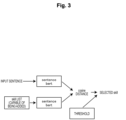
information processing device 100 will be described with reference toFig. 3 . Theacquisition unit 121 acquires a first character string input by the user and a second character string indicating a skill. Thevector conversion unit 122 then inputs the first character string (input sentence) and the second character string (skill list) acquired by theacquisition unit 121 to Sentence Bert trained for the entire language, and converts them into vectors. - The
measurement unit 123 measures a distance between a vector representing the meaning of the character string and a vector representing the meaning of a skill by measuring a distance between vectors as a cosine distance. Subsequently, theselection unit 124 selects a skill based on the distance measured by themeasurement unit 123. At this time, in a case where the distance measured by themeasurement unit 123 is larger than a predetermined value, theselection unit 124 selects a basic conversation. - Hereinafter, an information addition phase and an operation phase of the
information processing device 100 will be described. - In the information addition phase, the
information processing device 100 learns by Sentence Bert for the entire language. Theinformation processing device 100 then performs finetuning using the small number of input sentences and correct skills. Theinformation processing device 100 determines the threshold so as to have the highest accuracy, including basic conversations. - Next, the operation phase will be described. The
acquisition unit 121 acquires, for example, an input in slack by using api of a slack formula called bolt api. Thevector conversion unit 122 passes the acquired input to Sentence Bert. Theinformation processing device 100 also performs processing on the skill list in a similar manner. Theselection unit 124 selects a skill using the method described above. Theexecution unit 125 executes the selected skill, and the execution result is returned to slack. For example, theinformation processing device 100 acquires a character string "Let's work!" input in slack and selects a skill "Start of Shift", thereby enabling punching into the internal system. - An evaluation experiment of the
information processing device 100 will be described. Evaluation experimental conditions are as follows. - As the Pretrain model, Bert trained by Wikipedia was adopted. Accuracy (0 to 1) of skill selection was used as a display axis. Eight skills were chosen as a dataset, including meeting list, meeting reservation, end of shift, contact information, start of shift, attendance, procurement, and basic conversation. The data set is divided into 231 pieces of learning data and 78 pieces of test data.
- Finetuning was performed using three types of loss among Cos loss, Triplet loss, and Multiple negative ranking loss (MNR loss) with respect to the Pretrain model. Note that the evaluation was performed with a cosine distance, and the best threshold was adopted.
- The accuracy of skill selection in test data is shown in
Fig. 4 . As illustrated inFig. 4 , it is confirmed that the method described above is sufficiently effective. - A processing flow performed by the
information processing device 100 will be described usingFig. 5 . Steps S11 to S15 below can be executed in different orders. A part of steps may be omitted among steps S11 to S15 below. - The
acquisition unit 121 acquires a first character string input by the user and a second character string indicating a skill (step S11). For example, theacquisition unit 121 acquires a set of character strings such as "Let's work!" as the first character string and a set of character strings indicating skills as the second character string (such as meeting list, meeting reservation, end of shift, contact information, start of shift, attendance, procurement, basic conversation and others). - The
vector conversion unit 122 converts the character string and skill acquired by theacquisition unit 121 into vectors (step S12). For example, thevector conversion unit 122 inputs the first character string and the second character string acquired by theacquisition unit 121 to Sentence Bert trained for the entire language, and converts the first character string and the second character string into vectors. - The
measurement unit 123 measures a distance between the vectors converted by the vector conversion unit 122 (step S13). For example, themeasurement unit 123 measures a distance between a vector representing the meaning of the character string and a vector representing the meaning of a skill by measuring a distance between vectors as a cosine distance. - The selection unit 225 selects a skill based on the distance measured by the measurement unit 224 (step S14). For example, the
selection unit 124 selects a skill "Start of Shift" based on the distance measured by themeasurement unit 123. - The
execution unit 125 executes the skill selected by the selection unit 124 (step S15). For example, theexecution unit 125 executes the skill "start of shift" selected by theselection unit 124. - The
information processing device 100 according to the present embodiment includes anacquisition unit 121, avector conversion unit 122, ameasurement unit 123, aselection unit 124, and anexecution unit 125. Theacquisition unit 121 acquires a first character string input by a user and a second character string indicating a skill. Thevector conversion unit 122 converts the first character string and the second character string acquired by theacquisition unit 121 into vectors. Themeasurement unit 123 measures a distance between a meaning of the first character string and a meaning of the second character string, which have been converted into vectors by thevector conversion unit 122. Theselection unit 124 selects a skill based on the distance measured by themeasurement unit 123. Theexecution unit 125 executes the skill selected by theselection unit 124. - Accordingly, the
information processing device 100 measures the distance between the meaning of the character string input by the user and the meaning of the skill, and selects the skill on the basis of the measured distance, thereby enabling automatic skill selection. That is, theinformation processing device 100 enables automatic skill selection using the distance between the feature vectors, thereby reducing a burden on a person who should select a skill. - In the
information processing device 100 according to the present embodiment, themeasurement unit 123 measures a distance between a meaning of the first character string and a meaning of the second character string, which are converted into vectors, by means of a cosine distance. Accordingly, theinformation processing device 100 calculates the distance between the meaning of the character string and the meaning of the skill using the cosine distance, and selects the skill, thereby enabling automatic skill selection. - In the
information processing device 100 according to the present embodiment, theselection unit 124 is configured to select a basic conversation in a case where the distance measured by themeasurement unit 123 is larger than a predetermined threshold. Accordingly, in a case where a character string input is not close to any of the skills, theinformation processing device 100 can enable automatic determination by selecting a basic conversation without explicitly distinguishing the conversation and the skill. - Further, each of the components of each of the devices illustrated in the drawings is functionally conceptual, and is not required to be physically designed as illustrated. In other words, a specific form of distribution and integration of each device is not limited to the illustrated aspect, and all or part thereof can be functionally or physically distributed and integrated in any unit according to various loads, usage conditions, and other factors. For example, furthermore, all or any part of the processing functions performed in each device can be implemented by a CPU and a program analyzed and executed by the CPU or can be implemented as hardware by wired logic.
- Furthermore, among the processing described in the present example, all or part of the processing described as being automatically performed can be manually performed, or all or part of the processing described as being manually performed can be automatically performed by a known method. The processing procedures, control procedures, specific names, and information including various types of data and parameters described above in the specification and drawings can be optionally modified unless otherwise mentioned.
- It is also possible to create a program in which the processing to be executed by the
information processing device 100 described in the embodiments above is described in a language executable by a computer. In this case, the computer executes the program, and thus effects similar to those of the embodiments above can be obtained. Further, such a program may be recorded in a computer-readable recording medium, and the program recorded in the recording medium may be read and executed by a computer to implement processing similar to the above-described embodiment. -
Fig. 6 is a diagram illustrating an example of the computer that executes the information processing program. As illustrated inFig. 6 , acomputer 1000 includes, for example, amemory 1010, aCPU 1020, a harddisk drive interface 1030, adisk drive interface 1040, aserial port interface 1050, avideo adapter 1060, and anetwork interface 1070. These units are connected by a bus 1080. - The
memory 1010 includes a read only memory (ROM) 1011 and aRAM 1012. TheROM 1011 stores, for example, a boot program such as a basic input output system (BIOS). The harddisk drive interface 1030 is connected to ahard disk drive 1090. Thedisk drive interface 1040 is connected to adisk drive 1100. For example, a removable storage medium such as a magnetic disk or an optical disc is inserted into thedisk drive 1100. For example, theserial port interface 1050 is connected to amouse 1110 and akeyboard 1120. For example, adisplay 1130 is connected to thevideo adapter 1060. - As illustrated in
Fig. 6 , thehard disk drive 1090 stores, for example, anOS 1091, anapplication program 1092, aprogram module 1093, andprogram data 1094. Each table described in the above embodiment is stored in, for example, thehard disk drive 1090 or thememory 1010. - Furthermore, the information processing program is stored in the
hard disk drive 1090 as, for example, the program module including description of commands executable by thecomputer 1000. Specifically, theprogram module 1093 in which each processing executed by thecomputer 1000 described in the embodiment above is described is stored in thehard disk drive 1090. - Data used for information processing performed by the information processing program is stored in, for example, the
hard disk drive 1090 as the program data. Then, theCPU 1020 reads theprogram module 1093 and theprogram data 1094 stored in thehard disk drive 1090 to theRAM 1012 as necessary and executes each procedure described above. - The
program module 1093 and theprogram data 1094 related to the information processing program are not limited to being stored in thehard disk drive 1090, and may be stored in, for example, a removable storage medium and read by theCPU 1020 via thedisk drive 1100. Alternatively, theprogram module 1093 and theprogram data 1094 related to the control program may be stored in another computer connected via a network such as a local area network (LAN) or a wide area network (WAN) and may be read by theCPU 1020 via thenetwork interface 1070. - Although various embodiments have been described in detail in the present specification with reference to the drawings, those embodiments are merely examples and are not intended to limit the present invention thereto. The features described herein may be achieved by various methods, including various modifications and improvements based on the knowledge of those skilled in the art.
- In addition, the "unit (module, or wording with a suffix -er or -or)" described above can be read as, for example, a unit, means or circuit. For example, a communication module, a control module, and a storage module may be interchangeable with a communication unit, a control unit, and a storage unit, respectively.
-
- 100
- Information processing device
- 110
- Communication unit
- 120
- Control unit
- 121
- Acquisition unit
- 122
- Vector conversion unit
- 123
- Measurement unit
- 124
- Selection unit
- 125
- Execution unit
- 130
- Storage unit
Claims (5)
- An information processing device comprising:an acquisition unit configured to acquire a first character string input by a user and a second character string indicating a skill;a vector conversion unit configured to convert the first character string and the second character string acquired by the acquisition unit into vectors;a measurement unit configured to measure a distance between a meaning of a first character string and a meaning of a second character string, wherein the first and second character strings are converted into vectors by the vector conversion unit;a selection unit configured to select a skill based on the distance measured by the measurement unit; andan execution unit configured to execute the skill selected by the selection unit.
- The information processing device according to claim 1, wherein the measurement unit is configured to measure a distance between a meaning of a first character string and a meaning of a second character string, which are converted into vectors, by means of a cosine distance.
- The information processing device according to claim 1, wherein the selection unit is configured to select a basic conversation in a case where the distance measured by the measurement unit is larger than a predetermined threshold.
- An information processing method executed by a computer, the information processing method comprising:an acquisition step of acquiring a first character string input by a user and a second character string indicating a skill;a vector conversion step of converting the first character string and the second character string acquired in the acquisition step into vectors;a measurement step of measuring a distance between a meaning of a first character string and a meaning of a second character string, wherein the first and second character strings are converted into vectors in the vector conversion step;a selection step of selecting a skill based on the distance measured in the measurement step; andan execution step of executing the skill selected in the selection step.
- An information processing program that causes a computer to execute:an acquisition step of acquiring a first character string input by a user and a second character string indicating a skill;a vector conversion step of converting the first character string and the second character string acquired in the acquisition step into vectors;a measurement step of measuring a distance between a meaning of a first character string and a meaning of a second character string, wherein the first and second character strings are converted into vectors in the vector conversion step;a selection step of selecting a skill based on the distance measured in the measurement step; andan execution step of executing the skill selected in the selection step.
Applications Claiming Priority (1)
| Application Number | Priority Date | Filing Date | Title |
|---|---|---|---|
| PCT/JP2022/028113 WO2024018541A1 (en) | 2022-07-19 | 2022-07-19 | Information processing device, information processing method, and information processing program |
Publications (2)
| Publication Number | Publication Date |
|---|---|
| EP4546158A1 true EP4546158A1 (en) | 2025-04-30 |
| EP4546158A4 EP4546158A4 (en) | 2026-04-22 |
Family
ID=89617455
Family Applications (1)
| Application Number | Title | Priority Date | Filing Date |
|---|---|---|---|
| EP22951930.1A Pending EP4546158A4 (en) | 2022-07-19 | 2022-07-19 | INFORMATION PROCESSING DEVICE, INFORMATION PROCESSING METHOD AND INFORMATION PROCESSING PROGRAM |
Country Status (5)
| Country | Link |
|---|---|
| EP (1) | EP4546158A4 (en) |
| JP (1) | JPWO2024018541A1 (en) |
| CN (1) | CN119384666A (en) |
| AU (1) | AU2022470056A1 (en) |
| WO (1) | WO2024018541A1 (en) |
Family Cites Families (5)
| Publication number | Priority date | Publication date | Assignee | Title |
|---|---|---|---|---|
| US10324916B2 (en) * | 2012-02-22 | 2019-06-18 | Nokia Technologies Oy | Predictive service access |
| US9690264B2 (en) * | 2012-02-22 | 2017-06-27 | Nokia Technologies Oy | System, and a method for providing a prediction for controlling a system |
| CN104246758B (en) * | 2012-02-22 | 2018-05-18 | 诺基亚技术有限公司 | Adaptable System |
| US11625537B2 (en) * | 2020-02-24 | 2023-04-11 | Fujitsu Limited | Analysis of theme coverage of documents |
| US12067006B2 (en) * | 2020-06-23 | 2024-08-20 | SoundHound AI IP, LLC. | Machine learning system for digital assistants |
-
2022
- 2022-07-19 CN CN202280097254.2A patent/CN119384666A/en active Pending
- 2022-07-19 EP EP22951930.1A patent/EP4546158A4/en active Pending
- 2022-07-19 WO PCT/JP2022/028113 patent/WO2024018541A1/en not_active Ceased
- 2022-07-19 JP JP2024534818A patent/JPWO2024018541A1/ja active Pending
- 2022-07-19 AU AU2022470056A patent/AU2022470056A1/en active Pending
Also Published As
| Publication number | Publication date |
|---|---|
| CN119384666A (en) | 2025-01-28 |
| EP4546158A4 (en) | 2026-04-22 |
| WO2024018541A1 (en) | 2024-01-25 |
| JPWO2024018541A1 (en) | 2024-01-25 |
| AU2022470056A1 (en) | 2025-01-30 |
Similar Documents
| Publication | Publication Date | Title |
|---|---|---|
| US11010554B2 (en) | Method and device for identifying specific text information | |
| CN112579727A (en) | Document content extraction method and device, electronic equipment and storage medium | |
| US11327874B1 (en) | System, method, and computer program for orchestrating automatic software testing | |
| US12511485B2 (en) | Sound effect adding method and apparatus, storage medium, and electronic device | |
| CN114780589B (en) | Multi-table connection query method, device, equipment and storage medium | |
| JP2022530447A (en) | Chinese word division method based on deep learning, equipment, storage media and computer equipment | |
| JP6183636B2 (en) | Source code inspection device | |
| CN111444718A (en) | Insurance product demand document processing method and device and electronic equipment | |
| CN112989789B (en) | Test method and device of text auditing model, computer equipment and storage medium | |
| CN106681905A (en) | Software testing device and software testing method thereof | |
| EP4546158A1 (en) | Information processing device, information processing method, and information processing program | |
| CN115686530B (en) | Tensor program generation method and device | |
| CN107145446A (en) | A kind of method of testing of application APP, device and medium | |
| CN120202468A (en) | Method and apparatus for classifying nanopore sequencing time series electrical signals | |
| KR20220054753A (en) | Voice search method and device, electronic device, computer readable storage medium and computer program | |
| Zhu | Further discussion on linear production functions and DEA | |
| US12019986B2 (en) | Utterance pair acquisition apparatus, utterance pair acquisition method, and program | |
| JP2019148874A (en) | Project analysis device and its program | |
| CN111507084B (en) | Statement difficulty determining method and system | |
| CN119851297A (en) | Training and formula identification method and device for formula identification model | |
| JP4712512B2 (en) | Program conversion program, program conversion apparatus, and program conversion method | |
| CN115859973B (en) | Text feature extraction method, device, non-volatile storage medium and electronic device | |
| JP7669305B2 (en) | Information processing device, information processing method, and information processing program | |
| EP0856795A2 (en) | A processor for determining the operation of an integrated circuit | |
| Van Eyden et al. | Inflation-growth nexus in Africa: Evidence from a pooled CCE multiple regime panel smooth transition model |
Legal Events
| Date | Code | Title | Description |
|---|---|---|---|
| STAA | Information on the status of an ep patent application or granted ep patent |
Free format text: STATUS: THE INTERNATIONAL PUBLICATION HAS BEEN MADE |
|
| PUAI | Public reference made under article 153(3) epc to a published international application that has entered the european phase |
Free format text: ORIGINAL CODE: 0009012 |
|
| STAA | Information on the status of an ep patent application or granted ep patent |
Free format text: STATUS: REQUEST FOR EXAMINATION WAS MADE |
|
| 17P | Request for examination filed |
Effective date: 20250115 |
|
| AK | Designated contracting states |
Kind code of ref document: A1 Designated state(s): AL AT BE BG CH CY CZ DE DK EE ES FI FR GB GR HR HU IE IS IT LI LT LU LV MC MK MT NL NO PL PT RO RS SE SI SK SM TR |
|
| RAP3 | Party data changed (applicant data changed or rights of an application transferred) |
Owner name: NTT, INC. |
|
| DAV | Request for validation of the european patent (deleted) | ||
| DAX | Request for extension of the european patent (deleted) | ||
| REG | Reference to a national code |
Ref country code: DE Ref legal event code: R079 Free format text: PREVIOUS MAIN CLASS: G06F0016330000 Ipc: G06F0040350000 |
|
| A4 | Supplementary search report drawn up and despatched |
Effective date: 20260320 |
|
| RIC1 | Information provided on ipc code assigned before grant |
Ipc: G06F 40/35 20200101AFI20260316BHEP Ipc: G06F 40/30 20200101ALI20260316BHEP Ipc: G06F 40/216 20200101ALI20260316BHEP Ipc: G06F 16/33 20250101ALI20260316BHEP Ipc: G06F 16/9032 20190101ALI20260316BHEP |