EP4546104A1 - Application display method, application display device and storage medium - Google Patents
Application display method, application display device and storage medium Download PDFInfo
- Publication number
- EP4546104A1 EP4546104A1 EP24175089.2A EP24175089A EP4546104A1 EP 4546104 A1 EP4546104 A1 EP 4546104A1 EP 24175089 A EP24175089 A EP 24175089A EP 4546104 A1 EP4546104 A1 EP 4546104A1
- Authority
- EP
- European Patent Office
- Prior art keywords
- application
- display area
- display
- displayed
- recent task
- Prior art date
- Legal status (The legal status is an assumption and is not a legal conclusion. Google has not performed a legal analysis and makes no representation as to the accuracy of the status listed.)
- Pending
Links
Images






Classifications
-
- G—PHYSICS
- G06—COMPUTING OR CALCULATING; COUNTING
- G06F—ELECTRIC DIGITAL DATA PROCESSING
- G06F9/00—Arrangements for program control, e.g. control units
- G06F9/06—Arrangements for program control, e.g. control units using stored programs, i.e. using an internal store of processing equipment to receive or retain programs
- G06F9/44—Arrangements for executing specific programs
- G06F9/451—Execution arrangements for user interfaces
-
- G—PHYSICS
- G06—COMPUTING OR CALCULATING; COUNTING
- G06F—ELECTRIC DIGITAL DATA PROCESSING
- G06F3/00—Input arrangements for transferring data to be processed into a form capable of being handled by the computer; Output arrangements for transferring data from processing unit to output unit, e.g. interface arrangements
- G06F3/01—Input arrangements or combined input and output arrangements for interaction between user and computer
- G06F3/048—Interaction techniques based on graphical user interfaces [GUI]
- G06F3/0481—Interaction techniques based on graphical user interfaces [GUI] based on specific properties of the displayed interaction object or a metaphor-based environment, e.g. interaction with desktop elements like windows or icons, or assisted by a cursor's changing behaviour or appearance
-
- G—PHYSICS
- G06—COMPUTING OR CALCULATING; COUNTING
- G06F—ELECTRIC DIGITAL DATA PROCESSING
- G06F3/00—Input arrangements for transferring data to be processed into a form capable of being handled by the computer; Output arrangements for transferring data from processing unit to output unit, e.g. interface arrangements
- G06F3/01—Input arrangements or combined input and output arrangements for interaction between user and computer
- G06F3/048—Interaction techniques based on graphical user interfaces [GUI]
- G06F3/0484—Interaction techniques based on graphical user interfaces [GUI] for the control of specific functions or operations, e.g. selecting or manipulating an object, an image or a displayed text element, setting a parameter value or selecting a range
- G06F3/04845—Interaction techniques based on graphical user interfaces [GUI] for the control of specific functions or operations, e.g. selecting or manipulating an object, an image or a displayed text element, setting a parameter value or selecting a range for image manipulation, e.g. dragging, rotation, expansion or change of colour
-
- G—PHYSICS
- G06—COMPUTING OR CALCULATING; COUNTING
- G06F—ELECTRIC DIGITAL DATA PROCESSING
- G06F3/00—Input arrangements for transferring data to be processed into a form capable of being handled by the computer; Output arrangements for transferring data from processing unit to output unit, e.g. interface arrangements
- G06F3/01—Input arrangements or combined input and output arrangements for interaction between user and computer
- G06F3/048—Interaction techniques based on graphical user interfaces [GUI]
- G06F3/0484—Interaction techniques based on graphical user interfaces [GUI] for the control of specific functions or operations, e.g. selecting or manipulating an object, an image or a displayed text element, setting a parameter value or selecting a range
- G06F3/0486—Drag-and-drop
-
- G—PHYSICS
- G06—COMPUTING OR CALCULATING; COUNTING
- G06F—ELECTRIC DIGITAL DATA PROCESSING
- G06F3/00—Input arrangements for transferring data to be processed into a form capable of being handled by the computer; Output arrangements for transferring data from processing unit to output unit, e.g. interface arrangements
- G06F3/01—Input arrangements or combined input and output arrangements for interaction between user and computer
- G06F3/048—Interaction techniques based on graphical user interfaces [GUI]
- G06F3/0487—Interaction techniques based on graphical user interfaces [GUI] using specific features provided by the input device, e.g. functions controlled by the rotation of a mouse with dual sensing arrangements, or of the nature of the input device, e.g. tap gestures based on pressure sensed by a digitiser
- G06F3/0488—Interaction techniques based on graphical user interfaces [GUI] using specific features provided by the input device, e.g. functions controlled by the rotation of a mouse with dual sensing arrangements, or of the nature of the input device, e.g. tap gestures based on pressure sensed by a digitiser using a touch-screen or digitiser, e.g. input of commands through traced gestures
-
- G—PHYSICS
- G06—COMPUTING OR CALCULATING; COUNTING
- G06F—ELECTRIC DIGITAL DATA PROCESSING
- G06F3/00—Input arrangements for transferring data to be processed into a form capable of being handled by the computer; Output arrangements for transferring data from processing unit to output unit, e.g. interface arrangements
- G06F3/01—Input arrangements or combined input and output arrangements for interaction between user and computer
- G06F3/048—Interaction techniques based on graphical user interfaces [GUI]
- G06F3/0487—Interaction techniques based on graphical user interfaces [GUI] using specific features provided by the input device, e.g. functions controlled by the rotation of a mouse with dual sensing arrangements, or of the nature of the input device, e.g. tap gestures based on pressure sensed by a digitiser
- G06F3/0488—Interaction techniques based on graphical user interfaces [GUI] using specific features provided by the input device, e.g. functions controlled by the rotation of a mouse with dual sensing arrangements, or of the nature of the input device, e.g. tap gestures based on pressure sensed by a digitiser using a touch-screen or digitiser, e.g. input of commands through traced gestures
- G06F3/04883—Interaction techniques based on graphical user interfaces [GUI] using specific features provided by the input device, e.g. functions controlled by the rotation of a mouse with dual sensing arrangements, or of the nature of the input device, e.g. tap gestures based on pressure sensed by a digitiser using a touch-screen or digitiser, e.g. input of commands through traced gestures for inputting data by handwriting, e.g. gesture or text
-
- G—PHYSICS
- G06—COMPUTING OR CALCULATING; COUNTING
- G06F—ELECTRIC DIGITAL DATA PROCESSING
- G06F3/00—Input arrangements for transferring data to be processed into a form capable of being handled by the computer; Output arrangements for transferring data from processing unit to output unit, e.g. interface arrangements
- G06F3/01—Input arrangements or combined input and output arrangements for interaction between user and computer
- G06F3/048—Interaction techniques based on graphical user interfaces [GUI]
- G06F3/0487—Interaction techniques based on graphical user interfaces [GUI] using specific features provided by the input device, e.g. functions controlled by the rotation of a mouse with dual sensing arrangements, or of the nature of the input device, e.g. tap gestures based on pressure sensed by a digitiser
- G06F3/0488—Interaction techniques based on graphical user interfaces [GUI] using specific features provided by the input device, e.g. functions controlled by the rotation of a mouse with dual sensing arrangements, or of the nature of the input device, e.g. tap gestures based on pressure sensed by a digitiser using a touch-screen or digitiser, e.g. input of commands through traced gestures
- G06F3/04886—Interaction techniques based on graphical user interfaces [GUI] using specific features provided by the input device, e.g. functions controlled by the rotation of a mouse with dual sensing arrangements, or of the nature of the input device, e.g. tap gestures based on pressure sensed by a digitiser using a touch-screen or digitiser, e.g. input of commands through traced gestures by partitioning the display area of the touch-screen or the surface of the digitising tablet into independently controllable areas, e.g. virtual keyboards or menus
-
- G—PHYSICS
- G06—COMPUTING OR CALCULATING; COUNTING
- G06F—ELECTRIC DIGITAL DATA PROCESSING
- G06F2203/00—Indexing scheme relating to G06F3/00 - G06F3/048
- G06F2203/048—Indexing scheme relating to G06F3/048
- G06F2203/04803—Split screen, i.e. subdividing the display area or the window area into separate subareas
Definitions
- the present invention relates to the field of terminals, and more particularly, to an application display method, an application display device and a storage medium.
- floating small windows and other methods can be used to perform multi-window task display control on electronic apparatuses, but the cost of task management is still high, and addition of foreground application display is complex.
- the present invention provides an application display method, an application display device and a storage medium.
- an application display method including: entering a first display mode in response to detecting a first operation by an electronic apparatus, in which the first display mode includes a main display area, a recent task display area and a frequently-used application display area, the recent task display area is in a first area adjacent to a first edge of the main display area, and the frequently-used application display area is in a second area adjacent to a second edge of the main display area; and in response to entering the first display mode, displaying in the recent task display area an application that the electronic apparatus has run within a set time before a current time, displaying in the main display area a first currently active application upon detection of the first operation by the electronic apparatus, and displaying in the frequently-used application display area a preset application.
- the application display method further includes: performing display control on a target display area based on a second operation, in response to detecting the second operation in the first display mode, in which the target display area includes at least one of: the main display area, the recent task display area and the frequently-used application display area.
- performing the display control on the target display area based on the second operation includes: in response to that the second operation includes an adjustment operation on a display position of a first application window displayed in the main display area, displaying the first application window in the main display area based on the display position corresponding to the adjustment operation, and keeping display positions of the recent task display area and the frequently-used application display area unchanged.
- performing the display control on the target display area based on the second operation includes: performing display control on an application displayed in the target display area based on the second operation.
- performing the display control on the application displayed in the target display area based on the second operation includes: in response to the second operation for switching a first application currently displayed in the main display area to a second application, displaying the second application in the main display area, and displaying the first application at a first place in an application queue displayed in the recent task display area.
- the second application includes an application selected from the recent task display area, or an application selected from the frequently-used application display area, or an application selected from the main display area.
- performing the display control on the application displayed in the target display area based on the second operation includes: in response to the second operation for closing a first application currently displayed in the main display area, in which the number of the first application is one, closing the first application displayed in the main display area and displaying a desktop application.
- performing the display control on the application displayed in the target display area based on the second operation includes: in response to that the second operation includes dragging a third application from the recent task display area and/or the frequently-used application display area to the main display area, displaying the third application in the main display area in a display manner matching a hot spot location where the third application is dragged to the main display area.
- the display manner includes split screen display and/or floating window display, and different display manners correspond to different hot spot locations.
- the application display method further includes: in response to that the third application belongs to the recent task display area, filling a vacancy in the recent task display area by an application behind the third application in an application queue displayed in the recent task display area sequentially according to a closing time sequence.
- performing the display control on the application displayed in the target display area based on the second operation includes: in response to that the second operation includes updating an application displayed in the recent task display area, updating the application displayed in the recent task display area in the recent task display area according to a closing time sequence of the application in an application queue displayed in the recent task display area.
- the application display method further includes: in response to detecting a third operation of exiting the first display mode, exiting the first display mode, and displaying a fourth application according to a display manner of displaying the fourth application in the main display area upon detection of the third operation.
- detecting the first operation includes: detecting a first control operation on a first control in an application interface or a desktop application interface displayed on the electronic apparatus, and determining that the first operation is detected, in which a second operation and/or a third operation is a second control operation performed on the first control in the first display mode.
- the application display method further includes: maintaining a current application layout after the first operation is detected, and directly entering the first display mode.
- applications displayed in the target display area include an application existing in an original application layout and an application included in the main display area based on the second operation.
- an application display device including a processor; and a memory for storing processor-executable instructions in which the processor is configured to perform the application display method described in the first aspect or any one of embodiments of the first aspects when executing the processor-executable instructions.
- a storage medium having stored therein instructions that, when executed by a processor, perform the application display method described in the first aspect or any one of embodiments of the first aspects.
- the technical solutions according to embodiments of the present invention have the following beneficial effects.
- users can control display of a plurality of application programs or windows through intuitive operations in the main display area, the recent task display area and the frequently-used application display area, by entering the first display mode through the first operation, which makes multi-task management more natural and user-friendly.
- this intuitive display mode users can manage the plurality of applications more easily without switching among different applications frequently, improving the multitasking efficiency.
- An application display method can be applied to display control of an application program or a task window on an electronic apparatus.
- the application display method can be executed by an electronic apparatus that may be any apparatus including a display component and a touch component and using electronic components and technologies to perform specific functions or tasks.
- the electronic apparatus may be called a terminal, a mobile terminal, an intelligent terminal, and the like.
- the electronic apparatus can also be called user equipment (UE), mobile station (MS) and so on, such as a hand-held or vehicle-mounted device with a touch display function.
- Examples of the electronic apparatus can include: mobile phones, tablets, laptops, palmtop computers, mobile Internet devices (MID), wearable devices, virtual reality (VR) devices, augmented reality (AR) devices, intelligent distribution network devices, wireless terminals in industrial control, wireless terminals in unmanned driving, etc.
- MID mobile Internet devices
- VR virtual reality
- AR augmented reality
- embodiments of the present invention provide an application display method.
- users can control display of a plurality of application programs or windows through an intuitive operation in a main display area, a recent task display area and a frequently-used application display area, which makes multi-task management more natural and user-friendly.
- FIG. 1 is a flow chart of an application display method according to an embodiment of the present invention. As shown in FIG. 1 , the application display method includes steps S11 to S12.
- step S11 a first display mode is entered, in response to the electronic apparatus detecting the first operation.
- the first display mode can be directly entered for operation without other additional operations.
- the first display mode includes a main display area, a recent task display area and a frequently-used application display area, the recent task display area is in a first area adjacent to a first edge of the main display area, and the frequently-used application display area is in a second area adjacent to a second edge of the main display area.
- the electronic apparatus when the electronic apparatus detects that the user slides a rod control for a certain distance, it enters the first display mode.
- special screen touch gestures can also be introduced as the first operation to trigger the entry into the first display mode, such as detecting that the user makes a specific gesture on the electronic apparatus screen to trigger the first display mode.
- This gesture can be to draw a specific path on the screen, or click a specified number of times in a specified area.
- step S12 in response to entering the first display mode, an application that the electronic apparatus has run within a set time before a current time is displayed in the recent task display area, a first currently active application upon detection of the first operation by the electronic apparatus is displayed in the main display area, and a preset application is displayed in the frequently-used application display area.
- FIG. 2 is a schematic diagram of a first display mode according to an embodiment of the present invention.
- the first display mode includes a main display area, a recent task display area and a frequently-used application display area.
- the application that the electronic apparatus has run within a set time before the current time are displayed in the recent task display area, the first currently active application of the electronic apparatus when the first operation is detected is displayed in the main display area, and the preset applications are displayed in the frequently-used application display area.
- the first display mode can be entered from an application program or system desktop currently running in the foreground.
- the layout of the current application of the electronic apparatus can be maintained after the first operation is detected, while the first display mode can be directly entered without triggering other operations.
- FIG. 3 is a schematic diagram of entering the first display mode from the desktop according to an embodiment of the present invention.
- the currently active application is the system desktop.
- the first operation of sliding up rod control is performed, when the first operation is detected, the first display mode is directly entered from the desktop with the desktop as the main display area, and the recent task display area and the frequently-used application display area are respectively displayed in the side areas of the desktop.
- FIG. 4 is a schematic diagram of entering the first display mode from an application according to an embodiment of the present invention.
- the currently active application is the first application.
- the first operation of the sliding up rod control is performed, and the layout will not be changed when the first operation is detected, and the first application is directly used as the main display area of the first display mode, and the recent task display area and the frequently-used application display area are respectively displayed in the side areas of the desktop.
- the first display mode is entered when the first operation is detected.
- the main display area the recent task display area and the frequently-used application display area
- users can control the display of a plurality of application programs or windows through intuitive operations, which makes the multi-task management and application display control more natural and user-friendly.
- a target display area in response to detecting a second operation in a first display mode, based on the second operation, a target display area is controlled, and the target display area includes at least one of the following: a main display area, a recent task display area and a frequently-used application display area.
- a second operation can be performed, and based on the second operation, display control can be performed on the required application display layout from the main display area, the recent task display area and the frequently-used application display area.
- display control can be performed on the required application display layout from the main display area, the recent task display area and the frequently-used application display area.
- the first application window in response to that the second operation includes the adjustment operation of the display position of the first application window displayed in the main display area, the first application window is displayed in the main display area based on the display position corresponding to the adjustment operation, and the display positions of the recent task display area and the frequently-used application display area are kept unchanged.
- the first application window is displayed in the main display area based on the display position corresponding to the adjustment operation, and the positions of the recent task display area and the frequently-used application display area will not change. This helps to avoid the occlusion problem encountered by users in display control and provides a clearer view. Users don't have to worry about the display being accidentally moved or hidden, thus reducing possible confusion and errors in display control.
- display control is performed on the application displayed in the target display area.
- display control is performed on the application that needs to be displayed in the target display area based on the second operation.
- the user can control the display of a plurality of application programs or windows through intuitive operation, thus improving the efficiency of display control.
- the applications displayed in the target display area may include applications existing in the original application layout of the screen and applications included in the main display area based on the second operation.
- FIG. 5 is a flow chart of an application switching method according to an embodiment of the present invention. As shown in FIG. 5 , the application display method includes steps S51 to S52.
- step S51 in response to the second operation for switching a first application currently displayed in the main display area to a second application, the second application is displayed in the main display area, and the first application is displayed at a first place in an application queue displayed in the recent task display area.
- the second application includes an application selected from the recent task display area, or an application selected from the frequently-used application display area, or an application selected from the main display area.
- FIG. 6 is a schematic diagram of an application switching method according to an embodiment of the present invention.
- the application currently displayed in the main display area is changed from the first application to the second application by clicking on the recent task display area.
- the first application will be placed at the top of the application queue displayed in the recent task display area. It can also switch again through the frequently-used application display area, and the application currently displayed in the main display area is changed from the second application to the third application.
- the second application will be placed in the first place in the application queue displayed in the recent task display area, and the first application will be placed in the second place in the application queue displayed in the recent task display area.
- the switched application is displayed at the top of the nearest taskbar, which helps to maintain the continuity of multi-task management and display control. Users can return to their previous tasks at any time without reopening the application.
- the displayed first application in response that the second operation is used for closing the first application currently displayed in the main display area and the number of the first applications is one, the displayed first application is closed in the main display area, and the desktop application is displayed.
- FIG. 7 is a schematic diagram of a first application closing method according to an embodiment of the present invention.
- the first application can be closed by an operation button set in the main display area.
- the system desktop can be displayed without leaving the first display mode.
- the closed application is displayed in the recent task display area, so that the application can be opened again at any time.
- the second operation is configured to close the first application currently displayed in the main display area, and when the first application is the only application in the main display area, the system desktop can be displayed without leaving the first display mode.
- the application display method in embodiments of the invention the application program and the desktop can be switched more quickly, and the work efficiency is improved, especially when the desktop content needs to be frequently viewed such as when users need to view controls, files or shortcuts on the desktop.
- the second operation includes dragging a third application from a recent task display area and/or a frequently-used application display area to a main display area
- the third application is displayed in the main display area according to the display mode matching the hot spot location where the third application is dragged to the main display area
- the display mode includes a split screen display and/or a floating window display, and different display modes correspond to different hot spot locations.
- FIG. 8 is a schematic diagram of a hot spot location according to an embodiment of the present invention. As shown in FIG. 8 , it can be set that when dragging the third application from the recent task display area and/or the frequently-used application display area to the two sides of the main display area, the third application is displayed in a split screen, and when dragging the third application to the middle position of the main display area, the third application is displayed in a floating window.
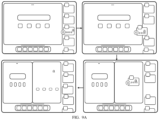
- FIG. 9A is a schematic diagram of dragging a third application from the recent task display area according to an embodiment of the present invention.
- application "a" is selected from the recent task display area and dragged to the side position of the main display area. After the drag is completed, the application "a" will be automatically displayed in a split screen according to the dragged hot spot location.
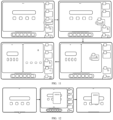
- FIG. 9B is another schematic diagram of dragging the third application from the recent task display area according to an embodiment of the present invention.
- application “b” is selected from the recent task display area and dragged to the middle position of the main display area. After the drag is completed, the application “b" will be automatically displayed in the floating window according to the dragged hot spot location.
- FIG. 10A is a schematic diagram of dragging a third application from a frequently-used application display area according to an embodiment of the present invention.
- application "a" is selected from the frequently-used application display area and dragged to the side position of the main display area. After the drag is completed, the application "a" will be automatically displayed in a split screen according to the dragged hot spot location.
- FIG. 10B is another schematic diagram of dragging the third application from the frequently-used application display area according to an embodiment of the present invention.
- application "b" is selected from the frequently-used application display area and dragged to the middle position of the main display area. After the drag is completed, the application "b" will be automatically displayed in the floating window according to the dragged hot spot location.
- the task management of multi-applications window can be realized by dragging applications from the recent task display area and/or the frequently-used application display area to the main display area.
- the simultaneous display of a plurality of applications can be realized through split screen display and/or floating window display.
- different display modes can be directly selected according to the different dragged hot spot locations without other additional operations.
- the multi-task window combination required by the user can be completed quickly and conveniently, thus making full use of the screen space and improving the work efficiency. Moreover, the position of the drag can be changed as needed, thus switching between the split screen and the small window at any time, which provides a smooth multi-task management mode without complicated operation.
- an application that is displayed behind the third application in an application queue displayed in the recent task display area fill a vacancy sequentially according to a closing time sequence.
- FIG. 11 is a schematic diagram of filling the recent task display area according to an embodiment of the present invention.
- applications a, b, c and d are displayed in the recent task display area in turn according to a closing time sequence. If application "a" is dragged from the recent task display area to the side area of the main display area, other applications b, c and d can automatically fill a vacancy in the recent task display area according to the closing time sequence after application "a" is displayed in a split screen.
- other applications can automatically fill in the recent task display area according to the closing time sequence, thus filling the vacancy of the application dragged to the home screen. This helps to maintain the continuity and improve user-friendliness of display control. Users don't have to manually rearrange applications, reducing confusion and possible errors. Moreover, it is ensured that the applications in the recent task display area remain in order, which helps to make full use of screen space and improves work efficiency.
- the applications displayed in the recent task display area are updated according to the time sequence in which the applications in the application queue displayed in the recent task display area are closed.
- the application in response to that the second operation includes updating the application displayed in the recent task display area, the application can be displayed in the recent task display area according to the closing time sequence, which helps to maintain the consistency of task management. Users can access applications according to their recent activities without searching in the list, which improves users' work efficiency.
- the first display mode is exited in response to detecting a third operation to exit the first display mode, and the fourth application is displayed according to the display mode of the fourth application displayed in the main display area when the third operation is detected.
- the application layout required by the user that is, the fourth application, is obtained in the main display area.
- users can directly exit the first display mode in the third operation, and display the combination of windows in full screen.
- FIG. 12 is a schematic diagram of an exit from the first display mode according to an embodiment of the present invention.
- the first display mode is entered through a first operation under the current layout of displaying the first active application.
- the third application is added to the main display area in the form of a floating window by dragging to perform the third operation, such as sliding down the rod control to a certain distance.
- the third operation the first display mode is directly exited, and the set application layout can be directly displayed in full screen.
- seamless switching from the first display mode to the full screen display can be realized through the third operation without unnecessary steps or clicks, which provides a faster and smoother handover experience.
- FIG. 13 is a flow chart of an application closing method according to an embodiment of the present invention. As shown in FIG. 13 , the application display method includes steps S111 to S112.
- step S111 a first control operation on a first control is detected in an application interface or a desktop application interface displayed on the electronic apparatus, and it is determined that the first operation is detected.
- a second operation and/or a third operation is a second control operation performed on the first control in the first display mode.
- the first display mode can be directly entered from the application interface or the system desktop application interface.
- the first control can be reused for other operations.
- FIG. 14 is a schematic diagram of an application closing method through a first control according to an embodiment of the present invention.
- the first display mode can be directly entered from the desktop by operating the first control
- the first display mode can be directly exited through the first control in the first display mode. For example, after sliding up the rod control on the desktop to a certain distance, enter the first display mode. In the first display mode, users can also exit the first display mode by sliding the rod control.
- FIG. 15 is a schematic diagram of another application closing method through a first control according to an embodiment of the present invention. As shown in FIG. 15 , when an application is displayed in full screen, the current application can be directly closed to return to the system desktop through the first control.
- embodiments of the present invention also provide an application display device.
- the application display device includes corresponding hardware structures and/or software modules for executing various functions in order to realize the above functions.
- embodiments of the present invention can be realized in the form of hardware or a combination of hardware and computer software. Whether a function is executed by hardware or computer software drives hardware depends on the specific application and design constraints of the technical solution. Those skilled in the art can use different methods to realize the described functions for each specific application, while this realization should not be considered beyond the scope of the technical solution of the disclosed embodiment.
- FIG. 16 is a block diagram of an application display device according to an embodiment of the present invention.
- the application display device includes: an operation unit 101 and a display unit 102.
- the operation unit 101 is configured to enter a first display mode in response to detecting a first operation by an electronic apparatus, in which the first display mode includes a main display area, a recent task display area and a frequently-used application display area, the recent task display area is in a first area adjacent to a first edge of the main display area, and the frequently-used application display area is in a second area adjacent to a second edge of the main display area.
- the display unit 102 is configured to, in response to entering the first display mode, display in the recent task display area an application that the electronic apparatus has run within a set time before a current time, display in the main display area a first currently active application upon detection of the first operation by the electronic apparatus, and display in the frequently-used application display area a preset application.
- the application display device further includes a processing unit 103 configured to perform display control on a target display area based on a second operation, in response to detecting the second operation in the first display mode.
- the target display area includes at least one of: the main display area, the recent task display area and the frequently-used application display area.
- the processing unit 103 performs the display control on the target display area based on the second operation by: in response to that the second operation includes an adjustment operation on a display position of a first application window displayed in the main display area, displaying the first application window in the main display area based on the display position corresponding to the adjustment operation, and keeping display positions of the recent task display area and the frequently-used application display area unchanged.
- the processing unit 103 performs the display control on the target display area based on the second operation by: performing display control on an application displayed in the target display area based on the second operation.
- the processing unit 103 performs display control on the application displayed in the target display area based on the second operation by: in response to the second operation for switching a first application currently displayed in the main display area to a second application, displaying the second application in the main display area, and displaying the first application at a first place in an application queue displayed in the recent task display area.
- the second application includes an application selected from the recent task display area, or an application selected from the frequently-used application display area, or an application selected from the main display area.
- the processing unit 103 performs display control on the application displayed in the target display area based on the second operation by: in response to the second operation for closing a first application currently displayed in the main display area, in which the number of the first application is one, closing the first application displayed in the main display area and displaying a desktop application.
- the processing unit 103 is further configured to: in response to that the third application belongs to the recent task display area, fill a vacancy in the recent task display area by an application behind the third application in an application queue displayed in the recent task display area sequentially according to a closing time sequence.
- the processing unit 103 performs display control on the application displayed in the target display area based on the second operation by: in response to that the second operation includes updating an application displayed in the recent task display area, updating the application displayed in the recent task display area according to a closing time sequence of the application in an application queue displayed in the recent task display area.
- the processing unit 103 is further configured to: in response to detecting a third operation of exiting the first display mode, exit the first display mode, and display a fourth application according to a display manner of displaying the fourth application in the main display area upon detection of the third operation.
- detecting the first operation includes detecting a first control operation on a first control in an application interface or a desktop application interface displayed on the electronic apparatus, and determining that the first operation is detected.
- the second operation and/or the third operation is a second control operation performed on the first control in the first display mode.
- FIG. 17 is a block diagram of a device 200 for application display according to an embodiment of the present invention.
- the device 200 can be a mobile phone, computer, digital broadcasting terminal, messaging device, game console, tablet device, medical device, fitness device, personal digital assistant, etc.
- the device 200 may include one or more of the following components: a processing component 202, a memory 204, a power component 206, a multimedia component 208, an audio component 210, an input/output (I/O) interface 212, a sensor component 214, and a communication component 216.
- a processing component 202 may include one or more of the following components: a memory 204, a power component 206, a multimedia component 208, an audio component 210, an input/output (I/O) interface 212, a sensor component 214, and a communication component 216.
- the processing component 202 generally controls the overall operation of the device 200, such as operations associated with display, telephone call, data communication, camera operation and recording operation.
- the processing component 202 may include one or more processors 220 to execute instructions to complete all or part of the steps of the application display method described above.
- the processing component 202 can include one or more modules to facilitate the interaction between the processing component 202 and other components.
- the processing component 202 can include a multimedia module to facilitate interaction between the multimedia component 208 and the processing component 202.
- the memory 204 is configured to store various types of data to support operations at the device 200. Examples of these data include instructions for any application or method operating on the device 200, contact data, phone book data, messages, pictures, videos, and the like.
- the memory 204 can be realized by any type of volatile or nonvolatile memory device or their combination, such as static random access memory (SRAM), electrically erasable programmable read-only memory (EEPROM), erasable programmable read-only memory (EPROM), programmable read-only memory (PROM), read-only memory (ROM), magnetic memory, flash memory, magnetic disk or optical disk.
- SRAM static random access memory
- EEPROM electrically erasable programmable read-only memory
- EPROM erasable programmable read-only memory
- PROM programmable read-only memory
- ROM read-only memory
- magnetic memory flash memory
- flash memory magnetic disk or optical disk.
- the power component 206 provides power to various components of the device 200.
- the power component 206 may include a power management system, one or more power sources, and other components associated with generating, managing and distributing power for the device 200.
- the multimedia component 208 includes a screen that provides an output interface between the device 200 and the user.
- the screen may include a liquid crystal display (LCD) and a touch panel (TP). If the screen includes a touch panel, the screen may be implemented as a touch screen to receive an input signal from a user.
- the touch panel includes one or more touch sensors to sense touch, sliding and gestures on the touch panel. The touch sensor may not only sense the boundary of a touch or sliding action, but also detect the duration and pressure related to the touch or sliding operation.
- the multimedia component 208 includes a front camera and/or a rear camera. When the device 200 is in an operation mode, such as a shooting mode or a video mode, the front camera and/or the rear camera can receive external multimedia data. Each front camera and rear camera can be a fixed optical lens system or have focal length and optical zoom capability.
- the audio component 210 is configured to output and/or input audio signals.
- the audio component 210 includes a microphone (MIC), which is configured to receive external audio signals when the device 200 is in an operation mode, such as a call mode, a recording mode and a voice recognition mode.
- the received audio signal may be further stored in the memory 204 or transmitted via the communication component 216.
- the audio component 210 further includes a speaker for outputting audio signals.
- the I/O interface 212 provides an interface between processing component 202 and peripheral interface modules, and the above-mentioned peripheral interface modules can be keyboards, click wheels, buttons, etc. These buttons may include, but are not limited to, home button, volume button, start button and lock button.
- the sensor component 214 includes one or more sensors for providing various aspects of status assessment for the device 200.
- the sensor component 214 can detect the open/closed state of the device 200, the relative positioning of components, such as the display and keypad of the device 200, the position change of the device 200 or a component of the device 200, the presence or absence of user contact with the device 200, the orientation or acceleration/deceleration of the device 200 and the temperature change of the device 200.
- the sensor component 214 may include a proximity sensor configured to detect the presence of a nearby object without any physical contact.
- the sensor component 214 may also include an optical sensor, such as a CMOS or CCD image sensor, for use in imaging applications.
- the sensor component 214 may further include an acceleration sensor, a gyro sensor, a magnetic sensor, a pressure sensor or a temperature sensor.
- the communication component 216 is configured to facilitate wired or wireless communication between the device 200 and other devices.
- the device 200 can access wireless networks based on communication standards, such as Wi-Fi, 2G or 3G, or their combination.
- the communication component 216 receives a broadcast signal or broadcast related information from an external broadcast management system via a broadcast channel.
- the communication component 216 further includes a near field communication (NFC) module to facilitate short-range communication.
- NFC near field communication
- the NFC module can be implemented based on radio frequency identification (RFID) technology, infrared data association (IrDA) technology, ultra-wideband (UWB) technology, Bluetooth (BT) technology and other technologies.
- RFID radio frequency identification
- IrDA infrared data association
- UWB ultra-wideband
- Bluetooth Bluetooth
- the device 200 may be implemented by one or more application specific integrated circuits (ASIC), digital signal processors (DSP), digital signal processing device(DSPD), programmable logic devices (PLD), field programmable gate arrays (FPGA), controllers, microcontrollers, microprocessors or other electronic components for performing the above methods.
- ASIC application specific integrated circuits
- DSP digital signal processors
- DSPD digital signal processing device
- PLD programmable logic devices
- FPGA field programmable gate arrays
- controllers microcontrollers, microprocessors or other electronic components for performing the above methods.
- non-transitory computer-readable storage medium including instructions, such as the memory 204 including instructions, which can be executed by the processor 220 of the device 200 to complete the above method.
- the non-transitory computer-readable storage medium can be ROM, random access memory (RAM), CD-ROM, magnetic tape, floppy disk, optical data storage device, etc.
- a plurality of in the present invention means two or more, and other quantifiers are similarly interpreted.
- the term “and/or”, which describes the relationship of related objects, means that there are three kinds of relationships. For example, A and/or B can mean that A exists alone, A and B exist together, and B exists alone. The symbol “/”generally indicates that the associated objects are in an “or” relationship.
- the singular forms “a/an”, “said” and “the” are also intended to include plural forms, unless clearly indicated otherwise in the context.
- first and second are configured to describe various information, but these information should not be limited to these terms. These terms are only used to distinguish the same type of information from each other and do not indicate a specific order or importance. In fact, the expressions “first” and “second” can be used interchangeably. For example, without departing from the scope of the present invention, first information may also be called second information, and similarly, second information may also be called first information.
- connection includes direct connection between two members without other members, and indirect connection between two members through other members.
Landscapes
- Engineering & Computer Science (AREA)
- Theoretical Computer Science (AREA)
- General Engineering & Computer Science (AREA)
- Human Computer Interaction (AREA)
- Physics & Mathematics (AREA)
- General Physics & Mathematics (AREA)
- Software Systems (AREA)
- User Interface Of Digital Computer (AREA)
Abstract
An application display method includes: entering a first display mode in response to detecting a first operation by an electronic apparatus, wherein the first display mode includes a main display area, a recent task display area and a frequently-used application display area, and the recent task display area is in a first area adjacent to a first edge of the main display area, and the frequently-used application display area is in a second area adjacent to a second edge of the main display area; and in response to entering the first display mode, displaying in the recent task display area an application that the electronic apparatus has run within a set time before a current time, displaying in the main display area a first currently active application upon detection of the first operation by the electronic apparatus, and displaying in the frequently-used application display area a preset application.
Description
- The present invention relates to the field of terminals, and more particularly, to an application display method, an application display device and a storage medium.
- With the development of communication technology, especially the rapid development of intelligent terminals, more and more kinds of applications are installed in terminals. Users often need to switch among a current application, recent tasks, desktop and other areas to realize multi-window task display control.
- In the related art, floating small windows and other methods can be used to perform multi-window task display control on electronic apparatuses, but the cost of task management is still high, and addition of foreground application display is complex.
- In order to overcome the problems existing in the related art, the present invention provides an application display method, an application display device and a storage medium.
- According to a first aspect of embodiments of the present invention, there is provided an application display method, including: entering a first display mode in response to detecting a first operation by an electronic apparatus, in which the first display mode includes a main display area, a recent task display area and a frequently-used application display area, the recent task display area is in a first area adjacent to a first edge of the main display area, and the frequently-used application display area is in a second area adjacent to a second edge of the main display area; and in response to entering the first display mode, displaying in the recent task display area an application that the electronic apparatus has run within a set time before a current time, displaying in the main display area a first currently active application upon detection of the first operation by the electronic apparatus, and displaying in the frequently-used application display area a preset application.
- In an embodiment, the application display method further includes: performing display control on a target display area based on a second operation, in response to detecting the second operation in the first display mode, in which the target display area includes at least one of: the main display area, the recent task display area and the frequently-used application display area.
- In an embodiment, performing the display control on the target display area based on the second operation includes: in response to that the second operation includes an adjustment operation on a display position of a first application window displayed in the main display area, displaying the first application window in the main display area based on the display position corresponding to the adjustment operation, and keeping display positions of the recent task display area and the frequently-used application display area unchanged.
- In an embodiment, performing the display control on the target display area based on the second operation includes: performing display control on an application displayed in the target display area based on the second operation.
- In an embodiment, performing the display control on the application displayed in the target display area based on the second operation includes: in response to the second operation for switching a first application currently displayed in the main display area to a second application, displaying the second application in the main display area, and displaying the first application at a first place in an application queue displayed in the recent task display area. The second application includes an application selected from the recent task display area, or an application selected from the frequently-used application display area, or an application selected from the main display area.
- In an embodiment, performing the display control on the application displayed in the target display area based on the second operation includes: in response to the second operation for closing a first application currently displayed in the main display area, in which the number of the first application is one, closing the first application displayed in the main display area and displaying a desktop application.
- In an embodiment, performing the display control on the application displayed in the target display area based on the second operation includes: in response to that the second operation includes dragging a third application from the recent task display area and/or the frequently-used application display area to the main display area, displaying the third application in the main display area in a display manner matching a hot spot location where the third application is dragged to the main display area. The display manner includes split screen display and/or floating window display, and different display manners correspond to different hot spot locations.
- In an embodiment, the application display method further includes: in response to that the third application belongs to the recent task display area, filling a vacancy in the recent task display area by an application behind the third application in an application queue displayed in the recent task display area sequentially according to a closing time sequence.
- In an embodiment, performing the display control on the application displayed in the target display area based on the second operation includes: in response to that the second operation includes updating an application displayed in the recent task display area, updating the application displayed in the recent task display area in the recent task display area according to a closing time sequence of the application in an application queue displayed in the recent task display area.
- In an embodiment, the application display method further includes: in response to detecting a third operation of exiting the first display mode, exiting the first display mode, and displaying a fourth application according to a display manner of displaying the fourth application in the main display area upon detection of the third operation.
- In an embodiment, detecting the first operation includes: detecting a first control operation on a first control in an application interface or a desktop application interface displayed on the electronic apparatus, and determining that the first operation is detected, in which a second operation and/or a third operation is a second control operation performed on the first control in the first display mode.
- In an embodiment, the application display method further includes: maintaining a current application layout after the first operation is detected, and directly entering the first display mode.
- In an embodiment, applications displayed in the target display area include an application existing in an original application layout and an application included in the main display area based on the second operation.
- According to a second aspect of the present invention, there is provided an application display device, including a processor; and a memory for storing processor-executable instructions in which the processor is configured to perform the application display method described in the first aspect or any one of embodiments of the first aspects when executing the processor-executable instructions.
- According to a third aspect of the present invention, there is provided a storage medium having stored therein instructions that, when executed by a processor, perform the application display method described in the first aspect or any one of embodiments of the first aspects.
- The technical solutions according to embodiments of the present invention have the following beneficial effects. In the first display mode, users can control display of a plurality of application programs or windows through intuitive operations in the main display area, the recent task display area and the frequently-used application display area, by entering the first display mode through the first operation, which makes multi-task management more natural and user-friendly. Through this intuitive display mode, users can manage the plurality of applications more easily without switching among different applications frequently, improving the multitasking efficiency.
- It is to be understood that both the foregoing general description and the following detailed description are exemplary and explanatory only and are not restrictive of the present invention.
- The accompanying drawings, which are incorporated in and constitute a part of this specification, illustrate embodiments consistent with the invention and together with the description, serve to explain the principles of the invention.
-
FIG. 1 is a flow chart of an application display method according to an embodiment of the present invention. -
FIG. 2 is a schematic diagram of a first display mode according to an embodiment of the present invention. -
FIG. 3 is a schematic diagram of entering a first display mode from a desktop according to an embodiment of the present invention. -
FIG. 4 is a schematic diagram of entering a first display mode from an application according to an embodiment of the present invention. -
FIG. 5 is a flow chart of an application switching method according to an embodiment of the present invention. -
FIG. 6 is a schematic diagram of an application switching method according to an embodiment of the present invention. -
FIG. 7 is a schematic diagram of a first application closing method according to an embodiment of the present invention. -
FIG. 8 is a schematic diagram of a hot spot location according to an embodiment of the present invention. -
FIG. 9A is a schematic diagram of dragging a third application from a recent task display area according to an embodiment of the present invention. -
FIG. 9B is a schematic diagram of dragging a third application from a recent task display area according to another embodiment of the present invention. -
FIG. 10A is a schematic diagram of dragging a third application from a frequently-used application display area according to an embodiment of the present invention. -
FIG. 10B is a schematic diagram of dragging a third application from a frequently-used application display area according to another embodiment of the present invention. -
FIG. 11 is a schematic diagram of filling a recent task display area according to an embodiment of the present invention. -
FIG. 12 is a schematic diagram of exiting a first display mode according to an embodiment of the present invention. -
FIG. 13 is a flow chart of an application closing method according to an embodiment of the present invention. -
FIG. 14 is a schematic diagram of an application closing method through a first control according to an embodiment of the present invention. -
FIG. 15 is a schematic diagram of an application closing method through a first control according to another embodiment of the present invention. -
FIG. 16 is a block diagram of an application display device according to an embodiment of the present invention. -
FIG. 17 is a block diagram of an apparatus for application display according to an embodiment of the present invention. - Embodiments of the present invention are described in detail below, and examples of the embodiments are shown in accompanying drawings. In the description with reference to the drawings, unless otherwise indicated, the same numbers in different drawings indicate the same or similar elements. Embodiments described below do not represent all possible embodiments consistent with the present invention.
- An application display method according to embodiments of the present invention can be applied to display control of an application program or a task window on an electronic apparatus.
- The application display method according to embodiments of the present invention can be executed by an electronic apparatus that may be any apparatus including a display component and a touch component and using electronic components and technologies to perform specific functions or tasks. For example, in the embodiments described below, the electronic apparatus may be called a terminal, a mobile terminal, an intelligent terminal, and the like. The electronic apparatus can also be called user equipment (UE), mobile station (MS) and so on, such as a hand-held or vehicle-mounted device with a touch display function. Examples of the electronic apparatus can include: mobile phones, tablets, laptops, palmtop computers, mobile Internet devices (MID), wearable devices, virtual reality (VR) devices, augmented reality (AR) devices, intelligent distribution network devices, wireless terminals in industrial control, wireless terminals in unmanned driving, etc.
- In current application scenarios of the electronic apparatus, users have increasingly diverse needs, and often require simultaneous use of a plurality of applications to meet the needs in different scenes. Consequently, it is not easy to display an ideal multi-task combination conveniently on a single apparatus.
- Although there are some display methods, such as split screens, small windows and quick switching between applications that have been opened, a current layout of existing applications still needs changing, or there are problems such as high task management cost and complex steps for addition of foreground application display.
- Accordingly, embodiments of the present invention provide an application display method. By entering a first display mode through a first operation, in the first display mode, users can control display of a plurality of application programs or windows through an intuitive operation in a main display area, a recent task display area and a frequently-used application display area, which makes multi-task management more natural and user-friendly.
-
FIG. 1 is a flow chart of an application display method according to an embodiment of the present invention. As shown inFIG. 1 , the application display method includes steps S11 to S12. - In step S11, a first display mode is entered, in response to the electronic apparatus detecting the first operation.
- When it is detected that a user performs the first operation during a current application interface operation, the first display mode can be directly entered for operation without other additional operations.
- The first display mode includes a main display area, a recent task display area and a frequently-used application display area, the recent task display area is in a first area adjacent to a first edge of the main display area, and the frequently-used application display area is in a second area adjacent to a second edge of the main display area.
- In an embodiment, in the current interface, when the electronic apparatus detects that the user slides a rod control for a certain distance, it enters the first display mode.
- For example, special screen touch gestures can also be introduced as the first operation to trigger the entry into the first display mode, such as detecting that the user makes a specific gesture on the electronic apparatus screen to trigger the first display mode. This gesture can be to draw a specific path on the screen, or click a specified number of times in a specified area.
- In step S12, in response to entering the first display mode, an application that the electronic apparatus has run within a set time before a current time is displayed in the recent task display area, a first currently active application upon detection of the first operation by the electronic apparatus is displayed in the main display area, and a preset application is displayed in the frequently-used application display area.
-
FIG. 2 is a schematic diagram of a first display mode according to an embodiment of the present invention. As shown inFIG. 2 , the first display mode includes a main display area, a recent task display area and a frequently-used application display area. - The application that the electronic apparatus has run within a set time before the current time are displayed in the recent task display area, the first currently active application of the electronic apparatus when the first operation is detected is displayed in the main display area, and the preset applications are displayed in the frequently-used application display area.
- By displaying all the applications that the electronic apparatus has run within a set time before the current time in the recent task display area, and displaying the applications that are frequently used in the frequently-used application display area, and allowing users to customize the frequently-used applications, users do not need to return to a home screen or the application drawer to find applications frequently, thus saving time and helping to better organize and manage the multi-task window.
- In an embodiment, the first display mode can be entered from an application program or system desktop currently running in the foreground. The layout of the current application of the electronic apparatus can be maintained after the first operation is detected, while the first display mode can be directly entered without triggering other operations.
- For example,
FIG. 3 is a schematic diagram of entering the first display mode from the desktop according to an embodiment of the present invention. As shown inFIG. 3 , the currently active application is the system desktop. In the system desktop, the first operation of sliding up rod control is performed, when the first operation is detected, the first display mode is directly entered from the desktop with the desktop as the main display area, and the recent task display area and the frequently-used application display area are respectively displayed in the side areas of the desktop. - For another example,
FIG. 4 is a schematic diagram of entering the first display mode from an application according to an embodiment of the present invention. As shown inFIG. 4 , the currently active application is the first application. In the first application, the first operation of the sliding up rod control is performed, and the layout will not be changed when the first operation is detected, and the first application is directly used as the main display area of the first display mode, and the recent task display area and the frequently-used application display area are respectively displayed in the side areas of the desktop. - In embodiments of the present invention, the first display mode is entered when the first operation is detected. In the first display mode, through the main display area, the recent task display area and the frequently-used application display area, users can control the display of a plurality of application programs or windows through intuitive operations, which makes the multi-task management and application display control more natural and user-friendly.
- In an embodiment, in response to detecting a second operation in a first display mode, based on the second operation, a target display area is controlled, and the target display area includes at least one of the following: a main display area, a recent task display area and a frequently-used application display area.
- In embodiments of the present invention, after entering the first display mode, a second operation can be performed, and based on the second operation, display control can be performed on the required application display layout from the main display area, the recent task display area and the frequently-used application display area. Through the recent task display area, users can clearly see the recently opened applications, which makes it easier to manage and switch multitasks. Through the frequently-used application display area, users don't need to remember or search for the required application, thus improving the efficiency of display control.
- In an embodiment, in response to that the second operation includes the adjustment operation of the display position of the first application window displayed in the main display area, the first application window is displayed in the main display area based on the display position corresponding to the adjustment operation, and the display positions of the recent task display area and the frequently-used application display area are kept unchanged.
- In embodiments of the present invention, the first application window is displayed in the main display area based on the display position corresponding to the adjustment operation, and the positions of the recent task display area and the frequently-used application display area will not change. This helps to avoid the occlusion problem encountered by users in display control and provides a clearer view. Users don't have to worry about the display being accidentally moved or hidden, thus reducing possible confusion and errors in display control.
- In an embodiment, based on the second operation, display control is performed on the application displayed in the target display area.
- In embodiments of the present invention, display control is performed on the application that needs to be displayed in the target display area based on the second operation. Through this visual display method, the user can control the display of a plurality of application programs or windows through intuitive operation, thus improving the efficiency of display control.
- In an embodiment, when entering the first display mode, the applications displayed in the target display area may include applications existing in the original application layout of the screen and applications included in the main display area based on the second operation.
-
FIG. 5 is a flow chart of an application switching method according to an embodiment of the present invention. As shown inFIG. 5 , the application display method includes steps S51 to S52. - In step S51, in response to the second operation for switching a first application currently displayed in the main display area to a second application, the second application is displayed in the main display area, and the first application is displayed at a first place in an application queue displayed in the recent task display area.
- In step S52, the second application includes an application selected from the recent task display area, or an application selected from the frequently-used application display area, or an application selected from the main display area.
- Through the recent task display area, frequently-used application display area or in the main display area, users can choose to switch the application currently displayed in the main display area. When the switch is made, the application programs previously displayed in the main display area will be placed at the top of the application queue displayed in the recent task display area, and will not be closed immediately.
-
FIG. 6 is a schematic diagram of an application switching method according to an embodiment of the present invention. As shown inFIG. 6 , the application currently displayed in the main display area is changed from the first application to the second application by clicking on the recent task display area. After switching, the first application will be placed at the top of the application queue displayed in the recent task display area. It can also switch again through the frequently-used application display area, and the application currently displayed in the main display area is changed from the second application to the third application. After switching, the second application will be placed in the first place in the application queue displayed in the recent task display area, and the first application will be placed in the second place in the application queue displayed in the recent task display area. - In embodiments of the present invention, the switched application is displayed at the top of the nearest taskbar, which helps to maintain the continuity of multi-task management and display control. Users can return to their previous tasks at any time without reopening the application.
- In an embodiment, in response that the second operation is used for closing the first application currently displayed in the main display area and the number of the first applications is one, the displayed first application is closed in the main display area, and the desktop application is displayed.
-
FIG. 7 is a schematic diagram of a first application closing method according to an embodiment of the present invention. As shown inFIG. 7 , the first application can be closed by an operation button set in the main display area. When the first application is the only application in the main display area, the system desktop can be displayed without leaving the first display mode. In addition, the closed application is displayed in the recent task display area, so that the application can be opened again at any time. - In embodiments of the present invention, the second operation is configured to close the first application currently displayed in the main display area, and when the first application is the only application in the main display area, the system desktop can be displayed without leaving the first display mode. Through the application display method in embodiments of the invention, the application program and the desktop can be switched more quickly, and the work efficiency is improved, especially when the desktop content needs to be frequently viewed such as when users need to view controls, files or shortcuts on the desktop.
- In an embodiment, in response to that the second operation includes dragging a third application from a recent task display area and/or a frequently-used application display area to a main display area, and the third application is displayed in the main display area according to the display mode matching the hot spot location where the third application is dragged to the main display area, and the display mode includes a split screen display and/or a floating window display, and different display modes correspond to different hot spot locations.
-
FIG. 8 is a schematic diagram of a hot spot location according to an embodiment of the present invention. As shown inFIG. 8 , it can be set that when dragging the third application from the recent task display area and/or the frequently-used application display area to the two sides of the main display area, the third application is displayed in a split screen, and when dragging the third application to the middle position of the main display area, the third application is displayed in a floating window. -
FIG. 9A is a schematic diagram of dragging a third application from the recent task display area according to an embodiment of the present invention. As shown inFIG. 9A , application "a" is selected from the recent task display area and dragged to the side position of the main display area. After the drag is completed, the application "a" will be automatically displayed in a split screen according to the dragged hot spot location. -
FIG. 9B is another schematic diagram of dragging the third application from the recent task display area according to an embodiment of the present invention. As shown inFIG. 9B , application "b" is selected from the recent task display area and dragged to the middle position of the main display area. After the drag is completed, the application "b" will be automatically displayed in the floating window according to the dragged hot spot location. -
FIG. 10A is a schematic diagram of dragging a third application from a frequently-used application display area according to an embodiment of the present invention. As shown inFIG. 10A , application "a" is selected from the frequently-used application display area and dragged to the side position of the main display area. After the drag is completed, the application "a" will be automatically displayed in a split screen according to the dragged hot spot location. -
FIG. 10B is another schematic diagram of dragging the third application from the frequently-used application display area according to an embodiment of the present invention. As shown inFIG. 10B , application "b" is selected from the frequently-used application display area and dragged to the middle position of the main display area. After the drag is completed, the application "b" will be automatically displayed in the floating window according to the dragged hot spot location. - The task management of multi-applications window can be realized by dragging applications from the recent task display area and/or the frequently-used application display area to the main display area. The simultaneous display of a plurality of applications can be realized through split screen display and/or floating window display. Moreover, different display modes can be directly selected according to the different dragged hot spot locations without other additional operations.
- In embodiments of the present invention, by dragging the application from the recent task display area and/or the frequently-used application display area to the main display area, the multi-task window combination required by the user can be completed quickly and conveniently, thus making full use of the screen space and improving the work efficiency. Moreover, the position of the drag can be changed as needed, thus switching between the split screen and the small window at any time, which provides a smooth multi-task management mode without complicated operation.
- In an embodiment, in response to that the third application belongs to the recent task display area, an application that is displayed behind the third application in an application queue displayed in the recent task display area fill a vacancy sequentially according to a closing time sequence.
-
FIG. 11 is a schematic diagram of filling the recent task display area according to an embodiment of the present invention. As shown inFIG. 11 , applications a, b, c and d are displayed in the recent task display area in turn according to a closing time sequence. If application "a" is dragged from the recent task display area to the side area of the main display area, other applications b, c and d can automatically fill a vacancy in the recent task display area according to the closing time sequence after application "a" is displayed in a split screen. - In embodiments of the present invention, other applications can automatically fill in the recent task display area according to the closing time sequence, thus filling the vacancy of the application dragged to the home screen. This helps to maintain the continuity and improve user-friendliness of display control. Users don't have to manually rearrange applications, reducing confusion and possible errors. Moreover, it is ensured that the applications in the recent task display area remain in order, which helps to make full use of screen space and improves work efficiency.
- In an embodiment, in response to that the second operation includes updating the applications displayed in the recent task display area, in the recent task display area, the applications displayed in the recent task display area are updated according to the time sequence in which the applications in the application queue displayed in the recent task display area are closed.
- In embodiments of the present invention, in response to that the second operation includes updating the application displayed in the recent task display area, the application can be displayed in the recent task display area according to the closing time sequence, which helps to maintain the consistency of task management. Users can access applications according to their recent activities without searching in the list, which improves users' work efficiency.
- In an embodiment, the first display mode is exited in response to detecting a third operation to exit the first display mode, and the fourth application is displayed according to the display mode of the fourth application displayed in the main display area when the third operation is detected.
- Through the above operations, the application layout required by the user, that is, the fourth application, is obtained in the main display area. At this time, users can directly exit the first display mode in the third operation, and display the combination of windows in full screen.
-
FIG. 12 is a schematic diagram of an exit from the first display mode according to an embodiment of the present invention. As shown inFIG. 12 , the first display mode is entered through a first operation under the current layout of displaying the first active application. In the first display mode, the third application is added to the main display area in the form of a floating window by dragging to perform the third operation, such as sliding down the rod control to a certain distance. Through the third operation, the first display mode is directly exited, and the set application layout can be directly displayed in full screen. - In embodiments of the present invention, seamless switching from the first display mode to the full screen display can be realized through the third operation without unnecessary steps or clicks, which provides a faster and smoother handover experience.
-
FIG. 13 is a flow chart of an application closing method according to an embodiment of the present invention. As shown inFIG. 13 , the application display method includes steps S111 to S112. - In step S111, a first control operation on a first control is detected in an application interface or a desktop application interface displayed on the electronic apparatus, and it is determined that the first operation is detected.
- In step S112, a second operation and/or a third operation is a second control operation performed on the first control in the first display mode.
- By controlling the first control, the first display mode can be directly entered from the application interface or the system desktop application interface. In the first display mode, the first control can be reused for other operations.
-
FIG. 14 is a schematic diagram of an application closing method through a first control according to an embodiment of the present invention. As shown inFIG. 14 , after the first display mode can be directly entered from the desktop by operating the first control, the first display mode can be directly exited through the first control in the first display mode. For example, after sliding up the rod control on the desktop to a certain distance, enter the first display mode. In the first display mode, users can also exit the first display mode by sliding the rod control. -
FIG. 15 is a schematic diagram of another application closing method through a first control according to an embodiment of the present invention. As shown inFIG. 15 , when an application is displayed in full screen, the current application can be directly closed to return to the system desktop through the first control. - Based on the same concept, embodiments of the present invention also provide an application display device.
- It can be understood that the application display device according to embodiments of the present invention includes corresponding hardware structures and/or software modules for executing various functions in order to realize the above functions. Combining the units and algorithm steps of various examples disclosed in embodiments of the present invention, embodiments of the present invention can be realized in the form of hardware or a combination of hardware and computer software. Whether a function is executed by hardware or computer software drives hardware depends on the specific application and design constraints of the technical solution. Those skilled in the art can use different methods to realize the described functions for each specific application, while this realization should not be considered beyond the scope of the technical solution of the disclosed embodiment.
-
FIG. 16 is a block diagram of an application display device according to an embodiment of the present invention. Referring toFIG. 16 , the application display device includes: anoperation unit 101 and adisplay unit 102. Theoperation unit 101 is configured to enter a first display mode in response to detecting a first operation by an electronic apparatus, in which the first display mode includes a main display area, a recent task display area and a frequently-used application display area, the recent task display area is in a first area adjacent to a first edge of the main display area, and the frequently-used application display area is in a second area adjacent to a second edge of the main display area. Thedisplay unit 102 is configured to, in response to entering the first display mode, display in the recent task display area an application that the electronic apparatus has run within a set time before a current time, display in the main display area a first currently active application upon detection of the first operation by the electronic apparatus, and display in the frequently-used application display area a preset application. - In some embodiments, the application display device further includes a
processing unit 103 configured to perform display control on a target display area based on a second operation, in response to detecting the second operation in the first display mode. The target display area includes at least one of: the main display area, the recent task display area and the frequently-used application display area. - In some embodiments, the
processing unit 103 performs the display control on the target display area based on the second operation by: in response to that the second operation includes an adjustment operation on a display position of a first application window displayed in the main display area, displaying the first application window in the main display area based on the display position corresponding to the adjustment operation, and keeping display positions of the recent task display area and the frequently-used application display area unchanged. - In some embodiments, the
processing unit 103 performs the display control on the target display area based on the second operation by: performing display control on an application displayed in the target display area based on the second operation. - In some embodiments, the
processing unit 103 performs display control on the application displayed in the target display area based on the second operation by: in response to the second operation for switching a first application currently displayed in the main display area to a second application, displaying the second application in the main display area, and displaying the first application at a first place in an application queue displayed in the recent task display area. The second application includes an application selected from the recent task display area, or an application selected from the frequently-used application display area, or an application selected from the main display area. - In some embodiments, the
processing unit 103 performs display control on the application displayed in the target display area based on the second operation by: in response to the second operation for closing a first application currently displayed in the main display area, in which the number of the first application is one, closing the first application displayed in the main display area and displaying a desktop application. - In some embodiments, the
processing unit 103 performs display control on the application displayed in the target display area based on the second operation by: in response to that the second operation includes dragging a third application from at least one of the recent task display area or the frequently-used application display area to the main display area, displaying the third application in the main display area in a display manner matching a hot spot location where the third application is dragged to the main display area. The display manner includes split screen display and/or floating window display, and different display manners correspond to different hot spot locations. - In some embodiments, the
processing unit 103 is further configured to: in response to that the third application belongs to the recent task display area, fill a vacancy in the recent task display area by an application behind the third application in an application queue displayed in the recent task display area sequentially according to a closing time sequence. - In some embodiments, the
processing unit 103 performs display control on the application displayed in the target display area based on the second operation by: in response to that the second operation includes updating an application displayed in the recent task display area, updating the application displayed in the recent task display area according to a closing time sequence of the application in an application queue displayed in the recent task display area. - In some embodiments, the
processing unit 103 is further configured to: in response to detecting a third operation of exiting the first display mode, exit the first display mode, and display a fourth application according to a display manner of displaying the fourth application in the main display area upon detection of the third operation. - In some embodiments, detecting the first operation includes detecting a first control operation on a first control in an application interface or a desktop application interface displayed on the electronic apparatus, and determining that the first operation is detected. The second operation and/or the third operation is a second control operation performed on the first control in the first display mode.
- Regarding the application display device in the above embodiments, the specific way in which each module performs the operation has been described in detail in the embodiments of the application display method, and will not be described in detail here.
-
FIG. 17 is a block diagram of adevice 200 for application display according to an embodiment of the present invention. For example, thedevice 200 can be a mobile phone, computer, digital broadcasting terminal, messaging device, game console, tablet device, medical device, fitness device, personal digital assistant, etc. - Referring to
FIG. 17 , thedevice 200 may include one or more of the following components: aprocessing component 202, amemory 204, apower component 206, amultimedia component 208, anaudio component 210, an input/output (I/O)interface 212, asensor component 214, and acommunication component 216. - The
processing component 202 generally controls the overall operation of thedevice 200, such as operations associated with display, telephone call, data communication, camera operation and recording operation. Theprocessing component 202 may include one ormore processors 220 to execute instructions to complete all or part of the steps of the application display method described above. In addition, theprocessing component 202 can include one or more modules to facilitate the interaction between theprocessing component 202 and other components. For example, theprocessing component 202 can include a multimedia module to facilitate interaction between themultimedia component 208 and theprocessing component 202. - The
memory 204 is configured to store various types of data to support operations at thedevice 200. Examples of these data include instructions for any application or method operating on thedevice 200, contact data, phone book data, messages, pictures, videos, and the like. Thememory 204 can be realized by any type of volatile or nonvolatile memory device or their combination, such as static random access memory (SRAM), electrically erasable programmable read-only memory (EEPROM), erasable programmable read-only memory (EPROM), programmable read-only memory (PROM), read-only memory (ROM), magnetic memory, flash memory, magnetic disk or optical disk. - The
power component 206 provides power to various components of thedevice 200. Thepower component 206 may include a power management system, one or more power sources, and other components associated with generating, managing and distributing power for thedevice 200. - The
multimedia component 208 includes a screen that provides an output interface between thedevice 200 and the user. In some embodiments, the screen may include a liquid crystal display (LCD) and a touch panel (TP). If the screen includes a touch panel, the screen may be implemented as a touch screen to receive an input signal from a user. The touch panel includes one or more touch sensors to sense touch, sliding and gestures on the touch panel. The touch sensor may not only sense the boundary of a touch or sliding action, but also detect the duration and pressure related to the touch or sliding operation. In some embodiments, themultimedia component 208 includes a front camera and/or a rear camera. When thedevice 200 is in an operation mode, such as a shooting mode or a video mode, the front camera and/or the rear camera can receive external multimedia data. Each front camera and rear camera can be a fixed optical lens system or have focal length and optical zoom capability. - The
audio component 210 is configured to output and/or input audio signals. For example, theaudio component 210 includes a microphone (MIC), which is configured to receive external audio signals when thedevice 200 is in an operation mode, such as a call mode, a recording mode and a voice recognition mode. The received audio signal may be further stored in thememory 204 or transmitted via thecommunication component 216. In some embodiments, theaudio component 210 further includes a speaker for outputting audio signals. - The I/
O interface 212 provides an interface betweenprocessing component 202 and peripheral interface modules, and the above-mentioned peripheral interface modules can be keyboards, click wheels, buttons, etc. These buttons may include, but are not limited to, home button, volume button, start button and lock button. - The
sensor component 214 includes one or more sensors for providing various aspects of status assessment for thedevice 200. For example, thesensor component 214 can detect the open/closed state of thedevice 200, the relative positioning of components, such as the display and keypad of thedevice 200, the position change of thedevice 200 or a component of thedevice 200, the presence or absence of user contact with thedevice 200, the orientation or acceleration/deceleration of thedevice 200 and the temperature change of thedevice 200. Thesensor component 214 may include a proximity sensor configured to detect the presence of a nearby object without any physical contact. Thesensor component 214 may also include an optical sensor, such as a CMOS or CCD image sensor, for use in imaging applications. In some embodiments, thesensor component 214 may further include an acceleration sensor, a gyro sensor, a magnetic sensor, a pressure sensor or a temperature sensor. - The
communication component 216 is configured to facilitate wired or wireless communication between thedevice 200 and other devices. Thedevice 200 can access wireless networks based on communication standards, such as Wi-Fi, 2G or 3G, or their combination. In an embodiment, thecommunication component 216 receives a broadcast signal or broadcast related information from an external broadcast management system via a broadcast channel. In an embodiment, thecommunication component 216 further includes a near field communication (NFC) module to facilitate short-range communication. For example, the NFC module can be implemented based on radio frequency identification (RFID) technology, infrared data association (IrDA) technology, ultra-wideband (UWB) technology, Bluetooth (BT) technology and other technologies. - In an embodiment, the
device 200 may be implemented by one or more application specific integrated circuits (ASIC), digital signal processors (DSP), digital signal processing device(DSPD), programmable logic devices (PLD), field programmable gate arrays (FPGA), controllers, microcontrollers, microprocessors or other electronic components for performing the above methods. - In an embodiment, there is also provided a non-transitory computer-readable storage medium including instructions, such as the
memory 204 including instructions, which can be executed by theprocessor 220 of thedevice 200 to complete the above method. For example, the non-transitory computer-readable storage medium can be ROM, random access memory (RAM), CD-ROM, magnetic tape, floppy disk, optical data storage device, etc. - It can be understood that "a plurality of" in the present invention means two or more, and other quantifiers are similarly interpreted. The term "and/or", which describes the relationship of related objects, means that there are three kinds of relationships. For example, A and/or B can mean that A exists alone, A and B exist together, and B exists alone. The symbol "/"generally indicates that the associated objects are in an "or" relationship. The singular forms "a/an", "said" and "the" are also intended to include plural forms, unless clearly indicated otherwise in the context.
- It can further understood that terms "first" and "second" are configured to describe various information, but these information should not be limited to these terms. These terms are only used to distinguish the same type of information from each other and do not indicate a specific order or importance. In fact, the expressions "first" and "second" can be used interchangeably. For example, without departing from the scope of the present invention, first information may also be called second information, and similarly, second information may also be called first information.
- It can be further understood that unless otherwise specified, the term "connection" includes direct connection between two members without other members, and indirect connection between two members through other members.
- It can be further understood that although the operations are described in a specific order in the drawings in embodiments of the present invention, it should not be understood as requiring that these operations must be performed in a specific order or a serial order shown, or that all the operations shown must be performed to obtain a desired result. In certain circumstances, multitasking and parallel processing may be beneficial.
- Other embodiments of the present invention will easily occur to those skilled in the art after considering the specification and practicing the present invention disclosed herein. This application is intended to cover any variations, uses or adaptations of the present invention, which follow the general principles of the present invention and include common sense or common technical means in this technical field that are not disclosed in the present invention.
- It should be understood that the present invention is not limited to the precise structures described above and shown in the drawings, and various modifications and changes can be made without departing from its scope. The scope of the present invention is limited only by the scope of the appended claims.
Claims (15)
- An application display method, comprising:entering a first display mode in response to detecting a first operation by an electronic apparatus (S11), wherein the first display mode comprises a main display area, a recent task display area and a frequently-used application display area, and the recent task display area is in a first area adjacent to a first edge of the main display area, and the frequently-used application display area is in a second area adjacent to a second edge of the main display area; andin response to entering the first display mode, displaying in the recent task display area an application that the electronic apparatus has run within a set time before a current time, displaying in the main display area a first currently active application upon detection of the first operation by the electronic apparatus, and displaying in the frequently-used application display area a preset application (S12).
- The application display method according to claim 1, further comprising:performing display control on a target display area based on a second operation, in response to detecting the second operation in the first display mode,wherein the target display area comprises at least one of: the main display area, the recent task display area and the frequently-used application display area.
- The application display method according to claim 2, wherein performing the display control on the target display area based on the second operation comprises:
in response to that the second operation comprises an adjustment operation on a display position of a first application window displayed in the main display area, displaying the first application window in the main display area based on the display position corresponding to the adjustment operation, and keeping display positions of the recent task display area and the frequently-used application display area unchanged. - The application display method according to claim 2 or 3, wherein performing the display control on the target display area based on the second operation comprises:
performing display control on an application displayed in the target display area based on the second operation. - The application display method according to claim 4, wherein performing the display control on the application displayed in the target display area based on the second operation comprises:in response to the second operation for switching a first application currently displayed in the main display area to a second application, displaying the second application in the main display area, and displaying the first application at a first place in an application queue displayed in the recent task display area (S51),wherein the second application comprises (S52) an application selected from the recent task display area, or an application selected from the frequently-used application display area, or an application selected from the main display area.
- The application display method according to claim 4 or 5, wherein performing the display control on the application displayed in the target display area based on the second operation comprises:
in response to the second operation for closing a first application currently displayed in the main display area, wherein the number of the first application is one, closing the first application displayed in the main display area and displaying a desktop application. - The application display method according to any one of claims 4-6, wherein performing the display control on the application displayed in the target display area based on the second operation comprises:in response to that the second operation comprises dragging a third application from the recent task display area and/or the frequently-used application display area to the main display area, displaying the third application in the main display area in a display manner matching a hot spot location where the third application is dragged to the main display area,wherein the display manner comprises split screen display and/or floating window display, and different display manners correspond to different hot spot locations.
- The application display method according to claim 7, further comprising:
in response to that the third application belongs to the recent task display area, filling a vacancy in the recent task display area by an application behind the third application in an application queue displayed in the recent task display area sequentially according to a closing time sequence. - The application display method according to any one of claims 4-8, wherein performing the display control on the application displayed in the target display area based on the second operation comprises:
in response to that the second operation comprises updating an application displayed in the recent task display area, updating the application displayed in the recent task display area according to a closing time sequence of the application in an application queue displayed in the recent task display area. - The application display method according to any one of claims 4-9, further comprising:
in response to detecting a third operation of exiting the first display mode, exiting the first display mode, and displaying a fourth application according to a display manner of displaying the fourth application in the main display area upon detection of the third operation. - The application display method according to any one of claims 1-10, wherein detecting the first operation comprises:detecting a first control operation on a first control in an application interface or a desktop application interface displayed on the electronic apparatus, and determining that the first operation is detected (S 111),wherein a second operation and/or a third operation is a second control operation performed on the first control in the first display mode (S1 12).
- The application display method according to any one of claims 1-11, further comprising: maintaining a current application layout after the first operation is detected, and directly entering the first display mode.
- The application display method according to claim 2, wherein applications displayed in the target display area comprise an application existing in an original application layout and an application included in the main display area based on the second operation.
- An application display device, comprising:a processor; anda memory for storing processor-executable instructions;wherein the processor is configured to perform the application display method according to any one of claims 1-13 when executing the processor-executable instructions.
- A storage medium having stored therein instructions that, when executed by a processor of a terminal, cause the terminal to perform the application display method according to any one of claims 1-13.
Applications Claiming Priority (1)
| Application Number | Priority Date | Filing Date | Title |
|---|---|---|---|
| CN202311386756.XA CN119883446B (en) | 2023-10-24 | 2023-10-24 | An application display method, device, and storage medium |
Publications (1)
| Publication Number | Publication Date |
|---|---|
| EP4546104A1 true EP4546104A1 (en) | 2025-04-30 |
Family
ID=91072853
Family Applications (1)
| Application Number | Title | Priority Date | Filing Date |
|---|---|---|---|
| EP24175089.2A Pending EP4546104A1 (en) | 2023-10-24 | 2024-05-10 | Application display method, application display device and storage medium |
Country Status (3)
| Country | Link |
|---|---|
| US (1) | US20250130681A1 (en) |
| EP (1) | EP4546104A1 (en) |
| CN (1) | CN119883446B (en) |
Citations (5)
| Publication number | Priority date | Publication date | Assignee | Title |
|---|---|---|---|---|
| US20150128042A1 (en) * | 2013-11-04 | 2015-05-07 | Microsoft Corporation | Multitasking experiences with interactive picture-in-picture |
| US20160357358A1 (en) * | 2015-06-07 | 2016-12-08 | Apple Inc. | Device, Method, and Graphical User Interface for Manipulating Application Windows |
| CN114003324A (en) * | 2021-09-30 | 2022-02-01 | 华为技术有限公司 | Method for combining multiple applications and simultaneously starting multiple applications and electronic equipment |
| CN114416227A (en) * | 2021-11-16 | 2022-04-29 | 华为技术有限公司 | Window switching method, electronic device and readable storage medium |
| US20220334854A1 (en) * | 2019-10-31 | 2022-10-20 | Beijing Bytedance Network Technology Co., Ltd. | Method and apparatus for operating electronic device, and electronic device and storage medium |
Family Cites Families (8)
| Publication number | Priority date | Publication date | Assignee | Title |
|---|---|---|---|---|
| US20020044161A1 (en) * | 2000-05-22 | 2002-04-18 | Kazuaki Sugai | Multi-window display system and method for displaying video data and storage medium |
| US20140137036A1 (en) * | 2012-11-15 | 2014-05-15 | Weishan Han | Operation Window for Portable Devices with Touchscreen Displays |
| KR20160026141A (en) * | 2014-08-29 | 2016-03-09 | 삼성전자주식회사 | Controlling Method based on a communication status and Electronic device supporting the same |
| CN110244893B (en) * | 2019-05-05 | 2022-02-25 | 华为技术有限公司 | Operating method and electronic device for split-screen display |
| CN112506386B (en) * | 2019-09-16 | 2023-08-01 | 华为技术有限公司 | Folding screen display method and electronic equipment |
| CN114125260B (en) * | 2020-08-31 | 2024-09-10 | 北京小米移动软件有限公司 | Application interface display method, application interface display device and storage medium |
| CN114363462B (en) * | 2020-09-30 | 2023-01-06 | 华为技术有限公司 | Interface display method, electronic equipment and computer readable medium |
| CN116820288A (en) * | 2022-03-21 | 2023-09-29 | 华为技术有限公司 | Window control method, electronic device and computer readable storage medium |
-
2023
- 2023-10-24 CN CN202311386756.XA patent/CN119883446B/en active Active
-
2024
- 2024-04-11 US US18/633,436 patent/US20250130681A1/en active Pending
- 2024-05-10 EP EP24175089.2A patent/EP4546104A1/en active Pending
Patent Citations (7)
| Publication number | Priority date | Publication date | Assignee | Title |
|---|---|---|---|---|
| US20150128042A1 (en) * | 2013-11-04 | 2015-05-07 | Microsoft Corporation | Multitasking experiences with interactive picture-in-picture |
| US20160357358A1 (en) * | 2015-06-07 | 2016-12-08 | Apple Inc. | Device, Method, and Graphical User Interface for Manipulating Application Windows |
| US20220334854A1 (en) * | 2019-10-31 | 2022-10-20 | Beijing Bytedance Network Technology Co., Ltd. | Method and apparatus for operating electronic device, and electronic device and storage medium |
| CN114003324A (en) * | 2021-09-30 | 2022-02-01 | 华为技术有限公司 | Method for combining multiple applications and simultaneously starting multiple applications and electronic equipment |
| EP4383069A1 (en) * | 2021-09-30 | 2024-06-12 | Huawei Technologies Co., Ltd. | Method for combining multiple applications and for simultaneously starting multiple applications, and electronic device |
| CN114416227A (en) * | 2021-11-16 | 2022-04-29 | 华为技术有限公司 | Window switching method, electronic device and readable storage medium |
| EP4414833A1 (en) * | 2021-11-16 | 2024-08-14 | Huawei Technologies Co., Ltd. | Window switching method, electronic device, and readable storage medium |
Also Published As
| Publication number | Publication date |
|---|---|
| CN119883446A (en) | 2025-04-25 |
| CN119883446B (en) | 2025-11-04 |
| US20250130681A1 (en) | 2025-04-24 |
Similar Documents
| Publication | Publication Date | Title |
|---|---|---|
| US10976887B2 (en) | Method and apparatus for split-window display | |
| EP3316112B1 (en) | Split screen display method and apparatus, computer program and recording medium | |
| US20170322709A1 (en) | Split-screen display method, apparatus and medium | |
| EP3232340A1 (en) | Method for operating a display device and display device for displaying pages of an application program | |
| EP3640784A1 (en) | Application icon movement method and apparatus, terminal, and storage medium | |
| EP3716029B1 (en) | Interface display method, device and storage medium | |
| US20150113475A1 (en) | Method and device for providing an image preview | |
| US20170322689A1 (en) | Method and device for multi-task management, and computer-readable medium | |
| EP3239827B1 (en) | Method and apparatus for adjusting playing progress of media file | |
| US20170052693A1 (en) | Method and device for displaying a target object | |
| US12001672B2 (en) | Interface display method and apparatus for controlling interactability of simultaneously displayed user interfaces of an application | |
| US12405715B2 (en) | Page display method, electronic device and storage medium | |
| KR102258742B1 (en) | Touch signal processing method, apparatus and medium | |
| CN111092971A (en) | Display method and device for displaying | |
| EP4546104A1 (en) | Application display method, application display device and storage medium | |
| CN112346629A (en) | Object selection method, object selection device and storage medium | |
| CN112269525A (en) | Small screen window display method and device and storage medium | |
| US12417059B2 (en) | Method and apparatus for split-screen display, electronic device and computer readable storage medium | |
| US20210333988A1 (en) | Method and device for switching interface, touch terminal, and storage medium | |
| US20240211089A1 (en) | Information interaction method electronic device | |
| US20250138712A1 (en) | Method and apparatus for editing lock screen interface and storage medium | |
| CN114816161A (en) | Icon display method and system | |
| CN119883095A (en) | Split screen method and device, electronic equipment and storage medium | |
| CN120010969A (en) | Application display method, device and storage medium | |
| CN119149148A (en) | Processing method, device and medium for form data |
Legal Events
| Date | Code | Title | Description |
|---|---|---|---|
| PUAI | Public reference made under article 153(3) epc to a published international application that has entered the european phase |
Free format text: ORIGINAL CODE: 0009012 |
|
| STAA | Information on the status of an ep patent application or granted ep patent |
Free format text: STATUS: REQUEST FOR EXAMINATION WAS MADE |
|
| 17P | Request for examination filed |
Effective date: 20240510 |
|
| AK | Designated contracting states |
Kind code of ref document: A1 Designated state(s): AL AT BE BG CH CY CZ DE DK EE ES FI FR GB GR HR HU IE IS IT LI LT LU LV MC ME MK MT NL NO PL PT RO RS SE SI SK SM TR |