EP4546081A1 - Modular laptop computer hinge - Google Patents
Modular laptop computer hinge Download PDFInfo
- Publication number
- EP4546081A1 EP4546081A1 EP24171895.6A EP24171895A EP4546081A1 EP 4546081 A1 EP4546081 A1 EP 4546081A1 EP 24171895 A EP24171895 A EP 24171895A EP 4546081 A1 EP4546081 A1 EP 4546081A1
- Authority
- EP
- European Patent Office
- Prior art keywords
- circuit board
- laptop computer
- hinge
- sub
- bracket
- Prior art date
- Legal status (The legal status is an assumption and is not a legal conclusion. Google has not performed a legal analysis and makes no representation as to the accuracy of the status listed.)
- Pending
Links
Images


Classifications
-
- G—PHYSICS
- G06—COMPUTING OR CALCULATING; COUNTING
- G06F—ELECTRIC DIGITAL DATA PROCESSING
- G06F1/00—Details not covered by groups G06F3/00 - G06F13/00 and G06F21/00
- G06F1/16—Constructional details or arrangements
- G06F1/1613—Constructional details or arrangements for portable computers
- G06F1/1633—Constructional details or arrangements of portable computers not specific to the type of enclosures covered by groups G06F1/1615 - G06F1/1626
- G06F1/1675—Miscellaneous details related to the relative movement between the different enclosures or enclosure parts
- G06F1/1683—Miscellaneous details related to the relative movement between the different enclosures or enclosure parts for the transmission of signal or power between the different housings, e.g. details of wired or wireless communication, passage of cabling
-
- G—PHYSICS
- G06—COMPUTING OR CALCULATING; COUNTING
- G06F—ELECTRIC DIGITAL DATA PROCESSING
- G06F1/00—Details not covered by groups G06F3/00 - G06F13/00 and G06F21/00
- G06F1/16—Constructional details or arrangements
- G06F1/1613—Constructional details or arrangements for portable computers
- G06F1/1615—Constructional details or arrangements for portable computers with several enclosures having relative motions, each enclosure supporting at least one I/O or computing function
- G06F1/1616—Constructional details or arrangements for portable computers with several enclosures having relative motions, each enclosure supporting at least one I/O or computing function with folding flat displays, e.g. laptop computers or notebooks having a clamshell configuration, with body parts pivoting to an open position around an axis parallel to the plane they define in closed position
-
- G—PHYSICS
- G06—COMPUTING OR CALCULATING; COUNTING
- G06F—ELECTRIC DIGITAL DATA PROCESSING
- G06F1/00—Details not covered by groups G06F3/00 - G06F13/00 and G06F21/00
- G06F1/16—Constructional details or arrangements
- G06F1/1613—Constructional details or arrangements for portable computers
- G06F1/1633—Constructional details or arrangements of portable computers not specific to the type of enclosures covered by groups G06F1/1615 - G06F1/1626
- G06F1/1675—Miscellaneous details related to the relative movement between the different enclosures or enclosure parts
- G06F1/1681—Details related solely to hinges
-
- G—PHYSICS
- G06—COMPUTING OR CALCULATING; COUNTING
- G06F—ELECTRIC DIGITAL DATA PROCESSING
- G06F1/00—Details not covered by groups G06F3/00 - G06F13/00 and G06F21/00
- G06F1/16—Constructional details or arrangements
- G06F1/18—Packaging or power distribution
- G06F1/183—Internal mounting support structures, e.g. for supporting printed circuit boards
- G06F1/184—Mounting of motherboards
Definitions
- the disclosure relates to a laptop computer.
- ESG is the abbreviation of three English words, namely Environment, Social and Governance.
- the United Nations Global Compact first proposed the concept of ESG in 2004, and it is regarded as an indicator for evaluating a company's operations.
- ESG is a measure of a company's sustainable development indicators, which are the carbon reduction and sustainable development goals required by international and domestic governments.
- business operations only required attention to financial data.
- operations violate human rights and discharge wastewater, it will infringe on consumers' rights and harm the living environment of the earth's creatures.
- it will also violate the international goal of promoting earth sustainability, prompt institutional investors to reduce investment and cooperation in such companies, and even affect the company's reputation.
- the invention provides a laptop computer, which not only has good heat dissipation efficiency, but also is convenient for users to operate.
- a laptop computer of the present invention includes a first body, a circuit board disposed in the first body, a second body, a display module disposed in the second body, a hinge connected to the first and the second bodies, and a mezzanine connector.
- the first and the second bodies are pivoted to each other to be folded or unfolded via the hinge.
- the mezzanine connector is clamped between the hinge and the circuit board, and is electrically connected between the display module and the circuit board.
- the laptop computer uses the corresponding settings of the hinge, the mezzanine connector and the circuit board in the body, so that when the display module and the hinge are assembled into the body with the circuit board built in, the mezzanine connector is clamped between the hinge and the circuit board.
- the display module can be electrically connected to the circuit board through the mezzanine connector. In this way, the electrical connection can also be completed during the assembly of the aforementioned structure. For assembly operators, it can effectively simplify the assembly process and avoid the need to first arrange the wiring of electronic components (such as display modules) before plugging them in, thereby avoiding the occurrence of plugging errors.
- the matching relationship between the above-mentioned components is beneficial to the disassembly and assembly operations. Therefore, for the laptop computer, users can easily complete subsequent expansion or repair without being limited by complicated assembly relationships, thereby improving the regeneration (repairability) ability of the laptop computer and meeting the conditions of sustainability.
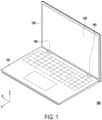
- FIG. 1 is a schematic diagram of a laptop computer according to an embodiment of the present invention.
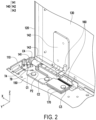
- FIG. 2 is a schematic diagram of some components of the laptop computer in FIG. 1 .
- the rectangular coordinates X-Y-Z are also provided to facilitate component description.
- the laptop computer 100 includes a first body 110 (such as, a host), a circuit board 150 (such as, a motherboard), a second body 120, a display module 130, a hinge 140 and a mezzanine connector 170.
- the circuit board 150 is disposed in the first body 110, and the display module 130 is disposed in the second body 120.
- the hinge 140 is connected to the first body 110 and the second body 120, and the first body 110 and the second body 120 are pivoted to each other along the X-axis to be folded or unfolded via the hinge.
- the mezzanine connector 170 is clamped between the hinge 140 and the circuit board 150, and is electrically connected between the display module 130 and the circuit board 150.
- the first body 110 is considered to be located on the X-Y plane.
- FIG. 3 is an exploded schematic diagram of some components of the laptop computer in FIG. 2 .
- FIG. 4 shows the components of FIG. 3 from another perspective.
- the hinge 140 includes a first bracket 141, a second bracket 142 and a rotating shaft 143, wherein the first bracket 141 is disposed in the first body 110, the second bracket 142 is disposed in the second body 120, and the rotating shaft 143 is connected to the second bracket 142 and pivoted to the first bracket 141.
- the mezzanine connector 170 is clamped between the first bracket 141 and the circuit board 150.
- the first bracket 141 has a pivot joint 141c, a first plate body 141a and a second plate body 141b.
- the pivot joint 141c is pivoted to the rotating shaft 143.
- the first plate body 141a is connected between the pivot joint 141c and the second plate body 141b.
- the mezzanine connector 170 is clamped between the second plate body 141b and the circuit board 150 along the Z-axis.
- the mezzanine connector 170 includes a first sub-circuit board 171 and a second sub-circuit board 172.
- the first sub-circuit board 171 is stacked on the circuit board 150, and a first conductive array 171b of the first sub-circuit board 171 abuts and is electrically connected to a third conductive array 151 of the circuit board 150.
- the second sub-circuit board 172 is stacked on the first sub-circuit board 171 and is electrically connected to the display module 130.
- a portion of the hinge 140 is stacked on the second sub-circuit board 172, and a fourth conductive array 172d of the second sub-circuit board 172 abuts and is electrically connected to a second conductive array 171a of the first sub-circuit board 171.
- the first conductive array 171b and the second conductive array 171a are shrapnel arrays respectively
- the third conductive array 151 and the fourth conductive array 172d are pad arrays respectively. In this way, the shrapnel arrays and the pad arrays can be smoothly connected to each other.
- the laptop computer 100 further includes a cable 160, which is electrically connected between the display module 130 and the circuit board 150. Furthermore, the cable 160 extends to and is electrically connected to a plurality of conductive pads 172a of the second sub-circuit board 172, and then is electrically connected to the circuit board 150 through the mezzanine connector 170.
- the conductive pads 172a are distributed on the opposite surfaces of the second sub-circuit board 172, and the cable 160 includes a coaxial part 161 and a double row conductive sheets 162 extending from the coaxial part 161.
- the double row conductive sheets 162 are respectively electrically connected to the conductive pads 172a on the upper and lower surfaces of the second sub-circuit board 172, which are also in double rows.
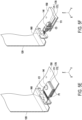
- FIG. 5A to FIG. 5F are partial cross-sectional views of some components of the laptop computer at different positions.
- the laptop computer 100 of the embodiment further includes a plurality of lock attachments C1 ⁇ C4 (such as, screws), as shown in FIG. 3 and FIG. 5A .
- the lock attachment C4 starts from the bottom of the first body 110 and performs the locking action.
- the first body 110 is further divided into a component 111 and a component 112, which can be regarded as the upper shell (component 112) and the lower shell (component 111) of the first body 110.
- the components 111 and 112 are only partially shown.
- the lock attachment C4 passes through the component 111, an opening T8 of the circuit board 150 and an opening T4 of the first plate body 141a of the first bracket 141 in sequence, and then locks into the component 112.
- the laptop computer 100 of the embodiment also has a second positioning post P2, which protrudes upward from the circuit board 150 and passes through an opening T9 of the first plate body 141a of the first bracket 141 for positioning when assembling the hinge 140.
- the lock attachment C1 starts from the hinge 140 and sequentially passes through an opening T1 of the first plate body 141a of the first bracket 141 and an opening T7 of the circuit board 150 to lock into the component 111 of the first body 110.
- the lock attachment C2 starts from the hinge 140 and sequentially passes through an opening T2 of the first plate body 141a of the first bracket 141 and an opening T6 of the circuit board 150 to lock into the component 111 of the first body 110.
- the hinge 140 of the embodiment also has a first positioning post P1, which is located on the bottom surface of the second plate body 141b of the first bracket 141, so as to pass through an opening 172c of the second sub-circuit board 172 and an opening 171d of the first sub-circuit board 171 in sequence.
- the first sub-circuit board 171 and the second sub-circuit board 172 can be positioned together with the first bracket 141.
- the lock attachment C3 starts from the hinge 140 and sequentially passes through an opening T3 of the second plate body 141b of the first bracket 141, an opening 172b of the second sub-circuit board 172, and opening 171c of the first sub-circuit board 171 and an opening T5 of the circuit board 150 to lock into the component 111 of the first body 110.
- the first bracket 141 of the hinge 140, the mezzanine connector 170, the circuit board 150 and the first body 110 produce mutual positioning and locking combination effects through the lock attachments C1 ⁇ C4 and the positioning posts P1, P2 of FIG. 5A to FIG. 5F .
- the cable 160 can be welded to the second sub-circuit board 172 of the mezzanine connector 170 after the second body 120 is assembled with the display module 130 and the second bracket 142 of the hinge 140. Then, during the process of assembling the second body 120 to the first body 110, the operator only needs to focus on the combination of components.
- the second body 120, the hinge 140 and the mezzanine connector 170 respectively correspond to the positioning and locking of the first body 110 and the circuit board 150.
- the assembly is completed, it is also equivalent to completing the connection operation of the display module 130 and the cable 160 being electrically connected to the circuit board 150 through the mezzanine connector 170.
- the laptop computer uses the corresponding settings of the hinge, the mezzanine connector and the circuit board in the body, so that when the display module and the hinge are assembled into the body with the circuit board (motherboard) built in, the mezzanine connector is clamped between the hinge and the circuit board.
- the display module can be electrically connected to the circuit board through the mezzanine connector. In this way, the electrical connection can also be completed during the assembly of the aforementioned structure. For assembly operators, it can effectively simplify the assembly process and avoid the need to first arrange the wiring of electronic components (such as display modules) before plugging them in, thereby avoiding the occurrence of plugging errors.
- the overlapping relationship of the above-mentioned components allows operators in the assembly process to only focus on component assembly, and saves the need to spend additional time on operations such as wire management or connector plugging. Furthermore, the matching relationship between the above-mentioned components is beneficial to the disassembly and assembly operations. Therefore, for the laptop computer, users can easily complete subsequent expansion or repair without being limited by complicated assembly relationships, thereby improving the regeneration (repairability) ability of the laptop computer and meeting the conditions of sustainability.
Landscapes
- Engineering & Computer Science (AREA)
- Computer Hardware Design (AREA)
- Theoretical Computer Science (AREA)
- Physics & Mathematics (AREA)
- Human Computer Interaction (AREA)
- General Engineering & Computer Science (AREA)
- General Physics & Mathematics (AREA)
- Mathematical Physics (AREA)
- Computer Networks & Wireless Communication (AREA)
- Combinations Of Printed Boards (AREA)
- Casings For Electric Apparatus (AREA)
- Details Of Connecting Devices For Male And Female Coupling (AREA)
Abstract
A laptop computer including a first body (110), a circuit board (150) disposed in the first body (110), a second body (120), a display module (130) disposed in the second body (120), a hinge (140) connected to the first body (110) and the second body (120), and a mezzanine connector (170) is provided. The first body (110) and the second body (120) are pivoted to each other to be folded or unfolded via the hinge (140). The mezzanine connector (170) is clamped between the hinge (140) and the circuit board (150), and is electrically connected between the display module (130) and the circuit board (150).
Description
- The disclosure relates to a laptop computer.
- ESG is the abbreviation of three English words, namely Environment, Social and Governance. The United Nations Global Compact first proposed the concept of ESG in 2004, and it is regarded as an indicator for evaluating a company's operations. ESG is a measure of a company's sustainable development indicators, which are the carbon reduction and sustainable development goals required by international and domestic governments. In the past, business operations only required attention to financial data. However, despite having good financial reports, if operations violate human rights and discharge wastewater, it will infringe on consumers' rights and harm the living environment of the earth's creatures. At the same time, it will also violate the international goal of promoting earth sustainability, prompt institutional investors to reduce investment and cooperation in such companies, and even affect the company's reputation. Today, companies that value the ESG concept not only have transparent financial reports, but also have stable and low-risk operating models, and their long-term performance will be relatively stable. Therefore, for the electronics manufacturing industry, whether the products it manufactures can meet the above conditions has become one of the evaluation conditions for the product.
- Taking a laptop computer as an example, whether it meets the above conditions depends on the energy consumed in the manufacturing process of the product and whether the product has the ability to be repaired (renewed). In order to achieve the above goals, the component design and assembly configuration of the laptop computers require corresponding new technologies and measures.
- To put it simply, in terms of assembly and configuration, when the existing assembly process of the laptop computers is used for electronic components with wires or cables, it often requires not only structural assembly, but also wire management, plugging, and other actions. In addition to the complicated process, the above-mentioned actions may also easily lead to errors due to the large number of wirings, causing considerable inconvenience and thus reducing the regeneration (repairability) capability of the laptop computer.
- The invention provides a laptop computer, which not only has good heat dissipation efficiency, but also is convenient for users to operate.
- A laptop computer of the present invention includes a first body, a circuit board disposed in the first body, a second body, a display module disposed in the second body, a hinge connected to the first and the second bodies, and a mezzanine connector. The first and the second bodies are pivoted to each other to be folded or unfolded via the hinge. The mezzanine connector is clamped between the hinge and the circuit board, and is electrically connected between the display module and the circuit board.
- Based on the above, the laptop computer uses the corresponding settings of the hinge, the mezzanine connector and the circuit board in the body, so that when the display module and the hinge are assembled into the body with the circuit board built in, the mezzanine connector is clamped between the hinge and the circuit board. More importantly, the display module can be electrically connected to the circuit board through the mezzanine connector. In this way, the electrical connection can also be completed during the assembly of the aforementioned structure. For assembly operators, it can effectively simplify the assembly process and avoid the need to first arrange the wiring of electronic components (such as display modules) before plugging them in, thereby avoiding the occurrence of plugging errors.
- Furthermore, the matching relationship between the above-mentioned components is beneficial to the disassembly and assembly operations. Therefore, for the laptop computer, users can easily complete subsequent expansion or repair without being limited by complicated assembly relationships, thereby improving the regeneration (repairability) ability of the laptop computer and meeting the conditions of sustainability.
-
-
FIG. 1 is a schematic diagram of a laptop computer according to an embodiment of the present invention. -
FIG. 2 is a schematic diagram of some components of the laptop computer inFIG. 1 . -
FIG. 3 is an exploded schematic diagram of some components of the laptop computer inFIG. 2 . -
FIG. 4 shows the components ofFIG. 3 from another perspective. -
FIG. 5A to FIG. 5F are partial cross-sectional views of some components of the laptop computer at different positions. -
FIG. 1 is a schematic diagram of a laptop computer according to an embodiment of the present invention.FIG. 2 is a schematic diagram of some components of the laptop computer inFIG. 1 . Here, the rectangular coordinates X-Y-Z are also provided to facilitate component description. Referring toFIG. 1 andFIG. 2 at the same time, in the embodiment, thelaptop computer 100 includes a first body 110 (such as, a host), a circuit board 150 (such as, a motherboard), asecond body 120, adisplay module 130, ahinge 140 and amezzanine connector 170. Thecircuit board 150 is disposed in thefirst body 110, and thedisplay module 130 is disposed in thesecond body 120. Thehinge 140 is connected to thefirst body 110 and thesecond body 120, and thefirst body 110 and thesecond body 120 are pivoted to each other along the X-axis to be folded or unfolded via the hinge. Themezzanine connector 170 is clamped between thehinge 140 and thecircuit board 150, and is electrically connected between thedisplay module 130 and thecircuit board 150. Here, thefirst body 110 is considered to be located on the X-Y plane. -
FIG. 3 is an exploded schematic diagram of some components of the laptop computer inFIG. 2 .FIG. 4 shows the components ofFIG. 3 from another perspective. Referring toFIG. 2 to FIG. 4 at the same time, in the embodiment, thehinge 140 includes afirst bracket 141, asecond bracket 142 and a rotatingshaft 143, wherein thefirst bracket 141 is disposed in thefirst body 110, thesecond bracket 142 is disposed in thesecond body 120, and the rotatingshaft 143 is connected to thesecond bracket 142 and pivoted to thefirst bracket 141. Themezzanine connector 170 is clamped between thefirst bracket 141 and thecircuit board 150. Here, thefirst bracket 141 has apivot joint 141c, afirst plate body 141a and asecond plate body 141b. Thepivot joint 141c is pivoted to the rotatingshaft 143. Thefirst plate body 141a is connected between thepivot joint 141c and thesecond plate body 141b. Themezzanine connector 170 is clamped between thesecond plate body 141b and thecircuit board 150 along the Z-axis. - As shown in
FIG. 2 andFIG. 3 , themezzanine connector 170 includes afirst sub-circuit board 171 and asecond sub-circuit board 172. Thefirst sub-circuit board 171 is stacked on thecircuit board 150, and a firstconductive array 171b of thefirst sub-circuit board 171 abuts and is electrically connected to a thirdconductive array 151 of thecircuit board 150. Thesecond sub-circuit board 172 is stacked on thefirst sub-circuit board 171 and is electrically connected to thedisplay module 130. A portion of thehinge 140 is stacked on thesecond sub-circuit board 172, and a fourthconductive array 172d of thesecond sub-circuit board 172 abuts and is electrically connected to a secondconductive array 171a of thefirst sub-circuit board 171. Here, the firstconductive array 171b and the secondconductive array 171a are shrapnel arrays respectively, and the thirdconductive array 151 and the fourthconductive array 172d are pad arrays respectively. In this way, the shrapnel arrays and the pad arrays can be smoothly connected to each other. - In the embodiment, the
laptop computer 100 further includes acable 160, which is electrically connected between thedisplay module 130 and thecircuit board 150. Furthermore, thecable 160 extends to and is electrically connected to a plurality ofconductive pads 172a of thesecond sub-circuit board 172, and then is electrically connected to thecircuit board 150 through themezzanine connector 170. Here, theconductive pads 172a are distributed on the opposite surfaces of thesecond sub-circuit board 172, and thecable 160 includes acoaxial part 161 and a double rowconductive sheets 162 extending from thecoaxial part 161. The double rowconductive sheets 162 are respectively electrically connected to theconductive pads 172a on the upper and lower surfaces of thesecond sub-circuit board 172, which are also in double rows. -
FIG. 5A to FIG. 5F are partial cross-sectional views of some components of the laptop computer at different positions. Referring toFIG. 3 andFIG. 4 and comparing toFIG. 5A , in order to successfully achieve the assembly and combination effect, thelaptop computer 100 of the embodiment further includes a plurality of lock attachments C1~C4 (such as, screws), as shown inFIG. 3 andFIG. 5A . The lock attachment C4 starts from the bottom of thefirst body 110 and performs the locking action. Here, thefirst body 110 is further divided into acomponent 111 and acomponent 112, which can be regarded as the upper shell (component 112) and the lower shell (component 111) of thefirst body 110. In order to facilitate identification, thecomponents FIG. 3 andFIG. 5A at the same time, the lock attachment C4 passes through thecomponent 111, an opening T8 of thecircuit board 150 and an opening T4 of thefirst plate body 141a of thefirst bracket 141 in sequence, and then locks into thecomponent 112. - Then, referring to
FIG. 3 andFIG. 4 and comparing withFIG. 5B , thelaptop computer 100 of the embodiment also has a second positioning post P2, which protrudes upward from thecircuit board 150 and passes through an opening T9 of thefirst plate body 141a of thefirst bracket 141 for positioning when assembling thehinge 140. - Then, referring to
FIG. 3 andFIG. 4 and comparing withFIG. 5C , the lock attachment C1 starts from thehinge 140 and sequentially passes through an opening T1 of thefirst plate body 141a of thefirst bracket 141 and an opening T7 of thecircuit board 150 to lock into thecomponent 111 of thefirst body 110. - Then, referring to
FIG. 3 andFIG. 4 and comparing withFIG. 5D , similar to the aforementioned lock attachment C1, the lock attachment C2 starts from thehinge 140 and sequentially passes through an opening T2 of thefirst plate body 141a of thefirst bracket 141 and an opening T6 of thecircuit board 150 to lock into thecomponent 111 of thefirst body 110. - Then, referring to
FIG. 3 andFIG. 4 and comparing withFIG. 5E , thehinge 140 of the embodiment also has a first positioning post P1, which is located on the bottom surface of thesecond plate body 141b of thefirst bracket 141, so as to pass through anopening 172c of the secondsub-circuit board 172 and anopening 171d of the firstsub-circuit board 171 in sequence. Thereby, the firstsub-circuit board 171 and the secondsub-circuit board 172 can be positioned together with thefirst bracket 141. - Then, referring to
FIG. 3 andFIG. 4 and comparing withFIG. 5F , the lock attachment C3 starts from thehinge 140 and sequentially passes through an opening T3 of thesecond plate body 141b of thefirst bracket 141, anopening 172b of the secondsub-circuit board 172, and opening 171c of the firstsub-circuit board 171 and an opening T5 of thecircuit board 150 to lock into thecomponent 111 of thefirst body 110. - The
first bracket 141 of thehinge 140, themezzanine connector 170, thecircuit board 150 and thefirst body 110 produce mutual positioning and locking combination effects through the lock attachments C1~C4 and the positioning posts P1, P2 ofFIG. 5A to FIG. 5F . Also referring toFIG. 2 andFIG. 4 , simply speaking, due to the stacking relationship of the above components, thecable 160 can be welded to the secondsub-circuit board 172 of themezzanine connector 170 after thesecond body 120 is assembled with thedisplay module 130 and thesecond bracket 142 of thehinge 140. Then, during the process of assembling thesecond body 120 to thefirst body 110, the operator only needs to focus on the combination of components. That is to ensure that thesecond body 120, thehinge 140 and themezzanine connector 170 respectively correspond to the positioning and locking of thefirst body 110 and thecircuit board 150. When the assembly is completed, it is also equivalent to completing the connection operation of thedisplay module 130 and thecable 160 being electrically connected to thecircuit board 150 through themezzanine connector 170. - In summary, in the above-described embodiment of the present invention, the laptop computer uses the corresponding settings of the hinge, the mezzanine connector and the circuit board in the body, so that when the display module and the hinge are assembled into the body with the circuit board (motherboard) built in, the mezzanine connector is clamped between the hinge and the circuit board. More importantly, the display module can be electrically connected to the circuit board through the mezzanine connector. In this way, the electrical connection can also be completed during the assembly of the aforementioned structure. For assembly operators, it can effectively simplify the assembly process and avoid the need to first arrange the wiring of electronic components (such as display modules) before plugging them in, thereby avoiding the occurrence of plugging errors.
- Simply put, the overlapping relationship of the above-mentioned components allows operators in the assembly process to only focus on component assembly, and saves the need to spend additional time on operations such as wire management or connector plugging. Furthermore, the matching relationship between the above-mentioned components is beneficial to the disassembly and assembly operations. Therefore, for the laptop computer, users can easily complete subsequent expansion or repair without being limited by complicated assembly relationships, thereby improving the regeneration (repairability) ability of the laptop computer and meeting the conditions of sustainability.
Claims (10)
- A laptop computer comprising:a first body (110);a circuit board (150), disposed in the first body (110);a second body (120);a display module (130), disposed in the second body (120);a hinge (140), connected to the first body (110) and the second body (120), the first body (110) and the second body (120) are pivoted to each other to be folded or unfolded via the hinge (140); anda mezzanine connector (170), clamped between the hinge (140) and the circuit board (150) and electrically connected between the display module (130) and the circuit board (150).
- The laptop computer according to claim 1, wherein the hinge (140) comprises:a first bracket (141), disposed in the first body (110);a second bracket (142), disposed in the second body (120); anda rotating shaft (143), connected to the second bracket (142) and pivoted to the first bracket (141), the mezzanine connector (170) is clamped between the first bracket (141) and the circuit board (150).
- The laptop computer according to claim 2, wherein the first bracket (141) has a pivot joint (141c), a first plate body (141a) and a second plate body (141b), the pivot joint (141c) is pivoted to the rotating shaft (143), the first plate body (141a) is connected between the pivot joint (141c) and the second plate body (141b), the mezzanine connector (170) is clamped between the second plate body (141b) and the circuit board (150).
- The laptop computer according to claim 1, wherein the mezzanine connector (170) comprises:a first sub-circuit board (171), stacked on the circuit board (150), a first conductive array (171b) of the first sub-circuit board (171) abuts and is electrically connected to a third conductive array (151) of the circuit board (150); anda second sub-circuit board (172), stacked on the first sub-circuit board (171) and electrically connected to the display module (130), a portion of the hinge (140) is stacked on the second sub-circuit board (172), a fourth conductive array (172d) of the second sub-circuit board (172) abuts and is electrically connected to a second conductive array (171a) of the first sub-circuit board (171).
- The laptop computer according to claim 4, wherein the first conductive array (171b) and the second conductive array (171a) are shrapnel arrays respectively, the third conductive array (151) and the fourth conductive array (172d) are pad arrays respectively.
- The laptop computer according to claim 4, wherein the display module (130) has a cable (160), extending to and electrically connected to a plurality of conductive pads (172a) of the second sub-circuit board (172).
- The laptop computer according to claim 6, wherein the conductive pads (172a) are distributed on the opposite surfaces of the second sub-circuit board (172), and the cable (160) comprises a coaxial part (161) and double row conductive sheets (162) extending from the coaxial part (161), the double row conductive sheets (162) are electrically connected to the conductive pads (172a) respectively.
- The laptop computer according to claim 1, wherein a portion of the hinge (140) also has a plurality of first positioning posts (P1), penetrating the mezzanine connector (170), so that the mezzanine connector (170) and the portion are positioned together.
- The laptop computer according to claim 1, further comprises at least one second positioning post (P2), protruding from the circuit board (150) and penetrating another portion of the hinge (140), so that the circuit board (150) and the other portion are positioned together.
- The laptop computer according to claim 1, further comprises a plurality of lock attachments (C1, C2, C3, C4), a part of the lock attachments lock the hinge (140), the mezzanine connector (170), the circuit board (150) and the first body (110) together, another part of the lock attachments lock the hinge (140), the circuit board (150) and the first body (110) together.
Applications Claiming Priority (1)
| Application Number | Priority Date | Filing Date | Title |
|---|---|---|---|
| TW112141304A TWI865133B (en) | 2023-10-27 | 2023-10-27 | Laptop computer |
Publications (1)
| Publication Number | Publication Date |
|---|---|
| EP4546081A1 true EP4546081A1 (en) | 2025-04-30 |
Family
ID=90829240
Family Applications (1)
| Application Number | Title | Priority Date | Filing Date |
|---|---|---|---|
| EP24171895.6A Pending EP4546081A1 (en) | 2023-10-27 | 2024-04-23 | Modular laptop computer hinge |
Country Status (3)
| Country | Link |
|---|---|
| US (1) | US12602093B2 (en) |
| EP (1) | EP4546081A1 (en) |
| TW (1) | TWI865133B (en) |
Citations (2)
| Publication number | Priority date | Publication date | Assignee | Title |
|---|---|---|---|---|
| US5897382A (en) * | 1996-05-23 | 1999-04-27 | Yokowo Co., Ltd. | Pivotally movable electrical connector and electronic apparatus using same |
| US6447314B1 (en) * | 1998-12-10 | 2002-09-10 | Japan Aviation Electronics Industry, Limited | Hinge connector extensible to a longitudinal direction |
Family Cites Families (13)
| Publication number | Priority date | Publication date | Assignee | Title |
|---|---|---|---|---|
| US5168429A (en) * | 1988-09-13 | 1992-12-01 | Kabushiki Kaisha Toshiba | Electronic apparatus having a slidable pawl for removably connecting a display housing to a base housing |
| US5237488A (en) * | 1992-05-11 | 1993-08-17 | Virginia Polytechnic Institute & State University | Portable computer with display unit connected to system unit through conducting hinge |
| DE29910884U1 (en) * | 1999-06-28 | 1999-09-16 | First International Computer Inc., Taipeh/T'ai-Pei | Notebook computer with a connection structure for signal lines of a liquid crystal display device |
| US6310768B1 (en) * | 2000-03-10 | 2001-10-30 | Compal Electronics, Inc. | Portable computer with detachable display |
| US7001193B2 (en) * | 2003-11-26 | 2006-02-21 | Molex Incorporated | Hinge connector for electronic device |
| KR100731817B1 (en) * | 2005-05-18 | 2007-06-25 | 삼성전자주식회사 | Portable computer with detachable display |
| US8264829B2 (en) * | 2005-11-09 | 2012-09-11 | George Moser | Reconfigurable computer |
| US8422210B2 (en) * | 2005-11-09 | 2013-04-16 | George Moser | Reconfigurable computer |
| US20110199319A1 (en) * | 2005-11-09 | 2011-08-18 | George Moser | Reconfigurable Computer |
| CN201029194Y (en) * | 2006-11-24 | 2008-02-27 | 莫列斯公司 | Electric connector |
| TWI539683B (en) * | 2013-04-26 | 2016-06-21 | 宏碁股份有限公司 | Connector and assembly method thereof |
| US10788865B1 (en) * | 2019-04-26 | 2020-09-29 | Dell Products L.P. | Information handling system dual pivot hinge signal path |
| TWI774518B (en) * | 2021-08-17 | 2022-08-11 | 和碩聯合科技股份有限公司 | Electronic device |
-
2023
- 2023-10-27 TW TW112141304A patent/TWI865133B/en active
-
2024
- 2024-03-28 US US18/621,050 patent/US12602093B2/en active Active
- 2024-04-23 EP EP24171895.6A patent/EP4546081A1/en active Pending
Patent Citations (2)
| Publication number | Priority date | Publication date | Assignee | Title |
|---|---|---|---|---|
| US5897382A (en) * | 1996-05-23 | 1999-04-27 | Yokowo Co., Ltd. | Pivotally movable electrical connector and electronic apparatus using same |
| US6447314B1 (en) * | 1998-12-10 | 2002-09-10 | Japan Aviation Electronics Industry, Limited | Hinge connector extensible to a longitudinal direction |
Also Published As
| Publication number | Publication date |
|---|---|
| US12602093B2 (en) | 2026-04-14 |
| TW202518206A (en) | 2025-05-01 |
| TWI865133B (en) | 2024-12-01 |
| US20250138593A1 (en) | 2025-05-01 |
Similar Documents
| Publication | Publication Date | Title |
|---|---|---|
| US8559189B2 (en) | Riser card for power supply | |
| CN102346514A (en) | server blade module | |
| EP4546081A1 (en) | Modular laptop computer hinge | |
| US20210365085A1 (en) | Power supply structure of desktop computer | |
| US12547216B2 (en) | Laptop computer | |
| US20260126835A1 (en) | Laptop computer | |
| US12554295B2 (en) | Laptop computer | |
| CN119916896A (en) | Laptop | |
| CN201464974U (en) | Rear-outlet I/O switching-over device for CPCI embedded-type reinforced computer | |
| TWI891099B (en) | Laptop computer | |
| CN206226832U (en) | A kind of flexible PCB | |
| CN117543245A (en) | I/O connector and electronic product | |
| JP3474656B2 (en) | PC expansion board | |
| CN101876839A (en) | Electronic device and assembling method thereof | |
| CN119916894A (en) | Laptop | |
| CN221863161U (en) | Printed circuit board and electronic equipment | |
| EP4546082A1 (en) | Laptop computer | |
| CN219592743U (en) | Communication device | |
| CN221979181U (en) | A structure combining case and motherboard to improve static electricity | |
| TWM675018U (en) | Computer host | |
| CN223194038U (en) | Touch screen assembly structure | |
| CN223681252U (en) | A circuit board | |
| CN219322657U (en) | High-compatibility 5G intelligent module and main board structure thereof | |
| CN218975982U (en) | LCD display screen debugging rotating plate | |
| US20250185185A1 (en) | Power supply assembly |
Legal Events
| Date | Code | Title | Description |
|---|---|---|---|
| PUAI | Public reference made under article 153(3) epc to a published international application that has entered the european phase |
Free format text: ORIGINAL CODE: 0009012 |
|
| STAA | Information on the status of an ep patent application or granted ep patent |
Free format text: STATUS: THE APPLICATION HAS BEEN PUBLISHED |
|
| AK | Designated contracting states |
Kind code of ref document: A1 Designated state(s): AL AT BE BG CH CY CZ DE DK EE ES FI FR GB GR HR HU IE IS IT LI LT LU LV MC ME MK MT NL NO PL PT RO RS SE SI SK SM TR |
|
| STAA | Information on the status of an ep patent application or granted ep patent |
Free format text: STATUS: REQUEST FOR EXAMINATION WAS MADE |
|
| 17P | Request for examination filed |
Effective date: 20250812 |