EP4545773A1 - Method for operating a turbo machine and corresponding system - Google Patents
Method for operating a turbo machine and corresponding system Download PDFInfo
- Publication number
- EP4545773A1 EP4545773A1 EP23315396.4A EP23315396A EP4545773A1 EP 4545773 A1 EP4545773 A1 EP 4545773A1 EP 23315396 A EP23315396 A EP 23315396A EP 4545773 A1 EP4545773 A1 EP 4545773A1
- Authority
- EP
- European Patent Office
- Prior art keywords
- compressor
- bearing
- expander
- gas
- gas stream
- Prior art date
- Legal status (The legal status is an assumption and is not a legal conclusion. Google has not performed a legal analysis and makes no representation as to the accuracy of the status listed.)
- Withdrawn
Links
Images



Classifications
-
- F—MECHANICAL ENGINEERING; LIGHTING; HEATING; WEAPONS; BLASTING
- F02—COMBUSTION ENGINES; HOT-GAS OR COMBUSTION-PRODUCT ENGINE PLANTS
- F02C—GAS-TURBINE PLANTS; AIR INTAKES FOR JET-PROPULSION PLANTS; CONTROLLING FUEL SUPPLY IN AIR-BREATHING JET-PROPULSION PLANTS
- F02C7/00—Features, components parts, details or accessories, not provided for in, or of interest apart form groups F02C1/00 - F02C6/00; Air intakes for jet-propulsion plants
- F02C7/06—Arrangements of bearings; Lubricating
-
- F—MECHANICAL ENGINEERING; LIGHTING; HEATING; WEAPONS; BLASTING
- F01—MACHINES OR ENGINES IN GENERAL; ENGINE PLANTS IN GENERAL; STEAM ENGINES
- F01D—NON-POSITIVE DISPLACEMENT MACHINES OR ENGINES, e.g. STEAM TURBINES
- F01D11/00—Preventing or minimising internal leakage of working-fluid, e.g. between stages
- F01D11/02—Preventing or minimising internal leakage of working-fluid, e.g. between stages by non-contact sealings, e.g. of labyrinth type
- F01D11/04—Preventing or minimising internal leakage of working-fluid, e.g. between stages by non-contact sealings, e.g. of labyrinth type using sealing fluid, e.g. steam
-
- F—MECHANICAL ENGINEERING; LIGHTING; HEATING; WEAPONS; BLASTING
- F02—COMBUSTION ENGINES; HOT-GAS OR COMBUSTION-PRODUCT ENGINE PLANTS
- F02C—GAS-TURBINE PLANTS; AIR INTAKES FOR JET-PROPULSION PLANTS; CONTROLLING FUEL SUPPLY IN AIR-BREATHING JET-PROPULSION PLANTS
- F02C7/00—Features, components parts, details or accessories, not provided for in, or of interest apart form groups F02C1/00 - F02C6/00; Air intakes for jet-propulsion plants
- F02C7/12—Cooling of plants
- F02C7/16—Cooling of plants characterised by cooling medium
- F02C7/18—Cooling of plants characterised by cooling medium the medium being gaseous, e.g. air
-
- F—MECHANICAL ENGINEERING; LIGHTING; HEATING; WEAPONS; BLASTING
- F02—COMBUSTION ENGINES; HOT-GAS OR COMBUSTION-PRODUCT ENGINE PLANTS
- F02C—GAS-TURBINE PLANTS; AIR INTAKES FOR JET-PROPULSION PLANTS; CONTROLLING FUEL SUPPLY IN AIR-BREATHING JET-PROPULSION PLANTS
- F02C7/00—Features, components parts, details or accessories, not provided for in, or of interest apart form groups F02C1/00 - F02C6/00; Air intakes for jet-propulsion plants
- F02C7/28—Arrangement of seals
-
- F—MECHANICAL ENGINEERING; LIGHTING; HEATING; WEAPONS; BLASTING
- F05—INDEXING SCHEMES RELATING TO ENGINES OR PUMPS IN VARIOUS SUBCLASSES OF CLASSES F01-F04
- F05D—INDEXING SCHEME FOR ASPECTS RELATING TO NON-POSITIVE-DISPLACEMENT MACHINES OR ENGINES, GAS-TURBINES OR JET-PROPULSION PLANTS
- F05D2240/00—Components
- F05D2240/50—Bearings
- F05D2240/51—Magnetic
-
- F—MECHANICAL ENGINEERING; LIGHTING; HEATING; WEAPONS; BLASTING
- F05—INDEXING SCHEMES RELATING TO ENGINES OR PUMPS IN VARIOUS SUBCLASSES OF CLASSES F01-F04
- F05D—INDEXING SCHEME FOR ASPECTS RELATING TO NON-POSITIVE-DISPLACEMENT MACHINES OR ENGINES, GAS-TURBINES OR JET-PROPULSION PLANTS
- F05D2240/00—Components
- F05D2240/55—Seals
-
- F—MECHANICAL ENGINEERING; LIGHTING; HEATING; WEAPONS; BLASTING
- F05—INDEXING SCHEMES RELATING TO ENGINES OR PUMPS IN VARIOUS SUBCLASSES OF CLASSES F01-F04
- F05D—INDEXING SCHEME FOR ASPECTS RELATING TO NON-POSITIVE-DISPLACEMENT MACHINES OR ENGINES, GAS-TURBINES OR JET-PROPULSION PLANTS
- F05D2260/00—Function
- F05D2260/20—Heat transfer, e.g. cooling
- F05D2260/213—Heat transfer, e.g. cooling by the provision of a heat exchanger within the cooling circuit
Definitions
- the present invention relates to a method for operating a turbo machine comprising an expander side and a compressor side, and to a corresponding system.
- Turbo machines can be used in different applications.
- cryogenic applications i.e. applications with process gases at cryogenic temperatures, e.g., plants for air separation or the like
- cryogenic turbo machines like turbo expanders and/or compressors are often used.
- Such turbo machines typically comprise an expander impeller and/or a compressor impeller, which are fixed on a shaft.
- Such turbo machines typically also comprise an inlet or inlet channel at an expansion side configured to guide operating fluid, e.g., gas like the mentioned process gas, to such impeller, and an outlet or outlet channel configured to guide said operating fluid, e.g., after expansion, from that impeller, e.g., to the outside.
- operating fluid e.g., gas like the mentioned process gas
- outlet or outlet channel configured to guide said operating fluid, e.g., after expansion, from that impeller, e.g., to the outside.
- turbo machines can comprise an inlet or inlet channel and an outlet or outlet channel at a compression side.
- a bearing of such turbo machine e.g., a magnetic bearing
- a seal gas in order to seal the bearing during operation; this is required in order to prevent the bearing from getting too cold during operation if cold or cryogenic process fluids are used.
- This can require high energy.
- part of the mentioned process gas at the expander side can be used, at least in part, as the seal gas.
- the seal gas is typically rather cold and has to be heated before being provided to the bearing. This also can require high energy.
- an object of the present invention is to provide a way to improve energy efficiency for turbo machines.
- turbo machines in particular cryogenic turbo machines
- the turbo machine comprises an expander side having a compressor inlet, an expander outlet and an expander impeller, and a compressor side having a compressor inlet, a compressor out and compressor impeller.
- such turbo machine comprises a shaft and a bearing, wherein the expander impeller and the compressor impeller are arranged on and connected to each other via the shaft, and wherein the shaft is supported by the bearing.
- the turbo machine also comprises a housing or housing parts, preferably, comprising an expander housing, a compressor housing and a bearing housing.
- An operating or process gas is provided to the compressor inlet to be compressed via the compressor impeller (also called compressor process gas in the following), and operating or process gas is provided to the expander inlet to be expanded by the expander impeller (also called expander process gas in the following).
- the compressed gas is then provided at the compressor outlet, and the expanded gas is provided at the expander outlet.
- both process gases can be of the same or of different type of gas.
- Types of turbomachines are, for example, centrifugal turbo machines and radial turbo machines.
- Cryogenic turbo machines are used with operating fluid like gases or process gases (or fluids or process fluids) at cryogenic temperatures, i.e., very low temperatures of, e.g., less than -100°C or even down to -230°C or -250°C at the expander outlet or at the compressor inlet.
- a seal gas is provided, as a seal gas stream, to the bearing for sealing the bearing.
- a part of the expander process gas is branched off to be used as at least part of the seal gas stream, before the expander process gas is provided to the expander inlet.
- seal gas can taken from expander inlet to be injected in the labyrinths behind the expander impeller.
- the gas is quite cold and need to be warmed up above its dewpoint to avoid condensation and liquid injection into the labyrinth seals.
- an electrical seal gas heater can be used; its consumption can vary from few kilowatts to hundreds of kilowatts in power and it can be regulated with a thyristor control panel, for example.
- a cooling gas is provided to the bearing for cooling the bearing.
- a part of the compressor process gas is branched off at the compressor outlet, to be used as the cooling gas.
- such cooling gas is, after having been taken from the compressor outlet and used to cool to the bearings, is then reinjected in the compressor inlet.
- the seal gas stream can be heated by using gas, after having been used or processed in the turbo machine, as a heat gas stream.
- the heat gas stream is guided through a heat exchanger to heat the seal gas stream, i.e., the heat gas stream is used as heating means in the heat exchanger.
- Such heat exchanger can be of usual type, e.g., of tubular or plate type. In this way, the heating of the seal gas stream can be made more efficient and less additional heating energy is required. An additional heater for heating the seal gas stream can be avoided or at least be made smaller with less energy consumption or operated at reduced times.
- a part of the compressor process gas is branched off at the compressor outlet, to be used as at least part of said heat gas stream.
- at least a part of the cooling gas after having cooled the bearing, is used as at least a part of the heat gas stream.
- this cooling gas can also be branched off at the compressor outlet. In this way, process gas after having been compressed is used to heat the seal gas stream, be it with or without using this branched off process gas for cooling the bearing. It is noted that both variants can also be combined.
- the heat gas stream is provided to said compressor inlet.
- the seal gas can be routed back to the compressor side where it has previously been branched off, for example.
- warm seal gas is provided to the bearing as the seal gas stream; alternatively, an external heater is used to heat the seal gas stream for start-up and/or shut-down; further alternatively, the bearing is heated for start-up and/or shut-down. If required or so desired, two or all three of these variants can be combined. Such external heater can, thus, be provided and used if other possibilities to sufficiently heat the seal gas stream or bearing, in particular for start-up and/or shut-down, is not available.
- the bearing is a magnetic bearing, preferably, an active magnetic bearing.
- Such types of bearings require particular cooling.
- a warm seal gas source is available for start-up and shutdown of the turbo machine, e.g., a tapping can be made at compressor outlet and a pipe added to a gas/gas heat exchanger located on seal gas line, to warm the seal gas coming from the expander inlet after the start-up of the turbo machine. Then cold gas can be reinjected at the compressor inlet. Flow control can be done with a locked in position valve before the heat exchanger giving the right flow to warm the seal gas to the wanted value.
- a size of the pipes, valves and exchanger can be evaluated during detailed engineering depending on the cases, gas composition and pressure and temperature.
- a heater e.g., an electrical heater can be used. Usually, it is used continuously during normal operation to warm the seal gas. To reduce the consumption and even stop the heater during normal operation, a tapping can be made at the compressor outlet and a pipe added to a gas/gas heat exchanger located on seal gas line just after the heater, to warm the seal gas coming from the expander inlet after the start-up of the turbo machine. Then cold gas can be reinjected at the compressor inlet. Flow control will be done with a locked in position valve before the heat exchanger giving the right flow to warm the seal gas to the wanted value. A size of the pipes, valves and exchanger can be evaluated during detailed engineering depending on the cases, gas composition and pressure and temperature.
- the shutdown or reduction of the heater consumption can be driven through the measurement of a temperature on a seal gas line after the pressure control valve (PDCV).
- PDCV pressure control valve
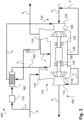
- Fig. 1 schematically illustrates a system 100 with a turbo machine 102 according to an embodiment of the invention.
- the turbo machine 102 e.g., a cryogenic turbo machine is configured as a compressor and an expander, i.e., both are combined in one turbo machine.
- the turbo machine 102 has an expander side 110 and a compressor side 120.
- Turbo machine 102 comprises, hence, an expander inlet 112 and an expander outlet 114 at the expander side 110, and a compressor inlet 122 and a compressor outlet 124 at the compressor side 120. Further, the turbo machine 102 comprises two impellers, an expander impeller 116 and a compressor impeller 126, both mounted on a shaft 130 of the turbo machine 102.
- the turbo machine 102 comprises bearings 140, 142 configured to support the shaft 130.
- a housing 150 of the turbo machine 102 is shown, enclosing, e.g., the bearing, the shaft and the impellers.
- These bearings 140, 142 can be active magnetic bearings.
- These induvial bearings 140, 142 can, in general, referred to as a bearing of the turbo machine.
- An expander process gas a i.e., a process gas or operating fluid to be expanded, is provided to the expander inlet 112 to be expanded; after expansion, the expander process gas a is guided from the turbo machine at the expander outlet 114.
- a compressor process gas b i.e., a process gas or operating fluid to be compressed, is provided to the compressor inlet 122 to be compressed; after compression, the compressor process gas b is guided from the turbo machine at the compressor outlet 124.
- the inlets 112, 122 and the outlets 114, 124 can, for example, be configured or formed as channels so as to guide the respective process gas to and from the respective impeller.
- the process gas or operating fluid to be compressed and the process gas or operating fluid to be expanded can have identical or can have different properties like pressure, temperature, chemical composition etc.
- a part of the expander process gas a is branched off and used as seal gas within a seal gas stream c, which is then provided to the bearing 140 for sealing the bearing 140.
- the seal gas stream c can be provided into labyrinths behind the expander impeller 116 within the housing 150. After having used for sealing the bearing, the seal gas stream c can be guided from the housing 150.
- a part of the compressor process gas b is branched off at the compressor outlet 124, to be used as a cooling gas within a cooling gas stream d; this cooling gas stream d is provided to the bearing 140, 142, inside the housing 150 to cool the bearing. After having cooled the bearing, the cooling gas stream d can be guided from the housing 150.
- the system 100 comprises a heat exchanger 160 which is used to heat the seal gas stream c in that the seal gas stream c is guided through the heat exchanger 160.
- a part of the compressor process gas b is branched off at the compressor outlet 124, to be used as at least part of the heat gas stream e.
- a valve 162 can be used to control flow to provide the right or desired flow to warm the seal gas to a wanted value.
- a heat gas stream e is provided as heating means (or heating medium) in the heat exchanger 160.After heating the seal gas stream c, the heat gas stream e is provided to the compressor inlet 122, i.e., this gas is then again compressed.
- heat generated during compression can be used, via the heat gas stream e, to heat the seal gas stream c.
- a separate warm seal gas stream from an external warm seal gas source 180 can be used, for example.
- Fig. 2 schematically illustrates a system 200 with a turbo machine 102 according to another embodiment of the invention.
- the turbo machine 102 can, at least basically, correspond to turbo machine 102 according to system 100 of Fig. 1 .
- the same or a similar flow of gases is used. Thus, it is referred to Fig. 1 and the corresponding explanations.
- system 200 comprises an external heater 170 that can be used, if necessary, to heat the seal gas stream c, e.g., for start-up and/or shut-down of the turbo machine 102.
- the seal gas stream c can be guided through the heater 170; in times when the heater 170 is not operated, the seal gas stream c is just guided through without being heated; rather, the seal gas stream is heated via the heat gas stream e and the heat exchanger 160.
- Fig. 3 schematically illustrates a system 300 with a turbo machine 102 according to another embodiment of the invention.
- the turbo machine 102 can, at least basically, correspond to turbo machine 102 according to system 100 of Fig. 1 .
- the same or a similar flow of gases is used. Thus, it is referred to Fig. 1 and the corresponding explanations.
- the heat gas stream is not obtained via (directly) branching off part of the compression process gas b at the compressor outlet 124. Rather, at least a part of the cooling gas d, after having cooled the bearing, is used as the heat gas stream e. In this way, the part branched off the compressor processing gas is first used for cooling the bearing and then used for heating the seal gas stream e.
Landscapes
- Engineering & Computer Science (AREA)
- Chemical & Material Sciences (AREA)
- Combustion & Propulsion (AREA)
- Mechanical Engineering (AREA)
- General Engineering & Computer Science (AREA)
- Structures Of Non-Positive Displacement Pumps (AREA)
Abstract
The invention relates to a method for operating a turbo machine (102), wherein the turbo machine comprises an expander side (110) having an expander inlet (112), an expander outlet (114) and an expander impeller (116), and a compressor side (120) having a compressor inlet (122), a compressor outlet (124) and compressor impeller (126), wherein the turbo machine further comprises a shaft (130) and a bearing (140, 142), wherein the expander impeller and the compressor impeller are arranged on and connected to each other via the shaft, and wherein the shaft is supported by the bearing, wherein a compressor process gas (b) is provided to the compressor inlet to be compressed, and an expander process gas (A) is provided to the expander inlet to be expanded, wherein a seal gas is provided, as a seal gas stream (c), to the bearing (140, 142) for sealing the bearing, wherein gas, after having been used or processed in the turbo machine is used, as a heat gas stream (e), to heat the seal gas stream. The invention also relates to a corresponding system (100).
Description
- The present invention relates to a method for operating a turbo machine comprising an expander side and a compressor side, and to a corresponding system.
- Turbo machines can be used in different applications. For example, in cryogenic applications, i.e. applications with process gases at cryogenic temperatures, e.g., plants for air separation or the like, cryogenic turbo machines like turbo expanders and/or compressors are often used. Such turbo machines typically comprise an expander impeller and/or a compressor impeller, which are fixed on a shaft.
- Such turbo machines typically also comprise an inlet or inlet channel at an expansion side configured to guide operating fluid, e.g., gas like the mentioned process gas, to such impeller, and an outlet or outlet channel configured to guide said operating fluid, e.g., after expansion, from that impeller, e.g., to the outside. Similarly, such turbo machines can comprise an inlet or inlet channel and an outlet or outlet channel at a compression side.
- A bearing of such turbo machine, e.g., a magnetic bearing, is typically supplied with a seal gas in order to seal the bearing during operation; this is required in order to prevent the bearing from getting too cold during operation if cold or cryogenic process fluids are used. This can require high energy. In addition, part of the mentioned process gas at the expander side can be used, at least in part, as the seal gas. In such case, the seal gas is typically rather cold and has to be heated before being provided to the bearing. This also can require high energy.
- Thus, an object of the present invention is to provide a way to improve energy efficiency for turbo machines.
- This object is achieved by providing a method for operating a turbo machine and a corresponding system with the features of the independent claims. Embodiments of the invention are the subject of the dependent claims and of the description that follows.
- The invention relates to turbo machines, in particular cryogenic turbo machines, wherein the turbo machine comprises an expander side having a compressor inlet, an expander outlet and an expander impeller, and a compressor side having a compressor inlet, a compressor out and compressor impeller. In addition, such turbo machine comprises a shaft and a bearing, wherein the expander impeller and the compressor impeller are arranged on and connected to each other via the shaft, and wherein the shaft is supported by the bearing. Typically, the turbo machine also comprises a housing or housing parts, preferably, comprising an expander housing, a compressor housing and a bearing housing.
- An operating or process gas is provided to the compressor inlet to be compressed via the compressor impeller (also called compressor process gas in the following), and operating or process gas is provided to the expander inlet to be expanded by the expander impeller (also called expander process gas in the following). The compressed gas is then provided at the compressor outlet, and the expanded gas is provided at the expander outlet. Note that both process gases can be of the same or of different type of gas. Types of turbomachines are, for example, centrifugal turbo machines and radial turbo machines.
- Cryogenic turbo machines, for example, are used with operating fluid like gases or process gases (or fluids or process fluids) at cryogenic temperatures, i.e., very low temperatures of, e.g., less than -100°C or even down to -230°C or -250°C at the expander outlet or at the compressor inlet.
- Further, a seal gas is provided, as a seal gas stream, to the bearing for sealing the bearing. Preferably, a part of the expander process gas is branched off to be used as at least part of the seal gas stream, before the expander process gas is provided to the expander inlet. For example, such seal gas can taken from expander inlet to be injected in the labyrinths behind the expander impeller. Usually in these applications, the gas is quite cold and need to be warmed up above its dewpoint to avoid condensation and liquid injection into the labyrinth seals. To do so, an electrical seal gas heater can be used; its consumption can vary from few kilowatts to hundreds of kilowatts in power and it can be regulated with a thyristor control panel, for example.
- Further, in an embodiment, a cooling gas is provided to the bearing for cooling the bearing. Preferably, a part of the compressor process gas is branched off at the compressor outlet, to be used as the cooling gas. Usually, such cooling gas is, after having been taken from the compressor outlet and used to cool to the bearings, is then reinjected in the compressor inlet.
- It has now turned out that the seal gas stream can be heated by using gas, after having been used or processed in the turbo machine, as a heat gas stream. In an embodiment, the heat gas stream is guided through a heat exchanger to heat the seal gas stream, i.e., the heat gas stream is used as heating means in the heat exchanger. Such heat exchanger can be of usual type, e.g., of tubular or plate type. In this way, the heating of the seal gas stream can be made more efficient and less additional heating energy is required. An additional heater for heating the seal gas stream can be avoided or at least be made smaller with less energy consumption or operated at reduced times.
- The necessity to have electrical heater on skid, what can sometimes be inconvenient for the end user, not only due to the electricity consumption but also because of the need to be connected to MCC (Motor Control Center) and add power cables, is avoided or at least reduced.
- In an embodiment, a part of the compressor process gas is branched off at the compressor outlet, to be used as at least part of said heat gas stream. In another embodiment, at least a part of the cooling gas, after having cooled the bearing, is used as at least a part of the heat gas stream. As mentioned before, this cooling gas can also be branched off at the compressor outlet. In this way, process gas after having been compressed is used to heat the seal gas stream, be it with or without using this branched off process gas for cooling the bearing. It is noted that both variants can also be combined.
- In an embodiment, after having been used to heat the seal gas stream, the heat gas stream is provided to said compressor inlet. In other words, the seal gas can be routed back to the compressor side where it has previously been branched off, for example.
- In an embodiment, for start-up and/or shut-down of the turbo-machine, warm seal gas is provided to the bearing as the seal gas stream; alternatively, an external heater is used to heat the seal gas stream for start-up and/or shut-down; further alternatively, the bearing is heated for start-up and/or shut-down. If required or so desired, two or all three of these variants can be combined. Such external heater can, thus, be provided and used if other possibilities to sufficiently heat the seal gas stream or bearing, in particular for start-up and/or shut-down, is not available.
- In an embodiment, the bearing is a magnetic bearing, preferably, an active magnetic bearing. Such types of bearings require particular cooling.
- To sum up, if a warm seal gas source is available for start-up and shutdown of the turbo machine, e.g., a tapping can be made at compressor outlet and a pipe added to a gas/gas heat exchanger located on seal gas line, to warm the seal gas coming from the expander inlet after the start-up of the turbo machine. Then cold gas can be reinjected at the compressor inlet. Flow control can be done with a locked in position valve before the heat exchanger giving the right flow to warm the seal gas to the wanted value. A size of the pipes, valves and exchanger can be evaluated during detailed engineering depending on the cases, gas composition and pressure and temperature.
- The same configuration as before can be used, but with a tapping being made at cooling gas outlet piping and then being routed back to the compressor inlet.
- If a warm seal gas source is not available for start-up and shutdown of the turbo machine, a heater, e.g., an electrical heater can be used. Usually, it is used continuously during normal operation to warm the seal gas. To reduce the consumption and even stop the heater during normal operation, a tapping can be made at the compressor outlet and a pipe added to a gas/gas heat exchanger located on seal gas line just after the heater, to warm the seal gas coming from the expander inlet after the start-up of the turbo machine. Then cold gas can be reinjected at the compressor inlet. Flow control will be done with a locked in position valve before the heat exchanger giving the right flow to warm the seal gas to the wanted value. A size of the pipes, valves and exchanger can be evaluated during detailed engineering depending on the cases, gas composition and pressure and temperature.
- The shutdown or reduction of the heater consumption can be driven through the measurement of a temperature on a seal gas line after the pressure control valve (PDCV). When the compressor runs in normal operation, the temperature of the seal gas will increase due to both action of heater and gas/gas heat exchanger, then to maintain the temperature, power to electrical heater can be reduced and eventually stopped depending on the gas composition and temperature.
- The same configuration as before can be used, but with a tapping being made at cooling gas outlet piping and then being routed back to the compressor inlet.
- Further advantages and embodiments of the invention will be apparent from the description and the accompanying drawing. The invention is illustrated schematically by means of embodiments in the drawing and is described below with reference to the drawing.
-
- Fig. 1
- illustrates a system with a turbo machine according to an embodiment of the invention;
- Fig. 2
- illustrates a system with a turbo machine according to another embodiment of the invention;
- Fig. 3
- illustrates a system with a turbo machine according to another embodiment of the invention; and
- Fig. 4
- illustrates a system with a turbo machine according to another embodiment of the invention.
-
Fig. 1 schematically illustrates asystem 100 with aturbo machine 102 according to an embodiment of the invention. Theturbo machine 102, e.g., a cryogenic turbo machine is configured as a compressor and an expander, i.e., both are combined in one turbo machine. Thus, theturbo machine 102 has anexpander side 110 and acompressor side 120. -
Turbo machine 102 comprises, hence, anexpander inlet 112 and anexpander outlet 114 at theexpander side 110, and acompressor inlet 122 and acompressor outlet 124 at thecompressor side 120. Further, theturbo machine 102 comprises two impellers, anexpander impeller 116 and acompressor impeller 126, both mounted on ashaft 130 of theturbo machine 102. - Further, the
turbo machine 102 comprisesbearings shaft 130. In addition, ahousing 150 of theturbo machine 102 is shown, enclosing, e.g., the bearing, the shaft and the impellers. Thesebearings induvial bearings - An expander process gas a, i.e., a process gas or operating fluid to be expanded, is provided to the
expander inlet 112 to be expanded; after expansion, the expander process gas a is guided from the turbo machine at theexpander outlet 114. A compressor process gas b, i.e., a process gas or operating fluid to be compressed, is provided to thecompressor inlet 122 to be compressed; after compression, the compressor process gas b is guided from the turbo machine at thecompressor outlet 124. Theinlets outlets - The process gas or operating fluid to be compressed and the process gas or operating fluid to be expanded can have identical or can have different properties like pressure, temperature, chemical composition etc.
- Further, a part of the expander process gas a is branched off and used as seal gas within a seal gas stream c, which is then provided to the
bearing 140 for sealing thebearing 140. In particular, the seal gas stream c can be provided into labyrinths behind theexpander impeller 116 within thehousing 150. After having used for sealing the bearing, the seal gas stream c can be guided from thehousing 150. - Further, a part of the compressor process gas b is branched off at the
compressor outlet 124, to be used as a cooling gas within a cooling gas stream d; this cooling gas stream d is provided to thebearing housing 150 to cool the bearing. After having cooled the bearing, the cooling gas stream d can be guided from thehousing 150. - Further, the
system 100 comprises aheat exchanger 160 which is used to heat the seal gas stream c in that the seal gas stream c is guided through theheat exchanger 160. - Further, a part of the compressor process gas b is branched off at the
compressor outlet 124, to be used as at least part of the heat gas stream e. Avalve 162 can be used to control flow to provide the right or desired flow to warm the seal gas to a wanted value. A heat gas stream e is provided as heating means (or heating medium) in the heat exchanger 160.After heating the seal gas stream c, the heat gas stream e is provided to thecompressor inlet 122, i.e., this gas is then again compressed. - In this way, heat generated during compression can be used, via the heat gas stream e, to heat the seal gas stream c. For start-up and/or shut-down of the
turbo machine 102, a separate warm seal gas stream from an external warmseal gas source 180 can be used, for example. -
Fig. 2 schematically illustrates asystem 200 with aturbo machine 102 according to another embodiment of the invention. Theturbo machine 102 can, at least basically, correspond toturbo machine 102 according tosystem 100 ofFig. 1 . In addition, the same or a similar flow of gases is used. Thus, it is referred toFig. 1 and the corresponding explanations. - In addition,
system 200 comprises anexternal heater 170 that can be used, if necessary, to heat the seal gas stream c, e.g., for start-up and/or shut-down of theturbo machine 102. The seal gas stream c can be guided through theheater 170; in times when theheater 170 is not operated, the seal gas stream c is just guided through without being heated; rather, the seal gas stream is heated via the heat gas stream e and theheat exchanger 160. -
Fig. 3 schematically illustrates asystem 300 with aturbo machine 102 according to another embodiment of the invention. Theturbo machine 102 can, at least basically, correspond toturbo machine 102 according tosystem 100 ofFig. 1 . In addition, the same or a similar flow of gases is used. Thus, it is referred toFig. 1 and the corresponding explanations. - Contrary to
system 100 inFig. 1 , however, the heat gas stream is not obtained via (directly) branching off part of the compression process gas b at thecompressor outlet 124. Rather, at least a part of the cooling gas d, after having cooled the bearing, is used as the heat gas stream e. In this way, the part branched off the compressor processing gas is first used for cooling the bearing and then used for heating the seal gas stream e. - It is noted that this variant can be used in combination with that of
system 100, i.e., part of the compression process gas b branched off at the compressor outlet can directly be guided to theheat exchanger 160, and another part can first be used as cooling gas d and then be combined with the other part such as to enter theheat exchanger 160 together. -
Fig. 4 schematically illustrates asystem 400 with aturbo machine 102 according to another embodiment of the invention. Theturbo machine 102 can, at least basically, correspond toturbo machine 102 according tosystem 300 ofFig. 3 . In addition, the same or a similar flow of gases is used. Thus, it is referred toFigs. 1 and3 and the corresponding explanations. - In addition,
system 400 comprises anexternal heater 170 that can be used, if necessary, to heat the seal gas stream c, e.g., for start-up and/or shut-down of theturbo machine 102. The seal gas stream c can be guided through theheater 170; in times when theheater 170 is not operated, the seal gas stream c is just guided through without being heated; rather, the seal gas stream is heated via the heat gas stream e and theheat exchanger 160. - Thus, with respect to where the heat gas stream e is obtained,
system 400 corresponds tosystem 300 but with respect to the external heater,system 400 corresponds tosystem 200. - Again, it is noted that this variant can be used in combination with that of
system 300, i.e., part of the compression process gas b branched off at the compressor outlet can directly be guided to theheat exchanger 160, and another part can first be used as cooling gas d and then be combined with the other part such as to enter theheat exchanger 160 together.
Claims (15)
- A method for operating a turbo machine (102), wherein the turbo machine comprises an expander side (110) having an expander inlet (112), an expander outlet (114) and an expander impeller (116), and a compressor side (120) having a compressor inlet (122), a compressor outlet (124) and compressor impeller (126),wherein the turbo machine further comprises a shaft (130) and a bearing (140, 142), wherein the expander impeller and the compressor impeller are arranged on and connected to each other via the shaft, and wherein the shaft is supported by the bearing,wherein a compressor process gas (b) is provided to the compressor inlet to be compressed, and an expander process gas (A) is provided to the expander inlet to be expanded,wherein a seal gas is provided, as a seal gas stream (c), to the bearing (140, 142) for sealing the bearing,wherein gas, after having been used or processed in the turbo machine, is used, as a heat gas stream (e), to heat the seal gas stream.
- The method of claim 1, wherein a part of the compressor process gas (b) is branched off at the compressor outlet (124), to be used as at least part of said heat gas stream (e).
- The method of claim 1 or 2, wherein a cooling gas (d) is provided to the bearing for cooling the bearing, and
wherein, at least a part of the cooling gas (d), after having cooled the bearing, is used as at least a part of the heat gas stream (e). - The method of claim 3, wherein a part of the compressor process gas (b) is branched off at the compressor outlet (124), to be used as the cooling gas (d).
- The method of any one of the preceding claims, wherein, after having been used to heat the seal gas stream, the heat gas stream (e) is provided to the compressor inlet (122).
- The method of any one of the preceding claims, wherein a part of the expander process gas (a) is branched off to be used as at least part of the seal gas stream (c), before the expander process gas is provided to the expander inlet. (112)
- The method of any one of the preceding claims, wherein the heat gas stream is guided through a heat exchanger (160) to heat the seal gas stream (c).
- The method of any one of the preceding claims, wherein, for start-up and/or shut-down of the turbo-machine:- warm seal gas is provided to the bearing as the seal gas stream, or- an external heater is used to heat the seal gas stream, or- the bearing is heated.
- The method of any one of the preceding claims, wherein the bearing is a magnetic bearing, preferably, an active magnetic bearing.
- A system (100, 200, 300, 400) comprising a turbo machine (102), wherein the turbo machine comprises an expander side (110) having a compressor inlet (112), an expander outlet (114) and an expander impeller (116), a compressor side (120) having a compressor inlet (122), a compressor outlet (124) and compressor impeller (126),wherein the turbo machine further comprises a shaft and a bearing, wherein the expander impeller and the compressor impeller are arranged on and connected to each other via the shaft, and wherein the shaft is supported by the bearing,wherein the system is configured to provide a compressor process gas at the compressor inlet to be compressed, and to provide an expander process gas at the expander inlet to be expanded,wherein the system is configured to provide a seal gas, as a seal gas stream, to the bearing for sealing the bearing, andwherein the system is further configured to use gas, after having been used or processed in the turbo machine is used, as a heat gas stream, to heat the first seal gas stream
- The system of claim 10, further configured to branch off a part of the compressor process gas at the compressor outlet, to be used as at least part of said heat gas stream.
- The system of claim 10 or 11, further configured to provide a cooling gas to the bearing for cooling the bearing, and to use at least a part of the cooling gas, after having cooled the bearing, as at least a part of the heat gas stream,
wherein, preferably, the system is further configured to branch off a part of the compressor process gas at the compressor outlet, to be used as the cooling gas. - The system of any one of claims 10 to 12, further comprising a heat exchanger, wherein the system is configured to guide the heat gas stream through the heat exchanger to heat the seal gas stream,
- The system of any one of claims 10 to 13, further configured to, for start-up of the turbo-machine:- provide warm seal gas to said bearing as the seal gas stream, or- use an external heater of the system to heat the seal gas stream, or- heat the bearing.
- The system of any one of claims 10 to 14, further configured to perform the method of any one of claims 1 to 9.
Priority Applications (3)
| Application Number | Priority Date | Filing Date | Title |
|---|---|---|---|
| EP23315396.4A EP4545773A1 (en) | 2023-10-24 | 2023-10-24 | Method for operating a turbo machine and corresponding system |
| PCT/EP2024/025303 WO2025087557A1 (en) | 2023-10-24 | 2024-10-15 | Method for operating a turbo machine and corresponding system |
| CN202480065569.8A CN122029345A (en) | 2023-10-24 | 2024-10-15 | Method for operating a turbomachine and corresponding system |
Applications Claiming Priority (1)
| Application Number | Priority Date | Filing Date | Title |
|---|---|---|---|
| EP23315396.4A EP4545773A1 (en) | 2023-10-24 | 2023-10-24 | Method for operating a turbo machine and corresponding system |
Publications (1)
| Publication Number | Publication Date |
|---|---|
| EP4545773A1 true EP4545773A1 (en) | 2025-04-30 |
Family
ID=88833981
Family Applications (1)
| Application Number | Title | Priority Date | Filing Date |
|---|---|---|---|
| EP23315396.4A Withdrawn EP4545773A1 (en) | 2023-10-24 | 2023-10-24 | Method for operating a turbo machine and corresponding system |
Country Status (3)
| Country | Link |
|---|---|
| EP (1) | EP4545773A1 (en) |
| CN (1) | CN122029345A (en) |
| WO (1) | WO2025087557A1 (en) |
Citations (5)
| Publication number | Priority date | Publication date | Assignee | Title |
|---|---|---|---|---|
| US20190041124A1 (en) * | 2016-03-09 | 2019-02-07 | Nuovo Pignone Tecnologie Srl | Integrated expander-motor compressor |
| CN113899096A (en) * | 2021-10-15 | 2022-01-07 | 西安热工研究院有限公司 | Dry gas sealing waste heat utilization coupling heat exchanger and method based on carbon dioxide power generation system |
| WO2022117227A1 (en) * | 2020-12-03 | 2022-06-09 | Nuovo Pignone Tecnologie - S.R.L. | Sealing gas leakage recovery and sealing gas boosting system and method |
| WO2023066518A1 (en) * | 2021-10-19 | 2023-04-27 | Nuovo Pignone Tecnologie - S.R.L. | Closed-loop cooling fluid circuit for magnetic bearings of an expander-compressor system |
| CN219492612U (en) * | 2022-12-05 | 2023-08-08 | 中国船舶集团有限公司第七一一研究所 | Control system of magnetic suspension centrifugal compressor |
-
2023
- 2023-10-24 EP EP23315396.4A patent/EP4545773A1/en not_active Withdrawn
-
2024
- 2024-10-15 WO PCT/EP2024/025303 patent/WO2025087557A1/en active Pending
- 2024-10-15 CN CN202480065569.8A patent/CN122029345A/en active Pending
Patent Citations (5)
| Publication number | Priority date | Publication date | Assignee | Title |
|---|---|---|---|---|
| US20190041124A1 (en) * | 2016-03-09 | 2019-02-07 | Nuovo Pignone Tecnologie Srl | Integrated expander-motor compressor |
| WO2022117227A1 (en) * | 2020-12-03 | 2022-06-09 | Nuovo Pignone Tecnologie - S.R.L. | Sealing gas leakage recovery and sealing gas boosting system and method |
| CN113899096A (en) * | 2021-10-15 | 2022-01-07 | 西安热工研究院有限公司 | Dry gas sealing waste heat utilization coupling heat exchanger and method based on carbon dioxide power generation system |
| WO2023066518A1 (en) * | 2021-10-19 | 2023-04-27 | Nuovo Pignone Tecnologie - S.R.L. | Closed-loop cooling fluid circuit for magnetic bearings of an expander-compressor system |
| CN219492612U (en) * | 2022-12-05 | 2023-08-08 | 中国船舶集团有限公司第七一一研究所 | Control system of magnetic suspension centrifugal compressor |
Also Published As
| Publication number | Publication date |
|---|---|
| WO2025087557A1 (en) | 2025-05-01 |
| CN122029345A (en) | 2026-05-12 |
Similar Documents
| Publication | Publication Date | Title |
|---|---|---|
| CN102032046B (en) | For cooling system and the corresponding operating method of combustion gas turbine | |
| EP2290241A1 (en) | Turbocompressor assembly with a cooling system | |
| CN106460545B (en) | Gas Turbine Generator Cooling | |
| WO2017090709A1 (en) | Gas turbine and component-temperature adjustment method therefor | |
| CN104136767A (en) | Cryogenic liquid expansion turbine | |
| JPH03117601A (en) | Turbo apparatus with seal fluid-recovering channel | |
| CN111894890B (en) | Seal assembly for compressor | |
| WO2025087557A1 (en) | Method for operating a turbo machine and corresponding system | |
| KR20210007907A (en) | Refrigeration and/or liquefaction device | |
| EP4476450B1 (en) | Multistage turbo machine system and method of operating | |
| WO2002050481A1 (en) | Refrigerating system with an integrated turbocompressor | |
| US7278818B2 (en) | Turbomachine for low temperature applications | |
| US20250364871A1 (en) | Integral expander generator for hydrogen applications with magnetic bearings | |
| US20240068382A1 (en) | Rotary machine and refrigeration device using same | |
| KR20250084888A (en) | Cryogenic expansion turbine with magnetic bearings | |
| EP3929453B1 (en) | Foil bearing lubrication | |
| JP7391196B2 (en) | an integrated motor-compressor unit having a cooling circuit and a pressure reduction system configured to reduce the pressure of the cooling fluid; | |
| EP4545767A1 (en) | Method for operating a turbo machine, turbo machine and method of manufacturing | |
| KR102826271B1 (en) | Enclosed turbo machinery | |
| RU2583191C1 (en) | Space power plant with machine energy conversion | |
| US20250027511A1 (en) | Integrated motor-compressor unit having a cooling circuit and a depressurization system configured to reduce pressure of the cooling fluid | |
| CN114901924B (en) | Integrated expander and motor-compressor assembly and closed-loop cooling circuit including such assembly | |
| JPH09303287A (en) | Gas compressor | |
| CN117948299A (en) | A centrifugal compressor | |
| CN116357591A (en) | Integrated multi-stage intercooler compressor |
Legal Events
| Date | Code | Title | Description |
|---|---|---|---|
| PUAI | Public reference made under article 153(3) epc to a published international application that has entered the european phase |
Free format text: ORIGINAL CODE: 0009012 |
|
| STAA | Information on the status of an ep patent application or granted ep patent |
Free format text: STATUS: THE APPLICATION HAS BEEN PUBLISHED |
|
| AK | Designated contracting states |
Kind code of ref document: A1 Designated state(s): AL AT BE BG CH CY CZ DE DK EE ES FI FR GB GR HR HU IE IS IT LI LT LU LV MC ME MK MT NL NO PL PT RO RS SE SI SK SM TR |
|
| STAA | Information on the status of an ep patent application or granted ep patent |
Free format text: STATUS: THE APPLICATION IS DEEMED TO BE WITHDRAWN |
|
| 18D | Application deemed to be withdrawn |
Effective date: 20251031 |