EP4545654A1 - Material discharge control device and material charging device - Google Patents
Material discharge control device and material charging device Download PDFInfo
- Publication number
- EP4545654A1 EP4545654A1 EP23857176.4A EP23857176A EP4545654A1 EP 4545654 A1 EP4545654 A1 EP 4545654A1 EP 23857176 A EP23857176 A EP 23857176A EP 4545654 A1 EP4545654 A1 EP 4545654A1
- Authority
- EP
- European Patent Office
- Prior art keywords
- raw material
- discharge
- hopper
- discharge amount
- property
- Prior art date
- Legal status (The legal status is an assumption and is not a legal conclusion. Google has not performed a legal analysis and makes no representation as to the accuracy of the status listed.)
- Pending
Links
Images





Classifications
-
- C—CHEMISTRY; METALLURGY
- C21—METALLURGY OF IRON
- C21B—MANUFACTURE OF IRON OR STEEL
- C21B7/00—Blast furnaces
- C21B7/18—Bell-and-hopper arrangements
- C21B7/20—Bell-and-hopper arrangements with appliances for distributing the burden
-
- C—CHEMISTRY; METALLURGY
- C21—METALLURGY OF IRON
- C21B—MANUFACTURE OF IRON OR STEEL
- C21B5/00—Making pig-iron in the blast furnace
- C21B5/006—Automatically controlling the process
-
- C—CHEMISTRY; METALLURGY
- C21—METALLURGY OF IRON
- C21B—MANUFACTURE OF IRON OR STEEL
- C21B5/00—Making pig-iron in the blast furnace
- C21B5/008—Composition or distribution of the charge
-
- C—CHEMISTRY; METALLURGY
- C21—METALLURGY OF IRON
- C21B—MANUFACTURE OF IRON OR STEEL
- C21B7/00—Blast furnaces
- C21B7/18—Bell-and-hopper arrangements
-
- C—CHEMISTRY; METALLURGY
- C21—METALLURGY OF IRON
- C21B—MANUFACTURE OF IRON OR STEEL
- C21B7/00—Blast furnaces
- C21B7/24—Test rods or other checking devices
-
- F—MECHANICAL ENGINEERING; LIGHTING; HEATING; WEAPONS; BLASTING
- F27—FURNACES; KILNS; OVENS; RETORTS
- F27B—FURNACES, KILNS, OVENS OR RETORTS IN GENERAL; OPEN SINTERING OR LIKE APPARATUS
- F27B1/00—Shaft or like vertical or substantially vertical furnaces
- F27B1/10—Details, accessories or equipment specially adapted for furnaces of these types
- F27B1/20—Arrangements of devices for charging
-
- F—MECHANICAL ENGINEERING; LIGHTING; HEATING; WEAPONS; BLASTING
- F27—FURNACES; KILNS; OVENS; RETORTS
- F27B—FURNACES, KILNS, OVENS OR RETORTS IN GENERAL; OPEN SINTERING OR LIKE APPARATUS
- F27B1/00—Shaft or like vertical or substantially vertical furnaces
- F27B1/10—Details, accessories or equipment specially adapted for furnaces of these types
- F27B1/26—Arrangements of controlling devices
-
- F—MECHANICAL ENGINEERING; LIGHTING; HEATING; WEAPONS; BLASTING
- F27—FURNACES; KILNS; OVENS; RETORTS
- F27D—DETAILS OR ACCESSORIES OF FURNACES, KILNS, OVENS OR RETORTS, IN SO FAR AS THEY ARE OF KINDS OCCURRING IN MORE THAN ONE KIND OF FURNACE
- F27D19/00—Arrangements of controlling devices
-
- F—MECHANICAL ENGINEERING; LIGHTING; HEATING; WEAPONS; BLASTING
- F27—FURNACES; KILNS; OVENS; RETORTS
- F27D—DETAILS OR ACCESSORIES OF FURNACES, KILNS, OVENS OR RETORTS, IN SO FAR AS THEY ARE OF KINDS OCCURRING IN MORE THAN ONE KIND OF FURNACE
- F27D21/00—Arrangement of monitoring devices; Arrangement of safety devices
-
- F—MECHANICAL ENGINEERING; LIGHTING; HEATING; WEAPONS; BLASTING
- F27—FURNACES; KILNS; OVENS; RETORTS
- F27D—DETAILS OR ACCESSORIES OF FURNACES, KILNS, OVENS OR RETORTS, IN SO FAR AS THEY ARE OF KINDS OCCURRING IN MORE THAN ONE KIND OF FURNACE
- F27D3/00—Charging; Discharging; Manipulation of charge
- F27D3/10—Charging directly from hoppers or shoots
-
- C—CHEMISTRY; METALLURGY
- C21—METALLURGY OF IRON
- C21B—MANUFACTURE OF IRON OR STEEL
- C21B2300/00—Process aspects
- C21B2300/04—Modeling of the process, e.g. for control purposes; CII
Definitions
- the present disclosure relates to a raw material discharge control apparatus and a raw material charging apparatus.
- the raw material In a production process that uses raw material such as minerals, the raw material is discharged from a raw material hopper that temporarily stores the raw material. At this time, it is important to control the discharge amount of raw material discharged from the raw material hopper, because the discharge amount of raw material affects productivity.
- raw material discharged from the raw material hopper is charged into the furnace through a rotating chute.
- the charged material is deposited in the furnace and forms a certain deposition shape.
- This deposition shape has a significant impact on conditions in the furnace. Consequently, if the discharge amount of raw material fluctuates over time, the conditions in the furnace may deteriorate.
- one known technique attempts to control the discharge amount of raw material to be constant by maintaining a constant degree of opening of the raw material hopper.
- the discharge amount of material raw ends up fluctuating over time even when the degree of opening of the raw material hopper is kept constant.
- it has been difficult to capture temporal fluctuations in raw material properties over a short period of time because the values for raw material properties have been calculated about once a week through batch sampling and sieve analysis of small amounts.
- Patent Literature (PTL) 1 discloses a technique for constantly calculating the degree of opening of the raw material hopper and the actual value of the raw material discharge rate and adjusting the degree of opening of the raw material hopper to achieve a target raw material discharge rate, in order to control the discharge amount of raw material from the raw material hopper to be constant.
- the discharge amount of raw material discharged from a raw material hopper can be accurately controlled even when there are changes in the properties of the raw material.
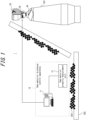
- FIG. 1 is a diagram schematically illustrating an example configuration of a raw material charging apparatus 1 that includes a raw material discharge control apparatus 10 according to an embodiment of the present disclosure.
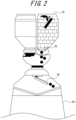
- FIG. 2 is an enlarged view of the area near a raw material hopper 20 in FIG. 1 . Referring to FIGS. 1 and 2 , the raw material charging apparatus 1 and raw material discharge control apparatus 10 are described.
- the raw material charging apparatus 1 is an apparatus that charges raw material 203, carried by a conveyor 202 for charging raw material, into a blast furnace 201.
- the raw material charging apparatus 1 includes the raw material discharge control apparatus 10, the raw material hopper 20, a flow regulating gate 30, and a rotating chute 40.
- the raw material charging apparatus 1 charges the raw material 203 into the blast furnace 201 by using the raw material discharge control apparatus 10 to control the discharge amount of the raw material 203 discharged from the raw material hopper 20.
- the raw material discharge control apparatus 10 is used in the raw material charging apparatus 1, which charges the raw material 203 carried by the conveyor 202 into the blast furnace 201, is described as an example, but the process in which the raw material discharge control apparatus 10 is used is not limited to this example.
- the raw material discharge control apparatus 10 can be used in any process that uses the raw material hopper 20 to charge the raw material 203.
- the raw material 203 may be coke but is not limited to this example.
- the raw material 203 may, for example, be ore, sintered ore, pellets, limestone, rock, concrete raw material, powder and granular material, or the like.
- the raw material discharge control apparatus 10 controls the discharge amount of the raw material 203 discharged from the raw material hopper 20.
- the raw material discharge control apparatus 10 includes a control unit 11 and a raw material property measurement unit 12. Details on the configuration and functions of the raw material discharge control apparatus 10 are described below.
- the raw material hopper 20 temporarily stores the raw material 203 transported by the conveyor 202.
- the raw material hopper 20 can discharge the stored raw material 203 into the blast furnace 201.
- the flow regulating gate 30 can control the discharge amount of the raw material 203 discharged from the raw material hopper 20.
- the flow regulating gate 30 is a gate whose degree of opening can be adjusted. As the degree of opening of the flow regulating gate 30 is greater, the discharge amount of the raw material 203 discharged from the raw material hopper 20 increases. As the degree of opening of the flow regulating gate 30 is smaller, the discharge amount of the raw material 203 discharged from the raw material hopper 20 decreases.
- the degree of opening of the flow regulating gate 30 is controlled by the control unit 11.
- the rotating chute 40 is arranged at the top of the blast furnace 201.
- the rotating chute 40 turns at a predetermined speed.
- the raw material 203 discharged from the raw material hopper 20 is charged into the blast furnace 201 through the rotating chute 40.
- control unit 11 and raw material property measurement unit 12 included in the raw material discharge control apparatus 10 are described.
- the control unit 11 acquires property values of the raw material 203 as measured by the raw material property measurement unit 12.
- the property values of the raw material 203 measured by the raw material property measurement unit 12 are the property values of the raw material 203 being transported by the conveyor 202, i.e., the property values of the raw material 203 before the raw material 203 is charged into the raw material hopper 20.
- the control unit 11 controls the discharge amount of the raw material 203 discharged from the raw material hopper 20 based on the property values of the raw material 203 as acquired from the raw material property measurement unit 12.
- the control unit 11 controls the discharge amount of the raw material 203 discharged from the raw material hopper 20 by adjusting the degree of opening of the flow regulating gate 30.
- FIG. 3 is a diagram schematically illustrating an example configuration of the control unit 11 according to an embodiment of the present disclosure.
- the control unit 11 may be a general-purpose computer, such as a workstation or personal computer, or may be a dedicated computer configured to function as the control unit 11 of the raw material discharge control apparatus 10. Referring to FIG. 3 , the configuration of the control unit 11 is described.
- the control unit 11 includes a controller 111, an input interface 112, an output interface 113, a memory 114, and a communication interface 115.
- the controller 111 includes at least one processor, at least one dedicated circuit, or a combination thereof.
- the processor is a general-purpose processor such as a Central Processing Unit (CPU) or a Graphics Processing Unit (GPU), or a dedicated processor that is dedicated to specific processing.
- Examples of dedicated circuits can include a Field-Programmable Gate Array (FPGA) and an Application Specific Integrated Circuit (ASIC).
- the controller 111 reads programs, data, and the like stored in the memory 114 and executes various functions.
- the controller 111 controls the flow regulating gate 30.
- the input interface 112 includes one or more interfaces for input to detect user input and acquire input information based on user operations.
- the input interface 112 includes a physical key, a capacitive key, a touch screen integrally provided with a display of the output interface 113, or a microphone that accepts voice input.
- the output interface 113 includes one or more interfaces for output to output information and notify the user.
- the output interface 113 includes a display for outputting information in the form of images or a speaker for outputting information in the form of audio.
- the display included in the output interface 113 may, for example, be a Liquid Crystal Display (LCD), a Cathode Ray Tube (CRT) display, or the like.
- the memory 114 is, for example, a flash memory, a hard disk, an optical memory, or the like. A portion of the memory 114 may be external to the control unit 11. In this case, the portion of the memory 114 may be a hard disk, a memory card, or the like connected to the control unit 11 by any interface.
- the memory 114 stores programs for the controller 111 to perform each function, data used by the programs, and the like.
- the communication interface 115 includes at least one of a communication module compatible with wired communication and a communication module compatible with wireless communication.
- the control unit 11 can communicate with other apparatuses and the like via the communication interface 115.
- the raw material property measurement unit 12 measures the property values of the raw material 203 being carried by the conveyor 202. In other words, the raw material property measurement unit 12 measures the property values of the raw material 203 before the raw material 203 is charged into the raw material hopper 20.
- the property values measured by the raw material property measurement unit 12 include at least one of particle size, shape, moisture content, and surface condition of the raw material.
- the significance of the raw material property measurement unit 12 measuring the particle size, shape, moisture content, and surface condition of the raw material 203 as the property values of the raw material 203 is now described.
- the particle size of the raw material 203 is described. As the particle size of the raw material 203 is smaller, the friction between particles of the raw material 203 is reduced. It is thought that because of the resulting increase in fluidity of the raw material 203, the discharge rate of the raw material 203 discharged from the raw material hopper 20 becomes faster for the same degree of opening of the flow regulating gate 30. The particle size of the raw material 203 thus affects the discharge rate of the raw material 203 from the raw material hopper 20.
- the shape of the raw material 203 is described. If the shape of the raw material 203 is angular, it is thought that the discharge rate of the raw material 203 discharged from the raw material hopper 20 becomes slower for the same degree of opening of the flow regulating gate 30. The shape of the raw material 203 thus affects the discharge rate of the raw material 203 from the raw material hopper 20.
- the moisture content of the raw material 203 is described. As the moisture content of the raw material 203 increases, the density of the raw material 203 increases and the friction on the surface of the raw material 203 decreases. It is then thought that the discharge rate of the raw material 203 discharged from the raw material hopper 20 becomes faster for the same degree of opening of the flow regulating gate 30. The moisture content of the raw material 203 thus affects the discharge rate of the raw material 203 from the raw material hopper 20.
- Influencing factors that express the surface condition of the raw material 203 include the roughness of the surface itself, the amount of moisture on the surface, and the amount of powder on the surface. Changes in these influencing factors change the friction of the raw material 203, which in turn changes the discharge rate of the raw material 203 discharged from the raw material hopper 20.
- the surface condition of the raw material 203 thus affects the discharge rate of the raw material 203 from the raw material hopper 20.
- the particle size, shape, moisture content, and surface condition of the raw material 203 as the property values of the raw material 203 thus affect the discharge rate of the raw material 203 discharged from the raw material hopper 20. Therefore, the raw material property measurement unit 12 measures property values such as the particle size, shape, moisture content, and surface condition of the raw material 203, and the control unit 11 controls the discharge amount of the raw material 203 discharged from the raw material hopper 20 based on the property values of the raw material 203, thereby enabling the discharge amount of the raw material 203 to be accurately controlled.
- the raw material property measurement unit 12 includes a distance measurement apparatus, an image measurement apparatus, and a moisture measurement apparatus.
- the raw material property measurement unit 12 may include either a distance measurement apparatus or an image measurement apparatus, rather than both a distance measurement apparatus and an image measurement apparatus.
- the distance measurement apparatus and the image measurement apparatus can measure the particle size, shape, and surface condition of the raw material 203.
- the moisture measurement apparatus can measure the moisture content of the raw material 203.
- the distance measurement apparatus may, for example, be a two-dimensional laser rangefinder.
- a laser rangefinder irradiates a laser beam in a line along the width direction of the conveyor 202 to measure the distance to the raw material 203 to be measured, one line at a time.
- the laser rangefinder measures the distance to the raw material 203 in a line at regular intervals.
- the laser rangefinder can generate 3D shape data for the raw material 203 by integrating the distance measurements at each line.
- the image measurement apparatus may calculate the particle size of the raw material 203 by, for example, averaging the diameters of individual particles obtained by image processing.
- particle size can be used.
- the circular equivalent diameter, major axis length, minor axis length, Feret diameter, or the like can be used as the definition of the particle size.
- the image measurement apparatus can calculate the shape of individual particles of the raw material 203 by identifying the individual particles.
- the image measurement apparatus may calculate the shape of the raw material 203 by averaging the diameters of individual particles.
- particle shape can be used.
- the circularity, convexity, solidity, or the like can be used as the definition of the particle shape.
- a distance measurement apparatus such as a laser rangefinder can calculate the surface roughness, which is one of the surface conditions.
- Various methods exist for calculating surface roughness For example, general indices such as Ra and Rz can be used. The method of calculating the surface roughness is not limited to this example, and any index related to the degree of unevenness affecting friction can be used.
- the amount of powder the weight percentage of the fine grain portion obtained from the particle size measurement, such as the weight percentage of the particle size data below 5 mm, can be used as an index.
- the moisture measurement apparatus may, for example, be a neutron moisture meter or an infrared moisture meter.
- the neutron moisture meter irradiates neutrons from a neutron source.
- the irradiated neutrons are partly transmitted through the raw material 203 and partly reflected depending on the moisture content of the raw material 203.
- the neutron moisture meter can detect the reflected neutrons and calculate the value of the moisture content based on the amount of reflection.
- the infrared moisture meter can measure the moisture content using infrared wavelengths that have absorption sensitivity to moisture.
- the infrared moisture meter can irradiate infrared rays onto the raw material 203 and calculate the value of the moisture content based on the degree of absorption.
- the controller 111 of the control unit 11 acquires, via the communication interface 115, the property values of the raw material 203 as measured by the raw material property measurement unit 12.
- the memory 114 may store coefficients for estimating the discharge rate of the raw material 203 discharged from the raw material hopper 20, taking the degree of opening of the flow regulating gate 30 and the property values of the raw material 203 as explanatory variables. These coefficients may be coefficients calculated by multiple regression analysis based on pre-measured actual values. In a case in which the property values of the raw material 203 include a plurality of values such as particle size, shape, moisture content, surface condition, and the like, the memory 114 may store coefficients for estimating the discharge rate of the raw material 203 with each value as an explanatory variable.
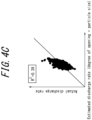
- FIGS. 4A to 4E are diagrams illustrating examples comparing estimated values and actual values of the discharge rate.
- the horizontal axis represents the estimated discharge rate of the raw material 203, as calculated by the control unit 11.
- the vertical axis represents the actual value of the discharge rate when the raw material 203 was actually charged into the blast furnace 201.
- FIG. 4D is a graph of the case in which the discharge rate of the raw material 203 is estimated based on the particle size and the moisture content of the raw material 203 as property values of the raw material 203, along with the degree of opening of the flow regulating gate 30.
- FIG. 4E is a graph of the case in which the discharge rate of the raw material 203 is estimated based on the particle size, the moisture content, and the shape of the raw material 203 as property values of the raw material 203, along with the degree of opening of the flow regulating gate 30.
- the coefficient of determination R 2 is 0.31 in the case in which the discharge rate is estimated based solely on the degree of opening of the flow regulating gate 30.
- the coefficient of determination is 0.41 in the case in which the discharge rate is estimated based on the degree of opening of the flow regulating gate 30 and the moisture content, which is a property value of the raw material 203.
- the coefficient of determination is 0.39 in the case in which the discharge rate is estimated based on the degree of opening of the flow regulating gate 30 and the particle size, which is a property value of the raw material 203.
- the coefficient of determination is 0.46 in the case in which the discharge rate is estimated based on the degree of opening of the flow regulating gate 30 and on the particle size and moisture content, which are property values of the raw material 203.
- the coefficient of determination is 0.60 in the case in which the discharge rate is estimated based on the degree of opening of the flow regulating gate 30 and on the particle size, moisture content, and shape, which are property values of the raw material 203.
- the results in FIGS. 4A to 4E indicate that the control unit 11 can accurately estimate the discharge rate of the raw material 203 by considering the property values of the raw material 203.
- the control unit 11 can control the discharge amount of the raw material 203 based on the discharge rate of the raw material 203 accurately estimated in this way.
- FIGS. 4A to 4E also indicate that the control unit 11 can estimate the discharge rate of the raw material 203 even more accurately when a plurality of values are considered as the property values of the raw material 203.
- the absolute value of the property value was used as the value calculated from at least one of the property values of the raw material 203.
- FIG. 5 is a diagram illustrating the change over time in various data.
- the top graph illustrates the change over time in the particle size of the raw material 203.
- the second graph illustrates the change over time in the degree of opening of the flow regulating gate 30.
- the bottom graph illustrates the discharge rate of the raw material 203.
- the particle size of the raw material 203 is low at the timing indicated by the reference sign 401. This is accompanied by a rapid increase in the discharge rate of the raw material 203, as indicated by the reference sign 402. This increase in the discharge rate of the raw material 203 has a negative effect on the operation of the blast furnace 201.
- the particle size of the raw material 203 is once again low at the timing indicated by the reference sign 404. At this time, the particle size of the raw material 203 is below a threshold 407. Therefore, as indicated by the reference sign 405, the raw material discharge control apparatus 10 implemented control to reduce the degree of opening of the flow regulating gate 30. As a result, the raw material discharge control apparatus 10 was able to suppress the increase in the discharge rate of the raw material 203 in the time range indicated by the reference sign 406. In other words, the raw material discharge control apparatus 10 was able to stabilize the discharge rate of the raw material 203 by controlling the flow regulating gate 30 based on the particle size, which is a property value of the raw material 203.
- the raw material discharge control apparatus 10 includes a raw material property measurement unit 12 that measures property values of the raw material 203 to be charged into the raw material hopper 20, and a control unit 11 that controls the discharge amount of the raw material 203 based on the property values of the raw material 203.
- the control unit 11 thus controlling the discharge amount of the raw material 203 based on the property values of the raw material 203, the raw material discharge control apparatus 10 according to the present embodiment can accurately control the discharge amount of the raw material 203 discharged from the raw material hopper 20, even if the properties of the raw material 203 change.
- the raw material charging apparatus 1 charges the raw material 203 into the blast furnace 201 by using the raw material discharge control apparatus 10 to control the discharge amount of the raw material 203. Therefore, the raw material charging apparatus 1 according to the present embodiment can accurately control the distribution shape of the raw material 203 deposited in the blast furnace 201, thus stabilizing the operation of the blast furnace 201.
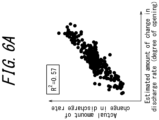
- FIG. 6A illustrates the results of estimation using only the differential value of the degree of opening.
- FIG. 6B illustrates the results of predicting the differential value of the discharge rate using the differential values of particle size, moisture content, and degree of opening.
- the determination coefficient R 2 is 0.57.
- the determination coefficient R 2 is 0.64. The addition of particle size and moisture content to the prediction thus improves the accuracy of the coefficient of determination R 2 to 0.64, indicating that particle size and moisture content are useful in predicting relative change.
- the present disclosure is not limited to the embodiments described above.
- a plurality of blocks described in the block diagrams may be integrated, or a block may be divided.
- the plurality of steps may be executed in parallel or in a different order according to the processing capability of the apparatus that executes each step, or as required.
- Other modifications can be made without departing from the spirit of the present disclosure.
- the raw material property measurement unit 12 includes a distance measurement apparatus, an image measurement apparatus, and a moisture measurement apparatus has been described as an example.
- the apparatuses included in the raw material property measurement unit 12 are not limited to these.
- the raw material property measurement unit 12 may include any apparatus capable of measuring the property values of the raw material 203.
- some of the processing operations performed in the raw material property measurement unit 12 may be performed in the control unit 11.
- the image measurement apparatus may capture images of the raw material 203, and the control unit 11 may calculate the particle size and shape, which are property values of the raw material 203, by analyzing the images of the raw material 203 captured by the image measurement apparatus.
- the means for controlling the discharge amount of the raw material 203 is not limited to this example.
- the raw material discharge control apparatus 10 may control the discharge amount of the raw material 203 using an apparatus other than the flow regulating gate 30.
- the case in which the raw material discharge control apparatus 10 controls the discharge amount of the raw material 203 charged into the blast furnace 201 has been described as an example, but the field in which the raw material discharge control apparatus 10 can be used is not limited to the field of steel production.
- the raw material discharge control apparatus 10 can also be used in other fields in which raw materials are transported.
Landscapes
- Engineering & Computer Science (AREA)
- Chemical & Material Sciences (AREA)
- Mechanical Engineering (AREA)
- General Engineering & Computer Science (AREA)
- Manufacturing & Machinery (AREA)
- Materials Engineering (AREA)
- Metallurgy (AREA)
- Organic Chemistry (AREA)
- Filling Or Emptying Of Bunkers, Hoppers, And Tanks (AREA)
Abstract
Description
- The present disclosure relates to a raw material discharge control apparatus and a raw material charging apparatus.
- In a production process that uses raw material such as minerals, the raw material is discharged from a raw material hopper that temporarily stores the raw material. At this time, it is important to control the discharge amount of raw material discharged from the raw material hopper, because the discharge amount of raw material affects productivity.
- In a blast furnace, for example, raw material discharged from the raw material hopper is charged into the furnace through a rotating chute. The charged material is deposited in the furnace and forms a certain deposition shape. This deposition shape has a significant impact on conditions in the furnace. Consequently, if the discharge amount of raw material fluctuates over time, the conditions in the furnace may deteriorate.
- Therefore, various techniques have been considered to control the discharge amount of raw material from the raw material hopper to be constant.
- For example, one known technique attempts to control the discharge amount of raw material to be constant by maintaining a constant degree of opening of the raw material hopper. However, due to raw material segregation of the raw material in the raw material hopper and fluctuations in the properties of the raw material in the raw material hopper, such as particle size, shape, moisture content, and surface condition, the discharge amount of material raw ends up fluctuating over time even when the degree of opening of the raw material hopper is kept constant. In addition, it has been difficult to capture temporal fluctuations in raw material properties over a short period of time, because the values for raw material properties have been calculated about once a week through batch sampling and sieve analysis of small amounts.
- For example, Patent Literature (PTL) 1 discloses a technique for constantly calculating the degree of opening of the raw material hopper and the actual value of the raw material discharge rate and adjusting the degree of opening of the raw material hopper to achieve a target raw material discharge rate, in order to control the discharge amount of raw material from the raw material hopper to be constant.
- PTL 1:
JP H4-198412 A - The technology disclosed in PTL 1 controls the degree of opening of the raw material hopper by constantly calculating the relationship between the degree of opening of the raw material hopper and the actual value of the raw material discharge rate. However, the properties of the raw material in the raw material hopper change moment by moment. Therefore, even if the relationship between the degree of opening of the raw material hopper and the actual value of the raw material discharge rate is calculated, it may be the case that when the calculated relationship is applied to control the degree of opening of the raw material hopper, the properties of the raw material have already changed, making it difficult to accurately control the discharge amount of raw material to the desired discharge amount.
- It is an aim of the present disclosure to provide a raw material discharge control apparatus and a raw material charging apparatus that can accurately control the discharge amount of raw material discharged from a raw material hopper even when there are changes in the properties of the raw material.
-
- [1] A raw material discharge control apparatus for controlling a discharge amount of raw material to be discharged from a raw material hopper, including:
- a raw material property measurement unit configured to measure one or more property values of raw material to be charged into the raw material hopper; and
- a control unit configured to control a discharge amount of the raw material based on the one or more property values of the raw material.
- [2] The raw material discharge control apparatus according to [1], wherein the one or more property values of the raw material include at least one of particle size, shape, moisture content, and surface condition of the raw material.
- [3] The raw material discharge control apparatus according to [1] or [2], wherein the control unit is configured to control the discharge amount of the raw material by adjusting a degree of opening of a flow regulating gate that can control the discharge amount of the raw material to be discharged from the raw material hopper.
- [4] The raw material discharge control apparatus according to any one of [1] to [3], wherein the control unit is configured to change the discharge amount of the raw material in a case in which a value calculated from at least one of the property values of the raw material exceeds a preset threshold.
- [5] A raw material charging apparatus configured to charge raw material into a blast furnace by controlling a discharge amount of the raw material using the raw material discharge control apparatus according to any one of [1] to [4].
- According to the raw material discharge control apparatus and the raw material charging apparatus of the present disclosure, the discharge amount of raw material discharged from a raw material hopper can be accurately controlled even when there are changes in the properties of the raw material.
- In the accompanying drawings:
-
FIG. 1 is a diagram schematically illustrating an example configuration of a raw material charging apparatus that includes a raw material discharge control apparatus according to an embodiment of the present disclosure; -
FIG. 2 is an enlarged view of the area near the raw material hopper inFIG. 1 ; -
FIG. 3 is a diagram schematically illustrating an example configuration of a control unit according to an embodiment of the present disclosure; -
FIG. 4A is a diagram illustrating examples comparing estimated values and actual values for the discharge rate of raw material; -
FIG. 4B is a diagram illustrating examples comparing estimated values and actual values for the discharge rate of raw material; -
FIG. 4C is a diagram illustrating examples comparing estimated values and actual values for the discharge rate of raw material; -
FIG. 4D is a diagram illustrating examples comparing estimated values and actual values for the discharge rate of raw material; -
FIG. 4E is a diagram illustrating examples comparing estimated values and actual values for the discharge rate of raw material; -
FIG. 5 is a diagram illustrating the change over time in various data; -
FIG. 6A is a diagram illustrating examples comparing estimated values and actual values of the change in discharge rate of raw material; and -
FIG. 6B is a diagram illustrating examples comparing estimated values and actual values of the change in discharge rate of raw material. - Embodiments of the present disclosure will be described below, with reference to the drawings.
-
FIG. 1 is a diagram schematically illustrating an example configuration of a raw material charging apparatus 1 that includes a raw materialdischarge control apparatus 10 according to an embodiment of the present disclosure.FIG. 2 is an enlarged view of the area near araw material hopper 20 inFIG. 1 . Referring toFIGS. 1 and2 , the raw material charging apparatus 1 and raw materialdischarge control apparatus 10 are described. - The raw material charging apparatus 1 is an apparatus that charges
raw material 203, carried by aconveyor 202 for charging raw material, into ablast furnace 201. - The raw material charging apparatus 1 includes the raw material
discharge control apparatus 10, the raw material hopper 20, aflow regulating gate 30, and arotating chute 40. The raw material charging apparatus 1 charges theraw material 203 into theblast furnace 201 by using the raw materialdischarge control apparatus 10 to control the discharge amount of theraw material 203 discharged from theraw material hopper 20. - In the present embodiment, a case in which the raw material
discharge control apparatus 10 is used in the raw material charging apparatus 1, which charges theraw material 203 carried by theconveyor 202 into theblast furnace 201, is described as an example, but the process in which the raw materialdischarge control apparatus 10 is used is not limited to this example. The raw materialdischarge control apparatus 10 can be used in any process that uses theraw material hopper 20 to charge theraw material 203. - The
raw material 203 may be coke but is not limited to this example. Theraw material 203 may, for example, be ore, sintered ore, pellets, limestone, rock, concrete raw material, powder and granular material, or the like. - The raw material
discharge control apparatus 10 controls the discharge amount of theraw material 203 discharged from theraw material hopper 20. The raw materialdischarge control apparatus 10 includes acontrol unit 11 and a raw materialproperty measurement unit 12. Details on the configuration and functions of the raw materialdischarge control apparatus 10 are described below. - The
raw material hopper 20 temporarily stores theraw material 203 transported by theconveyor 202. Theraw material hopper 20 can discharge the storedraw material 203 into theblast furnace 201. - The
flow regulating gate 30 can control the discharge amount of theraw material 203 discharged from theraw material hopper 20. Theflow regulating gate 30 is a gate whose degree of opening can be adjusted. As the degree of opening of theflow regulating gate 30 is greater, the discharge amount of theraw material 203 discharged from theraw material hopper 20 increases. As the degree of opening of theflow regulating gate 30 is smaller, the discharge amount of theraw material 203 discharged from theraw material hopper 20 decreases. The degree of opening of theflow regulating gate 30 is controlled by thecontrol unit 11. - The rotating
chute 40 is arranged at the top of theblast furnace 201. The rotatingchute 40 turns at a predetermined speed. Theraw material 203 discharged from theraw material hopper 20 is charged into theblast furnace 201 through the rotatingchute 40. - Next, the
control unit 11 and raw materialproperty measurement unit 12 included in the raw materialdischarge control apparatus 10 are described. - The
control unit 11 acquires property values of theraw material 203 as measured by the raw materialproperty measurement unit 12. Here, the property values of theraw material 203 measured by the raw materialproperty measurement unit 12 are the property values of theraw material 203 being transported by theconveyor 202, i.e., the property values of theraw material 203 before theraw material 203 is charged into theraw material hopper 20. - The
control unit 11 controls the discharge amount of theraw material 203 discharged from theraw material hopper 20 based on the property values of theraw material 203 as acquired from the raw materialproperty measurement unit 12. Thecontrol unit 11 controls the discharge amount of theraw material 203 discharged from theraw material hopper 20 by adjusting the degree of opening of theflow regulating gate 30. -
FIG. 3 is a diagram schematically illustrating an example configuration of thecontrol unit 11 according to an embodiment of the present disclosure. Thecontrol unit 11 may be a general-purpose computer, such as a workstation or personal computer, or may be a dedicated computer configured to function as thecontrol unit 11 of the raw materialdischarge control apparatus 10. Referring toFIG. 3 , the configuration of thecontrol unit 11 is described. - The
control unit 11 includes a controller 111, aninput interface 112, anoutput interface 113, amemory 114, and acommunication interface 115. - The controller 111 includes at least one processor, at least one dedicated circuit, or a combination thereof. The processor is a general-purpose processor such as a Central Processing Unit (CPU) or a Graphics Processing Unit (GPU), or a dedicated processor that is dedicated to specific processing. Examples of dedicated circuits can include a Field-Programmable Gate Array (FPGA) and an Application Specific Integrated Circuit (ASIC).
- The controller 111 reads programs, data, and the like stored in the
memory 114 and executes various functions. The controller 111 controls theflow regulating gate 30. - The
input interface 112 includes one or more interfaces for input to detect user input and acquire input information based on user operations. For example, theinput interface 112 includes a physical key, a capacitive key, a touch screen integrally provided with a display of theoutput interface 113, or a microphone that accepts voice input. - The
output interface 113 includes one or more interfaces for output to output information and notify the user. For example, theoutput interface 113 includes a display for outputting information in the form of images or a speaker for outputting information in the form of audio. The display included in theoutput interface 113 may, for example, be a Liquid Crystal Display (LCD), a Cathode Ray Tube (CRT) display, or the like. - The
memory 114 is, for example, a flash memory, a hard disk, an optical memory, or the like. A portion of thememory 114 may be external to thecontrol unit 11. In this case, the portion of thememory 114 may be a hard disk, a memory card, or the like connected to thecontrol unit 11 by any interface. - The
memory 114 stores programs for the controller 111 to perform each function, data used by the programs, and the like. - The
communication interface 115 includes at least one of a communication module compatible with wired communication and a communication module compatible with wireless communication. Thecontrol unit 11 can communicate with other apparatuses and the like via thecommunication interface 115. - The description now refers again to
FIGS. 1 and2 . - The raw material
property measurement unit 12 measures the property values of theraw material 203 being carried by theconveyor 202. In other words, the raw materialproperty measurement unit 12 measures the property values of theraw material 203 before theraw material 203 is charged into theraw material hopper 20. - The property values measured by the raw material
property measurement unit 12 include at least one of particle size, shape, moisture content, and surface condition of the raw material. - The significance of the raw material
property measurement unit 12 measuring the particle size, shape, moisture content, and surface condition of theraw material 203 as the property values of theraw material 203 is now described. - First, the particle size of the
raw material 203 is described. As the particle size of theraw material 203 is smaller, the friction between particles of theraw material 203 is reduced. It is thought that because of the resulting increase in fluidity of theraw material 203, the discharge rate of theraw material 203 discharged from theraw material hopper 20 becomes faster for the same degree of opening of theflow regulating gate 30. The particle size of theraw material 203 thus affects the discharge rate of theraw material 203 from theraw material hopper 20. - Next, the shape of the
raw material 203 is described. If the shape of theraw material 203 is angular, it is thought that the discharge rate of theraw material 203 discharged from theraw material hopper 20 becomes slower for the same degree of opening of theflow regulating gate 30. The shape of theraw material 203 thus affects the discharge rate of theraw material 203 from theraw material hopper 20. - Next, the moisture content of the
raw material 203 is described. As the moisture content of theraw material 203 increases, the density of theraw material 203 increases and the friction on the surface of theraw material 203 decreases. It is then thought that the discharge rate of theraw material 203 discharged from theraw material hopper 20 becomes faster for the same degree of opening of theflow regulating gate 30. The moisture content of theraw material 203 thus affects the discharge rate of theraw material 203 from theraw material hopper 20. - Next, the surface condition of the
raw material 203 is described. Influencing factors that express the surface condition of theraw material 203 include the roughness of the surface itself, the amount of moisture on the surface, and the amount of powder on the surface. Changes in these influencing factors change the friction of theraw material 203, which in turn changes the discharge rate of theraw material 203 discharged from theraw material hopper 20. The surface condition of theraw material 203 thus affects the discharge rate of theraw material 203 from theraw material hopper 20. - The particle size, shape, moisture content, and surface condition of the
raw material 203 as the property values of theraw material 203 thus affect the discharge rate of theraw material 203 discharged from theraw material hopper 20. Therefore, the raw materialproperty measurement unit 12 measures property values such as the particle size, shape, moisture content, and surface condition of theraw material 203, and thecontrol unit 11 controls the discharge amount of theraw material 203 discharged from theraw material hopper 20 based on the property values of theraw material 203, thereby enabling the discharge amount of theraw material 203 to be accurately controlled. - The raw material
property measurement unit 12 includes a distance measurement apparatus, an image measurement apparatus, and a moisture measurement apparatus. The raw materialproperty measurement unit 12 may include either a distance measurement apparatus or an image measurement apparatus, rather than both a distance measurement apparatus and an image measurement apparatus. - The distance measurement apparatus and the image measurement apparatus can measure the particle size, shape, and surface condition of the
raw material 203. The moisture measurement apparatus can measure the moisture content of theraw material 203. - The distance measurement apparatus may, for example, be a two-dimensional laser rangefinder. A laser rangefinder irradiates a laser beam in a line along the width direction of the
conveyor 202 to measure the distance to theraw material 203 to be measured, one line at a time. - At this time, the
raw material 203 to be measured has been deposited on theconveyor 202 and is being transported by theconveyor 202. The laser rangefinder measures the distance to theraw material 203 in a line at regular intervals. The laser rangefinder can generate 3D shape data for theraw material 203 by integrating the distance measurements at each line. - The above-described method of generating 3D shape data by the laser rangefinder is a method of generating 3D shape data by the so-called optical cutting method. The laser rangefinder can measure the particle size, shape, and surface condition of the
raw material 203 based on the 3D shape data. - The distance measurement apparatus can, for example, be a time of flight camera or a stereo camera and can generate 3D shape data.
- The image measurement apparatus may use an industrial camera to measure 2D image data of the raw material. In order to recognize a plurality of particles in the measured image data as individual particles, the image measurement apparatus may, for example, perform a particle separation process based on a processing method called the WaterShed algorithm, disclosed in Reference 1 (Meyer, F., (1992). Color image segmentation. In Proceedings of the International Conference on Image Processing and its Applications, pages 303-306).
- The image measurement apparatus may calculate the particle size of the
raw material 203 by, for example, averaging the diameters of individual particles obtained by image processing. - Various definitions of particle size can be used. For example, the circular equivalent diameter, major axis length, minor axis length, Feret diameter, or the like can be used as the definition of the particle size.
- The image measurement apparatus can calculate the shape of individual particles of the
raw material 203 by identifying the individual particles. The image measurement apparatus may calculate the shape of theraw material 203 by averaging the diameters of individual particles. - Various definitions of particle shape can be used. For example, the circularity, convexity, solidity, or the like can be used as the definition of the particle shape.
- A distance measurement apparatus such as a laser rangefinder can calculate the surface roughness, which is one of the surface conditions. Various methods exist for calculating surface roughness. For example, general indices such as Ra and Rz can be used. The method of calculating the surface roughness is not limited to this example, and any index related to the degree of unevenness affecting friction can be used. As for the amount of powder, the weight percentage of the fine grain portion obtained from the particle size measurement, such as the weight percentage of the particle size data below 5 mm, can be used as an index.
- The moisture measurement apparatus may, for example, be a neutron moisture meter or an infrared moisture meter.
- The neutron moisture meter irradiates neutrons from a neutron source. The irradiated neutrons are partly transmitted through the
raw material 203 and partly reflected depending on the moisture content of theraw material 203. The neutron moisture meter can detect the reflected neutrons and calculate the value of the moisture content based on the amount of reflection. - The infrared moisture meter can measure the moisture content using infrared wavelengths that have absorption sensitivity to moisture. The infrared moisture meter can irradiate infrared rays onto the
raw material 203 and calculate the value of the moisture content based on the degree of absorption. - The controller 111 of the
control unit 11 acquires, via thecommunication interface 115, the property values of theraw material 203 as measured by the raw materialproperty measurement unit 12. - The controller 111 controls the discharge amount of the
raw material 203 discharged from theraw material hopper 20 based on the property values acquired from the raw materialproperty measurement unit 12. The controller 111 can control the discharge amount of theraw material 203 by adjusting the degree of opening of theflow regulating gate 30. - The controller 111 can estimate the discharge rate of the
raw material 203 discharged from theraw material hopper 20 based on theflow regulating gate 30 and the property values of theraw material 203. The controller 111 may, for example, control the discharge amount of theraw material 203 so that the discharge rate of theraw material 203 discharged from theraw material hopper 20 is within a predetermined range. The discharge rate may, for example, be defined by the weight of theraw material 203 discharged per rotation of therotating chute 40. Alternatively, the discharge rate may, for example, be defined by the weight of theraw material 203 discharged per unit time. - The
memory 114 may store coefficients for estimating the discharge rate of theraw material 203 discharged from theraw material hopper 20, taking the degree of opening of theflow regulating gate 30 and the property values of theraw material 203 as explanatory variables. These coefficients may be coefficients calculated by multiple regression analysis based on pre-measured actual values. In a case in which the property values of theraw material 203 include a plurality of values such as particle size, shape, moisture content, surface condition, and the like, thememory 114 may store coefficients for estimating the discharge rate of theraw material 203 with each value as an explanatory variable. - The controller may perform control to change the discharge amount of the
raw material 203 discharged from theraw material hopper 20 in a case in which a value calculated from at least one property value of theraw material 203 acquired from the raw materialproperty measurement unit 12 exceeds a preset threshold. This enables the controller 111 to adjust the degree of opening of theflow regulating gate 30 to control the discharge rate of theraw material 203 to be in a predetermined range in a case in which a property value of theraw material 203 deviates significantly from the normal value. In a case in which the property values of theraw material 203 include a plurality of values among particle size, shape, moisture content, and surface condition, a threshold may be set for each value. The controller 111 may perform control to change the discharge amount of theraw material 203 discharged from theraw material hopper 20 in a case in which a value calculated from at least one property value among the property values of theraw material 203 exceeds the threshold. - The thresholds may be values determined based on a study, made in advance, of the property values of the
raw material 203 when the discharge rate becomes problematic for operation of theblast furnace 201. The thresholds may be stored in thememory 114. - Alternatively, upon acquiring the property values of the
raw material 203 from the raw materialproperty measurement unit 12, the controller 111 may estimate the discharge rate of theraw material 203. In a case in which the estimated discharge rate is not within a predetermined range, the controller 111 may control the degree of opening of theflow regulating gate 30 so that the discharge rate of theraw material 203 is within the predetermined range. This enables the controller 111 to control the discharge amount of theraw material 203 with greater precision. -
FIGS. 4A to 4E are diagrams illustrating examples comparing estimated values and actual values of the discharge rate. In the five graphs illustrated inFIGS. 4A to 4E , the horizontal axis represents the estimated discharge rate of theraw material 203, as calculated by thecontrol unit 11. The vertical axis represents the actual value of the discharge rate when theraw material 203 was actually charged into theblast furnace 201. - As a comparative example,
FIG. 4A is a graph of the case in which the discharge rate of theraw material 203 is estimated based only on the degree of opening of theflow regulating gate 30, without considering the property values of theraw material 203.FIG. 4B is a graph of the case in which the discharge rate of theraw material 203 is estimated based on the moisture content of theraw material 203 as a property value of theraw material 203, along with the degree of opening of theflow regulating gate 30.FIG. 4C is a graph of the case in which the discharge rate of theraw material 203 is estimated based on the particle size of theraw material 203 as a property value of theraw material 203, along with the degree of opening of theflow regulating gate 30.FIG. 4D is a graph of the case in which the discharge rate of theraw material 203 is estimated based on the particle size and the moisture content of theraw material 203 as property values of theraw material 203, along with the degree of opening of theflow regulating gate 30.FIG. 4E is a graph of the case in which the discharge rate of theraw material 203 is estimated based on the particle size, the moisture content, and the shape of theraw material 203 as property values of theraw material 203, along with the degree of opening of theflow regulating gate 30. - Looking at
FIG. 4A , the coefficient of determination R2 is 0.31 in the case in which the discharge rate is estimated based solely on the degree of opening of theflow regulating gate 30. By contrast, looking atFIG. 4B , the coefficient of determination is 0.41 in the case in which the discharge rate is estimated based on the degree of opening of theflow regulating gate 30 and the moisture content, which is a property value of theraw material 203. Looking atFIG. 4C , the coefficient of determination is 0.39 in the case in which the discharge rate is estimated based on the degree of opening of theflow regulating gate 30 and the particle size, which is a property value of theraw material 203. By thus estimating the discharge rate while considering the moisture content or particle size as a property value, thecontrol unit 11 can accurately estimate the discharge rate of theraw material 203. - Looking at
FIG. 4D , the coefficient of determination is 0.46 in the case in which the discharge rate is estimated based on the degree of opening of theflow regulating gate 30 and on the particle size and moisture content, which are property values of theraw material 203. By thus estimating the discharge rate while considering two values, i.e., the particle size and the moisture content, as property values, thecontrol unit 11 can more accurately estimate the discharge rate of theraw material 203. - Looking at
FIG. 4E , the coefficient of determination is 0.60 in the case in which the discharge rate is estimated based on the degree of opening of theflow regulating gate 30 and on the particle size, moisture content, and shape, which are property values of theraw material 203. By thus estimating the discharge rate while considering three values, i.e., the particle size, the moisture content, and the shape, as property values, thecontrol unit 11 can more accurately estimate the discharge rate of theraw material 203. - The results in
FIGS. 4A to 4E indicate that thecontrol unit 11 can accurately estimate the discharge rate of theraw material 203 by considering the property values of theraw material 203. Thecontrol unit 11 can control the discharge amount of theraw material 203 based on the discharge rate of theraw material 203 accurately estimated in this way. - The results in
FIGS. 4A to 4E also indicate that thecontrol unit 11 can estimate the discharge rate of theraw material 203 even more accurately when a plurality of values are considered as the property values of theraw material 203. In the present examples, the absolute value of the property value was used as the value calculated from at least one of the property values of theraw material 203. -
FIG. 5 is a diagram illustrating the change over time in various data. The top graph illustrates the change over time in the particle size of theraw material 203. The second graph illustrates the change over time in the degree of opening of theflow regulating gate 30. The bottom graph illustrates the discharge rate of theraw material 203. - In
FIG. 5 , at the timing indicated by thereference sign 403, the process of controlling the discharge amount of theraw material 203 is started by the raw materialdischarge control apparatus 10 according to the present embodiment. In other words, prior to the timing indicated by thereference sign 403, the process of controlling the discharge rate of theraw material 203 based on the property values of theraw material 203 is not performed. - Referring to
FIG. 5 , the particle size of theraw material 203 is low at the timing indicated by thereference sign 401. This is accompanied by a rapid increase in the discharge rate of theraw material 203, as indicated by thereference sign 402. This increase in the discharge rate of theraw material 203 has a negative effect on the operation of theblast furnace 201. - Referring to
FIG. 5 , the particle size of theraw material 203 is once again low at the timing indicated by thereference sign 404. At this time, the particle size of theraw material 203 is below athreshold 407. Therefore, as indicated by thereference sign 405, the raw materialdischarge control apparatus 10 implemented control to reduce the degree of opening of theflow regulating gate 30. As a result, the raw materialdischarge control apparatus 10 was able to suppress the increase in the discharge rate of theraw material 203 in the time range indicated by thereference sign 406. In other words, the raw materialdischarge control apparatus 10 was able to stabilize the discharge rate of theraw material 203 by controlling theflow regulating gate 30 based on the particle size, which is a property value of theraw material 203. - In
FIG. 5 , the case of controlling theflow regulating gate 30 based on the particle size of theraw material 203 is illustrated, but similar results can be obtained by controlling theflow regulating gate 30 based on the shape or the moisture content of theraw material 203. Similar results can also be obtained by controlling theflow regulating gate 30 based on a plurality of property values of theraw material 203. - As described above, the raw material
discharge control apparatus 10 according to the present embodiment includes a raw materialproperty measurement unit 12 that measures property values of theraw material 203 to be charged into theraw material hopper 20, and acontrol unit 11 that controls the discharge amount of theraw material 203 based on the property values of theraw material 203. By thecontrol unit 11 thus controlling the discharge amount of theraw material 203 based on the property values of theraw material 203, the raw materialdischarge control apparatus 10 according to the present embodiment can accurately control the discharge amount of theraw material 203 discharged from theraw material hopper 20, even if the properties of theraw material 203 change. - The raw material charging apparatus 1 according to the present embodiment charges the
raw material 203 into theblast furnace 201 by using the raw materialdischarge control apparatus 10 to control the discharge amount of theraw material 203. Therefore, the raw material charging apparatus 1 according to the present embodiment can accurately control the distribution shape of theraw material 203 deposited in theblast furnace 201, thus stabilizing the operation of theblast furnace 201. - In the present example, operations are performed regarding the lower limit, but it is also possible to control the discharge rate more accurately by setting thresholds for the upper and lower limits of each raw material property index. In addition to operation based on absolute values, thresholds based on relative values that represent changes over time can also be used for operation. In this case, since sensor values are used, operation requires periodic calibration of the sensors to true values. However, calibration represents an operational burden, making it difficult to increase the frequency of calibration. In this case, a sensor may deviate from the true value, leading to false positives and undetected values. In this respect, relative changes are comparatively less likely to deviate than absolute values. For long-term operation, use of relative changes may yield more stable threshold-based operation.
FIG. 6A illustrates the results of estimation using only the differential value of the degree of opening.FIG. 6B illustrates the results of predicting the differential value of the discharge rate using the differential values of particle size, moisture content, and degree of opening. Referring toFIG. 6A , the determination coefficient R2 is 0.57. By contrast, referring toFIG. 6B , the determination coefficient R2 is 0.64. The addition of particle size and moisture content to the prediction thus improves the accuracy of the coefficient of determination R2 to 0.64, indicating that particle size and moisture content are useful in predicting relative change. This makes it possible to predict the amount of change in discharge, and the setting of a threshold on the predicted amount of change in discharge makes it possible to deter a similarly large change and to bring the discharge amount closer to the appropriate target value by appropriate adjustment of the degree of opening. In the present disclosure, coke is transported in certain fixed quantities and charged into a bunker in batches. Hence, the difference between the current charged batch and the previous charged batch has been used as the amount of change, but this example is not limiting. For example, the change or the maximum amount of change within a certain past number of hours from the current time on an hourly basis may be used as an index of the amount of change. - The present disclosure is not limited to the embodiments described above. For example, a plurality of blocks described in the block diagrams may be integrated, or a block may be divided. Instead of executing a plurality of steps described in the flowcharts in chronological order in accordance with the description, the plurality of steps may be executed in parallel or in a different order according to the processing capability of the apparatus that executes each step, or as required. Other modifications can be made without departing from the spirit of the present disclosure.
- For example, in the above embodiment, the case in which the raw material
property measurement unit 12 includes a distance measurement apparatus, an image measurement apparatus, and a moisture measurement apparatus has been described as an example. However, the apparatuses included in the raw materialproperty measurement unit 12 are not limited to these. The raw materialproperty measurement unit 12 may include any apparatus capable of measuring the property values of theraw material 203. - For example, in the above embodiment, some of the processing operations performed in the raw material
property measurement unit 12 may be performed in thecontrol unit 11. For example, in a case in which the raw materialproperty measurement unit 12 includes an image measurement apparatus, the image measurement apparatus may capture images of theraw material 203, and thecontrol unit 11 may calculate the particle size and shape, which are property values of theraw material 203, by analyzing the images of theraw material 203 captured by the image measurement apparatus. - For example, in the above embodiment, the case of controlling the discharge amount of the
raw material 203 by adjusting the degree of opening of theflow regulating gate 30 has been described, but the means for controlling the discharge amount of theraw material 203 is not limited to this example. The raw materialdischarge control apparatus 10 may control the discharge amount of theraw material 203 using an apparatus other than theflow regulating gate 30. - For example, in the above embodiment, the case in which the raw material
discharge control apparatus 10 controls the discharge amount of theraw material 203 charged into theblast furnace 201 has been described as an example, but the field in which the raw materialdischarge control apparatus 10 can be used is not limited to the field of steel production. The raw materialdischarge control apparatus 10 can also be used in other fields in which raw materials are transported. -
- 1
- Raw material charging apparatus
- 10
- Raw material discharge control apparatus
- 11
- Control unit
- 12
- Raw material property measurement unit
- 20
- Raw material hopper
- 30
- Flow regulating gate
- 40
- Rotating chute
- 111
- Controller
- 112
- Input interface
- 113
- Output interface
- 114
- Memory
- 115
- Communication interface
- 201
- Blast furnace
- 202
- Conveyor
- 203
- Raw material
Claims (5)
- A raw material discharge control apparatus for controlling a discharge amount of raw material to be discharged from a raw material hopper, comprising:a raw material property measurement unit configured to measure one or more property values of raw material to be charged into the raw material hopper; anda control unit configured to control a discharge amount of the raw material based on the one or more property values of the raw material.
- The raw material discharge control apparatus according to claim 1, wherein the one or more property values of the raw material include at least one of particle size, shape, moisture content, and surface condition of the raw material.
- The raw material discharge control apparatus according to claim 1, wherein the control unit is configured to control the discharge amount of the raw material by adjusting a degree of opening of a flow regulating gate that can control the discharge amount of the raw material to be discharged from the raw material hopper.
- The raw material discharge control apparatus according to claim 1, wherein the control unit is configured to change the discharge amount of the raw material in a case in which a value calculated from at least one of the property values of the raw material exceeds a preset threshold.
- A raw material charging apparatus configured to charge raw material into a blast furnace by controlling a discharge amount of the raw material using the raw material discharge control apparatus according to any one of claims 1 to 4.
Applications Claiming Priority (2)
| Application Number | Priority Date | Filing Date | Title |
|---|---|---|---|
| JP2022132085 | 2022-08-22 | ||
| PCT/JP2023/028832 WO2024043062A1 (en) | 2022-08-22 | 2023-08-07 | Material discharge control device and material charging device |
Publications (2)
| Publication Number | Publication Date |
|---|---|
| EP4545654A1 true EP4545654A1 (en) | 2025-04-30 |
| EP4545654A4 EP4545654A4 (en) | 2025-12-24 |
Family
ID=90013116
Family Applications (1)
| Application Number | Title | Priority Date | Filing Date |
|---|---|---|---|
| EP23857176.4A Pending EP4545654A4 (en) | 2022-08-22 | 2023-08-07 | MATERIAL OUTPUT CONTROL DEVICE AND MATERIAL LOADING DEVICE |
Country Status (5)
| Country | Link |
|---|---|
| EP (1) | EP4545654A4 (en) |
| JP (1) | JP7683730B2 (en) |
| KR (1) | KR20250011184A (en) |
| CN (1) | CN119585446A (en) |
| WO (1) | WO2024043062A1 (en) |
Family Cites Families (12)
| Publication number | Priority date | Publication date | Assignee | Title |
|---|---|---|---|---|
| JPS5222802B2 (en) * | 1973-10-12 | 1977-06-20 | ||
| JPS5492389A (en) * | 1977-12-29 | 1979-07-21 | Sumitomo Metal Ind | Particle distribution measuring method |
| JPS6137903A (en) * | 1984-07-30 | 1986-02-22 | Nippon Steel Corp | Method for controlling discharge of starting material to be charged into blast furnace |
| JPH02138407A (en) * | 1988-11-16 | 1990-05-28 | Kawasaki Steel Corp | Method for charging raw material in bellless blast furnace |
| JPH079006B2 (en) * | 1989-03-27 | 1995-02-01 | 日本鋼管株式会社 | Blast furnace bellless charging equipment control method |
| JPH03175335A (en) * | 1989-12-01 | 1991-07-30 | Sumitomo Metal Ind Ltd | Method for automatically calibrating particle size distribution measuring apparatus |
| JP2942349B2 (en) | 1990-11-29 | 1999-08-30 | 川崎製鉄株式会社 | Blast furnace feed control method |
| JP2724063B2 (en) * | 1990-11-30 | 1998-03-09 | 川崎製鉄株式会社 | Raw material charging control method at the blast furnace top |
| JPH0598329A (en) * | 1991-10-08 | 1993-04-20 | Nkk Corp | Feeder used for particle size measurement of blast furnace raw material |
| JPH09138070A (en) * | 1995-11-10 | 1997-05-27 | Okawara Mfg Co Ltd | Municipal solid waste drying equipment and its operation control method |
| JP6743635B2 (en) | 2016-09-30 | 2020-08-19 | 日本製鉄株式会社 | Control device and control method |
| JP6590072B2 (en) * | 2017-03-30 | 2019-10-16 | Jfeスチール株式会社 | Raw material particle size distribution measuring device, particle size distribution measuring method and porosity measuring device |
-
2023
- 2023-08-07 EP EP23857176.4A patent/EP4545654A4/en active Pending
- 2023-08-07 WO PCT/JP2023/028832 patent/WO2024043062A1/en not_active Ceased
- 2023-08-07 KR KR1020247041670A patent/KR20250011184A/en active Pending
- 2023-08-07 JP JP2023561110A patent/JP7683730B2/en active Active
- 2023-08-07 CN CN202380053742.8A patent/CN119585446A/en active Pending
Also Published As
| Publication number | Publication date |
|---|---|
| EP4545654A4 (en) | 2025-12-24 |
| JP7683730B2 (en) | 2025-05-27 |
| CN119585446A (en) | 2025-03-07 |
| JPWO2024043062A1 (en) | 2024-02-29 |
| WO2024043062A1 (en) | 2024-02-29 |
| KR20250011184A (en) | 2025-01-21 |
Similar Documents
| Publication | Publication Date | Title |
|---|---|---|
| AU2019335607A1 (en) | Monitoring ore | |
| Gromke et al. | Snow particle characteristics in the saltation layer | |
| EP3605064B1 (en) | Raw material particle size distribution measuring device, particle size distribution measuring method, and void ratio measuring device | |
| Capart et al. | Depth-integrated equations for entraining granular flows in narrow channels | |
| Shen et al. | Comparison of a laser precipitation monitor, piezoelectric transducer and particle imaging transient visual measurement technology under simulated rainfall in laboratory conditions | |
| CN1397786A (en) | Device for in-line measuring weight of material | |
| EP4029953B1 (en) | Method for operating blast furnace | |
| US20240165634A1 (en) | In-process adjustment to crushing systems | |
| KR20210068628A (en) | Powder ratio measuring device and powder ratio measuring system | |
| WO2020204165A1 (en) | Powder rate measuring method and device | |
| JP7683730B2 (en) | Raw material discharge control device and raw material charging device | |
| CN108180947B (en) | Comprehensive evaluation method for quality of irregular bulk motion material | |
| Liu et al. | Hierarchical packing model: Estimating the overall particle size distribution from surface images and permeability properties | |
| CN116520301A (en) | Photoelectric sensor and ranging compensation method and system thereof | |
| CN119510241B (en) | Method, system, medium and program product for detecting solid content of reclaimed water | |
| TWI848627B (en) | Sintering machine operation management method, sintered ore production method and control device | |
| EP4495278A1 (en) | Method for managing operation of sintering machine, method for manufacturing sintered ore, and control device | |
| CN119022995A (en) | A concrete material measuring method and system | |
| CN115841513B (en) | A method, apparatus, electronic device and storage medium for determining the length of tobacco shreds | |
| WO2024108003A1 (en) | High throughput characterization of aggregate particles | |
| JP4675523B2 (en) | Method for calculating the terrace length of the raw material deposition layer at the top of the blast furnace furnace | |
| Agrawal | Enhanced Stockline Measurement and Burden Descent Monitoring for Sustainable Blast Furnace | |
| WO2025037452A1 (en) | Information processing device, information processing method, sintered ore manufacturing method, blast furnace operation method, coke manufacturing method, and program | |
| RU2790801C1 (en) | Method for determining the raw material volume | |
| EP4421474A1 (en) | Information processing method, information processing device, information processing system, information processing program, and sintered ore production method |
Legal Events
| Date | Code | Title | Description |
|---|---|---|---|
| STAA | Information on the status of an ep patent application or granted ep patent |
Free format text: STATUS: THE INTERNATIONAL PUBLICATION HAS BEEN MADE |
|
| PUAI | Public reference made under article 153(3) epc to a published international application that has entered the european phase |
Free format text: ORIGINAL CODE: 0009012 |
|
| STAA | Information on the status of an ep patent application or granted ep patent |
Free format text: STATUS: REQUEST FOR EXAMINATION WAS MADE |
|
| 17P | Request for examination filed |
Effective date: 20250123 |
|
| AK | Designated contracting states |
Kind code of ref document: A1 Designated state(s): AL AT BE BG CH CY CZ DE DK EE ES FI FR GB GR HR HU IE IS IT LI LT LU LV MC ME MK MT NL NO PL PT RO RS SE SI SK SM TR |
|
| DAV | Request for validation of the european patent (deleted) | ||
| DAX | Request for extension of the european patent (deleted) | ||
| A4 | Supplementary search report drawn up and despatched |
Effective date: 20251124 |
|
| RIC1 | Information provided on ipc code assigned before grant |
Ipc: C21B 7/18 20060101AFI20251118BHEP Ipc: C21B 7/20 20060101ALI20251118BHEP Ipc: F27B 1/20 20060101ALI20251118BHEP Ipc: F27B 1/26 20060101ALI20251118BHEP Ipc: F27D 3/10 20060101ALI20251118BHEP Ipc: F27D 19/00 20060101ALI20251118BHEP Ipc: C21B 5/00 20060101ALI20251118BHEP Ipc: F27D 21/00 20060101ALI20251118BHEP Ipc: C21B 7/24 20060101ALI20251118BHEP |