EP4545606A1 - MODIFIED SILICONE RUBBER CHEMISTRY - Google Patents
MODIFIED SILICONE RUBBER CHEMISTRY Download PDFInfo
- Publication number
- EP4545606A1 EP4545606A1 EP24207215.5A EP24207215A EP4545606A1 EP 4545606 A1 EP4545606 A1 EP 4545606A1 EP 24207215 A EP24207215 A EP 24207215A EP 4545606 A1 EP4545606 A1 EP 4545606A1
- Authority
- EP
- European Patent Office
- Prior art keywords
- examples
- pdms
- average molecular
- molecular weights
- include processes
- Prior art date
- Legal status (The legal status is an assumption and is not a legal conclusion. Google has not performed a legal analysis and makes no representation as to the accuracy of the status listed.)
- Pending
Links
- 229920002379 silicone rubber Polymers 0.000 title abstract description 10
- 239000004945 silicone rubber Substances 0.000 title abstract description 10
- 238000000034 method Methods 0.000 claims abstract description 76
- GWEVSGVZZGPLCZ-UHFFFAOYSA-N Titan oxide Chemical compound O=[Ti]=O GWEVSGVZZGPLCZ-UHFFFAOYSA-N 0.000 claims abstract description 57
- 239000000203 mixture Substances 0.000 claims abstract description 37
- 239000004408 titanium dioxide Substances 0.000 claims abstract description 28
- 230000015572 biosynthetic process Effects 0.000 claims abstract description 19
- 239000004205 dimethyl polysiloxane Substances 0.000 claims description 75
- 229920000435 poly(dimethylsiloxane) Polymers 0.000 claims description 75
- 239000000758 substrate Substances 0.000 claims description 33
- -1 polydimethylsiloxane Polymers 0.000 claims description 12
- 239000002105 nanoparticle Substances 0.000 claims description 8
- 239000011241 protective layer Substances 0.000 claims description 8
- 238000002156 mixing Methods 0.000 claims description 2
- 235000013870 dimethyl polysiloxane Nutrition 0.000 claims 3
- CXQXSVUQTKDNFP-UHFFFAOYSA-N octamethyltrisiloxane Chemical compound C[Si](C)(C)O[Si](C)(C)O[Si](C)(C)C CXQXSVUQTKDNFP-UHFFFAOYSA-N 0.000 claims 2
- 238000004987 plasma desorption mass spectroscopy Methods 0.000 claims 2
- 239000003507 refrigerant Substances 0.000 abstract description 24
- 230000005661 hydrophobic surface Effects 0.000 abstract description 5
- 238000009434 installation Methods 0.000 abstract description 4
- XLYOFNOQVPJJNP-UHFFFAOYSA-N water Chemical compound O XLYOFNOQVPJJNP-UHFFFAOYSA-N 0.000 description 46
- 239000000463 material Substances 0.000 description 30
- 229920001296 polysiloxane Polymers 0.000 description 12
- 239000010410 layer Substances 0.000 description 11
- 229920000642 polymer Polymers 0.000 description 10
- 229910052751 metal Inorganic materials 0.000 description 6
- 239000002184 metal Substances 0.000 description 6
- 125000002496 methyl group Chemical group [H]C([H])([H])* 0.000 description 6
- 239000002131 composite material Substances 0.000 description 5
- 230000002209 hydrophobic effect Effects 0.000 description 5
- 150000001875 compounds Chemical class 0.000 description 4
- 238000009472 formulation Methods 0.000 description 4
- 230000001681 protective effect Effects 0.000 description 4
- 238000005336 cracking Methods 0.000 description 3
- 238000001723 curing Methods 0.000 description 3
- 239000001257 hydrogen Substances 0.000 description 3
- 229910052739 hydrogen Inorganic materials 0.000 description 3
- 230000005660 hydrophilic surface Effects 0.000 description 3
- 239000007788 liquid Substances 0.000 description 3
- 125000004430 oxygen atom Chemical group O* 0.000 description 3
- 239000002245 particle Substances 0.000 description 3
- QGZKDVFQNNGYKY-UHFFFAOYSA-N Ammonia Chemical compound N QGZKDVFQNNGYKY-UHFFFAOYSA-N 0.000 description 2
- IJGRMHOSHXDMSA-UHFFFAOYSA-N Atomic nitrogen Chemical compound N#N IJGRMHOSHXDMSA-UHFFFAOYSA-N 0.000 description 2
- UFHFLCQGNIYNRP-UHFFFAOYSA-N Hydrogen Chemical compound [H][H] UFHFLCQGNIYNRP-UHFFFAOYSA-N 0.000 description 2
- 150000002739 metals Chemical class 0.000 description 2
- 230000002265 prevention Effects 0.000 description 2
- 229910052710 silicon Inorganic materials 0.000 description 2
- 239000010703 silicon Substances 0.000 description 2
- ZAMOUSCENKQFHK-UHFFFAOYSA-N Chlorine atom Chemical compound [Cl] ZAMOUSCENKQFHK-UHFFFAOYSA-N 0.000 description 1
- XUIMIQQOPSSXEZ-UHFFFAOYSA-N Silicon Chemical compound [Si] XUIMIQQOPSSXEZ-UHFFFAOYSA-N 0.000 description 1
- 229910021529 ammonia Inorganic materials 0.000 description 1
- QVGXLLKOCUKJST-UHFFFAOYSA-N atomic oxygen Chemical compound [O] QVGXLLKOCUKJST-UHFFFAOYSA-N 0.000 description 1
- 239000011324 bead Substances 0.000 description 1
- 239000003153 chemical reaction reagent Substances 0.000 description 1
- 239000000460 chlorine Substances 0.000 description 1
- 229910052801 chlorine Inorganic materials 0.000 description 1
- 238000009833 condensation Methods 0.000 description 1
- 230000005494 condensation Effects 0.000 description 1
- 230000001627 detrimental effect Effects 0.000 description 1
- 230000000694 effects Effects 0.000 description 1
- 229920001971 elastomer Polymers 0.000 description 1
- 230000003090 exacerbative effect Effects 0.000 description 1
- 230000008014 freezing Effects 0.000 description 1
- 238000007710 freezing Methods 0.000 description 1
- 239000008187 granular material Substances 0.000 description 1
- 239000001307 helium Substances 0.000 description 1
- 229910052734 helium Inorganic materials 0.000 description 1
- SWQJXJOGLNCZEY-UHFFFAOYSA-N helium atom Chemical compound [He] SWQJXJOGLNCZEY-UHFFFAOYSA-N 0.000 description 1
- 229930195733 hydrocarbon Natural products 0.000 description 1
- 150000002430 hydrocarbons Chemical class 0.000 description 1
- 150000002431 hydrogen Chemical class 0.000 description 1
- 239000004615 ingredient Substances 0.000 description 1
- 238000009413 insulation Methods 0.000 description 1
- 230000001788 irregular Effects 0.000 description 1
- 238000004643 material aging Methods 0.000 description 1
- 230000007246 mechanism Effects 0.000 description 1
- 229910052757 nitrogen Inorganic materials 0.000 description 1
- 239000001301 oxygen Substances 0.000 description 1
- 229910052760 oxygen Inorganic materials 0.000 description 1
- 239000011253 protective coating Substances 0.000 description 1
- 238000005096 rolling process Methods 0.000 description 1
- 150000003376 silicon Chemical class 0.000 description 1
Images


Classifications
-
- C—CHEMISTRY; METALLURGY
- C08—ORGANIC MACROMOLECULAR COMPOUNDS; THEIR PREPARATION OR CHEMICAL WORKING-UP; COMPOSITIONS BASED THEREON
- C08K—Use of inorganic or non-macromolecular organic substances as compounding ingredients
- C08K3/00—Use of inorganic substances as compounding ingredients
- C08K3/18—Oxygen-containing compounds, e.g. metal carbonyls
- C08K3/20—Oxides; Hydroxides
- C08K3/22—Oxides; Hydroxides of metals
-
- C—CHEMISTRY; METALLURGY
- C09—DYES; PAINTS; POLISHES; NATURAL RESINS; ADHESIVES; COMPOSITIONS NOT OTHERWISE PROVIDED FOR; APPLICATIONS OF MATERIALS NOT OTHERWISE PROVIDED FOR
- C09D—COATING COMPOSITIONS, e.g. PAINTS, VARNISHES OR LACQUERS; FILLING PASTES; CHEMICAL PAINT OR INK REMOVERS; INKS; CORRECTING FLUIDS; WOODSTAINS; PASTES OR SOLIDS FOR COLOURING OR PRINTING; USE OF MATERIALS THEREFOR
- C09D7/00—Features of coating compositions, not provided for in group C09D5/00; Processes for incorporating ingredients in coating compositions
- C09D7/40—Additives
- C09D7/60—Additives non-macromolecular
- C09D7/61—Additives non-macromolecular inorganic
-
- B—PERFORMING OPERATIONS; TRANSPORTING
- B32—LAYERED PRODUCTS
- B32B—LAYERED PRODUCTS, i.e. PRODUCTS BUILT-UP OF STRATA OF FLAT OR NON-FLAT, e.g. CELLULAR OR HONEYCOMB, FORM
- B32B1/00—Layered products having a non-planar shape
- B32B1/08—Tubular products
-
- B—PERFORMING OPERATIONS; TRANSPORTING
- B32—LAYERED PRODUCTS
- B32B—LAYERED PRODUCTS, i.e. PRODUCTS BUILT-UP OF STRATA OF FLAT OR NON-FLAT, e.g. CELLULAR OR HONEYCOMB, FORM
- B32B25/00—Layered products comprising a layer of natural or synthetic rubber
- B32B25/02—Layered products comprising a layer of natural or synthetic rubber with fibres or particles being present as additives in the layer
-
- B—PERFORMING OPERATIONS; TRANSPORTING
- B32—LAYERED PRODUCTS
- B32B—LAYERED PRODUCTS, i.e. PRODUCTS BUILT-UP OF STRATA OF FLAT OR NON-FLAT, e.g. CELLULAR OR HONEYCOMB, FORM
- B32B25/00—Layered products comprising a layer of natural or synthetic rubber
- B32B25/14—Layered products comprising a layer of natural or synthetic rubber comprising synthetic rubber copolymers
-
- C—CHEMISTRY; METALLURGY
- C08—ORGANIC MACROMOLECULAR COMPOUNDS; THEIR PREPARATION OR CHEMICAL WORKING-UP; COMPOSITIONS BASED THEREON
- C08J—WORKING-UP; GENERAL PROCESSES OF COMPOUNDING; AFTER-TREATMENT NOT COVERED BY SUBCLASSES C08B, C08C, C08F, C08G or C08H
- C08J3/00—Processes of treating or compounding macromolecular substances
- C08J3/20—Compounding polymers with additives, e.g. colouring
- C08J3/203—Solid polymers with solid and/or liquid additives
-
- C—CHEMISTRY; METALLURGY
- C09—DYES; PAINTS; POLISHES; NATURAL RESINS; ADHESIVES; COMPOSITIONS NOT OTHERWISE PROVIDED FOR; APPLICATIONS OF MATERIALS NOT OTHERWISE PROVIDED FOR
- C09D—COATING COMPOSITIONS, e.g. PAINTS, VARNISHES OR LACQUERS; FILLING PASTES; CHEMICAL PAINT OR INK REMOVERS; INKS; CORRECTING FLUIDS; WOODSTAINS; PASTES OR SOLIDS FOR COLOURING OR PRINTING; USE OF MATERIALS THEREFOR
- C09D183/00—Coating compositions based on macromolecular compounds obtained by reactions forming in the main chain of the macromolecule a linkage containing silicon, with or without sulfur, nitrogen, oxygen, or carbon only; Coating compositions based on derivatives of such polymers
- C09D183/04—Polysiloxanes
-
- B—PERFORMING OPERATIONS; TRANSPORTING
- B32—LAYERED PRODUCTS
- B32B—LAYERED PRODUCTS, i.e. PRODUCTS BUILT-UP OF STRATA OF FLAT OR NON-FLAT, e.g. CELLULAR OR HONEYCOMB, FORM
- B32B2264/00—Composition or properties of particles which form a particulate layer or are present as additives
- B32B2264/10—Inorganic particles
- B32B2264/102—Oxide or hydroxide
- B32B2264/1022—Titania
-
- B—PERFORMING OPERATIONS; TRANSPORTING
- B32—LAYERED PRODUCTS
- B32B—LAYERED PRODUCTS, i.e. PRODUCTS BUILT-UP OF STRATA OF FLAT OR NON-FLAT, e.g. CELLULAR OR HONEYCOMB, FORM
- B32B2597/00—Tubular articles, e.g. hoses, pipes
-
- C—CHEMISTRY; METALLURGY
- C08—ORGANIC MACROMOLECULAR COMPOUNDS; THEIR PREPARATION OR CHEMICAL WORKING-UP; COMPOSITIONS BASED THEREON
- C08G—MACROMOLECULAR COMPOUNDS OBTAINED OTHERWISE THAN BY REACTIONS ONLY INVOLVING UNSATURATED CARBON-TO-CARBON BONDS
- C08G77/00—Macromolecular compounds obtained by reactions forming a linkage containing silicon with or without sulfur, nitrogen, oxygen or carbon in the main chain of the macromolecule
- C08G77/04—Polysiloxanes
-
- C—CHEMISTRY; METALLURGY
- C08—ORGANIC MACROMOLECULAR COMPOUNDS; THEIR PREPARATION OR CHEMICAL WORKING-UP; COMPOSITIONS BASED THEREON
- C08J—WORKING-UP; GENERAL PROCESSES OF COMPOUNDING; AFTER-TREATMENT NOT COVERED BY SUBCLASSES C08B, C08C, C08F, C08G or C08H
- C08J2383/00—Characterised by the use of macromolecular compounds obtained by reactions forming in the main chain of the macromolecule a linkage containing silicon with or without sulfur, nitrogen, oxygen, or carbon only; Derivatives of such polymers
- C08J2383/04—Polysiloxanes
-
- C—CHEMISTRY; METALLURGY
- C08—ORGANIC MACROMOLECULAR COMPOUNDS; THEIR PREPARATION OR CHEMICAL WORKING-UP; COMPOSITIONS BASED THEREON
- C08K—Use of inorganic or non-macromolecular organic substances as compounding ingredients
- C08K3/00—Use of inorganic substances as compounding ingredients
- C08K3/18—Oxygen-containing compounds, e.g. metal carbonyls
- C08K3/20—Oxides; Hydroxides
- C08K3/22—Oxides; Hydroxides of metals
- C08K2003/2237—Oxides; Hydroxides of metals of titanium
- C08K2003/2241—Titanium dioxide
-
- C—CHEMISTRY; METALLURGY
- C08—ORGANIC MACROMOLECULAR COMPOUNDS; THEIR PREPARATION OR CHEMICAL WORKING-UP; COMPOSITIONS BASED THEREON
- C08K—Use of inorganic or non-macromolecular organic substances as compounding ingredients
- C08K2201/00—Specific properties of additives
- C08K2201/011—Nanostructured additives
Definitions
- Hoses, sleeves, pipes, tubing, fittings, and other pieces of equipment utilized in cryogenic or refrigerant application may experience ice formation on their outer surface, due to the cold temperatures of the associated process causing moisture in the external air to condense and freeze.
- This buildup of ice causes several problems, including requiring operators to wear specialized personal protective equipment when handling an icy apparatus; requiring the installation of specialized safety features; causing polymer composites to crack or otherwise lose strength/integrity; and/or reducing the toughness of materials such as metals.
- Current silicone rubber compositions (for example, as may be formed into a protective sleeve) perform well at high temperatures but are not suitable for low temperature applications.
- a composition of a silicone rubber suitable for refrigerant or cryogenic service, from which apparatuses (for example, hoses), sleeves, or protective layers could be made is desired.
- compositions for a modified silicone rubber that includes titanium dioxide.
- the disclosed composition creates a hydrophobic surface that prevents or minimizes ice formation on the external surface of apparatuses utilized in low temperature services.
- the disclosed composition is suitable for installation in cryogenic or refrigerant service, while also maintaining performance in high-temperature applications. Also disclosed herein are methods of forming the same.
- compositions, compounds, formulation, or method that is inclusive and does not exclude additional elements or method steps.
- the term “consisting of” refers to a compound, composition, formulation, or method that excludes the presence of any additional component or method steps.
- compositions, compound, formulation, or method that is inclusive of additional elements or method steps that do not materially affect the characteristic(s) of the composition, compound, formulation or method.
- low temperatures There are many circumstances wherein equipment and/or apparatuses may be exposed to low temperatures. Examples include, but are not limited to, cryogenic processes, refrigerant processes, processes involving the Joule-Thomson effect, processes creating or involving liquid gasses (for example, hydrogen, helium, oxygen, ammonia, chlorine, nitrogen, hydrocarbons, and others), or others.
- low temperature is defined to mean refrigerant, cryogenic, or other processes wherein an outer surface is cold enough to cause condensation and freezing of water vapor on the surface. Such processes may be present in industrial, aerospace, military, laboratory, medical, transportation, energy generation, or other environments.
- a material When a material is at a cold temperature (for example, PDMS in a cryogenic or refrigerant service), water vapor in the surrounding, external air may condense onto the external surface of the material.
- the volume and shape of water droplets that form on the surface is related to the surface energy of the material. As described in more detail below, a more hydrophilic surface with have a higher surface energy. If the surface of the material is cold enough, the condensed water droplets will freeze, forming ice on the surface of the material.
- low temperature applications may include processes at temperatures of about -100°F. In some examples, low temperature applications may include processes at temperatures below about 45°F. In some examples, low temperature applications may include processes at temperatures below about 32°F. In some examples, low temperature applications may include processes at temperatures below about 10°F. In some examples, low temperature applications may include processes at temperatures below about 0°F. In some examples, low temperature applications may include processes at temperatures below about -10°F. In some examples, low temperature applications may include processes at temperatures below about - 20°F. In some examples, low temperature applications may include processes at temperatures below about -40°F. In some examples, low temperature applications may include processes at temperatures below about -100°F. In some examples, low temperature applications may include processes at temperatures below about -150°F.
- low temperature applications may include processes of temperatures between about -450°F and between about 45°F. In some examples low temperature applications may include processes of temperatures between about - 450°F and between about 0°F. In some examples low temperature applications may include processes of temperatures between about 0°F and between about 45°F. In some examples low temperature applications may include processes of temperatures between about -100°F and between about 32°F. In some examples low temperature applications may include processes of temperatures between about -100°F and between about 0°F.
- cryogenic applications may include processes at temperatures of about -450°F. In some examples, cryogenic applications may include processes at temperatures below about -450°F. In some examples, cryogenic applications may include processes at temperatures below about -500°F. In some examples, cryogenic applications may include processes at temperatures below about -321°F. In some examples, cryogenic applications may include processes at temperatures below about -242°F. In some examples, cryogenic applications may include processes at temperatures below about -58°F. In some examples, cryogenic applications may include processes at temperatures below about -50°F. In some examples cryogenic applications may include processes of temperatures between about -450°F and between about -321°F.
- cryogenic applications may include processes of temperatures between about -450°F and between about -242°F. In some examples cryogenic applications may include processes of temperatures between about -450°F and between about - 58°F. In some examples cryogenic applications may include processes of temperatures between about -500°F and between about -400°F. In some examples cryogenic applications may include processes of temperatures between about -321 °F and between about -242°F. In some examples cryogenic applications may include processes of temperatures between about -321°F and between about -58°F. In some examples cryogenic applications may include processes of temperatures between about -242°F and between about -58°F.
- refrigerant applications may include processes at temperatures of about -250°F. In some examples, refrigerant applications may include processes at temperatures below about -250°F. In some examples, refrigerant applications may include processes at temperatures below about -300°F. In some examples, refrigerant applications may include processes at temperatures below about -200°F. In some examples, refrigerant applications may include processes at temperatures below about -150°F. In some examples, refrigerant applications may include processes at temperatures below about -100°F. In some examples, refrigerant applications may include processes at temperatures below about -50°F. In some examples, refrigerant applications may include processes at temperatures below about 0°F.
- an application of the disclosed systems and methods includes liquid hydrogen stored and utilized in a cryogenic system of an aircraft.
- the liquid hydrogen may be stored at an average temperature of about -423°F (at a maximum pressure of 700 bar). At such a high pressure, the integrity of the process fittings, pipes, hoses, equipment, and other apparatuses is paramount to maintain safety and prevent loss of containment.
- Ice formation on surfaces is problematic for several reasons. Operators or other users who need to interact with the equipment/apparatuses subject to ice formation must wear specialized personal protective equipment when handling an icy apparatus to protect themselves from the ice. To further enable safe handling of icy equipment/apparatuses, specialized safety features may be installed (for example, vacuum insulation or extended/insulated handles), increasing cost and complexity of the system without preventing the ice buildup itself. Additionally, the ice buildup can be detrimental to the equipment/apparatuses themselves, for example, causing polymer composites to crack or otherwise lose strength/integrity, and/or reducing the toughness of materials such as metals (for example, braided metal hoses).
- a hydrophilic material may absorb water (and/or hold more water on its surface), causing cracks in the surface or exacerbating existing cracks. Ice formation on the surface may cause the material to become more susceptible to cracking, and ice formation in cracks can expand the cracks further.
- compositions and related methods for a modified silicone rubber that includes titanium dioxide may be used for the formation of apparatuses such as hoses, as well as for the formation of protective coatings, layers, and sleeves.
- An example silicone rubber is polydimethylsiloxane (PDMS), although others may be contemplated.
- PDMS is a polymer, with chains that contain a hydrophilic, highly polar, silicon-based backbone. This silicon-based backbone is surrounded by nonpolar methyl groups.
- An example PDMS polymer formula is shown below.
- n indicates a number of dimethylsiloxane functional groups present in the particular polymer molecule. As the number n varies, so does the molecular weight of the polymer.
- PDMS as utilized in disclosed compositions includes a range of molecular weights (a range of polymer lengths/n's). In some examples, average molecular weights of PDMS may be between about 2000 Da to about 130,000 Da. In some examples, average molecular weights of PDMS may be between about 1500 Da to about 180,000 Da. In some examples, average molecular weights of PDMS may be between about 2500 Da to about 100,000 Da.
- average molecular weights of PDMS may be between about 3000 Da to about 90,000 Da. In some examples, average molecular weights of PDMS may be between about 4000 Da to about 75,000 Da. In some examples, average molecular weights of PDMS may be between about 5000 Da to about 50,000 Da. In some examples, average molecular weights of PDMS may be between about 7500 Da to about 25,000 Da. In some examples, average molecular weights of PDMS may be between about 10,000 Da to about 20,000 Da. In some examples, average molecular weights of PDMS may be between about 130,000 Da to about 80,000 Da. In some examples, average molecular weights of PDMS may be between about 80,000 Da to about 2,000 Da.
- average molecular weights of PDMS may be less than about 180,000 Da. In some examples, average molecular weights of PDMS may be less than about 175,000 Da. In some examples, average molecular weights of PDMS may be less than about 150,000 Da. In some examples, average molecular weights of PDMS may be less than about 125,000 Da. In some examples, average molecular weights of PDMS may be less than about 100,000 Da. In some examples, average molecular weights of PDMS may be less than about 75,000 Da. In some examples, average molecular weights of PDMS may be less than about 50,000 Da. In some examples, average molecular weights of PDMS may be less than about 25,000 Da.
- average molecular weights of PDMS may be greater than about 180,000 Da. In some examples, average molecular weights of PDMS may be greater than about 175,000 Da. In some examples, average molecular weights of PDMS may be greater than about 150,000 Da. In some examples, average molecular weights of PDMS may be greater than about 125,000 Da. In some examples, average molecular weights of PDMS may be greater than about 100,000 Da. In some examples, average molecular weights of PDMS may be greater than about 75,000 Da. In some examples, average molecular weights of PDMS may be greater than about 50,000 Da. In some examples, average molecular weights of PDMS may be greater than about 25,000 Da.
- bulk PDMS material may initially exhibit hydrophobic properties.
- material aging especially at subzero temperatures such as those experienced in cryogenic or refrigerant service
- methyl groups therefore making the PDMS material more hydrophilic.
- unaltered, cured PDMS may swell and/or crack when exposed so subzero temperatures (for example, at around temperatures of -65°F).
- the disclosed composition includes titanium dioxide (TiO2) particles or nanoparticles to the PDMS formula. As discussed further below, this extends the surface hydrophobicity of the PDMS and creates a hydrophobic surface that prevents or minimizes ice formation on the external surface. In some examples, other silicone/rubber materials may be included with and/or substituted for PDMS.
- the disclosed composition is also suitable for installation in cryogenic or refrigerant service, while also maintaining performance in high-temperature applications.
- PDMS is often utilized to form protective sleeves for equipment/apparatuses that are in high-temperature services or in areas where fire prevention/protection is desired (for example, where they may be exposed of temperatures up to 2,000°F).
- PDMS may lose strength/integrity and become prone to cracking.
- the inclusion of the TiO2, in addition to reducing or preventing ice formation, has an additional, surprising benefit of maintaining performance (e.g. integrity and strength, such as resistance to cracking) in low temperature applications.
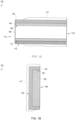
- FIG. 1A depicts a cross-sectional view of an example silicone layer 102 on a pipe or tube 104, with ice 114 formed on at least a portion of its outer surface 112.
- pipe 104 may represent tubing, piping, braided/woven hose, process equipment, or another suitable apparatus.
- Pipe 104 may comprise a polymer, composite, metal, other material, or combinations thereof.
- pipe 104 has an inner surface 108 that defines an opening 106, and silicone layer 102 surrounds an external surface 110 of pipe 104.
- silicone layer 102 exists without pipe 104, and itself forms a tube, pipe, hose, sheet, or other shape.
- silicone layer 102 does not comprise TiO2, and therefore is subject to the formation of ice 114 on its outer surface 112.
- the ice 114 formation is thicker at a second end 118 of pipe 104 (for example, where second end 118 is closer to a low temperature source) than at a first and 116 of pipe 104.
- FIG. 1B depicts a cross-sectional view of an example silicone layer 152 on a fitting or other piece of equipment or substrate 154, with ice 114 formed on its outer surface 162, according to an example.
- Fitting 154 may comprise a polymer, composite, metal, other material, or combinations thereof.
- silicone layer 152 exists without fitting 154, and itself forms a fitting, sheet, or other shape.
- silicone layer 152 does not comprise TiO2, and therefore is subject to the formation of ice 114 on its outer surface 162.
- silicone layers 102 and 152 may be extruded directly onto pipe 104 and 154, respectively.
- silicone layers 102 and 152 may be extruded directly onto pipe 104 and 154 but may comprise TiO2 as disclosed herein, and therefore would not be subject to the formation of ice 114 on their outer surfaces 112, 162.
- a substrate material for example, pipe, hose, tube, fitting, equipment, or other substrate
- the PDMS and TiO2 composition may be cured. In some examples, curing may be done at room temperature, at a temperature higher than room temperature in an oven, by exposure to UV light, and/or by another curing method.
- FIG. 2A depicts an example water droplet 220 on a hydrophilic surface 212 of a material 202.
- material 202 may be a silicone rubber, for example, PDMS (without comprising TiO2).
- Water droplet 220 sits on a surface 212 of material 202, and surface 212 is hydrophilic.
- Contact angle A1 is defined by the angle between the outer surface 222 of the water droplet 220 and the material surface 212.
- Hydrophilic material surface 212 has a high surface energy, meaning that contact angle A1 is relatively low.
- contact angle A1 may be about 30°.
- contact angle may be less than about 50°. This causes water droplet 220 to have a flatter shape and contact a greater surface area of material surface 212. Therefore, any ice (for example, ice 114 as shown in FIGS. 1A, 1B ), may cover a larger surface area of surface 212.
- FIG. 2B depicts an example water droplet 270 on a hydrophobic surface 262 of a material 252.
- material 252 may be a silicone rubber, for example, PDMS that comprises TiO2.
- Water droplet 270 sits on a surface 262 of material 252, and surface 262 is hydrophobic.
- Contact angle A2 is defined by the angle between the outer surface 272 of the water droplet 270 and the material surface 262.
- Hydrophobic material surface 262 has a low surface energy, meaning that contact angle A2 is relatively high.
- contact angle A2 may be about 75°. In an example, contact angle may be greater than about 50°. This causes water droplet 270 to have a more rounded/domed shape and contact a smaller surface area of material surface 262.
- surface 262 may lead to water droplets 270 rolling/beading off of surface 262 (and not absorbing into surface 262), and therefore, there will be no droplets 270 to form ice on surface 262. Additionally, because of the smaller surface area of droplets 270 that do not bead off of the surface 262, any residual ice (for example, ice 114 as shown in FIGS. 1A, 1B ), that does form may cover a smaller surface area of surface 262.
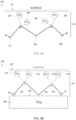
- FIG. 3A depicts an example polydimethylsiloxane molecular arrangement 300.
- Arrangement 300 shows an unmodified (i.e. not comprising TiO2) PDMS 324 molecular configuration, in which the methyl groups 326 are oriented nearer the (more hydrophilic) surface 212 of the material than the oxygen atoms 328, but the methyl groups 326 are arranged at irregular distances from surface 212.
- FIG. 3B depicts an example polydimethylsiloxane and titanium dioxide molecular arrangement 350.
- Arrangement 350 shows a modified PDMS 374 molecular configuration, in which the oxygen atoms 378 are arranged at an outer surface 380 of a TiO2 382 nanoparticle (or particle, in some examples).
- This arrangement of the oxygen atoms 378 leads to an arrangement and position of the PDMS 374 molecule(s) in which the methyl groups 376 are more consistently oriented at the surface 262. This close, consistent orientation of the methyl groups 376 at the surface 262 provides surface 262 with hydrophobic qualities.
- Figure 4 depicts an example method 400 for forming a modified polydimethylsiloxane and titanium dioxide composition, for preventing ice formation on a substrate.
- TiO2 nanoparticles are mixed into PDMS.
- the TiO2 may be in the form of particles (larger than nanoparticles) or granules.
- the substrate may be a hose, fitting, piece of equipment, or other substrate as disclosed herein.
- the substrate may comprise metal, a polymer, a composite, or other material or combination of materials.
- the mixture is cured.
- Aspect 2 The apparatus of aspect 1, wherein the protective layer is extruded onto an outer surface of the substrate.
- Aspect 3 The apparatus of any of aspects 1-2, wherein the titanium dioxide comprises titanium dioxide nanoparticles.
- Aspect 4 The apparatus of any of aspects 1-3, wherein the substrate comprises a hose.
- Aspect 5 The apparatus of any of aspects 1-3, wherein the substrate comprises a fitting.
- a method of preventing ice formation on a substrate comprising: mixing titanium dioxide nanoparticles into PDMS; extruding the mixture onto the substrate; and curing the mixture.
- Aspect 7 The method of aspect 6, wherein the substrate comprises a hose.
- Aspect 8 The method of aspect 6, wherein the substrate comprises a fitting.
- a composition for a protective layer for a substrate comprising: PDMS; and titanium dioxide, wherein the composition is extruded onto a substrate.
- Aspect 10 The composition of aspect 9, wherein the substrate comprises a hose.
- Aspect 11 The composition of aspect 9, wherein the substrate comprises a fitting.
Landscapes
- Chemical & Material Sciences (AREA)
- Organic Chemistry (AREA)
- Chemical Kinetics & Catalysis (AREA)
- Engineering & Computer Science (AREA)
- Polymers & Plastics (AREA)
- Medicinal Chemistry (AREA)
- Health & Medical Sciences (AREA)
- Life Sciences & Earth Sciences (AREA)
- Materials Engineering (AREA)
- Wood Science & Technology (AREA)
- Mechanical Engineering (AREA)
- Inorganic Chemistry (AREA)
- Compositions Of Macromolecular Compounds (AREA)
Abstract
Disclosed herein are compositions for and methods of forming a modified silicone rubber that includes titanium dioxide. The disclosed composition creates a hydrophobic surface that prevents or minimizes ice formation on the external surface of apparatuses utilized in low temperature services. The disclosed composition is suitable for installation in cryogenic or refrigerant service, while also maintaining performance in high-temperature applications.
Description
- This application claims the benefit of
Indian Provisional Patent Application No. 202311072886, filed October 26, 2023 - Hoses, sleeves, pipes, tubing, fittings, and other pieces of equipment utilized in cryogenic or refrigerant application may experience ice formation on their outer surface, due to the cold temperatures of the associated process causing moisture in the external air to condense and freeze. This buildup of ice causes several problems, including requiring operators to wear specialized personal protective equipment when handling an icy apparatus; requiring the installation of specialized safety features; causing polymer composites to crack or otherwise lose strength/integrity; and/or reducing the toughness of materials such as metals. Current silicone rubber compositions (for example, as may be formed into a protective sleeve) perform well at high temperatures but are not suitable for low temperature applications. A composition of a silicone rubber suitable for refrigerant or cryogenic service, from which apparatuses (for example, hoses), sleeves, or protective layers could be made is desired.
- Disclosed herein are compositions for a modified silicone rubber that includes titanium dioxide. The disclosed composition creates a hydrophobic surface that prevents or minimizes ice formation on the external surface of apparatuses utilized in low temperature services. The disclosed composition is suitable for installation in cryogenic or refrigerant service, while also maintaining performance in high-temperature applications. Also disclosed herein are methods of forming the same.
- This summary is provided to introduce a selection of concepts in a simplified form that are further described below in the Detailed Description. This summary is not intended to identify key features or essential features of the claimed subject matter, nor is it intended to be used to limit the scope of the claimed subject matter.
- Non-limiting and non-exhaustive examples are described with reference to the following Figures.
-
Figure 1A depicts a cross-sectional view of an example silicone layer on a pipe or tube, with ice on its outer surface. -
Figure 1B depicts a cross-sectional view of an example silicone layer on a fitting, with ice on its outer surface, according to an example. -
Figure 2A depicts an example water droplet on a hydrophilic surface. -
Figure 2B depicts an example water droplet on a hydrophobic surface. -
Figure 3A depicts an example polydimethylsiloxane molecular arrangement. -
Figure 3B depicts an example polydimethylsiloxane and titanium dioxide molecular arrangement. -
Figure 4 depicts an example method for forming a modified polydimethylsiloxane and titanium dioxide composition for prevention of ice formation on a substrate. - In the following detailed description, references are made to the accompanying drawings that form a part hereof, and in which are shown by way of illustrations specific embodiments or examples. These aspects may be combined, other aspects may be utilized, and structural changes may be made without departing from the present disclosure. Examples may be practiced as methods, systems, or devices. It should be understood that this invention is not limited to the particular methodology, protocols, and reagents, etc., described herein and as such may vary. The terminology used herein is for the purpose of describing particular embodiments only. The following detailed description is therefore not to be taken in a limiting sense, and the scope of the present disclosure is defined by the appended claims and their equivalents.
- Unless defined otherwise, all technical and scientific terms used herein have the same meaning as those commonly understood to one of ordinary skill in the art to which this invention pertains.
- For the purposes of this application the following terms shall have the following meanings:
- As used herein and in the claims, the singular forms "a," "an", and "the" include the plural reference unless the context clearly indicates otherwise.
- Other than in the operating examples, or where otherwise indicated, all numbers expressing quantities of ingredients or reaction conditions used herein should be understood as modified in all instances by the term "about." The term "about" when used herein in connection with numerical values means ± 20% and with percentages means ±1%.
- As used herein, the term "comprising" refers to a composition, compound, formulation, or method that is inclusive and does not exclude additional elements or method steps.
- As used herein, the term "consisting of" refers to a compound, composition, formulation, or method that excludes the presence of any additional component or method steps.
- As used herein, the term "consisting essentially of" refers to a composition, compound, formulation, or method that is inclusive of additional elements or method steps that do not materially affect the characteristic(s) of the composition, compound, formulation or method.
- There are many circumstances wherein equipment and/or apparatuses may be exposed to low temperatures. Examples include, but are not limited to, cryogenic processes, refrigerant processes, processes involving the Joule-Thomson effect, processes creating or involving liquid gasses (for example, hydrogen, helium, oxygen, ammonia, chlorine, nitrogen, hydrocarbons, and others), or others. Herein, "low temperature" is defined to mean refrigerant, cryogenic, or other processes wherein an outer surface is cold enough to cause condensation and freezing of water vapor on the surface. Such processes may be present in industrial, aerospace, military, laboratory, medical, transportation, energy generation, or other environments. When a material is at a cold temperature (for example, PDMS in a cryogenic or refrigerant service), water vapor in the surrounding, external air may condense onto the external surface of the material. The volume and shape of water droplets that form on the surface is related to the surface energy of the material. As described in more detail below, a more hydrophilic surface with have a higher surface energy. If the surface of the material is cold enough, the condensed water droplets will freeze, forming ice on the surface of the material.
- In some examples, low temperature applications may include processes at temperatures of about -100°F. In some examples, low temperature applications may include processes at temperatures below about 45°F. In some examples, low temperature applications may include processes at temperatures below about 32°F. In some examples, low temperature applications may include processes at temperatures below about 10°F. In some examples, low temperature applications may include processes at temperatures below about 0°F. In some examples, low temperature applications may include processes at temperatures below about -10°F. In some examples, low temperature applications may include processes at temperatures below about - 20°F. In some examples, low temperature applications may include processes at temperatures below about -40°F. In some examples, low temperature applications may include processes at temperatures below about -100°F. In some examples, low temperature applications may include processes at temperatures below about -150°F. In some examples low temperature applications may include processes of temperatures between about -450°F and between about 45°F. In some examples low temperature applications may include processes of temperatures between about - 450°F and between about 0°F. In some examples low temperature applications may include processes of temperatures between about 0°F and between about 45°F. In some examples low temperature applications may include processes of temperatures between about -100°F and between about 32°F. In some examples low temperature applications may include processes of temperatures between about -100°F and between about 0°F.
- In some examples, cryogenic applications may include processes at temperatures of about -450°F. In some examples, cryogenic applications may include processes at temperatures below about -450°F. In some examples, cryogenic applications may include processes at temperatures below about -500°F. In some examples, cryogenic applications may include processes at temperatures below about -321°F. In some examples, cryogenic applications may include processes at temperatures below about -242°F. In some examples, cryogenic applications may include processes at temperatures below about -58°F. In some examples, cryogenic applications may include processes at temperatures below about -50°F. In some examples cryogenic applications may include processes of temperatures between about -450°F and between about -321°F. In some examples cryogenic applications may include processes of temperatures between about -450°F and between about -242°F. In some examples cryogenic applications may include processes of temperatures between about -450°F and between about - 58°F. In some examples cryogenic applications may include processes of temperatures between about -500°F and between about -400°F. In some examples cryogenic applications may include processes of temperatures between about -321 °F and between about -242°F. In some examples cryogenic applications may include processes of temperatures between about -321°F and between about -58°F. In some examples cryogenic applications may include processes of temperatures between about -242°F and between about -58°F.
- In some examples, refrigerant applications may include processes at temperatures of about -250°F. In some examples, refrigerant applications may include processes at temperatures below about -250°F. In some examples, refrigerant applications may include processes at temperatures below about -300°F. In some examples, refrigerant applications may include processes at temperatures below about -200°F. In some examples, refrigerant applications may include processes at temperatures below about -150°F. In some examples, refrigerant applications may include processes at temperatures below about -100°F. In some examples, refrigerant applications may include processes at temperatures below about -50°F. In some examples, refrigerant applications may include processes at temperatures below about 0°F. In some examples, refrigerant applications may include processes at temperatures below about 32°F. In some examples refrigerant applications may include processes of temperatures between about -250°F and between about 32°F. In some examples refrigerant applications may include processes of temperatures between about -300°F and between about -200°F. In some examples refrigerant applications may include processes of temperatures between about -250°F and between about -100°F. In some examples refrigerant applications may include processes of temperatures between about -250°F and between about -50°F. In some examples refrigerant applications may include processes of temperatures between about -300°F and between about - 100°F.
- In a particular example, an application of the disclosed systems and methods includes liquid hydrogen stored and utilized in a cryogenic system of an aircraft. The liquid hydrogen may be stored at an average temperature of about -423°F (at a maximum pressure of 700 bar). At such a high pressure, the integrity of the process fittings, pipes, hoses, equipment, and other apparatuses is paramount to maintain safety and prevent loss of containment.
- Ice formation on surfaces is problematic for several reasons. Operators or other users who need to interact with the equipment/apparatuses subject to ice formation must wear specialized personal protective equipment when handling an icy apparatus to protect themselves from the ice. To further enable safe handling of icy equipment/apparatuses, specialized safety features may be installed (for example, vacuum insulation or extended/insulated handles), increasing cost and complexity of the system without preventing the ice buildup itself. Additionally, the ice buildup can be detrimental to the equipment/apparatuses themselves, for example, causing polymer composites to crack or otherwise lose strength/integrity, and/or reducing the toughness of materials such as metals (for example, braided metal hoses). The performance and integrity of the equipment/apparatuses may be degraded by a combination of several mechanisms. A hydrophilic material may absorb water (and/or hold more water on its surface), causing cracks in the surface or exacerbating existing cracks. Ice formation on the surface may cause the material to become more susceptible to cracking, and ice formation in cracks can expand the cracks further.
- Disclosed herein are compositions and related methods for a modified silicone rubber that includes titanium dioxide. Silicone rubber may be used for the formation of apparatuses such as hoses, as well as for the formation of protective coatings, layers, and sleeves. An example silicone rubber is polydimethylsiloxane (PDMS), although others may be contemplated. PDMS is a polymer, with chains that contain a hydrophilic, highly polar, silicon-based backbone. This silicon-based backbone is surrounded by nonpolar methyl groups. An example PDMS polymer formula is shown below.

- In FORMULA 1 above, n indicates a number of dimethylsiloxane functional groups present in the particular polymer molecule. As the number n varies, so does the molecular weight of the polymer. In some examples, PDMS as utilized in disclosed compositions includes a range of molecular weights (a range of polymer lengths/n's). In some examples, average molecular weights of PDMS may be between about 2000 Da to about 130,000 Da. In some examples, average molecular weights of PDMS may be between about 1500 Da to about 180,000 Da. In some examples, average molecular weights of PDMS may be between about 2500 Da to about 100,000 Da. In some examples, average molecular weights of PDMS may be between about 3000 Da to about 90,000 Da. In some examples, average molecular weights of PDMS may be between about 4000 Da to about 75,000 Da. In some examples, average molecular weights of PDMS may be between about 5000 Da to about 50,000 Da. In some examples, average molecular weights of PDMS may be between about 7500 Da to about 25,000 Da. In some examples, average molecular weights of PDMS may be between about 10,000 Da to about 20,000 Da. In some examples, average molecular weights of PDMS may be between about 130,000 Da to about 80,000 Da. In some examples, average molecular weights of PDMS may be between about 80,000 Da to about 2,000 Da. In some examples, average molecular weights of PDMS may be less than about 180,000 Da. In some examples, average molecular weights of PDMS may be less than about 175,000 Da. In some examples, average molecular weights of PDMS may be less than about 150,000 Da. In some examples, average molecular weights of PDMS may be less than about 125,000 Da. In some examples, average molecular weights of PDMS may be less than about 100,000 Da. In some examples, average molecular weights of PDMS may be less than about 75,000 Da. In some examples, average molecular weights of PDMS may be less than about 50,000 Da. In some examples, average molecular weights of PDMS may be less than about 25,000 Da. In some examples, average molecular weights of PDMS may be less than about 10,000 Da. In some examples, average molecular weights of PDMS may be less than about 7,500 Da. In some examples, average molecular weights of PDMS may be less than about 5,000 Da. In some examples, average molecular weights of PDMS may be less than about 4,000 Da. In some examples, average molecular weights of PDMS may be less than about 3,000 Da. In some examples, average molecular weights of PDMS may be less than about 2,000 Da. In some examples, average molecular weights of PDMS may be less than about 1,500 Da. In some examples, average molecular weights of PDMS may be less than about 1,000 Da. In some examples, average molecular weights of PDMS may be greater than about 180,000 Da. In some examples, average molecular weights of PDMS may be greater than about 175,000 Da. In some examples, average molecular weights of PDMS may be greater than about 150,000 Da. In some examples, average molecular weights of PDMS may be greater than about 125,000 Da. In some examples, average molecular weights of PDMS may be greater than about 100,000 Da. In some examples, average molecular weights of PDMS may be greater than about 75,000 Da. In some examples, average molecular weights of PDMS may be greater than about 50,000 Da. In some examples, average molecular weights of PDMS may be greater than about 25,000 Da. In some examples, average molecular weights of PDMS may be greater than about 10,000 Da. In some examples, average molecular weights of PDMS may be greater than about 7,500 Da. In some examples, average molecular weights of PDMS may be greater than about 5,000 Da. In some examples, average molecular weights of PDMS may be greater than about 4,000 Da. In some examples, average molecular weights of PDMS may be greater than about 3,000 Da. In some examples, average molecular weights of PDMS may be greater than about 2,000 Da. In some examples, average molecular weights of PDMS may be greater than about 1,500 Da. In some examples, average molecular weights of PDMS may be greater than about 1,000 Da.
- Once cured, bulk PDMS material may initially exhibit hydrophobic properties. However, material aging (especially at subzero temperatures such as those experienced in cryogenic or refrigerant service) may results in the loss of methyl groups, therefore making the PDMS material more hydrophilic. Additionally, unaltered, cured PDMS may swell and/or crack when exposed so subzero temperatures (for example, at around temperatures of -65°F).
- The disclosed composition includes titanium dioxide (TiO2) particles or nanoparticles to the PDMS formula. As discussed further below, this extends the surface hydrophobicity of the PDMS and creates a hydrophobic surface that prevents or minimizes ice formation on the external surface. In some examples, other silicone/rubber materials may be included with and/or substituted for PDMS.
- The disclosed composition is also suitable for installation in cryogenic or refrigerant service, while also maintaining performance in high-temperature applications. PDMS is often utilized to form protective sleeves for equipment/apparatuses that are in high-temperature services or in areas where fire prevention/protection is desired (for example, where they may be exposed of temperatures up to 2,000°F). However, when used in low temperature applications (for example, cryogenic or refrigerant applications), PDMS may lose strength/integrity and become prone to cracking. The inclusion of the TiO2, in addition to reducing or preventing ice formation, has an additional, surprising benefit of maintaining performance (e.g. integrity and strength, such as resistance to cracking) in low temperature applications.
- In accordance with principles of this disclosure,
FIG. 1A depicts a cross-sectional view of anexample silicone layer 102 on a pipe ortube 104, withice 114 formed on at least a portion of itsouter surface 112. In the example,pipe 104 may represent tubing, piping, braided/woven hose, process equipment, or another suitable apparatus.Pipe 104 may comprise a polymer, composite, metal, other material, or combinations thereof. In the example shown,pipe 104 has aninner surface 108 that defines anopening 106, andsilicone layer 102 surrounds anexternal surface 110 ofpipe 104. In some examples,silicone layer 102 exists withoutpipe 104, and itself forms a tube, pipe, hose, sheet, or other shape. - In the example,
silicone layer 102 does not comprise TiO2, and therefore is subject to the formation ofice 114 on itsouter surface 112. In an example, theice 114 formation is thicker at asecond end 118 of pipe 104 (for example, wheresecond end 118 is closer to a low temperature source) than at a first and 116 ofpipe 104. -
FIG. 1B depicts a cross-sectional view of anexample silicone layer 152 on a fitting or other piece of equipment orsubstrate 154, withice 114 formed on itsouter surface 162, according to an example. Fitting 154 may comprise a polymer, composite, metal, other material, or combinations thereof. In some examples,silicone layer 152 exists without fitting 154, and itself forms a fitting, sheet, or other shape. In the example,silicone layer 152 does not comprise TiO2, and therefore is subject to the formation ofice 114 on itsouter surface 162. - Regarding
FIGS. 1A and IB, silicone layers 102 and 152 may be extruded directly ontopipe pipe ice 114 on theirouter surfaces -
FIG. 2A depicts anexample water droplet 220 on ahydrophilic surface 212 of amaterial 202. In an example,material 202 may be a silicone rubber, for example, PDMS (without comprising TiO2).Water droplet 220 sits on asurface 212 ofmaterial 202, andsurface 212 is hydrophilic. Contact angle A1 is defined by the angle between theouter surface 222 of thewater droplet 220 and thematerial surface 212.Hydrophilic material surface 212 has a high surface energy, meaning that contact angle A1 is relatively low. For example, contact angle A1 may be about 30°. In an example, contact angle may be less than about 50°. This causeswater droplet 220 to have a flatter shape and contact a greater surface area ofmaterial surface 212. Therefore, any ice (for example,ice 114 as shown inFIGS. 1A, 1B ), may cover a larger surface area ofsurface 212. -
FIG. 2B depicts anexample water droplet 270 on ahydrophobic surface 262 of amaterial 252. In an example,material 252 may be a silicone rubber, for example, PDMS that comprises TiO2.Water droplet 270 sits on asurface 262 ofmaterial 252, andsurface 262 is hydrophobic. Contact angle A2 is defined by the angle between theouter surface 272 of thewater droplet 270 and thematerial surface 262.Hydrophobic material surface 262 has a low surface energy, meaning that contact angle A2 is relatively high. For example, contact angle A2 may be about 75°. In an example, contact angle may be greater than about 50°. This causeswater droplet 270 to have a more rounded/domed shape and contact a smaller surface area ofmaterial surface 262. The hydrophobic nature ofsurface 262 may lead towater droplets 270 rolling/beading off of surface 262 (and not absorbing into surface 262), and therefore, there will be nodroplets 270 to form ice onsurface 262. Additionally, because of the smaller surface area ofdroplets 270 that do not bead off of thesurface 262, any residual ice (for example,ice 114 as shown inFIGS. 1A, 1B ), that does form may cover a smaller surface area ofsurface 262. -
FIG. 3A depicts an example polydimethylsiloxanemolecular arrangement 300.Arrangement 300 shows an unmodified (i.e. not comprising TiO2)PDMS 324 molecular configuration, in which themethyl groups 326 are oriented nearer the (more hydrophilic)surface 212 of the material than theoxygen atoms 328, but themethyl groups 326 are arranged at irregular distances fromsurface 212. -
FIG. 3B depicts an example polydimethylsiloxane and titanium dioxidemolecular arrangement 350.Arrangement 350 shows a modifiedPDMS 374 molecular configuration, in which theoxygen atoms 378 are arranged at anouter surface 380 of aTiO2 382 nanoparticle (or particle, in some examples). This arrangement of theoxygen atoms 378 leads to an arrangement and position of thePDMS 374 molecule(s) in which themethyl groups 376 are more consistently oriented at thesurface 262. This close, consistent orientation of themethyl groups 376 at thesurface 262 providessurface 262 with hydrophobic qualities. -
Figure 4 depicts anexample method 400 for forming a modified polydimethylsiloxane and titanium dioxide composition, for preventing ice formation on a substrate. Atoperation 402, TiO2 nanoparticles are mixed into PDMS. In other examples, the TiO2 may be in the form of particles (larger than nanoparticles) or granules. - At
operation 404, the mixture is extruded onto a substrate. The substrate may be a hose, fitting, piece of equipment, or other substrate as disclosed herein. The substrate may comprise metal, a polymer, a composite, or other material or combination of materials. - At
operation 406, the mixture is cured. - Although specific aspects were described herein, the scope of the technology is not limited to those specific aspects. One skilled in the art will recognize other aspects or improvements that are within the scope of the present technology. Therefore, the specific structure, acts, or operations are disclosed only as illustrative aspects. The scope of the technology is defined by the following claims and any equivalents therein. Therefore, the specific structure, acts, or operations are disclosed only as illustrative aspects. The scope of the technology is defined by the following claims and any equivalents therein. Examples of the disclosure may be described according to the following aspects.
- Aspect 1. An apparatus, comprising: a substrate; a protective layer comprising: polydimethylsiloxane; and titanium dioxide.
- Aspect 2. The apparatus of aspect 1, wherein the protective layer is extruded onto an outer surface of the substrate.
- Aspect 3. The apparatus of any of aspects 1-2, wherein the titanium dioxide comprises titanium dioxide nanoparticles.
- Aspect 4. The apparatus of any of aspects 1-3, wherein the substrate comprises a hose.
- Aspect 5. The apparatus of any of aspects 1-3, wherein the substrate comprises a fitting.
- Aspect 6. A method of preventing ice formation on a substrate, comprising: mixing titanium dioxide nanoparticles into PDMS; extruding the mixture onto the substrate; and curing the mixture.
- Aspect 7. The method of aspect 6, wherein the substrate comprises a hose.
- Aspect 8. The method of aspect 6, wherein the substrate comprises a fitting.
- Aspect 9. A composition for a protective layer for a substrate, comprising: PDMS; and titanium dioxide, wherein the composition is extruded onto a substrate.
- Aspect 10. The composition of aspect 9, wherein the substrate comprises a hose.
- Aspect 11. The composition of aspect 9, wherein the substrate comprises a fitting.
- For the purposes of this application, directional terms such as "upper," "lower," "upward," and "downward" are intended to be descriptive with reference to the disclosure above and, where applicable, in relation to the orientation shown in the Figures for clarity. The examples as practiced and included in the scope of the claims may include examples where the systems and devices are in a different orientation.
- While particular uses of the technology have been illustrated and discussed above, the disclosed technology can be used with a variety of environments in accordance with many examples of the technology. The above discussion is not meant to suggest that the disclosed technology is only suitable for implementation within the environments shown and described above. As should be appreciated, the various aspects described with respect to the figures herein are not intended to limit the technology to the particular aspects described. Accordingly, additional configurations can be used to practice the technology herein and/or some aspects described can be excluded without departing from the methods and systems disclosed herein.
- This disclosure described some aspects of the present technology with reference to the accompanying drawings, in which only some of the possible aspects were shown. Other aspects can, however, be embodied in many different forms and should not be construed as limited to the aspects set forth herein. Rather, these aspects were provided so that this disclosure was thorough and complete and fully conveyed the scope of the possible aspects to those skilled in the art.
- Similarly, where operations of a process are disclosed, those operations are described for purposes of illustrating the present technology and are not intended to limit the disclosure to a particular sequence of operations. For example, the operations can be performed in differing order, two or more operations can be performed concurrently, additional operations can be performed, and disclosed operations can be excluded without departing from the present disclosure. Further, each operation can be accomplished via one or more sub-operations. The disclosed processes can be repeated.
- Although specific aspects were described herein, the scope of the technology is not limited to those specific aspects. One skilled in the art will recognize other aspects or improvements that are within the scope of the present technology. Therefore, the specific structure, acts, or operations are disclosed only as illustrative aspects. The scope of the technology is defined by the following claims and any equivalents therein.
Claims (11)
- An apparatus, comprising:a substrate;a protective layer comprising:polydimethylsiloxane; andtitanium dioxide.
- The apparatus of claim 1, wherein the protective layer is extruded onto an outer surface of the substrate.
- The apparatus of any of claims 1-2, wherein the titanium dioxide comprises titanium dioxide nanoparticles.
- The apparatus of any of claims 1-3, wherein the substrate comprises a hose.
- The apparatus of any of claims 1-3, wherein the substrate comprises a fitting.
- A method of preventing ice formation on a substrate, comprising:mixing titanium dioxide nanoparticles into PDMS;extruding the mixture onto the substrate; andcuring the mixture.
- The method of claim 6, wherein the substrate comprises a hose.
- The method of claim 6, wherein the substrate comprises a fitting.
- A composition for a protective layer for a substrate, comprising:PDMS; andtitanium dioxide, wherein the composition is extruded onto a substrate.
- The composition of claim 9, wherein the substrate comprises a hose.
- The composition of claim 9, wherein the substrate comprises a fitting.
Applications Claiming Priority (1)
| Application Number | Priority Date | Filing Date | Title |
|---|---|---|---|
| IN202311072886 | 2023-10-26 |
Publications (1)
| Publication Number | Publication Date |
|---|---|
| EP4545606A1 true EP4545606A1 (en) | 2025-04-30 |
Family
ID=93154293
Family Applications (1)
| Application Number | Title | Priority Date | Filing Date |
|---|---|---|---|
| EP24207215.5A Pending EP4545606A1 (en) | 2023-10-26 | 2024-10-17 | MODIFIED SILICONE RUBBER CHEMISTRY |
Country Status (2)
| Country | Link |
|---|---|
| US (1) | US20250136784A1 (en) |
| EP (1) | EP4545606A1 (en) |
Citations (4)
| Publication number | Priority date | Publication date | Assignee | Title |
|---|---|---|---|---|
| JP2009056640A (en) * | 2007-08-30 | 2009-03-19 | Tokai Rubber Ind Ltd | Heat-resistant hose and its manufacturing method |
| CN102676056A (en) * | 2012-06-01 | 2012-09-19 | 天津大学 | Nano composite ice-covering-proof coating containing phase change silicone oil and preparation method thereof |
| WO2017210230A1 (en) * | 2016-06-03 | 2017-12-07 | Hrl Laboratories, Llc | Compositions and methods for fabricating durable, low-ice-adhesion coatings |
| CN114133865A (en) * | 2021-11-29 | 2022-03-04 | 国网甘肃省电力公司经济技术研究院 | Self-cleaning anti-icing coating for power transmission line and preparation method thereof |
-
2024
- 2024-10-15 US US18/916,476 patent/US20250136784A1/en active Pending
- 2024-10-17 EP EP24207215.5A patent/EP4545606A1/en active Pending
Patent Citations (4)
| Publication number | Priority date | Publication date | Assignee | Title |
|---|---|---|---|---|
| JP2009056640A (en) * | 2007-08-30 | 2009-03-19 | Tokai Rubber Ind Ltd | Heat-resistant hose and its manufacturing method |
| CN102676056A (en) * | 2012-06-01 | 2012-09-19 | 天津大学 | Nano composite ice-covering-proof coating containing phase change silicone oil and preparation method thereof |
| WO2017210230A1 (en) * | 2016-06-03 | 2017-12-07 | Hrl Laboratories, Llc | Compositions and methods for fabricating durable, low-ice-adhesion coatings |
| CN114133865A (en) * | 2021-11-29 | 2022-03-04 | 国网甘肃省电力公司经济技术研究院 | Self-cleaning anti-icing coating for power transmission line and preparation method thereof |
Also Published As
| Publication number | Publication date |
|---|---|
| US20250136784A1 (en) | 2025-05-01 |
Similar Documents
| Publication | Publication Date | Title |
|---|---|---|
| Jones et al. | The response of aerospace composites to temperature and humidity | |
| JP6708252B2 (en) | Fiber reinforced composite materials, laminates, pipes, riser pipes and flow lines | |
| WO2018094519A1 (en) | Pvdf coated pipe for oil or gas applications | |
| Gonzalez et al. | Effect of flame-sprayed Al–12Si coatings on the failure behaviour of pressurized fibre-reinforced composite tubes | |
| US11926959B2 (en) | High tenacity textiles containing shear thickening fluid and uses thereof | |
| Lobanov et al. | Improvement of the impact and crack resistance of epoxy thermosets and thermoset-based composites with the use of thermoplastics as modifiers | |
| Son et al. | Fabrication of carbon fiber/polyamide 6 composites with water resistance and anti-icing performance using a superhydrophobic fluorinated-polydopamine coating | |
| WO2015061549A1 (en) | Polyamide composites containing graphene oxide sheets | |
| JPWO2009022400A1 (en) | Fluororesin composite material, lining film obtainable from the fluororesin composite material, and film body having the lining film | |
| US20250136784A1 (en) | Modified silcone rubber chemistry | |
| Nawaz et al. | 7Effects on thermal and ablative properties of phenolic resin (novolac) blended acrylonitrile butadiene rubber | |
| CN108064326B (en) | Use of material layers as thermal insulation barriers | |
| EP2900750B1 (en) | A composition, tape and composite pipe made therefrom and a method of producing composite pipe | |
| JPH1171493A (en) | Pressure resistant sliding ethylene polytetrafluoride resin composition | |
| EP4709581A1 (en) | A multilayer permeation barrier for spoolable composite pipes | |
| EP3370958B1 (en) | Isulated conduit including a fluoropolymer composition for use as a thermal insulation layer | |
| Jones | The effects of aggressive environments on long-term behaviour | |
| El-Tayeb et al. | Wear and friction behaviour of CGRP and WGRP composites subjected to dry sliding | |
| JP7111311B2 (en) | flame retardant material | |
| Serenario et al. | Anti-Corrosion Coatings Based on Nb2O5-a Comparison Between two Coatings Technology: Thermal Spray Coating and Epoxy Paint | |
| JP7117318B2 (en) | Plastic cap filled with sealing compound for combined protection against fuel and hydraulic oil and lightning strikes | |
| Kim et al. | Plasma treatment and its effects on the tribological behaviour of basalt/epoxy woven composites in a marine environment | |
| Gao et al. | Bark-mimetic layer-by-layer assembled montmorillonite/poly (p-aminostyrene) flexible nanocomposites shielding atomic oxygen erosion | |
| Weon et al. | Failure mechanism and long-term hydrostatic behavior of linear low density polyethylene tubing | |
| US11958584B2 (en) | Graphene-oxide grafted PBO (Zylon®) fibers; method for production and applications to airship hulls and lighter than air vehicles |
Legal Events
| Date | Code | Title | Description |
|---|---|---|---|
| PUAI | Public reference made under article 153(3) epc to a published international application that has entered the european phase |
Free format text: ORIGINAL CODE: 0009012 |
|
| STAA | Information on the status of an ep patent application or granted ep patent |
Free format text: STATUS: REQUEST FOR EXAMINATION WAS MADE |
|
| 17P | Request for examination filed |
Effective date: 20241017 |
|
| AK | Designated contracting states |
Kind code of ref document: A1 Designated state(s): AL AT BE BG CH CY CZ DE DK EE ES FI FR GB GR HR HU IE IS IT LI LT LU LV MC ME MK MT NL NO PL PT RO RS SE SI SK SM TR |