EP4545515A1 - Bcl-2 inhibitors - Google Patents
Bcl-2 inhibitors Download PDFInfo
- Publication number
- EP4545515A1 EP4545515A1 EP25150254.8A EP25150254A EP4545515A1 EP 4545515 A1 EP4545515 A1 EP 4545515A1 EP 25150254 A EP25150254 A EP 25150254A EP 4545515 A1 EP4545515 A1 EP 4545515A1
- Authority
- EP
- European Patent Office
- Prior art keywords
- methyl
- phenyl
- oxy
- amino
- pyridin
- Prior art date
- Legal status (The legal status is an assumption and is not a legal conclusion. Google has not performed a legal analysis and makes no representation as to the accuracy of the status listed.)
- Pending
Links
Images
Classifications
-
- C—CHEMISTRY; METALLURGY
- C07—ORGANIC CHEMISTRY
- C07D—HETEROCYCLIC COMPOUNDS
- C07D471/00—Heterocyclic compounds containing nitrogen atoms as the only ring hetero atoms in the condensed system, at least one ring being a six-membered ring with one nitrogen atom, not provided for by groups C07D451/00 - C07D463/00
- C07D471/02—Heterocyclic compounds containing nitrogen atoms as the only ring hetero atoms in the condensed system, at least one ring being a six-membered ring with one nitrogen atom, not provided for by groups C07D451/00 - C07D463/00 in which the condensed system contains two hetero rings
- C07D471/04—Ortho-condensed systems
-
- A—HUMAN NECESSITIES
- A61—MEDICAL OR VETERINARY SCIENCE; HYGIENE
- A61K—PREPARATIONS FOR MEDICAL, DENTAL OR TOILETRY PURPOSES
- A61K31/00—Medicinal preparations containing organic active ingredients
- A61K31/33—Heterocyclic compounds
- A61K31/395—Heterocyclic compounds having nitrogen as a ring hetero atom, e.g. guanethidine or rifamycins
- A61K31/495—Heterocyclic compounds having nitrogen as a ring hetero atom, e.g. guanethidine or rifamycins having six-membered rings with two or more nitrogen atoms as the only ring heteroatoms, e.g. piperazine or tetrazines
- A61K31/496—Non-condensed piperazines containing further heterocyclic rings, e.g. rifampin, thiothixene or sparfloxacin
-
- A—HUMAN NECESSITIES
- A61—MEDICAL OR VETERINARY SCIENCE; HYGIENE
- A61K—PREPARATIONS FOR MEDICAL, DENTAL OR TOILETRY PURPOSES
- A61K31/00—Medicinal preparations containing organic active ingredients
- A61K31/33—Heterocyclic compounds
- A61K31/395—Heterocyclic compounds having nitrogen as a ring hetero atom, e.g. guanethidine or rifamycins
- A61K31/435—Heterocyclic compounds having nitrogen as a ring hetero atom, e.g. guanethidine or rifamycins having six-membered rings with one nitrogen as the only ring hetero atom
- A61K31/4353—Heterocyclic compounds having nitrogen as a ring hetero atom, e.g. guanethidine or rifamycins having six-membered rings with one nitrogen as the only ring hetero atom ortho- or peri-condensed with heterocyclic ring systems
- A61K31/437—Heterocyclic compounds having nitrogen as a ring hetero atom, e.g. guanethidine or rifamycins having six-membered rings with one nitrogen as the only ring hetero atom ortho- or peri-condensed with heterocyclic ring systems the heterocyclic ring system containing a five-membered ring having nitrogen as a ring hetero atom, e.g. indolizine, beta-carboline
-
- A—HUMAN NECESSITIES
- A61—MEDICAL OR VETERINARY SCIENCE; HYGIENE
- A61P—SPECIFIC THERAPEUTIC ACTIVITY OF CHEMICAL COMPOUNDS OR MEDICINAL PREPARATIONS
- A61P35/00—Antineoplastic agents
-
- C—CHEMISTRY; METALLURGY
- C07—ORGANIC CHEMISTRY
- C07D—HETEROCYCLIC COMPOUNDS
- C07D207/00—Heterocyclic compounds containing five-membered rings not condensed with other rings, with one nitrogen atom as the only ring hetero atom
- C07D207/02—Heterocyclic compounds containing five-membered rings not condensed with other rings, with one nitrogen atom as the only ring hetero atom with only hydrogen or carbon atoms directly attached to the ring nitrogen atom
- C07D207/04—Heterocyclic compounds containing five-membered rings not condensed with other rings, with one nitrogen atom as the only ring hetero atom with only hydrogen or carbon atoms directly attached to the ring nitrogen atom having no double bonds between ring members or between ring members and non-ring members
- C07D207/08—Heterocyclic compounds containing five-membered rings not condensed with other rings, with one nitrogen atom as the only ring hetero atom with only hydrogen or carbon atoms directly attached to the ring nitrogen atom having no double bonds between ring members or between ring members and non-ring members with hydrocarbon radicals, substituted by hetero atoms, attached to ring carbon atoms
- C07D207/09—Radicals substituted by nitrogen atoms, not forming part of a nitro radical
-
- C—CHEMISTRY; METALLURGY
- C07—ORGANIC CHEMISTRY
- C07D—HETEROCYCLIC COMPOUNDS
- C07D403/00—Heterocyclic compounds containing two or more hetero rings, having nitrogen atoms as the only ring hetero atoms, not provided for by group C07D401/00
- C07D403/02—Heterocyclic compounds containing two or more hetero rings, having nitrogen atoms as the only ring hetero atoms, not provided for by group C07D401/00 containing two hetero rings
- C07D403/12—Heterocyclic compounds containing two or more hetero rings, having nitrogen atoms as the only ring hetero atoms, not provided for by group C07D401/00 containing two hetero rings linked by a chain containing hetero atoms as chain links
-
- C—CHEMISTRY; METALLURGY
- C07—ORGANIC CHEMISTRY
- C07D—HETEROCYCLIC COMPOUNDS
- C07D405/00—Heterocyclic compounds containing both one or more hetero rings having oxygen atoms as the only ring hetero atoms, and one or more rings having nitrogen as the only ring hetero atom
- C07D405/14—Heterocyclic compounds containing both one or more hetero rings having oxygen atoms as the only ring hetero atoms, and one or more rings having nitrogen as the only ring hetero atom containing three or more hetero rings
-
- C—CHEMISTRY; METALLURGY
- C07—ORGANIC CHEMISTRY
- C07D—HETEROCYCLIC COMPOUNDS
- C07D471/00—Heterocyclic compounds containing nitrogen atoms as the only ring hetero atoms in the condensed system, at least one ring being a six-membered ring with one nitrogen atom, not provided for by groups C07D451/00 - C07D463/00
- C07D471/12—Heterocyclic compounds containing nitrogen atoms as the only ring hetero atoms in the condensed system, at least one ring being a six-membered ring with one nitrogen atom, not provided for by groups C07D451/00 - C07D463/00 in which the condensed system contains three hetero rings
- C07D471/14—Ortho-condensed systems
-
- C—CHEMISTRY; METALLURGY
- C07—ORGANIC CHEMISTRY
- C07D—HETEROCYCLIC COMPOUNDS
- C07D519/00—Heterocyclic compounds containing more than one system of two or more relevant hetero rings condensed among themselves or condensed with a common carbocyclic ring system not provided for in groups C07D453/00 or C07D455/00
Definitions
- a compound of Formula (I) for inhibiting Bcl-2 and treating disease associated with undesirable bcl-2 activity Bcl-2 related diseases
- a method of using the compounds disclosed herein for treating dysregulated apoptotic diseases including neurodegenerative conditions, e.g., Alzheimer's disease; and proliferative diseases, e.g., cancers, autoimmune diseases and pro-thrombotic conditions, and a pharmaceutical composition comprising the same.
- apoptosis occurs in multicellular organisms to dispose damaged or unwanted cells, which is critical for normal tissue homeostasis.
- Br. J. Cancer 1972, 26, 239 defective apoptotic processes have been implicated in a wide variety of diseases. Excessive apoptosis causes atrophy, whereas an insufficient amount results in uncontrolled cell proliferation, such as cancer ( Cell 2011, 144, 646 ). Resistance to apoptotic cell death is a hallmark of cancer and contributes to chemoresistance ( Nat Med. 2004, 10, 789-799 ).
- Several key pathways controlling apoptosis are commonly altered in cancer.
- Bcl-2 B-cell lymphoma 2 family of proteins inhibit apoptosis. Negative regulation of apoptosis inhibits cell death signaling pathways, helping tumors to evade cell death and developing drug resistance.
- the extrinsic pathway is activated in response to the binding of deathinducing ligands to cell-surface death receptors ( Nat Rev Drug Discov. 2017 16, 273-284 ).
- the B cell lymphoma 2 (BCL-2) gene family a group of proteins homologous to the Bcl-2 protein, encodes more than 20 proteins that regulate the intrinsic apoptosis pathway.
- Bcl-2 family proteins are characterized by containing at least one of four conserved Bcl-2 homology (BH) domains (BH1, BH2, BH3 and BH4) ( Nat. Rev. Cancer 2008, 8, 121 ; Mol. Cell 2010, 37, 299 ; Nat. Rev. Mol.
- Bcl-2 family proteins consisting of pro-apoptotic and anti-apoptotic molecules, can be classified into the following three subfamilies according to sequence homology within four BH domains: (1) a subfamily shares sequence homology within all four BH domains, such as Bcl-2, Bcl-XL and Bcl-w which are anti-apoptotic; (2) a subfamily shares sequence homology within BH1, BH2 and BH4, such as Bax and Bak which are pro-apoptotic; (3) a subfamily shares sequence homology only within BH3, such as Bik, Bid and HRK which are pro-apoptotic.
- Bcl-2 family proteins One of the unique features of Bcl-2 family proteins is heterodimerization between anti-apoptotic and pro-apoptotic proteins, which is considered to inhibit the biological activity of their partners.
- This heterodimerization is mediated by the insertion of a BH3 region of a pro-apoptotic protein into a hydrophobic cleft composed of BH1, BH2 and BH3 from an anti-apoptotic protein.
- the BH4 domain is required for anti-apoptotic activity.
- BH3 domain is essential and, itself, sufficient for pro-apoptotic activity.
- Bcl-2 small molecule inhibitors have been investigated at various stages of drug development: the Bcl-2/Bcl-xL inhibitor ABT-263 (navitoclax, WO2009155386 ) has shown promising clinical activity in lymphoid malignancies such as chronic lymphocytic leukemia. However, its efficacy in these settings is limited by platelet death and attendant thrombocytopenia caused by Bcl-xL inhibition ( Lancet Oncol. 2010, 11, 1149 ; J. Clin. Oncol. 2011, 29, 909 ; J. Clin. Oncol. 2012, 30, 488 ).
- R a , R b , R c and R d are independently hydrogen or C 1-6 alkyl, preferably hydrogen or methyl.
- L 1 is a direct bond or -(CR a R b ) t -, wherein R a , R b and t are defined as with Formula (I).
- t is a number of 1 or 2.
- L 1 is a direct bond or -(CR a R b )-, wherein R a and R b are hydrogen or C 1-6 alkyl. preferably hydrogen.
- L 1 is a direct bond.
- L 2 is a direct bond, -(CR a R b ) 1-5 -, -(CR a R b ) 1-3 -(C ⁇ C)-, -O- or -NR a -, wherein R a , R b and R c , at each occurrence, are independently hydrogen or C 1-6 alkyl, and one or two CR a R b moieties in - (CR a R b ) 1-5 -, -(CR a R b ) 1-3 -(C ⁇ C)- are replaced with one or two moieties from O, S, SO, SO 2 , C(O) and NR a .
- L 2 is a direct bond, -(CR a R b ) 1-5 -, -(CR a R b ) 1-3 -(C ⁇ C)-, or -NR a -, wherein R a , R b and R c , at each occurrence, are independently hydrogen or C 1-6 alkyl, and one or two CR a R b moieties in -(CR a R b ) 1-5 -, -(CR a R b )-(C ⁇ C)- are replaced with one or two heteroatoms from O or NR a , wherein R a is hydrogen or C 1-6 alkyl, preferably hydrogen or CH 3 .
- L 2 is a direct bond, -CH 2 -, -O-, -NH-, wherein *3 refers to the position attached to ring A, **4 refers to the position attached to the phenyl ring.
- L 2 is a direct bond.
- L 1 and L 2 are both direct bonds, or L 1 is -CH 2 - or -CH 2 -CH 2 - and L 2 is a direct bond.
- L 3 is a direct bond, -(CR a R b ) t -, -O-, -S-, -S(O)-, -SO 2 -, -C(O)-, C(O)O-, -OC(O)-, or -NR a -, wherein R a , R b and t are defined as with Formula (I).
- R a and R b are independently hydrogen or C 1-6 alkyl, and t is 1 or 2.
- L 3 is -O-, -CH 2 -, a direct bond, or -C(O)-. More preferably, L 3 is -0-.
- R 3 is heteroaryl optionally substituted with one or two substituents R 3a as defined with Formula (I).
- R 3 is heteroaryl optionally substituted with one or two substituents R 3a selected from halogen, -C 1-8 alkyl, or -NR 3b R 3c , wherein R 3b and R 3c are independently hydrogen, or -C 1-8 alkyl.
- R 3 is a 5 to 7-membered nitrogen-containing monocyclic heteroaryl optionally substituted with one or two substituents R 3a selected from halogen, -C 1-8 alkyl, or -NR 3b R 3c , wherein R 3b and R 3c are independently hydrogen, or -C 1-8 alkyl.
- R 3 is tetrazolyl, trizolyl, pyrazolyl, pyrrolyl, pyridinyl, pyrimidinyl, each of which optionally substituted with one or two substituents R 3a selected from halogen, -C 1-8 alkyl, or - NR 3b R 3c , wherein R 3b and R 3c are independently hydrogen, or -C 1-8 alkyl.
- R 3 is a 8- to 12-membered bicyclic heteroaryl comprising 1 or 2 or 3 nitrogen atoms.
- R 3 is indolyl, pyrrolopyridiny, or pyrazolopyridinyl, each of which optionally substituted with one or two substituents R 3a selected from halogen, -C 1-8 alkyl, or -NR 3b R 3c , wherein R 3b and R 3c are independently hydrogen, or -C 1-8 alkyl.
- R 3 is indol-4-yl, pyrrolo[2,3-b]pyridin-5-yl, pyrazolo[4,3-b]pyridin-1-yl.
- R 3 is 11- to 14-membered tricyclic heteroaryl comprising 1 or 2 or 3 or 4 or 5 nitrogen atoms optionally substituted with one or two substituents R 3a selected from halogen, -C 1-8 alkyl, or -NR 3b R 3c , wherein R 3b and R 3c are independently hydrogen, or -C 1-8 alkyl.
- R 3 is pyrazolo[4,3-b]pyrrolo[3,2-e]pyridine-1(5i)-yl.
- L 3 is -0-
- R 3 is pyrrolo[2,3-b]pyridin-5-yl.
- L 4 is -C(O)NR a SO 2 -, wherein R a is hydrogen and C 1-6 alkyl; is preferably hydrogen.
- L 4 is *-C(O)NR a SO 2 -**, wherein R a is hydrogen and C 1-6 alkyl; is preferably hydrogen, wherein * refers to the position attached to Ring C, and ** refers to the position attached to Ring D.
- R 4 is -NO 2 , F, Cl, Br, cyano, or -SO 2 R 4a , wherein R 4a is defined as with Formula (I).
- R 4 is -NO 2 , F, Cl, Br, cyano, or -SO 2 R 4a , wherein R 4a is -C 1-8 alkyl optionally substituted with halogen, preferably -CF 3 .
- R 4 is -NO 2 .
- ring A is a phenyl ring, which is 1,2-phenylene, 1,3-phenylne, or 1,4-phenylene.
- ring A is a cycloalkyl ring which is C 3-8 cycloalkyl.
- ring A is selected from cyclobutyl, cyclopentyl, cyclohexyl, or cycloheptyl.
- ring A is 1,2-cyclobutylene, 1,3-cyclobutylene, 1,2-cyclopentylene, 1,3-cyclopentylene, 1,2-cyclohexylene, 1,3-cyclohexylene, 1,4-cyclohexylene, 1,2-cyclohcptylene, 1,3-cycloheptylene or 1,4-cycloheptylene.
- ring A is C 3-8 cycloalkenyl.
- ring A is cyclohexenyl. More preferably, ring A is cyclohex-3-enyl or cyclohex-2-enyl.
- ring A is heteroaryl.
- ring A is a monocyclic 5- or 6-membered heteroaryl comprising one or two or three or four heteroatoms selected from nitrogen, oxygen, and sulfur.
- ring A is pyridine, pyrazole, thiophene, or pyrimidine.
- ring A is 8- to 12-membered bicyclic heteroaryl ring.
- ring A is pyrazolopyrimidine (e.g., pyrazolo[1,5-a]pyrimidine), benzothiophene (benzo[b]thiophene), or pyrazolopyridine (e.g., pyrazolo[1,5-a]pyridine) group.
- ring A is heterocyclyl.
- ring A is selected from
- ring A is 5 to 12-membered spiro heterocyclyl comprising one or two heteroatoms selected from nitrogen, sulfur and oxygen as ring members.
- ring A is 4-membered/4-membered, 3-membered/5-membered, 4-membcred/5-membered, 4-membered/6-membered, 5-membered/5-membered, or 5-membered/6-membered mono-spiro heterocyclyl comprising one or two nitrogen or oxygen as ring members.
- ring A is 4-membered/4-membered or 4-membered/6-membered mono-spiro heterocyclyl comprising one nitrogen as ring member.
- ring A is (7-azaspiro[3.5]nonan-2,7-diyl), (2-azaspiro[3.5]nonan-2,7-diyl), (3-azaspiro[5.5]undecan-3, 9-diyl), (2-azaspiro[3.3]heptan-2,6-diyl), (8-azaspiro[4.5]decan-2,8-diyl), (2-azaspiro[4.5]decan-2,8-diyl).
- ring A is heterocyclic which is piperidine, pyrrolidine, and azetidine; 7-azaspiro[3.5]nonane, 2-azaspiro[3.5]nonanc, 8-azabicyclo[3.2.1]octane; tetrahydrothienopyridine (e.g., 4,5,6,7-tetrahydrothieno[2,3-c]pyridine), tetrahydropyrrolopyrazine (e.g., 1,2,3,4-tetrahydropyrrolo[1,2-a]pyrazine), tetrahydropyrrolopyrazine (e.g., 1,2,3,4-tetrahydropyrrolo[1,2-a]pyrazine), hexahydroindolizine (e.g., 1,2,3,5,8,8a-hexahydroindolizine), dihydropyrrolothiazole (e.g., 5,6-dihydro-4H
- ring A is selected from the group consisting of (7-azaspiro[3.5]nonan-2,7-diyl), (2-azaspiro[3.5]nonan-2,7-diyl), (8-azabicyclo[3.2.1]octan-3,8-diyl), (3-azaspiro[5.5]undccan-3, 9-diyl), (2-azaspiro[3.3]heptan-2,6-diyl), (8-azaspiro[4.5]decan-2,8-diyl), (2-azaspiro[4.5]decan-2,8-diyl), wherein *1 refers to the position attached to L 1 , and **2 refers to the position attached to L 2 .
- ring A is
- Ring B is cycloalkyl, cycloalkenyl, aryl, or heterocyclyl, each of which is optionally substituted with 1 to 4 substituents R 1 ;
- R 1 at each occurrence, is independently selected from the group consisting of halogen, -C 1-8 alkyl, -C 2-8 alkenyl, -C 2-8 alkynyl, cycloalkyl, aryl, heteroaryl, oxo, -CN, or -OR 1a ; wherein said -C 1-8 alkyl, -C 2-8 alkenyl, -C 2-8 alkynyl, aryl or heteroaryl are each independently optionally substituted with 1 to 4 substituents R 1d ,
- cycloalkyl as Ring B is monocyclic C 3-8 cycloalkyl, preferably cyclopentyl or cyclohexyl, substituted with R 1 .
- R 1 is an aryl group (e.g., phenyl) optionally substituted with R 1d which is monocyclic C 3-8 cycloalkyl.
- cycloalkenyl as Ring B is monocyclic C 3-8 cycloalkenyl, preferably cyclopentenyl or cyclohexenyl, substituted with one or two or three R 1 .
- R 1 is C 1-8 alkyl (e.g., C 1-6 alkyl, preferably methyl), or an aryl group (e.g., phenyl) optionally substituted with R 1d which halogen.
- heterocyclyl as ring B is monocyclic 4 to 9-membered heterocyclyl, a 5 to 20-membered spiro heterocyclyl, a 5 to 20-membered fused heterocyclyl, or a 5 to 20-membered bridged heterocyclyl, each of which is optionally substituted with 1 to 4 substituents R 1 .
- monocyclic heterocyclyl is a monocyclic 4 to 9-membered heterocyclyl comprising one or more heteroatoms selected from the group consisting of NH, O, S, SO or SO 2 heteroatoms as ring members.
- monocyclic heterocyclyl is a monocyclic 4 to 9-membered heterocyclyl comprising one nitrogen atom as the ring member.
- the monocyclic 4 to 9-membered heterocyclyl comprising one nitrogen atom as the ring member is C-linked or N-linked.
- the monocyclic 4 to 9-membered heterocyclyl comprising one nitrogen atom as the ring member is saturated.
- the saturated heterocyclyl is a N-linked saturated heterocyclyl, including, but not limited to aziridin-1-yl, azetidin-1-yl, pyrrolidin-1-yl, piperidin-1-yl, azepan-1-yl, and azocan-1-yl, preferably pyrrolidin-1-yl.
- the saturated heterocyclyl is a C-linked saturated heterocyclyl, including but not limited to aziridin-2-yl, azetidin-2-yl, azetidin-3-yl, pyrrolidin-2-yl, pyrrolidin-3-yl, piperidin-2-yl, piperidin-3-yl, piperidin-4-yl, azepan-2-yl, azepan-3-yl, azepan-4-yl, azocan-2-yl, azocan-3-yl, azocan-4-yl, and azocan-5-yl.
- the monocyclic 4 to 9-membered heterocyclyl comprising one nitrogen atom as the ring member is unsaturated.
- the monocyclic 4 to 9-membered heterocyclyl comprising one nitrogen atom as the ring member contains one carbon-carbon double bond.
- the monocyclic 4 to 9-membered heterocyclyl comprising one nitrogen atom as the ring member is dihydropyrrolyl, e.g., 2,3-dihydro-1H-pyrrolyl and 2,5-dihydro-1H-pyrrolyl, or tetrahydropyridinyl.
- monocyclic heterocyclyl is a monocyclic 4 to 9-membered heterocyclyl comprising one nitrogen atom and one additional heteroatom selected from the group consisting of NH, O, S, SO or SO 2 heteroatoms as ring members.
- the monocyclic 4 to 9-membered heterocyclyl comprising one nitrogen atom and one additional heteroatom selected from the group consisting of NH, O, S, SO or SO 2 heteroatoms as ring members is C-linked or N-linked.
- the monocyclic heterocyclyl is saturated.
- the saturated monocyclic heterocyclyl is N-linked.
- the saturated monocyclic heterocyclyl is C-linked.
- ring B is pyrrolidin-1-yl substituted with 1 to 4 substituents R 1 .
- R 1 is a phenyl group.
- ring B is aziridin-1-yl, azetidin-1-yl, pyrrolidin-1-yl, pyrrolidin-2-yl, piperidin-1-yl, azepan-1-yl, or azocan-1-yl, preferably pyrrolidin-1-yl which is substituted with a phenyl group at position 2 and further optionally substituted with 1 or 2 or 3 substituents R 1 on the pyrrolidinyl ring, and said phenyl group at position 2 is optionally substituted with R 1d as defined with Formula (1).
- R 1 at each occurrence, is independently selected from the group consisting of halogen, -C 1-8 alkyl, -C 2-8 alkenyl, -C 2-8 alkynyl, cycloalkyl, aryl, heteroaryl, oxo, -CN, or -OR 1a ; wherein said -C 1-8 alkyl , -C 2-8 alkenyl, -C 2-8 alkynyl, cycloalkyl, aryl, or heteroaryl is optionally substituted with 1 to 4 substituents R 1d , wherein R 1a is hydrogen or C 1-8 alkyl, preferably methyl, and R 1d is halogen, -C 1-8 alkyl, or -OR Ba , wherein R Ba is hydrogen or -C 1-8 alkyl.
- R 1 is hcteroaryl, preferably furanyl, more preferably furan-3-yl.
- R 1 is hcteroaryl, preferably fur
- R 1d when substituted on the phenyl group at position 2 of ring B (including the aziridin-1-yl, azetidin-1-yl, pyrrolidin-1-yl, pyrrolidin-2-yl, piperidin-1-yl, azepan-1-yl, or azocan-1-yl, preferably the pyrrolidin-1-yl group), is independently halogen, -C 1-8 alkyl, -C 2-8 alkenyl, -C 2-8 alkynyl, cycloalkyl, heterocyclyl, aryl, heteroaryl, -CN, -OR Ba , -SO 2 R Ba , -CONR Ba R Bb , -NO 2 , -NR Ba R Bb , -NR Ba COR Bb , or - NR Ba SO 2 R Bb ; wherein said -C 1-8 alkyl, -C 2-8 alkenyl,
- -C 1-8 alkyl as R 1d is further optionally substituted with 1 to 4 substituents R Bd , which is halogen, phenyl, cycloalkyl (e.g., C 3-8 cycloalkyl, preferably cyclopropyl), heterocyclyl (e.g., piperazinyl, piperidinyl) optionally substituted with C 1-6 alkyl.
- R 1d is -C 1-8 alkyl selected from methyl, ethyl, isopropyl, propyl, tert-butyl, and isobutyl, optionally substituted with R Bd .
- two methyl groups are at position 2 of the phenyl ring at position 2 of ring B.
- cycloalkyl as R 1d is further optionally substituted with 1 to 4 substituents R Bd , which is halogen, cyano, C 2-8 alkynyl (preferably ethynyl), or C 1-8 alkyl optionally substituted with halogen (preferably CF 3 ).
- R 1d is C 3-8 cycloalkyl selected from cyclopropyl, cyclobutyl, cyclopentyl, or cyclohexyl, optionally substituted with R Bd .
- one cyclopropyl is at position 2 of the phenyl ring at position 2 of ring B.
- -C 2-8 alkenyl as R 1d is prop-1-en-2-yl.
- -C 2-8 alkynyl as R 1d is ethynyl.
- R Ba is hydrogen, C 1-8 alkyl (selected from methyl, ethyl, propyl, and isopropyl), C 3-8 cycloalkyl (preferably cyclopropyl or cyclohexyl), aryl (preferably phenyl), wherein C 1-8 alkyl, C 3-8 cycloalkyl and aryl are each independently substituted with halogen, heterocyclyl (preferably monocyclic 4- to 9-membered heterocyclyl, more preferably morpholino), hydroxy, or -C 1-8 alkoxyl (preferably methoxyl).
- R 1d is aryl which is phenyl.
- R 1d is heterocycle which is monocyclic 4 to 9-membered heterocyclyl groups containing one or two heteroatoms selected from nitrogen or oxygen or sulfur as ring member, preferably monocyclic 4 to 6-membered heterocyclyl comprising one oxygen atom as ring member or monocyclic 6-membered heterocyclyl comprising one or two nitrogen atoms as ring members.
- R 1d is heteroaryl, preferably thiophenyl or furanyl.
- ring B is pyrrolidin-1-yl substituted with a naphthyl group, preferably substituted with a naphthyl at position 2.
- ring B is pyrrolidin-1-yl substituted with a heteroaryl group, preferably substituted with a heteroaryl group at position 2.
- said heteroaryl is 5- to 6-membered heteroaryl comprising 1-4 heteroatoms selected from nitrogen, oxygen, and sulfur.
- said heteroaryl is pyridinyl, furanyl, thiophenyl, or pyrazolyl.
- the heteroaryl is optionally substituted with halogen or C 3-8 cycloalkyl (preferably cyclopropyl).
- ring B is pyrrolidin-1-yl substituted with -C 1-8 alkyl, -C 2-8 alkenyl, or -C 2-8 alkynyl, preferably substituted with -C 1-8 alkyl, -C 2-8 alkenyl, or -C 2-8 alkynyl at position 2, each of said -C 1-8 alkyl, -C 2-8 alkenyl, or -C 2-8 alkynyl is unsubstituted or substituted with a phenyl group, said phenyl group is optionally substituted with halogen or C 3-8 cycloalkyl (preferably cyclopropyl).
- ring B is pyrrolidin-1-yl substituted with methyl, ethenyl, or ethynyl, each of which is optionally substituted with a phenyl group optionally substituted as above.
- ring B is pyrrolidin-1-yl, optionally substituted with 1 to 4 substituents R 1 as defined with Formula (I).
- ring B is a 2-substituted pyrrolidin-1-yl group
- L 1 is a direct bond
- L 2 is a direct bond
- ring A is a 1,4-phenylene ring, or 5 to 12-membered spiro heterocyclyl comprising one or two heteroatoms selected from nitrogen, sulfur and oxygen as ring members, preferably 5 to 12-membered spiro heterocyclyl comprising one or two nitrogenz as ring member; more preferably a 4-membered/4-membered, 3-membered/5-membered, 4-membered/5-membered, 4-membercd/6-membered, 5-membered/5-membered, or 5-membered/6-membered mono-spiro heterocyclyl comprising one or two nitrogen or oxygen as ring members; most preferably ring A is 7-azaspiro[3.5]nonan-2,7-diyl, 2-azaspiro[3.5]nonan-2,7-diyl
- ring B is a 2-(substituted phenyl)pyrrolidin-1-yl group
- L 1 is a direct bond
- L 2 is a direct bond
- ring A is a 1,4-phenylene ring, , or 5 to 12-membered spiro heterocyclyl comprising one or two heteroatoms selected from nitrogen, sulfur and oxygen as ring members, preferably 5 to 12-membered spiro heterocyclyl comprising one or two nitrogenz as ring member; more preferably a 4-membered/4-membered, 3-membered/5-membered, 4-membered/5-membered, 4-membered/6-membered, 5-membered/5-membered, or 5-membered/6-membered mono-spiro heterocyclyl comprising one or two nitrogen or oxygen as ring members; most preferably ring A is 7-azaspiro[3.5]nonan-2,7-diyl, 2-azaspiro[3.5]n
- ring B is a 2-(2-substituted phenyl)pyrrolidin-1-yl group or 2-(3-substituted phenyl)pyrrolidin-1-yl group
- L 1 is a direct bond
- L 2 is a direct bond
- ring A is a 1,4-phenylcnc ring or 7-azaspiro[3.5]nonan-2,7-diyl, 2-azaspiro[3.5]nonan-2,7-diyl, 3-azaspiro[5.5]undecan-3, 9-diyl, 2-azaspiro[3.3]heptan-2,6-diyl, 8-azaspiro[4.5]decan-2,8-diyl, or 2-azaspiro[4.5]decan-2,8-diyl, wherein the phenyl group at position 2 of the pyrrolindin-1-yl is substituted with 1 to 4 substituents R 1d as defined with Formula (
- ring B is a 2-(2-substituted phenyl)pyrrolidin-1-yl group or 2-(3-substituted phenyl)pyrrolidin-1-yl group
- L 1 is a direct bond
- ring A is a 1,4-cyclohexylene ring or 1,4-cyclohex-3-enyl or 1,4-cyclohex-2-enyl or 1,4-cyclohex-1-enyl or 7-azaspiro[3.5]nonan-2,7-diyl, 2-azaspiro[3.5]nonan-2,7-diyl, 3-azaspiro[5.5]undecan-3, 9-diyl, 2-azaspira[3.3]heplan-2,6-diyl, 8-azaspiro[4.5]decan-2,8-diyl, or 2-azaspiro[4.5]decan-2,8-diyl
- L 2 is a direct bond
- m is 1.
- L 5 is a direct bond, -(CR a R b ) t - or -NR a -, wherein t is a number of 1 to 7, and one or two CR a R b moieties in -(CR a R b ) t - are un-replaced or replaced with one or more moieties selected from O and NR a , wherein R a and R b are defined as with Formula (I).
- L 5 is a direct bond, -(CR a R b ) 1-4 -, -O-(CR a R b ) 1-3 -, -NH-(CR a R b ) 1-3 , or -NH-, wherein R a and R b are defined as with Formula (I) so that the -L 5 -CyC moiety is CyC, -(CR a R b ) 1-4 -CyC, -O-(CR a R b ) 1-3 -CyC, -NH-(CR a R b ) 1-3 -CyC, or -NH-CyC, respectively.
- L 5 is a direct bond, -(CH 2 ) 1-4 -, -O-(CH 2 ) 1-3 -, -NH-(CR a R b )-(CH 2 ) 2 -, or -NH-, wherein R d is hydrogen and R b is C 1-8 alkyl optionally substituted with phenyl-S- so that the -L 5 -CyC moiety is CyC, -(CH 2 ) 1-4 -CyC, -O-(CH 2 ) 1-3 -CyC, -NH-(CR a R b )-(CH 2 ) 2 -CyC, or -NH-CyC, respectively.
- L 5 is a direct bond, -CH 2 -, -O-CH 2 -, -NH-CH 2 -, or -NH- so that the -L 5 -CyC moiety is CyC, -CH 2 -CyC, -O-CH 2 -CyC, -NH-CH 2 -CyC, or -NH-CyC, respectively.
- CyC is cycloalkyl selected from monocyclic C 3-8 cycloalkyl or bridged cycloalkyl each of which is optionally substituted with one or two substituents R 5a .
- CyC is cyclopentyl or cyclohexyl, each of which is optionally substituted with one or two substituents R 5a .
- CyC is heterocyclyl selected from:
- CyC is monocyclic 4 to 6-membered heterocyclyl groups containing one nitrogen or oxygen or sulfur heteroatom as ring member. More preferably, Cyc is selected from oxetanyl, tetrahydrofuranyl, tetrahydropyranyl, azetidinyl, pyrrolidinyl, and piperdinyl.
- CyC is selected from oxetan-2-yl, Oxetan-3-yl, tetrahydrofuran-4-yl, tetrahydrofuran-2-yl, tetrahydrofuran-3-yl, tetrahydropyran-2-yl, tetrahydropyran-3-yl, tetrahydropyran-4-yl, azetidin-3-yl, azetidin-2-yl, pyrrolidin-2-yl, pyrrolidin-3-yl, piperdin-4-yl, piperdin-2-yl, and piperdin-3-yl.
- CyC is monocyclic 6-membered heterocyclyl group containing two heteroatoms selected from oxygen and nitrogen as ring members. More preferably, CyC is dioxanyl, morpholino, morpholinyl, or piperzinyl. Even more preferably 1,3-dioxan-2-yl, 1,3-dioxan-4-yl, 1,4-dioxan-2-yl, morpholin-1-yl, morpholin-2-yl, or morpholin-3-yl.
- CyC is 4-membered/4-membered, 3-membered/5-membered, 4-membered/5-membered, 4-membered/6-membered, 5-membered/5-membered, or 5-membered/6-membered mono-spiro heterocyclyl comprising one or two nitrogen or oxygen as ring members. More preferably, CyC is (7-oxa-2-azaspiro[3.5]nonan-2-yl), or (2-oxaspiro[3.5]nonan-7-yl).
- R 5a is independently selected from hydrogen, halogen, cyano, oxo, -OR 5b , -NR 5b R 5c , -COR 5b , -SO 2 R 5b , -C 1-8 alkyl, -C 2-8 alkynyl, monocyclic C 3-8 cycloalkyl, or monocyclic 4 to 9-membered heterocyclyl group containing one or two heteroatoms selected from nitrogen or oxygen or sulfur heteroatom as ring members, each of said -C 1-8 alkyl and monocyclic 4 to 9-membered heterocyclyl group is optionally substituted with one or two substituents R 5e .
- cycloalkyl as R 5a is C 3-6 cycloalkyl; more preferably cyclopropyl.
- heterocyclyl as R 5a is 4 to 6-membered heterocyclyl groups containing one or two heteroatoms selected from nitrogen or oxygen or sulfur heteroatom as ring members. More preferably, heterocyclyl as R 5a is oxetanyl, tetrahydrofuranyl, tetrahydropyranyl, piperzinyl, or morpholinyl. Even more preferably, heterocyclyl as R 5a is oxetan-3-yl, tetrahydrofuran-3-yl, tetrahydro-2H-pyran-4-yl, or morphin-4-yl.
- heterocyclyl as R 5e is monocyclic 4 to 9-membered heterocyclyl group containing one or two heteroatoms selected from nitrogen or oxygen or sulfur heteroatom as ring members.
- heterocyclyl as R 5e is tetrahydro-pyran-4-yl.
- R 5a is -NR 5b R 5c , wherein R 5b is hydrogen, and R 5c is heterocyclyl.
- R 5a is -NR 5b R 5c , wherein R 5b is hydrogen, and R 5c is tetrahydro-pyran-4-yl.
- R 5a is -NR 5b R 5c , wherein R 5b and R 5c are each independently hydrogen or -C 1-6 alkyl substituted with cycloalkyl, preferably -C 1-6 alkyl substituted with monocyclic C 3-8 cycloalkyl.
- R 5a is -OR 5b or -SO 2 R 5b , wherein R 5b is hydrogen or C 1-8 alkyl, preferably methyl.
- two adjacent R 5 on the phenyl ring together with the phenyl ring form indazolyl which is substituted with tetrahydropyranyl.
- -L 5 -CyC is selected from the group consisting of:
- ring A is 1,4-phenylene.
- ring A is 5 to 12-membered spiro heterocyclyl comprising one or two heteroatoms selected from nitrogen, sulfur and oxygen as ring members; preferably ring A is 4-membered/4-membered, 3-membered/5-membered, 4-membered/5-membered, 4-membered/6-membered, 5-membered/5-membered, or 5-membered/6-membered mono-spiro heterocyclyl comprising one or two nitrogen or oxygen as ring members; more preferably ring A is (7-azaspiro[3.5]nonan-2,7-diyl), (2-azaspiro[3.5]nonan-2,7-diyl), (3-azaspiro[5.5]undecan-3, 9-diyl), (2-azaspiro[3.3]heptan-2,6-diyl, wherein *1 refers to the position attached to the pyrrolidinyl
- ring B is aziridin-1-yl, azetidin-1-yl, pyrrolidin-1-yl, pyrrolidin-2-yl, piperidin-1-yl, azepan-1-yl, or azocan-1-yl, preferably pyrrolidin-1-yl, which is substituted with a phenyl group at position 2 and further optionally substituted with 1 or 2 or 3 substituents R 1 on the pyrrolidinyl ring, and said phenyl group at position 2 (i.e., ortho position) is optionally substituted with R 1d as defined with Formula (I).
- ring A is (7-azaspiro[3.5]nonan-2,7-diyl), (2-azaspiro[3.5]nonan-2,7-diyl), (3-azaspiro[5.5]undecan-3, 9-diyl), (2-azaspiro[3.3]heptan-2,6-diyl, wherein *1 refers to the position attached to the pyrrolidinyl ring, and **2 refers to the position attached to the phenyl ring so that the compound of formula (III) may be represented by the following subgenus formulas (III-A), (III-B), (III-C), (III-D) or (III-E) wherein the variables R 1d , R 2 , R 5 and m are defined with formula (I).
- R 1d is defined with formula (I). preferably, R 1d , when substituted on the phenyl group at position 2 of ring B (including the aziridin-1-yl, azetidin-1-yl, pyrrolidin-1-yl, pyrrolidin-2-yl, piperidin-1-yl, azepan-1-yl, or azovan-1-yl, preferably the pyrrolidin-1-yl group), is independently halogen, -C 1-8 alkyl, -C 2-8 alkenyl, -C 2-8 alkynyl, cycloalkyl, heterocyclyl, aryl, heteroaryl, -CN, -OR Ba , -SO 2 R Ba , -CONR Ba R Bb , -NO 2 , -NR Ba R
- R 1d is methyl, ethyl, isopropyl, propyl or methoxymethyl, or two methyl at position of the phenyl ring; or propenyl; or cyclopropyl, cyclobutyl, cyclopentyl, or cyclohexyl; or ethoxy or isopropoxy; or amino or dimethylamino.
- the 2-(2-substituted phenyl)pyrrolidin-1-yl moiety as ring B is selected from the group consisting of:
- m is 1; and L 5 is a direct bond, -(CR a R b ) t - or -NR a -, wherein t is a number of 1 to 7, and one or two CR a R b moieties in -(CR a R b ) t - are un-replaced or replaced with one or more moieties selected from O and NR a , wherein R a and R b are defined as with Formula (I).
- L 5 is a direct bond, -(CR a R b ) 1-4 -, -O-(CR a R b ) 1-3 -, -NH-(CR a R b ) 1-3 , or -NH-, wherein R a and R b are defined as with Formula (1) so that the -L 5 -CyC moiety is CyC, -(CR a R b ) 1-4 -CyC, -O-(CR a R b ) 1-3 -CyC, -NH-(CR a R b ) 1-3 -CyC, or -NH-CyC, respectively.
- L 5 is a direct bond, -(CH 2 ) 1-4 -, -O-(CH 2 ) 1-3 -, -NH-(CR a R b )-(CH 2 ) 2 -, or -NH-, wherein R a is hydrogen and R b is C 1-8 alkyl optionally substituted with phenyl-S- so that the -L 5 -CyC moiety is CyC, -(CH 2 ) 1-4 -CyC, -O-(CH 2 ) 1-3 -CyC, -NH-(CR a R b )-(CH 2 ) 2 -CyC, or -NH-CyC, respectively.
- L 5 is a direct bond, -CH 2 -, -O-CH 2 -, -NH-CH 2 -, or -NH- so that the -L 5 -CyC moiety is CyC, -CH 2 -CyC, -O-CH 2 -CyC, -NH-CH 2 -CyC, or -NH-CyC, respectively.
- CyC is cycloalkyl, or heterocyclyl, each of which is optionally substituted with one or two substituents R 5a ;
- CyC is cycloalkyl selected from monocyclic C 3-8 cycloalkyl or bridged cycloalkyl each of which is optionally substituted with one or two substituents R 5a .
- CyC is cyclopentyl or cyclohexyl, each of which is optionally substituted with one or two substituents R 5a .
- CyC is heterocyclyl selected from:
- CyC is monocyclic 4 to 6-membered heterocyclyl groups containing one nitrogen or oxygen or sulfur heteroatom as ring member. More preferably, Cyc is selected from oxetanyl, tetrahydrofuranyl, tetrahydropyranyl, azetidinyl, pyrrolidinyl, and piperdinyl.
- CyC is selected from oxetan-2-yl, Oxetan-3-yl, tetrahydrofuran-4-yl, tetrahydrofuran-2-yl, tetrahydrofuran-3-yl, tetrahydropyran-2-yl, tetrahydropyran-3-yl, tetrahydropyran-4-yl, azetidin-3-yl, azetidin-2-yl, pyrrolidin-2-yl, pyrrolidin-3-yl, piperdin-4-yl, piperdin-2-yl, and piperdin-3-yl.
- CyC is monocyclic 6-membered heterocyclyl group containing two heteroatoms selected from oxygen and nitrogen as ring members. More preferably, CyC is dioxanyl, morpholino, morpholinyl, or piperzinyl. Even more preferably 1,3-dioxan-2-yl, 1,3-dioxan-4-yl, 1,4-dioxan-2-yl, morpholin-1-yl, morpholin-2-yl, or morpholin-3-yl.
- CyC is 4-membered/4-membered, 3-membered/5-membered, 4-membered/5-membered, 4-membered/6-membered, 5-membered/5-membered, or 5-membered/6-membered mono-spiro heterocyclyl comprising one or two nitrogen or oxygen as ring members. More preferably, CyC is (7-oxa-2-azaspiro[3.5]nonan-2-yl), or ( 2-oxaspiro[3.5]nonan-7-yl).
- R 5a is independently selected from hydrogen, halogen, cyano, oxo, -OR 5b , -NR 5b R 5c , -COR 5b , -SO 2 R 5b , -C 1-8 alkyl, -C 2-8 alkynyl, monocyclic C 3-8 cycloalkyl, or monocyclic 4 to 9-membered heterocyclyl group containing one or two heteroatoms selected from nitrogen or oxygen or sulfur heteroatom as ring members, each of said -C 1-8 alkyl and monocyclic 4 to 9-membered heterocyclyl group is optionally substituted with one or two substituents R 5e .
- cycloalkyl as R 5a is C 3-6 cycloalkyl; more preferably cyclopropyl.
- heterocyclyl as R 5a is 4 to 6-membered heterocyclyl groups containing one or two heteroatoms selected from nitrogen or oxygen or sulfur heteroatom as ring members. More preferably, heterocyclyl as R 5a is oxetanyl, tetrahydrofuranyl, tetrahydropyranyl, piperzinyl, or morpholinyl. Even more preferably, heterocyclyl as R 5a is oxetan-3-yl, tetrahydrofuran-3-yl, tetrahydro-2H-pyran-4-yl, or morphin-4-yl.
- heterocyclyl as R 5e is monocyclic 4 to 9-membered heterocyclyl group containing one or two heteroatoms selected from nitrogen or oxygen or sulfur heteroatom as ring members.
- heterocyclyl as R 5e is tetrahydro-pyran-4-yl.
- R 5a is -NR 5b R 5c , wherein R 5b is hydrogen, and R 5c is heterocyclyl.
- R 5a is -NR 5b R 5c , wherein R 5b is hydrogen, and R 5c is tetrahydro-pyran-4-yl.
- R 5a is -NR 5b R 5c , wherein R 5b and R 5c are each independently hydrogen or -C 1-6 alkyl substituted with cycloalkyl, preferably -C 1-6 alkyl substituted with monocyclic C 3-8 cycloalkyl.
- R 5a is -OR 5b or -SO 2 R 5b , wherein R 5b is hydrogen or C 1-8 alkyl, preferably methyl.
- R 5a is -COR 5b , wherein R 5b is hydrogen or C 1-8 alkyl optionally substituted with -NR 5f R 5g , wherein R 5f and R 5g are each independently hydrogen or C 1-8 alkyl, preferably methyl.
- two adjacent R 5 on the phenyl ring together with the phenyl ring form indazolyl which is substituted with tetrahydropyranyl.
- m is 1 and R 5 is
- the carbon atom at position 2 of the pyrrolidinyl ring, to which the phenyl ring in the subgenus formulas (III), (III-A), (III-B), (III-C), (III-D) or (III-E) is attached is of (S)-configuration.
- the carbon atom at position 2 of the piperazinyl ring, to which the phenyl ring in the subgenus formula (IV) is attached is of (S)- or (R)-configuration.
- the compounds of formula (III), including subgenus formulas (III-A), (III-B), (III-C), (III-D) or (III-E), and formula (IV) are more potent and highly selective due to the optimum combination of the spiro or phenylene moiety and substitution of a phenyl group at position of the nitrogen-linked heterocyclyl (in particular the 2-(2-substituted phenyl)pyrrolidin-1-yl moiety for formula (III) and 2-(2-substituted phenyl)piperazin-1-yl for formula (IV)) of the compounds disclosed herein.
- the dysregulated apoptotic disease is cancer, such as, bladder cancer, brain cancer, breast cancer, bone marrow cancer, cervical cancer, chronic lymphocytic leukemia, colorectal cancer, esophageal cancer, hepatocellular cancer, lymphoblastic leukemia, follicular lymphoma, lymphoid malignancies of T-cell or B-cell origin, melanoma, myelogenous leukemia, myeloma, oral cancer, ovarian cancer, non-small cell lung cancer, prostate cancer, small cell lung cancer, spleen cancer published in WO 2005049593 and WO 2005049594 .
- cancer such as, bladder cancer, brain cancer, breast cancer, bone marrow cancer, cervical cancer, chronic lymphocytic leukemia, colorectal cancer, esophageal cancer, hepatocellular cancer, lymphoblastic leukemia, follicular lymphoma, lymphoid malignancies of T-cell or B-cell origin,
- the dysregulated apoptotic disease is autoimmune disease, such as, Systemic Lupus Erythematosus (SLE).
- SLE Systemic Lupus Erythematosus
- composition comprising the compound disclosed herein, or a pharmaceutically acceptable salt thereof, or a stereoisomer thereof, and a pharmaceutically acceptable carrier.
- alkyl refers to a hydrocarbon group selected from linear and branched saturated hydrocarbon groups comprising from 1 to 18, such as from 1 to 12, further such as from 1 to 10, more further such as from 1 to 8, or from 1 to 6, or from 1 to 4, carbon atoms.
- alkyl groups comprising from 1 to 6 carbon atoms include, but not limited to, methyl, ethyl, 1-propyl or n-propyl ("n-Pr"), 2-propyl or isopropyl ("i-Pr"), 1-butyl or n-butyl ("n-Bu”), 2-methyl-1-propyl or isobutyl ("i-Bu”), 1-methylpropyl or s-butyl ("s-Bu”), 1,1-dimethylethyl or t-butyl (“t-Bu”), 1-pentyl, 2-pentyl, 3-pentyl, 2-methyl-2-butyl, 3-methyl-2-butyl, 3-methyl-1-bulyl, 2-methyl-1-butyl, 1-hexyl, 2-hexyl, 3-hexyl, 2-methyl-2-pentyl, 3-methyl-2-pentyl, 4-methyl-2-pentyl, 3-methyl-3
- halogen refers to fluoro (F), chloro (Cl), bromo (Br) and iodo (I).
- haloalkyl refers to an alkyl group in which one or more hydrogen is/are replaced by one or more halogen atoms such as fluoro, chloro, bromo, and iodo.
- haloalkyl include haloCi_aalkyl, haloC 1-6 alkyl or halo C 1-4 alkyl, but not limited to -CF 3 , - CH 2 Cl, -CH 2 CF 3 , -CCl 2 , CF 3 , and the like.
- alkenyl group e.g., C 2-6 alkenyl
- examples of the alkenyl group, e.g., C 2-6 alkenyl include, but not limited to ethenyl or vinyl, prop-1-enyl, prop-2-enyl, 2-methylprop-1-enyl, but-1-enyl, but-2-enyl, but-3-enyl, buta-1,3-dienyl, 2-methylbuta-1,3-dienyl, hex-1-enyl, hex-2-enyl, hex-3-enyl, hex-4-enyl, and hexa-1,3-dienyl groups.
- alkynyl group e.g., C 2-6 alkynyl
- examples of the alkynyl group, e.g., C 2-6 alkynyl include, but not limited to ethynyl, 1-propynyl, 2-propynyl (propargyl), 1-butynyl, 2-butynyl, and 3-butynyl groups.
- alkyloxy refers to an alkyl group as defined above attached to the parent molecular moiety through an oxygen atom.
- alkyloxy e.g., C 1-6 alkyloxy or C 1-4 alkyloxy includes, but not limited to, methoxy, ethoxy, isopropoxy, propoxy, n-butoxy, tert-butoxy, pentoxy and hexoxy and the like.
- cycloalkyl refers to a hydrocarbon group selected from saturated cyclic hydrocarbon groups, comprising monocyclic and polycyclic (e.g., bicyclic and tricyclic) groups including fused, bridged or spiro cycloalkyl.
- the cycloalkyl group may comprise from 3 to 12, such as from 3 to 10, further such as 3 to 8, further such as 3 to 6, 3 to 5, or 3 to 4 carbon atoms.
- the cycloalkyl group may be selected from monocyclic group comprising from 3 to 12, such as from 3 to 10, further such as 3 to 8, 3 to 6 carbon atoms.
- Examples of the monocyclic cycloalkyl group include cyclopropyl, cyclobutyl, cyclopentyl, 1-cyclopent-1-enyl, cyclohexyl, cycloheptyl, cyclooctyl, cyclononyl, cyclodecyl, cycloundecyl, and cyclododecyl groups.
- Examples of the saturated monocyclic cycloalkyl group include, but not limited to cyclopropyl, cyclobutyl, cyclopentyl, cyclohexyl, cycloheptyl, and cyclooctyl groups.
- the cycloalkyl is a monocyclic ring comprising 3 to 6 carbon atoms (abbreviated as C 3-6 cycloalkyl), including but not limited to, cyclopropyl, cyclobutyl, cyclopentyl, and cyclohexyl.
- bicyclic cycloalkyl groups include those having from 7 to 12 ring atoms arranged as a fused bicyclic ring selected from [4,4], [4,5], [5,5], [5,6] and [6,6] ring systems, or as a bridged bicyclic ring selected from bicyclo[2.2.1]heptane, bicyclo[2.2.2]octane, and bicyclo[3.2.2]nonane.
- Further Examples of the bicyclic cycloalkyl groups include those arranged as a bicyclic ring selected from [5,6] and [6,6] ring systems, such as wherein the wavy lines indicate the points of attachment.
- the ring may be saturated or have at least one double bond (i.e. partially unsaturated), but is not fully conjugated, and is not aromatic, as aromatic is defined herein.
- spiro cycloalkyl refers to a cyclic structure which contains carbon atoms and is formed by at least two rings sharing one atom.
- 7 to 10 membered spiro cycloalkyl refers to a cyclic structure which contains 7 to 10 carbon atoms and is formed by at least two rings sharing one atom.
- fused cycloalkyl refers to a fused ring which contains carbon atoms and is formed by two or more rings sharing two adjacent atoms.
- fused cycloalkyl refers to a fused ring which contains 4 to 10 ring carbon atoms and is formed by two or more rings sharing two adjacent atoms.
- Examples include but are not limited to bicyclo[1.1.0]butyl, bicyclo[2.1.0]pentyl, bicyclo[3.1.0]hcxyl, bicyclo[4.1.0]heptyl, bicyclo[3.3.0]octyl, bicyclo[4.2.0]octyl, decalin, as well as benzo 3 to 8 membered cycloalkyl, benzo C 4-6 cycloalkenyl, 2,3-dihydro-1 H-indenyl, 1H-indenyl, 1,2,3,4-tetralyl, 1,4-dihydronaphthyl, etc.
- Preferred embodiments are 8 to 9 membered fused cyclyl, which refer to cyclic structures containing 8 to 9 ring atoms within the above examples.
- bridged cycloalkyl refers to a cyclic structure which contains carbon atoms and is formed by two rings sharing two atoms which are not adjacent to each other.
- 7 to 10 membered bridged cycloalkyl refers to a cyclic structure which contains 7 to 12 carbon atoms and is formed by two rings sharing two atoms which are not adjacent to each other.
- cycloalkenyl refers to non-aromatic cyclic alkyl groups of from 3 to 10 carbon atoms having single or multiple rings and having at least one double bond and preferably from 1 to 2 double bonds.
- the cycloalkenyl is cyclopentenyl or cyclohexenyl, preferably cyclohexenyl.
- cycloalkynyl refers to non-aromatic cycloalkyl groups of from 5 to 10 carbon atoms having single or multiple rings and having at least one triple bond.
- aryl used alone or in combination with other terms refers to a group selected from:
- a monocyclic or bicyclic aromatic hydrocarbon ring has 5 to 10 ring-forming carbon atoms (i.e., C 5-10 aryl).
- Examples of a monocyclic or bicyclic aromatic hydrocarbon ring includes, but not limited to, phenyl, naphth-1-yl, naphth-2-yl, anthracenyl, phenanthrenyl, and the like.
- the aromatic hydrocarbon ring is a naphthalene ring (naphth-1-yl or naphth-2-yl) or phenyl ring.
- the aromatic hydrocarbon ring is a phenyl ring.
- heteroaryl refers to a group selected from:
- Heterocyclyl refers to a non-aromatic heterocyclyl group comprising one or more heteroatoms selected from the group consisting of NH, O, S, SO or SO 2 heteroatoms as ring members, with the remaining ring members being carbon, including monocyclic, fused, bridged, and spiro ring, i.e., containing monocyclic heterocyclyl, bridged heterocyclyl, spiro heterocyclyl, and fused heterocyclic groups.
- Exemplary monocyclic 4 to 9-membered heterocyclyl groups include, but not limited to, (as numbered from the linkage position assigned priority 1) pyrrolidin-1-yl, pyrrolidin-2-yl, pyrrolidin-3-yl, imidazolidin-2-yl, imidazolidin-4-yl , pyrazolidin-2-yl, pyrazolidin-3-yl, piperidin-1-yl, piperidin-2-yl, piperidin-3-yl, piperidin-4-yl, 2,5-pipcrazinyl, pyranyl, morpholinyl, morpholino, morpholin-2-yl, morpholin-3-yl, oxiranyl, aziridin-1-yl, aziridin-2-yl, azocan-1-yl, azocan-2-yl, azocan-3-yl, azocan-4-yl, azocan-5-yl, thiiranyl, a
- spiro heterocyclyl refers to a 5 to 20-membered polycyclic heterocyclyl with rings connected through one common carbon atom (called a spiro atom), comprising one or more heteroatoms selected from the group consisting of NH, O, S, SO or SO 2 heteroatoms as ring members, with the remaining ring members being carbon.
- a spiro heterocyclyl group may contain one or more double bonds, but none of the rings has a completely conjugated pi-electron system.
- a spiro heterocyclyl is 6 to 14-membered, and more preferably 7 to 10-membered.
- a spiro heterocyclyl is divided into mono-spiro heterocyclyl, di-spiro heterocyclyl, or poly-spiro heterocyclyl, and preferably refers to mono-spiro heterocyclyl or di-spiro heterocyclyl, and more preferably 4-membered/4-membered, 3-membered/5-membered, 4-membered/5-membered, 4-membered/6-membered, 5-membered/5-membered, or 5-membered/6-membered mono-spiro heterocyclyl.
- fused heterocyclic group refers to a 5 to 20-membered polycyclic heterocyclyl group, wherein each ring in the system shares an adjacent pair of atoms (carbon and carbon atoms or carbon and nitrogen atoms) with another ring, comprising one or more heteroatoms selected from the group consisting of NH, O, S, SO or SO 2 heteroatoms as ring members, with the remaining ring members being carbon.
- One or more rings of a fused heterocyclic group may contain one or more double bonds, but none of the rings has a completely conjugated pi-electron system.
- a fused heterocyclyl is 6 to 14-membered, and more preferably 7 to 10-membered.
- a fused heterocyclyl is divided into bicyclic, tricyclic, tetracyclic, or polycyclic fused heterocyclyl, preferably refers to bicyclic or tricyclic fused heterocyclyl, and more preferably 5-membered/5-membered, or 5-membered/6-membered bicyclic fused heterocyclyl.
- bridged heterocyclyl refers to a 5 to 14-membered polycyclic heterocyclic alkyl group, wherein every two rings in the system share two disconnected atoms, comprising one or more heteroatoms selected from the group consisting of NH, O, S, SO or SO 2 heteroatoms as ring members, with the remaining ring members being carbon.
- One or more rings of a bridged heterocyclyl group may contain one or more double bonds, but none of the rings has a completely conjugated pi-electron system.
- a bridged heterocyclyl is 6 to 14-membered, and more preferably 7 to 10-membered.
- a bridged heterocyclyl is divided into bicyclic, tricyclic, tetracyclic or polycyclic bridged heterocyclyl, and preferably refers to bicyclic, tricyclic or tetracyclic bridged heterocyclyl, and more preferably bicyclic or tricyclic bridged heterocyclyl.
- Representative examples of bridged heterocyclyls include, but not limited to, the following groups: 2-azabicyclo[2.2.1]heptyl, azabicyclo[3.1.0]hexyl, 2-azabicyclo[2.2.2]octyl and 2-azabicyclo[3.3.2]decyl.
- the heterocyclyl ring may be fused to aryl, heteroaryl or cycloalkyl ring, wherein the ring structure is connected to the parent heterocyclic group together.
- N-linked heterocyclyl refers to a heterocyclyl group which is connected to the other part of the molecule by a direct bond from a nitrogen atom of the heterocyclyl ring.
- Enantiomers refer to two stereoisomers of a compound which are non-superimposable mirror images of one another. Where the compounds disclosed herein possess two or more asymmetric centers, they may additionally exist as diastereomers. Enantiomers and diastereomers fall within the broader class of stereoisomers. All such possible stereoisomers as substantially pure resolved enantiomers, racemic mixtures thereof, as well as mixtures of diastereomers are intended to be included. All stereoisomers of the compounds disclosed herein and /or pharmaceutically acceptable salts thereof are intended to be included. Unless specifically mentioned otherwise, reference to one isomer applies to any of the possible isomers. Whenever the isomeric composition is unspecified, all possible isomers are included.
- the term “substantially pure” as used herein means that the target stereoisomer contains no more than 35%, such as no more than 30%, further such as no more than 25%, even further such as no more than 20%, by weight of any other stereoisomer(s). In some embodiments, the term “substantially pure” means that the target stereoisomer contains no more than 10%, for example, no more than 5%, such as no more than 1%, by weight of any other stereoisomer(s).
- reaction products from one another and /or from starting materials.
- the desired products of each step or series of steps is separated and /or purified (hereinafter separated) to the desired degree of homogeneity by the techniques common in the art.
- separations involve multiphase extraction, crystallization from a solvent or solvent mixture, distillation, sublimation, or chromatography.
- Chromatography can involve any number of methods including, for example: reverse-phase and normal phase; size exclusion; ion exchange; high, medium and low pressure liquid chromatography methods and apparatus; small scale analytical; simulated moving bed (“SMB”) and preparative thin or thick layer chromatography, as well as techniques of small scale thin layer and flash chromatography.
- SMB simulated moving bed
- Enantiomers can be separated by converting the enantiomeric mixture into a diastereomeric mixture by reaction with an appropriate optically active compound (e.g., chiral auxiliary such as a chiral alcohol or Mosher's acid chloride), separating the diastereomers and converting (e.g., hydrolyzing) the individual diastereoisomers to the corresponding pure enantiomers.
- an appropriate optically active compound e.g., chiral auxiliary such as a chiral alcohol or Mosher's acid chloride
- Enantiomers can also be separated by use of a chiral HPLC column.
- a single stereoisomer e.g., a substantially pure enantiomer
- Racemic mixtures of chiral compounds of the invention can be separated and isolated by any suitable method, including: (1) formation of ionic, diastereomeric salts with chiral compounds and separation by fractional crystallization or other methods, (2) formation of diastereomeric compounds with chiral derivatizing reagents, separation of the diastereomers, and conversion to the pure stereoisomers, and (3) separation of the substantially pure or enriched stereoisomers directly under chiral conditions. See: Wainer, Irving W., Ed. Drug Stereochemistry: Analytical Methods and Pharmacology. New York: Marcel Dekker, Inc., 1993 .
- “Pharmaceutically acceptable salts” refers to those salts which arc, within the scope of sound medical judgment, suitable for use in contact with the tissues of humans and lower animals without undue toxicity, irritation, allergic response and the like, and are commensurate with a reasonable benefit/risk ratio.
- a pharmaceutically acceptable salt may be prepared in situ during the final isolation and purification of the compounds disclosed herein, or separately by reacting the free base function with a suitable organic acid or by reacting the acidic group with a suitable base.
- the free base can be obtained by basifying a solution of the acid salt.
- an addition salt such as a pharmaceutically acceptable addition salt, may be produced by dissolving the free base in a suitable organic solvent and treating the solution with an acid, in accordance with conventional procedures for preparing acid addition salts from base compounds.
- administration when applied to an animal, human, experimental subject, cell, tissue, organ, or biological fluid, mean contact of an exogenous pharmaceutical, therapeutic, diagnostic agent, or composition to the animal, human, subject, cell, tissue, organ, or biological fluid.
- Treatment of a cell encompasses contact of a reagent to the cell, as well as contact of a reagent to a fluid, where the fluid is in contact with the cell.
- administration and “treatment” also means in vitro and ex vivo treatments, e.g., of a cell, by a reagent, diagnostic, binding compound, or by another cell.
- subject herein includes any organism, preferably an animal, more preferably a mammal (e.g., rat, mouse, dog, cat, rabbit) and most preferably a human.
- an effective amount refers to an amount of the active ingredient, such as compound that, when administered to a subject for treating a disease, or at least one of the clinical symptoms of a disease or disorder, is sufficient to affect such treatment for the disease, disorder, or symptom.
- the “therapeutically effective amount” can vary with the compound, the disease, disorder, and/or symptoms of the disease or disorder, severity of the disease, disorder, and/or symptoms of the disease or disorder, the age of the subject to be treated, and/or the weight of the subject to be treated. An appropriate amount in any given instance can be apparent to those skilled in the art or can be determined by routine experiments.
- therapeutically effective amount is an amount of at least one compound and /or at least one stereoisomer thereof, and /or at least one pharmaceutically acceptable salt thereof disclosed herein effective to "treat” as defined above, a disease or disorder in a subject.
- therapeutically effective amount refers to the total amount of the combination objects for the effective treatment of a disease, a disorder or a condition.
- the pharmaceutical composition comprising the compound disclosed herein can be administrated via oral, inhalation, rectal, parenteral or topical administration to a subject in need thereof.
- the pharmaceutical composition may be a regular solid formulation such as tablets, powder, granule, capsules and the like, a liquid formulation such as water or oil suspension or other liquid formulation such as syrup, solution, suspension or the like; for parenteral administration, the pharmaceutical composition may be solution, water solution, oil suspension concentrate, lyophilized powder or the like.
- the formulation of the pharmaceutical composition is selected from tablet, coated tablet, capsule, suppository, nasal spray or injection, more preferably tablet or capsule.
- the pharmaceutical composition can be a single unit administration with an accurate dosage.
- the pharmaceutical composition may further comprise additional active ingredients.
- compositions disclosed herein can be produced by the conventional methods in the pharmaceutical field.
- the active ingredient can be mixed with one or more excipients, then to make the desired formulation.
- the "pharmaceutically acceptable excipient” refers to conventional pharmaceutical carriers suitable for the desired pharmaceutical formulation, for example: a diluent, a vehicle such as water, various organic solvents, etc, a filler such as starch, sucrose, etc a binder such as cellulose derivatives, alginates, gelatin and polyvinylpyrrolidone (PVP); a wetting agent such as glycerol; a disintegrating agent such as agar, calcium carbonate and sodium bicarbonate; an absorption enhancer such as quaternary ammonium compound; a surfactant such as hexadecanol; an absorption carrier such as Kaolin and soap clay; a lubricant such as talc, calcium stearate, magnesium stearate, polyethylene glycol, etc.
- the pharmaceutical composition further comprises other pharmaceutically acceptable excipients such as a decentralized agent, a stabilizer, a thickener, a complexing agent, a buffering agent, a permeation enhancer, a polymer, aromatics, a sweetener, and a dye.
- other pharmaceutically acceptable excipients such as a decentralized agent, a stabilizer, a thickener, a complexing agent, a buffering agent, a permeation enhancer, a polymer, aromatics, a sweetener, and a dye.
- reaction flasks were fitted with rubber septa for the introduction of substrates and reagents via syringe; and glassware was oven dried and/or heat dried.
- 1 H NMR spectra were recorded on a Agilent instrument operating at 400 MHz. 1 HNMR spectra were obtained using CDCl 3 , CD 2 Cl 2 , CD 3 OD, D 2 O, d 6 -DMSO, d 6 -acetone or (CD 3 ) 2 CO as solvent and tetramethylsilane (0.00 ppm) or residual solvent (CDCl 3 : 7.25 ppm; CD 3 OD: 3.31 ppm; D 2 O: 4.79 ppm; d 6 -DMSO: 2.50 ppm; d6-acetone: 2.05; (CD 3 ) 2 CO: 2.05) as the reference standard.
- Preparative HPLC was conducted on a column (150 ⁇ 21.2 mm ID, 5 ⁇ m, Gemini NX- C18) at a different flow rate and injection volume, at room temperature and UV Detection at 214 nm and 254 nm.
- Step 1 methyl 4-fluoro-2-((6-nitropyridin-3-yl)oxy)bcnzoate
- Step 3 methyl 2-((6-amino-5-chloropyridin-3-yl)oxy)-4-fluorobenzoate
- Step 1 tert-butyl 2-(2-bromophenyl)pyrrolidine-1-carboxylate
- Step 2 tert-butyl 2-(2-cyclopropylphenyl)pyrrolidine-1-carboxylate
- Step 1 tert-butyl 2-(2-(prop-1-en-2-yl)phenyl)pyrrolidine-1-carboxylate
- tert-butyl 2-(2-(prop-1-en-2-yl)phenyl)pyrrolidine-1-carboxylate was prepared using the similar procedure as tert-butyl 2-(2-cyclopropylphenyl)pyrrolidine-1-carboxylatc.
- Step 2 tert-butyl 2-(2-isopropylphenyl)pyrrolidine-1-carboxylate
- Step 2 tert-butyl 2-(4-cyclopropylphenyl)pyrrolidine-1-carboxylate
- the stirred suspension was heated at reflux while a mixture of 1.1 g (10 mmol) of vinylpyrrolidin-2-one and 1.9 g (10 mmol) of methyl 2-chloro-6-fluorobenzoate was slowly added. Heating was continued for 10 hr.
- the reaction mixture was cooled to room temperature and the resultant thick slurry was carefully diluted with 25 mL of saturated aqueous ammonium chloride.
- the product (1 g, TFA salt) was freed by Amberlyst A-21 ion exchange resin in MeOH (60 mL), filtered and concentrated to give the product.
- the product was neutralized with sat. Na 2 CO 3 (5mL), extracted with DCM (80 mL), dried over Na 2 SO 4 , filtered and concentrated under reduced pressure to give the product (640 mg) as a yellow oil.
- Step 1 tert-butyl (4-oxo-4-(2-(trifluoromethyl)phenyl)butyl)carbamate
- Step 1 tert-butyl (4-oxo-4-phenylbutyl)carbamate
- Step 1 1-(2-(2-bromophenyl)pyrrolidin-1-yl)-2,2,2-trifluoroethan-1-une
- Step 2 tert-butyl 4-(2-(1-(2,2,2-trifluoroacetyl)pyrrolidin-2-yl)phenyl)-3,6-dihydropyridine-1(2H)-carboxylate
- Step 3 2,2,2-trifluoro-1-(2-(2-(1,2,3,6-tetrahydropyridin-4-yl)phenyl)pyrrolidin-1-yl)ethan-1-one
- Step 4 2,2,2-trifluoro-1-(2-(2-(1-methyl-1,2,3,6-tetrahydropyridin-4-yl)phenyl)pyrrolidin-1-yl)ethan-1-one
- Step 1 tert-butyl 2-(2-bromophenyl)-4-fluoropyrrolidine-1-carboxylate
- Step 2 tert-butyl 2-(2-cyclopropylphenyl)-4-fluoropyrrolidine-1-carboxylatc
- Step 1 tert-butyl (4-(3-chloro-2-(dimethylamino)phenyl)-4-oxobutyl)carbamate
- Step 2 4-amino-1-(3-chloro-2-(dimethylamino)phenyl)butan-1-one
- Step 1 N-(4-bromophenyl)-1-(2-cyclopropylphenyl)-2,2,2-trifluoroethan-1-imine
- Step 2 4-bromo-N-(2-(2-cyclopropylphenyl)-1,1,1-trifluoropcnt-4-cn-2-yl)anilinc
- Step 3 4-((4-bromophenyl)amino)-4-(2-cyclopropylphenyl)-5,5,5-trifluoropentan-1-ol
- Step 4 1-(4-bromophenyl)-2-(2-cyclopropylphenyl)-2-(trifluoromethyl)pyrrolidine
- Step 1 tert-butyl 2-((2-cyclopropylphenyl)(hydroxy)methyl)pyrrolidine-1-carboxylate
- Step 2 tert-butyl 2-(((1H-imidazole-1-carbonothioyl)oxy)(2-cyclopropylphenyl)methyl)pyrrolidine-1-carboxylate
- Step 3 tert-butyl 2-(2-cyclopropylbenzyl)pyrrolidine-1-carboxylate
- Step 4 4-(2-(azetidin-1-yl)phenyl)-4-((4-bromophenyl)amino)butan-1-ol
- Step 5 2-(2-(azetidin-1-yl)phenyl)-1-(4-bromophenyl)pyrrolidine
- Step 2 tert-butyl 2-(2-(1,1-difluoroethyl)phenyl)-1H-pyrrole-1-carboxylate
- Step 3 tert-butyl 2-(2-(1,1-difluoroethyl)phenyl)pyrrolidine-1-carboxylate
- Step 3 tert-butyl 4-methyl-2-oxopyrrolidine-1-carboxylate
- Step 4 tert-butyl (4-(2-cyclopropylphenyl)-2-methyl-4-oxobutyl)carbamate
- Step 1 (S)-2-(2-cyclopropylphenyl)-1-(8,11-diuxadispiro[3.2.47.24]tridecan-2-yl)pyrrolidine
- Step 2 (S)-2-(2-(2-cyclopropylphenyl)pyrrolidin-1 -yl)spiro[3.5]nonan-7-one
- Step 3 (S)-2-(2-(2-cyclopropylphenyl)pyrrolidin-1- yl)spiro[3.5]non-6-en-7-yl trifluoromethanesulfonate
- Step 4 (S)-2-(2-cyclopropylphenyl)-1-(7-(4,4,5,5-tetramethyl-1,3,2-dioxaborolan-2-yl)spiro[3.5]non-6-en-2-yl)pyrrolidine
- Step 1 tert-butyl 4-(2-formylphenyl)piperazine-1-carboxylate
- Step 2 (E)-tert-butyl 4-(2-(((4-bromophenyl)imino)methyl)phenyl)piperazine-1-carboxylate
- Step 3 tert-butyl 4-(2-(1-((4-bromophenyl)amino)but-3-en-1-yl)phenyl)piperazine-1-carboxylate
- Step 4 tert-butyl 4-(2-(1-((4-bromophenyl)amino)-4-hydroxybutyl)phenyl)piperazine-1-carboxylate
- Step 5 tert-butyl 4-(2-(1-(4-bromophenyl)pyrrolidin-2- yl)phenyl)piperazine-1-carboxylate
- Step 1 tert-butyl 2-(2-cyclopropylphcnyl)-4-hydroxypyrrolidinc-1-carboxylatc
- Step 2 tert-butyl 2-(2-cyclopropylphenyl)-4-oxopyrrolidine-1-carboxylate
- Step 3 tert-butyl 2-(2-cyclopropylphenyl)-4-methylenepyrrolidine-1-carboxylate
- Step 4 tert-butyl 6-(2-cyclopropylphenyl)-5-azaspiro[2.4]heptane-5-carboxylate
- Step 1 (R)-1-(2-(2-bromophenyl)pyrrolidin-1-yl)-2,2,2-trifluoroethanone
- Step 2 (R)-2,2,2-trifluoro-1-(2-(2-vinylphenyl)pyrrolidin-1-yl)ethenone
- Step 4 (R)-tert-butyl 4-(2-(1-(2,2,2-trifluoroacetyl)pyrrolidin-2-yl)benzyl)piperazine-1-carboxylate
- Step 6 (R)-tert-butyl 4-(2-(1-(4-bromophenyl)pyrrolidin-2-yl)benzyl)piperazine-1-carboxylate
- Step 8 (R)-1-(2-(1-(4-bromophenyl)pyrrolidin-2-yl)benzyl)-4-methylpiperazine
- Step 2 (R)-tert-butyl 4-(2-(1-(2,2,2-trifluoroacetyl)pyrrolidin-2-yl)benzylidene)piperidine-1-carboxylate
- Step 3 (R)-tert-butyl 4-(2-(1 -(2,2,2-trifluoroacetyl)pyrrolidin-2-yl)benzyl)piperidine-1-carboxylate
- Step 5 (R)-tert-butyl 4-(2-(1-(4-brumophenyl)pyrrolidin-2-yl)benzyl)piperidine-1-carboxylate
- Step 1 (S)-tert-butyl 2-(2-((diphenylmethylene)amino)phenyl)pyrrolidine-1-carboxylate
- Step 1 (S)-tert-butyl 2-(2-(d 6 -dimethylamino)phenyl)pyrrolidine-1-carboxylate
- Step 3 tert-butyl 6-((1-(2-cyclopropylphenyl)pyrrolidin-2- yl)methyl)-2,6-diazaspiro[3.3]heptane-2-carboxylate
- Step 4 2-((1-(2-cyclopropylphenyl)pyrrolidin-2-yl)methyl)-2,6-diazaspiro[3.3]heptane
- Step 1 tert-butyl 4-(2,2-dichloro-3-oxocyclobutyl)piperidine-1-carboxylate
- Step 2 tert-butyl 4-(3-oxocyclobutyl)piperidine-1-carboxylate
- Step 3 (S)-tert-butyl 4-(3-(2-(2-cyclopropylphenyl)pyrrolidin-1-yl)cyclobutyl)piperidine-1-carboxylate
- Step 4 (S)-4-(3-(2-(2-cyclopropylphenyl)pyrrolidin-1-yl)cyclobutyl)piperidine
- Step 1 tert-butyl 4-(2-formylphenoxy)piperidine-1-carboxylate
- Step 3 tert-butyl 4-(2-(1-((4-bromophenyl)amino)but-3-en-1- yl)phenoxy)piperidine-1-carboxylate
- Step 4 tert-butyl 4-(2-(1-((4-bromophenyl)amino)-4-hydroxybutyl)phenoxy)piperidine-1-carboxylate
- Step 5 tert-butyl 4-(2-(1-(4-bromophenyl)pyrrolidin-2-yl)phenoxy)piperidine-1-carboxylate
- Step 6 4-(2-(1-(4-bromophenyl)pyrrolidin-2-yl)phenoxy)piperidine
- Step 7 4-(2-(1-(4-bromophenyl)pyrrolidin-2-yl)phenoxy)-1- methylpiperidine
- Step 1 tert-butyl 2-(methoxymethylene)-7-azaspiro[3.5]nonane-7-carboxylate
- Step 3 (S)-tert-butyl 2-((2-(2-cyclopropylphenyl)pyrrolidin-1-yl)inethyl)-7-azaspiro[3.5]nonane-7-carboxylate
- Step 4 (S)-2-((2-(2-cyclopropylphenyl)pyrrolidin-1 - yl)methyl)-7-azaspiro[3.5]nonane
- Step 1 tert-butyl 4-(but-3-en-1-yl)-4-((2-cyclopropylphenyl)amino)piperidine-1-carboxylate
- Step 2 tert-butyl 4-((2-cyclopropylphenyl)amino)-4-(4-hydroxybutyl)piperidine-1-carboxylate
- reaction mixture was poured into aq. Na 2 SO 3 (100 mL) and extracted with EA (100 mL ⁇ 3), dried over Na 2 SO 4 , filtered and concentrated. After the residue was purified by prep-MPLC, tert-butyl 4-((2-cyclopropylphenyl)amino)-4-(4-hydroxybutyl)piperidine-1-carboxylate (1.2 g) was obtained.
- Step 3 tert-butyl 1-(2-cyclopropylphenyl)-1,9-diazaspiro[5.5]undecane-9-carboxylate
- Step 1 1-(tert-butylsulfonyl)-5-(2-cyclopropylphenyl)pyrrolidin-3-one
- Step 1 (R)-tert-butyl 4-(2-(1-(2,2,2-trifluoroacetyl)pyrrolidin- 2-yl)phenyl)-5,6-dihydropyridine-1(2H)-carboxylate
- Step 2 (R)-tert-butyl 4-(2-(1-(2,2,2-trifluoroacetyl)pyrrolidin-2-yl)phenyl)piperidine-1-carboxylate
- Step 4 (R)-tert-butyl 4-(2-(1-(4-bromophenyl)pyrrolidin-2- yl)phenyl)piperidine-1-carboxylate
- Step 1 tert-butyl 6-(methoxymethylene)-2-azaspiro[3.3]heptane-2-carboxylate
- Step 3 tert-butyl 6-((2-(2-cyclopropylphenyl)pyrrolidin- 1-yl)methyl)-2-azaspiro[3.3]heptane-2-carboxylate
- Step 1 tert-butyl 2-(2-cyclopropylphenyl)-4-(tosyloxy)pyrrolidine-1-carboxylate
- Step 2 tert-butyl 2-(2-cyclopropylphenyl)-2,3-dihydro-1H-pyrrole-1-carboxylate
- Step 3 tert-butyl 3-(2-cyclopropylphenyl)-2-azabicyclo[3.1.0]hexane-2-carboxylate
- Step 1 2-((1-(tert-butylsulfonyl)-5-(2-cyclopropylphenyl)pyrrolidin-3-yl)oxy)-N,N-dimethylacetamide
- Step 2 (S)-tert-butyl 2-(2-(2-cthoxyphenyl)pyrrolidin-1-yl)-7-azaspiro[3.5]nonane-7-carboxylate
- Step 1 tert-butyl 2-(2-tosylhydrazono)-7-azaspiro[3.5]nonane-7-carboxylate
- Step 2 tert-butyl 2-(2-methoxyphenyl)-7-azaspiro[3.5]nonane-7-carboxylate
- Step 3 tert-butyl 2-(2-hydroxyphenyl)-7-azaspiro[3.5]nonane-7-carboxylate
- Step 4 tert-butyl 2-(2-(((trifluoromethyl)sulfonyl)oxy)phenyl)-7-azaspiro[3.5]nonane-7-carboxylate
- Step 5 tert-butyl 2-(2'-cyclopropyl-[1,1'-biphenyl]-2-yl)-7- azaspiro[3.5]nonane-7-carboxylate
- Step 1 methyl 4-((2-(2-cyclopropylphenyl)pyrrolidin-1-yl)methyl)benzoate
- Step 3 4-((2-(2-cyclopropylphenyl)pyrrolidin-1-yl)inethyl)benzaldehyde
- Step 2 tert-butyl (4-(3-chloro-2-cyclopropylphcnyl)-4- oxobutyl)carbamate
- Step 3 4-amino-1-(3-chloro-2-cyclopropylphenyl)butan-1-one
- Step 1 tert-butyl (1-(tetrahydro-2H-pyran-4-yl)azetidin-3-yl)carbamate
- Step 1 tert-butyl (1-(oxetan-3-yl)piperidin-4-yl)carbamate
- Step 2 4-(((3-((tcrt-butyldimethylsilyl)oxy)oxctan-3-yl)mcthyl)amino)-3-nitrobenzenesulfonamide
- Step 1 ethyl 4-((tert-butyldimethylsilyl)oxy)cyclohexane-1-carboxylate
- Step 3 4-((4-((tert-butyldimethylsilyl)oxy)cyclohexyl)methoxy)-3-nitrobenzenesulfonamide
- Step 1 tert-butyl 4-fluoro-4-((2-nitru-4-sulfamoylphenoxy)methyl)piperidine-1-carboxylate
- Step 3 4-((4-fluoro-1-(tetrahydrofuran-3-yl)piperidin-4-yl)methoxy)-3-nitrobenzenesulfonamide
- Step 1 tert-butyl 2-(((2-nitro-4-sulfamoylphenyl)amino)mcthyl)morpholine-4-carboxylate
- Step 1 tert-butyl ((1-(oxetan-3-yl)piperidin-4-yl)methyl)carbamate
- Step 1 ethyl 4-(trifluoromethyl)-4-((trimethylsilyl)oxy)cyclohexanecarboxylate
- Step 4 ((4-(azidomethyl)-1- (lrifluoromethyl)cyclohexyl)oxy)trimethylsilane
- Step 1 ethyl 3-oxabicyclo[3.1.0]hexane-6-carboxylate
- Step 6 4-(((3-oxabicyclo[3.1.0]hexan-6-yl)methyl)amino)-3-nitrobenzenesulfonamide
- Example A1 3-((1H-pyrrolo[2,3-b]pyridin-5-yl)oxy)-N-((3-nitro-4-(((tetrahydro-2H-pyran-4-yl)methyl)amino)phenyl)sulfonyl)-4'-(2-phenylpyrrolidin-1-yl)-[1,1'-biphenyl]-4-carboxamide
Landscapes
- Chemical & Material Sciences (AREA)
- Organic Chemistry (AREA)
- Health & Medical Sciences (AREA)
- Veterinary Medicine (AREA)
- General Health & Medical Sciences (AREA)
- Medicinal Chemistry (AREA)
- Public Health (AREA)
- Pharmacology & Pharmacy (AREA)
- Life Sciences & Earth Sciences (AREA)
- Animal Behavior & Ethology (AREA)
- General Chemical & Material Sciences (AREA)
- Nuclear Medicine, Radiotherapy & Molecular Imaging (AREA)
- Chemical Kinetics & Catalysis (AREA)
- Epidemiology (AREA)
- Pharmaceuticals Containing Other Organic And Inorganic Compounds (AREA)
- Plural Heterocyclic Compounds (AREA)
- Nitrogen Condensed Heterocyclic Rings (AREA)
- Nitrogen And Oxygen Or Sulfur-Condensed Heterocyclic Ring Systems (AREA)
- Pyrrole Compounds (AREA)
Abstract
Description
- This application claims the benefit of International Patent Application No.
PCT/CN2018/085217 filed April 29, 2018 PCT/CN2018/107134 filed on September 21, 2018 - Disclosed herein is a compound of Formula (I) for inhibiting Bcl-2 and treating disease associated with undesirable bcl-2 activity (Bcl-2 related diseases), a method of using the compounds disclosed herein for treating dysregulated apoptotic diseases including neurodegenerative conditions, e.g., Alzheimer's disease; and proliferative diseases, e.g., cancers, autoimmune diseases and pro-thrombotic conditions, and a pharmaceutical composition comprising the same.
- Programmed cell death or apoptosis occurs in multicellular organisms to dispose damaged or unwanted cells, which is critical for normal tissue homeostasis. (Br. J. Cancer 1972, 26, 239). However defective apoptotic processes have been implicated in a wide variety of diseases. Excessive apoptosis causes atrophy, whereas an insufficient amount results in uncontrolled cell proliferation, such as cancer (Cell 2011, 144, 646). Resistance to apoptotic cell death is a hallmark of cancer and contributes to chemoresistance (Nat Med. 2004, 10, 789-799). Several key pathways controlling apoptosis are commonly altered in cancer. Some factors like Fas receptors and caspases promote apoptosis, while some members of the B-cell lymphoma 2 (Bcl-2) family of proteins inhibit apoptosis. Negative regulation of apoptosis inhibits cell death signaling pathways, helping tumors to evade cell death and developing drug resistance.
- There are two distinct apoptosis pathways including the extrinsic pathway and the intrinsic pathway. The extrinsic pathway is activated in response to the binding of deathinducing ligands to cell-surface death receptors (Nat Rev Drug Discov. 2017 16, 273-284). The B cell lymphoma 2 (BCL-2) gene family, a group of proteins homologous to the Bcl-2 protein, encodes more than 20 proteins that regulate the intrinsic apoptosis pathway. Bcl-2 family proteins are characterized by containing at least one of four conserved Bcl-2 homology (BH) domains (BH1, BH2, BH3 and BH4) (Nat. Rev. Cancer 2008, 8, 121; Mol. Cell 2010, 37, 299; Nat. Rev. Mol. Cell Biol. 2014, 15,49). Bcl-2 family proteins, consisting of pro-apoptotic and anti-apoptotic molecules, can be classified into the following three subfamilies according to sequence homology within four BH domains: (1) a subfamily shares sequence homology within all four BH domains, such as Bcl-2, Bcl-XL and Bcl-w which are anti-apoptotic; (2) a subfamily shares sequence homology within BH1, BH2 and BH4, such as Bax and Bak which are pro-apoptotic; (3) a subfamily shares sequence homology only within BH3, such as Bik, Bid and HRK which are pro-apoptotic. One of the unique features of Bcl-2 family proteins is heterodimerization between anti-apoptotic and pro-apoptotic proteins, which is considered to inhibit the biological activity of their partners. This heterodimerization is mediated by the insertion of a BH3 region of a pro-apoptotic protein into a hydrophobic cleft composed of BH1, BH2 and BH3 from an anti-apoptotic protein. In addition to the BH1 and BH2, the BH4 domain is required for anti-apoptotic activity. In contrast, BH3 domain is essential and, itself, sufficient for pro-apoptotic activity.
- Similar to oncogene addiction, in which tumor cells rely on a single dominant gene for survival, tumor cells may also become dependent on Bcl-2 in order to survive. Bcl-2 overexpress is found frequently in acute myeloid leukemia (AML), acute lymphocytic leukemia (ALL), relapsed/refractory chronic lymphocytic leukemia (CLL), follicular lymphoma (FL), non-Hodgkin lymphoma (NHL) and solid tumors such as pancreatic, prostate, breast, and small cell and non-small cell lung cancers (Cancer 2001, 92, 1122-1129; Cancer Biol. 2003; 13:115-23; Curr. Cancer Drug Targets 2008, 8, 207-222; Cancers 2011, 3, 1527-1549). Dysregulated apoptotic pathways have also been implicated in the pathology of other significant diseases such as neurodegenerative conditions (up-regulated apoptosis), e.g., Alzheimer's disease; and proliferative diseases (down-regulated apoptosis), e.g., cancers, autoimmune diseases and pro-thrombotic conditions. Target to either Bcl-2 or Bcl-xL, a number of small-molecule BH3 mimetics have been reported in (Recent Patents on AntiCancer Drug Discovery, 2008, 3, 20-30; Bioorg. Med. Chem. Lett. 2016, 26, 2105-2114; Nature Reviews Drug Discovery 2017, 16, 273-284;
WO2002024636 ;WO2005049593 ;WO2006127364 ;WO2006023778 ;WO2007040650 ;WO2008030836 ;WO2009152082 ;WO2009036051 ;WO2010065824 ;WO2010065865 ;WO2010083441 ;WO2010083442 ;WO2010067067 ;WO2011029842 ;WO2011068561 ;WO2011119345 ;WO2011149492 ;WO2011150016 ;WO2012058392 ;WO2012017251 ;WO2012162365 ;WO2012103059 ;WO2013053045 ;WO2013185202 ;WO2013096060 ;WO2013096059 ;WO2013096055 ;WO2013096051 ;WO2013096049 ;US2011312969 ;WO2014158528 ;WO2014113413 ;WO2018027097 ;WO2018041248 ;WO2018009444 ;CN106749233 ;CN106565706 ). Some of the Bcl-2 small molecule inhibitors have been investigated at various stages of drug development: the Bcl-2/Bcl-xL inhibitor ABT-263 (navitoclax,WO2009155386 ) has shown promising clinical activity in lymphoid malignancies such as chronic lymphocytic leukemia. However, its efficacy in these settings is limited by platelet death and attendant thrombocytopenia caused by Bcl-xL inhibition (Lancet Oncol. 2010, 11, 1149; J. Clin. Oncol. 2011, 29, 909; J. Clin. Oncol. 2012, 30, 488). The new generation of the BCL-2 selective inhibitor venetoclax (ABT-199/GDC-0199) was proceeded, which demonstrated robust activity in these cancers but also spared platelets (Journal of Hematology & Oncology 2015, 8, 129; Clinical Advances in Hematology & Oncology 2017, 15, 210). S55746 (also known as BCL201), APG-101, APG-1252 are being studied at clinical trial stage. Currently, Venctoclax (formerly ABT-199) is the only Bcl-2 selective inhibitor approved by FDA for the treatment of patients who have relapsed or refractory chronic lymphocytic leukemia (CLL) with the 17p deletion. Recently, however, a novel Gly101 Val mutation in BCL2 was identified after the patients were treated with the Bcl-2 inhibitor venetoclax (ABT-199) for 19 to 42 months (Cancer Discov. 2019, 9, 342-353). This mutation dramatically reduced the binding affinity of Bcl-2 for Venetoclax (ABT-199) by about 180-fold in cell based assay. - Therefore, there is a need of new small molecules that selectively inhibit Bcl-2 proteins for the treatment of dysregulatcd apoptotic diseases such as cancers, autoimmune diseases and pro-thrombotic conditions. Unexpectedly, the inventors of the present application found some compounds disclosed herein show not only much higher potency and selectivity but also much lower CYP2C9 inhibition, indicating potential better efficacy and lower potential risk of drug-drug interaction (DDI). Also, the inventors of the present application found that the compounds disclosed herein exhibit inhibitory activity against both Bcl-2 wild type and Bcl-2 G101V mutation type, suggesting a type of new potential Bcl-2 inhibitors without resistance concern.
- Disclosed herein is a compound of Formula (I)
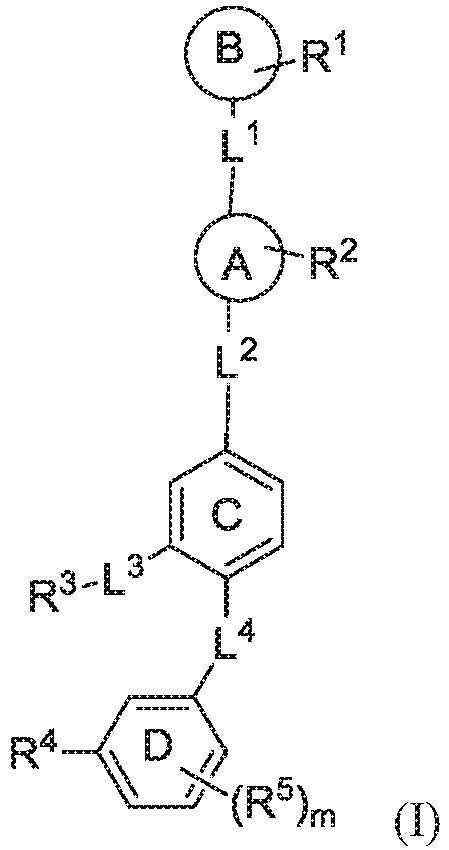
wherein - L1, L2, L3 and L4 are each independently a direct bond, -(CRaRb)t-, -(CRaRb)t-1-(CRc=CRd)-(CRaRb)v-1-, -(CRaRb)t-1-(C≡C)-(CRaRb)v-1-, -O-, -S-, -S(O)-, -SO2-, -C(O)-, C(O)O-, - OC(O)-, -NRa-, -C(O)NRa-, -NRaC(O)-, -NRaC(O)O-, -NRaC(O)NRb-, -SO2NRa-, - NRaSO2-, -NRaS(O)2NRb-, -NRaS(O)NRb-, -C(O)NRaSO2-, -C(O)NRaSO-, or - C(=NRa)NRb-, wherein t and v, at each occurrence, are independently a number of 1 to 7, and one or two CRaRb moieties in -(CRaRb)t-, -(CRaRb)t-1-(CRc=CRd)-(CRaRb)v-1-, - (CRaRb)t-1-(C≡C)-(CRaRb)v-1- are un-replaced or replaced with one or more moieties selected from O, S, SO, SO2, C(O) and NRa;
- Ring A is cycloalkyl, cycloalkenyl, cycloalkynyl, aryl, heterocyclyl, or heteroaryl, each of which is optionally substituted with 1 to 4 substituents R2;
R2, at each occurrence, is independently selected from the group consisting of hydrogen, halogen, -C1-8alkyl, -C2-8alkenyl, -C2-8alkynyl, cycloalkyl, heterocyclyl, aryl, heteroaryl, oxo, -CN, -NO2, -OR2a, -SO2R2a, -COR2a, -CO2R2a, -CONR2aR2b, - C(=NR2a)NR2bR2c, -NR2aR2b, -NR2aCOR2b, -NR2aCONR2bR2c, -NR2aCO2R2b, - NR2aSONR2bR2c, -NR2aSO2NR2bR2c, or -NR2aSO2R2b, each of said -C1-8alkyl, -C2-8alkenyl, -C2-8alkynyl, cycloalkyl, heterocyclyl, aryl, or heteroaryl is optionally substituted with halogen, hydroxy, -C1-8alkyoxy, cycloalkyl, heterocyclyl, aryl, or heteroaryl;
R2a, R2b, and R2c, are each independently hydrogen, -C1-8alkyl, -C2-8alkenyl, -C2-salkynyl, cycloalkyl, heterocyclyl, aryl, or heteroaryl, each of said -C1-8alkyl, -C2-8alkenyl, -C2-8alkynyl. cycloalkyl, heterocyclyl, aryl, or heteroaryl is optionally substituted with halogen, hydroxy or -C1-8alkyoxy; - Ring B is cycloalkyl, cycloalkenyl, cycloalkynyl, aryl, heterocyclyl, or heteroaryl, each of which is optionally substituted with 1 to 4 substituents R1;
R1, at each occurrence, is independently selected from the group consisting of hydrogen, halogen, -C1-8alkyl, -C2-8alkenyl, -C2-8alkynyl, cycloalkyl, heterocyclyl, aryl, heteroary!, oxo, -CN, -NO2, -OR1a, -SO2R1a, -COR1a, -CO2R1a, -CONR1aR1b, - C(=NR1a)NR1bR1c, -NR1aR1b, -NR1aCOR1b, -NR1aCONR1bR1c, -NR1aCO2R1b, - NR1aSONR1bR1c, -NR1aSO2NR1bR1c, or -NR1aSO2R1b; wherein said -C1-8alkyl, -C2-salkenyl, -C2-8alkynyl, cycloalkyl, heterocyclyl, aryl or heteroaryl are each independently optionally substituted with 1 to 4 substituents R1d,- R1a, R1b, and R1c, are each independently hydrogen, -C1-8alkyl, -C2-8alkenyl, -C2-salkynyl, cycloalkyl, heterocyclyl, aryl, or heteroaryl, each of said -C1-8alkyl, -C2-8alkenyl, -C2-8alkynyl, cycloalkyl, heterocyclyl, aryl, or heteroaryl is optionally substituted with halogen, hydroxy or -C1-8alkyoxy;
- R1d, at each occurrence, is independently halogen, -C1-8alkyl, -C2-8alkenyl, -C2-8alkynyl, cycloalkyl, heterocyclyl, aryl, heteroaryl, oxo, -CN, -NO2, -ORBa, - SO2RBa, -CORBa, -CO2RBa, -CONRBaRBb, -C(=NRBa)NRBbRBc, -NRBaRBb, - NRBaCORBb, -NRBaCONRBbRBc, -NRBaCO2RBb, -NRBaSONRBbRBc, - NRBaSO2NRBbRBc, or -NRBaSO2RBb; wherein said -C1-8alkyl, -C2-8alkenyl, -C2-salkynyl, cycloalkyl, heterocyclyl, aryl or heteroaryl are each independently optionally substituted with 1 to 4 substituents RBd;
- RBa, RBb, and RBc, are each independently hydrogen, -C1-8alkyl, -C2-8alkenyl, - C2-8alkynyl, cycloalkyl, heterocyclyl, aryl, or heteroaryl, each of said -C1-salkyl, -C2-8alkenyl, -C2-8alkynyl, cycloalkyl, heterocyclyl, aryl, or heteroaryl is optionally substituted with halogen, hydroxy, -NH2 or -N(C1-6alkyl)2, -C1-salkyoxy, cycloalkyl, heterocyclyl, aryl, or heteroaryl;
- RBd, at each occurrence, is independently hydrogen, halogen, oxo, -CN, -NO2, -C1-8alkyl, -C2-8alkenyl, -C2-8alkynyl, cycloalkyl, heterocyclyl, aryl, or heteroaryl, each of said -C1-8alkyl, -C2-8alkenyl, -C2-8alkynyl, cycloalkyl, heterocyclyl, aryl, or heteroaryl is optionally substituted with halogen, hydroxy, -C1-8alkyoxy, cycloalkyl, heterocyclyl, aryl, or heteroaryl;
- R3 is hydrogen, halogen, C1-8alkyl, C2-8alkenyl, C2-8alkynyl, cycloalkyl, aryl, heterocyclyl, or heteroaryl, each of said C1-8alkyl, C2-8alkenyl, C2-8alkynyl, cycloalkyl, aryl, heterocyclyl, or heteroaryl is optionally substituted with 1 to 4 substituents R3a;
- R3a, at each occurrence, is independently selected from halogen, cyano, -NO2, -OR3b, - SR3b, -NR3bR3c, -COR3b, -SO2R3b, -C(=O)OR3b, -C(=O)NR3bR3c, -C(=NR3b)NR3cR3d, - N(R3b)C(=O)R3c, -N(R3b)C(=O)OR3c, -N(R3b)C(O)NR3cR3d, -N(R3b)S(O)NR3cR3d, - N(R3b)S(O)2NR3cR3d, -NR3bSO2R3c, -C1-8alkyl, -C2-8alkenyl, -C2-8alkynyl, -cycloalkyl, heterocyclyl, aryl, or heteroaryl;
- R3b, R3c, and R3d are independently hydrogen, -C1-8alkyl, -C2-8alkenyl, -C2-8alkynyl, cycloalkyl, heterocyclyl, aryl, or heteroaryl, each of said -C1-8alkyl, -C2-salkenyl, -C2-8alkynyl, cycloalkyl, heterocyclyl, aryl, or heteroaryl is optionally substituted with halogen, hydroxy or -C1-8alkyoxy;
- R4 is hydrogen, halogen, cyano, -NO2, -OR4a, -SR4a, -NR4aR4b, -COR4a, -SO2R4a, - C(=O)OR4a, -C(=O)NR4aR4b, -C(=NR4a)NR4bR4c, -N(R4a)C(=O)R4b, -N(R4a)C(=O)OR4b, - N(R4a)C(O)NR4bR4c, -N(R4a)S(O)NR4bR4c, -N(R4a)S(O)2NR4bR4c, -NR4aSO2R4b, -C1-8alkyl, -C2-8alkenyl, -C2-8alkynyl, -cycloalkyl, heterocyclyl, aryl, or heteroaryl, each of said -C1-8alkyl, -C2-8alkenyl, -C2-8alkynyl, -cycloalkyl, heterocyclyl, aryl, or heteroaryl is independently and optionally substituted with one or two substituents R4d;
- R4a, R4b, and R4c are independently hydrogen, -C1-8alkyl, -C2-8alkenyl, -C2-8alkynyl, cycloalkyl, heterocyclyl, aryl, or heteroaryl, each of said -C1-8alkyl, -C2-8alkenyl, -C2-salkynyl, cycloalkyl, heterocyclyl, aryl, or heteroaryl is optionally substituted with halogen, hydroxy or -C1-8alkyoxy;
- R4d, at each occurrence, is independently hydrogen, oxo, -CN, -NO2, halogen, -C1-salkyl, -C2-8alkenyl, -C2-8alkynyl, cycloalkyl, heterocyclyl, aryl, or heteroaryl, each of said -C1-8alkyl, -C2-8alkenyl, -C2-8alkynyl, cycloalkyl, heterocyclyl, aryl, or heteroaryl is optionally substituted with halogen, hydroxy or -C1-8alkyoxy;
- m is an integer of 1-4;
- R5 is -L5-CyC,
- Wherein L5 is a direct bond, -(CRaRb)t-, -(CRaRb)t-1-(CRc=CRd)-(CRaRb)v-1-, - (CRaRb)t-1-(C≡C)-(CRaRb)v-1-, -O-, -S-, -S(O)-, -SO2-, -C(O)-, C(O)O-, -OC(O)-, - NRa-, -C(O)NRa-, -NRaC(O)-, -NRaC(O)O-, -NRaC(O)NRb-, -SO2NRa-, -NRaSO2-, - NRaS(O)2NRb-, -NRaS(O)NRb-, -C(O)NRaSO2-, -C(O)NRaSO-, or -C(=NRa)NRb-, wherein t and v, at each occurrence, are independently a number of 1 to 7, and one or two CRaRb moieties in -(CRaRb)t-, -(CRaRb)t-1-(CRc=CRd)-(CRaRb)v-1-, -(CRaRb)t-1-(C≡C)-(CRaRb)v-1- are un-replaced or replaced with one or more moieties selected from O, S, SO, SO2, C(O) and NRa;
- CyC is cycloalkyl, heterocyclyl, aryl, or heteroaryl, each of which is optionally substituted with one or two substituents R5a;
- R5a, at each occurrence, is independently selected from hydrogen, halogen, cyano, oxo, -NO2, -OR5b, -SR5b, -NR5bR5c, -COR5b, -SO2R5b, -C(=O)OR5b, -C(=O)NR5bR5c, - C(=NR5b)NR5cR5d, -N(R5b)C(=O)R5c, -N(R5b)C(=O)OR5c, -N(R5b)C(O)NR5cR5d, - N(R5b)S(O)NR5cR5d, -N(R5b)S(O)2NR5cR5d, -NR5bSO2R5c, -C1-8alkyl, -C2-8alkenyl, - C2-8alkynyl, -cycloalkyl, heterocyclyl, aryl, or heteroaryl, each of said -C1-8alkyl, -C2-salkenyl, -C2-8alkynyl, -cycloalkyl, heterocyclyl, aryl, or heteroaryl is optionally substituted with one or two substituents R5e;
- wherein R5b, R5c, and R5d are each independently hydrogen, -C1-8alkyl, -C2-salkenyl, -C2-8alkynyl, cycloalkyl, heterocyclyl, aryl, or heteroaryl, each of said - C1-8alkyl, -C2-8alkenyl, C2-8alkynyl, -cycloalkyl, heterocyclyl, aryl, or heteroary! is optionally substituted with one or two substituents R5c;
- R5e, at each occurrence, is independently selected from hydrogen, halogen, cyano, oxo, -NO2, -OR5f, -SR5f, -NR5fR5g, -COR5f, -SO2R5f, -C(=O)OR5f, - C(=O)NR5fR5g, -C(=NR5f)NR5gR5h, -N(R5f)C(=O)R5g, -N(R5f)C(=O)OR5g, - N(R5f)C(O)NR5gR5h, -N(R5f)S(O)NR5gR5h, -N(R5f)S(O)2NR5gR5h, -NR5fSO2R5g, - C 1-8alkyl, -C2-8alkenyl, -C2-8alkynyl, -cycloalkyl, heterocyclyl, aryl, or heteroaryl;
R5f, R5g, and R5h are each independently hydrogen, -C1-8alkyl, -C2-8alkenyl, - C2-8alkynyl, cycloalkyl, heterocyclyl, aryl, or heteroaryl;
- or, two adjacent R5 on the phenyl ring together with the phenyl ring form a benzo ring, said ring is optionally substituted with halogen, oxo, cyano, -NO2, -OR5i, -SR5i, -NR5iR5j, - COR5i, -SO2R5i, -C(=O)OR5i, -C(=O)NR5iR5j, -C(=NR5i)NR5jR5k, -N(R5i)C(=O)R5j, - N(R5i)C(=O)OR5j, -N(R5i)C(O)NR5jR5k, -N(R5i)S(O)NR5jR5k, -N(R5i)S(O)2NR5jR5k, - NR5iSO2R5k, -C1-8alkyl, -C2-8alkenyl, -C2-8alkynyl, -cycloalkyl, heterocyclyl, aryl, or heteroaryl;
R5i, R5j, and R5k are independently hydrogen, -C1-8alkyl, -C2-8alkenyl, -C2-salkynyl, cycloalkyl, heterocyclyl, aryl, or heteroaryl, each of said -C1-8alkyl, -C2-salkenyl, -C2-8alkynyl, cycloalkyl, heterocyclyl, aryl, or heteroaryl is optionally substituted with halogen, hydroxy or -C1-8alkyoxy; - Ra, Rb, Rc, and Rd at each occurrence, are independently hydrogen, -C1-8alkyl, -C2-8alkenyl, -C2-8alkynyl, cycloalkyl, heterocyclyl, aryl, or heteroaryl, said -C1-8alkyl, -C2-8alkenyl, -C2-8alkynyl, cycloalkyl, heterocyclyl, aryl, or heteroaryl are each independently substituted with -CN, halogen, -NO2, -NReRf, oxo, -ORe, or -SRe; and
wherein Re and Rf are each independently hydrogen, C1-8alkyl, C1-8alkoxy-C1-8alkyl-, C2-8alkenyl, C2-8alkynyl, cycloalkyl, aryl, heterocyclyl, or heteroaryl. - In one embodiment, Ra, Rb, Rc and Rd, at each occurrence, are independently hydrogen or C1-6alkyl, preferably hydrogen or methyl.
- In one embodiment, L1 is a direct bond or -(CRaRb)t-, wherein Ra, Rb and t are defined as with Formula (I). In some embodiment, t is a number of 1 or 2. In a preferred embodiment, L1 is a direct bond or -(CRaRb)-, wherein Ra and Rb are hydrogen or C1-6alkyl. preferably hydrogen. In a most preferred embodiment, L1 is a direct bond.
- In one embodiment, L2 is a direct bond, -(CRaRb)t-, -(CRaRb)t-1-(CRc=CRd)-(CRaRb)v-1-, -(CRaRb)t-1-(C≡C)-(CRaRb)v-1-, -O- or -NRa-, wherein Ra, Rb, Rc, t, and v are defined as with Formula (I). In some embodiment, t or v is a number of 1-4. In a preferred embodiment, L2 is a direct bond, -(CRaRb)1-5-, -(CRaRb)1-3-(C≡C)-, -O- or -NRa-, wherein Ra, Rb and Rc, at each occurrence, are independently hydrogen or C1-6alkyl, and one or two CRaRb moieties in - (CRaRb)1-5-, -(CRaRb)1-3-(C≡C)- are replaced with one or two moieties from O, S, SO, SO2, C(O) and NRa. In an even preferred embodiment, L2 is a direct bond, -(CRaRb)1-5-, -(CRaRb)1-3-(C≡C)-, or -NRa-, wherein Ra, Rb and Rc, at each occurrence, are independently hydrogen or C1-6alkyl, and one or two CRaRb moieties in -(CRaRb)1-5-, -(CRaRb)-(C≡C)- are replaced with one or two heteroatoms from O or NRa, wherein Ra is hydrogen or C1-6alkyl, preferably hydrogen or CH3. In another embodiment, L2 is a direct bond, -CH2-, -O-, -NH-,
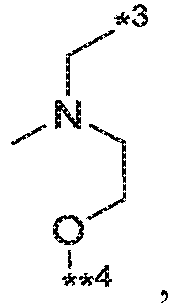

- In a preferred embodiment, L1 and L2 are both direct bonds, or L1 is -CH2- or -CH2-CH2- and L2 is a direct bond.
- In one embodiment, L3 is a direct bond, -(CRaRb)t-, -O-, -S-, -S(O)-, -SO2-, -C(O)-, C(O)O-, -OC(O)-, or -NRa-, wherein Ra, Rb and t are defined as with Formula (I). Preferably, Ra and Rb are independently hydrogen or C1-6alkyl, and t is 1 or 2. In a preferred embodiment, L3 is -O-, -CH2-, a direct bond, or -C(O)-. More preferably, L3 is -0-.
- In one embodiment, R3 is heteroaryl optionally substituted with one or two substituents R3a as defined with Formula (I). Preferably, R3 is heteroaryl optionally substituted with one or two substituents R3a selected from halogen, -C1-8alkyl, or -NR3bR3c, wherein R3b and R3c are independently hydrogen, or -C1-8alkyl.
- In one embodiment, R3 is a 5 to 7-membered nitrogen-containing monocyclic heteroaryl optionally substituted with one or two substituents R3a selected from halogen, -C1-8alkyl, or -NR3bR3c, wherein R3b and R3c are independently hydrogen, or -C1-8alkyl. Preferably, R3 is tetrazolyl, trizolyl, pyrazolyl, pyrrolyl, pyridinyl, pyrimidinyl, each of which optionally substituted with one or two substituents R3a selected from halogen, -C1-8alkyl, or - NR3bR3c, wherein R3b and R3c are independently hydrogen, or -C1-8alkyl.
- In one embodiment, R3 is a 8- to 12-membered bicyclic heteroaryl comprising 1 or 2 or 3 nitrogen atoms. Preferably, R3 is indolyl, pyrrolopyridiny, or pyrazolopyridinyl, each of which optionally substituted with one or two substituents R3a selected from halogen, -C1-8alkyl, or -NR3bR3c, wherein R3b and R3c are independently hydrogen, or -C1-8alkyl. More preferably, R3 is indol-4-yl, pyrrolo[2,3-b]pyridin-5-yl, pyrazolo[4,3-b]pyridin-1-yl.
- In one embodiment, R3 is 11- to 14-membered tricyclic heteroaryl comprising 1 or 2 or 3 or 4 or 5 nitrogen atoms optionally substituted with one or two substituents R3a selected from halogen, -C1-8alkyl, or -NR3bR3c, wherein R3b and R3c are independently hydrogen, or -C1-8alkyl. Preferably, R3 is pyrazolo[4,3-b]pyrrolo[3,2-e]pyridine-1(5i)-yl.
- In one embodiment, L3 is -0-, and R3 is pyrrolo[2,3-b]pyridin-5-yl.
- In one embodiment, L4 is -C(O)NRaSO2-, wherein Ra is hydrogen and C1-6alkyl; is preferably hydrogen. In a preferred embodiment, L4 is *-C(O)NRaSO2-**, wherein Ra is hydrogen and C1-6alkyl; is preferably hydrogen, wherein * refers to the position attached to Ring C, and ** refers to the position attached to Ring D.
- In one embodiment, R4 is -NO2, F, Cl, Br, cyano, or -SO2R4a, wherein R4a is defined as with Formula (I). In one embodiment, R4 is -NO2, F, Cl, Br, cyano, or -SO2R4a, wherein R4a is -C1-8alkyl optionally substituted with halogen, preferably -CF3. In a preferred embodiment, R4 is -NO2.
- In one embodiment, ring A is cycloalkyl, cycloalkenyl, aryl, heterocyclyl, or heteroaryl, each of which is optionally substituted with 1 to 4 substituents R2. Preferably, R2 is hydrogen, halogen (e.g., F, Cl or Br) or C1-6alkyl (e.g., methyl) optionally substituted with halogen (e.g., F, Cl or Br).
- In a preferred embodiment, ring A is a phenyl ring, which is 1,2-phenylene, 1,3-phenylne, or 1,4-phenylene.
- In a preferred embodiment, ring A is a cycloalkyl ring which is C3-8cycloalkyl. In a more preferred embodiment, ring A is selected from cyclobutyl, cyclopentyl, cyclohexyl, or cycloheptyl. Specifically, ring A is 1,2-cyclobutylene, 1,3-cyclobutylene, 1,2-cyclopentylene, 1,3-cyclopentylene, 1,2-cyclohexylene, 1,3-cyclohexylene, 1,4-cyclohexylene, 1,2-cyclohcptylene, 1,3-cycloheptylene or 1,4-cycloheptylene.
- In a preferred embodiment, ring A is C3-8cycloalkenyl. Preferably, ring A is cyclohexenyl. More preferably, ring A is cyclohex-3-enyl or cyclohex-2-enyl.
- In a preferred embodiment, ring A is heteroaryl. Preferably, ring A is a monocyclic 5- or 6-membered heteroaryl comprising one or two or three or four heteroatoms selected from nitrogen, oxygen, and sulfur. Specifically, ring A is pyridine, pyrazole, thiophene, or pyrimidine. Preferably, ring A is 8- to 12-membered bicyclic heteroaryl ring. Specifically, ring A is pyrazolopyrimidine (e.g., pyrazolo[1,5-a]pyrimidine), benzothiophene (benzo[b]thiophene), or pyrazolopyridine (e.g., pyrazolo[1,5-a]pyridine) group.
- In a preferred embodiment, ring A is heterocyclyl. Preferably, ring A is selected from
- a) monocyclic 4 to 9-membered heterocyclyl groups containing one or two heteroatoms selected from nitrogen or oxygen or sulfur as ring member;
- b) 5 to 12-membered spiro heterocyclyl comprising one or two heteroatoms selected from nitrogen, sulfur and oxygen as ring members;
- c) 5 to 12-membered fused heterocyclyl comprising one or two heteroatoms selected from nitrogen, sulfur and oxygen as ring members; and
- d) 5 to 12-membered bridged heterocyclyl comprising one or two heteroatoms selected from nitrogen, sulfur and oxygen as ring members.
- In a more preferred embodiment, ring A is 5 to 12-membered spiro heterocyclyl comprising one or two heteroatoms selected from nitrogen, sulfur and oxygen as ring members. Specifically, ring A is 4-membered/4-membered, 3-membered/5-membered, 4-membcred/5-membered, 4-membered/6-membered, 5-membered/5-membered, or 5-membered/6-membered mono-spiro heterocyclyl comprising one or two nitrogen or oxygen as ring members. Specifically, ring A is 4-membered/4-membered or 4-membered/6-membered mono-spiro heterocyclyl comprising one nitrogen as ring member. More specifically, ring A is


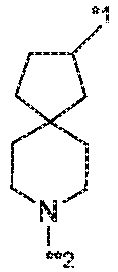

- Specifically, ring A is heterocyclic which is piperidine, pyrrolidine, and azetidine; 7-azaspiro[3.5]nonane, 2-azaspiro[3.5]nonanc, 8-azabicyclo[3.2.1]octane; tetrahydrothienopyridine (e.g., 4,5,6,7-tetrahydrothieno[2,3-c]pyridine), tetrahydropyrrolopyrazine (e.g., 1,2,3,4-tetrahydropyrrolo[1,2-a]pyrazine), tetrahydropyrrolopyrazine (e.g., 1,2,3,4-tetrahydropyrrolo[1,2-a]pyrazine), hexahydroindolizine (e.g., 1,2,3,5,8,8a-hexahydroindolizine), dihydropyrrolothiazole (e.g., 5,6-dihydro-4H-pyrrolo[3,4-d]thiazole), or isoindoline.
- In an even preferred embodiment, ring A is selected from the group consisting of


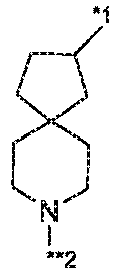


- In a most preferred embodiment, ring A is
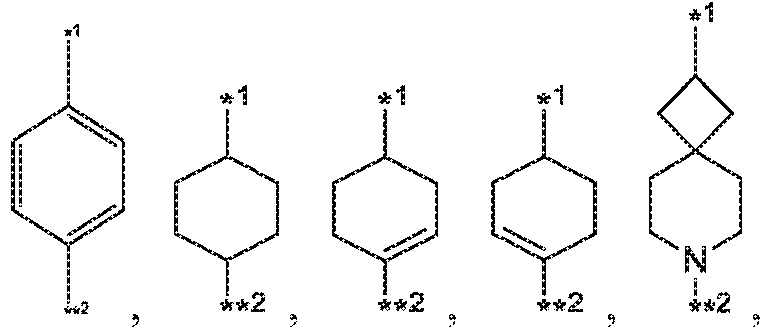

- In one embodiment, Ring B is cycloalkyl, cycloalkenyl, aryl, or heterocyclyl, each of which is optionally substituted with 1 to 4 substituents R1;
R1, at each occurrence, is independently selected from the group consisting of halogen, -C1-8alkyl, -C2-8alkenyl, -C2-8alkynyl, cycloalkyl, aryl, heteroaryl, oxo, -CN, or -OR1a; wherein said -C1-8alkyl, -C2-8alkenyl, -C2-8alkynyl, aryl or heteroaryl are each independently optionally substituted with 1 to 4 substituents R1d, - R1a is hydrogen, or -Ci_salkyl, said -C1-8alkyl is optionally substituted with halogen, hydroxy or -C1-8alkyoxy;
- R1d, at each occurrence, is independently halogen, -C1-8alkyl, -C2-8alkenyl, -C2-salkynyl, cycloalkyl, heterocyclyl, aryl, heteroaryl, -CN, -ORBa, -SO2RBa, - CONRBaRBb, -NRBaRBb, -NRBaCORBb, or -NRBaSO2RBb; wherein said -C1-8alkyl, cycloalkyl, heterocyclyl, aryl or heteroaryl are each independently optionally substituted with 1 to 4 substituents RBd;
- RBa and RBb are each independently hydrogen, -C1-8alkyl, cycloalkyl, or aryl, each of said -C1-8alkyl, cycloalkyl, or aryl is optionally substituted with halogen, hydroxy, -C1-8alkyoxy, cycloalkyl, heterocyclyl, aryl, or heteroaryl;
- RBd, at each occurrence, is independently hydrogen, halogen, -CN, -C1-8alkyl, -C2-8alkynyl, cycloalkyl, or aryl, each of said -C1-8alkyl, -C2-8alkynyl, or aryl is optionally substituted with halogen, hydroxy, -C1-8alkyoxy, cycloalkyl, heterocyclyl, aryl, or heteroaryl.
- In one embodiment, cycloalkyl as Ring B is monocyclic C3-8cycloalkyl, preferably cyclopentyl or cyclohexyl, substituted with R1. In one embodiment, R1 is an aryl group (e.g., phenyl) optionally substituted with R1d which is monocyclic C3-8cycloalkyl.
- In one embodiment, cycloalkenyl as Ring B is monocyclic C3-8cycloalkenyl, preferably cyclopentenyl or cyclohexenyl, substituted with one or two or three R1. In one embodiment, R1 is C1-8alkyl (e.g., C1-6alkyl, preferably methyl), or an aryl group (e.g., phenyl) optionally substituted with R1d which halogen.
- In one embodiment, heterocyclyl as ring B is monocyclic 4 to 9-membered heterocyclyl, a 5 to 20-membered spiro heterocyclyl, a 5 to 20-membered fused heterocyclyl, or a 5 to 20-membered bridged heterocyclyl, each of which is optionally substituted with 1 to 4 substituents R1.
- In one embodiment, monocyclic heterocyclyl is a monocyclic 4 to 9-membered heterocyclyl comprising one or more heteroatoms selected from the group consisting of NH, O, S, SO or SO2 heteroatoms as ring members.
- In one embodiment, monocyclic heterocyclyl is a monocyclic 4 to 9-membered heterocyclyl comprising one nitrogen atom as the ring member. In a preferred embodiment, the monocyclic 4 to 9-membered heterocyclyl comprising one nitrogen atom as the ring member is C-linked or N-linked. In an even preferred embodiment, the monocyclic 4 to 9-membered heterocyclyl comprising one nitrogen atom as the ring member is saturated. Specifically, the saturated heterocyclyl is a N-linked saturated heterocyclyl, including, but not limited to aziridin-1-yl, azetidin-1-yl, pyrrolidin-1-yl, piperidin-1-yl, azepan-1-yl, and azocan-1-yl, preferably pyrrolidin-1-yl. Specifically, the saturated heterocyclyl is a C-linked saturated heterocyclyl, including but not limited to aziridin-2-yl, azetidin-2-yl, azetidin-3-yl, pyrrolidin-2-yl, pyrrolidin-3-yl, piperidin-2-yl, piperidin-3-yl, piperidin-4-yl, azepan-2-yl, azepan-3-yl, azepan-4-yl, azocan-2-yl, azocan-3-yl, azocan-4-yl, and azocan-5-yl. In another even preferred embodiment, the monocyclic 4 to 9-membered heterocyclyl comprising one nitrogen atom as the ring member is unsaturated. In a yet even preferred embodiment, the monocyclic 4 to 9-membered heterocyclyl comprising one nitrogen atom as the ring member contains one carbon-carbon double bond. Specifically, the monocyclic 4 to 9-membered heterocyclyl comprising one nitrogen atom as the ring member is dihydropyrrolyl, e.g., 2,3-dihydro-1H-pyrrolyl and 2,5-dihydro-1H-pyrrolyl, or tetrahydropyridinyl.
- In another embodiment, monocyclic heterocyclyl is a monocyclic 4 to 9-membered heterocyclyl comprising one nitrogen atom and one additional heteroatom selected from the group consisting of NH, O, S, SO or SO2 heteroatoms as ring members. In a preferred embodiment, the monocyclic 4 to 9-membered heterocyclyl comprising one nitrogen atom and one additional heteroatom selected from the group consisting of NH, O, S, SO or SO2 heteroatoms as ring members is C-linked or N-linked. In an even preferred embodiment, the monocyclic heterocyclyl is saturated. In a yet even preferred embodiment, the saturated monocyclic heterocyclyl is N-linked. In another yet even preferred embodiment, the saturated monocyclic heterocyclyl is C-linked.
- In a preferred embodiment, ring B is pyrrolidin-1-yl substituted with 1 to 4 substituents R1.
- In one embodiment, R1 is a phenyl group.
- In a more preferred embodiment, ring B is aziridin-1-yl, azetidin-1-yl, pyrrolidin-1-yl, pyrrolidin-2-yl, piperidin-1-yl, azepan-1-yl, or azocan-1-yl, preferably pyrrolidin-1-yl which is substituted with a phenyl group at position 2 and further optionally substituted with 1 or 2 or 3 substituents R1 on the pyrrolidinyl ring, and said phenyl group at position 2 is optionally substituted with R1d as defined with Formula (1).
- In one aspect of this embodiment, R1, at each occurrence, is independently selected from the group consisting of halogen, -C1-8alkyl, -C2-8alkenyl, -C2-8alkynyl, cycloalkyl, aryl, heteroaryl, oxo, -CN, or -OR1a; wherein said -C1-8alkyl , -C2-8alkenyl, -C2-8alkynyl, cycloalkyl, aryl, or heteroaryl is optionally substituted with 1 to 4 substituents R1d, wherein R1a is hydrogen or C1-8alkyl, preferably methyl, and R1d is halogen, -C1-8alkyl, or -ORBa, wherein RBa is hydrogen or -C1-8alkyl. In another aspect, R1 is hcteroaryl, preferably furanyl, more preferably furan-3-yl. In some embodiment, R1 is substituted at position 2 of the monocyclic heterocyclyl.
- In one aspect of this embodiment, R1d, when substituted on the phenyl group at position 2 of ring B (including the aziridin-1-yl, azetidin-1-yl, pyrrolidin-1-yl, pyrrolidin-2-yl, piperidin-1-yl, azepan-1-yl, or azocan-1-yl, preferably the pyrrolidin-1-yl group), is independently halogen, -C1-8alkyl, -C2-8alkenyl, -C2-8alkynyl, cycloalkyl, heterocyclyl, aryl, heteroaryl, -CN, -ORBa, -SO2RBa, -CONRBaRBb, -NO2, -NRBaRBb, -NRBaCORBb, or - NRBaSO2RBb; wherein said -C1-8alkyl, -C2-8alkenyl, -C2-8alkynyl, cycloalkyl, heterocyclyl, aryl or heteroaryl are each independently optionally substituted with 1 to 4 substituents RBd as defined with Formula (1), preferably 1 or 2 substituents RBd as defined with Formula (1). In another aspect, one R1d is at position 2 of the phenyl ring at position 2 of ring B.
- In one aspect, -C1-8alkyl as R1d is further optionally substituted with 1 to 4 substituents RBd, which is halogen, phenyl, cycloalkyl (e.g., C3-8cycloalkyl, preferably cyclopropyl), heterocyclyl (e.g., piperazinyl, piperidinyl) optionally substituted with C1-6alkyl. Specifically, R1d is -C1-8alkyl selected from methyl, ethyl, isopropyl, propyl, tert-butyl, and isobutyl, optionally substituted with RBd. In another aspect, two methyl groups are at position 2 of the phenyl ring at position 2 of ring B.
- In one aspect, cycloalkyl as R1d is further optionally substituted with 1 to 4 substituents RBd, which is halogen, cyano, C2-8alkynyl (preferably ethynyl), or C1-8alkyl optionally substituted with halogen (preferably CF3). Specifically, R1d is C3-8cycloalkyl selected from cyclopropyl, cyclobutyl, cyclopentyl, or cyclohexyl, optionally substituted with RBd. In another aspect, one cyclopropyl is at position 2 of the phenyl ring at position 2 of ring B.
- In one aspect, -C2-8alkenyl as R1d is prop-1-en-2-yl.
- In one aspect, -C2-8alkynyl as R1d is ethynyl.
- In one aspect, in the definition of -ORBa as R1d, RBa is hydrogen, C1-8alkyl (selected from methyl, ethyl, propyl, and isopropyl), C3-8cycloalkyl (preferably cyclopropyl or cyclohexyl), aryl (preferably phenyl), wherein C1-8alkyl, C3-8cycloalkyl and aryl are each independently substituted with halogen, heterocyclyl (preferably monocyclic 4- to 9-membered heterocyclyl, more preferably morpholino), hydroxy, or -C1-8alkoxyl (preferably methoxyl).
- In one aspect, R1d is aryl which is phenyl.
- In one aspect, R1d is heterocycle which is monocyclic 4 to 9-membered heterocyclyl groups containing one or two heteroatoms selected from nitrogen or oxygen or sulfur as ring member, preferably monocyclic 4 to 6-membered heterocyclyl comprising one oxygen atom as ring member or monocyclic 6-membered heterocyclyl comprising one or two nitrogen atoms as ring members.
- In one aspect, R1d is heteroaryl, preferably thiophenyl or furanyl.
- In one embodiment, ring B is pyrrolidin-1-yl substituted with a naphthyl group, preferably substituted with a naphthyl at position 2.
- In one embodiment, ring B is pyrrolidin-1-yl substituted with a heteroaryl group, preferably substituted with a heteroaryl group at position 2. In one aspect, said heteroaryl is 5- to 6-membered heteroaryl comprising 1-4 heteroatoms selected from nitrogen, oxygen, and sulfur. Preferably, said heteroaryl is pyridinyl, furanyl, thiophenyl, or pyrazolyl. In another aspect, the heteroaryl is optionally substituted with halogen or C3-8cycloalkyl (preferably cyclopropyl).
- In one embodiment, ring B is pyrrolidin-1-yl substituted with -C1-8alkyl, -C2-8alkenyl, or -C2-8alkynyl, preferably substituted with -C1-8alkyl, -C2-8alkenyl, or -C2-8alkynyl at position 2, each of said -C1-8alkyl, -C2-8alkenyl, or -C2-8alkynyl is unsubstituted or substituted with a phenyl group, said phenyl group is optionally substituted with halogen or C3-8cycloalkyl (preferably cyclopropyl). In a preferred aspect, ring B is pyrrolidin-1-yl substituted with methyl, ethenyl, or ethynyl, each of which is optionally substituted with a phenyl group optionally substituted as above.
- In a preferred embodiment, ring B is pyrrolidin-1-yl, optionally substituted with 1 to 4 substituents R1 as defined with Formula (I).
- In a preferred embodiment,











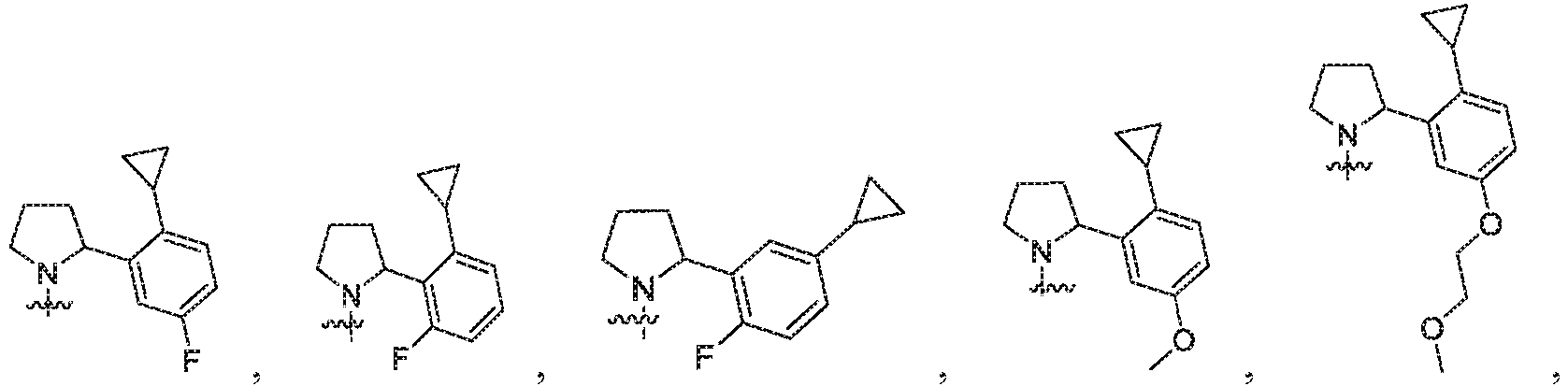


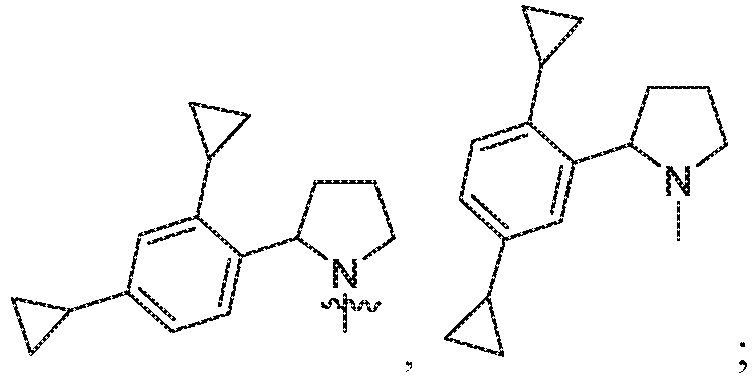


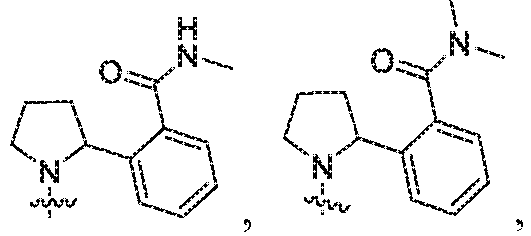











- In one preferred embodiment, ring B is a 2-substituted pyrrolidin-1-yl group, L1 is a direct bond, L2 is a direct bond, ring A is a 1,4-phenylene ring, or 5 to 12-membered spiro heterocyclyl comprising one or two heteroatoms selected from nitrogen, sulfur and oxygen as ring members, preferably 5 to 12-membered spiro heterocyclyl comprising one or two nitrogenz as ring member; more preferably a 4-membered/4-membered, 3-membered/5-membered, 4-membered/5-membered, 4-membercd/6-membered, 5-membered/5-membered, or 5-membered/6-membered mono-spiro heterocyclyl comprising one or two nitrogen or oxygen as ring members; most preferably ring A is 7-azaspiro[3.5]nonan-2,7-diyl, 2-azaspiro[3.5]nonan-2,7-diyl, 3-azaspiro[5.5]undecan-3, 9-diyl, 2-azaspiro[3.3]heptan-2,6-diyl, 8-azaspiro[4.5]decan-2,8-diyl, or 2-azaspiro[4.5]decan-2,8-diyl. In a more preferred embodiment, ring B is a 2-(substituted phenyl)pyrrolidin-1-yl group, L1 is a direct bond, L2 is a direct bond, ring A is a 1,4-phenylene ring, , or 5 to 12-membered spiro heterocyclyl comprising one or two heteroatoms selected from nitrogen, sulfur and oxygen as ring members, preferably 5 to 12-membered spiro heterocyclyl comprising one or two nitrogenz as ring member; more preferably a 4-membered/4-membered, 3-membered/5-membered, 4-membered/5-membered, 4-membered/6-membered, 5-membered/5-membered, or 5-membered/6-membered mono-spiro heterocyclyl comprising one or two nitrogen or oxygen as ring members; most preferably ring A is 7-azaspiro[3.5]nonan-2,7-diyl, 2-azaspiro[3.5]nonan-2,7-diyl, 3-azaspiro[5.5]undecan-3, 9-diyl, 2-azaspiro[3.3]heptan-2,6-diyl, 8-azaspiro[4.5]decan-2,8-diyl, or 2-azaspiro[4.5]decan-2,8-diyl. In an even more preferred embodiment, ring B is a 2-(2-substituted phenyl)pyrrolidin-1-yl group or 2-(3-substituted phenyl)pyrrolidin-1-yl group, L1 is a direct bond, L2 is a direct bond, ring A is a 1,4-phenylcnc ring or 7-azaspiro[3.5]nonan-2,7-diyl, 2-azaspiro[3.5]nonan-2,7-diyl, 3-azaspiro[5.5]undecan-3, 9-diyl, 2-azaspiro[3.3]heptan-2,6-diyl, 8-azaspiro[4.5]decan-2,8-diyl, or 2-azaspiro[4.5]decan-2,8-diyl, wherein the phenyl group at position 2 of the pyrrolindin-1-yl is substituted with 1 to 4 substituents R1d as defined with Formula (I). In an alternative preferred embodiment, ring B is a 2-(2-substituted phenyl)pyrrolidin-1-yl group or 2-(3-substituted phenyl)pyrrolidin-1-yl group, L1 is a direct bond, ring A is a 1,4-cyclohexylene ring or 1,4-cyclohex-3-enyl or 1,4-cyclohex-2-enyl or 1,4-cyclohex-1-enyl or 7-azaspiro[3.5]nonan-2,7-diyl, 2-azaspiro[3.5]nonan-2,7-diyl, 3-azaspiro[5.5]undecan-3, 9-diyl, 2-azaspira[3.3]heplan-2,6-diyl, 8-azaspiro[4.5]decan-2,8-diyl, or 2-azaspiro[4.5]decan-2,8-diyl, L2 is a direct bond, wherein the phenyl group at position 2 of the pyrrolindin-1-yl is substituted with 1 to 4 substituents R1d as defined with Formula (I). In one embodiment, one substituent R1d is substituted at position 2 of the phenyl group at position 2 of the pyrrolindin-1-yl.
- In one embodiment, m is 1.
- In one embodiment, L5 is a direct bond, -(CRaRb)t- or -NRa-, wherein t is a number of 1 to 7, and one or two CRaRb moieties in -(CRaRb)t- are un-replaced or replaced with one or more moieties selected from O and NRa, wherein Ra and Rb are defined as with Formula (I).
- In a preferred embodiment, L5 is a direct bond, -(CRaRb)1-4-, -O-(CRaRb)1-3-, -NH-(CRaRb)1-3, or -NH-, wherein Ra and Rb are defined as with Formula (I) so that the -L5-CyC moiety is CyC, -(CRaRb)1-4-CyC, -O-(CRaRb)1-3-CyC, -NH-(CRaRb)1-3-CyC, or -NH-CyC, respectively. More preferably, L5 is a direct bond, -(CH2)1-4-, -O-(CH2)1-3-, -NH-(CRaRb)-(CH2)2-, or -NH-, wherein Rd is hydrogen and Rb is C1-8alkyl optionally substituted with phenyl-S- so that the -L5-CyC moiety is CyC, -(CH2)1-4-CyC, -O-(CH2)1-3-CyC, -NH-(CRaRb)-(CH2)2-CyC, or -NH-CyC, respectively. More preferably, L5 is a direct bond, -CH2-, -O-CH2-, -NH-CH2-, or -NH- so that the -L5-CyC moiety is CyC, -CH2-CyC, -O-CH2-CyC, -NH-CH2-CyC, or -NH-CyC, respectively.
- In one embodiment, CyC is cycloalkyl, or heterocyclyl, each of which is optionally substituted with one or two substituents R5a;
- R5a is independently selected from hydrogen, halogen, cyano, oxo, -OR5b, -NR5bR5c, - COR5b, -SO2R5b, -C1-8alkyl, -C2-8alkynyl, -cycloalkyl, or heterocyclyl, each of said -C1-8alkyl, and heterocyclyl is optionally substituted with one or two substituents R5e which is selected from hydrogen, halogen, cyano, -OR5f, -C1-8alkyl, -cycloalkyl, or heterocyclyl,
wherein R5b, and R5c are each independently hydrogen, -C1-8alkyl or heterocyclyl, said -C1-8alkyl is optionally substituted with one or two substituents R5e which is hydrogen, -NR5fR5g, or -cycloalkyl;
R5f and R5g are each independently hydrogen or -C1-8alkyl; - or, two adjacent R5 on the phenyl ring together with the phenyl ring form a benzo ring, said ring is optionally substituted with heteroaryl.
- In one embodiment, CyC is cycloalkyl selected from monocyclic C3-8cycloalkyl or bridged cycloalkyl

- In one embodiment, CyC is heterocyclyl selected from:
- a) monocyclic 4 to 9-membered heterocyclyl groups containing one nitrogen or oxygen or sulfur heteroatom as ring member;
- b) monocyclic 4 to 9-membered heterocyclyl groups containing two heteroatoms selected from oxygen, sulfur and nitrogen as ring members: and
- c) 5 to 20-membered spiro heterocyclyl comprising one or two heteroatoms selected from nitrogen, sulfur and oxygen as ring members,
- In a preferred embodiment, CyC is monocyclic 4 to 6-membered heterocyclyl groups containing one nitrogen or oxygen or sulfur heteroatom as ring member. More preferably, Cyc is selected from oxetanyl, tetrahydrofuranyl, tetrahydropyranyl, azetidinyl, pyrrolidinyl, and piperdinyl. Even more preferably, CyC is selected from oxetan-2-yl, Oxetan-3-yl, tetrahydrofuran-4-yl, tetrahydrofuran-2-yl, tetrahydrofuran-3-yl, tetrahydropyran-2-yl, tetrahydropyran-3-yl, tetrahydropyran-4-yl, azetidin-3-yl, azetidin-2-yl, pyrrolidin-2-yl, pyrrolidin-3-yl, piperdin-4-yl, piperdin-2-yl, and piperdin-3-yl.
- In a preferred embodiment, CyC is monocyclic 6-membered heterocyclyl group containing two heteroatoms selected from oxygen and nitrogen as ring members. More preferably, CyC is dioxanyl, morpholino, morpholinyl, or piperzinyl. Even more preferably 1,3-dioxan-2-yl, 1,3-dioxan-4-yl, 1,4-dioxan-2-yl, morpholin-1-yl, morpholin-2-yl, or morpholin-3-yl.
- In a preferred embodiment, CyC is 4-membered/4-membered, 3-membered/5-membered, 4-membered/5-membered, 4-membered/6-membered, 5-membered/5-membered, or 5-membered/6-membered mono-spiro heterocyclyl comprising one or two nitrogen or oxygen as ring members. More preferably, CyC is


- In a preferred embodiment, R5a is independently selected from hydrogen, halogen, cyano, oxo, -OR5b, -NR5bR5c, -COR5b, -SO2R5b, -C1-8alkyl, -C2-8alkynyl, monocyclic C3-8cycloalkyl, or monocyclic 4 to 9-membered heterocyclyl group containing one or two heteroatoms selected from nitrogen or oxygen or sulfur heteroatom as ring members, each of said -C1-8alkyl and monocyclic 4 to 9-membered heterocyclyl group is optionally substituted with one or two substituents R5e. Preferably, cycloalkyl as R5a is C3-6cycloalkyl; more preferably cyclopropyl. Preferably, heterocyclyl as R5a is 4 to 6-membered heterocyclyl groups containing one or two heteroatoms selected from nitrogen or oxygen or sulfur heteroatom as ring members. More preferably, heterocyclyl as R5a is oxetanyl, tetrahydrofuranyl, tetrahydropyranyl, piperzinyl, or morpholinyl. Even more preferably, heterocyclyl as R5a is oxetan-3-yl, tetrahydrofuran-3-yl, tetrahydro-2H-pyran-4-yl, or morphin-4-yl.
- In one embodiment, heterocyclyl as R5e is monocyclic 4 to 9-membered heterocyclyl group containing one or two heteroatoms selected from nitrogen or oxygen or sulfur heteroatom as ring members. Preferably, heterocyclyl as R5e is tetrahydro-pyran-4-yl.
- In one embodiment, R5a is -NR5bR5c, wherein R5b is hydrogen, and R5c is heterocyclyl. In a more preferred embodiment, R5a is -NR5bR5c, wherein R5b is hydrogen, and R5c is tetrahydro-pyran-4-yl. In one embodiment, R5a is -NR5bR5c, wherein R5b and R5c are each independently hydrogen or -C1-6alkyl substituted with cycloalkyl, preferably -C1-6alkyl substituted with monocyclic C3-8cycloalkyl.
- In one embodiment, R5a is -OR5b or -SO2R5b, wherein R5b is hydrogen or C1-8alkyl, preferably methyl.
- In one embodiment, R5a is -COR5b, wherein R5b is hydrogen or C1-8alkyl optionally substituted with -NR5fR5g, wherein R5f and R5g are each independently hydrogen or C1-8alkyl, preferably methyl.
- In one embodiment, two adjacent R5 on the phenyl ring together with the phenyl ring form indazolyl which is substituted with tetrahydropyranyl.
- In a preferred embodiment, -L5-CyC is selected from the group consisting of:





- Also disclosed herein is a compound of Formula (II)
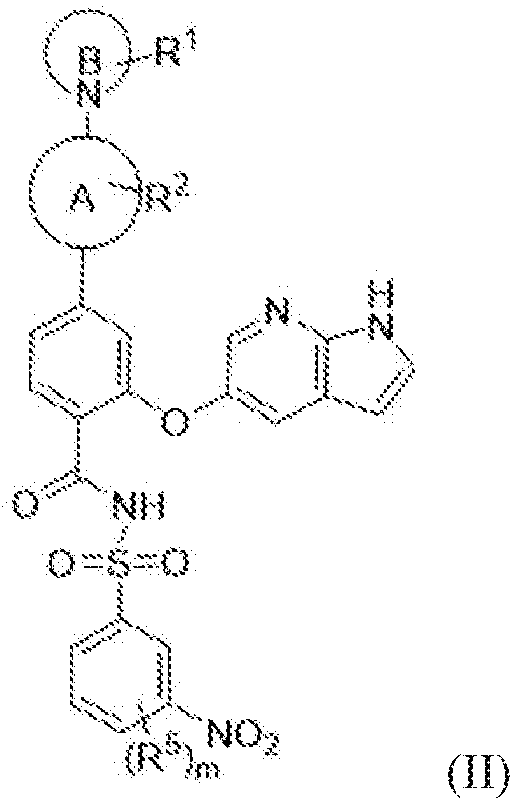
wherein - Ring A is a phenyl ring, which is 1,4-phenylene; or 5 to 12-membered spiro heterocyclyl comprising one or two heteroatoms selected from nitrogen, sulfur and oxygen as ring members, each of which is optionally substituted with 1 to 4 substituents R2;
R2, at each occurrence, is independently selected from the group consisting of hydrogen, halogen, or -C1-8alkyl optionally substituted with halogen; - Ring B is a monocyclic 4 to 9-membered heterocyclyl comprising one nitrogen atom as the ring member or a monocyclic 4 to 9-membered heterocyclyl comprising one nitrogen atom and one additional heteroatom selected from the group consisting of NH, O, S, SO or SO2 heteroatoms as ring members, said ring is N-linked;
- R1, R5 and m are defined with formula (I).
- The compound of formula (II) corresponds to the compound of formula (I), wherein
- L1 and L2 are each independently a direct bond, and L4 is -C(O)NHSO2-;
- L3 is -O-, and R3 is pyrrolo[2,3-b]pyridin-5-yl;
- R4 is -NO2.
- In some embodiment, ring A is 1,4-phenylene. In some embodiment, ring A is 5 to 12-membered spiro heterocyclyl comprising one or two heteroatoms selected from nitrogen, sulfur and oxygen as ring members; preferably ring A is 4-membered/4-membered, 3-membered/5-membered, 4-membered/5-membered, 4-membered/6-membered, 5-membered/5-membered, or 5-membered/6-membered mono-spiro heterocyclyl comprising one or two nitrogen or oxygen as ring members; more preferably ring A is


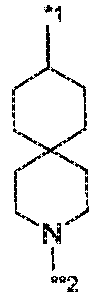
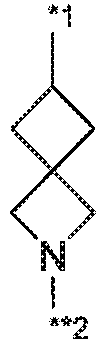
- In some embodiment, ring B is aziridin-1-yl, azetidin-1-yl, pyrrolidin-1-yl, pyrrolidin-2-yl, piperidin-1-yl, azepan-1-yl, or azocan-1-yl, preferably pyrrolidin-1-yl, which is substituted with a phenyl group at position 2 and further optionally substituted with 1 or 2 or 3 substituents R1 on the pyrrolidinyl ring, and said phenyl group at position 2 (i.e., ortho position) is optionally substituted with R1d as defined with Formula (I).
- When ring B is pyrrolidin-1-yl, which is substituted with a phenyl group at position 2, and said phenyl group at position 2 (i.e., ortho position) is optionally substituted with R1d as defined with Formula (I), the compound has the following formula (III)

- In one embodiment for formula (III), ring A is
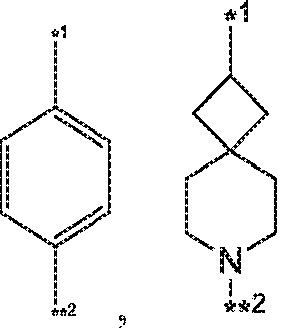

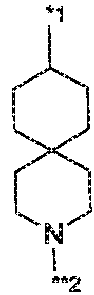


- In some embodiments for subgenus formulas (II), (III), (III-A), (III-B), (III-C), (III-D) or (III-E), wherein R2 is hydrogen.
- In some embodiments for subgenus formulas (II), (III), (III-A), (III-B), (III-C), (III-D) or (III-E), R1d is defined with formula (I). preferably, R1d, when substituted on the phenyl group at position 2 of ring B (including the aziridin-1-yl, azetidin-1-yl, pyrrolidin-1-yl, pyrrolidin-2-yl, piperidin-1-yl, azepan-1-yl, or azovan-1-yl, preferably the pyrrolidin-1-yl group), is independently halogen, -C1-8alkyl, -C2-8alkenyl, -C2-8alkynyl, cycloalkyl, heterocyclyl, aryl, heteroaryl, -CN, -ORBa, -SO2RBa, -CONRBaRBb, -NO2, -NRBaRBb, - NRBaCORBb, or -NRBaSO2RBb; wherein said -C1-8alkyl, -C2-8alkenyl, -C2-8alkynyl, cycloalkyl, heterocyclyl, aryl or heteroaryl are each independently optionally substituted with 1 to 4 substituents RBd as defined with Formula (I), preferably 1 or 2 substituents RBd as defined with Formula (I). In another aspect, one R1d is at position 2 of the phenyl ring at position 2 of ring B.
- In some preferred embodiments for subgenus formulas (II), (III), (III-A), (III-B), (III-C), (III-D) or (III-E), R1d is methyl, ethyl, isopropyl, propyl or methoxymethyl, or two methyl at position of the phenyl ring; or propenyl; or cyclopropyl, cyclobutyl, cyclopentyl, or cyclohexyl; or ethoxy or isopropoxy; or amino or dimethylamino.
- In some preferred embodiments for subgenus formulas (III), (III-A), (III-B), (III-C), (III-D) or (III-E), the 2-(2-substituted phenyl)pyrrolidin-1-yl moiety as ring B is selected from the group consisting of:






- In some preferred embodiments for subgenus formulas (II), (III), (III-A), (III-B), (III-C), (III-D) or (III-E), m is 1; and L5 is a direct bond, -(CRaRb)t- or -NRa-, wherein t is a number of 1 to 7, and one or two CRaRb moieties in -(CRaRb)t- are un-replaced or replaced with one or more moieties selected from O and NRa, wherein Ra and Rb are defined as with Formula (I).
- In a preferred embodiment, L5 is a direct bond, -(CRaRb)1-4-, -O-(CRaRb)1-3-, -NH-(CRaRb)1-3, or -NH-, wherein Ra and Rb are defined as with Formula (1) so that the -L5-CyC moiety is CyC, -(CRaRb)1-4-CyC, -O-(CRaRb)1-3-CyC, -NH-(CRaRb)1-3-CyC, or -NH-CyC, respectively. More preferably, L5 is a direct bond, -(CH2)1-4-, -O-(CH2)1-3-, -NH-(CRaRb)-(CH2)2-, or -NH-, wherein Ra is hydrogen and Rb is C1-8alkyl optionally substituted with phenyl-S- so that the -L5-CyC moiety is CyC, -(CH2)1-4-CyC, -O-(CH2)1-3-CyC, -NH-(CRaRb)-(CH2)2-CyC, or -NH-CyC, respectively. More preferably, L5 is a direct bond, -CH2-, -O-CH2-, -NH-CH2-, or -NH- so that the -L5-CyC moiety is CyC, -CH2-CyC, -O-CH2-CyC, -NH-CH2-CyC, or -NH-CyC, respectively.
- In one embodiment, CyC is cycloalkyl, or heterocyclyl, each of which is optionally substituted with one or two substituents R5a;
- R5a is independently selected from hydrogen, halogen, cyano, oxo, -OR5b, -NR5bR5c, - COR5b, -SO2R5b, -C1-8alkyl, -C2-8alkynyl, -cycloalkyl, or heterocyclyl, each of said -C1-8alkyl, and heterocyclyl is optionally substituted with one or two substituents R5e which is selected from hydrogen, halogen, cyano, -OR5f, -C1-8alkyl, -cycloalkyl, or heterocyclyl;
wherein R5b, and R5c are each independently hydrogen, -C1-8alkyl or heterocyclyl, said -C1-8alkyl is optionally substituted with one or two substituents R5e which is hydrogen, -NR5fR5g, or -cycloalkyl;
R5f and R5g are each independently hydrogen or -C1-8alkyl; - or, two adjacent R5 on the phenyl ring together with the phenyl ring form a benzo ring, said ring is optionally substituted with heteroaryl.
- In one embodiment, CyC is cycloalkyl selected from monocyclic C3-8cycloalkyl or bridged cycloalkyl
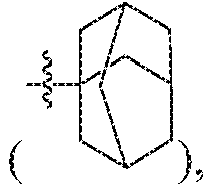
- In one embodiment, CyC is heterocyclyl selected from:
- a) monocyclic 4 to 9-membered heterocyclyl groups containing one nitrogen or oxygen or sulfur heteroatom as ring member;
- b) monocyclic 4 to 9-membered heterocyclyl groups containing two heteroatoms selected from oxygen, sulfur and nitrogen as ring members; and
- c) 5 to 20-membered spiro heterocyclyl comprising one or two heteroatoms selected from nitrogen, sulfur and oxygen as ring members,
- In a preferred embodiment, CyC is monocyclic 4 to 6-membered heterocyclyl groups containing one nitrogen or oxygen or sulfur heteroatom as ring member. More preferably, Cyc is selected from oxetanyl, tetrahydrofuranyl, tetrahydropyranyl, azetidinyl, pyrrolidinyl, and piperdinyl. Even more preferably, CyC is selected from oxetan-2-yl, Oxetan-3-yl, tetrahydrofuran-4-yl, tetrahydrofuran-2-yl, tetrahydrofuran-3-yl, tetrahydropyran-2-yl, tetrahydropyran-3-yl, tetrahydropyran-4-yl, azetidin-3-yl, azetidin-2-yl, pyrrolidin-2-yl, pyrrolidin-3-yl, piperdin-4-yl, piperdin-2-yl, and piperdin-3-yl.
- In a preferred embodiment, CyC is monocyclic 6-membered heterocyclyl group containing two heteroatoms selected from oxygen and nitrogen as ring members. More preferably, CyC is dioxanyl, morpholino, morpholinyl, or piperzinyl. Even more preferably 1,3-dioxan-2-yl, 1,3-dioxan-4-yl, 1,4-dioxan-2-yl, morpholin-1-yl, morpholin-2-yl, or morpholin-3-yl.
- In a preferred embodiment, CyC is 4-membered/4-membered, 3-membered/5-membered, 4-membered/5-membered, 4-membered/6-membered, 5-membered/5-membered, or 5-membered/6-membered mono-spiro heterocyclyl comprising one or two nitrogen or oxygen as ring members. More preferably, CyC is


- In a preferred embodiment, R5a is independently selected from hydrogen, halogen, cyano, oxo, -OR5b, -NR5bR5c, -COR5b, -SO2R5b, -C1-8alkyl, -C2-8alkynyl, monocyclic C3-8cycloalkyl, or monocyclic 4 to 9-membered heterocyclyl group containing one or two heteroatoms selected from nitrogen or oxygen or sulfur heteroatom as ring members, each of said -C1-8alkyl and monocyclic 4 to 9-membered heterocyclyl group is optionally substituted with one or two substituents R5e. Preferably, cycloalkyl as R5a is C3-6cycloalkyl; more preferably cyclopropyl. Preferably, heterocyclyl as R5a is 4 to 6-membered heterocyclyl groups containing one or two heteroatoms selected from nitrogen or oxygen or sulfur heteroatom as ring members. More preferably, heterocyclyl as R5a is oxetanyl, tetrahydrofuranyl, tetrahydropyranyl, piperzinyl, or morpholinyl. Even more preferably, heterocyclyl as R5a is oxetan-3-yl, tetrahydrofuran-3-yl, tetrahydro-2H-pyran-4-yl, or morphin-4-yl.
- In one embodiment, heterocyclyl as R5e is monocyclic 4 to 9-membered heterocyclyl group containing one or two heteroatoms selected from nitrogen or oxygen or sulfur heteroatom as ring members. Preferably, heterocyclyl as R5e is tetrahydro-pyran-4-yl.
- In one embodiment, R5a is -NR5bR5c, wherein R5b is hydrogen, and R5c is heterocyclyl. In a more preferred embodiment, R5a is -NR5bR5c, wherein R5b is hydrogen, and R5c is tetrahydro-pyran-4-yl. In one embodiment, R5a is -NR5bR5c, wherein R5b and R5c are each independently hydrogen or -C1-6alkyl substituted with cycloalkyl, preferably -C1-6alkyl substituted with monocyclic C3-8cycloalkyl.
- In one embodiment, R5a is -OR5b or -SO2R5b, wherein R5b is hydrogen or C1-8alkyl, preferably methyl.
- In one embodiment, R5a is -COR5b, wherein R5b is hydrogen or C1-8alkyl optionally substituted with -NR5fR5g, wherein R5f and R5g are each independently hydrogen or C1-8alkyl, preferably methyl.
- In one embodiment, two adjacent R5 on the phenyl ring together with the phenyl ring form indazolyl which is substituted with tetrahydropyranyl.
- In some embodiment, m is 1, and R5 is -L5-CyC selected from the group consisting of:






- In a preferred embodiment, m is 1 and R5 is


- In some embodiment, the carbon atom at position 2 of the pyrrolidinyl ring, to which the phenyl ring in the subgenus formulas (III), (III-A), (III-B), (III-C), (III-D) or (III-E) is attached, is of (S)-configuration.
- In some embodiment, compound of formula (I) has the formula (IV)

- In some embodiment, the carbon atom at position 2 of the piperazinyl ring, to which the phenyl ring in the subgenus formula (IV) is attached, is of (S)- or (R)-configuration.
- The inventors of the present application have found that the compounds of formula (III), including subgenus formulas (III-A), (III-B), (III-C), (III-D) or (III-E), and formula (IV) are more potent and highly selective due to the optimum combination of the spiro or phenylene moiety and substitution of a phenyl group at position of the nitrogen-linked heterocyclyl (in particular the 2-(2-substituted phenyl)pyrrolidin-1-yl moiety for formula (III) and 2-(2-substituted phenyl)piperazin-1-yl for formula (IV)) of the compounds disclosed herein.
- Disclosed here are intermediate compounds selected from a compound selected from:


- Disclosed herein is a method for treating dysregulated apoptotic diseases, comprising administering a subject in need thereof a therapeutically effective amount of the compound disclosed herein, or a pharmaceutically acceptable salt thereof, or a stereoisomer thereof. In one embodiment, the dysregulated apoptotic disease is cancer, such as, bladder cancer, brain cancer, breast cancer, bone marrow cancer, cervical cancer, chronic lymphocytic leukemia, colorectal cancer, esophageal cancer, hepatocellular cancer, lymphoblastic leukemia, follicular lymphoma, lymphoid malignancies of T-cell or B-cell origin, melanoma, myelogenous leukemia, myeloma, oral cancer, ovarian cancer, non-small cell lung cancer, prostate cancer, small cell lung cancer, spleen cancer published in
WO 2005049593 andWO 2005049594 . - In one embodiment, the dysregulated apoptotic disease is autoimmune disease, such as, Systemic Lupus Erythematosus (SLE).
- Disclosed herein a pharmaceutical composition comprising the compound disclosed herein, or a pharmaceutically acceptable salt thereof, or a stereoisomer thereof, and a pharmaceutically acceptable carrier.
- The following terms have the indicated meanings throughout the specification:
As used herein, including the appended claims, the singular forms of words such as "a", "an", and "the", include their corresponding plural references unless the context clearly dictates otherwise. - The term "or" is used to mean, and is used interchangeably with, the term "and/or" unless the context clearly dictates otherwise.
- The term "alkyl" refers to a hydrocarbon group selected from linear and branched saturated hydrocarbon groups comprising from 1 to 18, such as from 1 to 12, further such as from 1 to 10, more further such as from 1 to 8, or from 1 to 6, or from 1 to 4, carbon atoms. Examples of alkyl groups comprising from 1 to 6 carbon atoms (i.e., C1-6 alkyl) include, but not limited to, methyl, ethyl, 1-propyl or n-propyl ("n-Pr"), 2-propyl or isopropyl ("i-Pr"), 1-butyl or n-butyl ("n-Bu"), 2-methyl-1-propyl or isobutyl ("i-Bu"), 1-methylpropyl or s-butyl ("s-Bu"), 1,1-dimethylethyl or t-butyl ("t-Bu"), 1-pentyl, 2-pentyl, 3-pentyl, 2-methyl-2-butyl, 3-methyl-2-butyl, 3-methyl-1-bulyl, 2-methyl-1-butyl, 1-hexyl, 2-hexyl, 3-hexyl, 2-methyl-2-pentyl, 3-methyl-2-pentyl, 4-methyl-2-pentyl, 3-methyl-3-pentyl, 2-methyl-3-pentyl, 2,3-dimethyl-2-butyl and 3,3-dimethyl-2-butyl groups. The alkyl group can be optionally enriched in deuterium, e.g., -CD3, -CD2CD3 and the like.
- The term "halogen" refers to fluoro (F), chloro (Cl), bromo (Br) and iodo (I).
- The term "haloalkyl" refers to an alkyl group in which one or more hydrogen is/are replaced by one or more halogen atoms such as fluoro, chloro, bromo, and iodo. Examples of the haloalkyl include haloCi_aalkyl, haloC1-6alkyl or halo C1-4alkyl, but not limited to -CF3, - CH2Cl, -CH2CF3, -CCl2, CF3, and the like.
- The term "alkenyl" refers to a hydrocarbon group selected from linear and branched hydrocarbon groups comprising at least one C=C double bond and from 2 to 18, such as from 2 to 8, further such as from 2 to 6, carbon atoms. Examples of the alkenyl group, e.g., C2-6 alkenyl, include, but not limited to ethenyl or vinyl, prop-1-enyl, prop-2-enyl, 2-methylprop-1-enyl, but-1-enyl, but-2-enyl, but-3-enyl, buta-1,3-dienyl, 2-methylbuta-1,3-dienyl, hex-1-enyl, hex-2-enyl, hex-3-enyl, hex-4-enyl, and hexa-1,3-dienyl groups.
- The term "alkynyl" refers to a hydrocarbon group selected from linear and branched hydrocarbon group, comprising at least one C=C triple bond and from 2 to 18, such as 2 to 8, further such as from 2 to 6, carbon atoms. Examples of the alkynyl group, e.g., C2-6 alkynyl, include, but not limited to ethynyl, 1-propynyl, 2-propynyl (propargyl), 1-butynyl, 2-butynyl, and 3-butynyl groups.
- The term "alkyloxy" or "alkoxy" refers to an alkyl group as defined above attached to the parent molecular moiety through an oxygen atom. Examples of an alkyloxy, e.g., C1-6alkyloxy or C1-4 alkyloxy includes, but not limited to, methoxy, ethoxy, isopropoxy, propoxy, n-butoxy, tert-butoxy, pentoxy and hexoxy and the like.
- The term "cycloalkyl" refers to a hydrocarbon group selected from saturated cyclic hydrocarbon groups, comprising monocyclic and polycyclic (e.g., bicyclic and tricyclic) groups including fused, bridged or spiro cycloalkyl.
- For example, the cycloalkyl group may comprise from 3 to 12, such as from 3 to 10, further such as 3 to 8, further such as 3 to 6, 3 to 5, or 3 to 4 carbon atoms. Even further for example, the cycloalkyl group may be selected from monocyclic group comprising from 3 to 12, such as from 3 to 10, further such as 3 to 8, 3 to 6 carbon atoms. Examples of the monocyclic cycloalkyl group include cyclopropyl, cyclobutyl, cyclopentyl, 1-cyclopent-1-enyl, cyclohexyl, cycloheptyl, cyclooctyl, cyclononyl, cyclodecyl, cycloundecyl, and cyclododecyl groups. In particular, Examples of the saturated monocyclic cycloalkyl group, e.g., C3-8 cycloalkyl, include, but not limited to cyclopropyl, cyclobutyl, cyclopentyl, cyclohexyl, cycloheptyl, and cyclooctyl groups. In a preferred embedment, the cycloalkyl is a monocyclic ring comprising 3 to 6 carbon atoms (abbreviated as C3-6 cycloalkyl), including but not limited to, cyclopropyl, cyclobutyl, cyclopentyl, and cyclohexyl. Examples of the bicyclic cycloalkyl groups include those having from 7 to 12 ring atoms arranged as a fused bicyclic ring selected from [4,4], [4,5], [5,5], [5,6] and [6,6] ring systems, or as a bridged bicyclic ring selected from bicyclo[2.2.1]heptane, bicyclo[2.2.2]octane, and bicyclo[3.2.2]nonane. Further Examples of the bicyclic cycloalkyl groups include those arranged as a bicyclic ring selected from [5,6] and [6,6] ring systems, such as

- The term "spiro cycloalkyl" refers to a cyclic structure which contains carbon atoms and is formed by at least two rings sharing one atom. The term "7 to 10 membered spiro cycloalkyl" refers to a cyclic structure which contains 7 to 10 carbon atoms and is formed by at least two rings sharing one atom.
- The term "fused cycloalkyl" refers to a fused ring which contains carbon atoms and is formed by two or more rings sharing two adjacent atoms. The term "4 to 10 membered fused cycloalkyl" refers to a fused ring which contains 4 to 10 ring carbon atoms and is formed by two or more rings sharing two adjacent atoms.
- Examples include but are not limited to bicyclo[1.1.0]butyl, bicyclo[2.1.0]pentyl, bicyclo[3.1.0]hcxyl, bicyclo[4.1.0]heptyl, bicyclo[3.3.0]octyl, bicyclo[4.2.0]octyl, decalin, as well as benzo 3 to 8 membered cycloalkyl, benzo C4-6 cycloalkenyl, 2,3-dihydro-1 H-indenyl, 1H-indenyl, 1,2,3,4-tetralyl, 1,4-dihydronaphthyl, etc. Preferred embodiments are 8 to 9 membered fused cyclyl, which refer to cyclic structures containing 8 to 9 ring atoms within the above examples.
- The term "bridged cycloalkyl" refers to a cyclic structure which contains carbon atoms and is formed by two rings sharing two atoms which are not adjacent to each other. The term "7 to 10 membered bridged cycloalkyl" refers to a cyclic structure which contains 7 to 12 carbon atoms and is formed by two rings sharing two atoms which are not adjacent to each other.
- The term "cycloalkenyl" refers to non-aromatic cyclic alkyl groups of from 3 to 10 carbon atoms having single or multiple rings and having at least one double bond and preferably from 1 to 2 double bonds. In one embodiment, the cycloalkenyl is cyclopentenyl or cyclohexenyl, preferably cyclohexenyl.
- The term "cycloalkynyl" refers to non-aromatic cycloalkyl groups of from 5 to 10 carbon atoms having single or multiple rings and having at least one triple bond.
- The term "aryl" used alone or in combination with other terms refers to a group selected from:
- a) 5- and 6-membered carbocyclic aromatic rings, e.g., phenyl;
- b) bicyclic ring systems such as 7 to 12 membered bicyclic ring systems, wherein at least one ring is carbocyclic and aromatic, e.g., naphthyl and indanyl; and,
- c) tricyclic ring systems such as 10 to 15 membered tricyclic ring systems wherein at least one ring is carbocyclic and aromatic, e.g., fluorenyl.
- The terms "aromatic hydrocarbon ring" and "aryl" are used interchangeable throughout the disclosure herein. In some embodiments, a monocyclic or bicyclic aromatic hydrocarbon ring has 5 to 10 ring-forming carbon atoms (i.e., C5-10 aryl). Examples of a monocyclic or bicyclic aromatic hydrocarbon ring includes, but not limited to, phenyl, naphth-1-yl, naphth-2-yl, anthracenyl, phenanthrenyl, and the like. In some embodiments, the aromatic hydrocarbon ring is a naphthalene ring (naphth-1-yl or naphth-2-yl) or phenyl ring. In some embodiments, the aromatic hydrocarbon ring is a phenyl ring.
- The term "heteroaryl" refers to a group selected from:
- a) 5-, 6- or 7-membered aromatic, monocyclic rings comprising at least one heteroatom, for example, from 1 to 4, or, in some embodiments, from 1 to 3, in some embodiments, from 1 to 2, heteroatoms, selected from nitrogen (N), sulfur (S) and oxygen (O), with the remaining ring atoms being carbon;
- b) 8- to 12-membered bicyclic rings comprising at least one heteroatom, for example, from 1 to 4, or, in some embodiments, from 1 to 3, or, in other embodiments, 1 or 2, heteroatoms, selected from N, O, and S, with the remaining ring atoms being carbon and wherein at least one ring is aromatic and at least one heteroatom is present in the aromatic ring; and
- c) 11- to 14-membered tricyclic rings comprising at least one heteroatom, for example, from 1 to 4, or in some embodiments, from 1 to 3, or, in other embodiments, 1 or 2, heteroatoms, selected from N, O, and S, with the remaining ring atoms being carbon and wherein at least one ring is aromatic and at least one heteroatom is present in an aromatic ring.
- When the total number of S and O atoms in the heteroaryl group exceeds 1, those heteroatoms are not adjacent to one another. In some embodiments, the total number of S and O atoms in the heteroaryl group is not more than 2. In some embodiments, the total number of S and O atoms in the aromatic heterocycle is not more than 1. When the heteroaryl group contains more than one heteroatom ring member, the heteroatoms may be the same or different. The nitrogen atoms in the ring(s) of the heteroaryl group can be oxidized to form N-oxides. The term "C-linked heteroaryl" as used herein means that the heteroaryl group is connected to the core molecule by a bond from a C-atom of the heteroaryl ring
- The terms "aromatic heterocyclic ring" and "heteroaryl" are used interchangeable throughout the disclosure herein. In some embodiments, a monocyclic or bicyclic aromatic heterocyclic ring has 5-, 6-, 7-, 8-, 9- or 10-ring forming members with 1, 2, 3, or 4 heteroatom ring members independently selected from nitrogen (N), sulfur (S) and oxygen (O) and the remaining ring members being carbon. In some embodiments, the monocyclic or bicyclic aromatic heterocyclic ring is a monocyclic or bicyclic ring comprising 1 or 2 heteroatom ring members independently selected from nitrogen (N), sulfur (S) and oxygen (O). In some embodiments, the monocyclic or bicyclic aromatic heterocyclic ring is a 5- to 6-membered heteroaryl ring, which is monocyclic and which has 1 or 2 heteroatom ring members independently selected from nitrogen (N), sulfur (S) and oxygen (O). In some embodiments, the monocyclic or bicyclic aromatic heterocyclic ring is a 8- to 10-membcrcd heteroaryl ring, which is bicyclic and which has 1 or 2 heteroatom ring members independently selected from nitrogen, sulfur and oxygen.
- Examples of the heteroaryl group or the monocyclic or bicyclic aromatic heterocyclic ring include, but are not limited to, (as numbered from the linkage position assigned priority 1) pyridyl (such as 2-pyridyl, 3-pyridyl, or 4-pyridyl), cinnolinyl, pyrazinyl, 2,4-pyrimidinyl, 3,5-pyrimidinyl, 2,4-imidazolyl, imidazopyridinyl, isoxazolyl, oxazolyl, thiazolyl, isothiazolyl, thiadiazolyl (such as 1,2,3-thiadiazolyl, 1,2,4-thiadiazolyl, or 1,3,4-thiadiazolyl), tetrazolyl, thienyl (such as thien-2-yl, thicn-3-yl), triazinyl, benzothienyl, furyl or furanyl, bcnzofuryl, benzoimidazolyl, indolyl, isoindolyl, indolinyl, oxadiazolyl (such as 1,2,3-oxadiazolyl, 1,2,4-oxadiazolyl, or 1,3,4-oxadiazolyl), phthalazinyl, pyrazinyl, pyridazinyl, pyrrolyl, triazolyl (such as 1,2,3-triazolyl, 1,2,4-triazolyl, or 1,3,4-triazolyl), quinolinyl, isoquinolinyl, pyrazolyl, pyrrolopyridinyl (such as 1H-pyrrolo[2,3-b]pyridin-5-yl), pyrazolopyridinyl (such as 1H-pyrazolo[3,4-b]pyridin-5-yl), benzofuranyl, benzoxazolyl (such as benzo[d]oxazol-6-yl), pteridinyl, purinyl, 1-oxa-2,3-diazolyl, 1-oxa-2,4-diazolyl, 1-oxa-2,5-diazolyl, 1-oxa-3,4-diazolyl, 1-thia-2,3-diazolyl, 1-thia-2,4-diazolyl, 1-thia-2,5-diazolyl, 1-thia-3,4-diazolyl, furazanyl (such as furazan-2-yl, furazan-3-yl), bcnzofurazanyl, benzothiophenyl, benzothiazolyl, benzoxazolyl, quinazolinyl, quinoxalinyl, naphthyridinyl, furopyridinyl, benzothiazolyl (such as benzo[d]thiazol-6-yl), indazolyl (such as 1H-indazol-5-yl) and 5,6,7,8-tetrahydroisoquinoline.
- "Heterocyclyl", "heterocycle" or "heterocyclic" are interchangeable and refer to a non-aromatic heterocyclyl group comprising one or more heteroatoms selected from the group consisting of NH, O, S, SO or SO2 heteroatoms as ring members, with the remaining ring members being carbon, including monocyclic, fused, bridged, and spiro ring, i.e., containing monocyclic heterocyclyl, bridged heterocyclyl, spiro heterocyclyl, and fused heterocyclic groups.
- The term "monocyclic heterocyclyl" refers to monocyclic groups in which at least one ring member is a heteroatom selected from the group consisting of NH, O, S, SO or SO2. A heterocycle may be saturated or partially saturated.
- Exemplary monocyclic 4 to 9-membered heterocyclyl groups include, but not limited to, (as numbered from the linkage position assigned priority 1) pyrrolidin-1-yl, pyrrolidin-2-yl, pyrrolidin-3-yl, imidazolidin-2-yl, imidazolidin-4-yl , pyrazolidin-2-yl, pyrazolidin-3-yl, piperidin-1-yl, piperidin-2-yl, piperidin-3-yl, piperidin-4-yl, 2,5-pipcrazinyl, pyranyl, morpholinyl, morpholino, morpholin-2-yl, morpholin-3-yl, oxiranyl, aziridin-1-yl, aziridin-2-yl, azocan-1-yl, azocan-2-yl, azocan-3-yl, azocan-4-yl, azocan-5-yl, thiiranyl, azetidin-1-yl, azetidin-2-yl, azetidin-3-yl, oxetanyl, thietanyl, 1,2-dithietanyl, 1,3-dithietanyl, dihydropyridinyl, tetrahydropyridinyl, thiomorpholinyl, thioxanyl, piperazinyl, homopiperazinyl, homopiperidinyl, azepan-1-yl, azepan-2-yl, azepan-3-yl, azepan-4-yl, oxepanyl, thiepanyl, 1,4-oxathianyl, 1,4-dioxepanyl, 1,4-oxathiepanyl, 1,4-oxaazepanyl, 1,4-dithiepanyl, 1,4-thiazepanyl and 1,4-diazepanyl, 1,4-dithianyl, 1,4-azathianyl, oxazepinyl, diazepinyl, thiazepinyl, dihydrothienyl, dihydropyranyl, dihydrofuranyl, tetrahydrofuranyl, tetrahydrothienyl, tetrahydropyranyl, tetrahydrothiopyranyl, 1-pyrrolinyl, 2-pyrrolinyl, 3-pyrrolinyl, indolinyl, 2H-pyranyl, 4H-pyranyl, 1,4-dioxanyl, 1,3-dioxolanyl, pyrazolinyl, pyrazolidinyl, dithianyl, dithiolanyl, pyrazolidinyl, imidazolinyl, pyrimidinonyl, or 1,1-dioxo-thiomorpholinyl.
- The term "spiro heterocyclyl" or "heterospirocyclyl" refers to a 5 to 20-membered polycyclic heterocyclyl with rings connected through one common carbon atom (called a spiro atom), comprising one or more heteroatoms selected from the group consisting of NH, O, S, SO or SO2 heteroatoms as ring members, with the remaining ring members being carbon. One or more rings of a spiro heterocyclyl group may contain one or more double bonds, but none of the rings has a completely conjugated pi-electron system. Preferably a spiro heterocyclyl is 6 to 14-membered, and more preferably 7 to 10-membered. According to the number of common spiro atoms, a spiro heterocyclyl is divided into mono-spiro heterocyclyl, di-spiro heterocyclyl, or poly-spiro heterocyclyl, and preferably refers to mono-spiro heterocyclyl or di-spiro heterocyclyl, and more preferably 4-membered/4-membered, 3-membered/5-membered, 4-membered/5-membered, 4-membered/6-membered, 5-membered/5-membered, or 5-membered/6-membered mono-spiro heterocyclyl. Representative examples of spiro heterocyclyls include, but not limited to the following groups: 2,3-dihydrospiro[indene-1,2'-pyrrolidine] (e.g., 2,3-dihydrospiro[indene-1,2'-pyrrolidine]-1'-yl), 1,3-dihydrospiro[indene-2,2'-pyrrolidine] (e.g., 1,3-dihydrospiro[indene-2,2'-pyrrolidine]-1'-yl), ar.aspiro[2.4]heptane (e.g., 5-azaspiro[2.4]heptanc-5-yl), azaspiro[3.4]octane (e.g., 6-azaspiro[3.4]octane-6- yl), 2-oxa-6-azaspiro[3.4]octane (e.g., 2-oxa-6-azaspiro[3.4]octane-6-yl), azaspiro[3.4]octane (e.g., 6-azaspiro[3.4]octan-6-yl), azaspiro[3.4]octane (e.g., 6-azaspiro[3.4]octan-6-yl), 7-azaspiro[3.5]nonane (e.g., 7-azaspiro[3.5]nonan-7-yl), 2-azaspiro[3.5]nonane (e.g., 2-azaspiro[3.5]nonan-2-yl),1,7-dioxaspiro[4.5]decane, 2-oxa-7-aza-spiro[4.4]nonane (e.g., 2-oxa-7-aza-spiro[4.4]non-7-yl), 7-oxa-spiro[3.5]nonyl and 5-oxa-spiro[2.4]heptyl.
- The term "fused heterocyclic group" refers to a 5 to 20-membered polycyclic heterocyclyl group, wherein each ring in the system shares an adjacent pair of atoms (carbon and carbon atoms or carbon and nitrogen atoms) with another ring, comprising one or more heteroatoms selected from the group consisting of NH, O, S, SO or SO2 heteroatoms as ring members, with the remaining ring members being carbon. One or more rings of a fused heterocyclic group may contain one or more double bonds, but none of the rings has a completely conjugated pi-electron system. Preferably, a fused heterocyclyl is 6 to 14-membered, and more preferably 7 to 10-membered. According to the number of membered rings, a fused heterocyclyl is divided into bicyclic, tricyclic, tetracyclic, or polycyclic fused heterocyclyl, preferably refers to bicyclic or tricyclic fused heterocyclyl, and more preferably 5-membered/5-membered, or 5-membered/6-membered bicyclic fused heterocyclyl. Representative examples of fused heterocycles include, but not limited to, the following groups octahydrocyclopenta[c]pyrrole (e.g., octahydrocyclopenta[c]pyrrol-2-yl), octahydropyrrolo[3,4-c]pyrrolyl, octahydroisoindolyl, isoindolinyl (e.g., isoindoline-2-yl), octahydro-benzo[b][1,4]dioxin, dihydrobenzofuranyl, benzo[d][1,3]dioxolyl.
- The term "bridged heterocyclyl" refers to a 5 to 14-membered polycyclic heterocyclic alkyl group, wherein every two rings in the system share two disconnected atoms, comprising one or more heteroatoms selected from the group consisting of NH, O, S, SO or SO2 heteroatoms as ring members, with the remaining ring members being carbon. One or more rings of a bridged heterocyclyl group may contain one or more double bonds, but none of the rings has a completely conjugated pi-electron system. Preferably, a bridged heterocyclyl is 6 to 14-membered, and more preferably 7 to 10-membered. According to the number of membered rings, a bridged heterocyclyl is divided into bicyclic, tricyclic, tetracyclic or polycyclic bridged heterocyclyl, and preferably refers to bicyclic, tricyclic or tetracyclic bridged heterocyclyl, and more preferably bicyclic or tricyclic bridged heterocyclyl. Representative examples of bridged heterocyclyls include, but not limited to, the following groups: 2-azabicyclo[2.2.1]heptyl, azabicyclo[3.1.0]hexyl, 2-azabicyclo[2.2.2]octyl and 2-azabicyclo[3.3.2]decyl.
- The heterocyclyl ring may be fused to aryl, heteroaryl or cycloalkyl ring, wherein the ring structure is connected to the parent heterocyclic group together.
- "C-linked heterocyclyl" as used refers to a heterocyclyl group which is connected to the other part of the molecule by a direct bond from a carbon atom of the heterocyclyl ring.
- "N-linked heterocyclyl" as used refers to a heterocyclyl group which is connected to the other part of the molecule by a direct bond from a nitrogen atom of the heterocyclyl ring.
- Compounds disclosed herein may contain an asymmetric center and may thus exist as enantiomers. "Enantiomers" refer to two stereoisomers of a compound which are non-superimposable mirror images of one another. Where the compounds disclosed herein possess two or more asymmetric centers, they may additionally exist as diastereomers. Enantiomers and diastereomers fall within the broader class of stereoisomers. All such possible stereoisomers as substantially pure resolved enantiomers, racemic mixtures thereof, as well as mixtures of diastereomers are intended to be included. All stereoisomers of the compounds disclosed herein and /or pharmaceutically acceptable salts thereof are intended to be included. Unless specifically mentioned otherwise, reference to one isomer applies to any of the possible isomers. Whenever the isomeric composition is unspecified, all possible isomers are included.
- The term "substantially pure" as used herein means that the target stereoisomer contains no more than 35%, such as no more than 30%, further such as no more than 25%, even further such as no more than 20%, by weight of any other stereoisomer(s). In some embodiments, the term "substantially pure" means that the target stereoisomer contains no more than 10%, for example, no more than 5%, such as no more than 1%, by weight of any other stereoisomer(s).
- When compounds disclosed herein contain olefinic double bonds, unless specified otherwise, such double bonds are meant to include both E and Z geometric isomers.
- When compounds disclosed herein contain a di-substituted cyclohexyl or cyclobutyl group, substituents found on cyclohexyl or cyclobutyl ring may adopt cis and trans formations. Cis formation means that both substituents are found on the upper side of the 2 substituent placements on the carbon, while trans would mean that they were on opposing sides.
- It may be advantageous to separate reaction products from one another and /or from starting materials. The desired products of each step or series of steps is separated and /or purified (hereinafter separated) to the desired degree of homogeneity by the techniques common in the art. Typically such separations involve multiphase extraction, crystallization from a solvent or solvent mixture, distillation, sublimation, or chromatography. Chromatography can involve any number of methods including, for example: reverse-phase and normal phase; size exclusion; ion exchange; high, medium and low pressure liquid chromatography methods and apparatus; small scale analytical; simulated moving bed ("SMB") and preparative thin or thick layer chromatography, as well as techniques of small scale thin layer and flash chromatography. One skilled in the art will apply techniques most likely to achieve the desired separation.
- "Diastereomers" refers to stereoisomers of a compound with two or more chiral centers but which are not mirror images of one another. Diastereomeric mixtures can be separated into their individual diastereomers on the basis of their physical chemical differences by methods well known to those skilled in the art, such as by chromatography and /or fractional crystallization. Enantiomers can be separated by converting the enantiomeric mixture into a diastereomeric mixture by reaction with an appropriate optically active compound (e.g., chiral auxiliary such as a chiral alcohol or Mosher's acid chloride), separating the diastereomers and converting (e.g., hydrolyzing) the individual diastereoisomers to the corresponding pure enantiomers. Enantiomers can also be separated by use of a chiral HPLC column.
- A single stereoisomer, e.g., a substantially pure enantiomer, may be obtained by resolution of the racemic mixture using a method such as formation of diastereomers using optically active resolving agents (Eliel, E. and Wilen, S. Stereochemistry of Organic Compounds. New York: John Wiley & Sons. Inc., 1994 ; Lochmuller, C. H., et al. "Chromatographic resolution of enantiomers: Selective review "J. Chromatogr., 113(3) (1975): pp. 283-302). Racemic mixtures of chiral compounds of the invention can be separated and isolated by any suitable method, including: (1) formation of ionic, diastereomeric salts with chiral compounds and separation by fractional crystallization or other methods, (2) formation of diastereomeric compounds with chiral derivatizing reagents, separation of the diastereomers, and conversion to the pure stereoisomers, and (3) separation of the substantially pure or enriched stereoisomers directly under chiral conditions. See: Wainer, Irving W., Ed. Drug Stereochemistry: Analytical Methods and Pharmacology. New York: Marcel Dekker, Inc., 1993 .
- "Pharmaceutically acceptable salts" refers to those salts which arc, within the scope of sound medical judgment, suitable for use in contact with the tissues of humans and lower animals without undue toxicity, irritation, allergic response and the like, and are commensurate with a reasonable benefit/risk ratio. A pharmaceutically acceptable salt may be prepared in situ during the final isolation and purification of the compounds disclosed herein, or separately by reacting the free base function with a suitable organic acid or by reacting the acidic group with a suitable base.
- In addition, if a compound disclosed herein is obtained as an acid addition salt, the free base can be obtained by basifying a solution of the acid salt. Conversely, if the product is a free base, an addition salt, such as a pharmaceutically acceptable addition salt, may be produced by dissolving the free base in a suitable organic solvent and treating the solution with an acid, in accordance with conventional procedures for preparing acid addition salts from base compounds. Those skilled in the art will recognize various synthetic methodologies that may be used without undue experimentation to prepare non-toxic pharmaceutically acceptable addition salts.
- As defined herein, "a pharmaceutically acceptable salt thereof" include salts of at least one compound of Formula (1), and salts of the stereoisomers of the compound of Formula (I), such as salts of enantiomers, and /or salts of diastereomers.
- The terms "administration", "administering", "treating" and "treatment" herein, when applied to an animal, human, experimental subject, cell, tissue, organ, or biological fluid, mean contact of an exogenous pharmaceutical, therapeutic, diagnostic agent, or composition to the animal, human, subject, cell, tissue, organ, or biological fluid. Treatment of a cell encompasses contact of a reagent to the cell, as well as contact of a reagent to a fluid, where the fluid is in contact with the cell. The term "administration" and "treatment" also means in vitro and ex vivo treatments, e.g., of a cell, by a reagent, diagnostic, binding compound, or by another cell. The term "subject" herein includes any organism, preferably an animal, more preferably a mammal (e.g., rat, mouse, dog, cat, rabbit) and most preferably a human.
- The term "effective amount" or "therapeutically effective amount" refers to an amount of the active ingredient, such as compound that, when administered to a subject for treating a disease, or at least one of the clinical symptoms of a disease or disorder, is sufficient to affect such treatment for the disease, disorder, or symptom. The "therapeutically effective amount" can vary with the compound, the disease, disorder, and/or symptoms of the disease or disorder, severity of the disease, disorder, and/or symptoms of the disease or disorder, the age of the subject to be treated, and/or the weight of the subject to be treated. An appropriate amount in any given instance can be apparent to those skilled in the art or can be determined by routine experiments. In some embodiments, "therapeutically effective amount" is an amount of at least one compound and /or at least one stereoisomer thereof, and /or at least one pharmaceutically acceptable salt thereof disclosed herein effective to "treat" as defined above, a disease or disorder in a subject. In the case of combination therapy, the "therapeutically effective amount" refers to the total amount of the combination objects for the effective treatment of a disease, a disorder or a condition.
- The pharmaceutical composition comprising the compound disclosed herein can be administrated via oral, inhalation, rectal, parenteral or topical administration to a subject in need thereof. For oral administration, the pharmaceutical composition may be a regular solid formulation such as tablets, powder, granule, capsules and the like, a liquid formulation such as water or oil suspension or other liquid formulation such as syrup, solution, suspension or the like; for parenteral administration, the pharmaceutical composition may be solution, water solution, oil suspension concentrate, lyophilized powder or the like. Preferably, the formulation of the pharmaceutical composition is selected from tablet, coated tablet, capsule, suppository, nasal spray or injection, more preferably tablet or capsule. The pharmaceutical composition can be a single unit administration with an accurate dosage. In addition, the pharmaceutical composition may further comprise additional active ingredients.
- All formulations of the pharmaceutical composition disclosed herein can be produced by the conventional methods in the pharmaceutical field. For example, the active ingredient can be mixed with one or more excipients, then to make the desired formulation. The "pharmaceutically acceptable excipient" refers to conventional pharmaceutical carriers suitable for the desired pharmaceutical formulation, for example: a diluent, a vehicle such as water, various organic solvents, etc, a filler such as starch, sucrose, etc a binder such as cellulose derivatives, alginates, gelatin and polyvinylpyrrolidone (PVP); a wetting agent such as glycerol; a disintegrating agent such as agar, calcium carbonate and sodium bicarbonate; an absorption enhancer such as quaternary ammonium compound; a surfactant such as hexadecanol; an absorption carrier such as Kaolin and soap clay; a lubricant such as talc, calcium stearate, magnesium stearate, polyethylene glycol, etc. In addition, the pharmaceutical composition further comprises other pharmaceutically acceptable excipients such as a decentralized agent, a stabilizer, a thickener, a complexing agent, a buffering agent, a permeation enhancer, a polymer, aromatics, a sweetener, and a dye.
- The term "disease" refers to any disease, discomfort, illness, symptoms or indications, and can be interchangeable with the term "disorder" or "condition".
- Throughout this specification and the claims which follow, unless the context requires otherwise, the term "comprise", and variations such as "comprises" and "comprising" are intended to specify the presence of the features thereafter, but do not exclude the presence or addition of one or more other features. When used herein the term "comprising" can be substituted with the term "containing", "including" or sometimes "having".
- Throughout this specification and the claims which follow, the term "Cn-m" indicates a range which includes the endpoints, wherein n and m are integers and indicate the number of carbons. Examples include C1-8, C1-6, and the like.
- Unless specifically defined elsewhere in this document, all other technical and scientific terms used herein have the meaning commonly understood by one of ordinary skill in the art to which this invention belongs.
-
-
FIG. 1 shows Co-crystal structure of A4a. -
FIG. 2 shows ABT-199 analog (PDB code: 4MAN). -
FIG. 3 shows binding pose comparison of A4a with ABT-199 analog (PDB code: 4MAN) to Bcl2 protein. -
FIG. 4 shows a. Co-crystal structure of F22 with Bcl-2. b. Co-crystal structure of an ABT-199 analog with Bcl-2 (PDB code:4MAN). c. Binding pose alignment between F22 and ABT-199 analog. -
FIG. 5 shows a. Induced sub-pocket of Bcl-2 by cyclopropyl of F22 in crystal structure. b. No substituent in ABT-199 analog induces a similar sub-pocket at the same position (PDB code: 4MAN). c. Pocket surface alignment between F22 and ABT-199 analog. -
FIG. 6 shows a. Water bridge between F22 and Bcl-2 protein. b. No such water bridge can be observed between ABT-199 analog and Bcl-2. -
FIG. 7 show a. Sulfur-π interaction (4.41 Å) between Met115 and 2-cyclopropylphenyl of F22. b. Similar interaction (5.00 Å) between Met115 and 4-chlorophenyl of ABT-199 analog.. - The examples below are intended to be purely exemplary and should not be considered to be limiting in any way. Efforts have been made to ensure accuracy with respect to numbers used (for example, amounts, temperature, etc.), but some experimental errors and deviations should be accounted for. Unless indicated otherwise, temperature is in degrees Centigrade. Reagents were purchased from commercial suppliers such as Sigma-Aldrich, Alfa Aesar, or TCI, and were used without further purification unless indicated otherwise.
- Unless indicated otherwise, the reactions set forth below were performed under a positive pressure of nitrogen or argon or with a drying tube in anhydrous solvents; the reaction flasks were fitted with rubber septa for the introduction of substrates and reagents via syringe; and glassware was oven dried and/or heat dried.
- 1H NMR spectra were recorded on a Agilent instrument operating at 400 MHz. 1HNMR spectra were obtained using CDCl3, CD2Cl2, CD3OD, D2O, d6-DMSO, d6-acetone or (CD3)2CO as solvent and tetramethylsilane (0.00 ppm) or residual solvent (CDCl3: 7.25 ppm; CD3OD: 3.31 ppm; D2O: 4.79 ppm; d6-DMSO: 2.50 ppm; d6-acetone: 2.05; (CD3)2CO: 2.05) as the reference standard. When peak multiplicities are reported, the following abbreviations are used: s (singlet), d (doublet), t (triplet), q (quartet), qn (quintuplet), sx (sextuplet), m (multiplet), br (broadened), dd (doublet of doublets), dt (doublet of triplets). Coupling constants, when given, are reported in Hertz (Hz).
- LC-MS spectrometer (Agilent 1260) Detector: MWD (190-400 nm), Mass detector: 6120 SQ
Mobile phase: A: acetonitrile with 0.1% Formic acid, B: water with 0.1% Formic acid
Column: Poroshell 120 EC-C18, 4.6×50 mm, 2.7µm
Gradient method: Flow: 1.8 mL/minTime (min ) A (%) B (%) 0.00 5 95 1.5 95 5 2.0 95 5 2.1 5 95 3.0 5 95 - Preparative HPLC was conducted on a column (150 × 21.2 mm ID, 5 µm, Gemini NX- C18) at a different flow rate and injection volume, at room temperature and UV Detection at 214 nm and 254 nm.
- In the following examples, the abbreviations below are used:
- AcOH or HOAc
- Acetic acid
- aq.
- aqueous
- BINAP
- (2,2'-bis(diphenylphosphino)-1,1'-binaphthyl)
- BH3
- Borane
- Brine
- Saturated aqueous sodium chloride solution
- Boc2O
- di(tert-butyl) carbonate
- BSA
- Bovine serum albumin
- DAST
- Diethylaminosulfur trifluoride
- DBN
- 1,5-Diazabicyclo[4.3.0]non-5-ene
- DBU
- 1,8-Diazabicyclo[5.4.0]undec-7-ene
- DCE
- 1,2-Dichloroethane
- DCM
- Dichloromethane
- DMAP
- 4-Dimethylaminopyridine
- CH3MgBr
- Methyl magnesium bromide
- DIPEA
- N,N-Diisopropylethylamine
- DMF
- N,N-Dimethylformamide
- DMAC
- Dimethylacetamide
- DMSO
- Dimethyl sulfoxide
- EA
- Ethyl acetate
- EDCI
- 1-Ethyl-3-(3-dimethylaminopropyl)carbodiimide Hydrochloride
- EDTA
- Ethylenediaminetetraacetic acid
- EtOH
- Ethyl alcohol
- h or hr
- hour
- HATU
- 1-[Bis(dimethylamino)methylene]-1H-1,2,3-triazolo[4,5-b]pyridinium 3-oxide hexafluorophosphate
- Hex
- Hexane
- 1H NMR
- Proton Nuclear Magnetic Resonance
- H2O2
- Hydrogen peroxide
- HOBt
- Hydroxybenzotriazole
- IPA (i-PrOH)
- Isopropyl alcohol
- KOAc
- Potassium Acetate
- LAH
- Lithium aluminum hydride
- LC-MS
- Liquid chromatography- mass spectrometry
- LDA
- Lithium diisopropylamide
- MeOH
- Methanol
- MsOH
- Methanesulfonic acid
- min
- minutes
- MTBE
- Methyl tert-butyl ether
- n-BuLi
- n-Butyllithium
- NaH
- Sodium hydride
- NaBH(OAc)3
- Sodium triacetoxyborohydride
- NaBH3CN
- Sodium cyanoborohydride
- NH4Cl
- Ammonium chloride
- Pd/C
- Palladium on carbon powder
- Pd(dppf)Cl2
- [1,1'-Bis(diphenylphosphino)ferrocene]dichloropalladium(II)
- Pd(PPh3)4
- Tetrakis(triphenylphosphine)palladium(0)
- Pd(OAc)2
- Palladium acetate
- Pd(OH)2/C
- Palladium hydroxide on carbon powder
- PE
- Petroleum ether
- pH
- -lg(hydrogen ion concentration)
- Prep-HPLC
- Preparative high-pressure liquid chromatography
- Prep-MPLC
- Preparative medium pressure liquid chromatography
- Prep-SFC
- Preparative supercritical fluid chromatography
- Pre-TLC
- Preparative thin layer chromatography
- p-TsOH
- p-Toluenesulfonic acid
- r.t. or RT
- room temperature
- sat.
- Saturated
- t-BuOK
- Potassium tert-butoxide
- TBS
- tert-butyldimethylsilyl
- THF
- Tetrahydrofuran
- TEA
- Triethylamine
- TFA
- Trifluoroacetic acid
- TMSCF3
- Trimethyl(trifluoromethyl)silane
-

- A mixture of methyl 4-bromo-2-fluorobenzoate (116.5 g, 0.5 mol), 1H-pyrrolo[2,3-b]pyridin-5-ol (67 g, 0.5 mol) and K2CO3 (138 g, 1.0 mol) in DMF (500 mL) was heated at 95°C for about 16 h. The reaction mixture was cooled to ambient temperature, filtered and the filtrate was diluted with DCM (1 L). The resulting solution was washed with H2O (500 mL × 2) and concentrated. The residue was recrystallized from EA (200 mL) and PE (400 mL), the cake (68 g) was collected as the first batch. The filtrate was concentrated and dissolved in EA (500 mL). The solution was washed with H2O (200 mL × 2), concentrated, and slurried with EA (25 mL) and PE (25 mL) at reflux for 1 h, cooled to ambient temperature, filtered to give the product (38 g) as the second batch. The two batches of product were combined to afford the product (106 g, 61.3 %) as a brown solid. MS (ESI, m/e) [M+1]+ 346.9, 348.9.
-
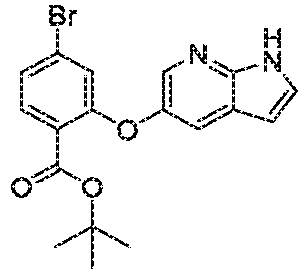
- A mixture of tert-butyl 4-bromo-2-fluorobenzoate (238.5 g, 867.3 mmol), 1H-pyrrolo[2,3-b]pyridin-5-ol (116.2 g, 867.3 mmol) and K2CO3 (239.4 g, 1734.5 mmol) in DMF (1 L) was heated at 80 °C for about 16 h. Another batch of K2CO3 (100 g, 724.6 mmol) and 1H-pyrrolo[2,3-b]pyridin-5-ol (10 g, 74.6 mmol) were added into the reaction mixture, the reaction mixture was stirred at 100°C for another 4 h. The reaction mixture was cooled to ambient temperature, filtered and the mother liquid was concentrated to remove about half volume of DMF. DCM (200 mL) and EA (200 mL) were added and stirred, the resulting mixture was filtered, the filtrate was concentrated, the residue was slurried in EA (200 mL) and PE (200 mL) at ambient temperature for 1 h. The precipitate was filtered and dried to afford the product (155 g, 46.1 %) as a yellow solid. MS (ESI, m/e) [M+1]+ 389.0, 391.0.
-

- To a mixture of tert-butyl 2-((1H-pyrrolo[2,3-b]pyridin-5-yl)oxy)-4-bromobenzoate (130 g, 334.2 mmol), 4,4,4',4',5,5,5',5'-octamethyl-2,2'-bi(1,3,2-dioxaborolane) (127 g, 501.3 mmol) and KOAc (98.3 g, 1002.3 mmol) in 1,4-dioxane (1.3 L) was added Pd(dppf)Cl2 (24.5 g, 66.8 mmol), the mixture was stirred at 85 °C under N2 for about 4 h. The reaction mixture was cooled to ambient temperature and concentrated, the residue was slurried in DCM (1 L), filtered, the mother liquid was concentrated, purified by chromatography column on silica (EA/DCM = 1/1) to give the crude product. The crude product was recrystallized from EA (100 mL) / PE (100 mL) and dried to give the product as a brown powder (114.5 g, 78.6%). MS (ESI, m/e) [M+1]+ 437.2, 355.1
-
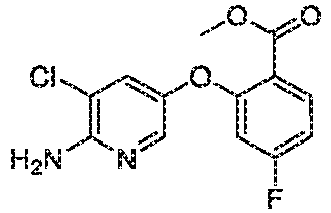
- A mixture of 5-chloro-2-nitropyridine (2.5 g, 15.75 mmol), methyl 4-iluoro-2-hydroxybenzoate (2.44 g, 14.38 mmol), K2CO3 (3.96 g, 28.65 mmol) in DMSO (30 mL) was stirred at 110 °C for 1 hour. TLC showed the reactant was consumed completely. The reaction mixture was cooled to room temperature and was poured into water and was then extracted with EA (40 mL × 3). The combined organic layers were washed with brine (50 mL × 2), dried over Na2SO4, filtered and concentrated to give a residue. The residue was purified by column chromatography on silica gel (eluent: PE/EA = 50/1 to 1/1) to obtain methyl 4-fluoro-2-((6-nitropyridin-3-yl)oxy)benzoate (1.3 g). MS (ESI, m/e) [M+1]+ 293.5.
- The mixture of methyl 4-fluoro-2-((6-nitropyridin-3-yl)oxy)benzoate (50 g, 3.42 mmol) and Pd/C (0.8 g) in EtOH (20 mL) was stirred at 25°C for 3 hours under H2 (50 Psi). TLC showed the reactant was consumed completely. The mixture was filtered and concentrated to remove solvent. The residue was purified by prep-MPLC (eluent: PEI EA = 20/ 1 to 5/1) to obtain methyl 2-((6-aminopyridin-3-yl)oxy)-4-fluorobenzoate (1.3 g, 4.96 mmol, yield: 72.49%). MS (ESI, m/e) [M+1]+ 263.3.
- To the solution of methyl 2-((6-aminopyridin-3-yl)oxy)-4-fluorobenzoate (1 g, 38.14 umol) in DMF (10 mL) was added NCS (1 g, 76.28 umol). The mixture was stirred at 25°C for 4 hours. TLC showed the reactant was consumed completely. The mixture was concentrated to remove solvent. The residue was purified by prep-MPLC (eluent: PE/ EA = 20/1 to 5/1) to obtain methyl 2-((6-amino-5-chloropyridin-3-yl)oxy)-4-fluorobenzoate (169 mg). 1H NMR (400MHz, CDCl3) δ ppm: 7.84 - 7.98 (m, 2 H), 7.77 (d, J=2.6 Hz, 1 H), 7.26 (d, J=2.6 Hz, 1 H), 6.77 (ddd, J=8.7, 7.6, 2.4 Hz, 1 H), 6.48 (dd, J=10.0, 2.4 Hz, 1 H), 4.88 (s, 2 H), 3.81 (s, 3 H). MS (ESI, m/e) [M+1]+ 297.2.
-

-

- A mixture solution of 2-(2-bromophenyl)pyrrolidine (1.13 g, 5 mmol), Boc2O (2.16 g, 10 mmol), TEA (1.01 g, 10 mmol) and DMAP (cat) in DCM (20 mL) was stirred at room temperature for 16hrs. Then the mixture solution was concentrated, and the residue was purified by chromatography on silica-gel (eluting with 100% PE to PE / EA = 5/1) to give the product (1.6 g, 98.1%) as a colorless oil. MS (ESI, m/e) [M+1]+ 270.0, 272.0
-

- Under a nitrogen atmosphere, a mixture of tert-butyl 2-(2-bromophenyl)pyrrolidine-1-carboxylate (1.56 g, 4.7 mmol), cyclopropyl boronic acid (1.23 g, 14.3 mmol), Pd(PPh3)4 (540 mg, 0.47 mmol) and K2CO3 (1.99 g, 14.3 mmol) in 1,4-dioxane/H2O (9:1, 20 mL) was stirred at 90°C for 16 hours. Then the reaction mixture was filtered and concentrated, the crude product (1.4 g) was used directly in next step without purification. MS (ESI, m/e) [M+1]+ 232.1.
-

- A mixture solution of tert-butyl 2-(2-cyclopropylphenyl)pyrrolidine-1-carboxylate (1.4 g) and TFA (5 mL) in DCM (50 mL) was stirred at room temperature for 16 hours. Then the mixture was concentrated to give a product (1.2 g, crude) as a yellow oil. MS (ESI, m/e) [M+1]+ 188.1.
-

-

- tert-butyl 2-(2-(prop-1-en-2-yl)phenyl)pyrrolidine-1-carboxylate was prepared using the similar procedure as tert-butyl 2-(2-cyclopropylphenyl)pyrrolidine-1-carboxylatc. 1H NMR (400 MHz, DMSO-d6 ) δ ppm: 7.32-7.14 (m, 2H), 7.14-6.99 (m, 2H), 5.25 (s, 1H), 4.95-4.81 (m, 2H), 3.67-3.54 (m, 1H), 3.53-3.40 (m, 1H), 2.29-2.23 (m, 1H), 2.05 (s, 3H), 1.92-1.73 (m, 2H), 1.64 (s, 1H), 1.36 (s, 3H), 1.07 (s, 6H). MS (ESI, m/e) [M+1]+ 232.1.
-

- A mixture of tert-butyl 2-(2-(prop-1-en-2-yl)phenyl)pyrrolidine-1-carboxylate (983 mg, 3.41 mmol) and Pd(OH)2/C (100 mg) in MeOH (20 mL) was stirred overnight at room temperature under a balloon of H2. Then the reaction mixture was filtered and concentrated to give the desired product as a colorless oil (803 mg, 81%) without further purification for the next deprotection step with TFA. 1H NMR (400 MHz, DMSO-d 6) δ ppm: 7.27 (d, J = 7.0 Hz, 1H), 7.15 (t, J = 2.5, 7.0 Hz, 2H), 6.97 (d, J = 7.0 Hz, 1H), 5.10-5.05 (m, 1H), 3.64-3.52 (m, 1H), 3.49-3.43 (m, 1H), 3.24-3.10 (m, 1H), 2.31-2.26 (m, 1H), 1.84-1.80 (m, 2H), 1.59-1.53 (m, 1H), 1.38 (s, 3H), 1.28-1.16 (m, 6H), 1.09 (s, 3H), 1.08 (s, 3H)..
-
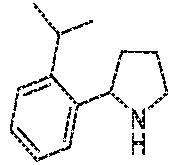
- A solution of tert-butyl 2-(2-isopropylphenyl)pyrrolidine-1-carboxylate (803 mg, 2.77 mmol) in DCM (5 mL) and TFA (2 mL) was stirred at r.t. for 4 h. After solvents were removed, the resulted residue was dissolved with DCM (50 mL) and washed with aq. NaHCO3 (30 mL × 2). The organic layer was collected and dried over anhydrous Na2SO4, filtered and concentrated to give the desired product as a colorless oil (522 mg). 1H NMR (400 MHz, DMSO-d6 ) δ ppm: 7.52 (d, J = 6.7 Hz, 1H), 7.24-7.22 (m, 1H), 7.19-7.05 (m, 2H), 4.29 (t, J = 7.6 Hz, 1H), 3.30-3.23 (m, 1H), 3.27-3.02 (m, 1H), 2.91-2.82 (m, 1H), 2.14-2.06 (m, 1H), 1.79-1.71 (m, 2H), 1.41-1.32 (m, 1H), 1.19 (s, 3H), 1.17 (s, 3H). MS (ESI, m/e) [M+1]+ 190.1.
-

-
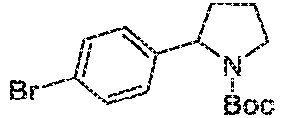
- A mixture of 2-(4-bromophenyl)pyrrolidine (2.0 g, 8.85 mmol), Boc2O (2.9g, 13.3 mmol), Et3N (1.8 g, 17.7 mmol), DMAP (110 mg, 0.9 mmoL) in 20 mL of DCM was stirred for 16 hours at room temperature. The mixture was concentrated and purified by column chromatograph on silica gel using EA/PE (1/10) as an eluent to get 2.2 g (78.6%) of tert-butyl 2-(4-bromophenyl)pyrrolidine-1-carboxylate as a yellow oil. MS (ESI) m/e [M+1]+ 325.0, 327.0.
-

- A mixture of tert-butyl 2-(4-bromophenyl)pyrrolidine-1-carboxylate (1.0 g, 3.07 mmol), cyclopropyl boronic acid (790 mg, 9.21mmol), Pd(PPh3)4 (358 mg, 0.31 mmol) and K2CO3 (1.27g, 9.21mmol) in dioxane (10 mL) was heated to 100 °C for 16 hours under N2. The mixture was filtrated and the filtrate was concentrated to gel crude product and further purification by column chromatograph on silica gel using EA/PE (1/10, v/v) as eluent afforded 600 mg (68.1 %) of tert-butyl 2-(4-cyclopropylphenyl)pyrrolidine-1-carboxylate as a yellow oil. MS (ESI) m/e [M+1-56]+ 232.1.
-

- A solution of tert-butyl 2-(4-cyclopropylphenyl)pyrrolidine-1-carboxylate (1.2 g, 4.18 mmol) in TFA/DCM (2mL/10 mL) was stirred at RT for 16 hr. The mixture was concentrated to remove solvent and the residue was partitioned between NaHCO3 solution (10 mL) and DCM (10 mL). The organic layer was collected and dried over Na2SO4, concentrated to get 620 mg (79.2 %) of 2-(4-cyclopropylphenyl)pyrrolidine. MS (ESI, m/e) [M+1]+ 188.0.
-

- To a solution of 2-(2-bromophenyl)pyrrolidine (500 mg, 2.2 mmol) in MeOH (50 mL) was added Cuprous bromide (158.6 mg, 1.1 mmol) and sodium methanolate (358mg, 6.6 mmol). The mixture was heated to reflux and stirred overnight. After cooled to room temperature, the mixture was filtered and concentrated, purified by chromatography column on silica (EA/PE = 1/1) to give the product (300 mg, 76.6%) as a yellow oil. MS (ESI, m/e) [M+1]+ 178.1.
-

-

- A dry, 100 mL three-necked, round-bottomed flask equipped with a mechanical stirrer, addition funnel, heating mantle, and reflux condenser, was charged with 60% sodium hydride (0.6 g, 15 mmol) and 25 mL of dry toluene. The stirred suspension was heated at reflux while a mixture of 1.1 g (10 mmol) of vinylpyrrolidin-2-one and 1.9 g (10 mmol) of methyl 2-chloro-6-fluorobenzoate was slowly added. Heating was continued for 10 hr. The reaction mixture was cooled to room temperature and the resultant thick slurry was carefully diluted with 25 mL of saturated aqueous ammonium chloride. The layers were separated, and the aqueous layer was extracted again with 25 mL of toluene. The combined organic layers were dried (MgSO4) and concentrated under reduced pressure to afford 3-(2-chloro-6-fluorobenzoyl)-1-vinylpyrrolidin-2-one as a crude product. [M+1]+ 268.0.
-

- A mixture of 3-(2-chloro-6-fluorobenzoyl)-1 -vinylpyrrolidin-2-one (1g, crude) and HCl (6 M, 10 ml) was heated to reflux for 10 h. the mixture was cooled to r.t and basified to pH=10 and extracted with DCM. The organic layers were dried over anhydrous Na2SO4 and concentrated. The residue was used in next step without further purification (300 mg, crude). MS (ESI, m/e) [M+1]+198.0
-

- To a solution of 5-(2-chloro-6-fluorophenyl)-3,4-dihydro-2H-pyrrole (300 mg, crude) in MeOH was added NaBH4 (50 mg) and stirred at r.t for 1 h. then excess MeOH was removed under reduced pressure. The residue was added into water and extracted with DCM. The organic layers were concentrated to afford 2-(2-chloro-6-fluorophenyl)pyrrolidine, which was used in next step without further purification (100 mg, crude). MS (ESI, m/e) [M+1]+ 200.1.
-

- A mixture of 2-phenylpyrrolidinc (3.5 g, 23.77 mmol), PtO2 (1.08 g, 4.75 mmol), AcOH (1.14 g, 19.02 mmol, 1.09 mL) in THF (60 mL) was degassed and purged with H2 for 3 times, and then the mixture was stirred at 65°C for 12 hr under H2 atmosphere (50 psi). LC-MS showed the reaction was completed and one main peak with desired mass was detected. The reaction mixture was filtered and concentrated under reduced pressure to give a residue. The residue was purified by prep-HPLC (TFA condition) to give the product (4 g, TFA salt) as a yellow oil. The product (1 g, TFA salt) was freed by Amberlyst A-21 ion exchange resin in MeOH (60 mL), filtered and concentrated to give the product. The product was neutralized with sat. Na2CO3 (5mL), extracted with DCM (80 mL), dried over Na2SO4, filtered and concentrated under reduced pressure to give the product (640 mg) as a yellow oil. 1H NMR (400MHz, CDCl3) δ ppm: 4.37 (br s, 1H), 3.13-3.01 (m, 1H), 2.95-2.90 (m, 1H), 2.83-2.72 (m, 1H), 2.00-1.59 (m, 8H), 1.48-1.06 (m, 5H), 1.06-0.88 (m, 2H).
-

-

- To a solution of 1-bromo-2-(trifluoromethyl)benzene (2 g, 8.89 mmol, 1.21 mL) in THF (15 mL) at -78°C was added n-BuLi (2.5 M, 3.56 mL). The reaction was stirred at - 78°C for 15 minutes, then added to a solution of tert-butyl 2-oxopyrrolidine-1-carboxylate (1.65 g, 8.89 mmol, 1.51 mL) in THF (15 mL) at -78°C. Ailer addition, the reaction mixture was warmed to 15°C and stirred at 15°C for 1 hr. TLC showed the reaction was ok. The mixture was quenched with sat. NH4Cl (20 mL), extracted with EA (20 mL*2). The organic layer was separated, washed with brine, dried over with Na2SO4, filtered and concentrated. The residue was purified by silica gel (PE: EA = 50:1 to 10:1) to afford tert-butyl (4-oxo-4-(2-(trifluoromethyl)phenyl)butyl)carbamate (2 g, 6.04 mmol, 67.91% yield) as yellow oil. 1H NMR (400MHz, CDCl3) δ ppm: 7.72 (d, J = 7.4 Hz, 1H), 7.64-7.53 (m, 2H), 7.44 (d, J = 7.4 Hz, 1H), 4.63 (br s, 1H), 3.23 (q, J = 6.4 Hz, 2H), 2.90 (t, J = 7.0 Hz, 2H), 1.93 (quin, J = 7.0 Hz, 2H), 1.44 (s, 9H).
-

- To the mixture solution of tert-butyl (4-oxo-4-(2-(trifluoromethyl)phenyl)butyl)carbamate (2.8 g, 8.45 mmol) in DCM (30 mL) was added TFA (30.80 g, 270.13 mmol, 20 mL). The mixture was stirred at 15°C for 1 hr. The solvent was removed to afford 4-amino-1-(2-(trifluoromethyl)phenyl)butan-1-one (3.5 g, 7.24 mmol, 85.67%, TFA) as brown oil. 1H NMR (400MHz, CDCl3) δ ppm: 9.14 (br s, 3H), 7.87-7.83 (m, 1H), 7.80-7.73 (m, 2H), 7.69-7.64 (m, 1H), 4.44-4.29 (m, 2H), 3.45 (t, J = 7.9 Hz, 2H), 2.58-2.43 (m, 2H).
-

- To the mixture solution of 4-amino-1-(2-(trifluoromethyl)phenyl)bulan-1-one (3 g, 6.53 mmol, 2TFA) in EtOH (72 mL) and AcOH (8 mL) was added NaBH3CN (697.85 mg, 11.10 mmol). The mixture was stirred at 15°C for 12 hr. The reaction mixture was quenched with sat. NaHCO3 solution in water (100 mL). The mixture was concentrated. The residue was dissolved with EA (100 mL), washed with water and brine, dried over with Na2SO4, filtered and concentrated to afford 2-(2-(trifluoromethyl)phenyl)pyrrolidine (0.71 g, 3.16 mmol, 48.33%) as yellow oil. 1H NMR (400MHz, CDCl3) δ ppm: 7.83 (d, J = 7.8 Hz, 1H), 7.63-7.52 (m, 2H), 7.38-7.29 (m, 1H), 4.54 (t, J = 7.8 Hz, 1H), 3.27-3.25 (m, 1H), 3.18-3.03 (m, 2H), 2.27 (td, J = 4.9, 7.8 Hz, 1H), 2.07-1.97 (m, 1H), 1.94-1.80 (m, 1H), 1.69-1.59 (m, 1H). MS (ESI, m/e) [M+1]' 216.1/217.1.
-

-

- To a solution of 3,3-dimethyldihydrofuran-2,5-dione (15.3 g, 120 mmol) and AlCl3 (31.92 g, 240 mmol) in DCM (200 mL) was added benzene (14.04 g, 180 mmol) dropwise with an ice-water bath. The mixture was warmed up to room temperature slowly and stirred overnight. I was poured into ice and diluted with DCM (400 mL) and conc. HCl acid (50 mL) was added and stirred until no precipitate. The organic layer was dried over anhydrous Na2SO4, filtered and concentrated. The residue was slurried with MTBE and PE to give the desired product as a white solid (22.52 g, 99%). 1H NMR (400 MHz, CDCl3) δ ppm: 7.95 (d, J = 8.0 Hz, 2H), 7.56 (t, J = 8.0 Hz, 1H), 7.46 (t, J = 8.0 Hz, 2H), 3.31 (s, 2H), 1.36 (s, 6H). MS (ESI, m/e) [M+1]+ 205.1.
-

- A solution of 2,2-dimethyl-4-oxo-4-phenylbutanoic acid (18.03 g, 87.5 mmol), (2,4-dimethoxyphenyl)methanamine (14.62 g, 87.5 mmol), HATU (33.25 g, 87.5 mmol) and Et3N (13.3 g, 131.25 mmol), in DCM (200 mL) was stirred at room temperature overnight. DCM was removed. The residue was purified by column flash in silica gel eluted with EA/PE = 1/4 to 1/1 (v/v) to give the desired product as a brown oil (30.2 g, 97%). MS (ESI, m/e) [M+1]+ 356.1.
-

- A solution of N-(2,4-dimethoxybenzyl)-2,2-dimethyl-4-oxo-4-phenylbutanamide (30.2 g, 85.1 mmol) in toluene (180 mL) and AcOH (10 mL) was refluxed overnight. It was cooled to r.t. and the solvent was removed. The residue was purified by column flash in silica gel eluted with EA/PE = 1/10 to 1/1 (v/v) to give the crude product as a yellow oil (10 g, 30% yield). MS (ESI, m/e) [M+1]+ 388.1.
-

- A solution of 1-(2,4-dimethoxybenzyl)-3,3-dimelhyl-5-phenyl-1,3-dihydro-2H-pyrrol-2-one (9 g, 26.6 mmol) in TFA (50 mL) was stirred at 95 °C for 1h. It was cooled to r.t. and TFA was removed. The residue was purified by column flash in silica gel eluted with EA/PE = 1/1 to give the crude product as a brown oil (4.4 g, 88% yield). MS (ESI, m/e) [M+1]+ 188.1.
-

- A solution of 1-(2,4-dimethoxybenzyl)-3,3-dimethyl-5-phenyl-1,3-dihydro-2H-pyrrol-2-one (2.4g, 12.8 mmol) in THF (100 mL) and BH3-THF (64 mL, 1 mol/L) was refluxed for 2h. It was cooled to r.t. and HCl acid (6 M, 20 mL) was added slowly. It was then refluxed for 30 min. The solvent was removed, and the residue was used for next step directly.
-

-

- To a sealed tube flushed with nitrogen was added L-proline (11.5 g, 100 mmol), potassium carbonate (27.6 g, 200 mmol), copper (I) iodide (3.8 g, 20 mmol), iodobenzene (24.4 g, 120 mmol) and DMF (150 ml). The mixture was heated at 90°C. for 48 hours, then cooled to room temperature. Water was added, and the pH value was adjusted to <3 with concentrated HCl acid. The aqueous phase was extracted 4 times with ethyl acetate. The combined organic layers were washed with brine, dried over magnesium sulfate, filtered and concentrated in vacuo. Purification by silica gel chromatography (0 to 100% EtOAc/hexane gradient) afforded the crude product which was used directly in the next step. MS (ESI, m/e) [M+1]+ 192.1
-

- To a solution of phenylproline (1.5 g, 7.8 mmol) in THF (50 mL) was added BH3-THF (1M, 15.6 mL). The reaction was refluxed for 1 hour. Then the reaction was cooled to r.t and quenched with MeOH (5 mL). Solvent was removed and the residue was purified by chromatography to give (1-phenylpyrrolidin-2-yl)methanol (1.3 g) as a colorless oil. MS (ESI, m/e) [M+1]+ 192.1
-

- To a solution of (1-phenylpyrrolidin-2-yl)methanol (531 mg, 3 mmol) in DCM (25 mL) was added Dess-Martin reagent (1.9 g, 4.5 mmol) in portions. The mixture was stirred overnight at r.t., then the mixture was washed with sat. NaHCO3 solution and the organic layers were concentrated and purified by chromatography to give 1-phenylpyrrolidine-2-carbaldehyde (100 mg) as a colorless oil. MS (ESI, m/e) [M+1]+176.1
-

-

- To a solution PhBr (8 g, 50.95 mmol, 5.37 mL) in THF (150 mL) was cooled to -78°C and added n-BuLi (2.5 M, 26.50 mL). The mixture was stirred at -78°C for 15min. Then tert-butyl 2-oxopyrrolidine-1-carboxylate (10.38 g, 56.05 mmol, 9.52 mL) in THF (20 mL) was added at -78°C. The mixture was stirred at -78°C for 15min. TLC and LC-MS showed the reaction was completed and main peak was title product. H2O (100 mL) was added. The mixture was extracted with EA (200 mL). The organic layer was washed with water and brine, dried over with Na2SO4, filtered and concentrated to afford tert-butyl (4-oxo-4-phenylbutyl)carbamate (14 g, crude) as yellow solid.
-

- To a mixture of tert-butyl (4-oxo-4-phenylbutyl)carbamate (12.3 g, 46.71 mmol) in Toluene (61.5 mL) was added HCl (12 M, 8.56 mL). The mixture was stirred at 65°C for 12hr. TLC showed the reaction was completed. The reaction mixture was extracted with EA (50 mL). The aqueous layer was collected, adjusted to pH = 10 by saturated NaHCO3 solution, extracted with EA (50 mL). The organic layer was washed with brine, dried over with Na2SO4, filtered and concentrated. The residue was purified by silica gel (elent: PE: EA = 50:1 to 10:1) to afford 5-phenyl-3,4-dihydro-2H-pyrrole (3.5 g, 22.90 mmol, 49.03% yield) as light yellow solid. 1H NMR (400MHz, CDCl3) δ ppm: 7.89-7.81 (m, 2H), 7.44-7.41 (m, 2H), 4.08 (br t, J=7.4 Hz, 2H), 2.96 (br t, J=8.2 Hz, 2H), 2.05 (dd, J=7.4, 8.5 Hz, 2H).
-

- To a stirred solution of 5-phenyl-3,4-dihydro-2H-pyrrole (2 g, 13.77 mmol) in THF (60 mL) was added BF3.Et2O (7.82 g, 55.10 mmol, 6.80 mL) at -78°C. The mixture was stirred at -78°C for 45min. Then MeLi (1.6 M, 34.44 mL) was added at -78°C. The mixture was stirred at -78°C for 2.5 hours, then warmed to 15°C and stirred at 15°C for 12hr. TLC showed the reaction was completed. The mixture was poured into water (100 mL), adjusted to pH = 12 by saturated NaOH solution, extracted with DCM (100 mL × 2). The organic layer was washed with brine, dried over with Na2SO4, filtered and concentrated. The residue was purified by silica gel (eluent: PE: EA = 100:1 to 20:1) to afford 2-methyl-2-phenylpyrrolidine (0.9 g, 5.30 mmol, 38.50% yield) as red oil. 1H NMR (400MHz, CDCl3) δ ppm: 7.52-7.46 (m, 2H), 7.36-7.29 (m, 2H), 7.2-7.18 (m, 1H), 3.17-3.09 (m, 1H), 3.04-2.96 (m, 1H), 2.14-2.05 (m, 1H), 1.94-1.85 (m, 2H), 1.80-1.70 (m, 2H), 1.45 (s, 3H).
-

- The solution of 1-bromo-4-iodobenzene (4.21 g, 14.88 mmol), 2-methyl-2-phenylpyrrolidine (0.6 g, 3.72 mmol), Pd2(dba)3 (340.75 mg, 372.11 umol), BINAP (463.40 mg, 744.22 umol), t-BuOK (1.25 g, 11.16 mmol) in Toluene (40 mL) was stirred at 90°C for 12hr. After cooled to room temperature, the reaction mixture was filtered and concentrated. The residue was purified by prep-HPLC. After removal of mobile phase, the residue was dissolved with EA (20 mL), adjusted to pH = 8 with saturated NaHCO3 solution, separated and concentrated to afford 1-(4-bromophenyl)-2-methyl-2-phenylpyrrolidine (0.43 g, 33.31% yield) as brown oil. 1H NMR (400MHz, CDCl3) δ ppm: 7.34-7.29 (m, 2H), 7.27-7.22 (m, 3H), 7.14-7.12 (m, 2H), 6.31-6.26 (m, 2H), 3.64-3.55 (m, 2H), 2.15-2.10 (m, 2H), 2.01-1.96 (m, 2H), 1.77 (s, 3H). MS (ESI, m/e) [M+1]+ 316.1, 318.1.
-

- 2-(2-cyclopropylphenyl)pyrrolidine (0.195 g, 647.19 umol) was dissolved in DCE (6 mL), tert-butyl 3-formylazetidine-1-carboxylate (359.62 mg, 1.94 mmol) and NaBH(OAc)3 (274.33 mg, 1.29 mmol) were added. After stirring at 15°C for 4 h, HOAc (116.59 mg, 1.94 mmol) was added. Stirring was continued at 15°C for 24 h. Then the reaction mixture was poured into saturated aqueous NaHCO3 (4 mL). The mixture was extracted three times with CH2Cl2 (3×5 mL). The combined organic phase extracts were washed with brine (5 mL), dried over Na2SO4, and concentrated. The residue was purified by column chromatography (SiO2, Petroleum ether/Ethyl acetate = 20/1 to 5/1). Tert-butyl 3-((2-(2-cyclopropylphenyl)pyrrolidin-1-yl)methyl)azetidine-1-carboxylate (0.18 g) was obtained as a yellow liquid.
- To a solution of Tert-butyl 3-((2-(2-cyclopropylphenyl)pyrrolidin-1-yl)methyl)azetidine-1-carboxylate (0.7 g, 1.96 mmol) in CH2Cl2 (4.8 mL) was TFA (2.24 g, 19.64 mmol) at 0°C under N2. The mixture was stirred at 15°C for 2 hours. The solution was concentrated under reduced pressure. The residue was adjusted to pH = 14 with 1N NaOH solution and extracted with CH2Cl2 (3 × 5 mL). The combined organic layers were dried and concentrated under reduced pressure. 1-(azetidin-3-ylmethyl)-2-(2-cyclopropylphenyl)pyrrolidine (475 mg) was obtained as a yellow liquid.
-

- Under inert N2 atmosphere, to a solution of 2-(2-bromophenyl)pyrrolidine (4 g, 17.68 mmol) in DCM (100 mL) was added TEA (3.57 g, 35.36 mmol) at 0° C and then trifluoroacetic anhydride (4.46 g, 21.22 mmol) dropwise. The mixture was stirred for overnight at room temperature. The reaction mixture was then poured into 100 mL of water, extracted with DCM (100 mL), washed with 50 mL of brine, dried over anhydrous Na2SO4. The solution was filtered and concentrated to give crude 1-(2-(2-bromophenyl)pyrrolidin-1-yl)-2,2,2-trifluoroethan-1-one (5.0 g) as a brown oil, which was used into next step without further purification.
- To a solution of 1-(2-(2-bromophenyl)pyrrolidin-1-yl)-2,2,2-trifluoroethan-1-one (5 g, 15.5 mmol) in toluene (10 mL) was added tert-butyl 4-(4,4,5,5-tetramethyl-1,3,2-dioxaborolan-2-yl)-3,6-dihydropyridine-1(2H)-carboxylate (7.2 g, 23.25 mmol), Pd(OAc)2 (350 mg, 1.55 mmol), Tricyclohexyl phosphine (870mg, 3.1 mmol) and K3PO4 (11.5 g, 54.25 mmol). The suspension was stirred at 100°C for 12 hours at N2 atmosphere. The reaction mixture was filtered and the filtrate was concentrated under reduced pressure to give a residue. The residue was further purified by column chromatograph on silica gel (eluent: Petroleum ether/Ethyl acetate = 50/1 to 10/1) to give tert-butyl 4-(2-(1-(2,2,2-trifluoroacetyl)pyrrolidin-2-yl)phenyl)-3,6-dihydropyridine-1(2H)-carboxylate (6.1 g) as yellow oil.
- To the solution of tert-butyl 4-(2-(1-(2,2,2-trifluoroacetyl)pyrrolidin-2-yl)phenyl)-3,6-dihydropyridine-1(2H)-carboxylate (6.1 g, 14.5 mmol) in DCM (100 mL) was added TFA (20 mL) at 0°C and then the mixture was stirred at room temperature for 1 hour. The reaction mixture was adjusted pH to 8-9 using aq. Na2CO3, and then was extracted with DCM. The organic layer was dried, filtered and the filtrate was concentrated under reduced pressure to give 2,2,2-trifluoro-1-(2-(2-(1,2,3,6-tetrahydropyridin-4-yl)phenyl)pyrrolidin-1-yl)ethan-1 -one (3.8 g) as a brown oil, which was used in next step without further purification.
- To the solution of 2,2,2-trifluoro-1-(2-(2-(1,2,3,6-tetrahydropyridin-4-yl)phenyl)pyrrolidin-1-yl)ethan-1-one (1 g, 3.08 mmol) in MeOH (50 mL) was added HCHO(37%, 1.5 g18.49 mmol) and NaBH3CN (774 mg, 12.32 mmol). The suspension was stirred at room temperature for 2 hours. The reaction mixture was concentrated under reduced pressure and then the residue was diluted water (15 mL) and EA (30 mL) under stirring. The organic layer was separated and washed with brine, and then dried, filtered and concentrated. The residue was purified by column chromatograph on silica gel (eluent: DCM/MeOH = 20/1) to give 2,2,2-trifluoro-1-(2-(2-(1-methyl-1,2,3,6-tetrahydropyridin-4-yl)phenyl)pyrrolidin-1-yl)ethan-1-one (0.8 g) as a brown oil.
- To the solution of 2,2,2-trifluoro-1-(2-(2-(1-methyl-1,2,3,6-tetrahydropyridin-4-yl)phenyl)pyrrolidin-1-yl)ethan-1-one (0.8 g, 2.36 mmol) in MeOH (50 mL) and H2O (50 mL) was added LiOH.H2O (0.2 g, 4.73 mmol). After the addition, the mixture was heated to 60 °C and stirred for 2 hours. The reaction mixture was concentrated under reduced pressure and then the residue was diluted water (15 mL) and EA (30 mL) under stirring. The organic layer was separated and washed with brine, and then dried, filtered and concentrated. The residue was purified by column chromatograph on silica gel (eluent: DCM/MeOH = 50/1) to give 1-methyl-4-(2-(pyrrolidin-2-yl)phenyl)-1,2,3,6-tetrahydropyridine(500 mg) as a brown oil. 1H NMR (400MHz, CDCl3) δ ppm: 7.51 (dd, J = 0.98, 7.83 Hz, 1H), 7.24-7.29 (m, 1H), 7.18 (dt, J = 1.34, 7.40 Hz, 1H), 7.08 (dd, J = 1.22, 7.58 Hz, 1H), 5.55 (td, J = 1.60, 3.27 Hz, 1H), 4.29 (t, J = 7.83 Hz, 1H), 3.23 (ddd, J = 5.14, 7.43, 9.93 Hz, 1H), 3.10 (q, J = 2.81 Hz, 2H), 2.94-3.04 (m, 1H), 2.63-2.70 (m, 2H), 2.43 (s, 3H), 2.12 (dtd, J = 4.89, 7.81, 12.50 Hz, 1H), 1.80-1.90 (m, 1H), 1.59-1.70 (m, 1H). MS (ESI, m/c) [M+1]+ 243.1.
-
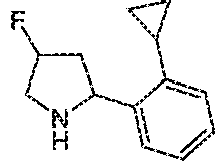
- To a solution of tert-butyl 2-(2-bromophenyl)-4-hydroxypyrrolidine-1-carboxylate (2.5 g, 7.31 mmol) in DCM (30 mL) was added DAST (1.77 g, 10.96 mmol) dropwise. Then the solution was stirred at 20 °C for 12 hours. The reaction mixture was quenched with ice water (30 mL). The organic layer was separated, then washed with saturated NaHCO3 solution (30 mL), brine (30 mL), dried over Na2SO4, and concentrated. The residue was purified by column chromatography on silica gel (eluent: PE/EA = 20/1 to 10/1) to give tert-butyl 2-(2-bromophenyl)-4-fluoropyrrolidine-1-carboxylate (1.6 g) as a yellow oil.
- To the solution of tert-butyl 2-(2-bromophenyl)-4-fluoropyrrolidine-1-carboxylate (1.5 g, 4.36 mmol) and cyclopropylboronic acid (1.1 g, 13.1 mmol) in toluene (20 mL) was added Pd(OAc)2 (98 mg, 0.436 mmol), tricyclohexylphosphine (245 mg, 0.872 mmol), K3PO4 (3.2 g, 15.3 mmol) and H2O (1 mL). The suspension was heated at 100 °C and stirred for 12 hours under N2 atmosphere. To the reaction mixture was added water (20 mL) and EtOAc (20 mL). The organic layer was separated, washed with brine (20 mL), dried over Na2SO4 and concentrated. The residue was purified by column chromatography on silica gel (eluent: PE/EA = 20/1) to give tert-butyl 2-(2-cyclopropylphenyl)-4-fluoropyrrolidine-1-carboxylate (1.1 g) as a brown oil.
- A solution of tert-butyl 2-(2-cyclopropylphenyl)-4-fluoropyrrolidine-1-carboxylate (1.1 g, 3.6 mmol) in HCl solution (20 mL, 4M in EA) was stirred at room temperature for 2 hours. The reaction mixture was concentrated. To the residue was diluted with saturated Na2CO3 solution (20 mL) and EA (20 mL). The organic layer was separated, dried over anhydrous Na2SO4 and concentrated. The residue was purified by column chromatography on silica gel (eluent: PE/EA = 4/1 to 1/1) to give 2-(2-cyclopropylphenyl)-4-fluoropyrrolidine (620 mg) as a yellow oil. 1H NMR (400MHz, CDCl3) δ ppm: 7.55 (dd, J = 7.5, 1.4 Hz, 1 H), 7.15 - 7.28 (m, 2 H), 7.01 - 7.09 (m, 1 H), 5.22 - 5.48 (m, 1 H), 4.71 - 5.10 (m, 1 H), 3.31 - 3.61 (m, 1 H), 2.91 - 3.11 (m, 1 H), 2.52 - 2.75 (m, 1 H), 1.70 - 2.14 (m, 3 H), 0.89 - 1.06 (m, 2 H), 0.60 - 0.82 (m, 2 H). MS (ESI, m/c) [M+1]+ 206.1.
-

- To the solution of 2-bromo-6-chloro-N,N-dimethylaniline (3.5 g, 14.92 mmol) and tert-butyl 2-oxopyrrolidine-1-carboxylate (2.76 g, 14.92 mmol) in THF (50 mL) was added n-BuLi(6 mL, 2.5 M in hexane) at -70°C and then stirred for 2 hours. The reaction mixture was added aq. NH4Cl (50 mL) and extracted with EA (50 mL×3). The combined organic layers were dried over anhydrous Na2SO4 and concentrated under reduced pressure. The residue was purified by column chromatography on silicaa gel (eluent: PE/EA = 5/1) to give tert-butyl (4-(3-chloro-2-(dimethylamino)phenyl)-4-oxobutyl)carbamate (1.8 g) as a yellow oil.
- To the solution of tert-butyl (4-(3-chloro-2-(dimethylamino)phenyl)-4-oxobutyl)carbamate (1.7 g, 4.99 mmol) in DCM (10 mL) was added TFA (1 mL) and stirred at room temperature for 4 hours. The reaction mixture was concentrated under reduced pressure to give crude 4-amino-1-(3-chloro-2-(dimethylamino)phenyl)butan-1-one (1.2 g, crude) as a yellow oil.
- To the solution of 4-amino-1-(3-chloro-2-(dimelhylamino)phenyl)butan-1-one (1.2 g, 4.98 mmol) in EtOH (20 mL) was added NaBH3CN (939.77 mg, 14.95 mmol) and HOAc(2 mL) and then stirred at room temperature for 36 hours. The reaction mixture was quenched with water (80 mL) and extracted with EA (50 mL×3). The combined organic layers were dried over anhydrous Na2SO4, filtered and concentrated under reduced pressure. The residue was purified by prep-HPLC (HCl). The solution of target peak was adjusted pH to 10 and extracted with DCM (30 mL × 3). The organic phase was dried over Na2SO4 and concentrated to give 2-chloro-N,N-dimethyl-6-(pyrrolidin-2-yl)aniline (297 mg) as colorless oil. 1H NMR (400MHz, CDCl3) δ ppm: 7.40 (dd, J = 1.3, 7.7 Hz, 1H), 7.19 (dd, J = 1.5, 7.9 Hz, 1H), 7.12 - 7.05 (m, 1H), 4.56 (t, J = 7.9 Hz, 1H), 3.19 (ddd, J = 5.4, 7.4, 9.9 Hz, 1H), 3.09 - 2.99 (m, 1H), 2.85 (s, 6H), 2.24 (dtd, J = 5.0, 7.7, 12.6 Hz, 1H), 1.95 - 1.80 (m, 2H), 1.58 - 1.45 (m, 1H). MS (ESI, m/e) [M+1]+ 225.2.
-

- The solution of N-(4-bromophenyl)-1,1,1-triphenyl-l5-phosphanimine (1.8 g, 4.16 mmol) and 1-(2-cyclopropylphenyl)-2,2,2-trifluoroethan-1-one (891.83 mg, 4.16 mmol) in toluene (20 mL) was stirred at 110°C for 12 hours. The reaction mixture was cooled down and concentrated under reduced pressure to remove solvent. The residue was purified by column chromatography on silica gel (eluent: PE/EA = 50/1 to 10/1) to give N-(4-bromophenyl)-1-(2-cyclopropylphenyl)-2,2,2-trifluoroethan-1-imine (1.1 g, 2.99 mmol) as a yellow oil.
- To a solution of N-(4-bromophenyl)-1-(2-cyclopropylphenyl)-2,2,2-trifluoroethan-1-imine (1.1 g, 2.99 mmol) in DCM (10 mL) was added allylmagnesium bromide (1 M, 14.94 mL) at -20°C and stirred for 2 hours. The reaction mixture was then quenched with aq. HN4Cl (10 mL) and extracted EA (10 mL × 3). The organic layer was dried over Na2SO4, filtered and concentrated. The residue was purified by column chromatography on silica gel (eluent: PE) to afford 4-bromo-N-(2-(2-vyclopropylphenyl)-1,1,1-trifluuropent-4-en-2-yl)aniline (1.20 g) as a white solid.
- To a solution of 4-bromo-N-(2-(2-cyclopropylphenyl)-1,1,1-trifluoropent-4-en-2-yl)aniline (1.20 g, 2.92 mmol) in THF (10 mL) was added BH3.THF (1 M, 14.62 mL) at 0°C and stirred for 1 hour. Then NaOH (2.5 M, 2.92 mL) and H2O2 (1.49g, 43.87 mmol) was added into the reaction mixture at 0°C. After addition, the mixture was further stirred for 1.5 hours at room temperature. The reaction mixture was then quenched with aq. HN4Cl (10 mL) and extracted with EA (10 mL × 3). The organic layer was dried over Na2SO4, filtered and concentrated. The residue was purified by column chromatography on silica gel (eluent: PE/EA = 50/1 to 5/1) to afford 4-((4-bromophenyl)amino)-4-(2-cyclopropylphenyl)-5,5,5-trifluoropentan-1-ol (0.6 g) as a yellow oil.
- To a solution of 4-((4-bromophenyl)amino)-4-(2-cyclopropylphenyl)-5,5,5-trifluoropentan-1-ol (0.6 g, 1.55 mmol) in dioxane (10 mL) was added TEA (469.17 mg, 4.64 mmol) and MsCl (265.56 mg, 2.32 mmol) and the mixture was stirred at room temperature for 1.5 hours. Then the mixture was heated to 80°C and stirred for 1 hour. The reaction mixture was then quenched with aq. NH4Cl (10 mL) and extracted with DCM (10 mL × 3), dried over Na2SO4, filtered and concentrated. The residue was purified by column chromatography on silica gel (eluent: PE/EA = 10/1) to afford 1-(4-bromophenyl)-2-(2-cyclopropylphenyl)-2-(tritluoromethyl)pyrrolidine (306 mg) as a white solid. 1H NMR (400MHz, CDCl3) δ ppm: 7.63 (td, J = 2.6, 6.6 Hz, 1H), 7.26 - 7.22 (m, 2H), 7.06 (d, J = 9.3 Hz, 2H), 6.88 - 6.83 (m, 1H), 6.32 (d, J = 9.0 Hz, 2H), 3.73 - 3.56 (m, 2H), 2.94 - 2.68 (m, 2H), 2.44 - 2.31 (m, 1H), 2.27 - 2.16 (m, 1H), 1.63 - 1.58 (m, 1H), 0.96 - 0.85 (m, 1H), 0.60 - 0.47 (m, 3H). MS (ESI, m/e) [M+1]+ 410.0.
-
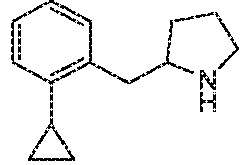
- A solution of 1-bromo-2-cyclopropylbenzene (4.50 g, 22.84 mmol) in THF (50 mL) was added n-BuLi (9.84 mL, 2.5M) at -70 °C under N2 and stirred for 10 minutes, then tert-butyl 2-formylpyrrolidine-1-carboxylate (3.5 g, 17.57 mmol) was added into the mixture and further stirred for 2 hours. The mixture was quenched with saturated NH4Cl solution (30 mL) and extracted with Ethyl acetate (50 mL×3). The organic phase was dried over Na2SO4, filtered, and concentrated. The residue was purified by column chromatography on silica gel (eluent: PE/EA = 200/1 to 5/1) to give tert-butyl 2-((2-cyclopropylphenyl)(hydroxy)methyl)pyrrolidine-1-carboxylate (3.40 g, 10.72 mmol) as a yellow oil.
- A solution of tert-butyl 2-((2-cyclopropylphenyl)(hydroxy)methyl)pyrrolidine-1-carboxylate (3.40 g, 10.72 mmol), di(1H-imidazol-1-yl)methanethione ( 5.73 g, 32.16 mol) and DMAP (1.32 g, 1072 mmol) in DCM (30 mL) was stirred for 24 hours at room temperature. The mixture was poured into HCl acid (30 mL, 1M) and extracted with DCM (50 mL×3). The organic phase was dried over Na2SO4, filtered and concentrated. The residue was purified by column chromatography on silica gel (eluent: PE/EA = 200/1 to 5/1) to give tert-butyl 2-(((1H-imidazole-1-carbonothioyl)oxy)(2-cyclopropylphenyl)methyl)pyrrolidine-1-carboxylate (3.0 g,7.02 mmol) as a yellow oil.
- To a solution of tert-butyl 2-(((1H-imidazole-1-carbonothioyl)oxy)(2-cyclopropylphenyl)methyl)pyrrolidine-1-carboxylate (2.5 g, 5.852 mmol) in toluene(10 mL) was added tributyltin hydride (2.55 g, 8.778 mmol) and a catalytic amount of AIBN (192.06 g, 1.1704 mmol). The mixture was stirred at 100 °C for 2 hours. The mixture was washed with saturated aq. KF solution (50 mL) and extracted with EA (50mL×3). The organic phase was dried over Na2SO4, filtered, and concentrated. The residue was purified by prep-HPLC (NaHCO3) to give tert-butyl 2-(2-cyclopropylbenzyl)pyrrolidine-1-carboxylate (650 mg) as a yellow oil.
- tert-butyl 2-(2-cyclopropylbenzyl)pyrrolidine-1-carboxylate (600.00 mg, 1.992 mmol) was added into a solution of MTBE/HCl (10 mL, 4M). The mixture was stirred for 2 hours at room temperature. The reaction mixture was concentrated and adjusted the pH to 10 with saturated Na2CO3 solution, then stirred for 15 mins, extracted with EA (30mL×3). The organic phase was dried over Na2SO4 and filtered and concentrated to give 2-(2-cyclopropylbenzyl)pyrrolidine (302.00 mg) as a yellow oil. 1H NMR (400MHz, CDCl3) δ ppm: 7.22 - 7.18 (m, 1H), 7.15 -7.10 (m, 2H), 6.98 - 6.92 (m, 1H), 3.43 - 3.32 (m, 1H), 3.13 - 2.80 (m, 4H), 2.05 - 1.96 (m, 1H), 1.93 - 1.66 (m, 6H), 1.52 - 1.40 (m, 1H), 1.01 - 0.90 (m, 2H), 0.74 - 0.62 (m, 2H). MS (ESI, m/e) [M+1]+ 202.2.
-

- To a solution of 2-fluorobenzaldehyde (10 g, 80.6 mmol) and azetidine (9.04g, 96.7 mmol) in DMSO (50 mL) was added K2CO3 (33.4 g, 241.17 mmol) and stirred at 80 °C for 24 hours. The mixture was poured into water (300 mL) and was extracted with EA (100 mL ×3). The combined organic phase was washed with brine (400 mL), dried with anhydrous Na2SO4, filtered and concentrated. The residue was purified by column chromatography on silica gel (eluent: PE/EA = 100/1 to 20/1) to give 2-(azetidin-1-yl)benzaldehyde (9 g, crude) as yellow oil.
- To a mixture of 2-(azetidin-1-yl)benzaldehyde (4 g, 24.81 mmol) and 4-bromoaniline (4.27g, 24.81 mmol) in toluene (40 mL) was added 4-methylbenzenesulfonic acid (854 mg, 4.96 mmol) and 4Å molecular sieve (4 g). The mixture was stirred at 140 °C for 6 hours and was then concentrated in vacuum. The crude 1-(2-(azetidin-1-yl)phenyl)-N-(4-bromophenyl)methanimine (9 g) was obtained as yellow solid which was used I next step without further purification.
- To a mixture of 1-(2-(azctidin-1-yl)phcnyl)-N-(4-bromophcnyl)methaniminc (9 g, 28.55 mmol) in DCM (50 mL) was added allylmagnesium bromide (128.5 mL, 1M) at -20°C under N2. The mixture was stirred at room temperature for 2 hours. The mixture was then poured into sat. NH4Cl (200 mL) and was extracted with EA (200 mL × 3). The combined organic phase was washed with brine (400 mL), dried with anhydrous Na2SO4, filtered and concentrated. The residue was purified by column chromatography on silica gel (PE/EA = 20/1 to 1/1) to give N-(1-(2-(azetidin-1-yl)phenyl)but-3-en-1-yl)-4-bromoaniline (3 g) as yellow oil.
- To a solution ofN-(1-(2-(azctidin-1-yl)phcnyl)but-3-en-1-yl)-4-bromoaniline (3 g, 8.4 mmol) in THF (20 mL) was added BH3 THF (25 g, 25.19 mmol) at 0°C under N2 atmosphere. The mixture was stirred at 25 °C for 2 hours. NaOH (1.01g, 25.19 mmol) and H2O2 (9.5 g, 83.97 mmol) at 0°C was added, then the mixture was stirred for 3 hours. The mixture was poured into H2O (50 mL) and was extracted with EA (100 mL ×3). The combined organic phase was washed with brine (200 mL), dried with anhydrous Na2SO4, filtered and concentrated. The residue was purified by column chromatography on silica gel (eluent: PE: EA =1/1 to 0/1) to give 4-(2-(azetidin-1-yl)phenyl)-4-((4-bromophenyl)amino)butan-1-ol (0.9 g) as yellow oil.
- To a solution of 4-(2-(azetidin-1-yl)phenyl)-4-((4-bromophenyl)amino)butan-1-ol (0.9 g, 2.4 mmol) in THF (5 mL) was added TEA (960 mg, 9.59 mmol) and MsCl (329 mg, 2.88 umol) at 0 °C. After stirred at 25 °C for 2 hours, the reaction mixture was concentrated in vacuum. The residue was purified by Pre-TLC (silica gel, eluent: PE/EA = 1/1) to give 2-(2-(azetidin-1-yl)phenyl)-1-(4-bromophenyl)pyrrolidine (388.6 mg) as yellow oil. 1H NMR (400MHz, CDCl3) δ ppm: 7.24 - 7.18 (m, 2H), 7.17 - 7.11 (m, 1H), 6.94 (dd, J = 1.4, 7.6 Hz, 1H), 6.74 - 6.66 (m, 1H), 6.55 (dd, J= 0.8, 8.0 Hz, 1H), 6.39 - 6.31 (m, 2H), 4.80 (d, J = 7.5 Hz, 1H), 4.11 - 3.91 (m, 4H), 3.69 - 3.57 (m, 1H), 3.36 (q, J = 8.8 Hz, 1H), 2.38 - 2.21 (m, 3H), 2.17 - 1.89 (m, 4H). MS (ESI, m/e) [M+1]+ 357.1.
-

- To DAST (25 mL) was added 1-(2-bromophenyl)cthan-1-onc (5 g, 25.120 mmol) in portions at room temperature. The resulting mixture was stirred for overnight at 50°C under nitrogen atmosphere. The reaction mixture was diluted with CH2Cl2 (100 mL) and was then poured into ice/saturated aq. NaHCO3 (250 mL) and was extracted with CH2Cl2 (2 × 100 mL). The combined organic layers were dried over anhydrous Na2SO4 and concentrated. The residue was purified by column chromatography on silica gel (eluent: PE/EA = 50/1) to obtain 1-bromo-2-(1,1-difluoroethyl)benzene (3.5 g) as a yellow liquid.
- To a stirred solution of 1-bromo-2-(1,1-difluoroethyl)benzene (1.5 g, 6.786 mmol) in THF (18 mL) and H2O (1.8 mL) were added [1-[(tert-butoxy)carbonyl]-1H-pyrrol-2-yl]boronic acid (1.44 g, 6.824 mmol), X-Phos (0.65 g, 1.363 mmol), K3PO4 (4.34 g, 20.446 mmol) and Pd(OAc)2 (152.8 mg, 0.680 mmol). After stirred for 4.5 hours at 70°C under nitrogen atmosphere, the reaction mixture was diluted with water (50 mL). and was extracted with EA (3 × 30 mL). The combined organic layers were washed with brine (50 mL), dried over anhydrous Na2SO4 and concentrated. The residue was purified by column chromatography on silica gel (eluent: PE/EA = 50/1) to obtain tert-butyl 2-[2-(1,1-difluoroethyl)phenyl]-1H-pyrrole-1-carboxylate 2.2729 g( crude) as a dark yellow oil.
- To a stirred solution of tert-butyl 2-[2-(1,1-dilluoroethyl)phenyl]-1H-pyrrole-1-carboxylate (2.2729 g, 7.395 mmol) in EtOH (45 mL) were added PtO2 (1.1365 g, 5.005 mmol) and concentrated HCl acid (4 mL) in portions. The resulting mixture was stirred for 5 hours at room temperature under H2 atmosphere (1 atm). After PtO2 were filtered out, the filtrate was concentrated. The residue was diluted with saturated aq. NaHCO3 (200 mL) at 0°C, then was extracted with EA (3 × 100 mL). The combined organic layers were washed with brine (100 mL), dried over anhydrous Na2SO4 and concentrated to afford tert-butyl 2-[2-(1,1-difluoroethyl)phenyl]pyrrolidine-1-carboxylate 1.7408 g(crude) as a dark yellow oil.
- To a solution of tert-butyl 2-[2-(1,1-difluoroethyl)phenyl]pyrrolidine-1-carboxylate (1.7408 g, 5.591 mmol) in DCM (35 mL) was added HCl solution (4 mL, 4 N in 1,4-dioxane) in portions. The resulting mixture was stirred for 4 h at room temperature under N2 atmosphere. After adjusted PH value to 8 with saturated aq. NaHCO3, the resulting mixture was extracted with DCM (3 × 50 mL). The combined organic layers were washed with brine (150 mL), dried over anhydrous Na2SO4 and concentrated. The residue was purified by reversed flash chromatography with the following conditions: column, C18 silica gel; mobile phase, CH3CN in water (0.05% NH4HCO3), 10% to 61% gradient in 25 min; detector, UV 220 nm. The resulting eluents was extracted with DCM (3×100 mL). Then the combined organic layers were concentrated to get (2-[2-(1,1-difluoroethyl)phenyl]pyrrolidine) (703.1 mg) as yellow oil. 1H NMR (400 MHz, Chloroform-d) δ ppm: 7.74 (d, J = 7.9 Hz, 1H), 7.50 - 7.39 (m, 2H), 7.27 (t, J = 7.7 Hz, 2H), 4.56 (t, J = 7.8 Hz, 1H), 3.27 (ddd, J = 9.8, 7.4, 5.1 Hz, 1H), 3.06 (dt, J = 9.8, 7.4 Hz, 1H), 2.23 (dtd, J = 12.8, 7.8, 4.9 Hz, 1H), 2.05 (s, 1H), 2.03 - 1.94 (m, 5H), 1.94 - 1.81 (m, 1H), 1.78 - 1.58 (m, 1H). MS (ESI, m/e) [M+1]+ 212.1.
-
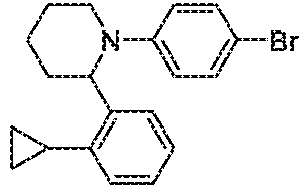
- To a stirred solution of 1-bromo-2-iodobenzene (40 g, 141.390 mmol) in dioxane (400 mL) were added K2CO3 (58.62 g, 424.151 mmol), cyclopropylboronic acid(36.44 g, 424.214 mmol) and Pd(dppf)Cl2(10.35 g, 14.14 mmol). The mixture was stirred for 48 hours at 70°C under N2 atmosphere. The mixture was diluted with water (1000 mL) and was extracted with EA (3 > 400 mL). The combined organic layers were washed with brine (400 mL), dried over anhydrous Na2SO4 and concentrated. The residue was was purified by column chromatography on silica gel (eluent: PE/EA = 100/1) to obtain 1-bromo-2-cyclopropylbenzene (22.0 g) as a colorless oil.
- To a stirred solution of 1-bromo-2-cyclopropylbenzene (12 g, 60.891 mmol) in dioxane (120 mL) were added 2-(tributylstannyl)pyridine (26.90 g, 73.069 mmol) and Pd(PPh3)4 (7.04 g, 6.089 mmol). The mixture was stirred for overnight at 100°C under N2 atmosphere. The reaction was quenched by the addition of water (100 mL). The resulting mixture was extracted with EA (3 × 50 mL). The combined organic layers were washed with 50 mL of brine, dried over anhydrous Na2SO4 and concentrated. The residue was purified by column chromatography on silica gel (eluent: PE/EA = 70/1) to obtain 2-(2-cyclopropylphenyl)pyridine (5.80 g) as a light yellow oil.
- To a stirred solution of 2-(2-cyclopropylphenyl)pyridine (2.5 g, 12.820 mmol) in EtOH (100 mL) were added HCl acid (con., 3.5 mL) and PtO2 (0.875 g, 3.846 mmol). The resulting mixture was stirred for 4 hours at room temperature under H2 (1 atm) atmosphere. After PtO2 was filtered out, the filtrate was concentrated. The residue was purified by reverse flash chromatography with the following conditions: column, C18 silica gel, mobile phase, 0.05% TFA in water and CH3CN, 0% to 10% gradient in 30 min; detector, UV 220 nm to afford 900 mg crude product, which was purified by Prep-HPLC with the following conditions (Column: XBridge Prep OBD C18 Column 30× 150mm 5um; Mobile Phase A: Water(10mMOL/L NH4HCO3), Mobile Phase B: CH3CN; Flow rate: 60 mL/min; Gradient: 25% B to 37% B in 9 min; 254&220 nm; Rt: 7.92 min) to afford 2-(2-cyclopropylphenyl)piperidine (280 mg) as a yellow oil.
- To a stirred mixture of 2-(2-cyclopropylphenyl)piperidine (2.50 g, 12.437 mmol), (4-bromophenyl)boronic acid (4.975 g, 24.874 mmol), Cu(OAc)2 (5.627 g, 31.093 mmol) and activated 4 Å molecular sieves (2.0 g) in DCM (250 mL) was added DIPEA (4.011 g, 31.093 mmol) dropwise at room temperature. The resulting mixture was stirred for 3 hours at room temperature under O2 atmosphere. The reaction mixture was filtered, and the filtrate was concentrated in vacuum. The residue was purified by Prep-HPLC with the following conditions (Column: XBridge Prep OBD C18 Column 30×150mm 5um; Mobile Phase A: Water(0.05%TFA ), Mobile Phase B: CH3CN; Flow rate: 60 mL/min; Gradient: 43% B to 46% B in 9 min; 254&220 nm; Rt: 7.40 min) to obtain 1-(4-bromophenyl)-2-(2-cyclopropylphenyl)piperidine (310 mg) as a brown solid. 1H NMR (300 MHz, Methanol-d4 ) δ ppm: 7.46 (s, 2H), 7.31 (d, J = 8.5 Hz, 2H), 7.21 - 7.09 (m, 2H), 6.91 (d, J = 7.3 Hz, 1H), 5.30 (s, 1H), 3.78 (s, 2H), 2.20 (s, 1H), 2.13 (s, 4H), 1.00 (d, J = 8.4 Hz, 2H), 0.60 (d, J = 6.0 Hz, 1H), 0.50 (d, J = 5.6 Hz, 1H). MS (ESI, m/e) [M+1]+ 357.9.
-

- To a solution of (E)-methyl but-2-enoate (20 g, 199.77 mmol), CH3NO2 (48.78 g, 799.07 mmol) in MeOH (200 mL) was added DBN (4.60 mg, 39.95 mmol). The mixture was stirred at 60°C for 6 hours under N2 atmosphere. TLC indicated the reactant was consumed completely. The reaction mixture was added MTBE (700 mL), washed with 1 M HCl (500 mL) and H2O (500 mL). The organic phase was concentrated under reduced pressure to give a residue. The residue was purified by column chromatography (Silica gel, Petroleum ether/Ethyl acetate = 50/1). Methyl 3-methyl-4-nitrobutanoate (23 g, yield: 71.44%) was obtained as a yellow liquid. 1H NMR (400 MHz, CDCl3) δ ppm: 4.27 - 4.49 (m, 2 H), 3.66 (s, 3 H), 2.75 (m, 1 H), 2.28 - 2.48 (m, 2 H), 1.06 (d, J = 6.84 Hz, 3 H).
- To a solution of methyl 3-methyl-4-nitrobutanoate (20 g, 124.10 mmol) in MeOH (200 mL) was added Raney Ni (728.41 mg, 12.41 mmol). The mixture was stirred at 50°C for 4 hours under H2 atmosphere. TLC indicated the reaction was complete. The reaction mixture was filtered and concentrated under reduced pressure to give 4-methylpyrrolidin-2-one (10 g) as a yellow solid, which was used in next step without further purification.
- To a mixture of 4-methylpyrrolidin-2-one (10 g, 100.88 mmol), DMAP (6.16 g, 50.44 mmol), TEA (10.21 g, 100.88 mmol) in THF (100 mL) was added (Boc)2O (44.03 g, 201.75 mmol). The mixture was stirred at 25°C for 3 hours. TLC indicated the reaction was complete. The reaction mixture was filtered and concentrated under reduced pressure to give a residue. The residue was purified by column chromatography (Silica gel, Petroleum ether/Ethyl acetate = 100/1 to 50/1). Tert-butyl 4-methyl-2-oxopyrrolidine-1-carboxylatc (13 g, 64.68% yield) was obtained as a white solid. 1H NMR (400 MHz, CDCl3) δ ppm: 3.87 (dd, J=10.7, 7.6 Hz, 1 H), 3.29 (dd, J=10.7, 6.9 Hz, 1 H), 2.64 (dd, J=17.0, 8.1 Hz, 1 H), 2.39 (dd, J=14.6, 7.5 Hz, 1 H) 2.16 (dd, J=17.0, 8.1 Hz, 1 H), 1.53 (s, 9 H), 1.14 (d, J=6.6 Hz, 3 H).
- A mixture of 1-bromo-2-cyclopropylbenzene (3.5 g, 17.76 mmol) in THF (50 mL) was degassed and purged with N2 for 3 times, and then n-BuLi (1.04 g, 16.28 mmol) was added dropwise into the mixture at -68°C. After stirred 10 min, Then tert-butyl 4-methyl-2-oxopyrrolidine-1-carboxylate (2.95 g, 14.80 mmol) in THF (10 mL) was added into the mixture. Then the mixture was stirred at -68°C for 2 hours under N2 atmosphere. TLC indicated the reaction was complete. The reaction was quenched with aqueous NH4Cl (20 mL), extracted with EA (50 mL×3). The combined organic layer was washed with brine (20 mL), dried over Na2SO4, and concentrated under reduced pressure to give a residue. The residue was purified by column chromatography (Silica gel, Petroleum ether/Ethyl acetate = 50/1 to 10/1). Tert-butyl (4-(2-cyclopropylphenyl)-2-methyl-4-oxobutyl)carbamate (3.6 g, 76.63% yield) was obtained as a yellow oil. 1H NMR (400 MHz, CDCl3) δ ppm: 7.44 (dd, J=7.7, 1.10 Hz, 1 H), 7.32 - 7.38 (m, 1 H), 7.17 - 7.24 (m, 1 H), 7.03 (d, J=7.9 Hz, 1 H), 4.68 (s, 1 H), 3.12 (t, J=6.3 Hz, 2 H), 3.00 (dd, J=16.8, 5.51 Hz, 2 H), 2.77 (dd, J=16.8, 7.72 Hz, 1 H), 2.24 - 2.50 (m, 3 H), 1.44 (s, 10 H), 1.24 - 1.36 (m, 1 H), 0.94 - 1.03 (m, 5 H), 0.88 - 0.94 (m, 2 H), 0.61 - 0.72 (m, 2 H).
- A solution of tert-butyl (4-(2-cyclopropylphenyl)-2-methyl-4-oxobutyl)carbamate (3.5 g, 11.03 mmol) in DCM (50 mL) was degassed and purged with N2 for 3 times, and then TFA (12.57 g, 110.26 mmol) was added. The mixture was stirred at 20°C for 1 hour under N2 atmosphere. TLC indicated the reaction was complete. The reaction mixture was concentrated under reduced pressure to give a residue. The crude product (2.0 g) was used for next step without purification. 1H NMR (400 MHz, CDCl3) δ ppm: 7.52 (d, J=7.7 Hz, 1 H), 7.27 - 7.44 (m, 8 H), 7.24 (d, J=1.1 Hz, 1 H), 7.08 - 7.19 (m, 4 H), 6.97 (d, J=7.7 Hz, 3 H), 4.46 (t, J=7.2 Hz, 1 H), 4.11 - 4.25 (m, 3 H), 3.61 - 3.75 (m, 3 H), 3.08 - 3.19 (m, 3 H), 2.48 - 2.71 (m, 9 H), 2.37 (d, J= 5.5 Hz, 3 H), 1.08 - 1.20 (m, 12 H), 0.89 - 0.98 (m, 9 H), 0.65 - 0.71 (m, 4 H).
- A solution of 4-amino-1-(2-cyclopropylphenyl)-3-methylbutan-1-one (2.0 g, 9.20 mmol) in EtOH (20 mL) and HOAc (2 mL) was degassed and purged with N2 for 3 times. Then NaBH3CN (983.23 mg, 15.56 mmol) was added into the solution in portions. The mixture was stirred at 25°C for 2 hours under N2 atmosphere. LC/MS showed the reaction was completed. The reaction mixture was adjusted to pH=10 with aqueous Na2CO3 (1 N) and extracted with EA (20 mL×5). The combined organic layers were washed with brine (50 mL), dried over Na2SO4, concentrated under reduced pressure to give a residue. The residue was purified by prep-HPLC (TFA condition). 2-(2-cyclopropylphenyl)-4-methylpyrrolidine (421 mg) was obtained as a yellow oil, 1H NMR (400 MHz, CDCl3) δ ppm: 7.48 - 7.59 (m, 1 H), 7.11 - 7.25 (m, 2 H), 7.01 (d, J=7.3 Hz, 1 H), 4.82 - 4.91 (m, 1 H), 3.39 (dd, J=9.9, 6.8 Hz, 1 H), 3.24 (dd, J=10.1, 7.5 Hz, 1 H), 2.77 (dd, J=10.2, 7.8 Hz, 1 H), 2.29 - 2.51 (m, 2 H), 2.00 (dd, J=8.3, 5.5 Hz, 1 H), 1.35 (d, J=9.8 Hz, 1 H), 1.08 - 1.15 (m, 3 H), 0.88 - 0.98 (m, 2 H), 0.61 - 0.71 (m, 2 H). MS (ESI, m/e) [M+1]+ 202.1.
-
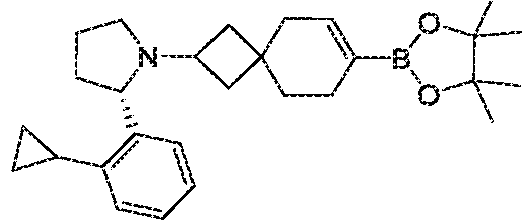
- The solution of 8,11-dioxadispiro[3.2.47.24]tridecan-2-one (2.5 g, 13.35 mmol), (S)-2-(2-cyclopropylphenyl)pyrrolidine (2.36 g, 12.01 mmol) and HOAc (2.4 g, 40.05 mmol) in DCE (30 mL) was stirred at 15°C for 2h. Then Na(OAc)3BH (5.6 g, 26.7 mmol) was added into the mixture and then stirred at 15°C for 12hours. TLC showed the reaction was completed. The mixture was adjusted to pH=10 with saturated aq. Na2CO3. The organic layer was washed with brine, dried over with Na2SO4, filtered and concentrated. The residue was purified by column chromatography on silica gel (eluent: PE/EA=20/1 to 7/1) to afford target product (2.5 g, crude) as yellow oil.
- The solution of (S)-2-(2-cyclopropylphenyl)-1-(8,11-dioxadispiro[3.2.47.24]tridecan-2-yl)pyrrolidine (2 g, 5.45 mmol) in acetone (27 mL) was added 1 N HCl acid (27 mL, 27.25 mmol). The mixture was stirred at 15°C for 6 hours. TLC showed the reaction was completed. After removal of solvent, the residue was dissolved with EA (20 mL), adjusted to pH=9 with saturated aq. NaHCO3. The organic layer was washed with water and brine, dried over with Na2SO4, filtered and concentrated to afford (S)-2-(2-(2- cyclopropylphenyl)pyrrolidin-1-yl)spiro[3.5]nonan-7-one (1.7 g, crude) as yellow oil.
- The mixture solution of (S)-2-(2-(2-cyclopropylphenyl)pyrrolidin-1-yl)spiro[3.5]nonan-7-one (1.6 g, 4.95 mmol) and 1,1,1-trifluoro-N-phenyl-N-((trifluoromethyl)sulfonyl)methanesulfonamide (2.12 g, 5.94 mmol) in THF (20 mL) was cooled to -78°C. Then LDA (2.97 mL, 5.94 mmol) was added and stirred 2 hours . The mixture was warmed to 15°C and stirred for 12 hours. TLC shows the reaction was completed. The mixture was poured into saturated aq. NH4Cl, extracted with EA. The organic layer was washed with water and brine, dried over with Na2SO4, filtered and concentrated. The residue was purified by column chromatography on silica gel (eluent: PE/ EA= 50/1 to 5/1) to afford (S)-2-(2-(2-cyclopropylphenyl)pyrrolidin-1-yl)spiro[3.5]non- 6-en-7-yl trifluoromethanesulfonate (2.4 g, crude) as yellow oil.
- The mixture solution of (S)-2-(2-(2-cyclopropylphenyl)pyrrolidin-1-yl)spiro[3.5]non-6-en-7-yl trifluoromethanesulfonate (2.2 g, 4.83 mmol), B2PIN2 (1.84 g, 7.25 mmol), KOAc (1.42 g, 14.49 mmol) and Pd(dppf)Cl2 (351 mg, 0.48 mmol) in dioxane (20 mL) was stirred at 85°C for 3 hours. TLC showed the reaction was completed. The mixture was filtered and concentrated. The residue was purified by column chromatography on silica gel (eluent: PE/ EA= 10/1 to 5/1) to afford (S)-2-(2-cyclopropylphenyl)-1-(7-(4,4,5,5-tetramethyl-1,3,2-dioxaborolan-2-yl)spiro[3.5]non-6-en-2-yl)pyrrolidine (700 mg, 33% yield) as a yellow solid. 1H NMR (400MHz, CDCl3) δ ppm: 7.66 (t, J=6.1 Hz, 1H), 7.33 - 7.28 (m, 1H), 7.25 - 7.12 (m, 4H), 7.04 - 6.99 (m, 1H), 6.35 (s, 1H), 4.39 (s, 1H), 3.40 (s, 1H), 3.28 - 3.10 (m, 1H), 2.73 (s, 1H), 2.38 - 2.25 (m, 1H), 2.05 (s, 2H), 1.99 - 1.80 (m, 5H), 1.78 - 1.31 (m, 4H), 1.25 (s, 13H), 1.00 - 0.86 (m, 2H), 0.71 - 0.57 (m, 2H). MS (ESI, m/e) [M+1]+ 434.1.
-

- To a solution of 2-fluorobenzaldehyde (13.33 g, 107.38 mmol) and tert-butyl piperazine-1-carboxylate (30.0 g, 161.07 mmol) in DMSO (150 mL) was added K2CO3 (44.52 g, 322.15 mmol). The mixture was stirred at 100°C for 12 hr. TLC indicated the reactant was consumed completely. The reaction mixture was cooled to room temperature and poured into H2O (150 mL) and extracted with EA (150 mL × 3), dried over Na2SO4, filtered and concentrated. The residue was purified by column chromatography (Silica gel, PE/EA=100/1 to 30/1). Tert-butyl 4-(2-fonnylphcnyl)piperazinc-1-carboxylatc (8.5 g) was obtained as a yellow solid. 1H NMR (400MHz, CDCl3) δ ppm: 1.50 (s, 9 H), 3.02 - 3.08 (m, 4 H), 3.61 - 3.66 (m, 4 H), 7.11 (d, J=8.2 Hz, 1 H), 7.17 (t, J=7.5 Hz, 1 H), 7.52 - 7.58 (m, 1 H), 7.83 (dd, J=7.7, 1.8 Hz, 1 H), 10.36 (s, 1 H).
- To a solution of tert-butyl 4-(2-formylphenyl)piperazine-1-carboxylate (8 g, 27.55 mmol) and 4-bromoaniline (4.74 g, 27.55 mmol) in toluene. (100 mL) was added 4Å molecular sieve (5 g) and TsOH (474.45 mg, 2.76 mmol). The mixture was stirred at 120°C for 12 hours. TLC indicated the reactant was consumed completely. The reaction mixture was concentrated under reduced pressure to remove solvent. (E)-tert-butyl 4-(2-(((4-bromophenyl)imino)methyl)phenyl)piperazine-1-carboxylate (8 g, crude) was obtained as an brown oil. 1H NMR (400MHz, CDCl3) δ ppm: 1.49 (s, 9 H), 2.98 (br, 4 H), 3.60 (br, 4 H), 7.08 - 7.13 (m, 3 H), 7.17 - 7.26 (m, 2 H), 7.46 (td, J--7.7, 1.6 Hz, 1 H), 7.50 - 7.54 (m, 2 H), 8.83 (s, 1 H).
- To a solution of (E)-tert-butyl-4-(2-(((4-bromophenyl)imino)methyl)phenyl)piperazine-1-carboxylate (8 g, 18.0 mmol) and in DCM (100 mL) was added allylmagnesium bromide (1 M, 18.0 mL) at -20°C. The mixture was stirred at -20°C for 2 hr. TLC indicated Reactant was consumed completely. The reaction mixture was poured into aq. NH4Cl (150 mL) and extracted with EA (150 mL×3), dried over Na2SO4, filtered and concentrated. The residue was purified by column chromatography (Silica gel, Petroleum ether). tert-butyl 4-(2-(1-((4-bromophenyl)amino)but-3-en-1-yl)phenyl)piperazine-1-carboxylate (6.0 g) was obtained as a yellow oil. 1H NMR (400MHz, CDCl3) δ ppm: 1.51 (s, 9 H), 2.47 - 2.66 (m, 2 H), 2.83 - 2.98 (m, 5 H), 3.48 - 3.75 (m, 3 H), 4.23 (s, 1 H), 4.89 (dd, J=8.1, 4.9 Hz, 1 H), 5.10 - 5.21 (m, 2 H), 5.79 (ddt, J=17.U, 10.1, 6.9Hz, 1 H), 6.40 - 6.44 (m, 2 H), 7.10 - 7.20 (m, 4 H), 7.24 (dd, J=7.2, 1.5 Hz, 1 H), 7.34 (dd, J=7.6, 1.5 Hz, 1 H).
- To a solution of tert-butyl 4-(2-(1-((4-bromophenyl)amino)but-3-en-1-yl)phenyl)piperazine- 1-carboxylate (6 g, 12.33 mmol) in THF (100 mL) was added BH3. THF (1M, 185.02 mL) at 0°C. The mixture was stirred at 25°C for 12 hr. And then NaOH (1.23 g, 30.84 mmol) and H2O2 (6.29 g, 185.02 mmol) was added into the mixture at 0°C. The mixture was stirred at 25°C for 8 hr. TLC indicated Reactant 4 was consumed completely. The reaction mixture was poured into aq. NH4Cl (150 mL) and extracted with EA (150 mL×3), dried over Na2SO4, filtered and concentrated. The residue was purified by column chromatography (Silica gel, PE/EA = 100/1 to 30/1). tert-butyl 4-(2-(1-((4-bromophenyl)amino)-4- hydroxybutyl)phenyl)piperazine-1-carboxylate (3.5 g) was obtained as a yellow sloid. 1H NMR (400MHz, CDCl3) δ ppm: 1.50 (s, 10 H), 1.56 - 1.80 (m, 3 H), 1.83 - 1.99 (m, 2 H), 2.80 - 2.94 (m, 4 H), 3.38 - 3.76 (m, 5 H), 4.88 (dd, J=7.9, 5.5 Hz, 1 H), 6.46 - 6.51 (m, 2 H), 7.11 - 7.18 (m, 4 H), 7.21 - 7.24 (m, 1 H), 7.31 - 7.34 (m, 1 H).
- To a solution of tert-butyl 4-(2-(1-((4-bromophenyl)amino)-4-hydroxybutyl)phenyl)piperazine-1-carboxylate (3.5 g, 6.94 mmol) in DCM (50 mL) and TEA (3.51 g, 34.69 mmol) was added MsCl (715.29 mg, 6.24 mmol) at 0°C and the mixture was stirred at 25°C for 1.5 hr. LCMS showed the reactant was consumed completely and one main peak with desired MS was observed. The reaction mixture was was poured into aq. NH4Cl (150 mL) and extracted with EA (150 mL×3), dried over Na2SO4, filtered and concentrated. The residue was purified by column chromatography (Silica gel, PE/EA = 10/1). Tert-butyl 4-(2-(1-(4-bromophcnyl)pyrrolidin-2-yl)phenyl)piperazine-1-carboxylale (3.0 g) was obtained as a white solid. 1H NMR (400MHz, CDCl3) δ ppm: 1.47 - 1.54 (m, 9 H), 1.90 - 1.98 (m, 1 H), 1.98 - 2.17 (m, 2 H), 2.40 - 2.52 (m, 1 H), 2.86 - 3.02 (m, 4 H), 3.35 - 3.43 (m, 1 H), 3.55 - 3.67 (m, 3 H), 3.67 - 3.75 (m, 1 H), 5.07 - 5.12 (m, 1 H), 6.27 - 6.34 (m, 2 H), 7.01 - 7.07 (m, 1 H), 7.08 - 7.12 (m, 1 H), 7.15 - 7.26 (m, 4 H). MS (ESI, m/e) [M+1]+ 486.1.
-

- To a solution of 5-(2-cyclopropylphenyl)pyrrolidin-3-ol (1.8 g, 8.9 mmol) and Et3N (0.9 g, 8.9 mmol) in DCM (20 mL) was added Boc2O (1.9 g, 8.9 mmol). Then the mixture was stirred at 20 °C for 12 hours. TLC showed the reaction was complete. The reaction mixture was washed with HCl acid (1 N, 20 mL), saturated aq. NaHCO3 solution (20 mL), brine (20 mL), dried over Na2SO4, and concentrated to give tert-butyl 2-(2-cyclopropylphenyl)-4-hydroxypyrrolidine-1-carboxylate (2.3 g, crude) as a yellow oil.
- To a solution of tert-butyl 2-(2-cyclopropylphenyl)-4-hydroxypyrrolidine-1-carboxylate (2.3 g, 7.6 mmol) in DCM (30 mL) was added NaHCO3 (640 mg, 7.6 mmol) and Dess-Martin periodinane (3.2 g, 7.6 mmol). The mixture was stirred at 20 °C for 12 hours. TLC showed the reaction was complete. The reaction mixture was quenched with saturated aq. Na2SO3 solution (30 mL). The organic layer was washed with brine (30 mL), dried over Na2SO4, and concentrated to give tert-butyl 2-(2-cyclopropylphenyl)-4-oxopyrrolidine-1-carboxylate (2.1 g, crude) as a yellow oil.
- To a mixture of Ph3P+MeBr- (5.5 g, 15.3 mmol) in THF (25 mL) was added t-BuOK (1.7 g, 15.3 mmol) in one portion. The mixture was stirred at 20 °C for 1 hour. Then tert-butyl 2-(2-cyclopropylphenyl)-4-oxopyrrolidine-1-carboxylate (2.3 g, 7.64 mmol) was added and the mixture was stirred at 20 °C for 12 hours. TLC showed the reaction was complete. The reaction mixture was quenched with saturated aq. NH4Cl solution (25 mL), and then extracted with EA (25 mL). The organic layer was washed with brine (25 mL), dried over Na2SO4, and concentrated. The residue was purified by column chromatography on silica gel eluted with PE/EA = 10/1 to give tert-butyl 2-(2-cyclopropylphenyl)-4-methylenepyrrolidine-1-carboxylate (1.3 g, yield: 56%).
- To a mixture of tert-butyl 2-(2-cyclopropylphenyl)-4-methylenepyrrolidine-1-carboxylate (1.3 g, 4.3 mmol) and Et2Zn (1 M in toluene, 15 mL, 15 mmol) was added ClCH2I (5.3 g, 30 mmol) at 0 °C. Then the mixture was stirred at 20 °C for 12 hours. TLC showed a new spot was produced and no material remained. The reaction mixture was quenched with saturated aq. NH4Cl solution (50 mL) and extracted with EA (50 mL). The organic layer was washed with brine (50 mL), dried over Na2SO4, and concentrated to give tert-butyl 6-(2-cyclopropylphenyl)-5-azaspiro[2.4]heptane-5-carboxylate (1 g, crude) as a yellow oil which was used in the next step directly.
- A solution of tert-butyl 6-(2-cyclopropylphenyl)-5-azaspiro[2.4]heptane-5-carboxylate (1 g, 3.2 mmol) in HCUEA (10 mL, 4 M) was stirred at 20 °C for 2 h. LC/MS showed the reaction was complete. The mixture was concentrated. The residue was purified by prep-HPLC (0.1 % TFA condition). The target eluent was basified with saturated aq. Na2CO3 solution to pH=10 and then extracted with EA (200 mL×4). The organic layers were combined, dried over Na2SO4, and concentrated to give 6-(2-cyclopropylphenyl)-5-azaspiro[2.4]heptane (293 mg) as a light yellow oil. 1H NMR (400 MHz, CDCl3) δ ppm: 7.60 (dd, J=7.6, 1.3 Hz, 1 H), 7.13 - 7.25 (m,2 H), 7.01 (d, J=7.5 Hz, 1 H), 4.97 (t, J=7.8 Hz, 1H), 3.02 - 3.13 (m, 2 H), 2.34 (s, 1H), 2.14 (dd, J=12.3, 7.2 Hz, 1H), 2.04 (t, J=8.4, 1H), 1.81 - 1.90 (m, 1H), 0.87 - 1.02 (m, 2H), 0.53 - 0.76 (m, 6 H). MS (ESI, m/e) [M+1]+ 214.1.
-

- To a mixture of (R)-2-(2-bromophenyl)pyrrolidine (10 g, 44.23 mmol) and TFAA (18.58 g, 88.45 mmol) in DCM (100 mL) was added TEA (13.5 g, 132.69 mmol) dropwise at 0°C. The mixture was stirred at 20°C for 10 hours. TLC indicated the reactant was consumed completely. The reaction mixture was washed with saturated aq. NH4Cl (100 mL x 2) and the organic phase was dried over Na2SO4, filtered and concentrated in vacuum. The residue was purified by column chromatography (Silica gel, PE/EA = 100/1 to 50/1). (R)-1-(2-(2-bromophenyl)pyrrolidin-1-yl)-2,2,2-trifluoroethanone (13 g) was obtained as a yellow solid.
- To a mixture of (R)-1-(2-(2-bromophcnyl)pyrrolidin-1-yl)-2,2,2-trifluorocthanonc (5 g, 15.52 mmol), potassium tritluoro(vinyl)borate (2.91 g, 21.73 mmol) and Cs2CO3 (10.11 g, 31.04 mmol) in dioxane (120 mL), H2O (12 mL) was added Pd(dppf)Cl2 (567 mg, 776 umol) at 20°C. The mixture was purged with N2 for three times and then heated to 100°C for 5 hours. TLC and LC/MS indicated the reactant was consumed completely. The reaction mixture was concentrated in vacuum (~ 30 mL). The residue was poured into ice-water (50 mL). The aqueous phase was extracted with EA (50 mL x 3). The combined organic phases were dried with anhydrous Na2SO4, filtered and concentrated. The crude product was purified by column chromatography (Silica gel, PE/EA = 100/1 to 50/1). (R)-2,2,2-trifluoro-1-(2-(2-vinylphenyl)pyrrolidin-1-yl)ethanone (3.4 g, 12.63 mmol, 81.34% yield) was obtained as a yellow oil. 1H NMR (400MHz, CDCl3) δ ppm: 7.44 - 7.51 (m, 1 H), 7.21 - 7.27 (m, 2 H), 6.88 - 7.07 (m, 2 H), 5.61 - 5.71 (m, 1 H), 5.46 - 5.60 (m, 1 H), 5.33 - 5.45 (m, 1 H), 3.75 - 4.03 (m, 2 H), 2.27 - 2.41 (m, 1 H), 1.82 - 2.12 (m, 3 H). MS (ESI, m/e) [M+1]' 270.1.
- To a mixture of (R)-2,2,2-trifluuro-1-(2-(2-vinylphenyl)pyrrolidin-1-yl)ethanone (3.4 g, 12.63 mmol) and K2OSO4.2H2O (186 mg, 505.1 umol) in THF (60 mL), H2O (60 mL) was added NaIO4 (10.8 g, 50.51 mmol) in portions at 10°C. The mixture was stirred at 10°C for 2 hr. TLC indicated the reactant was consumed completely. The reaction mixture was concentrated to remove THF. The aqueous phase was extracted with EA (50 mL x 3). The combined organic phases were washed with brine, dried with anhydrous Na2SO4, filtered and concentrated. (R)-2-(1-(2,2,2-trifluoroacetyl)pyrrolidin-2-yl)benzaldehyde (3.4 g, crude) was obtained as a brown oil. MS (ESI, m/e) [M+1]+ 272.1.
- To a mixture of (R)-2-(1-(2,2,2-trifluoroacetyl)pyrrolidin-2-yl)benzaldehyde (3.4 g, 12.54 mmol) and tert-butyl piperazine-1-carboxylate (4.67 g, 25.07 mmol) in DCE (100 mL) was added NaBH(OAc)3 (10.6 g, 50.16 mmol) in portions at 10°C. The mixture was stirred at 10°C for 10 hours. TLC indicated the reactant was consumed completely. The reaction mixture was washed with NaHCO3 (50 mL) and then the organic phase was separated. The organic phase was dried with anhydrous Na2SO4, filtered and concentrated. (R)-tert-butyl 4-(2-(1-(2,2,2-trifluoroavetyl)pyrrolidin-2-yl)benzyl)piperazine-1-carboxylate (3.5 g) was obtained as a yellow oil. MS (ESI, m/e) [M+1]+ 442.3.
- To a solution of (R)-tert-butyl 4-(2-(1-(2,2,2-trifluoroacetyl)pyrrolidin-2-yl)benzyl)piperazine-1-carboxylate (3.3 g, 7.47 mmol) in EtOH (50 mL) was added NaBH4 (662.13 mg, 16.44 mmol) in portions at 20°C. The mixture was stirred at 20°C for 4 hours. TLC indicated the reactant was consumed completely. The reaction mixture was concentrated to remove EtOH (~ 10 mL), poured into ice-water (20 mL). The aqueous phase was extracted with EA (50 mL x 3). The combined organic phases were washed with brine, dried with anhydrous Na2SO4, filtered and concentrated. (R)-tert-butyl 4-(2-(pyrrolidin-2-yl)benzyl)piperazine-1-carboxylate (2.55 g, crude) was obtained as a yellow oil. MS (ESI, m/e) [M+1]+ 346.3.
- To a mixture of (R)-tert-butyl 4-(2-(pyrrolidin-2-yl)benzyl)piperazine-1-carboxylate (2.55 g, 7.38 mmol), 1-bromo-4-iodobenzene (3.13 g, 11.07 mmol), X-phos (703 mg, 1.48 mmol) and Cs2CO3 (4.81 g, 14.76 mmol) in toluene (100 mL) was added Pd(OAc)2 (166 mg, 738 umol) at 20°C. The mixture was purged with N2 for three times and then heated to 105°C for 10 hours. TLC indicated the reactant was consumed completely. The reaction mixture was poured into ice-water (50 mL) and the organic phase was separated. The organic phase was dried with anhydrous Na2SO4, filtered and concentrated. (R)-tert-butyl 4-(2-(1-(4-bromophenyl)pyrrolidin-2-yl)benzyl)piperazine-1-carboxylate (1.25 g) was obtained as an orange solid. 1H NMR (400MHz, CDCl3) δ ppm: 7.05 - 7.24 (m, 6 H) 6.40 (d, J=8.9 Hz, 2 H) 5.28 - 5.37 (m, 1 H) 3.68 - 3.86 (m, 2 H) 3.29 - 3.53 (m, 6 H) 2.35 - 2.59 (m, 5 H) 1.98 - 2.15 (m, 2 H) 1.79 - 1.88 (m, 1 H) 1.41 - 1.51 (m, 9 H).
- A solution of (R)-tert-butyl 4-(2-(1-(4-bromophenyl)pyrrolidin-2-yl)benzyl)piperazine-1-carboxylate (1.25 g, 2.50 mmol) in TFA (20 mL) and DCM (60 mL) was stirred at 20°C for 12 hours. LC/MS indicated the reactant was consumed completely and desired compound was generated. The reaction solution was concentrated. The residue was diluted with EA (50 mL). The organic phase was washed with saturated aq. NaHCO3 (50 mL) and the organic phase was separated. The organic phase was dried with anhydrous Na2SO4, filtered and concentrated. (R)-1-(2-(1-(4-bromophenyl)pyrrolidin-2-yl)benzyl)piperazine (1 g, crude) was obtained as a yellow oil. MS (ESI, m/e) [M+1]' 400.2.
- To a mixture of (R)-1-(2-(1-(4-bromophenyl)pyrrolidin-2-yl)benzyljpiperazine (1 g, 2.50 mmol) and HCHO (374.99 mg, 12.49 mmol) in DCE (50 mL) was added NaBH(OAc)3 (2.1 g, 10 mmol) in portions at 20°C. The mixture was stirred at 20°C for 1 hour. LC/MS indicated the reactant was consumed completely and desired compound was generated. The reaction mixture was filtered and the filtrate was concentrated. The crude was purified by prep-HPLC (Phenomenex luna C18 250 mm * 100 mm * 10 um; mobile phase: [water (0.1 % TAF)-ACN]). The purified solution was concentrated. The aqueous phase was based with saturated NaHCO3 and then extracted with EA (50 mL x 3). The combined organic phases were dried with anhydrous Na2SO4, filtered and concentrated. (R)-1-(2-(1-(4-bromophenyl)pyrrolidin-2-yl)benzyl)-4-methylpiperazine (440 mg) was obtained as a yellow solid. 1H NMR (400MHz, CDCl3) δ ppm: 7.01 - 7.24 (m, 6 H), 6.36 (d, J=8.8 Hz, 2 H), 5.22 (d, J=8.2 Hz, 1 H), 3.88 (d, J=12.8 Hz, 1 H), 3.72 (t, J=7.4 Hz, 1 H), 3.33 - 3.50 (m, 2 H), 2.34 - 3.14 (m, 12 H), 2.06 (s, 2 H), 1.84 (d, J=5.7 Hz, 1 H). MS (ESI, m/e) [M+1]+ 414.2.
-
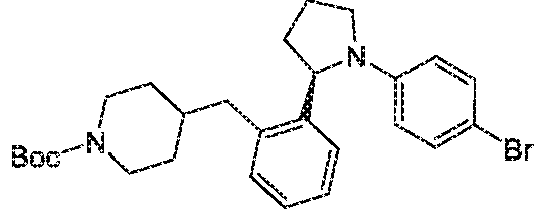
- A mixture of tert-butyl 4-fonnylpiperidine-1-carboxylate (1.75 g, 9.38 mmol) and 4-methylbenzenesulfonohydrazide (2.0 g, 9.38 mmol) in EtOH (30 mL) was stirred at 20°C for 15 hours. TLC indicated the reactant was consumed completely. The reaction mixture was concentrated in vacuum. (E)-tert-butyl 4-((2-tosylhydrazono)methyl)piperidine-1-carboxylate (3.4 g, crude) was obtained as a colorless oil.
- To a mixture of (R)-1-(2-(2-bromophenyl)pyrrolidin-1-yl)-2,2,2-trifluoroethanone (3 g, 9.31 mmol), (E)-tert-butyl 4-((2-tosylhydrazono)methyl)piperidine-1-carboxylate (5.33 g, 13.97 mmol) and t-BuOLi (2.98 g, 37.24 mmol) in dioxane (100 mL) was added Pd(PPh3)2Cl2 (670.5 mg, 931 umol) at 20°C. The mixture was purged with N2 for three times and then heated to 100°C for 3 hours. TLC indicated the reactant was consumed completely. The reaction mixture was concentrated in vacuum (~ 20 mL). The residue was poured into ice-water (30 mL) and was extracted with EA (50 mL x 3). The combined organic phases were washed with brine (50 mL), dried with anhydrous Na2SO4, filtered and concentrated. The crude was purified by column chromatography (Silica gel, PE/EA = 30/1 to 10/1). (R)-tert-butyl 4-(2-(1-(2,2,2-trifluoroacetyl)pyrrolidin-2-yl)bcnzylidcne)piperidinc-1-carboxylale (2.17 g, 4.95 mmol, 53.08% yield) was obtained as a red oil. 1H NMR (400MHz, CDCl3) δ ppm: 7.16 - 7.25 (m, 2 H), 7.04 - 7.11 (m, 1 H), 6.92 - 7.01 (m, 1 H), 6.29 - 6.46 (m, 1 H), 5.29 - 5.45 (m, 1 H), 3.75 - 4.00 (m, 2 H), 3.12 - 3.69 (m, 4 H), 2.16 - 2.41 (m, 4 H), 1.83 - 2.15 (m, 3 H), 1.70 - 1.82 (m, 1 H), 1.47 (s, 9 H). MS (ESI, m/e) [M+1]+ 339.2.
- To a solution of (R)-tert-butyl 4-(2-(1-(2,2,2-trifluoroacetyl)pyrrolidin-2-yl)benzylidene)pipcridinc-1-carboxylatc (2.3 g, 5.25 mmol) in MeOH (30 mL) was added Pd/C (300 mg, 10% wet). The mixture was purged with H2 for three times and then stirred at 20°C for 10 hours under 15 Psi H2. LC/MS indicated Reactant was consumed completely and desired compound was formed. The reaction mixture was filtered with Celite, washed with MeOH. The filtrate was concentrated. (R)-tert-butyl 4-(2-(1-(2,2,2-trifluoroacetyl)pyrrolidin-2-yl)benzyl)piperidine-1-carboxylate (2.3 g, crude) was obtained as a brown solid. 1H NMR (400MHz, CDCL3) δ ppm: 7.07 - 7.23 (in, 3 H), 6.86 - 6.98 (m, 1 H), 5.34 - 5.52 (m, 1 H), 3.73 - 4.24 (m, 4 H), 2.44 - 2.83 (m, 4 H), 2.31 - 2.44 (m, 1 H), 1.56 - 2.21 (m, 6 H), 1.37 - 1.55 (m, 9 H), 1.05 - 1.33 (m, 2 H).
- To a solution of (R)-tert-butyl 4-(2-(1-(2,2,2-trifluoroacetyl)pyrrolidin-2-yl)benzyl)piperidine-1-carboxylate (2.3 g, 5.22 mmol) in MeOH (10 mL), H2O (10 mL), THF (10 mL) was added LiOH.H2O (438.5 mg, 10.44 mmol) at 20°C. The mixture was heated to 50°C for 1 hour. TLC indicated the reactant was consumed completely. The reaction mixture was concentrated in vacuum to remove MeOH and THF. The aqueous phase was extracted with EA (30 mL x 3). The combined organic phases were dried with anhydrous Na2SO4, filtered and concentrated. (R)-tert-butyl 4-(2-(pyrrolidin-2-yl)benzyl)piperidine-1-carboxylate (1.76g, crude) was obtained as a yellow oil. MS (ESI, m/e) [M+1]' 345.2.
- To a mixture of (R)-tert-butyl 4-(2-(pyrrolidin-2-yl)benzyl)piperidine-1-carboxylate (1.4 g, 4.06 mmol), 1-bromo-4-iodobenzene (1.72 g, 6.10 mmol), X-phos (387 mg, 812 umol) and Cs2CO3 (2.64 g, 8.12 mmol) in toluene (50 mL) was added Pd(OAc)2 (90 mg, 406 umol) at 20°C. The mixture was purged with N2 for three times and then heated to 100°C for 5 hours. TLC indicated the reactant was consumed completely. The reaction mixture was cooled to room temperature and poured into ice-water (30 mL) and then separated. The organic phase was washed with brine, dried with anhydrous Na2SO4, filtered and concentrated. The crude was purified by column chromatography (silica gel, eluent: PE/EA = 100/1 to 50/1). (R)-tert-butyl 4-(2-(1-(4-bromophcnyl)pyrrolidin-2-yl)benzyl)piperidine-1-carboxylale (720 mg) was obtained as a yellow solid. 1H NMR (400MHz, CDCl3) δ ppm: 7.00 - 7.24 (m, 6 H) 6.27 (d, J=9.0 Hz, 2 H) 4.80 - 4.92 (m, 1 H) 4.02 - 4.27 (m, 2 H) 3.65 - 3.78 (m, 1 H) 3.35 - 3.47 (m, 1 H) 2.57 - 2.83 (m, 4 H) 2.36 - 2.51 (m, 1 H) 1.97 - 2.12 (m, 2 H) 1.80 - 1.95 (m, 2 H) 1.71 (d, J=12.1 Hz, 2 H) 1.48 (s, 9 H) 1.23 - 1.31 (m, 2 H). MS (ESI, m/e) [M+1]+ 498.9.
-
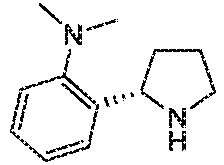
- To a solution of (S)-tert-butyl 2-(2-bromophenyl)prrolidine-1-carboxylate (2.0 g, 6.13 mmol) in 1,4-dioxane (50 mL) was added diphenylmethanimine (1.67 g, 9.20 mmol), Cs2CO3 (3.99 g, 12.26 mmol), Pd2(dba)3 (561.4 mg, 6.13 mmol), and Xant-phos (1.06g, 1.84 mmol). The mixture was stirred at 105 °C for 36 hours under N2 protection. LC/MS showed (S)-tert-butyl 2-(2-bromophcnyl)pyrrolidine-1-carboxylate was consumed completely and one main peak with desired mass signal. The mixture was evaporated in vacuum. The residue was used directly for next step. MS (ESI, m/e) [M-1]- 427.2.
- To a solution of (S)-tert-butyl 2-(2-((diphenylmethylene)amino)phenyl)pyrrolidine-1-carboxylate (262 mg, 613 umol, 1 eq) and in THF (5 mL) was added 0.5 N HCl acid 10 mL. The mixture was stirred at 20 °C for overnight. TLC showed (S)-tert-butyl 2-(2-((diphenylmethylene)amino)phenyl)pyrrolidine-1-carboxylate was consumed completely. The mixture was adjusted to PH ~8 with saturated aq. NaHCOs, then was extracted with EA (20 ml). The organic phase was washed with brine, dried over Na2SO4, evaporated in vacuum. The residue was purified by column chromatography on silica gel (eluent: PE/EA = 10/1 to 1/1) to give (S)-tert-butyl 2-(2-aminophenyl)pyrrolidine-1-carboxylate (50 mg). 1H NMR (400MHz, CDCl3) δ ppm: 6.91 - 7.16 (m, 2 H), 6.70 - 6.87 (m, 1 H), 6.62 - 6.70 (m, 1 H), 4.60 - 5.06 (m, 1 H), 3.36 - 3.97 (m, 4 H), 2.13 - 2.35 (m, 1 H), 1.83 - 2.01 (m, 3 H), 1.16 - 1.54 (m, 9 H).
- To a solution of (S)-tert-butyl 2-(2-aminophenyl)pyrrolidine-1-carboxylate (6.5 g, 22.87 mmol) in MeOH (200 mL) was added aq. HCHO (37%, 11.14 g, 137.22 mmol), and NaH3CN( 5.95 g, 114.35 mmol). The mixture was stirred at 20°C for 14 hours. TLC showed (S)-tert-butyl 2-(2-aminophenyl)pyrrolidine-1-carboxylate was consumed completely. The mixture was evaporated in vacuum. The residue was dissolved with DCM (100 mL), washed with brine, dried over Na2SO4, concentrated. The residue was purified by column chromatography on silica gel (eluent: PE/EA = 100/1 to 30/1) to give (S)-tert-butyl 2-(2-(dimethylamino)phenyl)pyrrolidine-1-carboxylate (5.9 g). 1H NMR (400MHz, CDCl3) δ ppm: 6.93 - 7.15 (m, 4 H), 5.12 - 5.37 (m, 1 H), 3.36 - 3.69 (m, 2 H), 2.60 (s, 6 H), 2.20 - 2.37 (m, 1 H), 1.64 - 1.87 (m, 3 H), 1.39 (s, 2 H), 1.10 (s, 6 H).
- To solution of (S)-tert-butyl 2-(2-(dimethylamino)phenyl)pyrrolidine-1-carboxylate (5.90 g, 20.32 mmol) in DCM (30 mL) was added TFA (30 mL). The mixture was stirred at 20°C for 2 hours. TLC showed (S)-tert-butyl 2-(2-(dimethylamino)phenyl)pyrrolidine-1-carboxylate was consumed completely. The mixture was poured into water was then adjusted to pH -10 with aq. NaOH (2N). The mixture was extracted with DCM (50 mL×3), washed with brine and water, dried with anhydrous Na2SO4. After filtration, the filtrate was concentrated in vacuum to give (S)-N,N-dimethyl-2-(pyrrolidin-2-yl)aniline (3.248 g). 1H NMR (400MHz, CDCl3) δ ppm: 7.38 - 7.52 (m, 1 H) 7.18 - 7.24 (m, 1 H) 7.03 - 7.16 (m, 2 H) 4.59 (t, J=7.9 Hz, 1 H), 3.24 (ddd, J=10.0, 7.6, 5.1 Hz, 1 H), 3.00 (dt, J=9.8, 7.7 Hz, 1 H), 2.71 (br, 6 H), 2.17 - 2.33 (m, 1 H), 2.14 (s, 1 H), 1.80 - 2.04 (m, 2 H), 1.54 - 1.77 (m, 1 H). MS (ESI, m/e) [M+1]+ 191.3.
-

- To a solution of (S)-tert-butyl 2-(2-aminophenyl)pyrrolidine-1-carboxylate (6.5 g, 22.87 mmol) in DMF (20 mL) was added NaH (457.4 mg, 11.44 mmol), and CD3I( 2.21 g, 15.25 mmol) at 0 °C. The mixture was stirred at 45°C for 14 hours. TLC showed (S)-tert-butyl 2-(2-aminophenyl)pyrrolidine-1-carboxylatc was consumed completely. The mixture was poured into water (50 mL), extracted with EA, concentrated in vacuum to give tert-butyl (S)-2-(2-(bis(methyl-d3)amino)phenyl)pyrrolidine-1-carboxylate (880 mg), which was used in next step without further purification. 1H NMR (400MHz, CDCl3) δ ppm: 7.00 - 7.22 (m, 4 H), 5.20 - 5.43 (m, 1 H), 3.49 - 3.72 (m, 2 H), 2.26 - 2.45 (m, 1 H), 1.72 - 1.95 (m, 3 H), 1.47 (s, 2 H), 1.18 (s, 7 H). MS (ESI, m/e) [M+1]' 297.4.
- To solution of (S)-2-(2-(bis(methyl-d3)amino)phenyl)pyrrolidine-1-carboxylate (275 mg, 927.68 umol), in DCM (10 mL) was added TFA (5 mL). The mixture was stirred at 20°C for 2 hours. TLC showed the reactant was consumed completely. The mixture was concentrated in vacuum to give a residue. The residue was dissolved with DCM (20 mL), washed with sat. aq. Na2CO3 (20 mL), dried with Na2SO4, concentrated in vacuum to give (S)-N,N-bis(methyl-d3)-2-(pyrrolidin-2-yl)aniline (100 mg). 1H NMR (400MHz, CDCl3) δ ppm: 7.42 (dd,J=7.7, 1.3 Hz, 1 H), 7.19 - 7.26 (m, 1 H), 7.07 - 7.18 (m, 2 H), 4.63 (t, J=7.9 Hz, 1 H), 3.24 (ddd, J=10.3, 7.4, 5.4 Hz, 1 H), 3.04 - 3.11 (m, 1 H), 2.18 - 2.30 (m, 1 H), 1.87 - 2.06 (m, 2 H), 1.66 - 1.77 (m, 1 H). MS (ESI, m/e) [M+1]+ 197.3.
-

- To a solution of 2-(((terl-butyldimethylsilyl)oxy)methyl)-1-(2-cyclopropylphenyl)pyrrolidine (1.5 g, 4.52 mmol) in MeOH/HCl (20 mL) at 20°C and the mixture was stirred for 1 hours. TLC indicated the reactant was consumed completely. The reaction mixture was concentrated to give (1-(2-cyclopropylphenyl)pyrrolidin-2-yl)methanol (0.8 g, crude). 1H NMR (400 MHz, CDCl3) δ ppm: 7.81 (d, J=7.7 Hz, 1 H), 7.34 - 7.40 (m, 1 H), 7.28 - 7.34 (m, 1 H), 7.04 (dd, J=7.7, 1.2 Hz, 1 H), 4.55 (br, 1 H), 4.19 (s, 1 H), 4.11 (d, J=13.9 Hz, 1 H), 3.85 - 4.15 (m, 2 H), 3.59 - 3.81 (m, 3 H), 2.52 - 2.64 (m, 1 H), 2.48 (s, 2 H), 2.37 (s, 2 H), 1.22 - 1.35 (m, 2 H), 0.77 - 0.98 (m, 2 H). MS (ESI, m/e) [M+1]+ 217.9.
- To a solution of (COCl)2 (700.9.m g, 5.52 mmol) in DCM (20 mL) was added DMSO ( 862.93mg, 11.04 mmol) drop-wise at -65°C. The mixture was stirred at -65°C for 0.5 hour. And then (1-(2-cyclopropylphenyl)pyrrolidin-2-yl)methanol (800.0 mg, 3.68) in DCM (2 mL) was added drop-wise at -65°C. The mixture was further stirred at -65°C for 1 hour. TLC indicated the reactant was consumed completely. To the reaction mixture was added TEA (2.89 g, 29.45 mmol) and warmed to 20°C for 0.5 hour. The reaction mixture was poured into water, extracted with DCM, dried over anhydrous Na2SO4 and concentrated in vacuum to obtain 1-(2-cyclopropylphenyl)pyrrolidine-2-carbaldehyde (1.2 g, crued). 1H NMR (400 MHz, CDCl3) δ ppm: 12.10 (s, 1 H), 9.39 (d, J=3.8 Hz, 1 H), 7.06 - 7.16 (m, 1 H), 6.85 - 7.03 (m, 3 H), 4.19 (td, J=7.1, 3.9 Hz, 1 H), 3.86 - 3.96 (m, 1 H), 3.05 - 3.16 (m, 6 H), 2.62 (s, 1 H), 2.12-2.26 (m, 2 H), 2.00 - 2.12 (m, 2 H), 1.90 - 2.00 (m, 1 H), 1.42 (t, J=7.3 Hz, 9 H), 1.00 - 1.10 (m, 1 H), 0.75 - 0.94 (m, 2 H), 0.59 - 0.67 (m, 1 H).
- To a solution of 1-(2-cyclopropylphenyl)pyrrolidine-2-carbaldehyde (600 mg, 2.79 mmol) in DCM (10 mL) was added NaBH(OAc)3 (1.18 g, 5.57 mmol) at 0°C slowly. Then tert-butyl 2,6-diazaspiro[3.3]heptane-2-carboxylate oxalate (803.46 mg, 2.79 mmol) was added into the mixture at 0 °C. The mixture was stirred at 20°C for 1 hour. TLC indicated the reactant was consumed completely. The reaction mixture was poured into water, extracted with DCM (10 mL) and concentrated in vacuum to give a residue. The residue was purified by column chromatography (SiO2, PE/EA = 100/1 to 0/1). Tert-butyl 6-((1-(2-cyclopropylphenyl)pyrrolidin-2-yl)methyl)-2,6-diazaspiro[3.3]heptane-2-carboxylate (600 mg) was obtained. 1H NMR (400 MHz, CDCl3) δ ppm: 7.07 - 7.14 (m, 1 H), 7.01 (d, J=7.9 Hz, 1 H), 6.90 - 6.97 (m, 1 H), 6.83 - 6.88 (m, 1 H), 3.95 (s, 4 H), 3.61 - 3.75 (m, 2 H), 3.16 - 3.43 (m, 4 H), 2.86 (td, J=8.5, 5.1 Hz, 1 H), 2.11 - 2.21 (m, 2 H), 2.06 (s, 1 H), 1.87 - 1.99 (m, 2 H), 1.74 - 1.87 (m, 2 H), 1.57 - 1.74 (m, 1 H), 1.42 (s, 9 H), 0.95 - 1.13 (m, 1 H), 0.70 - 0.95 (m, 3 H), 0.52 - 0.62 (in, 1 H). MS (ESI, m/e) [M+1]+ 398.1.
- To a solution of tert-butyl 6-((1-(2-cyclopropylphenyl)pyrrolidin-2-yl)methyl)-2,6-diazaspiro[3.3]heptane-2-carboxylate (600 mg, 1.51 mmol) in DCM (8 mL) was added TFA (2 mL) at 20°C. The mixture was stirred at 20°C for 1 hour. TLC indicated the reactant was consumed completely. The reaction mixture was concentrated to give 2-((1-(2-cyclopropylphenyl)pyrrolidin-2-yl)methyl)-2,6-diazaspiro[3.3]heptane (326 mg) as a yellow oil. 1H NMR (400 MHz, CDCl3) δ ppm: 7.10 (t, J=7.3 Hz, 1 H), 6.99 - 7.04 (m, 1 H), 6.91 (s, 1 H), 6.80 - 6.88 (m, 1 H), 3.78 (br, 4 H), 3.57 - 3.74 (m, 2 H), 3.22 - 3.40 (m, 4 H), 2.80 - 3.03 (m, 3 H), 2.55 (d, J=12.6 Hz, 1 H), 2.10 - 2.28 (m, 3 H), 1.90 (s, 1 H), 1.67 - 1.84 (m, 2 H), 0.82 - 1.10 (m, 2 H), 0.51 - 0.81 (m, 2 H). MS (ESI, m/e) [M+1]+ 298.2.
-

- To the mixture of Zn (4.64 g, 70.99 mmol) in dioxane (50 mL) under N2 atmosphere was added tert-butyl 4-vinylpiperidine-1-carboxylate (5.0 g, 23.66 mmol) at 20°C. Then CCl3COCl (6.45 g, 35.49 mmol) was added at 20°C. The mixture was stirred at 20°C for 12 hours. To the reaction mixture was added aq. NaHCO3 (50 mL) at 0°C. Then the mixture was extracted with EA (50 mL×5) and the combine organic phase was dried over anhydrous Na2SO4 and concentrated. The residue was purified by column chromatography (SiO2, PE/EA = 50/1 to 20/1). Tert-butyl 4-(2,2-dichloro-3-oxocyclobutyl)piperidine-1-carboxylate (3.0 g) was obtained. 1H NMR (400 MHz, CDCl3) δ ppm: 4.05 - 4.21 (m, 2 H) 3.04 - 3.27 (m, 2 H) 2.77 (br, 2 H) 2.60 (q, J = 10.4 Hz, 1 H) 2.03 - 2.10 (m, 1 H) 1.84 - 1.97 (m, 1 H) 1.52 - 1.63 (m, 1 H) 1.46 (s, 9 H) 1.16 - 1.41 (m, 3 H).
- To a mixture of Zn (1.22 g, 18.62 mmol) in HOAc (3.73 g, 62.07 mmol) under N2 atmosphere was added tert-butyl 4-(2,2-dichloro-3-oxocyclobutyl)piperidine-1-carboxylate (2.0 g, 6.21 mmol) in Diox (15 mL) at 15°C, the mixture was stirred at 15°C for 12 hours. The mixture was adjusted to pH ~9 with 33% aq. NaOH and was extracted with EA (50 mL×3). After dried and concentrated, the residue was purified by column chromatography (SiO2, PE/EA = 50/1 to 10/1). Tert-butyl 4-(3-oxocyclobutyl)pipcridinc-1-carboxylatc (1.0 g, 3.95 mmol) was obtained. 1H NMR (400 MHz, CDCl3) δ ppm: 4.14 (s, 2 H) 3.02 - 3.17 (m, 2 H) 2.64 - 2.83 (m, 4 H) 2.05 - 2.18 (m, 1 H) 1.72 (d, J = 12.8 Hz, 2 H) 1.35 - 1.36 (m, 1 H) 1.47 (s, 8 H) 1.15 (d, J = 12.3, 4.3 Hz, 2 H).
- To a solution of tert-butyl 4-(3-oxocyclobutyl)piperidine-1-carboxylate (0.7 g, 2.76 mmol, 1 eq) and (S)-2-(2-cyclopropylphenyl)pyrrolidine (569.23 mg, 3.04 mmol) in DCE (20 mL) was added AcOH (331.86 mg, 5.53 mmol) and NaBH(OAc)3 (1.17 mg, 5.53 mmol). The mixture was stirred at 25°C for 1 hour. TLC showed the reactant was consumed completely. The reaction mixture was quenched with aq. Na2CO3 (20 mL) and extracted EA (20 mL × 3), dried over Na2SO4, filtered and concentrated. The residue was purified by prep-MPLC. (S)-tert-butyl 4-(3-(2-(2-cyclopropylphenyl)pyrrolidin-1-yl)cyclobutyl)piperidine-1-carboxylate (1.1 g) was obtained. MS (ESI, m/e) [M+1]+ 425.3.
- A mixture of (S)-tert-butyl 4-(3-(2-(2-cyclopropylphenyl)pyrrolidin-1-yl)cyclobutyl)piperidine-1-carboxylate (0.9 g, 2.12 mmol) in DCM (5 mL) and TFA (5 mL) was stirred at 25°C for 1 hour. LC/MS showed the reactant was consumed completely and one main peak with desired mass signal. The reaction mixture was concentrated in vacuum to remove solvent. The residue was diluted with H2O (10 mL) and was adjusted to pH ~ 9 with saturated aq. Na2CO3. The mixture was extracted with EA (10 mL × 3), dried over Na2SO4, filtered and concentrated. (S)-4-(3-(2-(2-cyclopropylphenyl)pyrrolidin-1-yl)cyclobutyl)piperidine (643 mg) was obtained. 1H NMR (400MHz, CDCl3) δ ppm: 7.66 - 7.56 (m, 1H), 7.21 - 7.08 (m, 2H), 6.97 (d, J = 7.5 Hz, 1H), 6.34 (s, 1H), 3.96 (q, J = 7.7 Hz, 1H), 3.30 - 2.83 (m, 4H), 2.75 - 2.60 (m, 2H), 2.46 - 2.31 (m, 1H), 2.29 - 2.14 (m, 1H), 2.06 - 1.44 (m, 10H), 1.40 - 1.03 (m, 4H), 0.98 - 0.85 (m, 2H), 0.74 - 0.55 (m, 2H). MS (ESI, m/e) [M+1]+ 325.3.
-
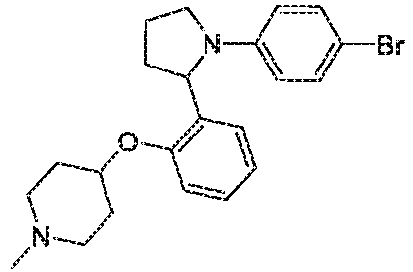
- To a solution of terl-butyl 4-hydroxypiperidine-1-carboxylate (5.0 g, 24.84 mmol) and 2-fluorobenzaldehyde (6.17 g, 49.69 mmol) in DMSO (150 mL) was added K2CO3 (10.15 g, 74.53 mmol). The mixture was stirred at 100°C for 6 hours. TLC indicated the reactant was consumed completely. The reaction mixture was cooled to room temperature and was poured into H2O (50 mL) and extracted with EA (50 mL × 3), dried over Na2SO4, filtered and concentrated. The residue was purified by column chromatography (SiO2, PE/EA = 20/1 to 10/1) to obtain tert-butyl 4-(2-formylphenoxy)piperidine-1-carboxylate (6 g). MS (ESI, m/e) [M+1]+ 306.1.
- A mixture of tert-butyl 4-(2-formylphenoxy)piperidine-1-carboxylate (4.30 g, 14.08 mmol), 4-bromoaniline (2.42 g, 14.08 mmol), TsOH (133.93 mg, 0.7 mmol) and 4Å molecular sieve (2.15 g) in toluene (43 mL) was stirred at 140°C for 12 hours. TLC indicated the reaction was completed. The reaction mixture was concentrated in vacuum to obtain the crude (E)-tert-butyl 4-(2-(((4-bromophenyl)imino) methyl)phenoxy)piperidine-1-carboxylate (7.5 g, crude), which was used directly for next step.
- To a solution of (E)-tert-butyl 4-(2-(((4-bromophenyl)imino)methyl)phenoxy)piperidine-1-carboxylate (5.7 g) in DCM (50 mL) was added dropwise allylmagnesium bromide (49.63 mL, 1 M in THF) at 0°C. The mixture was stirred at 0-15°C for 3 hours. TLC indicated the reaction was completed. The reaction mixture was poured into aq. HN4Cl (50 mL) and extracted with and EA (50 mL × 2). The combined organic layers were washed with brine (50 mL), dried over Na2SO4, filtered and concentrated in vacuum. The residue was purified by column chromatography on silica gel (eluent: PE/EA = 50/1 to 20/1) to give tert-butyl 4-(2-(1-((4-bromophenyl)amino)but-3-en-1-yl)phenoxy)piperidine-1-carboxylate (4.2 g). MS (ESI, m/e) [M+1]+ 502.2.
- To a solution of tert-butyl 4-(2-(1-((4-bromophenyl)amino)but-3-en-1-yl)phenoxy)piperidine-1-carboxylate (3.3 g, 6.58 mmol) in THF (50 mL) was added BH3. THF (65.8 mL, 1M in THF) at 0°C. The mixture was stirred at 0°C for 3 hours. And then H2O2 (6.58 mL, 65.81 mmol) was added in drops and stirred at 0°C for 1 hour. Aq. NaOH (2.63 g, 65.81 mmol, 4M) was added in drops and stirred at 0-15°C for 2 hours. TLC indicated the reaction was completed. The mixture was poured into saturated aq. Na2S2O3 (50 mL) and stirred for 0.5 hour, extracted with EA (100 mL × 2). The combined organic layers were washed with saturated aq. Na2S2O3 (50 mL), aq. NaHCO3 (50 mL) and brine (50 mL), dried over Na2SO4, filtered and concentrated in vacuum. The residue was purified by column chromatography (SiO2, PE/EA = 5/1 to 2/1) to give tert-butyl 4-(2-(1-((4-bromophenyl)amino)-4-hydroxybutyl)phenoxy)piperidine-1-carboxylate (2.4 g). MS (ESI, m/e) [M+1]+ 520.3.
- To a mixture of tert-butyl 4-(2-(1-((4-bromophenyl)amino)-4-hydroxybutyl)phenoxy)piperidine-1-carboxylate (2.3 g, 4.43 mmol) and TEA (1.34 g, 13.28 mmol) in DCM (23 mL) was added MsCl (1.01 mg, 8.86 mmol) at 0°C and the mixture was stirred at 25°C for 5 hours. TLC showed the reaction was complete. The reaction mixture was poured into H2O (20 mL), extracted with DCM (20 mL × 2). The combined organic layers were washed with brine (20 mL), dried over Na2SO4, filtered and concentrated in vacuum. The residue was purified by column chromatography on silica gel (eluent: PE/EA = 10/1 to 2/1) to obtain tert-butyl 4-(2-(1-(4-bromophenyl)pyrrolidin-2-yl)phenoxy)piperidine-1-carboxylate. MS (ESI, m/e) [M+1]+ 502.2.
- A mixture of tert-butyl 4-(2-(1-(4-bromophenyl)pyrrolidin-2-yl)phenoxy)piperidine-1-carboxylate (1.8 g, 3.59 mmol) in DCM (20 mL) was added TFA (7 mL) and was stirred at 15°C for 3 hours. TLC indicated the reaction was completed. The mixture was concentrated in vacuum to obtain 4-(2-(1-(4-bromophenyl)pyrrolidin-2-yl)phenoxy)piperidine (1.8 g, TFA salt, crude). MS (ESI, m/e) [M+1]+ 402.2.
- To a solution of 4-(2-(1-(4-bromophenyl)pyrrolidin-2-yl)phenoxy)piperidine (1.0 g, 2.49 mmol) in MeOH (10 mL) was added aq. HCHO (37%, 1.01 g, 12.46 mmol) and NaBH3CN (496.74 mg, 4.47 mmol) and stirred at 15 °C for 3 hours. TLC indicated the reaction was completed. The reaction mixture was concentrated in vacuum. The residue was poured into saturated aq. NaHCO3 (20 mL), extracted with EA (30 mL × 3). The combined organic layers were dried over Na2SO4, filtered and concentrated. The residue was purified by column chromatography on silica gel (eluent: PE/EA = 1/1 to 1/10) to give 4-(2-(1-(4-bromophenyl)pyrrolidin- 2-yl)phenoxy)-1-methylpiperidine. 1H NMR (400MHz, CDCl3) δ ppm: 7.15 - 7.24 (m, 3H) 6.99 (dd, J=7.5, 1.3 Hz, 1H) 6.88 (d, J=8.1 Hz, 1H) 6.79 - 6.85 (1 H, m) 6.30 (2 H, d, J=9.0 Hz) 4.96 (1 H, d, J=7.9 Hz) 4.60 (1 H, s) 3.63 - 3.70 (m, 1H) 3.32 - 3.41 (m, 1H) 2.64 - 2.87 (m, 4H) 2.46 (s, 3H) 2.29 - 2.40 (m, 1H) 2.14 - 2.24 (m, 2H) 1.92 - 2.10 (m, 5H). MS (ESI, m/e) [M+1]+ 415.1.
-

- To a solution of (methoxymethyl)triphenylphosphonium chloride (3.72 g, 10.86 mmol) in toluene (30 mL) was added t-BuOK (1 M in THF, 10.86 mL, 10.86 mmol). The mixture was stirred at 25°C for 20 minutes under N2 protection. Then tert-butyl 2-oxo-7-azaspiro[3.5]nonane-7-carboxylate (2 g, 8.36 mmol) in toluene (20 mL) was added. The mixture was stirred at 70°C for 4 hours. TLC showed the reactant was consumed completely. The reaction mixture was quenched by aq. HN4Cl (30 mL) and extracted with EA (50 mL × 3), dried over Na2SO4, filtered and concentrated. The residue was purified by prep-MPLC to obtain tert-butyl 2-(methoxymethylene)-7-azaspiro[3.5]nonanc-7-carboxylate (1.2 g). MS (ESI, m/e) [M+1]+ 268.3.
- A mixture of tert-butyl 2-(methoxymethylene)-7-azaspiro[3.5]nonane-7-carboxylate (1 g, 3.74 mmol) in ACN (36 mL), H2O (9 mL) and TFA (0.3 mL) was stirred at 25°C for 4 hours. TLC showed the reactant was consumed completely. The reaction mixture was quenched by aq. NaHCOs (20 mL) and extracted with EA (20 mL × 3), dried over Na2SO4, filtered and concentrated in vacuum. The residue was purified by prep-MPLC. Tert-butyl 2-fonnyl-7-azaspiro[3.5]nonane-7-carboxylate (390 mg) was obtained. 1H NMR (400MHz, CDCl3) δ ppm: 9.76 (d, J = 1.5 Hz, 1H), 3.39 - 3.32 (m, 2H), 3.31 - 3.25 (m, 2H), 3.20 - 3.10 (m, 1H), 2.11 - 1.95 (m, 4H), 1.64 - 1.56 (m, 2H), 1.44 (s, 9H).
- To a solution of tert-butyl 2-formyl-7-azaspiro[3.5]nonane-7-carboxylate (0.3 g, 1.18 mmol) and (S)-2-(2-cyclopropylphenyl)pyrrolidine (184.81 mg, 986.83 umol) in DCE (5 mL) was added AcOH (118.52 mg, 1.97 mmol) and NaBH(OAc)3 (418.30 mg, 1.97 mmol). The mixture was stirred at 25°C for 2 hours. TLC showed the reactant was consumed completely. The reaction mixture was poured into aq. Na2CO3 (5 mL) and extracted EA (5 mL × 3), dried over Na2SO4, filtered and concentrated. The residue was purified by prep-MPLC. (S)-tert-butyl 2-((2-(2-cyclopropylphenyl)pyrrolidin-1-yl)methyl)-7-azaspiro[3.5]nonane-7-carboxylate (300 mg, 0.7 mmol, 59.66% yield) was obtained. MS (ESI, m/e) [M+1]+ 425.3.
- A mixture of (S)-tert-butyl 2-((2-(2-cyclopropylphenyl)pyrrolidin-1-yl)methyl)-7-azaspiro[3.5]nonane-7-carboxylate (0.3 g, 0.7 mmol) in DCM (1.5 mL) and TFA (1.5 mL) was stirred at 25°C for 1 hour. LC/MS showed the reactant was consumed completely and one main peak with desired mass signal. The reaction mixture was concentrated in vacuum to remove solvent. The residue was diluted with H2O (10 mL), and adjusted to pH ~ 9 with Na2CO3. The mixture was extracted with EA (10 mL × 3), dried over Na2SO4, filtered and concentrated. (S)-2-((2-(2-cyclopropylphenyl)pyrrolidin-1-yl)methyl)-7-azaspiro[3.5]nonane (180 mg) was obtained. 1H NMR (400MHz, CDCl3) δ ppm: 7.58 (d, J = 7.7 Hz, 1H), 7.23 - 7.17 (m, 1H), 7.17 - 7.11 (m, 1H), 7.00 (d, J= 7.1 Hz, 1H), 3.81 ( t, J = 8.3 Hz, 1H), 3.27 (t,J = 7.7 Hz, 1H), 2.95 - 2.84 (m, 2H), 2.83 - 2.72 (m, 2H), 2.58 (dd, J = 8.0, 11.8 Hz, 1H), 2.41 (td, J = 7.8, 15.3 Hz, 1H), 2.30 - 2.15 (m, 2H), 2.13 - 1.98 (m, 2H), 1.97 - 1.87 (m, 3H), 1.83 (d, J = 14.3 Hz, 1H), 1.74 - 1.64 (m, 2H), 1.63 - 1.53 (m, 1H), 1.53 - 1.45 (m, 2H), 1.44 - 1.31 (m, 2H), 0.98 - 0.85 (m, 2H), 0.77 - 0.67 (m, 1H), 0.66 - 0.55 (m, 1H). MS (ESI, m/e) [M+1]+ 325.3.
-
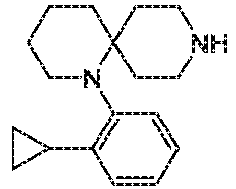
- To a solution of tert-butyl 4-((2-cyclopropylphenyl)imino)piperidine-1-carboxylate (5 g, 15.90 mmol) in DCM (50 mL) was added but-3-en-1-ylmagnesium bromide (0.5 M, 159 mL, 79.51 mmol) at -20°C. The mixture was stirred at -20°C for 2 hours. TLC indicated the reactant was consumed completely. The reaction mixture was quenched aq. HN4Cl (100 mL) and extracted with DCM (100 mL × 3), dried over Na2SO4, filtered and concentrated. After the residue was purified by prep-MPLC, tert-butyl 4-(but-3-en-1-yl)-4-((2-cyclopropylphenyl)amino)piperidine-1-carboxylate (2.5 g) was obtained as a yellow oil. MS (ESI, m/e) [M+1]' 371.3.
- To a solution of tert-butyl 4-(but-3-en-1-yl)-4-((2-cyclopropylphenyl)amino)piperidine-1-carboxylate (2.5 g, 6.75 mmol) in THF (25 mL) was added BH3. THF (1M, 33.74 mL, 33.74 mmol) at 0°C. The mixture was stirred at 25°C for 2 hours. Then to the mixture was added NaOH (2.5M, 6.75 mL, 6.75mmol) and H2O2 (11.48 g, 101.21 mmol) at 0°C. The mixture was stirred at 25°C for 2 hours. TLC indicated the reactant was consumed completely. The reaction mixture was poured into aq. Na2SO3 (100 mL) and extracted with EA (100 mL × 3), dried over Na2SO4, filtered and concentrated. After the residue was purified by prep-MPLC, tert-butyl 4-((2-cyclopropylphenyl)amino)-4-(4-hydroxybutyl)piperidine-1-carboxylate (1.2 g) was obtained. 1H NMR (400MHz, CDCl3) δ ppm: 7.09 (d, J = 7.5 Hz, 1H), 7.07 - 7.01 (m, 1H), 6.74 (d, J = 7.9 Hz, 1H), 6.61 (t, J = 7.4 Hz, 1H), 3.95 (s, 1H), 3.77 - 3.67 (m, 1H), 3.63 - 3.50 (m, 1H), 3.11 - 2.93 (m, 2H), 2.55 - 2.41 (m, 1H), 2.00 (d, J = 11.7 Hz, 1H), 1.92 - 1.70 (m, 4H), 1.66 - 1.56 (m, 1H), 1.46 (s, 9H), 1.36 - 1.29 (m, 1H), 0.98 - 0.86 (m, 5H), 0.67 - 0.57 (m, 2H).
- To a solution of tert-butyl 4-((2-cyclopropylphenyl)amino)-4-(4-hydroxybutyl)piperidine-1-carboxylate (1 g, 2.57 mmol) in DCM (10 mL) and TEA (520.87 mg, 5.51 mmol) was added MsCl (294.82 mg, 2.57 mmol) at 0°C and the mixture was stirred at 25°C for 2 hours. TLC indicated the reactant was consumed completely. The reaction mixture was quenched with aq. HN4Cl (10 mL) and extracted with DCM (10 mL × 3), dried over Na2SO4, filtered and concentrated. After the residue was purified by prep-MPLC, tert-butyl 1-(2-cyclopropylphenyl)-1,9-diazaspiro[5.5]undecane-9-carboxylate (0.7 g) was obtained as a yellow oil. MS (ESI, m/e) [M+1]' 371.4.
- A mixture of tert-butyl 1-(2-cyclopropylphenyl)-1,9-diazaspiro[5.5]undecane-9-carboxylate (0.7 g, 1.89 mmol) in DCM (4 mL) and TFA (4 mL) was stirred at 20°C for 1 hour. LC/MS showed the reactant was consumed completely and one main peak with desired mass signal. The reaction mixture was concentrated in vacuum to remove solvent. The residue was diluted with H2O (10 mL) and was adjusted to pH ∼ 9 with Na2CO3. Then the mixture was extracted with EA (10 mL × 3). The combined organic layers were washed with brine, dried over Na2CO3, filtered and concentrated to obtain 1-(2-cyclopropylphenyl)-1,9-diazaspiro[5.5]undecane (452 mg). 1H NMR (400MHz, CDCl3) δ ppm: 7.25 - 7.20 (m, 1H), 7.11 - 7.04 (m, 2H), 6.73 - 6.66 (m, 1H), 3.40 - 3.27 (m, 2H), 3.04 - 2.92 (m, 2H), 2.81 - 2.58 (m, 3H), 2.48 - 2.42 (m, 1H), 2.33 - 2.22 (m, 1H), 1.82 - 1.67 (m, 2H), 1.67 - 1.54 (m, 2H), 1.22 (dt, J = 4.0, 12.8 Hz, 1H), 1.11 (d, J = 6.8 Hz, 3H), 0.94 (dd, J = 1.8, 8.6 Hz, 2H), 0.75 - 0.66 (m, 1H), 0.61 - 0.54 (m, 1H). MS (ESI, m/e) [M+1]+ 271.4.
-

- A mixture of 1-(tert-butylsulfonyl)-5-(2-cyclopropylphenyl)pyrrolidin-3-ol (5.0 g, 15.46 mmol), DMP (8.52 g, 20.1 mmol) and NaHCO3 (1.43 g, 17.0 mmol) in DCM (50 mL). The mixture was stirred at 20°C for 3 hours. TLC indicated the reaction was complete. The mixture was quenched with Na2S2O3 (20 mL) and was adjusted to pH ~10 with aq. Na2CO3. After the mixture was extracted with DCM (50 mL×3), the combined organic layers were dried over Na2SO4, filtered and concentrated. After the residue was purified by column chromatography (SiO2, PE/EA = 50/1 to 15/1), 1-(tert-butylsulfonyl)-5-(2-cyclopropylphenyl)pyrrolidin-3-one (3.5 g) was obtained. 1H NMR (400 MHz, CDCl3) δ ppm: 7.18 - 7.23 (m, 2 H), 7.12 - 7.16 (m, 1 H), 7.02 - 7.08 (m, 1 H), 6.33 (d, J=8.8 Hz, 1 H), 4.54 (d, J=18.7 Hz, 1 H), 3.83 (d, J=18.7 Hz, 1 H), 3.21 (dd, J=17.9, 10.03 Hz, 1 H), 2.50 (d, J=17.9 Hz, 1 H), 1.85 - 1.95 (m, 1 H), 1.26 (s, 8 H), 0.93 - 1.08 (m, 2 H), 0.70 - 0.79 (m, 1 H), 0.58 - 0.65 (m, 1 H).
- To the mixture of 1-(tert-butylsulfonyl)-5-(2-cyclopropylphenyl)pyrrolidin-3-one (3.5 g, 10.89 mmol), dimethylamine hydrochloride (3.55 g, 43.55 mmol) in DCE (40 mL), was added NaBH(OAc)3 (6.92 g, 32.67 mmol). The mixture was stirred at 20 °C for 2 hours under N2 atmosphere. TLC indicated the reaction was complete. The mixture was concentrated and purified by prep-HPLC (TFA condition). 1-(tert-butylsulfonyl)-5-(2-cyclopropylphenyl)-N,N-dimethylpyrrolidin-3-amine (2.2 g, 6.28 mmol, 57.64% yield) was obtained. MS (ESI, m/e) [M+1]+ 351.3.
- A mixture of 1-(tert-butylsulfonyl)-5-(2-cyclopropylphenyl)- N,N-dimethylpyrrolidin-3-aminc (1.0 g, 2.85 mmol) in TFA (10 mL) was stirred at 70°C for 12 hours. TLC showed the reaction was complete. The mixture was concentrated and was adjusted to pH ~10 with saturated aq. Na2CO3 (10 mL). The mixture was extracted with EA (10 mL×5) and the combined organic layers were dried over anhydrous Na2SO4 and then concentrated. 5-(2-cyclopropylphenyl)-N,N-dimethylpyrrolidin-3-amine (170 mg) was obtained. 1H NMR (400 MHz, CDCl3) δ ppm: 7.52 - 7.63 (m, 1 H), 7.11 - 7.24 (m, 2 H), 7.00 (d, J=7.5 Hz, 1 H), 4.70 - 4.92 (m, 1 H), 3.07 - 3.42 (m, 2 H), 2.81 - 2.99 (m, 1 H), 2.38 - 2.50 (m, 1 H), 2.25 - 2.35 (m, 4 H), 1.63 (dt, J=1 1.9, 9.8 Hz, 1 H), 0.89 - 0.98 (m, 2 H), 0.62 - 0.76 (m, 1 H). MS (ESI, m/e) [M+1]+ 231.3.
-

- A mixture of (R)-1-(2-(2-bromophenyl)pyrrolidin-1-yl)-2,2,2-trifluoroethanone (8 g, 24.8 mmol), tert-butyl 4-(4,4,5,5-tetramethyl-1,3,2-dioxaborolan-2-yl)-5,6-dihydropyridine - 1(2H)-carboxylate (11.5 g, 37.2 mmol), Pd(OAc)2 (560 mg, 2.48 mmol), tricyclohexyl phosphine (1.4 g, 4.96 mmol) and K3PO4 (15.8 g, 74.4 mmol, 3.0 eq) in toluene (100 mL) and H2O (5 mL) was heated to 100 °C under N2 protection and stirred for 5 hours. TLC showed the reaction was complete. The mixture was cooled to room temperature and diluted with EA (50 mL), washed with water (100 mL), brine (100 mL), dried over Na2SO4, and concentrated. The residue was purified by column chromatography on silica gel (eluent: PE/EA = 5/1 to 2/1) to obtain (R)-tert-butyl 4-(2-(1-(2,2,2-trifluoroacetyl)pyrrolidin-2-yl)phenyl)-5,6-dihydropyridine-1(2H)-carboxylate (9 g, crude) as a brown solid. MS (ESI, m/e) [M+1]' 425.2.
- A mixture of (R)-tert-butyl 4-(2-(1-(2,2,2-trifluoroacetyl)pyrrolidin-2-yl)phenyl)-5,6-dihydropyridine-1(2H)-carboxylate (9 g, 21.2 mmol) and Pd/C (10%, 2 g) in CH3OH (200 mL) was stirred at 20°C under H2 atmosphere (15 psi) for 12 hours. LC/MS showed the reaction was completed. The mixture was filtered and the filtrate was concentrated to give (R)-tert-butyl 4-(2-(1-(2,2,2-trifluoroacetyl)pyrrolidin-2-yl)phenyl)piperidine-1-carboxylate (7.5 g, crude) as an off-white solid. MS (ESI, m/e) [M+1]+ 427.3.
- To a solution of (R)-tert-butyl 4-(2-(1-(2,2,2-trifluoroacetyl)pyrrolidin-2-yl)phenyl)piperidine-1-carboxylate (7.5 g, 17.6 mmol) in CH3OH (50 mL) was added a solution of NaOH (2.8 g, 70.4 mmol) in H2O (30 mL). Then the mixture was heated to 40°C and stirred for 2 hours. TLC showed the reaction was complete. The mixture was concentrated in vacuum to remove the organic solvent and the remained water solution was extracted with EA (100 mL). The organic layer was washed with brine (100 mL), dried over Na2SO4, and concentrated to give (R)-tert-butyl 4-(2-(pyrrolidin-2-yl)phenyl)piperidine-1-carboxylate (6 g, crude). MS (ESI, m/e) [M+1]+ 331.3.
- A mixture of (R)-tert-butyl 4-(2-(pyrrolidin-2-yl)phenyl)piperidine-1-carboxylate (2 g, 6.1 mmol), 1-bromo-4-iodobenzene (3.5 g, 12.2 mmol), Pd2(dba)3 (559 mg, 0.61 mmol), BINAP (760 mg, 1.22 mmol) and t-BuOK (1.4 g, 12.2 mmol) in toluene (20 mL) was heated to 100°C under N2 protection and stirred for 12 hours. TLC showed the reaction was completed. The mixture was cooled to room temperature and diluted with EA (20 mL), washed with water (20 mL), brine (20 mL), dried over Na2SO4, and concentrated in vacuum. The residue was purified by column chromatography on silica gel (eluent: PE/EA = 20/1 to 15/1) to give (R)-tert-butyl 4-(2-(1-(4-bromophenyl)pyrrolidin-2- yl)phenyl)piperidine-1-carboxylate (2 g). 'H NMR (400 MHz, CDCl3) δ ppm: 7.29 (1 H, s), 7.22 - 7.26 (1 H, m), 7.18 - 7.22 (2 H, m), 7.01 - 7.12 (2 H, m), 6.23 - 6.31 (2 H, m), 4.91 (1 H, d, J=6.8 Hz), 4.31 (2 H, s), 3.65 - 3.75 (1 H, m), 3.35 - 3.47 (1 H, m), 2.95 - 3.07 (1 H, m), 2.82 (2 H, s), 2.41 - 2.55 (1 H, m), 1.97 - 2.10 (2 H, m), 1.79 - 1.93 (3 H, m), 1.61 - 1.74 (2 H, m), 1.51 (9 H, s). MS (ESI, m/e) [M+1]' 487.8.
-

- To a solution of 2-(2-cyclopropylphenyl)pyrrolidine (700 mg, 3.7 mmol ) and tert-butyl 3-oxoazetidine-1-carboxylate(632 mg, 3.7 mmol) in DCM (10 mL) was added NaBH(OAc)3(600 mg, 3 mmol). The mixture was stirred at room temperature for 14 hours. Then saturated aq. NH4Cl (30 mL) was added to the reaction mixture under stirring. The organic phase was separated and washed with brine (10 mL), dried over anhydrous Na2SO4, concentrated in vacuum to obtain 1 g crude product. MS (ESI, in/e) [M+1]+ 343.0.
- To a solution of tert-butyl 3-(2-(2-cyclopropylphenyl)pyrrolidin-1-yl)azelidinc-1-carboxylate (680 mg, 2.0 mmol) in DCM (10 mL) was added TFA (2 mL). The mixture was stirred at room temperature for 4 hours. The solvent was removed to give 700 mg 1-(azetidin-3-yl)-2-(2-cyclopropylphenyl)pyrrolidine. MS (ESI, m/e) [M+1]+ 243.0.
- To a solution of tert-butyl 6-oxo-2-azaspiro[3.3]heptane-2-carboxylate (3 g, 0.014 mol) in toluene (50 mL) was added t-BuOK (2.0 g, 0.018 mol). The mixture was stirred at 25°C for 20 min at N2 atmosphere. Then (methoxymethyl)triphenylphosphonium chloride (6.2 g, 0.018 mol) in toluene (20 mL) was added. The mixture was stirred at 70°C for 4 hours. TLC indicated the reaction was complete. After removed the solvent, the residue was purified by column chromatograph on silica gel (eluent: PE/EA = 20/1) to obtain tert-butyl 6-(methoxymethylene)-2-azaspiro[3.3]heptane-2-carboxylate (1 g). 1H NMR (400MHz, CDCl3) δ ppm: 5.81 (s, 1H), 3.86-4.00 (s, 4H), 3.55 (s, 3H), 2.86 ( s, 2H), 2.79 ( s, 2H), 1.43 (s, 9H).
- To a solution of tert-butyl 6-(methoxymethylene)-2-azaspiro[3.3]heptane-2-carboxylate (1 g, 4.18 mmol) in CH3CN (36 mL) and H2O (9 mL) was added TFA (1 mL) and then the mixture was stirred at room temperature for 2 hours. TLC indicated the reaction was complete. The reaction mixture was adjusted to pH 8-9 with aq. Na2CO3 and was extracted with EA (20 mL × 3). The combined organic layer was washed with brine, dried, filtered and concentrated to obtain tert-butyl 6-formyl-2-azaspiro[3.3]heptane-2-carboxylate (0.9 g), which was used into next step without further purification. 1H NMR (400MHz, CDCl3) δ ppm: 9.71 (d, J=1.7 Hz, 1H), 3.94 (s, 2H), 3.85-3.86 (m, 1H), 3.80-3.84 (m, 1H), 3.82 (s, 1H), 2.98-3.20 (m, 1H), 2.30-2.46 (m, 4H), 1.41 (s, 9H).
- To the solution of tert-butyl 6-formyl-2-azaspiro[3.3]heptane-2-carboxylate (0.9 g, 4.0 mmol) in DCE (30 mL) was added 2-(2-cyclopropylphenyl)pyrrolidine (0.68 g, 3.63 mmol) and HOAc (436 mg, 7.26 mmol). After the mixture was stirred at room temperature for 30 min, NaBH(OAc)3 (1.54 g, 7.26 mmol) was added and then stirred for further 2 hours. LC/MS showed the reaction was complete. The reaction was quenched with aq. Na2CO3 ( 10 mL) and then extracted with EA (3×50 mL). The organic layer was dried, filtered and concentrated. The residue was purified by column chromatograph on silica gel (eluent: PE/EA = 2/1) to obtain tert-butyl 6-((2-(2-cyclopropylphenyl)pyrrolidin-1-yl)methyl)-2-azaspiro[3.3]heptane-2-carboxylate (0.8 g). MS (ESI, m/e) [M+1]+ 397.3.
- To a solution of tert-butyl 6-((2-(2-cyclopropylphenyl)pyrrolidin-1-yl)methyl)-2-azaspiro[3.3]heptane-2-carboxylate (0.8 g, 2.0 mmol) in DCM (20 mL) was added TFA (10mL) dropwise at 0°C. Then the mixture was stirred at room temperature for 2 hours. TLC indicated the reaction was complete. The reaction mixture was adjusted to pH 8-9 with aqueous Na2CO3 and then was extracted with DCM. The organic layer was dried, filtered and concentrated to obtain 6-((2-(2-cyclopropylphenyl)pyrrolidin-1-yl)methyl)-2-azaspiro[3.3]heptane (250 mg). 1H NMR (400MHz, CDCl3) δ ppm: 7.57 (d, J=7.4 Hz, 1H), 7.15-7.23 (m, 1H), 7.13 (dt, J=1.3, 7.4 Hz, 1H), 6.98 (d, J=7.4 Hz, 1H), 3.70-3.84 (m, 1H), 3.62 (d, J=1.7 Hz, 2H), 3.41 (s, 2H), 3.26 (t, J=8.3 Hz, 1H), 2.43-2.56 (m, 1H), 2.39 (s, 1H), 2.17-2.27 (m, 5H), 1.95-2.05 (m, 2H), 1.47-1.95 (m, 5H), 0.82-1.00 (m, 2H), 0.54-0.75 (m, 2H). MS (ESI, m/e) [M+1]' 297.3.
-
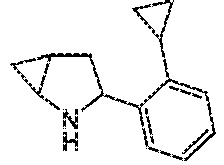
- To a solution of tert-butyl 2-(2-cyclopropylphenyl)-4-hydroxypyrrolidine-1-carboxylate (4.5 g, 14.8 mmol) in THF (50 mL) was added NaH (0.71 g, 17.8 mmol) and the mixture was stirred at 20 °C for 30 min. Then TosCl (3.4 g, 17.8 mmol) was added into the mixture and was further stirred at 20 °C for 12 hours. TLC showed the reaction was complete. The reaction mixture was quenched with water (100 mL), extracted with EA (100 mL). The organic layer was washed with brine (100 mL), dried over Na2SO4, and concentrated. The residue was purified by column chromatography on silica gel (eluent: PE/EA = 10/1 to 5/1) to obtain tert-butyl 2-(2-cyclopropylphenyl)-4-(tosyloxy)pyrrolidine-1-carboxylate (2.9 g). MS (ESI, m/e) [M+1]+ 458.2.
- To a solution of tert-butyl 2-(2-cyclopropylphenyl)-4-(tosyloxy)pyrrolidine-1-carboxylate (2.9 g, 6.3 mmol) in THF (50 mL) was added t-BuOK (1.4 g, 12.6 mmol) portion wise. After addition, the mixture was stirred at 20 °C for 12 hours. TLC showed the reaction was complete. The mixture was quenched with saturated aq. NH4Cl (50 mL) and was extracted with EA (50 mL). The organic layer was washed with brine (50 mL), dried over Na2SO4, and concentrated. The residue was purified by column chromatography on silica gel (eluent: PE/EA = 100/1) to give tert-butyl 2-(2-cyclopropylphenyl)-2,3-dihydro-1H-pyrrole-1-carboxylate (900 mg). MS (ESI, m/e) [M+1]' 286.4.
- To a solution of tert-butyl 2-(2-cyclopropylphenyl)-2,3-dihydro-1H-pyrrole-1-carboxylate (900 mg, 3.2 mmol) in toluene (20 mL) at 0 °C was added Et2Zn (1 M in toluene, 15.8 mL, 15.8 mmol) and ClCH2I (5.56 g, 32 mmol). Then the mixture was stirred at 20°C for 4 hours. TLC showed the reaction was complete. The reaction mixture was quenched with saturated aq. NH4Cl (20 mL) and was extracted with EA (30 mL ×2). The organic layer was washed with brine (20 mL), dried over Na2SO4, and concentrated. The residue was purified by column chromatography on silica gel (eluent: PE/EA = 30/1) to obtain tert-butyl 3-(2-cyclopropylphenyl)-2-azabicyclo[3.1.0]hexane-2-carboxylate (500 mg). MS (ESI, m/e) [M+1]+ 300.2.
- A solution of tert-butyl 3-(2-cyclopropylphenyl)-2-azabicyclo[3.1.0]hexane-2-carboxylate (500 mg, 1.7 mmol) in HCl in EA (4 M, 10 mL) was stirred at 20 °C for 2 hours. TLC showed the reaction was complete. The mixture was quenched with saturated aq. Na2CO3 (20 mL) and extracted with EA (20 mL ×2). The organic layer was washed with brine (20 mL), dried over Na2SO4, and concentrated to obtain 3-(2-cyclopropylphenyl)-2-azabicyclo[3.1.0]hexane (293 mg). 1H NMR (400 MHz, CDCl3) δ ppm: 7.63 (dd, J=7.7, 1.3 Hz, 1H), 7.18 - 7.23 (m, 1H), 7.11 - 7.16 (m, 1H), 6.98 (d, J=7.2 Hz, 1 H), 4.54 (dd, J=10.0, 7.0 Hz, 1H), 3.00 (td, J=6.0, 2.6 Hz, 1H), 2.37 (dd, J=12.3, 7.0 Hz, 1H), 1.91 - 2.02 (m, 1H), 1.72 - 1.83 (m, 1H), 1.48 - 1.59 (m, 1H), 0.87 - 1.03 (m, 1H), 0.87 - 1.03 (m, 1H), 0.77 - 0.84 (m, 1H), 0.60 - 0.73 (m, 2H), 0.60 - 0.73 (m, 2H), 0.42 (dt, J=8.1, 5.9 Hz, 1H), 0.37 - 0.47 (m, 1H). MS (ESI, m/c) [M+1]+ 200.2.
-

- To the solution of 1-bromo-2-cyclopropylbenzene (8.5 g, 0.043 mol) in THF(20 mL) was added n-BuLi (21 mL, 0.052 mol, 2.5M in hexane) at -78°C under N2 atmosphere. Then the mixture was stirred at -78°C for 1 hour. To the solution of tetrahydrocyclopenla[c]pyrrole-1,3(2H,3aH)-dione (4 g, 0.029 mol) in THF (20 mL) was added n-BuLi (13 mL, 0.035 mol, 2.5M in hexane) at -78°C under N2 atmosphere. Then the mixture was stirred at 0°C for 1 hour. The solution formed from 1-bromo-2-cyclopropylbenzene was added dropwise to the solution formed from tetrahydrocyclopenta[c]pyrrole-1,3(2H,3aH)-dione at -78°C. The resulting mixture was stirred at room temperature for 3 hours. TLC showed tetrahydrocyclopenta[c]pyrrole-1,3(2H,3aH)-dione was consumed . NaBH3CN (2.2 g, 0.035 mol) was added to the mixture and then followed by addition of 6N HCl acid (20 mL) at 0°C, and further stirred at room temperature for 1 hour. Na2CO3 (50 mL) was added to the mixture to adjust the pH to 8-9. The mixture was then extracted with EA (50 mL × 3), and the organic layer was washed with brine (50 mL × 2). The combined organic layer was dried, filtered and concentrated. The residue was purified by column chromatograph on silica gel (eluent: PE/EA = 10/1) to obtain 3-(2-cyclopropylphenyl)hexahydrocyclopenta[c]pyrrol-1(2H)-one(2.8 g). 1H NMR (400MHz, CDCl3) δ ppm: 7.19-7.23 (m, 1H), 7.11-7.16 (m, 2H), 6.95-7.01 (m, 1H), 6.20 (s, 1H), 5.44 (d, J=7.7 Hz, 1H), 3.08-3.24 (m, 1H), 2.93-3.04 (m, 1H), 2.73-2.87 (m, 1H), 1.91-2.06 (m, 1H), 1.73-1.83 (m, 2H), 1.51-1.64 (m, 1H), 1.40-1.49 (m, 2H), 1.33 (s, 1H), 1.10-1.20 (m, 1H), 0.52-0.73 (m, 2H). MS (ESI, m/e) [M+1]+ 242.3.
- To the solution of 3-(2-cyclopropylphenyl)hexahydrocyclopenta[c]pyrrol-1(2H)-one (1.0 g, 4.15 mmol, 1 eq) in THF (20 mL) was added BH3.DMS (4.2 mL, 41.5 mmol, 10 eq, 10M in DMS) dropwise at 0°C. After the addition, the mixture was stirred at room temperature for 12 hr. TLC showed the reactant consumed completely. At 0°C, MeOH (2 mL) and 1N HCl (20 mL) were added into the reaction mixture carefully. The mixture was then stirred at room temperature for 1 hour. The reaction was quenched with aq. Na2CO3 (50 mL) and was adjusted to pH ~9. The mixture was extracted with EA (50 mL×3). The organic layer was washed with brine (50 mL×2), dried, filtered and concentrated. The residue was purified by column chromatograph on silica gel (eluent: PE/EA = 5/1) to obtain target product(300 mg). 1H NMR (400MHz, CDCl3) δ ppm: 7.54-7.59 (m, 1H), 7.12-7.19 (m, 2H), 6.95-7.01 (m, 1H), 4.53 (d, J=6.97 Hz, 1H), 3.02-3.09 (m, 1H), 2.89-3.02 (m, 2H), 2.65 (quin, J=7.86 Hz, 1H), 1.91-2.03 (m, 2H), 1.55-1.64 (m, 1H), 1.24-1.39 (m, 1H), 1.18-1.39 (m, 1H), 1.18-1.20 (m, 1H), 1.11-1.21 (m, 1H), 0.87-0.99 (m, 3H), 0.61-0.78 (m, 2H). MS (ESI, m/e) [M+1]+ 228.5.
-

- To a solution of 1-(tert-butylsulfonyl)-5-(2-cyclopropylphenyl)pyrrolidin-3-ol (10.5 g, 32.46 mmol) in DMF (250 mL) was added NaH (1.43 g, 35.71 mmol, 60%) in portions at 10°C. The mixture was stirred at 10°C for 30 min. 2-chloro-N,N-dimethylacetamide (4.14 g, 34.09 mmol) was then added dropwise at 10°C. The mixture was stirred at 10°C for 2hour. TLC indicated the reactant was consumed completely. The reaction mixture was quenched by saturated aq.NH4Cl (50 mL) and was extracted with EA (100 mL × 3). The combined organic phases were washed with brine (50 mL × 2), dried with anhydrous Na2SO4, filtered and concentrated. The residue was purified by column chromatography (SiO2, PE/EA = 5/1 to 0/1) and 2-((1-(tert-butylsulfonyl)-5-(2-cyclopropylphenyl)pyrrolidin-3-yl)oxy)- N,N-dimethylacetamide (8.48 g) was obtained. MS (ESI, m/e) [M+1]+ 410.1.
- A solution of 2-((1-(tert-butylsulfonyl)-5-(2-cyclopropylphenyl)pyrrolidin-3-yl)oxy)-N,N-dimethylacetamide (8.4 g, 20.56 mmol) in TFA (100 mL) was stirred at 75°C for 12 hours. LC/MS indicated the reactant was consumed completely and the desired mass signal. The reaction mixture was concentrated in vacuum to ~ 20 mL and was poured into saturated aq. NaHCO3 (50 mL) to adjust the pH ~8. The aqueous phase was extracted with EA (100 mL × 3). The combined organic phases were washed with brine (50 mL × 2), dried with anhydrous Na2SO4, filtered and concentrated. 2-((5-(2-cyclopropylphenyl)pyrrolidin-3-yl)oxy)-N,N-dimethylacetamide (22 g, crude) was obtained. MS (ESI, m/e) [M+1]+ 289.3.
- A solution of 2-((5-(2-cyclopropylphenyl)pyrrolidin-3-yl)oxy)-N,N-dimethylacetamide (1.2 g, 4.16 mmol) in THF (50 mL) was added BH3,DMS (8.32 mL, 83.2 mmol, 10N in DMS) dropwise at 20°C. The mixture was heated to 70°C and stirred for 10 hours. LC/MS indicated the reactant was consumed completely. The reaction mixture was quenched with MeOH (10 mL) and was de-complexation by HCl/MeOH (4N, 20 mL) by reflux for 2 hours. LC/MS indicated the desired compound was generated. The reaction mixture was concentrated in vacuum. The residue was purified by prep-HPLC (Xtimate C18 10u 250 mm * 50 mm; mobile phase: [water (0.1% TFA)-ACN]). 2-((5-(2-cyclopropylphenyl)pyrrolidin-3-yl)oxy)-N,N-dimethylethanamine (1.4 g, TFA salt) was obtained. This salt was dissolved in CH3CN (100 mL) and K2CO3 (560.9 mg, 4.07 mmol, 1.5 eq) was added into the solution in one portion and was then stirred at 20°C for 2 hours. The mixture was filtered and the filtrate was concentrated to obtain 2-((5-(2-cyclopropylphenyl)pyrrolidin-3-yl)oxy)-N,N-dimethylethanamine (385 mg). 1H NMR (400MHz, CDCl3) δ ppm: 7.46 - 7.57 (m, 1 H), 7.10 - 7.20 (m, 2 H), 6.93 - 7.02 (m, 1 H), 4.91 (t, J=8.0 Hz, 1 H), 4.10 - 4.20 (m, 1 H), 3.50 - 3.58 (m, 2 H), 3.34 (dd, J=11.3, 5.1 Hz, 1 H), 3.05 - 3.18 (m, 1 H), 2.54 (t, J=5.8 Hz, 2 H), 2.35 - 2.46 (m, 1 H), 2.19 - 2.33 (m, 6 H), 1.92 - 2.03 (m, 1 H), 1.54 - 1.91 (m, 2 H), 0.84 - 1.00 (m, 2 H), 0.56 - 0.73 (m, 2 H). MS (ESI, m/e) [M+1]+ 275.1.
-

- To a mixture of (S)-2-(2-bromophenyl)pyrrolidine (1.5 g, 6.63 mmol) and EtONa (1.35 g, 19.90 mmol) in EtOH (15 mL) was added CuBr (475.81 mg, 3.32 mmol). Then the mixture was stirred at 90°C for 12 hours. LC/MS showed the reaction was complete and the peak with desired mass signal. The mixture was cooled to room temperature and was adjusted to pH -11 with aq. Na2CO3 and was then extracted with EA (20 mL×3). The combined organic layers were dried over Na2SO4, filtered and concentrated. The residue was purified by prep-HPLC (TFA condition). (S)-2-(2-ethoxyphenyl)pyrrolidine (0.7 g) was obtained. MS (ESI, m/e) [M+1]+ 192.3.
- A mixture of (S)-2-(2-ethoxyphenyl)pyrrolidine (0.5 g, 2.61 mmol) and tert-butyl 2-oxo-7-azaspiro[3.5]nonane-7-carboxylate (568.71 mg, 2.38 mmol), HOAc (428.13 mg, 7.13 mmol) in DCE (5 mL) was stirred at 20°C for 2 hours. NaBH(OAc)3 (1.01 g, 4.75 mmol) was added into the mixture and was furthered stirred at 20°C for 12 hours. TLC showed the reaction was complete. The mixture was adjusted to pH ~11 with aq. Na2CO3 and was then extracted with EA (20 mL×3). The combined organic layers were dried over Na2SO4, filtered and concentrated. The residue was purified by column chromatography on silica gel (eluent: PE/EA = 20/1 to 10/1) and (S)-tert-butyl 2-(2-(2-ethoxyphenyl)pyrrolidin-1-yl)-7-azaspiro[3.5]nonane-7-carboxylate (0.6 g) was obtained. MS (ESI, m/e) [M+1]+ 415.4.
- To the solution of (S)-tert-butyl 2-(2-(2-ethoxyphenyl)pyrrolidin-1-yl)-7-azaspiro[3.5]nonane- 7-carboxylate (0.6 g, 1.45 mmol) in DCM (10 mL) was added TFA (1.65 g, 14.47 mmol). The mixture was stirred at 20 °C for 1 hour. TLC indicated one new spot formed. The reaction mixture was adjusted to pH 8-9 with aqueous Na2CO3 and then was extracted with DCM (10 mL×5). The combined organic layer was washed with brine, dried over Na2SO4 and concentrated. (S)-2-(2-(2-ethoxyphenyl)pyrrolidin-1-yl)-7-azaspiro[3.5]nonane (360 mg) was obtained. 1H NMR (400 MHz, CDCl3) δ ppm: 7.49 - 7.58 (m, 1 H), 7.13 - 7.21 (m, 1 H), 6.93 (t, J=7.4 Hz, 1 H), 6.82 (d, J=7.4 Hz, 1 H), 4.04 (d, J=7.1 Hz, 2 H), 3.91 (t, J=7.1 Hz, 1 H), 3.07 - 3.21 (m, 2 H), 2.72 - 2.90 (m, 4 H), 2.40 (q, J=8.4 Hz, 1 H), 2.14 - 2.26 (m, 1 H), 1.73 - 1.94 (m, 5 H), 1.47 - 1.73 (m, 8 H), 1.41 (t, J=6.95 Hz, 3 H). MS (ESI, m/e) [M+1]+ 315.3.
-
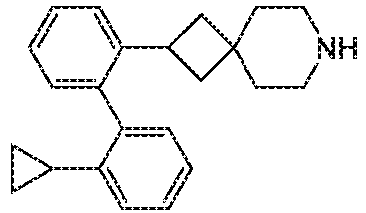
- A mixture of tert-butyl 2-oxo-7-azaspiro[3.5]nonanc-7-carboxylate (10.00 g, 41.79 mmol) and 4-methylbenzenesulfonohydrazide (9.34 g, 50.14 mmol) in EtOH (100 mL) was stirred at 80°C for 1 hour. TLC showed the reaction was completed. The mixture was cooled to room temperature and filtered. The filtrate was concentrated in vacuum to obtain tert-butyl 2-(2-tosylhydrazono)-7-azaspiro[3.5]nonane-7-carboxylate (8.0 g, crude). 1H NMR (400 MHz, CDCl3) δ ppm: 7.84 (d, J=8.1 Hz, 2 H), 7.39 (s, 1 H), 7.33 (d, J=8.0 Hz, 2 H), 3.22 - 3.39 (m, 5 H), 2.64 (s, 2 H), 2.49 (s, 2 H), 2.44 (s, 3 H), 1.54 (t, J=5.5 Hz, 4 H), 1.45 (s, 10 H).
- A mixture of tert-butyl 2-(2-tosylhydrazono)-7-azaspiro[3.5]nonane-7-carboxylate (8.0 g, 19.63 mmol) and (2-methoxyphenyl)boronic acid (8.95 g, 58.89 mmol), Cs2CO3 (19.19 g, 58.89 mmol) in dioxane (100 mL) was stirred at 1 10°C for 4 hours. TLC showed the reaction was completed. The mixture was filtered and concentrated. The residue was purified by column chromatography on silica gel (eluent: PE). Tert-butyl 2-(2-methoxyphenyl)-7-azaspiro[3.5]nonane-7-carboxylate (3.0 g) was obtained. MS (ESI, m/e) [M+1]+ 332.3.
- To the solution of tert-butyl 2-(2-methoxyphenyl)-7-azaspiro[3.5]nonane-7-carboxylate (3.0 g, 9.05 mmol) in DCM (30 mL) under N2 atmosphere was added BBr3 (9.07g, 36.20 mmol) at -78°C. After addition, the mixture was stirred at 20°C for 6 hours. LC/MS indicated the reaction was complete. The mixture was quenched with aq. Na2CO3 and was extracted with DCM (20 mL × 3). The combined organic phase was washed with brine, dried over Na2SO4 and concentrated. The residue was purified by column chromatography on silica gel (eluent: PE/EA = 20/1). Tert-butyl 2-(2-hydroxyphenyl)-7-azaspiro[3.5]nonane-7-carboxylate (1.3 g) was obtained. MS (ESI, m/e) [M+1]+ 318.4.
- To the solution of tert-butyl 2-(2-hydroxyphenyl)-7-azaspiro[3.5]nonane-7-carboxylate (1.3 g, 4.10 mmol) and TEA (1.24 g, 6.14 mmol) in DCM (10 mL) was added Tf2O (1.73g, 12.29 mmol) under N2 atmosphere at 0°C. The mixture was then stirred at 25°C for 1 hour. TLC indicated the reaction was completed. The mixture was quenched with H2O (10 mL) and NH4Cl (10 mL) and extracted with DCM (10 mL × 3). The organic phase was washed with brine, dried over Na2SO4 and concentrated in vacuum. The residue was purified by column chromatography on silica gel (eluent: PE/EA = 40/1) to obtain ert-butyl 2-(2-(((trifluoromethyl)sulfonyl)oxy)phenyl)-7-azaspiro[3.5]nonane-7-carboxylate (1.84 g). MS (ESI, m/e) [M+1]+ 450.2.
- To the mixture of compound tert-butyl 2-(2-(((trifluoromethyl)sulfonyl)oxy)phenyl)-7-azaspiro[3.5]nonane-7-carboxylate (1.4 g, 3.11 mmol), 2-(2-cyclopropylphenyl)-4,4,5,5-tetramethyl-1,3,2-dioxaborolane (1.52 g, 6.23 mmol) and Cs2CO3 (3.04 g, 9.34 mmol) in dioxane (10 mL) was added Pd(dppf)Cl2 (1.14 g, 1.56 mmol) under N2 atmosphere. The mixture was stirred at 90°C for 12 hours. TLC indicated the reactant was consumed completely and one new spot formed. The mixture was filtered and concentrated. The residue was purified by column chromatography on silica gel (eluent: PE/EA = 50/1) to obtain tert-butyl 2-(2'-cyclopropyl-[1,1'-biphenyl]-2-yl)-7-azaspiro[3.5]nonane-7-carboxylate (0.6 mg). MS (ESI, m/e) [M+1]+ 418.5.
- To the mixture of tert-butyl 2-(2'-cyclopropyl-[1,1'-biphenyl]-2-yl)-7-azaspiro[3.5]nonane- 7-carboxylate (0.6 g, 1.44 mmol) in DCM (5 mL) was added TFA (1.39 g, 14.37 mmol). The mixture was stirred at 25 °C for 2 hours. LC/MS indicated the reaction was complete. The reaction mixture was adjusted to pH ~10 with aq. Na2CO3 and then extracted with DCM (10 mL × 3). The combined organic layer was washed with brine, dried over Na2SO4 and concentrated. 2-(2'-cyclopropyl-[1,1'-biphenyl]-2-yl)-7-azaspiro[3.5]nonane (340 mg) was obtained. 1H NMR (400 MHz, CDCl3) δ ppm: 7.34 - 7.46 (m, 2 H), 7.22 - 7.32 (m, 3 H), 7.13 - 7.22 (m, 2 H), 7.06 (d, J=7.5 Hz, 1 H), 6.83 (d, J=7.7 Hz, 1 H), 3.46 (m, J=9.15 Hz, 1 H), 3.30 (s, 2 H), 2.70 - 2.84 (m, 4 H), 1.68 - 2.03 (m, 5 H), 1.45 - 1.64 (m, 5 H), 0.72 - 0.83 (m, 2 H), 0.61 - 0.71 (m, 2 H). MS (ESI, m/e) [M+1]+ 318.1.
-

- To a solution of 2-(2-cyclopropylphenyl)pyrrolidine (1.5 g, 8.01 mmol), methyl 4-formylbenzoate (1.14 g, 7.29 mmol) in DCE (20 mL)was added CH3COOH (0.87 g, 14.58 mmol), NaBH(OAc)3 (3.09 g, 14.58 mmol). The mixture was stirred at 25 °C for 4 hours. TLC showed the reactant was consumed completely. The reaction mixture was poured into H2O (50 mL) and extracted with EA (20 mL × 3). The combined organic layers were washed with brine (25 mL × 2), dried over Na2SO4, filtered and concentrated under reduced pressure. The residue was purified by column chromatography on silica gel (eluent: PE/EA = 50/1 to 1/1) to obtain methyl 4-((2-(2-cyclopropylphenyl)pyrrolidin-1-yl)methyl)benzoate (1.8 g). MS (ESI, m/e) [M+1]+ 336.5.
- To a solution of methyl 4-((2-(2-cyclopropylphenyl)pyrrolidin-1-yl)methyl)benzoate (2 g, 6 mmol) in THF (30 mL) was added LiAlH4 (46g, 17.28mmol) slowly at 0 °C. The mixture was stirred at 0 °C for 30 min. TLC showed the reactant was consumed completely. The residue was quenched with saturated aq. NH4Cl (50 mL) and extracted with EA (50 mL). The organic phase was washed with brine, dried over Na2SO4 and concentrated to obtain (4-((2-(2-cyclopropylphcnyl)pyrrolidin-1-yl)mcthyl)phenyl)mcthanol (1.5 g). MS (ESI, m/e) [M+1]+ 308.3.
- To the solution of (4-((2-(2-cyclopropylphenyl)pyrrolidin-1-yl)methyl)phenyl)methano (1.5 g, 4.89 mmol) in THF (20 mL) was added DMP (4.14 g, 9.78 mmol). The mixture was stirred at 25 °C for 4 hours. LC/MS showed the reactant was consumed completely and one main peak with desired mass signal. The reaction mixture was quenched by addition Na2S2O3 (25 ml) and NaHCO3 (15 ml) and extracted with EA (30 mL × 3). The combined organic layers were washed with brine (30 mL × 2), dried over Na2SO4 and concentrated to obtain 4-((2-(2-cyclopropylphenyl)pyrrolidin-1-yl)methyl)benzaldehyde (1.5 g). 1H NMR (400MHz, CDCl3) δ ppm: 9.91 (s, 1 H), 7.74 (d, J=8.1 Hz, 2 H), 7.68 (d, J=7.7 Hz, 1 H), 7.43 (d, J=7.9 Hz, 2 H), 7.14 - 7.18 (m, 1 H), 7.09 (td, J=7.4, 1.2 Hz, 1 H), 6.94 (d, J=7.5 Hz, 1 H), 3.96 (t, J=8.2 Hz, 1 H), 3.86 (d, J=13.8 Hz, 1 H), 2.98 - 3.14 (m, 2 H), 2.18 - 2.32 (m, 1 H), 2.14 (q, J=8.8 Hz, 1 H), 1.98 (d, J=7.7 Hz, 1 H), 1.68 - 1.91 (m, 2 H), 1.63 (dd, J=9.7, 2.4 Hz, 1 H), 0.80 - 0.95 (m, 2 H), 0.63 - 0.74 (m, 1 H), 0.48 - 0.61 (m, 1 H).
-

- The mixture of 1-bromo-3-chloro-2-iodobenzene (7 g, 22.1 mmol), cyclopropylboronic acid (3.8 g, 44.2 mmol), Pd(dppf)Cl2 (1.6 g, 2.21 mmol) and K2CO3 (2 g, 7.3 mmol, 1.0 eq) in dioxane (100 mL) was heated at 70 °C for 12 hours under N2 protection. TLC showed the reaction was complete and a new spot formed. The mixture was cooled to room temperature and was diluted with EtOAc (150 mL) and H2O (50 mL). The organic phase was separated and washed with water (150 mL), brine (150 mL), dried over Na2SO4, and concentrated. The residue was purified by column chromatography on silica gel (eluent: PE) to give 1-bromo-3-chloro-2-cyclopropylbenzene (3 g, crude), which was used directly in next step.
- To a solution of 1-bromo-3-chloro-2-cyclopropylbenzene (3 g, 13 mmol) in THF (30 mL) was added n-BuLi (2.5 M, 5.7 mL, 14.3 mmol) dropwise at -70°C. After stirred at -70°C for 30 min, a solution of tert-butyl 2-oxopyrrolidine-1-carboxylate (2.64 g, 14.3 mmol, 1.1 eq) in THF (5 mL) was added dropwise into the mixture at -70°C. The mixture was further stirred at -70°C for 2 hours. TLC showed the reaction was complete. The mixture was quenched with water (50 mL) and extracted with EtOAc (50 mL). The organic layer was washed with brine (50 mL), dried over Na2SO4, and concentrated. The residue was purified by column chromatography on silica gel (eluent: PE/EA = 5/1) to give tert-butyl (4-(3-chloro-2-cyclopropylphenyl)-4-oxobutyl) carbamate (1.3 g). 1H NMR (400 MHz, CDCl3) δ ppm: 7.35 (dd, J=7.6, 1.7 Hz, 1 H), 7.06 - 7.15 (m, 2 H), 4.56 (s, 1 H), 3.14 (q, J=6.3 Hz, 2 H), 2.89 (t, J=7.2 Hz, 2 H), 1.78 - 1.95 (m, 3 H), 1.37 (s, 9 H), 0.92 - 1.03 (m, 2 H), 0.35 - 0.45 (m, 2 H).
- To a solution of tert-butyl (4-(3-chloro-2-cyclopropylphenyl)-4-oxobutyl)carbamate (1.3 g, 3.8 mmol) in DCM (20 mL) was added TFA (4.4 g, 38 mmol). Then the mixture was stirred at 20°C for 2 hours. TLC showed the reaction was completed. The mixture was concentrated in vacuum to give 4-amino-1-(3-chloro-2-cyclopropylphenyl)butan-1-one (900 mg, crude). MS (ESI, m/e) [M+1]+ 237.9.
- A solution of 4-amino-1-(3-chloro-2-cyclopropylphenyl)butan-1-one (900 mg, 3.8 mmol) and AcOH (0.5 mL) in EtOH (10 mL) was heated to 65°C and stirred for 3 hours. Then the mixture was cooled to room temperature and NaBH3CN (360 mg, 5.7 mmol, 1.5 eq) was added into it. The mixture was further stirred for 1 hour at room temperature. TLC showed the reaction was completed. The reaction mixture was quenched and adjusted to pH ~10 with sat. aq. Na2CO3 and then extracted with EtOAc (20 mL × 3). The organic layers were combined, dried over Na2SO4 and concentrated. The residue was purified by column chromatography on silica gel (eluent: EA/MeOH = 10/0 to 10/ 1) to give the racemic 2-(3-chloro-2-cyclopropylphenyl)pyrrolidine.
- The racemic product was purified by SFC (Instrument: Thar SFC350 preparative SFC; Column: Chiralpak AD, 250*50mm i.d. 10u; Mobile phase: A for CO2 and B for MeOH(0.1% NH3.H2O); Gradient: B%=20%; Flow rate:200g/min; Wavelength:220 nm; Column temperature: 40°C; System back pressure: 100 bar) to give 2 isomers: the faster isomer (715 mg, retention time: 2.4 min) is (S or R)-2-(3-chloro-2-cyclopropylphenyl)pyrrolidine; the slower isomer (737 mg, retention time: 2.7 min) is (R or S)-2-(3-chloro-2-cyclopropylphenyl)pyrrolidine .
-

- To a solution of 4-fluoro-3-nitrobenzenesulfonamide (36.3 g, 0.165 mol) in THF (500 mL) were added (tetrahydro-2H-pyran-4-yl)methanamine (20.9 g, 0.182 mol) and TEA (20.0 g, 0.198 mol) at 0-5°C, the reaction was slowly warmed to r.t. stirred for about 16 hours. EA (1.5 L) was added to the reaction, the mixture was washed with sat. NaH2PO4 (100 mL) and saturated NaCl solution (100 mL), dried over anhydrous Na2SO4, filtered and concentrated to give the product (49.1 g, 95.0% yield) as yellow solid.
-

- To a mixture of compound 4-fluoro-3-nitrobenzenesulfonamide (540 mg, 2.45 mmol) and Na2CO3 (155.97 mg, 1.47 mmol) in i-PrOH (1.5 mL) was added compound (4-fluorotetrahydro-2H-pyran-4-yl)methanol (489.89 mg, 3.68 mmol) at 20°C under N2, the mixture was stirred at 60°C for 2 hours. The mixture was filtered and washed by water. Compound 4-((4-fluorotetrahydro-2H-pyran-4-yl)methoxy)-3-nitrobenzenesulfonamide (758 mg) was obtained as a yellow solid. 1H NMR (400MHz, DMSO-d6 ) δ ppm: 8.58 (br t, J = 6.0 Hz, 1H), 8.46 (d, J = 6.0 Hz, 1H), 7.81 (dd, J = 1.7, 9.3 Hz, 1H), 7.40 (br d, J = 9.3 Hz, 1H), 7.30 (br s, 2H), 3.81-3.70 (m, 4H), 3.56-3.45 (m, 2H), 1.89-1.69 (m, 4H). MS (ESI, m/e) [M+1]+ 334.0.
-

-

- To a solution of tetrahydro-4H-pyran-4-one (1.162 g, 11.6 mmol) in DCM (50 ml) was added tert-butyl azetidin-3-ylcarbamate (1 g, 5.8 mmol). The mixture was stirred at r.t. for 2 hours. Then to the mixture was added NaBH(OAc)3 (3.687 g, 17.4 mmol). The mixture was stirred at r.t. overnight. The mixture was diluted with DCM (200 ml), washed with brine (200 ml × 2), dried over Na2SO4, concentrated. The residue was purified by chromatography column on silica with eluent of MeOH/DCM = 1/20 (v/v) to give the product (800 mg) as a yellow oil. MS (ESI, m/c) [M+1]' 257.1.
-

- To a solution 4 N HCl (g) in dioxane (30 mL) was added tert-butyl (1-(tetrahydro-2H-pyran-4-yl)azetidin-3-yl)carbamate ( 300 mg, 1.17 mmol). The mixture was stirred at room temperature for 2 hours. The mixture was concentrated give the crude product (250 mg).
-

- To a solution of 1-(tetrahydro-2H-pyran-4-yl)azetidin-3-amine dihydrochloride (206 mg, 0.899 mmol) and 4-fluoro-3-nitrobenzenesulfonamide (282 mg, 1.28 mmol) in THF (50 mL) was added triethylamine (540.4 mg, 5.35 mmol). The mixture was stirred at room temperature for 4 hours. The mixture was filtered to give the product (300 mg, 93.6%) as a yellow solid. 1H NMR (400 MHz, DMSO-d6 ) δ ppm: 8.48 (s, 1H), 8.40 (s, 1H), 7.86 (d, J = 9.0 Hz, 1H), 7.39 (s, 2H), 7.10 (d, J = 9.0 Hz, 1H), 4.46-4.21 (m, 1 H), 3.97-3.56 (m, 4H), 3.47-3.14 (m, 4H), 2.46-2.19 (m, 1 H), 1.63 (d, J = 10.4 Hz, 2H), 1.20-1.19 (m, 2 H).
-
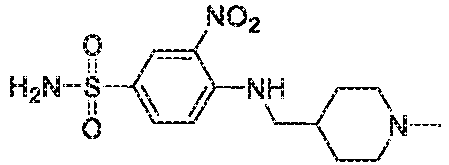
- To a solution of 4-fluoro-3-nitrobenzenesulfonamide (1.15 g, 5.2 mmol) and (1-methylpiperidin-4-yl)methanamine (640 mg, 5 mmol)in THF (12 mL) was added TEA ( 1.01 g, 10 mmol). The mixture was stirred at room temperature for 3 hours. And some solid came out. The mixture was filtered. Collected the solid (550 mg) as a yellow solid. MS (ESI, m/e) [M+1]+ 328.8.
-

- To a solution of 7-oxa-2-azaspiro[3.5]nonane hydrochloride (556 mg, 3.4 mmol) and 4-fluoro-3-nitrobenzenesulfonamide (500 mg, 2.27 mmol) in THF (50 mL) was added triethylamine (688 mg, 6.81 mmol). The mixture was stirred at room temperature for 4 hours. The reaction mixture was concentrated and purified by chromatography column on silica with the eluent of EA/PE = 1/1 (v/v) to give the product (600 mg, 80.7% yield) as a yellow solid. 1H NMR (400 MHz, DMSO-d6 ) δ ppm: 8.17 (d, J = 2.0 Hz, 1H), 7.79 (dd, J = 9.0, 2.0 Hz, 1H), 7.32 (s, 2H), 6.90 (d, J = 9.0 Hz, 1H), 3.79 (s, 4H), 3.526 (t, J = 5.0 Hz, 4H), 1.733 (t, J = 5.0 Hz, 4H).MS (ESI, m/e) [M+1]+ 328.
-

-
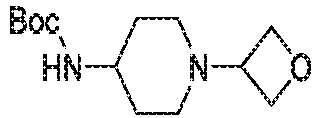
- To a solution of tert-butyl piperidin-4-ylcarbamate (1 g, 5 mmol) in DCM (50 ml) was added oxetan-3-one (1.08 g, 15 mmol), HOAC (0.2 ml). The mixture was stirred at room temperature for 2 hours. Then to the mixture was added NaBH(OAc)3 (3.18 g, 15 mmol). The mixture was stirred at r.t. for overnight. The mixture was diluted with DCM (200 ml), washed with saturated aq. NaHCO3 (100 ml), brine (200 mlx2), dried over Na2SO4, concentrated. The reaction residue was purified by chromatography column on silica (MeOH/DCM = 1/20) to give the product (1 g, 78%) as a yellow oil. 1H NMR (400 MHz, DMSO-d6 ) δ ppm: 6.79 (d, J = 6.3 Hz, 1H), 4.59-4.24 (m, 4H) , 3.32-3.26 (m, 1H), 3.25-3.07 ( m, 1 H), 2.72-2.50 (m, 3H), 1.84-1.55 (m, 4H), 1.47-1.13 (m, 11H). MS (ESI, m/c) [M+1]+ 257.1.
-

- To a solution of tert-butyl (1-(oxetan-3-yl)piperidin-4-yl)carbamate (1 g, 3.9 mmol) in DCM (30 mL) was added TFA (5 ml). The mixture was stirred at room temperature for overnight. The mixture was concentrated to give the product (1.4 g, 93.4%) as a white solid. 1H NMR (400 MHz, DMSO-d6 ) δ ppm: 11.02 (s, 1H), 8.23 (s, 3H), 4.82-4.63 (m, 4H), 4.43-4.21 (m, 1H), 3.59-3.20 (m, 3H), 3.04-2.76 (m, 2H), 2.24-1.97 (m, 2H), 1.91-1.63 (m, 2H). MS (ESI, m/e) [M+1]+ 157.2.
-

- To a solution of 1-(oxctan-3-yl)piperidin-4-amine bis(2,2,2-trifluoroacetate) (784 mg, 2.04 mmol) and 4-fluoro-3-nitrobenzenesulfonamide (471.6 mg, 2.142 mmol) in THF (50 mL) was added triethylamine (1.03 g, 10.2 mmol). The mixture was stirred at room temperature for 4 hours. The mixture was filtered to give the product (500 mg, 68.8%) as a yellow solid. MS (ESI, m/e) [M+1]' 357.0
-

-

- To a solution of 3-(aminomethyl)oxetan-3-ol (500 mg, 4.85 mmol) in DCM (50 ml) was added tert-butylchlorodimethylsilane (694 mg, 4.6 mmol), triethylamine (1.47 g, 14.55 mmol). The mixture was stirred at r.t. overnight. Then it was washed with saturated aq. NaHCO3 (500 ml), brine (50 ml × 2), dried over Na2SO4, concentrated to give the crude product, which was used directly for next step.
-

- To a solution of (3-((terl-bulyldimethylsilyl)oxy)oxetan-3-yl)methanamine (1.054 g, 4.85 mmol) in THF (50 mL) was added 4-fluoro-3-nitrobenzenesulfonamide (1.28 g, 5.82 mmol). The mixture was stirred at room temperature for 4 hours. The mixture was filtered to give the product (1.2 g, 59.3%) as a yellow solid. 1H NMR (400 MHz, DMSO-d6 ) δ ppm: 8.49 (d, J = 2.2 Hz, 1H), 8.41 (t, J = 4.8 Hz, 1H), 7.41-7.34 (m, 3H), 4.60 (d, J = 7.0 Hz, 2H), 4.47 (d, J = 7.0 Hz, 2H), 3.84 (d, J = 5.1 Hz, 2H), 0.88 (s, 9H), 0.13 (s, 6H), MS (ESI, m/e) [M+1]+ 418.1
-

-

- To a solution of ethyl 4-hydroxycyclohexane-1-carboxylate (2 g, 11.61mmol) in DMF (50 ml) were added tert-butylchlorodimethylsilane (1.575 g, 10.4 mmol) and imidazole (1.58 g, 23.22 mmol). The mixture was stirred at r.t. for 2 days. The mixture was concentrated. The residue was dissolved with DCM (200 ml), washed with brine, dried over Na2SO4 and concentrated. The residue was purified by chromatography column on silica (eluent: EA/PE = 1/40) to give the product (2.32 g, 69.8%).
-

- To a solution of ethyl 4-((lert-butyldimethylsilyl)oxy)cyclohcxane-1-carboxylatc (2.32 g, 8.1 mmol) in MTBE (50 mL) was added LAH (369 mg, 9.72 mmol). The mixture was stirred at reflux for 2 hours. The mixture was quenched with MeOH (10 ml) at 0 °C. The mixture was concentrated. The residue was purified by chromatography column on silica (eluent: EA/PE = 1/2) to give the product (1.5 g, 75.8%) as a yellow oil. MS (ESI, m/e) [M+1] ' 245.1
-

- To a solution of (4-((tert-butyldimethylsilyl)oxy)cyclohexyl)methanole (587 mg, 2.4mmol) in THF (50 ml) was added NaH (576 mg, 14.4 mmol) .The mixture was stirred at room temperature for 0.5 hour. Then to the mixture was added 4-fluoro-3-nitrobenzenesulfonamide (370 mg, 1.68 mmol). The mixture was stirred overnight at room temperature. The mixture was poured into sat. NaHCO3 water solution (200 mL), then adjusted pH = 5 ~ 6 with HCl acid (1 M), then extracted with ethyl acetate (200 mL × 3). The combined organic phase was washed with brine, dried over Na2SO4, concentrated. The residue was purified by chromatography column on silica (eluent: EA/PE = 1/2) to give the product as a yellow solid. MS (ESI, m/e) [M+1]+ 445.1.
-

-

- To a mixture of 4-fluoro-3-nitrobcnzenesulfonamidc (1 g, 4.54 mmol) and compound tert-butyl 4-fluoro-4-(hydroxymethyl)piperidine-1-carboxylate (1.06 g, 4.54 mmol) in THF (20 mL) was added NaH (726.61 mg, 18.17 mmol, 60% purity) in one portion at 0°C under N2. The mixture was stirred at 15°C for 14 hours. TLC showed the reaction was completed. 20 mL saturated NH4Cl solution was added to the mixture, the aqueous phase was extracted with ethyl acetate (20 mL × 3). The combined organic phase was washed with brine (50 mL), dried with anhydrous Na2SO4, filtered and concentrated in vacuum. The crude product was purified by re-crystallization in EtOAc (10 mL) to give tert-butyl 4-fluoro-4-((2-nitro-4-sulfamoylphenoxy)methyl)piperidine-1-carboxylate (1.17 g, 2.70 mmol, 59.4% yield) as yellow solid. 1H NMR (400MHz, DMSO-d6 ) δ ppm: 8.31 (br s, 1H), 8.06 (br d, J = 8.6 Hz, 1H), 7.64-7.54 (m, 1H), 7.25 (br s, 2H), 4.48-4.33 (m, 2H), 3.84 (br d, J = 11.9 Hz, 2H), 3.03 (br s, 2H), 1.97-1.84 (m, 2H), 1.82-1.61 (m, 2H), 1.41 (d, J = 2.9 Hz, 9H).
-

- To a mixture of tert-butyl 4-fluoro-4-((2-nitro-4-sulfamoylphenoxy)methyl)piperidine-1-carboxylate (1.17 g, 2.70 mmol) in EA was added HCl acid (4 M, 78.00 mL) in one portion at 15°C under N2. The mixture was stirred at 15°C for 12 hours. TLC showed the reaction was completed. The mixture was concentrated in vacuum to give 4-((4-fluoropiperidin-4-yl)methoxy)-3-nitrobenzenesulfonamide (1 g, crude, HCl salt) as yellow solid. It was used in next step directly. 1H NMR (400MHz, METHANOL-d4 ) δ ppm: 8.37 (d, J = 2.3 Hz, 1H), 8.12 (dd, J = 2.4, 8.9 Hz, 1H), 7.50 (d, J = 8.9 Hz, 1H), 4.43 (d, J = 10.0 Hz, 2H), 3.50-3.40 (m, 2H), 3.29-3.24 (m, 1H), 2.33 (br dd, J = 10.0, 12.8 Hz, 2H), 2.23-2.10 (m, 2H).
-

- To a mixture of 4-((4-fluoropiperidin-4-yl)methoxy)-3-nitrobenzenesulfonamide (1 g, 2.70 mmol, HCl) and dihydrofuran-3(2H)-one (698.40 mg, 8.11 mmol) in MeOH (20 mL) was added NaBH3CN (509.81 mg, 8.11 mmol) in one portion at 0°C under N2. The mixture was stirred at 15°C for 12 hours. LC-MS showed the reaction was completed. The mixture was poured into the sat. NaHCO3 (20 mL) solution, the aqueous phase was extracted with ethyl acetate (20 mL × 3). The combined organic phase was washed with brine (30 mL), dried with anhydrous Na2SO4, filtered and concentrated in vacuum. The mixture was dissolved in DCM, concentrated in vacuum to obtain a yellow solid. The crude product was purified by re-crystallization from MTBE (15 mL) to give 4-((4-fluoro-1-(tetrahydrofuran-3-yl)piperidin-4-yl)methoxy)-3-nitrobenzenesulfonamide (0.666 g, 1.65 mmol, 61.05% yield, 96.19% purity) as a yellow solid. 1H NMR (400MHz, METHANOL-d4 ) δ ppm: 8.34 (d, J = 2.2 Hz, 1H), 8.09 (dd, J = 2.2, 8.8 Hz, 1H), 7.47 (d, J = 8.8 Hz, 1H), 4.31 (d, J = 9.3 Hz, 2H), 4.00-3.88 (m, 2H), 3.83-3.72 (m, 1H), 3.66 (dd, J = 7.0, 8.8 Hz, 1H), 3.07 (quin, J = 7.2 Hz, 1H), 2.90 (d, J = 11.0 Hz, 1H), 2.71 (d, J = 11.8 Hz, 1H), 2.46 (q, J = 11.8 Hz, 2H), 2.20-1.80 (m, 6H). MS (ESI, m/e) [M+1]+ 404.1.
-

-

- To a solution of 4-fluoro-3-nitrobenzenesulfonamide (2.55 g, 11.56 mmol) in IPA (90 mL) at 55~60°C were added Na2CO3 (735.09 mg, 6.94 mmol) and tert-butyl 2-(aminomethyl)morpholine-4-carboxylate (3 g, 13.87 mmol). The mixture was stirred at 55-65°C for 4 hr. TLC indicated 4-fluoro-3-nitrobcnzenesulfonamide was consumed completely and one new spot formed. Concentrated and extracted with EtOAc (30 mL x 3). The combined organic layers were washed with brine (30 mL), dried over Na2SO4, filtered and concentrated under reduced pressure to give a residue. Tert-butyl 2-(((2-nitro-4-sulfamoylphcnyl)amino)mcthyl)morpholinc-4-carboxylatc (4.3 g, 10.33 mmol, 89.33% yield) was obtained as a yellow solid. The product was used in next step directly. 1H NMR (400MHz, CDCl3) δ ppm: 8.78 (d, J = 2.2 Hz, 1H), 8.61 (br s, 1H), 7.92 (dd, J = 2.1, 9.2 Hz, 1H), 6.98 (d, J = 9.0 Hz, 1H), 4.83 (s, 2H), 4.16-3.80 (m, 3H), 3.74 (t, J = 3.4, 7.0, 10.5 Hz, 1H), 3.65-3.47 (m, 2H), 3.46-3.37 (m, 1H), 3.01 (br s, 1H), 2.80 (br s, 1H), 1.48 (s, 9H).
-

- A mixture of tert-butyl 2-(((2-nitro-4-sulfamoylphenyl)amino)methyl)morpholine-4-carboxylate (2.5 g, 6.00 mmol) in TFA (10 mL) and DCM (10 mL) was stirred at 25°C for 1 hr. TLC indicated the reactant was consumed completely and one new spot formed. The reaction mixture was concentrated under reduced pressure to remove solvent. 4-((morpholin-2-ylmethyl)amino)-3-nitrobenzenesulfonamide (2.5 g, crude) was obtained as a yellow oil, which was used directly in the next step. 1H NMR (400MHz, DMSO-d6 ) δ ppm 8.57 (br t, J = 6.0 Hz, 1H), 8.48 (d, J = 2.2 Hz, 1H), 7.85 (dd, J = 2.1, 9.2 Hz, 1H), 7.36 (br s, 1H), 7.30 (d, J = 9.2 Hz, 1H), 4.08-3.89 (m, 2H), 3.77-3.61 (m, 2H), 3.61-3.51 (m, 1H), 3.34 (br d, J = 12.6 Hz, 1H), 3.20 (br d, J = 12.6 Hz, 1H), 3.01 (br, 1H), 2.90 (m, 1H).
-

- To a solution of 4-((morpholin-2-ylmethyl)amino)-3-nitrobenzenesulfonamide (600.00 mg, 1.90 mmol) and oxetan-3-one (410.05 mg, 5.69 mmol) in MeOH (60 mL) was added NaBH3CN (357.58 mg, 5.69 mmol). The mixture was stirred at 15°C for 14 hours. LC-MS showed 4-((morpholin-2-ylmethyl)amino)-3-nitrobenzenesulfonamide was consumed completely and one main peak with desired m/z. The reaction mixture was quenched by addition of H2O (10 mL) and concentrated, then extracted with EtOAc (10 mL × 3). The combined organic layers were washed with brine (10 mL), dried over Na2SO4, filtered and concentrated under reduced pressure to give a residue. The residue was washed with EA (5 mL). 3-nitro-4-(((4-(oxetan-3-yl)morpholin-2-yl)methyl)amino)benzenesulfonamide (580 mg, 1.49 mmol, 78.76% yield) was obtained as a yellow solid. 1H NMR (400MHz, DMSO-d6 ) δ ppm: 8.55 (br t, J = 5.5 Hz, 1H), 8.47 (d, J = 2.0 Hz, 1H), 7.84 (dd, J = 2.0, 9.0 Hz, 1H), 7.34 (s, 2H), 7.27 (d, J = 9.0 Hz, 1H), 4.59-4.51 (m, 2H), 4.49-4.41 (m, 2H), 3.86 (br d, J = 11.0 Hz, 1H), 3.75 (br s, 1H), 3.62-3.52 (m, 1H), 3.50-3.39 (m, 2H), 2.75 (br d, J = 11.0 Hz, 1H), 2.57 (br d, J = 11.0 Hz, 1H), 1.96 (dt, J = 2.9, 11.0 Hz, 1H), 1.80 (t, J = 11.0 Hz, 1H). MS (ESI, m/e) [M+1]+ 373.1.
-

- To a solution of 4-((morpholin-2-ylmelhyl)amino)-3-nitrobenzenesulfonamide (1 g, 3.16 mmol) in MeOH (30 mL) were added 4Å molecular sieve (0.5 g, 9.48 mmol), AcOH (1.33 g, 22.13 mmol, 1.27 mL), (1-ethoxycyclopropoxy)trimethylsilane (2.76 g, 15.81 mmol, 3.18 mL) and NaBH3CN (595.97 mg, 9.48 mmol). The mixture was stirred at 70°C for 5 hr. LC-MS showed 4-((morpholin-2-ylmethyl)amino)-3-nitrobenzenesulfonamide was consumed completely and one main peak with desired m/z. The reaction mixture was concentrated and diluted with H2O (20 mL) and extracted with EtOAc (20 mL × 3). The combined organic layers were washed with brine (20 mL) dried over Na2SO4, filtered and concentrated under reduced pressure to give a residue. The residue was purified by column chromatography (eluent: PE/EA = 10:1 to EA), 4-(((4-cyclopropylmorpholin-2-yl)methyl)amino)-3-nitrobenzenesulfonamide (300 mg, 25.82% yield) was obtained as a yellow solid. 1H NMR (400MHz, DMSO-d6 ) δ ppm: 8.57 (br t, J = 5.4 Hz, 1H), 8.47 (d, J = 2.2 Hz, 1H), 7.84 (dd, J = 2.2, 9.1 Hz, 1H), 7.35 (s, 2H), 7.28 (d, J = 9.3 Hz, 1H), 3.83 (br d, J = 11.4 Hz, 1H), 3.70-3.54 (m, 2H), 3.52-3.39 (m, 2H), 2.91 (br d, J = 10.5 Hz, 1H), 2.73 (br d, J = 11.4 Hz, 1H), 2.36-2.26 (m, 1H), 2.13 (t, J = 10.5 Hz, 1H), 1.70-1.61 (m, 1H), 0.46-0.39 (m, 2H), 0.36-0.28 (m, 2H). MS (ESI, m/c) [M+1]+ 357.1.
-

-

- To a solution of tert-butyl (piperidin-4-ylmethyl)carbamate (1 g, 4.67 mmol) in DCM (50 mL) was oxetan-3-one (1.01 g, 14 mmol) and HOAc(0.2 ml).The mixture was stirred at r.t. for 2 hours. Then to the mixture was added NaBH(OAc)3 (2.967 g, 14 mmol). The mixture was stirred at r.t. for overnight. The mixture was diluted with DCM (200 ml), washed with sat. aq. NaHCO3, brine (200 mL × 2), dried over Na2SO4, concentrated. The residue was purified by chromatography column on silica (eluent: MeOH/DCM = 1/20) to give the product (1.2 g, 95%) as a yellow oil. MS (ESI, m/e) [M+1]+ 271.1.
-

- To a solution of tert-butyl ((1-(oxetan-3-yl)piperidin-4-yl)methyl)carbamate (1.2 g4.44 mmol) in DCM (50 mL) was added TFA (15 mL). The mixture was stirred at room temperature for overnight. The mixture was concentrated give the product. The crude product was used directly for next step.
-

- To a solution of (1-(oxetan-3-yl)piperidin-4-yl)methanamine bis(2,2,2-trifluoroacetate) (1.77 g, 4.44 mmol) and 4-fluoro-3-nitrobenzenesulfonamidc (1.026 g, 4.66 mmol) in THF (50 mL) was added triethylamine (2.24 g, 22.2 mmol). The mixture was stirred at room temperature for overnight. The mixture was filtered to give the product (900 mg, 41.8%) as a yellow solid. MS (ESI, m/e) [M+1]+ 371.1
-

- To a solution of (R)-(1,4-dioxan-2-yl)methanamine (450 mg, 2.93mmol) in THF (50 mL) was added 4-fluoro-3-nitrobcnzenesulfonamide (709.5 mg, 3.22 mmol) and triethylamine (1.48 g, 14.65 mmol).The mixture was stirred at room temperature for 4 hours. Then the reaction mixture was filtered and the precipate was washed with petroleum to give the product (540 mg, 58%). MS (ESI, m/e) [M+1]+ 318.0.
-

- A solution of 4-fluoro-3-((trifluoromethyl)sulfonyl)benzenesulfonamide (469 mg, 1.53 mmol), (tetrahydro-2H-pyran-4-yl)methanamine (176 mg, 1.53 mmol) and Et3N (232 mg, 2.3 mmol) was stirred at room temperature for 4 hours. After removal of solvent, the resulted residue was dissolved with EA (100 mL) and washed with brine (100 mL x 4), dried over anhydrous Na2SO4, filtered and concentrated to give the crude product as a white solid (747 mg). MS (ESI, m/e) [M+1]+ 403.1.
-

- To a solution of oxan-4-one (100 g, 1 mol) in tert-Butanol (100 mL) was added 2-chloroacetonitrile (70 g, 0.93mol). The resulting mixture was stirred for 30 min at 25°C. This was followed by the addition of a solution of t-BuOK (120 g, 1.07mol) in tert-Butanol (1 L) dropwise with stirring at 25°C in 40 min. The resulting mixture was stirred overnight at room temperature. After diluted with 200 mL of water and quenched with 40 mL of 10% hydrogen chloride, the resulting mixture was concentrated to one-third of its volume and then was extracted with 3×400 mL of ether. The combined organic layer was washed with 500 mL of brine, dried over anhydrous sodium sulfate and concentrated to afford 84.5 g(crude) of 1,6-dioxaspiro[2.5]octane-2-carbonitrile as yellow oil.
- To a solution of 1,6-dioxaspiro[2.5]octane-2-carbonitrile (169 g, 1.22mol) in 1L of dichloromethane was added 70% HF/Py (148 mL) dropwise at 0°C. The resulting mixture was stirred overnight at room temperature. After diluted with 1000 mL of ethyl acetate, the reaction mixture was poured into NaHCO3(sat.) and adjusted to PH ~7 with solid NaHCO3 under stirring. The aqueous phase was extracted with 3× 1000 mL of ethyl acetate and the organic layers was combined and then washed with 850 mL of 1% hydrogen chloride and 1×1000 mL of brine. Then it was dried over anhydrous sodium sulfate and concentrated to afford 139 g (crude) of 2-(4-fluorooxan-4-yl)-2-hydroxyacetonitrile as light yellow oil.
- To a solution of 2-(4-fluorooxan-4-yl)-2-hydroxyacetonitrile (109 g, 685.5 mmol) in i-propanol/H2O (800 mL/200 mL) was added NaBH4 (39.1 g, 1028.3 mmol) in portions at 0°C. The resulting mixture was stirred 2 h at 0°C and then quenched by the addition of 220 mL of acetone and stirred for another 1 h. The solids were filtered out and washed with 200 mL of ethyl acetate. The filtrate was concentrated and purified by silica gel column chromatography(eluent: ethyl acetate/petroleum ether = 3/1) to afford 47.8 g (4-fluorooxan-4-yl)methanol as light yellow oil.
- To a solution of (4-fluorooxan-4-yl)methanol (57.8 g, 431.3 mmol) and TEA (65.5 g, 647.0 mmol) in 500 mL of dichloromethane was added MsCl (73.2 g, 647.0 mmol) dropwise at 0°C. The resulting mixture was stirred for 2 h at room temperature. After quenched with 500 mL of water, the resulting mixture was extracted with 2×500 mL of dichloromethane. The combined organic layer was dried over anhydrous sodium sulfate and concentrated to afford 105.8 g (crude) of (4-fluorooxan-4-yl)methyl methanesulfonate as yellow oil.
- To a solution of (4-fluorooxan-4-yl)methyl methanesulfonate (105.8 g, 499.1 mmol) in 1L of DMF was added potassium 1,3-dioxo-2,3-dihydro-1H-isoindol-2-ide (138.5 g,748.6 mmol). The resulting mixture was stirred for overnight at 140°C. After cooled to room temperature, The reaction mixture was poured into 3 L of water and then filtered. The filter cake was dried under vacuum to afford 98 g (crude) of 2-((4-fluorotetrahydro-2H-pyran-4-yl) methyl)isoindoline-1,3-dione as off-white solid.
- To a solution of 2-((4-fluorotetrahydro-2H-pyran-4-yl)methyl)isoindoline-1,3-dione(98 g, 372.6 mmol) in 1L of EtOH was added NH2NH2.H2O(111.8 g, 2.24 mol). The resulting mixture was stirred for overnight at 70°C. After cooled to room temperature, The reaction mixture was concentrated and then diluted with 1 L of DCM. After removal of the solid was by filtration, the filtrate was concentrated and purified by silica gel column chromatography (eluent: CH2Cl2/MeOH =100/1) to afford 30.2 g of (4-fluorooxan-4-yl)methanamine as light yellow oil.
- To a solution of (4-fluorotetrahydro-2H-pyran-4-yl)methanamine (30 g, 225.6 mmol) and 4-fluoro-3-nitrobenzene-1-sulfonamide (41.4 g, 188.0 mmol) in 500 mL of i-PrOH was added Na2CO2(12.0 g, 112.8 mmol). The resulting mixture was stirred for 2 h at 60°C and precipitation was formed. After filtration, the filter cake was washed by 3 × 100 mL of water and then dried under infrared light to afford 60.9 g of 4-[[(4-fluorooxan-4-yl)methyl]amino]-3-nitrobenzene-1-sulfonamide as a yellow solid.
-

- To a stirred solution of CH3MgBr (344.0 ml, 1.032 mol, 3 M in Et2O ) in dried toluene (2 L) was added 1,4-dioxaspiro[4.5]decan-8-one (70.0 g, 0.449 mol) solution in 350 ml dried toluene dropwise. The resulting mixture was stirred at 5~10 °C for 2 hours. The mixture was poured into saturated aq. NH4Cl solution (3L) and extracted with EtOAc(3 × 1L). The combined organic phase was washed with brine(1.5L), dried over Na2SO4 and concentrated to afford the 8-methyl-1,4-dioxaspiro[4.5]decan-8-ol (70.0 g, crude) as a white solid.
- To a stirred solution of 0.05 N HCl (1800 mL) was added 8-methyl-1,4-dioxaspiro[4.5]decan-8-ol (140.0 g, 0.814 mol). The mixture was stirred at 70°C for 2.5 hours. The resulting mixture was cooled to room temperature and added NaCl solid to saturation, then extracted with EtOAc (5 × 700 mL). The combined organic phase was dried over Na2SO4 and concentrated to give the 4-hydroxy-4-methylcyclohexan-1-one (105.0 g, crude) as a yellow oil.
- To a stirred solution of 4-hydroxy-4-methylcyclohexan-1-one (105.0 g, 0.820 mol) in CH3NO2 (600.0 mL) was added N1,N1-dimethylethane-1,2-diamine (7.216 g, 0.082 mol). The mixture was stirred for 2 hours at 100°C under nitrogen atmosphere. After cooled to room temperature, the reaction mixture was concentrated and purified by silica gel column chromatography eluted with EA/PE = 1/4 to afford the (S)-1-methyl-4-(nitromethyl)cyclohex-3-en-1-ol (96.0 g) as a yellow oil.
- To a stirred solution of (S)-1-methyl-4-(nitromethyl)cyclohex-3-en-1-ol (96.0 g, 0.561 mol) in DCM (1.5 L) was added Crabtree's catalyst (6.8 g, 0.008 mmol). The mixture was stirred at 50°C for overnight under H2 (30 atm) atmosphere. After cooled to room temperature, the reaction mixture was filtrated and concentrated to afford (1r,4r)-1-methyl-4-(nitromethyl)cyclohexan-1-ol (100.0 g, crude) as a yellow oil.
- To a stirred solution of (1r,4r)-1-methyl-4-(nitromethyl)cyclohexan-1-ol (120.0 g, 0.694 mol) in MeOH(1.5 L) was added 10% wet Pd/C (30.0 g). The mixture was stirred for overnight at 85°C under H2 (30 atm) atmosphere. After cooled to room temperature, the reaction mixture was filtrated and concentrated to afford (1r,4r)-4-(aminomethyl)-1-methylcyclohexan-1-ol (95.0 g, crude) as a brown solid. 1H NMR (300 MHz, Methanol-d4 ) δ ppm: 2.51 (d, J = 6.7 Hz, 2H), 1.86 - 1.58 (m, 4H), 1.40 -1.50 (s, 2H), 1.35 - 1.26 (m, 1H), 1.21 (s, 3H), 1.16 - 0.95 (m, 2H).
- To a stirred solution of (1r,4r)-4-(aminomethyl)-1-methylcyclohexan-1-ol (100.0 g, 0.699 mol) in THF (1L) was added 4-fluoro-3-nitrobenzenesulfonamide (107.6 g, 0.489 mol) and TEA (141.2 g, 1.389 mol). The mixture was stirred at room temperature for overnight. The resulting mixture was diluted with water (500 mL) and extracted with EtOAc (3 × 800 mL). The combined organic phase was washed with brine (1 L), dried over anhydrous Na2SO4 and concentrated. The residue was purified by slurry in EtOAc (800.0 mL) for three times to afford 4-((((1r,4r)-4-hydroxy-4-methylcyclohexyl)methyl)amino)-3-nitrobenzenesulfonamide (144.6 g) as a yellow solid. 1H NMR (300 MHz, DMSO-d6 ) δ ppm: 8.52 (t, J = 5.9 Hz, 1H), 8.45 (d, J = 2.3 Hz, 1H), 7.80 (dd, J = 9.2, 2.3 Hz, 1H), 7.42 - 7.11 (m, 3H), 4.24 (s, 1H), 3.31 (t, J = 6.3 Hz, 2H), 1.66 (d, J = 11.5 Hz, 3H), 1.53 (d, J = 12.7 Hz, 2H), 1.31 (td, J = 12.4, 3.4 Hz, 2H), 1.11 - 1.08 (m, 6H). MS (ESI, m/e) [M+1]' 343.9.
-

-
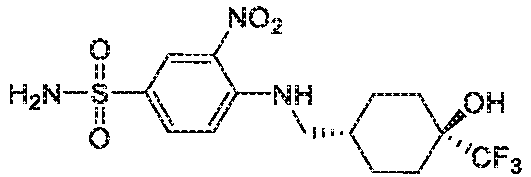
- To a solution of ethyl 4-oxocyclohexanecarboxylate (10 g, 58.75 mmol) in THF (100 mL) was added TMSCF3 (12.53 g, 88.13 mmol) and CsF (8.92 g, 58.75 mmol). The mixture was stirred at 20°C for 6 hours. TLC indicated the reactant was consumed completely. The reaction mixture was washed with saturated NaHCO3 aqueous solution (50 mL × 2) and extracted with ethyl acetate (50 mL × 3). The combined organic phase was washed with brine (50 mL × 2), dried with anhydrous Na2SO4, filtered and concentrated in vacuum. The residue was purified by column chromatography (silica gel, eluent: PE/EA = 100/1 to 211). Ethyl 4-(trifluoromethyl)-4-((trimethylsilyl)oxy)cyclohexanecarboxylate (8.12 g) was obtained as yellow oil. 1H NMR (400 MHz, CDCl3) δ ppm: 4.15 (q, J = 7.1 Hz, 2 H), 2.20 - 2.66 (m, 1 H), 1.98 - 2.08 (m, 1 H), 1.63 - 1.95 (m, 6 H), 1.53 (td, J = 13.4, 4.2 Hz, 1 H), 1.27 (t, J = 7.1 Hz, 3 H), 0.17 (d, J = 4.5 Hz, 9 H).
- To a solution of ethyl 4-(trifluoromethyl)-4-((trimethylsilyl)oxy)cyclohexanecarboxylate (8.10 g, 25.93 mmol) in THF (50 mL) was added LAH (1.97 g, 51.86 mmol) at 0°C, the mixture was stirred at 0°C for 2 hours. TLC indicated the reactant was consumed completely. The reaction mixture was quenched by addition of water (15 mL), and then extracted with Ethyl acetate (50 mL x 3). The combined organic layers were dried over Na2SO4, filtered and concentrated under reduced pressure. The crude product (6.2 g, crude) was used into the next step without further purification.
- To a solution of (4-(trifluoromethyl)-4-((trimethylsilyl)oxy)cyclohexyl)methanol (6.2 g, 22.93 mmol) and TEA (4.64 g, 45.86 mmol) in DCM (60 mL) was added MsCl (5.91 g, 51.60 mmol) at 0°C, the mixture was stirred at 0°C for 2 hours. TLC indicated the reactant was consumed completely. The reaction mixture was washed with saturated NaHCO3 aqueous solution (50 mLx2) and extracted with DCM (50 mLx2). The combined organic phase was washed with brine (50 mLx2), dried with anhydrous Na2SO4, filtered and concentrated in vacuum. The crude product (8.52 g, crude) was used into the next step without further purification.
- To a solution of (4-(trifluoromethyl)-4-((trimethylsilyl)oxy)cyclohexyl)methyl methanesulfonate (8.51 g, 24.42 mmol) in DMF (150 mL) was added NaN3 (7.94 g, 122.11 mmol) at 20°C, the mixture was stirred at 50°C for 12 hours. TLC indicated the reactant was consumed completely. The mixture was diluted with water and extracted with MTBE (100 mL x 3), dried over anhydrous Na2SO4 filtered. The combined organic layers were concentrated to obtain crude product, which was used for the next step directly.
- A mixture of ((4-(azidomethyl)-1 -(trifluoromethyl)cyclohexyl)oxy)trimethylsilane (7.21 g, theoretical yield) in CH3OH (50 mL) was added Pd/C(2.5 g), the mixture was stirred at 30°C for 16 hours under H2 (30 psi). TLC indicated the reactant was consumed completely. The mixture was filtered and concentrated under reduced pressure. (4-(trifluoromethyl)-4-((trimethylsilyl)oxy)cyclohexyl)methanamine (4.67 g, crude) was obtained as yellow oil. The crude product was used into the next step without further purification.
- To a solution of 4-fluoro-3-nitrobenzenesulfonamide (2.50 g, 11.35 mmol) and (4-(trifluoromethyl)-4-((trimethylsilyl)oxy)cyclohexyl)methanamine (4.59 g, 17.04 mmol) in DMF (75 mL) was added DIPEA (2.94 g, 22.74 mmol), the mixture was stirred at 55°C for 2 hours. TLC indicated the reactant was consumed completely. The reaction mixture was washed with water (200 mL) and extracted with EA (100 mL x 3). The combined organic phase was washed with brine (50 mL x 2), dried with anhydrous Na2SO4, filtered and concentrated in vacuum. The residue was washed with PE/EA = 5/1 (30 mL) and filtered. The filter cake was purified by prep-HPLC (neutral). 4-((((1s,4s)-4-hydroxy-4-(trifluoromethyl)cyclohexyl)methyl)amino)-3-nitrobenzenesulfonamide (Intermediate 3-q1, retention time: 2.5 min) (1.04 g) was obtained as a yellow solid. 1H NMR (400 MHz, methol-d4 ) δ ppm: 8.65 (d, J = 1.9 Hz, 1 H), 8.49 (t, J = 4.7 Hz, 1 H), 7.91 (dd, J = 9.1, 1.63 Hz, 1 H), 7.17 (d, J = 9.3 Hz, 1 H), 3.46 (t, J = 6.3 Hz, 2 H), 2.06 (d, J = 4.1 Hz, 1 H), 1.84 - 2.00 (m, 4 H), 1.52 - 1.70 (m, 4 H). MS (ESI, m/e) [M-1]- 396.0; 4-((((1r,4r)-4-hydroxy-4-(trifluoromethyl)cyclohexyl)methyl)amino)-3-nitrobenzenesulfonamide (Intermediate 3-q2, retention time: 2.6 min) (842 mg) was obtained as a yellow solid. 1H NMR (400 MHz, methol-d4 ) δ ppm: 8.65 (d, J = 1.9 Hz, 1 H), 8.54 (t, J = 5.2 Hz, 1 H), 7.90 (dd, J = 9.1, 1.6 Hz, 1 H), 7.17 (d, J = 9.3 Hz, 1 H), 3.33 - 3.41 (m, 2 H), 1.24 (s, 1 H), 1.87 (d, J = 12.5 Hz, 2 H), 1.71 - 1.82 (m, 3 H), 1.42 - 1.69 (m, 4 H). MS (ESI, m/e) [M-1]- 396.0.
-

- To a solution of 2,5-dihydrofuran (10 g, 142.67 mmol) and ethyl 2-diazoacetate (32.56 g, 285.35 mmol) in DCM (250 mL) was added Rh(AcO)2(63.06 mg, 2.85 mmol). The mixture was stirred at 20°C for 12 hours. TLC indicated the reactant was consumed completely. The reaction mixture was and concentrated in vacuum to give a residue. The residue was purified by prep-MPLC and ethyl 3-oxabicyclo[3.1.0]hexanc-6-carboxylatc (10.0 g) was obtained. 1H NMR (400MHz, CDCl3) δ ppm: 4.08 - 4.16 (m, 2 H), 3.92 (d, J=8.6 Hz, 2 H), 3.74 (d, J=8.4 Hz, 2 H), 2.13 - 2.17 (m, 2 H), 1.59 (t, J=3.1 Hz, 1 H), 1.23 - 1.28 (m, 3 H).
- To a solution of ethyl 3-oxabicyclo[3.1.0]hexane-6-carboxylate (10 g, 64.03 mmol) in THF (50 mL) was added LiAlH4 (2.43 g, 64.03 mmol) at 0°C. The mixture was stirred at 0°C for 4 hours. TLC indicated the reactant was consumed completely. The reaction mixture was poured into H2O (30 mL) and extracted with EA (30 mL × 3), dried over Na2SO4, filtered and concentrated. 3-oxabicyclo[3.1.0]hexan-6-ylmethanol (7.0 g, crude) was obtained and used into the next step without further purification.
- To a solution of 3-oxabicyclo[3.1.0]hexan-6-ylmethanol (7.0 g, 61.33 mmol) in DCM (100 mL) was added MsCl (21.08 g, 183.98 mmol) and TEA (24.82 g, 245.31 mmol). The mixture was stirred at 25°C for 5 hours. TLC indicated the reactant was consumed completely. The reaction mixture was quenched with aq. NH4Cl (30 mL) and extracted with EA (30 mL × 3), dried over Na2SO4, filtered and concentrated. The residue was purified by column chromatography (SiO2, PE/EA = 100/1 to 30/1). 3-oxabicyclo[3.1.0]hexan-6-ylmethyl methanesulfonate (3.5 g) was obtained. 1H NMR (400MHz, CDCl3) δ ppm: 4.15 (d, J=7.5 Hz, 2 H), 3.90 (d, J=8.4 Hz, 2 H), 3.71 (d, J=8.4 Hz, 2 H), 3.03 (s, 3 H), 1.69 - 1.72 (m, 2 H), 1.21 - 1.29 (m, 1 H).
- To a solution of 3-oxabicyclo[3.1.0]hexan-6-ylmethyl methanesulfonate (2 g, 10.4 mmol) in DMF (20 mL) was added NaN3 (676.37 mg, 10.4 mmol). The mixture was stirred at 50°C for 12 hours. TLC indicated the reactant was consumed completely. The reaction mixture was poured into H2O (30 mL) and extracted with EA (30 mL × 3), dried over Na2SO4, filtered and concentrated. The crude product was used in next step directly.
- To a solution of 6-(azidomethyl)-3-oxabicyclo[3.1.0]hexane (1.4 g, 10.06 mmol) in DMF (15 mL) was added Pd/C (0.7 g, 1.006 mmol). The mixture was stirred at 25°C for 2 hours under H2 atmosphere (15 Psi). LC/MS showed the reactant was consumed completely and one main peak with desired mass signal. The reaction mixture was filtered and used next step directly. MS (ESI, m/e) [M+1]+ 114.0.
- To a solution of 4-fluoro-3-nitrobenzenesulfonamide (1.5 g, 6.8 mmol) and 3-oxabicyclo[3.1.0]hexan-6-ylmethanamine (1 g, 8.84 mmol) in DMF (15 mL) was added DIEA (1.76 g, 13.6 mmol). The mixture was stirred at 60°C for 2 hours. LC/MS showed 4-fluoro-3-nitrobenzenesulfonamide was consumed completely and one main peak with desired mass signal. The reaction mixture was cooled to room temperature and poured into H2O (50 mL) under stirring. The precipitation was filtered and the cake was washed with MTBE (10 mL) and dried in vacuum. 4-((3-oxabicyclo[3.1.0]hexan-6-ylmethyl)amino)-3-nitrobenzenesulfonamide (758 mg) was obtained. 1H NMR (400MHz, DMSO-d6 ) δ ppm: 8.59 (br, 1H), 8.47 (s, 1H), 7.84 (d, J = 8.8 Hz, 1H), 7.37 (s, 2H), 7.28 (d, J = 9.2 Hz, 1H), 3.72 (d,J = 8.2 Hz, 2H), 3.55 (d, J = 7.9 Hz, 2H), 3.36 (s, 2H), 1.71 (s, 2H), 1.05 (s, 1H). MS (ESI, m/e) [M+1]+ 314.0.
-

-

- To a degassed solution of 2-phenylpyrrolidine (588 mg, 4 mmol), 1-bromo-4-iodobenzene (1.132 g, 16 mmol), BINAP (497 mg, 0.8 mmol) and K-OtBu (1.2 g, 12 mmol) in toluene (25 ml) was added Pd2(dba)3 (366 mg, 0.4 mmol). Nitrogen was bubbled through the mixture for 5 min, then heated to 90°C and stirred overnight. After cooled to room temperature, the reaction mixture was washed with water and brine in sequence. The organic layer was dried over anhydrous Na2SO4, then filtered, concentrated and purified by column chromatography with 5%∼20% EA/PE as eluent to give 1-(4-bromophenyl)-2-phenylpyrrolidine (750 mg, 62%) as a colorless oil. MS (ESI, m/e) [M+1]' 302.0, 304.1.
-

- Under nitrogen atmosphere, a mixture of 1-(4-bromophenyl)-2-phenylpyrrolidine (525 mg, 1.74 mmol), tert-butyl 2-((1H-pyrrolo[2,3-b]pyridin-5-yl)oxy)-4-(4,4,5,5-tetramethyl-1,3,2-dioxaborolan-2-yl)benzoate (985mg, 2.26 mmol), Pd(dppf)Cl2 (128 mg, 0.174 mmol), and K2CO3 (480 mg, 3.48 mmol) in 1,4-dioxane/H2O (50 mL/10 mL) was heated to 90°C with stirring overnight. After cooled to room temperature, the reaction mixture was washed with water and brine in sequence. The organic layer was dried over anhydrous Na2SO4, then filtered, concentrated and purified by column chromatography with 10 %∼50 % EA/PE as eluent to give tert-butyl-3-((1H-pyrrolo[2,3-b]pyridin-5-yl)oxy)-4'-(2-phenylpyrrolidin-1-yl)-[1,1'-biphenyl]-4-carboxylate (530 mg, 57.4 %) as a white foam. MS (ESI, m/e) [M+1]+ 532.3.
-
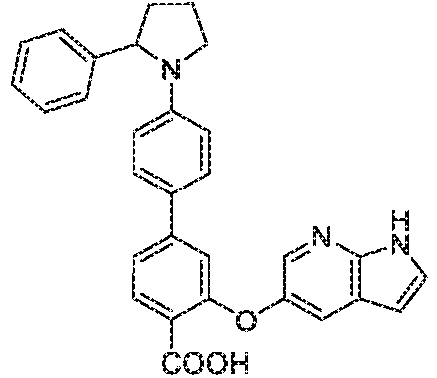
- To a solution of tert-butyl-3-((1H-pyrrolo[2,3-b]pyridin-5-yl)oxy)-4'-(2-phenylpyrrolidin-1-yl)-[1,1'-biphenyl]-4-carboxylate (531 mg, 1 mmol) in dichloromethane (25 mL) was added trifluoroacetic acid (5 mL). The reaction was stirred overnight at r.t. Then the solvent was removed under reduced pressure and the resulted residue was purified by column chromatography on silica gel with 5% methanol /dichloromethane to give 3-((1H-pyrrolo[2,3-b]pyridin-5-yl)oxy)-4'-(2-phenylpyrrolidin-1-yl)-[1,1'-biphenyl]-4-carboxylic acid (400 mg, 84.2 %) as a white foam. MS (ESI, m/e) [M+1]' 476.2.
-

- To a solution of 3-((1H-pyrrolo[2,3-b]pyridin-5-yl)oxy)-4'-(2-phenylpyrrolidin-1-yl)-[1,1'-biphenyl]-4-carboxylic acid (95 mg, 0.2 mmol) in dichloromethane (25 mL) were added HATU (114 mg, 0.3 mmol) and trimethylamine (0.2 mL). The mixture was stirred for 0.5 h at r.t. Then 3-nitro-4-(((tetrahydro-2H-pyran-4-yl)methyl)amino)benzenesulfonamide (126 mg, 0.4 mmol) was added. After stirred overnight at r.t, the reaction mixture was washed with water (10 mL), and the organic layers were dried over anhydrous Na2SO4, then concentrated in vacuum. The residue was further purified by prep-HPLC to give the desired compound.
- 1H NMR (400 MHz, DMSO-d6 ) δ ppm: 12.16 (s, 1H), 11.68 (s, 1H), 8.57 (s, 1H), 8.54 (s, 1H), 8.03 (s, 1H), 7.80 (d, J = 8.6 Hz, 1H), 7.59-7.46 (m, 3H), 7.33-7.25 (m, 5H), 7.20-7.14 (m, 3H), 7.08 (d, J = 8.1 Hz, 1H), 6.89 (s, 1H), 6.42 (d, J = 8.5 Hz, 2H), 6.37 (s, 1H), 4.78 (d, J = 7.4 Hz, 1H), 3.84 (d, J = 8.4 Hz, 2H), 3.68 (s, 1H), 3.31-3.20 (m, 3H), 2.37-2.34 (m, 1H), 1.94-1.80 (m, 4H), 1.60 (d, J = 12.0 Hz, 2H), 1.38-1.14 (m, 4H). MS (ESI, m/e) [M+1]+ 773.3
-

- The desired compound was synthesized starting from 2-(4-chlorophenyl)pyrrolidine and 1-bromo-4-iodobenzene following the procedures similar to those in Example A1. 1H NMR (400 MHz, DMSO-d6 ) δ ppm: 12.16 (s, 1H), 11.70 (s, 1H), 8.60 (s, 1H), 8.56 (s, 1H), 8.05 (d, J = 2.2 Hz, 1H), 7.82 (d, J = 8.4 Hz, 1H), 7.59 (s, 1H), 7.57-7.48 (m, 2H), 7.34-7.28 (m, 5H), 7.18 (d, J = 8.3 Hz, 2H), 7.12 (d, J = 9.3 Hz, 1H), 6.89 (s, 1H), 6.41 (d, J = 8.6 Hz, 2H), 6.38 (s, 1H), 4.78 (d, J = 7.1 Hz, 1H), 3.84 (d, J = 8.4 Hz, 2H), 3.67 (t, J = 7.1 Hz, 1H), 3.30-3.18 (m, 4H), 2.37 (m, 1H), 2.00-1.69 (m, 4H), 1.60 (d, J = 12.4 Hz, 2H), 1.34-1.13 (m, 3H). MS (ESI, m/e) [M+1]+ 807.1
-

- The desired compound was synthesized starting from 2-(3-chlorophenyl)pyrrolidine and 1-bromo-4-iodobenzene following the procedures similar to those in Example A1. 1H NMR (400 MHz, DMSO-d6 ) δ ppm: 12.17 (s, 1H), 11.70 (s, 1H), 8.59 (s, 1H), 8.57 (s, 1H), 8.05 (s, 1H), 7.83 (d, J = 9.0 Hz, 1H), 7.60 (s, 1H), 7.55-7.51 (m, 2H), 7.36-7.21 (m, 6H), 7.13 (d, J = 8.4 Hz, 2H), 6.91 (s, 1H), 6.43 (d, J = 8.4 Hz, 2H), 6.39 (s, 1H), 4.80 (d, J = 7.7 Hz, 1H), 3.85 (d, J = 9.9 Hz, 2H), 3.70 (s, 1H), 3.31-3.18 (m, 4H), 2.36-2.31 (m, 1H), 1.94 -1.79 (m, 4H), 1.60 (d, J= 12.5 Hz, 2H), 1.25 (m, 3H). MS (ESI, m/e) [M+1]' 807.1
-

- The desired compound was synthesized starting from 2-(2-chlorophenyl)pyrrolidine and 1-bromo-4-iodobenzene following the procedures similar to those in Example A1. 1H NMR (400 MHz, DMSO-d6 ) δ ppm: 12.17 (s, 1H), 11.70 (s, 1H), 8.61 (s, 1H), 8.57 (s, 1H), 8.05 (s, 1H), 7.83 (d, J = 9.4 Hz, 1H), 7.60-7.41 (m, 4H), 7.35-7.30 (m, 3H),7.25-7.12 (m, 3H), 7.00 (d, J = 7.7 Hz, 1H), 6.90 (s, 1H), 6.48-6.27 (m, 3H), 4.97 (d, J = 7.4 Hz, 1H), 3.85 (d, J = 11.3 Hz, 2H), 3.74 (s, 1H), 3.31-3.19 (m, 4H), 2.43-2.35 (m, 1H), 1.99-1.83 (m, 4H), 1.60 (d, J = 12.5 Hz, 2H), 1.23 (s, 3H). MS (ESI, m/e) [M+1]' 807.1.
-

- Two enantiomers A4a (faster isomer) and A4b (slower isomer) were separated by chiral preparative HPLC. The chiral separation conditions are shown below. The faster enantiomer was eluted at retention time of 1 .1 min to give 252 mg of product. The slower enantiomer was eluted at retention time of 1.8 min to give 238 mg of product. The absolute configuration of fast isomer was confirmed to be S by co-crystallization of Bcl2 with A4a, see the section "Protein purification and co-crystallization of Bcl2 with A4a".
Column CHIRALPAK IG Column size 2 cm × 25 cm, 5um Injection 4.8 mL Mobile phase CO2 : [DCM:EtOH(0.1%DEA) = 1:2] = 55 : 45 Flow rate 40 mL/min Wave length UV 220 nm Temperature 25 °C Sample solution 5.64 mg/mL in MeOH : DCM = 3 : 1 Prep-SFC equipment Prep-SFC-80 -

- The desired compound was synthesized starting from 2-(2-chlorophenyl)pyrrolidine and 4-bromo-2-chloro-1-iodobenzene following the procedures similar to those in Example A1. 1H NMR (400 MHz, DMSO-d6 ) δ ppm: 12.32 (s, 1H), 11.70 (s, 1H), 8.61 (t, J = 5.7 Hz, 1H), 8.55 (d, J = 2.0 Hz, 1H), 8.03 (d, J = 2.4 Hz, 1H), 7.82 (d, J = 7.6 Hz, 1H), 7.62 -7.46 (m, 4H), 7.44-7.34 (m, 2H), 7.33-7.22 (m, 2H), 7.22-7.15 (m, 2H), 7.12 (d, J = 9.4 Hz, 1H), 6.99 (s, 1H), 6.71 (d, J = 8.8 Hz, 1H), 6.37 (s, 1H), 5.20 (t, J = 7.6 Hz, 1H), 4.16 (m, 1H), 3.84 (d, J = 8.4 Hz, 2H), 3.45-3.11 (m, 5H), 2.10-1.80 (m, 3H), 1.63 (m, 2H), 1.24 (m, 4H). MS (ESI, m/e) [M+1]+ 841.1.
-

-

- A mixture of 2-phenylpyrrolidine (1.46 g, 10 mmol), 4-bromo-1-fluoro-2-(trifluoromethyl)benzene (4.8 g, 20 mmol) and N,N-Diisopropylethylamine (2.5 g, 20 mmol) in Dimethyl sulfoxide (50 mL) was heated to 150°C in a sealed tube with stirring overnight. The mixture was cooled and poured into water (100 mL). Then the mixture was extracted with EA (50 mL x 3), the organic was washed with water, brine and dried over anhydrous Na2SO4. Solvent was removed in vacuum, the residue was purified by column chromatography with petroleum to give 1-(4-bromo-2-(trifluoromethyl)phenyl)-2-phenylpyrrolidine (180 mg, 4.9 %) as a brown oil.
- The desired compound was then synthesized from 1-(4-bromo-2-(trifluoromethyl)phenyl)-2-phenylpyrrolidine following the next procedures similar to those in Example A1. 1H NMR (400 MHz, DMSO-d6 ) δ ppm: 12.32 (s, 1H), 11.66 (s, 1H), 8.56-8.53 (m, 2H), 8.01 (s, 1H), 7.78 (s, 1H), 7.66 (s, 1H), 7.61-7.42 (m, 4H), 7.39 (d, J = 8.0 Hz, 1H), 7.30 (d, J = 7.2 Hz, 2H), 7.23 (t, J = 7.2 Hz, 2H), 7.1-7.00 (m, 4H), 6.35 (s, 1H), 4.87 (d, J = 9.4 Hz, 1H), 4.02-3.64 (m, 3H), 3.26-3.22 (m, 4H), 2.43-2.31 (m, 1H), 2.00-1.98 (m, 1H), 1.93-1.81 (m, 2H), 1.72-1.67 (m, 1H), 1.60 (d, J = 12.0 Hz, 2H), 1.29-1.19 (m, 3H). MS (ESI, m/e) [M+1]+ 841.1.
-
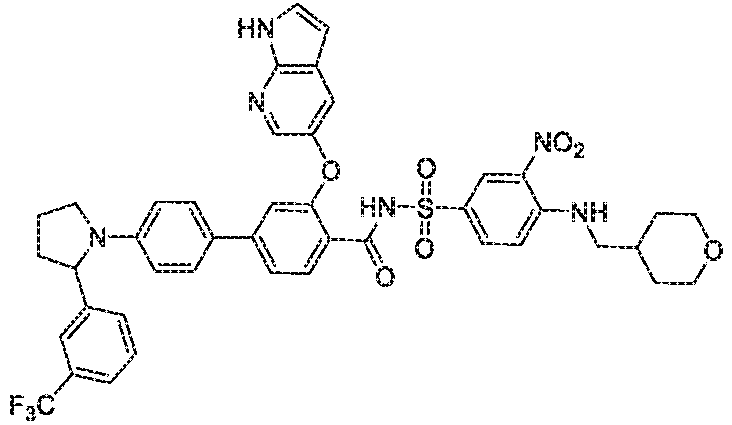
- The desired compound was synthesized starting from 2-(3-(triiluoromethyl)phenyl)pyrrolidine and 1-bromo-4-iodobenzene following the procedures similar to those in Example A1. 1H NMR (400 MHz, DMSO-d6 ) δ ppm: 12.17 (s, 1H), 11.70 (s, 1H), 8.61 (s, 1H), 8.56 (s, 1H), 8.05 (d, J = 2.0 Hz, 1H), 7.82 (d, J = 9.2 Hz, 1H), 7.64-7.42 (m, 7H), 7.33 (dd, J = 14.2, 8.5 Hz, 3H), 7.13 (d, J = 9.2 Hz, 1H), 6.90 (s, 1H), 6.56-6.31 (m, 3H), 4.90 (d, J = 7.4 Hz, 1H), 3.84 (d, J = 8.5 Hz, 2H), 3.73 (t, J = 7.1 Hz, 1H), 3.31-3.22 (m, 5H), 2.05-1.77 (m, 5H), 1.60 (d, J = 12.1 Hz, 2H), 1.28 (s, 2H). MS (ESI, m/e) [M+1]+ 841.1.
-

- The desired compound was synthesized from 2-(2-cyclopropylphenyl)pyrrolidine and 1-bromo-4-iodobenzene following the next procedures similar to those in Example A1. 1H NMR (400 MHz, CDCl3) δ ppm: 10.31 (s, 1H), 9.14 (s, 1H), 8.93 (d, J = 2.0 Hz, 1H), 8.54 (t,J = 5.2 Hz, 1H), 8.24 (d, J = 2.0 Hz, 1H), 8.19 (d, J = 7.6 Hz, 1H), 8.09 (d, J = 8.6 Hz, 1H), 7.71 (d, J = 2.0 Hz, 1H), 7.45-7.41 (m, 1H), 7.29 (s, 1H), 7.20 (d, J = 8.6 Hz, 2H), 7.12 (t, J = 7.6 Hz, 1H), 7.04-6.98 (m, 2H), 6.93 (d, J = 8.6 Hz, 2H), 6.81 (s, 1H), 6.53 (s, 1H), 6.36 (d, J = 8.6 Hz, 2H), 5.20 (d, J = 8.0 Hz, 1H), 4.03 (dd, J = 11.0, 3.6 Hz, 2H), 3.70 (t, J = 7.1 Hz, 1H), 3.50-3.41 (m, 3H), 3.27 (t, J = 6.0 Hz, 2H), 2.47-2.37 (m, 1H), 2.04-1.90 (m, 7H), 1.76-1.71 (m, 2H), 1.63 (s, 4H), 1.50-1.36 (m, 2H), 1.04-0.94 (m, 2H), 0.84 -0.80 (m, 1H), 0.72-0.68 (m, 1H).MS (ESI, m/e) [M+1]' 813.1.
-

- Two enantiomers A8a (faster isomer) and A8b (slower isomer) were separated by chiral preparative HPLC. The chiral separation conditions arc shown below. The faster enantiomer was eluted at retention time of 3.9 min to give 231 mg of product. The slower enantiomer was eluted at retention time of 4.7 min to give 219 mg of product.
Column CHIRAL ART Cellulose-SB Column size 2 cm × 25 cm, 5um Injection 0.5 mL Mobile phase (Hex:DCM = 5:1)(0.1%FA): EtOH = 50 : 50 Flow rate 20 mL/min Wave length UV 220 nm Temperature 25 °C Sample solution 17.3 mg/mL in EtOH : DCM = 3 : 1 Prep-HPLC equipment Prep-HPLC-Gilson -

- The desired compound was synthesized starting from 2-(4-(trifluoromethyl)phenyl)pyrrolidine and 1-bromo-4-iodobenzene following the procedures similar to those in Example A1. 1H NMR (400 MHz, DMSO-d6 ) δ ppm: 12.17 (s, 1H), 11.70 (s, 1H), 8.60 (s, 1H), 8.56 (s, 1H), 8.04 (s, 1H), 7.82 (d, J = 8.2 Hz, 1H), 7.64 (d, J = 8.0 Hz, 2H), 7.58 (s, 1H), 7.53 (d, J = 8.2 Hz, 1H), 7.50 (s, 1H), 7.39 (d, J = 8.0 Hz, 2H), 7.33 (d, J = 8.2 Hz, 1H), 7.30 (d, J = 8.5 Hz, 2H), 7.12 (d, J = 8.2 Hz, 1H), 6.89 (s, 1H), 6.43 (d, J = 8.5 Hz, 2H), 6.38 (s, 1H), 4.89 (d, J = 7.7 Hz, 1H), 3.84 (d, J = 8.3 Hz, 2H), 3.71 (t, J = 7.4 Hz, 1H), 3.43-3.19 (m, 5H), 2.46-2.35 (m, 1H), 2.05-1.76 (m, 4H), 1.60 (d,J= 12.4 Hz, 2H), 1.29-1.20 (m, 2H). MS (ESI, m/e) [M+1]+ 841.1.
-

- 2-(3-cyclopropylphenyl)pyrrolidine was prepared by the similar procedure of 2-(2-cyclopropylphenyl)pyrrolidine. The desired compound was then synthesized from 2-(3-cyclopropylphenyl)pyrrolidine and I-bromo-4-iodobenzene following the next procedures similar to those in Example A1. 1H NMR (400 MHz, DMSO-d6 ) δ ppm: 11.55 (s, 1H), 8.39 (s, 1H), 8.34 (t, J = 5.6 Hz, 1H), 7.95 (s, 1H), 7.64 (d, J = 8.0 Hz, 1H), 7.57 (d, J = 8.0 Hz, 1H), 7.41 (s, 1H), 7.34 (s, 1H), 7.30 (d, J = 8.4 Hz, 2H), 7.25 (d, J = 8.0 Hz, 1H), 7.13 (t, J = 7.5 Hz, 1H), 6.95 (s, 1H), 6.93 (s, 1H), 6.89 (d, J = 8.0 Hz, 1H), 6.85-6.77 (m, 2H), 6.42 (d, J = 8.4 Hz, 2H), 6.29 (s, 1H), 4.72 (d, J = 8.0Hz, 1H), 3.83 (d, J = 8.0 Hz, 2H), 3.67 (s, 1H), 3.25-3.23 (m, 3H), 2.41-2.27 (m, 1H), 1.93-1.78 (m, 6H), 1.60 (d, J = 8.0 Hz, 2H), 1.29-1.17 (m, 3H), 0.89 (d, J = 8.0 Hz, 2H), 0.64-0.57 (m, 2H). MS (ESI, m/e) [M+1]+ 813.1.
-

- The desired compound was synthesized starting from 2-(o-tolyl)pyrrolidinc and 1-bromo-4-iodobenzene following the procedures similar to those in Example A1 1H NMR (400 MHz, DMSO-d6) δ ppm: 11.54 (s, 1H), 8.39 (s, 1H), 8.34 (t, J = 5.5 Hz, 1H), 7.95 (d, J = 2.1 Hz, 1H), 7.65 (d, J = 9.1 Hz, 1H), 7.56 (d, J = 8.0 Hz, 1H), 7.41 (s, 1H), 7.35 (d, J = 2.1 Hz, 1H), 7.29 (d, J = 8.5 Hz, 2H), 7.23 (d, J = 8.0 Hz, 1H), 7.18 (d, J = 8.0 Hz, 1H), 7.09 (t, J = 7.3 Hz, 1H), 7.02 (t, J = 7.3 Hz, 1H), 6.89 (s, 1H), 6.87 (d, J = 8.0 Hz, 1H), 6.83 (d, J = 9.1 Hz, 1H), 6.35 (d, J = 8.5 Hz, 2H), 6.30 (d, J = 2.1 Hz, 1H), 4.86 (d, J = 8.0 Hz, 1H), 3.83 (d, J = 8.0 Hz, 2H), 3.75-3.71 (m, 1H), 3.25-3.23 (m, 3H), 3.17 (s, 1H), 2.38 (s, 3H), 2.04-1.80 (m, 3H), 1.74-1.71 (m, 1H), 1.60 (d,J= 12.0 Hz, 2H), 1.28-1.20 (m, 4H). MS (ESI, m/e) [M+1]+ 787.1.
-

- The desired compound was synthesized starting from 2-(2-isopropylphenyl)pyrrolidine and 1-bromo-4-iodobenzene following the next procedures similar to those in Example A1. 1H NMR (400 MHz, DMSO-d6 ) δ ppm: 12.16 (s, 1H), 11.70 (s, 1H), 8.61 (s, 1H), 8.56 (s, 1H), 8.04 (s, 1H), 7.82 (d, J = 8.5 Hz, 1H), 7.50-7.58 (m, 3H), 7.29-7.35 (m, 4H), 7.24 -7.06 (m, 2H), 6.98 (t, J = 7.3 Hz, 1H), 6.91 (s, 1H), 6.82 (d, J = 7.6 Hz, 1H), 6.35-6.37 (m, 3H), 4.99 (d, J = 7.9 Hz, 1H), 3.84 (d, J= 8.5 Hz, 2H), 3.70 (t, J = 7.9 Hz, 1H), 3.18-3.38 (m, 5H), 3.01 (s, 1H), 2.04-1.82 (m, 4H), 1.70 (s, 1H), 1.60 (d, J = 12.2 Hz, 2H), 1.27-1.23 (m, 8H). MS (ESI, m/e) [M+1]+ 815.2.
-

- The desired compound was synthesized starting from 2-([1,1'-biphenyl]-2-yl)pyrrolidine and 1-bromo-4-iodobenzene following the next procedures similar to those in Example A1. 1H NMR (400 MHz, DMSO-d6 ) δ ppm: 12.16 (s, 1H), 11.62 (s, 1H), 8.48 (s, 2H), 8.00 (s, 1H), 7.73 (s, 1H), 7.62-7.35 (m, 8H), 7.35-7.13 (m, 7H), 7.10 (s, 1H), 6.90 (s, 1H), 6.33 (d, J = 8.4 Hz, 3H), 4.61 (d, J = 7.8 Hz, 1H), 3.84 (d, J = 9.9 Hz, 2H), 3.70 (s, 1H), 3.26 (m, 4H), 2.98 (s, 1H), 2.19-2.07 (m, 1H), 1.97-2.02 (m, 2H), 1.78-1.89 (m, 3H), 1.60 (d, J = 12.7 Hz, 2H), 1.28 (s, 1H). MS (ESI, m/e) [M+1]+ 849.1.
-

- The desired compound was synthesized starting from 2-(4-cyclopropylphenyl)pyrrolidine and 1-bromo-4-iodobenzene following the procedures similar to those in Example A1. 1H NMR (400 MHz, DMSO-d6 ) δ ppm: 12.16 (s, 1H), 11.72 (s, 1H), 8.63 (t, J = 5.7 Hz, 1H), 8.57 (d, J = 1.8 Hz, 1H), 8.05 (d, J = 2.2 Hz, 1H), 7.83 (d, J = 9.1 Hz, 1H), 7.60 (d, J = 2.2 Hz, 1H), 7.55 - 7.50 (m, 2H), 7.35 - 7.25 (m, 3H), 7.14 (d, J = 9.3 Hz, 1H),7.05 - 6.95 (m, 4H), 6.89 (s, 1H), 6.45 - 6.35 (m, 3H), 4.72 (d, J = 8.0 Hz, 2H), 3.90 - 3.80 (m, 2H), 3.70 - 3.60 (m, 2H), 3.40 - 3.15 (m, 3H), 2.35 - 2.26 (m, 2H), 2.02 - 1.68 (m, 4H), 1.65 - 1.55 (m, 2H), 1.30 - 1.15 (m, 2H), 0.92 - 0.86 (m, 2H), 0.62 - 0.55 (m, 2H). MS (ESI, m/e) [M+1]+ 813.2.
-

- The desired compound was synthesized starting from 2-phenylazepane and 1-bromo-4-iodobenzene following the procedures similar to those in Example. 1H NMR (400 MHz, DMSO-d6 )δ ppm: 12.15 (s, 1H), 11.72 (s, 1H), 8.68 - 8.63 (m, 1H), 8.58 - 8.52 (m, 1H), 8.06 (d, J = 2.0 Hz, 1H), 7.84 (d, J = 8.2 Hz, 1H), 7.61 (d, J = 2.1 Hz, 1H), 7.53 (t, J = 5.7 Hz, 3H), 7.40 - 7.23 (m, 6H), 7.20 - 7.13(m, 5H), 6.87 (s, 1H), 6.57 (d, J = 8.6 Hz, 2H), 6.39 (s, 1H), 4.65 - 4.55 (m, 1H), 3.88 - 3.75 (m, 2H), 3.58 - 3.43 (m, 1H), 3.30 - 3.20 (m, 3H), 2.42 - 2.30 (m, 1H),1.95 - 1.87 (m, 2H), 1.82 - 1.67 (m, 3H), 1.65 - 1.52 (m, 4H). 1.29 - 1.23 (m, 2H). MS (ESI, m/e) [M+1]+ 801.2.
-

- The desired compound was synthesized starting from 2-phenylpiperidine and 1-bromo-4-iodobenzene following the procedures similar to those in Example A1. 1H NMR(400 MHz, DMSO-d6 ) δ ppm: 12.21 (br, 1H), 11.63 (br, 1H), 8.48 (br, 2H), 8.01 (m, 1H), 7.76 (d, J = 8.0 Hz, 1H), 7.56 (d, J = 8.0 Hz, 1H), 7.54 (m, 2H), 7.32 (d, J = 12.0 Hz, 2H), 7.25-7.21 (m, 4H), 7.13-7.11 (m, 1H), 6.91-6.86 (m, 4H), 6.35 (m, 1H), 4.79 (m, 1H), 3.75 (d, J=8.0 Hz, 2H), 3.45 (m, 1H), 3.32-3.23 (m, 5H), 1.92-1.70 (m, 4H), 1.62 (m, 2H), 1.48 (m, 2H), 1.25-1.20 (m, 3H). MS (ESI, m/c) [M+1]+ 787.1.
-

- The desired compound was synthesized starting from 2-(3,4-dichlorophenyl)pyrrolidine and 1-bromo-4-iodobenzene following the procedures similar to those in Example A1. 1H NMR (400 MHz, DMSO-d6 ) δ ppm: 12.17 (s, 1H), 11.69 (s, 1H), 8.65 - 8.50 (m, 2H), 8.04 (s, 1H), 7.85 - 7.75 (m, 1H), 7.55 - 7.42 (m, 4H), 7.42 - 7.38 (m, 1H), 7.32 - 7.25 (m, 4H), 7.20 - 7.14 (m, 2H), 6.90 (s, 1H), 6.50 - 6.33 (m, 3H), 4.80 (d, J = 7.8 Hz, 1H), 3.84 (d, J = 8.1 Hz, 2H), 3.75 - 3.65 (m, 1H), 3.24 - 3.18(m, 2H), 2.40 - 2.31 (m, 2H), 2.00 - 1.84 (m, 2H), 1.82 - 1.78 (m, 2H), 1.65 - 1.58 (m, 3H), 1.29 - 1.24 (m, 2H). MS (ESI, m/e) [M+1]+ 841.1.
-
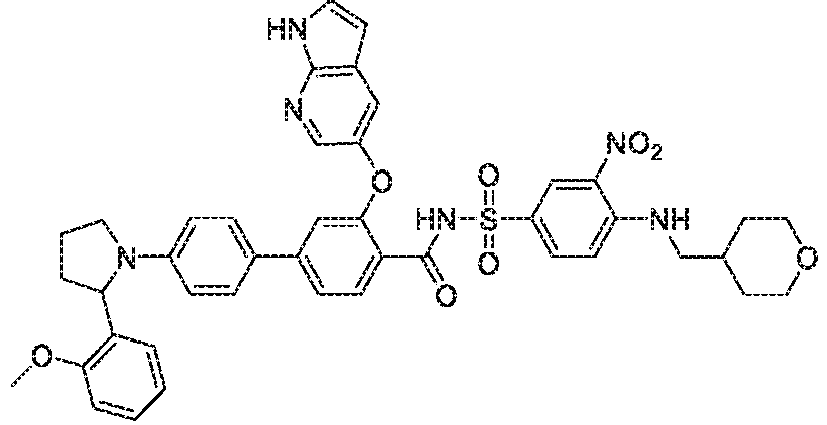
- The desired compound was synthesized starting from 2-(2-methoxyphenyl)pyrrolidine and 1-bromo-4-iodobenzene following the procedures similar to those in Example A1. 1H NMR (400 MHz, DMSO-d6 ) δ ppm: 12.16 (s, 1H), 11.71 (s, 1H), 8.65-8.60 (m, 1H), 8.57 (d,J = 2.6 Hz, 1H), 8.05 (d, J = 2.6 Hz, 1H), 7.85-7.80 (m, 1H), 7.53 (d, J = 8.2 Hz, 1H), 7.49-7.52 (m, 1H), 7.35-7.31 (m, 1H), 7.29 (d, J = 8.7 Hz, 2H), 7.21-7.16 (m, 1H), 7.13 (d, J = 9.2 Hz, 1H), 7.01 (d, J = 8.1 Hz, 1H), 6.89 (d, J = 1.3 Hz, 1H), 6.81-6.74 (m, 2H), 6.40 - 6.37 (m, 1H), 6.35 (d, J = 8.6 Hz, 2H), 4.94 (d, J = 8.0 Hz, 1H), 3.88-3.80 (m, 5H), 3.66 (t, J = 7.9 Hz, 1H), 3.34-3.21 (m, 6H), 2.35-2.25 (m, 1H), 2.00-1.71 (s, 4H), 1.60 (d, J = 12.1 Hz, 2H), 1.28-1.21 (m, 2H). MS (ESI, m/e) [M+1]+ 803.1
-

- The desired compound was synthesized starting from 2-(4-methoxyphenyl)pyrrolidine and 1-bromo-4-iodobenzene following the procedures similar to those in Example A1. 1H NMR (400 MHz, DMSO-d6 ) δ ppm: 12.16 (s, 1H), 11.71 (s, 1H), 8.62 (t, J = 5.5 Hz, 1H), 8.56 (d, J = 1.8 Hz, 1H), 8.05 (d, J = 2.4 Hz, 1H), 7.82 (d, J = 7.8 Hz, 1H), 7.62-7.57 (m, 1H), 7.56-7.48 (m, 2H), 7.34 (d, J = 8.1 Hz, 1H), 7.28 (d, J = 8.6 Hz, 2H), 7.13 (d, J = 9.2 Hz, 1H), 7.06 (d, J = 8.5 Hz, 2H), 6.89 (s, 1H), 6.82 (d, J = 8.5 Hz, 2H), 6.42 (d, J = 8.0 Hz, 2H), 6.36-6.40 (m, 1H), 4.72 (d, J = 8.0 Hz, 1H), 3.84 (dd, J = 11.2, 3.0 Hz, 2H), 3.74-3.61 (m, 4H), 3.34-3.20 (m, 6H), 2.37-2.27 (m, 2H), 1.98-1.79 (m, 3H), 1.79-1.70 (m, 1H), 1.60 (d, J = 12.0 Hz, 2H), 1.27-1.19 (m, 2H). MS (ESI, m/e) [M+1]+ 803.2
-

-
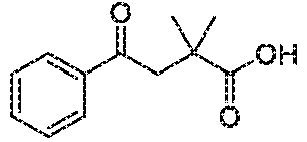
- To a solution of 3,3-dimethyldihydrofuran-2,5-dione (15.3 g, 120 mmol) and AlCl3 (31.92 g, 240 mmol) in DCM (200 mL) was added benzene (14.04 g, 180 mmol) dropwise with ice-water bath. It was warmed up to room temperature slowly and stirred overnight. The reaction mixture was poured into ice and diluted with DCM (400 mL) and conc. HCl acid (50 mL) was added and stirred until no precipitate. The organic layer was dried over anhydrous Na2SO4, filtered and concentrated. The residue was slurried with MTBE and PE to give the desired product as a white solid (22.52 g, 99%). 1H NMR (400 MHz, CDCl3) δ ppm: 7.95 (d, J = 7.7 Hz, 2H), 7.56 (t, J = 7.7 Hz, 1H), 7.46 (t, J = 7.7 Hz, 2H), 3.31 (s, 2H), 1.36 (s, 6H). MS (ESI, m/e) [M+1]+ 205.1.
-

- A solution of 2,2-dimethyl-4-oxo-4-phenylbutanoic acid (2.06 g, 10 mmol), 4-bromoaniline (1.806 g, 10.5 mmol), HATU (3.8 g, 10 mmol) and Et3N (1.5 g, 15 mmol), in DCM (50 mL) was stirred at room temperature overnight. After DCM was removed, the residue was purified by column flash in silica gel eluted with EA/PE = 1/5 to give the crude product as a brown oil (1.88 g). MS (ESI, m/e) [M+1]+ 360.0.
-

- A solution of N-(4-bromophenyl)-4-hydroxy-2,2-dimethyl-4-phenylbut-3-enamide (1.88 g, 5.22 mmol) and p-TsOH (50 mg, 0.26 mmol) in toluene (50 mL) was refluxed overnight. It was cooled to room temperature and toluene was removed. The residue was purified by flash column on silica gel eluted with EA/PE = 1/17 to give the desired product as a yellow oil (1.24 g, 69%). 1H NMR (400 MHz, DMSO-d6 ) δ 7.52 (d, J = 8.0 Hz, 2H), 7.29 (s, 3H), 7.13 (s, 2H), 6.98 (d, J = 8.0 Hz, 2H), 5.75 (s, 2H), 1.28 (s, 6H). MS (ESI, m/e) [M+1]+ 342.0.
-

- 1-(4-bromophenyl)-3,3-dimethyl-5-phenyl-1,3-dihydro-2H-pyrrol-2-one (200 mg, 0.59 mmol), tert-butyl 2-((1H-pyrrolo[2,3-b]pyridin-5-yl)oxy)-4-(4,4,5,5-tetramethyl-1,3,2-dioxaborolan-2-yl)benzoate (256 mg, 0.59 mmol) and Pd(dppf)Cl2 (43 mg, 0.059 mmol) in dioxane (20 mL) and sat. k2CO3 (2 mL) solution were stirred at 95°C under N2 overnight. After cooled to room temperature, the solvents were removed in vacuo. The residue was purified by pre-TLC (eluent: EA/PE = 1/1) to give the desired product as a white solid (150 mg, 44%). 1H NMR (400 MHz, DMSO-d6 ) δ 11.65 (s, 1H), 8.06 (d, J = 2.3 Hz, 1H), 7.81 (d, J = 8.4 Hz, 1H), 7.61 (d, J = 8.4 Hz, 2H), 7.56 (d, J = 8.4 Hz, 1H), 7.48 (s, 2H), 7.31-7.24 (m, 4H), 7.11 (d, J = 5.7 Hz, 4H), 6.38 (s, 1H), 5.74 (s, 1H), 1.37 (s, 9H), 1.28 (s, 6H). MS (ESI, m/e) [M+1]+ 572.2.
-

- A mixture of tert-butyl 3-((1H-pyrrolo[2,3-b]pyridin-5-yl)oxy)-4'-(3,3-dimethyl-2-oxo-5-phenyl-2,3-dihydro-1H-pyrrol-1-yl)-[1,1'-biphenyl]-4-carboxylate (140 mg, 0.24 mmol) and Pd/C (30 mg) in MeOH (20 mL) was stirred at room temperature under a balloon of H2 atmosphere. It was filtered, and the filtrate was concentrated to give the desired product was a white solid (134 mg, 97%). 1H NMR (400 MHz, DMSO-d6 ) δ ppm: 11.63 (s, 1H), 8.03 (d,J = 2.2 Hz, 1H), 7.77 (d, J = 8.1 Hz, 1H), 7.62-7.39 (m, 6H), 7.33-7.11 (m, 6H), 6.37 (s, 1H), 5.47 (t, J = 7.6 Hz, 1H), 1.97-2.03 (m, 1H), 1.72-1.77 (m, 1H), 1.37 (s, 9H), 1.20 (d, J = 10.1 Hz, 6H). MS (ESI, m/e) [M+1]+ 574.2.
-

- A solution of tert-butyl 3-((1H-pyrrolo[2,3-b]pyridin-5-yl)oxy)-4'-(3,3-dimethyl-2-oxo-5-phenylpyrrolidin-1-yl)-[1,1'-biphenyl]-4-carboxylate (134 mg, 0.23 mmol) in DCM (6 mL) and TFA (4 mL) was stirred at room temperature for 4 hours. The solvents were removed to give the desired product as a white solid (125 mg). MS (ESI, m/e) [M+1]+ 518.1.
- Then the desired compound in Example A20 was synthesized with 3-((1H-pyrrolo[2,3-b]pyridin-5-yl)oxy)-4'-(3,3-dimelhyl-2-oxo-5-phenylpyrrolidin-1-yl)-[1,1'-biphenyl]-4-carboxylic acid and 3-nitro-4-(((tetrahydro-2H-pyran-4-yl)methyl)amino)benzenesulfonamide following the next procedures similar to those in Example A1. 1H NMR (400 MHz, DMSO-d6 ) δ ppm: 12.35 (s, 1H), 11.65 (s, 1H), 8.51 (s, 2H), 8.00 (s, 1H), 7.76 (s, 1H), 7.63-7.33 (m, 7H), 7.29-7.11 (m, 5H), 7.11-6.97 (m, 2H), 6.35 (s, 1H), 5.44 (t, J = 7.7 Hz, 1H), 3.84 (d, J = 8.5 Hz, 2H), 3.25-3.18 (m, 4H), 2.05-1.93 (m, 1H), 1.86 (s, 1H), 1.71-1.76 (m, 1H), 1.58-1.64 (m, 3H), 1.25-1.28 (m, 2H), 1.20 (s, 3H), 1.17 (s, 3H). MS (ESI, m/e) [M+1]+ 815.1.
-
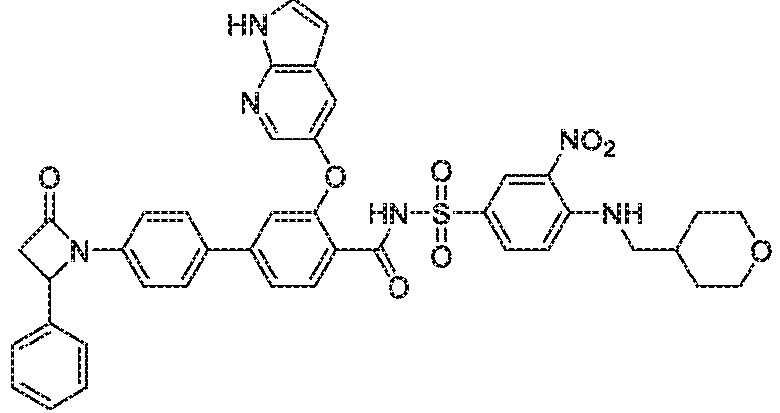
-

- A mixture of 4-phenylazetidin-2-one (500 mg, 3.40 mmol), (4-bromophenyl)boronic acid (2.05 g, 10.19 mmol), TEA (1.03 g, 10.19 mmol, 1.42 mL), 4Å molecular sieve (300 mg) and Cu(OAc)2 (617.07 mg, 3.40 mmol) in DCM (60 mL) was degassed and purged with O2 for 3 times, and then the mixture was stirred at 40 °C for 16 hours under O2 atmosphere. After cooled to room temperature, the reaction mixture was filtered and concentrated under reduced pressure to give a residue. The residue was purified by column chromatography (eluent: PE /EA = 60:1 to 10:1). 1-(4-bromophenyl)-4-phenylazetidin-2-one (800 mg, 75.59% yield) was obtained as an off-white solid, 1H NMR (400MHz, CDCl3) δ ppm: 7.43 - 7.29 (m, 7H), 7.20 - 7.10 (m, 2H), 4.99 (dd, J = 2.6, 5.7 Hz, 1H), 3.57 (dd, J = 5.7, 15.2 Hz, 1H), 2.96 (dd, J = 2.6, 15.2 Hz, 1H). MS (ESI, m/e) [M+1]+ 302.0.
- The desired compound was then synthesized with 1-(4-bromophenyl)-4-phenylazetidin-2-one and tert-butyl 2-((1H-pyrrolo[2,3-b]pyridin-5-yl)oxy)-4-(4,4,5,5-tetramethyl-1,3,2-dioxaborolan-2-yl)benzoate following the next procedures similar to those in Example A20. 1H NMR (DMSO-d6 ) δ ppm: 12.33 (s, 1H), 11.69 (s, 1H), 8.62-8.56 (m, 2H), 8.03 (d, J = 2.4Hz, 1H), 7.83-7.80 (m, 1H), 7.62-7.57 (m, 2H), 7.50-7.48 (m, 3H), 7.41-7.28 (m, 6H), 7.23 (d, J = 8.8Hz, 2H), 7.11 (d, J = 9.2Hz, 1H), 7.01 (s, 1H), 6.37 (s, 1H), 5.22-5.19 (m, 1H), 3.86-3.82 (m, 2H), 3.63-3.58 (m, 1H), 3.28-3.22 (m, 4H), 2.91 (dd, J= 2.4, 15.2 Hz, 1H), 1.93-1.90 (m, 1 H), 1.60 (d, J = 12.4Hz, 2H), 1.29-1.20 (m, 2H). MS (ESI) m/e [M+1]+ : 773.1
-
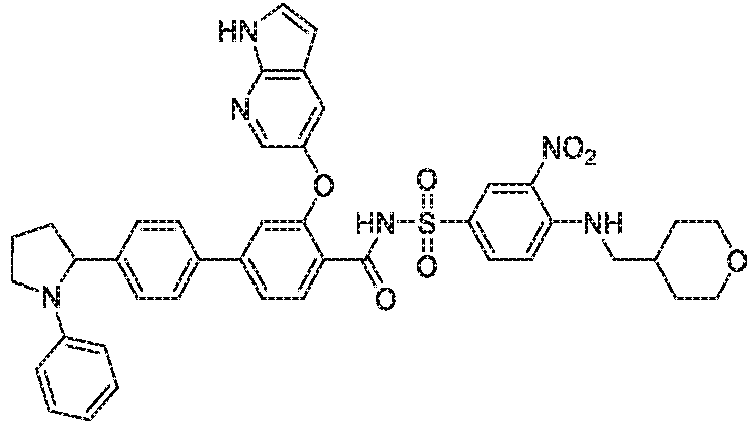
-

- The mixture of 2-(4-chlorophenyl)pyrrolidine (545 mg, 3 mmol), iodobenzene (920 mg, 4.5 mmol), 2,2'-bis(diphenylphosphanyl)-1,1'-binaphthalene (374 mg, 0.60 mmol), tris(dibenzylideneacetone)dipalladium (275 mg, 0.3 mmol), t-BuOK (673 mg, 6 mmol) in toluene (50 mL) was heated to 90 °C overnight. The reaction was concentrated in vacuo and purified by chromatography column on silica (eluent: EA/PE = 1/5) to give the product (582 mg, 75.3%) as a colorless oil. 1H NMR(400 MHz, DMSO-d6 ) δ ppm: 7.36 (d, J = 8.0 Hz, 2H), 7.24 (d, J = 8.0 Hz, 2H), 7.07 (t, J = 8.0 Hz, 2H), 6.54 (t, J = 8.0 Hz, 1H), 6.41 (d, J = 8.0 Hz, 2H), 4.75 (d, J = 8.0 Hz, 1H), 3.70-3.65 (m, 1H), 3.36-3.29 (m, 1H), 2.39-2.33 (m, 1H), 1.96-1.88 (m, 2H), 1.79-1.75 (m, 1H). MS (ESI, m/e) [M+1]+ 258.0.
-

- The mixture of 2-(4-chlorophenyl)-1-phenylpyrrolidine (515 mg, 2 mmol), tert-butyl 2-((1H-pyrrolo[2,3-b]pyridin-5-yl)oxy)-4-(4,4,5,5-tetramethyl-1,3,2-dioxaborolan-2-yl)benzoate (959 mg, 2.2 mmol), 1,1'-bis(diphenylphosphino)ferrocene-palladium(II)dichloride dichloromethane complex (146 mg, 0.2 mmol) , K2CO3 (691 mg, 5.0 mmol) in a solution of 1,4-dioxane (50 mL) and water (10 mL) was heated to 90°C and stirred overnight. The reaction was concentrated in vacuo and purified by chromatography column on silica (eluent: EA/PE = 1/1) to give the crude product (126 mg, 11.86%) as a brown oil. MS (ESI, m/e) [M+1]+ 532.1.
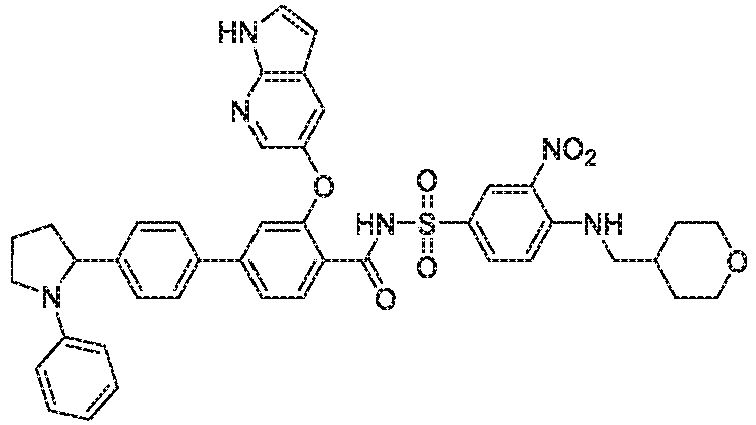
- The desired compound was then synthesized with tert-butyl 3-((1H-pyrrolo[2,3-b]pyridin-5-yl)oxy)-4'-(1-phenylpyrrolidin-2-yl)-[1,1'-biphenyl]-4-carboxylate following the procedures similar to those in Example A1. 1H NMR (400 MHz, DMSO-d6 ) δ ppm: 12.37 (br, 1H), 11.73 (br, 1H), 8.64-8.61 (m, 1H), 8.58 (d, J = 4.0 Hz, 1H), 8.07 (d, J = 4.0 Hz, 1H), 7.86 (d, J = 12.0 Hz, 1H), 7.63-7.59 (m, 2H), 7.52 (t, J = 4.0 Hz, 1H), 7.46-7.42 (m, 3H), 7.24 (d, J = 8.0 Hz, 2H), 7.15 (d, J = 8.0 Hz, 1H), 7.04 (t, J = 8.0 Hz, 2H), 6.99 (s, 1H), 6.51 (t, J = 8.0 Hz, 1H), 6.39-6.37 (m, 4H), 4.74 (d, J = 8.0 Hz, 1H), 3.85-3.83 (m, 2H), 3.65 (m, 1H), 3.28-3.23 (m, 4H), 2.35 (m, 1H), 1.93-1.76 (m, 4H), 1.61-1.58 (m, 2H), 1.28-1.23 (m, 3H). MS (ESI, m/e) [M+1]+ 773.1.
-

-
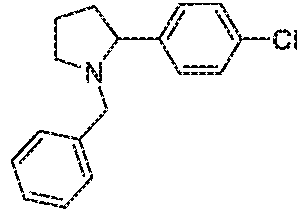
- The mixture of 2-(4-chlorophenyl)pyrrolidine (546 mg, 3 mmol), (bromomethyl)benzene (770 mg, 4.5 mmol) and triethylamine (909 mg, 9 mmol) in THF (100 mL) was stirred at room temperature for overnight. The mixture was concentrated in vacuo and the residue was diluted with DCM. The organic layer was washed with brine (100 mL), dried over Na2SO4 and evaporated in vacuo, then the residue was purified by chromatography column on silica (eluent: PE/EA = 2/1 to 1/1) to afford a crude product (1.2g), as a brown oil. MS (ESI, m/e) [M+1]+ 272.1.
-

- The mixture of 1-benzyl-2-(4-chlorophenyl)pyrrolidine (1.2 g, 4.4 mmol), tert-butyl 2-((1H-pyrrolo[2,3-b]pyridin-5-yl)oxy)-4-(4,4,5,5-tetramethyl-1,3,2-dioxaborolan-2-yl)benzoate (2.1 g, 4.8 mmol), 1,1'-Bis(diphenylphosphino)ferroccne-palladium(II)dichloridc dichloromethane complex (322 mg, 0.44 mmol), K2CO3 (1.52 g, 11 mmol) in a solution of 1,4-dioxane (100 mL) and water (10 mL) was heated to 90 °C for overnight. The reaction was concentrated in vacuo and purified by chromatography column on silica (eleuent: EA/PE = 1/1) to give the crude product (512 mg, 21.35%) as a red oil. MS (ESI, m/e) [M+1]' 546.2.

- The desired compound was then synthesized with tert-butyl 3-((1H-pyrrolo[2,3-b]pyridin-5-yl)oxy)-4'-(1-benzylpyrrolidin-2-yl)-[1,1'-biphenyl]-4-carboxylate following the procedures similar to those in Example A1. 1H NMR(400 MHz, DMSO-d6 ) δ ppm: 12.39 (br, 1H), 11.71 (br, 1H), 8.55 (m, 2H), 8.07 (d, J = 4.0 Hz, 1H), 7.83 (d, J = 8.0 Hz, 1H), 7.64-7.60 (m, 2H), 7.50-7.45 (m, 6H), 7.29 (m, 5H), 7.10 (d, J = 8.0 Hz, 1H), 7.03 (s, 1H), 6.39 (m, 1H), 4.51-4.14 (m, 1H), 3.85-3.83 (m, 2H), 3.34-3.23 (m, 4H), 2.99 (m, 2H), 2.18 (m, 2H), 1.87 (m, 4H), 1.61-1.58 (m, 2H), 1.30-1.21 (m, 3H). MS (ESI, m/e) [M+1]" 787.2.
-

- The desired compound was synthesized starting from 2-(2-ethylphenyl)pyrrolidine and 1-bromo-4-iodobenzene following the procedures similar to those in Example A1. 1H NMR (400 MHz, DMSO-d6 ) δ 12.15 (s, 1H), 11.69 (s, 1H), 8.60 (s, 1H), 8.56 (s, 1H), 8.04 (d, J = 2.0 Hz, 1H), 7.82 (d, J = 8.7 Hz, 1H), 7.50-7.58 (m, 3H), 7.27-7.34 (m, 3H), 7.22 (d, J = 7.4 Hz, 1H), 7.11-7.15 (m, 2H), 7.01 (t, J = 7.4 Hz, 1H), 6.89 (s, 1H), 6.85 (d, J = 7.4 Hz, 1H), 6.41-6.32 (m, 3H), 4.92 (d, J = 8.0 Hz, 1H), 3.84 (d, J = 7.9 Hz, 2H), 3.70 (t, J = 7.9 Hz, 1H), 3.37 (d, J = 7.9 Hz, 1H), 3.31-3.22 (m, 4H), 2.86-2.67 (m, 2H), 2.46-2.38 (m, 1H), 2.03-1.83 (m, 4H), 1.71 (s, 1H), 1.60 (d, J = 12.2 Hz, 2H), 1.27-1.23 (m, 4H). MS (ESI, m/e) [M+1]+ 801.2.
-

- The desired compound was synthesized starting from 2-(2-cyclopentylphenyl)pyrrolidine and 1-bromo-4-iodobenzene following the procedures similar to those in Example A1. 1H NMR (400 MHz, DMSO-d6 ) δ ppm: 12.16 (s, 1H), 11.70 (s, 1H), 8.61 (s, 1H), 8.56 (s, 1H), 8.05 (s, 1H), 7.82 (d, J = 8.0 Hz, 1H), 7.58 (s, 1H), 7.53-7.51 (m, 2H), 7.34-7.31 (m, 3H), 7.29 (s, 1H), 7.17-7.11 (m, 2H), 6.98 (t, J = 7.4 Hz, 1H), 6.91 (s, 1H), 6.82 (d, J = 8.0 Hz, 1H), 6.37 (s, 2H), 6.35 (s, 1H), 5.02 (d, J = 8.0 Hz, 1H), 3.84 (d, J = 8.8 Hz, 2H), 3.72-3.68 (m, 1H), 3.25-3.23 (m, 2H), 2.45-2.42 (m, 1H), 2.19-2.13 (m, 1H), 2.01-1.81 (m, 8H), 1.72-1.65 (m, 4H), 1.62-1.56 (m, 3H), 1.29-1.20 (m, 4H). MS (ESI, m/e) [M+1]+ 841.2.
-

- The desired compound was synthesized starting from 2-(2-fluorophenyl)pyrrolidine and 1-bromo-4-iodobenzene following the procedures similar to those in Example A1. 1H NMR (400 MHz, DMSO-d6 ) δ ppm: 12.17 (s, 1H), 11.67 (s, 1H), 8.53 (s, 2H), 8.03 (s, 1H), 7.79 (d, J = 8.0 Hz, 1H), 7.54 (d, J = 7.8 Hz, 2H), 7.49 (s, 1H), 7.32 (d, J = 7.8 Hz, 3H),7.25-7.15 (m, 2H), 7.05 (t, J = 7.2 Hz, 2H), 6.97 (t, J = 7.2 Hz, 1H), 6.90 (s, 1H), 6.42 (d, J= 8.0 Hz, 2H), 6.37 (s, 1H), 4.97 (d, J = 8.0 Hz, 1H), 3.84 (d, J = 8.8 Hz, 2H), 3.70 - 3.65 (m, 1H), 3.27 (d, J = 8.0 Hz, 3H), 2.42-2.35 (m, 1H), 1.99-1.85 (m, 4H), 1.62-1.58 (m, 2H), 1.26-1.23 (m, 4H). MS (ESI, m/e) [M+1]+ 791.1.
-

- The desired compound was synthesized starting from 2-methyl-2-phenylpyrrolidine and 1-bromo-4-iodobenzene following the procedures similar to those in Example A1. 1H NMR (400 MHz, DMSO-d6 ) δ ppm: 12.15 (s, 1H), 11.71 (s, 1H), 8.61 (t,J= 6.0 Hz, 1H), 8.586-8.525 (m, 1H), 8.05 (d, J = 2.3 Hz, 1H), 7.83 (d, J = 8.6 Hz, 1H), 7.59 (d, J = 2.0 Hz, 1H), 7.547-7.466 (m, 9H), 6.87 (s, 1H), 6.416-6.353 (m, 1H), 6.32 (d, J = 8.8 Hz, 2H), 3.890-3.794 (m, 2 H), 3.657-3.516 (m, 2H), 3.312-3.191 (m, 4 H), 2.180-2.118 (m, 1 H), 2.008-1.782 (m, 5 H), 1.71 (s, 3H), 1.638-1.547 (m, 2H), 1.265-1.201 (m, 3H). MS (ESI, m/e) [M+1]+ 787.1
-

- The desired compound was synthesized starting from 3-phenylpyrrolidine and 1-bromo-4-iodobenzene following the procedures similar to those in Example A1. 1H NMR (400 MHz, DMSO-d6 ) δ ppm: 12.17 (s, 1H), 11.72 (s, 1H), 8.62 (s, 1H), 8.58 (d, J = 2.2 Hz, 1H), 8.09 (d, J = 2.5 Hz, 1H), 7.85 (d, J = 9.3 Hz, 1H), 7.64 (d, J = 2.3 Hz, 1H), 7.57 (d, J = 8.1 Hz, 1H), 7.55-7.50 (m, 1H), 7.40 (t, J = 8.3 Hz, 3H), 7.32 (d, J = 4.4 Hz, 4H), 7.23 (dd, J = 8.7, 4.5 Hz, 1H), 7.14 (d, J = 9.4 Hz, 1H), 6.94 (s, 1H), 6.59 (d, J = 8.9 Hz, 2H), 6.41 (s, 1H), 3.85 (d, J = 7.3 Hz, 2H), 3.70 (t, J = 8.6 Hz, 1H), 3.58-3.40 (m, 3H), 3.25-3.21 (m, 5H), 2.38-2.32 (m, 1H), 2.10-2.00 (m, 1H), 1.90-1.84 (m, 1H), 1.61 (d, J = 11.3 Hz, 2H), 1.32-1.17 (m, 2H). MS (ESI, m/e) M+1]+ 773.1
-

- The desired compound was synthesized starting from 3-(pyrrolidin-2-yl)pyridine and 1-bromo-4-iodobenzene following the procedures similar to those in Example A1. 1H NMR (400 MHz, DMSO-d6 ) δ ppm: 12.17 (s, 1H), 11.72 (s, 1H), 8.62 (s, 3H), 8.57 (m, 1H), 8.06 (m, 1H), 8.06-7.94 (m, 1H), 7.83 (d, J = 9.2 Hz, 1H), 7.73-7.64 (m, 1H), 7.64-7.59 (m, 1H), 7.58-7.50 (m, 2H), 7.35-7.25 (m, 3H), 7.14 (d, J = 9.2 Hz, 1H), 6.87 (s, 1H), 6.47 (d, J = 8.5 Hz, 2H), 6.39 (s, 1H), 5.04-4.91 (m, 1H), 3.90-3.67 (m, 4H), 3.43-3.14 (m, 3H), 2.46-2.38 (m, 1H), 2.09-1.78 (m, 4H), 1.65-1.52 (m, 2H), 1.34-1.18 (m, 3H). MS (ESI) m/e [M+1]' 774.2.
-

- The desired compound was synthesized starting from 2-cyclohexylpyrrolidine and 1-bromo-4-iodobenzene following the procedures similar to those in Example A1. 1H NMR (400 MHz, DMSO-d6 ) δ ppm: 12.16 (s, 1H), 11.64 (s, 1H), 8.57 - 8.42 (m, 2H), 8.03 (s, 1H), 7.80 - 7.64 (m, 2H), 7.58 (d, J = 8.0 Hz, 1H), 7.55 - 7.44 (m, 2H), 7.36 - 7.34 (m, 3H), 7.00 (s, 1H), 6.92 (s, 1H), 6.57 (d, J = 8.0 Hz, 2H), 6.37 (s, 1H), 3.84 (d, J = 8.5 Hz, 2H), 3.64 - 3.60 (m, 1H), 3.43 - 3.39 (m, 1H), 3.26 - 3.20 (m, 4H), 3.09 - 3.07 (m, 1H), 1.90 - 1.82 (m, 3H), 1.72 - 1.55 (m, 7H), 1.47 - 1.41 (m, 1H), 1.30 - 1.23 (m, 4H), 1.02 - 0.95 (m, 4H). MS (ESI, m/e) [M+1]+ 779.2.
-

-

- The mixture of 2-(4-bromophenyl)pyrrolidine (452 mg, 2 mmol), 1-iodo-2-methylbenzene (654 mg, 3 mmol), 2,2'-bis(diphenylphosphanyl)-1,1'-binaphthalene(249 mg, 0.4 mmol), Tris(dibenzylideneacetone)dipalladium (183 mg, 0.2 mmol), t-BuOK (449 mg, 4 mmol) in toluene (50 mL) was heated to 90 °C overnight. The reaction was concentrated in vacuo and purified by chromatography column on silica (eluent: EA/PE = 1/5) to give the product (516 mg, 81.26%) as a colorless oil. 1H NMR(400 MHz, CDCl3) δ ppm: 7.33 (d,J = 8.0 Hz, 2H), 7.19 (d, J = 8.0 Hz, 2H), 7.09 (d, J = 4.0 Hz, 1H), 6.94 (t, J = 8.0 Hz, 1H), 6.79 (t, J = 8.0 Hz, 2H), 4.61 (dd, J = 4.0, J=8.0 Hz, 1H), 3.88 (d, J=8.0 Hz, 1H), 2.93 (m, 1H), 2.39 (m, 1H), 2.33 (s, 3H), 2.05-1.76 (m, 3H). MS (ESI, m/e) [M+1]' 258.0.
-

- The mixture of 2-(4-bromophenyl)-1-(u-tolyl)pyrrolidine (500 mg, 1.58 mmol), tert-butyl 2-((1H-pyrrolo[2,3-b]pyridin-5-yl)oxy)-4-(4,4,5,5-tetramethyl-1,3,2-dioxaborolan-2-yl)benzoate (760 mg, 1.74 mmol), 1,1'-Bis(diphenylphosphino)ferrocene-palladium(II)dichloride dichloromethane complex (117 mg, 0.16 mmol) , K2CO3 (545 mg, 3.95 mmol) in a solution of 1,4-dioxane (50 mL) and water (2 mL) was heated to 90°C for overnight. The reaction was concentrated in vacuo and purified by chromatography column on silica (eluent: EA/PE = 1/1) to give the product (623 mg, 73.30%) as a grey solid. MS (ESI, m/e) [M+1]+ 546.1.
- The desired compound was then synthesized with tert-butyl 3-((1H-pyrrolo[2,3-b]pyridin-5-yl)oxy)-4'-(1-(o-tolyl)pyrrolidin-2-yl)-[1,1'-biphenyl]-4-carboxylate following the procedures similar to those in Example A1. 1H NMR(400 MHz, DMSO-d6 ) δ ppm: 12.34(br, 1H), 11.71(br, 1H), 8.61(t, J = 4.0 Hz, 1H), 8.57(d, J = 4.0 Hz, 1H), 8.05 (d, J = 4.0 Hz, 1H), 7.85(d, J = 8.0 Hz, 1H), 7.61(d, J = 4.0 Hz, 1H), 7.58 (d, J = 8.0 Hz, 1H), 7.51 (t, J = 8.0 Hz, 1H), 7.40-7.33 (m, 5H), 7.14 (d, J = 8.0 Hz, 1H), 7.03 (d, J = 8.0 Hz, 1H), 6.96 (s, 1H), 6.89-6.80 (m, 2H), 6.69 (t, J = 8.0 Hz, 1H), 6.39-6.37 (m, 1H), 4.68 (m, 1H), 3.86-3.80 (m, 3H), 3.29-3.22 (m, 4H), 2.82 (m, 1H), 2.30 (m, 1H), 2.28 (s, 3H), 1.98-1.86 (m, 3H), 1.69-1.58 (m, 3H), 1.29 (m, 2H). MS (ESI, m/e) [M+1]' 787.1.
-

- The desired compound was synthesized starting from 2-(2-chloro-6-fluorophenyl)pyrrolidine and I-bromo-4-iodobenzene following the procedures similar to those in Example A1. 1H NMR (400 MHz, DMSO-d6) δ ppm: 12.16 (s, 1H), 11.70 (s, 1H), 8.60 (d, J = 5.6 Hz, 1H), 8.56 (d, J = 2.0 Hz, 1H), 8.04 (d, J = 2.4 Hz, 1H), 7.82 (d, J = 9.2 Hz, 1H), 7.58 (d, J = 2.5 Hz, 1H), 7.52 (s, 2H), 7.35-7.24 (m, 5H), 7.15-7.05 (m, 2H), 6.91 (s, 1H), 6.38 (s, 1H), 6.34 (d, J = 8.7 Hz, 2H), 5.32 (t, J = 4.8 Hz, 1H), 5.28-5.17 (m, 1H), 3.84 (d, J = 11.7 Hz, 2H), 3.50-3.45 (m, 2H), 2.03-1.95 (m, 4H), 1.90-1.85 (m, 3H), 1.60 (d, J = 12.8 Hz, 2H), 1.45 (s, 3H). MS (ESI, m/e) [M+1]' 825.1.
-

- The desired compound was synthesized starting from 2-phenylpyrrolidine and 4-bromo-2-fluoro-1-iodobenzene following the procedures similar to those in Example A5. 1H NMR (400 MHz, DMSO-d6 ) δ ppm: 12.24 (s, 1H), 11.64 (s, 1H), 8.50-8.42 (m, 2H), 8.00 (s, 1H), 7.78-7.72 (m, 1H), 7.59-7.38 (m, 4H), 7.32-7.28 (m, 2H), 7.23-7.05 (m, 5H), 6.78 (s, 1H), 6.35 (s, 1H), 6.26 (d, J = 8.7 Hz, 1H), 6.19 (m, 1H), 4.79 (d, J = 6.8 Hz, 1H), 3.83 (d, J = 8.3 Hz, 2H), 3.67 (s, 1H), 3.28-3.22 (m, 5H), 2.98 (s, 1H), 2.40-2.31 (m, 1H), 2.02-1.73 (m, 5H), 1.60 (d, J = 11.8 Hz, 2H). MS (ESI, m/e) [M+1]+ 791.1.
-

- The desired compound was synthesized starting from 2-(2-cyclobutylphenyl)pyrrolidine and 1-bromo-4-iodobenzene following the procedures similar to those in Example A1. 1H NMR (CDCl3-d6) δ ppm: 10.24 (s, 1H), 9.53 (s, 1H), 8.92 (s, 1H), 8.60-8.45 (m, 1H), 8.28-7.97 (m, 3H), 7.79 (s, 1H), 7.56-7.31 (m, 4H), 7.22-7.12 (m, 3H), 7.06-6.89 (m, 3H), 6.77 (s, 1H), 6.60-6.51 (m, 1H), 6.34 (d, J = 8.4Hz, 2H), 4.86 (d, J = 8.0Hz, 1H), 4.09-3.96 (m, 2H), 3.82-3.63 (m, 2H), 3.42 (t, J = 10.8Hz, 2H), 3.31-3.21 (m, 2H), 2.38-2.21 (m, 4H), 2.05-1.88 (m, 8H), 1.78-1.70 (m, 2H), 1.50-1.39 (m, 2H). MS (ESI, m/e) [M+1]+ 826.8.
-

- The desired compound was synthesized starting from 2-(2-cyclohexylphenyl)pyrrolidine and 1-bromo-4-iodobenzene following the procedures similar to those in ExampleA1. 1H NMR (400 MHz, DMSO-d6 ) δ ppm: 1H NMR (400 MHz, DMSO-d6) δ 12.14 (s, 1H), 11.68 (s, 1H), 8.9-8.55 (m, 2H), 8.04 (s, 1H), 7.81 (s, 1H), 7.62 - 7.44 (m, 2H), 7.35-7.28 (m, 5H), 7.14 (d, J = 7.7 Hz, 2H), 6.98 (t, J = 7.1 Hz, 1H), 6.91 (s, 1H), 6.82 (d, J = 7.6 Hz, 1H), 6.40-6.31 (m, 3H), 4.97 (d, J = 8.9 Hz, 1H), 3.84 (d, J = 10.4 Hz, 2H), 3.75-3.71 (m, 1H), 3.35-3.21 (m, 5H), 3.03 - 2.83 (m, 3H), 2.01-1.95 (m, 2H), 1.88-1.75 (m, 4H), 1.74-1.67 (m, 2H), 1.62-1.55 (m, 4H), 1.48-1.38 (m, 3H), 1.30-1.25 (m, 2H). MS (ESI, m/e) [M+1]' 854.8.
-

- The desired compound was synthesized starting from 4,4-dimethyl-2-phenylpyrrolidine and 1-bromo-4-iodobenzene following the procedures similar to those in Example A1. 1H NMR (400 MHz, DMSO-d6 ) δ ppm: 12.15 (s, 1H), 11.70 (s, 1H), 8.62 (t, J = 5.8 Hz, 1H), 8.57 (d, J = 2.0 Hz, 1H), 8.04 (d, J = 2.4 Hz, 1H), 7.83 (d, J = 7.5 Hz, 1H), 7.59 (d, J = 2.3 Hz, 1H), 7.52 (d, J = 8.0 Hz, 3H), 7.51-7.53 (m, 2H), 7.32 (d, J = 8.0 Hz, 1H), 7.12-7.28 (m, 8H), 6.87 (s, 1H), 6.39-6.42 (m, 3H), 4.78 (t, J = 7.8 Hz, 2H), 3.84 (d, J = 8.2 Hz, 2H), 3.51 (d, J = 9.6 Hz, 2H), 3.23-3.29 (m, 4H), 2.23-2.33 (m, 1H), 1.97-2.01 (m, 2H), 1.87 (s, 1H), 1.58-1.65 (m, 3H), 1.45 (s, 1H), 1.10 (s, 4H), 1.10 (s, 3H), 1.01 (s, 3H). MS (ESI, m/e) [M+1]+ 801.1.
-

- The desired compound was synthesized starting from 2-phenylazetidine and 1-bromo-4-iodobenzene following the procedures similar to those in Example A1. MS (ESI, m/e) [M+1]+ 758.8.
-

- The desired compound was synthesized from 1-(4-bromophenyl)-2-phenyl-2-(trifluoromethyl)pyrrolidine following the procedures similar to those in Example A1. 1H NMR (DMSO-d6 ) δ ppm: 12.22 (s, 1H), 11.70 (s, 1H), 8.67-8.48 (m, 2H), 8.10-7.97 (m, 1H), 7.86-7.75 (m, 1H), 7.65-7.46 (m, 3H), 7.43-7.08 (m, 9H), 6.91 (s, 1H), 6.54-6.32 (m, 3H), 3.87-3.62 (m, 4H), 3.30-3.20 (m, 4H), 2.76-2.66 (m, 1H), 2.22-1.80 (m, 4H), 1.66-1.53 (m, 2H), 1.30-1.19 (m, 2H).MS (ESI, m/e) [M+1]' 840.7.
-

- The desired compound was synthesized from 1-(4-bromophenyl)-2-ethyl-2-phenylpyrrolidine following the procedures similar to those in Example A1. 1H NMR (400 MHz, DMSO-d6 )δ ppm: 12.16 (s, 1H), 11.71 (s, 1H), 8.65 - 8.56 (m, 2H), 8.06 (d, J = 2.4 Hz, 1H), 7.85 (d, J = 8.8 Hz, 1H), 7.60 (s, 1H), 7.55 - 7.49 (m, 2H), 7.36 - 7.11 (m, 9H), 6.89 (s, 1H), 6.41 - 6.33 (m, 3H), 3.86 (d, J = 8.4 Hz, 2H), 3.68 - 3.45 (m, 2H), 3.31 - 3.22 (m, 4H), 2.41 - 2.25 (m, 3H), 1.92 - 1.71 (m, 4H), 1.62 (d, J= 12.4 Hz, 2H), 1.31 - 1.19 (m, 2H). 0.64 (t, J = 7.2 Hz, 3H). MS (ESI, m/e) [M+1]' 800.7.
-
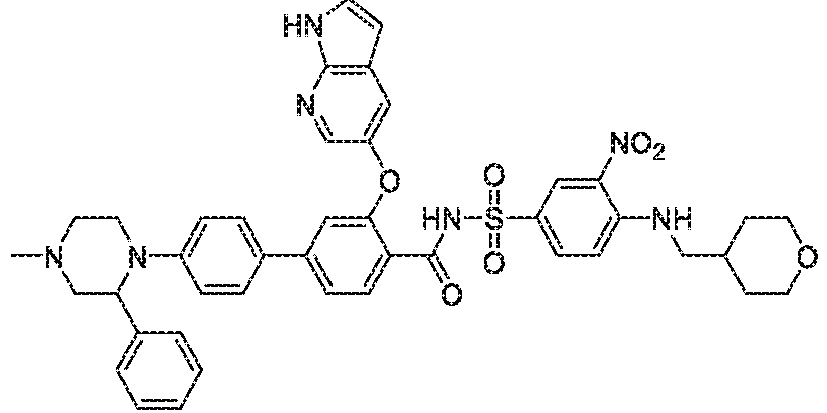
- The desired compound was synthesized starting from 1-methyl-3-phenylpiperazine and 1-bromo-4-iodobenzene following the procedures similar to those in Example A1. 1H NMR (400 MHz, DMSO-d6 ) δ ppm: 11.66 (s, 1H), 8.51 (s, 1H), 8.02 (s, 1H), 7.78 (d, J = 9.2 Hz, 1H), 7.60-7.48 (m, 4H), 7.35-7.28 (m, 6H), 7.25-7.21 (m, 2H), 7.16-7.13 (m, 1H), 7.04 (d, J = 9.2 Hz, 1H), 6.97-6.90 (m, 3H), 6.36 (s, 1H), 4.73 (s, 1H), 3.84 (d, J = 8.8 Hz, 2H), 3.57-3.45 (m, 3H), 3.28-3.22 (m, 4H), 3.15-2.90 (m, 5H), 2.05-1.79 (m, 2H), 1.59 (d, J = 12.0 Hz, 2H), 1.26-1.23 (m, 2H). MS (ESI, m/e) [M+1]' 802.2.
-
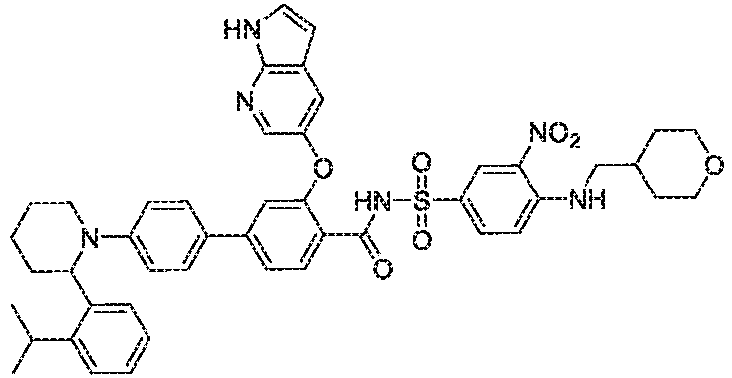
- The desired compound was synthesized from 1-(4-bromophenyl)-2-(2-isopropylphenyl)piperidine following the procedures similar to those in Example A1. 1H NMR (400 MHz, DMSO-d6 ) δ ppm: 12.24 (s, 1H), 11.68 (s, 1H), 8.54 (s, 2H), 8.02 (s, 1H), 7.79 (s, 1H), 7.57 - 7.47 (m, 3H), 7.39 - 7.19 (m, 4H), 7.17- 7.01 (m, 3H), 6.92 (s, 2H), 6.81 (d, J = 8.2 Hz, 2H), 6.36 (s, 1H), 4.71 (s, 1H), 3.84 (d, J = 9.7 Hz, 2H), 3.26 - 3.22 (m, 4H), 1.95 - 1.85 (m, 2H), 1.79 - 1.72 (m, 2H), 1.68-1.55 (m, 4H), 1.49 -1.43(m, 2H), 1.23 - 1.18 (m, 6H), 1.04 (d, J = 5.2 Hz, 2H), 0.86 - 0.82 (m, 1H). MS (ESI, m/e) [M+1]+ 828.8.
-

- AlCl3 (26.7 g, 200 mmol) was added into a mixture of dihydrofuran-2,5-dione (10.0 g, 100 mmol) in bromobenzene (97 g) at about 0°C, the reaction temperature was maintained at about 0°C for 1h and then allowed to r. t. the mixture was stirred at r. t for 16h. The reaction mixture was poured into ice water, HCl (1M) was added slowly until PH∼1. The mixture was extracted with EA (400 mL). The organic layer was dried over Na2SO4, concentrated, filtered and washed with PE (100 mL) to give the crude product as brown solid 14.5 g.
- To a solution of 4-(4-bromophenyl)-4-oxobutanoic acid (14.5 g, 56.42 mmol) in CH3OH (200 mL) was added SOCl2 (10 mL) slowly, the mixture was stirred at ambient temperature for 2h. The solution was concentrated. The residue was partitioned between DCM (100 mL) and Sat. NaHCO3 (300 mL). The organic layer was dried over Na2SO4 and concentrated to give the crude product as yellow oil. (15.0 g).
- To a solution of methyl 4-(4-bromophenyl)-4-oxobutanoate (15 g, 55.35 mmol) in CH3OH (150 mL) was added hydroxylamine hydrochloride (9.2 g, 132.84 mmol), NaOAc (11.4 g, 138.38 mmol)/ H2O (50 mL), the mixture was heated at reflux for about 1h. Cooled to ambient temperature, concentrated to remove CH3OH. The resulting mixture was partitioned between EA (300 mL) and Sat. NaHCO3 (200 mL). The aqueous layer was extracted with EA (100 mL). The combined organic layers were washed with H2O (200 mL), concentrated and purified by column chromatograph on silica gel (100-200 mesh, eluent: EA: PE= 1: 10) to give the product as yellow oil. (11.2 g, 71.0 %). [M+1]+ 285.9, 287.9.
- To a solution of methyl-4-(4-bromophenyl)-4-(hydroxyimino)butanoate (11.2 g, 39.16 mmol) in CH3OH (100 mL) was added Zn (powder, 5.2 g, 78.32 mmol), the mixture was stirred in a 80°C oil bath under N2 for about 16h. Cooled to ambient temperature, filtered, the filtrate was concentrated. The residue was partitioned between DCM (500 mL) and Sat. NaHCO3 (300 mL). The organic layer was separated, concentrated to give the crude product, which was slurry with PE (100 mL) to give the product as white solid. (6.5 g, 69.4%). [M+1]+ 240.0, 241.9.
- To a solution of tert-butyl 2-((1H-pyrrolo[2,3-b]pyridin-5-yl)oxy)-4-(4,4,5,5-tetramethyl-1,3,2-dioxaborolan-2-yl)benzoate (2.2 g, 5.00 mmol) in 1,4-dioxane (50 mL) was added 5-(4-bromophenyl)pyrrolidin-2-one (1.2 g, 5.00 mmol), Pd(dppf)Cl2 (183 mg, 0.25 mmol) and 1 N K2CO3 (15 mL), the mixture was stirred in a 80°C oil bath under N2 for about 18h. Cooled to r. t, extracted with DCM (50 mL×2). The combined organic layers were concentrated and purified by column chromatograph on silica gel (100-200 mesh, eluent: MeOH: DCM= 1: 10) to give the crude product as brown solid. (2.4 g). [M+1]+ 469.8.
- To a solution of tert-butyl 3-((1H-pyrrolo[2,3-b]pyridin-5-yl)oxy)-4'-(5-oxopyrrolidin-2-yl)-[1,1'-biphenyl]-4-carboxylale (1.5 g, 3.20 mmol) in DCM (50 mL) was added (2-bromophenyl)boronic acid (640 mg, 3.20 mmol), Cu(OAc)2 (920 mg, 4.80 mmol) and TEA (1.6 g, 15.99 mmol), the mixture was stirred at r. t in air for 3h. (2-bromophenyl)boronic acid (640 mg, 3.20 mmol) was added, the mixture was stirred in air for 18h. H2O (30 mL) was added, filtered, the organic layer was separated, concentrated and purified by column chromatograph on silica gel (100-200 mesh, eluent: MeOH: DCM= 1: 20) to give the product as brown solid. (1.0 g, 50.2 %). [M+1]" 623.8.
- To a solution of tert-butyl 3-((1 H-pyrrulo[2,3-b]pyridin-5-yl)oxy)-4'-(1-(2-bromophenyl)-5-oxopyrrolidin-2-yl)-[1,1'-biphenyl]-4-carboxylate (312 mg, 0.50 mmol) and cyclopropylboronic acid (172 mg, 2.00 mmol) in 1,4-dioxane (20 mL) was added 1N K2CO3 (2 mL) and Pd(dppf)Cl2 (37 mg, 0.05 mmol), the mixture was stirred in a 80°C oil bath under N2 for 20h. Cooled to r. t, diluted with DCM (30 mL), filtered, the filtrate was concentrated and purified by column chromatograph on silica gel (MeOH: DCM= 1: 20) to give the crude product, which was purified by pre-TLC (EA) to give the product as brown solid. (290 mg, 98.9 %). [M+1]+ 585.8
- The desired compound was then synthesized with tert-butyl 3-((1H-pyrrolo[2,3-b]pyridin-5-yl)oxy)-4'-(1-(2-cyclopropylphenyl)-5-oxopyrrolidin-2-yl)-[1,1'-biphenyl]-4-carboxylate following the procedures similar to those in Example A1. [M+1]+ 826.7.
-

- To a solution of 1-bromo-2-nitrobenzene (3.7 g, 18.32 mmol) and cyclopropylboronic acid (4.7 g, 54.95 mmol) in 1,4-dioxane (100 mL) was added K2CO3( 5.1 g, 36.64 mmol)/H2O (20 mL) and Pd(dppf)Cl2(1.3 g, 1.83 mmol), the mixture was stirred at 90°C under N2 for 16h. Cooled to ambient temperature, the organic layer was separated, concentrated and purified by column chromatograph on silica gel (100-200 mesh, eluent: EA: PE= 1: 4) to give the product as yellow oil. (2.6 g, 86.7 %).
- To a solution of 1-cyclopropyl-2-nitrobenzene (2.6 g, 15.95 mmol) in CH3OH (50 mL) was added Sat. NH4Cl (7.5 mL) and Zn (powder, 5.1 g, 79.75 mmol), the mixture was stirred at ambient temperature for 1h. A filtration was formed, the filtrate was concentrated. The residue was partitioned between DCM (30 mL) and H2O (20 mL). The organic layer was dried over Na2SO4 and concentrated to give the product as brown oil. (1.6 g, 75.4 %). [M+1]+ 134.2.
- To a solution of 4-(4-bromophenyl)-4-oxobutanoic acid (3.7 g, 15.95 mmol) in DCM (50 mL) was added 2-cyclopropylaniline (1.6 g, 12.03 mmol), HATU (6.9 g, 18.04 mmol) and TEA (3.6 g, 36.10 mmol), the solution was stirred at ambient temperature for 17h. The reaction solution was concentrated and purified by column chromatograph on silica gel (100-200 mesh, eluent: EA: DCM= 1: 2) to give the crude product, which was crystallized from EA/PE=1/3 (50 mL, 70°C - r. t) to give the product as off-white solid. (1.9 g, 35.8 %). [M+1]+ 371.8, 373.8.
- To a solution of 4-(4-bromophenyl)-N-(2-cyclopropylphenyl)-4-oxobutanamide (1.9 g, 5.12 mmol) in CH3OH (60 mL) was added NaBH4 (583 mg, 15.36 mmol) in portions, the solution was stirred at ambient temperature for 1h. The reaction solution was concentrated. The residue was partitioned between DCM (50 mL) and Sat. NaCl (20 mL). The organic layer was separated, concentrated and purified by column chromatograph on silica gel (100-200 mesh, eluent: EA: DCM= 1: 1) to give the product as pink oil. (1.8 g, 94.7 %). [M+1]' 373.8, 375.8.
- To a solution of 4-(4-bromophenyl)-N-(2-cyclopropylphenyl)-4-hydroxybutanamide (1.8 g, 4.83 mmol) in THF (50 mL) was added TosCl (1.2 g, 6.27 mmol) at -40°C, the solution was stirred at -40°C for about 40min, t-BuOK (1.08 g, 9.65 mmol) was then added, the mixture was stirred at -40°C for 1h. Warmed to r. t slowly, quenched by Sat. NaCl (10 mL). The organic layer was separated, concentrated and purified by column chromatograph on silica gel (100-200 mesh, eluent: EA: PE= 1: 1) to give the product as pink oil. (0.9 g, 52.5 %). [M+1]+ 355.8, 357.8.
- To a solution of 5-(4-bromophenyl)-1-(2-cyclopropylphenyl)pyrrolidin-2-one (900 mg, 2.53 mmol) in THF (20 mL) was added BH3/THF (0.9M, 10 mL, 9.0 mmol) slowly, the solution was stirred at 60°C under N2 for 3h. Cooled to r. t, quenched by CH3OH (2 mL), concentrated and purified by column chromatograph on silica gel (100-200 mesh, eluent: EA: PE= 1: 5) to give the product as yellow oil. (750 mg, 86.8 %). [M+1]+ 341.8, 343.8.
- The desired compound was then synthesized with 2-(4-bromophenyl)-1-(2-cyclopropylphenyl)pyrrolidine following the procedures similar to those in Example A1. [M+1]+ 812.8.
-

- To a solution of 3-((1H-pyrrolo[2,3-b]pyridin-5-yl)oxy)-N-((3-nitro-4-(((tetrahydro-2H-pyran-4-yl)methyl)amino)phenyl)sulfonyl)-4'-(pyrrolidin-2-yl)-[1,1'-biphenyl]-4-carboxamide (100 mg, 0.15 mmol) in CH3CN (10 mL) was added 1-fluoro-2-nitrobenzene (63 mg, 0.44 mmol) and TEA (149 mg, 1.47 mmol), the solution was stirred at 80 °C for 18h. The reaction solution was concentrated and purified by pre-TLC (DCM:MeOH = 25:1) to give the crude product, which was purified by pre-HPLC to give the product as yellow solid. (10 mg, 8.30 %). 1H NMR (DMSO-d6) δ ppm: 12.36 (s, 1H), 11.71 (s, 1H), 8.67-8.51 (m, 2H), 8.05 (d, J= 2.4Hz, 1H), 7.88-7.79 (m, 1H), 7.71-7.23 (m, 10H), 7.13 (d, J = 9.6Hz, 1H), 7.00 (s, 1H), 6.86-6.64 (m, 2H), 6.39 (s, 1H), 5.03-4.91 (m, 1H), 3.87-3.81 (m, 2H), 3.29-3.24 (m, 3H), 3.10-2.88 (m, 2H), 2.83-2.77 (m, 1H), 2.05-1.95 (m, 1H), 1.93-1.79 (m, 2H), 1.73-1.54 (m, 3H), 1.13-1.16 (m, 3H). MS (ESI, m/e) [M+1]' 817.7.
-

- The desired compound was synthesized starting from 2-(2-(tert-butyl)phenyl)pyrrolidine. 1H NMR (400 MHz, DMSO-d6) δ 12.15 (s, 1H), 11.67 (s, 1H), 8.54 (s, 2H), 8.01 (s, 1H), 7.80 (s, 1H), 7.55-7.46 (m, 2H), 7.42 (d, J = 8.1 Hz, 1H), 7.31 (s, 1H), 7.29-7.25 (m, 2H), 7.20 (s, 1H), 7.13 (s, 1H), 7.04 (s, 2H), 6.92 (s, 1H), 6.65 (s, 1H), 6.42-6.36 (m, 3H), 5.25 (d, J = 7.8 Hz, 1H), 3.84 (d, J = 9.2 Hz, 2H), 3.73 (s, 1H), 3.28-3.23 (m, 4H), 2.03-1.97 (m, 6H), 1.87 (s, 1H), 1.77 (s, 1H), 1.61-1.58 (m, 2H), 1.50 (s, 9H), 1.44 (s, 1H), 1.41 (s, 1H). MS (ESI, m/e) [M+1]+ 828.8.
-

- The desired compound was synthesized starting from N,N-dimethyl-2-(pyrrolidin-2-yl)aniline and 1-bromo-4-iodobenzene following the procedures similar to those in Example A1. 1H NMR (400 MHz, DMSO-d6 ) δ ppm: 12.16 (s, 1H), 11.66 (s, 1H), 8.53 (s, 2H), 8.02 (s, 1H), 7.77 (s, 1H), 7.61-7.44 (m, 3H), 7.35-7.13 (m, 5H), 6.98-6.88 (m, 3H), 6.47-6.30 (m, 3H), 5.15-5.08 (m, 1H), 3.89-3.80 (m, 2H), 3.71 (s, 1H), 3.55-3.50 (m, 3H), 2.75-2.67 (m, 6H), 2.45-2.40 (m, 1H), 2.05-1.98 (m, 3H), 1.85 (s, 2H), 1.64-1.54 (m, 2H), 1.47-1.42 (m, 1H), 1.06-1.00 (m, 5H). MS (ESI) m/e [M+1]+ 815.8.
-

- The desired compound was synthesized from 2-(2-(azetidin-1-yl)phcnyl)-1-(4-bromophenyl)pyrrolidine following the procedures similar to those in Example A1. 1H NMR (400 MHz, DMSO-d6 ) δ ppm: 12.14 (s, 1H), 11.69 (s, 1H), 8.58 (t, J = 6.0 Hz, 1H), 8.57 (d, J = 2.4 Hz, 1 H), 8.05 (d, J = 2.4 Hz, 1H), 7.84 (d, J = 8.8 Hz, 1H), 7.60 (d, J = 2.4 Hz, 1H), 7.52 - 7.50 (m, 2H), 7.35 - 7.25 (m, 3H), 7.14 (d, J = 9.2 Hz, 1H), 7.04 (t, J = 6.4 Hz, 1H), 6.89 (s, 1H), 6.75 (d, J = 7.6 Hz, 1H), 6.60 (t, J = 7.6 Hz, 1H), 6.51 (d, J = 7.6 Hz, 1H), 6.45 - 6.35 (m, 3H), 4.82 (d, J = 8.0 Hz, 1H), 3.93 (t, J = 7.4 Hz, 4H), 3.84 - 3.80 (m, 2H), 3.64 (t, J = 8.0 Hz, 1H), 3.32 - 3.21(m, 4H), 2.35 - 2.21 (m, 3H), 2.02 - 1.81 (m, 5H), 1.62 (d, J= 12.8 Hz, 2H), 1.30 - 1.25 (m, 2H). MS (ESI, m/e) [M+1]+ 827.8.
-

- The desired compound was synthesized starting from N-(2-(pyrrolidin-2-yl)phenyl)methanesulfonamide. 1H NMR (400 MHz, DMSO-d6 ) δ ppm:12.16 (s, 1H), 11.70 (s, 1H), 9.20 (s, 1H), 8.61-8.56 (m, 2H), 8.05 (s, 1H), 7.82 (d, J = 8.0 Hz, 1H), 7.65-7.48 (m, 3H), 7.35-7.33 (m, 2H), 7.24-7.22 (m, 3H), 7.13 (t, J = 7.2 Hz, 2H), 6.98-6.87 (m, 2H), 6.48 (d, J = 8.6 Hz, 2H), 6.38 (s, 1H), 5.26 (d, J = 7.9 Hz, 1H), 3.84 (d, J = 8.6 Hz, 2H), 3.68 (s, 1H), 3.29-3.22 (m, 4H), 3.11 (s, 3H), 2.37-2.33 (m, 1H), 1.95 (s, 1H), 1.83-1.81 (m, 2H), 1.60 (d, J = 12.5 Hz, 2H), 1.28-1.24 (m, 4H). MS (ESI, m/e) [M+1]+ 865.7.
-
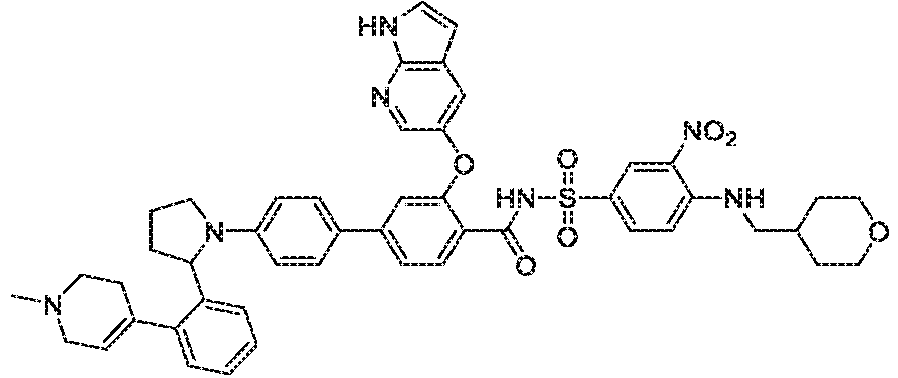
- The desired compound was synthesized starting from 1-methyl-4-(2-(pyrrolidin-2-yl)phenyl)-1,2,3,6-tetrahydropyridine and 1-bromo-4-iodobenzene following the procedures similar to those in Example A1. 1H NMR (400 MHz, DMSO-d6 ) δ ppm: 11.56 (s, 1H), 8.41 - 8.37 (m, 2H), 7.96 (s, 1H), 7.68 (d, J = 8.8 Hz, 1H), 7.57 (d, J = 8.0 Hz, 1H), 7.43 (s, 1H), 7.37 (s, 1H), 7.30 (d, J = 8.4 Hz, 2H), 7.33 - 7.12 (m, 4H), 7.04 (d, J = 7.2 Hz, 1H), 6.91 (s, 1H), 6.87 (d, J = 9.2 Hz, 1H), 6.38 (d, J = 8.4 Hz, 1H), 6.30 (s, 1H), 5.70 (m, 1H), 4.85 (d, J = 7.2 Hz, 1H), 3.84 (d, J = 8.4 Hz, 2H), 3.79 - 3.55 (m, 3H), 3.28 - 3.12 (m, 7H), 2.79 - 2.56 (m, 5H), 2.42 - 2.31 (m, 1H), 2.09 - 1.71 (m, 5H), 1.61 (d,J = 12.8 Hz, 2H), 1.50 - 1.32 (m, 2H). MS (ESI, m/e) [M+1]+ 867.7.
-

- To a solution of (R)-2-(2-bromophenyl)pyrrolidine (10 g, 44.22mmol) in DCM (100 ml) was added triethylamine (6.699 g, 66.33 mmol), then added (CF3CO)2O (10.216 g, 48.65 mmol) at 0 °C. After stirred at room temperature for 1 hour, the reaction mixture was concentrated. The resulted residue was dissolved with DCM (500 ml), and then washed with saturated aq. NaHCO3 solution, brine. After dried over Na2SO4, the organic phase was concentrated to obtain the product (14 g) as a brown solid. MS (ESI, m/e) [M+1]+ 321.8.
- To a solution of (R)-1-(2-(2-bromophenyl)pyrrolidin-1-yl)-2,2,2-trifluoroethan-1-one (5 g, 15.52 mmol) in toluene (100 ml) was added tert-butyl 4-(4,4,5,5-tetramethyl-1,3,2-dioxaborolan-2-yl)-3,6-dihydropyridine-1(2H)-carboxylate (7.189 g, 23.25 mmol), Pd(OAc)2 (348 mg, 1.552 mmol), Tricyclohexyl phosphine (870 mg, 3.1 mmol) and K3PO4 (11.53 g, 54.32 mmol). The mixture was then stirred at 100°C for 12 hours at N2 atmosphere. After cooled to room temperature, the reaction mixture was washed with brine and dried over Na2SO4.After removal of solvent, the resulted residue was purified by chromatograph column on silica gel (eluent: PE/EA = 50/1 to 10/1) to obtain the product (3.66 g) as yellow oil. MS (ESI, m/e) [M-55]+ 368.8.
- To a solution of tert-butyl (R)-4-(2-(1-(2,2,2-trifluoroacetyl)pyrrolidin-2-yl)phenyl)-3,6-dihydropyridine-1(2H)-carboxylate (3.66 g, 8.62mmol) in DCM (100 ml) was added TFA (20 ml). The mixture was stirred at room temperature for 2 hours. After removal of solvent and TFA, the residue was dissolved with DCM (200 ml) and then washed with saturated aq. NaHCO3 solution, brine, dried over Na2SO4. The DCM solution was concentrated to obtain the crude product (2.66 g) as a brown oil, which was used in next step without further purification.
- To a solution of (R)-2,2,2-trifluoro-1-(2-(2-(1,2,3,6-tetrahydropyridin-4-yl)phenyl)pyrrolidin-1-yl)ethan-1-one (2.66 g, 8.2 mmol) in MeOH (100 mL) was added HCHO(37%, 3.99 g 49.18 mmol) and NaBH3CN (2.058 g, 32.77 mmol). The mixture was stirred at room temperature for 2 hours. After removal of solvent, the residue was dissolved with EA (200 ml), washed with brine, and then dried over Na2SO4. The EA solution was concentrated to obtain the crude product (2.5 g) as a yellow solid, which was used in next step without further purification. MS (ESI, m/e) [M+1]+ 338.9.
- To a solution of (R)-2,2,2-trifluoro-1-(2-(2-(1-methyl-1,2,3,6-tetrahydropyridin-4-yl)phenyl)pyrrolidin-1-yl)ethan-1-one (2.5 g, 7.39 mmol) in MeOH (50 mL) and H2O (50 mL) was added LiOH.H2O (3.1 g, 73.9 mmol). After stirred at 60 °C for 3 hours, the reaction mixture was extracted with DCM (200 mL×3). The combined organic phase was concentrated. The residue was purified by column chromatograph on silica gel (eluent: DCM/MeOH = 10/1 (added 1% NH3.H2O)) to obtain the product (1.2 g). MS (ESI, m/e) [M+1]+ 243.0.
- To a solution of (R)-1-methyl-4-(2-(pyrrolidin-2-yl)phenyl)-1,2,3,6-tetrahydropyridine (500 mg, 2.07mmol) in toluene (50 ml) was added 1-bromo-4-iodobenzene (1.165 g, 4.13 mmol), Pd2(dba)3 (189 mg, 0.207 mmol), BINAP(257.5 mg, 0.414 mmol) and t-BuOK (757.6 mg, 6.21 mmol). The mixture was stirred at 90°C for 12 hours at N2 atmosphere. After cooled to room temperature, the reaction mixture was washed with brine, dried over Na2SO4 and concentrated. The residue was purified by chromatograph column on silica gel (DCM/MeOH = 50/1) to obtain the product (508 mg) as a yellow oil. MS (ESI, m/e) [M+1] ' 396.8.
- To a solution of (R)-4-(2-(1-(4-bromophenyl)pyrrolidin-2-yl)phenyl)-1-methyl-1,2,3,6-tetrahydropyridine (508 mg, 1.28 mmol) and tert-butyl 2-((1H-pyrrolo[2,3-b]pyridin-5-yl)oxy)-4-(3,3,4,4-tetramelhylborolan-1-yl)benzoate (725.3mg, 1.66 mmol) in 1,4-dioxane (50 mL) and H2O (5 mL) was added Pd(ddpf)Cl2 (93.6 mg, 0.128 mmol) and Cs2CO3 (1248 mg, 3.84 mmol). The mixture was stirred at 100 °C for 3 hours under N2 protection. After cooled to room temperature, the reaction mixture was diluted with DCM (200 mL), then washed with brine (200 mL×2) and dried over Na2SO4. After concentration, the residue was purified by chromatography column on silica (eluent: DCM/MeOH = 25/1) to obtain the product (367 mg) as a yellow solid. MS (ESI, m/e) [M+1]+ 626.9.
- To a solution of tert-butyl (R)-3-((1H-pyrrolo[2,3-b]pyridin-5-yl)oxy)-4'-(2-(2-(1-methyl-1,2,3,6-tetrahydropyridin-4-yl)phenyl)pyrrolidin-1-yl)-[1,1'-biphenyl]-4-carboxylate (367 mg, 0.585 mmol) in DCM (30 ml) was added TFA (15 ml). The mixture was stirred at room temperature for 2 hours. After removal of solvent and TFA, the crude product was obtained as a yellow solid, which was used in next step without further purification. MS (ESI, m/e) [M+1]+ 570.9.
- The desired compound was then synthesized with 3-nitro-4-(((tetrahydro-2H-pyran-4-yl)methyl)amino)benzenesulfonamide and (R)-3-((1H-pyrrolo[2,3-b]pyridin-5-yl)oxy)-4'-(2-(2-(1-methyl-1,2,3,6-tetrahydropyridin-4-yl)phenyl)pyrrolidin-1-yl)-[1,1'-biphenyl]-4-carboxylic acid following the procedure similar to those in Example A1. 1H NMR (400 MHz, DMSO-d6 ) δ ppm: 12.34 (br, 1H), 11.71 (s, 1H), 8.69-8.46 (m, 2H), 8.12-7.95 (m, 1H), 7.87-7.74 (m, 1H), 7.65-7.45 (m, 3H), 7.40-6.94 (m, 8H), 6.89 (s, 1H).,6.53-6.23 (m, 3H), 5.71 (s, 1H), 4.78 (d, J = 8.0 Hz, 1H), 4.04-3.45 (m, 6H), 3.41-3.36 (m, 2H), 3.32-3.19 (m, 6H), 2.92-2.81 (m, 3H), 2.44-2.33 (m, 1H), 2.06-1.67 (m, 4H), 1.67-1.51 (m, 2H). 1.32-1.16 (m, 2H). MS (ESI, m/e) [M+1]' 868.5.
-
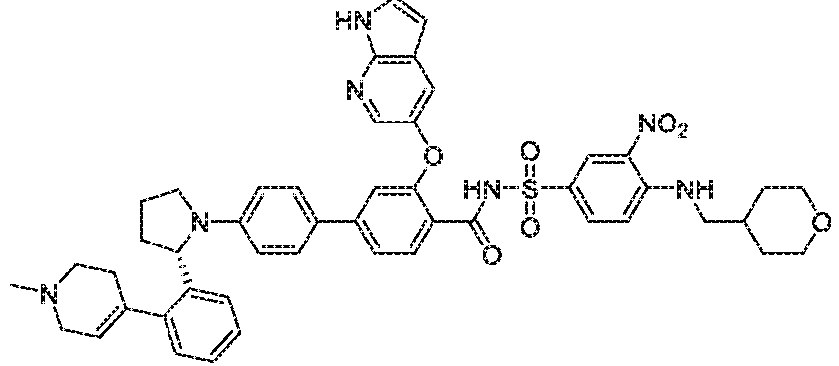
- The desired compound was synthesized following the procedures similar to those in Example A68-R by replacing (R)-1-methyl-4-(2-(pyrrolidin-2-yl)phenyl)-1,2,3,6-tetrahydropyridine with (S)-1-methyl-4-(2-(pyrrolidin-2-yl)phenyl)-1,2,3,6-tetrahydropyridine. 1H NMR (400 MHz, DMSO-d6 ) δ ppm: 11.55 (s, 1H), 8.39 (s, 1H), 8.36 (s, 1H), 7.96 (d,J = 2.3 Hz, 1H), 7.66 (d, J = 8.8 Hz, 1H), 7.56 (d, J = 8.1 Hz, 1H), 7.42 (s, 1H), 7.35 (s, 1H), 7.29 (d, J = 8.6 Hz, 2H), 7.27 - 7.09 (m, 4H), 7.03 (d, J = 7.1 Hz, 1H), 6.91 (s, 1H), 6.85 (d,J = 9.0 Hz, 1H), 6.37 (d, J = 8.6 Hz, 2H), 6.30 (s, 1H), 5.69 (s, 1H), 4.84 (d, J = 6.9 Hz, 1H), 3.83 (d, J = 8.3 Hz, 2H), 3.74 (s, 1H), 3.30-3.21 (m, 6H), 3.08-2.91 (m, 3H), 2.40 - 2.29 (m, 3H), 2.10 - 1.70 (m, 6H), 1.60 (d, J = 12.6 Hz, 2H), 1.30 - 1.18 (m, 3H). MS (ESI, m/c). [M+1]' 868.8.
-

- The desired compound was synthesized from 1-(4-bromo-2-fluorophenyl)-2-(2-cyclopropylphenyl)pyrrolidine following the procedures similar to those in Example A1. 1H NMR (DMSO-d6) δ ppm: 12.25 (s, 1H), 11.66 (s, 1H), 8.56 - 8.53 (m, 2H), 8.01 (s, 1H), 7.78 (d, J = 8.8 Hz, 1H), 7.54 - 7.48 (m, 3H), 7.36 (d, J = 8.1 Hz, 1H), 7.25 (d, J = 15.8 Hz, 1H), 7.13 (d, J = 8.1Hz, 1H), 7.09 - 7.04 (m, 2H), 7.01 - 6.96 (m, 3H), 6.46 (t, J = 8.8 Hz, 1H), 6.36 (s, 1H), 5.38 (s, 1H), 3.94 (s, 1H), 3.84 (d, J = 8.7 Hz, 2H), 3.57 - 3.49 (m, 1H), 3.30 - 3.24 (m, 4H), 2.09 - 2.01 (m, 1H), 1.96 - 1.82 (m, 3H), 1.78 - 1.68 (m, 1H), 1.65 -1.55 (m, 2H), 1.31 - 1.16 (m, 3H), 1.07- 0.89 (m, 3H), 0.78 - 0.71 (m, 1H), 0.68 - 0.63 (d, J = 3.6 Hz, 1H). MS (ESI, m/e) [M+1]+ 830.8.
-
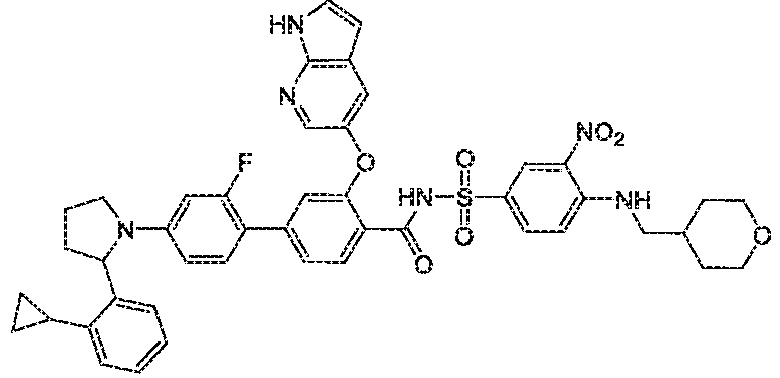
- The desired compound was synthesized from 1-(4-bromo-3-fluorophenyl)-2-(2-cyclopropylphenyl)pyrrolidine following the procedures similar to those in Example A1. 1H NMR (DMSO-d6 ) δ ppm: 12.24 (s, 1H), 11.72 (s, 1H), 8.68-8.52 (m, 2H), 8.05 (d, J = 1.6Hz, 1H), 7.85 (d, J =8.4Hz, 1H), 7.63 (d, J =1.6Hz, 1H), 7.57-7.48 (m, 2H), 7.22-6.99 (m, 6H), 6.86-6.75 (m, 2H), 6.40 (s, 1H), 6.22-6.06 (m, 2H), 5.24-5.12 (m, 1H), 3.87-3.80 (m, 2H), 3.74-3.65 (m, 1H), 3.29-3.23 (m, 3H), 2.47-2.35 (m, 1H), 2.07-1.82 (m, 5H), 1.65-1.52 (m, 2H), 1.29-1.21 (m, 2H), 1.08-0.93 (m, 4H), 0.81-0.62 (m, 2H). MS (ESI, m/e) [M+1]+ 830.8.
-

- The desired compound was synthesized from 1-(4-bromophenyl)-2-(2-cyclopropylphenyl)-2-(trifluoromethyl)pyrrolidine following the procedures similar to those in Example A1. MS (ESI, m/e) [M+1]+ 880.7.
-

- The desired compound was synthesized from 1-(4-bromophenyl)-2-(2-cyclopropylphenyl)piperidine following the procedures similar to those in Example A1. MS (ESI, m/e) [M+1]+ 880.7.
-

- The desired compound was synthesized starting from 2-(2-cyclopropylphenyl)-4-fluoropyrrolidine and 1-bromo-4-iodobenzene following the procedures similar to those in Example A1. 1H NMR (CDCl3-d6) δ ppm: 10.90-10.17 (m, 1H), 8.89 (s, 1H), 8.53 (s, 1H), 8.28-7.32 (m, 5H), 7.23-6.30 (m, 10H), 5.52-5.19 (m, 2H), 4.16-3.91 (m, 3H), 3.54-3.23 (m, 4H), 3.08-2.63 (m, 5H), 2.53-2.26 (m, 1H), 2.04-1.60 (m, 4H), 1.34-1.18 (m, 1H), 1.04-0.67 (m, 4H). MS (ESI, m/e) [M+1]+ 830.7.
-

- The desired compound was synthesized starting from 4-chloro-2-(2-cyclopropylphenyl)pyrrolidine and 1-bromo-4-iodobenzene following the procedures similar to those in Example A1. 1H NMR (DMSO-d6 ) δ ppm: 12.19 (s, 1H), 11.70 (s, 1H), 8.66-8.51 (m, 2H), 8.05 (d, J = 2.4Hz, 1H), 7.83 (dd, J = 8.8Hz, 2.0Hz, 1H), 7.62-7.48 (m, 3H), 7.37-7.27 (m, 3H), 7.21-7.06 (m, 3H), 7.01 (t, J = 6.4Hz, 2H), 6.91 (s, 1H), 6.46-6.34 (m, 3H), 5.26-5.16 (m, 1H), 4.90-4.80 (m, 1H), 3.96 (d, J = 4.4Hz, 2H), 3.87-3.80 (m, 2H), 3.29-3.17 (m, 4H), 2.18-2.09 (m, 1H), 2.04-1.96 (m, 1H), 1.92-1.82 (m, 1H), 1.63-1.55 (m, 2H), 1.30-1.21 (m, 4H), 1.01-0.91 (m, 2H), 0.80-0.66 (m, 2H). MS (ESI, m/e) [M+1]+ 846.7.
-

- The desired compound was synthesized starting from 2-(2-cyclopropylphenyl)-4-methoxypyrrolidine and 1-bromo-4-iodobenzene following the procedures similar to those in Example A1. 1H NMR (DMSO-d6 ) δ ppm: 12.16 (br, 1H), 11.68 (s, 1H), 8.62 - 8.55 (m, 2H), 8.03 (s, 1H), 7.83 - 7.79 (m, 1H), 7.57 - 7.47 (m, 3H), 7.34 - 7.27 (m, 3H), 7.14 - 6.96 (m, 5H), 6.90 (s, 1H), 6.42 - 6.35 (m, 3H), 4.17 - 4.08 (m, 1H), 3.98 - 3.83 (m, 1H), 3.84 (d, J=8.8 Hz, 2H), 3.47 - 3.42 (m, 1H), 3.25 - 3.16 (m, 6H), 3.06 - 2.93 (m, 1H), 2.67 - 2.51 (m, 1H), 2.09 - 1.95 (m, 4H), 1.92 - 1.81 (m, 1H), 1.61 (d, J=12.4 Hz, 2H), 1.50 - 1.43(m, 1H), 0.95 - 0.84(m, 2H), 0.68 - 0.45 (m, 2H). MS (ESI, m/e) [M+1]+ 842.8.
-

- The desired compound was synthesized starting from 2-(2-cyclopropylphenyl)-3-methylpyrrolidine and 1-bromo-4-iodobenzene following the procedures similar to those in Example A1. 1H NMR (DMSO-d6) δ ppm: 12.15 (s, 1H), 11.70 (s, 1H), 8.65-8.50 (m, 2H), 8.08-8.00 (m, 1H), 7.87-7.74 (m, 1H), 7.62-7.48 (m, 3H), 7.36-7.25 (m, 3H), 7.15-7.07 (m, 2H), 7.05-6.88 (m, 3H), 6.86-6.80 (m, 1H), 6.44-6.31 (m, 3H), 5.28 (d, J = 8.0Hz, 0.66H), 4.79 (s, 0.33H), 3.87-3.80 (m, 2H), 3.75-3.64 (m, 1H), 3.30-3.22 (m, 4H), 2.77-2.64 (m, 1H), 2.22-2.03 (m, 2H), 1.92-1.82 (m, 1H), 1.80-1.64 (m, 1H), 1.63-1.56 (m, 2H), 1.32-1.18 (m, 3H), 1.13 (d, J = 6.8Hz, 1H), 1.06-0.94 (m, 2H), 0.90-0.80 (m, 1H), 0.75-0.64 (m, 3H). MS (ESI, m/e) [M+1]+ 826.8.
-

- The desired compound was synthesized starting from 2-(2-cyclopropylphenyl)-3,3-dimethylpyrrolidine and 1-bromo-4-iodobenzene following the procedures similar to those in Example A1. 1H NMR (DMSO-d6 ) δ ppm: 12.15 (s, 1H), 11.69 (s, 1H), 8.60-8.55 (m, 2H), 8.03 (s, 1H), 7.81 (d, J = 8.7 Hz, 1H), 7.62 - 7.45 (m, 3H), 7.33-7.27 (m, 3H), 7.10-7.04 (m, 2H), 7.02 (t, J = 7.6 Hz, 1H), 6.95 (d, J = 7.6 Hz, 1H), 6.92 - 6.83 (m, 2H), 6.37-6.35 (m, 2H), 4.87 (s, 1H), 3.84 (d, J = 8.7 Hz, 2H), 3.70 (t, J = 9.0 Hz, 1H), 3.51-3.43 (m, 1H), 3.29 - 3.22 (m, 3H), 2.09 (s, 1H), 2.04 - 1.95 (m, 2H), 1.87 (s, 1H), 1.74-1.71 (m, 1H), 1.60 (d, J = 12.4 Hz, 2H), 1.45 (s, 1H), 1.18 (s, 3H), 1.08 (d, J = 8.6 Hz, 1H), 0.98 (d, J = 4.6 Hz, 1H), 0.95 - 0.82 (m, 2H), 0.70-0.68 (m, 4H). MS (ESI, m/c) [M+1]+ 840.8.
-

- The desired compound was synthesized starting from 1-(2-cyclopropylphenyl)octahydrocyclopenta[c]pyrrole and 1-bromo-4-iodobenzene following the procedures similar to those in Example A1. 1H NMR (DMSO-d6 ) δ ppm: 11.54 (s, 1H), 8.40 (s, 1H), 8.36 (s, 1H), 7.95 (s, 1H), 7.66 (d, J = 8.4 Hz, 1H), 7.54 (d, J = 8.1 Hz, 1H), 7.42 (s, 1H), 7.35 (s, 1H), 7.30-7.21 (m, 3H), 7.12-6.98 (m, 3H), 6.93 - 6.77 (m, 3H), 6.36 (d, J = 8.5 Hz, 2H), 6.30 (s, 1H), 5.34 (d, J = 8.6 Hz, 1H), 3.83 (d, J = 8.5 Hz, 2H), 3.72 (t, J = 9.4 Hz, 1H), 3.49 - 3.38 (m, 1H), 3.30-3.19 (m, 6H), 2.10-1.98 (m, 2H), 1.90 - 1.76 (m, 2H), 1.66 - 1.35 (m, 6H), 1.08 - 0.90 (m, 3H), 0.90 - 0.71 (m, 2H), 0.71 - 0.59 (m, 1H). MS (ESI, m/e) [M+1]+ 852.8.
-

- The desired compound was synthesized starting from 2-cyclopropylpyrrolidine and 1-bromo-4-iodobenzene following the procedures similar to those in Example A1. MS (ESI, m/e) [M+1]+ 736.8.
-
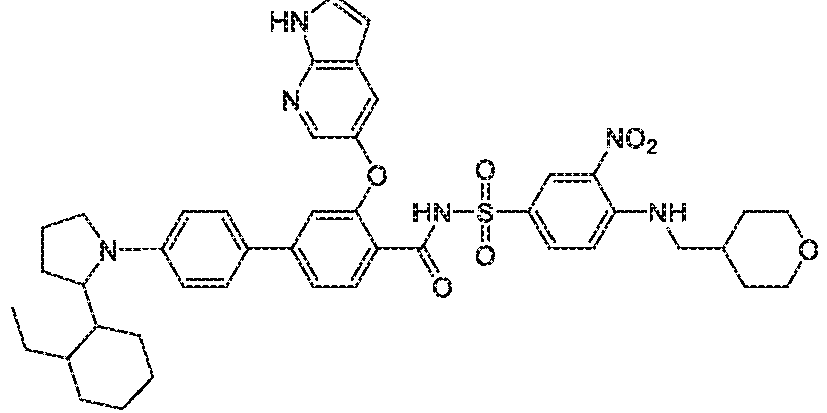
- The desired compound was synthesized starting from 2-(2-ethylcyclohexyl)pyrrolidine and 1-bromo-4-iodobenzene following the procedures similar to those in Example A1. MS (ESI, m/e) [M+1]+ 806.8.
-

- The desired compound was synthesized starting from 2-(2-cyclopropylbenzyl)pyrrolidine and 1-bromo-4-iodobenzene following the procedures similar to those in Example A1. MS (ESI, m/c) [M+1]+ 826.8.
-
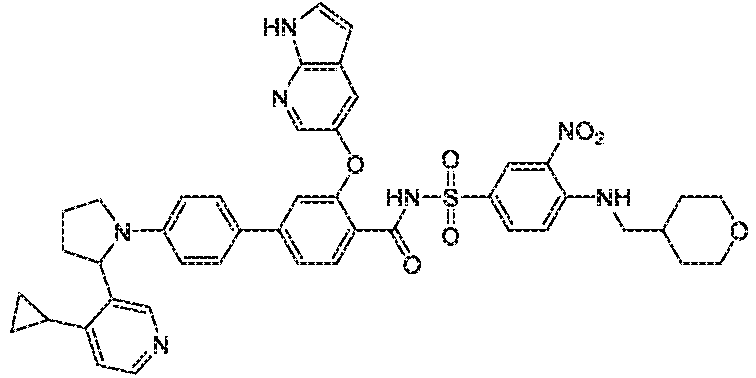
- The desired compound was synthesized starting from 4-cyclopropyl-3-(pyrrolidin-2-yl)pyridine and 1-bromo-4-iodobenzene following the procedures similar to those in Example A1. 1H NMR (400 MHz, DMSO-d6) δ ppm: 12.16 (s, 1H), 11.70 (s, 1H), 8.61-8.57 (m, 2H), 8.41 (s, 1H), 8.05-8.02 (m, 2H), 7.83 (d, J = 8.6 Hz, 1H), 7.61 (s, 1H), 7.57-7.49 (m, 2H), 7.36-7.32 (m, 3H), 7.24-7.11 (m, 2H), 6.89 (s, 1H), 6.65 (s, 2H), 6.42-6.39 (m, 3H), 5.23 (d, J = 7.3 Hz, 1H), 3.84 (d, J = 10.7 Hz, 2H), 3.28-3.22 (m, 4H), 2.02-1.99 (m, 6H), 1.91-1.89 (m, 1H), 1.61-1.58 (m, 2H), 1.45 (s, 3H), 0.85 (s, 4H). MS (ESI, m/e) [M+1]+ 813.8.
-
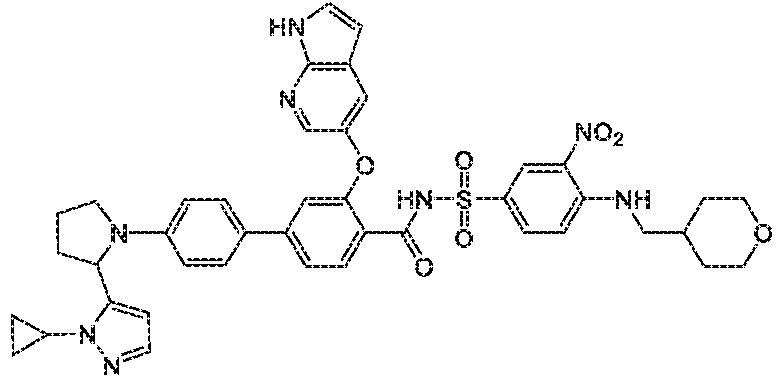
- The desired compound was synthesized starting from 1-cyclopropyl-5-(pyrrolidin-2-yl)-1H-pyrazole and 1-bromo-4-iodobenzene following the procedures similar to those in Example A1. MS (ESI, m/e) [M+1]' 802.8
-

- The desired compound was synthesized starting from 2-(3-chloro-2-cyclopropylphenyl)pyrrolidine and 1-bromo-4-iodobenzene following the procedures similar to those in Example A1. MS (ESI, m/e) [M+1]+ 846.8
-

- The desired compound was synthesized starting from 2-(2-cyclopropyl-5-methylphenyl)pyrrolidine and 1-bromo-4-iodobenzene following the procedures similar to those in Example A1. 1H NMR (400 MHz, DMSO-d6) δ ppm: 12.15 (s, 1H), 11.68 (s, 1H), 8.55 (s, 2H), 8.04 (s, 1H), 7.80 (s, 1H), 7.58-7.50 (m, 3H), 7.36-7.30 (m, 2H), 7.14-7.08 (m, 1H), 6.91 (s, 2H), 6.79-6.63 (m, 3H), 6.40-6.30 (m, 3H), 5.16-5.10 (m, 1H), 3.8-3.80 (m, 3H), 3.73 (s, 1H), 2.99-2.86 (m, 5H), 2.10 (s, 2H), 2.05 (s, 1H), 1.97 (s, 3H), 1.66-1.58 (m, 2H), 1.30-1.20 (m, 2H), 0.95-0.89 (m, 2H), 0.74 (s, 1H), 0.64 (s, 1H). MS (ESI) m/c [M+1]+ 826.8.
-
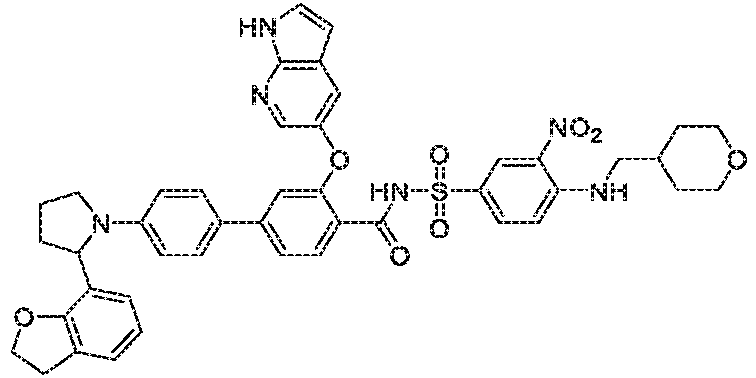
- The desired compound was synthesized starting from 2-(2,3-dihydrobenzofuran-7-yl)pyrrolidine and 1-bromo-4-iodobenzene following the procedures similar to those in Example A1. MS (ESI) m/e [M+1]+ 814.7.
-
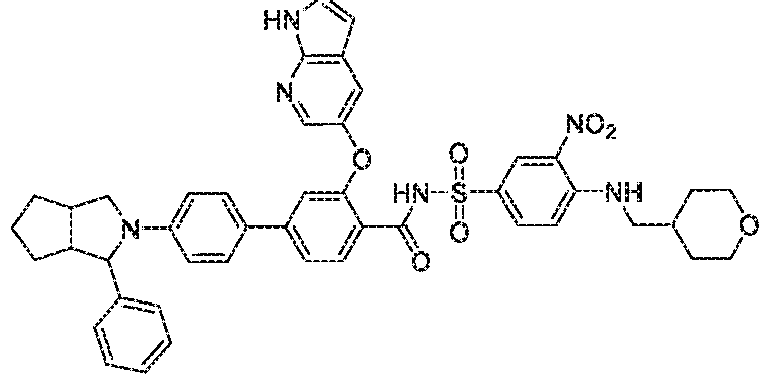
- The desired compound was synthesized starting from 1-phenyloctahydrocyclopenta[c]pyrrole and 1-bromo-4-iodobenzene following the procedures similar to those in Example A1. 1H NMR (400 MHz, DMSO-d6 )δ ppm: 12.17 (br, 1H), 11.61 (s, 1H), 8.51 - 8.42 (m, 2H), 8.00 (d, J = 2.4 Hz, 1H), 7.74 (d, J = 8.0 Hz, 1H), 7.55 (d, J = 8.4 Hz, 1H), 7.46 (s, 2H), 7.31 - 7.21 (m, 5H), 7.17 - 6.95 (m, 4H), 6.90 (s, 1H), 6.43 (d, J = 8.8 Hz, 2H), 6.34 (s, 1H), 4.92 (d, J = 8.4 Hz, 2H), 3.85 (d, J = 8.4 Hz, 2H), 3.66 (t, J = 9.2 Hz, 2H), 3.45 - 3.39 (m, 1H), 3.30 - 3.20 (m, 4H), 3.07 - 2.98 (m, 1H), 2.85 - 2.76 (m, 1H), 1.94 - 1.75 (m, 2H), 1.62 (d, J = 12.8 Hz, 2H), 1.56 - 1.35 (m, 4H), 1.30 - 1.22 (m, 2H), 1.12 - 1.05 (m, 2H). MS (ESI, m/e) [M+1]+ 812.8.
-

- The desired compound was synthesized from 1-(3-bromophenyl)-2-(2-cyclopropylphenyl)pyrrolidine following the procedures similar to those in Example A1. 1H NMR (400 MHz, DMSO-d6 )δ ppm: 12.30 (s, 1H), 11.73 (s, 1H), 8.65-8.55 (m, 2H), 8.01 (s, 1H), 7.82 (d, J = 8.9 Hz, 1H), 7.59-7.47 (m, 3H), 7.28-7.20 (m, 1H), 7.15-7.06 (m, 2H), 6.98-6.80 (m, 4H), 6.73 (s, 1H), 6.62 (d, J = 7.4 Hz, 1H), 6.39 (s, 2H), 6.30 (s, 1H), 5.15 (d, J = 7.4 Hz, 1H), 3.87-3.83 (m, 2H), 3.74-3.71 (m, 1H), 3.28-3.23 (m, 5H), 2.68 (s, 1H), 2.04-1.74 (m, 6H), 1.61-1.58 (m, 2H), 1.00-0.75 (m, 4H), 0.47-0.45 (m, 1H). MS (ESI) m/e [M+1]+ 812.8.
-
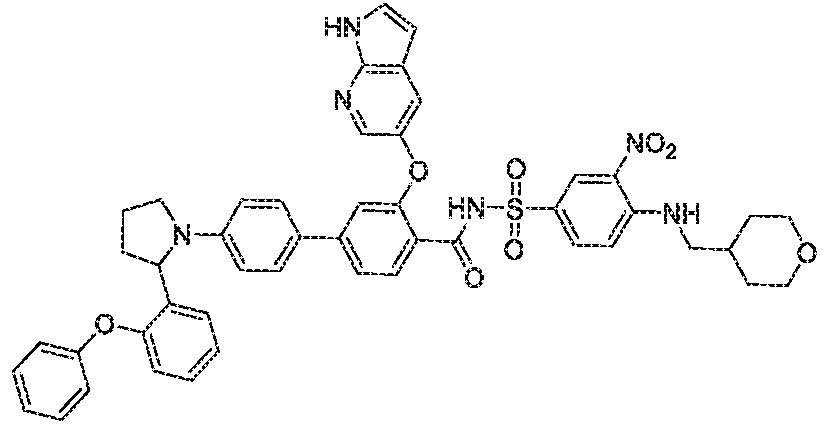
- The desired compound was synthesized starting from 2-(2-phenoxyphenyl)pyrrolidine and 1-bromo-4-iodobenzene following the procedures similar to those in Example A1. MS (ESI) m/e [M+1]+ 864.7.
-

- The desired compound was synthesized starting from 2-(2-(tetrahydro-2H-pyran-4-yl)phenyl)pyrrolidine and 1-bromo-4-iodobenzene following the procedures similar to those in Example A1. *H NMR (400 MHz, DMSO-d6 ) δ ppm: 12.16 (s, 1H), 11.70 (s, 1H), 8.61 (d, J = 5.6 Hz, 1H), 8.56 (d, J = 1.8 Hz, 1H), 8.04 (d, J = 2.3 Hz, 1H), 7.83 (d, J = 7.9 Hz, 1H), 7.59 (d, J = 1.9 Hz, 1H), 7.52 (d, J = 8.1 Hz, 2H), 7.35-7.28 (m, 4H), 7.21 - 7.08 (m, 2H), 7.01 (t, J = 7.4 Hz, 1H), 6.90 (s, 1H), 6.85 (d, J = 7.6 Hz, 1H), 6.36 (d, J = 9.3 Hz, 3H), 5.04 (d, J = 7.9 Hz, 1H), 3.96 (t, J = 9.9 Hz, 2H), 3.90 - 3.80 (m, 2H), 3.70 (t, J = 7.9 Hz, 1H), 3.55-3.41 (m, 2H), 3.31 - 3.21 (m, 5H), 2.85 (s, 2H), 1.91-1.78 (m, 3H), 1.85-1.68 (m, 3H), 1.65-1.54 (m, 3H), 1.34 - 1.16 (m, 3H). MS (ESI, m/e) [M+1]+ 856.7.
-

- The desired compound was synthesized from 1-(4-bromophenyl)-2-(2-cyclopropylcyclohex-1-en-1-yl)pyrrolidine following the procedures similar to those in Example A1. 1H NMR (400 MHz, DMSO-d6 ) δ ppm: 12.18 (s, 1H), 11.71 (s, 1H), 8.561-8.51 (m, 2H), 8.10-8.01 (m, 1H), 7.85-7.78 (m, 1H), 7.74 - 7.45 (m, 3H), 7.36 (d, J = 8.6 Hz, 3H), 7.18-7.03 (m, 2H), 6.96 (s, 1H), 6.55-6.48 (m, 1H), 6.38 (s, 1H), 5.32 (s, 1H), 4.77 (s, 1H), 3.84 (d, J = 9.4 Hz, 2H), 3.12-3.07 (m, 6H), 2.02-1.82 (m, 3H), 1.73 (s, 2H), 1.64-1.56 (m, 4H), 1.60-1.39 (m, 4H), 1.37-1.30 (m, 3H), 0.85-0.72 (m, 2H), 0.65 - 0.47 (m, 3H). MS (ESI, m/e) [M+1]+ 816.8.
-

- The desired compound was synthesized with 3-((1H-pyrrolo[2,3-b]pyridin-5-yl)oxy)-4'-(2-phenylcyclopentyl)-[1,1'-biphenyl]-4-carboxylic acid and 3-nitro-4-(((tetrahydro-2H-pyran-4-yl)methyl)amino)benzenesulfonamide following the procedure similar to those in Example A1. MS (ESI, m/e) [M+1]' 772.8.
-

- To a solution of 3-((1H-pyrrolo[2,3-b]pyridin-5-yl)oxy)-4'-(2-(2-cyclopropylphenyl)pyrrolidin-1-yl)-[1,1'-biphenyl]-4-carboxylic acid (100 mg, 0.194 mmol) in DCM (30 mL) was added EDCI (56 mg, 0.291 mmol) and DMAP (71 mg, 0.582 mmol). The mixture was stirred at room temperature for 0.5 hour. Then imino(methyl)(3-nitro-4-(((tetrahydro-2H-pyran-4-yl)methyl)amino)phenyl)-16-sulfanone (138 mg, 0.388 mmol) was added to the mixture. The mixture was stirred at room temperature for 2 days. The mixture was diluted with DCM (100 mL), then washed with saturated aq. NaHCO3, brine, dried over Na2SO4, concentrated and purified by chromatography column on silica gel (eluent: DCM/EA = 1/1 then MeOH/DCM = 1/10) to give the crude product. The crude product was purified by prep-HPLC to give the desired compound (9 mg). 1H NMR (400 MHz, DMSO-d 6) δ ppm: 11.63 (s, 1 H), 8.71 - 8.63 (m, 1H), 8.61 - 8.54 (m, 1H), 8.08 - 7.96 (m, 1H), 7.91 - 7.84 (m, 1H), 7.74 - 7.65 (m, 1H), 7.51 - 7.34 (s, 5H), 7.16 - 6.95 (m, 5H), 6.91 - 6.83 (m, 1H), 6.45 - 6.31 (m, 3H), 5.28 - 5.13 (m, 1H), 3.91 - 3.79 (m, 2H), 3.79 - 3.67 (m, 1H), 3.46 - 3.39 (m, 4H), 3.32 - 3.20 (m, 4H), 3.11 - 2.85 (m, 1H), 2.49 - 2.38 (m, 1H), 2.09 - 1.82 (m, 5H), 1.65 - 1.53 (m, 2H), 1.32 - 1.26 (m, 1H), 1.10 - 0.91 (m, 2H), 0.85 - 0.66 (m, 2H). MS (ESI, m/e) [M+1]+ 810.8.
-

- The desired compound was synthesized starting from 2-(2-(cyclopropylmethyl)phenyl)pyrrolidine and 1-bromo-4-iodobenzene following the procedures similar to those in Example A1. 1H NMR (DMSO-d6 ) δ ppm: 12.15 (s, 1 H), 11.69 (s, 1 H), 8.58 (m, 8.56-8.61, 2 H), 8.04 (d, J = 2.1 Hz, 1 H), 7.82 (m, 1 H), 7.58 (s, 1 H), 7.55 - 7.47 (m, 2 H), 7.39 (d, J = 7.5 Hz, 1 H), 7.31 (m, 3 H), 7.16-7.11 (m, 2 H), 7.05-7.01 (m, 1 H), 6.89-6.84 (m, 2 H), 6.38-6.35 (m, 3 H), 4.92 (d, J = 7.9 Hz, 1 H), 3.84 (d, J = 8.4 Hz, 2 H), 3.71 (t, J = 7.7 Hz, 1 H), 3.30 - 3.21 (m, 4 H), 2.78-2.72 (m, 1 H), 2.61 - 2.54 (m, 2 H), 2.43 - 2.33 (m, 1 H), 1.96-1.87 (m, 3 H), 1.61-1.58 (m, 2 H), 1.33 - 1.18 (m, 3 H), 1.12 - 1.01 (m, 1H), 0.56 (d, J = 7.7 Hz, 2H) ,0.28 (d, J = 2.1 Hz, 2 H). MS (ESI, m/e) [M+1]+ 826.8
-

- The desired compound was synthesized starting from 2-(2-cyclopropylphenyl)pyrrolidine and 1-bromo-2-chloro-4-iodobenzene following the procedures similar to those in Example A1. 1H NMR (400 MHz, DMSO-d6 ) δ ppm: 12.30 (s, 1 H), 11.70 (s, 1 H), 8.56 (s, 2 H), 8.02 (s, 1 H), 7.83 (d, J = 8.8 Hz, 1 H), 7.61 (s, 1 H), 7.52 (d, J = 8.2 Hz, 2 H), 7.19 - 6.93 (m, 6 H), 6.86 (d, J = 7.5 Hz, 1 H), 6.66 (s, 1 H), 6.37 (s, 2 H), 6.29 (d,J = 8.3 Hz, 1 H), 5.18 (d, J = 7.9 Hz, 1 H), 3.84 (d, J = 8.5 Hz, 2 H), 3.71 (t, J = 7.7 Hz, 1 H), 3.31 - 3.16 (m, 5 H), 2.48 - 2.30 (m, 1 H), 2.09 - 1.73 (m, 5 H), 1.59 (d, J= 12.4 Hz, 2 H), 1.35 - 1.17 (m, 2 H), 1.12 - 0.89 (m, 2 H), 0.80 (dd, J = 9.2, 4.2 Hz, 1 H), 0.65 (dd, J = 9.0, 3.8 Hz, 1 H). MS (ESI, m/e) [M+1]+ 846.7
-

- The desired compound was synthesized starting from (R)-2-(2-(4,4-difluorocyclohexyl)phenyl)pyrrolidine and 1-bromo-4-iodobenzene following the procedures similar to those in Example A1. MS (ESI, m/e) [M+1]+ 890.8.
-

- The desired compound was synthesized starting from N,N-dimethyl-2-(2-((R)-pyrrolidin-2-yl)phenyl)cyclopropan-1-amine and 1-bromo-4-iodobenzene following the procedures similar to those in Example A1. 1H NMR (400 MHz, DMSO-d6 ) δ ppm: 11.60 (s, 1H), 9.77 (s, 1H), 8.59 - 8.29 (m, 2H), 7.99 (s, 1H), 7.80 - 7.64 (m, 1H), 7.64 - 7.37(m, 3H), 7.30 - 7.17(m, 3H), 7.17 - 6.76 (m, 5H), 6.49 - 6.20 (m, 3H), 5.18 - 5.06 (m, 1H), 3.99 - 3.65(m, 3H), 3.62 - 3.35 (m, 3H), 3.30 - 3.16 (m, 4H), 3.12 - 2.82 (m, 1H), 2.48 - 2.26 (m, 7H), 2.12 - 1.78 (m, 5H), 1.67 - 1.55 (m, 2H), 0.88 - 0.78 (m, 2H). MS (ESI, m/e) [M+1]+ 855.8
-

- The desired compound was synthesized starting from tert-butyl 4-(2-(pyrrolidin-2-yl)phcnyl)piperidinc-1-carboxylale and 1-bromo-4-iodobenzene following the procedures similar to those in Example A1. 1H NMR (400 MHz, DMSO-d6 ): δ ppm: 12.16 (s, 1H), 11.70 (s, 1H), 8.62-8.56 (m, 2H), 8.04 (s, 1H), 7.82 (d, J = 9.2 Hz, 1H), 7.61-7.49 (m, 3H), 7.35-7.28 (m, 4H), 7.19-7.11 (m, 2H), 7.01 (t, J = 7.3 Hz, 1H), 6.90 (s, 1H), 6.84 (d, J = 7.6 Hz, 1H), 6.67 (s, 1H), 6.37-6.35 (m, 3H), 5.03 (d, J = 7.6 Hz, 1H), 4.10 (s, 2H), 3.84 (d, J = 8.0 Hz, 2H), 3.71 (t, J = 4 Hz, 1H), 3.39-3.33 (s, 2H), 3.27-3.17 (m, 4H), 3.06 (s, 1H), 2.99 (s, 1H), 2.02-1.97 (m, 3H), 1.85 (s, 2H), 1.74-1.56 (m, 5H), 1.43 (s, 10H), 1.27 (s, 2H). MS (ESI, m/e) [M+1]+ 955.8.
-
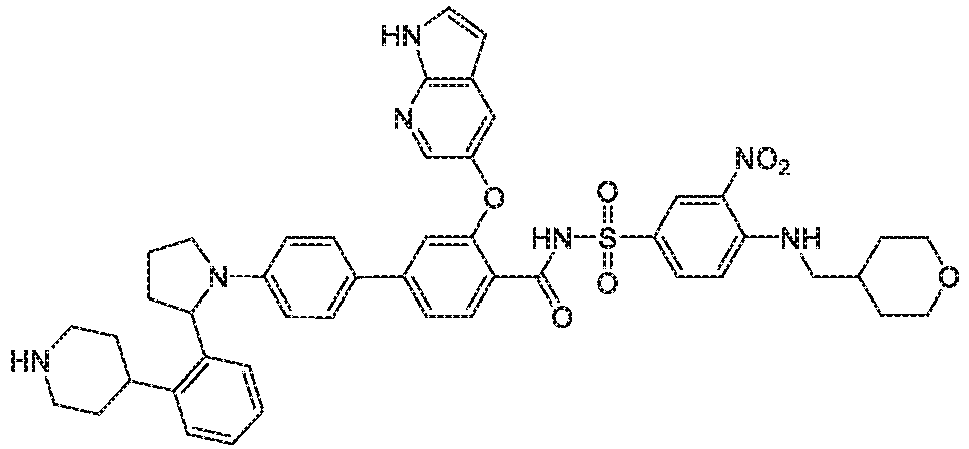
- The desired compound was synthesized by Boc deprotection of A98 in TFA/DCM. 1H NMR (400 MHz, DMSO-d6 ) δ ppm: 12.16 (s, 1H), 11.70 (s, 1H), 8.58-8.56 (m, 2H), 8.04 (s, 1H), 7.81 (s, 1H), 7.59-7.50 (m, 3H), 7.30-7.22 (m, 5H), 7.14-7.11 (m, 1H), 7.05 (t, J= 7.3 Hz, 1H), 6.88-6.86 (m, 2H), 6.67 (s, 1H), 6.38-6.36 (m, 2H), 5.05 (d, J = 7.3 Hz, 1H), 3.84 (d,J = 9.3 Hz, 2H), 3.72 (s, 1H), 3.40-3.38 (m, 2H), 3.29-3.23 (m, 5H), 3.06-2.96 (m, 3H), 2.0-1.96 (m, 4H), 1.88-1.82 (m, 3H), 1.69 (s, 1H), 1.60 (d, J = 12.4 Hz, 2H), 1.45 (s, 1H), 1.28 (s, 2H). MS (ESI, m/e) [M+1]+ 856.2.
-

- To a solution of tert-butyl (R)-2-(2-bromophenyl)pyrrolidine-1-carboxylate (14.6 g, 44.8 mmol) in dioxane/H2O (100 mL/20 mL) were added 1-methyl-4-(4,4,5,5-tetramethyl-1,3,2-dioxaborolan-2-yl)-1,2,3,6-tetrahydropyridine (10 g, 44.8 mmol), Pd(dppf)Ch (3.3 mg, 4.48 mmol) and Cs2CO3 (29 g, 90 mmol). The mixture was stirred at 90°C for 12 hours under N2 atmosphere. The reaction mixture was cooled to room temperature and then washed with brine, dried over Na2SO4, concentrated. The residue was purified by chromatograph column on silica gel (eluent: EA/CH3OH = 50/1 to 10/1) to give the product (4 g) as yellow oil. MS (ESI, m/e) [M+1]+ 343.0.
- To a solution of tert-butyl (R)-2-(2-(1-methyl-1,2,3,6-tetrahydropyridin-4-yl)phenyl)pyrrolidine-1-carboxylate (4 g, 11.7 mmol) in DCM (100 mL) was added TFA (20 mL). The mixture was stirred at room temperature for 2 hours. After removal of solvent, the residue was dissolved with DCM (200 mL), washed with saturated aq. NaHCO3, brine, dried over Na2SO4, and then concentrated to give the product (2 g) as a brown oil. 1H NMR (400 MHz, CDCl3) δ ppm: 7.51 (d, J = 7.8 Hz, 1H), 7.30 - 7.22 (m, 1 H), 7.17 (td, J= 7.4, 1.2 Hz, 1 H), 7.07 (dd, J = 7.6, 1.2 Hz, 1 H), 5.57 - 5.51 (m, 1 H), 4.27 (t, J = 7.9 Hz, 1 H), 3.25 - 3.21 (m, 1 H), 3.08 (dd, J = 5.7, 2.8 Hz, 2 H), 2.99 - 2.94 (m, 1 H), 2.65 (dd, J = 8.3, 3.6 Hz, 2H), 2.46 - 2.38 (m, 5 H), 2.12-2.07 (m, 2 H), 1.95-1.92 (m, 1 H), 1.90 - 1.77 (m, 1H), 1.68 - 1.55 (m, 1H). MS (ESI, m/e) [M+1]+ 243.0. The residue was used into next step without further purification.
- To a solution of (R)-1-methyl-4-(2-(pyrrolidin-2-yl)phenyl)-1,2,3,6-tetrahydropyridine (2 g, 8.2 mmol) in MeOH (100 mL) was added Pd(OH)2 (0.5 g) under H2 atmosphere .The mixture was stirred at 90 °C for 14 hours. The mixture was filtered. The filtrate was concentrated to give (R)-1-methyl-4-(2-(pyrrolidin-2-yl)phenyl)piperidine as a colorless oil, which was used in next step without further purification. 1H NMR (400 MHz, DMSO-d6 ) ppm: δ 7.58 - 7.51 (m, 1 H), 7.24-7.20 (m, 1 H), 7.16 - 7.09 (m, 2 H), 4.29 (t, J = 7.7 Hz, 1 H), 3.08 - 3.01 (m, 1H), 2.92-2.83 (m, 2 H), 2.76-2.72 (m, 2 H), 2.63-2.60 (m, 1 H), 2.19 (s, 3 H), 2.15-2.08 (m, 1 H), 1.99-1.96 (m, 2 H), 175-1.66 (m, 6 H), 1.39-1.32 (m, 1 H). MS (ESI, m/e) [M+1]+ 245.0.
- To a solution of (R)-1-methyl-4-(2-(pyrrolidin-2-yl)phenyl)piperidine 2 g, 8 mmol) in toluene (100 mL) was added 1-bromo-4-iodobenzene (4.6 g, 16 mmol), Pd2(dba)3 (732 mg, 0.8 mmol), BINAP(1 mg, 1.6 mmol) and t-BuOK (2.7 g, 24 mmol). The mixture was stirred at 90°C for 12 hours at N2 atmosphere. The reaction mixture was washed with brine, dried over Na2SO4, concentrated. The residue was purified by chromatograph column on silica gel (eluent: DCM/ MeOH = 50/1) to give the title product (2 g). MS (ESI, m/e) [M+1]+ 398.6, 400.6.
- To a solution of (R)-4-(2-(1-(4-bromophenyl)pyrrolidin-2-yl)phenyl)-1-methylpiperidine (2 g, 5 mmol) and tert-butyl 2-((1H-pyrrolo[2,3-b]pyridin-s-yl)oxy)-4-(3,3,4,4-tetramethylborolan-1-yl)benzoate (2.18 g, 5 mmol) in 1,4-dioxane (50 mL) and H2O (5 mL) were added Pd(ddpf)Cl2 (365 mg, 0.5 mmol) and Cs2CO3 (4.9 g, 15 mmol). The mixture was stirred at 90 °C overnight under nitrogen protection. The mixture was cooled to room temperature and then diluted with DCM (200 mL), washed with brine (200 mL×2), dried over Na2SO4. After concentrated, the residue was purified by chromatography column on silica gel (eluent: DCM/MeOH = 25/1) to give tert-butyl (R)-3-((1H-pyrrolo[2,3-b]pyridin-5-yl)oxy)-4'-(2-(2-(1-methylpiperidin-4-yl)phenyl)pyrrolidin-1-yl)-[1,1'-biphenyl]-4-carboxylate (2 g) as a brown oil. MS (ESI, m/e) [M+1]+ 629.0
- To a solution of tert-butyl (R)-3-((1H-pyrrolo[2,3-b]pyridin-5-yl)oxy)-4'-(2-(2-(1-methylpiperidin-4-yl)phenyl)pyrrolidin-1-yl)-[1,1'-biphenyl]-4-carboxylate (2 g, crude) in DCM (50 mL) was added TFA (15 mL). The mixture was stirred at room temperature for 2 hours. The mixture was concentrated to give the crude product as a yellow solid, which was used in next step without further purification. MS (ESI, m/e) [M+1]+ 573.0.
- The desired compound was then synthesized with (R)-3-((1H-pyrrolo[2,3-b]pyridin-5-yl)oxy)-4'-(2-(2-(1-methylpiperidin-4-yl)phenyl)pyrrolidin-1-yl)-[1,1'-biphenyl]-4-carboxylic acid and 3-nitro-4-(((tetrahydro-2H-pyran-4-yl)methyl)amino)benzenesulfonamide following the procedures similar to those in Example A1. 1H NMR (400 MHz, DMSO-d6 ) δ ppm: 12.16 (s, 1 H), 11.71 (s, 1 H), 8.61 (s, 1 H), 8.56 (s, 1 H), 8.05 (d, J = 2.2 Hz, 1 H), 7.82 (d, J = 8.7 Hz, 1 H), 7.59 (s, 1 H), 7.57 - 7.49 (m, 2 H), 7.37 - 7.18 (m, 4 H), 7.17 -7.02 (m, 2 H), 6.87 (d, J= 7.7 Hz, 2 H), 6.37 (d, J = 8.5 Hz, 3 H), 5.04 (d, J = 7.6 Hz, 1 H), 3.88-3.82 (m, 2 H), 3.75-3.71 (m, 1 H), 3.51 (s, 2 H), 3.47-3.39 (m, 1 H), 3.30 - 3.22 (m, 4 H), 3.19-3.13 (m, 3 H), 2.99-2.93 (m, 1 H), 2.85-2.78 (m, 3 H), 2.15 - 1.79 (m, 7 H), 1.75 - 1.69 (m, 1H), 1.65 - 1.61 (m, 2 H), 1.28 - 1.21 (m, 3 H). MS (ESI, m/c) [M+1]' 869.8.
-

- The desired compound was synthesized starting from 1-methyl-4-(2-((R)-pyrrolidin-2-yl)phenyl)piperidin-2-one and 1-bromo-4-iodobenzene following the procedures similar to those in Example A100. 1H NMR (400 MHz, DMSO-d6 ) δ ppm: 12.16 (s, 1 H), 11.70 (s, 1H), 8.72 - 8.44(M, 2H), 8.05 (s, 1H), 7.90 - 7.67 (m, 1H), 7.66 - 7.44 (m, 3H), 7.44 - 7.24 (m, 4H), 7.24 - 6.98 (m, 3H), 6.96 - 6.78 (m, 2H), 6.43 - 6.25 (m, 3H), 5.15 - 4.95 (m, 1H), 3.96 - 3.76 (m, 2H), 3.76 - 3.63 (m, 1H), 3.59 - 3.38 (m, 3H), 3.31 - 3.13 (m, 5H), 2.87 (s, 3H), 2.42 - 2.27 (m, 2H), 2.15 - 1.44 (m, 9H), 0.91 - 0.71 (m, 2H). MS (ESI, m/e) [M+1]+ 883.8.
-
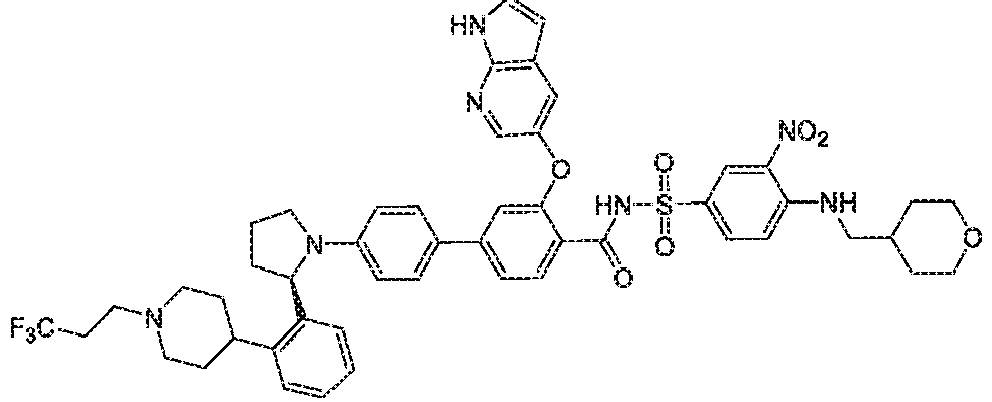
- The desired compound was synthesized starting from (R)-4-(2-(pyrrolidin-2-yl)phenyl)-1-(3,3,3-trifluoropropyl)piperidine and 1-bromo-4-iodobenzene following the procedures similar to those in Example A100. 1H NMR (400 MHz, DMSO-d6 ) δ ppm: 11.61 (s, 1H), 9.67 (s, 1H), 8.64 - 8.34 (m, 2H), 7.99 (s, 1H), 7.82 - 7.63 (m, 1H), 7.63 - 7.13 (m, 8H), 7.13 - 6.80 (m, 4H), 6.46 - 6.25 (m, 3H), 5.09 - 4.87 (m, 1H), 3.89 - 3.78 (m, 2H), 3.77 - 3.65 (m, 1H), 3.44 - 3.36 (m, 2H), 3.31 - 3.18 (m, 4H), 3.15 - 3.01 (m, 2H), 2.97 - 2.85 (m, 1H), 2.75 - 2.56 (m, 3H), 2.49 - 2.39 (m, 1H), 2.28 - 2.10(m, 1H), 2.05 - 1.80 (m, 5H), 1.75 - 1.57 (m, 4H), 1.32 - 1.19 (m, 4H). MS (ESI, m/e) [M+1]+ 951.8.
-

- The desired compound was synthesized starting from (R)-2-(4-(2-(pyrrolidin-2-yl)phenyl)piperidin-1-yl)ethan-1-ol and 1-bromo-4-iodobenzene following the procedures similar to those in Example A100. 1H NMR (400 MHz, DMSO-d6 ) δ ppm: 11.55 (s, 1H), 9.32 - 9.05 (m, 1H), 8.46 - 8.26 (m, 2H), 7.96 (s, 1H), 7.72 - 7.62 (m, 1H), 7.59 - 7.51 (m, 1H), 7.45 - 7.16 (m, 7H), 7.11 - 7.00 (m, 1H), 6.95 - 6.79 (m, 3H), 6.45 - 6.20 (m, 3H), 5.10 - 4.94 (m, 1H), 3.90 - 3.79 (m, 2H), 3.79 - 3.64 (m, 3H), 3.59 - 3.35 (m, 4H), 3.30 - 3.19 (m, 5H), 3.17 - 2.79 (m, 4H), 2.18 - 1.65(m, 9H), 1.65 - 1.55 (m, 2H), 1.33 - 1.26 (m, 2H). MS (ESI, m/e) [M+1]+ 899.9.
-

- The desired compound was synthesized starting from (R)-N,N-dimethyl-2-(4-(2-(pyrrolidin-2-yl)phenyl)piperidin-1-yl)acetamide and 1-bromo-4-iodobenzene following the procedures similar to those in Example A100. 1H NMR (400 MHz, DMSO-d6 ) δ ppm: 11.57 (s, 1H), 9.61 (s, 1H), 8.42 (s, 2H), 7.97 (s, 1H), 7.72 - 7.69 (m, 1H), 7.58 - 7.53 (m, 1H), 7.46 - 7.38 (m, 2H), 7.34 - 7.16 (m, 5H), 7.05 (s, 1H), 6.90 (s, 3H), 6.41 - 6.28 (m, 3H), 5.02 (s, 1H), 3.88 - 3.76 (m, 2H), 3.71 (s, 1H), 3.40 - 3.38 (m, 1H), 3.29 - 3.21 (m, 5H), 3.01 (s, 4H), 2.89 (s, 3H), 1.99 - 1.80 (m, 7H), 1.78 - 1.51 (m, 5H), 1.23 (s, 6H). MS (ESI) m/e [M+1]+ 940.8.
-

- The desired compound was synthesized starting from (R)-N-methyl-N-(2-(4-(2-(pyrrolidin-2-yl)phenyl)piperidin-1-yl)ethyl)acetamide and 1-bromo-4-iodobenzene following the procedures similar to those in Example A 100. 1H NMR (400 MHz, DMSO-d6 ) δ ppm: 11.60 (s, 1H), 8.56 - 8.22 (m, 2H), 7.99 (s, 1H), 7.83 - 7.66 (m, 1H), 7.60 - 7.39 (m, 3H), 7.38 - 7.13 (m, 5H), 7.12 - 6.78 (m, 4H), 6.46 - 6.25 (m, 3H), 5.10 - 4.93 (m, 1H), 3.91 - 3.77 (m, 2H), 3.77 - 3.66 (m, 1H), 3.66 - 3.33 (m, 6H), 3.32 - 3.17 (m, 4H), 3.16 - 2.90 (m, 4H), 2.88 - 2.67 (m, 2H), 2.48 - 2.38 (m, 1H), 2.11 - 1.66 (m, 10H), 1.65 - 1.53 (m, 2H), 1.53 - 1.23(m, 3H). MS (ESI, m/e) [M+1]+ 954.9.
-

- The desired compound A106 was synthesized by Boc-deprotection in TFA/DCM of tert-butyl (R)-(3-(4-(2-(1-(3'-((1H-pyrrolo[2,3-b]pyridin-5-yl)oxy)-4'-(((3-nitro-4-(((tetrahydro-2H-pyran-4-yl)methyl)amino)phenyl)sulfonyl)carbamoyl)-[1,1'-biphenyl]-4-yl)pyrrolidin-2-yl)phenyl)piperidin-1-yl)-3-oxopropyl)(methyl)carbamate, which was synthesized starting from tert-butyl (R)-methyl(3-oxo-3-(4-(2-(pyrrolidin-2-yl)phenyl)piperidin-1-yl)propyl)carbamate and 1-bromo-4-iodobenzene following the procedures similar to those in Example A 100. 1H NMR (DMSO-d6 ) δ ppm: 11.52 (s, 1H), 8.38 (s, 1H), 8.33 (s, 1H), 8.18 (s, 1H), 7.94 (s, 1H), 7.64 (d, J = 8.6 Hz, 1H), 7.54 (d,J = 7.9 Hz, 1H), 7.40 (s, 1H), 7.35 - 7.12 (m, 6H), 7.04 - 7.01 (m, 1H), 6.89 (s, 2H), 6.82 (d, J = 9.0 Hz, 1H), 6.36 (d, J = 7.8 Hz, 2H), 6.28 (s, 1H), 5.04 (s, 1H), 4.56 (s, 1H), 3.83 - 3.80 (m, 4H), 3.22 - 3.20 (m, 3H), 3.12 (s, 2H), 2.72 - 2.70 (m, 3H), 2.58 (s, 3H), 1.94 - 1.90 (m,5H), 1.69 (s, 2H), 1.59 - 1.57 (m, 3H), 1.22 (s, 8H). MS (ESI) m/e [M+1]+ 940.9.
-

- The desired compound was synthesized starting from 1-cyclopropyl-4-(2-(pyrrolidin-2-yl)phenyl)-1,2,3,6-tetrahydropyridine and 1-bromo-4-iodobenzene following the procedures similar to those in Example A68-R. 1H NMR (DMSO-d6 ) δ ppm: 11.66 (s, 1H), 8.56 - 8.52 (m, 2H), 8.02 (s, 1H), 7.78 (d, J = 8.9 Hz, 1H), 7.57 - 7.46 (m, 3H), 7.37 - 7.23 (m, 3H), 7.22 - 6.95 (m, 5H), 6.91 (s, 1H), 6.36 - 6.34 (m, 3H), 5.67 (s, 1H), 4.84 - 4.82 (m, 1H), 3.85 - 3.83 (m, 2H), 3.72 (s, 1H), 3.46 - 3.43 (m, 2H), 3.30 - 3.26 (m, 4H), 3.10-3.08 (m, 2H), 2.44 - 2.32 (m, 1H), 2.01 - 1.99 (m, 3H), 1.87 (s, 1H), 1.76 - 1.60 (m, 3H), 1.23 (s, 6H), 0.85-0.83 (m, 1H), 0.59 (s, 3H). MS (ESI) m/e [M+1]+ 893.9.
-
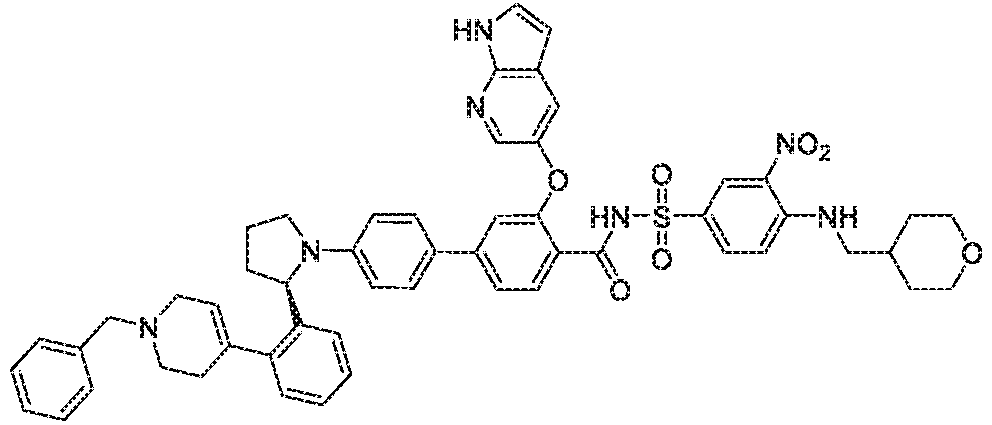
- The desired compound was synthesized starting from (R)-1-benzyl-4-(2-(pyrrolidin-2-yl)phenyl)-1,2,3,6-tetrahydropyridine and 1-bromo-4-iodobenzene following the procedures similar to those in Example A68-R. 1H NMR (DMSO-d6 ) δ ppm: 11.60 (s, 1 H), 8.46 (s, 2 H), 7.98 (s, 1 H), 7.74-7.69 (m, 1 H), 7.54 (d, J = 8.0 Hz, 1 H), 7.53-7.38 (m, 7 H), 7.33-7.27 (m, 4 H), 7.18-7.10 (m, 3 H), 7.00 (d, J = 7.5 Hz, 1 H), 6.98-6.91 (m, 1 H), 6.91 (s, 1 H), 6.39 - 6.27 (m, 3 H), 5.67 (s, 1 H), 4.83 (d, J = 6.1 Hz, 1 H), 3.84 (d, J = 7.7 Hz, 3 H), 3.73 (s, 2 H), 3.31-3.21 (m, 6 H), 3.28-3.19 (m, 3 H), 2.41-2.33 (m, 1 H), 2.01-1.77 (m, 5 H), 1.63-1.59 (m, 2 H), 1.26-1.21 (m, 3 H). MS (ESI, m/e) [M+1]+ 943.8.
-
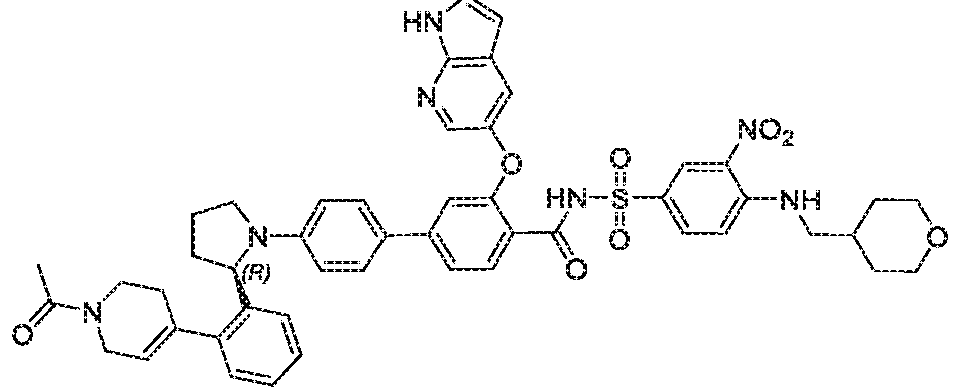
- The desired compound was synthesized starting from (R)-1-(4-(2-(pyrrolidin-2-yl)phenyl)-3,6-dihydropyridin-1(2H)-yl)ethan-1-one and 1-bromo-4-iodobenzene following the procedures similar to those in Example A68-R. 1H NMR (DMSO-d6 ) δ ppm: 12.16 (s, 1H), 11.70 (s, 1H), 8.67 - 8.43 (m, 2H), 8.10 - 7.99 (m, 1H), 7.87 - 7.76 (m, 1H), 7.62 - 7.46 (m, 3H), 7.42 - 7.25 (m, 3H), 7.25 - 7.05 (m, 4H), 7.05 - 6.94 (m, 1H), 6.93 - 6.84 (m, 1H), 6.42 - 6.29 (m, 3H), 5.71 (s, 1H), 4.87 - 4.76 (m, 1H), 4.17 - 4.02 (m, 2H), 3.92 - 3.78 (m, 2H), 3.81 - 3.59 (m, 3H), 3.39 - 3.35 (m, 1H), 3.31 - 3.17 (m, 4H), 2.48 - 2.44 (m, 1H), 2.43 - 2.26 (m, 2H), 2.13 - 2.01 (m, 3H), 2.01 - 1.92 (m, 2H), 1.92 - 1.83 (m, 1H), 1.80 - 1.70 (m, 1H), 1.64 - 1.54 (m, 2H), 1.33 - 1.18 (m, 2H). [M+1]+ 895.8.
-

- The desired compound was synthesized starting from (R)-1-(4-(2-(pyrrolidin-2-yl)phenyl)piperidin-1-yl)ethan-1-one and 1-bromo-4-iodobenzene following the procedures similar to those in Example A100. 1H NMR (DMSO-d6 ) δ ppm: 12.14 (s, 1H), 11.70 (s, 1H), 8.57 - 8.55 (m, 2H), 8.05 (d, J = 2.5 Hz, 1H), 7.83 (d, J = 9.4 Hz, 1H), 7.59 (s, 1H), 7.54 - 7.49 (m, 2H), 7.36 - 7.30 (m, 4H), 7.17 - 7.08 (m, 2H), 7.03 - 7.00 (m, 1H), 6.90 (s, 1H), 6.86 - 6.8 (m, 1H), 6.38 - 6.36 (m, 3H), 5.06 (s, 1H), 4.55 (s, 1H), 4.24 (s, 1H), 3.93 (s, 1H), 3.71 (s, 1H), 3.39 - 3.38 (m, 1H), 3.26 - 3.23 (m, 3H), 3.18 - 3.16 (m, 2H), 2.70 - 2.60 (m, 2H), 2.04 (s, 3H), 1.97 (s, 1H), 1.86 (s, 2H), 1.69 - 1.65 (m, 4H), 1.56 - 1.53 (m, 2H), 1.33 - 1.30 (m, 2H), 1.15 - 1.00 (m, 5H). MS (ESI) m/e [M+1]+ 925.8.
-
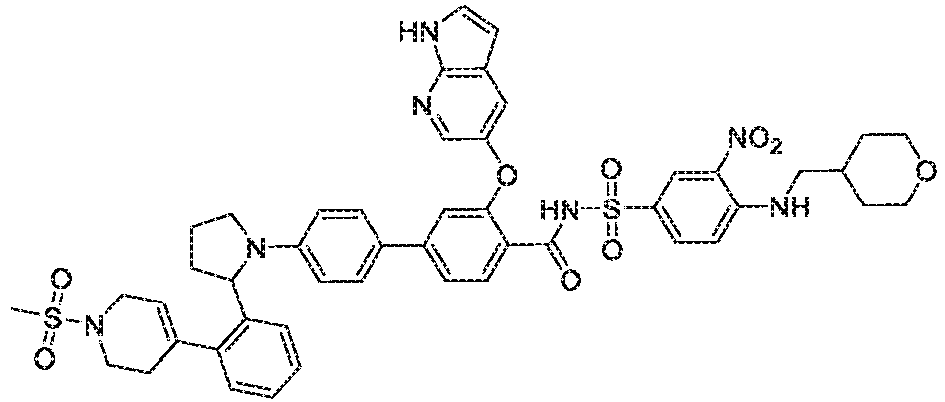
- The desired compound was synthesized starting from 1-(methylsulfonyl)-4-(2-(pyrrolidin-2-yl)phenyl)-1,2,3,6-tetrahydropyridine and 1-bromo-4-iodobenzene following the procedures similar to those in Example A68-R. 1H NMR (DMSO-d6 ) δ ppm: 12.17 (s, 1H), 11.70 (s, 1H), 8.70 - 8.51 (m, 2H), 8.08 - 7.98 (m, 1H), 7.86 - 7.74 (m, 1H), 7.63 - 7.46 (m, 3H), 7.39 - 7.25 (m, 3H), 7.25 - 7.04 (m, 4H), 7.04 - 6.95 (m, 1H), 6.91 (s, 1H), 6.46 - 6.25 (m, 3H), 5.75 (s, 1H), 4.88 - 4.75 (m, 1H), 3.91 - 3.80 (m, 4H), 3.77 - 3.66 (m, 1H), 3.45 - 3.38 (m, 2H), 3.31 - 3.21 (m, 5H), 2.95 (s, 3H), 2.87 - 2.82 (m, 1H), 2.42 - 2.28 (m, 1H), 2.03 - 1.70 (m, 4H), 1.65 - 1.54 (m, 2H), 1.34 - 1.18 (m, 3H). MS (ESI, m/e) [M+1]+ 931.7.
-

- The desired compound was synthesized starting from (R)-1-methyl-4-(2-(pyrrolidin-2-yl)benzyl)piperidine and 1-bromo-4-iodobenzene following the procedures similar to those in ExampleA100. 1H NMR (DMSO-d6 ) δ ppm: 12.15 (s, 1H), 11.64 (s, 1H), 9.09 (s, 1H), 8.51 (s, 2H), 8.01 (s, 1H), 7.76 (s, 1H), 7.59 - 7.43 (m, 3H), 7.30 (d, J = 7.9 Hz, 3H), 7.22 - 6.97 (m, 4H), 6.91 (s, 2H), 6.35 (s, 3H), 4.90 (s, 1H), 3.84 (d, J = 10.2 Hz, 2H), 3.72 (s, 1H), 3.39 (s, 3H), 3.30 - 3.21 (m, 4H), 2.89 (s, 2H), 2.75 - 2.65 (m, 4H), 1.99 - 1.92 (m, 7H), 1.70 (s, 1H), 1.68 - 1.57 (m, 4H), 1.45 (s, 2H), 1.24 (s, 7H). MS (ESI) m/e [M+1]+ 883.9.
-

- The desired compound was synthesized starting from 1-methyl-4-(2-(pyrrolidin-2-yl)phenoxy)piperidine and 1-bromo-4-iodobenzene following the procedures similar to those in Example A 100. 1H NMR (DMSO-d6 ) δ ppm: 11.55 (s, 1H), 9.60 (s, 1H), 8.39 - 8.36 (m, 2H), 7.96 (s, 1H), 7.66 (d, J = 8.9 Hz, 1H), 7.56 (d, J = 7.8 Hz, 1H), 7.42 (s, 1H), 7.38 - 7.22 (m, 5H), 7.16 - 7.14 (m, 1H), 7.06 - 7.04 (m, 1H), 6.91 (s, 1H), 6.85 (s, 2H), 6.79 - 6.76 (m, 1H), 6.38 - 6.35 (m, 2H), 6.30 (s, 1H), 4.99 (s, 1H), 4.66 (s, 1H), 3.83 - 3.81(m, 2H), 3.68 (s, 1H), 3.27 - 3.25 (m, 4H), 2.94 (s, 2H), 2.33 (s, 2H), 2.10 - 1.77 (m, 11H), 1.62 - 1.60 (m, 2H), 1.23 (s, 5H). MS (ESI) m/e [M+1]+ 885.8.
-

- The desired compound was synthesized starting from (R)-1-methyl-4-(2-(pyrrolidin-2-yl)benzyl)piperazine and 1-bromo-4-iodobenzene following the procedures similar to those in Example A 100. 1H NMR (DMSO-d6 ) δ ppm: δ 11.56 (s, 1 H), 9.91 - 9.17 (m, 1 H), 8.44-8.37 (m, 2 H), 7.97 (d, J = 2.2 Hz, 1 H), 7.68 (d, J = 9.0 Hz, 1 H), 7.58-7.55 (m, 1 H), 7.48-7.40 (m, 2 H), 7.33 - 7.18 (m, 4 H), 7.18 - 7.07 (m, 2 H), 6.99 - 6.92 (m, 1 H), 6.89-6.83 (m, 2 H), 6.46 (d, J = 8.4 Hz, 2 H), 6.31 (s, 1 H), 5.26 (d, J = 8.0 Hz, 1 H), 3.92 - 3.69 (m, 4 H), 3.45-3.34 (m, 2 H), 3.28-3.21 (m, 5 H), 3.12-2.58 (m, 6 H), 1.97-1.70 (m, 6 H), 1.61-1.58 (m, 3 H), 1.28-1.21 (m, 4 H). MS (ESI, m/e) [M+1]+ 884.8.
-
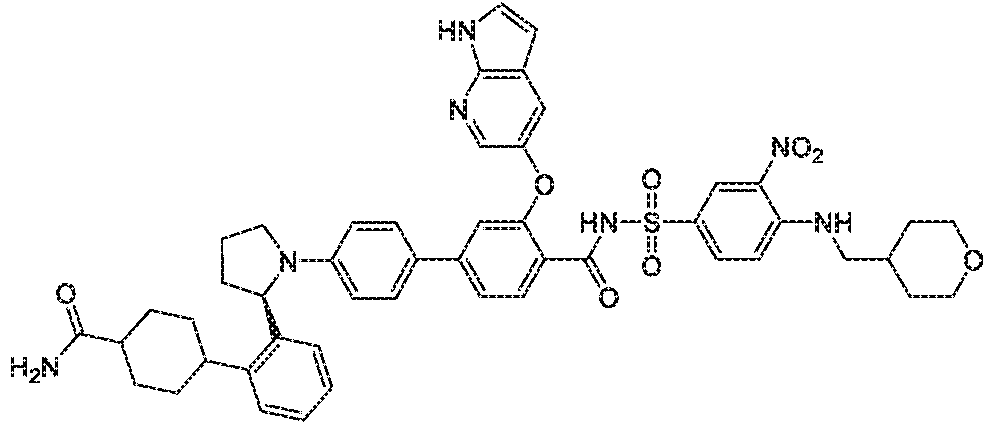
- The desired compound was synthesized starting from (R)-4-(2-(pyrrolidin-2-yl)phenyl)cyclohexane-1-carboxamide and 1-bromo-4-iodobenzene following the procedures similar to those in Example A100. 1H NMR (DMSO-d6 ) δ ppm: 12.16 (s, 0.5H), 11.60 (s, 1H), 9.67 (s, 0.5H), 8.68 - 8.19 (m, 2H), 7.99 (s, 1H), 7.81 - 7.63 (m, 1H), 7.58 - 7.11 (m, 9H), 7.07 - 6.79 (m, 4H), 6.79 - 6.60 (m, 1H), 6.41 - 6.25 (m, 3H), 5.04 - 4.89 (m, 1H), 3.90 - 3.774 (m, 2H), 3.77 - 3.63 (m, 1H), 3.60 - 3.36 (m, 2H), 3.30 - 3.18 (m, 4H), 2.91 - 2.80 (m, 1H), 2.27 - 2.13 (m, 1H), 2.04 - 1.79 (m, 8H), 1.80 - 1.37 (m, 9H). MS (ESI, m/e) [M+1]+ 897.8.
-

- The desired compound was synthesized starting from 4-(2-(pyrrolidin-2-yl)phenyl)pyridine and 1-bromo-4-iodobenzene following the procedures similar to those in Example A1. 12.18 (s, 1H), 11.71 (s, 1H), 8.67 (d, J = 5.3 Hz, 2H), 8.60-8.55 (m, 2H), 8.05 (d, J = 2.3 Hz, 1H), 7.83 (d, J = 9.1 Hz, 1H), 7.59 (s, 1H), 7.55 - 7.44 (m, 4H), 7.38 - 7.24 (m, 5H), 7.25 - 7.18 (m, 1H), 7.15 - 7.10 (m, 2H), 6.89 (s, 1H), 6.41 - 6.29 (m, 3H), 4.60 (d, J = 6.6 Hz, 1H), 3.86 - 3.82 (m, 2H), 3.68 (s, 1H), 3.30 - 3.22 (m, 5H), 2.16 - 2.13 (m, 1H), 1.94 - 1.90 (m, 3H), 1.79 - 1.77 (m, 1H), 1.62 - 1.58 (m, 2H), 1.30 - 1.24 (m, 3H).MS (ESI) m/e [M+1]+ 849.8.
-

- The desired compound was synthesized starting from 1-methyl-3-(2-(pyrrolidin-2-yl)phenyl)piperidine and 1-bromo-4-iodobenzene following the procedures similar to those in Example A1. The crude product was separated and purified by prep-HPLC to afford 2 isomers. The isomer as faster peak of HPLC (retention time: 6.28 minute) was obtained as Example A117a 1H NMR (400 MHz, DMSO-d6 ): δ 11.55 (s, 1 H), 8.41 (s, 1 H), 8.36 (s, 1 H), 7.96 (s, 1 H), 7.67 (d, J = 9.6 Hz, 1 H), 7.56 (d, J = 7.9 Hz, 1 H), 7.42 (s, 1 H), 7.39 -7.27 (m, 4 H), 7.25-7.20 (m, 3 H), 7.13-7.08 (m, 1 H), 6.93-6.87 (m, 3 H), 6.38-6.34 (m, 2 H), 6.30 (s, 1 H), 4.98 (s, 1 H), 3.83 (d, J = 11.2 Hz, 2 H), 3.78-3.71 (m, 1 H), 3.45-3.41 (m, 1H), 3.28 - 3.20 (m, 5H), 2.01-1.69 (m, 10H), 1.63-1.59 (m, 4H), 1.26-1.23 (m, 5H), 0.88-0.81 (m, 1H). MS (ESI, m/e) [M+1]+ 869.9; The isomer as slower peak of HPLC (retention time: 6.42 minute) was obtained as Example A117b, 1H NMR (400 MHz, DMSO-d6 ): 11.55 (s, 1 H), 8.41 (s, 1 H), 8.36 (s, 1 H), 7.96 (s, 1 H), 7.67 (d, J= 9.6 Hz, 1 H), 7.56 (d, J = 7.9 Hz, 1 H), 7.42 (s, 1 H), 7.39 -7.27 (m, 4 H), 7.25-7.20 (m, 3 H), 7.13 - 7.08 (m, 1 H), 6.93 - 6.87 (m, 3 H), 6.38 - 6.34 (m, 2 H), 6.30 (s, 1 H), 4.98 (s, 1 H), 3.83 (d, J = 11.2 Hz, 2 H), 3.78-3.71 (m, 1 H), 3.47-3.41 (m, 1H), 3.28 - 3.21 (m, 5H), 2.00-1.70 (m, 10H), 1.65-1.60 (m, 4H), 1.25-1.23 (m, 5H), 0.86-0.80 (m, 1H). MS (ESI, m/c) [M+1]+ 869.9. MS (ESI, m/e) [M+1]+ 869.9.
-

- The desired compound was synthesized starting from N,N-dimethyl-1-(2-(pyrrolidin-2-yl)phenyl)piperidin-3-amine following the procedures similar to those in Example A100. After separation by prep-HPLC, two products had been obtained. Faster peak as Example A118a, 1H NMR (400 MHz, DMSO-d6 ) δ ppm: 11.71 (s, 1H), 9.82 (br, 1H), 8.42-8.35 (m, 2H), 7.95 (s, 1H), 7.66 (d, J = 8.8 Hz, 1H), 7.56 (d, J = 8.0 Hz, 1H), 7.42 - 7.15 (m, 7H), 7.03 - 6.84 (m, 4H), 6.38 (d, J = 8.0 Hz, 1H), 6.35 - 6.28 (m, 2H), 5.09 (d, J = 4.4 Hz, 1H), 3.85 (d, J = 8.4 Hz, 2H), 3.73 - 3.61 (m, 1H), 3.33 - 3.20 (m, 5H), 2.95 - 2.49 (m, 9H), 2.47 - 2.31 (m, 1H), 2.13 -1.26 (m, 14H). MS (ESI, m/e) [M+1]+ 898.9. slower peak as Example A118b, 1H NMR (400 MHz, DMSO-d6 )δ ppm: 11.56 (s, 1H), 10.58 (br, 1H), 8.41-8.35 (m, 2H), 7.96 (s, 1H), 7.69 (d, J = 8.8 Hz, 1H), 7.60 (d, J = 8.0 Hz, 1H), 7.43 - 7.15 (m, 7H), 7.03 - 6.84 (m, 5H), 6.41 (d, J = 8.0 Hz, 1H), 6.35 - 6.28 (m, 1H), 5.04 (d, J = 4.4 Hz, 1H), 3.85 (d, J = 8.4 Hz, 2H), 3.73 - 3.61 (m, 1H), 3.33 - 3.20 (m, 5H), 2.90-2.52 (m, 9H), 2.47 - 2.31 (m, 1H), 2.13 -1.18 (m, 14H). MS (ESI, m/e) [M+1]+ 898.9.
-
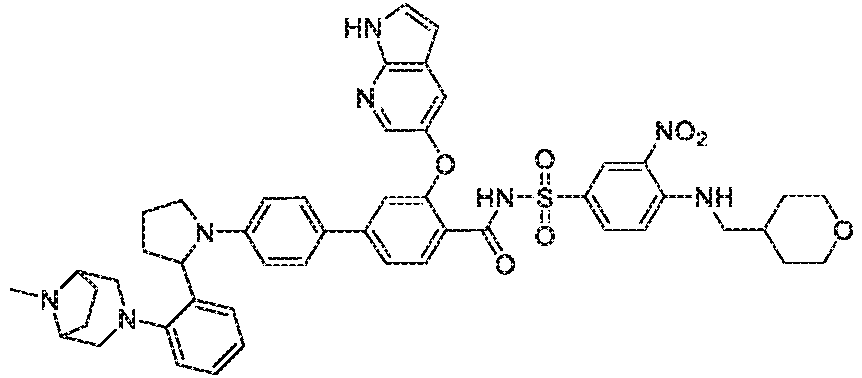
- The desired compound was synthesized starting from 8-methyl-3-(2-(pyrrolidin-2-yl)phenyl)-3,8-diazabicyclo[3.2.1]octane and 1-bromo-4-iodobenzene following the procedures similar to those in Example A100. 1H NMR (400 MHz, CDCl3) δ 11.62 (s, 1H), 9.85 (s, 1H), 8.53 - 8.35 (m, 2H), 8.07 - 7.97 (m, 1H), 7.78 - 7.69 (m, 1H), 7.68 - 7.58 (m, 1H), 7.54 - 7.22 (m, 7H), 7.17 - 7.00 (m, 2H), 7.00 - 6.85 (m, 2H), 6.49 - 6.25 (m, 3H), 5.22 - 5.07 (m, 1H), 4.14 - 3.71 (m, 5H), 3.36 - 3.21 (m, 5H), 3.18 - 2.91 (m, 3H), 2.91 - 2.69 (m, 3H), 2.32 - 2.12 (m, 4H), 2.13 - 1.77 (m, 5H), 1.78 - 1.59 (m, 2H), 1.57 - 1.43 (m, 1H), 1.42 - 1.36 (m, 1H), 0.95 - 0.80 (m, 2H). MS (ESI, m/e) [M+1]+ 896.9.
-

- The desired compound A120 was synthesized by Boc-deprotection in TFA/DCM of tert-butyl 4-(2-(1-(3'-((1H-pyrrolo[2,3-b]pyridin-5-yl)oxy)-4'-(((3-nitro-4-(((tetrahydro-2H-pyran-4-yl)methyl)amino)phenyl)sulfonyl)carbamoyl)-[1,1'-biphenyl]-4-yl)pyrrolidin-2-yl)phenyl)piperazine-1-carboxylate, which was synthesized starting from tert-butyl 4-(2-(pyrrolidin-2-yl)phenyl)piperazine-1-carboxylate and 1-bromo-4-iodobenzene following the procedures similar to those in Example A100. 1H NMR(400 MHz, DMSO-d6 ) δ ppm: 11.54 (s, 1H), 8.42-8.31 (m, 2H), 7.67-7.61 (m, 1H), 7.59-7.52 (s, 1H), 7.43-7.38 (m, 1H), 7.34-7.26 (m, 4H), 7.25-7.16 (m, 3H), 7.05-6.98 (m, 2H), 6.90 (s, 1H), 6.85-6.78 (m, 1H), 6.41-6.35 (m, 2H), 6.31-6.27 (m, 1H), 5.11-5.08 (m, 1H), 3.89-3.77 (m, 3H), 3.76-3.68 (m, 1H), 3.28-3.21 (m, 5H), 3.18-3.08 (m, 4H), 3.04-2.95 (m, 4H), 2.02-1.97 (m, 2H), 1.88-1.78 (m, 3H), 1.63-1.57 (m, 4H). MS (ESI, m/e) [M+1]' 856.8.
-

- The desired compound was synthesized starting from 1-methyl-4-(2-(pyrrolidin-2-yl)phenyl)piperazine and 1-bromo-4-iodobenzene following the procedures similar to those in Example A100. 1H NMR (400 MHz, DMSO-d6 )δ ppm: 11.58 (s, 1H), 10.34 (s, 1H), 8.51 - 8.27 (m, 2H), 7.97 (s, 1H), 7.74 - 7.65 (m, 1H), 7.59 - 7.51 (m, 1H), 7.47 - 7.34 (m, 2H), 7.33 - 7.13 (m, 5H), 7.08 - 6.96 (m, 2H), 6.95 - 6.85 (m, 2H), 6.45 - 6.25 (m, 3H), 5.15 - 4.98 (m, 1H), 3.88 - 3.79 (m, 2H), 3.9 - 3.67 (m, 1H), 3.41 - 3.36 (m, 1H), 3.32 - 3.19 (m, 2H), 3.13 - 2.77 (m, 8H), 2.67 - 2.53 (m, 3H), 2.47 - 2.38 (m, 1H), 2.07 - 1.94 (m, 3H), 1.93 - 1.73 (m, 2H), 1.66 - 1.52 (m, 2H). MS (ESI, m/c) [M+1]+ 870.8.
-

- The desired compound was synthesized starting from 4-(2-(pyrrolidin-2-yl)phenyl)morpholine and 1-bromo-4-iodobenzene following the procedures similar to those in Example A100. 1H NMR (400 MHz, DMSO-d6 )δ ppm: 12.15 (s, 1H), 11.69 (s, 1H), 8.63 - 8.55 (m, 2H), 7.56 (s, 1H), 7.34 (s, 1H), 7.33 - 7.20 (m, 3H), 7.19 - 7.13 (m, 7H), 7.00 (s, 2H), 6.90 (s, 1H), 6.43 - 6.37 (m, 3H), 5.16 - 5.13 (m, 1H), 3.86 - 3.75 (m, 8H), 3.33 - 3.25 (m, 5H), 3.10 - 2.95 (m, 4H), 1.84 (s, 3H), 1.60 - 1.57 (m, 4H). MS (ESI) m/e [M+1]+ 857.8.
-
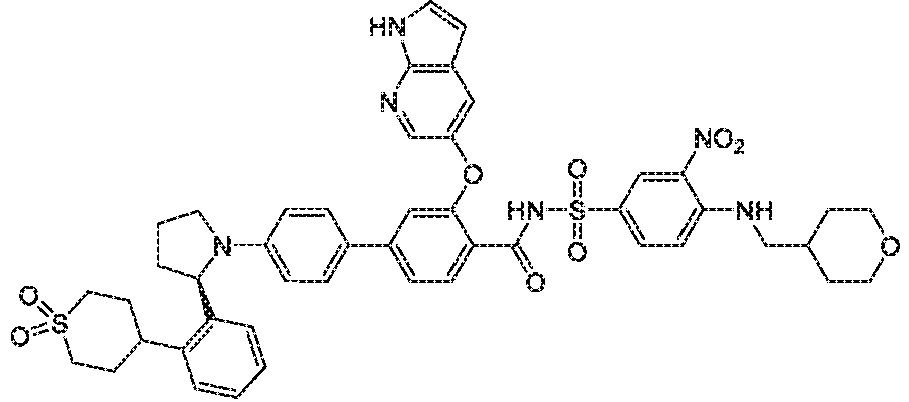
- The desired compound was synthesized starting from (R)-2-(2-(tetrahydro-2H-thiopyran-4-yl)phenyl)pyrrolidine and 1-bromo-4-iodobenzene following the procedures similar to those in Example A 100. 1H NMR (400 MHz, DMSO-d6 )δ ppm: 12.16 (s, 1H), 11.71 (s, 1H), 8.62-8.58 (m, 2H), 8.05 (s, 1H), 7.83 (d, J = 8.8 Hz, 1H), 7.64 - 7.48 (m, 3H), 7.38 - 7.24 (m, 4H), 7.15 -7.10 (m, 3H), 6.94 - 6.81 (m, 2H), 6.37 - 6.35 (m, 3H), 5.05 - 5.04 (m, 1H), 3.85 - 3.83 (m, 1H), 3.67 (s, 1H), 3.52 - 3.37 (m, 3H), 3.29 - 3.21 (m, 1H), 3.14 (s, 2H), 2.28 - 2.26 (m, 1H), 2.13 - 2.10 (m, 2H), 2.01 - 1.99 (m, 2H), 1.87 (s, 2H), 1.73 -1.54 (m, 3H), 1.24 (s, 5H).MS (ESI) m/e [M+1]+ 904.7.
-

- The desired compound was synthesized starting from 1-(2-(pyrrolidin-2-yl)phenyl)piperidin-4-ol and 1-bromo-4-iodobenzene following the procedures similar to those in Example A100. 1H NMR (DMSO-d 6) δ ppm: 12.15 (s, 1H), 11.67 (s, 1H), 8.53 (s, 2H), 8.02 (s, 1H), 7.79 (s, 1H), 7.58 - 7.46 (m, 3H), 7.35 - 7.28 (m, 3H), 7.21 - 7.04 (m, 3H), 6.96 - 6.88 (m, 3H), 6.44 - 6.31 (m, 3H), 5.06 - 5.04 (m, 1H), 4.68 - 4.65 (m, 1H), 3.89 - 3.85 (m, 2H), 3.68 - 3.63 (m, 2H), 3.30 - 3.21 (m, 4H), 3.10 - 2.95 (m, 4H), 2.79 - 2.74 (m, 2H), 1.99 (s, 3H), 1.86 - 1.82 (m, 4H), 1.62 - 1.58 (m, 4H), 1.25 - 1.21 (m, 2H). MS (ESI) m/e [M+1]+ 871.8.
-

- The desired compound was synthesized starting from N,N-dimethyl-1-(2-(pyrrolidin-2-yl)phenyl)piperidin-4-amine and 1-bromo-4-iodobenzene following the procedures similar to those in Example A 100. 1H NMR (DMSO-d6 ) δ ppm: 11.67 (s, 1H), 8.62 - 8.42 (m, 2H), 8.02 (s, 1H), 7.78 (d, J = 9.2 Hz, 1H), 7.60 - 7.42 (m, 3H), 7.36 - 7.24 (m, 3H), 7.23 - 7.14 (m, 2H), 7.10 - 6.96 (m, 3H), 6.91 (s, 1H), 6.48 - 6.30 (m, 3H), 5.06 (d, J = 7.6 Hz, 1H), 3.84 (d, J = 8.0 Hz, 2H), 3.76 - 3.67 (m, 1H), 3.30 - 3.18 (m, 6H), 3.10 - 3.00 (m, 1H), 2.87 (t, J = 11.6 Hz, 1H), 2.77 (s, 6H), 2.47 - 2.39 (m, 1H), 2.16 - 1.95 (m, 4H), 1.90 - 1.74 (m, 4H), 1.60 (d, J = 12.4 Hz, 2H), 1.30 - 1.18 (m, 4H). MS (ESI, m/e) [M+1]+ 898.8.
-

- The desired compound was synthesized starting from 1-methyl-3-(2-(pyrrolidin-2-yl)phenyl)pyrrolidine and 1-bromo-4-iodobenzene following the procedures similar to those in Example A100. 1H NMR (DMSO-d6 ) δ ppm: 12.37 - 11.97 (m, 0.4 H), 11.66 (s, 1H), 10.39 - 9.79 (m, 0.6H), 8.61 - 8.36 (m, 2H), 8.02 (s, 1H), 7.85 - 7.68 (m, 1H), 7.63 - 7.41 (m, 4H), 7.36 - 7.17 (m, 4H), 7.14 - 6.97 (m, 2H), 6.95 - 6.82 (m, 2H), 6.43 - 6.26(m, 2H), 5.10 - 4.89 (m, 1H), 3.88 - 3.66 (m, 4H), 3.43 - 3.36 (m, 1H), 3.30 - 3.18 (m, 5H), 2.92 (s, 3H), 2.45 - 2.36 (m, 2H), 2.05 - 1.79 (m, 5H), 1.78 - 1.41 (m, 5H), 0.87 - 0.81 (m, 2H). MS (ESI, m/e) [M+1]+ 855.9.
-

- The desired compound was synthesized starting from N,N-dimethyl-2-(2-(pyrrolidin-2-yl)phenoxy)ethan-1-amine and 1-bromo-4-iodobenzene following the procedures similar to those in Example A 100. 1H NMR (DMSO-d6 ) δ ppm: 11.56 (s, 1H), 8.44-8.32 (m, 2H), 7.96 (s, 1H), 7.71-7.64 (m, 2H), 7.58-7.52 (m, 1H), 7.46-7.35 (m, 2H), 7.32-7.22 (m, 3H), 7.21-7.16 (m, 1H), 7.07-7.01(m, 1H), 6.97-6.71 (m, 5H), 6.40-6.34 (m, 2H), 6.31-6.27 (m, 1H), 5.33 (s, 1H), 5.06-4.99 (m, 1H), 4.38-4.22 (m, 2H), 3.88-3.79 (m, 2H), 3.70-3.65 (m, 1H), 3.30-3.19 (m, 5H), 2.71-2.59 (m, 6H), 2.05-1.92 (m, 3H), 1.88-1.78 (m, 3H), 1.65-1.55 (m, 3H). MS (ESI, m/e) [M+1]+ 859.8.
-

- The desired compound was synthesized starting from 2-(2-(methoxymethyl)phenyl)pyrrolidine and 1-bromo-4-iodobenzene following the procedures similar to those in Example A1. 1H NMR (DMSO-d6 ) δ ppm: 12.17 (s, 1H), 11.70 (s, 1H), 8.71-8.49 (m, 2H), 8.04 (s, 1H), 7.81 (d, J = 8.7 Hz, 1H), 7.60-7.47 (m, 3H), 7.38- 7.25 (m, 4H), 7.22-7.10 (m, 3H), 6.92-6.88 (m, 2H), 6.49-6.33 (m, 3H), 4.99 (d, J = 7.7 Hz, 1H), 4.69-4.60 (m, 1H), 4.55-4.46 (m, 1H), 3.91-3.78 (m, 2H), 3.72 (s, 1H), 3.34 (s, 3H), 3.29-3.25 (m, 2H), 3.24- 3.18 (m, 1H), 3.06-2.98 (m, 1H), 2.39 (s, 1H), 2.07-1.82 (m, 4H), 1.76 (s, 1H), 1.68-1.54 (m, 2H), 1.26 (s, 2H). MS (ESI, m/e) [M+1]+ 816.8.
-

- The desired compound was synthesized starting from (R)-N,N-dimethyl-1-(2-(pyrrolidin-2-yl)phenyl)methanamine and 1-bromo-4-iodobenzene following the procedures similar to those in Example A1. 1H NMR (400 MHz, DMSO-d 6 ) δ ppm: 11.64 (s, 1H), 8.60 - 8.40 (m, 2H), 8.01 (s, 1H), 7.80 - 7.75 (m, 1H), 7.60 - 7.40 (m, 4H), 7.39 - 7.13 (m, 5H), 7.10 - 6.85 (m, 3H), 6.49 - 6.26 (m, 3H), 5.25 - 5.15 (m, 1H), 3.75 - 3.88 (m, 2H), 3.75 - 3.65 (m, 1H), 3.35 - 3.25 (m, 5H), 3.15 - 3.06 (m, 1H), 2.45 - 2.30 (m, 2H), 2.07 - 1.80 (m, 4H), 1.70 - 1.65 (m, 1H), 1.64 - 1.60 (m, 2H), 1.35 - 1.15 (m, 6H). MS (ESI, m/e) [M+1]+ 829.8.
-

- The desired compound was synthesized starting from N,N-dimethyl-2-(2-(pyrrolidin-2-yl)phenyl)ethan-1-amine and 1-bromo-4-iodobenzene following the procedures similar to those in Example A100. 1H NMR (DMSO-d 6) δ ppm: 11.54 (s, 1H), 9.75 (br, 1H), 8.41-8.33 (m, 2H), 7.96 (s, 1H), 7.55 (d, J = 8.8 Hz, 1H), 7.48 (d, J = 8.0 Hz, 1H), 7.37 - 7.07 (m, 7H), 7.03 - 6.84 (m, 4H), 6.41 (d, J = 8.0 Hz, 2H), 6.30 (s, 1H), 4.94 (d, J = 4.4 Hz, 1H), 3.85 (d, J = 8.4 Hz, 2H), 3.73 - 3.61 (m, 1H), 3.33 - 3.20 (m, 6H), 3.05-2.92 (m, 4H), 2.80(s, 6H), 2.07 - 1.26 (m, 8H). MS (ESI, m/e) [M+1]+ 843.9.
-

- The desired compound was synthesized starting from N,N-dimethyl-3-(2-(pyrrolidin-2-yl)phenyl)propan-1-amine and 1-bromo-4-iodobenzene following the procedures similar to those in Example A 100. 1H NMR (DMSO-d6 ) δ ppm: 11.58 (s, 1H), 8.43 (s, 2H), 7.98 (s, 1H), 7.69 (d, J = 8.0 Hz, 1H), 7.56 (d, J = 7.8 Hz, 1H), 7.43 (d, J = 12.8 Hz, 2H), 7.33 - 7.12 (m, 6H), 7.08 - 7.07 (m, 1H), 6.96 - 6.84 (m, 3H), 6.41 - 6.28 (m, 3H), 3.88 - 3.82 (m, 2H), 3.73 (s, 1H), 3.39 - 3.37 (m, 1H), 3.27 - 3.23 (m, 4H), 3.13 (s, 2H), 2.86 - 2.62 (m, 9H), 1.96 - 1.90 (m, 6H), 1.71 (s, 1H), 1.62 - 1.58 (m, 2H), 1.24 (s, 5H). MS (ESI) m/c [M+1]' 857.9.
-

- The desired compound was synthesized starting from 1-methyl-3-(2-(pyrrolidin-2-yl)phenoxy)pyrrolidine and 1-bromo-4-iodobenzene following the procedures similar to those in Example A100. 1H NMR (DMSO-d6 ) δ ppm: 11.57 (s, 1H), 10.58 (br, 1H), 8.47-8.45 (m, 2H), 7.97 (s, 1H), 7.70 (d, J = 8.8 Hz, 1H), 7.55 (d, J = 8.0 Hz, 1H), 7.43 - 7.15 (m, 6H), 7.03 - 6.84 (m, 5H), 6.41 - 6.28 (m, 3H), 5.15 (d, J = 24.4 Hz, 2H), 3.85 (d, J = 8.4 Hz, 2H), 3.73 - 3.71 (m, 1H), 3.33 - 3.00 (m, 6H), 2.70 (s, 3H), 2.90-2.52 (m, 8H), 2.17 - 2.72 (m, 6H), 1.75(d, J = 8.4 Hz, 2H). MS (ESI, m/e) [M+1]+ 871.9.
-

- The desired compound was synthesized starting from N,1-dimethyl-N-(2-((R)-pyrrolidin-2-yl)phenyl)pyrrolidin-3-amine and 1-bromo-4-iodobenzene following the procedures similar to those in Example A100. 1H NMR (DMSO-d6 ) δ ppm: 11.55 (s, 1H), 9.80 (s, 1H), 8.45 - 8.28 (m, 2H), 7.95 (s, 1H), 7.74 - 7.61 (m, 1H), 7.60 - 7.52 (m, 1H), 7.42 (s, 1H), 7.39 - 7.31 (m, 1H), 7.31 - 7.12 (m, 5H), 7.06 - 6.94 (m, 2H), 6.94 - 6.77(m, 2H), 6.44 - 6.23 (m, 3H), 5.18 - 4.98 (m, 1H), 3.93 - 3.64 (m, 4H), 3.31 - 3.12 (m, 5H), 3.10 - 2.75 (m, 3H), 2.70 - 2.53 (m, 6H), 2.45 - 2.36 (m, 2H), 2.19 - 1.93 (m, 3H), 1.90 - 1.72 (m, 3H), 1.66 - 1.53 (m, 2H), 1.26 - 1.21 (m, 2H). MS (ESI, m/e) [M+1]+ 884.9.
-

- The desired compound was synthesized starting from N,1-dimethyl-N-(2-(pyrrolidin-2-yl)phenyl)piperidin-3-amine and 1-bromo-4-iodobenzene following the procedures similar to those in ExampleA100. 1H NMR (DMSO-d6 ) δ ppm: 11.56 (s, 1H), 8.41-8.37 (m, 2H), 7.96 (s, 1H), 7.68 (d, J = 8.6 Hz, 1H), 7.56 (d, J = 8.0 Hz, 1H), 7.43 - 7.38 (m, 2H), 7.28 -7.24 (m, 6H), 6.99 (s, 2H), 6.89 (s, 2H), 6.42 - 6.26 (m, 3H), 5.01 (s, 1H), 3.85 - 3.81 (m, 2H), 3.71 (s, 1H), 3.37 (s, 1H), 3.27 - 3.23 (m, 6H), 3.09 (s, 3H), 2.69 (s, 5H), 2.42 (s, 1H), 2.01 - 1.98 (m, 4H), 1.86 (s, 4H), 1.63 - 1.58 (m, 5H). MS (ESI) m/e [M+1]+ 898.8.
-
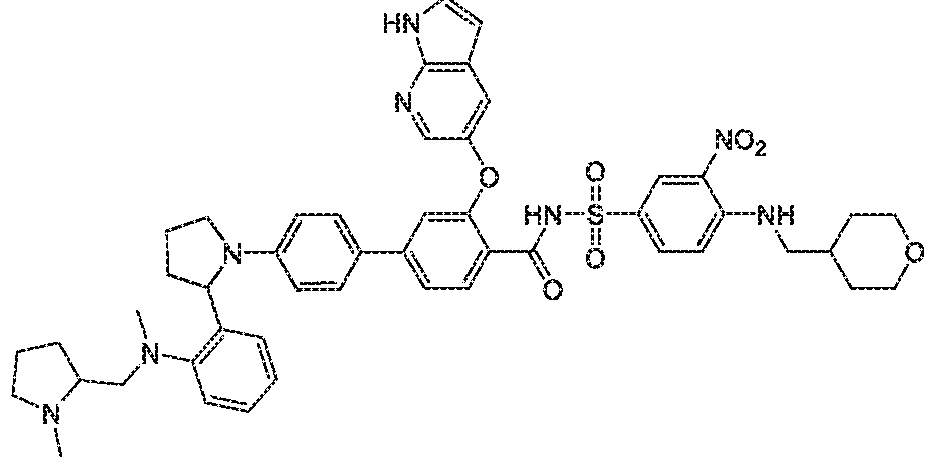
- The desired compound was synthesized starting from N-methyl-N-((1-methylpyrrolidin-2-yl)methyl)-2-(pyrrolidin-2-yl)aniline and 1-bromo-4-iodobenzene following the procedures similar to those in Example A100. 1H NMR (DMSO-d6 ) δ ppm: 12.16 (s, 1H), 11.70 (s, 1H), 8.65 - 8.45 (m, 2H), 8.04 (d, J = 2.0 Hz, 1H), 7.81 (d, J = 8.8 Hz, 1H), 7.64 - 7.45 (m, 3H), 7.36 - 7.20 (m, 5H), 7.15 - 6.94 (m, 3H), 6.87 (s, 1H), 6.42 - 6.28 (m, 3H), 5.11 - 4.99 (m, 1H), 3.84 (d, J = 8.0 Hz, 2H), 3.74 - 3.68 (m, 1H), 3.62 - 3.46 (m, 2H), 3.30 - 3.20 (m, 4H), 3.17 - 2.93 (m, 5H), 2.72 - 2.64 (m, 3H), 2.45 - 2.22 (m, 2H), 2.02 - 1.74 (m, 7H), 1.60 (d, J = 12.0 Hz, 2H), 1.34 - 1.16 (m, 4H). MS (ESI, m/e) [M+1]+ 898.8.
-

- The desired compound was synthesized starting from (R)-7-methyl-2-(2-(pyrrolidin-2-yl)phenyl)-2,7-diazaspiro[3.5]nonane and 1-bromo-4-iodobenzene following the procedures similar to those in Example A100. 1H NMR (DMSO-d6 ) δ ppm: 11.55 (s, 1H), 9.44 (s, 1H), 8.51 - 8.27 (m, 2H), 8.01 - 7.92 (m, 1H), 7.74 - 7.60 (m, 1H), 7.60 - 7.47 (m, 1H), 7.47 - 7.16 (m, 5H), 7.13 - 6.99 (m, 1H), 6.94 - 6.73 (m, 3H), 6.68 - 6.56 (m, 1H), 6.56 - 6.36 (m, 3H), 6.31 (s, 1H), 4.92 - 4.66 (m, 1H), 3.90 - 3.55 (m, 6H), 3.30 - 3.18 (m, 4H), 3.12 - 2.74 (m, 4H), 2.68 - 2.52 (m, 3H), 2.30 - 2.19 (m, 1H), 2.06 - 1.70 (m, 7H), 1.67 - 1.52 (m, 2H), 1.36 - 1.08 (m, 4H). MS (ESI, m/e) [M+1]+ 910.9.
-

- The desired compound was synthesized starting from N,N-dimethyl-1-(1-(2-(pyrrolidin-2-yl)phenyl)pyrrolidin-2-yl)methanamine and 1-bromo-4-iodobenzene following the procedures similar to those in Example A100. 1H NMR (DMSO-d6 ) δ ppm: 11.56 (s, 1H), 9.62 (s, 1H), 8.47 - 8.28 (m, 2H), 7.97 (s, 1H), 7.76 - 7.63 (m, 1H), 7.61 - 7.50 (m, 1H), 7.47 - 7.14 (m, 7H), 6.96 - 6.80 (m, 4H), 6.47 - 6.24 (m, 3H), 5.05 - 4.85 (m, 1H), 3.97 - 3.76 (m, 3H), 3.70 - 3.54 (m, 2H), 3.40 - 3.33 (m, 3H), 3.31 - 3.19 (m, 4H), 3.07 - 2.93 (m, 1H), 2.87 - 2.80 (m, 1H), 2.37 - 2.20 (m, 4H), 2.04 - 1.65 (m, 9H), 1.62 - 1.54 (m, 2H), 1.37 - 1.23 (m, 3H). MS (ESI, m/e) [M+1]+ 899.0.
-

- The desired compound was synthesized starting from (R)-1-methyl-4-(2-(pyrrolidin-2-yl)phenyl)-1H-pyrazole and 1-bromo-4-iodobenzene following the procedures similar to those in Example A 100. 1H NMR (DMSO-d6 ) δ ppm: 12.15 (s, 1H), 11.70 (s, 1H), 8.66 - 8.53 (m, 2H), 8.04 (d, J = 2.8 Hz, 1H), 7.94 (s, 1H), 7.82 (dd, J = 1.6 Hz, 9.2 Hz, 1H), 7.66 (s, 1H), 7.58 (d, J = 2.4 Hz, 1H), 7.54 - 7.48 (m, 2H), 7.39 - 7.10 (m, 7H), 7.05 - 7.00 (m, 1H), 6.88 (s, 1H), 6.41 - 6.35 (m, 1H), 6.26 (d, J = 8.4 Hz, 1H), 4.86 (d, J = 7.2 Hz, 1H), 3.90 (s, 3H), 3.84 (dd, J = 2.8 Hz, 11.2 Hz, 2H), 3.77 - 3.68 (m, 1H), 3.29 - 3.25 (m, 2H), 3.14 - 3.06 (m, 1H), 2.46 - 2.32 (m, 1H), 2.06 - 1.94 (m, 2H), 1.92 - 1.74 (m, 2H), 1.60 (d, J = 12.4 Hz, 2H), 1.28 - 1.22 (m, 2H), 1.18 (t, J = 7.6 Hz, 2H). MS (ESI, m/e) [M+1]+ 852.8.
-

- The desired compound was synthesized starting from 1-mcthyl-4-(5-(pyrrolidin-2-yl)-1H-pyrazol-1-yl)piperidine and 1-bromo-4-iodobenzene following the procedures similar to those in Example A 100. 1H NMR (DMSO-d6 ) δ ppm: 11.56 (s, 1H), 9.74 (s, 1H), 8.56 - 8.25 (m, 2H), 8.04 - 7.89 (m, 1H), 7.74 - 7.51 (m, 2H), 7.49 - 7.18 (m, 6H), 6.97 - 6.77 (m, 2H), 6.51 - 6.37 (m, 2H), 6.31 (s, 1H), 5.76 (s, 1H), 5.15 - 4.93 (m, 1H), 4.60 - 4.29 (m, 1H), 3.94 - 3.75 (m, 2H), 3.68 - 3.55 (m, 1H), 3.39 - 3.32 (m, 2H), 3.30 - 3.16 (m, 5H), 3.01 - 2.72 (m, 2H), 2.72 - 2.56 (m, 3H), 2.42 - 1.73 (m, 9H), 1.67 - 1.53 (m, 2H), 1.29 - 1.19 (m, 2H). MS (ESI, m/e) [M+1]+ 859.9.
-

- The desired compound was synthesized starting from 4-(4-chloro-2-(pyrrolidin-2-yl)phenyl)-1-methyl-1,2,3,6-tetrahydropyridine and 1-bromo-4-iodobenzene following the procedures similar to those in Example A68-R. 1H NMR (DMSO-d6 ) δ ppm: 11.55 (s, 1H), 9.62 (s, 1H), 8.46 - 8.29 (m, 2H), 7.96 (s, 1H), 7.73 - 7.51 (m, 2H), 7.48 - 7.10 (m, 7H), 7.04 (s, 1H), 6.93 (s, 1H), 6.89 - 6.78 (m, 1H), 6.46 - 6.26 (m, 3H), 5.71 (s, 1H), 4.85 - 4.68 (m, 1H), 3.92 - 3.72 (m, 3H), 3.31 - 3.19 (m, 5H), 3.18 - 2.81 (m, 3H), 2.39 - 2.23 (m, 2H), 2.07 - 1.92 (m, 3H), 1.92 - 1.73 (m, 2H), 1.70 - 1.52 (m, 2H), 1.34 - 1.22 (m, 6H). MS (ESI, m/e) [M+1]+ 901.9.
-

- The desired compound was synthesized starting from 8-(pyrrolidin-2-yl)isoquinoline and 1-bromo-4-iodobenzene following the procedures similar to those in Example A1. 1H NMR (DMSO-d6 ) δ ppm: 12.15 (s, 1H), 11.68 (s, 1H), 9.71 (s, 1H), 8.58 - 8.52 (m, 3H), 8.04 (s, 1H), 7.65 - 7.53 (m, 3H), 7.57 - 7.46 (m, 4H), 7.37 - 7.23 (m, 3H), 7.22 - 6.95 (m, 2H), 6.87 (s, 1H), 6.36 - 6.34 (m, 3H), 5.73 (s, 1H), 3.85 - 3.83 (m, 3H), 3.46 - 3.43 (m, H), 3.30 - 3.26 (m, 4H), 3.10 - 3.08 (m, 2H), 2.65 - 2.58 (m, 1H), 1.95 - 1.85 (m, 4H), 1.66 - 1.50 (m, 2H), 1.23 (s, 3H). MS (ESI) m/e [M+1]+ 823.8.
-

- The desired compound was synthesized starting from 2-methyl-7-(pyrrolidin-2-yl)-2H-indazole and 1-bromo-4-iodobenzene following the procedures similar to those in Example A1. 1H NMR (DMSO-d6 ) δ ppm: 11.58 (s, 1H), 10.34 (s, 1H), 8.51 - 8.27 (m, 2H), 7.97 (s, 1H), 7.74 - 7.65 (m, 1H), 7.59 - 7.51 (m, 1H), 7.47 - 7.34 (m, 2H), 7.33 - 7.13 (m, 5H), 7.08 - 6.96 (m, 2H), 6.95 - 6.85 (m, 2H), 6.45 - 6.25 (m, 3H), 5.15 - 4.98 (m, 1H), 3.88 - 3.79 (m, 2H), 3.9 - 3.67 (m, 1H), 3.41 - 3.36 (m, 1H), 3.32 - 3.19 (m, 2H), 3.13 - 2.77 (m, 8H), 2.67 - 2.53 (m, 3H), 2.47 - 2.38 (m, 1H), 2.07 - 1.94 (m, 3H), 1.93 - 1.73 (m, 2H), 1.66 - 1.52 (m, 2H). MS (ESI, m/c) [M+1]+ 870.8.
-

- The desired compound was synthesized starting from 2-methyl-8-(pyrrolidin-2-yl)-1,2,3,4-tetrahydroisoquinoline and 1-bromo-4-iodobenzene following the procedures similar to those in Example A 100. 1H NMR (DMSO-d6 ) δ ppm: 11.60 (s, 1H), 10.54 (s, 1H), 8.53 - 8.33 (m, 2H), 8.04 - 7.92 (m, 1H), 7.78 - 7.63 (m, 1H), 7.60 - 7.38 (m, 3H), 7.33 - 7.15 (m, 3H), 7.15 - 7.01 (m, 2H), 6.99 - 6.71 (m, 3H), 6.46 - 6.22 (m, 3H), 4.87 - 4.67 (m, 1H), 4.60 - 4.31 (m, 1H), 4.19 - 3.92 (m, 1H), 3.92 - 3.79 (m, 2H), 3.77 - 3.60 (m, 1H), 3.40 - 3.34 (m, 1H), 3.29 - 3.17 (m, 5H), 3.10 - 2.95 (m, 2H), 2.89 - 2.75 (m, 2H), 2.41 - 2.24 (m, 1H), 2.02 - 1.76 (m, 3H), 1.76 - 1.50 (m, 3H), 1.33 - 1.13 (m, 3H). MS (ESI, m/e) [M+1]+ 841.8.
-

- The desired compound was synthesized starting from 2-(2-(2-cyclopropylphenyl)propan-2-yl)pyrrolidine and 1-bromo-4-iodobenzene following the procedures similar to those in Example A1. 1H NMR (DMSO-d6 ) δ ppm: 12.17 (s, 1H), 11.74 (s, 1H), 8.63-8.58 (m, 2H), 8.09 (s, 1H), 7.85 (d, J = 8.1 Hz, 1H), 7.59-7.53 (m, 3H), 7.36-7.30 (m, 4H), 7.19 - 7.00 (m, 3H), 6.90 (s, 2H), 6.73 - 6.69 (m, 2H), 6.41 (s, 1H), 4.85 (s, 1H), 3.87 - 3.83 (m, 2H), 3.49 (s, 1H), 3.28 - 3.15 (m, 3H), 2.02 - 1.84 (m, 2H), 1.72 - 1.58 (m, 5H), 1.40 (s, 6H), 1.24 (s, 4H), 0.98 - 0.92 (m, 4H), 0.61 (s, 1H). MS (ESI) m/e [M+1]+ 854.8.
-

- To a solution of 2-cyclopropylbenzaldehyde (126.95 g, 868.39 mmol) and 2-melhylpropanc-2-sulfinamidc (210.89 g, 1.74 mol) in THF (1300 mL) was added Ti(OEt)4 (396.91 g, 1.74 mol). The mixture was stirred at 80°C for 12 hours. TLC indicated the reactant was consumed completely. The reaction mixture was poured into water (500 mL) and filtered. The filtrate was extracted with Ethyl acetate (300 mL × 3). The combined organic phase was washed with brine (50 mL × 2), dried with anhydrous Na2SO4, filtered and concentrated in vacuum. The residue was purified by column chromatography on silica gel (eluent: PE/EA = 200/1 to 50/1). (E)-N-(2-cyclopropylbenzylidene)-2-methylpropane-2-sulfinamide (190.13 g) was obtained as yellow solid.
- To a solution of (E)-N-(2-cyclopropylbenzylidene)-2-methylpropane-2-sulfinamide (190 g, 761.92 mmol) in DCM (1.50 L) was added allylmagnesium bromide (2.28 L, 2.28 mol, 1M) at -10°C to 0°C, the mixture was stirred at 0°C for 1 hours. LC/MS showed that the reaction was completely. The reaction mixture was quenched by saturated NH4Cl aqueous solution, and then extracted with DCM (200 mL × 3). The combined organic layers were dried over Na2SO4, filtered and concentrated under reduced pressure. The residue was washed with MTBE (200 mL) and filtered. N-(1-(2-cyclopropylphenyl)but-3-en-1-yl)-2-methylpropane-2-sulfonamide (130.12 g) was obtained as white solid. 1H NMR (400 MHz, CDCl3) δ ppm: 0.59 - 0.84 (m, 2 H) 0.89 - 1.08 (m, 2 H) 1.20 (s, 9 H) 1.95 - 2.09 (m, 1 H) 2.49 (dt, J = 14.03, 8.45 Hz, 1 H) 2.59 - 2.71 (m, 1 H) 3.69 (br s, 1 H) 5.11 - 5.26 (m, 3 H) 5.70 - 5.86 (m, 1 H) 7.03 - 7.12 (m, 1 H) 7.15 - 7.25 (m, 2 H) 7.32 - 7.41 (m, 1 H).
- To a solution of N-(1-(2-cyclopropylphenyl)but-3-en-1-yl)-2-methylpropane-2-sulfonamide (30 g, 102.93 mmol) in DCM (300 mL) was added m-CPBA (71.05 g, 411.73 mmol) at 0°C, the mixture was stirred at 20°C for 12 hours. TLC indicated the reactant was consumed completely. The reaction mixture was washed with saturated Na2CO3 aqueous solution (100 mL) and extracted with DCM (100 mL × 3). The combined organic phase was washed with brine (100 mL × 2), dried with anhydrous Na2SO4, filtered and concentrated in vacuum. The residue was purified by column chromatography on silica gel (eluent: PE/EA = 1/0 to 2/1). N-(1-(2-cyclopropylphenyl)-2-(oxiran-2-yl)ethyl)-2-methylpropane-2-sulfonamide (24.75 g) was obtained as yellow solid. 1H NMR (400 MHz, CDCl3) δ ppm: 0.55 - 0.86 (m, 2 H) 0.88 - 1.09 (m, 2 H) 1.25 (s, 2 H) 1.28 (d, J = 0.73 Hz, 6 H) 1.86 - 1.96 (m, 1 H) 2.11 - 2.25 (m, 1 H) 2.40 - 2.64 (m, 1 H) 2.73 - 2.87 (m, 1 H) 2.94 - 3.12 (m, 1 H) 4.66 - 5.15 (m, 1 H) 5.37 - 5.54 (m, 1 H) 6.98 - 7.10 (m, 1 H) 7.16 - 7.26 (m, 2 H) 7.30 - 7.64 (m, 1 H) 7.94 - 8.12 (m, 1 H).
- To a solution of N-(1-(2-cyclopropylphenyl)-2-(uxiran-2-yl)ethyl)-2-methylpropane-2- sulfonamide (24.75 g, 76.52 mmol) in DMF (300 mL) was added K2CO3 (31.73 g, 229.56 mmol) and KI (12.70 g, 76.52 mmol), the mixture was stirred at 100°C for 12 hours. TLC indicated the reactant was consumed completely. The mixture was cooled to room temperature and then poured into ice/water and extracted with EA (300 mL × 3), dried with Na2SO4, filtered and concentrated under reduced pressure. The residue was purified by column chromatography on silica gel (eluent: PE/EA = 200/1 to 2/1). 1-(tert-butylsulfonyl)-5-(2-cyclopropylphenyl)pyrrolidin-3-ol (20.63 g) was obtained as yellow oil. 1H NMR (400 MHz, CDCl3) δ ppm: 0.50 - 0.84 (m, 2 H) 0.89 - 1.02 (m, 2 H) 1.23 (d, J = 5.29 Hz, 9 H) 1.84 - 2.02 (m, 2 H) 2.28 (d, J = 4.85 Hz, 1 H) 2.75 (br dd, J = 7.17, 5.84 Hz, 1 H) 3.38 (dd, J = 11.47, 6.39 Hz, 1 H) 4.03 (br d, J = 12.35 Hz, 1 H) 4.27 (dd, J = 11.36, 6.50 Hz, 1 H) 4.46 - 4.61 (m, 1 H) 5.85 - 6.12 (m, 1 H) 7.05 (d, J = 7.72 Hz, 1 H) 7.11 - 7.26 (m, 2 H) 7.47 (d, J = 7.72 Hz, 1 H).
- DAST (23.47 g, 145.62 mmol) A was added into the solution of 1-(tert-butylsulfonyl)-5-(2-cyclopropylphenyl)pyrrolidin-3-ol (15.70 g, 48.54 mmol) in DCM (200 mL) at 0°C. The mixture was stirred at 30°C for 12 hours. TLC indicated the reactant was consumed completely. The reaction mixture was washed with saturated Na2CO3 aqueous solution (100 mL) and extracted with DCM (150 mL×3). The combined organic phase was washed with brine (100 mL×2), dried with anhydrous Na2SO4, filtered and concentrated in vacuum. The residue was purified by column chromatography on silica gel (eluent: PE/EA = 1/0 to 2/1). 1-(tert-butylsulfonyl)-2-(2-cyclopropylphenyl)-4-tluoropyrrolidine (10.21 g) was obtained as yellow solid.
- A mixture of 1-(tert-butylsulfonyl)-2-(2-cyclopropylphenyl)-4-fluoropyrrolidine (10.21 g, 31.37 mmol) in TFA (80 mL) was stirred at 60°C for 2 hours. TLC indicated the reactant was consumed completely. The reaction mixture was concentrated to remove the TFA in vacuum. The residue was adjusted to Ph ~ 10 with saturated Na2CO3 aqueous solution and extracted with EA (150 mL×3). The combined organic phase was washed with brine (100 mL×2), dried with anhydrous Na2SO4, filtered and concentrated in vacuum. 2-(2-cyclopropylphenyl)-4-fluoropyrrolidine (5.23 g) was obtained as yellow oil. The crude product was used into the next step without further purification. 1H NMR (400 MHz, CDCl3) δ ppm: 0.59 - 0.81 (m, 2 H) 0.89 - 1.03 (m, 2 H) 1.66 - 2.13 (m, 4 H) 2.50 - 2.74 (m, 1 H) 3.27 - 3.61 (m, 2 H) 4.61 - 5.12 (m, 1 H) 5.20 - 5.45 (m, 1 H) 6.95 - 7.09 (m, 1 H) 7.14 - 7.25 (m, 2 H) 7.53 (d, J = 7.02 Hz, 1 H).
- To a solution of 2-(2-cyclopropylphenyl)-4-fluoropyrrolidine (1.6 g, 7.8 mmol) and 1-bromo-4-iodobenzene (6.6 g, 23.4 mmol) in toluene (20 mL) were added t-BuOK (2.62 g, 23.4 mmol), BINAP (968 mg, 1.56 mmol), Pd2(dba)3 (712 g, 780 umol). The mixture was stirred at 100°C for 4 hours. TLC indicated the reactant was consumed completely. The reaction mixture was concentrated in vacuum. The residue was purified by prep-TLC (eluent: PE/EA = 10/1) to give faster isomer as 1-(4-bromophenyl)-2-(2-cyclopropylphenyl)-4-trans-fluoropyrrolidine, and then give slower isomer as 1-(4-bromophenyl)-2-(2-cyclopropylphenyl)-4-cis-fluoropyrrolidine.
- 1-(4-bromophenyl)-2-(2-cyclopropylphenyl)-4-trans-fluoropyrrolidine was then separated by SFC (Instrument: Thar SFC350 preparative SFC; Column: Chiralpak AD, 250×50mm i.d. 10u; Mobile phase: A for CO2 and B for MeOH; Gradient: B%=30%; Flow rate: 200 g/min; Wavelength: 220 nm; Column temperature: 40°C; System back pressure: 100 bar) to obtain two isomers.
- With the faster isomer in SFC (retention time: 1.0 min) as starting material, 3-((1H-pyrrolo[2,3-b]pyridin-5-yl)oxy)-4'-((2R,4S) or (2S,4R)-2-(2-cyclopropylphenyl)-4-fluoropyrrolidin-1-yl)-N-((3-nitro-4-(((tetrahydro-2H-pyran-4-yl)methyl)amino)phenyl)sulfonyl)-[1,1'-biphenyl]-4-carboxamide as example A145a was synthesized following the similar procedures with example A1. 1H NMR (400 MHz, DMSO-d6 ) δ ppm: 12.18 (s, 1H), 11.70 (s, 1H), 8..70 - 8.44(m, 2H), 8.10 - 7.98 (m, 1H), 7.87 - 7.77 (m, 1H), 7.64 - 7.47 (m, 3H), 7.39 - 6.97 (m, 8H), 6.90 (s, 1H), 6.46 - 6.31 (m, 3H), 5.56 - 5.28 (m, 2H), 4.15 - 3.98 (m, 1H), 3.91 - 3.66 (m, 3H), 3.29 - 3.20 (m, 4H), 3.07 - 2.81 (m, 3H), 2.11 - 1.82 (m, 3H), 1.67 - 1.55 (m, 2H), 1.10 - 0.88 (m, 2H), 0.80 - 0.65 (m, 2H). MS (ESI, m/e) [M+1]+ 830.7.
- With the slower isomer in SFC (retention time: 1.4 min) as starting material, 3-((1H-pyrrolo[2,3-b]pyridin-5-yl)oxy)-4'-((2S,4R) or (2R,4S)-2-(2-cyclopropylphenyl)-4-fluoropyrrolidin-1-yl)-N-((3-nitro-4-(((tetrahydro-2H-pyran-4-yl)methyl)amino)phenyl)sulfonyl)-[1,1'-biphenyl]-4-carboxamide as example A 145b was synthesized following the similar procedures with example A1. MS (ESI, m/e) [M+1]+ 830.7.
-

- 1-(4-bromophenyl)-2-(2-cyclopropylphenyl)-4-cis-fluoropyrrolidine was separated by SFC (Instrument: Thar SFC350 preparative SFC; Column: Chiralcel OD, 250×50mm i.d. 10u; Mobile phase: A for CO2 and B for MeOH; Gradient: B%=35%; Flow rate: 200 g/min; Wavelength: 220 nm; Column temperature: 40'C; System back pressure: 100 bar) to obtain two isomers.
- With the faster isomer in SFC (retention time: 1.6 min) as the starting material, 3-((1H-pyrrolo[2,3-b]pyridin-5-yl)oxy)-4'-((2R,4R) or (2S,4S)-2-(2-cyclopropylphenyl)-4-fluoropyrrolidin-1-yl)-N-((3-nitro-4-(((tetrahydro-2H-pyran-4-yl)methyl)amino)phenyl)sulfonyl)-[1,1'-biphenyl]-4-carboxamide as example A 145c was synthesized following the similar procedures with example A1. 1H NMR (DMSO-d 6) δ ppm: 12.18 (s, 1H), 11.70 (s, 1H), 8.61 (s, 1H), 8.57 (s, 1H), 8.05 (s, 1H), 7.83 (d, J = 9.4 Hz, 1H), 7.59 (s, 1H), 7.56 - 7.48 (m, 2H), 7.34 (t, J = 8.6 Hz, 3H), 7.13 - 7.09 (m, 2H), 7.05 - 7.00 (m, 3H), 6.91 (s, 1H), 6.41 - 6.38 (m, 3H) 5.55 (s, 0.5H), 5.41 (s, 0.5H), 5.27 (d, J= 9.7 Hz, 1H), 4.01 - 3.97 (m, 1H), 3.86 - 3.81 (m, 2H), 3.78 - 3.65 (m, 1H), 3.31 - 3.22 (m, 5H), 2.26 - 2.15 (m, 1H), 2.01 - 1.98 (m, 1H), 1.87 (s, 1H), 1.62 - 1.58 (m, 2H), 1.24 (s, 2H), 1.03 - 0.92 (m, 2H), 0.81 - 0.74 (m, 1H), 0.72-0.68 (m, 1H). MS (ESI) m/c [M+1]+ 830.8.
- With the slower isomer in SFC (retention time: 1.8 min) as the starting material, 3-((1 H-pyrrolo[2,3-b]pyridin-5-yl)oxy)-4'-((2S,4S) or (2R,4R)-2-(2-cyclopropylphenyl)-4-fluoropyrrolidin-1-yl)-N-((3-nitro-4-(((tetrahydro-2H-pyran-4-yl)methyl)amino)phenyl)sulfonyl)-[1,1'-biphenyl]-4-carboxamidc as example A 145d was synthesized following the similar procedures with example A1. MS (ESI) m/e [M+1]+ 830.8.
-

- The desired compound was synthesized starting from 2-(2-cyclopropylphenyl)-4-fluoro-2,5-dihydro-1H-pyrrole and 1-bromo-4-iodobenzene following the procedures similar to those in Example A1. 1H NMR (DMSO-d 6) δ ppm: 12.19 (s, 1H), 11.69 (s, 1H), 8.61-8.56 (m, 2H), 8.04 (s, 1H), 7.82 (d, J = 8.8 Hz, 1H), 7.52-7.46 (m, 3H), 7.36-7.32 (m, 2H), 7.14 - 7.05 (m, 4H), 6.91 (s, 1H), 6.39 (d, J = 8.1 Hz, 3H), 5.95 (s, 1H), 5.65 (s, 1H), 4.58 (d, J = 13.3 Hz, 1H), 4.34 (d, J = 13.3 Hz, 1H), 3.84 (d, J = 8.5 Hz, 2H), 3.29-3.22 (m, 4H), 2.98 (s, 1H), 2.13 (s, 1H), 2.03-1.94 (m, 1H), 1.87 (s, 1H), 1.60 (d, J = 12.1 Hz, 2H), 1.04-0.91 (m, 2H), 0.82-0.68 (m, 2H). MS (ESI, m/e) [M+1]+ 828.7.
-

- To a mixture of 1-(tert-butylsulfonyl)-5-(2-cyclopropylphenyl)pyrrolidin-3-ol (6.5 g, 20.1 mmol) in DCM (70 mL) was added NaHCO3 (1.69 g, 20.1 umol) and DMP (17.1 g, 40.19 mmol) at 0 °C, the mixture was stirred at 25 °C for 12 hours. TLC showed the reaction was completed. The mixture was poured into saturated aq. NaHCO3 and was then extracted with EA (100 mL × 3). The combined organic phase was washed with brine (200 mL), dried with Na2SO4 and concentrated in vacuum. The residue was purified by column chromatography on silica gel (eluent: PE/EA = 20:1 to 1:1) to give 1-(tert-butylsulfonyl)-5-(2-cyclopropylphenyl)pyrrolidin-3-one (5 g, 77.5% yield) as a white solid.
- To a mixture of 1-(tert-butylsulfonyl)-5-(2-cyclopropylphenyl)pyrrolidin-3-one (5 g, 15.56 mmol) in DCM (100 mL) was added DAST (7.52 g mg, 46.6 mmol) at 0 °C, the mixture was stirred at 25 °C for 2 hours. TLC showed the reaction was completed. The mixture was added to saturated aq. Na2CO3 and was extracted with DCM (100 mL × 3), the combined organic phase washed with brine (100 mL) dried with Na2SO4, concentrated in vacuum. The residue was purified by column chromatography on silica gel (eluent: PE/EA = 100/1 to 5/1) to give 1-(tert-butylsulfonyl)-2-(2-cyclopropylphenyl)-4,4-difluoropyrrolidine (4 g) as yellow solid.
- To a mixture of 1-(tert-butylsulfonyl)-2-(2-cyclopropylphenyl)4,4-difluoropyrrolidin (3.5 g, 10.15 mmol) in TFA (30 mL), the mixture was stirred at 60 °C for 4 hours. TLC showed the reaction was completed. Saturated aq. Na2CO3 was added to adjust pH at ~11, the aqueous phase was extracted with EA (50 mL × 3). The combined organic phase was washed with brine (50 mL), dried with Na2SO4 and concentrated in vacuum to give 2-(2-cyclopropylphenyl)-4,4-difluoropyrrolidine (1.8 g, crude) as yellow oil.
- To a mixture of 2-(2-cyclopropylphenyl)-4,4-difluoropyrrolidine (2 g, 8.96 mmol) and 1-bromo-4-iodobenzene (7.6 g, 26.87 mmol) in toluene (20 mL) was added t-BuOK(3.02 g, 26.87 mmol), BINAP (1.12 g, 1.79 mmol) and Pd2(dba)3 (820 mg, 895 umol). The mixture was stirred at 100°C for 4 hours. TLC showed the reaction was completed. The mixture was concentrated in vacuum. The residue was purified by column chromatography on silica gel (eluent: PE/EA = 100/1 to 20/ 1). The crude product was separated and purified by prep-SFC (Instrument: Thar SFC80; Column: Chiralcel OJ, 250×25mm i.d., 10u; Mobile phase: A for CO2 and B for EtOH; Gradient: B=30%; Flow rate: 65g/min; Back pressure: 100 bar; Column temperature: 40°C) to give (R or S)-1-(4-bromophenyl)-2-(2- cyclopropylphenyl)-4,4-difluoropyrrolidine (360 mg) as faster isomer (retention time: 2.9 min) and (S orR)-1-(4-bromophenyl)-2-(2-cyclopropylphenyl)-4,4-dilluoropyrrolidine (330 mg) as slower isomer (retention time: 3.1 min).
- With the faster isomer in SFC (retention time: 2.9 min) (R or S)-1-(4-bromophenyl)-2-(2- cyclopropylphenyl)-4,4-difluoropyrrolidine as the starting material, (R or S)-3-((1H-pyrrolo[2,3-b]pyridin-5-yl)oxy)-4'-(2-(2-cyclopropylphenyl)-4,4-difluoropyrrolidin-1-yl)-N-((3-nitru-4-(((tetrahydro-2H-pyran-4-yl)methyl)amino)phenyl)sulfonyl)-[1,1'-biphenyl]-4-carboxamide as example A147a was synthesized. 1H NMR (DMSO-d 6) δ ppm: 12.21 (s, 1H), 11.70 (s, 1H), 8.61 (s, 1H), 8.56 (s, 1H), 8.04 (d, J = 2.4 Hz, 1H), 7.83 (d, J = 9.4 Hz, 1H), 7.59 (d, J = 2.4 Hz, 3H), 7.54 (d, J = 8.1 Hz, 1H), 7.51 (s, 1H), 7.34 (t, J = 8.1 Hz, 3H), 7.14 - 7.12 (m, 2H), 7.05 - 7.01 (m, 3H), 6.92 (s, 1H), 6.45 - 6.34 (m, 3H), 5.47-5.45 (m, 1H), 4.26 - 4.13 (m, 1H), 3.98 - 3.80 (m, 3H), 3.30 - 3.21 (m, 5H), 2.33 (s, 1H), 2.04 - 2.00 (m, 1H), 1.87 (s, 1H), 1.61 - 1.59 (m, 2H), 1.28 - 1.25 (m, 2H), 1.05 - 0.92 (m, 2H), 0.82 - 0.68 (m, 2H). MS (ESI) m/e [M+1]' 848.7. With the slower isomer in SFC (retention time: 3.1 min) (S or R)-1-(4-bromophenyl)-2-(2- cyclopropylphenyl)-4,4-difluoropyrrolidine as starting material, (S or R)-3-((1H-pyrrolo[2,3-b]pyridin-5-yl)oxy)-4'-(2-(2-cyclopropylphenyl)-4,4-difluoropyrrolidin-1-yl)-N-((3-nitro-4-(((tctrahydro-2H-pyran-4-yl)methyl)amino)phenyl)sulfonyl)-[1,1'-biphenyl]-4-carboxamide as example A147b was synthesized. MS (ESI) m/e [M+1]' 848.7.
-

- The desired compound was synthesized starting from 4-cyclopropyl-2-(2-cyclopropylphenyl)pyrrolidine and 1-bromo-4-iodobenzene following the procedures similar to those in Example A1. 1H NMR (DMSO-d 6) δ ppm: 12.15 (s, 1H), 11.69 (s, 1H), 8.59 - 8.57 (m, 2H), 8.04 (s, 1H), 7.82 (d, J = 9.1 Hz, 1H), 7.58 (s, 1H), 7.55 - 7.48 (m, 2H), 7.36 -7.22 (m, 3H), 7.12 (d, J = 9.1 Hz, 1H), 7.09 - 6.95 (m, 4H), 6.89 (s, 1H), 6.41 - 6.30 (m, 3H), 5.17 - 5.13 (m, 1H), 3.84 (d, J = 8.5 Hz, 2H), 3.70 - 3.68 (m, 1H), 3.53-3.51 (m, 1H), 3.30 - 3.22 (m, 4H), 2.79 - 2.70 (m, 1H), 2.09 - 2.07 (m, 2H), 1.89 - 1.87 (m, 1H), 1.72 - 1.70 (m, 1H), 1.60 - 1.58 (m, 3H), 1.28 - 1.26 (m, 2H), 0.96 (s, 2H), 0.76 (s, 2H), 0.45 - 0.33 (m, 2H), 0.17 - 0.13 (m, 2H). MS (ESI) m/c [M+1]+ 852.8.
-

- The desired compound was synthesized starting from 2-(2-cyclopropylphenyl)-4-phenylpyrrolidine and 1-bromo-4-iodobenzene following the procedures similar to those in Example A1. MS (ESI) m/e [M+1]+ 888.8.
-

- The desired compound was synthesized starting from 2-(2-cyclopropylphenyl)-4-methylenepyrrolidine and 1-bromo-4-iodobenzene following the procedures similar to those in Example A1. 1H NMR (400 MHz, DMSO-d6)δ ppm: 12.16 (s, 1H), 11.65 (br, 1H), 8.54-8.52 (m, 2H), 8.03 (s, 1H), 7.83 - 7.75 (m, 1H), 7.55 (d, J = 8.8 Hz, 1H), 7.52 - 7.45 (m, 2H), 7.33 (d, J= 8.0 Hz, 3H), 7.10 - 6.90 (m, 6H), 6.72(s, 1H), 6.35 - 6.28 (m, 3H), 5.45 (d, J= 8.8 Hz, 1H), 5.12 (s, 1H), 4.97 (s, 1H), 4.22-4.15 (m, 2H), 3.85 (d, J = 8.4 Hz, 2H), 3.33 - 3.20 (m, 5H), 2.09 -1.76 (m, 4H), 1.62 (d, J = 13.2 Hz, 2H), 1.05 - 0.95 (m, 2H), 0.76 -0.68 (m, 2H). MS (ESI, m/e) [M+1]+ 824.8.
-

- The desired compound was synthesized starting from 5-(2-cyclopropylphenyl)-N,N-dimethylpyrrolidin-3-amine and 1-bromo-4-iodobenzene following the procedures similar to those in Example A1. 1H NMR (400 MHz, CDCl3) δ ppm: 11.55 (s, 1H), 9.80 (s, 1H), 8.45 - 8.28 (m, 2H), 7.95 (s, 1H), 7.74 - 7.61 (m, 1H), 7.60 - 7.52 (m, 1H), 7.42 (s, 1H), 7.39 - 7.31 (m, 1H), 7.31 - 7.12 (m, 5H), 7.06 - 6.94 (m, 2H), 6.94 - 6.77(m, 2H), 6.44 - 6.23 (m, 3H), 5.18 - 4.98 (m, 1H), 3.93 - 3.64 (m, 4H), 3.31 - 3.12 (m, 5H), 3.10 - 2.75 (m, 3H), 2.70 - 2.53 (m, 6H), 2.45 - 2.36 (m, 2H), 2.19 - 1.93 (m, 3H), 1.90 - 1.72 (m, 3H), 1.66 - 1.53 (m, 2H), 1.26 - 1.21 (m, 2H). MS (ESI, m/e) [M+1]+ 855.8.
-

- The desired compound was synthesized from 1-(4-bromophenyl)-2-(2-cyclopropylphenyl)piperidine following the procedures similar to those in Example A1. MS (ESI, m/e) [M+1]+ 827.8.
-

- The desired compound was synthesized from 4-(4-bromophenyl)-5-(2-cyclopropylphenyl)morpholin-3-one following the procedures similar to those in Example A1. 1H NMR (400 MHz, DMSO-d 6) δ ppm: 12.41 (s, 1H), 11.72 (s, 1H), 8.60 - 8.50 (m, 2H), 8.03 (d, J = 2.1 Hz, 1H), 7.81 (d, J = 8.5 Hz, 1H), 7.58 (d, J = 8.5 Hz, 2H), 7.52 - 7.45 (m, 3H), 7.45 - 7.34 (m, 4H), 7.20 - 7.05 (m, 3H), 7.04 (s, 1H), 6.95 - 6.90 (m, 1H), 6.37 (s, 1H), 5.84 (s, 1H), 4.48 (d, J = 16.7 Hz, 1H), 4.37 - 4.22 (m, 2H), 3.92 (d, J = 9.4 Hz, 1H), 3.84 (d, J = 8.8 Hz, 2H), 3.30 - 3.20(m, 3H), 2.69 (s, 4H), 1.95 - 1.85 (m, 1H), 1.59 (d, J = 12.8 Hz, 2H) , 0.90 - 0.85 (m, 2H), 0.62 - 0.58 (m, 1H), 0.40 - 0.32 (m, 1H). MS (ESI, m/e) [M+1]+ 842.8.
-

- A mixture of 4-(4-bromophenyl)-5-(2-cyclopropylphenyl)morpholin-3-one (300 mg, 0.806 mmol), tert-butyl 2-((1H-pyrrolo[2,3-b]pyridin-5-yl)oxy)-4- (4,4,5,5- tetramethyl-1,3,2-dioxaborolan-2-yl)benzoate (422 mg, 0.968mmol), Pd(dppf)Cl2 (58 mg, 0.08 mmol), Cs2CO3(523 mg, 1.612 mmol) in dioxane (10 mL) was heated to 100°C for 16 hours under N2. The mixture was cooled to room temperature and then filtrated. The filtrate was concentrated and purified with column chromatograph on silica gel (eluent: EA/PE = 1/1) to afford 260 mg tert-bulyl-3-((1H-pyrrolo[2,3-b]pyridin-5-yl)oxy)-4'-(3-(2-cyclopropyl phenyl)-5-oxomorpholino)-[1,1'-biphenyl]-4-carboxylate as a yellow oil. MS (ESI) m/e [M+1]+ 610.9.
- A solution of tert-butyl 3-((1H-pyrrolo[2,3-b]pyridin-5-yl)oxy)-4'-(3-(2-cyclopropyl phenyl)-5-oxamarpholino)-[1,1'-biphenyl]-4-carboxylate (100 mg, 0.167 mmol) in THF (5 mL) was added BH3-SMe2 (2 N, 1 mL) at room temperature. After stirred at room temperature for 16 hours, the reaction mixture was quenched with aq. HCl acid (1N, 5 mL) and then was extracted with EA ( 5 mL × 3). The combined organic layers were dried over anhydrous Na2SO4, concentrated and purified with column chromatograph on silica gel (eluent: EA/PE = 1/1) to afford 60 mg of tert-butyl-3-((1H-pyrrolo[2,3-b]pyridin-5-yl)oxy)-4'-(3-(2-cyclopropylphenyl)-morpholino)-[1,1'-biphenyl]-4-carboxylate (yield: 61.2 %). MS (ESI, m/e) [M+1]+ 587.9.
- The desired compound was then synthesized from tert-butyl 3-((1H-pyrrolo[2,3-b]pyridin-5-yl)oxy)-4'-(3-(2-cyclopropylphenyl)-morpholino)-[1,1'-biphenyl]-4-carboxylate following the procedures similar to those in Example A1. 1H NMR (400 MHz, DMSO-d 6 ) δ ppm: 12.28 (s, 1H), 11.72 (s, 1H), 8.64 - 8.53 (m, 2H), 8.04 (d, J = 2.5 Hz, 1H), 7.82 (dd, J = 9.1, 1.8 Hz, 1H), 7.60 - 7.47 (m, 3H), 7.40 - 7.30 (m, 3H), 7.18 (d, J = 7.2 Hz, 1H), 7.12 (d, J = 9.3 Hz, 1H), 7.05 - 7.00 (m, 1H), 6.98 - 6.90 (m, 3H), 6.87 (d, J = 8.7 Hz, 2H), 6.41 - 6.34 (m, 1H), 4.90 - 4.80 (m, 1H), 4.01 - 3.78 (m, 4H), 3.65 - 3.60 (m, 1H), 3.55 - 3.50 (m, 1H), 3.30 - 3.20 (m, 4H), 3.20 - 3.06 (m, 1H), 2.25-2.10 (m, 1H), 1.95 - 1.80 (m, 1H), 1.59 (d, J = 11.7 Hz, 2H), 1.33 - 1.18 (m, 2H), 1.05 - 0.89 (m, 2H), 0.79 - 0.63 (m, 2H). MS (ESI, m/e) [M+1]+ 828.8.
-

- The desired compound was synthesized from 1-(4-bromophenyl)-2-(2-cyclopropylphenyl)-4-methylpiperazine following the procedures similar to those in Example A1. 1H NMR (400 MHz, DMSO-d 6) δ ppm: 12.32 (s, 1H), 11.70 (s, 1H), 11.20 (s, 1H), 8.58 (s, 1H), 8.54 (s, 1H), 8.02 (s, 1H), 7.80 (d,J= 8.4 Hz, 1H), 7.54 (d,J= 7.6 Hz, 2H), 7.50 (s, 1H), 7.35 (d, J = 8.4 Hz, 3H), 7.26 (d, J = 7.6 Hz, 1H), 7.11 - 7.04 (m, 2H), 7.03 - 6.88 (m, 5H), 6.36 (s, 1H), 5.15 (s, 1H), 3.84 (d, J = 8.3 Hz, 2H), 3.76 - 3.66 (m, 1H), 3.57 - 3.49 (m, 1H), 3.29 - 3.20 (m, 5H), 3.08 - 2.93 (m, 2H), 2.79 (s, 3H), 2.23 - 2.16 (m, 1H), 1.91 - 1.83 (m, 1H), 1.59 (d, J = 12.3 Hz, 2H), 1.09 - 0.96 (m, 3H), 0.87 - 0.81(m, , 2H), 0.68 - 0.62 (m, 1H). MS (ESI, m/e) [M+1]+ 841.9.
-

- The desired compound was synthesized from 1-(4-bromophenyl)-2-(2-cyclopropylphenyl)pyrazolidine following the procedures similar to those in Example A1. 1H NMR (400 MHz, DMSO-d 6)δ ppm: 12.20 (s, 0.5H), 11.59 (s, 1H), 9.70 (s, 0.5H), 8.55 - 8.31 (m, 2H), 8.00 (s, 1H), 7.79 - 7.63 (m, 1H), 7.79 - 7.63 (m, 1H), 7.48 - 7.52 (m, 6H), 7.00 - 6.86 (m, 2H), 6.83 - 6.71 (m, 4H), 6.54 - 6.45 (m, 1H), 6.33 (s, 1H), 3.90 - 3.78 (m, 4H), 3.12 - 3.02 (m, 3H), 2.05 - 2.01 (m, 4H), 1.90 - 1.82 (m, 3H), 1.66 - 1.56 (m, 3H), 1.50 - 1.41 (m, 2H), 0.87 - 0.84 (m, 2H), 0.54 - 0.46 (m, 2H). MS (ESI, m/e) [M+1]+ 813.8.
-
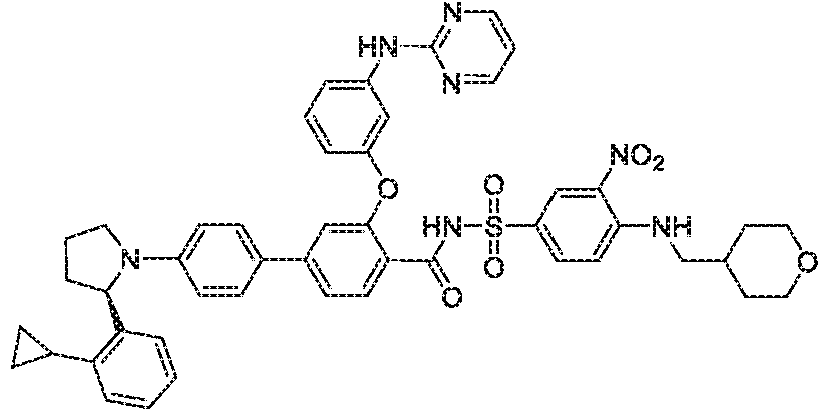
- The desired compound was synthesized following the procedures similar to those in Example A1 by replacing 2-phenylpyrrolidine with (R)-2-(2-cyclopropylphenyl)pyrrolidine and replacing tert-butyl 2-((1H-pyrrolo[2,3-b]pyridin-5-yl)oxy)-4-(4,4,5,5-tetramethyl-1,3,2-dioxaborolan-2-yl)benzoate with methyl 2-(3-(pyrimidin-2-ylamino)phenoxy)-4-(4,4,5,5-tctramethyl-1,3,2-dioxaborolan-2-yl)benzoate. MS (ESI, m/e) [M+1]' 865.8.
-

- The desired compound was synthesized following the procedures similar to those in Example A1 by replacing 2-phenylpyrrolidine with (R)-2-(2-cyclopropylphenyl)pyrrolidine and replacing tert-butyl 2-((1H-pyrrolo[2,3-b]pyridin-5-yl)oxy)-4-(4,4,5,5-tetramethyl-1,3,2-dioxaborolan-2-yl)benzoate with methyl 2-((6-(methylcarbamoyl)pyridin-3-yl)oxy)-4-(4,4,5,5-tetramethyl-1,3,2-dioxaborolan-2-yl)benzoate. MS (ESI, m/e) [M+1]+ 830.8.
-

-

- The mixture of 2-phenylpyrrolidine (450 mg, 3 mmol), 1-(bromomethyl)-4-chlorobenzene (678 mg, 3.3 mmol) and K2CO3(828 mg, 6 mmol) in DMF (10 mL) was heated to 50°C and stirred for 2 hours. Then the reaction mixture was concentrated in vacuo and the residue was diluted with DCM, washed with brine (100 mL), dried over Na2SO4 and evaporated in vacuo, then the crude product was purified by chromatography column on silica (eluent: PE/EA = 2/1 to 1/1) to afford a colorless oil (670 mg). 1H NMR(400 MHz, CDCl3) δ ppm: 7.46 (d, J = 8.0 Hz, 2H), 7.34 (t, J = 8.0 Hz, 2H), 7.25-7.20(m, 5H), 3.80(d, J = 12.0 Hz, 1H), 3.35 (t, J = 8.0 Hz, 1H), 3.08-2.99 (m, 2H), 2.21-2.14 (m, 2H), 1.91-1.70 (m, 3H). MS (ESI, m/e) [M+1]+ 272.1.
-

- The mixture of 1-(4-chlorobenzyl)-2-phenylpyrrolidine (670 mg, 2.5 mmol), tert-butyl 2-((1H-pyrrolo[2,3-b]pyridin-5-yl)oxy)-4-(4,4,5,5-tetramethyl-1,3,2-dioxaborolan-2-yl)benzoate (1.2 g, 2.75 mmol), 1,1'-Bis(diphenylphosphino)ferrocene-palladium(II)dichloride dichloromethane complex (183 mg, 0.25 mmol), K2CO3 (863 mg, 6.25 mmol) in a solution of 1,4-dioxane (20 mL) and water (10 mL) was heated to 90 °C and stirred overnight. After cooled to room temperature, the reaction mixture was concentrated in vacuo and purified by chromatography column on silica (eluent: EA/PE = 1/1) to give the product (211mg) as a red oil. MS (ESI, m/e) [M+1]+ 546.2.
-

- To a solution of tert-butyl 3-((1H-pyrrolo[2,3-b]pyridin-5-yl)oxy)-4'-((2-phenylpyrrolidin-1-yl)methyl)-[1,1'-biphenyl]-4-carboxylate (200 mg, 0.37 mmol) in DCM (2 mL) was added trifluoroacetic acid (2 mL) and stirred at room temperature overnight. The mixture was concentrated in vacuo and purified by chromatography column on silica (eluent: DCM/MeOH = 10/1) to give the product (170 mg) as a grey solid. MS (ESI, m/e) [M+1]+ 490.1.
-
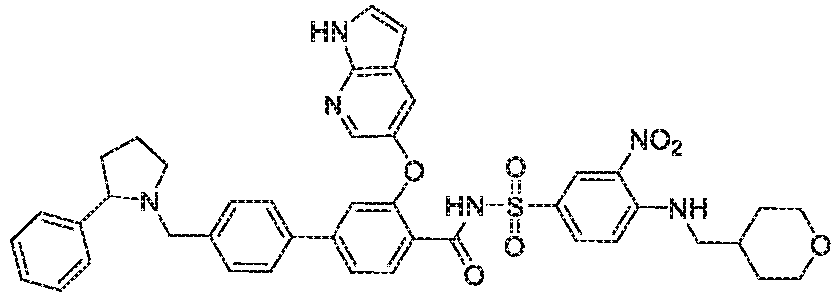
- The mixture of3-((1H-pyrrolo[2,3-b]pyridin-5-yl)oxy)-4'-((2-phenylpyrrolidin-1-yl)methyl)-[1,1'-biphenyl]-4-carboxylic acid (170 mg, 0.35 mmol), triethylamine (106 mg, 1.05 mmol), 2-(7-azabenzotriazol-l-yl)-N,N,N',N'-tetramethyluronium hexafluorophosphate (201 mg, 0.53 mmol) in DCM (10 mL) was stirred for 2 hours at room temperature. To the resulted reaction mixture were added 3-nitro-4-(((tetrahydro-2H-pyran-4-yl)methyl)amino)bcnzenesulfonamide (167 mg, 0.53 mmol) and DMAP (5 mg, 0.04 mmol) and then stirred overnight. The reaction mixture was extracted with DCM (30 mL) and water (30 mL). The organic layer was concentrated in vacuo and purified by chromatography column on silica (eluent: DCM/MeOH = 20/1 to 10/1) to afford a crude product, which was then purified with Pre-HPLC to give the product (14.28 mg). 1H NMR(400 MHz, DMSO-d6 ) δ ppm: 12.41 (br, 1H), 11.67 (br, 1H), 8.51 (br, 2H), 8.04 (m, 1H), 7.79 (d, J = 8.0 Hz, 1H), 7.62 (d,J = 8.0 Hz, 1H), 7.42-7.27 (m, 12H), 6.99 (m, 2H), 6.37(m, 1H), 3.85 (d, J = 8.0 Hz, 2H), 3.67 (m, 1H), 3.28-3.23 (m, 6H), 3.10-2.96 (m, 2H), 2.15 (m, 2H), 2.01 (m, 1H), 1.87 (m, 2H),1.61 (d, J = 8.0Hz, 2H), 1.45 (m, 2H). MS (ESI, m/e) [M+1]+ 787.2.
-

- The desired compound was synthesized starting from 2-(2-chlorophenyl)pyrrolidine and 1-(bromomethyl)-4-chlorobenzene following the procedures similar to those in Example B1. 1H NMR(400 MHz, DMSO-d6 ) δ ppm: 12.30 (br, 1H), 11.73 (br, 1H), 8.60-8.58 (m, 2H), 8.09 (d, J = 4.0 Hz, 1H), 7.86 (d, J = 8.0 Hz, 1H), 7.77 (d, J = 12.0 Hz, 1H), 7.64-7.59 (m, 2H), 7.53-7.43 (m, 4H), 7.39-7.31 (m, 4H), 7.23 (t, J = 8.0 Hz, 1H), 7.14 (d, J = 12.0 Hz, 1H), 6.99 (s, 1H), 6.41 (m, 1H), 3.86 (m, 3H), 3.69 (m, 1H), 3.28-3.23 (m, 4H), 3.01 (m, 1H), 2.32 (m, 2H), 1.87-1.76 (m, 3H), 1.61-1.58 (m, 2H), 1.46 (m, 1H), 1.30-1.21 (m, 3H). MS (ESI, m/e) [M+1]+ 821.1.
-

- The desired compound was synthesized starting from 2-(2-cyclopropylphenyl)pyrrolidine and 1-(bromomethyl)-4-chlorobenzene following the procedures similar to those in Example B1. 1H NMR (400 MHz, DMSO-d6 ) δ ppm: 12.36 (s, 1H), 11.70 (s, 1H), 8.55 (s, 2H), 8.06 (s, 1H), 7.81 (d, J = 8.4 Hz, 1H), 7.69-7.56 (m, 3H), 7.56-7.38 (m, 4H), 7.32 (d, J = 7.6 Hz, 2H), 7.14 (m, 3H), 7.03-6.90 (m, 2H), 6.39 (s, 1H), 3.90-3.87 (m, 3H), 3.29-3.21 (m, 5H), 3.05-3.01 (m, 1H), 2.15-2.01 (m, 3H), 1.87-1.77 (m, 4H), 1.60 (d, J = 12.0 Hz, 3H), 1.33-1.17 (m, 3H), 0.89 (t, J = 12.0 Hz, 3H). MS (ESI, m/e) M+1]+ 827.2
-

-

- LDA (15ml, 2M in hexane) was added dropwise to a solution of 4-oxo-piperidine-1-carboxylic acid tert-butyl ester (5 g, 25 mmol) in THF (40 mL). The mixture was stirred for 1 hour at -78°C, and then 1,1,1-trifluoro-N-phenyl-N-((trifluoromethyl)sulfonyl)methanesulfonamide (10.1 g, 27.5 mmol) was added. The mixture was allowed to room temperature and stir overnight. The reaction mixture was extracted with ethyl acetate and the extracts were washed with water. The organic extracts were dried over Na2SO4, filtered, evaporated, and purified by chromatography on an alumina column to give 4-trifluoromethanesulfonyloxy-3,6-dihydro-2H-pyridine-1-carboxylic acid tert-butyl ester (5 g).
-

- Under nitrogen atmosphere, a mixture of tert-butyl 4-(((trifluoromethyl)sulfonyl)oxy)-3,6-dihydropyridine-1(2H)-carboxylate (331 mg, 1 mmol), tert-butyl 2-((1H-pyrrolo[2,3-b]pyridin-5-yl)oxy)-4-(4,4,5,5-tetramethyl-1,3,2-dioxaborolan-2-yl)benzoate (523 mg, 1.2 mmol), Pd(dppi)Cl2 (73 mg, 0.1 mmol), and K2CO3 (276 mg, 0.2 mmol) in1,4-dioxane/H2O (25 ml/5 ml) was heated to 90°C with stirring overnight. Then the reaction was cooled to room temperature, the mixture was washed with water, brine and dried over anhydrous Na2SO4. The organic layers were concentrated and purified by column chromatography with 10 %~50 % EA/PE as eluent to give tert-butyl 4-(3-((1H-pyrrolo[2,3-b]pyridin-5-yl)oxy)-4-(tert-butoxycarbonyl)phenyl)-3,6-dihydropyridine-1(2H)-carboxylate. MS (ESI, m/e) [M+1]+492.2.
-

- To a solution of tert-butyl 4-(3-((1H-pyrrolo[2,3-b]pyridin-5-yl)oxy)-4-(tert-butoxycarbonyl)phenyl)-3,6-dihydropyridinc-1(2H)-carboxylatc (246 mg, 0.5 mmol) in dioxane (15 mL) was added HCl-dioxane (10 mL). The reaction was stirred for 0.5 hour at r.t. the mixture was basified by sat. NaHCO3 solution in H2O (10 mL), then extracted with EA. The organic layer was then concentrated to give tert-butyl 2-((1H-pyrrolo[2,3-b]pyridin-5-yl)oxy)-4-(1,2,3,6-tetrahydropyridin-4-yl)benzoate (190 mg) as a colorless oil. MS (ESI, m/e) [M+1]+ 392.1.
-

- A mixture of 1-phenylpyrrolidine-2-carbaldehyde and tert-butyl 2-((1H-pyrrolo[2,3-b]pyridin-5-yl)oxy)-4-(1,2,3,6-tetrahydropyridin-4-yl)benzoate in DCM (25 mL) was stirred for 0.5 hour, then NaBH(OAc)3 was added. The reaction was continually stirred for 3 hours, then the solvent was removed and the residue was purified by chromatography to give tert-butyl 2-((1H-pyrrolo[2,3-b]pyridin-5-yl)oxy)-4-(1-(1-phenylpyrrolidin-2-yl)methyl)-1,2,3,6-tetrahydropyridin-4-yl)benzoate(80 mg) as a colorless oil MS (ESI, m/e) [M+1]+ 551.2.
- Then following the similar procedures in Example B1, proceeded with hydrolysis in step 5 and condensation of the resulted 2-((1H-pyrrola[2,3-b]pyridin-5-yl)oxy)-4-(1-((1-phenylpyrrolidin-2-yl)methyl)-1,2,3,6-tetrahydropyridin-4-yl)benzoic acid and 3-nitro-4-(((tetrahydro-2H-pyran-4-yl)methyl)amino)benzenesulfonamide in step 6, to afford the product. 1H NMR (400 MHz, DMSO-d6 ) δ ppm: 12.22 (s, 1H), 11.66 (s, 1H), 8.49 (s, 2H), 8.00 (s, 1H), 7.75 (s, 1H), 7.62-7.37 (m, 3H), 7.23 (d, J = 8.0 Hz, 1H), 7.14 (t, J = 7.5 Hz, 2H), 7.01 (s, 1H), 6.83 (s, 1H), 6.57 (d, J = 6.8 Hz, 3H), 6.37 (s, 1H), 6.12 (s, 1H), 3.84 (d, J= 8.7 Hz, 3H), 3.30-3.23 (m, 7H), 3.08-3.01 (m, 2H), 2.44-2.37 (m, 1H), 2.08-1.76 (m, 6H), 1.60 (d,J = 12.2 Hz, 2H), 1.28-1.21 (m, 5H). MS (ESI, m/e) [M+1]+ 792.2.
-
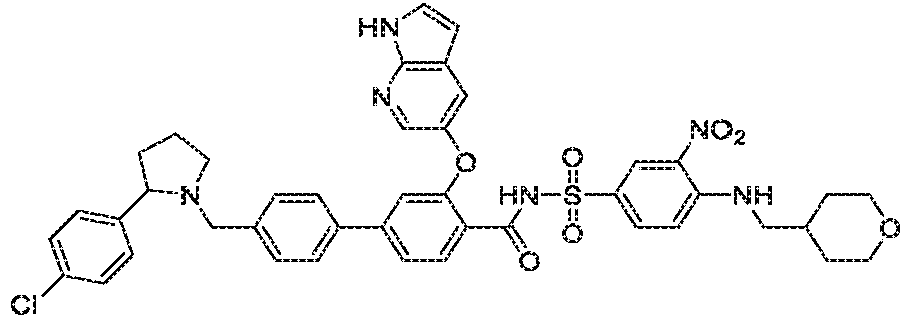
- The desired compound was synthesized starting from 2-(4-chlorophenyl)pyrrolidinc and 1-(bromomethyl)-4-chlorobenzene following the procedures similar to those in Example B1. 1H NMR (400 MHz, DMSO-d6 ) δ ppm: 12.34 (s, 1H), 11.70 (s, 1H), 8.54 (s, 2H), 8.06 (s, 1H), 7.81 (d, J = 7.3 Hz, 1H), 7.59-7.63 (m, 2H), 7.37-7.50 (m, 8H), 7.27-7.34 (m, 2H), 7.07 (s, 1H), 6.99 (s, 1H), 6.39 (s, 1H), 3.85 (d, J = 7.9 Hz, 2H), 3.64 (s, 1H), 3.29-3.23 (m, 4H), 2.97 (s, 2H), 2.18 (s, 2H), 1.95-2.04 (m, 1H), 1.77-1.87 (m, 4H), 1.60 (d, J = 11.7 Hz, 2H), 1.26 (s, 2H). MS (ESI, m/e) [M+1]+ 821.1.
-

-

- To a mixture of DMF (70 mL) and DCM (600 mL) was added POCl3 (80 mL) dropwise at -10 °C. Then the mixture was stirred at r.t. for 0.5 hour. Then 3,3-dimethylcyclohexan-1-one (110 mL) was added. The mixture was stirred at reflux for overnight. The mixture was basified with sat. NaHCO3 solution in water and separated. The organic layer was dried over Na2SO4, concentrated to give the product 130 g as a yellow oil.
-

- To a solution of 2-chlora-4,4-dimethylcyclohex-1-ene-1-carbaldehyde (17.1 g, 100 mmol) and (4-chlorophenyl)boronic acid (17.2 g, 110 mmol) in toluene (150 mL) and H2O (15 mL) were added Pd (PPh3)4 (3.45 g, 3 mmol), K2CO3 (28 g, 200 mmol). The mixture was stirred at 100°C for 2 hours under nitrogen protection. The mixture was filtered. Then the filtrate was washed with brine, dried over Na2SO4, concentrated and purified by chromatography column on silica (eluent: EA/PE = 1/20) to give the product (18g) as a yellow oil.
-

- To a solution of 4'-chloro-5,5-dimethyl-3,4,5,6-tetrahydro-[1,1'-biphenyl]-2-carbaldehyde (3 g, 12.06 mmol) in 1,4-dioxane (100 mL) was added 4-methylbenzenesulfonohydrazide (2.695 g, 14.47 mmol). The mixture was stirred at 90°C for 2 hours. The mixture was concentrated. The residue was dissolved with DCM (200 mL), then washed with brine (200 mL x 2), dried over Na2SO4, concentrated and purified by chromatography column on silica (eluent: EA/PE = 1/10) to give the product (4.6 g, 91.5%) as a yellow solid. MS (ESI, m/e) [M+1]+ 417.1.
-

- To a solution of N'-((4'-chloro-5,5-dimethyl-3,4,5,6-tetrahydro-[1,1'-biphenyl]-2-yl)methylene)-4-methylbenzenesulfonohydrazide (2 g, 4.8 mmol) in 1,4-dioxane (50 mL) were added (4-bromophenyl)boronic acid (1.445 g, 7.2 mmol) and K2CO3 (1.325 g, 9.6 mmol). The mixture was stirred at reflux for overnight under nitrogen protection. The mixture was diluted with DCM (200 ml), washed with brine, dried over Na2SO4, concentrated and purified by chromatography column on silica (eluent: EA/PE = 1/100) to give the product (1.65 g, 88.2%) as a clear oil. 1H NMR (400 MHz, DMSO-d6 ) δ ppm: 7.45 (d, J = 8.3 Hz, 2H), 7.39 (d, J = 8.2 Hz, 2H), 7.18 (d, J = 8.3 Hz, 2H), 7.02 (d, J= 8.2 Hz, 2H), 3.18 (s, 2H), 2.04 (s, 2H), 1.90 (t, J = 5.8 Hz, 2H), 1.36 (t, J= 5.8 Hz, 2H), 0.93 (s, 6H).
-

- To a solution of 6-(4-bromobenzyl)-4'-chloro-3,3-dimethyl-2,3,4,5-tetrahydro-1,1'-biphenyl (200 mg, 0.513 mmol) and tert-butyl 2-((1H-pyrrolo[2,3-b]pyridin-5-yl)oxy)-4-(3,3,4,4-tetramethylborolan-1-yl)benzoate (291 mg, 0.67 mmol) in toluene (30 mL) and H2O (2 mL) were added Pd(PPh3)4( 118.5 mg, 0.103 mmol) and K2CO3 (106.2 mg, 0.77 mmol). The mixture was stirred at reflux for overnight under nitrogen protection. The mixture was washed with brine, dried over Na2SO4, concentrated and purified by chromatography column on silica (eluent: EA/PE = 1/2) to give the product (60 mg) as a yellow solid. MS (ESI, m/e) [M+1]+ 619.2.
-

- To a solution of tert-butyl 3-((1H-pyrrolo[2,3-b]pyridin-5-yl)oxy)-4'-((4'-chloro-5,5-dimethyl-3,4,5,6-tetrahydro-[1,1'-biphenyl]-2-yl)methyl)-[1,1 '-biphenyl]-4-carboxylate (60 mg, 0.097 mmol) in DCM (30 mL) was added TFA (5 mL). The mixture was stirred at room temperature for overnight. The mixture was concentrated and purified by chromatography column on silica (eluent: MeOH/DCM = 1/30) to give the product (31 mg) as a brown solid. MS (ESI, m/e) [M+1]+ 563.1.
-

- To a solution of 3-((1H-pyrrolo[2,3-b]pyridin-5-yl)oxy)-4'-((4'-chloro-5,5-dimethyl-3,4,5,6-tetrahydro-[1,1'-biphenyl]-2-yl)methyl)-[1,1'-biphenyl]-4-carboxylic acid (30 mg, 0.0533 mmol) in DCM (50 mL) was added HATU (30.4 mg, 0.08 mmol) and triethylamine (27 mg, 0.267 mmol). The mixture was stirred at room temperature for 1 hour. Then to the mixture were added 3-nitro-4-(((tetrahydro-2H-pyran-4-yl)methyl)amino)benzenesulfonamide (33.6 mg, 0.107 mmol). The mixture was stirred at room temperature for overnight. The mixture was washed with brine, dried over Na2SO4, concentrated and purified by chromatography column on silica (eluent: EA/PE = 1/1 then MeOH/DCM = 1/10) to give the crude product. The crude product was further purified by prep-TLC (MeOH/DCM = 1/20) to give the product (1.79 mg, 3.9%). 1H NMR (400 MHz, DMSO-d6 ) δ ppm: 12.35 (s, 1H), 11.73 (s, 1H), 8.68-8.50 (m, 2H), 8.10-8.02 (m, 1H), 7.84 (d, J = 8.0 Hz, 1H), 7.67-7.56 (m, 2H), 7.56-7.48 (m, 1H), 7.43 (d, J = 8.0 Hz, 3H), 7.37 (d, J = 8.2 Hz, 2H), 7.17 (d, J = 8.2 Hz, 2H), 7.10 (d, J = 8.0 Hz, 2H), 6.99 (s, 1H), 6.40 (s, 1H), 5.41-5.21 (m, 1 H), 3.85 (d, J = 8.5 Hz, 2H), 3.28-3.15 (m, 6H), 2.07-1.94 (m, 4H), 1.94-1.79 (m, 3H), 1.67-1.54 (m, 2H), 1.38-1.31 (m, 2H), 0.91 (s, 6H). MS (ESI, m/e) [M+1]+ 860.1.
-

- The desired compound was synthesized starting from phenylproline and tert-butyl 2-((1H-pyrrolo[2,3-b]pyridin-5-yl)oxy)-4-(1,2,3,6-letrahydropyridin-4-yl)benzoate following the procedures similar to those in Example B4. 1H NMR (400 MHz, DMSO-d6 ) δ ppm: 12.32 (s, 1H), 11.72 (s, 1H), 8.69-8.53 (m, 1H), 8.04 (s, 1H), 7.83 (d, J = 8.0 Hz, 1H), 7.64-7.46 (m, 3H), 7.28 (d, J = 8.0 Hz, 1H), 7.13 (d, J = 8.0 Hz, 1H), 7.10-7.05 (m, 2H), 6.87 (d, J = 12.0 Hz, 1H), 6.51 (t, J = 8.0 Hz, 1H), 6.40 (s, 1H), 6.35-6.25 (m, 1H), 6.18 (s, 1H), 4.79-4.59 (m, 1H), 4.47-4.15 (m, 1H), 4.11-3.91 (m, 1H), 3.90-3.74 (m, 3H), 3.72-3.47 (m, 4H), 3.29-3.18 (m, 5H), 2.41-2.15 (m, 3H), 2.04-1.72 (m, 5H), 1.61 (d, J = 8.0 Hz, 2H), 1.35-1.15 (m, 3H). MS (ESI, m/e) [M+1]+ 806.1.
-

- To a solution of methyl 2,4-difluorobenzoate (3.44 g, 20.00 mmol) in DMF (50 mL) was added 1H-pyrrolo[2,3-b]pyridin-5-ol (2.70 g, 20.00 mmol) and K2CO3 (5.6 g, 40.00 mmol), the mixture was stirred at 80°C for 20h. Cooled to room temperature, partitioned between EA (40 ml) and H2O (40 mL), the aqueous layer was extracted with EA (20 mL). The combined organic layers were washed with H2O (30 mL×3), concentrated and purified by CombiFlash (0-60%, EA/PE) to give the crude product, which was crystallized from EA/PE=1/1 (50 mL) to give the isomer. The mother liquid was left standing over night, the precipitate was collected by filtration to give methyl 2-((1H-pyrrolo[2,3-b]pyridin-5-yl)oxy)-4-fluorobenzoate (600 mg) as a white solid. [M+1]+ 286.9.
- To a solution of methyl 2-((1 H-pyrrolo[2,3-b]pyridin-5-yl)oxy)-4-fluorobenzoate (200 mg, 0.70 mmol) in DMF (10 mL) was added 1-(azetidin-3-ylmethyl)-2-(2-cyclopropylphenyl)pyrrolidine (180 mg, 0.70 mmol) and TEA (355 mg, 3.50 mmol), the solution was stirred at 100°C for 6h. Cooled to ambient temperature, partitioned between DCM (30 mL) and H2O (50 mL). The organic layer was separated, washed with H2O (20 mL), dried over Na2SO4, concentrated and purified by CombiFlash (0-10%, MeOH/DCM) to give methyl 2-((1H-pyrrolo[2,3-b]pyridin-5-yl)oxy)-4-(3-((2-(2-cyclopropylphcnyl)pyrrolidin-1-yl)methyl)azetidin-1-yl)benzaate (100mg) as colorless oil. [M+1]+ 522.9.
- To a solution of methyl 2-((1H-pyrrolo[2,3-b]pyridin-5-yl)oxy)-4-(3-((2-(2-cyclopropylphenyl)pyrrolidin-1-yl)methyl)azetidin-1-yl)benzoate (100 mg, 0.19 mmol) in CH3OH (20 mL) was added 6N NaOH (5 mL), the mixture was heated at ambient temperature for 16 h. The mixture was acidified with con. HCl. The mixture was partitioned between DCM (40 mL) and H2O (30 mL). The organic layer was washed with Brine (10 mL), dried over Na2SO4 and concentrated to give the crude 2-((1H-pyrrolo[2,3-b]pyridin-5-yl)oxy)-4-(3-((2-(2-cyclopropylphenyl)pyrrolidin-1-yl)methyl)azetidin-1-yl)benzoic acid as white solid (40 mg). [M+1]+ 508.9.
- To a solution of 2-((1H-pyrrolo[2,3-b]pyridin-5-yl)oxy)-4-(3-((2-(2-cyclopropylphenyl)pyrrolidin-1-yl)methyl)azetidin-1-yl)benzoic acid (40 mg, 0.08 mmol) in DCM (10 mL) was added HATU (36mg, 0.09 mmol) and TEA (86 mg, 0.85 mmol), the solution was stirred for about 0.5h, 3-nitro-4-(((tetrahydro-2H-pyran-4-yl)methyl)amino)bcnzenesulfonamide (27 mg, 0.170 mmol) and DMAP (12 mg, 0.09 mmol) was then added, the solution was stirred at r. t for 16h. The reaction solution was concentrated and purified by column chromatograph on silica gel (100-200 mesh, eluent: MeOH/DCM = 1/10) to give the crude product, which was purified by Pre-TLC (MeOH/DCM = 1/18) to obtain the desired compound. 1H NMR (CDCl3) δ ppm: 10.12 (s, 1H), 9.14 (s, 1H), 8.89 (s, 1H), 8.57-8.46 (m, 1H), 8.24-8.09 (m, 2H), 7.90 (d, J = 8.8Hz, 1H), 7.69 (s, 1H), 7.55-7.37 (m, 2H), 7.16-7.03 (m, 2H), 6.97-6.82 (m, 2H), 6.55 (s, 1H), 6.01 (d, J = 8.4Hz, 1H), 5.37 (s, 1H), 4.10-3.98 (m, 2H), 3.84-3.71 (m, 2H), 3.49-3.14 (m, 7H), 2.80-2.51 (m, 2H), 2.39-2.11 (m, 3H), 2.04-1.67 (m, 7H), 1.50-1.35 (m, 3H), 0.93-0.81 (m, 2H), 0.73-0.46 (m, 2H). MS (ESI, m/e) [M+1]+ 805.8.
-

- The desired compound was synthesized following the procedures similar to those in Example B3. MS (ESI, m/e) [M+1]+ 827.5.
-

- The desired compound was synthesized following the procedures similar to those in Example B3. MS (ESI, m/e) [M+1]+ 841.5.
-

- The desired compound was synthesized following the procedures similar to those in Example B3. 1H NMR (400 MHz, DMSO-d6 ) δ ppm: 12.36 (s, 1H), 11.72 (s, 1H), 8.70 - 8.50 (m, 2H), 8.06 (s, 1H), 7.83 (d, J = 9.0 Hz, 1H), 7.80 - 7.70 (m, 1H), 7.65 - 7.56 (m, 2H), 7.52 (s, 1H), 7.50 - 7.40 (m, 3H), 7.35 - 7.25 (m, 2H), 7.20 - 7.05 (m, 4H), 6.97 (s, 1H), 6.39 (s, 1H), 5.15 - 4.95 (m, 1H), 3.90 - 3.70 (m, 2H), 3.29 - 3.21 (m, 3H), 3.10 - 2.80 (m, 4H), 2.29 - 1.79 (m, 5H), 1.60 (d, J = 9.0Hz, 2H), 1.30 - 1.20 (m, 3H), 1.00 - 0.78 (m, 5H), 0.65 - 0.55 (m, 2H).MS (ESI, m/e) [M+1]+ 841.5.
-
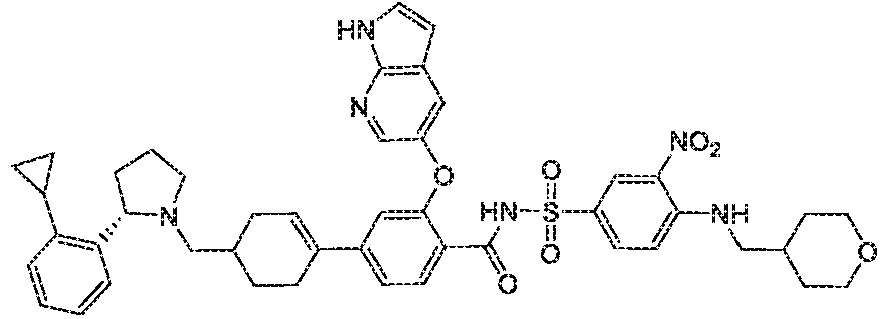
- To a solution of ethyl 1,4-dioxaspiro[4.5]decane-8-carboxylate (3.21 g, 15.00 mmol) in toluene (40 mL) was added DIBAL-H( 10 mL, 15.00 mmol) dropwise at about -65°C, the mixture was stirred at -65°C under N2 for 0.5h. Quenched by CH3OH (20 mL), warmed to ambient temperature, Sat. NH4Cl (20 mL) was added. The organic layer was separated, dried over Na2SO4 and concentrated to give the crude product as yellow oil. (2.5 g).
- To a solution of 1,4-dioxaspiro[4.5]decane-8-carbaldehyde (2.5 g, 15.00 mmol) in DCM (50 mL) was added (S)-2-(2-cyclopropylphenyl)pyrrolidine (2.8 g, 15.00 mmol) and NaBH(OAc)3 (6.4 g, 30.00 mmol), the mixture was stirred at ambient temperature for 2h. The reaction solution was washed with Sat. NaCl (20 mL), concentrated and purified by column chromatograph on silica gel (100-200 mesh, eluent: EA/DCM = 1/2) to give the product as brown oil. (2.0 g). [M+1]+ 341.8.
- To a solution of (S)-1-((1,4-diaxaspiro[4.5]decan-8-yl)melhyl)-2-(2-cyclopropylphenyl)pyrrolidine (2.0 g, 5.85 mmol) in DCM (10 mL) and CH3OH (5 mL) was added con. HCl (5 mL), the mixture was stirred at ambient temperature for 2d. The reaction mixture was partitioned between DCM (40 mL) and 2N NaOH (20 mL). The organic layer was separated, concentrated and purified by column chromatograph on silica gel (100-200 mesh, eluent: EA/DCM = 1/2) to give the product as yellow oil. (1.25 g). [M+1]+ 297.8.
- To a solution of (S)-4-((2-(2-cyclopropylphenyl)pyrrolidin-1-yl)methyl)cyclohexan-1-one (1.2 g, 4.04 mmol) and 1,1,1-trifluoro-N-phenyl-N-((trifluoromethyl)sulfonyl)methanesulfonamide (1.73 g, 4.85 mmol) in THF (40 mL) was added NaHMDS (2.2 ml, 4.44 mmol) dropwise at about -65°C, the solution was stirred at -65°C under N2 for 1h, warmed to r. t for about 16h. The reaction solution was partitioned between EA (20 mL) and Sat. NaCl (20 mL). The organic layer was separated, concentrated and purified by column chromatograph on silica gel (100-200 mesh, eluent: EA: PE= 1: 10) to give the product as yellow oil. (250 mg). [M+1]+ 429.8. Step 5: tert-butyl 3-((1H-pyrrolo[2,3-b]pyridin-5-yl)oxy)-4'-(((S)-2-(2-cyclopropylphenyl)pyrrolidin-1 -yl)methyl)-2',3',4',5'-tetrahydro-[1,1'-biphenyl]-4-carboxylate To a solution of 4-(((S)-2-(2-cyclopropylphenyl)pyrrolidin-1-yl)methyl)cyclohex-1-en-1-yl trifluoromethanesulfonate (230 mg, 0.537 mmol) in 1,4-dioxane (10 mL) was added tert-butyl 2-((1H-pyrrolo[2,3-b]pyridin-5-yl)oxy)-4-(4,4,5,5 -tetramethyl-1,3,2-dioxaborolan-2-yl)benzoate (251 mg, 0.645 mmol), Cs2CO3 (700 mg, 2.148 mmol), H2O (2 mL) and Pd(dppf)Cl2 (40 mg, 0.054 mmol), the mixture was stirred at 100°C under N2 for 6h. Cooled to r. t, partitioned between EA (20 mL) and Sat. NaCl (10 mL). The organic layer was separated, concentrated and purified by pre-TLC(MeOH/DCM = 1/15) to give the product as brown oil. (200 mg). [M+1]+ 589.9.
- To a solution of 5tert-butyl 3-((1H-pyrrolo[2,3-b]pyridin-5-yl)oxy)-4'-(((S)-2-(2-cyclopropylphenyl)pyrrolidin-1-yl)methyl)-2',3',4',5'-tetrahydro-[1,1 '-biphenyl]-4-carboxylate (200 mg, 0.340 mmol) in DCM (10 mL) was added TFA (5 ml), the solution was stirred at r. t for 2h. the reaction solution was concentrated. The residue was partitioned between DCM (50 mL) and H2O (20 mL), the organic layer was washed with Sat. NaCl (20 mL), dried over Na2SO4 and concentrated to give the crude product as yellow solid. (150 mg).
- To a solution of 3-((1H-pyrrolo[2,3-b]pyridin-5-yl)oxy)-4'-(((S)-2-(2-cyclopropylphenyl)pyrrolidin-1-yl)methyl)-2',3',4',5'-tetrahydro-[1,1 '-biphenyl]-4-carboxylic acid (150 mg, 0.281 mmol) in DCM (20 mL) was added HATU (128 mg, 0.338 mmol), DMAP (34 mg, 0.281 mmol), TEA (141 mg, 1.405 mmol) and 3-nitro-4-(((tetrahydro-2H-pyran-4-yl)methyl)amino)benzenesulfonamide (106 mg, 0.338 mmol), the solution was stirred at r. t for 16h. The reaction solution was concentrated and purified by column chromatograph on silica gel (100-200 mesh, eluent: MeOH/DCM = 1/20) to give the crude product, which was purified by pre-TLC (MeOH/DCM = 1/15) to give the product as yellow solid. (60 mg, 25.7 %). 1H NMR (DMSO-d6) δ ppm: 12.22 (s, 1H), 11.70 (s, 1H), 8.90-8.42 (m, 2H), 8.01 (s, 1H), 7.85-7.40 (m, 5H), 7.32-6.80 (m, 5H), 6.74-6.61 (m, 1H), 6.39 (s, 1H), 6.10-5.89 (m, 1H), 5.16-4.92 (m, 1H), 3.94-3.66 (m, 3H), 3.53-3.44 (m, 1H), 3.30-3.17 (m, 5H), 2.27-1.96 (m, 7H), 1.91-1.54 (m, 7H), 1.44-1.13 (m, 4H), 1.06-1.01 (m, 1H), 0.94-0.81 (m, 2H), 0.71-0.42 (m, 2H). [M+1]' 830.8.
-

- The desired compound was synthesized following the procedures similar to those in Example B12. 1H NMR (400 MHz, DMSO-d6 ) δ ppm: 11.67 (s, 1H), 11.36 (s, 1H), 8.69-8.44 (m, 2H), 8.10-7.96 (m, 1H), 7.77 (d, J =8.8Hz, 1H), 7.58-7.36 (m, 4H), 7.17-6.84 (m, 4H), 6.70-6.60 (m, 1H), 6.37 (s, 1H), 6.14 (s, 1H), 3.86-3.69 (m, 3H), 3.60-3.48(m, 2H), 3.30-3.19 (m, 5H), 2.71-2.59 (m, 2H), 2.24-2.09 (m, 2H), 2.02-1.74 (m, 6H), 1.62-1.56 (m, 2H), 1.50-1.38 (m, 2H), 1.28-1.19 (m, 4H), 0.92-0.80 (m, 4H), 0.68-0.58 (m, 1H), 0.54-0.43 (m, 1H). MS (ESI, m/e) [M+1]+ 833.8.
-

- The desired compound was synthesized following the procedures similar to those in Example B12. 1H NMR (400 MHz, DMSO-d6 ) δ ppm: 11.70 (s, 1H), 11.39 (s, 1H), 8.74-8.42 (m, 2H), 8.05 (s, 1H), 7.80 (d, J =8.8Hz, 1H), 7.65-7.35 (m, 4H), 7.25-6.84 (m, 4H), 6.73-6.61 (m, 1H), 6.39 (s, 1H), 6.15 (s, 1H), 3.90-3.68 (m, 3H), 3.65-3.51 (m, 2H), 3.31-3.20 (m, 5H), 2.76-2.59 (m, 2H), 2.28-1.74 (m, 9H), 1.69-1.56 (m, 3H), 1.53-1.34 (m, 2H), 1.32-1.19 (m, 2H), 0.97-0.79 (m, 4H), 0.68-0.46 (m, 2H). MS (ESI, m/c) [M+1]+ 833.9.
-
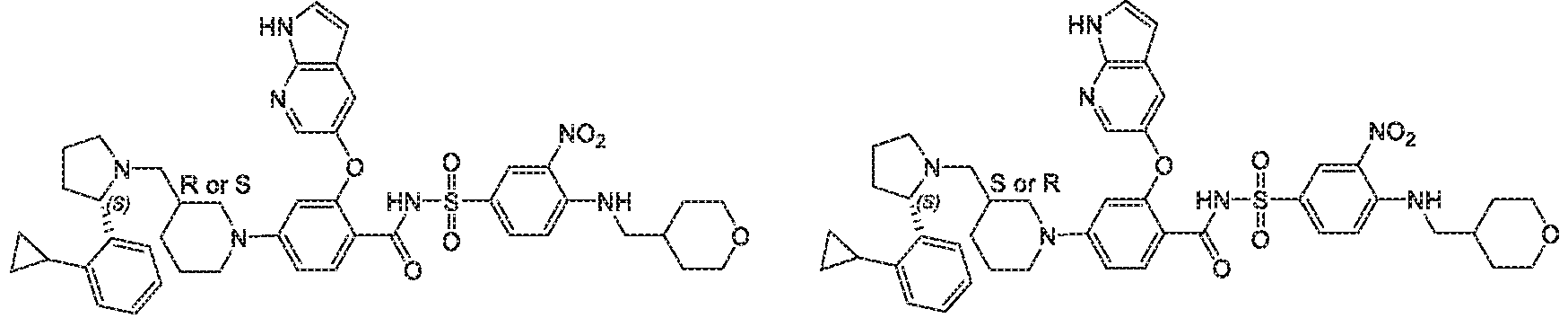
- The desired compound was synthesized following the procedures similar to those in Example B12. The faster in column chromatograph on silica gel is Example B19a: MS (ESI, m/e) [M+1]+ 834.8; The slower is Example B19b: MS (ESI, m/e) [M+1]+ 834.8.
-

- The desired compound was synthesized following the procedures similar to those in Example B12. The faster in column chromatograph on silica gel is Example B20a: MS (ESI, m/e) [M+1]+ 834.8; The slower is Example B20b: MS (ESI, m/e) [M+1]+ 834.8.
-

- The desired compound was synthesized starting from (S)-2-(3-cyclopropylphenyl)pyrrolidine and 1-(bromomethyl)-4-chlorobenzene following the procedures similar to those in Example B1. 1H NMR (DMSO-d 6) δ ppm: 12.37 (br, 1H), 11.71 (s, 1H), 8.55 (s, 2H), 8.06 (s, 1H), 7.83 (d, J = 8.8 Hz, 1H), 7.65 - 7.56 (m, 2H), 7.52 - 7.39 (m, 4H), 7.31 - 7.26 (m, 2H), 7.20 - 7.15 (m, 2H), 7.12 - 7.03 (m, 2H), 6.98 (s, 1H), 6.95 - 6.89 (m, 1H), 6.39 (s, 1H), 3.85 (d, J = 8.4 Hz, 2H), 3.79 - 3.55 (m, 1H), 3.31 - 2.90 (m, 8H), 2.29 - 1.70 (m, 6H), 1.62 (d, J = 12.4 Hz, 2H), 1.31 - 1.26 (m, 2H), 0.93 - 0.81 (m, 2H), 0.66 - 0.55 (m, 2H). MS (ESI, m/e) [M+1]+ 826.9.
-
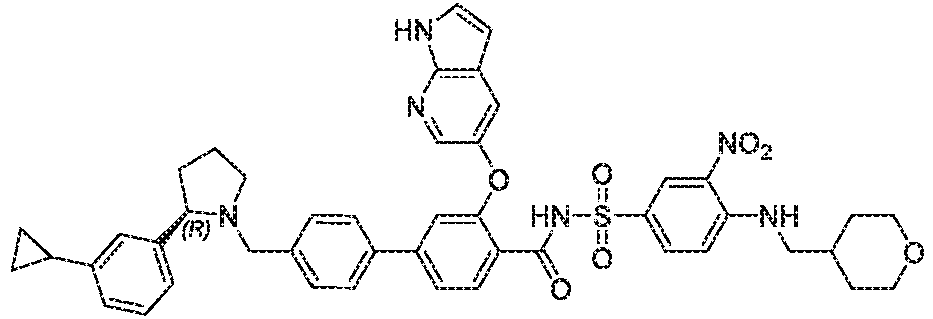
- The desired compound was synthesized starting from (R)-2-(3-cyclopropylphenyl)pyrrolidine and 1-bromo-4-(bromomethyl)benzene following the procedures similar to those in Example B1. 1H NMR (400 MHz, DMSO-d6 ) δ ppm: 12.36 (br, 1H), 11.70 (s, 1H), 8.54 (s, 2H), 8.06 (s, 1H), 7.82 (d, J = 8.8 Hz, 1H), 7.65 - 7.56 (m, 2H), 7.52 - 7.39 (m, 4H), 7.31 -7.26 (m, 2H), 7.20 - 7.15 (m, 2H), 7.12 - 7.03 (m, 2H), 6.98 (s, 1H), 6.95 - 6.89 (m, 1H), 6.39 (s, 1H), 3.85 (d, J = 8.4 Hz, 2H), 3.79 - 3.55 (m, 1H), 3.31 - 2.90 (m, 8H), 2.29 - 1.70 (m, 6H), 1.62 (d, J= 12.4 Hz, 2H), 1.31 - 1.26 (m, 2H), 0.93 - 0.81 (m, 2H), 0.66 - 0.55 (m, 2H). MS (ESI, m/e) [M+1]+ 826.9.
-

- The desired compound was synthesized starting from 1-(2-(4-bromophenyl)propan-2-yl)-2-(2-cyclopropylphenyl)pyrrolidine and tert-butyl 2-((1H-pyrrolo[2,3-b]pyridin-5-yl)oxy)-4-(4,4,5,5-tetramethyl-1,3,2-dioxaborolan-2-yl)benzoate following the procedures similar to those in Example A1. 1H NMR (400 MHz, DMSO-d6 ) δ ppm: 12.36 (s, 1H), 11.78 (s, 1H), 8.92 (s, 1H), 8.62 (d,J= 8.4 Hz, 2H), 8.12 (d, J = 14.0 Hz, 1H), 7.88 (s, 1H), 7.78 (d, J = 15.6 Hz, 1H), 7.72 - 7.49 (m, 3H), 7.46 - 7.30 (m, 3H), 7.18 - 7.07 (m, 3H), 7.05 - 6.97 (m, 1H), 6.89 - 6.78 (m, 1H), 6.62 (s, 0.5H), 6.45 (d, J = 14.8 Hz, 1H), 6.18 (s, 0.5H), 4.89 - 4.71 (m, 1H), 3.93 - 3.65 (m, 3H), 3.32 - 3.21 (m, 4H), 2.85 - 2.70 (m, 1H), 2.45 - 2.30 (m, 1H), 2.23 - 2.07 (m, 1H), 1.93 - 1.84 (m, 1H), 1.81 - 1.69 (m, 3H), 1.60 (d, J = 12.0 Hz, 3H), 1.41 - 1.39 (m, 1H), 1.25 (d, J = 12.0 Hz, 3H), 1.05 - 0.98 (m, 2H), 0.92 - 0.73 (m, 2H), 0.71 - 0.60 (m, 1H), 0.42 - 0.33 (m, 1H), 0.26 - 0.08 (m, 1H). MS (ESI, m/e) [M+1]+ 854.8
-

- The desired compound was synthesized following the procedures similar to those in Example B1 by replacing 1-(bromomethyl)-4-chlorobenzene with 1-((5-bromofuran-2-yl)methyl)-2-(2-cyclopropylphenyl)pyrrolidine and replacing 2-phenylpyrrolidinewith 2-(2-cyclopropylphenyl)pyrrolidine. MS (ESI, m/c) [M+1]+ 816.8
-

- A mixture of 2-(2-cyclopropylphenyl)pyrrolidine (300 mg, 1.60 mmol) tert-butyl 3-oxoazetidine-1-carboxylate (820 mg, 4.8 mmol) and NaBH(OAc)3 (509 mg, 2.4 mmol) in DCM (15 mL) and HOAc (1 drop) was stirred at rt overnight. I was diluted with DCM (30 mL) and washed with brine (30 mL). The organic layer was concentrated. The residue was purified by pre-TLC (eluent: MeOH/DCM = 1/30) to give the crude product (234 mg), which was directly used in next step.
- A solution of tert-butyl 3-(2-(2-cyclopropylphenyl)pyrrolidin-1-yl)azetidine-1-carboxylate (284 mg, 0.83 mmol) in DCM (5 mL) and TFA (2 mL) was stirred at room temperature overnight. The solvents were removed. The residue was dissolved with DCM (50 mL) and washed with aq. NaHCO3 (30 mL × 2), dried over anhydrous Na2SO4, filtered and concentrated to give the desired product as a yellow oil (125 mg, 61%). MS (ESI, m/e) [M+1]+ 243.0.
- A mixture of 1-(azetidin-3-yl)-2-(2-cyclopropylphenyl)pyrrolidine (125 mg, 0.51 mmol), 1-bromo-4-iodobenzene (146 mg, 0.51 mmol), Pd2(dba)3 (47 mg, 0.051 mmol), BINAP (63 mg) and t-BuOK (124 mg, 1.02 mmol) in toluene (10 mL) was stirred at 80°C overnight. It was cooled to room temperature and toluene was removed. The residue was purified by Pre-TLC (eluent: EA/PE = 1/5) to give the desired product as a yellow oil (104 mg). MS (ESI, m/e) [M+1]+ 396.8
- Then 3-((1H-pyrrolo[2,3-b]pyridin-5-yl)oxy)-4'-(3-(2-(2-cyclopropylphenyl)pyrrolidin-1-yl)azetidin-1-yl)-N-((3-nitro-4-(((tetrahydro-2H-pyran-4-yl)methyl)amino)phenyl)sulfonyl)-[1,1'-biphenyl]-4-carboxamide was synthesized following the procedures similar to those in Example A1, 1H NMR (400 MHz, DMSO-d6 ) δ ppm: 12.21 (s, 1H), 11.71 (s, 1H), 8.61-8.56 (m, 2H), 8.05 (s, 1H), 7.82 (d, J = 8.0 Hz, 1H), 7.63-7.45 (m, 4H), 7.40-7.26 (m, 3H), 7.12 (s, 3H), 6.95-6.91 (m, 2H), 6.39 (s, 1H), 6.32 (d, J = 8.2 Hz, 2H), 4.06 (s, 1H), 3.86-3.83 (m, 2H), 3.71 (s, 1H), 3.62 (s, 2H), 3.30-3.23 (m, 6H), 2.99 (s, 2H), 2.27 (s, 1H), 2.02-1.97 (m, 3H), 1.87 (s, 2H), 1.60 (d, J = 11.9 Hz, 2H), 1.45 (s, 1H), 1.26-1.22 (m, 2H), 0.87-0.84 (m, 3H), 0.67 (s, 1H). MS (ESI, m/e) [M+1]+ 867.8.
-

- To a solution of 2-(2-cyclopropylphenyl)pyrrolidine (375 mg, 2.00 mmol) in DCM (20 mL) was added tert-butyl 3-oxoazetidine-1-carboxylate (342 mg, 2.00 mmol) and NaBH(OAc)3 (848 mg, 4.00 mmol), the mixture was stirred at r.t for 16 hours. The reaction solution was washed with H2O (20 mL), concentrated and purified by column chromatograph on silica gel (eluent: MeOH/DCM= 0/20 to 1/20) to give the product as a light yellow oil. (540 mg, 78.9 %). MS (ESI, m/e) [M+1]+ 343.0.
- To a solution of tert-butyl 3-(2-(2-cyclopropylphenyl)pyrrolidin-1-yl)azetidine-1-carboxylate (540 mg, 1.58 mmol) in DCM (5 mL) was added HCl in 1,4-dioxane solution (5 mL, 4 M) was then stirred at r.t for 20 hours. The reaction solution was concentrated to give the crude product as a white solid. (440 mg). MS (ESI, m/e) [M+1]+ 243.0.
- To a solution of 1-(azetidin-3-yl)-2-(2-cyclopropylphenyl)pyrrolidine hydrochloride (450 mg, 1.505 mmol) in DCM (20 mL) was added tert-butyl 3-oxoazetidine-1-carboxylate (386 mg, 2.258 mmol) TEA (235 mg, 2.258 mmol) and NaBH(OAc)3 (641 mg, 3.010 mmol) and the mixture was stirred at r.t for 16 hours. The reaction solution was washed with H2O (10 mL), concentrated and purified by column chromatograph on silica gel (eluent: MeOH/DCM= 0/20 to 1/20) to give the product as a light yellow oil. (500 mg, 83.2 %). MS (ESI, m/e) [M+1]+ 398.0.
- To a solution of tert-butyl 3-(2-(2-cyclopropylphenyl)pyrrolidin-1-yl)-[1,3'-biazetidine]-1'-carboxylate (500 mg, 1.259 mmol) in DCM (10 mL) was added HCl in 1,4-dioxane solution (10 mL, 4 M) and the solution was stirred at r.t for 4 hours. The reaction solution was concentrated to give the crude product as a brown solid. (500 mg). MS (ESI, m/e) [M+1]+ 298.0.
- Then 2-((1H-pyrrolo[2,3-b]pyridin-5-yl)oxy)-4-(3-(2-(2-cyclopropylphenyl)pyrrolidin-1-yl)-[1,3'-biazetidin]-1'-yl)-N-((3-nitro-4-(((tetrahydro-2H-pyran-4-yl)methyl)amino)phenyl)sulfonyl)benzamide was synthesized following the procedures similar to those in Example B12. 1H NMR (DMSO-d 6) δ ppm: 11.70 (s, 1H), 11. 14 (s, 1H), 8.63 - 8.46 (m, 2H), 8.02 (d, J = 2.0Hz, 1H), 7.80 (d, J = 9.2Hz, 1H), 7.59 - 7.33 (m, 4H), 7.14 - 6.97 (m, 3H), 6.86 (s, 1H), 6.37 (s, 1H), 6.08 (d, J = 8.8Hz, 1H), 5.53 (s, 1H), 4.03 - 3.63 (m, 5H), 3.58 - 3.37 (m, 4H), 3.27 - 2.65 (m, 9H), 2.25 - 2.09 (m, 1H), 2.06-1.94 (m, 1H), 1.90 - 1.68 (m, 3H), 1.63 - 1.42 (m, 3H), 1.29 - 1.14 (m, 3H), 0.90 - 0.76 (m, 2H), 0.63 - 0.55 (m, 1H), 0.50 - 0.40 (m, 1H). MS (ESI, m/e) [M+1]+ 846.9.
-

- To a solution of (S)-4-(3-(2-(2-cyclopropylphenyl)pyrrolidin-1-yl)cyclobutyl)piperidine (100 mg, 0.3 mmol), methyl 2-((1H-pyrrolo[2,3-b]pyridin-5-yl)oxy)-4-fluorobenzoate (88 mg, 0.3 mmol) in DMF (10 mL) was added Na2CO3(318 mg, 3 mmol). The mixture was stirred at 100°C for 18 hours. After the solvent was removed in vacuum, the residue was diluted with DCM (50 mL) / H2O (50 mL) and then stirred for 30 minutes. The organic phase was separated and washed with saturated aq. NaCl (10 mL), H2O (10 mL) and dried over anhydrous Na2SO4, concentrated to give a crude product. The crude was purified by pre-TLC (eluent: PE/EA = 3/1) to obtain 120 mg methyl (S)-2-((1 H-pyrrolo[2,3-b]pyridin-5-yl)oxy)-4-(4-(3-(2-(2-cyclopropylphenyl)pyrrolidin-1-yl)cyclobutyl)piperidin-1-yl)benzoate. MS (ESI, m/e) [M+1]+ 591.0.
- To a mixture of methyl (S)-2-((1H-pyrrolo[2,3-b]pyridin-5-yl)oxy)-4-(4-(3-(2-(2-cyclopropylphenyl)pyrrolidin-1-yl)cyclobutyl)piperidin-1-yl)benzoate (120 mg, 0.2 mmol) in MeOH (5 mL), THF (5 mL), H2O (5 mL) was added NaOH (80 mg, 2mmol). The mixture was stirred at 50°C for 14 hours. The mixture was adjusted to PH ~3 with 2N HCl acid and then extracted with DCM (30 mL×2). The combined the organic phase was washed with saturated aq. NaCl (10 mL), H2O (10 mL) and concentrated to obtain 100 mg (S)-2-((1H-pyrrolo[2,3-b]pyridin-5-yl)oxy)-4-(4-(3-(2-(2-cyclopropylphenyl)pyrrolidin-1 -yl)cyclobutyl)piperidin-1 - yl)benzoic acid, which used in next step without further purification. MS (ESI, m/e) [M+1]+ 577.0.
- The desired compound was then synthesized following the procedures similar to those in Example B12. 1H NMR (400 MHz, DMSO-d6 ) δ ppm: 11.70 (s, 1H), 11.41 (s, 1H), 9.52 (s, 1H), 8.62 (s, 2H), 8.57 (s, 1H), 8.04 (s, 1H), 7.81 (d, J = 9.0 Hz, 1H), 7.61 - 7.46 (m, 3H), 7.30 (s, 2H), 7.16 - 7.03 (m, 2H), 6.67 (d, J = 9.0 Hz, 1H), 6.39 (s, 1H), 6.15 (s, 1H), 5.02 - 5.00 (m, 1H), 3.87 - 3.84 (m, 2H), 3.72 - 3.52 (m, 4H), 3.35 - 3.18 (m, 5H), 2.68 - 2.55 (m, 5H), 2.21 - 1.98 (m, 6H), 1.93 - 1.77 (m, 2H), 1.63 - 1.60 (m, 3H), 1.45 (s, 1H), 1.31 - 1.22 (m, 9H), 0.98 - 0.95 (m, 2H), 0.85 - 0.83 (m, 2H), 0.67 - 0.65 (m, 2H). MS (ESI) m/e [M+1]+ 873.9.
-

- To a mixture solution of (R)-1-(4-bromophenyl)-2-(2-cyclopropylphenyl)pyrrolidine (500 mg, 1.50 mmol) in THF (10 mL) was added n-BuLi (1.6 N, 1.2 mL, 1.80 mmol) at - 70°C ~-75 °C under N2. After the mixture was stirred for 30 mins, DMF (219 mg, 3.0 mmol) was added at -70°C~-75 °C under N2. Then the mixture was allowed to warm to room temperature and stirred for 2 hours. The reaction was quenched with diluted HCl acid (1N, 5 mL) and extracted with EA (5 mL ×3). The combined organic layers were dried over anhydrous Na2SO4, concentrated and then purified with column chromatograph on silica gel (eluent: EA/PE = 1/1) to afford 200 mg of (R)-4-(2-(2-cyclopropylphenyl)pyrrolidin-1-yl)benzaldehyde. MS (ESI, m/e) [M+1]+ 291.9.
- A mixture of (R)-4-(2-(2-cyclopropylphenyl)pyrrolidin-1-yl)benzaldehyde (200 mg, 1.05 mmol), 4-methylbenzenesulfonohydrazide (195 mg, 1.05mmol) in dioxane (10 mL) was heated to 100°C and stirred for 2 hours. Then (3-((1H-pyrrolo[2,3-b]pyridin-5-yl)oxy)-4-(methoxycarbonyl)phenyl)boronic acid (326 mg, 1.05mmol) and K2CO3 (290 mg, 2.10 mmol) were added to the mixture and stirred for another 5 hours. After cooled to room temperature, the reaction mixture was quenched with H2O (20 mL) and extracted with EA (10 mL × 3). The combined organic layers were dried over anhydrous Na2SO4, concentrated and then purified with column chromatograph on silica gel (eluent: EA/PE = 1/1) to afford 280 mg (yield: 49.2 %) of methyl (R)-2-((l1H-pyrrolo[2,3-b]pyridin-5-yl)oxy)-4-(4-(2-(2-cyclopropylphenyl)pyrrolidin-1-yl)benzyl)benzoate as a yellow solid. MS (ESI, m/e) [M+1]+ 543.9.
- The desired compound was then synthesized from methyl (R)-2-((1H-pyrrolo[2,3-b]pyridin-5-yl)oxy)-4-(4-(2-(2-cyclopropyl phenyl)pyrrolidin-1-yl)benzyl)benzoate following the procedures similar to those in Example B1. MS (ESI, m/e) [M+1]+ 827.1.
-

- The desired compound was synthesized with 4-(2-(2-cyclopropylphenyl)pyrrolidin-1-yl)cyclohexane-1-carbaldehyde following the procedures similar to those in Example B28. 1H NMR (400 MHz, DMSO-d6 ) δ ppm:12.14 (s, 1H), 11.70 (s, 1H), 9.50 (s, 1H), 8.59 - 8.56 (m, 2H), 7.99 (s, 1H), 7.85-7.71 (m, 2H), 7.48 - 7.44 (m, 3H), 7.30 - 7.28 (m, 2H), 7.09 (s, 2H), 6.90 - 6.86 (m, 1H), 6.53 (d, J = 11.8 Hz, 1H), 6.39 (d, J = 11.8 Hz, 1H), 5.12 - 5.09 (m, 1H), 3.85 - 3.83 (m, 2H), 3.61 (s, 1H), 3.24 - 3.17 (m, 2H), 2.94 (s, 1H), 2.33 - 2.30 (m, 2H), 2.06 - 2.02 (m, 4H), 1.87 - 1.84 (m, 4H), 1.56 - 1.53 (m, 5H), 1.29 (s, 5H), 0.96 - 0.90 (m, 2H), 0.83 - 0.80 (m, 3H), 0.55 - 0.52 (m, 1H). MS (ESI) m/e [M+1]+ 832.9
-

- The desired compound was synthesized with 4-((2-(2-cyclopropylphenyl)pyrrolidin-1-yl)methyl)benzaldehyde following the procedures similar to those in Example B28. MS (ESI) m/e [M+1]+ 832.9
-

- To a solution of (S)-2-((1 H-pyrrolo[2,3-b]pyridin-5-yl)oxy)-4-((4-(2-(2-cyclopropylphenyl)pyrrolidin-1-yl)phenyl)amino)benzoic acid ( 200 mg, 0.38 mmol) in 30 mL dichloromethane was added 2-(7-Azabenzotriazol-1-yl)-N,N,N',N'-tetramethyluronium hexafluorophosphate (160 mg, 0.42 mmol) and 0.3 mL N,N-diisopropyl ethylamine. It was stirred at room temperature for 1 hour, then 3-nitro-4-(((tetrahydro-2H-pyran-4-yl)methyl)amino)benzenesulfonamide (132 mg, 0.42 mmol) and 4-dimethyl aminopyridine (40 mg, 0.35 mmol) was added. And the mixture was stirred at room temperature for 16 h. Then organic layer was combined, dried over sodium sulfate and it was concentrated in vacuum. The residue was purified by prep-HPLC to give 20 mg the desired compound. 1H NMR(400 MHz, DMSO-d6 ) δ ppm: 11.77 (s, 1H), 11.18 (s, 1H), 8.69-8.54 (m, 2H), 8.29-8.18 (m, 1H), 8.10 (s, 1H), 7.94-7.86 (m, 1H), 7.77-7.69 (m, 1H), 7.54 (s, 1H), 7.46-7.40 (m, 1H), 7.25-7.17 (m, 1H), 7.14-7.07(m, 1H), 7.05-6.98 (m, 2H), 6.93-6.87 (m, 1H), 6.82-6.77 (m, 2H), 6.47-6.37 (m, 2H), 6.28-6.21 (m, 2H), 5.99 (s, 1H), 5.10-5.05 (m, 1H), 3.90-3.80 (m, 2H), 3.71-3.60 (m, 1H), 3.32-3.20 (m, 5H), 2.46-2.35 (m, 1H), 2.10-2.00 (m, 1H), 2.00-1.85 (m, 3H), 1.84-1.77 (m, 1H), 1.66-1.57 (m, 2H), 1.30-1.25 (m, 1H), 1.05-0.93 (m, 3H), 0.76-0.64 (m, 2H). MS (ESI, m/e)[M+1]+ 827.8.
-

- The desired compound was synthesized following the procedures similar to those in Example B12 by replacing 1-(azetidin-3-ylmethyl)-2-(2-cyclopropylphenyl)pyrrolidine with 1-(2-cyclopropylphenyl)-1,8-diazaspiro[4.5]decane. 1H NMR (400 MHz, DMSO-d6 ) δ ppm: 11.70 (s, 1H), 11.40 (s, 1H), 8.63-8.58 (m, 2H), 8.02 (s, 1H), 7.79 (d, J = 8.9 Hz, 1H), 7.55 - 7.38 (m, 3H), 7.20 - 7.07 (m, 2H), 7.06 - 6.94 (m, 2H), 6.66 - 6.63 (m, 2H), 6.38 (s, 1H), 6.13 (s, 1H), 3.86 - 3.84 (m, 2H), 3.60 - 3.57 (m, 2H), 3.31 - 3.17 (m, 6H), 2.74 - 2.72 (m, 2H), 1.88 (s, 5H), 1.59 - 1.55 (m, 4H), 1.30 - 1.28 (m, 5H), 0.85 - 0.83 (m, 2H), 0.54 - 0.52 (m, 2H). MS (ESI) m/e [M+1]+ 805.8.
-

- The desired compound was synthesized with 3-((1H-pyrrolo[2,3-b]pyridin-5-yl)oxy)-4'-(1-(2-cyclopropylphenyl)-1,8-diazaspiro[4.5]decan-8-yl)-[1,1'-biphenyl]-4-carboxylic acid and 4-((((1r,4r)-4-hydroxy-4-methylcyclohexyl)methyl)amino)-3-nitrobenzenesulfonamide following the procedures similar to those in Example B32. MS (ESI) m/e [M+1]+ 909.8.
-

- The desired compound was synthesized following the procedures similar to those in Example B12 by replacing 1-(azetidin-3-ylmethyl)-2-(2-cyclopropylphenyl)pyrrolidine with 1-(2-bromophenyl)-1,8-diazaspiro[4.5]decane. MS (ESI) m/e [M+1]+ 843.7.
-
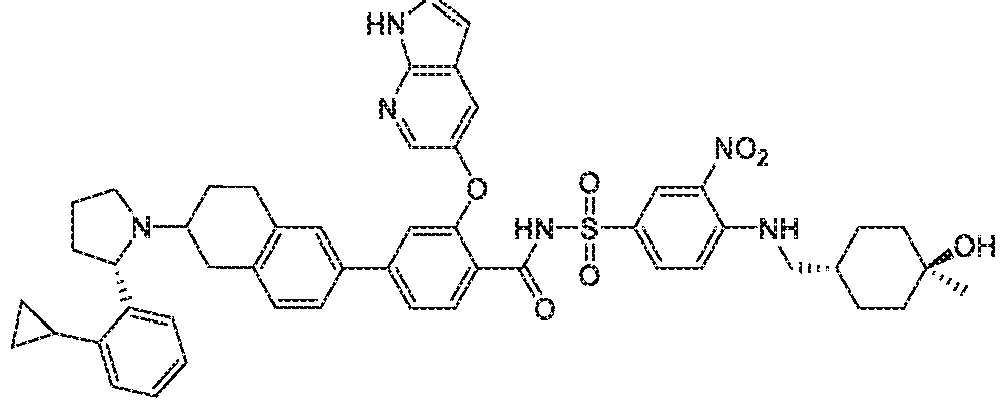
- The desired compound was synthesized following the procedures similar to those in Example A1 by replacing 1-(4-bromophenyl)-2-phenylpyrrolidine with (2S)-1-(6-bromo-1,2,3,4-tetrahydronaphthalen-2-yl)-2-(2-cyclopropylphenyl)pyrrolidine. 1H NMR (DMSO-d 6) δ ppm: 12.32 (s, 1H), 11.62 (s, 1H), 9.56 - 9.36 (m, 1H), 8.48 - 8.45 (m, 2H), 8.01 (s, 1H), 7.73 (s, 1H), 7.60 - 7.58 (m, 1H), 7.46 (s, 2H), 7.35 (d, J = 7.8 Hz, 1H), 7.20 (s, 2H), 7.09 - 7.07 (m, 1H), 6.99 - 6.96 (m, 3H), 6.34 (s, 1H), 4.40 (s, 1H), 4.23 (s, 1H), 3.62 (d, J = 4.4 Hz, 1H), 3.26 - 3.20 (m, 3H), 2.86 (s, 1H), 2.67 (s, 3H), 2.06 - 1.93 (m, 2H), 1.77 (s, 1H), 1.69 - 1.67 (m, 3H), 1.56 - 1.50 (m, 3H), 1.30 - 1.20 (m, 9H), 1.15 - 1.08 (m, 5H), 0.98 - 0.84 (m, 2H), 0.70 (s, 1H), 0.52 (s, 1H). MS (ESI) m/e [M+1]+ 894.8
-

- The desired compound was synthesized following the procedures similar to those in Example A1 by replacing 1-(4-bromophenyl)-2-phenylpyrrolidine with 5-bromo-2-(2-(2-cyclopropylphenyl)pyrrolidin-1-yl)-1H-benzo[d]imidazole. MS (ESI) m/e [M+1]+ 852.8
-

- The desired compound was synthesized starting from 1-(I-(4-bromophenyl)ethyl)-2-(2-cyclopropylphenyl)pyrrolidine and tert-butyl 2-((1H-pyrrolo[2,3-b]pyridin-5-yl)oxy)-4-(4,4,5,5-tetramethyl-1,3,2-dioxaborolan-2-yl)benzoate following the procedures similar to those in Example A1. MS (ESI) m/e [M+1]+ 840.8.
-

- The mixture of (S)-1-(3-(2-(2-cyclopropylphenyl)pyrrolidin-1-yl)cyclobutyl)-4-(4,4,5,5-tetramethyl-1,3,2-dioxaborolan-2-yl)-1H-pyrazole (520 mg, 1.2 mmol), tert-butyl 2-((1H-pyrrolo[2,3-b]pyridin-5-yl)oxy)-4-bromobenzoate (389 mg, 1.0 mmol), Pd(dppf)2Cl2 (146 mg, 0.2 mmol), Cs2CO3(975 mg, 3 mmol) in a 1,4-dioxane (40 mL) and water(5 mL) was heated to 100 °C and stirred for overnight. The reaction was concentrated in vacuo and purified by chromatography column on silica gel (eluent: EA/PE = 1/10 to 1/2) to give the target product (412 mg). MS (ESI, m/e) [M+1]' 615.9.
- The desired compound was synthesized starting from tert-butyl (S)-2-((1H-pyrrolo[2,3-b]pyridin-5-yl)oxy)-4-(1-(3-(2-(2-cyclopropylphenyl)pyrrolidin-1-yl)cyclobutyl)-1H-pyrazol-4-yl)benzoate following the procedures similar to those in Example A1. 1H NMR (400 MHz, DMSO-d6 )δ ppm: 12.20 (br, 1H), 11.63 (s, 1H), 8.60 - 8.45(m, 2H), 8.14 (s, 1H), 8.00(d, J = 2.4Hz, 1H), 8.85 (s, 1H), 7.74(d, J = 9.2Hz, 1H), 7.65 - 7.58 (m, 1H), 7.56 (d,J = 8.0Hz, 1H), 7.47 (t, J = 2.8Hz, 1H), 7.43 - 7.41(m, 1H),7.37 (d, J = 8.0Hz, 1H), 7.22 - 7.10 (m, 2H), 7.04 (s, 1H), 7.00 -6.95(m, 2H), 6.35 - 6.32 (m, 1H), 4.43 - 4.40(m, 1H), 3.86 (dd,J = 11.6Hz, J = 3.2Hz, 2H), 3.30 - 3.25 (m, 5H), 2.67 - 2.59 (m, 1H), 2.44 - 2.25 (m, 2H), 2.20 - 1.80 (m, 7H), 1.62 (d, J = 11.2Hz, 2H), 1.30 - 1.20 (m, 4H), 0.92 - 0.80 (m, 3H), 0.66 - 0.52 (m, 2H). MS (ESI, m/e) [M+1]+ 856.8.
-

- The desired compound was synthesized following the procedures similar to those in Example A1 by replacing 1-(4-bromophenyl)-2-phenylpyrrolidine with 5-(4-bromophenyl)-3-phenyl-4,5,6,7-tetrahydrothieno[3,2-c]pyridine. MS (ESI) m/e [M+1]+ 841.2
-
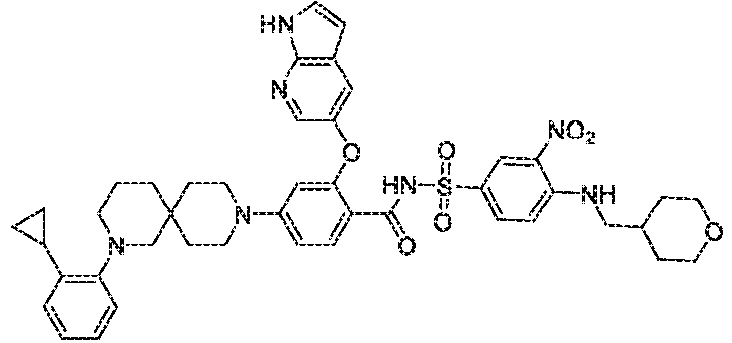
- The desired compound was synthesized following the procedures similar to those in Example B12 by replacing 1-(azetidin-3-ylmethyl)-2-(2-cyclopropylphenyl)pyrrolidine with 2-(2-cyclopropylphenyl)-2,9-diazaspiro[5.5]undecane. MS (ESI) m/e [M+1]+ 819.8.
-

-
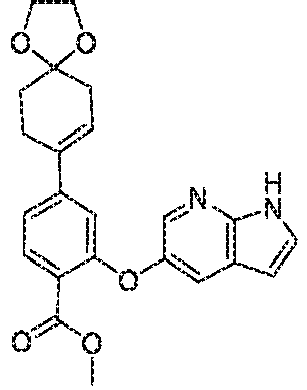
- To a solution of methyl 2-((1H-pyrrolo[2,3-b]pyridin-5-yl)oxy)-4-bromobenzoate (3.3 g, 9.57 mmol) in 1,4-dioxane (50 mL) were added 4,4,5,5-tetramethyl-2-(1,4-dioxaspiro[4.5]dec-7-en-8-yl)-1,3,2-dioxaborolane (2.8 g, 10.53 mmol), 1N K2CO3 (20 mL, H2O) and Pd(dppf)Cl2 (700 mg, 0.96 mmol), the reaction was heated at 95°C under N2 for about 2.5 h. The reaction mixture was cooled to ambient temperature, concentrated and purified by chromatography on silica gel (eluent: DCM: MeOH = 40: 1) to afford the desired compound as a yellow solid (3.4 g, 87.8%). MS (ESI, m/e) [M+1]+ 407.1.
-
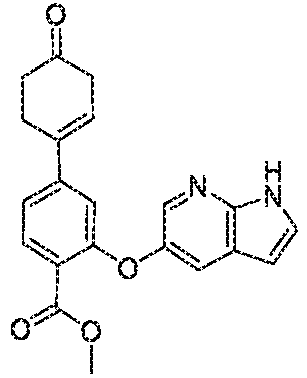
- To a solution of methyl 2-((1H-pyrralo[2,3-b]pyridin-5-yl)oxy)-4-(1,4-dioxaspiro[4.5]dec-7-en-8-yl)benzoate (2.0 g, 4.93 mmol) in EA (20 mL) was added 6M HCl acid (10 mL), the mixture was stirred at ambient temperature for about 1 h. The pH of the reaction mixture was adjusted to about 9 with sat. Na2CO3, the organic layer was separated, dried over Na2SO4 and concentrated to give the crude product as a brown oil (2.0 g). MS (ESI, m/e) [M+1]+ 363.0
-

- To a solution of methyl 3-((1H-pyrrolo[2,3-b]pyridin-5-yl)oxy)-4'-oxo-2',3',4',5'-tetrahydro-[1,1'-biphenyl]-4-carboxylate (2.0 g, 5.52 mmol) in DCM (10 mL) and EtOH (20 mL) were added 2-phenylpyrrolidine (1.22 g, 8.29 mmol) and HOAc (0.5 mL), the solution was stirred at ambient temperature for 1.5 h, NaBH3CN (1.7 g, 27.62 mmol) was then added, the reaction was stirred at ambient temperature for 1 h. The reaction mixture was portioned between DCM (50 mL) and H2O (20 mL). The organic layer was washed with H2O (20 mL), concentrated and purified by chromatography on silica gel (eluent: DCM: MeOH = 15: 1) to afford the desired compound as a yellow solid (1.4 g, 51.4%). MS (ESI, m/e) [M+1]+ 494.1
-
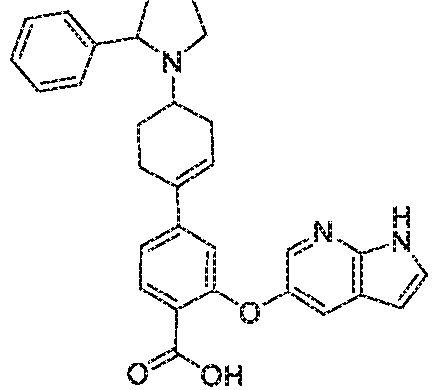
- To a mixture of methyl 3-((1H-pyrrolo[2,3-b]pyridin-5-yl)oxy)-4'-(2-phenylpyrrolidin-1-yl)-2',3',4',5'-tetrahydro-[1,1'-biphenyl]-4-carboxylate (200 mg, 0.45 mmol) in MeOH (10 mL) was added 3N NaOH (5 mL), the reaction was stirred at ambient temperature for about 20 h. The pH of the reaction mixture was adjusted to about 4 with 1M HCl acid, the resulting solution was concentrated. The residue was slurried with DCM/MeOH (20 mL/2 mL), filtered, the filtrate was concentrated to afford the crude product as yellow solid (200 mg). MS (ESI, m/e) [M+1]+ 480.1.
-

- A mixture of 3-((1H-pyrrolo[2,3-b]pyridin-5-yl)oxy)-4'-(2-phenylpyrrolidin-1-yl)-2',3',4',5'-tetrahydro-[1,1'-biphenyl]-4-carboxylic acid (200 mg, 0.416 mmol), 3-nitro-4-(((tetrahydro-2H-pyran-4-yl)methyl)amino)benzenesulfonamide (131 mg, 0.416 mmol), EDCI (120 mg, 0.624 mmol), DMAP (76 mg, 0.624 mmol) and DIPEA (161 mg, 1.247 mmol) in DCM (10 mL) was stirred at ambient temperature for 20 h. The reaction solution was concentrated and purified by pre-HPLC to give the product (30 mg). 1H NMR (DMSO-d6 ) δ ppm: 11.63 (s, 1H), 8.46 (s, 2H), 7.96 (t, J = 4.0 Hz, 1H), 7.73 (d, J = 8.0 Hz, 1H), 7.55-6.97 (m, 11H), 6.72 (s, 1H), 6.34 (s, 1H), 5.98-5.86 (m, 1H), 3.84 (dd, J = 12.0, 4.0 Hz, 2H), 3.28-3.22 (m, 5H), 2.33-1.83 (m, 10H), 1.61-1.58 (d, J = 12.0 Hz, 4H), 1.29-1.18 (m, 3H). MS (ESI) m/e [M+1]+ 777.2.
-

- The desired compound was synthesized starting from 2-(2-bromophenyl)pyrrolidine and methyl 3-((1H-pyrrolo[2,3-b]pyridin-5-yl)oxy)-4'-oxo-2',3',4',5'-tetrahydro-[1,1 '-biphenyl]-4-carboxylate following the next procedures similar to those in Example C1. 1H NMR(400 MHz, DMSO-d6 ) δ ppm: 12.20 (br, 1H), 11.86 (br, 1H), 8.56-8.53 (m, 2H), 8.00 (m, 1H), 7.78 (m, 1H), 7.65-7.58 (m, 1H), 7.50-7.45 (m, 4H), 7.31 (m, 1H), 7.14-7.08 (m, 3H), 6.72 (d,J = 4.0, 1H), 6.38 (m, 1H), 6.01-5.77 (m, 1H), 4.10 (m, 1H), 3.85 (m, 2H), 3.28-3.22 (m, 5H), 2.67 (m, 1H), 2.31-2.00 (m, 5H), 1.86 (m, 2H), 1.72 (m, 2H), 1.61 (d, J = 12.0, 2H), 1.28-1.21 (m, 5H). MS (ESI, m/c) [M+1]+ 855.1, 857.1.
-
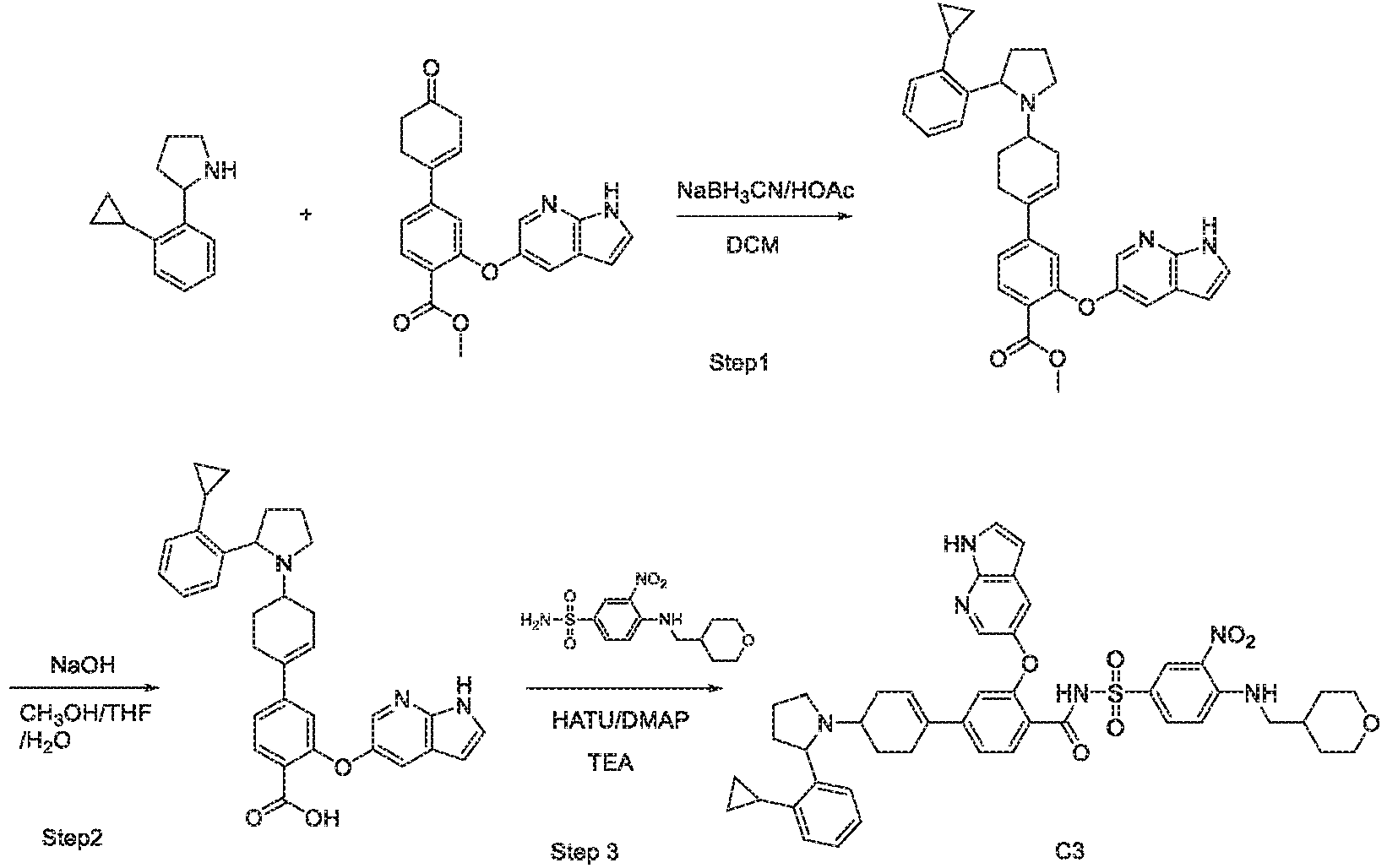
-
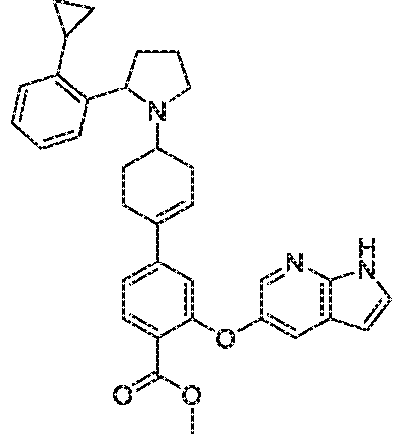
- To a mixture of methyl 3-((1H-pyrrolo[2,3-b]pyridin-5-yl)oxy)-4'-oxo-2',3',4',5'-tetrahydro-[1,1'-biphenyl]4-carboxylate (764 mg, 2.1 mmol), 2-(2-cyclopropylphenyl)pyrrolidine (473 mg, 2.53 mmol) in MeOH was added AcOH (0.2 mL) and the resultant mixture was stirred for 1 h. To the reaction was added NaBH3CN (889 mg, 4 mmol) and stirred for another 1 hour. Then the reaction mixture was concentrated in vacuum and diluted with EA (200 mL), washed with NaHCO3 (200 mL), brine (100 mL), dried over Na2SO4, concentrated in vacuum and purified by chromatography column on silica (eluent: EA/PE = 5/1 to 1/2) to give the product (412 mg, 36.76%) as alight yellow solid. 1H NMR (400 MHz, CDCl3) δ ppm: 11.70 (br, 1H), 8.01 (s, 1H), 7.75 (d, J = 0.8 Hz, 1H), 7.56-7.51 (m, 3H), 7.23 (d, J = 0.8 Hz, 1H), 7.09-7.02 (m, 1H), 6.98-6.96 (m, 1H), 6.91-6.85 (m, 1H), 4.32-4.25 (m, 1H), 3.74 (s, 3H), 3.18-2.97 (m, 2H), 2.38-1.99 (m, 7H), 1.73 (m, 2H), 1.54-1.41 (m, 2H), 0.89-0.85 (m, 2H), 0.65-0.52 (m, 2H). MS (ESI, m/e) [M+1]+ 534.2.
-

- To the solution of methyl 3-((1H-pyrrolo[2,3-b]pyridin-5-yl)oxy)-4'-(2-(2-cyclopropylphenyl)pyrrolidin-1-yl)-2',3',4',5'-tctrahydro-[1,1'-biphenyl]-4-carboxylate (700 mg, 1.31 mmol) in a mixture solvent of MeOH (10 mL), THF (10 mL), H2O (2 mL) was added NaOH (524 mg, 13.1mmol) and the resultant mixture was stirred overnight. The reaction was quenched with HCl acid (6 M) to pH ~ 4, extracted with DCM (400 mL), washed with brine (100 mL), dried over Na2SO4 and evaporated in vacuum Then the reaction mixture was concentrated in vacuum to afford a crude product (836 mg, crude). 1H NMR(400 MHz, CDCl3) δ ppm: 12.91 (br, 1H), 11.60 (br, 1H), 8.01 (s, 1H), 786-7.76 (m, 1H), 7.78 (d, J = 0.8 Hz, 1H), 7.50-7.47 (m, 2H), 7.30-7.27 (m, 3H), 7.10-7.02 (m, 1H), 6.89-6.88 (m, 1H), 6.39 (s, 1H), 6.05-5.96 (m, 1H), 5.25-5.09 (m,lH), 3.75-3.68 (m, 3H), 2.37-2.06 (m, 7H), 1.76-1.60 (m, 2H), 1.23 (m, 2H), 0.96 (m, 2H), 0.72-0.61 (m, 2H). MS (ESI, m/e) [M+1]+ 520.2
-

- The mixture of 3-((1H-pyrrolo[2,3-b]pyridin-5-yl)oxy)-4'-(2-(2-cyclopropylphcnyl)pyrrolidin-1-yl)-2',3',4',5'-tetrahydro-[1,1'-biphenyl]4-carboxylic acid (700 mg, 1.34 mmol), triethylamine (106 mg, 4.05 mmol), 2-(7-azabenzotriazol-1-yl)-N,N,N',N'-tetramethyluronium hexafluorophosphate (616 mg, 1.62 mmol) in DCM (10 mL) was stirred for 2 hours at room temperature. To the reaction mixture was added 3-nitro-4-(((tetrahydro-2H-pyran-4-yl)methyl)amino)bcnzenesulfonamide (512 mg, 1.62 mmol) and DMAP (17 mg, 0.14 mmol) and stirred overnight. The reaction mixture was washed with brine, dried over Na2SO4 and concentrated in vacuo, then purified by chromatography column on silica (eluent: DCM/MeOH = 50/1 to 15/1) to afford a crude product (490 mg). The crude product was purified with Pre-HPLC to give the product (1.65 mg, 1.26%). 1H NMR (400 MHz, DMSO-d6 ) δ ppm: 12.25 (br, 1H), 11.68 (br, 1H), 8.51 (m, 2H), 7.99 (s, 1H), 7.79 (d, J = 12.0 Hz, 1H), 7.61-7.47 (m, 4H), 7.28-7.07 (m, 5H), 6.73 (s, 1H), 6.37 (s, 1H), 5.99-5.85 (m, 1H), 5.32-5.28 (m, 1H), 3.85 (d, J = 8.0 Hz, 2H), 3.75-3.51 (m, 2H), 3.22 (m, 5H), 2.42-1.97 (m, 8H), 1.86 (s, 2H), 1.73 (s, 1H), 1.61-1.57 (m, 2H), 1.45-1.37 (m, 1H), 1.23 (m, 2H), 1.07-0.93 (m, 2H), 0.71-0.59 (m, 2H). MS (ESI, m/e) [M+1]+ 817.2.
-

-

- To a solution of (S)-2-(2-bromophenyl)pyrrolidine (5.0 g, 22.12 mmol) in DCM (50 mL) was added Boc2O (5.3 g, 24.34 mmol) slowly, the resulted solution was stirred at room temperature for 20 min. Then the reaction mixture was concentrated to give the product (7.8 g, crude) as a brown solid. MS (ESI, m/e) [M+1]+ 270.0, 271.9.
-

- To a solution of tert-butyl (S)-2-(2-bromophenyl)pyrrolidine-1-carboxylate (7.8 g, 22.12 mmol) in 1,4-dioxane (150 ml) was added cyclopropylboronic acid (5.78 g, 66.36 mmol), Pd(dppf)Cl2 (810 mg, 1.11 mmol), K2CO3 (9.16 g, 66.36 mmol) and water (2.5 mL), the mixture was stirred at 90 °C under N2 atmosphere for 4 h. After cooled to r.t, the reaction mixture was filtered. The filtrate was concentrated and purified by prep-MPLC (eluent: 0-5%, EA/PE) to give the product (5.0 g, 78.4 %) as a colorless oil. MS (ESI, m/e) [M+1]+ 232.1
-

- To a solution of tert-butyl (S)-2-(2-cyclopropylphenyl)pyrrolidine-1-carboxylate (5.0 g, 17.54 mmol) in MeOH (50 mL) was added HCl (1,4-dioxane solution, 4M, 50 mL) and stirred at room temperature for 1 hour. The reaction solution was concentrated in vacuum. The residue was partitioned between EA (20 mL) and H2O (100 mL). Then aqueous layer was extracted with EA (20 mL). The aqueous layer was separated, basified with Sat. NaHCO3, then extracted with DCM (50 mL×3). The combined organic layers were dried over Na2SO4 and concentrated to give the product (2.5g, 77.0%) as a brown oil without further purification for next synthesis. MS (ESI, m/e) [M+1]+ 188.2.
-

- To a solution of (S)-2-(2-cyclopropylphenyl)pyrrolidine (555 mg, 3.00 mmol) in DCM (30mL) was added methyl 3-((1H-pyrrolo[2,3-b]pyridin-5-yl)oxy)-4'-oxo-2',3',4',5'-tetrahydro-[1,1'-biphenyl]-4-carboxylate (1.09 g, 3.00 mmol), AcOH (2 drops) and NaBH(OAc)3 (1.27 g, 6.00 mmol), the solution was stirred at room temperature for overnight. The reaction solution was washed with H2O (20 mL), concentrated and purified by prep-MPLC (eluent: MeOH/DCM = 0/10 to 1/10) to give the product (1.3 g, 81.3 %) as a yellow solid. MS (ESI, m/e) [M+1]+ 534.
-

- To the solution of methyl 3-((1H-pyrrolo[2,3-b]pyridin-5-yl)oxy)-4'-((S)-2-(2-cyclopropylphenyl)pyrrolidin-1 -yl)-2',3',4',5'-tetrahydro-[1 ,1'-biphenyl]-4-carboxylate (700 mg, 1.31 mmol) in MeOH (15 mL) was added THF (15 mL) and NaOH (6M, 10mL) and stirred at room temperature for 3 hours. The PH value of the reaction mixture was adjusted to ~ 3 with Con. HCl acid. The resulting mixture was concentrated in vacuum. The residue was washed with DCM/MeOH = 10/1 (v/v, 50 mL), filtered. The filtrate was concentrated to give the product as a yellow solid (650 mg, crude). MS (ESI, m/e) [M+1]' 520.2
-

- The a mixture of 3-((1H-pyrrolo[2,3-b]pyridin-5-yl)oxy)-4'-((S)-2-(2-cyclopropylphenyl)pyrrolidin-1-yl)-2',3',4',5'-tetrahydro-[1,1'-biphenyl]-4-carboxylic acid (650 mg, 1.25 mmol) in DCM (20 mL) was added EDCI (480 mg, 2.50 mmol), triethylamine (630 mg, 6.26 mmol), 3-nitro-4-(((tetrahydro-2H-pyran-4-yl)mcthyl)amino)bcnzencsulfonamide (395 mg, 1.25 mmol) and DMAP (306 mg, 2.50 mmol), the solution was stirred at r.t for 40 h. The reaction solution was washed with H2O (30 mL×3), concentrated and purified by chromatography column on silica (eluent: MeOH/DCM = 0/25 to 1/25) to afford the product (700 mg, 68.5%). MS (ESI, m/e) [M+1]+ 817.2. 1H NMR(400 MHz, DMSO-d6 ) δ ppm: 11.64 (s, 1H), 8.48 (s, 2H), 7.96 (s, 1H), 7.80-7.40 (m, 5H), 7.30-6.84 (m, 5H), 6.73 (s, 1H), 6.35 (s, 1H), 6.04-5.79 (m, 1H), 3.88-3.81 (m, 2H), 3.32-3.16 (m, 6H), 2.38-1.21 (m, 18H), 0.97-0.84 (m, 2H), 0.72-0.50 (m, 2H). MS (ESI) m/e [M+1]+ 763.2. MS (ESI) m/e [M+1]+ 805.2
- Two enantiomers C3a (faster isomer) and C3b (slower isomer) were separated by chiral preparative HPLC. The chiral separation conditions are shown below. The faster enantiomer was eluted at retention time of 1.8 min to give C3a. The slower enantiomer was eluted at retention time of 2.6 min to give C3b.
Column CHIRAL ART Cellulose-SB Column size 2 cm × 25 cm, 5 um Injection 1.2 mL Mobile phase CO2:[MeOH:DCM = 2:1(0.1%MSA+ NH4HCO3)] = 60:40 Flow rate 45 mL/min Wave length UV 220 nm Temperature 25 °C Sample solution 18mg/mL in MeOH:DCM = 3:1 Prep-SFC Prep-SFC-100-1 -
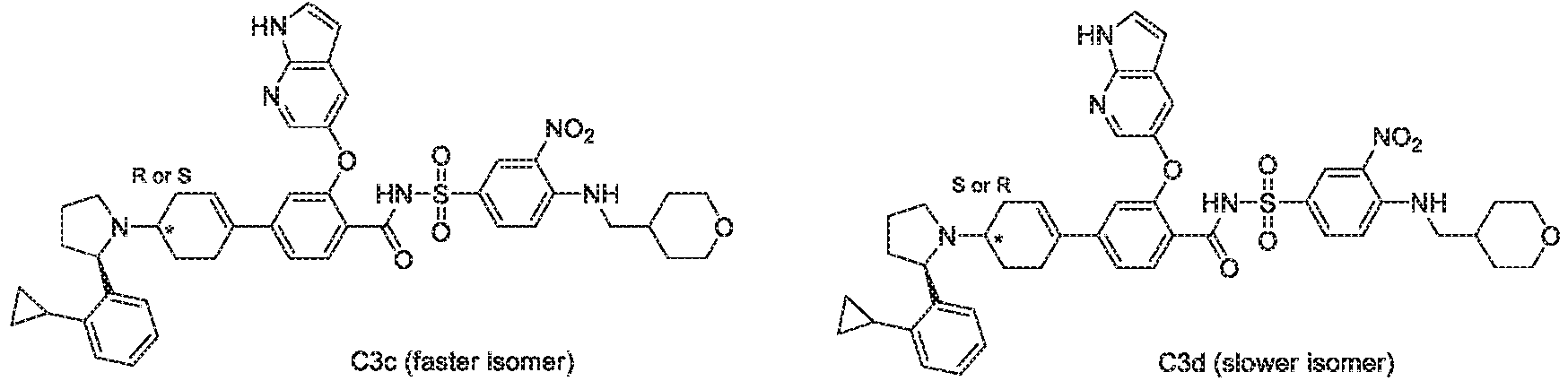
- Using (R)-2-(2-cyclopropylphenyl)pyrrolidine instead of (S)-2-(2-cyclopropylphenyl)pyrrolidine in the reductive amination step and then following the similar procedures in Example C3a and Example C3b, the mixture of Example C3c and Example C3d were afforded, then proceeded by chiral-HPLC separation, Two enantiomers C3c (faster isomer) and C3d (slower isomer) were separated. The chiral separation conditions are shown below. The faster enantiomer was eluted at retention time of 8.4 min to give C3c. The slower enantiomer was eluted at retention time of 9.6 min to give C3d.
Column CHIRALPAK IA Column size 2 cm × 25 cm, 5 um Injection 1.0 mL Mobile phase MTBE:MeOH(0.2%MSA) = 60:40 Flow rate 20 mL/min Wave length UV 220 nm Temperature 25 °C Sample solution 13.7 mg/ml in MeOH:DCM = 3:1 Prep-HPLC equipment Prep-Gilson-HPLC -

- The desired compound was synthesized starting from 2-(3-cyclopropylphenyl)pyrrolidine and methyl 3-((1H-pyrrolo[2,3-b]pyridin-5-yl)oxy)-4'-oxo-2',3',4',5'-tetrahydro-[1,1'-biphenyl]-4-carboxylate following the next procedures similar to those in Example C3. 1H NMR(400 MHz, DMSO-d6) δ ppm: 12.61 (br, 1H), 11.61 (br, 1H), 8.44 (m, 2H), 7.95 (s, 1H), 7.72 (d, J = 8.0Hz, 1H), 7.48-7.40 (m, 3H), 7.20-6.93 (m, 6H), 6.73 (s, 1H), 6.34 (s, 1H), 5.98-5.88 (m, 1H), 3.85-3.82 (m, 2H), 3.28-3.00 (m, 6H), 2.33-1.86 (m, 11H), 1.61 (d, J = 12.0 Hz, 2H), 1.45-1.25 (m, 4H), 0.92-0.84 (m, 2H), 0.65-0.59 (m, 2H). MS (ESI, m/e) [M+1]+ 817.2.
-

- The desired compound was synthesized starting from 3-(pyrrolidin-2-yl)pyridine and methyl 3-((1H-pyrrolo[2,3-b]pyridin-5-yl)oxy)-4'-oxo-2',3',4',5'-tetrahydro-[1,1'-biphenyl]-4-carboxylate following the next procedures similar to those in Example C1. 1H NMR(400 MHz, DMSO-d6) δ ppm: 12.27 (s, 1H), 11.73 (s, 1H), 9.90-9.69 (m, 1H), 8.78 (s, 1H), 8.67-8.59 (m, 1H), 8.56 (s, 1H), 8.11-8.04 (m, 1H), 8.02 (s, 1H), 7.82 (d, J = 9.0 Hz, 1H), 7.61-7.42 (m, 4H), 7.22-7.06 (m, 2H), 6.71 (s, 1H), 6.40 (s, 1H), 6.05-5.86 (m, 1H), 3.90-3.76 (m, 5H), 3.35-3.14 (m, 4H), 2.55-2.41 (m, 4H), 2.22-1.99 (m, 4H), 1.93-1.78 (m, 1H), 1.64-1.51 (m, 3H), 1.33-1.13 (m, 4H). MS (ESI) m/e [M+1]+ 778.1.
-

- The desired compound was synthesized starting from 2-benzylpyrrolidinc and methyl 3-((1H-pyrrolo[2,3-b]pyridin-5-yl)oxy)-4'-oxo-2',3',4',5'-tetrahydro-[1,1'-biphenyl]-4-carboxylate following the next procedures similar to those in Example C1 . 1H NMR(400 MHz, DMSO-d6 ) δ ppm: 11.59 (s, 1H), 9.41 (Brs, 1H), 8.42 (s, 1H), 8.37 (s, 1H), 7.96 (d, J = 2.0 Hz, 1H), 7.72-7.64 (m, 1H), 7.52 (d, J = 8.0 Hz, 1H), 7.45 (s, 1H), 7.39 (s, 1H), 7.35-7.25 (m, 4H), 7.25-7.18 (m, 1H), 7.17-7.09 (m, 1H), 6.92-6.83 (m, 1H), 6.78 (d, J = 8.0 Hz, 1H), 6.34 (s, 1H), 6.03 (s, 1H), 3.92-3.76 (m, 3H), 3.45-3.335 (s, 1H), 3.30-3.19 (m, 6H), 2.46-2.32 (m, 4H), 2.26-2.10 (m, 1H), 1.95-1.73 (m, 5H), 1.68-1.53 (m, 3H), 1.30-1.19 (m, 3H). MS (ESI) m/e [M+1]+ 791.2.
-
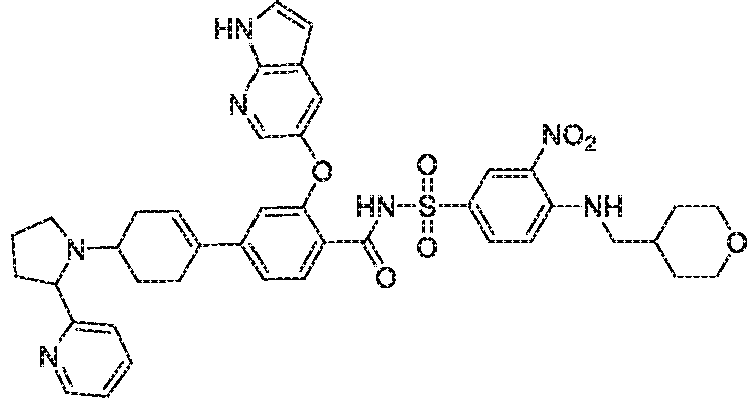
- The desired compound was synthesized starting from 2-(pyrrolidin-2-yl)pyridine and methyl 3-((1H-pyrrolo[2,3-b]pyridin-5-yl)oxy)-4'-oxo-2',3',4',5'-tetrahydro-[1,1'-biphenyl]-4-carboxylate following the next procedures similar to those in Example C1. 1H NMR(400 MHz, DMSO-d6 ) δ ppm: 12.43 (br, 1H), 11.62 (s, 1H), 8.55 (s, 1H), 8.44 (s, 2H), 7.95 (s, 2H), 7.72 (s, 1H), 7.62-7.23 (m, 5H), 7.11 (d, J = 7.8 Hz, 1H), 6.93 (s, 1H), 6.73 (s, 1H), 6.34 (s, 1H), 5.97-5.85 (m, 1H), 3.84 (d, J = 9.4 Hz, 2H), 3.29-3.16 (m, 5H), 2.45-2.25 (m, 5H), 2.12-1.75 (m, 6H), 1.59 (d, J = 12.6 Hz, 3H), 1.31-1.16 (m, 4H). MS (ESI, m/e) [M+1]+ 778.2
-
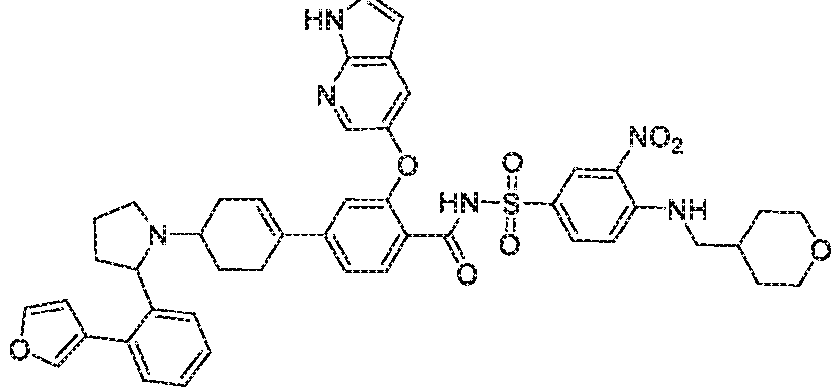
- The desired compound was synthesized starting from 2-(2-(furan-3-yl)phcnyl)pyrrolidine and methyl 3-((1H-pyrrolo[2,3-b]pyridin-5-yl)oxy)-4'-oxo-2',3',4',5'-tetrahydro-[1,1'-biphenyl]-4-carboxylate following the next procedures similar to those in Example C1. 1H NMR(400 MHz, OMSO-d6 ) δ ppm: 12.22 (br, 1H), 11.63 (s, 1H), 8.46 (s, 2H), 7.95 (s, 1H), 7.82-7.62 (m, 4H), 7.52-7.35 (m, 4H), 7.27-7.03 (m, 3H), 6.99-6.86 (m, 1H), 6.76-6.49 (m, 2H), 6.34 (s, 1H), 5.92-5.74 (m, 1H), 3.84 (d, J = 10.9 Hz, 3H), 3.29-3.20 (m, 5H), 3.16-2.93 (m, 2H), 2.20-1.64 (m, 9H), 1.60 (d, J = 12.7 Hz, 3H), 1.24 (s, 3H). MS (ESI, m/e) [M+1]+ 843.1
-

- The desired compound was synthesized starting from 2-(2-chlorophenyl)pyrrolidine and methyl 3-((1H-pyrrolo[2,3-b]pyridin-5-yl)oxy)-4'-oxo-2',3',4',5'-tetrahydro-[1,1'-biphenyl]-4-carboxylate following the next procedures similar to those in Example C1. 1H NMR(400 MHz, DMSO-d6 ) δ ppm: 12.23 (br, 1H), 11.69 (br, 1H), 8.57-8.53 (m, 2H), 7.99 (s, 1H), 7.80 (d, J = 8.0 Hz, 1H), 7.70-7.61 (m, 1H), 7.51 (s, 2H), 7.48 (d, J = 8.0 Hz, 1H), 7.36-7.21 (m, 2H), 7.14 (d, J = 8.0 Hz, 1H), 7.09-7.01 (m, 2H), 6.72 (s, 1H), 6.38 (s, 1H), 6.01-5.79 (m, 1H), 4.15-4.09 (m, 1H), 3.85 (d, J = 8.0Hz, 2H), 3.26-3.22 (m, 4H), 3.17-2.90 (m, 2H), 2.67-2.55 (m, 1H), 2.32-2.08 (m, 6H), 1.86-1.67 (m, 5H), 1.61 (d, J = 12.0 Hz, 2H), 1.47-1.23 (m, 2H). MS (ESI, m/e) [M+1]+ 811.1.
-

- The desired compound was synthesized with 2-(2-(trifluoromethyl)phenyl)pyrrolidine and methyl 3-((1H-pyrrolo[2,3-b]pyridin-5-yl)oxy)-4'-oxo-2',3',4',5'-tetrahydro-[1,1'-biphenyl]-4-carboxylate following the next procedures similar to those in Example C1. 1H NMR (400 MHz, DMSO-d6 ) δ ppm: 12.21 (s, 1H), 11.60 (s, 1H), 8.43 (s, 2H), 8.01-7.82 (m, 2H), 7.78-7.58 (m, 3H), 7.50-7.26 (m, 4H), 7.07 (s, 1H), 6.92 (s, 1H), 6.71 (d, J = 8.0 Hz, 1H), 6.33 (s, 1H), 5.99-5.72 (m, 1H), 4.24-4.06 (m, 2H), 3.84 (d, J = 9.0 Hz, 2H), 3.28-3.14 (m, 5H), 2.62-2.56 (m, 1H), 2.40-2.10 (m, 4H), 1.94-1.82 (m, 2H), 1.7 -1.68 (m, 2H), 1.62-1.56 (m, 2H), 1.45-1.35 (m, 2H), 1.30-1.18 (m, 2H), 0.95 - 0.83 (m, 1H).MS (ESI, m/e) [M+1]+ 845.1.
-

- The desired compound was synthesized with 2-(naphthalen-1-yl)pyrrolidine and methyl 3-((1H-pyrrolo[2,3-b]pyridin-5-yl)oxy)-4'-oxo-2',3',4',5'-tctrahydro-[1,1'-biphenyl]-4-carboxylate following the next procedures similar to those in Example C1. 1H NMR (400 MHz, DMSO-d6 ) δ ppm: 9.61 (s, 1H), 8.90 (s, 1H), 8.53 (s, 1H), 8.25-7.35 (m, 11H), 7.10-6.85 (m, 2H), 6.65-6.40 (m, 2H), 6.02-5.60 (m, 1H), 4.50 (s, 1H), 4.12-3.92 (m, 2H), 3.52-3.14 (m, 5H), 2.82-2.52 (m, 2H), 2.40-1.91 (m, 7H), 1.87-1.54 (m, 6H), 1.49-1.34 (m, 2H). MS (ESI) m/e [M+1]+ 827.1
-

-
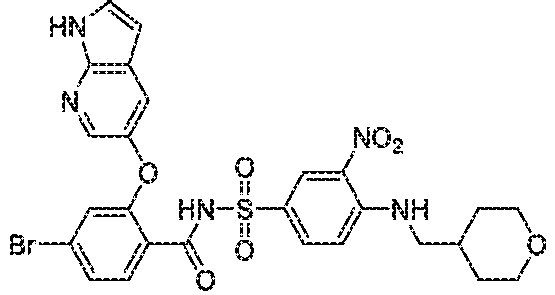
- To a mixture of 2-((]H-pyrrolo[2,3-b]pyridin-5-yl)oxy)-4-bromobenzoic acid (6.6 g, 19.88mol) in DCM (200 mL) were added 3-nitro-4-(((tetrahydro-2H-pyran-4-yl)methyl)amino)benzenesulfonamide (6.3 g, 19.88 mmol), EDCI (8.0 g, 41.75 mmol), DMAP (3.6 g, 29.82 mmol) and TEA (5.0 g, 49.70 mmol), the mixture was stirred at room temperature for about 2 days. 1 M HCl acid (100 mL) was added. The precipitate was filtered and dried under vacuum to give the product (9 g, 61.3 %) as a yellow solid without further purification for next step. MS (ESI, m/e) [M+1]+ 630.0, 632.0.
-

- A mixture of 2-((1H-pyrrolo[2,3-b]pyridin-5-yl)oxy)-4-bromo-N-((3-nitro-4-(((tetrahydro-2H-pyran-4-yl)methyl)amino)phenyl)sulfbnyl)benzamide (100 mg, 0.16 mmol), 4,4,5,5-tetramethyl-2-(1,4-dioxaspiro[4.5]dec-7-en-8-yl)-1,3,2-dioxaborolane (64 mg, 0.24 mmol), Pd(dppf)Cl2 (12 mg, 0.016 mmol) and K2CO3 (44 mg, 0.32 mmol) in dioxane (5 mL) and H2O (0.5 mL) was stirred at 95 °C under N2 overnight. It was cooled to r.t. and filtered off the inorganic salt. The filtrate was concentrated. The residue was purified by pre-TLC (MeOH/DCM = 1/10) to give the desired product as a yellow solid (76 mg, 68%). 1H NMR (400 MHz, DMSO-d6 ) δ 12.24 (s, 1H), 11.70 (s, 1H), 8.56-8.59 (m, 2H), 8.03 (s, 1H), 7.82 (d, J = 8.3 Hz, 1H), 7.48-7.58 (m, 3H), 7.20 (d, J = 7.9 Hz, 1H), 7.12 (d, J = 7.9 Hz, 1H), 6.76 (s, 1H), 6.40 (s, 1H), 5.95 (s, 1H), 3.85 (s, 6H), 3.23-3.27 (m, 2H), 2.98 (s, 2H), 2.37 (s, 2H), 2.28 (s, 2H), 2.03-1.96 (m, 2H), 1.87 (s, 1H), 1.71 (t, J = 6.2 Hz, 2H), 1.60 (d, J = 12.4 Hz, 2H). MS (ESI, m/e) [M+1]+ 690.1.
-

- A solution of 2-((1H-pyrrolo[2,3-b]pyridin-5-yl)oxy)-N-((3-nitro-4-(((tetrahydro-2H-pyran-4-yl)methyl)amino)phenyl)sulfonyl)-4-(1,4-dioxaspiro[4.5]dec-7-en-8-yl)benzamide (76 mg, 0.11 mmol) in DCM (5 mL) and 3 M HCl (1 mL) was stirred at room temperature overnight. It was diluted with DCM (20 mL) and neutralized with aq. NaHCO3. The organic layer was dried over anhydrous Na2SO4, filtered and concentrated to give the desired product as a yellow solid (42 mg, 59%) without further purification for next step. MS (ESI, m/e) [M+1]+ 646.1.
-

- A solution of 3-((1H-pyrrolo[2,3-b]pyridin-5-yl)oxy)-N-((3-nitro-4-(((tetrahydro-2H-pyran-4-yl)methyl)amino)phenyl)sulfonyl)-4'-oxo-2',3',4',5'-tetrahydro-[1,1'-biphenyl]-4-carboxamide (32 mg, 0.05 mmol) and 4,4-dimethyl-2-phenylpyrrolidine (13 mg, 0.075 mmol) in THF was stirred at r.t. for 30 min. NaBH(OAc)3 was added and stirred overnight. THF was removed and the residue was purified by pre-HPLC to give the desired product(5 mg, 12%). 1H NMR (400 MHz, DMSO-d6 ) δ ppm: 12.28 (s, 1H), 11.72 (s, 1H), 9.79 (d, J = 52.7 Hz, 1H), 8.61 (s, 1H), 8.54 (s, 1H), 8.00 (s, 1H), 7.81 (d, J = 8.7 Hz, 1H), 7.61-7.63 (m, 2H), 7.54 (s, 2H), 7.36-7.44 (m, 3H), 7.22-7.10 (m, 2H), 6.72 (d, J = 6.1 Hz, 1H), 6.66 (s, 1H), 6.39 (s, 1H), 5.98-5.88 (m, 1H), 4.94-4.78 (m, 1H), 3.84 (d, J = 8.9 Hz, 2H), 3.22-3.27 (m, 5H), 2.99 (s, 5H), 2.28 (s, 1H), 1.97-2.07 (m, 4H), 1.86 (s, 1H), 1.59 (d, J = 12.5 Hz, 2H), 1.45 (s, 1H), 1.24 (s, 6H). MS (ESI, m/e) [M+1]' 805.2.
-

- The desired compound was synthesized with 2-(2,6-dichlorophenyl)pyrrolidine and 3-((1H-pyrrolo[2,3-b]pyridin-5-yl)oxy)-N-((3-nitro-4-(((tetrahydro-2H-pyran-4-yl)methyl)amino)phenyl)sulfonyl)-4'-oxo-2',3',4',5'-tetrahydro-[1,1'-biphenyl]-4-carboxamide following the procedures similar to those in Example C12. 11H NMR (400 MHz, DMSO-d6 ) δ ppm: 12.23 (br, 1H), 11.71 (br, 1H), 8.58-8.54 (m, 2H), 7.99 (s, 1H), 7.81 (d, J = 8.0 Hz, 1H), 7.52-7.48 (m, 2H), 7.44 (d, J= 8.0 Hz, 1H), 7.34-7.30 (m, 1H), 7.20-7.11 (m, 4H), 6.71 (d, J = 16.0 Hz, 1H), 6.39 (s, 1H), 6.01-5.67 (m, 1H), 4.52-4.49 (m, 1H), 3.85 (d, J = 8.0Hz, 2H), 3.27-3.22 (m, 4H), 3.17-3.09 (m, 2H), 2.67-2.63 (m, 1H), 2.33-1.76 (m, 11H), 1.61 (d,J = 12.0Hz, 2H), 1.47-1.23 (m, 2H). MS (ESI, m/e) [M+1]+ 845.1.
-

- The desired compound was synthesized with 2-(2-propylphenyl)pyrrolidine and 3-((1H-pyrrolo[2,3-b]pyridin-5-yl)oxy)-N-((3-nitro-4-(((tetrahydro-2H-pyran-4-yl)methyl)amino)phenyl)sulfonyl)-4'-oxo-2',3',4',5'-letrahydro-[1,1'-biphenyl]-4-carbaxamide following the procedures similar to those in Example C12. 1H NMR (400 MHz, DMSO-d6 ) δ ppm: 12.24 (br, 0.5H), 11.65 (s, 1H), 9.34 (br, 0.5H), 8.49 (s, 2H), 7.96 (s, 1H), 7.79 - 7.67 (m, 1H), 7.55 -7.40 (m, 4H), 7.33 - 7.21 (m, 3H), 7.15 - 6.96 (m, 3H), 7.72 - 6.67 (m, 1H), 6.35 (s, 1H), 5.98-5.82 (m, 1H), 4.74 (s, 1H), 3.84 (d, J= 8.6 Hz, 2H), 3.28 - 3.22 (m, 4H), 3.05 - 2.84 (m, 2H), 2.20 - 2.07 (m, 2H), 2.02 - 1.97 (m, 2H), 1.91 - 1.78 (m, 2H), 1.76 - 1.64 (m, 2H), 1.62 - 1.28 (m, 7H), 0.99 - 0.81 (m, 6H). MS (ESI, m/e) [M+1]+ 819.2.
-

- The desired compound was synthesized starting from 2-(2-(thiophen-2-yl)phenyl)pyrrolidine and methyl 3-((1H-pyrrolo[2,3-b]pyridin-5-yl)oxy)-4'-oxo-2',3',4',5'-tetrahydro-[1, I-biphenyl]-4-carboxylate following the next procedures similar to those in Example C1. 1H NMR(400 MHz, DMSO-d6 ) δ ppm: 12.26 (s, 1H), 11.68 (s, 1H), 8.49-8.30 (m, 2H), 7.97 (s, 1H), 7.75 (d, J = 7.9 Hz, 3H), 7.54-7.22 (m, 6H), 7.22-6.88 (m, 4H), 6.70 (d, J = 3.7 Hz, 1H), 6.36 (s, 1H), 5.95-5.70 (m, 1H), 3.90-3.84 (m, 2H), 3.50-3.30 (m, 1H), 3.30-3.10 (m, 4H), 3.00-2.90 (m, 2H), 2.25-2.17 (m, 6H), 1.92-1.80 (m, 3H), 1.65-1.59 (m, 3H), 1.50-1.40 (m, 1H), 1.35-1.20 (m, 3H). MS (ESI, m/e) [M+1]+ 859.1.
-

- The desired compound was synthesized with 2-(2-benzylphenyl)pyrrolidine and 3-((1H-pyrrolo[2,3-b]pyridin-5-yl)oxy)-N-((3-nitro-4-(((tetrahydro-2H-pyran-4-yl)methyl)amino)phenyl)sulfonyl)-4'-oxo-2',3',4',5'-telrahydro-[1,1'-biphenyl]-4-carboxamide following the procedures similar to those in Example C12. 1H NMR (400 MHz, DMSO-d6 ) δ ppm: 12.22 (s, 1H), 11.71 (s, 1H), 8.52 (s, 2H), 8.01 (s, 1H), 7.79 (s, 1H), 7.36-7.56 (m, 5H), 6.88-7.08 (m, 9H), 6.59 (s, 1H), 6.40 (s, 1H), 5.75 (s, 1H), 3.93-4.04 (m, 2H), 3.83-3.85 (m, 3H), 3.22-3.27 (m, 5H), 3.02 (s, 2H), 2.46 - 2.36 (m, 1H), 2.28 - 2.07 (m, 2H), 2.04 - 1.96 (m, 2H), 1.86 (s, 2H), 1.59 (d, J = 12.3 Hz, 5H), 1.23-1.28 (m, 2H). MS (ESI, m/e) [M+1]+ 867.2
-

- The desired compound was synthesized with 4-(pyrrolidin-2-yl)pyridine and methyl 3-((1H-pyrrolo[2,3-b]pyridin-5-yl)oxy)4'-oxo-2',3',4',5'-tetrahydro-[1,1'-biphenyl]-4-carboxylate following the next procedures similar to those in Example C1. 1H NMR (400 MHz, DMSO-d6 ) δ ppm: 12.14 (s, 1H), 11.67 (s, 1H), 8.53-8.46 (m, 4H), 7.97 (d, J = 2.2 Hz, 1H), 7.76 (d,J = 8.8 Hz, 1H), 7.58-7.29 (m, 5H), 7.12 (d, J = 8.0 Hz, 1H), 7.03 (d, J = 8.8 Hz, 1H), 6.71 (s, 1H), 6.36 (s, 1H), 5.99 (s, 1H), 3.84 (d, J = 8.4 Hz, 2H), 3.25-3.22 (m, 5H), 2.33-2.08 (m, 4H), 1.91-1.76 (m, 4H), 1.61-1.53 (m, 3H), 1.50-1.43 (m, 1H), 1.31-1.18 (m, 6H). MS (ESI, m/e) [M+1]+ 778.2.
-

- The desired compound was synthesized with 2-(2-isopropylphenyl)pyrrolidine and 3-((1H-pyrrolo[2,3-b]pyridin-5-yl)oxy)-N-((3-nitro-4-(((tetrahydro-2H-pyran-4-yl)methyl)amino)phenyl)sulfonyl)-4'-oxo-2',3',4',5'-tetrahydro-[1,1'-biphenyl]-4-carboxamide following the procedure similar to those in Example C12. 1H NMR (400 MHz, DMSO-d6 ) δ ppm: 12.27 (s, 1H), 11.71 (s, 1H), 9.480 (s, 0.5H), 9.283 (s, 0.5H), 8.60 (s, 1H), 8.54 (s, 1H), 7.99 (s, 1H), 7.80 (d, J = 9.0 Hz, 1H), 7.61 (d, J = 7.5 Hz, 1H), 7.52 (s, 2H), 7.48 (d, J = 8.0 Hz, 1H), 7.22-7.42 (m, 3H), 7.16 (d, J = 8.0 Hz, 1H), 7.11 (d, J = 9.0 Hz, 1H), 6.73 (s, 1H), 6.38 (s, 1H), 5.98-5.84 (m, 1H), 5.11-4.94 (m, 1H), 3.84 (d, J = 8.6 Hz, 2H), 3.63-3.70 (m, 1H), 3.20-3.32 (m, 7H), 3.00-2.93 (m, 2H), 2.42-2.38 (m, 1H), 2.28-2.20 (m, 1H), 2.12-2.16 (m, 2H), 1.96-2.20 (m, 1H), 1.83-1.91 (m, 2H), 1.59 (d, J = 12.0 Hz, 2H), 1.19-1.22 (m, 7H), 1.13 (d, J = 6.6 Hz, 3H). MS (ESI, m/e) [M+1]+ 819.2.
-

- The desired compound was synthesized with 2-(2-(prop-1-en-2-yl)phenyl)pyrrolidine and 3-((1 H-pyrrolo[2,3-b]pyridin-5-yl)oxy)-N-((3-nitro-4-(((tetrahydro-2H-pyran-4-yl) meth yl)amino)phenyl)sulfonyl)-4'-oxo-2',3',4',5'-tetrahydro-[1,1'-biphenyl]-4-carboxamide following the procedure similar to those in Example C12. 1H NMR (400 MHz, DMSO-d6 ) δ 12.25 (s, 1H), 11.64 (s, 1H), 8.48 (s, 1H), 7.98 - 7.94 (m, 1H), 7.80 - 7.70 (m, 1H), 7.47 - 7.45 (m, 4H), 7.12 - 7.00 (m, 4H), 6.73 (s, 1H), 6.35 (s, 1H), 5.98 - 5.82 (m, 0.5H), 5.22 (s, 0.5H), 4.90-4.60 (m, 2H), 4.10 - 3.84 (m, 2H), 3.28 - 3.22 (m, 4H), 3.20 - 3.15 (m, 2H), 2.30 - 2.10 (m, 4H), 1.99 - 1.90 (m, 6H), 1.88 -1.80 (m, 2H), 1.75 - 1.70 (m, 2H), 1.65 - 1.55 (m, 2H), 1.50 - 1.40 (m, 1H), 1.30 - 1.20 (m, 4H). MS (ESI, m/e) [M+1]+ 817.2.
-

- The desired compound was synthesized with 2-(2-isobutylphenyl)pyrrolidine and 3-((1H-pyrrolo[2,3-b]pyridin-5-yl)oxy)-N-((3-nitro-4-(((tetrahydro-2H-pyran-4-yl) meth yl)amino)phenyl)sulfonyl)4'-oxo-2',3',4',5'-tetrahydro-[1,1'-biphenyl]-4-carboxamide following the procedure similar to those in Example C12. MS (ESI, m/e) [M+1]+ 832.8.
-

- The desired compound was synthesized with 2-(2-(cyclopropylmethyl)phenyl)pyrrolidine and 3-((1H-pyrrolo[2,3-b]pyridin-5-yl)oxy)-N-((3-nitro-4-(((tetrahydro-2H-pyran-4-yl) meth yl)amino)phenyl)sulfonyl)-4'-oxo-2',3',4',5'-tetrahydro-[1,1'-biphenyl]-4-carboxamide following the procedure similar to those in Example C12. MS (ESI, m/e) [M+1]' 830.8.
-

- C24a was synthesized with cis- or trans- 2-(2-(pyrrolidin-2-yl)phenyl)cyclopropane-1-carbonitrile(faster peak in HPLC) and3-((1H-pyrrolo[2,3-b]pyridin-5-yl)oxy)-N-((3-nitro-4-(((tetrahydro-2H-pyran-4-yl) meth yl)amino)phenyl)sulfonyl)-4'-oxo-2',3',4',5'-tetrahydro-[1,1'-biphenyl]-4-carboxamide following the procedure similar to those in Example C12. 1H NMR (400 MHz, DMSO-d6 ) δ ppm: 12.22 (s, 1H), 11.67 (s, 1H), 8.51 (s, 2H), 7.98 (s, 1H), 7.75 (s, 1H), 7.64-7.58 (m, 1H), 7.55 - 7.38 (m, 4H), 7.20-7.12 (m, 4H), 6.70-6.66 (m, 2H), 6.36 (s, 1H), 5.99-5.82 (m, 1H), 4.19 (s, 1H), 3.84 (d, J = 8.8 Hz, 2H), 3.28-3.22 (m, 5H), 2.98 (s, 3H), 2.75-2.67 (m, 1H), 2.26-2.18 (s, 5H), 2.01-1.97 (m, 5H), 1.73 (s, 2H), 1.59 (d, J = 12.5 Hz, 2H), 1.45 (s, 2H), 0.91-0.84 (m, 2H). MS (ESI, m/e) [M+1]+ 841.8. With trans- or cis- 2-(2-(pyrrolidin-2-yl)phenyl)cyclopropane-1-carbonitrile(slower peak in HPLC) was C24b synthesized. MS (ESI, m/e) [M+1]+ 841.8.
-
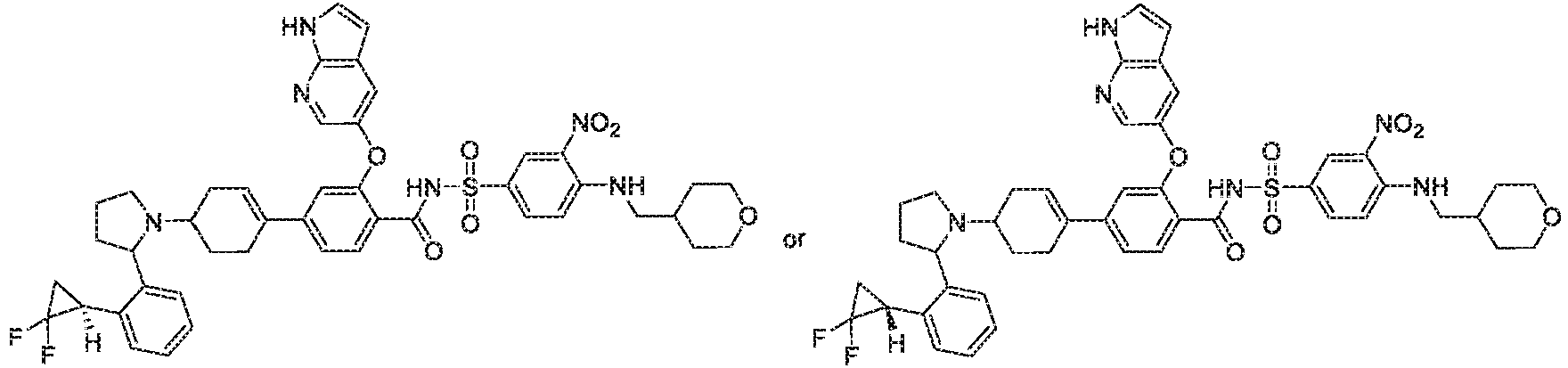
- The desired compound 26a was synthesized with 2-(2-((S or R)-2,2-difluorocyclopropyl)phenyl)pyrrolidine (faster peak in HPLC) and 3-((1H-pyrrolo[2,3-b]pyridin-5-yl)oxy)-N-((3-nitro-4-(((tetrahydro-2H-pyran-4-yl) meth yl)amino)phenyl)sulfonyl)-4'-oxo-2',3',4',5'-tetrahydro-[1,1'-biphenyl]-4-carboxamide following the procedure similar to those in Example C12. 1H NMR (DMSO-d 6)δ ppm: 12.23 (s, 1H), 11.68 (s, 1H), 8.65-8.42 (m, 2H), 7.98 (s, 1H), 7.77 (s, 1H), 7.63-7.39 (m, 4H), 7.27-7.00 (m, 5H), 6.76-6.54 (m, 1H), 6.37 (s, 1H), 6.07-5.70 (m, 1H), 4.01 (s, 1H), 3.91-3.76 (m, 2H), 3.27-3.19 (m, 4H), 3.17-3.04 (m, 2H), 3.01-2.89 (m, 1H), 2.29-2.09 (m, 3H), 2.06-1.83 (m, 5H), 1.78-1.69 (m, 2H), 1.64-1.54 (m, 2H), 1.47-1.34 (m, 2H), 1.31-1.24 (m, 3H). MS (ESI) m/e [M+1]+ 852.7. With 2-(2-((R or S)-2,2-difluorocyclopropyl)phenyl)pyrrolidine (slower peak in HPLC), 26b was synthesized. MS (ESI, m/e) [M+1]+ 852.7.
-

- The desired compound was synthesized with 2-(2-cyclobutylphenyl)pyrrolidine and 3-((1 H-pyrrolo[2,3-b]pyridin-5-yl)oxy)-N-((3-nitro-4-(((tetrahydro-2H-pyran-4-yl)methyl) amino)phenyl)sulfonyl)-4'-oxo-2',3',4',5'-tctrahydro-[1,1'-biphenyl]-4-carboxamidc following the procedure similar to those in Example C12. 1H NMR (400 MHz, DMSO-d 6) δ 12.22 (s, 1H), 11.64 (s, 1H), 8.60 - 8.40 (m, 2H), 7.96 (s, 1H), 7.85 - 7.65 (m, 1H), 7.60 - 7.40 (m, 4H), 7.35 - 7.15(m, 2H), 7.11 (d, J = 8.0 Hz, 1H), 7.05 - 6.90 (m, 2H), 6.72 (s, 1H), 6.35 (s, 1H), 5.98 (s, 0.5H), 5.79 (s, 0.5H), 3.88 - 3.80 (m, 3H), 3.75 - 3.60 (m, 1H), 3.30 - 3.20 (m, 5H), 3.15 - 2.85 (m, 2H), 2.41 - 1.91 (m, 10H), 1.90 - 1.64 (m, 5H), 1.59 (d, J = 12.4 Hz, 2H), 1.55 - 1.40 (m, 1H), 1.35 - 1.15 (m, 3H). MS (ESI, m/e) [M+1]+ 830.9.
-

- The desired compound was synthesized with N,N-dimethyl-2-(pyrrolidin-2-yl)aniline and methyl 3-((1H-pyrrolo[2,3-b]pyridin-5-yl)oxy)-4'-oxo-2',3',4',5'-tetrahydro-[1,1'-biphenyl] -4-carboxylate following the next procedures similar to those in Example C1. 1H NMR (400 MHz, DMSO-d6 ) δ 11.60 (s, 1H), 8.42 (s, 2H), 7.93 (s, 1H), 7.73 - 7.63 (m, 1H), 7.62 - 7.51 (m, 1H), 7.51 - 7.41 (m, 2H), 7.39 - 7.29 (m, 1H), 7.12 - 7.01 (m, 1H), 6.96 - 6.81 (m, 1H), 6.79 - 6.66 (m, 1H), 6.38 - 6.27 (m, 1H), 6.02 - 5.77 (m, 1H), 3.92 - 3.77 (m, 2H), 3.27 - 3.13 (m, 6H), 2.67 - 3.55 (m, 7H), 2.32 - 2.22 (m, 3H), 2.13 - 1.95 (m, 4H), 1.91 - 1.79 (m, 2H), 1.67 - 1.52 (m, 4H), 1.33 - 1.24 (m, 6H). MS (ESI) m/e [M+1]+ 802.8.
-

- The desired compound was synthesized with 2-(2-(difluoromethoxy)phenyl) pyrrolidine and 3-((1H-pyrrolo[2,3-b]pyridin-5-yl)oxy)-N- ((3-nitro-4-(((tetrahydro-2H-pyran -4-yl)methyl)amino)phenyl)sulfonyl)-4'-oxo-2',3',4',5'-tetrahydro-[1,1'-biphenyl]-4-carboxamide following the procedure similar to those in Example C12. 1H NMR (400 MHz, DMSO-d6 ) δ 12.24 (s, 1H ), 11.68 (s, 1H), 8.60 - 8.45 (m, 2H ), 8.05 - 7.95 (m, 1H), 7.85 - 7.70 (m, 2H), 7.60 - 7.37 (m, 3H), 7.30 - 6.90 (m, 5H ), 6.72 (s, 1H), 6.37 (s, 1H), 6.01 (s, 0.5H ), 5.81 (s, 0.5H ), 4.20 - 4.00 (m, 1H), 3.98 - 3.71 (m, 2H ), 3.35 - 3.20 (m, 5H ), 2.65 - 2.55 (m, 2H), 2.40 - 2.00 (m, 6H ), 1.95 - 1.80 (m, 2H ), 1.75 - 1.65 (m, 2H ), 1.65 - 1.55 (m, 2H ), 1.45 - 1.35 (m, 1H ), 1.35 - 1.20 (m, 3H ). MS (ESI, m/e) [M+1]+ 842.8.
-

- The desired compound was synthesized with 2-(2-(trifluoromethoxy)phenyl)pyrrolidine and 3-((1H-pyrrolo[2,3-b]pyridin-5-yl)oxy)-N-((3-nitro-4-(((tetrahydro-2H-pyran-4-yl)methyl)amino)phenyl)sulfonyl)-4'-oxo-2',3',4'.5'-tetrahydro-[1,1'-biphenyl]-4-carboxamide following the procedure similar to those in Example C12. 1H NMR (400 MHz, DMSO-d6 ) δ ppm: 12.35 (s, 1H), 11.63 (s, 1H), 8.46 (s, 2H), 7.96 (s, 1H), 7.75-7.63 (m, 2H), 7.50-7.47 (m, 2H), 7.36-7.15 (m, 4H), 7.10 (d, J = 7.2 Hz, 1H), 6.96 (s, 1H), 6.72 (d, J = 7.2 Hz, 1H), 6.35 (s, 1H), 6.00-5.78 (m, 1H), 4.07 (s, 1H), 3.84 (d, J = 8.4 Hz, 2H), 3.29-3.22 (m, 4H), 3.17-3.08 (m, 1H), 2.62-2.53 (m, 2H), 2.36-2.28 (m, 1H), 2.25-2.10 (m, 3H), 1.93-1.80 (m, 2H), 1.78-1.65 (m, 3H), 1.62-1.58 (m, 2H), 1.50-1.37 (m, 2H), 1.33-1.27 (m, 2H). MS (ESI, m/e) [M+1]+ 861.1.
-

- The desired compound was synthesized starting from 2-(2-propoxyphenyl)pyrrolidine and methyl 3-((1H-pyrrolo[2,3-b]pyridin-5-yl)oxy)-4'-oxo-2',3',4',5'-tetrahydro-[1,1'-biphenyl]-4-carboxylate following the next procedures similar to those in Example C1. 1H NMR(400 MHz, DMSO-d6 ) δ ppm: 11.59 (s, 1H), 8.50 - 8.35(m, 2H), 7.95 - 7.90 (m, 1H), 7.75 - 7.65 (m, 1H), 7.57 - 7.41 (m, 3H), 7.37 - 7.30 (m, 1H), 7.12 - 7.05 (m, 1H), 6.95 - 6.85(m, 3H), 6.75 - 6.70(m, 1H), 6.38 - 6.30 (m, 1H), 5.98 - 5.80 (m, 1H), 5.78 - 5.75 (m, 1H), 5.76 (s, 1H), 4.10 (q, J = 5.2 Hz, 2H), 4.00 - 3.90(m, 2H), 3.88 - 3.75 (m, 2H), 3.30 - 3.25 (m, 5H), 3.20 - 3.15 (m, 3H), 2.40 - 2.25 (m, 3H), 2.20 - 1.90 (m, 3H),1.88 - 1.80 (m, 2H), 1.76-1.66 (m, 2H), 1.65 - 1.55 (m, 2H), 1.36 - 1.13 (m, 3H), 0.95 (t, J= 7.3 Hz, 3H). MS (ESI, m/e) [M+1]+ 835.2.
-

- The desired compound was synthesized with 2-(2-(2-methoxyethoxy)phenyl)pyrrolidine and 3-((1H-pyrrolo[2,3-b]pyridin-5-yl)oxy)-N-((3-nitro-4-(((tetrahydro-2H-pyran-4-yl)methyl)amino)phcnyl)sulfonyl)-4'-oxo-2',3',4',5'-tetrahydro-[1,1'-biphenyl]-4-carboxamide following the procedure similar to those in Example C12. 1H NMR (400 MHz, DMSO-d6 ) δ ppm: 11.59 (s, 1H), 8.50-8.33 (m, 2H), 7.94 (s, 1H), 7.68 (d, J = 8.6 Hz, 1H), 7.60-7.44 (m, 3H), 7.40-7.38 (m, 1H), 7.15-7.05 (m, 2H),7.00-6.85(m, 3H), 6.70 (s, 1H), 6.33 (s, 1H), 5.97-5.85 (m, 1H), 4.30-4.10 (m, 2H), 3.90-3.80 (m, 2H), 3.75-3.65 (m, 2H), 3.27-3.15 (m, 9H), 2.40-2.10 (m, 7H), 1.90-1.80 (m, 2H), 1.70-1.50 (m, 4H), 1.45-1.35 (m, 1H), 1.32-1.14 (m, 3H). MS (ESI, m/e) [M+1]+ 851.2.
-

- The desired compound was synthesized with 2-(2-isopropoxyphenyl)pyrrolidine and methyl 3-((1 H-pyrrolo[2,3-b]pyridin-5-yl)oxy)-4'-oxo-2',3',4',5'-tetrahydro-[1,1'-biphenyl] -4-carboxylate following the next procedures similar to those in Example C1. 1H NMR (400 MHz, DMSO-d6 ) δ 12.28 (s, 1H), 11.74 (s, 1H), 8.66 - 8.52 (m, 2H), 8.02 (s, 1H), 7.82 (d, J = 9.1 Hz, 1H), 7.71 - 7.46 (m, 4H), 7.40 - 7.30 (m, 1H), 7.25 - 7.06 (m, 3H), 7.05 - 6.95 (m, 1H), 6.71 (s, 1H), 6.40 (s, 1H), 6.01 (s, 0.5H), 5.93 (s, 0.5H), 5.05 - 4.90 (m, 1H), 4.76 - 4.57 (m, 1H), 3.85 (d, J = 10.6 Hz, 2H), 3.31 - 3.15 (m, 5H), 2.40 - 2.20 (m, 4H), 2.18 - 2.05 (m, 4H), 2.00 - 1.85 (m, 2H), 1.70 - 1.55 (m, 3H), 1.35 - 1.15 (m, 10H). MS (ESI) m/c [M+1]+ 834.8.
-
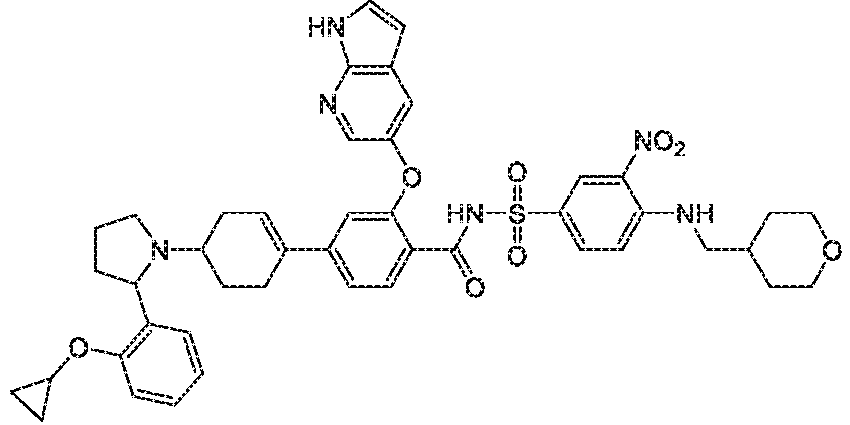
- The desired compound was synthesized with 2-(2-cyclopropoxyphenyl)pyrrolidine and 3-((1H-pyrrolo[2,3-b]pyridin-5-yl)oxy)-N-((3-nitro-4-(((tetrahydro-2H -pyran -4-yl)methyl)amino)phenyl)sulfonyl)-4'-oxo-2',3',4',S'-tetrahydro-[l,l'-biphenyl]-4-carbox amide following the procedure similar to those in Example C12. 1H-NMR (400 MHz, d6-DMSO) δ ppm: 12.28 (s, 1H), 11.71 (s, 1H), 8.60 - 8.52 (m, 2H), 8.00 (s, 1H), 7.92 - 7.77 (m, 2H), 7.50 - 7.48 (m, 3H), 7.43 - 7.32 (m, 2H), 7.16 (d, J = 7.4 Hz, 1H), 7.06 (d, J = 7.4 Hz, 1H), 7.05 - 7.02 (m, 1H), 6.74 (s, 1H), 6.39 (s, 1H), 5.95 - 5.90 (m, 1H), 4.88 - 4.75 (m, 1H), 3.88-3.73 (m, 3H), 3.52 (s, 1H), 3.29 - 3.20 (m, 5H), 2.43 - 2.23 (m, 5H), 2.15-1.95 (m, 5H), 1.89-1.75 (m, 1H), 1.59 (d, J = 11.9 Hz, 3H), 1.24-1.15 (m, 3H), 0.79 - 0.65 (m, 3H).MS (ESI, m/e) [M+1]+ 832.8. Example C45: 3-((1H-pyrrolo[2,3-b]pyridin-5-yl)oxy)-4'-(2-(2-chloro-6-cyclopropylphenyl)pyrrolidin-1-yl)-N-((3-nitro-4-(((tetrahydro-2H-pyran-4-yl)methyl)amino)phenyl)sulfonyl)-2',3',4',5'-tetrahydro-[1,1'-biphenyl]-4-carboxamide
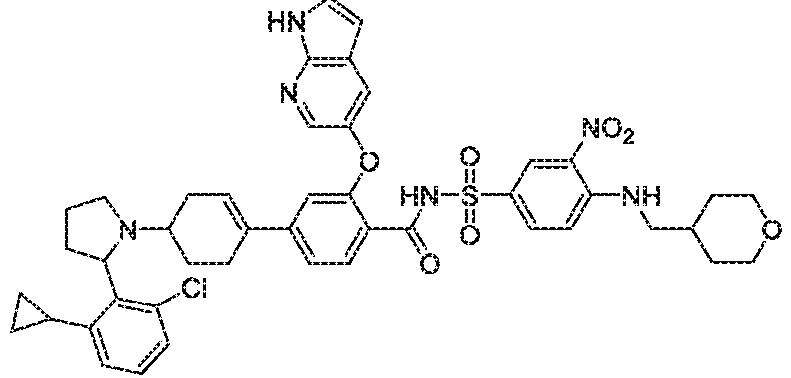
- The desired compound was synthesized with 2-(2-chloro-6-cyclopropylphenyl) pyrrolidine and 3-((1H-pyrrolo[2,3-b]pyridin-5-yl)oxy)-N-((3-nitro-4-(((tetrahydro-2H -pyran -4-yl)methyl)amino)phenyl)sulfonyl)-4'-oxo-2',3',4',5'-tetrahydro-[1,1'-biphenyl]-4-carbox amide following the procedure similar to those in Example C12. 1H NMR (400 MHz, DMSO-d6 ) δ 12.24 (s, 1H), 11.70 (s, 1H), 8.59 - 8.53 (m, 2H), 7.99 (s, 1H), 7.80 (d, J = 8.8 Hz, 1H), 7.60 - 7.39 (m, 3H), 7.23 - 6.95 (m, 4H), 6.72 - 6.61 (m, 2H), 6.38 (s, 1H), 6.03 - 5.79 (m, 1H), 4.52 - 4.47 (m, 1H), 3.84 (d, J = 8.8 Hz, 2H), 3.28 - 3.22 (m, 4H), 3.12 - 3.03 (m, 2H), 2.20 - 2.10 (m, 2H), 2.01 - 1.97 (m, 3H), 1.90 - 1.73 (m, 4H), 1.65 - 1.50 (m, 2H), 1.50 - 1.40 (m, 1H), 1.30 - 1.20 (m, 6H), 0.98 - 0.79 (m, 3H). MS (ESI, m/e) [M+1]+ 850.8.
-

- The desired compound was synthesized with 2-(2,6-dimethylphenyl)pyrrolidine and 3-((1H-pyrrolo[2,3-b]pyridin-5-yl)oxy)-N-((3-nitro-4-(((tetrahydro-2H-pyran-4-yl)methyl)amino)phenyl)sulfonyl)-4'-axo-2',3',4',5'-tetrahydro-[1,1'-biphenyl]-4-carbaxamide following the procedure similar to those in Example C12. 1H NMR (400 MHz, DMSO-d6 ) δ ppm: 12.27 (s, 1H), 11.69 (s, 1H), 8.65-8.48 (m, 2H), 7.98 (s, 1H), 7.78 (d, J = 8.4 Hz, 1H), 7.51 (s, 2H),7.44 (d, J = 8.4 Hz, 1H), 7.20-7.05 (m, 2H), 7.03-6.79 (m, 3H), 6.72 (d, J= 8.0 Hz, 1H), 6.38 (s, 1H), 6.00-5.72 (m, 1H), 4.15-3.75 (m, 4H), 3.30-3.17 (m, 4H), 3.15-2.98 (m, 1H), 2.45-2.25 (m, 8H), 2.18-2.05 (m, 3H), 1.99-1.53 (m, 8H), 1.51-1.35 (m, 1H), 1.28-1.18 (m, 4H). MS (ESI, m/e) [M+1]+ 805.2.
-

- The desired compound was synthesized with 2-(2-chloro-3-fluorophenyl)pyrrolidine and 3-((1 H-pyrrolo[2,3-b]pyridin-5-yl)oxy)-N-((3-nitro-4-(((tetrahydro-2H-pyran-4-yl) methyl)amino)phenyl)sulfonyl)-4'-oxo-2',3',4',5'-tetrahydro-[1,1'-biphenyl]-4-carboxamide following the procedure similar to those in Example C12. 1H NMR (400 MHz, DMSO-d6 ) δ 11.68 (s, 1H), 8.60 - 8.45 (m, 2H), 8.05 - 7.95 (m, 1H), 7.80 - 7.70 (m, 1H), 7.62 - 7.44 (m, 4H), 7.35 - 7.20 (m, 1H), 7.18 - 7.10 (m, 2H), 7.09 - 6.92 (m, 2H), 6.70 (d, J = 8.1 Hz, 1H), 6.37 (s, 1H), 6.01 (s, 0.5H), 5.80 (s, 0.5H), 4.2 - 4.05 (m, 1H), 3.84 (d, J = 8.2 Hz, 2H), 3.30 - 3.20 (m, 4H), 3.18 - 2.90 (m, 2H), 2.40 - 2.05 (m, 4H), 2.00 - 1.80 (m, 2H), 1.78 - 1.65 (m, 2H), 1.59 (d, J = 12.6 Hz, 3H), 1.50 - 1.40 (m, 1H), 1.36 - 1.13 (m, 4H). MS (ESI) m/e [M+1]' 828.7.
-

- The desired compound was synthesized starting from 2-(2,3-dichlorophenyl)pyrrolidine and methyl 3-((1H-pyrrolo[2,3-b]pyridin-5-yl)oxy)-4'-oxo-2',3',4',5'-tetrahydro-[1,1'-biphenyl]-4-carboxylate following the next procedures similar to those in Example C1. 1H NMR(400 MHz, DMSO-d6 ) δ ppm: 12.21 (s, 1H), 11.71 (s, 1H), 8.7-8.5 (m, 2H), 8.05-7.95 (m, 1H), 7.85-7.75 (m, 1H), 7.70-7.65 (m, 1H), 7.60-7.40 (m, 4H), 7.38-7.22 (m, 1H), 7.20-7.00 (m, 2H), 6.70 (d, J = 9.7 Hz, 1H), 6.40 (s, 1H), 6.01- 5.84 (m, 1 H), 4.25-4.00 (m, 2H), 3.84 (d, J = 10.5 Hz, 2H), 3.30-3.19 (m, 4H), 2.42-1.99 (m, 5H), 1.95-1.86 (m, 3H), 1.79-1.52 (m, 5H), 1.50-1.35 (m, 1H), 1.30-1.15 (m, 3H). MS (ESI, m/e) [M+1]+ 845.1.
-
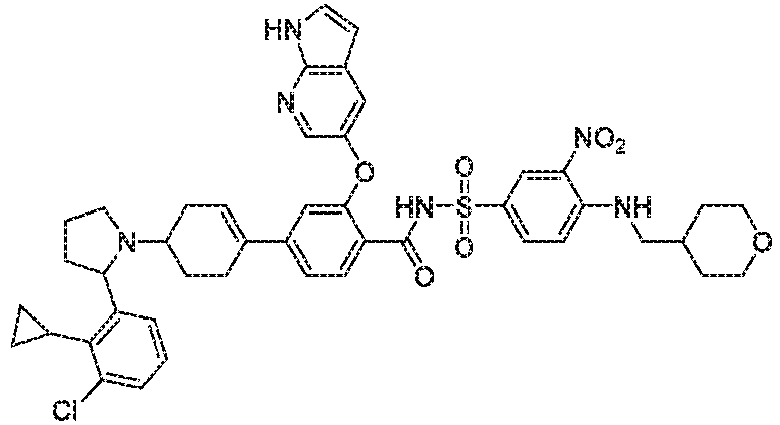
- The desired compound was synthesized with 2-(3-chloro-2-cyclopropylphenyl) pyrrolidine and methyl 3-((1H-pyrrolo[2,3-b]pyridin-5-yl)oxy)-4'-oxo-2',3',4',5'-tetrahydro- [1,1'-biphenyl] -4-carboxylate following the next procedures similar to those in Example C1. 1H NMR (400 MHz, DMSO-d6 ) δ 12.25 (s, 1H), 11.70 (s, 1H), 8.65 - 8.45 (m, 2H), 7.99 (s, 1H), 7.79 (d, J = 8.7 Hz, 1H), 7.60 - 7.40 (m, 4H), 7.38 - 7.25(m, 1H),7.20 - 7.00 (m, 3H), 6.72 (s, 1H), 6.38 (s, 1H), 5.98 (s, 0.5H), 5.90 - 5.75 (m, 0.5H), 4.60 - 4.45(m, 1H), 3.84 (dd, J = 11.1, 2.8 Hz, 2H), 3.76 - 3.56 (m, 2H), 3.30 - 3.20 (m, 5H), 2.65 - 2.55 (m, 1H), 2.44 - 1.98 (m, 6H), 1.95 - 1.65 (m, 4H), 1.59 (d, J = 12.4 Hz, 2H), 1.31 - 1.15 (m, 3H), 1.12 - 1.05 (m, 2H), 0.70 - 0.60 (m, 1H), 0.55 - 0.45(m, 1H). MS (ESI, m/e) [M+1]+ 850.8.
-

- The desired compound was synthesized with 2-(2-cyclopropyl-3-fluorophenyl) pyrrolidine and methyl 3-((1H-pyrrolo[2,3-b]pyridin-5-yl)oxy)-4'-oxo-2',3',4',5'-tetrahydro- [1,1'-biphenyl]-4-carboxylate following the next procedures similar to those in Example C1. 1H NMR (DMSO-d 6) δ 12.22 (s, 1H), 11.59 (s, 1H), 8.52 - 8.32 (m, 2H), 7.94 (s, 1H), 7.69 (s, 1H), 7.53 - 7.28 (m, 4H), 7.18 - 7.02 (m, 2H), 6.92 - 6.67 (m, 3H), 6.33 (s, 1H), 6.00 - 5.71 (m, 1H), 4.36 (s, 1H), 3.93 - 3.73 (m, 2H), 3.30 - 2.85 (m, 7H) 2.30 - 2.13 (m, 3H), 2.05 - 1.79 (m, 4H), 1.77 - 1.53 (m, 5H), 1.49 - 1.37 (m, 2H), 1.02 - 0.91 (m, 2H), 0.89 - 0.81 (m, 2H), 0.77 - 0.67 (m, 1H), 0.62 - 0.48 (m, 1H). MS (ESI) m/e [M+1]+ 834.8.
-

- The desired compound was synthesized with 2-(2-cyclopropyl-4-fluorophenyl) pyrrolidine and methyl 3-((1H-pyrrolo[2,3-b]pyridin-5-yl)oxy)-4'-oxo-2',3',4',5'-tetrahydro- [1,1'-biphenyl]-4-carboxylate following the next procedures similar to those in Example C1. 1H NMR (400 MHz, DMSO-d6 ) δ 12.22 (s, 1H), 11.65 (s, 1H), 8.60 - 8.40 (m, 2H), 7.97 (d, J = 2.2 Hz, 1H), 7.75 (d, J = 8.3 Hz, 1H), 7.65 - 7.55 (m, 1H), 7.50 - 7.40 (m, 3H), 7.12 (d, J = 8.3 Hz, 1H), 7.05 - 6.95 (m, 1H), 6.96 - 6.80 (m, 1H), 6.80 - 6.65 (m, 2H), 6.38 - 6.32(m, 1H), 6.00 (s, 0.5H), 5.87 (s, 0.5H), 4.40 - 4.05 (m, 1H), 3.84 (dd, J = 11.4, 3.0 Hz, 2H), 3.30 - 3.15 (m, 5H), 2.40 - 3.15(m, 5H), 2.05 - 1.95 (m, 3H), 1.90 - 1.80 (m, 2H), 1.78 - 1.65 (m, 2H), 1.59 (d, J = 11.3 Hz, 2H), 1.53 - 1.33 (m, 2H), 1.30 - 1.15 (m, 2H), 0.95 - 0.85 (m, 2H), 0.75 - 0.65 (m, 1H), 0.63 - 0.52 (m, 1H). MS (ESI, m/e) [M+1]+ 834.8
-

- The desired compound was synthesized with 2-(2-cyclopropyl-5-fluorophenyl) pyrrolidine and methyl 3-((1H-pyrrolo[2,3-b]pyridin-5-yl)oxy)-4'-oxo-2',3',4',5'-tetrahydro- [1,1'-biphenyl]-4-carboxylate following the next procedures similar to those in Example C1. 1H NMR (400 MHz, DMSO-d6 ) δ 12.23 (s, 1H), 11.67 (s, 1H), 8.60 - 8.45 (m, 2H), 7.98 (s, 1H), 7.77 (d, J = 8.4 Hz, 1H), 7.59 - 7.41 (m, 3H), 7.39 - 7.21 (m, 1H), 7.18 - 6.77 (m, 4H), 6.73 (s, 1H), 6.37 (s, 1H), 6.01 (s, 0.5H), 5.85 (s, 0.5H), 4.40 - 4.20 (m, 1H), 3.84 (d, J = 8.3 Hz, 2H), 3.30 - 3.15 (m, 5H), 2.40 - 2.15 (m, 3H), 2.06 - 1.82 (m, 4H), 1.80 - 1.65 (m, 2H), 1.59 (d, J = 12.1 Hz, 3H), 1.50 - 1.35 (m, 1H), 1.33 - 1.14 (m, 5H), 0.95 - 0.79 (m, 2H), 0.70 - 0.60 (m, 1H), 0.55 - 0.45 (m, 1H). MS (ESI, m/e) [M+1]+ 834.8.
-
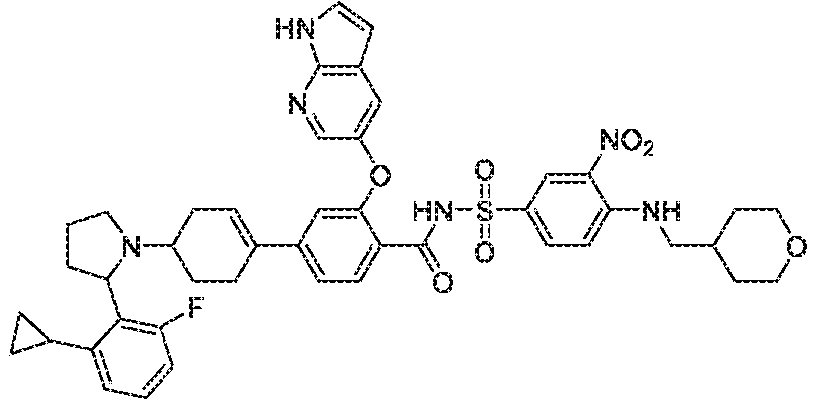
- The desired compound was synthesized with 2-(2-cyclopropyl-6-fluorophenyl) pyrrolidine and methyl 3-((1H-pyrrolo[2,3-b]pyridin-5-yl)oxy)-4'-oxo-2',3',4',5'-tetrahydro- [1,1'-biphenyl] -4-carboxylate following the next procedures similar to those in Example C1. 1H NMR (400 MHz, DMSO-d6 ) δ ppm: 12.25 (s, 1H), 11.68 (s, 1H), 8.60 - 8.45 (m, 2H), 7.98 (s, 1H), 7.85 - 7.70 (m, 1H), 7.55 - 7.30 (m, 3H), 7.20 - 6.50 (m, 6H), 6.37 (s, 1H), 6.10 - 5.79 (m, 1H), 4.50 - 4.20 (m, 1H), 3.84 (dd, J = 11.1, 2.7 Hz, 2H), 3.74 - 3.42 (m, 2H), 3.30 - 3.20 (m, 5H), 2.40 - 1.65 (m, 10H), 1.59 (d, J = 12.3 Hz, 2H), 1.35 - 1.10 (m, 3H), 1.05 - 0.65 (m, 4H), 0.60 - 0.45 (m, 1H). MS (ESI) m/e [M+1]+ 834.8.
-
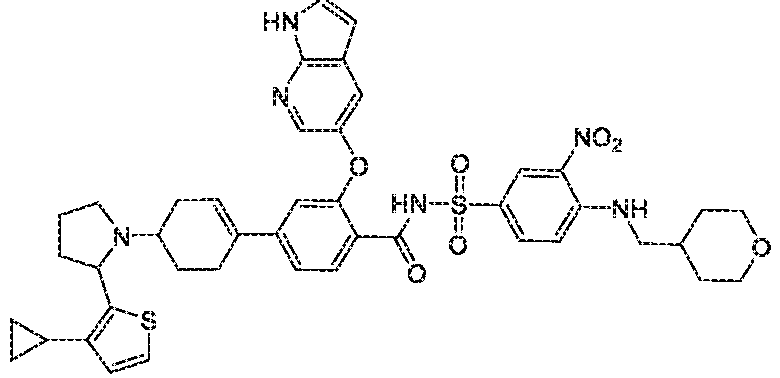
- The desired compound was synthesized with 2-(3-cyclopropylthiophen-2-yl)pyrrolidine and methyl 3-((1H-pyrrolo[2,3-b]pyridin-5-yl)oxy)-4'-oxo-2',3',4',5'-tetrahydro-[1,1'-biphenyl] -4-carboxylate following the next procedures similar to those in Example C1. 1H NMR (400 MHz, DMSO-d6 ) δ ppm: 12.23 (s, 0.5H), 11.67 (s, 1H), 9.55 (s, 0.5H), 8.51 (s, 2H), 7.99 (s, 1H), 7.77 (s, 1H), 7.50-7.46 (m, 3H), 7.21 - 6.96 (m, 3H), 6.75 (s, 1H), 6.50 (s, 1H), 6.37 (s, 1H), 6.03 (s, 0.5H), 5.94 (s, 0.5H), 4.41-4.28 (m, 1H), 3.91-3.72 (m, 2H), 3.49 - 3.41 (m, 1H), 3.29 - 3.18 (m, 6H), 3.08 - 2.91 (m, 2H), 2.31-2.19 (m, 4H), 1.89-1.71 (m, 3H), 1.69-1.59 (m, 3H), 1.32 - 1.15 (m, 3H), 0.95-0.78 (m, 3H), 0.54 (s, 2H). MS (ESI, m/c) [M+1]+ 822.7.
-

- The desired compound was synthesized starting from 2-cyclohexylpyrrolidine and methyl 3-((1H-pyrrolo[2,3-b]pyridin-5-yl)oxy)-4'-oxo-2',3',4',5'-tetrahydro-[1,1'-biphenyl]-4-carboxylate following the next procedures similar to those in Example C1. 1H NMR(400 MHz, DMSO-d6 ) δ ppm: 11.60 (s, 1H), 8.96 (s, 1H), 8.42 (s, 1H), 8.37 (s, 1H), 7.96 (s, 1H), 7.69 (d, J = 8.8 Hz, 1H), 7.47 (d, J = 7.2 Hz, 1H), 7.45 (s, 1H), 7.39 (s, 1H), 7.13 (d, J = 7.2 Hz, 1H), 6.88 (d, J = 8.8 Hz, 1H), 6.76 (s, 1H), 6.34 (s, 1H), 6.00 (s, 1H), 3.84 (d, J = 8.4 Hz, 2H), 3.48-3.39 (m, 2H), 3.30-3.16 (m, 6H), 2.44-2.28 (m, 2H), 2.22-2.09 (m, 1H), 2.02-1.93 (m, 1H), 1.88-1.78 (m, 3H), 1.76-1.66 (m, 3H), 1.66-1.53 (m, 4H), 1.31-1.13 (m, 6H), 1.13-0.91 (m, 3H). MS (ESI, m/e) [M+1]+ 783.2.
-
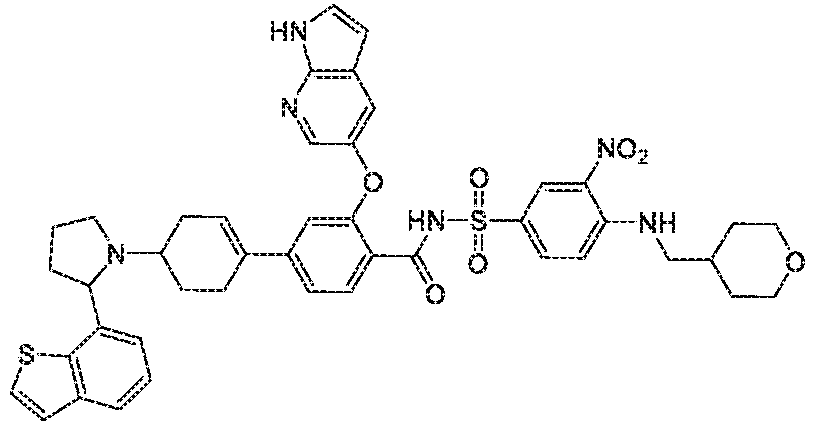
- The desired compound was synthesized with 2-(benzo[b]thiophen-7-yl)pyrrolidine and methyl 3-((1H-pyrrolo[2,3-b]pyridin-5-yl)oxy)-4'-oxo-2',3',4',5'-tetrahydro- [1,1 -biphenyl] -4-carboxylate following the next procedures similar to those in Example C1. 1H NMR (400 MHz, DMSO-d6 ) δ 12.20 (s, 1H), 11.69 (s, 1H), 8.64 - 8.33 (m, 2H), 7.97 (s, 1H), 7.77 (s, 1H), 7.72 - 7.58 (m, 2H), 7.59 - 7.45 (m, 2H), 7.45 - 7.40 (m, 2H), 7.30 - 7.14 (m, 2H), 7.18 - 7.03 (m, 2H), 6.68 (d, J = 10.1 Hz, 1H), 6.36 (s, 1H), 6.03 - 5.78 (m, 1H), 4.20 - 4.07 (m, 1H), 3.88 - 3.80 (m, 2H), 3.30 - 3.17 (m, 4H), 3.09 - 2.88 (m, 4H), 2.28 - 2.09 (m, 3H), 2.05 - 1.94 (m, 3H), 1.90 - 1.73 (m, 3H), 1.69 - 1.54 (m, 3H), 1.49 - 1.39 (m, 2H). MS (ESI) m/e [M+1]+ 832.7.
-
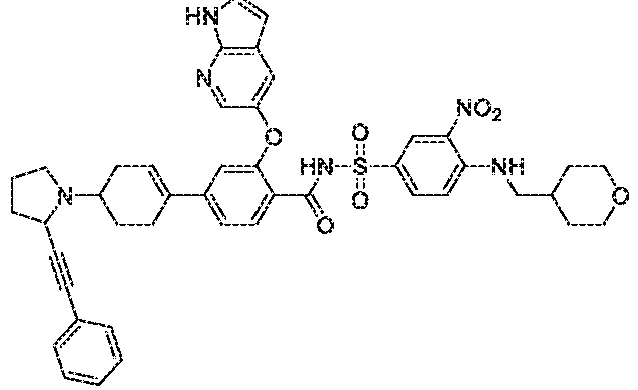
- The desired compound was synthesized with 2-(phenylethynyl)pyrrolidine and 3-((1H-pyrrolo[2,3-b]pyridin-5-yl)oxy)-N-((3-nitro-4-(((tetrahydro-2H-pyran-4-yl) methyl) amino)phenyl)sulfonyl)-4'-axo-2',3',4',5'-tetrahydro-[1,1'-biphenyl]-4-carboxamide following the procedure similar to those in Example C12. 1H NMR (400 MHz, DMSO-d6 ) δ 12.06 (s, 1H), 11.69 (s, 1H), 8.56 - 8.53 (m, 2H), 8.01 (d,J = 2.2 Hz, 1H), 7.78 (d, J = 8.8 Hz, 1H), 7.56 - 7.32 (m, 8H), 7.22 (d, J = 8.1 Hz, 1H), 7.07 (d, J = 8.8 Hz, 1H), 6.80 (d, J = 3.8 Hz, 1H), 6.38 (s, 1H), 6.07 (s, 1H), 3.90 - 3.80 (m, 2H), 3.35 - 3.23 (m, 5H), 3.05 - 2.95 (m, 1H), 2.41 - 2.23 (m, 2H), 2.24 - 1.95 (m, 5H), 1.90 - 1.75 (m, 2H), 1.65 - 1.55 (m, 2H), 1.35 - 1.25 (m, 6H). MS (ESI, m/e) [M+1]+ 800.8.
-

- 3-((1H-pyrrolo[2,3-b]pyridin-5-yl)oxy)-N-((3-nitro-4-(((tetrahydro-2H-pyran-4-yl)mcthyl)amino)phenyl)sulfonyl)-4'-(2-(2-(N-Boc-pipcridin-4-yl)phcnyl)pyrrolidin-1-yl)-2',3',4',5'-letrahydro-[1,1'-biphenyl]-4-carbaxamide was synthesized with tert-butyl 4-(2-(pyrrolidin-2-yl)phenyl)piperidine-1-carboxylate and 3-((1H-pyrrolo[2,3-b]pyridin-5-yl)oxy)-N-((3-nitro-4-(((tetrahydro-2H-pyran-4-yl) methyl) amino)phenyl)sulfonyl)-4'-oxo-2',3',4',5'-tetrahydro-[1,1'-biphenyl]-4-carboxamide following the procedure similar to those in Example C12. Then after deprotection with TFA, the desired compound was obtained. 1H NMR ( 400 MHz, DMSO-d 6 ) δ ppm: 11.54 ( s, 1H ), 8.38 - 8.36 ( m, 1H ), 8.35 - 8.30 ( m, 1H), 7.92 - 7.88 ( m, 1H), 7.68 - 7.60 ( m, 1H), 7.59 - 7.49 ( m, 1H), 7.49 - 7.38 ( m, 2H ), 7.35 - 7.25 ( m, 1H), 7.21 - 6.96 (m, 4H), 6.85 - 6.75 (m, 1H ), 6.72 - 6.68 ( m, 1H), 6.29 (s, 1H ), 5.98 ( s, 0.5H ), 5.80 ( s, 0.5H ), 4.10 - 4.00 ( m, 1H ), 3.85 - 3.72 ( m, 2H ), 3.29 - 3.17 ( m, 5H ), 3.15 - 2.90 ( m, 6H ), 2.80 - 2.65 ( m, 2H ), 2.30 - 2.10 ( m, 4H ), 2.05 - 1.80 ( m, 2H), 1.79 - 1.46 ( m, 9H), 1.40 - 1.30 (m, 2H), 1.25 - 1.10 (m, 2H). MS (ESI, m/e) [M+1]+ 859.8.
-
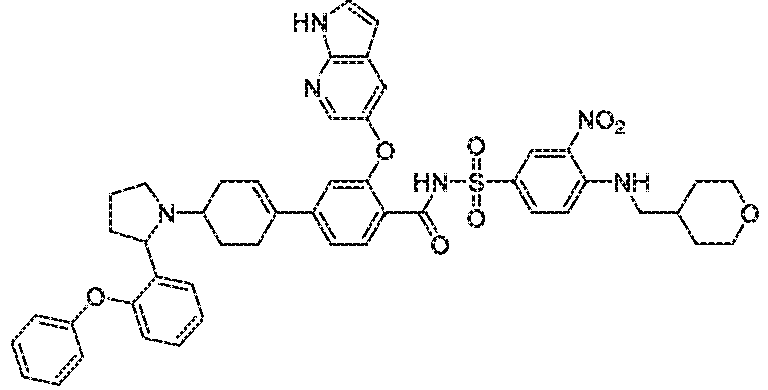
- The desired compound was synthesized with 2-(2-phenoxyphenyl)pyrrolidine and 3-((1H-pyrrolo[2,3-b]pyridin-5-yl)oxy)-N-((3-nitro-4-(((tetrahydro-2H-pyran-4-yl) methyl) amino)phenyl)sulfonyl)-4'-axo-2',3',4',5'-tetrahydro-[1,1'-biphenyl]-4-carboxamide following the procedure similar to those in Example C12. 1H NMR (400 MHz, DMSO-d6 ) δ 12.20 (s, 1H), 11.71 (s, 1H), 8.60 - 8.40 (m, 2H), 8.30 - 8.10 (m, 1H), 7.98 (s, 1H), 7.78 (d, J = 7.6 Hz, 1H), 7.60 - 7.45 (m, 2H), 7.47 - 7.35 (m, 2H), 7.35 - 7.18 (m, 4H), 7.10 - 6.85(m, 6H), 6.57 (s, 1H), 6.39 (s, 1H), 4.95 - 4.75 (m, 1H), 3.84 (d, J = 8.6 Hz, 2H), 3.30 - 3.20 (m, 5H), 2.40 - 2.25 (m, 2H), 2.20 - 2.00 (m, 3H), 1.95 - 1.77 (m, 2H), 1.76 - 1.52 (m, 4H), 1.50 - 1.30 (m, 2H), 1.28 - 1.05 (m, 4H). MS (ESI, m/e) [M+1]+ 868.8.
-

- The desired compound was synthesized with 2-(2-cyclopropyl-5-methoxyphenyl)pyrrolidine and methyl 3-((1H-pyrrolo[2,3-b]pyridin-5-yl)oxy)-4'-oxo-2',3',4',5'-tetrahydro- [1,1'-biphenyl] -4- carboxylate following the next procedures similar to those in Example C1. 1H NMR(400 MHz, DMSO-d6) δ ppm: 12.25 (s, 1H), 11.62 (s, 1H), 8.57-8.35 (m, 1H), 7.95 (s, 1H), 7.79-7.67 (m, 1H), 7.53-7.34 (m, 3H), 7.18-7.05 (m, 2H), 7.03-6.81 (m, 2H), 6.75 (s, 1H), 6.66-6.53 (m,1H), 6.34 (s, 1H), 6.05-5.76 (m, 1H), 4.36-4.20 (m, 1H), 3.87-3.80 (m, 2H), 3.77-3.57 (m, 4H), 3.31-3.18 (m, 6H), 2.25-2.15 (m, 2H), 1.95-1.81 (m, 3H), 1.76-1.65 (m, 2H), 1.65-1.54 (m, 3H), 1.30-1.22 (m, 5H), 0.89-0.74 (m, 4H), 0.67-0.41 (m, 2H). MS (ESI, m/e) [M+1]+ 857.8.
-

- The desired compound was synthesized with 2-(2-cyclopropylphenyl)-2,5-dihydro-1H-pyrrole and methyl 3-((1H-pyrrolo[2,3-b]pyridin-5-yl)oxy)-4'-oxo-2',3',4',5'-tetrahydro- [1,1'-biphenyl] -4- carboxylate following the next procedures similar to those in Example C1. 1H NMR (400 MHz, DMSO-d6 ) δ ppm: 12.22 (s, 1H), 11.69 (s, 1H), 8.57-8.48 (m, 2H), 7.99 (s, 1H), 7.79 (s, 1H), 7.59 - 7.40 (m, 3H), 7.13-7.05 (m, 4H), 6.99-6.90 (m, 1H), 6.73-6.65 (m, 1H), 6.38 (s, 1H), 6.02 (s, 1H), 5.85 - 5.63 (m, 2H), 5.29 (s, 1H), 3.84 (d, J = 8.3 Hz, 2H), 3.61-3.51 (m, 1H), 3.31-3.11 (m, 5H), 2.99-2.91 (m, 2H), 2.21-2.08 (m, 3H), 1.96-1.76 (m, 2H), 1.59 (d, J = 12.1 Hz, 3H), 1.29 - 1.17 (m, 3H), 0.88 (s, 3H), 0.75-0.60 (m, 2H). MS (ESI, m/e) [M+1]+ 814.8.
-

- The desired compound was synthesized with 1-(2-cyclopropylphenyl)isoindoline and 3-((1H-pyrrolo[2,3-b]pyridin-5-yl)oxy)-N-((3-nitro-4-(((tetrahydro-2H-pyran-4-yl) methyl) amino)phenyl)sulfonyl)-4'-axo-2',3',4',5'-tetrahydro-[1,1'-biphenyl]-4-carboxamide following the procedure similar to those in Example C12. MS (ESI, m/e) [M+1]+ 865.3.
-

- The desired compound was synthesized with 5-phenylpyrrolidin-3-ol and 3-((1H-pyrrolo[2,3-b]pyridin-5-yl)oxy)-N-((3-nitro-4-(((tetrahydro-2H-pyran-4-yl) methyl) amino)phenyl)sulfonyl)-4'-oxo-2',3',4',5'-tetrahydro-[1,1'-biphenyl]-4-carboxamide following the procedure similar to those in Example C12. 1H NMR (400 MHz, DMSO-d6 ) δ ppm: 12.22 (s, 1H), 11.64 (s, 1H), 8.47 - 8.42 (m, 2H), 7.96 (s, 1H), 7.73 - 7.72 (m, 1H), 7.65 - 7.62 (m, 1H), 7.47-7.20 (m, 7H), 7.11 - 7.10 (m, 1H), 6.98 - 6.94 (m, 1H), 6.71 (s, 1H), 6.35 (s, 1H), 5.76 (s, 0.5H), 5.31 (s, 0.5H), 4.75 - 4.73 (m, 1H), 4.23 - 4.21 (m, 1H), 3.85 (d, J=8.0 Hz, 2H), 3.22 - 3.09 (m, 4H), 3.00 - 2.95 (m, 2H), 2.33 - 1.85 (m, 8H), 1.61 (d, J=12.0 Hz, 2H), 1.47 - 1.23 (m, 4H) MS (ESI, m/e) [M+1]+ 792.8.
-

- The desired compounds were synthesized with 2-(2-cyclopropylphenyl)-4-methoxypyrrolidine and 3-((1 H-pyrrolo[2,3-b]pyridin-5-yl)oxy)-N-((3-nitro-4-(((tetrahydro-2H-pyran-4-yl) methyl) amino)phenyl)sulfonyl)-4'-oxo-2',3',4',5'-tetrahydru-[1,1'-biphenyl]-4-carboxamide following the procedure similar to those in Example C12. After purification with prep-HPLC, faster peak C88a was obtained, 1H NMR(400 MHz, DMSO-d6) δ ppm: 12.24 (br, 1H), 11.67 (s, 1H), 8.59 - 8.48 (m, 2H), 7.97 (s, 1H), 7.81 - 7.73 (m, 1H), 7.59 - 7.41 (m, 4H), 7.23 - 6.86 (m, 5H), 6.72 (s, 1H), 6.36 (s, 1H), 5.99 (s, 0.5H), 5.84 (s, 0.5H). 4.34 - 4.19 (m, 1H), 3.85 (d, J=8.8 Hz, 2H), 3.25 - 3.11 (m, 10H), 2.68 - 2.60 (m, 1H), 2.29 - 2.11 (m, 3H), 2.09 - 1.95 (m, 4H), 1.92 - 1.69 (m, 3H), 1.61 (d, J= 12.4 Hz, 2H), 1.55 - 1.33(m, 2H), 0.95 - 0.84 (m, 2H), 0.68 - 0.45 (m, 2H). MS (ESI, m/e) [M+1]' 846.8; slower peak C88b, 1H NMR(400 MHz, DMSO-d6) δ ppm: 12.22 (br, 1H), 11.65 (s, 1H), 8.59 - 8.41 (m, 2H), 7.96 (s, 1H), 7.80 - 7.69 (m, 1H), 7.57 - 7.40 (m, 4H), 7.20 - 6.92 (m, 5H), 6.72 (s, 1H), 6.35 (s, 1H), 6.00 (s, 0.5H), 5.84 (s, 0.5H), 4.55 - 4.41 (m, 1H), 3.95 - 3.87 (m, 1H), 3.84 (d, J=8.8 Hz, 2H), 3.47 - 3.35 (m, 1H), 3.25 - 3.16 (m, 8H), 2.67 - 2.51 (m, 2H), 2.29 - 2.11 (m, 4H), 2.09 - 1.95 (m, 3H), 1.92 - 1.69 (m, 2H), 1.61 (d, J= 12.4 Hz, 2H), 1.55 - 1.33 (m, 2H), 0.95 - 0.84 (m, 2H), 0.68 - 0.45 (m, 2H). MS (ESI, m/e) [M+1]+ 846.8.
-

- The desired compound was synthesized with 2-(2-cyclopropylphenyl)-4-fluoropyrro lidine and methyl 3-((1H-pyrrolo[2,3-b]pyridin-5-yl)oxy)-4'-oxo-2',3',4',5'-tetrahydro - [1,1'-biphenyl] -4-carboxylate following the next procedures similar to those in Example C1. 1H NMR (400 MHz, DMSO-d6 ) δ 12.23 (s, 1H), 11.70 (s, 1H), 8.65 - 8.50 (m, 2H), 8.05 - 7.95 (m, 1H), 7.80 (d, J = 8.7 Hz, 1H), 7.67 - 7.38 (m, 4H), 7.19 - 7.02 (m, 3H), 7.02 - 6.95 (m, 1H), 6.95 - 6.85 (m, 1H), 6.71 (d, J = 4.4 Hz, 1H), 6.38 (s, 1H), 6.01 (s, 0.5H), 5.81 (s, 0.5H), 5.26 (s, 0.5H), 5.12 (s, 0.5H), 4.39 - 4.22 (m, 1H), 3.84 (dd, J = 11.1, 2.7 Hz, 2H), 3.30 - 3.15 (m, 5H), 2.80 - 2.60 (m, 2H), 2.37 - 1.79 (m, 8H), 1.70 - 1.50 (m, 4H), 1.50 - 1.35 (m, 1H), 1.30 - 1.15 (m, 3H), 0.95 - 0.80 (m, 2H), 0.70 - 0.60 (m, 1H), 0.55 - 0.45 (m, 1H). MS (ESI) m/e [M+1]+ 834.8.
-
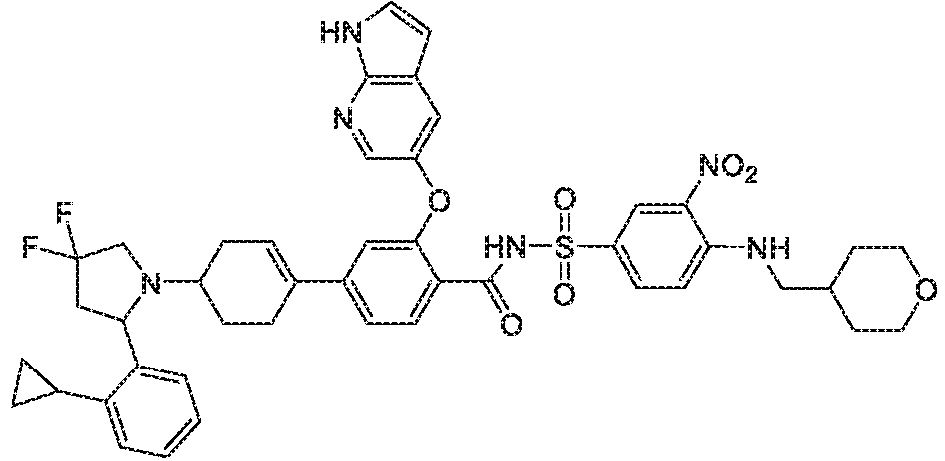
- The desired compound was synthesized with 2-(2-cyclopropylphenyl)-4,4-difluoropyrrolidine and methyl 3-((1H-pyrrolo[2,3-b]pyridin-5-yl)oxy)-4'-oxo-2',3',4',5'-tetrahydro- [1,1'-biphenyl] -4-carboxylate following the next procedures similar to those in Example C1. 1H NMR (400 MHz, CDCl3) δ 10.28 (s, 1H), 9.42 (s, 1H), 8.94 - 8.88 (m, 1H), 8.56 - 8.50 (m, 1H), 8.20 - 8.15 (m, 2H), 8.02 (d, J = 8.4 Hz, 1H), 7.68 (s, 1H), 7.65 - 7.53 (m, 1H), 7.47 (s, 1H), 7.20 - 7.10 (m, 2H), 7.08 - 7.04 (m, 1H), 6.98 (d, J = 7.2 Hz, 1H), 6.92 (d, J = 8.4 Hz, 1H), 6.61 (s, 1H), 6.55 (s, 1H), 5.92 (s, 0.5H), 5.83 (s, 0.5H), 4.75 - 4.55 (m, 1H), 4.02 (d, J = 11.4 Hz, 2H), 3.55 - 3.35 (m, 3H), 3.30 - 3.20 (m, 2H), 2.80 - 2.55 (m, 2H), 2.22 - 1.80 (m, 8H), 1.75 - 1.55 (m, 4H), 1.50 - 1.35 (m, 2H), 1.00 - 0.80 (m, 2H), 0.70 - 0.62 (m, 1H), 0.60 - 0.50 (m, 1H). MS (ESI) m/e [M+1]' 852.8.
-
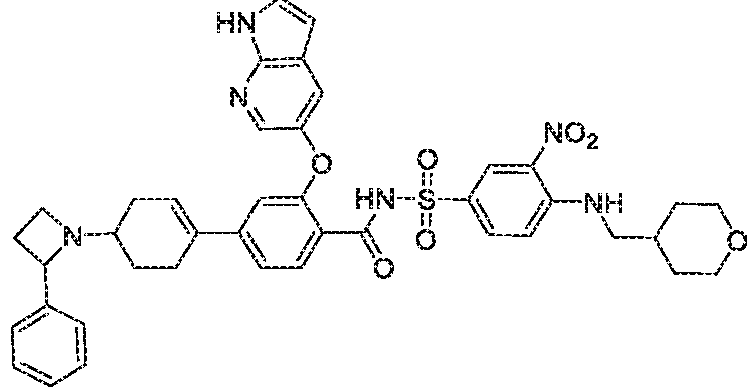
- The desired compound was synthesized with 2-phenylazetidine and 3-((1H-pyrrolo[2,3-b]pyridin-5-yl)oxy)-N-((3-nitro-4-(((tetrahydro-2H-pyran-4-yl)niethyl)amino)phenyl)sulfonyl)-4'-oxo-2',3',4',5'-tetrahydro-[1,1'-biphenyl]4-carboxamide following the procedure similar to those in Example C12. 1H NMR (400 MHz, DMSO-d6 ) δ ppm: 9.82 (s, 1H), 8.92 (s, 1H), 8.61-8.45 (m, 1H), 8.19-8.13 (m, 1H), 8.10-7.94 (m, 2H), 7.77-7.30 (m, 7H), 7.15-6.82 (m, 3H), 6.62-6.47 (m, 2H), 5.86-5.54 (m, 1H), 4.08-3.96 (m, 2H), 3.49 (s, 1H), 3.45-3.38 (m, 2H), 3.29-3.23 (m, 2H), 2.54-2.42 (m, 1H), 2.33-2.22 (m, 1H), 2.14-1.82 (m, 5H), 1.78-1.60 (m, 4H), 1.51-1.36 (m, 3H), 1.33-1.16 (m, 2H). MS (ESI) m/e [M+1]+ 763.2.
-

- The desired compound was synthesized with 2-(2-cyclopropylbenzyl)pyrrolidine and 3-((1H-pyrrolo[2,3-b]pyridin-5-yl)oxy)-N-((3-nitro-4-(((tetrahydro-2H-pyran-4-yl)methyl)amino)phenyl)sulfonyl)-4'-oxo-2',3',4',5'-tetrahydro-[1,1'-biphenyl]-4-carboxamide following the procedure similar to those in Example C12. 1H NMR (400 MHz, DMSO-d6 ) δ ppm: 12.28 (s, 1H), 11.73 (s, 1H), 8.59-8.55 (m, 2H), 8.03 (s, 1H), 7.82 (d, J = 8.3 Hz, 1H), 7.58-7.52 (m, 3H), 7.22 - 7.13 (m, 5H), 6.96 (d, J = 6.2 Hz, 1H), 6.76 (t, J = 11.4 Hz, 1H), 6.41 (s, 1H), 6.04 (s, 1H), 3.85 (d, J = 8.7 Hz, 2H), 3.64 (s, 1H), 3.30 - 3.21 (m, 5H), 3.06-2.95 (m, 3H), 2.43 (s, 2H), 2.24 (s, 1H), 2.00 (dd, J = 14.2, 6.8 Hz, 3H), 1.92 - 1.82 (m, 3H), 1.70 (s, 1H), 1.60 (d, J = 12.3 Hz, 2H), 1.45 (s, 1H), 0.92-0.84 (m, 4H), 0.63 (s, 2H). MS (ESI, m/e) [M+1]+ 830.8.
-
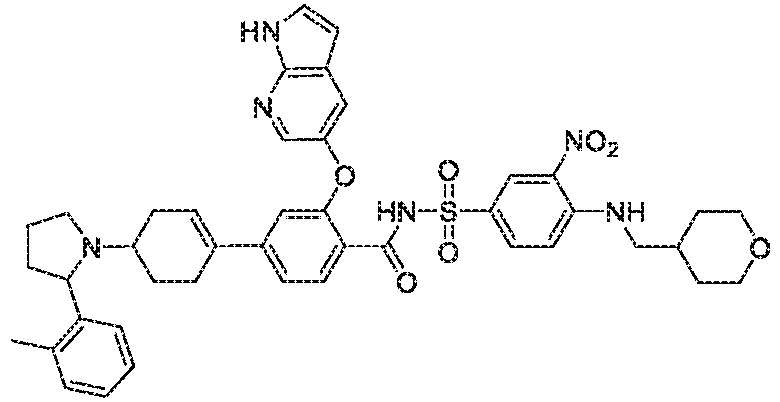
- The desired compound was synthesized with 2-(o-tolyl)pyrrolidine and 3-((1H-pyrrolo[2,3-b]pyridin-5-yl)oxy)-N-((3-nitro-4-(((tetrahydro-2H-pyran-4-yl)niethyl)amino)phenyl)sulfonyl)-4'-oxo-2',3',4',5'-tetrahydro-[1,1'-biphenyl]4-carboxamide following the procedure similar to those in Example C12. 1H NMR (400 MHz, DMSO-d6 ) δ ppm: 12.28 (s, 1H), 11.72 (s, 1H), 8.65-8.51 (m, 2H), 8.00 (d, J = 2.2 Hz, 1H), 7.81 (dd, J = 8.0 Hz, 2.2 Hz, 1H), 7.64-7.60 (m, 1H), 7.56-7.51 (m, 2H), 7.48 (d, J = 8.0 Hz, 1H), 7.28 - 7.25 (m, 3H), 7.20-7.07 (m, 2H), 6.73 (d, J = 8.0 Hz, 1H), 6.43-6.34 (m, 1H), 5.97-5.86 (m, 1H), 4.88-4.73 (m, 1H), 3.84 (d, J= 8.4 Hz, 2H), 3.30-3.21 (m, 6H), 2.54 (s, 2H), 2.35 (s, 3H), 2.30 (s, 2H), 2.33-2.23 (m, 2H), 2.15-2.05 (m, 1H), 1.92-1.78 (m, 2H), 1.63-1.55 (m, 2H), 1.30-1.21 (m, 5H). MS (ESI, m/e) [M+1]+ 791.2.
-
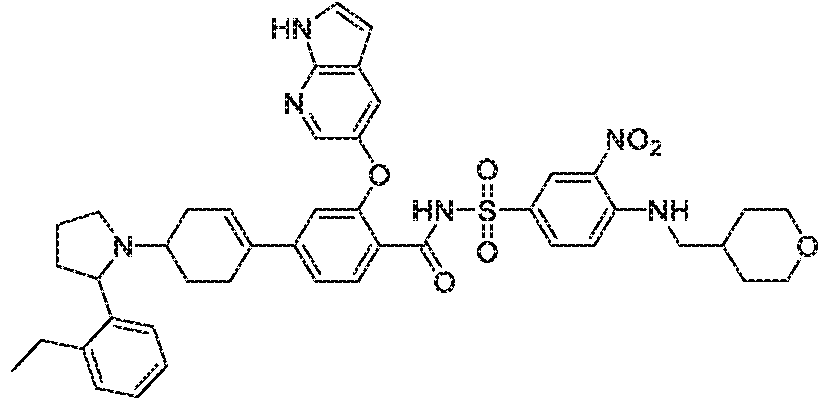
- The desired compound was synthesized starting from 2-(2-ethylphenyl)pyrrolidine and methyl 3-((1H-pyrrolo[2,3-b]pyridin-5-yl)oxy)-4'-oxo-2',3',4',5'-tetrahydro-[1,1'-biphenyl]-4-carboxylate following the next procedures similar to those in Example C1. 1H NMR (400 MHz, DMSO-d6 ) δ ppm: 12.25 (br, 1H), 11.67 (s, 1H), 8.51 (s, 2H), 7.98 (s, 1H), 7.87-7.60 (m, 2H), 7.55-7.42 (m, 3H), 7.31-6.94 (m, 5H), 6.74 (s, 1H), 6.36 (s, 1H), 5.97-5.81 (m, 1H), 3.36 (s, 1H), 6.03-5.77 (m, 1H), 3.94-3.78 (m, 2H), 3.30-3.15 (m, 6H), 2.72-2.60 (m, 2H), 2.45-1.78 (m, 8H), 1.70-1.47 (m, 4H), 1.32-1.04 (m, 6H). MS (ESI) m/e [M+1]+ 763.2. MS (ESI) m/e [M+1]+ 805.2
-
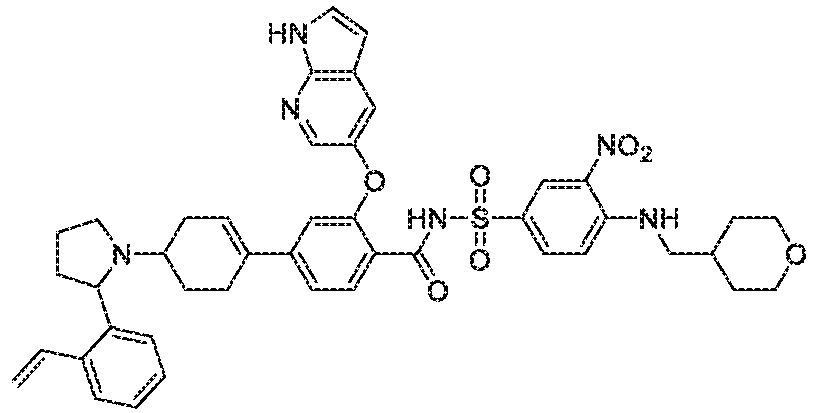
- The desired compound was synthesized with 2-(2-vinylphenyl)pyrrolidine and 3-((1H-pyrrolo[2,3-b]pyridin-5-yl)oxy)-N-((3-nitro-4-(((tetrahydro-2H-pyran-4-yl)methyl)amino)phenyl)sulfonyl)-4'-oxo-2',3',4',5'-tetrahydro-[1,1'-biphenyl]-4-carboxamide following the procedure similar to those in Example C12. 1H NMR (400 MHz, DMSO-d6 ) δ ppm: 12.21 (s, 1H), 11.66 (s, 1H), 8.49 (s, 2H), 7.97 (s, 1H), 7.76 (s, 1H), 7.61-7.34 (m, 5H), 7.27-6.86 (m, 5H), 6.71 (s, 1H), 6.36 (s, 1H), 5.97-5.81 (m, 1H), 5.64 (br, 1H), 5.29 (s, 1H), 3.84 (d, J = 8.4 Hz, 2H), 3.28-3.22 (m, 3H), 3.08-2.82 (m, 1H), 2.29-2.07(m, 6H), 1.88-1.79 (m, 2H), 1.70 (s, 1H), 1.60-1.45 (m, 3H), 1.39 (s, 1H), 1.30-1.01 (m, 4H). MS (ESI, m/e) [M+1]+ 803.2.
-

- The desired compound was synthesized with 2-(2-chloro-4-fluorophenyl)pyrrolidine and 3-((1H-pyrrolo[2,3-b]pyridin-5-yl)oxy)-N-((3-nitro-4-(((tetrahydro-2H-pyran-4-yl)methyl)amino)phenyl)sulfonyl)-4'-oxo-2',3',4',5'-tetrahydro-[1,1'-biphenyl]-4-carboxamide following the procedure similar to those in Example C12. 1H NMR (400 MHz, DMSO-d6 ) δ ppm: 12.21 (s, 1H), 11.68 (s, 1H), 8.52 (s, 2H), 7.99 (s, 1H), 7.79 (s, 1H), 7.68-7.61 (m, 1H), 7.59-7.41 (m, 3H), 7.31 (s, 1H), 7.23-6.99 (m, 3H), 6.72 (s, 1H), 6.37 (s, 1H), 6.00-5.85 (m, 1H), 4.11 (s, 1H), 3.84 (d, J = 11.3 Hz, 2H), 3.30-3.22 (m, 5H), 2.99-2.90 (m, 3H), 2.19 (s, 3H), 1.88-1.82 (m, 2H), 1.70 (s, 2H), 1.59 (d, J = 12.6 Hz, 3H), 1.25-1.18 (m, 4H). MS (ESI, m/e) [M+1]+ 829.1
-

- The desired compound was synthesized with 2-(2-bromo-6-chlorophenyl)pyrrolidine and 3-((1H-pyrrolo[2,3-b]pyridin-5-yl)oxy)-N-((3-nitro-4-(((tetrahydro-2H-pyran-4-yl)methyl)amino)phenyl)sulfonyl)-4'-oxo-2',3',4',5'-tetrahydro-[1,1'-biphenyl]-4-carboxamide following the procedure similar to those in Example C12. 1H NMR (400 MHz, DMSO-d6 ) δ ppm: 12.24 (s, 1H), 11.71 (s, 1H), 8.54 (s, 2H), 8.00 (s, 1H), 7.80 (s, 1H), 7.68-7.23 (m, 5H), 7.25-6.98 (m, 3H), 6.75-6.63 (m, 1H), 6.38 (s, 1H), 6.01-5.67 (m, 1H), 4.51 (s, 1H), 3.84 (d,J = 7.8 Hz, 2H), 3.28-3.05 (m, 5H), 2.68-2.55 (s, 2H), 2.38-2.27 (m, 1H), 2.23-2.02 (m, 3H), 2.01-1.73 (m, 5H), 1.65-1.58 (m, 2H), 1.59-1.33 (m, 1H), 1.31-1.12 (m, 3H). MS (ESI, m/e) [M+1]+ 889.0, 891.0.
-
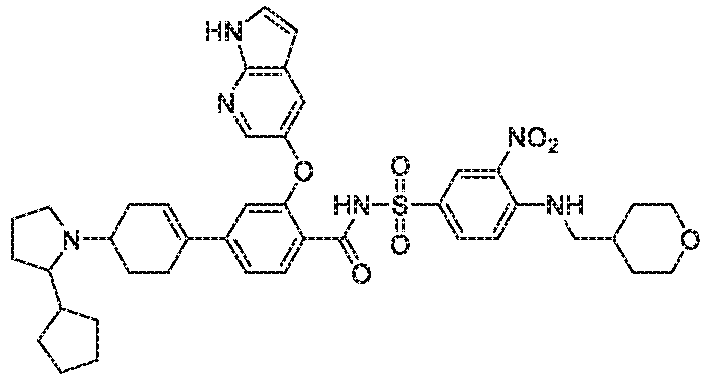
- The desired compound was synthesized with 2-cyclopentylpyrrolidine and 3-((1H-pyrrolo[2,3-b]pyridin-5-yl)oxy)-N-((3-nitro-4-(((tetrahydro-2H-pyran -4-yl)methyl)amino)phenyl)sulfonyl)-4'-oxo-2',3',4',5'-tetrahydro-[1,1'-biphenyl]-4-carbox amide following the procedure similar to those in Example C12. 1H NMR (400 MHz, DMSO-d6 ) δ ppm: 11.59 (s, 1H), 9.06 (s, 1H), 8.43 - 8.29 (m, 2H), 7.95 (s, 1H), 7.69 (d, J = 8.9 Hz, 1H), 7.51 (d, J = 8.0 Hz, 1H), 7.45 (s, 1H), 7.38 (s, 1H), 7.13 (d, J = 8.0 Hz, 1H), 6.87 (d, J = 8.9 Hz, 1H), 6.77 (s, 1H), 6.33 (s, 1H), 6.00 (s, 1H), 3.84 (d, J = 8.8 Hz, 2H), 3.65 - 3.55 (m, 1H), 3.30 - 3.15 (m, 6H), 2.48-2.40 (m, 1H), 2.41-2.32 (m, 1H), 2.08 - 1.95 (m, 3H), 1.95 - 1.78 (m, 4H), 1.78 - 1.70 (m, 3H), 1.69 - 1.65 (m, 4H),1.55 - 1.40 (m, 3H), 1.30 -1.15 (m, 6H).MS (ESI, m/e) [M+1]+ 768.8.
-

- The desired compound was synthesized with 2-(2-butylphenyl)pyrrolidine and methyl 3-((1H-pyrrolo[2,3-b]pyridin-5-yl)oxy)-4'-oxo-2',3',4',5'-tetrahydro-[1,1'-biphenyl] -4-carboxylate following the next procedures similar to those in Example C1. 1H NMR (400 MHz, DMSO-d6 ) δ 12.24 (s, 1H), 11.65 (s, 1H), 8.48 (s, 2H), 7.96 (s, 1H), 7.74 (s, 1H), 7.62 - 7.39 (m, 4H), 7.27 (s, 1H), 7.17 - 6.94 (m, 3H), 6.72 (s, 1H), 6.35 (s, 1H), 6.06 - 5.77 (m, 1H), 3.90 - 3.78 (m, 2H), 3.27 - 2.94 (m, 6H), 2.72 - 2.58 (m, 3H), 2.29 - 2.09 (m, 3H), 2.02 - 1.94 (m, 2H), 1.93 - 1.80 (m, 2H), 1.77 - 1.66 (m, 2H), 1.64 - 1.52 (m, 2H), 1.52 - 1.39 (m, 2H), 1.35 - 1.18 (m, 8H), 0.92 - 0.75 (m, 4H). MS (ESI) m/c [M+1]+ 832.9.
-

- The desired compound was synthesized with 2-(5-bromo-2-isopropoxyphenyl) pyrrolidine and 3-((1H-pyrrolo[2,3-b]pyridin-5-yl)oxy)-N-((3-nitro-4-(((tetrahydro-2H-pyran -4-yl)methyl)amino)phenyl)sulfonyl)-4'-oxo-2',3',4',5'-tetrahydro-[1,1'-biphenyl]-4-carbox amide following the procedure similar to those in Example C12. 1H NMR ( 400 MHz, DMSO-d6 ) δ 8.95 - 8.80 (m, 1H), 8.55 - 8.45 (m, 1H), 8.20 - 8.10 (m, 2H), 8.05 - 7.95 (m, 1H ), 7.75 - 7.60 (m, 2H ), 7.50 - 7.40 ( m, 1H ), 7.23 - 7.05 ( m, 2H ), 6.95 - 6.80 ( m, 1H ), 6.71 - 6.59 ( m, 2H), 6.55 - 6.45 ( m, 1H ), 5.97 (s, 0.5H ), 5.83 ( s, 0.5H ), 4.55 - 4.41 ( m, 1H ), 4.16 - 3.94 ( m, 3H ), 3.42 ( m, 2H ), 3.30 - 3.15 ( m, 3H ), 2.67 - 2.46 (m, 3H ), 2.32 - 2.13 ( m, 4H), 2.10 - 1.94 ( m, 3H), 1.55 - 1.40 (m, 4H), 1.31 - 1.24 ( m, 9H). MS (ESI, m/e) [M+1]+ 912.7 and 914.7.
-

- The desired compound was synthesized with 2-(m-tolyl)pyrrolidine and 3-((1H- pyrrolo[2,3-b]pyridin-5-yl)oxy)-N-((3-nitro-4-(((tetrahydro-2H-pyran-4-yl)methyl)amino)ph enyl)sulfonyl)-4'-oxo-2',3',4',5'-tetrahydro-[1,1'-biphenyl]-4-carboxamide following the procedure similar to those in Example C12. 1H NMR (400 MHz, DMSO-d6 ) δ 12.25 (s, 1H), 11.66 (s, 1H), 8.65 - 8.40 (m, 2H), 8.05 - 7.95 (m, 1H), 7.80 - 7.65 (m, 1H), 7.57 - 7.25 (m, 5H), 7.25 - 6.90 (m, 5H), 6.73 (s, 1H), 6.35 (s, 1H), 5.98 (s, 0.5H), 5.90 (s, 0.5H), 4.67 - 4.45 (m, 1H), 3.84 (d, J = 8.6 Hz, 2H), 3.65 - 3.65 (m, 1H), 3.30 - 3.22 (m, 4H), 3.20 - 1.85(m, 3H), 2.35 - 2.20 (m, 5H), 2.11 - 1.94 (m, 4H), 1.90 - 1.80 (m, 1H), 1.65 - 1.55 (m, 2H), 1.50 - 1.40 (m, 1H), 1.30 - 1.15 (m, 3H). MS (ESI, m/e) [M+1]+ 790.8.
-

- The desired compound was synthesized with 2-(3-isopropylphenyl)pyrrolidine and 3-((1H-pyrrolo[2,3-b]pyridin-5-yl)oxy)-N-((3-nitro-4-(((tetrahydro-2H-pyran-4-yl) methyl) amino)phenyl)sulfonyl)-4'-oxo-2',3',4',5'-tetrahydro-[1,1'-biphenyl]-4-carboxamide following the procedure similar to those in Example C12. 1H NMR (400 MHz, DMSO-d6 ) δ 11.92 (s, 1H), 11.57 (s, 1H), 8.45 - 8.30 (m, 2H), 7.92 (s, 1H), 7.70 - 7.60 (m, 1H), 7.50 - 7.40 (m, 2H), 7.38 - 7.25 (m, 2H), 7.24 - 6.97 (m, 4H), 6.90 - 6.80 (m, 1H), 6.72 (s, 1H), 6.31 (s, 1H), 5.98 (s, 0.5H), 5.86 (s, 0.5H), 3.83 (d, J = 8.0 Hz, 3H), 3.30 - 3.20 (m, 5H), 2.40 - 2.00 (m, 6H), 1.95 - 1.82 (s, 2H), 1.80 - 1.70 (m, 2H), 1.60 (d, J = 12.5 Hz, 3H), 1.50 - 1.40 (m, 2H), 1.31 - 1.08 (m, 9H). MS (ESI) m/e [M+1]+ 818.8.
-
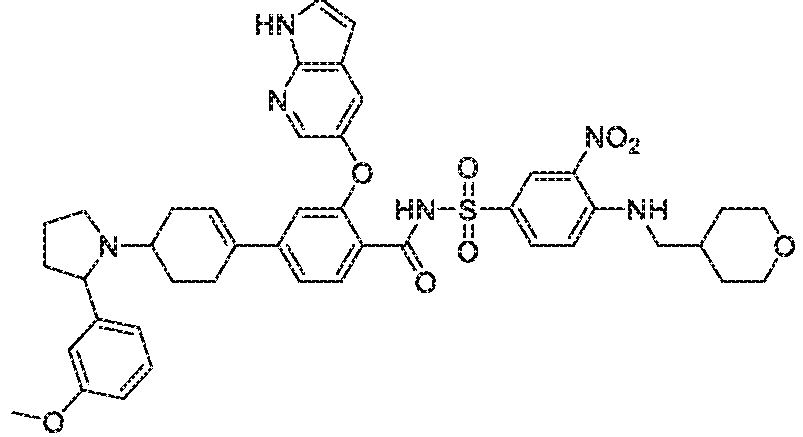
- The desired compound was synthesized with 2-(3-methoxyphenyl)pyrrolidine and methyl 3-((1H-pyrrolo[2,3-b]pyridin-5-yl)oxy)-4'-oxo-2',3',4',5'-tetrahydro-[1,1'-biphenyl] -4-carboxylate following the next procedures similar to those in Example C1. 1H NMR (400 MHz, DMSO-d6 ) δ 12.27 (s, 1H), 11.68 (s, 1H), 8.61 - 8.46 (m, 2H), 7.98 (s, 1H), 7.84 - 7.70 (m, 1H), 7.58 - 7.43 (m, 3H), 7.39 - 7.30 (m, 1H), 7.26 - 6.93 (m, 5H), 6.73 (s, 1H), 6.37 (m, 1H), 4.67 - 4.54 (m, 1H), 3.90 - 3.80 (m, 2H), 3.76 (s, 3H), 3.31 - 3.19 (m, 4H), 3.10 - 2.87 (m, 3H), 2.43 - 2.36 (m, 2H), 2.13 - 1.99 (m, 4H), 1.92 - 1.81 (m, 2H), 1.67 - 1.54 (m, 4H), 1.32 - 1.20 (m, 4H). MS (ESI, m/e) [M+1]+ 806.8.
-

- The desired compound was synthesized with 3-(pyrrolidin-2-yl)benzonitrile and 3-((1H-pyrrolo[2,3-b]pyridin-5-yl)oxy)-N-((3-nitro-4-(((tetrahydro-2H-pyran-4-yl) methyl) amino)phenyl)sulfonyl)-4'-oxo-2',3',4',5'-tetrahydro-[1,1-biphenyl] -4-carboxamide following the procedure similar to those in Example C12. MS (ESI, m/e) [M+1]+ 801.8.
-

- The desired compound was synthesized with 2-(3-vinylphenyl)pyrrolidine and methyl 3-((1H-pyrrolo[2,3-b]pyridin-5-yl)oxy)-4'-axo-2',3',4',5'-tetrahydro-[1,1'-biphenyl] -4- carboxylate following the next procedures similar to those in Example C1. 1H NMR (400 MHz, DMSO-d6 ) δ 12.23 (s, 1H), 11.63 (s, 1H), 8.46 (s, 2H), 7.95 (s, 1H), 7.76 - 7.61 (m, 2H), 7.56 - 7.32 (m, 6H), 7.16 - 7.04 (m, 1H), 7.02 - 6.88 (m, 1H), 6.69 - 6.63 (m, 2H), 6.34 (s, 1H), 6.00 - 5.78 (m, 2H), 5.35 - 5.20 (m, 2H), 3.90 - 3.78 (m, 2H), 3.30 - 3.18 (m, 5H), 2.32 - 2.15 (m, 4H), 2.05 - 1.93 (m, 3H), 1.91 - 1.78 (m, 2H), 1.66 - 1.54 (m, 4H), 1.52 - 1.38 (m, 1H), 1.35 - 1.24 (m, 3H). MS (ESI) m/e [M+1]+ 802.8.
-

- The desired compound was synthesized with 2-(benzo[d][1,3]dioxol-4-yl)pyrrolidine and methyl 3-((1H-pyrrolo[2,3-b]pyridin-5-yl)oxy)-4'-oxo-2',3',4',5'-tetrahydro-[1,1'-biphenyl] -4-carboxylate following the next procedures similar to those in Example C1. 1H NMR (400 MHz, DMSO-d6 ) δ 12.27 (s, 1H), 11.69 (s, 1H), 8.65 - 8.45 (m, 2H), 7.99 (s, 1H), 7.78 (d, J = 8.8 Hz, 1H), 7.55 - 7.42 (m, 3H), 7.30 - 7.20 (m, 1H), 7.17 (d, J = 8.8 Hz, 1H), 7.06 (d, J = 8.8 Hz, 1H), 7.00 - 6.90 (m, 1H), 6.80 - 6.70 (m, 1H), 6.38 (s, 1H), 6.04 (s, 1H), 6.01 (s, 0.5H), 5.93 (s, 0.5H), 4.80 - 4.50 (m, 1H), 3.87 - 3.80 (m, 2H), 3.70 - 3.40 (m, 2H), 3.30 - 3.15 (m, 5H), 2.40 - 2.00 (m, 10H), 1.90 - 1.75 (m, 2H), 1.59 (d, J = 12.1 Hz, 2H), 1.31 - 1.10 (m, 3H). MS (ESI, m/e) [M+1]+ 820.8.
-

- The desired compound was synthesized with 2-(2,2-difluorobenzo[d][1,3]dioxol-4-yl) pyrrolidine and 3-((1H-pyrrolo[2,3-b]pyridin-5-yl)oxy)-N-((3-nitro-4-(((tetrahydro-2H-pyran-4-yl) methyl) amino)phenyl)sulfonyl)-4'-oxo-2',3',4',5'-tetrahydro-[1,1'-biphenyl] -4-carboxamide following the procedure similar to those in Example C12. 1H NMR (400 MHz, DMSO-d6 ) δ 12.11 (s, 1H), 11.66 (s, 1H), 8.58 - 8.42 (m, 2H), 8.05 - 7.95 (m, 1H), 7.80 - 7.70 (m, 1H), 7.55 - 7.41 (m, 3H), 7.30 - 7.16 (m, 2H), 7.15 - 7.06 (m, 2H), 7.05 - 6.95 (m, 1H), 6.75 - 6.65 (m, 1H), 6.36 (s, 1H), 6.01 (s, 0.5H), 5.83 (s, 0.5H), 4.05 - 3.95 (m, 1H), 3.90 - 3.75 (m, 2H), 3.27 - 3.18 (m, 4H), 3.15 - 2.94 (m, 1H), 2.25 - 2.05 (m, 4H), 2.02 - 1.95 (m, 2H), 1.90 - 1.80 (m, 2H), 1.75 - 1.65 (m, 2H), 1.60 - 1.55 (m, 3H), 1.50 - 1.40 (m, 1H), 1.35 - 1.15 (m, 3H). MS (ESI, m/e) [M+1]+ 818.9.
-

- The desired compound was synthesized with 2-(2-cyclopropylphenyl)-3-methyl pyrrolidine and methyl 3-((1H-pyrrolo[2,3-b]pyridin-5-yl)oxy)-4'-oxo-2',3',4',5'-tetrahydro- [1,1'-biphenyl] -4-carboxylate following the next procedures similar to those in Example C1. 1H NMR (400 MHz, DMSO-d6 ) δ 12.22 (s, 1H), 11.66 (s, 1H), 8.65 - 8.35 (m, 2H), 7.97 (s, 1H), 7.76 (d,J = 8.5 Hz, 1H), 7.65 - 7.35 (m, 4H), 7.37 - 6.85 (m, 5H), 6.73 (s, 1H), 6.36 (s, 1H), 5.98 (s, 0.5H), 5.85 (s, 0.5H), 4.60 - 4.20 (m, 1H), 3.84 (d, J = 8.4 Hz, 2H), 3.30 - 3.10 (m, 5H), 2.40 - 2.05 (m, 5H), 2.04 - 1.75 (m, 4H), 1.70 - 1.35 (m, 5H), 1.33 - 1.12 (m, 3H), 0.95 - 0.80 (m, 2H), 0.78 - 0.66 (m, 1H), 0.60 - 0.25 (m, 4H). MS (ESI) m/e [M+1]+ 830.8.
-

- The desired compound was synthesized with 2-(2-cyclopropylphenyl)-3,3-dimethyl pyrrolidine and methyl 3-((1H-pyrrolo[2,3-b]pyridin-5-yl)oxy)-4'-oxo-2',3',4',5'-tetrahydro-[1,1'-biphenyl] -4-carboxylate following the next procedures similar to those in Example C1. 1H NMR (400 MHz, DMSO-d6 ) δ 12.24 (s, 1H), 11.67 (s, 1H), 8.65 - 8.40 (m, 2H), 7.98 (s, 1H), 7.85 - 7.80 (m, 1H), 7.69 - 7.20 (m, 5H), 7.15 - 6.80 (m, 4H), 6.72 (s, 1H), 6.36 (s, 1H), 6.04 - 5.71 (m, 1H), 4.30 - 4.10 (m, 1H), 3.84 (d, J = 9.3 Hz, 2H), 3.75 - 3.50 (m, 1H), 3.30 - 3.20 (m, 4H), 3.10 - 2.90 (m, 1H), 2.80 - 2.60 (m, 1H), 2.41 - 1.79 (m, 8H), 1.35 - 1.20 (m, 5H), 1.15 -1.05 (m, 3H), 1.10 - 0.65 (m, 5H), 0.60 - 0.35 (m, 3H). MS (ESI) m/e [M+1]+ 844.8.
-

- The desired compound was synthesized with 2-(4-chloro-2-cyclopropylphenyl)pyrrolidine and methyl 3-((1 H-pyrrolo[2,3-b]pyridin-5-yl)oxy)-4'-oxo-2',3',4',5'-tetrahydro-[1,1'-bi phenyl]-4-carboxylate following the next procedures similar to those in Example C1. 1H NMR (400 MHz, DMSO-d6 ) δ 12.24 (s, 1H), 11.68 (s, 1H), 8.64 - 8.47 (m, 2H), 7.98 (s, 1H), 7.77 (s, 1H), 7.50 (s, 4H), 7.25 - 7.01 (m, 4H), 6.73 (s, 1H), 6.37 (s, 1H), 6.05 - 5.95 (m, 0.5H), 5.90 - 5.85 (m, 0.5H), 4.45 - 4.25 (m, 1H), 3.89 - 3.79 (m, 2H), 3.25 - 3.10 (m, 5H), 3.04 - 2.16 (m, 5H), 2.06 - 1.70 (m, 5H), 1.64 - 1.57 (m, 2H), 1.49 - 1.38 (m, 2H), 1.34 - 1.26 (m, 3H), 0.99 - 0.85 (m, 4H), 0.79 - 0.54 (m, 1H). MS (ESI) m/e [M+1]+ 850.8.
-
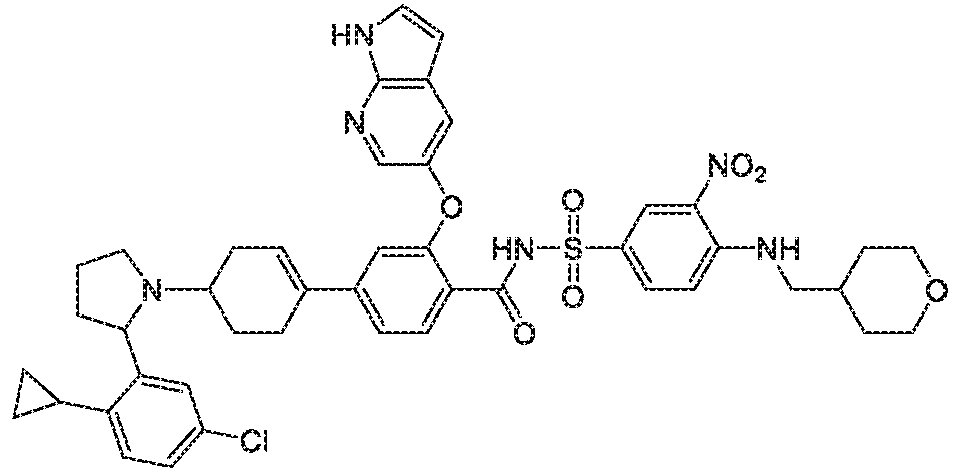
- The desired compound was synthesized with 2-(5-chloro-2-cyclopropylphenyl) pyrrolidine and methyl 3-((1H-pyrrolo[2,3-b]pyridin-5-yl)oxy)-4'-oxo-2',3',4',5'-tetrahydro- [1,1'-biphenyl] -4-carboxylate following the next procedures similar to those in Example C1. 1H NMR (400 MHz, DMSO-d6 ) δ 10.31 (s, 1H), 9.63 (s, 1H), 8.95 - 8.85(m, 1H), 8.54 (t, J = 4.9 Hz, 1H), 8.25 - 8.10 (m, 2H), 8.03 (d, J = 8.4 Hz, 1H), 7.72 - 7.68 (m, 1H), 7.60 (d, J = 23.7 Hz, 1H), 7.47 (s, 1H), 7.15 - 7.06 (m, 1H), 7.05 - 6.95 (m, 1H), 6.92 (d, J = 8.4 Hz, 1H), 6.90 - 6.80 (m, 1H), 6.70 - 6.60 (m, 1H), 6.58 - 6.50 (m, 1H), 5.97 (s, 0.5H), 5.80 (s, 0.5H), 4.35 - 4.20 ( m, 1H), 4.08 - 3.94 (m, 2H), 3.42 (t, J = 11.8 Hz, 2H), 3.25 (t, J = 5.9 Hz, 2H), 3.20 - 3.15 (m, 1H), 2.70 - 2.45 (m, 2H), 2.40 - 2.10 (m, 4H), 2.01 - 1.91 (m, 2H), 1.90 - 1.80 (m, 2H), 1.77 - 1.35 (m, 8H), 1.10 - 0.80 (m, 2H), 0.70 - 0.60 (m, 1H), 0.55 - 0.45 (m, 1H). MS (ESI) m/e [M+1]+ 850.7.
-

- The desired compound was synthesized with 2-(2-(1,1-difluoroethyl)phenyl)pyrrolidine and methyl 3-((1 H-pyrrolo[2,3-b]pyridin-5-yl)oxy)-4'-oxo-2',3',4',5'-tetra hydro-[1,1'-biphenyl]-4-carboxylate following the next procedures similar to those in Example C1. MS (ESI) m/e [M+1]+ 840.8.
-

- The desired compound was synthesized with 2-(2-(2,2,2-trifluoroethyl)phenyl)pyrrolidine and 3-((1H-pyrrolo[2,3-b]pyridin-5-yl)oxy)-N-((3-nitro-4-(((tetrahydro-2H-pyran-4-yl) methyl) amino)phenyl)sulfonyl)-4'-oxo-2',3',4',5'-tetrahydro-[1,1-biphenyl] -4-carboxamide following the procedure similar to those in Example C12. MS (ESI) m/e [M+1]+ 858.8.
-

- The desired compound was synthesized with 2-(2-cyclopentylphenyl)pyrrolidine and methyl 3-((1 H-pyrrolo[2,3-b]pyridin-5-yl)oxy)-4'-oxo-2',3',4',5'-tetra hydro-[1,1'-biphenyl]-4-carboxylate following the next procedures similar to those in Example C1. MS (ESI, m/e) [M+1]+ 844.8.
-

- The desired compound was synthesized with 2-(2,2-dimethylbenzo[d][1,3]dioxol-4-yl)pyrrolidine and methyl 3-((1H-pyrrolo[2,3-b]pyridin-5-yl)oxy)-4'-oxo-2',3',4',5'-tetra hydro-[1,1'-biphenyl]-4-carboxylate following the next procedures similar to those in Example C1. 1H NMR (400 MHz, DMSO-d6 ) δ 9.39 (s, 1H), 8.91 (s, 1H), 8.59 - 8.49 (m, 1H), 8.23 - 8.10 (m, 2H), 8.03 (d, J = 8.3 Hz, 1H), 7.68 (s, 1H), 7.46 (s, 1H), 7.08 - 7.03 (m, 2H), 6.92 (d, J = 9.3 Hz, 1H), 6.82 - 6.70 (m, 1H), 6.67 - 6.51 (m, 3H), 5.96 - 5.75 (m, 1H), 4.07 - 4.00 (m, 2H), 3.49 - 3.33 (m, 2H), 3.31 - 3.21 (m, 2H), 2.93 - 2.81 (m, 2H), 2.43 - 2.24 (m, 4H), 2.17 - 1.88 ( m, 8H), 1.82 - 1.68 (m, 3H), 1.68 - 1.61 (m, 3H), 1.61 - 1.48 (m, 3H), 1.47 - 1.39 (m, 3H). MS (ESI) m/e [M+1]+ 848.8.
-

- The desired compound was synthesized with 2-(3-ethynylphenyl)pyrrolidine and methyl 3-((1H-pyrrolo[2,3-b]pyridin-5-yl)oxy)-4'-oxo-2',3',4',5'-tetrahydro-[1,1'-biphenyl] -4-carboxylate following the next procedures similar to those in Example C1. 1H NMR (400 MHz, DMSO-d6 ) δ 12.25 (s, 1H), 11.68 (s, 1H), 8.60 - 8.40 (m, 2H), 7.98 (s, 1H), 7.80 - 7.60 (m, 2H), 7.55 - 7.35 (m, 5H), 7.30 - 7.20 (m, 1H), 7.18 - 6.96 (m, 2H), 6.72 (s, 1H), 6.37 (s, 1H), 6.05 - 5.85 (m, 1H), 4.80 - 4.50 (m, 1H), 4.35 - 4.15 (m, 1H), 3.89 - 3.73 (m, 2H), 3.30 - 3.18 ( m, 5H), 2.40 - 2.25 (m, 3H), 2.20 - 1.95 ( m, 5H), 1.90 - 1.80 (m, 2H), 1.75 - 1.65 (m, 1H), 1.59 (d, J = 11.7 Hz, 2H), 1.50 - 1.35 (m, 1H), 1.31 - 1.16 (m, 3H). MS (ESI) m/e [M+1]+ 800.8.
-

- The desired compound was synthesized with 2-(2-cyclopropylphenyl)pyrrolidine-3-carbonitrile and methyl 3-((1H-pyrrolo[2,3-b]pyridin-5-yl)oxy)-4'-oxo-2',3',4',5'-tetrahydro - [1,1'-biphenyl] -4-carboxylate following the next procedures similar to those in Example C1. 1H NMR (400 MHz, DMSO-d6 ) δ 12.22 (s, 1H), 11.69 (s, 1H), 8.65 - 8.45 (m, 2H), 8.05 - 7.95 (m, 1H), 7.79 (d, J=8.9, 1H), 7.55 - 7.40 (m, 4H), 7.20 - 6.94 (m, 5H), 6.74 - 6.68 (m, 1H), 6.02 (s, 0.5H), 5.81 (s, 0.5H), 4.64 - 4.47 (m, 1H), 3.91 - 3.78 (m, 2H), 3.29 - 3.15 (m, 5H), 3.05 - 2.95 (m, 2H), 2.8 - 2.74 (m, 1H), 2.26 - 1.81 (m,10H), 1.64 - 1.52 (m, 3H), 1.30 - 1.15 (m, 3H), 0.99 - 0.88 (m, 2H), 0.79 - 0.68 (m, 1H), 0.63 - 0.50 (m, 1H). MS (ESI) m/e [M+1]+ 841.8.
-

- The desired compound was synthesized with 2-(2-cyclopropylphenyl)-3-ethynylpyrro lidine and methyl 3-((1H-pyrrolo[2,3-b]pyridin-5-yl)oxy)-4'-oxo-2',3',4',5'-tetrahydro-[1,1'-biphen yl]-4-carboxylale following the next procedures similar to those in Example C1. 1H NMR (400 MHz, DMSO-d6 ) δ 12.21 (s, 1H), 11.68 (s, 1H), 8.67 - 8.40 (m, 2H), 7.98 (s, 1H), 7.84 - 7.72 (m, 1H), 7.56 - 7.36 (m, 4H), 7.17 - 7.08 (m, 4H), 6.94 (s, 1H), 6.71 (s, 1H), 6.37 (s, 1H), 6.06 - 5.75 (m, 1H), 4.35 - 4.05 (m, 1H), 3.91 - 3.76 (m, 2H), 3.30 - 3.20 (m, 4H), 3.15 - 3.05 (m, 2H), 2.40 - 1.95 (m, 8H), 1.90 - 1.65 (m, 4H), 1.64 - 1.55 (m, 2H), 1.50 - 1.35 (m, 2H), 1.30 - 1.10 (m, 2H), 1.05 - 0.95 (m, 1H), 0.85 - 0.80 (m, 1H). MS (ESI) m/e [M+1]+ 840.8.
-

- The desired compound was synthesized with 2-(2-methoxyphenyl)pyrrolidine and 3-((1H-pyrrolo[2,3-b]pyridin-5-yl)oxy)-N-((3-nitro-4-(((tetrahydro-2H-pyran-4-yl) methyl) amino)phenyl)sulfonyl)-4'-oxo-2',3',4',5'-tetrahydro-[1,1'-biphenyl]-4-carboxamide following the procedure similar to those in Example C12. 1H NMR (400 MHz, DMSO-d6 ) δ 11.54 (s, 1H), 8.38 - 8.33 (m, 2H), 7.91 (s, 1H), 7.69 - 7.60 (m, 1H), 7.58 - 7.38 (m, 3H), 7.30 (d, J = 6.1 Hz, 1H), 7.24 - 7.02 (m, 2H), 6.95 - 6.78 (m, 3H), 6.73 (s, 1H), 6.30 (s, 1H), 5.98 - 5.79 (m, 1H), 4.12 (s, 1H), 3.83 (d, J = 8.4 Hz, 2H), 3.76 (s, 3H), 3.30 - 3.21 (m, 4H), 3.15 - 2.95 (m, 2H), 2.25 - 2.15 ( m, 1H), 2.06 (d, J = 18.4, 6.0 Hz, 2H), 2.03 - 1.97 (m, 3H), 1.95 - 1.82 (m, 1H), 1.72 - 1.56 (m, 5H), 1.48 - 1.45 (m, 1H), 1.30 - 1.20 (m, 3H). MS (ESI, m/e) [M+1]+ 806.8.
-

- The desired compound was synthesized with 2-(benzo[b]thiophen-3-yl)pyrrolidine and methyl 3-((1H-pyrrolo[2,3-b]pyridin-5-yl)oxy)-4'-oxo-2',3',4',5'-tetrahydro- [1,1'-biphenyl] -4-carboxylate following the next procedures similar to those in Example C1. 1H NMR (400 MHz, DMSO-d6 ) δ 12.23 (s, 1H), 11.66 (s, 1H), 8.60 - 8.40 (m, 2H), 8.10 - 7.85 (m, 3H), 7.80 - 7.65 (m, 1H), 7.60 - 7.25 (m, 6H), 7.18 - 6.88 (m, 2H), 6.70 (s, 1H), 6.36 (s, 1H), 5.98 (s, 0.5H), 5.86 (s, 0.5H), 4.22 (s, 1H), 3.83 (d, J = 8.4 Hz, 2H), 3.30 - 3.10 (m, 5H), 2.40 - 2.20 (m, 7H), 2.10 - 1.85 (m, 3H), 1.65 - 1.40 (m, 4H), 1.30 - 1.15 (m, 3H).
-

- The desired compound was synthesized with 3-(2-chlorophenyl)pyrrolidine and 3-((1H-pyrrolo[2,3-b]pyridin-5-yl)oxy)-N-((3-nitro-4-(((tetrahydro-2H-pyran-4-yl)methyl) amino)phenyl)sulfonyl)-4'-oxo-2',3',4',5'-tetrahydro-[1,1'-biphenyl]-4-carboxamide following the procedure similar to those in Example C12. 1H NMR (400 MHz, DMSO-d6 ) δ ppm: 12.32 (s, 1H), 11.70 (s, 1H), 8.65 - 8.45 (m, 2H), 8.02 (d, J = 2.1 Hz, 1H), 7.80 (d, J = 9.0 Hz, 1H), 7.65 - 7.45 (m, 5H), 7.38 (t, J = 7.5 Hz, 1H), 7.32 (t, J = 7.5 Hz, 1H), 7.24 (d, J = 8.4 Hz, 1H), 7.07 (d, J = 9.0 Hz, 1H), 6.80 (s, 1H), 6.39 (s, 1H), 6.04 (s, 1H), 3.90 - 3.65 (m, 4H), 3.30 - 3.20 (m, 5H), 2.70 - 2.55 (m, 1H), 2.45 - 2.30 (m, 4H), 2.25 - 2.15 (m, 1H), 2.10 - 1.91 (m, 2H), 1.90 - 1.70 (m, 3H), 1.60 (d, J = 11.9 Hz, 2H), 1.34 - 1.15 (m, 3H). MS (ESI) m/e [M+1]+ 810.8.
-

- The desired compound was synthesized with 2-(5-cyclopropyl-2-iluorophenyl)pyrrolidine and methyl 3-((1H-pyrrolo[2,3-b]pyridin-5-yl)oxy)-4'-oxo-2',3',4',5'-tetrahydro- [1,1'-biphenyl] -4-carboxylate following the next procedures similar to those in Example C1. 1H NMR (DMSO-d 6) δ ppm: 12.23 (s, 0.5H), 11.66 (s, 1H), 8.50 (s, 2H), 7.97 (s, 1H), 7.82-7.73 (m, 1H), 7.55-7.39 (m, 3H), 7.34-6.83 (m, 5H), 6.75 (s, 1H), 6.36 (s, 1H), 6.07-5.84 (m, 1H), 4.10-4.00 (m, 1H), 3.94-3.75 (m, 2H), 3.30-3.15 (m, 5H), 2.34-2.00 (m, 6H), 1.86 (s, 3H), 1.75-1.65 (m, 1H), 1.65-1.53 (m, 3H), 1.51-1.40 (m, 1H), 1.35-1.15 (m, 5H), 0.99-0.76 (m, 2H), 0.72-0.44 (m, 2H). MS (ESI) m/e [M+1]+ 834.8.
-

- The desired compound was synthesized with 2-(5-cyclopropyl-2-chlorophenyl)pyrrolidine and methyl 3-((1 H-pyrrolo[2,3-b]pyridin-5-yl)oxy)-4'-oxo-2',3',4',5'-tetrahydro- [1,1'-biphenyl] -4-carboxylate following the next procedures similar to those in Example C1. MS (ESI) m/e [M+1]+ 850.7.
-
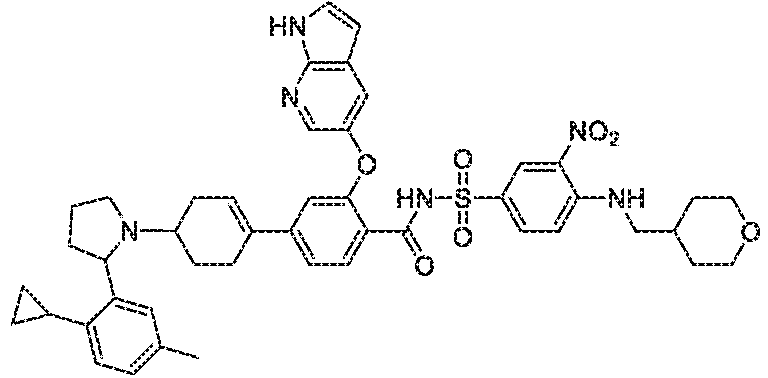
- The desired compound was synthesized with 2-(5-cyclopropyl-2-chlorophenyl)pyrrolidine and methyl 3-((1H-pyrrolo[2,3-b]pyridin-5-yl)oxy)-4'-oxo-2',3',4',5'-tetrahydro- [1 ,1'-biphenyl] -4-carboxylate following the next procedures similar to those in Example C1. 1H NMR (DMSO-d 6) δ ppm: 12.24 (s, 0.3H), 11.61 (s, 1H), 8.45 (s, 2H), 7.95 (s, 1H), 7.76-7.63 (m, 1H), 7.52-7.32 (m, 4H), 7.11 (d, J=7.9, 1H), 7.06-6.72 (m, 4H), 6.33 (s, 1H), 6.04-5.80 (m, 1H), 4.26 (s, 1H), 3.91-3.78 (m, 2H), 3.25-3.17 (m, 5H), 2.38-2.07 (m, 8H), 2.05-1.81 (m, 4H), 1.72 (s, 1H), 1.65-1.52 (m, 3H), 1.30-1.17 (m, 3H), 0.98-0.79 (m, 2H), 0.70-0.40 (m, 2H). MS (ESI) m/e [M+1]+ 830.8.
-

- The desired compound was synthesized with N1-(4-cyclopropyl-3-(pyrrolidin-2-yl)phenyl)-N 1,N2,N2-trimethylethane-1,2-diamine and 3-((1H-pyrrolo[2,3-b]pyridin-5-yl)oxy)-N-((3-nitro-4-(((tetrahydro-2H-pyran-4-yl)methyl) amino)phenyl)sulfonyl)-4'-oxo-2',3',4',5'-tetrahydro-[1,1 '-biphenyl]-4-carboxamide following the procedure similar to those in Example C12. 1H NMR (400 MHz, DMSO-d6 ) δ ppm: 11.53 (s, 1H), 8.38 (s, 1H), 8.35 - 8.31 (m, 1H), 7.91 (s, 1H), 7.64 (d, ,7=8.8 Hz, 1H), 7.48 (d, J=8.0 Hz, 1H), 7.42 (s, 1H), 7.29 (s, 1H), 7.06 - 7.00 (m, 2H), 6.82 - 6.71 (m, 3H), 6.35 - 6.29 (m, 2H), 5.99 (s, 0.5H), 5.85 (s, 0.5H), 4.26 - 4.20 (m, 1H), 3.84 (d, J=8.8 Hz, 2H), 3.27 - 2.98 (m, 8H), 2.85 - 2.65 (m, 5H), 2.34 - 2.15 (m, 5H), 2.13 - 1.92 (m, 8H), 1.83 - 1.66 (m, 4H), 1.61 (d, J=12.8 Hz, 2H), 1.45 - 1.35 (m, 4H), 0.85 - 0.74(m, 2H), 0.58 - 0.34 (m, 2H). MS (ESI, m/e) [M+1]+ 916.8.
-

- The desired compound was synthesized with N1-(4-cyclopropyl-3-(pyrrolidin-2-yl)phenyl)-N2,N2-dimethylethane-1,2-diamine and 3-((1H-pyrrolo[2,3-b]pyridin-5-yl)oxy)-N-((3-nitro-4-(((tetrahydro-2H-pyran-4-yl)methyl) amino)phenyl)sulfonyl)-4'-oxo-2',3',4',5'-tetrahydro-[1,1'-biphenyl]-4-carboxamide following the procedure similar to those in Example C12. 1H NMR (DMSO-d6) δ ppm: 12.30 (s, 1H), 11.73 (s, 1H), 10.06-9.35 (m, 2H), 8.67-8.48 (m, 2H), 8.05-7.95 (m, 1H), 7.87-7.76 (m, 1H), 7.60-7.39 (m, 3H), 7.22-7.06 (m, 2H), 6.96-6.71 (m, 3H), 6.57 (d, J = 8.4Hz, 1H), 6.45-6.32 (m, 1H), 5.97 (d, J = 26.4Hz, 1H), 5.18-4.98 (m, 1H), 3.87-3.80 (m, 2H), 3.75-3.63 (m, 1H), 3.49-3.17 (m, 10H), 2.89-2.72 (m, 6H), 2.47-2.27 (m, 4H), 2.17-1.81 (m, 6H), 1.73-1.55 (m, 3H), 1.28-1.18 (m, 2H), 0.90-0.79 (m, 2H), 0.61-0.38 (m, 2H). MS (ESI, m/e) [M+1]+ 902.8.
-

- The desired compound was synthesized with 2-(2-(but-1-en-1-yl)phenyl)pyrrolidine and methyl 3-((1H-pyrrolo[2,3-b]pyridin-5-yl)oxy)-4'-oxo-2',3',4',5'-tetrahydro- [1,1'-biphenyl] -4-carboxylate following the next procedures similar to those in Example C1. MS (ESI, m/e) [M+1]+ 830.8.
-
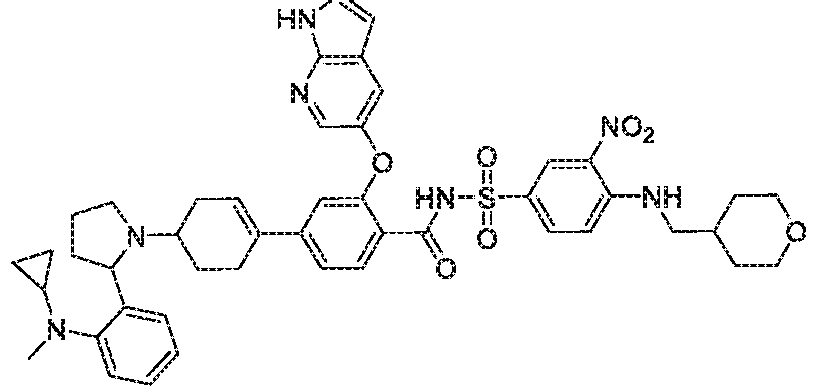
- The desired compound was synthesized with N-cyclopropyl-N-methyl-2-(pyrrolidin-2-yl)aniline and methyl 3-((1H-pyrrolo[2,3-b]pyridin-5-yl)oxy)-4'-oxo-2',3',4',5'-tetrahydro-[1,1'-biphenyl] -4- carboxylate following the next procedures similar to those in Example C1. 1H NMR (400 MHz, DMSO-d6 ) δ ppm: 12.48-12.08 (m, 0.5H), 11.68 (s, 1H), 9.84-9.42 (m, 0.5H), 7.99 (s, 1H), 8.81-8.26 (m, 2H), 7.87-6.85 (m, 10H), 6.74-6.53 (m, 1H), 6.38 (s, 1H), 5.93-5.75 (m, 1H), 5.41-5.23 (m, 1H), 5.00-4.61 (m, 1H), 3.90-3.75 (m, 2H), 3.28-2.86 (m, 9H), 2.71-2.60 (m, 3H), 2.38-1.78 (m, 11H), 1.65-1.38 (m, 4H), 0.61-0.26 (m, 2H). MS (ESI, m/e) [M+1]+ 845.8.
-

- The desired compound was synthesized with 1-methyl-4-(2-(pyrralidin-2-yl)phenyl)-1,2,3,6-tetrahydropyridine and methyl 3-((1H-pyrrulo[2,3-b]pyridin-5-yl)oxy)-4'-oxo-2',3',4',5'-tetrahydro- [1,1-biphenyl] -4- carboxylate following the next procedures similar to those in Example C1. 1H NMR (400 MHz, DMSO-d6 ) δ ppm: 11.56 (s, 1H), 8.52-8.18 (m, 2H), 7.98-7.81 (m, 1H), 7.74-6.78 (m, 11H), 6.72 (s, 1H), 6.30 (s, 1H), 6.02-5.73 (m, 1H), 5.55-5.26 (m, 1H), 3.88-3.77 (m, 2H), 3.62-3.39 (m, 7H), 3.28-3.02 (m, 7H), 3.02-2.65 (m, 3H), 2.30-1.30 (m, 12H), 1.07-0.98 (m, 2H). MS (ESI, m/e) [M+1]+ 871.8.
-

- The desired compound was synthesized with 1-(4-(2-(pyrrolidin-2-yl)phenyl)-3,6-dihydropyridin-1(2H)-yl)ethan-1-one and methyl 3-((1H-pyrrolo[2,3-b]pyridin-5-yl)oxy)-4'-oxo-2',3',4',5'-tetrahydro- [1,1'-biphenyl] -4- carboxylate following the next procedures similar to those in Example C1. 1H NMR (400 MHz, DMSO-d6 )δ ppm: 12.43-12.02 (m, 0.3 H), 11.63 (s, 1H), 9.98-9.26 (m, 0.7H), 8.71-8.22 (m, 2H), 8.22-6.53 (m, 13H), 6.34 (s, 1H), 6.07-5.73 (m, 1H), 5.60-5.41 (m, 1H), 4.12-3.97 (m, 2H), 3.87-3.78 (m, 2H), 3.70-3.42 (m, 7H), 3.28-3.18 (m, 3H), 3.16-2.92 (m, 1H), 2.25-1.24 (m, 16H), 1.08-0.98 (m, 2H). MS (ESI, m/e) [M+1]+ 899.8.
-

- The desired compound was synthesized with 2-(4-cyclopropylthiophen-2-yl)pyrrolidine and methyl 3-((1H-pyrrolo[2,3-b]pyridin-5-yl)oxy)-4'-oxo-2',3',4',5'-tetrahydro- [1,1 '-biphenyl] -4-carboxylate following the next procedures similar to those in Example C1. 1H NMR (400 MHz, DMSO-d6 ) δ ppm: 12.19 (s, 0.5H), 11.67 (s, 1H), 9.65 (s, 0.5H), 8.50 (s, 2H), 7.99 (s, 1H), 7.76 (d, J = 7.5 Hz, 1H), 7.49 (s, 3H), 7.20 - 6.88 (m, 3H), 6.75 (s, 2H), 6.37 (s, 1H), 6.01-5.88 (m, 1H), 3.84 (d, J = 8.5 Hz, 2H), 3.30-3.15 (m, 5H), 3.10-2.91 (m, 2H), 2.33-2.10 (m, 6H), 1.95-1.75 (m, 4H), 1.70-1.55 (m, 4H), 1.35-1.21 (m, 3H), 0.91-0.75 (m, 2H), 0.75-0.55 (m, 2H). MS (ESI, m/e) [M+1]+ 822.7.
-

- The desired compound was synthesized with 1-cyclopropyl-3-(pyrrolidin-2-yl)-1H-pyrazole and 3-((1H-pyrrolo[2,3-b]pyridin-5-yl)oxy)-N-((3-nitro-4-(((tetrahydro-2H-pyran-4-yl)methyl) amino)phenyl)sulfonyl)-4'-oxo-2',3',4',5'-tetrahydro-[1,1'-biphenyl]-4-carboxamide following the procedure similar to those in Example C12. MS (ESI, m/e) [M+1]+ 806.8. Example C179: 3-((1H-pyrrolo[2,3-b]pyridin-5-yl)oxy)-4'-(4-chloro-2-(2-cyclopropylphenyl)pyrrolidin-1-yl)-N-((3-nitro-4-(((tetrahydro-2H-pyran-4-yl)methyl)amino)phenyl)sulfonyl)-2',3',4',5'-tetrahydro-[1,1'-biphenyl]-4-carboxamide

- The desired compound was synthesized with 4-chloro-2-(2-cyclopropylphenyl)pyrrolidine and 3-((1H-pyrrolo[2,3-b]pyridin-5-yl)oxy)-N-((3-nitro-4-(((tetrahydro-2H-pyran-4-yl)methyl) amino)phenyl)sulfonyl)-4'-oxo-2',3',4',5'-tetrahydro-[1,1'-biphenyl]-4-carboxamide following the procedure similar to those in Example C12. 1H NMR (DMSO-d6) δ ppm: 12.28 (s, 1H), 11.76 (s, 1H), 8.71-8.57 (m, 2H), 8.10-8.01 (m, 1H), 7.91-7.83 (m, 1H), 7.80-7.49 (m, 5H), 7.25-6.92 (m, 6H), 6.81-6.74 (m, 1H), 6.48-6.41 (m, 1H), 6.11-6.02 (m, 0.5H), 5.90-5.83 (m, 0.5H), 4.71-4.62 (m, 1H), 4.49-4.36 (m, 1H), 3.93-3.86 (m, 2H), 3.35-3.29 (m, 4H), 3.18-3.09 (m, 1H), 3.03-2.94 (m, 1H), 2.69-2.59 (m, 1H), 2.29-2.21 (m, 2H), 2.14-1.73 (m, 6H), 1.68-1.61 (m, 2H), 1.34-1.26(m, 4H), 0.95-0.87 (m, 2H), 0.73-0.54 (m, 2H). MS (ESI, m/e) [M+1]+ 850.7.
-

- The desired compound was synthesized with 2-(2-cyclopropylphenyl)-4-methylenepyrrolidine and methyl 3-((1H-pyrrolo[2,3-b]pyridin-5-yl)oxy)-4'-oxo-2',3',4',5'-tetrahydro- [1,1'-biphenyl] -4- carboxylate following the next procedures similar to those in Example C1. 1H NMR (400 MHz, DMSO-d6 ) δ ppm: 12.21 (s, 0.5H), 11.65 (s, 1H), 9.71 - 9.48 (m, 0.5H), 8.49 (s, 2H), 7.97 (s, 1H), 7.75 (s, 1H), 7.56 - 7.34 (m, 4H), 7.12-6.94 (m, 5H), 6.72 (s, 1H), 6.35 (s, 1H), 5.99 (s, 0.5 H), 5.86 (s, 0.5 H), 4.92 (s, 1H), 4.84 (s, 1H), 4.48-4.39 (m, 1H), 3.83 (s, 2H), 3.69 (d, J = 13.8 Hz, 1H),3.30-3.15 ( m, 5H), 2.99-2.78 (m, 2H), 2.18-2.11(m, 6H), 1.96-1.65 (m, 3H), 1.63-1.55 (m, 2H), 1.26-1.21 (m, 3H), 0.96-0.81 (m, 3H). MS (ESI, m/e) [M+1]+ 828.8.
-

- The desired compound was synthesized with 1-(2-cyclopropylphenyl)octahydrocyclopenta[c]pyrrole and methyl 3-((1H-pyrrolo[2,3-b]pyridin-5-yl)oxy)-4'-oxo-2',3',4',5'-tetrahydro- [1,1'-biphenyl] -4- carboxylate following the next procedures similar to those in Example C1. MS (ESI, m/e) [M+1]+ 856.8.
-
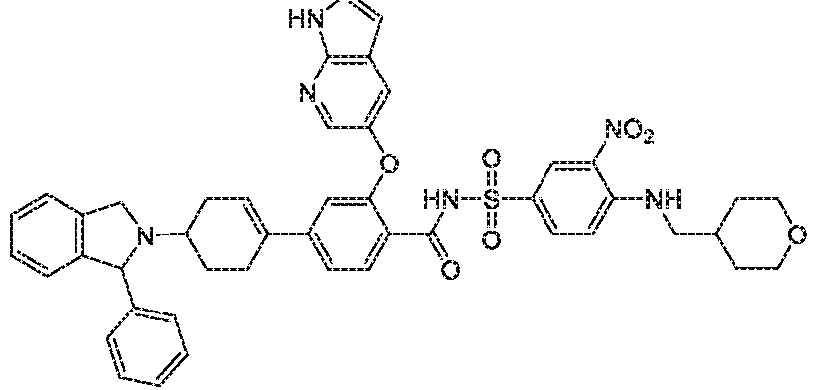
- The desired compound was synthesized with 1-phenylisoindoline and 3-((1H-pyrrolo[2,3-b]pyridin-5-yl)oxy)-N-((3-nitro-4-(((tetrahydro-2H-pyran-4-yl)methyl) amino)phenyl)sulfonyl)-4'-oxo-2'.3',4',5'-tetrahydro-[1,1'-biphenyl]-4-carboxamide following the procedure similar to those in Example C12. MS (ESI, m/e) [M+1]+ 824.8.
-

- The desired compound was synthesized with 2-((2-cyclopropylphenyl)(methoxy)methyl)pyrrolidine and 3-((1H-pyrrolo[2,3-b]pyridin-5-yl)oxy)-N-((3-nitro-4-(((tetrahydro-2H-pyran-4-yl)methyl) amino)phenyl)sulfonyl)-4'-oxo-2',3',4',5'-tetrahydro-[1,1'-biphenyl]-4-carboxamide following the procedure similar to those in Example C12. 1H NMR (400 MHz, DMSO-d6 ) δ ppm: 12.28 (s, 1H), 11.72 (s, 1H), 8.56 (s, 2H), 8.03 (s, 1H), 7.81 (s, 1H), 7.54-7.52 (m, 2H), 7.43 (s, 1H), 7.26-7.21 (m, 4H), 7.06 (s, 1H), 6.79 (s, 1H), 6.66 (s, 1H), 6.39 (s, 1H), 6.06 (s, 1H), 5.04 (s, 1H), 4.07 (s, 1H), 3.84 (d, J = 9.1 Hz, 3H), 3.67 (s, 1H), 3.51 (s, 3H), 3.25-3.23 (m, 4H), 3.06-2.97 (m, 7H), 2.03 - 1.97 (m, 3H), 1.88 (s, 2H), 1.60 (d, J = 12.8 Hz, 2H), 1.47-1.43 (m, 2H), 0.97 (s, 2H), 0.86-0.84 (m, 4H). MS (ESI, m/e) [M+1]+ 860.8.
-
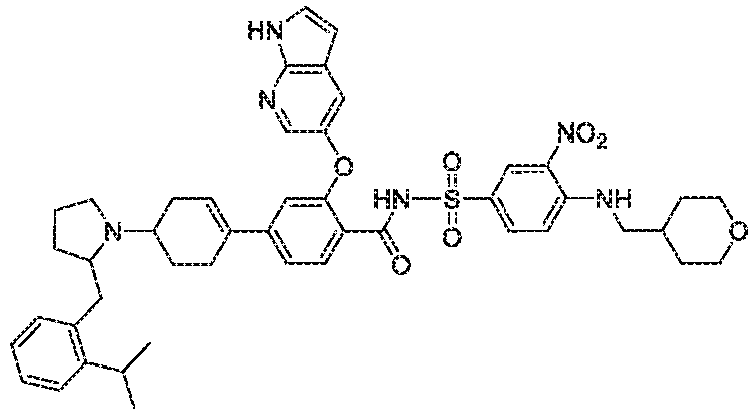
- The desired compound was synthesized with 2-(2-isopropylbenzyl)pyrrolidine and methyl 3-((1H-pyrrolo[2,3-b]pyridin-5-yl)oxy)-4'-oxo-2',3',4',5'-tetrahydro- [1,1'-biphenyl] -4-carboxylate following the next procedures similar to those in Example C1. 1H NMR (400 MHz, DMSO-d6 ) δ ppm: 11.63 (s, 1H), 9.70-9.28 (m, 1H), 8.50-8.40 (m, 2H), 7.98 (s, 1H), 7.72 (d, J=8.4, 1H), 7.56-7.45 (m 3H), 7.30-7.10 (m, 6H), 6.92 (s, 1H), 6.82-6.73 (m,1H), 6.36 (s, 1H), 6.04 (s, 1H), 3.90-3.80 (m, 3H), 3.30-3.20 (m, 7H), 3.08 (s, 1H), 2.85 (s, 1H), 2.41-2.32 (m, 1H), 2.14 (s, 1H), 1.90-1.80 (m, 6H), 1.65-1.56 (m, 3H), 1.32-1.10 (m, 10H). MS (ESI) m/e [M+1]+ 832.8.
-
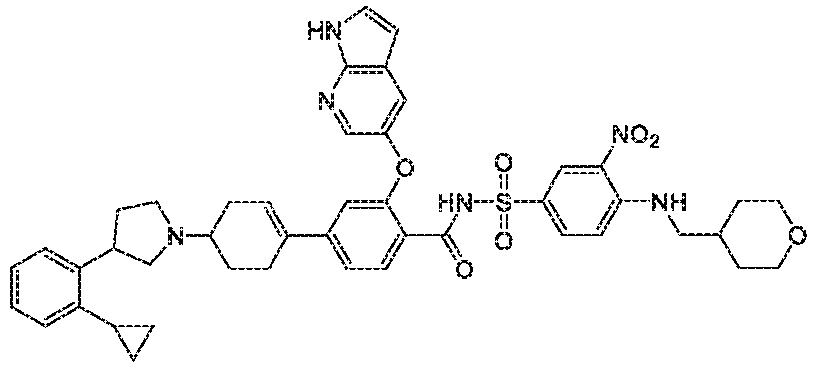
- The desired compound was synthesized with 3-(2-cyclopropylphenyl)pyrrolidine and methyl 3-((1H-pyrrolo[2,3-b]pyridin-5-yl)oxy)-4'-oxo-2',3',4',5'-tetrahydro- [1,1'-biphenyl] -4-carboxylate following the next procedures similar to those in Example C1. MS (ESI) m/e [M+1]+ 816.8.
-
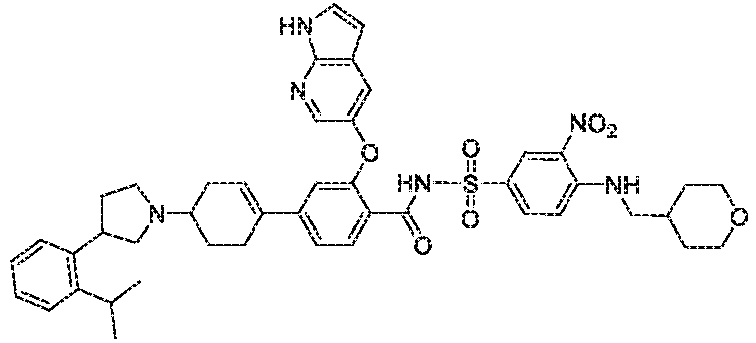
- The desired compound was synthesized with 3-(2-isopropylphenyl)pyrrolidine and methyl 3-((1H-pyrrolo[2,3-b]pyridin-5-yl)oxy)-4'-oxo-2',3',4',5'-tetrahydro- [1,1'-biphenyl] -4-carboxylate following the next procedures similar to those in Example C1. MS (ESI) m/e [M+1]+ 818.8.
-
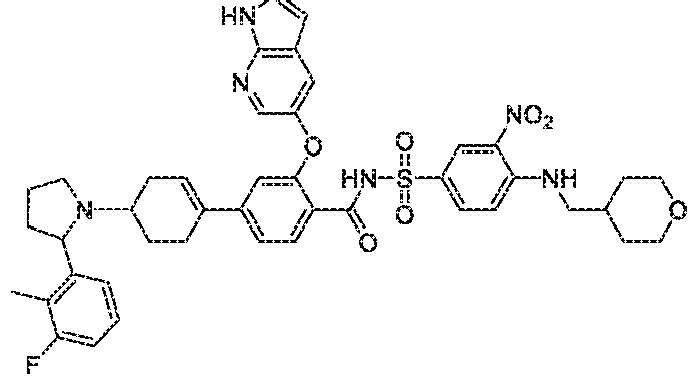
- The desired compound was synthesized with 2-(3-fluoro-2-methylphenyl)pyrrolidine and 3-((1H-pyrrolo[2,3-b]pyridin-5-yl)oxy)-N-((3-nitro-4-(((tetrahydro-2H-pyran-4-yl)methyl) amino)phenyl)sulfonyl)-4'-oxo-2',3',4',5'-tetrahydro-[1,1'-biphenyl]-4-carboxamide following the procedure similar to those in Example C12. 1H NMR ( 400 MHz, DMSO-d 6 ) δ ppm: 12.22 ( s, 1H), 11.68 ( s, 1H ), 8.70 - 8.40 ( m, 2H ), 8.02 - 7.95 ( m, 1H ), 7.85 - 7.75 ( m, 1H), 7.60 - 7.31 ( m, 4H), 7.20 - 6.90 (m, 3H), 6.85 - 6.75 ( m, 1H ), 6.71 (s, 1H ), 6.37 (s, 1H ), 5.99 ( s, 0.5H ), 5.80 ( s, 0.5H ), 4.05 - 3.90 ( m, 1H ), 3.85 - 3.80 ( m, 3H ), 3.35 - 3.20 ( m, 5H ), 2.55 - 2.40 ( m, 2H ), 2.25 - 2.10 ( m, 6H ), 2.00 - 1.80 ( m, 2H ), 1.75 - 1.65 ( m, 3H ), 1.60 - 1.55 ( m, 3H), 1.31 -1.17 ( m, 3H). MS (ESI, m/e) [M+1]+ 809.2.
-

- The desired compound was synthesized with 2-(2-(2-methylprop-1-en-1-yl)phenyl)pyrrolidine and 3-((1 H-pyrrolo[2,3-b]pyridin-5-yl)oxy)-N-((3-nitro-4-(((tetrahydro-2H-pyran-4-yl)methyl) amino)phenyl)sulfonyl)-4'-oxo-2',3',4',5'-tetrahydro-[1,1'-biphenyl]-4-carboxamide following the procedure similar to those in Example C12. 1H NMR (400 MHz, DMSO-d 6 ) δ ppm: 11.62 (s, 1H), 8.46 (s, 2H), 7.95 (s, 1H), 7.78 - 7.66 (m, 2H), 7.53 - 7.36 (m, 4H),7.15 - 6.92 (m, 4H), 6.69 (d, J = 8.0 Hz, 1H), 6.40 - 6.28 (m, 2H), 5.94 (s, 0.5H), 5.82 (s, 0.5H), 3.92 - 3.77 (m, 3H), 3.28 - 3.22 (m, 5H), 3.18 - 2.95 (m, 2H), 2.23 - 1.95 (m, 5H), 1.82 (s, 6H), 1.64 - 1.45 (m, 7H), 1.31 - 1.16 (m, 3H). MS (ESI, m/e) [M+1]+ 831.2.
-

- The desired compound was synthesized with 2-(benzo[b]thiophen-2-yl)pyrrolidine and 3-((1H-pyrrolo[2,3-b]pyridin-5-yl)oxy)-N-((3-nitro-4-(((tetrahydro-2H-pyran-4-yl)methyl) amino)phenyl)sulfonyl)-4'-oxo-2',3',4',5'-tetrahydro-[1,1'-biphenyl]-4-carboxamide following the procedure similar to those in Example C12. 1H NMR (400 MHz, DMSO-d 6 ) δ ppm: 12.19 (s, 1H), 11.67 (s, 1H), 8.58-8.52 (m, 2H), 7.98 (s, 1H), 7.94 - 7.60 (m, 3H), 7.54 - 7.40 (m, 3H), 7.28 (s, 3H), 7.18 - 7.00 (m, 2H), 6.72 (s, 1H), 6.36 (s, 1H), 6.01-5.95 (m, 1H), 4.23 (s, 1H), 3.84 (d, J = 8.5 Hz, 2H), 3.28-3.22 (m, 4H), 3.05 (s, 1H), 2.70 (s, 1H), 2.33-2.14 (m, 5H), 2.04 - 1.95 (m, 1H), 1.86 (s, 2H), 1.79 - 1.71 (m, 1H), 1.59 (d, J = 13.0 Hz, 2H), 1.47 (s, 1H), 1.27-1.23 (s, 4H). MS (ESI, m/e) [M+1]+ 833.1.
-

- The desired compound was synthesized with 2-(4-cyclopropylphenyl)pyrrolidine and methyl 3-((1H-pyrrolo[2,3-b]pyridin-5-yl)oxy)-4'-oxo-2',3',4',5'-tetrahydro- [1,1'-biphenyl] -4-carboxylate following the next procedures similar to those in Example C1. 1H NMR(400 MHz, DMSO-d 6 ) δ ppm: 11.60 (s, 1H), 8.43 (m, 2H), 7.94 (s, 1H), 7.68 (m, 1H), 7.48 - 7.46 ( m, 2H), 7.37 - 7.12 (m, 3H), 7.10 - 7.04 (m, 3H), 6.92 (m, 1H), 6.74 (s, 1H), 6.33 (s, 1H), 5.97 (s, 0.5H), 5.89 (s, 0.5H), 3.85 (d, J=8.0 Hz, 2H), 3.27 - 3.23 (m, 6H), 2.27 - 2.01 (m, 5H), 1.87 - 1.64 (m, 6H), 1.61 (d, J=12.8 Hz, 2H), 1.45 - 1.43 ( m, 2H), 1.20 - 1.16 (m, 3H), 0.93 - 0.86 ( m, 2H), 0.68 - 0.64 (m, 2H). MS (ESI, m/e) [M+1]+ 817.2.
-
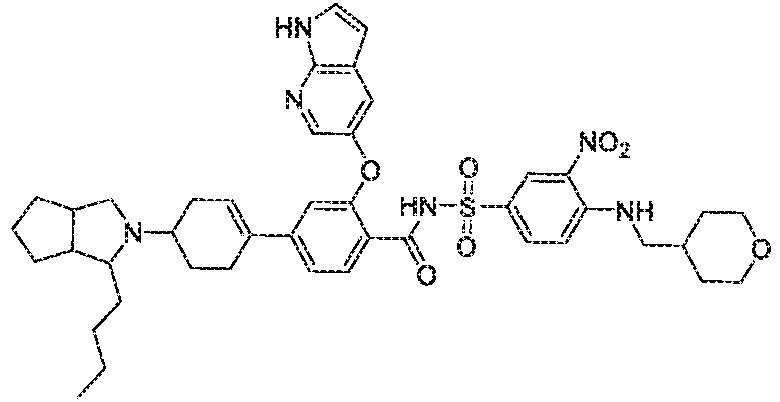
- The desired compound was synthesized with 1-butyloclahydrocyclopenta[c]pyrrole and methyl 3-((1H-pyrrolo[2,3-b]pyridin-5-yl)oxy)-4'-oxo-2',3',4',5'-tetrahydro- [1,1'-biphenyl] -4- carboxylate following the next procedures similar to those in Example C1. 1H NMR(400 MHz, DMSO-d 6 ) δ ppm: 12.27 (s, 1H), 11.71 (s, 1H), 10.25-9.75 (m, 1H), 8.66-8.49 (m, 2H), 8.02 (s, 1H), 7.81 (d, J = 8.6 Hz, 1H), 7.61-7.46 (m, 3H), 7.21 (d, J = 8.6 Hz, 1H), 7.14-7.08 (m, 1H), 6.79-6.70 ( m, 1H), 6.40 (s, 1H), 6.09-5.93 (m, 1H), 3.91-3.78 (m,2H), 3.65-3.51 (m, 2H), 3.30-3.17 (m, 5H), 3.15-3.08 (m, 1H), 2.98-2.95 ( m, 1H), 2.77-2.64 (m, 2H), 2.49-2.32 (m, 4H), 1.95-1.87 (m, 2H), 1.70- 1.45 (m, 11H), 1.39-1.17 (m, 5H), 0.92-0.80 (m, 3H). MS (ESI) m/e [M+1]+ 796.8.
-

- The desired compound was synthesized with 2-(3-chloro-2-methylphenyl)pyrrolidine and methyl 3-((1H-pyrrolo[2,3-b]pyridin-5-yl)oxy)-4'-oxo-2',3',4',5'-tetrahydro- [1,1'-biphenyl] -4-carboxylate following the next procedures similar to those in Example C1. 1H NMR (400 MHz, DMSO-d 6 ) δ ppm: 12.23 (s, 1H), 11.68 (s, 1H), 8.65 - 8.45 (m, 2H), 7.99 (d, J = 4.7 Hz, 1H), 7.85 - 7.70 (m, 1H), 7.60 - 7.30 (m, 4H), 7.25 - 6.85 (m, 4H), 6.75 - 6.65 (m, 1H), 6.37 (s, 1H), 6.00 (s, 0.5H), 5.76 (s, 0.5H), 4.25 - 4.05 (m, 1H), 3.84 (d, J = 8.3 Hz, 2H), 3.30-3.10 (m, 5H), 2.40 - 2.01 (m, 8H), 1.90 - 1.80 ( m, 2H), 1.78 - 1.50 (m, 5H), 1.46 - 1.11 ( m, 5H). MS (ESI) m/e [M+1]+ 824.8.
-

- The desired compound was synthesized with tert-butyl 4-(2-(pyrrolidin-2-yl)phenyl)-3,6-dihydropyridine-1(2H)-carboxylate and 3-((1H-pyrrolo[2,3-b]pyridin-5-yl)oxy)-N-((3-nitro-4-(((tetrahydro-2H-pyran-4-yl)methyl) amino)phenyl)sulfonyl)-4'-oxo-2',3',4',5'-tetrahydro-[1,1'-biphenyl]-4-carboxamide following the procedure similar to those in Example C66. 1H NMR(400 MHz, DMSO-d 6 ) δ ppm: 11.54 (s, 1H), 8.42-8.28 ( m, 2H), 7.90 (s, 1H), 7.67-7.58 (m, 1H), 7.57-7.37 (m, 4H), 7.31-7.24 (m, 1H), 7.15-7.00 (m, 3H), 6.98-6.89 (m, 2H), 6.85-6.73 (m, 1H), 6.77-6.66 (m, 1H), 6.29 (s, 1H), 5.84-5.74 (m, 1H), 5.52-5.38 (m, 1H), 3.92-3.78 (m, 4H), 3.32-3.19 (m, 6H), 3.16-3.05 (m, 3H), 2.91-2.79 (m, 2H), 2.04-1.91 (m, 3H), 1.88-1.75 (m, 3H), 1.63-1.54 (m, 3H), 1.51-1.38 (m, 3H), 1.20-1.08 (m, 2H), 0.80-0.70 (m, 2H). MS (ESI, m/e) [M+1]+ 806.8.
-
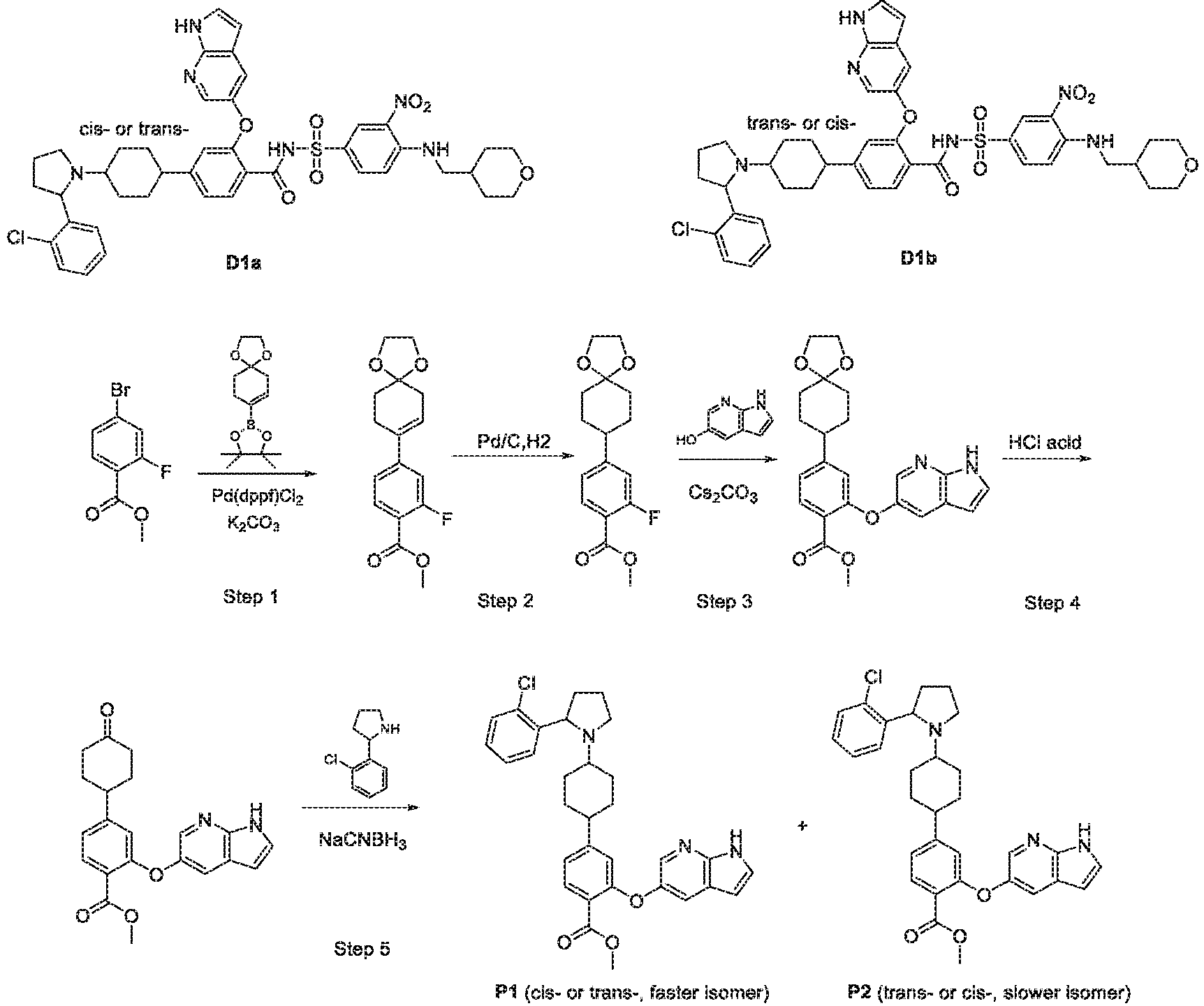
-

- The mixture of methyl 4-bromo-2-fluorobenzoate (2.33 g, 10 mmol), 4,4,5,5-tetramethyl-2-(1,4-dioxaspiro[4.5]dec-7-en-8-yl)-1,3,2-dioxaborolane (2.93 g, 11 mmol), 1,1'-bis(diphenylphosphino)ferrocene-palladium(II)dichloride dichloromethane complex (731 mg, 1 mmol), K2CO3 (3.45 g, 25 mmol) in a solution of 1,4-dioxane (100 mL) and water (5 mL) was heated to 90 °C and stirred overnight. After cooled to room temperature, the reaction mixture was concentrated in vacuum and purified by chromatography column on silica (eluent: EA/PE = 1/5) to give the product (2.7 g, 92.46%) as a white solid. 1H NMR (400 MHz, CDCl3) δ ppm: 7.87 (t, J = 8.0 Hz, 1H), 7.24 (d, J = 8.0 Hz, 1H), 7.16 (d, J = 8.0 Hz, 1H), 6.16-6.11 ( m, 1H), 4.03 (s, 4H), 3.92 (s, 3H), 2.64-2.62 (m, 2H), 2.50-2.48 (m, 2H), 1.93-1.82 (m, 2H).
-

- The mixture of methyl 2-fluoro-4-(1,4-dioxaspiro[4.5]dec-7-en-8-yl)benzoate (2.7 g, 9.24 mmol) and Pd/C (0.5 g) in MeOH (100 mL) was stirred overnight under H2 atmosphere (1 atm) at room temperature. The mixture was filtrated, then the filtrate was concentrated in vacuum to afford the tittle product (2.6 g, 95.61%) as a white solid. 1H NMR (400 MHz, CDCl3) δ ppm: 7.85 (t, J = 8.0, 1H), 7.09 (d, J = 8.0 Hz, 1H), 7.03 (d, J = 12.0 Hz, 1H), 4.03 (s, 4H), 3.93 (s, 3H), 2.60-2.57 (m, 1H), 1.88-1.86 (m, 4H), 1.79-1.65 (m, 4H).
-

- The mixture of methyl 2-fluoro-4-(1,4-dioxaspiro[4.5]decan-8-yl)benzoate (2.6 g, 8.83 mmol) and 1H-pyrrolo[2,3-b]pyridin-5-ol (1.42 g, 10.60 mmol) and Cs2CO3 in DMF (100 mL) was heated to 100°C and stirred overnight. After cooled to room temperature, the reaction mixture was concentrated in vacuum and purified by chromatography column on silica (eluent: EA/PE = 1/5) to give the product (1.16 g, 32.20%) as a yellow solid. MS (ESI, m/e) [M+1]+ 409.1
-
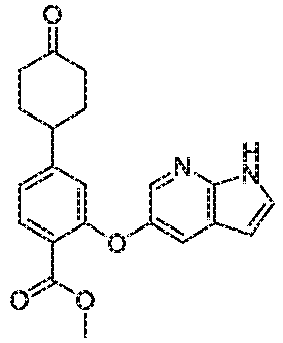
- The mixture of methyl 2-((1H-pyrrolo[2,3-b]pyridin-5-yl)oxy)-4-(1,4-dioxaspiro[4.5]decan-8-yl)benzoate (1.16 g, 2.85 mmol) and HCl acid (6M, 4mL) in EA (50 mL) was stirred for 30mins at room temperature. The reaction was quenched with NaOH (1 M) solution and adjusted to pH-8, washed with brine, dried over Na2SO4 and concentrated in vacuum to afford the tittle product (1.03 g) as a yellow solid. 1H NMR(400 MHz, CDCl3) δ ppm: 10.37 (br, 1H), 8.20 (s, 1H), 7.91 (d, J = 8.0 Hz, 1H), 7.61 (s, 1H), 7.41 (s, 1H), 7.03 (d,J = 8.0 Hz, 1H), 6.75 (s, 1H), 6.48 (s, 1H), 3.88 (s, 3H), 2.96-2.90 (m, 1H), 2.45-2.61 (m, 4H), 2.15-2.05 (m, 2H), 1.86-1.80 (m, 2H). MS (ESI, m/e) [M+1]+ 365.1
-

- The mixture of methyl 2-((1H-pyrrolo[2,3-b]pyridin-5-yl)oxy)-4-(4-oxocyclohexyl)benzoate (437 mg, 1.20 mmol), 2-(2-chlorophenyl)pyrrolidine (262 mg, 1.44 mmol), AcOH (0.2mL) in MeOH was stirred for 1 hour at room temperature. To the reaction was added NaCNBH3 (276 mg, 4.40 mmol) and stirred for another 1 hour. Then the reaction mixture was concentrated in vacuum and purified by chromatography column on silica: with the eluent of EA/PE = 1/5 to give the faster isomer P1 (130 mg, 20.43%) as a white solid. 1H NMR (400 MHz, CDCl3) δ ppm: 9.29 (br, 1H), 8.19-8.15 (m, 1H), 7.86 (d, J= 8.0, 1H), 7.68-7.65 (m, 1H), 7.53-7.49 (m, 1H), 7.36-7.27 (m, 1H), 7.21-7.18 (m, 1H), 6.98-6.93 (m, 3H), 6.71 (s, 1H), 6.47-6.42 ( m, 1H), 4.22 (d, J = 8.0, 1H), 3.84 (s, 3H), 3.24-3.18 (m, 1H), 2.60-2.53 (m, 2H), 2.43-2.38 (m, 2H), 2.19-2.15 (m, 1H), 1.83-1.71 (m, 5H), 1.49-1.43 (m, 4H), 1.36-1.24 (m, 2H). MS (ESI, m/e) [M+1]' 530.1; then with the eluent of EA/PE = 1/1 to give the slower isomer P2 (70 mg, 11.00%) as a white solid. 1H NMR (400 MHz, CDCl3) δ ppm: 8.86 (br, 1H), 8.15-8.11 (m, 1H), 7.84 (d, J = 8.0, 1H), 7.70 (d, J = 8.0, 1H), 7.52-7.47 (m, 1H), 7.34-7.25 (m, 2H), 7.21 (t, J = 8.0, 1H), 7.11 (t, J = 8.0, 1H), 6.95 (d, J = 8.0, 1H), 6.66 (s, 1H), 6.46-6.42 (m, 1H), 4.22-4.17 (m, 1H), 3.84 (s, 3H), 3.24-3.15-3.10 (m, 1H), 2.60-2.53 (m, 2H), 2.37-2.29 (m, 2H), 2.21-2.08 (m, 1H), 1.81-1.72 (m, 5H), 1.56-1.50 (m, 2H), 1.32-1.2 1(m, 4H). MS (ESI, m/e) [M+1]+ 530.1.
-
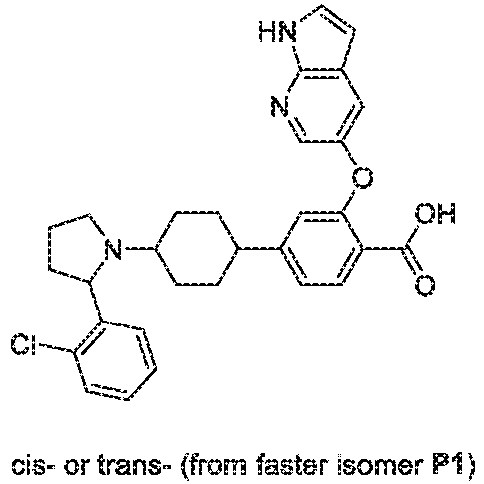
- The mixture of (cis- or trans-) methyl 2-((1 H-pyrrolo[2,3-b]pyridin-5-yl)oxy)-4-(4-(2-(2-chlorophenyl)pyrrolidin-1-yl)cyclohexyl)benzoate (P1) (130 mg, 0.25 mmol) in a solution of MeOH (10 mL) / THF (2 mL) / H2O (1 mL) was added NaOH (100 mg, 2.5 mmol) and stirred overnight. Then the reaction was quenched with HCl acid (6N) and adjusted to pH ∼ 4, extracted with DCM (20 mL), washed with brine (10 mL), dried over Na2SO4 and concentrated in vacuum to afford a crude product (142 mg, crude). MS (ESI, m/e) [M+1]+ 516.1.
-

- The mixture of (cis- or trans-)2-((1H-pyrrolo[2,3-b]pyridin-5-yl)oxy)-4-(4-(2-(2-chlorophenyl)pyrrolidin-1-yl)cyclohexyl)benzoic acid (142 mg, 0.28 mmol; product of step 6), triethylamine (85 mg, 0.84 mmol), 2-(7-azabenzotriazol-1-yl)-N,N,N',N'-tetramethyluronium hexafluorophosphate (125 mg, 0.33 mmol) in DCM (20 mL) was stirred for 2 hours. To the resulting reaction were added 3-nitro-4-(((tetrahydro-2H-pyran-4-yl)methyl)amino)benzenesulfonamide (104 mg, 0.33 mmol) and DMAP (3 mg, 0.03 mmol) and stirred overnight. The reaction mixture was concentrated in vacuum and purified by chromatography column on silica (eluent: PE/EA = 1/1 to DCM/MeOH = 10/1) to afford a crude product, which was purified with Pre-TLC (DCM/MeOH, 25/1) to give the product Example D1a (17.5 mg, 7.71%). 1H NMR (400 MHz, DMSO-d 6 ) δ ppm: 12.16 (br, 1H), 11.78 (br, 1H), 8.61 (m, 2H), 8.05 (s, 1H), 7.85 (d, J = 8.0 Hz, 1H), 7.63 (s, 1H), 7.55 (m, 1H), 7.51 (d, J = 8.0 Hz, 1H), 7.45 (d, J = 8.0 Hz, 1H), 7.27 (d, J = 8.0 Hz, 1H), 7.16 (d, J = 8.0 Hz, 1H), 7.00 (t, J = 8.0 Hz, 1H), 6.94 (d, J = 8.0 Hz, 1 H), 6.86 (t, J = 8.0 Hz, 1H), 6.51 (s, 1H), 6.44 (s, 1H), 4.10 (d, J = 8.0 Hz, 1H), 3.85 (d, J = 8.0 Hz, 2H), 3.30-3.23 (m, 5H), 3.16-3.10-3.04 (m, 2H), 2.67-2.55 (m, 1H), 2.42-2.33 (m, 3H), 2.13-1.99 (m, 2H), 1.87-1.82 (m, 2H), 1.67-1.58 (m, 4H), 1.41-1.26 (m, 6H). MS (ESI, m/e) [M+1]+ 813.2.
-

- Using the slower isomer P2 in the hydrolysis reaction of step 6 and then proceeded with a condensation reaction following similar procedure of Example D1a gave Example D1b (11 mg, 8.46%). 1H NMR(400 MHz, DMSO-d 6 ) δ ppm: 12.14(br, 1H), 11.68(br, 1H), 8.51-8.42(m, 2H), 7.97 (s, 1H), 7.79 (d, J = 8.0Hz, 1H), 7.68-7.65(m, 1H), 7.50-7.47 (m, 2H), 7.42(d, J = 8.0Hz, 1H), 7.34-7.30(m, 2H), 7.20-7.16(m, 1H), 7.07-7.01(m, 1H), 6.98(d, J = 8.0Hz, 1H), 6.60(s, 1H), 6.38(s, 1H), 4.14(m, 1H), 3.85(d, J = 12.0Hz, 2H), 3.26-3.22(m, 5H), 3.13-2.98(m, 2H), 2.67-2.59(m, 1H), 2.33-2.18(m, 4H), 2.03-1.97(m, 1H), 1.86-1.80(m, 2H), 1.68-1.57(m, 8H), 1.45-1.26(m, 2H). MS (ESI, m/e) [M+1]+ 813.2.
-

- Using 2-(2-cyclopropylphenyl)pyrrolidine in the reductive amination step, and then following the next similar procedures of Example D1a and D1b, compounds D2a and D2b were obtained correspondingly.
- Example D2a: 12.16 (br, 1H), 11.73-11.67 (m, 1H), 8.55 ( m, 2H), 8.03-7.97 (m, 1H), 7.81-7.5 8(m, 2H), 7.49-7.43 (m, 3H), 7.24-6.92 (m, 3H), 6.87-6.81 (m, 1H), 6.67 (m, 1H), 6.53 (s, 1H), 6.42-6.36 (m, 1H), 5.13 (m, 0.5H), 4.23 (m, 0.5H), 3.85 (d, J= 8.0Hz, 2H), 3.70 (m, 1H), 3.40 (m, 1H), 3.28-3.16 (m, 5H), 2.67 (m, 1H), 2.42-1.87 (m, 8H), 1.67 (m, 2H), 1.61 (d, J = 12.0Hz, 2H), 1.45-1.23 (m, 6H), 0.91-0.85 ( m, 2H), 0.69-0.45 (m, 2H). MS (ESI, m/e) [M+1]+ 819.2.
- Example D2b: 12.26 (br, 1H), 11.88 (br, 1H), 8.48 (m, 2H), 7.95 (s, 1H), 7.74 (m, 1H), 7.51-7.43 (m, 3H), 7.30 (m, 2H), 7.09-6.94 (m, 4H), 6.59 (s, 1H), 6.36 (s, 1H), 5.14 (m, 0.5H), 4.27 (m, 0.5H), 3.84 (d, J = 8.0Hz, 1H), 3.62 ( m, 1H), 3.25-3.13 (m, 4H), 3.10-2.98 (m, 2H), 2.41 (m, 2H), 2.10-1.99 (m, 6H), 1.86 ( m, 2H), 1.67-1.61 (m, 4H), 1.60 (d, J = 8.0Hz, 2H), 1.41-1.26 (m, 4H), 0.93 (m, 2H), 0.72-0.59 (m, 2H). MS (ESI, m/e) [M+1]' 819.2.
-

-

- To a solution of methyl 2-((1H-pyrrolo[2,3-b]pyridin-5-yl)oxy)-4-(4-oxocyclohexyl)benzoate (364 mg, 1.00 mmol), (S)-2-(2-cyclopropylphenyl)pyrrolidine (185 mg, 1.00 mmol), AcOH (1 drop) in DCM (20 mL) was added NaBH(OAc)3(424 mg, 2.00 mmol), the solution was stirred at r.t for 16 h. The reaction solution was washed with H2O (20 mL), dried over Na2SO4, concentrated and purified by prep-MPLC to afford two products as cis-/trans- isomer of cyclohexyl. the faster isomer P1 (eluent: 40%(v), EA/PE) as a white solid (250 mg, 41.4%), MS (ESI, m/e) [M+1]+ 536.2; the slower isomer P2 (eluent: 80%(v), EA/PE) as a white solid (230 mg, 46.7%), MS (ESI, m/e) [M+1]+ 536.2.
-
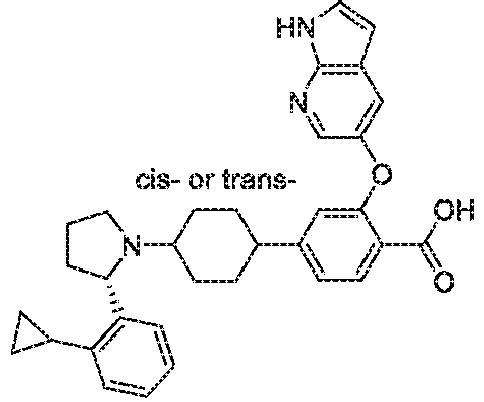
- The solution of methyl (cis- or trans-) (S)-2-((1H-pyrrolo[2,3-b]pyridin-5-yl)oxy)-4-(4-(2-(2-cyclopropylphenyl)pyrrolidin-1-yl)cyclohcxyl)benzoate (P1) (250 mg, 0.0.467 mmol) in THF (20 mL) was added NaOH(6M, 6 mL), the mixture was stirred for 3 h at room temperature. Then the pH value of the reaction solution was adjusted to ~ 3 with Con. HCl acid and concentrated in vacuum. The residue was washed with DCM/MeOH = 10/1(50 mL), filtered, the filtrate was concentrated to afford the product (200 mg, crude) as a yellow solid. MS (ESI, m/e) [M+1]+ 522.2.
-

- To a mixture of (cis- or trans-) (S)-2-((1H-pyrrolo[2,3-b]pyridin-5-yl)oxy)-4-(4-(2-(2-cyclopropylphenyl)pyrrolidin-1-yl)cyclohexyl)benzoic acid (200 mg, 0.384 mmol) in DCM (20 mL) was added 3-nitro-4-(((tetrahydro-2H-pyran-4-yl)methyl)amino)benzenesulfonamide (145 mg, 0.460 mmol), HATU (175 mg, 0.0.460 mmol), DMAP (47 mg, 0.84 mmol) and triethylamine (194 mg, 1.919 mmol), the solution was stirred at room temperature for 18 hours. Then the reaction mixture was washed with H2O (10 mL) and separated. The organic layer was then concentrated and purified by chromatography column on silica (eluent: DCM/MeOH, 20/0 to 20/1) to afford the crude product, which was further purified by pre-TLC (eluent: MeOH/DCM=1/20) to give compound D2a-S (200 mg, 63.7 %) as a yellow solid. 1H NMR(400 MHz, DMSO-d 6 ) δ ppm: 11.70 (s, 1H), 8.53(s, 2H), 8.10-7.42 (m, 6H), 7.20-6.22 (m, 8H), 3.87-3.81 (m, 2H), 3.30-3.12 (m, 6H), 2.00-1.13 (m, 20H), 0.94-0.77 (m, 3H), 0.67-0.64 (m, 2H). MS (ESI, m/e) [M+1]' 819.2.

- To a mixture of (trans- or cis-) (S)-2-((1H-pyrrolo[2,3-b]pyridin-5-yl)oxy)-4-(4-(2-(2-cyclopropylphenyl)pyrrolidin-1-yl)cyclohexyl)benzoic acid (200 mg, 0.384 mmol, prepared from intermediate P2 using the same procedure in example D2a-S) in DCM (20 mL) was added 3-nitro-4-(((tetrahydro-2H-pyran-4-yl)methyl)amino)benzenesulfonamide (121 mg, 0.384 mmol), EDCI (148 mg, 0.768 mmol), DMAP (94 mg, 0.768 mmol) and triethylamine (195 mg, 1.92 mmol), the resulted mixture was stirred at room temperature for 40 hours. Then the reaction mixture was washed with H2O (10 mL × 3), the organic phase was concentrated and purified by chromatography column on silica (eluent: DCM/MeOH, 20/0 to 20/1) to afford compound D2b-S (80 mg, 25.5 %). 1H NMR(400 MHz, CDCl3-d6) δ ppm: 9.53 (s, 1H), 8.90 (s, 1H), 8.53 (s, 1H), 8.24-8.07 (m, 2H), 8.00 (d, J = 8.4Hz, 1H), 7.83-7.38 (m, 3H), 7.21-7.05 (m, 2H), 7.01-6.95 (m, 3H), 6.59-6.39 (m, 2H), 4.51-4.18 (m, 1H), 4.10-3.95 (m, 2H), 3.46-3.36 (t, J = 12.0Hz, 2H), 3.29-3.22 (t, J = 6.0Hz, 2H), 2.63 (m, 1H), 2.32-2.19 (m, 2H), 2.00-1.85 (m, 4H), 1.78-1.63 ( m, 6H), 1.48-1.39 (m, 2H), 1.36-1.11 (m, 6H), 0.96-0.77 ( m, 3H), 0.73-0.50 (m, 2H). MS (ESI, m/e) [M+1]+ 819.2.
-

- Using (R)-2-(2-cyclopropylphenyl)pyrrolidine instead of (S)-2-(2-cyclopropylphenyl)pyrrolidine in the reductive amination step, and then following the next similar procedures of Example D2a-S, compounds D2a-R and D2b-R were obtained correspondingly.
- Example D2a-R: 1H NMR(400 MHz, DMSO-d 6 ) δ ppm: 11.59 (br, 1H), 8.42 (s, 1H), 8.35 (t, J = 4.0Hz, 1H), 7.95 (s, 1H), 7.72 (d, J = 12.0Hz, 1H), 7.49-7.46 (m, 3H), 7.36 (s, 1H), 6.87-6.82 (m, 4H), 6.73 (t, J = 8.0Hz, 1H), 6.56 (s, 1H), 6.34-6.31 (m, 1H), 4.26 (d, J = 8.0Hz, 1H), 3.85 (d, J = 8.0Hz, 2H), 3.29-3.17 (m, 6H), 2.54-2.48 (m, 1H), 2.38-2.34 (m, 2H), 2.19-2.14 (m, 1H), 1.96-1.68 ( m, 6H), 1.62 (d, J = 12.0Hz, 2H), 1.42-1.21 (m, 8H), 0.89-0.82 (m, 2H), 0.65-0.62 (m, 1H), 0.49-0.45 (m, 1H). MS (ESI, m/e) [M+1]+ 819.2.
- Example D2b-R: 1H NMR(400 MHz, DMSO-d 6 ) δ ppm: 11.53 (br, 1H), 8.37 (s, 1H), 8.32 (t, J = 4.0Hz, 1H), 7.89 (d, J = 2.0Hz, 1H), 7.65 (d, J = 8.0Hz, 1H), 7.56 (d, J = 8.0Hz, 1H), 7.42-7.40 (m, 2H), 7.30 (d, J = 2.0Hz, 1H), 7.11 (t, J = 4.0Hz, 1H), 7.05 (t, J = 8.0Hz, 1H), 6.92 (d, J = 8.0Hz, 1H), 6.88 (d, J = 8.0Hz, 1H), 6.83(d, J = 8.0Hz, 1H), 6.58 (s, 1H), 6.30-6.27 (m, 1H), 4.30 (t, J = 8.0Hz, 1H), 3.85(d, J = 8.0Hz, 2H), 3.30-3.11 (m, 6H), 2.59-2.53 (m, 1H), 2.33-2.31 (m, 2H), 2.20-2.17 (m, 1H), 1.99-1.93 (m, 1H), 1.86-1.80 (m, 2H), 1.72-1.58 (m, 7H), 1.42-1.21 ( m, 6H), 0.90-0.84 (m, 2H), 0.65-0.63 (m, 1H), 0.53-0.50 (m, 1H). MS (ESI, m/e) [M+1]+ 819.2.
-

- Using 2-(3-cyclopropylphenyl)pyrrolidine in the reductive amination step, and then following the next similar procedures of Example D1a and D1b, compounds D3a and D3b were obtained correspondingly.
- Example D3a: 1H NMR(400 MHz, DMSO-d 6 ) δ ppm:12.20 (br, 1H), 11.66 (br, 1H), 9.62 (br, 0.5H), 8.50-8.45 (m, 2H), 7.98 (s, 1H), 7.76-7.73 (m, 1H), 7.49-7.46 (m, 2H), 7.35-6.51 ( m, 7H), 6.36 (s, 1H), 5.76 (s, 1H), 4.49-4.39 (m, 1H), 3.85 (d, J = 8.0Hz, 2H), 3.62-3.45 (m, 1H), 3.29-3.01 (m, 6H), 2.65-2.39 (m, 1H), 2.35-2.15 (m, 1H), 2.01-1.85 (m, 6H), 1.83-1.60 (m, 6H), 1.45-1.27 (m, 5H), 0.97-0.94 (m, 2H), 0.73-0.67 (m, 2H). MS (ESI, m/e) [M+1]+ 819.2.
- Example D3b: 1H NMR(400 MHz, DMSO-d 6 ) δ ppm: 12.18 (br, 1H), 11.68 (br, 1H),9.73 (br, 0.5H), 8.51 (m, 2H), 7.97 (s, 1H), 7.79 (d, J = 8.0Hz, 1H), 7.50-7.47 ( m, 2H), 7.44 (d, J = 8.0Hz, 1H), 7.34-7.29 (m, 3H), 7.10-7.01 (m, 2H), 6.97 (d, J = 8.0Hz, 1H), 6.59 (s, 1H), 6.38 (m, 1H), 4.53-4.48 (m, 1H), 3.85 (d, J = 8.0Hz, 2H), 3.55-3.46 (m, 1H), 3.29-3.01 (m, 6H), 2.36-2.25 ( m, 2H), 2.01-1.85 (m, 8H), 1.83-1.66 (m, 2H), 1.60 (d, J = 12.0Hz, 2H), 1.45-1.27 (m, 5H), 0.97-0.94 (m, 2H), 0.73-0.67 (m, 2H). MS (ESI, m/e) [M+1]+ 819.2.
-

- Using 2-(4-cyclopropylphenyl)pyrrolidine in the reductive amination step, and then following the next similar procedures of Example D1a and D1b, compounds D4a and D4b were obtained correspondingly. Example D4a: MS (ESI, m/e) [M+1]" 819.2. Example D4b: 1H NMR(400 MHz, DMSO-d 6 ) δ ppm: 12.18 (br, 0.5H), 11.72 (m, 1H), 9.71 (br, 0.5H), 8.49 (m, 2H), 7.96 (s, 1H), 7.77 (d, J=9.2 Hz, 2H), 7.59 - 7.42 (m, 4H), 7.12 - 6.94 (m, 4H), 6.59 (s, 1H), 6.37 (s, 1H), 4.54 (s, 1H), 3.85 (d, J=8.0 Hz, 2H), 3.51 (s, 1H), 3.27 - 3.23 (m, 4H), 2.33 - 2.01 ( m, 2H), 1.85 - 1.66 (m, 9H), 1.61 (d, J=12.8 Hz, 2H), 1.45 - 1.21 ( m, 8H), 0.96 - 0.84 (m, 2H), 0.70 - 0.66 (m, 2H). MS (ESI, m/e) [M+1]' 819.2.
-

- Using 2-(2-isopropylphenyl)pyrrolidine in the reductive amination step, and then following the next similar procedures of Example D1b, compound D5 was obtained. 1H NMR (400 MHz, DMSO-d 6 ) δ ppm: 12.15 (s, 1H), 11.63 (s, 1H), 8.47 (s, 2H), 7.94 (s, 1H), 7.73 (s, 1H), 7.56 (s, 1H), 7.52-6.88 (m, 8H), 6.59 (s, 1H), 6.35 (s, 1H), 3.83 (d, J = 8.6 Hz, 2H), 3.24-3.16 (m, 5H), 3.09 (s, 1H), 2.33 (s, 2H), 2.15-2.13 (m, 1H), 1.85 (s, 3H), 1.75-1.57 (m, 6H), 1.27-1.13 (m, 13H). MS (ESI, m/e) [M+1]" 821.2.
-

- Using 2-(2-(prop-1-en-2-yl)phenyl)pyrrolidine in the reductive amination step, and then following the next similar procedures of Example D1b, compound D 6 was obtained. 1H NMR (400 MHz, DMSO-d 6 ) δ ppm: 12.17 (s, 1H), 11.62 (s, 1H), 8.60 - 8.40 (m, 2H), 7.93 (s, 1H), 7.80 - 7.60 (m, 2H), 7.55 - 7.30 (m, 4H), 7.30 - 6.80 (m, 4H), 6.59 (s, 1H), 6.34 (s, 1H), 5.35 - 5.15 (m, 1H), 4.90 - 4.50 (m, 1H), 3.84 (d, J = 11.0 Hz, 2H), 3.30 - 3.20 (m, 4H), 3.05 - 2.85 (m, 2H), 2.40 - 2.20 (m, 2H), 2.15 - 1.90 (m, 5H), 1.85 - 1.50 (m, 8H), 1.45 - 1.05 ( m, 8H). MS (ESI, m/e) [M+1]+ 818.9.
-

- Using 2-(3-chlorophenyl)pyrrolidine in the reductive amination step, and then following the next similar procedures of Example D1a and D1b, compounds D13-1a and D13-1b were obtained correspondingly.
- Example D13-1a: 1H NMR (400 MHz, DMSO-d 6 ) δ ppm: 12.16 (s, 1H), 11.72 (s, 1H), 8.70-8.35 (m, 2H), 8.01 (s, 1H), 7.83-7.70 (m, 1H), 7.64-7.30 (m, 5H), 7.22-7.00 (m, 4H), 6.99-6.84 (m, 1H), 6.53 (s, 1H), 6.44-6.31 (m, 1H), 3.93-3.79 (m, 2H), 3.78-3.63 (m, 1H), 3.16-2.97 ( m, 2H), 2.42-2.28 (m, 2H), 2.19-1.94 (m, 2H), 1.94-1.68 (m, 4H), 1.68-1.52 (m, 4H), 1.51-1.33 (m, 3H), 1.33-1.23 (s, 5H), MS (ESI) m/e [M+1]+ 813.1.
- Example D13-1b: 1H NMR (400 MHz, CDCl3) δ ppm: 10.27 (s, 0.5H), 8.99 (s, 1H), 8.90 (s, 1H), 8.53 (s, 1H), 8.21-8.11 (m, 2H), 8.02 (d, J = 8.1 Hz, 1H), 7.69 (s, 1H), 7.45 (s, 1H), 7.21-7.08 (m, 5H), 6.99-6.87 (m, 2H), 6.56 (s, 1H), 6.48 (s, 1H), 4.11-3.96 (m, 2H), 3.48-3.35 (m, 2H), 3.30-3.19 (m, 2H), 2.31-2.20 (m, 3H), 2.08-1.94 (m, 3H), 1.82-1.72 (m, 4H), 1.48-1.39 (m, 3H), 1.38-1.26 (m, 7H). MS (ESI) m/e [M+1]+ 813.1.
-

- Using 2-(4-chlorophenyl)pyrrolidine in the reductive amination step, and then following the next similar procedures of Example D1a and D1b, compounds D14-1a and D14-1b were obtained correspondingly.
- Example D14-1a: 1H NMR (400 MHz, DMSO-d 6 ) δ ppm: 12.14 (s, 1H), 11.74 (s, 1H), 8.70-8.49 (m, 2H), 8.11-7.49 (m, 1H), 7.90-7.78 (m, 1H), 7.69-7.57 (m, 1H), 7.56-7.37 (m, 3H), 7.28-7.01 (m, 4H), 6.96-6.84 (m, 1 H), 6.74-6.58 (m, 1 H), 6.52 (s, 1H), 6.47-6.37 (s, 1H), 3.89-3.79 (m, 2H), 3.72-3.62 (m, 1H), 3.28-3.17 (m, 3H), 3.11-2.86 (m, 4H), 2.46-2.29 (m, 1H), 2.15-1.92 (m, 3H), 1.92-1.79 (m, 2 H), 1.73-1.52 (m, 5H), 1.49-1.28 (m, 7H). MS (ESI) m/e [M+1]+ 813.1.
- Example D14-1b: 1H NMR (400 MHz, DMSO-d 6 ) δ ppm: 12.16 (br, 1H), 11.65 (s, 1 H), 8.48 (s, 2H), 7.95 (s, 1H), 7.82-7.23 (m, 8H), 7.09-6.86 ( m, 2 H), 6.58 (s, 1H), 6.36 (s, 1H), 3.90-3.78 (m, 2H), 3.27-3.17 (m, 4H), 3.09-2.87 (m, 3H), 2.41-2.28 (m, 2H), 2.09-1.92 (m, 3H), 1.91-1.63 (m, 4 H), 1.63-1.53 (m, 3H), 1.45-1.36 (m, 2H), 1.34-1.23 (m, 4H). MS (ESI) m/e [M+1]+ 813.1.
-

- Using 2-phenylpyrrolidine in the reductive amination step, and then following the next similar procedures of Example D1a and D1b, compounds D 63a and D 63b were obtained correspondingly. Example D63a: 1H NMR (400 MHz, DMSO-d 6 ) δ ppm: 12.17 (s, 1H), 11.80 - 11.55 (m, 1H), 8.65 - 8.35 (m, 2H), 8.05 - 1.90 (m, 1H), 7.85 - 7.65 (m, 1H), 7.60 - 7.30 ( m, 5H), 7.25 - 6.80 (m, 5H), 6.74 - 6.26 (m, 2H), 4.65 - 4.50 (m, 1H), 3.84 (dd, J= 11.1, 2.8 Hz, 2H), 3.30 - 3.20 (m, 5H), 2.45 - 2.25 (m, 3H), 2.18 - 1.93 (m, 3H), 1.80 - 1.50 (m, 9H), 1.48 - 1.10 (m, 5H). MS (ESI) m/e [M+1]+ 778.8. Example D63b: 1H NMR (400 MHz, DMSO-d 6 ) δ ppm: 12.17 (s, 1H), 11.64 (s, 1H), 8.60 - 8.30 ( m, 2H), 7.95 (s, 1H), 7.80 - 7.70 (m, 1H), 7.65 - 7.10 (m, 8H), 6.98 - 6.85 (m, 2H), 6.58 (s, 1H), 6.36 (s, 1H), 4.70 - 4.50 (m, 1H), 3.83 (d, J = 8.7 Hz, 2H), 3.30 - 3.20 (m, 5H), 2.45 - 2.20 (m, 3H), 2.15 - 1.92 (m, 5H), 1.90 - 1.80 (m, 2H), 1.78 - 1.65 (m, 3H), 1.59 (d, J = 12.3 Hz, 2H), 1.48 - 1.35 (m, 3H), 1.33 - 1.13 (m, 2H). MS (ESI) m/e [M+1]+ 778.8.
-

- Using 2-(o-tolyl)pyrrolidine in the reductive amination step, and then following the next similar procedures of Example D1b, compound D 96 was obtained. 1H NMR (400 MHz, DMSO-d 6 ) δ ppm:12.21 (s, 1H), 11.66 (s, 1H), 8.60 - 8.35 (m, 2H), 8.20 - 8.05(m, 1H), 7.95 (s, 1H), 7.85 - 7.65 (m, 1H), 7.62 - 7.35 (m, 3H), 7.30 - 6.80 (m, 5H), 6.60 (s, 1H), 6.35 (s, 1H), 4.80 - 4.60 (m, 1H), 3.83 (d, J = 9.0 Hz, 2H), 3.75 - 3.55 (m, 1H), 3.30 - 3.20 (m, 5H), 2.50 - 2.22 ( m, 5H), 2.20 - 1.95 (m, 2H), 1.90 - 1.75 (m, 3H), 1.70 - 1.45 (m, 6H), 1.40 - 1.12 (m, 6H). MS (ESI) m/e [M+1]+ 792.9.
-

- Using 2-(2-ethylphenyl)pyrrolidine in the reductive amination step, and then following the next similar procedures of Example D1a and D1b, compounds D 97-a and D 97-b were obtained correspondingly. Example D97-a: MS (ESI) m/e [M+1]+ 806.9. Example D97-b: 1H NMR (400 MHz, DMSO-d 6 ) δ ppm: 11.58 (s, 1H), 8.50 - 8.27 (m, 2H), 7.91 (d, J = 2.0Hz, 1H), 7.74 - 7.51 (m, 2H), 7.47 - 7.31 (m, 3H), 7.27 - 7.02 (m, 3H), 6.89 (d, J = 7.6Hz, 2H), 6.58 (s, 1H), 6.32 (s, 1H), 4.05 - 3.90 (m, 1H) 3.87 - 3.79 (m, 2H), 3.29 - 3.06 (m, SH), 2.68 - 2.60 (m, 2H), 2.37 - 2.24 (m, 2H), 1.89 - 1.55 (m, 10H), 1.40 - 1.20 (m, 8H), 1.13 (t, J = 7.5 Hz, 3H). MS (ESI) m/e [M+1]+ 806.9.
-
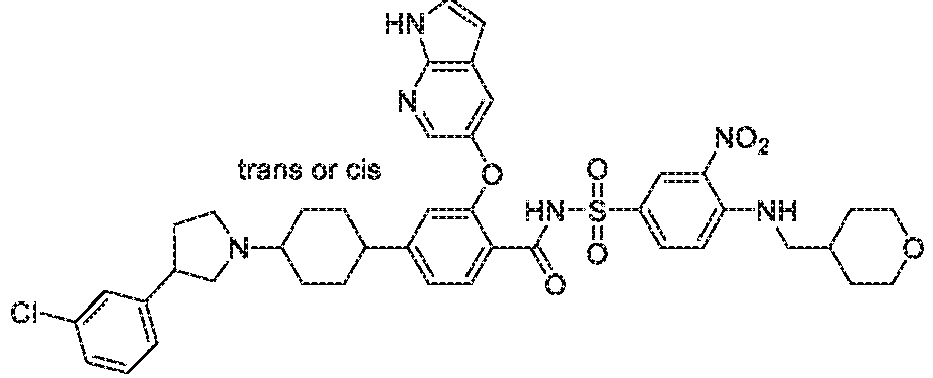
- Using 3-(3-chlorophenyl)pyrrolidine in the reductive amination step, and then following the next similar procedures of Example D1b, compound D 99 was obtained. 1H NMR (400 MHz, DMSO-d 6 ) δ ppm: 12.25 (s, 1H), 11.68 (s, 1H), 8.60 - 8.47 (m, 2H), 8.00 (s, 1H), 7.85 - 7.65 ( m, 1H), 7.60 - 7.43 (m, 4H), 7.41 - 7.29 ( m, 3H), 7.28 - 7.21 (m, 1H), 7.14 - 7.01 (m, 1H), 6.83 - 6.74 (m, 1H), 6.38 (m, 1H), 4.01 - 3.94 (m, 1H), 3.90 - 3.79 (m, 2H), 3.75 - 3.50 (m, 2H), 3.31 - 3.19 (m, 5H), 3.15 - 3.08 (m, 1H), 2.16 - 2.04 (m, 2H), 2.03 - 1.92 (m, 3H), 1.91 - 1.73 (m, 5H), 1.67 - 1.49 (m, 5H), 1.32 - 1.25 (m, 2H). MS (ESI, m/e) [M+1]+ 812.7.
-

- Using 2-(2-phenoxyphenyl)pyrrolidine in the reductive amination step, and then following the next similar procedures of Example D1b, compound D 100 was obtained. 1H NMR (400 MHz, DMSO-d 6 ) δ ppm: 12.20 (s, 1H), 11.71 (s, 1H), 8.65 - 8.45 (m, 2H), 8.30 - 8.15 (m, 1H), 7.98 (s, 1H), 7.78 (d, J = 7.6 Hz, 1H), 7.57 - 7.36 (m, 4H), 7.34 - 7.16 (m, 3H), 7.16 - 6.78 (m, 6H), 6.57 (s, 1H), 6.39 (s, 1H), 5.00 - 4.85 (m, 1H), 3.84 (d, J = 8.6 Hz, 2H), 3.60 - 3.45(m, 1H), 3.30 - 3.20 (m, 4H), 3.15 - 3.05 (m, 1H), 2.40 - 2.25(m, 2H), 2.20 - 1.95 (m, 3H), 1.90 - 1.76 (m, 3H), 1.74 - 1.51 (m, 5H), 1.50 - 1.03 (m, 6H). MS (ESI, m/e) [M+1]+ 871.8.
-

- Using 2-(2-cyclopropylstyryl)pyrrolidine in the reductive amination step, and then following the next similar procedures of Example D1b, compound D101 was obtained. 1H NMR (400 MHz, DMSO-d 6 ) δ ppm: 11.57 (s, 1H), 9.49 (s, 1H), 8.60 - 8.30 (m, 2H), 7.92 (d, J = 1.9 Hz, 1H), 7.69 (d, J = 8.9 Hz, 1H), 7.60 - 7.30 (m, 5H), 7.25 - 7.05 (m, 2H), 7.01 (d, J = 8.9 Hz, 1H), 6.95 - 6.85 (m, 2H), 6.60 (s, 1H), 6.32 (s, 1H), 6.13 (s, 1H), 4.50 - 4.20 (m, 1H), 3.83 (d, J = 8.8 Hz, 2H), 3.30 - 3.20 (m, 6H), 3.10 - 2.80 (m, 1H), 2.29 - 1.71 (m, 10H), 1.68 - 1.14 (m, 8H), 1.10 - 0.75 (m, 3H), 0.68 - 0.45 (m, 2H). MS (ESI, m/e) [M+1]+ 844.8
-

- Using 2-styrylpyrrolidine in the reductive amination step, and then following the next similar procedures of Example D1b, compound D102 was obtained. MS (ESI, m/e) [M+1]+ 806.2
-

- Using 2-(2-methoxyphenyl)pyrrolidine in the reductive amination step, and then following the next similar procedures of Example D1b, compound D103 was obtained. 1H NMR (400 MHz, DMSO-d 6 ) δ ppm: 12.08 (s, 1H), 11.71 (s, 1H), 8.02 (s, 1H), 7.87 (s, 1H), 7.72 (s, 1H), 7.52-7.45 (m, 3H), 7.28-7.074 (m, 4H), 6.95-6.89 (m, 1H), 6.70 (s, 2H), 6.40 (s, 1H), 5.98-5.79 (m, 1H), 4.33 - 4.19 (m, 1H), 3.82 (d, J = 8.8 Hz, 2H), 3.22 (t, J = 11.3 Hz, 2H), 3.08 (s, 2H), 2.98 (s, 2H), 2.18 (s, 3H), 2.02-1.97 (m, 4H), 1.80-1.71 (m, 4H), 1.56 (d, J = 12.6 Hz, 2H), 1.4-7-1.33 (m, 2H), 1.23 - 1.15 (m, 5H). MS (ESI, m/e) [M+1]+ 809.2.
-

- 1H NMR (DMSO-d 6) δ ppm: 12.16 (s, 1H), 11.70 (s, 1H), 8.64-8.48 (m, 2H), 8.07-7.93 (m, 1H), 7.87-7.74 (m, 1H), 7.63-7.40 (m, 2H), 7.44-7.38 (m, 1H), 7.37-7.07 (m, 11H), 7.03-6.94 (m, 1H), 6.71-6.53 (m, 1H), 6.43-6.30 (m, 1H), 3.90-3.80 (m, 2H), 3.66-3.42 (m, 4H), 3.25-3.17 (m, 5H), 2.44-2.30 (m, 1H), 1.99-1.73 (m, 4H), 1.65-1.55 (m, 3H), 1.55-1.40 (m, 3H), 1.33-1.24 (s, 2H). MS (ESI) m/e [M+1]+ 829.2.
-

- 1H NMR (DMSO-d 6) δ ppm: 12.17 (s, 1H), 11.59 (s, 1H), 9.20 (s, 1H), 8.62-8.27 (m, 2H), 7.95 (s, 1H), 7.81-7.57 (m, 3H), 7.52-7.01 (m, 12H), 6.78-6.63 (m, 1H), 6.34 (s, 1H), 5.75 (s, 0.5H), 4.83 (s, 0.5H), 3.92-3.7 (m, 2H), 3.25-3.17 (m, 4H), 3.15-2.90 (m, 2H), 2.07-1.94 (m, 2H), 1.94-1.67(m, 5H), 1.64-1.53 (m, 3H), 1.41-1.35 (m, 1H), 1.30-1.24 (m, 3H). MS (ESI) m/e [M+1]+ 814.8.
-

- Using (R)-N-methyl-1-phenylethan-1-amine in the reductive amination step, and then following the next similar procedures of Example D1b, compound D106 was obtained. 1H NMR(400 MHz, DMSO-d 6 ) δ ppm: 12.23 (s, 1H), 11.66 (s, 1H), 9.17-9.04 (m, 1H), 8.62-8.47 (m, 2H), 7.99 (s, 1H), 7.83-7.71 (m, 1H), 7.63-7.43 (m, 7H), 7.23-7.08 (m, 1H), 7.03-6.93 (m, 1H), 6.83-6.70 (m, 1H), 6.36 (m, 1H), 4.70 (m, 1H), 3.88-3.80 (m, 2H), 3.30-3.17 (m, 6H), 2.64-2.52 (m, 1H), 2.05-1.92 (m, 2H), 1.92-1.69 (m, 5H), 1.66-1.50 (m, 5H), 1.49-1.37 (m, 2H), 1.32-1.24 (m, 3H). MS (ESI, m/e) [M+1]+ 766.8.
-

- Step 1: 2-((1H-pyrrolo[2,3-b]pyridin-5-yl)oxy)-4-(4-oxocyclohexyl)benzoic acid To the solution of methyl 2-((1H-pyrrolo[2,3-b] pyridin-5-yl)oxy)-4-(4-oxocyclohexyl)benzoate (8.0 g, 22.0 mmol) in THF (100 mL) and H2O (50 mL) was added NaOH (800 mg). The reaction mixture was stirred at ambient temperature for 20 hours. After removal of THF, the mixture was adjusted to pH ~4 with 1M HCl acid and then extracted with EA (50 mL × 2). The combined organic phase was washed with brine, dried over anhydrous Na2SO4, concentrated in vacuum. The residue was slurried in DCM/MeOH (20 mL/2 mL), filtered, and the filtrate was concentrated to afford 2-((1H-pyrrolo[2,3-b]pyridin-5-yl)oxy)-4-(4-oxocyclohexyl)benzoic acid (2.2 g). MS (ESI, m/e) [M+1]+ 351.1.
- A mixture of 2-((1H-pyrrolo[2,3-b]pyridin-5-yl)oxy)-4-(4-oxocyclohexyl)benzoic acid (2.0g, 5.71mmol), 3-nitro-4-(((tetrahydro-2H-pyran-4-yl)methyl)amino)benzene sulfonamide (1.8 g, 5.71 mmol), EDCI (1.64 g, 8.57 mmol), DMAP (1.05 g, 8.57 mmol) and TEA (1.15 g, 16.42 mmol) in DCM (20 mL) was stirred at ambient temperature for 20 hours. The reaction mixture was concentrated in vacuum, then purified by chromatography column on silica (eluent: DCM/MeOH = 100/1 to 50/1) to afford 2-((1H-pyrrolo[2,3-b]pyridin-5-yl)oxy)-N-((3-nitro-4-(((tetrahydro-2H-pyran-4-yl)methyl)amino)phenyl)sulfonyl)-4-(4-oxocyclohexyl)benzamide (1.5 g). MS (ESI) m/e [M+1]+ 648.1.
- Step 3: To a solution of 2-((1H-pyrrolo[2,3-b]pyridin-5-yl)oxy)-N-((3-nitro-4-(((tetrahydro-2H-pyran-4-yl)methyl)amino)phenyl)sulfonyl)-4-(4-oxocyclohexyl)benzamide (400 mg, 0.7 mmol) and 1-(azetidin-3-yl)-2-(2-cyclopropylphenyl)pyrrolidine (200 mg, 0.9 mmol) in DCM (40 mL) was added NaBH(OAc)3 (600 mg, 3 mmol). The mixture was stirred at room temperature for 14 hours. Then aq. NH4Cl (30 mL) was added to the reaction mixture. The organic phase was washed with saturated aq. NaCl (10 mL), dried over anhydrous Na2SO4, concentrated. The crude product was then purified by pre-TLC to give 20 mg of 2-((1H-pyrrolo[2,3-b]pyridin-5-yl)oxy)-4-(cis-4-(3-(2-(2-cyclopropylphenyl)pyrrolidin-1-yl)azetidin-1-yl)cyclohexyl)-N-((3-nitro-4-(((tetrahydro-2H-pyran-4-yl)methyl)amino)phenyl)sulfonyl)benzamide (the faster isomer) as example D107a. MS (ESI, m/e) [M+1]+ 874.0; and 10 mg of 2-((1H-pyrrolo[2,3-b]pyridin-5-yl)oxy)-4-(cis-4-(3-(2-(2-cyclopropylphenyl)pyrrolidin-1-yl)azetidin-1-yl)cyclohexyl)-N-((3-nitro-4-(((tetrahydro-2H-pyran-4-yl)methyl)amino)phenyl)sulfonyl)benzamide (the slower isomer) as example D107b. 1H NMR (DMSO-d 6) δ ppm: 12.19 (s, 1H), 11.74 (s, 1H), 8.60 - 8.56 (m, 2H), 8.02 (s, 1H), 7.83 (d, J = 8.7 Hz, 1H), 7.61 (s, 1H), 7.54 (s, 1H), 7.48 - 7.40 (m, 2H), 7.19 - 7.12 (m, 3H), 6.99 - 6.85 (m, 2H), 6.57 (s, 1H), 6.42 (s, 1H), 4.01 (s, 3H), 3.88 - 3.82 (m, 2H), 3.69 - 3.64 (m, 2H), 3.49 (s, 1H), 3.30 - 3.25 (m, 4H), 3.16 (s, 1H), 2.99 (s, 2H), 2.41 (s, 1H), 2.24 (s, 1H), 2.03 (s, 1H), 1.85 - 1.65 (m, 8H), 1.65 - 1.56 (m, 3H), 1.25 - 1.23 (m, 2H), 1.20 - 1.08 (m, 3H), 0.90 - 0.85 (m, 2H), 0.65 (s, 1H), 0.57 (s, 1H). MS (ESI) m/e [M+1]+ 873.9.
-

-

- A mixture of 2-phenylpyrrolidine (441 mg, 3 mmol), 5-bromo-2-fluoropyridine (633 mg, 3.6 mmol) and N, N-Diisopropylethylamine (2 g, 15 mmol) in DMSO (50 mL) was heated to 120 °C with stirring overnight. Then the reaction was cooled to room temperature, the mixture was washed with water, brine and dried over anhydrous Na2SO4. The organic layers were concentrated and purified by column chromatography with 5%--20% EA/PE to give 5-bromo-2-(2-phenylpyrrolidin-1-yl)pyridine (400 mg, 44.4 %) as a colorless oil. 1H NMR (400 MHz, DMSO-d6 ) δ ppm: 8.07 (d, J = 2.4 Hz, 1H), 7.54 (dd, J = 9.0, 2.4 Hz, 1H), 7.29 (t, J = 7.6 Hz, 2H), 7.21 (d, J = 7.6 Hz, 1H), 7.17 (t, J = 6.2 Hz, 2H), 6.24 (d, J = 7.3 Hz, 1H), 5.00 (d, J = 7.3 Hz, 1H), 3.83-3.64 (m, 1H), 3.53 (dd, J = 17.5, 8.6 Hz, 1H), 2.38 (dd, J = 13.1, 5.4 Hz, 1H), 2.01-1.77 (m, 3H). MS (ESI, m/e) [M+1]+ 303.0, 305.0
-

- Under nitrogen atmosphere, a mixture of 5-bromo-2-(2-phenylpyrrolidin-1-yl)pyridine (260 mg, 0.86 mmol), tert-butyl 2-((1H-pyrrolo[2,3-b]pyridin-5-yl)oxy)-4-(4,4,5,5-tetramethyl-1,3,2-dioxaborolan-2-yl)benzoate (375 mg, 0.86 mmol), Pd(PPh3)4 (96 mg, 0.086 mmol), and Cs2CO3 (555 mg, 1.72 mmol) in1,4-dioxane/H2O (50 mL/10 mL) was heated to 90°C with stirring overnight. Then the reaction was cooled to room temperature, the mixture was washed with water, brine and dried over anhydrous Na2SO4. The organic layers were concentrated and purified by column chromatography with 5%~20% EA/PE to give tert-butyl 2-((1H-pyrrolo[2,3-b]pyridin-5-yl)oxy)-4-(6-(2-phenylpyrrolidin-1-yl)pyridin-3-yl)benzoate product (300 mg, 65.6 %). MS(ESI, m/e) [M+1]+533.1.
-

- To a solution of tert-butyl 2-((1H-pyrrolo[2,3-b]pyridin-5-yl)oxy)-4-(6-(2-phenylpyrrolidin-1-yl)pyridin-3-yl)benzoate (266 mg, 0.5 mmol) in dichloromethane (25 mL) was added trifluoroacetic acid (5 mL). The reaction was stirred overnight at r.t., then the excess solvent was removed under reduced pressure. The residue was purified by column chromatography on silica gel to give 2-((1H-pyrrolo[2,3-b]pyridin-5-yl)oxy)-4-(6-(2-phenylpyrrolidin-1-yl)pyridin-3-yl)bcnzoic acid (200 mg, 84 %) as a white foam. MS (ESI, m/e) [M+1]+ 477.1.
-

- To a solution of 2-((1H-pyrrolo[2,3-b]pyridin-5-yl)oxy)-4-(6-(2-phenylpyrrolidin-1-yl)pyridin-3-yl)benzoic acid (150 mg, 0.32 mmol) in dichloromethane (25 mL) were added o-(7-azabenzotriazol-1-yl)-N,N,N',N'-tetramethyluronium hexafluorophosphate (182 mg, 0.48 mmol), triethylamine (1 mL) and 4-Dimethylaminopyridine (40 mg, 0.32 mmol). The mixture was stirred for 0.5 h at r.t. Then 3-nitro-4-(((tetrahydro-2H-pyran-4-yl)methyl)amino)benzenesulfonamide (199 mg, 0.64 mmol) was added. The reaction was continually stirred overnight at r.t. Afterwards, the mixture was washed with water (15 mL) and the organic layers were dried over anhydrous Na2SO4 and concentrated. The residue was further purified by prep-HPLC to give the product (40 mg, 16.2 % ). 1H NMR (400 MHz, DMSO-d 6 ) δ ppm: 12.25 (s, 1H), 11.69 (s, 1H), 8.61 (s, 1H), 8.56 (d, J = 2.0 Hz, 1H), 8.25 (s, 1H), 8.03 (d, J = 2.0 Hz, 1H), 7.82 (d, J = 7.3 Hz, 1H), 7.68-7.46 (m, 4H), 7.38 (d, J = 8.2 Hz, 1H), 7.27 (t, J = 7.3 Hz, 2H), 7.22-7.07 (m, 4H), 6.97 (s, 1H), 6.38 (s, 1H), 6.30 (d, J = 8.2 Hz, 1H), 5.05 (d, J = 7.1 Hz, 1H), 3.83 (t,J= 10.0 Hz, 3H), 3.57 (d,J= 9.3 Hz, 1H), 3.31-3.18 (m, 4H), 2.42-2.27 (m, 1H), 1.88-1.78 (m, 4H), 1.60 (d, J = 12.2 Hz, 2H), 1.31-1.14 (m, 2H). MS (ESI, m/e) [M+1]+ 774.1
-

-

- To a solution of 2-phenylpyrrolidine (1.46 g, 10 mmol) in dichloromethane (100 mL) was added tert-butyl 4-oxopiperidine-1-carboxylate (1.99 g, 10 mmol) at 0 °C. The mixture was stirred for 1 h and sodium triacetoxyborohydride (3.8 g, 15 mmol) was added in portions. Then the mixture was warmed to room temperature and stirred overnight. The mixture was washed with water, brine and dried over anhydrous Na2SO4. Solvent was removed in vacuum to give tert-butyl 4-(2-phenylpyrrolidin-1-yl)piperidine-1-carboxylate (3.30 g, 100 %) as a white solid, which was used directly without further purification. MS (ESI, m/e) [M+1]+ 331.2.
-
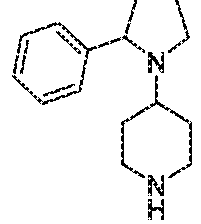
- A mixture of tert-butyl 4-(2-phenylpyrrolidin-1-yl)piperidine-1-carboxylate (3.3 g, 10 mmol) and HCl in 1,4-dioxane (4 N, 25 mL) was stirred for 3 h at room temperature. Solvent was removed under reduced pressure and the residue was basified by sat. aq. NaHCO3 (50 mL) until pH > 7. Then the mixture was extracted with dichloromethane (25 mL × 3), the combined organic layers were concentrated to give 4-(2-phenylpyrrolidin-1-yl)piperidine (1 g, 43.4%) as a colorless oil. 1H NMR (400 MHz, CDCl3) δ ppm: 7.37-7.24 (m, 4H), 7.20 (t, J = 7.0 Hz, 1H), 5.90 (s, 1H), 3.72 (dd, J = 8.2, 6.4 Hz, 1H), 3.26 (d, J = 12.4 Hz, 1H), 3.19-3.02 (m, 2H), 2.71-2.48 (m, 4H), 2.15 (dq, J = 12.4, 8.1 Hz, 1H), 2.00-1.82 (m, 2H), 1.82-1.56 (m, 5H). MS (ESI, m/e) [M+1]+ 231.1.
-

- To a degassed mixture of 4-(2-phenylpyrrolidin-1-yl)piperidine (230 mg, 1 mmol), tert-butyl 2-(1-(triisopropylsilyl)-1H-pyrrolo[2,3-b]pyridin-5-yloxy)-4-bromobenzoate (643 mg, 1.1 mmol), BINAP (125 mg, 0.2 mmol) and t-BuOK (224 mg, 2 mmol) in toluene (50 mL) was added Pd2(dba)3 (92 mg, 0.1 mmol). Nitrogen was bubbled through the mixture for 5 min and then heated to 90°C with stirring overnight. Then the reaction was cooled to room temperature, the mixture was washed with water, brine and dried over anhydrous Na2SO4. The organic layers were concentrated and purified by column chromatography with 5%∼20% EA/PE to give tert-butyl 2-(1-(triisopropylsilyl)-1H-pyrrolo[2,3-b]pyridin-5-yloxy)-4-(4-(2-phenylpyrrolidin-1-yl)piperidin-1-yl)benzoate (400 mg, 57.6 %). 1H NMR (400 MHz, DMSO-d6 ) δ ppm: 7.94 (s, 1H), 7.65 (d, J = 8.9 Hz, 1H), 7.48-7.39 (m, 1H), 7.33 (d, J = 7.3 Hz, 2H), 7.26 (t, J = 7.3 Hz, 2H), 7.18 (s, 2H), 6.78 (d, J = 8.8 Hz, 1H), 6.50 (s, 2H), 3.88-3.64 (m, 3H), 3.31 (d,J= 9.5 Hz, 1H), 3.07 (s, 1H), 2.64 (d, J = 11.3 Hz, 2H), 2.17-2.03 (m, 1H), 1.90-1.63 (m, 6H), 1.61-1.26 (m, 4H), 1.17 (s, 9H), 1.06 (s, 9H), 1.03 (s, 9H). MS (ESI, m/e) [M+1]+ 695.3.
-

- To a solution of tert-butyl 2-(1-(triisopropylsilyl)-1H-pyrrolo[2,3-b]pyridin-5-yloxy)-4-(4-(2-phenylpyrrolidin-1-yl)piperidin-1-yl)benzoate (347 mg, 0.5 mmol) in dichloromethane (25 mL) was added trifluoroacetic acid (5 mL). The reaction was stirred overnight at r.t. then the excess solvent was removed under reduced pressure. The residue was purified by column chromatography on silica gel to give 2-((1H-pyrrolo[2,3-b]pyridin-5-yl)oxy)-4-(4-(2-phenylpyrrolidin-1-yl)piperidin-1-yl)benzoic acid (200 mg, 83 %). MS (ESI, m/e) [M+1]+ 483.1.
-

- To a solution of 2-((1H-pyrrolo[2,3-b]pyridin-5-yl)oxy)-4-(4-(2-phenylpyrrulidin-1-yl)piperidin-1-yl)benzoic acid (145 mg, 0.3 mmol) in dichloromethane (25 mL) were added o-(7-azabenzotriazol-1-yl)-N,N,N',N'-tetramethyluronium hexafluorophosphate (171 mg, 0.45 mmol), triethylamine (1 mL) and 4-dimethylaminopyridine (36 mg, 0.3 mmol). The mixture was stirred for 0.5 h at r.t. Then 3-nitro-4-(((tetrahydro-2H-pyran-4-yl)methyl)amino)benzenesulfonamide (189 mg, 0.6 mmol) was added. The reaction was continually stirred overnight at r.t. Afterwards, the mixture was washed with water (10 mL) and the organic layers were dried over anhydrous Na2SO4 and concentrated. The residue was further purified by prep-HPLC to give the desired product (50 mg, 21.5 %). 1H NMR (400 MHz, DMSO-d 6 ) δ ppm: 11.68 (m, 2H), 8.58 (d, J = 5.6 Hz, 1H), 8.54 (d, J = 2.4 Hz, 1H), 8.02 (d, J = 2.4 Hz, 1H), 7.77 (d, J = 9.2 Hz, 1H), 7.60-7.40 (m, 5H), 7.33-7.25 (m, 3H), 7.07 (d, J = 9.2 Hz, 1H), 6.68 (d, J = 7.8 Hz, 1H), 6.37 (d, J = 1.5 Hz, 1H), 6.20 (s, 1H), 3.93-3.77 (m, 2H), 3.64 (s, 2H), 3.31-3.20 (m, 6H), 2.59 (s, 3H), 2.28-2.22 (m, 1H), 1.88 (m, 5H), 1.61 (d, J = 12.1 Hz, 3H), 1.38 (s, 2H), 1.32-1.16 (m, 3H). MS (ESI, m/e) [M+1]+ 780.2.
-

- The desired compound was synthesized starting from 2-(2-chlorophenyl)pyrrolidine and tert-butyl 4-oxopiperidine-1-carboxylate following the next procedures similar to those in Example E2. 1H NMR (400 MHz, DMSO-d 6 ) δ ppm: 11.69 (s, 1H), 11.44 (s, 1H), 8.62 (s, 1H), 8.56 (s, 1H), 8.03 (d, J = 2.4 Hz, 1H), 7.79 (d, J = 9.6 Hz, 1H), 7.63 (s, 1H), 7.51-7.48 (m, 3H), 7.33 (s, 1H), 7.27 (s, 1H), 7.18 (s, 1H), 7.11 (d, J = 8.6 Hz, 1H), 6.67 (d, J = 7.8 Hz, 1H), 6.38 (s, 1H), 6.18 (s, 1H), 4.15-4.11 (m, 1H), 3.84-3.75 (m, 2H), 3.65-3.60 (m, 1H), 3.55-3.50 (m, 1H), 3.30-3.25 (m, 2H), 3.25-3.20 (m, 2H), 3.14-3.10 (m, 2H), 2.74-2.57 (m, 3H), 2.20 (br, 1H), 1.89-1.87 (m, 1H), 1.69-1.65 (m, 3H), 1.47-1.41 (m, 3H), 1.29-1.12 (m, 5H). (ESI, m/e) [M+1]+ 814.1.
-
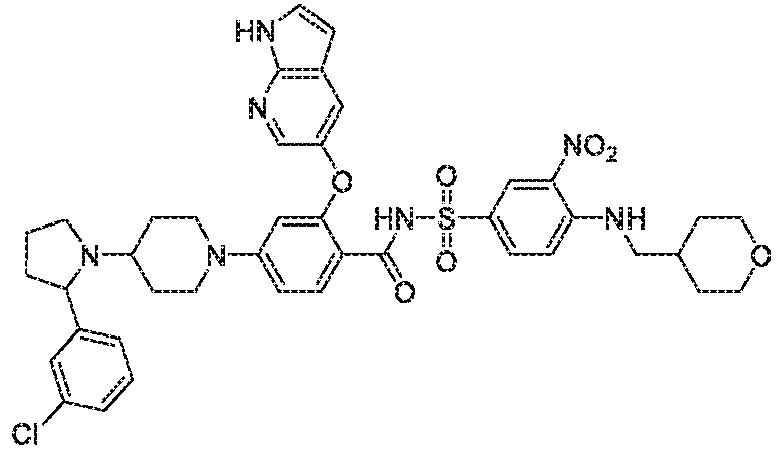
- The desired compound was synthesized starting from 2-(3-chlorophenyl)pyrrolidine and tert-butyl 4-oxopiperidine-1-carboxylate following the next procedures similar to those in Example E2. 1H NMR (400 MHz, DMSO-d 6 ) δ ppm: 11.66 (s, 1H), 11.41 (s, 1H), 8.57 (s, 1H), 8.53 (s, 1H), 8.01 (s, 1H), 7.76 (d, J = 8.5 Hz, 1H), 7.49 (d, J = 8.4 Hz, 3H), 7.37 (s, 1H), 7.29-7.23 (m, 3H), 7.07 (s, 1H), 6.66 (d, J = 8.3 Hz, 1H), 6.37 (s, 1H), 6.18 (s, 1H), 3.85 (d, J = 8.4 Hz, 3H), 3.61-3.54 (m, 2H), 3.27-3.07 (m, 4H), 3.07 (s, 1H), 2.67-2.55 (m, 3H), 2.12 (br, 1H), 1.88 (br, 1H), 1.81-1.41 (m, 7H), 1.41-1.13 (m, 5H). MS (ESI, m/e) [M+1]+ 814.1.
-

- The desired compound was synthesized starting from 2-(2-cyclopropylphenyl)pyro lidine and tert-butyl 4-oxopiperidine-1-carboxylate following the next procedures similar to those in Example E2. 1H NMR (400 MHz, DMSO-d 6 ) δ 11.67 (s, 1H), 11.43 (s, 1H), 8.65 - 8.45 (m, 2H), 8.02 (s, 1H), 7.5 - 7.70 (m, 1H), 7.60 - 7.40 (m, 4H), 7.20 - 6.98 (m, 3H), 6.95 - 7.85(m, 1H), 6.66 (d, J = 8.3 Hz, 1H), 6.37 (s, 1H), 6.18 (s, 1H), 4.40 - 4.20 (m, 1H), 3.85 (d, J= 8.4 Hz, 2H), 3.76 - 3.50 (m, 2H), 3.31 - 3.19 (m, 4H), 2.70 - 2.60 (m, 2H), 2.30 - 2.15 (m, 1H), 2.05 - 1.80 (m, 3H), 1.81 - 1.57 (m, 5H), 1.50 - 1.35 (m, 3H), 1.32 - 1.11 (m, 4H), 0.95 - 0.80 (m, 3H), 0.70 - 0.60 (m, 1H), 0.55 - 0.45 (m, 1H). MS (ESI, m/e) [M+1]+ 819.9.
-

- The desired compound was synthesized from 2-bromo-5-(2-(2-cyclopropylphenyl)pyrrolidin-1-yl)pyridine following the procedures similar to those in Example A1. 1H NMR (400 MHz, DMSO-d6 ) δ ppm: 12.20 (s, 1H), 11.75 (s, 1H), 8.63 - 8.58 (m, 2H), 8.06 (s, 1H), 7.86 (d, J = 9.2 Hz, 1H), 7.73 (s, 1H), 7.65 - 7.59 (m, 3H), 7.55 - 7.52 (m, 2H), 7.35 (s, 1H), 7.17 - 6.98 (m, 4H), 6.83 (d, J = 7.2 Hz, 1H), 6.65 (d, J = 8.8 Hz, 1H), 6.41 (s, 1H), 5.26 (d, J = 8.0 Hz, 1H), 3.85 (d, J = 11.2 Hz, 2H), 3.81- 3.70 (m, 1H), 3.47 - 3.39 (m, 1H), 3.32 - 3.22 (m, 4H), 2.45 - 2.41 (m, 1H), 2.11 - 1.82 (m, 5H), 1.61 (d, J = 8.4 Hz, 2H), 1.30 - 1.15 (m, 2H), 1.04 - 0.91 (m, 2H), 0.78 - 0.66 (m, 2H). MS (ESI, m/e) [M+1]+ 813.8.
-

-

- To a solution of 3-bromo-1H-pyrazol-5-amine (3.2 g, 20.0 mmol) in DMF (60 mL) were added Cs2CO3 (13.0 g, 40.0 mmol) and ethyl-3-ethoxyacrylate (8.6 g, 60.0 mmol), the reaction mixture was stirred at 125 °C for about 2 h. The reaction mixture was cooled to ambient temperature, poured into H2O (200 mL), acidified by 1N HCl acid solution, extracted with EA (100 mL × 3). The combined organic layers were washed with H2O (100 mL), concentrated and purified by chromatography on silica gel (eluent: DCM/MeOH = 10/1) to afford the desired compound as a yellow solid (2.0 g). MS (ESI, m/e) [M+1]+ 213.9, 214.9.
-

- To a mixture of 2-bromopyrazolo[1,5-a]pyrimidin-5-ol (2.0 g, 9.40 mmol) in CH3CN (20 mL) was added phosphoryl trichloride (7 mL), the mixture was heated at 95 °C for about 16 h. Cooled to ambient temperature, poured into H2O (100 mL) slowly. The precipitate was collected by filtration and dried under vacuum to give the product as yellow solid (1.8 g). MS (ESI, m/e) [M+1]' 231.9, 233.9.
-
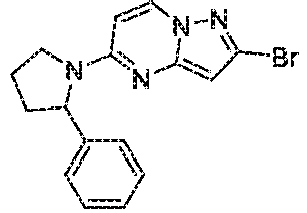
- To a solution of 2-bromo-5-chloropyrazolo[1,5-a]pyrimidine (1.8 g, 7.80 mmol) in DMF (20 mL) were added 2-phenylpyrrolidine (1.26 g, 8.57 mmol) and DIPEA (3.0 g, 23.41 mmol), the reaction was stirred at 120°C for about 1 h. The reaction mixture was cooled to ambient temperature, poured into H2O (100 mL), extracted with EA (50 mL × 2). The combined organic layers were concentrated and purified by chromatography on silica gel (eluent: DCM/EA = 10/1) to afford the desired compound as a yellow solid (1.7 g). MS (ESI, m/e) [M+1]+ 343.0, 345.0.
-

- To a solution of 2-bromo-5-(2-phenylpyrrolidin-1-yl)pyrazolo[1,5-a]pyrimidine (850 mg, 2.50 mmol) in 1,4-dioxane (30 mL) were added tert-butyl 2-((1H-pyrrolo[2,3-b]pyridin-5-yl)oxy)-4-(4,4,5,5-tetramethyl-1,3,2-dioxabarolan-2-yl)benzoate (1.3 g, 3.00 mmol), K2CO3 aqueous solution (1M, 5 mL) and Pd(dppf)Cl2 (180 mg, 0.25 mmol), the reaction was heated at 95°C under N2 for about 16 h. The mixture was cooled to ambient temperature and concentrated. The residue was portioned between DCM (30 mL) and H2O (10 mL), the organic layer was concentrated and purified by column chromatograph on silica gel (eluent: DCM/MeOH = 50/1) to afford the product as a yellow solid (1.3 g). MS (ESI, m/e) [M+1]' 573.2.
-
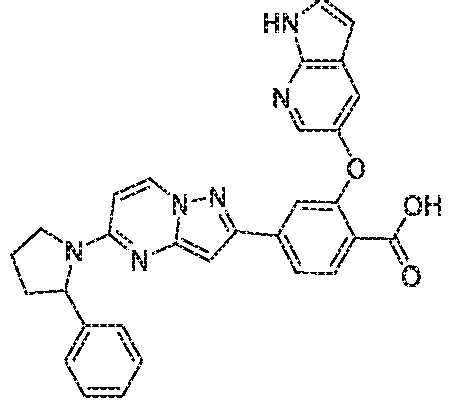
- To a solution of tert-butyl 2-((1H-pyrrolo[2,3-b]pyridin-5-yl)oxy)-4-(5-(2-phenylpyrrolidin-1-yl)pyrazolo[1,5-a]pyrimidin-2-yl)benzoate (700 mg, 1.22 mmol) in DCM (10 mL) was added TFA (2.5 mL), the solution was stirred at ambient temperature for about 4 h. The solution was diluted with DCM (30 mL), washed with H2O (20 mL × 2), dried over anhydrous Na2SO4, filtered and concentrated to give the crude product as a yellow solid (500 mg).
-
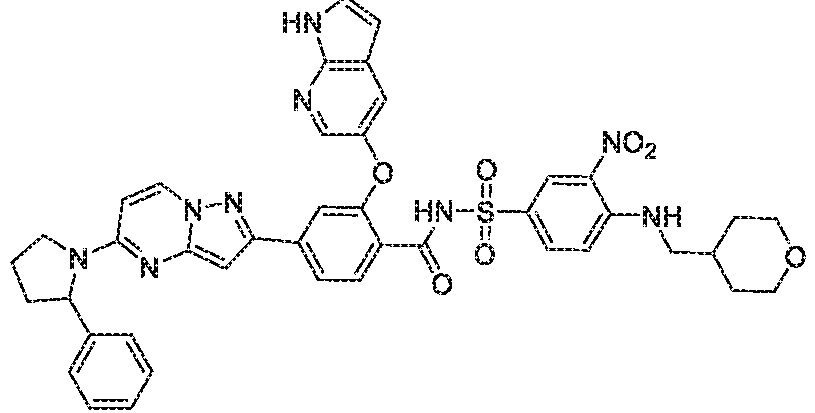
- A mixture of 2-((1H-pyrrolo[2,3-b]pyridin-5-yl)oxy)-4-(5-(2-phenylpyrrolidin-1-yl)pyrazolo[1,5-a]pyrimidin-2-yl)benzoic acid (250 mg, 0.484 mmol), 3-nitro-4-(((tetrahydro-2H-pyran-4-yl)methyl)amino)benzenesulfonamidc (150 mg, 0.484 mmol), EDCI (196 mg, 0.969 mmol), DMAP (88 mg, 0.727 mmol) and TEA (150 mg, 1.452 mol) in DCM (10 ml) was stirred at ambient temperature for 4 d. The reaction solution was washed with H2O (10 mL), concentrated, purified by column chromatograph on silica gel (100-200 mesh, eluted with DCM: MeOH = 20:1) to give a crude product, the crude product was purified by pre-HPLC to give the product (80 mg). 1H NMR (DMSO-d6 ) δ ppm: 12.35 (s, 1H), 11.79 (s, 1H), 8.69-8.31 ( m, 3H), 8.09 (d, J = 2.4 Hz, 1H), 7.87 (dd, J = 9.2, 2.4 Hz, 1H), 7.77-7.50 (m, 4H), 7.31-7.15 (m, 7H), 6.50-6.43 (m, 2H), 5.15 (s, 1H), 3.89-3.82 (m, 3H), 3.64 (s, 1H), 3.30-3.21 (m, 5H), 2.39-2.33 (m, 1H), 1.93-1.82 (m, 4H), 1.59 (d, J = 12.0 Hz, 2H), 1.29-1.18 (m, 2H). MS (ESI, m/e) [M+1]+ 814.1.
-

- 1H NMR (400 MHz, DMSO-d 6 ) δ 12.38 (s, 1H), 11.73(s, 1H), 8.70 - 8.45 (m, 2H), 8.07(s, 1H), 7.82 (d, J = 9.5 Hz, 1H), 7.70-7.50 (m, 5H), 7.50-7.45 (m, 1H), 7.30-7.25 (m, 2H), 7.20-7.15(m, 3H), 7.10-7.00 (m, 2H), 6.74 (s, 1H), 6.55-6.50 (m, 1H), 6.41 (s, 1H), 4.85-4.75 (m, 1H), 3.90-3.82 (m, 2H), 3.80-3.65 (m, 1H), 3.30-3.10 (m, 3H), 3.05-2.95 (m, 1H), 2.44-2.32 (m, 1H), 2.04-1.74 (m, 4H), 1.70-1.60 (m, 2H), 1.35-1.16 (m, 3H). MS (ESI, m/e) [M+1]+ 829.1.
-

- To a solution of methyl 2-((1H-pyrrolo[2,3-b]pyridin-5-yl)oxy)-4-bromobenzoate (6.96 g, 20.04 mmol) in tetrahydrofuran (80 mL) was added sodium hydride (960 mg, 24.0 mmol) at 0 °C and the resulted mixture was stirred at room temperature for 0.5 h. Then benzenesulfonyl chloride (4.30 g, 24.3 mmol) was added dropwise. Then stirred at room temperature for 6 h, the mixture was quenched with aq. ammonium chloride. Then after extracted with EA, the organic layer was combined, dried over sodium sulfate and concentrated in vacuum. The residue was purified by chromatography column on silica (PE/EA = 10/1 to 3/1) to give the product (3.80 g) as a white solid. MS (ESI, m/e) [M+1]+ 486.9.
- To a solution of methyl 4-bromo-2-((1-(phenylsulfonyl)-1H-pyrrolo[2,3-b]pyridine-5-yl)oxy)benzoate (1.00 g, 2.05 mmol), 4,4,4',4',5,5,5',5'-octamethyl-2,2'-bi(1,3,2-dioxaborolane) (608 mg, 2.39 mmol) in dioxane (25mL) was added [1,1'-bis(diphenylphosphino)ferrocene]dichloropalladium(II) (147 mg, 0.20 mmol) and potassium acetate (600 mg, 6.12 mmol) under N2 atmosphere. After addition, the reaction mixture was heated to 90 °C and stirred for 16 h. After cooled to room temperature, the mixture was filtered, and the filtrate was evaporated. The resulted residue was purified by chromatography column on silica (PE/EA = 2/1 to 1/1) to give the product (920 mg) as a yellow gel. MS (ESI, m/e) [M+1]+ 535.0.
- To a solution of methyl 2-((1-(phenylsulfonyl)-1H- pyrrolo[2,3-b]pyridine-5-yl)oxy)-4-(4,4,5,5-tetramethyl-1,3,2-dioxaborolan-2-yl)benzoate (900 mg, 1.68 mmol) in acetic acid (10 inL)/ water (10 mL ) was added hydrogen peroxide(30%) (3.0 mL). After addition, the reaction mixture was stirred at room temperature for 16 h. Then aq. sodium bicarbonate was added and adjusted PH to ~8. After extracted with EA, the organic layer was combined, dried over sodium sulfate and concentrated in vacuum. The resultant residue was purified by chromatography column on silica (PE/EA=5/1 to 1/1 then DCM/MeOH = 40/1) to give the product (700 mg) as a white solid. MS (ESI, m/e) [M+1]+ 424.8.
- To a solution of methyl 4-hydroxy-2-((1-(phenylsulfonyl)-1H-pyrrolo [2,3-b] pyridin-5-yl)oxy)benzoate (460 mg, 1.08 mmol), 4-hydroxycyclohexan-1-one (130 mg, 1.1 mmol) and triphenylphosphine ( 390 mg, 1.49 mmol) in tetrahydrofuran (15 mL) was added diisopropyl azodicarboxylate (440 mg 2.17 mmol) at 0 °C under N2 . After stirred at room temperature for 3 h, the reaction mixture was diluted with water and extracted with EA. The organic layer was combined, dried over sodium sulfate and concentrated in vacuum. The resulted residue was purified by chromatography column on silica ( PE/EA = 2/1) to give 550 mg crude product directly for next step. MS (ESI, m/e) [M+1]' 520.8
- To a solution of methyl 4-((4-oxocyclohexyl)oxy)-2-((1-(phenylsulfonyl)-1H-pyrrolo[2,3-b]pyridin-5-yl)oxy)benzoate (550 mg, 1.06 mmol) and 2-(2-cyclopropylphenyl)pyrrolidine (195 mg, 1.06 mmol) in DCM (20 mL)was added acetic acid (0.08 mL) for 30 min. Then it was added sodium triacetoxyborohydride (460 mg, 2.10 mmol) and it was stirred at room temperature for 2 h. The mixture was diluted with water and it was extracted with dichloromethane. The organic layer was combined, dried over sodium sulfate and it was concentrated in vacuum. The residue was purified by chromatography column on silica (PE/EA = 5/1 to 1/1 then DCM/MeOH = 40/1) to give the faster P1 (200 mg, cis or trans) and slower P2 (240 mg, trans or cis). MS (ESI, m/e) [M+1]+ 691.8.
- To a solution of (trans- or cis-)methyl 4-((4-(2-(2-cyclopropylphenyl)pyrrolidin-1-yl)cyclohexyl)oxy)-2-((1-(phenylsulfonyl)-1H-pyrrolo[2,3-b]pyridin-5-yl)oxy)benzoate (240 mg, 0.35 mmol) in MeOH/THF (6 mL /6 mL) was added 3N NaOH solution (5 mL) and stirred at room temperature for 16 h. Then the reaction mixture was adjusted PH to 3-4 with 2N HCl solution. After extracted with DCM, the organic layer was combined, dried over sodium sulfate and concentrated in vacuum to give crude 100 mg white solid without purification for the next step. MS (ESI, m/e) [M+1]' 537.9.
- The desired compound was synthesized with 3-nitro-4-(((tetrahydro-2H-pyran-4-yl)methyl)amino)benzenesulfonamide and (trans- or cis-)2-((1H-pyrrolo[2,3-b]pyridin-5-yl)oxy)-4-((4-(2-(2-cyclopropyl phenyl)pyrrolidin-1-yl)cyclohexyl)oxy)benzoic acid following the procedures similar to those in Example A1. 1H NMR(400 MHz, DMSO-d 6 ) δ ppm: 11.89 (s, 1H), 11.85-11.73 (m, 1H), 9.52-9.37 (m, 1H), 8.67-8.50 (m, 2H), 8.07 (s, 1H), 7.89-7.79 (m, 1H), 7.72-7.63 (m, 1H), 7.62-7.50 (m, 2H), 7.32-7.12 (m, 3H), 7.08-6.96 (m, 1H), 6.86 (s, 1H), 6.53-6.40 (m, 1H), 6.17-6.00 (m, 1H), 5.12-5.02 (m, 1H), 4.54-4.45 (m, 1H), 3.90-3.78 (m, 2H), 3.71-3.59 (m, 1H), 3.30-3.18 (m, 4H), 3.11-2.89 (m, 2H), 2.13-2.03 (m, 1H), 2.00-1.92 ( m, 2H), 1.90-1.77 (m, 4H), 1.74-1.55 (m, 4H), 1.55-1.45 (m, 2H), 1.44-1.34 (m, 2H), 1.33-1.16 (m, 4H), 0.88-0.75 (m, 2H), 0.65-0.57 (m, 1H), 0.48-0.40 (m, 1H). MS (ESI, m/e) [M+1]" 834.8.
-

- The desired compound was synthesized with 3-nitro-4-(((tetrahydro-2H-pyran-4-yl)methyl)amino)benzenesulfonamide and (trans- or cis-) 2-((1H-pyrrolo[2,3-b]pyridin-5-yl)oxy)-4-((4-(2-(2-cyclopropylphenyl)pyrrolidin-1-yl)cyclohexyl)(methyl)amino)benzoic acid following the procedures similar to those in Example A1. 1H NMR(400 MHz, DMSO-d 6 ) δ ppm: 11.68 (s, 1H), 11.31-11.16 (m, 1H), 8.69-8.50 (m, 2H), 8.10-7.98 (m, 1H), 7.83-7.70 (m, 1H), 7.61-7.45 (m, 4H), 7.20-7.01 (m, 3H), 6.97-6.87 (m, 1H), 6.63-6.50 (m, 1H), 6.43-6.34 (m, 1H), 5.95 (s, 1H), 4.30-4.21 (m, 1H), 3.91-3.80 (m, 2H), 3.50-3.41 (m, 1H), 3.30-3.21 (m, 5H), 3.11-2.94 (m, 2H), 2.53 (s, 3H), 2.08-1.98 ( m, 1H), 1.93-1.85 (m, 1H), 1.66-1.56 (m, 3H), 1.33-1.27 (m, 2H), 1.20-1.15 (m, 3H), 0.95-0.85 (m, 4H), 0.81-0.72 (m, 4H), 0.70-0.60 (m, 2H), 0.58-0.44 (m, 2H). MS (ESI, m/e) [M+1]+ 848.2.
-
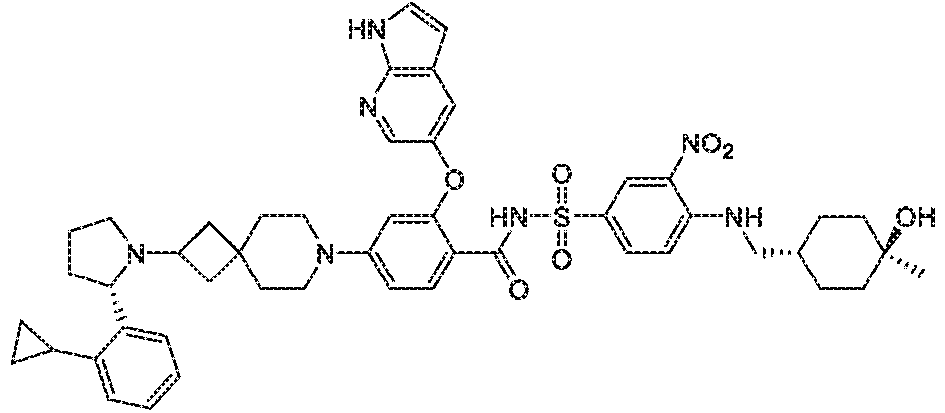
- To a solution of (S)-2-(2-bromophenyl)pyrrolidine (70 g, 311 mmol) in DCM (200 mL) were added Boc2O (72.6 g, 333 mmol) and DMAP (cat) at 0°C. After addition, the mixture was stirred at room temperature for 1 hour. Then the mixture solution was washed with saturated aq. NaHCO3 (100 mL × 3), brine. The organic phase was dried with anhydrous NaSO4, filtered, and concentrated to obtain pale brown solid (95g, crude), which was not further purified for next step. MS (ESI, m/e) [M+1]+ 326.1/328.2.
- Under a N2 atmosphere, a mixture of tert-butyl (S)-2-(2-bromophenyl)pyrrolidine-1-carboxylate (88 g, 270 mmol), cyclopropyl boronic acid (68.9 g, 810 mmol), Pd(dppf)2Cl2 (19.7 g, 27 mmol) and K2CO3 (150 g, 1.08 mol) in 1,4-dioxane (270 mL) and H2O (30 mL) was stirred at 90°C for 16 hours. After the reaction mixture was cooled to room temperature, the mixture was filtered, and the filtrate was concentrated in vacuum. The residue was purified by chromatography column on silica (eluent: DCM/CH3OH = 20/1) to obtain tert-butyl (S)-2-(2-cyclopropylphenyl)pyrrolidine-1-carboxylate as pale yellow oil 70 g (yield: 90%). MS (ESI, m/e) [M+1]+ 288.1.
- To a solution of tert-butyl (S)-2-(2-cyclopropylphenyl)pyrrolidine-1-carboxylate (70g, 244 mmol) in DCM (200 mL) was added HCl solution (200 mL, 4M in dioxane). After addition, the mixture was stirred for overnight at room temperature. After removal of solvent, the residue was diluted with water (200 mL) and EA (100 mL) under stirring. the separated water phase was adjusted to PH ∼ 11 and exacted with DCM (100 mL ×2). The combined organic phase was dried with anhydrous NaSO4, filtered, and concentrated to obtain (S)-2-(2-cyclopropylphenyl)pyrrolidine (42 g, crude) as brown oil. MS (ESI, m/e) [M+1]+ 188.2.
- To the mixture of (S)-2-(2-cyclopropylphenyl)pyrrolidine (3.74 g, 20 mmol) and tert-butyl 2-oxo-7-azaspiro[3.5]nonane-7-carboxylate(4.78 g, 20 mmol) in DCM (100 mL) was added NaBH(AcO)3 (8.48 g, 40 mmol) at room temperature and stirred for 2 hours. The reaction mixture was quenched with aq. NaHCO3 solution (200 mL), and then extracted with DCM (200 mL × 2). The organic layer was combined, washed with brine and dried over Na2SO4. After evaporation in vacuum, the crude product (8.21 g) was obtained as a colorless oil without further purification for next step. MS (ESI, m/e) [M+1]' 411.0.
- To a solution of tert-butyl (S)-2-(2-(2-cyclopropylphenyl)pyrrolidin-1-yl)-7-azaspiro[3.5]nonane-7-carboxylate (8.2 g, 20mmol) in DCM (200 mL) was added TFA (40 mL) at 20°C and stirred at room temperature overnight. The mixture was concentrated in vacuum and diluted with DCM (200 mL) and aq. NaOH solution (1N, 200 mL) was added under stirring. Then the organic layer was collected and dried over Na2SO4. After evaporation in vacuum, the crude product (6.2g) was obtained as a brown oil without further purification for next step. 1H NMR (400 MHz, CDCl3) δ ppm: 7.61 (dd, J = 8.0 Hz, J = 4.0 Hz, 1H), 7.22 - 7.11 (m, 2H), 7.00 - 6.96 (m, 1H), 3.94 (t, J = 8.0 Hz, 1H), 3.23 - 3.03 (m, 2H), 2.71 - 2.60 (m, 4H), 2.42 - 2.20 (m, 2H), 2.07 - 1.55 (m, 10H), 1.41 - 1.37 (m, 3H), 0.95 - 0.87 (m, 2H), 0.64 - 0.53 (m, 2H). MS (ESI, m/e) [M+1]+ 311.0.
- The mixture of methyl 2,4-difluorobenzoate (17.2 g, 0.1 mol), 1H-pyrrolo[2,3-b]pyridin-5-ol (28.1 g, 0.21 mol), K3PO4 (36 g, 0.17 mol) in 2-methoxyethyl ether (560 mL) was heated to 120°C and stirred for overnight. The reaction mixture was cooled to room temperature and then poured into water (3 L) to form precipitation. After filtration, the resulted solid was further purified by recrystallization (eluent: PE/EA = 3/1, 500 mL) to give the product (13.2 g) as an off-white solid. MS (ESI, m/e) [M+1]+ 287.1.
- The mixture of (S)-2-(2-(2-cyclopropylphenyl)pyrrolidin-1-yl)-7-azaspiro[3.5]nonane (6.2 g, 20 mmol), methyl 2-((1H-pyrrolo[2,3-b]pyridin-5-yl)oxy)-4-fluorobenzoate (6.89 g, 24 mmol), Na2CO3 (21.2 g, 200 mmol) in DMF(100 mL) was heated to 105 °C and stirred overnight. After cooling down to room temperature, the reaction mixture was diluted with EA (300 mL), washed with brine (300mL × 2), dried over Na2SO4 and concentrated in vacuum. The resulted residue was purified by chromatography column on silica (eluent: EA/PE, 1/5 to 1/1) to give the product (6.3 g) as an off-white solid. MS (ESI, m/e) [M+1]+ 576.9.
- To the solution of methyl (S)-2-((1H-pyrrolo[2,3-b]pyridin-5-yl)oxy)-4-(2-(2-(2-cyclopropylphenyl)pyrrolidin-1-yl)-7-azaspiro[3.5]nonan-7-yl)benzoate (6.3 g, 11.21 mmol) in MeOH(180 mL) and THF(180 mL) was added aq. NaOH solution (3N, 373 mL). After addition, the reaction mixture was heated to 50 °C and stirred for 2 hours. Then the mixture was adjusted to pH~5 with HCl acid (6N), and extracted with DCM (500 mL × 2). The organic layer was combined, dried over Na2SO4 and then evaporated in vacuum to afford a crude product (6.0g) as off-white solid. 1H NMR (400 MHz, DMSO-d 6) δ ppm: 11.99 (s, 1H), 11.25 - 11.04 (m, 1H), 8.10 - 7.94 (m, 2H), 7.76 (d, J = 8.0 Hz, 1H), 7.47 (s, 1H), 7.38 (s, 1H), 7.28 (s, 2H), 7.12 - 7.02 (s, 1H), 6.75 (d, J = 8.0 Hz, 1H), 6.36 (s, 2H), 5.02 -4.94 (m, 1H), 3.91 - 3.67 (m, 4H), 3.17 - 2.96 (m, 4H), 2.33 - 2.04 (m, 5H), 1.81 - 1.72 (m, 2H), 1.56 - 1.37 (m, 4H), 0.91 - 0.89 (m, 2H), 0.69 - 0.62 (m, 2H). MS (ESI, m/e) [M+1]+ 562.9.
- The mixture of (S)-2-((1H-pyrrolo[2,3-b]pyridin-5-yl)oxy)-4-(2-(2-(2-cyclopropylphenyl)pyrrolidin-1-yl)-7-azaspiro[3.5]nonan-7-yl)benzoic acid (3 g, 5.33 mmol), triethylamine (3.2 g, 32 mmol), HATU (2.43 g, 6.40 mmol) in DCM (100 mL) was stirred for 4 hours at room temperature. Then to the resulting reaction mixture was added 4-((((1r,4r)-4-hydroxy-4-methylcyclohexyl)methyl)amino)-3-nitrobenzenesulfonamide (2.20 g, 6.40 mmol) and DMAP (122 mg, 2 mmol). After stirring overnight, the reaction mixture was washed with brine, dried over Na2SO4, filtered and concentrated in vacuum. The resulted residue was purified by chromatography column on silica (eluent: PE/EA = 1/1 (2L), then DCM/MeOH = 100/1 to 40/1), and then the desired compound was obtained (2.0 g, yield: 42.2%)as yellow solid.. 1H NMR (400 MHz, DMSO-d6 )δ ppm: 11.65 (s, 1H), 11.34 (br, 1H), 8.55 - 8.47 (m, 2H), 8.00(s, 1H), 7.75 (d, J = 8.0 Hz, 1H), 7.59 - 7.44 (m, 4H), 7.24 - 7.09 (m, 2H), 7.00 - 6.90 (m, 2H), 6.67 (d, J = 8.0 Hz, 1H), 6.36 (s, 1H), 6.18 (s, 1H), 4.24 (s, 1H), 3.32 - 3.25 (m, 3H), 3.05 - 2.63 (m, 5H), 2.33 - 2.28 (m, 1H), 2.04 - 2.01(m, 2H) 1.73 - 1.52 (m, 12H), 1.46 - 1.29 (m, 8H), 1.16 - 1.13 (m, 5H), 0.91 - 0.89 (m, 2H), 0.64 - 0.56 (m, 2H). MS (ESI, m/e) [M+1]+ 888.8
-
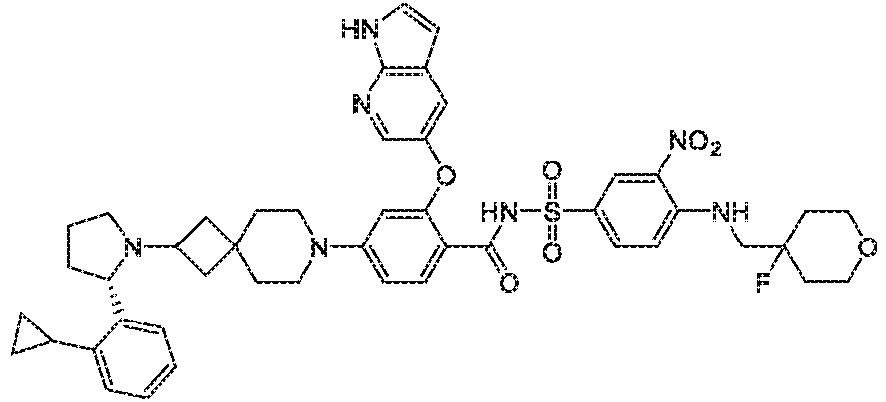
- The desired compound was synthesized with 4-(((4-fluorotetrahydro-2H-pyran-4-yl)methyl)amino)-3-nitrobenzenesulfonamide and (S)-2-((1H-pyrrolo[2,3-b]pyridin-5-yl)oxy)-4-(2-(2-(2-cyclopropylphenyl)pyrrolidin-1-yl)-7-azaspiro[3.5]nonan-7-yl)benzoic acid following the procedures similar to those in Example F21. 1H NMR (DMSO-d 6) δ ppm: 11.65 (s, 1H), 11.23 (br, 1H), 8.63-8.47 (m, 2H), 8.00 (s, 1H), 7.80-7.74 (m, 1H), 7.61-7.38 (m, 5H), 7.30-6.96 (m, 5H), 6.69-6.63 (m, 1H), 6.36 (s, 1H), 6.17 (s, 1H), 3.81-3.72 (m, 4H), 3.57-3.49 (m, 4H), 3.05-2.92 (m, 4H), 2.42-2.32 (m, 2H), 2.09-1.99 (m, 2H), 1.86-1.72 (m, 6H), 1.58-1.47 (m, 3H), 1.46-1.24 (m, 6H), 1.00-0.54 (m, 4H). MS (ESI, m/e) [M+1]+ 877.8.
-

- The mixture of (S)-2-((1 H-pyrrolo[2,3-b]pyridin-5-yl)oxy)-4-(2-(2-(2-cyclopropylphenyl)pyrrolidin-1-yl)-7-azaspiro[3.5]nonan-7-yl)benzoic acid (2.0 g, 3.56 mmol), triethylamine (1.08 g, 10.68 mmol), 2-(7-Azabenzotriazol-1-yl)-N,N,N',N'-tetramethyluronium hexafluorophosphate (1.62 g, 4.27 mmol) in DCM (100 mL) was stirred for 4 hours at room temperature. Then to the resulting reaction mixture was added 3-nitro-4-(((tetrahydro-2H-pyran-4-yl)methyl)amino)benzenesulfonamide (1.35 g, 4.27 mmol) and DMAP (50 mg, 0.40 mmol). After stirred overnight, the reaction mixture was quenched and washed with NH4Cl, dried over Na2SO4 and concentrated in vacuum. The resulted residue was purified by chromatography column on silica (eluent: PE/EA =1/1, then DCM/MeOH = 60/1 to 40/1), and then the desired compound was obtained (1.3 g, yield: 42.5%). 1H NMR (400 MHz, DMSO-d 6) δ ppm: 11.63 (s, 1H), 11.30 (br, 1H), 8.58 - 8.47 (m, 2H), 7.99 (s, 1H), 7.74 (d, J = 8.8 Hz, 1H), 7.55 - 7.42 (m, 4H), 7.19 - 7.08 (m, 2H), 7.04 - 6.90 (m, 2H), 6.66 (d, J = 8.8 Hz, 1H), 6.35 (s, 1H), 6.18 (m, 1H), 4.34 - 4.08 (m, 1H), 3.85 (d, J = 8.8 Hz, 2H), 3.31 - 3.18 (m, 6H), 3.05 - 2.93 (m, 4H), 2.67 - 2.51 (m, 1H), 2.35 - 2.25 (m, 1H), 2.07 - 2.01 (m, 1H), 1.95 - 1.68 (m, 6H), 1.62 (d, J = 12.8 Hz, 2H), 1.55 - 1.21 (m, 9H), 0.92 - 0.85 (m, 2H), 0.65 - 0.53(m, 2H). MS (ESI, m/e) [M+1]+ 859.8.
-

- The desired compound was synthesized following the procedures similar to those in Example F21 by replacing (S)-2-(2-cyclopropylphenyl)pyrrolidine with (S)-2-(2-ethylphenyl)pyrrolidine, and replacing 4-((((1r,4r)-4-hydroxy-4-methylcyclohexyl)methyl)amino)-3-nitrobenzenesulfonamide with 3-nitro-4-(((tetrahydro-2H-pyran-4-yl)methyl)amino)bcnzenesulfonamide. 1H NMR (DMSO-d 6) δ ppm: 11.69 (s, 1H), 11.45 (s, 1H), 10.06 (s, 1H), 8.62-8.56 (m, 2H), 8.03 (d, J = 2.3 Hz, 1H), 7.80-7.76 (m, 2H), 7.51-7.47 (m, 3H), 7.31 (s, 1H), 7.24 (s, 1H), 7.11 (d, J = 9.2 Hz, 1H), 6.68 (d, J = 9.2 Hz, 1H), 6.38 (s, 1H), 6.17 (s, 1H), 4.64 (s, 1H), 3.87-3.84 (m, 3H), 3.66 (s, 1H), 3.29-3.21 (m, 3H), 3.04 (s, 2H), 2.94 (s, 2H), 2.77-2.75 (m, 1H), 2.67-2.57 (m, 2H), 2.08 (s, 4H), 2.03-1.97 (m, 2H), 1.88 (s, 1H), 1.62-1.60 (m, 2H), 1.43 (s, 3H), 1.35-1.29 (m, 4H), 1.12 (t, J = 7.5 Hz, 3H), 0.85 (t, J = 6.6 Hz, 1H). MS (ESI, m/e) [M+1]+ 847.9.
-

- The desired compound was synthesized following the procedures similar to those in Example F21 by replacing (S)-2-(2-cyclopropylphenyl)pyrrolidine with (S)-2-(2-ethylphenyl)pyrrolidine, and replacing 4-((((1r,4r)-4-hydroxy-4-methylcyclohexyl)mcthyl)amino)-3-nitrobenzcncsulfonamidc with 4-(((4-fluorotetrahydro-2H-pyran-4-yl)methyl)amino)-3-nitrobenzenesulfonamide. 1H NMR (DMSO-d 6) δ ppm: 11.70 (s, 1H), 11.46 (s, 1H), 10.53 (s, 1H), 8.64 (t, J = 6.1 Hz, 1H), 8.56 (d, J = 1.8 Hz, 1H), 8.03 (d, J = 2.3 Hz, 1H), 7.89 (s, 1H), 7.81 (d, J = 7.9 Hz, 1H), 7.52-7.46 (m, 3H), 7.35-7.24 (m, 3H), 6.68 (d, J = 9.0 Hz, 1H), 6.38 (s, 1H), 6.17 (s, 1H), 4.61 (d, J = 7.5 Hz, 1H), 3.86 (d, J = 8.1 Hz, 1H), 3.75-3.62 (m, 6H), 3.52-3.43 (m, 2H), 3.17-2.94 (m, 3H), 2.78-2.75 (m, 1H), 2.65-2.58 (m, 1H), 2.43-2.42 (m, 1H), 2.19-1.95 (m, 7H), 1.84-1.74 (m, 4H), 1.45-1.34 (m, 5H), 1.12 (t, J = 7.5 Hz, 3H). MS (ESI, m/e) [M+1]+ 866.8.
-

- The desired compound was synthesized following the procedures similar to those in Example F21 by replacing (S)-2-(2-cyclopropylphenyl)pyrrolidine with (S)-2-(2-ethylphenyl)pyrrolidine. 1H NMR (DMSO-d 6) δ ppm: 11.70 (s, 1H), 11.44 (s, 1H), 10.67 (s, 1H), 8.58-8.55 (m, 2H), 8.03 (d, J = 2.2 Hz, 1H), 7.93 (s, 1H), 7.78 (d, J = 9.2 Hz, 1H), 7.51-7.46 (m, 3H), 7.30-7.22 (m, 3H), 7.08 (d, J = 9.2 Hz, 1H), 6.68 (d, J = 8.4 Hz, 1H), 6.38 (s, 1H), 6.17 (s, 1H), 4.60 (d, J = 8.0 Hz, 1H), 4.25 (s, 1H), 3.86 (d, J = 8.3 Hz, 1H), 3.66 (s, 1H), 3.30 - 3.26 (m, 2H), 3.08-2.94 (m, 3H), 2.78-2.58 (m, 2H), 2.44-2.42 (m, 1H), 2.20 - 1.96 (m, 7H), 1.69-1.66 (m, 3H), 1.52-1.45 (m, 2H), 1.33-1.24 (m, 8H), 1.14-1.12 (m, 6H). MS (ESI, m/e) [M+1]+ 876.9.
-

- The desired compound was synthesized following the procedures similar to those in Example F21 by replacing (S)-2-(2-cyclopropylphenyl)pyrrolidine with (R)-2-(2-cyclopropylphenyl)pyrrolidine, and replacing 4-((((1r,4r)-4-hydroxy-4-methylcyclohexyl)mcthyl)amino)-3-nitrobenzenesulfonamide with 3-nitro-4-(((tetrahydro-2H-pyran-4-yl)methyl)amino)benzenesulfonamide. 1H NMR (DMSO-d 6) δ ppm: 11.69 (s, 1H), 11.44 (s, 1H), 10.37 (s, 1H), 8.61 (s, 1H), 8.56 (s, 1H), 8.03 (d, J = 1.8 Hz, 1H), 7.85-7.76 (m, 2H), 7.55 -7.45 (m, 3H), 7.28 (s, 2H), 7.14 - 6.99 (m, 2H), 6.69 (d, J = 8.7 Hz, 1H), 6.38 (s, 1H), 6.17 (s, 1H), 4.97 (s, 1H), 3.85 (d, J = 8.5 Hz, 3H), 3.67 - 3.61 (m, 1H), 3.30 - 3.21 (m, 4H), 3.08 - 3.01 (m, 2H), 2.98 - 2.91 (m, 2H), 2.12 - 2.05 (m, 4H), 1.92 - 1.87 (m, 1H), 1.66 - 1.58 (m, 3H), 1.53 - 1.45 (m, 1H), 1.44 - 1.36 (m, 4H), 1.30 - 1.22 (m, 4H), 0.98 - 0.93 (m, 2H), 0.86 - 0.80 (m, 3H), 0.69 - 0.60 (s, 2H). MS (ESI, m/e) [M+1]' 859.8.
-
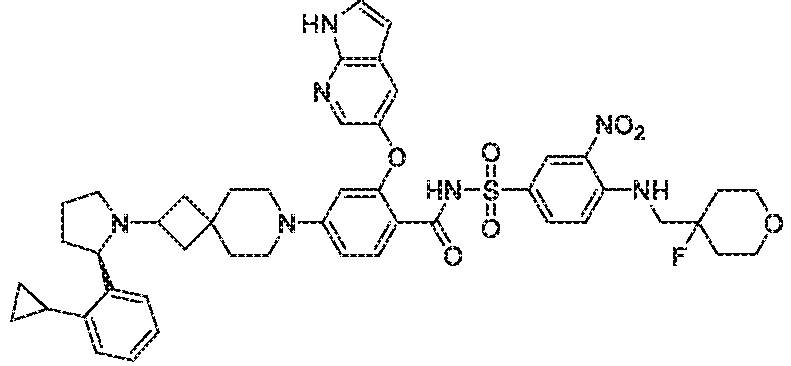
- The desired compound was synthesized following the procedures similar to those in Example F21 by replacing (S)-2-(2-cyclopropylphenyl)pyrrolidine with (R)-2-(2-cyclopropylphenyl)pyrrolidine, and replacing 4-((((1r,4r)-4-hydroxy-4-methylcyclohexyl)methyl)amino)-3-nitrobenzenesulfonamide with 4-(((4-fluorotetrahydro-2H-pyran-4-yl)methyl)amino)-3-nitrobenzenesulfonamide. 1H NMR (DMSO-d 6) δ ppm: 11.69 (s, 1H), 11.04 (s, 1H), 8.62 (s, 1H), 8.55 (s, 1H), 8.02 (s, 1H), 7.80 (d, J = 8.8 Hz, 1H), 7.54 - 7.49 (m, 2H), 7.24 - 7.21 (m, 2H), 7.05 (s, 1H), 6.68 (d, J = 8.0 Hz, 1H), 6.37 (s, 1H), 6.17 (s, 1H), 4.95 (s, 1H), 3.80 - 3.70 (m, 5H), 3.57 - 3.47 (m, 2H), 3.15 - 2.95 (m, 6H), 2.17 - 2.95 (m, 5H), 1.86 - 1.72 (m, 4H), 1.50 - 1.31 (m, 6H), 0.98 - 0.91 (m, 2H), 0.87 - 0.79 (m, 2H), 0.70 - 0.59 (s, 2H). MS (ESI, m/e) [M+1]+ 877.8.
-

- The desired compound was synthesized following the procedures similar to those in Example F21 by replacing (S)-2-(2-cyclopropylphenyl)pyrrolidine with (R)-2-(2-cyclopropylphenyl)pyrrolidine. 1H NMR (DMSO-d 6) δ ppm: 11.69 (s, 1H), 10.88 (s, 1H), 9.76 (s, 1H), 8.55 (s, 2H), 8.21 (d, J = 5.6 Hz, 1H), 8.07 - 7.95 (m, 2H), 7.78 (d, J = 8.4 Hz, 1H), 7.53 - 7.48 (m, 2H), 7.27 (s, 1H), 7.13 - 7.05 (m, 2H), 6.98 (s, 1H), 6.68 (d, J = 8.4 Hz, 1H), 6.38 (s, 1H), 6.17 (s, 1H), 5.01 - 4.93 (m, 1H), 4.32-4.28 (m, 1H), 3.89-3.81 (m, 1H), 3.72 - 3.65 (m, 1H), 2.97-2.88 (m, 4H), 2.25 - 2.08 (m, 5H), 1.78 - 1.60 (m, 4H), 1.58 - 1.54 (m, 2H), 1.47 - 1.38 (m, 5H), 1.36 - 1.29 (m, 3H), 1.27-1.23 (m, 2H), 1.16-1.12 (m, 2H), 1.10 (s, 3H), 1.01 - 0.89 (m, 2H), 0.86 - 0.82 (m, 1H), 0.70 - 0.58 (m, 2H). MS (ESI, m/e) [M+1]+ 888.9.
-

- The desired compound was synthesized following the procedures similar to those in Example F21 by replacing tert-butyl 2-oxo-7-azaspiro[3.5]nonane-7-carboxylate with tert-butyl 7-oxo-2-azaspiro[3.5]nonane-2-carboxylate, and replacing 4-((((1r,4r)-4-hydroxy-4-methylcyclohexyl)methyl)amino)-3-nitrobenzenesulfonamide with 3-nitro-4-(((tetrahydro-2H-pyran-4-yl)methyl)amino)benzenesulfonamide. 1H NMR (DMSO-d 6) δ ppm: 11.76 (s, 1H), 11.28 (s, 1H), 8.69-8.55 (m, 2H), 8.08 (s, 1H), 7.96 (s, 1H), 7.89-7.59 (m, 3H), 7.56-7.44 (m, 2H), 7.34-7.23 (m, 1H), 7.23-7.13 (m, 1H), 7.09-6.85 (m, 2H), 6.44 (s, 1H), 6.14-6.06 (m, 1H), 5.55-5.43 (m, 1H), 5.21-4.18 (m, 1H), 3.90-3.81 (m, 2H), 3.47-3.36 (m, 3H), 3.31-3.17 (m, 5H), 3.07-2.94 (m, 2H), 2.12-1.94 (m, 3H), 1.92-1.75 (m, 5H), 1.73-1.66 (m, 2H), 1.65-1.55 (m, 3H), 1.36-1.27 (m, 3H), 0.94-0.79(m, 3H), 0.78-0.61 (m, 2H), 0.56-0.45 (m, 1H). MS (ESI, m/e) [M+1]+ 859.8.
-

- The desired compound was synthesized following the procedures similar to those in Example F30 by replacing (S)-2-(2-cyclopropylphenyl)pyrrolidine with (R)-2-(2-cyclopropylphenyl)pyrrolidine. 1H NMR (DMSO-d 6) δ ppm: 11.78 (s, 1H), 11.42-11.09 (m, 0.5H), 9.97-9.53 (m, 0.5H), 8.78-8.42 (m, 2H), 8.14-8.06 (m, 1H), 7.97-7.75 (m, 2H), 7.75-7.62 (m, 1H), 7.62-7.43 (m, 2H), 7.42-7.10 (m, 3H), 7.10-6.84 (m, 1H), 6.45 (s, 1H), 6.20-6.00 (m, 1H), 5.47 (s, 1H), 5.22-4.96 (m, 1H), 3.94-3.75 (m, 2H), 3.70-3.54 (m, 1H), 3.54-3.37 (m, 6H), 3.31-3.13 (m, 4H), 3.08-2.91 (m, 1H), 2.21-1.49 (m, 10 H), 1.40-1.15 (m, 6H), 1.00-0.81 (m, 2H), 0.80-0.43 (m, 2H). MS (ESI, m/e) [M+1]+ 859.8.
-
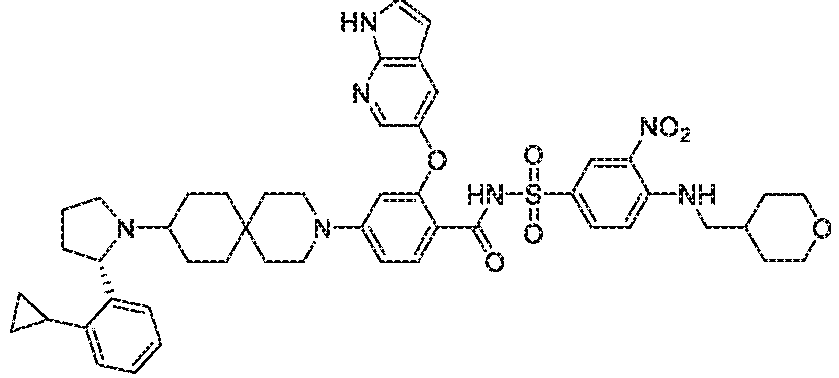
- The desired compound was synthesized following the procedures similar to those in Example F21 by replacing tert-butyl 2-oxo-7-azaspiro[3.5]nonane-7-carboxylate with tert-butyl 9-oxo-3-azaspiro[5.5]undecane-3-carboxylate, and replacing 4-((((1r,4r)-4-hydroxy-4-methylcyclohexyl)methyl)amino)-3-nitrobenzenesulfonamide with 3-nitro-4-(((tetrahydro-2H-pyran-4-yl)methyl)amino)benzenesulfonamide. 1H NMR (DMSO-d 6) δ ppm: 11.73 (s, 1H), 11.41 (s, 1H), 10.37 (s, 1H), 8.65-8.60 (m, 1H), 8.58 (d,J = 2.2 Hz, 1H), 8.10 - 8.00 (m, 1H), 7.81 (d, J = 9.5 Hz, 1H), 7.57 (d, J = 2.2 Hz, 1H), 7.54 - 7.43 (m, 2H), 7.32 - 7.22 (m, 2H), 7.14 (d, J = 9.3 Hz, 1H), 7.10 - 7.00 (m, 1H), 6.68 (d, J = 9.0 Hz, 1H), 6.45 - 6.32 (m, 1H), 6.13 (s, 1H), 5.15 - 5.05 (m, 1H), 3.88 - 3.80 (m, 2H), 3.70 - 3.60 (m, 1H), 3.31 - 3.21 (m, 5H), 3.10 - 3.00 (m, 2H), 2.22 - 2.00 (m, 4H), 1.90 - 1.81 (m, 2H), 1.80 - 1.51 (m, 7H), 1.45 - 1.35 (m, 4H), 1.05 - 0.90 (m, 6H), 0.88 - 0.72 (m, 4H). MS (ESI, m/e) [M+1]+ 887.8.
-

- The desired compound was synthesized following the procedures similar to those in Example F32 by replacing (S)-2-(2-cyclopropylphenyl)pyrrolidine with (R)-2-(2-cyclopropylphenyl)pyrrolidine. 1H NMR (DMSO-d 6) δ ppm: 11.72 (s, 1H), 11.40 (s, 1H), 8.70 - 8.53 (m, 2H), 8.06 (d, J = 2.3 Hz, 1H), 7.82 (d, J = 9.1 Hz, 1H), 7.52 (dd, J = 19.0, 15.6 Hz, 3H), 7.29 (s, 2H), 7.14 (d, J = 9.1 Hz, 1H), 7.10 - 7.05 (m, 2H), 6.40 (s, 1H), 6.13 (s, 1H), 5.15 - 5.10 (m, 1H), 3.85 (d, J = 8.3 Hz, 2H), 3.70 - 3.60 (m, 1H), 3.30 - 3.20 (m, 4H), 3.10 - 3.2.95 (m, 5H), 2.15 - 2.05 (m, 3H), 1.95 - 1.85 (m, 2H), 1.80 - 1.50 (m, 7H), 1.45 - 1.35 (m, 3H), 1.34 - 1.12 (m, 6H), 1.00 - 0.90 (m, 4H), 0.80 - 0.70 (m, 1H), 0.60 - 0.50 (m, 1H). MS (ESI, m/e) [M+1]+ 887.8.
-
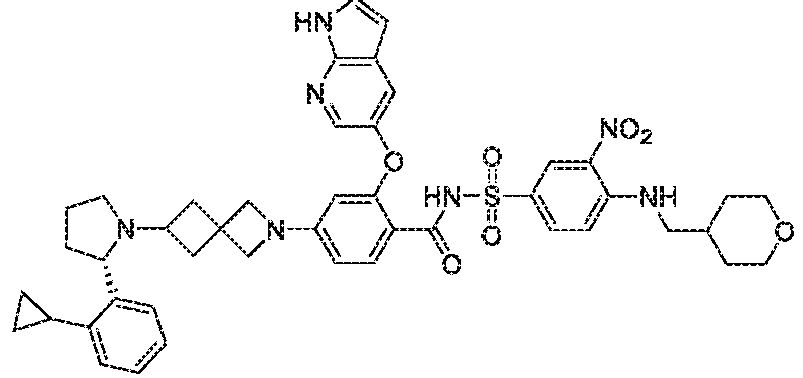
- The desired compound was synthesized following the procedures similar to those in Example F21 by replacing tert-butyl 2-oxo-7-azaspiro[3.5]nonane-7-carboxylate with tert-butyl 6-oxo-2-azaspiro[3.3]heptane-2-carboxylate, and replacing 4-((((1r,4r)-4-hydroxy-4-methylcyclohexyl)methyl)amino)-3-nitrobenzenesulfonamide with 3-nitro-4-(((tetrahydro-2H-pyran-4-yl)methyl)amino)benzenesulfonamide. 1H NMR (400 MHz, DMSO-d6) 8 ppm: 11.74 (s, 1H), 11.35 (br, 1H), 8.64 (t, J=6.0 Hz, 2H), 8.59(s, 1H), 8.06 (d, J=2.0 Hz, 1H), 7.85 (d,J = 8.0 Hz, 1H), 7.69 - 7.60 (m, 2H), 7.55 - 7.52 (m, 1H), 7.48 (d, J = 8.8 Hz, 1H), 7.33 - 7.23 (m, 2H), 7.18 (d, J = 9.6 Hz, 1H), 7.06 (s, 1H), 6.42 (s, 1H), 6.09 (d, J = 8.8 Hz, 1H), 5.49 (s, 1H), 5.02 - 4.82 (m, 1H), 3.85 (d, J = 8.4 Hz, 2H), 3.79 - 3.56 (m, 6H), 3.31 - 3.23 (m, 6H), 2.50 - 2.38 (m, 1H), 2.18 - 1.72 (m, 7H), 1.62 (d, J = 12.8 Hz, 2H), 1.34 - 1.22 (m, 2H), 1.02 - 0.88 (m, 2H), 0.70 - 0.58(m, 2H). MS (ESI, m/e) [M+1]' 832.7.
-

- The desired compound was synthesized following the procedures similar to those in Example F34 by replacing (S)-2-(2-cyclopropylphenyl)pyrrolidine with (R)-2-(2-cyclopropylphenyl)pyrrolidine. 1H NMR (400 MHz, DMSO-d 6) δ ppm: 11.66 (s, 1H), 11.23 (br, 1H), 8.60 - 8.45 (m, 2H), 8.00 (s, 1H), 7.78 (d, J = 7.6 Hz, 1H), 7.59 - 7.43 (m, 4H), 7.15 - 7.00 (m, 3H), 6.92 (d, J = 6.8 Hz, 1H), 6.38 (s, 1H), 6.06 (d, J = 8.4 Hz, 1H), 5.54 (s, 1H),4.05 - 3.82 (m, 3H), 3.70 -3.50 (m, 4H), 3.35 - 3.21 (m, 4H), 3.15 - 2.90 (m, 2H), 2.41 - 1.95 (m, 5H), 1.93 - 1.70 (m, 5H), 1.63 (d, J= 12.4 Hz, 2H), 1.56 - 1.27 (m, 3H), 0.92 - 1.81 (m, 2H), 0.67 - 0.46 (m, 2H). MS (ESI, m/e) [M+1]+ 832.8.
-

- The desired compound was synthesized following the procedures similar to those in Example F21 by replacing (S)-2-(2-cyclopropylphenyl)pyrrolidine with 2-chloro-N,N-dimethyl-6-(pyrrolidin-2-yl)aniline, and replacing 4-((((1r,4r)-4-hydroxy-4-methylcyclohcxyl)methyl)amino)-3-nitrobcnzenesulfonamide with 3-nitro-4-(((tetrahydro-2H-pyran-4-yl)methyl)amino)benzenesulfonamide. 1H NMR (DMSO-d 6) δ ppm: 11.70 (s, 1H), 11.45 (s, 1H), 11. 16 (s, 1H), 8.70 - 8.60 (m, 1H), 8.58 (s, 1H), 8.15 - 7.93 (m, 2H), 7.76 (d, J = 9.3 Hz, 1H), 7.58 - 7.37 (m, 3H), 7.35 - 7.25 (m, 1H), 7.11 (d, J = 9.3 Hz, 1H), 6.75 - 6.65 (m, 1H), 6.40 - 6.35 (m, 1H), 6.18 (s, 1H), 4.98 (s, 1H), 3.85 (d, J = 8.8 Hz, 2H), 3.81 - 3.58 (m, 3H), 3.30 - 3.20 (m, 5H), 3.10 - 2.76 (m, 4H), 2.75 - 2.56 (m, 6H), 2.45 - 2.40 (m, 1H), 2.21 - 2.00 (m, 4H), 1.90 - 1.75 (m, 2H), 1.65 - 1.50 (m, 3H), 1.45 - 1.40 (m, 3H), 1.25 - 1.10 (m, 3H). MS (ESI, m/e) [M+1]+ 896.8.
-

- The desired compound was synthesized with (S)4-(((1,4-dioxan-2-yl)methyl)amino)-3-nitrobenzenesulfonamide and (S)-2-((1H-pyrrolo[2,3-b]pyridin-5-yl)oxy)-4-(2-(2-(2-cyclopropylphenyl)pyrrolidin-1-yl)-7-azaspiro[3.5]nonan-7-yl)benzoic acid following the procedures similar to those in Example F21. 1H NMR (DMSO-d 6) δ ppm: 11.81(s, 1H), 11.28 (br, 1H), 8.68-8.34 (m, 2H), 8.01 (s, 1H), 7.78 (d, J=8.4Hz, 1H), 7.66-7.40 (m, 4H), 7.33-6.87 (m, 4H), 6.67 (d, J =8.8Hz, 1H), 6.37 (s, 1H), 6.18 (s, 1H), 3.86-3.57 (m, 6H), 3.53-3.37 (m, 3H), 3.28-2.77 (m, 7H), 2.23-1.70 (m, 6H), 1.67-1.17 (m, 8H), 0.99-0.84 (m, 2H), 0.69-0.51 (m, 2H). MS (ESI, m/e) [M+1]+ 862.8. MS (ESI, m/e) [M+1]+ 862.8.
-

- The desired compound was synthesized with (R)-4-(((1,4-dioxan-2-yl)mcthyl)amino)-3-nitrobenzenesulfonamide and (S)-2-((1H-pyrrolo[2,3-b]pyridin-5-yl)oxy)-4-(2-(2-(2-cyclopropylphenyl)pyrrolidin-1-yl)-7-azaspiro[3.5]nonan-7-yl)benzoic acid following the procedures similar to those in Example F21. 1H NMR (DMSO-d 6) δ ppm: 11.68 (s, 1H), 10.11 (s, 1H), 8.58-8.55 (m, 2H), 8.22 (d, J = 7.3 Hz, 1H), 8.03 (d, J = 2.2 Hz, 1H), 7.86-7.63 (m, 2H), 7.52-7.46 (m, 2H), 7.28 (s, 2H), 7.10-7.06 (m, 2H), 6.98 (d, J = 7.3 Hz, 1H), 6.68 (d, J = 9.2 Hz, 1H), 6.37 (s, 1H), 6.18 (s, 1H), 4.98 (s, 1H), 3.81-3.77 (m, 3H), 3.69-3.57 (m, 3H), 3.54-3.44 (m, 2H), 3.44-3.36 (m, 1H), 3.18 (s, 4H), 3.05 (s, 1H), 2.95 (s, 2H), 2.15-1.96 (m, 6H), 1.53 (s, 1H), 1.44-1.37 (m, 4H), 1.25 (s, 2H), 1.04-0.93 (m, 2H), 0.85 (t, J = 6.6 Hz, 1H), 0.64 (s, 2H). MS (ESI, m/e) [M+1]+ 862.8.
-

- The desired compounds were synthesized following the procedures similar to those in Example F21 by replacing tert-butyl 2-oxo-7-azaspiro[3.5]nonane-7-carboxylate with tert-butyl 2-oxo-8-azaspiro[4.5]decane-8-carboxylate, and replacing 4-((((1r,4r)-4-hydroxy-4-methylcyclohexyl)methyl)amino)-3-nitrobenzenesulfonamide with 3-nitro-4-(((tetrahydro-2H-pyran-4-yl)mcthyl)amino)bcnzcncsulfonamidc. After separation and purification with prep-HPLC, F39a was obtained as faster peak in HPLC, 1H NMR (DMSO-d 6) δ ppm: 11.72 (s, 1H), 11.45 (s, 1H), 9.33 (s, 1H), 8.70-8.52 (m, 2H), 8.05 (d, J = 2.1 Hz, 1H), 7.81 (d, J = 9.2 Hz, 1H), 7.56-7.48 (m, 4H), 7.36-7.24 (m, 2H), 7.14 (d, J = 9.2 Hz, 1H), 7.10-6.97 (m, 1H), 6.68 (d, J = 8.6 Hz, 1H), 6.40 (s, 1H), 6.13 (s, 1H), 5.12-5.06 (m, 1H), 3.85 (d, J = 8.4 Hz, 2H), 3.72 (d, J = 6.8 Hz, 2H), 3.33-3.25 (m, 4H), 3.11-3.04 (m, 2H), 2.99-2.91 (m, 2H), 2.85-2.77 (m, 1H), 2.21-2.10 (m, 2H), 2.07-1.95 (m, 4H), 1.94-1.84 (m, 2H), 1.63-1.60 (m, 2H), 1.46-1.39 (m, 3H), 1.33-1.25 (m, 6H), 0.96-0.94 (m, 2H), 0.86-0.84 (m, 2H), 0.76-0.68 (m, 1H), 0.62-0.54 (m, 1H). MS (ESI, m/e) [M+1]+ 874.8; F39b was obtained as slower peak in HPLC, 1H NMR (DMSO-d 6) δ ppm: 11.72 (s, 1H), 11.44 (s, 1H), 9.41 (s, 1H), 8.71-8.55 (m, 2H), 8.06 (d, J = 2.2 Hz, 1H), 7.81 (d, J = 8.0 Hz, 1H), 7.65-7.45 (m, 4H), 7.37-7.25 (m, 2H), 7.18-7.03 (m, 3H), 6.73 (d, J = 8.3 Hz, 1H), 6.40 (s, 1H), 6.18 (s, 1H), 5.10-5.04 (m, 1H), 3.85 (d, J = 8.5 Hz, 2H), 3.74-3.72 (m, 2H), 3.30-3.24 (m, 5H), 3.10 (s, 3H), 2.98 (s, 1H), 2.19-2.04 (m, 4H), 1.99-1.88 (m, 5H), 1.63-.160 (m, 3H), 1.50-1.45 (m, 2H), 1.38-1.27 (m, 5H), 0.95-0.91 (m, 2H), 0.89-0.84 (m, 2H), 0.66 (s, 2H). MS (ESI, m/e) [M+1]+ 874.8.
-

- A solution of tert-butyl 2-oxo-7-azaspiro[3.5]nonane-7-carboxylate (47.8g, 200 mmol) in HCl/dioxane solution (150 mL, 4 mol/L) and DCM (300 mL) was stirred at room temperature overnight. After removal of solvent by vacuum, 7-azaspiro[3.5]nonan-2-one hydrochloride was obtained as a pale yellow solid.
- 2-((1H-pyrrolo[2,3-b]pyridin-5-yl)oxy)-4-fluorobenzoate (2.08g, 7.3 mmol) and 7-azaspiro[3.5]nonan-2-one hydrochloride (3.83g, 21.9 mmol) in DMSO (40 mL) was stirred at 110 °C for 2 days. After cooled to room temperature, the reaction mixture was poured into water (200 mL) under stirring. Then the precipitated solid was filtered and the filtered cake was further purified by column chromatography on silica gel (eluent: MeOH/DCM = 1/50 to 1/30) to obtain methyl 2-((1H-pyrrolo[2,3-b]pyridin-5-yl)oxy)-4-(2-oxo-7-azaspiro[3.5]nonan-7-yl)benzoate as a yellow oil (470 mg). MS (ESI, m/e) [M+1]+ 405.9.
- To the mixture of 2-((1H-pyrrolo[2,3-b]pyridin-5-yl)oxy)-4-(2-oxo-7-azaspiro[3.5]nonan-7-yl)benzoate (470 mg, 1.16 mmol), (S)-2-(2-ethylphenyl)pyrrolidine (204 mg, 1.16 mmol) in DCM (20 mL) was added NaBH(OAc)3 (369 mg, 1.74 mmol) and HOAc (1 drop) and stirred at room temperature overnight. After removal of solvent, the residue was purified by column chromatography on silica gel (eluent: MeOH/DCM = 1/50 to 1/10) to obtain S)-2-((1H-pyrrolo[2,3-b]pyridin-5-yl)oxy)-4-(2-(2-(2-ethylphenyl)pyrrolidin-1-yl)-7-azaspiro[3.5]nonan-7-yl)benzoate as a yellow solid (440 mg). MS (ESI, m/e) [M+1]+ 565.0.
- To the solution of methyl (S)-2-((1H-pyrrolo[2,3-b]pyridin-5-yl)oxy)-4-(2-(2-(2-ethylphenyl)pyrrolidin-1-yl)-7-azaspiro[3.5]nonan-7-yl)benzoate (530mg, 0.94 mmol) in THF (4 mL) and MeOH (4 mL) was added aq. NaOH solution (4 mL, 6 mol/L) and stirred at 60 °C for 2 h. After removal of THF and MeOH, the mixture was acidified with 6 N HCl acid to pH ~ 3 and then was extracted with DCM/i-PrOH = 3/1 (60 mL). The organic layer was washed with brine (40 mL), dried over anhydrous Na2SO4, filtered and concentrated to give (S)-2-((1H-pyrrolo[2,3-b]pyridin-5-yl)oxy)-4-(2-(2-(2-ethylphenyl)pyrrolidin-1-yl)-7-azaspiro[3.5]nonan-7-yl)benzoic acid as a yellow solid (450 mg). MS (ESI, m/e) [M+1]+ 550.9.
- To a mixture of (S)-2-((1H-pyrrolo[2,3-b]pyridin-5-yl)oxy)-4-(2-(2-(2-ethylphenyl)pyrrolidin-1-yl)-7-azaspiro[3.5]nonan-7-yl)benzoic acid (200 mg, 0.364 mmol) in DCM (20 mL) were added EDC1 (105 mg, 0.546 mmol), DMAP (66 mg, 0.546 mmol), (S)-4-(((1,4-dioxan-2-yl)methyl)amino)-3-nitrobenzenesulfonamide (138 mg, 0.436 mmol) and TEA (184 mg, 1.820 mmol), the mixture was stirred at ambient temperature for about 20 hours. The reaction mixture was concentrated and purified by column chromatograph on silica gel (100-200 mesh, eluent: EA/DCM = 1/1 to MeOH/DCM = 1/15) to give the crude product, which was purified by pre-TLC (eluent: MeOH/DCM = 1/15) to give the desired compound as yellow solid. (70 mg, yield: 22.6 %). 1H NMR (DMSO-d 6) δ ppm: 11.73 (s, 1H), 11.32 (br, 1H), 8.63-8.49 (m, 2H), 8.02 (d, J =2.0Hz, 1H), 7.92-7.68 (m, 2H), 7.57-7.42 (m, 3H), 7.36-7.16 (m, 3H), 7.14-7.02 (m, 1H), 6.68 (d, J =8.8Hz, 1H), 6.37 (s, 1H), 6.18 (s, 1H), 3.92-3.36 (m, 1 1H), 3.20-2.84 (m, 6H), 2.80-2.56 (m, 2H), 2.42-1.86 (m, 6H), 1.50-1.28 (m, 6H), 1.12 (t,J=7.6Hz, 3H), 0.99-0.84 (m, 2H), 0.69-0.51 (m, 2H). MS (ESI, m/e) [M+1]+ 849.8.
-

- The desired compound was synthesized following the procedures similar to those in Example F40 by replacing (S)-4-(((1,4-dioxan-2-yl)melhyl)amino)-3-nitrobcnzenesulfonamidc with (R)4-(((1,4-dioxan-2-yl)methyl)amino)-3-nitrobenzenesulfonamide. 1H NMR (DMSO-d6) δ ppm: 11.73-11.32 (m, 2H), 8.63-8.49 (m, 2H), 8.02 (d, J =2.0Hz, 1H), 7.92-7.68 (m, 2H), 7.57-7.42 (m, 3H), 7.36-7.16 (m, 3H), 7.14-7.02 (m, 1H), 6.68 (d, J =8.8Hz, 1H), 6.37 (s, 1H), 6.18 (s, 1H), 3.92-3.36 (m, 11H), 3.20-2.84 (m, 6H), 2.80-2.56 (m, 2H), 2.42-1.86 (m, 6H), 1.50-1.28 (m, 6H), 1.12 (t, J =7.6Hz, 3H), 0.99-0.84 (m, 2H), 0.69-0.51 (m, 2H). MS (ESI, m/e) [M+1]+ 849.8 MS (ESI, m/e) [M+1]+ 849.8.
-

- The desired compounds were synthesized following the procedures similar to those in Example F21 by replacing tert-butyl 2-oxo-7-azaspiro[3.5]nonane-7-carboxylate with tert-butyl 8-oxo-2-azaspiro[4.5]decane-2-carboxylate, and replacing 4-((((1r,4r)-4-hydroxy-4-methylcyclohcxyl)methyl)amino)-3-nitrobcnzenesulfonamide with 3-nitro-4-(((tetrahydro-2H-pyran-4-yl)methyl)amino)benzenesulfonamide. 1H NMR(400 MHz, DMSO-d 6) δ ppm: 11.68 (s, 1H), 11.24 (s, 1H), 8.67-8.44 (m, 2H), 8.05 (s, 1H), 7.84-7.65 (m, 1H), 7.61-7.42 (m, 4H), 7.17-6.99 (m, 3H), 6.94-6.85 (m, 1H), 6.41-6.26 (m, 2H), 5.82 (s, 1H), 4.33-4.22 (m, 1H), 3.89-3.81 (m, 2H), 3.30-3.21 (m, 4H), 3.17-2.91 (m, 6H), 2.05-1.95 (m, 2H), 1.92-1.82 (m, 2H), 1.74-1.65 (m, 3H), 1.66-1.59 (m, 5H), 1.19-1.14 (m, 4H), 0.89-0.83 (m, 4H), 0.78-0.72 (m, 3H), 0.52-0.46 (m, 1H). MS (ESI, m/e) [M+1]+ 873.9.
-

- To the solution of tert-butyl 2-oxo-7-azaspiro[3.5]nonane-7-carboxylate (500 g, 2.09 mol) in MeOH (750 mL) and EA (750 mL) was added conc. HCl acid (350 mL, 4.18 mol) at room temperature and stirred for 4 hours. After concentrated in vacuum, MeOH (750 mL) was added into the residue and then the resulting mixture was concentrated in vacuum (repeated this work-up twice). The brown residue was suspended in EA (1250 mL) and stirred for 1 hour. The solid precipitation was filtered and dried in vacuum to afford the tittle product as an off-white powder (350 g, yield: 76.0%). 1H NMR (400 MHz, DMSO-d 6) δ ppm: 3.03 (s, 6 H), 2.96-2.89 (m, 4 H), 1.93 (s, 4 H), 1.74-1.67 (m, 4 H). MS (ESI, m/e) [M+1]+ 186.0.
- The mixture of methyl 2-((1H-pyrrolo[2,3-b]pyridin-5-yl)oxy)-4-fluorobenzoate (100 g), 2,2-dimethoxy-7-azaspiro[3.5]nonane hydrochloride (116 g, 1.5 eq.) and DBU (160 g, 3.0 eq.) in NMP (500 mL) was stirred for 16 hours at 85 °C. After the reaction was completed, the mixture was cooled to 50 ± 5°C and citric acid in water (2%, 5 L) was added drop-wise into the system under stirring. After filtered, the cake was collected and dissolved with DCM (1.5 L). The solution of crude product was washed with citric acid in water (2%, 1.5 L), saturated aq. NaHCOs (1.5 L) and 15% aq. NaCl (1.5 L), and then dried over anhydrous Na2SO4. Silica gel (100 g) was added into the solution of crude product under stirring and then filtered. The filtrate was concentrated to 300 mL. MTBE (500mL) was poured into the system. After stirred for 2 hours, the cake was collected after filtration and was dried in vacuum to give an off-white solid (192 g, yield: 72.1%). 1H NMR (400 MHz, DMSO-d 6) δ ppm: 11.63 (s, 1H), 8.00 (d, J = 2.4 Hz, 1H), 7.76 (d, J = 9.2 Hz, 1H), 7.47 (t, J = 3.2 Hz, 1H), 7.42 (d, J = 2.4 Hz, 1H), 6.79 (dd, J = 2.4 Hz, J = 9.2 Hz, 1H), 6.39-6.36 (m, 2H), 3.64 (s, 3H), 3.17-3.12 (m, 4H), 3.01 (s, 6H), 1.86 (s, 4H), 1.54-1.50 (m, 4H). MS (ESI, m/c) [M+1]+ 451.9.
- To the solution of methyl 2-((1H-pyrrolo[2,3-b]pyridin-5-yl)oxy)-4-(2,2-dimethoxy-7-azaspiro[3.5]nonan-7-yl)benzoate (176 g, 0.39 mol) in DCM (2 L) was added diluted HCl acid (1M, 1.5 L) and stirred for overnight. After the reaction was completed, the mixture was cooled to 10 °C and was adjusted to pH = 8-9 with aqueous NaOH solution (4 M) under stirring. The organic phase was separated and washed with 15% aq. NaCl (1 L), then washed with H2O (1 L). After the organic phase was concentrated to 500 mL, MTBE (1 L) was poured into the solution and then the system was concentrated to 500 mL (repeated this work-up 3 times). The resulting system was stirred for 0.5 hour. After filtration, the cake was collected and then dried in vacuum to obtain the tittle product as a white solid (152 g, yield: 96.23%). 1H NMR (400 MHz, DMSO-d 6) δ ppm: 11.64 (s, 1H), 8.02 (d, J = 2.4 Hz, 1H), 7.78 (d, J = 9.2 Hz, 1H), 7.47 (t, J = 3.2 Hz, 1H), 7.44 (d, J = 2.4 Hz, 1H), 6.83 (dd, J = 2.4 Hz, J = 9.2 Hz, 1H), 6.43 (d, J = 2.4 Hz, 1H), 6.38-6.36 (m, 1H), 3.65 (s, 3H), 3.24-3.21 (m, 4H), 2.80 (s, 4H), 1.70-1.67 (m, 4H). MS (ESI, m/e) [M+1]+ 405.9.
- To a mixture of (S)-tert-butyl 2-(2-bromophenyl)pyrrolidine-1-carboxylate (50 g, 153.3 mmol) and 4,4,5,5-tetramethyl-2-(prup-1-en-2-yl)-1,3,2-dioxaborolane (38.6 g, 229.9 mmol) in dioxane (500 mL) and H2O (50 mL) was added Cs2CO3 (100 g, 305 mmol) and Pd(dppf)Cl2 (6.6 g, 7.5 mmol). The mixture was stirred at 100 °C for 8 hours. TLC showed the reaction was completed. The mixture was concentrated in vacuum. The residue was purified by column chromatography on silica gel (eluent: PE/EA (v/v) = 100/1 to 10/1) to obtain (S)-tert-butyl 2-(2-(prop-1-en-2-yl)phenyl)pyrrolidine-1-carboxylate (65 g, crude). The crude product was used directly in next step.
- To a solution of (S)-tert-butyl 2-(2-(prop-1-en-2-yl)phenyl)pyrrolidine-1-carboxylate (30 g, 104.39 mmol) in MeOH (500 mL) was added Pd/C (10 g, 10%) and the mixture was stirred at 20 °C under H2 (15 Psi) for 12 hours. TLC showed the reaction was completed. The mixture was filtered and the filtrate was concentrated in vacuum to give (S)-tert-butyl 2-(2-isopropylphenyl)pyrrolidine-1-carboxylate (60 g, crude), which was used in next step without further purification. 1H NMR (400 MHz, CDCl3) δ ppm: 7.39-6.90 (m, 4H), 5.36-5.04 (m, 1H), 3.77-3.52 (m, 2H), 3.20-3.17 (m, 1H), 2.47-2.24 (m, 1H), 1.96-1.65 (m, 3H), 1.54-1.38 (m, 2H), 1.31-1.22 (m, 8H), 1.17 (s, 7H).
- To a solution of tert-butyl 2-(2-isopropylphenyl)pyrrolidine-1-carboxylate (55 g, 190 mmol) in DCM (50 mL) was added HCl in 1,4-dioxane (4 M, 142 mL, 570 mmol) dropwise at room temperature. The mixture was stirred at room temperature for overnight. The mixture was concentrated in vacuum. The resulting residue was slurried with EA (100 mL) and then filtered, dried in vacuum to give (S)-2-(2-isopropylphenyl)pyrrolidine hydrochloride 26 g (yield: 60.4%). 1H NMR (400 MHz, DMSO-d 6) δ ppm: 9.93 (s, 1H), 8.81 (s, 1H), 7.63-7.57 (m, 1H), 7.41-7.34 (m, 2H), 7.32-7.24 (m, 1H), 4.91-4.75 (m, 1H), 3.47-3.35 (m, 1H), 3.31-3.25 (m, 1H), 2.40-2.21 (m, 1H), 2.19-1.86 (m, 3H), 1.25 (d, J = 6.7 Hz, 3H), 1.17 (d, J = 6.7 Hz, 3H). MS (ESI, m/e) [M+1]+ 190.0.
- A mixture of (S)-2-(2-isopropylphenyl)pyrrolidine hydrochloride (120 g, 0.535 mole) and methyl 2-((1H-pyrrolo[2,3-b]pyridin-5-yl)oxy)-4-(2-oxo-7-azaspiro[3.5]nonan-7-yl)benzoate (218 g, 0.509 mole) in DCM (2.2L) was charged into a reactor. The temperature was controlled blow 30 °C and NaBH(OAc)3 (216 g, 1.018 mole) was added into the reactor in 5-6 portions. Then the reaction mixture was stirred at room temperature and monitored by TLC. After the starting material ketone was consumed completely, the mixture was adjusted to pH = 4~5 with diluted HCl acid (0.5 M). The separated organic phase was washed with H2O (600 mL × 2) and then washed with aq. NaHCO3 (600 mL × 2), saturated aq. NaCl (600 mL). The organic phase was collected, then dried over anhydrous Na2SO4 and concentrated. 256 g off-white solid was obtained as crude product, which was used in next step directly. MS (ESI, m/e) [M+1]+ 579.0.
- To a solution of methyl (S)-2-((1H-pyrrolo[2,3-b]pyridin-5-yl)oxy)-4-(2-(2-(2-isopropylphenyl)pyrrolidin-1-yl)-7-azaspiro[3.5]nonan-7-yl)benzoate (105 g, 181.7 mmol) in THF (525 mL) and MeOH (525 mL) was added aq. NaOH (3.5 M). It was stirred at room temperature overnight. After THF and MeOH were removed in vacuum, 3.5 L of water was added into the residue. The resulting mixture was adjusted to pH = 5~6 with 3 N HCl acid at room temperature with stirring. The precipitate was filtered and dried in vacuum to give the product as a white solid (102.4 g, yield: 99%). 1H NMR (400 MHz, DMSO-d 6) δ ppm: 12.13 (s, 1H), 11.58 (s, 1H), 7.95 (s, 1H), 7.67 (d, J = 8.0 Hz, 1H), 7.56 - 7.40 (m, 2H), 7.35 (s, 1H), 7.27 - 7.04 (m, 3H), 6.68 (d, J = 8.0 Hz, 1H), 6.32 (s, 2H), 3.62 (s, 1H), 3.32 - 3.26 (m, 1H), 3.10 - 3.04 (m, 4H), 2.35-2.30 (m, 1 H), 2.9-2.15 (m, 1 H), 1.74 -1.64 (m, 4H), 1.52-1.37 (m, 6H), 1.28 - 1.06 (m, 6H). MS (ESI, m/e) [M+1]+ 564.9.
- A mixture of (S)-2-((1H-pyrrolo[2,3-b]pyridin-5-yl)oxy)-4-(2-(2-(2-isopropylphenyl)pyrrolidin-1-yl)-7-azaspiro[3.5]nonan-7-yl)benzoic acid (44 g, 78 mmol), 4-((((1r,4r)-4-hydroxy-4-methylcyclohexyl)methyl)amino)-3-nitrobenzenesulfonamide (26.8 g, 78 mmol), TEA (15.7 g, 156 mmol), EDCI (19.4 g, 101 mmol) and DMAP (19 g, 156 mmol) in anhydrous DCM (880 mL) was stirred overnight at room temperature. The reaction was monitored by HPLC. After starting material of (S)-2-((1H-pyrrolo[2,3-b]pyridin-5-yl)oxy)-4-(2-(2-(2-isopropylphenyl)pyrrolidin-1-yl)-7-azaspiro[3.5]nonan-7-yl)benzoic acid was consumed completely, the reaction mixture was heated to ~35 °C and N1,N1-dimethylethane-1,2-diamine (17.2 g, 195 mmol) was added in one portion. The reaction was stirred for another 12 hours. The mixture was washed twice with 10 wt % aq. AcOH solution (300 mL × 2) and then washed with saturated aq. NaHCOs (300 mL×2). The organic layer was collected and concentrated to about 90 mL. 22 g of silica gel was added and stirred for 2 hours. After filtration, 180 mL EA was added into the filtrate at reflux and further stirred for 5 hours. After the mixture was cooled to room temperature, the precipitate was filtered and then the wet cake was washed twice with EA (180 mL). After drying in vacuum at 80-90 °C, the desired compound was obtained (48 g, yield: 69.5%). 1H NMR (DMSO-d 6) δ ppm: 11.65 (s, 1H), 11.11 (br, 1H), 8.58-8.39 (m, 2H), 8.00 (d, J = 2.8 Hz, 1H), 7.74 (d, J = 8.8 Hz, 1H), 7.57-7.37 (m, 4H), 7.30-7.10 (m, 3H), 7.00 (d, J = 9.2 Hz, 1H), 6.65 (d, J = 1.2 Hz, 1H), 6.35 (s, 1H), 6.17 (s, 1H), 4.24 (s, 1H), 3.39-3.20 (m, 5H), 3.04-2.88 (m, 4H), 2.23 (s, 1H), 1.94-1.47 (m, 11H), 1.44-1.26 (m, 7H), 1.19 (d, J = 8.0 Hz, 3H), 1.14 (d, J = 8.0 Hz, 3H), 1.10 (s, 4H). MS (ESI, m/e) [M+1]+ 889.9.
-

- A mixture of (S)-2-((1H-pyrrolo[2,3-b]pyridin-5-yl)oxy)-4-(2-(2-(2-isopropylphenyl)pyrrolidin-1-yl)-7-azaspiro[3.5]nonan-7-yl)benzoic acid (78 g, 138 mmol), (S)-4-(((1,4-dioxan-2-yl)methyl)amino)-3-nitrobenzenesulfonamide (64 g, 138 mmol), TEA (78 mL, 565 mmol), EDCI (32 g, 170 mmol) and DMAP (34.5 g, 283 mmol) in anhydrous DCM (2 L) was stirred overnight at room temperature. The reaction was monitored by HPLC. After the starting material (S)-2-((1H-pyrrolo[2,3-b]pyridin-5-yl)oxy)-4-(2-(2-(2-isopropylphenyl)pyrrolidin-1-yl)-7-azaspiro[3.5]nonan-7-yl)benzoic acid was consumed completely, the mixture was washed with 10% HOAc (600 mL × 2) and then with saturated aq. NaHCO3 (600 mL × 2). The organic layers were collected and dried over anhydrous Na2SO4 and then purified by column chromatography on silica gel (eluent: DCM/EA (v/v) = 1/1, then 2% MeOH in DCM to 5% MeOH in DCM) to give a crude product (95 g), which was further purified to obtain the desired compound (40 g, yield: 41%). 1H NMR (400 MHz, DMSO-d 6): 11.68 ppm: (s, 1 H), 11.47 (s, 1 H), 8.59-8.55 (m, 2 H), 8.03 (s, 1 H), 7.80 (d, J= 8.4 Hz, 2 H), 7.63-7.41 (m, 3 H), 7.35-7.28 (m, 3 H), 7.10 (d, J = 9.2 Hz, 1 H), 6.68 (d, J = 9.2 Hz, 1 H), 6.37 (s, 1 H), 6.18 (s, 1 H), 4.76 (s, 1 H), 3.89-3.79 (m, 4 H), 3.68-3.59 (m, 3 H), 3.52-3.41 (m, 2 H), 3.43-3.38 (m, 1 H), 3.31-3.21 (m, 2 H), 3.17-2.88 (m, 5 H), 2.18-2.11 (m, 5 H), 1.40-1.31 (m, 7 H), 1.24 (d, J = 8.0 Hz, 3 H), 1.11 (d, J = 8.0 Hz, 3H). MS (ESI, m/e) [M+1]+ 863.9.
-
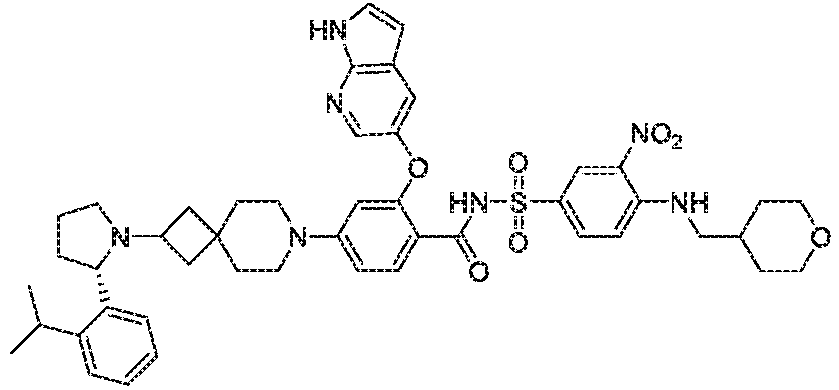
- The desired compound was synthesized following the procedures similar to those in Example F43 by replacing 4-((((1r,4r)-4-hydroxy-4-methylcyclohexyl)methyl)amino)-3-nitrobenzenesulfonamide with 3-nitro-4-(((tetrahydro-2H-pyran-4-yl)methyl)amino)benzenesulfonamide. 1H NMR (400 MHz, DMSO-d 6) δ ppm: 11.69 (s, 1H), 11.44 (br, 1H), 8.61 (s, 1H), 8.55 (s, 1H), 8.03 (s, 1H), 7.79 (d, J = 8.8 Hz, 1H), 7.67 (s, 1H), 7.55 - 7.46 (m, 3H), 7.41 - 7.25 (m, 3H), 7.17 - 7.05 (m, 1H), 6.68 (d, J = 8.8 Hz, 1H), 6.38 (s, 1H), 6.17 (s, 1H), 4.85 - 4.70 (m, 1H), 3.85 (d, J = 8.4 Hz, 3H), 3.72 - 3.60 (m, 1H), 3.27 - 3.21 (m, 4H), 3.12 - 2.89 (m, 8H), 2.18 - 1.99 (m, 4H), 1.95 - 1.83 (m, 1H), 1.61 (d, J = 12.5 Hz, 2H), 1.48 - 1.39 (m, 3H), 1.38 - 1.17 (m, 9H), 1.15 - 0.97 (s, 3H). MS (ESI, m/e) [M+1]+ 861.9.
-

- The desired compound was synthesized following the procedures similar to those in Example F43 by replacing 4-((((1r,4r)-4-hydroxy-4-methylcyclohexyl)methyl)amino)-3-nitrobenzenesulfonamide with 4-(((4-fhiorotetrahydro-2H-pyran-4-yl)methyl)amino)-3-nitrobenzenesulfonamide. 1H NMR (400 MHz, DMSO-d 6) δ ppm: 11.70 (s, 1H), 11.47 (br, 1H), 8.65 (t, J = 6.0 Hz, 1H), 8.57 (d, J = 1.6 Hz, 1H), 8.04 (d, J = 1.6 Hz, 1H), 7.82 (d, J = 8.8 Hz, 1H), 7.60 (d, J = 7.6 Hz, 1H), 7.52 (d, J = 7.6 Hz, 2H), 7.48 (d, J = 8.8 Hz, 1H), 7.37 (d,J = 4.0 Hz, 2H), 7.31 (dd, J = 7.6, 4.0 Hz, 1H), 7.26 (d, J = 8.8 Hz, 1H), 6.68 (d, J = 8.8 Hz, 1H), 6.38 (s, 1H), 6.17 (s, 1H), 4.86 - 4.73 (m, 1H), 3.89 (dd, J = 16.0, 8.0 Hz, 1H), 3.79 - 3.64 (m, 4H), 3.60 - 3.47 (m, 2H), 3.33 - 3.22 (m, 2H), 3.22 - 3.11 (m, 1H), 3.06 (s, 2H), 2.95 (s, 2H), 2.49 - 2.40 (m, 2H), 2.22 - 1.92 (m, 5H), 1.88 - 1.65 (m, 4H), 1.55 - 1.30 (m, 5H), 1.25 (d, J = 6.4 Hz, 3H), 1.10 (d, J = 6.4 Hz, 3H). MS (ESI, m/e) [M+1]+ 879.9.
-
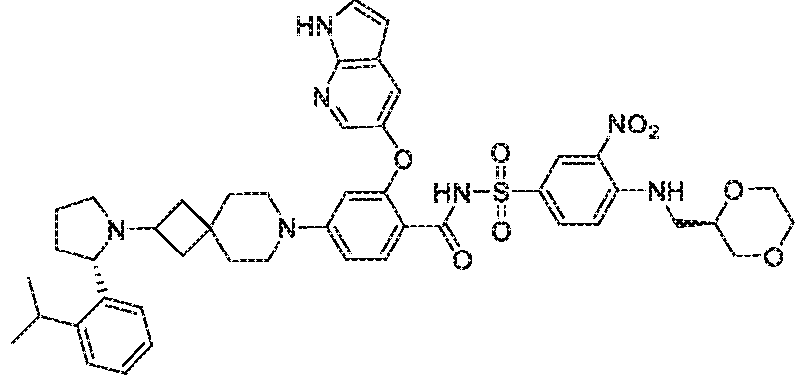
- The desired compound was synthesized following the procedures similar to those in Example F43 by replacing 4-((((1r,4r)-4-hydroxy-4-methylcyclohexyl)methyl)amino)-3-nitrobenzenesulfonamide with (R)-4-(((1,4-dioxan-2-yl)methyl)amino)-3-nitrobenzenesulfonamide. 1H NMR (400 MHz, DMSO-d 6) δ ppm: 11.68 (s, 1H), 11.47 (br, 1H), 8.59 - 8.55 (m, 2 H), 8.03 (d, J = 1.8 Hz, 1 H), 7.80 (d, J = 8.1 Hz, 2 H), 7.63 - 7.41 (m, 3 H), 7.35 - 7.28 (m, 3 H), 7.10 (d, J = 9.2 Hz, 1 H), 6.68 (d, J = 8.8 Hz, 1 H), 6.37 (s, 1 H), 6.18 (s, 1 H), 4.76 (s, 1 H), 3.89 - 3.79 (m, 4 H), 3.68 - 3.59 (m, 3 H), 3.52 - 3.41 (m, 2 H), 3.43 - 3.38 (m, 1 H), 3.31 - 3.21 (m, 2 H), 3.17 - 2.88 (m, 5 H), 2.18 - 2.11 (m, 5 H), 1.40 - 1.31 (m, 7 H), 1.24 (d, J = 6.0 Hz, 3 H), 1.11 (d, J = 6.0 Hz, 3H). MS (ESI, m/e) [M+1] + 863.9.
-

- The desired compound was synthesized following the procedures similar to those in Example F43 by replacing 4-((((1r,4r)-4-hydroxy-4-methylcyclohexyl)methyl)amino)-3-nitrobenzenesulfonamide with 4-((((1 s,4s)-4-hydroxy-4-methylcyclohexyl)methyl)amino)-3-nitrobenzenesulfonamide. 1H NMR (400 MHz, DMSO-d6 ) δ ppm: 11.65 (s, 1H), 11.24 (br, 1H), 8.53-8.51 (m, 2H), 8.00 (s, 1H), 7.73 (d, J = 7.8 Hz, 1H), 7.51-7.48 (m, 4H), 7.23-7.16 (m, 3H), 6.99 (s, 1H), 6.65 (d, J = 8.3 Hz, 1H), 6.36 (s, 1H), 6.17 (s, 1H), 3.95 (s, 1H), 3.27-3.24(m, 4H), 3.01 (s, 2H), 2.93 (s, 2H), 2.24 (s, 1H), 1.83-1.74 (m, 4H), 1.58-1.46 (m, 7H), 1.43-1.33 (m, 6H), 1.27-1.10 (m, 10H), 1.08 (s, 3H). MS (ESI, m/e) [M+1]+ 889.9.
-

- The desired compound was synthesized following the procedures similar to those in Example F43 by replacing (S)-2-(2-isopropylphenyl)pyrrolidine with (R)-2-(2-isopropylphenyl)pyrrolidine. 1H NMR (400 MHz, DMSO-d 6) δ ppm: 11.70 (s, 1H), 11.44 (br, 1H), 8.57 (s, 1H), 8.55 (s, 1H), 8.03 (s, 1H), 7.98 (s, 1H), 7.78 (d, J = 8.4 Hz, 1H), 7.55 - 7.42 (m, 3H), 7.33 (s, 2H), 7.26 (s, 1H), 7.07 (d, J = 8.4 Hz, 1H), 6.68 (d, J = 8.8 Hz, 1H), 6.38 (s, 1H), 6.18 (s, 1H), 4.74 (s, 1H), 4.25 (s, 1H), 3.96 - 3.51 (m, 2H), 3.28 (s, 3H), 3.14 - 2.85 (m, 5H), 2.38 (s, 1H), 2.30 - 1.88(m, 5H), 1.74 - 1.60 (m, 3H), 1.54 (d, J = 12.6 Hz, 2H), 1.48 - 1.28 (m, 8H), 1.24 (d, J = 5.4 Hz, 3H), 1.16 - 1.05 (m, 8H). MS (ESI, m/e) [M+1]' 889.9.
-
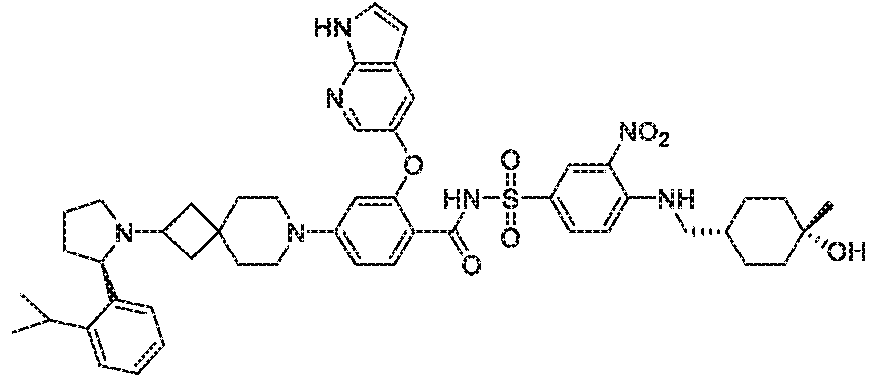
- The desired compound was synthesized following the procedures similar to those in Example F43 by replacing (S)-2-(2-isopropylphenyl)pyrrolidine with (R)-2-(2-isopropylphenyl)pyrrolidine and replacing 4-((((1r,4r)-4-hydroxy-4-methylcyclohexyl)methyl)amino)-3-nitrobenzenesulfonamide with 4-((((1s,4s)-4-hydroxy-4-methylcyclohexyl)methyl)amino)-3-nitrobenzenesulfonamide. 1H NMR (400 MHz, DMSO-d 6) δ ppm: 11.71 (s, 1H), 11.44 (br, 1H), 10.87 (s, 1H), 8.61 (s, 1H), 8.56 (s, 1H), 8.04 (s, 1H), 7.98 (s, 1H), 7.78 (d, J = 9.0 Hz, 1H), 7.55 - 7.42 (m, 3H), 7.33 (s, 2H), 7.27 (s, 1H), 7.07 (d, J = 9.0 Hz, 1H), 6.68 (d, J = 8.8 Hz, 1H), 6.38 (s, 1H), 6.18 (s, 1H), 4.73 (s, 1H), 3.97 (s, 1H), 3.82 (s, 1H), 3.67 (s, 1H), 3.26 (s, 3H), 3.14 - 2.85 (m, 5H), 2.39 (s, 1H), 2.30 - 1.88(m, 5H), 1.60 - 1.30 (m, 12H), 1.24 (d, J = 6.0 Hz, 5H), 1.15 - 1.03 (m, 6H). MS (ESI, m/e) [M+1]+ 889.9.
-

- The desired compound was synthesized following the procedures similar to those in Example F40 by replacing (S)-2-(2-ethylphenyl)pyrrolidine with 2-(2-cyclobutylphenyl)pyrrolidine and replacing (S)-4-(((1,4-dioxan-2-yl)methyl)amino)-3-nitrobenzenesulfonamide with 3-nitro-4-(((tetrahydro-2H-pyran-4-yl)methyl)amino)benzenesulfonimidamide. 1H NMR (DMSO-d 6) δ ppm: 11.69 (s, 1H), 11.43 (br, 1H), 8.61 - 8.53 (m, 2H), 8.02 (s, 1H), 7.78 - 7.70 (m, 2H), 7.49 - 7.45 (m, 3H), 7.29 (s, 3H), 7.10 - 7.06 (m, 1H), 6.70 - 6.62 (m, 1H), 6.37 (s, 1H), 6.17 (s, 1H), 4.46 (s, 1H), 3.81 - 3.75 (m, 5H), 3.31 - 3.21 (m, 4H), 2.99 - 2.95 (m, 4H), 2.30 - 1.87 (m, 13H), 1.65 - 1.58 (m, 2H), 1.47 - 1.18 (m, 10H). MS (ESI) m/e [M+ 1]+ 873.8.
-

- The desired compound was synthesized following the procedures similar to those in Example F40 by replacing (S)-2-(2-ethylphenyl)pyrrolidine with (S)-2-(2-isobutylphenyl)pyrrolidinc and replacing (S)-4-(((1,4-dioxan-2-yl)mcthyl)amino)-3-nitrobenzenesulfonamide with 3-nitro-4-(((tetrahydro-2H-pyran-4-yl)methyl)amino)benzenesulfonimidamide. 1H NMR (DMSO-d 6) δ ppm: 11.52 (s, 1H), 9.64 (s, 1H), 8.67 - 8.26 (m, 2H), 8.02 - 7.86 (m, 1H), 7.71 - 7.34 (m, 4H), 7.29 - 6.92 (m, 4H), 6.88 - 6.56 (m, 2H), 6.37 - 6.10 (m, 1H), 5.39 - 5.23 (m, 1H), 3.89 - 3.77 (m, 2H), 3.60 - 3.46 (m, 1H), 3.28 - 3.21 (m, 4H), 3.15 - 2.81 (m, 8H), 2.21 - 1.55 (m, 13H), 1.51 - 1.40 (m, 4H), 0.893 - 0.79(m, 7H). MS (ESI, m/e) [M+1]+ 875.9.
-

- The desired compound was synthesized following the procedures similar to those in Example F40 by replacing (S)-2-(2-ethylphenyl)pyrrolidine with 2-(3-cyclopropylphenyl)pyrrolidine and replacing (S)-4-(((1,4-dioxan-2-yl)methyl)amino)-3-nitrobenzenesulfonamide with 3-nitro-4-(((tetrahydro-2H-pyran-4-yl)methyl)amino)benzenesulfonimidamide. 1H NMR (DMSO-d 6) δ ppm: 11.68 (s, 1H), 11.45 (br, 1H), 8.54 (s, 2H), 8.03 (s. 1H), 7.77 (s, 1H), 7.50 (s, 3H), 7.27 (s, 3H), 7.10 (s, 2H), 6.73 - 6.65 (m, 1H), 6.38 (s, 1H), 6.18 (s, 1H), 4.28 (s, 1H), 3.90 - 3.80 (m, 3H), 3.62 (s, 1H), 3.30 - 3.23 (m, 3H), 3.10 - 2.91 (m, 6H), 2.10 - 1.92 (m, 7H), 1.65 - 1.59 (m, 3H), 1.45 - 1.25 (m, 8H), 0.99 - 0.92 (m, 2H), 0.68 (s, 2H). MS (ESI) m/e [M+1]+ 860.0.
-

- The desired compound was synthesized following the procedures similar to those in Example F40 by replacing (S)-2-(2-elhylphcnyl)pyrrolidine with (S)-2-(o-tolyl)pyrrolidine and replacing (S)-4-(((1,4-dioxan-2-yl)methyl)amino)-3-nitrobenzenesulfonamide with 3-nitro-4-(((tetrahydro-2H-pyran-4-yl)methyl)amino)benzenesulfonimidamide. 1H NMR (DMSO-d 6) δ ppm: 11.68 (s, 1H), 11.44 (s, 1H), 8.62 (t, J = 6.0 Hz, 1H), 8.56 (d, J = 2.4 Hz, 1H), 8.03 (d, J = 2.4 Hz, 1H), 7.87 (s, 1H), 7.79 (dd, J = 9.0, 2.0 Hz, 1H), 7.57 - 7.45 (m, 3H), 7.30 - 7.16 (m, 3H), 7.11 (d, J = 9.0 Hz, 1H), 6.69 (d, J = 9.0 Hz, 1H), 6.38 (dd, J = 3.2, 1.8 Hz, 1H), 6.18 (s, 1H), 4.55 (s, 1H), 3.85 (dd, J = 11.2, 3.0 Hz, 2H), 3.33 - 3.22 (m, 4H), 3.14 - 2.85 (m, 5H), 2.36 (s, 4H), 2.21 - 1.96 (m, 5H), 1.92 - 1.83 (m, 1H), 1.61 (d, J = 12.8 Hz, 2H), 1.49 - 1.35 (m, 5H), 1.31 - 1.17 (m, 2H). MS (ESI, m/e) [M+1]' 833.9.
-

- The desired compound was synthesized following the procedures similar to those in Example F40 by replacing (S)-2-(2-ethylphenyl)pyrrolidine with (S)-2-(2-chlorophenyl)pyrrolidine and replacing (S)-4-(((1,4-dioxan-2-yl)methyl)amino)-3-nitrobenzenesulfonamide with 3-nitro-4-(((tetrahydro-2H-pyran-4-yl)methyl)amino)benzenesulfonimidamide. 1H NMR (DMSO-d 6) δ ppm: 11.70 (s, 1 H), 11.46 (br, 1 H), 8.65-8.61 (m, 1 H), 8.56 (d, J = 2.2 Hz, 1 H), 8.04 (d, J = 2.5 Hz, 2 H), 7.80 (d, J = 9.1 Hz, 1H), 7.56 - 7.31 (m, 5 H), 7.11 (d, J = 9.4 Hz, 1H), 6.69 (d, J = 9.0 Hz, 1 H), 6.39 (d, J = 1.7 Hz, 1 H), 6.18 (s, 1 H), 5.31 (s, 1H), 4.80 (s, 1H), 3.85 (d, J = 8.1 Hz,2 H), 3.69 - 3.61 (m, 1 H), 3.41 - 3.34 (m, 1 H), 3.30 - 3.21 (m, 1 H), 3.14 - 3.00 (m, 4 H), 2.96 (s, 3 H), 2.40 - 2.19(m, 3 H), 1.65 - 1.60 (m, 3 H), 1.54 - 1.40 (m, 6 H), 1.32 - 1.20 (m, 5 H). MS (ESI, m/e) [M+1]+ 853.8.
-
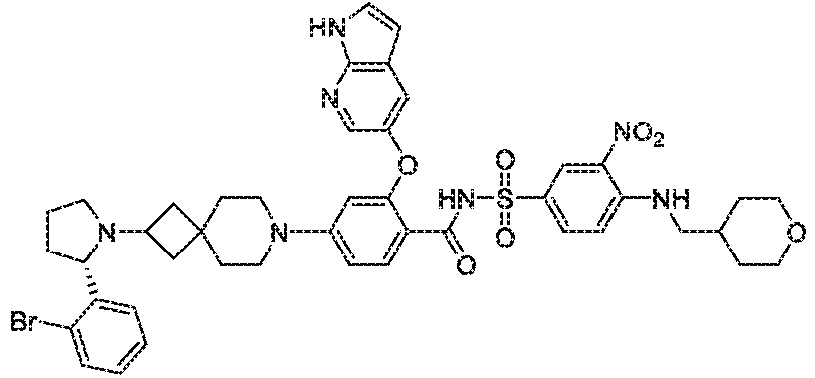
- The desired compound was synthesized following the procedures similar to those in Example F40 by replacing (S)-2-(2-ethylphenyl)pyrrolidine with (S)-2-(2-bromophcnyl)pyrrolidine and replacing (S)-4-(((1,4-dioxan-2-yl)methyl)amino)-3-nitrobenzenesulfonamide with 3-nitro-4-(((tetrahydro-2H-pyran-4-yl)methyl)amino)benzenesulfonimidamide. 1H NMR (DMSO-d 6) δ ppm: 11.72 (s, 1H), 11.68 (br, 1H), 8.61 (t, J = 5.6 Hz, 1H), 8.56 (d, J = 2.0 Hz, 1H), 8.04 (d, J = 2.0 Hz, 1H), 7.87 - 7.74 (m, 1H), 7.59 (s, 1H), 7.53 - 7.46 (m, 3H), 7.42 (s, 1H), 7.25 (s, 1H), 7.11 (d, J = 9.0 Hz, 1H), 6.68 (d, J = 7.4 Hz, 1H), 6.44 - 6.30 (m, 1H), 6.18 (s, 1H), 3.85 (dd, J = 11.2, 2.8 Hz, 2H), 3.62 - 3.12 (m, 8H), 3.12 - 2.83 (m, 5H), 2.43 - 2.27 (m, 1H), 2.12 - 1.76 (m, 5H), 1.61 (d, J = 12.0 Hz, 2H), 1.58 - 1.31 (m, 6H), 1.30 - 1.19 (m, 2H). MS (ESI, m/e) [M+1]+ 897.7.
-

- The desired compound was synthesized following the procedures similar to those in Example F40 by replacing (S)-2-(2-ethylphenyl)pyrrolidine with (R)-2-(2-chlorophenyl)pyrrolidine and replacing (S)-4-(((1,4-dioxan-2-yl)methyl)amino)-3-nitrobenzenesulfonamide with 3-nitro-4-(((tetrahydro-2H-pyran-4-yl)methyl)amino)benzenesulfonimidamide. 1H NMR (DMSO-d 6) δ ppm: 11.70 (s, 1H), 11.44 (br, 1H), 8.63 (t, J = 5.6 Hz, 1H), 8.56 (d, J = 1.8 Hz, 1H), 8.04-7.99 (m, 2H), 7.79 (d, J = 9.1 Hz, 1H), 7.52-7.43 (m, 5H), 7.12 (d, J = 9.3 Hz, 1H), 6.69 (d, J = 8.7 Hz, 1H), 6.39 (s, 1H), 6.17 (s, 1H), 4.81 (s, 1H), 3.85 (d, J = 8.4 Hz, 2H), 3.63 (s, 1H), 3.29-3.23 (m, 4H), 3.05 (s, 2H), 2.97 (s, 2H), 2.10 (s, 2H), 2.02-1.97 (m, 1H), 1.89 (s, 2H), 1.63-1.60 (m, 3H), 1.43-1.38 (m, 5H), 1.31-1.19 (m, 4H). MS (ESI, m/e) [M+1]+ 853.7.
-

- The desired compound was synthesized following the procedures similar to those in Example F40 by replacing (S)-2-(2-ethylphenyl)pyrrolidine with (S)-2-(3-chlorophenyl)pyrrolidine and replacing (S)-4-(((1,4-dioxan-2-yl)melhyl)amino)-3-nitrobenzenesulfonamide with 3-nitro-4-(((tetrahydro-2H-pyran-4-yl)methyl)amino)benzenesulfonimidamide. 1H NMR (DMSO-d 6) δ ppm: 11.70 (s, 1H), 11.45 (br, 1H), 8.69 - 8.49 (m, 2H), 8.11 - 7.96 (m, 1H), 7.90 - 7.22 (m, 8H), 7.20 - 7.03 (m, 1H), 6.76 - 6.59 (m, 1H), 6.38 (s, 1H), 6.27 - 6.06 (m, 1H), 4.54 - 4.11 (m, 1H), 4.00 - 3.50 (m, 3H), 3.31 - 3.22 (m, 4H), 3.11 - 2.82 (m, 5H), 2.30 - 1.73 (m, 6H), 1.69 - 1.53 (m, 3H), 1.53 - 1.18 (m, 8H). MS (ESI, m/e) [M+1]+ 853.8.
-

- The desired compound was synthesized following the procedures similar to those in Example F40 by replacing (S)-2-(2-ethylphenyl)pyrrolidine with (R)-2-(3-chlorophenyl)pyrrolidine and replacing (S)4-(((1,4-dioxan-2-yl)methyl)amino)-3-nitrobenzenesulfonamide with 3-nitro-4-(((tetrahydro-2H-pyran-4-yl)methyl)amino)benzenesulfonimidamide. 1H NMR (DMSO-d 6) δ ppm: 11.69 (s, 1H), 11.44 (br, 1H), 8.62 (s, 1H), 8.55 (s, 1H), 8.03 (d, J = 1.9 Hz, 1H), 7.79 (d, J = 9.1 Hz, 1H), 7.51-7.34 (M, 6H), 7.11 (d, J = 8.7 Hz, 1H), 6.69 (d, J = 8.6 Hz, 1H), 6.38 (s, 1H), 6.17 (s, 1H), 4.38 (s, 1H), 3.85 (d, J = 8.5 Hz, 2H), 3.63 (s, 1H), 3.29-3.23 (M, 4H), 3.05 (s, 2H), 2.96 (s, 2H), 2.11 (s, 1H), 2.02-1.97 (m, 1H), 1.91-1.89 (m, 2H), 1.63-1.60 (m, 3H), 1.43 (s, 2H), 1.36 (s, 2H), 1.31-1.23 (m, 6H). MS (ESI, m/e) [M+1]+ 854.1.
-

- The desired compound was synthesized following the procedures similar to those in Example F40 by replacing (S)-2-(2-ethylphenyl)pyrrolidine with (S)-2-(4-chlorophcnyl)pyrrolidinc and replacing (S)-4-(((1,4-dioxan-2-yl)methyl)amino)-3-nitrobenzenesulfonamide with 3-nitro-4-(((tetrahydro-2H-pyran-4-yl)methyl)amino)benzenesulfonimidamide. 1H NMR (DMSO-d 6) δ ppm: 11.68 (s, 1 H), 8.61 (t, J = 5.9 Hz, 1 H), 8.56 (d, J = 2.2 Hz, 1 H), 8.03 (d, J = 2.6 Hz, 1 H), 7.79 (dd, J = 9.2, 2.1 Hz, 1 H), 7.63 (d, J = 7.6 Hz, 2 H), 7.54 - 7.43 (m, 5 H), 7.10 (d, J = 9.4 Hz, 1 H), 6.70 (dd,J = 9.0, 1.8 Hz, 1 H), 6.39 (dd, J = 3.2, 1.8 Hz, 1 H), 6.18 (d, J = 1.7 Hz, 1 H), 4.25 (s, 1 H), 3.89-3.83 (m, 3 H), 3.34 - 3.19 (m, 6 H), 3.13 - 2.90 (m, 6 H), 2.34 (s, 1 H), 2.10 - 2.06 (m, 5 H), 1.94 - 1.82 (m, 1 H), 1.65 - 1.58 (m, 3 H), 1.51 - 1.33 (m, 5 H), 1.26 - 1.19 (m, 2 H). MS (ESI, m/e) [M+1]+ 853.8.
-

- The desired compound was synthesized following the procedures similar to those in Example F40 by replacing (S)-2-(2-ethylphenyl)pyrrolidine with (S)-2-(2-ethoxyphenyl)pyrrolidine and replacing (S)-4-(((1,4-dioxan-2-yl)methyl)amino)-3-nitrobenzenesulfonamide with 3-nitro-4-(((tetrahydro-2H-pyran-4-yl)mcthyl)amino)bcnzcncsulfonimidamidc. 1H NMR (DMSO-d 6) δ ppm: 11.68 (s, 1H), 11.45 (s, 1H), 9.97 (s, 1H), 8.58 - 8.52 (m, 2H), 8.02 (s, 1H), 7.78 - 7.76 (m, 1H), 7.65 - 7.23 (m, 5H), 7.05 - 7.01 (m, 3H), 6.72 - 6.58 (m, 1H), 6.37 (s, 1H), 6.20 (s, 1H), 4.68 (s, 1H), 4.10 (s, 2H), 3.87 - 3.83 (m, 3H), 3.30 - 3.23 (m, 3H), 3.05 - 3.01 (m, 5H), 2.05 - 1.98 (m, 9H), 1.67 - 1.17 (m, 14H). MS (ESI) m/e [M+1]+ 863.8.
-
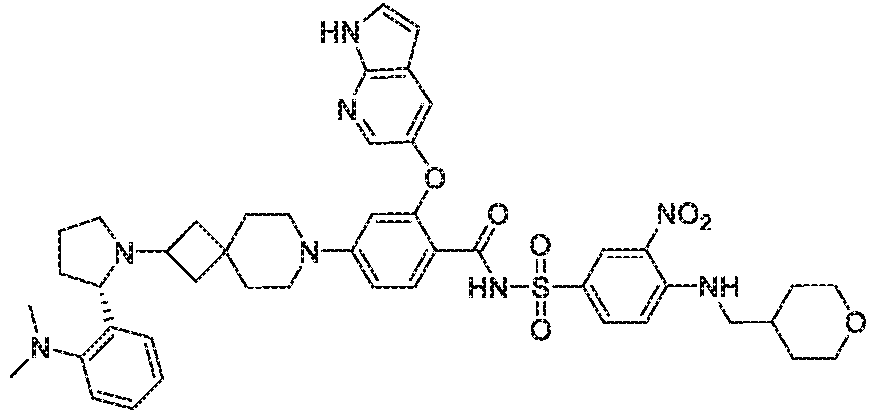
- The desired compound was synthesized following the procedures similar to those in Example F40 by replacing (S)-2-(2-ethylphenyl)pyrrolidine with (S)-N,N-dimethyl-2-(pyrrolidin-2-yl)aniline and replacing (S)-4-(((1,4-dioxan-2-yl)methyl)amino)-3-nitrobenzenesulfonamide with 3-nitro-4-(((tetrahydro-2H-pyran-4-yl)methyl)amino)benzensulfonimidamide. 1H NMR (DMSO-d 6) δ ppm: 11.70 (s, 1H), 11.45 (s, 1H), 10.17 (s, 1H), 8.67 - 8.59 (m, 1H), 8.59 - 8.52 (m 1H), 8.08 - 7.99 (m, 1H), 7.83 - 7.76 (m, 1H), 7.71 (s, 1H), 7.57 - 7.45 (m, 3H), 7.44 - 7.33 (m, 1H), 7.31 - 7.24 (m, 1H), 7.24 - 7.16(m, 1H), 7.16 - 7.06 (m, 1H), 6.73 - 6.64 (m, 1H), 6.42 - 6.31 (m, 1H), 6.21 - 6.11 (m, 1H), 4.99 - 4.83 (m, 1H), 3.91 - 3.80 (m, 2H), 3.80 - 3.67 (m, 1H), 3.67 - 3.51 (m, 1H), 3.32 - 3.22 (m, 4H), 3.20 - 2.90 (m, 6H), 2.60 (s, 6H), 2.23 - 1.79 (m, 6H), 1.70 - 1.57 (m, 2H), 1.57 - 1.49 (m, 1H), 1.44 - 1.20 (m. 7H). MS (ESI, m/e) [M+1]+ 862.9.
-

- The desired compound was synthesized following the procedures similar to those in Example F21 by replacing (S)-2-(2-cyclopropylphenyl)pyrrolidine with (S)-N,N-dimethyl-2-(pyrrolidin-2-yl)aniline. 1H NMR (DMSO-d 6) δ ppm: 11.60 (s, 1H), 11.37 (s, 1H), 8.66 - 8.52 (m, 2H), 8.05 (s, 1H), 7.83 (d, J = 8.9 Hz, 1H), 7.56 - 7.52 (m, 3H), 7.36 - 7.30 (m, 4H), 7.17 - 7.15 (m, 2H), 7.03 - 7.00 (m, 1H), 6.94 - 6.80 (m, 2H), 6.39 - 6.35 (m, 3H), 5.06 (s, 1H), 4.56 (s, 1H), 3.96 - 3.81 (m, 3H), 3.71 - 3.70 (m, 1H), 3.29 - 3.10 (m, 6H), 2.67 (s, 6H), 2.07 - 2.04 (m, 3H), 1.99 (s, 2H), 1.86 (s, 3H), 1.66 - 1.60 (m, 5H), 1.45 - 1.43 (m, 1H). MS (ESI) m/e [M+1]+ 890.9.
-

- The desired compound was synthesized following the procedures similar to those in Example F21 by replacing (S)-2-(2-cyclopropylphenyl)pyrrolidine with (S)-N,N-bis(methyl-d3)-2-(pyrrolidin-2-yl)aniline. 1H NMR (DMSO-d 6) δ ppm: 11.69 (s, 1H), 11.43 (s, 1H), 10.14 (s, 1H), 8.56 (s, 2H), 8.04 (s, 1H), 7.81 - 7.75 (m, 1H), 7.69 (s, 1H), 7.51 - 7.43 (m, 3H), 7.38 (s, 1H), 7.29 - 7.16 (m, 2H), 7.11 - 7.06 (m, 1H), 6.70 - 6.72 (m, 1H), 6.38 (s, 1H), 6.18 (s, 1H), 4.90 (s, 1H), 4.24 (s, 1H), 3.68 - 3.64 (m, 2H), 3.30 - 3.01 (m, 7H), 2.11 - 2.06 (m, 5H), 1.72 - 1.65 (m, 2H), 1.61 - 1.60 (m, 3H), 1.38 - 1.30 (m, 7H), 1.13 - 1.05 (m, 5H). MS (ESI) m/e [M+1]' 896.9.
-

- The desired compound was synthesized following the procedures similar to those in Example F40 by replacing (S)-2-(2-ethylphenyl)pyrrolidine with 1-(2-(pyrrolidin-2-yl)phenyl)pyrrolidine and replacing (S)-4-(((1,4-dioxan-2-yl)methyl)amino)-3-nitrobenzenesulfonamide with 3-nitro-4-(((tetrahydro-2H-pyran-4-yl)methyl)amino)benzenesulfonimidamide. 1H NMR (DMSO-d 6) δ ppm: 11.70 (s, 1H), 11.46 (s, 1H), 8.57 - 8.55 (m, 2H), 8.03 (s, 1H), 7.79 (d, J = 8.8 Hz, 1H), 7.67 (s, 1H), 7.50-7.48 (m, 3H), 7.32 (s, 1H), 7.10 (s, 3H), 6.70 - 6.68 (m, 1H), 6.38 (s, 1H), 6.18 (s, 1H), 4.79 (s, 1H), 3.86 - 3.84 (m, 2H), 3.71 (s, 1H), 3.53 (s, 1H), 3.30 - 3.26 (m, 6H), 2.98 - 2.92 (m, 5H), 2.81 (s, 2H), 2.13 (s, 3H), 2.05 - 1.77 (m, 8H), 1.63 - 1.59 (m, 2H), 1.56 - 1.48 (m, 1H), 1.35-1.26 (m, 7H).MS (ESI) m/e [M+1]+ 888.8.
-

- The desired compound was synthesized following the procedures similar to those in Example F23 by replacing (S)-2-(2-cyclopropylphenyl)pyrrolidine with (S)-1-methyl-4-(2-(pyrrolidin-2-yl)phenyl)-1,2,3,6-tetrahydropyridine. MS (ESI, m/e) [M+1]+ 914.8.
-
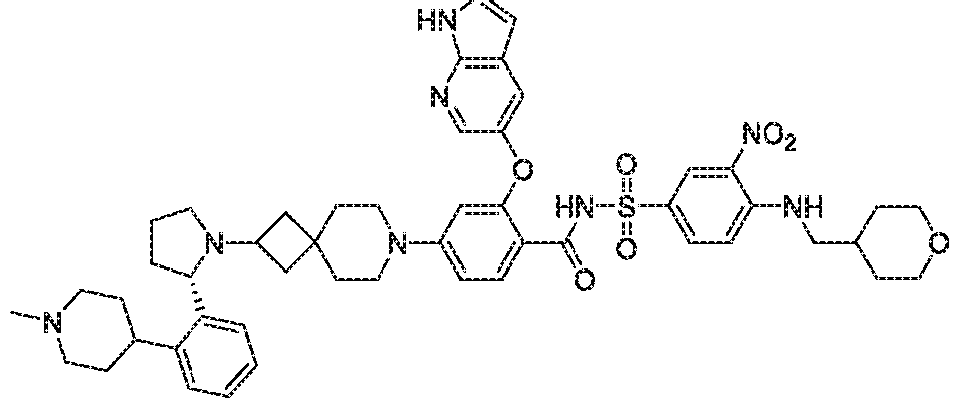
- The desired compound was synthesized following the procedures similar to those in Example F23 by replacing (S)-2-(2-cyclopropylphenyl)pyrrolidine with (S)-1-methyl-4-(2-(pyrrolidin-2-yl)phenyl)piperidine. MS (ESI, m/e) [M+1]+ 916.8.
-

- The desired compound was synthesized following the procedures similar to those in Example F40 by replacing (S)-2-(2-ethylphenyl)pyrrolidine with (S)-2-(2-methoxyphenyl)pyrrolidine and replacing (S)-4-(((1,4-dioxan-2-yl)methyl)amino)-3-nitrobenzenesulfonamide with 3-nitro-4-(((tetrahydro-2H-pyran-4-yl)methyl)amino)benzenesulfonamide. 1H NMR (400 MHz, DMSO-d 6) δ ppm: 11.70 (s, 1H), 11.46 (s, 1H), 9.38 (s, 1H), 8.72 - 8.47 (m, 2H), 8.04 (s, 1H), 7.85 - 7.71 (m, 1H), 7.57 - 7.38 (m, 4H), 7.19 - 6.92 (m, 3H), 6.77 - 6.62 (m, 1H), 6.38 (s, 1H), 6.19 (s, 1H), 4.73 - 4.56 (m, 1H), 3.93 - 3.76 (m, 5H), 3.59 - 3.40 (m, 2H), 3.29 - 2.89 (m, 9H), 2.37 - 1.72 (m, 8H), 1.68 - 1.55 (m, 2H), 1.53- 1.33 (m, 4H), 1.32 - 1.24 (m, 3H). MS (ESI, m/e) [M+ 1]+849.9.
-

- The desired compound was synthesized following the procedures similar to those in Example F43 by replacing (S)-2-(2-isopropylphenyl)pyrrolidine with (S)-2-(2-isopropoxyphenyl)pyrrolidine and replacing 4-((((1r,4r)-4-hydroxy-4-methylcyclohexyl)methyl)amino)-3-nitrobenzenesulfonamide with 3-nitro-4-(((tetrahydro-2H-pyran-4-yl)methyl)amino)benzencsulfonamidc. 1H NMR (400 MHz, DMSO-d 6) δ ppm: 11.70 (s, 1H), 11.46 (s, 1H), 8.75 - 8.41 (m, 2H), 8.04 (s, 1H), 7.89 - 7.72 (m, 1H), 7.72 - 7.55(m, 1H), 7.55 - 7.41 (m, 3H), 7.41 - 7.28 (m, 1H), 7.20 - 6.89 (m, 3H), 6.79 - 6.61 (m, 1H), 6.38 (s, 1H), 6.20 (s, 1H), 4.82 - 4.58 (m, 2H), 3.99 - 3.71 (m, 3H), 3.62 - 3.47 (m, 1H), 3.30 - 3.22(m, 3H), 3.20 - 2.85 (m, 5H), 2.40 - 1.68 (m, 9H), 1.65 - 1.38 (m, 7H), 1.37 - 1.26 (m, 7H). MS (ESI, m/e) [M+1]' 877.9.
-

- The desired compound was synthesized following the procedures similar to those in Example F40 by replacing (S)-2-(2-ethylphenyl)pyrrolidine with 2-(2-(methoxymethyl)phenyl)pyrrolidine and replacing (S)-4-(((1,4-dioxan-2-yl)methyl)amino)-3-nitrobenzenesulfonamide with 3-nitro-4-(((tetrahydro-2H-pyran-4-yl)methyl)amino)benzenesulfonamide. 1H NMR (400 MHz, DMSO-d 6) δ ppm: 11.69 (s, 1H), 11.44 (br, 1H), 8.62-8.55 (m, 2H), 8.02 (s, 1H), 8.87-7.77 (m, 2H), 7.51-7.42 (m, 3H), 7.37 (s, 1H), 7.21 (s, 1H), 7.11 (s, 1H), 6.67 (d, J = 7.3 Hz, 1H), 6.37 (s, 1H), 6.17 (s, 1H), 4.55-4.50 (m, 1H), 4.45 (s, 1H), 3.85 (d, J = 8.1 Hz, 2H), 3.67 (s, 1H), 3.31-3.22 (m, 10H), 3.02 (s, 2H), 2.94 (s, 2H), 2.10 (s, 1H), 2.02-1.97 (m, 2H), 1.88 (s, 1H), 1.61 (d, J = 12.2 Hz, 2H), 1.45 (s, 4H), 1.25-1.23 (m, 7H). MS (ESI, m/e) [M+1]+ 863.8.
-

- The desired compound was synthesized following the procedures similar to those in Example F40 by replacing (S)-2-(2-ethylphenyl)pyrrolidine with (2-(pyrrolidin-2-yl)phenyl)methanol and replacing (S)-4-(((1,4-dioxan-2-yl)methyl)amino)-3-nitrobenzenesulfonamide with 3-nitro-4-(((tetrahydro-2H-pyran-4-yl)methyl)amino)benzenesulfonamide. 1H NMR (400 MHz, DMSO-d 6) δ ppm: 11.65 (s, 1H), 8.55-8.51 (m, 2H), 8.20 (d, J = 6.5 Hz, 2H), 8.00 (s, 1H), 7.73 (d, J = 8.9 Hz, 1H), 7.50-7.44 (m, 2H), 7.32-7.27 (m, 2H), 7.03 (d, J = 8.8 Hz, 1H), 6.94 (d, J = 6.4 Hz, 2H), 6.66 (d, J = 7.9 Hz, 1H), 6.36 (s, 1H), 6.18 (s, 1H), 4.64-4.50 (m, 2H), 3.84 (d, J= 9.3 Hz, 2H), 3.31-3.23 (m, 8H), 3.01 (s, 2H), 2.92 (s, 2H), 2.02-1.98 (m, 2H), 1.88 (s, 2H), 1.61 (d, J = 12.1 Hz, 2H), 1.45 (s, 1H), 1.39-1.36 (m, 4H), 1.23 (s, 6H). MS (ESI, m/e) [M+1]+ 849.8.
-

- The desired compound 72a was synthesized following the procedures similar to those in Example F40 by replacing (S)-2-(2-ethylphenyl)pyrrolidine with (R or S)-2-(3-chloro-2-cyclopropylphenyl)pyrrolidine (faster peak in SFC) and replacing (S)-4-(((1,4-dioxan-2-yl)methyl)amino)-3-nitrobenzenesulfonamide with 3-nitro-4-(((tetrahydro-2H-pyran-4-yl)methyl)amino)benzenesulfonamide. 1H NMR (400 MHz, DMSO-d 6) δ ppm: 11.66 (s, 1H), 11.38 (br, 1H), 8.56-8.52 (m, 2H), 8.01 (s, 1H), 7.74 -7.72 (m, 1H), 7.58 - 7.49 (m, 4H), 7.35 - 7.04 (m, 3H), 6.65 (m, 1H), 6.36 (s, 1H), 6.17 (s, 1H), 4.12 - 4.09 (m, 1H), 3.85 - 3.71 (m, 2H), 3.33 - 3.21 (m, 4H), 3.21-2.90 (m, 5H), 2.67 - 2.61 (m, 1H), 2.33 -1.08 (m, 19H), 0.85 - 0.81 (m, 2H), 0.52 - 0.44 (m, 2H). MS (ESI, m/e) [M+1]+ 893.8; Compound 72b was synthesized following the procedures similar to those in Example F40 by replacing (S)-2-(2-ethylphenyl)pyrrolidine with (S or R)-2-(3-chloro-2-cyclopropylphenyl)pyrrolidine (slower peak in SFC) and replacing (S)-4-(((1,4-dioxan-2-yl)methyl)amino)-3-nitrobenzenesulfonamide with 3-nitro-4-(((tetrahydro-2H-pyran-4-yl)methyl)amino)benzenesulfonamide. MS (ESI, m/e) [M+1]+ 893.8.
-

- The desired compound was synthesized following the procedures similar to those in Example F40 by replacing (S)-2-(2-ethylphenyl)pyrrolidine with 2-(5-chloro-2-cyclopropylphenyl)pyrrolidine and replacing (S)-4-(((1,4-diuxan-2-yl)methyl)amino)-3-nitrobenzenesulfonamide with 3-nitro-4-(((tetrahydro-2H-pyran-4-yl)methyl)amino)benzenesulfonamide. 1H NMR (400 MHz, DMSO-d 6) δ ppm: 11.63 (s, 1H), 8.56-8.52 (m, 2H), 8.01 (s, 1H), 7.71 - 7.69 (m, 1H), 7.58 - 7.49 (m, 4H), 7.35 - 7.04 (m, 3H), 6.65 -6.63 (m, 1H), 6.36 (s, 1H), 6.19 (s, 1H), 4.11 - 3.86 (m, 1H), 3.85 (d, J = 8.4 Hz, 2H), 3.33 - 2.90(m, 12H), 2.67 - 2.61 (m, 1H), 2.33 - 2.21 (m, 1H), 2.02 - 1.08 (m, 15H), 0.85 - 0.81 (m, 2H), 0.64 - 0.53 (m, 2H).MS (ESI, m/e) [M+1]+ 893.8.
-

- The desired compound 72a was synthesized following the procedures similar to those in Example F40 by replacing (S)-2-(2-ethylphenyl)pyrrolidine with (R or S)- 2-(3-chloro-2-ethylphenyl)pyrrolidine (faster peak in SFC) and replacing (S)-4-(((1,4-dioxan-2-yl)methyl)amino)-3-nitrobenzenesulfonamide with 3-nitro-4-(((tetrahydro-2H-pyran-4-yl)methyl)amino)benzenesulfonamide. 1H NMR (400 MHz, DMSO-d 6) δ ppm: 11.70 (s, 1H), 11.45 (s, 1H), 10.08 (s, 1H), 8.70 - 8.55 (m, 2H), 8.04 (s, 1H), 7.85 - 7.70 (m, 2H), 7.66 - 7.24 (m, 4H), 7.40 - 7.20 (m, 1H), 6.69 (d, J = 8.7 Hz, 1H), 6.35 (d, J = 25.1 Hz, 1H), 6.17 (s, 1H), 5.76 (s, 1H), 4.75 - 4.60 (m, 1H), 3.90 - 3.75 (m, 2H), 3.76 - 3.56 (m, 1H), 3.31 - 3.21 (m, 2H), 3.19 - 2.90 (m, 4H), 2.15 - 1.85 (m, 5H), 1.61 (d, J = 12.1 Hz, 2H), 1.56 - 1.19 (m, 10H), 1.15 - 1.10 (m, 2H), 0.90 - 0.79 (m, 3H). MS (ESI, m/e) [M+1]+ 881.8; Compound 74b was synthesized following the procedures similar to those in Example F40 by replacing (S)-2-(2-ethylphenyl)pyrrolidine with (S or R)-2-(3-chloro-2-ethylphenyl)pyrrolidine (slower peak in SFC) and replacing (S)-4-(((1,4-dioxan-2-yl)methyl)amino)-3-nitrobenzenesulfonamide with 3-nitro-4-(((tetrahydro-2H-pyran-4-yl)methyl)amino)benzenesulfonamide. MS (ESI, m/e) [M+1]+ 881.8.
-

- The desired compound was synthesized following the procedures similar to those in Example F40 by replacing (S)-2-(2-ethylphenyl)pyrrolidine with 2-(2,4-dicyclopropylphenyl)pyrrolidine and replacing (S)-4-(((1,4-dioxan-2-yl)methyl)amino)-3-nitrobenzenesulfonamide with 3-nitro-4-(((tetrahydro-2H-pyran-4-yl)methyl)amino)benzenesulfonamide. 1H NMR (400 MHz, DMSO-d 6) δ ppm: 11.69 (s, 1H), 11.45 (br, 1H), 8.62-8.56 (m, 2H), 8.03 (s, 1H), 7.78 (s, 1H), 7.56-7.47 (m, 3H), 7.20-7.12 (m, 1H), 6.94 (d, J = 8.1 Hz, 1H), 6.76 (s, 1H), 6.69 (d, J = 9.2 Hz, 1H), 6.38 (s, 1H), 6.18 (s, 1H), 4.90 (s, 1H), 3.85 (d, J = 8.2 Hz, 2H), 3.64 (s, 1H), 3.31 - 3.23 (m, 4H), 3.08 - 2.97 (m. 8H), 2.11 (s, 2H), 2.03 - 1.97 (m, 4H), 1.89 (s, 2H), 1.63 - 1.59 (m, 3H), 1.45 (s, 2H), 1.38 (s, 2H), 1.24-1.19 (m, 10H). MS (ESI, m/e) [M+1]+ 899.8.
-

- The desired compound was synthesized following the procedures similar to those in Example F40 by replacing (S)-2-(2-ethylphenyl)pyrrolidine with 2-(2,5-dicyclopropylphenyl)pyrrolidine and replacing (S)-4-(((1,4-dioxan-2-yl)methyl)amino)-3-nitrobenzenesulfonamide with 3-nitro-4-(((tetrahydro-2H-pyran-4-yl)methyl)amino)benzenesulfonamide. 1H NMR (400 MHz, DMSO-d 6) δ ppm: 11.66 (s, 1H), 11.44 (br, 1H), 8.67 - 8.44 (m, 2H), 8.06 - 7.94 (m, 1H), 7.82 - 7.67 (m, 1H), 7.58 - 7.22 (m, 4H), 7.05 - 6.95 (m, 4H), 6.39 - 6.33 (m, 1H), 6.24 - 6.12 (m, 1H), 3.88 - 3.81 (m, 2H), 3.31 - 3.21 (m, 5H), 3.10 - 2.90 (m, 5H), 2.13 - 1.73 (m, 8H), 1.70 - 1.17 (m, 13H), 0.94 - 0.83 (m, 4H), 0.68 - 0.48 (m, 4H). MS (ESI, m/e) [M+1]+ 899.9.
-

- The desired compound was synthesized following the procedures similar to those in Example F40 by replacing (S)-2-(2-ethylphenyl)pyrrolidine with 2-(3-(2-chlorophenyl)thiophen-2-yl)pyrrolidine and replacing (S)-4-(((1,4-dioxan-2-yl)methyl)amino)-3-nitrobenzenesulfonamide with 3-nitro-4-(((tetrahydro-2H-pyran-4-yl)methyl)amino)benzenesulfonamide. 1H NMR (400 MHz, DMSO-d 6) δ ppm: 11.71 (s, 1H), 11.44 (s, 1H), 8.63 (s, 1H), 8.57 (s, 1H), 8.05 (s, 1H), 7.81 (d, J = 9.0 Hz, 1H), 7.56 - 7.46 (m, 4H), 7.39 (s, 2H), 7.27 (s, 1H), 7.12 (d, J = 9.0 Hz, 1H), 6.88 (s, 1H), 6.70 (d, J = 8.6 Hz, 1H), 6.40 (s, 1H), 6.17 (s, 1H), 3.85 (d, J = 8.4 Hz, 2H), 3.33 - 3.25 (m, 4H), 3.10 - 2.95 (m, 7H), 2.05 -1.96 (m, 1H), 1.89 (s, 2H), 1.66 - 1.58 (m, 5H), 1.51 (s, 3H), 1.42 - 1.25 (m, 7H). MS (ESI) m/e [M+1]+ 935.7.
-

- The desired compound was synthesized following the procedures similar to those in Example F40 by replacing (S)-2-(2-ethylphenyl)pyrrolidine with 2-(2-cyclopropylphenyl)-4-methylpyrrolidine and replacing (S)-4-(((1,4-dioxan-2-yl)methyl)amino)-3-nitrobenzenesulfonamide with 3-nitro-4-(((tetrahydro-2H-pyran-4-yl)methyl)amino)benzenesulfonamide. 1H NMR (400 MHz, DMSO-d6 ) δ ppm: 11.70 (s, 1 H), 11.49 (br, 1 H), 8.63 (t, J = 5.9 Hz, 1H), 8.56 (d, J = 2.2 Hz, 1H), 8.04 (d, J = 2.5 Hz, 1H), 7.91-7.75 (m, 2 H), 7.57 - 7.42 (m, 3 H), 7.35-7.25 (m, 2 H), 7.12 (d, J = 9.3 Hz, 1 H), 7.15-7.18 (m, 1 H), 6.69 (d, J = 9.0 Hz, 1H), 6.43 - 6.31 (m, 1H), 6.17 (s, 1H), 5.02 (s, 1H), 3.88-3.71 (m, 3 H), 3.29-3.21 (m, 5 H), 3.12-2.95 (m, 4 H), 2.58-2.54 (m, 2 H), 2.11-2.05 (m, 3 H), 1.95-1.77 (m, 2 H), 1.65-1.60 (m, 4 H), 1.55 - 1.10 (m, 11 H), 1.04 - 0.88 (m, 3 H). MS (ESI, m/e) [M+1]+ 873.9.
-

- The desired compound was synthesized following the procedures similar to those in Example F40 by replacing (S)-2-(2-elhylphcnyl)pyrrolidine with 4-cyclopropyl-2-(2-cyclopropylphenyl)pyrrolidine and replacing (S)-4-(((1,4-dioxan-2-yl)methyl)amino)-3-nitrobenzenesulfonamide with 3-nitro-4-(((tetrahydro-2H-pyran-4-yl)methyl)amino)benzenesulfonamide. 1H NMR (400 MHz, DMSO-d6 ) δ ppm: 11.70 (s, 1H), 11.46 (s, 1H), 8.619 - 8.52(m" 2H), 8.039 - 7.99(m, 1H), 7.948 - 7.88(m, 1H), 7.87 - 7.73 (m, 1H), 7.62 - 7.40 (m, 3H), 7.38 - 7.20 (m, 2H), 7.20 - 7.91 (m, 2H), 6.74 - 6.63 (m, 1H), 6.42 (s, 1H), 6.19 (s, 1H), 4.51 - 4.42 (m, 1H), 3.95 - 3.77(m,, 3H), 3.54 - 3.42 (m, 1H), 3.30 - 3.22 (m, 4H), 3.08 - 2.86 (m,, 5H), 2.22 - 1.81 (m, 6H), 1.67 - 1.14 (m, 11H), 1.09 - 0.79 (m, 3H), 0.73 - 0.56 (m, 2H), 0.52 - 0.36 (m, 2H), 0.31 - 0.12 (m, 2H). MS (ESI, m/e) [M+1]+ 899.9.
-

- The desired compound was synthesized following the procedures similar to those in Example F40 by replacing (S)-2-(2-ethylphenyl)pyrrolidine with 2-(2-cyclopropylphenyl)-4-phenyl-2,5-dihydro-1H-pyrrole and replacing (S)-4-(((1,4-dioxan-2-yl)methyl)amino)-3-nitrobenzenesulfonamide with 3-nitro-4-(((tetrahydro-2H-pyran-4-yl)methyl)amino)benzenesulfonamide. 1H NMR (400 MHz, DMSO-d6 ) δ ppm: 11.70 (s, 1H), 11.42 (s, 1H), 8.62 (s, 1H), 8.56 (s, 1H), 8.05 (s, 1H), 7.80 (d, J = 8.6 Hz, 1H), 7.53 - 7.48 (m, 6H), 7.33 - 7.29 (m, 3H), 7.12 (s, 3H), 6.99 (s, 1H), 6.70 (d, J = 8.6 Hz, 1H), 6.39 (s, 1H), 6.25 (s, 1H), 6.18 (s, 1H), 5.31-5.29 (m, 1H), 4.23 (s, 1H), 3.86 - 3.84 (m, 3H), 3.26 - 3.24 (m, 3H), 3.09 (s, 2H), 3.00 (s, 2H), 2.11 (s, 1H), 1.91 - 1.85 (m, 4H), 1.63 - 1.59 (m, 2H), 1.45 (s, 4H), 1.24 (s, 4H), 0.89 (s, 3H), 0.73 (s, 1H), 0.58 (s, 1H). MS (ESI) m/e [M+1]+ 933.8.
-

- The desired compound was synthesized following the procedures similar to those in Example F40 by replacing (S)-2-(2-ethylphenyl)pyrrolidine with 6-(2-cyclopropylphenyl)-5-azaspiro[2.4]heptane and replacing (S)-4-(((1,4-dioxan-2-yl)methyl)amino)-3-nitrobenzenesulfonamide with 3-nitro-4-(((tetrahydro-2H-pyran-4-yl)methyl)amino)benzenesulfonamide. 1H NMR (400 MHz, DMSO-d6 ) δ ppm: 11.69 (s, 1H), 11.46 (s, 1H), 8.65 - 8.50 (m, 2H), 8.02 (s, 1H), 7.95 - 7.85 (m, 1H), 7.80 - 7.75 (m, 1H), 7.58 - 7.38 (m, 3H), 7.30 - 7.20 (m, 2H), 7.17 - 6.98 (m, 2H), 6.70 - 6.60 (m, 1H), 6.36 (s, 1H), 6.15 (s, 1H), 4.15 - 4.05 (m, 1H), 4.02 - 3.95(m, 2H), 3.90 - 3.75 (m, 2H), 3.30 - 3.19 (m, 3H), 3.18 - 3.10 (m, 2H), 3.08 - 2.90 (m, 2H), 2.50 - 2.40 (m, 2H), 1.90 - 1.80 (m, 2H), 1.65 - 1.55 (m, 2H), 1.50 - 1.30 (m, 5H), 1.29 - 1.06 (m, 5H), 1.00 - 0.90 (m, 2H), 0.80 - 0.50 (m, 8H). MS (ESI, m/e) [M+1]+ 885.8.
-

- The desired compound was synthesized following the procedures similar to those in Example F40 by replacing (S)-2-(2-ethylphenyl)pyrrolidine with 2-(2-cyclopropylphenyl)-4,4-dimcthylpyrrolidine and replacing (S)-4-(((1,4-dioxan-2-yl)mcthyl)amino)-3-nitrobenzenesulfonamide with 3-nitro-4-(((tetrahydro-2H-pyran-4-yl)methyl)amino)benzenesulfonamide. 1H NMR (400 MHz, DMSO-d6 ) δ ppm: 11.68 (s, 1H), 11.43 (s, 1H), 8.61 (s, 1H), 8.56 (s, 1H), 8.03 (s, 1H), 7.79 (d, J = 8.7 Hz, 2H), 7.60-7.43 (m, 3H), 7.29 (s, 1H), 7.11 (d, J = 9.3 Hz, 2H), 6.68 (d, J = 8.6 Hz, 1H), 6.38 (s, 1H), 6.16 (s, 1H), 5.13 (s, 1H), 3.89 - 3.85 (m, 3H), 3.28 - 3.21 (m, 1H), 2.98 - 2.93 (m, 5H), 2.26 -1.86 (m, 6H), 1.63 - 1.59 (m, 2H), 1.30 - 1.26 (m, 16H), 1.14 - 0.86 (m, 4H), 0.66 - 0.63 (m, 2H). MS (ESI) m/e [M+1]+ 887.9.
-

- The desired compound was synthesized following the procedures similar to those in Example F40 by replacing (S)-2-(2-ethylphenyl)pyrrolidine with 2-(2-cyclopropylphenyl)-4,4-difluoropyrrolidine and replacing (S)-4-(((1,4-dioxan-2-yl)methyl)amino)-3-nitrobenzenesulfonamide with 3-nitro-4-(((tetrahydro-2H-pyran-4-yl)methyl)amino)benzenesulfonamide. 1H NMR (400 MHz, DMSO-d6 ) δ ppm: 11.71 (s, 1H), 11.42 (s, 1H), 8.63 (t, J = 2.0 Hz, 1H), 8.57 (d, J = 2.0 Hz, 1H), 8.41 (d, J = 2.4 Hz, 1H), 7.82 (d, J = 8.8 Hz, 1H), 7.55 - 7.46 (m, 4H), 7.19 - 7.11 (m, 3H), 6.97 (d, J = 7.6 Hz, 1H), 6.69 (d, J = 7.6 Hz, 1H), 6.40 - 6.39 (m, 1H), 6.15 (s, 1H), 4.24 (t, J = 8.4 Hz, 1H), 3.85 (d,J= 10.8 Hz, 2H), 3.49 - 3.44 (m, 1H), 3.32 - 3.23(m, 4H), 3.12 - 2.69 (m, 6H), 2.08 - 1.89 (m, 3H), 1.66 - 1.21 (m, 13H), 0.90 - 0.85 (m, 2H), 0.64 - 0.50 (m, 2H). MS (ESI, m/e) [M+1]' 895.9.
-

- The desired compound was synthesized following the procedures similar to those in Example F40 by replacing (S)-2-(2-ethylphenyl)pyrrolidine with 2-(2-cyclopropylphenyl)-4-(trifluoromethyl)pyrrolidine. 1H NMR (400 MHz, DMSO-d6 ) δ ppm: 11.70 (s, 1H), 11.41 (s, 1H), 8.65 - 8.44 (m, 2H), 8.04 (d, J = 2.0 Hz, 1H), 7.79 (d, J = 8.8 Hz, 1H), 7.56 - 7.40 (m, 4H), 7.24 - 7.04 (m, 3H), 6.93 (d, J = 7.3 Hz, 1H), 6.67 (d, J = 8.8 Hz, 1H), 6.39 (s, 1H), 6.15 (s, 1H), 4.24 (s, 1H), 3.96 (t, J = 7.9 Hz, 1H), 3.28 (t, J = 6.0 Hz, 3H), 3.21 - 3.08 (m, 2H), 3.05 - 2.89 (m, 5H), 2.72 - 2.61 (m, 1H), 2.14 - 2.02 (m, 1H), 1.75 - 1.43 (m, 9H), 1.41 - 1.24 (m, 7H), 1.19 - 1.03 (m, 5H), 0.92 - 0.80 (m, 3H), 0.70 - 0.45 (m, 2H). MS (ESI, m/e) [M+1]+ 955.9.
-

- The desired compound was synthesized following the procedures similar to those in Example F40 by replacing (S)-2-(2-ethylphenyl)pyrrolidine with 5-(2-cyclopropylphenyl)-N,N-dimethylpyrrolidin-3-amine and replacing (S)-4-(((1,4-dioxan-2-yl)methyl)amino)-3-nitrobenzenesulfonamide with 3-nitro-4-(((tetrahydro-2H-pyran-4-yl)methyl)amino)benzenesulfonamide. 1H NMR (400 MHz, DMSO-d6 ) δ ppm: 11.56 (s, 1H), 8.41-8.33 (m, 2H), 7.94 (s, 1H), 7.57 (d, J = 8.8 Hz, 1H), 7.54 - 7.48 (m, 2H), 7.46 (s, 1H), 7.27 (s, 1H), 7.17 - 7.12 (m, 2H), 7.03 - 6.84 (m, 2H), 6.62 (d, J = 8.0 Hz, 1H), 6.31 (s, 1H), 6.21 (s, 1H), 4.03 - 4.02(m, 1H), 3.83 (d, J = 8.4 Hz, 2H), 3.53 - 3.34 (m, 2H), 3.33 - 3.29 (m, 4H), 3.05 - 2.72 (m, 6H), 2.60 (s, 6 H), 2.45 - 2.42 (m, 1H), 2.01 - 1.51 (m, 15H), 1.01 - 0.85 (m, 2H), 0.64 - 0.51 (m, 2H). MS (ESI, m/e) [M+1]+ 902.9.
-

- The desired compound was synthesized following the procedures similar to those in Example F40 by replacing (S)-2-(2-ethylphenyl)pyrrolidine with 2-((5-(2-cyclopropylphenyl)pyrrolidin-3-yl)oxy)-N,N-dimethylethan-1-amine and replacing (S)-4-(((1,4-dioxan-2-yl)methyl)amino)-3-nitrobenzenesulfonamide with 3-nitro-4-(((tetrahydro-2H-pyran-4-yl)methyl)amino)benzenesulfonamide. 1H NMR (400 MHz, DMSO-d6 ) δ ppm: 11.60 (s, 1H), 11.46 (s, 1H), 8.89 (s, 1H), 8.56 - 8.46 (m, 1H), 8.24 - 8.10 (m, 2H), 7.96 - 7.85 (m, 1H), 7.71 (s, 1H), 7.50 - 7.41 (m, 1H), 7.13 - 6.82 (m, 3H), 6.61 - 6.43 (m, 2H), 5.92 (s, 1H), 5.43 - 5.21 (m, 3H), 4.53 - 4.24 (m, 1H), 4.11 - 3.72 (m, 4H), 3.50 - 3.32 (m, 3H), 3.32 - 3.19 (m, 3H), 3.05 - 2.72 (m, 7H), 2.26 - 2.15 (m, 2H), 2.08 - 1.93 (m, 5H), 1.83 - 1.42 (m, 14H), 0.92 - 0.80 (m, 5H). MS (ESI, m/e) [M+1]+ 947.0.
-

- The desired compound was synthesized following the procedures similar to those in Example F23 by replacing (S)-2-(2-cyclopropylphenyl)pyrrolidine with 3-(2-cyclopropylphenyl)-2-azabicyclo[3.1.0]hexane. 1H NMR (400 MHz, DMSO-d6 ) δ ppm: 11.70 (s, 1H), 11.44 (s, 1H), 8.72 - 8.48 (m, 2H), 8.12 - 7.95 (m, 1H), 7.83 - 7.70 (m, 1H), 7.62 - 7.42 (m, 3H), 7.37 - 7.16 (m, 2H), 7.15 - 7.08 (m, 1H), 7.06 - 6.86 (m, 1H), 6.72 - 6.65 (m, 1H), 6.42 - 6.35 (m, 1H), 6.22 - 6.12 (m, 1H), 5.78 - 5.73 (m, 1H), 3.90 - 3.78 (m, 2H), 3.44 - 3.21 (m, 6H), 3.06 (s, 2H), 2.99 - 2.87 (m, 2H), 2.35 - 1.99 (m, 3H), 1.99 - 1.77 (m, 3H), 1.70 - 1.09 (m, 12H), 1.00 - 0.76 (m, 4H), 0.73 - 0.43 (m, 3H). MS (ESI, m/e) [M+1]+ 871.9.
-

- The desired compound was synthesized following the procedures similar to those in Example F23 by replacing (S)-2-(2-cyclopropylphenyl)pyrrolidine with 1-(2-cyclopropylphenyl)octahydrocyclopenta[c]pyrrole. 1H NMR (400 MHz, DMSO-d6 ) δ ppm: 11.66 (s, 1H), 11.40 (br, 1H), 8.68 - 8.41 (m, 2H), 8.01 (s, 1H), 7.84 - 7.64 (m, 1H), 7.65 - 7.21 (m, 5H), 7.21 - 6.85 (m, 4H), 6.72 - 6.60 (m, 1H), 6.37 (s, 1H), 6.17 (s, 1H), 4.00 - 3.89 (m, 1H), 3.89 - 3.79 (m, 2H), 3.31 - 3.21 (m, 4H), 3.19 - 3.09 (m, 1H), 3.06 - 2.90 (m, 4H), 2.90 - 2.73 (m , 2H), 2.71 - 2.56 (m, 1H), 1.96 - 1.75 (m, 4H), 1.73 - 1.57 (m, 4H), 1.56 - 1.24 (m, 10H), 1.01 - 0.79 (m, 4H), 0.69 - 0.41 (m, 2H). MS (ESI, m/e) [M+1]+ 899.9.
-

- The desired compound was synthesized following the procedures similar to those in Example F23 by replacing (S)-2-(2-cyclopropylphenyl)pyrrolidine with 2-(2-cyclopropylphenyl)-3,3-dimethylpyrrolidine. 1H NMR (400 MHz, DMSO-d6 ) δ ppm: 11.57 (s, 1H), 11.40(s, 1H), 8.74 - 8.16 (m, 2H), 7.95 (s, 1H), 7.78 - 7.31 (m, 5H), 7.28 - 6.75 (m, 5H), 6.70 - 6.56 (m, 1H), 6.41 - 6.04 (m, 2H), 3.98 - 3.89 (m, 1H), 3.89 - 3.77 (m, 2H), 3.31 - 3.18 (m, 5H), 3.11 - 2.85 (m, 6H), 2.69 - 2.57 (m, 1H), 2.02 - 1.95 (m, 1H), 1.95 - 1.81(m, 2H), 1.73 - 1.52 (m, 6H), 1.47 - 1.35 (m, 5H), 1.08 (s, 3H), 0.92 - 0.81 (m, 2H), 0.75 - 0.66 (m, 1H), 0.63 - 0.39(m, 4H). MS (ESI, m/e) [M+1]' 887.9.
-

- To a solution of methyl 2-(2-bromophenyl)acetate (25 g, 109.14 mmol) in CCl4 (250 mL) was added NBS (21.37 g, 120.65 mmol) and BPO (1.32 g, 5.46 mmol). The mixture was stirred at 85 °C for 5 hours. TLC showed reactant was consumed completely. The mixture was poured into H2O (200 mL) and extracted with DCM (200 mL × 3), washed with brine, dried over Na2SO4, filtered and concentrated. The residue was purified by prep-MPLC. Methyl 2-bromo-2-(2-bromophenyl)acetate (20 g) was obtained as a colorless oil. 1H NMR (400MHz, CDCl3) δ ppm: 7.79 (dd, J = 1.0, 8.0 Hz, 1H), 7.58 (dd, J = 1.0, 8.0 Hz, 1H), 7.40 - 7.34 (m, 1H), 7.21 (dt, J = 1.5, 7.7 Hz, 1H), 5.98 - 5.83 (m, 1H), 3.82 (s, 3H).
- To a solution of methyl 2-bromo-2-(2-bromophenyl)acetate (20 g, 64.94 mmol) in MeOH (200 mL) was added DIEA (12.67 g, 98.04 mmol) and ethane-1,2-diamine (7.86 g, 130.72 mmol). The mixture was stirred at 25 °C for 12 hours. TLC showed reactant was consumed completely. The mixture was diluted with H2O (200 mL) and extracted with EA (200 mL ×3), washed with brine, dried over Na2SO4, filtered and concentrated to give crude 3-(2-bromophenyl)piperazin-2-one (14 g) as a white solid, which used in next step without further purification.
- To a solution of 3-(2-bromophenyl)piperazin-2-one (7 g, 27.44 mmol) and tert-butyl 2-oxo-7-azaspiro[3.5]nonane-7-carboxylate (7.22 g, 30.18 mmol) in DCE (150 mL) was added AcOH (3.3 g, 54.88 mmol) and NaBH(OAc)3 (1 1.63 g, 54.88 mmol). The mixture was stirred at 25°C for 12 hours. TLC showed reactant was consumed completely. The reaction mixture was extracted with aq. Na2CO3 (150 mL) and EA (150 mL × 3), dried over Na2SO4, filtered and concentrated. The residue was purified by prep-MPLC. Tert-butyl 2-(2-(2-bromophenyl)-3-oxopipcrazin-1-yl)-7-azaspiro[3.5]nonane-7-carboxylatc (8 g) was obtained as a white solid.
- To a solution of tert-butyl 2-(2-(2-bromophenyl)-3-oxopiperazin-1-yl)-7-azaspiro[3.5]nonane-7-carboxylate (8 g, 16.72 mmol) and cyclopropylboronic acid (2.15 g, 25.08 mmol) in dioxane (100 mL) and H2O (10 mL) was added Cs2CO3 (16.34 g, 50.16 mmol) and Pd(dppf)Cl2 (1.22 g, 1.67 mmol) under N2 atmosphere. The mixture was stirred at 85°C for 2 hours. LC/MS showed reactant was consumed completely and one main peak with desired MS signal. The reaction mixture was filtered and concentrated. The residue was diluted with H2O (50 mL); EA (50 mL) and extracted with EA (50 mL × 2), dried over Na2SO4, filtered and concentrated. The residue was purified by prep-MPLC. Tert-butyl 2-(2-(2-cyclopropylphenyl)-3-oxopiperazin-1-yl)-7-azaspiro[3.5]nonane-7-carboxylate (5 g, 68.02% yield) was obtained as a yellow solid. MS (ESI, m/e) [M+1]+ 440.2.
- To a solution of tert-butyl 2-(2-(2-cyclopropylphenyl)-3-oxopiperazin-1-yl)-7-azaspiro[3.5]nonane-7-carboxylate (5 g, 11.37 mmol) in THF (50 mL) was added NaH (0.5 g, 12.51 mmol, 60%) at 0°C. The mixture was stirred at 0°C for 10 minutes. Then MeI (3.23 g, 22.75 mmol) was added at 0°C. The mixture was stirred at 25°C for 5 hours. LC/MS showed reactant was consumed completely and one main peak with desired MS signal. The reaction mixture was diluted with H2O (50 mL) and extracted with EA (50 mL × 3), dried over Na2SO4, filtered and concentrated. The residue was purified by prep-MPLC. Tert-butyl 2-(2-(2-cyclopropylphenyl)-4-methyl-3-oxopiperazin-1-yl)-7-azaspiro[3.5]nonane-7-carboxylate (4.7 g, 91.09% yield) was obtained as a white solid. MS (ESI, m/e) [M+1]+ 454.2.
- A mixture of tert-butyl 2-(2-(2-cyclopropylphenyl)-4-methyl-3-oxopiperazin-1-yl)-7-azaspiro[3.5]nonane-7-carboxylate (4.7 g, 10.36 mmol, 1 eq) in BH3.THF (50 mL) was stirred at 70°C for 12 hours. LC/MS showed reactant was consumed completely and one main peak with desired MS signal. The reaction mixture was quenched by MeOH (50 mL) at 0°C and stirred at 25°C for 30 minutes. Then the mixture was concentrated to afford tert-butyl 2-(2-(2-cyclopropylphenyl)-4-methylpiperazin-1-yl)-7- azaspiro[3.5]nonane-7-carboxylate (4.5 g). MS (ESI, m/e) [M+1]+ 440.3.
- A mixture of tert-butyl 2-(2-(2-cyclopropylphenyl)-4-methylpiperazin-1-yl)-7-azaspiro[3.5]nonane-7-carboxylate (4.5 g, 10.24 mmol) in DCM (25 mL) and TFA (25 mL) was stirred at 25°C for 1 hr. LC/MS showed reactant was consumed completely and one main peak with desired MS signal. The reaction mixture was concentrated under reduced pressure to remove solvent. The residue was purified by prep-HPLC (TFA condition). The desired collection was concentrated and was dilute with H2O (20 mL) and added aq. Na2CO3 to adjust pH to ~ 9. The mixture was extracted with EA (20 mL × 3), dried over Na2SO4, filtered and concentrated under reduced pressure to remove solvent. 2-(2-(2-cyclopropylphenyl)-4-methylpiperazin-1-yl)-7-azaspiro[3.5] (1.2g) was obtained as a white solid. 1H NMR (400MHz, CDCl3) δ ppm: 7.48 (s, 1H), 7.22 - 7.12 (m, 2H), 7.01 (s, 1H), 6.39 (s, 1H), 3.96 (d, J = 7.3 Hz, 1H), 3.04 - 2.96 (m, 1H), 2.95 - 2.87 (m, 2H), 2.85 - 2.65 (m, 5H), 2.30 (s, 3H), 2.27 (s, 2H), 2.12 (s, 1H), 1.99 (s, 1H), 1.90 - 1.81 (m, 1H), 1.75 - 1.66 (m, 1H), 1.60 - 1.43 (m, 4H), 1.38 - 1.28 (m, 1H), 1.11 (d, J = 4.4, 7.2, 11.5 Hz, 1H), 0.99 - 0.91 (m. 2H), 0.70 (s, 1H), 0.63 - 0.52 (m, 1H). MS (ESI, m/e) [M+1]+ 340.3.
- Then the desired compound was synthesized following the procedures similar to those in Example F23 by replacing (S)-2-(2-(2-cyclopropylphenyl)pyrrolidin-1-yl)-7-azaspiro[3.5]nonane with 2-(2-(2-cyclopropylphenyl)-4-methylpiperazin-1-yl)-7-azaspiro[3.5]nonane. 1H NMR (400 MHz, DMSO-d6 ) δ ppm: 11.71 (s, 1H), 11.45 (s, 1H), 8.58 (s, 1H), 8.54 (s, 1H), 8.02 (s, 1H), 7.80 (d, J = 8.4 Hz, 1H), 7.54 (d, J = 7.6 Hz, 2H), 7.50 (s, 1H), 7.35 (d, J = 8.4 Hz, 3H), 7.26 (d, J = 7.6 Hz, 1H), 7.11 - 7.04 (m, 2H), 7.03 - 6.88 (m, 5H), 6.36 (s, 1H), 5.15 (s, 1H), 3.84 (d, J = 8.3 Hz, 2H), 3.76 - 3.66 (m, 1H), 3.57 - 3.49 (m, 1H), 3.29 - 3.20 (m, 5H), 3.08 - 2.93 (m, 2H), 2.79 (s, 3H), 2.23 - 2.16 (m, 1H), 1.91 - 1.83 (m, 1H), 1.59 (d, J = 12.3 Hz, 2H), 1.09 - 0.96 (m, 3H), 0.87 - 0.81(m, 2H), 0.68 - 0.62 (m, 1H). MS (ESI, m/e) [M+1]+ 841.9.
-

- 2-(2-(2-cyclopropylphenyl)-4-methylpiperazin-1-yl)-7-azaspiro[3.5]nonane was separated and purified by SFC to obtain 2 pure isomers (Instrument: Thar SFC350 preparative SFC; Column: Phenomencx-C2, 250×50mm i.d. 10u; Mobile phase: A for CO2 and B for MeOH(0.1% NH3.H2O); Gradient: B% = 50%: Flow rate:200g/min; Wavelength:220 nm; Column temperature: 40°C ; System back pressure: 100 bar): (S or R)-2-(2-(2-cyclopropylphenyl)-4-methylpipcrazin-1-yl)-7-azaspiro[3.5]nonane as faster peak in SFC (retention time: 2.7 min) (1.05g) was obtained as a yellow oil. 1H NMR (400 MHz, CDCl3) δ ppm: 7.49 (s, 1H), 7.14 (d, J = 3.1 Hz, 2H), 7.01 (s, 1H), 3.96 (d, J = 5.1 Hz, 1H), 3.02 (d, J = 6.6 Hz, 1H), 2.96 - 2.85 (m, 2H), 2.73 - 2.52 (m, 7H), 2.29 (s, 3H), 2.12 (s, 1H), 2.00 (s, 1H), 1.82 (s, 1H), 1.65 (t, J = 9.9 Hz, 1H), 1.48 - 1.22 (m, 6H), 1.10 (d, J = 4.3 Hz, 1H), 0.95 (d, J = 8.1 Hz, 2H), 0.69 (s, 1H), 0.64 - 0.54 (m, 1H). MS (ESI, m/e) [M+1]+ 340.3. (R or S)-2-(2-(2-cyclopropylphenyl)-4-methylpiperazin-1-yl)-7-azaspiro[3.5]nonane (slower peak in SFC, retention time: 3.4 min) (1.13g) was obtained as a white solid.
- With the isomer of faster peak in SFC as starting material, Example F91a was synthesized following the procedures similar to those in Example F21. To a solution of (S or R) ?-((1H-pyrrolo[2,3-b]pyridin-5-yl)oxy)-4-(2-(2-(2-cyclopropylphenyl)-4-methylpiperazin-1-yl)-7-azaspiro[3.5]nonan-7-yl)benzoic acid (117.2 mg, 0.198 mmol) in DCM (20 ml) was added HATU (113 mg, 0.297 mmol) and triethylamine (100 mg, 0.99 mmol). The mixture was stirred at room temperature for 1 hour. Then to the mixture was added 4-((((1r,4r)-4-hydroxy-4-methylcyclohexyl)methyl)amino)-3-nitrobenzenesulfonamide (136 mg, 0.396 mmol) and DMAP (24 mg, 0.198 mmol). The mixture was stirred at room temperature for overnight. The mixture was washed with saturated aq. NaHCO3, brine, dried over Na2SO4, concentrated and purified by prep-HPLC to give the desired compound (19 mg). 1H NMR (400 MHz, DMSO-d6 ) δ ppm: 11.67 (s, 1H), 10.71 (s 1H), 8.58 - 8.41 (m, 2H), 8.03 (d, J = 2.5 Hz, 1H), 7.77 - 7.68 (m, 1H), 7.57 (d, J = 8.8 Hz, 1H), 7.54 - 7.38 (m, 3H), 7.30 - 7.11 (m, 2H), 7.11 - 6.90(m, 2H), 6.75 - 6.60 (m, 1H), 6.42 - 6.35 (m, 1H), 6.30 - 6.15(m, 1H), 4.30 (s, 1H), 4.10 - 3.85 (m, 1H), 3.35 - 3.25 (m, 2H), 3.16 - 2.82 (m, 8H), 2.47 (s, 3H), 2.31 - 1.99 (m, 2H), 1.82 - 1.53 (m, 7H), 1.46 - 1.31 (m, 7H), 1.23 - 1.12 (m, 5H), 1.10 - 0.86 (m, 4H), 0.82 - 0.52 (m, 2H). MS (ESI, m/e) [M+1]' 916.9.
- With the isomer of slower peak in SFC as starting material. Example F91b was synthesized following the procedures similar to those in Example F21. 1H NMR (400 MHz, DMSO-d6 ) δ ppm: 11.58 (s, 1H), 10.61 (s, 1H), 8.43 (s, 2H), 7.95 (s, 1H), 7.67 - 7.63 (m, 1H), 7.47 - 7.42 (m, 4H), 7.13 (s, 2H), 6.96 - 6.93 (m, 2H), 6.62 - 6.60 (m, 1H), 6.32 (s, 1H), 6.17 (s, 1H), 4.24 (s, 1H), 3.24 (s, 2H), 2.93 - 2.90 (m, 9H), 2.33 (s, 2H), 2.19 (s, 2H), 2.03 - 1.95 (m, 2H), 1.75 - 1.50 (m, 8H), 1.33 - 1.25 (m, 8H), 1.09 (s, 5H), 0.89 - 0.87 (m, 4H), 0.68 (s, 1H), 0.53 (s, 1H). MS (ESI) m/e [M+1]+ 916.9.
-
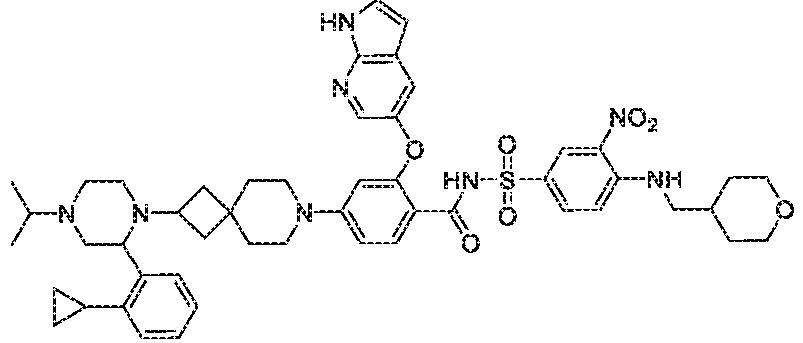
- The desired compound was synthesized following the procedures similar to those in Example F90 by replacing (S)-2-(2-(2-cyclopropylphenyl)pyrrolidin-1-yl)-7-azaspiro[3.5]nonane with 2-(2-(2-cyclopropylphenyl)-4-isopropylpiperazin-1-yl)-7-azaspiro[3.5]nonane. 1H NMR (400 MHz, DMSO-d6 ) δ ppm: 11.70 (s, 1H), 11.43 (s, 1H), 8.69 - 8.50 (m, 2H), 8.06 - 7.97 (m, 1H), 7.84 - 7.74 (m, 1H), 7.61 - 7.38 (m, 4H), 7.35 - 6.94 (m, 4H), 6.75 - 6.58 (m, 1H), 6.38 (s, 1H), 6.13 (s, 1H), 4.25 (s, 1H), 3.91 - 3.80 (m, 2H), 3.34 - 3.09 (m, 8H), 3.10 - 2.80 (m, 6H), 2.23 - 1.71 (m, 4H), 1.67 - 1.45 (m, 3H), 1.44 - 1.25 (m, 10H), 1.10 - 0.66 (m, 5H). MS (ESI, m/e) [M+1]+ 916.9.
-

- The desired compound was synthesized following the procedures similar to those in Example F23 by replacing (S)-2-(2-(2-cyclopropylphenyl)pyrrolidin-1-yl)-7-azaspiro[3.5]nonane with 2-(2'-cyclopropyl-[1,1'-biphenylj-2-yl)-7-azaspiro[3.5]nonane. 1H NMR (400 MHz, DMSO-d6 ) δ ppm: 11.68 (s, 1H), 11.42 (s, 1H), 9.90 (s, 1H), 8.63 (s, 2H), 8.55 (s, 1H), 7.99 (s, 1H), 7.75 - 7.71 (m, 2H), 7.50 (s, 3H), 7.30 - 7.25 (m, 3H), 7.09 (s, 1H), 6.67 (d, J = 8.7 Hz, 1H), 6.37 (s, 1H), 6.17 (s, 1H), 5.66 (s, 1H), 4.77 (s, 1H), 3.87 (s, 1H), 3.66 (s, 1H), 3.30 - 3.28 (m, 2H), 3.00 - 2.98 (m, 7H), 2.05 - 2.02 (m, 4H), 1.69 - 1.67 (m, 7H), 1.48 - 1.32 (m, 21H), 1.24 - 1.21 (m, 5H), 1.13 (s, 4H). MS (ESI) m/e [M+1]+ 866.8.
-

- The desired compound was synthesized following the procedures similar to those in Example F23 by replacing (S)-2-(2-cyclopropylphenyl)pyrrolidine with 2-(o-tolyl)azepane. 1H NMR (400 MHz, DMSO-d6 ) δ ppm: 11.71 (s, 1H), 11.47 (s, 1H), 9.82 (s, 1H), 8.70 - 8.60 (m, 1H), 8.56 (s, 1H), 8.04 (s, 1H), 7.79 (d, J = 9.0 Hz, 1H), 7.75 - 6.95 (m, 1H), 7.60 - 7.40 (m, 3H), 7.35 - 7.15 (m, 3H), 7.12 (d, J = 9.0 Hz, 1H), 6.69 (d, J = 8.4 Hz, 1H), 6.39 (s, 1H), 6.18 (s, 1H), 4.45 - 4.35 (m, 1H), 4.10 - 3.90 (m, 1H), 3.85 (d, J = 10.4 Hz, 2H), 3.60 - 3.50 (m, 2H), 3.35 - 3.20 (m, 5H), 3.15 - 2.85(m, 4H), 2.35 (s, 3H), 2.25 - 2.00 (m, 4H), 1.98 - 1.67 (m, 5H), 1.65 - 1.55 (m, 2H), 1.51 - 1.16 (m, 8H). MS (ESI, m/e) [M+1]+ 861.9.
-
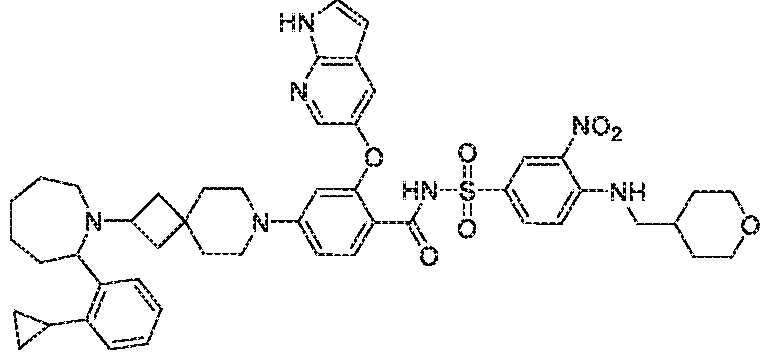
- The desired compound was synthesized following the procedures similar to those in Example F23 by replacing (S)-2-(2-cyclopropylphenyl)pyrrolidine with 2-(2-cyclopropylphenyl)azepanc. 1H NMR (400 MHz, DMSO-d6 ) δ ppm: 11.68 (s, 1H), 11.44 (s, 1H), 8.67 - 8.46 (m, 2H), 8.03 (s, 1H), 7.86 - 7.71 (m, 1H), 7.65 - 7.36 (m, 4H), 7.34 - 7.20 (m, 2H), 7.20 - 6.88 (m, 3H), 6.74 - 6.55 (m, 1H), 6.38 (s, 1H), 6.22 - 6.11 (m, 1H), 4.92 - 4.73 (m, 1H), 4.15 - 3.97 (m, 1H), 3.92 - 3.77 (m, 2H), 3.66 - 3.45 (m, 1H), 3.30 - 3.19 (m, 3H), 3.19 - 2.78 (m, 6H), 2.21 - 1.66 (m, 10H), 1.63 - 1.26 (m, 11H), 1.06 - 0.90 (m, 2H), 0.76 - 0.45 (m, 2H). MS (ESI, m/e) [M+1]+ 887.9.
-

- The desired compound was synthesized following the procedures similar to those in Example F23 by replacing (S)-2-(2-(2-cyclopropylphenyl)pyrrolidin-1-yl)-7-azaspiro[3.5]nonane with 2-(2-(2-cyclopropylphenyl)pyrazolidin-1-yl)-7-azaspiro[3.5]nonane. 1H NMR (400 MHz, DMSO-d6 ) δ ppm: 11.69 (s, 1H), 11.40 (s, 1H), 8.67 - 8.52 (m, 2H), 8.05 (d, J = 2.3 Hz, 1H), 7.80 (d, J = 9.2 Hz, 1H), 7.59 - 7.44 (m, 3H), 7.35 (d, J = 8.0 Hz, 1H), 7.12 (d, J = 9.4 Hz, 1H), 6.96 (s, 1H), 6.75 - 6.70 (m, 3H), 6.39 (s, 1H), 6.18 (s, 1H), 3.86 - 3.84 (m, 2H), 3.26 - 3.24 (m, 2H), 3.09 (s, 2H), 3.02 (s, 2H), 2.91 (s, 2H), 2.08 (s, 1H), 1.94 - 1.79 (m, 5H), 1.59-1.57 (m, 4H), 1.46 - 1.12 (m, 4H), 1.32 -1.19 (m, 7H), 0.93-0.90 (m, 2H), 0.62 (s, 2H). MS (ESI) m/e [M+1]' 860.9.
-

- The desired compound was synthesized following the procedures similar to those in Example F21 by replacing 4-((((1r,4r)-4-hydroxy-4-methylcyclohexyl)methyl)amino)-3-nitrobenzenesulfonamide with 4-(((((1s,4s) or (1r,4r))-4-((dimethyl(oxo)-16-sulfaneylidene)amino)cyclohexyl)methyl)amino)-3-nitrobenzenesulfonamide. 1H NMR (400 MHz, DMSO-d6 ) δ ppm: 11.76 (s, 1H), 10.16 (s, 1H), 8.70 - 8.64 (m, 1H), 8.62 - 8.60(m, 1H), 8.15 - 8.06 (m, 1H), 7.91 - 7.74 (m, 2H), 7.62 - 7.49 (m, 3H), 7.41 - 7.28 (m, 2H), 7.15 - 7.10(m, 2H), 6.75 (d, J = 9.2 Hz, 1H), 6.48 - 6.42(m, 1H), 6.25 - 6.20 (m, 1H), 5.05 - 4.95 (m, 1H), 4.05 - 3.85(m, 1H), 3.80 - 3.70 (m, 1H), 3.40 - 3.20 (m, 4H), 3.18 - 3.05 (m, 4H), 2.65 - 2.55 (m, 6H), 2.30 - 2.00 (m, 4H), 1.94 - 1.76 (m, 3H), 1.70 - 1.41 (m, 8H), 1.40 - 1.25 (m, 2H), 1.24 - 1.11 (m, 3H), 1.10 - 0.96 (m, 2H), 0.95 - 0.85 (m, 2H), 0.75 - 0.65 (m, 2H). MS (ESI, m/e) [M+1]+ 948.8.
-

- To a solution of 3-((1H-pyrrolo[2,3-b]pyridin-5-yl)oxy)-4'-(2-(2-cyclopropylphenyl)pyrrolidin-1-yl)-[1,1'-biphenyl]-4-carboxylic acid (100 mg, 0.194 mmol) in DCM (30 ml) was added EDCI (56 mg, 0.291 mmol) and DMAP (71 mg, 0.582 mmol). The mixture was stirred at room temperature for 0.5 hour. Then to the mixture was added imino(methyl)(3-nitro-4-(((tetrahydro-2H-pyran-4-yl)methyl)amino)phenyl)-l6-sulfanone (138 mg, 0.388 mmol). The mixture was stirred at room temperature for 2 days. The mixture was diluted with DCM (100 ml), washed with saturated aq. NaHCO3, brine, dried over Na2SO4, concentrated and purified by chromatography column on silica gel (eluent: DCM: EA = 1:1 then MeOH/DCM = 1/10) to give the crude product. The crude product was further purified by prep-MPLC (eluent: MeOH/DCM = 1/10) to give the product (9 mg). 1H NMR (400 MHz, DMSO-d6 ) δ ppm: 11.63 (s, 1 H), 8.71 - 8.63 (m, 1H), 8.61 - 8.54 (m, 1H), 8.08 - 7.96 (m, 1H), 7.91 - 7.84 (m, 1H), 7.74 - 7.65 (m, 1H), 7.51 - 7.34 (s, 5H), 7.16 - 6.95 (m, 5H), 6.91 - 6.83 (m, 1H), 6.45 - 6.31 (m, 3H), 5.28 - 5.13 (m, 1H), 3.91 - 3.79 (m, 2H), 3.79 - 3.67 (m, 1H), 3.46 - 3.39 (m, 4H), 3.32 - 3.20 (m, 4H), 3.11 - 2.85 (m, 1H), 2.49 - 2.38 (m, 1H), 2.09 - 1.82 (m, 5H), 1.65 - 1.53 (m, 2H), 1.32 - 1.26 (m, 1H), 1.10 - 0.91 (m, 2H), 0.85 - 0.66 (m, 2H). MS (ESI, m/e) [M+1]+ 810.8.
-

- The desired compound was synthesized following the procedures similar to those in Example F43 by replacing 4-((((1r,4r)-4-hydroxy-4-methylcyclohexyl)methyl)amino)-3-nitrobenzenesulfonamide with 4-(((3-oxabicyclo[3.1.0]hexan-6-yl)methyl)amino)-3-nitrobenzenesulfonamide. 1H NMR (400 MHz, DMSO-d6 ) δ ppm: 11.70 (s, 1H), 11.45 (s, 1H), 8.60 - 8.58 (m, 2H), 8.03 (s, 1H), 7.80 (d, J = 8.7 Hz, 1H), 7.59 (s, 1H), 7.50 - 7.48 (m, 3H), 7.35 - 7.32 (m, 3H), 7.09 (d, J = 8.9 Hz, 1H), 6.68 (d, J = 8.4 Hz, 1H), 6.38 (s, 1H), 6.17 (s, 1H), 4.78 (s, 1H), 3.89 (s, 1H), 3.72 - 3.70 (m, 3H), 3.56 (d, J= 7.7 Hz, 2H), 3.27 (s, 1H), 3.17 (s, 1H), 3.05 - 2.95 (m, 4H), 2.46 - 2.36 (m, 1H), 2.05 - 2.03 (m, 5H), 1.71 (s, 2H), 1.54 - 1.17 (m, 11H), 1.15- 0.98 (m, 4H). MS (ESI) m/e [M+1]' 859.9.
-
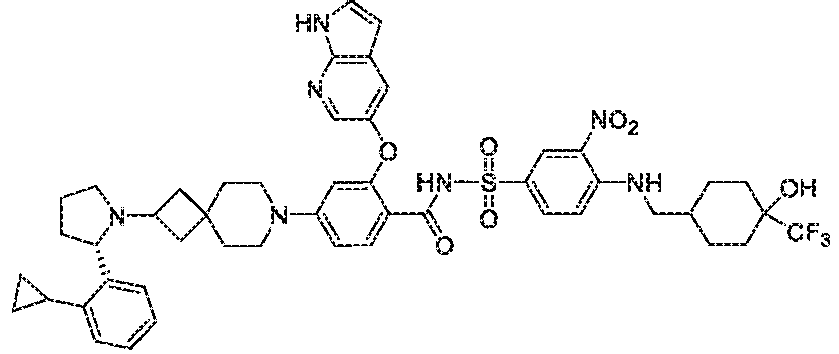
- The desired compound was synthesized following the procedures similar to those in Example F43 by replacing (S)-2-(2-isopropylphenyl)pyrrolidine with (S)-2-(2-cyclopropylphenyl)pyrrolidine and replacing 4-((((1r,4r)-4-hydroxy-4-methylcyclohexyl)methyl)amino)-3-nitrobenzenesulfonamide with 4-(((4-hydroxy-4-(trifluoromethyl)cyclohexyl)methyl)amino)-3-nitrobenzenesulfonamide. 1H NMR (400 MHz, DMSO-d6 ) δ ppm: 11.70 (s, 1H), 11.44 (s, 1H), 8.66 (s, 1H), 8.56 (s, 1H), 8.03 (s, 1H), 7.79 (d, J = 9.0 Hz, 2H), 7.50 - 7.48 (m, 3H), 7.28 (s, 2H), 7.06 (s, 2H), 6.68 (d, J = 8.4 Hz, 1H), 6.38 (s, 1H), 6.17 (s, 1H), 5.69 - 5.67 (m, 1H), 4.97 (s, 1H), 3.87 (s, 1H), 3.67 (s, 1H), 3.40 (s, 1H), 3.29 (s, 1H), 3.05 - 2.98 (m, 6H), 2.05 - 2.01 (m, 6H), 1.76 - 1.72 (m, 5H), 1.55 - 1.29 (m, 10H), 0.95 (s, 2H), 0.64 (s, 2H). MS (ESI) m/c [M+1]+ 941.8.
-

- The desired compound F101a was synthesized following the procedures similar to those in Example F43 by replacing 4-((((1r,4r)-4-hydroxy-4-methylcyclohexyl)methyl)amino)-3-nitrobenzenesulfonamide with 4-((((1r,4r)-4-hydroxy-4-(trifluoromethyl)cyclohexyl)methyl)amino)-3-nitrobenzenesulfonamide. 1H NMR (400 MHz, DMSO-d6 ) δ ppm: 11.69 (s, 1H), 11.44 (s, 1H), 8.80 - 8.45 (m, 2H), 8.03 (s, 1H), 7.90 - 7.65(m, 2H), 7.64 - 6.93 (m, 7H), 6.77 - 6.59 (m, 1H), 6.38 (s, 1H), 6.17 (s, 1H), 5.69 (s, 1H), 4.99 (br, 1H), 3.93 (br, 1H), 3.73 - 3.36 (m, 3H), 3.30 - 3.21 (m, 1H), 3.19 - 2.86 (m, 5H), 2.46 - 2.35 (m, 1H), 2.23 - 1.90 (m, 5H), 1.85 - 1.70 (m, 4H), 1.58 - 1.32 (m, 9H), 1.23 (s, 6H), 1.17 - 1.01 (m, 3H). MS (ESI, m/e) [M+1]+ 943.9; F101b was synthesized by replacing 4-((((1r,4r)-4-hydroxy-4-methylcyclohexyl)methyl)amino)-3-nitrobenzenesulfonamide with 4-((((1s,4s)-4-hydroxy-4-(trifluoromethyl)cyclohexyl)methyl)amino)-3-nitrobenzenesulfonamide. 1H NMR (400 MHz, DMSO-d6 ) δ ppm: 11.68 (s, 1H), 11.42 (s, 1H), 9.90 (s, 1H), 8.63 (s, 2H), 8.55 (s, 1H), 7.99 (s, 1H), 7.75 - 7.71 (m, 2H), 7.50 (s, 3H), 7.30 - 7.25 (m, 3H), 7.09 (s, 1H), 6.67 (d,J = 8.7 Hz, 1H), 6.37 (s, 1H), 6.17 (s, 1H), 5.66 (s, 1H), 4.77 (s, 1H), 3.87 (s, 1H), 3.66 (s, 1H), 3.30-3.28 (m, 2H), 3.00 - 2.98 (m, 7H), 2.05 - 2.02 (m, 4H), 1.69 - 1.67 (m, 7H), 1.48 - 1.32 (m, 21H), 1.24 - 1.21 (m, 5H), 1.13 (s, 4H). MS (ESI) m/e [M+1]+ 943.8.
-

- The desired compound was synthesized following the procedures similar to those in Example F43 by replacing 4-((((1r,4r)-4-hydroxy-4-methylcyclohexyl)methyl)amino)-3-nitrobenzenesulfonamide with 4-((((1r,4r)-4-methoxy-4-methylcyclohexyl)methyl)amino)-3-nitrobenzenesulfonamide. 1 H NMR (400 MHz, DMSO-d6 ) δ ppm: 11.69 (s, 1H), 11.43 (br, 1H), 8.62 - 8.53(m, 2H), 8.02 (s, 2H), 7.79 (d, J = 9.6Hz, 1H), 7.49 - 7.46(m, 3H), 7.39 - 7.15 (m, 3H), 7.08 (d, J = 9.6Hz, 1H), 6.68 (d, J = 8.8Hz, 1H), 6.40 - 6.32 (m, 1H), 6.17 (s, 1H), 4.74 - 4.72(m, 1H), 3.88 - 3.55 (m, 2H), 3.30 - 3.25 (m, 2H), 3.09 (s, 3H), 3.03 - 2.85 (m, 4H), 2.44 - 2.30 (m, 1H), 2.25 - 1.94 (m, 4H), 1.75 - 1.56 (m, 6H), 1.49 - 1.30 (m, 9H), 1.26 - 1.10 (m,12H). MS (ESI, m/e) [M+1]+ 903.9.
-

- The desired compound was synthesized following the procedures similar to those in Example F43 by replacing 4-((((1r,4r)-4-hydroxy-4-methylcyclohexyl)methyl)amino)-3-nitrobenzenesulfonamide with (S)-4-(((4-methylcyclohex-3-en-1-yl)methyl)amino)-3-nitrobenzenesulfonamide. 1H NMR (400 MHz, DMSO-d6 ) δ ppm: 11.69 (s, 1H), 11.44 (br, 1H), 8.62 - 8.53(m, 2H), 8.03 (d, J = 2.4 Hz, 1H), 7.99 - 7.80 (m, 1H), 7.78 (d, J = 9.6 Hz, 1H), 7.50 - 7.46(m, 3H), 7.39 - 7.22 (m, 3H), 7.08 (d, J = 9.6 Hz, 1H), 6.68 (d, J = 8.8 Hz, 1H), 6.40 - 6.32 (m, 1H), 6.17 (s, 1H), 5.35 (s, 1H), 4.74 - 4.72(m, 1H), 3.88 - 3.55 (m, 2H), 3.30 - 3.25 (m, 2H), 3.09 - 2.85 (m, 4H), 2.44 - 2.30 (m, 1H), 2.20 - 1.70 (m, 12H), 1.61(s, 3H), 1.49 - 1.30 (m, 11H), 1.12 (d, J = 6.8Hz, 1H). MS (ESI, m/e) [M+1]+ 871.9.
-

- The desired compound was synthesized following the procedures similar to those in Example F43 by replacing (S)-2-(2-isopropylphenyl)pyrrolidine with (S)-2-(2-(prop-1-en-2-yl)phenyl)pyrrolidine. 1H NMR (400 MHz, DMSO-d6 ) δ ppm: 11.70 (s, 1H), 11.44 (s, 1H), 10.37 (br, 1H), 8.60 - 8.55 (m, 2H), 8.04 (d, J = 2.4 Hz, 1H), 7.95 - 7.91(m, 1H), 7.80 (dd,J = 9.6 Hz, J = 2.4 Hz, 1H), 7.52 - 7.46 (m, 3H), 7.38 - 7.35(m. 2H), 7.20 (d, J = 6.8 Hz, 1H), 7.10 (d, J = 9.2 Hz, 1H), 6.69 (d, J = 9.2 Hz, 1H), 6.40 - 6.32 (m, 1H), 6.17 (s, 1H), 5.31 (s, 1H), 4.80 (s, 1H), 4.44 - 4.40(m, 1H), 3.68 - 3.61 (m, 2H), 3.30 - 2.95 (m, 7H), 2.17 - 2.06 (m, 5H), 2.02 (s, 3H), 1.69 - 1.20 (m, 19H). MS (ESI, m/e) [M+1]+ 887.9.
-
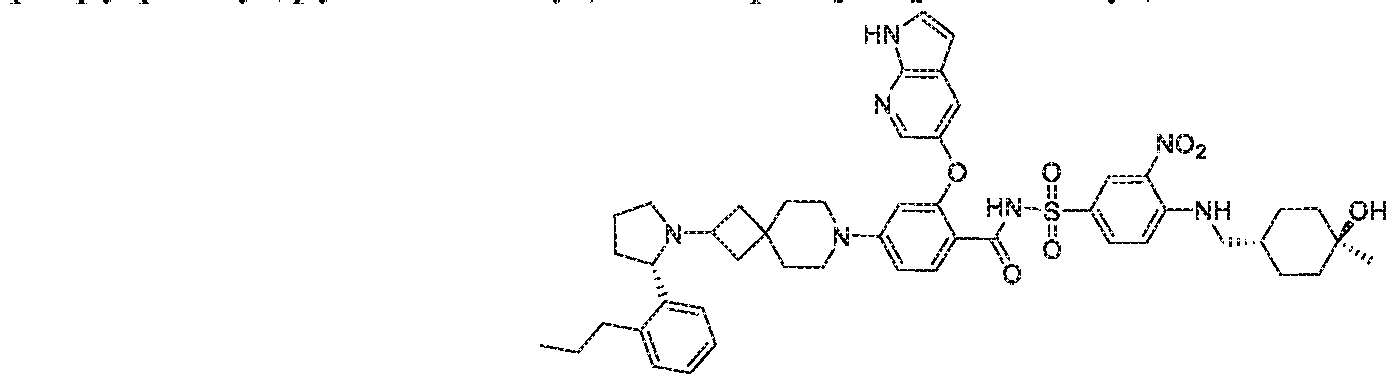
- The desired compound was synthesized following the procedures similar to those in Example F43 by replacing (S)-2-(2-isopropylphenyl)pyrrolidine with (S)-2-(2-propylphenyl)pyrrolidine. 1H NMR (400 MHz, DMSO-d6 ) δ ppm: 11.69 (s, 1H), 11.44 (s, 1H), 10.37 (br, 1H), 8.61 - 8.55 (m, 2H), 8.03 (d, J = 2.4 Hz, 1H), 7.99 - 7.85(m, 1H), 7.79 (d, J = 9.6 Hz, 1H), 7.52 - 7.46 (m, 3H), 7.27 - 7.20(m, 2H), 7.08 (d, J = 9.6 Hz, 1H), 6.69 (d, J = 8.8 Hz, 1H), 6.40 - 6.32 (m, 1H), 6.17 (s, 1H), 4.61 - 4.57(m, 1H), 4.25(s, 1H), 3.88 - 3.61 (m, 2H), 3.30 - 2.90 (m, 7H), 2.80 - 2.50 (m, 2H), 2.44 - 2.36 (m, 1H), 2.19 - 1.90 (m, 4H), 1.69 - 1.23 (m, 17H), 1.17 - 1.05 (m, 5H), 0.92 (t, J = 3.2 Hz, 3H). MS (ESI, m/e) [M+1]+ 889.9.
-

- To the mixture of (S)-2-(2-cyclopropylphenyl)pyrrolidine (18.7 g, 0.1 mol) and tert-butyl 6-oxo-2-azaspiro[3.3]heptane-2-carboxylate (21.12 g, 0.1 mol) in DCM (200 mL) was added NaBH(AcO)3 (42 g, 0.2 mol) at room temperature and stirred for overnight. The mixture was quenched with aq. NaHCOs (200 mL), extracted with DCM (200 mL). the combined organic layers was washed with brine (200 mL), dried over Na2SO4 and evaporated in vacuum to afford the tittle product (38.2g) without further purification for next step. MS (ESI, m/e) [M+1]+ 383.0.
- To a solution of tert-butyl tert-butyl (S)-6-(2-(2-cyclopropylphenyl)pyrrolidin-1-yl)-2-azaspiro[3.3]heptane-2-carboxylate (38 g, 0.1mmol) in DCM (50 mL) was added TFA(100 mL) at 20°C and stirred at room temperature for overnight. The mixture was concentrated in vacuum and diluted with DCM (200mL), then was adjusted to pH 8~9 with aq. NaOH (1M). Then the organic layer was washed with brine, dried over Na2SO4 and concentrated in vacuum to afford the crude product (28.2g) without further purification for next step. MS (ESI, m/e) [M+1]+ 283.0.
- The mixture of (S)-6-(2-(2-cyclopropylphenyl)pyrrolidin-1-yl)-2-azaspiro[3.3]heptane (28.3 g, 0.1 mmol), methyl 2-((1H-pyrrolo[2,3-b]pyridin-5-yl)oxy)-4-fluorobenzoate (31.57 g, 0.11 mmol), Na2CO3(106 g, 1 mol) in DMF(500 mL) was heated to 105 °C and stirred for overnight. After cooled to room temperature, the reaction mixture was diluted with EA (1000 mL), washed with brine (1000 mL × 2), dried over Na2SO4 and concentrated in vacuum to afford a residue, which was purified by chromatography column on silica gel (eluent: EA/PE = 1/5 to 1/1) to give the product (11.2 g) as an off-white solid. MS (ESI, m/e) [M+1]+ 548.9.
- To the mixture of methyl (S)-2-((11H-pyrrolo[2,3-b]pyridin-5-yl)oxy)-4-(6-(2-(2-cyclopropylphenyl)pyrrolidin-1-yl)-2-azaspiro[3.3]heptan-2-yl)benzoate (11.2 g, 20.42 mmol) in a solution of MeOH (200 mL), THF (200 mL) and aq. NaOH (166 mL, 1 mol) and heated to 50°C for overnight. The reaction was quenched with HCl acid (6 M) and adjusted to pH 4-5, extracted with DCM (500 mL), washed with brine (200 mL).To the organic layer was added triethylamine to adjust pH at -8, then evaporated in vacuum to afford the tittle product(10.5g) as an off-white solid. MS (ESI, m/e) [M+1]+ 534.9.
- The mixture of (S)-2-((1H-pyrrolo[2,3-b]pyridin-5-yl)oxy)-4-(6-(2-(2-cyclopropylphenyl)pyrrolidin-1-yl)-2-azaspiro[3.3]heptan-2-yl)benzoic acid (1.07 g, 2 mmol), triethylamine (1.20 g, 12 mmol) and 2-(7-Azabenzotriazol-1-yl)-N,N,N',N'-tetramethyluronium hexafluorophosphate (1.14 g, 3.0 mmol) in DCM(100 mL) was stirred for 2 hours at 50°C. To the mixture was added 4-(((4-hydroxy-4-methylcyclohexyl)methyl)amino)-3-nitrobenzenesulfonamide (1.37 g, 4 mmol) and DMAP (24 mg, 0.2 mmol) and then stirred for overnight at 35 °C. The mixture was quenched with aq. NH4Cl (500 mL), extracted with DCM (300 mL), washed with NaHCO3 (300 mL), dried over Na2SO4 and concentrated in vacuum. The crude residue was then purified by chromatography column on silica gel (eluent: PE/EA = 1/1, then DCM/EA = 1/1 then DCM/MeOH = 50/1 to 40/1) to afford the desired compound (1.02 g). 1H NMR (400 MHz, DMSO-d6 ) δ ppm: 11.71 (s, 1H), 11.12 (br, 1H), 8.55 - 8.53 (m, 2H), 8.04 (s, 1H), 7.85 (d, J = 8.0 Hz, 1H), 7.51 - 7.47 (m, 4H), 7.15 - 7.05 (m, 3H), 6.92 - 6.90 (m, 1H), 6.40 (s, 1H), 6.07 (d, J = 8.8 Hz, 1H), 5.52 (s, 1H), 4.25 (s, 1H), 4.04 - 3.89 (m, 1H), 3.85 - 3.34 (m, 8H), 3.31 - 3.23 (m, 2H), 2.41 - 1.58 (m, 18H), 1.41 - 1.05 (m, 2H), 0.89 - 0.87 (m, 2H), 0.64 - 0.53(m, 2H). MS (ESI, m/e) [M+1]+ 859.9.
-

- The desired compound was synthesized following the procedures similar to those in Example F 106 by replacing 4-((((1r,4r)-4-hydroxy-4-methylcyclohexyl)methyl)amino)-3-nitrobenzenesulfonamide with (S)-4-(((1,4-dioxan-2-yl)methyl)amino)-3-nitrobenzenesulfonamide. 1H NMR (400 MHz, DMSO-d6 ) δ ppm: 11.70 (s, 1H), 11.24 (br, 1H), 8.55 -8.52(m, 2H), 8.03 (s, 1H), 7.85 (d, J = 8.0 Hz, 1H), 7.51 - 7.47 (m, 4H), 7.15 - 7.05 (m, 3H), 6.92 - 6.90 (m, 1H), 6.39 -6.37 (m, 1H), 6.07 (d, J = 8.8 Hz, 1H), 5.52 (s, 1H), 4.12 - 4.04 (m, 1H), 3.85-3.29 (m, 15H), 3.31 - 3.23 (m, 1H), 2.31 - 1.58 (m, 9H), 0.89 - 0.87 (m, 2H), 0.64 - 0.62(m, 2H). MS (ESI, m/e) [M+1]+ 833.8.
-

- The desired compound was synthesized following the procedures similar to those in Example F 106 by replacing 4-((((1r,4r)-4-hydroxy-4-methylcyclohexyl)methyl)amino)-3-nitrobenzenesulfonamide with (R)-4-(((1,4-dioxan-2-yl)methyl)amino)-3-nitrobenzenesulfonamide. 1H NMR (400 MHz, DMSO-d6 ) δ ppm: 11.73 (s, 1H), 11.33 (br, 1H), 8.59 -8.55 (m, 2H), 8.06 (d, J=2.0 Hz, 1H), 7.85 (d, J = 8.0 Hz, 1H), 7.69 - 7.52 (m, 4H), 7.35 - 7.01 (m, 3H), 6.42 (s, 1H), 6.06 (d, J = 8.8 Hz, 1H), 5.50 (s, 1H), 5.02 - 4.92 (m, 1H), 3.85 (d, J = 8.4 Hz, 2H), 3.79 - 3.31 (m, 12H), 3.31 - 3.23 (m, 2H), 2.50 - 2.38 (m, 2H), 2.18 - 1.72 (m, 7H), 1.02 - 0.88 (m, 2H), 0.70 - 0.58(m, 2H). MS (ESI, m/e) [M+1]+ 833.8.
-
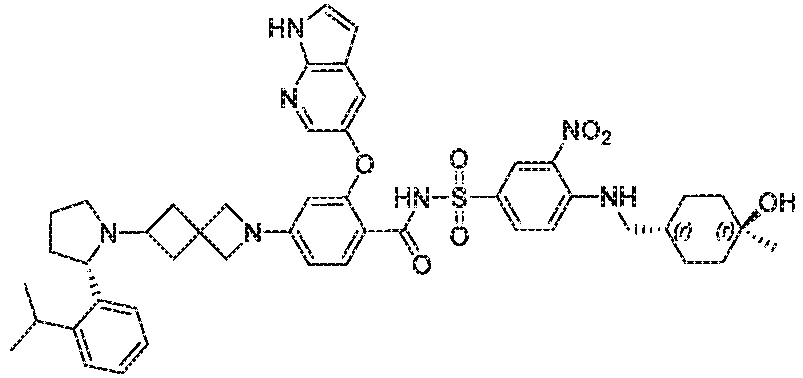
- The desired compound was synthesized following the procedures similar to those in Example F106 by replacing (S)-2-(2-cyclopropylphenyl)pyrrolidine with (S)-2-(2-isopropylphenyl)pyrrolidine. 1H NMR (400 MHz, DMSO-d6 ) δ ppm: 11.73 (s, 1 H), 11.28 (s, 1 H), 8.57 (s, 2 H), 8.05 (d, J= 2.3 Hz, 1 H), 7.82 (d, J= 8.8 Hz, 1 H), 7.63 - 7.42 (m, 4 H), 7.35 - 7.04 (m, 5 H), 6.41 (s, 1 H), 6.06 (d, J = 8.9 Hz, 1 H), 5.50 (s, 1 H), 4.24 (s, 1 H), 3.65 - 3.55 (m, 5 H), 3.30 - 3.19 (m, 4 H), 3.07 - 2.90 (m, 2 H), 2.08 - 1.99 (m, 2 H), 1.86 - 1.59 (m, 6 H), 1.66 - 1.52 (m, 2 H), 1.35 - 1.31 (m, 3 H), 1.25 - 1.11 (m, 12 H). MS (ESI, m/e) [M+1]+ 862.1.
-

- The desired compound was synthesized following the procedures similar to those in Example F106 by replacing (S)-2-(2-cyclopropylphcnyl)pyrrolidine with (S)-2-(2-isopropylphenyl)pyrrolidine and replacing 4-((((1r,4r)-4-hydroxy-4-methylcyclohexyl)methyl)amino)-3-nitrobenzenesulfonamide with (S)-4-(((1,4-dioxan-2-yl)methyl)amino)-3-nitrobenzenesulfonamide. 1H NMR (400 MHz, DMSO-d6 ) δ ppm: 11.69 (s, 1 H), 11.23 (s, 1 H), 8.55 (s, 2 H), 8.03 (d, J = 1.5 Hz, 1 H), 7.82 (d, J = 8.9 Hz, 1 H), 7.66 - 7.40 (m, 4 H), 7.33 - 6.98 (m, 4 H), 6.39 (s, 1 H), 6.06 (d, J = 8.6 Hz, 1 H), 5.51 (s, 1 H), 3.89 - 3.73 (m, 3 H), 3.73 - 3.56 (m, 7 H), 3.56 - 3.43 (m, 3 H), 3.43 - 3.20 (m, 4 H), 2.19 - 2.11 (m, 3 H), 1.90 - 1.64 (m, 5 H), 1.51 (s, 1 H), 1.18 - 1.11 (m, 6 H). MS (ESI, m/e) [M+1]' 835.9.
-

- The desired compound was synthesized following the procedures similar to those in Example F106 by replacing (S)-2-(2-cyclopropylphenyl)pyrrolidine with (S)-2-(2-ethylphenyl)pyrrolidine. 1H NMR (400 MHz, DMSO-d6 ) δ ppm: 11.74 (s, 1H), 11.32 (s, 1H), 8.58 (s, 2H), 8.05 (s, 1H), 7.83 (d, J = 8.6 Hz, 1H), 7.67-7.61 (m, 2H), 7.53 (s, 1H), 7.46 (d,J = 8.6 Hz, 1H), 7.31 (s, 1H), 7.24 (s, 1H), 7.12 (d, J = 9.2 Hz, 2H), 6.41 (s, 1H), 6.06 (d, J = 8.6 Hz, 1H), 5.49 (s, 1H), 4.62 (s, 1H), 4.24 (s, 1H), 3.63 - 3.53 (m, 4H), 3.29 (s, 3H), 2.61 (s, 1H), 2.44 - 2.40 (m, 1H), 2.07 (s, 2H), 1.97 - 1.99 (m, 1H), 1.79 (s, 1H), 1.66 (s, 4H), 1.54 - 1.52 (m, 2H), 1.45 (s, 1H), 1.32 - 1.29 (m, 3H), 1.23 (s, 6H), 1.09 (s, 3H). MS (ESI, m/e) [M+1]+ 847.9.
-

- The desired compound was synthesized following the procedures similar to those in Example F106 by replacing (S)-2-(2-cyclopropylphenyl)pyrrolidine with (S)-2-(2-ethylphenyl)pyrrolidine and replacing 4-((((1r,4r)-4-hydroxy-4-methylcyclohexyl)methyl)amino)-3-nitrobenzenesulfonamide with (S)-4-(((1,4-dioxan-2-yl)methyl)amino)-3-nitrobenzenesulfonamide. 1H NMR (400 MHz, DMSO-d6 ) δ ppm: 11.73 (s, 1H), 11.34 (s, 1H), 10.19 (s, 1H), 8.59-8.58 (m, 2H), 8.05 (d, J = 2.0 Hz, 1H), 7.85 (d,J = 8.8 Hz, 1H), 7.77 (s, 1H), 7.60 (s, 1H), 7.53 (s, 1H), 7.46 (d, J = 8.6 Hz, 1H), 7.29 - 7.14 (m, 4H), 6.41 (s, 1H), 6.07 (d, J = 8.3 Hz, 1H), 5.49 (s, 1H), 4.61 (s, 1H), 3.80-3.77 (m, 3H), 3.67-3.60 (m, 4H), 3.56 - 3.53 (m, 1H), 3.52 - 3.47 (m, 2H), 3.43 - 3.38 (m, 1H), 3.35 (s, 1H), 3.29 (s, 1H), 3.08 (s, 1H), 2.74 (s, 1H), 2.64 - 2.57 (m, 1H), 2.41 (s, 1H), 2.08 (s, 1H), 1.99 - 1.97 (m, 1H), 1.77 (s, 1H), 1.71 (d, J= 9.1 Hz, 1H), 1.23 (s, 3H), 1.13 - 1.10 (m, 3H). MS (ESI, m/e) [M+1]+ 821.9.
-

- The desired compound was synthesized following the procedures similar to those in Example F21 by replacing (S)-2-(2-(2-cyclopropylphcnyl)pyrrolidin-1-yl)-7-azaspiro[3.5]nonane with 6-((2-(2-cyclopropylphenyl)pyrrolidin-1-yl)methyl)-2-azaspiro[3.3]heptane and replacing 4-((((1r,4r)-4-hydroxy-4-methylcyclohexyl)methyl)amino)-3-nitrobenzenesulfonamide with 3-nitro-4-(((tetrahydro-2H-pyran-4-yl)methyl)amino)benzenesulfonamide. 1H NMR (DMSO-d6 ) δ ppm: 11.78 (s, 1H), 11.41 (br, 1H), 8.64 - 8.60 (m, 2H), 8.09 (s, 1H), 7.86 (d, J = 9.2 Hz, 1H), 7.66 (s, 2H), 7.56 (s, 1H), 7.48 (d, J = 8.5 Hz, 1H), 7.18 (d, J = 9.2 Hz, 3H), 6.99 - 6.96 (m, 1H), 6.45 (s, 1H), 6.07 (d, J = 8.5 Hz, 1H), 5.46 (s, 1H), 3.87 - 3.83 (m, 2H), 3.71 (s, 3H), 3.51 (s, 1H), 3.36 (s, 1H), 3.30 - 3.24 (m, 3H), 3.19 (s, 1H), 3.08 (s, 1H), 2.78 (s, 1H), 2.33 (s, 2H), 2.17 (s, 3H), 2.06 - 2.04 (m, 2H), 1.90 (s, 2H), 1.71 (s, 1H), 1.64 - 1.60 (m, 2H), 1.36 - 1.17 (m, 4H), 0.92 (s, 2H), 0.63 (s, 2H). MS (ESI) m/e [M+1]+ 845.9.
-
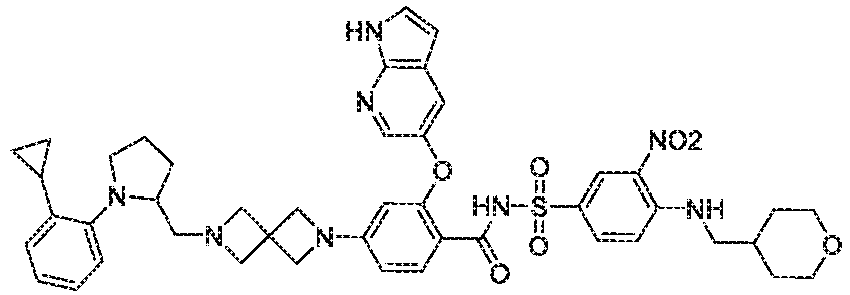
- The desired compound was synthesized following the procedures similar to those in Example F21 by replacing (S)-2-(2-(2-cyclopropylphcnyl)pyrrolidin-1-yl)-7-azaspiro[3.5]nonane with 2-((1-(2-cyclopropylphenyl)pyrrolidin-2-yl)methyl)-2,6-diazaspiro[3.3]heptane and replacing 4-((((1r,4r)-4-hydroxy-4-methylcyclohexyl)methyl)amino)-3-nitrobenzenesulfonamide with 3-nitro-4-(((tetrahydro-2H-pyran-4-yl)methyl)amino)benzenesulfonamide. 1H NMR (DMSO-d6 ) δ ppm: 11.68 (s, 1H), 9.64 (s, 1H), 8.52 (s, 2H), 8.02 (s, 1H), 7.75 (s, 1H), 7.54 - 7.51 (m, 3H), 7.12 - 6.97 (m, 3H), 6.89 (s, 1H), 6.80 (s, 1H), 6.38 (s, 1H), 6.16 (d, J = 8.2 Hz, 1H), 5.60 (s, 1H), 3.83 (s, 10H), 3.60-3.58 (m, 1H), 3.30 - 3.22 (m, 4H), 2.78-2.75 (m, 3H), 2.09 (s, 2H), 1.64 - 1.61 (m, 6H), 1.26 - 1.24 (m, 4H), 1.01 (s, 1H), 0.80 - 0.78 (m, 2H). MS (ESI) m/e [M+1]+ 846.9.
-

- The desired compound was synthesized following the procedures similar to those in Example F21 by replacing (S)-2-(2-(2-cyclopropylphenyl)pyrrolidin-1-yl)-7-azaspiro[3.5]nonane with (S)-2-((2-(2-cyclopropylphenyl)pyrrolidin-1-yl)mcthyl)-7-azaspiro[3.5]nonane and replacing 4-((((1r,4r)-4-hydroxy-4-methylcyclohexyl)methyl)amino)-3-nitrobenzenesulfonamide with 3-nitro-4-(((tetrahydro-2H-pyran-4-yl)methyl)amino)benzenesulfonamide. 1H NMR (DMSO-d6 ) δ ppm: 11.70 (s, 1H), 11.44 (s, 1H), 8.56 - 8.52 (m, 2H), 8.05 (s, 1H), 7.79 -7.73 (m, 2H), 7.51 - 7.49 (m, 3H), 7.31 - 7.04 (m, 2H), 7.12 - 7.10 (m, 1H), 6.72 (d, J = 8.8 Hz, 1H), 6.39 (s, 1H), 6.18 (s, 1H), 4.11 - 3.86 (m, 1H), 3.85 (d, J = 8.4 Hz, 2H), 3.66 - 3.62 (m, 1H), 3.33 - 2.90(m, 9H), 2.20 - 1.80 (m, 10H), 1.62 (d, J = 12.4 Hz, 2H), 1.48 - 1.25 (m, 10H), 0.85 -0.81 (m, 2H), 0.68 -0.63 (m, 2H).MS (ESI, m/e) [M+1]+ 873.9.
-
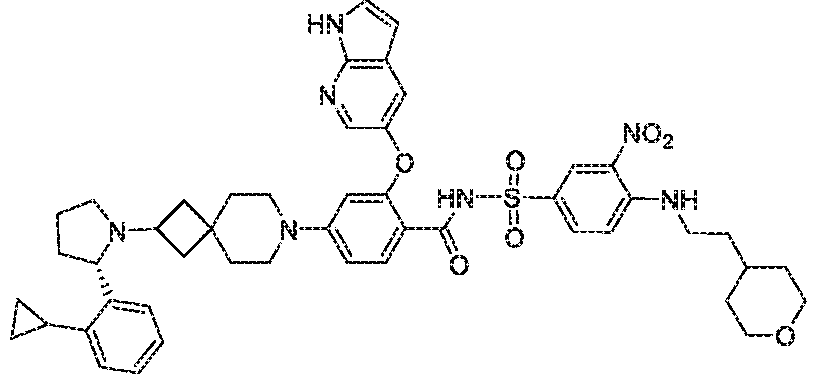
- The desired compound was synthesized following the procedures similar to those in Example F40 by replacing (S)-2-(2-ethylphenyl)pyrrolidine with (S)-2-(2-cyclopropylphenyl)pyrrolidine and replacing (S)-4-(((1,4-dioxan-2-yl)methyl)amino)-3-nitrobenzenesulfonamide with 3-nitro-4-((2-(tetrahydro-2H-pyran-4-yl)ethyl)amino)benzencsulfonamidc. 1H NMR (DMSO-d6 ) δ ppm: 11.70 (s, 1H), 11.47 (s, 1H), 8.60 - 8.50 (m, 2H), 8.10 - 8.00 (m, 1H), 7.98 - 7.85 (m, 1H), 7.84 - 7.75 (m, 1H), 7.57 - 7.42 (m, 3H), 7.30 - 7.20 (m, 2H), 7.10 - 7.00 (m, 2H), 6.75 - 6.65 (m, 1H), 6.38 (s, 1H), 6.18 (s, 1H), 5.76 (s, 1H), 4.95 (s, 1H), 3.83 (d, J = 7.9 Hz, 2H), 3.75 - 3.60 (m, 1H), 3.50 - 3.40 (m, 2H), 3.25 - 3.15 (m, 2H), 3.10 - 2.80 (m, 2H), 2.45 (s, 1H), 2.20 - 1.85 (m, 4H), 1.70 - 1.51 (m, 5H), 1.51 - 1.30 (m, 6H), 1.25 - 1.10 (m, 4H), 1.03 - 0.89 (m, 3H), 0.89 - 0.77 (m, 2H), 0.70 - 0.55 (m, 2H). MS (ESI, m/e) [M+1]+ 873.9.
-

- The desired compound was synthesized following the procedures similar to those in Example F40 by replacing (S)-2-(2-ethylphenyl)pyrrolidine with (S)-2-(2-cyclopropylphenyl)pyrrolidine and replacing (S)-4-(((1,4-dioxan-2-yl)methyl)amino)-3-nitrobenzenesulfonamide with 4-((2-morpholinoethyl)amino)-3-nitrobenzenesulfonamide. 1H NMR (DMSO-d6 ) δ ppm: 11.73 (s, 1H), 11.62 (s, 1H), 8.85 - 8.75 (m, 1H), 8.60 - 8.50 (m, 1H), 8.25 - 8.05 (m, 1H), 8.01 (d, J = 2.4 Hz, 1H), 7.78 (d, J = 8.0 Hz, 1H), 7.53 - 7.40 (m, 3H), 7.30 - 7.20 (m, 2H), 7.10 - 7.00 (m, 2H), 6.67 (d, J = 7.7 Hz, 1H), 6.36 (s, 1H), 6.19 (s, 1H), 5.05 - 4.75 (m, 1H), 4.25 - 4.10 (m, 1H), 3.85 - 3.75 (m, 1H), 3.70 - 3.60 (m, 4H), 3.55 - 3.45 (m, 2H), 3.20 - 3.15 (m, 2H), 3.14 - 2.88 (m, 4H), 2.80 - 2.70 (m, 2H), 2.65 - 2.50 (m, 4H), 2.45 - 2.20(m, 2H), 2.15 - 1.90 (m, 4H), 1.61 - 1.29 (m, 4H), 1.25 - 1.15 (m, 1H), 1.02 - 0.87 (m, 2H), 0.65 - 0.55 (m, 2H). MS (ESI, m/e) [M+1]+ 874.9.
-

- The desired compound was synthesized following the procedures similar to those in Example F43 by replacing (S)-2-(2-isopropylphenyl)pyrrolidine with (S)-2-(2-cyclopropylphenyl)pyrrolidine and replacing 4-((((1r,4r)-4-hydroxy-4-methylcyclohexyl)methyl)amino)-3-nitrobenzenesulfonamide with 3-nitro-4-((2-(3-oxomorpholino)ethyl)amino)benzenesulfonamide. 1H NMR (DMSO-d6 ) δ ppm: 11.64 (s, 1H), 11.40 (s, 1H), 8.61 (s, 1H), 8.51 (s, 1H), 8.00 (s, 1H), 7.77 (s, 1H), 7.48 (s, 4H), 7.10 - 6.99 (m, 4H), 6.66 (d, J = 8.4 Hz, 1H), 6.36 (s, 1H), 6.17 (s, 1H), 3.99 (s, 2H), 3.77 (s, 2H), 3.58 (s, 4H), 3.41 (s, 2H), 3.02 (s, 2H), 2.94 (s, 2H), 2.11 - 1.94 (m, 3H), 1.78 (s, 3H), 1.55 (s, 1H), 1.42-1.37 (m, 6H), 1.24 (s, 2H), 0.91 (s, 3H), 0.63-0.59 (m, 2H).MS (ESI) m/e [M+1]+ 888.8.
-
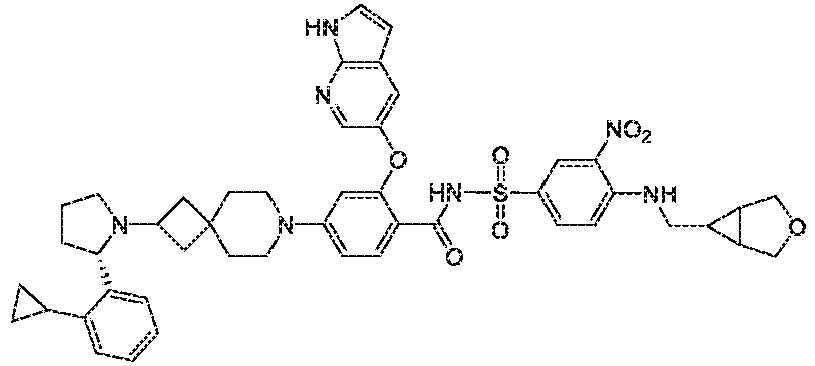
- The desired compound was synthesized following the procedures similar to those in Example F43 by replacing (S)-2-(2-isopropylphenyl)pyrrolidine with (S)-2-(2-cyclopropylphenyl)pyrrolidine and replacing 4-((((1r,4r)-4-hydroxy-4-methylcyclohexyl)methyl)amino)-3-nitrobenzenesulfonamide with 4-(((3-oxabicyclo[3.1.0]hexan-6-yl)methyl)amino)-3-nitrobenzenesulfonamide. 1H NMR (DMSO-d6 ) δ ppm: 11.68 (s, 1H), 11.43 (s, 1H), 10.39 (s, 1H), 8.61 (s, 1H), 8.55 (s, 1H), 8.03 (s, 1H), 7.79 (d, J = 8.5 Hz, 2H), 7.49-7.46 (m, 3H), 7.26 (s, 2H), 7.06 (s, 2H), 6.68 (d, J = 8.5 Hz, 1H), 6.37 (s, 1H), 6.18 (s, 1H), 4.96 (s, 1H), 3.88 - 3.84 (m, 1H), 3.73 - 3.70 (m, 3H), 3.57 - 3.53 (m, 2H), 3.03 - 2.98 (m, 5H), 2.05 - 2.00 (m, 6H), 1.71 (s, 2H), 1.39 - 1.35 (m, 8H), 0.97 - 0.93 (m, 3H), 0.64 (s, 2H). MS (ESI) m/e [M+1]+ 857.9.
-

- The desired compound was synthesized following the procedures similar to those in Example F43 by replacing (S)-2-(2-isopropylphenyl)pyrrolidine with (S)-2-(2-cyclopropylphenyl)pyrrolidine and replacing 4-((((1r,4r)-4-hydroxy-4-methylcyclohexyl)methyl)amino)-3-nitrobenzenesulfonamide with 4-(((2,6-dimethyltetrahydro-2H-pyran-4-yl)methyl)amino)-3-nitrobenzenesulfonamide. 1H NMR (DMSO-d6 ) δ ppm: 11.69 (s, 1H), 11.44 (s, 1H), 8.62 (s, 1H), 8.55 (s, 1H), 8.03 (s, 1H), 7.79 (s, 2H), 7.50 - 7.48 (m, 3H), 7.27 (s, 2H), 7.07 (s, 2H), 6.68 (d, J = 8.3 Hz, 1H), 6.38 (s, 1H), 6.17 (s, 1H), 4.97 (s, 1H), 3.71 - 3.68 (m, 3H), 3.27 (s, 2H), 2.99 - 2.98 (m, 5H), 2.04 - 2.01 (m, 7H), 1.67 - 1.65 (m, 2H), 1.57 - 1.21 (m, 9H), 1.08 - 1.04 (m, 6H), 0.95 (s, 2H), 0.84 - 0.82 (m, 2H), 0.64 (s, 2H). MS (ESI) m/e [M+1]+ 887.9.
-

- The desired compound was synthesized following the procedures similar to those in Example F43 by replacing (S)-2-(2-isopropylphenyl)pyrrolidine with (S)-2-(2-cyclopropylphenyl)pyrrolidine and replacing 4-((((1r,4r)-4-hydroxy-4-methylcyclohexyl)methyl)amino)-3-nitrobenzenesulfonamide with 3-nitro-4-(((2,2,6,6-tetramethyltetrahydro-2H-pyran-4-yl)methyl)amino)benzenesulfonamide. 1H NMR (DMSO-d6 ) δ ppm: 11.69 (s, 1H), 11.45 (s, 1H), 8.58 - 8.56 (m, 2H), 8.03 (s, 1H), 7.81 - 7.78 (m, 2H), 7.49 - 7.46 (m, 3H), 7.27 (s, 2H), 7.16 - 6.98 (m, 2H), 6.68 (d, J = 8.3 Hz, 1H), 6.38 (s, 1H), 6.17 (s, 1H), 4.96 (s, 1H), 3.77 - 3.75 (m, 2H), 3.28 (s, 2H), 3.00 - 2.98 (m, 5H), 2.33 - 1.94 (m, 7H), 1.62 -1.60 (m, 2H), 1.42 - 1.40 (m, 6H), 1.19 - 1.15 (m, 14H), 1.04 - 0.91 (m, 4H), 0.64 (s, 2H). MS (ESI) m/e [M+1]+ 915.9.
-

- The desired compound was synthesized following the procedures similar to those in Example F21 by replacing (S)-2-(2-(2-cyclopropylphenyl)pyrrolidin-1-yl)-7-azaspiro[3.5]nonane with (S)-2-(2-(2-cyclopropylphenyl)pyrrolidin-1-yl)-6-azaspiro[3.4]octane. 1H NMR (DMSO-d6 ) δ ppm: 11.68 (s, 1H), 11.18 (s, 1H), 8.54 (s, 2H), 8.04 (s, 1H), 7.78 (s, 1H), 7.49 (s, 4H), 7.07 (s, 3H), 6.90 (s, 1H), 6.38 (s, 1H), 6.24 (s, 1H), 5.73 (s, 1H), 5.32 (s, 1H), 4.23 (s, 1H), 3.27 - 3.23 (m, 1H), 3.11 - 2.97 (m, 6H), 2.20 (s, 1H), 2.02 - 2.00 (m, 3H), 1.78 - 1.54 (m, 7H), 1.32 - 1.30 (m, 3H), 1.11 - 1.09 (m, 5H), 0.86 - 0.84 (m, 3H), 0.63 (s, 1H), 0.49 (s, 1H). MS (ESI) m/e [M+1]+ 873.9.
-

- The desired compound was synthesized following the procedures similar to those in Example F21 by replacing (S)-2-(2-(2-cyclopropylphenyl)pyrrolidin-1-yl)-7-azaspiro[3.5]nonane with 6-((S)-2-(2-cyclopropylphenyl)pyrrolidin-1-yl)-2-azaspiro[3.4]octane. 1H NMR (DMSO-d6 ) δ ppm: 11.76 (s, 1H), 11.32 (s, 1H), 9.46 (s, 1H), 8.61 (s, 2H), 8.09 (s, 1H), 7.87 (d, J = 8.8 Hz, 1H), 7.68 (s, 1H), 7.56 - 7.48 (m, 3H), 7.30 (s, 2H), 7.21 - 7.05 (m, 2H), 6.44 (s, 1H), 6.15 - 6.07 (m, 1H), 5.48 - 5.43 (m, 1H), 5.03 (s, 1H), 3.63 (s, 2H), 3.58-3.54 (m, 1H), 3.47 (s, 2H), 3.31 (s, 3H), 2.54 (s, 1H), 1.92 - 1.88 (m, 6H), 1.67 (s, 3H), 1.56 - 1.53 (m, 2H), 1.38 - 1.22 (m, 8H), 1.15 - 1.10 (m, 4H), 0.96 - 0.92 (m, 3H), 0.64 (s, 2H). MS (ESI) m/c [M+1]' 873.9.
-

- The desired compounds were synthesized following the procedures similar to those in Example F21 by replacing (S)-2-(2-(2-cyclopropylphenyl)pyrrolidin-1-yl)-7-azaspiro[3.5]nonane with 7-((S)-2-(2-cyclopropylphenyl)pyrrolidin-1-yl)-2-azaspiro[4.4]nonane. F124a was obtained as faster peak by separation and purification of crude product with prep-HPLC. 1H NMR (DMSO-d6 ) δ ppm: 11.63 (s, 1H), 11.20 (s, 0H), 8.46 (s, 2H), 8.00 (s, 1H), 7.64 - 7.37 (m, 4H), 7.28 - 6.94 (m, 4H), 6.89 - 6.84 (m, 1H), 6.66 (s, 1H), 6.34 (s, 1H), 6.22 (s, 1H), 5.73 (s, 1H), 5.32 (s, 1H), 4.24 (s, 1H), 4.08 (s, 1H), 3.25 (s, 2H), 3.16 (s, 1H), 3.04 (s, 1H), 2.95 - 2.90 (m, 2H), 2.86 - 2.81 (m, 1H), 2.22 (s, 1H), 2.02 - 1.95 (m, 3H), 1.73-1.65 (m, 5H), 1.56 - 1.52 (m, 2H), 1.45 (s, 2H), 1.34 - 1.28 (m, 3H), 1.24 (s, 5H), 1.13 - 1.05 (m, 4H), 0.85 (s, 3H), 0.63 (s, 1H), 0.44 (s, 1H). MS (ESI) m/e [M+1]+ 887.8; F124b was obtained as slower peak by separation and purification of crude product with prep-HPLC. MS (ESI) m/c [M+1]+ 887.8
-

- To a mixture of (S)-2-(2-cyclopropylphenyl)-1-(7-(4,4,5,5-tetramethyl-1,3,2-dioxaborolan-2-yl)spiro[3.5]non-6-en-2-yl)pyrrolidine (200 mg, 0.461 mmol) and tert-butyl 2-((1H-pyrrulo[2,3-b]pyridin-5-yl)oxy)-4-bromobenzoate (160 mg, 0.461 mmol) in 1,4-dioxane (20 ml) and H2O (2 ml) was added Pd(dppf)Cl2 (67.4 mg, 0.0922 mmol) and Cs2CO3 (450 mg, 1.383 mmol). The mixture was stirred at 100 °C for overnight under nitrogen protection. The mixture was cooled to room temperature and diluted with DCM (100 ml), then washed with brine, dried over Na2SO4, concentrated and purified by chromatography column on silica gel (eluent: PE: EA = 2/1 to 1/1) to give the product 60 mg. MS (ESI, m/e) [M+1]+ 616.0.
- To a solution of tert-butyl (S)-2-((1H-pyrrolo[2,3-b]pyridin-5-yl)oxy)-4-(2-(2-(2-cyclopropylphcnyl)pyrrolidin-1-yl)spiro[3.5]non-6-cn-7-yl)benzoate (60 mg, 0.0974 mmol) in DCM (10 ml) was added TFA (5 ml). The mixture was stirred at room temperature for overnight. The mixture was concentrated in vacuum to give the crude product, which was used directly for next step. MS (ESI, m/e) [M+1]+ 559.9.
- To a solution of (S)-2-((1H-pyrrolo[2,3-b]pyridin-5-yl)oxy)-4-(2-(2-(2-cyclopropylphcnyl)pyrrolidin-1-yl)spiro[3.5]non-6-cn-7-yl)benzoic acid (54.5 mg, 0.0974 mmol) in DCM (20 ml) was added HATU (55.6 mg, 0.146 mmol) and triethylamine (49 mg, 0.487 mmol). The mixture was stirred at room temperature for 1 hour. Then to the mixture was added 4-((((1 r,4r)-4-hydroxy-4-methylcyclohexyl)methyl)amino)-3-nitrobenzenesulfonamide (66.9 mg, 0.195 mmol) and DMAP (11.9 mg, 0.0974 mmol). The mixture was stirred at room temperature for overnight. The mixture was washed with saturated aq. NaHCOs, brine, dried over Na2SO4, concentrated and purified by prep-TLC (eluent: DCM/MeOH = 20/1) to give the desired compound (18.5 mg). 1H NMR (400 MHz, DMSO-d6 ) δ ppm: 12.19 (s, 1H), 11.60(s, 1H), 8.64 - 8.20 (m, 2H), 7.95 (s, 1H), 7.79 - 7.17 (m, 7H), 7.17 - 6.78 (m, 4H), 6.73 (s, 1H), 6.34 (s, 1H), 6.03 - 5.83 (m, 1H), 4.23 (s, 1H), 4.03 - 3.77 (m, 1H), 3.77 - 3.49 (m, 1H), 3.28 - 3.06 (m, 3H), 2.28 - 1.85 (m, 9H), 1.75 - 1.42 (m, 10H), 1.39 - 1.29 (m, 3H), 1.16 - 1.04 (m, 5H), 1.01 - 0.85 (m, 2H), 0.71 - 0.54 (m, 2H). MS (ESI, m/e) [M+1]+ 884.9.
-

- The desired compound was synthesized following the procedures similar to those in Example F21 by replacing (methyl 2-((1H-pyrrolo[2,3-b]pyridin-5-yl)oxy)-4-fluorobenzoate with methyl 2-((6-amino-5-chloropyridin-3-yl)oxy)-4-fluorobenzoate and replacing 4-((((1r,4r)-4-hydroxy-4-methylcyclohexyl)methyl)amino)-3-nitrobenzenesulfonamide with 4-(((2,2-dimethyltetrahydro-2H-pyran-4-yl)methyl)amino)-3-nitrobenzenesulfonamide. 1H NMR (DMSO-d6 ) δ ppm: 11.36 (s, 1H), 9.50 (s, 1H), 8.82 - 8.32 (m, 2H), 7.96 - 7.63 (m, 2H), 7.63 - 7.40 (m, 2H), 7.40 - 6.80 (m, 5H), 6.77 - 6.54 (m, 1H), 6.33 - 5.86 (m, 3H), 4.13 - 3.74 (m, 3H), 3.30 - 3.21 (m, 3H), 3.21 - 2.85 (m, 6H), 2.21 - 1.68 (m, 7H), 1.68 - 1.53 (m, 3H), 1.53 - 1.33 (m, 5H), 1.33 - 1.17 (m, 4H), 0.95 - 0.80 (m, 2H), 0.69 - 0.51 (m, 2H). MS (ESI, m/e) [M+1]+ 869.8.
-
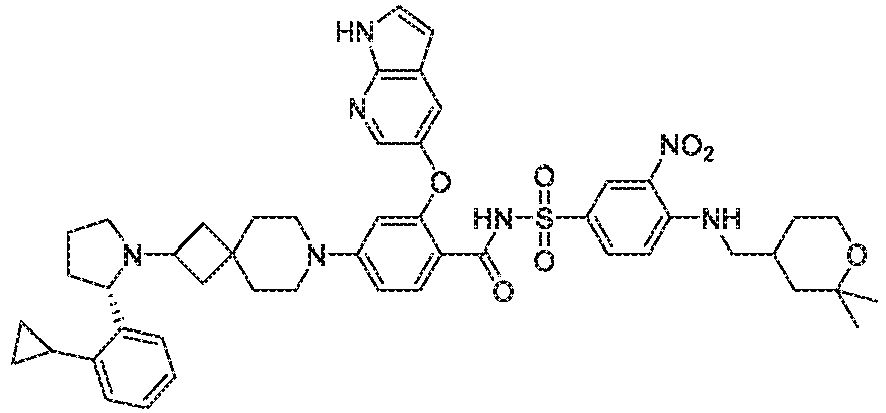
- The desired compound was synthesized following the procedures similar to those in Example F43 by replacing (S)-2-(2-isopropylphenyl)pyrrolidine with (S)-2-(2-cyclopropylphenyl)pyrrolidine and replacing 4-((((1r,4r)-4-hydroxy-4-methylcyclohexyl)methyl)amino)-3-nitrobenzenesulfonamide with 4-(((2,2-dimethyltetrahydro-2H-pyran-4-yl)methyl)amino)-3-nitrobenzenesulfonamide. 1H NMR (DMSO-d6 ) δ ppm: 11.62 (s, 1H), 8.48 (s, 2H), 7.98 (d, J = 2.5 Hz, 1H), 7.71 (d, J = 9.0 Hz, 1H), 7.55 - 7.53 (m, 2H), 7.46 (t, J = 2.5 Hz, 1H), 7.41 (s, 1H), 7.13 (s, 2H), 7.03 - 6.86 (m, 3H), 6.65 (d, J = 9.0 Hz, 1H), 6.34 (s, 1H), 6.19 (s, 1H), 3.64 - 3.51 (m, 3H), 3.23 -3.21 (m, 3H), 3.13 (s, 1H), 3.01 (s, 2H), 2.93 (s, 2H), 2.26 (s, 1H), 2.09 - 2.01 (m, 3H), 1.84 (s, 4H), 1.59 - 1.56 (m, 3H), 1.39 - 1.38 (m, 6H), 1.14 - 1.12 (m, 7H), 0.93 - 0.86 (m, 2H), 0.67 - 0.60 (m, 1H), 0.55 (s, 1H). MS (ESI) m/e [M+1]+ 887.9.
-

- The desired compound was synthesized following the procedures similar to those in Example F43 by replacing (S)-2-(2-isopropylphenyl)pyrrolidine with (S)-2-(2-cyclopropylphenyl)pyrrolidine and replacing 4-((((1r,4r)-4-hydroxy-4-methylcyclohexyl)methyl)amino)-3-nitrobenzenesulfonamide with 4-(3-methyl-3-((tetrahydro-2H-pyran-4-yl)mcthyl)ureido)-3-nitrobenzenesulfonamide. 1H NMR (DMSO-d6 ) δ ppm: 11.54 (s, 1H), 9.53 (s, 1H), 8.33 (d, J = 1.9 Hz, 1H), 8.18 (d, J = 7.2 Hz, 1H), 7.96 - 7.93 (m , 2H), 7.88 - 7.86 (m, 1H), 7.55 - 7.53 (m, 2H), 7.42 - 7.40 (m, 1H), 7.33 - 7.31 (m, 1H), 7.16 - 7.14 (m, 2H), 6.95 - 6.94 (m, 1H), 6.88 (d, J = 7.2 Hz, 1H), 6.62 - 6.60 (m, 1H), 6.32 - 6.29 (m, 1H), 6.19 (d, J = 2.0 Hz, 1H), 3.85 - 3.84 (m, 2H), 3.26 - 3.24 (m, 5H), 3.12 (s, 4H), 3.02 (s, 3H), 2.97 (s, 2H), 2.89 (s, 2H), 2.28 (s, 1H), 2.05 (s, 1H), 1.85 (s, 3H), 1.55 - 1.53 (m, 3H), 1.42 - 1.40 (m, 5H), 1.22 - 1.20 (m, 4H), 0.89 - 0.88 (m, 2H), 0.66 - 0.60 (m, 1H), 0.55 (s, 1H). MS (ESI) m/e [M+1]+ 916.9.
-

- The desired compound was synthesized following the procedures similar to those in Example F43 by replacing (S)-2-(2-isopropylphenyl)pyrrolidine with (S)-2-phenylpyrrolidine. 1H NMR (400 MHz, DMSO-d6 ) δ ppm: 11.69 (s, 1H), 10.58 (br, 1H), 8.61 - 8.55 (m, 2H), 8.04 (d, J = 2.8 Hz, 1H), 7.79 (d, J = 8.8 Hz, 1H), 7.65 - 7.55 (m, 2H), 7.52 - 7.47 (m, 3H), 7.45 - 7.38 (m, 3H), 7.08 (d, J = 9.2 Hz, 1H), 6.69 (d, J = 9.2 Hz, 1H), 6.40 - 6.32 (m, 1H), 6.17 (s, 1H), 4.47 - 4.30(m, 1H), 4.25(s, 1H), 3.84 - 3.66 (m, 2H), 3.25 - 2.95 (m, 6H), 2.44 - 2.36 (m, 1H), 2.20 - 1.89 (m, 5H), 1.75 - 1.10 (m, 19H). MS (ESI, m/e) [M+1]+ 847.8.
-

- The desired compound was synthesized following the procedures similar to those in Example F23 by replacing (S)-2-(2-(2-cyclopropylphenyl)pyrrolidin-1-yl)-7-azaspiro[3.5]nonanc with 2-(2-(2-cyclopropylphenyl)-4-ethylpiperazin-1-yl)-7-azaspiro[3.5]nonane. 1H NMR (400 MHz, DMSO-d6 ) δ ppm: 11.60 (s, 1H), 10.51 (s, 1H), 8.35-8.60 (m, 2H), 7.96 (s, 1H), 7.69 (d, J = 8.2 Hz, 1H), 7.62-7.28 (m,, 4H), 7.28-7.06 (m, 2H), 7.06-6.85 (m, 2H), 6.75-6.56 (m, 1H), 6.33 (s, 1H), 6.17 (s, 1H), 4.09-3.91 (m, 1H), 3.89-3.78 (m, 2H), 3.32-3.21 (m, 5H), 3.08 - 2.82 (m, 7H), 2.27 - 2.14 (m, 1H), 2.06 - 1.68 (m, 3H), 1.65 - 1.52 (m, 3H), 1.47 - 1.15 (m, 10H), 1.12 - 0.82 (m, 6H), 0.77 - 0.46 (m, 2H). MS (ESI, m/e) [M+1]+ 902.9.
-
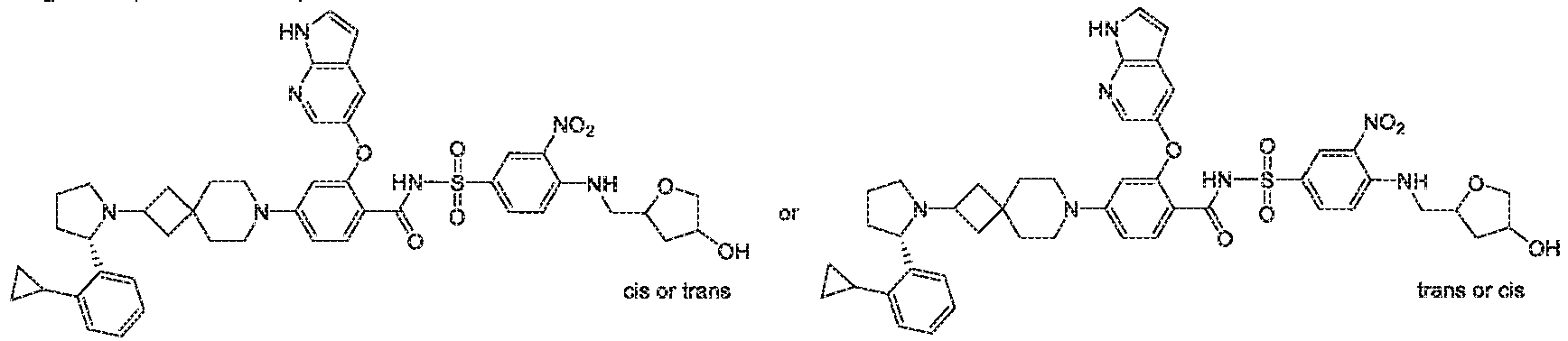
- The desired compound was synthesized following the procedures similar to those in Example F43 by replacing (S)-2-(2-isopropylphenyl)pyrrolidine with (S)-2-(2-cyclopropylphenyl)pyrrolidine and replacing 4-((((1r,4r)-4-hydroxy-4-methylcyclohexyl)methyl)amino)-3-nitrobenzenesulfonamide with 4-(((4-hydroxytetrahydrofuran-2-yl)methyl)amino)-3-nitrobenzenesulfonamide. After separation and purification with prep-HPLC, the faster isomers was obtained as Example F131a, 1H NMR (DMSO-d6 ) δ ppm: 11.68 (s, 1H), 11.50 (s, 1H), 8.75 - 8.40 (m, 2H), 8.10 - 7.97 (m, 1H), 7.86 - 7.36 (m, 5H), 7.33 - 6.91 (m, 4H), 6.74 - 6.68 (m, 1H), 6.41 (s, 1H), 6.25 (s, 1H), 5.06 - 4.96 (m, 1H), 4.46 - 4.26 (m, 2H), 3.97 - 3.87 (m, 1H), 3.70 - 3.55 (m, 2H), 3.12 - 2.96 (m, 5H), 2.40 - 2.32 (m, 2H), 2.13 - 1.55 (m, 16H), 1.01 - 0.96 (m, 2H), 0.73 - 0.63 (m, 2H). MS (ESI, m/e) [M+1]+ 861.9 ; the slower isomers was obtained as Example F131b, 1H NMR (DMSO-d6 ) δ ppm: 11.67 (s, 1H), 11.43 (s, 1H), 8.80 - 8.40 (m, 2H), 8.04 (s, 1H), 7.90 - 7.70 (m, 1H), 7.65 - 7.38 (m, 4H), 7.33 - 6.92 (m, 5H), 6.80 - 6.65 (m, 1H), 6.40 (s, 1H), 6.25 (s, 1H), 5.15 - 5.05 (m, 1H), 4.45 - 4.35 (m, 1H), 4.25 - 4.12 (m, 1H), 3.78 - 3.68 (m, 2H), 3.66 - 3.53 (m, 3H), 3.15 - 2.93 (m, 5H), 2.40 - 2.25 (m, 2H), 2.15 - 1.99 (m, 3H), 1.70 - 1.57 (m, 3H), 1.52 - 1.39 (m, 6H), 1.03 - 0.94 (m, 2H), 0.75 - 0.55 (m, 2H). MS (ESI, m/e) [M+1]+ 861.9.
-

- 2-(2-(2-isopropylphenyl)-4-methylpiperazin-1-yl)-7-azaspiro[3.5]nonane was separated and purified by SFC to obtain 2 pure isomers (Instrument: Waters SFC80Q preparative SFC; Column: Lux Cellulose-2, 250×30mm i.d., 10um; Mobile phase: A for CO: and B for McOH(0.1%NH3H2O); Gradient: B% = 60%; Flow rate: 80 g/min; Column temperature: 40°C; System back pressure:100 bar): (S or R)-2-(2-(2-isopropylphenyl)-4-methylpiperazin-1-yl)-7-azaspiro[3.5]nonane as faster peak in SFC (0.4 g, retention time: 2.2 min). 1H NMR (400 MHz, CDCl3) δ ppm: 7.53 - 7.44 (m, 1H), 7.26 - 7.21 (m, 2H), 7.16 - 7.09 (m, 1H), 3.71 - 3.59 (m, 1H), 3.45 - 3.31 (m, 1H), 2.98 (d, J = 8.4 Hz, 1H), 2.93 - 2.74 (m, 6H), 2.64 (d, J = 10.8 Hz, 1H), 2.29 (s, 3H), 2.28 (s, 1H), 2.26 (s, 1H), 2.19 - 2.10 (m, 1H), 1.87 - 1.77 (m, 1H), 1.76 - 1.68 (m, 1H), 1.63 - 1.47 (m, 4H), 1.40 - 1.30 (m, 1H), 1.23 (d, J = 6.8 Hz, 3H), 1.20 (d, J = 6.8 Hz, 3H), 1.17 - 1.09 (m, 1H). MS (ESI, m/e) [M+1]+ 342.4. (R or S)-2-(2-(2-isopropylphenyl)-4-methylpiperazin-1-yl)-7-azaspiro[3.5]nonane (slower peak in SFC, retention time: 3.9 min) (340 mg) was obtained as a white solid.
- With the isomer of faster peak in SFC as starting material, Example F132a was synthesized following the procedures similar to those in Example F91. 1H NMR (400 MHz, DMSO-d6 ) δ ppm: 11.59 (s, 1H), 8.49 - 8.40 (m, 2H), 7.95 (s, 1H), 7.68 -7.65 (m, 1H), 7.52 (d, J = 8.4 Hz, 1H), 7.46 -7.10 (m, 7H), 6.95 -6.87 (m, 1H), 6.63 (d, J = 8.4 Hz, 1H), 6.32 (s, 1H), 6.17 (s, 1H), 4.24 (s, 1H), 3.67 - 3.55 (m, 1H), 3.26 - 3.24 (m, 3H), 3.01 - 2.82 (m, 9H), 2.25 - 2.19 (m, 1H), 2.05 - 1.97 (m, 2H), 1.71 - 1.50 (m, 8H), 1.33 - 1.01 (m, 20H). MS (ESI, m/e) [M+1]+ 919.0.
- With the isomer of slower peak in SFC as starting material, Example F1321b was synthesized following the procedures similar to those in Example F91. 1H NMR (400 MHz, DMSO-d6 ) δ ppm: 11.66 (s, 1 H), 10.55 (s, 1 H), 8.51 (d, J = 2.5 Hz, 2 H), 8.00 (d, J = 2.5 Hz, 1 H), 7.74 (d, J = 9.2 Hz, 1 H), 7.52 - 7.40 (m, 4 H), 7.29-7.21 (m, 2 H), 7.19-7.14 (m, 1H), 7.02 (d, J = 9.2 Hz, 1H), 6.64 (d, J = 8.6 Hz, 1H), 6.36 (s, 1 H), 6.15 (s, 1 H), 4.25 (s, 1 H), 3.72 (s, 1 H), 3.30 - 3.16 (m, 4 H), 3.09 - 2.72 (m, 10 H), 2.65-2.60 (m, 3 H), 2.35-2.30 (m, 2 H), 1.69-1.52 (m, 8 H), 1.38 - 1.14 (m, 16 H). MS (ESI, m/e) [M+1]+ 919.0.
-

- The mixture of 2-((1H-pyrrolo[2,3-b]pyridin-5-yl)oxy)-4-(2,2-dimethoxy-7-azaspiro[3.5]nonan-7-yl)benzoic acid (437 mg, 1.0 mmol), triethylamine (303 mg, 3.0 mmol), EDCI (229 mg, 1.2 mmol), DMAP(366 mg, 3.0 mmol) and 4-((((1r,4r)-4-hydroxy-4-methylcyclohexyl)methyl)amino)-3-nitrobenzenesulfonamide (343 mg, 1.0 mmol) in DCM (50 mL) was heated to reflux and stirred for overnight. The mixture was cooled to r.t. and then washed with brine, dried over Na2SO4 and concentrated in vacuo, then purified by chromatography column on silica (eluent: PE/EA = 1/1 to DCM/EA = 1/1) to give the target product (424 mg, 55.58%). MS (ESI, m/e) [M+1]+ 762.8.
- To the mixture of 2-((1H-pyrrolo[2,3-b]pyridin-5-yl)oxy)-4-(2,2-dimethoxy-7-azaspiro[3.5]nonan-7-yl)-N-((4-((((1r,4r)-4-hydroxy-4-methylcyclohexyl)methyl)amino)-3-nitrophenyl)sulfonyl)benzamide (100 mg, 0.13mmol) in DCM (5 mL) was added HCl solution (4M in 1,4-dioxane, 1 mL) and stirred for 30 mins. The reaction was quenched with aq. NaHCO3 (30 mL), extracted with DCM (30mL), concentrated in vacuum and purified by pre-TLC (eluent: DCM/MeOH = 20/1) to afford the desired compound (42 mg, 45.12%) as a yellow solid. 1H NMR (400 MHz, DMSO-d6 ) 6 ppm: 11.71 (s, 1H), 11.46 (s, 1H), 8.62 - 8.53 (m, 2H), 8.08 (d, J = 2.4 Hz, 1H), 7.82 (d, J = 7.6 Hz, 1H), 7.57 - 7.51(m, 3H), 7.11 (d, J = 8.8 Hz, 1H), 6.79 (d, J = 8.8 Hz, 1H), 6.41 - 6.38 (m, 1H), 6.24 (s, 1H), 4.25 (s, 1H), 3.30 - 3.25 (m, 2H), 3.21 - 3.12 (m, 4H), 2.78 (s, 4H), 1.75 - 1.52 (m, 10H), 1.41 - 1.10 (m, 6H). MS (ESI, m/e) [M+1]+ 716.8.
-

- The mixture of 3-((1H-pyrrolo[2,3-b]pyridin-5-yl)oxy)-4'-(2-(2-chlorophenyl)pyrrolidin-1-yl)-[1,1'-biphenyl]-4-carboxylic acid (51 mg, 0.1 mmol), triethylamine (30 mg, 0.3 mmol), 2-(7-azabenzotriazol-1-yl)-N,N,N',N'-tetramethyluronium hexafluorophosphate (59 mg, 0.15 mmol) in DCM (10 mL) was stirred for 2 h. To the resulting reaction were added 4-((4-fluorotetrahydro-2H-pyran-4-yl)mcthoxy)-3-nitrobenzenesulfonamide (50 mg, 0.15 mmol) and DMAP (1 mg, 0.01 mmol) and stirred for overnight. The mixture was purified by chromatography column on silica (eluent: PE/EA = 1/1 to DCM/MeOH = 20/1) to afford a crude, which was purified with Pre-HPLC to give the product (25 mg). 1H NMR(400 MHz, DMSO- d6 ) δ ppm: 12.20 (br, 1H), 11.64 (br, 1H), 8.30 (br, 1H), 8.01 (m, 2H), 7.57 (d, J = 4.0 Hz, 1H), 7.56-7.46 (m, 3H), 7.54 (m, 2H), 7.33-7.18 (m, 3H), 7.02 (d, J = 4.0 Hz, 1H), 6.90 (s, 4H), 6.36(m, 3H), 4.98 (d, J=8.0 Hz, 1H), 4.36 (d, J = 24.0 Hz, 2H), 3.79-3.72 (m, 3H), 3.61-3.56 (m, 2H), 3.39-3.32 (m, 1H), 2.41 (m, 1H), 1.99-1.81 (m, 5H). MS (ESI, m/e) [M+1]' 826.0.
-

- The desired compound was synthesized with 4-((4-fluorotetrahydro-2H-pyran-4-yl)methoxy)-3-nitrobenzenesulfonamide and 3-((1H-pyrrolo[2,3-b]pyridin-5-yl)oxy)-4'-(2-(2-cyclopropylphenyl)pyrrolidin-1-yl)-2',3',4',5'-tetrahydro-[1,1'-biphenyl]-4-carboxylic acid following the procedure similar to those in Example C3. MS (ESI, m/e) [M+1]' 836.2.
-

- The desired compound G2 was synthesized with 4-(((1-methylpiperidin-4-yl)methyl)amino)-3-nitrobenzenesulfonamide and 3-((1H-pyrrolo[2,3-b]pyridin-5-yl)oxy)-4'-(2-(2-chlorophcnyl)pyrrolidin-1-yl)-[1,1'-biphenyl]-4-carboxylic acid following the procedures similar to those in Example G1. 1H NMR (400 MHz, DMSO-d6 ) δ ppm: 11.55 (s, 1H), 9.32 (br, 1H), 8.49-8.33 (m, 2H), 7.99-7.95 (m, 1H), 7.73-7.65 (m, 1H), 7.57 (d, J = 8.0 Hz, 1H), 7.47 (d, J = 8.0 Hz, 1H), 7.45-7.41 (m, 1H), 7.41-7.36 (m, 1H), 7.32 (d, J = 8.4 Hz, 2H), 7.29-7.16 (m, 3H), 7.06-6.99 (m, 1H), 6.96-6.84 (m, 2H), 6.40-6.28 (m, 3H), 4.97 (d, J = 8.5 Hz, 1H), 3.80-3.70 (m, 1H), 3.40-3.34 (m, 2H), 3.31-3.27 (m, 4H), 2.87-2.74 (m, 1H), 2.74-2.61 (m, 3H), 2.05-1.96 (m, 1H), 1.96-1.74 (m, 6H), 1.44-1.32 (m, 2H). MS (ESI, m/e) [M+1]+ 820.1.
-

- The desired compound was synthesized with 4-(((1-methylpipcridin-4-yl)methyl)amino)-3-nitrobenzenesulfonamide and 3-((1H-pyrrolo[2,3-b]pyridin-5-yl)oxy)-4'-(2-(2-cyclopropylphenyl)pyrrolidin-1-yl)-2',3',4',5'-tetrahydro-[1,1'-biphenyl]-4-carboxylic acid following the procedure similar to those in Example C3. 1H NMR(400 MHz, DMSO-d6 ) δ ppm: 11.55 (s, 1H), 8.8.42-8.27 (m, 2H), 7.91 (s, 1H), 7.66-7.57 (m, 1H), 7.58-7.44 (m, 2H), 7.41-7.38 (m, 1H), 7.11-7.02 (m, 2H), 7.00-6.95 (m, 1H), 6.93-6.85 (m, 1H), 6.83-6.77 (m, 1H), 6.75-6.70 (m, 1H), 6.30 (s, 1H), 6.01-5.77 (m, 1H), 4.38-4.20 (m, 1H), 3.27-3.07 (m, 4H), 2.90-2.73 (m, 2H), 2.62-2.50 (m, 2H), 2.26-2.15 (m, 4H), 2.07-1.90 (m, 3H), 1.76-1.63 (m, 4H), 1.20-1.13 (m, 4H), 0.97-0.84 (m, 3H), 0.82-0.44 (m, 4H). MS (ESI, m/e) [M+1]+ 829.9.
-

- The desired compoundG3 was synthesized with 3-nitro-4-((1-(letrahydro-2H-pyran-4-yl)azelidin-3-yl)amino)benzenesulfonamide and 3-((1 H-pyrrolo[2,3-b]pyridin-5-yl)oxy)-4'-(2-(2-chlorophenyl)pyrrolidin-1-yl)-[1,1'-biphenyl]-4-carboxylic acid following the procedures similar to those in Example G1. 1H NMR (400 MHz, DMSO-d6 ) δ ppm: 11.57 (s, 1H), 8.48-8.43 (m, 1H), 8.39-8.30 (m, 1H), 7.98-7.94 (m, 1H), 7.81-7.72 (m, 1H), 7.50-7.42 (m, 2H), 7.42-7.37 (m, 1H), 7.33 (d, J = 8.4 Hz, 2H), 7.29 -7.15 (m, 3H), 7.04-6.98 (m, 1H), 6.94-6.89 (m, 1H), 6.82-6.68 (m, 1H), 6.35 (d, J = 8.4 Hz, 2H), 6.33-6.29 (m, 1H), 5.00-4.94 (m, 1H), 4.53-4.24 (m, 1H), 3.94-3.83 (m, 2H), 3.79-3.71 (m, 1H), 3.42-3.36 (m, 1H), 3.31-3.17 (m, 5H), 2.46-2.36 (m, 2H), 2.04-1.67 (m, 6H), 1.33-1.25 (m, 2H). MS (ESI, m/e) [M+1]+ 848.1.
-

- The desired compound G4 was synthesized with 3-nitro-4-((1-(oxetan-3-yl)piperidin-4-yl)amino)benzenesulfonamide and 3-((1H-pyrrolo[2,3-b]pyridin-5-yl)oxy)-4'-(2-(2-chlorophenyl)pyrrolidin-1-yl)-[1,1'-biphenyl]-4-carboxylic acid following the procedures similar to those in Example G1. 1H NMR (400 MHz, DMSO- d6 ) δ ppm: 12.23 (s, 1H), 11.69 (s, 1H), 10.90-10.05 (m, 1 H), 8.63-8.48 (m, 1H), 8.27-8.12 (m, 1 H), 8.04 (d, J= 1.8 Hz, 1H), 7.90 (d, J = 8.1 Hz, 1H), 7.59 (d, J = 1.8 Hz, 1H), 7.55-7.43 (m, 3 H), 7.38-7.26 (m, 3 H), 7.26-7.14 (m, 3 H), 7.00 (d, J = 7.4 Hz, 1H), 6.90 (s, 1H), 6.44-6.28 (m, 3 H), 4.97 (d, J = 8.0 Hz, 1H), 4.85-4.66 (m, 3 H), 4.45-4.26 (m, 1 H), 3.93-3.88 (m, 1 H), 3.55-3.32 (m, 3 H), 3.04-2.82 (m, 2 H), 2.44-2.35 (m, 1 H), 2.28-2.09 (m, 2 H), 2.09-1.94 (m, 2 H), 1.94-1.68 (m, 2 H), 1.23-1.02 (m, 2 H). MS (ESI, m/e) [M+1]+ 848.1.
-
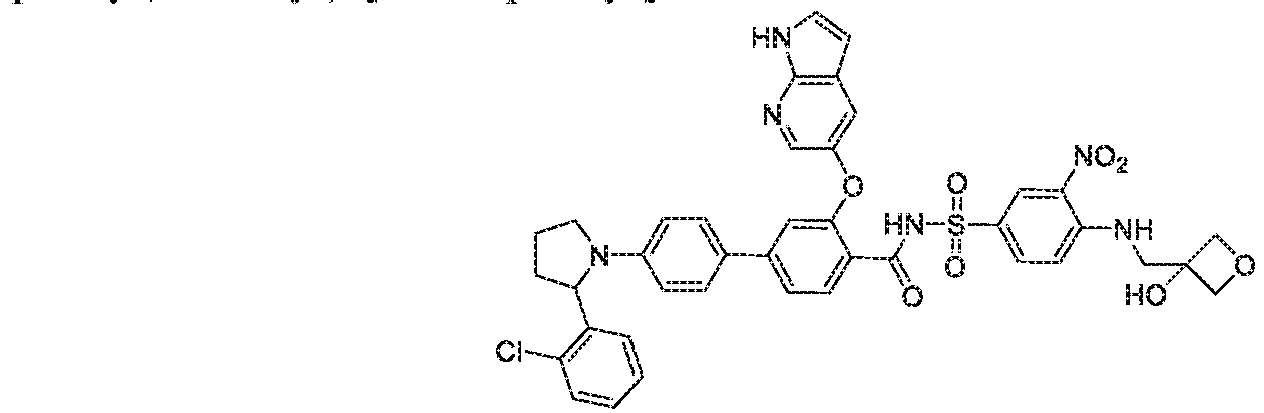
-

- To a solution of 3-((1H-pyrrolo[2,3-b]pyridin-5-yl)oxy)-4'-(2-(2-chlorophenyl)pyrrolidin-1-yl)-[1,1'-biphenyl]-4-carboxylic acid (54 mg, 0.106 mmol) in DCM (50 mL) was added HATU (60 mg, 0.159 mmol) and triethylamine (53.5 mg, 0.53 mmol). The mixture was stirred at room temperature for 1 hour. Then to the mixture were added 4-(((3-((tert-butyldimethylsilyl)oxy)oxctan-3-yl)methyl)amino)-3-nitrobenzenesulfonamide (88.5 mg, 0.212 mmol). The mixture was stirred at room temperature overnight. The mixture was washed with brine, dried over Na2SO4, concentrated. The residue was purified by chromatography column on silica (eluent: EA/PE = 1/1 to MeOH/DCM = 1/10) to give the crude product. The crude product was further purified by prep-TLC (MeOH/DCM = 1/20) to afford product (36 mg, 37.3%) as a yellow solid. MS (ESI, m/e) [M+1]+ 909.1.

- To a solution of 3-((1H-pyrrolo[2,3-b]pyridin-5-yl)oxy)-N-((4-(((3-((tertbutyldimethylsilyl)oxy)oxetan-3-yl)methyl)amino)-3-nitrophenyl)sulfonyl)-4'-(2-(2-chlorophenyl)pyrrolidin-1-yl)-[1,1'-biphenyl]-4-carboxamide(TBS-G5) in DCM (50 ml) was added TBAF (100.6 mg, 0.385 mmol). The mixture was stirred at r.t. for 2 h. The mixture was washed with brine (50 ml × 2), dried over Na2SO4, concentrated. The residue was purified by prep-HPLC to give the desired product in Example G5. 1H NMR (400 MHz, DMSO-d6 ) δ ppm: 12.17 (s, 1H), 11.69 (s, 1H), 8.57 (s, 2H), 8.06 (s, 1H), 7.85 (d, J = 8.7 Hz, 1H), 7.60 (s, 1H), 7.57-7.42 (m, 3H), 7.39-7.28 (m, 3H), 7.28-7.14 (m, 3H), 7.01 (d,J= 7.1 Hz, 1H), 6.91 (s, 1H), 4.98 (d, J = 7.7 Hz, 1H), 4.48 (d, J = 6.2 Hz, 2H), 4.44 (d, J = 6.2 Hz, 2H), 3.81-3.65 (m, 3 H), 3.48-3.39 (m, 1 H), 2.45-2.33 (m, 2H), 2.05-1.94 (m, 2H), 1.94-1.76 (m, 2H), 1.26-1.24 (m, 2H) MS (ESI, m/e) [M+1]+ 795.1.
-

- The desired compound was synthesized from 4-((4-((tertbutyldimethylsilyl)oxy)cyclohexyl)methoxy)-3-nitrobenzenesulfonamide and 3-((1 H-pyrrolo[2,3-b]pyridin-5-yl)oxy)-4'-(2-(2-chlorophenyl)pyrrolidin-1 -yl)-[1,1'-biphenyl]-4-carboxylic acid following the procedures similar to those in Example G5 to get TBS-G6, then proceeded with a deprotection step to afford the product. 1H NMR (400 MHz, DMSO-d6 ) δ ppm: 12.36 (s, 1H), 11.73 (s, 1H), 8.38 (d, J = 2.2 Hz, 1H), 8.13-8.01 (m, 2 H), 7.62 (d, J = 2.2 Hz, 1H), 7.57-7.49 (m, 2 H), 7.49-7.39 (m, 2H), 7.37-7.28 (m, 3H), 7.28-7.15 (m, 2H), 7.04-6.97 (m, 1 H), 6.89 (s, 1H), 6.44-6.38 (m, 1H), 6.35 (d, J = 8.7 Hz, 2H), 4.97 (d, J = 7.8 Hz, 1H), 4.01-3.93 (m, 4H), 3.78-3.69 (m, 2H), 3.42-3.28 (m, 2H), 2.06-1.95 (m, 2H), 1.91-1.82 (m, 3 H), 1.82-1.72 (m, 2H), 1.18-0.97 (m, 4H). MS (ESI, m/c) [M+1]' 822.1.
-

- The desired compound was synthesized with 3-nitro-4-(7-oxa-2-azaspiro[3.5]nonan-2-yl)benzenesulfonamide and 3-((1H-pyrrolo[2,3-b]pyridin-5-yl)oxy)-4'-(2-(2-chlorophenyl)pyrrolidin-1-yl)-[1,1'-biphenyl]-4-carboxylic acid following the procedures similar to those in Example G1, and afforded the product. 1H NMR (400 MHz, DMSO-d6 ) δ ppm: 12.15 (s, 1H), 11.74 (s, 1H), 8.28-8.25 (m, 1H), 8.09-8.05 (m, 1H), 7.81-7.77 (m, 1H), 7.66-7.62 (m, 1H), 7.56-7.50 (m, 2H), 7.49-7.44 (m, 1H), 7.36-7.16 (m, 5H), 7.00 (d, J = 7.3 Hz, 1H), 6.88 (s, 1H), 6.74 (d, J = 8.4 Hz, 2H), 6.43-6.40 (m, 1H), 6.35 (d, J = 8.4 Hz, 2H), 4.97 (d, J = 7.9 Hz, 1H), 3.81-3.70 (m, 5H), 3.55-3.40 (m, 4H), 2.04-1.95 (m, 2H), 1.90-1.79 (m, 2H), 1.74-1.65 (m, 4H). MS (ESI, m/e) [M+1]+ 819.1.
-

- To a solution of 3-((1H-pyrrolo[2,3-b]pyridin-5-yl)oxy)-4'-(2-(2-cyclopropylphenyl)pyrrolidin-1-yl)-2',3',4',5'-tetrahydro-[1,1'-biphenyl]-4-carboxylic acid (60 mg, 0.115 mmol) in DCM (50 ml) were added HATU (52.6 mg, 0.138 mmol) and triethylamine (34.8 mg, 0.345 mmol). The mixture was stirred at room temperature for 1 hour. Then to the mixture was added (S)-4-(((1,4-dioxan-2-yl)methyl)amino)-3-nitrobenzenesulfonamide (43.8 mg, 0.138 mmol). The mixture was stirred at room temperature overnight. The mixture was washed with brine, dried over Na2SO4, concentrated. The residue was purified by prep-HPLC to give the product (2 mg, 1.9%). 1H NMR (400 MHz, DMSO-d6 ) δ ppm: 12.28 (s, 1H), 11.71 (s, 1H), 9.43 (br, 1 H), 8.63-8.47 (m, 2H), 8.00 (s, 1H), 7.82 (d, J = 9.1 Hz, 1H), 7.65-7.58 (m, 1H), 7.56-7.45 (m, 3H), 7.35-7.21 (m, 2H), 7.21-7.02 (m, 3H), 6.74 (d, J = 6.2 Hz, 1H), 6.39 (s, 1H), 6.00-5.93 (m, 1H), 529-5.07 (m, 1H), 3.80-3.62 (m, 8H), 3.40-3.28 (m, 4H), 2.26-1.96 (m, 6H), 1.91-1.70 (m, 2H), 1.64-1.41 (m, 2H), 1.00-0.90 (m, 2H), 0.77-0.69 (m, 1H), 0.64-0.56 (m, 1H). MS (ESI, nVe) [M+1]+ 819.1.
-
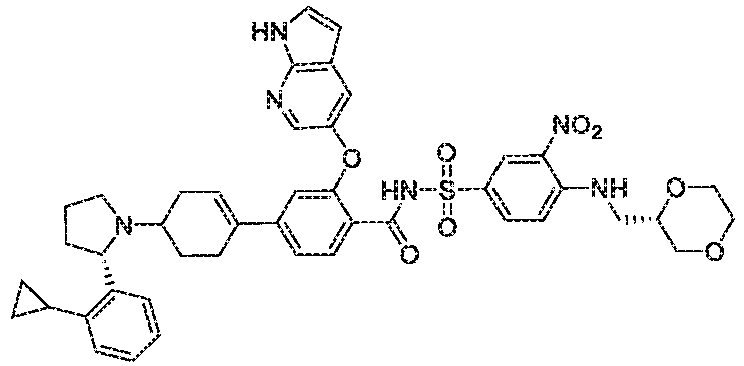
- The desired compound was synthesized with (S)-4-(((1,4-dioxan-2-yl)methyl)amino)-3-nitrobenzenesulfonamide and 3-((1H-pyrrolo[2,3-b]pyridin-5-yl)oxy)-4'-((S)-2-(2-cyclopropylphenyl)pyrrolidin-1-yl)-2',3',4'.5'-tetrahydro-[1,1'-biphenyl]-4-carboxylic acid following the procedures similar to those in Example G8. 1H NMR (400 MHz, DMSO-d6 ) δ ppm: 12.35 (br, 1H), δ 11.64 (s, 1H), 8.61-8.35 (m, 2H), 7.97 (s, 1H),7.84-7.68 (m, 1H), 7.66-7.36 (m, 4H), 7.33-6.80 (m, 5H), 6.74 (s, 1H), 6.35 (s, 1H), 6.03-5.77 (m, 1H), 5.43-4.93 (m, 0.5H), 4.56-4.05 (m, 0.5 H), 3.83-3.71 (m, 3H) 3.69-3.56 (m, 2H), 3.51-3.40 (m, 2H), 3.32-3.26 (m, 2H), 3.21-2.89 (m, 1H), 2.45-1.27 (m, 13H), 0.98-0.82 (m, 2H), 0.76-0.46 (m, 2H). MS (ESI, m/e) [M+1]+ 818.8.
- Two enantiomers G8-a (faster isomer) and G8-b (slower isomer) were separated by chiral preparative HPLC. The chiral separation conditions are shown below. The faster enantiomer was eluted at retention time of 3.3 min to give G8-a. The slower enantiomer was eluted at retention time of 4.7 min to give G8-b.
Column CHIRAL ART Cellulose-SB Column size 2cm × 25 cm, 5um Injection 0.8mL Mobile phase MTBE:MeOH (0.2% MSA) = 70:30 Flow rate 20 mL/min Wave length UV 220 nm Temperature 25 °C Sample solution 12mg/mL in MeOH:DCM = 3:1 Prep-HPLC equipment Prep-Gilson-HPLC - Example G8-a: 1H NMR (400 MHz, DMSO-d6 ) δ ppm: 12.40 (br, 1H), 11.63 (s, 1H), 8.65-8.24 (m, 2H), 7.96 (s, 1H), 7.83-7.34 (m, 5H), 7.34-7.17 (m, 1H), 7.17-6.81 (m, 4H), 6.73 (s, 1H), 6.34 (s, 1H), 5.82 (s, 1H), 5.37-5.09 (m, 0.5H), 4.50-4.16 (m, 0.5H), 3.86-3.69 (m, 3H), 3.69-3.54 (m, 2H), 3.54-3.40 (m, 2H), 3.31-3.10 (m, 2H), 3.08-2.82 (m, 1H), 2.50-1.81 (m, 10H), 1.81-1.35 (m, 3H), 1.02-0.79 (m, 2H), 0.76-0.42 (m, 2H). MS (ESI, m/e) [M+1]' 818.8. Example G8-b: 1H NMR (400 MHz, DMSO-d6 ) δ ppm: 12.56-11.98 (m, 0.3 H), 11.61 (s, 1H), 10.19-9.41 (m, 0.4 H), 8.67-8.20 (m, 2H), 8.13-7.51 (m, 2H), 7.95 (s, 1H), 7.51-7.33 (m, 3H), 7.35-6.80 (m, 5H), 6.74 (s, 1H), 6.33 (s, 1H), 5.99 (s, 1H), 5.30-4.82 (m, 0.5H), 4.42-4.06 (m, 0.5H), 3.87-3.71 (m, 3H), 3.71-3.54 (m, 2H), 3.54-3.39 (m, 2H), 3.31-2.90 (m, 3H), 2.72-2.50 (m, 2H), 2.41-1.60 (m, 9H), 1.56-1.23 (m, 2H), 1.04-0.77 (m, 2H), 0.77-0.42 (m, 2H). MS (ESI, m/c) [M+1]+ 818.8.
-

- The desired compound was synthesized with (R)-4-(((1,4-dioxan-2-yl)methyl)amino)-3-nitrobenzenesulfonamide and 3-((1H-pyrrolo[2,3-b]pyridin-5-yl)oxy)-4'-(2-(2-cyclopropylphenyl)pyrrolidin-1-yl)-2',3',4',5'-tetrahydro-[1,1'-biphenyl]-4-carboxylic acid following the procedures similar to those in Example G8. 1H NMR (400 MHz, DMSO-d6 ) δ ppm: 12.24 (br, 0.3H), 11.62 (s, 1H), 9.86-9.16 (m, 1H), 8.45 (s, 2H), 7.95 (s, 1H), 7.84-7.34 (m, 4H), 7.34-7.184 (m, 1H), 7.15-6.81 (m, 4H), 6.79-6.64 (m, 1H), 6.74 (s, 1H), 6.34 (s, 1H), 6.34 (s, 1H), 5.99-5.81 (m, 1H), 4.42-4.12 (m, 1H), 3.85-3.70 (m, 3H), 3.70-3.53 (m, 2H), 3.53-3.34 (m, 6H), 3.21-2.81 (m, 2H), 2.35-1.84 (m, 6H), 1.84-1.25 (m, 4H). 1.03-0.77 (m, 2H), 0.77-0.40 (m, 2H). MS (ESI, m/e) [M+1]+ 819.2.
-

- N-((4-((((R)-1,4-dioxan-2-yl)methyl)amino)-3-nitrophenyl)sulfonyl)-3-((1H-pyrrolo[2,3-b]pyridin-5-yl)oxy)-4'-((S)-2-(2-cyclopropylphenyl)pyrrolidin-1-yl)-2',3',4',5'-tetrahydro-[1,1'-biphenyl]-4-carboxamide was synthesized with (R)-4-(((1,4-dioxan-2-yl)methyl)amino)-3-nitrobcnzenesulfonamidc and 3-((1H-pyrrolo[2,3-b]pyridin-5-yl)oxy)-4'-((S)-2-(2-cyclopropylphenyl)pyrrolidin-1-yl)-2',3',4',5'-letrahydro-[1,1 '-biphenyl]-4-carboxylic acid following the procedures similar to those in Example G8. Then two enantiomers G9-a (faster isomer) and G9-b (slower isomer) were separated by chiral preparative HPLC. The chiral separation conditions are shown below. The faster enantiomer was eluted at retention time of 1.8 min to give G9-a. The slower enantiomer was eluted at retention time of 2.1 min to give G9-b.
Column CHIRAL ART Cellulose-SB Column size 2cm × 25 cm, 5um Injection 0.5 mL Mobile phase MTBE:[MeOH:DCM = 1:1 (0.1% MSA)] = 50:50 Flow rate 20mL/min Wave length UV 220 nm Temperature 25 °C Sample solution 32mg/ml in EtOH:DCM = 3:1 Prep-HPLC equipment Prep-(ailson-HPLC - Example G9-a: 1H NMR(400 MHz, DMSO-d6 ) δ ppm: 12.24 (s, 1H), 11.64 (s, 1H), 8.53-8.41 (m, 2H), 7.97 (s, 1H), 7.83-7.66 (m, 1H), 7.60-7.37 (m, 3H), 7.32-7.18 (m, 1H), 7.16-7.02 (m, 3H), 7.01-6.83 (m, 1H), 6.73 (s, 1H), 6.35 (s, 1H), 5.82 (s, 1H), 5.37-5.15 (m, 1H), 4.36-4.22 (m, 1H), 3.82-3.74 (m, 3H), 3.67-3.56 (m, 3H), 3.50 -3.37 (m, 3H), 3.24-3.06 (m, 1H), 3.04-2.88 (m, 1H), 2.29-2.12 (m, 3H), 2.10-1.83 (m, 3H), 1.80-1.62 (m, 1H), 1.32-1.18 (m, 2H), 1.02-0.79 (m, 4H). 0.79-0.64 (m, 2H), 0.61-0.47 (m, 1H). MS (ESI, m/e) [M+1]+ 818.8. Example G9-b: 1H NMR(400 MHz, DMSO-d6 ) δ ppm: 12.25 (s, 1H), 11.61 (s, 1H), 8.51-8.37 (m, 2H), 7.95 (s, 1H), 7.83-7.66 (m, 1H), 7.60-7.37 (m, 3H), 7.32-7.18 (m, 1H), 7.16-7.02 (m, 3H), 7.01-6.83 (m, 1H), 6.74 (s, 1H), 6.33 (s, 1H), 5.99 (s, 1H), 5.38-5.03 (m, 1H), 4.36-4.22 (m, 1H), 3.82-3.74 (m, 3H), 3.67-3.56 (m, 3H), 3.50 -3.37 (m, 3H), 3.24-3.06 (m, 1H), 3.04-2.91 (m, 1H), 2.29-2.14 (m, 3H), 2.10-1.96 (m, 2H), 1.82-1.64 (m, 2H), 1.23-1.04 (m, 3H), 1.00-0.82 (m, 3H). 0.79-0.64 (m, 2H), 0.61-0.47 (m, 1H). MS (ESI, m/e) [M+1]+ 818.8.
- Example G10a and Example G10b : (cis- or trans-) 3-((1H-pyrrolo[2,3-b]pyridin-5-yl)oxy)-4'-(2-(2-cyclopropylphenyl)pyrrolidin-1-yl)-N-((4-((4-hydroxy-4-methylcyclohexyl)methoxy)-3-nitrophenyl)sulfonyl)-2',3',4',5'-tetrahydro-[1,1'-biphenyl]-4-carboxamide; and (trans- or cis-) 3-((1H-pyrrolo[2,3-b]pyridin-5-yl)oxy)-4'-(2-(2-cyclopropylphenyl)pyrralidin-1-yl)-N-((4-((4-hydroxy-4-melhylcyclohexyl)methoxy)-3-nitrophenyl)sulfonyl)-2',3',4',5'-tetrahydro-[1,1'-biphenyl]-4-carboxamide;

-

- To a solution of 4-(hydroxymethyl)cycluhexan-1-one (1 g, 7.93mmol) in THF (100 ml) was added CH3MgBr (1 M in THF solution) (39.6 ml, 39.6 mmol) at 0°C for 5 mins. The mixture was stirred at r.t. for 3 hours. Then the reaction mixture was poured into saturated aq. NH4Cl (200 ml), extracted with ethyl acetate (200 mL × 2). The combined organic phase was sequentially washed with brine, dried over Na2SO4 and concentrated. The resulted residue was purified by chromatography column on silica (eluent: MeOH/DCM = 1/40) to give the product (650 mg, 56.8%) as a yellow oil. MS (ESI, m/e) [M-17]+ 127.1.
-

- To a solution 4-(hydroxymethyl)-1-methylcyclohexan-1-ol (575 mg, 3.99 mmol) in THF (50 mL) was added NaH (957.6 mg, 23.94 mmol). The mixture was stirred at room temperature for 0.5 hour. Then to the mixture was added 4-fluoro-3-nitrobenzenesulfonamide (616.5 mg, 2.8 mmol). The reaction mixture was stirred at room temperature for 5 days and then was poured into saturated aq. NH4Cl (200 ml). After extracted with EA (200 mL × 3), the combined organic phase was washed with brine, dried over Na2SO4, concentrated. The resulted residue was purified by prep-HPLC to give isomer (faster peak) P1 (100 mg) as a yellow solid. 1H NMR(400 MHz, DMSO-d6 ) δ ppm: 8.28 (d, J= 2.2 Hz, 1H), 8.03 (dd, J = 9.0, 2.2 Hz, 1H), 7.56 (d, J = 9.0 Hz, 1H), 7.50 (s, 2H), 4.36-4.15 (m, 1H), 4.12 (d, J = 5.8 Hz, 3H), 1.82-1.64 (m, 3H), 1.60-1.50 (m, 2H), 1.43-1.30 (m, 2H), 1.30-1.15 (m, 2H), 1.10 (s, 3H); and other isomer (slower peak) P2 (250 mg) as a yellow solid, 1H NMR(400 MHz, DMSO-d6 ) δ ppm: 8.27 (d, J = 2.2 Hz, 1H), 8.03 (dd, J = 9.0, 2.2 Hz, 1H), 7.57 (d, J = 9.0 Hz, 1H), 7.50 (s, 2H), 4.07 (d, J = 6.6 Hz, 2H), 3.92 (s, 1H), 1.76-1.63 (m, 1H), 1.62-1.50 (m, 4H), 1.49-11.35 (m, 2H), 1.34-1.21 (m, 2H), 1.10 (s, 3H).
- Step 3: the reaction of 3-((1H-pyrrolo[2,3-b]pyridin-5-yl)oxy)-4'-(2-(2-cyclopropylphenyl)pyrrolidin-1-yl)-2',3',4',5'-tetrahydro-[1,1'-biphenyl]-4-carboxylic acid with P1 following the procedures similar to those in Example G8 the desired compound G10a was afforded, and with P2 following the procedures similar to those in Example G8 the desired compound G10b was afforded.
- Compound of Example G10a 1H NMR (400 MHz, DMSO-d6 ) δ ppm: 12.43 (s, 1H), 11.61 (s, 1H), 8.29-8.06 (m, 1H), 7.94 (s, 1H), 7.89-7.73 (m, 1H), 7.72-7.58 (m, 1 H), 7,52-7.41 (m, 2H), 7.40-7.23 (m, 2H), 7.17-7.02 (m, 2H), 7.00-6.84 (m, 1H), 6.79-6.61 (m, 1H), 6.34 (s, 1H), 5.98-5.85 (m, 1H), 5.382-5.195 (m, 1H), 4.26 (s, 1H), 3.99 (s, 2H), 3.77-3.57 (m, 1 H), 3.54-3.34 (m, 2H), 3.06-2.88 (m, 1 H), 2.32-1.81 (m, 7H), 1.79-1.63 (m, 4H), 1.60-1.48 (m, 2H), 1.42-1.29 (m, 3H), 1.24-1.13 (m, 4H), 1.10 (s, 3H), 1.00-0.85 (m, 2H), 0.77-0.55 (m, 2H).
- Compound of Example GlOb 1H NMR (400 MHz, DMSO-d6 ) δ ppm: 12.43 (br, 1H), 11.62 (s, 1H), 8.18 (s, 1H), 7.94 (s, 1H), 7.90-7.76 (m, 1 H), 7.71-7.33 (m, 4 H), 7.33-6.83 (m, 5H), 6.75 (s, 1H), 6.34 (s, 1H), 5.98 (s, 1H), 5.84 (s, 1H), 5.51-4.98 (m, 1 H), 4.46-4.15 (m, 0.3 H), 4.09-3.83 (m, 3 H), 3.80-3.58 (m, 0.7 H), 3.57-3.33 (m, 4 H), 2.39-1.79 (m, 7 H), 1.77-1.45 (m, 6 H), 1.45-1.34 (m, 3H), 1.33-1.17 (m, 3 H), 1.09 (s, 3H), 1.02-0.79 (m, 2H), 0.78-0.43 (m, 2 H), MS (ESI, m/e) [M+1]+ 846.2.
-

- With the slower isomer (slower peak) P2 and 3-((1H-pyrrolo[2,3-b]pyridin-5-yl)oxy)-4'-((S)-2-(2-cyclopropylphenyl)pyrrolidin-1-yl)-2',3',4',5'-tetrahydro-[1,1'-biphenyl]-4-carboxylic acid following the procedures similar to those in Example G8, G10b-S was synthesized. MS (ESI, m/e) [M+1]+ 846.2.
- Two enantiomers G10b-a (faster isomer) and G10b-b (slower isomer) of G10b-S were separated by chiral preparative HPLC. The chiral separation conditions are shown below. The faster enantiomer was eluted at retention time of 2.5 min to give G10b-a. The slower enantiomer was eluted at retention time of 3.6 min to give G10b-b.
Column CHIRAL ART Cellulose-SB Column size 2cm × 25 cm, Sum Injection 1.0 mL Mobile phase MTBE:EtOH(0.1% MSA) = 50:50 Flow rate 45mL/min Wave length UV 220 nm Temperature 25 °C Sample solution 15mg/mL in EtOH:DCM = 3:1 Prep-HPLC equipment Prep-Gilson-HPLC - Example GlOb-a: 1H NMR (400 MHz, DMSO-d6 ) δ ppm: 12.60 (br, 1 H), 11.62 (s, 1H), 8.36-8.09 (m, 1H),7.94 (s, 1H), 7.90-7.75 (m, 1H), 7.73-6.83 (m, 9H), 6.76 (s, 1H), 6.34 (s, 1H), 5.85 (s, 1H), 5.36-5.16 (m, 1H),4.27 (s, 1H), 4.08-3.90 (m,2H), 3.81-3.64 (m,1H), 3.54-3.41 (m, 1H), 3.30-2.85 (m, 2H), 2.36-1.83 (m, 8H), 1.81-1.62 (m, 4H), 1.60-1.48 (m, 2H), 1.47-1.29 (m, 3H), 1.23-1.15 (m, 2H), 1.10 (s, 3H), 1.02-0.79 (m, 2H), 0.79-0.45 (m, 2H). MS (ESI, m/e) [M+1]+ 846.2. Example G10b-b: 1H NMR (400 MHz, DMSO-d6 ) δ ppm: 12.58 (br, 1 H), 11.62 (s, 1H), 8.31-8.06 (m, 1H), 7.94 (s, 1H), 7.89-7.75 (m, 1H), 7.75-6.89 (m, 9H), 6.75 (s, 1H), 6.34 (s, 1H), 5.98 (s, 1H), 5.24-5.02 (m, 1H), 4.27 (s, 1H), 4.09-3.91 (m, 2H), 3.72-3.57 (m, 1H), 3.57-3.35 (m, 2H), 3.14-2.86 (m, 1H), 2.43-2.27 (m, 2H), 2.27-1.93 (m, 5H), 1.91-1.79 (m, 1H), 1.79-1.64 (m, 4H), , 1.58-1.51 (m, 2H), 1.44-1.29 (m, 3H), 1.22-1.14 (m, 2H), 1.10 (s, 3H), 1.03-0.89 (m, 2H), 0.77-0.55 (m, 2H). MS (ESI, m/e) [M+1]' 846.2.
-

- To a solution of 3-((1H-pyrrolo[2,3-b]pyridin-5-yl)oxy)-4'-(2-(2-cyclopropylphenyl)pyrrolidin-1-yl)-2',3',4',5'-tetrahydro-[1,1'-biphenyl]-4-carboxylic acid (52 mg, 0.10 mmol) and 3-nitro-4-(((4-(oxetan-3-yl)morpholin-2-yl)methyl)amino)benzenesulfonamide (56 mg, 0.15 mmol) in 15 mL of DCM were added 1-ethyl-3-(3-dimethylaminopropyl)carbodiimide hydrochloride (58 mg, 0.3 mmol), 4-dimethylaminopyridine (37 mg, 0.3 mmol) and triethylamine (0.1 mL). The mixture was stirred at room temperature for 72 h, then it was diluted with water and extracted with DCM:i-PrOH = 5:1. The organic layer was combined, dried over sodium sulfate and it was concentrated in vacuum. The residue was purified by chromatography column on silica (eluent: PE/EA = 1/2 then DCM/MeOH = 10/1 plus 1% NH3·H2O) to give the crude as a yellow gel, which was purified with Pre-HPLC to give the product (1.14 mg, 1.30 %). 1H NMR(400 MHz, DMSO-d6 ) δ ppm: 11.64 (s, 1H), 9.95-9.65 (m, 1H), 8.59-8.40 (m, 2H), 8.01-7.91 (m, 1H), 7.81-7.70 (m, 2H), 7.52-7.36 (m, 3H), 7.34-7.23 (m, 1H), 7.15-7.08 (m, 2H), 7.06-7.04 (d, J = 8.1 Hz, 2H), 6.98-6.93 (m, 1H), 6.74 (s, 1H), 6.35 (s, 1H), 5.99-5.84 (m, 1H), 5.23-5.13 (m, 1H), 4.55-4.54 (m, 2H), 3.49-4.40 (m, 2H), 3.91-3.83 (m, 2H), 3.80-3.69 (m, 2H), 3.60-3.40 (m, 7H), 2.73-2.67 (m, 2H), 2.63-2.50 (m, 3H), 2.35-2.31 (m, 1H), 2.08-1.90 (m, 4H), 1.82-1.77 (m, 3H), 1.02-0.80 (m, 2H), 0.76-0.50 (m, 1H). MS (ESI, m/e) [M+1]+ 874.2.
-

- To a solution of 3-((1H-pyrrolo[2,3-b]pyridin-5-yl)oxy)-4'-(2-(2-cyclopropylphenyl)pyrrolidin-1-yl)-2',3',4',5'-tetrahydro-[1,1'-biphenyl]-4-carboxylic acid (52 mg, 0.10 mmol) and 4-((2-oxaspiro[3.5]nonan-7-yl)methoxy)-3-nitrobenzenesulfonamide (C-8) (53 mg, 0.15 mmol) in 15 mL of DCM were added 1-ethyl-3-(3-dimethylaminopropyl)carbodiimide hydrochloride (58 mg, 0.3 mmol), 4-dimethylaminopyridine (37 mg, 0.3 mmol) and triethylamine (0.1 mL). The mixture was stirred at room temperature for 72 h, then it was diluted with water and extracted with DCM: i-PrOH = 10:1. The organic layer was combined, dried over sodium sulfate and was concentrated in vacuum. The residue was purified by chromatography column on silica (eluent: PE/ EA = 1/2 then DCM/MeOH = 10/1) to give the crude as a yellow gel, which was purified with Pre-HPLC to give the product (4.0 mg, 4.67%). 1H NMR (400 MHz, DMSO-d6 ) δ ppm: 11.62 (s, 1H), 9.75-9.52 (m, 1H), 8.19 (s, 1H), 7.94-7.87 (m, 2H), 7.74-7.65 (m, 1H), 7.53-7.44 (m, 2H), 7.43-7.39 (m, 1H), 7.39-7.28 (m, 2H), 7.15-7.04 (m, 3H), 6.74 (s, 1H), 6.34 (s, 1H), 5.97-5.85 (m, 1H), 5.24-5.12 (m, 1H), 4.29 (s, 2H), 4.20 (s, 2H), 3.92-3.91 (d, J = 4.9 Hz, 2H), 3.74-3.63 (m, 1H), 3.50-3.33 (m, 2H), 2.36-2.27 (m, 2H), 2.20-1.98 (m, 6H), 1.93-1.84 (m, 2H), 1.75-1.64 (m, 4H), 1.46-1.35 (m, 3H), 1.10-0.85 (m, 5H), 0.77-0.54 (m, 2H). MS (ESI, m/e) [M+1]+ 858.2.
-

- The desired compound was synthesized with 4-(((1r,4r)-4-(bis(cyclopropylmethyl)amino)cyclohexyl)amino)-3-nitrobenzenesulfonamide and 3-((1H-pyrrolo[2,3-b]pyridin-5-yl)oxy)-4'-(2-(2-cyclopropylphenyl)pyrrulidin-1-yl)-2',3',4',5'-tetrahydro-[1,1'-biphenyl]-4-carboxylic acid following the procedures similar to those in Example G8. 1H NMR (400 MHz, DMSO-d6 ) δ ppm: 11.54 (s, 1H), 9.15 (s, 1H), 8.39 (s, 1H), 7.99 (d, J = 7.3 Hz, 1H), 7.95-7.88 (m, 1H), 7.76-7.62 (m, 1H), 7.61-7.38 (m, 3H), 7.38-7.26 (m, 1H), 7.14-6.91 (m, 3H), 6.91-6.79 (m, 2H), 6.77-6.66 (m, 1H), 6.35-6.25 (m, 1H), 6.04-5.91 (m, 0.5H), 5.84-5.72 (m, 0.5 H), 4.39-4.15 (m, 1H), 3.68-3.41 (m, 2H), 3.23-2.81 (m, 5H), 2.62-2.52 (m, 3H), 2.41-2.30 (m, 1H), 2.30-1.86 (m, 10H), 1.81-1.61 (m, 4H), 1.55-1.31 (m, 4H), 1.23-1.08 (m, 2H), 0.97-0.78 (m, 2H), 0.76-0.59 (m, 4H), 0.58-0.29 (m, 5H). MS (ESI, m/e) [M+1]+ 924.3.
-

- The desired compound was synthesized with 4-(((4-cyclopropylmorpholin-2-yl)methyl)amino)-3-nitrobenzenesulfonamide and 3-((1H-pyrrolo[2,3-b]pyridin-5-yl)oxy)-4'-(2-(2-cyclopropylphenyl)pyrrolidin-1-yl)-2',3',4',5'-tetrahydro-[1,1'-biphenyl]-4-carboxylic acid following the procedures similar to those in Example G8. 1H NMR (400 MHz, DMSO-d6 ) δ ppm: 12.20-12.16 (m, 1H), 11.63 (s, 1H), 8.56-8.40 (m, 2H), 8.01-7.91 (m, 1H), 7.76-7.68 (m, 1H), 7.54-7.33 (m, 3H), 7.33-7.23 (m, 1H), 7.16-7.00 (m, 2H), 7.00-6.86 (m, 2H), 6.80-6.64 (m, 1H), 6.36-6.28 (s, 1H), 6.02-5.77 (m, 1H), 4.31-4.22 (m, 1H), 3.96-3.88 (m, 1H), 3.85-3.75 (m, 2H), 3.66-3.55 (m, 2H), 3.52-3.33 (m, 3H), 3.05-2.98 (m, 2H), 2.96-2.86 (m, 2H), 2.78-2.66 (m, 2H), 2.37-2.27 (m, 2H), 2.23-2.09 (m, 3H), 2.05-1.93 (m, 2H), 1.76-1.63 (m, 4H), 0.98-0.78 (m, 4H), 0.48-0.29 (m, 3H). MS (ESI, m/e) [M+1]+ 858.2.
-

- The desired compound was synthesized with 4-(((4-(dimethylglycyl)morpholin-2-yl)methyl)amino)-3-nitrobenzenesulfonamide and 3-((1H-pyrrolo[2,3-b]pyridin-5-yl)oxy)-4'-(2-(2-cyclopropylphenyl)pyrrolidin-1-yl)-2',3',4',5'-tetrahydro-[1,1'-biphenyl]-4-carboxylic acid following the procedures similar to those in Example G8. 1H NMR (400 MHz, DMSO-d6 ) δ ppm: 11.56 (s, 1H), 8.46-8.35 (m, 2H), 7.93 (s, 1H), 7.81-7.62 (m, 1H), 7.59-7.41 (m, 3H), 7.38-7.33 (m, 1H), 7.15-7.04 (m, 2H), 7.02-6.86 (m, 3H), 6.75-6.70 (m, 1H), 6.33-6.28 (m, 1H), 6.02-5.77 (m, 1H), 4.39-4.24 (m, 2H), 4.16-4.10 (m, 1H), 3.98-3.88 (m, 2H), 3.82-3.74 (m, 1H), 3.64-3.55 (m, 2H), 3.52-3.47 (m, 2H), 3.23-3.10 (m, 1H), 3.06-2.98 (m, 1H), 2.90-2.75 (m, 1H), 2.66-2.52 (m, 8H), 2.29-2.11 (m, 3H), 2.07-1.94 (m, 2H), 1.81-1.65 (m, 3H), 1.51-1.30 (m, 2H), 0.96-0.78 (m, 3H), 0.69-0.60 (m,1H), 0.59-0.48 (m, 1H). MS (ESI, m/e) [M+1]+ 903.2.
-

- The desired compound was synthesized with 3-nitro-4-((tetrahydro-2H-pyran-4-yl)methoxy)bcnzenesulfonamide and 3-((1H-pyrrolo[2,3-b]pyridin-5-yl)oxy)-4'-(2-(2-cyclopropylphenyl)pyrrolidin-1-yl)-2',3',4',5'-tetrahydro-[1,1 '-biphenyl]-4-carboxylic acid following the procedures similar to those in Example G8. 1H NMR (400 MHz, DMSO-d6 ) δ ppm: 11.57 (s, 1H), 9.876-9.349 (m, 0.7H), 8.14 (s, 1H), 7.92 (s, 1H), 7.87-7.71 (m, 1H), 7.54-7.39 (m, 2H), 7.39-7.17 (m, 2H), 7.17-6.76 (m, 4H), 6.76-6.60 (m, 1H), 6.32 (s, 1H), 6.05-5.69 (m, 1H), 5.41-5.03 (m, 1H), 4.36-4.18 (m, 1H), 3.98 (d, J = 5.9 Hz, 2H), 3.92-3.80 (m, 2H), 3.20-2.81 (m, 2H), 2.29-1.81 (m, 6H), 1.80-1.52 (m, 4H), 1.52-1.23 (m, 7H), 1.01-0.85 (m, 2H), 0.78-0.42 (m, 2H). MS (ESI, m/e) [M+1]+ 818.2.
-

-

- To a solution of tert-butyl ((4-oxocyclohexyl)methyl)carbamate (500 mg, 2.2 mmol) in THF (500 mL) was added CH3MgBr (1 M solution in THF) (8.8 ml, 8.8 mmol) at -78 °C for 15 mins . After addition, the reaction mixture was stirred at -78 °C for 2 hours and then at 0 °C for 3 hours. The mixture was poured into saturated aq. NH4Cl (200 mL), extracted with EA (200 mL x 3).The combined organic phase was concentrated to give the crude product, which was used directly for next step.
-

- To a solution of tert-butyl ((4-hydroxy-4-methylcyclohexyl)methyl)carbamate (535 mg, 2.2 mmol) in DCM (50 mL) was added TFA (10 mL). After addition, the reaction mixture was stirred at room temperature overnight. The mixture was then concentrated in vacuum to remove solvent, and the crude product was obtained, which was used directly for next step without no further purification.
-

- To a solution 4-(aminomethyl)-1-methylcyclohexan-1-ol 2,2,2-trifluoroacetate (566 mg, 2.2 mmol) in THF (50 mL) was added 4-fluoro-3-nitrobenzenesulfonamide (484 mg, 2.2 mmol), and triethylamine (1.1 g, 11 mmol). The mixture was stirred at room temperature overnight. After removal of solvent, the resulted residue was purified by chromatography column on silica (eluent: MeOH/DCM = 1/40) to give the crude product. The crude product was further purified by prep-HPLC to give the product P1 (fast peak, 80 mg) as a yellow solid. MS (ESI, m/e) [M+1]+ 344.0; and product P2 (slower, 150 mg) as a yellow solid. 1H NMR (400 MHz, DMSO-d6 ) δ ppm: 8.57 (t, J = 5.6 Hz, 1H), 8.46 (d, J = 2.2 Hz, 1H), 7.82 (dd, J = 9.2, 2.2 Hz, 1H), 7.32 (s, 2H), 7.26 (d,J = 9.2 Hz, 1H), 3.95 (s, 1H), 3.32-3.28 (m,2H), 1.65-1.31 (m, 7H), 1.28-1.20 (m, 2H), 1.08 (s, 3H). MS (ESI, m/c) [M-17]' 326.0
- Then with P2 ((trans- or cis-)4-(((4-hydroxy-4-methylcyclohexyl)methyl)amino)-3-nitrobenzenesulfonamide) and 3-((1H-pyrrolo[2,3-b]pyridin-5-yl)oxy)-4'-(2-(2-cyclopropylphenyl)pyrrolidin-1-yl)-2',3',4',5'-tetrahydro-[1,1'-biphenyl]-4-carboxylic acid following the procedures similar to those in Example G8, the desired compound was afforded. 1H NMR (400 MHz, DMSO-d6 ) δ ppm: 12.21 (br, 1H), 11.64 (s, 1H), 8.68-8.19 (m, 2H), 7.96 (s, 1H), 7.83-7.20 (m, 6H), 7.18-6.79 (m, 4H), 6.73 (s, 1H), 6.35 (s, 1H), 6.05-5.74 (m, 1H), 5.46-4.86 (m, 1H), 4.38-4.13 (m,1H), 3.95 (s, 1H), 3.83-3.56 (m,1H), 3.26-3.10 (m, 3H), 3.05-2.89 (m, 1H), 2.26-1.87 (m, SH), 1.71-1.62 (m, 2H), 1.62-1.30 (m, 9H), 1.30-1.15 (m, 3H), 1.07 (s, 3H), 1.00-0.77 (m, 2H), 0.75-0.42 (m, 2H). MS (ESI, m/e) [M+1]+ 845.2.
- Two enantiomers G24b-a (faster isomer) and G24b-b (slower isomer) of (trans- or cis-)3-((1H-pyrrolo[2,3-b]pyridin-5-yl)oxy)-4'-(2-(S)-(2-cyclopropylphenyl)pyrrolidin-1-yl)-N-((4-(((4-hydroxy-4-methylcyclohexyl)methyl)amino)-3-nitrophcnyl)sulfonyl)-2',3',4',5'-tetrahydro-[1,1'-biphenyl]-4-carboxamide were separated by chiral preparative HPLC. The chiral separation conditions are shown below. The faster enantiomer was eluted at retention time of 2.6 min to give G24b-a. The slower enantiomer was eluted at retention time of 3.8 min to give G24b-b.
Column CHIRAL ART Cellulose-SB Column size 2cm × 25 cm, Sum Injection 1.0 mL Mobile phase MtBE:EtOH (0.2% MSA) = 50:50 Flow rate 95mL/min Wave length UV 220 nm Temperature 25°C Sample solution 28mg/mL in EtOH:DCM = 3:1 Prep-HPLC equipment Prep-HPLC-YMC - Example G24b-a: 1H NMR (400 MHz, DMSO-d6 ) δ ppm: 12.38-12.06 (m, 0.5H), 11.64 (s, 1H), 9.47-9.10 (m, 0.5H), 8.65-8.28 (m, 2H), 7.97 (s, 1H),7.82-7.67 (m, 1H), 7.67-7.35 (m, 4H), 7.35 -6.82 (m, 5H), 6.73 (s, 1H), 6.35 (s, 1H), 5.82 (s, 1H), 5.41-5.04 (m, 0.5H), 4.41-4.27 (m, 0.5H), 4.24 (s, 1H), 3.78-3.32 (m, 2H), 3.27-3.11(m, 3H), 2.67-2.54 (m, 1H), 2.33-1.86 (m, 7H), 1.81-1.46 (m, 8H), 1.39-1.28 (m, 2H), 1.19-1.02 (m, 5H), 0.99-0.79 (m, 2H), 0.76-0.42 (m, 2H).,.. MS (ESI, m/e) [M+1]+ 844.8. Example G24b-b: 1H NMR (400 MHz, DMSO-d6 ) δ ppm: 12.48-11.94(m, 0.5H), 11.64 (s, 1H), 9.74-9.13 (m, 0.5H), 8.60-8.27 (m, 2H), 7.96 (s, 1H), 7.85-6.79 (m, 10H), 6.73 (s, 1H), 6.46-6.27(m, 1H), 6.04-5.91 (m, 1H), 5.37-4.75 (m, 0.5H), 4.54-4.29 (m, 0.5H), 4.24 (s, 1H), 3.69-3.33 (m, 2H), 3.27-3.01 (m, 3H), 2.75-2.50 (m, 2H), 2.45-1.89 (m, 7H), 1.87-1.46 (m, 7H), 1.38-1.26 (m, 2H), 1.19-0.97 (m, 5H), 0.97-0.78 (m, 2H), 0.76-0.44 (m, 2H). MS (ESI, m/e) [M+1]+ 844.8.
-

- The desired compound was synthesized with 4-((morpholin-2-ylmethyl)amino)-3-nitrobenzenesulfonamide and 3-((1 H-pyrrolo[2,3-b]pyridin-5-yl)oxy)-4'-(2-(2-cyclopropylphenyl)pyrrolidin-1-yl)-2',3',4',5'-tetrahydro-[1,1'-biphenyl]-4-carboxylic acid following the procedures similar to those in Example G8. 1H NMR(400 MHz, DMSO-d6 ) δ ppm: 11.57 (s, 1H), 8.45-8.28 (m, 2H), 7.91 (s, 1H), 7.70-7.61 (m, 1H), 7.57-7.44 (m, 2H), 7.43-7.39 (m, 1H), 7.31-7.26 (m, 1H), 7.11-7.03 (m, 2H), 7.02-6.98 (m, 1H), 6.95-6.83 (m, 2H), 6.77-6.69 (m, 1H), 6.30 (s, 1H), 6.00-5.78 (m, 1H), 4.32-4.20 (m, 1H), 4.00-3.86 (m, 2H), 3.78-3.67 (m, 1H), 3.58-3.48 (m, 1H), 3.24-3.14 (m, 3H), 3.09-3.01 (m, 1H), 2.93-2.86 (m, 1H), 2.81-2.71 (m, 1H), 2.65-2.52 (m, 2H), 2.31-2.11 (m, 2H), 2.05-1.95 (m, 2H), 1.82-1.65 (m, 2H), 1.58-1.41 (m, 3H), 0.85-0.42 (m, 7H). MS (ESI, m/e) [M+1]+ 818.8.
-
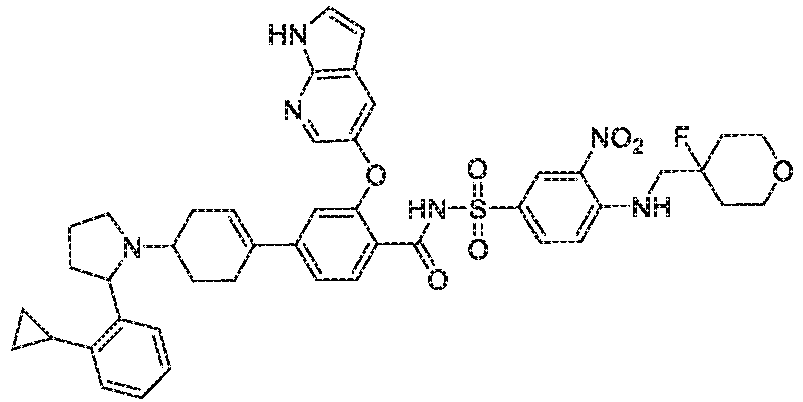
- The desired compound was synthesized with 4-(((4-fluorotetrahydro-2H-pyran-4-yl)methyl)amino)-3-nitrobenzenesulfonamide and 3-((1 H-pyrrolo[2,3-b]pyridin-5-yl)oxy)-4'-(2-(2-cyclopropylphenyl)pyrrolidin-1-yl)-2',3',4',5'-tetrahydro-[1,1 '-biphenyl]-4-carboxylic acid following the procedures similar to those in Example G8, and was afforded. 1H NMR (400 MHz, DMSO-d6 ) δ ppm: 12.20 (br, 1H), 11.60 (s, 1H), 8.46 (s, 2H), 7.95 (s, 1H), 7.84-7.65 (m, 1H), 7.60-7.36 (m, 3H), 7.35-6.82 (m, 5H), 6.73 (s, 1H), 6.33 (s, 1H), 6.06-5.74 (m, 1H), 5.40-4.85 (m, 1H), 4.42-4.14 (m,1 H), 3.79-3.60 (m, 4H), 3.60-3.47 (m, 2H), 3.46-3.30 (m, 5H), 3.21-2.85 (m, 2H), 2.34-1.91 (m, 5H), 1.90-1.63 (m, 5H), 1.47-1.23 (m, 1H), 1.01-0.79 (m, 1 H), 0.76-0.44 (m, 2H). MS (ESI, m/e) [M+1]+ 819.1.
-

- The desired compound was synthesized with 4-(((4-fluorotetrahydro-2H-pyran-4-yl)methyl)amino)-3-nitrobenzenesulfonamide and 3-((1H-pyrrolo[2,3-b]pyridin-5-yl)oxy)-4'-((S)-2-(2-cyclopropylphcnyl)pyrrolidin-1-yl)-2',3',4',5'-tetrahydro-[1,1'-biphenyl]-4-carboxylic acid following the procedures similar to those in Example G8. MS (ESI, m/e) [M+1]+ 834.8.
- Two enantiomers G30-a (faster isomer) and G30-b (slower isomer) of G30-S were separated by chiral preparative HPLC. The chiral separation conditions are shown below. The faster enantiomer was eluted at retention time of 3.6 min to give G30-a. The slower enantiomer was eluted at retention time of 5.5 min to give C30-b.
Column CHIRAL ART Cellulose-SB Column size 2cm × 25 cm, Sum Injection 1.5 mL Mobile phase MTBE:EtOH (0.1% MSA) = 50:50 Flow rate 20mL/min Wave length UV 220 nm Temperature 25 °C Sample solution 7mg/mL in EtOH:DCM = 3:1 Prep-HPLC equipment Prep-Gilson-HPLC - Example G30-a: 1H NMR (400 MHz, DMSO-d6 ) δ ppm: 12.57 (br, 1H), 11.61 (s, 1H), 8.65-8.24 (m, 2H), 7.95 (s, 1H), 7.85-7.64 (m, 1H), 7.64-7.31 (m, 4H), 7.31-6.81 (m, 5H), 6.72 (s, 1H), 6.33 (s, 1H), 5.81 (s, 1H), 5.43-5.01 (m, 0.3H), 4.48-4.16 (m, 1H), 4.01-3.59 (m, 4H), 3.59-3.45 (m, 2H), 3.32-2.95 (m, 2H), 2.48-1.88 (m, 8H), 1.88-1.23 (m, 8H),1.00-0.79 (m, 2H), 0.75-0.41 (m, 2H). [M+1]+ 834.8. Example G30-b: 1H NMR (400 MHz, DMSO-d6 ) δ ppm: 12.51-12.04 (m, 0.4H),1 1.62 (s, 1H), 10.39-9.96 (m, 0.4H), 8.62-8.25 (m, 2H),7.91-7.83 (m, 2H), 7.95 (s, 1H), 7.60-6.85 (m, 8H), 6.73 (s, 1H), 6.33 (s, 1H), 5.98 (s, 1H), 5.28-4.89 (m, 0.5H), 4.47-3.98 (m, 0.7H), 3.81-3.61 (m, 4H), 3.59-3.45 (m, 2H), 3.32-2.79 (m, 2H), 2.49-1.95 (m, 2H), 1.94-1.23 (m, 8H), 1.04-0.79 (m, 2H), 0.78-0.42(m,2H). (MS (ESI, m/e) [M+1]' 834.8
-

- The desired compound was synthesized with 4-(((4-fluorotetrahydro-2H-pyran-4-yl)methyl)amino)-3-nitrobenzenesulfonamide and 3-((1H-pyrrolo[2,3-b]pyridin-5-yl)oxy)-4'-((R)-2-(2-cyclopropylphenyl)pyrrolidin-1-yl)-2',3',4',5'-tetrahydro-[1,1'-biphenyl]-4-carboxylic acid following the procedures similar to those in Example G8. MS (ESI, m/e) [M+1]+ 834.8
-

- The desired compound was synthesized with 4-(((4-methylmorpholin-2-yl)methyl)amino)-3-nitrobenzenesulfonamide and 3-((1H-pyrrolo[2,3-b]pyridin-5-yl)oxy)-4'-(2-(2-cyclopropylphenyl)pyrrolidin-1-yl)-2',3',4',5'-tetrahydro-[1,1'-biphenyl]-4-carboxylic acid following the procedures similar to those in Example G8. 1H NMR (400 MHz, DMSO-d6 ) δ ppm: 11.62 (s, 1H), 8.47 (s, 2H), 7.95 (s, 1H), 7.74 (s, 1H), 7.60 - 7.34 (m, 4H), 7.29-7.21 (m, 1H), 7.11-7.10 (m, 2H), 6.98-6.89 (m, 2H), 6.73-6.69 (m, 1H), 6.34 (s, 1H), 5.99-5.80 (m, 1H), 4.29 (s, 1H), 3.91 (s, 1H), 3.80 (s, 1H), 3.63-3.57 (m, 1H), 3.51-3.44 (m, 2H), 3.12-2.99 (m, 7H), 2.45 - 2.40 (m, 1H), 2.20-2.12 (m, 4H), 2.02-1.97 (m, 4H), 1.71 (s, 2H), 1.47-1.44 (m, 2H), 1.28 (s, 2H), 0.96-0.84 (m, 4H). MS (ESI, m/e) [M/2+1]' 832.8.
-

- The desired compound was synthesized with 4-(((4-acetylmorpholin-2-yl)methyl)amino)-3-nitrobenzenesulfonamide and 3-((1H-pyrrolo[2,3-b]pyridin-5-yl)oxy)-4'-(2-(2-cyclopropylphenyl)pyrrolidin-1-yl)-2',3',4',5'-tetrahydro-[1,1'-biphenyl]-4-carboxylic acid following the procedures similar to those in Example G8. 1H NMR (400 MHz, DMSO-d6 ) δ ppm: 11.52 (s, 1H), 8.40 - 8.33(m, 2H), 7.90 (s, 1H), 7.72 - 7.49 (m, 2H), 7.48 (d, J=7.2 Hz, 1H), 7.42 (s, 1H), 7.33 - 7.27 (m, 1H), 7.15 - 6.81 (m, 5H), 6.72 (s, 1H), 6.29 (s, 1H), 5.99 (s, 0.5H), 5.79 (s, 0.5H), 4.36 - 4.25 (m, 2H), 4.14 - 3.82 (m, 2H), 3.67 - 3.34 (m, 6H), 3.22 - 2.98 (m, 1H), 2.72 -2.56 (m, 2H), 2.40 - 2.11 (m, 4H), 2.05-1.90 (m, 6H), 1.78 - 1.65 (m, 2H), 1.60 - 1.35 (m, 2H), 0.95 - 0.81 (m, 2H), 0.71 - 0.47 (m, 2H). MS (ESI, m/e) [M+1]+ 859.8.
-

- The desired compound was synthesized with 4-((4-fluoro-1-(oxetan-3-yl)piperidin-4-yl)methoxy)-3-nitrobenzenesulfonamide and 3-((1H-pyrrolo[2,3-b]pyridin-5-yl)oxy)-4'-((S)-2-(2-cyclopropylphenyl)pyrrolidin-1-yl)-2',3',4',5'-tetrahydro-[1,1'-biphenyl]-4-carboxylic acid following the procedures similar to those in Example G8. 1H NMR (400 MHz, DMSO-d6 ) δ ppm: 11.59 (s, 1H), 10.23-9.66 (m, 1H), (8.18 (s, 1H),, 7.98-7.90 (m, 1H), 7.90-7.69 (m, 2H), 7.62-7.42 (m, 2H), 7.42-7.13 (m, 3H), 7.13-6.82 (m, 3H), 6.82-6.68 (m, 1H), 6.33 (s, 1H), 6.07-5.70 (m, 1H), 5.36-5.01 (m, 1H), 4.55 (t, J = 6.5 Hz, 2H), 4.45 (t, J = 5.7 Hz, 2H), 4.26 (d, J = 20.3 Hz, 2H), 3.94-3.57 (m, 1H), 3.57-3.37(m, 3H), 3.21-2.87 (m, 1H), 2.72-2.54 (m, 3H), 2.47-1.67 (m, 14H), 1.04-1.34 (m, 1H), 1.02-0.79 (m, 2H), 0.79-0.44 (m, 2H). MS (ESI, m/e) [M+1]+ 890.8.
- Two enantiomers G35-a (faster isomer) and G35-b (slower isomer) were separated by chiral preparative HPLC. The chiral separation conditions are shown below. The faster enantiomer was eluted at retention time of 4.6 min to give G35-a. The slower enantiomer was eluted at retention time of 6.0 min to give G35-b.
Column CHIRAL ART Cellulose-SB Column size 2cm × 25 cm, Sum Injection 0.5 mL Mobile phase MtBE:MeOH (0.2% MSA) = 70:30 Flow rate 20ml/min Wave length UV 220 nm Temperature 25°C Sample solution 16mg/ml in MeOH:DCM = 3:1 Prep-HPLC equipment Prep-Gilson-HPLC - Example G35-a : 1H NMR (400 MHz, DMSO-d6 )δ ppm: 11.60 (s, 1H), 9.44-9.06 (m, 1H), 8.38-8.08 (m, 1H), 8.08-7.76 (m, 2H), 7.76-6.83 (m, 9H), 6.83-6.66 (m, 1H), 6.34 (s, 1H), 5.94-5.65 (m, 1H), 5.37-5.11 (m, 1H), 4.63-4.51 (m, 2H), 4.51-4.39 (m, 2H), 4.39-4.14 (m, 2H), 3.82-3.63 (m, 1H), 3.63-3.41 (m, 2H), 3.18-2.77 (m, 2H), 2.77-2.55 (m, 3H), 2.42-1.62 (m, 14H), 1.62-1.38 (m, 1H), 0.96-0.84 (m, 2H), 0.80-0.55 (m, 2H). MS (ESI, m/e) [M+1]' 890.8. Example G35-b: 1H NMR (400 MHz, DMSO-d6) δ ppm: 11.60 (s, 1H), 9.58-9.27 (m, 1H), 8.29-8.10 (m, 1H), 8.05-7.75 (m, 2H), 7.67-7.53 (m, 1H), 7.53-7.42 (m, 2H), 7.42-7.16 (m, 3H), 7.16-6.86 (m, 3H), 6.74 (s, 1H), 6.33 (s, 1H), 6.03-5.91 (m, 1H), 5.25-4.99 (m, 1H), 4.60-4.50 (m, 2H), 4.50-4.38 (m, 2H), 4.36-4.18 (m, 2H), 3.74-3.32 (m, 4H), 3.24-2.86 (m, 1H), 2.79-2.53 (m, 3H), 2.46-1.58 (m, 14H), 1.53-1.35 (m, 1H), 1.03-0.88 (m, 2H), 0.77-0.49 (m, 2H). MS (ESI, m/e) [M+1]+ 890.8.
-

- The desired compound was synthesized with 4-((4-fluoro-1-(tetrahydro-2H-pyran-4-yl)piperidin-4-yl)methoxy)-3-nitrobenzenesulfonamide and 3-((1H-pyrrolo[2,3-b]pyridin-5-yl)oxy)-4'-(2-(2-cyclopropylphenyl)pyrrolidin-1-yl)-2',3',4',5'-tetrahydro-[1,1'-biphenyl]-4-carboxylic acid following the procedures similar to those in Example G8. 1H NMR (400 MHz, DMSO-d6 )δ ppm: 11.56 (s, 1H), 9.33 (s, 1H), 8.19 (s, 1H), 8.01 - 7.79 (m, 2H), 7.59 - 7.39 (m, 3H), 7.39 - 7.15 (m, 3H), 7.10-7.01 (m, 3H), 6.93 - 6.83 (m, 1H), 6.72 (s, 1H), 6.32 (s, 1H), 5.98 (s, 0.5H), 5.79 (s, 0.5H), 4.41-4.25 (m, 3H), 3.98-3.95 (m, 2H), 3.31-3.21 (m, 5H), 3.10-2.85 (m, 3H), 2.28-1.81 (m, 15H), 1.74 - 1.39 (m, 8H), 0.99 - 0.79 (m, 4H). MS (ESI, m/e) [M+1]+ 918.8.
-

- The desired compound was synthesized with (R)-3-nitro-4-(((1-(oxetan-3-yl)pyrrolidin-3-yl)methyl)amino)benenesulfonamide and 3-((1H-pyrrolo[2,3-b]pyridin-5-yl)oxy)4'-(2-(2-cyclopropylphcnyl)pyrrolidin-1-yl)-2',3',4',5'-tetrahydro-[1,1'-biphenyl]-4-carboxylic acid following the procedures similar to those in Example G8. 1H NMR (400 MHz, DMSO-d6) δ ppm: 11.62 (s, 1H), 8.67-8.58 (m, 1H), 8.46 (s, 1H), 7.95 (s, 1H), 7.80-7.52 (m, 2H), 7.51-7.44 (m, 2H), 7.43-7.35 (m, 1H), 7.29-7.01 (m, 3H), 6.99-6.86 (m, 2H), 6.73 (s, 1H), 6.34 (s, 1H), 6.01-5.76 (m, 1H), 465-4.44 (m, 4H), 4.38-4.23 (m, 1H), 3.79-3.63 (m, 1H), 3.24-2.85 (m, 2H), 2.83-2.69 (m, 1H), 2.66-2.54 (m, 6H), 2.29-2.10 (m, 3H), 2.10-1.89 (m, 4H), 1.80-1.67 (m, 3H), 1.61-1.50 (m, 2H), 1.28-1.07 (m, 4H), 0.99-0.81 (m, 3H), 0.80-0.45 (m, 3H). MS (ESI, m/e) [M+1]+ 857.8.
-

- The desired compound was synthesized with (S)-3-nitro-4-(((1-(oxetan-3-yl)pyrrolidin-3-yl)methyl)amino)benzenesulfonamide and 3-((1H-pyrrolo[2,3-b]pyridin-5-yl)oxy)4'-(2-(2-cyclopropylphcnyl)pyrrolidin-1-yl)-2',3',4',5'-tetrahydro-[1,1'-biphenyl]-4-carboxylic acid following the procedures similar to those in Example G8. 1H NMR (400 MHz, DMSO-d6 )δ ppm: 12.00 (s, 1H), 11.66 (s, 1H), 10.42-9.76 (m, 1H), 8.68 (s, 1H), 8.50 (s, 1H), 7.97 (s, 1H), 7.77 (s, 1H), 7.55-7.37 (m, 4H), 7.37-7.20 (m, 2H), 7.17-6.91 (m, 4H), 6.74 (s, 1H), 6.36 (s, 1H), 6.03-5.82 (m, 1H), 5.26-5.06 (m, 1H), 4.62 (s, 5H), 3.50-3.34 (m, 5H), 3.04-2.86 (m, 2H), 2.71-2.60 (m, 3H), 2.33 (s, 2H), 2.04-1.97 (m, 3H), 1.80-1.53 (m, 3H), 1.52-1.38 (m, 1H), 0.98-0.83 (m, 4H), 0.76-0.63 (m, 1H), 0.62-0.51 (m, 1H).MS (ESI) m/e [M+1]+ 857.8.
-

- The desired compound G43a was synthesized with (cis- or trans-)4-(((4-ethyl-4-hydroxycyclohexyl)methyl)amino)-3-nitrobenzenesulfonamide (faster peak in HPLC) and 3-((1H-pyrrolo[2,3-b]pyridin-5-yl)oxy)-4'-((S)-2-(2-cyclopropylphenyl)pyrrolidin-1-yl)-2',3',4',5'-tetrahydro-[1,1'-biphenyl]-4-carboxylic acid following the procedures similar to those in Example G8. 1H NMR (400 MHz, DMSO- d6 ) δ ppm: 12.43 (br, 0.4H), 11.65 (s, 1H), 8.65-8.26 (m, 2H), 7.97 (s, 1H), 7.83-7.66 (m, 1H), 7.66-6.80 (m, 9H), 6.08-5.70 (m, 1H), 6.73 (s, 1H), 6.35 (s, 1H), 5.47-4.93 (m, 0.5H), 4.61-4.08 (m, 0.5H), 3.77 (s, 1H), 3.26-3.14 (m, 2H), 2.40-1.65 (m, 9H), 1.60-1.07 (m, 15H), 1.00-0.76 (m, 6H), 0.73-0.39 (m, 2H). MS (ESI, m/e) [M+1]+ 840.8; The desired compound G43b was synthesized with (trans- or cis-)4-(((4-ethyl-4-hydroxycyclohexyl)methyl)amino)-3-nitrobenzenesulfonamide (slower peak in HPLC) and 3-((1H-pyrrolo[2,3-b]pyridin-5-yl)oxy)-4'-((S)-2-(2-cyclopropylphenyl)pyrrolidin-1-yl)-2',3',4',5'-letrahydro-[1,1'-biphenyl]-4-carboxylic acid following the procedures similar to those in Example G8. 1H NMR (400 MHz, DMSO- d6 ) δ ppm: 12.34 (br, 1H), 11.64 (s, 1H), 8.72-8.23 (m, 2H), 7.97 (s, 1H), 7.87-6.79 (m, 10 H), , 6.73 (s, 1H), 6.35 (s, 1H), 6.10-5.67 (m, 1H), 5.44-4.92 (m, 0.4H), 4.46-4.12 (m, 0.6H), 3.98 (s, 1H), 3.27-3.18 (m, 2H), 2.38-1.83 (m, 7H), 1.82-1.50 (m, 7H), 1.50-1.33 (m, 3H), 1.33-1.15 (m, 4H), 1.15-0.99 (m, 3H), 0.98-0.76 (m, 6H), 0.76-0.41 (m, 2H). MS (ESI, m/e) [M+1]+ 840.8.
-

- The desired compound was synthesized with 4-((1-cyclopropyl-4-fluoropiperidin-4-yl)methoxy)-3-nitrobenzenesulfonamide and 3-((1H-pyrrolo[2,3-b]pyridin-5-yl)oxy)-4'-(2-(2-cyclopropylphenyl)pyrrolidin-1-yl)-2',3',4',5'-tetrahydro-[1,1'-biphenyl]-4-carboxylic acid following the procedures similar to those in Example G8. 1H NMR (400 MHz, DMSO-d6 ) δ ppm: 12.53 (s, 1H), 11.71 (s, 1H), 9.95 (s, 1H), 9.31 (s, 2H), 8.37-7.68 (m, 3H), 7.54 - 7.46 (m, 2H), 7.32 - 7.20 (m, 2H), 7.15-7.07 (m, 2H), 6.75 (d, J = 4.5 Hz, 1H), 6.38 (s, 1H), 5.97-5.88 (m, 1H), 5.31-5.22 (m, 1H), 4.38 (d, J = 19.7 Hz, 2H), 3.73-3.55 (m, 3H), 2.97 (s, 4H), 2.41 (s, 1H), 2.24 - 1.95 (m, 8H), 1.90 (s, 1H), 1.66 - 1.55 (m, 1H), 1.49-1.45 (m, 2H), 1.06 (s, 2H), 0.94 (d, J = 8.3 Hz, 2H), 0.87-0.83 (m, 2H). MS (ESI, m/e) [M+1]+ 874.8.
-

- The desired compound was synthesized with (R)-4-((1-(1,3-difluoropropan-2-yl)pyrrolidin-3-yl)amino)-3-nitrobenzenesulfonamide and 3-((1H-pyrrolo[2,3-b]pyridin-5-yl)oxy)-4'-(2-(2-cyclopropylphenyl)pyrrolidin-1-yl)-2',3',4',5'-tetrahydro-[1,1 '-biphenyl]-4-carboxylic acid following the procedures similar to those in Example G8. 1H NMR (400 MHz, DMSO-d6 )δ ppm: 12.21 (s, 0.5H), 11.62 (s, 1H), 9.41 (s, 0.5H), 8.46 (s, 1H), 8.26 (s, 1H), 7.95 (s, 1H), 7.75 (s, 1H), 7.68-7.50 (m, 1H), 7.49-7.39 (m, 3H), 7.24-7.15 (m, 3H), 7.10-6.88 (m, 2H), 6.74 (s, 1H), 6.34 (s, 1H), 5.99 (s, 0.5H), 5.82 (s, 0.5H), 4.67 (d, J = 4.6 Hz, 2H), 4.56 (d, J = 4.5 Hz, 2H), 4.17 (s, 1H), 3.09 - 2.86 (m, 5H), 2.77 (d, J = 6.9 Hz, 2H), 2.68 (d, J = 6.8 Hz, 2H), 2.35-2.16 (m, 4H), 2.12 -2.05(m, 3H), 1.77-1.59 (m, 4H), 1.32-1.14(m,3H), 0.97-0.80 (m, 4H). MS (ESI, m/e) [M+1]' 865.8.
-

- The desired compound was synthesized with 3-chloro-4-(((tetrahydro-2H-pyran-4-yl)methyl)amino)benzenesulfonamide and 3-((1H-pyrrolo[2,3-b]pyridin-5-yl)oxy)-4'-(2-(2-cyclopropylphenyl)pyrrolidin-1-yl)-2',3',4',5'-tetrahydro-[1,1'-biphenyl]-4-carboxylic acid following the procedures similar to those in Example G8. 1H NMR (400 MHz, DMSO-d6 ) δ ppm: 12.00 (s, 1H), 11.75 (s, 1H), 8.06 (s, 1H), 7.76 - 7.42 (m, 6H), 7.28-6.87 (m, 4H), 6.81 - 6.65 (m, 2H), 6.43 (s, 2H), 5.97 (s, 1H), 4.28 (s, 1H), 3.82 (d, J = 9.0 Hz, 2H), 3.75-3.61 (m, 1H), 3.29-3.20 (m, 2H), 3.07 (s, 2H), 3.00 (s, 1H), 2.16 (s, 3H), 2.05 - 1.95 (m, 3H), 1.81 (s, 1H), 1.71 (s, 1H), 1.57 (d, J = 12.3 Hz, 3H), 1.47-1.44 (m, 1H), 1.24 (s, 4H), 1.21 - 1.13 (m, 2H), 0.99 - 0.81 (m, 4H). MS (ESI, m/e) [M+1]+ 805.8.
-

- The desired compound was synthesized with 3-cyano-4-(((tetrahydro-2H-pyran-4-yl)methyl)amino)benzenesulfonamide and 3-((1H-pyrrolo[2,3-b]pyridin-5-yl)oxy)-4'-(2-(2-cyclopropylphenyl)pyrrolidin-1-yl)-2',3',4',5'-tetrahydro-[1,1'-biphenyl]-4-carboxylic acid following the procedures similar to those in Example G8. 1H NMR (400 MHz, DMSO-d6 ) δ ppm: 12.08 (s, 1H), 11.71 (s, 1H), 8.02 (s, 1H), 7.87 (s, 1H), 7.72 (s, 1H), 7.52-7.45 (m, 3H), 7.28-7.04 (m, 4H), 6.95-6.89 (m 1H), 6.78-6.66 (m, 2H), 6.40 (s, 1H), 5.98 (s, 1H), 5.79 (s, 1H), 4.33 - 4.19 (m, 1H), 3.82 (d, J= 8.8 Hz, 2H), 3.22-3.19 (m, 2H), 3.08 (s, 2H), 2.98 (s, 2H), 2.18 (s, 3H), 2.02-1.97 (m, 4H), 1.80-1.71 (m, 4H), 1.56 (d, J = 12.6 Hz, 3H), 1.45-1.39 (m, 2H), 1.23-1.15 (m, 5H). MS (ESI, m/e) [M+1]' 797.2.
-

- The desired compound was synthesized with 4-(((letrahydro-2H-pyran-4-yl)methyl)amino)-3-((trifluoromethyl)sulfonyl)benzenesulfonamide and 3-((1H-pyrrolo[2,3-b]pyridin-5-yl)oxy)-4'-(2-(2-cyclopropylphenyl)pyrrolidin-1-yl)-2',3',4',5'-tetrahydro-[1,1'-biphenyl]-4-carboxylic acid following the procedures similar to those in Example G8. 1H NMR (400 MHz, DMSO-d6 ) δ ppm: 12.30 (s, 1H), 11.69 (s, 1H), 8.09 (s, 1H), 7.99 (s, 1H), 7.87 (s, 1H), 7.78 (s, 1H), 7.50-7.45 (m, 3H), 7.29 (s, 2H), 7.14-6.96 (m, 3H), 6.73 (s, 1H), 6.38 (s, 1H), 5.97-5.80 (m, 1H), 5.25-5.11 (m, 1H), 3.83 (d, J = 8.5 Hz, 2H), 3.72-3.66 (m, 1H), 3.37 (s, 1H), 3.23-3.19 (m, 4H), 3.01-2.98 (m, 2H), 2.82-2.75 (m, 1H), 2.56 (s, 3H), 2.33 (s, 1H), 2.12 (s, 1H), 2.03-1.97 (m, 2H), 1.8-1.721 (m, 2H), 1.53 (d, J = 12.2 Hz, 2H), 1.22-1.17 (m, 8H). MS (ESI, m/e) [M+1]+ 904.1.
-

- The desired compound was synthesized with 3-nitro-4-(((1-(oxetan-3-yl)piperidin-4-yl)mcthyl)amino)bcnzcncsulfonamidc 2,2,2-trifluoroacetatc and 3-((1H-pyrrolo[2,3-b]pyridin-5-yl)oxy)-4'-(2-(2-cyclopropylphenyl)pyrrolidin-1-yl)-2',3',4',5'-tetrahydro-[1,1'-biphenyl]-4-carboxylic acid following the procedures similar to those in Example G8. 1H NMR (400 MHz, DMSO-d6 ) δ ppm: 11.61 (s, 1H), 9.81-9.27 (m, 1H), 8.56-8.32 (m, 2H), 7.94 (s, 1H), 7.71 (s, 1H),7.59-7.17 (m, 4H), 7.16-6.79 (m, 4H), 6.78-6.68 (m, 1H), 6.61-6.50 (m, 3H), 6.34 (s, 1H), 5.99-5.69 (m, 1H), 5.44-5.03 (m, 4H), 4.34-4.16 (m, 1H), 3.31-3.21 (m, 2H), 3.20-2.67 (m, 4H), 2.20-1.85 (m, 7H), 1.85-1.53 (m, 6H), 1.48-1.20 (m, 7H), 0.98-0.82 (m, 2H), 0.70-0.43 (m, 2H). MS (ESI, m/e) [M+1]+ 872.2.
- Two enantiomers G75-a (faster isomer) and G75-b (slower isomer) of 3-((1H-pyrrolo[2,3-b]pyridin-5-yl)oxy)-4'-((S)-2-(2-cyclopropylphenyl)pyrrolidin-1-yl)-N-((3-nitro4-(((1-(oxetan-3-yl)piperidin-4-yl)methyl)amino)phenyl)sulfonyl)-2',3',4',5'-tetrahydro-[1,1'-biphenyl]-4-carboxamide were separated by chiral preparative HPLC. The chiral separation conditions are shown below. The faster enantiomer was eluted at retention time of 1.1 min to give G75-a. The slower enantiomer was eluted at retention time of 1.5 min to give G75-b.
Column CHIRAL ART Cellulose-SB Column size 2cm × 25 cm, Sum Injection 1.0 mL Mobile phase CO2:[EtOH:CAN = 1:1(0.2% MSA)]= 50:50 Flow rate 40 mL/min Wave length UV 220 nm Temperature 35 °C Sample solution 26.7mg/mL in MeOH:DCM = 3:1 Prep-SFC equipment Prep-SFC-80-2 - Example G75-a: 1H NMR (DMSO-d6) δ ppm: 11.63 (s, 1H), 8.46 (s, 2H), 7.95 (s, 1H), 7.78-7.66 (m, 1H), 7.62-7.35 (m, 4H), 7.33-6.60 (m, 7H), 6.34 (s, 1H), 5.81 (s, 1H), 4.68-4.20 (m, 5H), 3.30-3.14 (m, 3H), 2.90-2.69 (m, 2H), 2.61-2.54 (m, 1H), 2.40-1.82 (m, 10H), 1.80-1.18 (m, 10H), 0.98-0.80 (m, 2H), 0.74-0.44 (m, 2H). MS (ESI, m/e) [M+1]+ 871.8. Example G75-b: 1H NMR (CDCl3-d6) δ ppm: 9.45 (s, 1H), 8.90 (s, 1H), 8.52 (s, 1H), 8.25-7.90 (m, 3H), 7.78-7.38 (m, 3H), 7.18-6.78 (m, 5H), 6.58 (d, J = 36.8Hz, 2H), 5.95 (s, 1H), 4.75-4.54 (m, 4H), 4.42-4.16 (m, 1H), 3.57-3.40 (m, 1H), 3.33-3.05 (m, 3H), 2.89-2.52 (m, 4H), 2.38-2.09 (m, 6H), 1.97-1.79 (m, 8H), 1.50-1.33 (m, 4H), 0.92-0.84 (m, 2H), 0.72-0.50 (m, 2H).MS (ESI, m/e) [M+1]+ 871.8.
-

- With (R)-4-(((1,4-dioxan-2-yl)methyl)amino)-3-nitrobenzenesulfonamide and (trans- or cis-) 2-((1H-pyrrola[2,3-b]pyridin-5-yl)oxy)-4-(4-(2-(2-cyclopropylphenyl)pyrrolidin-1-yl)cyclohexyl)benzoic acid, the desired compound was afforded following the similar procedure of Example D2b. 1H NMR (400 MHz, DMSO-d6 ) δ ppm: 12.17 (br, 1H), 11.60 (s, 1H), 8.66-8.10 (m, 2H), 7.93 (s, 1H), 7.83-7.18(m, 6H), 7.18-6.71 (m, 4H), 6.59 (s, 1H), 6.33 (s, 1H), 5.24-5.06 (m, 1H), 3.83-3.71 (m, 3H), 3.71-3.58 (m, 2H), 3.53-3.39 (m, 3H), 3.22-2.79 (m, 5H), 2.25-1.56 (m, 9H), 1.50-1.26 (m, 4H), 0.96-0.82 (m, 2H), 0.75-0.48 (m, 2H). MS (ESI, m/e) [M+1]+ 821.2.
-

- The desired compound was synthesized with (R)-4-(((1,4-dioxan-2-yl)methyl)amino)-3-nitrobenzenesulifonamide and (trans- or cis-) (S)-2-((1H-pyrrolo[2,3-b]pyridin-5-yl)oxy)-4-(4-(2-(2-cyclopropylphenyl)pyrrolidin-1-yl)cyclohexyl)benzoic acid following the procedures similar to those in Example D2b. 1H NMR (400 MHz, DMSO-d6 ) δ ppm: 11.61 (s, 1H), 8.50-8.35 (m, 2H), 7.93 (s, 1H), 7.74-7.72 (d, 1H, J=8.8), 7.65-7.55 (m, 1H), 7.50-7.45 (m, 1H), 7.44-7.38 (m, 2H), 7.30-7.10 (m, 2H), 7.08-6.87 (m, 3H), 6.59 (s, 1H), 6.34 (s, 1H), 3.82-3.73 (m, 3H), 3.61-3.55 (m, 2H), 3.53-3.40 (m, 3H), 3.33-3.26 (m, 3H), 3.18-3.14 (m, 1H), 2.43-2.26 (m, 2H), 2.10-1.84 (m, 4H), 1.81-1.53 (m, 4H), 1.47-1.07 (m, 5H), 0.98-0.83 (m, 2H), 0.76-0.64 (m, 1H), 0.61-0.50 (m, 1H). MS (ESI, m/e) [M+1]+ 821.2.
-

- With (S)-4-(((1,4-dioxan-2-yl)methyl)amino)-3-nitrobenzenesulfonamide instead of 3-nitro-4-(((tetrahydro-2H-pyran-4-yl)methyl)amino)benzenesulfimamide, the desired compound was afforded by following the similar procedure of Example D2b. 1H NMR (400 MHz, DMSO-d6 ) δ ppm: 12.18 (br, 1H), 11.60 (s, 1H), 8.59-8.20 (m, 2H), 7.93 (s, 1H), 7.87-7.20 (m, 6H), 7.20-6.79 (m, 4H), 6.60 (s, 1H), 6.33 (s, 1H), 5.32-4.91 (m, 1 H), 3.86-3.71 (m, 3H), 3.71-3.54 (m, 2H), 3.54-3.38 (m, 3H), 3.31-2.79 (m, 5H), 2.21-1.54 (m, 9H), 1.53-1.23 (m, 4H), 1.02-0.81 (m, 2H), 0.78-0.40 (m, 2H). MS (ESI, m/e) [M+1]+ 821.2.
-

- The desired compound was synthesized with (S)-4-(((1,4-dioxan-2-yl)methyl)amino)-3-nitrobenzenesulfonamide and (trans- or cis-) (S)-2-((1H-pyrrolo[2,3-b]pyridin-5-yl)oxy)-4-(4-(2-(2-cyclopropylphenyl)pyrrolidin-1-yl)cyclohexyl)benzoic acid following the procedures similar to those in Example D2b. 1H NMR (400 MHz, DMSO-d6 ) δ ppm: 12.19 (br, 1H), 11.61 (s, 1H), 8.61 - 8.21 (m, 2H), 7.93 (s, 1H), 7.85 - 7.63 (m, 2H), 7.62 - 7.38 (m, 3H), 7.34 - 6.80 (m, 5H), 6.60 (s, 1H), 6.34 (s, 1H), 5.23 - 5.03 (m, 0.5H), 4.49 - 4.12 (m, 0.5H), 3.84 - 3.72 (m, 3H), 3.68 - 3.55 (m, 2H), 3.52 - 3.40 (m, 2H), 3.32 - 3.27 (m, 4H), 3.21 - 2.99 (m, 1H), 2.41 - 1.11 (m, 14H), 1.03 - 0.80 (m, 2H), 0.79 - 0.44 (m, 2H). MS (ESI, m/e) [M+1]+ 821.2.
-

- The desired compound was synthesized with (cis- or trans-)4-((4-((tert-bulyldimelhylsilyl)oxy)cyclohexyl)melhoxy)-3-nitrobenzenesulfonamide and 3-((1H-pyrrolo[2,3-b]pyridin-5-yl)oxy)-4'-((S)-2-(2-cyclopropylphenyl)pyrrolidin-1-yl)-2',3',4',5'-tetrahydro-[1,1'-biphenyl]-4-carboxylic acid following the procedures similar to those in Example G8. MS (ESI, m/e) [M+1]+ 954.8.
-

- The desired compound was synthesized with (trans- or cis-)4-((4-((tertbutyldimethylsilyl)oxy)cyclohexyl)methoxy)-3-nitrobcnzenesulfonamide and 3-((1H-pyrrolo[2,3-b]pyridin-5-yl)oxy)-',-((S)-2-(2-cyclopropylphenyl)pyrrolidin-1-yl)-2',3',4',5'-tetrahydro-[1,1'-biphenyl]-4-carboxylic acid following the procedures similar to those in Example G8. MS (ESI, m/e) [M+1]+ 954.8.
-

- 1H NMR (400 MHz, DMSC)-d6 ) δ ppm: 12.91 (br, 1H), 11.61 (s, 1H), 8.16 (s, 1H), , 7.94 (s, 1H), 7.90-7.64 (m, 2H), 7.64-6.83 (m, 8H), 6.33 (s, 1H), 6.07-5.74 (m, 1H), 5.38-4.95 (m, 0.7H), 4.40-4.14 (m, 1H), 4.04-3.86 (m, 2H), 3.85-3.38 (m, 3H), 3.25-2.84 (m, 1H), 2.46-1.80 (m, 8H), 1.80-1.24 (m, 11H), 1.02-0.79 (m, 2H), 0.78-0.43 (m, 2H). MS (ESI, m/e) [M+1]+ 831.8.
- After deprotection of tert-butyldimethyl-silanyl for G80b, Example G81b: (trans- or cis-) 3-((1H-pyrrolo[2,3-b]pyridin-5-yl)oxy)-4'-((S)-2-(2-cyclopropylphcnyl)pyrrolidin-1-yl)-N-((4-((4-hydroxycyclohexyl)methoxy)-3-nitrophenyl)sulfonyl)-2',3',4',5'-tetrahydra-[1,1'-biphenyl]-4-carboxamide was obtained. 1H NMR (400 MHz, DMSO-d6 ) δ ppm: 12.77 (br, 1 H), 11.62 (s, 1H), 8.18 (s, 1H), 7.94 (s, 1H), 7.90-7.75 (m, 1H), 7.75-6.83 (m, 9H), 6.74 (s, 1H), 6.34 (s, 1H), 6.08-5.09 (m, 1H), 5.42-4.92 (m, 0.7H), 4.61-4.47 (m, 1H), 4.03-3.82 (m, 2H), 3.82-3.35 (m, 3H), 3.23-2.89 (m, 1H), 2.40-1.44 (m, 14H), 1.22-1.00(m, 5H), 0.98-0.87 (m, 2H), 0.79-0.47(m, 2H). MS (ESI, m/e) [M+1]+ 831.8.
-

- The desired compound was synthesized with N-(2-nilro-4-sulfamoylphenyl)morpholine-4-carboxamide and 3-((1H-pyrrolo[2,3-b]pyridin-5-yl)oxy)-4'-(2-(2-cyclopropylphenyl)pyrrolidin-1-yl)-2',3',4',5'-tetrahydro-[1,1'-biphenyl]-4-carboxylic acid following the procedures similar to those in Example G8. 1H NMR (400 MHz, DMSO-d6 ) δ ppm: 12.48 (s, 1H), 11.67 (s, 1H), 9.67 (s, 1H), 8.33 (s, 1H), 8.00 - 7.99 (m, 2H), 7.99 -7.78 (m, 2H), 7.49 -7.47 (m, 3H), 7.30 -7.25 (m, 2H), 7.12 - 7.10 (m, 2H), 6.71(s, 1H), 6.38 (s, 1H), 6.02 - 5.76 (m, 1H), 5.22 - 5.10 (m, 1H), 3.61 - 3.52 (m, 4H), 3.47 - 3.44 (m, 4H), 3.25 - 3.22 (m, 3H), 2.45 - 2.04 (m, 8H), 2.02 - 1.48 (m, 3H), 0.93 - 0.84 (m, 2H), 0.62 - 0.55 (m, 2H). MS (ESI, m/e) [M+1]+ 831.8.
-

- The desired compound was synthesized following the procedures similar to those in Example A1 by replacing 2-phenylpyrrolidine with (S)-2-(2-isopropylphenyl)pyrrolidine, and 3-nitro-4-(((tetrahydro-2H-pyran-4-yl)methyl)amino)benzenesulfonamide with 4-(((4-fluorotetrahydro-2H-pyran-4-yl)methyl)amino)-3-nitrobenzenesulfonamide. 1H NMR (400 MHz, DMSO-d6) δ ppm:12.17 (s, 1H), 11.70 (s, 1H), 8.64 (s, 1H), 8.57 (s, 1H), 8.05 (d, J = 2.1 Hz, 1H), 7.84 (d, J = 9.0 Hz, 1H), 7.59 (s, 1H), 7.54-7.51 (m, 2H), 7.37 - 7.23 (m, 5H), 7.17 (t, J = 7.4 Hz, 1H), 6.98 (t, J = 7.4 Hz, 1H), 6.91 (s, 1H), 6.82 (d, J = 7.6 Hz, 1H), 6.37-6.35 (m, 2H), 4.99 (d, J = 7.9 Hz, 1H), 3.79 - 3.67 (m, 5H), 3.54-3.52 (m, 2H), 3.38-3.29 (m, 2H), 2.06 - 1.92 (m, 2H), 1.86-1.75 (m, 6H), 1.27 - 1.23 (m, 6H). MS (ESI, m/e) [M+1]+ 832.8.
-

- The desired compound was synthesized following the procedures similar to those in Example A1 by replacing 2-phenylpyrrolidine with (R)-2-(2-isopropylphenyl)pyrrolidine, and 3-nitro-4-(((tetrahydro-2H-pyran-4-yl)methyl)amino)benzenesulfonamide with 4-(((4-fluorotetrahydro-2H-pyran-4-yl)methyl)amino)-3-nitrobenzenesulfonamide. 1H NMR (400 MHz, DMSO-d6 )δ ppm: 12.17 (s, 1H), 11.69 (s, 1H), 8.62-8.56 (m, 2H), 8.04 (s, 1H), 7.82 (s, 1H), 7.58-7.50 (m, 3H), 7.35-7.29 (m, 4H), 7.19-7.15 (m, 2H), 7.00-6.97 (m, 1H), 6.91 (s, 1H), 6.82 (d, J = 7.6 Hz, 1H), 6.66 (s, 1H), 6.37-6.35 (m, 3H), 4.99 (d, J = 7.7 Hz, 1H), 3.73-3.66 (m, 5H), 3.54-3.48 (m, 2H), 3.38-3.32 (m, 2H), 2.55 (s, 1H), 2.03-1.97 (m, 4H), 1.84-1.75 (m, 3H), 1.47-1.45 (m, 1H), 1.28-1.25 (m, 6H). MS (ESI, m/e) [M+1]' 832.8.
-
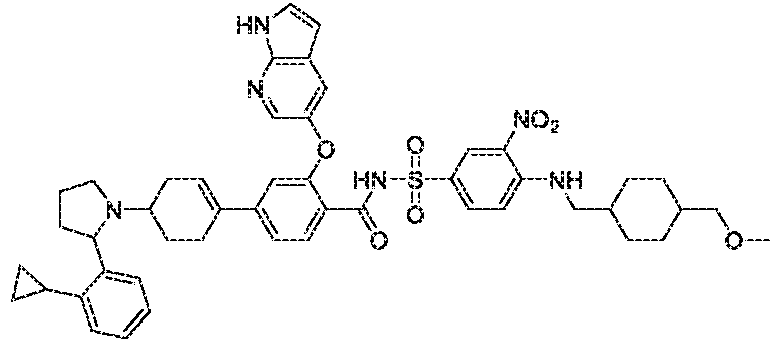
- The desired compound was synthesized with 4-(((4-(methoxymethyl)cyclohexyl)methyl)amino)-3-nitrobenzenesulfonamide and 3-((1H-pyrrolo[2,3-b]pyridin-5-yl)oxy)-4'-(2-(2-cyclopropylphenyl)pyrrolidin-1-yl)-2',3',4',5'-tetrahydro-[1,1'-biphenyl]-4-carboxylic acid following the procedures similar to those in Example G8. 1H NMR (400 MHz, DMSO-d6 ) δ ppm: 12.23 (br, 1H), 11.64 (s, 1H), 8.50 - 8.40 (m, 2H), 7.97 (s, 1H), 7.85 - 7.50 (m, 2H), 7.49 -7.44 (m, 3H), 7.40 -7.19 (m, 1H), 7.13 -7.05 (m, 2H), 7.01 - 6.85 (m, 2H), 6.72 (s, 1H), 6.35 (s, 1H), 5.99 (s, 0.5H), 5.81 (s, 0.5H), 5.30 - 5.12 (m, 0.5H), 4.30-4.26 (m, 0.5H), 3.33-3.21 (m, 5H), 3.12 (d, J=6.0 Hz, 2H), 3.06 - 2.90 (m, 2H), 2.29 - 2.10 (m, 4H), 2.08 - 1.95 (m, 4H), 1.81 - 1.67 (m, 6H), 1.58 - 1.41 (m, 5H), 1.02-0.81 (m, 5H), 0.67 - 0.50 (m, 2H). MS (ESI, m/e) [M+1]+ 858.9.
-
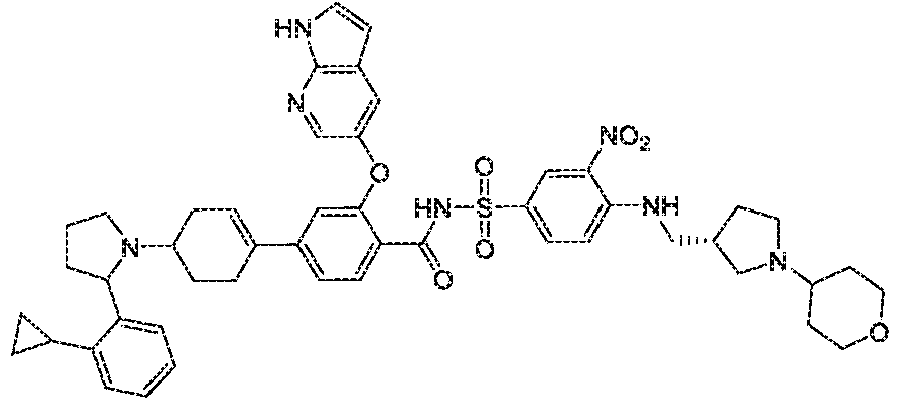
- The desired compound was synthesized with (S)-3-nitro-4-(((1-(tetrahydro-2H-pyran-4-yl)pyrrolidin-3-yl)methyl)amino)bcnzenesulfonamide and 3-((1H-pyrrolo[2,3-b]pyridin-5-yl)oxy)-4'-(2-(2-cyclopropylphenyl)pyrrolidin-1-yl)-2',3',4',5'-tetrahydro-[1,1'-biphenyl]-4-carboxylic acid following the procedures similar to those in Example G8. 1H NMR (400 MHz, DMSO-d6 ) δ ppm: 11.55 (s, 1H), 9.62 (s, 1H), 8.64-8.34 (m, 2H), 7.92 (s, 1H), 7.76-7.53 (m, 2H), 7.52-7.40 (m, 3H), 7.31 (s, 1H), 7.10-6.96 (m, 3H), 6.90-6.85 (m, 2H), 6.75-6.68 (m, 1H), 6.31 (s, 1H), 6.04-5.70 (m, 1H) 3.87 (s, 2H), 3.30-3.10 (m, 5H), 3.05-2.83 (m, 3H), 2.27-2.13 (m, 3H), 2.06-1.91 (m, 4H), 1.72 (s, 3H), 1.55-1.36 (m, 5H), 1.33-1.24 (m, 3H), 0.96-0.80 (m, 4H), 0.65 (s, 1H), 0.51 (s, 1H). MS (ESI) m/e [M+1]+ 885.9.
-

- The desired compound was synthesized following the procedures similar to those in Example A1 by replacing 2-phenylpyrrolidine with (S)-2-(2-isopropylphenyl)pyrrolidine, and replacing 3-nitro-4-(((tetrahydro-2H-pyran-4-yt)methyl)amino)benzenesutfonamide with (S)-4-(((1,4-dioxan-2-yl)methyl)amino)-3-nitrobenzenesulfonamide. 1H NMR (400 MHz, DMSO-d6 ) δ ppm: 12.17 (s, 1H), 11.68 (s, 1H), 8.56 (s, 1H), 8.04 (s, 1H), 7.82 (s, 1H), 7.57-7.50 (m, 3H), 7.35-7.30(m, 4H), 7.20-7.15 (m, 3H), 6.99 (t, J = 7.5 Hz, 1H), 6.92 (s, 1H), 6.82 (d, J = 7.1 Hz, 1H), 6.67 (s, 1H), 6.37-6.35 (m, 2H), 4.99 (d, J = 8.4 Hz, 1H), 3.80-3.75 (m, 3H), 3.73 - 3.56 (m, 4H), 3.51 - 3.44 (m, 2H), 3.37-3.28 (m, 2H), 2.43 (s, 1H), 1.91 - 1.84 (m, 1H), 1.72-1.67 (m, 1H), 1.47-1.44 (m, 2H), 1.23 (s, 6H). MS (ESI, m/e) [M+1]+ 816.8.
-

- The desired compound was synthesized following the procedures similar to those in Example A1 by replacing 2-phenylpyrrolidine with (S)-2-(2-isopropylphenyl)pyrrolidine, and replacing 3-nitro-4-(((tetrahydro-2H-pyran-4-yl)methyl)amino)benzenesulfonamide with (R)-4-(((1,4-dioxan-2-yl)methyl)amino)-3-nitrobenzenesulfonamidc. 1H NMR(400 MHz, DMSO-d6 ) δ ppm: 12.17 (s, 1H), 11.69 (s, 1H), 8.59-8.56 (m, 2H), 8.04 (s, 1H), 7.83 (d, J = 8.4 Hz, 1H), 7.57-7.50 (m, 3H), 7.35-7.30 (m, 4H), 7.17-7.10 (m, 3H), 6.98 (t, J = 7.5 Hz, 1H), 6.92 (s, 1H), 6.82 (d, J = 7.6 Hz, 1H), 6.37-6.35 (m, 2H), 4.99 (d, J = 7.8 Hz, 1H), 3.83 -3.75 (m, 3H), 3.70-3.58 (m, 4H), 3.53 - 3.43 (m, 2H), 3.37 - 3.29 (m, 2H), 2.43 - 2.40 (m, 1H), 1.90-1.84 (m, 1H), 1.72.-167 (m, 1H), 1.46-1.43 (m, 1H), 1.30 - 1.23 (m, 7H). MS (ESI, m/e) [M+1]' 816.8.
-

- The desired compound was synthesized with 4-(((4-fluorotetrahydro-2H-pyran-4-yl)methyl)amino)-3-nitrobenzenesulfonamide and 3-((1H-pyrrolo[2,3-b]pyridin-5-yl)oxy)-4'-((S)-2-(2-ethylphenyl)pyrrolidin-1-yl)-2',3',4',5'-tetrahydro-[1,1'-biphenyl]-4-carboxylic acid following the procedures similar to those in Example G8. 1H NMR (DMSO-d6) δ ppm: 11.64 (s, 1H), 8.59-8.15 (m, 2H), 7.94 (s, 1H), 7.71 (d, J = 8.4Hz, 1H), 7.55-6.90 (m, 8H), 6.75 (s, 1H), 6.32 (s, 1H), 5.98-5.77 (m, 1H), 3.81-3.61 (m, 4H), 3.59-3.37 (m, 7H), 2.83-2.60 (m, 2H), 2.44-1.93 (m, 7H), 1.88-1.35 (m, 6H), 1.24-1.03 (m, 3H). MS (ESI, m/e) [M+1]+ 822.8.
- Two enantiomers G90-a (faster isomer) and G90-b (slower isomer) were separated by chiral preparative HPLC. The chiral separation conditions are shown below. The faster enantiomer was eluted at retention time of 3.7 min to give G90-a. The slower enantiomer was eluted at retention time of 5.5 min to give G90-b.
Column CHIRAL ART Cellulose-SB Column size 5cm × 25 cm, 5um Injection 3.0mL Mobile phase MTBE: [MeOH (0.2%MSA)] = 70:30 Flow rate 95ml/min Wave length UV 220 nm Temperature 25°C Sample solution 32mg/mL in MeOH:DCM = 3:1 Prep-HPLC equipment Prep-HPLC-YMC - Example G90-a: 1H NMR (DMSO-d6 ) δ ppm: 11.64 (s, 1H), 8.49 (s, 2H), 7.97 (s, 1H), 7.83-6.86 (m, 10H), 6.72 (s, 1H), 6.35 (s, 1H), 5.81 (s, 1H), 3.87-3.40 (m, 7H), 3.20-2.94 (m, 1H), 2.73-2.59 (m, 2H), 2.43-1.21 (m, 16H), 1.13 (t, J = 7.6Hz, 3H). MS (ESI, m/e) [M+1]+ 822.8. Example G90-b: 1H NMR (DMSO-d6 ) δ ppm: 11.63 (s, 1H), 8.48 (s, 2H), 7.96 (d, J = 2.0Hz, 1H), 7.76 (d, J = 8.0Hz, 1H), 7.64-7.39 (m, 4H), 7.34-6.97 (m, 5H), 6.72 (s, 1H), 6.35 (s, 1H), 5.98 (s, 1H), 3.80-3.46 (m, 7H), 2.77-2.55 (m, 3H), 2.45-1.21 (m, 16H), 1.14 (t, J = 7.2Hz, 3H). MS (ESI, m/e) [M+1]+ 822.8.
-

- The desired compound was synthesized following the procedures similar to those in Example A1 by replacing 2-phenylpyrrolidine with (R)-2-(2-isopropylphenyl)pyrrolidine, and replacing 3-nitro-4-(((tetrahydro-2H-pyran-4-yl)methyl)amino)benzenesulfonamide with 4-((((1r,4r)-4-hydroxy-4-methylcyclohexyl)methyl)amino)-3-nitrobcnzenesulfonamide. 1H NMR (400 MHz, DMSO-d6 ) δ ppm: 12.15 (s, 1H), 11.69 (s, 1H), 8.55 (s, 2H), 8.04 (s, 1H), 7.80 (s, 1H), 7.68 (s, 1H), 7.61-7.44 (m, 3H), 7.29 (d, J = 8.6 Hz, 2H), 7.22 (d, J = 7.4 Hz, 1H), 7.17-7.11 (m, 1H), 7.01 (t, J = 7.2 Hz, 1H), 6.91-6.82 (m, 2H), 6.36-6.34 (m, 3H), 4.92 (d, J = 7.7 Hz, 1H), 4.25 (s, 1H), 3.70 (s, 1H), 2.83-2.76 (m, 1H), 2.73-2.67(m, 1H), 2.03-1.97 (m, 5H), 1.69-1.66 (m, 3H), 1.55-1.52 (m, 2H), 1.47-1.43 (m, 1H), 1.32-1.25 (m, 6H). MS (ESI, m/e) [M+1]+ 842.8.
-

- The desired compound was synthesized following the procedures similar to those in Example A1 by replacing 2-phenylpyrrolidine with (R)-2-(2-cyclopropylphenyl)pyrrolidine, and replacing 3-nitro-4-(((tetrahydro-2H-pyran-4-yl)methyl)amino)benzenesulfonamide with 4-((((1r,4r)-4-hydroxy-4-methylcyclohexyl)methyl)amino)-3-nitrobenzenesulfonamide. 1H NMR (400 MHz, DMSO-d6 )δ ppm: 12.14 (s, 1H), 11.70 (s, 1H), 8.65-8.45 (m, 2H), 8.06 (d,J = 2.4Hz, 1H), 7.83 (dd, J = 9.2Hz, 1.6Hz, 1H), 7.65-7.45 (m, 3H), 7.40-7.22 (m, 3H), 7.17-6.96 (m, 4H), 6.93-6.78 (m, 2H), 6.47-6.27 (m, 3H), 5.20 (d, J =8.0Hz, 1H), 4.24 (s, 1H), 3.71 (t, J = 7.6Hz, 1H), 3.45-3.37 (m, 1H), 3.29-3.20 (m, 2H), 2.47-2.36 (m, 1H), 2.10-1.79 (m, 4H), 1.73-1.49 (m, 5H), 1.40-1.27 (m, 2H), 1.18-1.06 (m, 5H), 1.04-0.90 (m, 2H), 0.82-0.64 (m, 2H). MS (ESI, m/e) [M+1]+ 840.8.
-

- The desired compound was synthesized following the procedures similar to those in Example A1 by replacing 2-phenylpyrrolidine with (S)-2-(2-cyclopropylphenyl)pyrrolidine, and replacing 3-nitro-4-(((tetrahydro-2H-pyran-4-yl)methyl)amino)bcnzenesulfonamide with 4-((((1r,4r)-4-hydroxy-4-methylcyclohexyl)methyl)amino)-3-nitrobenzenesulfonamide. 1H NMR (400 MHz, DMSO-d6 ) δ ppm: 12.15 (s, 1H), 11.69 (s, 1H), 8.65-8.42 (m, 2H), 8.07-8.01 (m, 1H), 7.88-7.73 (m, 1H), 7.64-7.43 (m, 3H), 7.39-7.21 (m, 3H), 7.16-6.95 (m, 4H), 6.95-6.76 (m, 2H), 6.44-6.25 (m, 3H), 5.25-5.13 (m, 1H), 4.24 (s, 1H), 3.76-3.65 (m, 1H), 3.47-3.35 (m, 1H), 3.30-3.20 (m, 2H), 3.18-2.84 (m, 1H), 2.47-2.36 (m, 1H), 2.11-1.77 (m, 4H), 1.74-1.58 (m, 3H), 1.58-1.46 (m, 2H), 1.40-1.27 (m, 2H), 1.16-1.10 (m, 1H), 1.09 (s, 3H), 1.04-0.91 (m, 2H), 0.82-0.65 (m, 2H). MS (ESI, m/e) [M+1]+ 840.8.
-

- The desired compound was synthesized following the procedures similar to those in Example A1 by replacing 2-phenylpyrrolidine with (R)-2-(2-cyclopropylphenyl)pyrrolidine, and replacing 3-nitro-4-(((tetrahydro-2H-pyran-4-yl)methyl)amino)benzenesulfonamide with 4-((((1s,4s)-4-hydroxy-4-methylcyclohexyl)methyl)amino)-3-nitrobenzenesulfonamide. 1H NMR (400 MHz, DMSO-d 6) δ ppm: 12.14 (s, 1H), 11.70 (s, 1H), 8.66-8.48(m, 2H), 8.10-8.01 (m, 1H), 7.88-7.74 (m, 1H), 7.63-7.45 (m, 3H), 7.39-7.23 (m, 3H), 7.14-6.94 (m, 4H), 6.93-6.77 (m, 2H), 6.45-6.24 (m, 3H), 5.26-5.09 (m, 1H), 3.96 (s, 1H), 3.80-3.63 (m, 1H), 3.42-3.37 (m, 1H), 3.28-3.17 (m, 2H), 2.47-2.37 (m, 1H), 2.12-1.76 (m, 4H), 1.62-1.23 (m, 9H), 1.08 (s, 4H), 1.03-0.90 (m, 2H), 0.81-0.64 (m, 2H). MS (ESI, m/e) [M+1]+ 840.8.
-

- The desired compound was synthesized following the procedures similar to those in Example A1 by replacing 2-phenylpyrrolidine with (S)-2-(2-cyclopropylphenyl)pyrrolidine, and replacing 3-nitro-4-(((tetrahydro-2H-pyran-4-yl)methyl)amino)benzenesulfonamide with 4-((((1s,4s)-4-hydroxy-4-methylcyclohexyl)mcthyl)amino)-3-nitrobenzenesulfonamidc. MS (ESI, m/e) [M+1]+ 840.8.
-

- The desired compound was synthesized following the procedures similar to those in Example A1 by replacing 2-phenylpyrrolidine with (R)-2-(2-cyclopropylphenyl)pyrrolidine, and replacing 3-nitro-4-(((tetrahydro-2H-pyran-4-yl)methyl)amino)benzenesulfonamide with 4-(((4-fluorotetrahydro-2H-pyran-4-yl)methyl)amino)-3-nitrobenzenesulfonamide. 1H NMR (400 MHz, DMSO-d 6) δ ppm: 12.17 (s, 1H), 11.70 (s, 1H), 8.64 (s, 1H), 8.57 (s, 1H), 8.05 (s, 1H), 7.84 (d, J = 9.2 Hz, 1H), 7.65-7.44 (m, 3H), 7.37-7.22 (m, 4H), 7.14-7.06 (m, 1H), 7.05-6.96 (m, 2H), 6.92-6.81 (m, 2H), 6.45-6.32 (m, 3H), 5.28-5.10 (m, 1H), 3.82-3.68 (m, 5H), 3.63-3.49 (m, 2H), 2.48-2.40 (m, 1H), 2.08-1.70 (m, 8H), 1.09-0.89 (m, 2H), 0.84-0.74 (m, 2H). MS (ESI) m/e [M+1]' 830.7.
-

- The desired compound was synthesized following the procedures similar to those in Example A1 by replacing 2-phenylpyrrolidine with (S)-2-(2-cyclopropylphenyl)pyrrolidine, and replacing 3-nitro-4-(((tetrahydro-2H-pyran-4-yl)methyl)amino)benzenesulfonamide with 4-(((4-fluorotetrahydro-2H-pyran-4-yl)methyl)amino)-3-nitrobenzenesulfonamide. 1H NMR (400 MHz, DMSO-d 6) δ ppm: 12.15 (s, 1H), 11.69 (s, 1H), 8.69-8.58 (m, 1H), 8.58-8.52 (m, 1H), 8.10-7.99 (m, 1H), 7.89-7.77 (m, 1H), 7.63-7.45 (m, 3H), 7.41-7.21 (m, 4H), 7.16-7.05 (m, 1H), 7.05-6.96 (m, 2H), 6.90 (s, 1H), 6.87-6.80 (m, 1H), 6.44-6.28 (m, 3H), 5.29-5.07 (m, 1H), 3.82-3.65 (m, 5H), 3.59-3.46 (m, 2H), 3.43-3.36 (m, 1H), 2.47-2.34 (m, 1H), 2.14-1.67 (m, 8H), 1.07-0.88 (m, 2H), 0.83-0.63 (m, 2H). MS (ESI) m/e [M+1]' 830.8.
-

- The desired compound was synthesized following the procedures similar to those in Example A1 by replacing 2-phenylpyrrolidine with (R)-2-(2-cyclopropylphenyl)pyrrolidine, and replacing 3-nitro-4-(((tetrahydro-2H-pyran-4-yl)methyl)amino)benzenesulfonamide with (S)-4-(((1,4-dioxan-2-yl)methyl)amino)-3-nitrobenzenesulfonamide. 1H NMR (400 MHz, DMSO-d 6)δ ppm: 12.16 (s, 1H), 11.68 (s, 1H), 8.64-8.49 (m, 2H), 8.10-7.99 (m, 1H), 7.91-7.71 (m, 1H), 7.65-7.41 (m, 3H), 7.41-7.20 (m, 3H), 7.18-7.06 (m, 2H), 7.06-6.95 (m, 2H), 6.90 (s, 1H), 6.87-6.78 (m, 1H), 6.42-6.27 (m, 3H), 5.32-5.10 (m, 1H), 3.85-3.55 (m, 6H), 3.55-3.43 (m, 2H), 3.43-3.36 (m, 1H), 3.20-2.79 (m, 1H), 2.46-2.33 (m, 1H), 2.19-1.77 (m, 4H), 1.09-0.89 (m, 2H), 0.85-0.61 (m, 2H). MS (ESI, m/e) [M+1]+ 814.7.
-

- The desired compound was synthesized following the procedures similar to those in Example A1 by replacing 2-phenylpyrrolidine with (S)-2-(2-cyclopropylphenyl)pyrrolidine, and replacing 3-nitro-4-(((tetrahydro-2H-pyran-4-yl)methyl)amino)benzenesulfonamide with (S)-4-(((1,4-dioxan-2-yl)methyl)amino)-3-nitrobenzenesulfonamide. MS (ESI, m/e) [M+1]+ 814.7.
-
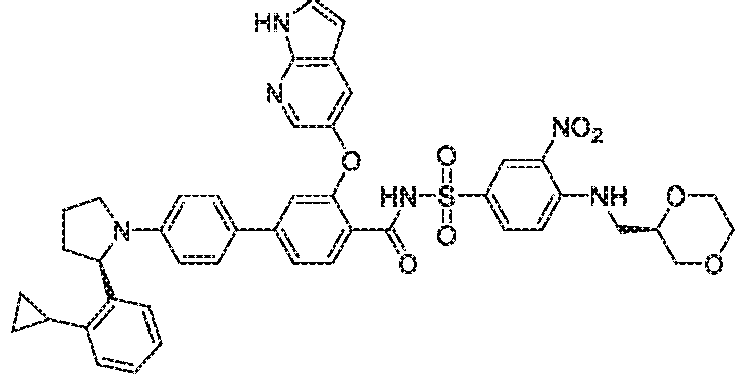
- The desired compound was synthesized following the procedures similar to those in Example A1 by replacing 2-phenylpyrrolidine with (R)-2-(2-cyclopropylphenyl)pyrrolidine, and replacing 3-nitro-4-(((tetrahydro-2H-pyran-4-yl)methyl)amino)benzenesulfonamide with (R)-4-(((1,4-dioxan-2-yl)methyl)amino)-3-nitrobenzenesulfonamide. 1H NMR (400 MHz, DMSO-d 6) δ ppm: 12.15 (s, 1H), 11.68 (s, 1H), 8.60-8.55 (m, 2H), 8.05 (s, 1H), 7.84 (d, J = 9.0 Hz, 1H), 7.58-7.51 (m, 3H), 7.35-7.30 (m, 3H), 7.15-7.06 (m, 2H), 7.04-6.97 (m, 2H), 6.90 (s, 1H), 6.86-6.80 (m, 1H), 6.39-6.33 (m, 3H), 5.22-5.10 (m, 1H), 3.82-3.71 (m, 4H), 3.65-3.58 (m, 2H), 3.53-3.45 (m, 2H), 3.38 (s, 1H), 2.06-1.82 (m, 4H), 1.03-0.94 (m, 2H), 0.80-0.75 (m, 1H), 0.75-0.68 (m, 1H). MS (ESI) m/e [M+1]+ 814.7.
-
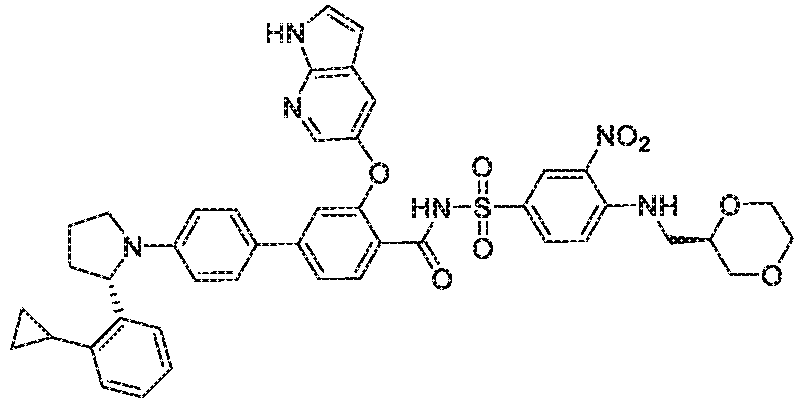
- The desired compound was synthesized following the procedures similar to those in Example A1 by replacing 2-phenylpyrrolidine with (S)-2-(2-cyclopropylphenyl)pyrrolidine, and replacing 3-nitro-4-(((tetrahydro-2H-pyran-4-yl)methyl)amino)benzenesulfonamide with (R)-4-(((1,4-dioxan-2-yl)methyl)amino)-3-nitrobenzenesulfonamide. 1H NMR (400 MHz, DMSO-d6 )δ ppm: 12.32-12.04 (m, 1H), 11.67 (s, 1H), 8.76-8.38 (m, 2H), 8.11-7.96 (m, 1H), 7.91-7.72 (m, 1H), 7.66-7.43 (m, 3H), 7.43-7.21 (m, 3H), 7.21-6.95 (m, 4H), 6.95-6.73 (m, 2H), 6.46-6.23 (m, 3H), 5.26-5.08 (m, 1H), 3.90-3.58 (m, 5H), 3.58-3.34 (m, 6H), 2.44-2.35 (m, 1H), 2.07-1.83 (m, 4H), 1.08-0.90 (m, 2H), 0.83-0.62 (m, 2H). MS (ESI, m/e) [M+1]+ 814.8.
-

- The desired compound was synthesized following the procedures similar to those in Example A1 by replacing 2-phenylpyrrolidine with (R)-2-(2-cyclopropylphenyl)pyrrolidine, and replacing 3-nitro-4-(((tetrahydro-2H-pyran-4-yl)methyl)amino)benzenesulfonamide with 4-((4-fluoro-1 -(oxctan-3-yl)piperidin-4-yl)mcthoxy)-3-nitrobenzcncsulfonamidc. 1H NMR (400 MHz, DMSO-d 6) δ ppm: 12.43-11.83 (m, 1H), 11.68 (s, 1H), 8.36 (s, 1H), 8.15-7.95 (m, 2H), 7.65-7.37 (m, 4H), 7.37-7.18 (m, 3H), 7.15-6.94 (m, 3H), 6.94-6.80 (m, 2H), 6.44-6.26 (m, 3H), 5.27-5.11 (m, 1H), 4.66-4.44 (m, 3H), 4.44-4.26 (m, 2H), 3.77-3.67 (m, 1H), 3.46-3.31 (m, 2H), 3.01-2.60 (m, 2H), 2.50-1.69 (m, 12H), 1.07-0.89 (m, 2H), 0.85-0.61 (m, 2H). MS (ESI, m/e) [M+1]+ 886.7.
-

- The desired compound was synthesized following the procedures similar to those in Example A1 by replacing 2-phenylpyrrolidine with (S)-2-(2-cyclopropylphenyl)pyrrolidine, and replacing 3-nitro-4-(((tetrahydro-2H-pyran-4-yl)methyl)amino)benzenesulfonamide with 4-((4-fluoro-1 -(oxetan-3-yl)piperidin-4-yl)methoxy)-3-nitrobenzenesulfonamide. MS (ESI, m/e) [M+1]+ 886.7.
-
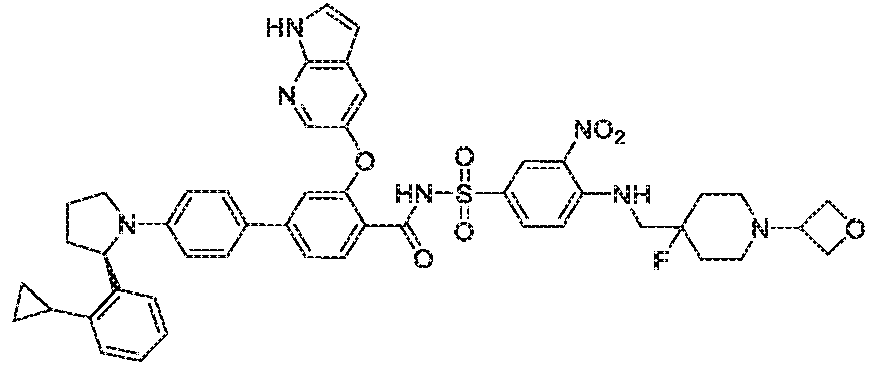
- The desired compound was synthesized following the procedures similar to those in Example A1 by replacing 2-phenylpyrrolidine with (R)-2-(2-cyclopropylphenyl)pyrrolidine, and replacing 3-nitro-4-(((tetrahydro-2H-pyran-4-yl)methyl)amino)bcnzenesulfonamide with 4-(((4-fluoro-1-(oxetan-3-yl)piperidin-4-yl)methyl)amino)-3-nitrobenzenesulfonamide. 1H NMR (400 MHz, DMSO-d 6)δ ppm: 12.24-11.87(m, 1H), 11.68 (s, 1H) 8.70-8.43 (m, 2H), 8.12-7.91 (m, 1H), 7.86-7.75 (m, 1H), 7.62-7.43 (m, 3H), 7.38-7.15 (m,4H), 7.14-7.04 (m, 1H), 7.04-6.95 (m, 2H), 6.95-6.75.(m, 2H), 6.47-6.28( m, 2H), 5.30-5.08 (m, 1H), 4.70-4.34 (m, 4H), 3.84-3.61 (m, 3H), 3.61-3.33 (m, 3H), 2.70-2.53 (m, 2H), 2.47-2.35 (m, 1H), 2.16-1.66 (m, 9H), 1.06-0.90 (m, 2H), 0.82-0.63 (m,2 H). MS (ESI, m/e) [M+1]+ 885.7.
-

- The desired compound was synthesized following the procedures similar to those in Example A1 by replacing 2-phenylpyrrolidine with (R)-2-(2-cyclopropylphenyl)pyrrolidine, and replacing 3-nitro-4-(((tetrahydro-2H-pyran-4-yl)methyl)amino)benzenesulfonamide with 4-((2-oxaspiro[3.5]nonan-7-yl)methoxy)-3-nitrobenzenesulfonamide. 1H NMR (400 MHz, DMSO-d6 ) δ ppm: 12.34 (s, 1H), 11.71 (s, 1H), 8.38 (s, 1H), 8.12-8.00 (m, 2H), 7.62-7.58 (m, 1H), 7.56-7.49 (m, 2H), 7.43-7.38 (m, 1H), 7.35-7.26 (m, 3H), 7.12-7.06 (m, 1H), 7.05-6.97 (m, 2H), 6.89 (m, 1H), 6.86-6.84 (m, 1H), 6.42-6.31 (m, 3H), 5.25-5.15 (m, 1H), 4.29 (s, 2H), 4.21 (s, 2H), 4.00-3.91 (m, 2H), 3.77-3.67 (m, 1H), 3.42-3.38 (m, 1H), 2.45-2.37 (m, 1H), 2.12-2.01 (m, 3H), 2.00-1.78 (m, 3H), 1.74-1.62 (m, 3H), 1.48-1.38 (m, 2H), 1.10-0.90 (m, 4H), 0.82-0.65 (m, 2H). MS (ESI, m/e) [M+1]+ 853.7.
-

- The desired compound G100a was synthesized following the procedures similar to those in Example A1 by replacing 2-phenylpyrrolidine with (R)-2-(2-cyclopropylphenyl)pyrrolidine, and replacing 3-nitro-4-(((tetrahydro-2H-pyran-4-yl)methyl)amino)benzenesulfonamide with (cis- or trans-)4-(((1-fluoro-4-hydroxy-4-methylcyclohexyl)methyl)amino)-3-nitrobenzenesulfonamide (faster peak in HPLC). 1H NMR (400 MHz, DMSO-d 6) δ ppm: 12.14 (s, 1H), 11.54 (s, 1H), 8.50-8.36 (m, 2H), 7.97 (s, 1H), 7.71 (s, 1H), 7.55 (d, J = 8.1 Hz, 1H), 7.55 (d, J = 8.1 Hz, 1H), 7.50-7.39 (m, 2H), 7.30 (d, J = 8.8 Hz, 2H), 7.28-7.20 (m, 1H), 7.10 (t, J = 6.8 Hz, 1H), 7.06 - 6.94 (m, 2H), 6.95-6.81 (m, 2H), 6.36 (d, J = 8.8 Hz, 2H), 6.31 (s, 1H), 5.20 (d, J = 8.2 Hz, 1H), 4.34 (s, 1H), 3.76 - 3.53 (m, 3H), 3.43-3.35 (m, 1H), 2.47 - 2.38 (m, 1H), 2.10 - 1.79 (m, 8H), 1.71 - 1.51 (m, 5H), 1.51 - 1.38 (m, 2H), 1.09 - 0.93 (m, 2H), 0.91 - 0.74 (m, 1H), 0.72-0.65 (m, 1H). MS (ESI, m/e) [M+1]' 858.7. The desired compound G100b was synthesized following the procedures similar to those in Example A1 by replacing 2-phenylpyrrolidine with (R)-2-(2-cyclopropylphenyl)pyrrolidine, and 3-nitro-4-(((tetrahydro-2H-pyran-4-yl)methyl)amino)benzenesulfonamide with (trans- or cis-)4-(((1-fluoro-4-hydroxy-4-methylcyclohexyl)methyl)amino)-3-nitrobenzenesulfonamide (slower peak in HPLC). 1H NMR (400 MHz, DMSO-d 6) δ ppm: 12.43 (s, 1H), 11.97 (s, 1H), 8.92 (s, 1H), 8.84 (s, 1H), 8.34 (s, 1H), 8.10 (d, J = 9.2 Hz, 1H), 7.87 (s, 1H), 7.85-7.78 (m, 2H), 7.63-7.55 (m, 3H), 7.51 (d, J = 9.2 Hz, 1H), 7.40-7.35 (m, 1H), 7.32-7.25 (m, 2H), 7.18-7.08 (m, 2H), 6.70-6.59 (m, 3H), 5.50-5.47 (m, 1H), 4.45 (s, 1H), 4.02-3.86 (m, 3H), 2.73-2.68 (m, 1H), 2.37-2.22 (m, 3H), 2.16-2.10 (m, 2H), 2.01-1.95 (m, 2H), 1.74 (s, 4H), 1.51 (s, 3H), 1.41 (s, 3H), 1.30-1.24 (m, 2H), 1.10-1.05 (m, 1H), 1.00-0.93 (m, 1H). MS (ESI, m/e) [M+1]' 858.7.
-
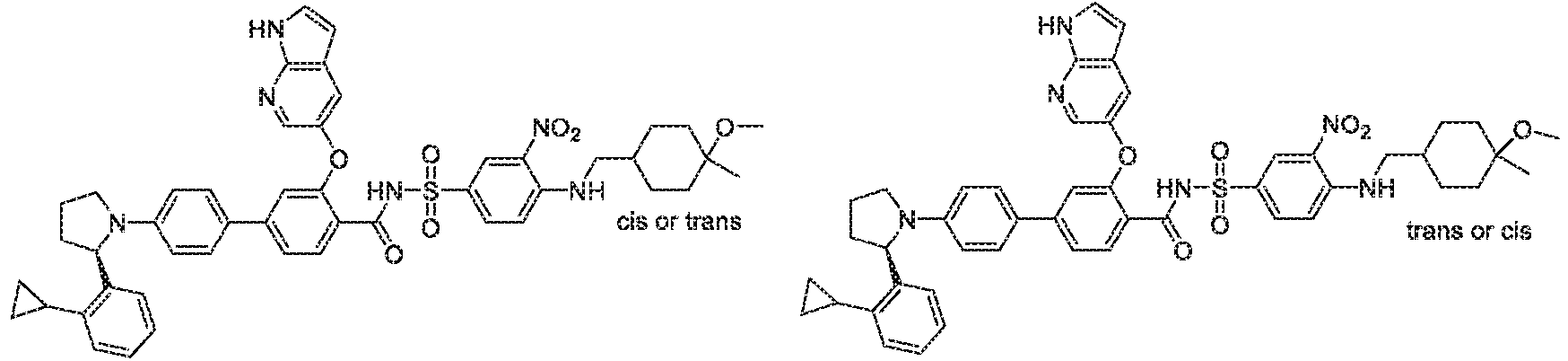
- The desired compound G101a was synthesized following the procedures similar to those in Example A1 by replacing 2-phenylpyrrolidine with (R)-2-(2-cyclopropylphenyl)pyrrolidine, and replacing 3-nitro-4-(((tetrahydro-2H-pyran-4-yl)methyl)amino)benzenesulfonamide with (cis- or trans-) 4-(((4-methoxy-4-methylcyclohexyl)methyl)amino)-3-nitrobenzenesulfonamide (faster peak in HPLC). 1H NMR (400 MHz, DMSO- d6 ) δ ppm: 12.14 (s, 1H), 11.69 (s, 1H), 8.65-8.50 (m, 2H), 8.09-8.01 (m, 1H), 7.87-7.77 (m, 1H), 7.14-7.05 (m, 2H), 7.05-6.96 (m, 2H), 6.93-6.80 (m, 2H), 6.44-6.31 (m, 3H), 5.25-5.08 (m, 1H), 3.83-3.62 (m, 1H), 3.31-3.26 (m, 2H), 3.09 (s, 4H), 3.01-2.85 (m, 1H), 2.17-1.76 (m,4H), 1.76-1.53 (m, 5H), 1.39-1.29 (m, 2H), 1.27-1.21 (m, 1H), 1.19-1.07 (m, 5H), 1.05-0.92 (m, 2H), 0.81-0.63 (m, 2H). MS (ESI, m/e) [M+1]' 854.8. The desired compound G101b was synthesized following the procedures similar to those in Example A1 by replacing 2-phenylpyrrolidine with (R)-2-(2-cyclopropylphenyl)pyrrolidine, and 3-nitro-4-(((tetrahydro-2H-pyran-4-yl)methyl)amino)benzenesulfonamide with (trans- or cis-) 4-(((4-methoxy-4-methylcyclohexyl)methyl)amino)-3-nitrobenzenesulfonamide (slower peak in HPLC). 1H NMR (400 MHz, DMSO-d 6) δ ppm: 12.14 (s, 1H), 11.70 (s, 1H), 8.63-8.55 (m, 1H), 8.05 (d, J = 2.6 Hz, 1H), 7.82 (dd, J = 9.3, 2.0 Hz, 1H), 7.60-7.57 (m, 1H), 7.54 - 7.48 (m, 2H), 7.35-7.26 (m, 3H), 7.13-7.06 (m, 2H), 7.04-6.97 (m, 2H), 6.89 (s, 1H), 6.86-6.82 (m, 1H), 6.40-6.31 (m, 3H), 5.25-5.15 (m, 1H), 3.73-3.68 (m, 1H), 3.42-3.38 (m, 1H), 3.26-3.21 (m, 2H), 3.05 (s, 3H), 2.46-2.39 (m, 1H), 2.09-1.80 (m, 5H), 1.78-1.74 (m, 2H), 1.57 (s, 0H), 1.49-1.43 (m, 2H), 1.24-1.18 (m, 1H), 1.03 (s, 3H), 1.01-0.92 (m, 2H), 0.79-0.75 (m, 1H), 0.70-0.67 (m, 1H). MS (ESI, m/e) [M+1]+ 854.8.
-

- The desired compound was synthesized following the procedures similar to those in Example A1 by replacing 2-phenylpyrrolidine with (R)-2-(2-cyclopropylphenyl)pyrrolidine, and replacing 3-nitro-4-(((tetrahydro-2H-pyran-4-yl)methyl)amino)benzenesulfonamide with 4-(((4-mcthylcyclohcx-3-en-1-yl)methyl)amino)-3-nitrobenzenesulfonamidc. 1H NMR (400 MHz, DMSO- d6 ) δ ppm: 12.14 (s, 1H), 11.70 (s, 1H), 8.61-8.56 (m, 2H), 8.05 (s, 1H), 7.82 (d, J = 9.0 Hz, 1H), 7.58 (s, 1H), 7.55-7.48 (m, 2H), 7.35-7.28 (m, 3H), 7.14-7.06 (m, 2H), 7.04-6.98 (m, 2H), 6.89 (s, 1H), 6.86-6.82 (m, 1H), 6.38-6.33 (m, 3H), 5.34 (s, 1H), 5.23-5.18 (m, 1H), 3.75-3.70 (m, 1H), 3.42-3.36 (m, 1H), 2.45- 2.37 (m, 1H), 2.11-1.71 (m, 11H), 1.61 (s, 3H), 1.31 - 1.22 (m, 1H), 0.99-0.93 (m, 2H), 0.78 (s, 1H), 0.70 (s, 1H). MS (ESI) m/e [M+1]+ 822.8.
-

- The desired compound was synthesized following the procedures similar to those in Example A1 by replacing 2-phenylpyrrolidinc with (R)-2-(2-ethylphenyl)pyrrolidine, and replacing 3-nitro-4-(((tetrahydro-2H-pyran-4-yl)methyl)amino)benzenesulfonamide with 4-((((1r,4r)-4-hydroxy-4-methylcyclohexyl)methyl)amino)-3-nitrobenzenesulfonamide. 1H NMR (400 MHz, DMSO- d6 ) δ ppm: 12.15 (s, 1H), 11.69 (s, 1H), 8.55 (s, 2H), 8.04 (s, 1H), 7.80 (s, 1H), 7.68 (s, 1H), 7.61 - 7.44 (m, 3H), 7.30-7.28 (m, 2H), 7.22- (d, J = 7.2 Hz, 1H), 7.17 - 7.11 (m, 1H), 7.01 (t,J = 7.2 Hz, 1H), 6.91 - 6.82 (m, 2H), 6.36-6.34 (m, 3H), 4.92 (d,J = 7.7 Hz, 1H), 4.25 (s, 1H), 3.70 (s, 1H), 2.83 - 2.76 (m, 1H), 2.71-2.67 (m, 1H), 2.03-1.97 (m, 5H), 1.69-1.66 (m, 3H), 1.55-1.52 (m, 2H), 1.47-1.43 (m, 1H), 1.29-1.26 (m, 6H). MS (ESI, m/e) [M+1]+ 828.8.
-

- The desired compound was synthesized following the procedures similar to those in Example A1 by replacing 2-phenylpyrrolidinc with (R)-2-(2-ethylphenyl)pyrrolidine, and replacing 3-nitro-4-(((tetrahydro-2H-pyran-4-yl)methyl)amino)benzenesulfonamide with 4-((4-fluoro-1-(oxetan-3-yl)piperidin-4-yl)methoxy)-3-nitrobenzenesulfonamide. 1H NMR (400 MHz, DMSO- d6 ) δ ppm: 12.27 (s, 1H), 11.69 (s, 1H), 8.37 (s, 1H), 8.05 (s, 2H), 7.60 - 7.47 (m, 3H), 7.43 (s, 1H), 7.32-7.27 (m, 3H), 7.22 (d, J = 7.2 Hz, 1H), 7.14 (t, J = 7.2 Hz, 1H), 7.01 (t, J = 7.2 Hz, 1H), 6.92 - 6.82 (m, 2H), 6.44 - 6.30 (m, 3H), 4.92 (d, J = 7.8 Hz, 1H), 4.58-4.50 (m, 4H), 4.39-4.34 (m, 2H), 3.71 (t, J = 7.8 Hz, 1H), 3.51 (s, 1H), 2.99 (s, 2H), 2.86 - 2.64 (m, 4H), 2.02-1.97 (m, 6H), 1.73-1.71 (m, 1H), 1.45 (s, 1H), 1.27-1.24 (m, 3H). MS (ESI, m/e) [M+1]+ 874.7.
-
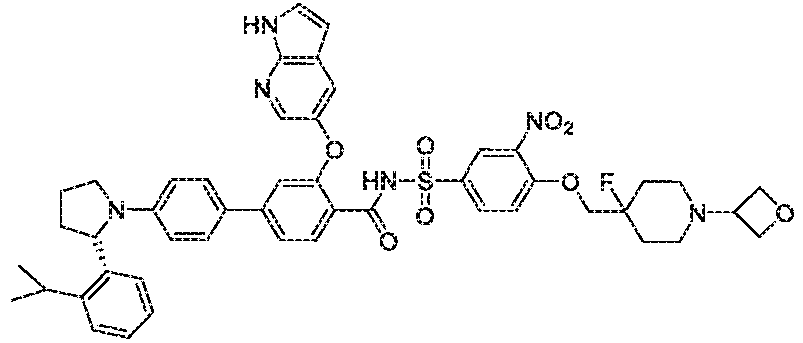
- The desired compound was synthesized following the procedures similar to those in Example A1 by replacing 2-phenylpyrrolidine with (S)-2-(2-isopropylphenyl)pyrrolidine, and replacing 3-nitro-4-(((tetrahydro-2H-pyran-4-yl)methyl)amino)benzenesulfonamide with 4-((4-fluoro-1-(oxetan-3-yl)piperidin-4-yl)methoxy)-3-nitrobenzenesulfonamide. 1H NMR (400 MHz, DMSO-d 6) δ ppm: 11.67 (s, 1H), 8.35 (s, 1H), 8.04 (s, 2H), 7.56-7.54 (m, 2H), 7.49 (s, 1H), 7.41 (s, 1H), 7.35-7.29 (m, 5H), 7.17 (t, J = 7.4 Hz, 1H), 6.99 (t, J = 7.4 Hz, 1H), 6.91 (s, 1H), 6.83 (d, J = 7.7 Hz, 1H), 6.37-6.35 (m, 3H), 4.99 (d, J = 8.0 Hz, 1H), 4.58-4.51 (m, 4H), 4.38-4.33 (m, 2H), 3.70 (t, J= 8.0 Hz, 1H), 3.38-3.32 (m, 1H), 2.45-2.48 (m, 1H), 2.03-1.97 (m, 5H), 1.92-1.84 (m, 3H), 1.72-1.68 (m, 1H), 1.47-1.44 (m, 1H), 1.28 - 1.24 (m, 9H). MS (ESI, m/e) [M+1]+ 888.8.
-

- The desired compound was synthesized with 4-((((1r,4r)-4-hydroxy-4-methylcyclohexyl)methyl)amino)-3-nitrobenzenesulfonamide and 3-((1H-pyrrolo[2,3-b]pyridin-5-yl)oxy)-4'-(2-(3-chloro-2-cyclopropylphenyl)pyrrolidin-1-yl)-2',3',4',5'-tetrahydro-[1,1'-biphenyl]-4-carboxylic acid following the procedures similar to those in Example G8. 1H NMR (400 MHz, DMSO-d6 ) δ ppm: 12.21 (s, 1H), 11.65 (s, 1H), 8.48 (s, 2H), 7.97 (s, 1H), 7.74 (s, 1H), 7.63-7.37 (m, 5H), 7.26-6.89 (m, 4H), 6.72 (s, 1H), 6.36 (s, 1H), 6.08-5.70 (m, 1H), 4.46 (s, 1H), 4.24 (s, 1H), 3.30-3.10 (m, 3H), 3.10-3.00 (m, 1H), 2.30-2.10 (m, 5H), 2.09-1.90 (m, 2H), 1.76-1.62 (m, 5H), 1.58-1.47 (m, 3H), 1.41-1.30 (m, 3H), 1.14-1.00 (m, 6H), 0.85 (s, 1H), 0.68 (s, 1H), 0.50 (s, 1H)..MS (ESI) m/e [M+1]+ 878.8.
-

- 3-((1H-pyrrolo[2,3-b]pyridin-5-yl)oxy)-4'-((S)-2-(2-ethylphenyl)pyrrolidin-1-yl)-N-((4-((((1r,4r)-4-hydroxy-4-methylcyclohexyl)methyl)amino)-3-nitrophenyl)sulfonyl)-2',3',4',5'-tetrahydro-[1,1-biphenyl]-4-carboxamide was synthesized with 4-((((1r,4r)-4-hydroxy-4-methylcyclohexyl)methyl)amino)-3-nitrobenzenesulfonamide and 3-((1H-pyrrolo[2,3-b]pyridin-5-yl)oxy)-4'-((S)-2-(2-ethylphenyl)pyrrolidin-1 -yl)-2',3',4',5'-tetrahydro-[1,1'-biphenyl]-4-carboxylic acid following the procedures similar to those in Example G8. Then two enantiomers G107-a (faster isomer) and G107-b (slower isomer) were separated by chiral preparative HPLC. The chiral separation conditions are shown below. The faster enantiomer was eluted at retention time of 2.5 min to give G107-a. The slower enantiomer was eluted at retention time of 3.6 min to give G107-b.
Column CHIRAL ART Cellulose-SB Column size 2cm ×25 cm, 5um Injection 0.5 mL Mobile phase MTBE:EtOH (0.2% MSA) = 50:50 Flow rate 20 mL/min Wave length UV 220 nm Temperature 25°C Sample solution 30mg/mL in EtOH:DCM = 3:1 Prep-HPLC equipment Prep-Gilson-HPLC - Example G107-a: 1H NMR (DMSO-d6 ) δ ppm: 11.65 (s, 1H), 8.56-8.36 (m, 2H), 7.97 (d, J = 2.0Hz, 1H), 7.75 (d, J = 8.4Hz, 1H), 7.61-7.38 (m, 4H), 7.24-6.85 (m, 5H), 6.73 (s, 1H), 6.36 (s, 1H), 5.81 (s, 1H), 4.25 (s, 1H), 3.23 (t, J = 6.0Hz, 3H), 2.68-2.58 (m, 2H), 2.42-1.83 (m, 8H), 1.79-1.44 (m, 8H), 1.36-1.06 (m, 11H). MS (ESI, m/e) [M+1]+ 832.8. Example G107-b: 1H NMR (DMSO-d6 ) δ ppm: 11.64 (s, 1H), 8.57-8.34 (m, 2H), 7.97 (s, 1H), 7.80-7.66 (m, 1H), 7.61-7.42 (m, 4H), 7.25-6.93 (m, 5H), 6.73 (s, 1H), 6.35 (s, 1H), 5.99 (s, 1H), 4.24 (s, 1H), 3.28-3.16 (m, 3H), 2.70-2.61 (m, 2H), 2.36-2.04 (m, 6H), 1.85-1.48 (m, 9H), 1.33 (t,J= 12.0Hz, 3H), 1.17-1.07 (m, 9H).MS (ESI, m/e) [M+1]+ 832.9.
-

- 3-((1H-pyrrolo[2,3-b]pyridin-5-yl)oxy)-4'-(2-(2-cyclopropylphenyl)pyrrolidin-1-yl)-N-((4-(((1-fluoro-4-hydroxycyclohexyl)methyl)amino)-3-nitrophenyl)sulfonyl)-2',3',4',5'-tetrahydro-[1,1'-biphenyl]-4-carboxamide was synthesized with 4-(((1-fluoro-4-hydroxycyclohexyl)methyl)amino)-3-nitrobenzenesulfonamide and 3-((1H-pyrrolo[2,3-b]pyridin-5-yl)oxy)-4'-(2-(2-cyclopropylphenyl)pyrrolidin-1-yl)-2',3',4',5'-tetrahydro-[1,1'-biphenyl]-4-carboxylic acid following the procedures similar to those in Example G8. 2 products were obtained after prep-HPLC purification. Example G108a was the faster peak, 1H NMR (400 MHz, DMSO-d 6) δ ppm: 12.48 (s, 1H), 11.71 (s, 1H), 8.45-8.31 (m, 1H), 8.10-7.95 (m, 2H), 7.69-7.36 (m, 5H), 7.35-7.20 (m, 2H), 7.19-7.04 (m, 2H), 6.80-6.69 (m, 1H), 6.39 (s, 1H), 5.99-5.88 (m, 1H), 5.30-5.10 (m, 1H), 4.67 (s, 1H), 4.29-4.20 (m, 2H), 3.71 (s, 1H), 3.46 (s, 3H), 2.38-2.30 (m, 2H), 2.13 (s, 3H), 2.04- 1.93 (m, 4H), 1.78-1.68 (m, 3H), 1.63-1.55 (m, 2H), 1.48-1.35 (m, 3H), 0.98-0.91 (m, 2H), 0.78-0.68 (m, 1H), 0.61 (s, 1H). MS (ESI) m/e [M+1]+ 849.8. Example G108b was the slower peak, MS (ESI) m/e [M+1]+ 849.8.
-
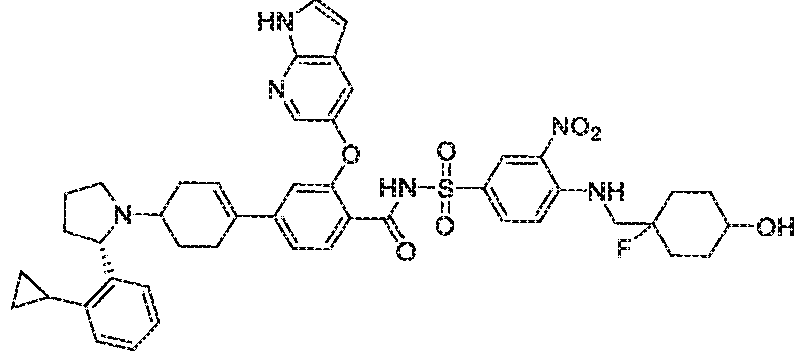
- The desired compound was synthesized with 4-(((1-Σluoro-4-hydroxycyclohexyl)methyl)amino)-3-nitrobenzenesulfonamide and 3-((1H-pyrrolo[2,3-b]pyridin-5-yl)oxy)-4'-((S)-2-(2-cyclopropylphenyl)pyrrolidin-1-yl)-2',3',4',5'-tetrahydro-[1,1'-biphenyl]-4-carboxylic acid following the procedures similar to those in Example G8. 1H NMR (400 MHz, DMSO-d6 )δ ppm: 12.38-12.19 (m, 0.5H), 11.70 (s, 1H), 10.55-10.05 (m, 0.5H), 8.66-8.43 (m, 2H), 8.11-7.87 (m, 2H), 7.85-7.72 (m, 1H), 7.60-7.39 (m, 3H), 7.37-6.99 (m, 5H), 6.75 (s, 1H), 6.38 (s, 1H), 6.08-5.77 (m, 1H), 5.27-4.97 (m, 1H), 4.77-4.51 (m, 1H), 3.76-3.54 (m, 4H), 3.22-2.89 (m, 3H), 2.36-1.33 (m, 17H), 1.00-0.87 (m, 2H), 0.79-0.49 (m, 2H). MS (ESI, m/e) [M+1]+ 848.8.
-

- The desired compound G110a was synthesized with (cis- or trans-)4-(((4-hydroxycyclohexyl)methyl)amino)-3-nitrobenzenesulfonamide (faster peak in HPLC) and 3-((1H-pyrrolo[2,3-b]pyridin-5-yl)oxy)-4'-((S)-2-(2-cyclopropylphenyl)pyrrolidin-1-yl)-2',3',4',5'-tetrahydro-[1,1'-biphenyl]-4-carboxylic acid following the procedures similar to those in Example G8. 1H NMR (400 MHz, DMSO- d6 ) δ ppm: 12.44 (br, 1H), , 11.69 (s, 1H), 8.66-8.35 (m, 2H), 7.99 (s, 1H), 7.89-7.70 (m, 2H), 7.61-7.40 (m, 3H), 7.36-6.84 (m, 5H), 6.84-6.66 (m, 1H), 6.74 (s, 1H), 6.45-6.29 (m, 1H), 6.37 (s, 1H), 6.07-5.81 (m, 1H), 5.33-5.01 (m, 1H), 4.56-4.41 (m, 1H), 3.82-3.36 (m, 3H), 3.24-3.11 (m, 2H), 3.08-2.86 (m, 1H), 2.33-1.52 (m, 14H), 1.18-0.81 (m, 7H), 0.77-0.50 (m, 2H). MS (ESI, m/e) [M+1]+ 830.8; The desired compound G110b was synthesized with (trans- or cis-)4-(((4-hydroxycyclohexyl)methyl)amino)-3-nitrobcnzenesulfonamide (slower peak in HPLC) and 3-((1 H-pyrrolo[2,3-b]pyridin-5-yl)oxy)-4'-((S)-2-(2-cyclopropylphenyl)pyrrolidin-1-yl)-2',3',4',5'-tetrahydro-[1,1'-biphenyl]-4-carboxylic acid following the procedures similar to those in Example G8. 1H NMR (400 MHz, DMSO- d6 ) δ ppm: 12.36 (br, 1H), 11.68 (s, 1H), 8.64-8.37 (m, 2H), 7.98 (s, 1H), 7.91-7.65 (m, 2H), 7.62-7.38 (m, 3H), 7.37-6.80 (m, 5H), 6.74 (s, 1H), 6.37 (s, 1H), 5.99-5.73 (m, 1H), 5.38-5.01 (m, 1H), 4.37-4.19 (m, 1H), 3.73-3.37 (m, 3H), 3.27-3.17 (m, 2H), 3.08-2.87 (m, 1H), 2.43-1.33 (m, 19H), 0.99-0.82 (m, 2H), 0.77-0.44(m, 2H). MS (ESI, m/e) [M+1]' 840.8.
- Two enantiomers G110b-a (faster isomer) and G110b-b (slower isomer) of G110b were separated by chiral preparative HPLC. The chiral separation conditions are shown below. The faster enantiomer was eluted at retention time of 2.5 min to give G110b-a. The slower enantiomer was eluted at retention time of 3.8 min to give G110b-b.
Column CHIRAL ART Cellulose-SB Column size 2cm × 25 cm, 5um Injection 0.5 mL Mobile phase MTBE:EtOH (0.2% MSA) = 50:50 Flow rate 20mL/min Wave length UV 220 nm Temperature 25°C Sample solution 36mg/mL in EtOH:DCM = 3:1 Prep-HPLC equipment Prep-Gilson-HPLC - Example G110b-a: 1H NMR (400 MHz, DMSO-d6 )δ ppm: 12.60 (br, 1 H), 11.61 (s, 1H), 8.40-8.07 (m, 1H), 8.02-7.74 (m, 2H), 7.74-6.83 (m, 9H), 6.83-6.67 (m, 1H), 6.34 (s, 1H), 5.84-5.69 (m, 1H), 5.37-5.12 (m, 1H), 5.41-5.26 (m, 1H), 4.67-4.44 (m, 1H), 4.06-3.82 (m, 2H), 3.82-3.57 (m, 1H), 3.57-3.41 (m, 1H), 3.22-2.91 (m, 1H), 2.41-1.46 (m, 15H), 1.19-0.79 (m, 8H), 0.79-0.45 (m, 2H), MS (ESI, m/e) [M+1]+ 831.8. Example G110b-b: 1H NMR (400 MHz, DMSO-d6 ) δ ppm: 12.66 (br, 1 H), 11.61 (s, 1H), 8.32-8.07(m, 1H), 8.02-7.76 (m, 2H), 7.71-6.84 (m, 9H), 6.74 (s, 1H), 6.34 (s, 1H), 6.06-5.89 (m,1H), 5.28-4.91 (m, 1H), 4.63-4.45 (m, 1H), 4.06-3.83 (m, 2H), 3.77-3.56 (m, 1H), 3.55-3.41 (m, 1H), 3.22-2.88 (m, 1H), 2.43-1.52 (m, 16H), 1.19-0.83 (m, 7H), 0.78-0.47 (m, 2H). MS (ESI, m/e) [M+1]+ 831.8.
-
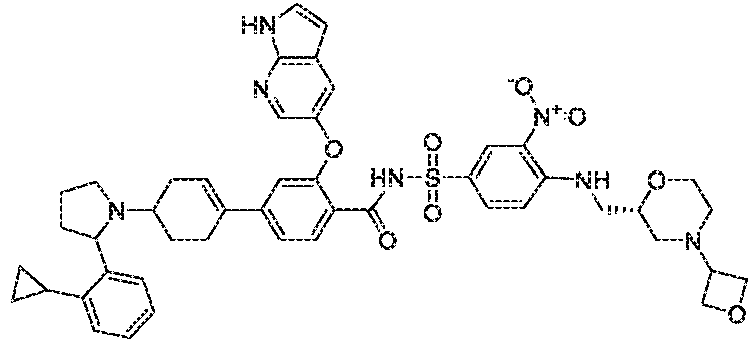
- The desired compound was synthesized with (S)-3-nitro-4-(((4-(oxetan-3-yl)morpholin-2-yl)methyl)amino)benzenesulfonamide and 3-((1H-pyrrolo[2,3-b]pyridin-5-yl)oxy)-4'-(2-(2-cyclopropylphenyl)pyrrolidin-1-yl)-2',3',4',5'-tetrahydro-[1,1'-biphenyl]-4-carboxylic acid following the procedures similar to those in Example G8. 1H NMR (400 MHz, DMSO-d 6) δ ppm: 12.24 (s, 0.5H), 11.66 (s, 1H), 9.58-9.30 (m, 0.5H), 8.50 (s, 2H), 7.97 (s, 1H), 7.76 (s, 1H), 7.61 (s, 1H), 7.55-7.39 (m, 3H), 7.33-6.91 (m, 6H), 6.74 (s, 1H), 6.36 (s, 1H), 6.04-5.80 (m, 1H), 4.60-4.49 (m, 2H), 4.49-4.39 (m, 2H), 3.90-3.67 (m, 3H), 3.59-3.43(m, 5H), 2.88-2.70(m, 2H), 2.60-2.50 (m, 2H), 2.07-1.86 (m, 5H), 1.85-1.75 (m, 2H), 1.16-1.07 (m, 2H), 0.99-0.80 (m, 3H), 0.78-0.50 (m, 2H). MS (ESI) m/e [M+1]+ 873.8.
-

- The desired compound was synthesized with (R)-3-nitro-4-(((4-(oxetan-3-yl)morpholin-2-yl)methyl)amino)benzenesulfonamide and 3-((1H-pyrrolo[2,3-b]pyridin-5-yl)oxy)-4'-((S)-2-(2-cyclopropylphenyl)pyrrolidin-1-yl)-2',3',4',5'-tetrahydro-[1,1'-biphenyl]-4-carboxylic acid following the procedures similar to those in Example G8. 1H NMR (400 MHz, DMSO-d6 ) δ ppm: 12.27-12.13 (m, 1H), 11.63 (s, 1H), 8.53-8.38 (m, 2H), 7.96 (s, 1H), 7.52-7.40 (m, 3H), 7.35-7.21 (m, 1H), 7.19-7.07 (m, 2H), 7.05-6.83 (m, 3H), 6.74 (s, 1H), 6.35 (s, 1H), 6.04-5.75 (m, 1H), 4.58-4.50 (m, 2H), 4.48-4.40 (m, 2H), 3.90-3.81 (m, 1H), 3.77-3.69 (m, 1H), 3.62-3.38 (m, 5H), 3.21-3.06 (m, 1H), 2.80-2.70 (m, 1H), 2.63-2.53 (m, 2H), 2.35-2.10 (m, 5H), 2.04-1.91 (m, 3H), 1.84-1.70 (m, 3H), 1.39-1.31 (m, 1H), 0.99-.072 (m, 3H), 0.72-0.45 (m, 2H). MS (ESI, m/e) [M+1]+ 874.8.
-
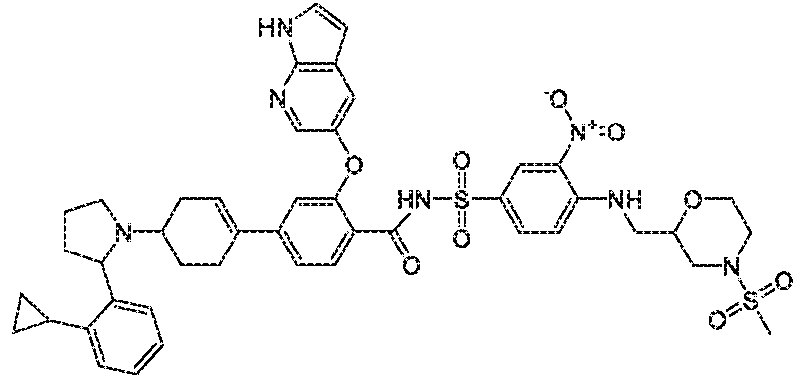
- The desired compound was synthesized with 4-(((4-(methylsulfonyl)morpholin-2-yl)methyl)amino)-3-nitrobenzenesulfonamide and 3-((1H-pyrrolo[2,3-b]pyridin-5-yl)oxy)-4'-(2-(2-cyclopropylphcnyl)pyrrolidin-1-yl)-2',3',4',5'-tctrahydro-[1,1'-biphenylJ-4-carboxylic acid following the procedures similar to those in Example G8. 1H NMR (400 MHz, DMSO-d6 )δ ppm: 12.20 (br, 1H), 11.63 (s, 1H), 8.54 - 8.45 (m, 2H), 7.98 (s, 1H), 7.81 - 7.74 (m, 1H), 7.62 -7.42 (m, 4H), 7.30 -6.95 (m, 5H), 6.74 (s, 1H), 6.36 (s, 1H), 5.99 (s, 0.5H), 5.83 (s, 0.5H), 3.96 (d, J=12.0 Hz, 1H), 3.76 (s, 1H), 3.63 - 3.34 (m, 8H), 2.92 (s, 3H), 2.90 - 2.80 (m, 1H), 2.74 - 2.66 (m, 1H), 2.49 - 2.17 (m, 5H), 2.10 - 1.42 (m, 7H), 0.99-0.81 (m, 2H), 0.78 - 0.50 (m, 2H). MS (ESI, m/e) [M+1]+ 895.7.
-

- The desired compound was synthesized with 4-(((4-fluoro-1(oxetan-3-yl)piperidin-4-yl)methyl)amino)-3-nitrobenzenesulfonamide and 3-((1H-pyrrolo[2,3-b]pyridin-5-yl)oxy)-4'-((S)-2-(2-cyclopropylphenyl)pyrrolidin-1-yl)-2',3',4',5'-tetrahydro-[1,1'-biphenyl]-4-carboxylic acid following the procedures similar to those in Example G8. 1H NMR (400 MHz, DMSO-d 6) δ ppm: 11.63 (s, 1H), 8.58-8.40 (m, 2H) 7.95 (s, 1H), 7.80-7.70 (m, 1H), 7.65-7.36 (m, 4H), 7.34-7.21 (m, 1H), 7.15-7.04 (m, 2H), 6.99-6.85 (m, 2H), 6.72 (s, 1H), 6.34 (s, 1H), 6.01-5.76 (m, 1H), 4.57-4.47 (m, 2H), 4.46-4.37 (m, 2H), 4.33-4.22 (m, 1H), 3.70-3.57 (m, 3H), 3.51-3.41 (m, 3H), 3.06-2.85 (m, 3H), 2.24-2.13 (m, 2H), 2.05-1.93 (m, 3H), 1.86-1.79 (m, 2H), 1.74-1.65 (m, 2H), 1.21-1.10 (m, 2H), 1.09-1.01 (m, 2H), 0.99-0.90 (m, 2H), 0.89-0.82 (m, 2H). 0.73-0.45 (m, 3H). MS (ESI, m/e) [M+1]+ 889.8.
-

- The desired compound was synthesized with 4-(((4-(methylsulfonyl)morpholin-2-yl)methyl)amino)-3-nitrobenzenesulfonamide and 3-((1H-pyrrolo[2,3-b]pyridin-5-yl)oxy)-4'-(2-(2-cyclopropylphcnyl)pyrrolidin-1-yl)-2',3',4',5'-tetrahydro-[1,1'-biphenyl]-4-carboxylic acid following the procedures similar to those in Example G8. 1H NMR (400 MHz, DMSO-d 6) δ ppm: 11.54 (s, 1H), 8.30 (s, 1H), 8.04 (s, 1H), 7.99 - 7.91 (m, 1H), 7.57 - 7.41 (m, 3H), 7.35 - 7.32 (m, 1H), 7.16 - 6.98 (m, 3H), 6.93 - 6.82 (m, 1H), 6.74 - 6.72 (m, 1H), 6.34 - 6.30 (m, 1H), 5.99 (s, 0.5H), 5.79 (s, 0.5H), 4.47(s, 1H), 4.42 (s, 1H), 4.31 - 4.18 (m, 2H), 3.95 - 3.87 (m, 1H), 3.25 - 3.11 (m, 4H), 2.87 - 2.81 (m, 1H), 2.67 - 2.51 (m, 2H), 2.26 - 2.07 (m, 8H), 2.04 - 1.91 (m, 6H), 1.78 - 1.64 (m, 4H), 1.55 - 1.33 (m, 4H), 0.95 - 0.84 (m, 2H), 0.68 - 0.45 (m, 2H). MS (ESI, m/e) [M+1]+ 909.7.
-

- The desired compound was synthesized with (trans- or cis-)4-((4-hydroxycyclohexyl)mcthoxy)-3-nitrobenzenesulfonamidc and 3-((1H-pyrrolo[2,3-b]pyridin-5-yl)oxy)-4'-(2-(3-chloro-2-cyclopropylphenyl)pyrrolidin-1-yl)-2',3',4',5'-tetrahydro-[1,1'-biphenyl]-4-carboxylic acid following the procedures similar to those in Example G8. 1H NMR (400 MHz, DMSO-d 6) δ ppm: 12.48 (br, 1H), 11.61 (s, 1H), 8.18 (s, 1H), 7.94 (s, 1H), 7.85 (m, 1H), 7.54 -7.37 (m, 5H), 7.25 - 7.08 (m, 3H), 6.73 (s, 1H), 6.34 (s, 1H), 5.79 - 5.76 (m, 0.5H), 5.32 - 5.31 (m, 0.5H), 4.53 - 4.51(m, 1H), 3.91 (d,J=6.0 Hz, 2H), 3.82 - 3.41 (m, 1H), 3.25 - 3.02 (m, 1H), 2.67 - 2.65 (m, 2H), 2.45 - 2.08 (m, 5H), 1.99 - 1.66 (m, 10H), 1.62-1.53 (m, 2H), 1.36-1.07 (m, 6H), 0.60 - 0.51 (m, 2H). MS (ESI, m/e) [M+1]+ 865.7.
-
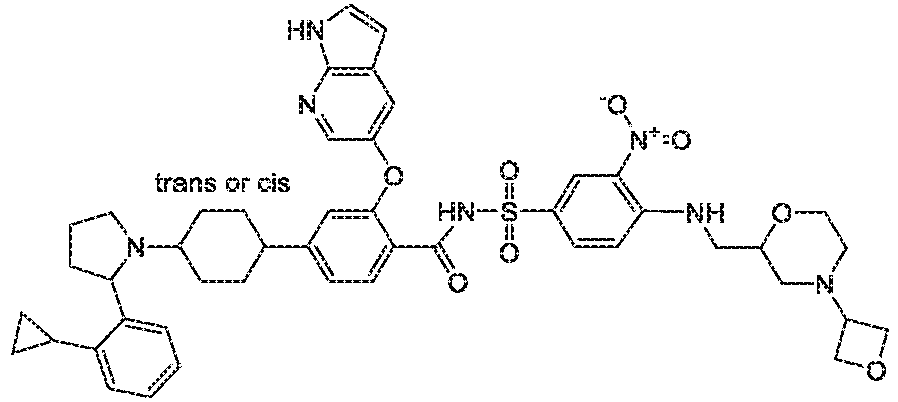
- The desired compound was synthesized with 3-nitro-4-(((4-(oxetan-3-yl)morpholin-2-yl)methyl)amino)benzenesulfonamide and (trans- or cis-)2-((1H-pyrrolo[2,3-b]pyridin-5-yl)oxy)-4-(4-(2-(2-cyclopropylphenyl)pyrrolidin-1-yl)cyclohexyl)benzoic acid following the procedures similar to those in Example D1b. 1H NMR (400 MHz, DMSO-d 6) δ ppm: 12.48 (br, 0.5H), 11.61 (s, 1H), 9.26 (br, 0.5H), 8.18 (s, 1H), 7.94 (s, 1H), 7.85 (m, 1H), 7.54 -7.37 (m, 5H), 7.25 - 7.08 (m, 3H), 6.73 (s, 1H), 6.34 (s, 1H), 5.79 - 5.76 (m, 0.5H), 5.32 - 5.31 (m, 0.5H), 4.53 - 4.51(m, 1H), 3.91 (d, J=6.0 Hz, 2H), 3.82 - 3.41 (m, 1H), 3.25 - 3.02 (m, 1H), 2.67 - 2.65 (m, 2H), 2.45 - 2.08 (m, 5H), 1.99 - 1.66 (m, 10H), 1.62-1.53 (m, 2H), 1.36-1.07 (m, 6H), 0.60 - 0.51 (m, 2H). MS (ESI, m/e) [M+1]+ 865.7.
-

- To a solution of (R)-2-(2-bromophenyl)pyrrolidine (10 g, 44.22mmol) in DCM (100 mL) was added triethylamine (6.699 g, 66.33 mmol), then added (CF3CO)2O (10.216 g, 48.65 mmol) at 0 °C. After stirred at room temperature for 1 hour, the reaction mixture was concentrated. The resulted residue was dissolved with DCM (500 ml), and then washed with saturated aq. NaHCOs solution, brine. After dried over Na2SO4, the organic phase was concentrated to obtain the product (14 g) as a brown solid. MS (ESI, m/e) [M+1]+ 321.8.
- To a solution of(R)-1-(2-(2-bromophenyl)pyrrolidin-1-yl)-2,2,2-trifluoroethan-1-one (5 g, 15.52 mmol) in toluene (100 ml) was added tert-butyl 4-(4,4,5,5-tetramethyl-1,3,2-dioxaborolan-2-yl)-3,6-dihydropyridine-1(2H)-carboxylate (7.189 g, 23.25 mmol), Pd(OAc)2 (348 mg, 1.552 mmol), Tricyclohexyl phosphine (870 mg, 3.1 mmol) and K3PO4 (11.53 g, 54.32 mmol). The mixture was then stirred at 100°C for 12 hours at N2 atmosphere. After cooled to room temperature, the reaction mixture was washed with brine and dried over Na2SO4.After removal of solvent, the resulted residue was purified by chromatograph column on silica gel (eluent: PE/EA = 50/1 to 10/1) to obtain the product (3.66 g) as yellow oil. MS (ESI, m/e) [M-55]+ 368.8.
- To a solution of tert-butyl (R)-4-(2-(1-(2,2,2-tritluoroacetyl)pyrrolidin-2-yl)phenyl)-3,6-dihydropyridine-1(2H)-carboxylate (3.66 g, 8.62mmol) in DCM (100 ml) was added TFA (20 ml). The mixture was stirred at room temperature for 2 hours. After removal of solvent and TFA, the residue was dissolved with DCM (200 ml) and then washed with saturated aq. NaHCO3 solution, brine, dried over Na2SO4. The DCM solution was concentrated to obtain the crude product (2.66 g) as a brown oil, which was used in next step without further purification.
- To a solution of (R)-2,2,2-trifluoro-1-(2-(2-(1,2,3,6-tetrahydropyridin-4-yl)phenyl)pyrrolidin-1-yl)ethan-1-one (2.66 g, 8.2 mmol) in MeOH (100 mL) was added HCHO(37%, 3.99 g 49.18 mmol) and NaBH3CN (2.058 g, 32.77 mmol). The mixture was stirred at room temperature for 2 hours. After removal of solvent, the residue was dissolved with EA (200 ml), washed with brine, and then dried over Na2SO4.The EA solution was concentrated to obtain the crude product (2.5 g) as a yellow solid, which was used in next step without further purification. MS (ESI, m/e) [M+1]+ 338.9.
- To a solution of (R)-2,2,2-trifluoro-1-(2-(2-(1-methyl-1,2,3,6-tetrahydropyridin-4-yl)phenyl)pyrrolidin-1-yl)ethan-1-one (2.5 g, 7.39 mmol) in MeOH (50 mL) and H2O (50 mL) was added LiOH.H2O (3.1 g, 73.9 mmol). After stirred at 60 °C for 3 hours, the reaction mixture was extracted with DCM (200 mL×3). The combined organic phase was concentrated. The residue was purified by column chromatograph on silica gel (eluent: DCM/MeOH = 10/1 (added 1% NH3.H2O)) to obtain the product (1.2 g). MS (ESI, m/e) [M+1]' 243.0.
- To a solution of (R)-1-methyl-4-(2-(pyrrolidin-2-yl)phenyl)-1,2,3,6-tetrahydropyridine (500 mg, 2.07mmol) in toluene (50 ml) was added 1-bromo-4-iodobenzene (1.165 g, 4.13 mmol), Pd2(dba)3 (189 mg, 0.207 mmol), BINAP(257.5 mg, 0.414 mmol) and t-BuOK (757.6 mg, 6.21 mmol). The mixture was stirred at 90°C for 12 hours at N2 atmosphere. After cooled to room temperature, the reaction mixture was washed with brine, dried over Na2SO4 and concentrated. The residue was purified by chromatograph column on silica gel (DCM/MeOH = 50/1) to obtain the product (508 mg) as a yellow oil. MS (ESI, m/e) [M+1]+ 396.8.
- To a solution of (R)-4-(2-(1-(4-bromophenyl)pyrrolidin-2-yl)phenyl)-1-methyl-1,2,3,6-tetrahydropyridine (508 mg, 1.28 mmol) and tert-butyl 2-((1H-pyrrolo[2,3-b]pyridin-5-yl)oxy)-4-(3,3,4,4-tetramethylborolan-1-yl)benzoate (725.3mg, 1.66 mmol) in 1,4-dioxane (50 mL) and H2O (5 mL) was added Pd(ddpf)Cl2 (93.6 mg, 0.128 mmol) and Cs2CO3 (1248 mg, 3.84 mmol). The mixture was stirred at 100 °C for 3 hours under N2 protection. After cooled to room temperature, the reaction mixture was diluted with DCM (200 mL), then washed with brine (200 mL×2) and dried over Na2SO4. After concentration, the residue was purified by chromatography column on silica (eluent: DCM/MeOH = 2511) to obtain the product (367 mg) as a yellow solid. MS (ESI, m/e) [M+1]+ 626.9.
- To a solution of tert-butyl (R)-3-((1H-pyrrolo[2,3-b]pyridin-5-yl)oxy)-4'-(2-(2-(1-methyl-1,2,3,6-tetrahydropyridin-4-yl)phenyl)pyrrolidin-1-yl)-[1,1'-biphenyl]-4-carboxylate (367 mg, 0.585 mmol) in DCM (30 mL) was added TFA (15 mL). The mixture was stirred at room temperature for 2 hours. After removal of solvent and TFA, the crude product was obtained as a yellow solid, which was used in next step without further purification. MS (ESI, m/e) [M+1]+ 570.9.
- To a solution of (R)-3-((1H-pyrrolo[2,3-b]pyridin-5-yl)oxy)-4'-(2-(2-(1-methyl-1,2,3,6-tetrahydropyridin-4-yl)phenyl)pyrrolidin-1-yl)-[1,1'-biphenyl]-4-carboxylic acid (334 mg, 0.585 mmol) in DCM (50 mL) was added HATU (333.5 mg, 0.878 mmol) and triethylamine (295 mg, 2.925 mmol). The mixture was stirred at room temperature for 1 hour and then to the mixture was added 4-((((1r,4r)-4-hydroxy-4-methylcyclohexyl)methyl)amino)-3-nitrobenzenesulfonamide (301.5 mg, 0.878 mmol) and DMAP (35.7 mg, 0.293 mmol). The reaction mixture was stirred at room temperature for overnight. After washed with saturated aq. NaHCO3 solution, brine and dried over Na2SO4, the reaction mixture was concentrated and purified by chromatography column on silica (eluent: MeOH/DCM = 1/10) to give the crude product. The crude product was further purified by prep-TLC (eluent: MeOH/DCM = 1/10) to obtain the desired product (135 mg) as a yellow solid. 1H NMR (400 MHz, DMSO d6 ) δ 12.32 (br, 1 H), 11.70 (s, 1H), 8.71-8.42 (m, 2H), 8.12-7.97 (m, 1H), 7.79-7.71 (m, 1H), 7.62-7.44 (m, 3H), 7.38-6.94 (m, 8H), 6.90 (s, 1H), 6.44-6.25 (m, 3H), 5.86-5.60 (m, 1H), 5.00-4.79 (m, 1H), 4.32-4.17 (m, 1H), 3.9-3.43 (m, 3H), 3.43-.34 (m, 2H), 3.28-3.20 (m, 2H), 2.95-2.72 (m, 5H), 2.42-2.31 (m, 2H), 2.06-1.93 (m, 2H), 1.80-1.48 (m, 6H), 1.38-1.26 (m, 2H), 1.17-1.04 (m, 5H). MS (ESI, m/e) [M+1]+ 896.8.
-

- The desired compound was synthesized following the procedures similar to those in Example G118 by replacing 4-((((1r,4r)-4-hydroxy-4-methylcyclohexyl)methyl)amino)-3-nitrobenzenesulfonamide with 4-(((4-fluorotetrahydro-2H-pyran-4-yl)methyl)amino)-3-nitrobenzenesulfonamide. 1H NMR (400 MHz, DMSO-d 6) δ ppm: 12.31 (br, 1H), 11.69 (s, 1H), 8.69 - 8.46 (m, 2H), 8.01 - 7.97(m,, 1H), 7.88 - 7.74 (m, 1H), 7.61 - 7.42 (m, 3H), 7.39 - 7.06 (m, 7H), 7.06 - 6.94 (m,, 1H), 6.90 (s, 1H), 6.47 - 6.27 (m, 3H), 5.71 (s, 1H), 4.96 - 4.81 (m, 1H), 3.98 - 3.62 (m, 7H), 3.63 - 3.34 (m, 5H), 3.06 - 2.58 (m, 5H), 2.44 - 2.30 (m, 1H), 2.06 - 1.92 (m, 2H), 1.88-1.67 (m, 5H). MS (ESI, m/e) [M+1]+ 885.8.
-

- The desired compound was synthesized following the procedures similar to those in Example G 118 by replacing 4-((((1r,4r)-4-hydroxy-4-methylcyclohexyl)methyl)amino)-3-nitrobenzenesulfonamide with (R)-4-(((1,4-dioxan-2-yl)methyl)amino)-3-nitrobenzenesulfonamide. 1H NMR (DMSO-d6 ) δ ppm: 12.18 (br, 1 H), 11.69 (s, 1 H), 8.55 (s, 2 H), 8.04 (d, J = 1.9 Hz, 1H), 7.82 (d, J = 8.9 Hz, 1 H), 7.56 - 7.51 (m, 3 H), 7.34 - 7.28 (m, 3 H), 7.26 - 7.07 (m, 4 H), 7.00 (d, J = 7.3 Hz, 1 H), 6.90 (s, 1 H), 6.41 - 6.32 (m, 3 H), 5.70 (s, 1 H), 4.88 (d, J = 7.0 Hz, 1 H), 3.96 - 3.91 (m, 1 H), 3.84 - 3.70 (m, 6 H), 3.65 - 3.61 (m, 4 H), 3.53 - 3.42 (m, 4 H), 2.88 (s, 4 H), 2.38 - 2.31 (m, 2 H), 1.98 (s, 2 H), 1.79 - 1.71 (m, 1 H). MS (ESI, m/e) [M+1]' 869.8.
-
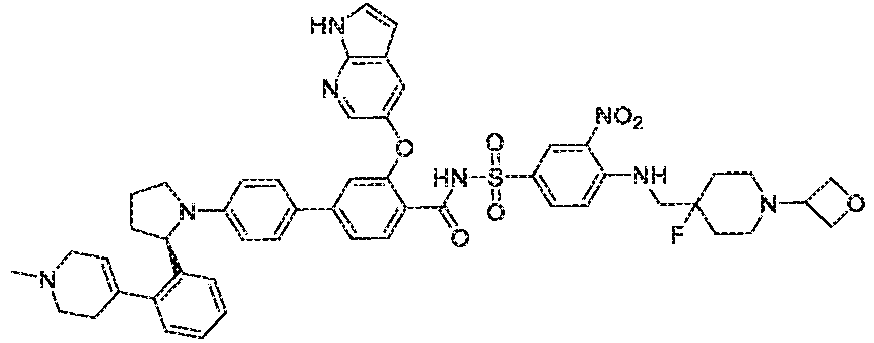
- The desired compound was synthesized following the procedures similar to those in Example G118 by replacing 4-((((1r,4r)-4-hydroxy-4-methylcyclohexyl)methyl)amino)-3-nitrobenzenesulfonamide with 4-(((4-fluoro-1-(oxetan-3-yl)piperidin-4-yl)methyl)amino)-3-nitrobenzenesulfonamide. 1H NMR (DMSO-d6 ) δ ppm: 11.56 (s, 1H), 10.11 (s, 1H), 8.52 - 8.24 (m, 2H), 8.01 - 7.89 (m, 1H), 7.76 - 7.63 (m, 1H), 7.62 - 7.49 (m, 1H), 7.48 - 7.33 (m, 2H), 7.33 - 7.09 (m, 6H), 7.09 - 6.94 (m, 2H), 6.90 (s, 1H), 6.43 - 6.20 (m, 3H), 5.70 (s, 1H), 4.91 - 4.76 (m, 1H), 4.59 - 4.47 (m, 2H), 4.46 - 4.36 (m, 2H), 3.81 - 3.51 (m, 5H), 3.48 - 3.34 (m, 4H), 3.30 - 2.87 (m, 3H), 2.82 - 2.68 (m, 3H), 2.68 - 2.59 (m, 2H), 2.41 - 2.28 (m, 1H), 2.06 - 1.91 (m, 4H), 1.88 - 1.66 (m, 5H). MS (ESI, m/e) [M+1]+ 941.2.
-
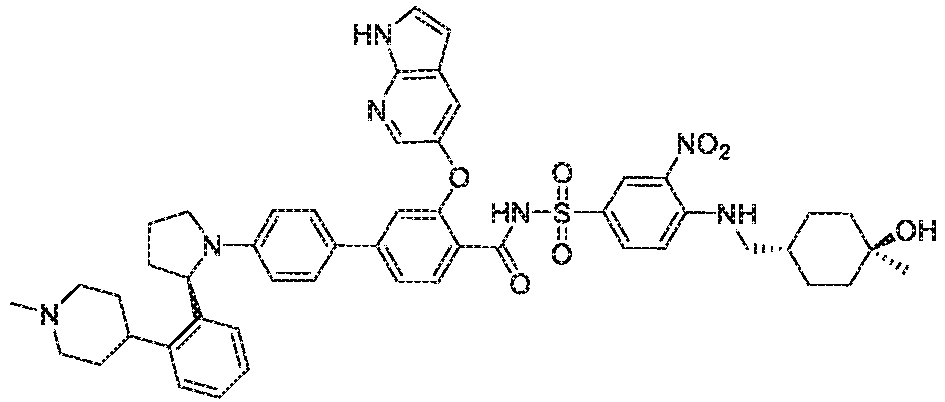
- The desired compound was synthesized following the procedures similar to those in Example A100. To a solution of (R)-3-((1H-pyrrolo[2,3-b]pyridin-5-yl)oxy)-4'-(2-(2-(1-methylpiperidin-4-yl)phenyl)pyrrolidin-1-yl)-[1,1'-biphenyl]-4-carboxylic acid (400 mg, 0.69 mmol) in DCM (25 ml) were added HATU (393 mg, 0.69 mmol) and triethylamine (1 mL). The mixture was stirred at room temperature for 1 hour. Then 4-((((1r,4r)-4-hydroxy-4-methylcyclohexyl)methyl)amino)-3-nitrobenzenesulfonamide (478 mg, 1.40 mmol) and DMAP (171 mg, 1.40 mmol ) were added into the reactor and stirred at room temperature overnight. The reaction mixture was washed with saturated aq. NaHCO3, brine, and dried over anhydrous Na2SO4, then concentrated. The residue was purified by prep-HPLC to obtain example G122 (400 mg). 1H NMR (DMSO-d6 ) δ ppm: 11.54 (s, 1 H), 9.58 (s, 1 H), 8.40 (d, J = 2.0 Hz, 1 H), 8.30 (t, J = 5.6 Hz, 1 H), 7.96 (d, J = 2.5 Hz, 1 H), 7.66 (dd, J = 9.2, 1.7 Hz, 1 H), 7.56 (d, J = 8.6 Hz, 1 H), 7.41 (t, J = 2.9 Hz, 1 H), 7.36 (d, J = 2.5 Hz, 1 H), 7.26-7.19 (m, 6 H), 7.04 (t, J = 7.5 Hz, 1 H), 6.90 (d, J = 6.8 Hz, 2 H), 6.82 (d, J = 9.2 Hz, 1 H), 6.36 (d,J = 8.6 Hz, 2 H), 6.31 - 6.27 (m, 1 H), 5.00 (d, J = 7.5 Hz, 1 H), 4.23 (s, 1 H), 3.79-3.64 (m, 1 H), 3.42 - 3.35 (m, 3 H), 3.25 - 3.15 (m, 3 H), 3.05 (s, 1 H), 2.81 - 2.70 (m, 2 H), 2.59 (s, 3 H), 2.46 - 2.36 (m, 1 H), 1.97 - 1.88 (m, 5 H), 1.82 - 1.48 (m, 8 H), 1.37 - 1.31 (m, 2 H), 1.17 - 1.12 (m, 2 H). MS (ESI, m/e) [M+1]+ 897.9.
-

- The desired compound was synthesized following the procedures similar to those in Example G122 by replacing (R)-1-methyl-4-(2-(pyrrolidin-2-yl)phenyl)piperidine with (R)-1-(4-(2-(pyrrolidin-2-yl)phenyl)piperidin-1-yl)ethan-1-one. 1H NMR (DMSO-d6 ) δ ppm: 12.14 (s, 1H), 11.70 (s, 1H), 8.57 - 8.55 (m, 2H), 8.05 (d, J = 2.5 Hz, 1H), 7.83 (d, J = 9.4 Hz, 1H), 7.59 (s, 1H), 7.54 - 7.49 (m, 2H), 7.36 - 7.30 (m, 4H), 7.17 - 7.08 (m, 2H), 7.03 - 7.00 (m, 1H), 6.90 (s, 1H), 6.86 - 6.8 (m, 1H), 6.38 - 6.36 (m, 3H), 5.06 (s, 1H), 4.55 (s, 1H), 4.24 (s, 1H), 3.93 (s, 1H), 3.71 (s, 1H), 3.39 - 3.38 (m, 1H), 3.26 - 3.23 (m, 3H), 3.18 - 3.16 (m, 2H), 2.70 - 2.60 (m, 2H), 2.04 (s, 3H), 1.97 (s, 1H), 1.86 (s, 2H), 1.69 - 1.65 (m, 4H), 1.56 - 1.53 (m, 2H), 1.33 - 1.30 (m, 2H), 1.15 - 1.00 (m, 5H). MS (ESI) m/e [M+1]+ 925.8.
-

- A mixture of (R)-tert-butyl 4-(2-(1-(4-bromophenyl)pyrrolidin-2-yl)phenyl)piperidine-1-carboxylate (1 g, 2.1 mmol) in HCl (4 M in EA, 20 mL) was stirred at 20°C for 2 hours. TLC showed the reaction was complete. The precipitation was filtered off and dried to give (R)-4-(2-(1-(4-bromophenyl)pyrrolidin-2- yl)phenyl)piperidine (600 mg, HCl salt) as an off-white solid. MS (ESI, m/e) [M+1]' 387.8.
- To a solution of 2-(dimethylamino)acetic acid (175 mg, 1.7 mmol) and TEA (424 mg, 4.2 mmol) in DCM (10 mL) was added HATU (646 mg, 1.7 mmol) at 0°C, and the mixture was stirred at 0°C for 30 min. Then (R)-4-(2-(1-(4-bromophenyl)pyrrolidin-2-yl)phenyl)piperidine (600 mg, 1.4 mmol) was added and the resulting mixture was stirred at 20°C for 2 hours. LC/MS showed the reaction was completed. The mixture was washed with water (10 mL), brine (10 mL), dried over Na2SO4, and concentrated in vacuum to give 900 mg of the crude product, which was purified by prep-HPLC to obtain (R)-1-(4-(2-(1-(4-bromophenyl)pyrrolidin-2-yl)phenyl)piperidin-1-yl)-2-(dimethylamino)ethanone (453 mg). 1H NMR (400MHz, CD3OD) δ ppm: 7.28 (d, J = 7.6 Hz, 1H), 7.22 - 7.10 (m, 3H), 7.08 - 7.03 (m, 1H), 7.01 - 6.97 (m, 1H), 7.01 - 6.97 (m, 1H), 6.30 (d, J = 8.8 Hz, 2H), 5.03 - 4.97 (m, 1H), 5.00 (d, J = 7.4 Hz, 1H), 4.69 (d, J = 13.6 Hz, 1H), 4.17 (d, J = 12.6 Hz, 1H), 3.74 - 3.68 (m, 1H), 3.74 - 3.68 (m, 1H), 3.46 - 3.35 (m, 2H), 3.23 (d, J = 13.2 Hz, 1H), 2.84 - 2.73 (m, 1H), 2.59 - 2.48 (m, 1H), 2.39 (s, 6H), 2.08 - 1.92 (m, 1H), 2.08 - 1.92 (m, 3H), 1.85 - 1.75 (m, 3H), 1.74 - 1.58 (m, 1H). MS (ESI, m/e) [M+1]+ 470.1.
- Step 3: tert-butyl (R)-3-((1H-pyrrolo[2,3-b]pyridin-5-yl)oxy)-4'-(2-(2-(1-(dimethylglycyl)piperidin-4-yl)phenyl)pyrrolidin-1 -yl)-[1,1'-biphenyl]-4-carboxylate To a solution of (R)-1-(4-(2-(1-(4-bromophcnyl)pyrrolidin-2-yl)phenyl)pipcridin-1-yl)-2-(dimethylamino)ethanone (200 mg, 0.425 mmol) in 1,4-dioxane (200 mL) and H2O (2 mL) was added tert-butyl 2-((1H-pyrrolo[2,3-b]pyridin-5-yl)oxy)-4-(4,4,5,5-tetramethyl-1,3,2-dioxaborolan-2-yl)benzoate (203.8 mg, 0.468 mmol) and Pd(dppf)Cl2 (62 mg, 0.085 mmol) and Cs2CO3 (414.4 mg, 1.275 mmol). The mixture was stirred at 100°C for overnight under nitrogen protection. After cooled to room temperature, the mixture was diluted with DCM (100 mL), washed with brine, dried over Na2SO4, concentrated in vacuum. The residue was purified by chromatography column on silica gel (eluent: DCM/MeOH = 20/1 to 1011) to give the product (130 mg, yield: 43.7%). MS (ESI, m/e) [M+1]+ 699.9.
- To a solution of tert-butyl 2-((1H-pyrralo[2,3-b]pyridin-5-yl)oxy)-4-(4,4,5,5-tetramethyl-1,3,2-dioxaborolan-2-yl)benzoate (130 mg, 0.186 mmol) in DCM (10 mL) was added TFA (3 mL). The mixture was stirred at room temperature for 2 hours. The mixture was concentrated in vacuum to give the crude product, which was used directly for next step. MS (ESI, m/e) [M+1]+ 643.8.
- To a solution of (R)-3-((1H-pyrrolo[2,3-b]pyridin-5-yl)oxy)-4'-(2-(2-(1-(dimethylglycyl)piperidin-4-yl)phenyl)pyrrolidin-1-yl)-[1,1'-biphenyl]-4-carboxylic acid in DCM (20 ml) was added HATU (106 mg, 0.279 mmol) and TEA (94mg, 0.930 mmol). The mixture was stirred at room temperature for 1 hour. Then to the mixture was added 4-((((1r,4r)-4-hydroxy-4-methylcyclohexyl)methyl)amino)-3-nitrobenzenesulfonamide (127.7 mg, 0.37 mmol) and DMAP (22.7 mg, 0.186 mmol). The mixture was stirred at room temperature for overnight. The mixture was diluted with DCM (100 mL), and then washed with brine, dried over Na2SO4, evaporated in vacuum. The resulted residue was purified by prep-HPLC to give the desired compound G124 (18 mg) 1H NMR (400 MHz, DMSO-d6 ) δ ppm 11.56 (s, 1H), 9.65 (s, 1H), 8.46-8.34 (m, 2H), 7.97 (s, 1H), 7.76-7.49 (m, 2H), 7.45 - 7.12 (m, 7H), 7.08 - 6.98 (m, 1H), 6.96 - 6.77 (m, 3H), 6.44 - 6.19 (m, 3H), 5.18 - 4.96 (m, 1H), 4.66 - 4.42 (m, 1H), 4.23 (s, 1H), 4.10 - 3.78 (m, 3H), 3.79 - 3.62 (m, 1H), 3.45 - 3.35(m, 1H), 3.30 - 3.03 (m, 5H), 2.89 - 2.58 (m, 7H), 2.07 - 1.82(m, 4H), 1.77 - 1.59 (m, 6H), 1.57 - 1.48 (m, 2H), 1.40 - 1.29 (m, 2H), 1.16 - 1.044 (m, 5H). MS (ESI, m/e) [M+1]+ 968.9.
-

- The desired compound was synthesized following the procedures similar to those in Example G124 starting from tert-butyl (R)-(2-(4-(2-(1-(4-bromophenyl)pyrrolidin-2-yl)phenyl)piperidin-1-yl)-2-oxoethyl)(methyl)carbamate. 1H NMR (400 MHz, DMSO-d 6) δ ppm: 11.53 (s, 1H), 8.43 - 8.23 (m, 2H), 7.95 (s, 1H), 7.68 - 7.51 (m, 2H), 7.45 - 7.14 (m, 7H), 7.07 - 7.00 (m, 1H), 6.96 - 6.85 (m, 2H), 6.85 - 6.74 (m, 1H), 6.70 - 6.51 (m, 1H), 6.43 - 6.33 (m, 1H), 6.29 (s, 1H), 5.38 - 5.25 (m, 1H), 5.13 - 5.01 (m, 1H), 4.60 - 4.48 (m, 1H), 4.23 (s, 1H), 3.94 - 3.69 (m, 3H), 3.64 - 3.53(m, 1H), 3.43 - 3.38 (m, 1H), 3.26 - 3.17 (m, 3H), 3.07 - 2.76 (m, 5H), 2.04 - 1.92 (m, 5H), 1.76 - 1.59 (m, 6H), 1.56 - 1.43 (m, 4H), 1.13 - 1.03 (m, 5H). MS (ESI, m/e) [M+1]+ 954.9
-

- The desired compound was synthesized following the procedures similar to those in Example G124 starting from (R)-1-(4-(2-(1-(4-bromophenyl)pyrrolidin-2-yl)phcnyl)piperidin-1-yl)-3-(dimethylamino)propan-1-one. 1H NMR (400 MHz, DMSO-d6 ) δ ppm: 11.56 (s, 1H), 9.17 (s, 1H), 8.52 - 8.21 (m, 2H), 7.97 (s, 1H), 7.72 - 7.61(m, 1H), 7.61 - 7.48 (m, 1H), 7.47 - 7.09 (m, 7H), 7.08 - 6.96 (m, 1H), 6.96 - 6.74 (m, 3H), 6.45 - 6.22 (m, 3H), 5.15 - 4.91 (m, 1H), 4.68 - 4.49(m, 1H), 4.23 (s, 1H), 4.02 - 3.87 (m, 1H), 3.80 - 3.66 (m, 1H), 3.46 - 3.36 (m, 1H), 3.29 - 3.10 (m, 6H), 2.89 - 2.79 (m, 2H), 2.79 - 2.72 (m, 6H), 2.71 - 2.64 (m, 1H), 2.05 - 1.84 (m, 3H), 1.81 - 1.40 (m, 10H), 1.40 - 1.27 (m, 3H), 1.16-1.01 (m, 5H). MS (ESI, m/e) [M+1]+ 982.9.
-

- The desired compound was synthesized following the procedures similar to those in Example G124 starting from tert-butyl (R)-(1-(4-(2-(1-(4-bromophenyl)pyrrolidin-2-yl)phenyl)piperidin-1-yl)-2-methyl-1-oxopropan-2-yl)(tert-butoxycarbonyl)carbamate. 1H NMR (400 MHz, DMSO-d 6) δ ppm: 11.56 (s, 1H), 8.48 - 8.26 (m, 2H), 7.97 (s, 1H), 7.80 - 7.62 (m, 1H), 7.62 - 7.49 ((m, 1H), 7.48 - 7.13 (m, 8H), 7.08 - 6.99 (m, 1H), 6.94 - 6.83 (m, 2H), 6.42 - 6.25 (m, 3H), 5.11 - 5.02 (m, 1H), 4.45 - 4.32 (m, 1H), 4.23 (s, 1H), 3.77 - 3.68 (m, 1H), 3.61 - 3.53 (m, 1H), 3.52 - 3.49 (m, 1H), 3.43 - 3.37(m, 1H), 3.25 - 3.17 (m, 2H), 2.03 - 1.89 (m, 10H), 1.70 - 1.43 (m, 15H), 1.14 - 1.05 (m, 5H). MS (ESI, m/e) [M+1]+ 968.9. Example G128: (R)-3-((1H-pyrrolo[2,3-b]pyridin-5-yl)oxy)-N-((4-(((1-acetylpiperidin-4-yl)methyl)amino)-3-nitrophenyl)sulfonyl)-4'-(2-(2-cyclopropylphenyl)pyrrolidin-1-yl)-[1,1'-biphenyl]-4-carboxamide

- The desired compound was synthesized following the procedures similar to those in Example A1 by replacing 2-phenylpyrrolidine with (R)-2-(2-cyclopropylphenyl)pyrrolidine, and replacing 3-nitro-4-(((letrahydro-2H-pyran-4-yl)methyl)amino)benzenesulfonamide with 4-(((1-acetylpiperidin-4-yl)methyl)amino)-3-nitrobenzenesulfonamide. 1H NMR (400 MHz, DMSO-d 6) δ ppm: 12.16 (s, 1H), 11.69 (s, 1H), 8.62 (s, 1H), 8.56 (s, 1H), 8.04 (s, 1H), 7.83 (d, J = 8.8 Hz, 1H), 7.58 - 7.51 (m, 3H), 7.35 - 7.28 (m, 3H), 7.14 - 7.04 (m, 4H), 6.90 (s, 1H), 6.85 (d, J = 8.8 Hz, 1H), 6.42 - 6.32 (m, 3H), 5.21 (d, J = 8.0 Hz, 1H), 4.38 (d, J = 8.8 Hz, 1H), 3.85 - 3.71 (m, 2H), 3.33 - 3.31 (m, 2H), 2.92-2.88 (m, 1H), 2.49 - 2.40 (m, 2H), 2.08 - 1.65 (m, 11H), 1.12 - 0.94 (m, 4H), 0.75 -0.71 (m, 2H). MS (ESI, m/e) [M+1]' 853.8.
-
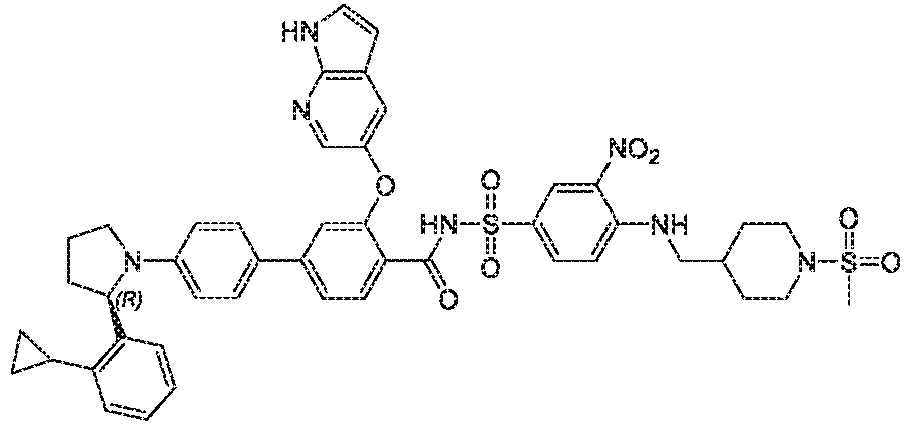
- The desired compound was synthesized following the procedures similar to those in Example A1 by replacing 2-phenylpyrrolidine with (R)-2-(2-cyclopropylphenyl)pyrrolidine, and replacing 3-nitro-4-(((tetrahydro-2H-pyran-4-yl)methyl)amino)benzenesulfonamide with 4-(((1-(methylsulfonyl)piperidin-4-yl)methyl)amino)-3-nitrobenzenesulfonamide. 1H NMR (400 MHz, DMSO-d 6) δ ppm: 12.16 (s, 1H), 11.69 (s, 1 H), 8.63 (s, 1H), 8.56 (s, 1H), 8.04 (s, 1H), 7.83 (d, J = 8.8 Hz, 1H), 7.58 - 7.51 (m, 3H), 7.34 - 7.28 (m, 3H), 7.14 -7.04 (m, 4H), 6.90 (s, 1H), 6.85 (d, J = 8.8 Hz, 1H), 6.42 - 6.32 (m, 3H), 5.21 (d, J= 8.0 Hz, 1H), 3.75 - 3.45 (m, 4H), 3.03 - 3.01 (m, 1H), 2.83 (s, 1H), 2.68 - 2.62 (m, 2H), 2.49 - 2.40 (m, 1H), 2.08 - 1.65 (m, 10H), 1.32 - 1.26 (m, 2H), 1.05 - 0.91 (m, 2H), 0.79 -0.66 (m, 2H). MS (ESI, m/e) [M+1]+ 889.8.
-

- The desired compound was synthesized following the procedures similar to those in Example A1 by replacing 2-phenylpyrrolidine with (R)-2-(2-cyclopropylphenyl)pyrrolidine, and replacing 3-nitro-4-(((tetrahydro-2H-pyran-4-yl)methyl)amino)benzenesulfonamide with 4-((2-morpholinoethyl)amino)-3-nitrobenzenesulfonamide. 1H NMR (400 MHz, DMSO-d 6) δ ppm: 12.01 (br, 1H), 11.70 (s, 1H), 8.80 - 8.65 (m, 1H), 8.60 - 8.45 (m, 1H), 8.10 - 7.95 (m, 1H), 7.82 (d,J = 8.0 Hz, 1H), 7.60 - 7.40 (m, 3H), 7.40 - 7.20 (m, 3H), 7.15 - 6.95 (m, 4H), 6.94 - 6.80 (m, 2H), 6.45 - 6.25 (m, 3H), 5.25 - 5.10 (m, 1H), 3.80 - 3.60 (m, 4H), 3.50 - 3.30 (m, 4H), 2.80 - 2.60 (m, 6H), 2.16 - 1.76 (m, 5H),1.10 - 0.90 (m, 2H), 0.80 - 0.65 (m, 2H). MS (ESI, m/e) [M+1]+ 827.8.
-

- The desired compound was synthesized following the procedures similar to those in Example A1 by replacing 2-phenylpyrrolidine with (R)-2-(2-cyclopropylphenyl)pyrrolidine, and replacing 3-nitro-4-(((tetrahydro-2H-pyran-4-yl)methyl)amino)benzenesulfonamide with 3-nitro-4-((2-(tetrahydro-2H-pyran-4-yl)-2-azaspiro[3.3]heptan-6-yl)amino)benzenesulfonamide. 1H NMR (400 MHz, DMSO-d 6) δ ppm: 11.54 (s, 1H), 8.38 (s, 1H), 8.08 (s, 1H), 7.94 (s, 1H), 7.66 (s, 1H), 7.55 (d, J = 8.0 Hz, 1H), 7.42 (s, 1H), 7.36 - 7.28 (m, 3H), 7.26 - 7.24 (m, 1H), 7.11 - 7.08 (m, 1H), 7.04 - 6.97 (m, 2H), 6.93 - 6.84 (m, 2H), 6.63 - 6.61 (m, 1H), 6.36 (d, J = 8.6 Hz, 2H), 6.30 (s, 1H), 5.32 (s, 1H), 5.21 - 5.20 (m, 1H), 4.02 - 3.69 (m, 5H), 3.28 - 3.19 (m, 3H), 3.00 (s, 5H), 2.12 - 1.80 (m, 9H), 1.45 (s, 1H), 1.08 - 0.93 (m, 3H), 0.84 - 0.81 (m, 4H), 0.70 (s, 1H). MS (ESI) m/e [M+1]+ 893.9.
-
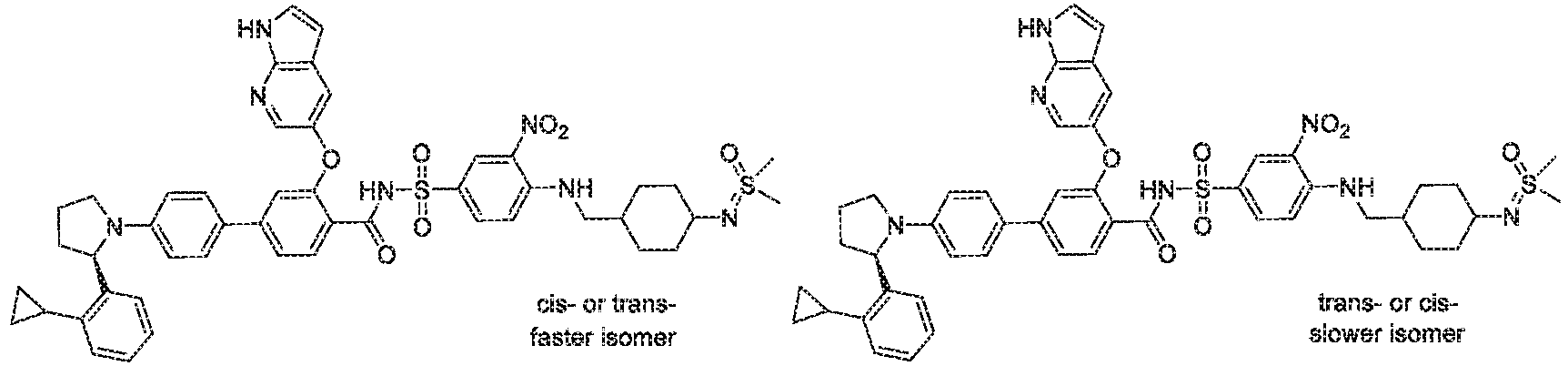
- The desired compounds were synthesized following the procedures similar to those in Example A1 by replacing 2-phenylpyrrolidine with (R)-2-(2-cyclopropylphenyl)pyrrolidine, and replacing 3-nitro-4-(((tetrahydro-2H-pyran-4-yl)methyl)amino)benzenesulfonamide with 3 4-(((4-((dimethyl(oxo)-16-sulfaneylidene)amino)cyclohexyl)methyl)amino)-3-nitrobenzenesulfonamide. G132a was obtained as faster peak by separation and purification of crude product with prep-HPLC.1H NMR (400 MHz, DMSO-d 6) δ ppm: 12.10 (s, 1H), 11.70 (s, 1H), 8.64 - 8.47 (m, 2H), 8.04 (d, J = 2.2 Hz, 1H), 7.81 (d, J = 8.5 Hz, 1H), 7.62 - 7.45 (m, 3H), 7.38 - 7.25 (m, 3H), 7.14 - 6.98 (m, 4H), 6.97 - 6.80 (m, 2H), 6.47 - 6.24 (m, 3H), 5.24 - 5.16 (m, 1H), 3.77 - 3.65 (m, 1H), 3.52 - 3.37 (m, 3H), 3.28 - 3.20 (m, 2H), 3.00 (s, 6H), 2.04 - 1.83 (m, 4H), 1.74 - 1.63 (m, 1H), 1.56 - 1.44.(m, 6H), 1.04 - 0.92 (m, 2H), 0.88 - 0.63 (m, 4H). MS (ESI, m/e) [M+1]+ 901.8. G132b was obtained as slower peak by separation and purification of crude product with prep-HPLC. MS (ESI, m/e) [M+1]' 901.8.
-

- The desired compounds were synthesized following the procedures similar to those in Example A147b by replacing 3-nitro-4-(((tetrahydro-2H-pyran-4-yl)methyl)amino)benzenesulfonamide with 4-((((1 r,4r)-4-hydroxy-4-methylcyclohexyl )methyl)amino)-3-nitrobenzenesulfonamide. 1H NMR (400 MHz, DMSO-d 6) δ ppm: 12.20 (s, 1H), 11.69 (s, 1H), 8.55 (s, 2H), 8.04 (d,J= 2.4 Hz, 1H), 7.81 (d, J = 9.1 Hz, 1H), 7.58-7.49 (m, 3H), 7.39-7.29 (m, 3H), 7.16 -6.99 (m, 5H), 6.92 (s, 1H), 6.47- 6.32 (m, 3H), 5.47 (t, J = 7.4 Hz, 1H), 4.29-4.14 (m, 2H), 3.98-3.87 (m, 1H), 3.4 (t, J = 6.0 Hz, 2H), 2.40-2.30 (m, 1H), 2.03-1.98 (m, 1H), 1.69 (s, 1H), 1.66 (s, 1H), 1.55 (s, 1H), 1.52 (s, 1H), 1.33 (t, J = 10.9 Hz, 2H), 1.23 (s, 2H), 1.15-1.12 (m, 1H), 1.09 (s, 3H), 1.00-0.94 (m, 2H), 0.79-0.75 (m, 1H), 0.72-0.70 (m, 1H). MS (ESI, m/c) [M+1]+ 876.8.
-

- The desired compounds were synthesized following the procedures similar to those in Example A1 by replacing 2-phenylpyrrolidine with 2-(2-cyclopropylphenyl)-4-(trifluoromethyl)pyrrolidinc, and replacing 3-nitro-4-(((tetrahydro-2H-pyran-4-yl)methyl)amino)benzenesulfonamide with 4-((((1r,4r)-4-hydroxy-4-methylcyclohexyl)methyl)amino)-3-nitrobenzenesulfonamide. 1H NMR (400 MHz, DMSO-d 6) δ ppm: 1H NMR (400 MHz, DMSO-d 6) δ ppm: 12.18 (s, 1H), 11.70 (s, 1H), 8.65 - 8.45 (m, 2H), 8.09 - 7.99 (m, 1H), 7.82 (d, J = 9.0 Hz, 1H), 7.67 - 7.42 (m, 3H), 7.41 - 7.18 (m, 3H), 7.18 - 6.81 (m, 6H), 6.52 - 6.20 (m, 3H), 5.30 (t, J = 7.4 Hz, 1H), 4.24 (s, 1H), 3.93 - 3.73 (m, 2H), 3.60 - 3.43 (m, 1H), 3.30 - 3.18 (m, 2H), 3.042 - 2.90 (m, 1H), 2.16 - 2.02 (m, , 1H), 1.89 - 1.74 (m, 1H), 1.74 - 1.42 (m, 5H), 1.40 - 1.27 (m , 2H), 1.20 - 1.02 (m, 5H), 1.02 - 0.89 (m, 2H), 0.80 - 0.65 (m, 2H). MS (ESI, m/e) [M+1]+ 908.7.
-
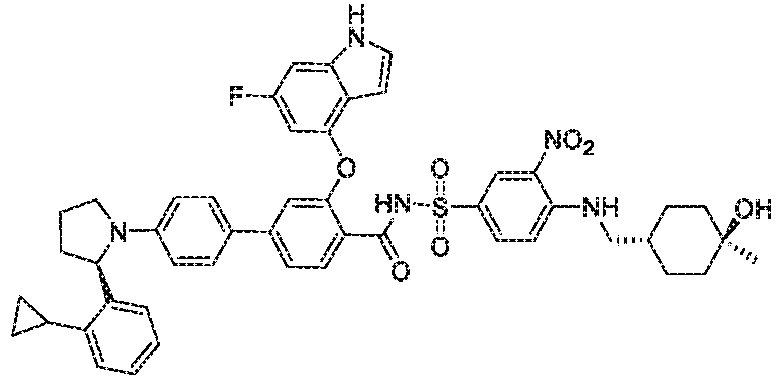
- 1H NMR (DMSO-d6 ) δ ppm: 12.21 (s, 1H), 11.26 (s, 1H), 8.56 (s, 1H), 8.44 (s, 1H), 7.68 - 7.63 (m, 1H), 7.59-7.54 (m, 1H), 7.46 - 7.43 (m, 1H), 7.38 - 7.35 (m, 2H), 7.23 (s, 1H), 7.13 - 7.06 (m, 2H), 7.02 - 6.95 (m, 3H), 6.88 - 6.82 (m, 2H), 6.40 - 6.35 (m, 2H), 6.24 - 6.13 (m, 2H), 5.26 - 5.20 (m, 1H), 3.27 (s, 3H), 2.54 (s, 1H), 2.07 - 1.97 (m, 3H), 1.92 - 1.80 (m, 1H), 1.72 - 1.62 (m, 3H), 1.58 - 1.3 (m, 2H), 1.38 - 1.30 (m, 3H), 1.10 (s, 4H), 1.03 - 0.95 (m, 2H), 0.92-0.78 (m, 2H), 0.73 - 0.65 (m, 1H). MS (ESI) m/e [M+1]' 857.8.
-

- To the solution of 6-methyl-1-((2-(trimethylsilyl)ethoxy)methyl)-1H-pyrrolo[2,3-b]pyridin-5-amine (1.39 g) and Ac2O (1.94 g) in toluene (15 mL) was added AcOK (1.96 g), and the mixture was stirred at 25 °C for 3 hours under N2 atmosphere. Then isoamyl nitrate (1.46 g) was added and the reaction mixture was stirred at 60°C for 14 hr. After cooled to room temperature, the mixture was quenched by aq. NaHCO3(200 mL) and then extracted with DCM (100 mL × 3). The combined organic layer was washed with brine (100 mL), dried over anhydrous Na2SO4 and concentrated in vacuum. The resulted residue (2 g) was dissolved in MeOH (25 mL) and K2CO3(5.5 g) was added. After stirred at 25 °C for 2 hours under N2 atmosphere, the reaction mixture was poured into water (200 mL), and then extracted with DCM (100 ml × 3). The combined organic layer was washed with brine (100 mL), dried over anhydrous Na2SO4 and concentrated in vacuum. The crude product was purified by column chromatography on silica gel (eluent: Petroleum ether/Ethyl acetate = 100/l to 5/1) to obtain5-((2-(trimethylsilyl)ethoxy)methyl)-1,5-dihydropyrazolo[4,3-b]pyrrolo[3,2-e]pyridine (500 mg) as a yellow solid. MS (ESI, m/e) [M+1]' 288.9.
- To the solution of 5-((2-(trimethylsilyl)ethoxy)methyl)-1,5-dihydropyrazolo[4,3-b]pyrrolo[3,2-c]pyridine (600 mg) and methyl 4-bromo-2-fluorobcnzoate(700 mg) in DMF (50 mL) was added Cs2CO3 (1.9 g). The mixture was heated to 120°C and stirred for 6 hours. After cooled to room temperature, the reaction mixture was poured into water and extracted with EA. The organic layers were dried over anhydrous Na2SO4, concentrated and purified by column chromatography on silica gel to obtain methyl 4-bromo-2-(5-((2-(trimethylsilyl)ethoxy)methyl)pyrazolo[4,3-b]pyrrolo[3,2-e]pyridin-1(5H)-yl)benzoate (300 mg). MS (ESI, m/e) [M+1]' 500.7.
- Under nitrogen atmosphere, a mixture of methyl 4-bromo-2-(5-((2-(trimethylsilyl)ethoxy)methyl)pyrazolo[4,3-b]pyrrolo[3,2-e]pyridin-1 (5H)-yl)benzoate (200 mg), 4,4,5,5-tetramethyl-2-(1,4-dioxaspiro[4.5]dec-7-en-8-yl)-1,3,2-dioxaborolane (160mg), Pd(dppf)Cl2 (30 mg), and K2CO3 (166 mg) in 1,4-dioxane (50 mL) and H2O (10 mL) was heated to 90°C and stirred overnight. After cooled to room temperature, the reaction mixture was washed with water, brine and dried over anhydrous Na2SO4. The organic layers were concentrated and purified by column chromatography on silica gel with 10 %~50 % EA/PE to obtain methyl 4-(1,4-dioxaspiro[4.5]dec-7-en-8-yl)-2-(5-((2-(trimethylsilyl)ethoxy)methyl)pyrazolo[4,3-b]pyrrolo[3,2-e]pyridin-1(5H)-yl)benzoate (300 mg) as a white foam.
- To a solution of methyl 4-(1,4-dioxaspiro[4.5]dec-7-en-8-yl)-2-(5-((2-(trimethylsilyl)ethoxy)methyl)pyrazolo[4,3-b]pyrrolo[3,2-e]pyridin-1(5H)-yl)benzoate (300 mg) in THF was added 2 N HCl acid (1 mL) and the mixture was stirred for 3 hours at room temperature. Then the reaction mixture was adjusted to PH ~8 with saturated aq. NaHCO3 solution. After extraction with EA, the organic layers were dried over anhydrous Na2SO4, concentrated and purified by chromatography on silica gel to give (200 mg) as a white solid.
- To the solution of 2-(2-cyclopropylphenyl)pyrrolidine(50.8 mg,0.29 mmol), 4'-oxo-3-(5-((2-(trimethylsilyl)ethoxy)methyl)pyrazolo[4,3-b]pyrrolo[3,2-e]pyridin-1(5H)-yl)-2',3',4',5'-tetrahydro-[1,1'-biphenyl]-4-carboxylate(150 mg) in DCM (25 mL) was HOAc (1 drop) and NaBH(OAc)3 added. After stirred overnight at room temperature, the reaction mixture was washed with saturated aq. NaHCO3 solution. The organic layers were dried over anhydrous Na2SO4, concentrated and purified by chromatography on silica gel to give as a white solid. MS (ESI, m/e) [M+1]+ 687.9.
- To a solution of methyl 4'-(2-(2-cyclopropylphenyl)pyrrolidin-1-yl)-3-(5-((2-(trimethylsilyl)ethoxy)methyl)pyrazolo[4,3-b]pyrrolo[3,2-e]pyridin-1(5H)-yl)-2',3',4',5'-tetrahydro-[1,1'-biphenyl]-4-carboxylate(150 mg) in MeOH/THF(15 mL / 5 mL) was added NaOH(3N, 1mL). After stirred for 4 hours at room temperature, the reaction mixture was acidified by 1N HCl acid to PH ~5 and was then extracted with DCM. The organic layers were dried over anhydrous Na2SO4 and concentrated. The crude 4'-(2-(2-cyclopropylphenyl)pyrrolidin-1-yl)-3-(5-((2-(trimethylsilyl)ethoxy)methyl)pyrazolo[4,3-b]pyrrolo[3,2-e]pyridin-1(5H)-yl)-2',3',4',5'-tetrahydro-[1,1 '-biphenyl]-4-carboxylic acid was used in next step directly without further purification. MS (ESI, m/e) [M+1]+ 673.9.
- To a solution of 4'-(2-(2-cyclopropylphenyl)pyrrolidin-1-yl)-3-(5-((2-(trimethylsilyl)ethoxy)methyl)pyrazolo[4,3-b]pyrrolo[3,2-e]pyridin-1(5H)-yl)-2',3',4',5'-tetrahydro-[1,1'-biphenyl]-4-carboxylic acid (100 mg, 0.15 mmol) in dichloromethane (25 mL) was added O-(7-Azabenzotriazol-1-yl)-N,N,N',N'-tetraMethyluroniuMhexafluorophosphate (86 mg, 0.225 mmol) and trimethylamine (0.5 mL). The mixture was stirred for 0.5 hour at room temperature, then 3-nitro-4-(((tetrahydro-2H-pyran-4-yl)methyl)amino)benzenesulfonamide (95 mg, 0.3 mmol) was added. After stirred overnight at room temperature, the mixture was washed with water (10 mL) and the organic layers were dried over anhydrous Na2SO4 and concentrated in vacuum. The residue was further purified by prep-HPLC to obtain 4'-(2-(2-cyclopropylphenyl)pyrrolidin-1-yl)-N-((3-nitro-4-(((tetrahydro-2H-pyran-4-yl)methyl)amino)phenyl)sulfonyl)-3-(5-((2-(trimethylsilyl)ethoxy)methyl)pyrazolo[4,3-b]pyrrolo[3,2-e]pyridin-1(5H)-yl)-2',3',4',5'-tetrahydro-[1,1'-biphenyl]-4-carboxamide (50 mg). MS (ESI, m/e) [M+1]+970.8.
- To a solution of 4'-(2-(2-cyclopropylphenyl)pyrrolidin-1-yl)-N-((3-nitro-4-(((tetrahydro-2H-pyran-4-yl)methyl)amino)phenyl)sulfonyl)-3-(5-((2-(trimethylsilyl)ethoxy)methyl)pyrazolo[4,3-b]pyrrolo[3,2-e]pyridin-1 (SH)-yl)-2',3',4',5'-tetrahydro-[1,1'-biphenyl]-4-carboxamide (40 mg) in DCM(10 mL) was added TFA(0.5 mL). the mixture was stirred overnight at room temperature. After removal of solvent, the residue was diluted with 20 mL DCM and was then basified by saturated aq. NaHCO3 solution. The isolated organic layers were concentrated and purified by chromatography on silica gel to obtain the desired compound. 1H NMR (400 MHz, DMSO-d6 ) δ ppm: 12.43 (s, 0.5 H), 11.39 (s, 1H), 10.70 (s, 0.5H), 8.30-8.20 (m, 2 H), 8.07 (s, 2 H), 7.69 - 7.39 (m, 5 H), 7.35-7.15 (m, 2 H), 7.13-7.07 (m, 2 H), 6.30-6..15 (m, 2H), 6.13 (s, 1H), 5.33 (d, J = 4.7 Hz, 1H), 3.86 (t, J = 14.2 Hz, 3H), 3.20-3.15 (m, 3H), 2.15- 1.97 (m, 8 H), 1.83 (s, 8H), 1.70-1.61 (m, 5 H), 1.48-1.35 (m, 2 H). MS (ESI, m/e) [M+1]+ 840.8; and Example H3a: 4'-(2-(2-cyclopropylphenyl)pyrrolidin-1-yl)-3-(5-(hydroxymethyl)pyrazolo[4,3-b]pyrrolo[3,2-e]pyridin-1(5H)-yl)-N-((3-nitro-4-(((tetrahydro-2H-pyran-4-yl)methyl)amino)phenyl)sulfonyl)-2',3',4',5'-tetrahydro-[1,1'-biphenyl]-4-carboxamide, MS(ESI, m/e) [M+1]' 870.8.
-

- The desired compound was synthesized with 4-((4-morpholino-1 -(phenylthio)butan-2-yl)amino)-3-nitrobenzenesulfonamide and 3-((1H-pyrrolo[2,3-b]pyridin-5-yl)oxy)-4'-(2-(2-cyclopropylphenyl)pyrrolidin-1-yl)-2',3',4',5'-tetrahydro-[1,1'-biphenyl]-4-carboxylic acid following the procedures similar to those in Example G8. 1H NMR (400 MHz, DMSO-d6 ) δ ppm: 11.66 (s, 1H), 8.42 (s, 1H), 8.33 (s, 1H), 7.98 (s, 1H), 7.81-7.68 (m, 2H), 7.48 (s, 3H), 7.32 - 6.85 (m, 10H), 6.71 (s, 1H), 6.36 (s, 1H), 5.97-5.82 (m, 1H), 4.10 (s, 1H), 3.55 (s, 4H), 3.18 (s, 1H), 3.00 (s, 1H), 2.33 (s, 3H), 2.20 (s, 3H), 2.11 - 1.96 (m, 4H), 1.89 (s, 1H), 1.72 (s, 1H), 1.23 (s, 5H), 0.97 - 0.82 (m, 3H), 0.64 (d, J = 44.8 Hz, 2H). MS (ESI, m/e) [M-1]+ 968.7.
-

- The desired compound was synthesized with 4-((4-morpholino-1-(phenylthio)butan-2-yl)amino)-3-nitrobenzenesulfonamide and 4'-(2-(2-cyclopropylphenyl)pyrrolidin-1-yl)-2',3',4',5'-tetrahydro-[1,1'-biphenyl]-4-carboxylic acid following the procedures similar to those in Example G8. 1H NMR (400 MHz, DMSO-d6 ) δ ppm: 9.68-9.49 (m, 1H), 8.09 (s, 1H), 7.94 (s, 1H), 7.81-7.73 (m, 3H), 7.38 - 7.25 (m, 8H), 7.21-7.11 (m, 2H), 6.90 (s, 2H), 6.72 (s, 1H), 6.12-6.03 (m, 1H), 4.02 (s, 1H), 3.76-3.73 (m, 1H), 3.51 (s, 4H), 2.99 (s, 4H), 2.56 (s, 2H), 2.33-2.17 (s, 2H), 2.17-2.10 (m, 5H), 2.03-1.96 (m, 3H), 1.67-1.45 (m, 2H), 1.45 (s, 1H), 1.24 (s, 5H), 1.00 (s, 2H), 0.78 (s, 1H), 0.65 (s, 1H). MS (ESI, m/e) [M+1]+ 922.7.
-
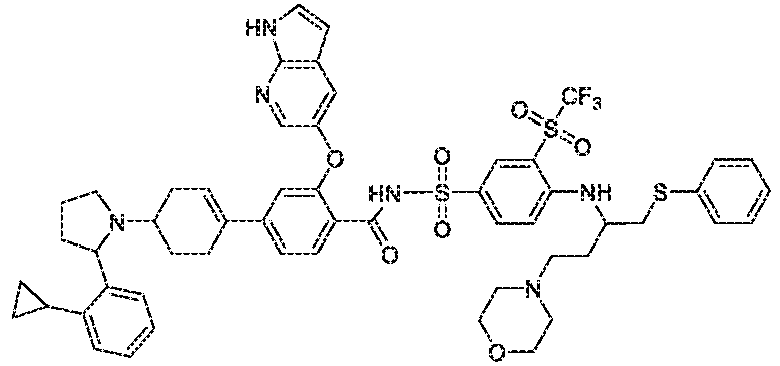
- The desired compound was synthesized with 4-((4-morpholino-1-(phenylthio)butan-2-yl)amino)-3-((trifluoromethyl)sulfonyl)benzenesulfonamide and 3-((1H-pyrrolo[2,3-b]pyridin-5-yl)oxy)-4'-(2-(2-cyclopropylphenyl)pyrrolidin-1-yl)-2',3',4',5'-tetrahydro-[1,1'-biphenyl]-4-carboxylic acid following the procedures similar to those in Example G8. MS (ESI, m/e) [M+1]+ 1055.3.
-

- The desired compound was synthesized with 4-((4-morpholino-1-(phenylthio)butan-2-yl)amino)-3-((trifluoromethyl)sulfonyl)benzenesulfonamide and 4'-(2-(2-cyclopropylphenyl)pyrrolidin-1-yl)-2',3',4',5'-tetrahydro-[1,1'-biphenyl]-4-carboxylic acid following the procedures similar to those in Example G8. MS (ESI, m/e) [M+1]+ 923.3.
- Compounds disclosed herein were tested for blocking of Bcl-2/Bcl-xl protein with its ligand in an assay based on fluorescence polarization methodology. Recombinant human 2.7 nM Bcl-2/ 1.3 nM Bcl-xl protein was pre-incubated with a serial dilution of compounds disclosed herein (maximum concentration is 1 µM for Bcl-2 assay, and 10 µM or 1 µM for Bcl-xl assay, 3-fold serially diluted, 10 points) at room temperature for 0.5 hour in an assay buffer containing 20 mM potassium phosphate buffer, pH 7.5, 50 mM NaCl, 1 mM EDTA, 0.05% Tween-20, 0.01% BSA. Then the FITC labeled Bak peptide Ac-GQVGRQLAIIGDK(FITC)INR-amide (1nM for Bcl-2, 0.82nM for Bcl-xl) was added to plate and further incubated at room temperature for 0.5 h. The FP signals (485nm-520nm-520nm) were read on BMG PHERAstar FS or BMG PHERAstar FSX instrument. The inhibition percentage of Bcl-2/Bcl-xl interaction with its ligand in presence of increasing concentrations of compounds was calculated based on the FP signals. The IC50 for each compound was derived from fitting the data to the four-parameter logistic equation by Graphpad Prism software.
- Compounds disclosed herein were tested for blocking of Bcl-2/Bcl-X protein with its ligand in an assay based on Time-Resolved Fluorescence Resonance Energy Transfer (TR-FRET) methodology. Recombinant human 0.05nM Bcl-2/0.03nM Bcl-X protein was pre-incubated with a serial dilution of compounds disclosed herein (maximum concentration is 0.1µM for Bcl-2 assay, and 10 µM for Bcl-xl assay, 3-fold serially diluted, 10 points; or maximum concentration is 0.02 µM for Bcl-2 assay, and 2 µM for Bcl-xl assay, 3-fold serially diluted, 10 points) at room temperature for 0.5 hour in an assay buffer containing 20 mM potassium phosphate buffer, pH 7.5, 50 mM NaCl, 1 mM EDTA, 0.05% Tween-20, 0.01% BSA. Then the FITC labeled Bak peptide Ac-GQVGRQLAIIGDK(FITC)INR-amide (0.5nM for Bcl-2, 0.3nM for Bcl-xl) and MAb Anti 6His Tb cryptate Gold were added to plate and further incubated at room temperature for 1 hour. The TR-FRET signals (337nm-520nm-490nm) were read on BMG PHERAstar FSX instrument. The inhibition percentage of Bcl-2/Bcl-X interaction with its ligand in presence of increasing concentrations of compounds was calculated based on the TR-FRET signals. The IC50 for each compound was derived from fitting the data to the four-parameter logistic equation by Graphpad Prism software. To improve the assay sensitivity and test more potent compounds in the present application, the bcl-2 concentration was reduced in method B.
- The Bcl-2 family proteins are central regulators of apoptosis. Bcl-2 and Bcl-XL are antiapoptotic factors within this family. In our cell proliferation assay, the Bcl-2 dependent acute lymphoblastic leukemia (ALL) cell line, RS4;11, was used to study the cellular potency of Bcl-2 inhibitors. The cells (ATCC, CRL-1873) were cultured in RPM1-1640 complete medium (RPMI-1640 medium, HEPES (Gibco, 22400-105) supplemented with 10% fetal bovine serum (FBS) (Gibco, 10099-1441), 100 unit/ml penicillin and 100 µg/ml streptomycin (Gibco, 15140122)) and maintained in a humidified chamber at 37°C containing 5% CO2. Each compound was serially diluted with 1 µM as the maximum concentration. To test the apoptotic effect of the compounds, the cells were seeded at 50,000 in 180 µl per well in 96-well plates and treated with 10-point dilution series of each compound for 48 hours at 37°C. Cell viability was assessed after the treatment using CellTiter-GLO luminescent assay (Promega) according to the manufacturer's recommendations. Briefly, 30 µl of CellTiter-GLO reagent was added into 200 µl of cell culture. Mixture was agitated on an orbital shaker for 5 minutes to ensure cell lysis followed by 7 mins incubation at room temperature to allow development and stabilization of luminescent signals, which corresponded to quantity of ATP and thus the quantity of metabolically active cells. Luminescent signals were measured using PHERAstar FS reader (BMG). Mean IC50 values for cell viability were determined with GraphPad Prism software. The Bcl-XL-dependent ALL cell line, Molt-4 (ATCC, CRL-1582) was also used in cell proliferation assay to further evaluate the specificity of these inhibitors. Similarly, the cells were cultured in RPM1-1640 complete medium (RPMI-1640 medium, HEPES (Gibco, 22400-105) supplemented with 10% fetal bovine serum (FBS) (Gibco, 10099-1441), 100 unit/ml penicillin and 100 µg/ml streptomycin (Gibco, 15140122) and 1×GlutaMAX (Gibco, 35050-061)) and maintained in a humidified chamber at 37°C containing 5% CO2. The antiproliferative IC50s of these compounds were similarly determined as a percentage of viable cells upon treatment compared to the untreated control using CellTiter-GLO luminescent assay.
Table 1-A: Biological data tested with Method A Example Biochemical activity (IC50, nM) Cellular activity (IC50, nM) BCL-2 Bcl-xl RS4;11 Molt-4 A1 43 4570 582 6230 A2 140 7152 558 6191 A3 122 ND 1191 7038 A4 16 2145 74 >10000 A4a 3.8 987 36 4134 A4b 36 2697 72 4145 A5 449 ND ND ND A6 3689 ND ND ND A7 417 ND ND ND A8 7.2 900 48 7584 A8a (faster isomer) 1.9 162 19 1870 A8b (slower isomer) 33 4096 147 >10000 A9 1884 ND ND ND A10 1075 ND ND ND A11 14 926 50 > 10000 A12 6.6 645 30 5156 A13 43 ND 404 >10000 A14 133 ND 1570 >10000 A15 31 >10000 200 > 10000 A16 80 >10000 813 >10000 A17 1122 ND ND ND A18 14 724 73 > 10000 A19 191 ND 1025 >10000 A20 71 ND 1505 > 10000 A21 41 2168 6229 > 10000 A22 76 >10000 1096 8911 A23 241 ND ND ND A24 13 879 69 4498 A25 34 2169 260 9176 A26 54 5889 454 7301 A27 10 2326 203 >10000 A28 281 ND 1613 6689 A29 26 ND 1599 >10000 A30 221 ND 1144 5797 A31 20 4299 85 > 10000 A32 26 2915 123 4145 A33 87 ND 1367 >10000 A35 13 1237 145 >10000 A 46 130 ND ND ND A47 977 ND ND ND A54 9.0 2693 90 6249 A55 36 ND 215 8030 A56 14 ND ND ND A57 27 5710 156 4395 A61 >1000 ND ND ND A62 59 ND ND ND A63 29 >10000 328 > 10000 A64 31 ND ND ND A65 8.5 372 40 3306 A67 18 1818 328 >10000 A68 3.9 132 20 >10000 A69 40 ND 135 4900 A70 13 974 123 6348 A73 2.9 138 20 2107 A74 5.3 374 8.6 1847 A75 17 1692 61 5336 A76 5.2 1450 47 2519 A77 23 4224 55 1858 A79 56 ND ND ND A80 186 ND ND ND A81 942 ND ND ND A82 15 1847 217 5176 A83 43 ND ND ND A84 283 ND ND ND A85 125 ND ND ND B1 49 >10000 560 >10000 B2 83 ND 339 5519 B3 85 ND 565 5194 B4 95 ND 2004 >10000 B5 141 ND 736 5090 B6 17 >10000 91 7264 B8 64 ND >10000 >10000 B12 16 1923 586 >10000 B17 5.3 2178 48 8933 B18 2.2 310 30 >10000 B21 89 ND ND ND C1 5.9 3696 109 >10000 C2 14 1501 184 6757 C3 7.3 1816 56 7722 C4 7.9 5131 112 5563 C5 53 ND 4259 >10000 C6 24 ND 1295 >10000 C7 30 ND 2182 >10000 C8 58 ND 694 >10000 C9 26 2686 185 >10000 C10 31 4646 147 6101 C11 89 ND 261 >10000 C12 226 ND ND ND C13 78 ND 335 >10000 C14 18 >10000 93 7933 C15 62 ND ND ND C16 57 >10000 435 >10000 C17 124 ND ND ND C18 21 4159 121 9823 C19 28 5708 204 7266 C21 49 ND 132 5444 C22 60 ND ND ND C24a 3.0 2143 105 >10000 C24b 20 2483 852 >10000 C26a 32 3241 353 7722 C26b 62 ND ND ND C28 29 4324 280 >10000 C31 3.3 1118 41 5599 C36 41 6879 233 7454 C37 51 ND ND ND C39 19 6310 119 >10000 C40 14 5539 383 >10000 C41 12 4975 122 >10000 C42 18 5457 226 >10000 C45 48 ND ND ND C46 30 8846 106 >10000 C47 222 ND ND ND C48 117 ND ND ND C51 14 5761 59 9477 C52 92 2317 ND ND C53 23 ND 180 4217 C54 41 5457 185 5792 C55 12 1099 86 5300 C57 30 5126 463 >10000 C60 7.3 >10000 107 >10000 C62 147 ND ND ND C63 69 ND ND ND C66 14 1947 3012 >10000 C67 110 ND ND ND C69 28 4340 243 >10000 C81 18 2207 410 >10000 C86 96 >10000 748 9817 C87 11 2411 1055 >10000 C88a 20 3593 155 5639 C88b 26 4115 198 7706 C89 15 1002 328 7612 C90 63 9932 291 1469 C99 15 1561 645 >10000 C118 11 >10000 339 9522 C125 13 3708 104 >10000 C126 3.7 1915 24 >10000 C127 12 2762 53 >10000 C128 58 ND ND ND C129 92 ND ND ND C131 19 6594 621 >10000 C132 50 >10000 324 6885 C133 756 ND ND ND C134 8.7 >10000 125 7126 C135 11 >10000 72 6550 C136 16 5406 126 8660 C137 174 ND ND ND C138 28 >10000 127 >10000 C139 27 7086 346 >10000 C140 135 ND ND ND C141 14 4271 94 4115 C142 34 8240 153 2593 C143 59 ND 569 4992 C144 80 ND ND ND C145 45 ND ND ND C146 79 ND ND ND C152 93 ND ND ND C161 51 ND 400 >10000 C162 90 ND 580 >10000 C163 16 2300 171 9054 C164 21 6594 141 4139 C165 6.7 3663 96 >10000 C166 72 ND ND ND C167 92 ND ND ND C168 17 4451 363 >10000 C169 52 ND ND ND C170 6.4 3613 118 >10000 C171 15 1450 492 >10000 C172 5.2 123 131 >10000 C173 121 ND ND ND C174 23 7700 260 >10000 C175 20 2826 476 >10000 C176 39 ND ND ND C177 27 8037 451 >10000 C178 97 ND ND ND C179 36 3486 151 5579 C180 23 3998 118 1989 C181 45 ND ND ND C182 226 ND ND ND C183 4.7 1054 187 >10000 C184 15 >10000 226 7116 C185 109 ND ND ND C186 98 ND ND ND C187 61 ND ND ND C-189 29 ND 79 6506 C190 57 ND ND ND C191 93 ND ND ND C192 21 8397 57 6831 C193 19 >10000 159 3946 C194 61 ND ND ND C195 19 ND >10000 >10000 D1a 3080 ND ND ND D1b 27 3744 377 >10000 D2a 862 ND ND ND D2b 6.5 1421 60 ND D2a-S 520 ND ND ND D2b-S 4.0 949 19 5745 D2a-R 1016 ND ND ND D2b-R 12 3319 108 >10000 D3a 865 ND ND ND D3b 4.0 3053 47 >10000 D4a 2418 ND ND ND D4b 15 7261 94 6258 D5 12 ND 43 7445 D6 19 6631 178 5053 D13-1a 3846 ND ND ND D13-1b 22 ND ND ND D14-1a 2181 ND ND ND D14-1b 23 9747 182 >10000 D63a 2020 ND ND ND D63b 12 >10000 259 >10000 D96 5.9 3441 43 >10000 D97a 631 ND ND ND D97b 4.0 1613 44 8270 D99 >1000 ND ND ND D100 107 ND ND ND D101 66 ND ND ND D102 36 >10000 1038 >10000 D103 6.7 3797 144 >10000 D104 1150 ND ND ND D105 >1000 ND ND ND D106 >1000 ND ND ND E1 54 ND 1630 >10000 E2 20 6924 583 >10000 E3 16 1758 931 >10000 E4 15 ND 798 >10000 E12 7.2 763 144 >10000 E13 6.8 423 82 3800 F1 49 ND 1804 6553 F2 755 ND ND ND F5 2.8 230 4.3 6184 F9 91 ND ND ND F11 37 6665 329 >10000 F30 34 >1000 290 >10000 F31 107 ND ND ND F32 13 >10000 137 7038 F33 149 ND ND ND F36 4.6 2000 31 6086 G1 12 2490 88 6773 G1C 6.9 1528 37 5165 G2 16 93 208 8167 G2C 14 187 159 >10000 G3 33 570 455 >10000 G4 24 5376 241 >10000 G5 19 400 197 4704 G6 13 7356 59 6091 G7 125 ND 3854 >10000 G8 6.4 1097 64 >10000 G8-S 4.8 937 25 2465 G8-a 5.3 884 15 5645 G8-b 4.3 868 10 4754 G9 6.2 936 34 4469 G9-a 7.1 1491 42 >10000 G9-b 5.9 1727 28 6450 G9-S 4.2 1099 38 1091 G10a 5.5 3327 12 7494 G10b 17 3804 72 3754 G10b-S 5.4 3294 4.6 3211 G10b-a 4.6 5372 14 4112 G10b-b 3.0 5125 10 4086 G11 4.5 723 40 >10000 G12 18 5955 51 >10000 G13 5.0 407 72 >10000 G16 27 4982 280 >10000 G18 3.4 172 39 >10000 G20 15 4824 53 >10000 G24b 6.7 2184 36 >10000 G24b-S 2.1 1978 12 4465 G24b-a 3.6 1508 10 4583 G24b-b 2.6 1052 4.9 4045 G26 7.0 551 52 5038 G27 9.5 161 118 >10000 G30 4.9 1019 18 5329 G30-S 3.5 1250 19 4831 G30-a 4.5 1362 22 4607 G30-b 3.4 1362 13 4157 G30-R 7.9 884 121 >10000 G31 6.0 302 66 1230 G32 10 1183 123 >10000 G35-S 2.4 398 14 5187 G35-a 1.9 341 15 7583 G35-b 2.2 287 8.2 3540 G36 5.9 137 41 474 G37 4.3 643 103 6627 G39 17 635 116 6262 G63 20 885 86 8597 G64 8.9 1657 70 3738 G70 353 ND ND ND G72 431 ND ND ND G73 252 ND ND ND G75-a 4.6 1024 42 3246 G75-b 3.6 1088 28 2090 G75 5.2 1008 46 >10000 G76 5.3 1163 34 6301 G76-S 4.2 1099 38 8091 G77 5.0 730 24 >10000 G77-S 3.1 720 35 7397 G80a >1000 ND ND ND G80b 849 ND ND ND G81a 16 8313 49 5487 G81b 5.3 3571 15 8809 G84 12 1118 117 7311 G85-S 59 3692 103 4082 G85-R 2.9 150 10 1837 G86 18 ND 254 9760 G87 18 65 274 2011 G88-S 61 ND ND ND G89-S 59 ND ND ND G90-S 2.8 1574 11 6783 G90-a 3.3 1344 25 3218 G90-b 2.3 1135 16 4655 G91-R 2.4 249 8.5 1726 G92-R 1.8 198 8.2 1266 G92-S 10 1570 37 4257 G93-R 3.6 346 32 3249 G93-S 29 4321 157 2989 G94-R 2.7 157 12 1423 G94-S 12 1317 66 2600 G95-R 3.5 110 16 1439 G95-S 12 1112 91 6197 G96-R 4.9 227 29 2065 G96-S 19 924 55 2744 G97-R 2.2 37 3.9 434 G97-S 8.3 733 35 3030 G98 1.5 65 5.6 1351 G100a 2.8 331 17 3709 G100b 3.3 239 34 3764 G103 13 1404 58 9594 G104 6.5 167 11 1314 G105 51 1249 47 2669 G106 6.0 6701 15 3173 a107-a 1.6 1646 18 7251 G107-b 1.2 1944 11 >10000 G43a 8.2 5049 79 2712 G43b 3.7 2719 22 3042 G108a 3.2 1348 31 >10000 G108b 5.7 1187 24 >10000 G109 5.3 1828 24 >10000 G110a 3.3 1200 13 6182 G110b 6.8 2212 27 5693 G110b-a 5.9 3459 17 3908 G110b-b 4.4 2936 11 2930 G111 6.2 2503 253 >10000 G112 2.5 660 12 4278 G113 7.4 2213 124 >10000 G114 3.2 640 18 5969 G115 9.0 1201 91 >10000 G116 12 6160 20 >10000 G117 4.9 698 70 >10000 H3a 310 ND ND ND H3 27 4572 409 >10000 I7 134 ND ND ND I8 882 ND ND ND I9 >1000 ND ND ND I10 559 ND ND ND Table 1-B: Biological data tested with Method B Example Biochemical activity (IC50, nM) Cellular activity (IC50, nM) BCL-2 Bcl-xl RS4;11 Molt-4 A37 40 ND ND ND A66 1.7 130 289 > 10000 A72 33 650 214 >10000 A78 19 4100 1411 >10000 A86 42 ND ND ND A87 30 ND ND ND A68-S 4.8 1000 196 > 10000 A68-R 0.28 34 10 5241 A88 32 ND ND ND A89 >100 ND ND ND A90 3.8 280 71 5605 A91 >100 ND ND ND A93 68 ND ND ND A94 21 ND ND ND A95 >100 ND ND ND A96 28 ND ND ND A97 0.32 16 4.8 1410 A98 >100 ND ND ND A99 0.56 57 58 > 10000 A100 0.21 17 4.6 >10000 A101 0.055 5.6 7.1 2410 A102 19 ND ND ND A103 0.56 68 11 >10000 A104 1.2 126 16 4613 A105 1.3 144 13 3997 A106 0.3 22 175 >10000 A107 3.5 254 18 3177 A108 6.6 ND 32 > 10000 A109 0.68 36 2.7 1317 A110 3.0 276 15 1258 A111 11 ND 31 6290 A112 0.11 12 3.4 1211 A113 0.24 19 8.6 1190 A114 0.089 9.9 2.7 589 A115 0.8 67 22 3835 A116 2.3 150 65 7043 A117a 0.5 61 11 8962 A117b 2.5 150 46 > 10000 A118a 0.58 61 3.7 979 A118b 0.15 16 1.2 459 A119 0.96 143 38 >1000 A120 0.47 86 88 > 10000 A121 0.88 178 6.6 1799 A122 3.8 ND 48 6919 A123 0.49 89 38.5 3912 A124 4.4 242 14 5844 A125 0.23 21 4.5 489 A126 0.79 32 26 >10000 A127 1.4 170 32 4100 A128 4.4 320 115 >10000 A129 5.4 ND 45 4351 A130 1.2 ND 31 >10000 A131 0.14 24 16 1350 A132 0.63 56 4.2 1993 A133 0.38 57 6.3 5958 A134 0.35 46 2.1 1392 A135 0.25 24 12 751 A136 0.28 19 3.8 1412 A137 0.74 165 10 3537 A138 4.2 115 ND ND A139 6.8 ND 2322 >10000 A140 1.8 161 24 > 10000 A141 49 ND ND ND A142 12 211 108 2510 A143 16 ND ND ND A144 36 >10000 ND ND A145a 8.4 1500 79 5958 A145b 5.8 530 36 3489 A145c 0.44 32 6.8 782 A145d 29 ND ND ND A146 13 1748 22 1900 A147a 20 3202 24 3141 A147b 1.8 230 4.9 1252 A148 62 ND ND ND A149 >100 ND ND ND A150 3.3 1354 41 4108 A151 2.7 ND 26 >10000 A152 33 650 214 >10000 A153 5.9 ND 424 >10000 A154 22 ND ND ND A155 6 2064 94 > 10000 A156 17 ND 142 4395 A157 >100 ND ND ND A158 >100 ND ND ND B13 >100 ND ND ND B14 25 >10000 2552 >10000 B15 8.1 >10000 425 9497 B16 3.9 3900 282 > 10000 B19a >100 ND ND ND B19b >100 ND ND ND B20a >100 ND ND ND B20b >100 ND ND ND B21 100 ND ND ND B22 >100 ND ND ND B23 >100 ND ND ND B24 >100 ND ND ND B25 24 ND 154 9873 B26 9 ND 511 >10000 B27 8.9 > 1 0000 340 >10000 B28 11 ND ND ND B29 26 ND ND ND B30 47 ND ND ND B31 660 ND ND ND B32 59 ND ND ND B33 >100 ND ND ND B34 33 ND ND ND B35 17 ND ND ND B36 87 ND ND ND B37 >100 ND ND ND B38 2.3 >10000 115 > 10000 B39 >100 ND ND ND B40 69 ND ND ND D107a 29 ND ND ND D107b 1.7 ND 187 >10000 F5 0.045 55 5.8 5890 F23 0.039 35 2.2 3736 F22 0.032 26 1.3 2825 F21 0.022 24 1.1 2035 F24 0.078 58 5.9 2848 F25 0.042 36 2.0 4411 F26 0.034 43 1.9 > 10000 F27 1.2 3402 119 > 10000 F28 0.98 1523 83 > 10000 F29 0.63 3061 86 > 10000 F34 0.092 74 6.7 7417 F35 1.4 1300 160 > 10000 F36 4.6 2000 31 6086 F37 0.041 20 2.8 1442 F38 0.07 38 3.8 1745 F39a 0.21 210 14 > 10000 F39b 3.9 2300 105 > 10000 F40 0.045 18 2.7 2702 F41 0.059 22 4.5 4302 F42 44 ND ND ND F43 0.015 18 0.41 2520 F44 0.048 61 1.1 1378 F45 0.036 46 1.0 5979 F46 0.052 28 0.4 2847 F47 0.038 34 0.7 1468 F48 0.074 132 1.8 3753 F49 0.74 2907 123 9342 F50 2.1 5361 349 9342 F51 1.1 1823 43 7000 F52 1.6 9125 107 8988 F53 1.0 835 100 >10000 F54 0.11 154 0.8 1866 F55 0.31 320 44 > 10000 F56 0.43 323 11 4016 F57 4.4 2600 342 > 10000 F58 4.8 1800 262 > 10000 F59 4.7 ND 198 >10000 F60 7.7 5500 517 > 10000 F61 0.081 86 27 > 10000 F62 0.023 29 1.4 991 F63 0.021 17 0.8 6819 F64 0.02 28 0.8 2442 F65 0.32 1408 45 >10000 F66 57 ND ND ND F67 78 ND ND ND F68 0.12 148 13 >10000 F69 0.076 133 15 > 10000 F70 0.24 390 53 > 10000 F71 2.1 7700 1287 >10000 F72a 1.3 826 25 7892 F72b 2.0 1879 42 4305 F73 1.1 1507 63 >10000 F74a 1.9 1490 30 7527 F74b 1.4 372 12 4138 F75 1.5 >10000 36 2045 F76 12 2300 2389 >10000 F77 23 ND ND ND F78 0.21 278 1.5 3569 F79 1.1 1860 38 >10000 F80 32 >10000 ND ND F81 0.56 666 11 1695 F82 0.82 1067 7.6 2488 F83 6.9 ND 60 4833 F84 3.8 7674 44 2229 F85 0.058 38 3.5 3507 F86 0.15 60 32 > 10000 F87 1.5 ND 36 >10000 F88 1.6 2426 13 6977 F89 1.7 3077 27 4013 F90 0.094 99 3.6 > 10000 F91a 0.071 164 3.6 1880 F91b 0.063 27 0.38 957 F92 0.025 22 1.2 1370 F93 15 > 10000 900 >10000 F94 0.97 1300 32 >10000 F95 0.28 708 7.8 4166 F96 27 ND ND ND F97 0.047 82 1.0 > 10000 F98 3.3 1930 14 > 10000 F99 0.024 52 2.6 3080 F100 0.058 133 6.4 7032 F101a 0.063 364 11 2960 F101b 0.098 124 4.4 >10000 F102 0.087 271 1.3 3410 F103 0.57 1160 8.9 > 10000 F104 0.055 86 0.4 1490 F105 0.091 382 3.1 7700 F106 0.021 67 0.7 1206 F107 0.047 20 0.9 1025 F108 0.05 31 1.1 1191 F109 0.039 167 1.2 3847 F110 0.055 106 2.7 2555 F111 0.03 61 0.4 1663 F112 0.045 42 0.7 871 F113 7.8 9004 103 > 10000 F114 2.6 1880 152 2960 F115 6.4 ND 123 > 10000 F116 0.13 167 5.4 4709 F117 0.15 45 6.5 1457 F118 0.13 60 120 > 10000 F119 0.044 35 2.1 2804 F120 0.025 37 2.7 2520 F121 0.092 181 10 4580 F122 0.74 1960 57 > 10000 F123 0.27 688 28.8 > 10000 F124a 1 4459 19 > 10000 F124b 1.3 4141 27 >10000 F125 0.45 4534 30 > 10000 F126 0.076 50 7.5 > 10000 F127 0.084 172 2.1 1790 F128 0.12 34 7.8 1810 F129 0.21 534 29 > 10000 F130 0.021 23 0.5 7350 F131a 0.046 17 4.9 > 10000 F131b 0.061 28 11 >10000 F132a 0.17 335 30 > 10000 F132b 0.015 7.1 0.49 4260 G85-R 2.6 140 10 1612 G91-R 1.5 150 8.5 1726 G92-R 1.1 120 8.9 1955 G94-R 1.5 67 15 1935 G95-R 1.6 61 16 1439 G99 3.2 540 36 6905 G101a 6.1 ND ND ND G101b 7.3 320 111 > 10000 G102 23 1100 861 > 10000 G118 0.068 17 2.8 >10000 G119 0.099 19 3.7 7848 G120 0.17 19 9 > 10000 G121 0.095 12 1.6 >10000 G122 0.053 19 1.6 >10000 G123 1.1 176 5.4 3556 G124 0.063 22 3.8 >10000 G125 0.064 14 33 > 10000 G126 0.084 12 12 >10000 G127 1.2 150 60.3 >10000 G128 1.2 75 21 765 G129 3.3 123 35 974 G130 9.1 170 82 2338 G131 14 ND ND ND G132a 2.6 250 30 5343 G132b 0.24 297 20 8246 G133 1.6 170 1.5 392 G134 13 3396 33 1427 G135 49 2743 ND ND ABT-199 
0.34 190 9.5 3166 F133 49 > 10000 ND ND Example 8 in CN 10674 9233A 
84 >10000 ND ND ND: no data. - Selected compounds disclosed herein were tested for blocking of Bcl-2-G101 protein with its ligand in an assay based on time-resolved fluorescence resonance energy transfer methodology. 0.05nM of Recombinant human Bcl-2-G101V protein was pre-incubated with a serial dilution of compounds disclosed herein (maximum concentration is 10 µM, 4-fold serially diluted, 10 points; or maximum concentration is 1uM, 3-fold serially diluted, 10 points) at room temperature for 0.5 hour in an assay buffer containing 20 mM potassium phosphate buffer, pH 7.5, 50 mM NaCl, 1 mM EDTA, 0.05% Tween-20, 0.01% BSA. Then 5nM of the FITC labeled Bak peptide Ac-GQVGRQLAIIGDK(FITC)INR-amide and Mab Anti-6His Tb cryptate Gold was added to plate and further incubated at room temperature for 1 hour. The TR-FRET signals (ex337nm, em490nm/520nm) were read on BMG PHERAstar FSX instrument. The inhibition percentage of Bcl-2-G101V interaction with its ligand in presence of increasing concentrations of compounds was calculated based on the ratio of fluorescence at 490 nm to that at 520nm. The IC50 for each compound was derived from fitting the data to the four-parameter logistic equation by Graphpad Prism software or Dotmatics. The data was shown in Table 1-C.
Table 1-C: Biochemical data of inhibition of mutant Bcl-2-G101V Example Biochemical activity Bcl-2-G101V, IC50 (nM) A114 2.7 F21 0.93 F26 1.2 F43 0.42 F44 1.6 F48 2.1 F63 0.52 F85 1.3 F90 1.4 F91b 0.25 F92 0.86 F99 2.5 F106 0.72 F126 12 F132b 0.31 G122 1.5 G124 1.1 ABT-199 
28 - To further assess the compound's binding affinity to Bcl-2 Gly101Val mutant, selected compounds in Table 1-C together with ABT-199 were examined in biochemical assay. These compounds were confirmed to be unexpectedly more potent than ABT-199 (28 nM), which indicates these compounds may overcome the BCL2 resistant mutant.
- TABLE 2 describes ABT-199, its structurally similar analogs and their activity in both of biochemical assay and cellular assay. As can be seen from the table, these analogs exhibit a dramatic trend of decreasing activity (at least more than 1 0 fold) for Bcl-2 compared with ABT-199. For example, the most similar analog B6 shows about 14 fold less potent in biochemical assay and more than 20 fold less potent in RS4;11 cellular proliferation assay. The decrease in activity of ABT-199 analogs from B1 to B5 ranges from 40 fold to greater than 100 fold in biochemical assay, and the drop potency in RS4;11 cellular proliferation assay are all greater than 80 fold.
Table 2: ABT-199 and its structurally similar analogs in the present invention Example Biochemical activity# (IC50, nM) Cellular activity (IC50, nM) BCL-2 RS4;11 B1 49 560 B2 83 339 B3 85 565 B4 95 2004 B5 141 ND B6 17 91 ABT-199 
1.2 3.8 ABT-199 analog 
ND ND #: Data tested with method A. - TABLE 3A describes selected compounds without the carbon atom between two rings A and B and their activity or potency in both of biochemical assay and cellular assay. Compounds in the present patent show unexpected structure-activity relationship (SAR). When ring A is phenyl or spiro ring, compounds (F5, F55, A4, A8) with an ortho-substituent (e.g., Cl atom or cyclopropyl) on the phenyl group are much more potent (> 10 fold) compared to those compounds with the same substituent on other positions of the phenyl group. However, the above SAR with respect to the change of the substitution positions on the phenyl group were not found when the ring A is hexane or hexene group.
Table 3A Example Biochemical activity (IC50, nM) Cellular activity (IC50, nM) BCL-2 RS4;11 F5B 0.045# 5.8 F53B 1.0# 100 F55B 0.31# 44 F58B 4.8# 262 F60B 7.7# 517 A4A 16 2145 A3A 122 ND A2A 140 7152 A8A 7.2 48 A10A 1075 ND A14A 133 1570 C3A 7.3 56 C4A 7.9 112 C192A 21 8397 D1bA 27 3744 D13-1bA 22 ND D14-1bA 23 9747 D2bA 6.5 60 D3bA 4.0 3053 D4bA 15 7261 #: Data tested with method B. - Table 3B describes some examples with different ring A and their activity or potency in both of biochemical assay and cellular assay. No -CH2- between Ring A and B. Surprisingly, examples F21, F22, F23,F24, F25, F26, F34, F37, F38, F40, F41, F43-F48, F62-F64, F90, F91b, F92, F99, F104, F106, F109, F111, F120, F126, F130 and F132b with spiro ring as ring A have significantly increased activity in both of biochemical assay and cellular assay, compared to examples with other rings as ring A (i.e., examples A8a, G92-R, G94-R, G95-R and G96-R with phenyl rings as ring A, and C3, G30-a, G30-b, G10b-a, G10b-b, G24b-a, G24b-b, Ci9-a, (a9-b, (a8-a, G8-b, G107-a, G107-b, G90-a, and G90-b with hexene rings as ring A, and D2b-S and G76-S, G77-S with hexane rings as ring A). Compounds in the current patent show unexpected SAR, which can be further explained by an additional sulfur-pi interaction with Met115 in co-crystal of compound F22 having a spiro ring as ring A with bcl-2 protein compared to those of compounds G10b-a, G10b-b having hexene rings as ring A with bcl-2 protein.
- Examples F21, F22, F23, F24, F25, F26, F34, F37, F38, F40, F41, F43-F48, F62-F64, F90, F91b, F92, F99, F104, F106, F109, F111, F120, F126, F130 and F132b with spiro rings as ring A are 3 to > 10 fold more potent than ABT-199 and Example 8 from
CN106749233A in biochemical assay using method B, and >1 to >8 fold more potent than ABT-199 in cellular assay. Moreover, the selectivity of examples with spiro ring as ring A against Bcl-xl is better than that of ABT-199 in biochemical assay or cellular assay. Further, the unexpected SAR also happened on the chiral center of pyrrolidine ring. The more potent isomer in example with phenyl ring as ring A has R configuration (i.e., examples G92-R, G94-R, G95-R, G96-R, G118, G122 and G124), while the more potent isomer in example with hexane, hexane or spiro ring as ring A has S configuration.Table 38 Example Biochemical activity (IC50, nM) Cellular activity (IC50, nM) Bcl-2 Bcl-xl RS 4; 11 Molt-4 A8A 7.2 900 48 7584 A8a (faster isomer)A 1.9 162 19 1870 G92-RA 1.8 198 8.2 1266 G92-RB 1.1 ND ND ND G94-RA 2.7 157 12 1423 G94-RB 1.5 ND ND ND G95-RA 3.5 110 16 1439 G95-RB 1.6 ND ND ND G96-RA 4.9 227 29 2065 G118 0.068 17 2.8 >10000 G122 0.053 19 1.6 >10000 G124 0.063 22 3.8 >10000 C3A 7.3 1816 56 7722 G30-aA 4.5 1362 22 4607 G30-bA 3.4 1362 13 4157 G10-aA 4.6 5372 14 4112 G10b-bA 3.0 5125 10 4086 G24b-aA 3.6 1508 10 4583 G24b-bA 2.6 1052 4.9 4045 G9-aA 7.1 1491 42 >10000 G9-bA 5.9 1727 28 6450 G8-aA 5.3 884 15 5645 G8-bA 4.3 868 10 4754 G9-aA 1.6 1646 18 7251 G107-bA 1.2 1944 11 >10000 G90-aA 3.3 1344 25 3218 G90-bA 2.3 1135 16 4655 D2b-SA 4.0 949 19 5745 G76-SA 4.2 1099 38 8091 G77-SA 3.1 720 35 7397 F21A 1.6 ND ND ND F21B 0.022 24 1.1 2035 F22A 1.7 ND ND ND F22B 0.032 26 1.3 2825 F23A 1.7 ND ND ND F23B 0.039 35 2.2 3736 F24B 0.078 58 5.9 2848 F25B 0.042 36 2.0 4411 F26B 0.034 43 1.9 >10000 F34B 0.042 74 6.7 7417 F37B 0.041 20 2.8 1442 F38B 0.07 38 3.8 1745 F40B 0.045 18 2.7 2702 F41B 0.059 22 4.5 4302 F43B 0.015 18 0.41 2520 F44B 0.048 61 1.1 1378 F45B 0.036 46 1.0 5979 F46B 0.052 28 0.4 2847 F47B 0.038 34 0.7 1468 F48B 0.074 132 1.8 3753 F62B 0.023 29 1.4 991 F63B 0.021 17 0.8 6819 F64B 0.02 28 0.8 2442 F90B 0.094 99 3.6 >10000 F91bB 0.063 27 0.38 957 F92B 0.025 22 1.2 1370 F99B 0.024 52 2.6 3080 F104B 0.055 86 0.4 1490 F106B 0.021 67 0.7 1206 F109B 0.039 167 1.2 3847 F111B 0.03 61 0.4 1663 F120B 0.025 37 2.7 2520 F126B 0.076 50 7.5 >10000 F130B 0.021 23 0.5 7350 F132bB 0.015 7.1 0.49 4260 ABT-199A 
2.3 ND ND ND ABT-199B 0.34 190 9.5 3166 F133 49 >10000 ND ND Example 8 from CN 106749233 AB
84 >10000 ND ND A: Biochemical data using method A; B: Biochemical data using method B. - Table 3C describes compounds with spiro ring as ring A and their activity in both of biochemical assay (using method B) and cellular assay. As can be seen from the table, inserting -CH2- between ring A (spiro ring) and ring B (pyrrolidine ring) dramatically reduced the potency, which is consistent with the unexpected structure-activity relationship (SAR). For example, the F115 shows > 100 folds and 50 folds less potent than its analog F23 in biochemical assay and cellular assay, respectively. F113 and F114 show 28 to 80 folds and 15 to 22 folds less potent than their analog F34 in biochemical assay and cellular assay, respectively.
- Moreover, all these compounds are much more potent than Example 8 from
CN106749233A and F133 in biochemical assay, which may be attributed to the optimum combination of the spiro moiety and the 2-(2-substituted phenyl)pyrrolidin-1-yl moiety or 2-(2-substituted phenyl)-4-alkylpiperazin-1-yl moiety of the compounds disclosed herein.Table 3C#: Example Biochemical activity# (IC50, nM) Cellular activity (IC50, nM) Bc1-2 RS4;11 F23 0.039 2.2 F90 0.094 3.6 F115 6.4 123 F34 0.042 6.7 F113 7.8 103 F114 2.6 152 F133 49 ND Example 8 from CN 106749 233A 
84 ND - Recombinant Bcl-2 protein with GST tag was expressed in F. coli BL21 (DE3), induced with 0.1 mM IPTG for 16 h at 16°C. The cells were harvested by centrifugation at 5,000 g for 15 min, re-suspended in lysis buffer containing 20 mM Tris, pH 8.0 and 300 mM NaCl, and lysed by sonication. After centrifugation at 20,000 g for 40 min, the supernatant was incubated with Glutathione S-transferase resin at 4 °C for 30 min. The resin was rinsed three times with the lysis buffer, followed by treatment with PreScission protease at 4°C overnight. The flow through was concentrated and sequentially applied to a size-exclusion chromatography column (Superdex-75, GE Healthcare) in a buffer containing 20 mM Tris, pH 8.0 and 150 mM NaCl. The peak was collected and concentrated to approximately 10 mg/ml. Protein solution was incubated with A4a for 30 min at 4°C, and then mixed with a reservoir solution containing 0.1 M Bis-Tris, pH 6.6 and 25% PEG 3,350. Co-crystals of Bcl-2 with A4a were obtained by vapor diffusion from hanging drops cultured at 20°C.
- Nylon loops were used to harvest the co-crystals and then immersed the crystals in the reservoir solution supplemented with 20% glycerol for 10 sec. Diffraction data were collected on Eiger 16M detector at BL17U1, Shanghai Synchrotron Radiation Facility, and were processed with XDS program. The phase was solved with program PHASER using the Bcl-2 crystal structure (PDB code 4MAN) as the molecular replacement searching model. Phenix.refine was used to perform rigid body, TLS, restrained refinement against X-ray data, followed by manually adjustment in COOT program and further refinement in Phenix.refine program.
-
Data collection Beamline BL17U1 Space group P1 21 1 Cell dimensions (Å) a=31.90 b=40.60 c=53.81 Angles (°) α=90.00 β= 103.66 γ=90.00 Resolution (Å) 32.07-1.60 (1.63-1.60) Total number of reflections 111450 (31 30) Number of unique reflections 17216 (709) Completeness (%) 96.7 (82.3) Average redundancy 6.5 (4.4) Rmergea 0.074 (0.61 9) I/sigma (I) 12.5 (1.9) Wilson B factor (Å) 22.8 Refinement Resolution (Å) 31.00-1.60 Number of reflections 17200 rmsd bond lengths (Å) 0.006 rmsd bond angles (°) 0.991 Rwork b (%) 18.19 Rfree c (%) 22.27 Average B-factors of protein 33.360 Ramachandran plot (%) Favored 99.26 Allowed 0.74 Outliers 0.00 - Values in parentheses refer to the highest resolution shell.
- a Rmerge=ΣΣ i |I(h) i - 〈I(h)〉|/∑∑ i |I(h) i |, where 〈I(h)〉 is the mean intensity of equivalent.
- b Rwork=∑|Fo - Fc|/∑|Fo|, where Fo and Fc are the observed and calculated structure factor amplitudes, respectively.
- c Rfree=∑|Fo - Fc|/∑|Fo|, calculated using a test data set, 5% of total data randomly selected from the observed reflections.
- The absolute stereochemistry of the more potent compound A4a in enzymatic and cellular assays is assigned as (S)-configuration on the chiral carbon atom based on its co-crystal structure with Bcl-2 protein. The binding pose of A4a is distinct from that of ABT-199 analog (compound structure see table 3, PDB code: 4MAN) to Bcl2 protein. Compared to ABT-199 analog, 2-(2-chlorophenyl)-pyrrolidinyl moiety of A4a induces a different conformation of the residues around p2 pocket of Bcl-2, such as Phe112, Met115, Glu136 and Phe153, which results in a larger and flatter pocket on the surface of the protein.
- As shown in
FIG 4. and 5 ., binding pose of F22 is distinct from that of ABT-199 analog (PDB code: 4MAN). Compared to ABT-199 analog, 2-(2-cyclopropylphenyl)-pyrrolidinyl moiety of F22 induces a different conformation of the residues around p2 pocket of Bcl-2, such as Aspl 11, Phe112 and Met115, which create an extra sub-pocket. Hydrophobic interaction between 2-cyclopropylphenyl with the surrounding residues contributes to the better potency of F22. - As shown in
FIG. 6 , water bridge is observed between nitrogen atom of F22 pyrrolidinyl ring and backbone carbonyl of Val133 through 2 water molecules in the crystal structure. This water bridge contributes to a more stable interaction between F22 and Bcl-2 protein, while no such water bridge can be observed between ABT-199 analog and Bcl-2.As shown inFIG. 7 , optimal sulfur-π interaction between Met115 and 2-cyclopropylphenyl of F22 is observed in the crystal structure. Similar interaction can also be observed in the crystal structure of ABT-199 analog (PDB code: 4MAN), but the interaction is not optimal in that crystal structure. - In summary, based on the crystal structure of F22, hydrophobic interaction between the cyclopropyl group and induced sub-pocket, water bridge with Val133 and sulfur-π interaction with Met115 all contribute to the better potency of F22.
- Protein was purified as described previously. Protein solution was incubated with F22 by a molar ratio 1:2 for 30 min at 4°C, and then mixed with a reservoir solution containing 0.2 M ammonium acetate, 0.1 M Bis-Tris, pH 5.5 and 25% PEG 3,350. Co-crystals were obtained by vapor diffusion from hanging drops cultured at 20°C.
- Nylon loops were used to harvest the co-crystals and then immersed the crystals in the reservoir solution supplemented with 20%) glycerol for 10 sec. Diffraction data were collected at home lab diffractometer, and were processed with XDS program. The phase was solved with program PHASER using the Bcl-2_G10B-a in house crystal structure as the molecular replacement searching model. Phenix.refine was used to perform rigid body, TLS, restrained refinement against X-ray data, followed by manually adjustment in COOT program and further refinement in Phenix.refine program.
- Data collection and refinement statistics
Data collection Beamline Home lab diffractometer Space group P 21 21 21 Cell dimensions (Å) a=32.91 b=45.73 c=98.95 Angles (°) α=90.00 β=90.00 γ=90.00 Resolution (Å) 41.51-2.60 (2.72-2.60) Total number of reflections 46305 (5642) Number of unique reflections 4831 (561) Completeness (%) 97.5 (95.4) Average redundancy 9.6(10.1) Rmergea 0.065 (0.478) I/sigma (I) 28.1 (4.7) Wilson B factor (Å) 16.14 Refinement Resolution (Å) 33.58-2.60 Number of reflections 4805 rmsd bond lengths (Å) 0.003 rmsd bond angles (°) 0.612 Rwork b (%) 18.90 Rfree c (%) 23.20 Average B-factors of protein 20.74 Ramachandran plot (%) Favored 96.75 Allowed 3.25 Outliers 0.00 - Values in parentheses refer to the highest resolution shell.
- a Rmerge=∑∑ i |I(h) i - 〈I(h)〉|∑∑ i |I(h) i |, where 〈I(h)〉 is the mean intensity of equivalent.
- b Rwork=∑|Fo - Fc|∑|Fo|, where Fo and Fc are the observed and calculated structure factor amplitudes, respectively.
- c Rfree=∑|Fo - Fc|/∑|Fo|, calculated using a test data set, 5% of total data randomly selected from the observed reflections.
- Method: The five isoform-selective probe substrate (in a cocktail manner) was used as a measure of activity for the individual cytochrome P450 (CYPs) in a pool of human liver microsomes, i.e., phenacetin for CYP1A2, diclofenac for CYP2C9, S-Mephenytoin for CYP2C19, dextromethorphan for CYP2D6, midazolam for CYP3A. Test compounds, at 7 concentration levels including zero, were incubated in human liver microsomes (HLM) together with the 5 probe substrate (in a cocktail manner). IC50 was determined by monitoring the reduction of the CYP activity as a function of test compound concentration and quantified by product formation using LC-MS/MS. Ketoconazole for CYP3A was included as quality control. All incubations were performed in singlet. The final incubation conditions are listed below.
Reaction Component Final Concentration HLM 0.1 mg·mL-1 Buffer Phosphate Buffer (100 mM, pH 7.4) Test Compound 7 Concentration Points Including Zero (0~30 µM or 0∼10 µM, as requested) Positive Control Ketoconazole for CYP3A (7 Concentration Points Containing Zero, 0 - 0.3 µM) Probe Substrate (in a cocktail manner) Phenacetin for CYP1A2 (10 µM) Diclofenac for CYP2C9 (5 µM) S-Mephenytoin for CYP2C 19 (30 µM) Dextromethorphan for CYP2D6 (5 µM) Midazolam for CYP3A (2 µM) NADPH 1 mM Incubation Time 15 min MgCl2 3 mM - Data Analysis: The uninhibited fraction of CYP activity (remaining activity fraction) will be calculated as


where Top, Bottom, S, x and y donate the experimentally maximum remaining enzyme activity (%), the experimentally minimum remaining enzyme activity (%), the slope factor, the test compound concentration, and the uninhibited fraction (%), respectively. - In the case that no significant inhibition is observed over the concentration range (the uninhibited fraction does not reach 50% even at the highest test compound concentration), the IC50 will not be calculated.
- The general criteria to evaluate the potential risk of drug-drug interaction (DDI) is as followed
- IC50 > 10 µM: low CYP inhibition;
- µM < IC50 < 10 µM: moderate CYP inhibition;
- IC50 < 3 µM: high CYP inhibition.
- Compared with Compound ABT-199 (Venetoclax) and ABT-263 (Navitoclax) showing high CYP 2C9 inhibition, representative compounds disclosed herein, for example, Compounds G2, G12, G10b-b, G24b-b, G35b, G77-S, F21, F26, F37, F43, F44, F45, F106, F107, G122 and G 124 showed much lower CYP 2C9 inhibition, indicating the compounds disclosed herein have lower potential risk of drug-drug interaction (DDl).
- It is to be understood that, if any prior art publication is referred to herein; such reference does not constitute an admission that the publication forms a part of the common general knowledge in the art in any country.
- The disclosures of all publications, patents, patent applications and published patent applications referred to herein by an identifying citation are hereby incorporated herein by reference in their entirety.
- Although the foregoing invention has been described in some detail by way of illustration and example for purposes of clarity of understanding, it is apparent to those skilled in the art that certain minor changes and modifications will be practiced. Therefore, the description and Examples should not be construed as limiting the scope of the invention.
- The following numbered clauses, describing aspects of our proposals, are part of the description:
- 1. A compound of Formula (I)

wherein- L1 and L2 are each independently a direct bond, and L4 is -C(O)NRgSO2-, wherein Rg is hydrogen and C1-6alkyl;
- L3 is a direct bond, -(CRaRb)t-, -(CRaRb)t-1-(CRc=CRd)-(CRaRb)v-1-, -(CRaRb)t-1-(C≡C)-(CRaRb)v-1-, -O-, -S-, -S(O)-, -SO2-, -C(O)-, C(O)O-, -OC(O)-, -NR8-, -C(O)NRa-, - NRaC(O)-, -NRaC(O)O-, -NRaC(O)NRb-, -SO2NRa-, -NRaSO2-, -NRaS(O)2NRb-, - NRaS(O)NRb-, -C(O)NRaSO2-, -C(O)NRaSO-, or -C(=NRa)NRb-, wherein t and v, at each occurrence, are independently a number of 1 to 7, and one or two CRaRb moieties in - (CRaRb)t-, -(CRaRb)t-1-(CRc=CRd)-(CRaRb)v-1-, -(CRaRb)t-1-(C≡C)-(CRaRb)v-1- are un-replaced or replaced with one or more moieties selected from O, S, SO, SO2, C(O) and NR';
- Ring A is cycloalkyl, cycloalkenyl, cycloalkynyl, aryl, heterocyclyl, or heteroaryl, each of which is optionally substituted with 1 to 4 substituents R2;
R2, at each occurrence, is independently selected from the group consisting of hydrogen, halogen, or -C1-8alkyl optionally substituted with halogen; - Ring B is heterocyclyl, or heteroaryl, each of which is optionally substituted with 1 to 4 substituents R1;
R1, at each occurrence, is independently selected from the group consisting of hydrogen, halogen, -C1-8alkyl, -C2-8alkenyl, -C2-8alkynyl, cycloalkyl, heterocyclyl, aryl, heteroaryl, oxo, -CN, -NO2, -OR1a, -SO2R1a, -COR1a, -CO2R1a, -CONR1aR1b, - C(=NR1a)NR1bR1c, -NR1aR1b, -NR1aCOR1b, -NR1aCONR1bR1c, -NR1aCO2R1b, - NR1aSONR1bR1c, -NR1aSO2NR1bR1c, or -NR1aSO2R1b; wherein said -C1-8alkyl, -C2-salkenyl, -C2-8alkynyl, cycloalkyl, heterocyclyl, aryl or heteroaryl are each independently optionally substituted with 1 to 4 substituents R1d,- R1a, R1b, and R1c, are each independently hydrogen, -C1-8alkyl, -C2-8alkenyl, -C2-salkynyl, cycloalkyl, heterocyclyl, aryl, or heteroaryl, each of said -C1-8alkyl, -C2-salkenyl, -C2-8alkynyl, cycloalkyl, heterocyclyl, aryl, or heteroaryl is optionally substituted with halogen, hydroxy or -C1-8alkyoxy;
- R1d, at each occurrence, is independently halogen, -C1-8alkyl, -C2-8alkenyl, -C2-salkynyl, cycloalkyl, heterocyclyl, aryl, heteroaryl, oxo, -CN, -NO2, -ORBa, - SO2RBa, -CORBa, -CO2RBa, -CONRBaRBb, -C(=NRBa)NRBbRBc, -NRBaRBb, - NRBaCORBb, -NRBaCONRBbRBc, -NRBaCO2RBb, -NRBaSONRBbRBc, - NRBaSO2NRBbRBc, or -NRBaSO2RBb; wherein said -C1-8alkyl, -C2-8alkenyl, -C2-salkynyl, cycloalkyl, heterocyclyl, aryl or heteroaryl are each independently optionally substituted with 1 to 4 substituents RBd;
- RBa, RBb, and RBc, are each independently hydrogen, -C1-8alkyl, -C2-8alkenyl,-C2-8alkynyl, cycloalkyl, heterocyclyl, aryl, or heteroaryl, each of said -C1-8alkyl, -C2-8alkenyl, -C2-8alkynyl, cycloalkyl, heterocyclyl, aryl, or heteroaryl is optionally substituted with halogen, hydroxy, -NH2 or -N(C1-6alkyl)2, -C1-8alkyoxy, cycloalkyl, heterocyclyl, aryl, or heteroaryl;
- RBd, at each occurrence, is independently hydrogen, halogen, oxo, -CN, -NO2, -C1-8alkyl, -C2-8alkenyl, -C2-8alkynyl, cycloalkyl, heterocyclyl, aryl, or heteroaryl, each of said -C1-8alkyl, -C2-8alkenyl, -C2-8alkynyl, cycloalkyl, heterocyclyl, aryl, or heteroaryl is optionally substituted with halogen, hydroxy, -C1-8alkyoxy, cycloalkyl, heterocyclyl, aryl, or heteroaryl;
- R3 is hydrogen, halogen, C1-8alkyl, C2-8alkenyl, C2-8alkynyl, cycloalkyl, aryl, heterocyclyl, or heteroaryl, each of said C1-8alkyl, C2-8alkenyl, C2-8alkynyl, cycloalkyl, aryl, heterocyclyl, or heteroaryl is optionally substituted with 1 to 4 substituents R3a;
R3a, at each occurrence, is independently selected from halogen, cyano, -NO2, -OR3b, - SR3b, -NR3bR3c, -COR3b, -SO2R3b, -C(=O)OR3b, -C(=O)NR3bR3c, -C(=NR3b)NR3cR3d, - N(R3b)C(=O)R3c, -N(R3b)C(=O)OR3c, -N(R3b)C(O)NR3cR3d, -N(R3b)S(O)NR3cR3d, - N(R3b)S(O)2NR3cR3d, -NR3bSO2R3c, -C1-8alkyl, -C2-8alkenyl, -C2-8alkynyl, -cycloalkyl, heterocyclyl, aryl, or heteroaryl;
R3b, R3c, and R3d are independently hydrogen, -C1-8alkyl, -C2-8alkenyl, -C2-8alkynyl, cycloalkyl, heterocyclyl, aryl, or heteroaryl, each of said -C1-8alkyl, -C2-8alkenyl, -C2-8alkynyl, cycloalkyl, heterocyclyl, aryl, or heteroaryl is optionally substituted with halogen, hydroxy or -C1-8alkyoxy; - R4 is -NO2;
- m is an integer of 1-4;
- R5 is -L5-CyC,
- Wherein L5 is a direct bond, -(CRaRb)t-, -(CRaRb)t-1-(CRc=CRd)-(CRaRb)v-1-, - (CRaRb)t-1-(C≡C)-(CRaRb)v-1-, -O-, -S-, -S(O)-, -SO2-, -C(O)-, C(O)O-, -OC(O)-, - NRa-, -C(O)NRa-, -NRaC(O)-, -NRaC(O)O-, -NRaC(O)NRb-, -SO2NRa-, -NRaSO2-, - NRaS(O)2NRb-, -NRaS(O)NRb-, -C(O)NRaSO2-, -C(O)NRaSO-, or -C(=NRa)NRb-, wherein t and v, at each occurrence, are independently a number of 1 to 7, and one or two CRaRb moieties in -(CRaRb)t-, -(CRaRb)t-1-(CRc=CRd)-(CRaRb)v-1-, -(CRaRb)t-1-(C ≡C)-(CRaRb)v-1- are un-replaced or replaced with one or more moieties selected from O, S, SO, SO2, C(O) and NRa;
- CyC is cycloalkyl, heterocyclyl, aryl, or heteroaryl, each of which is optionally substituted with one or two substituents R5a;
- R5a, at each occurrence, is independently selected from hydrogen, halogen, cyano, oxo, -NO2, -OR5b, -SR5b, -NR5bR5c, -COR5b, -SO2R5b, -C(=O)OR5b, -C(=O)NR5bR5c, - C(=NR5b)NR5cR5d, -N(R5b)C(=O)R5c, -N(R5b)C(=O)OR5c, -N(R5b)C(O)NR5cR5d, - N(R5b)S(O)NR5cR5d, -N(R5b)S(O)2NR5cR5d, -NR5bSO2R5c, -C1-8alkyl, -C2-8alkenyl, - C2-8alkynyl, -cycloalkyl, heterocyclyl, aryl, or heteroaryl, each of said -C1-8alkyl, -C2-8alkenyl, -C2-8alkynyl, -cycloalkyl, heterocyclyl, aryl, or heteroaryl is optionally substituted with one or two substituents R5e;
- wherein R5b, R5c, and R5d are each independently hydrogen, -C1-8alkyl, -C2-8alkenyl, -C2-8alkynyl, cycloalkyl, heterocyclyl, aryl, or heteroaryl, each of said - C1-8alkyl, -C2-8alkenyl, C2-8alkynyl, -cycloalkyl, heterocyclyl, aryl, or heteroaryl is optionally substituted with one or two substituents R5e;
- R5e, at each occurrence, is independently selected from hydrogen, halogen, cyano, oxo, -NO2, -OR5f, -SR5f, -NR5fR5g, -COR5f, -SO2R5f, -C(=O)OR5f, - C(=O)NR5fR5g, -C(=NR5f)NR5gR5h, -N(R5f)C(=O)R5g, -N(R5f)C(=O)OR5g, - N(R5f)C(O)NR5gR5h, -N(R5f)S(O)NR5gR5h, -N(R5f)S(O)2NR5gR5h, -NR5fSO2R5g,-C1-8alkyl, -C2-8alkenyl, -C2-8alkynyl, -cycloalkyl, heterocyclyl, aryl, or heteroaryl;
R5f, R5g, and R5h are each independently hydrogen, -C1-8alkyl, -C2-8alkenyl, - C2-8alkynyl, cycloalkyl, heterocyclyl, aryl, or heteroaryl;
- or, two adjacent R5 on the phenyl ring together with the phenyl ring form a benzo ring, said ring is optionally substituted with halogen, oxo, cyano, -NO2, -OR5i, -SR5i, -NR5iR5j, - COR5i, -SO2R5i, -C(=O)OR5i, -C(=O)NR5iR5j, -C(=NR5i)NR5jR5k, -N(R5i)C(=O)R5j, - N(R5i)C(=O)OR5j, -N(R5i)C(O)NR5jR5k, -N(R5i)S(O)NR5jR5k, -N(R5i)S(O)2NR5jR5k, - NR5iSO2R5k, -C1-8alkyl, -C2-8alkenyl, -C2-8alkynyl, -cycloalkyl, heterocyclyl, aryl, or heteroaryl;
R5i, R5j, and R5k are independently hydrogen, -C1-8alkyl, -C2-8alkenyl, -C2-8alkynyl, cycloalkyl, heterocyclyl, aryl, or heteroaryl, each of said -C1-8alkyl, -C2-salkenyl, -C2-8alkynyl, cycloalkyl, heterocyclyl, aryl, or heteroaryl is optionally substituted with halogen, hydroxy or -C1-8alkyoxy; - Ra, Rb, Rc, and Rd at each occurrence, are independently hydrogen, -C1-8alkyl, -C2-8alkenyl, -C2-8alkynyl, cycloalkyl, heterocyclyl, aryl, or heteroaryl, said -C1-8alkyl, -C2-8alkenyl, -C2-8alkynyl, cycloalkyl, heterocyclyl, aryl, or heteroaryl are each independently substituted with -CN, halogen, -NO2, -NReRf, oxo, -ORe, or -SRe; and
wherein Re and Rf are each independently hydrogen, C1-8alkyl, C1-8alkoxy-C1-8alkyl-, C2-8alkenyl, C2-8alkynyl, cycloalkyl, aryl, heterocyclyl, or heteroaryl.
- 2. The compound of clause 1, wherein Ra, Rb, Rc and Rd, at each occurrence, are independently hydrogen or C1-6alkyl, preferably hydrogen or methyl.
- 3. The compound of clause 1, wherein L3 is a direct bond, -(CRaRb)t-, -O-, -S-, -S(O)-, -SO2-, -C(O)-, C(O)O-, -OC(O)-, or -NRa-, wherein Ra, Rb and t are defined as with Formula (I). Preferably, Ra and Rb are independently hydrogen or C1-6alkyl, and t is 1 or 2.
- 4. The compound of clause 3, wherein L3 is -O-, -CH2-, -NRa-, a direct bond, or -C(O)-.
- 5. The compound of clause 3, wherein L3 is -0-.
- 6. The compound of clause 1, wherein R3 is heteroaryl optionally substituted with one or two substituents R3a as defined with Formula (I).
- 7. The compound of clause 6, wherein R3 is heteroaryl optionally substituted with one or two substituents R3a selected from halogen, -C1-8alkyl, or -NR3bR3c, wherein R3b and R3c are independently hydrogen, or -C1-8alkyl.
- 8. The compound of clause 6, wherein R3 is a 5 to 7-membered nitrogen-containing monocyclic heteroaryl optionally substituted with one or two substituents R3a selected from halogen, -C1-8alkyl, or -NR3bR3c, wherein R3b and R3c are independently hydrogen, or -C1-8alkyl.
- 9. The compound of clause 6, wherein R3 is tetrazolyl, trizolyl, pyrazolyl, pyrrolyl, pyridinyl, pyrimidinyl, each of which optionally substituted with one or two substituents R3a selected from halogen, -C1-8alkyl, or -NR3bR3c, wherein R3b and R3c are independently hydrogen, or -C1-8alkyl.
- 10. The compound of clause 6, wherein R3 is a 8- to 12-membered bicyclic heteroaryl comprising 1 or 2 or 3 nitrogen atoms.
- 11. The compound of clause 10, wherein R3 is indolyl, pyrrolopyridiny, or pyrazolopyridinyl, each of which optionally substituted with one or two substituents R3a selected from halogen, -C1-8alkyl, or -NR3bR3c, wherein R3b and R3c are independently hydrogen, or -C1-8alkyl.
- 12. The compound of clause 11, wherein R3 is indol-4-yl, pyrrolo[2,3-b]pyridin-5-yl, pyrazolo[4,3-b]pyridin-1-yl.
- 13. The compound of clause 6, wherein R3 is 11- to 14-membered tricyclic heteroaryl comprising 1 or 2 or 3 or 4 or 5 nitrogen atoms optionally substituted with one or two substituents R3a selected from halogen, -C1-8alkyl, or -NR3bR3c, wherein R3b and R3c are independently hydrogen, or -C1-8alkyl.
- 14. The compound of clause 1, wherein L3 is -O-, and R3 is pyrrolo[2,3-b]pyridin-5-yl.
- 15. The compound of clause 1, wherein L4 is -C(O)NRaSO2-, wherein Ra is hydrogen and C1-6alkyl; is preferably hydrogen.
- 16. The compound of clause 1, wherein ring A is cycloalkyl, cycloalkenyl, aryl, heterocyclyl, or heteroaryl, each of which is optionally substituted with 1 to 4 substituents R2.
- 17. The compound of clause 16, wherein R2 is hydrogen, halogen (e.g., F, Cl or Br) or C1-6alkyl (e.g., methyl) optionally substituted with halogen (e.g., F, Cl or Br)
- 18. The compound of clause 16, wherein ring A is a phenyl ring, which is 1,2-phenylene, 1,3-phenylne, or 1,4-phenylene.
- 19. The compound of clause 16, wherein ring A is a cycloalkyl ring which is C3-8cycloalkyl.
- 20. The compound of clause 19, wherein A is selected from cyclobutyl, cyclopentyl, cyclohexyl, or cycloheptyl.
- 21. The compound of clause 20, wherein ring A is 1,2-cyclobutylene, 1,3-cyclobutylene, 1,2-cyclopentylene, 1,3-cyclopentylene, 1,2-cyclohexylene, 1,3-cyclohexylene, 1,4-cyclohexylene, 1,2-cycloheptylene, 1,3-cycloheptylene or 1,4-cycloheptylene.
- 22. The compound of clause 16, wherein ring A is C3-8cycloalkenyl, preferably cyclohexenyl, more preferably cyclohex-3-enyl or cyclohex-2-enyl.
- 23. The compound of clause 16, wherein ring A is a monocyclic 5- or 6-membered heteroaryl comprising one or two or three or four heteroatoms selected from nitrogen, oxygen, and sulfur, or 8- to 12-membered bicyclic heteroaryl ring.
- 24. The compound of clause 16, wherein ring A is heterocyclyl, which is selected from a) monocyclic 4 to 9-membered heterocyclyl groups containing one or two heteroatoms selected from nitrogen or oxygen or sulfur as ring member;
- b) 5 to 12-membered spiro heterocyclyl comprising one or two heteroatoms selected from nitrogen, sulfur and oxygen as ring members;
- c) 5 to 12-membered fused heterocyclyl comprising one or two heteroatoms selected from nitrogen, sulfur and oxygen as ring members; and
- d) 5 to 12-membered bridged heterocyclyl comprising one or two heteroatoms selected from nitrogen, sulfur and oxygen as ring members.
- 25. The compound of clause 24, wherein ring A is heterocyclic which is piperidine, pyrrolidine, and azetidine; 7-azaspiro[3.5]nonane, 2-azaspiro[3.5]nonane, 8-azabicyclo[3.2.1]octane; tetrahydrothienopyridine (e.g., 4,5,6,7-tetrahydrothieno[2,3-c]pyridine), tetrahydropyrrolopyrazine (e.g., 1,2,3,4-tetrahydropyrrolo[1,2-a]pyrazine), tetrahydropyrrolopyrazine (e.g., 1,2,3,4-tetrahydropyrrolo[1,2-a]pyrazine), hexahydroindolizine (e.g., 1,2,3,5,8,8a-hexahydroindolizine), dihydropyrrolothiazole (e.g., 5,6-dihydro-4H-pyrrolo[3,4-d]thiazole), or isoindoline; or ring A is 5 to 12-membered spiro heterocyclyl comprising one or two heteroatoms selected from nitrogen, sulfur and oxygen as ring members; preferably ring A is 4-membered/4-membered, 3-membered/5-membered, 4-membered/5-membered, 4-membered/6-membered, 5-membered/5-membered, or 5-membered/6-membered mono-spiro heterocyclyl comprising one or two nitrogen or oxygen as ring members; more preferably ring A is


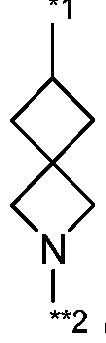


- 26. The compound of clause 20, wherein ring A is selected from the group consisting of


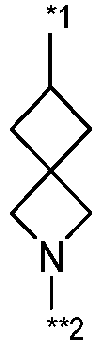

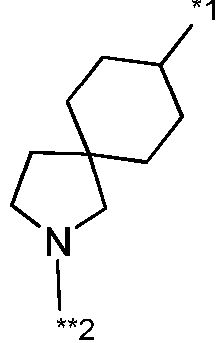



- 27. The compound of clause 20, wherein ring A is


- 28. The compound of clause 1, wherein Ring B is heterocyclyl, each of which is optionally substituted with 1 to 4 substituents R1;
- R1 is selected from the group consisting of halogen, -C1-8alkyl, -C2-8alkenyl, -C2-8alkynyl, cycloalkyl, aryl, heteroaryl, oxo, -CN, or -OR1a; wherein said -C1-8alkyl, -C2-8alkenyl, -C2-salkynyl, aryl or heteroaryl are each independently optionally substituted with 1 to 4 substituents R1d,
- R1a is hydrogen, or -C1-8alkyl, said -C1-8alkyl is optionally substituted with halogen, hydroxy or -C1-8alkyoxy;
- R1d, at each occurrence, is independently halogen, -C1-8alkyl, -C2-8alkenyl, -C2-8alkynyl, cycloalkyl, heterocyclyl, aryl, heteroaryl, -CN, -ORBa, -SO2RBa, -CONRBaRBb, -NRBaRBb, - NRBaCORBb, or -NRBaSO2RBb; wherein said -C1-8alkyl, cycloalkyl, heterocyclyl, aryl or heteroaryl are each independently optionally substituted with 1 to 4 substituents RBd;
- RBa and RBb are each independently hydrogen, -C1-8alkyl, cycloalkyl, or aryl, each of said -C1-salkyl, cycloalkyl, or aryl is optionally substituted with halogen, hydroxy, -C1-8alkyoxy, cycloalkyl, heterocyclyl, aryl, or heteroaryl;
- RBd, at each occurrence, is independently hydrogen, halogen, -CN, -C1-8alkyl, -C2-8alkynyl, cycloalkyl, or aryl, each of said -C1-8alkyl, -C2-8alkynyl, or aryl is optionally substituted with halogen, hydroxy, -C1-8alkyoxy, cycloalkyl, heterocyclyl, aryl, or heteroaryl.
- 29. The compound of clause 1, wherein ring B is heterocyclyl which is monocyclic 4 to 9-membered heterocyclyl, a 5 to 20-membered spiro heterocyclyl, a 5 to 20-membered fused heterocyclyl, or a 5 to 20-membered bridged heterocyclyl, each of which is optionally substituted with 1 to 4 substituents R1.
- 30. The compound of clause 29, wherein said monocyclic heterocyclyl is a monocyclic 4 to 9-membered heterocyclyl comprising one or more heteroatoms selected from the group consisting of NH, O, S, SO or SO2 heteroatoms as ring members.
- 31. The compound of clause 29, wherein said monocyclic heterocyclyl is a monocyclic 4 to 9-membered heterocyclyl comprising one nitrogen atom as the ring member.
- 32. The compound of clause 30, wherein said monocyclic 4 to 9-membered heterocyclyl comprising one nitrogen atom as the ring member is C-linked or N-linked.
- 33. The compound of clause 30, wherein said monocyclic 4 to 9-membered heterocyclyl comprising one nitrogen atom as the ring member is saturated.
- 34. The compound of clause 33, wherein said saturated heterocyclyl is a N-linked saturated heterocyclyl.
- 35. The compound of clause 34, wherein said saturated heterocyclyl is aziridin-1-yl, azetidin-1-yl, pyrrolidin-1-yl, piperidin-1-yl, azepan-1-yl, or azocan-1-yl.
- 36. The compound of clause 33, wherein said saturated heterocyclyl is a C-linked saturated heterocyclyl.
- 37. The compound of clause 33, wherein said saturated heterocyclyl is aziridin-2-yl, azetidin-2-yl, azetidin-3-yl, pyrrolidin-2-yl, pyrrolidin-3-yl, piperidin-2-yl, piperidin-3-yl, piperidin-4-yl, azepan-2-yl, azepan-3-yl, azepan-4-yl, azocan-2-yl, azocan-3-yl, azocan-4-yl, or azocan-5-yl.
- 38. The compound of clause 30, wherein said monocyclic 4 to 9-membered heterocyclyl comprising one nitrogen atom as the ring member is unsaturated.
- 39. The compound of clause 38, wherein said monocyclic 4 to 9-membered heterocyclyl comprising one nitrogen atom as the ring member contains one carbon-carbon double bond.
- 40. The compound of clause 38, wherein said monocyclic 4 to 9-membered heterocyclyl comprising one nitrogen atom as the ring member is dihydropyrrole, e.g., 2,3-dihydro-1H-pyrrole and 2,5-dihydro-1H-pyrrole, or tetrahydropyridine group.
- 41. The compound of clause 29, wherein said monocyclic heterocyclyl is a monocyclic 4 to 9-membered heterocyclyl comprising one nitrogen atom and one additional heteroatom selected from the group consisting of NH, O, S, SO or SO2 heteroatoms as ring members.
- 42. The compound of clause 41, wherein said monocyclic 4 to 9-membered heterocyclyl comprising one nitrogen atom and one additional heteroatom selected from the group consisting of NH, O, S, SO or SO2 heteroatoms as ring members is C-linked or N-linked.
- 43. The compound of clause 41, wherein said monocyclic heterocyclyl is saturated.
- 44. The compound of clause 41, wherein said saturated monocyclic heterocyclyl is N-linked or C-linked.
- 45. The compound of clause 29, wherein ring B is pyrrolidin-1-yl substituted with 1 to 4 substituents R1.
- 46. The compound of clause 45, wherein R1 is a phenyl group.
- 47. The compound of clause 29, wherein ring B is aziridin-1-yl, azetidin-1-yl, pyrrolidin-1-yl, pyrrolidin-2-yl, piperidin-1-yl, azepan-1-yl, or azocan-1-yl, preferably pyrrolidin-1-yl, which is substituted with a phenyl group at position 2 and further optionally substituted with 1 or 2 or 3 substituents R1 on the pyrrolidinyl ring, and said phenyl group at position 2 is optionally substituted with R1d as defined with Formula (I).
- 48. The compound of clause 47, wherein R1 is selected from the group consisting of halogen, - C1-8alkyl, -C2-8alkenyl, -C2-8alkynyl, cycloalkyl, aryl, heteroaryl, oxo, -CN, or -OR1a; wherein said -C1-8alkyl, -C2-8alkenyl, -C2-8alkynyl, cycloalkyl, aryl, or heteroaryl is optionally substituted with 1 to 4 substituents R1d, wherein R1a is hydrogen or C1-8alkyl, preferably methyl, and R1d is halogen or -ORBa, wherein RBa is hydrogen or -C1-8alkyl.
- 49. The compound of clause 48, wherein R1 is heteroaryl, preferably furanyl, more preferably furan-3-yl.
- 50. The compound of clause 47, wherein R1d is halogen, -C1-8alkyl, -C2-8alkenyl, -C2-8alkynyl, cycloalkyl, heterocyclyl, aryl, heteroaryl, -CN, -ORBa, -SO2RBa, -CONRBaRBb, -NO2, - NRBaRBb, -NRBaCORBb, or -NRBaSO2RBb; wherein said -C1-8alkyl, -C2-8alkenyl, -C2-8alkynyl, cycloalkyl, heterocyclyl, aryl or heteroaryl are each independently optionally substituted with 1 to 4 substituents RBd as defined with Formula (I), preferably 1 or 2 substituents RBd as defined with Formula (I).
- 51. The compound of clause 48, wherein R1d is -C1-8alkyl which is further optionally substituted with 1 to 4 substituents RBd, which is halogen, phenyl, or cycloalkyl (e.g., C3-8cycloalkyl, preferably cyclopropyl).
- 52. The compound of clause 51, wherein R1d is -C1-8alkyl selected from methyl, ethyl, isopropyl, propyl, tert-butyl, and isobutyl, optionally substituted with RBd.
- 53. The compound of clause 50, wherein R1d is cycloalkyl which is further optionally substituted with 1 to 4 substituents RBd, which is halogen, cyano, C2-8alkynyl (preferably ethynyl), or C1-8alkyl optionally substituted with halogen (preferably CF3).
- 54. The compound of clause 50, wherein R1d is C3-8cycloalkyl selected from cyclopropyl, cyclobutyl, cyclopentyl, or cyclohexyl, optionally substituted with RBd.
- 55. The compound of clause 50, wherein R1d is -C2-8alkenyl which is prop-1-en-2-yl.
- 56. The compound of clause 50, wherein R1d is -C2-8alkynyl which is ethynyl.
- 57. The compound of clause 50, wherein in the definition of -ORBa as R1d, RBa is hydrogen, C1-8alkyl (selected from methyl, ethyl, propyl, and isopropyl), C3-8cycloalkyl (preferably cyclopropyl or cyclohexyl), aryl (preferably phenyl), wherein C1-8alkyl, C3-8cycloalkyl and aryl are each independently substituted with halogen, heterocyclyl (preferably monocyclic 4- to 9-membered heterocyclyl, more preferably morpholino), hydroxy, or -C1-8alkoxyl (preferably methoxyl).
- 58. The compound of clause 50, wherein R1d is aryl which is phenyl.
- 59. The compound of clause 50, wherein R1d is heterocycle which is monocyclic 4 to 9-membered heterocyclyl groups containing one or two heteroatoms selected from nitrogen or oxygen or sulfur as ring member, preferably monocyclic 4 to 6-membered heterocyclyl comprising one oxygen atom as ring member or monocyclic 6-membered heterocyclyl comprising one or two nitrogen atoms as ring members.
- 60. The compound of clause 50, wherein R1d is heteroaryl, preferably thiophenyl or furanyl.
- 61. The compound of clause 29, wherein ring B is pyrrolidin-1-yl substituted with a naphthyl group, preferably substituted with a naphthyl at position 2.
- 62. The compound of clause 29, wherein ring B is pyrrolidin-1-yl substituted with a heteroaryl group, preferably substituted with a heteroaryl group at position 2.
- 63. The compound of clause 62, wherein said heteroaryl is 5- to 6-membered heteroaryl comprising 1-4 heteroatoms selected from nitrogen, oxygen, and sulfur.
- 64. The compound of clause 62, wherein said heteroaryl is pyridinyl, furanyl, thiophenyl, or pyrazole.
- 65. The compound of clause 62, wherein said heteroaryl is optionally substituted with halogen or C3-8cycloalkyl (preferably cyclopropyl).
- 66. The compound of clause 29, wherein ring B is pyrrolidin-1-yl substituted with -C1-8alkyl, - C2-8alkenyl, or -C2-8alkynyl, preferably substituted with -C1-8alkyl, -C2-8alkenyl, or -C2-8alkynyl at position 2, each of said -C1-8alkyl, -C2-8alkenyl, or -C2-8alkynyl is unsubstituted or substituted with a phenyl group, said phenyl group is optionally substituted with halogen or C3-8cycloalkyl (preferably cyclopropyl).
- 67. The compound of clause 66, wherein ring B is pyrrolidin-1-yl substituted with methyl, ethenyl, or ethynyl, each of which is optionally substituted with a phenyl group optionally substituted as above.
- 68. The compound of clause 66, wherein ring B is pyrrolidin-1-yl, optionally substituted with 1 to 4 substituents R1 as defined with Formula (I).
- 69. The compound of clause 1 or 29, wherein

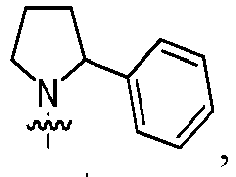









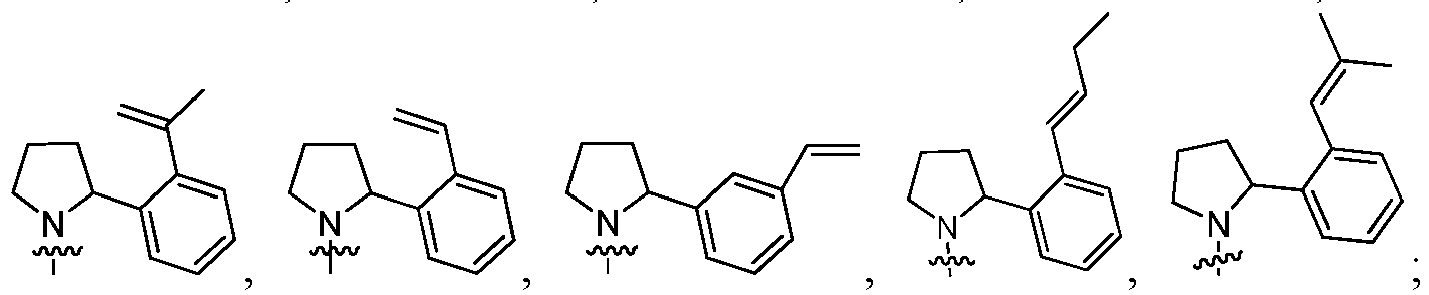
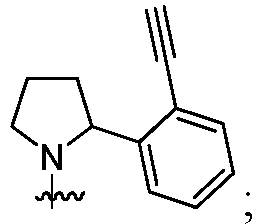


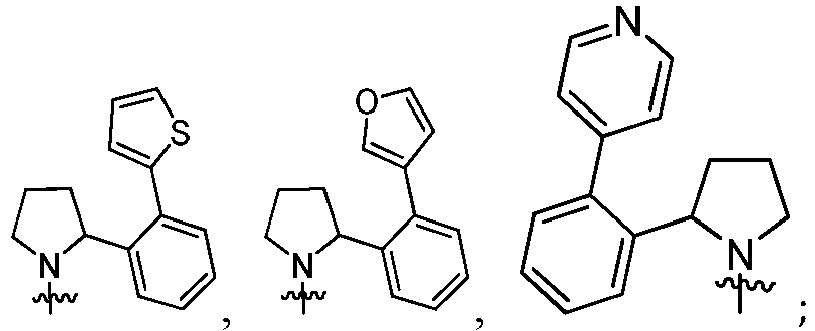





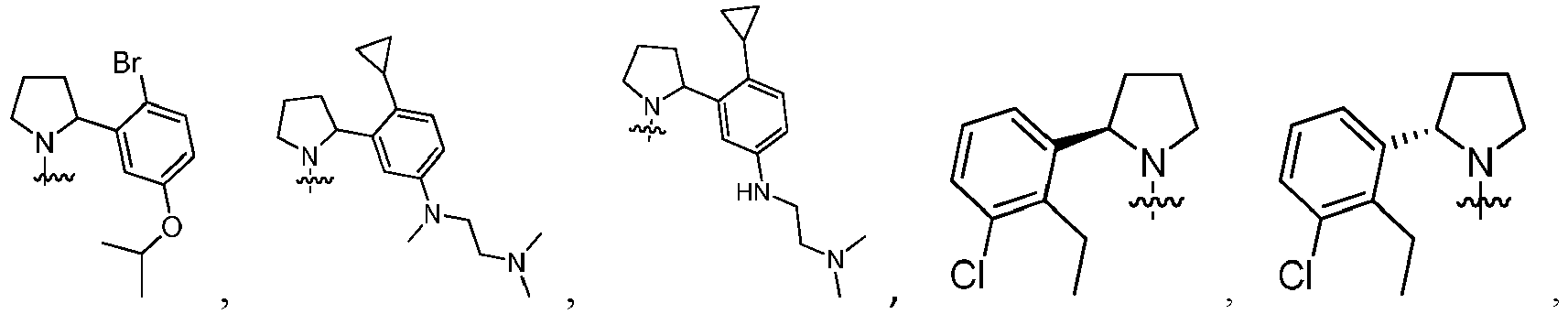

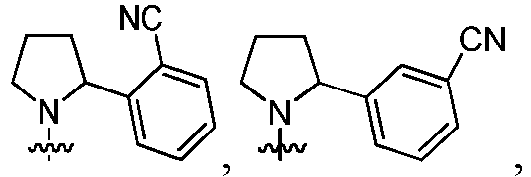






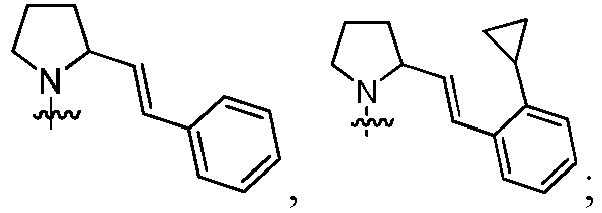


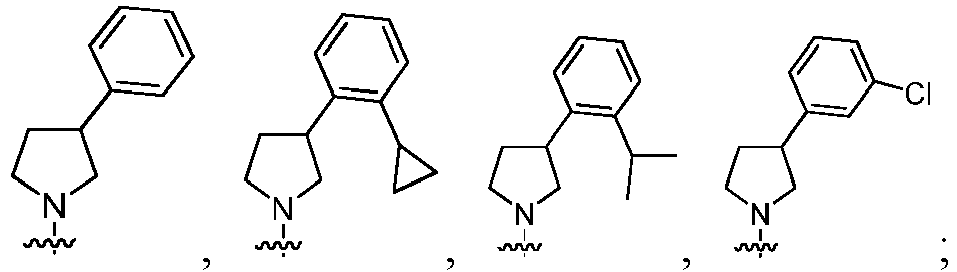







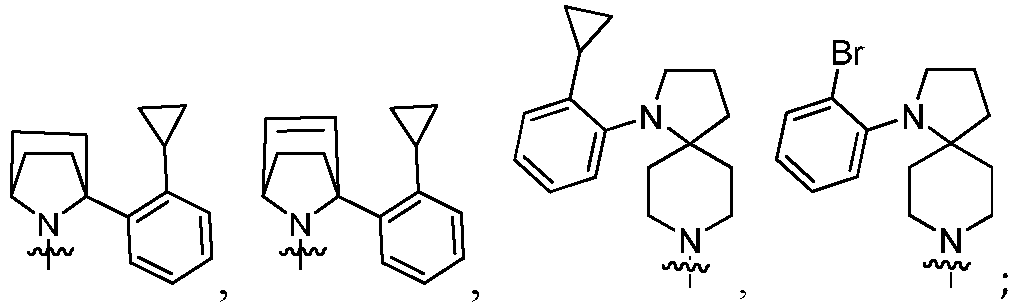


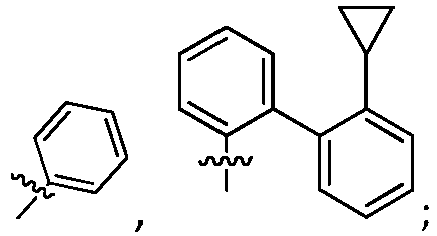

- 70. The compound of clause 1, wherein ring B is a 2-substituted pyrrolidin-1-yl group, L1 is a direct bond, L2 is a direct bond, ring A is a 1,4-phenylene ring or 5 to 12-membered spiro heterocyclyl comprising one or two heteroatoms selected from nitrogen, sulfur and oxygen as ring members; preferably ring A is 4-membered/4-membered, 3-membered/5-membered, 4-membered/5-membered, 4-membered/6-membered, 5-membered/5-membered, or 5-membered/6-membered mono-spiro heterocyclyl comprising one or two nitrogen or oxygen as ring members; more preferably ring A is


- 71. The compound of clause 1, wherein ring B is a 2-(substituted phenyl)pyrrolidin-1-yl group, L1 is a direct bond, ring A is a 1,4-phenylene ring or 7-azaspiro[3.5]nonan-2,7-diyl, 2-azaspiro[3.5]nonan-2,7-diyl, 3-azaspiro[5.5]undecan-3, 9-diyl, 2-azaspiro[3.3]heptan-2,6-diyl, 8-azaspiro[4.5]decan-2,8-diyl, or 2-azaspiro[4.5]decan-2,8-diyl, L2 is a direct bond.
- 72. The compound of clause 1, wherein ring B is a 2-(2-substituted phenyl)pyrrolidin-1-yl or 2-(3-substituted phenyl)pyrrolidin-1-yl group, L1 is a direct bond, ring A is a 1,4-phenylene ring or 7-azaspiro[3.5]nonan-2,7-diyl, 2-azaspiro[3.5]nonan-2,7-diyl, 3-azaspiro[5.5]undecan-3, 9-diyl, 2-azaspiro[3.3]heptan-2,6-diyl, 8-azaspiro[4.5]decan-2,8-diyl, or 2-azaspiro[4.5]decan-2,8-diyl, L2 is a direct bond, wherein the phenyl group at position 2 of the pyrrolindin-1-yl is substituted with 1 to 4 substituents R1d as defined with Formula (I).
- 73. The compound of clause 1, wherein ring B is a 2-(2-substituted phenyl)pyrrolidin-1-yl or 2-(3-substituted phenyl)pyrrolidin-1-yl group, L1 is a direct bond, ring A is a 1,4-cyclohexylene ring or 1,4-cyclohex-3-enyl or 1,4-cyclohex-2-enyl or 1,4-cyclohex-1-enyl or 7-azaspiro[3.5]nonan-2,7-diyl, 2-azaspiro[3.5]nonan-2,7-diyl, 3-azaspiro[5.5]undecan-3, 9-diyl, 2-azaspiro[3.3]heptan-2,6-diyl, 8-azaspiro[4.5]decan-2,8-diyl, or 2-azaspiro[4.5]decan-2,8-diyl, L2 is a direct bond, wherein the phenyl group at position 2 of the pyrrolindin-1-yl is substituted with 1 to 4 substituents R1d as defined with Formula (I).
- 74. The compound of clause 1, wherein m is 1.
- 75. The compound of clause 1, wherein L5 is a direct bond, -(CRaRb)t- or -NRa-, wherein t is a number of 1 to 7, and one or two CRaRb moieties in -(CRaRb)t- are un-replaced or replaced with one or more moieties selected from O and NRa, wherein Ra and Rb are defined as with Formula (I).
- 76. The compound of clause 73, wherein L5 is a direct bond, -(CRaRb)1-4-, -O-(CRaRb)1-3-, - NH-(CRaRb)1-3, or -NH-, wherein Ra and Rb are defined as with Formula (I).
- 77. The compound of clause 73, wherein L5 is a direct bond, -(CH2)1-4-, -O-(CH2)1-3-, -NH-(CRaRb)-(CH2)2-, or -NH-, wherein Ra is hydrogen and Rb is C1-8alkyl optionally substituted with phenyl-S-.
- 78. The compound of clause 1, wherein CyC is cycloalkyl, or heterocyclyl, each of which is optionally substituted with one or two substituents R5a;
- R5a is independently selected from hydrogen, halogen, cyano, oxo, -OR5b, -NR5bR5c, - COR5b, -SO2R5b, -C1-8alkyl, -C2-8alkynyl, -cycloalkyl, or heterocyclyl, each of said -C1-8alkyl, and heterocyclyl is optionally substituted with one or two substituents R5e which is selected from hydrogen, halogen, cyano, -OR5f, -C1-8alkyl, -cycloalkyl, or heterocyclyl;
wherein R5b, and R5c are each independently hydrogen, -C1-8alkyl or heterocyclyl, said -C1-8alkyl is optionally substituted with one or two substituents R5e which is hydrogen, -NR5fR5g, or -cycloalkyl;
R5f and R5g are each independently hydrogen or -C1-8alkyl; - or, two adjacent R5 on the phenyl ring together with the phenyl ring form a benzo ring, said ring is optionally substituted with heteroaryl.
- R5a is independently selected from hydrogen, halogen, cyano, oxo, -OR5b, -NR5bR5c, - COR5b, -SO2R5b, -C1-8alkyl, -C2-8alkynyl, -cycloalkyl, or heterocyclyl, each of said -C1-8alkyl, and heterocyclyl is optionally substituted with one or two substituents R5e which is selected from hydrogen, halogen, cyano, -OR5f, -C1-8alkyl, -cycloalkyl, or heterocyclyl;
- 79. The compound of clause 78, wherein CyC is cycloalkyl selected from monocyclic C3-8cycloalkyl or bridged cycloalkyl

- 80. The compound of clause 79, wherein CyC is cyclopentyl or cyclohexyl, each of which is optionally substituted with one or two substituents R5a.
- 81. The compound of clause 78, wherein CyC is heterocyclyl selected from:
- a) monocyclic 4 to 9-membered heterocyclyl groups containing one nitrogen or oxygen or sulfur heteroatom as ring member;
- b) monocyclic 4 to 9-membered heterocyclyl groups containing two heteroatoms selected from oxygen, sulfur and nitrogen as ring members; and
- c) 5 to 20-membered spiro heterocyclyl comprising one or two heteroatoms selected from nitrogen, sulfur and oxygen as ring members,
- 82. The compound of clause 80, wherein CyC is monocyclic 4 to 6-membered heterocyclyl groups containing one nitrogen or oxygen or sulfur heteroatom as ring member.
- 83. The compound of clause 82, wherein Cyc is selected from oxetanyl, tetrahydrofuranyl, tetrahydropyranyl, azetidinyl, pyrrolidinyl, and piperdinyl.
- 84. The compound of clause 82, wherein CyC is selected from oxetan-2-yl, Oxetan-3-yl, tetrahydrofuran-4-yl, tetrahydrofuran-2-yl, tetrahydrofuran-3-yl, tetrahydropyran-2-yl, tetrahydropyran-3-yl, tetrahydropyran-4-yl, azetidin-3-yl, azetidin-2-yl, pyrrolidin-2-yl, pyrrolidin-3-yl, piperdin-4-yl, piperdin-2-yl, and piperdin-3-yl.
- 85. The compound of clause 82, wherein CyC is monocyclic 6-membered heterocyclyl group containing two heteroatoms selected from oxygen and nitrogen as ring members.
- 86. The compound of clause 85, wherein CyC is dioxanyl, morpholino, morpholinyl, or piperzinyl.
- 87. The compound of clause 84, wherein CyC is 1,3-dioxan-2-yl, 1,3-dioxan-4-yl, 1,4-dioxan-2-yl, morpholin-1-yl, morpholin-2-yl, or morpholin-3-yl.
- 88. The compound of clause 80, wherein CyC is 4-membered/4-membered, 3-membered/5-membered, 4-membered/5-membered, 4-membered/6-membered, 5-membered/5-membered, or 5-membered/6-membered mono-spiro heterocyclyl comprising one or two nitrogen or oxygen as ring members.
- 89. The compound of clause 88, wherein CyC is


- 90. The compound of clause 81, wherein R5a is independently selected from hydrogen, halogen, cyano, oxo, -OR5b, -NR5bR5c, -COR5b, -SO2R5b, -C1-8alkyl, -C2-8alkynyl, monocyclic C3-8cycloalkyl, or monocyclic 4 to 9-membered heterocyclyl group containing one or two heteroatoms selected from nitrogen or oxygen or sulfur heteroatom as ring members, each of said -C1-8alkyl and monocyclic 4 to 9-membered heterocyclyl group is optionally substituted with one or two substituents R5e.
- 91. The compound of clause 90, wherein cycloalkyl as R5a is C3-6cycloalkyl; more preferably cyclopropyl.
- 92. The compound of clause 90, wherein heterocyclyl as R5a is 4 to 6-membered heterocyclyl groups containing one or two heteroatoms selected from nitrogen or oxygen or sulfur heteroatom as ring members.
- 93. The compound of clause 90, wherein heterocyclyl as R5a is oxetanyl, tetrahydrofuranyl, tetrahydropyranyl, piperzinyl, or morpholinyl.
- 94. The compound of clause 90, wherein heterocyclyl as R5a is oxetan-3-yl, tetrahydrofuran-3-yl, tetrahydro-2H-pyran-4-yl, or morphin-4-yl.
- 95. The compound of clause 90, wherein heterocyclyl as R5e is monocyclic 4 to 9-membered heterocyclyl group containing one or two heteroatoms selected from nitrogen or oxygen or sulfur heteroatom as ring members.
- 96. The compound of clause 90, wherein heterocyclyl as R5e is tetrahydro-pyran-4-yl.
- 97. The compound of clause 90, wherein R5a is -NR5bR5c, wherein R5b is hydrogen, and R5c is heterocyclyl.
- 98. The compound of clause 90, wherein R5a is -NR5bR5c, wherein R5b is hydrogen, and R5c is tetrahydro-pyran-4-yl.
- 99. The compound of clause 90, wherein R5a is -NR5bR5c, wherein R5b and R5c are each independently hydrogen or -C1-6alkyl substituted with cycloalkyl, preferably -C1-6alkyl substituted with monocyclic C3-8cycloalkyl.
- 100. The compound of clause 90, wherein R5a is -OR5b or -SO2R5b, wherein R5b is hydrogen or C1-8alkyl, preferably methyl.
- 101. The compound of clause 90, wherein R5a is -COR5b, wherein R5b is hydrogen or C1-8alkyl optionally substituted with -NR5fR5g, wherein R5f and R5g are each independently hydrogen or C1-8alkyl, preferably methyl.
- 102. The compound of clause 1, wherein two adjacent R5 on the phenyl ring together with the phenyl ring form indazolyl which is substituted with tetrahydropyranyl.
- 103. The compound of clause 1, wherein m is 1 and -L5-CyC is selected from the group consisting of:



- 104. The compound of clause 1, selected from:
A1, A2, A3, A4, A4a, A4b, A5, A6, A7, A8, A8a, A8b, A9, A10, A11, A12, A13, A14, A15, A16, A17, A18, A19, A20, A21, A22, A23, A24, A25, A26, A27, A28, A29, A30, A31, A32, A33, A35, A 46, A47, A54, A55, A56, A57, A61, A62, A63, A64, A65, A67, A68, A69, A70, A73, A74, A75, A76, A77, A79, A80, A81, A82, A83, A84, A85, B1, B2, B3, B4, B5, B6, B8, B12, B17, B18, B21, C1, C2, C3, C4, C5, C6, C7, C8, C9, C10, C11, C12, C13, C14, C15, C16, C17, C18, C19, C21, C22, C24a, C24b, C26a, C26b, C28, C31, C36, C37, C39, C40, C41, C-42, C45, C46, C47, C48, C51, C52, C53, C54, C55, C57, C60, C62, C63, C66, C67, C69, C81, C86, C87, C88a, C88b, C89, C90, C99, C118, C125, C126, C127, C128, C129, C131, C132, C133, C134, C135, C136, C137, C138, C139, C140, C141, C142, C143, C144, C145, C146, C152, C161, C162, C163, C164, C165, C166, C167, C168, C169, C170, C171, C172, C173, C174, C175, C176, C177, C178, C179, C180, C181, C182, C183, C184, C185, C186, C187, C-189, C190, C191, C192, C193, C194, C195, D1a, D1b, D2a, D2b, D2a-S, D2b-S, D2a-R, D2b-R, D3a, D3b, D4a, D4b, D5, D6, D13-1a, D13-1b, D14-1a, D14-1b, D63a, D63b, D96, D97a, D97b, D99, D100, D101, D102, D103, D104, D105, D106, E1, E2, E3, E4, E12, E13, F1, F2, F5, F9, F11, F30, F31, F32, F33, F36, G1, G1C, G2, G2C, G3, G4, G5, G6, G7, G8, G8-S, G8-a, G8-b, G9, G9-a, G9-b, G9-S, G10a, G10b, G10b-S, G10b-a, G10b-b, G11, G12, G13, G16, G18, G20, G24b, G24b-S, G24b-a, G24b-b, G26, G27, G30, G30-S, G30-a, G30-b, G30-R, G31, G32, G35-S, G35-a, G35-b, G36, G37, G39, G63, G64, G70, G72, G73, G75-a, G75-b, G75, G76, G76-S, G77, G77-S, G80a, G80b, G81a, G81b, G84, G85-S, G85-R, G86, G87, G88-S, G89-S, G90-S, G90-a, G90-b, G91-R, G92-R, G92-S, G93-R, G93-S, G94-R, G94-S, G95-R, G95-S, G96-R, G96-S, G97-R, G97-S, G98, G100a, G100b, G103, G104, G105, G106, G107-a, G107-b, G43a, G43b, G108a, G108b, G109, G110a, G110b, G110b-a, G110b-b, G111, G112, G113, G114, G115, G116, G117, H3a, H3, I7, I8, I9, I10, , A37, A66, A72, A78, A86, A87, A68-S, A68-R, A88, A89, A90, A91, A93, A94, A95, A96, A97, A98, A99, A100, A101, A102, A103, A104, A105, A106, A107, A108, A109, A110, A111, A112, A113, A114, A115, A116, A117a, A117b, A118a, A118b, A119, A120, A121, A122, A123, A124, A125, A126, A127, A128, A129, A130, A131, A132, A133, A134, A135, A136, A137, A138, A139, A140, A141, A142, A143, A144, A145a, A145b, A145c, A145d, A146, A147a, A147b, A148, A149, A150, A151, A152, A153, A154, A155, A156, A157, A158, B13, B14, B15, B16, B19a, B19b, B20a, B20b, B21, B22, B23, B24, B25, B26, B27, B28, B29, B30, B31, B32, B33, B34, B35, B36, B37, B38, B39, B40, D107a, D107b, F23, F22, F21, F24, F25, F26, F27, F28, F29, F34, F35, F37, F38, F39a, F39b, F40, F41, F42, F43, F44, F45, F46, F47, F48, F49, F50, F51, F52, F53, F54, F55, F56, F57, F58, F59, F60, F61, F62, F63, F64, F65, F66, F67, F68, F69, F70, F71, F72a, F72b, F73, F74a, F74b, F75, F76, F77, F78, F79, F80, F81, F82, F83, F84, F85, F86, F87, F88, F89, F90, F91a, F91b, F92, F93, F94, F95, F96, F97, F98, F99, F100, F101a, F111b, F102, F103, F104, F105, F106, F107, F108, F109, F110, F111, F112, F113, F114, F115, F116, F117, F118, F119, F120, F121, F122, F123, F124a, F124b, F125, F126, F127, F128, F129, F130, F131a, F131b, F132a, F132b, G99, G101a, G101b, G102, G118, G119, G120, G121, G122, G123, G124, G125, G126, G127, G128, G129, G130, G131, G132a, G132b, G133, G134, or G135. - 105. A method for treating dysregulated apoptotic diseases, comprising administering a subject in need thereof a therapeutically effective amount of the compound of any one of clauses 1-112, or a pharmaceutically acceptable salt thereof, or a stereoisomer thereof.
- 106. The method of clause 105, wherein the dysregulated apoptotic disease is neurodegenerative condition, proliferative diseases and pro-thrombotic conditions.
- 107. A pharmaceutical composition comprising the compound of any one of clauses 1-105, or a pharmaceutically acceptable salt thereof, or a stereoisomer thereof, and a pharmaceutically acceptable carrier.
- 108. A compound selected from:


- 109. A compound of Formula (II)

wherein- Ring A is a phenyl ring, which is 1,4-phenylene; or 5 to 12-membered spiro heterocyclyl comprising one or two heteroatoms selected from nitrogen, sulfur and oxygen as ring members, each of which is optionally substituted with 1 to 4 substituents R2;
R2, at each occurrence, is independently selected from the group consisting of hydrogen, halogen, or -C1-8alkyl optionally substituted with halogen; - Ring B is a monocyclic 4 to 9-membered heterocyclyl comprising one nitrogen atom as the ring member or a monocyclic 4 to 9-membered heterocyclyl comprising one nitrogen atom and one additional heteroatom selected from the group consisting of NH, O, S, SO or SO2 heteroatoms as ring members, said ring is N-linked;
- R1, R5 and m are defined with formula (I).
- Ring A is a phenyl ring, which is 1,4-phenylene; or 5 to 12-membered spiro heterocyclyl comprising one or two heteroatoms selected from nitrogen, sulfur and oxygen as ring members, each of which is optionally substituted with 1 to 4 substituents R2;
- 110. The compound of clause 109, wherein ring A is 1,4-phenylene.
- 111. The compound of clause 109, wherein ring A is 5 to 12-membered spiro heterocyclyl comprising one or two heteroatoms selected from nitrogen, sulfur and oxygen as ring members; preferably ring A is 4-membered/4-membered, 3-membered/5-membered, 4-membered/5-membered, 4-membered/6-membered, 5-membered/5-membered, or 5-membered/6-membered mono-spiro heterocyclyl comprising one or two nitrogen or oxygen as ring members.
- 112. The compound of clause 111, wherein ring A is
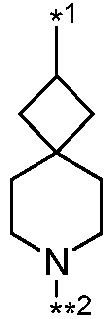

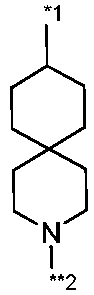

- 113. The compound of clause 109, wherein ring B is aziridin-1-yl, azetidin-1-yl, pyrrolidin-1-yl, pyrrolidin-2-yl, piperidin-1-yl, azepan-1-yl, or azocan-1-yl, preferably pyrrolidin-1-yl, which is substituted with a phenyl group at position 2 and further optionally substituted with 1 or 2 or 3 substituents R1 on the pyrrolidinyl ring, and said phenyl group at position 2 (i.e., ortho position) is optionally substituted with R1d as defined with Formula (I).
- 114. The compound of clause 109, wherein the compound has the following formula (III)

- 115. The compound of clause 114, wherein ring A is


- 116. The compound of clause 115, wherein the compound is represented by the following subgenus formulas (III-A), (III-B), (III-C), (III-D) or (III-E)


- 117. The compound of any one of clauses 109-116, wherein R2 is hydrogen.
- 118. The compound of any one of clauses 109-116, wherein R1d is defined with formula (I). preferably, R1d, when substituted on the phenyl group at position 2 of ring B (including the aziridin-1-yl, azetidin-1-yl, pyrrolidin-1-yl, pyrrolidin-2-yl, piperidin-1-yl, azepan-1-yl, or azocan-1-yl, preferably the pyrrolidin-1-yl group), is independently halogen, -C1-8alkyl, -C2-8alkenyl, -C2-8alkynyl, cycloalkyl, heterocyclyl, aryl, heteroaryl, -CN, -ORBa, -SO2RBa, - CONRBaRBb, -NO2, -NRBaRBb, -NRBaCORBb, or -NRBaSO2RBb; wherein said -C1-8alkyl, -C2-8alkenyl, -C2-8alkynyl, cycloalkyl, heterocyclyl, aryl or heteroaryl are each independently optionally substituted with 1 to 4 substituents RBd as defined with Formula (I), preferably 1 or 2 substituents RBd as defined with Formula (I). In another aspect, one R1d is at position 2 of the phenyl ring at position 2 of ring B.
- 119. The compound of clause 118, wherein R1d is methyl, ethyl, isopropyl, propyl or methoxymethyl, or two methyl at position of the phenyl ring; or propenyl; or cyclopropyl, cyclobutyl, cyclopentyl, or cyclohexyl; or ethoxy or isopropoxy; or amino or dimethylamino.
- 120. The compound of any one of clauses 109-119, wherein the 2-(2-substituted phenyl)pyrrolidin-1-yl moiety as ring B is selected from the group consisting of








- 121. The compound of any one of clauses 109-120, wherein m is 1; and L5 is a direct bond, - (CRaRb)t- or -NRa-, wherein t is a number of 1 to 7, and one or two CRaRb moieties in - (CRaRb)t- are un-replaced or replaced with one or more moieties selected from O and NRa, wherein Ra and Rb are defined as with Formula (I).
- 122. The compound of any one of clauses 109-121, wherein L5 is a direct bond, -(CRaRb)1-4-, -O-(CRaRb)1-3-, -NH-(CRaRb)1-3, or -NH-, wherein Ra and Rb are defined as with Formula (I) so that the -L5-CyC moiety is CyC, -(CRaRb)1-4-CyC, -O-(CRaRb)1-3-CyC, -NH-(CRaRb)1-3-CyC, or -NH-CyC, respectively. More preferably, L5 is a direct bond, -(CH2)1-4-, -O-(CH2)1-3-, - NH-(CRaRb)-(CH2)2-, or -NH-, wherein Ra is hydrogen and Rb is C1-8alkyl optionally substituted with phenyl-S- so that the -L5-CyC moiety is CyC, -(CH2)1-4-CyC, -O-(CH2)1-3-CyC, -NH-(CRaRb)-(CH2)2-CyC, or -NH-CyC, respectively. More preferably, L5 is a direct bond, -CH2-, -O-CH2-, -NH-CH2-, or -NH- so that the -L5-CyC moiety is CyC, -CH2-CyC, -O-CH2-CyC, -NH-CH2-CyC, or -NH-CyC, respectively.
- 123. The compound of any one of clauses 109-122, wherein CyC is cycloalkyl, or heterocyclyl, each of which is optionally substituted with one or two substituents R5a;
- R5a is independently selected from hydrogen, halogen, cyano, oxo, -OR5b, -NR5bR5c, - COR5b, -SO2R5b, -C1-8alkyl, -C2-8alkynyl, -cycloalkyl, or heterocyclyl, each of said -C1-8alkyl, and heterocyclyl is optionally substituted with one or two substituents R5e which is selected from hydrogen, halogen, cyano, -OR5f, -C1-8alkyl, -cycloalkyl, or heterocyclyl;
wherein R5b, and R5c are each independently hydrogen, -C1-8alkyl or heterocyclyl, said -C1-8alkyl is optionally substituted with one or two substituents R5e which is hydrogen, -NR5fR5g, or -cycloalkyl;
R5f and R5g are each independently hydrogen or -C1-8alkyl; - or, two adjacent R5 on the phenyl ring together with the phenyl ring form a benzo ring, said ring is optionally substituted with heteroaryl.
- R5a is independently selected from hydrogen, halogen, cyano, oxo, -OR5b, -NR5bR5c, - COR5b, -SO2R5b, -C1-8alkyl, -C2-8alkynyl, -cycloalkyl, or heterocyclyl, each of said -C1-8alkyl, and heterocyclyl is optionally substituted with one or two substituents R5e which is selected from hydrogen, halogen, cyano, -OR5f, -C1-8alkyl, -cycloalkyl, or heterocyclyl;
- 124. The compound of clause 123, wherein CyC is cycloalkyl selected from monocyclic C3-8cycloalkyl or bridged cycloalkyl

- 125. The compound of clause 123, wherein CyC is heterocyclyl selected from:
- a) monocyclic 4 to 9-membered heterocyclyl groups containing one nitrogen or oxygen or sulfur heteroatom as ring member;
- b) monocyclic 4 to 9-membered heterocyclyl groups containing two heteroatoms selected from oxygen, sulfur and nitrogen as ring members; and
- c) 5 to 20-membered spiro heterocyclyl comprising one or two heteroatoms selected from nitrogen, sulfur and oxygen as ring members,
- 126. The compound of clause 125, wherein CyC is monocyclic 4 to 6-membered heterocyclyl groups containing one nitrogen or oxygen or sulfur heteroatom as ring member. More preferably, Cyc is selected from oxetanyl, tetrahydrofuranyl, tetrahydropyranyl, azetidinyl, pyrrolidinyl, and piperdinyl. Even more preferably, CyC is selected from □oxetan-2-yl, Oxetan-3-yl, tetrahydrofuran-4-yl, tetrahydrofuran-2-yl, tetrahydrofuran-3-yl, tetrahydropyran-2-yl, tetrahydropyran-3-yl, tetrahydropyran-4-yl, azetidin-3-yl, azetidin-2-yl, pyrrolidin-2-yl, pyrrolidin-3-yl, piperdin-4-yl, piperdin-2-yl, and piperdin-3-yl.
- 127 The compound of clause 125, wherein CyC is monocyclic 6-membered heterocyclyl group containing two heteroatoms selected from oxygen and nitrogen as ring members. More preferably, CyC is dioxanyl, morpholino, morpholinyl, or piperzinyl. Even more preferably 1,3-dioxan-2-yl, 1,3-dioxan-4-yl, 1,4-dioxan-2-yl, morpholin-1-yl, morpholin-2-yl, or morpholin-3-yl.
- 128. The compound of any one of clauses 123-125, wherein R5a is independently selected from hydrogen, halogen, cyano, oxo, -OR5b, -NR5bR5c, -COR5b, -SO2R5b, -C1-8alkyl, -C2-salkynyl, monocyclic C3-8cycloalkyl, or monocyclic 4 to 9-membered heterocyclyl group containing one or two heteroatoms selected from nitrogen or oxygen or sulfur heteroatom as ring members, each of said -C1-8alkyl and monocyclic 4 to 9-membered heterocyclyl group is optionally substituted with one or two substituents R5e; preferably, cycloalkyl as R5a is C3-6cycloalkyl; more preferably cyclopropyl; preferably, heterocyclyl as R5a is 4 to 6-membered heterocyclyl groups containing one or two heteroatoms selected from nitrogen or oxygen or sulfur heteroatom as ring members; more preferably, heterocyclyl as R5a is oxetanyl, tetrahydrofuranyl, tetrahydropyranyl, piperzinyl, or morpholinyl; even more preferably, heterocyclyl as R5a is oxetan-3-yl, tetrahydrofuran-3-yl, tetrahydro-2H-pyran-4-yl, or morphin-4-yl.
- 129. The compound of any one of clauses 123-125, wherein heterocyclyl as R5e is monocyclic 4 to 9-membered heterocyclyl group containing one or two heteroatoms selected from nitrogen or oxygen or sulfur heteroatom as ring members.
- 130. The compound of clause 129, wherein heterocyclyl as R5e is tetrahydro-pyran-4-yl.
- 131. The compound of any one of clauses 123-125, wherein R5a is -NR5bR5c, wherein R5b is hydrogen, and R5c is heterocyclyl.
- 132. The compound of any one of clauses 123-125, wherein R5a is -NR5bR5c, wherein R5b is hydrogen, and R5c is tetrahydro-pyran-4-yl.
- 133. The compound of any one of clauses 123-125, wherein R5a is -NR5bR5c, wherein R5b and R5c are each independently hydrogen or -C1-6alkyl substituted with cycloalkyl, preferably -C1-6alkyl substituted with monocyclic C3-8cycloalkyl.
- 134 The compound of any one of clauses 123-125, wherein R5a is -OR5b or -SO2R5b, wherein R5b is hydrogen or C1-8alkyl, preferably methyl.
- 135. The compound of any one of clauses 123-125, wherein R5a is -COR5b, wherein R5b is hydrogen or C1-8alkyl optionally substituted with -NR5fR5g, wherein R5f and R5g are each independently hydrogen or C1-8alkyl, preferably methyl.
- 136. The compound of any one of clauses 123-125, wherein two adjacent R5 on the phenyl ring together with the phenyl ring form indazolyl which is substituted with tetrahydropyranyl.
- 137. The compound of any one of clauses 123-125, wherein m is 1, and R5 is -L5-CyC selected from the group consisting of:





- 138. The compound of clause 137, wherein m is 1 and R5 is


- 139. A compound of formula (I) has the formula (IV)

| Compound/Example | CYP 2C9 (IC50 µM) | |
| ABT-199 | 1.77 | |
| ABT-263 | 1.50 | |
| G2 | 16.8 | |
| G12 | 6.25 | |
| G10b-b | 6.85 | |
| G24b-b | 8.21 | |
| G35b | 8.86 | |
| G77-S | 17.5 | |
| F21 | > 30 | |
| F26 | > 30 | |
| F37 | 15.9 | |
| F43 | >30 | |
| F44 | >10 | |
| F45 | 8.9 | |
| F106 | 6.3 | |
| F107 | 7.4 | |
| G122 | >10 | |
| G124 | >10 |
Claims (16)
- A compound of Formula (II)
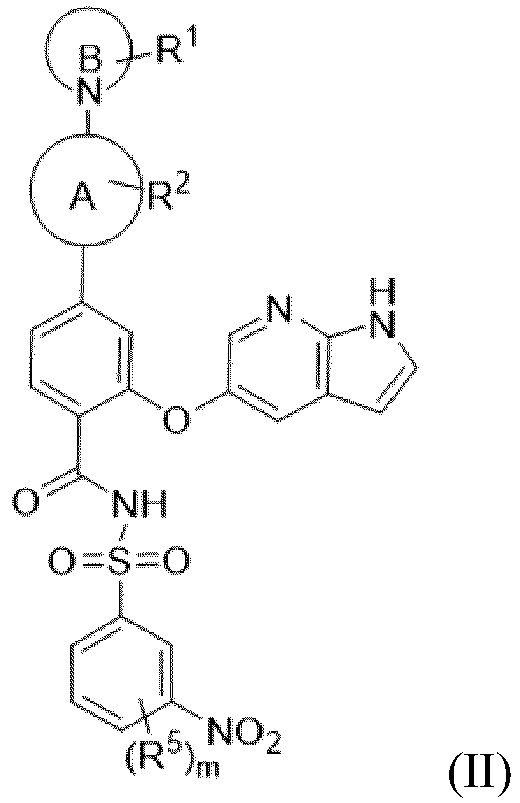
whereinRing A is(a) 1,4-phenylene; or(b) 4-membered/4-membered, 3-membered/5-membered, 4-membered/5-membered, 4-membered/6-membered, 5-membered/5-membered, or 5-membered/6-membered mono-spiro heterocyclyl comprising one or two nitrogen or oxygen as ring members;each of which is optionally substituted with 1 to 4 substituents R2;
R2, at each occurrence, is independently selected from the group consisting of hydrogen, halogen, or -C1-8alkyl optionally substituted with halogen;Ring B is aziridin-1-yl, azetidin-1-yl, pyrrolidin-1-yl, piperidin-1-yl, azepan-1-yl, or azocan-1-yl, said ring is N-linked and said ring is optionally substituted with 1 to 4 substituents R1;R1, at each occurrence, is independently selected from the group consisting of hydrogen, halogen, -C1-8alkyl, -C2-8alkenyl, -C2-8alkynyl, cycloalkyl, heterocyclyl, aryl, heteroaryl, oxo, -CN, -NO2, -OR1a, -SO2R1a, -COR1a, -CO2R1a, -CONR1aR1b, - C(=NR1a)NR1bR1c, -NR1aR1b, -NR1aCOR1b, -NR1aCONR1bR1c, -NR1aCO2R1b, - NR1aSONR1bR1c, -NR1aSO2NR1bR1c, or -NR1aSO2R1b; wherein said -C1-8alkyl, -C2-8alkenyl, -C2-8alkynyl, cycloalkyl, heterocyclyl, aryl or heteroaryl are each independently optionally substituted with 1 to 4 substituents R1d,R1a, R1b, and R1c, are each independently hydrogen, -C1-8alkyl, -C2-8alkenyl, -C2-8alkynyl, cycloalkyl, heterocyclyl, aryl, or heteroaryl, each of said -C1-8alkyl, -C2-8alkenyl, -C2-8alkynyl, cycloalkyl, heterocyclyl, aryl, or heteroaryl is optionally substituted with halogen, hydroxy or -C1-8alkyoxy;R1d, at each occurrence, is independently halogen, -C1-8 alkyl, -C2-8 alkenyl, - C2-8 alkynyl, cycloalkyl, heterocyclyl, aryl, heteroaryl, oxo, -CN, -NO2, -ORBa, - SO2RBa, -CORBa, -CO2RBa, -CONRBaRBb, -C(=NRBa)NRBbRBc, -NRBaRBb, - NRBaCORBb, -NRBaCONRBbRBc, -NRBaCO2RBb, -NRBaSONRBbRBc, - NRBaSO2NRBbRBc, or -NRBaSO2RBb; wherein said -C1-8alkyl, -C2-8alkenyl, -C2-8alkynyl, cycloalkyl, heterocyclyl, aryl or heteroaryl are each independently optionally substituted with 1 to 4 substituents RBd;RBa, RBb, and RBc, are each independently hydrogen, -C1-8alkyl, -C2-8alkenyl, - C2-8alkynyl, cycloalkyl, heterocyclyl, aryl, or heteroaryl, each of said -C1-8alkyl, -C2-8alkenyl, -C2-8alkynyl, cycloalkyl, heterocyclyl, aryl, or heteroaryl is optionally substituted with halogen, hydroxy, -NH2 or -N(C1-6alkyl)2, -C1-8alkyoxy, cycloalkyl, heterocyclyl, aryl, or heteroaryl;RBd, at each occurrence, is independently hydrogen, halogen, oxo, -CN, -NO2, -C1-8alkyl, -C2-8alkenyl, -C2-8alkynyl, cycloalkyl, heterocyclyl, aryl, or heteroaryl, each of said -C1-8alkyl, -C2-8alkenyl, -C2-8alkynyl, cycloalkyl, heterocyclyl, aryl, or heteroaryl is optionally substituted with halogen, hydroxy, -C1-8alkyoxy, cycloalkyl, heterocyclyl, aryl, or heteroaryl;R5 is -L5-CyC,wherein L5 is a direct bond, -(CRaRb)t-, -(CRaRb)t-1-(CRc=CRd)-(CRaRb)v-1-, -(CRaRb)t-1-(C≡C)-(CRaRb)v-1-, -O-, -S-, -S(O)-, -SO2-, -C(O)-, C(O)O-, -OC(O)-, -NRa-, - C(O)NRa-, -NRaC(O)-, -NRaC(O)O-, -NRaC(O)NRb-, -SO2NRa-, -NRaSO2-, - NRaS(O)2NRb-, -NRaS(O)NRb-, -C(O)NRaSO2-, -C(O)NRaSO-, or -C(=NRa)NRb-, wherein t and v, at each occurrence, are independently a number of 1 to 7, and one or two CRaRb moieties in -(CRaRb)t-, -(CRaRb)t-1-(CRc=CRd)-(CRaRb)v-1-, -(CRaRb)t-1-(C≡C)-(CRaRb)v-1- are un-replaced or replaced with one or more moieties selected from O, S, SO, SO2, C(O) and NRa;CyC is cycloalkyl, heterocyclyl, aryl, or heteroaryl, each of which is optionally substituted with one or two substituents R5a;R5a, at each occurrence, is independently selected from hydrogen, halogen, cyano, oxo, -NO2, -OR5b, -SR5b, -NR5bR5c, -COR5b, -SO2R5b, -C(=O)OR5b, -C(=O)NR5bR5c, - C(=NR5b)NR5cR5d, -N(R5b)C(=O)R5c, -N(R5b)C(=O)OR5c, -N(R5b)C(O)NR5cR5d, - N(R5b)S(O)NR5cR5d, -N(R5b)S(O)2NR5cR5d, -NR5bSO2R5c, -C1-8alkyl, -C2-8alkenyl, - C2-8alkynyl, -cycloalkyl, heterocyclyl, aryl, or heteroaryl, each of said -C1-8alkyl, -C2-8alkenyl, -C2-8alkynyl, -cycloalkyl, heterocyclyl, aryl, or heteroaryl is optionally substituted with one or two substituents R5e;wherein R5b, R5c, and R5d are each independently hydrogen, -C1-8alkyl, -C2-8alkenyl, -C2-8alkynyl, cycloalkyl, heterocyclyl, aryl, or heteroaryl, each of said - C1-8alkyl, -C2-8alkenyl, C2-8alkynyl, -cycloalkyl, heterocyclyl, aryl, or heteroaryl is optionally substituted with one or two substituents R5e;R5e, at each occurrence, is independently selected from hydrogen, halogen, cyano, oxo, -NO2, -OR5f, -SR5f, -NR5fR5g, -COR5f, -SO2R5f, -C(=O)OR5f, - C(=O)NR5fR5g, -C(=NR5f)NR5gR5h, -N(R5f)C(=O)R5g, -N(R5f)C(=O)OR5g, - N(R5f)C(O)NR5gR5h, -N(R5f)S(O)NR5gR5h, -N(R5f)S(O)2NR5gR5h, -NR5fSO2R5g, - C1-8alkyl, -C2-8alkenyl, -C2-8alkynyl, -cycloalkyl, heterocyclyl, aryl, or heteroaryl;
R5f, R5g, and R5h are each independently hydrogen, -C1-8alkyl, -C2-8alkenyl, - C2-8alkynyl, cycloalkyl, heterocyclyl, aryl, or heteroaryl;or, two adjacent R5 on the phenyl ring together with the phenyl ring form a benzo ring, said ring is optionally substituted with halogen, oxo, cyano, -NO2, -OR5i, -SR5i, -NR5iR5j, - COR5i, -SO2R5i, -C(=O)OR5i, -C(=O)NR5iR5j, -C(=NR5i)NR5jR5k, -N(R5i)C(=O)R5j, - N(R5i)C(=O)OR5j, -N(R5i)C(O)NR5jR5k, -N(R5i)S(O)NR5jR5k, -N(R5i)S(O)2NR5jR5k, - NR5iSO2R5k, -C1-8alkyl, -C2-8alkenyl, -C2-8alkynyl, -cycloalkyl, heterocyclyl, aryl, or heteroaryl;R5i, R5j, and R5k are independently hydrogen, -C1-8alkyl, -C2-8alkenyl, -C2-8alkynyl, cycloalkyl, heterocyclyl, aryl, or heteroaryl, each of said -C1-8alkyl, -C2-8alkenyl, -C2-8alkynyl, cycloalkyl, heterocyclyl, aryl, or heteroaryl is optionally substituted with halogen, hydroxy or -C1-8alkyoxy;m is an integer of 1-4;Ra, Rb, Rc, and Rd at each occurrence, are independently hydrogen, -C1-8alkyl, -C2-8alkenyl, -C2-8alkynyl, cycloalkyl, heterocyclyl, aryl, or heteroaryl, said -C1-8alkyl, -C2-8alkenyl, -C2-8alkynyl, cycloalkyl, heterocyclyl, aryl, or heteroaryl are each independently substituted with -CN, halogen, -NO2, -NReRf, oxo, -ORe, or -SRe; andwherein Re and Rf are each independently hydrogen, C1-8alkyl, C1-8alkoxy-C1-8alkyl-, C2-8alkenyl, C2-8alkynyl, cycloalkyl, aryl, heterocyclyl, or heteroaryl,whereinsaid cycloalkyl refers to a hydrocarbon group selected from saturated cyclic hydrocarbon groups, comprising monocyclic and polycyclic (e.g., bicyclic and tricyclic) groups and comprise from 3 to 12 carbon atoms;said aryl refers to phenyl or naphthyl;said heteroaryl refers to a group selected from:5-, 6- or 7-membered aromatic, monocyclic rings comprising 1 to 4 heteroatoms selected from nitrogen, sulfur and oxygen, with the remaining ring atoms being carbon;8- to 12-membered bicyclic rings comprising 1 to 4 heteroatoms selected from nitrogen, sulfur and oxygen, with the remaining ring atoms being carbon and wherein at least one ring is aromatic and at least one heteroatom is present in the aromatic ring; and11- to 14-membered tricyclic rings comprising 1 to 4 heteroatoms selected from nitrogen, sulfur and oxygen with the remaining ring atoms being carbon and wherein at least one ring is aromatic and at least one heteroatom is present in an aromatic ring;said heterocyclyl (in addition to the heterocyclyl in the definitions of ring A and ring B) refers to a non-aromatic heterocyclyl group comprising one or more heteroatoms selected from the group consisting of NH, O, S, SO or SO2 heteroatoms as ring members, with the remaining ring members being carbon, including 4- to 9-membered monocyclic heterocyclyl, 5- to 14-membered bridged heterocyclyl, 5- to 20-membered spiro heterocyclyl, and 5- to 20-membered fused heterocyclic groups. - The compound of claim 1, wherein ring A is


- The compound of claim 1, wherein ring B is substituted with a phenyl group at position 2 and further optionally substituted with 1 or 2 or 3 substituents R1 on the ring, and said phenyl group at position 2 (i.e., ortho position) is optionally substituted with R1d as defined in claim 1.
- The compound of claim 3, wherein ring B is pyrrolidin-1-yl.
- The compound of claim 1, wherein the compound has the following formula (III)

- The compound of claim 5, wherein ring A is


- The compound of claim 5, wherein the compound is represented by the following subgenus formulas (III-A), (III-B), (III-C), (III-D) or (III-E)


- The compound of any one of claims 1-7, wherein R2 is hydrogen.
- The compound of any one of claims 3-8, wherein(a) R1d is independently halogen, -C1-8alkyl, -C2-8alkenyl, -C2-8alkynyl, cycloalkyl, heterocyclyl, aryl, heteroaryl, -CN, -ORBa, -SO2RBa, -CONRBaRBb, -NO2, -NRBaRBb, - NRBaCORBb, or -NRBaSO2RBb; wherein said -C1-8alkyl, -C2-8alkenyl, -C2-8alkynyl, cycloalkyl, heterocyclyl, aryl or heteroaryl are each independently optionally substituted with 1 to 4 substituents RBd as defined in claim 1,optionally whereinone R1d is at position 2 of the phenyl ring at position 2 of ring B,further optionally whereinR1d is methyl, ethyl, isopropyl, or propyl, or two methyl at position 2 of the phenyl ring; or propenyl; or cyclopropyl, cyclobutyl, cyclopentyl, or cyclohexyl; or ethoxy or isopropoxy; or amino or dimethylamino at position 2 pf the phenyl ring;
and/or(b) the 2-(2-substituted phenyl)pyrrolidin-1-yl moiety as ring B is selected from the group consisting of







 (c) m is 1; and L5 is a direct bond, -(CH2)1-4-, -O-(CH2)1-3-, -NH-(CRaRb)-(CH2)2-, or - NH-, wherein Ra is hydrogen and Rb is C1-8alkyl optionally substituted with phenyl-S- so that the -L5-CyC moiety is CyC, -(CH2)1-4-CyC, -O-(CH2)1-3-CyC, -NH-(CRaRb)-(CH2)2-CyC, or -NH-CyC, respectively, wherein Ra and Rb are defined in claim 1,
optionally wherein
L5 is a direct bond, -CH2-, -O-CH2-, -NH-CH2-, or -NH- so that the -L5-CyC moiety is CyC, -CH2-CyC, -O-CH2-CyC, -NH-CH2-CyC, or -NH-CyC, respectively. - The compound of any one of claims 1-9, wherein CyC is cycloalkyl, or heterocyclyl, each of which is optionally substituted with one or two substituents R5a;R5a is independently selected from hydrogen, halogen, cyano, oxo, -OR5b, -NR5bR5c, - COR5b, -SO2R5b, -C1-8alkyl, -C2-8alkynyl, -cycloalkyl, or heterocyclyl, each of said -C1-8alkyl, and heterocyclyl is optionally substituted with one or two substituents R5e which is selected from hydrogen, halogen, cyano, -OR5f, -C1-8alkyl, -cycloalkyl, or heterocyclyl;
wherein R5b, and R5c are each independently hydrogen, -C1-8alkyl or heterocyclyl, said -C1-8alkyl is optionally substituted with one or two substituents R5e which is hydrogen, -NR5fR5g, or -cycloalkyl;
R5f and R5g are each independently hydrogen or -C1-8alkyl;or, two adjacent R5 on the phenyl ring together with the phenyl ring form a benzo ring, said ring is optionally substituted with heteroaryl. - The compound of claim 10, wherein(a) CyC is cycloalkyl selected from monocyclic C3-8cycloalkyl or bridged cycloalkyl
 (b) CyC is heterocyclyl selected from:(i) monocyclic 4 to 9-membered heterocyclyl groups containing one nitrogen or oxygen or sulfur heteroatom as ring member;(ii) monocyclic 4 to 9-membered heterocyclyl groups containing two heteroatoms selected from oxygen, sulfur and nitrogen as ring members; and(iii) 5 to 20-membered spiro heterocyclyl comprising one or two heteroatoms selected from nitrogen, sulfur and oxygen as ring members,each of which is optionally substituted with one or two R5a,optionally wherein(i) CyC is monocyclic 4 to 6-membered heterocyclyl groups containing one nitrogen or oxygen or sulfur heteroatom as ring member;
or(ii) CyC is selected from oxetan-2-yl, Oxetan-3-yl, tetrahydrofuran-4-yl, tetrahydrofuran-2-yl, tetrahydrofuran-3-yl, tetrahydropyran-2-yl, tetrahydropyran-3-yl, tetrahydropyran-4-yl, azetidin-3-yl, azetidin-2-yl, pyrrolidin-2-yl, pyrrolidin-3-yl, piperdin-4-yl, piperdin-2-yl, and piperdin-3-yl;
or(iii) CyC is monocyclic 6-membered heterocyclyl group containing two heteroatoms selected from oxygen and nitrogen as ring members, optionally wherein CyC is 1,3-dioxan-2-yl, 1,3-dioxan-4-yl, 1,4-dioxan-2-yl, morpholin-1-yl, morpholin-2-yl, or morpholin-3-yl. - The compound of claim 10 or claim 11, wherein(a) R5a is independently selected from hydrogen, halogen, cyano, oxo, -OR5b, -NR5bR5c, - COR5b, -SO2R5b, -C1-8alkyl, -C2-8alkynyl, monocyclic C3-8cycloalkyl, or monocyclic 4 to 9-membered heterocyclyl group containing one or two heteroatoms selected from nitrogen or oxygen or sulfur heteroatom as ring members, each of said -C1-8alkyl and monocyclic 4 to 9-membered heterocyclyl group is optionally substituted with one or two substituents R5e;
or(b) R5a is oxetan-3-yl, tetrahydrofuran-3-yl, tetrahydro-2H-pyran-4-yl, or morphin-4-yl; - NR5bR5c, wherein R5b is hydrogen, and R5c is heterocyclyl; -NR5bR5c, wherein R5b and R5c are each independently hydrogen or -C1-6alkyl substituted with cycloalkyl, preferably -C1-6alkyl substituted with monocyclic C3-8cycloalkyl; -OR5b or -SO2R5b, wherein R5b is hydrogen or C1-8alkyl; -COR5b, wherein R5b is hydrogen or C1-8alkyl optionally substituted with -NR5fR5g, wherein R5f and R5g are each independently hydrogen or C1-8alkyl
or(c) R5e is monocyclic 4 to 9-membered heterocyclyl group containing one or two heteroatoms selected from nitrogen or oxygen or sulfur heteroatom as ring members, optionally wherein
R5e is tetrahydro-pyran-4-yl. - The compound of claim 10 or claim 11, wherein(a) two adjacent R5 on the phenyl ring together with the phenyl ring form indazolyl which is substituted with tetrahydropyranyl;
or(b) wherein m is 1, and R5 is -L5-CyC selected from the group consisting of




- A compound of formula (IV)

- A compound or a pharmaceutically acceptable salt thereof, or a stereoisomer thereof, said compound is selected from:3-((1H-pyrrolo[2,3-b]pyridin-5-yl)oxy)-N-((3-nitro-4-(((tetrahydro-2H-pyran-4-yl)methyl)amino)phenyl)sulfonyl)-4'-(2-phenylpyrrolidin-1-yl)-[1,1'-biphenyl]-4-carboxamide;3-((1H-pyrrolo[2,3-b]pyridin-5-yl)oxy)-4'-(2-(4-chlorophenyl)pyrrolidin-1-yl)-N-((3-nitro-4-(((tetrahydro-2H-pyran-4-yl)methyl)amino)phenyl)sulfonyl)-[1,1'-biphenyl]-4-carboxamide;3-((1H-pyrrolo[2,3-b]pyridin-5-yl)oxy)-4'-(2-(3-chlorophenyl)pyrrolidin-1 -yl)-N-((3-nitro-4-(((tetrahydro-2H-pyran-4-yl)methyl)amino)phenyl)sulfonyl)-[1,1'-biphenyl]-4-carboxamide;3-((1H-pyrrolo[2,3-b]pyridin-5-yl)oxy)-4'-(2-(2-chlorophenyl)pyrrolidin-1-yl)-N-((3-nitro-4-(((tetrahydro-2H-pyran-4-yl)methyl)amino)phenyl)sulfonyl)-[1,1'-biphenyl]-4-carboxamide;(S)-3-((1H-pyrrolo[2,3-b]pyridin-5-yl)oxy)-4'-(2-(2-chlorophenyl)pyrrolidin-1-yl)-N-((3-nitro-4-(((tetrahydro-2H-pyran-4-yl)methyl)amino)phenyl)sulfonyl)-[1,1'-biphenyl]-4-carboxamide;(R)- 3-((1H-pyrrolo[2,3-b]pyridin-5-yl)oxy)-4'-(2-(2-chlorophenyl)pyrrolidin-1-yl)-N-((3-nitro-4-(((tetrahydro-2H-pyran-4-yl)methyl)amino)phenyl)sulfonyl)-[1,1'-biphenyl]-4-carboxamide;3-((1H-pyrrolo[2,3-b]pyridin-5-yl)oxy)-3'-chloro-4'-(2-(2-chlorophenyl)pyrrolidin-1 -yl)-N-((3-nitro-4-(((tetrahydro-2H-pyran-4-yl)methyl)amino)phenyl)sulfonyl)-[1,1'-biphenyl]-4-carboxamide;3-((1H-pyrrolo[2,3-b]pyridin-5-yl)oxy)-N-((3-nitro-4-(((tetrahydro-2H-pyran-4-yl)methyl)amino)phenyl)sulfonyl)-4'-(2-phenylpyrrolidin-1-yl)-3'-(trifluoromethyl)-[1,1'-biphenyl]-4-carboxamide;3-((1H-pyrrolo[2,3-b]pyridin-5-yl)oxy)-N-((3-nitro-4-(((tetrahydro-2H-pyran-4-yl)methyl)amino)phenyl)sulfonyl)-4'-(2-(3-(trifluoromethyl)phenyl)pyrrolidin-1-yl)-[1,1'-biphenyl]-4-carboxamide;3-((1H-pyrrolo[2,3-b]pyridin-5-yl)oxy)-4'-(2-(2-cyclopropylphenyl)pyrrolidin-1-yl)-N-((3-nitro-4-(((tetrahydro-2H-pyran-4-yl)methyl)amino)phenyl)sulfonyl)-[1,1 '-biphenyl]-4-carboxamide;(S)-3-((1H-pyrrolo[2,3-b]pyridin-5-yl)oxy)-4'-(2-(2-cyclopropylphenyl)pyrrolidin-1-yl)-N-((3-nitro-4-(((tetrahydro-2H-pyran-4-yl)methyl)amino)phenyl)sulfonyl)-[1,1 '-biphenyl]-4-carboxamide;(R)-3-((1H-pyrrolo[2,3-b]pyridin-5-yl)oxy)-4'-(2-(2-cyclopropylphenyl)pyrrolidin-1-yl)-N-((3-nitro-4-(((tetrahydro-2H-pyran-4-yl)methyl)amino)phenyl)sulfonyl)-[1,1 '-biphenyl]-4-carboxamide;3-((1H-pyrrolo[2,3-b]pyridin-5-yl)oxy)-N-((3-nitro-4-(((tetrahydro-2H-pyran-4-yl)methyl)amino)phenyl)sulfonyl)-4'-(2-(4-(trifluoromethyl)phenyl)pyrrolidin-1-yl)-[1,1'-biphenyl]-4-carboxamide;3-((1H-pyrrolo[2,3-b]pyridin-5-yl)oxy)-4'-(2-(3-cyclopropylphenyl)pyrrolidin-1-yl)-N-((3-nitro-4-(((tetrahydro-2H-pyran-4-yl)methyl)amino)phenyl)sulfonyl)-[1,1 '-biphenyl]-4-carboxamide;3-((1H-pyrrolo[2,3-b]pyridin-5-yl)oxy)-N-((3-nitro-4-(((tetrahydro-2H-pyran-4-yl)methyl)amino)phenyl)sulfonyl)-4'-(2-(o-tolyl)pyrrolidin-1-yl)-[1,1'-biphenyl]-4-carboxamide;3-((1H-pyrrolo[2,3-b]pyridin-5-yl)oxy)-4'-(2-(2-isopropylphenyl)pyrrolidin-1-yl)-N-((3-nitro-4-(((tetrahydro-2H-pyran-4-yl)methyl)amino)phenyl)sulfonyl)-[1,1'-biphenyl]-4-carboxamide;3-((1H-pyrrolo[2,3-b]pyridin-5-yl)oxy)-4'-(2-([1,1 '-biphenyl]-2-yl)pyrrolidin-1-yl)-N-((3-nitro-4-(((tetrahydro-2H-pyran-4-yl)methyl)amino)phenyl)sulfonyl)-[1,1'-biphenyl]-4-carboxamide;3-((1H-pyrrolo[2,3-b]pyridin-5-yl)oxy)-4'-(2-(4-cyclopropylphenyl)pyrrolidin -1-yl)-N-((3-nitro-4-(((tetrahydro-2H-pyran-4-yl)methyl)amino)phenyl)sulfonyl)-[1,1'-biphenyl]-4-carboxamide;3-((1H-pyrrolo[2,3-b]pyridin-5-yl)oxy)-N-((3-nitro-4-(((tetrahydro-2H-pyran-4-yl)methyl)amino)phenyl)sulfonyl)-4'-(2-phenylazepan-1-yl)-[1,1'-biphenyl]-4-carboxamide;3-((1H-pyrrolo[2,3-b]pyridin-5-yl)oxy)-N-((3-nitro-4-(((tetrahydro-2H-pyran-4-yl)methyl)amino)phenyl)sulfonyl)-4'-(2-phenylpiperidin-1-yl)-[1,1'-biphenyl]-4-carboxamide;3-((1H-pyrrolo[2,3-b]pyridin-5-yl)oxy)-4'-(2-(3,4-dichlorophenyl)pyrrolidin-1-yl)-N-((3-nitro-4-(((tetrahydro-2H-pyran-4-yl)methyl)amino)phenyl)sulfonyl)-[1,1'-biphenyl]-4-carboxamide;3-((1H-pyrrolo[2,3-b]pyridin-5-yl)oxy)-4'-(2-(2-methoxyphenyl)pyrrolidin-1-yl)-N-((3-nitro-4-(((tetrahydro-2H-pyran-4-yl)methyl)amino)phenyl)sulfonyl)-[1,1'-biphenyl]-4-carboxamide;3-((1H-pyrrolo[2,3-b]pyridin-5-yl)oxy)-4'-(2-(4-methoxyphenyl)pyrrolidin-1-yl)-N-((3-nitro-4-(((tetrahydro-2H-pyran-4-yl)methyl)amino)phenyl)sulfonyl)-[1,1'-biphenyl]-4-carboxamide;3-((1H-pyrrolo[2,3-b]pyridin-5-yl)oxy)-4'-(3,3-dimethyl-2-oxo-5-phenylpyrrolidin-1-yl)-N-((3-nitro-4-(((tetrahydro-2H-pyran-4-yl)methyl)amino)phenyl)sulfonyl)-[1,1'-biphenyl]-4-carboxamide;3-((1H-pyrrolo[2,3-b]pyridin-5-yl)oxy)-N-((3-nitro-4-(((tetrahydro-2H-pyran-4-yl)methyl)amino)phenyl)sulfonyl)-4'-(2-oxo-4-phenylazetidin-1-yl)-[1,1'-biphenyl]-4-carboxamide;3-((1H-pyrrolo[2,3-b]pyridin-5-yl)oxy)-4'-(2-(2-ethylphenyl)pyrrolidin-1-yl)-N-((3-nitro-4-(((tetrahydro-2H-pyran-4-yl)methyl)amino)phenyl)sulfonyl)-[1,1'-biphenyl]-4-carboxamide;3-((1H-pyrrolo[2,3-b]pyridin-5-yl)oxy)-4'-(2-(2-cyclopentylphenyl)pyrrolidin-1-yl)-N-((3-nitro-4-(((tetrahydro-2H-pyran-4-yl)methyl)amino)phenyl)sulfonyl)-[1,1'-biphenyl]-4-carboxamide;3-((1H-pyrrolo[2,3-b]pyridin-5-yl)oxy)-4'-(2-(2-fluorophenyl)pyrrolidin-1-yl)-N-((3-nitro-4-(((tetrahydro-2H-pyran-4-yl)methyl)amino)phenyl)sulfonyl)-[1,1'-biphenyl]-4-carboxamide;3-((1H-pyrrolo[2,3-b]pyridin-5-yl)oxy)-4'-(2-methyl-2-phenylpyrrolidin-1-yl)-N-((3-nitro-4-(((tetrahydro-2H-pyran-4-yl)methyl)amino)phenyl)sulfonyl)-[1,1'-biphenyl]-4-carboxamide;3-((1H-pyrrolo[2,3-b]pyridin-5-yl)oxy)-N-((3-nitro-4-(((tetrahydro-2H-pyran-4-yl)methyl)amino)phenyl)sulfonyl)-4'-(3-phenylpyrrolidin-1-yl)-[1,1'-biphenyl]-4-carboxamide;3-((1H-pyrrolo[2,3-b]pyridin-5-yl)oxy)-N-((3-nitro-4-(((tetrahydro-2H-pyran-4-yl)methyl)amino)phenyl)sulfonyl)-4'-(2-(pyridin-3-yl)pyrrolidin-1-yl)-[1,1'-biphenyl]-4-carboxamide;3-((1H-pyrrolo[2,3-b]pyridin-5-yl)oxy)-4'-(2-cyclohexylpyrrolidin-1-yl)-N-((3-nitro-4-(((tetrahydro-2H-pyran-4-yl)methyl)amino)phenyl)sulfonyl)-[1,1'-biphenyl]-4-carboxamide;3-((1H-pyrrolo[2,3-b]pyridin-5-yl)oxy)-4'-(2-(2-chloro-6-fluorophenyl)pyrrolidin-1-yl)-N-((3-nitro-4-(((tetrahydro-2H-pyran-4-yl)methyl)amino)phenyl)sulfonyl)-[1,1'-biphenyl]-4-carboxamide;3-((1H-pyrrolo[2,3-b]pyridin-5-yl)oxy)-3'-fluoro-N-((3-nitro-4-(((tetrahydro-2H-pyran-4-yl)methyl)amino)phenyl)sulfonyl)-4'-(2-phenylpyrrolidin-1-yl)-[1,1'-biphenyl]-4-carboxamide;3-((1H-pyrrolo[2,3-b]pyridin-5-yl)oxy)-4'-(2-(2-cyclobutylphenyl)pyrrolidin-1-yl)-N-((3-nitro-4-(((tetrahydro-2H-pyran-4-yl)methyl)amino)phenyl)sulfonyl)-[1,1'-biphenyl]-4-carboxamide;3-((1H-pyrrolo[2,3-b]pyridin-5-yl)oxy)-4'-(2-(2-cyclohexylphenyl)pyrrolidin-1-yl)-N-((3-nitro-4-(((tetrahydro-2H-pyran-4-yl)methyl)amino)phenyl)sulfonyl)-[1,1'-biphenyl]-4-carboxamide;3-((1H-pyrrolo[2,3-b]pyridin-5-yl)oxy)-4'-(4,4-dimethyl-2-phenylpyrrolidin-1 -yl)-N-((3-nitro-4-(((tetrahydro-2H-pyran-4-yl)methyl)amino)phenyl)sulfonyl)-[1,1'-biphenyl]-4-carboxamide;3-((1H-pyrrolo[2,3-b]pyridin-5-yl)oxy)-N-((3-nitro-4-(((tetrahydro-2H-pyran-4-yl)methyl)amino)phenyl)sulfonyl)-4'-(2-phenylazetidin-1-yl)-[1,1'-biphenyl]-4-carboxamide;3-((1H-pyrrolo[2,3-b]pyridin-5-yl)oxy)-N-((3-nitro-4-(((tetrahydro-2H-pyran-4-yl)methyl)amino)phenyl)sulfonyl)-4'-(2-phenyl-2-(trifluoromethyl)pyrrolidin-1 -yl)-[1,1'-biphenyl]-4-carboxamide;3-((1H-pyrrolo[2,3-b]pyridin-5-yl)oxy)-4'-(2-ethyl-2-phenylpyrrolidin-1-yl)-N-((3-nitro-4-(((tetrahydro-2H-pyran-4-yl)methyl)amino)phenyl)sulfonyl)-[1,1'-biphenyl]-4-carboxamide;3-((1H-pyrrolo[2,3-b]pyridin-5-yl)oxy)-4'-(4-methyl-2-phenylpiperazin-1-yl)-N-((3-nitro-4-(((tetrahydro-2H-pyran-4-yl)methyl)amino)phenyl)sulfonyl)-[1,1 '-biphenyl]-4-carboxamide;3-((1H-pyrrolo[2,3-b]pyridin-5-yl)oxy)-4'-(2-(2-isopropylphenyl)piperidin-1-yl)-N-((3-nitro-4-(((tetrahydro-2H-pyran-4-yl)methyl)amino)phenyl)sulfonyl)-[1,1 '-biphenyl]-4-carboxamide;3-((1H-pyrrolo[2,3-b]pyridin-5-yl)oxy)-4'-(2-(2-(tert-butyl)phenyl)pyrrolidin-1 -yl)-N-((3-nitro-4-(((tetrahydro-2H-pyran-4-yl)methyl)amino)phenyl)sulfonyl)-[1,1'-biphenyl]-4-carboxamide;3-((1H-pyrrolo[2,3-b]pyridin-5-yl)oxy)-4'-(2-(2-(dimethylamino)phenyl)pyrrolidin-1-yl)-N-((3-nitro-4-(((tetrahydro-2H-pyran-4-yl)methyl)amino)phenyl)sulfonyl)-[1,1'-biphenyl]-4-carboxamide;3-((1H-pyrrolo[2,3-b]pyridin-5-yl)oxy)-4'-(2-(2-(azetidin-1-yl)phenyl)pyrrolidin-1-yl)-N-((3-nitro-4-(((tetrahydro-2H-pyran-4-yl)methyl)amino)phenyl)sulfonyl)-[1,1 '-biphenyl]-4-carboxamide;3-((1H-pyrrolo[2,3-b]pyridin-5-yl)oxy)-4'-(2-(2-(methylsulfonamido)phenyl)pyrrolidin-1 -yl)-N-((3-nitro-4-(((tetrahydro-2H-pyran-4-yl)methyl)amino)phenyl)sulfonyl)-[1,1'-biphenyl]-4-carboxamide;3-((1H-pyrrolo[2,3-b]pyridin-5-yl)oxy)-4'-(2-(2-(1-methyl-1,2,3,6-tetrahydropyridin-4-yl)phenyl)pyrrolidin-1-yl)-N-((3-nitro-4-(((tetrahydro-2H-pyran-4-yl)methyl)amino)phenyl)sulfonyl)-[1,1'-biphenyl]-4-carboxamide;(R)-3-((1H-pyrrolo[2,3-b]pyridin-5-yl)oxy)-4'-(2-(2-(1-methyl-1,2,3,6-tetrahydropyridin-4-yl)phenyl)pyrrolidin-1-yl)-N-((3-nitro-4-(((tetrahydro-2H-pyran-4-yl)methyl)amino)phenyl)sulfonyl)-[1,1'-biphenyl]-4-carboxamide;(S)-3-((1H-pyrrolo[2,3-b]pyridin-5-yl)oxy)-4'-(2-(2-(1-methyl-1,2,3,6-tetrahydropyridin-4-yl)phenyl)pyrrolidin-1-yl)-N-((3-nitro-4-(((tetrahydro-2H-pyran-4-yl)methyl)amino)phenyl)sulfonyl)-[1,1'-biphenyl]-4-carboxamide;3-((1H-pyrrolo[2,3-b]pyridin-5-yl)oxy)-4'-(2-(2-cyclopropylphenyl)pyrrolidin-1-yl)-3'-fluoro-N-((3-nitro-4-(((tetrahydro-2H-pyran-4-yl)methyl)amino)phenyl)sulfonyl)-[1,1'-biphenyl]-4-carboxamide;3-((1H-pyrrolo[2,3-b]pyridin-5-yl)oxy)-4'-(2-(2-cyclopropylphenyl)pyrrolidin-1-yl)-2'-fluoro-N-((3-nitro-4-(((tetrahydro-2H-pyran-4-yl)methyl)amino)phenyl)sulfonyl)-[1,1'-biphenyl]-4-carboxamide;3-((1H-pyrrolo[2,3-b]pyridin-5-yl)oxy)-4'-(2-(2-cyclopropylphenyl)-2-(trifluoromethyl)pyrrolidin-1-yl)-N-((3-nitro-4-(((tetrahydro-2H-pyran-4-yl)methyl)amino)phenyl)sulfonyl)-[1,1'-biphenyl]-4-carboxamide;3-((1H-pyrrolo[2,3-b]pyridin-5-yl)oxy)-4'-(2-(2-cyclopropylphenyl)piperidin-1-yl)-N-((3-nitro-4-(((tetrahydro-2H-pyran-4-yl)methyl)amino)phenyl)sulfonyl)-[1,1'-biphenyl]-4-carboxamide;3-((1H-pyrrolo[2,3-b]pyridin-5-yl)oxy)-4'-(2-(2-cyclopropylphenyl)-4-fluoropyrrolidin-1-yl)-N-((3-nitro-4-(((tetrahydro-2H-pyran-4-yl)methyl)amino)phenyl)sulfonyl)-[1,1'-biphenyl]-4-carboxamide;3-((1H-pyrrolo[2,3-b]pyridin-5-yl)oxy)-4'-(4-chloro-2-(2-cyclopropylphenyl)pyrrolidin-1 -yl)-N-((3-nitro-4-(((tetrahydro-2H-pyran-4-yl)methyl)amino)phenyl)sulfonyl)-[1,1'-biphenyl]-4-carboxamide;3-((1H-pyrrolo[2,3-b]pyridin-5-yl)oxy)-4'-(2-(2-cyclopropylphenyl)-4-methoxypyrrolidin-1-yl)-N-((3-nitro-4-(((tetrahydro-2H-pyran-4-yl)methyl)amino)phenyl)sulfonyl)-[1,1'-biphenyl]-4-carboxamide;3-((1H-pyrrolo[2,3-b]pyridin-5-yl)oxy)-4'-(2-(2-cyclopropylphenyl)-3-methylpyrrolidin-1-yl)-N-((3-nitro-4-(((tetrahydro-2H-pyran-4-yl)methyl)amino)phenyl)sulfonyl)-[1,1'-biphenyl]-4-carboxamide;3-((1H-pyrrolo[2,3-b]pyridin-5-yl)oxy)-4'-(2-(2-cyclopropylphenyl)-3,3-dimethylpyrrolidin-1-yl)-N-((3-nitro-4-(((tetrahydro-2H-pyran-4-yl)methyl)amino)phenyl)sulfonyl)-[1,1'-biphenyl]-4-carboxamide;3-((1H-pyrrolo[2,3-b]pyridin-5-yl)oxy)-4'-(1-(2-cyclopropylphenyl)hexahydrocyclopenta[c]pyrrol-2(1H)-yl)-N-((3-nitro-4-(((tetrahydro-2H-pyran-4-yl)methyl)amino)phenyl)sulfonyl)-[1,1'-biphenyl]-4-carboxamide;3-((1H-pyrrolo[2,3-b]pyridin-5-yl)oxy)-4'-(2-cyclopropylpyrrolidin-1-yl)-N-((3-nitro-4-(((tetrahydro-2H-pyran-4-yl)methyl)amino)phenyl)sulfonyl)-[1,1'-biphenyl]-4-carboxamide;3-((1H-pyrrolo[2,3-b]pyridin-5-yl)oxy)-4'-(2-(2-ethylcyclohexyl)pyrrolidin-1 -yl)-N-((3-nitro-4-(((tetrahydro-2H-pyran-4-yl)methyl)amino)phenyl)sulfonyl)-[1,1'-biphenyl]-4-carboxamide;3-((1H-pyrrolo[2,3-b]pyridin-5-yl)oxy)-4'-(2-(2-cyclopropylbenzyl)pyrrolidin-1-yl)-N-((3-nitro-4-(((tetrahydro-2H-pyran-4-yl)methyl)amino)phenyl)sulfonyl)-[1,1'-biphenyl]-4-carboxamide;3-((1H-pyrrolo[2,3-b]pyridin-5-yl)oxy)-4'-(2-(4-cyclopropylpyridin-3-yl)pyrrolidin-1 -yl)-N-((3-nitro-4-(((tetrahydro-2H-pyran-4-yl)methyl)amino)phenyl)sulfonyl)-[1,1'-biphenyl]-4-carboxamide;3-((1H-pyrrolo[2,3-b]pyridin-5-yl)oxy)-4'-(2-(1-cyclopropyl-1H-pyrazol-5-yl)pyrrolidin-1-yl)-N-((3-nitro-4-(((tetrahydro-2H-pyran-4-yl)methyl)amino)phenyl)sulfonyl)-[1,1'-biphenyl]-4-carboxamide;3-((1H-pyrrolo[2,3-b]pyridin-5-yl)oxy)-4'-(2-(3-chloro-2-cyclopropylphenyl)pyrrolidin-1-yl)-N-((3-nitro-4-(((tetrahydro-2H-pyran-4-yl)methyl)amino)phenyl)sulfonyl)-[1,1'-biphenyl]-4-carboxamide;3-((1H-pyrrolo[2,3-b]pyridin-5-yl)oxy)-4'-(2-(2-cyclopropyl-5-methylphenyl)pyrrolidin-1-yl)-N-((3-nitro-4-(((tetrahydro-2H-pyran-4-yl)methyl)amino)phenyl)sulfonyl)-[1,1'-biphenyl]-4-carboxamide;3-((1H-pyrrolo[2,3-b]pyridin-5-yl)oxy)-4'-(2-(2,3-dihydrobenzofuran-7-yl)pyrrolidin-1 -yl)-N-((3-nitro-4-(((tetrahydro-2H-pyran-4-yl)methyl)amino)phenyl)sulfonyl)-[1,1'-biphenyl]-4-carboxamide;3-((1H-pyrrolo[2,3-b]pyridin-5-yl)oxy)-N-((3-nitro-4-(((tetrahydro-2H-pyran-4-yl)methyl)amino)phenyl)sulfonyl)-4'-(1-phenylhexahydrocyclopenta[c]pyrrol-2(1H)-yl)-[1,1'-biphenyl]-4-carboxamide;3-((1H-pyrrolo[2,3-b]pyridin-5-yl)oxy)-3'-(2-(2-cyclopropylphenyl)pyrrolidin-1-yl)-N-((3-nitro-4-(((tetrahydro-2H-pyran-4-yl)methyl)amino)phenyl)sulfonyl)-[1,1'-biphenyl]-4-carboxamide;3-((1H-pyrrolo[2,3-b]pyridin-5-yl)oxy)-N-((3-nitro-4-(((tetrahydro-2H-pyran-4-yl)methyl)amino)phenyl)sulfonyl)-4'-(2-(2-phenoxyphenyl)pyrrolidin-1-yl)-[1,1'-biphenyl]-4-carboxamide;3-((1H-pyrrolo[2,3-b]pyridin-5-yl)oxy)-N-((3-nitro-4-(((tetrahydro-2H-pyran-4-yl)methyl)amino)phenyl)sulfonyl)-4'-(2-(2-(tetrahydro-2H-pyran-4-yl)phenyl)pyrrolidin-1-yl)-[1,1'-biphenyl]-4-carboxamide;3-((1H-pyrrolo[2,3-b]pyridin-5-yl)oxy)-4'-(2-(2-cyclopropylcyclohex-1-en-1-yl)pyrrolidin-1-yl)-N-((3-nitro-4-(((tetrahydro-2H-pyran-4-yl)methyl)amino)phenyl)sulfonyl)-[1,1'-biphenyl]-4-carboxamide;3-((1H-pyrrolo[2,3-b]pyridin-5-yl)oxy)-4'-(2-(2-cyclopropylphenyl)pyrrolidin-1-yl)-N-(methyl(3-nitro-4-(((tetrahydro-2H-pyran-4-yl)methyl)amino)phenyl)(oxo)-16-sulfaneylidene)-[1,1'-biphenyl]-4-carboxamide;3-((1H-pyrrolo[2,3-b]pyridin-5-yl)oxy)-4'-(2-(2-(cyclopropylmethyl)phenyl)pyrrolidin-1 -yl)-N-((3-nitro-4-(((tetrahydro-2H-pyran-4-yl)methyl)amino)phenyl)sulfonyl)-[1,1'-biphenyl]-4-carboxamide;3-((1H-pyrrolo[2,3-b]pyridin-5-yl)oxy)-2'-chloro-4'-(2-(2-cyclopropylphenyl)pyrrolidin-1-yl)-N-((3-nitro-4-(((tetrahydro-2H-pyran-4-yl)methyl)amino)phenyl)sulfonyl)-[1,1'-biphenyl]-4-carboxamide;(R)-3-((1H-pyrrolo[2,3-b]pyridin-5-yl)oxy)-4'-(2-(2-(4,4-difluorocyclohexyl)phenyl)pyrrolidin-1-yl)-N-((3-nitro-4-(((tetrahydro-2H-pyran-4-yl)methyl)amino)phenyl)sulfonyl)-[1,1'-biphenyl]-4-carboxamide;3-((1H-pyrrolo[2,3-b]pyridin-5-yl)oxy)-4'-((2R)-2-(2-(2-(dimethylamino)cyclopropyl)phenyl)pyrrolidin-1-yl)-N-((3-nitro-4-(((tetrahydro-2H-pyran-4-yl)methyl)amino)phenyl)sulfonyl)-[1,1'-biphenyl]-4-carboxamide;tert-butyl 4-(2-(1-(3'-((1H-pyrrolo[2,3-b]pyridin-5-yl)oxy)-4'-(((3-nitro-4-(((tetrahydro-2H-pyran-4-yl)methyl)amino)phenyl)sulfonyl)carbamoyl)-[1,1'-biphenyl]-4-yl)pyrrolidin-2-yl)phenyl)piperidine-1-carboxylate;3-((1H-pyrrolo[2,3-b]pyridin-5-yl)oxy)-N-((3-nitro-4-(((tetrahydro-2H-pyran-4-yl)methyl)amino)phenyl)sulfonyl)-4'-(2-(2-(piperidin-4-yl)phenyl)pyrrolidin-1-yl)-[1,1'-biphenyl]-4-carboxamide;(R)-3-((1H-pyrrolo[2,3-b]pyridin-5-yl)oxy)-4'-(2-(2-(1-methylpiperidin-4-yl)phenyl)pyrrolidin-1-yl)-N-((3-nitro-4-(((tetrahydro-2H-pyran-4-yl)methyl)amino)phenyl)sulfonyl)-[1,1'-biphenyl]-4-carboxamide;3-((1H-pyrrolo[2,3-b]pyridin-5-yl)oxy)-4'-((2R)-2-(2-(1-methyl-2-oxopiperidin-4-yl)phenyl)pyrrolidin-1-yl)-N-((3-nitro-4-(((tetrahydro-2H-pyran-4-yl)methyl)amino)phenyl)sulfonyl)-[1,1'-biphenyl]-4-carboxamide;(R)-3-((1H-pyrrolo[2,3-b]pyridin-5-yl)oxy)-N-((3-nitro-4-(((tetrahydro-2H-pyran-4-yl)methyl)amino)phenyl)sulfonyl)-4'-(2-(2-(1-(3,3,3-trifluoropropyl)piperidin-4-yl)phenyl)pyrrolidin-1-yl)-[1,1'-biphenyl]-4-carboxamide;(R)-3-((1H-pyrrolo[2,3-b]pyridin-5-yl)oxy)-4'-(2-(2-(1-(2-hydroxyethyl)piperidin-4-yl)phenyl)pyrrolidin-1-yl)-N-((3-nitro-4-(((tetrahydro-2H-pyran-4-yl)methyl)amino)phenyl)sulfonyl)-[1,1'-biphenyl]-4-carboxamide;(R)-3-((1H-pyrrolo[2,3-b]pyridin-5-yl)oxy)-4'-(2-(2-(1-(2-(dimethylamino)-2-oxoethyl)piperidin-4-yl)phenyl)pyrrolidin-1-yl)-N-((3-nitro-4-(((tetrahydro-2H-pyran-4-yl)methyl)amino)phenyl)sulfonyl)-[1,1'-biphenyl]-4-carboxamide;(R)-3-((1H-pyrrolo[2,3-b]pyridin-5-yl)oxy)-4'-(2-(2-(1-(2-(N-methylacetamido)ethyl)piperidin-4-yl)phenyl)pyrrolidin-1-yl)-N-((3-nitro-4-(((tetrahydro-2H-pyran-4-yl)methyl)amino)phenyl)sulfonyl)-[1,1'-biphenyl]-4-carboxamide;(R)-3-((1H-pyrrolo[2,3-b]pyridin-5-yl)oxy)-4'-(2-(2-(1-(3-(methylamino)propanoyl)piperidin-4-yl)phenyl)pyrrolidin-1-yl)-N-((3-nitro-4-(((tetrahydro-2H-pyran-4-yl)methyl)amino)phenyl)sulfonyl)-[1,1'-biphenyl]-4-carboxamide;3-((1H-pyrrolo[2,3-b]pyridin-5-yl)oxy)-4'-(2-(2-(1-cyclopropyl-1 ,2,3,6-tetrahydropyridin-4-yl)phenyl)pyrrolidin-1-yl)-N-((3-nitro-4-(((tetrahydro-2H-pyran-4-yl)methyl)amino)phenyl)sulfonyl)-[1,1'-biphenyl]-4-carboxamide;(R)-3-((1 H-pyrrolo[2,3-b]pyridin-5-yl)oxy)-4'-(2-(2-(1-benzyl-1 ,2,3,6-tetrahydropyridin-4-yl)phenyl)pyrrolidin-1-yl)-N-((3-nitro-4-(((tetrahydro-2H-pyran-4-yl)methyl)amino)phenyl)sulfonyl)-[1,1'-biphenyl]-4-carboxamide;(R)-3-((1H-pyrrolo[2,3-b]pyridin-5-yl)oxy)-4'-(2-(2-(1-acetyl-1 ,2,3,6-tetrahydropyridin-4-yl)phenyl)pyrrolidin-1-yl)-N-((3-nitro-4-(((tetrahydro-2H-pyran-4-yl)methyl)amino)phenyl)sulfonyl)-[1,1'-biphenyl]-4-carboxamide;(R)-3-((1H-pyrrolo[2,3-b]pyridin-5-yl)oxy)-4'-(2-(2-(1-acetylpiperidin-4-yl)phenyl)pyrrolidin-1-yl)-N-((3-nitro-4-(((tetrahydro-2H-pyran-4-yl)methyl)amino)phenyl)sulfonyl)-[1,1'-biphenyl]-4-carboxamide;3-((1H-pyrrolo[2,3-b]pyridin-5-yl)oxy)-4'-(2-(2-(1-(methylsul fonyl)-1 ,2,3,6-tetrahydropyridin-4-yl)phenyl)pyrrolidin-1-yl)-N-((3-nitro-4-(((tetrahydro-2H-pyran-4-yl)methyl)amino)phenyl)sulfonyl)-[1,1'-biphenyl]-4-carboxamide;(R)-3-((1H-pyrrolo[2,3-b]pyridin-5-yl)oxy)-4'-(2-(2-((1-methylpiperidin-4-yl)methyl)phenyl)pyrrolidin-1-yl)-N-((3-nitro-4-(((tetrahydro-2H-pyran-4-yl)methyl)amino)phenyl)sulfonyl)-[1,1'-biphenyl]-4-carboxamide;3-((1H-pyrrolo[2,3-b]pyridin-5-yl)oxy)-4'-(2-(2-((1-methylpiperidin-4-yl)oxy)phenyl)pyrrolidin-1-yl)-N-((3-nitro-4-(((tetrahydro-2H-pyran-4-yl)methyl)amino)phenyl)sulfonyl)-[1,1'-biphenyl]-4-carboxamide;(R)-3-((1H-pyrrolo[2,3-b]pyridin-5-yl)oxy)-4'-(2-(2-((4-methylpiperazin-1-yl)methyl)phenyl)pyrrolidin-1-yl)-N-((3-nitro-4-(((tetrahydro-2H-pyran-4-yl)methyl)amino)phenyl)sulfonyl)-[1,1'-biphenyl]-4-carboxamide;(R)-3-((1H-pyrrolo[2,3-b]pyridin-5-yl)oxy)-4'-(2-(2-(4-carbamoylcyclohexyl)phenyl)pyrrolidin-l-yl)-N-((3-nitro-4-(((tetrahydro-2H-pyran-4-yl)methyl)amino)phenyl)sulfonyl)-[1,1'-biphenyl]-4-carboxamide;3-((1H-pyrrolo[2,3-b]pyridin-5-yl)oxy)-N-((3-nitro-4-(((tetrahydro-2H-pyran-4-yl)methyl)amino-yl)-[1,1'-biphenyl]-4-carboxamide;3-((1H-pyrrolo[2,3-b]pyridin-5-yl)oxy)-4'-(2-(2-(1-methylpiperidin-3-yl)phenyl)pyrrolidin-1-yl)-N-((3-nitro-4-(((tetrahydro-2H-pyran-4-yl)methyl)amino)phenyl)sulfonyl)-[1,1'-biphenyl]-4-carboxamide (isomer 1, first eluting isomer);3-((1H-pyrrolo[2,3-b]pyridin-5-yl)oxy)-4'-(2-(2-(1-methylpiperidin-3-yl)phenyl)pyrrolidin-1-yl)-N-((3-nitro-4-(((tetrahydro-2H-pyran-4-yl)methyl)amino)phenyl)sulfonyl)-[1,1'-biphenyl]-4-carboxamide (isomer 2, second eluting isomer);3-((1H-pyrrolo[2,3-b]pyridin-5-yl)oxy)-4'-(2-(2-(3-(dimethylamino)piperidin-1 - yl)phenyl)pyrrolidin-1-yl)-N-((3-nitro-4-(((tetrahydro-2H-pyran-4-yl)methyl)amino)phenyl)sulfonyl)-[1,1'-biphenyl]-4-carboxamide (isomer 1, first eluting isomer);3-((1H-pyrrolo[2,3-b]pyridin-5-yl)oxy)-4'-(2-(2-(3-(dimethylamino)piperidin-1 - yl)phenyl)pyrrolidin-1-yl)-N-((3-nitro-4-(((tetrahydro-2H-pyran-4-yl)methyl)amino)phenyl)sulfonyl)-[1,1'-biphenyl]-4-carboxamide (isomer 2, second eluting isomer);3-((1H-pyrrolo[2,3-b]pyridin-5-yl)oxy)-4'-(2-(2-(8-methyl-3,8-diazabicyclo[3.2.1]octan-3-yl)phenyl)pyrrolidin-1-yl)-N-((3-nitro-4-(((tetrahydro-2H-pyran-4-yl)methyl)amino)phenyl)sulfonyl)-[1,1'-biphenyl]-4-carboxamide;3-((1H-pyrrolo[2,3-b]pyridin-5-yl)oxy)-N-((3-nitro-4-(((tetrahydro-2H-pyran-4-yl)methyl)amino)phenyl)sulfonyl)-4'-(2-(2-(piperazin-1-yl)phenyl)pyrrolidin-1-yl)-[1,1'-biphenyl]-4-carboxamide;3-((1H-pyrrolo[2,3-b]pyridin-5-yl)oxy)-4'-(2-(2-(4-methylpiperazin-1 -yl)phenyl)pyrrolidin-1-yl)-N-((3-nitro-4-(((tetrahydro-2H-pyran-4-yl)methyl)amino)phenyl)sulfonyl)-[1,1'-biphenyl]-4-carboxamide;3-((1H-pyrrolo[2,3-b]pyridin-5-yl)oxy)-4'-(2-(2-morpholinophenyl)pyrrolidin-1-yl)-N-((3-nitro-4-(((tetrahydro-2H-pyran-4-yl)methyl)amino)phenyl)sulfonyl)-[1,1'-biphenyl]-4-carboxamide;(R)-3-((1H-pyrrolo[2,3-b]pyridin-5-yl)oxy)-4'-(2-(2-(1,1-dioxidotetrahydro-2H-thiopyran-4-yl)phenyl)pyrrolidin-1-yl)-N-((3-nitro-4-(((tetrahydro-2H-pyran-4-yl)methyl)amino)phenyl)sulfonyl)-[1,1'-biphenyl]-4-carboxamide;3-((1H-pyrrolo[2,3-b]pyridin-5-yl)oxy)-4'-(2-(2-(4-hydroxypiperidin-1 -yl)phenyl)pyrrolidin-1-yl)-N-((3-nitro-4-(((tetrahydro-2H-pyran-4-yl)methyl)amino)phenyl)sulfonyl)-[1,1'-biphenyl]-4-carboxamide;3-((1H-pyrrolo[2,3-b]pyridin-5-yl)oxy)-4'-(2-(2-(4-(dimethylamino)piperidin-1 - yl)phenyl)pyrrolidin-1-yl)-N-((3-nitro-4-(((tetrahydro-2H-pyran-4-yl)methyl)amino)phenyl)sulfonyl)-[1,1'-biphenyl]-4-carboxamide;3-((1 H-pyrrolo[2,3-b]pyridin-5-yl)oxy)-4'-(2-(2-(1-methylpyrrolidin-3-yl)phenyl)pyrrolidin-1-yl)-N-((3-nitro-4-(((tetrahydro-2H-pyran-4-yl)methyl)amino)phenyl)sulfonyl)-[1,1'-biphenyl]-4-carboxamide;3-((1H-pyrrolo[2,3-b]pyridin-5-yl)oxy)-4'-(2-(2-(2-(dimethylamino)ethoxy)phenyl)pyrrolidin-1-yl)-N-((3-nitro-4-(((tetrahydro-2H-pyran-4-yl)methyl)amino)phenyl)sulfonyl)-[1,1'-biphenyl]-4-carboxamide;3-((1H-pyrrolo[2,3-b]pyridin-5-yl)oxy)-4'-(2-(2-(methoxymethyl)phenyl)pyrrolidin-1-yl)-N-((3-nitro-4-(((tetrahydro-2H-pyran-4-yl)methyl)amino)phenyl)sulfonyl)-[1,1'-biphenyl]-4-carboxamide;(R)-3-((1H-pyrrolo[2,3-b]pyridin-5-yl)oxy)-4'-(2-(2-((dimethylamino)methyl)phenyl)pyrrolidin-1-yl)-N-((3-nitro-4-(((tetrahydro-2H-pyran-4-yl)methyl)amino)phenyl)sulfonyl)-[1,1'-biphenyl]-4-carboxamide;3-((1H-pyrrolo[2,3-b]pyridin-5-yl)oxy)-4'-(2-(2-(2-(dimethylamino)ethyl)phenyl)pyrrolidin-1-yl)-N-((3-nitro-4-(((tetrahydro-2H-pyran-4-yl)methyl)amino)phenyl)sulfonyl)-[1,1'-biphenyl]-4-carboxamide;3-((1H-pyrrolo[2,3-b]pyridin-5-yl)oxy)-4'-(2-(2-(3-(dimethylamino)propyl)phenyl)pyrrolidin-1-yl)-N-((3-nitro-4-(((tetrahydro-2H-pyran-4-yl)methyl)amino)phenyl)sulfonyl)-[1,1'-biphenyl]-4-carboxamide;3-((1H-pyrrolo[2,3-b]pyridin-5-yl)oxy)-4'-(2-(2-((1-methylpyrrolidin-3-yl)oxy)phenyl)pyrrolidin-1-yl)-N-((3-nitro-4-(((tetrahydro-2H-pyran-4-yl)methyl)amino)phenyl)sulfonyl)-[1,1'-biphenyl]-4-carboxamide;3-((1H-pyrrolo[2,3-b]pyridin-5-yl)oxy)-4'-((2R)-2-(2-(methyl(1-methylpyrrolidin-3-yl)amino)phenyl)pyrrolidin-1-yl)-N-((3-nitro-4-(((tetrahydro-2H-pyran-4-yl)methyl)amino)phenyl)sulfonyl)-[1,1'-biphenyl]-4-carboxamide;3-((1H-pyrrolo[2,3-b]pyridin-5-yl)oxy)-4'-(2-(2-(methyl(1-methylpiperidin-3-yl)amino)phenyl)pyrrolidin-1-yl)-N-((3-nitro-4-(((tetrahydro-2H-pyran-4-yl)methyl)amino)phenyl)sulfonyl)-[1,1'-biphenyl]-4-carboxamide;3-((1H-pyrrolo[2,3-b]pyridin-5-yl)oxy)-4'-(2-(2-(methyl((1-methylpyrrolidin-2-yl)methyl)amino)phenyl)pyrrolidin-1-yl)-N-((3-nitro-4-(((tetrahydro-2H-pyran-4-yl)methyl)amino)phenyl)sulfonyl)-[1,1'-biphenyl]-4-carboxamide;(R)-3-((1H-pyrrolo[2,3-b]pyridin-5-yl)oxy)-4'-(2-(2-(7-methyl-2,7-diazaspiro[3.5]nonan-2-yl)phenyl)pyrrolidin-1-yl)-N-((3-nitro-4-(((tetrahydro-2H-pyran-4-yl)methyl)amino)phenyl)sulfonyl)-[1,1'-biphenyl]-4-carboxamide;3-((1H-pyrrolo[2,3-b]pyridin-5-yl)oxy)-4'-(2-(2-(2-((dimethylamino)methyl)pyrrolidin-1 - yl)phenyl)pyrrolidin-1-yl)-N-((3-nitro-4-(((tetrahydro-2H-pyran-4-yl)methyl)amino)phenyl)sulfonyl)-[1,1'-biphenyl]-4-carboxamide;(R)-3-((1H-pyrrolo[2,3-b]pyridin-5-yl)oxy)-4'-(2-(2-(1-methyl-1H-pyrazol-4-yl)phenyl)pyrrolidin-1-yl)-N-((3-nitro-4-(((tetrahydro-2H-pyran-4-yl)methyl)amino)phenyl)sulfonyl)-[1,1'-biphenyl]-4-carboxamide;3-((1H-pyrrolo[2,3-b]pyridin-5-yl)oxy)-4'-(2-(1-(1-methylpiperidin-4-yl)-1H-pyrazol-5-yl)pyrrolidin-1-yl)-N-((3-nitro-4-(((tetrahydro-2H-pyran-4-yl)methyl)amino)phenyl)sulfonyl)-[1,1'-biphenyl]-4-carboxamide;3-((1H-pyrrolo[2,3-b]pyridin-5-yl)oxy)-4'-(2-(5-chloro-2-(1-methyl-1 ,2,3,6-tetrahydropyridin-4-yl)phenyl)pyrrolidin-1-yl)-N-((3-nitro-4-(((tetrahydro-2H-pyran-4-yl)methyl)amino)phenyl)sulfonyl)-[1,1'-biphenyl]-4-carboxamide;3-((1H-pyrrolo[2,3-b]pyridin-5-yl)oxy)-4'-(2-(isoquinolin-8-yl)pyrrolidin-1-yl)-N-((3-nitro-4-(((tetrahydro-2H-pyran-4-yl)methyl)amino)phenyl)sulfonyl)-[1,1'-biphenyl]-4-carboxamide;3-((1H-pyrrolo[2,3-b]pyridin-5-yl)oxy)-4'-(2-(2-methyl-2H-indazol-7-yl)pyrrolidin-1 -yl)-N-((3-nitro-4-(((tetrahydro-2H-pyran-4-yl)methyl)amino)phenyl)sulfonyl)-[1,1'-biphenyl]-4-carboxamide;3-((1H-pyrrolo[2,3-b]pyridin-5-yl)oxy)-4'-(2-(2-methyl-1,2,3,4-tetrahydroisoquinolin-8-yl)pyrrolidin-1-yl)-N-((3-nitro-4-(((tetrahydro-2H-pyran-4-yl)methyl)amino)phenyl)sulfonyl)-[1,1'-biphenyl]-4-carboxamide;3-((1H-pyrrolo[2,3-b]pyridin-5-yl)oxy)-4'-(2-(2-(2-cyclopropylphenyl)propan-2-yl)pyrrolidin-1-yl)-N-((3-nitro-4-(((tetrahydro-2H-pyran-4-yl)methyl)amino)phenyl)sulfonyl)-[1,1'-biphenyl]-4-carboxamide;3-((1H-pyrrolo[2,3-b]pyridin-5-yl)oxy)-4'-((2R,4S) or (2S,4R)-2-(2-cyclopropylphenyl)-4-fluoropyrrolidin-1-yl)-N-((3-nitro-4-(((tetrahydro-2H-pyran-4-yl)methyl)amino)phenyl)sulfonyl)-[1,1'-biphenyl]-4-carboxamide;3-((1H-pyrrolo[2,3-b]pyridin-5-yl)oxy)-4'-((2S,4R) or (2R,4S)-2-(2-cyclopropylphenyl)-4-fluoropyrrolidin-1-yl)-N-((3-nitro-4-(((tetrahydro-2H-pyran-4-yl)methyl)amino)phenyl)sulfonyl)-[1,1'-biphenyl]-4-carboxamide;3-((1H-pyrrolo[2,3-b]pyridin-5-yl)oxy)-4'-((2R,4R) or (2S,4S)-2-(2-cyclopropylphenyl)-4-fluoropyrrolidin-1-yl)-N-((3-nitro-4-(((tetrahydro-2H-pyran-4-yl)methyl)amino)phenyl)sulfonyl)-[1,1'-biphenyl]-4-carboxamide;3-((1H-pyrrolo[2,3-b]pyridin-5-yl)oxy)-4'-((2S,4S) or (2R,4R)-2-(2-cyclopropylphenyl)-4-fluoropyrrolidin-1-yl)-N-((3-nitro-4-(((tetrahydro-2H-pyran-4-yl)methyl)amino)phenyl)sulfonyl)-[1,1'-biphenyl]-4-carboxamide;3-((1H-pyrrolo[2,3-b]pyridin-5-yl)oxy)-4'-(2-(2-cyclopropylphenyl)-4-fluoro-2,5-dihydro-1H-pyrrol-1-yl)-N-((3-nitro-4-(((tetrahydro-2H-pyran-4-yl)methyl)amino)phenyl)sulfonyl)-[1,1'-biphenyl]-4-carboxamide;(S)-3-((1H-pyrrolo[2,3-b]pyridin-5-yl)oxy)-4'-(2-(2-cyclopropylphenyl)-4,4-difluoropyrrolidin-1-yl)-N-((3-nitro-4-(((tetrahydro-2H-pyran-4-yl)methyl)amino)phenyl)sulfonyl)-[1,1'-biphenyl]-4-carboxamide;(R)-3-((1H-pyrrolo[2,3-b]pyridin-5-yl)oxy)-4'-(2-(2-cyclopropylphenyl)-4,4-difluoropyrrolidin-1-yl)-N-((3-nitro-4-(((tetrahydro-2H-pyran-4-yl)methyl)amino)phenyl)sulfonyl)-[1,1'-biphenyl]-4-carboxamide;3-((1H-pyrrolo[2,3-b]pyridin-5-yl)oxy)-4'-(4-cyclopropyl-2-(2-cyclopropylphenyl)pyrrolidin-1-yl)-N-((3-nitro-4-(((tetrahydro-2H-pyran-4-yl)methyl)amino)phenyl)sulfonyl)-[1,1'-biphenyl]-4-carboxamide;3-((1H-pyrrolo[2,3-b]pyridin-5-yl)oxy)-4'-(2-(2-cyclopropylphenyl)-4-phenylpyrrolidin-1-yl)-N-((3-nitro-4-(((tetrahydro-2H-pyran-4-yl)methyl)amino)phenyl)sulfonyl)-[1,1'-biphenyl]-4-carboxamide;3-((1H-pyrrolo[2,3-b]pyridin-5-yl)oxy)-4'-(2-(2-cyclopropylphenyl)-4-methylenepyrrolidin-1-yl)-N-((3-nitro-4-(((tetrahydro-2H-pyran-4-yl)methyl)amino)phenyl)sulfonyl)-[1,1'-biphenyl]-4-carboxamide;3-((1H-pyrrolo[2,3-b]pyridin-5-yl)oxy)-4'-(2-(2-cyclopropylphenyl)-4-(dimethylamino-1-yl)-N-((3-nitro-4-(((tetrahydro-2H-pyran-4-yl)methyl)amino)phenyl)sulfonyl)-[1,1'-biphenyl]-4-carboxamide;3-((1H-pyrrolo[2,3-b]pyridin-5-yl)oxy)-4'-(2-(2-cyclopropylphenyl)piperidin-1-yl)-N-((3-nitro-4-(((tetrahydro-2H-pyran-4-yl)methyl)amino)phenyl)sulfonyl)-[1,1'-biphenyl]-4-carboxamide;3-((1H-pyrrolo[2,3-b]pyridin-5-yl)oxy)-4'-(3-(2-cyclopropylphenyl)-5-oxomorpholino)-N-((3-nitro-4-(((tetrahydro-2H-pyran-4-yl)methyl)amino)phenyl)sulfonyl)-[1,1'-biphenyl]-4-carboxamide;3-((1H-pyrrolo[2,3-b]pyridin-5-yl)oxy)-4'-(3-(2-cyclopropylphenyl)morpholino)-N-((3-nitro-4-(((tetrahydro-2H-pyran-4-yl)methyl)amino)phenyl)sulfonyl)-[1,1'-biphenyl]-4-carboxamide;3-((1H-pyrrolo[2,3-b]pyridin-5-yl)oxy)-4'-(2-(2-cyclopropylphenyl)-4-methylpiperazin-1-yl)-N-((3-nitro-4-(((tetrahydro-2H-pyran-4-yl)methyl)amino)phenyl)sulfonyl)-[1,1'-biphenyl]-4-carboxamide;3-((1H-pyrrolo[2,3-b]pyridin-5-yl)oxy)-4'-(2-(2-cyclopropylphenyl)pyrazolidin-1-yl)-N-((3-nitro-4-(((tetrahydro-2H-pyran-4-yl)methyl)amino)phenyl)sulfonyl)-[1,1 '-biphenyl]-4-carboxamide;(R)-4'-(2-(2-cyclopropylphenyl)pyrrolidin-1-yl)-N-((3-nitro-4-(((tetrahydro-2H-pyran-4-yl)methyl)amino)phenyl)sulfonyl)-3-(3-(pyrimidin-2-ylamino)phenoxy)-[1,1'-biphenyl]-4-carboxamide;(R)-5-((4'-(2-(2-cyclopropylphenyl)pyrrolidin-1-yl)-4-(((3-nitro-4-(((tetrahydro-2H-pyran-4-yl)methyl)amino)phenyl)sulfonyl)carbamoyl)-[1,1'-biphenyl]-3-yl)oxy)-N-methylpicolinamide;3-((1H-pyrrolo[2,3-b]pyridin-5-yl)oxy)-4'-(3-(2-(2-cyclopropylphenyl)pyrrolidin-1-yl)azetidin-1-yl)-N-((3-nitro-4-(((tetrahydro-2H-pyran-4-yl)methyl)amino)phenyl)sulfonyl)-[1,1'-biphenyl]-4-carboxamide;3-((1H-pyrrolo[2,3-b]pyridin-5-yl)oxy)-4'-(1-(2-cyclopropylphenyl)-1 ,8-diazaspiro[4.5]decan-8-yl)-N-((4-((((1r,4r)-4-hydroxy-4-methylcyclohexyl)methyl)amino)-3-nitrophenyl)sul fonyl)-[1,1'-biphenyl]-4-carboxamide;3-((1H-pyrrolo[2,3-b]pyridin-5-yl)oxy)-N-((3-nitro-4-(((tetrahydro-2H-pyran-4-yl)methyl)amino)phenyl)sulfonyl)-4'-(3-phenyl-6,7-dihydrothieno[3,2-c]pyridin-5(4H)-yl)-[1,1'-biphenyl]-4-carboxamide;2-((1H-pyrrolo[2,3-b]pyridin-5-yl)oxy)-4-(2-((S)-2-(2-cyclopropylphenyl)pyrrolidin-1 -yl)-7-azaspiro[3.5]nonan-7-yl)-N-((4-((((1r,4r)-4-hydroxy-4-methylcyclohexyl)methyl)amino)-3-nitrophenyl)sulfonyl)benzamide;(S)-2-((1H-pyrrolo[2,3-b]pyridin-5-yl)oxy)-4-(2-(2-(2-cyclopropylphenyl)pyrrolidin-1-yl)-7-azaspiro[3.5]nonan-7-yl)-N-((4-(((4-fluorotetrahydro-2H-pyran-4-yl)methyl)amino)-3-nitrophenyl)sulfonyl)benzamide;(S)-2-((1H-pyrrolo[2,3-b]pyridin-5-yl)oxy)-4-(2-(2-(2-cyclopropylphenyl)pyrrolidin-1-yl)-7-azaspiro[3.5]nonan-7-yl)-N-((3-nitro-4-(((tetrahydro-2H-pyran-4-yl)methyl)amino)phenyl)sulfonyl)benzamide;(S)-2-((1H-pyrrolo[2,3-b]pyridin-5-yl)oxy)-4-(2-(2-(2-ethylphenyl)pyrrolidin-1-yl)-7-azaspiro[3.5]nonan-7-yl)-N-((3-nitro-4-(((tetrahydro-2H-pyran-4-yl)methyl)amino)phenyl)sulfonyl)benzamide;(S)-2-((1H-pyrrolo[2,3-b]pyridin-5-yl)oxy)-4-(2-(2-(2-ethylphenyl)pyrrolidin-1-yl)-7-azaspiro[3.5]nonan-7-yl)-N-((4-(((4-fluorotetrahydro-2H-pyran-4-yl)methyl)amino)-3-nitrophenyl)sulfonyl)benzamide;2-((1H-pyrrolo[2,3-b]pyridin-5-yl)oxy)-4-(2-((S)-2-(2-ethylphenyl)pyrrolidin-1-yl)-7-azaspiro[3.5]nonan-7-yl)-N-((4-((((1r,4r)-4-hydroxy-4-methylcyclohexyl)methyl)amino)-3-nitrophenyl)sulfonyl)benzamide;(R)-2-((1H-pyrrolo[2,3-b]pyridin-5-yl)oxy)-4-(2-(2-(2-cyclopropylphenyl)pyrrolidin-1 -yl)-7-azaspiro[3.5]nonan-7-yl)-N-((3-nitro-4-(((tetrahydro-2H-pyran-4-yl)methyl)amino)phenyl)sulfonyl)benzamide;(R)-2-((1H-pyrrolo[2,3-b]pyridin-5-yl)oxy)-4-(2-(2-(2-cyclopropylphenyl)pyrrolidin-1-yl)-7-azaspiro[3.5]nonan-7-yl)-N-((4-(((4-fluorotetrahydro-2H-pyran-4-yl)methyl)amino)-3-nitrophenyl)sulfonyl)benzamide;2-((1H-pyrrolo[2,3-b]pyridin-5-yl)oxy)-4-(2-((R)-2-(2-cyclopropylphenyl)pyrrolidin-1 -yl)-7-azaspiro[3.5]nonan-7-yl)-N-((4-((((1r,4r)-4-hydroxy-4-methylcyclohexyl)methyl)amino)-3-nitrophenyl)sulfonyl)benzamide;(S)-2-((1H-pyrrolo[2,3-b]pyridin-5-yl)oxy)-4-(7-(2-(2-cyclopropylphenyl)pyrrolidin-1-yl)-2-azaspiro[3.5]nonan-2-yl)-N-((3-nitro-4-(((tetrahydro-2H-pyran-4-yl)methyl)amino)phenyl)sulfonyl)benzamide;(R)-2-((1H-pyrrolo[2,3-b]pyridin-5-yl)oxy)-4-(7-(2-(2-cyclopropylphenyl)pyrrolidin-1-yl)-2-azaspiro[3.5]nonan-2-yl)-N-((3-nitro-4-(((tetrahydro-2H-pyran-4-yl)methyl)amino)phenyl)sulfonyl)benzamide;(S)-2-((1H-pyrrolo[2,3-b]pyridin-5-yl)oxy)-4-(9-(2-(2-cyclopropylphenyl)pyrrolidin-1-yl)-3-azaspiro[5.5]undecan-3-yl)-N-((3-nitro-4-(((tetrahydro-2H-pyran-4-yl)methyl)amino)phenyl)sulfonyl)benzamide;(R)-2-((1H-pyrrolo[2,3-b]pyridin-5-yl)oxy)-4-(9-(2-(2-cyclopropylphenyl)pyrrolidin-1-yl)-3-azaspiro[5.5]undecan-3-yl)-N-((3-nitro-4-(((tetrahydro-2H-pyran-4-yl)methyl)amino)phenyl)sulfonyl)benzamide;(S)-2-((1H-pyrrolo[2,3-b]pyridin-5-yl)oxy)-4-(6-(2-(2-cyclopropylphenyl)pyrrolidin-1-yl)-2-azaspiro[3.3]heptan-2-yl)-N-((3-nitro-4-(((tetrahydro-2H-pyran-4-yl)methyl)amino)phenyl)sulfonyl)benzamide;(R)-2-((1H-pyrrolo[2,3-b]pyridin-5-yl)oxy)-4-(6-(2-(2-cyclopropylphenyl)pyrrolidin-1-yl)-2-azaspiro[3.3]heptan-2-yl)-N-((3-nitro-4-(((tetrahydro-2H-pyran-4-yl)methyl)amino)phenyl)sulfonyl)benzamide;2-((1H-pyrrolo[2,3-b]pyridin-5-yl)oxy)-4-(2-(2-(3-chloro-2-(dimethylamino)phenyl)pyrrolidin-1-yl)-7-azaspiro[3.5]nonan-7-yl)-N-((3-nitro-4-(((tetrahydro-2H-pyran-4-yl)methyl)amino)phenyl)sulfonyl)benzamide;N-((4-((((S)-1,4-dioxan-2-yl)methyl)amino)-3-nitrophenyl)sulfonyl)-2-((1H-pyrrolo[2,3-b]pyridin-5-yl)oxy)-4-(2-((S)-2-(2-cyclopropylphenyl)pyrrolidin-1-yl)-7-azaspiro[3.5]nonan-7-yl)benzamide;N-((4-((((R)-1,4-dioxan-2-yl)methyl)amino)-3-nitrophenyl)sulfonyl)-2-((1H-pyrrolo[2,3-b]pyridin-5-yl)oxy)-4-(2-((S)-2-(2-cyclopropylphenyl)pyrrolidin-1-yl)-7-azaspiro[3.5]nonan-7-yl)benzamide;(S) 2-((1H-pyrrolo[2,3-b]pyridin-5-yl)oxy)-4-(2-((S)-2-(2-cyclopropylphenyl)pyrrolidin-1 -yl)-8-azaspiro[4.5]decan-8-yl)-N-((3-nitro-4-(((tetrahydro-2H-pyran-4-yl)methyl)amino)phenyl)sulfonyl)benzamide;(R) 2-((1H-pyrrolo[2,3-b]pyridin-5-yl)oxy)-4-(2-((S)-2-(2-cyclopropylphenyl)pyrrolidin-1-yl)-8-azaspiro[4.5]decan-8-yl)-N-((3-nitro-4-(((tetrahydro-2H-pyran-4-yl)methyl)amino)phenyl)sulfonyl)benzamide;N-((4-((((S)-1,4-dioxan-2-yl)methyl)amino)-3-nitrophenyl)sulfonyl)-2-((1H-pyrrolo[2,3-b]pyridin-5-yl)oxy)-4-(2-((S)-2-(2-ethylphenyl)pyrrolidin-1-yl)-7-azaspiro[3.5]nonan-7-yl)benzamide;N-((4-((((R)-1,4-dioxan-2-yl)methyl)amino)-3-nitrophenyl)sulfonyl)-2-((1H-pyrrolo[2,3-b]pyridin-5-yl)oxy)-4-(2-((S)-2-(2-ethylphenyl)pyrrolidin-1-yl)-7-azaspiro[3.5]nonan-7-yl)benzamide;(S)-2-((1H-pyrrolo[2,3-b]pyridin-5-yl)oxy)-4-(8-(2-(2-cyclopropylphenyl)pyrrolidin-1-yl)-2-azaspiro[4.5]decan-2-yl)-N-((3-nitro-4-(((tetrahydro-2H-pyran-4-yl)methyl)amino)phenyl)sulfonyl)benzamide;N-((4-((((S)-1,4-dioxan-2-yl)methyl)amino)-3-nitrophenyl)sulfonyl)-2-((1H-pyrrolo[2,3-b]pyridin-5-yl)oxy)-4-(2-((S)-2-(2-isopropylphenyl)pyrrolidin-1-yl)-7-azaspiro[3.5]nonan-7-yl)benzamide;(S)-2-((1H-pyrrolo[2,3-b]pyridin-5-yl)oxy)-4-(2-(2-(2-isopropylphenyl)pyrrolidin-1-yl)-7-azaspiro[3.5]nonan-7-yl)-N-((3-nitro-4-(((tetrahydro-2H-pyran-4-yl)methyl)amino)phenyl)sulfonyl)benzamide;(S)-2-((1H-pyrrolo[2,3-b]pyridin-5-yl)oxy)-N-((4-(((4-fluorotetrahydro-2H-pyran-4-yl)methyl)amino)-3-nitrophenyl)sulfonyl)-4-(2-(2-(2-isopropylphenyl)pyrrolidin-1-yl)-7-azaspiro[3.5]nonan-7-yl)benzamide;N-((4-((((R)-1 ,4-dioxan-2-yl)methyl)amino)-3-nitrophenyl)sulfonyl)-2-((1H-pyrrolo[2,3-b]pyridin-5-yl)oxy)-4-(2-((S)-2-(2-isopropylphenyl)pyrrolidin-1-yl)-7-azaspiro[3.5]nonan-7-yl)benzamide;2-((1H-pyrrolo[2,3-b]pyridin-5-yl)oxy)-N-((4-((((1s,4s)-4-hydroxy-4-methylcyclohexyl)methyl)amino)-3-nitrophenyl)sulfonyl)-4-(2-((S)-2-(2-isopropylphenyl)pyrrolidin-1-yl)-7-azaspiro[3.5]nonan-7-yl)benzamide;2-((1H-pyrrolo[2,3-b]pyridin-5-yl)oxy)-N-((4-((((1 r,4r)-4-hydroxy-4-methylcyclohexyl)methyl)amino)-3-nitrophenyl)sulfonyl)-4-(2-((R)-2-(2-isopropylphenyl)pyrrolidin-1-yl)-7-azaspiro[3.5]nonan-7-yl)benzamide;2-((1H-pyrrolo[2,3-b]pyridin-5-yl)oxy)-N-((4-((((1s,4s)-4-hydroxy-4-methylcyclohexyl)methyl)amino)-3-nitrophenyl)sulfonyl)-4-(2-((R)-2-(2-isopropylphenyl)pyrrolidin-1-yl)-7-azaspiro[3.5]nonan-7-yl)benzamide;2-((1H-pyrrolo[2,3-b]pyridin-5-yl)oxy)-4-(2-(2-(2-cyclobutylphenyl)pyrrolidin-1 -yl)-7-azaspiro[3.5]nonan-7-yl)-N-((3-nitro-4-(((tetrahydro-2H-pyran-4-yl)methyl)amino)phenyl)sulfonyl)benzamide;(S)-2-((1H-pyrrolo[2,3-b]pyridin-5-yl)oxy)-4-(2-(2-(2-isobutylphenyl)pyrrolidin-1-yl)-7-azaspiro[3.5]nonan-7-yl)-N-((3-nitro-4-(((tetrahydro-2H-pyran-4-yl)methyl)amino)phenyl)sulfonyl)benzamide;2-((1H-pyrrolo[2,3-b]pyridin-5-yl)oxy)-4-(2-(2-(3-cyclopropylphenyl)pyrrolidin-1 -yl)-7-azaspiro[3.5]nonan-7-yl)-N-((3-nitro-4-(((tetrahydro-2H-pyran-4-yl)methyl)amino)phenyl)sulfonyl)benzamide;(S)-2-((1H-pyrrolo[2,3-b]pyridin-5-yl)oxy)-N-((3-nitro-4-(((tetrahydro-2H-pyran-4-yl)methyl)amino)phenyl)sulfonyl)-4-(2-(2-(o-tolyl)pyrrolidin-1-yl)-7-azaspiro[3.5]nonan-7-yl)benzamide;(S)-2-((1H-pyrrolo[2,3-b]pyridin-5-yl)oxy)-4-(2-(2-(2-chlorophenyl)pyrrolidin-1-yl)-7-azaspiro[3.5]nonan-7-yl)-N-((3-nitro-4-(((tetrahydro-2H-pyran-4-yl)methyl)amino)phenyl)sulfonyl)benzamide;(S)-2-((1H-pyrrolo[2,3-b]pyridin-5-yl)oxy)-4-(2-(2-(2-bromophenyl)pyrrolidin-1-yl)-7-azaspiro[3.5]nonan-7-yl)-N-((3-nitro-4-(((tetrahydro-2H-pyran-4-yl)methyl)amino)phenyl)sulfonyl)benzamide;(R)-2-((1H-pyrrolo[2,3-b]pyridin-5-yl)oxy)-4-(2-(2-(2-chlorophenyl)pyrrolidin-1-yl)-7-azaspiro[3.5]nonan-7-yl)-N-((3-nitro-4-(((tetrahydro-2H-pyran-4-yl)methyl)amino)phenyl)sulfonyl)benzamide;(S)-2-((1H-pyrrolo[2,3-b]pyridin-5-yl)oxy)-4-(2-(2-(3-chlorophenyl)pyrrolidin-1-yl)-7-azaspiro[3.5]nonan-7-yl)-N-((3-nitro-4-(((tetrahydro-2H-pyran-4-yl)methyl)amino)phenyl)sulfonyl)benzamide;(R)-2-((1H-pyrrolo[2,3-b]pyridin-5-yl)oxy)-4-(2-(2-(3-chlorophenyl)pyrrolidin-1-yl)-7-azaspiro[3.5]nonan-7-yl)-N-((3-nitro-4-(((tetrahydro-2H-pyran-4-yl)methyl)amino)phenyl)sulfonyl)benzamide;(S)-2-((1H-pyrrolo[2,3-b]pyridin-5-yl)oxy)-4-(2-(2-(4-chlorophenyl)pyrrolidin-1-yl)-7-azaspiro[3.5]nonan-7-yl)-N-((3-nitro-4-(((tetrahydro-2H-pyran-4-yl)methyl)amino)phenyl)sulfonyl)benzamide;(S)-2-((1H-pyrrolo[2,3-b]pyridin-5-yl)oxy)-4-(2-(2-(2-ethoxyphenyl)pyrrolidin-1-yl)-7-azaspiro[3.5]nonan-7-yl)-N-((3-nitro-4-(((tetrahydro-2H-pyran-4-yl)methyl)amino)phenyl)sulfonyl)benzamide;(S)-2-((1H-pyrrolo[2,3-b]pyridin-5-yl)oxy)-4-(2-(2-(2-(dimethylamino)phenyl)pyrrolidin-1-yl)-7-azaspiro[3.5]nonan-7-yl)-N-((3-nitro-4-(((tetrahydro-2H-pyran-4-yl)methyl)amino)phenyl)sulfonyl)benzamide;2-((1H-pyrrolo[2,3-b]pyridin-5-yl)oxy)-4-(2-((S)-2-(2-(dimethylamino)phenyl)pyrrolidin-1 - yl)-7-azaspiro[3.5]nonan-7-yl)-N-((4-((((1r,4r)-4-hydroxy-4-methylcyclohexyl)methyl)amino)-3-nitrophenyl)sulfonyl)benzamide;2-((1H-pyrrolo[2,3-b]pyridin-5-yl)oxy)-4-(2-((S)-2-(2-(bis(methyl-d3)amino)phenyl)pyrrolidin-1-yl)-7-azaspiro[3.5]nonan-7-yl)-N-((4-((((1r,4r)-4-hydroxy-4-methylcyclohexyl)methyl)amino)-3-nitrophenyl)sulfonyl)benzamide;2-((1H-pyrrolo[2,3-b]pyridin-5-yl)oxy)-N-((3-nitro-4-(((tetrahydro-2H-pyran-4-yl)methyl)amino)phenyl)sulfonyl)-4-(2-(2-(2-(pyrrolidin-1-yl)phenyl)pyrrolidin-1 -yl)-7-azaspiro[3.5]nonan-7-yl)benzamide;(S)-2-((1H-pyrrolo[2,3-b]pyridin-5-yl)oxy)-4-(2-(2-(2-(1-methyl-1,2,3,6-tetrahydropyridin-4-yl)phenyl)pyrrolidin-1-yl)-7-azaspiro[3.5]nonan-7-yl)-N-((3-nitro-4-(((tetrahydro-2H-pyran-4-yl)methyl)amino)phenyl)sulfonyl)benzamide;(S)-2-((1H-pyrrolo[2,3-b]pyridin-5-yl)oxy)-4-(2-(2-(2-(1-methylpiperidin-4-yl)phenyl)pyrrolidin-1-yl)-7-azaspiro[3.5]nonan-7-yl)-N-((3-nitro-4-(((tetrahydro-2H-pyran-4-yl)methyl)amino)phenyl)sulfonyl)benzamide;(S)-2-((1H-pyrrolo[2,3-b]pyridin-5-yl)oxy)-4-(2-(2-(2-methoxyphenyl)pyrrolidin-1-yl)-7-azaspiro[3.5]nonan-7-yl)-N-((3-nitro-4-(((tetrahydro-2H-pyran-4-yl)methyl)amino)phenyl)sulfonyl)benzamide;(S)-2-((1H-pyrrolo[2,3-b]pyridin-5-yl)oxy)-4-(2-(2-(2-isopropoxyphenyl)pyrrolidin-1-yl)-7-azaspiro[3.5]nonan-7-yl)-N-((3-nitro-4-(((tetrahydro-2H-pyran-4-yl)methyl)amino)phenyl)sulfonyl)benzamide;2-((1H-pyrrolo[2,3-b]pyridin-5-yl)oxy)-4-(2-(2-(2-(methoxymethyl)phenyl)pyrrolidin-1 -yl)-7-azaspiro[3.5]nonan-7-yl)-N-((3-nitro-4-(((tetrahydro-2H-pyran-4-yl)methyl)amino)phenyl)sulfonyl)benzamide;2-((1H-pyrrolo[2,3-b]pyridin-5-yl)oxy)-4-(2-(2-(2-(hydroxymethyl)phenyl)pyrrolidin-1 -yl)-7-azaspiro[3.5]nonan-7-yl)-N-((3-nitro-4-(((tetrahydro-2H-pyran-4-yl)methyl)amino)phenyl)sulfonyl)benzamide;(S)-2-((1H-pyrrolo[2,3-b]pyridin-5-yl)oxy)-4-(2-(2-(3-chloro-2-cyclopropylphenyl)pyrrolidin-1-yl)-7-azaspiro[3.5]nonan-7-yl)-N-((3-nitro-4-(((tetrahydro-2H-pyran-4-yl)methyl)amino)phenyl)sulfonyl)benzamide;(R)-2-((1H-pyrrolo[2,3-b]pyridin-5-yl)oxy)-4-(2-(2-(3-chloro-2-cyclopropylphenyl)pyrrolidin-1-yl)-7-azaspiro[3.5]nonan-7-yl)-N-((3-nitro-4-(((tetrahydro-2H-pyran-4-yl)methyl)amino)phenyl)sulfonyl)benzamide;2-((1H-pyrrolo[2,3-b]pyridin-5-yl)oxy)-4-(2-(2-(5-chloro-2-cyclopropylphenyl)pyrrolidin-1 - yl)-7-azaspiro[3.5]nonan-7-yl)-N-((3-nitro-4-(((tetrahydro-2H-pyran-4-yl)methyl)amino)phenyl)sulfonyl)benzamide;(S)-2-((1H-pyrrolo[2,3-b]pyridin-5-yl)oxy)-4-(2-(2-(3-chloro-2-ethylphenyl)pyrrolidin-1-yl)-7-azaspiro[3.5]nonan-7-yl)-N-((3-nitro-4-(((tetrahydro-2H-pyran-4-yl)methyl)amino)phenyl)sulfonyl)benzamide;(R)-2-((1H-pyrrolo[2,3-b]pyridin-5-yl)oxy)-4-(2-(2-(3-chloro-2-ethylphenyl)pyrrolidin-1-yl)-7-azaspiro[3.5]nonan-7-yl)-N-((3-nitro-4-(((tetrahydro-2H-pyran-4-yl)methyl)amino)phenyl)sulfonyl)benzamide;2-((1H-pyrrolo[2,3-b]pyridin-5-yl)oxy)-4-(2-(2-(2,4-dicyclopropylphenyl)pyrrolidin-1-yl)-7-azaspiro[3.5]nonan-7-yl)-N-((3-nitro-4-(((tetrahydro-2H-pyran-4-yl)methyl)amino)phenyl)sulfonyl)benzamide;2-((1H-pyrrolo[2,3-b]pyridin-5-yl)oxy)-4-(2-(2-(2,5-dicyclopropylphenyl)pyrrolidin-1 -yl)-7-azaspiro[3.5]nonan-7-yl)-N-((3-nitro-4-(((tetrahydro-2H-pyran-4-yl)methyl)amino)phenyl)sulfonyl)benzamide;2-((1H-pyrrolo[2,3-b]pyridin-5-yl)oxy)-4-(2-(2-(3-(2-chlorophenyl)thiophen-2-yl)pyrrolidin-1 - yl)-7-azaspiro[3.5]nonan-7-yl)-N-((3-nitro-4-(((tetrahydro-2H-pyran-4-yl)methyl)amino)phenyl)sulfonyl)benzamide;2-((1H-pyrrolo[2,3-b]pyridin-5-yl)oxy)-4-(2-(2-(2-cyclopropylphenyl)-4-methylpyrrolidin-1-yl)-7-azaspiro[3.5]nonan-7-yl)-N-((3-nitro-4-(((tetrahydro-2H-pyran-4-yl)methyl)amino)phenyl)sulfonyl)benzamide;2-((1H-pyrrolo[2,3-b]pyridin-5-yl)oxy)-4-(2-(4-cyclopropyl-2-(2-cyclopropylphenyl)pyrrolidin-1-yl)-7-azaspiro[3.5]nonan-7-yl)-N-((3-nitro-4-(((tetrahydro-2H-pyran-4-yl)methyl)amino)phenyl)sulfonyl)benzamide;2-((1H-pyrrolo[2,3-b]pyridin-5-yl)oxy)-4-(2-(2-(2-cyclopropylphenyl)-4-phenyl-2,5-dihydro-1H-pyrrol-1-yl)-7-azaspiro[3.5]nonan-7-yl) -N-((3-nitro-4-(((tetrahydro-2H-pyran-4-yl)methyl)amino)phenyl)sulfonyl)benzamide;2-((1H-pyrrolo[2,3-b]pyridin-5-yl)oxy)-4-(2-(6-(2-cyclopropylphenyl)-5-azaspiro[2.4]heptan-5-yl)-7-azaspiro[3.5]nonan-7-yl)-N-((3-nitro-4-(((tetrahydro-2H-pyran-4-yl)methyl)amino)phenyl)sulfonyl)benzamide;2-((1H-pyrrolo[2,3-b]pyridin-5-yl)oxy)-4-(2-(2-(2-cyclopropylphenyl)-4,4-dimethylpyrrolidin-1-yl)-7-azaspiro[3.5]nonan-7-yl)-N-((3-nitro-4-(((tetrahydro-2H-pyran-4-yl)methyl)amino)phenyl)sulfonyl)benzamide;2-((1H-pyrrolo[2,3-b]pyridin-5-yl)oxy)-4-(2-(2-(2-cyclopropylphenyl)-4,4-difluoropyrrolidin-1-yl)-7-azaspiro[3.5]nonan-7-yl)-N-((3-nitro-4-(((tetrahydro-2H-pyran-4-yl)methyl)amino)phenyl)sulfonyl)benzamide;2-((1H-pyrrolo[2,3-b]pyridin-5-yl)oxy)-4-(2-(2-(2-cyclopropylphenyl)-4-(trifluoromethyl)pyrrolidin-1-yl)-7-azaspiro[3.5]nonan-7-yl)-N-((4-((((1r,4r)-4-hydroxy-4-methylcyclohexyl)methyl)amino)-3-nitrophenyl)sulfonyl)benzamide;2-((1H-pyrrolo[2,3-b]pyridin-5-yl)oxy)-4-(2-(2-(2-cyclopropylphenyl)-4-(dimethylamino)pyrrolidin-1-yl)-7-azaspiro[3.5]nonan-7-yl)-N-((3-nitro-4-(((tetrahydro-2H-pyran-4-yl)methyl)amino)phenyl)sulfonyl)benzamide;2-((1H-pyrrolo[2,3-b]pyridin-5-yl)oxy)-4-(2-(2-(2-cyclopropylphenyl)-4-(2-(dimethylamino)ethoxy)pyrrolidin-1-yl)-7-azaspiro[3.5]nonan-7-yl)-N-((3-nitro-4-(((tetrahydro-2H-pyran-4-yl)methyl)amino)phenyl)sulfonyl)benzamide;2-((1H-pyrrolo[2,3-b]pyridin-5-yl)oxy)-4-(2-(3-(2-cyclopropylphenyl)-2-azabicyclo[3.1.0]hexan-2-yl)-7-azaspiro[3.5]nonan-7-yl)-N-((3-nitro-4-(((tetrahydro-2H-pyran-4-yl)methyl)amino)phenyl)sulfonyl)benzamide;2-((1H-pyrrolo[2,3-b]pyridin-5-yl)oxy)-4-(2-(1-(2-cyclopropylphenyl)hexahydrocyclopenta[c]pyrrol-2(1H)-yl)-7-azaspiro[3.5]nonan-7-yl)-N-((3-nitro-4-(((tetrahydro-2H-pyran-4-yl)methyl)amino)phenyl)sulfonyl)benzamide;2-((1H-pyrrolo[2,3-b]pyridin-5-yl)oxy)-4-(2-(2-(2-cyclopropylphenyl)-3,3-dimethylpyrrolidin-1-yl)-7-azaspiro[3.5]nonan-7-yl)-N-((3-nitro-4-(((tetrahydro-2H-pyran-4-yl)methyl)amino)phenyl)sulfonyl)benzamide;2-((1H-pyrrolo[2,3-b]pyridin-5-yl)oxy)-4-(2-(2-(2-cyclopropylphenyl)-4-methylpiperazin-1-yl)-7-azaspiro[3.5]nonan-7-yl)-N-((3-nitro-4-(((tetrahydro-2H-pyran-4-yl)methyl)amino)phenyl)sulfonyl)benzamide;2-((1H-pyrrolo[2,3-b]pyridin-5-yl)oxy)-4-(2-((S)-2-(2-cyclopropylphenyl)-4-methylpiperazin-1-yl)-7-azaspiro[3.5]nonan-7-yl)-N-((4-((((1r,4r)-4-hydroxy-4-methylcyclohexyl)methyl)amino)-3-nitrophenyl)sulfonyl)benzamide;2-((1H-pyrrolo[2,3-b]pyridin-5-yl)oxy)-4-(2-((R)-2-(2-cyclopropylphenyl)-4-methylpiperazin-1-yl)-7-azaspiro[3.5]nonan-7-yl)-N-((4-((((1r,4r)-4-hydroxy-4-methylcyclohexyl)methyl)amino)-3-nitrophenyl)sulfonyl)benzamide;2-((1H-pyrrolo[2,3-b]pyridin-5-yl)oxy)-4-(2-(2-(2-cyclopropylphenyl)-4-isopropylpiperazin-1-yl)-7-azaspiro[3.5]nonan-7-yl)-N-((3-nitro-4-(((tetrahydro-2H-pyran-4-yl)methyl)amino)phenyl)sulfonyl)benzamide;2-((1H-pyrrolo[2,3-b]pyridin-5-yl)oxy)-4-(2-(2'-cyclopropyl-[1,1'-biphenyl]-2-yl)-7-azaspiro[3.5]nonan-7-yl)-N-((3-nitro-4-(((tetrahydro-2H-pyran-4-yl)methyl)amino)phenyl)sulfonyl)benzamide;2-((1H-pyrrolo[2,3-b]pyridin-5-yl)oxy)-N-((3-nitro-4-(((tetrahydro-2H-pyran-4-yl)methyl)amino)phenyl)sulfonyl)-4-(2-(2-(o-tolyl)azepan-1-yl)-7-azaspiro[3.5]nonan-7-yl)benzamide;2-((1H-pyrrolo[2,3-b]pyridin-5-yl)oxy)-4-(2-(2-(2-cyclopropylphenyl)azepan-1 -yl)-7-azaspiro[3.5]nonan-7-yl)-N-((3-nitro-4-(((tetrahydro-2H-pyran-4-yl)methyl)amino)phenyl)sulfonyl)benzamide;2-((1H-pyrrolo[2,3-b]pyridin-5-yl)oxy)-4-(2-(2-(2-cyclopropylphenyl)pyrazolidin-1 -yl)-7-azaspiro[3.5]nonan-7-yl)-N-((3-nitro-4-(((tetrahydro-2H-pyran-4-yl)methyl)amino)phenyl)sulfonyl)benzamide;2-((1H-pyrrolo[2,3-b]pyridin-5-yl)oxy)-4-(2-((S)-2-(2-cyclopropylphenyl)pyrrolidin-1 -yl)-7-azaspiro[3.5]nonan-7-yl)-N-((4-(((((1s,4s) or (1r,4r))-4-((dimethyl(oxo)-l6-sulfaneylidene)amino)cyclohexyl)methyl)amino)-3-nitrophenyl)sulfonyl)benzamide;2-((1H-pyrrolo[2,3-b]pyridin-5-yl)oxy)-4-(2-((S)-2-(2-cyclopropylphenyl)pyrrolidin-1 -yl)-7-azaspiro[3.5]nonan-7-yl)-N-(methyl(3-nitro-4-(((tetrahydro-2H-pyran-4-yl)methyl)amino)phenyl)(oxo)-l6-sulfaneylidene)benzamide;2-((1H-pyrrolo[2,3-b]pyridin-5-yl)oxy)-N-((4-(((-3-oxabicyclo[3.1 .0]hexan-6-yl)methyl)amino)-3-nitrophenyl)sulfonyl)-4-(2-((S)-2-(2-isopropylphenyl)pyrrolidin-1-yl)-7-azaspiro[3.5]nonan-7-yl)benzamide;(S)-2-((1H-pyrrolo[2,3-b]pyridin-5-yl)oxy)-4-(2-(2-(2-cyclopropylphenyl)pyrrolidin-1-yl)-7-azaspiro[3.5]nonan-7-yl)-N-((4-(((4-hydroxy-4-(trifluoromethyl)cyclohexyl)methyl)amino)-3-nitrophenyl)sulfonyl)benzamide;2-((1H-pyrrolo[2,3-b]pyridin-5-yl)oxy)-N-((4-((((1r,4r)-4-hydroxy-4-(trifluoromethyl)cyclohexyl)methyl)amino)-3-nitrophenyl)sulfonyl)-4-(2-((S)-2-(2-isopropylphenyl)pyrrolidin-1-yl)-7-azaspiro[3.5]nonan-7-yl)benzamide;2-((1H-pyrrolo[2,3-b]pyridin-5-yl)oxy)-N-((4-((((1s,4s)-4-hydroxy-4-(trifluoromethyl)cyclohexyl)methyl)amino)-3-nitrophenyl)sulfonyl)-4-(2-((S)-2-(2-isopropylphenyl)pyrrolidin-1-yl)-7-azaspiro[3.5]nonan-7-yl)benzamide;2-((1H-pyrrolo[2,3-b]pyridin-5-yl)oxy)-4-(2-((S)-2-(2-isopropylphenyl)pyrrolidin-1 -yl)-7-azaspiro[3.5]nonan-7-yl)-N-((4-((((1r,4r)-4-methoxy-4-methylcyclohexyl)methyl)amino)-3-nitrophenyl)sulfonyl)benzamide;2-((1H-pyrrolo[2,3-b]pyridin-5-yl)oxy)-4-(2-((S)-2-(2-isopropylphenyl)pyrrolidin-1 -yl)-7-azaspiro[3.5]nonan-7-yl)-N-((4-((((S)-4-methylcyclohex-3-en-1-yl)methyl)amino)-3-nitrophenyl)sulfonyl)benzamide;2-((1H-pyrrolo[2,3-b]pyridin-5-yl)oxy)-N-((4-((((1 r,4r)-4-hydroxy-4-methylcyclohexyl)methyl)amino)-3-nitrophenyl)sulfonyl)-4-(2-((S)-2-(2-(prop-1-en-2-yl)phenyl)pyrrolidin-1-yl)-7-azaspiro[3.5]nonan-7-yl)benzamide;2-((1H-pyrrolo[2,3-b]pyridin-5-yl)oxy)-N-((4-((((1r,4r)-4-hydroxy-4-methylcyclohexyl)methyl)amino)-3-nitrophenyl)sulfonyl)-4-(2-((S)-2-(2-propylphenyl)pyrrolidin-1 -yl)-7-azaspiro[3.5]nonan-7-yl)benzamide;2-((1H-pyrrolo[2,3-b]pyridin-5-yl)oxy)-4-(6-((S)-2-(2-cyclopropylphenyl)pyrrolidin-1 -yl)-2-azaspiro[3.3]heptan-2-yl)-N-((4-((((1r,4r)-4-hydroxy-4-methylcyclohexyl)methyl)amino)-3-nitrophenyl)sulfonyl)benzamide;N-((4-((((S)-1,4-dioxan-2-yl)methyl)amino)-3-nitrophenyl)sulfonyl)-2-((1H-pyrrolo[2,3-b]pyridin-5-yl)oxy)-4-(6-((S)-2-(2-cyclopropylphenyl)pyrrolidin-1-yl)-2-azaspiro[3.3]heptan-2-yl)benzamide;N-((4-((((R)-1 ,4-dioxan-2-yl)methyl)amino)-3-nitrophenyl)sulfonyl)-2-((1H-pyrrolo[2,3-b]pyridin-5-yl)oxy)-4-(6-((S)-2-(2-cyclopropylphenyl)pyrrolidin-1-yl)-2-azaspiro[3.3]heptan-2-yl)benzamide;2-((1H-pyrrolo[2,3-b]pyridin-5-yl)oxy)-N-((4-((((1r,4r)-4-hydroxy-4-methylcyclohexyl)methyl)amino)-3-nitrophenyl)sulfonyl)-4-(6-((S)-2-(2-isopropylphenyl)pyrrolidin-1 -yl)-2-azaspiro[3.3]heptan-2-yl)benzamide;N-((4-((((S)-1,4-dioxan-2-yl)methyl)amino)-3-nitrophenyl)sulfonyl)-2-((1H-pyrrolo[2,3-b]pyridin-5-yl)oxy)-4-(6-((S)-2-(2-isopropylphenyl)pyrrolidin-1-yl)-2-azaspiro[3.3]heptan-2-yl)benzamide;2-((1H-pyrrolo[2,3-b]pyridin-5-yl)oxy)-4-(6-((S)-2-(2-ethylphenyl)pyrrolidin-1 -yl)-2-azaspiro[3.3]heptan-2-yl)-N-((4-((((1r,4r)-4-hydroxy-4-methylcyclohexyl)methyl)amino)-3-nitrophenyl)sulfonyl)benzamide;N-((4-((((S)-1,4-dioxan-2-yl)methyl)amino)-3-nitrophenyl)sulfonyl)-2-((1H-pyrrolo[2,3-b]pyridin-5-yl)oxy)-4-(6-((S)-2-(2-ethylphenyl)pyrrolidin-1-yl)-2-azaspiro[3.3]heptan-2-yl)benzamide;(S)-2-((1H-pyrrolo[2,3-b]pyridin-5-yl)oxy)-4-(2-(2-(2-cyclopropylphenyl)pyrrolidin-1-yl)-7-azaspiro[3.5]nonan-7-yl)-N-((3-nitro-4-((2-(tetrahydro-2H-pyran-4-yl)ethyl)amino)phenyl)sulfonyl)benzamide;(S)-2-((1H-pyrrolo[2,3-b]pyridin-5-yl)oxy)-4-(2-(2-(2-cyclopropylphenyl)pyrrolidin-1-yl)-7-azaspiro[3.5]nonan-7-yl)-N-((4-((2-morpholinoethyl)amino)-3-nitrophenyl)sulfonyl)benzamide;(S)-2-((1H-pyrrolo[2,3-b]pyridin-5-yl)oxy)-4-(2-(2-(2-cyclopropylphenyl)pyrrolidin-1-yl)-7-azaspiro[3.5]nonan-7-yl)-N-((3-nitro-4-((2-(3-oxomorpholino)ethyl)amino)phenyl)sulfonyl)benzamide;2-((1H-pyrrolo[2,3-b]pyridin-5-yl)oxy)-N-((4-(((3-oxabicyclo[3.1 .0]hexan-6-yl)methyl)amino)-3-nitrophenyl)sulfonyl)-4-(2-((S)-2-(2-cyclopropylphenyl)pyrrolidin-1-yl)-7-azaspiro[3.5]nonan-7-yl)benzamide;2-((1H-pyrrolo[2,3-b]pyridin-5-yl)oxy)-4-(2-((S)-2-(2-cyclopropylphenyl)pyrrolidin-1 -yl)-7-azaspiro[3.5]nonan-7-yl)-N-((4-(((2,6-dimethyltetrahydro-2H-pyran-4-yl)methyl)amino)-3-nitrophenyl)sulfonyl)benzamide;(S)-2-((1H-pyrrolo[2,3-b]pyridin-5-yl)oxy)-4-(2-(2-(2-cyclopropylphenyl)pyrrolidin-1-yl)-7-azaspiro[3.5]nonan-7-yl)-N-((3-nitro-4-(((2,2,6,6-tetramethyltetrahydro-2H-pyran-4-yl)methyl)amino)phenyl)sulfonyl)benzamide;2-((1H-pyrrolo[2,3-b]pyridin-5-yl)oxy)-4-(2-((S)-2-(2-cyclopropylphenyl)pyrrolidin-1 -yl)-6-azaspiro[3.4]octan-6-yl)-N-((4-((((1r,4r)-4-hydroxy-4-methylcyclohexyl)methyl)amino)-3-nitrophenyl)sulfonyl)benzamide;2-((1H-pyrrolo[2,3-b]pyridin-5-yl)oxy)-4-(6-((S)-2-(2-cyclopropylphenyl)pyrrolidin-1 -yl)-2-azaspiro[3.4]octan-2-yl)-N-((4-((((1r,4r)-4-hydroxy-4-methylcyclohexyl)methyl)amino)-3-nitrophenyl)sulfonyl)benzamide;2-((1H-pyrrolo[2,3-b]pyridin-5-yl)oxy)-4-((7S)-7-((S)-2-(2-cyclopropylphenyl)pyrrolidin-1 - yl)-2-azaspiro[4.4]nonan-2-yl)-N-((4-((((1r,4r)-4-hydroxy-4-methylcyclohexyl)methyl)amino)-3-nitrophenyl)sulfonyl)benzamide;2-((1H-pyrrolo[2,3-b]pyridin-5-yl)oxy)-4-((7R)-7-((S)-2-(2-cyclopropylphenyl)pyrrolidin-1 - yl)-2-azaspiro[4.4]nonan-2-yl)-N-((4-((((1r,4r)-4-hydroxy-4-methylcyclohexyl)methyl)amino)-3-nitrophenyl)sulfonyl)benzamide;(S)-2-((6-amino-5-chloropyridin-3-yl)oxy)-4-(2-(2-(2-cyclopropylphenyl)pyrrolidin-1-yl)-7-azaspiro[3.5]nonan-7-yl)-N-((3-nitro-4-(((tetrahydro-2H-pyran-4-yl)methyl)amino)phenyl)sulfonyl)benzamide;2-((1H-pyrrolo[2,3-b]pyridin-5-yl)oxy)-4-(2-((S)-2-(2-cyclopropylphenyl)pyrrolidin-1 -yl)-7-azaspiro[3.5]nonan-7-yl)-N-((4-(((2,2-dimethyltetrahydro-2H-pyran-4-yl)methyl)amino)-3-nitrophenyl)sulfonyl)benzamide;(S)-2-((1H-pyrrolo[2,3-b]pyridin-5-yl)oxy)-4-(2-(2-(2-cyclopropylphenyl)pyrrolidin-1-yl)-7-azaspiro[3.5]nonan-7-yl)-N-((4-(3-methyl-3-((tetrahydro-2H-pyran-4-yl)methyl)ureido)-3-nitrophenyl)sulfonyl)benzamide;2-((1H-pyrrolo[2,3-b]pyridin-5-yl)oxy)-N-((4-((((1r,4r)-4-hydroxy-4-methylcyclohexyl)methyl)amino)-3-nitrophenyl)sulfonyl)-4-(2-((S)-2-phenylpyrrolidin-1-yl)-7-azaspiro[3.5]nonan-7-yl)benzamide;2-((1H-pyrrolo[2,3-b]pyridin-5-yl)oxy)-4-(2-(2-(2-cyclopropylphenyl)-4-ethylpiperazin-1 -yl)-7-azaspiro[3.5]nonan-7-yl)-N-((3-nitro-4-(((tetrahydro-2H-pyran-4-yl)methyl)amino)phenyl)sulfonyl)benzamide;2-((1H-pyrrolo[2,3-b]pyridin-5-yl)oxy)-4-(2-((S)-2-(2-cyclopropylphenyl)pyrrolidin-1 -yl)-7-azaspiro[3.5]nonan-7-yl)-N-((4-((((cis)-4-hydroxytetrahydrofuran-2-yl)methyl)amino)-3-nitrophenyl)sulfonyl)benzamide;2-((1H-pyrrolo[2,3-b]pyridin-5-yl)oxy)-4-(2-((S)-2-(2-cyclopropylphenyl)pyrrolidin-1 -yl)-7-azaspiro[3.5]nonan-7-yl)-N-((4-((((trans)-4-hydroxytetrahydrofuran-2-yl)methyl)amino)-3-nitrophenyl)sulfonyl)benzamide;2-((1H-pyrrolo[2,3-b]pyridin-5-yl)oxy)-4-(2-((S)-2-(2-isopropylphenyl)-4-methylpiperazin-1 - yl)-7-azaspiro[3.5]nonan-7-yl)-N-((4-((((1r,4r)-4-hydroxy-4-methylcyclohexyl)methyl)amino)-3-nitrophenyl)sulfonyl)benzamide;2-((1H-pyrrolo[2,3-b]pyridin-5-yl)oxy)-4-(2-((R)-2-(2-isopropylphenyl)-4-methylpiperazin-1 - yl)-7-azaspiro[3.5]nonan-7-yl)-N-((4-((((1r,4r)-4-hydroxy-4-methylcyclohexyl)methyl)amino)-3-nitrophenyl)sulfonyl)benzamide;3-((1H-pyrrolo[2,3-b]pyridin-5-yl)oxy)-4'-(2-(2-chlorophenyl)pyrrolidin-1 -yl)-N-((4-((4-fluorotetrahydro-2H-pyran-4-yl)methoxy)-3-nitrophenyl)sulfonyl)-[1,1'-biphenyl]-4-carboxamide;3-((1H-pyrrolo[2,3-b]pyridin-5-yl)oxy)-4'-(2-(2-chlorophenyl)pyrrolidin-1-yl)-N-((4-(((1-methylpiperidin-4-yl)methyl)amino)-3-nitrophenyl)sulfonyl)-[1,1'-biphenyl]-4-carboxamide;3-((1H-pyrrolo[2,3-b]pyridin-5-yl)oxy)-4'-(2-(2-chlorophenyl)pyrrolidin-1 -yl)-N-((3-nitro-4-((1-(tetrahydro-2H-pyran-4-yl)azetidin-3-yl)amino)phenyl)sulfonyl)-[1,1'-biphenyl]-4-carboxamide;3-((1H-pyrrolo[2,3-b]pyridin-5-yl)oxy)-4'-(2-(2-chlorophenyl)pyrrolidin-1 -yl)-N-((3-nitro-4-((1-(oxetan-3-yl)piperidin-4-yl)amino)phenyl)sulfonyl)-[1,1'-biphenyl]-4-carboxamide;3-((1H-pyrrolo[2,3-b]pyridin-5-yl)oxy)-4'-(2-(2-chlorophenyl)pyrrolidin-1 -yl)-N-((4-(((3-hydroxyoxetan-3-yl)methyl)amino)-3-nitrophenyl)sulfonyl)-[1,1'-biphenyl]-4-carboxamide;3-((1H-pyrrolo[2,3-b]pyridin-5-yl)oxy)-4'-(2-(2-chlorophenyl)pyrrolidin-1 -yl)-N-((4-((4-hydroxycyclohexyl)methoxy)-3-nitrophenyl)sulfonyl)-[1,1'-biphenyl]-4-carboxamide;3-((1H-pyrrolo[2,3-b]pyridin-5-yl)oxy)-4'-(2-(2-chlorophenyl)pyrrolidin-1 -yl)-N-((3-nitro-4-(7-oxa-2-azaspiro[3.5]nonan-2-yl)phenyl)sulfonyl)-[1,1'-biphenyl]-4-carboxamide;(S)-3-((1H-pyrrolo[2,3-b]pyridin-5-yl)oxy)-N-((4-(((4-fluorotetrahydro-2H-pyran-4-yl)methyl)amino)-3-nitrophenyl)sulfonyl)-4'-(2-(2-isopropylphenyl)pyrrolidin-1-yl)-[1,1'-biphenyl]-4-carboxamide;(R)-3-((1H-pyrrolo[2,3-b]pyridin-5-yl)oxy)-N-((4-(((4-fluorotetrahydro-2H-pyran-4-yl)methyl)amino)-3-nitrophenyl)sulfonyl)-4'-(2-(2-isopropylphenyl)pyrrolidin-1-yl)-[1,1'-biphenyl]-4-carboxamide;N-((4-((((S)-1,4-dioxan-2-yl)methyl)amino)-3-nitrophenyl)sulfonyl)-3-((1H-pyrrolo[2,3-b]pyridin-5-yl)oxy)-4'-((S)-2-(2-isopropylphenyl)pyrrolidin-1-yl)-[1,1'-biphenyl]-4-carboxamide;N-((4-((((R)-1,4-dioxan-2-yl)methyl)amino)-3-nitrophenyl)sulfonyl)-3-((1H-pyrrolo[2,3-b]pyridin-5-yl)oxy)-4'-((S)-2-(2-isopropylphenyl)pyrrolidin-1-yl)-[1,1'-biphenyl]-4-carboxamide;3-((1H-pyrrolo[2,3-b]pyridin-5-yl)oxy)-N-((4-((((1r,4r)-4-hydroxy-4-methylcyclohexyl)methyl)amino)-3-nitrophenyl)sulfonyl)-4'-((R)-2-(2-isopropylphenyl)pyrrolidin-1-yl)-[1,1'-biphenyl]-4-carboxamide;3-((1H-pyrrolo[2,3-b]pyridin-5-yl)oxy)-4'-((R)-2-(2-cyclopropylphenyl)pyrrolidin-1 -yl)-N-((4-((((1r,4r)-4-hydroxy-4-methylcyclohexyl)methyl)amino)-3-nitrophenyl)sulfonyl)-[1,1'-biphenyl]-4-carboxamide;3-((1H-pyrrolo[2,3-b]pyridin-5-yl)oxy)-4'-((S)-2-(2-cyclopropylphenyl)pyrrolidin-1 -yl)-N-((4-((((1r,4r)-4-hydroxy-4-methylcyclohexyl)methyl)amino)-3-nitrophenyl)sulfonyl)-[1,1'-biphenyl]-4-carboxamide;3-((1H-pyrrolo[2,3-b]pyridin-5-yl)oxy)-4'-((R)-2-(2-cyclopropylphenyl)pyrrolidin-1 -yl)-N-((4-((((1s,4s)-4-hydroxy-4-methylcyclohexyl)methyl)amino)-3-nitrophenyl)sulfonyl)-[1,1'-biphenyl]-4-carboxamide;3-((1H-pyrrolo[2,3-b]pyridin-5-yl)oxy)-4'-((S)-2-(2-cyclopropylphenyl)pyrrolidin-1 -yl)-N-((4-((((1s,4s)-4-hydroxy-4-methylcyclohexyl)methyl)amino)-3-nitrophenyl)sulfonyl)-[1,1'-biphenyl]-4-carboxamide;(R)-3-((1H-pyrrolo[2,3-b]pyridin-5-yl)oxy)-4'-(2-(2-cyclopropylphenyl)pyrrolidin-1-yl)-N-((4-(((4-fluorotetrahydro-2H-pyran-4-yl)methyl)amino)-3-nitrophenyl)sulfonyl)-[1,1'-biphenyl]-4-carboxamide;(S)-3-((1H-pyrrolo[2,3-b]pyridin-5-yl)oxy)-4'-(2-(2-cyclopropylphenyl)pyrrolidin-1-yl)-N-((4-(((4-fluorotetrahydro-2H-pyran-4-yl)methyl)amino)-3-nitrophenyl)sulfonyl)-[1,1'-biphenyl]-4-carboxamide;N-((4-((((S)-1,4-dioxan-2-yl)methyl)amino)-3-nitrophenyl)sulfonyl)-3-((1H-pyrrolo[2,3-b]pyridin-5-yl)oxy)-4'-((R)-2-(2-cyclopropylphenyl)pyrrolidin-1-yl)-[1,1'-biphenyl]-4-carboxamide;N-((4-((((S)-1,4-dioxan-2-yl)methyl)amino)-3-nitrophenyl)sulfonyl)-3-((1H-pyrrolo[2,3-b]pyridin-5-yl)oxy)-4'-((S)-2-(2-cyclopropylphenyl)pyrrolidin-1-yl)-[1,1'-biphenyl]-4-carboxamide;N-((4-((((R)-1,4-dioxan-2-yl)methyl)amino)-3-nitrophenyl)sulfonyl)-3-((1H-pyrrolo[2,3-b]pyridin-5-yl)oxy)-4'-((R)-2-(2-cyclopropylphenyl)pyrrolidin-1-yl)-[1,1'-biphenyl]-4-carboxamide;N-((4-((((R)-1,4-dioxan-2-yl)methyl)amino)-3-nitrophenyl)sulfonyl)-3-((1H-pyrrolo[2,3-b]pyridin-5-yl)oxy)-4'-((S)-2-(2-cyclopropylphenyl)pyrrolidin-1-yl)-[1,1'-biphenyl]-4-carboxamide;(R)-3-((1H-pyrrolo[2,3-b]pyridin-5-yl)oxy)-4'-(2-(2-cyclopropylphenyl)pyrrolidin-1-yl)-N-((4-((4-fluoro-1-(oxetan-3-yl)piperidin-4-yl)methoxy)-3-nitrophenyl)sulfonyl)-[1,1'-biphenyl]-4-carboxamide;(S)-3-((1H-pyrrolo[2,3-b]pyridin-5-yl)oxy)-4'-(2-(2-cyclopropylphenyl)pyrrolidin-1-yl)-N-((4-((4-fluoro-1-(oxetan-3-yl)piperidin-4-yl)methoxy)-3-nitrophenyl)sulfonyl)-[1,1'-biphenyl]-4-carboxamide;(R)-3-((1H-pyrrolo[2,3-b]pyridin-5-yl)oxy)-4'-(2-(2-cyclopropylphenyl)pyrrolidin-1-yl)-N-((4-(((4-fluoro-1-(oxetan-3-yl)piperidin-4-yl)methyl)amino)-3-nitrophenyl)sulfonyl)-[1,1'-biphenyl]-4-carboxamide;(R)-3-((1H-pyrrolo[2,3-b]pyridin-5-yl)oxy)-N-((4-((2-oxaspiro[3.5]nonan-7-yl)methoxy)-3-nitrophenyl)sulfonyl)-4'-(2-(2-cyclopropylphenyl)pyrrolidin-1-yl)-[1,1'-biphenyl]-4-carboxamide;cis-(R)-3-((1H-pyrrolo[2,3-b]pyridin-5-yl)oxy)-4'-(2-(2-cyclopropylphenyl)pyrrolidin-1-yl)-N-((4-(((1-fluoro-4-hydroxy-4-methylcyclohexyl)methyl)amino)-3-nitrophenyl)sulfonyl)-[1,1'-biphenyl]-4-carboxamide;trans-(R)-3-((1H-pyrrolo[2,3-b]pyridin-5-yl)oxy)-4'-(2-(2-cyclopropylphenyl)pyrrolidin-1-yl)-N-((4-(((1-fluoro-4-hydroxy-4-methylcyclohexyl)methyl)amino)-3-nitrophenyl)sulfonyl)-[1,1'-biphenyl]-4-carboxamide;cis-(R)-3-((1H-pyrrolo[2,3-b]pyridin-5-yl)oxy)-4'-(2-(2-cyclopropylphenyl)pyrrolidin-1-yl)-N-((4-(((4-methoxy-4-methylcyclohexyl)methyl)amino)-3-nitrophenyl)sulfonyl)-[1,1'-biphenyl]-4-carboxamide;trans-(R)-3-((1H-pyrrolo[2,3-b]pyridin-5-yl)oxy)-4'-(2-(2-cyclopropylphenyl)pyrrolidin-1-yl)-N-((4-(((4-methoxy-4-methylcyclohexyl)methyl)amino)-3-nitrophenyl)sulfonyl)-[1,1'-biphenyl]-4-carboxamide;3-((1H-pyrrolo[2,3-b]pyridin-5-yl)oxy)-4'-((R)-2-(2-cyclopropylphenyl)pyrrolidin-1 -yl)-N-((4-(((4-methylcyclohex-3-en-1-yl)methyl)amino)-3-nitrophenyl)sulfonyl)-[1,1'-biphenyl]-4-carboxamide;3-((1H-pyrrolo[2,3-b]pyridin-5-yl)oxy)-4'-((R)-2-(2-ethylphenyl)pyrrolidin-1-yl)-N-((4-((((1r,4r)-4-hydroxy-4-methylcyclohexyl)methyl)amino)-3-nitrophenyl)sulfonyl)-[1,1'-biphenyl]-4-carboxamide;(R)-3-((1H-pyrrolo[2,3-b]pyridin-5-yl)oxy)-4'-(2-(2-ethylphenyl)pyrrolidin-1-yl)-N-((4-((4-fluoro-1-(oxetan-3-yl)piperidin-4-yl)methoxy)-3-nitrophenyl)sulfonyl)-[1,1'-biphenyl]-4-carboxamide;(S)-3-((1H-pyrrolo[2,3-b]pyridin-5-yl)oxy)-N-((4-((4-fluoro-1 -(oxetan-3-yl)piperidin-4-yl)methoxy)-3-nitrophenyl)sulfonyl)-4'-(2-(2-isopropylphenyl)pyrrolidin-1 -yl)-[1,1'-biphenyl]-4-carboxamide;3-((1H-pyrrolo[2,3-b]pyridin-5-yl)oxy)-N-((4-((((1r,4r)-4-hydroxy-4-methylcyclohexyl)methyl)amino)-3-nitrophenyl)sulfonyl)-4'-((R)-2-(2-(1-methyl-1,2,3,6-tetrahydropyridin-4-yl)phenyl)pyrrolidin-1-yl)-[1,1'-biphenyl]-4-carboxamide;(R)-3-((1H-pyrrolo[2,3-b]pyridin-5-yl)oxy)-N-((4-(((4-fluorotetrahydro-2H-pyran-4-yl)methyl)amino)-3-nitrophenyl)sulfonyl)-4'-(2-(2-(1-methyl-1,2,3,6-tetrahydropyridin-4-yl)phenyl)pyrrolidin-1-yl)-[1,1'-biphenyl]-4-carboxamide;N-((4-((((R)-1,4-dioxan-2-yl)methyl)amino)-3-nitrophenyl)sulfonyl)-3-((1H-pyrrolo[2,3-b]pyridin-5-yl)oxy)-4'-((R)-2-(2-(1-methyl-1,2,3,6-tetrahydropyridin-4-yl)phenyl)pyrrolidin-1-yl)-[1,1'-biphenyl]-4-carboxamide;(R)-3-((1H-pyrrolo[2,3-b]pyridin-5-yl)oxy)-N-((4-(((4-fluoro-1 -(oxetan-3-yl)piperidin-4-yl)methyl)amino)-3-nitrophenyl)sulfonyl)-4'-(2-(2-(1-methyl-1,2,3,6-tetrahydropyridin-4-yl)phenyl)pyrrolidin-1-yl)-[1,1'-biphenyl]-4-carboxamide;3-((1H-pyrrolo[2,3-b]pyridin-5-yl)oxy)-N-((4-((((1r,4r)-4-hydroxy-4-methylcyclohexyl)methyl)amino)-3-nitrophenyl)sulfonyl)-4'-((R)-2-(2-(1-methylpiperidin-4-yl)phenyl)pyrrolidin-1-yl)-[1,1'-biphenyl]-4-carboxamide;3-((1H-pyrrolo[2,3-b]pyridin-5-yl)oxy)-4'-((R)-2-(2-(1-acetylpiperidin-4-yl)phenyl)pyrrolidin-1-yl)-N-((4-((((1r,4r)-4-hydroxy-4-methylcyclohexyl)methyl)amino)-3-nitrophenyl)sulfonyl)-[1,1'-biphenyl]-4-carboxamide;3-((1H-pyrrolo[2,3-b]pyridin-5-yl)oxy)-4'-((R)-2-(2-(1-(dimethylglycyl)piperidin-4-yl)phenyl)pyrrolidin-1-yl)-N-((4-((((1r,4r)-4-hydroxy-4-methylcyclohexyl)methyl)amino)-3-nitrophenyl)sulfonyl)-[1,1'-biphenyl]-4-carboxamide;3-((1H-pyrrolo[2,3-b]pyridin-5-yl)oxy)-N-((4-((((1r,4r)-4-hydroxy-4-methylcyclohexyl)methyl)amino)-3-nitrophenyl)sulfonyl)-4'-((R)-2-(2-(1-(methylglycyl)piperidin-4-yl)phenyl)pyrrolidin-1-yl)-[1,1'-biphenyl]-4-carboxamide;3-((1H-pyrrolo[2,3-b]pyridin-5-yl)oxy)-4'-((R)-2-(2-(1-(3-(dimethylamino)propanoyl)piperidin-4-yl)phenyl)pyrrolidin-1-yl)-N-((4-((((1r,4r)-4-hydroxy-4-methylcyclohexyl)methyl)amino)-3-nitrophenyl)sulfonyl)-[1,1'-biphenyl]-4-carboxamide;3-((1H-pyrrolo[2,3-b]pyridin-5-yl)oxy)-4'-((R)-2-(2-(1-(2-amino-2-methylpropanoyl)piperidin-4-yl)phenyl)pyrrolidin-1-yl)-N-((4-((((1r,4r)-4-hydroxy-4-methylcyclohexyl)methyl)amino)-3-nitrophenyl)sulfonyl)-[1,1'-biphenyl]-4-carboxamide;(R)-3-((1H-pyrrolo[2,3-b]pyridin-5-yl)oxy)-N-((4-(((1-acetylpiperidin-4-yl)methyl)amino)-3-nitrophenyl)sulfonyl)-4'-(2-(2-cyclopropylphenyl)pyrrolidin-1-yl)-[1,1'-biphenyl]-4-carboxamide;(R)-3-((1H-pyrrolo[2,3-b]pyridin-5-yl)oxy)-4'-(2-(2-cyclopropylphenyl)pyrrolidin-1-yl)-N-((4-(((1-(methylsulfonyl)piperidin-4-yl)methyl)amino)-3-nitrophenyl)sulfonyl)-[1,1'-biphenyl]-4-carboxamide;(R)-3-((1H-pyrrolo[2,3-b]pyridin-5-yl)oxy)-4'-(2-(2-cyclopropylphenyl)pyrrolidin-1-yl)-N-((4-((2-morpholinoethyl)amino)-3-nitrophenyl)sulfonyl)-[1,1'-biphenyl]-4-carboxamide;(R)-3-((1H-pyrrolo[2,3-b]pyridin-5-yl)oxy)-4'-(2-(2-cyclopropylphenyl)pyrrolidin-1-yl)-N-((3-nitro-4-((2-(tetrahydro-2H-pyran-4-yl)-2-azaspiro[3.3]heptan-6-yl)amino)phenyl)sulfonyl)-[1,1'-biphenyl]-4-carboxamide;(R)-3-((1H-pyrrolo[2,3-b]pyridin-5-yl)oxy)-4'-(2-(2-cyclopropylphenyl)pyrrolidin-1-yl)-N-((4-(((4-(cis)-((dimethyl(oxo)-l6-sulfaneylidene)amino)cyclohexyl)methyl)amino)-3-nitrophenyl)sulfonyl)-[1,1'-biphenyl]-4-carboxamide;(R)-3-((1H-pyrrolo[2,3-b]pyridin-5-yl)oxy)-4'-(2-(2-cyclopropylphenyl)pyrrolidin-1-yl)-N-((4-(((4-(trans)-((dimethyl(oxo)-l6-sulfaneylidene)amino)cyclohexyl)methyl)amino)-3-nitrophenyl)sulfonyl)-[1,1'-biphenyl]-4-carboxamide;(S)-3-((1H-pyrrolo[2,3-b]pyridin-5-yl)oxy)-4'-(2-(2-cyclopropylphenyl)-4,4-difluoropyrrolidin-1-yl)-N-((4-((((1r,4r)-4-hydroxy-4-methylcyclohexyl)methyl)amino)-3-nitrophenyl)sulfonyl)-[1,1'-biphenyl]-4-carboxamide;(R)-3-((1H-pyrrolo[2,3-b]pyridin-5-yl)oxy)-4'-(2-(2-cyclopropylphenyl)-4,4-difluoropyrrolidin-1-yl)-N-((4-((((1r,4r)-4-hydroxy-4-methylcyclohexyl)methyl)amino)-3-nitrophenyl)sulfonyl)-[1,1'-biphenyl]-4-carboxamide;3-((1H-pyrrolo[2,3-b]pyridin-5-yl)oxy)-4'-(2-(2-cyclopropylphenyl)-4-(trifluoromethyl)pyrrolidin-1-yl)-N-((4-((((1r,4r)-4-hydroxy-4-methylcyclohexyl)methyl)amino)-3-nitrophenyl)sulfonyl)-[1,1'-biphenyl]-4-carboxamide;4'-((R)-2-(2-cyclopropylphenyl)pyrrolidin-1-yl)-3-((6-fluoro-1 H-indol-4-yl)oxy)-N-((4-((((1r,4r)-4-hydroxy-4-methylcyclohexyl)methyl)amino)-3-nitrophenyl)sulfonyl)-[1,1'-biphenyl]-4-carboxamide.
- A compound selected from:


Applications Claiming Priority (4)
| Application Number | Priority Date | Filing Date | Title |
|---|---|---|---|
| CN2018085217 | 2018-04-29 | ||
| CN2018107134 | 2018-09-21 | ||
| PCT/CN2019/085001 WO2019210828A1 (en) | 2018-04-29 | 2019-04-29 | Bcl-2 INHIBITORS |
| EP19797052.8A EP3788042B1 (en) | 2018-04-29 | 2019-04-29 | Bcl-2 inhibitors |
Related Parent Applications (2)
| Application Number | Title | Priority Date | Filing Date |
|---|---|---|---|
| EP19797052.8A Division-Into EP3788042B1 (en) | 2018-04-29 | 2019-04-29 | Bcl-2 inhibitors |
| EP19797052.8A Division EP3788042B1 (en) | 2018-04-29 | 2019-04-29 | Bcl-2 inhibitors |
Publications (1)
| Publication Number | Publication Date |
|---|---|
| EP4545515A1 true EP4545515A1 (en) | 2025-04-30 |
Family
ID=68386968
Family Applications (2)
| Application Number | Title | Priority Date | Filing Date |
|---|---|---|---|
| EP25150254.8A Pending EP4545515A1 (en) | 2018-04-29 | 2019-04-29 | Bcl-2 inhibitors |
| EP19797052.8A Active EP3788042B1 (en) | 2018-04-29 | 2019-04-29 | Bcl-2 inhibitors |
Family Applications After (1)
| Application Number | Title | Priority Date | Filing Date |
|---|---|---|---|
| EP19797052.8A Active EP3788042B1 (en) | 2018-04-29 | 2019-04-29 | Bcl-2 inhibitors |
Country Status (22)
| Country | Link |
|---|---|
| US (3) | US11420968B2 (en) |
| EP (2) | EP4545515A1 (en) |
| JP (4) | JP2021521138A (en) |
| KR (1) | KR102738032B1 (en) |
| CN (3) | CN112437772B (en) |
| AU (1) | AU2019264475C1 (en) |
| BR (1) | BR112020022092A2 (en) |
| CA (1) | CA3098348A1 (en) |
| DK (1) | DK3788042T3 (en) |
| ES (1) | ES3018793T3 (en) |
| FI (1) | FI3788042T3 (en) |
| HR (1) | HRP20250392T1 (en) |
| HU (1) | HUE071493T2 (en) |
| IL (1) | IL278366B2 (en) |
| LT (1) | LT3788042T (en) |
| MX (2) | MX2020011495A (en) |
| PL (1) | PL3788042T3 (en) |
| PT (1) | PT3788042T (en) |
| SG (1) | SG11202009933WA (en) |
| SI (1) | SI3788042T1 (en) |
| TW (1) | TWI855062B (en) |
| WO (1) | WO2019210828A1 (en) |
Families Citing this family (29)
| Publication number | Priority date | Publication date | Assignee | Title |
|---|---|---|---|---|
| CN110177788B (en) | 2017-01-07 | 2023-03-24 | 重庆复创医药研究有限公司 | Compounds as BCL-2 selective apoptosis inducers |
| SI3612531T1 (en) | 2017-04-18 | 2022-11-30 | Shanghai Fochon Pharmaceutical Co., Ltd. | Apoptosis-inducing agents |
| IL316472A (en) | 2018-01-10 | 2024-12-01 | Recurium Ip Holdings Llc | Benzamide compounds |
| CN112437772B (en) * | 2018-04-29 | 2023-11-21 | 百济神州有限公司 | Bcl-2 inhibitors |
| WO2020140005A2 (en) | 2018-12-29 | 2020-07-02 | Newave Pharmaceutical Inc. | Bcl-2 inhibitors |
| WO2021083135A1 (en) * | 2019-10-28 | 2021-05-06 | Beigene, Ltd. | Bcl-2 INHIBITORS |
| WO2021110102A1 (en) * | 2019-12-02 | 2021-06-10 | Beigene, Ltd. | Methods of cancer treatment using bcl-2 inhibitor |
| KR20220100992A (en) | 2019-12-06 | 2022-07-18 | 록쏘 온콜로지, 인코포레이티드 | Administration of Bruton's Tyrosine Kinase Inhibitors |
| BR112022012283A2 (en) | 2019-12-20 | 2022-08-30 | Recurium Ip Holdings Llc | COMBINATIONS |
| WO2021133817A1 (en) | 2019-12-27 | 2021-07-01 | Guangzhou Lupeng Pharmaceutical Company Ltd. | 1h-pyrrolo[2,3-b]pyridine derivatives as bcl-2 inhibitors for the treatment of neoplastic and autoimmune diseases |
| CN116969937B (en) | 2020-04-15 | 2026-03-24 | 百济神州(苏州)生物科技有限公司 | BCL-2 inhibitors |
| MX2022014007A (en) * | 2020-05-08 | 2023-02-09 | Fochon Pharmaceuticals Ltd | Compounds as bcl-2 inhibitors. |
| WO2022089463A1 (en) * | 2020-10-28 | 2022-05-05 | 杭州和正医药有限公司 | Bcl-2 protein apoptosis-inducing agent and application thereof |
| BR112023017371A2 (en) * | 2021-03-19 | 2023-10-03 | Eil Therapeutics Inc | COMPOUNDS THAT HAVE ((3-NITROPHENYL)SULFONYL)ACETAMIDE AS BCL-2 INHIBITORS |
| US20240239792A1 (en) * | 2021-04-13 | 2024-07-18 | Appicine Therapeutics (Hk) Limited | Modulators of bcl-2 or bcl-2/bcl-xl and uses thereof |
| MX2023014275A (en) * | 2021-06-02 | 2024-03-06 | Beigene Switzerland Gmbh | Methods of treating b-cell malignancy using bcl-2 inhibitor. |
| CN115490708B (en) * | 2021-06-18 | 2025-01-24 | 苏州亚盛药业有限公司 | Sulfonamide macrocyclic derivatives and preparation methods and uses thereof |
| MX2024002465A (en) * | 2021-08-31 | 2024-04-29 | Beigene Ltd | SOLID FORMS OF BCL-2 INHIBITORS, METHOD OF PREPARATION AND THEIR USES. |
| WO2023078398A1 (en) * | 2021-11-05 | 2023-05-11 | Fochon Pharmaceuticals, Ltd. | Compounds as bcl-2 inhibitors |
| JP2024540590A (en) * | 2021-11-20 | 2024-10-31 | フォチョン・バイオサイエンシーズ・リミテッド | Compounds as BCL-2 Inhibitors |
| JP7765790B2 (en) * | 2021-12-06 | 2025-11-07 | 杭州和正医薬有限公司 | Anti-apoptotic protein BCL-2 inhibitors, pharmaceutical compositions and uses thereof |
| TW202400163A (en) | 2022-05-12 | 2024-01-01 | 英屬開曼群島商百濟神州有限公司 | Methods of treating myeloid malignancies using bcl-2 inhibitor |
| WO2023231777A1 (en) * | 2022-06-01 | 2023-12-07 | Fochon Pharmaceuticals, Ltd. | Compounds as bcl-2 inhibitors |
| KR20250079128A (en) * | 2022-07-21 | 2025-06-04 | 베이진 스위찰랜드 게엠베하 | Treatment of multiple myeloma using BCL-2 inhibitors |
| WO2024140678A1 (en) * | 2022-12-27 | 2024-07-04 | Beigene (Suzhou) Co., Ltd. | A ketal protected intermediate for sonrotoclax and preparation method thereof |
| WO2024140692A1 (en) * | 2022-12-27 | 2024-07-04 | Beigene (Suzhou) Co., Ltd. | Salts and solid forms of sonrotoclax intermediate |
| WO2024140690A1 (en) * | 2022-12-27 | 2024-07-04 | Beigene (Suzhou) Co., Ltd. | Intermediates of sonrotoclax and the method of preparing the same |
| TW202604488A (en) | 2024-06-26 | 2026-02-01 | 瑞士商百濟神州I有限責任公司 | A pharmaceutical formulation comprising solid dispersion of sonrotoclax and a process of preparation thereof |
| WO2026019442A1 (en) * | 2024-07-14 | 2026-01-22 | Eil Therapeutics, Inc. | Compounds having (3-nitrophenyl)acetamide as bcl-2 inhibitors |
Citations (1)
| Publication number | Priority date | Publication date | Assignee | Title |
|---|---|---|---|---|
| WO2011149492A1 (en) * | 2010-05-26 | 2011-12-01 | Abbott Laboratories | Apoptosis-inducing agents for the treatment of cancer and immune and autoimmune diseases |
Family Cites Families (48)
| Publication number | Priority date | Publication date | Assignee | Title |
|---|---|---|---|---|
| US20020055631A1 (en) | 2000-09-20 | 2002-05-09 | Augeri David J. | N-acylsulfonamide apoptosis promoters |
| UY26942A1 (en) | 2000-09-20 | 2002-04-26 | Abbott Lab | PROMOTING N-ACILSULFONAMIDS OF APOPTOSIS |
| WO2005049593A2 (en) | 2003-11-13 | 2005-06-02 | Abbott Laboratories | N-acylsulfonamide apoptosis promoters |
| BRPI0514504A (en) | 2004-08-20 | 2008-06-10 | Univ Michigan | small inhibitory molecules of the anti-apoptotic bcl-2 family members and their uses |
| ES2493466T3 (en) | 2005-05-12 | 2014-09-11 | Abbvie Bahamas Ltd. | Apoptosis promoters |
| EP1888543B1 (en) | 2005-05-24 | 2012-08-01 | Abbott Laboratories | Apoptosis promoters |
| MX2009002422A (en) | 2006-09-05 | 2009-03-20 | Abbott Lab | Treatment of myeoproliferative diseases. |
| WO2009036051A1 (en) | 2007-09-10 | 2009-03-19 | Curis, Inc. | Bcl-2 inhibitors containing a zinc binding moiety |
| US8501992B2 (en) | 2008-06-09 | 2013-08-06 | Bristol-Myers Squibb Company | Hydroxyphenyl sulfonamides as antiapoptotic bcl inhibitors |
| US8168784B2 (en) | 2008-06-20 | 2012-05-01 | Abbott Laboratories | Processes to make apoptosis promoters |
| UA108193C2 (en) | 2008-12-04 | 2015-04-10 | APOPTOZINDUCE FOR THE TREATMENT OF CANCER AND IMMUNE AND AUTO-IMMUNE DISEASES | |
| NZ614305A (en) | 2008-12-05 | 2015-03-27 | Abbvie Inc | Sulfonamide derivatives as bcl-2-selective apoptosis-inducing agents for the treatment of cancer and immune diseases |
| US8586754B2 (en) | 2008-12-05 | 2013-11-19 | Abbvie Inc. | BCL-2-selective apoptosis-inducing agents for the treatment of cancer and immune diseases |
| US8563735B2 (en) | 2008-12-05 | 2013-10-22 | Abbvie Inc. | Bcl-2-selective apoptosis-inducing agents for the treatment of cancer and immune diseases |
| CN102307862A (en) | 2008-12-08 | 2012-01-04 | 贝林格尔.英格海姆国际有限公司 | Compounds for treating cancer |
| NZ616828A (en) | 2009-01-19 | 2015-03-27 | Abbvie Inc | Apoptosis-inducing agents for the treatment of cancer and immune and autoimmune diseases |
| RU2538965C2 (en) | 2009-01-19 | 2015-01-10 | Эббви Инк. | Apoptosis inducing agents for treating cancer and immune and autoimmune diseases |
| ES2546294T7 (en) * | 2009-05-26 | 2024-06-06 | Abbvie Ireland Unlimited Co | Apoptosis-inducing agents for the treatment of cancer and immune and autoimmune diseases |
| BR112012005343A2 (en) | 2009-09-10 | 2016-03-22 | Novartis Ag | sulfonamides as bcl-2 family protein inhibitors for cancer treatment |
| AU2011229862B2 (en) | 2010-03-25 | 2014-07-24 | Abbvie Inc. | Apoptosis-inducing agents for the treatment of cancer and immune and autoimmune diseases |
| TWI520960B (en) | 2010-05-26 | 2016-02-11 | 艾伯維有限公司 | Apoptosis-inducing agents for the treatment of cancer and immune and autoimmune diseases |
| TWI535712B (en) | 2010-08-06 | 2016-06-01 | 阿斯特捷利康公司 | Chemical compounds |
| KR20180059560A (en) | 2010-10-29 | 2018-06-04 | 애브비 인코포레이티드 | Solid dispersions containing an apoptosis-inducing agent |
| IT1403156B1 (en) | 2010-12-01 | 2013-10-04 | Università Degli Studi Di Torino | PHOSPHATIDYLINOSITOL 3-CHINASE INHIBITORS, RELATED COMPOSITIONS AND USES. |
| KR101762724B1 (en) * | 2011-01-25 | 2017-07-28 | 더 리젠츠 오브 더 유니버시티 오브 미시건 | Bcl-2/bcl-xl inhibitors and therapeutic methods using the same |
| CN103732589B (en) | 2011-05-25 | 2016-03-30 | 百时美施贵宝公司 | Can be used as the sulphonamide of the replacement of anti-apoptotic BCL inhibitor |
| WO2013053045A1 (en) | 2011-10-12 | 2013-04-18 | Beta Pharma Canada Inc. | Heterocyclic molecules as apoptosis inducers |
| EA201491265A1 (en) | 2011-12-23 | 2014-11-28 | Новартис Аг | COMPOUNDS FOR INHIBITING THE INTERACTION OF BCL-2 WITH PARTNERS ON BINDING |
| AU2012355623A1 (en) | 2011-12-23 | 2014-07-17 | Novartis Ag | Compounds for inhibiting the interaction of BCL2 with binding partners |
| CA2859873A1 (en) | 2011-12-23 | 2013-06-27 | Novartis Ag | Compounds for inhibiting the interaction of bcl2 with binding partners |
| AU2012355624A1 (en) | 2011-12-23 | 2014-07-17 | Novartis Ag | Compounds for inhibiting the interaction of BCL2 with binding partners |
| AU2012355613A1 (en) | 2011-12-23 | 2014-07-17 | Novartis Ag | Compounds for inhibiting the interaction of BCL2 with binding partners |
| WO2013185202A1 (en) | 2012-06-14 | 2013-12-19 | Beta Pharma Canada Inc | Apoptosis inducers |
| EP2945940B1 (en) | 2013-01-16 | 2020-07-15 | The Regents of The University of Michigan | Bcl-2/bcl-xl inhibitors and their use in the treatment of cancer |
| US20140275082A1 (en) | 2013-03-14 | 2014-09-18 | Abbvie Inc. | Apoptosis-inducing agents for the treatment of cancer and immune and autoimmune diseases |
| WO2017132474A1 (en) | 2016-01-30 | 2017-08-03 | Newave Pharmaceutical Inc. | Bcl-2 inhibitors |
| EP3481397A1 (en) | 2016-07-06 | 2019-05-15 | Concert Pharmaceuticals Inc. | Deuterated venetoclax |
| KR102376764B1 (en) | 2016-08-05 | 2022-03-18 | 더 리젠츠 오브 더 유니버시티 오브 미시건 | N-(phenylsulfonyl)benzamide and related compounds as BCL-2 inhibitors |
| CN109641897B (en) | 2016-09-01 | 2021-12-07 | 北京赛林泰医药技术有限公司 | Bcl-2 selective inhibitors, their preparation and use |
| CN106565706B (en) | 2016-10-27 | 2018-05-01 | 广东东阳光药业有限公司 | A kind of sulfamide derivative and its application in pharmacy |
| CN106749233B (en) | 2016-11-24 | 2020-04-21 | 中山大学 | A class of sulfonamide derivatives and their applications |
| CN110177788B (en) | 2017-01-07 | 2023-03-24 | 重庆复创医药研究有限公司 | Compounds as BCL-2 selective apoptosis inducers |
| SI3612531T1 (en) | 2017-04-18 | 2022-11-30 | Shanghai Fochon Pharmaceutical Co., Ltd. | Apoptosis-inducing agents |
| MX2020002032A (en) | 2017-08-23 | 2020-09-17 | Guangzhou Lupeng Pharmaceutical Company Ltd | Bcl-2 inhibitors. |
| CN112437772B (en) | 2018-04-29 | 2023-11-21 | 百济神州有限公司 | Bcl-2 inhibitors |
| WO2020140005A2 (en) | 2018-12-29 | 2020-07-02 | Newave Pharmaceutical Inc. | Bcl-2 inhibitors |
| WO2021083135A1 (en) | 2019-10-28 | 2021-05-06 | Beigene, Ltd. | Bcl-2 INHIBITORS |
| WO2021110102A1 (en) | 2019-12-02 | 2021-06-10 | Beigene, Ltd. | Methods of cancer treatment using bcl-2 inhibitor |
-
2019
- 2019-04-29 CN CN201980029015.1A patent/CN112437772B/en active Active
- 2019-04-29 BR BR112020022092-2A patent/BR112020022092A2/en active Search and Examination
- 2019-04-29 US US17/050,581 patent/US11420968B2/en active Active
- 2019-04-29 PT PT197970528T patent/PT3788042T/en unknown
- 2019-04-29 CN CN202311185016.XA patent/CN117430601A/en active Pending
- 2019-04-29 IL IL278366A patent/IL278366B2/en unknown
- 2019-04-29 LT LTEPPCT/CN2019/085001T patent/LT3788042T/en unknown
- 2019-04-29 KR KR1020207033817A patent/KR102738032B1/en active Active
- 2019-04-29 EP EP25150254.8A patent/EP4545515A1/en active Pending
- 2019-04-29 HR HRP20250392TT patent/HRP20250392T1/en unknown
- 2019-04-29 PL PL19797052.8T patent/PL3788042T3/en unknown
- 2019-04-29 EP EP19797052.8A patent/EP3788042B1/en active Active
- 2019-04-29 MX MX2020011495A patent/MX2020011495A/en unknown
- 2019-04-29 SG SG11202009933WA patent/SG11202009933WA/en unknown
- 2019-04-29 HU HUE19797052A patent/HUE071493T2/en unknown
- 2019-04-29 WO PCT/CN2019/085001 patent/WO2019210828A1/en not_active Ceased
- 2019-04-29 CA CA3098348A patent/CA3098348A1/en active Pending
- 2019-04-29 JP JP2020555218A patent/JP2021521138A/en not_active Withdrawn
- 2019-04-29 SI SI201930922T patent/SI3788042T1/en unknown
- 2019-04-29 AU AU2019264475A patent/AU2019264475C1/en active Active
- 2019-04-29 FI FIEP19797052.8T patent/FI3788042T3/en active
- 2019-04-29 ES ES19797052T patent/ES3018793T3/en active Active
- 2019-04-29 DK DK19797052.8T patent/DK3788042T3/en active
- 2019-04-29 CN CN202311486964.7A patent/CN117683029A/en active Pending
-
2020
- 2020-04-28 TW TW109114185A patent/TWI855062B/en active
- 2020-10-29 MX MX2023001689A patent/MX2023001689A/en unknown
-
2022
- 2022-05-23 US US17/750,821 patent/US12077536B2/en active Active
-
2024
- 2024-06-11 JP JP2024094048A patent/JP7540113B1/en active Active
- 2024-06-17 US US18/745,423 patent/US20240376104A1/en active Pending
- 2024-08-14 JP JP2024135320A patent/JP7688210B2/en active Active
-
2025
- 2025-05-22 JP JP2025085498A patent/JP2025119001A/en active Pending
Patent Citations (1)
| Publication number | Priority date | Publication date | Assignee | Title |
|---|---|---|---|---|
| WO2011149492A1 (en) * | 2010-05-26 | 2011-12-01 | Abbott Laboratories | Apoptosis-inducing agents for the treatment of cancer and immune and autoimmune diseases |
Also Published As
Similar Documents
| Publication | Publication Date | Title |
|---|---|---|
| US12077536B2 (en) | BCL-2 inhibitors | |
| EP3788040B1 (en) | Pyridazinones as parp7 inhibitors | |
| EP3322697B1 (en) | Substituted tricyclics and method of use | |
| CN114929689B (en) | Bcl-2 inhibitors | |
| AU2015214366B2 (en) | 6-heteroaryloxy- and 6-aryloxy-quinoline-2-carboxamides and uses thereof | |
| EP3310441B1 (en) | 1, 4-substituted piperidine derivatives | |
| EP2097419B1 (en) | Benzofuropyrimidinones as protein kinase inhibitors | |
| EP2534151B1 (en) | 8-methyl-1-phenyl-imidazol[1,5-a]pyrazine compounds | |
| EP4146655A1 (en) | Degradation of bruton's tyrosine kinase (btk) by conjugation of btk inhibitors with e3 ligase ligand and methods of use | |
| CN115504980B (en) | Pyrimidine nitrogen-containing six-membered aromatic heterocyclic compound and application thereof | |
| KR101947289B1 (en) | Novel pyrrolopyrimidine compound or salt thereof, pharmaceutical composition containing same, especially agent for prevention and/or treatment of tumors etc based on nae inhibitory effect | |
| EP4219500A1 (en) | Condensed heterocyclic compound | |
| HK40038513B (en) | Bcl-2 inhibitors | |
| HK40038513A (en) | Bcl-2 inhibitors | |
| EA043978B1 (en) | Bcl-2 INHIBITORS | |
| HK40048232B (en) | Pyridazinones as parp7 inhibitors | |
| HK40048232A (en) | Pyridazinones as parp7 inhibitors | |
| HK40078656A (en) | Bcl-2 inhibitors | |
| HK40031697B (en) | Tetrahydro-imidazo quinoline compositions as cbp/p300 inhibitors | |
| HK40031697A (en) | Tetrahydro-imidazo quinoline compositions as cbp/p300 inhibitors |
Legal Events
| Date | Code | Title | Description |
|---|---|---|---|
| PUAI | Public reference made under article 153(3) epc to a published international application that has entered the european phase |
Free format text: ORIGINAL CODE: 0009012 |
|
| STAA | Information on the status of an ep patent application or granted ep patent |
Free format text: STATUS: THE APPLICATION HAS BEEN PUBLISHED |
|
| AC | Divisional application: reference to earlier application |
Ref document number: 3788042 Country of ref document: EP Kind code of ref document: P |
|
| AK | Designated contracting states |
Kind code of ref document: A1 Designated state(s): AL AT BE BG CH CY CZ DE DK EE ES FI FR GB GR HR HU IE IS IT LI LT LU LV MC MK MT NL NO PL PT RO RS SE SI SK SM TR |
|
| STAA | Information on the status of an ep patent application or granted ep patent |
Free format text: STATUS: REQUEST FOR EXAMINATION WAS MADE |
|
| REG | Reference to a national code |
Ref country code: HK Ref legal event code: DE Ref document number: 40124287 Country of ref document: HK |
|
| 17P | Request for examination filed |
Effective date: 20251027 |
|
| RAP3 | Party data changed (applicant data changed or rights of an application transferred) |
Owner name: BEONE MEDICINES I GMBH |
|
| STAA | Information on the status of an ep patent application or granted ep patent |
Free format text: STATUS: EXAMINATION IS IN PROGRESS |
|
| 17Q | First examination report despatched |
Effective date: 20260213 |