EP4545486A1 - Facile transportation of nickel sulfate - Google Patents
Facile transportation of nickel sulfate Download PDFInfo
- Publication number
- EP4545486A1 EP4545486A1 EP23205837.0A EP23205837A EP4545486A1 EP 4545486 A1 EP4545486 A1 EP 4545486A1 EP 23205837 A EP23205837 A EP 23205837A EP 4545486 A1 EP4545486 A1 EP 4545486A1
- Authority
- EP
- European Patent Office
- Prior art keywords
- nickel sulfate
- mol
- nickel
- sulfate
- range
- Prior art date
- Legal status (The legal status is an assumption and is not a legal conclusion. Google has not performed a legal analysis and makes no representation as to the accuracy of the status listed.)
- Withdrawn
Links
Images
Classifications
-
- C—CHEMISTRY; METALLURGY
- C01—INORGANIC CHEMISTRY
- C01G—COMPOUNDS CONTAINING METALS NOT COVERED BY SUBCLASSES C01D OR C01F
- C01G53/00—Compounds of nickel
- C01G53/10—Sulfates
-
- C—CHEMISTRY; METALLURGY
- C01—INORGANIC CHEMISTRY
- C01P—INDEXING SCHEME RELATING TO STRUCTURAL AND PHYSICAL ASPECTS OF SOLID INORGANIC COMPOUNDS
- C01P2004/00—Particle morphology
- C01P2004/60—Particles characterised by their size
- C01P2004/61—Micrometer sized, i.e. from 1-100 micrometer
-
- C—CHEMISTRY; METALLURGY
- C01—INORGANIC CHEMISTRY
- C01P—INDEXING SCHEME RELATING TO STRUCTURAL AND PHYSICAL ASPECTS OF SOLID INORGANIC COMPOUNDS
- C01P2006/00—Physical properties of inorganic compounds
- C01P2006/11—Powder tap density
-
- C—CHEMISTRY; METALLURGY
- C01—INORGANIC CHEMISTRY
- C01P—INDEXING SCHEME RELATING TO STRUCTURAL AND PHYSICAL ASPECTS OF SOLID INORGANIC COMPOUNDS
- C01P2006/00—Physical properties of inorganic compounds
- C01P2006/80—Compositional purity
- C01P2006/82—Compositional purity water content
-
- Y—GENERAL TAGGING OF NEW TECHNOLOGICAL DEVELOPMENTS; GENERAL TAGGING OF CROSS-SECTIONAL TECHNOLOGIES SPANNING OVER SEVERAL SECTIONS OF THE IPC; TECHNICAL SUBJECTS COVERED BY FORMER USPC CROSS-REFERENCE ART COLLECTIONS [XRACs] AND DIGESTS
- Y02—TECHNOLOGIES OR APPLICATIONS FOR MITIGATION OR ADAPTATION AGAINST CLIMATE CHANGE
- Y02E—REDUCTION OF GREENHOUSE GAS [GHG] EMISSIONS, RELATED TO ENERGY GENERATION, TRANSMISSION OR DISTRIBUTION
- Y02E60/00—Enabling technologies; Technologies with a potential or indirect contribution to GHG emissions mitigation
- Y02E60/10—Energy storage using batteries
Definitions
- the present invention is directed towards a process for the manufacture of a precursor of a cathode active material for lithium-ion batteries wherein said cathode active material comprises at least 60 mol-% nickel, referring to metals other than lithium:
- the present invention is directed towards a certain modification of nickel sulfate.
- Lithiated transition metal oxides are currently used as electrode active materials for lithium-ion batteries. Extensive research and developmental work have been performed in the past years to improve properties like charge density, specific energy, but also other properties like the reduced cycle life and capacity loss that may adversely affect the lifetime or applicability of a lithium-ion battery. Additional effort has been made to improve manufacturing methods.
- a so-called precursor is being formed by co-precipitating the transition metals as carbonates, oxides or preferably as hydroxides that may or may not be basic, for example oxyhydroxides.
- the precursor is then mixed with a source of lithium such as, but not limited to LiOH, Li 2 O or Li 2 CO 3 and calcined (fired) at high temperatures.
- Lithium source(s) can be employed as hydrate(s) or in dehydrated form.
- the calcination - or firing - often also referred to as thermal treatment or heat treatment of the precursor - is usually carried out at temperatures in the range of from 600 to 1000 °C. During the thermal treatment a solid-state reaction takes place, and the electrode active material is formed. The thermal treatment is performed in the heating zone of an oven or kiln.
- Starting materials for the precursors are usually the sulfates of the respective transition metals, especially of nickel. Sulfates usually are thermally stable, and - unlike chloride - sulfate does not create corrosion issues.
- inventive process comprises step (a), step (b), step (c), step (d), step (e) and step (f), hereinafter in brief also referred to as (a), (b), (c), (d), (e) and (f).
- steps (a) to (f) are described in more detail below.
- Precursors as manufactured in accordance with the inventive process are selected from (oxy)hydroxides, oxides and carbonates of transition metals of which at least 60 mol-% nickel, preferably at least 80 mol-% and even more preferably at least 90 mol-%. The higher the percentage of nickel, the higher will be the benefit. Although precursors made according to the inventive process may be a pure (oxy)hydroxide of nickel, transition metals other than nickel, such as cobalt and manganese, are of importance as well.
- precursors as manufactured according to the inventive process contain at least one of cobalt, manganese and aluminum, preferably at least two, for example manganese and cobalt or aluminum and cobalt, for example up to 10 mol-% of cobalt and up to 10 mol-% of manganese, or 3 to 5 mol-% of cobalt and 3 to 5 mol-% of manganese.
- Precursors manufactured in accordance with the present invention may further contain 50 to 250 ppm of magnesium, ppm referring to the respective precursor.
- Precursors as manufactured in accordance with the inventive process are particulate (oxy)hydroxides, oxides or carbonates of a metal component, hereinafter also referred to as TM, and at least 60 mol-% nickel, preferably at least 80 mol-% and even more preferably at least 90 mol-% of TM is nickel.
- TM metal component
- oxyhydroxide is not limited to compounds with as many hydroxide ions as oxide ions but to compounds of TM in general that bear oxide and hydroxide ions in a molar ratio of from 1:20 to 20:1.
- TM may contain traces of further metal ions other than the above, for example traces of ubiquitous metals such as sodium, calcium, iron, or zinc, as impurities but such traces will not be taken into account in the description of the present invention. Traces in this context will mean amounts of 0.05 mol-% or less, referring to the total metal content of TM.
- (Oxy)hydroxides and oxides of TM may contain traces of further counterions, for example carbonate.
- Each (oxy)hydroxides and oxides and carbonates of TM may contain traces of sulphate. Such traces are neglected in the further description of the present invention.
- Precursors as used herein are particulate materials.
- precursors manufactured in accordance with the inventive process have an average particle diameter D50 in the range of from 3 to 20 ⁇ m, preferably from 4 to 16 ⁇ m.
- the average particle diameter may be determined, e. g., by light scattering or LASER diffraction or electroacous-tic spectroscopy.
- the particles are composed of primary particles, in particular they are agglomerates of primary particles, and the above particle diameter refers to the secondary particle diameter.
- (D50) is - strictly speaking - the median value rather than an average diameter both expressions are used interchangeably.
- the span of the particle diameter distribution of precursors manufactured in accordance with the inventive process is in the range of from 0.2 to 2.0, preferably from 0.25 to 0.35 or from 0.6 to 1.5.
- the span is defined as [(D90) - (D10)]/(D50), with the values of (D90), (D50) and (D10) being the respective percentiles determined by LASER diffraction or by X-ray diffraction.
- step (a) crystals of NiSO 4 ⁇ 6 H 2 O are provided.
- Such crystalline NiSO 4 ⁇ 6 H 2 O is commercially available. Such crystals are emerald colored. Crystalline NiSO 4 ⁇ 6 H 2 O containing some NiSO 4 ⁇ 7 H 2 O is encompassed, but NiSO 4 ⁇ 6 H 2 O without the heptahydrate is preferred.
- crystals of NiSO 4 ⁇ 6 H 2 O may have a diameter (d50) in the range of from 0.5 to 5 mm, preferably 1 to 3 mm.
- an aqueous solution of NiSO 4 ⁇ 6 H 2 O is provided in step (a).
- the complex ion is also referred to as hexaquo complex.
- Said solution may have a concentration of from 100 to 650 g/l water.
- step (b) water is removed at a temperature in the range of from 150 to 500°C, preferably 150 to 500°C, more preferably 325 to 355°C. Said water removal may be performed in various vessels, for example in pans, crucibles, pots or the like. In laboratory scale, for example for 100 mg to 150 g, crucibles are preferred. The temperature of 150 to 500°C then refers to the bottom of the respective vessel.
- step (b) is performed in pans, crucibles, pots or the like
- a layer in order to prevent crystals from "jumping" out of the vessel, for example a lid with one or more holes, or a sieve.
- pans or crucibles may be covered with aluminum foil that does not close tightly.
- crucibles, pans or pots may be moved during step (b), e.g., by vibration, in order to prevent scale formation and in order to mix crystals and prevent them from "jumping" out of the vessel.
- water removal is performed by spray-drying, for example in a spray tower, and the temperature of 150 to 500°C refers to the gas inlet temperature.
- gas air may be used, but nitrogen and oxygen-depleted air are preferred.
- spraying is performed through one or more nozzles per drying vessel.
- Suitable nozzles are, for example, high-pressure rotary drum atomizers, rotary atomizers, single-fluid nozzles and two-fluid nozzles, two-fluid nozzles and rotary atomizers being preferred.
- the first fluid is aqueous solution or slurry provided according to step (a)
- the second fluid is compressed gas, for example air or nitrogen or oxygen-depleted air with a pressure of from 1.1 to 7 bar.
- the droplets formed in spray-drying have a diameter in the range of from 1 to 500 ⁇ m, preferably from 10 to 180 ⁇ m, more preferably 20 to 175 ⁇ m.
- step (b) is performed in a fluidized bed, in a moving bed or in a fixed bed, for example in a fluidized bed dryer, and the temperature of 150 to 500°C refers to the fluidization gas inlet temperature.
- the off-gas usually has a temperature lower than the temperature of the gas inlet stream, for example 105 to 150°C.
- the off-gas is usually humid.
- Step (b) may be performed under air.
- step (b) is performed under an atmosphere of nitrogen or oxygen-depleted air, for example with an oxygen content of 1 to 15% by volume. Air is preferred.
- the humid off-gas generated in spray-drying or fluidized bed-based embodiments of step (b) is preferably cleaned by filters, cyclones, or preferably by a combination of at least one cyclone and at least one filter.
- step (b) wherein step (b) is performed in a pot, crucible or pan, the residence time is in the range of from one to 10 hours.
- step (c) nickel sulfate with an average content of water of crystallization of 0.01 to 3.5 mol/mol Ni is recovered.
- Said nickel sulfate will also be referred to as "anhydrous" nickel sulfate.
- the composition is determined by elemental analysis. Preferred are 0.01 to 0.2 mol water of crystallization per mol of nickel or 2.1 to 2.7 mol water of crystallization per mol Ni.
- anhydrous nickel sulfate is recovered as fluffy solid with irregularly formed particles.
- anhydrous nickel sulfate recovered in step (c) has a pressed density in the range of from 0.55 to 1.0 g Ni/ml at 200 MPa.
- step (b) of the inventive process solely or to a vast extent, for example at least 80% of the electricity used is generated from non-fossil sources and other than by nuclear power.
- non-fossil sources wind energy, solar energy and tide power.
- the electricity used for step (b) is generated from a wind turbine, by solar power, by geothermal power, by hydroelectricity or by tide power, or a combination of at least two of the ways mentioned before.
- Wind turbine shall include a combination of more than one wind turbine. Wind turbines and solar power are preferred.
- the concentration of nickel in anhydrous nickel sulfate recovered in step (c) is in the range of from 31 to 38 % by weight.
- step (d) anhydrous nickel sulfate from step (c) is transported to a location over at least 100 km, for example in flexible intermediate bulk containers, so-called big bags, or in a silo, for example in a silo similar to silos suitable for the transportation of cement.
- Big bags and especially silos may be transported by truck, by train or by aircraft, or by ship or by a combination of at least two of the foregoing. It is possible as well to store a big bag or a silo on a trailer of a truck and to then transport such trailer by train or ship for at least some distance.
- a potential maximum distance is 25,000 km, preferably up to 19,000 km.
- a silo is a container with a steep conical outlet.
- the design with a steep conical outlet is an interchangeable silo.
- Interchangeable containers are typically 4 to 9.5 m in total height, 1.5 to 2 m and preferably 2.5 m in diameter and 1.5 to 7 m, more preferred 2 to 4 m in cylinder length. They are equipped with mounting fittings so that they can be connected to and loaded onto transport cars by changing systems, in the context of the present invention also referred to as "connector to changing systems".
- Packaging for anhydrous nickel sulfate from step (c) is preferably water-tight in order to reduce or prevent access of humidity.
- step (e) anhydrous nickel sulfate from step (c) is dissolved in an aqueous medium, for example in water, preferably in desalinated water. Said dissolution takes place at the destination reached in step (d).
- aqueous medium may contain sulfuric acid, for example to adjust the pH value to 2 to 5.
- the order of addition of nickel sulfate and water may be selected freely.
- concentration of nickel may be selected in wide ranges, concentrations in the range of from 0.5 to 5 mol/l, preferably 1 to 3 mol/l are feasible.
- Step (e) may be performed at a temperature in the range of from 5 to 50°C, ambient temperature being preferred.
- a filtration step takes place.
- a filtration step is not required because step (d) directly furnishes a clear solution.
- step (e) An aqueous solution of nickel sulfate is obtained from step (e).
- Said aqueous solution may have a pH value in the range of from 2.0 to 6.0, preferably 2.5 to 5.7, determined at 23°C.
- Step (f) includes combining the aqueous medium with the dissolved nickel sulfate obtained in step (e) with a solution or solid particles of cobalt sulfate or manganese sulfate or of an aluminum compound and subsequently with an aqueous solution of sodium hydroxide or (bi)carbonate in one or more sub-steps.
- the molar ratio of nickel sulfate is at least 60 % with reference to metals such as cobalt, manganese and aluminum, as the case may be, preferably at least 80 mol-% and more preferably at least 90 mol-%.
- Metals in the context of step (f) are metals other than alkali metal.
- Step (f) may be performed in a continuous mode or in a batch mode.
- transition metal salts In embodiments wherein (oxy)hydroxides are precipitated, it is preferred to control the stoichiometry of transition metal salts to hydroxide in a way that the molar ratio of transition metal to hydroxide is in the range of from 1:2 to 1:2.5.
- transition metal salts it is preferred to control the stoichiometry of transition metal salts to carbonate in a way that the molar ratio of transition metal to carbonate is in the range of from 1:1 to 1:1.25.
- Aqueous solution of sodium hydroxide may have a concentration of hydroxide in the range from 0.1 to 10 mol/l, preferably 1 to 7.5 mol/l.
- Aqueous solution of alkali metal hydroxide may comprise one or more further salts, for example ammonium compounds, especially ammonium hydroxide, ammonium sulfate or ammonium sulfite.
- a molar NH 3 : transition metal ratio of 0.01 to 0.9 and more preferably of 0.08 to 0.65 can be established.
- Step (f) may be performed at a temperature in the range of from 20 to 75°C, preferably 45 to 70°C.
- Step (f) is preferably performed under an atmosphere of nitrogen or strongly oxygen-depleted air, for example under an atmosphere that contains 0.1 to 2 vol-% oxygen.
- step (f) is performed at a pH value in the range of from 9.5 to 13.0.
- step (f) is performed in two sub-steps, with the sub-step (f-1) being performed at a pH value in the range of from 11.0 to 13.5 and sub-step (f-2) is performed at a pH value in the range of from 9.5 to 11.0 but in any case at least 0.5 units below the pH value of step (f-1).
- the pH value of step (f-2) is 10.5 at most.
- the inventive process allows a facile transportation of nickel sulfate. Tonnage in form of water of crystallization is strongly reduced.
- a further aspect of the present invention is related to particulate NiSO 4 with an average content of water of crystallization of 0.01 to 3.5 mol/mol Ni, and with a pressed density in the range of from 0.55 to 1.0 g Ni/cm 3 , wherein the majority of the nickel sulfate particles have an irregular shape.
- Such particulate NiSO 4 is an intermediate used in the inventive process, and it is hereinafter also referred to as inventive NiSO 4 .
- the particles of inventive NiSO 4 have a form factor (average) in the range of from 0.5 to 0.8.
- the form factor (averaged) it will first be determined for at least 50 individual particles of each sample and then averaged.
- Form factor 4 ⁇ ⁇ area / perimeter 2
- the particles of inventive NiSO 4 preferably have the appearance of hollow spherical particles.
- Inventive anhydrous nickel sulfate displays a certain hygroscopicity and should not be stored under ambient air or in the presence of humidity.
- Packaging for transport, for example according to step (d) of the inventive process, should be water-tight.
- the present invention is further illustrated by working examples.
- NiSO 4 ⁇ 6 H 2 O (analysis grade) crystals were purchased from CHEMSOLUTE. Particle diameter a few millimeters.
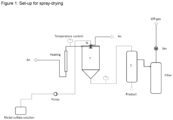
- step (b.1) and (b.2) respectively, a commercially available GEA Niro spray tower in accordance with Figure 1 was used.
- the fluffy materials obtained from (b.1) and (b.2) were filled into glass bottles.
- the bottles were sealed with polymer film. They can be transported over 100 km or more.
- Step (f.1) A spherical Ni(OH) 2 precursor was made by combining aqueous nickel sulfate solution from step (e.1) with an aqueous 25 wt.% NaOH solution and using ammonia as complexation agent. The pH value was set at 12.6. The freshly precipitated Ni(OH) 2 was washed with water, sieved and dried at 120 °C for 12 hours. p-CAM.1 was Ni(OH) 2 with a D50 of 6.5 ⁇ m.
- Step (a.3) solid NiSO 4 ⁇ 6 H 2 O, particle diameter about 1 to 3 mm, was obtained commercially.
- Step (b.3) A crucible was filled with 100 g of NiSO 4 ⁇ 6 H 2 O from step (a.2) and placed in a muffle oven with a flow of argon. The temperature was raised to 500°C and maintained for 8 hours. In order to prevent crystals from "jumping" out of the crucibles it was covered with aluminum foil that did not close tightly, so steam was allowed to escape. Then, the crucible was removed and allowed to cool naturally to ambient temperature.
- Step (c.3) NiSO 4 ⁇ 0.01 H 2 O as a yellow powder was removed from the crucible. NiSO 4 ⁇ 0.01 H 2 O as obtained in step (c.3) was less fluffy than the NiSO 4 ⁇ 2.3 H 2 O as obtained in (b.1) and (c.1). The shape of the particles was irregular. Particle diameters of from 2 ⁇ m up to 150 ⁇ m were observed (SEM).
- Step (d.3) The powder obtained from (b.3) and (c.3) was filled into glass bottles in a glove box.
- the glass bottles were sealed with polymer film. They can be transported over 100 km or more.
- Step (e.3) In an Erlenmeyer flask, 33.25 g of compact powder obtained from (b.3) and (c.3) was re-dissolved in 100 ml desalinated water to obtain an aqueous solution with a concentration of 10% by weight of nickel. Filtration did not reveal substantial amounts of solid residue.
- Step (f.3) A spherical Ni(OH) 2 precursor was made by combining aqueous nickel sulfate solution from step (e.3) with an aqueous 25 wt.% NaOH solution and using ammonia as complexation agent. The pH value was set at 12.6. The freshly precipitated Ni(OH) 2 was washed with water, sieved and dried at 120 °C for 12 hours. p-CAM.3 was Ni(OH) 2 with a D50 of 6.6 ⁇ m.
- step (b.4) may be repeated but with a temperature of 150°C, step (b.4) or 300°C, step (b.5).
Landscapes
- Chemical & Material Sciences (AREA)
- Organic Chemistry (AREA)
- Inorganic Chemistry (AREA)
- Inorganic Compounds Of Heavy Metals (AREA)
Abstract
Process for the manufacture of a precursor of a cathode active material for lithium-ion batteries wherein said cathode active material comprises at least 60 mol-% nickel, referring to metals other than lithium:(a) providing crystalline nickel sulfate hexahydrate or heptahydrate crystals or an aqueous solution of nickel sulfate,(b) removing water including water of crystallization at a temperature in the range of from 150 to 500°C,(c) recovering nickel sulfate with an average content of water of crystallization of 0.01 to 3.5 mol/mol Ni,(d) transporting anhydrous nickel sulfate from step (c) to a location over at least 100 km,(e) dissolving anhydrous nickel sulfate from step (c) in an aqueous medium,(f) combining the aqueous medium with the dissolved nickel sulfate obtained in step (e) with a solution or solid particles of cobalt sulfate or manganese sulfate and subsequently with an aqueous solution of sodium hydroxide in one or more sub-steps.
Description
- The present invention is directed towards a process for the manufacture of a precursor of a cathode active material for lithium-ion batteries wherein said cathode active material comprises at least 60 mol-% nickel, referring to metals other than lithium:
- (a) providing crystalline nickel sulfate hexahydrate or heptahydrate crystals or an aqueous solution of nickel sulfate,
- (b) removing water including water of crystallization at a temperature in the range of from 150 to 500°C,
- (c) recovering nickel sulfate with an average content of water of crystallization of 0.01 to 3.5 mol/mol Ni,
- (d) transporting anhydrous nickel sulfate from step (c) to a location over at least 100 km,
- (e) dissolving anhydrous nickel sulfate from step (c) in an aqueous medium,
- (f) combining the aqueous medium with the dissolved nickel sulfate obtained in step (e) with a solution or solid particles of cobalt sulfate or manganese sulfate and subsequently with an aqueous solution of sodium hydroxide in one or more sub-steps.
- In addition, the present invention is directed towards a certain modification of nickel sulfate.
- Lithiated transition metal oxides are currently used as electrode active materials for lithium-ion batteries. Extensive research and developmental work have been performed in the past years to improve properties like charge density, specific energy, but also other properties like the reduced cycle life and capacity loss that may adversely affect the lifetime or applicability of a lithium-ion battery. Additional effort has been made to improve manufacturing methods.
- In a typical process for making cathode materials for lithium-ion batteries, first a so-called precursor is being formed by co-precipitating the transition metals as carbonates, oxides or preferably as hydroxides that may or may not be basic, for example oxyhydroxides. The precursor is then mixed with a source of lithium such as, but not limited to LiOH, Li2O or Li2CO3 and calcined (fired) at high temperatures. Lithium source(s) can be employed as hydrate(s) or in dehydrated form. The calcination - or firing - often also referred to as thermal treatment or heat treatment of the precursor - is usually carried out at temperatures in the range of from 600 to 1000 °C. During the thermal treatment a solid-state reaction takes place, and the electrode active material is formed. The thermal treatment is performed in the heating zone of an oven or kiln.
- Starting materials for the precursors are usually the sulfates of the respective transition metals, especially of nickel. Sulfates usually are thermally stable, and - unlike chloride - sulfate does not create corrosion issues.
- However, since nickel sulfate is produced in close vicinity to the ores where nickel is won, significant transportation costs are caused. Said costs add to the manufacturing costs of the respective precursors and to the costs of the costs of the cathode active materials.
- It was an objective of the present invention to provide a process for making precursors for cathode active materials for lithium-ion batteries that will trigger lower costs for transportation without lowering the quality of the precursors and the electrochemical performance of cathode active materials.
- Accordingly, the process as defined at the outset was found, hereinafter also defined as inventive process. The inventive process comprises step (a), step (b), step (c), step (d), step (e) and step (f), hereinafter in brief also referred to as (a), (b), (c), (d), (e) and (f). The steps (a) to (f) are described in more detail below.
- It has been assessed that in transportation of nickel sulfate, due to the fact that the commercially available nickel is usually provided as hexahydrate complex, NiSO4·6 H2O, only 22.3 % by weight of the nickel sulfate is nickel. It was therefore an objective to increase the share of nickel in the transported material. It was now found that by removing water, the transportation costs may be decreased despite the reduction of density of the transported material.
- Precursors as manufactured in accordance with the inventive process are selected from (oxy)hydroxides, oxides and carbonates of transition metals of which at least 60 mol-% nickel, preferably at least 80 mol-% and even more preferably at least 90 mol-%. The higher the percentage of nickel, the higher will be the benefit. Although precursors made according to the inventive process may be a pure (oxy)hydroxide of nickel, transition metals other than nickel, such as cobalt and manganese, are of importance as well.
- In a one embodiment of the present invention, precursors as manufactured according to the inventive process contain at least one of cobalt, manganese and aluminum, preferably at least two, for example manganese and cobalt or aluminum and cobalt, for example up to 10 mol-% of cobalt and up to 10 mol-% of manganese, or 3 to 5 mol-% of cobalt and 3 to 5 mol-% of manganese.
- Precursors manufactured in accordance with the present invention may further contain 50 to 250 ppm of magnesium, ppm referring to the respective precursor.
- Precursors as manufactured in accordance with the inventive process are particulate (oxy)hydroxides, oxides or carbonates of a metal component, hereinafter also referred to as TM, and at least 60 mol-% nickel, preferably at least 80 mol-% and even more preferably at least 90 mol-% of TM is nickel. The term oxyhydroxide is not limited to compounds with as many hydroxide ions as oxide ions but to compounds of TM in general that bear oxide and hydroxide ions in a molar ratio of from 1:20 to 20:1.
- In each case, TM may contain traces of further metal ions other than the above, for example traces of ubiquitous metals such as sodium, calcium, iron, or zinc, as impurities but such traces will not be taken into account in the description of the present invention. Traces in this context will mean amounts of 0.05 mol-% or less, referring to the total metal content of TM.
- (Oxy)hydroxides and oxides of TM may contain traces of further counterions, for example carbonate. Each (oxy)hydroxides and oxides and carbonates of TM may contain traces of sulphate. Such traces are neglected in the further description of the present invention.
- Precursors as used herein are particulate materials. In one embodiment of the present invention, precursors manufactured in accordance with the inventive process have an average particle diameter D50 in the range of from 3 to 20 µm, preferably from 4 to 16 µm. The average particle diameter may be determined, e. g., by light scattering or LASER diffraction or electroacous-tic spectroscopy. The particles are composed of primary particles, in particular they are agglomerates of primary particles, and the above particle diameter refers to the secondary particle diameter. Although (D50) is - strictly speaking - the median value rather than an average diameter both expressions are used interchangeably.
- In one embodiment of the present invention, the span of the particle diameter distribution of precursors manufactured in accordance with the inventive process is in the range of from 0.2 to 2.0, preferably from 0.25 to 0.35 or from 0.6 to 1.5. The span is defined as [(D90) - (D10)]/(D50), with the values of (D90), (D50) and (D10) being the respective percentiles determined by LASER diffraction or by X-ray diffraction.
- In one embodiment of step (a), crystals of NiSO4·6 H2O are provided. Such crystalline NiSO4·6 H2O is commercially available. Such crystals are emerald colored. Crystalline NiSO4·6 H2O containing some NiSO4·7 H2O is encompassed, but NiSO4·6 H2O without the heptahydrate is preferred. In one embodiment, crystals of NiSO4·6 H2O may have a diameter (d50) in the range of from 0.5 to 5 mm, preferably 1 to 3 mm.
- In an alternative embodiment of the present invention, an aqueous solution of NiSO4·6 H2O is provided in step (a). The complex ion is also referred to as hexaquo complex. Said solution may have a concentration of from 100 to 650 g/l water.
- Providing a crystalline NiSO4·6 H2O is preferred.
- In step (b), water is removed at a temperature in the range of from 150 to 500°C, preferably 150 to 500°C, more preferably 325 to 355°C. Said water removal may be performed in various vessels, for example in pans, crucibles, pots or the like. In laboratory scale, for example for 100 mg to 150 g, crucibles are preferred. The temperature of 150 to 500°C then refers to the bottom of the respective vessel.
- In order to prevent the formation of sheets or films on one hand and of boiling retardation on the other hand, it is possible to stir aqueous solution that is heated in a crucible or pan or pot.
- In embodiments where step (b) is performed in pans, crucibles, pots or the like, it is preferred to close such vessel with a layer in order to prevent crystals from "jumping" out of the vessel, for example a lid with one or more holes, or a sieve. In laboratory scale experiments, pans or crucibles may be covered with aluminum foil that does not close tightly.
- In one embodiment of the present invention, crucibles, pans or pots may be moved during step (b), e.g., by vibration, in order to prevent scale formation and in order to mix crystals and prevent them from "jumping" out of the vessel.
- In one embodiment of the present invention, water removal is performed by spray-drying, for example in a spray tower, and the temperature of 150 to 500°C refers to the gas inlet temperature. As gas, air may be used, but nitrogen and oxygen-depleted air are preferred.
- In one embodiment of the present invention, spraying is performed through one or more nozzles per drying vessel. Suitable nozzles are, for example, high-pressure rotary drum atomizers, rotary atomizers, single-fluid nozzles and two-fluid nozzles, two-fluid nozzles and rotary atomizers being preferred. The first fluid is aqueous solution or slurry provided according to step (a), the second fluid is compressed gas, for example air or nitrogen or oxygen-depleted air with a pressure of from 1.1 to 7 bar.
- In one embodiment of the present invention, the droplets formed in spray-drying have a diameter in the range of from 1 to 500 µm, preferably from 10 to 180 µm, more preferably 20 to 175 µm.
- In another embodiment of the present invention, step (b) is performed in a fluidized bed, in a moving bed or in a fixed bed, for example in a fluidized bed dryer, and the temperature of 150 to 500°C refers to the fluidization gas inlet temperature.
- The off-gas usually has a temperature lower than the temperature of the gas inlet stream, for example 105 to 150°C. The off-gas is usually humid.
- Step (b) may be performed under air. In one embodiment of the present invention, step (b) is performed under an atmosphere of nitrogen or oxygen-depleted air, for example with an oxygen content of 1 to 15% by volume. Air is preferred.
- In order to prevent dusting of nickel sulfate, the humid off-gas generated in spray-drying or fluidized bed-based embodiments of step (b) is preferably cleaned by filters, cyclones, or preferably by a combination of at least one cyclone and at least one filter.
- In one embodiment of the present invention, wherein step (b) is performed in a pot, crucible or pan, the residence time is in the range of from one to 10 hours.
- In step (c), nickel sulfate with an average content of water of crystallization of 0.01 to 3.5 mol/mol Ni is recovered. Said nickel sulfate will also be referred to as "anhydrous" nickel sulfate. The composition is determined by elemental analysis. Preferred are 0.01 to 0.2 mol water of crystallization per mol of nickel or 2.1 to 2.7 mol water of crystallization per mol Ni.
- In one embodiment of the present invention, anhydrous nickel sulfate is recovered as fluffy solid with irregularly formed particles.
- In a preferred embodiment of the present invention, anhydrous nickel sulfate recovered in step (c) has a pressed density in the range of from 0.55 to 1.0 g Ni/ml at 200 MPa.
- Instead of using fossil-based energy or nuclear power or an energy mix of the foregoing, in step (b) of the inventive process, solely or to a vast extent, for example at least 80% of the electricity used is generated from non-fossil sources and other than by nuclear power. Examples of non-fossil sources wind energy, solar energy and tide power. Preferred are thus embodiments wherein the electricity used for step (b) is generated from a wind turbine, by solar power, by geothermal power, by hydroelectricity or by tide power, or a combination of at least two of the ways mentioned before. Wind turbine shall include a combination of more than one wind turbine. Wind turbines and solar power are preferred.
- In one embodiment of the present invention, the concentration of nickel in anhydrous nickel sulfate recovered in step (c) is in the range of from 31 to 38 % by weight.
- In step (d), anhydrous nickel sulfate from step (c) is transported to a location over at least 100 km, for example in flexible intermediate bulk containers, so-called big bags, or in a silo, for example in a silo similar to silos suitable for the transportation of cement. Big bags and especially silos may be transported by truck, by train or by aircraft, or by ship or by a combination of at least two of the foregoing. It is possible as well to store a big bag or a silo on a trailer of a truck and to then transport such trailer by train or ship for at least some distance. A potential maximum distance is 25,000 km, preferably up to 19,000 km.
- In one embodiment of the present invention, a silo has a length in the range of from 10 to 40 feet (3.3 to 15 meters), preferably 4 to 9.5 meters.
- One preferred example of a silo is a container with a steep conical outlet. In one embodiment, the design with a steep conical outlet is an interchangeable silo. Interchangeable containers are typically 4 to 9.5 m in total height, 1.5 to 2 m and preferably 2.5 m in diameter and 1.5 to 7 m, more preferred 2 to 4 m in cylinder length. They are equipped with mounting fittings so that they can be connected to and loaded onto transport cars by changing systems, in the context of the present invention also referred to as "connector to changing systems".
- Packaging for anhydrous nickel sulfate from step (c) is preferably water-tight in order to reduce or prevent access of humidity.
- In step (e), anhydrous nickel sulfate from step (c) is dissolved in an aqueous medium, for example in water, preferably in desalinated water. Said dissolution takes place at the destination reached in step (d).
- In one embodiment of the present invention, aqueous medium may contain sulfuric acid, for example to adjust the pH value to 2 to 5.
- The order of addition of nickel sulfate and water may be selected freely. The concentration of nickel may be selected in wide ranges, concentrations in the range of from 0.5 to 5 mol/l, preferably 1 to 3 mol/l are feasible.
- Step (e) may be performed at a temperature in the range of from 5 to 50°C, ambient temperature being preferred.
- In one embodiment of the present invention, a filtration step takes place. However, in many embodiments a filtration step is not required because step (d) directly furnishes a clear solution.
- An aqueous solution of nickel sulfate is obtained from step (e).
- Said aqueous solution may have a pH value in the range of from 2.0 to 6.0, preferably 2.5 to 5.7, determined at 23°C.
- Step (f) includes combining the aqueous medium with the dissolved nickel sulfate obtained in step (e) with a solution or solid particles of cobalt sulfate or manganese sulfate or of an aluminum compound and subsequently with an aqueous solution of sodium hydroxide or (bi)carbonate in one or more sub-steps.
- In said combination, it is taken care that the molar ratio of nickel sulfate is at least 60 % with reference to metals such as cobalt, manganese and aluminum, as the case may be, preferably at least 80 mol-% and more preferably at least 90 mol-%. Metals in the context of step (f) are metals other than alkali metal.
- Step (f) may be performed in a continuous mode or in a batch mode.
- In embodiments wherein (oxy)hydroxides are precipitated, it is preferred to control the stoichiometry of transition metal salts to hydroxide in a way that the molar ratio of transition metal to hydroxide is in the range of from 1:2 to 1:2.5.
- In embodiments wherein carbonates are precipitated, it is preferred to control the stoichiometry of transition metal salts to carbonate in a way that the molar ratio of transition metal to carbonate is in the range of from 1:1 to 1:1.25.
- Aqueous solution of sodium hydroxide may have a concentration of hydroxide in the range from 0.1 to 10 mol/l, preferably 1 to 7.5 mol/l.
- Aqueous solution of alkali metal hydroxide may comprise one or more further salts, for example ammonium compounds, especially ammonium hydroxide, ammonium sulfate or ammonium sulfite. In one embodiment, a molar NH3: transition metal ratio of 0.01 to 0.9 and more preferably of 0.08 to 0.65 can be established.
- Step (f) may be performed at a temperature in the range of from 20 to 75°C, preferably 45 to 70°C.
- Step (f) is preferably performed under an atmosphere of nitrogen or strongly oxygen-depleted air, for example under an atmosphere that contains 0.1 to 2 vol-% oxygen.
- In one embodiment of the present invention, step (f) is performed at a pH value in the range of from 9.5 to 13.0.
- In one embodiment of the present invention, step (f) is performed in two sub-steps, with the sub-step (f-1) being performed at a pH value in the range of from 11.0 to 13.5 and sub-step (f-2) is performed at a pH value in the range of from 9.5 to 11.0 but in any case at least 0.5 units below the pH value of step (f-1). Thus, for example, if step (f-1) is performed at a pH value of 11.0, the pH value of step (f-2) is 10.5 at most.
- The inventive process allows a facile transportation of nickel sulfate. Tonnage in form of water of crystallization is strongly reduced.
- A further aspect of the present invention is related to particulate NiSO4 with an average content of water of crystallization of 0.01 to 3.5 mol/mol Ni, and with a pressed density in the range of from 0.55 to 1.0 g Ni/cm3, wherein the majority of the nickel sulfate particles have an irregular shape. Such particulate NiSO4 is an intermediate used in the inventive process, and it is hereinafter also referred to as inventive NiSO4.
- In one embodiment of the present invention, the particles of inventive NiSO4 have a median diameter (D50) in the range of from 1 µm to 250 µm, preferably 2 to 150 µm. In embodiments wherein a spray-drying is performed, a median diameter in the range of from 8 to 15 µm is preferred, determined by LASER diffraction.
- In one embodiment of the present invention, the particles of inventive NiSO4 have a form factor (average) in the range of from 0.5 to 0.8.
- To determine the form factor (averaged), it will first be determined for at least 50 individual particles of each sample and then averaged.
- The form factor of the individual particles is calculated from the perimeter and area determined from top view SEM images:

- While a perfect sphere would possess a form factor of 1.0, any deviation from perfect sphericity will lead to form factors < 1.0
- In embodiment wherein a spray drying is performed, the particles of inventive NiSO4 preferably have the appearance of hollow spherical particles.
- Inventive anhydrous nickel sulfate displays a certain hygroscopicity and should not be stored under ambient air or in the presence of humidity. Packaging for transport, for example according to step (d) of the inventive process, should be water-tight.
- The present invention is further illustrated by working examples.
- NiSO4·6 H2O (analysis grade) crystals were purchased from CHEMSOLUTE. Particle diameter a few millimeters.
- An amount of 381.1 g NiSO4·6 H2O was dissolved in 1 liter of desalinated water. The resultant solution was 8.5% by weight in nickel.
- For the spray-drying according to step (b.1) and (b.2), respectively, a commercially available GEA Niro spray tower in accordance with
Figure 1 was used. - Explanation of
Figure 1 : - N: nozzle
- T: spray tower
- C: cyclone
- The settings were chosen as follows:
- air, inlet temperature: 350°C
- Gas outlet temperature: 140°C
- Batch (b.1): 90% fan power, 8.89 Nm/s
- Batch (b.2): 60% fan power, 7.52 Nm/s
- From batch (b.1), a fluffy powder was obtained, formula NiSO4·2.3 H2O.
- From batch (b.2), a fluffy powder was obtained, formula NiSO4·2.6 H2O. The compositions were determined by elemental analyses.
- The fluffy materials obtained from (b.1) and (b.2) were filled into glass bottles. The bottles were sealed with polymer film. They can be transported over 100 km or more.
- In Erlenmeyer flasks, each 33.25 g of the fluffy materials obtained from (b.1) and (b.2), respectively, were re-dissolved in 100 ml desalinated water to obtain aqueous solutions with a concentration of 10% by weight of nickel. Filtration did not reveal any solid residue.
- Step (f.1): A spherical Ni(OH)2 precursor was made by combining aqueous nickel sulfate solution from step (e.1) with an aqueous 25 wt.% NaOH solution and using ammonia as complexation agent. The pH value was set at 12.6. The freshly precipitated Ni(OH)2 was washed with water, sieved and dried at 120 °C for 12 hours. p-CAM.1 was Ni(OH)2 with a D50 of 6.5 µm.
- Step (a.3): solid NiSO4·6 H2O, particle diameter about 1 to 3 mm, was obtained commercially.
- Step (b.3): A crucible was filled with 100 g of NiSO4·6 H2O from step (a.2) and placed in a muffle oven with a flow of argon. The temperature was raised to 500°C and maintained for 8 hours. In order to prevent crystals from "jumping" out of the crucibles it was covered with aluminum foil that did not close tightly, so steam was allowed to escape. Then, the crucible was removed and allowed to cool naturally to ambient temperature.
- Step (c.3): NiSO4·0.01 H2O as a yellow powder was removed from the crucible. NiSO4·0.01 H2O as obtained in step (c.3) was less fluffy than the NiSO4·2.3 H2O as obtained in (b.1) and (c.1). The shape of the particles was irregular. Particle diameters of from 2 µm up to 150 µm were observed (SEM).
- Step (d.3): The powder obtained from (b.3) and (c.3) was filled into glass bottles in a glove box. The glass bottles were sealed with polymer film. They can be transported over 100 km or more.
- Step (e.3): In an Erlenmeyer flask, 33.25 g of compact powder obtained from (b.3) and (c.3) was re-dissolved in 100 ml desalinated water to obtain an aqueous solution with a concentration of 10% by weight of nickel. Filtration did not reveal substantial amounts of solid residue.
- Step (f.3): A spherical Ni(OH)2 precursor was made by combining aqueous nickel sulfate solution from step (e.3) with an aqueous 25 wt.% NaOH solution and using ammonia as complexation agent. The pH value was set at 12.6. The freshly precipitated Ni(OH)2 was washed with water, sieved and dried at 120 °C for 12 hours. p-CAM.3 was Ni(OH)2 with a D50 of 6.6 µm.
- The above process may be repeated but with a temperature of 150°C, step (b.4) or 300°C, step (b.5).
- Step (c.4): NiSO4·1.9 H2O as a mint green powder was removed from the crucible.
- Step (c.5): NiSO4·0.5 H2O as a mint green powder was removed from the crucible.
Claims (8)
- Process for the manufacture of a precursor of a cathode active material for lithium-ion batteries wherein said cathode active material comprises at least 60 mol-% nickel, referring to metals other than lithium:(a) providing crystalline nickel sulfate hexahydrate or heptahydrate crystals or an aqueous solution of nickel sulfate,(b) removing water including water of crystallization at a temperature in the range of from 150 to 500°C,(c) recovering nickel sulfate with an average content of water of crystallization of 0.01 to 3.5 mol/mol Ni,(d) transporting anhydrous nickel sulfate from step (c) to a location over at least 100 km,(e) dissolving anhydrous nickel sulfate from step (c) in an aqueous medium,(f) combining the aqueous medium with the dissolved nickel sulfate obtained in step (e) with a solution or solid particles of cobalt sulfate or manganese sulfate and subsequently with an aqueous solution of sodium hydroxide or (bi)carbonate in one or more sub-steps.
- Process according to claim 1 wherein step (b) is performed by spray-drying or in a fluidized bed dryer, and the temperature refers to the inlet temperature of the respective gas used for spray-drying or fluidization.
- Process according to claim 1 or 2 wherein step (b) is performed under an atmosphere of air, nitrogen or oxygen-depleted air.
- Process according to any of the preceding claims wherein step (d) is performed in a big bag.
- Particulate NiSO4 with an average content of water of crystallization of 0.01 to 3.5 mol/mol Ni, and with a pressed density in the range of from 0.55 to 1.0 g nickel/cm3 at a pressure of 200 MPa, wherein the majority of the nickel sulfate particles have an irregular shape or have the appearance of hollow spherical particles.
- Particulate NiSO4 according to claim 5 wherein the particles have a diameter (D50) in the range of from 1 to 150 µm.
- Particulate NiSO4 according to claim 5 or 6 wherein the majority of the nickel sulfate particles have the appearance of hollow spherical particles with an average diameter (D50) in the range of from 8 to 15 µm, determined by LASER diffraction.
- Particulate NiSO4 according to claim 5 or 6, wherein said particles have a form factor in the range of from 0.5 to 0.8.
Priority Applications (1)
| Application Number | Priority Date | Filing Date | Title |
|---|---|---|---|
| EP23205837.0A EP4545486A1 (en) | 2023-10-25 | 2023-10-25 | Facile transportation of nickel sulfate |
Applications Claiming Priority (1)
| Application Number | Priority Date | Filing Date | Title |
|---|---|---|---|
| EP23205837.0A EP4545486A1 (en) | 2023-10-25 | 2023-10-25 | Facile transportation of nickel sulfate |
Publications (1)
| Publication Number | Publication Date |
|---|---|
| EP4545486A1 true EP4545486A1 (en) | 2025-04-30 |
Family
ID=88511521
Family Applications (1)
| Application Number | Title | Priority Date | Filing Date |
|---|---|---|---|
| EP23205837.0A Withdrawn EP4545486A1 (en) | 2023-10-25 | 2023-10-25 | Facile transportation of nickel sulfate |
Country Status (1)
| Country | Link |
|---|---|
| EP (1) | EP4545486A1 (en) |
Citations (1)
| Publication number | Priority date | Publication date | Assignee | Title |
|---|---|---|---|---|
| JP2022508083A (en) * | 2018-11-09 | 2022-01-19 | ビーエーエスエフ ソシエタス・ヨーロピア | Manufacturing method of nickel composite hydroxide |
-
2023
- 2023-10-25 EP EP23205837.0A patent/EP4545486A1/en not_active Withdrawn
Patent Citations (1)
| Publication number | Priority date | Publication date | Assignee | Title |
|---|---|---|---|---|
| JP2022508083A (en) * | 2018-11-09 | 2022-01-19 | ビーエーエスエフ ソシエタス・ヨーロピア | Manufacturing method of nickel composite hydroxide |
Non-Patent Citations (4)
| Title |
|---|
| "Bureau of mines Report of investigations 6617", 1 January 1965, article L.H. ADAMI ET.AL.: "Heats of formation of anhydrous sulfates of cadmium, cobalt, copper, nickel and zink", pages: 1 - 6, XP093155530 * |
| ANISA SURYA WIJARENI: "Morphology and Particle Size of a Synthesized NMC 811 Cathode Precursor with Mixed Hydroxide Precipitate and Nickel Sulfate as Nickel Sources and Comparison of Their Electrochemical Performances in an NMC 811 Lithium-Ion Battery", ENERGIES, vol. 15, no. 16, 10 August 2022 (2022-08-10), CH, pages 5794, XP093155506, ISSN: 1996-1073, DOI: 10.3390/en15165794 * |
| PUBCHEM: "Nickel sulfate", 4 April 2022 (2022-04-04), pages 1 - 1, XP093155560, Retrieved from the Internet <URL:https://web.archive.org/web/20230301000000*/https://pubchem.ncbi.nlm.nih.gov/compound/Nickel-Sulfate> * |
| TSUNEICHI TAKESHITA: "Acid Property and Structure of a Solid Metal Sulfate Catalyst. Change in Structure of Nickel Sulfates with Heating 1", THE JOURNAL OF PHYSICAL CHEMISTRY, vol. 69, no. 12, 1 December 1965 (1965-12-01), pages 4077 - 4084, XP093155515, ISSN: 0022-3654, Retrieved from the Internet <URL:https://pubs.acs.org/doi/pdf/10.1021/j100782a005> DOI: 10.1021/j100782a005 * |
Similar Documents
| Publication | Publication Date | Title |
|---|---|---|
| CA2778286C (en) | Nickel-cobalt-manganese-based compound particles and process for producing the nickel-cobalt-manganese-based compound particles, lithium composite oxide particles and process for producing the lithium composite oxide particles, and non-aqueous electrolyte secondary battery | |
| EP2693535B1 (en) | Positive electrode active material granular powder and method for producing same, and nonaqueous electrolyte secondary battery | |
| KR101306532B1 (en) | Inorganic Compounds | |
| RU2479485C2 (en) | Iron (iii) orthophosphate for lithium-ion batteries | |
| JP5614334B2 (en) | Nickel-cobalt composite hydroxide, method for producing the same, and positive electrode active material for non-aqueous electrolyte secondary battery obtained using the composite hydroxide | |
| JP5464348B2 (en) | Nickel-cobalt composite hydroxide for non-aqueous electrolyte secondary battery positive electrode active material and method for producing the same, and method for producing non-aqueous electrolyte secondary battery positive electrode active material using the nickel-cobalt composite hydroxide | |
| EP2833445B1 (en) | Positive electrode active material particle powder and method for producing same, and non-aqueous electrolyte secondary battery | |
| US20140087262A1 (en) | Li-ni composite oxide particles and process for producing the same, and non-aqueous electrolyte secondary battery | |
| US20160293950A1 (en) | Nickel-cobalt-manganese composite hydroxide and method for producing same | |
| JP7507758B2 (en) | Method for producing nickel composite hydroxide | |
| US20230212028A1 (en) | Process for making a particulate (oxy) hydroxide | |
| CA2738291A1 (en) | Lithium manganate particles for non-aqueous electrolyte secondary battery, process for producing the same, and non-aqueous electrolyte secondary battery | |
| KR20130096224A (en) | Process for preparing lithium mixed metal oxides and their use as cathode materials | |
| ES2988556T3 (en) | Procedure for precipitation of a mixed hydroxide | |
| US20030094596A1 (en) | Phosphor and its production process | |
| JP5365488B2 (en) | Method for producing nickel cobalt aluminum composite oxide | |
| CN115135609A (en) | Method for producing surface-modified particulate lithium nickel metal oxide materials | |
| WO2020052997A1 (en) | Process for coating an oxide material | |
| EP3881373A1 (en) | Process for producing a surface-modified particulate lithium nickel metal oxide material | |
| WO2020052995A1 (en) | Process for coating an oxide material | |
| CN114531873A (en) | Method | |
| JP6876600B2 (en) | Precursor of positive electrode active material for non-aqueous electrolyte secondary battery and its manufacturing method, and positive electrode active material for non-aqueous electrolyte secondary battery and its manufacturing method | |
| US20240228323A9 (en) | Process for making a particulate (oxy)hydroxide or oxide | |
| JP2005035880A (en) | Porous potassium carbonate having a specific pore structure, method for producing the same, and method for storing the same | |
| JP5632794B2 (en) | Lithium titanate and method for producing the same, electrode active material containing the lithium titanate, and power storage device using the electrode active material |
Legal Events
| Date | Code | Title | Description |
|---|---|---|---|
| PUAI | Public reference made under article 153(3) epc to a published international application that has entered the european phase |
Free format text: ORIGINAL CODE: 0009012 |
|
| STAA | Information on the status of an ep patent application or granted ep patent |
Free format text: STATUS: THE APPLICATION HAS BEEN PUBLISHED |
|
| AK | Designated contracting states |
Kind code of ref document: A1 Designated state(s): AL AT BE BG CH CY CZ DE DK EE ES FI FR GB GR HR HU IE IS IT LI LT LU LV MC ME MK MT NL NO PL PT RO RS SE SI SK SM TR |
|
| STAA | Information on the status of an ep patent application or granted ep patent |
Free format text: STATUS: THE APPLICATION HAS BEEN WITHDRAWN |
|
| 18W | Application withdrawn |
Effective date: 20250502 |