EP4545421A1 - Emergency system for an aircraft - Google Patents
Emergency system for an aircraft Download PDFInfo
- Publication number
- EP4545421A1 EP4545421A1 EP23205948.5A EP23205948A EP4545421A1 EP 4545421 A1 EP4545421 A1 EP 4545421A1 EP 23205948 A EP23205948 A EP 23205948A EP 4545421 A1 EP4545421 A1 EP 4545421A1
- Authority
- EP
- European Patent Office
- Prior art keywords
- cockpit
- aircraft
- emergency
- pilot
- rest compartment
- Prior art date
- Legal status (The legal status is an assumption and is not a legal conclusion. Google has not performed a legal analysis and makes no representation as to the accuracy of the status listed.)
- Pending
Links
Images
Classifications
-
- B—PERFORMING OPERATIONS; TRANSPORTING
- B64—AIRCRAFT; AVIATION; COSMONAUTICS
- B64D—EQUIPMENT FOR FITTING IN OR TO AIRCRAFT; FLIGHT SUITS; PARACHUTES; ARRANGEMENT OR MOUNTING OF POWER PLANTS OR PROPULSION TRANSMISSIONS IN AIRCRAFT
- B64D45/00—Aircraft indicators or protectors not otherwise provided for
- B64D45/0015—Devices specially adapted for the protection against criminal attack, e.g. anti-hijacking systems
- B64D45/0059—Devices specially adapted for the protection against criminal attack, e.g. anti-hijacking systems by communicating emergency situations to ground control or between crew members
-
- G—PHYSICS
- G05—CONTROLLING; REGULATING
- G05D—SYSTEMS FOR CONTROLLING OR REGULATING NON-ELECTRIC VARIABLES
- G05D1/00—Control of position, course, altitude or attitude of land, water, air or space vehicles, e.g. using automatic pilots
- G05D1/80—Arrangements for reacting to or preventing system or operator failure
- G05D1/81—Handing over between on-board automatic and on-board manual control
- G05D1/817—Handing over between on-board automatic and on-board manual control to recover from pilot incapacitation
-
- G—PHYSICS
- G05—CONTROLLING; REGULATING
- G05D—SYSTEMS FOR CONTROLLING OR REGULATING NON-ELECTRIC VARIABLES
- G05D1/00—Control of position, course, altitude or attitude of land, water, air or space vehicles, e.g. using automatic pilots
- G05D1/60—Intended control result
- G05D1/654—Landing
- G05D1/6546—Emergency landing
-
- B—PERFORMING OPERATIONS; TRANSPORTING
- B64—AIRCRAFT; AVIATION; COSMONAUTICS
- B64D—EQUIPMENT FOR FITTING IN OR TO AIRCRAFT; FLIGHT SUITS; PARACHUTES; ARRANGEMENT OR MOUNTING OF POWER PLANTS OR PROPULSION TRANSMISSIONS IN AIRCRAFT
- B64D25/00—Emergency apparatus or devices, not otherwise provided for
-
- B—PERFORMING OPERATIONS; TRANSPORTING
- B64—AIRCRAFT; AVIATION; COSMONAUTICS
- B64D—EQUIPMENT FOR FITTING IN OR TO AIRCRAFT; FLIGHT SUITS; PARACHUTES; ARRANGEMENT OR MOUNTING OF POWER PLANTS OR PROPULSION TRANSMISSIONS IN AIRCRAFT
- B64D45/00—Aircraft indicators or protectors not otherwise provided for
- B64D45/04—Landing aids; Safety measures to prevent collision with earth's surface
-
- G—PHYSICS
- G05—CONTROLLING; REGULATING
- G05D—SYSTEMS FOR CONTROLLING OR REGULATING NON-ELECTRIC VARIABLES
- G05D2105/00—Specific applications of the controlled vehicles
- G05D2105/20—Specific applications of the controlled vehicles for transportation
- G05D2105/22—Specific applications of the controlled vehicles for transportation of humans
-
- G—PHYSICS
- G05—CONTROLLING; REGULATING
- G05D—SYSTEMS FOR CONTROLLING OR REGULATING NON-ELECTRIC VARIABLES
- G05D2109/00—Types of controlled vehicles
- G05D2109/20—Aircraft, e.g. drones
- G05D2109/22—Aircraft, e.g. drones with fixed wings
Definitions
- the present disclosure generally relates to an emergency system for an aircraft, as well as an aircraft section and aircraft having such emergency system.
- the present disclosure relates to an emergency system including an emergency button outside of the cockpit to send an emergency landing signal.
- the present disclosure further relates to an aircraft section having such emergency system and an aircraft comprising such aircraft section.
- a conventional aircraft is usually equipped with an autopilot system to allow controlling the aircraft during cruise.
- Some of the autopilot systems include functionality to perform minor climb and descend manoeuvres.
- some aircrafts or autopilot systems are configured to perform automated manoeuvres in case of a signal from a Traffic Collision Avoidance System (TCAS).
- TCAS Traffic Collision Avoidance System
- a more advanced control of the aircraft may even allow an automated landing of the aircraft including Air Traffic Control communication, for example, if the pilot/s is/are unable to continue the flight.
- an emergency system for an aircraft comprises an autopilot controller arranged in a cockpit of the aircraft and configured to automatically fly the aircraft including performing predefined manoeuvres, a surveillance system, and an emergency button arranged in a crew rest compartment outside of the cockpit and configured to send an emergency landing signal to the surveillance system and/or the autopilot controller when activated.
- a crew member resting outside of the cockpit which is common practice during long-haul flights, is capable of initiating an emergency landing procedure, although not being physically in the cockpit. This allows the crew member outside of the cockpit to solve critical situations as if being in the cockpit, and valuable time is not lost, for example, until the crew member has left the crew rest compartment and reached the cockpit.
- Such emergency system further allows to reduce the number of "standby" or backup crew members providing economic benefits for the aircraft operator (e.g., an airline).
- the aircraft operator e.g., an airline
- two pilots are in the cockpit and fly (operate) the aircraft.
- uncritical flight phases such as climb, cruise, and initial decent, it is sufficient to have only one pilot in the cockpit.
- the surveillance system can be integrated into the autopilot controller.
- the aircraft can either be equipped with a conventional autopilot controller supplemented with the surveillance system, according to the present disclosure, or the autopilot controller is exchanged with an autopilot controller including the functionality of the surveillance system, according to the present disclosure.
- Such replacement of the autopilot controller includes updating a software/firmware executed on the autopilot controller.
- the emergency system can further comprise a camera arranged in the cockpit and configured to capture an image of the cockpit, and a user interface device arranged in the crew rest compartment and configured to display the captured image from the camera. This allows the crew member in the crew rest compartment to see a live video stream of the cockpit and facilitates assessing the situation by the resting crew member.
- the camera can be configured to capture an image of a section of the cockpit including a pilot seat.
- the resting crew member can assess whether the remaining (sole) pilot in the cockpit may not be able to handle the situation or may even be hampered to fly the aircraft. For instance, the pilot in the cockpit may be unconscious or may have a difficult health situation hindering the pilot from operating the aircraft properly. Of course, the resting crew member can go back to the cockpit without pressing the emergency button, for example, in less critical situations.
- the display device can be further configured to display one or more alert messages indicated on a control panel in the cockpit.
- alert messages may be presented in the same or at least similar manner to the crew member in the crew rest compartment.
- the user interface can be configured to output a visual and/or audible alarm, in order to notify that an alert message is being displayed.
- the surveillance system can be configured to monitor a physical condition and/or health of a pilot in the cockpit, to determine whether the pilot is hampered of operating the aircraft, and to send an alarm signal to the user interface device, if it is determined that the pilot is hampered based on the physical condition and/or health of the pilot.
- the alarm signal can be a visual and/or audible signal.
- the alarm signal in the crew rest compartment can be a bright light, an alert message displayed, a sound, a noise, a vibration or the like, intended to wake up the resting crew member and/or directing the attention of the resting crew member to the user interface device.
- Monitoring the physical condition and/or health of the pilot can be performed, for example, on the basis of the camera image.
- Health monitoring and fatigue recognition can be performed on image signals as well as audio surveillance of the cockpit.
- the surveillance system may analyse image data from the camera and/or audio data from a microphone or similar audio input device in the cockpit, to determine whether the (remaining) pilot in the cockpit is able to fly the aircraft.
- Such health monitoring and fatigue recognition can be based on a conventional pilot/driver monitoring system (for example, as they are also available for cars).
- the emergency button can comprise a security measure, preferably an authentication means.
- the emergency button may be operated with a key that is only available to the crew member (pilot).
- the security measure may comprise entering a pin, password or other authentication credentials, such as a fingerprint or iris recognition, before the emergency button can be activated. This increases the overall security, so that the emergency button is not unintentionally triggered and the automated landing manoeuvre is not unintentionally initiated.
- an aircraft section comprises a cockpit, at least one crew rest compartment located outside of the cockpit, and an emergency system of the first aspect or one or more of its implementation variants.
- the crew member (pilot) currently on standby or resting is able to initiate an automated landing manoeuvre and can safe valuable time before leaving the crew rest compartment and entering the cockpit to take over manual control of the aircraft.
- the emergency button and/or the user interface device may also be disposed in other aircraft sections, where flight personal operates or rests.
- well-trained flight attendants may be alerted via the user interface device and can assess the situation and the cockpit, and may even be authorised to activate the emergency button, and, hence, initiate the automated emergency landing manoeuvre of the aircraft.
- an aircraft comprises an aircraft section of the second aspect.
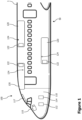
- Figure 1 schematically illustrates an aircraft section 50 having an emergency system 100.
- an aircraft 1 comprises an aircraft section 50 including a cockpit 110 and at least one crew rest compartment 120.
- Figure 1 exemplarily illustrates three crew rest compartments 120, two in a crown area, and one crew rest compartment 120 and a cargo area, i.e. beneath a cabin floor (not illustrated).
- Each crew rest compartment 120 is arranged outside of the cockpit 110, and it may take some time (e.g., a few minutes, such as one, two or even five minutes) for a crew member to leave the crew rest compartment 120 and reach the cockpit 110.
- an autopilot controller 112 is provided that is configured to automatically fly the aircraft 1.
- the autopilot controller 112 is further capable of performing predefined manoeuvres, such as following a particular (predefined and/or pre-programmed) flight route. This includes that the autopilot controller 112 operates the aircraft 1 to descent, climb, and cruise.
- Such autopilot controller 112 may be a conventional autopilot controller.
- the emergency button 124 is configured to send an emergency landing signal to the surveillance system 114.
- the surveillance system 114 may then be configured to initiate an emergency landing sequence (flight procedure) at the autopilot controller 112 (which emergency landing sequence may be conventionally installed in the autopilot controller 112 or may be installed when the aircraft 1 is retrofitted with the emergency system 100 of the present disclosure).
- the emergency button 124 may directly send an emergency landing signal to the autopilot controller 112 (if the autopilot controller 112 is configured to receive and process such signal).
- an automatic emergency landing manoeuvre is initiated, so that the aircraft can, for example, begin to decent (e.g., under control of the autopilot controller 112 or other emergency flight means, e.g., TCAS-alert based devices).
- the aircraft can, for example, begin to decent (e.g., under control of the autopilot controller 112 or other emergency flight means, e.g., TCAS-alert based devices).
- TCAS-alert based devices e.g., TCAS-alert based devices.
- the emergency system 100 can further comprise a camera 115 arranged in the cockpit 110 and configured to capture an image of the cockpit. As illustrated in Figure 1 , the camera 115 can capture an image of a section of the cockpit including a pilot seat.
- the emergency button 124 can be a physical button (hard key) that can be pressed to activate the emergency landing manoeuvre.
- such emergency button 124 can be provided on the user interface device 122, for example, in form of a so-called soft key (displayed button).
- the user interface device 122 may be equipped with one or more physical buttons that can be related to such soft keys and/or can be configured as a touchscreen (a display screen including a touch input capability).
- authentication means can be easily, including displaying of input fields for user credentials, such as username and password, a pin or the like.
- a finger print recognition or iris recognition can be provided at or in the user interface device 122, in order to authenticate the crew member when the emergency button 124 is activated/triggered.
- security measures such as authentication means can also be provided.
- authentication means such as authentication means.
- One measure would be that the emergency button 124 can only be activated when using a key.
- a further optional feature of the surveillance system 114 is an input means that can be activated by the (remaining) crew member in the cockpit 110.
- the surveillance system 114 sends the alert message to the user interface device 122 and/or triggers an alarm signal in or near the crew rest compartment 120.
- the crew member in the cockpit 100 can feeling not well, and alert to the other crew member in the crew rest compartment 120 can be initiated.
Landscapes
- Engineering & Computer Science (AREA)
- Aviation & Aerospace Engineering (AREA)
- Radar, Positioning & Navigation (AREA)
- Remote Sensing (AREA)
- Physics & Mathematics (AREA)
- General Physics & Mathematics (AREA)
- Automation & Control Theory (AREA)
- Business, Economics & Management (AREA)
- Emergency Management (AREA)
- Alarm Systems (AREA)
Abstract
Description
- The present disclosure generally relates to an emergency system for an aircraft, as well as an aircraft section and aircraft having such emergency system. Particularly, the present disclosure relates to an emergency system including an emergency button outside of the cockpit to send an emergency landing signal. The present disclosure further relates to an aircraft section having such emergency system and an aircraft comprising such aircraft section.
- A conventional aircraft is usually equipped with an autopilot system to allow controlling the aircraft during cruise. Some of the autopilot systems include functionality to perform minor climb and descend manoeuvres. In addition, some aircrafts or autopilot systems are configured to perform automated manoeuvres in case of a signal from a Traffic Collision Avoidance System (TCAS). A more advanced control of the aircraft may even allow an automated landing of the aircraft including Air Traffic Control communication, for example, if the pilot/s is/are unable to continue the flight.
- It is an object of the present disclosure to provide an aircraft control system for improved safety of the aircraft and passengers.
- This object is solved by the present invention as defined in the independent claims. Preferred embodiments are defined by the dependent claims.
- According to a first aspect to better understand the present disclosure, an emergency system for an aircraft comprises an autopilot controller arranged in a cockpit of the aircraft and configured to automatically fly the aircraft including performing predefined manoeuvres, a surveillance system, and an emergency button arranged in a crew rest compartment outside of the cockpit and configured to send an emergency landing signal to the surveillance system and/or the autopilot controller when activated.
- Thus, a crew member resting outside of the cockpit, which is common practice during long-haul flights, is capable of initiating an emergency landing procedure, although not being physically in the cockpit. This allows the crew member outside of the cockpit to solve critical situations as if being in the cockpit, and valuable time is not lost, for example, until the crew member has left the crew rest compartment and reached the cockpit.
- Such emergency system further allows to reduce the number of "standby" or backup crew members providing economic benefits for the aircraft operator (e.g., an airline). As a mere example, during take-off and landing/approach two pilots are in the cockpit and fly (operate) the aircraft. However, during uncritical flight phases, such as climb, cruise, and initial decent, it is sufficient to have only one pilot in the cockpit.
- It is to be understood that the surveillance system can be integrated into the autopilot controller. Thus, the aircraft can either be equipped with a conventional autopilot controller supplemented with the surveillance system, according to the present disclosure, or the autopilot controller is exchanged with an autopilot controller including the functionality of the surveillance system, according to the present disclosure. Such replacement of the autopilot controller includes updating a software/firmware executed on the autopilot controller.
- In an implementation variant, the emergency system can further comprise a camera arranged in the cockpit and configured to capture an image of the cockpit, and a user interface device arranged in the crew rest compartment and configured to display the captured image from the camera. This allows the crew member in the crew rest compartment to see a live video stream of the cockpit and facilitates assessing the situation by the resting crew member.
- As a mere example, the camera can be configured to capture an image of a section of the cockpit including a pilot seat. Thus, the resting crew member can assess whether the remaining (sole) pilot in the cockpit may not be able to handle the situation or may even be hampered to fly the aircraft. For instance, the pilot in the cockpit may be unconscious or may have a difficult health situation hindering the pilot from operating the aircraft properly. Of course, the resting crew member can go back to the cockpit without pressing the emergency button, for example, in less critical situations.
- In another implementation variant, the display device can be further configured to display one or more alert messages indicated on a control panel in the cockpit. In other words, in case of alert messages being provided inside of the cockpit, such alert messages may be presented in the same or at least similar manner to the crew member in the crew rest compartment. Alternatively or additionally, the user interface can be configured to output a visual and/or audible alarm, in order to notify that an alert message is being displayed.
- In yet another implementation variant, the surveillance system can be configured to monitor a physical condition and/or health of a pilot in the cockpit, to determine whether the pilot is hampered of operating the aircraft, and to send an alarm signal to the user interface device, if it is determined that the pilot is hampered based on the physical condition and/or health of the pilot. The alarm signal can be a visual and/or audible signal. Particularly, the alarm signal in the crew rest compartment can be a bright light, an alert message displayed, a sound, a noise, a vibration or the like, intended to wake up the resting crew member and/or directing the attention of the resting crew member to the user interface device.
- Monitoring the physical condition and/or health of the pilot can be performed, for example, on the basis of the camera image. Health monitoring and fatigue recognition can be performed on image signals as well as audio surveillance of the cockpit. Thus, the surveillance system may analyse image data from the camera and/or audio data from a microphone or similar audio input device in the cockpit, to determine whether the (remaining) pilot in the cockpit is able to fly the aircraft. Such health monitoring and fatigue recognition can be based on a conventional pilot/driver monitoring system (for example, as they are also available for cars).
- In an implementation variant, the emergency button can comprise a security measure, preferably an authentication means. As a mere example, the emergency button may be operated with a key that is only available to the crew member (pilot). Alternatively or additionally, the security measure may comprise entering a pin, password or other authentication credentials, such as a fingerprint or iris recognition, before the emergency button can be activated. This increases the overall security, so that the emergency button is not unintentionally triggered and the automated landing manoeuvre is not unintentionally initiated.
- According to a second aspect to better understand the present disclosure, an aircraft section comprises a cockpit, at least one crew rest compartment located outside of the cockpit, and an emergency system of the first aspect or one or more of its implementation variants.
- Thus, the crew member (pilot) currently on standby or resting is able to initiate an automated landing manoeuvre and can safe valuable time before leaving the crew rest compartment and entering the cockpit to take over manual control of the aircraft. This significantly increases safety of the aircraft and, hence, of the crew and passengers, as valuable time can be saved in critical situations.
- As a mere example, the crew rest compartment can be in a crown area of the aircraft or in a belly or cargo area, i.e. underneath the cabin floor. Both areas are usually reached through a small staircase or ladder, which can only be passed slowly.
- It is to be understood that the emergency button and/or the user interface device may also be disposed in other aircraft sections, where flight personal operates or rests. As a mere example, well-trained flight attendants may be alerted via the user interface device and can assess the situation and the cockpit, and may even be authorised to activate the emergency button, and, hence, initiate the automated emergency landing manoeuvre of the aircraft.
- According to a third aspect to better understand the present disclosure, an aircraft comprises an aircraft section of the second aspect.
- The present disclosure is not restricted to the aspects and variants in the described form and order. Specifically, the description of aspects and variants is not to be understood as a specific limiting grouping of features. It is to be understood that the present disclosure also covers combinations of the aspects and variants. Thus, each variant or optional feature can be combined with any other aspect, variant, optional feature or even combinations thereof.
- In the following, the present disclosure will further be described with reference to an exemplary implementation illustrated in the sole Figure schematically illustrating an aircraft section having an emergency system.
- In the following description, for purposes of explanation and not limitation, specific details are set forth in order to provide a thorough understanding of the present disclosure. It will be apparent to one skilled in the art that the present disclosure may be practiced in other implementations that depart from these specific details.
-
Figure 1 schematically illustrates anaircraft section 50 having anemergency system 100. Specifically, anaircraft 1 comprises anaircraft section 50 including acockpit 110 and at least onecrew rest compartment 120.Figure 1 exemplarily illustrates threecrew rest compartments 120, two in a crown area, and onecrew rest compartment 120 and a cargo area, i.e. beneath a cabin floor (not illustrated). Each crew restcompartment 120 is arranged outside of thecockpit 110, and it may take some time (e.g., a few minutes, such as one, two or even five minutes) for a crew member to leave thecrew rest compartment 120 and reach thecockpit 110. - In the cockpit, an
autopilot controller 112 is provided that is configured to automatically fly theaircraft 1. Theautopilot controller 112 is further capable of performing predefined manoeuvres, such as following a particular (predefined and/or pre-programmed) flight route. This includes that theautopilot controller 112 operates theaircraft 1 to descent, climb, and cruise.Such autopilot controller 112 may be a conventional autopilot controller. - The
emergency system 100 of the present disclosure additionally includes asurveillance system 114 and anemergency button 124. Specifically, thesurveillance system 114 can be provided in or at thecockpit 110 and may be configured to communicate with theautopilot controller 112, particularly to send a control signal to theautopilot controller 112. Theemergency button 124 is arranged in thecrew rest compartment 120, i.e., outside of thecockpit 110. Theemergency button 124 is arranged in such a manner that a resting crew member can activate theemergency button 124 before going to thecockpit 110. It is to be understood that theemergency button 124 may likewise be arranged at an entrance or close to thecrew rest compartment 120 or at any other location outside of thecockpit 110. - In any case, the
emergency button 124 is configured to send an emergency landing signal to thesurveillance system 114. Thesurveillance system 114 may then be configured to initiate an emergency landing sequence (flight procedure) at the autopilot controller 112 (which emergency landing sequence may be conventionally installed in theautopilot controller 112 or may be installed when theaircraft 1 is retrofitted with theemergency system 100 of the present disclosure). - Alternatively or additionally, the
emergency button 124 may directly send an emergency landing signal to the autopilot controller 112 (if theautopilot controller 112 is configured to receive and process such signal). - Thus, once the
emergency button 124 is activated, an automatic emergency landing manoeuvre is initiated, so that the aircraft can, for example, begin to decent (e.g., under control of theautopilot controller 112 or other emergency flight means, e.g., TCAS-alert based devices). This saves valuable time in case of an emergency, if the resting crew member is the sole member handling a critical situation, but is currently not in thecockpit 110. - The
emergency system 100 can further comprise acamera 115 arranged in thecockpit 110 and configured to capture an image of the cockpit. As illustrated inFigure 1 , thecamera 115 can capture an image of a section of the cockpit including a pilot seat. - The
surveillance system 114 may be configured to analyse the captured image from thecamera 115, in order to monitor a physical condition and/or health situation of a member (pilot) in thecockpit 110. Thesurveillance system 114 may further be configured to determine whether the crew member is hampered of operating theaircraft 1, i.e., is hindered or unable to control theaircraft 1, and if so, send an alarm signal to thecrew rest compartment 120. Specifically, thesurveillance system 114 can send such alarm signal to auser interface device 122 arranged in the crew rest compartment 120 (or close thereto). - Furthermore, the
user interface device 122 can be configured to display the captured image from thecamera 115. This allows the resting crew member to have a real-time view into thecockpit 110, although currently being outside of thecockpit 110. Thus, the crew member can assess the situation and, if necessary, press theemergency button 124. - It is to be understood that the
emergency button 124 can be a physical button (hard key) that can be pressed to activate the emergency landing manoeuvre. Alternatively or additionally,such emergency button 124 can be provided on theuser interface device 122, for example, in form of a so-called soft key (displayed button). Theuser interface device 122 may be equipped with one or more physical buttons that can be related to such soft keys and/or can be configured as a touchscreen (a display screen including a touch input capability). - In case of a touch screen forming the
user interface device 122, authentication means can be easily, including displaying of input fields for user credentials, such as username and password, a pin or the like. Moreover, a finger print recognition or iris recognition can be provided at or in theuser interface device 122, in order to authenticate the crew member when theemergency button 124 is activated/triggered. - In case of a hard key, security measures, such as authentication means can also be provided. One measure would be that the
emergency button 124 can only be activated when using a key. - It is to be understood that combinations of hard key and soft key inputs are required to activate the
emergency button 124. - A further optional feature of the
surveillance system 114 is an input means that can be activated by the (remaining) crew member in thecockpit 110. In this case, thesurveillance system 114 sends the alert message to theuser interface device 122 and/or triggers an alarm signal in or near thecrew rest compartment 120. As a mere example, in case of the crew member in thecockpit 100 can feeling not well, and alert to the other crew member in thecrew rest compartment 120 can be initiated. - It is believed that the advantages of the technique presented herein will be fully understood from the foregoing description, and it will be apparent that various changes may be made in the form, constructions and arrangement of the exemplary aspects thereof without departing from the scope of the disclosure or without sacrificing all of its advantageous effects. Because the technique presented herein can be varied in many ways, it will be recognized that the disclosure should be limited only by the scope of the claims that follow.
Claims (6)
- An emergency system (100) for an aircraft (1), comprising:an autopilot controller (112) arranged in a cockpit (110) of the aircraft (1) and configured to automatically fly the aircraft including performing predefined manoeuvres;a surveillance system (114); andan emergency button (124) arranged in a crew rest compartment (120) outside of the cockpit (110) and configured to send an emergency landing signal to the surveillance system (114) and/or the autopilot controller (112) when activated.
- The emergency system of claim 1, further comprising:a camera (115) arranged in the cockpit (110) and configured to capture an image of the cockpit, preferably an image of a section of the cockpit including a pilot seat; anda user interface device (122) arranged in the crew rest compartment (120) and configured to display the captured image from the camera (115).
- The emergency system of claim 2, wherein the user interface device (122) is further configured to display one or more alert messages indicated on a control panel (117) in the cockpit (110), and/or
wherein the surveillance system (114) is configured to monitor a physical condition and/or health of a pilot in the cockpit (110), to determine whether the pilot is hampered of operating the aircraft, and to send an alarm signal to the user interface device (122), if the physical condition and/or health of the pilot is determined to be hampered. - The emergency system of one of claims 1 to 3, wherein the emergency button (124) comprises a security measure, preferably an authentication means.
- An aircraft section (50), comprising:a cockpit (110);at least one crew rest compartment (120) located outside of the cockpit (110); andan emergency system (100) of one of claims 1 to 4.
- An aircraft (1), comprising an aircraft section (50) of claim 5.
Priority Applications (2)
| Application Number | Priority Date | Filing Date | Title |
|---|---|---|---|
| EP23205948.5A EP4545421A1 (en) | 2023-10-26 | 2023-10-26 | Emergency system for an aircraft |
| US18/924,664 US20250138558A1 (en) | 2023-10-26 | 2024-10-23 | Emergency system for an aircraft |
Applications Claiming Priority (1)
| Application Number | Priority Date | Filing Date | Title |
|---|---|---|---|
| EP23205948.5A EP4545421A1 (en) | 2023-10-26 | 2023-10-26 | Emergency system for an aircraft |
Publications (1)
| Publication Number | Publication Date |
|---|---|
| EP4545421A1 true EP4545421A1 (en) | 2025-04-30 |
Family
ID=88558529
Family Applications (1)
| Application Number | Title | Priority Date | Filing Date |
|---|---|---|---|
| EP23205948.5A Pending EP4545421A1 (en) | 2023-10-26 | 2023-10-26 | Emergency system for an aircraft |
Country Status (2)
| Country | Link |
|---|---|
| US (1) | US20250138558A1 (en) |
| EP (1) | EP4545421A1 (en) |
Families Citing this family (1)
| Publication number | Priority date | Publication date | Assignee | Title |
|---|---|---|---|---|
| US20250232683A1 (en) * | 2024-01-16 | 2025-07-17 | Honeywell International Inc. | Systems and methods for providing interactive emergency landing assistance |
Citations (5)
| Publication number | Priority date | Publication date | Assignee | Title |
|---|---|---|---|---|
| US20060032978A1 (en) * | 2004-08-16 | 2006-02-16 | Matos Jeffrey A | Method and system for controlling a hijacked aircraft |
| US20060041345A1 (en) * | 2004-08-09 | 2006-02-23 | Darrell Metcalf | System for safely disabling and re-enabling the manual vehicle control input of aircraft and other vehicles |
| WO2020112203A1 (en) * | 2018-09-10 | 2020-06-04 | Rockwell Collins, Inc. | Passenger rest compartments for remote aircraft spaces |
| US20210287560A1 (en) * | 2020-03-10 | 2021-09-16 | Honeywell International Inc. | Systems and methods providing assist-to-land and emergency land functions |
| US20220388678A1 (en) * | 2021-06-03 | 2022-12-08 | Rockwell Collins, Inc. | System and method to detect authorized user |
Family Cites Families (9)
| Publication number | Priority date | Publication date | Assignee | Title |
|---|---|---|---|---|
| US6641087B1 (en) * | 2001-10-09 | 2003-11-04 | Cubic Defense Systems, Inc. | Anti-hijacking system operable in emergencies to deactivate on-board flight controls and remotely pilot aircraft utilizing autopilot |
| US6864805B1 (en) * | 2002-09-24 | 2005-03-08 | L-3 Communications Corporation | Surveillance system for aircraft interior |
| FR2973344B1 (en) * | 2011-04-01 | 2013-11-29 | Latecoere | AIRCRAFT WITH A MONITORING SYSTEM |
| WO2014115139A1 (en) * | 2013-01-23 | 2014-07-31 | Iatas (Automatic Air Traffic Control) Ltd | System and methods for automated airport air traffic control services |
| US9711994B2 (en) * | 2014-01-31 | 2017-07-18 | Semiconductor Energy Laboratory Co., Ltd. | Electronic device and its operation system |
| US11136137B2 (en) * | 2018-09-10 | 2021-10-05 | Rockwell Collins, Inc. | Non-intrusive passenger rest cabin monitoring system |
| US11150653B1 (en) * | 2019-04-10 | 2021-10-19 | Rockwell Collins, Inc. | Autopilot availability for reduced crew operations system and method |
| US20210034053A1 (en) * | 2019-07-30 | 2021-02-04 | The Boeing Company | Pilot Health and Alertness Monitoring, Communication and Safeguarding |
| US12112649B2 (en) * | 2021-06-22 | 2024-10-08 | Honeywell International Inc. | Automatic autoland activation methods and systems |
-
2023
- 2023-10-26 EP EP23205948.5A patent/EP4545421A1/en active Pending
-
2024
- 2024-10-23 US US18/924,664 patent/US20250138558A1/en active Pending
Patent Citations (5)
| Publication number | Priority date | Publication date | Assignee | Title |
|---|---|---|---|---|
| US20060041345A1 (en) * | 2004-08-09 | 2006-02-23 | Darrell Metcalf | System for safely disabling and re-enabling the manual vehicle control input of aircraft and other vehicles |
| US20060032978A1 (en) * | 2004-08-16 | 2006-02-16 | Matos Jeffrey A | Method and system for controlling a hijacked aircraft |
| WO2020112203A1 (en) * | 2018-09-10 | 2020-06-04 | Rockwell Collins, Inc. | Passenger rest compartments for remote aircraft spaces |
| US20210287560A1 (en) * | 2020-03-10 | 2021-09-16 | Honeywell International Inc. | Systems and methods providing assist-to-land and emergency land functions |
| US20220388678A1 (en) * | 2021-06-03 | 2022-12-08 | Rockwell Collins, Inc. | System and method to detect authorized user |
Also Published As
| Publication number | Publication date |
|---|---|
| US20250138558A1 (en) | 2025-05-01 |
Similar Documents
| Publication | Publication Date | Title |
|---|---|---|
| EP2108585B1 (en) | System and method for prevention of inadvertent escape slide deployment for an aircraft | |
| US8289172B2 (en) | Method and system of aircraft pilot assessment and for remedial action upon pilot impairment | |
| US12013692B2 (en) | Aircraft and method of controlling | |
| CN100423032C (en) | Monitoring system for aircraft interior | |
| US20060220883A1 (en) | Method and system of aircraft pilot assessment | |
| US20210034053A1 (en) | Pilot Health and Alertness Monitoring, Communication and Safeguarding | |
| US6888475B2 (en) | Control system for aircraft seat belt arrangement | |
| US10800529B2 (en) | Passenger supply unit for an aircraft cabin | |
| CN109528157A (en) | System and method for monitoring pilot's health | |
| US11858638B2 (en) | System for remote monitoring of an area intended to accommodate at least one passenger of an aeroplane and aeroplane cabin equipped with such a remote monitoring system | |
| US6882288B2 (en) | Aircraft security system to prevent manual flight operation by unauthorized individuals | |
| US11554853B2 (en) | Advanced mission interaction control yoke for advanced autopilots or autonomous aircraft | |
| US20250138558A1 (en) | Emergency system for an aircraft | |
| US10040573B2 (en) | System and method for aircraft incident mitigation | |
| US20200290751A1 (en) | Information projection and control system | |
| US20210354809A1 (en) | Control and monitoring device for a vehicle | |
| US12515811B2 (en) | Cabin for an aircraft, having a monitoring assembly, aircraft having the cabin, monitoring assembly and method for monitoring a cabin of an aircraft | |
| WO2003035475A1 (en) | Security apparatus and method for transport vehicles, in particular aircraft | |
| DE102021005433A1 (en) | Method for the detection of a person and a bus in an emergency situation inside a bus | |
| EP4375420A1 (en) | Remote operation system for passenger boarding bridges for craft and arrangement of passenger boarding bridges for craft | |
| CN120096818A (en) | A manned eVTOL cabin emergency landing button control system and method | |
| JP2003341597A (en) | Human-made abnormal operation preventing device for moving body |
Legal Events
| Date | Code | Title | Description |
|---|---|---|---|
| PUAI | Public reference made under article 153(3) epc to a published international application that has entered the european phase |
Free format text: ORIGINAL CODE: 0009012 |
|
| STAA | Information on the status of an ep patent application or granted ep patent |
Free format text: STATUS: THE APPLICATION HAS BEEN PUBLISHED |
|
| AK | Designated contracting states |
Kind code of ref document: A1 Designated state(s): AL AT BE BG CH CY CZ DE DK EE ES FI FR GB GR HR HU IE IS IT LI LT LU LV MC ME MK MT NL NO PL PT RO RS SE SI SK SM TR |
|
| STAA | Information on the status of an ep patent application or granted ep patent |
Free format text: STATUS: REQUEST FOR EXAMINATION WAS MADE |
|
| 17P | Request for examination filed |
Effective date: 20251030 |
|
| GRAP | Despatch of communication of intention to grant a patent |
Free format text: ORIGINAL CODE: EPIDOSNIGR1 |
|
| STAA | Information on the status of an ep patent application or granted ep patent |
Free format text: STATUS: GRANT OF PATENT IS INTENDED |
|
| RIC1 | Information provided on ipc code assigned before grant |
Ipc: B64D 45/00 20060101AFI20260312BHEP Ipc: G05D 1/654 20240101ALI20260312BHEP Ipc: B64D 25/00 20060101ALI20260312BHEP Ipc: B64D 45/04 20060101ALI20260312BHEP |
|
| INTG | Intention to grant announced |
Effective date: 20260324 |