EP4542936A1 - Communications redundancy between network nodes - Google Patents
Communications redundancy between network nodes Download PDFInfo
- Publication number
- EP4542936A1 EP4542936A1 EP24206090.3A EP24206090A EP4542936A1 EP 4542936 A1 EP4542936 A1 EP 4542936A1 EP 24206090 A EP24206090 A EP 24206090A EP 4542936 A1 EP4542936 A1 EP 4542936A1
- Authority
- EP
- European Patent Office
- Prior art keywords
- communication control
- communication
- control device
- wired
- unit
- Prior art date
- Legal status (The legal status is an assumption and is not a legal conclusion. Google has not performed a legal analysis and makes no representation as to the accuracy of the status listed.)
- Pending
Links
Images




Classifications
-
- H—ELECTRICITY
- H04—ELECTRIC COMMUNICATION TECHNIQUE
- H04L—TRANSMISSION OF DIGITAL INFORMATION, e.g. TELEGRAPHIC COMMUNICATION
- H04L12/00—Data switching networks
- H04L12/28—Data switching networks characterised by path configuration, e.g. LAN [Local Area Networks] or WAN [Wide Area Networks]
- H04L12/40—Bus networks
- H04L12/40169—Flexible bus arrangements
- H04L12/40176—Flexible bus arrangements involving redundancy
- H04L12/40182—Flexible bus arrangements involving redundancy by using a plurality of communication lines
-
- H—ELECTRICITY
- H04—ELECTRIC COMMUNICATION TECHNIQUE
- H04B—TRANSMISSION
- H04B1/00—Details of transmission systems, not covered by a single one of groups H04B3/00 - H04B13/00; Details of transmission systems not characterised by the medium used for transmission
- H04B1/38—Transceivers, i.e. devices in which transmitter and receiver form a structural unit and in which at least one part is used for functions of transmitting and receiving
- H04B1/40—Circuits
- H04B1/401—Circuits for selecting or indicating operating mode
Definitions
- the present invention relates to a communication control device, a communication control method, a communication control program, and a communication control system.
- each of the nodes is connected to a plurality of paths in a wired manner (see, for example, JP 2014-112977 A ).
- the conventional technique has a problem that redundancy in a communication network cannot be easily realized.
- a communication control system 1a includes a switch 11, an IO node 21a, a computing node 22a, and a computer terminal 31.
- the IO node 21a is connected to a field device 41 and a field device 42.
- the node is a device that performs information processing and communication.
- the node may be rephrased as a computer or the like.
- the IO node 21a includes a wired communication unit 211 and a wired communication unit 212a.
- the wired communication unit 211 is connected to the switch 11, and the wired communication unit 212a is connected to a switch 12.
- the computing node 22a includes a wired communication unit 221 and a wired communication unit 222a.
- the wired communication unit 221 is connected to the switch 11, and the wired communication unit 222a is connected to the switch 12.
- the computer terminal 31 includes a wired communication unit 311.
- the wired communication unit 311 is connected to the switch 11.
- the communication control system 1a has a redundant network configuration between the IO node 21a and the computing node 22a by a star (or mesh) topology.
- a star or mesh
- an object is to easily realize redundancy in a communication network.
- a communication control device includes: a first wired communication unit (511) having a wired connection function; a second wired communication unit (512) having a wired connection function and connected to a node; a wireless communication unit (513) having a wireless communication function; a identifying unit (5151) connected to the first wired communication unit (511) via a wired network to identify another communication control device that satisfies a condition; and a communication control unit (5152) that establishes communication with the another communication control device via a wireless network.
- a communication control method executed by a communication control device includes a first wired communication unit (511) having a wired communication function, a second wired communication unit (512) having a wired communication function and connected to a node, and a wireless communication unit (513) having a wireless communication function
- the communication control method includes: a identifying step of identifying another communication control device that is connected to the first wired communication unit (511) via a wired network and satisfies a condition; and a communication control step of establishing communication with the another communication control device via a wireless network.
- a communication control program for causing a communication control device including a first wired communication unit (511) having a wired communication function, a second wired communication unit (512) having a wired communication function and connected to a node, and a wireless communication unit (513) having a wireless communication function to execute: identifying another communication control device that is connected to the first wired communication unit (511) via a wired network and satisfies a condition; and establishing communication with the another communication control device via a wireless network.
- a communication control system includes a first node, a first communication control device, a second node, and a second communication control device
- the first communication control device includes: a first wired communication unit (511) having a wired communication function; a second wired communication unit (512) having a wired communication function and connected to the first node; a first wireless communication unit (513) having a wireless communication function; and a first communication control unit (5152) that establishes communication with the second communication control device via a wireless network when the first wired communication unit (511) is connected to the second communication control device via a wired network, and transmits a frame transmitted from the first node to the second node to the second communication control device via both the wired network and the wireless network
- the second communication control device includes: a third wired communication unit (521) having a wired communication function; a fourth wired communication unit (522) having a wired communication function and connected to the second node; a second wireless communication unit (513) having
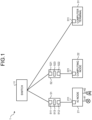
- FIG. 1 is a diagram illustrating a configuration example of a communication control system according to the first embodiment.
- the communication control system 1 includes a switch 11, an IO node 21, a computing node 22, a computer terminal 31, a communication control device 51, and a communication control device 52.
- the IO node 21 is connected to a field device 41 and a field device 42.
- the node is a device that performs information processing and communication.
- the node may be rephrased as a computer or the like.
- the field device transmits a sensor value detected by a sensor or a frame indicating a detection result based on the sensor value to the node by a predetermined communication protocol.
- the field device 41 and the field device 42 are provided in a plant.
- the plant is, for example, an oil plant, a petrochemical plant, a chemical plant, or a gas plant.
- products such as liquefied natural gas (LNG), resin (plastic, nylon, etc.), and chemical products are obtained.
- LNG liquefied natural gas
- resin plastic, nylon, etc.
- the plant includes a factory facility, a machine facility, a production facility, a power generation facility, a storage facility, a wellhead facility for mining oil, natural gas, and the like.
- the plant also includes equipment for producing products.
- the field device 41 acquires information regarding a state of the plant.
- the field device 41 is a temperature sensor, a pH sensor, a speed sensor, an acceleration sensor, an atmospheric pressure sensor, a gas concentration sensor, a device that detects an opened degree of a valve, a device that detects a state (a turn-on or turn-off state) of a switch, or the like.
- the field device 42 is an actuator that drives a valve or the like.
- the IO node 21 transmits the frame acquired from the field device 41 to the computing node 22.
- the computing node 22 performs arithmetic processing.
- the computing node 22 transmits an arithmetic processing result (a control signal or the like) to the field device 41, the field device 42, and the like via the IO node 21.
- nodes included in the communication control system 1 may communicate data with each other.
- the IO node 21 includes a wired communication unit 211.
- the wired communication unit 211 is connected to the communication control device 51.
- the computing node 22 includes a wired communication unit 221.
- the wired communication unit 221 is connected to the communication control device 52.
- the computer terminal 31 includes a wired communication unit 311.
- the wired communication unit 311 is connected to the switch 11.
- each of the IO node 21 and the computing node 22 includes one wired communication unit.
- each wired communication unit may include, for example, an Ethernet (registered trademark) port to which a local area network (LAN) cable is connected.
- Ethernet registered trademark
- the computer terminal 31 is a device such as a personal computer (PC) for managing the switch 11.
- the computer terminal 31 is a device such as a human machine interface (HMI) that monitors operations of various nodes or a personal computer (PC) for managing a network or the like.
- HMI human machine interface
- FIG. 1 includes only one wired communication unit, a wired communication unit can be easily added as necessary.
- the node since the node is installed in a narrow place or in a place with a limited available space, there are restrictions such as size reduction, weight reduction, and simple configuration. For this reason, it is preferable that the number of communication ports of the node is small.
- the communication control device 51 and the communication control device 52 easily realize a redundant network configuration between the nodes at least between the communication control device 51 and the communication control device 52, even in a case where one communication port is provided in each of the nodes.
- the communication control device 51 includes a first wired communication unit 511, a second wired communication unit 512, and a wireless communication unit 513.
- the first wired communication unit 511 is connected to the switch 11.
- the second wired communication unit 512 is connected to the wired communication unit 211 of the IO node 21.
- the communication control device 52 includes a third wired communication unit 521, a fourth wired communication unit 522, and a wireless communication unit 523.
- the third wired communication unit 521 is connected to the switch 11.
- the fourth wired communication unit 522 is connected to the wired communication unit 221 of the computing node 22.
- Each wired communication unit is, for example, a wired communication module.
- the wired communication module is a module having a communication function corresponding to a predetermined wired communication protocol, such as an Ethernet module, a fiber channel module, or a USB module.
- the wireless communication unit is a wireless communication module.
- the wireless communication module is a module having a communication function corresponding to a predetermined wireless communication protocol, such as a Wi-Fi (registered trademark) module, a Bluetooth (registered trademark) module, or a low power wide area (LPWA) module.
- Wi-Fi registered trademark
- Bluetooth registered trademark
- LPWA low power wide area
- the node and a communication control unit may be connected to each other by a universal serial bus (USB) instead of the Ethernet.
- USB universal serial bus
- the wired communication unit 211, the second wired communication unit 512, the wired communication unit 221, and the fourth wired communication unit 522 have USB ports.
- the communication control device 51 can be supplied with power from the IO node 21 via the USB port.
- the operations of the communication control device 51 and the communication control device 52 will be described. Note that, since the communication control device 51 and the communication control device 52 have the same function, the communication control device 51 and the communication control device 52 may be appropriately replaced in the following description.
- the communication control device 51 is connected to the switch 11 and the IO node 21 via wired networks. Furthermore, the communication control device 52 is connected to the computing node 22 via a wired network. The communication control device 51 and the communication control device 52 are connected to a wired network including the switch 11. Note that a communication control device other than the communication control device 51 and the communication control device 52, another node, and another computer terminal may be further connected to wired networks.
- the communication control device 51 identifies another communication control device that is connected to the wired network and satisfies the condition. For example, the communication control device 51 identifies another communication control device identified by predetermined identification information. Note that it is assumed that the communication control device 52 satisfies the condition. In addition, the communication control device 51 finding a communication control device by identification may be rephrased as identifying a communication device.
- the identification information is, for example, a MAC address.
- the communication control device 51 stores the MAC address. Then, the communication control device 51 identifies the communication control device 52 having the stored MAC address.
- the communication control device 52 identifies the communication control device 51 as another communication control device that satisfies the condition using a method similar to that used by the communication control device 51. At this time, the communication control device 51 and the communication control device 52 can identify each other as communication control devices that satisfy the condition, establishing communication via the wireless network between the wireless communication unit 513 and the wireless communication unit 523.
- the communication control device 51 establishes communication with the communication control device 52 by performing Bluetooth pairing. Furthermore, for example, the communication control device 51 establishes communication with the communication control device 52 by using itself as an access point of WiFi or by peer-to-peer connection.
- the communication control device 51 and the communication control device 52 are connected to each other by both a wired network (a solid line in FIG. 2 ) and a wireless network (a dotted line in FIG. 2 ). That is, a redundant network configuration is easily realized at least between the communication control device 51 and the communication control device 52.
- the communication control device 52 transmits a frame transmitted by the computing node 22 with the IO node 21 as a destination through both a path via the wired network and a path via the wireless network. Then, when the same frame is received from the communication control device 51 via both the wired network and the wireless network, the communication control device 52 transfers the frame that has been received earlier to the IO node 21, and discards the frame that has been received later. As a result, even if any frame does not arrive correctly, a time-consuming process such as resending the frame or switching from an abnormal network to a normal network is not necessary.
- the transfer and discard of the frame by the communication control system 1 may be realized using a method such as IEEE 802.1CB (frame replication and elimination for reliability).
- the communication control device 51 cannot communicate with the communication control device 52 using the wired network.
- the communication control device 51 can continue to communicate with the communication control device 52 using the wireless network.
- the communication control system 1 can take advantage of such redundancy. For example, if the switch 11 fails, the computer terminal 31 is disconnected from the network. Even in such a case, wireless communication between the communication control device 51 and the communication control device 52 can be continuously used.
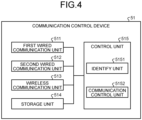
- FIG. 4 is a diagram illustrating a configuration example of a communication control device according to the first embodiment. Note that the configuration of the communication control device 52 is the same as the configuration of the communication control device 51.
- the communication control device 51 includes a first wired communication unit 511, a second wired communication unit 512, a wireless communication unit 513, a storage unit 514, and a control unit 515.
- the first wired communication unit 511 has a wired communication function.
- the second wired communication unit 512 has a wired communication function, and is connected to the IO node 21.
- the wireless communication unit 513 has a wireless communication function.
- the storage unit 514 stores various types of data, various programs executed by the control unit 515, and the like.
- the storage unit 514 is a storage device such as a hard disk drive (HDD), a solid state drive (SSD), or a flash memory.
- the storage unit 514 stores, as necessary, various types of data generated during processing executed by the communication control device 51, such as data obtained in the process when the control unit 515 executes various types of processing and processing results obtained by executing the various types of processing.
- the control unit 515 is a processing unit that controls the entire communication control device 51.
- the control unit 515 is an arithmetic device such as a central processing unit (CPU) including a processor or a microcomputer.
- the control unit 515 includes a identifying unit 5151 and a communication control unit 5152.
- the identifying unit 5151 identifies another communication control device that is connected to the wired network and satisfies the condition. For example, the identifying unit 5151 identifies another communication control device identified by predetermined identification information.
- the communication control unit 5152 establishes communication with another communication control device via a wireless network. In addition, when the same frame is received from another communication control device via both the wired network and the wireless network, the communication control unit 5152 transfers the frame that has been received earlier to the IO node 21, and discards the frame that has been received later.
- FIG. 5 is a flowchart illustrating a flow of a process performed by a communication control device.
- the communication control device 51 stands by until a trigger is generated (Step S101, No) in a state where it is connected to the wired network (Step S101).
- the trigger may be a connection to the wired network, a lapse of a certain period of time after the connection to the wired network, or a manual operation.
- the communication control device 51 identifies a communication control device that satisfies a condition in the wired network (Step S102).
- Step S103 When there is no communication control device that satisfies the condition (Step S103, No), the communication control device 51 ends the process. Furthermore, the communication control device 51 may reset the trigger and return to the start. On the other hand, when there is a communication control device that satisfies the condition (Step S103, Yes), the communication control device 51 establishes a wireless network with the communication control device that satisfies the condition (Step S104).
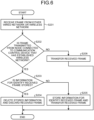
- FIG. 6 is a flowchart illustrating a flow of a process performed by the communication control device.
- the communication control device 51 receives a frame from either a wired network or a wireless network (Step S201).
- Step S202 When the frame is transmitted from the computing node 22 connected to the communication control device 52 that has established the wireless network (Step S202, Yes), the communication control device 51 proceeds to Step S203. Otherwise (Step S202, No), the communication control device 51 transfers the received frame to the IO node 21 (Step S206), and ends the process.
- the communication control device 51 deletes the stored information and discards the received frame (Step S204).
- the communication control device 51 stores the information for identifying the received frame in the storage unit 514, and transfers the received frame to the IO node 21 (Step S205).
- the information for identifying the frame is, for example, a hash value calculated from the entire frame, a sequence number intentionally inserted into the frame by the communication control device 52, or the like. In a case where the information intentionally inserted into the frame is used, the information for identifying the frame is removed from the frame before the frame is transferred.
- the discard of the frame may be not transferring the received frame, not storing the received frame in the memory, or actively deleting the received frame.
- the first wired communication unit 511 has a wired communication function.
- the second wired communication unit 512 has a wired communication function, and is connected to the IO node 21.
- the wireless communication unit 513 has a wireless communication function.
- the identifying unit 5151 identifies another communication control device that is connected to the wired network and satisfies the condition.
- the communication control unit 5152 establishes communication with another communication control device via a wireless network. As a result, even if one communication port is provided in each node, it is possible to easily realize redundancy in a main path of a communication network.
- the identifying unit 5151 identifies another communication control device identified by predetermined identification information.
- the communication control device 51 can reliably identify a communication control device that satisfies the condition.
- the communication control unit 5152 transfers the frame that has been received earlier to the IO node 21, and discards the frame that has been received later. As a result, even if any frame does not arrive correctly, the communication control unit 5152 does not need to perform a time-consuming process such as resending the frame or switching from an abnormal network to a normal network, as a result realizing a stable communication operation.
- each component of each device illustrated in the drawings is functionally conceptual, and is not necessarily physically configured as illustrated in the drawings. That is, the specific distributed or integrated form of each device is not limited to that illustrated in the drawings. In other words, all or some of the devices can be functionally or physically distributed or integrated in certain units according to various loads, usage conditions, and the like.
- each device can be realized by a CPU and a program analyzed and executed by the CPU, or can be realized as hardware by wired logic.
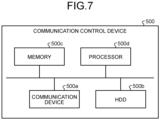
- FIG. 7 is a diagram for explaining a hardware configuration example.
- the communication control device 51 and the communication control device 52 have a hardware configuration similar to that of a communication control device 500 in FIG. 7 .
- the communication control device 500 includes a communication device 500a, an HDD 500b, a memory 500c, and a processor 500d.
- the units illustrated in FIG. 7 are connected to each other by a bus or the like.
- the communication device 500a is a network interface card or the like, and communicates with an external device or apparatus.
- the HDD 500b stores programs and data for operating the functions illustrated in FIG. 4 .
- the processor 500d reads a program for executing processing similar to that performed by each of the processing units illustrated in FIG. 4 from the HDD 500b or the like and develops the program in the memory 500c, thereby operating the process for executing each of the functions described with reference to FIG. 4 , etc. For example, this process executes a function similar to that of each processing unit included in the communication control device 51.
- the processor 500d reads a program having functions similar to those of the identifying unit 5151 and the communication control unit 5152 from the HDD 500b or the like. Then, the processor 500d executes a process of executing processes similar to those of the identifying unit 5151 and the communication control unit 5152.
- the communication control device 51 operates as a communication control device that executes a communication control method by reading and executing a program. Furthermore, the communication control device 51 can also realize functions similar to those in the above-described embodiment by reading the program from a recording medium using a medium reading device and executing the read program. Note that the program referred to in another embodiment is not limited to that executed by the communication control device 51. For example, the present invention can also be similarly applied to a case where another computer or server executes a program or a case where another computer and another server execute a program in cooperation.
- This program can be distributed via a network such as the Internet.
- this program is recorded on a computer-readable recording medium such as a hard disk, a flexible disk (FD), a CD-ROM, a magneto-optical (MO) disk, or a digital versatile disc (DVD), and can be executed by being read from the recording medium by the computer.
- a computer-readable recording medium such as a hard disk, a flexible disk (FD), a CD-ROM, a magneto-optical (MO) disk, or a digital versatile disc (DVD)
- redundancy can be easily realized in a communication network.
Landscapes
- Engineering & Computer Science (AREA)
- Computer Networks & Wireless Communication (AREA)
- Signal Processing (AREA)
- Mobile Radio Communication Systems (AREA)
- Data Exchanges In Wide-Area Networks (AREA)
Abstract
A communication control device 51 according to an embodiment includes a first wired communication unit (511), a second wired communication unit (512), a wireless communication unit (513), a identifying unit (5151), and a communication control unit (5152). The first wired communication unit (511) has a wired communication function. The second wired communication unit (512) has a wired communication function, and is connected to the IO node 21. The wireless communication unit (513) has a wireless communication function. The identifying unit (5151) is connected to the first wired communication unit (511) via a wired network to identify another communication control device that satisfies a condition. The communication control unit (5152) establishes communication with another communication control device via a wireless network.
Description
- The present invention relates to a communication control device, a communication control method, a communication control program, and a communication control system.
- As a conventionally known method for making a communication network having a plurality of nodes redundant, each of the nodes is connected to a plurality of paths in a wired manner (see, for example,
JP 2014-112977 A - However, the conventional technique has a problem that redundancy in a communication network cannot be easily realized.
- For example, in the conventional technique, each node needs to have physical communication ports as many as the number of paths connected thereto. On the other hand, it may be difficult to provide a plurality of communication ports, for example, because the size of the node has been reduced.
- A conventional communication control system will be described with reference to
FIG. 8. FIG. 8 is a diagram illustrating a conventional communication control system. - As illustrated in
FIG. 8 , acommunication control system 1a includes aswitch 11, anIO node 21a, acomputing node 22a, and acomputer terminal 31. TheIO node 21a is connected to afield device 41 and afield device 42. - Here, the node is a device that performs information processing and communication. The node may be rephrased as a computer or the like.
- The
IO node 21a includes awired communication unit 211 and awired communication unit 212a. Thewired communication unit 211 is connected to theswitch 11, and thewired communication unit 212a is connected to a switch 12. Thecomputing node 22a includes awired communication unit 221 and awired communication unit 222a. Thewired communication unit 221 is connected to theswitch 11, and thewired communication unit 222a is connected to the switch 12. Thecomputer terminal 31 includes awired communication unit 311. Thewired communication unit 311 is connected to theswitch 11. - As described above, the
communication control system 1a has a redundant network configuration between theIO node 21a and thecomputing node 22a by a star (or mesh) topology. However, as described above, in a case where a plurality of communication ports cannot be provided in a node, the network configuration as illustrated inFIG. 8 cannot be realized. - In one aspect, an object is to easily realize redundancy in a communication network.
- According to an aspect of an embodiment, a communication control device includes: a first wired communication unit (511) having a wired connection function; a second wired communication unit (512) having a wired connection function and connected to a node; a wireless communication unit (513) having a wireless communication function; a identifying unit (5151) connected to the first wired communication unit (511) via a wired network to identify another communication control device that satisfies a condition; and a communication control unit (5152) that establishes communication with the another communication control device via a wireless network.
- According to an aspect of an embodiment, a communication control method executed by a communication control device includes a first wired communication unit (511) having a wired communication function, a second wired communication unit (512) having a wired communication function and connected to a node, and a wireless communication unit (513) having a wireless communication function, the communication control method includes: a identifying step of identifying another communication control device that is connected to the first wired communication unit (511) via a wired network and satisfies a condition; and a communication control step of establishing communication with the another communication control device via a wireless network.
- According to an aspect of an embodiment, a communication control program for causing a communication control device including a first wired communication unit (511) having a wired communication function, a second wired communication unit (512) having a wired communication function and connected to a node, and a wireless communication unit (513) having a wireless communication function to execute: identifying another communication control device that is connected to the first wired communication unit (511) via a wired network and satisfies a condition; and establishing communication with the another communication control device via a wireless network.
- According to an aspect of an embodiment, a communication control system includes a first node, a first communication control device, a second node, and a second communication control device, wherein the first communication control device includes: a first wired communication unit (511) having a wired communication function; a second wired communication unit (512) having a wired communication function and connected to the first node; a first wireless communication unit (513) having a wireless communication function; and a first communication control unit (5152) that establishes communication with the second communication control device via a wireless network when the first wired communication unit (511) is connected to the second communication control device via a wired network, and transmits a frame transmitted from the first node to the second node to the second communication control device via both the wired network and the wireless network, and the second communication control device includes: a third wired communication unit (521) having a wired communication function; a fourth wired communication unit (522) having a wired communication function and connected to the second node; a second wireless communication unit (513) having a wireless communication function; and a second communication control unit (5152) that establishes communication with the first communication control device via the wireless network when the third wired communication unit (521) is connected to the first communication control device via the wired network, and transmits a frame transmitted from the second node to the first node to the first communication control device via both the wired network and the wireless network.
-
-
FIG. 1 is a diagram illustrating a configuration example of a communication control system according to a first embodiment; -
FIG. 2 is a diagram illustrating a configuration example of a communication control system according to the first embodiment; -
FIG. 3 is a diagram illustrating a configuration example of a communication control system according to the first embodiment; -
FIG. 4 is a diagram illustrating a configuration example of a communication control device according to the first embodiment; -
FIG. 5 is a flowchart illustrating a flow of a process performed by the communication control device; -
FIG. 6 is a flowchart illustrating a flow of a process performed by the communication control device; -
FIG. 7 is a diagram for explaining a hardware configuration example; and -
FIG. 8 is a diagram illustrating a conventional communication control system. - Hereinafter, a communication control device, a communication control method, a communication control program, and a communication control system according to embodiments disclosed in the present application will be described in detail with reference to the drawings. Note that the invention of the present application is not limited by the embodiments described herein. In addition, the same elements are denoted by the same reference numerals, and redundant description will be omitted as appropriate. In addition, the embodiments can be appropriately combined within a range that does not cause any contradiction.
- A configuration of a communication control system according to a first embodiment will be described with reference to
FIG. 1. FIG. 1 is a diagram illustrating a configuration example of a communication control system according to the first embodiment. - As illustrated in
FIG. 1 , thecommunication control system 1 includes aswitch 11, anIO node 21, acomputing node 22, acomputer terminal 31, acommunication control device 51, and acommunication control device 52. TheIO node 21 is connected to afield device 41 and afield device 42. - Here, the node is a device that performs information processing and communication. The node may be rephrased as a computer or the like. In addition, the field device transmits a sensor value detected by a sensor or a frame indicating a detection result based on the sensor value to the node by a predetermined communication protocol.
- For example, the
field device 41 and thefield device 42 are provided in a plant. The plant is, for example, an oil plant, a petrochemical plant, a chemical plant, or a gas plant. By operating the plant, products such as liquefied natural gas (LNG), resin (plastic, nylon, etc.), and chemical products are obtained. - In addition, the plant includes a factory facility, a machine facility, a production facility, a power generation facility, a storage facility, a wellhead facility for mining oil, natural gas, and the like. In addition, the plant also includes equipment for producing products.
- The
field device 41 acquires information regarding a state of the plant. For example, thefield device 41 is a temperature sensor, a pH sensor, a speed sensor, an acceleration sensor, an atmospheric pressure sensor, a gas concentration sensor, a device that detects an opened degree of a valve, a device that detects a state (a turn-on or turn-off state) of a switch, or the like. Thefield device 42 is an actuator that drives a valve or the like. - In addition, the
IO node 21 transmits the frame acquired from thefield device 41 to thecomputing node 22. Thecomputing node 22 performs arithmetic processing. In addition, thecomputing node 22 transmits an arithmetic processing result (a control signal or the like) to thefield device 41, thefield device 42, and the like via theIO node 21. - Note that the configurations and operations of the nodes included in the
communication control system 1 are not limited to those described herein. The nodes included in thecommunication control system 1 may communicate data with each other. - The
IO node 21 includes awired communication unit 211. Thewired communication unit 211 is connected to thecommunication control device 51. Thecomputing node 22 includes awired communication unit 221. Thewired communication unit 221 is connected to thecommunication control device 52. Thecomputer terminal 31 includes a wiredcommunication unit 311. Thewired communication unit 311 is connected to theswitch 11. - In this manner, each of the
IO node 21 and thecomputing node 22 includes one wired communication unit. Furthermore, each wired communication unit may include, for example, an Ethernet (registered trademark) port to which a local area network (LAN) cable is connected. - Here, the
computer terminal 31 is a device such as a personal computer (PC) for managing theswitch 11. Here, thecomputer terminal 31 is a device such as a human machine interface (HMI) that monitors operations of various nodes or a personal computer (PC) for managing a network or the like. Although thecomputer terminal 31 inFIG. 1 includes only one wired communication unit, a wired communication unit can be easily added as necessary. - Meanwhile, since the node is installed in a narrow place or in a place with a limited available space, there are restrictions such as size reduction, weight reduction, and simple configuration. For this reason, it is preferable that the number of communication ports of the node is small.
- The
communication control device 51 and thecommunication control device 52 according to the present embodiment easily realize a redundant network configuration between the nodes at least between thecommunication control device 51 and thecommunication control device 52, even in a case where one communication port is provided in each of the nodes. - The
communication control device 51 includes a firstwired communication unit 511, a secondwired communication unit 512, and awireless communication unit 513. The firstwired communication unit 511 is connected to theswitch 11. The secondwired communication unit 512 is connected to the wiredcommunication unit 211 of theIO node 21. - In addition, the
communication control device 52 includes a thirdwired communication unit 521, a fourthwired communication unit 522, and awireless communication unit 523. The thirdwired communication unit 521 is connected to theswitch 11. The fourthwired communication unit 522 is connected to the wiredcommunication unit 221 of thecomputing node 22. - Each wired communication unit is, for example, a wired communication module. The wired communication module is a module having a communication function corresponding to a predetermined wired communication protocol, such as an Ethernet module, a fiber channel module, or a USB module. The wireless communication unit is a wireless communication module. The wireless communication module is a module having a communication function corresponding to a predetermined wireless communication protocol, such as a Wi-Fi (registered trademark) module, a Bluetooth (registered trademark) module, or a low power wide area (LPWA) module.
- The node and a communication control unit may be connected to each other by a universal serial bus (USB) instead of the Ethernet. In this case, the wired
communication unit 211, the secondwired communication unit 512, the wiredcommunication unit 221, and the fourthwired communication unit 522 have USB ports. Furthermore, thecommunication control device 51 can be supplied with power from theIO node 21 via the USB port. - The operations of the
communication control device 51 and thecommunication control device 52 will be described. Note that, since thecommunication control device 51 and thecommunication control device 52 have the same function, thecommunication control device 51 and thecommunication control device 52 may be appropriately replaced in the following description. - First, as illustrated in
FIG. 1 , thecommunication control device 51 is connected to theswitch 11 and theIO node 21 via wired networks. Furthermore, thecommunication control device 52 is connected to thecomputing node 22 via a wired network. Thecommunication control device 51 and thecommunication control device 52 are connected to a wired network including theswitch 11. Note that a communication control device other than thecommunication control device 51 and thecommunication control device 52, another node, and another computer terminal may be further connected to wired networks. - In a case where the first
wired communication unit 511 is connected to a wired network, thecommunication control device 51 identifies another communication control device that is connected to the wired network and satisfies the condition. For example, thecommunication control device 51 identifies another communication control device identified by predetermined identification information. Note that it is assumed that thecommunication control device 52 satisfies the condition. In addition, thecommunication control device 51 finding a communication control device by identification may be rephrased as identifying a communication device. - The identification information is, for example, a MAC address. For example, the
communication control device 51 stores the MAC address. Then, thecommunication control device 51 identifies thecommunication control device 52 having the stored MAC address. - Furthermore, it is assumed that the
communication control device 52 identifies thecommunication control device 51 as another communication control device that satisfies the condition using a method similar to that used by thecommunication control device 51. At this time, thecommunication control device 51 and thecommunication control device 52 can identify each other as communication control devices that satisfy the condition, establishing communication via the wireless network between thewireless communication unit 513 and thewireless communication unit 523. - For example, the
communication control device 51 establishes communication with thecommunication control device 52 by performing Bluetooth pairing. Furthermore, for example, thecommunication control device 51 establishes communication with thecommunication control device 52 by using itself as an access point of WiFi or by peer-to-peer connection. - As a result, as illustrated in
FIG. 2 , thecommunication control device 51 and thecommunication control device 52 are connected to each other by both a wired network (a solid line inFIG. 2 ) and a wireless network (a dotted line inFIG. 2 ). That is, a redundant network configuration is easily realized at least between thecommunication control device 51 and thecommunication control device 52. - In addition, the
communication control device 52 transmits a frame transmitted by thecomputing node 22 with theIO node 21 as a destination through both a path via the wired network and a path via the wireless network. Then, when the same frame is received from thecommunication control device 51 via both the wired network and the wireless network, thecommunication control device 52 transfers the frame that has been received earlier to theIO node 21, and discards the frame that has been received later. As a result, even if any frame does not arrive correctly, a time-consuming process such as resending the frame or switching from an abnormal network to a normal network is not necessary. - The transfer and discard of the frame by the
communication control system 1 may be realized using a method such as IEEE 802.1CB (frame replication and elimination for reliability). - Furthermore, as illustrated in
FIG. 3 , a case where theswitch 11 becomes unusable due to a failure will be considered. In this case, thecommunication control device 51 cannot communicate with thecommunication control device 52 using the wired network. On the other hand, if communication is established via the wireless network, thecommunication control device 51 can continue to communicate with thecommunication control device 52 using the wireless network. Thecommunication control system 1 can take advantage of such redundancy. For example, if theswitch 11 fails, thecomputer terminal 31 is disconnected from the network. Even in such a case, wireless communication between thecommunication control device 51 and thecommunication control device 52 can be continuously used. - A configuration of the
communication control device 51 will be described with reference toFIG. 4. FIG. 4 is a diagram illustrating a configuration example of a communication control device according to the first embodiment. Note that the configuration of thecommunication control device 52 is the same as the configuration of thecommunication control device 51. - As illustrated in
FIG. 4 , thecommunication control device 51 includes a firstwired communication unit 511, a secondwired communication unit 512, awireless communication unit 513, a storage unit 514, and a control unit 515. - The first
wired communication unit 511 has a wired communication function. The secondwired communication unit 512 has a wired communication function, and is connected to theIO node 21. Thewireless communication unit 513 has a wireless communication function. - The storage unit 514 stores various types of data, various programs executed by the control unit 515, and the like. For example, the storage unit 514 is a storage device such as a hard disk drive (HDD), a solid state drive (SSD), or a flash memory. The storage unit 514 stores, as necessary, various types of data generated during processing executed by the
communication control device 51, such as data obtained in the process when the control unit 515 executes various types of processing and processing results obtained by executing the various types of processing. - The control unit 515 is a processing unit that controls the entire
communication control device 51. The control unit 515 is an arithmetic device such as a central processing unit (CPU) including a processor or a microcomputer. The control unit 515 includes a identifyingunit 5151 and acommunication control unit 5152. - In a case where the first
wired communication unit 511 is connected to a wired network, the identifyingunit 5151 identifies another communication control device that is connected to the wired network and satisfies the condition. For example, the identifyingunit 5151 identifies another communication control device identified by predetermined identification information. - The
communication control unit 5152 establishes communication with another communication control device via a wireless network. In addition, when the same frame is received from another communication control device via both the wired network and the wireless network, thecommunication control unit 5152 transfers the frame that has been received earlier to theIO node 21, and discards the frame that has been received later. - A process in which a communication control device establishes a wireless network will be described with reference to
FIG. 5. FIG. 5 is a flowchart illustrating a flow of a process performed by a communication control device. - As illustrated in
FIG. 5 , first, thecommunication control device 51 stands by until a trigger is generated (Step S101, No) in a state where it is connected to the wired network (Step S101). The trigger may be a connection to the wired network, a lapse of a certain period of time after the connection to the wired network, or a manual operation. - When the trigger is generated (Step S101, Yes), the
communication control device 51 identifies a communication control device that satisfies a condition in the wired network (Step S102). - When there is no communication control device that satisfies the condition (Step S103, No), the
communication control device 51 ends the process. Furthermore, thecommunication control device 51 may reset the trigger and return to the start. On the other hand, when there is a communication control device that satisfies the condition (Step S103, Yes), thecommunication control device 51 establishes a wireless network with the communication control device that satisfies the condition (Step S104). - A process in which a communication control device transfers a frame will be described with reference to
FIG. 6. FIG. 6 is a flowchart illustrating a flow of a process performed by the communication control device. - As illustrated in
FIG. 6 , first, thecommunication control device 51 receives a frame from either a wired network or a wireless network (Step S201). - When the frame is transmitted from the
computing node 22 connected to thecommunication control device 52 that has established the wireless network (Step S202, Yes), thecommunication control device 51 proceeds to Step S203. Otherwise (Step S202, No), thecommunication control device 51 transfers the received frame to the IO node 21 (Step S206), and ends the process. - When information for identifying the received frame is stored in the storage unit 514 (Step S203, Yes), the
communication control device 51 deletes the stored information and discards the received frame (Step S204). On the other hand, when information for identifying the received frame is not stored in the storage unit 514 (Step S203, No), thecommunication control device 51 stores the information for identifying the received frame in the storage unit 514, and transfers the received frame to the IO node 21 (Step S205). The information for identifying the frame is, for example, a hash value calculated from the entire frame, a sequence number intentionally inserted into the frame by thecommunication control device 52, or the like. In a case where the information intentionally inserted into the frame is used, the information for identifying the frame is removed from the frame before the frame is transferred. - The discard of the frame may be not transferring the received frame, not storing the received frame in the memory, or actively deleting the received frame.
- As described above, the first
wired communication unit 511 has a wired communication function. The secondwired communication unit 512 has a wired communication function, and is connected to theIO node 21. Thewireless communication unit 513 has a wireless communication function. In a case where the firstwired communication unit 511 is connected to a wired network, the identifyingunit 5151 identifies another communication control device that is connected to the wired network and satisfies the condition. Thecommunication control unit 5152 establishes communication with another communication control device via a wireless network. As a result, even if one communication port is provided in each node, it is possible to easily realize redundancy in a main path of a communication network. - In addition, the identifying
unit 5151 identifies another communication control device identified by predetermined identification information. As a result, thecommunication control device 51 can reliably identify a communication control device that satisfies the condition. - In addition, when the same frame is received from another communication control device via both the wired network and the wireless network, the
communication control unit 5152 transfers the frame that has been received earlier to theIO node 21, and discards the frame that has been received later. As a result, even if any frame does not arrive correctly, thecommunication control unit 5152 does not need to perform a time-consuming process such as resending the frame or switching from an abnormal network to a normal network, as a result realizing a stable communication operation. - The processing procedure, the control procedure, the specific terms, and the information including various frames and parameters described above or illustrated in the drawings can be arbitrarily changed unless otherwise specified.
- In addition, each component of each device illustrated in the drawings is functionally conceptual, and is not necessarily physically configured as illustrated in the drawings. That is, the specific distributed or integrated form of each device is not limited to that illustrated in the drawings. In other words, all or some of the devices can be functionally or physically distributed or integrated in certain units according to various loads, usage conditions, and the like.
- Furthermore, all or some of the processing functions performed in each device can be realized by a CPU and a program analyzed and executed by the CPU, or can be realized as hardware by wired logic.
- Next, a hardware configuration example of the
communication control device 51 will be described.FIG. 7 is a diagram for explaining a hardware configuration example. Thecommunication control device 51 and thecommunication control device 52 have a hardware configuration similar to that of acommunication control device 500 inFIG. 7 . - As illustrated in
FIG. 7 , thecommunication control device 500 includes acommunication device 500a, anHDD 500b, amemory 500c, and aprocessor 500d. The units illustrated inFIG. 7 are connected to each other by a bus or the like. - The
communication device 500a is a network interface card or the like, and communicates with an external device or apparatus. TheHDD 500b stores programs and data for operating the functions illustrated inFIG. 4 . - The
processor 500d reads a program for executing processing similar to that performed by each of the processing units illustrated inFIG. 4 from theHDD 500b or the like and develops the program in thememory 500c, thereby operating the process for executing each of the functions described with reference toFIG. 4 , etc. For example, this process executes a function similar to that of each processing unit included in thecommunication control device 51. Specifically, theprocessor 500d reads a program having functions similar to those of the identifyingunit 5151 and thecommunication control unit 5152 from theHDD 500b or the like. Then, theprocessor 500d executes a process of executing processes similar to those of the identifyingunit 5151 and thecommunication control unit 5152. - As described above, the
communication control device 51 operates as a communication control device that executes a communication control method by reading and executing a program. Furthermore, thecommunication control device 51 can also realize functions similar to those in the above-described embodiment by reading the program from a recording medium using a medium reading device and executing the read program. Note that the program referred to in another embodiment is not limited to that executed by thecommunication control device 51. For example, the present invention can also be similarly applied to a case where another computer or server executes a program or a case where another computer and another server execute a program in cooperation. - This program can be distributed via a network such as the Internet. In addition, this program is recorded on a computer-readable recording medium such as a hard disk, a flexible disk (FD), a CD-ROM, a magneto-optical (MO) disk, or a digital versatile disc (DVD), and can be executed by being read from the recording medium by the computer.
- Some examples of combinations of the technical features disclosed herein are described below.
- According to an embodiment, redundancy can be easily realized in a communication network.
- Although the invention has been described with respect to specific embodiments for a complete and clear disclosure, the appended claims are not to be thus limited but are to be construed as embodying all modifications and alternative constructions that may occur to one skilled in the art that fairly fall within the basic teaching herein set forth.
Claims (8)
- A communication control device comprising:a first wired communication unit (511) having a wired connection function;a second wired communication unit (512) having a wired connection function and connected to a node;a wireless communication unit (513) having a wireless communication function;a identifying unit (5151) connected to the first wired communication unit (511) via a wired network to identify another communication control device that satisfies a condition; anda communication control unit (5152) that establishes communication with the another communication control device via a wireless network.
- The communication control device according to claim 1, wherein
the identifying unit (5151) identifies another communication control device identified by predetermined identification information. - The communication control device according to claim 1, wherein
the identifying unit (5151) identifies another communication control device identified by a predetermined MAC address. - The communication control device according to claim 1, wherein
when receiving the same frame from the another communication control device via both the wired network and the wireless network, the communication control unit (5152) transfers a frame received earlier to the node and discards a frame received later. - A communication control method executed by a communication control device includinga first wired communication unit (511) having a wired communication function,a second wired communication unit (512) having a wired communication function and connected to a node, anda wireless communication unit (513) having a wireless communication function, the communication control method comprising:a identifying step of identifying another communication control device that is connected to the first wired communication unit (511) via a wired network and satisfies a condition; anda communication control step of establishing communication with the another communication control device via a wireless network.
- A communication control program for causing a communication control device including a first wired communication unit (511) having a wired communication function, a second wired communication unit (512) having a wired communication function and connected to a node, and a wireless communication unit (513) having a wireless communication function to execute:identifying another communication control device that is connected to the first wired communication unit (511) via a wired network and satisfies a condition; andestablishing communication with the another communication control device via a wireless network.
- A communication control system comprising a first node, a first communication control device, a second node, and a second communication control device, wherein
the first communication control device includes:a first wired communication unit (511) having a wired communication function;a second wired communication unit (512) having a wired communication function and connected to the first node;a first wireless communication unit (513) having a wireless communication function; anda first communication control unit (5152) that establishes communication with the second communication control device via a wireless network when the first wired communication unit (511) is connected to the second communication control device via a wired network, and transmits a frame transmitted from the first node to the second node to the second communication control device via both the wired network and the wireless network, andthe second communication control device includes:a third wired communication unit (521) having a wired communication function;a fourth wired communication unit (522) having a wired communication function and connected to the second node;a second wireless communication unit (513) having a wireless communication function; anda second communication control unit (5152) that establishes communication with the first communication control device via the wireless network when the third wired communication unit (521) is connected to the first communication control device via the wired network, and transmits a frame transmitted from the second node to the first node to the first communication control device via both the wired network and the wireless network. - The communication control system according to claim 7, whereinwhen receiving the same frame from the second communication control device via both the wired network and the wireless network, the first communication control unit (5152) transfers a frame received earlier to the first node and discards a frame received later, andwhen receiving the same frame from the first communication control device via both the wired network and the wireless network, the second communication control unit (5152) transfers a frame received earlier to the second node and discards a frame received later.
Applications Claiming Priority (1)
| Application Number | Priority Date | Filing Date | Title |
|---|---|---|---|
| JP2023179024A JP2025068910A (en) | 2023-10-17 | 2023-10-17 | Communication control device, communication control method, communication control program, and communication control system |
Publications (1)
| Publication Number | Publication Date |
|---|---|
| EP4542936A1 true EP4542936A1 (en) | 2025-04-23 |
Family
ID=93117549
Family Applications (1)
| Application Number | Title | Priority Date | Filing Date |
|---|---|---|---|
| EP24206090.3A Pending EP4542936A1 (en) | 2023-10-17 | 2024-10-11 | Communications redundancy between network nodes |
Country Status (4)
| Country | Link |
|---|---|
| US (1) | US20250125830A1 (en) |
| EP (1) | EP4542936A1 (en) |
| JP (1) | JP2025068910A (en) |
| CN (1) | CN119854836A (en) |
Citations (3)
| Publication number | Priority date | Publication date | Assignee | Title |
|---|---|---|---|---|
| US20130136117A1 (en) * | 2011-11-28 | 2013-05-30 | Qualcomm Incorporated | Wireless bridging in a hybrid communication network |
| JP2014112977A (en) | 2010-02-26 | 2014-06-19 | Alaxala Networks Corp | Packet relay device |
| EP4156639A1 (en) * | 2021-09-23 | 2023-03-29 | INTEL Corporation | Redundancy over wi-fi for ultra-reliable wireless time sensitive networking |
-
2023
- 2023-10-17 JP JP2023179024A patent/JP2025068910A/en active Pending
-
2024
- 2024-10-10 US US18/911,423 patent/US20250125830A1/en active Pending
- 2024-10-11 EP EP24206090.3A patent/EP4542936A1/en active Pending
- 2024-10-15 CN CN202411437317.1A patent/CN119854836A/en active Pending
Patent Citations (3)
| Publication number | Priority date | Publication date | Assignee | Title |
|---|---|---|---|---|
| JP2014112977A (en) | 2010-02-26 | 2014-06-19 | Alaxala Networks Corp | Packet relay device |
| US20130136117A1 (en) * | 2011-11-28 | 2013-05-30 | Qualcomm Incorporated | Wireless bridging in a hybrid communication network |
| EP4156639A1 (en) * | 2021-09-23 | 2023-03-29 | INTEL Corporation | Redundancy over wi-fi for ultra-reliable wireless time sensitive networking |
Non-Patent Citations (2)
| Title |
|---|
| FANG JUAN ET AL: "Wireless TSN with Multi-Radio Wi-Fi", 2021 IEEE CONFERENCE ON STANDARDS FOR COMMUNICATIONS AND NETWORKING (CSCN), IEEE, 15 December 2021 (2021-12-15), pages 105 - 110, XP034072987, DOI: 10.1109/CSCN53733.2021.9686180 * |
| UNDERBERG LISA ET AL: "Towards hybrid wired-wireless networks in industrial applications", 2018 IEEE INDUSTRIAL CYBER-PHYSICAL SYSTEMS (ICPS), IEEE, 15 May 2018 (2018-05-15), pages 768 - 773, XP033361519, DOI: 10.1109/ICPHYS.2018.8390804 * |
Also Published As
| Publication number | Publication date |
|---|---|
| CN119854836A (en) | 2025-04-18 |
| US20250125830A1 (en) | 2025-04-17 |
| JP2025068910A (en) | 2025-04-30 |
Similar Documents
| Publication | Publication Date | Title |
|---|---|---|
| US12140933B2 (en) | System and method of communicating data over high availability industrial control systems | |
| US20160085237A1 (en) | Information controller, information control system, and information control method | |
| JP2020167714A (en) | Methods and equipment for providing redundancy for process control systems | |
| US11327472B2 (en) | System and method of connection management during synchronization of high availability industrial control systems | |
| EP4084418A1 (en) | Determination method, determination system and program | |
| EP3300305B1 (en) | Processing device, control method of processing device, and recording medium | |
| US11748217B2 (en) | Method for failure detection and role selection in a network of redundant processes | |
| US20250125830A1 (en) | Communication control device, communication control method, non-transitory computer readable recording medium, and communication control system | |
| US9596131B2 (en) | Method for transiting operation mode of routing processor | |
| US8522075B2 (en) | Storage system having storage devices for storing data and control devices for controlling the storage devices | |
| CN106254150A (en) | Network fault handling method and system | |
| CN111373700A (en) | Communication system, controlled device, and control method of communication system | |
| EP4550727A1 (en) | Communications redundancy between network nodes | |
| CN117336006A (en) | Safety communication method, communication device, safety communication system and control system | |
| JP2016157254A (en) | Control apparatus, control method, and control program | |
| CN116938630B (en) | A method and system for achieving communication link redundancy based on dual CAN communication | |
| EP4084444A1 (en) | Redundancy method, redundancy program, and information processing device | |
| KR20210140899A (en) | System and Method for Fault-tolerant Process Module Control Based on Seamless Control | |
| US20230152783A1 (en) | Control system, industrial device, control method, and program | |
| CN118158022B (en) | A multi-bus communication method, port machinery edge computing device and related equipment | |
| US12445424B2 (en) | Communication device, communication method, and computer program product | |
| CN106992883B (en) | Data control method and data control device | |
| WO2026022301A1 (en) | System and method for automated switching of communication element | |
| CN121396742A (en) | Fault processing method, device, equipment and storage medium | |
| CN117597950A (en) | Computer-implemented method for operating end devices in a network with high availability |
Legal Events
| Date | Code | Title | Description |
|---|---|---|---|
| PUAI | Public reference made under article 153(3) epc to a published international application that has entered the european phase |
Free format text: ORIGINAL CODE: 0009012 |
|
| STAA | Information on the status of an ep patent application or granted ep patent |
Free format text: STATUS: THE APPLICATION HAS BEEN PUBLISHED |
|
| AK | Designated contracting states |
Kind code of ref document: A1 Designated state(s): AL AT BE BG CH CY CZ DE DK EE ES FI FR GB GR HR HU IE IS IT LI LT LU LV MC ME MK MT NL NO PL PT RO RS SE SI SK SM TR |
|
| STAA | Information on the status of an ep patent application or granted ep patent |
Free format text: STATUS: REQUEST FOR EXAMINATION WAS MADE |
|
| 17P | Request for examination filed |
Effective date: 20251009 |