EP4542683A1 - Positive electrode material, preparation method for positive electrode material, positive electrode sheet, and battery - Google Patents
Positive electrode material, preparation method for positive electrode material, positive electrode sheet, and battery Download PDFInfo
- Publication number
- EP4542683A1 EP4542683A1 EP23859046.7A EP23859046A EP4542683A1 EP 4542683 A1 EP4542683 A1 EP 4542683A1 EP 23859046 A EP23859046 A EP 23859046A EP 4542683 A1 EP4542683 A1 EP 4542683A1
- Authority
- EP
- European Patent Office
- Prior art keywords
- positive electrode
- electrode material
- sodium
- containing oxide
- characteristic peak
- Prior art date
- Legal status (The legal status is an assumption and is not a legal conclusion. Google has not performed a legal analysis and makes no representation as to the accuracy of the status listed.)
- Pending
Links
Images

Classifications
-
- C—CHEMISTRY; METALLURGY
- C01—INORGANIC CHEMISTRY
- C01G—COMPOUNDS CONTAINING METALS NOT COVERED BY SUBCLASSES C01D OR C01F
- C01G51/00—Compounds of cobalt
-
- C—CHEMISTRY; METALLURGY
- C01—INORGANIC CHEMISTRY
- C01G—COMPOUNDS CONTAINING METALS NOT COVERED BY SUBCLASSES C01D OR C01F
- C01G51/00—Compounds of cobalt
- C01G51/40—Complex oxides containing cobalt and at least one other metal element
- C01G51/42—Complex oxides containing cobalt and at least one other metal element containing alkali metals, e.g. LiCoO2
-
- C—CHEMISTRY; METALLURGY
- C01—INORGANIC CHEMISTRY
- C01G—COMPOUNDS CONTAINING METALS NOT COVERED BY SUBCLASSES C01D OR C01F
- C01G51/00—Compounds of cobalt
- C01G51/40—Complex oxides containing cobalt and at least one other metal element
- C01G51/42—Complex oxides containing cobalt and at least one other metal element containing alkali metals, e.g. LiCoO2
- C01G51/44—Complex oxides containing cobalt and at least one other metal element containing alkali metals, e.g. LiCoO2 containing manganese
-
- H—ELECTRICITY
- H01—ELECTRIC ELEMENTS
- H01M—PROCESSES OR MEANS, e.g. BATTERIES, FOR THE DIRECT CONVERSION OF CHEMICAL ENERGY INTO ELECTRICAL ENERGY
- H01M10/00—Secondary cells; Manufacture thereof
- H01M10/05—Accumulators with non-aqueous electrolyte
- H01M10/052—Li-accumulators
- H01M10/0525—Rocking-chair batteries, i.e. batteries with lithium insertion or intercalation in both electrodes; Lithium-ion batteries
-
- H—ELECTRICITY
- H01—ELECTRIC ELEMENTS
- H01M—PROCESSES OR MEANS, e.g. BATTERIES, FOR THE DIRECT CONVERSION OF CHEMICAL ENERGY INTO ELECTRICAL ENERGY
- H01M4/00—Electrodes
- H01M4/02—Electrodes composed of, or comprising, active material
- H01M4/13—Electrodes for accumulators with non-aqueous electrolyte, e.g. for lithium-accumulators; Processes of manufacture thereof
- H01M4/131—Electrodes based on mixed oxides or hydroxides, or on mixtures of oxides or hydroxides, e.g. LiCoOx
-
- H—ELECTRICITY
- H01—ELECTRIC ELEMENTS
- H01M—PROCESSES OR MEANS, e.g. BATTERIES, FOR THE DIRECT CONVERSION OF CHEMICAL ENERGY INTO ELECTRICAL ENERGY
- H01M4/00—Electrodes
- H01M4/02—Electrodes composed of, or comprising, active material
- H01M4/36—Selection of substances as active materials, active masses, active liquids
- H01M4/48—Selection of substances as active materials, active masses, active liquids of inorganic oxides or hydroxides
- H01M4/50—Selection of substances as active materials, active masses, active liquids of inorganic oxides or hydroxides of manganese
- H01M4/505—Selection of substances as active materials, active masses, active liquids of inorganic oxides or hydroxides of manganese of mixed oxides or hydroxides containing manganese for inserting or intercalating light metals, e.g. LiMn2O4 or LiMn2OxFy
-
- H—ELECTRICITY
- H01—ELECTRIC ELEMENTS
- H01M—PROCESSES OR MEANS, e.g. BATTERIES, FOR THE DIRECT CONVERSION OF CHEMICAL ENERGY INTO ELECTRICAL ENERGY
- H01M4/00—Electrodes
- H01M4/02—Electrodes composed of, or comprising, active material
- H01M4/36—Selection of substances as active materials, active masses, active liquids
- H01M4/48—Selection of substances as active materials, active masses, active liquids of inorganic oxides or hydroxides
- H01M4/52—Selection of substances as active materials, active masses, active liquids of inorganic oxides or hydroxides of nickel, cobalt or iron
- H01M4/525—Selection of substances as active materials, active masses, active liquids of inorganic oxides or hydroxides of nickel, cobalt or iron of mixed oxides or hydroxides containing iron, cobalt or nickel for inserting or intercalating light metals, e.g. LiNiO2, LiCoO2 or LiCoOxFy
-
- C—CHEMISTRY; METALLURGY
- C01—INORGANIC CHEMISTRY
- C01P—INDEXING SCHEME RELATING TO STRUCTURAL AND PHYSICAL ASPECTS OF SOLID INORGANIC COMPOUNDS
- C01P2002/00—Crystal-structural characteristics
- C01P2002/50—Solid solutions
- C01P2002/52—Solid solutions containing elements as dopants
-
- C—CHEMISTRY; METALLURGY
- C01—INORGANIC CHEMISTRY
- C01P—INDEXING SCHEME RELATING TO STRUCTURAL AND PHYSICAL ASPECTS OF SOLID INORGANIC COMPOUNDS
- C01P2002/00—Crystal-structural characteristics
- C01P2002/70—Crystal-structural characteristics defined by measured X-ray, neutron or electron diffraction data
- C01P2002/72—Crystal-structural characteristics defined by measured X-ray, neutron or electron diffraction data by d-values or two theta-values, e.g. as X-ray diagram
-
- C—CHEMISTRY; METALLURGY
- C01—INORGANIC CHEMISTRY
- C01P—INDEXING SCHEME RELATING TO STRUCTURAL AND PHYSICAL ASPECTS OF SOLID INORGANIC COMPOUNDS
- C01P2004/00—Particle morphology
- C01P2004/01—Particle morphology depicted by an image
- C01P2004/03—Particle morphology depicted by an image obtained by SEM
-
- C—CHEMISTRY; METALLURGY
- C01—INORGANIC CHEMISTRY
- C01P—INDEXING SCHEME RELATING TO STRUCTURAL AND PHYSICAL ASPECTS OF SOLID INORGANIC COMPOUNDS
- C01P2004/00—Particle morphology
- C01P2004/60—Particles characterised by their size
- C01P2004/61—Micrometer sized, i.e. from 1-100 micrometer
-
- C—CHEMISTRY; METALLURGY
- C01—INORGANIC CHEMISTRY
- C01P—INDEXING SCHEME RELATING TO STRUCTURAL AND PHYSICAL ASPECTS OF SOLID INORGANIC COMPOUNDS
- C01P2006/00—Physical properties of inorganic compounds
- C01P2006/12—Surface area
-
- C—CHEMISTRY; METALLURGY
- C01—INORGANIC CHEMISTRY
- C01P—INDEXING SCHEME RELATING TO STRUCTURAL AND PHYSICAL ASPECTS OF SOLID INORGANIC COMPOUNDS
- C01P2006/00—Physical properties of inorganic compounds
- C01P2006/40—Electric properties
-
- H—ELECTRICITY
- H01—ELECTRIC ELEMENTS
- H01M—PROCESSES OR MEANS, e.g. BATTERIES, FOR THE DIRECT CONVERSION OF CHEMICAL ENERGY INTO ELECTRICAL ENERGY
- H01M4/00—Electrodes
- H01M4/02—Electrodes composed of, or comprising, active material
- H01M2004/021—Physical characteristics, e.g. porosity, surface area
-
- H—ELECTRICITY
- H01—ELECTRIC ELEMENTS
- H01M—PROCESSES OR MEANS, e.g. BATTERIES, FOR THE DIRECT CONVERSION OF CHEMICAL ENERGY INTO ELECTRICAL ENERGY
- H01M4/00—Electrodes
- H01M4/02—Electrodes composed of, or comprising, active material
- H01M2004/026—Electrodes composed of, or comprising, active material characterised by the polarity
- H01M2004/028—Positive electrodes
-
- Y—GENERAL TAGGING OF NEW TECHNOLOGICAL DEVELOPMENTS; GENERAL TAGGING OF CROSS-SECTIONAL TECHNOLOGIES SPANNING OVER SEVERAL SECTIONS OF THE IPC; TECHNICAL SUBJECTS COVERED BY FORMER USPC CROSS-REFERENCE ART COLLECTIONS [XRACs] AND DIGESTS
- Y02—TECHNOLOGIES OR APPLICATIONS FOR MITIGATION OR ADAPTATION AGAINST CLIMATE CHANGE
- Y02E—REDUCTION OF GREENHOUSE GAS [GHG] EMISSIONS, RELATED TO ENERGY GENERATION, TRANSMISSION OR DISTRIBUTION
- Y02E60/00—Enabling technologies; Technologies with a potential or indirect contribution to GHG emissions mitigation
- Y02E60/10—Energy storage using batteries
Definitions
- the present invention relates to the field of battery technologies, and in particular, to a positive electrode material, a preparation method of a positive electrode material, a positive electrode plate, and a battery.
- an existing positive electrode material undergoes a severe irreversible phase transition when the charge and discharge cut-off voltage exceeds 4.5 V.
- the positive electrode material undergoes a phase transition from an O3 phase to an H1-3 phase, and at a higher voltage, undergoes a phase transition from the H1-3 phase to an O1 phase.
- Such an irreversible phase transition causes a structure of the positive electrode material to because extremely unstable at a high voltage, leading to severe contraction of a crystal structure. This results in cracking or even destruction of positive electrode material particles, consequently causing problems such as rapid capacity fading and a rapid cycling drop.
- doping and coating the positive electrode material suppress or mitigate harmful effects of these phase transitions to an extent, a capacity loss is caused.
- the present invention provides a positive electrode material, a preparation method of a positive electrode material, a positive electrode plate, and a battery, to solve a problem of low capacity of a positive electrode material in the prior art.
- the present invention provides a positive electrode material.
- the positive electrode material includes a sodium-containing oxide, an angle range of a first characteristic peak of the sodium-containing oxide is less than an angle range of a second characteristic peak, the first characteristic peak is a characteristic peak of the sodium-containing oxide at an initial voltage, the second characteristic peak is a characteristic peak of the sodium-containing oxide at a cut-off voltage, and a chemical formula of the sodium-containing oxide is Li x Na 1-x Co 1-z M z O 2 .
- M includes a metal element or a non-metal element, 0.7 ⁇ x ⁇ 1, and 0.001 ⁇ z ⁇ 0.03.
- the sodium-containing oxide includes a plurality of phase transitions, and the plurality of phase transitions are reversible phase transitions.
- each phase transition in the plurality of phase transitions includes an equilibrium potential.
- the sodium-containing oxide compound coexists as a first phase and a second phase; at a second voltage range, the sodium-containing oxide compound coexists as a third phase and a fourth phase; and at a third voltage range, the sodium-containing oxide compound coexists as a fifth phase and a sixth phase.
- a phase layered structure of the sodium-containing oxide includes a plurality of stacked repeating units, each of the repeating units presents a layered structure in which a first transition metal layer, a lithium oxygen layer, and a second transition metal layer are stacked, and transition metal and lithium atoms respectively occupy octahedral sites.
- M includes at least one element of Al, Mg, Ti, Zr, Mn, Ni, B, P, Y, La, Te, Nb, W, K, or La.
- a median particle size of the sodium-containing oxide ranges from 3 ⁇ m to 30 ⁇ m.
- a specific surface area of the sodium-containing oxide ranges from 0.2 m 2 /g to 1 m 2 /g.
- the present invention further provides a preparation method of a positive electrode material, used for preparing the positive electrode material describe above.
- the method includes:
- a molar ratio between Co and M in the cobalt salt solution and the M salt solution is (1-z):z
- the coprecipitate includes (Co 1-z M z ) 3 O 4 , where 0.001 ⁇ z ⁇ 0.03
- the intermediate product includes Na m Co 1-z M z O 2 , where 0.65 ⁇ m ⁇ 1
- the precursor includes Li x Na 1-x Co 1-z M z O 2 , where 0.7 ⁇ x ⁇ 1.
- the present invention further provides a positive electrode plate, including a current collector and a coating layer disposed on a surface of one or both sides of the current collector, where the coating layer includes the positive electrode material in the present invention and/or a positive electrode material prepared by using the preparation method of a positive electrode material in the present invention.
- the present invention further provides a battery, including a positive electrode plate and a negative electrode plate, where the positive electrode plate includes the positive electrode material in the present invention and/or a positive electrode material prepared by using the preparation method of a positive electrode material in the present invention.
- the first characteristic peak and the second characteristic peak are formed during a phase transition process of the sodium-containing oxide from the initial voltage to the cut-off voltage.
- the angle range of the first characteristic peak is less than the angle range of the second characteristic peak.
- first”, “second”, and the like are intended to distinguish between similar objects but do not indicate a particular order or a sequence. It should be understood that the structures used in this way are interchangeable under appropriate circumstances so that embodiments of the present invention can be implemented in an order other than those illustrated or described herein, and the objects distinguished by "first”, “second”, and the like are generally of a same type.
- a quantity of the objects is not limited.
- a first object may be one or more objects.
- “and/or” in the specification and claims represents at least one of the associated objects, and the character “/" generally indicates that the associated objects are in an "or” relationship.
- the present invention provides a positive electrode material, as shown in FIG. 1, FIG. 2 , and FIG. 3 .
- the positive electrode material includes a sodium-containing oxide, an angle range of a first characteristic peak of the sodium-containing oxide is less than an angle range of a second characteristic peak, the first characteristic peak is a characteristic peak of the sodium-containing oxide at an initial voltage, the second characteristic peak is a characteristic peak of the sodium-containing oxide at a cut-off voltage, and a chemical formula of the sodium-containing oxide is Li x Na 1-x Co 1-z M z O 2 .
- M includes a metal element or a non-metal element, 0.7 ⁇ x ⁇ 1 (for example, x is 0.71, 0.75, 0.8, 0.85, 0.9, 0.95, or 0.99), and 0.001 ⁇ z ⁇ 0.03 (for example, z is 0.0015, 0.005, 0.01, 0.015, 0.02, 0.025, or 0.029).
- the first characteristic peak and the second characteristic peak are formed during a phase transition process of the sodium-containing oxide from the initial voltage to the cut-off voltage.
- the first characteristic peak is a characteristic peak of the sodium-containing oxide at the initial voltage (3 V)
- the second characteristic peak is a characteristic peak of the sodium-containing oxide at the cut-off voltage (4.5 V).
- the angle range of the first characteristic peak is less than the angle range of the second characteristic peak.
- a chemical formula of the sodium-containing oxide may be Li x Na 1-x Co 1-z M z O 2 .
- XRD in-situ X-ray diffraction
- the second characteristic peak is located on the right side of the first characteristic peak, that is, the angle range of the first characteristic peak is less than the angle range of the second characteristic peak.
- the improved positive electrode material in the present invention has a higher capacity.
- the characteristic peak of the lithium cobalt oxide material at the cut-off voltage (4.5 V) is located on the left side of the characteristic peak of the lithium cobalt oxide material at the initial voltage (3 V).
- the second characteristic peak of the positive electrode material provided in the present invention is located on the right side of the first characteristic peak, so that the sodium-containing oxide in the positive electrode material provided in the present invention can release more lithium (about 80% of lithium ions) at the same voltage, while conventional lithium cobalt oxide can release only 70% of lithium ions at the same voltage. Therefore, compared with the prior art, the positive electrode material in the present invention improves its capacity at a same charging cut-off voltage.
- the positive electrode material provided in the present invention can achieve a gram capacity of 202 mAh/g at 4.5 V, which is much higher than the conventional commercial lithium cobalt oxide material (186 mAh/g) at the same voltage.
- the sodium-containing oxide includes a plurality of phase transitions, and the plurality of phase transitions are reversible phase transitions.
- the sodium-containing oxide has a plurality of reversible phase transitions. These phase transitions are not only reversible, but also achieve a higher capacity at a lower voltage, thereby increasing a capacity of the positive electrode material at a same charge cut-off voltage while maintaining structural stability.
- Each phase transition process in the plurality of phase transitions includes an equilibrium potential.
- a charge and discharge test was conducted on sodium-containing oxide Li x Na 1-x Co 1-z M z O 2 , where a test result was shown in FIG. 1 and FIG. 2 , indicating that charge and discharge curves of the material has four charge-discharge plateaus within a voltage range of 3 V to 4.5 V.
- in-situ XRD of a current commercial lithium cobalt oxide material as shown in FIG.
- charge and discharge curves of Li x Na 1-x Co 1-z M z O 2 show that charge-discharge plateaus are exhibited respectively at 3.7 V to 3.8 V, 4.0 V to 4.15 V, 4.15 V to 4.25 V, and 4.4 V to 4.5 V, which are significantly different from the current commercial lithium cobalt oxide material. That Li x Na 1-x Co 1-z M z O 2 exhibits a charge and discharge plateau, that is, the equilibrium potential, where the voltage remains constant. At the current voltage, a material content corresponding to a phase increases, allowing for extraction of some lithium ions during each phase transition. This improves a capacity of the positive electrode material.
- a phase layered structure of the sodium-containing oxide includes a plurality of stacked repeating units, each of the repeating units presents a layered structure in which a first transition metal layer, a lithium oxygen layer, and a second transition metal layer are stacked, and transition metal and lithium atoms respectively occupy octahedral sites.
- a morphology of the sodium-containing oxide may be polycrystalline or monocrystalline.
- the Li x Na 1-x Co 1-z M z O 2 material exhibits four reversible phase transitions in the in-situ XRD.
- the first phase transition is during charging from 3.7 V to 3.8 V, where a phase transition in which Li atoms in the material transition from octahedral sites to tetrahedral sites.
- the second phase transition is during charging from 4.0 V to 4.15 V, where continuous extraction of Li leads to a change in lattice parameters, resulting in a phase transition.
- the third phase transition is during charging from 4.15 V to 4.25 V, where Li reoccupies the octahedral sites and the lithium-cobalt layer undergoes interlayer sliding.
- the fourth phase transition is during charging from 4.4 V to 4.5 V, where a structural unit transitions from an alternating arrangement of six lithium-cobalt metal layers to an arrangement of two lithium-cobalt metal layers.
- a discharge process an angle change is consistent with that of the charge process, and the phase transition is completely reversible.
- the Li x Na 1-x Co 1-z M z O 2 material can completely return to its original phase structure, reflecting good kinetic stability of the material during the charge and discharge process.
- the in-situ XRD shows that all phase transitions of the material between 3 V and 4.5 V are reversible phase transitions, and the material can maintain good structural stability during the charge and discharge process.
- the material has a plurality of reversible phase transitions at less than 4.6 V, and therefore can not only achieve a high capacity but also have good cycling performance.
- a structure of the material has a larger interlayer electrostatic repulsion due to coplanarity of a LiO 6 layer and a CoO 6 layer, so as to achieve a larger transition metal interlayer spacing than the lithium cobalt oxide in the prior art. Therefore, this is more conducive to rapid diffusion of Li ions between the layers, thereby achieving higher rate performance and improving a capacity of the positive electrode material.
- the sodium-containing oxide compound coexists as a first phase and a second phase; at a second voltage range, the sodium-containing oxide compound coexists as a third phase and a fourth phase; and at a third voltage range, the sodium-containing oxide compound coexists as a fifth phase and a sixth phase.
- the first voltage range is from 3.7 V to 3.8 V; the second voltage range is from 4.15 V to 4.25 V; and the third voltage range is from 4.4 V to 4.5 V
- the first phase transition occurs during charging from 3 V to the first voltage range (for example, 3.7 V to 3.8 V), and two peaks coexist within a range of 17.6° to 18.7° in an XRD spectrum, that is, the first phase and the second phase coexist.
- the first phase may be a left peak at 17.6° to 18.2°
- the second phase may be a right peak at 18.4° to 18.7°, and as the charge process progresses, the left peak gradually strengthens, and the right peak gradually weakens until it disappears.
- the enhanced left peak slowly shifts to the left, and the angle range may be from 17.7° to 18°, during which the second phase transition reaction occurs.
- the third phase transition occurs, during which two peaks coexist, that is, the third phase and the fourth phase coexist.
- the third phase may be a left peak at 17.6° to 18.1°
- the fourth phase may be a right peak at 18.0° to 18.7°.
- the left peak gradually weakens until it disappears, and the right peak gradually strengthens.
- a peak position ranges from 17.6° to 18.7°.
- the fourth phase transition occurs, and two peaks also coexist, that is, the fifth phase and the sixth phase coexist.
- the fifth phase may be a left peak located at 18° to 18.6°
- the sixth phase may be a right peak located at 18.7° to 19.5°.
- the left peak gradually weakens until it disappears, and the right peak gradually strengthens.
- a peak position change range is from 18° to 19.5°. This is completely reversible during the discharge process.
- a peak position of the positive electrode material in the present invention is located on the right side of an initial state position, while a peak position of a conventional positive electrode material is located on the left side of an initial state position.
- the positive electrode material in the present invention can release more Li (approximately 80% of Li ions) at the same voltage, while the conventional positive electrode material can release only 70% of Li ions at the same voltage.
- a capacity of the positive electrode material is improved.
- M includes at least one element of Al, Mg, Ti, Zr, Mn, Ni, B, P, Y, Te, Nb, W, K, or La.
- the M element includes the foregoing metal element or non-metal element, and may also be another element that can form a covalent bond with an oxygen atom and embed into the Li x Na 1-x Co 1-z M z O 2 lattice, such as a lanthanide element La/Y, and a same technical effect can be achieved. Details are not described herein.
- a median particle size of the sodium-containing oxide may range from 3 ⁇ m to 30 ⁇ m (for example, is 3 ⁇ m, 5 ⁇ m, 10 ⁇ m, 15 ⁇ m, 20 ⁇ m, 25 ⁇ m, or 30 ⁇ m).
- a specific surface area of the sodium-containing oxide may range from 0.2 m 2 /g to 1 m 2 /g (for example, is 0.2 m 2 /g, 0.3 m 2 /g, 0.4 m 2 /g, 0.5 m 2 /g, 0.6 m 2 /g, 0.7 m 2 /g, 0.8 m 2 /g, 0.9 m 2 /g, or 1 m 2 /g).
- phase transitions are also completely reversible.
- the sodium-containing oxide Li x Na 1-x Co 1-z M z O 2 can completely return to its original phase structure, and kinetic stability is good during the charge and discharge process.
- a chemical formula of the sodium-containing oxide may be Li 0.97 Na 0.03 Co 0.99 Al 0.01 O 2 .
- a solvent such as deionized water
- 0.05 mol/L sodium hydroxide and ammonia water were added to adjust the pH to 6-10 so that the mixture formed a coprecipitate.
- the precipitate was sintered at 900°C for 20 hours in air atmosphere, and then the resulting product was processed by grinding and sieving to obtain a (Co 0.99 Al 0.01 ) 3 O 4 material.
- a chemical formula of the sodium-containing oxide may be Li 0.95 Na 0.05 Co 0.99 Al 0.1 O 2 .
- a solvent such as deionized water
- 0.05 mol/L sodium hydroxide and ammonia water were added to adjust the pH to 6-10 so that the mixture formed a coprecipitate.
- the precipitate was sintered at 900°C for 20 hours in air atmosphere, and then the resulting product was processed by grinding and sieving to obtain a (Co 0.99 Al 0.01 ) 3 O 4 material.
- a chemical formula of the sodium-containing oxide may be Li 0.93 Na 0.07 Co 0.99 Al 0.01 O 2 .
- a solvent such as deionized water
- 0.05 mol/L sodium hydroxide and ammonia water were added to adjust the pH to 6-10 so that the mixture formed a coprecipitate.
- the precipitate was sintered at 900°C for 20 hours in air atmosphere, and then the resulting product was processed by grinding and sieving to obtain a (Co 0.99 Al 0.01 ) 3 O 4 material.
- a chemical formula of the sodium-containing oxide may be Li 0.92 Na 0.08 Co 0.99 Mg 0.01 O 2 .
- a solvent such as deionized water
- 0.05 mol/L sodium hydroxide and ammonia water were added to adjust the pH to 6-10 so that the mixture formed a coprecipitate.
- the precipitate was sintered at 900°C for 20 hours in air atmosphere, and then the resulting product was processed by grinding and sieving to obtain a (Co 0.99 Mg 0.1 ) 3 O 4 material.
- a chemical formula of the sodium-containing oxide may be Li 0.95 Na 0.05 Co 0.99 Ni 0.01 O 2 .
- a solvent such as deionized water
- 0.05 mol/L sodium hydroxide and ammonia water were added to adjust the pH to 6-10 so that the mixture formed a coprecipitate.
- the precipitate was sintered at 800°C for 20 hours in air atmosphere, and then the resulting product was processed by grinding and sieving to obtain a (Co 0.99 Ni 0.01 ) 3 O 4 material.
- a chemical formula of the sodium-containing oxide may be Li 0.95 Na 0.05 Co 0.98 Al 0.01 Mg 0.01 O 2 .
- a solvent such as deionized water
- cobalt nitrate, aluminum sulfate, and magnesium sulfate were added to a solvent (such as deionized water) at a molar ratio of Co to Al to Mg of 1.98: 0.01:0.01, and then 0.05 mol/L sodium hydroxide and ammonia water were added to adjust the pH to 6-10 so that the mixture formed a coprecipitate.
- the precipitate was sintered at 800°C for 20 hours in air atmosphere, and then the resulting product was processed by grinding and sieving to obtain a (Co 0.98 Al 0.01 Mg 0.01 ) 3 O 4 material. Then, the (Co 0.08 Al 0.01 Mg 0.01 ) 3 O 4 and Na 2 CO 3 were uniformly mixed at a molar ratio of Na to Co of 0.72:1, and sintered in an oxygen atmosphere at 800°C for 36 hours to obtain Na 0.72 Co 0.98 Al 0.01 Mg 0.01 O 2 . Then the Na 0.72 Co 0.98 Al 0.01 Mg 0.01 O 2 and LiCl were mixed with Li/Na being 10, and heated at 300°C to melt to finally obtain Li 0.95 Na 0.05 Co 0.98 Ai 0.98 Mg 0.01 O 2 .
- a chemical formula of the sodium-containing oxide may be Li 0.97 Na 0.03 Co 0.98 Al 0.01 Ni 0.01 O 2 .
- a preparation process of the sodium-containing oxide in Example 7 was the same as that in Example 1, except that the Ni element was added according to a molar ratio during coprecipitation.
- a chemical formula of the sodium-containing oxide may be Li 0.97 Na 0.03 Co 0.98 Al 0.01 Mg 0.005 Ni 0.005 O 2 .
- a preparation process of the sodium-containing oxide in Example 8 was the same as that in Example 1, except that the Mg element and the Ni element were added according to a molar ratio during coprecipitation.
- a commercial lithium cobalt oxide positive electrode material was prepared by a conventional synthesis method.
- the synthesis method was as follows: cobalt sulfate and aluminum sulfate were added to deionized water at a molar ratio of 0.99:0.01, and sodium carbonate and ammonia water were added as a precipitating agent and a complexing agent respectively to adjust the pH to 7-8 for precipitation.
- the precipitating agent was processed by sintering and grinding to obtain (Co 0.99 Al 0.01 ) 3 O 4 , and then was mixed with Li 2 CO 3 according to a molar ratio of Li/Co of 1.01.
- the mixture was sintered at 900 °C in air for 12 hours to finally obtain a lithium cobalt oxide positive electrode material with a chemical formula of LiCo 0.99 Al 0.01 O 2 .
- a preparation method of a positive electrode material in Comparative Example 2 was the same as that in Comparative Example 1, except that the Mg element was added according to a molar ratio during coprecipitation, to finally obtain a lithium cobalt oxide positive electrode material with a chemical formula of LiCo 0.98 Al 0.01 Mg 0.01 O 2 .
- a preparation method of a positive electrode material in Comparative Example 3 was the same as that in Comparative Example 1, except that the Mg element was added according to a molar ratio during coprecipitation, and the Ti element was added according to a molar ratio during sintering, to finally obtain a lithium cobalt oxide positive electrode material with a chemical formula of LiCo 0.97 Al 0.01 Mg 0.01 Ti 0.01 O 2 .
- a preparation method of a positive electrode material in Comparative Example 4 is the same as that in Comparative Example 1, except that Mg was added according to a molar ratio during coprecipitation, and Ti and Zr elements were added according to a molar ratio during sintering, to finally obtain a lithium cobalt oxide positive electrode material with a chemical formula of LiCo 0.96 Al 0.01 Mg 0.01 Ti 0.01 Zr 0.01 O 2 .
- Example 1 In Examples 1 to 8 and Comparative Examples 1 to 4, positive electrode plates were prepared in a same manner and assembled into lithium batteries. The lithium batteries were subjected to electrochemical tests. Electrochemical performance test results are shown below in Table 1. Table 1 Electrochemical performance test results Sample Chemical formula 4.5 V capacity (mAh/g) 4.55 V capacity cycle 0.1C 0.2C 0.5C 1C 0.5C 50T retention rate (%) Example 1 Li 0.97 Na 0.03 CO 0.99 Al 0.01 O 2 201.53 201.26 199.60 193.81 205.65 89.13 Example 2 Li 0.95 Na 0.05 Co 0.90 Al 0.0 O 2 198.96 198.82 198.57 197.46 206.47 89.06 Example 3 Li 0.93 Na 0.07 Co 0.99 Al 0.01 O 2 197.52 196.70 196.66 194.89 205.35 92.7 Example 4 Li 0.92 Na 0.08 Co 0.99 Mg 0.01 O 2 195.89 195.13 194.75 192.89 203.48 92.13 Example
- a positive electrode material including Li x Na 1-x Co 1-z M z O 2 provided in the present invention has a higher capacity and better C-rate and cycling performance at a same voltage than conventional commercial high-voltage lithium cobalt oxide.
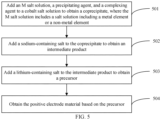
- FIG. 5 shows a preparation method of a positive electrode material according to the present invention.
- An embodiment of the present invention provides a preparation method of a positive electrode material, used for preparing the positive electrode material describe above.
- the method includes: Step 501: Add an M salt solution, a precipitating agent, and a complexing agent to a cobalt salt solution to obtain a coprecipitate, where the M salt solution includes a salt solution including a metal element or a non-metal element.
- the cobalt salt includes but is not limited to cobalt chloride, cobalt sulfate, cobalt nitrate, cobalt acetate, and the like, and the M salt may be nitrate, sulfate, oxalate, acetate, and the like.
- the cobalt salt and the M salt may be added at a preset ratio to deionized water, and then a precipitant and a complexing agent accounting for a total content ranging from 0.01 mol/L to 2 mol/L may be added, where the precipitating agent may be sodium hydroxide, and the complexing agent may be ammonia water, so that a molar ratio of the complexing agent to the precipitant is 0.1:2, the pH is adjusted to 6-10, and the mixture forms a coprecipitate.
- the precipitating agent may be sodium hydroxide
- the complexing agent may be ammonia water
- Step 502 Add a sodium-containing salt to the coprecipitate to obtain an intermediate product.
- the sodium-containing salt may be sodium carbonate, and a molar ratio of Co in the coprecipitate to Na in the sodium-containing salt of n:1 (0.69 ⁇ n ⁇ 0.78) is used for even mixing, the mixture is sintered in an oxygen atmosphere at 700°C to 1000°C for 24 hours to 36 hours to obtain the intermediate product.
- Step 503 Add a lithium-containing salt to the intermediate product to obtain a precursor.
- the intermediate product is mixed with a lithium-containing salt, and then heated to melt, where it is ensured that a molar ratio of Li/Na is 2: 10, and the lithium salt may be selected from one or more of lithium chloride, lithium bromide, lithium acetate, lithium carbonate, or lithium hydroxide.
- a precursor is obtained after heating at 100°C to 300°C.
- the precursor may sodium-containing oxide with a chemical formula of Li x Na 1-x Co 1-z M z O 2 .
- Step 504 Obtain the positive electrode material based on the precursor.
- the positive electrode material is mixed with a conductive agent, a binder, and the like to obtain a positive electrode slurry.
- the sodium-containing oxide Li x Na 1-x Co 1-z M z O 2 can maintain good structural stability during a charge and discharge process, and has a plurality of reversible phase transitions, so that the sodium-containing oxide can not only achieve a high capacity but also have good cycling performance.
- a structure of the material has a larger interlayer electrostatic repulsion due to coplanarity of a LiO 6 layer and a CoO 6 layer, so as to achieve a larger transition metal interlayer spacing. Therefore, this is more conducive to rapid diffusion of Li ions between the layers, thereby achieving higher rate performance and improving a gram capacity of the positive electrode material.
- a molar ratio between Co and M in the cobalt salt solution and the M salt solution is (1-z):z
- the coprecipitate includes (Co 1-z M z ) 3 O 4 , where 0.001 ⁇ z ⁇ 0.03
- the intermediate product includes Na m Co 1-z M z O 2 , where 0.65 ⁇ m ⁇ 1
- the precursor includes Li x Na 1-x Co 1-z M z O 2 , where 0.70 ⁇ x ⁇ 1.
- the cobalt salt and the M salt may be at a molar ratio of Co to M (1-z):z, and are added to deionized water, and then a precipitating agent and a complexing agent accounting for a total content ranging from 0.01 mol/L to 2 mol/L are added to obtain a coprecipitate.
- the coprecipitate is sintered in an air atmosphere at 300°C to 900°C for 10 hours to 20 hours, and the product is processed by grinding and sieving to obtain a (Co 1-z M z ) 3 O 4 material, where 0.001 ⁇ z ⁇ 0.03, and a median particle size of the (CO 1-z M z ) 3 O 4 ranges from 3 ⁇ m to 30 ⁇ m.
- the (Co 1-z M z ) 3 O 4 and Na 2 CO 3 are evenly mixed at a molar ratio of Na to Co of n:1 (0.69 ⁇ n ⁇ 0.78), and sintered in an oxygen atmosphere at 700°C to 1000°C for 24 hours to 36 hours to obtain Na m Co 1-z M z O 2 , where 0.65 ⁇ m ⁇ 1.
- the Na m Co 1-z M z O 2 and the lithium salt are mixed and heated to melt, so as to obtain Li x Na 1-x Co 1-z M z O 2 .
- the gram capacity of the positive electrode material is improved by adding the sodium-containing oxide Li x Na 1-x Co 1-z M z O 2 .
- the present invention further provides a positive electrode plate, including a current collector and a coating layer disposed on the current collector, where the coating layer includes the positive electrode material in the present invention and/or a positive electrode material prepared by using the preparation method of a positive electrode material in the present invention.
- the current collector is made of a metal foil, preferably an aluminum foil.
- a thickness of the aluminum foil ranges from 6 ⁇ m to 10 ⁇ m (for example, is 6 ⁇ m, 7 ⁇ m, 8 ⁇ m, 9 ⁇ m, or 10 ⁇ m).
- the coating layer includes the positive electrode material, and a positive electrode active material in the positive electrode material may include Li x Na 1-x Co 1-z M z O 2 .
- a press density of the positive electrode plate may range from 3 g/cm 3 to 4.5 g/cm 3 (for example, is 3 g/cm 3 , 3.2 g/cm 3 , 3.5 g/cm 3 , 3.8 g/cm 3 , 4 g/cm 3 , 4.2 g/cm 3 , or 4.5 g/cm 3 ).
- the coating layer further includes a conductive agent and a binder.
- the binder may include one or more of polyvinylidene fluoride (PVDF), carboxymethyl cellulose (CMC), styrene-butadiene rubber (SBR), water-based acrylic resin, polytetrafluoroethylene (PTFE), ethylene-vinyl acetate copolymer (EVA), or polyvinyl alcohol (PVA).
- the conductive agent may include one or more of superconducting carbon, acetylene black, carbon black, Ketjen black, carbon dots, carbon nanotubes, graphene, or carbon nanofibers.
- a weight content of the positive electrode material ranges from 90wt% to 99wt%
- a weight content of the conductive agent ranges from 0.5wt% to 5wt%
- a weight content of the binder ranges from 0.5 wt% to 5 wt%.
- the positive electrode material, the conductive agent, and the binder are dispersed in a solvent (such as N-methylpyrrolidone, NMP for short) to form a uniform coating layer, and the coating layer is coated on a positive electrode current collector. After drying and rolling processes, the positive electrode plate is obtained.
- a solvent such as N-methylpyrrolidone, NMP for short
- the positive electrode plate is obtained.
- the positive electrode material has a plurality of reversible phase transitions. These phase transitions are not only reversible, but also achieve a higher capacity at a lower voltage, thereby increasing a capacity of the positive electrode plate at a same charge cut-off voltage.
- the present invention further provides a battery, including a positive electrode plate and a negative electrode plate, where the positive electrode plate includes the positive electrode material in the present invention and/or a positive electrode material prepared by using the preparation method of a positive electrode material in the present invention.
- the battery may be a lithium-ion battery.
- the terms "include” and “comprise”, or any of their variants are intended to cover a non-exclusive inclusion, such that a process, method, article, or apparatus that includes a list of elements not only includes those elements but also includes other elements that are not expressly listed, or further includes elements inherent to such process, method, article, or apparatus.
- an element preceded by "includes a" does not preclude the existence of other identical elements in the process, method, article, or apparatus that includes the element.
- the scope of the methods and apparatuses in embodiments of the present invention is not limited to performing the functions in the order discussed, but may also include performing the functions in a substantially simultaneous manner or in a reverse order depending on the functions involved.
- the described methods may be performed in an order different from that described, and various steps may be added, omitted, or combined.
- features described with reference to some examples may be combined in other examples.
Landscapes
- Chemical & Material Sciences (AREA)
- Chemical Kinetics & Catalysis (AREA)
- Electrochemistry (AREA)
- General Chemical & Material Sciences (AREA)
- Organic Chemistry (AREA)
- Engineering & Computer Science (AREA)
- Inorganic Chemistry (AREA)
- Materials Engineering (AREA)
- Manufacturing & Machinery (AREA)
- Battery Electrode And Active Subsutance (AREA)
- Secondary Cells (AREA)
- Inorganic Compounds Of Heavy Metals (AREA)
Abstract
Description
- The present invention relates to the field of battery technologies, and in particular, to a positive electrode material, a preparation method of a positive electrode material, a positive electrode plate, and a battery.
- With the development of battery technologies, achieving higher capacities under the condition of stable structures of positive electrode materials has become an urgent need. Currently, a charge and discharge cut-off voltage has transitioned from original 4.2 V or 4.3 V to current 4.45 V or 4.48 V, and will eventually develop toward 4.5 V, 4.6 V, or even higher.
- However, an existing positive electrode material undergoes a severe irreversible phase transition when the charge and discharge cut-off voltage exceeds 4.5 V. For example, at 4.55 V, the positive electrode material undergoes a phase transition from an O3 phase to an H1-3 phase, and at a higher voltage, undergoes a phase transition from the H1-3 phase to an O1 phase. Such an irreversible phase transition causes a structure of the positive electrode material to because extremely unstable at a high voltage, leading to severe contraction of a crystal structure. This results in cracking or even destruction of positive electrode material particles, consequently causing problems such as rapid capacity fading and a rapid cycling drop. Although doping and coating the positive electrode material suppress or mitigate harmful effects of these phase transitions to an extent, a capacity loss is caused.
- It can be learned that a positive electrode material in the prior art has a problem of low capacity.
- The present invention provides a positive electrode material, a preparation method of a positive electrode material, a positive electrode plate, and a battery, to solve a problem of low capacity of a positive electrode material in the prior art.
- The present invention provides a positive electrode material. The positive electrode material includes a sodium-containing oxide, an angle range of a first characteristic peak of the sodium-containing oxide is less than an angle range of a second characteristic peak, the first characteristic peak is a characteristic peak of the sodium-containing oxide at an initial voltage, the second characteristic peak is a characteristic peak of the sodium-containing oxide at a cut-off voltage, and a chemical formula of the sodium-containing oxide is LixNa1-xCo1-zMzO2.
- M includes a metal element or a non-metal element, 0.7 < x < 1, and 0.001 < z < 0.03.
- In one example, during a charge and discharge process from the initial voltage to the cut-off voltage, the sodium-containing oxide includes a plurality of phase transitions, and the plurality of phase transitions are reversible phase transitions.
- In one example, each phase transition in the plurality of phase transitions includes an equilibrium potential.
- In one example, during the charge and discharge process from the initial voltage to the cut-off voltage, at a first voltage range, the sodium-containing oxide compound coexists as a first phase and a second phase; at a second voltage range, the sodium-containing oxide compound coexists as a third phase and a fourth phase; and at a third voltage range, the sodium-containing oxide compound coexists as a fifth phase and a sixth phase.
- In one example, a phase layered structure of the sodium-containing oxide includes a plurality of stacked repeating units, each of the repeating units presents a layered structure in which a first transition metal layer, a lithium oxygen layer, and a second transition metal layer are stacked, and transition metal and lithium atoms respectively occupy octahedral sites.
- In one example, M includes at least one element of Al, Mg, Ti, Zr, Mn, Ni, B, P, Y, La, Te, Nb, W, K, or La.
- In one example, a median particle size of the sodium-containing oxide ranges from 3 µm to 30 µm.
- In one example, a specific surface area of the sodium-containing oxide ranges from 0.2 m2/g to 1 m2/g.
- The present invention further provides a preparation method of a positive electrode material, used for preparing the positive electrode material describe above. The method includes:
- adding an M salt solution, a precipitating agent, and a complexing agent to a cobalt salt solution to obtain a precipitate, where the M salt solution includes a salt solution including a metal element or a non-metal element;
- adding a sodium-containing salt to the coprecipitate to obtain an intermediate product;
- adding a lithium-containing salt to the intermediate product to obtain a precursor; and
- obtaining the positive electrode material based on the precursor.
- In one example, a molar ratio between Co and M in the cobalt salt solution and the M salt solution is (1-z):z, and the coprecipitate includes (Co1-zMz)3O4, where 0.001 < z < 0.03; the intermediate product includes NamCo1-zMzO2, where 0.65 < m < 1; and the precursor includes LixNa1-xCo1-zMzO2, where 0.7 < x < 1.
- The present invention further provides a positive electrode plate, including a current collector and a coating layer disposed on a surface of one or both sides of the current collector, where the coating layer includes the positive electrode material in the present invention and/or a positive electrode material prepared by using the preparation method of a positive electrode material in the present invention.
- The present invention further provides a battery, including a positive electrode plate and a negative electrode plate, where the positive electrode plate includes the positive electrode material in the present invention and/or a positive electrode material prepared by using the preparation method of a positive electrode material in the present invention.
- In the present invention, during a phase transition process of the sodium-containing oxide from the initial voltage to the cut-off voltage, the first characteristic peak and the second characteristic peak are formed. The angle range of the first characteristic peak is less than the angle range of the second characteristic peak. In this way, the sodium-containing oxide can release more lithium ions at a same voltage, thereby improving a capacity of the positive electrode material, and improving rate performance and cycling performance of the positive electrode material.
- To describe technical solutions in embodiments of the present invention more clearly, the following briefly describes the accompanying drawings required for describing embodiments or the prior art. Apparently, the accompanying drawings in the following description show merely some of embodiments of the present invention, and persons of ordinary skill in the art may still derive other drawings from these accompanying drawings without creative efforts.
-
FIG. 1 shows an in-situ XRD pattern of sodium-containing oxide in a positive electrode material during a charge and discharge process according to an embodiment of the present invention. -
FIG. 2 shows charge and discharge curves of sodium-containing oxide in a positive electrode material according to an embodiment of the present invention. -
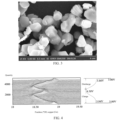
FIG. 3 is a scanning electron microscope image of sodium-containing oxide in a positive electrode material according to an embodiment of the present invention. -
FIG. 4 is an in-situ XRD diagram of lithium cobalt oxide in an existing positive electrode material. -
FIG. 5 is a flowchart of a preparation method of a positive electrode material according to an embodiment of the present invention. - The following clearly and completely describes the technical solutions in embodiments of the present invention with reference to the accompanying drawings in embodiments of the present invention. Apparently, the described embodiments are some but not all of embodiments of the present invention. All other embodiments obtained by persons of ordinary skill in the art based on embodiments of the present invention without creative efforts shall fall within the protection scope of the present invention.
- In the specification and claims of the present invention, the terms "first", "second", and the like are intended to distinguish between similar objects but do not indicate a particular order or a sequence. It should be understood that the structures used in this way are interchangeable under appropriate circumstances so that embodiments of the present invention can be implemented in an order other than those illustrated or described herein, and the objects distinguished by "first", "second", and the like are generally of a same type. A quantity of the objects is not limited. For example, a first object may be one or more objects. In addition, "and/or" in the specification and claims represents at least one of the associated objects, and the character "/" generally indicates that the associated objects are in an "or" relationship.
- The present invention provides a positive electrode material, as shown in
FIG. 1, FIG. 2 , andFIG. 3 . The positive electrode material includes a sodium-containing oxide, an angle range of a first characteristic peak of the sodium-containing oxide is less than an angle range of a second characteristic peak, the first characteristic peak is a characteristic peak of the sodium-containing oxide at an initial voltage, the second characteristic peak is a characteristic peak of the sodium-containing oxide at a cut-off voltage, and a chemical formula of the sodium-containing oxide is LixNa1-xCo1-zMzO2. - M includes a metal element or a non-metal element, 0.7 < x < 1 (for example, x is 0.71, 0.75, 0.8, 0.85, 0.9, 0.95, or 0.99), and 0.001 < z < 0.03 (for example, z is 0.0015, 0.005, 0.01, 0.015, 0.02, 0.025, or 0.029).
- In the chemical formula LixNa1-xCo1-zMzO2, when M includes a plurality of elements (≥2), z is a sum of atom quantities of the plurality of elements. For example, when M is Al and Mg, a sum of atom quantities of Al and Mg is 1.
- In the present invention, during a phase transition process of the sodium-containing oxide from the initial voltage to the cut-off voltage, the first characteristic peak and the second characteristic peak are formed. The first characteristic peak is a characteristic peak of the sodium-containing oxide at the initial voltage (3 V), and the second characteristic peak is a characteristic peak of the sodium-containing oxide at the cut-off voltage (4.5 V). The angle range of the first characteristic peak is less than the angle range of the second characteristic peak. In this way, the sodium-containing oxide can release more lithium ions at a same voltage, thereby improving a capacity of the positive electrode material, and improving rate performance and cycling performance of the positive electrode material.
- Specifically, a chemical formula of the sodium-containing oxide may be LixNa1-xCo1-zMzO2. In an in-situ X-ray diffraction (XRD) pattern during a charge and discharge process of 3 V to 4.5 V, as shown in
FIG. 1 , it can be learned that the first characteristic peak, namely, the characteristic peak of the sodium-containing oxide at the initial voltage (3 V), is located in an angle range of 18.4° to 18.7°; and the second characteristic peak, namely, the characteristic peak of the sodium-containing oxide at the cut-off voltage (4.5 V), is located in an angle range of 18.7° to 19.5°. The second characteristic peak is located on the right side of the first characteristic peak, that is, the angle range of the first characteristic peak is less than the angle range of the second characteristic peak. Compared with a positive electrode material in the prior art, the improved positive electrode material in the present invention has a higher capacity. - For example, as shown in
FIG. 4 , the positive electrode material in the prior art includes commercial lithium cobalt oxide. A result of an in-situ XRD test of the commercial lithium cobalt oxide during a charge and discharge process of 3 V to 4.5 V shows that there is only one peak with a position shift between 18.4° and 19° during the charge and discharge process, and there is no coexistence of two peaks, indicating that a main reaction during the charge and discharge process is a solid solution reaction of lithium ions insertion and extraction, without no more than two reversible phase transition reactions. After full charging to 4.5 V, the characteristic peak of the lithium cobalt oxide material at the cut-off voltage (4.5 V) is located on the left side of the characteristic peak of the lithium cobalt oxide material at the initial voltage (3 V). However, the second characteristic peak of the positive electrode material provided in the present invention is located on the right side of the first characteristic peak, so that the sodium-containing oxide in the positive electrode material provided in the present invention can release more lithium (about 80% of lithium ions) at the same voltage, while conventional lithium cobalt oxide can release only 70% of lithium ions at the same voltage. Therefore, compared with the prior art, the positive electrode material in the present invention improves its capacity at a same charging cut-off voltage. - In one example, the positive electrode material provided in the present invention can achieve a gram capacity of 202 mAh/g at 4.5 V, which is much higher than the conventional commercial lithium cobalt oxide material (186 mAh/g) at the same voltage.
- In one example, during a charge and discharge process from the initial voltage to the cut-off voltage, the sodium-containing oxide includes a plurality of phase transitions, and the plurality of phase transitions are reversible phase transitions.
- In the present invention, it can be learned from an in-situ XRD (as shown in
FIG. 1 ) result that during the charge and discharge process from the initial voltage to the cut-off voltage, the sodium-containing oxide has a plurality of reversible phase transitions. These phase transitions are not only reversible, but also achieve a higher capacity at a lower voltage, thereby increasing a capacity of the positive electrode material at a same charge cut-off voltage while maintaining structural stability. - Each phase transition process in the plurality of phase transitions includes an equilibrium potential. In other words, a charge and discharge test was conducted on sodium-containing oxide LixNa1-xCo1-zMzO2, where a test result was shown in
FIG. 1 and FIG. 2 , indicating that charge and discharge curves of the material has four charge-discharge plateaus within a voltage range of 3 V to 4.5 V. In comparison with in-situ XRD of a current commercial lithium cobalt oxide material (as shown inFIG. 4 ), charge and discharge curves of LixNa1-xCo1-zMzO2 show that charge-discharge plateaus are exhibited respectively at 3.7 V to 3.8 V, 4.0 V to 4.15 V, 4.15 V to 4.25 V, and 4.4 V to 4.5 V, which are significantly different from the current commercial lithium cobalt oxide material. That LixNa1-xCo1-zMzO2 exhibits a charge and discharge plateau, that is, the equilibrium potential, where the voltage remains constant. At the current voltage, a material content corresponding to a phase increases, allowing for extraction of some lithium ions during each phase transition. This improves a capacity of the positive electrode material. - In one example, a phase layered structure of the sodium-containing oxide includes a plurality of stacked repeating units, each of the repeating units presents a layered structure in which a first transition metal layer, a lithium oxygen layer, and a second transition metal layer are stacked, and transition metal and lithium atoms respectively occupy octahedral sites. A morphology of the sodium-containing oxide may be polycrystalline or monocrystalline.
- Specifically, the LixNa1-xCo1-zMzO2 material exhibits four reversible phase transitions in the in-situ XRD. The first phase transition is during charging from 3.7 V to 3.8 V, where a phase transition in which Li atoms in the material transition from octahedral sites to tetrahedral sites. The second phase transition is during charging from 4.0 V to 4.15 V, where continuous extraction of Li leads to a change in lattice parameters, resulting in a phase transition. The third phase transition is during charging from 4.15 V to 4.25 V, where Li reoccupies the octahedral sites and the lithium-cobalt layer undergoes interlayer sliding. The fourth phase transition is during charging from 4.4 V to 4.5 V, where a structural unit transitions from an alternating arrangement of six lithium-cobalt metal layers to an arrangement of two lithium-cobalt metal layers. During a discharge process, an angle change is consistent with that of the charge process, and the phase transition is completely reversible. After a complete charge and discharge process, the LixNa1-xCo1-zMzO2 material can completely return to its original phase structure, reflecting good kinetic stability of the material during the charge and discharge process. The in-situ XRD shows that all phase transitions of the material between 3 V and 4.5 V are reversible phase transitions, and the material can maintain good structural stability during the charge and discharge process. The material has a plurality of reversible phase transitions at less than 4.6 V, and therefore can not only achieve a high capacity but also have good cycling performance. In addition, a structure of the material has a larger interlayer electrostatic repulsion due to coplanarity of a LiO6 layer and a CoO6 layer, so as to achieve a larger transition metal interlayer spacing than the lithium cobalt oxide in the prior art. Therefore, this is more conducive to rapid diffusion of Li ions between the layers, thereby achieving higher rate performance and improving a capacity of the positive electrode material.
- In one example, during the charge and discharge process from the initial voltage to the cut-off voltage, at a first voltage range, the sodium-containing oxide compound coexists as a first phase and a second phase; at a second voltage range, the sodium-containing oxide compound coexists as a third phase and a fourth phase; and at a third voltage range, the sodium-containing oxide compound coexists as a fifth phase and a sixth phase. The first voltage range is from 3.7 V to 3.8 V; the second voltage range is from 4.15 V to 4.25 V; and the third voltage range is from 4.4 V to 4.5 V
- In one example, during the charge process of the LixNa1-xCo1-zMzO2 material, the first phase transition occurs during charging from 3 V to the first voltage range (for example, 3.7 V to 3.8 V), and two peaks coexist within a range of 17.6° to 18.7° in an XRD spectrum, that is, the first phase and the second phase coexist. The first phase may be a left peak at 17.6° to 18.2°, and the second phase may be a right peak at 18.4° to 18.7°, and as the charge process progresses, the left peak gradually strengthens, and the right peak gradually weakens until it disappears.
- During continued charging of 4.0 V to 4.15 V, the enhanced left peak slowly shifts to the left, and the angle range may be from 17.7° to 18°, during which the second phase transition reaction occurs.
- During continued charging to the second voltage range (which may be, for example, 4.15 V to 4.25 V), the third phase transition occurs, during which two peaks coexist, that is, the third phase and the fourth phase coexist. The third phase may be a left peak at 17.6° to 18.1°, and the fourth phase may be a right peak at 18.0° to 18.7°. The left peak gradually weakens until it disappears, and the right peak gradually strengthens. A peak position ranges from 17.6° to 18.7°.
- During continued charging to the third voltage range (which may be, for example, 4.4 V to 4.5 V), the fourth phase transition occurs, and two peaks also coexist, that is, the fifth phase and the sixth phase coexist. The fifth phase may be a left peak located at 18° to 18.6°, and the sixth phase may be a right peak located at 18.7° to 19.5°. The left peak gradually weakens until it disappears, and the right peak gradually strengthens. A peak position change range is from 18° to 19.5°. This is completely reversible during the discharge process.
- In comparison with in-situ XRD of a current commercial lithium cobalt oxide material, a result of an in-situ XRD test of the commercial lithium cobalt oxide during a charge and discharge process of 3 V to 4.5 V shows (as shown in
FIG. 4 ) that there is only one peak with a position shift between 18.4° and 19° during the charge and discharge process of the current commercial lithium cobalt oxide material, and there is no coexistence of two peaks, indicating that a main reaction of a conventional positive electrode material during the charge and discharge process is a solid solution reaction of Li ions insertion and extraction, without no more than two reversible phase transition reactions. In addition, after full charging to 4.5 V, a peak position of the positive electrode material in the present invention is located on the right side of an initial state position, while a peak position of a conventional positive electrode material is located on the left side of an initial state position. This is because the positive electrode material in the present invention can release more Li (approximately 80% of Li ions) at the same voltage, while the conventional positive electrode material can release only 70% of Li ions at the same voltage. At the same charging cut-off voltage, a capacity of the positive electrode material is improved. - M includes at least one element of Al, Mg, Ti, Zr, Mn, Ni, B, P, Y, Te, Nb, W, K, or La.
- It should be noted that the M element includes the foregoing metal element or non-metal element, and may also be another element that can form a covalent bond with an oxygen atom and embed into the LixNa1-xCo1-zMzO2 lattice, such as a lanthanide element La/Y, and a same technical effect can be achieved. Details are not described herein.
- A median particle size of the sodium-containing oxide may range from 3 µm to 30 µm (for example, is 3 µm, 5 µm, 10 µm, 15 µm, 20 µm, 25 µm, or 30 µm).
- A specific surface area of the sodium-containing oxide may range from 0.2 m2/g to 1 m2/g (for example, is 0.2 m2/g, 0.3 m2/g, 0.4 m2/g, 0.5 m2/g, 0.6 m2/g, 0.7 m2/g, 0.8 m2/g, 0.9 m2/g, or 1 m2/g).
- It should be noted that, in a case that the initial voltage is charged to a cut-off voltage of higher than 4.6 V for the sodium-containing oxide, phase transitions are also completely reversible. After a complete charge and discharge process, the sodium-containing oxide LixNa1-xCo1-zMzO2 can completely return to its original phase structure, and kinetic stability is good during the charge and discharge process.
- The following describes, based on a plurality of groups of experiments, effects of batteries prepared by using the positive electrode material provided in the present invention.
- Preparation of sodium-containing oxide in a positive electrode material: A chemical formula of the sodium-containing oxide may be Li0.97Na0.03Co0.99Al0.01O2. First, cobalt nitrate and aluminum sulfate were added to a solvent (such as deionized water) at a molar ratio of Co to Al of 0.99:0.01, and then 0.05 mol/L sodium hydroxide and ammonia water were added to adjust the pH to 6-10 so that the mixture formed a coprecipitate. The precipitate was sintered at 900°C for 20 hours in air atmosphere, and then the resulting product was processed by grinding and sieving to obtain a (Co0.99Al0.01)3O4 material. Then, the (Co0.99Al0.01)3O4 and Na2CO3 were uniformly mixed at a molar ratio of Na to Co of 0.76:0.99, and sintered in an oxygen atmosphere at 950°C for 36 hours to obtain Na0.76Co0.99Al0.01O2. Then the Na0.76Co0.99Al0.01O2 and LiCl were mixed and heated at 300°C to melt to finally obtain Li0.97Na0.03Co0.99Al0.01O2.
- Preparation of sodium-containing oxide in a positive electrode material: A chemical formula of the sodium-containing oxide may be Li0.95Na0.05Co0.99Al0.1O2. First, cobalt nitrate and aluminum sulfate were added to a solvent (such as deionized water) at a molar ratio of Co to Al of 0.99:0.01, and then 0.05 mol/L sodium hydroxide and ammonia water were added to adjust the pH to 6-10 so that the mixture formed a coprecipitate. The precipitate was sintered at 900°C for 20 hours in air atmosphere, and then the resulting product was processed by grinding and sieving to obtain a (Co0.99Al0.01)3O4 material. Then, the (Co0.99Al0.01)3O4 and Na2CO3 were uniformly mixed at a molar ratio of Na to Co of 0.74:0.99, and sintered in an oxygen atmosphere at 850°C for 36 hours to obtain Na0.74Co0.99Al0.01O2. Then the Na0.74Co0.99Al0.01O2 and LiCl were mixed with Li/Na being 7, and heated at 300°C to melt to finally obtain Li0.95Na0.05Co0.99Al0.01O2.
- Preparation of sodium-containing oxide in a positive electrode material: A chemical formula of the sodium-containing oxide may be Li0.93Na0.07Co0.99Al0.01O2. First, cobalt nitrate and aluminum sulfate were added to a solvent (such as deionized water) at a molar ratio of Co to Al of 0.99:0.01, and then 0.05 mol/L sodium hydroxide and ammonia water were added to adjust the pH to 6-10 so that the mixture formed a coprecipitate. The precipitate was sintered at 900°C for 20 hours in air atmosphere, and then the resulting product was processed by grinding and sieving to obtain a (Co0.99Al0.01)3O4 material. Then, the (Co0.99Al0.01)3O4 and Na2CO3 were uniformly mixed at a molar ratio of Na to Co of 0.72:0.99, and sintered in an oxygen atmosphere at 750°C for 36 hours to obtain Na0.72Co0.99Al0.01O2. Then the Na0.72Co0.99Al0.01O2 and LiCl were mixed with Li/Na being 5, and heated at 300°C to melt to finally obtain Li0.93Na0.07Co0.99Al0.01O2.
- Preparation of sodium-containing oxide in a positive electrode material: A chemical formula of the sodium-containing oxide may be Li0.92Na0.08Co0.99Mg0.01O2. First, cobalt nitrate and magnesium sulfate were added to a solvent (such as deionized water) at a molar ratio of Co to Mg of 0.99:0.01, and then 0.05 mol/L sodium hydroxide and ammonia water were added to adjust the pH to 6-10 so that the mixture formed a coprecipitate. The precipitate was sintered at 900°C for 20 hours in air atmosphere, and then the resulting product was processed by grinding and sieving to obtain a (Co0.99Mg0.1)3O4 material. Then, the (Co0.99Mg0.01)3O4 and Na2CO3 were uniformly mixed at a molar ratio of Na to Co of 0.70:0.99, and sintered in an oxygen atmosphere at 750°C for 36 hours to obtain Na0.70Co0.99Mg0.01O2. Then the Na0.70Co0.99Mg0.01O2 and LiCl were mixed with Li/Na being 7, and heated at 300°C to melt to finally obtain Li0.92Na0.08Co0.99Mg0.01O2.
- Preparation of sodium-containing oxide in a positive electrode material: A chemical formula of the sodium-containing oxide may be Li0.95Na0.05Co0.99Ni0.01O2. First, cobalt nitrate and nickel sulfate were added to a solvent (such as deionized water) at a molar ratio of Co to Ni of 0.99:0.01, and then 0.05 mol/L sodium hydroxide and ammonia water were added to adjust the pH to 6-10 so that the mixture formed a coprecipitate. The precipitate was sintered at 800°C for 20 hours in air atmosphere, and then the resulting product was processed by grinding and sieving to obtain a (Co0.99Ni0.01)3O4 material. Then, the (Co0.99Ni0.01)3O4 and Na2CO3 were uniformly mixed at a molar ratio of Na to Co of 0.72:0.99, and sintered in an oxygen atmosphere at 800°C for 36 hours to obtain Na0.72Co0.99Ni0.01O2. Then the Na0.72Co0.99Ni0.01O2 and LiCl were mixed with Li/Na being 10, and heated at 300°C to melt to finally obtain Li0.95Na0.05Co0.99Ni0.01O2.
- Preparation of sodium-containing oxide in a positive electrode material: A chemical formula of the sodium-containing oxide may be Li0.95Na0.05Co0.98Al0.01Mg0.01O2. First, cobalt nitrate, aluminum sulfate, and magnesium sulfate were added to a solvent (such as deionized water) at a molar ratio of Co to Al to Mg of 1.98: 0.01:0.01, and then 0.05 mol/L sodium hydroxide and ammonia water were added to adjust the pH to 6-10 so that the mixture formed a coprecipitate. The precipitate was sintered at 800°C for 20 hours in air atmosphere, and then the resulting product was processed by grinding and sieving to obtain a (Co0.98Al0.01Mg0.01)3O4 material. Then, the (Co0.08Al0.01Mg0.01)3O4 and Na2CO3 were uniformly mixed at a molar ratio of Na to Co of 0.72:1, and sintered in an oxygen atmosphere at 800°C for 36 hours to obtain Na0.72Co0.98Al0.01Mg0.01O2. Then the Na0.72Co0.98Al0.01Mg0.01O2 and LiCl were mixed with Li/Na being 10, and heated at 300°C to melt to finally obtain Li0.95Na0.05Co0.98Ai0.98Mg0.01O2.
- Preparation of sodium-containing oxide in a positive electrode material: A chemical formula of the sodium-containing oxide may be Li0.97Na0.03Co0.98Al0.01Ni0.01O2. A preparation process of the sodium-containing oxide in Example 7 was the same as that in Example 1, except that the Ni element was added according to a molar ratio during coprecipitation.
- Preparation of sodium-containing oxide in a positive electrode material: A chemical formula of the sodium-containing oxide may be Li0.97Na0.03Co0.98Al0.01Mg0.005Ni0.005O2. A preparation process of the sodium-containing oxide in Example 8 was the same as that in Example 1, except that the Mg element and the Ni element were added according to a molar ratio during coprecipitation.
- A commercial lithium cobalt oxide positive electrode material was prepared by a conventional synthesis method. The synthesis method was as follows: cobalt sulfate and aluminum sulfate were added to deionized water at a molar ratio of 0.99:0.01, and sodium carbonate and ammonia water were added as a precipitating agent and a complexing agent respectively to adjust the pH to 7-8 for precipitation. The precipitating agent was processed by sintering and grinding to obtain (Co0.99Al0.01)3O4, and then was mixed with Li2CO3 according to a molar ratio of Li/Co of 1.01. The mixture was sintered at 900 °C in air for 12 hours to finally obtain a lithium cobalt oxide positive electrode material with a chemical formula of LiCo0.99Al0.01O2.
- A preparation method of a positive electrode material in Comparative Example 2 was the same as that in Comparative Example 1, except that the Mg element was added according to a molar ratio during coprecipitation, to finally obtain a lithium cobalt oxide positive electrode material with a chemical formula of LiCo0.98Al0.01Mg0.01O2.
- A preparation method of a positive electrode material in Comparative Example 3 was the same as that in Comparative Example 1, except that the Mg element was added according to a molar ratio during coprecipitation, and the Ti element was added according to a molar ratio during sintering, to finally obtain a lithium cobalt oxide positive electrode material with a chemical formula of LiCo0.97Al0.01Mg0.01Ti0.01O2.
- A preparation method of a positive electrode material in Comparative Example 4 is the same as that in Comparative Example 1, except that Mg was added according to a molar ratio during coprecipitation, and Ti and Zr elements were added according to a molar ratio during sintering, to finally obtain a lithium cobalt oxide positive electrode material with a chemical formula of LiCo0.96Al0.01Mg0.01Ti0.01Zr0.01O2.
- In Examples 1 to 8 and Comparative Examples 1 to 4, positive electrode plates were prepared in a same manner and assembled into lithium batteries. The lithium batteries were subjected to electrochemical tests. Electrochemical performance test results are shown below in Table 1.
Table 1 Electrochemical performance test results Sample Chemical formula 4.5 V capacity (mAh/g) 4.55 V capacity cycle 0.1C 0.2C 0.5C 1C 0.5C 50T retention rate (%) Example 1 Li0.97Na0.03CO0.99Al0.01O2 201.53 201.26 199.60 193.81 205.65 89.13 Example 2 Li0.95Na0.05Co0.90Al0.0O2 198.96 198.82 198.57 197.46 206.47 89.06 Example 3 Li0.93Na0.07Co0.99Al0.01O2 197.52 196.70 196.66 194.89 205.35 92.7 Example 4 Li0.92Na0.08Co0.99Mg0.01O2 195.89 195.13 194.75 192.89 203.48 92.13 Example 5 Li0.95Na0.05Co0..99Ni0.01O2 199.07 198.38 198.13 197.36 206.50 90.76 Example 6 Li0.95Na0.05Co0.98Al0.01Mg0.01O2 199.07 198.38 198.13 197.36 206.50 92.14 Example 7 Li0.97Na0.03Co0.98Al0.01Ni0.01O2 200.65 200.56 199.57 198.67 208.73 88.84 Example 8 Li0.97Na0.03Co0.98Al0.01Mg0.005Ni0.005O2 200.28 200.42 199.53 198.48 207.48 89.9 Comparative Example 1 LiCo0.99Al0.01O2 178.11 175.16 169.68 163.67 181.71 73.8 Comparative Example 2 LiCo0.98Al0.01Mg0.01O2 181.41 178.50 172.94 166.94 185.30 75.2 Comparative Example 3 LiCo0.97Al0.01Mg0.01Ti0.01O2 182.26 179.22 173.71 167.64 182.87 78.5 Comparative Example 4 LiCo0.96Al0.01Mg0.01Ti0.01Z10.01O2 180.56 177.76 172.17 166.23 181.79 82.5 - It can be learned, from the table above, that a positive electrode material including LixNa1-xCo1-zMzO2 provided in the present invention has a higher capacity and better C-rate and cycling performance at a same voltage than conventional commercial high-voltage lithium cobalt oxide.
- Refer to
FIG. 5. FIG. 5 shows a preparation method of a positive electrode material according to the present invention. An embodiment of the present invention provides a preparation method of a positive electrode material, used for preparing the positive electrode material describe above. The method includes:
Step 501: Add an M salt solution, a precipitating agent, and a complexing agent to a cobalt salt solution to obtain a coprecipitate, where the M salt solution includes a salt solution including a metal element or a non-metal element. - In this step, the cobalt salt includes but is not limited to cobalt chloride, cobalt sulfate, cobalt nitrate, cobalt acetate, and the like, and the M salt may be nitrate, sulfate, oxalate, acetate, and the like. The cobalt salt and the M salt may be added at a preset ratio to deionized water, and then a precipitant and a complexing agent accounting for a total content ranging from 0.01 mol/L to 2 mol/L may be added, where the precipitating agent may be sodium hydroxide, and the complexing agent may be ammonia water, so that a molar ratio of the complexing agent to the precipitant is 0.1:2, the pH is adjusted to 6-10, and the mixture forms a coprecipitate.
- Step 502: Add a sodium-containing salt to the coprecipitate to obtain an intermediate product.
- In this step, the sodium-containing salt may be sodium carbonate, and a molar ratio of Co in the coprecipitate to Na in the sodium-containing salt of n:1 (0.69 < n < 0.78) is used for even mixing, the mixture is sintered in an oxygen atmosphere at 700°C to 1000°C for 24 hours to 36 hours to obtain the intermediate product.
- Step 503: Add a lithium-containing salt to the intermediate product to obtain a precursor.
- In this step, the intermediate product is mixed with a lithium-containing salt, and then heated to melt, where it is ensured that a molar ratio of Li/Na is 2: 10, and the lithium salt may be selected from one or more of lithium chloride, lithium bromide, lithium acetate, lithium carbonate, or lithium hydroxide. Finally, a precursor is obtained after heating at 100°C to 300°C. The precursor may sodium-containing oxide with a chemical formula of LixNa1-xCo1-zMzO2.
- Step 504: Obtain the positive electrode material based on the precursor.
- In this step, the positive electrode material is mixed with a conductive agent, a binder, and the like to obtain a positive electrode slurry.
- In the present invention, the sodium-containing oxide LixNa1-xCo1-zMzO2 can maintain good structural stability during a charge and discharge process, and has a plurality of reversible phase transitions, so that the sodium-containing oxide can not only achieve a high capacity but also have good cycling performance. In addition, a structure of the material has a larger interlayer electrostatic repulsion due to coplanarity of a LiO6 layer and a CoO6 layer, so as to achieve a larger transition metal interlayer spacing. Therefore, this is more conducive to rapid diffusion of Li ions between the layers, thereby achieving higher rate performance and improving a gram capacity of the positive electrode material.
- In one example, a molar ratio between Co and M in the cobalt salt solution and the M salt solution is (1-z):z, and the coprecipitate includes (Co1-zMz)3O4, where 0.001 < z < 0.03; the intermediate product includes NamCo1-zMzO2, where 0.65 < m < 1; and the precursor includes LixNa1-xCo1-zMzO2, where 0.70 < x < 1.
- The cobalt salt and the M salt may be at a molar ratio of Co to M (1-z):z, and are added to deionized water, and then a precipitating agent and a complexing agent accounting for a total content ranging from 0.01 mol/L to 2 mol/L are added to obtain a coprecipitate. The coprecipitate is sintered in an air atmosphere at 300°C to 900°C for 10 hours to 20 hours, and the product is processed by grinding and sieving to obtain a (Co1-zMz)3O4 material, where 0.001 < z < 0.03, and a median particle size of the (CO1-zMz)3O4 ranges from 3 µm to 30 µm. Then, the (Co1-zMz)3O4 and Na2CO3 are evenly mixed at a molar ratio of Na to Co of n:1 (0.69 < n < 0.78), and sintered in an oxygen atmosphere at 700°C to 1000°C for 24 hours to 36 hours to obtain NamCo1-zMzO2, where 0.65 < m < 1. The NamCo1-zMzO2 and the lithium salt are mixed and heated to melt, so as to obtain LixNa1-xCo1-zMzO2. The gram capacity of the positive electrode material is improved by adding the sodium-containing oxide LixNa1-xCo1-zMzO2.
- The present invention further provides a positive electrode plate, including a current collector and a coating layer disposed on the current collector, where the coating layer includes the positive electrode material in the present invention and/or a positive electrode material prepared by using the preparation method of a positive electrode material in the present invention.
- In one example, the current collector is made of a metal foil, preferably an aluminum foil.
- In one example, a thickness of the aluminum foil ranges from 6 µm to 10 µm (for example, is 6 µm, 7 µm, 8 µm, 9 µm, or 10 µm).
- In one example, the coating layer includes the positive electrode material, and a positive electrode active material in the positive electrode material may include LixNa1-xCo1-zMzO2.
- In one example, a press density of the positive electrode plate may range from 3 g/cm3 to 4.5 g/cm3 (for example, is 3 g/cm3, 3.2 g/cm3, 3.5 g/cm3, 3.8 g/cm3, 4 g/cm3, 4.2 g/cm3, or 4.5 g/cm3).
- In one example, the coating layer further includes a conductive agent and a binder. The binder may include one or more of polyvinylidene fluoride (PVDF), carboxymethyl cellulose (CMC), styrene-butadiene rubber (SBR), water-based acrylic resin, polytetrafluoroethylene (PTFE), ethylene-vinyl acetate copolymer (EVA), or polyvinyl alcohol (PVA). The conductive agent may include one or more of superconducting carbon, acetylene black, carbon black, Ketjen black, carbon dots, carbon nanotubes, graphene, or carbon nanofibers.
- In one example, based on a total weight of the coating layer, a weight content of the positive electrode material ranges from 90wt% to 99wt%, a weight content of the conductive agent ranges from 0.5wt% to 5wt%, and a weight content of the binder ranges from 0.5 wt% to 5 wt%.
- Specifically, the positive electrode material, the conductive agent, and the binder are dispersed in a solvent (such as N-methylpyrrolidone, NMP for short) to form a uniform coating layer, and the coating layer is coated on a positive electrode current collector. After drying and rolling processes, the positive electrode plate is obtained. During the charge and discharge process from an initial voltage to a cut-off voltage, the positive electrode material has a plurality of reversible phase transitions. These phase transitions are not only reversible, but also achieve a higher capacity at a lower voltage, thereby increasing a capacity of the positive electrode plate at a same charge cut-off voltage.
- The present invention further provides a battery, including a positive electrode plate and a negative electrode plate, where the positive electrode plate includes the positive electrode material in the present invention and/or a positive electrode material prepared by using the preparation method of a positive electrode material in the present invention.
- The battery may be a lithium-ion battery.
- It should be noted that the implementations of the embodiment of the positive electrode material described above is also applicable to the embodiment of the battery and a same technical effect can be achieved. Details are not described herein again.
- It should be noted that in this specification, the terms "include" and "comprise", or any of their variants are intended to cover a non-exclusive inclusion, such that a process, method, article, or apparatus that includes a list of elements not only includes those elements but also includes other elements that are not expressly listed, or further includes elements inherent to such process, method, article, or apparatus. In absence of more constraints, an element preceded by "includes a..." does not preclude the existence of other identical elements in the process, method, article, or apparatus that includes the element. Furthermore, it should be noted that the scope of the methods and apparatuses in embodiments of the present invention is not limited to performing the functions in the order discussed, but may also include performing the functions in a substantially simultaneous manner or in a reverse order depending on the functions involved. For example, the described methods may be performed in an order different from that described, and various steps may be added, omitted, or combined. In addition, features described with reference to some examples may be combined in other examples.
- The foregoing describes embodiments of the present invention with reference to the accompanying drawings. However, the present invention is not limited to these specific embodiments. The specific embodiments are merely illustrative rather than restrictive. Inspired by the present invention, persons of ordinary skill in the art may develop many other manners without departing from the principle of the present invention and the protection scope of the claims, and all such manners fall within the protection scope of the present invention.
Claims (15)
- A positive electrode material, characterized in that the positive electrode material comprises a sodium-containing oxide, an angle range of a first characteristic peak of the sodium-containing oxide is less than an angle range of a second characteristic peak, the first characteristic peak is a characteristic peak of the sodium-containing oxide at an initial voltage, the second characteristic peak is a characteristic peak of the sodium-containing oxide at a cut-off voltage, and a chemical formula of the sodium-containing oxide is LixNa1-xCo1-zMzO2;
wherein M comprises a metal element or a non-metal element, 0.7 < x < 1, and 0.001 < z < 0.03. - The positive electrode material according to claim 1, characterized in that in an in-situ X-ray diffraction pattern during a charge and discharge process of 3 - 4.5 V, the first characteristic peak is the characteristic peak of the sodium-containing oxide at the initial voltage 3 V, is located in an angle range of 18.4° to 18.7°; and the second characteristic peak is the characteristic peak of the sodium-containing oxide at the cut-off voltage 4.5 V, is located in an angle range of 18.7° to 19.5°; and/or
the second characteristic peak is located on the right side of the first characteristic peak, that is, the angle range of the first characteristic peak is less than the angle range of the second characteristic peak. - The positive electrode material according to claim 1 or 2, characterized in that during a charge and discharge process from the initial voltage to the cut-off voltage, the sodium-containing oxide comprises a plurality of phase transitions, and the plurality of phase transitions are reversible phase transitions.
- The positive electrode material according to any one of claims 1 to 3, characterized in that each phase transition in the plurality of phase transitions comprises an equilibrium potential.
- The positive electrode material according to any one of claims 1 to 4, characterized in that the during the charge and discharge process from the initial voltage to the cut-off voltage, at a first voltage range, the sodium-containing oxide compound coexists as a first phase and a second phase; at a second voltage range, the sodium-containing oxide compound coexists as a third phase and a fourth phase; and at a third voltage range, the sodium-containing oxide compound coexists as a fifth phase and a sixth phase.
- The positive electrode material according to any one of claims 1 to 5, characterized in that a phase layered structure of the sodium-containing oxide comprises a plurality of stacked repeating units, each of the repeating units presents a layered structure in which a first transition metal layer, a lithium oxygen layer, and a second transition metal layer are stacked, and transition metal and lithium atoms respectively occupy octahedral sites.
- The positive electrode material according to any one of claims 1 to 6, characterized in that M comprises at least one element of Al, Mg, Ti, Zr, Mn, Ni, B, P, Y, La, Te, Nb, W, K, or La.
- The positive electrode material according to any one of claims 1 to 7, characterized in that a median particle size of the sodium-containing oxide ranges from 3 µm to 30 µm.
- The positive electrode material according to any one of claims 1 to 8, characterized in that a specific surface area of the sodium-containing oxide ranges from 0.2 m2/g to 1 m2/g.
- A preparation method of a positive electrode material, used for preparing the positive electrode material according to any one of claims 1 to 9, characterized in that the method comprises:adding an M salt solution, a precipitating agent, and a complexing agent to a cobalt salt solution to obtain a coprecipitate, wherein the M salt solution comprises a salt solution comprising a metal element or a non-metal element;adding a sodium-containing salt to the coprecipitate to obtain an intermediate product;adding a lithium-containing salt to the intermediate product to obtain a precursor; andobtaining the positive electrode material based on the precursor.
- The method according to claim 10, characterized in that a molar ratio between Co and M in the cobalt salt solution and the M salt solution is (1-z):z, and the coprecipitate comprises (Co1-zMz)3O4, wherein 0.001 < z < 0.03; the intermediate product comprises NamCo1-zMzO2, wherein 0.65 < m < 1; and the precursor comprises LixNa1-xCo1-zMzO2, wherein 0.7 < x < 1.
- A positive electrode plate, characterized in that the positive electorde plate comprises a current collector and a coating layer disposed on the current collector, wherein the coating layer comprises the positive electrode material according to any one of claims 1 to 9 and/or a positive electrode material prepared by using the method according to claim 10 or 11.
- The positive electrode plate according to claim 12, characterized in that the coating layer further comprises a conductive agent and a binder; and based on a total weight of the coating layer, a weight content of the positive electrode material ranges from 90 wt% to 99 wt%, a weight content of the conductive agent ranges from 0.5 wt% to 5 wt%, and a weight content of the binder ranges from 0.5 wt% to 5 wt%.
- A battery, characterized in that the battery comprises a positive electrode plate and a negative electrode plate, wherein the positive electrode plate comprises the positive electrode material according to any one of claims 1 to 9 and/or a positive electrode material prepared by using the method according to claim 10 or 11.
- The battery according to claim 14, the battery is a lithium-ion battery.
Applications Claiming Priority (2)
| Application Number | Priority Date | Filing Date | Title |
|---|---|---|---|
| CN202211045711.1A CN117673259A (en) | 2022-08-30 | 2022-08-30 | A kind of positive electrode material, preparation method of positive electrode material, positive electrode sheet and battery |
| PCT/CN2023/110604 WO2024046011A1 (en) | 2022-08-30 | 2023-08-01 | Positive electrode material, preparation method for positive electrode material, positive electrode sheet, and battery |
Publications (2)
| Publication Number | Publication Date |
|---|---|
| EP4542683A1 true EP4542683A1 (en) | 2025-04-23 |
| EP4542683A4 EP4542683A4 (en) | 2025-12-17 |
Family
ID=90073830
Family Applications (1)
| Application Number | Title | Priority Date | Filing Date |
|---|---|---|---|
| EP23859046.7A Pending EP4542683A4 (en) | 2022-08-30 | 2023-08-01 | POSITIVE ELECTRODE MATERIAL, MANUFACTURING PROCESS FOR POSITIVE ELECTRODE MATERIAL, POSITIVE ELECTRODE FILM AND BATTERY |
Country Status (4)
| Country | Link |
|---|---|
| US (1) | US20250105282A1 (en) |
| EP (1) | EP4542683A4 (en) |
| CN (1) | CN117673259A (en) |
| WO (1) | WO2024046011A1 (en) |
Families Citing this family (3)
| Publication number | Priority date | Publication date | Assignee | Title |
|---|---|---|---|---|
| JP7397792B2 (en) | 2018-06-22 | 2023-12-13 | 株式会社半導体エネルギー研究所 | Positive electrode active material, positive electrode, secondary battery, and method for producing positive electrode |
| WO2020201891A1 (en) | 2019-04-05 | 2020-10-08 | 株式会社半導体エネルギー研究所 | Method for producing positive electrode active substance |
| US12552681B2 (en) | 2019-04-05 | 2026-02-17 | Semiconductor Energy Laboratory Co., Ltd. | Method for forming positive electrode active material, method for manufacturing secondary battery, and secondary battery |
Family Cites Families (7)
| Publication number | Priority date | Publication date | Assignee | Title |
|---|---|---|---|---|
| JPWO2018025795A1 (en) * | 2016-08-04 | 2019-06-13 | 株式会社三徳 | Positive electrode active material for non-aqueous electrolyte secondary battery, and positive electrode and secondary battery using the positive electrode active material |
| KR20180050894A (en) * | 2016-11-07 | 2018-05-16 | 삼성에스디아이 주식회사 | Positive electrode for rechargeable lithium battery and rechargeable lithium battery including same |
| JP7326462B2 (en) * | 2020-06-08 | 2023-08-15 | 寧徳新能源科技有限公司 | Cathode material and electrochemical device comprising said cathode material |
| CN115275099B (en) * | 2020-12-24 | 2025-04-18 | 东莞新能源科技有限公司 | Positive electrode and electrochemical device |
| CN114335534A (en) * | 2021-12-16 | 2022-04-12 | 中国科学技术大学 | Lithium cobaltate positive electrode material coated and modified by zirconium lithium phosphate fast ion conductor and preparation method and application thereof |
| CN119230817A (en) * | 2022-03-25 | 2024-12-31 | 珠海冠宇电池股份有限公司 | Positive electrode material, battery, and electronic device |
| CN114573041B (en) * | 2022-03-25 | 2023-10-20 | 珠海冠宇电池股份有限公司 | A kind of preparation method of cathode material |
-
2022
- 2022-08-30 CN CN202211045711.1A patent/CN117673259A/en active Pending
-
2023
- 2023-08-01 WO PCT/CN2023/110604 patent/WO2024046011A1/en not_active Ceased
- 2023-08-01 EP EP23859046.7A patent/EP4542683A4/en active Pending
-
2024
- 2024-12-09 US US18/974,272 patent/US20250105282A1/en active Pending
Also Published As
| Publication number | Publication date |
|---|---|
| WO2024046011A1 (en) | 2024-03-07 |
| EP4542683A4 (en) | 2025-12-17 |
| CN117673259A (en) | 2024-03-08 |
| US20250105282A1 (en) | 2025-03-27 |
Similar Documents
| Publication | Publication Date | Title |
|---|---|---|
| US11955633B2 (en) | Positive electrode material and preparation method and usage thereof | |
| EP3733609A1 (en) | Positive active material, preparing method thereof, and rechargeable lithium battery including the same | |
| EP4542683A1 (en) | Positive electrode material, preparation method for positive electrode material, positive electrode sheet, and battery | |
| CN111864195B (en) | Positive electrode active material for rechargeable lithium battery, preparation method thereof, and rechargeable lithium battery including same | |
| EP3550643A1 (en) | Nickel active material precursor for lithium secondary battery, method for producing nickel active material precursor, nickel active material for lithium secondary battery produced by method, and lithium secondary battery having cathode containing nickel active material | |
| JP2020504415A (en) | Positive electrode active material for secondary battery, method for producing the same, and secondary battery including the same | |
| CN116190560B (en) | A positive electrode and a battery | |
| KR20220160919A (en) | Positive active material for rechargeable lithium battery, preparing method thereof and rechargeable lithium battery including the same | |
| JP7561973B2 (en) | Positive Electrode and Electrochemical Device | |
| JP7574266B2 (en) | Ternary positive electrode material and its manufacturing method, positive electrode plate and lithium ion battery | |
| CN113825725B (en) | Positive electrode active material for non-aqueous electrolyte secondary battery and positive electrode for non-aqueous electrolyte secondary battery | |
| JP7729688B2 (en) | Positive electrode active material, positive electrode containing the same, and secondary battery | |
| CN115036474A (en) | Positive electrode material, positive plate comprising positive electrode material and battery | |
| JP2020184534A (en) | Anode active material for lithium secondary battery, manufacturing method therefor and lithium secondary battery having the same | |
| JP7767582B2 (en) | Positive electrode active material, method for producing the same, and lithium secondary battery including the same | |
| KR20250168123A (en) | positive electrode active material for sodium secondary battery, method for preparing the same and sodium secondary battery including the same | |
| CN118231646B (en) | A ternary material, its preparation method, positive electrode, lithium-ion battery and electrical equipment. | |
| JP2025501057A (en) | Positive electrode active material and lithium ion battery | |
| CN113380996A (en) | Lithium ferric manganese phosphate coated single crystal quaternary positive electrode material and preparation method thereof | |
| EP4636854A1 (en) | Cathode active material for all-solid-state battery, manufacturing method therefor, and all-solid-state battery including same | |
| KR102905451B1 (en) | Lithium composite oxide and positive electrode active material for secondary battery containing same | |
| EP4489126A1 (en) | Positive electrode material, electrochemical apparatus and electric device | |
| CN116093302A (en) | Positive electrode material, positive electrode plate comprising positive electrode material and battery | |
| CN116093272B (en) | Cobalt-free positive electrode material, positive plate comprising same and battery | |
| EP4636850A1 (en) | Cathode active material for all-solid-state battery, manufacturing method therefor, and all-solid-state battery comprising same |
Legal Events
| Date | Code | Title | Description |
|---|---|---|---|
| STAA | Information on the status of an ep patent application or granted ep patent |
Free format text: STATUS: THE INTERNATIONAL PUBLICATION HAS BEEN MADE |
|
| PUAI | Public reference made under article 153(3) epc to a published international application that has entered the european phase |
Free format text: ORIGINAL CODE: 0009012 |
|
| STAA | Information on the status of an ep patent application or granted ep patent |
Free format text: STATUS: REQUEST FOR EXAMINATION WAS MADE |
|
| 17P | Request for examination filed |
Effective date: 20250116 |
|
| AK | Designated contracting states |
Kind code of ref document: A1 Designated state(s): AL AT BE BG CH CY CZ DE DK EE ES FI FR GB GR HR HU IE IS IT LI LT LU LV MC ME MK MT NL NO PL PT RO RS SE SI SK SM TR |
|
| DAV | Request for validation of the european patent (deleted) | ||
| DAX | Request for extension of the european patent (deleted) | ||
| A4 | Supplementary search report drawn up and despatched |
Effective date: 20251118 |
|
| RIC1 | Information provided on ipc code assigned before grant |
Ipc: H01M 4/525 20100101AFI20251112BHEP Ipc: H01M 10/0525 20100101ALI20251112BHEP Ipc: C01G 51/42 20250101ALI20251112BHEP |