EP4542566A1 - Planning updates for an interdependent fleet of medical devices - Google Patents
Planning updates for an interdependent fleet of medical devices Download PDFInfo
- Publication number
- EP4542566A1 EP4542566A1 EP23208229.7A EP23208229A EP4542566A1 EP 4542566 A1 EP4542566 A1 EP 4542566A1 EP 23208229 A EP23208229 A EP 23208229A EP 4542566 A1 EP4542566 A1 EP 4542566A1
- Authority
- EP
- European Patent Office
- Prior art keywords
- medical devices
- fleet
- upgrade
- update
- upcoming update
- Prior art date
- Legal status (The legal status is an assumption and is not a legal conclusion. Google has not performed a legal analysis and makes no representation as to the accuracy of the status listed.)
- Withdrawn
Links
Images


Classifications
-
- G—PHYSICS
- G16—INFORMATION AND COMMUNICATION TECHNOLOGY [ICT] SPECIALLY ADAPTED FOR SPECIFIC APPLICATION FIELDS
- G16H—HEALTHCARE INFORMATICS, i.e. INFORMATION AND COMMUNICATION TECHNOLOGY [ICT] SPECIALLY ADAPTED FOR THE HANDLING OR PROCESSING OF MEDICAL OR HEALTHCARE DATA
- G16H40/00—ICT specially adapted for the management or administration of healthcare resources or facilities; ICT specially adapted for the management or operation of medical equipment or devices
- G16H40/20—ICT specially adapted for the management or administration of healthcare resources or facilities; ICT specially adapted for the management or operation of medical equipment or devices for the management or administration of healthcare resources or facilities, e.g. managing hospital staff or surgery rooms
-
- G—PHYSICS
- G06—COMPUTING OR CALCULATING; COUNTING
- G06Q—INFORMATION AND COMMUNICATION TECHNOLOGY [ICT] SPECIALLY ADAPTED FOR ADMINISTRATIVE, COMMERCIAL, FINANCIAL, MANAGERIAL OR SUPERVISORY PURPOSES; SYSTEMS OR METHODS SPECIALLY ADAPTED FOR ADMINISTRATIVE, COMMERCIAL, FINANCIAL, MANAGERIAL OR SUPERVISORY PURPOSES, NOT OTHERWISE PROVIDED FOR
- G06Q10/00—Administration; Management
- G06Q10/06—Resources, workflows, human or project management; Enterprise or organisation planning; Enterprise or organisation modelling
-
- G—PHYSICS
- G06—COMPUTING OR CALCULATING; COUNTING
- G06Q—INFORMATION AND COMMUNICATION TECHNOLOGY [ICT] SPECIALLY ADAPTED FOR ADMINISTRATIVE, COMMERCIAL, FINANCIAL, MANAGERIAL OR SUPERVISORY PURPOSES; SYSTEMS OR METHODS SPECIALLY ADAPTED FOR ADMINISTRATIVE, COMMERCIAL, FINANCIAL, MANAGERIAL OR SUPERVISORY PURPOSES, NOT OTHERWISE PROVIDED FOR
- G06Q10/00—Administration; Management
- G06Q10/06—Resources, workflows, human or project management; Enterprise or organisation planning; Enterprise or organisation modelling
- G06Q10/063—Operations research, analysis or management
- G06Q10/0631—Resource planning, allocation, distributing or scheduling for enterprises or organisations
- G06Q10/06312—Adjustment or analysis of established resource schedule, e.g. resource or task levelling, or dynamic rescheduling
-
- G—PHYSICS
- G06—COMPUTING OR CALCULATING; COUNTING
- G06Q—INFORMATION AND COMMUNICATION TECHNOLOGY [ICT] SPECIALLY ADAPTED FOR ADMINISTRATIVE, COMMERCIAL, FINANCIAL, MANAGERIAL OR SUPERVISORY PURPOSES; SYSTEMS OR METHODS SPECIALLY ADAPTED FOR ADMINISTRATIVE, COMMERCIAL, FINANCIAL, MANAGERIAL OR SUPERVISORY PURPOSES, NOT OTHERWISE PROVIDED FOR
- G06Q10/00—Administration; Management
- G06Q10/06—Resources, workflows, human or project management; Enterprise or organisation planning; Enterprise or organisation modelling
- G06Q10/063—Operations research, analysis or management
- G06Q10/0631—Resource planning, allocation, distributing or scheduling for enterprises or organisations
- G06Q10/06315—Needs-based resource requirements planning or analysis
-
- G—PHYSICS
- G06—COMPUTING OR CALCULATING; COUNTING
- G06Q—INFORMATION AND COMMUNICATION TECHNOLOGY [ICT] SPECIALLY ADAPTED FOR ADMINISTRATIVE, COMMERCIAL, FINANCIAL, MANAGERIAL OR SUPERVISORY PURPOSES; SYSTEMS OR METHODS SPECIALLY ADAPTED FOR ADMINISTRATIVE, COMMERCIAL, FINANCIAL, MANAGERIAL OR SUPERVISORY PURPOSES, NOT OTHERWISE PROVIDED FOR
- G06Q10/00—Administration; Management
- G06Q10/06—Resources, workflows, human or project management; Enterprise or organisation planning; Enterprise or organisation modelling
- G06Q10/063—Operations research, analysis or management
- G06Q10/0637—Strategic management or analysis, e.g. setting a goal or target of an organisation; Planning actions based on goals; Analysis or evaluation of effectiveness of goals
Definitions
- the following generally relates to the medical device update or upgrade arts, medical imaging device update or upgrade arts, medical device update or upgrade planning arts, and related arts.
- Medical devices such as computed tomography (CT) scanners, magnetic resonance imaging (MRI) scanners, positron emission tomography (PET) scanners, image-guided therapy (IGT) devices, and other medical imaging devices are mechanically complex and highly computerized.
- an MRI scanner may include thousands of systems, subsystems, and individual components, with automated operation of the patient support bed, magnetic field gradient coils, radio frequency (RF) coils, and other hardware, along with software for reconstructing and displaying acquired MRI images.
- RF radio frequency
- the vendor party may occasionally offer software or hardware updates or upgrades to improve the capabilities of the medical device, or for another reason such as compliance with new or revised governmental regulations. Scheduling such an update or upgrade can be challenging, as an MRI or other complex medical device commonly handles a heavy workload. The update or upgrade should minimally interfere with that workload.
- Updates and upgrades of medical devices inevitably result in downtime, and such downtime has costs in terms of lost revenue from radiology examinations performed with the medical devices, patient rescheduling costs, and/or so forth.
- hospitals need to deal with alternative allocation of patients and staff, often resulting in capacity issues. When updating across the whole fleet of medical devices, this alternative allocation is becoming an even bigger challenge. For hospitals it is not straightforward how to deal with this, and there is an unmet need for systematic adaptive methods for optimization.
- a system for planning an upcoming update or upgrade of a fleet of medical devices including a hardware processor, a display device, and a non-transitory computer readable medium.
- the non-transitory computer readable medium stores instructions readable and executable by the hardware processor to: receive historical workload information for medical devices of a fleet of medical devices, the fleet including at least two medical devices; receive, via a user interface (UI) presented on the display device, cost preferences for respective costs of the upcoming update or upgrade of the fleet of medical devices, the respective costs including at least a patient delay cost, a patient rescheduling cost, and a staff overtime cost; estimate values for the respective costs for different scenarios for performing the upcoming update or upgrade of the fleet of medical devices, each scenario specifying a schedule for the upcoming update or upgrade of the fleet of medical devices and resources allocated for the upcoming update or upgrade of the fleet of medical devices, wherein the values estimated for the costs for each scenario are metrics of the impact of performing the upcoming update or upgrade in accordance with the scenario on efficiency of
- the instructions are further readable and executable by the hardware processor to: receive, via the UI, a selection of a user-selected scenario from the selected one or more scenarios; and automatically perform at least a portion of the upcoming update or upgrade of the fleet of medical devices in accordance with the user-selected scenario.
- a method for planning an upcoming update or upgrade of a fleet of medical devices.
- the method includes: receiving historical workload information for medical devices of the fleet of medical devices; receiving, via a user interface (UI), cost preferences for respective costs of the upcoming update or upgrade of the fleet of medical devices; estimating values for the respective costs of the upcoming update or upgrade of the fleet of medical devices for different scenarios for performing the upcoming update or upgrade of the fleet of medical devices, each scenario specifying at least a schedule for the upcoming update or upgrade of the fleet of medical devices and whether pairs of medical devices of the fleet are to be updated or upgraded simultaneously or consecutively; selecting one or more proposed scenarios for performing the upcoming update or upgrade of the fleet of medical devices based on comparisons of the estimated values for the respective costs with the cost preferences for the respective costs received via the UI; and outputting, on the UI, information about the selected one or more scenarios for performing the upcoming update or upgrade of the fleet of medical devices including at least indications of the estimated values for the respective costs.
- UI user interface
- the method of the immediately preceding paragraph further includes: receiving, via the UI, a selection of a user-selected scenario from the selected one or more scenarios; and automatically performing at least a portion of the upcoming update or upgrade of the fleet of medical devices in accordance with the user-selected scenario.
- a non-transitory computer readable medium stores instructions readable and executable by at least one hardware processor to: receive historical workload information for medical devices of a fleet of medical devices, the fleet including at least two medical devices; receive information on an upcoming update or upgrade of the fleet of medical devices; receive information on resources available for performing the upcoming update or upgrade of the fleet of medical devices; receive, via a user interface (UI), cost preferences for respective costs of the upcoming update or upgrade of the fleet of medical devices; simulate different scenarios performing the upcoming update or upgrade of the fleet of medical devices, each scenario specifying a schedule for the upcoming update or upgrade of the fleet of medical devices and resources allocated for the upcoming update or upgrade of the fleet of medical devices, the simulation of each scenario utilizing the historical workload information for the medical devices of the fleet of medical devices and outputting estimated values for the respective costs of the upcoming update or upgrade of the fleet of medical devices; select one or more proposed scenarios for performing the upcoming update or upgrade of the fleet of medical devices from the simulated different scenarios based on comparisons of the estimated values for the respective
- One advantage resides in planning updates or upgrades for a fleet of medical devices based on an interdependency of the medical devices.
- Another advantage resides in planning updates or upgrades for a fleet of medical devices based on resources and schedules at a medical facility where the medical devices are located.
- Another advantage resides in providing a user interface with slider bars allowing a user to optimize a plan for scheduling updates or upgrades for a fleet of medical devices.
- Another advantage resides in providing an intuitive user interface to ease the task of the fleet manager or updates planner, considering different scenarios where the update of one device can affect the normal operation of other devices.
- Another advantage resides in providing a model to consider relevant costs of downtime of a device due to an upcoming update or upgrade, involving relevant persons in the optimal solution, such as patients, staff member(s) operating such devices or service provider's availability.
- a given embodiment may provide none, one, two, more, or all of the foregoing advantages, and/or may provide other advantages as will become apparent to one of ordinary skill in the art upon reading and understanding the present disclosure.
- the vendor device 102 is programmed to interact with the update or upgrade scheduler 100 to provide inputs to set up for an upcoming update or upgrade session for the medical device 120.
- the scheduler 100 analyzes the received one or more inputs, optionally along with information about the customer, to determine a scenario for performing the upcoming update or upgrade of the fleet 120 of medical devices (for example, including a proposed time for performing the upcoming update or upgrade session, whether medical devices should be updated or upgraded simultaneously or consecutively, and/or so forth).
- This proposed scenario is output on a user interface (UI) 140 of the vendor device 102.
- UI user interface
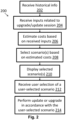
- an illustrative embodiment of the update or upgrade scheduling method 200 executable by the electronic processor 113 is diagrammatically shown as a flowchart.
- the scheduling method 200 may be performed at least in part by cloud processing.
- historical workload information for medical devices of a fleet of medical devices 120 are received at the server 111 , for example from the non-transitory computer readable medium 127.
- information on resources available for performing the upcoming update or upgrade of the fleet of medical devices 120 is also received, for example from the non-transitory computer readable medium 127.
- the GUI 140 is presented on the display device 150 of the customer device 102 .
- the GUI 140 may, for example, be presented as a webpage displayed in a web browser running on the customer device 102 , or may be presented by an application program running on the customer device 102 .
- the user provides inputs via the user input device(s) 103 indicative of cost preferences for respective costs of the upcoming update or upgrade of the fleet of medical devices 120 .
- the respective costs can include for example, at least a patient delay cost, a patient rescheduling cost, a staff overtime cost, and so forth. More generally, the costs are metrics of the impact of the upgrade scenario on processing efficiency of operation of the fleet of medical devices as the update or upgrade is being performed.
- the upgrade constitutes a background process that is performed while at least a subset of the medical devices of the fleet continue to be utilized to provide medical care, and the costs are metrics of the impact of the upgrade background process on the efficiency of the fleet of medical devices as they continue operate to provide medical services during the upgrade.
- the GUI 140 displays one or more slider bars 142 for each respective cost of the upcoming update or upgrade of the fleet of medical devices 120 , and the inputs setting the cost preferences are received as adjustments of the slider bars 120. While slider bars 142 are illustrated, other types of user dialogs are also contemplated, such as providing numerical "minimum” and "maximum” value inputs for various costs.
- default cost preferences can be determined based on cost preferences received via the GUI 140 for previous updates or upgrades of the fleet of medical devices 120 and/or similar fleets of medical devices 120. To do so, the GUI 140 can be initialized with the default cost preferences before the user adjusts the slider bars 142.
- values for the respective costs for different scenarios are estimated for performing the upcoming update or upgrade of the fleet of medical devices 120 .
- Each scenario can specify a schedule for the upcoming update or upgrade of the fleet of medical devices 120 and resources allocated for the upcoming update or upgrade of the fleet of medical devices 120.
- Each scenario further includes one or more updates for the fleet of medical devices 120 , patient care workflows, staff schedules, field service engineer schedules, and so forth.
- the different scenarios differ at least in whether the upcoming update or upgrade is performed simultaneously or consecutively for a pair of medical devices of the fleet of medical devices 120.
- the model 130 is configured to analyze the cost preferences for respective costs of the upcoming update or upgrade of the fleet of medical devices 120 .
- the values estimated for the costs for each scenario in the operation 206 are metrics of the impact of performing the upcoming update or upgrade in accordance with the scenario on efficiency of operation of the fleet of medical devices during the upcoming update or upgrade.
- one or more proposed scenarios for performing the upcoming update or upgrade of the fleet of medical devices 120 are selected based on comparisons of the estimated values with the cost preferences for the respective costs received via the UI 140 .
- information about the selected one or more scenarios for performing the upcoming update or upgrade of the fleet of medical devices are displayed on the display device 105 .
- the displayed information can include, for example, indications of the estimated values for the respective costs.
- a user selects, via the UI 140 , a user-selected scenario from the one or more scenarios for performing the upcoming update or upgrade of the fleet of medical devices that were selected in the operation 208.
- the user suitably selects the user-selected scenario based on the information about the one or more (proposed) scenarios displayed in the operation 210.
- the upcoming update or upgrade will then be performed in accordance with the user-selected scenario.
- the update or upgrade scheduling method 200 may be extended to include automated performance of at least a portion of the update or upgrade in accordance with the user-selected scenario selected at the operation 212.
- at least a portion of the update or upgrade is automatically performed in accordance with the user-selected scenario. For example, if a portion or the entirety of the update or upgrade is a software update, then this can be automatically implemented in the operation 214 by pushing the software update from the server 111 to the appropriate medical devices 120.
- the medical devices 120 are computed tomography (CT) scanners or positron emission tomography (PET) scanners or the like which employ radiation detectors, and a portion or the entirety of the update or upgrade is a calibration of the radiation detectors
- the operation 214 may entail controlling the CT or PET scanner(s) to acquire calibration data of an imaging phantom, a point radiation source, or an empty scanner (i.e., an air scan or air calibration), and processing the calibration data to generate calibration scaling factors or the like for scaling values output by the detector elements of the radiation detectors.
- CT computed tomography
- PET positron emission tomography
- the operation 214 may entail controlling the CT or PET scanner(s) to acquire calibration data of an imaging phantom, a point radiation source, or an empty scanner (i.e., an air scan or air calibration), and processing the calibration data to generate calibration scaling factors or the like for scaling values output by the detector elements of the radiation detectors.
- Fig. 3 shows another embodiment of the scheduler system 100.
- the system 100 can include one or more databases including a first database 150 operated by a hospital or medical institution, and stores activity and historical data of medical devices 120 which belong to the fleet, staff members who operate the devices availably, patients care flows which make use of the medical device, activity of medical devices from third party providers, and so forth.
- At least one second database 152 is operated by a service provider and stores data related to availability of field service engineers, updates / upgrades needed for medical devices supplied.
- the server 111 is programmed to implement an optimization module 154 storing a mathematical or statistical model which computes the optimal solution to allocate updates or upgrades for the selected devices 120.
- the optimization module 156 provides initialization costs to calculate the solution based on historical data.
- the model 130 can comprise an artificial intelligence (AI) interaction learning model which learns the user (i.e., fleet manager) behavior of tuning the UI sliders 142 to adapt the recommendation from the optimization model or solver 154. While learning the behavior over time some user behavior patterns which are not obvious can be captured.
- AI artificial intelligence
- the user interface 140 can display dashboards or graphs, including for example, dashboards of update or upgrade tasks to be approved to get executed, an interdependency graph of devices which interact most often together, an interdependency graph of staff members which interact mostly with the devices, an interdependency graph of the patients care flows or medical procedures which make use of certain devices, bottlenecks in the scheduling flow, alerts of malfunction of components of medical devices, the sliders 142 (or buttons) which the user can tune in to adapt the recommended solution to his / her needs, a simulation environment where the staff member can simulate different scheduling scenarios to assess the overall cost implied in each scenario, and so forth.
- the optimization module 154 is configured to compute an optimal scheduling solution.
- the cost functions can be used by the optimization module 154 to come up with the optimal solution.
- the explanation is focused on the costs involved to update a single device X and later on, the costs involved considering the interdependency of devices X 1 and X 2 .
- This cost function fx(t) is different for different scenarios S, resulting in various cost functions fx,s(t).
- This can potentially affect, for example, a staff member M 1 will be asked to work during the evening instead of the day at costs C M1 , a staff member M 2 will be asked to work during the evening instead of the day at costs C M2 , and so forth.
- This can potentially be extended with other variables, such as service provider availability, accessories with devices that become idle as well when device is down, an availability of the system (in terms of patient load, as it is beneficial to schedule updates when the worklist is short or empty), and so forth.
- the total cost of updating device X under scenario S on moment t is defined by ⁇ M,P f X,S ( t ), that is the summed costs of all the stakeholders (M, P, and perhaps more) involved.
- the number of operators is related to the number of active devices (to make sure they are all ⁇ operational'), and there might also be boundaries to the length of the shifts or reasonable timeslots to ask patients to come to the hospital.
- costs of not updating device X can be considered. For example, by using predictive maintenance models we can estimate the probability that the device or components of the device will break down when not updated, which is likely to increase over time (similar to a depreciation cost). In another example, when new features are released and hospitals decide to not update and keep working with the old version, a cost element that represents inefficiency can be included to compare the use of the new versus the old version.
- a cost function to do so can include min S , t ⁇ P , M f X , S t .
- the optimization module 154 can decide to update all or some devices together, in parallel, or after each other, consecutive. For example, the optimization module 154 can decide which subset of the fleet, x ⁇ X , we update together at time t.
- the cost function of one device X 1 changes depending on whether another device X 2 should be updated. That is, the cost of updating one device depends on whether patients and staff can be allocated to other similar devices that are not down.
- Table 1 shows a summary of considerations in deciding whether to update two devices 120 together or separately.
- Table 1 Updating device X 1 Not updating device X 1 Updating device X 2 Updating both devices together can have advantages: total costs ⁇ ⁇ P,M f X 1 , S' ( t' ) + ⁇ P,M f X 2 , S' ( t '), for example in the case where you have 2 operators, and 1 secretary.
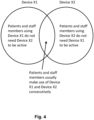
- Fig. 4 shows a Venn diagram of determining whether to update or upgrade two devices 120 simultaneously or consecutively.
- a device X 1 interacting with device X 2 we propose to make use of the historical data of the hospital's databases to see how often device X 1 and device X 2 work together. This minimizes the risk of causing a major issue by having both devices down due to malfunctioning and/or unplanned maintenance tasks.
- devices X 1 and X 2 can have a stronger interdependency link (intersection area) if, for example, certain procedures imply patients in the need of devices X 1 and X 2 , staff members have the same competence to operate devices X 1 and X 2 , and so forth.
- the GUI 140 is configured to allow a user to visualize the impact of certain decisions. This way, users can simulate and try first, before making actual decisions and plan accordingly. In current practice, many people (from the hospital and from the provider) are involved in making this decision on which devices to update when. Moreover, the current scheduling systems don't take all the variables described and the interdependency issue. Such a GUI 140 can facilitate this communication and decision-making process.
- the cost function under one scenario can be broken down into different elements of that scenario, i.e., costs of letting staff members work more or at other times, costs of delaying patients, etc. These costs should be set.
- considerations can include staff members availability that normally operate device X will have higher associated costs than staff members that don't make use of such devices, patients which need due to their procedure make use of device X will have higher associated costs than patients which don't need such device., and so forth.
- To extract this information of need of device X by either staff members or patient historical data that the hospital held where the device X was in use can be used.
- the system 100 can learn from the usage the planner does of the interactive tool. Per the sliders 142 , which is accessible to the planner through the GUI 140 , the model 130 can learn how much deviation is from the "suggested cost" by the system 100 and the "adjusted cost” that the planner adjusts for a device X. Through time this learning model 130 will become more accurate taking into consideration the degree of adjustment the planner normally does for a given device X.
- a video can display the delta changes between the old and new updates and also show the ease at which the device can be used after the update. This feature can help the hospital to decide the downtime and time required during and after the update.
- a non-transitory storage medium includes any medium for storing or transmitting information in a form readable by a machine (e.g., a computer).
- a machine-readable medium includes read only memory ("ROM”), solid state drive (SSD), flash memory, or other electronic storage medium; a hard disk drive, RAID array, or other magnetic disk storage media; an optical disk or other optical storage media; or so forth.
- the methods illustrated throughout the specification may be implemented as instructions stored on a non-transitory storage medium and read and executed by a computer or other electronic processor.
Landscapes
- Business, Economics & Management (AREA)
- Human Resources & Organizations (AREA)
- Engineering & Computer Science (AREA)
- Strategic Management (AREA)
- Economics (AREA)
- Entrepreneurship & Innovation (AREA)
- General Business, Economics & Management (AREA)
- Educational Administration (AREA)
- Tourism & Hospitality (AREA)
- Marketing (AREA)
- Operations Research (AREA)
- Quality & Reliability (AREA)
- Game Theory and Decision Science (AREA)
- Physics & Mathematics (AREA)
- Development Economics (AREA)
- General Physics & Mathematics (AREA)
- Theoretical Computer Science (AREA)
- Health & Medical Sciences (AREA)
- Biomedical Technology (AREA)
- Epidemiology (AREA)
- General Health & Medical Sciences (AREA)
- Medical Informatics (AREA)
- Primary Health Care (AREA)
- Public Health (AREA)
- Medical Treatment And Welfare Office Work (AREA)
Abstract
In planning an upcoming update or upgrade of a fleet of medical devices, historical workload information are received for medical devices of the fleet. Cost preferences are received for respective costs of the upcoming update or upgrade. Values for the respective costs of the upcoming update or upgrade of the fleet are estimated for different scenarios for performing the upcoming update or upgrade. One or more proposed scenarios are selected for performing the upcoming update or upgrade of the fleet of medical devices based on comparisons of the estimated values for the respective costs with the cost preferences for the respective costs received via the UI. Information is displayed about the selected one or more scenarios for performing the upcoming update or upgrade of the fleet of medical devices including at least indications of the estimated values for the respective costs.
Description
- The following generally relates to the medical device update or upgrade arts, medical imaging device update or upgrade arts, medical device update or upgrade planning arts, and related arts.
- Medical devices such as computed tomography (CT) scanners, magnetic resonance imaging (MRI) scanners, positron emission tomography (PET) scanners, image-guided therapy (IGT) devices, and other medical imaging devices are mechanically complex and highly computerized. As just one example, an MRI scanner may include thousands of systems, subsystems, and individual components, with automated operation of the patient support bed, magnetic field gradient coils, radio frequency (RF) coils, and other hardware, along with software for reconstructing and displaying acquired MRI images. The maintenance of such complex medical devices is often outsourced to the device vendor since hospitals typically do not have the requisite expertise. In addition to maintenance, the vendor party may occasionally offer software or hardware updates or upgrades to improve the capabilities of the medical device, or for another reason such as compliance with new or revised governmental regulations. Scheduling such an update or upgrade can be challenging, as an MRI or other complex medical device commonly handles a heavy workload. The update or upgrade should minimally interfere with that workload.
- Updates and upgrades of medical devices inevitably result in downtime, and such downtime has costs in terms of lost revenue from radiology examinations performed with the medical devices, patient rescheduling costs, and/or so forth. In order to plan updates and upgrades, hospitals need to deal with alternative allocation of patients and staff, often resulting in capacity issues. When updating across the whole fleet of medical devices, this alternative allocation is becoming an even bigger challenge. For hospitals it is not straightforward how to deal with this, and there is an unmet need for systematic adaptive methods for optimization.
- The following discloses certain improvements to overcome these problems and others.
- In one aspect, a system for planning an upcoming update or upgrade of a fleet of medical devices, the system including a hardware processor, a display device, and a non-transitory computer readable medium. The non-transitory computer readable medium stores instructions readable and executable by the hardware processor to: receive historical workload information for medical devices of a fleet of medical devices, the fleet including at least two medical devices; receive, via a user interface (UI) presented on the display device, cost preferences for respective costs of the upcoming update or upgrade of the fleet of medical devices, the respective costs including at least a patient delay cost, a patient rescheduling cost, and a staff overtime cost; estimate values for the respective costs for different scenarios for performing the upcoming update or upgrade of the fleet of medical devices, each scenario specifying a schedule for the upcoming update or upgrade of the fleet of medical devices and resources allocated for the upcoming update or upgrade of the fleet of medical devices, wherein the values estimated for the costs for each scenario are metrics of the impact of performing the upcoming update or upgrade in accordance with the scenario on efficiency of operation of the fleet of medical devices during the upcoming update or upgrade; select one or more proposed scenarios for performing the upcoming update or upgrade of the fleet of medical devices based on comparisons of the estimated values with the cost preferences for the respective costs received via the UI; and display, on the display device, information about the selected one or more scenarios for performing the upcoming update or upgrade of the fleet of medical devices including at least indications of the estimated values for the respective costs.
- In another aspect, in a system as set forth in the immediately preceding paragraph, the instructions are further readable and executable by the hardware processor to: receive, via the UI, a selection of a user-selected scenario from the selected one or more scenarios; and automatically perform at least a portion of the upcoming update or upgrade of the fleet of medical devices in accordance with the user-selected scenario.
- In another aspect, a method is disclosed for planning an upcoming update or upgrade of a fleet of medical devices. The method includes: receiving historical workload information for medical devices of the fleet of medical devices; receiving, via a user interface (UI), cost preferences for respective costs of the upcoming update or upgrade of the fleet of medical devices; estimating values for the respective costs of the upcoming update or upgrade of the fleet of medical devices for different scenarios for performing the upcoming update or upgrade of the fleet of medical devices, each scenario specifying at least a schedule for the upcoming update or upgrade of the fleet of medical devices and whether pairs of medical devices of the fleet are to be updated or upgraded simultaneously or consecutively; selecting one or more proposed scenarios for performing the upcoming update or upgrade of the fleet of medical devices based on comparisons of the estimated values for the respective costs with the cost preferences for the respective costs received via the UI; and outputting, on the UI, information about the selected one or more scenarios for performing the upcoming update or upgrade of the fleet of medical devices including at least indications of the estimated values for the respective costs.
- In another aspect, the method of the immediately preceding paragraph further includes: receiving, via the UI, a selection of a user-selected scenario from the selected one or more scenarios; and automatically performing at least a portion of the upcoming update or upgrade of the fleet of medical devices in accordance with the user-selected scenario.
- In another aspect, a non-transitory computer readable medium stores instructions readable and executable by at least one hardware processor to: receive historical workload information for medical devices of a fleet of medical devices, the fleet including at least two medical devices; receive information on an upcoming update or upgrade of the fleet of medical devices; receive information on resources available for performing the upcoming update or upgrade of the fleet of medical devices; receive, via a user interface (UI), cost preferences for respective costs of the upcoming update or upgrade of the fleet of medical devices; simulate different scenarios performing the upcoming update or upgrade of the fleet of medical devices, each scenario specifying a schedule for the upcoming update or upgrade of the fleet of medical devices and resources allocated for the upcoming update or upgrade of the fleet of medical devices, the simulation of each scenario utilizing the historical workload information for the medical devices of the fleet of medical devices and outputting estimated values for the respective costs of the upcoming update or upgrade of the fleet of medical devices; select one or more proposed scenarios for performing the upcoming update or upgrade of the fleet of medical devices from the simulated different scenarios based on comparisons of the estimated values for the respective costs output by the simulations of the different scenarios with the cost preferences for the respective costs received via the UI; and output, on the UI, information about the selected one or more scenarios for performing the upcoming update or upgrade of the fleet of medical devices including at least indications of the estimated values for the respective costs.
- One advantage resides in planning updates or upgrades for a fleet of medical devices based on an interdependency of the medical devices.
- Another advantage resides in planning updates or upgrades for a fleet of medical devices based on resources and schedules at a medical facility where the medical devices are located.
- Another advantage resides in providing a user interface with slider bars allowing a user to optimize a plan for scheduling updates or upgrades for a fleet of medical devices.
- Another advantage resides in providing an intuitive user interface to ease the task of the fleet manager or updates planner, considering different scenarios where the update of one device can affect the normal operation of other devices.
- Another advantage resides in providing a model to consider relevant costs of downtime of a device due to an upcoming update or upgrade, involving relevant persons in the optimal solution, such as patients, staff member(s) operating such devices or service provider's availability.
- A given embodiment may provide none, one, two, more, or all of the foregoing advantages, and/or may provide other advantages as will become apparent to one of ordinary skill in the art upon reading and understanding the present disclosure.
- The disclosure may take form in various components and arrangements of components, and in various steps and arrangements of steps. The drawings are only for purposes of illustrating the preferred embodiments and are not to be construed as limiting the disclosure.
-
Fig. 1 diagrammatically illustrates an illustrative system for determining an upgrade or update session for servicing a medical device in accordance with the present disclosure. -
Fig. 2 shows exemplary flow chart operations of the system ofFig. 1 . -
Fig. 3 shows another embodiment of the system ofFig. 1 . -
Fig. 4 presents a Venn diagram of a decision made by the system ofFig. 1 . - When updating hardware and/or software of a fleet of medical devices, there will typically be downtime of the medical devices, with consequent delay or rescheduling of patients, lost revenue if medical examinations are outsourced during the downtime, staff overtime costs, and/or so forth. Customers (e.g., hospitals or other medical institutions) can value these factors differently: some customers may prefer to pay staff overtime to reduce patient delays or rescheduling, while other customers may prefer to close the relevant medical department or laboratory entirely to minimize staff costs at the expense of patient delays or rescheduling. Typically, customer preferences are accommodated by way of consultations between the customer and the servicing entity's customer representative. This ad hoc approach can lead to customer dissatisfaction and implementing a nonoptimal upgrade pathway.
- The following discloses a system for planning a fleet update in an automated fashion. The system includes a user interface (typically customer-facing) and a backend optimization module that employs a disclosed total cost estimation for a given upgrade scenario. In use, the customer uses slider bars or other user input dialogs of the user interface to indicate preferences for the various costs, which can include patient delay costs, patient rescheduling costs, and staff overtime costs. The backend optimization also takes into account whether the updates are performed simultaneously or consecutively in computing the overall cost. For example, if a fleet of medical imaging devices including two magnetic resonance imaging (MRI) scanners is being updated, there may be benefits to updating the MRI scanners consecutively as this can keep one MRI scanner available for use throughout the upgrade. Conversely, there may be benefits to updating the MRI scanners simultaneously, such as allowing the MRI department to be shut down entirely during the update thus saving staff costs. In general, it is desired to not shut down the entire fleet of medical devices, but rather to continue medical operations as efficiently as possible during the upgrade, using at least a subset of the medical devices of the fleet while the upgrade is in-progress. Hence, the cost of an upgrade scenario can be a quantification of the impact of the upgrade scenario on processing efficiency of operation of the fleet of medical devices as the upgrade is being performed (e.g., in the background).
- Typically, a fleet upgrade may involve up to a dozen or more medical devices being updated simultaneously. In assessing the costs of simultaneous versus consecutive updating, this can be done for every possible grouping of the (e.g., 12) medical devices, leading to a computationally challenging task. The following provides an optimization algorithm that provides for doing this.
- A further aspect of the illustrative embodiment is to use artificial intelligence (AI) to learn customer preferences for various cohorts or even individual customers. This enables the sliders or other user input dialogs to be initially set to personalized default values which can expedite the fleet update planning process.
- With reference to
Fig. 1 , an illustrative scheduler system orapparatus 100 implemented on aserver computer 111 or the like provides for scheduling an update or upgrade or other maintenance procedure of a fleet of devices 120 (e.g., a medical imaging device - also referred to as a medical device, an imaging device, imaging scanner, and variants thereof) is diagrammatically shown. While four medical devices are shown by way of illustrations inFig. 1 , it will be understood that the fleet ofmedical devices 120 can include one, two, three, illustrative four, five, six, seven, eight, nine, ten, eleven, twelve, or moremedical devices 120, as further examples. By way of some non-limiting illustrative examples, themedical imaging device 120 to be scheduled to undergo service may be a magnetic resonance imaging (MRI) scanner, a computed tomography (CT) scanner, a positron emission tomography (PET) scanner, a gamma camera for performing single photon emission computed tomography (SPECT), an interventional radiology (IR) device, or so forth. (More generally, embodiments of the disclosed scheduler can be applied in conjunction with scheduling of an update or upgrade of any type of complex computerized device, e.g., the approach could be applied to schedule an update or upgrade of a commercial airliner, radiation therapy device, or so forth). As shown inFig. 1 , thescheduler 100 includes, or is accessible by, acustomer device 102 that may for example be a workstation or electronic processing device used by the customer (e.g., a fleet manager, planner, or other representative of the hospital or other medical institution who is the customer receiving the upgrade). Thecustomer device 102 is operated by an employee or other agent of the customer, and may for example be a desktop computer or a portable device such as a notebook computer. As another nonlimiting illustrative example, thecustomer device 102 may be a mobile device such as a cellular telephone (cellphone) or tablet computer. - The
customer device 102 includes adisplay 105, and at least oneuser input device 103 such a mouse, keyboard, or touchscreen. Thecustomer device 102 further includes anelectronic processer 101 and non-transitory storage medium 107 (internal components which are diagrammatically indicated inFig. 1 ). Thenon-transitory storage medium 107 stores instructions which are readable and executable by theelectronic processor 101 for interfacing the customer with the update orupgrade scheduler system 100. Thecustomer device 102 also includes acommunication interface 109 to communicate with the server orprocessing device 111, which implements the computational aspects of the update orupgrade scheduler system 100.Such communication interfaces 109 include, for example, a wired and/or wireless Ethernet interface (e.g., in the case in which thecustomer device 102 is a workstation); or in the case in which thecustomer device 102 is a notebook computer, or other portable device theinterface 109 may be a wireless Wi-Fi or 4G/5G interface or the like for connection to the Internet and/or an intranet. In some embodiments, thecustomer device 102 interfaces with thescheduler system 100 by way of a webpage or the like that is accessed via the Internet and presented on a web browser running on thecustomer device 102. In other embodiments, thecustomer device 102 interfaces with thescheduler system 100 by way of an application program running on the customer device 102 - in this case, the customer may initially download the application program from theserver 111. Some aspects of thescheduler system 100 may also be implemented by cloud processing or other remote processing (that is, theserver computer 111 may be embodied as a cloud-based computing resource comprising a plurality of interconnected servers). In illustrativeFig. 1 , the update or upgradescheduler 100 is implemented and/or owned by the imaging device vendor or leased by the vendor from a cloud computing service provider. - The
vendor device 102 is programmed to interact with the update or upgradescheduler 100 to provide inputs to set up for an upcoming update or upgrade session for themedical device 120. To schedule the update or upgrade session, thescheduler 100 analyzes the received one or more inputs, optionally along with information about the customer, to determine a scenario for performing the upcoming update or upgrade of thefleet 120 of medical devices (for example, including a proposed time for performing the upcoming update or upgrade session, whether medical devices should be updated or upgraded simultaneously or consecutively, and/or so forth). This proposed scenario is output on a user interface (UI) 140 of thevendor device 102. - The
server 111 implementing thescheduler 100 is equipped with non-transitory storage medium 127 (internal components which are diagrammatically indicated inFig. 1 ). While a single server computer is shown, it will be appreciated that the backend 110 may more generally be implemented on a single server computer, or a server cluster, or a cloud computing resource comprising ad hoc-interconnected server computers, or so forth. - With continuing reference to
Fig. 1 , the non-transitory computer readable medium 127 stores amodel 130 configured to analyze cost preferences for respective costs of the upcoming update or upgrade of the fleet of medical devices 12 to estimate the values for the respective costs for the different scenarios for themedical device 120. For example, the customer agent provides inputs via thecustomer device 102 related to customer preferences for the upcoming update or upgrade session, which are received and analyzed by themodel 130. In some embodiments, themodel 130 comprises a Bayesian model. Themodel 130 includes one or more conditions that limit when the update or upgrade session can be performed. These conditions may be different for different customers and may be parameters of the Bayesian orother model 130. While a Bayesian model is employed as anillustrative model 130, other types of models can be used for analyzing the received inputs to determine a proposed time for performing the upcoming update or upgrade session, such as Monte Carlo modeling, a suitably trained artificial neural network (ANN), or so forth. - The
non-transitory storage medium 127 further stores instructions executable by theelectronic processor 113 of thebackend server 111 to perform an update or upgradescheduling method 200 for planning an upcoming update or upgrade of a fleet ofmedical devices 120. In other embodiments, maintenance of hardware, or combined hardware maintenance software updating, sessions may be similarly scheduled. - With continuing reference to
Fig. 1 and further reference toFig. 2 , an illustrative embodiment of the update or upgradescheduling method 200 executable by theelectronic processor 113 is diagrammatically shown as a flowchart. In some examples, thescheduling method 200 may be performed at least in part by cloud processing. - To begin the
method 200, at anoperation 202, historical workload information for medical devices of a fleet ofmedical devices 120 are received at theserver 111, for example from the non-transitory computerreadable medium 127. In some embodiments, information on resources available for performing the upcoming update or upgrade of the fleet ofmedical devices 120 is also received, for example from the non-transitory computerreadable medium 127. - At an
operation 204, theGUI 140 is presented on thedisplay device 150 of thecustomer device 102. TheGUI 140 may, for example, be presented as a webpage displayed in a web browser running on thecustomer device 102, or may be presented by an application program running on thecustomer device 102. Via theGUI 140, the user provides inputs via the user input device(s) 103 indicative of cost preferences for respective costs of the upcoming update or upgrade of the fleet ofmedical devices 120. The respective costs can include for example, at least a patient delay cost, a patient rescheduling cost, a staff overtime cost, and so forth. More generally, the costs are metrics of the impact of the upgrade scenario on processing efficiency of operation of the fleet of medical devices as the update or upgrade is being performed. In this view, the upgrade constitutes a background process that is performed while at least a subset of the medical devices of the fleet continue to be utilized to provide medical care, and the costs are metrics of the impact of the upgrade background process on the efficiency of the fleet of medical devices as they continue operate to provide medical services during the upgrade. To provide the inputs, theGUI 140 displays one or more slider bars 142 for each respective cost of the upcoming update or upgrade of the fleet ofmedical devices 120, and the inputs setting the cost preferences are received as adjustments of the slider bars 120. While slider bars 142 are illustrated, other types of user dialogs are also contemplated, such as providing numerical "minimum" and "maximum" value inputs for various costs. - In some embodiments, default cost preferences can be determined based on cost preferences received via the
GUI 140 for previous updates or upgrades of the fleet ofmedical devices 120 and/or similar fleets ofmedical devices 120. To do so, theGUI 140 can be initialized with the default cost preferences before the user adjusts the slider bars 142. - At an
operation 206, values for the respective costs for different scenarios are estimated for performing the upcoming update or upgrade of the fleet ofmedical devices 120. Each scenario can specify a schedule for the upcoming update or upgrade of the fleet ofmedical devices 120 and resources allocated for the upcoming update or upgrade of the fleet ofmedical devices 120. Each scenario further includes one or more updates for the fleet ofmedical devices 120, patient care workflows, staff schedules, field service engineer schedules, and so forth. The different scenarios differ at least in whether the upcoming update or upgrade is performed simultaneously or consecutively for a pair of medical devices of the fleet ofmedical devices 120. To estimate the values for the respective costs for the different scenarios, themodel 130 is configured to analyze the cost preferences for respective costs of the upcoming update or upgrade of the fleet ofmedical devices 120. The values estimated for the costs for each scenario in theoperation 206 are metrics of the impact of performing the upcoming update or upgrade in accordance with the scenario on efficiency of operation of the fleet of medical devices during the upcoming update or upgrade. - At an
operation 208, one or more proposed scenarios for performing the upcoming update or upgrade of the fleet ofmedical devices 120 are selected based on comparisons of the estimated values with the cost preferences for the respective costs received via theUI 140. - At an
operation 210, information about the selected one or more scenarios for performing the upcoming update or upgrade of the fleet of medical devices are displayed on thedisplay device 105. The displayed information can include, for example, indications of the estimated values for the respective costs. - At an operation 212, a user selects, via the
UI 140, a user-selected scenario from the one or more scenarios for performing the upcoming update or upgrade of the fleet of medical devices that were selected in theoperation 208. The user suitably selects the user-selected scenario based on the information about the one or more (proposed) scenarios displayed in theoperation 210. The upcoming update or upgrade will then be performed in accordance with the user-selected scenario. - In some embodiments, the update or upgrade
scheduling method 200 may be extended to include automated performance of at least a portion of the update or upgrade in accordance with the user-selected scenario selected at the operation 212. To this end, in an optional further operation 214 at least a portion of the update or upgrade is automatically performed in accordance with the user-selected scenario. For example, if a portion or the entirety of the update or upgrade is a software update, then this can be automatically implemented in the operation 214 by pushing the software update from theserver 111 to the appropriatemedical devices 120. In another example, if themedical devices 120 are computed tomography (CT) scanners or positron emission tomography (PET) scanners or the like which employ radiation detectors, and a portion or the entirety of the update or upgrade is a calibration of the radiation detectors, then the operation 214 may entail controlling the CT or PET scanner(s) to acquire calibration data of an imaging phantom, a point radiation source, or an empty scanner (i.e., an air scan or air calibration), and processing the calibration data to generate calibration scaling factors or the like for scaling values output by the detector elements of the radiation detectors. These are merely nonlimiting illustrative examples. - In other embodiments, the update or upgrade may be performed manually, for example if the update or upgrade entails manually performed replacement or addition of physical hardware of the medical device(s).
-
Fig. 3 shows another embodiment of thescheduler system 100. As shown inFig. 3 , thesystem 100 can include one or more databases including afirst database 150 operated by a hospital or medical institution, and stores activity and historical data ofmedical devices 120 which belong to the fleet, staff members who operate the devices availably, patients care flows which make use of the medical device, activity of medical devices from third party providers, and so forth. At least onesecond database 152 is operated by a service provider and stores data related to availability of field service engineers, updates / upgrades needed for medical devices supplied. - The
server 111 is programmed to implement anoptimization module 154 storing a mathematical or statistical model which computes the optimal solution to allocate updates or upgrades for the selecteddevices 120. The optimization module 156 provides initialization costs to calculate the solution based on historical data. - The
model 130 can comprise an artificial intelligence (AI) interaction learning model which learns the user (i.e., fleet manager) behavior of tuning theUI sliders 142 to adapt the recommendation from the optimization model orsolver 154. While learning the behavior over time some user behavior patterns which are not obvious can be captured. - The
user interface 140 can display dashboards or graphs, including for example, dashboards of update or upgrade tasks to be approved to get executed, an interdependency graph of devices which interact most often together, an interdependency graph of staff members which interact mostly with the devices, an interdependency graph of the patients care flows or medical procedures which make use of certain devices, bottlenecks in the scheduling flow, alerts of malfunction of components of medical devices, the sliders 142(or buttons) which the user can tune in to adapt the recommended solution to his / her needs, a simulation environment where the staff member can simulate different scheduling scenarios to assess the overall cost implied in each scenario, and so forth. - In some embodiments, the
optimization module 154 is configured to compute an optimal scheduling solution. The cost functions can be used by theoptimization module 154 to come up with the optimal solution. First, the explanation is focused on the costs involved to update a single device X and later on, the costs involved considering the interdependency of devices X1 and X2. For example, in a cost function for updating device X at time t, there is a cost function C=fx(t) that describes what the costs are of updating (i.e., downtime) device X at time t. This cost function fx(t) is different for different scenarios S, resulting in various cost functions fx,s(t). In one example scenario, one can make the decision to shift or extend working hours of staff, shifting patients that were planned on devices-to-be-updated to similar devices after normal hours, to avoid or limit the patient waiting time and keep normal patient throughput. This can potentially affect, for example, a staff member M1 will be asked to work during the evening instead of the day at costs CM1, a staff member M2 will be asked to work during the evening instead of the day at costs CM2, and so forth. - In another example scenario, one can make the decision to delay certain patients, which were planned on the devices-to-be-updated, to a later point in time, with the cost of risking that patients' symptoms will increase, or resulting in capacity issues later. This affects potentially, for example, a first patient P1 will be delayed to moment tP1 ' with the cost of CP1, a second patient P2 will be delayed to moment tP2 ' with the cost of CP2, and so forth. This can potentially be extended with other variables, such as service provider availability, accessories with devices that become idle as well when device is down, an availability of the system (in terms of patient load, as it is beneficial to schedule updates when the worklist is short or empty), and so forth.
- Thus, the total cost of updating device X under scenario S on moment t is defined by ΣM,PfX,S (t), that is the summed costs of all the stakeholders (M, P, and perhaps more) involved.
- In deciding upon or creating a certain scenario, there must be certain constraints in place. For example, the number of operators is related to the number of active devices (to make sure they are all `operational'), and there might also be boundaries to the length of the shifts or reasonable timeslots to ask patients to come to the hospital.
- In addition, costs of not updating device X can be considered. For example, by using predictive maintenance models we can estimate the probability that the device or components of the device will break down when not updated, which is likely to increase over time (similar to a depreciation cost). In another example, when new features are released and hospitals decide to not update and keep working with the old version, a cost element that represents inefficiency can be included to compare the use of the new versus the old version.
- When one needs to decide when to update a device (i.e., set t) and how to deal with the scheduling (i.e., set S), one wants to choose that t and S that minimizes the total costs. Thus, a cost function to do so can include

- For multiple devices, that is X1, X2, X3, etc., the
optimization module 154 can decide to update all or some devices together, in parallel, or after each other, consecutive. For example, theoptimization module 154 can decide which subset of the fleet, x ∈ X, we update together at time t. The cost function of one device X1 changes depending on whether another device X2 should be updated. That is, the cost of updating one device depends on whether patients and staff can be allocated to other similar devices that are not down. This implies that the decisions to update multiple devices are independent, and the cost functions are not additive, resulting in a cost function of total costs ≠ ΣP,Mf X1 ,S' (t') + Σ P,Mf X2 ,S' (t'). Table 1 shows a summary of considerations in deciding whether to update twodevices 120 together or separately.Table 1 Updating device X1 Not updating device X1 Updating device X2 Updating both devices together can have advantages: total costs < ΣP,Mf X 1 ,S' (t') + ΣP,Mf X2 ,S' (t'), for example in the case where you have 2 operators, and 1 secretary. When 1 operator is still working, the secretary also needs to be on duty, whereas when both are not operating, the whole 'department' can be down for some time, saving costs of, e.g., the secretary.For the benefits: see the drawbacks of updating them together in the top left cell. Updating both devices together can also have drawbacks: total costs > ΣP,Mf X 1 ,S' (t') + Σ P,Mf X2 ,S' (t'), for example when you want to allocate patients to alternative devices, to maintain the patient throughput as much as possible.Not updating device X2 For the benefits: see the drawbacks of updating them together in the top left cell. - Ultimately the impact of updating multiple devices together is a combination of advantages and drawbacks, that all should be taken into consideration. Then, when the total costs of updating together are lower than the additive costs of updating them separately (total costs < ΣP,Mf X
1 ,S' (t') + ΣP,Mf X2 ,S'(t'), one should update them together, if not, one should update them separately. - However, the above reasoning all implies to a given S and t. Of course, one should decide upon S and t first. This can be done given the total cost function, including the dependencies (i.e., knowing the cost function of updating X1 when X2 is not updated as well as when X2 is also updated, and extending this to the whole fleet). This total cost function most likely has local minima, so when minimizing one should use a global optimization approach, such as cutting-plane methods or branch and bound methods, or reinforcement learning. S and t should be selected such that the total costs are minimal, and from that also follows which devices are updated simultaneously.
-
Fig. 4 shows a Venn diagram of determining whether to update or upgrade twodevices 120 simultaneously or consecutively. To better consider the interdependency of a device X1 interacting with device X2 we propose to make use of the historical data of the hospital's databases to see how often device X1 and device X2 work together. This minimizes the risk of causing a major issue by having both devices down due to malfunctioning and/or unplanned maintenance tasks. For example, devices X1 and X2 can have a stronger interdependency link (intersection area) if, for example, certain procedures imply patients in the need of devices X1 and X2, staff members have the same competence to operate devices X1 and X2, and so forth. Different data sources such as procedure historical data (to see which devices are needed) or skills matrix data (staff competence vs devices he/she operates frequently). In any non-intersecting situation both devices X1 and X2 could be updated together (even in parallel) without creating major issues due to downtime. - The
GUI 140 is configured to allow a user to visualize the impact of certain decisions. This way, users can simulate and try first, before making actual decisions and plan accordingly. In current practice, many people (from the hospital and from the provider) are involved in making this decision on which devices to update when. Moreover, the current scheduling systems don't take all the variables described and the interdependency issue. Such aGUI 140 can facilitate this communication and decision-making process. - The cost function under one scenario can be broken down into different elements of that scenario, i.e., costs of letting staff members work more or at other times, costs of delaying patients, etc. These costs should be set. To initialize the costs, for a device X, considerations can include staff members availability that normally operate device X will have higher associated costs than staff members that don't make use of such devices, patients which need due to their procedure make use of device X will have higher associated costs than patients which don't need such device., and so forth. To extract this information of need of device X by either staff members or patient historical data that the hospital held where the device X was in use can be used.
- Afterwards, the
system 100 can learn from the usage the planner does of the interactive tool. Per thesliders 142, which is accessible to the planner through theGUI 140, themodel 130 can learn how much deviation is from the "suggested cost" by thesystem 100 and the "adjusted cost" that the planner adjusts for a device X. Through time thislearning model 130 will become more accurate taking into consideration the degree of adjustment the planner normally does for a given device X. Other factors to consider in the cost initialization are, for example, some staff members are more flexibly deployable compared to others, for example because they have a broader set of skills and can also be allocated to other machines or tasks, some staff members might have a longer 'backlog' of tasks that they can do alternatively, when not operating, for example following e-learning courses, documentation tasks, or supervising colleagues, some staff members might deal easier with changes in their schedule than others, for example because they have less commute time to work, a more flexible situation at home, etc., some patients have more severe health issues than others and this should be prioritized to make use of the device to get updated, and so forth. - In some embodiments, a video can display the delta changes between the old and new updates and also show the ease at which the device can be used after the update. This feature can help the hospital to decide the downtime and time required during and after the update.
- A non-transitory storage medium includes any medium for storing or transmitting information in a form readable by a machine (e.g., a computer). For instance, a machine-readable medium includes read only memory ("ROM"), solid state drive (SSD), flash memory, or other electronic storage medium; a hard disk drive, RAID array, or other magnetic disk storage media; an optical disk or other optical storage media; or so forth.
- The methods illustrated throughout the specification, may be implemented as instructions stored on a non-transitory storage medium and read and executed by a computer or other electronic processor.
- The disclosure has been described with reference to the preferred embodiments. Modifications and alterations may occur to others upon reading and understanding the preceding detailed description. It is intended that the exemplary embodiment be construed as including all such modifications and alterations insofar as they come within the scope of the appended claims or the equivalents thereof.
Claims (15)
- A system (100) for planning an upcoming update or upgrade of a fleet of medical devices (120), the system comprisinga hardware processor (101, 113);a display device (105); anda non-transitory computer readable medium (107, 127) storing instructions readable and executable by the hardware processor to:receive historical workload information for medical devices of a fleet of medical devices (120), the fleet including at least two medical devices;
receive, via a user interface (UI) (140) presented on the display device, cost preferences for respective costs of the upcoming update or upgrade of the fleet of medical devices;estimate values for the respective costs for different scenarios for performing the upcoming update or upgrade of the fleet of medical devices, each scenario specifying a schedule for the upcoming update or upgrade of the fleet of medical devices and resources allocated for the upcoming update or upgrade of the fleet of medical devices, wherein the values estimated for the costs for each scenario are metrics of the impact of performing the upcoming update or upgrade in accordance with the scenario on efficiency of operation of the fleet of medical devices during the upcoming update or upgrade;select one or more proposed scenarios for performing the upcoming update or upgrade of the fleet of medical devices based on comparisons of the estimated values with the cost preferences for the respective costs received via the UI; and
display, on the display device, information about the selected one or more scenarios for performing the upcoming update or upgrade of the fleet of medical devices including at least indications of the estimated values for the respective costs. - The system (100) of claim 1, wherein the instructions further include:receiving information on resources available for performing the upcoming update or upgrade of the fleet of medical devices (120);wherein each scenario further specifies resources allocated for the upcoming update or upgrade of the fleet of medical devices.
- The system (100) of either one of claims 1 and 2, wherein the different scenarios differ at least in whether the upcoming update or upgrade is performed simultaneously or consecutively for a pair of medical devices of the fleet of medical devices.
- The system (XX) of any one of claims 1-3, wherein the UI (140) displays a slider bar (142) for each respective cost of the upcoming update or upgrade of the fleet of medical devices and the inputs setting the cost preferences are received as adjustments of the slider bars.
- The system (100) of any one of claims 1-4, wherein the instructions are further readable and executable by the hardware processor to:receive, via the UI (140), a selection of a user-selected scenario from the selected one or more scenarios; andautomatically perform at least a portion of the upcoming update or upgrade of the fleet of medical devices (120) in accordance with the user-selected scenario.
- The system (100) of any one of claims 1-5, further storing a model (130) configured to analyze the cost preferences for respective costs of the upcoming update or upgrade of the fleet of medical devices to estimate the values for the respective costs for the different scenarios.
- The system (100) of any one of claims 1-6, wherein each scenario further includes one or more of updates for the fleet of medical devices (120), patient care workflows, staff schedules, and field service engineer schedules.
- A method (200) for planning an upcoming update or upgrade of a fleet of medical devices (120), the method comprising:receiving historical workload information for medical devices of the fleet of medical devices (120);
receiving, via a user interface (UI) (140), cost preferences for respective costs of the upcoming update or upgrade of the fleet of medical devices;estimating values for the respective costs of the upcoming update or upgrade of the fleet of medical devices for different scenarios for performing the upcoming update or upgrade of the fleet of medical devices, each scenario specifying at least a schedule for the upcoming update or upgrade of the fleet of medical devices and whether pairs of medical devices of the fleet are to be updated or upgraded simultaneously or consecutively;selecting one or more proposed scenarios for performing the upcoming update or upgrade of the fleet of medical devices based on comparisons of the estimated values for the respective costs with the cost preferences for the respective costs received via the UI; and
outputting, on the UI, information about the selected one or more scenarios for performing the upcoming update or upgrade of the fleet of medical devices including at least indications of the estimated values for the respective costs. - The method (100) of claim 8, further comprising:receiving information on resources available for performing the upcoming update or upgrade of the fleet of medical devices;wherein each scenario further specifies resources allocated for the upcoming update or upgrade of the fleet of medical devices.
- The method (100) of either one of claims 8 and 9, wherein the respective costs include at least a patient delay cost, a patient rescheduling cost, and a staff overtime cost, and the values estimated for the costs for each scenario are metrics of the impact of performing the upcoming update or upgrade in accordance with the scenario on efficiency of operation of the fleet of medical devices during the upcoming update or upgrade.
- The method (100) of any one of claims 8-10, wherein the UI (140) displays a slider bar (142) for each respective cost of the upcoming update or upgrade of the fleet of medical devices and the inputs setting the cost preferences are received as adjustments of the slider bars.
- The method (100) of any one of claims 8-11, further including:determining default cost preferences based on cost preferences received via the UI (140) for previous updates or upgrades of the fleet of medical devices and/or similar fleets of medical devices; andprior to receiving the cost preferences via the UI, initializing the UI with the default cost preferences.
- The method (100) of any one of claims 8-12, further including:
with a model (130), analyzing the cost preferences for respective costs of the upcoming update or upgrade of the fleet of medical devices to estimate the values for the respective costs for the different scenarios. - The method (100) of any one of claims 8-13, further comprising:receiving, via the UI (140), a selection of a user-selected scenario from the selected one or more scenarios; andautomatically performing at least a portion of the upcoming update or upgrade of the fleet of medical devices (120) in accordance with the user-selected scenario.
- A non-transitory computer readable medium (107, 127) storing instructions readable and executable by at least one hardware processor (101, 113) to:receive historical workload information for medical devices of a fleet of medical devices (120), the fleet including at least two medical devices;receive information on an upcoming update or upgrade of the fleet of medical devices;receive information on resources available for performing the upcoming update or upgrade of the fleet of medical devices;
receive, via a user interface (UI) (140), cost preferences for respective costs of the upcoming update or upgrade of the fleet of medical devices;simulate different scenarios performing the upcoming update or upgrade of the fleet of medical devices, each scenario specifying a schedule for the upcoming update or upgrade of the fleet of medical devices and resources allocated for the upcoming update or upgrade of the fleet of medical devices, the simulation of each scenario utilizing the historical workload information for the medical devices of the fleet of medical devices and outputting estimated values for the respective costs of the upcoming update or upgrade of the fleet of medical devices;select one or more proposed scenarios for performing the upcoming update or upgrade of the fleet of medical devices from the simulated different scenarios based on comparisons of the estimated values for the respective costs output by the simulations of the different scenarios with the cost preferences for the respective costs received via the UI; and
output, on the UI, information about the selected one or more scenarios for performing the upcoming update or upgrade of the fleet of medical devices including at least indications of the estimated values for the respective costs.
Priority Applications (1)
| Application Number | Priority Date | Filing Date | Title |
|---|---|---|---|
| PCT/EP2024/079100 WO2025083004A1 (en) | 2023-10-20 | 2024-10-16 | Planning updates for an interdependent fleet of medical devices |
Applications Claiming Priority (1)
| Application Number | Priority Date | Filing Date | Title |
|---|---|---|---|
| US202363591771P | 2023-10-20 | 2023-10-20 |
Publications (1)
| Publication Number | Publication Date |
|---|---|
| EP4542566A1 true EP4542566A1 (en) | 2025-04-23 |
Family
ID=88731515
Family Applications (1)
| Application Number | Title | Priority Date | Filing Date |
|---|---|---|---|
| EP23208229.7A Withdrawn EP4542566A1 (en) | 2023-10-20 | 2023-11-07 | Planning updates for an interdependent fleet of medical devices |
Country Status (1)
| Country | Link |
|---|---|
| EP (1) | EP4542566A1 (en) |
Citations (4)
| Publication number | Priority date | Publication date | Assignee | Title |
|---|---|---|---|---|
| US20210056575A1 (en) * | 2019-08-21 | 2021-02-25 | EquipX, LLC | System and method for evaluating medical equipment |
| US20210134447A1 (en) * | 2019-08-21 | 2021-05-06 | EquipX, LLC | Decision support engine for medical equipment |
| US20220051184A1 (en) * | 2019-11-05 | 2022-02-17 | Strong Force Vcn Portfolio 2019, Llc | Digital twin for control tower and enterprise management platform managing packaging design |
| WO2023046576A1 (en) * | 2021-09-23 | 2023-03-30 | Koninklijke Philips N.V. | Systems and methods for maintenance services |
-
2023
- 2023-11-07 EP EP23208229.7A patent/EP4542566A1/en not_active Withdrawn
Patent Citations (4)
| Publication number | Priority date | Publication date | Assignee | Title |
|---|---|---|---|---|
| US20210056575A1 (en) * | 2019-08-21 | 2021-02-25 | EquipX, LLC | System and method for evaluating medical equipment |
| US20210134447A1 (en) * | 2019-08-21 | 2021-05-06 | EquipX, LLC | Decision support engine for medical equipment |
| US20220051184A1 (en) * | 2019-11-05 | 2022-02-17 | Strong Force Vcn Portfolio 2019, Llc | Digital twin for control tower and enterprise management platform managing packaging design |
| WO2023046576A1 (en) * | 2021-09-23 | 2023-03-30 | Koninklijke Philips N.V. | Systems and methods for maintenance services |
Non-Patent Citations (1)
| Title |
|---|
| GURBETA LEJLA ET AL: "Inspection process of medical devices in healthcare institutions: software solution", HEALTH AND TECHNOLOGY, SPRINGER BERLIN HEIDELBERG, BERLIN/HEIDELBERG, vol. 7, no. 1, 7 December 2016 (2016-12-07), pages 109 - 117, XP036179239, ISSN: 2190-7188, [retrieved on 20161207], DOI: 10.1007/S12553-016-0154-2 * |
Similar Documents
| Publication | Publication Date | Title |
|---|---|---|
| US11031124B2 (en) | Optimizing state transition set points for schedule risk management | |
| Pérez et al. | Stochastic online appointment scheduling of multi-step sequential procedures in nuclear medicine | |
| US20160253463A1 (en) | Simulation-based systems and methods to help healthcare consultants and hospital administrators determine an optimal human resource plan for a hospital | |
| Werker et al. | The use of discrete-event simulation modelling to improve radiation therapy planning processes | |
| US20140108034A1 (en) | Continuous automated healthcare enterprise resource assignment system and method | |
| US20140108035A1 (en) | System and method to automatically assign resources in a network of healthcare enterprises | |
| US20190080785A1 (en) | Methods of forecasting enrollment rate in clinical trial | |
| US12068069B1 (en) | Systems and methods for processing real-time and historical data and generating nursing unit health scores | |
| US20180315502A1 (en) | Method and apparatus for optimization and simulation of patient flow | |
| Pérez et al. | Modeling and simulation of nuclear medicine patient service management in DEVS | |
| US20150294071A1 (en) | Method and computer program for resource scheduling | |
| White et al. | Ice‐breaker vs. standalone: Comparing alternative workflow modes of mid‐level care providers | |
| Liu et al. | Bridging the nursing gap: How virtual nurse adoption impacts patient outcomes | |
| EP4542566A1 (en) | Planning updates for an interdependent fleet of medical devices | |
| US20230005605A1 (en) | Internal benchmarking of current operational workflow performances of a hospital department | |
| WO2025087710A1 (en) | Systems and methods to predict optimal period to communicate on updates, additional customer service and maintenance tasks of medical devices | |
| US20250093845A1 (en) | Systems for controlling design and manufacturing process for user specific devices | |
| WO2025083004A9 (en) | Planning updates for an interdependent fleet of medical devices | |
| WO2025179010A1 (en) | Systems and methods for optimal operating room scheduling under uncertainty | |
| Shetty et al. | Intraday dynamic rescheduling under patient no-shows | |
| US20220157444A1 (en) | Scheduling diagnostic tests for on-site repair of medical devices | |
| US20250095849A1 (en) | System and method for optimizing operations of a radiology service using ai powered gamification | |
| Suo et al. | A Scalable Methodology for Optimizing Hospital Surgical Schedules Considering Efficiency, Flexibility, and Improved Patient Outcomes | |
| EP4232877B1 (en) | Multi-criteria fair queueing of alerts | |
| US20180315508A1 (en) | Methods and apparatus for dynamic event driven simulations |
Legal Events
| Date | Code | Title | Description |
|---|---|---|---|
| PUAI | Public reference made under article 153(3) epc to a published international application that has entered the european phase |
Free format text: ORIGINAL CODE: 0009012 |
|
| STAA | Information on the status of an ep patent application or granted ep patent |
Free format text: STATUS: THE APPLICATION HAS BEEN PUBLISHED |
|
| AK | Designated contracting states |
Kind code of ref document: A1 Designated state(s): AL AT BE BG CH CY CZ DE DK EE ES FI FR GB GR HR HU IE IS IT LI LT LU LV MC ME MK MT NL NO PL PT RO RS SE SI SK SM TR |
|
| STAA | Information on the status of an ep patent application or granted ep patent |
Free format text: STATUS: THE APPLICATION IS DEEMED TO BE WITHDRAWN |
|
| 18D | Application deemed to be withdrawn |
Effective date: 20251024 |