EP4542545A1 - System and method for audio limiting in call downlink algorithm - Google Patents
System and method for audio limiting in call downlink algorithm Download PDFInfo
- Publication number
- EP4542545A1 EP4542545A1 EP24204199.4A EP24204199A EP4542545A1 EP 4542545 A1 EP4542545 A1 EP 4542545A1 EP 24204199 A EP24204199 A EP 24204199A EP 4542545 A1 EP4542545 A1 EP 4542545A1
- Authority
- EP
- European Patent Office
- Prior art keywords
- audio frame
- current
- volume
- audio
- far
- Prior art date
- Legal status (The legal status is an assumption and is not a legal conclusion. Google has not performed a legal analysis and makes no representation as to the accuracy of the status listed.)
- Pending
Links
Images

Classifications
-
- G—PHYSICS
- G10—MUSICAL INSTRUMENTS; ACOUSTICS
- G10L—SPEECH ANALYSIS TECHNIQUES OR SPEECH SYNTHESIS; SPEECH RECOGNITION; SPEECH OR VOICE PROCESSING TECHNIQUES; SPEECH OR AUDIO CODING OR DECODING
- G10L21/00—Speech or voice signal processing techniques to produce another audible or non-audible signal, e.g. visual or tactile, in order to modify its quality or its intelligibility
- G10L21/02—Speech enhancement, e.g. noise reduction or echo cancellation
- G10L21/0316—Speech enhancement, e.g. noise reduction or echo cancellation by changing the amplitude
-
- G—PHYSICS
- G10—MUSICAL INSTRUMENTS; ACOUSTICS
- G10L—SPEECH ANALYSIS TECHNIQUES OR SPEECH SYNTHESIS; SPEECH RECOGNITION; SPEECH OR VOICE PROCESSING TECHNIQUES; SPEECH OR AUDIO CODING OR DECODING
- G10L21/00—Speech or voice signal processing techniques to produce another audible or non-audible signal, e.g. visual or tactile, in order to modify its quality or its intelligibility
- G10L21/02—Speech enhancement, e.g. noise reduction or echo cancellation
- G10L21/0316—Speech enhancement, e.g. noise reduction or echo cancellation by changing the amplitude
- G10L21/0364—Speech enhancement, e.g. noise reduction or echo cancellation by changing the amplitude for improving intelligibility
-
- H—ELECTRICITY
- H04—ELECTRIC COMMUNICATION TECHNIQUE
- H04R—LOUDSPEAKERS, MICROPHONES, GRAMOPHONE PICK-UPS OR LIKE ACOUSTIC ELECTROMECHANICAL TRANSDUCERS; ELECTRIC HEARING AIDS; PUBLIC ADDRESS SYSTEMS
- H04R1/00—Details of transducers, loudspeakers or microphones
- H04R1/10—Earpieces; Attachments therefor ; Earphones; Monophonic headphones
- H04R1/1083—Reduction of ambient noise
-
- G—PHYSICS
- G10—MUSICAL INSTRUMENTS; ACOUSTICS
- G10L—SPEECH ANALYSIS TECHNIQUES OR SPEECH SYNTHESIS; SPEECH RECOGNITION; SPEECH OR VOICE PROCESSING TECHNIQUES; SPEECH OR AUDIO CODING OR DECODING
- G10L21/00—Speech or voice signal processing techniques to produce another audible or non-audible signal, e.g. visual or tactile, in order to modify its quality or its intelligibility
- G10L21/02—Speech enhancement, e.g. noise reduction or echo cancellation
- G10L21/0316—Speech enhancement, e.g. noise reduction or echo cancellation by changing the amplitude
- G10L21/0324—Details of processing therefor
- G10L21/034—Automatic adjustment
-
- G—PHYSICS
- G10—MUSICAL INSTRUMENTS; ACOUSTICS
- G10L—SPEECH ANALYSIS TECHNIQUES OR SPEECH SYNTHESIS; SPEECH RECOGNITION; SPEECH OR VOICE PROCESSING TECHNIQUES; SPEECH OR AUDIO CODING OR DECODING
- G10L25/00—Speech or voice analysis techniques not restricted to a single one of groups G10L15/00 - G10L21/00
- G10L25/78—Detection of presence or absence of voice signals
- G10L25/84—Detection of presence or absence of voice signals for discriminating voice from noise
-
- H—ELECTRICITY
- H03—ELECTRONIC CIRCUITRY
- H03G—CONTROL OF AMPLIFICATION
- H03G3/00—Gain control in amplifiers or frequency changers
- H03G3/20—Automatic control
- H03G3/30—Automatic control in amplifiers having semiconductor devices
- H03G3/32—Automatic control in amplifiers having semiconductor devices the control being dependent upon ambient noise level or sound level
-
- H—ELECTRICITY
- H04—ELECTRIC COMMUNICATION TECHNIQUE
- H04M—TELEPHONIC COMMUNICATION
- H04M1/00—Substation equipment, e.g. for use by subscribers
- H04M1/60—Substation equipment, e.g. for use by subscribers including speech amplifiers
- H04M1/6016—Substation equipment, e.g. for use by subscribers including speech amplifiers in the receiver circuit
-
- H—ELECTRICITY
- H04—ELECTRIC COMMUNICATION TECHNIQUE
- H04M—TELEPHONIC COMMUNICATION
- H04M9/00—Arrangements for interconnection not involving centralised switching
- H04M9/08—Two-way loud-speaking telephone systems with means for conditioning the signal, e.g. for suppressing echoes for one or both directions of traffic
- H04M9/085—Two-way loud-speaking telephone systems with means for conditioning the signal, e.g. for suppressing echoes for one or both directions of traffic using digital techniques
-
- H—ELECTRICITY
- H04—ELECTRIC COMMUNICATION TECHNIQUE
- H04R—LOUDSPEAKERS, MICROPHONES, GRAMOPHONE PICK-UPS OR LIKE ACOUSTIC ELECTROMECHANICAL TRANSDUCERS; ELECTRIC HEARING AIDS; PUBLIC ADDRESS SYSTEMS
- H04R3/00—Circuits for transducers
-
- G—PHYSICS
- G10—MUSICAL INSTRUMENTS; ACOUSTICS
- G10L—SPEECH ANALYSIS TECHNIQUES OR SPEECH SYNTHESIS; SPEECH RECOGNITION; SPEECH OR VOICE PROCESSING TECHNIQUES; SPEECH OR AUDIO CODING OR DECODING
- G10L25/00—Speech or voice analysis techniques not restricted to a single one of groups G10L15/00 - G10L21/00
- G10L25/78—Detection of presence or absence of voice signals
- G10L2025/783—Detection of presence or absence of voice signals based on threshold decision
-
- G—PHYSICS
- G10—MUSICAL INSTRUMENTS; ACOUSTICS
- G10L—SPEECH ANALYSIS TECHNIQUES OR SPEECH SYNTHESIS; SPEECH RECOGNITION; SPEECH OR VOICE PROCESSING TECHNIQUES; SPEECH OR AUDIO CODING OR DECODING
- G10L25/00—Speech or voice analysis techniques not restricted to a single one of groups G10L15/00 - G10L21/00
- G10L25/78—Detection of presence or absence of voice signals
-
- H—ELECTRICITY
- H04—ELECTRIC COMMUNICATION TECHNIQUE
- H04M—TELEPHONIC COMMUNICATION
- H04M2201/00—Electronic components, circuits, software, systems or apparatus used in telephone systems
- H04M2201/40—Electronic components, circuits, software, systems or apparatus used in telephone systems using speech recognition
-
- H—ELECTRICITY
- H04—ELECTRIC COMMUNICATION TECHNIQUE
- H04R—LOUDSPEAKERS, MICROPHONES, GRAMOPHONE PICK-UPS OR LIKE ACOUSTIC ELECTROMECHANICAL TRANSDUCERS; ELECTRIC HEARING AIDS; PUBLIC ADDRESS SYSTEMS
- H04R2201/00—Details of transducers, loudspeakers or microphones covered by H04R1/00 but not provided for in any of its subgroups
- H04R2201/10—Details of earpieces, attachments therefor, earphones or monophonic headphones covered by H04R1/10 but not provided for in any of its subgroups
-
- H—ELECTRICITY
- H04—ELECTRIC COMMUNICATION TECHNIQUE
- H04R—LOUDSPEAKERS, MICROPHONES, GRAMOPHONE PICK-UPS OR LIKE ACOUSTIC ELECTROMECHANICAL TRANSDUCERS; ELECTRIC HEARING AIDS; PUBLIC ADDRESS SYSTEMS
- H04R2430/00—Signal processing covered by H04R, not provided for in its groups
-
- H—ELECTRICITY
- H04—ELECTRIC COMMUNICATION TECHNIQUE
- H04R—LOUDSPEAKERS, MICROPHONES, GRAMOPHONE PICK-UPS OR LIKE ACOUSTIC ELECTROMECHANICAL TRANSDUCERS; ELECTRIC HEARING AIDS; PUBLIC ADDRESS SYSTEMS
- H04R2430/00—Signal processing covered by H04R, not provided for in its groups
- H04R2430/01—Aspects of volume control, not necessarily automatic, in sound systems
Definitions
- the present inventive subject relates generally to audio processing, and particularly to a system and a method for audio limiting in a downlink algorithm.
- earphones to make phone calls has become a common practice in daily life.
- a near-end earphone user is generally unable to control the behavior of a far-end user.
- the far-end user may be too far away from the phone or microphone, so that it is difficult for the near-end earphone user to hear the other person clearly.
- a person at the far end may suddenly speak loudly, which causes a sudden surge in the volume of the near-end earphone, resulting in a poor experience at the near-end earphone user side.
- an audio limiter device which necessarily maintains a consistent volume for a near-end earphone user, no matter how soft or loud a far-end person speaks.
- a method for audio limiting in a call downlink includes receiving far-end sound from a far-end device through an audio limiting module configured at a near-end device, and performing voice activity detection and adjusting a current volume for each audio frame of a plurality of audio frames in the received far-end sound.
- the method further includes playing far-end sound with the adjusted volume through a speaker of the near-end device.
- the step of adjusting the current volume in the method further includes calculating a difference between the current volume and a target volume and regarding it as a gain, and applying the gain to a current audio frame.
- a system for audio limiting in a call downlink includes an audio limiting module, which is configured to receive far-end sound from a far-end device at a near-end device, and perform voice activity detection and adjust a current volume for each audio frame of a plurality of audio frames in the received far-end sound.
- the system further includes a speaker in the near-end device, and the speaker is configured to play far-end sound with the adjusted volume in the near-end device.
- Adjusting the current volume in the system further includes calculating a difference between the current volume and a target volume and regarding it as a gain, and applying the gain to a current audio frame.
- the audio limiting system and method provided by the present inventive subject only play a role in the detected speech part, and can perform noise suppression on the non-speech part at the same time.
- a user needs to control, through a button on the product (for example, on a mobile phone or an earphone), the volume of the other speaking person heard in a call.
- a button on the product for example, on a mobile phone or an earphone
- the other person may whisper, which makes it difficult to hear.
- the volume must be turned up by pressing the button.
- it is necessary to maintain a consistent volume for the user using the earphone at the near end.
- the present inventive subject specifically introduces an audio limiter technique in a call downlink algorithm for the design of a near-end device, such as an earphone.
- an audio limiting method is adopted in the downlink of the call algorithm to adaptively limit the audio.
- the downlink refers to enabling the person at the near end to hear the voice of the other person at the far end, and the method for audio limiting provided by the present inventive subject only acts on the detected speech part.
- the speech part is processed differently according to the volume, the volume higher than a target volume is suppressed, and the volume lower than the target volume is increased.
- an upper threshold for the gain can limit the maximum gain, and avoid the background noise of the speech segment being excessively amplified, thereby improving the user experience.
- the caller can free his/her hands and the earphone can adaptively keep the listening volume at an appropriate level. At the same time, it can also suppress noise when there is no speech transmission (that is, no speech is detected).
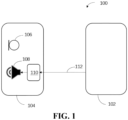
- FIG. 1 shows a schematic diagram 100 of a system for audio limiting in a call downlink according to one or more embodiments of the present inventive subject.
- a far-end device 102 may be, for example, a mobile phone or a telephone, and a near-end device 104 may be connected to the far-end device 102 in a wireless manner.
- the near-end device 104 is an earphone, such as a headphone including a microphone 106 and a speaker 108.
- the headphone may include, but is not limited to, a Bluetooth headset. As can be seen from FIG.
- a module 110 for audio limiting is added to the last portion of the downlink, and the module can be used to adaptively adjust the volume of the far-end sound 112 to a target volume, regardless of whether the far-end volume is large or small.
- the voice of the other person heard by the earphone user at the near end can be controlled to keep at the target volume level.
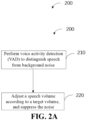
- FIG. 2A shows a step 200 of a method for audio limiting in a call downlink according to one or more embodiments of the present inventive subject.
- the method for audio limiting in a call downlink audio limiter is mainly divided into two parts: voice activity detection (VAD) and applying a gain to adjust the volume.
- VAD voice activity detection
- the near-end device first performs voice activity detection in step S210 after receiving sound from the far-end device, for distinguishing between a speech segment and a pure noise segment contained in received voice segments in an earphone.
- the near-end earphone it only intends to adjust the volume when there is a speech, and therefore, the speech segment is first distinguished from the pure noise segment.
- step S220 the volume of the speech heard can be adjusted according to the target volume by the distinguishing result of the voice activity detection. Noise can be suppressed when there is no speech.
- the volume-adjusted speech can be delivered to the user through a speaker in the near-end device.
- FIG. 2B shows an algorithm flow chart 230 of a method for audio limiting in a call downlink according to one or more embodiments of the present inventive subject.
- the downlink means that the near-end device receives audio data, that is, the audio data is transmitted from the far-end device to the near-end device. It will be appreciate by those skilled in the art that before reaching the audio limiter, the downlink audio data is decoded by an audio decoder to obtain an audio digital signal ready for processing, and that the processing process into the audio limiter module is performed in a time-frequency domain.
- the SNR threshold can be obtained through acoustic data actually collected by simulation in an implementation process of a specific project.
- the predetermine threshold is, for example, 15 dB. It should be noted that for the setting of the SNR threshold, the voice should be not determined as noise as much as possible, thereby avoiding effective voice from being incorrectly amplified or compressed.
- a current volume is obtained.
- the current volume is acquired as a maximum absolute value of the audio frame volume in a block 260.
- the volume of the frame takes the maximum amplitude of all audio samples in the frame.
- a speech sampling rate is 16 kHz
- the number of sampling bits is 16 bits.
- Each audio frame selects an audio length of 16 ms for processing, corresponding to 256 sampling points, and selects the maximum value among amplitudes of the 256 samples as the current volume of the frame.
- the current volume is acquired as an average value of maximum absolute values of the volume of several speech presence frames before the audio frame.
- the average value of the maximum absolute values of amplitudes obtained per frame for several previous speech presence frames saved in a buffer is regarded as the current volume.
- the average value of the maximum absolute values of amplitudes obtained per frame for 128 speech presence frames saved in the buffer is regarded as the current volume.
- a gain of adjusting the current volume to the target volume is calculated.
- the value of the target volume may be experience-based, which may be an adjustable range of target values.
- a difference between the current volume and the target volume may be calculated.
- the difference is regarded as the gain to adjust the current volume to the target volume.
- the gain should be limited in a certain range, for example, in a range having an upper threshold and a lower threshold. For example, it should be ensured that the voice heard can be prevented from being amplified too much.
- the gain value can further be smoothed. For example, the gain is smoothed sample by sample in the frame range, so as to prevent the excessive fluctuation of the gain value from introducing abnormal noise.
- the volume difference is compensated in the near-end earphone sample by sample in the frame.
- the algorithm of the audio limiter may be as follows:
- the audio limiting system and method provided by the present inventive subject take different processing strategies according to whether a speech is detected or not, amplify or compress the speech to the target volume according to the current speech amplitude when the speech is detected, and suppress the detected pure noise segment. If the speech volume is too small, the upper threshold for the gain can limit the maximum gain, and avoid the background noise of the speech segment from being excessively amplified, thereby improving the user experience.
- the audio limiter is used for the call downlink algorithm of the earphone to automatically amplify the low pitch, limit the high pitch and prevent the distortion of the high pitch.
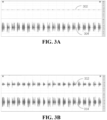
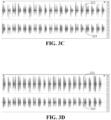
- FIG. 3A to FIG. 3D show volume comparisons before and after audio limiting is used in a call downlink according to one or more embodiments of the present inventive subject.
- an earphone connected to a mobile phone through a Bluetooth connection is regarded as the near end.
- the far end is a mobile phone, and the sound played by a human mouth is collected by the far-end mobile phone and transmitted to the near-end mobile phone through a communication link, and the human mouth is 0.2 m away from the mobile phone.
- the near-end device 104 is an earphone and the far-end device 102 is a mobile phone.
- the volume of the far-end sound 112 is between 49 dB and 99 dB (measured at the human mouth).
- the volume after the audio limiter system is added to the downlink is adjusted to a stable volume.
- Amplitudes of a first channel (upper waveform) and a second channel (lower waveform) in each of the graphs in FIG. 3A to FIG. 3D represent volume levels before and after downlink processing with an audio limiter, respectively.
- the waveform of the upper first channel represents that the volume of a far-end sound 302 from the far end is 49 dB
- the lower second channel waveform represents that the volume of the voice that can be heard through the near-end earphone after the limiting is amplified (positive gain) to maintain the target volume of a sound 304 normally heard by the earphone.
- the waveform of the upper first channel represents that the volume of a far-end sound 312 from the far end is 69 dB
- the lower second channel waveform represents that the volume of the voice that can be heard through the near-end earphone after the limiting is amplified (positive gain) to maintain the target volume of a sound 314 normally heard by the earphone.
- the waveform of the upper first channel represents that the volume of a far-end sound 322 from the far end is 89 dB
- the lower second channel waveform represents that the volume of the voice that can be heard through the near-end earphone after the limiting is amplified (negative gain) to maintain the target volume of a sound 324 normally heard by the earphone.
- the waveform of the upper first channel represents that the volume of a far-end sound 332 from the far end is 99 dB
- the lower second channel waveform represents that the volume of the voice that can be heard through the near-end earphone after the limiting is amplified (negative gain) to maintain the target volume of a sound 334 normally heard by the earphone.
- the target volume is set to be the same, and therefore, in the case of the four far-end sounds, the volume of the voice in the far-end sound heard by the near-end earphone user from the earphone has been processed by the audio limiter to be at the target volume level, while the background noise at the speech interval segments of each picture is suppressed and not incorrectly amplified. As a result, the earphone user is able to hear a clear, volume-appropriate voice.
- the audio limiter is used in a call downlink algorithm for earphones to automatically amplify the low pitch, limit the high pitch, and prevent distortion of the high pitch. For example, by adjusting each frequency point, clipping of the amplitude can be avoided, thereby preventing cracking voice.
- This method is more like volume control, which always keeps the speech volume at a target level. In this way, the earphone user can listen at a stable volume. In this process, according to the distinguishing result of the voice activity detection, the volume is adjusted only when there is a speech, and the noise is suppressed when there is no speech.
- the elements of various real-time solutions for implementing the modules, elements, and components of the methods provided in the present inventive subject may be fabricated as one or more electronic devices residing on the same chip or in a chipset, including but not limited to an array of fixed or programmable logic elements (such as transistors or gates).
- One or more elements of various implementations of the device described herein may also be fully or partially implemented as one or more instruction sets, which may be arranged to execute on one or more fixed or programmable logic element arrays (such as microprocessors, embedded processors, IP cores, digital signal processors, FPGAs, ASSPs, and ASICs).
Landscapes
- Engineering & Computer Science (AREA)
- Signal Processing (AREA)
- Physics & Mathematics (AREA)
- Acoustics & Sound (AREA)
- Computational Linguistics (AREA)
- Health & Medical Sciences (AREA)
- Audiology, Speech & Language Pathology (AREA)
- Human Computer Interaction (AREA)
- Multimedia (AREA)
- Quality & Reliability (AREA)
- Circuit For Audible Band Transducer (AREA)
Abstract
Description
- The present inventive subject relates generally to audio processing, and particularly to a system and a method for audio limiting in a downlink algorithm.
- Using earphones to make phone calls has become a common practice in daily life. However, when using an earphone for a call, a near-end earphone user is generally unable to control the behavior of a far-end user. For example, sometimes the far-end user may be too far away from the phone or microphone, so that it is difficult for the near-end earphone user to hear the other person clearly. Conversely, a person at the far end may suddenly speak loudly, which causes a sudden surge in the volume of the near-end earphone, resulting in a poor experience at the near-end earphone user side.
- Therefore, in order to improve the call experience, an audio limiter device is required, which necessarily maintains a consistent volume for a near-end earphone user, no matter how soft or loud a far-end person speaks.
- According to one aspect of the present inventive subject, a method for audio limiting in a call downlink is provided. The method includes receiving far-end sound from a far-end device through an audio limiting module configured at a near-end device, and performing voice activity detection and adjusting a current volume for each audio frame of a plurality of audio frames in the received far-end sound. The method further includes playing far-end sound with the adjusted volume through a speaker of the near-end device. The step of adjusting the current volume in the method further includes calculating a difference between the current volume and a target volume and regarding it as a gain, and applying the gain to a current audio frame.
- According to another aspect of the present inventive subject, a system for audio limiting in a call downlink is provided. The system includes an audio limiting module, which is configured to receive far-end sound from a far-end device at a near-end device, and perform voice activity detection and adjust a current volume for each audio frame of a plurality of audio frames in the received far-end sound. The system further includes a speaker in the near-end device, and the speaker is configured to play far-end sound with the adjusted volume in the near-end device. Adjusting the current volume in the system further includes calculating a difference between the current volume and a target volume and regarding it as a gain, and applying the gain to a current audio frame.
- The audio limiting system and method provided by the present inventive subject only play a role in the detected speech part, and can perform noise suppression on the non-speech part at the same time.
- These and/or other features, aspects, and advantages of the present invention will be better understood upon reading the following detailed description with reference to the accompanying drawings, where the same characters represent the same components throughout these accompanying drawings:
-
FIG. 1 shows a schematic diagram of a system for audio limiting in a call downlink according to one or more embodiments of the present inventive subject; -
FIG. 2A shows a step flow chart of a method for audio limiting in a call downlink according to one or more embodiments of the present inventive subject; -
FIG. 2B shows an algorithm flow chart of a method for audio limiting in a call downlink according to one or more embodiments of the present inventive subject; -
FIG. 3A shows a volume comparison before and after audio limiting is used in a call downlink according to one or more embodiments of the present inventive subject, wherein a far-end sound volume received by a near-end device before audio limiting is used is 49 dB; -
FIG. 3B shows a volume comparison before and after audio limiting is used in a call downlink according to one or more embodiments of the present inventive subject, wherein a far-end sound volume received by a near-end device before audio limiting is used is 69 dB; -
FIG. 3C shows a volume comparison before and after audio limiting is used in a call downlink according to one or more embodiments of the present inventive subject, wherein a far-end sound volume received by a near-end device before audio limiting is used is 89 dB; and -
FIG. 3D shows a volume comparison before and after audio limiting is used in a call downlink according to one or more embodiments of the present inventive subject, wherein a far-end sound volume received by a near-end device before audio limiting is used is 99 dB. - Description of various embodiments is provided below for the purpose of illustration, but it is not intended to be exhaustive or to limit the disclosed embodiments. Many modifications and variations will be apparent to those of ordinary skill in the art without departing from the scope and spirit of the described embodiments.
- In an existing call product, a user needs to control, through a button on the product (for example, on a mobile phone or an earphone), the volume of the other speaking person heard in a call. During a call, for example, the other person may whisper, which makes it difficult to hear. To hear clearly, the volume must be turned up by pressing the button. However, doing so will increase the background noise. Therefore, in order to improve the call experience during the speech call, no matter how soft or loud the voice of the person talking at the far end is, it is necessary to maintain a consistent volume for the user using the earphone at the near end.
- In order to achieve this, the present inventive subject specifically introduces an audio limiter technique in a call downlink algorithm for the design of a near-end device, such as an earphone. In order to ensure that an earphone wearer can more comfortably hear far-end sound during a call, an audio limiting method is adopted in the downlink of the call algorithm to adaptively limit the audio. Here, the downlink refers to enabling the person at the near end to hear the voice of the other person at the far end, and the method for audio limiting provided by the present inventive subject only acts on the detected speech part. The speech part is processed differently according to the volume, the volume higher than a target volume is suppressed, and the volume lower than the target volume is increased. If the speech volume is too small, an upper threshold for the gain can limit the maximum gain, and avoid the background noise of the speech segment being excessively amplified, thereby improving the user experience. In this way, the caller can free his/her hands and the earphone can adaptively keep the listening volume at an appropriate level. At the same time, it can also suppress noise when there is no speech transmission (that is, no speech is detected).
-
FIG. 1 shows a schematic diagram 100 of a system for audio limiting in a call downlink according to one or more embodiments of the present inventive subject. As shown inFIG. 1 , a far-end device 102 may be, for example, a mobile phone or a telephone, and a near-end device 104 may be connected to the far-end device 102 in a wireless manner. For example, the near-end device 104 is an earphone, such as a headphone including amicrophone 106 and aspeaker 108. In one example, the headphone may include, but is not limited to, a Bluetooth headset. As can be seen fromFIG. 1 , amodule 110 for audio limiting is added to the last portion of the downlink, and the module can be used to adaptively adjust the volume of the far-end sound 112 to a target volume, regardless of whether the far-end volume is large or small. Thus, the voice of the other person heard by the earphone user at the near end can be controlled to keep at the target volume level. -
FIG. 2A shows astep 200 of a method for audio limiting in a call downlink according to one or more embodiments of the present inventive subject. The method for audio limiting in a call downlink audio limiter is mainly divided into two parts: voice activity detection (VAD) and applying a gain to adjust the volume. As shown inFIG. 2A , the near-end device first performs voice activity detection in step S210 after receiving sound from the far-end device, for distinguishing between a speech segment and a pure noise segment contained in received voice segments in an earphone. In the near-end earphone, it only intends to adjust the volume when there is a speech, and therefore, the speech segment is first distinguished from the pure noise segment. Then, in step S220, the volume of the speech heard can be adjusted according to the target volume by the distinguishing result of the voice activity detection. Noise can be suppressed when there is no speech. The volume-adjusted speech can be delivered to the user through a speaker in the near-end device. -
FIG. 2B shows analgorithm flow chart 230 of a method for audio limiting in a call downlink according to one or more embodiments of the present inventive subject. Here, the downlink means that the near-end device receives audio data, that is, the audio data is transmitted from the far-end device to the near-end device. It will be appreciate by those skilled in the art that before reaching the audio limiter, the downlink audio data is decoded by an audio decoder to obtain an audio digital signal ready for processing, and that the processing process into the audio limiter module is performed in a time-frequency domain. - Referring to
FIG. 2B , in an example of a downlink call audio limiting algorithm, first, in the audio limiter, as described in ablock 240, a signal-to-noise ratio (SNR) for each audio frame is calculated by noise estimation for a segment of speech received by the earphone. Then, it is determined whether the audio frame has voice, as shown in ablock 250, wherein when the SNR exceeds a predetermined threshold (Y), it is determined that the frame has voice, and when the SNR does not reach the threshold level (N), the frame is determined to be noise. For example, if the SNR exceeds a predetermined threshold Thres _v, it is determined that there is voice in the frame, that is, VAD_T = 1. Conversely, if the SNR does not exceed the predetermined threshold Thres_v, it is determined that there is no voice in the frame, or that the frame should be silent, that is, VAD_T = 0. The determination of the SNR threshold can be obtained through acoustic data actually collected by simulation in an implementation process of a specific project. In one example, the predetermine threshold is, for example, 15 dB. It should be noted that for the setting of the SNR threshold, the voice should be not determined as noise as much as possible, thereby avoiding effective voice from being incorrectly amplified or compressed. - Then, a current volume is obtained. When the determination result of the current frame is VAD_T = 1, that is, there is voice, the current volume is acquired as a maximum absolute value of the audio frame volume in a
block 260. Specifically, the volume of the frame takes the maximum amplitude of all audio samples in the frame. For example, a speech sampling rate is 16 kHz, and the number of sampling bits is 16 bits. Each audio frame selects an audio length of 16 ms for processing, corresponding to 256 sampling points, and selects the maximum value among amplitudes of the 256 samples as the current volume of the frame. - In addition, when the determination result of the current frame is VAD_T = 0, that is, there is no voice, in a
block 270, the current volume is acquired as an average value of maximum absolute values of the volume of several speech presence frames before the audio frame. For example, the average value of the maximum absolute values of amplitudes obtained per frame for several previous speech presence frames saved in a buffer is regarded as the current volume. For example, the average value of the maximum absolute values of amplitudes obtained per frame for 128 speech presence frames saved in the buffer is regarded as the current volume. - Next, a gain of adjusting the current volume to the target volume is calculated. The value of the target volume may be experience-based, which may be an adjustable range of target values. For each frame, a difference between the current volume and the target volume may be calculated. The difference is regarded as the gain to adjust the current volume to the target volume. The gain should be limited in a certain range, for example, in a range having an upper threshold and a lower threshold. For example, it should be ensured that the voice heard can be prevented from being amplified too much. At the same time, the gain value can further be smoothed. For example, the gain is smoothed sample by sample in the frame range, so as to prevent the excessive fluctuation of the gain value from introducing abnormal noise.
- Then, after the above smoothing process, the volume difference is compensated in the near-end earphone sample by sample in the frame.
- As can be seen, in order to avoid processing noise or silence fragments, the VAD (voice activity detection) is necessary. If the noise is also amplified, it will affect the sensation of hearing. Preprocessing, such as smoothing, of the gain used to adjust the volume is also necessary. Therefore, the algorithm of the audio limiter may be as follows:

- As mentioned above, the audio limiting system and method provided by the present inventive subject take different processing strategies according to whether a speech is detected or not, amplify or compress the speech to the target volume according to the current speech amplitude when the speech is detected, and suppress the detected pure noise segment. If the speech volume is too small, the upper threshold for the gain can limit the maximum gain, and avoid the background noise of the speech segment from being excessively amplified, thereby improving the user experience.
- The audio limiter is used for the call downlink algorithm of the earphone to automatically amplify the low pitch, limit the high pitch and prevent the distortion of the high pitch.
-
FIG. 3A to FIG. 3D show volume comparisons before and after audio limiting is used in a call downlink according to one or more embodiments of the present inventive subject. In a specific environment, an earphone connected to a mobile phone through a Bluetooth connection is regarded as the near end. The far end is a mobile phone, and the sound played by a human mouth is collected by the far-end mobile phone and transmitted to the near-end mobile phone through a communication link, and the human mouth is 0.2 m away from the mobile phone. In the example shown inFIG. 1 , the near-end device 104 is an earphone and the far-end device 102 is a mobile phone. The volume of the far-end sound 112 is between 49 dB and 99 dB (measured at the human mouth). The volume after the audio limiter system is added to the downlink is adjusted to a stable volume. Amplitudes of a first channel (upper waveform) and a second channel (lower waveform) in each of the graphs inFIG. 3A to FIG. 3D represent volume levels before and after downlink processing with an audio limiter, respectively. - Specifically, in
FIG. 3A , the waveform of the upper first channel represents that the volume of a far-end sound 302 from the far end is 49 dB, and after a gain is applied through the audio limiter, the lower second channel waveform represents that the volume of the voice that can be heard through the near-end earphone after the limiting is amplified (positive gain) to maintain the target volume of asound 304 normally heard by the earphone. - In
FIG. 3B , the waveform of the upper first channel represents that the volume of a far-end sound 312 from the far end is 69 dB, and after a gain is applied through the audio limiter, the lower second channel waveform represents that the volume of the voice that can be heard through the near-end earphone after the limiting is amplified (positive gain) to maintain the target volume of asound 314 normally heard by the earphone. - Similarly, in
FIG. 3C , the waveform of the upper first channel represents that the volume of a far-end sound 322 from the far end is 89 dB, and after a gain is applied through the audio limiter, the lower second channel waveform represents that the volume of the voice that can be heard through the near-end earphone after the limiting is amplified (negative gain) to maintain the target volume of asound 324 normally heard by the earphone. - Moreover, in
FIG. 3D , the waveform of the upper first channel represents that the volume of a far-end sound 332 from the far end is 99 dB, and after a gain is applied through the audio limiter, the lower second channel waveform represents that the volume of the voice that can be heard through the near-end earphone after the limiting is amplified (negative gain) to maintain the target volume of asound 334 normally heard by the earphone. - As can be seen by comparing
FIG. 3A to FIG. 3D above, the target volume is set to be the same, and therefore, in the case of the four far-end sounds, the volume of the voice in the far-end sound heard by the near-end earphone user from the earphone has been processed by the audio limiter to be at the target volume level, while the background noise at the speech interval segments of each picture is suppressed and not incorrectly amplified. As a result, the earphone user is able to hear a clear, volume-appropriate voice. - The audio limiter is used in a call downlink algorithm for earphones to automatically amplify the low pitch, limit the high pitch, and prevent distortion of the high pitch. For example, by adjusting each frequency point, clipping of the amplitude can be avoided, thereby preventing cracking voice. This method is more like volume control, which always keeps the speech volume at a target level. In this way, the earphone user can listen at a stable volume. In this process, according to the distinguishing result of the voice activity detection, the volume is adjusted only when there is a speech, and the noise is suppressed when there is no speech.
- Examples of one or more embodiments of the present inventive subject are described in the following clauses:
-
Clause 1. A method for audio limiting in a call downlink, including:- receiving far-end sound from a far-end device through an audio limiting module at a near-end device;
- performing voice activity detection and adjusting a current volume for each audio frame of a plurality of audio frames in the received far-end sound; and
- playing far-end sound with the adjusted volume through a speaker of the near-end device,
- wherein the adjusting a current volume includes:
- calculating a difference between the current volume and a target volume and regarding it as a gain; and
- applying the gain to a current audio frame.
- Clause 2. The method according to
clause 1, wherein the performing voice activity detection includes:- calculating a signal-to-noise ratio of the each audio frame of the plurality of audio frames in the received far-end sound through noise estimation;
- determining the current audio frame as an audio frame containing a speech when the signal-to-noise ratio is higher than a predetermined threshold; and
- determining the current audio frame as an audio frame not containing a speech when the signal-to-noise ratio is not higher than the predetermined threshold.
- Clause 3. The method according to
clause 1 or clause 2, wherein the adjusting a current volume further includes:
for the current audio frame being an audio frame containing a speech, taking the current volume as a maximum absolute value among amplitudes of all sampled samples in the current audio frame. - Clause 4. The method according to any one of
clause 1 to clause 3, wherein the adjusting a current volume further includes:
for the current audio frame being an audio frame not containing a speech, taking the current volume as an average value of maximum absolute values of amplitudes obtained per frame for the previous several audio frames containing a speech. - Clause 5. The method according to any one of
clause 1 to clause 4, wherein applying the gain to the current audio frame further includes:
previously limiting the gain to a range between an upper threshold and a lower threshold, and smoothing the gain sample by sample during the current audio frame. - Clause 6. The method according to any one of
clause 1 to clause 5, wherein the target volume is a value taken based on experience. - Clause 7. The method according to any one of
clause 1 to clause 6, wherein the near-end device is an earphone, the far-end device is a mobile phone, and the near-end device is connected to the far-end device via a Bluetooth connection. - Clause 8. A system for audio limiting in a call downlink, including:
- an audio limiting module configured to receive far-end sound from a far-end device at a near-end device, and perform voice activity detection and adjust a current volume for each audio frame of a plurality of audio frames in the received far-end sound;
- a speaker configured to play far-end sound with the adjusted volume in the near-end device,
- wherein the adjusting a current volume includes:
- calculating a difference between the current volume and a target volume and regarding it as a gain; and
- applying the gain to a current audio frame.
- Clause 9. The system according to clause 8, wherein the performing voice activity detection includes:
- calculating a signal-to-noise ratio of the each audio frame of the plurality of audio frames in the received far-end sound through noise estimation;
- determining the current audio frame as an audio frame containing a speech when the signal-to-noise ratio is higher than a predetermined threshold; and
- determining the current audio frame as an audio frame not containing a speech when the signal-to-noise ratio is not higher than the predetermined threshold.
- Clause 10. The system according to clause 8 or clause 9, wherein the adjusting a current volume further includes:
for the current audio frame being an audio frame containing a speech, taking the current volume as a maximum absolute value among amplitudes of all sampled samples in the current audio frame. - Clause 11. The system according to any one of clause 8 to clause 10, wherein the adjusting a current volume further includes:
for the current audio frame being an audio frame not containing a speech, taking the current volume as an average value of maximum absolute values of amplitudes obtained per frame for the previous several audio frames containing a speech. - Clause 12. The system according to any one of clause 8 to clause 11, wherein applying the gain to the current audio frame further includes:
previously limiting the gain to a range between an upper threshold and a lower threshold, and smoothing the gain sample by sample during the current audio frame. - Clause 13. The system according to any one of clause 8 to clause 12, wherein the target volume is a value taken based on experience.
- Clause 14. The system according to any one of clause 8 to clause 15, wherein the near-end device is an earphone, the far-end device is a mobile phone, and the near-end device is connected to the far-end device via a Bluetooth connection.
- Clause 15. A non-temporary computer-readable medium storing instructions thereon, wherein the instructions, when executed by one or more processors, cause the one or more processors to perform the method for audio limiting in a call downlink according to
clauses 1 to 7. - The elements of various real-time solutions for implementing the modules, elements, and components of the methods provided in the present inventive subject may be fabricated as one or more electronic devices residing on the same chip or in a chipset, including but not limited to an array of fixed or programmable logic elements (such as transistors or gates). One or more elements of various implementations of the device described herein may also be fully or partially implemented as one or more instruction sets, which may be arranged to execute on one or more fixed or programmable logic element arrays (such as microprocessors, embedded processors, IP cores, digital signal processors, FPGAs, ASSPs, and ASICs).
- The selection of terms used herein is intended to best explain the principles and practical applications of the embodiments or the improvements to technologies found in the market, or to enable other persons of ordinary skill in the art to understand the embodiments disclosed herein.
- In the above, reference is made to the embodiments presented in the present disclosure. However, the scope of the present disclosure is not limited to the specifically described embodiments. Rather, any combination of the above features and elements, whether related to different embodiments or not, is contemplated as implementing and practicing the contemplated embodiments.
- Furthermore, although the embodiments disclosed herein can achieve advantages better than other possible solutions or better than the prior art, whether a given embodiment achieves specific advantages does not limit the scope of the present disclosure. Therefore, the above aspects, features, embodiments and advantages are merely illustrative and are not considered as elements or limitations of the appended claims unless explicitly recited in the claims.
- Although the above content is directed to the embodiments of the present disclosure, other and further embodiments of the present disclosure can be designed without departing from the basic scope of the present disclosure, and the scope of the present disclosure is determined by the appended claims.
Claims (15)
- A method for audio limiting in a call downlink, comprising:receiving far-end sound from a far-end device through an audio limiting module at a near-end device;performing voice activity detection and adjusting a current volume for each audio frame of a plurality of audio frames in the received far-end sound; andplaying far-end sound with the adjusted volume through a speaker of the near-end device,wherein the adjusting a current volume comprises:calculating a difference between the current volume and a target volume and regarding it as a gain; andapplying the gain to a current audio frame.
- The method according to claim 1, wherein the performing voice activity detection comprises:calculating a signal-to-noise ratio of the each audio frame of the plurality of audio frames in the received far-end sound through noise estimation;determining the current audio frame as an audio frame containing a speech when the signal-to-noise ratio is higher than a predetermined threshold; anddetermining the current audio frame as an audio frame not containing a speech when the signal-to-noise ratio is not higher than the predetermined threshold.
- The method according to claim 2, wherein the adjusting a current volume further comprises:
for the current audio frame being an audio frame containing a speech, taking a value of the current volume as a maximum absolute value among amplitudes of all sampled samples in the current audio frame. - The method according to claim 2 or 3, wherein the adjusting a current volume further comprises:
for the current audio frame being an audio frame not containing a speech, taking a value of the current volume as an average value of maximum absolute values of amplitudes obtained per frame for the previous several audio frames containing a speech. - The method according to any preceding claim, wherein applying the gain to the current audio frame further comprises:
previously limiting the gain to a range between an upper threshold and a lower threshold, and smoothing the gain sample by sample during the current audio frame. - The method according to any preceding claim, wherein the target volume is a value taken based on experience.
- The method according to any preceding claim, wherein the near-end device is an earphone, the far-end device is a mobile phone, and the near-end device is connected to the far-end device via a Bluetooth connection.
- A system for audio limiting in a call downlink, comprising:an audio limiting module configured to receive far-end sound from a far-end device at a near-end device, and perform voice activity detection and adjust a current volume for each audio frame of a plurality of audio frames in the received far-end sound;a speaker configured to play far-end sound with the adjusted volume in the near-end device,wherein the adjusting a current volume comprises:calculating a difference between the current volume and a target volume and regarding it as a gain; andapplying the gain to a current audio frame.
- The system according to claim 8, wherein the performing voice activity detection comprises:calculating a signal-to-noise ratio of each audio frame in the received far-end sound through noise estimation;determining the current audio frame as an audio frame containing a speech when the signal-to-noise ratio is higher than a predetermined threshold; anddetermining the current audio frame as an audio frame not containing a speech when the signal-to-noise ratio is not higher than the predetermined threshold.
- The system according to claim 9, wherein the adjusting a current volume further comprises:
for the current audio frame being an audio frame containing a speech, taking the current volume as a maximum absolute value among amplitudes of all sampled samples in the current audio frame. - The system according to claim 9 or 10, wherein the adjusting a current volume further comprises:
for the current audio frame being an audio frame not containing a speech, taking the current volume as an average value of maximum absolute values of amplitudes obtained per frame for the previous several audio frames containing a speech. - The system according to any of claims 8 to 11, wherein applying the gain to the current audio frame further comprises:
previously limiting the gain to a range between an upper threshold and a lower threshold, and smoothing the gain sample by sample during the current audio frame. - The system according to any of claims 8 to 12, wherein the target volume is a value taken based on experience.
- The system according to any of claims 8 to 13, wherein the near-end device is an earphone, the far-end device is a mobile phone, and the near-end device is connected to the far-end device via a Bluetooth connection.
- A non-temporary computer-readable medium storing instructions thereon, wherein the instructions, when executed by one or more processors, cause the one or more processors to perform the method for audio limiting in a call downlink according to claims 1 to 7.
Applications Claiming Priority (1)
| Application Number | Priority Date | Filing Date | Title |
|---|---|---|---|
| CN202311347262.0A CN119854687A (en) | 2023-10-17 | 2023-10-17 | System and method for audio clipping in a talk-down algorithm |
Publications (1)
| Publication Number | Publication Date |
|---|---|
| EP4542545A1 true EP4542545A1 (en) | 2025-04-23 |
Family
ID=92973557
Family Applications (1)
| Application Number | Title | Priority Date | Filing Date |
|---|---|---|---|
| EP24204199.4A Pending EP4542545A1 (en) | 2023-10-17 | 2024-10-02 | System and method for audio limiting in call downlink algorithm |
Country Status (3)
| Country | Link |
|---|---|
| US (1) | US20250124941A1 (en) |
| EP (1) | EP4542545A1 (en) |
| CN (1) | CN119854687A (en) |
Citations (4)
| Publication number | Priority date | Publication date | Assignee | Title |
|---|---|---|---|---|
| US20130282369A1 (en) * | 2012-04-23 | 2013-10-24 | Qualcomm Incorporated | Systems and methods for audio signal processing |
| US20200227065A1 (en) * | 2017-07-18 | 2020-07-16 | Harman Becker Automotive Systems Gmbh | Speech signal leveling |
| US11164592B1 (en) * | 2019-05-09 | 2021-11-02 | Amazon Technologies, Inc. | Responsive automatic gain control |
| US20230162754A1 (en) * | 2020-03-27 | 2023-05-25 | Dolby Laboratories Licensing Corporation | Automatic Leveling of Speech Content |
-
2023
- 2023-10-17 CN CN202311347262.0A patent/CN119854687A/en active Pending
-
2024
- 2024-10-02 EP EP24204199.4A patent/EP4542545A1/en active Pending
- 2024-10-09 US US18/910,778 patent/US20250124941A1/en active Pending
Patent Citations (4)
| Publication number | Priority date | Publication date | Assignee | Title |
|---|---|---|---|---|
| US20130282369A1 (en) * | 2012-04-23 | 2013-10-24 | Qualcomm Incorporated | Systems and methods for audio signal processing |
| US20200227065A1 (en) * | 2017-07-18 | 2020-07-16 | Harman Becker Automotive Systems Gmbh | Speech signal leveling |
| US11164592B1 (en) * | 2019-05-09 | 2021-11-02 | Amazon Technologies, Inc. | Responsive automatic gain control |
| US20230162754A1 (en) * | 2020-03-27 | 2023-05-25 | Dolby Laboratories Licensing Corporation | Automatic Leveling of Speech Content |
Also Published As
| Publication number | Publication date |
|---|---|
| US20250124941A1 (en) | 2025-04-17 |
| CN119854687A (en) | 2025-04-18 |
Similar Documents
| Publication | Publication Date | Title |
|---|---|---|
| CN104160443B (en) | The method, apparatus and system processed for voice data | |
| US8744091B2 (en) | Intelligibility control using ambient noise detection | |
| US11393486B1 (en) | Ambient noise aware dynamic range control and variable latency for hearing personalization | |
| CN103295581B (en) | Method and device for increasing speech clarity and computing device | |
| JP6374529B2 (en) | Coordinated audio processing between headset and sound source | |
| US8918197B2 (en) | Audio communication networks | |
| EP1622349B1 (en) | Teleconference volume level monitoring and feedback on the volume level | |
| US10616676B2 (en) | Dynamically adjustable sidetone generation | |
| EP1599992A1 (en) | Audibility enhancement | |
| CN106448712B (en) | Automatic gain control method and device for audio signal | |
| CN105719644A (en) | Method and device for adaptively adjusting voice recognition rate | |
| CN101552823B (en) | Volume management system and method | |
| US9620142B2 (en) | Self-voice feedback in communications headsets | |
| CN103812462B (en) | Volume control method and device | |
| CN111063363B (en) | Voice acquisition method, audio equipment and device with storage function | |
| US20250124941A1 (en) | System and method for audio limiting in call downlink algorithm | |
| CN109511040B (en) | Whisper amplifying method and device and earphone | |
| JP2009027239A (en) | Telecommunication conference apparatus | |
| TWI781579B (en) | Audio signal processing method, device and electronic apparatus | |
| CN120544562A (en) | Microphone control based on speech direction | |
| JP2015002386A (en) | Telephone conversation device, voice change method, and voice change program | |
| US20220139414A1 (en) | Communication device and sidetone volume adjusting method thereof | |
| JP2003345399A (en) | Audio playback device | |
| US20220093075A1 (en) | Audio enhancement and noise cancelling systems and methods | |
| KR20010105517A (en) | Device for regulating automatically reception volume in mobile communication phone |
Legal Events
| Date | Code | Title | Description |
|---|---|---|---|
| PUAI | Public reference made under article 153(3) epc to a published international application that has entered the european phase |
Free format text: ORIGINAL CODE: 0009012 |
|
| STAA | Information on the status of an ep patent application or granted ep patent |
Free format text: STATUS: THE APPLICATION HAS BEEN PUBLISHED |
|
| AK | Designated contracting states |
Kind code of ref document: A1 Designated state(s): AL AT BE BG CH CY CZ DE DK EE ES FI FR GB GR HR HU IE IS IT LI LT LU LV MC ME MK MT NL NO PL PT RO RS SE SI SK SM TR |
|
| STAA | Information on the status of an ep patent application or granted ep patent |
Free format text: STATUS: REQUEST FOR EXAMINATION WAS MADE |
|
| 17P | Request for examination filed |
Effective date: 20250714 |
|
| STAA | Information on the status of an ep patent application or granted ep patent |
Free format text: STATUS: EXAMINATION IS IN PROGRESS |
|
| 17Q | First examination report despatched |
Effective date: 20260209 |