EP4542418A1 - Data management system, corresponding data management method and computer program - Google Patents
Data management system, corresponding data management method and computer program Download PDFInfo
- Publication number
- EP4542418A1 EP4542418A1 EP23306835.2A EP23306835A EP4542418A1 EP 4542418 A1 EP4542418 A1 EP 4542418A1 EP 23306835 A EP23306835 A EP 23306835A EP 4542418 A1 EP4542418 A1 EP 4542418A1
- Authority
- EP
- European Patent Office
- Prior art keywords
- dataset
- annotation
- memory
- predetermined
- additional
- Prior art date
- Legal status (The legal status is an assumption and is not a legal conclusion. Google has not performed a legal analysis and makes no representation as to the accuracy of the status listed.)
- Pending
Links
Images
Classifications
-
- G—PHYSICS
- G06—COMPUTING OR CALCULATING; COUNTING
- G06F—ELECTRIC DIGITAL DATA PROCESSING
- G06F16/00—Information retrieval; Database structures therefor; File system structures therefor
- G06F16/50—Information retrieval; Database structures therefor; File system structures therefor of still image data
- G06F16/58—Retrieval characterised by using metadata, e.g. metadata not derived from the content or metadata generated manually
- G06F16/583—Retrieval characterised by using metadata, e.g. metadata not derived from the content or metadata generated manually using metadata automatically derived from the content
-
- G—PHYSICS
- G06—COMPUTING OR CALCULATING; COUNTING
- G06F—ELECTRIC DIGITAL DATA PROCESSING
- G06F16/00—Information retrieval; Database structures therefor; File system structures therefor
- G06F16/20—Information retrieval; Database structures therefor; File system structures therefor of structured data, e.g. relational data
- G06F16/28—Databases characterised by their database models, e.g. relational or object models
- G06F16/284—Relational databases
- G06F16/285—Clustering or classification
-
- G—PHYSICS
- G06—COMPUTING OR CALCULATING; COUNTING
- G06N—COMPUTING ARRANGEMENTS BASED ON SPECIFIC COMPUTATIONAL MODELS
- G06N20/00—Machine learning
Definitions
- the present invention relates to a data management system including a storing unit and a processing unit.
- the invention further relates to a data management method and a computer program.
- the invention applies to the field of computer science, and more specifically to the management of data for computer learning.
- models In the field of computer learning, it is known to store large amounts of data to be used as training data for training artificial intelligence models (hereinafter, "models").
- Such sets of data generally come from heterogenous sources, so that the data generally differ with regards to their formats or the associated learning criteria.
- learning criterion it is meant, in the context of the present invention, information relating to given data, and providing a description thereof, said description being generally used as a base for the training of a model.
- learning criteria may include classes, position of labelled objects in an image, encoding in a specific space, depth masks, text description of an image, etc.
- Such data be harmonized in order to allow efficient training of models.
- Such harmonization may also be required to efficiently access and browse such data based on specific learning criteria, for instance when creating training datasets or validation datasets for training one or several models.
- a purpose of the present invention is to overcome at least one of these drawbacks.
- Another purpose of the invention is to provide a data management method for harmonizing datasets that is easy to perform and that maintains traceability.
- the present invention relates to a data management system of the aforementioned type, wherein the storing unit comprises:
- Such metadata memory also imparts the data management system with great flexibility, since additional learning criteria can be continuously added to each dataset.
- mapping the annotations of a new dataset onto a set of predetermined annotation values more homogeneous datasets (with regard to the associated learning criteria) are obtained. Thanks to such automatic harmonization, accessing the data (e.g., for the purpose of organizing said data by learning criteria) is made easier.
- the data management system further includes one or more of the following features, taken individually or according to any technically possible combination:
- mapping includes:
- the processing unit is configured to assign a predetermined annotation to the respective dataset annotation
- encoding a dataset annotation, respectively a predetermined annotation value includes applying a language model to said dataset annotation, respectively said predetermined annotation value, to determine a corresponding embedding as at least part of the respective encoded dataset annotation, respectively the respective encoded predetermined annotation value;
- the metadata associated with the additional dataset comprises, for each dataset annotation, the predetermined annotation value matched with said dataset annotation;
- the storing unit further includes a model memory configured to store at least one previously trained artificial intelligence model, each forming a reference model, the processing unit being configured to, if it is determined that the additional dataset does not include dataset annotations, for each reference model:
- the storing unit further includes a model memory configured to store at least one previously trained artificial intelligence model, each forming a reference model, and upon storing of an additional reference model in the model memory, the processing unit being configured to, for each dataset in the dataset memory:
- the system may be a personal device such as a smartphone, a tablet, a smartwatch, a computer, any wearable electronic device, etc.
- the system according to the invention may execute one or several applications to carry out the method according to the invention.
- the system according to the invention may be loaded with, and configured to execute, a computer program according to the invention.
- the invention also relates to a computer-implemented data management method comprising, upon storing of an additional dataset in a dataset memory included in a storing unit, the steps:
- a computer program comprising instructions, which when executed by a computer, cause the computer to carry out the steps of the data management method as defined above.
- the computer program may be in any programming language such as C, C++, JAVA, Python, etc.
- the computer program may be in machine language.
- the computer program may be stored, in a non-transient memory, such as a USB stick, a flash memory, a hard-disc, a processor, a programmable electronic chop, etc.
- a non-transient memory such as a USB stick, a flash memory, a hard-disc, a processor, a programmable electronic chop, etc.
- the computer program may be stored in a computerized device such as a smartphone, a tablet, a computer, a server, etc.
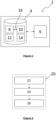
- a data management system 2 according to the invention is shown on figure 1 .
- the data management system 2 is configured to manage datasets, and more specifically to harmonize said datasets, preferably while maintaining traceability.
- the data management system includes a storing unit 4 and a processing unit 6 connected to one another.
- the storing unit 4 is configured to store data, especially large amounts of data, preferably aggregated as datasets, such as training datasets and/or validation datasets for training artificial intelligence models.
- the storing unit 4 may also be referred to as a data lake.
- the storing unit 4 includes a dataset memory 8, a metadata memory 10 and an annotation memory 12.
- the storing unit 4 further comprises a model memory 14.
- the dataset memory 8 is configured to store at least one dataset.
- Each dataset includes data that may be used to train artificial intelligence models.
- Each dataset may further comprise annotations (also referred to as "labels") that are descriptive of the data included in said dataset, i.e., that provide additional knowledge regarding the data included in said dataset.
- annotations also referred to as "labels”
- each corresponding annotation may be indicative of a class to which belongs each object in a said image.
- Each dataset may have been collected from any source of data, such as a repository, sensors, etc.
- the metadata memory 10 is configured to store corresponding metadata.
- the storing unit 4 includes a link (arrow 16) linking said dataset to the respective metadata.
- the links between the datasets in the dataset memory 8 and the corresponding metadata in the metadata memory 10 may be written in a correlation table (not shown) stored in the storing unit 4.
- each metadatum (i.e., piece of metadata) belonging to metadata in the metadata memory 10 associated with a given dataset in the dataset memory 8 may relate to a respective datum (i.e., piece of data) of said dataset.
- annotation memory 12 is configured to store at least one predetermined annotation value.
- each annotation value has been previously defined by a user of the data management system 2.
- the model memory 14 is configured to store at least one previously trained artificial intelligence model.
- each previously trained artificial intelligence model stored in the model memory 14 is referred to as "reference model”.
- the processing unit 6 is configured to execute tasks based on predetermined triggers relating to actions performed on the storing unit 4.
- each trigger causes the processing unit 6 to implement a data management method 20 ( figure 2 ).
- the data management method 20 includes a determination step 22, a mapping step 24 and a writing step 26.
- the processing unit 6 is configured to determine, during the determination step 22, whether said additional dataset includes dataset annotations that are descriptive of the data comprised in said additional dataset.
- the annotation memory 12 further stores the respective encoded predetermined annotation value in each predetermined space.
- the processing unit 6 is configured to retrieve from the annotation memory 12, for each predetermined annotation value, the corresponding encoded predetermined annotation value for the current predetermined space.
- the processing unit 6 is configured to determine a distance, with regard to a predetermined metric, between said encoded dataset annotation and the closest encoded predetermined annotation value.
- such metric is the L2-norm or the cosine similarity, both known to the person skilled in the art.
- the processing unit 6 is configured to match the respective dataset annotation with the predetermined annotation value corresponding to said closest encoded predetermined annotation value.
- the processing unit 6 is preferably configured to assign, to the respective dataset annotation, a predetermined annotation indicative that the respective dataset annotation is not relevant.
- processing unit 6 is configured to write, during the writing step 26, in the metadata memory 8, in relation to the additional dataset, metadata representative of a result of the mapping.
- the metadata associated with the additional dataset comprises, for each dataset annotation, the predetermined annotation value matched with said dataset annotation.
- the processing unit 6 is configured to apply, for each reference model stored in the model memory 14, said reference model to the additional dataset.
- processing unit 6 is further configured to write, in the metadata memory 10, in relation to the additional dataset, metadata representative of an output of each reference model.
- storing of an additional dataset in the dataset memory 8 forms another trigger for the processing unit 6.
- the processing unit 6 is configured to, for each dataset in the dataset memory 8, apply the additional reference model to said dataset.
- the processing unit 6 is further configured to write, in the metadata memory 10, in relation to said dataset, metadata representative of an output of the additional reference model applied to said dataset.
- the processing unit 6 determines whether the additional dataset includes dataset annotations.
- the processing unit 6 maps each dataset annotation onto the predetermined annotation values stored in the annotation memory 12.
Landscapes
- Engineering & Computer Science (AREA)
- Theoretical Computer Science (AREA)
- Databases & Information Systems (AREA)
- General Engineering & Computer Science (AREA)
- Data Mining & Analysis (AREA)
- Physics & Mathematics (AREA)
- General Physics & Mathematics (AREA)
- Library & Information Science (AREA)
- Software Systems (AREA)
- Evolutionary Computation (AREA)
- Computing Systems (AREA)
- Mathematical Physics (AREA)
- Medical Informatics (AREA)
- Computer Vision & Pattern Recognition (AREA)
- Artificial Intelligence (AREA)
- Information Retrieval, Db Structures And Fs Structures Therefor (AREA)
Abstract
The invention concerns a data management system (2) including a storing unit (4) and a processing unit (6), the storing unit (4) comprising:
- a dataset memory (8) configured to store at least one dataset;
- a metadata memory (10) configured to store, for each dataset stored in the dataset memory (8), respective metadata; and
- an annotation memory (12) configured to store at least one predetermined annotation value;
the processing unit (6) being configured to, upon storing of an additional dataset in the dataset memory (8):
- determine (22) whether the additional dataset includes dataset annotations descriptive of the data comprised in said additional dataset;
- perform a mapping (24) of each dataset annotation onto the at least one predetermined annotation value;
- write (26), in the metadata memory (10), in relation to the additional dataset, metadata representative of a result of the mapping.
- a dataset memory (8) configured to store at least one dataset;
- a metadata memory (10) configured to store, for each dataset stored in the dataset memory (8), respective metadata; and
- an annotation memory (12) configured to store at least one predetermined annotation value;
the processing unit (6) being configured to, upon storing of an additional dataset in the dataset memory (8):
- determine (22) whether the additional dataset includes dataset annotations descriptive of the data comprised in said additional dataset;
- perform a mapping (24) of each dataset annotation onto the at least one predetermined annotation value;
- write (26), in the metadata memory (10), in relation to the additional dataset, metadata representative of a result of the mapping.
Description
- The present invention relates to a data management system including a storing unit and a processing unit.
- The invention further relates to a data management method and a computer program.
- The invention applies to the field of computer science, and more specifically to the management of data for computer learning.
- In the field of computer learning, it is known to store large amounts of data to be used as training data for training artificial intelligence models (hereinafter, "models").
- Such sets of data generally come from heterogenous sources, so that the data generally differ with regards to their formats or the associated learning criteria.
- By "learning criterion", it is meant, in the context of the present invention, information relating to given data, and providing a description thereof, said description being generally used as a base for the training of a model. Examples of such learning criteria may include classes, position of labelled objects in an image, encoding in a specific space, depth masks, text description of an image, etc.
- Despite their initial heterogeneity, it is required that such data be harmonized in order to allow efficient training of models. Such harmonization may also be required to efficiently access and browse such data based on specific learning criteria, for instance when creating training datasets or validation datasets for training one or several models.
- Known solutions to perform such harmonization usually involve manually annotating the data.
- However, such method is not satisfactory.
- Indeed, manually annotating the data may be very cumbersome, especially with the increasingly large sets of data currently used in the field of computer learning.
- Furthermore, with evolving regulations, such as the AI Act, the traceability of data used for model training has to be guaranteed for potential audits. Yet, the manual annotation described above generally implies altering the data, which is detrimental to said traceability.
- A purpose of the present invention is to overcome at least one of these drawbacks.
- Another purpose of the invention is to provide a data management method for harmonizing datasets that is easy to perform and that maintains traceability.
- To this end, the present invention relates to a data management system of the aforementioned type, wherein the storing unit comprises:
- a dataset memory configured to store at least one dataset;
- a metadata memory configured to store, for each dataset stored in the dataset memory, respective metadata; and
- an annotation memory configured to store at least one predetermined annotation value;
- the processing unit being configured to, upon storing of an additional dataset in the dataset memory:
- determine whether the additional dataset includes dataset annotations descriptive of the data comprised in said additional dataset;
- perform a mapping of each dataset annotation onto the at least one predetermined annotation value;
- write, in the metadata memory, in relation to the additional dataset, metadata representative of a result of the mapping.
- Indeed, by using the metadata memory, it is possible to automatically add information to each dataset without altering the dataset, thereby guaranteeing traceability.
- Such metadata memory also imparts the data management system with great flexibility, since additional learning criteria can be continuously added to each dataset.
- Furthermore, by mapping the annotations of a new dataset onto a set of predetermined annotation values, more homogeneous datasets (with regard to the associated learning criteria) are obtained. Thanks to such automatic harmonization, accessing the data (e.g., for the purpose of organizing said data by learning criteria) is made easier.
- Advantageously, the data management system further includes one or more of the following features, taken individually or according to any technically possible combination:
- the mapping includes:
- encoding each dataset annotation into a predetermined space to obtain a respective encoded dataset annotation;
- for each encoded dataset annotation:
- determining a distance, with regard to a predetermined metric, between said encoded dataset annotation and the closest encoded predetermined annotation value, each encoded predetermined annotation value being a result of encoding a respective predetermined annotation value into the predetermined space;
- if the determined distance is lower than a predetermined threshold, matching the respective dataset annotation with the predetermined annotation value corresponding to said closest encoded predetermined annotation value;
- for each encoded dataset annotation, if the determined distance is greater than the predetermined threshold, the processing unit is configured to assign a predetermined annotation to the respective dataset annotation;
- encoding a dataset annotation, respectively a predetermined annotation value, includes applying a language model to said dataset annotation, respectively said predetermined annotation value, to determine a corresponding embedding as at least part of the respective encoded dataset annotation, respectively the respective encoded predetermined annotation value;
- the metadata associated with the additional dataset comprises, for each dataset annotation, the predetermined annotation value matched with said dataset annotation;
- the storing unit further includes a model memory configured to store at least one previously trained artificial intelligence model, each forming a reference model, the processing unit being configured to, if it is determined that the additional dataset does not include dataset annotations, for each reference model:
- apply said reference model to the additional dataset;
- write, in the metadata memory, in relation to the additional dataset, metadata representative of an output of said reference model;
- the storing unit further includes a model memory configured to store at least one previously trained artificial intelligence model, each forming a reference model, and upon storing of an additional reference model in the model memory, the processing unit being configured to, for each dataset in the dataset memory:
- apply the additional reference model to said dataset; and
- write, in the metadata memory, in relation to said dataset, metadata representative of an output of the additional reference model.
- The system may be a personal device such as a smartphone, a tablet, a smartwatch, a computer, any wearable electronic device, etc.
- The system according to the invention may execute one or several applications to carry out the method according to the invention.
- The system according to the invention may be loaded with, and configured to execute, a computer program according to the invention.
- The invention also relates to a computer-implemented data management method comprising, upon storing of an additional dataset in a dataset memory included in a storing unit, the steps:
- determining whether the additional dataset includes dataset annotations descriptive of the data comprised in said additional dataset;
- mapping each dataset annotation onto at least one predetermined annotation value stored in an annotation memory included in the storing unit;
- writing, in a metadata memory included in the storing unit, metadata representative of a result of the mapping, in relation to the additional dataset.
- According to another aspect of the same invention, it is proposed a computer program comprising instructions, which when executed by a computer, cause the computer to carry out the steps of the data management method as defined above.
- The computer program may be in any programming language such as C, C++, JAVA, Python, etc.
- The computer program may be in machine language.
- The computer program may be stored, in a non-transient memory, such as a USB stick, a flash memory, a hard-disc, a processor, a programmable electronic chop, etc.
- The computer program may be stored in a computerized device such as a smartphone, a tablet, a computer, a server, etc.
- Other advantages and characteristics will become apparent on examination of the detailed description of an embodiment which is in no way limitative, and the attached figures, where:
-
Figure 1 is a schematic representation of a data management system according to the invention; and -
Figure 2 is a flowchart of a data management method performed by the data management system offigure 1 . - It is well understood that the embodiments that will be described below are in no way limitative. In particular, it is possible to imagine variants of the invention comprising only a selection of the characteristics described hereinafter, in isolation from the other characteristics described, if this selection of characteristics is sufficient to confer a technical advantage or to differentiate the invention with respect to the state of the prior art. Such a selection comprises at least one, preferably functional, characteristic without structural details, or with only a part of the structural details if this part alone is sufficient to confer a technical advantage or to differentiate the invention with respect to the prior art.
- In the figures, elements common to several figures retain the same reference.
- A
data management system 2 according to the invention is shown onfigure 1 . - The
data management system 2 is configured to manage datasets, and more specifically to harmonize said datasets, preferably while maintaining traceability. - The data management system includes a
storing unit 4 and aprocessing unit 6 connected to one another. - The storing
unit 4 is configured to store data, especially large amounts of data, preferably aggregated as datasets, such as training datasets and/or validation datasets for training artificial intelligence models. The storingunit 4 may also be referred to as a data lake. - The storing
unit 4 includes adataset memory 8, ametadata memory 10 and anannotation memory 12. - Preferably, the storing
unit 4 further comprises amodel memory 14. - The
dataset memory 8 is configured to store at least one dataset. - Each dataset includes data that may be used to train artificial intelligence models.
- Each dataset may further comprise annotations (also referred to as "labels") that are descriptive of the data included in said dataset, i.e., that provide additional knowledge regarding the data included in said dataset.
- As an example, if a dataset stored in the
dataset memory 8 includes images, then, for a given image of said dataset, each corresponding annotation may be indicative of a class to which belongs each object in a said image. - Each dataset may have been collected from any source of data, such as a repository, sensors, etc.
- For each dataset in the
dataset memory 8, themetadata memory 10 is configured to store corresponding metadata. In other words, for each dataset in thedataset memory 8, the storingunit 4 includes a link (arrow 16) linking said dataset to the respective metadata. - For instance, the links between the datasets in the
dataset memory 8 and the corresponding metadata in themetadata memory 10 may be written in a correlation table (not shown) stored in thestoring unit 4. - For each dataset, the corresponding metadata are descriptive of the data included in said dataset. For instance, each metadatum (i.e., piece of metadata) belonging to metadata in the
metadata memory 10 associated with a given dataset in thedataset memory 8 may relate to a respective datum (i.e., piece of data) of said dataset. - Furthermore, the
annotation memory 12 is configured to store at least one predetermined annotation value. - For instance, each annotation value has been previously defined by a user of the
data management system 2. - The
model memory 14 is configured to store at least one previously trained artificial intelligence model. Hereinafter, each previously trained artificial intelligence model stored in themodel memory 14 is referred to as "reference model". - The
processing unit 6 is configured to execute tasks based on predetermined triggers relating to actions performed on thestoring unit 4. - More precisely, each trigger causes the
processing unit 6 to implement a data management method 20 (figure 2 ). - The
data management method 20 includes adetermination step 22, amapping step 24 and a writingstep 26. - More specifically, upon storing of an additional dataset in the dataset memory 8 (i.e., when storing of an additional dataset in the
dataset memory 8 is detected), theprocessing unit 6 is configured to determine, during thedetermination step 22, whether said additional dataset includes dataset annotations that are descriptive of the data comprised in said additional dataset. - In this case, storing of an additional dataset in the
dataset memory 8 is the trigger to the implementation of thedata management method 20. - Moreover, if the additional dataset includes dataset annotations, the
processing unit 6 is configured to perform, during themapping step 24, a mapping of each corresponding dataset annotation onto the at least one predetermined annotation value stored in theannotation memory 12. - Preferably, to perform such mapping, the
processing unit 6 is configured to encode each dataset annotation into a predetermined space to obtain a respective encoded dataset annotation. - Preferably, in the case where the dataset annotations are words, the
processing unit 6 is configured to apply a language model to each dataset annotation in order to encode said dataset annotation. As a result, for each dataset annotation, the output of the language model is a corresponding embedding. In this case, for each dataset annotation, the corresponding output embedding forms at least part of the respective encoded dataset annotation. Furthermore, in this case, the predetermined space is a vector space of embeddings. - As a non-limiting example, the language model is BERT ("Bidirectional Encoder Representations from Transformers").
- Furthermore, each predetermined annotation value is associated with a respective encoded predetermined annotation value. More precisely, for each predetermined annotation value, the respective encoded predetermined annotation value is a result of encoding said predetermined annotation value in the aforementioned predetermined space.
- For instance, the
processing unit 6 is configured to encode, in the predetermined space, during themapping step 24, each predetermined annotation value so as to obtain the respective encoded predetermined annotation value. - Preferably, in the case where the predetermined annotation values are words, the
processing unit 6 is configured to apply a language model to each predetermined annotation value to perform such encoding. In this case, for each predetermined annotation value, the corresponding embedding forms at least part of the respective encoded predetermined annotation value. - Alternatively, for each predetermined annotation value, the
annotation memory 12 further stores the respective encoded predetermined annotation value in each predetermined space. In this case, to perform the mapping, theprocessing unit 6 is configured to retrieve from theannotation memory 12, for each predetermined annotation value, the corresponding encoded predetermined annotation value for the current predetermined space. - Moreover, for each encoded dataset annotation, the
processing unit 6 is configured to determine a distance, with regard to a predetermined metric, between said encoded dataset annotation and the closest encoded predetermined annotation value. - For instance, such metric is the L2-norm or the cosine similarity, both known to the person skilled in the art.
- Furthermore, for each encoded dataset annotation, if the determined distance is lower than a predetermined threshold, the
processing unit 6 is configured to match the respective dataset annotation with the predetermined annotation value corresponding to said closest encoded predetermined annotation value. - Moreover, for each encoded dataset annotation, if the determined distance is greater than the predetermined threshold, the
processing unit 6 is preferably configured to assign, to the respective dataset annotation, a predetermined annotation indicative that the respective dataset annotation is not relevant. - Moreover, the
processing unit 6 is configured to write, during the writingstep 26, in themetadata memory 8, in relation to the additional dataset, metadata representative of a result of the mapping. - Preferably, the metadata associated with the additional dataset comprises, for each dataset annotation, the predetermined annotation value matched with said dataset annotation.
- Preferably, if, during the
determination step 22, it is determined that the additional dataset does not include dataset annotations, theprocessing unit 6 is configured to apply, for each reference model stored in themodel memory 14, said reference model to the additional dataset. - In this case, the
processing unit 6 is further configured to write, in themetadata memory 10, in relation to the additional dataset, metadata representative of an output of each reference model. - Preferably, storing of an additional dataset in the
dataset memory 8 forms another trigger for theprocessing unit 6. - In this case, upon storing of an additional reference model in the model memory, the
processing unit 6 is configured to, for each dataset in thedataset memory 8, apply the additional reference model to said dataset. - In this case, for each dataset, the
processing unit 6 is further configured to write, in themetadata memory 10, in relation to said dataset, metadata representative of an output of the additional reference model applied to said dataset. - Operation of the
data management system 2 will now be described with reference tofigures 1 and 2 . - If storing of an additional dataset in the
dataset memory 8 is detected, then, during thedetermination step 22, theprocessing unit 6 determines whether the additional dataset includes dataset annotations. - If the additional dataset includes dataset annotations, then, during the
mapping step 24, theprocessing unit 6 maps each dataset annotation onto the predetermined annotation values stored in theannotation memory 12. - Preferably, to perform such mapping, the
processing unit 6 encodes each dataset annotation into the predetermined space to obtain a respective encoded dataset annotation. - In this case, for each encoded dataset annotation, the
processing unit 6 determines a distance between said encoded dataset annotation and the closest encoded predetermined annotation value. - Preferably, for each encoded dataset annotation, if the determined distance is lower than the predetermined threshold, the
processing unit 6 matches the dataset annotation with the predetermined annotation value that corresponds to said closest encoded predetermined annotation value. - Then, during the writing
step 26, theprocessing unit 6 writes, in themetadata memory 8, and in relation to the additional dataset, metadata representative of a result of the mapping. - Conversely, if the additional dataset does not include dataset annotations, then the
processing unit 6 applies, to the additional dataset, each reference model stored in themodel memory 14. - In this case, the
processing unit 6 further writes, in themetadata memory 10, in relation to the additional dataset, metadata representative of an output of each reference model. - If storing of an additional dataset in the
dataset memory 8 is detected, theprocessing unit 6 applies the additional reference model to each dataset in thedataset memory 8. - In this case, for each dataset, the
processing unit 6 further writes in themetadata memory 10, in relation to said dataset, metadata representative of an output of the additional reference model when applied to said dataset. - Of course, the invention is not limited to the examples detailed above.
Claims (9)
- A data management system (2) including a storing unit (4) and a processing unit (6),the storing unit (4) comprising:- a dataset memory (8) configured to store at least one dataset;- a metadata memory (10) configured to store, for each dataset stored in the dataset memory (8), respective metadata; and- an annotation memory (12) configured to store at least one predetermined annotation value;the processing unit (6) being configured to, upon storing of an additional dataset in the dataset memory (8):- determine (22) whether the additional dataset includes dataset annotations descriptive of the data comprised in said additional dataset;- perform a mapping (24) of each dataset annotation onto the at least one predetermined annotation value;- write (26), in the metadata memory (10), in relation to the additional dataset, metadata representative of a result of the mapping.
- The data management system (2) according to claim 1, wherein the mapping includes:- encoding each dataset annotation into a predetermined space to obtain a respective encoded dataset annotation;- for each encoded dataset annotation:• determining a distance, with regard to a predetermined metric, between said encoded dataset annotation and the closest encoded predetermined annotation value, each encoded predetermined annotation value being a result of encoding a respective predetermined annotation value into the predetermined space;• if the determined distance is lower than a predetermined threshold, matching the respective dataset annotation with the predetermined annotation value corresponding to said closest encoded predetermined annotation value.
- The data management system (2) according to claim 2, wherein, for each encoded dataset annotation, if the determined distance is greater than the predetermined threshold, the processing unit is configured to assign a predetermined annotation to the respective dataset annotation.
- The data management system (2) according to claim 2 or 3, wherein encoding a dataset annotation, respectively a predetermined annotation value, includes applying a language model to said dataset annotation, respectively said predetermined annotation value, to determine a corresponding embedding as at least part of the respective encoded dataset annotation, respectively the respective encoded predetermined annotation value.
- The data management system (2) according to any one of claims 2 to 4, wherein the metadata associated with the additional dataset comprises, for each dataset annotation, the predetermined annotation value matched with said dataset annotation.
- The data management system (2) according to any one of claims 1 to 5, wherein the storing unit further includes a model memory (14) configured to store at least one previously trained artificial intelligence model, each forming a reference model,
the processing unit (6) being configured to, if it is determined that the additional dataset does not include dataset annotations, for each reference model:- apply said reference model to the additional dataset;- write, in the metadata memory (10), in relation to the additional dataset, metadata representative of an output of said reference model. - The data management system (2) according to any one of claims 1 to 6, wherein the storing unit further includes a model memory (14) configured to store at least one previously trained artificial intelligence model, each forming a reference model, and
upon storing of an additional reference model in the model memory (14), the processing unit (6) being configured to, for each dataset in the dataset memory (8):- apply the additional reference model to said dataset; and- write, in the metadata memory, in relation to said dataset, metadata representative of an output of the additional reference model. - A computer-implemented data management method (20) comprising, upon storing of an additional dataset in a dataset memory (8) included in a storing unit (4), the steps:- determining (22) whether the additional dataset includes dataset annotations descriptive of the data comprised in said additional dataset;- mapping (24) each dataset annotation onto at least one predetermined annotation value stored in an annotation memory (12) included in the storing unit (4);- writing (26), in a metadata memory (10) included in the storing unit (4), metadata representative of a result of the mapping, in relation to the additional dataset.
- Computer program comprising instructions, which when executed by a computer, cause the computer to carry out the steps of the data management method (20) according to claim 8.
Priority Applications (2)
| Application Number | Priority Date | Filing Date | Title |
|---|---|---|---|
| EP23306835.2A EP4542418A1 (en) | 2023-10-19 | 2023-10-19 | Data management system, corresponding data management method and computer program |
| US18/918,571 US12608404B2 (en) | 2023-10-19 | 2024-10-17 | Data management system, corresponding data management method and computer program |
Applications Claiming Priority (1)
| Application Number | Priority Date | Filing Date | Title |
|---|---|---|---|
| EP23306835.2A EP4542418A1 (en) | 2023-10-19 | 2023-10-19 | Data management system, corresponding data management method and computer program |
Publications (1)
| Publication Number | Publication Date |
|---|---|
| EP4542418A1 true EP4542418A1 (en) | 2025-04-23 |
Family
ID=88697467
Family Applications (1)
| Application Number | Title | Priority Date | Filing Date |
|---|---|---|---|
| EP23306835.2A Pending EP4542418A1 (en) | 2023-10-19 | 2023-10-19 | Data management system, corresponding data management method and computer program |
Country Status (2)
| Country | Link |
|---|---|
| US (1) | US12608404B2 (en) |
| EP (1) | EP4542418A1 (en) |
Citations (3)
| Publication number | Priority date | Publication date | Assignee | Title |
|---|---|---|---|---|
| US20220044149A1 (en) * | 2020-08-05 | 2022-02-10 | Mobileye Vision Technologies Ltd. | Techniques for generating machine learning trained models |
| US20220207303A1 (en) * | 2020-12-27 | 2022-06-30 | International Business Machines Corporation | Annotation quality grading of machine learning training sets |
| US20220319153A1 (en) * | 2020-03-10 | 2022-10-06 | Olympus Corporation | Image processing system, image processing device, endoscope system, interface, image processing method and information storage medium |
Family Cites Families (1)
| Publication number | Priority date | Publication date | Assignee | Title |
|---|---|---|---|---|
| US8156053B2 (en) * | 2008-05-09 | 2012-04-10 | Yahoo! Inc. | Automated tagging of documents |
-
2023
- 2023-10-19 EP EP23306835.2A patent/EP4542418A1/en active Pending
-
2024
- 2024-10-17 US US18/918,571 patent/US12608404B2/en active Active
Patent Citations (3)
| Publication number | Priority date | Publication date | Assignee | Title |
|---|---|---|---|---|
| US20220319153A1 (en) * | 2020-03-10 | 2022-10-06 | Olympus Corporation | Image processing system, image processing device, endoscope system, interface, image processing method and information storage medium |
| US20220044149A1 (en) * | 2020-08-05 | 2022-02-10 | Mobileye Vision Technologies Ltd. | Techniques for generating machine learning trained models |
| US20220207303A1 (en) * | 2020-12-27 | 2022-06-30 | International Business Machines Corporation | Annotation quality grading of machine learning training sets |
Also Published As
| Publication number | Publication date |
|---|---|
| US20250131018A1 (en) | 2025-04-24 |
| US12608404B2 (en) | 2026-04-21 |
Similar Documents
| Publication | Publication Date | Title |
|---|---|---|
| US11308940B2 (en) | Counterfactual annotated dialogues for conversational computing | |
| CN108228231B (en) | A Visual Drift Method for Git Warehouse File Annotation System | |
| US20190251471A1 (en) | Machine learning device | |
| US9286526B1 (en) | Cohort-based learning from user edits | |
| CN107608951B (en) | Report generation method and system | |
| CN108491421B (en) | A method, apparatus, device and computing storage medium for generating question and answer | |
| US9280253B2 (en) | Application coordinating system, application coordinating method, and application coordinating program | |
| US20080229192A1 (en) | Interactive image tagging | |
| US20110289486A1 (en) | System and Method for Debugging Dynamically Generated Code of an Application | |
| CN111191429A (en) | System and method for automatic filling of data table | |
| US20150082248A1 (en) | Dynamic Glyph-Based Search | |
| US7853595B2 (en) | Method and apparatus for creating a tool for generating an index for a document | |
| US20250165819A1 (en) | Real time feedback from a machine learning system | |
| WO2016095502A1 (en) | Mathematical formula processing method, device, apparatus and computer storage medium | |
| US12608404B2 (en) | Data management system, corresponding data management method and computer program | |
| CN114138262B (en) | Method, device, equipment and storage medium for generating interface file | |
| CN104346174A (en) | Method for describing and reproducing on-line vector diagram modeling process | |
| JPWO2022259511A5 (en) | ||
| CN120336518A (en) | Query method, device, electronic device and readable storage medium | |
| CN119226380A (en) | Database code extraction method and system based on fast screening of large language model | |
| US20250209543A1 (en) | Artificial intelligence driven system for accelerated software application content generation | |
| CN119576625A (en) | Method, device, equipment, storage medium and program product for generating code log statements | |
| CN118506391A (en) | Bill information extraction method, device, computer equipment and storage medium | |
| CN113986245B (en) | Target code generation method, device, equipment and medium based on HALO platform | |
| CN112463896B (en) | Archive cataloging data processing methods, devices, computing equipment and storage media |
Legal Events
| Date | Code | Title | Description |
|---|---|---|---|
| PUAI | Public reference made under article 153(3) epc to a published international application that has entered the european phase |
Free format text: ORIGINAL CODE: 0009012 |
|
| STAA | Information on the status of an ep patent application or granted ep patent |
Free format text: STATUS: THE APPLICATION HAS BEEN PUBLISHED |
|
| AK | Designated contracting states |
Kind code of ref document: A1 Designated state(s): AL AT BE BG CH CY CZ DE DK EE ES FI FR GB GR HR HU IE IS IT LI LT LU LV MC ME MK MT NL NO PL PT RO RS SE SI SK SM TR |
|
| STAA | Information on the status of an ep patent application or granted ep patent |
Free format text: STATUS: REQUEST FOR EXAMINATION WAS MADE |
|
| 17P | Request for examination filed |
Effective date: 20251014 |