EP4542326A1 - Remotely piloted aircraft, remote pilot station, system for automatically controlling said aircraft - Google Patents
Remotely piloted aircraft, remote pilot station, system for automatically controlling said aircraft Download PDFInfo
- Publication number
- EP4542326A1 EP4542326A1 EP24186785.2A EP24186785A EP4542326A1 EP 4542326 A1 EP4542326 A1 EP 4542326A1 EP 24186785 A EP24186785 A EP 24186785A EP 4542326 A1 EP4542326 A1 EP 4542326A1
- Authority
- EP
- European Patent Office
- Prior art keywords
- aircraft
- control
- air traffic
- remote pilot
- traffic control
- Prior art date
- Legal status (The legal status is an assumption and is not a legal conclusion. Google has not performed a legal analysis and makes no representation as to the accuracy of the status listed.)
- Pending
Links
Images


Classifications
-
- G—PHYSICS
- G05—CONTROLLING; REGULATING
- G05D—SYSTEMS FOR CONTROLLING OR REGULATING NON-ELECTRIC VARIABLES
- G05D1/00—Control of position, course, altitude or attitude of land, water, air or space vehicles, e.g. using automatic pilots
- G05D1/20—Control system inputs
- G05D1/22—Command input arrangements
- G05D1/228—Command input arrangements located on-board unmanned vehicles
- G05D1/2285—Command input arrangements located on-board unmanned vehicles using voice or gesture commands
-
- G—PHYSICS
- G05—CONTROLLING; REGULATING
- G05D—SYSTEMS FOR CONTROLLING OR REGULATING NON-ELECTRIC VARIABLES
- G05D1/00—Control of position, course, altitude or attitude of land, water, air or space vehicles, e.g. using automatic pilots
- G05D1/20—Control system inputs
- G05D1/22—Command input arrangements
- G05D1/221—Remote-control arrangements
-
- G—PHYSICS
- G05—CONTROLLING; REGULATING
- G05D—SYSTEMS FOR CONTROLLING OR REGULATING NON-ELECTRIC VARIABLES
- G05D1/00—Control of position, course, altitude or attitude of land, water, air or space vehicles, e.g. using automatic pilots
- G05D1/20—Control system inputs
- G05D1/22—Command input arrangements
- G05D1/221—Remote-control arrangements
- G05D1/222—Remote-control arrangements operated by humans
- G05D1/223—Command input arrangements on the remote controller, e.g. joysticks or touch screens
-
- G—PHYSICS
- G05—CONTROLLING; REGULATING
- G05D—SYSTEMS FOR CONTROLLING OR REGULATING NON-ELECTRIC VARIABLES
- G05D1/00—Control of position, course, altitude or attitude of land, water, air or space vehicles, e.g. using automatic pilots
- G05D1/60—Intended control result
- G05D1/69—Coordinated control of the position or course of two or more vehicles
- G05D1/698—Control allocation
- G05D1/6987—Control allocation by centralised control off-board any of the vehicles
-
- G—PHYSICS
- G08—SIGNALLING
- G08G—TRAFFIC CONTROL SYSTEMS
- G08G5/00—Traffic control systems for aircraft
- G08G5/20—Arrangements for acquiring, generating, sharing or displaying traffic information
- G08G5/22—Arrangements for acquiring, generating, sharing or displaying traffic information located on the ground
-
- G—PHYSICS
- G08—SIGNALLING
- G08G—TRAFFIC CONTROL SYSTEMS
- G08G5/00—Traffic control systems for aircraft
- G08G5/20—Arrangements for acquiring, generating, sharing or displaying traffic information
- G08G5/26—Transmission of traffic-related information between aircraft and ground stations
-
- G—PHYSICS
- G08—SIGNALLING
- G08G—TRAFFIC CONTROL SYSTEMS
- G08G5/00—Traffic control systems for aircraft
- G08G5/30—Flight plan management
-
- G—PHYSICS
- G08—SIGNALLING
- G08G—TRAFFIC CONTROL SYSTEMS
- G08G5/00—Traffic control systems for aircraft
- G08G5/50—Navigation or guidance aids
- G08G5/56—Navigation or guidance aids for two or more aircraft
-
- G—PHYSICS
- G08—SIGNALLING
- G08G—TRAFFIC CONTROL SYSTEMS
- G08G5/00—Traffic control systems for aircraft
- G08G5/50—Navigation or guidance aids
- G08G5/57—Navigation or guidance aids for unmanned aircraft
-
- G—PHYSICS
- G10—MUSICAL INSTRUMENTS; ACOUSTICS
- G10L—SPEECH ANALYSIS TECHNIQUES OR SPEECH SYNTHESIS; SPEECH RECOGNITION; SPEECH OR VOICE PROCESSING TECHNIQUES; SPEECH OR AUDIO CODING OR DECODING
- G10L15/00—Speech recognition
- G10L15/26—Speech to text systems
-
- G—PHYSICS
- G05—CONTROLLING; REGULATING
- G05D—SYSTEMS FOR CONTROLLING OR REGULATING NON-ELECTRIC VARIABLES
- G05D2105/00—Specific applications of the controlled vehicles
- G05D2105/20—Specific applications of the controlled vehicles for transportation
- G05D2105/22—Specific applications of the controlled vehicles for transportation of humans
-
- G—PHYSICS
- G05—CONTROLLING; REGULATING
- G05D—SYSTEMS FOR CONTROLLING OR REGULATING NON-ELECTRIC VARIABLES
- G05D2107/00—Specific environments of the controlled vehicles
- G05D2107/80—Transportation hubs
- G05D2107/85—Airports
-
- G—PHYSICS
- G05—CONTROLLING; REGULATING
- G05D—SYSTEMS FOR CONTROLLING OR REGULATING NON-ELECTRIC VARIABLES
- G05D2109/00—Types of controlled vehicles
- G05D2109/20—Aircraft, e.g. drones
-
- G—PHYSICS
- G05—CONTROLLING; REGULATING
- G05D—SYSTEMS FOR CONTROLLING OR REGULATING NON-ELECTRIC VARIABLES
- G05D2109/00—Types of controlled vehicles
- G05D2109/20—Aircraft, e.g. drones
- G05D2109/22—Aircraft, e.g. drones with fixed wings
Definitions
- the present disclosure relates to an aircraft, a remote pilot station, and an automatic control system for the aircraft, and more specifically, to communication technology between the aircraft, an air traffic control tower, and a remote pilot station.
- Control of an existing aircraft has been mainly carried out through voice communication between a pilot operating the aircraft and an air traffic controller.
- the pilot flies by receiving commands from a control facility (control tower) around the aircraft through communication with the control facility and changing a flight path or flight speed of the aircraft.
- unmanned aerial vehicles or autonomous aircraft they are remotely controlled by a remote pilot station (RPS), and conventionally, control of the unmanned aerial vehicles or autonomous aircrafts was difficult as control was achieved through direct communication between a control manager of a general airport control tower (CT) and a pilot of the aircraft.
- RPS remote pilot station
- An exemplary embodiment of the present disclosure attempts to provide an aircraft, a remote pilot station, and an automatic control system for the aircraft, configured for automatically controlling the aircraft by performing communication between the aircraft, the remote pilot station, and the air traffic control tower.
- An exemplary embodiment of the present disclosure attempts to provide an aircraft, a remote pilot station, and an automatic control system for the aircraft, configured for minimizing a cost for automatic control, reducing airport congestion, and minimizing work fatigue of control managers and remote pilots without need to build additional communication infrastructure between an air traffic control tower and the remote pilot station by performing communication between the air traffic control tower and the remote pilot station based on the aircraft.
- An exemplary embodiment of the present disclosure attempts to provide an aircraft, a remote pilot station, and an automatic control system for the aircraft, configured for minimizing a communication delay and a human error caused by human voice communication and minimizing a control time during control of the aircraft by automatically generating voice information through natural language processing (NLP) and transmitting it to the air traffic control tower in the aircraft and by converting the voice information received from the air traffic control tower into data information and transmitting it to the remote pilot station.
- NLP natural language processing
- an exemplary embodiment of the present disclosure attempts to provide an aircraft, a remote pilot station, and an automatic control system for the aircraft, configured for efficiently controlling multiple aircraft based on communication with the air traffic control tower through the aircraft in response to a case where multiple aircraft are controlled by one remote pilot station.
- An exemplary embodiment of the present disclosure provides an aircraft including: a communication device configured to communicate with an air traffic control tower which controls an aircraft and a remote pilot station which remotely controls the aircraft; and a processor configured to transmit status information of the aircraft to the air traffic control tower, to control the communication device to convert a voice command received from the air traffic control tower into a command keyword to transmit it to the remote pilot station, and to perform remote control based on an instruction received from the remote pilot station.
- the processor may be configured to convert status information of the aircraft into voice information based on a natural language processing technique to transmit it to the air traffic control tower.
- the processor may be configured to control the communication device to transmit the status information of the aircraft, including voice information and data information, to the air traffic control tower.
- the processor may be configured to convert the instruction received from the remote pilot station into voice information and to control the communication device to transmit it to the air traffic control tower.
- the processor may be configured, in response to satisfying at least one of a section requiring air traffic control, a section where air traffic control communication is possible for the air traffic control tower, and a communication request for the air traffic control tower, to start a logic for controlling the aircraft.
- An exemplary embodiment of the present disclosure provides a remote pilot station including: a communication device configured to communicate with an aircraft; and a processor configured to control the communication device to transmit an instruction corresponding to a command keyword according to a voice command from the air traffic control tower, to the aircraft to remotely control the aircraft, in response to a case of receiving the command keyword from the aircraft.
- the method may further include an interface device configured to display the command keyword on a screen.
- the interface device is configured to receive an instruction from a remote pilot.
- the processor may be configured to monitor a status of the aircraft by receiving status information of the aircraft from the aircraft at predetermined intervals.
- the processor may be configured to communicate with the air traffic control tower to request that the air traffic control tower performs priority control of the aircraft in which the emergency situation has occurred in response to a case where an emergency situation occurs in the aircraft.
- An exemplary embodiment of the present disclosure provides an automatic control system for an aircraft, including: the aircraft; and a remote pilot station configured to remotely control the aircraft, wherein the aircraft is configured to transmit status information of the aircraft to an air traffic control tower that controls the aircraft, to convert a voice command received from the air traffic control tower into a command keyword to transmit it to the remote pilot station, and to perform remote control based on an instruction received from the remote pilot station, and the remote pilot station is configured to remotely control the aircraft by transmitting an instruction corresponding to a command keyword according to the voice command from the air traffic control tower, to the aircraft in response to a case of receiving the command keyword from the aircraft.
- the aircraft may include multiple aircraft, and in response to the case where the one remote pilot station remotely controls the multiple aircraft, the remote pilot station may be configured to transmit an instruction for control to an aircraft designated as a control target among the multiple aircraft, and to control an aircraft which is not designated as a control target among the multiple aircraft to continue performing previous mission.
- an aircraft which is not designated as a control target among the multiple aircraft may be configured to transmit status information thereof to the remote pilot station at predetermined intervals.
- the processor in response to a case where the aircraft which is not designated as a control target among the multiple aircraft, the processor may be configured to control an aircraft which is not able to continue performing the previous mission according to airport control regulations.
- the remote pilot station may be configured, in the event of an emergency situation with an aircraft which is not designated as a control target among the multiple aircraft, to request the air traffic control tower to preferentially control the aircraft in which the emergency situation has occurred.
- the remote pilot station in response to the case where the one remote pilot station remotely controls the multiple aircraft, may be configured to determine control priority of the multiple aircraft based on status information of the multiple aircraft.
- the status information of the multiple aircraft may include at least one of a driving mode of the aircraft, fuel status information, defect status, or a combination thereof.
- the processor in response to a case where the aircraft which is not designated as a control target among the multiple aircraft, the processor may be configured to control an aircraft, which is not able to continue performing the previous mission, to perform a loitering mission over an airport according to airport control regulations.
- the aircraft may be configured, in response to satisfying at least one of a section requiring air traffic control, a section where air traffic control communication is possible for the air traffic control tower, and a communication request for the air traffic control tower, to start a logic for controlling the aircraft.
- the aircraft may be configured to end control of the aircraft in response to ending of the section requiring the air traffic control and the section where the air traffic control communication is possible for the air traffic control tower.
- the aircraft may be automatically controlled based on communication between the aircraft, the remote pilot station, and the air traffic control tower.
- information needed by a control manager of an air traffic control tower may be displayed on a screen by transmitting and receiving not only voice information but also data information between the control manager and the aircraft.
- NLP natural language processing
- multiple aircraft may be efficiently controlled based on communication with the air traffic control tower through the aircraft in response to a case where multiple aircraft are controlled by one remote pilot station.
- FIG. 1 illustrates an example of a configuration of a control automation system for an aircraft
- FIG. 2 illustrates a block diagram showing an example configuration of a control automation system for an aircraft.
- an aircraft control automation system may include a remote pilot station 100, an aircraft 200, and an air traffic control tower 300.
- the aircraft control automation system may be configured to automate control of the aircraft 200 through communication between the remote pilot station 100 that remotely controls the aircraft 200 and the aircraft 200, and between the aircraft 200 and the air traffic control tower 300.
- the remote pilot station 100 may be configured to remotely control the aircraft 200 from a remote position. That is, the remote pilot station 100 may be configured to remotely control the vehicle 200 by transmitting instructions to the vehicle 200 based on data communication, and may be configured to control, e.g., takeoff, landing, and circling.
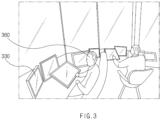
- the remote pilot station 100 may be implemented as a Remote Pilot Station (RPS), and as illustrated in FIG. 3 , a remote pilot 160 may check an image in front of the aircraft 200 through the interface device 130.
- FIG. 3 illustrates an example screen of a remote pilot station.
- the aircraft 200 may include a first kind of air mobility vehicle that has occupants, including pilots and passengers, on board and may fly autonomously or semi-autonomously, and a second kind of air mobility vehicle that may fly autonomously by external control or program without occupants on board.
- the aircraft 200 may include a helicopter, a drone, an airplane, or a vehicle that may be configured to move with wheels on the ground and to fly in the air, and as mentioned earlier, these may include both manned and unmanned cases.
- the aircraft 200 may be implemented as a Remote Pilot Aircraft (RPA).
- RPA Remote Pilot Aircraft
- the air traffic control tower 300 may be configured to communicate with the aircraft 200, and in particular, may be configured to transmit and receive voice information of a control manager, voice information of a pilot, voice information generated by NLP, etc.
- the air traffic control tower 300 may be configured to receive status information of the aircraft 200 from the aircraft 200 and to transmit commands to the aircraft 200.
- the control manager in the air traffic control tower 300 and the pilot of the aircraft 200 may communicate by voice, and may communicate the status information of the aircraft 200 and control commands of the aircraft 200 by voice.
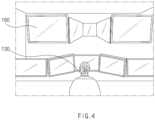
- the air traffic control tower 300 may be implemented as an Air Traffic Control Tower (ATCT), and a control manager 360 may check a status of the aircraft 200 through the interface device 330 as illustrated in FIG. 4.
- FIG. 4 illustrates an example screen of an air traffic control tower.
- the aircraft 200 may be configured to transmit the status information of the aircraft 200 to the air traffic control tower 300 (1).
- the status information of the aircraft 200 may include driving modes such as a landing mode and a tour mode, a fuel status, and whether there is a defect.
- the aircraft 200 may be configured to generate state information of the aircraft 200 as voice information based on Natural Language Processing (NLP) and transmit the voice information.
- NLP Natural Language Processing
- the aircraft 200 may be configured to transmit the status information of the aircraft 200 as text information as well as voice information, so that the voice information may be output through a speaker from the air traffic control tower 300, and data (e.g., text information) may be displayed on a screen of the air traffic control tower 300.
- the air traffic control tower 300 may be configured to output the status information of the aircraft 200 as a voice and to display it on the screen together (@), allowing the control manager to hear the status information of the aircraft 200 with his or her ears and check it with his or her eyes, to minimize errors in the case of using the voice communication. Additionally, the air traffic control tower 300 may be configured to receive a command according to the status information of the aircraft 200 from a control manager and to transmit it to the aircraft 200 (@). That is, a command from the control manager of the air traffic control tower 300 may be transmitted to the aircraft 200 as a voice.
- the aircraft 200 may be configured to generates a command keyword based on the voice command and to transmit the command keyword to the remote pilot station 100 (@).
- the command keyword may be transmitted to the remote pilot station 100 in text type based on data communication, but may be converted into voice information through natural language processing and transmitted to the remote pilot station 100.
- the remote pilot station 100 may be configured to display the command keyword received from the aircraft 200 on a screen, and to generate an instruction based on the command keyword (5). That is, a remote pilot of the remote pilot station 100 may check the command keyword displayed on the screen and generate a command corresponding thereto. That is, the remote pilot station 100 may be configured to transmit the generated instruction to the aircraft 200 (@). For example, in response to a case where the command keyword is "landing," the remote pilot may enter an instruction "land.”
- the remote pilot station 100 may be configured to transmit an instruction converted from the voice command into text to the aircraft 200.
- the aircraft 200 may be configured to convert the instruction received from the remote pilot station 100 into voice information and to transmit it to the air traffic control tower 300.
- the remote pilot station 100 and the air traffic control tower 300 may not be connected to each other, but in an emergency situation, they may be configured to communicate with each other to transmit and receive emergency situation information (7).
- the remote pilot station 100 may be configured to request the air traffic control tower 300 to prioritize an aircraft which is in an emergency situation.
- the above-described steps (D to 6 maybe repeated until ends of a section requiring air traffic control and a section where communication with the air traffic control tower is possible.
- the section requiring the air traffic control and the section where the communication with the air traffic control tower is possible may each be predetermined by airport regulations, etc.
- the aircraft 200 and the air traffic control tower 300 may be configured to perform communication to transmit and receive data information (e.g., text) as well as voice information, and the aircraft 200 and the remote pilot station 100 may be configured to transmit and receive data and instructions based on data communication.
- data information e.g., text
- voice information e.g., voice information
- the aircraft 200 and the remote pilot station 100 may be configured to transmit and receive data and instructions based on data communication.
- human error may be minimized by automatically converting voice communication contents between the control manager of the air traffic control tower 300 and the pilot of the aircraft 200 into data information and transmitting and receiving it. That is, according to the present disclosure, human error may be minimized by converting information to be transmitted and received between the control manager of the air traffic control tower 300 and the pilot of the aircraft 200 into voice information or data information through NLP instead of a voice.
- the remote pilot station 100 may include a communication device 110, a storage 120, an interface device 130, and a processor 140.
- the remote pilot station 100 may be implemented as a single unit by coupling components with each other, and some components may be omitted, based on an implementation method thereof.
- the communication device 110 may perform wireless communication with each of the air traffic control tower 300 and the aircraft 200.
- the communication device 110 may be configured to receive a command keyword from the aircraft 200, and may be configured to transmit an instruction to the aircraft 200.
- the communication device 110 which is a hardware device implemented with various electronic circuits to transmit and receive signals through a wired connection, may be configured to transmit and receive information with each device in the remote pilot station 100 based on a network communication technique, and may be configured to perform wireless communication with the aircraft 200.
- the storage 120 may be configured to store data and/or algorithms necessary for the processor 140 to operate, and as an exemplary embodiment of the present disclosure, may be configured to store data transmitted and received from the aircraft 200
- the command keyword received from the aircraft 200 may be stored.
- the interface device 130 may be configured to output data for remote control of the aircraft 200, and may be configured to receive instructions for being manipulated by a remote pilot to be transmitted to the aircraft 200. As an exemplary embodiment of the present disclosure, in response to a case where a command keyword is received from the aircraft 200, the interface device 130 may display it on the screen.
- the processor 140 may be electrically connected to the communication device 110, the storage 120, the interface device 130, and the like, may electrically control each component, and may be an electrical circuit that executes software commands, thereby performing various data processing and calculations described below.
- the processor 140 may be configured to process a signal transferred between components of remote pilot station 100 to perform overall control such that each component may perform its function normally.
- the processor 140 may be implemented in the form of hardware, software, or a combination of and software.
- the processor 140 may be implemented as a microprocessor, but the present disclosure is not limited thereto.
- the processor 140 may be configured to control the communication device 110 to transmit an instruction corresponding to the command keyword to the aircraft 200, remotely controlling the aircraft 200.
- the processor 140 may be configured to monitor a status of the aircraft 200 by receiving status information of the aircraft 200 from the aircraft 200 at predetermined intervals.
- the processor 140 may be configured to communicate with the air traffic control tower 300 to request that the air traffic control tower 300 may perform priority control of the aircraft in which the emergency situation has occurred.
- the processor 140 may be configured to transmit an instruction for control to the first aircraft 201 designated as a control target among the multiple aircraft 201, 202, ..., and 200n, and may be configured to control the aircraft 202 and 203 which are not designated as control targets among them to continue performing previous missions.
- the processor 140 may be configured to control an aircraft which is not able to continue performing its previous mission according to airport control regulations.
- the airport control regulations may include loitering missions over the airport.
- the processor 140 may be configured to control the communication device 110 to request the air traffic control tower 300 to preferentially control the second aircraft 202 in which the emergency situation has occurred.
- the processor 140 may be configured to control an aircraft, which is not able to continue performing its previous mission, to perform a loitering mission over the airport according to airport control regulations.
- the multiple aircraft 201, 202, ... and 200n may each include a communication device 210, a storage 220, and a processor 230.
- the aircraft 200 may be implemented as a single unit by coupling components with each other, and some components may be omitted, based on an implementation method thereof.
- the communication device 210 is a hardware device implemented with various electronic circuits to transmit and receive signals through a wired connection, and may be configured to transmit and receive information based on in-vehicle devices and in-vehicle network communication techniques.
- the in-vehicle network communication techniques may include Controller Area Network (CAN) communication, Local Interconnect Network (LIN) communication, flex-ray communication, and the like.
- the communication device 210 may be configured to perform wireless communication with the remote pilot station 100 and the air traffic control tower 300.
- the communication device 210 may be configured to transmit status information (including data information such as voice information and text) of the aircraft 200 to the air traffic control tower 300, and may be configured to receive voice commands from the air traffic control tower 300.
- the communication device 210 may be configured to transmit a command keyword to the remote pilot station 100 and to receive an instruction from the remote pilot station 100.
- the storage 220 may be configured to store data and/or algorithms necessary for the processor 230 to operate, and as an exemplary embodiment of the present disclosure, may be configured to store information received from the remote pilot station 100 and the air traffic control tower 300.
- the processor 230 may be electrically connected to the communication device 210, the storage 220, and the like, may electrically control each component, and may be an electrical circuit that executes software commands, thereby performing various data processing and calculations described below.
- the processor 230 may be configured to process a signal transferred between components of the aircraft 200 to perform overall control such that each of the components may perform its function normally.
- the processor 230 may be implemented in the form of hardware, software, or a combination of and software.
- the processor 230 may be implemented as a microprocessor, but the present disclosure is not limited thereto.
- the processor 230 may include a flight control converter to convert voice commands received from the air traffic control tower 300 into data information for data communication. Furthermore, the processor 230 may convert a data type command received from the remote pilot station 100 into voice information based on the flight control converter.
- the processor 230 may be configured to transmit status information of the aircraft to the air traffic control tower 300, may be configured to convert a voice command, which is voice information received from the air traffic control tower 300, into a command keyword, which is data information using a natural language processing (NLP) technique to control the communication device 110 to transmit it to the remote pilot station 100, and may be configured to perform remote control based on an instruction received from the remote pilot station 100.
- NLP natural language processing
- the processor 230 may be configured to convert status information of the aircraft 200 into voice information based on the natural language processing technique to transmit it to the air traffic control tower 300.
- the processor 230 may be configured to control the communication device 110 to transmit the status information of the aircraft 200, including voice information and data information, to the air traffic control tower 300.
- the processor 230 may be configured to convert the instruction received from the remote pilot station 100 into voice information and to control the communication device 110 to transmit it to the air traffic control tower 300.
- the processor 230 may be configured to start a logic for controlling the aircraft in response to satisfying at least one of a section requiring air traffic control, a section where air traffic control communication is possible for the air traffic control tower 300, and a communication request for the air traffic control tower 300. Furthermore, the processor 230 may be configured to end the control of the aircraft 200 in response to ending of the section requiring air traffic control and the section where the air traffic control communication is possible for the air traffic control tower 300.
- the aircraft 202 and 203 that are not designated as control targets may be configured to transmit their status information to the remote pilot station 100 at predetermined intervals.
- the air traffic control tower 300 may include a communication device 310, a storage 320, an interface device 330, and a processor 340. According to an exemplary embodiment of the present disclosure, the air traffic control tower 300 may be implemented as a single unit by coupling components with each other, and some components may be omitted, based on an implementation method thereof.
- the communication device 310 may be configured to perform wireless communication with the first aircraft 201.
- the communication device 310 maybe configured to receive status information of the aircraft 201, 202, ..., and 200n from the aircraft 201, 202, ..., and 200n, and may transmit voice commands for control to each of the aircraft 201, 202, ..., and 200n.
- the storage 320 may store data and/or algorithms required for the processor 140 to operate, and the like. As an exemplary embodiment of the present disclosure, the storage 320 may store the status information of the aircraft 201, 202, ..., and 200n received from the aircraft 201, 202, ..., and 200n.
- the interface device 330 may display the status information of the aircraft 201, 202, ..., and 200n received from the aircraft 201, 202, ..., and 200n, and command keywords may be inputted by a control manager.
- the processor 340 may be electrically connected to the communication device 310, the storage 320, the interface device 330, and the like, may electrically control each component, and may be an electrical circuit that executes software commands, thereby performing various data processing and calculations described below.
- the processor 340 may be configured to process a signal transferred between components of the air traffic control tower 300 to perform overall control such that each component may perform its function normally.
- the processor 340 may be implemented in the form of hardware, software, or a combination of and software.
- the processor 340 may be implemented as a microprocessor, but the present disclosure is not limited thereto.
- the processor 340 may be configured to monitor statuses of the aircraft 201, 202, ..., and 200n based on the status information of the aircraft 201, 202, ..., and 200n periodically received from the aircraft 201, 202, ..., and 200n.
- the processor 340 may be configured to control the communication device 310 to transmit the voice command inputted by the controller to the aircraft 200.
- the processor 340 may be configured to preferentially perform control of the aircraft.
- the above-described communication devices 110, 210, and 310 which are hardware devices implemented with various electronic circuits to transmit and receive signals through wired or wireless connections, may be configured to transmit and receive information with in-vehicle devices based on in-vehicle network communication technology, and may be configured to communicate with the outside through a mobile communication module, a wireless Internet module, and a short range communication module.
- the mobile communication module may be configured to perform communication through a mobile communication network established according to technical standards or communication methods for mobile communication (e.g., Global System for Mobile communication (GSM), Code Division Multi access (CDMA), Code Division Multi Access 2000 (CDMA 2000), Enhanced Voice-Data Optimized or Enhanced Voice-Data Only (EV-DO), Wideband CDMA (WCDMA), High Speed Downlink Packet Access (HSDPA), High Speed Uplink Packet Access (HSUPA), Long Term Evolution (LTE), Long Term Evolution-Advanced (LTE-A), 4th Generation mobile telecommunication (4G), 5th Generation mobile telecommunication (5G), etc.
- GSM Global System for Mobile communication
- CDMA Code Division Multi access
- CDMA 2000 Code Division Multi Access 2000
- WCDMA Wideband CDMA
- HSDPA High Speed Downlink Packet Access
- HSUPA High Speed Uplink Packet Access
- LTE Long Term Evolution
- LTE-A Long Term
- the wireless Internet module refers to a module for wireless Internet access, and may be configured to perform communication through Wireless LAN (WLAN), Wireless-Fidelity (Wi-Fi), Wi-Fi direct, Digital Living Network Alliance (DLNA), Wireless Broadband (WiBro), World Interoperability for Microwave Access (WiMAX), High Speed Downlink Packet Access (HSDPA), High Speed Uplink Packet Access (HSUPA), Long Term Evolution (LTE), Long Term Evolution-Advanced (LTE-A), etc.
- WLAN Wireless LAN
- Wi-Fi Wireless-Fidelity
- Wi-Fi Wi-Fi direct
- WiBro Wireless Broadband
- WWX World Interoperability for Microwave Access
- HSDPA High Speed Downlink Packet Access
- HSUPA High Speed Uplink Packet Access
- LTE Long Term Evolution
- LTE-A Long Term Evolution-Advanced
- the short-range communication module may support short-range communication by using at least one of Bluetooth TM , Radio Frequency Identification (RFID), Infrared Data Association (IrDA), ultra wideband (UWB), ZigBee, Near Field Communication (NFC), a Wireless Universal Serial Bus (USB) technique, or any combination thereof.
- RFID Radio Frequency Identification
- IrDA Infrared Data Association
- UWB ultra wideband
- ZigBee ZigBee
- NFC Near Field Communication
- USB Wireless Universal Serial Bus
- the storages 120, 220, and 320 may each include a storage medium of at least one type among memories of types such as a flash memory, a hard disk, a micro, a card (e.g., a Secure Digital (SD) card or an eXtreme Digital (XD) Card), a Random Access Memory (RAM), a Static RAM (SRAM), a Read-Only Memory (ROM), a Programmable ROM (PROM), an Electrically Erasable PROM (EEPROM), a Magnetic Memory (MRAM), a magnetic disk, and an optical disk.
- a storage medium of at least one type among memories of types such as a flash memory, a hard disk, a micro, a card (e.g., a Secure Digital (SD) card or an eXtreme Digital (XD) Card), a Random Access Memory (RAM), a Static RAM (SRAM), a Read-Only Memory (ROM), a Programmable ROM (PROM), an Electrically Erasable PROM (EEPROM),
- the interface devices 130 and 330 may each include an input means for receiving a control command from a user and an output means for outputting an operation state of the apparatus and results thereof.
- the input means may include a key button, and may include a mouse, a joystick, a jog shuttle, a stylus pen, and the like.
- the input means may include a soft key implemented on the display.
- the output device may include a display, and may also include a voice output means such as a speaker.
- the display in response to a case that a touch sensor formed of a touch film, a touch sheet, or a touch pad is provided on the display, the display may operate as a touch screen, and may be implemented in a form in which an input device and an output device are integrated.
- the display may include at least one of a liquid crystal display (LCD), a thin film transistor liquid crystal display (TFT LCD), an organic light emitting diode display (OLED display), a flexible display, a field emission display (FED), a 3D display, or any combination thereof.
- LCD liquid crystal display
- TFT LCD thin film transistor liquid crystal display
- OLED display organic light emitting diode display
- flexible display a field emission display
- FED field emission display
- 3D display or any combination thereof.
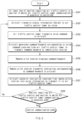
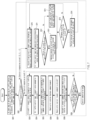
- a control automation system for an aircraft in FIG. 1 performs a process of FIG. 5 .
- operations described as being performed by a device may be understood as being controlled by the processors 140, 230, and 340 of each device in the control automation system for the aircraft.
- operations of steps S101 to S108 may be performed sequentially, but are not necessarily performed sequentially. For example, an order of each operation may be changed, and at least two operations may be performed in parallel.
- the aircraft 200 in response to a section that requires air traffic control, a section where air traffic control tower communication is possible, or a communication request from air traffic control tower 300 (S101), the aircraft 200 may be configured to transmit status information of the aircraft 200 to the air traffic control tower 300 (S102).
- the status information of the aircraft 200 may include both voice information and data information.
- the air traffic control tower 300 may be configured to display data information among the status information of the aircraft 200 received from the aircraft 200 on a screen, may be configured to output voice information through a speaker so that a control manager may check the status information of the aircraft 200, and may be configured to receive a voice command that matches the status information of the aircraft 200 from the control manager and to transmit it to the aircraft 200 (S103).
- the aircraft 200 may be configured to generate a command keyword corresponding to the voice command received from the air traffic control tower 300 and to transmit the command keyword to the remote pilot station 100 (S104).
- the remote pilot station 100 may be configured to display the command keyword on the screen so that a remote pilot may check the command keyword (S105), and may be configured to receive an instruction matching the command keyword by the remote pilot to transmit the instruction to the aircraft 200 (S106).
- the aircraft 200 may be configured to convert the instruction received from the remote pilot station 100 into voice information to transmit the instruction converted into the voice information to the air traffic control tower 300 (S107).
- the aircraft 200 may be configured to determine whether the section requiring air traffic control or the section in which air traffic control tower communication is possible ends (S108), and may be configured to end air traffic control communication in response to the end of the section requiring air traffic control or the section in which air traffic control tower communication is possible ends.
- the above steps S102 to S107 may be repeated until the section requiring air traffic control or the section in which air traffic control tower communication is possible ends.
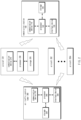
- FIG. 6 illustrates an example of a configuration of a control automation system for an autonomous flight gas
- FIG. 7 illustrates another flowchart for describing an example control automation method for an aircraft.
- steps S201 to S215 may be performed sequentially, but are not necessarily performed sequentially. For example, an order of each operation may be changed, and at least two operations may be performed in parallel.
- the first aircraft 201 may preferentially be a control target, and the aircraft 202 and 203 may be configured to perform a same previous mission and wait until they become the control target.
- one first aircraft 201 designated by the remote pilot may be preferentially controlled.
- the plurality of aircraft may all transmit their status information to the air traffic control tower 300 and the remote pilot station 100, and the air traffic control tower 300 and the remote pilot station 100 may be configured to display the received status information of the plurality of aircraft on the screen.
- the aircraft 202 and 203 which are not designated as control targets may continue to perform a same mission (e.g., cruising) which they were previously performing.
- control target ranking may be arbitrarily determined by a remote pilot or determined according to predetermined rules.
- status information may be transmitted by voice to the air traffic control tower.
- the aircraft 200 may be configured to determine whether the aircraft is a control-responsive aircraft (S202).
- control-responsive aircraft In response to a case where the aircraft is the control-responsive aircraft, the control-responsive aircraft will be referred to as the first aircraft, and a control-irresponsive aircraft will be referred to as the second aircraft and the third aircraft.
- the first aircraft 201 may be configured to transmit status information of the first aircraft 201 to the air traffic control tower 300 (S203).
- the status information of the first aircraft 201 may include voice information and data information.
- the air traffic control tower 300 may be configured to display data information among the status information of the first aircraft 201 received from the first aircraft 201 on a screen, may be configured to output voice information through a speaker so that a control manager may check the status information of the first aircraft 201, and may be configured to transmit a voice command that matches the status information of the first aircraft 201 (S204).
- the air traffic control tower 300 may be configured to receive a voice command that matches the status information of the first aircraft 201 from the control manager to transmit it to the first aircraft 201.
- the first aircraft 201 may be configured to generate a command keyword based on data communication corresponding to the voice command received from the air traffic control tower 300 and to transmit the command keyword based on data communication to the remote pilot station 100 (S205).
- the command keyword may include a runway, a gate, speed, a descent angle, a landing time, etc.
- the remote pilot station 100 may be configured to display the command keyword on the screen so that a remote pilot may check it (S206), and may be configured to generate an instruction matching the command keyword to transmit the generated instruction to the aircraft 201 (S207). For example, in response to a case where the command keyword is a landing time, a remote pilot may input the instruction "Land at 2 o'clock,” and this instruction be transmitted to the aircraft 200.
- the aircraft 201 may be configured to convert the instruction based on data communication received from the remote pilot station 100 into voice information to transmit the converted voice information to the air traffic control tower 300 (S208). Accordingly, the control manager may check the instruction transmitted to the first aircraft 201.
- the first aircraft 201 may be configured to determine whether the section requiring air traffic control or the section in which air traffic control tower communication is possible ends (S209), and may be configured to end air traffic control communication in response to the end of the section requiring air traffic control or the section in which air traffic control tower communication is possible ends.
- the above steps S202 to S209 may be repeated until the section requiring air traffic control or the section in which air traffic control tower communication is possible ends.
- step S202 the remaining aircraft 202 and 203 that are not designated as control targets among the plurality of aircraft 201, 202, and 203 may be configured to transmit their status information to each of the air traffic control tower 300 and the remote pilot station 100 (S210).
- the air traffic control tower 300 and the remote pilot station 100 may be configured to display the status information received from the aircraft 202 and 203 (S211), and the remote pilot station 100 may be configured to determine whether the mission of the aircraft 202 and 203 may be maintained (S212).
- the remote pilot station 100 may be configured to remotely control the aircraft 202 and 203 to maintain their mission (S213), and in response to a case where it is impossible to maintain the mission of aircraft 202 and 203, the remote pilot station 100 may perform the mission of the aircraft 202 and 203 according to existing control regulations (S214).
- the remote pilot station 100 may monitor whether an emergency situation occurs in the aircraft 202 and 203 (S215), and in the event of the emergency situation in the aircraft 202 or 203, may be linked with the air traffic control tower 300 to perform interrupt control to control the emergency situation of the aircraft 202 and/or 203 (S216). In the instant case, the remote pilot station 100 may monitor the emergency situation through periodic communication with the aircraft 202 and/or 203.
- control of the first aircraft 201 may be completed and then control of the second aircraft 202 may be performed.
- control of the second aircraft 202 may be performed through another control manager who responds to the emergency situation instead of the control manager who was controlling the first aircraft 201 at the air traffic control tower 300.
- the control manager who was controlling the first aircraft 201 may perform control of the second aircraft 202 after ending control of the first aircraft 201.
- the aircraft 202 and 203 which are not designated as control targets may perform the processes of S210 to S216 in parallel.
- control of the aircraft may be automated without building a communication infrastructure between the air traffic control tower 300 and the remote pilot station 100.
- human error may be minimized through voice communication by displaying necessary information on the screen through data communication as well as voice communication between the control manager of the air traffic control tower 300 and the aircraft 200.
- a control time may be minimized, airport congestion may be reduced, and work fatigue of control managers and remote pilots may be minimized by automating the control of aircraft based on voice information generation through natural language processing (NLP) and command generation based on voice information, minimizing communication delay due to voice communication.
- NLP natural language processing
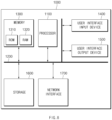
- FIG. 8 illustrates an example computing system.
- the computing system 1000 includes at least one processor 1100 connected through a bus 1200, a memory 1300, a user interface input device 1400, a user interface output device 1500, and a storage 1600, and a network interface 1700.
- the processor 1100 may be a central processing unit (CPU) or a semiconductor device that is configured to perform processing on commands stored in the memory 1300 and/or the storage 1600.
- the memory 1300 and the storage 1600 may include various types of volatile or nonvolatile storage media.
- the memory 1300 may include a read only memory (ROM) 1310 and a random access memory (RAM) 1320.
- steps of a method or algorithm described in connection with the exemplary embodiments included herein may be directly implemented by hardware, a software module, or a combination of the two, executed by the processor 1100.
- the software module may reside in a storage medium (i.e., the memory 1300 and/or the storage 1600) such as a RAM memory, a flash memory, a ROM memory, an EPROM memory, an EEPROM memory, a register, a hard disk, a removable disk, and a CD-ROM.
- An exemplary storage medium is coupled to the processor 1100, which may read information from and write information to the storage medium.
- the storage medium may be integrated with the processor 1100.
- the processor and the storage medium may reside within an application specific integrated circuit (ASIC).
- ASIC application specific integrated circuit
- the ASIC may reside within a user terminal.
- the processor and the storage medium may reside as separate components within the user terminal.
Landscapes
- Engineering & Computer Science (AREA)
- Physics & Mathematics (AREA)
- Aviation & Aerospace Engineering (AREA)
- General Physics & Mathematics (AREA)
- Automation & Control Theory (AREA)
- Remote Sensing (AREA)
- Radar, Positioning & Navigation (AREA)
- Audiology, Speech & Language Pathology (AREA)
- Multimedia (AREA)
- Acoustics & Sound (AREA)
- Human Computer Interaction (AREA)
- Health & Medical Sciences (AREA)
- Computational Linguistics (AREA)
- Traffic Control Systems (AREA)
Abstract
Description
- This application claims the benefit of
Korean Patent Application No. 10-2023-0141457, filed on October 20, 2023 - The present disclosure relates to an aircraft, a remote pilot station, and an automatic control system for the aircraft, and more specifically, to communication technology between the aircraft, an air traffic control tower, and a remote pilot station.
- Control of an existing aircraft has been mainly carried out through voice communication between a pilot operating the aircraft and an air traffic controller. At each stage of flight, such as airport departure, approach, cruising, etc., the pilot flies by receiving commands from a control facility (control tower) around the aircraft through communication with the control facility and changing a flight path or flight speed of the aircraft.
- In the past, as the pilot of an aircraft communicated directly with a control manager of the control facility by voice, accidents due to errors during voice communication were frequent, and because air traffic control was only possible through voice communication, there was a problem with workload of pilots and control managers being high.
- Furthermore, in a case of unmanned aerial vehicles or autonomous aircraft, they are remotely controlled by a remote pilot station (RPS), and conventionally, control of the unmanned aerial vehicles or autonomous aircrafts was difficult as control was achieved through direct communication between a control manager of a general airport control tower (CT) and a pilot of the aircraft.
- Accordingly, there are problems such as additional costs due to a need to build additional infrastructure for communication between the general airport control tower (CT) and the remote pilot station to control unmanned aerial vehicles or autonomous aircraft.
- Furthermore, in a case where one remote pilot station remotely controls multiple aircraft, there is a problem in that it is difficult to control them in conjunction with the airport control tower.
- An exemplary embodiment of the present disclosure attempts to provide an aircraft, a remote pilot station, and an automatic control system for the aircraft, configured for automatically controlling the aircraft by performing communication between the aircraft, the remote pilot station, and the air traffic control tower.
- An exemplary embodiment of the present disclosure attempts to provide an aircraft, a remote pilot station, and an automatic control system for the aircraft, configured for minimizing a cost for automatic control, reducing airport congestion, and minimizing work fatigue of control managers and remote pilots without need to build additional communication infrastructure between an air traffic control tower and the remote pilot station by performing communication between the air traffic control tower and the remote pilot station based on the aircraft.
- An exemplary embodiment of the present disclosure attempts to provide an aircraft, a remote pilot station, and an automatic control system for the aircraft, configured for minimizing a communication delay and a human error caused by human voice communication and minimizing a control time during control of the aircraft by automatically generating voice information through natural language processing (NLP) and transmitting it to the air traffic control tower in the aircraft and by converting the voice information received from the air traffic control tower into data information and transmitting it to the remote pilot station.
- Furthermore, an exemplary embodiment of the present disclosure attempts to provide an aircraft, a remote pilot station, and an automatic control system for the aircraft, configured for efficiently controlling multiple aircraft based on communication with the air traffic control tower through the aircraft in response to a case where multiple aircraft are controlled by one remote pilot station.
- An exemplary embodiment of the present disclosure provides an aircraft including: a communication device configured to communicate with an air traffic control tower which controls an aircraft and a remote pilot station which remotely controls the aircraft; and a processor configured to transmit status information of the aircraft to the air traffic control tower, to control the communication device to convert a voice command received from the air traffic control tower into a command keyword to transmit it to the remote pilot station, and to perform remote control based on an instruction received from the remote pilot station.
- In an exemplary embodiment of the present disclosure, the processor may be configured to convert status information of the aircraft into voice information based on a natural language processing technique to transmit it to the air traffic control tower.
- In an exemplary embodiment of the present disclosure, the processor may be configured to control the communication device to transmit the status information of the aircraft, including voice information and data information, to the air traffic control tower.
- In an exemplary embodiment of the present disclosure, the processor may be configured to convert the instruction received from the remote pilot station into voice information and to control the communication device to transmit it to the air traffic control tower.
- In an exemplary embodiment of the present disclosure, the processor may be configured, in response to satisfying at least one of a section requiring air traffic control, a section where air traffic control communication is possible for the air traffic control tower, and a communication request for the air traffic control tower, to start a logic for controlling the aircraft.
- An exemplary embodiment of the present disclosure provides a remote pilot station including: a communication device configured to communicate with an aircraft; and a processor configured to control the communication device to transmit an instruction corresponding to a command keyword according to a voice command from the air traffic control tower, to the aircraft to remotely control the aircraft, in response to a case of receiving the command keyword from the aircraft.
- In an exemplary embodiment, the method may further include an interface device configured to display the command keyword on a screen.
- In an exemplary embodiment of the present disclosure, the interface device is configured to receive an instruction from a remote pilot.
- In an exemplary embodiment of the present disclosure, the processor may be configured to monitor a status of the aircraft by receiving status information of the aircraft from the aircraft at predetermined intervals.
- In an exemplary embodiment of the present disclosure, the processor may be configured to communicate with the air traffic control tower to request that the air traffic control tower performs priority control of the aircraft in which the emergency situation has occurred in response to a case where an emergency situation occurs in the aircraft.
- An exemplary embodiment of the present disclosure provides an automatic control system for an aircraft, including: the aircraft; and a remote pilot station configured to remotely control the aircraft, wherein the aircraft is configured to transmit status information of the aircraft to an air traffic control tower that controls the aircraft, to convert a voice command received from the air traffic control tower into a command keyword to transmit it to the remote pilot station, and to perform remote control based on an instruction received from the remote pilot station, and the remote pilot station is configured to remotely control the aircraft by transmitting an instruction corresponding to a command keyword according to the voice command from the air traffic control tower, to the aircraft in response to a case of receiving the command keyword from the aircraft.
- In an exemplary embodiment of the present disclosure, the aircraft may include multiple aircraft, and in response to the case where the one remote pilot station remotely controls the multiple aircraft, the remote pilot station may be configured to transmit an instruction for control to an aircraft designated as a control target among the multiple aircraft, and to control an aircraft which is not designated as a control target among the multiple aircraft to continue performing previous mission.
- In an exemplary embodiment of the present disclosure, an aircraft which is not designated as a control target among the multiple aircraft may be configured to transmit status information thereof to the remote pilot station at predetermined intervals.
- In an exemplary embodiment of the present disclosure, in response to a case where the aircraft which is not designated as a control target among the multiple aircraft, the processor may be configured to control an aircraft which is not able to continue performing the previous mission according to airport control regulations.
- In an exemplary embodiment of the present disclosure, the remote pilot station may be configured, in the event of an emergency situation with an aircraft which is not designated as a control target among the multiple aircraft, to request the air traffic control tower to preferentially control the aircraft in which the emergency situation has occurred.
- In an exemplary embodiment of the present disclosure, in response to the case where the one remote pilot station remotely controls the multiple aircraft, the remote pilot station may be configured to determine control priority of the multiple aircraft based on status information of the multiple aircraft.
- In an exemplary embodiment of the present disclosure, the status information of the multiple aircraft may include at least one of a driving mode of the aircraft, fuel status information, defect status, or a combination thereof.
- In an exemplary embodiment of the present disclosure, in response to a case where the aircraft which is not designated as a control target among the multiple aircraft, the processor may be configured to control an aircraft, which is not able to continue performing the previous mission, to perform a loitering mission over an airport according to airport control regulations.
- In an exemplary embodiment of the present disclosure, the aircraft may be configured, in response to satisfying at least one of a section requiring air traffic control, a section where air traffic control communication is possible for the air traffic control tower, and a communication request for the air traffic control tower, to start a logic for controlling the aircraft.
- In an exemplary embodiment of the present disclosure, the aircraft may be configured to end control of the aircraft in response to ending of the section requiring the air traffic control and the section where the air traffic control communication is possible for the air traffic control tower.
- According to the present technique, the aircraft may be automatically controlled based on communication between the aircraft, the remote pilot station, and the air traffic control tower.
- According to the present technique, information needed by a control manager of an air traffic control tower may be displayed on a screen by transmitting and receiving not only voice information but also data information between the control manager and the aircraft.
- In addition, according to the present technique, it may be possible to minimize a control time by minimizing a communication delay due to voice communication, to reduce airport congestion, and to minimize work fatigue of control managers and remote pilots, by automating control of the aircraft generating the voice information through natural language processing (NLP) and generating instructions based on the voice information.
- In addition, according to the present technique, multiple aircraft may be efficiently controlled based on communication with the air traffic control tower through the aircraft in response to a case where multiple aircraft are controlled by one remote pilot station.
- Furthermore, various effects which may be directly or indirectly identified through the present specification may be provided.
-
-
FIG. 1 illustrates an example of a configuration of a control automation system for an aircraft; -
FIG. 2 illustrates a block diagram showing an example configuration of a control automation system for an aircraft; -
FIG. 3 illustrates an example screen of a remote pilot station; -
FIG. 4 illustrates an example screen of an air traffic control tower; -
FIG. 5 illustrates a flowchart showing an example control automation method for an aircraft; -
FIG. 6 illustrates another example of a configuration of a control automation system for an aircraft; -
FIG. 7 illustrates a flowchart showing another example control automation method for an aircraft; and -
FIG. 8 illustrates an example computing system. - Hereinafter, some exemplary embodiments of the present disclosure will be described in detail with reference to exemplary drawings. It should be noted that in adding reference numerals to constituent elements of each drawing, the same constituent elements include the same reference numerals as possible even though they are indicated on different drawings. In describing an exemplary embodiment of the present disclosure, when it is determined that a detailed description of the well-known configuration or function associated with the exemplary embodiment of the present disclosure may obscure the gist of the present disclosure, it will be omitted.
- In describing constituent elements according to an exemplary embodiment of the present disclosure, terms such as first, second, A, B, (a), and (b) may be used. These terms are only for distinguishing the constituent elements from other constituent elements, and the nature, sequences, or orders of the constituent elements are not limited by the terms. Furthermore, all terms used herein including technical scientific terms include the same meanings as those which are generally understood by those skilled in the technical field to which an exemplary embodiment of the present disclosure pertains (those skilled in the art) unless they are differently defined. Terms defined in a generally used dictionary shall be construed to include meanings matching those in the context of a related art, and shall not be construed to include idealized or excessively formal meanings unless they are clearly defined in the present specification.
- Hereinafter, various exemplary embodiments of the present disclosure will be described in detail with reference to
FIG. 1 to FIG. 8 . -
FIG. 1 illustrates an example of a configuration of a control automation system for an aircraft, and -
FIG. 2 illustrates a block diagram showing an example configuration of a control automation system for an aircraft. - Referring to
FIG. 1 , an aircraft control automation system according to an exemplary embodiment of the present disclosure may include aremote pilot station 100, anaircraft 200, and an airtraffic control tower 300. - The aircraft control automation system according to the present disclosure may be configured to automate control of the
aircraft 200 through communication between theremote pilot station 100 that remotely controls theaircraft 200 and theaircraft 200, and between theaircraft 200 and the airtraffic control tower 300. - The
remote pilot station 100 may be configured to remotely control theaircraft 200 from a remote position. That is, theremote pilot station 100 may be configured to remotely control thevehicle 200 by transmitting instructions to thevehicle 200 based on data communication, and may be configured to control, e.g., takeoff, landing, and circling. Theremote pilot station 100 may be implemented as a Remote Pilot Station (RPS), and as illustrated inFIG. 3 , aremote pilot 160 may check an image in front of theaircraft 200 through theinterface device 130.FIG. 3 illustrates an example screen of a remote pilot station. - The
aircraft 200 may include a first kind of air mobility vehicle that has occupants, including pilots and passengers, on board and may fly autonomously or semi-autonomously, and a second kind of air mobility vehicle that may fly autonomously by external control or program without occupants on board. Specifically, theaircraft 200 may include a helicopter, a drone, an airplane, or a vehicle that may be configured to move with wheels on the ground and to fly in the air, and as mentioned earlier, these may include both manned and unmanned cases. Theaircraft 200 may be implemented as a Remote Pilot Aircraft (RPA). - The air
traffic control tower 300 may be configured to communicate with theaircraft 200, and in particular, may be configured to transmit and receive voice information of a control manager, voice information of a pilot, voice information generated by NLP, etc. The airtraffic control tower 300 may be configured to receive status information of theaircraft 200 from theaircraft 200 and to transmit commands to theaircraft 200. In the instant case, the control manager in the airtraffic control tower 300 and the pilot of theaircraft 200 may communicate by voice, and may communicate the status information of theaircraft 200 and control commands of theaircraft 200 by voice. The airtraffic control tower 300 may be implemented as an Air Traffic Control Tower (ATCT), and acontrol manager 360 may check a status of theaircraft 200 through theinterface device 330 as illustrated inFIG. 4. FIG. 4 illustrates an example screen of an air traffic control tower. - The
aircraft 200 may be configured to transmit the status information of theaircraft 200 to the air traffic control tower 300 (①). In the instant case, the status information of theaircraft 200 may include driving modes such as a landing mode and a tour mode, a fuel status, and whether there is a defect. Furthermore, theaircraft 200 may be configured to generate state information of theaircraft 200 as voice information based on Natural Language Processing (NLP) and transmit the voice information. In the instant case, theaircraft 200 may be configured to transmit the status information of theaircraft 200 as text information as well as voice information, so that the voice information may be output through a speaker from the airtraffic control tower 300, and data (e.g., text information) may be displayed on a screen of the airtraffic control tower 300. - Accordingly, the air
traffic control tower 300 may be configured to output the status information of theaircraft 200 as a voice and to display it on the screen together (@), allowing the control manager to hear the status information of theaircraft 200 with his or her ears and check it with his or her eyes, to minimize errors in the case of using the voice communication. Additionally, the airtraffic control tower 300 may be configured to receive a command according to the status information of theaircraft 200 from a control manager and to transmit it to the aircraft 200 (@). That is, a command from the control manager of the airtraffic control tower 300 may be transmitted to theaircraft 200 as a voice. - In response to a voice command being received from the air
traffic control tower 300, theaircraft 200 may be configured to generates a command keyword based on the voice command and to transmit the command keyword to the remote pilot station 100 (@). In the instant case, the command keyword may be transmitted to theremote pilot station 100 in text type based on data communication, but may be converted into voice information through natural language processing and transmitted to theremote pilot station 100. - Accordingly, the
remote pilot station 100 may be configured to display the command keyword received from theaircraft 200 on a screen, and to generate an instruction based on the command keyword (⑤). That is, a remote pilot of theremote pilot station 100 may check the command keyword displayed on the screen and generate a command corresponding thereto. That is, theremote pilot station 100 may be configured to transmit the generated instruction to the aircraft 200 (@). For example, in response to a case where the command keyword is "landing," the remote pilot may enter an instruction "land." - In the instant case, in response to a case where a command is inputted as a voice by a remote pilot, the
remote pilot station 100 may be configured to transmit an instruction converted from the voice command into text to theaircraft 200. - Furthermore, the
aircraft 200 may be configured to convert the instruction received from theremote pilot station 100 into voice information and to transmit it to the airtraffic control tower 300. - Furthermore, the
remote pilot station 100 and the airtraffic control tower 300 may not be connected to each other, but in an emergency situation, they may be configured to communicate with each other to transmit and receive emergency situation information (⑦). For example, in response to a case where there are a plurality of aircraft for control, theremote pilot station 100 may be configured to request the airtraffic control tower 300 to prioritize an aircraft which is in an emergency situation. - The above-described steps (D to ⑥ maybe repeated until ends of a section requiring air traffic control and a section where communication with the air traffic control tower is possible. In the instant case, the section requiring the air traffic control and the section where the communication with the air traffic control tower is possible may each be predetermined by airport regulations, etc.
- Accordingly, according to the present disclosure, the
aircraft 200 and the airtraffic control tower 300 may be configured to perform communication to transmit and receive data information (e.g., text) as well as voice information, and theaircraft 200 and theremote pilot station 100 may be configured to transmit and receive data and instructions based on data communication. - Furthermore, according to the present disclosure, human error may be minimized by automatically converting voice communication contents between the control manager of the air
traffic control tower 300 and the pilot of theaircraft 200 into data information and transmitting and receiving it. That is, according to the present disclosure, human error may be minimized by converting information to be transmitted and received between the control manager of the airtraffic control tower 300 and the pilot of theaircraft 200 into voice information or data information through NLP instead of a voice. - Referring to
FIG. 2 , theremote pilot station 100 may include acommunication device 110, astorage 120, aninterface device 130, and aprocessor 140. According to an exemplary embodiment of the present disclosure, theremote pilot station 100 may be implemented as a single unit by coupling components with each other, and some components may be omitted, based on an implementation method thereof. - The
communication device 110 may perform wireless communication with each of the airtraffic control tower 300 and theaircraft 200. As an exemplary embodiment of the present disclosure, thecommunication device 110 may be configured to receive a command keyword from theaircraft 200, and may be configured to transmit an instruction to theaircraft 200. - The
communication device 110, which is a hardware device implemented with various electronic circuits to transmit and receive signals through a wired connection, may be configured to transmit and receive information with each device in theremote pilot station 100 based on a network communication technique, and may be configured to perform wireless communication with theaircraft 200. - The
storage 120 may be configured to store data and/or algorithms necessary for theprocessor 140 to operate, and as an exemplary embodiment of the present disclosure, may be configured to store data transmitted and received from theaircraft 200 - As an exemplary embodiment of the present disclosure, the command keyword received from the
aircraft 200 may be stored. - The
interface device 130 may be configured to output data for remote control of theaircraft 200, and may be configured to receive instructions for being manipulated by a remote pilot to be transmitted to theaircraft 200. As an exemplary embodiment of the present disclosure, in response to a case where a command keyword is received from theaircraft 200, theinterface device 130 may display it on the screen. - The
processor 140 may be electrically connected to thecommunication device 110, thestorage 120, theinterface device 130, and the like, may electrically control each component, and may be an electrical circuit that executes software commands, thereby performing various data processing and calculations described below. - The
processor 140 may be configured to process a signal transferred between components ofremote pilot station 100 to perform overall control such that each component may perform its function normally. Theprocessor 140 may be implemented in the form of hardware, software, or a combination of and software. For example, theprocessor 140 may be implemented as a microprocessor, but the present disclosure is not limited thereto. - In response to a case of receiving a command keyword according to a voice command from the air traffic control tower from the
aircraft 200, theprocessor 140 may be configured to control thecommunication device 110 to transmit an instruction corresponding to the command keyword to theaircraft 200, remotely controlling theaircraft 200. - The
processor 140 may be configured to monitor a status of theaircraft 200 by receiving status information of theaircraft 200 from theaircraft 200 at predetermined intervals. - In response to a case where an emergency situation occurs in the
aircraft 200, theprocessor 140 may be configured to communicate with the airtraffic control tower 300 to request that the airtraffic control tower 300 may perform priority control of the aircraft in which the emergency situation has occurred. - In response to a case where
multiple aircraft remote pilot station 100, theprocessor 140 may be configured to transmit an instruction for control to thefirst aircraft 201 designated as a control target among themultiple aircraft aircraft - In response to a case where the
aircraft multiple aircraft processor 140 may be configured to control an aircraft which is not able to continue performing its previous mission according to airport control regulations. In the instant case, the airport control regulations may include loitering missions over the airport. - In the event of an emergency situation with the
second aircraft 202, which is not designated as a control target, theprocessor 140 may be configured to control thecommunication device 110 to request the airtraffic control tower 300 to preferentially control thesecond aircraft 202 in which the emergency situation has occurred. - In response to a case where one
remote pilot station 100 remotely controls a plurality of aircraft, theprocessor 140 may be configured to determine control priority of theaircraft multiple aircraft - In response to a case where the aircraft, which are not designated as control targets, are not able to continue to perform their previous missions among the
multiple aircraft processor 140 may be configured to control an aircraft, which is not able to continue performing its previous mission, to perform a loitering mission over the airport according to airport control regulations. - The
multiple aircraft communication device 210, astorage 220, and aprocessor 230. According to an exemplary embodiment of the present disclosure, theaircraft 200 may be implemented as a single unit by coupling components with each other, and some components may be omitted, based on an implementation method thereof. - The
communication device 210 is a hardware device implemented with various electronic circuits to transmit and receive signals through a wired connection, and may be configured to transmit and receive information based on in-vehicle devices and in-vehicle network communication techniques. As an exemplary embodiment of the present disclosure, the in-vehicle network communication techniques may include Controller Area Network (CAN) communication, Local Interconnect Network (LIN) communication, flex-ray communication, and the like. - Furthermore, the
communication device 210 may be configured to perform wireless communication with theremote pilot station 100 and the airtraffic control tower 300. As an exemplary embodiment of the present disclosure, thecommunication device 210 may be configured to transmit status information (including data information such as voice information and text) of theaircraft 200 to the airtraffic control tower 300, and may be configured to receive voice commands from the airtraffic control tower 300. Furthermore, thecommunication device 210 may be configured to transmit a command keyword to theremote pilot station 100 and to receive an instruction from theremote pilot station 100. - The
storage 220 may be configured to store data and/or algorithms necessary for theprocessor 230 to operate, and as an exemplary embodiment of the present disclosure, may be configured to store information received from theremote pilot station 100 and the airtraffic control tower 300. - The
processor 230 may be electrically connected to thecommunication device 210, thestorage 220, and the like, may electrically control each component, and may be an electrical circuit that executes software commands, thereby performing various data processing and calculations described below. - The
processor 230 may be configured to process a signal transferred between components of theaircraft 200 to perform overall control such that each of the components may perform its function normally. Theprocessor 230 may be implemented in the form of hardware, software, or a combination of and software. For example, theprocessor 230 may be implemented as a microprocessor, but the present disclosure is not limited thereto. - The
processor 230 may include a flight control converter to convert voice commands received from the airtraffic control tower 300 into data information for data communication. Furthermore, theprocessor 230 may convert a data type command received from theremote pilot station 100 into voice information based on the flight control converter. - The
processor 230 may be configured to transmit status information of the aircraft to the airtraffic control tower 300, may be configured to convert a voice command, which is voice information received from the airtraffic control tower 300, into a command keyword, which is data information using a natural language processing (NLP) technique to control thecommunication device 110 to transmit it to theremote pilot station 100, and may be configured to perform remote control based on an instruction received from theremote pilot station 100. - The
processor 230 may be configured to convert status information of theaircraft 200 into voice information based on the natural language processing technique to transmit it to the airtraffic control tower 300. - The
processor 230 may be configured to control thecommunication device 110 to transmit the status information of theaircraft 200, including voice information and data information, to the airtraffic control tower 300. - The
processor 230 may be configured to convert the instruction received from theremote pilot station 100 into voice information and to control thecommunication device 110 to transmit it to the airtraffic control tower 300. - The
processor 230 may be configured to start a logic for controlling the aircraft in response to satisfying at least one of a section requiring air traffic control, a section where air traffic control communication is possible for the airtraffic control tower 300, and a communication request for the airtraffic control tower 300. Furthermore, theprocessor 230 may be configured to end the control of theaircraft 200 in response to ending of the section requiring air traffic control and the section where the air traffic control communication is possible for the airtraffic control tower 300. - In response to a case where one
remote pilot station 100 remotely controls theaircraft aircraft aircraft remote pilot station 100 at predetermined intervals. - The air
traffic control tower 300 may include acommunication device 310, astorage 320, aninterface device 330, and aprocessor 340. According to an exemplary embodiment of the present disclosure, the airtraffic control tower 300 may be implemented as a single unit by coupling components with each other, and some components may be omitted, based on an implementation method thereof. - The
communication device 310 may be configured to perform wireless communication with thefirst aircraft 201. As an exemplary embodiment of the present disclosure, thecommunication device 310 maybe configured to receive status information of theaircraft aircraft aircraft - The
storage 320 may store data and/or algorithms required for theprocessor 140 to operate, and the like. As an exemplary embodiment of the present disclosure, thestorage 320 may store the status information of theaircraft aircraft - The
interface device 330 may display the status information of theaircraft aircraft - The
processor 340 may be electrically connected to thecommunication device 310, thestorage 320, theinterface device 330, and the like, may electrically control each component, and may be an electrical circuit that executes software commands, thereby performing various data processing and calculations described below. - The
processor 340 may be configured to process a signal transferred between components of the airtraffic control tower 300 to perform overall control such that each component may perform its function normally. Theprocessor 340 may be implemented in the form of hardware, software, or a combination of and software. For example, theprocessor 340 may be implemented as a microprocessor, but the present disclosure is not limited thereto. - The
processor 340 may be configured to monitor statuses of theaircraft aircraft aircraft - The
processor 340 may be configured to control thecommunication device 310 to transmit the voice command inputted by the controller to theaircraft 200. - In response to a case of receiving a request from the
remote pilot station 100 for emergency control of an aircraft which is in an emergency situation, theprocessor 340 may be configured to preferentially perform control of the aircraft. - The above-described
communication devices - The mobile communication module may be configured to perform communication through a mobile communication network established according to technical standards or communication methods for mobile communication (e.g., Global System for Mobile communication (GSM), Code Division Multi access (CDMA), Code Division Multi Access 2000 (CDMA 2000), Enhanced Voice-Data Optimized or Enhanced Voice-Data Only (EV-DO), Wideband CDMA (WCDMA), High Speed Downlink Packet Access (HSDPA), High Speed Uplink Packet Access (HSUPA), Long Term Evolution (LTE), Long Term Evolution-Advanced (LTE-A), 4th Generation mobile telecommunication (4G), 5th Generation mobile telecommunication (5G), etc.
- The wireless Internet module refers to a module for wireless Internet access, and may be configured to perform communication through Wireless LAN (WLAN), Wireless-Fidelity (Wi-Fi), Wi-Fi direct, Digital Living Network Alliance (DLNA), Wireless Broadband (WiBro), World Interoperability for Microwave Access (WiMAX), High Speed Downlink Packet Access (HSDPA), High Speed Uplink Packet Access (HSUPA), Long Term Evolution (LTE), Long Term Evolution-Advanced (LTE-A), etc.
- The short-range communication module may support short-range communication by using at least one of Bluetooth™, Radio Frequency Identification (RFID), Infrared Data Association (IrDA), ultra wideband (UWB), ZigBee, Near Field Communication (NFC), a Wireless Universal Serial Bus (USB) technique, or any combination thereof.
- The
storages - The
interface devices - The output device may include a display, and may also include a voice output means such as a speaker. In the instant case, in response to a case that a touch sensor formed of a touch film, a touch sheet, or a touch pad is provided on the display, the display may operate as a touch screen, and may be implemented in a form in which an input device and an output device are integrated.
- In the instant case, the display may include at least one of a liquid crystal display (LCD), a thin film transistor liquid crystal display (TFT LCD), an organic light emitting diode display (OLED display), a flexible display, a field emission display (FED), a 3D display, or any combination thereof.
- Hereinafter, a control automation method for an aircraft according to an exemplary embodiment of the present disclosure will be described with reference to
FIG. 5. FIG. 5 illustrates a flowchart for describing an example control automation method for an aircraft. - Hereinafter, it is assumed that a control automation system for an aircraft in
FIG. 1 performs a process ofFIG. 5 . Furthermore, in the description ofFIG. 5 , operations described as being performed by a device may be understood as being controlled by theprocessors - Referring to
FIG. 5 , in response to a section that requires air traffic control, a section where air traffic control tower communication is possible, or a communication request from air traffic control tower 300 (S101), theaircraft 200 may be configured to transmit status information of theaircraft 200 to the air traffic control tower 300 (S102). In the instant case, the status information of theaircraft 200 may include both voice information and data information. - Accordingly, the air
traffic control tower 300 may be configured to display data information among the status information of theaircraft 200 received from theaircraft 200 on a screen, may be configured to output voice information through a speaker so that a control manager may check the status information of theaircraft 200, and may be configured to receive a voice command that matches the status information of theaircraft 200 from the control manager and to transmit it to the aircraft 200 (S103). - Accordingly, the
aircraft 200 may be configured to generate a command keyword corresponding to the voice command received from the airtraffic control tower 300 and to transmit the command keyword to the remote pilot station 100 (S104). - The
remote pilot station 100 may be configured to display the command keyword on the screen so that a remote pilot may check the command keyword (S105), and may be configured to receive an instruction matching the command keyword by the remote pilot to transmit the instruction to the aircraft 200 (S106). - Accordingly, the
aircraft 200 may be configured to convert the instruction received from theremote pilot station 100 into voice information to transmit the instruction converted into the voice information to the air traffic control tower 300 (S107). - Thereafter, the
aircraft 200 may be configured to determine whether the section requiring air traffic control or the section in which air traffic control tower communication is possible ends (S108), and may be configured to end air traffic control communication in response to the end of the section requiring air traffic control or the section in which air traffic control tower communication is possible ends. - In response to a case where the section requiring air traffic control or the section in which air traffic control tower communication is possible has not ended, the above steps S102 to S107 may be repeated until the section requiring air traffic control or the section in which air traffic control tower communication is possible ends.
- Hereinafter, a control automation method for an aircraft according to an exemplary embodiment of the present disclosure will be described in detail with reference to
FIG. 6 andFIG. 7 .FIG. 6 illustrates an example of a configuration of a control automation system for an autonomous flight gas, andFIG. 7 illustrates another flowchart for describing an example control automation method for an aircraft. - Hereinafter, it is assumed that the
remote pilot station 100 ofFIG. 6 , theaircraft traffic control tower 300 perform the process ofFIG. 7 . Furthermore, in the description ofFIG. 7 , operations described as being performed by a device may be understood as being controlled by theprocessors - In
FIG. 6 , in response to a case where themultiple aircraft remote pilot station 100, thefirst aircraft 201 may preferentially be a control target, and theaircraft - That is, in response to a case where one
remote pilot station 100 controls a plurality of aircraft, it may be difficult to control all the aircraft together, so it may be controlled to control sequentially them according to a predetermined priority. - Among the plurality of aircraft, one
first aircraft 201 designated by the remote pilot may be preferentially controlled. In the instant case, the plurality of aircraft may all transmit their status information to the airtraffic control tower 300 and theremote pilot station 100, and the airtraffic control tower 300 and theremote pilot station 100 may be configured to display the received status information of the plurality of aircraft on the screen. In the instant case, while thefirst aircraft 201 designated as a control target is controlled by the airtraffic control tower 300, theaircraft undesignated aircraft aircraft aircrafts - Thereafter, in response to a case where control of the
first aircraft 201 is completed, control of thesecond aircraft 202, which is of a next highest priority, may be started. In the instant case, control target ranking may be arbitrarily determined by a remote pilot or determined according to predetermined rules. - Referring to
FIG. 7 , status information may be transmitted by voice to the air traffic control tower. - In response to a case where there is a communication request from the air traffic control tower 300 (S201) in a section requiring air traffic control or a section in which air traffic control tower communication is possible, the
aircraft 200 may be configured to determine whether the aircraft is a control-responsive aircraft (S202). - In response to a case where the aircraft is the control-responsive aircraft, the control-responsive aircraft will be referred to as the first aircraft, and a control-irresponsive aircraft will be referred to as the second aircraft and the third aircraft.
- The
first aircraft 201 may be configured to transmit status information of thefirst aircraft 201 to the air traffic control tower 300 (S203). In this case, the status information of thefirst aircraft 201 may include voice information and data information. - Accordingly, the air
traffic control tower 300 may be configured to display data information among the status information of thefirst aircraft 201 received from thefirst aircraft 201 on a screen, may be configured to output voice information through a speaker so that a control manager may check the status information of thefirst aircraft 201, and may be configured to transmit a voice command that matches the status information of the first aircraft 201 (S204). In the instant case, the airtraffic control tower 300 may be configured to receive a voice command that matches the status information of thefirst aircraft 201 from the control manager to transmit it to thefirst aircraft 201. - Accordingly, the
first aircraft 201 may be configured to generate a command keyword based on data communication corresponding to the voice command received from the airtraffic control tower 300 and to transmit the command keyword based on data communication to the remote pilot station 100 (S205). For example, the command keyword may include a runway, a gate, speed, a descent angle, a landing time, etc. - The
remote pilot station 100 may be configured to display the command keyword on the screen so that a remote pilot may check it (S206), and may be configured to generate an instruction matching the command keyword to transmit the generated instruction to the aircraft 201 (S207). For example, in response to a case where the command keyword is a landing time, a remote pilot may input the instruction "Land at 2 o'clock," and this instruction be transmitted to theaircraft 200. - Accordingly, the
aircraft 201 may be configured to convert the instruction based on data communication received from theremote pilot station 100 into voice information to transmit the converted voice information to the air traffic control tower 300 (S208). Accordingly, the control manager may check the instruction transmitted to thefirst aircraft 201. - Thereafter, the
first aircraft 201 may be configured to determine whether the section requiring air traffic control or the section in which air traffic control tower communication is possible ends (S209), and may be configured to end air traffic control communication in response to the end of the section requiring air traffic control or the section in which air traffic control tower communication is possible ends. - In response to a case where the section requiring air traffic control or the section in which air traffic control tower communication is possible has not ended, the above steps S202 to S209 may be repeated until the section requiring air traffic control or the section in which air traffic control tower communication is possible ends.
- Meanwhile, in step S202, the remaining
aircraft aircraft traffic control tower 300 and the remote pilot station 100 (S210). - The air
traffic control tower 300 and theremote pilot station 100 may be configured to display the status information received from theaircraft 202 and 203 (S211), and theremote pilot station 100 may be configured to determine whether the mission of theaircraft - In response to a case where the mission of the
aircraft remote pilot station 100 may be configured to remotely control theaircraft aircraft remote pilot station 100 may perform the mission of theaircraft - Meanwhile, the
remote pilot station 100 may monitor whether an emergency situation occurs in theaircraft 202 and 203 (S215), and in the event of the emergency situation in theaircraft traffic control tower 300 to perform interrupt control to control the emergency situation of theaircraft 202 and/or 203 (S216). In the instant case, theremote pilot station 100 may monitor the emergency situation through periodic communication with theaircraft 202 and/or 203. - Furthermore, in response to a case where an emergency responsive control manager is deployed to control the
second aircraft 202 in an emergency situation, or there is no emergency responsive control manager among theaircraft first aircraft 201 may be completed and then control of thesecond aircraft 202 may be performed. For example, in the event of an emergency situation in thesecond aircraft 202, control of thesecond aircraft 202 may be performed through another control manager who responds to the emergency situation instead of the control manager who was controlling thefirst aircraft 201 at the airtraffic control tower 300. Furthermore, in response to a case where no other controller exists to respond to an emergency situation, the control manager who was controlling thefirst aircraft 201 may perform control of thesecond aircraft 202 after ending control of thefirst aircraft 201. - In the instant case, in response to a case where the
first aircraft 201 designated as a control target is controlled through the processes of steps S202 to S209, theaircraft - Accordingly, according to the present disclosure, control of the aircraft may be automated without building a communication infrastructure between the air
traffic control tower 300 and theremote pilot station 100. - Furthermore, according to the present disclosure, human error may be minimized through voice communication by displaying necessary information on the screen through data communication as well as voice communication between the control manager of the air
traffic control tower 300 and theaircraft 200. - Furthermore, according to the present disclosure, a control time may be minimized, airport congestion may be reduced, and work fatigue of control managers and remote pilots may be minimized by automating the control of aircraft based on voice information generation through natural language processing (NLP) and command generation based on voice information, minimizing communication delay due to voice communication.
-
FIG. 8 illustrates an example computing system. - Referring to
FIG. 8 , thecomputing system 1000 includes at least oneprocessor 1100 connected through abus 1200, amemory 1300, a userinterface input device 1400, a userinterface output device 1500, and astorage 1600, and anetwork interface 1700. - The
processor 1100 may be a central processing unit (CPU) or a semiconductor device that is configured to perform processing on commands stored in thememory 1300 and/or thestorage 1600. Thememory 1300 and thestorage 1600 may include various types of volatile or nonvolatile storage media. For example, thememory 1300 may include a read only memory (ROM) 1310 and a random access memory (RAM) 1320. - Accordingly, steps of a method or algorithm described in connection with the exemplary embodiments included herein may be directly implemented by hardware, a software module, or a combination of the two, executed by the
processor 1100. The software module may reside in a storage medium (i.e., thememory 1300 and/or the storage 1600) such as a RAM memory, a flash memory, a ROM memory, an EPROM memory, an EEPROM memory, a register, a hard disk, a removable disk, and a CD-ROM. - An exemplary storage medium is coupled to the
processor 1100, which may read information from and write information to the storage medium. Alternatively, the storage medium may be integrated with theprocessor 1100. The processor and the storage medium may reside within an application specific integrated circuit (ASIC). The ASIC may reside within a user terminal. Alternatively, the processor and the storage medium may reside as separate components within the user terminal. - The above description is merely illustrative of the technical idea of the present disclosure, and those skilled in the art to which the present disclosure pertains may make various modifications and variations without departing from the essential characteristics of the present disclosure.
- Therefore, the exemplary embodiments disclosed in the present disclosure are not intended to limit the technical ideas of the present disclosure, but to explain them, and the scope of the technical ideas of the present disclosure is not limited by these exemplary embodiments. The protection range of the present disclosure should be interpreted by the claims below, and all technical ideas within the equivalent range should be interpreted as being included in the scope of the present disclosure.
Claims (15)
- An aircraft comprising:a communication device configured to communicate with an air traffic control tower configured to control the aircraft and a remote pilot station configured to remotely control the aircraft; anda processor configured to:transmit status information of the aircraft to the air traffic control tower;control the communication device to convert a voice command received from the air traffic control tower into a command keyword to transmit to the remote pilot station; andperform control based on an instruction received from the remote pilot station.
- The aircraft of claim 1, wherein the processor is configured to:convert the status information of the aircraft into voice information based on a natural language processing technique; andtransmit it to the air traffic control tower.
- The aircraft of claim 1 or 2, wherein the processor is configured to control the communication device to transmit the status information of the aircraft to the air traffic control tower, the status information comprising voice information and data information.
- The aircraft of one of claims 1-3, wherein the processor is configured to:convert the instruction received from the remote pilot station into voice information; andcontrol the communication device to transmit it to the air traffic control tower.
- The aircraft of one of claims 1-4, wherein the processor is configured,in response to satisfying at least one of a section requiring air traffic control, a section where air traffic control communication is possible for the air traffic control tower, and a communication request for the air traffic control tower,to start a logic for controlling the aircraft.
- A remote pilot station comprising:a communication device configured to communicate with an aircraft; anda processor configured to control the communication device to transmit an instruction corresponding to a command keyword based on a voice command from the air traffic control tower to the aircraft to remotely control the aircraft when the command keyword is received from the aircraft.
- The remote pilot station of claim 6, further comprising an interface device configured to display the command keyword on a screen.
- The remote pilot station of claim 7, wherein the interface device is configured to receive an instruction from a remote pilot.
- The remote pilot station of one of claims 6-8, wherein the processor is configured to monitor a status of the aircraft by receiving status information of the aircraft from the aircraft at predetermined intervals.
- The remote pilot station of claim 9, wherein the processor is configured to communicate with the air traffic control tower to request that the air traffic control tower performs priority control of the aircraft when an emergency situation in the aircraft has occurred.
- An automatic control system comprising:an aircraft; anda remote pilot station configured to remotely control the aircraft,wherein the aircraft is configured to:transmit status information of the aircraft to an air traffic control tower configured to control the aircraft,convert a voice command received from the air traffic control tower into a command keyword to transmit it to the remote pilot station, andperform control based on an instruction received from the remote pilot station, andwherein the remote pilot station is configured to remotely control the aircraft by transmitting an instruction corresponding to a command keyword base on the voice command from the air traffic control tower to the aircraft when the command keyword is received from the aircraft.
- The automatic control system of claim 11,wherein the aircraft includes multiple aircrafts,wherein the remote pilot station is configured to remotely controls the multiple aircrafts, andwherein the remote pilot station is configured to:transmit an instruction for control to a first aircraft designated as a control target among the multiple aircraft, andcontrol a second aircraft, which is not designated as the control target among the multiple aircrafts, to continue performing previous mission.
- The automatic control system of claim 12, wherein the second aircraft is configured to transmit status information to the remote pilot station at predetermined intervals.
- The automatic control system of claim 12 or 13, wherein the processor is configured to control the second aircraft when the second aircraft is not able to continue performing the previous mission according to airport control regulations.
- The automatic control system of one of claims 12-14, wherein the remote pilot station is configured to request the air traffic control tower to preferentially control the second aircraft when an emergency situation occurred with the second aircraft.
Applications Claiming Priority (1)
| Application Number | Priority Date | Filing Date | Title |
|---|---|---|---|
| KR1020230141457A KR20250057527A (en) | 2023-10-20 | 2023-10-20 | A aircraft, remoted pilot station, system for automatically controlling a aircraft |
Publications (1)
| Publication Number | Publication Date |
|---|---|
| EP4542326A1 true EP4542326A1 (en) | 2025-04-23 |
Family
ID=91845255
Family Applications (1)
| Application Number | Title | Priority Date | Filing Date |
|---|---|---|---|
| EP24186785.2A Pending EP4542326A1 (en) | 2023-10-20 | 2024-07-05 | Remotely piloted aircraft, remote pilot station, system for automatically controlling said aircraft |
Country Status (3)
| Country | Link |
|---|---|
| US (1) | US20250131831A1 (en) |
| EP (1) | EP4542326A1 (en) |
| KR (1) | KR20250057527A (en) |
Citations (1)
| Publication number | Priority date | Publication date | Assignee | Title |
|---|---|---|---|---|
| US20230334991A1 (en) * | 2022-04-19 | 2023-10-19 | Rockwell Collins, Inc. | Autonomous air traffic control interaction |
-
2023
- 2023-10-20 KR KR1020230141457A patent/KR20250057527A/en active Pending
-
2024
- 2024-06-28 US US18/757,777 patent/US20250131831A1/en active Pending
- 2024-07-05 EP EP24186785.2A patent/EP4542326A1/en active Pending
Patent Citations (1)
| Publication number | Priority date | Publication date | Assignee | Title |
|---|---|---|---|---|
| US20230334991A1 (en) * | 2022-04-19 | 2023-10-19 | Rockwell Collins, Inc. | Autonomous air traffic control interaction |
Non-Patent Citations (1)
| Title |
|---|
| BOUWMEESTER LUKE: "Autonomous communication between air traffic control and remotely piloted aircraft", 16TH AUSTRALIAN INTERNATIONAL AEROSPACE CONGRESS (AIAC16) : MELBOURNE, AUSTRALIA, 23-24 FEBRUARY 2015, 24 February 2015 (2015-02-24), pages 48 - 57, XP093194367, ISBN: 978-1-5108-5667-7 * |
Also Published As
| Publication number | Publication date |
|---|---|
| KR20250057527A (en) | 2025-04-29 |
| US20250131831A1 (en) | 2025-04-24 |
Similar Documents
| Publication | Publication Date | Title |
|---|---|---|
| US12456383B2 (en) | Unmanned aerial vehicle airspace reservation and allocation system | |
| US11161611B2 (en) | Methods and systems for aircraft collision avoidance | |
| US8626361B2 (en) | System and methods for unmanned aerial vehicle navigation | |
| US20140249692A1 (en) | Unoccupied flying vehicle (ufv) inter-vehicle communication for hazard handling | |
| JPH10241100A (en) | Aircraft Individual Guidance System for Approach Control Zones under Automatic Dependent Surveillance Environment | |
| US11972691B2 (en) | Autonomous aerial vehicle flight management | |
| CN111316129A (en) | System and method for sensing and avoiding objects outside an aircraft | |
| EP4276792A2 (en) | Autonomous air traffic control interaction | |
| US20210211187A1 (en) | System, management device, and aircraft | |
| US12307914B2 (en) | System and method for software-defined drones | |
| EP3514682B1 (en) | Task execution method and apparatus, movable object, and computer readable storage medium | |
| US20230028792A1 (en) | Machine learning architectures for camera-based detection and avoidance on aircrafts | |
| CN107992077A (en) | Aircraft fault rescue method and device | |
| EP4542324A1 (en) | Remote control station, system and method for automatically controlling an aircraft | |
| JP7560892B2 (en) | Automatic control system, automatic control method, and automatic control device | |
| JP7679097B2 (en) | Work plan generation system | |
| US20250131831A1 (en) | An aircraft, remote pilot station, system for automatically controlling an aircraft | |
| EP4193231B1 (en) | Vehicle controller | |
| US20090313199A1 (en) | Decision making unit for autonomous platform | |
| US20170316712A1 (en) | Aircraft Procedural Trainer Interface | |
| CN110618692B (en) | Method and apparatus for controlling the take-off of an unmanned aerial vehicle | |
| CN120928826A (en) | Unmanned aerial vehicle control method and related products thereof | |
| US12327483B2 (en) | Landing information determination apparatus, landing information determination system, landing information determination method, and computer-readable medium | |
| US12361837B2 (en) | Collision avoidance system and method | |
| CN111542793A (en) | Unmanned aerial vehicle parachute landing method and system |
Legal Events
| Date | Code | Title | Description |
|---|---|---|---|
| PUAI | Public reference made under article 153(3) epc to a published international application that has entered the european phase |
Free format text: ORIGINAL CODE: 0009012 |
|
| STAA | Information on the status of an ep patent application or granted ep patent |
Free format text: STATUS: THE APPLICATION HAS BEEN PUBLISHED |
|
| AK | Designated contracting states |
Kind code of ref document: A1 Designated state(s): AL AT BE BG CH CY CZ DE DK EE ES FI FR GB GR HR HU IE IS IT LI LT LU LV MC ME MK MT NL NO PL PT RO RS SE SI SK SM TR |
|
| P01 | Opt-out of the competence of the unified patent court (upc) registered |
Free format text: CASE NUMBER: APP_29727/2025 Effective date: 20250623 |
|
| STAA | Information on the status of an ep patent application or granted ep patent |
Free format text: STATUS: REQUEST FOR EXAMINATION WAS MADE |
|
| STAA | Information on the status of an ep patent application or granted ep patent |
Free format text: STATUS: EXAMINATION IS IN PROGRESS |
|
| 17P | Request for examination filed |
Effective date: 20251022 |
|
| 17Q | First examination report despatched |
Effective date: 20251106 |
|
| REG | Reference to a national code |
Ref country code: DE Ref legal event code: R079 Free format text: PREVIOUS MAIN CLASS: G05D0001228500 Ipc: G08G0005220000 |
|
| GRAP | Despatch of communication of intention to grant a patent |
Free format text: ORIGINAL CODE: EPIDOSNIGR1 |
|
| STAA | Information on the status of an ep patent application or granted ep patent |
Free format text: STATUS: GRANT OF PATENT IS INTENDED |