EP4542256A1 - Distance measurement device - Google Patents
Distance measurement device Download PDFInfo
- Publication number
- EP4542256A1 EP4542256A1 EP23823459.5A EP23823459A EP4542256A1 EP 4542256 A1 EP4542256 A1 EP 4542256A1 EP 23823459 A EP23823459 A EP 23823459A EP 4542256 A1 EP4542256 A1 EP 4542256A1
- Authority
- EP
- European Patent Office
- Prior art keywords
- distance
- range finding
- range finder
- predetermined
- range
- Prior art date
- Legal status (The legal status is an assumption and is not a legal conclusion. Google has not performed a legal analysis and makes no representation as to the accuracy of the status listed.)
- Pending
Links
Images




Classifications
-
- G—PHYSICS
- G01—MEASURING; TESTING
- G01S—RADIO DIRECTION-FINDING; RADIO NAVIGATION; DETERMINING DISTANCE OR VELOCITY BY USE OF RADIO WAVES; LOCATING OR PRESENCE-DETECTING BY USE OF THE REFLECTION OR RERADIATION OF RADIO WAVES; ANALOGOUS ARRANGEMENTS USING OTHER WAVES
- G01S7/00—Details of systems according to groups G01S13/00, G01S15/00, G01S17/00
- G01S7/02—Details of systems according to groups G01S13/00, G01S15/00, G01S17/00 of systems according to group G01S13/00
- G01S7/35—Details of non-pulse systems
- G01S7/352—Receivers
- G01S7/358—Receivers using I/Q processing
-
- G—PHYSICS
- G01—MEASURING; TESTING
- G01S—RADIO DIRECTION-FINDING; RADIO NAVIGATION; DETERMINING DISTANCE OR VELOCITY BY USE OF RADIO WAVES; LOCATING OR PRESENCE-DETECTING BY USE OF THE REFLECTION OR RERADIATION OF RADIO WAVES; ANALOGOUS ARRANGEMENTS USING OTHER WAVES
- G01S11/00—Systems for determining distance or velocity not using reflection or reradiation
- G01S11/02—Systems for determining distance or velocity not using reflection or reradiation using radio waves
-
- G—PHYSICS
- G01—MEASURING; TESTING
- G01S—RADIO DIRECTION-FINDING; RADIO NAVIGATION; DETERMINING DISTANCE OR VELOCITY BY USE OF RADIO WAVES; LOCATING OR PRESENCE-DETECTING BY USE OF THE REFLECTION OR RERADIATION OF RADIO WAVES; ANALOGOUS ARRANGEMENTS USING OTHER WAVES
- G01S11/00—Systems for determining distance or velocity not using reflection or reradiation
- G01S11/02—Systems for determining distance or velocity not using reflection or reradiation using radio waves
- G01S11/08—Systems for determining distance or velocity not using reflection or reradiation using radio waves using synchronised clocks
-
- G—PHYSICS
- G01—MEASURING; TESTING
- G01S—RADIO DIRECTION-FINDING; RADIO NAVIGATION; DETERMINING DISTANCE OR VELOCITY BY USE OF RADIO WAVES; LOCATING OR PRESENCE-DETECTING BY USE OF THE REFLECTION OR RERADIATION OF RADIO WAVES; ANALOGOUS ARRANGEMENTS USING OTHER WAVES
- G01S13/00—Systems using the reflection or reradiation of radio waves, e.g. radar systems; Analogous systems using reflection or reradiation of waves whose nature or wavelength is irrelevant or unspecified
- G01S13/02—Systems using reflection of radio waves, e.g. primary radar systems; Analogous systems
- G01S13/06—Systems determining position data of a target
- G01S13/08—Systems for measuring distance only
- G01S13/32—Systems for measuring distance only using transmission of continuous waves, whether amplitude-, frequency-, or phase-modulated, or unmodulated
- G01S13/34—Systems for measuring distance only using transmission of continuous waves, whether amplitude-, frequency-, or phase-modulated, or unmodulated using transmission of continuous, frequency-modulated waves while heterodyning the received signal, or a signal derived therefrom, with a locally-generated signal related to the contemporaneously transmitted signal
- G01S13/343—Systems for measuring distance only using transmission of continuous waves, whether amplitude-, frequency-, or phase-modulated, or unmodulated using transmission of continuous, frequency-modulated waves while heterodyning the received signal, or a signal derived therefrom, with a locally-generated signal related to the contemporaneously transmitted signal using sawtooth modulation
-
- G—PHYSICS
- G01—MEASURING; TESTING
- G01S—RADIO DIRECTION-FINDING; RADIO NAVIGATION; DETERMINING DISTANCE OR VELOCITY BY USE OF RADIO WAVES; LOCATING OR PRESENCE-DETECTING BY USE OF THE REFLECTION OR RERADIATION OF RADIO WAVES; ANALOGOUS ARRANGEMENTS USING OTHER WAVES
- G01S13/00—Systems using the reflection or reradiation of radio waves, e.g. radar systems; Analogous systems using reflection or reradiation of waves whose nature or wavelength is irrelevant or unspecified
- G01S13/02—Systems using reflection of radio waves, e.g. primary radar systems; Analogous systems
- G01S13/06—Systems determining position data of a target
- G01S13/08—Systems for measuring distance only
- G01S13/32—Systems for measuring distance only using transmission of continuous waves, whether amplitude-, frequency-, or phase-modulated, or unmodulated
- G01S13/34—Systems for measuring distance only using transmission of continuous waves, whether amplitude-, frequency-, or phase-modulated, or unmodulated using transmission of continuous, frequency-modulated waves while heterodyning the received signal, or a signal derived therefrom, with a locally-generated signal related to the contemporaneously transmitted signal
- G01S13/347—Systems for measuring distance only using transmission of continuous waves, whether amplitude-, frequency-, or phase-modulated, or unmodulated using transmission of continuous, frequency-modulated waves while heterodyning the received signal, or a signal derived therefrom, with a locally-generated signal related to the contemporaneously transmitted signal using more than one modulation frequency
-
- G—PHYSICS
- G01—MEASURING; TESTING
- G01S—RADIO DIRECTION-FINDING; RADIO NAVIGATION; DETERMINING DISTANCE OR VELOCITY BY USE OF RADIO WAVES; LOCATING OR PRESENCE-DETECTING BY USE OF THE REFLECTION OR RERADIATION OF RADIO WAVES; ANALOGOUS ARRANGEMENTS USING OTHER WAVES
- G01S13/00—Systems using the reflection or reradiation of radio waves, e.g. radar systems; Analogous systems using reflection or reradiation of waves whose nature or wavelength is irrelevant or unspecified
- G01S13/02—Systems using reflection of radio waves, e.g. primary radar systems; Analogous systems
- G01S13/06—Systems determining position data of a target
- G01S13/08—Systems for measuring distance only
- G01S13/32—Systems for measuring distance only using transmission of continuous waves, whether amplitude-, frequency-, or phase-modulated, or unmodulated
- G01S13/36—Systems for measuring distance only using transmission of continuous waves, whether amplitude-, frequency-, or phase-modulated, or unmodulated with phase comparison between the received signal and the contemporaneously transmitted signal
-
- G—PHYSICS
- G01—MEASURING; TESTING
- G01S—RADIO DIRECTION-FINDING; RADIO NAVIGATION; DETERMINING DISTANCE OR VELOCITY BY USE OF RADIO WAVES; LOCATING OR PRESENCE-DETECTING BY USE OF THE REFLECTION OR RERADIATION OF RADIO WAVES; ANALOGOUS ARRANGEMENTS USING OTHER WAVES
- G01S13/00—Systems using the reflection or reradiation of radio waves, e.g. radar systems; Analogous systems using reflection or reradiation of waves whose nature or wavelength is irrelevant or unspecified
- G01S13/74—Systems using reradiation of radio waves, e.g. secondary radar systems; Analogous systems
- G01S13/82—Systems using reradiation of radio waves, e.g. secondary radar systems; Analogous systems wherein continuous-type signals are transmitted
- G01S13/825—Systems using reradiation of radio waves, e.g. secondary radar systems; Analogous systems wherein continuous-type signals are transmitted with exchange of information between interrogator and responder
-
- G—PHYSICS
- G01—MEASURING; TESTING
- G01S—RADIO DIRECTION-FINDING; RADIO NAVIGATION; DETERMINING DISTANCE OR VELOCITY BY USE OF RADIO WAVES; LOCATING OR PRESENCE-DETECTING BY USE OF THE REFLECTION OR RERADIATION OF RADIO WAVES; ANALOGOUS ARRANGEMENTS USING OTHER WAVES
- G01S13/00—Systems using the reflection or reradiation of radio waves, e.g. radar systems; Analogous systems using reflection or reradiation of waves whose nature or wavelength is irrelevant or unspecified
- G01S13/74—Systems using reradiation of radio waves, e.g. secondary radar systems; Analogous systems
- G01S13/82—Systems using reradiation of radio waves, e.g. secondary radar systems; Analogous systems wherein continuous-type signals are transmitted
- G01S13/84—Systems using reradiation of radio waves, e.g. secondary radar systems; Analogous systems wherein continuous-type signals are transmitted for distance determination by phase measurement
-
- G—PHYSICS
- G01—MEASURING; TESTING
- G01S—RADIO DIRECTION-FINDING; RADIO NAVIGATION; DETERMINING DISTANCE OR VELOCITY BY USE OF RADIO WAVES; LOCATING OR PRESENCE-DETECTING BY USE OF THE REFLECTION OR RERADIATION OF RADIO WAVES; ANALOGOUS ARRANGEMENTS USING OTHER WAVES
- G01S7/00—Details of systems according to groups G01S13/00, G01S15/00, G01S17/00
- G01S7/02—Details of systems according to groups G01S13/00, G01S15/00, G01S17/00 of systems according to group G01S13/00
- G01S7/35—Details of non-pulse systems
- G01S7/352—Receivers
Definitions
- the present invention relates to a range finding device.
- range finding device that performs range finding based on phase differences between signals having a plurality of frequencies received from a transmitter (for example, see PTL 1).
- range finding device that performs Fourier transform of a signal received from a transmitter and performs range finding based on a frequency spectrum (for example, see PTL 2).
- Conditions of signals received from transmitters determine which is more suitable, range finding based on a phase difference and range finding based on a frequency spectrum. Here, selective use of them depending on the conditions has not been practiced yet.
- a range finding device includes: a first range finder configured to perform range finding by a first range finding method based on a phase difference of a signal received from a transmitter and output a first distance; a second range finder configured to perform range finding by a second range finding method based on a frequency spectrum of a signal received from the transmitter and output a second distance; and a selector configured to select the first distance or the second distance based on a frequency spectrum distribution of a signal received from the transmitter.
- FIG. 1 is a diagram illustrating a range finding device 100 of an embodiment.
- FIG. 1 illustrates a smartphone 50 in addition to the range finding device 100.
- the smartphone 50 is an example of a communication device that transmits or receives signals, and the range finding device 100 determines the distance (or performs range finding) from the range finding device 100 to the smartphone 50 based on signals exchanged with the smartphone 50.
- the range finding device 100 includes an antenna 110, a communication unit 120, and a Micro Computer (MMC) 130.
- the antenna 110 is connected to the communication unit 120 and receives a signal transmitted from the smartphone 50.
- MMC Micro Computer
- the range finding device 100 may include a plurality of antennas 110.
- the communication unit 120 includes an Analog Front End (AFE), an Analog to Digital (AD) converter, and the like, and performs signal processing such as AD conversion and the like of a signal received by the antenna 110 from the smartphone 50 and outputs the result to the MMC 130.
- AFE Analog Front End
- AD Analog to Digital
- the MMC 130 includes a transmission/reception processor 131, a first range finder 132, a second range finder 133, a selector 134, and a memory 135.
- the MMC 130 is implemented by a microcomputer including a Central Processing Unit (CPU), a Random Access Memory (RAM), a Read Only Memory (ROM), an internal bus, and the like.
- the transmission/reception processor 131, the first range finder 132, the second range finder 133, and the selector 134 are representations of functions of programs executed by the MMC 130 in the form of functional blocks.
- the memory 135 is a functional representation of the memory of the MMC 130.
- the transmission/reception processor 131 exchanges signals with the smartphone 50 in order to acquire data such as a phase difference, a frequency component, and the like that are necessary for the first range finder 132 and the second range finder 133 to perform range finding.
- the first range finder 132 and the second range finder 133 perform range finding by the Time Of Arrival (ToA) method.
- the first range finder 132 performs range finding by a first range finding method based on a phase difference of a signal received from the smartphone 50, and outputs a first distance.
- the second range finder 133 performs range finding by a second range finding method based on a frequency spectrum of a signal received from the smartphone 50, and outputs a second distance.
- the TOA is a range finding method also referred to as Time Of Flight (TOF).
- the selector 134 selects the first distance output by the first range finder 132 or the second distance output by the second range finder 133 in accordance with the condition of radio waves received by the antenna 110. The selection method will be described later with reference to FIG. 8 .
- the memory 135 stores programs and data necessary for the transmission/reception processor 131 to perform processes for transmitting or receiving signals, programs and data necessary for the first range finder 132 and the second range finder 133 to perform processes for range finding, and programs and data necessary for the selector 134 to perform processes for selecting the first distance or the second distance.
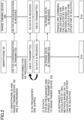
- FIG. 2 is a task diagram illustrating processes performed by the smartphone 50 and the range finding device 100.
- the smartphone 50 transmits a Continuous Wave (CW) for synchronization, and the range finding device 100 receives the CW for synchronization.
- the transmission/reception processor 131 performs the reception process.
- the smartphone 50 and the range finding device 100 repeatedly transmit CW and receive IQ data alternately while hopping across 64 frequencies.
- the transmission/reception processor 131 performs the transmission/reception process. As an example, of 160 channels in a range from 2.4 through 2.48 GHz at 0.5 MHz intervals, hopping is performed randomly across 64 channels.
- the smartphone 50 transmits IQ data for the 64 frequencies and phases to the range finding device 100, and the range finding device 100 receives them.
- the transmission/reception processor 131 performs the reception process.
- the range finding device 100 combines the phases on the smartphone 50 side and the phases on the range finding device 100 side, performs range finding (calculates the distance) by two methods, namely, a first range finding method and a second range finding method, by ToA calculation, and selects the distance calculated by the range finding method suited to the condition.
- the first range finder 132, the second range finder 133, and the selector 134 perform the process of (4).
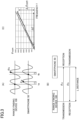
- FIG. 3 is a diagram illustrating the range finding by the first range finder 132.
- the range finding by the first range finder 132 is particularly effective when the direct-path signal intensity is high and the multipath signal intensity is low.
- the phase at which the smartphone 50 receives the CW transmitted by the range finding device 100 is denoted by ⁇ a
- the phase at which the range finding device 100 receives the CW transmitted by the smartphone 50 is denoted by ⁇ b. That is, the phase difference of the phase at which the smartphone 50 receives the CW with respect to the phase at which the range finding device 100 transmits the CW is denoted by ⁇ a
- the phase difference of the phase at which the range finding device 100 receives the CW with respect to the phase at which the smartphone 50 transmits the CW is denoted by ⁇ b.
- the phase difference ⁇ a corresponds to a time ta
- the phase difference ⁇ b corresponds to a time tb.
- the phase difference ⁇ a corresponds to the time ta
- the phase difference ⁇ b corresponds to the time tb.
- n represents the number of CW waves (wavelength) reciprocated between the range finding device 100 and the smartphone 50.
- ⁇ sum 2 2 360 f 2 L C
- ⁇ sum 2 2 360 f 2 L C
- Equation 6 L C ⁇ sum 2 360 ⁇ f
- Equation (6) When range finding is performed at two frequencies, the distance L is as expressed by Equation (6). However, the robustness is low because even a minor phase error would result in a distance error. Thus, the range finding is performed at multiple (M) frequencies, which results as illustrated in FIG. 3 (C) .
- M multiple frequencies
- the first range finder 132 performs range finding based on Equation (6).
- Such range finding by the first range finder 132 is a method of measuring the distance based on a phase difference, and determines the phase at which a round trip between the range finding device 100 and the smartphone 50 at each frequency has been completed.
- phase difference phase differences
- the method needs to determine the slope, the calculation tends to be easier at shorter distances than at longer distances.
- FIG. 4 is a diagram illustrating the range finding by the first range finder 132.
- ⁇ sum takes a value from 0° to 360°, and appears as data that has a characteristic of repeating changes in a sawtooth wave pattern.
- the distance L is calculated by converting the data in FIG. 4 (A) by a conversion process of being converted into a straight line as illustrated in FIG. 4 (B) .
- This conversion process becomes more difficult as the distance increases.
- the data of a short distance (5 m as an example) as illustrated in FIG. 4 (C) has an easy-to-see phase linearity, making the addition process in which the value may reach or exceed 360° easier, whereas as can be seen from the data of FIG. 4 (D) of an example case of 15 m and the data of FIG. 4 (E) of an example case of 60 m, a greater slope due to a longer distance makes the phase linearity more difficult to see, making the addition process more difficult.
- the range finding by the first range finder 132 is better suited to a short distance than to a long distance, and is better suited to a direct-path environment than to a multipath environment.
- the range finding by the first range finder 132 will be referred to as the direct-path range finding method.
- the direct-path range finding method is an example of the first range finding method.
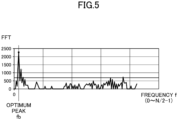
- FIG. 5 is a diagram illustrating the range finding by the second range finder 133.
- the range finding by the second range finder 133 can be used even when the multipath signal intensity is high and the direct-path signal intensity is low, and calculation is relatively easy even when the smartphone 50 is relatively far from the range finding device 100.
- the second range finder 133 converts IQ data corresponding to all 64 frequencies by Fast Fourier Transform (FFT) function.
- FFT Fast Fourier Transform
- the result is obtained as a frequency spectrum illustrated in, for example, FIG. 5 .
- the horizontal axis represents the frequency f, which corresponds to the distance.
- the vertical axis represents the signal intensity.
- the second range finder 133 extracts the lowest frequency that has a sufficiently high signal intensity the FFT conversion result as illustrated in FIG. 5 , as the frequency that provides the optimum peak. This is because a direct-path signal, which has a shorter radio wave path than that of a multipath signal, necessarily comes to a lower frequency than a multipath signal through the FFT conversion. By conversion of the selected frequency into a distance, the distance to the smartphone 50 is determined.
- hopping may be performed across 64 channels out of 160 channels randomly at 0.5 MHz intervals in a range from 2.4 through 2.48 GHz.
- N set to 256 where N is the number of sampling buffers with which FFT is performed and with frequency intervals freq_step set to 2 MHz
- hopping may be performed across 40 channels at 2 MHz intervals.
- Equation 8 L C 2 N ⁇ freq _ step fb
- the frequency fb at which the optimum peak is obtained has a sufficient intensity, and is the lowest frequency at which spectrum data is obtained.
- the horizontal axis of the FFT result assumes discrete values, which are 0, 1, 2, ..., and 127 (256/2-1).
- the frequency component of the frequency fb is a decimal number because it is determined by interpolation based on the shape of the FFT waveform.
- the range finding by the second range finder 133 is based on the frequency components of the signal received from the smartphone 50 and includes the conversion process by the FFT function, the calculation is relatively easy even when the distance is long.
- the range finding by the second range finder 133 can be used even when the multipath effect is major and the direct path effect is minor, and the calculation is relatively easy even when the smartphone 50 is relatively far from the range finding device 100.
- the range finding by the second range finder 133 will be referred to as the multipath range finding method.
- the multipath range finding method is an example of a second range finding method. However, when multipath noise is large, the calculation may become difficult.
- FIG. 6 is a diagram illustrating an example of a frequency spectrum after FFT execution by the second range finder 133. Referring to FIG. 6 , a process for determining, based on a signal received from the smartphone 50, whether or not the distance calculation is possible and whether or not it is a multipath environment will be described.
- the horizontal axis represents the frequency
- the vertical axis represents the amplitude (height) of the frequency spectrum.
- the selector 134 determines whether or not the distance calculation is possible using a signal intensity threshold. For example, as illustrated in (1) of FIG. 6 , when the signal intensity is lower than a threshold E, the selector 134 determines that the distance calculation is not possible, and when the signal intensity is equal to or higher than the threshold E as illustrated in (2), (3), (4), and (5) of FIG. 6 , the selector 134 determines that the distance calculation is possible.
- the selector 134 determines that the environment has little multipath effect and includes a lot of direct-path components. Further, as illustrated in (4) of FIG. 6 , when there are a plurality of peaks having a signal intensity equal to or higher than the threshold, the selector 134 determines that the environment has a strong multipath effect. As illustrated in (5) of FIG. 6 , also when a plurality of peaks overlap and form a single peak, the selector 134 determines that the environment has a strong multipath effect. However, since there may be a case where it is not easy to determine whether the environment is under direct-pathing or multipathing, the selector 134 performs determination based on each part of the signal as illustrated in FIG. 7 .
- FIG. 7 is a diagram illustrating the items checked by the selector 134 to determine that the environment is a multipath environment.
- the horizontal axis represents frequency
- the vertical axis represents amplitude (height) of the frequency spectrum.
- the number of peaks in the frequency spectrum illustrated as an example in FIG. 7 is three.
- the selector 134 extracts the peak height, the peak width, and the peak area of the highest peak, and the number of peaks, and uses them when determining whether the environment is a multipath environment or a direct-path environment in step S2 of FIG. 8 , which will be described later.
- the peak height is the height from the lowest point to the highest point of the highest peak.
- the peak width is the amplitude in the horizontal axis direction at the level of the peak height threshold E.
- the peak area is the area of a part of the highest peak that is equal to or higher than the threshold E.
- the number of peaks is the number of peaks equal to or higher than the peak height threshold E.
- the selector 134 determines whether or not the environment is a multipath environment as follows. In a case where there is a peak equal to or higher than the peak height threshold E, the selector 134 determines that the environment is a direct-path environment and is not a multipath environment when the peak width, at the peak height threshold E, of the highest peak among one or more extracted peaks is equal to or less than a threshold D in the bandwidth direction (the horizontal axis direction in FIG. 7 ), when the peak area of the highest peak is equal to or greater than an area threshold S, or when the peak height of the highest peak is equal to or higher than a peak height threshold h.
- the selector 134 determines that the environment is a multipath environment when the peak width at the peak height threshold E is greater than the threshold D in the bandwidth direction (the horizontal axis direction in FIG. 7 ), when the peak area is less than the area threshold S, or when the peak height is lower than the peak height threshold h.
- first distance the direct-path range finding method
- second distance the distance measured by the multipath range finding method
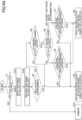
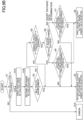
- FIG. 8 is a flowchart illustrating the selection process performed by the selector 134.
- the first range finder 132 and the second range finder 133 have measured the first distance and the second distance from the range finding device 100 to the smartphone 50 by the above-described range finding methods.
- the selector 134 determines whether the distance calculation is possible (step S1). For example, when the intensity is lower than the threshold E as illustrated in (1) of FIG. 6 , the selector 134 determines that the distance calculation is not possible (S1: NO), and moves the flow to step S10 to determine that there is an error (a state in which the distance calculation is not possible) (step S10).
- step S1 determines in step S1 that the distance calculation is possible (S1: YES)
- the flow moves to step S1A.
- the selector 134 determines that the distance calculation is possible (S1: YES), and moves the flow to step S2 via steps S1A and S1B. More specifically, the process is as follows.
- the first range finder 132 performs the range finding by the direct-path range finding method based on equation (6), and obtains a distance L (first distance) (step S1A).
- the second range finder 133 performs the range finding by the multipath range finding method based on equation (8), and obtains a distance L (second distance) (step S1B).
- the selector 134 performs FFT on the signal received from the smartphone 50 and determines whether or not the environment is a multipath environment based on the obtained frequency spectrum (step S2). Determining whether or not the environment is a multipath environment is determining whether or not the environment is a multipath environment (step S2: YES) or a direct-path environment (step S2: NO). Which the frequency spectrum of the signal is, for example, a direct-path environment as illustrated in (2) and (3) of FIG. 6 or a multipath environment as illustrated in (4) and (5) of FIG. 6 is determined.
- step S2 It is determined in step S2 that the environment is a multipath environment (step S2: YES) when it is determined that the signal corresponds to (4) and (5) of FIG. 6 .
- a multi-path environment determination is made when the peak width at the peak height threshold E is greater than the threshold D in the bandwidth direction (the horizontal axis direction in FIG. 7 ), when the peak area is less than the area threshold S, or when the peak height is lower than the peak height threshold h.
- step S2 determines in step S2 that the environment is a multipath environment (step S2: YES)
- the selector 134 selects the second distance calculated by the second range finder 133 by the range finding based on the multipath range finding method (step S3). That is, the multipath range finding method is adopted.
- the selector 134 determines in step S2 that the environment is not a multipath environment (S2: NO), since the environment is a direct-path environment, the result of the direct-path range finding method and the result of the multipath range finding method both have the possibility of being selectable. Therefore, in order to determine the selectability of the direct-path range finding method, the selector 134 determines whether the degree of the phase linearity of the signal received from the smartphone 50 is equal to or greater than a predetermined degree (step S4).
- the phase linearity of the signal received from the smartphone 50 is, for example, represented by a correlation coefficient indicating a frequency-phase correlation.
- a correlation coefficient indicating a frequency-phase correlation regarding phases of a CW obtained by hopping across 64 frequencies, it is determined whether the phase linearity of the signal received from the smartphone 50 is equal to or greater than the predetermined degree.
- the correlation coefficient indicating the frequency-phase correlation can be represented by, for example, the absolute value of the Pearson's correlation coefficient.
- the correlation coefficient is high (the correlation coefficient is large).
- the correlation coefficient is low (the correlation coefficient is small).
- the correlation coefficient is indicated by the slope of the straight line representing the frequency-phase correlation.
- the direct-path range finding method is suitable.
- the absolute value of the correlation coefficient between the frequency and the phase being close to 1 means that the direct-path range finding method can be used for measurement from a low frequency to a high frequency, that is, from a short distance to a long distance. Therefore, when the absolute value of the correlation coefficient is close to 1, the direct-path range finding method is suitable.
- the direct-path range finding method is suitable for measuring short distances.
- step S2 when it is determined in step S2 that the environment is not a multi-path environment (S2: NO), the flow moves to step S4, and when all the determinations in steps S4, S5, S6, S7, and S9 are YES, the distance L (first distance) obtained by the range finding by the direct-path range finding method is adopted. That is, when there is a linearity and the distance is short, the direct-path range finding method is basically adopted.
- the direct-path range finding method may be determined to not be adopted, because such a case means an abnormal state in which the distance ultimately obtained by the direct-path range finding method becomes a negative value.
- the predetermined degree used for the determination in step S4 may be set to a value close to 1, such as from 0.9 through 1, and in step S4, it may be determined whether or not the value that is not the absolute value is a negative value.
- step S4 When it is determined in step S4 that the degree of phase linearity of the signal received from the smartphone 50 is less than the predetermined degree (S4: NO), the selector 134 moves the flow to step S3. This is because it is not appropriate to adopt the direct-path range finding method. Also when the Pearson's correlation coefficient (a value that is not the absolute value) is a positive value, the selector 134 may move the flow to step S3. As a result, the second distance obtained by the multipath range finding method is selected.
- step S4 When it is determined in step S4 that the degree of phase linearity of the signal received from the smartphone 50 is equal to or greater than the predetermined degree (S4: YES), the selector 134 determines whether or not the number of pieces of effective phase data in a predetermined frequency band is equal to or greater than a predetermined number (step S5). This is to confirm whether or not the direct-path range finding method is selectable.
- the predetermined frequency band is, for example, a WiFi communication frequency band.
- the signal to be received from the smartphone 50 is affected by, for example, WiFi radio waves, no signal in the WiFi communication frequency band will be received, resulting in phase data omission or a large variation. When this occurs, it is difficult to appropriately calculate the distance by the direct-path range finding method. Therefore, the direct-path range finding method may be determined to not be adopted.
- the predetermined frequency band in the determination in step S5 may be determined in advance based on the relationship between the frequency band used by the range finding device 100 and the smartphone 50 for communication and a WiFi frequency band or the like that may exist in the surroundings.
- a number necessary for appropriately calculating the distance by the direct-path range finding method may be determined in advance by experiment or simulation.
- step S5 When it is determined in step S5 that the number of pieces of effective phase data in the predetermined frequency band is less than the predetermined number (S5: NO), the selector 134 moves the flow to step S3. This is because it is not appropriate to adopt the direct-path range finding method. As a result, the second distance determined by the multipath range finding method is selected.
- step S5 When it is determined in step S5 that the number of pieces of effective phase data in the predetermined frequency band is equal to or greater than the predetermined number (S5: YES), the selector 134 determines whether the second distance measured by the second range finder 133 is equal to or greater than a predetermined distance (step S6).
- the direct-path range finding method is better suited to short-distance range-finding than to long-distance range-finding. Thus, the determination may be performed with the predetermined distance set to 30 m as an example.
- the selector 134 determines whether the difference between the first distance measured by the first range finder 132 and the second distance measured by the second range finder 133 is less than a second predetermined difference (step S7).
- the difference between the first distance measured by the first range finder 132 and the second distance measured by the second range finder 133 being small indicates that the range-finding accuracy of the first range finder 132 and the second range finder 133 is high.
- the flow having moved to step S7 via steps S4 to S6 means that the conditions better suited to the direct-path range finding method than to the multipath range finding method are satisfied. Therefore, the difference between the first distance and the second distance determined in step S7 indicates whether or not the quality of the direct path is high. A small difference between the first distance and the second distance indicates that the quality of the direct path is high, and a large difference between the first distance and the second distance indicates that the quality of the direct path is low.
- the selector 134 selects the first distance output by the first range finder 132 (step S8). That is, the first distance measured by the direct-path range finding method is selected. This is because the difference between the first distance and the second distance is smaller than the second predetermined difference, so the quality of the direct path is high.
- step S7 When it is determined in step S7 that the difference between the first distance and the second distance is equal to or greater than the second predetermined difference (S7: NO), the selector 134 moves the flow to step S3. This is because the quality of the direct path is low. As a result, the second distance determined by the multipath range finding method is selected.
- step S6 When it is determined in step S6 that the second distance measured by the second range finder 133 is equal to or greater than the predetermined distance (S6: YES), the selector 134 determines whether or not the difference between the first distance measured by the first range finder 132 and the second distance measured by the second range finder 133 is less than a first predetermined difference (step S9).
- step S9 When it is determined in step S9 that the difference between the first distance and the second distance is not less than the first predetermined difference (S9: NO), the selector 134 moves the flow to step S3. This is because moving to step S9 via steps S4 to S6 means that although the conditions better suited to the direct-path range finding method than to the multipath range finding method are satisfied, the quality of the direct path is low, so it is not appropriate to adopt the direct-path range finding method. As a result, the second distance determined by the multipath range finding method is selected.
- the first predetermined difference used in the determination in step S9 may be larger than the second predetermined difference used in the determination in step S7.
- the second predetermined difference used in the determination in step S7 may be smaller than the first predetermined difference used in the determination in step S9.
- the flow moves to step S9 when it is determined in step S6 that the second distance measured by the second range finder 133 is equal to or greater than the predetermined distance (S6: YES), and moves to step S7 when it is determined in step S6 that the second distance measured by the second range finder 133 is less than the predetermined distance (S6: NO).
- the difference in the distance accounts for a smaller fraction of the entire distance as the distance between the range finding device 100 and the smartphone 50 is greater (i.e., the range is longer), and accounts for a greater fraction of the entire distance as the distance between the range finding device 100 and the smartphone 50 is shorter (i.e., the range is shorter).
- the second predetermined difference used in the determination in step S7 is set to be smaller than the first predetermined difference used in the determination in step S9
- the first predetermined difference used in the determination in step S9 is set to be larger than the second predetermined difference used in the determination in step S7.
- the first predetermined difference being larger than the second predetermined difference is an example, and the first predetermined difference may be smaller than the second predetermined difference.
- step S9 When it is determined in step S9 that the difference between the first distance and the second distance is less than the first predetermined difference (S9: Yes), the selector 134 moves the flow to step S8. This is because although the distance is long, the quality of the direct path is high. As a result, the first distance obtained by the direct-path range finding method is selected.
- the selector 134 selects the first distance or the second distance based on the result of FFT processing of the IQ data exchanged between the smartphone 50 and the range finding device 100, phase linearity, and the like.
- a range finding device 100 capable of selecting between the first range finding method based on a phase difference and the second range finding method based on a frequency component of an FFT calculation result depending on the condition of the signal exchanged with the smartphone 50.
- the selector 134 determines whether or not the environment is a multipath environment based on the number of peaks, the peak height, or the peak area in the frequency spectrum resulting from FFT execution by the second range finder 133, and when it is determined that the environment is a multipath environment, selects the second distance obtained by the multipath range finding method. Therefore, it is possible to provide a range finding device 100 capable of appropriately selecting the second distance obtained by the multipath range finding method when the environment is a multipath environment.
- the selector 134 determines that the environment is a multipath environment when the peak width at the peak height threshold E is larger than the threshold in the bandwidth direction, when the peak area is less than the area threshold S, or when the peak height is less than the peak height threshold h. Therefore, it is possible to provide a range finding device 100 capable of reliably determining whether or not the environment is a multipath environment using the peak height threshold E, the area threshold S of the peak area, and the peak height threshold h, and appropriately selecting the second distance obtained by the multipath range finding method when the environment is a multipath environment.
- the selector 134 selects the second distance obtained by the multipath range finding method when the degree of phase linearity of the signal received from the smartphone 50 is less than a predetermined degree. Therefore, it is possible to provide a range finding device 100 capable of appropriately selecting the second distance obtained by the multipath range finding method when the degree of linearity is less than the predetermined degree, because the absolute value of the correlation coefficient is small and the direct-path range finding method is thus not suitable.
- step S2 Even when it is determined in step S2 that the environment is not a multipath environment, the linearity between frequency and phase being less than the predetermined degree in step S4 indicates that the measurement by the direct-path range finding method is not suited to some low-frequency to high-frequency bands or to all frequency bands. For this reason, when it is determined in step S2 that the environment is not a multipath environment (S2: NO) and the flow goes to step S4 once, and then any of the determinations in steps S4, S5, S6, S7, and S9 is determined to be NO, it is determined that the environment is a multipath environment, and the multipath range finding method is adopted. When there is no linearity or the distance is long, the multipath range finding method is basically adopted.
- the selector 134 selects the second distance determined by the multipath range finding method when the number of pieces of effective phase data in a predetermined frequency band is less than a predetermined number. For example, when no signal in a WiFi communication frequency band has been received, consequent phase data omission or large variation may make it difficult to appropriately calculate the distance by the direct-path range finding method. Thus, it is possible to provide a range finding device 100 that selects the second distance determined by the multipath range finding method that is better suited to such a situation.
- the selector 134 selects the second distance determined by the multipath range finding method when the second distance measured by the second range finder 133 is equal to or greater than a predetermined distance.
- the direct-path range finding method is better suited to measuring short distances than to long distances.
- the selector 134 selects the second distance determined by the multipath range finding method, because the quality of the direct path is low and it is not appropriate to adopt the direct-path range finding method.
- the selector 134 selects the second distance determined by the multipath range finding method when the quality of the direct path is low.
- the selector 134 selects the second distance determined by the multipath range finding method when the difference between the first distance measured by the first range finder and the second distance measured by the second range finder is equal to or greater than a second predetermined difference, because the quality of the direct path is low and it is not appropriate to adopt the direct-path range finding method.
- a range finding device 100 that selects the multipath range finding method when the quality of the direct path is low.
- the selector 134 selects the first distance determined by the direct-path range finding method when the number of pieces of effective phase data in the predetermined frequency band is equal to or greater than the predetermined number, the second distance measured by the second range finder is less than the predetermined distance, and the difference between the first distance measured by the first range finder and the second distance measured by the second range finder is less than the second predetermined difference. It is possible to provide a range finding device 100 that selects the first distance determined by the direct-path range finding method when the plurality of conditions (steps S2 to S6) for selecting the direct-path range finding method are satisfied and the quality of the direct path is high.
- the first predetermined difference is larger than the second predetermined difference. Since the difference in the distance accounts for a smaller fraction of the entire distance as the distance between the range finding device 100 and the smartphone 50 is longer (i.e., the range is longer), and accounts for a larger fraction of the entire distance as the distance between the range finding device 100 and the smartphone 50 is shorter (i.e., the range is shorter), it is possible to make the short-range determination stricter, by making the first predetermined difference larger than the second predetermined difference.
- the flowchart illustrated in FIG. 9A illustrates a version of the flow of the flowchart illustrated in FIG. 8 , from which the process of step S5 is omitted.
- the selector 134 moves the flow to step S6 to determine whether the second distance measured by the second range finder 133 is equal to or greater than the predetermined distance (step S6). In this way, in a case it is determined that the environment is a direct-path environment (S2: NO), the selector 134 may move the flow from step S4 to step S6 without going through the process of step S5 illustrated in FIG. 8 .
- the flowchart illustrated in FIG. 9B illustrates a version of the flow of the flowchart illustrated in FIG. 8 , from which the process of step S4 is omitted.
- the selector 134 moves the flow to step S5 to determine whether or not the number of pieces of effective phase data in the predetermined frequency band is equal to or greater than the predetermined number (step S5).
- the selector 134 determines whether or not the second distance measured by the second range finder 133 is equal to or greater than the predetermined distance (step S6). In this way, when it is determined that the environment is a direct-path environment (S2: NO), the selector 134 may move the flow from step S2 to step S5 without going through the process of step S4 illustrated in FIG. 8 .
Landscapes
- Engineering & Computer Science (AREA)
- Radar, Positioning & Navigation (AREA)
- Remote Sensing (AREA)
- Physics & Mathematics (AREA)
- General Physics & Mathematics (AREA)
- Computer Networks & Wireless Communication (AREA)
- Radar Systems Or Details Thereof (AREA)
Abstract
A range finding device is provided that is capable of selecting between range finding based on a phase difference and range finding based on a frequency spectrum depending on conditions of a signal exchanged with a communication device. The range finding device includes: a first range finder to perform range finding by a first range finding method based on a phase difference of a signal received from a transmitter and output a first distance; a second range finder to perform range finder based on a second range finding method based on a frequency spectrum of the signal received from the transmitter and output a second distance; and a selector to select the first distance or the second distance based on a frequency spectrum or phase linearity of the signal received from the transmitter.
Description
- The present invention relates to a range finding device.
- There is a range finding device that performs range finding based on phase differences between signals having a plurality of frequencies received from a transmitter (for example, see PTL 1). There is also a range finding device that performs Fourier transform of a signal received from a transmitter and performs range finding based on a frequency spectrum (for example, see PTL 2).
-
- PTL 1:
Japanese Patent Application Laid-Open Publication No. 2018-197697 - PTL 2:
Japanese Patent Application Laid-Open Publication No. 09-152478 - Conditions of signals received from transmitters (communication devices) determine which is more suitable, range finding based on a phase difference and range finding based on a frequency spectrum. Here, selective use of them depending on the conditions has not been practiced yet.
- It is an object to provide a range finding device capable of selecting between range finding based on a phase difference and range finding based on a frequency spectrum depending on the condition of a signal exchanged with a communication device.
- A range finding device according to an embodiment of the present invention includes: a first range finder configured to perform range finding by a first range finding method based on a phase difference of a signal received from a transmitter and output a first distance; a second range finder configured to perform range finding by a second range finding method based on a frequency spectrum of a signal received from the transmitter and output a second distance; and a selector configured to select the first distance or the second distance based on a frequency spectrum distribution of a signal received from the transmitter.
- It is possible to provide a range finding device that can select between range finding based on a phase difference and range finding based on a frequency spectrum depending on the condition of a signal exchanged with a communication device.
-
- [
FIG. 1] FIG. 1 is a diagram illustrating a range findingdevice 100 according to an embodiment. - [
FIG. 2] FIG. 2 is a task diagram illustrating processes performed by asmartphone 50 and therange finding device 100. - [
FIG. 3] FIG. 3 is a diagram illustrating range finding by afirst range finder 132. - [
FIG. 4] FIG. 4 is a diagram illustrating range finding by thefirst range finder 132. - [
FIG. 5] FIG. 5 is a diagram illustrating range finding by asecond range finder 133. - [
FIG. 6] FIG. 6 is a diagram illustrating an example of a frequency spectrum after being subjected to FFT by thesecond range finder 133. - [
FIG. 7] FIG. 7 is a diagram illustrating the items checked by aselector 134 to determine a multipath environment. - [
FIG. 8] FIG. 8 is a diagram illustrating a flowchart indicating a selection process performed by theselector 134. - [
FIG. 9A] FIG. 9A is a diagram illustrating a flowchart indicting a selection process according to a modified example, performed by theselector 134. - [
FIG. 9B] FIG. 9B is a diagram illustrating a flowchart indicating a selection process according to a modified example, performed by theselector 134. - An embodiment to which the range finding device of the present invention is applied will be described.
-
FIG. 1 is a diagram illustrating arange finding device 100 of an embodiment.FIG. 1 illustrates asmartphone 50 in addition to the range findingdevice 100. Thesmartphone 50 is an example of a communication device that transmits or receives signals, and therange finding device 100 determines the distance (or performs range finding) from the range findingdevice 100 to thesmartphone 50 based on signals exchanged with thesmartphone 50. - The
range finding device 100 includes anantenna 110, acommunication unit 120, and a Micro Computer (MMC) 130. Theantenna 110 is connected to thecommunication unit 120 and receives a signal transmitted from thesmartphone 50. Although a configuration in which the range findingdevice 100 includes oneantenna 110 will be described here, therange finding device 100 may include a plurality ofantennas 110. - The
communication unit 120 includes an Analog Front End (AFE), an Analog to Digital (AD) converter, and the like, and performs signal processing such as AD conversion and the like of a signal received by theantenna 110 from thesmartphone 50 and outputs the result to the MMC 130. - The MMC 130 includes a transmission/
reception processor 131, afirst range finder 132, asecond range finder 133, aselector 134, and amemory 135. As an example, the MMC 130 is implemented by a microcomputer including a Central Processing Unit (CPU), a Random Access Memory (RAM), a Read Only Memory (ROM), an internal bus, and the like. The transmission/reception processor 131, thefirst range finder 132, thesecond range finder 133, and theselector 134 are representations of functions of programs executed by the MMC 130 in the form of functional blocks. Thememory 135 is a functional representation of the memory of theMMC 130. - The transmission/
reception processor 131 exchanges signals with thesmartphone 50 in order to acquire data such as a phase difference, a frequency component, and the like that are necessary for thefirst range finder 132 and thesecond range finder 133 to perform range finding. - The
first range finder 132 and thesecond range finder 133 perform range finding by the Time Of Arrival (ToA) method. Thefirst range finder 132 performs range finding by a first range finding method based on a phase difference of a signal received from thesmartphone 50, and outputs a first distance. Thesecond range finder 133 performs range finding by a second range finding method based on a frequency spectrum of a signal received from thesmartphone 50, and outputs a second distance. The TOA is a range finding method also referred to as Time Of Flight (TOF). - The
selector 134 selects the first distance output by thefirst range finder 132 or the second distance output by thesecond range finder 133 in accordance with the condition of radio waves received by theantenna 110. The selection method will be described later with reference toFIG. 8 . - The
memory 135 stores programs and data necessary for the transmission/reception processor 131 to perform processes for transmitting or receiving signals, programs and data necessary for thefirst range finder 132 and thesecond range finder 133 to perform processes for range finding, and programs and data necessary for theselector 134 to perform processes for selecting the first distance or the second distance. -
FIG. 2 is a task diagram illustrating processes performed by thesmartphone 50 and therange finding device 100. First, as (1), in order for thesmartphone 50 and the range findingdevice 100 to synchronize with each other, thesmartphone 50 transmits a Continuous Wave (CW) for synchronization, and the range findingdevice 100 receives the CW for synchronization. In the range findingdevice 100, the transmission/reception processor 131 performs the reception process. - Next, as (2), the
smartphone 50 and the range findingdevice 100 repeatedly transmit CW and receive IQ data alternately while hopping across 64 frequencies. In the range findingdevice 100, the transmission/reception processor 131 performs the transmission/reception process. As an example, of 160 channels in a range from 2.4 through 2.48 GHz at 0.5 MHz intervals, hopping is performed randomly across 64 channels. - Next, as (3), the
smartphone 50 transmits IQ data for the 64 frequencies and phases to the range findingdevice 100, and the range findingdevice 100 receives them. In the range findingdevice 100, the transmission/reception processor 131 performs the reception process. - Lastly, as (4), the
range finding device 100 combines the phases on thesmartphone 50 side and the phases on therange finding device 100 side, performs range finding (calculates the distance) by two methods, namely, a first range finding method and a second range finding method, by ToA calculation, and selects the distance calculated by the range finding method suited to the condition. In therange finding device 100, thefirst range finder 132, thesecond range finder 133, and theselector 134 perform the process of (4). -
FIG. 3 is a diagram illustrating the range finding by thefirst range finder 132. The range finding by thefirst range finder 132 is particularly effective when the direct-path signal intensity is high and the multipath signal intensity is low. - As illustrated in
FIGS. 3 (A) and 3 (B) , the phase at which thesmartphone 50 receives the CW transmitted by therange finding device 100 is denoted by θa, and the phase at which therange finding device 100 receives the CW transmitted by thesmartphone 50 is denoted by θb. That is, the phase difference of the phase at which thesmartphone 50 receives the CW with respect to the phase at which therange finding device 100 transmits the CW is denoted by θa, and the phase difference of the phase at which therange finding device 100 receives the CW with respect to the phase at which thesmartphone 50 transmits the CW is denoted by θb. The phase difference θa corresponds to a time ta, and the phase difference θb corresponds to a time tb. - The distance between the
range finding device 100 and thesmartphone 50 is defined as L, and the sum of the phase θa at which thesmartphone 50 receives what is transmitted from therange finding device 100 and the phase θb at which therange finding device 100 receives what is transmitted from thesmartphone 50 is defined as a round-trip phase θsum (=(θa+θb)×n). The phase difference θa corresponds to the time ta, and the phase difference θb corresponds to the time tb. n represents the number of CW waves (wavelength) reciprocated between therange finding device 100 and thesmartphone 50. - Here, the speed of the radio waves is denoted by C, the frequency of the radio waves is denoted by f, and the cycle of the radio waves is denoted by T (=1/f). The following (1) and (2) are established.
Equation 1
Equation 2
- Since (θa+θb)×n=θsum,
Equation 3 is obtained fromEquations
Equation 3
-
Equation 4 is obtained whenEquation 3 is deformed and reorganized based on θsum.
Equation 4
- When the
range finding device 100 and thesmartphone 50 perform round-trip communications at the frequencies f1 and f2, a round-trip phase difference θsum1 at a frequency f1 and a round-trip phase difference θsum2 at a frequency f2 are obtained. The difference between θsum1 and θsum2 is the relationship of Equations (5A) and (5B).
Equation 5

- Based on Equations (5A) and (5B), the distance L can be calculated as expressed by Equation (6).
Equation 6
- When range finding is performed at two frequencies, the distance L is as expressed by Equation (6). However, the robustness is low because even a minor phase error would result in a distance error. Thus, the range finding is performed at multiple (M) frequencies, which results as illustrated in
FIG. 3 (C) . In the graph illustrated inFIG. 3 (C) , the horizontal axis represents the frequency f and the vertical axis represents the phase θa+θb when the radio wave has made a round trip. Since Δθsum/Δf in Equation (6) represents the slope of the straight line, the distance L can be expressed as Equation (7) below.
Equation 7
- Thus, the distance L is proportional to the slope. The
first range finder 132 performs range finding based on Equation (6). - Such range finding by the
first range finder 132 is a method of measuring the distance based on a phase difference, and determines the phase at which a round trip between therange finding device 100 and thesmartphone 50 at each frequency has been completed. Thus, if there is a lot of noise due to the multipath effect, addition of the phases (phase differences) at all frequencies tend to generate an error. In addition, since the method needs to determine the slope, the calculation tends to be easier at shorter distances than at longer distances. - For the sake of explanation of the calculation principle, θsum indicated in
FIG. 3 (C) assumes a value that is 360° or greater. However, since the radio wave that theMMC 130 actually receives does not carry the concept of wavenumber, θsum assumes a value from 0° to 360°. This is illustrated inFIG. 4. FIG. 4 is a diagram illustrating the range finding by thefirst range finder 132. - As illustrated in
FIG. 4 (A) , θsum takes a value from 0° to 360°, and appears as data that has a characteristic of repeating changes in a sawtooth wave pattern. The distance L is calculated by converting the data inFIG. 4 (A) by a conversion process of being converted into a straight line as illustrated inFIG. 4 (B) . This conversion process becomes more difficult as the distance increases. This is because the data of a short distance (5 m as an example) as illustrated inFIG. 4 (C) has an easy-to-see phase linearity, making the addition process in which the value may reach or exceed 360° easier, whereas as can be seen from the data ofFIG. 4 (D) of an example case of 15 m and the data ofFIG. 4 (E) of an example case of 60 m, a greater slope due to a longer distance makes the phase linearity more difficult to see, making the addition process more difficult. - For this reason, the range finding by the
first range finder 132 is better suited to a short distance than to a long distance, and is better suited to a direct-path environment than to a multipath environment. The range finding by thefirst range finder 132 will be referred to as the direct-path range finding method. The direct-path range finding method is an example of the first range finding method. -
FIG. 5 is a diagram illustrating the range finding by thesecond range finder 133. The range finding by thesecond range finder 133 can be used even when the multipath signal intensity is high and the direct-path signal intensity is low, and calculation is relatively easy even when thesmartphone 50 is relatively far from therange finding device 100. - The
second range finder 133 converts IQ data corresponding to all 64 frequencies by Fast Fourier Transform (FFT) function. Thus, the result is obtained as a frequency spectrum illustrated in, for example,FIG. 5 . InFIG. 5 , the horizontal axis represents the frequency f, which corresponds to the distance. The vertical axis represents the signal intensity. - The
second range finder 133 extracts the lowest frequency that has a sufficiently high signal intensity the FFT conversion result as illustrated inFIG. 5 , as the frequency that provides the optimum peak. This is because a direct-path signal, which has a shorter radio wave path than that of a multipath signal, necessarily comes to a lower frequency than a multipath signal through the FFT conversion. By conversion of the selected frequency into a distance, the distance to thesmartphone 50 is determined. - More specifically, with N set to 256 where N is the number of sampling buffers with which FFT is performed and with frequency intervals freq_step set to 0.5 MHz, hopping may be performed across 64 channels out of 160 channels randomly at 0.5 MHz intervals in a range from 2.4 through 2.48 GHz. Alternatively, as an example, with N set to 256 where N is the number of sampling buffers with which FFT is performed and with frequency intervals freq_step set to 2 MHz, hopping may be performed across 40 channels at 2 MHz intervals. IQ data is set in 40 buffers out of the N=256 sampling buffers. When FFT is executed, the result illustrated in
FIG. 5 is obtained. - From the FFT result, the distance L can be calculated by the following equation (8).
Equation 8
- The frequency fb at which the optimum peak is obtained has a sufficient intensity, and is the lowest frequency at which spectrum data is obtained. The horizontal axis of the FFT result assumes discrete values, which are 0, 1, 2, ..., and 127 (256/2-1). The frequency component of the frequency fb is a decimal number because it is determined by interpolation based on the shape of the FFT waveform.
- Since the range finding by the
second range finder 133 is based on the frequency components of the signal received from thesmartphone 50 and includes the conversion process by the FFT function, the calculation is relatively easy even when the distance is long. - Therefore, the range finding by the
second range finder 133 can be used even when the multipath effect is major and the direct path effect is minor, and the calculation is relatively easy even when thesmartphone 50 is relatively far from therange finding device 100. Hereinafter, the range finding by thesecond range finder 133 will be referred to as the multipath range finding method. The multipath range finding method is an example of a second range finding method. However, when multipath noise is large, the calculation may become difficult. -
FIG. 6 is a diagram illustrating an example of a frequency spectrum after FFT execution by thesecond range finder 133. Referring toFIG. 6 , a process for determining, based on a signal received from thesmartphone 50, whether or not the distance calculation is possible and whether or not it is a multipath environment will be described. InFIG. 6 , the horizontal axis represents the frequency, and the vertical axis represents the amplitude (height) of the frequency spectrum. - The
selector 134 determines whether or not the distance calculation is possible using a signal intensity threshold. For example, as illustrated in (1) ofFIG. 6 , when the signal intensity is lower than a threshold E, theselector 134 determines that the distance calculation is not possible, and when the signal intensity is equal to or higher than the threshold E as illustrated in (2), (3), (4), and (5) ofFIG. 6 , theselector 134 determines that the distance calculation is possible. - Further, as illustrated in (2) and (3) of
FIG. 6 , when there is one peak having a sufficiently high signal intensity and the signal intensity is equal to or higher than the threshold E, theselector 134 determines that the environment has little multipath effect and includes a lot of direct-path components. Further, as illustrated in (4) ofFIG. 6 , when there are a plurality of peaks having a signal intensity equal to or higher than the threshold, theselector 134 determines that the environment has a strong multipath effect. As illustrated in (5) ofFIG. 6 , also when a plurality of peaks overlap and form a single peak, theselector 134 determines that the environment has a strong multipath effect. However, since there may be a case where it is not easy to determine whether the environment is under direct-pathing or multipathing, theselector 134 performs determination based on each part of the signal as illustrated inFIG. 7 . -
FIG. 7 is a diagram illustrating the items checked by theselector 134 to determine that the environment is a multipath environment. InFIG. 7 , the horizontal axis represents frequency, and the vertical axis represents amplitude (height) of the frequency spectrum. The number of peaks in the frequency spectrum illustrated as an example inFIG. 7 is three. - As illustrated in
FIG. 7 , theselector 134 extracts the peak height, the peak width, and the peak area of the highest peak, and the number of peaks, and uses them when determining whether the environment is a multipath environment or a direct-path environment in step S2 ofFIG. 8 , which will be described later. The peak height is the height from the lowest point to the highest point of the highest peak. The peak width is the amplitude in the horizontal axis direction at the level of the peak height threshold E. The peak area is the area of a part of the highest peak that is equal to or higher than the threshold E. The number of peaks is the number of peaks equal to or higher than the peak height threshold E. - The
selector 134 determines whether or not the environment is a multipath environment as follows. In a case where there is a peak equal to or higher than the peak height threshold E, theselector 134 determines that the environment is a direct-path environment and is not a multipath environment when the peak width, at the peak height threshold E, of the highest peak among one or more extracted peaks is equal to or less than a threshold D in the bandwidth direction (the horizontal axis direction inFIG. 7 ), when the peak area of the highest peak is equal to or greater than an area threshold S, or when the peak height of the highest peak is equal to or higher than a peak height threshold h. - In a case where there are a plurality of peaks equal to or higher than the peak height threshold E, the
selector 134 determines that the environment is a multipath environment when the peak width at the peak height threshold E is greater than the threshold D in the bandwidth direction (the horizontal axis direction inFIG. 7 ), when the peak area is less than the area threshold S, or when the peak height is lower than the peak height threshold h. A specific process by which theselector 134 selects a distance measured by the direct-path range finding method (first distance) or a distance measured by the multipath range finding method (second distance) will be described below with reference to the flowchart ofFIG. 8 . -
FIG. 8 is a flowchart illustrating the selection process performed by theselector 134. As a premise, it is assumed that thefirst range finder 132 and thesecond range finder 133 have measured the first distance and the second distance from therange finding device 100 to thesmartphone 50 by the above-described range finding methods. - Upon starting the process, the
selector 134 determines whether the distance calculation is possible (step S1). For example, when the intensity is lower than the threshold E as illustrated in (1) ofFIG. 6 , theselector 134 determines that the distance calculation is not possible (S1: NO), and moves the flow to step S10 to determine that there is an error (a state in which the distance calculation is not possible) (step S10). - On the other hand, when the
selector 134 determines in step S1 that the distance calculation is possible (S1: YES), the flow moves to step S1A. For example, when the signal intensity is equal to or higher than the threshold E as illustrated in (2), (3), (4), and (5) ofFIG. 6 , theselector 134 determines that the distance calculation is possible (S1: YES), and moves the flow to step S2 via steps S1A and S1B. More specifically, the process is as follows. - The
first range finder 132 performs the range finding by the direct-path range finding method based on equation (6), and obtains a distance L (first distance) (step S1A). - The
second range finder 133 performs the range finding by the multipath range finding method based on equation (8), and obtains a distance L (second distance) (step S1B). - The
selector 134 performs FFT on the signal received from thesmartphone 50 and determines whether or not the environment is a multipath environment based on the obtained frequency spectrum (step S2). Determining whether or not the environment is a multipath environment is determining whether or not the environment is a multipath environment (step S2: YES) or a direct-path environment (step S2: NO). Which the frequency spectrum of the signal is, for example, a direct-path environment as illustrated in (2) and (3) ofFIG. 6 or a multipath environment as illustrated in (4) and (5) ofFIG. 6 is determined. - It is determined in step S2 that the environment is a multipath environment (step S2: YES) when it is determined that the signal corresponds to (4) and (5) of
FIG. 6 . As described with reference toFIG. 7 , in a case where there are a plurality of peaks equal to or higher than the peak height threshold E, a multi-path environment determination is made when the peak width at the peak height threshold E is greater than the threshold D in the bandwidth direction (the horizontal axis direction inFIG. 7 ), when the peak area is less than the area threshold S, or when the peak height is lower than the peak height threshold h. - In a case of determining in step S2 that the environment is a multipath environment (step S2: YES), the
selector 134 selects the second distance calculated by thesecond range finder 133 by the range finding based on the multipath range finding method (step S3). That is, the multipath range finding method is adopted. - When the
selector 134 determines in step S2 that the environment is not a multipath environment (S2: NO), since the environment is a direct-path environment, the result of the direct-path range finding method and the result of the multipath range finding method both have the possibility of being selectable. Therefore, in order to determine the selectability of the direct-path range finding method, theselector 134 determines whether the degree of the phase linearity of the signal received from thesmartphone 50 is equal to or greater than a predetermined degree (step S4). - The phase linearity of the signal received from the
smartphone 50 is, for example, represented by a correlation coefficient indicating a frequency-phase correlation. By determining a correlation coefficient indicating a frequency-phase correlation regarding phases of a CW obtained by hopping across 64 frequencies, it is determined whether the phase linearity of the signal received from thesmartphone 50 is equal to or greater than the predetermined degree. - The correlation coefficient indicating the frequency-phase correlation can be represented by, for example, the absolute value of the Pearson's correlation coefficient. When the phases at respective frequencies are on a straight line, the correlation is high (the correlation coefficient is large). When the phases at respective frequencies are dispersed, the correlation is low (the correlation coefficient is small). The correlation coefficient is indicated by the slope of the straight line representing the frequency-phase correlation.
- The closer the absolute value of the correlation coefficient is to 1, the stronger the correlation (the higher the degree of linearity), whereas the closer the absolute value of the correlation coefficient is to 0, the weaker the correlation (the lower the degree of linearity). When the absolute value of the correlation coefficient is close to 1, the direct-path range finding method is suitable. The absolute value of the correlation coefficient between the frequency and the phase being close to 1 means that the direct-path range finding method can be used for measurement from a low frequency to a high frequency, that is, from a short distance to a long distance. Therefore, when the absolute value of the correlation coefficient is close to 1, the direct-path range finding method is suitable. The direct-path range finding method is suitable for measuring short distances. For this reason, when it is determined in step S2 that the environment is not a multi-path environment (S2: NO), the flow moves to step S4, and when all the determinations in steps S4, S5, S6, S7, and S9 are YES, the distance L (first distance) obtained by the range finding by the direct-path range finding method is adopted. That is, when there is a linearity and the distance is short, the direct-path range finding method is basically adopted.
- When the Pearson's correlation coefficient (a value that is not the absolute value) is a positive value, the direct-path range finding method may be determined to not be adopted, because such a case means an abnormal state in which the distance ultimately obtained by the direct-path range finding method becomes a negative value.
- The predetermined degree used for the determination in step S4 may be set to a value close to 1, such as from 0.9 through 1, and in step S4, it may be determined whether or not the value that is not the absolute value is a negative value.
- When it is determined in step S4 that the degree of phase linearity of the signal received from the
smartphone 50 is less than the predetermined degree (S4: NO), theselector 134 moves the flow to step S3. This is because it is not appropriate to adopt the direct-path range finding method. Also when the Pearson's correlation coefficient (a value that is not the absolute value) is a positive value, theselector 134 may move the flow to step S3. As a result, the second distance obtained by the multipath range finding method is selected. - When it is determined in step S4 that the degree of phase linearity of the signal received from the
smartphone 50 is equal to or greater than the predetermined degree (S4: YES), theselector 134 determines whether or not the number of pieces of effective phase data in a predetermined frequency band is equal to or greater than a predetermined number (step S5). This is to confirm whether or not the direct-path range finding method is selectable. - The predetermined frequency band is, for example, a WiFi communication frequency band. When the signal to be received from the
smartphone 50 is affected by, for example, WiFi radio waves, no signal in the WiFi communication frequency band will be received, resulting in phase data omission or a large variation. When this occurs, it is difficult to appropriately calculate the distance by the direct-path range finding method. Therefore, the direct-path range finding method may be determined to not be adopted. - The predetermined frequency band in the determination in step S5 may be determined in advance based on the relationship between the frequency band used by the
range finding device 100 and thesmartphone 50 for communication and a WiFi frequency band or the like that may exist in the surroundings. - As the predetermined number of the effective phase data in the determination in step S5, a number necessary for appropriately calculating the distance by the direct-path range finding method may be determined in advance by experiment or simulation.
- When it is determined in step S5 that the number of pieces of effective phase data in the predetermined frequency band is less than the predetermined number (S5: NO), the
selector 134 moves the flow to step S3. This is because it is not appropriate to adopt the direct-path range finding method. As a result, the second distance determined by the multipath range finding method is selected. - When it is determined in step S5 that the number of pieces of effective phase data in the predetermined frequency band is equal to or greater than the predetermined number (S5: YES), the
selector 134 determines whether the second distance measured by thesecond range finder 133 is equal to or greater than a predetermined distance (step S6). As described above, the direct-path range finding method is better suited to short-distance range-finding than to long-distance range-finding. Thus, the determination may be performed with the predetermined distance set to 30 m as an example. - When it is determined that the second distance measured by the
second range finder 133 is less than the predetermined distance (S6: NO), theselector 134 determines whether the difference between the first distance measured by thefirst range finder 132 and the second distance measured by thesecond range finder 133 is less than a second predetermined difference (step S7). - The difference between the first distance measured by the
first range finder 132 and the second distance measured by thesecond range finder 133 being small indicates that the range-finding accuracy of thefirst range finder 132 and thesecond range finder 133 is high. The flow having moved to step S7 via steps S4 to S6 means that the conditions better suited to the direct-path range finding method than to the multipath range finding method are satisfied. Therefore, the difference between the first distance and the second distance determined in step S7 indicates whether or not the quality of the direct path is high. A small difference between the first distance and the second distance indicates that the quality of the direct path is high, and a large difference between the first distance and the second distance indicates that the quality of the direct path is low. - When it is determined that the difference between the first distance and the second distance is less than the second predetermined difference (S7: YES), the
selector 134 selects the first distance output by the first range finder 132 (step S8). That is, the first distance measured by the direct-path range finding method is selected. This is because the difference between the first distance and the second distance is smaller than the second predetermined difference, so the quality of the direct path is high. - When it is determined in step S7 that the difference between the first distance and the second distance is equal to or greater than the second predetermined difference (S7: NO), the
selector 134 moves the flow to step S3. This is because the quality of the direct path is low. As a result, the second distance determined by the multipath range finding method is selected. - When it is determined in step S6 that the second distance measured by the
second range finder 133 is equal to or greater than the predetermined distance (S6: YES), theselector 134 determines whether or not the difference between the first distance measured by thefirst range finder 132 and the second distance measured by thesecond range finder 133 is less than a first predetermined difference (step S9). - When it is determined in step S9 that the difference between the first distance and the second distance is not less than the first predetermined difference (S9: NO), the
selector 134 moves the flow to step S3. This is because moving to step S9 via steps S4 to S6 means that although the conditions better suited to the direct-path range finding method than to the multipath range finding method are satisfied, the quality of the direct path is low, so it is not appropriate to adopt the direct-path range finding method. As a result, the second distance determined by the multipath range finding method is selected. - Here, the first predetermined difference used in the determination in step S9 may be larger than the second predetermined difference used in the determination in step S7. In other words, the second predetermined difference used in the determination in step S7 may be smaller than the first predetermined difference used in the determination in step S9. The flow moves to step S9 when it is determined in step S6 that the second distance measured by the
second range finder 133 is equal to or greater than the predetermined distance (S6: YES), and moves to step S7 when it is determined in step S6 that the second distance measured by thesecond range finder 133 is less than the predetermined distance (S6: NO). - The difference in the distance accounts for a smaller fraction of the entire distance as the distance between the
range finding device 100 and thesmartphone 50 is greater (i.e., the range is longer), and accounts for a greater fraction of the entire distance as the distance between therange finding device 100 and thesmartphone 50 is shorter (i.e., the range is shorter). For this reason, as an example, in order to make the short-range determination stricter, the second predetermined difference used in the determination in step S7 is set to be smaller than the first predetermined difference used in the determination in step S9, and the first predetermined difference used in the determination in step S9 is set to be larger than the second predetermined difference used in the determination in step S7. Note that the first predetermined difference being larger than the second predetermined difference is an example, and the first predetermined difference may be smaller than the second predetermined difference. - When it is determined in step S9 that the difference between the first distance and the second distance is less than the first predetermined difference (S9: Yes), the
selector 134 moves the flow to step S8. This is because although the distance is long, the quality of the direct path is high. As a result, the first distance obtained by the direct-path range finding method is selected. - As described above, the
selector 134 selects the first distance or the second distance based on the result of FFT processing of the IQ data exchanged between thesmartphone 50 and therange finding device 100, phase linearity, and the like. - Therefore, it is possible to provide a
range finding device 100 capable of selecting between the first range finding method based on a phase difference and the second range finding method based on a frequency component of an FFT calculation result depending on the condition of the signal exchanged with thesmartphone 50. - Further, the
selector 134 determines whether or not the environment is a multipath environment based on the number of peaks, the peak height, or the peak area in the frequency spectrum resulting from FFT execution by thesecond range finder 133, and when it is determined that the environment is a multipath environment, selects the second distance obtained by the multipath range finding method. Therefore, it is possible to provide arange finding device 100 capable of appropriately selecting the second distance obtained by the multipath range finding method when the environment is a multipath environment. - Further, in a case where there are a plurality of peaks equal to or greater than a peak height threshold in a frequency spectrum resulting from FFT execution by the
second range finder 133, theselector 134 determines that the environment is a multipath environment when the peak width at the peak height threshold E is larger than the threshold in the bandwidth direction, when the peak area is less than the area threshold S, or when the peak height is less than the peak height threshold h. Therefore, it is possible to provide arange finding device 100 capable of reliably determining whether or not the environment is a multipath environment using the peak height threshold E, the area threshold S of the peak area, and the peak height threshold h, and appropriately selecting the second distance obtained by the multipath range finding method when the environment is a multipath environment. - Even in a case where the number of the plurality of peaks in the frequency spectrum resulting from FFT execution by the
second range finder 133 is not equal to or greater than a predetermined number, theselector 134 selects the second distance obtained by the multipath range finding method when the degree of phase linearity of the signal received from thesmartphone 50 is less than a predetermined degree. Therefore, it is possible to provide arange finding device 100 capable of appropriately selecting the second distance obtained by the multipath range finding method when the degree of linearity is less than the predetermined degree, because the absolute value of the correlation coefficient is small and the direct-path range finding method is thus not suitable. Even when it is determined in step S2 that the environment is not a multipath environment, the linearity between frequency and phase being less than the predetermined degree in step S4 indicates that the measurement by the direct-path range finding method is not suited to some low-frequency to high-frequency bands or to all frequency bands. For this reason, when it is determined in step S2 that the environment is not a multipath environment (S2: NO) and the flow goes to step S4 once, and then any of the determinations in steps S4, S5, S6, S7, and S9 is determined to be NO, it is determined that the environment is a multipath environment, and the multipath range finding method is adopted. When there is no linearity or the distance is long, the multipath range finding method is basically adopted. - Even when the degree of phase linearity of the signal received from the
smartphone 50 is equal to or greater than the predetermined degree, theselector 134 selects the second distance determined by the multipath range finding method when the number of pieces of effective phase data in a predetermined frequency band is less than a predetermined number. For example, when no signal in a WiFi communication frequency band has been received, consequent phase data omission or large variation may make it difficult to appropriately calculate the distance by the direct-path range finding method. Thus, it is possible to provide arange finding device 100 that selects the second distance determined by the multipath range finding method that is better suited to such a situation. - Moreover, even when the number of pieces of effective phase data in the predetermined frequency band is equal to or greater than the predetermined number, the
selector 134 selects the second distance determined by the multipath range finding method when the second distance measured by thesecond range finder 133 is equal to or greater than a predetermined distance. The direct-path range finding method is better suited to measuring short distances than to long distances. Thus, it is possible to provide arange finding device 100 that selects the multipath range finding method that can handle long distances. - Further, when the second distance measured by the second range finder is equal to or greater than the predetermined distance and the difference between the first distance measured by the first range finder and the second distance measured by the second range finder is equal to or greater than a first predetermined difference, the
selector 134 selects the second distance determined by the multipath range finding method, because the quality of the direct path is low and it is not appropriate to adopt the direct-path range finding method. Thus, it is possible to provide arange finding device 100 that selects the multipath range finding method when the quality of the direct path is low. - Further, even when the number of pieces of effective phase data in the predetermined frequency band is equal to or greater than the predetermined number and the second distance measured by the second range finder is less than the predetermined distance, the
selector 134 selects the second distance determined by the multipath range finding method when the difference between the first distance measured by the first range finder and the second distance measured by the second range finder is equal to or greater than a second predetermined difference, because the quality of the direct path is low and it is not appropriate to adopt the direct-path range finding method. Thus, it is possible to provide arange finding device 100 that selects the multipath range finding method when the quality of the direct path is low. - The
selector 134 selects the first distance determined by the direct-path range finding method when the number of pieces of effective phase data in the predetermined frequency band is equal to or greater than the predetermined number, the second distance measured by the second range finder is less than the predetermined distance, and the difference between the first distance measured by the first range finder and the second distance measured by the second range finder is less than the second predetermined difference. It is possible to provide arange finding device 100 that selects the first distance determined by the direct-path range finding method when the plurality of conditions (steps S2 to S6) for selecting the direct-path range finding method are satisfied and the quality of the direct path is high. - The first predetermined difference is larger than the second predetermined difference. Since the difference in the distance accounts for a smaller fraction of the entire distance as the distance between the
range finding device 100 and thesmartphone 50 is longer (i.e., the range is longer), and accounts for a larger fraction of the entire distance as the distance between therange finding device 100 and thesmartphone 50 is shorter (i.e., the range is shorter), it is possible to make the short-range determination stricter, by making the first predetermined difference larger than the second predetermined difference. -
FIGS. 9A and9B are flowcharts illustrating the selection process of modified examples, performed by theselector 134. - The flowchart illustrated in
FIG. 9A illustrates a version of the flow of the flowchart illustrated inFIG. 8 , from which the process of step S5 is omitted. InFIG. 9A , when it is determined in step S2 that the environment is not a multipath environment but rather a direct-path environment (S2: NO), and it is determined in step S4 that the degree of phase linearity of the signal received from thesmartphone 50 is equal to or greater than the predetermined degree (S4: YES), theselector 134 moves the flow to step S6 to determine whether the second distance measured by thesecond range finder 133 is equal to or greater than the predetermined distance (step S6). In this way, in a case it is determined that the environment is a direct-path environment (S2: NO), theselector 134 may move the flow from step S4 to step S6 without going through the process of step S5 illustrated inFIG. 8 . - The flowchart illustrated in
FIG. 9B illustrates a version of the flow of the flowchart illustrated inFIG. 8 , from which the process of step S4 is omitted. InFIG. 9B , when it is determined in step S2 that the environment is not a multipath environment but rather a direct-path environment (S2: NO), theselector 134 moves the flow to step S5 to determine whether or not the number of pieces of effective phase data in the predetermined frequency band is equal to or greater than the predetermined number (step S5). When it is determined that the number of pieces of effective phase data in the predetermined frequency band is equal to or greater than the predetermined number (S5: YES), theselector 134 determines whether or not the second distance measured by thesecond range finder 133 is equal to or greater than the predetermined distance (step S6). In this way, when it is determined that the environment is a direct-path environment (S2: NO), theselector 134 may move the flow from step S2 to step S5 without going through the process of step S4 illustrated inFIG. 8 . - Although the range finding device of the exemplary embodiment of the present invention has been described above, the present invention is not limited to the specifically disclosed embodiment, and various modifications and changes are applicable without departing from the scope of the claims.
- The present international application claims priority based on
Japanese Patent Application 2022- 098457 filed June 17, 2022 -
- 50 smartphone
- 100 range finding device
- 110 antenna
- 120 communication unit
- 130 MMC
- 131 transmission/reception processor
- 132 first range finder
- 133 second range finder
- 134 selector
- 135 memory
Claims (13)
- A range finding device, comprising:a first range finder configured to perform range finding by a first range finding method based on a phase difference of a signal exchanged with a communication device, and output a first distance;a second range finder configured to perform range finding by a second range finding method based on a frequency spectrum of the signal exchanged with the communication device, and output a second distance; anda selector configured to select the first distance or the second distance based on the frequency spectrum of the signal exchanged with the communication device.
- The range finding device according to claim 1,
wherein the selector determines whether or not an environment is a multipath environment based on a number of peaks, a peak height, or a peak area in the frequency spectrum of the signal, and when determining that the environment is the multipath environment, selects the second distance. - The range finding device according to claim 2,
wherein in a case where the frequency spectrum of the signal includes a plurality of peaks equal to or greater than a threshold for the peak height, the selector determines that the environment is the multipath environment when a peak width at the threshold for the peak height is greater than a threshold in a bandwidth direction, when the peak area is less than an area threshold, or when the peak height is less than a threshold for the peak height. - The range finding device according to claim 2,
wherein in a case of determining that the environment is not the multipath environment, the selector selects the second distance when a degree of phase linearity of the signal exchanged with the communication device is less than a predetermined degree. - The range finding device according to claim 2,
wherein when a number of pieces of effective phase data in a predetermined frequency band is less than a predetermined number, the selector selects the second distance. - The range finding device according to claim 2,
wherein in a case where a number of pieces of effective phase data in a predetermined frequency band is equal to or greater than a predetermined number when determining that the environment is not the multipath environment, the selector determines whether the second distance measured by the second range finder is equal to or greater than a predetermined distance. - The range finding device according to claim 2,
wherein in a case where a degree of phase linearity of the signal exchanged with the communication device is equal to or greater than a predetermined degree when determining that the environment is not the multipath environment, the selector determines whether the second distance measured by the second range finder is equal to or greater than a predetermined distance. - The range finding device according to claim 6 or 7,
wherein in a case where the second distance measured by the second range finder is equal to or greater than the predetermined distance and a difference between the first distance measured by the first range finder and the second distance measured by the second range finder is equal to or greater than a first predetermined difference, the selector selects the second distance. - The range finding device according to claim 6 or 7,
wherein in a case where the second distance measured by the second range finder is equal to or greater than the predetermined distance and a difference between the first distance measured by the first range finder and the second distance measured by the second range finder is less than a first predetermined difference, the selector selects the first distance. - The range finding device according to claim 6 or 7,
wherein even in a case where the second distance measured by the second range finder is less than the predetermined distance, the selector selects the second distance when a difference between the first distance measured by the first range finder and the second distance measured by the second range finder is equal to or greater than a second predetermined difference. - The range finding device according to claim 6 or 7,
wherein in a case where the second distance measured by the second range finder is less than the predetermined distance and a difference between the first distance measured by the first range finder and the second distance measured by the second range finder is less than a second predetermined difference, the selector selects the first distance. - The range finding device according to claim 6 or 7,wherein the selector is configured to select the second distance when the second distance measured by the second range finder is equal to or greater than the predetermined distance and a difference between the first distance measured by the first range finder and the second distance measured by the second range finder is equal to or greater than a first predetermined difference, or to select the second distance when the difference between the first distance measured by the first range finder and the second distance measured by the second range finder is equal to or greater than a second predetermined difference even when where the second distance measured by the second range finder is less than the predetermined distance, andthe first predetermined difference is larger than the second predetermined difference.
- The range finding device according to claim 6 or 7,wherein the selector is configured to select the first distance when the second distance measured by the second range finder is equal to or greater than the predetermined distance and a difference between the first distance measured by the first range finder and the second distance measured by the second range finder is less than a first predetermined difference; or to select the first distance when the second distance measured by the second range finder is less than the predetermined distance and the difference between the first distance measured by the first range finder and the second distance measured by the second range finder is less than a second predetermined difference, andthe first predetermined difference is larger than the second predetermined difference.
Applications Claiming Priority (2)
| Application Number | Priority Date | Filing Date | Title |
|---|---|---|---|
| JP2022098457 | 2022-06-17 | ||
| PCT/JP2023/007511 WO2023243155A1 (en) | 2022-06-17 | 2023-03-01 | Distance measurement device |
Publications (1)
| Publication Number | Publication Date |
|---|---|
| EP4542256A1 true EP4542256A1 (en) | 2025-04-23 |
Family
ID=89192657
Family Applications (1)
| Application Number | Title | Priority Date | Filing Date |
|---|---|---|---|
| EP23823459.5A Pending EP4542256A1 (en) | 2022-06-17 | 2023-03-01 | Distance measurement device |
Country Status (6)
| Country | Link |
|---|---|
| US (1) | US20250067863A1 (en) |
| EP (1) | EP4542256A1 (en) |
| JP (1) | JP7700378B2 (en) |
| KR (1) | KR20240171151A (en) |
| CN (1) | CN119256245A (en) |
| WO (1) | WO2023243155A1 (en) |
Family Cites Families (7)
| Publication number | Priority date | Publication date | Assignee | Title |
|---|---|---|---|---|
| JP3627389B2 (en) | 1995-09-28 | 2005-03-09 | 株式会社デンソー | Radar equipment |
| US9310464B2 (en) * | 2014-07-09 | 2016-04-12 | Deere & Company | Determining location of a receiver with a multi-subcarrier signal |
| US20160102964A1 (en) * | 2014-10-09 | 2016-04-14 | Lexmark International, Inc. | Methods and Systems for Estimating Distance of a Radio Frequency Identification Tag |
| JP2018197697A (en) | 2017-05-24 | 2018-12-13 | 新日本無線株式会社 | Radio wave sensor |
| JP6916142B2 (en) * | 2018-03-29 | 2021-08-11 | 株式会社東海理化電機製作所 | Distance measurement system |
| JP2021081200A (en) * | 2019-11-14 | 2021-05-27 | ソニーセミコンダクタソリューションズ株式会社 | Communication device and communication method |
| KR20220089390A (en) | 2020-12-21 | 2022-06-28 | 세메스 주식회사 | Temperature adjustment apparatus |
-
2023
- 2023-03-01 WO PCT/JP2023/007511 patent/WO2023243155A1/en not_active Ceased
- 2023-03-01 CN CN202380041940.2A patent/CN119256245A/en active Pending
- 2023-03-01 EP EP23823459.5A patent/EP4542256A1/en active Pending
- 2023-03-01 JP JP2024528289A patent/JP7700378B2/en active Active
- 2023-03-01 KR KR1020247036981A patent/KR20240171151A/en active Pending
-
2024
- 2024-11-14 US US18/947,171 patent/US20250067863A1/en active Pending
Also Published As
| Publication number | Publication date |
|---|---|
| JP7700378B2 (en) | 2025-06-30 |
| KR20240171151A (en) | 2024-12-06 |
| WO2023243155A1 (en) | 2023-12-21 |
| US20250067863A1 (en) | 2025-02-27 |
| JPWO2023243155A1 (en) | 2023-12-21 |
| CN119256245A (en) | 2025-01-03 |
Similar Documents
| Publication | Publication Date | Title |
|---|---|---|
| JP4462060B2 (en) | FMCW radar equipment | |
| US9470784B2 (en) | Radar device | |
| US10145949B2 (en) | Radar apparatus | |
| US10557933B2 (en) | Radar device and position-determination method | |
| US9448303B2 (en) | Radar device | |
| US10126417B2 (en) | Radar apparatus and object detecting method | |
| US7791532B2 (en) | Radar | |
| JP5704552B2 (en) | Radar equipment | |
| US9500741B2 (en) | Radar apparatus | |
| JP2016151425A (en) | Radar system | |
| US20130127655A1 (en) | Radar device | |
| EP3208632B1 (en) | Radar apparatus and radar method | |
| WO2018008751A1 (en) | Radar device | |
| JP2008232832A (en) | Interference judgment method, FMCW radar | |
| US20130147655A1 (en) | Radar apparatus | |
| US11125857B2 (en) | Moving object detection system and moving object detection method | |
| EP3059609B1 (en) | Radar apparatus | |
| KR101184622B1 (en) | Apparatus and method for avoiding interference among car radars based on fmcw waveform | |
| JP6916142B2 (en) | Distance measurement system | |
| JP7324859B2 (en) | processing equipment | |
| US20250216538A1 (en) | Radar apparatus and transmission method | |
| US20250067863A1 (en) | Range finding device | |
| JP7452310B2 (en) | Radar equipment and its control method | |
| JP2008541025A (en) | Method and apparatus for determining the distance to a target object | |
| KR100643939B1 (en) | Radar device and radar distance measuring method |
Legal Events
| Date | Code | Title | Description |
|---|---|---|---|
| STAA | Information on the status of an ep patent application or granted ep patent |
Free format text: STATUS: THE INTERNATIONAL PUBLICATION HAS BEEN MADE |
|
| PUAI | Public reference made under article 153(3) epc to a published international application that has entered the european phase |
Free format text: ORIGINAL CODE: 0009012 |
|
| STAA | Information on the status of an ep patent application or granted ep patent |
Free format text: STATUS: REQUEST FOR EXAMINATION WAS MADE |
|
| 17P | Request for examination filed |
Effective date: 20241128 |
|
| AK | Designated contracting states |
Kind code of ref document: A1 Designated state(s): AL AT BE BG CH CY CZ DE DK EE ES FI FR GB GR HR HU IE IS IT LI LT LU LV MC ME MK MT NL NO PL PT RO RS SE SI SK SM TR |
|
| DAV | Request for validation of the european patent (deleted) | ||
| DAX | Request for extension of the european patent (deleted) |