EP4541944A1 - Improved proton exchange membrane for water electrolysis - Google Patents
Improved proton exchange membrane for water electrolysis Download PDFInfo
- Publication number
- EP4541944A1 EP4541944A1 EP23306820.4A EP23306820A EP4541944A1 EP 4541944 A1 EP4541944 A1 EP 4541944A1 EP 23306820 A EP23306820 A EP 23306820A EP 4541944 A1 EP4541944 A1 EP 4541944A1
- Authority
- EP
- European Patent Office
- Prior art keywords
- proton exchange
- exchange membrane
- titanium oxide
- oxide film
- water electrolysis
- Prior art date
- Legal status (The legal status is an assumption and is not a legal conclusion. Google has not performed a legal analysis and makes no representation as to the accuracy of the status listed.)
- Pending
Links
Images



Classifications
-
- C—CHEMISTRY; METALLURGY
- C25—ELECTROLYTIC OR ELECTROPHORETIC PROCESSES; APPARATUS THEREFOR
- C25B—ELECTROLYTIC OR ELECTROPHORETIC PROCESSES FOR THE PRODUCTION OF COMPOUNDS OR NON-METALS; APPARATUS THEREFOR
- C25B13/00—Diaphragms; Spacing elements
- C25B13/04—Diaphragms; Spacing elements characterised by the material
- C25B13/08—Diaphragms; Spacing elements characterised by the material based on organic materials
-
- C—CHEMISTRY; METALLURGY
- C23—COATING METALLIC MATERIAL; COATING MATERIAL WITH METALLIC MATERIAL; CHEMICAL SURFACE TREATMENT; DIFFUSION TREATMENT OF METALLIC MATERIAL; COATING BY VACUUM EVAPORATION, BY SPUTTERING, BY ION IMPLANTATION OR BY CHEMICAL VAPOUR DEPOSITION, IN GENERAL; INHIBITING CORROSION OF METALLIC MATERIAL OR INCRUSTATION IN GENERAL
- C23C—COATING METALLIC MATERIAL; COATING MATERIAL WITH METALLIC MATERIAL; SURFACE TREATMENT OF METALLIC MATERIAL BY DIFFUSION INTO THE SURFACE, BY CHEMICAL CONVERSION OR SUBSTITUTION; COATING BY VACUUM EVAPORATION, BY SPUTTERING, BY ION IMPLANTATION OR BY CHEMICAL VAPOUR DEPOSITION, IN GENERAL
- C23C16/00—Chemical coating by decomposition of gaseous compounds, without leaving reaction products of surface material in the coating, i.e. chemical vapour deposition [CVD] processes
- C23C16/22—Chemical coating by decomposition of gaseous compounds, without leaving reaction products of surface material in the coating, i.e. chemical vapour deposition [CVD] processes characterised by the deposition of inorganic material, other than metallic material
- C23C16/30—Deposition of compounds, mixtures or solid solutions, e.g. borides, carbides, nitrides
- C23C16/40—Oxides
- C23C16/405—Oxides of refractory metals or yttrium
-
- C—CHEMISTRY; METALLURGY
- C23—COATING METALLIC MATERIAL; COATING MATERIAL WITH METALLIC MATERIAL; CHEMICAL SURFACE TREATMENT; DIFFUSION TREATMENT OF METALLIC MATERIAL; COATING BY VACUUM EVAPORATION, BY SPUTTERING, BY ION IMPLANTATION OR BY CHEMICAL VAPOUR DEPOSITION, IN GENERAL; INHIBITING CORROSION OF METALLIC MATERIAL OR INCRUSTATION IN GENERAL
- C23C—COATING METALLIC MATERIAL; COATING MATERIAL WITH METALLIC MATERIAL; SURFACE TREATMENT OF METALLIC MATERIAL BY DIFFUSION INTO THE SURFACE, BY CHEMICAL CONVERSION OR SUBSTITUTION; COATING BY VACUUM EVAPORATION, BY SPUTTERING, BY ION IMPLANTATION OR BY CHEMICAL VAPOUR DEPOSITION, IN GENERAL
- C23C16/00—Chemical coating by decomposition of gaseous compounds, without leaving reaction products of surface material in the coating, i.e. chemical vapour deposition [CVD] processes
- C23C16/44—Chemical coating by decomposition of gaseous compounds, without leaving reaction products of surface material in the coating, i.e. chemical vapour deposition [CVD] processes characterised by the method of coating
- C23C16/455—Chemical coating by decomposition of gaseous compounds, without leaving reaction products of surface material in the coating, i.e. chemical vapour deposition [CVD] processes characterised by the method of coating characterised by the method used for introducing gases into reaction chamber or for modifying gas flows in reaction chamber
- C23C16/45523—Pulsed gas flow or change of composition over time
- C23C16/45525—Atomic layer deposition [ALD]
- C23C16/45555—Atomic layer deposition [ALD] applied in non-semiconductor technology
-
- C—CHEMISTRY; METALLURGY
- C25—ELECTROLYTIC OR ELECTROPHORETIC PROCESSES; APPARATUS THEREFOR
- C25B—ELECTROLYTIC OR ELECTROPHORETIC PROCESSES FOR THE PRODUCTION OF COMPOUNDS OR NON-METALS; APPARATUS THEREFOR
- C25B1/00—Electrolytic production of inorganic compounds or non-metals
- C25B1/01—Products
- C25B1/02—Hydrogen or oxygen
- C25B1/04—Hydrogen or oxygen by electrolysis of water
-
- C—CHEMISTRY; METALLURGY
- C25—ELECTROLYTIC OR ELECTROPHORETIC PROCESSES; APPARATUS THEREFOR
- C25B—ELECTROLYTIC OR ELECTROPHORETIC PROCESSES FOR THE PRODUCTION OF COMPOUNDS OR NON-METALS; APPARATUS THEREFOR
- C25B13/00—Diaphragms; Spacing elements
- C25B13/04—Diaphragms; Spacing elements characterised by the material
-
- Y—GENERAL TAGGING OF NEW TECHNOLOGICAL DEVELOPMENTS; GENERAL TAGGING OF CROSS-SECTIONAL TECHNOLOGIES SPANNING OVER SEVERAL SECTIONS OF THE IPC; TECHNICAL SUBJECTS COVERED BY FORMER USPC CROSS-REFERENCE ART COLLECTIONS [XRACs] AND DIGESTS
- Y02—TECHNOLOGIES OR APPLICATIONS FOR MITIGATION OR ADAPTATION AGAINST CLIMATE CHANGE
- Y02E—REDUCTION OF GREENHOUSE GAS [GHG] EMISSIONS, RELATED TO ENERGY GENERATION, TRANSMISSION OR DISTRIBUTION
- Y02E60/00—Enabling technologies; Technologies with a potential or indirect contribution to GHG emissions mitigation
- Y02E60/30—Hydrogen technology
- Y02E60/36—Hydrogen production from non-carbon containing sources, e.g. by water electrolysis
Definitions
- the invention relates to water electrolysis, and in particular to proton exchange membrane for water electrolysis.
- Proton exchange membrane are known for water electrolysis. However, crossover of O 2 from the cathode to the anode is detrimental to the proton exchange membrane. Indeed, permeation of O 2 through the proton exchange membrane may form H 2 O 2 at the anode. Such H 2 O 2 is detrimental to the proton exchange membrane as it may decompose in the presence of Fe 2+ impurities into radicals that may attack the proton exchange membrane.
- the present disclosure relates to a proton exchange membrane for water electrolysis comprising a proton exchange substrate coated on one side with a titanium oxide (TiO 2 ) film, the film having a thickness equal to or smaller than 100 nm.
- TiO 2 titanium oxide
- the thickness of the titanium oxide film minimises the permeation of O 2 through the proton exchange membrane without impacting too strongly the proton conductivity of the proton exchange membrane.
- the proton exchange substrate may be a perfluorinated sulfonic acid membrane.
- perfluorinated sulfonic acid membrane may be of the type commercialized under the reference Nafion TM .
- the thickness of the titanium oxide film may be equal to or smaller than 70 nm.
- the thickness of the titanium oxide film may be equal to or smaller than 20 nm.
- the present disclosure also relates to a method for making a proton exchange membrane for water electrolysis, comprising the step of:
- Spatial atomic layer deposition has the advantage of allowing for thinner film deposition on large samples and in a continuous manner, for example compared to atomic layer deposition. Therefore, costs of productions are reduced and productivity rate may be increased. Spatial atomic layer deposition also allows for deposition on one side of the substrate, therefore allowing deposition of the titanium oxide film on one side of the proton exchange substrate.
- precursors of the titanium oxide film may be water and tetrakis(dimethtylamino) titanium.
- the thickness of the titanium oxide film may be equal to or smaller than 70 nm.
- the thickness of the titanium oxide film may be equal to or smaller than 20 nm.
- the proton exchange membrane 10 for water electrolysis.
- the proton exchange membrane 10 includes a proton exchange substrate 12 and a film of titanium oxide 14 deposited onto the proton exchange substrate 12.
- the proton exchange substrate 12 may be made of Nafion TM 212.
- FIG. 2 shows a flow chart of a method 100 for making a proton exchange membrane for water electrolysis.
- the method 100 includes a step of providing 102 a proton exchange substrate 12.
- the proton exchange substrate 12 may be made of Nafion TM 212.
- the method 100 includes a step of coating 104 the proton exchange substrate 12 on one side with a film of titanium oxide 14, the film being deposited by spatial atomic layer deposition and having a thickness t 14 equal to or smaller than 100 nm, for example equal to or smaller than 70 nm, for example equal to or smaller than 20 nm.
- the film of titanium oxide 14 may be directly in contact with the proton exchange substrate 12, e.g. directly in contact with the polymer forming the proton exchange substrate 12. As illustrated, only one side of the proton exchange substrate 12 may be covered with the film of titanium oxide 14.
- FIG. 3 shows the principle of spatial atomic layer deposition, in which a substrate 16 to be coated pass under flux of gas A and B alternatively, so as to obtain the desired thickness.
- the gas A may be water and the gas B may be tetrakis(dimethtylamino) titanium.
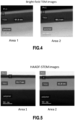
- FIG. 4 shows a bright field TEM image of two areas of a first exemplary proton exchange membrane for water electrolysis.
- the first exemplary proton exchange membrane (Ex1) for water electrolysis has titanium oxide film having a thickness between 60.3 nm and 61.8 nm
- FIG. 5 shows a HAADF-STEM image of two areas of the first exemplary proton exchange membrane for water electrolysis of FIG. 4 .
- HAADF-STEM images allow for enhanced contrast, especially at lower atomic numbers, compared to TEM.
- FIG. 6 shows a bright field TEM image of two areas of a second exemplary proton exchange membrane (Ex2) for water electrolysis.
- the second exemplary proton exchange membrane for water electrolysis has titanium oxide film having a thickness between 17.4 nm and 18.9 nm.
- FIG. 7 shows a HAADF-STEM image of two areas of the second exemplary proton exchange membrane for water electrolysis of FIG. 6 .
- FIG. 8 shows the concentration (in at%) as a function of depth of the removed material (in nm SiO 2 equivalent) measured by XPS for the first exemplary proton exchange membrane showing the composition of the film is TiO 2 .
- Table 1 shows hydrogen transmission rate (in cm 3 /(m 2 .d.bar)) and oxygen transmission rate (g/(m 2 .d)) through an uncoated Nafion 212 proton exchange membrane (CompEx), Ex1 and Ex2. Measurements of hydrogen transmission rate were carried out according to ISO 15105-1 at 23°C and 0% relative humidity and measurements of oxygen transmission rate were carried out according to ISO 15105-2 at 23°C and 50% relative humidity. Two samples were measured for CompEx, Ex1 and Ex2. For Ex1 and Ex2, the proton exchange membranes were disposed so that titanium oxide film was facing the gas.
- FIG. 9 shows the average conductivity (in mS/cm) as a function of the Relative Humidity (in %) at 80°C for uncoated Nafion 212 proton exchange membrane, the first exemplary proton exchange membrane and the second exemplary proton exchange membrane.
- the second exemplary proton exchange membrane up to 95% relative humidity at 80°C.
- in plane proton conductivity was measured with four-probe method.
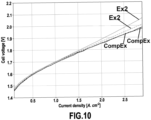
- FIG. 10 shows the cell voltage (in V) as a function of the current density (in A.cm -2 ) at 80°C before (solid line) and after (dotted line) activation for a Membrane Electrode Assembly (MEA) comprising an uncoated proton exchange membrane (comparative example) and for a MEA comprising the second exemplary proton exchange membrane.
- MEA Membrane Electrode Assembly
- a MEA was made by sandwiching the proton exchange membrane between two gas diffusion electrodes, one based on Ir catalyst (H 2 O reduction) and one based Pt catalyst (H 2 oxidation). Performance electrochemical testing was done by galvanostatic intermittent titration technique (GITT).
- Activation is carried out to study the effect of fast degradation of the proton exchange membrane. The activation was carried out applying 3 A/cm 2 current for 30 min.
- FIG. 10 shows that proton exchange membrane of the disclosure may be incorporated in MEA and tested in water electrolysis configuration.
- the before activation polarization curve with the MEA with the second exemplary proton exchange membrane is similar to that of the MEA with uncoated proton exchange membrane, in particular up to 1.5 mA/cm 2 .
Landscapes
- Chemical & Material Sciences (AREA)
- Chemical Kinetics & Catalysis (AREA)
- Engineering & Computer Science (AREA)
- Materials Engineering (AREA)
- Metallurgy (AREA)
- Organic Chemistry (AREA)
- Electrochemistry (AREA)
- Inorganic Chemistry (AREA)
- General Chemical & Material Sciences (AREA)
- Mechanical Engineering (AREA)
- Electrolytic Production Of Non-Metals, Compounds, Apparatuses Therefor (AREA)
Abstract
A proton exchange membrane (10) for water electrolysis comprising a proton exchange substrate (12) coated on one side with a titanium oxide film (14), the titanium oxide film having a thickness (t<sub>14</sub>) equal to or smaller than 100 nm. A method for making a proton exchange membrane for water electrolysis.
Description
- The invention relates to water electrolysis, and in particular to proton exchange membrane for water electrolysis.
- Proton exchange membrane (PEM) are known for water electrolysis. However, crossover of O2 from the cathode to the anode is detrimental to the proton exchange membrane. Indeed, permeation of O2 through the proton exchange membrane may form H2O2 at the anode. Such H2O2 is detrimental to the proton exchange membrane as it may decompose in the presence of Fe2+ impurities into radicals that may attack the proton exchange membrane.
- The present disclosure relates to a proton exchange membrane for water electrolysis comprising a proton exchange substrate coated on one side with a titanium oxide (TiO2) film, the film having a thickness equal to or smaller than 100 nm.
- Thanks to the thickness of the titanium oxide film, the permeation of O2 through the proton exchange membrane is reduced without impacting too strongly the proton conductivity of the proton exchange membrane.
- In some embodiments, the proton exchange substrate may be a perfluorinated sulfonic acid membrane.
- As non limiting examples, perfluorinated sulfonic acid membrane may be of the type commercialized under the reference Nafion™.
- In some embodiments, the thickness of the titanium oxide film may be equal to or smaller than 70 nm.
- In some embodiments, the thickness of the titanium oxide film may be equal to or smaller than 20 nm.
- The present disclosure also relates to a method for making a proton exchange membrane for water electrolysis, comprising the step of:
- providing a proton exchange substrate; and
- coating the proton exchange substrate on one side with a titanium oxide film, the titanium oxide film being deposited by spatial atomic layer deposition and having a thickness equal to or smaller than 100 nm.
- This method may be carried out to obtain the proton exchange membrane described above. Spatial atomic layer deposition has the advantage of allowing for thinner film deposition on large samples and in a continuous manner, for example compared to atomic layer deposition. Therefore, costs of productions are reduced and productivity rate may be increased. Spatial atomic layer deposition also allows for deposition on one side of the substrate, therefore allowing deposition of the titanium oxide film on one side of the proton exchange substrate.
- In some embodiments, precursors of the titanium oxide film may be water and tetrakis(dimethtylamino) titanium.
- In some embodiments, the thickness of the titanium oxide film may be equal to or smaller than 70 nm.
- In some embodiments, the thickness of the titanium oxide film may be equal to or smaller than 20 nm.
- Features, advantages, and technical and industrial significance of exemplary embodiments of the invention will be described below with reference to the accompanying drawings, in which like signs denote like elements, and wherein:
-
FIG. 1 shows an exemplary proton exchange membrane for water electrolysis; -
FIG. 2 shows a flow chart of a method for making proton exchange membrane for water electrolysis; -
FIG. 3 shows the principle of spatial atomic layer deposition; -
FIG. 4 shows a bright field TEM image of two areas of a first exemplary proton exchange membrane for water electrolysis; -
FIG. 5 shows a HAADF-STEM image of two areas of the first exemplary proton exchange membrane for water electrolysis; -
FIG. 6 shows a bright field TEM image of two areas of a second exemplary proton exchange membrane for water electrolysis; -
FIG. 7 shows a HAADF-STEM image of two areas of the second exemplary proton exchange membrane for water electrolysis; -
FIG. 8 shows the concentration (in at%) as a function of depth of the remove material (in nm SiO2 equivalent) measured by XPS; -
FIG. 9 shows the average conductivity (in mS/cm) as a function of the Relative Humidity (in %); -
FIG. 10 shows the cell voltage (in V) as a function of the current density (in A.cm-2) before (solid line) and after (dotted line) activation. - As shown in
FIG. 1 , aproton exchange membrane 10 for water electrolysis. Theproton exchange membrane 10 includes aproton exchange substrate 12 and a film oftitanium oxide 14 deposited onto theproton exchange substrate 12. - As a non-limiting example, the
proton exchange substrate 12 may be made of Nafion™ 212. -
FIG. 2 shows a flow chart of amethod 100 for making a proton exchange membrane for water electrolysis. - The
method 100 includes a step of providing 102 aproton exchange substrate 12. - As a non-limiting example, the
proton exchange substrate 12 may be made of Nafion™ 212. - The
method 100 includes a step of coating 104 theproton exchange substrate 12 on one side with a film oftitanium oxide 14, the film being deposited by spatial atomic layer deposition and having a thickness t14 equal to or smaller than 100 nm, for example equal to or smaller than 70 nm, for example equal to or smaller than 20 nm. The film oftitanium oxide 14 may be directly in contact with theproton exchange substrate 12, e.g. directly in contact with the polymer forming theproton exchange substrate 12. As illustrated, only one side of theproton exchange substrate 12 may be covered with the film oftitanium oxide 14. -
FIG. 3 shows the principle of spatial atomic layer deposition, in which asubstrate 16 to be coated pass under flux of gas A and B alternatively, so as to obtain the desired thickness. - As a non-limiting example, the gas A may be water and the gas B may be tetrakis(dimethtylamino) titanium.
-
FIG. 4 shows a bright field TEM image of two areas of a first exemplary proton exchange membrane for water electrolysis. The first exemplary proton exchange membrane (Ex1) for water electrolysis has titanium oxide film having a thickness between 60.3 nm and 61.8 nm -
FIG. 5 shows a HAADF-STEM image of two areas of the first exemplary proton exchange membrane for water electrolysis ofFIG. 4 . HAADF-STEM images allow for enhanced contrast, especially at lower atomic numbers, compared to TEM. -
FIG. 6 shows a bright field TEM image of two areas of a second exemplary proton exchange membrane (Ex2) for water electrolysis. The second exemplary proton exchange membrane for water electrolysis has titanium oxide film having a thickness between 17.4 nm and 18.9 nm. -
FIG. 7 shows a HAADF-STEM image of two areas of the second exemplary proton exchange membrane for water electrolysis ofFIG. 6 . -
FIG. 8 shows the concentration (in at%) as a function of depth of the removed material (in nm SiO2 equivalent) measured by XPS for the first exemplary proton exchange membrane showing the composition of the film is TiO2.FIG. 8 is an in depth XPS profiling done by ion beam etching. In that case, the sputter rate was calibrated using SiO2: sputter rate = 10 nm/min. - Table 1 shows hydrogen transmission rate (in cm3/(m2.d.bar)) and oxygen transmission rate (g/(m2.d)) through an uncoated Nafion 212 proton exchange membrane (CompEx), Ex1 and Ex2. Measurements of hydrogen transmission rate were carried out according to ISO 15105-1 at 23°C and 0% relative humidity and measurements of oxygen transmission rate were carried out according to ISO 15105-2 at 23°C and 50% relative humidity. Two samples were measured for CompEx, Ex1 and Ex2. For Ex1 and Ex2, the proton exchange membranes were disposed so that titanium oxide film was facing the gas.
Table 1 Samples Thickness (µm) Hydrogen transmission rate Oxygen transmission rate min max MW CompEx 47.6 49.3 48.4 11090 8670 48.0 49.8 48.5 10770 8920 Ex1 51.9 54.8 53.8 7620 6860 52.8 55.2 54.0 7550 6950 Ex 2 51.9 53.6 52.7 7220 8500 48.1 49.4 48.7 8850 7080 -
FIG. 9 shows the average conductivity (in mS/cm) as a function of the Relative Humidity (in %) at 80°C for uncoated Nafion 212 proton exchange membrane, the first exemplary proton exchange membrane and the second exemplary proton exchange membrane. In particular, it is shown that there is no loss of conductivity for the second exemplary proton exchange membrane up to 95% relative humidity at 80°C. In this experiment, in plane proton conductivity was measured with four-probe method. -
FIG. 10 shows the cell voltage (in V) as a function of the current density (in A.cm-2) at 80°C before (solid line) and after (dotted line) activation for a Membrane Electrode Assembly (MEA) comprising an uncoated proton exchange membrane (comparative example) and for a MEA comprising the second exemplary proton exchange membrane. A MEA was made by sandwiching the proton exchange membrane between two gas diffusion electrodes, one based on Ir catalyst (H2O reduction) and one based Pt catalyst (H2 oxidation). Performance electrochemical testing was done by galvanostatic intermittent titration technique (GITT). - Activation is carried out to study the effect of fast degradation of the proton exchange membrane. The activation was carried out applying 3 A/cm2 current for 30 min.
- MEA uncoated proton exchange membrane
- Anode catalyst supplier: Umicore
- PEM thickness: 50µm
- PEM type: Nafion NR-212
- Anode thickness wet: 60 µm
- Anode Ir loading: 1.8634 mg.cm-2
- Cathode thickness wet: 42 µm
- Cathode Pt loading: 0.04101 mg.cm-2
- Current density at 1.8V: 1.647 A.cm-2
- MEA second exemplary proton exchange membrane
- Anode catalyst supplier: Umicore
- PEM thickness susbstrate: 50µm
- PEM type: second exemplary proton exchange membrane
- Anode thickness wet: 60 µm
- Anode Ir loading: 1.8634 mg.cm-2
- Cathode thickness wet: 42 µm
- Cathode Pt loading: 0.04101 mg.cm-2
- Current density at 1.8V: 1.64 A.cm-2
-
FIG. 10 shows that proton exchange membrane of the disclosure may be incorporated in MEA and tested in water electrolysis configuration. - The before activation polarization curve with the MEA with the second exemplary proton exchange membrane is similar to that of the MEA with uncoated proton exchange membrane, in particular up to 1.5 mA/cm2. The same applies to the after activation polarization curve.
- Although the present disclosure refers to specific exemplary embodiments, modifications may be provided to these examples without departing from the general scope of the invention as defined by the claims. In particular, individual characteristics of the different illustrated/mentioned embodiments may be combined in additional embodiments. Therefore, the description and the drawings should be considered in an illustrative rather than in a restrictive sense.
Claims (8)
- A proton exchange membrane (10) for water electrolysis comprising a proton exchange substrate (12) coated on one side with a titanium oxide film (14), the titanium oxide film (14) having a thickness (t14) equal to or smaller than 100 nm.
- The proton exchange membrane (10) according to claim 1, wherein the proton exchange substrate (12) is a perfluorinated sulfonic acid membrane.
- The proton exchange membrane (10) according to claim 1 or 2, wherein the thickness (t14) of the titanium oxide film (14) is equal to or smaller than 70 nm.
- The proton exchange membrane (10) according to claim 3, wherein the thickness (t14) of the titanium oxide film (14) is equal to or smaller than 20 nm.
- A method (100) for making a proton exchange membrane (10) for water electrolysis, comprising the step of:- providing (102) a proton exchange substrate (12); and- coating (104) the proton exchange substrate (12) on one side with a titanium oxide film (14), the titanium oxide film (14) being deposited by spatial atomic layer deposition and having a thickness (t14) equal to or smaller than 100 nm.
- The method (100) according to claim 5, wherein precursors of the titanium oxide film (14) are water and tetrakis(dimethtylamino) titanium.
- The method (100) according to claim 5 or 6, wherein the thickness (t14) of the titanium oxide film (14) is equal to or smaller than 70 nm.
- The method (100) according to claim 7, wherein the thickness (t14) of the titanium oxide film (14) is equal to or smaller than 20 nm.
Priority Applications (1)
| Application Number | Priority Date | Filing Date | Title |
|---|---|---|---|
| EP23306820.4A EP4541944A1 (en) | 2023-10-17 | 2023-10-17 | Improved proton exchange membrane for water electrolysis |
Applications Claiming Priority (1)
| Application Number | Priority Date | Filing Date | Title |
|---|---|---|---|
| EP23306820.4A EP4541944A1 (en) | 2023-10-17 | 2023-10-17 | Improved proton exchange membrane for water electrolysis |
Publications (1)
| Publication Number | Publication Date |
|---|---|
| EP4541944A1 true EP4541944A1 (en) | 2025-04-23 |
Family
ID=88600571
Family Applications (1)
| Application Number | Title | Priority Date | Filing Date |
|---|---|---|---|
| EP23306820.4A Pending EP4541944A1 (en) | 2023-10-17 | 2023-10-17 | Improved proton exchange membrane for water electrolysis |
Country Status (1)
| Country | Link |
|---|---|
| EP (1) | EP4541944A1 (en) |
Citations (2)
| Publication number | Priority date | Publication date | Assignee | Title |
|---|---|---|---|---|
| US20170288250A1 (en) * | 2014-08-28 | 2017-10-05 | Kemira Oyj | An electrolyte membrane for use in an electrochemical cell |
| US20200017980A1 (en) * | 2017-04-03 | 2020-01-16 | 3M Innovative Properties Company | Water electrolyzers |
-
2023
- 2023-10-17 EP EP23306820.4A patent/EP4541944A1/en active Pending
Patent Citations (2)
| Publication number | Priority date | Publication date | Assignee | Title |
|---|---|---|---|---|
| US20170288250A1 (en) * | 2014-08-28 | 2017-10-05 | Kemira Oyj | An electrolyte membrane for use in an electrochemical cell |
| US20200017980A1 (en) * | 2017-04-03 | 2020-01-16 | 3M Innovative Properties Company | Water electrolyzers |
Non-Patent Citations (2)
| Title |
|---|
| EKSTROM ET AL: "Nanometer-thick films of titanium oxide acting as electrolyte in the polymer electrolyte fuel cell", ELECTROCHIMICA ACTA, ELSEVIER, AMSTERDAM, NL, vol. 52, no. 12, 28 February 2007 (2007-02-28), pages 4239 - 4245, XP005915019, ISSN: 0013-4686, DOI: 10.1016/J.ELECTACTA.2006.12.002 * |
| WANG LIKUN ET AL: "Suppression of Carbon Monoxide Poisoning in Proton Exchange Membrane Fuel Cells via Gold Nanoparticle/Titania Ultrathin Film Heterogeneous Catalysts", ACS APPLIED ENERGY MATERIALS, vol. 2, no. 5, 28 May 2019 (2019-05-28), pages 3479 - 3487, XP093144023, ISSN: 2574-0962, DOI: 10.1021/acsaem.9b00264 * |
Similar Documents
| Publication | Publication Date | Title |
|---|---|---|
| US12119520B2 (en) | Membrane electrode assembly for fuel cells | |
| US8557470B2 (en) | Membrane/electrode assembly for polymer electrolyte fuel cell and process for producing membrane/electrode assembly for polymer electrolyte fuel cell | |
| Veh et al. | Improving the water management in anion-exchange membrane fuel cells via ultra-thin, directly deposited solid polymer electrolyte | |
| CN101297430B (en) | High durability fuel cell components with cerium salt additives | |
| EP1946400B1 (en) | High durability fuel cell components with cerium oxide additives | |
| US10236527B2 (en) | Porous Nafion membrane and method for preparing the same | |
| JP5069059B2 (en) | Local inactivation of the membrane | |
| US20160233525A1 (en) | Multilayer Coating for Corrosion Resistant Metal Bipolar Plate for a PEMFC | |
| KR102575409B1 (en) | A method of manufacturing an electrolyte membrane for a fuel cell and a method of producing a membrane-electrode assembly including the same | |
| US20250286095A1 (en) | Membrane-electrode assembly and method for manufacturing same | |
| Kim et al. | Improving stability of reinforced composite membrane with hydrophilic interlayer coating | |
| EP3195397B1 (en) | An electrolyte membrane for use in an electrochemical cell | |
| US12166251B2 (en) | Method for manufacturing polymer electrolyte membrane for fuel cells and polymer electrolyte membrane for fuel cells manufactured thereby | |
| EP4541944A1 (en) | Improved proton exchange membrane for water electrolysis | |
| US11088379B2 (en) | Electrolyte membrane of a membrane-electrode assembly having improved chemical durability and a manufacturing method thereof | |
| US11749816B2 (en) | Highly durable electrolyte membrane having improved ion conductivity and production method therefor | |
| US20250051935A1 (en) | Catalyst coated membranes for water electrolysers | |
| JP2017162733A (en) | Membrane electrode assembly for fuel cell and method for producing the same | |
| KR20200043127A (en) | Catalyst Complex For Fuel Cell And Method For Manufacturing The Same | |
| CN112952169B (en) | Method for producing electrolyte membrane for fuel cell with improved durability | |
| JP5220599B2 (en) | Gas diffusion electrode, membrane-electrode assembly and method of manufacturing the same | |
| KR20230002803A (en) | Method for preparing a catalyst coating film | |
| US20250101611A1 (en) | Electrode structure | |
| JP2025047249A (en) | Electrode Structure | |
| KR20240086856A (en) | Polymer electrolyte membrane for fuel cell and manufacturing method thereof |
Legal Events
| Date | Code | Title | Description |
|---|---|---|---|
| PUAI | Public reference made under article 153(3) epc to a published international application that has entered the european phase |
Free format text: ORIGINAL CODE: 0009012 |
|
| STAA | Information on the status of an ep patent application or granted ep patent |
Free format text: STATUS: REQUEST FOR EXAMINATION WAS MADE |
|
| 17P | Request for examination filed |
Effective date: 20231017 |
|
| AK | Designated contracting states |
Kind code of ref document: A1 Designated state(s): AL AT BE BG CH CY CZ DE DK EE ES FI FR GB GR HR HU IE IS IT LI LT LU LV MC ME MK MT NL NO PL PT RO RS SE SI SK SM TR |