EP4541929A1 - Material for chemical vapor deposition, film production method, and film - Google Patents
Material for chemical vapor deposition, film production method, and film Download PDFInfo
- Publication number
- EP4541929A1 EP4541929A1 EP23826942.7A EP23826942A EP4541929A1 EP 4541929 A1 EP4541929 A1 EP 4541929A1 EP 23826942 A EP23826942 A EP 23826942A EP 4541929 A1 EP4541929 A1 EP 4541929A1
- Authority
- EP
- European Patent Office
- Prior art keywords
- film
- lioch
- vapor deposition
- chemical vapor
- lio
- Prior art date
- Legal status (The legal status is an assumption and is not a legal conclusion. Google has not performed a legal analysis and makes no representation as to the accuracy of the status listed.)
- Pending
Links
Classifications
-
- C—CHEMISTRY; METALLURGY
- C23—COATING METALLIC MATERIAL; COATING MATERIAL WITH METALLIC MATERIAL; CHEMICAL SURFACE TREATMENT; DIFFUSION TREATMENT OF METALLIC MATERIAL; COATING BY VACUUM EVAPORATION, BY SPUTTERING, BY ION IMPLANTATION OR BY CHEMICAL VAPOUR DEPOSITION, IN GENERAL; INHIBITING CORROSION OF METALLIC MATERIAL OR INCRUSTATION IN GENERAL
- C23C—COATING METALLIC MATERIAL; COATING MATERIAL WITH METALLIC MATERIAL; SURFACE TREATMENT OF METALLIC MATERIAL BY DIFFUSION INTO THE SURFACE, BY CHEMICAL CONVERSION OR SUBSTITUTION; COATING BY VACUUM EVAPORATION, BY SPUTTERING, BY ION IMPLANTATION OR BY CHEMICAL VAPOUR DEPOSITION, IN GENERAL
- C23C16/00—Chemical coating by decomposition of gaseous compounds, without leaving reaction products of surface material in the coating, i.e. chemical vapour deposition [CVD] processes
- C23C16/06—Chemical coating by decomposition of gaseous compounds, without leaving reaction products of surface material in the coating, i.e. chemical vapour deposition [CVD] processes characterised by the deposition of metallic material
- C23C16/18—Chemical coating by decomposition of gaseous compounds, without leaving reaction products of surface material in the coating, i.e. chemical vapour deposition [CVD] processes characterised by the deposition of metallic material from metallo-organic compounds
-
- C—CHEMISTRY; METALLURGY
- C07—ORGANIC CHEMISTRY
- C07C—ACYCLIC OR CARBOCYCLIC COMPOUNDS
- C07C31/00—Saturated compounds having hydroxy or O-metal groups bound to acyclic carbon atoms
- C07C31/34—Halogenated alcohols
- C07C31/38—Halogenated alcohols containing only fluorine as halogen
-
- C—CHEMISTRY; METALLURGY
- C07—ORGANIC CHEMISTRY
- C07F—ACYCLIC, CARBOCYCLIC OR HETEROCYCLIC COMPOUNDS CONTAINING ELEMENTS OTHER THAN CARBON, HYDROGEN, HALOGEN, OXYGEN, NITROGEN, SULFUR, SELENIUM OR TELLURIUM
- C07F1/00—Compounds containing elements of Groups 1 or 11 of the Periodic Table
- C07F1/02—Lithium compounds
-
- C—CHEMISTRY; METALLURGY
- C23—COATING METALLIC MATERIAL; COATING MATERIAL WITH METALLIC MATERIAL; CHEMICAL SURFACE TREATMENT; DIFFUSION TREATMENT OF METALLIC MATERIAL; COATING BY VACUUM EVAPORATION, BY SPUTTERING, BY ION IMPLANTATION OR BY CHEMICAL VAPOUR DEPOSITION, IN GENERAL; INHIBITING CORROSION OF METALLIC MATERIAL OR INCRUSTATION IN GENERAL
- C23C—COATING METALLIC MATERIAL; COATING MATERIAL WITH METALLIC MATERIAL; SURFACE TREATMENT OF METALLIC MATERIAL BY DIFFUSION INTO THE SURFACE, BY CHEMICAL CONVERSION OR SUBSTITUTION; COATING BY VACUUM EVAPORATION, BY SPUTTERING, BY ION IMPLANTATION OR BY CHEMICAL VAPOUR DEPOSITION, IN GENERAL
- C23C16/00—Chemical coating by decomposition of gaseous compounds, without leaving reaction products of surface material in the coating, i.e. chemical vapour deposition [CVD] processes
- C23C16/22—Chemical coating by decomposition of gaseous compounds, without leaving reaction products of surface material in the coating, i.e. chemical vapour deposition [CVD] processes characterised by the deposition of inorganic material, other than metallic material
- C23C16/30—Deposition of compounds, mixtures or solid solutions, e.g. borides, carbides, nitrides
-
- C—CHEMISTRY; METALLURGY
- C23—COATING METALLIC MATERIAL; COATING MATERIAL WITH METALLIC MATERIAL; CHEMICAL SURFACE TREATMENT; DIFFUSION TREATMENT OF METALLIC MATERIAL; COATING BY VACUUM EVAPORATION, BY SPUTTERING, BY ION IMPLANTATION OR BY CHEMICAL VAPOUR DEPOSITION, IN GENERAL; INHIBITING CORROSION OF METALLIC MATERIAL OR INCRUSTATION IN GENERAL
- C23C—COATING METALLIC MATERIAL; COATING MATERIAL WITH METALLIC MATERIAL; SURFACE TREATMENT OF METALLIC MATERIAL BY DIFFUSION INTO THE SURFACE, BY CHEMICAL CONVERSION OR SUBSTITUTION; COATING BY VACUUM EVAPORATION, BY SPUTTERING, BY ION IMPLANTATION OR BY CHEMICAL VAPOUR DEPOSITION, IN GENERAL
- C23C16/00—Chemical coating by decomposition of gaseous compounds, without leaving reaction products of surface material in the coating, i.e. chemical vapour deposition [CVD] processes
- C23C16/44—Chemical coating by decomposition of gaseous compounds, without leaving reaction products of surface material in the coating, i.e. chemical vapour deposition [CVD] processes characterised by the method of coating
- C23C16/455—Chemical coating by decomposition of gaseous compounds, without leaving reaction products of surface material in the coating, i.e. chemical vapour deposition [CVD] processes characterised by the method of coating characterised by the method used for introducing gases into reaction chamber or for modifying gas flows in reaction chamber
-
- C—CHEMISTRY; METALLURGY
- C23—COATING METALLIC MATERIAL; COATING MATERIAL WITH METALLIC MATERIAL; CHEMICAL SURFACE TREATMENT; DIFFUSION TREATMENT OF METALLIC MATERIAL; COATING BY VACUUM EVAPORATION, BY SPUTTERING, BY ION IMPLANTATION OR BY CHEMICAL VAPOUR DEPOSITION, IN GENERAL; INHIBITING CORROSION OF METALLIC MATERIAL OR INCRUSTATION IN GENERAL
- C23C—COATING METALLIC MATERIAL; COATING MATERIAL WITH METALLIC MATERIAL; SURFACE TREATMENT OF METALLIC MATERIAL BY DIFFUSION INTO THE SURFACE, BY CHEMICAL CONVERSION OR SUBSTITUTION; COATING BY VACUUM EVAPORATION, BY SPUTTERING, BY ION IMPLANTATION OR BY CHEMICAL VAPOUR DEPOSITION, IN GENERAL
- C23C16/00—Chemical coating by decomposition of gaseous compounds, without leaving reaction products of surface material in the coating, i.e. chemical vapour deposition [CVD] processes
- C23C16/44—Chemical coating by decomposition of gaseous compounds, without leaving reaction products of surface material in the coating, i.e. chemical vapour deposition [CVD] processes characterised by the method of coating
- C23C16/455—Chemical coating by decomposition of gaseous compounds, without leaving reaction products of surface material in the coating, i.e. chemical vapour deposition [CVD] processes characterised by the method of coating characterised by the method used for introducing gases into reaction chamber or for modifying gas flows in reaction chamber
- C23C16/45523—Pulsed gas flow or change of composition over time
- C23C16/45525—Atomic layer deposition [ALD]
- C23C16/45553—Atomic layer deposition [ALD] characterized by the use of precursors specially adapted for ALD
-
- C—CHEMISTRY; METALLURGY
- C23—COATING METALLIC MATERIAL; COATING MATERIAL WITH METALLIC MATERIAL; CHEMICAL SURFACE TREATMENT; DIFFUSION TREATMENT OF METALLIC MATERIAL; COATING BY VACUUM EVAPORATION, BY SPUTTERING, BY ION IMPLANTATION OR BY CHEMICAL VAPOUR DEPOSITION, IN GENERAL; INHIBITING CORROSION OF METALLIC MATERIAL OR INCRUSTATION IN GENERAL
- C23C—COATING METALLIC MATERIAL; COATING MATERIAL WITH METALLIC MATERIAL; SURFACE TREATMENT OF METALLIC MATERIAL BY DIFFUSION INTO THE SURFACE, BY CHEMICAL CONVERSION OR SUBSTITUTION; COATING BY VACUUM EVAPORATION, BY SPUTTERING, BY ION IMPLANTATION OR BY CHEMICAL VAPOUR DEPOSITION, IN GENERAL
- C23C16/00—Chemical coating by decomposition of gaseous compounds, without leaving reaction products of surface material in the coating, i.e. chemical vapour deposition [CVD] processes
- C23C16/44—Chemical coating by decomposition of gaseous compounds, without leaving reaction products of surface material in the coating, i.e. chemical vapour deposition [CVD] processes characterised by the method of coating
- C23C16/455—Chemical coating by decomposition of gaseous compounds, without leaving reaction products of surface material in the coating, i.e. chemical vapour deposition [CVD] processes characterised by the method of coating characterised by the method used for introducing gases into reaction chamber or for modifying gas flows in reaction chamber
- C23C16/45523—Pulsed gas flow or change of composition over time
- C23C16/45525—Atomic layer deposition [ALD]
- C23C16/45555—Atomic layer deposition [ALD] applied in non-semiconductor technology
-
- H—ELECTRICITY
- H01—ELECTRIC ELEMENTS
- H01M—PROCESSES OR MEANS, e.g. BATTERIES, FOR THE DIRECT CONVERSION OF CHEMICAL ENERGY INTO ELECTRICAL ENERGY
- H01M10/00—Secondary cells; Manufacture thereof
- H01M10/42—Methods or arrangements for servicing or maintenance of secondary cells or secondary half-cells
- H01M10/4235—Safety or regulating additives or arrangements in electrodes, separators or electrolyte
-
- H—ELECTRICITY
- H01—ELECTRIC ELEMENTS
- H01M—PROCESSES OR MEANS, e.g. BATTERIES, FOR THE DIRECT CONVERSION OF CHEMICAL ENERGY INTO ELECTRICAL ENERGY
- H01M4/00—Electrodes
- H01M4/02—Electrodes composed of, or comprising, active material
- H01M4/04—Processes of manufacture in general
- H01M4/0402—Methods of deposition of the material
- H01M4/0421—Methods of deposition of the material involving vapour deposition
- H01M4/0428—Chemical vapour deposition
-
- H—ELECTRICITY
- H01—ELECTRIC ELEMENTS
- H01M—PROCESSES OR MEANS, e.g. BATTERIES, FOR THE DIRECT CONVERSION OF CHEMICAL ENERGY INTO ELECTRICAL ENERGY
- H01M4/00—Electrodes
- H01M4/02—Electrodes composed of, or comprising, active material
- H01M4/13—Electrodes for accumulators with non-aqueous electrolyte, e.g. for lithium-accumulators; Processes of manufacture thereof
-
- Y—GENERAL TAGGING OF NEW TECHNOLOGICAL DEVELOPMENTS; GENERAL TAGGING OF CROSS-SECTIONAL TECHNOLOGIES SPANNING OVER SEVERAL SECTIONS OF THE IPC; TECHNICAL SUBJECTS COVERED BY FORMER USPC CROSS-REFERENCE ART COLLECTIONS [XRACs] AND DIGESTS
- Y02—TECHNOLOGIES OR APPLICATIONS FOR MITIGATION OR ADAPTATION AGAINST CLIMATE CHANGE
- Y02E—REDUCTION OF GREENHOUSE GAS [GHG] EMISSIONS, RELATED TO ENERGY GENERATION, TRANSMISSION OR DISTRIBUTION
- Y02E60/00—Enabling technologies; Technologies with a potential or indirect contribution to GHG emissions mitigation
- Y02E60/10—Energy storage using batteries
Definitions
- the present disclosure relates to a chemical vapor deposition material, film production method, and film.
- Lithium phosphate oxynitride LiPON
- LiNbO 3 lithium niobate
- Li titanate Li 2 TiO 3
- Patent document 1 discloses a chemical vapor deposition material for producing lithium phosphate oxynitride layers.
- Patent document 1 Japanese unexamined patent 2017-48445
- the aim of the present disclosure is the provision of a novel chemical vapor deposition material, film production method, and film.
- the present disclosure allows the provision of a novel chemical vapor deposition material, film production method, and film.
- CVD chemical vapor deposition
- ALD atomic layer deposition
- an "organic group” is a group containing at least 1 carbon atom.
- a "fluorinated alkyl group” is an alkyl group (functional group) wherein one or more of its hydrogen atoms are substituted by fluorine.
- Alkyl groups are represented by the general formula C n H 2n+1 (where n is ⁇ 1).
- “Fluorinated alkyl group” means the same as fluoroalkyl group.
- a "fluorinated alkenyl group” is an alkenyl group (functional group) wherein one or more of its hydrogen atoms are substituted by fluorine.
- Alkenyl groups are represented by the general formula C n H 2n-1 (where n is ⁇ 2).
- a "fluorinated alkoxyalkyl group” is an alkoxyalkyl group (functional group) wherein one or more of its hydrogen atoms are substituted by fluorine.
- Alkoxy groups are represented by the general formula C n H 2n+1 O (where n is an integer ⁇ 1), and alkoxyalkyl groups are represented by the general formula C n H 2n+1 O-C m H 2m (where n and m are each independently an integer ⁇ 1).
- TMPO trimethyl phosphate
- the abbreviation "Me” denotes methyl group
- the abbreviation “Et” denotes ethyl group
- the abbreviation “Pr” denotes propyl group
- the abbreviation “"Pr” denotes "normal” or straight-chain propyl group
- the abbreviation “ i Pr” denotes isopropyl group
- the abbreviation “Bu” denotes butyl group
- the abbreviation “ n Bu” denotes "normal” or straight-chain butyl group
- the abbreviation “ t Bu” denotes tert-butyl group, also known as 1,1-dimethylethyl
- the abbreviation “ s Bu” denotes sec-butyl group, also known as 1-methylpropyl
- the abbreviation “ i Bu” denotes isobutyl group, also known as 2-methylpropyl.
- the chemical vapor deposition material relating to the present embodiments is represented by formula (1) below.
- This type of chemical vapor deposition material allows the provision of a novel chemical vapor deposition material.
- the chemical vapor deposition material has Li (lithium) as its metal element.
- Atom E belongs to group 16 of the periodic table. For example, it is an oxygen atom, sulfur atom, selenium atom or tellurium atom. Atom E is preferably an oxygen atom.
- R 1 , R 2 and R 3 are each independently a hydrogen atom or a C1-7 straight-chain, branched or cyclic organic group. And at least one of R 1 , R 2 and R 3 contains a fluorine atom. Also, R 1 , R 2 and R 3 are not all hydrogen atoms.
- C1-7 straight-chain organic groups are methyl group, ethyl group, propyl group, butyl group, pentyl group, hexyl group, heptyl group, ethenyl group, propenyl group, etc.
- C1-7 branched organic groups are tert-butyl group, sec-butyl group and isobutyl group.
- C1-7 cyclic organic groups are cyclic alkyl groups, alkenyl groups and alkynyl groups.
- the abovementioned C1-7 organic groups may have a divalent heteroatom-containing group between a carbon-carbon bond, and some or all of the hydrogen atoms of the abovementioned organic groups may be substituted by monovalent heteroatom-containing groups.
- heteroatoms in the divalent or monovalent heteroatom-containing groups are oxygen atom, nitrogen atom, sulfur atom, phosphorus atom, silicon atom, halogen atom, etc.
- halogen atoms are fluorine atom, chlorine atom, bromine atom and iodine atom.
- divalent heteroatom-containing groups are -CO-, -CS-, -NH-, -O-, -S-, - SO 2 - and divalent groups containing combinations of these.
- Examples of monovalent heteroatom-containing groups are hydroxy group, carboxy group, sulfanyl group, cyano group, nitro group, halogen atoms, etc.
- R 1 , R 2 and R 3 are each independently a hydrogen atom or a C1-5 fluorinated alkyl group, C2-5 alkenyl group, C2-5 fluorinated alkenyl group or C2-5 fluorinated alkoxyalkyl group.
- R1 is -CF 3 .
- At least one of R 2 and R 3 is a hydrogen atom.
- LiO(CH 2 ) 2 OC(Me n Bu)(CF 2 CF 3 ), LiO(CH 2 ) 2 O C(Me t Bu)(CF 2 CF 3 ), LiO(CH 2 )2OC(Me s Bu)(CF 2 C F 3 ), LiO(CH 2 ) 2 OC(CH 3 )(CF 2 CF 3 ) 2 , LiO(CH 2 ) 2 OC (CF 2 CF 3 ) 3 , LiO(CH 2 ) 2 OC(CH 2 CH CH 2 )(CF 3 ) 2 , Li O(CH 2 ) 2 OC(Et)(CF 3 ) 2 , LiO(CH 2 ) 2 OC( n Pr)(CF 3 ) 2 , LiO(CH 2 ) 2 OC( i Pr)(CF 3 ) 2 , LiO(CH 2 ) 2 OC( n Bu) (CF 3 ) 2 , LiO(CH 2 ) 2 OC( t Bu)(
- Chemical vapor deposition material can usually be produced in accordance with scheme (A) below.
- R' is a hydrocarbon group.
- R 1 , R 2 and R 3 are as defined for abovementioned formula (1).
- a round-bottomed flask with a dropping funnel attached is prepared. This round-bottomed flask is attached to a distillation unit. An organic solvent having a specified amount of Li source (e.g. n-butyllithium) dissolved therein is introduced into the dropping funnel. Then an organic solvent having a specified amount of carbon source (e.g. HOCH(CF 3 ) 2 ) dissolved therein is introduced into the round-bottomed flask. Next, while cooling the dropping funnel to around -30°C to -10°C, the organic solvent in the dropping funnel is agitated and introduced dropwise into the round-bottomed flask. This affords a precipitate.
- Li source e.g. n-butyllithium
- carbon source e.g. HOCH(CF 3 ) 2
- the organic solvent is removed from the resulting precipitate (e.g. by creating a vacuum in the round-bottomed flask) to obtain a solid.
- the resulting solid is then subjected to further decrease in pressure (e.g. ⁇ 0.01 kPa), and the round-bottomed flask is heated to around 100°C to 180°C. This yields the target chemical vapor deposition material.
- the various chemical vapor deposition materials of the abovementioned embodiments are obtained by changing the specified carbon source as appropriate.
- the film production method of the present embodiment includes an introduction step wherein the abovementioned chemical vapor deposition material is introduced into a reactor that houses a substrate; and a formation step wherein at least some of said chemical vapor deposition material is deposited onto said substrate.
- the abovementioned chemical vapor deposition material is introduced into a reactor that houses a substrate.
- the type of substrate onto which a film is to be deposited is selected as appropriate for the end-use.
- substrates are Si substrate and electrodes for batteries.
- the reactor may be any closed vessel or chamber of a device inside which vapor deposition can be performed. Specific examples include, but are not limited to, parallel plate type reactors, cold wall type reactors, hot wall type reactors, single-wafer reactors, multi-wafer reactors, and other types of deposition system.
- gas containing vaporized chemical vapor deposition material is introduced into the reactor.
- Pure (single) compound or blended (multiple) compounds in the liquid state may be supplied into a vaporizer and vaporized before being introduced into the reactor.
- the chemical vapor deposition material can be vaporized by passing carrier gas through a vessel containing the chemical vapor deposition material, or by bubbling carrier gas through the chemical vapor deposition material.
- gas containing the carrier gas and vaporized compound(s) is introduced into the reactor. If necessary, the vessel may be heated to a temperature at which the chemical vapor deposition material will have sufficient vapor pressure.
- the carrier gas Ar, He, N 2 , and mixtures of these can be used.
- the compound(s) can be vaporized by direct liquid injection (DLI).
- coreactant can also be introduced into the reactor.
- the coreactant is preferably chosen from the group consisting of O 2 , O 3 , H 2 O, H 2 O 2 , NO, N 2 O, NO 2 , trimethyl phosphate (also referred to as TMPO), oxygen radicals thereof, and mixtures thereof.
- Other coreactants such as alcohols, ammonia, polyamines, hydrazine, dimethylethyl phosphoramidates, and sulfates, can also be used.
- the vessel is maintained at a temperature in the range of 0°C to about 150°C, for example.
- a temperature in the range of 0°C to about 150°C, for example.
- the amount of vaporized compound can be controlled by regulating the vessel temperature by a known method.
- the reactor is maintained at a pressure in the range of about 0.5 mTorr to about 20 Torr.
- the abovementioned chemical vapor deposition material is vapor-deposited onto the substrate to form a film.
- this step in one example of an atomic layer deposition type process, chemical vapor deposition material in the gas phase is introduced into the reactor where it comes into contact with a suitable substrate. Then excess chemical vapor deposition material can be removed from the reactor by purging and/or venting the reactor. Coreactant is introduced into the reactor and reacts in a self-terminating manner with the absorbed chemical vapor deposition material. Excess coreactant is removed from the reactor by purging and/or venting the reactor. When the desired film is a metal oxide film, this 2-stage process may provide the desired film thickness, or this 2-stage process may be repeated until film of the required thickness is obtained.
- the introduction of chemical vapor deposition material vapor into the reactor can be continued.
- This chemical vapor deposition material is chosen based on the properties of the metal oxide to be deposited.
- the compound comes into contact with the substrate. Excess compound is removed from the reactor by purging and/or venting the reactor.
- Coreactant may again be introduced into the reactor to react with the chemical vapor deposition material; this coreactant can be the same as or different from the coreactant in the abovementioned 2-stage process. It is preferable to introduce into the reactor a coreactant that is different from the coreactant in the abovementioned 2-stage process.
- Excess coreactant is removed from the reactor by purging and/or venting the reactor. If the desired film thickness is achieved, this process may be ended. However, if a thicker film is desired, the entire 4-stage process can be repeated.
- the number of repeat cycles of the 4-stage process is preferably 50-1000 cycles, more preferably 100-800 cycles, and even more preferably 200-600 cycles. Films of the desired composition and thickness can be deposited by alternating the supply of chemical vapor deposition material and coreactant. It is also possible to repeat a 6-stage process using multiple types (e.g. 2 types) of coreactant respectively. The number of repeat cycles of the 6-stage process is, for example, 100 cycles to 600 cycles.
- This step may be performed in the presence of at least one coreactant chosen from the group consisting of O 2 , O 3 , H 2 O, H 2 O 2 , NO, NO 2 , N 2 O, PH 3 and TMPO.
- adding coreactant into the reactor allows a film to form on the substrate.
- the temperature of the reactor is preferably ⁇ 130°C to ⁇ 350°C, more preferably ⁇ 130°C to ⁇ 300°C, even more preferably ⁇ 130°C to ⁇ 250°C, and particularly preferably ⁇ 130°C to ⁇ 200°C.
- the temperature of the reactor in this step is preferably ⁇ 130°C to ⁇ 350°C, more preferably ⁇ 150°C to ⁇ 350°C, even more preferably ⁇ 170°C to ⁇ 350°C, and particularly preferably ⁇ 200°C to ⁇ 350°C.
- the film growth rate per cycle is preferably ⁇ 0.05 ⁇ to ⁇ 0.7 ⁇ , more preferably ⁇ 0.08 ⁇ to ⁇ 0.6 ⁇ , and even more preferably ⁇ 0.1 ⁇ to ⁇ 0.5 ⁇ . The faster the film growth rate, the more efficiently film can be formed.
- Film produced by the film production method described above contains metal oxyfluoride.
- the metal oxyfluoride contains Li, oxygen and fluorine.
- Film produced by the film production method described above contains a compound represented by Li x O y F z .
- the compound is such that 2.6 ⁇ x ⁇ 4.3, 1.8 ⁇ y ⁇ 2.3, and 4.3 ⁇ z ⁇ 6.6.
- the composition of the compound can be calculated from analysis results obtained using a commercially available elemental analyzer, and stoichiometric calculation using those analysis results. It should be noted that the compound contained in the film may be substantially Li x O y F z ( ⁇ 99% by mass Li x O y F z ) or may contain impurities (e.g. LiOF and/or LiCF).
- the film produced by the film production method described above has a reflection coefficient of ⁇ 1.1 to ⁇ 1.5.
- the reflection coefficient can be measured using a commercially available spectroscopic ellipsometer (i.e., an ellipsometer).
- the film in the present embodiment contains a compound represented by Li x O y F z , wherein 2.6 ⁇ x ⁇ 4.3, 1.8 ⁇ y ⁇ 2.3, and 4.3 ⁇ z ⁇ 6.6.
- the composition of the compound can be calculated from analysis results obtained using a commercially available elemental analyzer, and stoichiometric calculation using those analysis results.
- the compound Li x O y F z contained in the film constitutes preferably ⁇ 50% by mass, more preferably ⁇ 60% by mass, even more preferably ⁇ 70% by mass, and particularly preferably ⁇ 90% by mass, thereof.
- the film of the present embodiment has a reflection coefficient of ⁇ 1.1 to ⁇ 1.5.
- the reflection coefficient can be measured using a commercially available spectroscopic ellipsometer. Because it has a relatively low reflection coefficient, the film will have multiple uses.
- the film thickness is preferably ⁇ 0.1 nm to ⁇ 100 nm, more preferably ⁇ 1 nm to ⁇ 50 nm.
- the chemical vapor deposition material and film of the present embodiment are useful in the production of lithium oxide, lithium oxyfluoride or alkali-containing mixed metal oxyfluoride films, for various uses such as coating lithium metal, and coating cathodes and anodes in lithium batteries.
- Lithium oxyfluoride films have improved resistance to oxidizing agents; this improved resistance can bestow the solid electrolyte mesophase with improved resistance to the gradual deterioration that decreases battery-charging efficiency.
- a 500 mL round-bottomed flask with an attached 100 mL dropping funnel was prepared.
- a distillation unit was attached to this round-bottomed flask.
- a 250 mL round-bottomed flask was attached to the distillation unit.
- 58 mL n-hexane (n-hexane manufactured by Kanto Chemical Co., Inc.) having 2.6 M n-butyllithium (manufactured by Kanto Chemical Co., Inc.) dissolved therein was introduced into the dropping funnel.
- the 1H NMR (C6D6, 400 MHz) results were as follows. From these results it was confirmed that the target chemical vapor deposition material was Li-O-CH(CF 3 ) 2 .
- a Bruker Ascend 400 MHz NMR unit was used for the NMR measurements.
- 1H NMR (C6D6, 400MHz) ⁇ 3. 988 (1H, d, O-CH (CF 3 ) 2 ) ;
- the Li-O-CH(CF 3 ) 2 synthesized in "Synthesis of chemical vapor deposition material" described above was introduced into a vessel (purchased from Japan Advanced Chemicals Co., Ltd). Then the inside of the vessel was set at 78°C. At this point, the pressure was 10 Torr. The vessel was connected to allow the gas in the vessel to be supplied to the reactor.
- Si substrate produced by Mitsubishi Materials Corporation, product name: P-type Silicon Wafer
- 1 vol% HF solution 1 vol% HF solution
- the temperature and pressure inside the reactor were set at 200°C and 1 Torr, the atmosphere surrounding the substrate was changed as described below, and 400 cycles were repeated. This resulted in the formation of a film.
- a film was formed by the same method as for Sample 1, except that in "Changes of atmosphere", step (1) was 5 s.
- a film was formed by the same method as for Sample 1, except that in "Changes of atmosphere", step (1) was 10 s.
- a film was formed by the same method as for Sample 1, except that in "Changes of atmosphere", step (1) was 15 s.
- a film was formed by the same method as for Sample 1, except that the temperature inside the reactor was 175°C.
- a film was formed by the same method as for Sample 1, except for the following.
- a film was formed by the same method as for Sample 1, except for the following.
- a film was formed by the same method as for Sample 1, except for the following.
- a film was formed by the same method as for Sample 1, except for the following.
- the Li-O-CH(CF 3 ) 2 synthesized in "Synthesis of chemical vapor deposition material" described above was introduced into a first vessel (purchased from Japan Advanced Chemicals Co., Ltd). Then the inside of the first vessel was set at 78°C. At this point, the pressure was 20 Torr.
- TMPO manufactured by Aldrich
- TMPO was added into a second vessel (purchased from Japan Advanced Chemicals Co., Ltd). Then the inside of the second vessel was set at 80°C. At this point, the pressure was 20 Torr.
- the first vessel and the second vessel were connected to allow gas to be supplied to the reactor.
- Si substrate produced by Mitsubishi Materials Corporation, product name: P-type Silicon Wafer
- 1 vol% HF solution 1 vol% HF solution
- the temperature and pressure inside the reactor were set at 200°C and 1 Torr, the atmosphere surrounding the substrate was changed as described below, and 400 cycles were repeated. This resulted in the formation of a film.
- This series (1) to (6) constituted 1 cycle.
- a film was formed by the same method as for Sample 10, except that in "Changes of atmosphere", step (1) was 20 s.
- a film was formed by the same method as for Sample 10, except that the temperature inside the reactor was 250°C.
- a film was formed by the same method as for Sample 10, except for the following.
- a film was formed by the same method as for Sample 10, except for the following.
- a film was formed by the same method as for Sample 10, except for the following.
- a film was formed by the same method as for Sample 10, except for the following.
- a film was formed by the same method as for Sample 10, except that the temperature inside the reactor was 275°C.
- a film was formed by the same method as for Sample 10, except for the following.
- a film was formed by the same method as for Sample 10, except for the following.
- a film was formed by the same method as for Sample 10, except for the following.
- a film was formed by the same method as for Sample 10, except for the following.
- a film was formed by the same method as for Sample 10, except that the temperature inside the reactor was 300°C.
- a film was formed by the same method as for Sample 10, except for the following.
- a film was formed by the same method as for Sample 10, except for the following.
- a film was formed by the same method as for Sample 10, except for the following.
- the Li-O-CH(CF 3 ) 2 synthesized in "Synthesis of chemical vapor deposition material" described above was introduced into a vessel (purchased from Japan Advanced Chemicals Co., Ltd). Then the inside of the vessel was set at 78°C. At this point, the pressure was 20 Torr. The vessel was connected to allow gas to be supplied to the reactor.
- Si substrate produced by Mitsubishi Materials Corporation, product name: P-type Silicon Wafer
- 1 vol% HF solution 1 vol% HF solution
- the temperature and pressure inside the reactor were set at 200°C and 1 Torr, the atmosphere surrounding the substrate was changed as described below, and 400 cycles were repeated. This resulted in the formation of a film.
- a film was formed by the same method as for Sample 26, except that in "Changes of atmosphere", step (1) was 20 s.
- a film was formed by the same method as for Sample 26, except that the temperature inside the reactor was 250°C.
- a film was formed by the same method as for Sample 26, except for the following.
- a film was formed by the same method as for Sample 26, except that the temperature inside the reactor was 275°C.
- a film was formed by the same method as for Sample 26, except for the following.
- a film was formed by the same method as for Sample 26, except that the temperature inside the reactor was 300°C.
- a film was formed by the same method as for Sample 26, except for the following.
- the films of Samples 1 to 33 were analyzed using an ellipsometer (manufactured by Semilab, product name: SE-2000).
- the analysis results (film growth rate ( ⁇ (Angstrom)/cycle) and reflection coefficient) for each sample are compiled in Table 1 to Table 3.
- "-" denotes that that component was not used.
- Li-HFIP denotes Li-O-CH(CF 3 ) 2 .
Landscapes
- Chemical & Material Sciences (AREA)
- Organic Chemistry (AREA)
- Engineering & Computer Science (AREA)
- General Chemical & Material Sciences (AREA)
- Chemical Kinetics & Catalysis (AREA)
- Materials Engineering (AREA)
- Mechanical Engineering (AREA)
- Metallurgy (AREA)
- Electrochemistry (AREA)
- Manufacturing & Machinery (AREA)
- Inorganic Chemistry (AREA)
- Organic Low-Molecular-Weight Compounds And Preparation Thereof (AREA)
- Chemical Vapour Deposition (AREA)
- Physical Vapour Deposition (AREA)
Abstract
Description
- The present disclosure relates to a chemical vapor deposition material, film production method, and film.
- In batteries, durability and high ion conductivity are required. For example, in lithium ion batteries it is necessary to maintain electrode durability and to have a high ion conductivity. With regard to durability, the provision of a film that covers the positive electrode and the negative electrode in lithium ion batteries is known. Lithium phosphate oxynitride (LiPON), lithium niobate (LiNbO3), lithium titanate (Li2TiO3), etc., are examples of compounds contained in the film.
Patent document 1 discloses a chemical vapor deposition material for producing lithium phosphate oxynitride layers. - Patent document 1:
Japanese unexamined patent 2017-48445 - The aim of the present disclosure is the provision of a novel chemical vapor deposition material, film production method, and film.
- The present inventors discovered that the abovementioned problem can be solved by a chemical vapor deposition material represented by formula (1) below.
- [1] Chemical vapor deposition material represented by formula (1) below.

- (Here, E is an oxygen atom, sulfur atom, selenium atom or tellurium atom.
- R1, R2 and R3 are each independently a hydrogen atom or a C1-7 straight-chain, branched or cyclic organic group, and at least one of R1, R2 and R3 contains a fluorine atom.
- Also, R1, R2 and R3 are not all hydrogen atoms.)
- [2] The chemical vapor deposition material described in [1], where R1, R2 and R3 are each independently a hydrogen atom or a C1-5 fluorinated alkyl group, C2-5 alkenyl group, C2-5 fluorinated alkenyl group or C1-5 fluorinated alkoxyalkyl group.
- [3] The chemical vapor deposition material described in [1] or [2], where at least one of R1, R2 and R3 is -CF3, -CF2CF3, -CF2CF2CF3, -(CH2CH=CH2) or -(CH2OCH2CF3).
- [4] The chemical vapor deposition material described in any of [1] to [3], where R1 is -CF3.
- [5] The chemical vapor deposition material described in any of [1] to [4], where at least one of R2 and R3 is a hydrogen atom.
- [6] The chemical vapor deposition material described in any of [1] to [5], where E is an oxygen atom.
- [7] A film production method provided with a formation step whereby the chemical vapor deposition material described in any of [1] to [6] is vapor-deposited onto a substrate to form a film.
- [8] The film production method described [7], where
said formation step proceeds in the presence of at least one coreactant chosen from the group consisting of O2, O3, H2O, H2O2, NO, NO2, N2O, PH3 and TMPO. - [9] The film production method described in [7] or [8], where
the temperature of the reactor in said formation step is ≥150°C to ≤350°C. - [10] The film production method described in any of [7] to [9], where
- said film contains a compound represented by LixOyFz
- wherein


- [11] The film production method described in any of [7] to [10], where the reflection coefficient of said film is ≥1.1 to ≤1.5.
- [12] Film that contains a compound represented by LixOyFz
wherein


- [13] The film described in [12], where
the reflection coefficient of said film is ≥1.1 to ≤1.5. - The present disclosure allows the provision of a novel chemical vapor deposition material, film production method, and film.
- Embodiments of the present disclosure are described below, but the present disclosure is not particularly limited to these embodiments, and can be implemented with appropriate modifications. Also, any of the various configurations described below can be implemented in combination.
- Standard abbreviations for elements from the periodic table of elements are used in the present specification. Therefore, elements are represented by these abbreviations. For example, Li denotes lithium, O denotes oxygen, S denotes sulfur, Se denotes selenium, Te denotes tellurium, H denotes hydrogen, C denotes carbon, and F denotes fluorine. The same applies to other elements.
- In the present specification, CVD (chemical vapor deposition) denotes the chemical gaseous phase deposition method or the chemical vapor deposition method, and ALD (atomic layer deposition) denotes the atomic layer deposition method. It should be noted that ALD is a type of CVD.
- In the present specification, an "organic group" is a group containing at least 1 carbon atom.
- In the present specification, a "fluorinated alkyl group" is an alkyl group (functional group) wherein one or more of its hydrogen atoms are substituted by fluorine. Alkyl groups are represented by the general formula CnH2n+1 (where n is ≥1). "Fluorinated alkyl group" means the same as fluoroalkyl group.
- In the present specification, a "fluorinated alkenyl group" is an alkenyl group (functional group) wherein one or more of its hydrogen atoms are substituted by fluorine. Alkenyl groups are represented by the general formula CnH2n-1 (where n is ≥2).
- In the present specification, a "fluorinated alkoxyalkyl group" is an alkoxyalkyl group (functional group) wherein one or more of its hydrogen atoms are substituted by fluorine. Alkoxy groups are represented by the general formula CnH2n+1O (where n is an integer ≥1), and alkoxyalkyl groups are represented by the general formula CnH2n+1O-CmH2m (where n and m are each independently an integer ≥1).
- In the present specification, "TMPO" is trimethyl phosphate.
- When used in the present specification, the abbreviation "Me" denotes methyl group, the abbreviation "Et" denotes ethyl group; the abbreviation "Pr" denotes propyl group; the abbreviation ""Pr" denotes "normal" or straight-chain propyl group; the abbreviation "iPr" denotes isopropyl group; the abbreviation "Bu" denotes butyl group; the abbreviation "nBu" denotes "normal" or straight-chain butyl group; the abbreviation "tBu" denotes tert-butyl group, also known as 1,1-dimethylethyl; the abbreviation "sBu" denotes sec-butyl group, also known as 1-methylpropyl; and the abbreviation "iBu" denotes isobutyl group, also known as 2-methylpropyl.
- The chemical vapor deposition material relating to the present embodiments is represented by formula (1) below.

- (Here, E is an oxygen atom, sulfur atom, selenium atom or tellurium atom.
- R1, R2 and R3 are each independently a hydrogen atom or a C1-7 straight-chain, branched or cyclic organic group,
- and at least one of R1, R2 and R3 contains a fluorine atom.
- Also, R1, R2 and R3 are not all hydrogen atoms.)
- This type of chemical vapor deposition material allows the provision of a novel chemical vapor deposition material.
- The chemical vapor deposition material has Li (lithium) as its metal element.
- Atom E belongs to group 16 of the periodic table. For example, it is an oxygen atom, sulfur atom, selenium atom or tellurium atom. Atom E is preferably an oxygen atom.
- R1, R2 and R3 are each independently a hydrogen atom or a C1-7 straight-chain, branched or cyclic organic group. And at least one of R1, R2 and R3 contains a fluorine atom. Also, R1, R2 and R3 are not all hydrogen atoms.
- Examples of C1-7 straight-chain organic groups are methyl group, ethyl group, propyl group, butyl group, pentyl group, hexyl group, heptyl group, ethenyl group, propenyl group, etc.
- Examples of C1-7 branched organic groups are tert-butyl group, sec-butyl group and isobutyl group.
- Examples of C1-7 cyclic organic groups are cyclic alkyl groups, alkenyl groups and alkynyl groups.
- The abovementioned C1-7 organic groups may have a divalent heteroatom-containing group between a carbon-carbon bond, and some or all of the hydrogen atoms of the abovementioned organic groups may be substituted by monovalent heteroatom-containing groups.
- Examples of heteroatoms in the divalent or monovalent heteroatom-containing groups are oxygen atom, nitrogen atom, sulfur atom, phosphorus atom, silicon atom, halogen atom, etc. Examples of halogen atoms are fluorine atom, chlorine atom, bromine atom and iodine atom.
- Examples of divalent heteroatom-containing groups are -CO-, -CS-, -NH-, -O-, -S-, - SO2- and divalent groups containing combinations of these.
- Examples of monovalent heteroatom-containing groups are hydroxy group, carboxy group, sulfanyl group, cyano group, nitro group, halogen atoms, etc.
- Preferably, R1, R2 and R3 are each independently a hydrogen atom or a C1-5 fluorinated alkyl group, C2-5 alkenyl group, C2-5 fluorinated alkenyl group or C2-5 fluorinated alkoxyalkyl group.
- More preferably, at least one of R1, R2 and R3 is -CF3, -CF2CF3, -CF2CF2CF3, -(CH2CH=CH2) or -(CH2OCH2CF3).
- Even more preferably, R1 is -CF3.
- Particularly preferably, at least one of R2 and R3 is a hydrogen atom.
- Specific examples of chemical vapor deposition materials
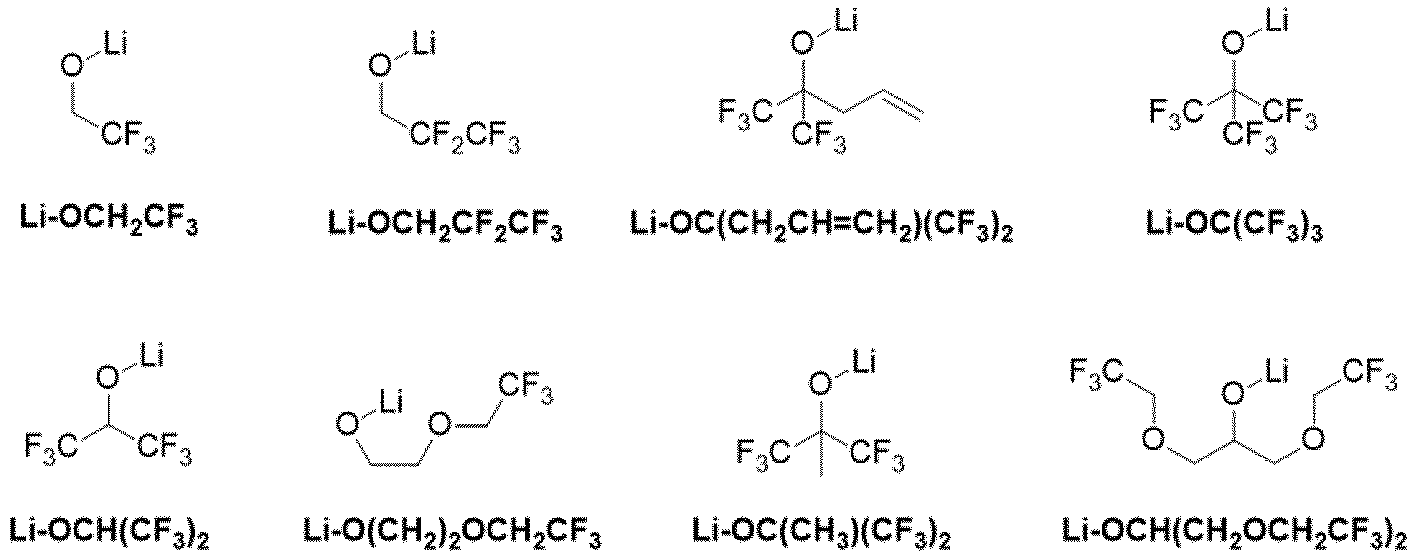
- Below are examples of chemical vapor deposition materials.
Li-OCH2CF3, Li-OCH2CF2CF3, Li-OC(CH2CH=CH 2)(CF3)2, Li-OC(CF3)3, Li-OCH(CF3)2, Li-O(C H2)2OCH2CF3, Li-OC(CH3)(CF3)2, Li-OCH(CH2OC H2CF3)2
- Below are more examples of chemical vapor deposition materials.
LiOC(Et)2(CF3), LiOC(Pr)2(CF3), LiOC(nBu)2 (CF3), LiOC(iBu)2(CF3), LiOC(tBu)2(CF3), Li OC(sBu)2(CF3), LiOC(MeEt)(CF3), LiOC(MeP r) (CF3), LiOC(MenBu)(CF3), LiOC(MeiBu)(CF 3), LiOC(MetBu)(CF3), LiOC(MesBu)(CF3), Li OCH2(CF2CF3), LiOCH(CF2CF3)2, LiOC(CH3)2(CF 2CF3), LiOC(MeEt)(CF2CF3)LiOC(MePr)(CF2C F3), LiOC(MeiBu)(CF2CF3), LiOC(MenBu)(CF2 CF3), LiOC(MetBu)(CF2CF3), LiOC(MesBu)(CF 2CF3), LiOC(CH3)(CF2CF3)2, LiOC(CF2CF3)3, Li OC(Et)(CF3)2, LiOC(nPr)(CF3)2, LiOC(iPr)(C F3)2, LiOC(nBu)(CF3)2, LiOC(tBu)(CF3)2, LiOC (sBu)(CF3)2, LiOC(iBu)(CF3)2, LiO(CH2)2OCH2 CF3, LiO(CH2)2OCH(CF3)2, LiO(CH2)2OC(CF3)3, LiO(CH2)2OC(CH3)(CF3)2, LiO(CH2)2OC(CH3)2 (CF3), LiO(CH2)2OC(Et)2(CF3), LiO(CH2)2OC (Pr)2(CF3), LiO(CH2)2OC(nBu)2(CF3), LiO(CH 2)2OC(iBu)2(CF3), LiO(CH2)2OC(tBu)2(CF3), L iO(CH2)2OC(sBu)2(CF3), LiO(CH2)2OC(MeEt) (CF3), LiO(CH2)2OC(MePr)(CF3), LiO(CH2)2OC (MenBu)(CF3), LiO(CH2)2OC(MeiBu)(CF3), Li O (CH2)2OC(MetBu)(CF3), LiO(CH2)2OC(MesBu) (CF3), LiO(CH2)2OCH2(CF2CF3), LiO(CH2)2OCH (CF2CF3)2, LiO(CH2)2OC(CH3)2(CF2CF3), LiO(C H2)2OC(MeEt)(CF2CF3), LiO(CH2)2OC(MePr) (C F2CF3), LiO(CH2)2OC(MeiBu)(CF2CF3), - LiO(CH2)2OC(MenBu)(CF2CF3), LiO(CH2)2O C(MetBu)(CF2CF3), LiO(CH2)2OC(MesBu)(CF2C F3), LiO(CH2)2OC(CH3)(CF2CF3)2, LiO(CH2)2OC (CF2CF3)3, LiO(CH2)2OC(CH2CH=CH2)(CF3)2, Li O(CH2)2OC(Et)(CF3)2, LiO(CH2)2OC(nPr)(CF3) 2, LiO(CH2)2OC(iPr)(CF3)2, LiO(CH2)2OC(nBu) (CF3)2, LiO(CH2)2OC(tBu)(CF3)2, LiO(CH2)2OC (sBu)(CF3)2, LiO(CH2)2OC(iBu)(CF3)2, LiOCH (Me) CH2OCH2CF3, LiOCH(Me)CH2OCH(CF3)2, LiO CH(Me)CH2OC(CF3)3, LiOCH(Me) CH2OC(CH3) (C F3)2, LiOCH(Me) CH2OC(CH3)2(CF3), LiOCH(Me) CH2OC(Et)2(CF3), LiOCH(Me)CH2OC(Pr)2(CF 3), LiOCH(Me)CH2OC(nBu)2(CF3), LiOCH(Me)C H2OC(iBu)2(CF3), LiOCH(Me)CH2OC(tBu)2(CF 3), LiOCH(Me)CH2OC(sBu)2(CF3), LiOCH(Me)C H2OC(MeEt)(CF3), LiOCH(Me)CH2OC(MePr) (CF 3), LiOCH(Me)CH2OC(MenBu)(CF3), LiOCH(Me) CH2OC(MeiBu)(CF3), LiOCH(Me)CH2OC(MetBu) (CF3), LiOCH(Me)CH2OC(MesBu)(CF3), LiOCH (Me)CH2OCH2(CF2CF3), LiOCH(Me)CH2OCH(CF2C F3)2, LiOCH(Me)CH2OC(CH3)2(CF2CF3), LiOCH (Me)CH2OC(MeEt)(CF2CF3), LiOCH(Me)CH2OC (MePr)(CF2CF3), LiOCH(Me)CH2OC(MeiBu)(CF 2CF3), LiOCH(Me)CH2OC(MenBu)(CF2CF3), LiOC H(Me)CH2OC(MetBu)(CF2CF3), LiOCH(Me) CH2O C(MesBu)(CF2CF3), LiOCH(Me)CH2OC(CH3)(CF2 CF3)2, LiOCH(Me)CH2OC(CF2CF3)3, LiOCH(Me)C H2OC(CH2CH=CH2)(CF3)2,
- LiOCH(Me)CH2OC(Et)(CF3)2, LiOCH(Me)CH 2OC(nPr)(CF3)2, LiOCH(Me)CH2OC(iPr)(CF3)2, L iOCH (Me)CH2OC(nBu)(CF3)2, LiOCH(Me)CH2OC (tBu)(CF3)2, LiOCH(Me)CH2OC(sBu)(CF3)2, Li OCH (Me) CH2OC(iBu)(CF3)2, LiOCH2CH(Me)OCH2 CF3, LiOCH2CH(Me)OCH(CF3)2, LiOCH2CH(Me)O C (CF3)3, LiOCH2CH(Me)OC(CH3)(CF3)2, LiOCH2 CH(Me)OC(CH3)2(CF3), LiOCH2CH(Me)OC(Et)2 (CF3), LiOCH2CH(Me)OC(Pr)2(CF3), LiOCH2CH (Me)OC(nBu)2(CF3), LiOCH2CH(Me)OC(iBu)2(C F3), LiOCH2CH(Me)OC(tBu)2(CF3), LiOCH2CH(M e)OC(sBu)2(CF3), LiOCH2CH(Me)OC(MeEt)(CF 3), LiOCH2CH(Me)OC(MePr)(CF3), LiOCH2CH(M e)OC(MenBu)(CF3), LiOCH2CH(Me)OC(MeiBu) (CF3), LiOCH2CH(Me)OC(MetBu)(CF3), LiOCH2 CH(Me)OC(MesBu)(CF3), LiOCH2CH(Me)OCH2(C F2CF3), LiOCH2CH(Me)OCH(CF2CF3)2, LiOCH2CH (Me)OC(CH3)2(CF2CF3), LiOCH2CH(Me)OC(MeE t)(CF2CF3), LiOCH2CH(Me)OC(MePr)(CF2CF 3), LiOCH2CH(Me)OC(MeiBu)(CF2CF3), LiOCH2C H(Me)OC(MenBu)(CF2CF3), LiOCH2CH(Me)OC(M etBu)(CF2CF3), LiOCH2CH(Me)OC(MesBu)(CF2C F3), LiOCH2CH(Me)OOC(CH3)(CF2CF3)2, LiOCH2 CH(Me)OC(CF2CF3)3, LiOCH2CH(Me)OC(CH2CH= CH2)(CF3)2, LiOCH2CH(Me)OC(Et)(CF3)2, LiOC H2CH(Me)OC(nPr)(CF3)2, LiOCH2CH(Me)OC(iP r)(CF3)2, LiOCH2CH(Me)OC(nBu)(CF3)2, LiOCH 2CH(Me)OC(tBu)(CF3)2,
- LiOCH2CH(Me)OC(sBu)(CF3)2, LiOCH2CH(M e) OC(iBu)(CF3)2, LiO(CH2)3OCH2CF3, LiO(CH2) 3OCH(CF3)2, LiO(CH2)3OC(CF3)3, LiO(CH2)3OC (CH3)(CF3)2, LiO(CH2)3OC(CH3)2(CF3), LiO(CH 2)3OC(Et)2(CF3), LiO(CH2)3OC(Pr)2(CF3), LiO (CH2)3OC(nBu)2(CF3), LiO(CH2)3OC(iBu)2(CF 3), LiO(CH2)3OC(tBu)2(CF3), LiO(CH2)3OC(sB u) 2(CF3), LiO(CH2)3OC(MeEt)(CF3), LiO(CH2) 3OC(MePr)(CF3), LiO(CH2)3OC(MenBu)(CF3), L iO(CH2)3OC(MeiBu)(CF3), LiO(CH2)3OC(MetB u) (CF3), LiO(CH2)3OC(MesBu)(CF3), LiO(CH2) 3OCH2(CF2CF3), LiO(CH2)3OCH(CF2CF3)2, LiO(C H2)3OC(CH3)2(CF2CF3), LiO(CH2)3OC(MeEt) (CF 2CF3), LiO(CH2)3OC(MePr) (CF2CF3), LiO(CH2)3 OC(MeBu)(CF2CF3), LiO(CH2)3OC(MenBu)(CF2 CF3), LiO(CH2)3OC(MetBu)(CF2CF3), LiO(CH2)3 OC(MesBu)(CF2CF3), LiO(CH2)3OC(CH3)(CF2CF 3)2, LiO(CH2)3OC(CF2CF3)3, LiO(CH2)3OC(CH2C H=CH2)(CF3)2, LiO(CH2)3OC(Et) (CF3)2, LiO(C H2)3OC(nPr)(CF3)2, LiO(CH2)3OC(iPr)(CF3)2, LiO(CH2)3OC(nBu)(CF3)2, LiO(CH2)3OC(tBu)(C F3)2, LiO(CH2)3OC(sBu)(CF3)2, LiO(CH2)3OC(i Bu) (CF3)2, LiO(CH2)2CH(Me)OCH2CF3, LiO(CH 2)2CH(Me)OCH(CF3)2, LiO(CH2)2CH(Me)OC(CF 3)3, LiO(CH2)2CH(Me)OC(CH3)(CF3)2, LiO(CH2) 2CH(Me)OC(CH3)2(CF3), LiO(CH2)2CH(Me)OC(E t)2(CF3), LiO(CH2)2CH(Me)OC(Pr)2(CF3), LiO (CH2)2CH(Me) OC (nBu)2(CF3), L iO(CH2)2CH(M e) OC(iBu)2(CF3),
- L iO(CH2)2CH(Me)OC(tBu)2(CF3), L iO(CH2) 2CH(Me)OC(sBu)2(CF3), LiO(CH2)2CH(Me)OC (MeEt)(CF3), LiO(CH2)2CH(Me)OC(MePr)(CF 3), LiO(CH2)2CH(Me)OC(MenBu)(CF3), LiO(CH 2)2CH(Me)OC(MeiBu)(CF3), LiO(CH2)2CH(Me)O C(MetBu)(CF3), LiO(CH2)2CH(Me)OC(MesBu) (CF3), LiO(CH2)2CH(Me)OCH2(CF2CF3), LiO(CH 2)2CH(Me)OCH(CF2CF3)2, LiO(CH2)2CH(Me)OC (CH3)2(CF2CF3), L i O(CH2)2CH(Me) OC (MeEt) (C F2CF3), L i O (CH2)2CH(Me) OC (MePr)(CF2CF3), L iO(CH2)2CH(Me) OC (MeiBu) (CF2CF3), L i O (CH2) 2CH(Me) OC(MenBu)(CF2CF3), L i O (CH2)2CH(Me) OC (MetBu)(CF2CF3), L i O (CH2)2CH(Me) OC (MesB u)(CF2CF3), L i O(CH2)2CH (Me) OC(CH3)(CF2CF 3)2, L i O(CH2)2CH(Me) OC(CF2CF3)3, L i O (CH2)2C H (Me) OC(CH2CH=CH2)(CF3)2, L i O (CH2)2CH(Me) OC (Et)(CF3)2, L i O (CH2)2CH(Me) OC (nPr) (CF3) 2, L i O (CH2)2CH(Me) OC (iPr)(CF3)2, L i O (CH2)2 CH (Me)OC(nBu)(CF3)2, L i O (CH2)2CH(Me)OC(tB u) (CF3)2, L i O (CH2)2CH(Me)OC(sBu)(CF3)2, L i O (CH2)2CH(Me)OC(iBu)(CF3)2, L i OCH (Me) (CH 2)2OCH2CF3, L i OCH (Me) (CH2)2OCH(CF3)2, L i OCH (Me)(CH2)2OC(CF3)3, LiOCH(Me) (CH2)2OC(CH 3)(CF3)2, LiOCH(Me) (CH2)2OC(CH3)2(CF3), L i O CH (Me) (CH2)2OC(Et)2(CF3), L i OCH (Me) (CH2)2 OC (Pr)2(CF3), L i OCH (Me) (CH2)2OC(nBu)2(CF 3), L i OCH (Me) (CH2)2OC(iBu)2(CF3), L i OCH (M e) (CH2)2OC(tBu)2(CF3), L i OCH (Me) (CH2)2OC (sBu)2(CF3), LiOCH(Me) (CH2)2OC(MeEt) (CF 3), LiOCH(Me) (CH2)2OC(MePr)(CF3), LiOCH(M e) (CH2)2OC(MenBu)(CF3), L i OCH (Me)(CH2)2OC (Me Bu) (CF3),
- LiOCH(Me)(CH2)2OC(MetBu)(CF3), L i OCH (Me) (CH2)2OC(MesBu)(CF3), L i OCH (Me) (CH2)2 OCH2(CF2CF3), L i OCH (Me) (CH2)2OCH(CF2CF3)2, L i OCH (Me) (CH2)2OC(CH3)2(CF2CF3), L i OCH (M e) (CH2)2OC(MeEt) (CF2CF3), LiOCH(Me) (CH2)2 OC (MePr)(CF2CF3), LiOCH(Me) (CH2)2OC(MeiB u) (CF2CF3), LiOCH(Me) (CH2)2OC(MenBu) (CF2 CF3), LiOCH(Me) (CH2)2OC(MetBu)(CF2CF3), L i OCH (Me) (CH2)2OC(MesBu)(CF2CF3), L iOCH(M e) (CH2)2OC(CH3)(CF2CF3)2, LiOCH(Me) (CH2)2O C (CF2CF3)3, LiOCH(Me) (CH2)2OC(CH2CH=CH2) (CF3)2, LiOCH(Me) (CH2)2OC(Et)(CF3)2, LiOCH (Me) (CH2)2OC(nPr)(CF3)2, L i OCH (Me) (CH2)2O C(iPr)(CF3)2, L i OCH (Me) (CH2)2OC(nBu)(CF3) 2, LiOCH(Me) (CH2)2OC(tBu)(CF3)2, LiOCH(Me) (CH2)2OC(sBu)(CF3)2, LiOCH(Me) (CH2)2OC(iB u) (CF3)2, LiOC(Me)2(CH2)2OCH2CF3, LiOC(Me)2 (CH2)2OCH(CF3)2, LiOC(Me) 2 (CH2)2OC(CF3)3, LiOC(Me)2(CH2)2OC(CH3)(CF3)2, LiOC(Me)2(C H2)2OC(CH3)2(CF3), LiOC(Me)2(CH2)2OC(Et)2 (CF3), LiOC(Me)2(CH2)2OC(Pr)2(CF3), LiOC(M e) 2(CH2)2OC(nBu) 2(CF3), L iOC(Me) 2(CH2)2OC (iBu)2(CF3), LiOC(Me)2(CH2)2OC(tBu)2(CF3), L iOC(Me) 2(CH2)2OC(sBu)2(CF3),
- L i OC(Me)2(CH2)2OC(MeEt)(CF3), L iOC(M e) 2(CH2)2OC(MePr)(CF3), LiOC(Me)2(CH2)2OC (MenBu)(CF3), L iOC(Me) 2(CH2)2OC(Me i Bu) (C F3), LiOC(Me)2(CH2)2OC(MetBu)(CF3), LiOC(M e) 2(CH2)2OC(MesBu)(CF3), L iOC(Me) 2(CH2)2OC H2 (CF2CF3), L iOC(Me) 2(CH2)2OCH(CF2CF3)2, L i OC (Me) 2(CH2)2OC(CH3) 2(CF2CF3), L iOC(Me)2 (CH2)2OC(MeEt) (CF2CF3), LiOC(Me) 2(CH2)2OC (MePr) (CF2CF3), LiOC(Me) 2(CH2)2OC(Me Bu) (CF2CF3), LiOC(Me) 2(CH2)2OC(MenBu)(CF2CF 3), LiOC(Me) 2(CH2)2OC(MetBu)(CF2CF3), L iOC (Me) 2(CH2)2OC(MesBu)(CF2CF3), L iOC(Me) 2(C H2)2OC(CH3)(CF2CF3)2, L iOC(Me) 2(CH2)2OC(CF 2CF3)3, L iOC(Me) 2(CH2)2OC(CH2CH=CH2)(CF3) 2, L iOC(Me) 2(CH2)2OC(Et) (CF3)2, L iOC(Me)2 (CH2)2OC(nPr)(CF3)2, LiOC(Me) 2(CH2)2OC(iP r) (CF3)2LiOC(Me)2(CH2)2OC(nBu)(CF3)2, LiOC (Me)2(CH2)2OC(tBu)(CF3)2, LiOC(Me)2(CH2)2O C (sBu)(CF3)2, LiOC(Me)2(CH2)2OC(iBu)(CF3) 2, L iOC(Me) 2(CH2)2OCH2CF3, L iOC(Me) 2(CH2)2O CH (CF3)2, LiOC(Me) 2(CH2)2OC(CF3)3, LiOC(M e) 2(CH2)2OC (CH3)(CF3)2, L iOC(Me) 2(CH2)2OC (CH3)2(CF3), L iOC(Me) 2(CH2)2OC(CH2CH=CH2) (CF3)2, L iOC(Me) 2(CH2)2OC(Et)(CF3)2, L iOC (Me) 2(CH2)2OC(nPr)(CF3)2, LiOC(Me)2(CH2)2O C (iPr)(CF3)2, LiOC(Me)2(CH2)2OC(nBu)(CF3) 2, LiOC(Me)2(CH2)2OC(tBu)(CF3)2, LiOC(Me)2 (CH2)2OC(sBu) (CF3)2, LiOC(Me) 2(CH2)2OC(iB u) (CF3)2, LiOC(CH2)2(Me) 2OCH2CF3, L iOC(CH2) 2(Me) 2OCH (CF3)2, L iOC(CH2)2(Me) 2OC(CF3)3, L iOC(CH2)2(Me) 2OC(CH3)(CF3)2, L iOC(CH2)2(M e) 2OC(CH3)2(CF3), L iOC(CH2)2(Me) 2OC(Et)2(C F3) , LiOC(CH2)2(Me) 2OC(Pr)2(CF3), LiOC(CH 2)2(Me) 2OC(nBu)2(CF3), LiOC(CH2)2(Me)2OC(i Bu)2(CF3), L iOC(CH2)2(Me) 2OC(tBu)2(CF3), L i OC (CH2)2(Me) 2OC(sBu)2(CF3), L iOC(CH2)2(Me) 2OC(MeEt) (CF3), L iOC(CH2)2(Me) 2OC(MePr) (CF3), LiOC(CH2)2(Me) 2OC(MenBu)(CF3), LiOC (CH2)2(Me) 2OC(Me Bu) (CF3),
- L iOC(CH2)2(Me)2OC(MetBu)(CF3), LiOC(C H2)2(Me) 2OC(MesBu)(CF3), L iOC(CH2)2(Me) 2OC H2 (CF2CF3), LiOC(CH2)2(Me) 2OCH(CF2CF3)2, L i OC (CH2)2(Me) 2OC(CH3)2(CF2CF3), LiOC(CH2)2 (Me) 2OC(MeEt) (CF2CF3), LiOC(CH2)2(Me) 2OC (MePr)(CF2CF3), LiOC(CH2)2(Me) 2OC(Me Bu) (CF2CF3), LiOC(CH2)2(Me) 2OC(MenBu)(CF2CF 3), LiOC(CH2)2(Me) 2OC(MetBu)(CF2CF3), LiOC (CH2)2(Me) 2OC(MesBu)(CF2CF3), LiOC(CH2)2(M e) 2OC(CH3)(CF2CF3)2LiOC(CH2)2(Me) 2OC(CF2C F3)3, LiOC(CH2)2(Me) 2OC(CH2CH=CH2)(CF3)2, L i OC (CH2)2(Me) 2OC(Et) (CF3)2, LiOC(CH2)2(M e) 2OC(nPr)(CF3)2, LiOC(CH2)2(Me) 2OC(iPr)(C F3)2, LiOC(CH2)2(Me) 2OC(nBu)(CF3)2, LiOC(CH 2)2(Me) 2OC(tBu)(CF3)2, LiOC(CH2)2(Me)2OC(s Bu) (CF3)2, LiOC(CH2)2(Me)2OC(iBu)(CF3)2,
- L i OCH [(CH2)2OCH2CF3]2, LiOCH[(CH2)2OC H (CF3)2]2, LiOCH[(CH2)2OC(CF3)3]2, LiOCH[(C H2)2OC(CH3)(CF3)2]2, L i OCH [(CH2)2OC(CH3)2 (CF3)] 2, LiOCH[(CH2)2OC(Et)2(CF3)]2, L i OCH [(CH2)2OC(Pr)2(CF3)]2, LiOCH[(CH2)2OC(nBu) 2(CF3)] 2, LiOCH[(CH2)2OC(iBu)2(CF3)] 2, L i OC H [(CH2)2OC(tBu)2(CF3)] 2, LiOCH[(CH2)2OC(sB u) 2(CF3)]2, LiOCH[(CH2)2OC(MeEt) (CF3)]2, L i OCH [(CH2)2OC(MePr)(CF3)]2, L i OCH [(CH2)2 OC (MenBu)(CF3)] 2, LiOCH[(CH2)2OC(MeiBu)(C F3)] 2, L i OCH [(CH2)2OC(MetBu)(CF3)] 2, LiOCH [(CH2)2OC(MesBu)(CF3)] 2, L i OCH [(CH2)2OCH2 (CF2CF3)] 2, LiOCH[(CH2)2OCH(CF2CF3)2]2, L iO CH [(CH2)2OC(CH3)2(CF2CF3)] 2LiOCH[(CH2)2OC (MeEt)(CF2CF3)] 2, LiOCH[(CH2)2OC(MePr)(C F2CF3)] 2, LiOCH[(CH2)2OC(Me Bu) (CF2CF3)]2, L i OCH [(CH2)2OC(MenBu)(CF2CF3)]2, L i OCH [(C H2)2OC(MetBu)(CF2CF3)]2, L i OCH [(CH2)2OC(Me sBu)(CF2CF3)]2, L i OCH [(CH2)2OC(CH3)(CF2CF 3)2]2, LiOCH[(CH2)2OC(CF2CF3)3] 2, L i OCH [(CH 2)2OC(CH2CH=CH2)(CF3)2]2, L i OCH [(CH2)2OC(E t) (CF3)2]2, LiOCH[(CH2)2OC(nPr)(CF3)2]2, L i OCH [(CH2)2OC(iPr)(CF3)2]2, L i OCH [(CH2)2OC (nBu)(CF3)2]2, L i OCH [(CH2)2OC (tBu)(CF3)2] 2, L i OCH [(CH2)2OC(sBu)(CF3)2]2, L i OCH [(CH2) 2OC(iBu)(CF3)2]2, L iOC(Et) 2(CF2H), L i OC (Et) 2(CFH2) ,L i OC (Et)2(CF3), L i OCH (CF2H)2, L i SCH (CF3)2, LiSeCH(CF3)2, L i TeCH (CF3)2
- Chemical vapor deposition material can usually be produced in accordance with scheme (A) below.

- The following procedure is a specific example of the production method. A round-bottomed flask with a dropping funnel attached is prepared. This round-bottomed flask is attached to a distillation unit. An organic solvent having a specified amount of Li source (e.g. n-butyllithium) dissolved therein is introduced into the dropping funnel. Then an organic solvent having a specified amount of carbon source (e.g. HOCH(CF3)2) dissolved therein is introduced into the round-bottomed flask. Next, while cooling the dropping funnel to around -30°C to -10°C, the organic solvent in the dropping funnel is agitated and introduced dropwise into the round-bottomed flask. This affords a precipitate. The organic solvent is removed from the resulting precipitate (e.g. by creating a vacuum in the round-bottomed flask) to obtain a solid. The resulting solid is then subjected to further decrease in pressure (e.g. <0.01 kPa), and the round-bottomed flask is heated to around 100°C to 180°C. This yields the target chemical vapor deposition material. The various chemical vapor deposition materials of the abovementioned embodiments are obtained by changing the specified carbon source as appropriate.
- The film production method of the present embodiment includes an introduction step wherein the abovementioned chemical vapor deposition material is introduced into a reactor that houses a substrate; and a formation step wherein at least some of said chemical vapor deposition material is deposited onto said substrate.
- In this step, the abovementioned chemical vapor deposition material is introduced into a reactor that houses a substrate. The type of substrate onto which a film is to be deposited is selected as appropriate for the end-use. Examples of substrates are Si substrate and electrodes for batteries.
- The reactor may be any closed vessel or chamber of a device inside which vapor deposition can be performed. Specific examples include, but are not limited to, parallel plate type reactors, cold wall type reactors, hot wall type reactors, single-wafer reactors, multi-wafer reactors, and other types of deposition system.
- Next, gas containing vaporized chemical vapor deposition material is introduced into the reactor. Pure (single) compound or blended (multiple) compounds in the liquid state may be supplied into a vaporizer and vaporized before being introduced into the reactor. Or the chemical vapor deposition material can be vaporized by passing carrier gas through a vessel containing the chemical vapor deposition material, or by bubbling carrier gas through the chemical vapor deposition material. Next, gas containing the carrier gas and vaporized compound(s) is introduced into the reactor. If necessary, the vessel may be heated to a temperature at which the chemical vapor deposition material will have sufficient vapor pressure. There are no limitations on the carrier gas; Ar, He, N2, and mixtures of these can be used. Or, instead of adopting the method that involves bubbling carrier gas (known as the bubbling method), the compound(s) can be vaporized by direct liquid injection (DLI).
- In the introduction step, coreactant can also be introduced into the reactor. The coreactant is preferably chosen from the group consisting of O2, O3, H2O, H2O2, NO, N2O, NO2, trimethyl phosphate (also referred to as TMPO), oxygen radicals thereof, and mixtures thereof. Other coreactants, such as alcohols, ammonia, polyamines, hydrazine, dimethylethyl phosphoramidates, and sulfates, can also be used.
- The vessel is maintained at a temperature in the range of 0°C to about 150°C, for example. Those skilled in the art will understand that the amount of vaporized compound can be controlled by regulating the vessel temperature by a known method.
- The reactor is maintained at a pressure in the range of about 0.5 mTorr to about 20 Torr.
- In the formation step, the abovementioned chemical vapor deposition material is vapor-deposited onto the substrate to form a film.
- In this step, in one example of an atomic layer deposition type process, chemical vapor deposition material in the gas phase is introduced into the reactor where it comes into contact with a suitable substrate. Then excess chemical vapor deposition material can be removed from the reactor by purging and/or venting the reactor. Coreactant is introduced into the reactor and reacts in a self-terminating manner with the absorbed chemical vapor deposition material. Excess coreactant is removed from the reactor by purging and/or venting the reactor. When the desired film is a metal oxide film, this 2-stage process may provide the desired film thickness, or this 2-stage process may be repeated until film of the required thickness is obtained.
- Or, when the desired film is a metal oxide film, after the abovementioned 2-stage process, the introduction of chemical vapor deposition material vapor into the reactor can be continued. This chemical vapor deposition material is chosen based on the properties of the metal oxide to be deposited. After its introduction into the reactor, the compound comes into contact with the substrate. Excess compound is removed from the reactor by purging and/or venting the reactor. Coreactant may again be introduced into the reactor to react with the chemical vapor deposition material; this coreactant can be the same as or different from the coreactant in the abovementioned 2-stage process. It is preferable to introduce into the reactor a coreactant that is different from the coreactant in the abovementioned 2-stage process. Excess coreactant is removed from the reactor by purging and/or venting the reactor. If the desired film thickness is achieved, this process may be ended. However, if a thicker film is desired, the entire 4-stage process can be repeated. The number of repeat cycles of the 4-stage process is preferably 50-1000 cycles, more preferably 100-800 cycles, and even more preferably 200-600 cycles. Films of the desired composition and thickness can be deposited by alternating the supply of chemical vapor deposition material and coreactant. It is also possible to repeat a 6-stage process using multiple types (e.g. 2 types) of coreactant respectively. The number of repeat cycles of the 6-stage process is, for example, 100 cycles to 600 cycles.
- This step may be performed in the presence of at least one coreactant chosen from the group consisting of O2, O3, H2O, H2O2, NO, NO2, N2O, PH3 and TMPO. Specifically, adding coreactant into the reactor allows a film to form on the substrate. In this step the temperature of the reactor is preferably ≥130°C to ≤350°C, more preferably ≥130°C to ≤300°C, even more preferably ≥130°C to ≤250°C, and particularly preferably ≥130°C to ≤200°C. By using a relatively low reactor temperature it is possible to form films on heat-sensitive substrates. For example, it is possible to form films on lithium ion battery electrodes.
- In another embodiment, the temperature of the reactor in this step is preferably ≥130°C to ≤350°C, more preferably ≥150°C to ≤350°C, even more preferably ≥170°C to ≤350°C, and particularly preferably ≥200°C to ≤350°C. By using a relatively high reactor temperature it is possible to form films at high growth rates.
- In this embodiment the film growth rate per cycle is preferably ≥0.05 Å to ≤0.7 Å, more preferably ≥0.08 Å to ≤0.6 Å, and even more preferably ≥0.1 Å to ≤0.5 Å. The faster the film growth rate, the more efficiently film can be formed.
- Film produced by the film production method described above contains metal oxyfluoride. Here, the metal oxyfluoride contains Li, oxygen and fluorine.
- Film produced by the film production method described above contains a compound represented by LixOyFz. Here, the compound is such that 2.6 ≤ x ≤ 4.3, 1.8 ≤ y ≤ 2.3, and 4.3 ≤ z ≤ 6.6. The composition of the compound can be calculated from analysis results obtained using a commercially available elemental analyzer, and stoichiometric calculation using those analysis results. It should be noted that the compound contained in the film may be substantially LixOyFz (≥99% by mass LixOyFz) or may contain impurities (e.g. LiOF and/or LiCF).
- The film produced by the film production method described above has a reflection coefficient of ≥1.1 to ≤1.5. The reflection coefficient can be measured using a commercially available spectroscopic ellipsometer (i.e., an ellipsometer).
- The film in the present embodiment contains a compound represented by LixOyFz, wherein 2.6 ≤ x ≤ 4.3, 1.8 ≤ y ≤ 2.3, and 4.3 ≤ z ≤ 6.6. The composition of the compound can be calculated from analysis results obtained using a commercially available elemental analyzer, and stoichiometric calculation using those analysis results. Here, the compound LixOyFz contained in the film constitutes preferably ≥50% by mass, more preferably ≥60% by mass, even more preferably ≥70% by mass, and particularly preferably ≥90% by mass, thereof.
- The film of the present embodiment has a reflection coefficient of ≥1.1 to ≤1.5. The reflection coefficient can be measured using a commercially available spectroscopic ellipsometer. Because it has a relatively low reflection coefficient, the film will have multiple uses.
- The film thickness is preferably ≥0.1 nm to ≤100 nm, more preferably ≥1 nm to ≤50 nm.
- The chemical vapor deposition material and film of the present embodiment are useful in the production of lithium oxide, lithium oxyfluoride or alkali-containing mixed metal oxyfluoride films, for various uses such as coating lithium metal, and coating cathodes and anodes in lithium batteries. Lithium oxyfluoride films have improved resistance to oxidizing agents; this improved resistance can bestow the solid electrolyte mesophase with improved resistance to the gradual deterioration that decreases battery-charging efficiency.
- The examples below are provided to illustrate use the disclosure of the present specification, and it should be fully understood that any specific embodiment or group of embodiments of the present invention may not necessarily afford all of the advantages of the process described in the present specification. Although specific embodiments and examples are disclosed below, it will be understood by those skilled in the art that the present invention includes obvious modifications and exceeds the specifically disclosed inventive embodiments and/or uses. Therefore, it should be understood that the scope of the disclosed present invention is not limited to the specific embodiments described below.
- A 500 mL round-bottomed flask with an attached 100 mL dropping funnel was prepared. A distillation unit was attached to this round-bottomed flask. A 250 mL round-bottomed flask was attached to the distillation unit. Then 58 mL n-hexane (n-hexane manufactured by Kanto Chemical Co., Inc.) having 2.6 M n-butyllithium (manufactured by Kanto Chemical Co., Inc.) dissolved therein was introduced into the dropping funnel. Then 200 mL n-hexane having 150 mmol HOCH(CF3)2 (manufactured by Tokyo Chemical Industry Co., Ltd.) dissolved therein was introduced into the 500 mL round-bottomed flask. Next, while cooling the dropping funnel to -20°C, the n-hexane in the dropping funnel was agitated and introduced dropwise into the 500 mL round-bottomed flask. This afforded a precipitate. The n-hexane was removed from the resulting precipitate, to obtain a solid. The resulting solid was then subjected to further decrease in pressure to vacuum (<0.01 kPa), and the 500 mL round-bottomed flask was heated to around 150°C. This yielded the target chemical vapor deposition material.
- The 1H NMR (C6D6, 400 MHz) results were as follows. From these results it was confirmed that the target chemical vapor deposition material was Li-O-CH(CF3)2. A Bruker Ascend 400 MHz NMR unit was used for the NMR measurements.
1H NMR (C6D6, 400MHz) : δ 3. 988 (1H, d, O-CH (CF3)2) ; 1 3C NMR (C6D6/D6-DMSO 101MHz) : 6 8. 827 (m, O-CH (CF3)2), 123. 1 (q, 1JCF=288. 6 Hz, O-CH (CF3)2) ; 19F NMR (C6D6, 376MHz) : -7 8. 415 (s, Li-O-CH(CF3)2) ; 1 L i NMR (C6D6, 15 6MHz) : 0. 211 (s, Li-O-CH(CF3)2) . - The Li-O-CH(CF3)2 synthesized in "Synthesis of chemical vapor deposition material" described above was introduced into a vessel (purchased from Japan Advanced Chemicals Co., Ltd). Then the inside of the vessel was set at 78°C. At this point, the pressure was 10 Torr. The vessel was connected to allow the gas in the vessel to be supplied to the reactor.
- Next, Si substrate (produced by Mitsubishi Materials Corporation, product name: P-type Silicon Wafer) that had been washed using 1 vol% HF solution was introduced into the reactor. The temperature and pressure inside the reactor were set at 200°C and 1 Torr, the atmosphere surrounding the substrate was changed as described below, and 400 cycles were repeated. This resulted in the formation of a film.
-
- 4 sccm Li-O-CH(CF3)2 (2.5 s)
- 300 sccm nitrogen gas (30 s)
- 20 sccm H2O gas (1 s)
- 300 sccm nitrogen gas (30 s)
- This series (1) to (4) constituted 1 cycle.
- A film was formed by the same method as for Sample 1, except that in "Changes of atmosphere", step (1) was 5 s.
- A film was formed by the same method as for Sample 1, except that in "Changes of atmosphere", step (1) was 10 s.
- A film was formed by the same method as for Sample 1, except that in "Changes of atmosphere", step (1) was 15 s.
- A film was formed by the same method as for Sample 1, except that the temperature inside the reactor was 175°C.
- A film was formed by the same method as for Sample 1, except for the following.
- The temperature inside the reactor was set at 175°C
- In "Changes of atmosphere", (1) was 5 s
- A film was formed by the same method as for Sample 1, except for the following.
- The temperature inside the reactor was set at 175°C
- In "Changes of atmosphere", (1) was 10 s
- A film was formed by the same method as for Sample 1, except for the following.
- The temperature inside the reactor was set at 175°C
- In "Changes of atmosphere", (1) was 15 s
- A film was formed by the same method as for Sample 1, except for the following.
- The temperature inside the reactor was set at 150°C
- In "Changes of atmosphere", (1) was 15 s
- The number of cycles was 600
- The Li-O-CH(CF3)2 synthesized in "Synthesis of chemical vapor deposition material" described above was introduced into a first vessel (purchased from Japan Advanced Chemicals Co., Ltd). Then the inside of the first vessel was set at 78°C. At this point, the pressure was 20 Torr. TMPO (manufactured by Aldrich) was added into a second vessel (purchased from Japan Advanced Chemicals Co., Ltd). Then the inside of the second vessel was set at 80°C. At this point, the pressure was 20 Torr. The first vessel and the second vessel were connected to allow gas to be supplied to the reactor.
- Next, Si substrate (produced by Mitsubishi Materials Corporation, product name: P-type Silicon Wafer) that had been washed using 1 vol% HF solution was introduced into the reactor. The temperature and pressure inside the reactor were set at 200°C and 1 Torr, the atmosphere surrounding the substrate was changed as described below, and 400 cycles were repeated. This resulted in the formation of a film.
-
- (1) 1 sccm Li-O-CH(CF3)2 (5 s)
- (2) 300 sccm nitrogen gas (5 s)
- (3) 30 sccm TMPO (5 s)
- (4) 300 sccm nitrogen gas (5 s)
- (5) 50 sccm ozone gas (5 s)
- (6) 300 sccm nitrogen gas (5 s)
- This series (1) to (6) constituted 1 cycle.
- A film was formed by the same method as for Sample 10, except that in "Changes of atmosphere", step (1) was 20 s.
- A film was formed by the same method as for Sample 10, except that the temperature inside the reactor was 250°C.
- A film was formed by the same method as for Sample 10, except for the following.
- The temperature inside the reactor was set at 250°C
- In "Changes of atmosphere", step (1) was 10 s
- A film was formed by the same method as for Sample 10, except for the following.
- The temperature inside the reactor was set at 250°C
- In "Changes of atmosphere", step (1) was 15 s
- A film was formed by the same method as for Sample 10, except for the following.
- The temperature inside the reactor was set at 250°C
- In "Changes of atmosphere", step (1) was 20 s
- A film was formed by the same method as for Sample 10, except for the following.
- The temperature inside the reactor was set at 250°C
- In "Changes of atmosphere", step (1) was 25 s
- A film was formed by the same method as for Sample 10, except that the temperature inside the reactor was 275°C.
- A film was formed by the same method as for Sample 10, except for the following.
- The temperature inside the reactor was set at 275°C
- In "Changes of atmosphere", step (1) was 10 s
- A film was formed by the same method as for Sample 10, except for the following.
- The temperature inside the reactor was set at 275°C
- In "Changes of atmosphere", step (1) was 15 s
- A film was formed by the same method as for Sample 10, except for the following.
- The temperature inside the reactor was set at 275°C
- In "Changes of atmosphere", step (1) was 20 s
- A film was formed by the same method as for Sample 10, except for the following.
- The temperature inside the reactor was set at 275°C
- In "Changes of atmosphere", step (1) was 25 s
- A film was formed by the same method as for Sample 10, except that the temperature inside the reactor was 300°C.
- A film was formed by the same method as for Sample 10, except for the following.
- The temperature inside the reactor was set at 300°C
- In "Changes of atmosphere", step (1) was 10 s
- A film was formed by the same method as for Sample 10, except for the following.
- The temperature inside the reactor was set at 300°C
- In "Changes of atmosphere", step (1) was 15 s
- A film was formed by the same method as for Sample 10, except for the following.
- The temperature inside the reactor was set at 300°C
- In "Changes of atmosphere", step (1) was 20 s
- The Li-O-CH(CF3)2 synthesized in "Synthesis of chemical vapor deposition material" described above was introduced into a vessel (purchased from Japan Advanced Chemicals Co., Ltd). Then the inside of the vessel was set at 78°C. At this point, the pressure was 20 Torr. The vessel was connected to allow gas to be supplied to the reactor.
- Next, Si substrate (produced by Mitsubishi Materials Corporation, product name: P-type Silicon Wafer) that had been washed using 1 vol% HF solution was introduced into the reactor. The temperature and pressure inside the reactor were set at 200°C and 1 Torr, the atmosphere surrounding the substrate was changed as described below, and 400 cycles were repeated. This resulted in the formation of a film.
-
- (1) 1 sccm Li-O-CH(CF3)2 (5 s)
- (2) 300 sccm nitrogen gas (5 s)
- (3) 50 sccm ozone gas (5 s)
- (4) 300 sccm nitrogen gas (5 s)
- This series (1) to (4) constituted 1 cycle.
- A film was formed by the same method as for Sample 26, except that in "Changes of atmosphere", step (1) was 20 s.
- A film was formed by the same method as for Sample 26, except that the temperature inside the reactor was 250°C.
- A film was formed by the same method as for Sample 26, except for the following.
- The temperature inside the reactor was set at 250°C
- In "Changes of atmosphere", (1) was 20 s
- A film was formed by the same method as for Sample 26, except that the temperature inside the reactor was 275°C.
- A film was formed by the same method as for Sample 26, except for the following.
- The temperature inside the reactor was set at 275°C
- In "Changes of atmosphere", step (1) was 20 s
- A film was formed by the same method as for Sample 26, except that the temperature inside the reactor was 300°C.
- A film was formed by the same method as for Sample 26, except for the following.
- The temperature inside the reactor was set at 300°C
- In "Changes of atmosphere", step (1) was 20 s
- The films of Samples 1 to 33 were analyzed using an ellipsometer (manufactured by Semilab, product name: SE-2000). The analysis results (film growth rate (Å (Angstrom)/cycle) and reflection coefficient) for each sample are compiled in Table 1 to Table 3. In the tables, "-" denotes that that component was not used. Also, in the tables, Li-HFIP denotes Li-O-CH(CF3)2.
[Table 1] Sample 1 2 3 4 5 6 7 8 9 Test conditions Reactor temperature (°C) 200 200 200 200 175 175 175 175 150 Type of coreactant H2O Chemical vapor deposition material-containing gas flow time (s) Li-HFIP (4sccm) 2.5 5 10 15 2.5 5 10 15 15 Li-HFIP (1sccm) - - - - - - - - - Analysis results Growth rate (Angstrom/cycle) 0.28 0.3 0.31 0.32 0.159 0.178 0.174 0.177 0.118 Reflection coefficient 1.41 1.42 1.42 1.42 1.4 1.42 1.42 1.42 1.43 [Table 2] Sample 10 11 12 13 14 15 16 17 18 19 20 21 22 23 24 25 Test condition s Reactor temperature (°C) 200 200 250 250 250 250 250 275 275 275 275 275 300 300 300 300 Type of coreactant TMPO + O3 Chemical vapor depositio n material-containin g gas flow time (s) Li-HFIP (4sccm) - - - - - - - - - - - - - - - - Li-HFIP (1sccm) 5 20 5 10 15 20 25 5 10 15 20 25 5 10 15 20 Analysis results Growth rate (Angstrom/cycle ) 0.1 2 0.0 9 0.2 2 0.2 8 0.4 6 0.4 2 0.4 0.3 6 0.4 6 0.4 9 0.5 1 0.5 1 0.6 1 0.5 7 0.4 6 0.4 4 Reflection coefficient 1.3 7 1.2 8 1.3 3 1.3 6 1.3 3 1.3 3 1.3 6 1.3 3 1.3 3 1.3 3 1.3 6 1.3 6 1.3 9 1.3 9 1.3 9 1.3 9 [Table 3] Sample 26 27 28 29 30 31 32 33 Test conditions Reactor temperature (°C) 200 200 250 250 275 275 300 300 Type of coreactant O3 Chemical vapor deposition material-containing gas flow time (s) Li-HFIP (4sccm) - - - - - - - - Li-HFIP (1sccm) 5 20 5 20 5 20 5 20 Analysis results Growth rate (Angstrom/cycle) 0.11 0.07 0.24 0.18 0.27 0.19 0.28 0.12 Reflection coefficient 1.35 1.21 1.23 1.36 1.32 1.31 1.32 1.26
Claims (13)
- Chemical vapor deposition material represented by formula (1) below
 (here, E is an oxygen atom, sulfur atom, selenium atom or tellurium atom;R1, R2 and R3 are each independently a hydrogen atom or a C1-7 straight-chain, branched or cyclic organic group,and at least one of R1, R2 and R3 contains a fluorine atom;also, R1, R2 and R3 are not all hydrogen atoms).
 - The chemical vapor deposition material claimed in Claim 1, where R1, R2 and R3 are each independently a hydrogen atom or a C1-5 fluorinated alkyl group, C2-5 alkenyl group, C2-5 fluorinated alkenyl group or C2-5 fluorinated alkoxyalkyl group.
- The chemical vapor deposition material claimed in Claim 2, where at least one of R1, R2 and R3 is -CF3, -CF2CF3, -CF2CF2CF3, -(CH2CH=CH2) or -(CH2OCH2CF3).
- The chemical vapor deposition material claimed in Claim 3, where R1 is -CF3.
- The chemical vapor deposition material claimed in Claim 4, where at least one of R2 and R3 is a hydrogen atom.
- The chemical vapor deposition material claimed in Claim 1, where E is an oxygen atom.
- A film production method provided with a formation step whereby the chemical vapor deposition material claimed in any of Claims 1 to 6 is vapor-deposited onto a substrate to form a film.
- The film production method claimed in Claim 7, where said formation step proceeds in the presence of at least one coreactant chosen from the group consisting of O2, O3, H2O, H2O2, NO, NO2, N2O, PH3 and TMPO.
- The film production method claimed in Claim 8, where the temperature of the reactor in said formation step is ≥130°C to ≤350°C.
- The film production method claimed in Claim 7, where said film contains a compound represented by LixOyFz wherein


- The film production method claimed in Claim 10, where the reflection coefficient of said film is ≥1.1 to ≤1.5.
- Film that contains a compound represented by LixOyFz wherein


- The film claimed in Claim 12, where
the reflection coefficient of said film is ≥1.1 to ≤1.5.
Applications Claiming Priority (2)
| Application Number | Priority Date | Filing Date | Title |
|---|---|---|---|
| JP2022098679A JP2024000112A (en) | 2022-06-20 | 2022-06-20 | Chemical vapor deposition materials, membrane manufacturing methods, and membranes |
| PCT/JP2023/020483 WO2023248755A1 (en) | 2022-06-20 | 2023-06-01 | Material for chemical vapor deposition, film production method, and film |
Publications (2)
| Publication Number | Publication Date |
|---|---|
| EP4541929A1 true EP4541929A1 (en) | 2025-04-23 |
| EP4541929A4 EP4541929A4 (en) | 2026-06-17 |
Family
ID=89379893
Family Applications (1)
| Application Number | Title | Priority Date | Filing Date |
|---|---|---|---|
| EP23826942.7A Pending EP4541929A4 (en) | 2022-06-20 | 2023-06-01 | MATERIAL FOR CHEMICAL GAS PHASE SEPARATION, FILM MANUFACTURING PROCESSES AND FILM |
Country Status (7)
| Country | Link |
|---|---|
| EP (1) | EP4541929A4 (en) |
| JP (1) | JP2024000112A (en) |
| KR (1) | KR20250027719A (en) |
| CN (1) | CN119234053A (en) |
| CA (1) | CA3251535A1 (en) |
| TW (1) | TWI884445B (en) |
| WO (1) | WO2023248755A1 (en) |
Family Cites Families (7)
| Publication number | Priority date | Publication date | Assignee | Title |
|---|---|---|---|---|
| JP3241793B2 (en) * | 1992-04-08 | 2001-12-25 | 大日本印刷株式会社 | Phase shift photomask |
| JP2015193589A (en) * | 2014-03-26 | 2015-11-05 | セントラル硝子株式会社 | METHOD FOR PRODUCING 1,1,1,3,3,3-HEXAFLUORO-tert-BUTANOL |
| TWI709481B (en) | 2014-08-25 | 2020-11-11 | 日商東洋紡股份有限公司 | Silane coupling agent laminated layer polymer film and its manufacturing method, laminated body and its manufacturing method, and flexible electronic device manufacturing method |
| JP6493107B2 (en) | 2015-09-04 | 2019-04-03 | トヨタ自動車株式会社 | Method for producing lithium phosphate oxynitride layer |
| JP7086189B2 (en) * | 2018-06-28 | 2022-06-17 | 東京エレクトロン株式会社 | Film formation method, film formation system, and film formation equipment |
| US11913110B2 (en) * | 2020-01-31 | 2024-02-27 | Tanaka Kikinzoku Kogyo K.K. | Raw material for chemical deposition containing organoruthenium compound, and chemical deposition method using the raw material for chemical deposition |
| US12473309B2 (en) * | 2020-06-16 | 2025-11-18 | Samsung Electronics Co., Ltd. | Organometallic compound and method of manufacturing integrated circuit using the same |
-
2022
- 2022-06-20 JP JP2022098679A patent/JP2024000112A/en active Pending
-
2023
- 2023-05-03 TW TW112116428A patent/TWI884445B/en active
- 2023-06-01 KR KR1020257001311A patent/KR20250027719A/en active Pending
- 2023-06-01 WO PCT/JP2023/020483 patent/WO2023248755A1/en not_active Ceased
- 2023-06-01 CN CN202380041146.8A patent/CN119234053A/en active Pending
- 2023-06-01 CA CA3251535A patent/CA3251535A1/en active Pending
- 2023-06-01 EP EP23826942.7A patent/EP4541929A4/en active Pending
Also Published As
| Publication number | Publication date |
|---|---|
| TWI884445B (en) | 2025-05-21 |
| CN119234053A (en) | 2024-12-31 |
| KR20250027719A (en) | 2025-02-27 |
| CA3251535A1 (en) | 2025-07-08 |
| JP2024000112A (en) | 2024-01-05 |
| EP4541929A4 (en) | 2026-06-17 |
| TW202409055A (en) | 2024-03-01 |
| WO2023248755A1 (en) | 2023-12-28 |
Similar Documents
| Publication | Publication Date | Title |
|---|---|---|
| EP1849789A1 (en) | Metal complexes of polydentate beta-ketoiminates | |
| EP3936636A1 (en) | Indium compound and method for forming indium-containing film using said indium compound | |
| US20250066405A1 (en) | Molybdenum precursor compound, method for preparing same, and method for depositing molybdenum-containing film using same | |
| WO2008002546A1 (en) | Metal(iv) tetra-amidinate compounds and their use in vapor deposition | |
| WO2013011297A1 (en) | Method | |
| US8691985B2 (en) | Heteroleptic pyrrolecarbaldimine precursors | |
| EP4053131B1 (en) | Indium precursor compound, method for manufacturing thin film by using same, and substrate manufactured from same | |
| US20240102161A1 (en) | Lithium precursors for deposition of lithium-containing layers, islets or clusters | |
| US20110206863A1 (en) | Organometallic compounds having sterically hindered amides | |
| US12371787B2 (en) | Method of forming dielectric films, new precursors and their use in the semi-conductor manufacturing | |
| KR102355133B1 (en) | Precursor For Forming A Thin Film, Method For Preparing Thereof, Method For Preparing The Thin Film, and The Thin Film | |
| KR20250027719A (en) | Chemical vapor deposition materials, film preparation methods, and films | |
| EP4587421A1 (en) | Novel chelating and sterically encumbered ligands and their corresponding organometallic complexes for deposition of metal-containing films | |
| KR20140075024A (en) | Alkali metal diazabutadiene compounds and their use for alkali metal-containing film depositions | |
| TWI831079B (en) | Rare earth precursor, method of preparing the same, and method of forming thin film using the same | |
| EP4737461A1 (en) | Novel compound, precursor composition comprising same, and method for manufacturing thin film using same | |
| Park et al. | Evaluation of tin nitride (Sn3N4) via atomic layer deposition using novel volatile Sn precursors | |
| JP7496028B2 (en) | Organometallic compound, precursor composition containing the same, and method for producing thin film using the same | |
| TW202402772A (en) | Precursor compound for forming a metal film and a metal film using the same | |
| WO2026027436A1 (en) | Use of lithium containing compounds in vapor deposition and precursors for vapor deposition | |
| US8431719B1 (en) | Heteroleptic pyrrolecarbaldimine precursors | |
| Saly | The synthesis, structure, and properties of group 2 poly (pyrazolyl) borates and their use for the atomic layer deposition of group 2 borates |
Legal Events
| Date | Code | Title | Description |
|---|---|---|---|
| STAA | Information on the status of an ep patent application or granted ep patent |
Free format text: STATUS: THE INTERNATIONAL PUBLICATION HAS BEEN MADE |
|
| PUAI | Public reference made under article 153(3) epc to a published international application that has entered the european phase |
Free format text: ORIGINAL CODE: 0009012 |
|
| STAA | Information on the status of an ep patent application or granted ep patent |
Free format text: STATUS: REQUEST FOR EXAMINATION WAS MADE |
|
| 17P | Request for examination filed |
Effective date: 20250120 |
|
| AK | Designated contracting states |
Kind code of ref document: A1 Designated state(s): AL AT BE BG CH CY CZ DE DK EE ES FI FR GB GR HR HU IE IS IT LI LT LU LV MC ME MK MT NL NO PL PT RO RS SE SI SK SM TR |
|
| DAV | Request for validation of the european patent (deleted) | ||
| DAX | Request for extension of the european patent (deleted) | ||
| A4 | Supplementary search report drawn up and despatched |
Effective date: 20260515 |
|
| RIC1 | Information provided on ipc code assigned before grant |
Ipc: C23C 16/18 20060101AFI20260508BHEP Ipc: C07C 31/38 20060101ALI20260508BHEP Ipc: C07F 1/02 20060101ALI20260508BHEP Ipc: C23C 16/455 20060101ALI20260508BHEP Ipc: H01M 4/04 20060101ALI20260508BHEP Ipc: H01M 4/13 20100101ALI20260508BHEP Ipc: H01M 10/42 20060101ALI20260508BHEP Ipc: C23C 16/30 20060101ALI20260508BHEP |