EP4541916A1 - 800mpa-grade high-hole-expansion hot-dip galvanized steel plate and manufacturing method therefor - Google Patents
800mpa-grade high-hole-expansion hot-dip galvanized steel plate and manufacturing method therefor Download PDFInfo
- Publication number
- EP4541916A1 EP4541916A1 EP23823197.1A EP23823197A EP4541916A1 EP 4541916 A1 EP4541916 A1 EP 4541916A1 EP 23823197 A EP23823197 A EP 23823197A EP 4541916 A1 EP4541916 A1 EP 4541916A1
- Authority
- EP
- European Patent Office
- Prior art keywords
- steel plate
- hot
- hole
- dip galvanized
- 800mpa
- Prior art date
- Legal status (The legal status is an assumption and is not a legal conclusion. Google has not performed a legal analysis and makes no representation as to the accuracy of the status listed.)
- Pending
Links
Images
Classifications
-
- C—CHEMISTRY; METALLURGY
- C23—COATING METALLIC MATERIAL; COATING MATERIAL WITH METALLIC MATERIAL; CHEMICAL SURFACE TREATMENT; DIFFUSION TREATMENT OF METALLIC MATERIAL; COATING BY VACUUM EVAPORATION, BY SPUTTERING, BY ION IMPLANTATION OR BY CHEMICAL VAPOUR DEPOSITION, IN GENERAL; INHIBITING CORROSION OF METALLIC MATERIAL OR INCRUSTATION IN GENERAL
- C23C—COATING METALLIC MATERIAL; COATING MATERIAL WITH METALLIC MATERIAL; SURFACE TREATMENT OF METALLIC MATERIAL BY DIFFUSION INTO THE SURFACE, BY CHEMICAL CONVERSION OR SUBSTITUTION; COATING BY VACUUM EVAPORATION, BY SPUTTERING, BY ION IMPLANTATION OR BY CHEMICAL VAPOUR DEPOSITION, IN GENERAL
- C23C2/00—Hot-dipping or immersion processes for applying the coating material in the molten state without affecting the shape; Apparatus therefor
- C23C2/34—Hot-dipping or immersion processes for applying the coating material in the molten state without affecting the shape; Apparatus therefor characterised by the shape of the material to be treated
- C23C2/36—Elongated material
- C23C2/40—Plates; Strips
-
- B—PERFORMING OPERATIONS; TRANSPORTING
- B32—LAYERED PRODUCTS
- B32B—LAYERED PRODUCTS, i.e. PRODUCTS BUILT-UP OF STRATA OF FLAT OR NON-FLAT, e.g. CELLULAR OR HONEYCOMB, FORM
- B32B15/00—Layered products comprising a layer of metal
- B32B15/01—Layered products comprising a layer of metal all layers being exclusively metallic
- B32B15/013—Layered products comprising a layer of metal all layers being exclusively metallic one layer being formed of an iron alloy or steel, another layer being formed of a metal other than iron or aluminium
-
- C—CHEMISTRY; METALLURGY
- C21—METALLURGY OF IRON
- C21D—MODIFYING THE PHYSICAL STRUCTURE OF FERROUS METALS; GENERAL DEVICES FOR HEAT TREATMENT OF FERROUS OR NON-FERROUS METALS OR ALLOYS; MAKING METAL MALLEABLE, e.g. BY DECARBURISATION OR TEMPERING
- C21D1/00—General methods or devices for heat treatment, e.g. annealing, hardening, quenching or tempering
- C21D1/18—Hardening; Quenching with or without subsequent tempering
-
- C—CHEMISTRY; METALLURGY
- C21—METALLURGY OF IRON
- C21D—MODIFYING THE PHYSICAL STRUCTURE OF FERROUS METALS; GENERAL DEVICES FOR HEAT TREATMENT OF FERROUS OR NON-FERROUS METALS OR ALLOYS; MAKING METAL MALLEABLE, e.g. BY DECARBURISATION OR TEMPERING
- C21D1/00—General methods or devices for heat treatment, e.g. annealing, hardening, quenching or tempering
- C21D1/26—Methods of annealing
-
- C—CHEMISTRY; METALLURGY
- C21—METALLURGY OF IRON
- C21D—MODIFYING THE PHYSICAL STRUCTURE OF FERROUS METALS; GENERAL DEVICES FOR HEAT TREATMENT OF FERROUS OR NON-FERROUS METALS OR ALLOYS; MAKING METAL MALLEABLE, e.g. BY DECARBURISATION OR TEMPERING
- C21D6/00—Heat treatment of ferrous alloys
- C21D6/002—Heat treatment of ferrous alloys containing Cr
-
- C—CHEMISTRY; METALLURGY
- C21—METALLURGY OF IRON
- C21D—MODIFYING THE PHYSICAL STRUCTURE OF FERROUS METALS; GENERAL DEVICES FOR HEAT TREATMENT OF FERROUS OR NON-FERROUS METALS OR ALLOYS; MAKING METAL MALLEABLE, e.g. BY DECARBURISATION OR TEMPERING
- C21D6/00—Heat treatment of ferrous alloys
- C21D6/005—Heat treatment of ferrous alloys containing Mn
-
- C—CHEMISTRY; METALLURGY
- C21—METALLURGY OF IRON
- C21D—MODIFYING THE PHYSICAL STRUCTURE OF FERROUS METALS; GENERAL DEVICES FOR HEAT TREATMENT OF FERROUS OR NON-FERROUS METALS OR ALLOYS; MAKING METAL MALLEABLE, e.g. BY DECARBURISATION OR TEMPERING
- C21D6/00—Heat treatment of ferrous alloys
- C21D6/008—Heat treatment of ferrous alloys containing Si
-
- C—CHEMISTRY; METALLURGY
- C21—METALLURGY OF IRON
- C21D—MODIFYING THE PHYSICAL STRUCTURE OF FERROUS METALS; GENERAL DEVICES FOR HEAT TREATMENT OF FERROUS OR NON-FERROUS METALS OR ALLOYS; MAKING METAL MALLEABLE, e.g. BY DECARBURISATION OR TEMPERING
- C21D8/00—Modifying the physical properties of ferrous metals or ferrous alloys by deformation combined with, or followed by, heat treatment
- C21D8/02—Modifying the physical properties of ferrous metals or ferrous alloys by deformation combined with, or followed by, heat treatment during manufacturing of plates or strips
-
- C—CHEMISTRY; METALLURGY
- C21—METALLURGY OF IRON
- C21D—MODIFYING THE PHYSICAL STRUCTURE OF FERROUS METALS; GENERAL DEVICES FOR HEAT TREATMENT OF FERROUS OR NON-FERROUS METALS OR ALLOYS; MAKING METAL MALLEABLE, e.g. BY DECARBURISATION OR TEMPERING
- C21D8/00—Modifying the physical properties of ferrous metals or ferrous alloys by deformation combined with, or followed by, heat treatment
- C21D8/02—Modifying the physical properties of ferrous metals or ferrous alloys by deformation combined with, or followed by, heat treatment during manufacturing of plates or strips
- C21D8/0221—Modifying the physical properties of ferrous metals or ferrous alloys by deformation combined with, or followed by, heat treatment during manufacturing of plates or strips characterised by the working steps
- C21D8/0226—Hot rolling
-
- C—CHEMISTRY; METALLURGY
- C21—METALLURGY OF IRON
- C21D—MODIFYING THE PHYSICAL STRUCTURE OF FERROUS METALS; GENERAL DEVICES FOR HEAT TREATMENT OF FERROUS OR NON-FERROUS METALS OR ALLOYS; MAKING METAL MALLEABLE, e.g. BY DECARBURISATION OR TEMPERING
- C21D8/00—Modifying the physical properties of ferrous metals or ferrous alloys by deformation combined with, or followed by, heat treatment
- C21D8/02—Modifying the physical properties of ferrous metals or ferrous alloys by deformation combined with, or followed by, heat treatment during manufacturing of plates or strips
- C21D8/0221—Modifying the physical properties of ferrous metals or ferrous alloys by deformation combined with, or followed by, heat treatment during manufacturing of plates or strips characterised by the working steps
- C21D8/0236—Cold rolling
-
- C—CHEMISTRY; METALLURGY
- C21—METALLURGY OF IRON
- C21D—MODIFYING THE PHYSICAL STRUCTURE OF FERROUS METALS; GENERAL DEVICES FOR HEAT TREATMENT OF FERROUS OR NON-FERROUS METALS OR ALLOYS; MAKING METAL MALLEABLE, e.g. BY DECARBURISATION OR TEMPERING
- C21D8/00—Modifying the physical properties of ferrous metals or ferrous alloys by deformation combined with, or followed by, heat treatment
- C21D8/02—Modifying the physical properties of ferrous metals or ferrous alloys by deformation combined with, or followed by, heat treatment during manufacturing of plates or strips
- C21D8/0247—Modifying the physical properties of ferrous metals or ferrous alloys by deformation combined with, or followed by, heat treatment during manufacturing of plates or strips characterised by the heat treatment
- C21D8/0263—Modifying the physical properties of ferrous metals or ferrous alloys by deformation combined with, or followed by, heat treatment during manufacturing of plates or strips characterised by the heat treatment following hot rolling
-
- C—CHEMISTRY; METALLURGY
- C21—METALLURGY OF IRON
- C21D—MODIFYING THE PHYSICAL STRUCTURE OF FERROUS METALS; GENERAL DEVICES FOR HEAT TREATMENT OF FERROUS OR NON-FERROUS METALS OR ALLOYS; MAKING METAL MALLEABLE, e.g. BY DECARBURISATION OR TEMPERING
- C21D8/00—Modifying the physical properties of ferrous metals or ferrous alloys by deformation combined with, or followed by, heat treatment
- C21D8/02—Modifying the physical properties of ferrous metals or ferrous alloys by deformation combined with, or followed by, heat treatment during manufacturing of plates or strips
- C21D8/0247—Modifying the physical properties of ferrous metals or ferrous alloys by deformation combined with, or followed by, heat treatment during manufacturing of plates or strips characterised by the heat treatment
- C21D8/0273—Final recrystallisation annealing
-
- C—CHEMISTRY; METALLURGY
- C21—METALLURGY OF IRON
- C21D—MODIFYING THE PHYSICAL STRUCTURE OF FERROUS METALS; GENERAL DEVICES FOR HEAT TREATMENT OF FERROUS OR NON-FERROUS METALS OR ALLOYS; MAKING METAL MALLEABLE, e.g. BY DECARBURISATION OR TEMPERING
- C21D8/00—Modifying the physical properties of ferrous metals or ferrous alloys by deformation combined with, or followed by, heat treatment
- C21D8/02—Modifying the physical properties of ferrous metals or ferrous alloys by deformation combined with, or followed by, heat treatment during manufacturing of plates or strips
- C21D8/0278—Modifying the physical properties of ferrous metals or ferrous alloys by deformation combined with, or followed by, heat treatment during manufacturing of plates or strips involving a particular surface treatment
-
- C—CHEMISTRY; METALLURGY
- C21—METALLURGY OF IRON
- C21D—MODIFYING THE PHYSICAL STRUCTURE OF FERROUS METALS; GENERAL DEVICES FOR HEAT TREATMENT OF FERROUS OR NON-FERROUS METALS OR ALLOYS; MAKING METAL MALLEABLE, e.g. BY DECARBURISATION OR TEMPERING
- C21D9/00—Heat treatment, e.g. annealing, hardening, quenching or tempering, adapted for particular articles; Furnaces therefor
- C21D9/46—Heat treatment, e.g. annealing, hardening, quenching or tempering, adapted for particular articles; Furnaces therefor for sheet metals
-
- C—CHEMISTRY; METALLURGY
- C22—METALLURGY; FERROUS OR NON-FERROUS ALLOYS; TREATMENT OF ALLOYS OR NON-FERROUS METALS
- C22C—ALLOYS
- C22C38/00—Ferrous alloys, e.g. steel alloys
- C22C38/001—Ferrous alloys, e.g. steel alloys containing N
-
- C—CHEMISTRY; METALLURGY
- C22—METALLURGY; FERROUS OR NON-FERROUS ALLOYS; TREATMENT OF ALLOYS OR NON-FERROUS METALS
- C22C—ALLOYS
- C22C38/00—Ferrous alloys, e.g. steel alloys
- C22C38/002—Ferrous alloys, e.g. steel alloys containing In, Mg, or other elements not provided for in one single group C22C38/001 - C22C38/60
-
- C—CHEMISTRY; METALLURGY
- C22—METALLURGY; FERROUS OR NON-FERROUS ALLOYS; TREATMENT OF ALLOYS OR NON-FERROUS METALS
- C22C—ALLOYS
- C22C38/00—Ferrous alloys, e.g. steel alloys
- C22C38/02—Ferrous alloys, e.g. steel alloys containing silicon
-
- C—CHEMISTRY; METALLURGY
- C22—METALLURGY; FERROUS OR NON-FERROUS ALLOYS; TREATMENT OF ALLOYS OR NON-FERROUS METALS
- C22C—ALLOYS
- C22C38/00—Ferrous alloys, e.g. steel alloys
- C22C38/04—Ferrous alloys, e.g. steel alloys containing manganese
-
- C—CHEMISTRY; METALLURGY
- C22—METALLURGY; FERROUS OR NON-FERROUS ALLOYS; TREATMENT OF ALLOYS OR NON-FERROUS METALS
- C22C—ALLOYS
- C22C38/00—Ferrous alloys, e.g. steel alloys
- C22C38/06—Ferrous alloys, e.g. steel alloys containing aluminium
-
- C—CHEMISTRY; METALLURGY
- C22—METALLURGY; FERROUS OR NON-FERROUS ALLOYS; TREATMENT OF ALLOYS OR NON-FERROUS METALS
- C22C—ALLOYS
- C22C38/00—Ferrous alloys, e.g. steel alloys
- C22C38/18—Ferrous alloys, e.g. steel alloys containing chromium
- C22C38/26—Ferrous alloys, e.g. steel alloys containing chromium with niobium or tantalum
-
- C—CHEMISTRY; METALLURGY
- C22—METALLURGY; FERROUS OR NON-FERROUS ALLOYS; TREATMENT OF ALLOYS OR NON-FERROUS METALS
- C22C—ALLOYS
- C22C38/00—Ferrous alloys, e.g. steel alloys
- C22C38/18—Ferrous alloys, e.g. steel alloys containing chromium
- C22C38/28—Ferrous alloys, e.g. steel alloys containing chromium with titanium or zirconium
-
- C—CHEMISTRY; METALLURGY
- C22—METALLURGY; FERROUS OR NON-FERROUS ALLOYS; TREATMENT OF ALLOYS OR NON-FERROUS METALS
- C22C—ALLOYS
- C22C38/00—Ferrous alloys, e.g. steel alloys
- C22C38/18—Ferrous alloys, e.g. steel alloys containing chromium
- C22C38/32—Ferrous alloys, e.g. steel alloys containing chromium with boron
-
- C—CHEMISTRY; METALLURGY
- C22—METALLURGY; FERROUS OR NON-FERROUS ALLOYS; TREATMENT OF ALLOYS OR NON-FERROUS METALS
- C22C—ALLOYS
- C22C38/00—Ferrous alloys, e.g. steel alloys
- C22C38/18—Ferrous alloys, e.g. steel alloys containing chromium
- C22C38/38—Ferrous alloys, e.g. steel alloys containing chromium with more than 1.5% by weight of manganese
-
- C—CHEMISTRY; METALLURGY
- C23—COATING METALLIC MATERIAL; COATING MATERIAL WITH METALLIC MATERIAL; CHEMICAL SURFACE TREATMENT; DIFFUSION TREATMENT OF METALLIC MATERIAL; COATING BY VACUUM EVAPORATION, BY SPUTTERING, BY ION IMPLANTATION OR BY CHEMICAL VAPOUR DEPOSITION, IN GENERAL; INHIBITING CORROSION OF METALLIC MATERIAL OR INCRUSTATION IN GENERAL
- C23C—COATING METALLIC MATERIAL; COATING MATERIAL WITH METALLIC MATERIAL; SURFACE TREATMENT OF METALLIC MATERIAL BY DIFFUSION INTO THE SURFACE, BY CHEMICAL CONVERSION OR SUBSTITUTION; COATING BY VACUUM EVAPORATION, BY SPUTTERING, BY ION IMPLANTATION OR BY CHEMICAL VAPOUR DEPOSITION, IN GENERAL
- C23C2/00—Hot-dipping or immersion processes for applying the coating material in the molten state without affecting the shape; Apparatus therefor
- C23C2/02—Pretreatment of the material to be coated, e.g. for coating on selected surface areas
-
- C—CHEMISTRY; METALLURGY
- C23—COATING METALLIC MATERIAL; COATING MATERIAL WITH METALLIC MATERIAL; CHEMICAL SURFACE TREATMENT; DIFFUSION TREATMENT OF METALLIC MATERIAL; COATING BY VACUUM EVAPORATION, BY SPUTTERING, BY ION IMPLANTATION OR BY CHEMICAL VAPOUR DEPOSITION, IN GENERAL; INHIBITING CORROSION OF METALLIC MATERIAL OR INCRUSTATION IN GENERAL
- C23C—COATING METALLIC MATERIAL; COATING MATERIAL WITH METALLIC MATERIAL; SURFACE TREATMENT OF METALLIC MATERIAL BY DIFFUSION INTO THE SURFACE, BY CHEMICAL CONVERSION OR SUBSTITUTION; COATING BY VACUUM EVAPORATION, BY SPUTTERING, BY ION IMPLANTATION OR BY CHEMICAL VAPOUR DEPOSITION, IN GENERAL
- C23C2/00—Hot-dipping or immersion processes for applying the coating material in the molten state without affecting the shape; Apparatus therefor
- C23C2/02—Pretreatment of the material to be coated, e.g. for coating on selected surface areas
- C23C2/022—Pretreatment of the material to be coated, e.g. for coating on selected surface areas by heating
-
- C—CHEMISTRY; METALLURGY
- C23—COATING METALLIC MATERIAL; COATING MATERIAL WITH METALLIC MATERIAL; CHEMICAL SURFACE TREATMENT; DIFFUSION TREATMENT OF METALLIC MATERIAL; COATING BY VACUUM EVAPORATION, BY SPUTTERING, BY ION IMPLANTATION OR BY CHEMICAL VAPOUR DEPOSITION, IN GENERAL; INHIBITING CORROSION OF METALLIC MATERIAL OR INCRUSTATION IN GENERAL
- C23C—COATING METALLIC MATERIAL; COATING MATERIAL WITH METALLIC MATERIAL; SURFACE TREATMENT OF METALLIC MATERIAL BY DIFFUSION INTO THE SURFACE, BY CHEMICAL CONVERSION OR SUBSTITUTION; COATING BY VACUUM EVAPORATION, BY SPUTTERING, BY ION IMPLANTATION OR BY CHEMICAL VAPOUR DEPOSITION, IN GENERAL
- C23C2/00—Hot-dipping or immersion processes for applying the coating material in the molten state without affecting the shape; Apparatus therefor
- C23C2/02—Pretreatment of the material to be coated, e.g. for coating on selected surface areas
- C23C2/022—Pretreatment of the material to be coated, e.g. for coating on selected surface areas by heating
- C23C2/0224—Two or more thermal pretreatments
-
- C—CHEMISTRY; METALLURGY
- C23—COATING METALLIC MATERIAL; COATING MATERIAL WITH METALLIC MATERIAL; CHEMICAL SURFACE TREATMENT; DIFFUSION TREATMENT OF METALLIC MATERIAL; COATING BY VACUUM EVAPORATION, BY SPUTTERING, BY ION IMPLANTATION OR BY CHEMICAL VAPOUR DEPOSITION, IN GENERAL; INHIBITING CORROSION OF METALLIC MATERIAL OR INCRUSTATION IN GENERAL
- C23C—COATING METALLIC MATERIAL; COATING MATERIAL WITH METALLIC MATERIAL; SURFACE TREATMENT OF METALLIC MATERIAL BY DIFFUSION INTO THE SURFACE, BY CHEMICAL CONVERSION OR SUBSTITUTION; COATING BY VACUUM EVAPORATION, BY SPUTTERING, BY ION IMPLANTATION OR BY CHEMICAL VAPOUR DEPOSITION, IN GENERAL
- C23C2/00—Hot-dipping or immersion processes for applying the coating material in the molten state without affecting the shape; Apparatus therefor
- C23C2/02—Pretreatment of the material to be coated, e.g. for coating on selected surface areas
- C23C2/024—Pretreatment of the material to be coated, e.g. for coating on selected surface areas by cleaning or etching
-
- C—CHEMISTRY; METALLURGY
- C23—COATING METALLIC MATERIAL; COATING MATERIAL WITH METALLIC MATERIAL; CHEMICAL SURFACE TREATMENT; DIFFUSION TREATMENT OF METALLIC MATERIAL; COATING BY VACUUM EVAPORATION, BY SPUTTERING, BY ION IMPLANTATION OR BY CHEMICAL VAPOUR DEPOSITION, IN GENERAL; INHIBITING CORROSION OF METALLIC MATERIAL OR INCRUSTATION IN GENERAL
- C23C—COATING METALLIC MATERIAL; COATING MATERIAL WITH METALLIC MATERIAL; SURFACE TREATMENT OF METALLIC MATERIAL BY DIFFUSION INTO THE SURFACE, BY CHEMICAL CONVERSION OR SUBSTITUTION; COATING BY VACUUM EVAPORATION, BY SPUTTERING, BY ION IMPLANTATION OR BY CHEMICAL VAPOUR DEPOSITION, IN GENERAL
- C23C2/00—Hot-dipping or immersion processes for applying the coating material in the molten state without affecting the shape; Apparatus therefor
- C23C2/04—Hot-dipping or immersion processes for applying the coating material in the molten state without affecting the shape; Apparatus therefor characterised by the coating material
- C23C2/06—Zinc or cadmium or alloys based thereon
-
- C—CHEMISTRY; METALLURGY
- C23—COATING METALLIC MATERIAL; COATING MATERIAL WITH METALLIC MATERIAL; CHEMICAL SURFACE TREATMENT; DIFFUSION TREATMENT OF METALLIC MATERIAL; COATING BY VACUUM EVAPORATION, BY SPUTTERING, BY ION IMPLANTATION OR BY CHEMICAL VAPOUR DEPOSITION, IN GENERAL; INHIBITING CORROSION OF METALLIC MATERIAL OR INCRUSTATION IN GENERAL
- C23C—COATING METALLIC MATERIAL; COATING MATERIAL WITH METALLIC MATERIAL; SURFACE TREATMENT OF METALLIC MATERIAL BY DIFFUSION INTO THE SURFACE, BY CHEMICAL CONVERSION OR SUBSTITUTION; COATING BY VACUUM EVAPORATION, BY SPUTTERING, BY ION IMPLANTATION OR BY CHEMICAL VAPOUR DEPOSITION, IN GENERAL
- C23C2/00—Hot-dipping or immersion processes for applying the coating material in the molten state without affecting the shape; Apparatus therefor
- C23C2/14—Removing excess of molten coatings; Controlling or regulating the coating thickness
-
- C—CHEMISTRY; METALLURGY
- C23—COATING METALLIC MATERIAL; COATING MATERIAL WITH METALLIC MATERIAL; CHEMICAL SURFACE TREATMENT; DIFFUSION TREATMENT OF METALLIC MATERIAL; COATING BY VACUUM EVAPORATION, BY SPUTTERING, BY ION IMPLANTATION OR BY CHEMICAL VAPOUR DEPOSITION, IN GENERAL; INHIBITING CORROSION OF METALLIC MATERIAL OR INCRUSTATION IN GENERAL
- C23C—COATING METALLIC MATERIAL; COATING MATERIAL WITH METALLIC MATERIAL; SURFACE TREATMENT OF METALLIC MATERIAL BY DIFFUSION INTO THE SURFACE, BY CHEMICAL CONVERSION OR SUBSTITUTION; COATING BY VACUUM EVAPORATION, BY SPUTTERING, BY ION IMPLANTATION OR BY CHEMICAL VAPOUR DEPOSITION, IN GENERAL
- C23C2/00—Hot-dipping or immersion processes for applying the coating material in the molten state without affecting the shape; Apparatus therefor
- C23C2/26—After-treatment
-
- C—CHEMISTRY; METALLURGY
- C23—COATING METALLIC MATERIAL; COATING MATERIAL WITH METALLIC MATERIAL; CHEMICAL SURFACE TREATMENT; DIFFUSION TREATMENT OF METALLIC MATERIAL; COATING BY VACUUM EVAPORATION, BY SPUTTERING, BY ION IMPLANTATION OR BY CHEMICAL VAPOUR DEPOSITION, IN GENERAL; INHIBITING CORROSION OF METALLIC MATERIAL OR INCRUSTATION IN GENERAL
- C23G—CLEANING OR DE-GREASING OF METALLIC MATERIAL BY CHEMICAL METHODS OTHER THAN ELECTROLYSIS
- C23G3/00—Apparatus for cleaning or pickling metallic material
- C23G3/02—Apparatus for cleaning or pickling metallic material for cleaning wires, strips, filaments continuously
- C23G3/025—Details of the apparatus, e.g. linings or sealing means
-
- C—CHEMISTRY; METALLURGY
- C21—METALLURGY OF IRON
- C21D—MODIFYING THE PHYSICAL STRUCTURE OF FERROUS METALS; GENERAL DEVICES FOR HEAT TREATMENT OF FERROUS OR NON-FERROUS METALS OR ALLOYS; MAKING METAL MALLEABLE, e.g. BY DECARBURISATION OR TEMPERING
- C21D2211/00—Microstructure comprising significant phases
- C21D2211/002—Bainite
-
- C—CHEMISTRY; METALLURGY
- C21—METALLURGY OF IRON
- C21D—MODIFYING THE PHYSICAL STRUCTURE OF FERROUS METALS; GENERAL DEVICES FOR HEAT TREATMENT OF FERROUS OR NON-FERROUS METALS OR ALLOYS; MAKING METAL MALLEABLE, e.g. BY DECARBURISATION OR TEMPERING
- C21D2211/00—Microstructure comprising significant phases
- C21D2211/005—Ferrite
-
- C—CHEMISTRY; METALLURGY
- C23—COATING METALLIC MATERIAL; COATING MATERIAL WITH METALLIC MATERIAL; CHEMICAL SURFACE TREATMENT; DIFFUSION TREATMENT OF METALLIC MATERIAL; COATING BY VACUUM EVAPORATION, BY SPUTTERING, BY ION IMPLANTATION OR BY CHEMICAL VAPOUR DEPOSITION, IN GENERAL; INHIBITING CORROSION OF METALLIC MATERIAL OR INCRUSTATION IN GENERAL
- C23G—CLEANING OR DE-GREASING OF METALLIC MATERIAL BY CHEMICAL METHODS OTHER THAN ELECTROLYSIS
- C23G1/00—Cleaning or pickling metallic material with solutions or molten salts
- C23G1/02—Cleaning or pickling metallic material with solutions or molten salts with acid solutions
- C23G1/08—Iron or steel
Definitions
- the disclosure relates to a steel plate and a manufacturing method thereof, and in particular to a hot-dip galvanized steel plate and a manufacturing method thereof.
- the inventor wishes to develop a unique 800MPa grade high hole expansion hot-dip galvanized steel plate and the manufacture method thereof, so as achieve said processing performance, corrosion resistance and manufacturability of the material and meet the current requirements of the market and users.
- a Chinese patent reference with the publication number CN109055867A, a publication date of December 21, 2018 and entitled "A Method for Producing High-hole-expansion Hot-dip Galvanized Plates with a Tensile strength of 540 MPa" discloses a method for producing high-hole-expansion hot-dip galvanized plates with a tensile strength of 540 MPa.
- the method is characterized in that the pickled plate is directly galvanized without cold rolling, thus it is a short-process method.
- the tensile strength of the steel plate produced by this method is merely 540 MPa.
- a Chinese patent reference with the publication number of CN108396259A, a publication date of August 14, 2018 , and entitled "A Hot-rolled Galvanized Steel Plate with High Hole Expansion Performance and the Manufacture Method Thereof", discloses a hot-rolled galvanized steel plate with high hole expansion performance and its manufacturing method, wherein the steel plate has a yield strength ⁇ 600MPa and a hole expansion ratio ⁇ 40%.
- the steel plate has a composition containing 0.5-2.5% of Si.
- the Si content is relatively high, thus red iron scale may be easily formed on the surface thereof, which is unfavorable for the control of the galvanized surface.
- the steel has relatively high Si content.
- CN104513930A a publication date of April 15, 2015 and entitled "Ultra-high Strength Hot-rolled complex phase Steel Plate and Steel Strip with Good Bending and Hole-expansion Performance and Manufacturing Method thereof", discloses an ultra-high strength hot-rolled complex phase steel plate and steel strip with good bending and hole expansion performance and a manufacturing method thereof.
- the technical solution of this reference discloses the performance design and manufacture method of the hot-rolled pickled plate.
- the design of the chemical composition does not consider the role of the B element. At the same time, it does not disclose the influence of the hot-dip galvanizing process on the performance of the hot-dip galvanized steel plate.
- One of the objects of the present disclosure is to provide an 800MPa grade high hole expansion hot-dip galvanized steel plate.
- the 800MPa grade high hole expansion hot-dip galvanized steel plate adopts a well-designed chemical composition and can exhibit good comprehensive mechanical properties. It has high strength and high corrosion resistance while exhibiting high hole expansion ratio. It can be used for the manufacture of automobile body structural parts and automobile chassis parts, and can also be used in other application fields requiring high strength, weight reduction, etc., thus it has good application prospects.
- an 800MPa-grade high-hole-expansion hot-dip galvanized steel plate comprising a substrate plate and a hot-dip galvanizing layer plated on at least one surface of the substrate plate, wherein the substrate plate comprises Fe and inevitable impurity elements, and further comprises the following chemical elements in percentage by mass:
- each of the chemical elements have been designed according to the following principles:
- C In the substrate plate of the 800MPa grade high hole expansion hot-dip galvanized steel plate described in the present disclosure, while considering that the C content largely determines the tensile strength level of the steel plate, C is used for solid solution strengthening and forming sufficient amount of precipitation strengthening phase to ensure the strength of the steel; but when the mass percentage of C is too high, the carbide particles will become coarse, which is unfavorable for the hole expansion performance.
- the mass percentage of the C element may be preferably controlled in the range of 0.04-0.07% so as to achieve better effects.
- the Si element has the function of solid solution strengthening and enhancing the steel plate strength. Meanwhile, the addition of Si can increase the process hardening rate and the uniform elongation and total elongation under a certain strength, which is helpful for improving the elongation of the steel plate. Additionally, Si can also prevent the precipitation of carbides and reduce the formation of pearlite phase. However, it should be noted that the inclusion of silicon in steel tends to cause the formation of surface defects such as fayalite (2FeO-SiO 2 ) iron oxide scale on the surface of the steel plate, which has an adverse effect on the surface quality. Based on this, in the substrate plate of the 800MPa grade high hole expansion hot-dip galvanized steel plate described in the present disclosure, the mass percentage of Si element is controlled to be in the range of 0 ⁇ Si ⁇ 0.45%.
- the mass percentage of Si element may be preferably controlled to be in the range of 0.05 ⁇ Si ⁇ 0.45% so as to achieve better effects. In some preferable embodiments, the mass percentage of Si element may be preferably controlled to be in the range of 0 ⁇ Si ⁇ 0.2% so as to achieve better effects. In some preferable embodiments, the mass percentage of Si element may be preferably controlled to be in the range of 0.05 ⁇ Si ⁇ 0.2% so as to achieve better effects.
- Mn In the substrate plate of the 800MPa grade high hole expansion hot-dip galvanized steel plate described in the present disclosure, the Mn element is used as a solid solution strengthening element.
- the steel will have insufficient strength when it has low mass percentage of the Mn element, while the steel plate will have reduced plasticity when the mass percentage of the Mn element is too high.
- Mn will also delay the transformation of pearlite, improve the hardenability of steel and decrease the bainite transformation temperature, thus refining the organizational substructure of steel, ensuring the formation of lath substructure, ensuring the tensile strength of the product while achieving good formability.
- the mass percentage of the Mn element in the substrate plate of the 800MPa grade high hole expansion hot-dip galvanized steel plate described in the present disclosure is controlled to be in the range of 1.3-1.8%.
- Al In the substrate plate of the 800MPa grade high hole expansion hot-dip galvanized steel plate described in the present disclosure, Al is used in steel as a deoxidizing element, which can reduce the oxide inclusions in steel, purify steel quality, and is beneficial for improving the formability of the steel plate.
- the Al content in steel should not be too high.
- the mass percentage of Al in steel is controlled to be in the range of 0.02-0.1%.
- the Cr element is used as an element for inhibiting the generation of pearlite, hence it is beneficial for the formation of bainite structure, and thus is ultimately beneficial for the improvement of strength and hole expansion ratio.
- the inventors have conducted research and have found that when the mass percentage of Cr in steel is less than 0.15%, it cannot provide significant effect on the CCT curve; but when the mass percentage of Cr in steel is too high, it will not only lead to an increase in alloy cost, but also tends to bring about the formation of more martensitic structure. Based on this, in the substrate plate of the 800MPa grade high hole expansion hot-dip galvanized steel plate described in the present disclosure, the mass percentage of the Cr element is controlled to be in the range of 0.2-0.6%.
- Ti In the substrate plate of the 800MPa grade high hole expansion hot-dip galvanized steel plate described in the present disclosure, Ti is one of the important precipitation strengthening and grain refinement strengthening elements. Especially in the hot-dip galvanizing annealing process, Ti has provided additional precipitation strengthening effect and the fixation of C, which are beneficial for improving the strength and elongation of the steel plate. Therefore, in order to achieve the beneficial effect of the Ti element, the mass percentage of the Ti element is controlled to be in the range of 0.05-0.15% in the present disclosure.
- Nb In the substrate plate of the 800MPa grade high hole expansion hot-dip galvanized steel plate described in the present disclosure, Nb is one of the important precipitation strengthening and grain refinement strengthening elements. However, when the mass percentage of Nb is higher than 0.05%, the strengthening effect of Nb is close to saturation and the cost is relatively high. Therefore, in order to ensure the beneficial effects of the Nb element while controlling the production cost, the mass percentage content of the Nb element is controlled to be Nb ⁇ 0.05% in the present disclosure.
- the mass percentage of Nb can also be preferably controlled to be Nb ⁇ 0.02% so as to achieve better effects.
- B In the substrate plate of the 800MPa grade high hole expansion hot-dip galvanized steel plate described in the present disclosure, B is beneficial for expanding the bainite phase region, thus ensuring that the steel plate can produce a bainite structure during cooling after rolling, and thus significantly improving the strength and hardness of the steel.
- the content of element B in steel should not be too high. An excessively high amount of B element will render the formation of excessive martensite structure in the steel plate, resulting in a decrease in the hole expansion ratio and elongation of the steel. Therefore, the mass percentage content of the B element is controlled to be B ⁇ 0.003% in the present disclosure.
- the main purpose for adding high content of Ti and Nb into steel is to ensure that dispersed and fine nano-scale carbides can be precipitated in the steel strip during the annealing and hot-dip galvanizing, thereby achieving a high precipitation strengthening effect.
- the C content has been designed in coordination with the Ti and Nb contents to ensure sufficient precipitation of Ti and Nb.
- a hot-dip galvanized steel plate with high strength and high hole expansion ratio can only be produced when the mass percentages of N, Ti and Nb elements satisfy the above-indicated relation of "0.01% ⁇ (Ti-3.43N+0.52Nb)/4 ⁇ 0.03%", together with the addition of proper amount of Cr element, to obtain a bainite structure without pearlite that affects the hole expansion performance during the hot rolling coiling and annealing hot-dip galvanizing process (and Cr has good tempering resistance, which is beneficial for maintaining the strength of bainite during the annealing step), in combination with claimed manufacture process.
- the inevitable impurity elements comprise P ⁇ 0.02%, S ⁇ 0.005% and N ⁇ 0.005%.
- the P element content is controlled to be P ⁇ 0.02%
- the S element content is controlled to be S ⁇ 0.005%
- the N element content is controlled to be N ⁇ 0.005%.
- the mass percentage of each chemical element in the substrate plate further satisfies at least one of:
- the substrate plate microstructure has a matrix of bainite+ferrite, on which there are precipitates, and the precipitates include nano-scale precipitates.
- the volume fraction of bainite is ⁇ 95%.
- the volume fraction of ferrite is ⁇ 5%.
- the matrix of the substrate plate microstructure comprises 95-99% (by volume fraction) of bainite and 1-5% (by volume fraction) of ferrite.
- the nano-scale precipitates include TiC and (Ti, Nb)C, and the diameter of the nano-scale precipitates is in the range of 3-20nm.
- the precipitates further include TiN precipitates having a diameter of ⁇ 10 ⁇ m.
- the hot-dip galvanized layer has a single side average weight of 20 to 600g/m 2 .
- the steel plate has the properties of a longitudinal yield strength of ⁇ 660 MPa, a tensile strength of ⁇ 780 MPa, an elongation A50 of ⁇ 15%, a punching hole-expansion ratio of ⁇ 50%, and a reaming hole-expansion ratio of ⁇ 80%.
- the 800MPa-grade high-hole expansion hot-dip galvanized steel plate described in the present disclosure has a longitudinal yield strength of ⁇ 675 MPa, preferably 675-810 MPa.
- the 800MPa-grade high-hole expansion hot-dip galvanized steel plate described in the present disclosure has a tensile strength of ⁇ 800 MPa, preferably 800-870MPa.
- the 800MPa-grade high-hole expansion hot-dip galvanized steel plate described in the present disclosure has an elongation A50 of ⁇ 18%, preferably 18-20%.
- the 800MPa-grade high-hole expansion hot-dip galvanized steel plate described in the present disclosure has a punching hole-expansion ratio of ⁇ 55%, preferably ⁇ 60%. In some embodiments, the 800MPa-grade high-hole expansion hot-dip galvanized steel plate described in the present disclosure has a punching hole expansion ratio of 50-80%.
- the 800MPa-grade high-hole expansion hot-dip galvanized steel plate described in the present disclosure has a reaming hole-expansion ratio of ⁇ 90%, preferably ⁇ 95%. In some embodiments, the 800MPa-grade high-hole expansion hot-dip galvanized steel plate described in the present disclosure has a reaming hole-expansion ratio of 80-120%, preferably 90-120%.
- the 800MPa-grade high-hole expansion hot-dip galvanized steel plate described in the present disclosure has a longitudinal yield strength of 675-810MPa, a tensile strength of 800-870MPa, an elongation of 18-20%, a punching hole-expansion ratio of 50-80%, and a reaming hole-expansion ratio of 80-120%.
- the 800MPa-grade high-hole expansion hot-dip galvanized steel plate described in the present disclosure has a yield strength of 678-801MPa, a tensile strength of 803-862MPa, an elongation A50 of 18-20%, a punching hole-expansion ratio of 52-82%, and a reaming hole-expansion ratio of 85-117%.
- another object of the present disclosure is to provide a method for manufacturing the above-indicated 800MPa grade high hole expansion hot-dip galvanized steel plate of the present disclosure.
- the 800MPa grade high hole expansion hot-dip galvanized steel plate manufactured by the manufacture method has high strength and excellent corrosion resistance as well as high hole-expansion ratio, thus it has good application prospects.
- the present disclosure proposes a method for manufacturing the above said 800MPa grade high hole expansion hot dip galvanized steel plate, comprising the steps of:
- the heating temperature of the slab used in step (2) is particularly important for the performance and surface of the hot-dip galvanized steel containing Ti, as Ti will incur the precipitation of a large number of large-size (Ti, Nb)(C, N) precipitates during the continuous casting process.
- the heating temperature is configured to be ⁇ 1200 °C, and the main purpose is to ensure that the solid solution of the alloy elements, such as Ti, can be maximized during the heating process of the slab, so as to ensure that subsequent micro-alloys, such as Ti, etc., can be precipitated as nanoscale precipitates during the hot rolling and coiling, especially during annealing and hot-dip galvanizing.
- the heating temperature should not be too high.
- the heating temperature in the hot rolling process of the present disclosure is preferably controlled in the range of 1200-1280 °C.
- the control of the rough rolling temperature and the rolling speed for the hot rolling process have substantial impact on micro-alloying elements such as Ti, etc.
- the rough rolling outlet temperature is controlled to be ⁇ 1000 °C and the rolling speed of the finishing rolling is controlled to be ⁇ 7.5m/s.
- the rough rolling outlet temperature is controlled to be 1000-1080°C.
- the rolling speed of the finish rolling is controlled to be 7.5-11 m/s.
- the finishing rolling outlet temperature, coiling temperature, and water cooling rate adopted for the hot rolling process have great influence on the microstructure.
- the finishing rolling outlet temperature is controlled to 840-950°C; after the finishing rolling, the steel plate is water-cooled at a cooling rate of 40-150°C/s to 430-540 °C for coiling to control a more sufficient bainite phase transition.
- the finishing rolling outlet temperature is controlled to be 870-930°C.
- the cooling rate after finish rolling is 50-110 °C/s.
- the annealing soaking temperature is in the range of 480-740 °C, as the most intense precipitation of (Ti, Nb)(C, N) may occur in such a temperature range.
- the steel plate When being heated and annealed under a temperature below the austenite transition point Ac1, the steel plate maintains a hot-rolled single-phase structure of bainite.
- the cooling speed after soaking being ⁇ 3 °C/s, the generation of excessive ferrite structure can be avoided, which is beneficial to the improvement of the hole expansion ratio.
- the steel strip before annealing, can be transmitted to an open flame furnace and subjected to pre-oxidation so as to obtain a steel plate with a pre-oxidation film formed on the surface thereof, and the thickness of the pre-oxidation film is controlled to be 60-120 nanometers; after the pre-oxidation, it is transmitted to an annealing furnace and subjected to an annealing treatment so as to obtain a steel plate with a surface reduced with hydrogen.
- step (2) the heating temperature is controlled to be 1250-1280°C.
- step (2) the duration of the temperature keeping process is 1-3 hours.
- step (2) the finishing rolling outlet temperature is controlled to be 840-920°C; and/or the coiling temperature is controlled to be 430-500°C.
- step (3) the pickling stretching-bending straightening elongation is controlled to be 0.2-2%, the pickling speed is controlled to be 60-150 m/min, the last pickling acid tank in the pickling step is controlled to have a temperature of 80-90°C and an iron ion concentration of 30-40 g/L.
- the annealing soaking temperature is 650-730°C; and/or the annealing soaking section has a duration of 30-120s.
- the heating rate is 5 to 20°C/s, preferably 5 to 15°C/s.
- step (4) the cooling rate after the soaking is 3-25°C/s; in some embodiments, the cooling rate is 12 to 25°C/s.
- step (5) the temperature of the hot-dip galvanizing pot is 440-480°C.
- the planarization rate is 0.05-1.3%, preferably the planarization rate is 0.2%-0.4%.
- step (6) the final thickness of the steel plate thus obtained is ⁇ 5 mm.
- the 800MPa grade high hole expansion hot-dip galvanized steel plate and the manufacture method thereof as described in the present disclosure have the following advantages and beneficial effects:
- an economical and rational chemical composition design is adopted, which also coordinates with the existing continuous hot rolling production line and hot-dip galvanizing production line, to produce 800MPa grade high hole expansion hot-dip galvanized steel plates with ultra-high strength and hole expansion ratio.
- the manufacture process optimized and designed by the present disclosure omits the cold rolling process, shortens the process flow, improves the production efficiency, saves energy and can effectively reduce production cost.
- the 800MPa grade high hole expansion hot-dip galvanized steel plate prepared in the present disclosure has high hole-expansion ratio, high strength, high corrosion resistance, etc. It has a longitudinal yield strength of ⁇ 660MPa, a tensile strength of ⁇ 780MPa, an elongation A50 of ⁇ 15%, a punching hole-expansion ratio of ⁇ 50%, and a reaming hole-expansion ratio of ⁇ 80%. It can be used as automobile body structural parts and automobile chassis parts, and can also be used in other applications requiring high strength and weight reduction, and has good application prospects.
- the 800MPa grade high hole expansion hot-dip galvanized steel plates of Examples 1-11 of the present disclosure and the comparative steel plates of Comparative Examples 1-10 are prepared by the following steps:
- the chemical composition design and related processes of the 800MPa grade high hole expansion hot-dip galvanized steel plates of Examples 1-11 meet the specification requirements designed by the present disclosure.
- the comparative steel plates of comparative examples 1-10 are also prepared by steps (1)-(6) as stated above, except that the chemical composition design and related processes of the comparative steel plates of comparative examples 1-10 comprise parameters that do not meet the design requirements of the present disclosure.
- Example 1 A 5 740 200 25 460 0.2
- Example 2 5 720 200 25 465 0.2
- Example 3 5 680 200 25 480 0.2
- Example 3 showed the microstructure observation and analysis results of the substrate plates of Example 1-11 and Comparative Example 1-10.
- Example 1 96 4 3-15 ⁇ 10 Example 2 99 1 3-15 ⁇ 10
- Example 3 99 1 3-15 ⁇ 10
- Example 4 99 1 3-15 ⁇ 10
- Example 5 99 1 3-15 ⁇ 10
- Example 6 99 1 3-15 ⁇ 10
- Example 7 95 5 3-20 ⁇ 10
- Example 9 99 1 3-15 ⁇ 10
- Example 10 99 1 3-15 ⁇ 10
- the microstructure matrix of the substrate plates of the 800MPa grade high hole expansion hot-dip galvanized steel plates prepared in Examples 1-11 was bainite+ferrite, and the volume fraction of bainite was in the range of 95-99%.
- nanoscale precipitates which included TiC and (Ti, Nb)C, and had a diameter of 3-20 nm, on the microstructure matrix of the substrate plates of Examples 1-11.
- the precipitates formed on the substrate plates of Examples 1-11 also comprised TiN precipitates, which were larger particles having a specific diameter of less than 10 ⁇ m.
- Table 4 showed the mechanical property test results as well as the single side average weight of the hot-dip galvanized layer of the 800 MPa grade high hole expansion hot-dip galvanized steel plates of Examples 1-11 and the comparative steel plates of Comparative Examples 1-10. Table 4. Example No.
- Example 8 678 835 19.0 53 90 300
- the 800MPa grade high hole expansion hot-dip galvanized steel plates of Examples 1-11 followed the low-carbon bainite design concept of the present disclosure. They utilized Cr to improve bainite transition and resistance to tempering softening during annealing. Meanwhile, Ti and Nb were added to enhance the precipitation strengthening effect during annealing.
- the 800MPa grade high hole expansion hot-dip galvanized steel plates prepared in Examples 1-11 had a yield strength of 678-801 MPa, a tensile strength of 803-862MPa, an elongation A50 of 18-20%, a punching hole expansion ratio of 52-82%, and a reaming hole expansion ratio of 85-117%.
- Comparative Examples 1-2 comprised identical steel grade A and identical hot rolling process, but adopted higher annealing temperature or slower cooling rate after soaking, and the result was that the microstructure of the substrate plates thus prepared had ferrite ratios higher than 5%, resulting in decreased yield strength and decreased hole expansion ratio of the steel.
- Comparative Example 3 adopted a lower heating temperature and exhibited insufficient solid solution of Nb and Ti contents; both of Comparative Example 4, which adopted lower rough rolling outlet temperature, and Comparative Example 5, which adopted lower finishing rolling outlet temperature, exhibited coarse precipitation of Nb and Ti in the form of (Ti, Nb)(C, N) during the hot rolling, which degraded their contribution to the strength and consequently resulted in reduced strength of the steel plate.
- Comparative Example 6 adopted higher coiling temperature, the hot coil microstructure thus prepared had higher ferrite content, thus resulting in a higher ferrite content in the final microstructure and a lower hole expansion ratio.
- Comparative Example 7 comprised high C content which provided more contribution to the strength and exhibited reduced hole expansion ratio.
- Comparative Example 8 comprised high N content which consumed a large amount of Ti element, and thus resulting in the precipitation of a large amount of blocky TiN.
- the contribution of 5-20 ⁇ m TiN to the strength was limited, the strength of the steel plate was thus reduced.
- Comparative Example 9 which was designed to have low Mn element content in the steel, produced a steel plate with low strength.
- Comparative Example 10 had inferior hardenability due to the low Cr element content in the steel, low hot rolling cooling rate and high ferrite content in the hot coiling microstructure, thus resulting in a high ferrite content in the final microstructure and a low hole expansion ratio of the steel plate.
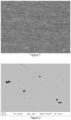
- FIG. 1 is a photograph showing a typical metallographic structure of the substrate plate of the 800 MPa grade high hole expansion hot-dip galvanized steel plate of Example 1.
- the microstructure of the 800 MPa grade high hole expansion hot-dip galvanized complex phase steel plate of Example 1 comprises 96% bainite by volume + 4% ferrite by volume, the grain size of bainite and ferrite is 5.5 ⁇ m, the diameter of the nano-scale precipitation is 3-15 nm, and the TiN diameter is less than 10 ⁇ m.
- FIG. 2 is a photograph showing large TiN particles contained in the comparative steel plate of Comparative Example 8.
- the microstructure of Comparative Example 8 comprises 99% bainite by volume + 1% ferrite by volume, the diameter of the nano-scale precipitation is 3-20 nm, and the diameter of TiN is larger, which is 10-20 ⁇ m.
Landscapes
- Chemical & Material Sciences (AREA)
- Engineering & Computer Science (AREA)
- Materials Engineering (AREA)
- Mechanical Engineering (AREA)
- Metallurgy (AREA)
- Organic Chemistry (AREA)
- Thermal Sciences (AREA)
- Physics & Mathematics (AREA)
- Crystallography & Structural Chemistry (AREA)
- Chemical Kinetics & Catalysis (AREA)
- General Chemical & Material Sciences (AREA)
- Heat Treatment Of Sheet Steel (AREA)
- Coating With Molten Metal (AREA)
Abstract
Description
- The disclosure relates to a steel plate and a manufacturing method thereof, and in particular to a hot-dip galvanized steel plate and a manufacturing method thereof.
- In recent years, due to the rapid development of the automobile industry, the requirements for lightweight automobiles raised by the market and users has been growing higher. Lightweighting has become a development trend in the automobile industry, and the use of high-strength steel plates in automobile structural parts has also been increased.
- In the actual preparation of high-strength steel, more and more automobile models starts to produce automobile chassis parts by using 80kg-grade steel plates, which not only have specific requirements on the strength and elongation of the steel, but also have specific requirements on the hole expansion performance of the steel. In addition to the above requirements on the strength, elongation and hole expansion properties, the corrosion resistance of steel also needs to be further improved so as to meet the corrosion resistance requirements of automotive parts in different use environments and extend the service life of the vehicle. Meanwhile, the ordinary hot-rolled and cold-rolled plates and pickled plates of the art can no longer meet the requirements of the automotive industry, and the hot-dip galvanized plates are one of the effective ways to improve the corrosion resistance of automotive parts.
- In view of the above, the inventor wishes to develop a unique 800MPa grade high hole expansion hot-dip galvanized steel plate and the manufacture method thereof, so as achieve said processing performance, corrosion resistance and manufacturability of the material and meet the current requirements of the market and users.
- In the prior art, although some steel plates with good performance properties have been developed by the researchers, they still cannot meet requirements on some performance, e.g. specific strength and manufacturing process parameters, and still have insufficient performance.
- According to an example, a Chinese patent reference, with the publication number
CN109055867A, a publication date of December 21, 2018 and entitled "A Method for Producing High-hole-expansion Hot-dip Galvanized Plates with a Tensile strength of 540 MPa", discloses a method for producing high-hole-expansion hot-dip galvanized plates with a tensile strength of 540 MPa. The method is characterized in that the pickled plate is directly galvanized without cold rolling, thus it is a short-process method. However, the tensile strength of the steel plate produced by this method is merely 540 MPa. - According to another example, a Chinese patent reference, with the publication number of
CN108396259A, a publication date of August 14, 2018 , and entitled "A Hot-rolled Galvanized Steel Plate with High Hole Expansion Performance and the Manufacture Method Thereof", discloses a hot-rolled galvanized steel plate with high hole expansion performance and its manufacturing method, wherein the steel plate has a yield strength ≥600MPa and a hole expansion ratio ≥40%. The steel plate has a composition containing 0.5-2.5% of Si. The Si content is relatively high, thus red iron scale may be easily formed on the surface thereof, which is unfavorable for the control of the galvanized surface. In the technical solution of this reference, the steel has relatively high Si content. - According to a further example, a Chinese patent reference, with the publication number of
-
CN104513930A, a publication date of April 15, 2015 and entitled "Ultra-high Strength Hot-rolled complex phase Steel Plate and Steel Strip with Good Bending and Hole-expansion Performance and Manufacturing Method thereof", discloses an ultra-high strength hot-rolled complex phase steel plate and steel strip with good bending and hole expansion performance and a manufacturing method thereof. The technical solution of this reference discloses the performance design and manufacture method of the hot-rolled pickled plate. The design of the chemical composition does not consider the role of the B element. At the same time, it does not disclose the influence of the hot-dip galvanizing process on the performance of the hot-dip galvanized steel plate. - One of the objects of the present disclosure is to provide an 800MPa grade high hole expansion hot-dip galvanized steel plate. The 800MPa grade high hole expansion hot-dip galvanized steel plate adopts a well-designed chemical composition and can exhibit good comprehensive mechanical properties. It has high strength and high corrosion resistance while exhibiting high hole expansion ratio. It can be used for the manufacture of automobile body structural parts and automobile chassis parts, and can also be used in other application fields requiring high strength, weight reduction, etc., thus it has good application prospects.
- In order to achieve the above said object, the present disclosure provides an 800MPa-grade high-hole-expansion hot-dip galvanized steel plate, comprising a substrate plate and a hot-dip galvanizing layer plated on at least one surface of the substrate plate, wherein the substrate plate comprises Fe and inevitable impurity elements, and further comprises the following chemical elements in percentage by mass:
- 0.03-0.08% of C, 0<Si≤0.45%, 1.3-1.8% of Mn, 0.02-0.1% of Al, 0.2-0.6% of Cr, 0.05-0.15% of Ti, Nb≤0.05% and B≤0.003%; and
- the mass percentages of N, Ti and Nb also satisfy the relation of 0.01%≤(Ti-3.43N+0.52Nb)/4≤0.03%.
- According to another embodiment, the 800MPa-grade high-hole-expansion hot-dip galvanized steel plate of the present disclosure comprises the following chemical elements in percentage by mass
- 0.03-0.08% of C, 0<Si≤0.45%, 1.3-1.8% of Mn, 0.02-0.1% of Al, 0.2-0.6% of Cr, 0.05-0.15% of Ti, Nb≤0.05%, B≤0.003%, and the balance amount of Fe and inevitable impurity elements; and
- the mass percentages of N, Ti and Nb also satisfy the relation of 0.01%≤(Ti-3.43N+0.52Nb)/4≤0.03%.
- In the substrate plate of the 800MPa-grade high-hole-expansion hot-dip galvanized steel plate of the present disclosure, each of the chemical elements have been designed according to the following principles:
C: In the substrate plate of the 800MPa grade high hole expansion hot-dip galvanized steel plate described in the present disclosure, while considering that the C content largely determines the tensile strength level of the steel plate, C is used for solid solution strengthening and forming sufficient amount of precipitation strengthening phase to ensure the strength of the steel; but when the mass percentage of C is too high, the carbide particles will become coarse, which is unfavorable for the hole expansion performance. Therefore, in order to ensure that this grade of steel has both high hole expansion and strength, while achieving good forming and welding properties, the mass percentage of the C element in the substrate plate of the 800MPa grade high hole expansion hot-dip galvanized steel plate described in the present disclosure is controlled in the range of 0.03-0.08%. - Of course, in some preferable embodiments, the mass percentage of the C element may be preferably controlled in the range of 0.04-0.07% so as to achieve better effects.
- Si: In the substrate plate of the 800MPa grade high hole expansion hot-dip galvanized steel plate described in the present disclosure, the Si element has the function of solid solution strengthening and enhancing the steel plate strength. Meanwhile, the addition of Si can increase the process hardening rate and the uniform elongation and total elongation under a certain strength, which is helpful for improving the elongation of the steel plate. Additionally, Si can also prevent the precipitation of carbides and reduce the formation of pearlite phase. However, it should be noted that the inclusion of silicon in steel tends to cause the formation of surface defects such as fayalite (2FeO-SiO2) iron oxide scale on the surface of the steel plate, which has an adverse effect on the surface quality. Based on this, in the substrate plate of the 800MPa grade high hole expansion hot-dip galvanized steel plate described in the present disclosure, the mass percentage of Si element is controlled to be in the range of 0<Si≤0.45%.
- Of course, in some preferable embodiments, the mass percentage of Si element may be preferably controlled to be in the range of 0.05<Si≤0.45% so as to achieve better effects. In some preferable embodiments, the mass percentage of Si element may be preferably controlled to be in the range of 0<Si≤0.2% so as to achieve better effects. In some preferable embodiments, the mass percentage of Si element may be preferably controlled to be in the range of 0.05<Si≤0.2% so as to achieve better effects.
- Mn: In the substrate plate of the 800MPa grade high hole expansion hot-dip galvanized steel plate described in the present disclosure, the Mn element is used as a solid solution strengthening element. The steel will have insufficient strength when it has low mass percentage of the Mn element, while the steel plate will have reduced plasticity when the mass percentage of the Mn element is too high. In addition, Mn will also delay the transformation of pearlite, improve the hardenability of steel and decrease the bainite transformation temperature, thus refining the organizational substructure of steel, ensuring the formation of lath substructure, ensuring the tensile strength of the product while achieving good formability. Therefore, while considering about the influence of the Mn element content on the properties of steel, the mass percentage of the Mn element in the substrate plate of the 800MPa grade high hole expansion hot-dip galvanized steel plate described in the present disclosure is controlled to be in the range of 1.3-1.8%.
- Al: In the substrate plate of the 800MPa grade high hole expansion hot-dip galvanized steel plate described in the present disclosure, Al is used in steel as a deoxidizing element, which can reduce the oxide inclusions in steel, purify steel quality, and is beneficial for improving the formability of the steel plate. However, it should be noted that the Al content in steel should not be too high. When the mass percentage of Al in steel is too high, oxidation will occur, which will further influence the continuous casting production. Therefore, while considering about the influence of the Al element on the performance of the steel plate in the technical solution, the mass percentage of Al in the substrate plate of the 800MPa grade high hole expansion hot-dip galvanized steel plate described in the present disclosure is controlled to be in the range of 0.02-0.1%.
- Cr: In the substrate plate of the 800 MPa grade high hole expansion hot-dip galvanized steel plate described in the present disclosure, the Cr element is used as an element for inhibiting the generation of pearlite, hence it is beneficial for the formation of bainite structure, and thus is ultimately beneficial for the improvement of strength and hole expansion ratio. The inventors have conducted research and have found that when the mass percentage of Cr in steel is less than 0.15%, it cannot provide significant effect on the CCT curve; but when the mass percentage of Cr in steel is too high, it will not only lead to an increase in alloy cost, but also tends to bring about the formation of more martensitic structure. Based on this, in the substrate plate of the 800MPa grade high hole expansion hot-dip galvanized steel plate described in the present disclosure, the mass percentage of the Cr element is controlled to be in the range of 0.2-0.6%.
- Of course, in some preferable embodiments, the mass percentage of Cr can also be preferably controlled to be in the range of 0.2-0.35% so as to achieve better effects.
- Ti: In the substrate plate of the 800MPa grade high hole expansion hot-dip galvanized steel plate described in the present disclosure, Ti is one of the important precipitation strengthening and grain refinement strengthening elements. Especially in the hot-dip galvanizing annealing process, Ti has provided additional precipitation strengthening effect and the fixation of C, which are beneficial for improving the strength and elongation of the steel plate. Therefore, in order to achieve the beneficial effect of the Ti element, the mass percentage of the Ti element is controlled to be in the range of 0.05-0.15% in the present disclosure.
- Nb: In the substrate plate of the 800MPa grade high hole expansion hot-dip galvanized steel plate described in the present disclosure, Nb is one of the important precipitation strengthening and grain refinement strengthening elements. However, when the mass percentage of Nb is higher than 0.05%, the strengthening effect of Nb is close to saturation and the cost is relatively high. Therefore, in order to ensure the beneficial effects of the Nb element while controlling the production cost, the mass percentage content of the Nb element is controlled to be Nb≤0.05% in the present disclosure.
- Of course, in some preferable embodiments, the mass percentage of Nb can also be preferably controlled to be Nb≤0.02% so as to achieve better effects.
- B: In the substrate plate of the 800MPa grade high hole expansion hot-dip galvanized steel plate described in the present disclosure, B is beneficial for expanding the bainite phase region, thus ensuring that the steel plate can produce a bainite structure during cooling after rolling, and thus significantly improving the strength and hardness of the steel. However, it should be noted that the content of element B in steel should not be too high. An excessively high amount of B element will render the formation of excessive martensite structure in the steel plate, resulting in a decrease in the hole expansion ratio and elongation of the steel. Therefore, the mass percentage content of the B element is controlled to be B≤0.003% in the present disclosure.
- In addition, it should be noted that in the technical solution designed by the present disclosure, while the mass percentage of each chemical element in the substrate being controlled, and the mass percentages of N, Ti, and Nb in the substrate plate is further controlled to satisfy the relation of 0.01%≤(Ti-3.43N+0.52Nb)/4≤0.03%, wherein, N is an impurity element in the substrate plate.
- According to such a design concept, the main purpose for adding high content of Ti and Nb into steel is to ensure that dispersed and fine nano-scale carbides can be precipitated in the steel strip during the annealing and hot-dip galvanizing, thereby achieving a high precipitation strengthening effect. In the present disclosure, the C content has been designed in coordination with the Ti and Nb contents to ensure sufficient precipitation of Ti and Nb. Therefore, a hot-dip galvanized steel plate with high strength and high hole expansion ratio can only be produced when the mass percentages of N, Ti and Nb elements satisfy the above-indicated relation of "0.01%≤(Ti-3.43N+0.52Nb)/4≤0.03%", together with the addition of proper amount of Cr element, to obtain a bainite structure without pearlite that affects the hole expansion performance during the hot rolling coiling and annealing hot-dip galvanizing process (and Cr has good tempering resistance, which is beneficial for maintaining the strength of bainite during the annealing step), in combination with claimed manufacture process.
- Furthermore, in the 800MPa grade high hole expansion hot-dip galvanized steel plate described in the present disclosure, the inevitable impurity elements comprise P≤0.02%, S≤0.005% and N≤0.005%.
- In the above technical solution, all of P, S and N are impurity elements in the 800MPa grade high hole expansion hot-dip galvanized steel plate described in the present disclosure. When technical conditions permit, the contents of the impurity elements in the steel plate should be minimize so as to produce steel with better performance and quality.
- Therefore, in the 800MPa grade high hole expansion hot-dip galvanized steel plate of the present disclosure, the P element content is controlled to be P≤0.02%, the S element content is controlled to be S≤0.005%, and the N element content is controlled to be N≤0.005%.
- Furthermore, in the 800MPa grade high hole expansion hot-dip galvanized steel plate of the present disclosure, the mass percentage of each chemical element in the substrate plate further satisfies at least one of:
- C: 0.04-0.07%;
- 0<Si≤0.2%, preferably 0.05≤Si≤0.2%;
- Cr: 0.2-0.35%;
- Nb≤0.02%.
- Furthermore, in the 800MPa-grade high-hole expansion hot-dip galvanized steel plate described in the present disclosure, the substrate plate microstructure has a matrix of bainite+ferrite, on which there are precipitates, and the precipitates include nano-scale precipitates.
- Furthermore, in the 800MPa-grade high-hole expansion hot-dip galvanized steel plate described in the present disclosure, the volume fraction of bainite is ≥95%.
- Furthermore, in the 800MPa-grade high-hole expansion hot-dip galvanized steel plate described in the present disclosure, the volume fraction of ferrite is ≤5%.
- Furthermore, in the 800MPa-grade high-hole expansion hot-dip galvanized steel plate described in the present disclosure, the matrix of the substrate plate microstructure comprises 95-99% (by volume fraction) of bainite and 1-5% (by volume fraction) of ferrite.
- Furthermore, in the 800MPa-grade high-hole expansion hot-dip galvanized steel plate described in the present disclosure, the nano-scale precipitates include TiC and (Ti, Nb)C, and the diameter of the nano-scale precipitates is in the range of 3-20nm.
- Furthermore, in the 800MPa-grade high-hole expansion hot-dip galvanized steel plate described in the present disclosure, the precipitates further include TiN precipitates having a diameter of < 10 µm.
- Furthermore, in the 800MPa-grade high-hole expansion hot-dip galvanized steel plate described in the present disclosure, the hot-dip galvanized layer has a single side average weight of 20 to 600g/m2.
- Furthermore, in the 800MPa-grade high-hole expansion hot-dip galvanized steel plate described in the present disclosure, the steel plate has the properties of a longitudinal yield strength of ≥660 MPa, a tensile strength of ≥780 MPa, an elongation A50 of ≥15%, a punching hole-expansion ratio of ≥50%, and a reaming hole-expansion ratio of ≥80%.
- Furthermore, the 800MPa-grade high-hole expansion hot-dip galvanized steel plate described in the present disclosure has a longitudinal yield strength of ≥675 MPa, preferably 675-810 MPa.
- Furthermore, the 800MPa-grade high-hole expansion hot-dip galvanized steel plate described in the present disclosure has a tensile strength of ≥ 800 MPa, preferably 800-870MPa.
- Furthermore, the 800MPa-grade high-hole expansion hot-dip galvanized steel plate described in the present disclosure has an elongation A50 of ≥18%, preferably 18-20%.
- In some embodiments, the 800MPa-grade high-hole expansion hot-dip galvanized steel plate described in the present disclosure has a punching hole-expansion ratio of ≥55%, preferably ≥60%. In some embodiments, the 800MPa-grade high-hole expansion hot-dip galvanized steel plate described in the present disclosure has a punching hole expansion ratio of 50-80%.
- In some embodiments, the 800MPa-grade high-hole expansion hot-dip galvanized steel plate described in the present disclosure has a reaming hole-expansion ratio of ≥90%, preferably ≥95%. In some embodiments, the 800MPa-grade high-hole expansion hot-dip galvanized steel plate described in the present disclosure has a reaming hole-expansion ratio of 80-120%, preferably 90-120%.
- In some embodiments, the 800MPa-grade high-hole expansion hot-dip galvanized steel plate described in the present disclosure has a longitudinal yield strength of 675-810MPa, a tensile strength of 800-870MPa, an elongation of 18-20%, a punching hole-expansion ratio of 50-80%, and a reaming hole-expansion ratio of 80-120%.
- In some embodiments, the 800MPa-grade high-hole expansion hot-dip galvanized steel plate described in the present disclosure has a yield strength of 678-801MPa, a tensile strength of 803-862MPa, an elongation A50 of 18-20%, a punching hole-expansion ratio of 52-82%, and a reaming hole-expansion ratio of 85-117%.
- Accordingly, another object of the present disclosure is to provide a method for manufacturing the above-indicated 800MPa grade high hole expansion hot-dip galvanized steel plate of the present disclosure. The 800MPa grade high hole expansion hot-dip galvanized steel plate manufactured by the manufacture method has high strength and excellent corrosion resistance as well as high hole-expansion ratio, thus it has good application prospects.
- In order to achieve the above object, the present disclosure proposes a method for manufacturing the above said 800MPa grade high hole expansion hot dip galvanized steel plate, comprising the steps of:
- (1) smelting and casting;
- (2) hot rolling: the slab is heated to 1200-1280 °C and kept under such a temperature; then it is rolled with the rough rolling outlet temperature being controlled to be ≥1000 °C, the finishing rolling outlet temperature being controlled to be 840-950 °C, and the rolling speed of the finishing rolling being controlled to be ≥7.5m/s; after finishing rolling, the steel plate is water-cooled at a cooling rate of 40-150 °C/s to a coiling temperature of 430-540 °C, under which it is coiled;
- (3) pickling;
- (4) annealing: after pickling, the steel coil is annealed and soaked in a combustion non-oxidizing continuous annealing furnace, wherein the heating rate is ≥5 °C/s, the annealing soaking temperature is in the range of 480-740 °C, the annealing soaking section has a duration of 30-300s, and the cooling rate after the soaking is ≥3 °C/s;
- (5) hot dip galvanizing; and
- (6) planarizing.
- In the above said technical solution of the present disclosure, the heating temperature of the slab used in step (2) is particularly important for the performance and surface of the hot-dip galvanized steel containing Ti, as Ti will incur the precipitation of a large number of large-size (Ti, Nb)(C, N) precipitates during the continuous casting process. The heating temperature is configured to be ≥1200 °C, and the main purpose is to ensure that the solid solution of the alloy elements, such as Ti, can be maximized during the heating process of the slab, so as to ensure that subsequent micro-alloys, such as Ti, etc., can be precipitated as nanoscale precipitates during the hot rolling and coiling, especially during annealing and hot-dip galvanizing. However, it should be noted that the heating temperature should not be too high. When the heating temperature exceeds 1280 °C, the grains tends to coarsen, which is unfavorable for the toughness of the steel plate. Meanwhile, thicker iron oxide scale will be formed, which is unfavorable for the dephosphorization from the iron oxide scale, and ultimately affects the surface quality of hot-dip galvanizing. The heating temperature in the hot rolling process of the present disclosure is preferably controlled in the range of 1200-1280 °C.
- Furthermore, the control of the rough rolling temperature and the rolling speed for the hot rolling process have substantial impact on micro-alloying elements such as Ti, etc. During the rough rolling under lower temperature and the finishing rolling process, the inclusion of Ti will incur the precipitation of Ti carbides and carbonitrides having larger size, which is unfavorable for the improvement of the final strength. Therefore, in the hot rolling process of the present disclosure, the rough rolling outlet temperature is controlled to be ≥1000 °C and the rolling speed of the finishing rolling is controlled to be ≥7.5m/s. In some embodiments, the rough rolling outlet temperature is controlled to be 1000-1080°C. In some embodiments, the rolling speed of the finish rolling is controlled to be 7.5-11 m/s.
- Furthermore, the finishing rolling outlet temperature, coiling temperature, and water cooling rate adopted for the hot rolling process have great influence on the microstructure. When the finishing rolling outlet temperature is too low and when the water cooling rate is too low, block ferrite tends to be formed. When the coiling temperature is too high, higher ferrite and pearlite contents will be incurred. When the coiling temperature is too low, martensite structure may be formed. Therefore, in the hot rolling process of the present disclosure, the finishing rolling outlet temperature is controlled to 840-950°C; after the finishing rolling, the steel plate is water-cooled at a cooling rate of 40-150°C/s to 430-540 °C for coiling to control a more sufficient bainite phase transition. In some embodiments, the finishing rolling outlet temperature is controlled to be 870-930°C. In some embodiments, the cooling rate after finish rolling is 50-110 °C/s.
- Accordingly, in the annealing process of the above said step (4) of the present disclosure, the annealing soaking temperature is in the range of 480-740 °C, as the most intense precipitation of (Ti, Nb)(C, N) may occur in such a temperature range. When being heated and annealed under a temperature below the austenite transition point Ac1, the steel plate maintains a hot-rolled single-phase structure of bainite. When being heated and annealed under a temperature above the austenite transition point Ac1, and the cooling speed after soaking being ≥3 °C/s, the generation of excessive ferrite structure can be avoided, which is beneficial to the improvement of the hole expansion ratio.
- It should be noted that in the technical solution designed by the present disclosure, in certain embodiments, before annealing, the steel strip can be transmitted to an open flame furnace and subjected to pre-oxidation so as to obtain a steel plate with a pre-oxidation film formed on the surface thereof, and the thickness of the pre-oxidation film is controlled to be 60-120 nanometers; after the pre-oxidation, it is transmitted to an annealing furnace and subjected to an annealing treatment so as to obtain a steel plate with a surface reduced with hydrogen.
- Furthermore, in the manufacture method of the present disclosure, in step (2), the heating temperature is controlled to be 1250-1280°C.
- Furthermore, in the manufacture method of the present disclosure, in step (2), the duration of the temperature keeping process is 1-3 hours.
- Furthermore, in the manufacture method of the present disclosure, in step (2), the finishing rolling outlet temperature is controlled to be 840-920°C; and/or the coiling temperature is controlled to be 430-500°C.
- Furthermore, in the manufacture method described in the present disclosure, in step (3), the pickling stretching-bending straightening elongation is controlled to be 0.2-2%, the pickling speed is controlled to be 60-150 m/min, the last pickling acid tank in the pickling step is controlled to have a temperature of 80-90°C and an iron ion concentration of 30-40 g/L.
- Furthermore, in the manufacture method described in the present disclosure, in step (4), the annealing soaking temperature is 650-730°C; and/or the annealing soaking section has a duration of 30-120s.
- Furthermore, in the manufacture method of the present disclosure, in step (4), the heating rate is 5 to 20°C/s, preferably 5 to 15°C/s.
- Furthermore, in the manufacture method of the present disclosure, in step (4), the cooling rate after the soaking is 3-25°C/s; in some embodiments, the cooling rate is 12 to 25°C/s.
- Furthermore, in the manufacture method described in the present disclosure, in step (5), the temperature of the hot-dip galvanizing pot is 440-480°C.
- Furthermore, in the manufacture method of the present disclosure, in step (6), the planarization rate is 0.05-1.3%, preferably the planarization rate is 0.2%-0.4%.
- Furthermore, in the manufacture method of the present disclosure, in step (6), the final thickness of the steel plate thus obtained is ≤5 mm.
- When compared with the prior art, the 800MPa grade high hole expansion hot-dip galvanized steel plate and the manufacture method thereof as described in the present disclosure have the following advantages and beneficial effects:
According to the present disclosure, an economical and rational chemical composition design is adopted, which also coordinates with the existing continuous hot rolling production line and hot-dip galvanizing production line, to produce 800MPa grade high hole expansion hot-dip galvanized steel plates with ultra-high strength and hole expansion ratio. When compared with the traditional method for manufacturing the hot-dip galvanized plate, the manufacture process optimized and designed by the present disclosure omits the cold rolling process, shortens the process flow, improves the production efficiency, saves energy and can effectively reduce production cost. - The 800MPa grade high hole expansion hot-dip galvanized steel plate prepared in the present disclosure has high hole-expansion ratio, high strength, high corrosion resistance, etc. It has a longitudinal yield strength of ≥660MPa, a tensile strength of ≥780MPa, an elongation A50 of ≥15%, a punching hole-expansion ratio of ≥50%, and a reaming hole-expansion ratio of ≥80%. It can be used as automobile body structural parts and automobile chassis parts, and can also be used in other applications requiring high strength and weight reduction, and has good application prospects.
-
-
FIG. 1 is a photograph showing the typical metallographic structure of the substrate plate of the 800 MPa grade high hole expansion hot-dip galvanized steel plate of Example 1. -
FIG. 2 is a photograph showing the large TiN particles contained in the comparative steel plate of Comparative Example 8. - The 800MPa grade high hole expansion hot-dip galvanized steel plate and its manufacture method as described in the present disclosure will be further explained and illustrated below in combination with specific embodiments and drawings. However, such explanation and illustration do not constitute an improper limitation on the technical solution of the present disclosure.
- The chemical elements, by mass percentage, of the substrate plate of the 800 MPa grade high hole expansion hot-dip galvanized steel plates of Examples 1-11 and the comparative steel plates of Comparative Examples 1-10 are summarized in Table 1.
Table 1. (in wt%, with the balance content being Fe and inevitable imourities other than P S and N) Example No. Steel No. Chemical composition (Ti-3.43N+0 .52Nb)/4 C Si Mn P S N Al Cr B Ti Nb Example 1-4; Comparative Example 1-2 A 0.065 0.05 1.75 0.010 0.0009 0.0045 0.038 0.35 - 0.13 - 0.029 Example 5-7; Comparative Example 3-6 B 0.070 0.10 1.70 0.013 0.0011 0.0042 0.035 0.35 - 0.10 0.05 0.028 Example 8 C 0.080 0.30 1.30 0.010 0.0050 0.0040 0.025 0.55 - 0.08 - 0.017 Example 9 D 0.030 0.45 1.80 0.014 0.0009 0.0023 0.029 0.60 0.0008 0.05 - 0.011 Example 10 E 0.040 0.20 1.55 0.011 0.0013 0.0050 0.10 0.45 - 0.09 0.01 0.020 Example 11 F 0.069 0.15 1.62 0.020 0.0015 0.0025 0.033 0.20 0.003 0.10 - 0.023 Comparative Example 7 G 0.120 0.25 1.65 0.010 0.0020 0.0036 0.025 0.33 - 0.05 - 0.009 Comparative Example 8 H 0.065 0.08 1.75 0.010 0.0009 0.010 0.038 0.35 - 0.05 - 0.004 Comparative Example 9 I 0.065 0.08 1.0 0.010 0.0009 0.0045 0.038 0.35 - 0.13 - 0.029 Comparative Example 10 J 0.065 0.08 1.75 0.010 0.0009 0.0045 0.038 0.10 - 0.13 - 0.029 Note: In above Table 1, the formula "(Ti-3.43N+0.52Nb)/4" represents the TiC precipitation equivalent, wherein each of N, Ti and Nb represents the corresponding mass percentage of each chemical element. - The 800MPa grade high hole expansion hot-dip galvanized steel plates of Examples 1-11 of the present disclosure and the comparative steel plates of Comparative Examples 1-10 are prepared by the following steps:
- (1) Smelting and casting are carried out by using the chemical compositions shown in Table 1.
- (2) Hot rolling: The slab obtained by smelting and continuous casting is heated to 1200-1280 °C and kept at that temperature for 1-3 hours; then it is subjected to rolling, wherein the rough rolling outlet temperature is controlled to be ≥1000 °C, the finishing rolling outlet temperature is controlled in the range of 840-950 °C, and can be preferably controlled in the range of 840-920 °C, and the rolling speed of the finishing rolling is ≥7.5m/s; after finishing rolling, the steel plate is water-cooled at a cooling rate of 40-150 °C/s to a coiling temperature of 430-540 °C under which the steel plate is subjected to coiling, and the coiling temperature can be preferably controlled in the range of 430-500°C.
- (3) Pickling: in this step, the pickling stretching-bending straightening elongation is controlled to be 0.2-2%, the pickling speed is controlled to be 60-150 m/min, the last pickling acid tank in the pickling step is controlled to have a temperature of 80-90°C and an iron ion concentration of 30-40 g/L.
- (4) Annealing: after pickling, the steel coil is annealed and soaked in a combustion non-oxidizing continuous annealing furnace, wherein the heating rate is ≥5 °C/s, the annealing soaking temperature is controlled in the range of 480-740 °C, the annealing soaking section has a duration of 30-300s, and the cooling rate after the soaking is ≥3 °C/s. Of course, the annealing soaking temperature may also be preferably controlled in the range of 650-730 °C, and the duration of the annealing soaking section may be 30-120 s.
- (5) hot dip galvanizing: the steel plate is transmitted into the zinc pot for hot-dip galvanizing, and the temperature of the hot-dip galvanizing zinc pot is controlled at 440-480 °C.
- (6) Planarizing: after the galvanizing, the steel plate is subjected to planarization with the planarization rate being controlled to be 0.05-1.3%, and finally a steel plate with a thickness of ≤5 mm is obtained.
- In the present disclosure, the chemical composition design and related processes of the 800MPa grade high hole expansion hot-dip galvanized steel plates of Examples 1-11 meet the specification requirements designed by the present disclosure. The comparative steel plates of comparative examples 1-10 are also prepared by steps (1)-(6) as stated above, except that the chemical composition design and related processes of the comparative steel plates of comparative examples 1-10 comprise parameters that do not meet the design requirements of the present disclosure.
- The specific process parameters of the above manufacturing process for the 800MPa grade high hole expansion hot-dip galvanized steel plates of Example 1-11 and the comparative steel plates of Comparative Example 1-10 were summarized in Table 2-1 and Table 2-2.
Table 2-1. Example No. Steel No. Step (2) heating temperature (°C) rough rolling outlet temperature (°C) finishing rolling outlet temperature (°C) rolling speed of the finishing rolling (m/s) cooling rate (°C /s) coiling temperature (°C) Example 1 A 1250 1050 910 8.5 50 480 Example 2 1250 1050 910 8.5 50 480 Example 3 1250 1050 910 8.5 50 480 Example 4 1250 1050 910 8.5 50 480 Comparative Example 1 1250 1050 910 8.5 50 480 Comparative Example 2 1250 1050 910 8.5 50 480 Example 5 B 1250 1050 910 8.5 70 480 Example 6 1250 1050 910 8.5 70 430 Example 7 1250 1050 910 8.5 70 540 Comparative Example 3 1150 1030 910 8.5 70 480 Comparative Example 4 1250 950 910 8.5 70 480 Comparative Example 5 1250 1050 820 8.5 70 480 Comparative Example 6 1250 1050 910 8.5 70 580 Example 8 C 1280 1050 910 7.5 50 540 Example 9 D 1200 1000 840 11 110 430 Example 10 E 1250 1020 880 8.5 70 500 Example 11 F 1250 1080 950 9.5 80 450 Comparative Example 7 G 1250 1050 910 8.5 50 480 Comparative Example 8 H 1250 1050 910 8.5 50 480 Comparative Example 9 I 1250 1050 910 8.5 50 480 Comparative Example 10 J 1250 1050 910 7.0 30 480 Table 2-2. Example No. Steel No. Step (4) Step (5) Step (6) heating rate (°C/s) Annealing soaking temperature(°C) The duration of the annealing soaking section (s) cooling rate after the soaking (°C /s) temperature of the hot-dip galvanizing pot (°C) planarization elongation (%) Example 1 A 5 740 200 25 460 0.2 Example 2 5 720 200 25 465 0.2 Example 3 5 680 200 25 480 0.2 Example 4 5 580 200 25 480 0.2 Comparative Example 1 5 740 200 0.5 460 0.2 Comparative Example 2 5 760 200 25 460 0.2 Example 5 B 13 720 80 12 465 0.2 Example 6 13 720 80 3 440 0.2 Example 7 13 720 80 12 465 0.2 Comparative Example 3 13 720 80 12 465 0.2 Comparative Example 4 13 720 80 12 465 0.2 Comparative Example 5 13 720 80 12 465 0.2 Comparative Example 6 13 720 80 12 465 0.2 Example 8 C 15 720 200 30 480 1.3 Example 9 D 13 650 80 12 465 0.2 Example 10 E 10 580 300 26 455 0.4 Example 11 F 8 480 50 8 440 0.2 Comparative Example 7 G 5 600 120 5 470 0.3 Comparative Example 8 H 3 550 30 18 465 0.6 Comparative Example 9 I 13 740 200 15 480 1.3 Comparative Example 10 J 15 720 200 30 480 1.3 - It should be noted that before hot-dip galvanizing, samples of the substrate plates of the 800 MPa grade high-expansion hot-dip galvanized steel plates of the finished products of Examples 1-11 and Comparative Examples 1-10 obtained through the above process steps were taken, respectively. The microstructure of the substrate plates of the steel plates of each example and comparative example was observed and analyzed. The results observed and analyzed were summarized in the following Table 3.
- Table 3 showed the microstructure observation and analysis results of the substrate plates of Example 1-11 and Comparative Example 1-10.
Table 3. Example No. volume fraction of bainite (%) volume fraction of ferrite (%) diameter of the nanoscale precipitate (nm) TiN particle diameter (µm) Example 1 96 4 3-15 <10 Example 2 99 1 3-15 <10 Example 3 99 1 3-15 <10 Example 4 99 1 3-15 <10 Example 5 99 1 3-15 <10 Example 6 99 1 3-15 <10 Example 7 95 5 3-20 <10 Example 8 96 4 3-20 <10 Example 9 99 1 3-15 <10 Example 10 99 1 3-15 <10 Example 11 99 1 3-15 <10 Comparative Example 1 94 6 3-15 <10 Comparative Example 2 89 11 3-15 <10 Comparative Example 3 99 1 3-15 <10 Comparative Example 4 99 1 3-40 <10 Comparative Example 5 99 1 3-40 <10 Comparative Example 6 85 15 3-15 <10 Comparative Example 7 99 1 3-15 <10 Comparative Example 8 99 1 3-20 10-20 Comparative Example 9 99 1 3-15 ≤10 Comparative Example 10 88 12 3-15 ≤10 - It can be seen from the above results that in the present disclosure, the microstructure matrix of the substrate plates of the 800MPa grade high hole expansion hot-dip galvanized steel plates prepared in Examples 1-11 was bainite+ferrite, and the volume fraction of bainite was in the range of 95-99%.
- It should be noted that in the actual preparation, there were nanoscale precipitates, which included TiC and (Ti, Nb)C, and had a diameter of 3-20 nm, on the microstructure matrix of the substrate plates of Examples 1-11. Meanwhile, the precipitates formed on the substrate plates of Examples 1-11 also comprised TiN precipitates, which were larger particles having a specific diameter of less than 10 µm.
- In order to characterize the performance properties of the final galvanized steel plates, after the above said observation of the substrate plate microstructure, finished products of the 800MPa grade high-expansion hot-dip galvanized steel plates of Examples 1-11 and the comparative steel plates of Comparative Examples 1-10 obtained through the above said process steps (1)-(6) were sampled and subjected to mechanical property tests. At the same time, the single side weight average of the hot-dip galvanized layer of the steel plates prepared by each example and comparative example was also measured. The test results were summarized in Table 4.
- The following technology means were used for characterizing the performance properties:
- (1) Tensile property test: the test specimen was JIS 5# stretched along the longitudinal direction, and the tensile test was performed according to GB/T 228.1-2010 "Metallic materials, tensile test, Part 1: test method under room temperature" to characterize the yield strength, tensile strength and elongation of the steel plates prepared by each example and comparative example.
- (2) Hole expansion test: the hole expansion ratio was determined by a hole expansion test in which a specimen with a hole in the center was pressed into a die by using a punch to expand the center hole of the specimen until necking or through crack occurred at the edge of the hole in the specimen. Since the preparation method of the original hole in the center of the specimen might greatly influence the results of the hole expansion ratio test, the original hole in the center of the specimen was prepared by punching and reaming respectively. The subsequent tests and characterization methods were carried out according to the hole expansion ratio test method specified in the ISO/DIS 16630 standard. The test results were summarized in Table 4.
- Table 4 showed the mechanical property test results as well as the single side average weight of the hot-dip galvanized layer of the 800 MPa grade high hole expansion hot-dip galvanized steel plates of Examples 1-11 and the comparative steel plates of Comparative Examples 1-10.
Table 4. Example No. yield strength Rp0.2 (MPa) tensile strength Rm (MPa) elongation A50 (%) punching hole-expansion ratio (%) reaming hole-expansion ratio (%) single side average weight of the hot-dip galvanized layer (g/m2) Example 1 682 851 18.5 52 83 20 Example 2 718 855 19.5 65 93 50 Example 3 753 851 18.0 73 102 100 Example 4 801 862 18.5 80 113 140 Example 5 738 835 18.0 68 97 200 Example 6 725 824 18.5 73 100 225 Example 7 763 841 19.0 52 85 275 Example 8 678 835 19.0 53 90 300 Example 9 682 803 20.0 58 99 350 Example 10 752 852 18.5 82 117 450 Example 11 693 832 19.5 79 105 600 Comparative Example 1 653 849 20.0 45 75 50 Comparative Example 2 635 845 20.5 35 63 50 Comparative Example 3 642 769 20.0 80 119 200 Comparative Example 4 645 762 19.5 78 118 200 Comparative Example 5 651 778 20.0 75 121 200 Comparative Example 6 723 853 20.0 38 62 200 Comparative Example 7 815 919 16.0 45 75 350 Comparative Example 8 625 672 20.5 44 101 350 Comparative Example 9 632 679 20.5 92 127 350 Comparative Example 10 632 809 18.5 37 68 600 - As shown in Table 4, the 800MPa grade high hole expansion hot-dip galvanized steel plates of Examples 1-11 of the present disclosure exhibited better comprehensive mechanical properties as compared with the comparative steel plates of Comparative Examples 1-10.
- In the present disclosure, the 800MPa grade high hole expansion hot-dip galvanized steel plates of Examples 1-11 followed the low-carbon bainite design concept of the present disclosure. They utilized Cr to improve bainite transition and resistance to tempering softening during annealing. Meanwhile, Ti and Nb were added to enhance the precipitation strengthening effect during annealing. The 800MPa grade high hole expansion hot-dip galvanized steel plates prepared in Examples 1-11 had a yield strength of 678-801 MPa, a tensile strength of 803-862MPa, an elongation A50 of 18-20%, a punching hole expansion ratio of 52-82%, and a reaming hole expansion ratio of 85-117%.
- When compared with Examples 1-4, Comparative Examples 1-2 comprised identical steel grade A and identical hot rolling process, but adopted higher annealing temperature or slower cooling rate after soaking, and the result was that the microstructure of the substrate plates thus prepared had ferrite ratios higher than 5%, resulting in decreased yield strength and decreased hole expansion ratio of the steel.
- When compared with Examples 5-7, Comparative Example 3 adopted a lower heating temperature and exhibited insufficient solid solution of Nb and Ti contents; both of Comparative Example 4, which adopted lower rough rolling outlet temperature, and Comparative Example 5, which adopted lower finishing rolling outlet temperature, exhibited coarse precipitation of Nb and Ti in the form of (Ti, Nb)(C, N) during the hot rolling, which degraded their contribution to the strength and consequently resulted in reduced strength of the steel plate.
- When compared with Examples 5-7, Comparative Example 6 adopted higher coiling temperature, the hot coil microstructure thus prepared had higher ferrite content, thus resulting in a higher ferrite content in the final microstructure and a lower hole expansion ratio.
- Accordingly, the chemical composition design used in Comparative Examples 7-10 did not meet the requirements of the present disclosure. Comparative Example 7 comprised high C content which provided more contribution to the strength and exhibited reduced hole expansion ratio. Comparative Example 8 comprised high N content which consumed a large amount of Ti element, and thus resulting in the precipitation of a large amount of blocky TiN. As the contribution of 5-20 µm TiN to the strength was limited, the strength of the steel plate was thus reduced. Meanwhile, due to the microcracks caused by large-sized TiN at the punching edge during punching, the punching hole expansion ratio of was significantly affected. Comparative Example 9, which was designed to have low Mn element content in the steel, produced a steel plate with low strength. Comparative Example 10 had inferior hardenability due to the low Cr element content in the steel, low hot rolling cooling rate and high ferrite content in the hot coiling microstructure, thus resulting in a high ferrite content in the final microstructure and a low hole expansion ratio of the steel plate.
-
FIG. 1 is a photograph showing a typical metallographic structure of the substrate plate of the 800 MPa grade high hole expansion hot-dip galvanized steel plate of Example 1. - As shown in
FIG. 1 , according to this embodiment, the microstructure of the 800 MPa grade high hole expansion hot-dip galvanized complex phase steel plate of Example 1 comprises 96% bainite by volume + 4% ferrite by volume, the grain size of bainite and ferrite is 5.5 µm, the diameter of the nano-scale precipitation is 3-15 nm, and the TiN diameter is less than 10 µm. -
FIG. 2 is a photograph showing large TiN particles contained in the comparative steel plate of Comparative Example 8. - As shown in
FIG. 2 , according this embodiment, the microstructure of Comparative Example 8 comprises 99% bainite by volume + 1% ferrite by volume, the diameter of the nano-scale precipitation is 3-20 nm, and the diameter of TiN is larger, which is 10-20 µm. - It should be noted that the combination of the various technical features in the present disclosure is not limited to the combinations described in the claims of the present disclosure or the combinations described in the specific embodiments. All technical features recorded in the present disclosure can be freely combined in any way unless there is a contradiction between them.
- It should also be noted that the embodiments illustrated above are only specific embodiments of the present disclosure. Obviously, the present disclosure is not limited to the above embodiments, and similar changes or modifications made therewith can be directly derived from or easily associated with the contents disclosed by those skilled in the art, and should all fall within the protection scope of the present disclosure.
Claims (15)
- A 800MPa-grade high-hole-expansion hot-dip galvanized steel plate, comprising a substrate plate and a hot-dip galvanizing layer plated on at least one surface of the substrate plate, wherein the substrate plate comprises Fe and inevitable impurity elements, and characterized in that the substrate plate further comprises the following chemical elements in percentage by mass:0.03-0.08% of C, 0<Si≤0.45%, 1.3-1.8% of Mn, 0.02-0.1% of Al, 0.2-0.6% of Cr, 0.05-0.15% of Ti, Nb≤0.05% and B≤0.003%; andthe mass percentages of N, Ti and Nb also satisfy the relation of0.01%≤(Ti-3.43N+0.52Nb)/4≤0.03%.
- The 800MPa-grade high-hole-expansion hot-dip galvanized steel plate according to claim 1, comprising the following chemical elements in percentage by mass: 0.03-0.08% of C, 0<Si≤0.45%, 1.3-1.8% of Mn, 0.02-0.1% of Al, 0.2-0.6% of Cr, 0.05-0.15% of Ti, Nb≤0.05%, B≤0.003%, and the balance amount of Fe and inevitable impurity elements; andthe mass percentages of N, Ti and Nb also satisfy the relation of0.01%≤(Ti-3.43N+0.52Nb)/4≤0.03%.
- The 800MPa-grade high-hole-expansion hot-dip galvanized steel plate according to claim 1 or 2, characterized in that the inevitable impurity elements comprise P≤0.02%, S≤0.005% and N≤0.005%.
- The 800MPa-grade high-hole-expansion hot-dip galvanized steel plate according to claim 1 or 2, characterized in that the mass percentage of each chemical element of the substrate plate further satisfies at least one of:C: 0.04-0.07%;0<Si≤0.2%;Cr: 0.2-0.35%;Nb≤0.02%.
- The 800MPa-grade high-hole-expansion hot-dip galvanized steel plate according to claim 1 or 2, characterized in that the matrix of the substrate plate microstructure comprises bainite + ferrite and the matrix further has precipitates including nanoscale precipitates; preferably, the volume fraction of bainite is ≥95%; preferably, the nanoscale precipitates include TiC, (Ti, Nb)C and have a diameter in the range of 3-20nm; preferably, the precipitates further include TiN precipitates with a diameter of <10 µm.
- The 800MPa-grade high-hole-expansion hot-dip galvanized steel plate according to claim 1 or 2, characterized in that the hot-dip galvanized layer has a single side average weight of 20 to 600g/m2.
- The 800MPa-grade high-hole-expansion hot-dip galvanized steel plate according to claim 1 or 2, characterized in that the steel plate has the following properties: a longitudinal yield strength of ≥660MPa, a tensile strength of ≥780MPa, an elongation A50 of ≥15%, a punching hole-expansion ratio of ≥50% and a reaming hole-expansion ratio of ≥80%.
- The 800MPa-grade high-hole-expansion hot-dip galvanized steel plate according to claim 1 or 2, characterized in that the steel plate has the following properties: a longitudinal yield strength of ≥675MPa, preferably in the range of 675-810 MPa; a tensile strength of ≥800MPa, preferably in the range of 800-870 MPa; an elongation A50 of ≥18%, preferably in the range of 18-20%; a punching hole-expansion ratio of ≥55%, preferably in the range of 50-80%; and a reaming hole-expansion ratio of ≥90%, preferably in the range of 80-120%.
- The 800MPa-grade high-hole-expansion hot-dip galvanized steel plate according to claim 1 or 2, characterized in that the 800MPa-grade high-hole-expansion hot-dip galvanized steel plate has a yield strength in the range of 678-801 MPa, a tensile strength in the range of 803-862MPa, an elongation A50 in the range of 18-20%, a punching hole-expansion ratio in the range of 52-82%, and a reaming hole-expansion ratio in the range of 85-117%.
- A method for manufacturing the 800MPa-grade high-hole-expansion hot-dip galvanized steel plate according to any one of claims 1 to 9, characterized in that the method comprises the steps of:(1) smelting and casting;(2) hot rolling: the slab is heated to 1200-1280 °C and kept under such a temperature; then it is rolled with the rough rolling outlet temperature being controlled to be ≥1000 °C, the finishing rolling outlet temperature being controlled to be 840-950 °C, and the rolling speed of the finishing rolling being controlled to be ≥7.5m/s; after finishing rolling, the steel plate is water-cooled at a cooling rate of 40-150 °C/s to a coiling temperature of 430-540 °C, under which it is coiled;(3) pickling;(4) annealing: after pickling, the steel coil is annealed and soaked in a combustion non-oxidizing continuous annealing furnace, wherein the heating rate is ≥5 °C/s, the annealing soaking temperature is in the range of 480-740 °C, the annealing soaking section has a duration of 30-300s, and the cooling rate after the soaking is ≥3 °C/s;(5) hot dip galvanizing; and(6) planarizing.
- The method according to claim 10, characterized in that in step (2): the slab is kept under such a temperature for 1-3 hours; and/or the rough rolling outlet temperature is controlled to be 1000 to 1080 °C; and/or the finishing rolling outlet temperature is controlled to be 840-920 °C; and/or the finishing rolling is conducted with a rolling speed of 7.5 to 11 m/s; and/or the cooling rate after finishing rolling is controlled to be 50 to 110°C/s; and/or the coiling temperature is controlled to be 430-500°C.
- The method according to claim 10, characterized in that in step (3): the pickling stretching-bending straightening elongation is controlled to be 0.2-2%, the pickling speed is controlled to be 60-150 m/min, the last pickling acid tank in the pickling step is controlled to have a temperature of 80-90°C and an iron ion concentration of 30-40 g/L.
- The method according to claim 10, characterized in that in step (4): the heating rate is 3-25°C/s; and/or the annealing soaking temperature is 650-730°C; and/or the annealing soaking section has a duration of 30-120s; and/or the cooling rate is 12-25°C/s; optionally, the steel plate is subjected to pre-oxidization to form a pre-oxidized film with a thickness of 60-120nm, before it is annealed.
- The method according to claim 10, characterized in that in step (5): the temperature of the hot-dip galvanizing pot is in the range of 440-480°C.
- The method according to claim 10, characterized in that in step (6): the planarization rate is in the range of 0.05-1.3%, preferably in the range of 0.2%-0.4%; and the thickness of the final steel plate is ≤5mm.
Applications Claiming Priority (2)
| Application Number | Priority Date | Filing Date | Title |
|---|---|---|---|
| CN202210675493.3A CN117265380B (en) | 2022-06-15 | 2022-06-15 | 800 MPa-level high-reaming hot-dip galvanized steel plate and manufacturing method thereof |
| PCT/CN2023/100255 WO2023241631A1 (en) | 2022-06-15 | 2023-06-14 | 800mpa-grade high-hole-expansion hot-dip galvanized steel plate and manufacturing method therefor |
Publications (2)
| Publication Number | Publication Date |
|---|---|
| EP4541916A1 true EP4541916A1 (en) | 2025-04-23 |
| EP4541916A4 EP4541916A4 (en) | 2025-10-29 |
Family
ID=89192311
Family Applications (1)
| Application Number | Title | Priority Date | Filing Date |
|---|---|---|---|
| EP23823197.1A Pending EP4541916A4 (en) | 2022-06-15 | 2023-06-14 | Hot-dip galvanized steel plate with high hole expansion rate and 80 MPa and manufacturing process for it |
Country Status (7)
| Country | Link |
|---|---|
| US (1) | US20250354244A1 (en) |
| EP (1) | EP4541916A4 (en) |
| JP (1) | JP2025521282A (en) |
| KR (1) | KR20250024811A (en) |
| CN (1) | CN117265380B (en) |
| MX (1) | MX2024015516A (en) |
| WO (1) | WO2023241631A1 (en) |
Families Citing this family (3)
| Publication number | Priority date | Publication date | Assignee | Title |
|---|---|---|---|---|
| CN117344203A (en) * | 2022-06-27 | 2024-01-05 | 宝山钢铁股份有限公司 | A kind of hot-rolled multi-phase steel with tensile strength of 800Mpa and its manufacturing method |
| CN118291853B (en) * | 2024-03-25 | 2025-10-14 | 马鞍山钢铁股份有限公司 | One-steel multi-grade low-cost high-formability hot-dip galvanized automobile steel and its manufacturing method |
| CN118814080B (en) * | 2024-06-28 | 2026-02-24 | 鞍钢股份有限公司 | A 800MPa grade hot-dip aluminized silicon high-hole-expansion multiphase steel and its preparation method |
Family Cites Families (23)
| Publication number | Priority date | Publication date | Assignee | Title |
|---|---|---|---|---|
| JP4153580B2 (en) * | 1998-02-26 | 2008-09-24 | 新日本製鐵株式会社 | High-strength hot-rolled steel sheet with extremely excellent fatigue characteristics and method for producing the same |
| JP4528135B2 (en) * | 2004-03-01 | 2010-08-18 | 新日本製鐵株式会社 | High strength and high ductility hot dip galvanized steel sheet excellent in hole expansibility and method for producing the same |
| JP5041083B2 (en) * | 2010-03-31 | 2012-10-03 | Jfeスチール株式会社 | High-tensile hot-dip galvanized steel sheet excellent in workability and manufacturing method thereof |
| JP6354274B2 (en) * | 2014-04-11 | 2018-07-11 | 新日鐵住金株式会社 | Hot-rolled steel sheet and manufacturing method thereof |
| CN104513930A (en) | 2014-12-19 | 2015-04-15 | 宝山钢铁股份有限公司 | Ultrahigh-strength hot-rolled complex phase steel plate and steel strip with good bending and broaching performance and manufacturing method thereof |
| KR101980471B1 (en) * | 2015-02-25 | 2019-05-21 | 닛폰세이테츠 가부시키가이샤 | Hot-rolled steel sheet |
| WO2017022027A1 (en) * | 2015-07-31 | 2017-02-09 | 新日鐵住金株式会社 | Strain-induced-transformation composite-structure steel plate and method of manufacturing same |
| CN108396259A (en) | 2017-02-05 | 2018-08-14 | 鞍钢股份有限公司 | Hot-rolled galvanized steel sheet with high hole expansion performance and manufacturing method thereof |
| CN108441763B (en) * | 2018-03-23 | 2019-11-19 | 马钢(集团)控股有限公司 | A kind of tensile strength 1000MPa grades of cold rollings galvanizing by dipping high-strength steel and preparation method thereof |
| CN108707815A (en) * | 2018-04-23 | 2018-10-26 | 马钢(集团)控股有限公司 | A kind of 800MPa grades of pure zinc coating high-chambering steel plate and its manufacturing method |
| KR102098478B1 (en) * | 2018-07-12 | 2020-04-07 | 주식회사 포스코 | Hot rolled coated steel sheet having high strength, high formability, excellent bake hardenability and method of manufacturing the same |
| KR102098482B1 (en) * | 2018-07-25 | 2020-04-07 | 주식회사 포스코 | High-strength steel sheet having excellent impact resistant property and method for manufacturing thereof |
| CN109055867B (en) | 2018-08-30 | 2021-06-29 | 日照钢铁控股集团有限公司 | Method for producing high-hole-expansion hot-dip galvanized plate with tensile strength of 540MPa |
| CN109371325A (en) * | 2018-11-30 | 2019-02-22 | 宝山钢铁股份有限公司 | A zinc-based plated hot-formed steel sheet or steel strip with excellent cold bending properties and a manufacturing method thereof |
| CN112575267A (en) * | 2019-09-27 | 2021-03-30 | 宝山钢铁股份有限公司 | High-hole-expansion complex phase steel and manufacturing method thereof |
| CN112779401B (en) * | 2019-11-07 | 2022-11-11 | 上海梅山钢铁股份有限公司 | High-reaming hot-rolled pickled steel plate with yield strength of 550MPa |
| KR102307928B1 (en) * | 2019-12-02 | 2021-09-30 | 주식회사 포스코 | High strength multiphase steel sheet with excellent durability and manufacturing method thereof |
| CN110983196A (en) * | 2019-12-17 | 2020-04-10 | 首钢集团有限公司 | 600 MPa-grade hot-rolled galvanized high-reaming steel and production method thereof |
| CN113832386A (en) * | 2020-06-23 | 2021-12-24 | 宝山钢铁股份有限公司 | A kind of high-strength hot-rolled substrate, hot-dip galvanized steel and manufacturing method thereof |
| CN111926247A (en) * | 2020-07-13 | 2020-11-13 | 首钢集团有限公司 | 800 MPa-grade cold-rolled hot-galvanized complex-phase steel and preparation method thereof |
| CN114381654B (en) * | 2020-10-21 | 2022-11-15 | 宝山钢铁股份有限公司 | 780 MPa-grade cold-rolled high-strength galvanized steel plate and manufacturing method thereof |
| CN113481430B (en) * | 2021-06-10 | 2022-06-21 | 马鞍山钢铁股份有限公司 | 800 MPa-grade boron-containing hot-dip galvanized dual-phase steel with enhanced hole expansion performance and production method thereof |
| CN113584375B (en) * | 2021-06-10 | 2022-08-05 | 马鞍山钢铁股份有限公司 | 600 MPa-grade low-manganese nickel-containing alloying hot-dip galvanized dual-phase steel with enhanced hole expansion performance and production method thereof |
-
2022
- 2022-06-15 CN CN202210675493.3A patent/CN117265380B/en active Active
-
2023
- 2023-06-14 JP JP2024573638A patent/JP2025521282A/en active Pending
- 2023-06-14 KR KR1020257000869A patent/KR20250024811A/en active Pending
- 2023-06-14 WO PCT/CN2023/100255 patent/WO2023241631A1/en not_active Ceased
- 2023-06-14 US US18/874,274 patent/US20250354244A1/en active Pending
- 2023-06-14 EP EP23823197.1A patent/EP4541916A4/en active Pending
-
2024
- 2024-12-13 MX MX2024015516A patent/MX2024015516A/en unknown
Also Published As
| Publication number | Publication date |
|---|---|
| JP2025521282A (en) | 2025-07-08 |
| KR20250024811A (en) | 2025-02-19 |
| US20250354244A1 (en) | 2025-11-20 |
| CN117265380A (en) | 2023-12-22 |
| EP4541916A4 (en) | 2025-10-29 |
| MX2024015516A (en) | 2025-02-10 |
| WO2023241631A1 (en) | 2023-12-21 |
| CN117265380B (en) | 2026-01-20 |
Similar Documents
| Publication | Publication Date | Title |
|---|---|---|
| EP1808505B1 (en) | Cold rolled high strength thin-gauge steel sheet excellent in elongation and hole expandibility | |
| CN101688277B (en) | High-strength hot-dip galvanized steel sheet and manufacturing method thereof | |
| CN102301027B (en) | High-strength hot-dip galvanized steel sheet and manufacturing method thereof | |
| CN101688279B (en) | High-strength hot-dip galvanized steel sheet with low yield strength and with less material quality fluctuation and process for producing the same | |
| WO2021143661A1 (en) | High corrosion-resistance strip steel and manufacturing method therefor | |
| CN108823507B (en) | A kind of hot-dip galvanized high-strength steel with a tensile strength of 800 MPa and a production method for its reduction | |
| CN102803543B (en) | High-strength molten zinc-plated steel sheet and process for production thereof | |
| CN106062232B (en) | The excellent hot-dip galvanized steel sheet of hole expansibility, alloyed hot-dip galvanized steel plate and its manufacturing method | |
| CN110291217A (en) | High-strength steel sheet and method for producing the same | |
| US20250354244A1 (en) | 800mpa-grade high-hole-expansion hot-dip galvanized steel plate and manufacturing method therefor | |
| WO2013046476A1 (en) | High strength steel plate and manufacturing method thereof | |
| KR20230024905A (en) | Ultra-high strength steel with excellent plasticity and manufacturing method thereof | |
| EP4541921A1 (en) | 1000mpa-grade high hole expansion hot-rolled complex phase steel plate and manufacturing method thereof | |
| EP3647448A1 (en) | Hot-pressed member and method for manufacturing same, and cold-rolled steel sheet for hot pressing and method for manufacturing same | |
| CN114807737B (en) | Hot dip galvanized steel and manufacturing method thereof | |
| KR20230087773A (en) | Steel sheet having excellent strength and ductility, and manufacturing method thereof | |
| CN110527923A (en) | A kind of high yield strength ratio structural steel for 600MPa grade automobile body and its production method | |
| EP4180547A1 (en) | Hot-pressed member and manufacturing method therefor | |
| WO2009008548A1 (en) | Process for producing high-strength cold rolled steel sheet with low yield strength and with less material quality fluctuation | |
| JP2025157499A (en) | Hot forming parts | |
| KR20220024957A (en) | High-strength steel sheet, high-strength member and manufacturing method thereof | |
| JP5659604B2 (en) | High strength steel plate and manufacturing method thereof | |
| WO2022257902A1 (en) | Hot-dip galvanized steel plate and manufacturing method therefor | |
| EP4488399A1 (en) | Cold rolled steel plate for galvanized steel plate, galvanized steel plate and manufacturing method therefor | |
| CN115505835B (en) | Cold-rolled steel sheet and manufacturing method thereof |
Legal Events
| Date | Code | Title | Description |
|---|---|---|---|
| STAA | Information on the status of an ep patent application or granted ep patent |
Free format text: STATUS: THE INTERNATIONAL PUBLICATION HAS BEEN MADE |
|
| PUAI | Public reference made under article 153(3) epc to a published international application that has entered the european phase |
Free format text: ORIGINAL CODE: 0009012 |
|
| STAA | Information on the status of an ep patent application or granted ep patent |
Free format text: STATUS: REQUEST FOR EXAMINATION WAS MADE |
|
| 17P | Request for examination filed |
Effective date: 20241211 |
|
| AK | Designated contracting states |
Kind code of ref document: A1 Designated state(s): AL AT BE BG CH CY CZ DE DK EE ES FI FR GB GR HR HU IE IS IT LI LT LU LV MC ME MK MT NL NO PL PT RO RS SE SI SK SM TR |
|
| REG | Reference to a national code |
Ref country code: DE Ref legal event code: R079 Free format text: PREVIOUS MAIN CLASS: C22C0038000000 Ipc: B32B0015010000 |
|
| DAV | Request for validation of the european patent (deleted) | ||
| DAX | Request for extension of the european patent (deleted) | ||
| A4 | Supplementary search report drawn up and despatched |
Effective date: 20250929 |
|
| RIC1 | Information provided on ipc code assigned before grant |
Ipc: B32B 15/01 20060101AFI20250923BHEP Ipc: C21D 1/26 20060101ALI20250923BHEP Ipc: C23C 2/02 20060101ALI20250923BHEP Ipc: C23C 2/26 20060101ALI20250923BHEP Ipc: C23G 1/08 20060101ALI20250923BHEP Ipc: C23C 2/40 20060101ALI20250923BHEP Ipc: C22C 38/38 20060101ALI20250923BHEP Ipc: C21D 6/00 20060101ALI20250923BHEP Ipc: C23C 2/06 20060101ALI20250923BHEP Ipc: C22C 38/32 20060101ALI20250923BHEP Ipc: C22C 38/28 20060101ALI20250923BHEP Ipc: C21D 8/02 20060101ALI20250923BHEP Ipc: C22C 38/26 20060101ALI20250923BHEP Ipc: C22C 38/02 20060101ALI20250923BHEP Ipc: C21D 9/46 20060101ALI20250923BHEP Ipc: C22C 38/04 20060101ALI20250923BHEP Ipc: C22C 38/06 20060101ALI20250923BHEP |