EP4541798A1 - Production method for fluoroalkyl aromatic compound - Google Patents
Production method for fluoroalkyl aromatic compound Download PDFInfo
- Publication number
- EP4541798A1 EP4541798A1 EP24767195.1A EP24767195A EP4541798A1 EP 4541798 A1 EP4541798 A1 EP 4541798A1 EP 24767195 A EP24767195 A EP 24767195A EP 4541798 A1 EP4541798 A1 EP 4541798A1
- Authority
- EP
- European Patent Office
- Prior art keywords
- substituents
- group optionally
- formula
- compound represented
- compound
- Prior art date
- Legal status (The legal status is an assumption and is not a legal conclusion. Google has not performed a legal analysis and makes no representation as to the accuracy of the status listed.)
- Pending
Links
Classifications
-
- C—CHEMISTRY; METALLURGY
- C07—ORGANIC CHEMISTRY
- C07C—ACYCLIC OR CARBOCYCLIC COMPOUNDS
- C07C17/00—Preparation of halogenated hydrocarbons
- C07C17/26—Preparation of halogenated hydrocarbons by reactions involving an increase in the number of carbon atoms in the skeleton
- C07C17/32—Preparation of halogenated hydrocarbons by reactions involving an increase in the number of carbon atoms in the skeleton by introduction of halogenated alkyl groups into ring compounds
-
- C—CHEMISTRY; METALLURGY
- C07—ORGANIC CHEMISTRY
- C07C—ACYCLIC OR CARBOCYCLIC COMPOUNDS
- C07C17/00—Preparation of halogenated hydrocarbons
- C07C17/23—Preparation of halogenated hydrocarbons by dehalogenation
-
- C—CHEMISTRY; METALLURGY
- C07—ORGANIC CHEMISTRY
- C07C—ACYCLIC OR CARBOCYCLIC COMPOUNDS
- C07C25/00—Compounds containing at least one halogen atom bound to a six-membered aromatic ring
- C07C25/18—Polycyclic aromatic halogenated hydrocarbons
-
- C—CHEMISTRY; METALLURGY
- C07—ORGANIC CHEMISTRY
- C07C—ACYCLIC OR CARBOCYCLIC COMPOUNDS
- C07C25/00—Compounds containing at least one halogen atom bound to a six-membered aromatic ring
- C07C25/24—Halogenated aromatic hydrocarbons with unsaturated side chains
-
- C—CHEMISTRY; METALLURGY
- C07—ORGANIC CHEMISTRY
- C07F—ACYCLIC, CARBOCYCLIC OR HETEROCYCLIC COMPOUNDS CONTAINING ELEMENTS OTHER THAN CARBON, HYDROGEN, HALOGEN, OXYGEN, NITROGEN, SULFUR, SELENIUM OR TELLURIUM
- C07F1/00—Compounds containing elements of Groups 1 or 11 of the Periodic Table
- C07F1/08—Copper compounds
-
- C—CHEMISTRY; METALLURGY
- C07—ORGANIC CHEMISTRY
- C07F—ACYCLIC, CARBOCYCLIC OR HETEROCYCLIC COMPOUNDS CONTAINING ELEMENTS OTHER THAN CARBON, HYDROGEN, HALOGEN, OXYGEN, NITROGEN, SULFUR, SELENIUM OR TELLURIUM
- C07F5/00—Compounds containing elements of Groups 3 or 13 of the Periodic Table
- C07F5/02—Boron compounds
- C07F5/022—Boron compounds without C-boron linkages
Definitions
- the present disclosure relates to, for example, a method for producing a fluoroalkyl aromatic compound.
- Fluoroalkyl aromatic compounds are useful compounds as agrochemicals, pharmaceuticals, liquid crystal materials, and the like.
- Known methods for producing such compounds include, for example, a method for producing a fluoroalkyl aromatic compound by reacting a fluoroalkyl iodide, such as C 5 F 11 I or C 6 F 13 I, an aryl iodide, such as iodobenzene, and copper powder in a high-boiling point solvent, such as N,N-dimethylformamide (DMF) or dimethyl sulfoxide (DMSO) (PTL 1, PTL 2, and NPL 1).
- a fluoroalkyl iodide such as C 5 F 11 I or C 6 F 13 I
- an aryl iodide such as iodobenzene
- copper powder in a high-boiling point solvent, such as N,N-dimethylformamide (DMF) or dimethyl sulfoxide (DM
- NPL 1 D. Wiedenfeld et al., Journal of Fluorine Chemistry, 104 (2000), 303-306
- the method of PTL 1 requires high-temperature conditions, and in addition, the method of PTL 1 has room for improvement in terms of yield. Additionally, the methods of PTL 1, PTL 2, and NPL 1 all use a high-boiling point solvent and thus require complicated operations multiple times, such as extraction with water, vacuum distillation, and crystallization, in order to collect the product from the high-boiling point solvent.
- the present disclosure provides, for example, a useful method for producing a fluoroalkyl aromatic compound, and a compound obtained by the production method.
- the steps, treatments, or operations described herein can be performed at room temperature.
- the room temperature referred to herein can mean a temperature in the range of 10 to 40°C.
- C n-m (where n and m are each an integer of 1 or more, and n ⁇ m) used herein means that the number of carbon atoms is n or more and m or less, as is usually understood by persons skilled in the art.
- halogen examples include fluorine (F), chlorine (Cl), bromine (Br), and iodine (I).
- alkyl group in the present specification include linear or branched C 1-20 alkyl groups, such as methyl, ethyl, propyl (e.g., n-propyl and isopropyl), butyl (e.g., n-butyl, isobutyl, sec-butyl, and tert-butyl), pentyl, and hexyl.
- alkoxy group examples include linear or branched C 1-20 alkoxy groups, such as methoxy, ethoxy, propoxy (e.g., n-propoxy and isopropoxy), butoxy (e.g., n-butoxy, isobutoxy, sec-butoxy, and tert-butoxy), pentyloxy, and hexyloxy.
- alkylthio group examples include linear or branched C 1-20 alkylthio groups, such as methylthio, ethylthio, propylthio (e.g., n-propylthio and isopropylthio), butylthio (e.g., n-butylthio, isobutylthio, sec-butylthio, and tert-butylthio), pentylthio, and hexylthio.
- methylthio ethylthio
- propylthio e.g., n-propylthio and isopropylthio
- butylthio e.g., n-butylthio, isobutylthio, sec-butylthio, and tert-butylthio
- pentylthio and hexylthio.
- cycloalkyl group examples include C 3-20 cycloalkyl groups, such as cyclopropyl, cyclobutyl, cyclopentyl, cyclohexyl, and cycloheptyl.
- aryl group in the present specification can be, for example, monocyclic, bicyclic, tricyclic, or tetracyclic.
- Examples of the "aryl group” include C 6-20 aryl groups, such as phenyl, 1-naphthyl, 2-naphthyl, 2-biphenyl, 3-biphenyl, 4-biphenyl, and 2-anthryl.
- the "heteroaryl group” in the present specification can be monocyclic, bicyclic, tricyclic, or tetracyclic.
- the "heteroaryl group” can be, for example, a 5- to 18-membered heteroaryl group.
- the “heteroaryl group” can be, for example, a heteroaryl group containing, in addition to carbon atoms, one, two, three, or four heteroatoms selected from oxygen, sulfur, and nitrogen atoms as a ring-constituting atom.
- the "heteroaryl group” includes "monocyclic heteroaryl groups” and "aromatic fused heterocyclic groups.”
- Examples of the "monocyclic heteroaryl groups” include pyrrolyl (e.g., 1-pyrrolyl, 2-pyrrolyl, and 3-pyrrolyl), furyl (e.g., 2-furyl and 3-furyl), thienyl (e.g., 2-thienyl and 3-thienyl), pyrazolyl (e.g., 1-pyrazolyl, 3-pyrazolyl, and 4-pyrazolyl), imidazolyl (e.g., 1-imidazolyl, 2-imidazolyl, and 4-imidazolyl), isoxazolyl (e.g., 3-isoxazolyl, 4-isoxazolyl, and 5-isoxazolyl), oxazolyl (e.g., 2-oxazolyl, 4-oxazolyl, and 5-oxazolyl), isothiazolyl (e.g., 3-isothiazolyl, 4-isothiazolyl, and 5-isothiazoly
- aromatic fused heterocyclic groups examples include isoindolyl (e.g., 1-isoindolyl, 2-isoindolyl, 3-isoindolyl, 4-isoindolyl, 5-isoindolyl, 6-isoindolyl, and 7-isoindolyl), indolyl (e.g., 1-indolyl, 2-indolyl, 3-indolyl, 4-indolyl, 5-indolyl, 6-indolyl, and 7-indolyl), benzo[b]furanyl (e.g., 2-benzo[b]furanyl, 3-benzo[b]furanyl, 4-benzo[b]furanyl, 5-benzo[b]furanyl, 6-benzo[b]furanyl, and 7-benzo[b]furanyl), benzo[c]furanyl (e.g., 1-benzo[c]furanyl,
- alkyl group optionally having one or more substituents
- -CH 2 - which may be present in the alkyl group, is optionally replaced with -O-, -S-, or -NH-.
- substituents for the alkyl group include halogen, a hydroxy group, an alkoxy group, a mercapto group, an alkylthio group, an alkoxycarbonyl (alkyl-O-CO-) group, an alkylcarbonyloxy (alkyl-CO-O-) group, an aryl group, and a combination of two or more thereof (e.g., a haloalkoxy group).
- the number of substituents may be selected from the range of one to the maximum replaceable number, and can be, for example, 1, 2, 3, 4, or 5. When the number of substituents is two or more, the substituents may be the same or different.
- alkyl group optionally having one or more substituents examples include an alkyl group optionally substituted with one or more halogens (e.g., fluorine).
- An alkyl group substituted with one or more halogens is referred to as a "haloalkyl group.”
- haloalkyl group For example, when the halogen as a substituent is fluorine, the alkyl group may be referred to as a "fluoroalkyl group.”
- the "fluoroalkyl group” may be a perfluoroalkyl group or a non-perfluoroalkyl group.
- fluoroalkyl group examples include linear or branched fluoro-C 1-20 alkyl groups, such as a trifluoromethyl group, a perfluoroethyl group, a perfluoropropyl group (e.g., a perfluoro n-propyl group and a perfluoroisopropyl group), a perfluorobutyl group, a perfluoropentyl group, and a perfluorohexyl group.
- a trifluoromethyl group such as a trifluoromethyl group, a perfluoroethyl group, a perfluoropropyl group (e.g., a perfluoro n-propyl group and a perfluoroisopropyl group), a perfluorobutyl group, a perfluoropentyl group, and a perfluorohexyl group.
- fluoroalkyl group optionally having one or more substituents include, in addition to the fluoroalkyl groups mentioned above, fluoroalkyl groups substituted with one or more substituents (e.g., an alkoxy group; a haloalkoxy group, such as a fluoroalkoxy group; an alkoxycarbonyl group; and a haloalkoxycarbonyl group, such as a fluoroalkoxycarbonyl group).
- substituents e.g., an alkoxy group; a haloalkoxy group, such as a fluoroalkoxy group; an alkoxycarbonyl group; and a haloalkoxycarbonyl group, such as a fluoroalkoxycarbonyl group.
- linear or branched fluoro-C 1-20 alkyl groups substituted with one or more substituents such as CF 3 -O-CF 2 -, CF 3 -O-CF(CF 3 )-, CF 3 -O-CH 2 -CH 2 -, CF 3 -O-CH(CF 3 )-CH 2 -, CF 3 -O-CF 2 -CF 2 -, CF 3 -CF 2 -O-CF 2 -, CF 3 -CF 2 -O-CF 2 -CF 2 -, CF 3 -O-CF 2 -O-CF 2 -, CF 3 -CF 2 -CF 2 -O-CH 2 -CF 2 -, CF 3 -CF 2 -CF 2 -O-CF 2 -CF 2 -, CF 3 -CF 2 -CF 2 -O-CH 2 -CF 2 -, CF 3 -CF 2 -CF 2 -O-CF 2 -CF 2 -
- substituents in the "aryl group optionally having one or more substituents” and the “heteroaryl group optionally having one or more substituents” in the present specification include halogen, a hydroxy group, an alkyl group, an alkoxy group, an alkylthio group, and a combination of two or more thereof (e.g., a haloalkyl group and a haloalkoxy group).
- the number of substituents may be selected from the range of one to the maximum replaceable number, and can be, for example, 1, 2, 3, 4, or 5. When the number of substituents is two or more, the substituents may be the same or different.
- alkylene group divalent groups formed by removing one H from an “alkyl group,” “cycloalkyl group,” and “aryl group,” respectively.
- a method for producing a compound represented by formula (2) comprises step A of reacting a compound represented by formula (1), a copper compound, and a ligand in the presence of a reducing agent.
- step A of reacting a compound represented by formula (1), a copper compound, and a ligand in the presence of a reducing agent.
- R F the lower limit of the number of carbon atoms in the fluoroalkyl group may be, for example, 1, 2, or 3, and the upper limit may be, for example, 20, 16, 14, 12, or 10.
- R F is preferably a fluoro-C 1-20 alkyl group optionally having one or more substituents (e.g., a perfluoro-C 1-20 alkyl group), more preferably a fluoro-C 1-12 alkyl group optionally having one or more substituents (e.g., a perfluoro-C 1-12 alkyl group), and even more preferably a fluoro-C 1-10 alkyl group optionally having one or more substituents (e.g., a perfluoro-C 1-10 alkyl group).
- X 1 is preferably Br or I.
- X 1 is preferably Br.
- X 1 is preferably I.
- the copper compound is not limited as long as it contains copper.
- the copper compound may be, for example, copper alone, or a monovalent or divalent copper compound.
- the copper compound is preferably a monovalent copper compound.
- Examples of the copper compound include copper powder; copper(I) halides, such as copper(I) iodide; copper(I) oxide; copper(I) sulfide; copper(I) hydroxide; copper(I) acetate; copper(II) halides, such as copper(II) iodide; copper(II) oxide; copper(II) sulfate; copper(II) hydroxide; copper(II) acetate; and the like.
- copper compounds may be used in combination with an alkoxide, aryloxide, thioalkoxide, or thioaryloxide of an alkali metal, such as lithium, sodium, or potassium.
- the copper compound for use may be an alkoxide, aryloxide, thioalkoxide, or thioaryloxide of copper.
- alkoxide or aryloxide include C 1-6 alkoxides, such as methoxide, ethoxide, propoxide, and butoxide (e.g., t-butoxide), and C 6-10 aryloxides, such as phenoxide.
- the thioalkoxide or thioaryloxide may be, for example, an alkoxide or aryloxide mentioned above in which O is replaced with S.
- the amount of the copper compound for use is, for example, 0.5 mol or more, preferably 1 mol or more, and more preferably 1.5 mol or more, per mol of the compound represented by formula (1).
- the amount of the copper compound for use is, for example, 5 mol or less, preferably 4 mol or less, and more preferably 3 mol or less, per mol of the compound represented by formula (1).
- the amount of the copper compound for use is, for example, within the range of 0.5 to 5 mol, preferably within the range of 1 to 4 mol, and more preferably within the range of 1.5 to 3 mol, per mol of the compound represented by formula (1).
- the ligand is not limited as long as it can be coordinated to copper.
- Examples of the ligand include pyridine-containing ligands, phosphine ligands, and the like.
- pyridine-containing ligands examples include phenanthroline (e.g., 1,10-phenanthroline), 2,2'-bipyridyl, pyridine, methylpyridine, lutidine (e.g., 2,6-lutidine), and the like.
- the phosphine ligand is preferably a trialkylphosphine or a triarylphosphine.
- trialkylphosphines include tri(C 3-20 alkyl)phosphines, such as triisopropylphosphine, di-t-butylmethylphosphine, tri-t-butylphosphine, trihexylphosphine, tricyclopentylphosphine, tricyclohexylphosphine, triadamantylphosphine, tribicyclo[2,2,2]octylphosphine, and trinorbornylphosphine, and the like.
- triarylphosphines examples include tri(monocyclic aryl)phosphines, such as triphenylphosphine, trimesitylphosphine, and tri(o-tolyl)phosphine. Of these, triphenylphosphine, tricyclohexylphosphine, and tri-t-butylphosphine are preferred.
- the ligand is preferably a bidentate ligand.
- bidentate ligands include 1,10-phenanthroline and the like.
- the amount of the ligand for use is, for example, 0.5 mol or more, preferably 1 mol or more, and more preferably 1.5 mol or more, per mol of the compound represented by formula (1).
- the amount of the ligand for use is, for example, 5 mol or less, preferably 4 mol or less, and more preferably 3 mol or less, per mol of the compound represented by formula (1).
- the amount of the ligand for use is, for example, within the range of 0.5 to 5 mol, preferably within the range of 1 to 4 mol, and more preferably within the range of 1.5 to 3 mol, per mol of the compound represented by formula (1).
- the reaction By performing the reaction of step A in the presence of a reducing agent, the reaction can be performed at a low temperature, whereby the use of a high-boiling point solvent and associated complicated operations for removal can be avoided, making it possible to easily synthesize even a compound that is easily decomposed at high temperatures.
- the reducing agent is not limited as long as it has reducing ability.
- the reducing agent is preferably a compound containing boron and/or silicon.
- Examples of the reducing agent include diboron compounds, silylborane compounds, disilane compounds, and the like.
- diboron compound examples include a compound represented by formula (A): wherein
- Z 1 and Z 2 are preferably both single bonds.
- Z 1 and Z 2 are preferably both double bonds.
- Z 1 and Z 2 are preferably both CH 2 .
- R 1 and R 2 are preferably each independently an alkyl group, more preferably a C 1-6 alkyl group, even more preferably a C 1-4 alkyl group, and still more preferably a C 1-2 alkyl group.
- k1 and k2 are each 0, 1, 2, 3, or 4.
- k1 and k2 are each 0, 1, or 2.
- Z 1 and Z 2 are CH 2
- k1 and k2 are each 0, 1, 2, 3, 4, 5, or 6.
- the compound represented by formula (A) may be, for example, a compound represented by formula (A1), (A2), (A3), or (A4):
- silylborane compound examples include a compound represented by formula (B): wherein
- Z 11 is preferably a single bond.
- Z 11 is preferably a double bond.
- Z 11 is preferably CH 2 .
- R 11 is preferably a hydrocarbon group, more preferably an alkyl group, even more preferably a C 1-6 alkyl group, still more preferably a C 1-4 alkyl group, and particularly preferably a C 1-2 alkyl group.
- R 12 , R 13 , and R 14 are preferably each independently an alkyl group or an aryl group, more preferably a C 1-6 alkyl group or a C 6-14 aryl group, even more preferably a C 1-4 alkyl group or a C 6-12 aryl group, and still more preferably a C 1-2 alkyl group or a C 6-10 aryl group.
- k3 When Z 11 is a single bond, k3 is 0, 1, 2, 3, or 4. When Z 11 is a double bond, k3 is 0, 1, or 2. When Z 11 is CH 2 , k3 is 0, 1, 2, 3, 4, 5, or 6.
- the compound represented by formula (B) may be, for example, a compound represented by formula (B1):
- disilane compound examples include a compound represented by formula (C): wherein
- the compound represented by formula (C) may be, for example, a compound represented by formula (C1), (C2), (C3), (C4), (C5), (C6), (C7), (C8), or (C9):
- the amount of the reducing agent for use is, for example, 0.7 mol or more, preferably 0.8 mol or more, and more preferably 0.9 mol or more, per mol of the compound represented by formula (1).
- the amount of the reducing agent for use is, for example, 3 mol or less, preferably 2 mol or less, and more preferably 1.5 mol or less, per mol of the compound represented by formula (1).
- the amount of the reducing agent for use is, for example, within the range of 0.7 to 3 mol, preferably within the range of 0.8 to 1 mol, and more preferably within the range of 0.9 to 1.5 mol, per mol of the compound represented by formula (1).
- the reaction of step A is preferably performed in the presence of an organic solvent.
- the organic solvent is not a high-boiling point solvent (or is a low-boiling point solvent) and has a boiling point under ordinary pressure of 150°C or lower, 140°C or lower, 130°C or lower, 120°C or lower, or 110°C or lower.
- the organic solvent include ether solvents (e.g., cyclic ether solvents, such as tetrahydrofuran), aromatic hydrocarbon solvents (e.g., toluene and xylene), mixed solvents of two or more of these, and the like.
- the amount of the organic solvent for use is, for example, 0.5 mL or more, preferably 1 mL or more, and more preferably 1.5 mL or more, per mmol of the compound represented by formula (1).
- the amount of the organic solvent for use is, for example, 40 mL or less, preferably 30 mL or less, and more preferably 20 mL or less, per mmol of the compound represented by formula (1).
- the amount of the organic solvent for use is, for example, within the range of 0.5 to 40 mL, preferably within the range of 1 to 30 mL, and more preferably within the range of 1.5 to 20 mL, per mmol of the compound represented by formula (1).
- reaction temperature and reaction time in step A are not limited as long as the reaction proceeds.
- the reaction temperature is, for example, -30°C or higher, preferably -10°C or higher, and more preferably 0°C or higher.
- the reaction temperature is, for example, 40°C or lower, preferably 35°C or lower, and more preferably 30°C or lower.
- the reaction temperature is, for example, within the range of -30 to 40°C, preferably within the range of -10 to 35°C, and more preferably within the range of 0 to 30°C.
- the reaction time is, for example, 5 minutes or more, preferably 10 minutes or more, more preferably 30 minutes or more, and even more preferably 1 hour or more.
- the reaction time is, for example, 48 hours or less, preferably 24 hours or less, and more preferably 12 hours or less.
- the reaction time is, for example, within the range of 5 minutes to 48 hours, preferably within the range of 10 minutes to 24 hours, and more preferably within the range of 1 to 12 hours.
- the production method may further comprise isolating or purifying the compound represented by formula (2).
- the compound represented by formula (2) can be isolated or purified by a method, such as filtration, extraction, concentration, or chromatography, or a combination of these methods.
- a method for producing a compound represented by formula (4) comprises step A and then step B of reacting a reaction product of step A (particularly the compound represented by formula (2)) and a compound represented by formula (3).
- Ar is preferably a C 6-14 aryl group optionally having one or more substituents, or a 5- to 14-membered heteroaryl group optionally having one or more substituents, more preferably a C 6-12 aryl group optionally having one or more substituents, or a 5- to 12-membered heteroaryl group optionally having one or more substituents, and even more preferably a C 6-10 aryl group optionally having one or more substituents, or a 5- to 10-membered heteroaryl group optionally having one or more substituents.
- the heteroatom(s) contained in the heteroaryl groups are preferably selected from the group consisting of O, S, and N.
- Ar is preferably an aryl group optionally having one or more substituents.
- the substituent may be an organic group. Specific examples include an alkyl group optionally having one or more further substituents, an aryl group optionally having one or more further substituents, a heteroaryl group optionally having one or more further substituents, a carbonyl group (-L 1 -CO-Q 1 or -CO-L 1 -Q 1 ; Q 1 is H or a hydrocarbon group optionally having one or more further substituents, and L 1 is a single bond or -O-), an amide group (-L 2 -CO-NQ 2 Q 3 or -NQ 4 -CO-L 3 -Q 5 ; Q 2 , Q 3 , Q 4 , and Q 5 are each independently H or a hydrocarbon group optionally having one or more further substituents, and L 2 and L 3 are each independently a single bond or -O-), an alkoxy group, a hydroxy group, halogen (a
- X 2 is preferably Br or I.
- the compound represented by formula (3) is preferably a compound represented by formula (3A) or formula (3B): X 21 -Ar 1 -A 0 -Ar 2 -X 22 (3A) or X 23 -Ar 3 -X 24 (3B), wherein
- Ar 1 and Ar 2 may be the same or different.
- Preferable examples of Ar 1 , Ar 2 , and Ar 3 include divalent groups corresponding to the preferable examples of Ar.
- a 0 is an alkylene group optionally having one or more substituents
- the lower limit of the number of carbon atoms in the alkylene group can be, for example, 1 or 2
- the upper limit can be, for example, 6, 5, 4, 3, or 2.
- a 0 is preferably a C 1-6 alkylene group optionally having one or more substituents, more preferably a C 1-6 alkylene group optionally having one or more substituents, even more preferably a C 1-4 alkylene group optionally having one or more substituents, and still more preferably a C 1-2 alkylene group optionally having one or more substituents.
- the substituent may be any organic group, and specific examples include an alkyl group optionally having one or more further substituents, an aryl group optionally having one or more further substituents, a heteroaryl group optionally having one or more further substituents, a carbonyl group (-L 1 -CO-Q 1 or - CO-L 1 -Q 1 ), an amide group (-L 2 -CO-NQ 2 Q 3 or -NQ 4 -CO-L 3 -Q 5 ), an alkoxy group, a hydroxy group, halogen (a halogeno group), and combinations thereof.
- a 0 is a cycloalkylene group optionally having one or more substituents
- a 0 is preferably a C 5-14 cycloalkylene group optionally having one or more substituents, more preferably a C 5-12 cycloalkylene group optionally having one or more substituents, and even more preferably a C 5-10 cycloalkylene group optionally having one or more substituents.
- a 0 is an arylene group optionally having one or more substituents
- a 0 is preferably a C 6-14 arylene group optionally having one or more substituents, more preferably a C 6-12 arylene group optionally having one or more substituents, and even more preferably a C 5-10 arylene group optionally having one or more substituents.
- X 21 , X 22 , X 23 , and X 24 are each independently Br or I.
- X 21 and X 22 may be the same or different.
- X 23 and X 24 may be the same or different.
- the amount of the compound represented by formula (3) for use (particularly the total amount of Cl, Br, and I) is, for example, 0.05 mol or more, preferably 0.1 mol or more, and more preferably 0.15 mol or more, per mol of the compound represented by formula (2).
- the amount of the compound represented by formula (3) for use is, for example, 3 mol or less, preferably 2 mol or less, and more preferably 1.5 mol or less, per mol of the compound represented by formula (2).
- the amount of the compound represented by formula (3) for use is, for example, within the range of 0.05 to 3 mol, preferably within the range of 0.1 to 2 mol, and more preferably within the range of 0.15 to 1.5 mol, per mol of the compound represented by formula (2).
- the reaction of step B is preferably performed in the presence of an organic solvent.
- the organic solvent is not a high-boiling point solvent (or is a low-boiling point solvent) and has a boiling point under ordinary pressure of 150°C or lower, 140°C or lower, 130°C or lower, 120°C or lower, or 110°C or lower.
- the organic solvent include ether solvents (e.g., cyclic ether solvents, such as tetrahydrofuran), aromatic hydrocarbon solvents (e.g., toluene and xylene), mixed solvents of two or more of these, and the like.
- the organic solvent may be different from the organic solvent that can be used in step A, but is preferably the same.
- reaction temperature and reaction time in step B are not limited as long as the reaction proceeds.
- the reaction temperature is, for example, 0°C or higher, preferably 10°C or higher, and more preferably 20°C or higher.
- the reaction temperature is, for example, 125°C or lower, preferably 100°C or lower, and more preferably 80°C or lower.
- the reaction temperature is, for example, within the range of 0 to 125°C, preferably within the range of 10 to 100°C, and more preferably within the range of 20 to 80°C.
- the reaction time is, for example, 30 minutes or more, preferably 1 hour or more, and more preferably 2 hours or more.
- the reaction time is, for example, 48 hours or less, preferably 24 hours or less, and more preferably 12 hours or less.
- the reaction time is, for example, within the range of 30 minutes to 48 hours, preferably within the range of 1 to 24 hours, and more preferably within the range of 2 to 12 hours.
- a method for producing a compound represented by formula (4) comprises step C of reacting a compound represented by formula (1) and a compound represented by formula (3) in the presence of a reducing agent, a copper compound, and a ligand.
- the compound represented by formula (1) and the compound represented by formula (3) may be the same compounds as those listed for step A and step B as examples, respectively.
- the amount of the compound represented by formula (3) for use (particularly the total amount of Cl, Br, and I) is, for example, 0.05 mol or more, preferably 0.1 mol or more, and more preferably 0.15 mol or more, per mol of the compound represented by formula (1).
- the amount of the compound represented by formula (3) for use is, for example, 3 mol or less, preferably 2 mol or less, and more preferably 1.5 mol or less, per mol of the compound represented by formula (1).
- the amount of the compound represented by formula (3) for use is, for example, within the range of 0.05 to 3 mol, preferably within the range of 0.1 to 2 mol, and more preferably within the range of 0.15 to 1.5 mol, per mol of the compound represented by formula (1).
- Examples of the reducing agent, copper compound, and ligand include the same as those listed for step A as examples.
- the amounts of the reducing agent, copper compound, and ligand for use relative to the compound represented by formula (1) can also be selected from the same ranges as those listed for step A as examples.
- step C is preferably performed in the presence of an organic solvent.
- organic solvent include the same organic solvents as those listed for step A as examples.
- the amount of the organic solvent for use relative to the compound represented by formula (1) can also be selected from the same ranges as those listed for step A as examples.
- reaction temperature and reaction time in step C are not limited as long as the reaction proceeds.
- the reaction temperature and reaction time can be selected from the same ranges as those listed for step A as examples.
- a compound represented by formula (4B) and/or a compound represented by formula (4C) may be produced as by-products.
- the production method may further comprise isolating or purifying the compound represented by formula (4).
- the compound represented by formula (4) can be isolated or purified by a method, such as filtration, extraction, concentration, or chromatography, or a combination of these methods.
- a compound according to one embodiment of the present disclosure is a compound represented by formula (4A): wherein A 1 is a single bond, -O-, -S-, an alkylene group optionally having one or more substituents, a cycloalkylene group optionally having one or more substituents, or an arylene group optionally having one or more substituents.
- a 1 is an alkylene group optionally having one or more substituents
- the lower limit of the number of carbon atoms in the alkylene group can be, for example, 1 or 2
- the upper limit can be, for example, 6, 5, 4, 3, or 2.
- a 1 is preferably a C 1-6 alkylene group optionally having one or more substituents, more preferably a C 1-6 alkylene group optionally having one or more substituents, even more preferably a C 1-4 alkylene group optionally having one or more substituents, and still more preferably a C 1-2 alkylene group optionally having one or more substituents.
- the substituent may be any organic group, and specific examples include an alkyl group optionally having one or more further substituents, an aryl group optionally having one or more further substituents, a heteroaryl group optionally having one or more further substituents, a carbonyl group (-L 1 -CO-Q 1 or - CO-L 1 -Q 1 ), an amide group (-L 2 -CO-NQ 2 Q 3 or -NQ 4 -CO-L 3 -Q 5 ), an alkoxy group, a hydroxy group, halogen (a halogeno group), and combinations thereof.
- a 1 is a cycloalkylene group optionally having one or more substituents
- a 1 is preferably a C 5-14 cycloalkylene group optionally having one or more substituents, more preferably a C 5-12 cycloalkylene group optionally having one or more substituents, and even more preferably a C 5-10 cycloalkylene group optionally having one or more substituents.
- a 1 is an arylene group optionally having one or more substituents
- a 1 is preferably a C 6-14 arylene group optionally having one or more substituents, more preferably a C 6-12 arylene group optionally having one or more substituents, and even more preferably a C 5-10 arylene group optionally having one or more substituents.
- the compound represented by formula (4A) can be produced, for example, according to the production method for the compound represented by formula (4), by reacting a compound of formula (3A) in which Ar 1 and Ar 2 are phenylene groups, a compound of formula (1) in which R F is CF 2 Cl-CFCl-CF 2 -CF 2 -, a copper compound, and a ligand (or a compound of formula (2) in which R F is CF 2 Cl-CFCl-CF 2 -CF 2 - produced by reacting these).
- a compound according to one embodiment of the present disclosure is a compound represented by formula (5A): wherein A 2 is a single bond, -O-, -S-, an alkylene group optionally having one or more substituents, a cycloalkylene group optionally having one or more substituents, or an arylene group optionally having one or more substituents.
- a 2 is a single bond, -O-, -S-, an alkylene group optionally having one or more substituents, a cycloalkylene group optionally having one or more substituents, or an arylene group optionally having one or more substituents.
- a 2 is an alkylene group optionally having one or more substituents
- the lower limit of the number of carbon atoms in the alkylene group can be, for example, 1 or 2
- the upper limit can be, for example, 6, 5, 4, 3, or 2.
- a 2 is preferably a C 1-6 alkylene group optionally having one or more substituents, more preferably a C 1-6 alkylene group optionally having one or more substituents, even more preferably a C 1-4 alkylene group optionally having one or more substituents, and still more preferably a C 1-2 alkylene group optionally having one or more substituents.
- the substituent may be any organic group, and specific examples include an alkyl group optionally having one or more further substituents, an aryl group optionally having one or more further substituents, a heteroaryl group optionally having one or more further substituents, a carbonyl group (-L 1 -CO-Q 1 or - CO-L 1 -Q 1 ), an amide group (-L 2 -CO-NQ 2 Q 3 or -NQ 4 -CO-L 3 -Q 5 ), an alkoxy group, a hydroxy group, halogen (a halogeno group), and combinations thereof.
- a 2 is a cycloalkylene group optionally having one or more substituents
- a 2 is preferably a C 5-14 cycloalkylene group optionally having one or more substituents, more preferably a C 5-12 cycloalkylene group optionally having one or more substituents, and even more preferably a C 5-10 cycloalkylene group optionally having one or more substituents.
- a 2 is an arylene group optionally having one or more substituents
- a 2 is preferably a C 6-14 arylene group optionally having one or more substituents, more preferably a C 6-12 arylene group optionally having one or more substituents, and even more preferably a C 5-10 arylene group optionally having one or more substituents.
- the compound represented by formula (5A) can be produced, for example, by subjecting the compound represented by formula (4A) to a dechlorination reaction.
- the dechlorination reaction can be performed under conditions known or conventional in the art.
- the compound represented by formula (5A) may comprise Al, Cr, Cu, Fe, Ni, and Zn, or may not comprise a part or all of these metals.
- the content of each of Al, Cr, Cu, Fe, Ni, and Zn in the compound represented by formula (5A) is, for example, 1000 ppm or less, preferably 800 ppm or less, and more preferably 500 ppm or less. Since the lower the content of each of the above metals, the more preferable it is, the lower limit is not limited. The lower limit may be, for example, 0.001 ppm or more.
- the content of each of Al, Cr, Cu, Fe, Ni, and Zn can be measured by, for example, ICP (high-frequency inductively coupled plasma) emission analysis. In one embodiment, the content of each of Al, Cr, Cu, Fe, Ni, and Zn is preferably below the limit of detection by ICP emission analysis.
- the total content of Al, Cr, Cu, Fe, Ni, and Zn in the compound represented by formula (5A) is, for example, 6000 ppm or less, preferably 4800 ppm or less, and more preferably 3000 ppm or less.
- the total content of the above metals may be 1000 ppm or less, 800 ppm or less, or 500 ppm or less. Since the lower the total content of the above metals, the more preferable it is, the lower limit is not limited. The lower limit may be, for example, 0.001 ppm or more.
- the total content of Al, Cr, Cu, Fe, Ni, and Zn can be measured by, for example, ICP (high-frequency inductively coupled plasma) emission analysis. In one embodiment, the total content of Al, Cr, Cu, Fe, Ni, and Zn is preferably below the limit of detection by ICP emission analysis.
- the compound represented by formula (5A) may comprise Pd or may not comprise Pd.
- the Pd content in the compound represented by formula (5A) is, for example, 1000 ppm or less, preferably 800 ppm or less, and more preferably 500 ppm or less. Since the lower the Pd content, the more preferable it is, the lower limit is not limited. The lower limit may be, for example, 0.001 ppm or more.
- the Pd content can be measured, for example, by ICP emission analysis. In one embodiment, the Pd content is preferably below the limit of detection by ICP emission analysis.
- a compound according to one embodiment of the present disclosure is a compound represented by formula (5): wherein
- A is an alkylene group optionally having one or more substituents
- the lower limit of the number of carbon atoms in the alkylene group can be, for example, 1 or 2
- the upper limit can be, for example, 6, 5, 4, 3, or 2.
- A is preferably a C 1-6 alkylene group optionally having one or more substituents, more preferably a C 1-6 alkylene group optionally having one or more substituents, even more preferably a C 1-4 alkylene group optionally having one or more substituents, and still more preferably a C 1-2 alkylene group optionally having one or more substituents.
- the substituent may be any organic group, and specific examples include an alkyl group optionally having one or more further substituents, an aryl group optionally having one or more further substituents, a heteroaryl group optionally having one or more further substituents, a carbonyl group (-L 1 -CO-Q 1 or - CO-L 1 -Q 1 ), an amide group (-L 2 -CO-NQ 2 Q 3 or -NQ 4 -CO-L 3 -Q 5 ), an alkoxy group, a hydroxy group, halogen (a halogeno group), and combinations thereof.
- A is a cycloalkylene group optionally having one or more substituents
- A is preferably a C 5-14 cycloalkylene group optionally having one or more substituents, more preferably a C 5-12 cycloalkylene group optionally having one or more substituents, and even more preferably a C 5-10 cycloalkylene group optionally having one or more substituents.
- A is an arylene group optionally having one or more substituents
- A is preferably a C 6-14 arylene group optionally having one or more substituents, more preferably a C 6-12 arylene group optionally having one or more substituents, and even more preferably a C 5-10 arylene group optionally having one or more substituents.
- R 31 , R 32 , R 33 , R 34 , R 35 , R 41 , R 42 , R 43 , R 44 , and R 45 are preferably each independently fluorine, a C 1-6 alkyl group, or a fluoro-C 1-6 alkyl group, more preferably fluorine, a C 1-4 alkyl group, or a fluoro-C 1-4 alkyl group, and even more preferably fluorine, a C 1-2 alkyl group, or a fluoro-C 1-2 alkyl group.
- R 31 , R 32 , R 33 , R 34 , and R 35 are preferably the same as R 41 , R 42 , R 43 , R 44 , and R 45 , respectively.
- n and m are preferably both 0.
- the compound represented by formula (5) may comprise Al, Cr, Cu, Fe, Ni, and Zn, or may not comprise a part or all of these metals.
- the content of each of Al, Cr, Cu, Fe, Ni, and Zn in the compound represented by formula (5) is, for example, 1000 ppm or less, preferably 800 ppm or less, and more preferably 500 ppm or less. Since the lower the content of each of the above metals, the more preferable it is, the lower limit is not limited. The lower limit may be, for example, 0.001 ppm or more.
- the content of each of Al, Cr, Cu, Fe, Ni, and Zn can be measured by, for example, ICP (high-frequency inductively coupled plasma) emission analysis. In one embodiment, the content of each of Al, Cr, Cu, Fe, Ni, and Zn is preferably below the limit of detection by ICP emission analysis.
- the total content of Al, Cr, Cu, Fe, Ni, and Zn in the compound represented by formula (5) is, for example, 6000 ppm or less, preferably 4800 ppm or less, and more preferably 3000 ppm or less.
- the total content of the above metals may be 1000 ppm or less, 800 ppm or less, or 500 ppm or less. Since the lower the total content of the above metals, the more preferable it is, the lower limit is not limited. The lower limit may be, for example, 0.001 ppm or more.
- the total content of Al, Cr, Cu, Fe, Ni, and Zn can be measured by, for example, ICP (high-frequency inductively coupled plasma) emission analysis. In one embodiment, the total content of Al, Cr, Cu, Fe, Ni, and Zn is preferably below the limit of detection by ICP emission analysis.
- the compound represented by formula (5) may comprise Pd or may not comprise Pd.
- the Pd content in the compound represented by formula (5) is, for example, 1000 ppm or less, preferably 800 ppm or less, and more preferably 500 ppm or less. Since the lower the Pd content, the more preferable it is, the lower limit is not limited. The lower limit may be, for example, 0.001 ppm or more.
- the Pd content can be measured, for example, by ICP emission analysis. In one embodiment, the Pd content is preferably below the limit of detection by ICP emission analysis.
- the compound represented by formula (5) can be produced, for example, according to the production method for the compound represented by formula (4), by reacting a compound of formula (3A) in which Ar 1 and Ar 2 are phenylene groups, a compound of formula (1) in which R F is CR 35 R 34 Cl-CR 33 Cl-(CR 32 R 31 ) n - and/or a compound of formula (1), in which R F is CR 45 R 44 Cl-CR 43 Cl-(CR 42 R 41 ) m -, a copper compound, and a ligand (or a compound of formula (2) produced by reacting these), and subjecting the compound of formula (4) produced by the reaction above to a dechlorination reaction.
- the dechlorination reaction can be performed under conditions known or conventional in the art.
- solution 1 of CuOtBu (4.8 mmol, 654.6 mg) and 1,10-phenanthrorine (4.8 mmol, 865.1 mg) in THF (4.8 mL) was prepared in a screw-cap test tube, and the solution was cooled to -30°C.
- THF solution 2 (2.4 mL) of B 2 pin 2 (2.4 mmol, 610.1 mg) and ICF 2 CF 2 CFClCF 2 Cl (2.4 mmol, 426 ⁇ L) was prepared.
- Solution 2 was slowly added dropwise to solution 1.
- the container for solution 2 was washed twice with THF (1.2 mL), and the washed liquid was added to solution 1.
Landscapes
- Chemical & Material Sciences (AREA)
- Organic Chemistry (AREA)
- Chemical Kinetics & Catalysis (AREA)
- Organic Low-Molecular-Weight Compounds And Preparation Thereof (AREA)
Abstract
RF-X1 (1),
Ar-X2 (3),
Ar-RF (4),
wherein RF is a fluoroalkyl group optionally having one or more substituents, X1 is Cl, Br, or I, X2 is Cl, Br, or I, and Ar is an aryl group optionally having one or more substituents or a heteroaryl group optionally having one or more substituents.
Description
- The present disclosure relates to, for example, a method for producing a fluoroalkyl aromatic compound.
- Fluoroalkyl aromatic compounds are useful compounds as agrochemicals, pharmaceuticals, liquid crystal materials, and the like. Known methods for producing such compounds include, for example, a method for producing a fluoroalkyl aromatic compound by reacting a fluoroalkyl iodide, such as C5F11I or C6F13I, an aryl iodide, such as iodobenzene, and copper powder in a high-boiling point solvent, such as N,N-dimethylformamide (DMF) or dimethyl sulfoxide (DMSO) (PTL 1, PTL 2, and NPL 1).
-
- PTL 1:
US Patent No. 3,408,411 - PTL 2:
US Patent Publication No. 2016/152636 - NPL 1: D. Wiedenfeld et al., Journal of Fluorine Chemistry, 104 (2000), 303-306
- The method of PTL 1 requires high-temperature conditions, and in addition, the method of PTL 1 has room for improvement in terms of yield. Additionally, the methods of PTL 1, PTL 2, and NPL 1 all use a high-boiling point solvent and thus require complicated operations multiple times, such as extraction with water, vacuum distillation, and crystallization, in order to collect the product from the high-boiling point solvent.
- An object of the present disclosure includes providing a useful method for producing a fluoroalkyl aromatic compound, and a compound obtained by the production method.
- The present disclosure encompasses the following embodiments.
- Item 1. A method for producing a compound represented by formula (2):
M-RF (2),
- wherein M is Cu having a ligand, and
- RF is a fluoroalkyl group optionally having one or more substituents;
the method comprising:- step A of reacting, in the presence of a reducing agent, a compound represented by formula (1):
RF-X1 (1),
- step A of reacting, in the presence of a reducing agent, a compound represented by formula (1):
- wherein RF is as defined above, and
- X1 is Cl, Br, or I;
- a copper compound, and a ligand.
- Item 2. A method for producing a compound represented by formula (4):
Ar-RF (4),
- wherein Ar is an aryl group optionally having one or more substituents or a heteroaryl group optionally having one or more substituents, and
- RF is a fluoroalkyl group optionally having one or more substituents;
the method comprising:- step A of reacting, in the presence of a reducing agent, a compound represented by formula (1):
RF-X1 (1),
- wherein RF is as defined above, and
- X1 is Cl, Br, or I;
- a copper compound, and a ligand; and
- step B of reacting a reaction product of step A and a compound represented by formula (3):
Ar-X2 (3),- wherein Ar is as defined above, and
- X2 is Cl, Br, or I.
- step A of reacting, in the presence of a reducing agent, a compound represented by formula (1):
- Item 3. A method for producing a compound represented by formula (4):
Ar-RF (4),- wherein Ar is an aryl group optionally having one or more substituents or a heteroaryl group optionally having one or more substituents, and
- RF is a fluoroalkyl group optionally having one or more substituents;
the method comprising:- step C of reacting, in the presence of a reducing agent, a copper compound, and a ligand, a compound represented by formula (1):
RF-X1 (1),
- wherein RF is as defined above, and
- X1 is Cl, Br, or I;
- and a compound represented by formula (3):
Ar-X2 (3),
- wherein Ar is as defined above, and
- X2 is Cl, Br, or I.
- step C of reacting, in the presence of a reducing agent, a copper compound, and a ligand, a compound represented by formula (1):
- Item 4. The production method according to any one of Items 1 to 3, wherein the reducing agent is a compound containing boron and/or silicon.
- Item 5. The production method according to any one of Items 1 to 4, wherein the reducing agent is at least one member selected from the group consisting of a diboron compound, a silylborane compound, and a disilane compound.
- Item 6. The production method according to Item 5,
- wherein the diboron compound is a compound represented by formula (A):

- wherein Z1 and Z2 are each independently a single bond, a double bond, or CH2,
- R1 and R2 are each independently an alkyl group,
- two adjacent R1s, when present, are optionally bonded together to form a ring,
- two adjacent R2s, when present, are optionally bonded together to form a ring, and
- k1 and k2 are each independently an integer of 0 or 1 or more;
- the silylborane compound is a compound represented by formula (B):

- wherein Z11 is a single bond, a double bond, or CH2,
- R11 is an alkyl group,
- two adjacent R11s, when present, are optionally bonded together to form a ring,
- R12, R13, and R14 are each independently an alkyl group or an aryl group, and
- k3 is an integer of 0 or 1 or more; and
- the disilane compound is a compound represented by formula (C):

- wherein the diboron compound is a compound represented by formula (A):
- Item 7. The production method according to any one of Items 1 to 6, which is performed in an organic solvent.
- Item 8. The production method according to Item 7, wherein the organic solvent has a boiling point of 150°C or lower under ordinary pressure.
- Item 9. The production method according to Item 7 or 8, wherein the organic solvent is at least one member selected from the group consisting of ether solvents and aromatic hydrocarbon solvents.
- Item 10. The production method according to any one of Items 1 to 9, wherein the copper compound is a monovalent copper compound.
- Item 11. The production method according to any one of Items 1 to 10, wherein the copper compound is an alkoxide, aryloxide, thioalkoxide, or thioaryloxide of Cu.
- Item 12. The production method according to any one of Items 1 to 11, wherein the ligand is at least one member selected from the group consisting of pyridine-containing ligands and phosphine ligands.
- Item 13. The production method according to any one of Items 2 to 12, wherein step B or step C is performed at 50°C or lower.
- Item 14. The production method according to any one of Items 2 to 13, wherein Ar is an aryl group optionally having one or more substituents.
- Item 15. The production method according to any one of Items 2 to 14, wherein Ar is an aryl group having one or more fluorine atoms or fluoroalkyl groups.
- Item 16. A compound represented by formula (4A):
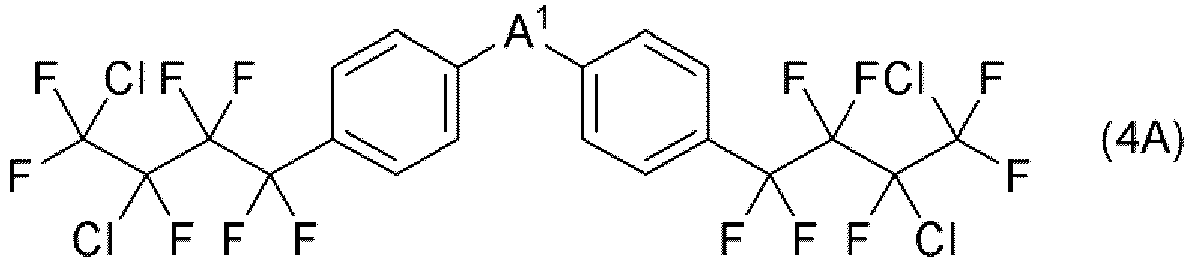
- Item 17. A compound represented by formula (5A):

- Item 18. A compound represented by formula (5A):

- Item 19. A compound represented by formula (5A):

- Item 20. A compound represented by formula (5):

- wherein A is a single bond, -O-, -S-, an alkylene group optionally having one or more substituents, a cycloalkylene group optionally having one or more substituents, or an arylene group optionally having one or more substituents,
- R31, R32, R23, R34, R35, R41, R42, R43, R44, and R45 are each independently fluorine, an alkyl group, or a fluoroalkyl group, and
- n and m are each independently 0, 1, or 2; and
- wherein the Pd content is 1000 ppm or less.
- The present disclosure provides, for example, a useful method for producing a fluoroalkyl aromatic compound, and a compound obtained by the production method.
- The above summary of the present disclosure is not intended to describe each disclosed embodiment or every implementation of the present disclosure.
- The following description of the present disclosure more particularly exemplifies illustrative embodiments. In several places throughout the present disclosure, guidance is provided through lists of examples, and these examples can be used in various combinations. In each instance, the described list serves only as a representative group, and should not be interpreted as an exclusive list.
- All publications, patents, and patent applications cited herein are incorporated herein by reference in their entirety.
- Unless otherwise specified, the symbols and abbreviations herein can be understood in the context of the present specification in the meanings commonly used in the art to which the present disclosure belongs.
- The term "contains" as used herein is intended to include "consisting essentially of" and "consisting of."
- Unless otherwise specified, the steps, treatments, or operations described herein can be performed at room temperature. The room temperature referred to herein can mean a temperature in the range of 10 to 40°C.
- The notation "Cn-m" (where n and m are each an integer of 1 or more, and n<m) used herein means that the number of carbon atoms is n or more and m or less, as is usually understood by persons skilled in the art.
- Examples of the "halogen" in the present specification include fluorine (F), chlorine (Cl), bromine (Br), and iodine (I).
- Examples of the "alkyl group" in the present specification include linear or branched C1-20 alkyl groups, such as methyl, ethyl, propyl (e.g., n-propyl and isopropyl), butyl (e.g., n-butyl, isobutyl, sec-butyl, and tert-butyl), pentyl, and hexyl.
- Examples of the "alkoxy group" in the present specification include linear or branched C1-20 alkoxy groups, such as methoxy, ethoxy, propoxy (e.g., n-propoxy and isopropoxy), butoxy (e.g., n-butoxy, isobutoxy, sec-butoxy, and tert-butoxy), pentyloxy, and hexyloxy.
- Examples of the "alkylthio group" in the present specification include linear or branched C1-20 alkylthio groups, such as methylthio, ethylthio, propylthio (e.g., n-propylthio and isopropylthio), butylthio (e.g., n-butylthio, isobutylthio, sec-butylthio, and tert-butylthio), pentylthio, and hexylthio.
- Examples of the "cycloalkyl group" in the present specification include C3-20 cycloalkyl groups, such as cyclopropyl, cyclobutyl, cyclopentyl, cyclohexyl, and cycloheptyl.
- The "aryl group" in the present specification can be, for example, monocyclic, bicyclic, tricyclic, or tetracyclic. Examples of the "aryl group" include C6-20 aryl groups, such as phenyl, 1-naphthyl, 2-naphthyl, 2-biphenyl, 3-biphenyl, 4-biphenyl, and 2-anthryl.
- The "heteroaryl group" in the present specification can be monocyclic, bicyclic, tricyclic, or tetracyclic. The "heteroaryl group" can be, for example, a 5- to 18-membered heteroaryl group. The "heteroaryl group" can be, for example, a heteroaryl group containing, in addition to carbon atoms, one, two, three, or four heteroatoms selected from oxygen, sulfur, and nitrogen atoms as a ring-constituting atom. The "heteroaryl group" includes "monocyclic heteroaryl groups" and "aromatic fused heterocyclic groups."
- Examples of the "monocyclic heteroaryl groups" include pyrrolyl (e.g., 1-pyrrolyl, 2-pyrrolyl, and 3-pyrrolyl), furyl (e.g., 2-furyl and 3-furyl), thienyl (e.g., 2-thienyl and 3-thienyl), pyrazolyl (e.g., 1-pyrazolyl, 3-pyrazolyl, and 4-pyrazolyl), imidazolyl (e.g., 1-imidazolyl, 2-imidazolyl, and 4-imidazolyl), isoxazolyl (e.g., 3-isoxazolyl, 4-isoxazolyl, and 5-isoxazolyl), oxazolyl (e.g., 2-oxazolyl, 4-oxazolyl, and 5-oxazolyl), isothiazolyl (e.g., 3-isothiazolyl, 4-isothiazolyl, and 5-isothiazolyl), thiazolyl (e.g., 2-thiazolyl, 4-thiazolyl, and 5-thiazolyl), triazolyl (e.g., 1,2,3-triazol-3-yl and 1,2,4-triazol-4-yl), oxadiazolyl (e.g., 1,2,4-oxadiazol-3-yl and 1,2,4-oxadiazol-5-yl), thiadiazolyl (e.g., 1,2,4-thiadiazol-3-yl and 1,2,4-thiadiazol-5-yl), tetrazolyl, pyridyl (e.g., 2-pyridyl, 3-pyridyl, and 4-pyridyl), pyridazinyl (e.g., 3-pyridazinyl and 4-pyridazinyl), pyrimidinyl (e.g., 2-pyrimidinyl, 4-pyrimidinyl, and 5-pyrimidinyl), pyrazinyl, and the like.
- Examples of the "aromatic fused heterocyclic groups" include isoindolyl (e.g., 1-isoindolyl, 2-isoindolyl, 3-isoindolyl, 4-isoindolyl, 5-isoindolyl, 6-isoindolyl, and 7-isoindolyl), indolyl (e.g., 1-indolyl, 2-indolyl, 3-indolyl, 4-indolyl, 5-indolyl, 6-indolyl, and 7-indolyl), benzo[b]furanyl (e.g., 2-benzo[b]furanyl, 3-benzo[b]furanyl, 4-benzo[b]furanyl, 5-benzo[b]furanyl, 6-benzo[b]furanyl, and 7-benzo[b]furanyl), benzo[c]furanyl (e.g., 1-benzo[c]furanyl, 4-benzo[c]furanyl, and 5-benzo[c]furanyl), benzo[b]thienyl (e.g., 2-benzo[b]thienyl, 3-benzo[b]thienyl, 4-benzo[b]thienyl, 5-benzo[b]thienyl, 6-benzo[b]thienyl, and 7-benzo[b]thienyl), benzo[c]thienyl (e.g., 1-benzo[c]thienyl, 4-benzo[c]thienyl, and 5-benzo[c]thienyl), indazolyl (e.g., 1-indazolyl, 2-indazolyl, 3-indazolyl, 4-indazolyl, 5-indazolyl, 6-indazolyl, and 7-indazolyl), benzimidazolyl (e.g., 1-benzimidazolyl, 2-benzimidazolyl, 4-benzimidazolyl, and 5-benzimidazolyl), 1,2-benzisoxazolyl (e.g., 1,2-benzisoxazol-3-yl, 1,2-benzisoxazol-4-yl, 1,2-benzisoxazol-5-yl, 1,2-benzisoxazol-6-yl, and 1,2-benzisoxazol-7-yl), benzoxazolyl (e.g., 2-benzoxazolyl, 4-benzoxazolyl, 5-benzoxazolyl, 6-benzoxazolyl, and 7-benzoxazolyl), 1,2-benzisothiazolyl (e.g., 1,2-benzisothiazol-3-yl, 1,2-benzisothiazol-4-yl, 1,2-benzisothiazol-5-yl, 1,2-benzisothiazol-6-yl, and 1,2-benzisothiazol-7-yl), benzothiazolyl (e.g., 2-benzothiazolyl, 4-benzothiazolyl, 5-benzothiazolyl, 6-benzothiazolyl, and 7-benzothiazolyl), isoquinolyl (e.g., 1-isoquinolyl, 3-isoquinolyl, 4-isoquinolyl, and 5-isoquinolyl), quinolyl (e.g., 2-quinolyl, 3-quinolyl, 4-quinolyl, 5-quinolyl, and 8-quinolyl), cinnolinyl (e.g., 3-cinnolinyl, 4-cinnolinyl, 5-cinnolinyl, 6-cinnolinyl, 7-cinnolinyl, and 8-cinnolinyl), phthalazinyl (e.g., 1-phthalazinyl, 4-phthalazinyl, 5-phthalazinyl, 6-phthalazinyl, 7-phthalazinyl, and 8-phthalazinyl), quinazolinyl (e.g., 2-quinazolinyl, 4-quinazolinyl, 5-quinazolinyl, 6-quinazolinyl, 7-quinazolinyl, and 8-quinazolinyl), quinoxalinyl (e.g., 2-quinoxalinyl, 3-quinoxalinyl, 5-quinoxalinyl, 6-quinoxalinyl, 7-quinoxalinyl, and 8-quinoxalinyl), pyrazolo[1,5-a]pyridyl (e.g., pyrazolo[1,5-a]pyridin-2-yl, pyrazolo[1,5-a]pyridin-3-yl, pyrazolo[1,5-a]pyridin-4-yl, pyrazolo[1,5-a]pyridin-5-yl, pyrazolo[1,5-a]pyridin-6-yl, and pyrazolo[1,5-a]pyridin-7-yl), imidazo[1,2-a]pyridyl (e.g., imidazo[1,2-a]pyridin-2-yl, imidazo[1,2-a]pyridin-3-yl, imidazo[1,2-a]pyridin-5-yl, imidazo[1,2-a]pyridin-6-yl, imidazo[1,2-a]pyridin-7-yl, and imidazo[1,2-a]pyridin-8-yl), and the like.
- In the "alkyl group optionally having one or more substituents" in the present specification, -CH2-, which may be present in the alkyl group, is optionally replaced with -O-, -S-, or -NH-. Examples of the substituents for the alkyl group include halogen, a hydroxy group, an alkoxy group, a mercapto group, an alkylthio group, an alkoxycarbonyl (alkyl-O-CO-) group, an alkylcarbonyloxy (alkyl-CO-O-) group, an aryl group, and a combination of two or more thereof (e.g., a haloalkoxy group). When the alkyl group has a substituent, the number of substituents may be selected from the range of one to the maximum replaceable number, and can be, for example, 1, 2, 3, 4, or 5. When the number of substituents is two or more, the substituents may be the same or different.
- Examples of the "alkyl group optionally having one or more substituents" include an alkyl group optionally substituted with one or more halogens (e.g., fluorine). An alkyl group substituted with one or more halogens is referred to as a "haloalkyl group." For example, when the halogen as a substituent is fluorine, the alkyl group may be referred to as a "fluoroalkyl group." The "fluoroalkyl group" may be a perfluoroalkyl group or a non-perfluoroalkyl group. Examples of the "fluoroalkyl group" include linear or branched fluoro-C1-20 alkyl groups, such as a trifluoromethyl group, a perfluoroethyl group, a perfluoropropyl group (e.g., a perfluoro n-propyl group and a perfluoroisopropyl group), a perfluorobutyl group, a perfluoropentyl group, and a perfluorohexyl group. Examples of the "fluoroalkyl group optionally having one or more substituents" include, in addition to the fluoroalkyl groups mentioned above, fluoroalkyl groups substituted with one or more substituents (e.g., an alkoxy group; a haloalkoxy group, such as a fluoroalkoxy group; an alkoxycarbonyl group; and a haloalkoxycarbonyl group, such as a fluoroalkoxycarbonyl group). Specific examples thereof include linear or branched fluoro-C1-20 alkyl groups substituted with one or more substituents, such as CF3-O-CF2-, CF3-O-CF(CF3)-, CF3-O-CH2-CH2-, CF3-O-CH(CF3)-CH2-, CF3-O-CF2-CF2-, CF3-CF2-O-CF2-, CF3-CF2-O-CF2-CF2-, CF3-O-CF2-O-CF2-, CF3-CF2-CF2-O-CH2-CF2-, CF3-CF2-CF2-O-CF2-CF2-, CF3-CF2-CF2-O-CF(CF3)-CF2-, CF3-CF2-CF2-O-CF(CF3)-CF2-O-CF(CF3)-CF2-, and CF3-CF2-CF2-O-[CF(CF3)-CF2-O-]2-CF(CF3)-CF2-.
- Examples of the substituents in the "aryl group optionally having one or more substituents" and the "heteroaryl group optionally having one or more substituents" in the present specification include halogen, a hydroxy group, an alkyl group, an alkoxy group, an alkylthio group, and a combination of two or more thereof (e.g., a haloalkyl group and a haloalkoxy group). When the aryl group has a substituent, the number of substituents may be selected from the range of one to the maximum replaceable number, and can be, for example, 1, 2, 3, 4, or 5. When the number of substituents is two or more, the substituents may be the same or different.
- The "alkylene group," "cycloalkylene group," and "arylene group" in the present specification are divalent groups formed by removing one H from an "alkyl group," "cycloalkyl group," and "aryl group," respectively.
- In one embodiment of the present disclosure, a method for producing a compound represented by formula (2) (which may be referred to as a "fluoroalkyl copper reagent") comprises step A of reacting a compound represented by formula (1), a copper compound, and a ligand in the presence of a reducing agent.
RF-X1 (1)
M-RF (2)
- In the formulas,
- RF is a fluoroalkyl group optionally having one or more substituents,
- X1 is Cl, Br, or I, and
- M is Cu having a ligand.
- In RF, the lower limit of the number of carbon atoms in the fluoroalkyl group may be, for example, 1, 2, or 3, and the upper limit may be, for example, 20, 16, 14, 12, or 10. RF is preferably a fluoro-C1-20 alkyl group optionally having one or more substituents (e.g., a perfluoro-C1-20 alkyl group), more preferably a fluoro-C1-12 alkyl group optionally having one or more substituents (e.g., a perfluoro-C1-12 alkyl group), and even more preferably a fluoro-C1-10 alkyl group optionally having one or more substituents (e.g., a perfluoro-C1-10 alkyl group).
- X1 is preferably Br or I.
- In one embodiment, X1 is preferably Br.
- In another embodiment, X1 is preferably I.
- The copper compound is not limited as long as it contains copper. The copper compound may be, for example, copper alone, or a monovalent or divalent copper compound. In one embodiment, the copper compound is preferably a monovalent copper compound.
- Examples of the copper compound include copper powder; copper(I) halides, such as copper(I) iodide; copper(I) oxide; copper(I) sulfide; copper(I) hydroxide; copper(I) acetate; copper(II) halides, such as copper(II) iodide; copper(II) oxide; copper(II) sulfate; copper(II) hydroxide; copper(II) acetate; and the like. These copper compounds may be used in combination with an alkoxide, aryloxide, thioalkoxide, or thioaryloxide of an alkali metal, such as lithium, sodium, or potassium. Alternatively, the copper compound for use may be an alkoxide, aryloxide, thioalkoxide, or thioaryloxide of copper. Examples of the alkoxide or aryloxide include C1-6 alkoxides, such as methoxide, ethoxide, propoxide, and butoxide (e.g., t-butoxide), and C6-10 aryloxides, such as phenoxide. The thioalkoxide or thioaryloxide may be, for example, an alkoxide or aryloxide mentioned above in which O is replaced with S.
- The amount of the copper compound for use is, for example, 0.5 mol or more, preferably 1 mol or more, and more preferably 1.5 mol or more, per mol of the compound represented by formula (1). The amount of the copper compound for use is, for example, 5 mol or less, preferably 4 mol or less, and more preferably 3 mol or less, per mol of the compound represented by formula (1). The amount of the copper compound for use is, for example, within the range of 0.5 to 5 mol, preferably within the range of 1 to 4 mol, and more preferably within the range of 1.5 to 3 mol, per mol of the compound represented by formula (1).
- The ligand is not limited as long as it can be coordinated to copper. Examples of the ligand include pyridine-containing ligands, phosphine ligands, and the like.
- Examples of the pyridine-containing ligands include phenanthroline (e.g., 1,10-phenanthroline), 2,2'-bipyridyl, pyridine, methylpyridine, lutidine (e.g., 2,6-lutidine), and the like.
- The phosphine ligand is preferably a trialkylphosphine or a triarylphosphine. Examples of trialkylphosphines include tri(C3-20 alkyl)phosphines, such as triisopropylphosphine, di-t-butylmethylphosphine, tri-t-butylphosphine, trihexylphosphine, tricyclopentylphosphine, tricyclohexylphosphine, triadamantylphosphine, tribicyclo[2,2,2]octylphosphine, and trinorbornylphosphine, and the like. Examples of triarylphosphines include tri(monocyclic aryl)phosphines, such as triphenylphosphine, trimesitylphosphine, and tri(o-tolyl)phosphine. Of these, triphenylphosphine, tricyclohexylphosphine, and tri-t-butylphosphine are preferred.
- In one embodiment, the ligand is preferably a bidentate ligand. Preferable examples of bidentate ligands include 1,10-phenanthroline and the like.
- The amount of the ligand for use is, for example, 0.5 mol or more, preferably 1 mol or more, and more preferably 1.5 mol or more, per mol of the compound represented by formula (1). The amount of the ligand for use is, for example, 5 mol or less, preferably 4 mol or less, and more preferably 3 mol or less, per mol of the compound represented by formula (1). The amount of the ligand for use is, for example, within the range of 0.5 to 5 mol, preferably within the range of 1 to 4 mol, and more preferably within the range of 1.5 to 3 mol, per mol of the compound represented by formula (1).
- By performing the reaction of step A in the presence of a reducing agent, the reaction can be performed at a low temperature, whereby the use of a high-boiling point solvent and associated complicated operations for removal can be avoided, making it possible to easily synthesize even a compound that is easily decomposed at high temperatures.
- The reducing agent is not limited as long as it has reducing ability. In one embodiment, the reducing agent is preferably a compound containing boron and/or silicon. Examples of the reducing agent include diboron compounds, silylborane compounds, disilane compounds, and the like.
- Examples of the diboron compound include a compound represented by formula (A):

- Z1 and Z2 are each independently a single bond, a double bond, or CH2,
- R1 and R2 are each independently an organic group,
- two adjacent R1s, when present, are optionally bonded together to form a ring,
- two adjacent R2s, when present, are optionally bonded together to form a ring, and
- k1 and k2 are each independently an integer of 0 or 1 or more.
- In one embodiment, Z1 and Z2 are preferably both single bonds.
- In another embodiment, Z1 and Z2 are preferably both double bonds.
- In yet another embodiment, Z1 and Z2 are preferably both CH2.
- R1 and R2 are preferably each independently an alkyl group, more preferably a C1-6 alkyl group, even more preferably a C1-4 alkyl group, and still more preferably a C1-2 alkyl group.
- When Z1 and Z2 are single bonds, k1 and k2 are each 0, 1, 2, 3, or 4. When Z1 and Z2 are double bonds, k1 and k2 are each 0, 1, or 2. When Z1 and Z2 are CH2, k1 and k2 are each 0, 1, 2, 3, 4, 5, or 6.
- The compound represented by formula (A) may be, for example, a compound represented by formula (A1), (A2), (A3), or (A4):

- Examples of the silylborane compound include a compound represented by formula (B):

- Z11 is a single bond, a double bond, or CH2,
- R11 is an organic group,
- two adjacent R11s, when present, are optionally bonded together to form a ring,
- R12, R13, and R14 are each independently an organic group, and
- k3 is an integer of 0 or 1 or more.
- In one embodiment, Z11 is preferably a single bond.
- In another embodiment, Z11 is preferably a double bond.
- In yet another embodiment, Z11 is preferably CH2.
- R11 is preferably a hydrocarbon group, more preferably an alkyl group, even more preferably a C1-6 alkyl group, still more preferably a C1-4 alkyl group, and particularly preferably a C1-2 alkyl group.
- R12, R13, and R14 are preferably each independently an alkyl group or an aryl group, more preferably a C1-6 alkyl group or a C6-14 aryl group, even more preferably a C1-4 alkyl group or a C6-12 aryl group, and still more preferably a C1-2 alkyl group or a C6-10 aryl group.
- When Z11 is a single bond, k3 is 0, 1, 2, 3, or 4. When Z11 is a double bond, k3 is 0, 1, or 2. When Z11 is CH2, k3 is 0, 1, 2, 3, 4, 5, or 6.
- The compound represented by formula (B) may be, for example, a compound represented by formula (B1):

- Examples of the disilane compound include a compound represented by formula (C):

- R21, R22, R23, R24, R25, and R26 are each independently H, halogen,
- or an organic group.
- R21, R22, R23, R24, R25, and R26 are preferably each independently H, halogen, an alkyl group, an alkoxy group, or an aryl group, more preferably H, halogen, a C1-6 alkyl group, a C1-6 alkoxy group, or a C6-14 aryl group, even more preferably H, halogen, a C1-4 alkyl group, a C1-4 alkoxy group, or a C6-12 aryl group, and still more preferably H, halogen (particularly Cl), a C1-2 alkyl group, a C1-2 alkoxy group, or a C6-10 aryl group.
- The compound represented by formula (C) may be, for example, a compound represented by formula (C1), (C2), (C3), (C4), (C5), (C6), (C7), (C8), or (C9):


- The amount of the reducing agent for use is, for example, 0.7 mol or more, preferably 0.8 mol or more, and more preferably 0.9 mol or more, per mol of the compound represented by formula (1). The amount of the reducing agent for use is, for example, 3 mol or less, preferably 2 mol or less, and more preferably 1.5 mol or less, per mol of the compound represented by formula (1). The amount of the reducing agent for use is, for example, within the range of 0.7 to 3 mol, preferably within the range of 0.8 to 1 mol, and more preferably within the range of 0.9 to 1.5 mol, per mol of the compound represented by formula (1).
- The reaction of step A is preferably performed in the presence of an organic solvent. In one embodiment, it is preferable that the organic solvent is not a high-boiling point solvent (or is a low-boiling point solvent) and has a boiling point under ordinary pressure of 150°C or lower, 140°C or lower, 130°C or lower, 120°C or lower, or 110°C or lower. Examples of the organic solvent include ether solvents (e.g., cyclic ether solvents, such as tetrahydrofuran), aromatic hydrocarbon solvents (e.g., toluene and xylene), mixed solvents of two or more of these, and the like.
- The amount of the organic solvent for use is, for example, 0.5 mL or more, preferably 1 mL or more, and more preferably 1.5 mL or more, per mmol of the compound represented by formula (1). The amount of the organic solvent for use is, for example, 40 mL or less, preferably 30 mL or less, and more preferably 20 mL or less, per mmol of the compound represented by formula (1). The amount of the organic solvent for use is, for example, within the range of 0.5 to 40 mL, preferably within the range of 1 to 30 mL, and more preferably within the range of 1.5 to 20 mL, per mmol of the compound represented by formula (1).
- The reaction temperature and reaction time in step A are not limited as long as the reaction proceeds.
- The reaction temperature is, for example, -30°C or higher, preferably -10°C or higher, and more preferably 0°C or higher. The reaction temperature is, for example, 40°C or lower, preferably 35°C or lower, and more preferably 30°C or lower. The reaction temperature is, for example, within the range of -30 to 40°C, preferably within the range of -10 to 35°C, and more preferably within the range of 0 to 30°C.
- The reaction time is, for example, 5 minutes or more, preferably 10 minutes or more, more preferably 30 minutes or more, and even more preferably 1 hour or more. The reaction time is, for example, 48 hours or less, preferably 24 hours or less, and more preferably 12 hours or less. The reaction time is, for example, within the range of 5 minutes to 48 hours, preferably within the range of 10 minutes to 24 hours, and more preferably within the range of 1 to 12 hours.
- The production method may further comprise isolating or purifying the compound represented by formula (2). The compound represented by formula (2) can be isolated or purified by a method, such as filtration, extraction, concentration, or chromatography, or a combination of these methods.
- In one embodiment of the present disclosure, a method for producing a compound represented by formula (4) comprises step A and then step B of reacting a reaction product of step A (particularly the compound represented by formula (2)) and a compound represented by formula (3).
Ar-X2 (3)
Ar-RF (4) - In the formulas,
- Ar is an aryl group optionally having one or more substituents or a heteroaryl group optionally having one or more substituents,
- X2 is Cl, Br, or I, and
- RF is as defined above.
- Ar is preferably a C6-14 aryl group optionally having one or more substituents, or a 5- to 14-membered heteroaryl group optionally having one or more substituents, more preferably a C6-12 aryl group optionally having one or more substituents, or a 5- to 12-membered heteroaryl group optionally having one or more substituents, and even more preferably a C6-10 aryl group optionally having one or more substituents, or a 5- to 10-membered heteroaryl group optionally having one or more substituents. The heteroatom(s) contained in the heteroaryl groups are preferably selected from the group consisting of O, S, and N.
- In one embodiment, Ar is preferably an aryl group optionally having one or more substituents. The substituent may be an organic group. Specific examples include an alkyl group optionally having one or more further substituents, an aryl group optionally having one or more further substituents, a heteroaryl group optionally having one or more further substituents, a carbonyl group (-L1-CO-Q1 or -CO-L1-Q1; Q1 is H or a hydrocarbon group optionally having one or more further substituents, and L1 is a single bond or -O-), an amide group (-L2-CO-NQ2Q3 or -NQ4-CO-L3-Q5; Q2, Q3, Q4, and Q5 are each independently H or a hydrocarbon group optionally having one or more further substituents, and L2 and L3 are each independently a single bond or -O-), an alkoxy group, a hydroxy group, halogen (a halogeno group), and combinations thereof. In one embodiment, the substituent is preferably fluorine and/or a fluoroalkyl group, and the substituent may be a fluoroalkyl group.
- X2 is preferably Br or I.
- In one embodiment, X2 is preferably Br.
- In another embodiment, X2 is preferably I.
- In one embodiment, the compound represented by formula (3) is preferably a compound represented by formula (3A) or formula (3B):
X21-Ar1-A0-Ar2-X22 (3A)
or
X23-Ar3-X24 (3B),
wherein - Ar1, Ar2, and Ar3 are each independently an arylene group optionally having one or more substituents, or a heteroarylene group optionally having one or more substituents,
- A0 is a single bond, -O-, -S-, an alkylene group optionally having one or more substituents, a cycloalkylene group optionally having one or more substituents, or an arylene group optionally having one or more substituents, and
- X21, X22, X23, and X24 are each independently Cl, Br, or I.
- Ar1 and Ar2 may be the same or different. Preferable examples of Ar1, Ar2, and Ar3 include divalent groups corresponding to the preferable examples of Ar.
- When A0 is an alkylene group optionally having one or more substituents, the lower limit of the number of carbon atoms in the alkylene group can be, for example, 1 or 2, and the upper limit can be, for example, 6, 5, 4, 3, or 2. A0 is preferably a C1-6 alkylene group optionally having one or more substituents, more preferably a C1-6 alkylene group optionally having one or more substituents, even more preferably a C1-4 alkylene group optionally having one or more substituents, and still more preferably a C1-2 alkylene group optionally having one or more substituents. The substituent may be any organic group, and specific examples include an alkyl group optionally having one or more further substituents, an aryl group optionally having one or more further substituents, a heteroaryl group optionally having one or more further substituents, a carbonyl group (-L1-CO-Q1 or - CO-L1-Q1), an amide group (-L2-CO-NQ2Q3 or -NQ4-CO-L3-Q5), an alkoxy group, a hydroxy group, halogen (a halogeno group), and combinations thereof.
- When A0 is a cycloalkylene group optionally having one or more substituents, A0 is preferably a C5-14 cycloalkylene group optionally having one or more substituents, more preferably a C5-12 cycloalkylene group optionally having one or more substituents, and even more preferably a C5-10 cycloalkylene group optionally having one or more substituents.
- When A0 is an arylene group optionally having one or more substituents, A0 is preferably a C6-14 arylene group optionally having one or more substituents, more preferably a C6-12 arylene group optionally having one or more substituents, and even more preferably a C5-10 arylene group optionally having one or more substituents.
- It is preferable that X21, X22, X23, and X24 are each independently Br or I. X21 and X22 may be the same or different. X23 and X24 may be the same or different.
- The amount of the compound represented by formula (3) for use (particularly the total amount of Cl, Br, and I) is, for example, 0.05 mol or more, preferably 0.1 mol or more, and more preferably 0.15 mol or more, per mol of the compound represented by formula (2). The amount of the compound represented by formula (3) for use is, for example, 3 mol or less, preferably 2 mol or less, and more preferably 1.5 mol or less, per mol of the compound represented by formula (2). The amount of the compound represented by formula (3) for use is, for example, within the range of 0.05 to 3 mol, preferably within the range of 0.1 to 2 mol, and more preferably within the range of 0.15 to 1.5 mol, per mol of the compound represented by formula (2).
- The reaction of step B is preferably performed in the presence of an organic solvent. In one embodiment, it is preferable that the organic solvent is not a high-boiling point solvent (or is a low-boiling point solvent) and has a boiling point under ordinary pressure of 150°C or lower, 140°C or lower, 130°C or lower, 120°C or lower, or 110°C or lower. Examples of the organic solvent include ether solvents (e.g., cyclic ether solvents, such as tetrahydrofuran), aromatic hydrocarbon solvents (e.g., toluene and xylene), mixed solvents of two or more of these, and the like. The organic solvent may be different from the organic solvent that can be used in step A, but is preferably the same.
- The reaction temperature and reaction time in step B are not limited as long as the reaction proceeds.
- The reaction temperature is, for example, 0°C or higher, preferably 10°C or higher, and more preferably 20°C or higher. The reaction temperature is, for example, 125°C or lower, preferably 100°C or lower, and more preferably 80°C or lower. The reaction temperature is, for example, within the range of 0 to 125°C, preferably within the range of 10 to 100°C, and more preferably within the range of 20 to 80°C.
- The reaction time is, for example, 30 minutes or more, preferably 1 hour or more, and more preferably 2 hours or more. The reaction time is, for example, 48 hours or less, preferably 24 hours or less, and more preferably 12 hours or less. The reaction time is, for example, within the range of 30 minutes to 48 hours, preferably within the range of 1 to 24 hours, and more preferably within the range of 2 to 12 hours.
- In another embodiment of the present disclosure, a method for producing a compound represented by formula (4) comprises step C of reacting a compound represented by formula (1) and a compound represented by formula (3) in the presence of a reducing agent, a copper compound, and a ligand.
- The compound represented by formula (1) and the compound represented by formula (3) may be the same compounds as those listed for step A and step B as examples, respectively.
- The amount of the compound represented by formula (3) for use (particularly the total amount of Cl, Br, and I) is, for example, 0.05 mol or more, preferably 0.1 mol or more, and more preferably 0.15 mol or more, per mol of the compound represented by formula (1). The amount of the compound represented by formula (3) for use is, for example, 3 mol or less, preferably 2 mol or less, and more preferably 1.5 mol or less, per mol of the compound represented by formula (1). The amount of the compound represented by formula (3) for use is, for example, within the range of 0.05 to 3 mol, preferably within the range of 0.1 to 2 mol, and more preferably within the range of 0.15 to 1.5 mol, per mol of the compound represented by formula (1).
- Examples of the reducing agent, copper compound, and ligand include the same as those listed for step A as examples. The amounts of the reducing agent, copper compound, and ligand for use relative to the compound represented by formula (1) can also be selected from the same ranges as those listed for step A as examples.
- The reaction of step C is preferably performed in the presence of an organic solvent. Examples of the organic solvent include the same organic solvents as those listed for step A as examples. The amount of the organic solvent for use relative to the compound represented by formula (1) can also be selected from the same ranges as those listed for step A as examples.
- The reaction temperature and reaction time in step C are not limited as long as the reaction proceeds. The reaction temperature and reaction time can be selected from the same ranges as those listed for step A as examples.
- In this production method, for example, when a compound represented by formula (3A) is used, a compound represented by formula (4B) and/or a compound represented by formula (4C) may be produced as by-products.
X21-Ar1-A0-Ar2-RF (4B)
RF-Ar1-A0-Ar2-X22 (4C)
- The production method may further comprise isolating or purifying the compound represented by formula (4). The compound represented by formula (4) can be isolated or purified by a method, such as filtration, extraction, concentration, or chromatography, or a combination of these methods.
- A compound according to one embodiment of the present disclosure is a compound represented by formula (4A):

A1 is a single bond, -O-, -S-, an alkylene group optionally having one or more substituents, a cycloalkylene group optionally having one or more substituents, or an arylene group optionally having one or more substituents. - When A1 is an alkylene group optionally having one or more substituents, the lower limit of the number of carbon atoms in the alkylene group can be, for example, 1 or 2, and the upper limit can be, for example, 6, 5, 4, 3, or 2. A1 is preferably a C1-6 alkylene group optionally having one or more substituents, more preferably a C1-6 alkylene group optionally having one or more substituents, even more preferably a C1-4 alkylene group optionally having one or more substituents, and still more preferably a C1-2 alkylene group optionally having one or more substituents. The substituent may be any organic group, and specific examples include an alkyl group optionally having one or more further substituents, an aryl group optionally having one or more further substituents, a heteroaryl group optionally having one or more further substituents, a carbonyl group (-L1-CO-Q1 or - CO-L1-Q1), an amide group (-L2-CO-NQ2Q3 or -NQ4-CO-L3-Q5), an alkoxy group, a hydroxy group, halogen (a halogeno group), and combinations thereof.
- When A1 is a cycloalkylene group optionally having one or more substituents, A1 is preferably a C5-14 cycloalkylene group optionally having one or more substituents, more preferably a C5-12 cycloalkylene group optionally having one or more substituents, and even more preferably a C5-10 cycloalkylene group optionally having one or more substituents.
- When A1 is an arylene group optionally having one or more substituents, A1 is preferably a C6-14 arylene group optionally having one or more substituents, more preferably a C6-12 arylene group optionally having one or more substituents, and even more preferably a C5-10 arylene group optionally having one or more substituents.
- The compound represented by formula (4A) can be produced, for example, according to the production method for the compound represented by formula (4), by reacting a compound of formula (3A) in which Ar1 and Ar2 are phenylene groups, a compound of formula (1) in which RF is CF2Cl-CFCl-CF2-CF2-, a copper compound, and a ligand (or a compound of formula (2) in which RF is CF2Cl-CFCl-CF2-CF2- produced by reacting these).
- A compound according to one embodiment of the present disclosure is a compound represented by formula (5A):

A2 is a single bond, -O-, -S-, an alkylene group optionally having one or more substituents, a cycloalkylene group optionally having one or more substituents, or an arylene group optionally having one or more substituents. - When A2 is an alkylene group optionally having one or more substituents, the lower limit of the number of carbon atoms in the alkylene group can be, for example, 1 or 2, and the upper limit can be, for example, 6, 5, 4, 3, or 2. A2 is preferably a C1-6 alkylene group optionally having one or more substituents, more preferably a C1-6 alkylene group optionally having one or more substituents, even more preferably a C1-4 alkylene group optionally having one or more substituents, and still more preferably a C1-2 alkylene group optionally having one or more substituents. The substituent may be any organic group, and specific examples include an alkyl group optionally having one or more further substituents, an aryl group optionally having one or more further substituents, a heteroaryl group optionally having one or more further substituents, a carbonyl group (-L1-CO-Q1 or - CO-L1-Q1), an amide group (-L2-CO-NQ2Q3 or -NQ4-CO-L3-Q5), an alkoxy group, a hydroxy group, halogen (a halogeno group), and combinations thereof.
- When A2 is a cycloalkylene group optionally having one or more substituents, A2 is preferably a C5-14 cycloalkylene group optionally having one or more substituents, more preferably a C5-12 cycloalkylene group optionally having one or more substituents, and even more preferably a C5-10 cycloalkylene group optionally having one or more substituents.
- When A2 is an arylene group optionally having one or more substituents, A2 is preferably a C6-14 arylene group optionally having one or more substituents, more preferably a C6-12 arylene group optionally having one or more substituents, and even more preferably a C5-10 arylene group optionally having one or more substituents.
- The compound represented by formula (5A) can be produced, for example, by subjecting the compound represented by formula (4A) to a dechlorination reaction. The dechlorination reaction can be performed under conditions known or conventional in the art.
- The compound represented by formula (5A) may comprise Al, Cr, Cu, Fe, Ni, and Zn, or may not comprise a part or all of these metals. The content of each of Al, Cr, Cu, Fe, Ni, and Zn in the compound represented by formula (5A) is, for example, 1000 ppm or less, preferably 800 ppm or less, and more preferably 500 ppm or less. Since the lower the content of each of the above metals, the more preferable it is, the lower limit is not limited. The lower limit may be, for example, 0.001 ppm or more. The content of each of Al, Cr, Cu, Fe, Ni, and Zn can be measured by, for example, ICP (high-frequency inductively coupled plasma) emission analysis. In one embodiment, the content of each of Al, Cr, Cu, Fe, Ni, and Zn is preferably below the limit of detection by ICP emission analysis.
- The total content of Al, Cr, Cu, Fe, Ni, and Zn in the compound represented by formula (5A) is, for example, 6000 ppm or less, preferably 4800 ppm or less, and more preferably 3000 ppm or less. In one embodiment, the total content of the above metals may be 1000 ppm or less, 800 ppm or less, or 500 ppm or less. Since the lower the total content of the above metals, the more preferable it is, the lower limit is not limited. The lower limit may be, for example, 0.001 ppm or more. The total content of Al, Cr, Cu, Fe, Ni, and Zn can be measured by, for example, ICP (high-frequency inductively coupled plasma) emission analysis. In one embodiment, the total content of Al, Cr, Cu, Fe, Ni, and Zn is preferably below the limit of detection by ICP emission analysis.
- The compound represented by formula (5A) may comprise Pd or may not comprise Pd. The Pd content in the compound represented by formula (5A) is, for example, 1000 ppm or less, preferably 800 ppm or less, and more preferably 500 ppm or less. Since the lower the Pd content, the more preferable it is, the lower limit is not limited. The lower limit may be, for example, 0.001 ppm or more. The Pd content can be measured, for example, by ICP emission analysis. In one embodiment, the Pd content is preferably below the limit of detection by ICP emission analysis.
- A compound according to one embodiment of the present disclosure is a compound represented by formula (5):

- A is a single bond, -O-, -S-, an alkylene group optionally having one or more substituents, a cycloalkylene group optionally having one or more substituents, or an arylene group optionally having one or more substituents,
- R31, R32, R33, R34, R35, R41, R42, R43, R44, and R45 are each independently fluorine, an alkyl group, or a fluoroalkyl group, and
- n and m are each independently 0, 1, or 2.
- When A is an alkylene group optionally having one or more substituents, the lower limit of the number of carbon atoms in the alkylene group can be, for example, 1 or 2, and the upper limit can be, for example, 6, 5, 4, 3, or 2. A is preferably a C1-6 alkylene group optionally having one or more substituents, more preferably a C1-6 alkylene group optionally having one or more substituents, even more preferably a C1-4 alkylene group optionally having one or more substituents, and still more preferably a C1-2 alkylene group optionally having one or more substituents. The substituent may be any organic group, and specific examples include an alkyl group optionally having one or more further substituents, an aryl group optionally having one or more further substituents, a heteroaryl group optionally having one or more further substituents, a carbonyl group (-L1-CO-Q1 or - CO-L1-Q1), an amide group (-L2-CO-NQ2Q3 or -NQ4-CO-L3-Q5), an alkoxy group, a hydroxy group, halogen (a halogeno group), and combinations thereof.
- When A is a cycloalkylene group optionally having one or more substituents, A is preferably a C5-14 cycloalkylene group optionally having one or more substituents, more preferably a C5-12 cycloalkylene group optionally having one or more substituents, and even more preferably a C5-10 cycloalkylene group optionally having one or more substituents.
- When A is an arylene group optionally having one or more substituents, A is preferably a C6-14 arylene group optionally having one or more substituents, more preferably a C6-12 arylene group optionally having one or more substituents, and even more preferably a C5-10 arylene group optionally having one or more substituents.
- R31, R32, R33, R34, R35, R41, R42, R43, R44, and R45 are preferably each independently fluorine, a C1-6 alkyl group, or a fluoro-C1-6 alkyl group, more preferably fluorine, a C1-4 alkyl group, or a fluoro-C1-4 alkyl group, and even more preferably fluorine, a C1-2 alkyl group, or a fluoro-C1-2 alkyl group. In one embodiment, R31, R32, R33, R34, and R35 are preferably the same as R41, R42, R43, R44, and R45, respectively.
- In one embodiment, n and m are preferably both 0.
- In another embodiment, n and m are preferably both 1.
- In yet another embodiment, n and m are preferably both 2.
- The compound represented by formula (5) may comprise Al, Cr, Cu, Fe, Ni, and Zn, or may not comprise a part or all of these metals. The content of each of Al, Cr, Cu, Fe, Ni, and Zn in the compound represented by formula (5) is, for example, 1000 ppm or less, preferably 800 ppm or less, and more preferably 500 ppm or less. Since the lower the content of each of the above metals, the more preferable it is, the lower limit is not limited. The lower limit may be, for example, 0.001 ppm or more. The content of each of Al, Cr, Cu, Fe, Ni, and Zn can be measured by, for example, ICP (high-frequency inductively coupled plasma) emission analysis. In one embodiment, the content of each of Al, Cr, Cu, Fe, Ni, and Zn is preferably below the limit of detection by ICP emission analysis.
- The total content of Al, Cr, Cu, Fe, Ni, and Zn in the compound represented by formula (5) is, for example, 6000 ppm or less, preferably 4800 ppm or less, and more preferably 3000 ppm or less. In one embodiment, the total content of the above metals may be 1000 ppm or less, 800 ppm or less, or 500 ppm or less. Since the lower the total content of the above metals, the more preferable it is, the lower limit is not limited. The lower limit may be, for example, 0.001 ppm or more. The total content of Al, Cr, Cu, Fe, Ni, and Zn can be measured by, for example, ICP (high-frequency inductively coupled plasma) emission analysis. In one embodiment, the total content of Al, Cr, Cu, Fe, Ni, and Zn is preferably below the limit of detection by ICP emission analysis.
- The compound represented by formula (5) may comprise Pd or may not comprise Pd. The Pd content in the compound represented by formula (5) is, for example, 1000 ppm or less, preferably 800 ppm or less, and more preferably 500 ppm or less. Since the lower the Pd content, the more preferable it is, the lower limit is not limited. The lower limit may be, for example, 0.001 ppm or more. The Pd content can be measured, for example, by ICP emission analysis. In one embodiment, the Pd content is preferably below the limit of detection by ICP emission analysis.
- The compound represented by formula (5) can be produced, for example, according to the production method for the compound represented by formula (4), by reacting a compound of formula (3A) in which Ar1 and Ar2 are phenylene groups, a compound of formula (1) in which RF is CR35R34Cl-CR33Cl-(CR32R31)n- and/or a compound of formula (1), in which RF is CR45R44Cl-CR43Cl-(CR42R41)m-, a copper compound, and a ligand (or a compound of formula (2) produced by reacting these), and subjecting the compound of formula (4) produced by the reaction above to a dechlorination reaction. The dechlorination reaction can be performed under conditions known or conventional in the art.
- One embodiment of the present disclosure is described in more detail below by way of the Examples; however, the present disclosure is not limited thereto. The abbreviations used in the Examples are as follows.
- B2pin2: Bis(pinacolato)diboron
- DMF: N,N-dimethylformamide
- HPLC: High-performance liquid chromatography
- PhMe2SiBpin: (Dimethylphenylsilyl)boronic acid pinacol ester
- tBu: t-Butyl
- THF: Tetrahydrofuran
-

- In a nitrogen atmosphere, a solution of CuOtBu (1 mmol, 134 mg) and 1,10-phenanthrorine (1 mmol, 180 mg) in THF (4 mL) was prepared in a screw-cap test tube. A THF solution (1 mL) of B2pin2 (0.5 mmol, 127 mg) and ICF2CF2CFClCF2Cl (0.5 mmol, 189 mg) was added dropwise. The reaction solution was stirred at room temperature for 10 minutes and then filtered. The filtrate was concentrated and washed with ether to give 197.6 mg of the title compound as a brown solid in a yield of 80%.
- 1H NMR (400 MHz, THF-d8): δ9.1 (br, 2H), 8.7 (br, 2H), 8.1 (br, 2H), 8.0 (br, 2H).
- 19F NMR (376 MHz, THF-d8): δ-65.7 (br, 2F), -111.5 (br, 2F), - 120.3 (br, 2F), -132.3 (br, 1F).
-

- In a nitrogen atmosphere, a solution of CuOtBu (0.24 mmol, 32.1 mg) and 1,10-phenanthrorine (0.24 mmol, 43.2 mg) in THF (0.3 mL) was prepared in a screw-cap test tube. A THF solution (0.2 mL) of B2pin2 (0.12 mmol, 30.5 mg) and ICF2CF2CF2CF3 (0.12 mmol, 20 µL) was added dropwise. After the reaction solution was stirred at room temperature for 1 hour, 4-fluoroiodobenzene (0.1 mmol, 11.6 µL) was added, sealing was performed, and stirring was performed at 40°C for 18 hours to give the title compound in a yield of 82%.
19F NMR (376 MHz, CDCl3): -107.1 (s, 1F), -109.9 (t, 13 Hz, 2F), - 122.5 (t, 9 Hz, 2F), -125.4 (m, 2F). - The same procedure was performed as described above except that B2pin2 was changed to PhMe2SiBpin (0.12 mmol). The results confirmed the production of the title compound (4-1) in a yield of 63% by 19F NMR.
- The same procedure was performed as described above except that THF was changed to diethyl ether. The results confirmed the production of compound (4-1) in a yield of 8% by 19F NMR.
- The same procedure was performed as described above except that THF was changed to toluene. The results confirmed the production of compound (4-1) in a yield of 30% by 19F NMR.
-


- In a glove box, solution 1 of CuOtBu (4.8 mmol, 654.6 mg) and 1,10-phenanthrorine (4.8 mmol, 865.1 mg) in THF (4.8 mL) was prepared in a screw-cap test tube, and the solution was cooled to -30°C. THF solution 2 (2.4 mL) of B2pin2 (2.4 mmol, 610.1 mg) and ICF2CF2CFClCF2Cl (2.4 mmol, 426 µL) was prepared. Solution 2 was slowly added dropwise to solution 1. The container for solution 2 was washed twice with THF (1.2 mL), and the washed liquid was added to solution 1. After the solution was stirred at room temperature for 1 hour, 4,4'-diiodobiphenyl (0.8 mmol, 325.3 mg) was added, sealing was performed, and stirring was performed at 40°C for 18 hours. After completion of the reaction, a mixture of compound (4-2) and compound (4-3) in a ratio of 10:1 was obtained. This mixture contained a small amount of compound (5-1). The mixture was filtered and purified by column chromatography to give compound (4-2) in a yield of 82%.
- 1H NMR (400 MHz, CDCl3): δ7.65 (m, 8H)
- 19F NMR (376 MHz, CDCl3): δ-63.3 (t, 2F), δ-107.0, -107.7, -108.5, -109.2 (m, 2F), δ-112.6, -113.4, -114.0, -114.7 (m, 2F), δ-130.0 (m, 1F)GCMS m/z: 656
-

- In a glove box, solution 1 of CuOtBu (4.8 mmol, 654.6 mg) and 1,10-phenanthrorine (4.8 mmol, 865.1 mg) in THF (4.8 mL) was prepared in a screw-cap test tube, and the solution was cooled to -30°C. THF solution 2 (2.4 mL) of B2pin2 (2.4 mmol, 610.1 mg) and ICF2CF2CFClCF2Cl (2.4 mmol, 426 µL) was prepared. Solution 2 was slowly added dropwise to solution 1. The container for solution 2 was washed twice with THF (1.2 mL), and the washed liquid was added to solution 1. After the solution was stirred at room temperature for 1 hour, 4,4'-diiodobiphenyl (0.8 mmol, 325.3 mg), Zn (325 mg), ZnCl2 (44 mg), and DMF (8.4 mL) were added, sealing was performed, and stirring was performed at 40°C for 18 hours. After completion of the reaction, 232 mg of a crude product was obtained. Analysis by NMR revealed that 4,4'-diiodobiphenyl, compound (4-2), and compound (4-4) were produced in a molar ratio of 0.7:1:1.4.
-

- In a glove box, zinc powder (6.5 mmol, 438 mg) and zinc chloride (0.65 mmol, 87.9 mg) were weighed into a 50 mL two-necked round-bottom flask, and DMF (3 mL) was added. Compound (4-2) (0.65 mmol, 428.3 mg) was dissolved in DMF (3 mL), and the solution was added to the reaction solution. Washing was performed twice with DMF (2 mL), and the washed liquid was added to the reaction solution, followed by stirring at 60°C for 2 hours in a nitrogen atmosphere. After completion of the reaction, filtration and extraction, as well as purification by HPLC, were performed to give compound (5-1) in a yield of 93%.
- 1H NMR (400 MHz, CDCl3): δ7.63 (dd, 8H)19F NMR (MHz, CDCl3) δ-89.9 (m, 1F), δ-106.6 (m, 1F), δ-112.5 (d, 2F), δ-118.2 (t, 2F), δ-187.1 (m, 1F)
- GCMS m/z: 513
- The results of analysis of the resulting compound (5-1) by ICP-AES (Pd detection limit: 1 ppm) revealed that no Pd was detected.
Claims (20)
- A method for producing a compound represented by formula (2):
M-RF (2),
wherein M is Cu having a ligand, andRF is a fluoroalkyl group optionally having one or more substituents;the method comprising:
step A of reacting, in the presence of a reducing agent, a compound represented by formula (1):
RF-X1 (1),
wherein RF is as defined above, andX1 is Cl, Br, or I;a copper compound, and a ligand. - A method for producing a compound represented by formula (4):
Ar-RF (4),
wherein Ar is an aryl group optionally having one or more substituents or a heteroaryl group optionally having one or more substituents, andRF is a fluoroalkyl group optionally having one or more substituents;
the method comprising:step A of reacting, in the presence of a reducing agent, a compound represented by formula (1):
RF-X1 (1),
wherein RF is as defined above, andX1 is Cl, Br, or I;a copper compound, and a ligand; andstep B of reacting a reaction product of step A and a compound represented by formula (3):
Ar-X2 (3),
wherein Ar is as defined above, andX2 is Cl, Br, or I. - A method for producing a compound represented by formula (4):
Ar-RF (4),
wherein Ar is an aryl group optionally having one or more substituents or a heteroaryl group optionally having one or more substituents, andRF is a fluoroalkyl group optionally having one or more substituents;
the method comprising:
step C of reacting, in the presence of a reducing agent, a copper compound, and a ligand, a compound represented by formula (1):
RF-X1 (1),
wherein RF is as defined above, andX1 is Cl, Br, or I;and a compound represented by formula (3):
Ar-X2 (3),
wherein Ar is as defined above, andX2 is Cl, Br, or I. - The production method according to any one of claims 1 to 3, wherein the reducing agent is a compound containing boron and/or silicon.
- The production method according to any one of claims 1 to 4, wherein the reducing agent is at least one member selected from the group consisting of a diboron compound, a silylborane compound, and a disilane compound.
- The production method according to claim 5,
wherein the diboron compound is a compound represented by formula (A): wherein Z1 and Z2 are each independently a single bond, a double bond, or CH2,R1 and R2 are each independently an alkyl group,two adjacent R1s, when present, are optionally bonded together to form a ring,two adjacent R2s, when present, are optionally bonded together to form a ring, andk1 and k2 are each independently an integer of 0 or 1 or more;the silylborane compound is a compound represented by formula (B):
 wherein Z11 is a single bond, a double bond, or CH2,R11 is an alkyl group,two adjacent R11s, when present, are optionally bonded together to form a ring,R12, R13, and R14 are each independently an alkyl group or an aryl group, andk3 is an integer of 0 or 1 or more; andthe disilane compound is a compound represented by formula (C):
- The production method according to any one of claims 1 to 6, which is performed in an organic solvent.
- The production method according to claim 7, wherein the organic solvent has a boiling point of 150°C or lower under ordinary pressure.
- The production method according to claim 7 or 8, wherein the organic solvent is at least one member selected from the group consisting of ether solvents and aromatic hydrocarbon solvents.
- The production method according to any one of claims 1 to 9, wherein the copper compound is a monovalent copper compound.
- The production method according to any one of claims 1 to 10, wherein the copper compound is an alkoxide, aryloxide, thioalkoxide, or thioaryloxide of Cu.
- The production method according to any one of claims 1 to 11, wherein the ligand is at least one member selected from the group consisting of pyridine-containing ligands and phosphine ligands.
- The production method according to any one of claims 2 to 12, wherein step B or step C is performed at 50°C or lower.
- The production method according to any one of claims 2 to 13, wherein Ar is an aryl group optionally having one or more substituents.
- The production method according to any one of claims 2 to 14, wherein Ar is an aryl group having one or more fluorine atoms or fluoroalkyl groups.
- A compound represented by formula (4A):

- A compound represented by formula (5A):
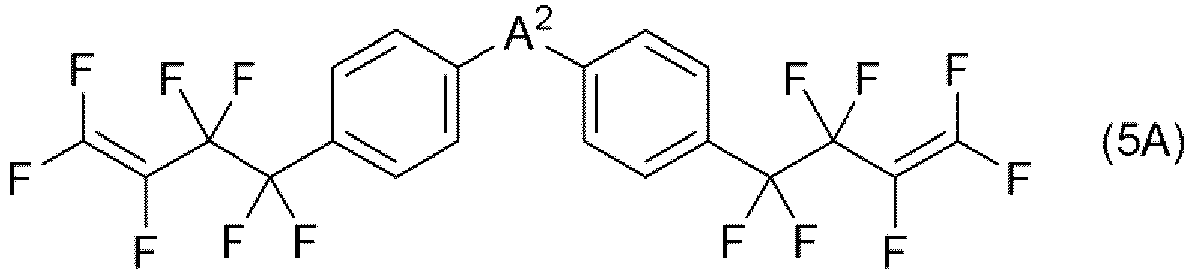
- A compound represented by formula (5A):
 wherein A2 is a single bond, -O-, -S-, an alkylene group optionally having one or more substituents, a cycloalkylene group optionally having one or more substituents, or an arylene group optionally having one or more substituents; andwherein the content of each of Al, Cr, Cu, Fe, Ni, and Zn is 1000 ppm or less.
 - A compound represented by formula (5A):
 wherein A2 is a single bond, -O-, -S-, an alkylene group optionally having one or more substituents, a cycloalkylene group optionally having one or more substituents, or an arylene group optionally having one or more substituents; andwherein the total content of Al, Cr, Cu, Fe, Ni, and Zn is 6000 ppm or less.
 - A compound represented by formula (5):
 wherein A is a single bond, -O-, -S-, an alkylene group optionally having one or more substituents, a cycloalkylene group optionally having one or more substituents, or an arylene group optionally having one or more substituents,R31, R32, R33, R34, R35, R41, R42, R43, R44, and R45 are each independently fluorine, an alkyl group, or a fluoroalkyl group, andn and m are each independently 0, 1, or 2; andwherein the Pd content is 1000 ppm or less.
Applications Claiming Priority (2)
| Application Number | Priority Date | Filing Date | Title |
|---|---|---|---|
| JP2023034958 | 2023-03-07 | ||
| PCT/JP2024/008622 WO2024185829A1 (en) | 2023-03-07 | 2024-03-06 | Production method for fluoroalkyl aromatic compound |
Publications (2)
| Publication Number | Publication Date |
|---|---|
| EP4541798A1 true EP4541798A1 (en) | 2025-04-23 |
| EP4541798A4 EP4541798A4 (en) | 2025-10-01 |
Family
ID=92675289
Family Applications (1)
| Application Number | Title | Priority Date | Filing Date |
|---|---|---|---|
| EP24767195.1A Pending EP4541798A4 (en) | 2023-03-07 | 2024-03-06 | PREPARATION PROCESS FOR FLUOROALKYLAROMATIC COMPOUND |
Country Status (4)
| Country | Link |
|---|---|
| EP (1) | EP4541798A4 (en) |
| JP (2) | JP7681281B2 (en) |
| CN (1) | CN120752244A (en) |
| WO (1) | WO2024185829A1 (en) |
Family Cites Families (9)
| Publication number | Priority date | Publication date | Assignee | Title |
|---|---|---|---|---|
| GB1156912A (en) | 1965-05-21 | 1969-07-02 | Nat Res Dev | Araliphatic Compounds Containing Fluorine |
| US5023380A (en) * | 1989-06-09 | 1991-06-11 | The Dow Chemical Company | Perfluorovinyl compounds |
| JP6374867B2 (en) * | 2013-08-07 | 2018-08-15 | ニチアス株式会社 | Cross-linking agent and fluorine-containing aromatic compound |
| DE112014004558T5 (en) * | 2013-10-02 | 2016-06-23 | Daikin Industries, Ltd | Flour-containing complex compound and production process for fluorine-containing organic compound using them |
| JP6402919B2 (en) | 2014-11-27 | 2018-10-10 | Jnc株式会社 | COMPOUND HAVING PERFLUOROALKYL TERMINAL GROUP AND CF2O BONDING GROUP, LIQUID CRYSTAL COMPOSITION AND LIQUID CRYSTAL DISPLAY DEVICE |
| JP2016145167A (en) | 2015-02-06 | 2016-08-12 | ニチアス株式会社 | Cross-linking agent and fluorine-containing aromatic compound |
| HUE065555T2 (en) * | 2017-06-20 | 2024-06-28 | Daikin Ind Ltd | Method for producing butadiene compound |
| CN115605540B (en) * | 2020-05-14 | 2024-10-25 | 霓佳斯株式会社 | Rubber composition, fluoroelastomer, and sealing material |
| JP7295451B2 (en) | 2021-11-01 | 2023-06-21 | ダイキン工業株式会社 | Method for producing perfluoroalkyl group-containing aromatic compound |
-
2024
- 2024-03-06 JP JP2024033808A patent/JP7681281B2/en active Active
- 2024-03-06 EP EP24767195.1A patent/EP4541798A4/en active Pending
- 2024-03-06 CN CN202480017327.1A patent/CN120752244A/en active Pending
- 2024-03-06 WO PCT/JP2024/008622 patent/WO2024185829A1/en not_active Ceased
-
2025
- 2025-05-01 JP JP2025076097A patent/JP2025106133A/en active Pending
Also Published As
| Publication number | Publication date |
|---|---|
| JP2024127841A (en) | 2024-09-20 |
| JP7681281B2 (en) | 2025-05-22 |
| WO2024185829A1 (en) | 2024-09-12 |
| CN120752244A (en) | 2025-10-03 |
| JP2025106133A (en) | 2025-07-11 |
| EP4541798A4 (en) | 2025-10-01 |
Similar Documents
| Publication | Publication Date | Title |
|---|---|---|
| JPWO2015050236A1 (en) | Fluorine-containing complex compound and method for producing fluorine-containing organic compound using the same | |
| US11932596B2 (en) | Fluorovinyl ether compound | |
| JP7681281B2 (en) | Method for producing fluoroalkyl aromatic compounds | |
| EP3778547B1 (en) | Fluorinated organic compound production method | |
| JP7473826B2 (en) | Method for producing fluoroether | |
| EP3892611B1 (en) | Method for producing fluorovinyl amide compound | |
| JP2018145183A (en) | Fluorine-substituted nitrogen-containing heterocyclic compound and method for producing the same | |
| US11643500B2 (en) | Fluorinated aromatic polymer and method for producing same | |
| JP2015160846A (en) | Method for producing α-fluoroacrylic acid ester or derivative thereof | |
| CN112004793B (en) | Method for manufacturing fluorinated organic compounds | |
| JP6497548B2 (en) | Fluorine-containing complex compound, and method for producing fluorine-containing organic compound using fluorine-containing complex compound | |
| JP6629020B2 (en) | Method for producing substituted olefin compound | |
| JP7264363B1 (en) | Method for producing fluoroether | |
| EP3904322A1 (en) | Method for producing fluoroalkoxide | |
| US11261148B2 (en) | Method for producing carbonyl compound | |
| JP6919733B2 (en) | Method for producing propionic acid derivative | |
| JP2016166164A (en) | Method for producing organic fluorine compound | |
| JP6976678B2 (en) | Fluorine-containing compound and its manufacturing method | |
| JP6300586B2 (en) | Method for producing fluorine-containing compound | |
| JP2024143112A (en) | Compound having difluoromethylene chain in molecule and method for producing same | |
| JP2018150264A (en) | Cyclic carbonate compound and method for producing the same | |
| JP2017202979A (en) | Method for producing halogenated fluorine-containing organic compound |
Legal Events
| Date | Code | Title | Description |
|---|---|---|---|
| STAA | Information on the status of an ep patent application or granted ep patent |
Free format text: STATUS: THE INTERNATIONAL PUBLICATION HAS BEEN MADE |
|
| PUAI | Public reference made under article 153(3) epc to a published international application that has entered the european phase |
Free format text: ORIGINAL CODE: 0009012 |
|
| STAA | Information on the status of an ep patent application or granted ep patent |
Free format text: STATUS: REQUEST FOR EXAMINATION WAS MADE |
|
| 17P | Request for examination filed |
Effective date: 20250114 |
|
| AK | Designated contracting states |
Kind code of ref document: A1 Designated state(s): AL AT BE BG CH CY CZ DE DK EE ES FI FR GB GR HR HU IE IS IT LI LT LU LV MC ME MK MT NL NO PL PT RO RS SE SI SK SM TR |
|
| RIC1 | Information provided on ipc code assigned before grant |
Ipc: C07C 25/24 20060101ALI20250520BHEP Ipc: C07C 25/18 20060101ALI20250520BHEP Ipc: C07C 17/32 20060101ALI20250520BHEP Ipc: C07C 17/23 20060101ALI20250520BHEP Ipc: C07C 17/266 20060101ALI20250520BHEP Ipc: C07F 5/02 20060101ALI20250520BHEP Ipc: C07F 1/08 20060101AFI20250520BHEP |
|
| A4 | Supplementary search report drawn up and despatched |
Effective date: 20250903 |
|
| RIC1 | Information provided on ipc code assigned before grant |
Ipc: C07F 1/08 20060101AFI20250828BHEP Ipc: C07F 5/02 20060101ALI20250828BHEP Ipc: C07C 17/266 20060101ALI20250828BHEP Ipc: C07C 17/23 20060101ALI20250828BHEP Ipc: C07C 17/32 20060101ALI20250828BHEP Ipc: C07C 25/18 20060101ALI20250828BHEP Ipc: C07C 25/24 20060101ALI20250828BHEP |
|
| STAA | Information on the status of an ep patent application or granted ep patent |
Free format text: STATUS: EXAMINATION IS IN PROGRESS |
|
| 17Q | First examination report despatched |
Effective date: 20260416 |
|
| DAV | Request for validation of the european patent (deleted) | ||
| DAX | Request for extension of the european patent (deleted) |