EP4541533A1 - Indicating when an operational head needs replacing - Google Patents
Indicating when an operational head needs replacing Download PDFInfo
- Publication number
- EP4541533A1 EP4541533A1 EP23205046.8A EP23205046A EP4541533A1 EP 4541533 A1 EP4541533 A1 EP 4541533A1 EP 23205046 A EP23205046 A EP 23205046A EP 4541533 A1 EP4541533 A1 EP 4541533A1
- Authority
- EP
- European Patent Office
- Prior art keywords
- operational parameter
- operational
- computer
- implemented method
- values
- Prior art date
- Legal status (The legal status is an assumption and is not a legal conclusion. Google has not performed a legal analysis and makes no representation as to the accuracy of the status listed.)
- Withdrawn
Links
Images



Classifications
-
- B—PERFORMING OPERATIONS; TRANSPORTING
- B26—HAND CUTTING TOOLS; CUTTING; SEVERING
- B26B—HAND-HELD CUTTING TOOLS NOT OTHERWISE PROVIDED FOR
- B26B19/00—Clippers or shavers operating with a plurality of cutting edges, e.g. hair clippers, dry shavers
- B26B19/38—Details of, or accessories for, hair clippers, or dry shavers, e.g. housings, casings, grips, guards
- B26B19/3873—Electric features; Charging; Computing devices
- B26B19/388—Sensors; Control
Definitions
- the subject-matter of the present disclosure relates to personal care appliances and indicating when an operational head of a personal care appliance requires replacing, plus transitory, or non-transitory, computer-readable media.
- changes in the distribution over time include a change in a value of the operational parameter associated with an nth percentile.
- sending the signal that the operational head needs replacing based on the changes in the distribution comprises comparing the value of the operational parameter associated with the nth percentile to a signal threshold, sending the signal that the operational head needs replacing when value of the operational parameter associated with the nth percentile is greater than the signal threshold, not sending the signal that the operational head needs replacing when operational parameter associated with the nth percentile is less than or equal to the signal threshold.
- the constructing the distribution of values of the operational parameter comprises continually updating the distribution over time.
- the constructing a distribution of values of the operational parameter comprises comparing individually sensed instances of the operational parameter to an operational parameter threshold, discarding any instances below the operational parameter threshold, retaining any instances at or above the operational parameter threshold, and using the retained instances of the operational parameter as values for the distribution.
- the method further comprises obtaining a standard deviation of instances of the operational parameter, and setting the operational parameter threshold as the standard deviation multiplied by a factor greater than 1, for example 6.
- sending the signal that the operational head needs replacing based on the changes in the distribution comprises sending the signal to a display device to display a notification to the user to replace the operational head.
- the display device is on the personal care appliance. In another example, the display device is a remote display device.
- monitoring the operational parameter sensed by a sensor of the personal care appliance comprises measuring, using the sensor, real time values of the operational parameter, and subtracting the real time values of the operational parameter from a free-running value of the operational parameter.
- subtracting the real time values of the operational parameter from the free-running value of the operational parameter comprises monitoring a real time free-running value of the operational parameter, and subtracting the real time value of the operational parameter from the real time free-running value of the operational parameter over time.
- monitoring the real time free-running value of the operational parameter comprises determining the real time free-running value of the operational parameter by using a low-pass filter on the real time values of the operational parameter to discard values above a filter threshold, and/or calculating a moving minimum value from the real time values of the operational parameter, and/or calculating a moving nth percentile value from the real time values of the operational parameter.
- the personal care appliance is a hair cutting device and the operational head is a cutter, wherein optionally the hair cutting device is a trimmer.
- a transitory, or non-transitory, computer-readable medium having instructions stored thereon, that when executed by one or more processors, cause the one or more processors to perform the aforementioned computer-implemented method.
- a personal care appliance comprising a handle, an attachment for attaching an operational head to the handle, a sensor coupled to the handle, and a controller including a processor and storage, wherein the storage includes instructions that, when executed by the processor, cause the processor to perform the aforementioned computer-implemented method.
- At least some of the example embodiments described herein may be constructed, partially or wholly, using dedicated special-purpose hardware.
- Terms such as 'component', 'module' or 'unit' used herein may include, but are not limited to, a hardware device, such as circuitry in the form of discrete or integrated components, a Field Programmable Gate Array (FPGA) or Application Specific Integrated Circuit (ASIC), which performs certain tasks or provides the associated functionality.
- FPGA Field Programmable Gate Array
- ASIC Application Specific Integrated Circuit
- the described elements may be configured to reside on a tangible, persistent, addressable storage medium and may be configured to execute on one or more processors.
- These functional elements may in some embodiments include, by way of example, components, such as software components, object-oriented software components, class components and task components, processes, functions, attributes, procedures, subroutines, segments of program code, drivers, firmware, microcode, circuitry, data, databases, data structures, tables, arrays, and variables.
- components such as software components, object-oriented software components, class components and task components, processes, functions, attributes, procedures, subroutines, segments of program code, drivers, firmware, microcode, circuitry, data, databases, data structures, tables, arrays, and variables.
- components such as software components, object-oriented software components, class components and task components, processes, functions, attributes, procedures, subroutines, segments of program code, drivers, firmware, microcode, circuitry, data, databases, data structures, tables, arrays, and variables.
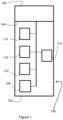
- a personal care appliance 100 includes a handle 102, an attachment 104, an operational head 106, a power source 108, a controller 110, a motor 112, a sensor 114, and a display 116.
- the personal care appliance 100 may be a hair removal appliance such as a trimmer or a shaver, for example.
- the operational head 106 is a device that performs an operation, e.g. hair removal.
- the operational head may be a cutting element.
- the cutting element includes a guard and a cutter.
- the cutter and the guard each comprise teeth which cut hair therebetween to when the cutter moves reciprocally over the guard.
- the attachment 104 attaches the operational head 106 to the handle 102.
- the power source 108 may be a battery, e.g. a secondary, or rechargeable, battery.
- the controller 110 may include storage and one or more processors.
- the storage includes electronic data in the form of instructions.
- the instructions when executed by the one or more processors, may cause the one or more processors to perform the computer-implemented methods described herein.
- the storage may be non-transitory computer readable media.
- the instructions may also be provided as transitory computer-readable media when provided as a download to be stored on the storage.
- the motor 112 may consume energy from the power source 108 when operating. This energy may be sensed by the sensor 114.
- the sensor sensed an operational parameter associated with operating the operational head. The operational parameter being current or power.
- the sensor 114 may be coupled to the handle 102.
- the display 116 may be mounted to an exterior surface of the handle 102 and communicatively linked to the controller so as to display indications generated by the controller.
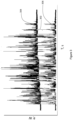
- both graphs show operational parameter values cycling between values associated with cutting hair and values associated with a free-running motor.
- the values of a free-running motor are associated with the troughs 202 and the values of cutting hair are associated with the peaks 204.
- Also shown on each graph is an average value line 206, a value plus 10% of the average value 208, and a value minus 10% of the average value 210.
- the upper figure is associated with a brand-new cutter.
- the lower figure is associated with a worn cutter. It can be seen that the amplitude between values associated with cutting hair and values associated with a free-running motor is larger for the worn cutting element, and therefore the +10% lines 208, 210, are farther apart.
- the operational parameter values can be used for determining when the operational head needs replacing since there are differences between worn and brand-new cutters.
- Embodiments provide computer-implemented method of indicating when an operational head 106 of a personal care appliance 100 needs to be replaced.
- the computer-implemented method comprises: monitoring, using a sensor of the personal care appliance, an operational parameter associated with operating the operational head; constructing a distribution of values of the operational parameter; monitor changes in the distribution over time; and sending a signal that the operational head needs replacing based on the changes in the distribution.
- Subtracting the real time values of the operational parameter from the free-running value of the operational parameter comprises: monitoring a real time free-running value 302 of the operational parameter; and subtracting the real time value 304 of the operational parameter from the real time free-running value of the operational parameter over time.
- the result of the subtraction is the real time values 306.
- the real-time free running value 302 it is possible to determine the real time free-running value of the operational parameter by using a low-pass filter on the real time values 304 of the operational parameter to discard values above a threshold.
- the threshold may be set at what is known to be a free-running value of a motor for example.
- Another way is to calculate a moving minimum value from the real time values of the operational parameter.
- the moving minimum uses a time window which moves with time.
- a minimum real time value 304 in the window is obtained and is used as the real-time free running value 302.
- Another way is to calculate a moving n th percentile value from the real time values of the operational parameter.
- n th percentile may be a 1st, 2nd or even a 3rd percentile, for example, although other percentiles may be used too.
- Another way is to obtain a standard deviation of instances of the operational parameter and calculate the threshold as a multiplication of the standard deviation by a factor greater than 1, for example 6.
- a time series plot 402 of values of the operational parameter is obtained for a use of the personal care appliance by monitoring the operational parameter.
- the time series plot 404 is shown where the values are compared to an operational parameter threshold 406. Any values of the operational parameter below the operational parameter threshold 406 are discarded. Any values of the operational parameter greater than or equal to the threshold are retained.
- the time series plot 408 is condensed. In other words, the time series plot only shows values that are at or above the threshold with no gaps between them.
- the retained instances of the operational parameter are used as values for the distribution 502.
- a number of instances, N, of each current value is obtained.
- the number of instances, N are arranged in descending order.
- a distribution is fitted to the ordered instances.
- the distribution is updated, or changed, with each use. More specifically, the number of instances, N, or values of the operational parameter, are continually updated, or aggregated, with each use such that the number of instances changes over time.
- the n th percentile 504 may be, for example, 75 th percentile, 90 th percentile, 99 th percentile, or 99.9 th percentile. Other values may also be used. As the cutter becomes more worn, the more current will be drawn when using it. Therefore, the distribution will change such that the value of the operational parameter associated with the n th percentile will shift. The shift will be an increase in the value of the operational parameter.
- the change in the distribution that is monitored over time may include a change in a value of the operational parameter associated with the nth percentile.
- In order to send the signal that the operational head needs replacing based on the changes in the distribution comprises: comparing the value of the operational parameter associated with the n th percentile to a signal threshold; sending the signal that the operational head needs replacing when value of the operational parameter associated with the nth percentile is greater than the signal threshold; and not sending the signal that the operational head needs replacing when operational parameter associated with the nth percentile is less than or equal to the signal threshold.
- the distribution may be continually updated over time. This may be done in real time or after each use.
- the signal may be a signal to a display device to display a notification to the user to replace the operational head.
- the display device 116 may be on the personal care appliance 100. In other embodiments, the display device 116 may be a remote display device.
- a computer-implemented method of indicating when an operational head 106 of a personal care appliance 100 needs to be replaced comprising: monitoring 600, using a sensor 114 of the personal care appliance, an operational parameter associated with operating the operational head; constructing 602 a distribution of values of the operational parameter; monitor 604 changes in the distribution over time; and sending 606 a signal that the operational head needs replacing based on the changes in the distribution.
Landscapes
- Life Sciences & Earth Sciences (AREA)
- Forests & Forestry (AREA)
- Engineering & Computer Science (AREA)
- Mechanical Engineering (AREA)
- Dry Shavers And Clippers (AREA)
Abstract
The subject-matter of the present disclosure relates to a computer-implemented method of indicating when an operational head (106) of a personal care appliance (100) needs to be replaced. The computer-implemented method comprises monitoring (600), using a sensor (114) of the personal care appliance, an operational parameter associated with operating the operational head, constructing (602) a distribution of values of the operational parameter, monitoring (604) changes in the distribution over time, and sending (606) a signal that the operational head needs replacing based on the changes in the distribution. There is also described a personal care appliance configured to carry out the method.
Description
- The subject-matter of the present disclosure relates to personal care appliances and indicating when an operational head of a personal care appliance requires replacing, plus transitory, or non-transitory, computer-readable media.
- Personal care appliances, such as hair cutting devices, often include a cutter. The cutter, when first installed to the personal care appliance, is sharp and cuts or shaves hair well. However, over time, the cutter or shaving device becomes blunter and requires replacing.
- Generating a replacing signal for a user can be difficult because different users have different hair types. For example, one user may have a dense beard with thick hair. Another use may have a sparse beard with finer hair. The former will blunt the cutter more than the latter.
- It is an aim of the subject-matter of the present disclosure to improve on the prior art.
- According to a first aspect of the present invention, there is provided a computer-implemented method of indicating when an operational head of a personal care appliance needs to be replaced. The computer-implemented method comprises monitoring, using a sensor of the personal care appliance, an operational parameter associated with operating the operational head, constructing a distribution of values of the operational parameter, monitoring changes in the distribution over time, and sending a signal that the operational head needs replacing based on the changes in the distribution.
- In an example, changes in the distribution over time include a change in a value of the operational parameter associated with an nth percentile.
- In an example, sending the signal that the operational head needs replacing based on the changes in the distribution comprises comparing the value of the operational parameter associated with the nth percentile to a signal threshold, sending the signal that the operational head needs replacing when value of the operational parameter associated with the nth percentile is greater than the signal threshold, not sending the signal that the operational head needs replacing when operational parameter associated with the nth percentile is less than or equal to the signal threshold.
- In an example, the constructing the distribution of values of the operational parameter comprises continually updating the distribution over time.
- In an example, the constructing a distribution of values of the operational parameter comprises comparing individually sensed instances of the operational parameter to an operational parameter threshold, discarding any instances below the operational parameter threshold, retaining any instances at or above the operational parameter threshold, and using the retained instances of the operational parameter as values for the distribution.
- In an example, the method further comprises obtaining a standard deviation of instances of the operational parameter, and setting the operational parameter threshold as the standard deviation multiplied by a factor greater than 1, for example 6.
- In an example, sending the signal that the operational head needs replacing based on the changes in the distribution comprises sending the signal to a display device to display a notification to the user to replace the operational head.
- In an example, the display device is on the personal care appliance. In another example, the display device is a remote display device.
- In an example monitoring the operational parameter sensed by a sensor of the personal care appliance comprises measuring, using the sensor, real time values of the operational parameter, and subtracting the real time values of the operational parameter from a free-running value of the operational parameter.
- In an example, subtracting the real time values of the operational parameter from the free-running value of the operational parameter comprises monitoring a real time free-running value of the operational parameter, and subtracting the real time value of the operational parameter from the real time free-running value of the operational parameter over time.
- In an example monitoring the real time free-running value of the operational parameter comprises determining the real time free-running value of the operational parameter by using a low-pass filter on the real time values of the operational parameter to discard values above a filter threshold, and/or calculating a moving minimum value from the real time values of the operational parameter, and/or calculating a moving nth percentile value from the real time values of the operational parameter.
- In an example, the personal care appliance is a hair cutting device and the operational head is a cutter, wherein optionally the hair cutting device is a trimmer.
- According to a second aspect of the invention, there is provided a transitory, or non-transitory, computer-readable medium, having instructions stored thereon, that when executed by one or more processors, cause the one or more processors to perform the aforementioned computer-implemented method.
- According to a third aspect of the invention, there is provided a personal care appliance, comprising a handle, an attachment for attaching an operational head to the handle, a sensor coupled to the handle, and a controller including a processor and storage, wherein the storage includes instructions that, when executed by the processor, cause the processor to perform the aforementioned computer-implemented method.
- These and other aspects of the present invention will be apparent from and elucidated with reference to the embodiment(s) described hereinafter.
- The embodiments of the present inventions may be best understood with reference to the accompanying figures, in which:
-
Fig. 1 shows a block diagram of a personal care appliance according to one or more embodiments; -
Fig. 2 shows a series of parameter values captured over time for respective new and worn operational heads of the personal care appliance; -
Fig. 3 shows a graph for use in determining real time values of an operational parameter minus real time free running values of the operational parameter, according to one or more embodiments; -
Fig. 4A shows a time series plot of the real time values when using the personal care appliance; -
Fig. 4B shows the time series plot fromFig. 4A of real time values above a threshold; -
Fig. 4C shows the time series plot fromFig. 4B after values below the threshold have been discarded and only values greater than or equal to the threshold have been retained; -
Fig. 5 shows the distribution of operational parameter values using the time series plot fromFig. 4C ; and -
Fig. 6 shows a flow chart summarising a computer-implemented method of indicating when an operational head of a personal care appliance needs to be replaced. - At least some of the example embodiments described herein may be constructed, partially or wholly, using dedicated special-purpose hardware. Terms such as 'component', 'module' or 'unit' used herein may include, but are not limited to, a hardware device, such as circuitry in the form of discrete or integrated components, a Field Programmable Gate Array (FPGA) or Application Specific Integrated Circuit (ASIC), which performs certain tasks or provides the associated functionality. In some embodiments, the described elements may be configured to reside on a tangible, persistent, addressable storage medium and may be configured to execute on one or more processors. These functional elements may in some embodiments include, by way of example, components, such as software components, object-oriented software components, class components and task components, processes, functions, attributes, procedures, subroutines, segments of program code, drivers, firmware, microcode, circuitry, data, databases, data structures, tables, arrays, and variables. Although the example embodiments have been described with reference to the components, modules and units discussed herein, such functional elements may be combined into fewer elements or separated into additional elements. Various combinations of optional features have been described herein, and it will be appreciated that described features may be combined in any suitable combination. In particular, the features of any one example embodiment may be combined with features of any other embodiment, as appropriate, except where such combinations are mutually exclusive. Throughout this specification, the term "comprising" or "comprises" means including the component(s) specified but not to the exclusion of the presence of others.
- With reference to
Fig. 1 , apersonal care appliance 100 according to one or more embodiments includes ahandle 102, anattachment 104, anoperational head 106, apower source 108, acontroller 110, amotor 112, asensor 114, and adisplay 116. - The
personal care appliance 100 may be a hair removal appliance such as a trimmer or a shaver, for example. Theoperational head 106 is a device that performs an operation, e.g. hair removal. The operational head may be a cutting element. The cutting element includes a guard and a cutter. The cutter and the guard each comprise teeth which cut hair therebetween to when the cutter moves reciprocally over the guard. - The
attachment 104 attaches theoperational head 106 to thehandle 102. - The
power source 108 may be a battery, e.g. a secondary, or rechargeable, battery. - The
controller 110 may include storage and one or more processors. The storage includes electronic data in the form of instructions. The instructions, when executed by the one or more processors, may cause the one or more processors to perform the computer-implemented methods described herein. In this way, the storage may be non-transitory computer readable media. The instructions may also be provided as transitory computer-readable media when provided as a download to be stored on the storage. - The
motor 112 may consume energy from thepower source 108 when operating. This energy may be sensed by thesensor 114. The sensor sensed an operational parameter associated with operating the operational head. The operational parameter being current or power. Thesensor 114 may be coupled to thehandle 102. - The
display 116 may be mounted to an exterior surface of thehandle 102 and communicatively linked to the controller so as to display indications generated by the controller. - With reference to
Fig. 2 , both graphs show operational parameter values cycling between values associated with cutting hair and values associated with a free-running motor. The values of a free-running motor are associated with thetroughs 202 and the values of cutting hair are associated with thepeaks 204. Also shown on each graph is anaverage value line 206, a value plus 10% of theaverage value 208, and a value minus 10% of theaverage value 210. The upper figure is associated with a brand-new cutter. The lower figure is associated with a worn cutter. It can be seen that the amplitude between values associated with cutting hair and values associated with a free-running motor is larger for the worn cutting element, and therefore the +10% lines - Therefore, it can be seen that the operational parameter values can be used for determining when the operational head needs replacing since there are differences between worn and brand-new cutters.
- Embodiments provide computer-implemented method of indicating when an
operational head 106 of apersonal care appliance 100 needs to be replaced. The computer-implemented method comprises: monitoring, using a sensor of the personal care appliance, an operational parameter associated with operating the operational head; constructing a distribution of values of the operational parameter; monitor changes in the distribution over time; and sending a signal that the operational head needs replacing based on the changes in the distribution. - With reference to
Fig. 3 , the monitoring the operational parameter sensed by a sensor of the personal care appliance may comprise measuring, using the sensor, real time values 304 of the operational parameter; and subtracting the real time values of the operational parameter from a free-runningvalue 302 of the operational parameter. - Subtracting the real time values of the operational parameter from the free-running value of the operational parameter comprises: monitoring a real time free-running
value 302 of the operational parameter; and subtracting thereal time value 304 of the operational parameter from the real time free-running value of the operational parameter over time. The result of the subtraction is the real time values 306. Using this method to obtain values of the operational parameter is more accurate because the free-running values are in real-time, i.e. they are continually updated rather than, for example, the free-running values being assumed to be constant. - It is possible to obtain the real-time
free running value 302 in various ways. For instance, it is possible to determine the real time free-running value of the operational parameter by using a low-pass filter on the real time values 304 of the operational parameter to discard values above a threshold. The threshold may be set at what is known to be a free-running value of a motor for example. Another way is to calculate a moving minimum value from the real time values of the operational parameter. The moving minimum uses a time window which moves with time. A minimumreal time value 304 in the window is obtained and is used as the real-timefree running value 302. Another way is to calculate a moving nth percentile value from the real time values of the operational parameter. The nth percentile may be a 1st, 2nd or even a 3rd percentile, for example, although other percentiles may be used too. Another way is to obtain a standard deviation of instances of the operational parameter and calculate the threshold as a multiplication of the standard deviation by a factor greater than 1, for example 6. - With reference to
Fig. 4A , atime series plot 402 of values of the operational parameter is obtained for a use of the personal care appliance by monitoring the operational parameter. - With reference to
Fig. 4B , thetime series plot 404 is shown where the values are compared to anoperational parameter threshold 406. Any values of the operational parameter below theoperational parameter threshold 406 are discarded. Any values of the operational parameter greater than or equal to the threshold are retained. - With reference to
Fig. 4C , thetime series plot 408 is condensed. In other words, the time series plot only shows values that are at or above the threshold with no gaps between them. - With reference to
Fig. 5 , the retained instances of the operational parameter are used as values for thedistribution 502. To construct the distribution, a number of instances, N, of each current value is obtained. The number of instances, N, are arranged in descending order. A distribution is fitted to the ordered instances. - The distribution is updated, or changed, with each use. More specifically, the number of instances, N, or values of the operational parameter, are continually updated, or aggregated, with each use such that the number of instances changes over time.
- A value of the operational parameter associated with the nth percentile is determined. The nth percentile 504 may be, for example, 75th percentile, 90th percentile, 99th percentile, or 99.9th percentile. Other values may also be used. As the cutter becomes more worn, the more current will be drawn when using it. Therefore, the distribution will change such that the value of the operational parameter associated with the nth percentile will shift. The shift will be an increase in the value of the operational parameter.
- In this way, the change in the distribution that is monitored over time may include a change in a value of the operational parameter associated with the nth percentile.
- In order to send the signal that the operational head needs replacing based on the changes in the distribution comprises: comparing the value of the operational parameter associated with the nth percentile to a signal threshold; sending the signal that the operational head needs replacing when value of the operational parameter associated with the nth percentile is greater than the signal threshold; and not sending the signal that the operational head needs replacing when operational parameter associated with the nth percentile is less than or equal to the signal threshold.
- The distribution may be continually updated over time. This may be done in real time or after each use.
- The signal may be a signal to a display device to display a notification to the user to replace the operational head.
- With reference to
Fig. 1 , thedisplay device 116 may be on thepersonal care appliance 100. In other embodiments, thedisplay device 116 may be a remote display device. - With reference to
Fig. 6 , a computer-implemented method of indicating when anoperational head 106 of apersonal care appliance 100 needs to be replaced, the computer-implemented method comprising: monitoring 600, using asensor 114 of the personal care appliance, an operational parameter associated with operating the operational head; constructing 602 a distribution of values of the operational parameter; monitor 604 changes in the distribution over time; and sending 606 a signal that the operational head needs replacing based on the changes in the distribution. - While the invention has been illustrated and described in detail in the drawings and foregoing description, such illustration and description are to be considered illustrative or exemplary and not restrictive; the invention is not limited to the disclosed embodiments.
- Other variations to the disclosed embodiments can be understood and effected by those skilled in the art in practicing the claimed invention, from a study of the drawings, the disclosure, and the appended claims. In the claims, the word "comprising" does not exclude other elements or steps, and the indefinite article "a" or "an" does not exclude a plurality. A single processor or other unit may fulfil the functions of several items recited in the claims. The mere fact that certain measures are recited in mutually different dependent claims does not indicate that a combination of these measured cannot be used to advantage. Any reference signs in the claims should not be construed as limiting the scope.
Claims (15)
- A computer-implemented method of indicating when an operational head (106) of a personal care appliance (100) needs to be replaced, the computer-implemented method comprising:monitoring (600), using a sensor (114) of the personal care appliance, an operational parameter associated with operating the operational head;constructing (602) a distribution of values of the operational parameter;monitor (604) changes in the distribution over time; andsending (606) a signal that the operational head needs replacing based on the changes in the distribution.
- The computer-implemented method of Claim 1, wherein changes in the distribution over time include a change in a value of the operational parameter associated with an nth percentile.
- The computer-implemented method of Claim 2, wherein the sending the signal that the operational head needs replacing based on the changes in the distribution comprises:comparing the value of the operational parameter associated with the nth percentile to a signal threshold;sending the signal that the operational head needs replacing when value of the operational parameter associated with the nth percentile is greater than the signal threshold; andnot sending the signal that the operational head needs replacing when operational parameter associated with the nth percentile is less than or equal to the signal threshold.
- The computer-implemented method of any preceding claim, wherein the constructing the distribution of values of the operational parameter comprises:
continually updating the distribution over time. - The computer-implemented method of any preceding claim, wherein the constructing a distribution of values of the operational parameter comprises:comparing individually sensed instances of the operational parameter to an operational parameter threshold;discarding any instances below the operational parameter threshold;retaining any instances at or above the operational parameter threshold; andusing the retained instances of the operational parameter as values for the distribution.
- The computer-implemented method of Claim 5, further comprising:obtaining a standard deviation of instances of the operational parameter,wherein the operational parameter threshold is the standard deviation multiplied by a factor greater than 1, for example 6.
- The computer-implemented method of any preceding claim, wherein the sending the signal that the operational head needs replacing based on the changes in the distribution comprises:
sending the signal to a display device (116) to display a notification to the user to replace the operational head. - The computer-implemented method of Claim 7, wherein the display device is on the personal care appliance.
- The computer-implemented method of Claim 7, wherein the display device is a remote display device.
- The computer-implemented method of any preceding claim, wherein the monitoring the operational parameter sensed by a sensor of the personal care appliance may comprises:measuring, using the sensor, real time values (304) of the operational parameter; andsubtracting the real time values of the operational parameter from a free-running value (302) of the operational parameter.
- The computer-implemented method of Claim 10, wherein the subtracting the real time values of the operational parameter from the free-running value of the operational parameter comprises:monitoring a real time free-running value of the operational parameter; andsubtracting the real time value of the operational parameter from the real time free-running value of the operational parameter over time.
- The computer-implemented method of Claim 11, wherein the monitoring the real time free-running value of the operational parameter comprises determining the real time free-running value of the operational parameter by:using a low-pass filter on the real time values of the operational parameter to discard values above a filter threshold; and/orcalculating a moving minimum value from the real time values of the operational parameter; and/orcalculating a moving nth percentile value from the real time values of the operational parameter.
- The computer-implemented method of any preceding claim, wherein the personal care appliance is a hair cutting device and the operational head is a cutter, wherein optionally the hair cutting device is a trimmer.
- A transitory, or non-transitory, computer-readable medium, having instructions stored thereon, that when executed by one or more processors, cause the one or more processors to perform the computer-implemented method of any preceding claim.
- A personal care appliance, comprising:a handle (102);an attachment (104) for attaching an operational head (106) to the handle;a sensor (114) coupled to the handle; anda controller (110) including a processor and storage, wherein the storage includes instructions that, when executed by the processor, cause the processor to perform the computer-implemented method of any of Claims 1 to 13.
Priority Applications (2)
| Application Number | Priority Date | Filing Date | Title |
|---|---|---|---|
| EP23205046.8A EP4541533A1 (en) | 2023-10-20 | 2023-10-20 | Indicating when an operational head needs replacing |
| PCT/EP2024/078933 WO2025082925A1 (en) | 2023-10-20 | 2024-10-15 | Indicating when an operational head needs replacing |
Applications Claiming Priority (1)
| Application Number | Priority Date | Filing Date | Title |
|---|---|---|---|
| EP23205046.8A EP4541533A1 (en) | 2023-10-20 | 2023-10-20 | Indicating when an operational head needs replacing |
Publications (1)
| Publication Number | Publication Date |
|---|---|
| EP4541533A1 true EP4541533A1 (en) | 2025-04-23 |
Family
ID=88506961
Family Applications (1)
| Application Number | Title | Priority Date | Filing Date |
|---|---|---|---|
| EP23205046.8A Withdrawn EP4541533A1 (en) | 2023-10-20 | 2023-10-20 | Indicating when an operational head needs replacing |
Country Status (2)
| Country | Link |
|---|---|
| EP (1) | EP4541533A1 (en) |
| WO (1) | WO2025082925A1 (en) |
Citations (5)
| Publication number | Priority date | Publication date | Assignee | Title |
|---|---|---|---|---|
| US20040098862A1 (en) * | 2002-08-21 | 2004-05-27 | Eveready Battery Company, Inc. | Razor system having razor sensors |
| US20170099199A1 (en) * | 2015-10-05 | 2017-04-06 | The Gillette Company | Systems and methods for providing device usage data |
| US20180236674A1 (en) * | 2014-10-07 | 2018-08-23 | Koninkijke Philips N.V. | Electrical appliance for performing a cutting action on hairs as present on an area of skin |
| US20190375121A1 (en) * | 2017-02-20 | 2019-12-12 | Koninklijke Philips N.V. | Operating a personal care device |
| US20230034605A1 (en) * | 2021-07-29 | 2023-02-02 | Braun Gmbh | Hair removal device |
-
2023
- 2023-10-20 EP EP23205046.8A patent/EP4541533A1/en not_active Withdrawn
-
2024
- 2024-10-15 WO PCT/EP2024/078933 patent/WO2025082925A1/en active Pending
Patent Citations (5)
| Publication number | Priority date | Publication date | Assignee | Title |
|---|---|---|---|---|
| US20040098862A1 (en) * | 2002-08-21 | 2004-05-27 | Eveready Battery Company, Inc. | Razor system having razor sensors |
| US20180236674A1 (en) * | 2014-10-07 | 2018-08-23 | Koninkijke Philips N.V. | Electrical appliance for performing a cutting action on hairs as present on an area of skin |
| US20170099199A1 (en) * | 2015-10-05 | 2017-04-06 | The Gillette Company | Systems and methods for providing device usage data |
| US20190375121A1 (en) * | 2017-02-20 | 2019-12-12 | Koninklijke Philips N.V. | Operating a personal care device |
| US20230034605A1 (en) * | 2021-07-29 | 2023-02-02 | Braun Gmbh | Hair removal device |
Also Published As
| Publication number | Publication date |
|---|---|
| WO2025082925A1 (en) | 2025-04-24 |
Similar Documents
| Publication | Publication Date | Title |
|---|---|---|
| CN115398509B (en) | Operation support method, operation support system, and operation support server | |
| US10867421B2 (en) | Seasonal aware method for forecasting and capacity planning | |
| US7257513B2 (en) | Performance monitoring system and method | |
| CN109636949A (en) | The system and method for being suitable for trend-monitoring for element condition indicator data | |
| EP3537658A1 (en) | Network detection method and apparatus | |
| US11425197B2 (en) | Condition monitoring device and method | |
| US20160100792A1 (en) | Sleep state determination apparatus, sleep state determination method, and sleep management system | |
| RU2674777C2 (en) | Electric shaver with a cleaning indicator | |
| WO2012035547A2 (en) | Apparatus that analyses attributes of diverse machine types and technically upgrades performance by applying operational intelligence and the process therefor | |
| EP4541533A1 (en) | Indicating when an operational head needs replacing | |
| CN110023048B (en) | Hair cutting device including current detector | |
| EP3616851A1 (en) | System and apparatus for monitoring the performance of an electrically powered device | |
| US20180126571A1 (en) | Oral care and grooming device | |
| EP4542321A1 (en) | Indicating when an operational head requires replacing | |
| EP4541532A1 (en) | Determining when an operational head needs replacing | |
| EP4541531A1 (en) | Determining when an operational head needs replacing | |
| CN102700718A (en) | Method for processing aviation electronic system warning information for general-purpose aircraft | |
| JP2022042721A (en) | Dehydrated state management system and dehydrated state management method | |
| CN114559297A (en) | Cutter state evaluation system and method | |
| US20210366602A1 (en) | Signal-processing device, analysis system, signal-processing method, and signal-processing program | |
| US20240293945A1 (en) | Monitoring usage of a hair cutting device | |
| CN212516080U (en) | Intelligent shaver and system | |
| JP2018057450A (en) | Drowsiness estimation device and drowsiness estimation program | |
| CN117291555B (en) | Cooperative control system for manufacturing mechanical parts | |
| CN119939157A (en) | A shear point prediction method and device based on fusion model |
Legal Events
| Date | Code | Title | Description |
|---|---|---|---|
| PUAI | Public reference made under article 153(3) epc to a published international application that has entered the european phase |
Free format text: ORIGINAL CODE: 0009012 |
|
| STAA | Information on the status of an ep patent application or granted ep patent |
Free format text: STATUS: THE APPLICATION HAS BEEN PUBLISHED |
|
| AK | Designated contracting states |
Kind code of ref document: A1 Designated state(s): AL AT BE BG CH CY CZ DE DK EE ES FI FR GB GR HR HU IE IS IT LI LT LU LV MC ME MK MT NL NO PL PT RO RS SE SI SK SM TR |
|
| STAA | Information on the status of an ep patent application or granted ep patent |
Free format text: STATUS: THE APPLICATION IS DEEMED TO BE WITHDRAWN |
|
| 18D | Application deemed to be withdrawn |
Effective date: 20251024 |