EP4539046A1 - Method for compressing a higher order ambisonics (hoa) signal, method for decompressing a compressed hoa signal, apparatus for compressing a hoa signal, and apparatus for decompressing a compressed hoa signal - Google Patents
Method for compressing a higher order ambisonics (hoa) signal, method for decompressing a compressed hoa signal, apparatus for compressing a hoa signal, and apparatus for decompressing a compressed hoa signal Download PDFInfo
- Publication number
- EP4539046A1 EP4539046A1 EP24209401.9A EP24209401A EP4539046A1 EP 4539046 A1 EP4539046 A1 EP 4539046A1 EP 24209401 A EP24209401 A EP 24209401A EP 4539046 A1 EP4539046 A1 EP 4539046A1
- Authority
- EP
- European Patent Office
- Prior art keywords
- hoa
- signals
- ambient
- amb
- spatial
- Prior art date
- Legal status (The legal status is an assumption and is not a legal conclusion. Google has not performed a legal analysis and makes no representation as to the accuracy of the status listed.)
- Pending
Links
Images






Classifications
-
- G—PHYSICS
- G10—MUSICAL INSTRUMENTS; ACOUSTICS
- G10L—SPEECH ANALYSIS TECHNIQUES OR SPEECH SYNTHESIS; SPEECH RECOGNITION; SPEECH OR VOICE PROCESSING TECHNIQUES; SPEECH OR AUDIO CODING OR DECODING
- G10L19/00—Speech or audio signals analysis-synthesis techniques for redundancy reduction, e.g. in vocoders; Coding or decoding of speech or audio signals, using source filter models or psychoacoustic analysis
- G10L19/008—Multichannel audio signal coding or decoding using interchannel correlation to reduce redundancy, e.g. joint-stereo, intensity-coding or matrixing
-
- G—PHYSICS
- G10—MUSICAL INSTRUMENTS; ACOUSTICS
- G10L—SPEECH ANALYSIS TECHNIQUES OR SPEECH SYNTHESIS; SPEECH RECOGNITION; SPEECH OR VOICE PROCESSING TECHNIQUES; SPEECH OR AUDIO CODING OR DECODING
- G10L19/00—Speech or audio signals analysis-synthesis techniques for redundancy reduction, e.g. in vocoders; Coding or decoding of speech or audio signals, using source filter models or psychoacoustic analysis
- G10L19/04—Speech or audio signals analysis-synthesis techniques for redundancy reduction, e.g. in vocoders; Coding or decoding of speech or audio signals, using source filter models or psychoacoustic analysis using predictive techniques
- G10L19/16—Vocoder architecture
- G10L19/18—Vocoders using multiple modes
- G10L19/24—Variable rate codecs, e.g. for generating different qualities using a scalable representation such as hierarchical encoding or layered encoding
-
- H—ELECTRICITY
- H04—ELECTRIC COMMUNICATION TECHNIQUE
- H04S—STEREOPHONIC SYSTEMS
- H04S3/00—Systems employing more than two channels, e.g. quadraphonic
- H04S3/008—Systems employing more than two channels, e.g. quadraphonic in which the audio signals are in digital form, i.e. employing more than two discrete digital channels
-
- H—ELECTRICITY
- H04—ELECTRIC COMMUNICATION TECHNIQUE
- H04S—STEREOPHONIC SYSTEMS
- H04S2400/00—Details of stereophonic systems covered by H04S but not provided for in its groups
- H04S2400/01—Multi-channel, i.e. more than two input channels, sound reproduction with two speakers wherein the multi-channel information is substantially preserved
-
- H—ELECTRICITY
- H04—ELECTRIC COMMUNICATION TECHNIQUE
- H04S—STEREOPHONIC SYSTEMS
- H04S2400/00—Details of stereophonic systems covered by H04S but not provided for in its groups
- H04S2400/11—Positioning of individual sound objects, e.g. moving airplane, within a sound field
-
- H—ELECTRICITY
- H04—ELECTRIC COMMUNICATION TECHNIQUE
- H04S—STEREOPHONIC SYSTEMS
- H04S2420/00—Techniques used stereophonic systems covered by H04S but not provided for in its groups
- H04S2420/11—Application of ambisonics in stereophonic audio systems
Definitions
- HOA Higher Order Ambisonics
- WFS wave field synthesis
- channel based approaches like 22.2.
- HOA representation offers the advantage of being independent of a specific loudspeaker set-up. This flexibility, however, is at the expense of a decoding process which is required for the playback of the HOA representation on a particular loudspeaker set-up.
- HOA may also be rendered to set-ups consisting of only few loudspeakers.
- a further advantage of HOA is that the same representation can also be employed without any modification for binaural rendering to head-phones.
- the final compressed representation is assumed to comprise, on the one hand, a number of quantized signals, which result from the perceptual coding of the directional signals, and relevant coefficient sequences of the ambient HOA component. On the other hand, it is assumed to comprise additional side information related to the quantized signals, which is necessary for the reconstruction of the HOA representation from its compressed version.
- the directional component is extended to a so-called predominant sound component.
- the predominant sound component is assumed to be partly represented by directional signals, i.e. monaural signals with a corresponding direction from which they are assumed to impinge on the listener, together with some prediction parameters to predict portions of the original HOA representation from the directional signals.
- the predominant sound component is supposed to be represented by so-called vector based signals, meaning monaural signals with a corresponding vector which defines the directional distribution of the vector based signals.
- the known compressed HOA representation consists of I quantized monaural signals and some additional side information, wherein a fixed number O MIN out of these I quantized monaural signals represent a spatially transformed version of the first O MIN coefficient sequences of the ambient HOA component C AMB ( k - 2).
- the type of the remaining I - O MIN signals can vary between successive frames, and be either directional, vector based, empty or representing an additional coefficient sequence of the ambient HOA component C AMB ( k - 2).
- a known method for compressing a HOA signal representation with input time frames (C(k)) of HOA coefficient sequences includes spatial HOA encoding of the input time frames and subsequent perceptual encoding and source encoding.
- the spatial HOA encoding comprises performing Direction and Vector Estimation processing of the HOA signal in a Direction and Vector Estimation block 101, wherein data comprising first tuple sets ( k ) for directional signals and second tuple sets ( k ) for vector based signals are obtained.
- gain control or normalization is performed on the transport signals y i ( k - 2) and the predicted transport signals y P, i ( k - 2), wherein gain modified transport signals z i ( k - 2), exponents e i ( k - 2) and exception flags ( ⁇ i ( k - 2) are obtained.
- One drawback of the proposed HOA compression method is that it provides a monolithic (i.e. non-scalable) compressed HOA representation.
- a monolithic (i.e. non-scalable) compressed HOA representation For certain applications, like broadcasting or internet streaming, it is however desirable to be able to split the compressed representation into a low quality base layer (BL) and a high quality enhancement layer (EL).
- the base layer is supposed to provide a low quality compressed version of the HOA representation, which can be decoded independently of the enhancement layer.
- Such a BL should typically be highly robust against transmission errors, and be transmitted at a low data rate in order to guarantee a certain minimum quality of the decompressed HOA representation even under bad transmission conditions.
- the EL contains additional information to improve the quality of the decompressed HOA representation.
- the present invention provides a solution for modifying existing HOA compression methods so as to be able to provide a compressed representation that comprises a (low quality) base layer and a (high quality) enhancement layer. Further, the present invention provides a solution for modifying existing HOA decompression methods so as to be able to decode a compressed representation that comprises at least a low quality base layer that is compressed according to the invention.
- One improvement relates to obtaining a self-contained (low quality) base layer.
- the O MIN channels that are supposed to contain a spatially transformed version of the (without loss of generality) first O MIN coefficient sequences of the ambient HOA component C AMB ( k - 2) are used as the base layer.
- An advantage of selecting the first O MIN channels for forming a base layer is their time-invariant type.
- the respective signals lack any predominant sound components, which are essential for the sound scene.
- Fig.1 shows the structure of a conventional architecture of a HOA compressor.
- the directional component is extended to a so-called predominant sound component.
- the predominant sound component is assumed to be partly represented by directional signals, meaning monaural signals with a corresponding direction from which they are assumed to impinge on the listener, together with some prediction parameters to predict portions of the original HOA representation from the directional signals.
- the predominant sound component is supposed to be represented by so-called vector based signals, meaning monaural signals with a corresponding vector which defines the directional distribution of the vector based signals.
- the overall architecture of the HOA compressor proposed in [4] is illustrated in Fig.1 .
- the frame C AMB ( k - 1) of the ambient HOA component is modified according to the information provided by the tagret assignment vector v A,T ( k - 1).
- a fade in and out of coefficient sequences is performed if the indices of the chosen coefficient sequences vary between successive frames.
- the information about the modification of the ambient HOA component is directly related to the assignment of all possible types of signals to the available channels.
- the final information about the assignment is contained in the final assignment vector v A ( k - 2).
- information contained in the target assignment vector v A,T ( k - 1) is exploited.
- All of the I gain corrected signal frames ⁇ i ( k ), i ⁇ ⁇ 1, ... , I ⁇ , are passed together with the assignment vector v AMB,ASSIGN ( k ) and the tuple sets ( k + 1) and ( k + 1) to the Channel Reassignment.
- the tuple sets ( k + 1) and ( k + 1) are defined above (for spatial HOA encoding), and the assignment vector v AMB,ASSIGN ( k ) consists of I components, which indicate for each transmission channel if and which coefficient sequence of the ambient HOA component it contains.
- the HOA representation of the predominant sound component ⁇ PS ( k - 1) is computed from the frame X ⁇ PS ( k ) of all predominant sound signals using the tuple set ( k + 1) and the set ⁇ ( k + 1) of prediction parameters, the tuple set ( k + 1) and the sets ( k - 1), ( k - 1), and ( k - 1).
- the compressed representation consists of I quantized monaural signals and some additional side information.
- a fixed number O MIN out of these I quantized monaural signals represent a spatially transformed version of the first O MIN coefficient sequences of the ambient HOA component C AMB ( k - 2).
- the type of the remaining I - O MIN signals can vary between successive frame, being either directional, vector based, empty or representing an additional coefficient sequence of the ambient HOA component C AMB ( k - 2).
- the compressed HOA representation is meant to be monolithic. In particular, one problem is how to split the described representation into a low quality base layer and an enhancement layer.
- bit stream multiplexing A possible consequent modification of the bit stream multiplexing to provide bit streams for a base layer and an enhancement layer is illustrated in Figs.3 and 4 , as described further below.
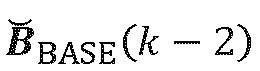
- the base layer and enhancement layer bit streams B ⁇ BASE k ⁇ 2 and B ⁇ ENH k ⁇ 2 are then jointly transmitted instead of the former total bit stream B ⁇ k ⁇ 2 .
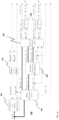
- FIG.3 and Fig.4 an apparatus for compressing a HOA signal being an input HOA representation with input time frames ( C (k)) of HOA coefficient sequences is shown.
- Said apparatus comprises a spatial HOA encoding and perceptual encoding portion for spatial HOA encoding of the input time frames and subsequent perceptual encoding, which is shown in Fig.3 , and a source coder portion for source encoding, which is shown in Fig.4 .
- the spatial HOA encoding and perceptual encoding portion comprises a Direction and Vector Estimation block 301, a HOA Decomposition block 303, an Ambient Component Modification block 304, a Channel Assignment block 305, and a plurality of Gain Control blocks 306.
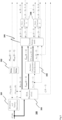
- Fig.4 shows the structure of an architecture of a source coder portion of a HOA compressor according to one embodiment of the invention.
- the source coder portion as shown in Fig.4 comprises a Perceptual Coder 310, a Side Information Source Coder block with two coders 320,330, namely a Base Layer Side Information Source Coder 320 and an Enhancement Layer Side Information Encoder 330, and two multiplexers 340,350, namely a Base Layer Bitstream Multiplexer 340 and an Enhancement Layer Bitstream Multiplexer 350.
- the Side Information Source Coders may be in a single Side Information Source Coder block.
- the Side Information Source Coders 320,330 are adapted for encoding side information comprising said exponents e i ( k - 2) and exception flags ⁇ i ( k - 2), said first tuple sets ( k ) and second tuple sets ( k ), said prediction parameters ⁇ (k-1) and said final assignment vector v A ( k - 2), wherein encoded side information ⁇ (k - 2) is obtained.
- the modification of the ambient HOA component C AMB ( k - 1) in the HOA compression is considered at the HOA decompression by appropriately modifying the HOA composition.
- the predominant sound HOA component is not added to the ambient HOA component for the first O MIN coefficient sequences, since it is already included therein. All other processing blocks of the HOA spatial decoder remain unchanged.
- Each tuple of the first tuple set ( k + 1) comprises an index of a directional signal and a respective quantized direction
- each tuple of the second tuple set ( k + 1) comprises an index of a vector based signal and a vector defining the directional distribution of the vector based signal.
- prediction parameters ⁇ (k+1) and an ambient assignment vector v AMB,ASSIGN ( k ) are obtained, wherein the ambient assignment vector v AMB,ASSIGN ( k ) comprises components that indicate for each transmission channel if and which coefficient sequence of the ambient HOA component it contains.
- Fig.6 shows the structure of an architecture of a spatial HOA decoding portion of a HOA decompressor according to one embodiment of the invention.
- the spatial HOA decoding portion comprises a plurality of inverse gain control units 604, a Channel Reassignment block 605, a Predominant Sound Synthesis block 606, and an Ambient Synthesis block 607, a HOA Composition block 608.
- the Predominant Sound Synthesis block 606 is adapted for synthesizing 912 a HOA representation of the predominant HOA sound components ⁇ PS ( k - 1) from said predominant sound signals X ⁇ PS ( k ), wherein the first and second tuple sets ( k + 1), ( k + 1), the prediction parameters ⁇ (k+1) and the second set of indices ( k - 1), ( k - 1), ( k - 1) are used.
- the ambient HOA component comprises in its O MIN lowest positions (ie. those with lowest indices) HOA coefficient sequences of the decompressed HOA signal ⁇ ( k - 1), and in remaining higher positions coefficient sequences that are part of an HOA representation of a residual.
- This residual is a residual between the decompressed HOA signal ⁇ ( k - 1) and 914 the HOA representation of the predominant HOA sound components ⁇ PS ( k - 1).
- the layered mode indication LMF D indicates a single-layer mode
- the ambient HOA component is a residual between the decompressed HOA signal ⁇ ( k - 1) and the HOA representation of the predominant sound components ⁇ PS ( k - 1).
- the HOA Composition block 608 is adapted for adding the HOA representation of the predominant sound components to the ambient HOA component ⁇ PS ( k - 1) C ⁇ ⁇ AMB k ⁇ 1 , wherein coefficients of the HOA representation of the predominant sound signals and corresponding coefficients of the ambient HOA component are added, and wherein the decompressed HOA signal ⁇ ' ( k - 1) is obtained, and wherein,
- Fig.8 shows a flow-chart of a method for compressing a HOA signal.
- the method 800 for compressing a Higher Order Ambisonics (HOA) signal being an input HOA representation of an order N with input time frames C(k) of HOA coefficient sequences comprises spatial HOA encoding of the input time frames and subsequent perceptual encoding and source encoding.
- HOA Higher Order Ambisonics
- the method further comprises a final step of multiplexing the Base Layer bitstream B ⁇ BASE ( k - 2), Enhancement Layer bitstream B ⁇ ENH ( k - 2) and mode indication into a single bitstream.
- a fade in and fade out of coefficient sequences is performed if the HOA sequence indices of the chosen HOA coefficient sequences vary between successive frames.
- the perceptual decoding and source decoding comprises steps of
- the ambient HOA component is a residual between the decompressed HOA signal ⁇ ( k - 1) and the HOA representation of the predominant HOA sound components ⁇ P S ( k - 1).
- the synthesizing 912 the HOA representation of the predominant HOA sound components ⁇ PS ( k - 1) from the predominant sound signals X ⁇ PS ( k ) in the Predominant Sound Synthesis block 606 can therefore be skipped, and the synthesizing 913 an ambient HOA component C ⁇ ⁇ AMB k ⁇ 1 from the modified ambient HOA component C ⁇ I,AMB ( k ) in the Ambient Synthesis block 607 corresponds to a conventional HOA synthesis.
Landscapes
- Engineering & Computer Science (AREA)
- Physics & Mathematics (AREA)
- Multimedia (AREA)
- Acoustics & Sound (AREA)
- Signal Processing (AREA)
- Computational Linguistics (AREA)
- Health & Medical Sciences (AREA)
- Audiology, Speech & Language Pathology (AREA)
- Human Computer Interaction (AREA)
- Quality & Reliability (AREA)
- Mathematical Physics (AREA)
- Stereophonic System (AREA)
- Circuit For Audible Band Transducer (AREA)
Abstract
Description
- This application is a European divisional application of European patent application
EP 22169940.8 (reference: A16026BEP03), which EPO Form 1001 was filed 26 April 2022 - This invention relates to a method for compressing a Higher Order Ambisonics (HOA) signal, a method for decompressing a compressed HOA signal, an apparatus for compressing a HOA signal, and an apparatus for decompressing a compressed HOA signal.
- Higher Order Ambisonics (HOA) offers a possibility to represent three-dimensional sound. Other known techniques are wave field synthesis (WFS) or channel based approaches like 22.2. In contrast to channel based methods, however, the HOA representation offers the advantage of being independent of a specific loudspeaker set-up. This flexibility, however, is at the expense of a decoding process which is required for the playback of the HOA representation on a particular loudspeaker set-up. Compared to the WFS approach, where the number of required loudspeakers is usually very large, HOA may also be rendered to set-ups consisting of only few loudspeakers. A further advantage of HOA is that the same representation can also be employed without any modification for binaural rendering to head-phones.
- HOA is based on the representation of the so-called spatial density of complex harmonic plane wave amplitudes by a truncated Spherical Harmonics (SH) expansion. Each expansion coefficient is a function of angular frequency, which can be equivalently represented by a time domain function. Hence, without loss of generality, the complete HOA sound field representation actually can be assumed to consist of O time domain functions, where O denotes the number of expansion coefficients. These time domain functions will be equivalently referred to as HOA coefficient sequences or as HOA channels in the following. Usually, a spherical coordinate system is used where the x axis points to the frontal position, the y axis points to the left, and the z axis points to the top. A position in space x = (r, θ, φ) T is represented by a radius r > 0 (i.e. the distance to the coordinate origin), an inclination angle θ ∈ [0,π] measured from the polar axis z and an azimuth angle φ ∈ [0,2π[ measured counter-clockwise in the x - y plane from the x axis.
- Further, (·) T denotes the transposition.
- A more detailed description of the HOA coding is provided in the following.
- The Fourier transform of the sound pressure with respect to time denoted by(·), i.e.,


- Here c s denotes the speed of sound and k denotes the angular wavenumber, which is related to the angular frequency ω by


- Assuming the individual coefficients
 (·)) provides time domain functions


- The position index of a time domain function


EP2743922A ,EP2665208A andEP2800401A . These approaches have in common that they perform a sound field analysis and decompose the given HOA representation into a directional and a residual ambient component. The final compressed representation is assumed to comprise, on the one hand, a number of quantized signals, which result from the perceptual coding of the directional signals, and relevant coefficient sequences of the ambient HOA component. On the other hand, it is assumed to comprise additional side information related to the quantized signals, which is necessary for the reconstruction of the HOA representation from its compressed version. - Further, a similar method is described in ISO/IEC JTC1/SC29/WG11 N14264 (Working draft 1-HOA text of MPEG-H 3D audio, January 2014, San Jose), where the directional component is extended to a so-called predominant sound component. As the directional component, the predominant sound component is assumed to be partly represented by directional signals, i.e. monaural signals with a corresponding direction from which they are assumed to impinge on the listener, together with some prediction parameters to predict portions of the original HOA representation from the directional signals. Additionally, the predominant sound component is supposed to be represented by so-called vector based signals, meaning monaural signals with a corresponding vector which defines the directional distribution of the vector based signals. The known compressed HOA representation consists of I quantized monaural signals and some additional side information, wherein a fixed number O MIN out of these I quantized monaural signals represent a spatially transformed version of the first O MIN coefficient sequences of the ambient HOA component C AMB(k - 2). The type of the remaining I - O MIN signals can vary between successive frames, and be either directional, vector based, empty or representing an additional coefficient sequence of the ambient HOA component C AMB(k - 2).
- A known method for compressing a HOA signal representation with input time frames (C(k)) of HOA coefficient sequences includes spatial HOA encoding of the input time frames and subsequent perceptual encoding and source encoding. The spatial HOA encoding, as shown in
Fig.1 a) , comprises performing Direction and Vector Estimation processing of the HOA signal in a Direction andVector Estimation block 101, wherein data comprising first tuple sets(k) for directional signals and second tuple sets (k) for vector based signals are obtained. Each of the first tuple sets comprises an index of a directional signal and a respective quantized direction, and each of the second tuple sets comprising an index of a vector based signal and a vector defining the directional distribution of the signals. A next step is decomposing 103 each input time frame of the HOA coefficient sequences into a frame of a plurality of predominant sound signals X PS (k-1) and a frame of an ambient HOA component C AMB (k-1), wherein the predominant sound signals X PS (k-1) comprise said directional sound signals and said vector based sound signals. The decomposing further provides prediction parameters ξ(k-1) and a target assignment vector v A,T(k - 1). The prediction parameters ξ(k-1) describe how to predict portions of the HOA signal representation from the directional signals within the predominant sound signals X PS (k-1) so as to enrich predominant sound HOA components, and the target assignment vector v A,T(k - 1) contains information about how to assign the predominant sound signals to a given number I of channels. The ambient HOA component C AMB(k - 1) is modified 104 according to the information provided by the target assignment vector v A,T(k - 1), wherein it is determined which coefficient sequences of the ambient HOA component are to be transmitted in the given number I of channels, depending on how many channels are occupied by predominant sound signals. A modified ambient HOA component C M,A(k - 2) and a temporally predicted modified ambient HOA component C P,M,A(k - 1) are obtained. Also a final assignment vector v A(k - 2) is obtained from information in the target assignment vector v A,T(k - 1). The predominant sound signals X PS(k-1) obtained from the decomposing, and the determined coefficient sequences of the modified ambient HOA component C M,A(k - 2) and of the temporally predicted modified ambient HOA component C P,M,A(k - 1) are assigned to the given number of channels, using the information provided by the final assignment vector v A(k - 2), wherein transport signals y i (k - 2), i = 1, ... , I and predicted transport signals y P,i(k - 2), i = 1,... , I are obtained. Then, gain control (or normalization) is performed on the transport signals y i (k - 2) and the predicted transport signals y P,i (k - 2), wherein gain modified transport signals z i(k - 2), exponents ei (k - 2) and exception flags (βi (k - 2) are obtained.
- As shown in
Fig.1 b) , the perceptual encoding and source encoding comprises perceptual coding of the gain modified transport signals z i(k - 2), wherein perceptually encoded transport signals (k),
(k), (k), the prediction parameters ξ(k-1) and the final assignment vector v A (k - 2), and encoded side information Γ̌(k - 2) is obtained. Finally, the perceptually encoded transport signals

- One drawback of the proposed HOA compression method is that it provides a monolithic (i.e. non-scalable) compressed HOA representation. For certain applications, like broadcasting or internet streaming, it is however desirable to be able to split the compressed representation into a low quality base layer (BL) and a high quality enhancement layer (EL). The base layer is supposed to provide a low quality compressed version of the HOA representation, which can be decoded independently of the enhancement layer. Such a BL should typically be highly robust against transmission errors, and be transmitted at a low data rate in order to guarantee a certain minimum quality of the decompressed HOA representation even under bad transmission conditions. The EL contains additional information to improve the quality of the decompressed HOA representation.
- The present invention provides a solution for modifying existing HOA compression methods so as to be able to provide a compressed representation that comprises a (low quality) base layer and a (high quality) enhancement layer. Further, the present invention provides a solution for modifying existing HOA decompression methods so as to be able to decode a compressed representation that comprises at least a low quality base layer that is compressed according to the invention.
- One improvement relates to obtaining a self-contained (low quality) base layer. According to the invention, the O MIN channels that are supposed to contain a spatially transformed version of the (without loss of generality) first O MIN coefficient sequences of the ambient HOA component C AMB(k - 2) are used as the base layer. An advantage of selecting the first O MIN channels for forming a base layer is their time-invariant type. However, conventionally the respective signals lack any predominant sound components, which are essential for the sound scene. This is also clear from the conventional computation of the ambient HOA component C AMB(k - 1), which is carried out by subtraction of the predominant sound HOA representation C PS(k - 1) from the original HOA representation C (k - 1) according to

- Therefore, one improvement of the invention relates to the addition of such predominant sound components. According to the invention, a solution to this problem is the inclusion of predominant sound components at a low spatial resolution into the base layer. For this purpose, the ambient HOA component C AMB(k - 1) that is output by a HOA Decomposition processing in the spatial HOA encoder according to the invention is replaced by a modified version thereof. The modified ambient HOA component comprises in the first O MIN coefficient sequences, which are supposed to be always transmitted in a spatially transformed form, the coefficient sequences of the original HOA component. This improvement of the HOA Decomposition processing can be seen as an initial operation for making the HOA compression work in a layered mode (for example dual layer mode). This mode provides e.g. two bit streams, or a single bit stream that can be split up into a base layer and an enhancement layer. Using or not using this mode is signalized by a mode indication bit (e.g. a single bit) in access units of the total bit stream.
- In one embodiment, the base layer bit stream


- Advantageous embodiments of the invention are disclosed in the claims, the following description and the figures.
- Exemplary embodiments of the invention are described with reference to the accompanying drawings, which show in
-
Fig.1 the structure of a conventional architecture of a HOA compressor; -
Fig.2 the structure of a conventional architecture of a HOA decompressor; -
Fig.3 the structure of an architecture of a spatial HOA encoding and perceptual encoding portion of a HOA compressor according to one embodiment of the invention; -
Fig.4 the structure of an architecture of a source coder portion of a HOA compressor according to one embodiment of the invention; -
Fig.5 the structure of an architecture of a perceptual decoding and source decoding portion of a HOA decompressor according to one embodiment of the invention; -
Fig.6 the structure of an architecture of a spatial HOA decoding portion of a HOA decompressor according to one embodiment of the invention; -
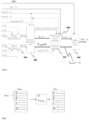
Fig.7 transformation of frames from ambient HOA signals to modified ambient HOA signals, -
Fig.8 a flow-chart of a method for compressing a HOA signal; -
Fig.9 a flow-chart of a method for decompressing a compressed HOA signal; and -
Fig.10 details of parts of an architecture of a spatial HOA decoding portion of a HOA decompressor according to one embodiment of the invention. - For easier understanding, prior art solutions in
Fig.1 andFig.2 are recapitulated in the following. -
Fig.1 shows the structure of a conventional architecture of a HOA compressor. In a method described in [4], the directional component is extended to a so-called predominant sound component. As the directional component, the predominant sound component is assumed to be partly represented by directional signals, meaning monaural signals with a corresponding direction from which they are assumed to impinge on the listener, together with some prediction parameters to predict portions of the original HOA representation from the directional signals. Additionally, the predominant sound component is supposed to be represented by so-called vector based signals, meaning monaural signals with a corresponding vector which defines the directional distribution of the vector based signals. The overall architecture of the HOA compressor proposed in [4] is illustrated inFig.1 . It can be subdivided into a spatial HOA encoding part depicted inFig.1a and a perceptual and source encoding part depicted inFig.1b . The spatial HOA encoder provides a first compressed HOA representation consisting of I signals together with side information describing how to create an HOA representation thereof. In the perceptual and side info source coder the mentioned I signals are perceptually encoded and the side information is subjected to source encoding, before multiplexing the two coded representations. - Conventionally, the spatial encoding works as follows.
- In a first step, the k-th frame C(k) of the original HOA representation is input to a Direction and Vector Estimation processing block, which provides the tuple sets(k) and
 (k). The tuple set
 (k) consists of tuples of which the first element denotes the index of a directional signal and of which the second element denotes the respective quantized direction. The tuple set
 (k) consists of tuples of which the first element indicates the index of a vector based signal and of which the second element denotes the vector defining the directional distribution of the signals, i.e. how the HOA representation of the vector based signal is computed.
- Using both tuple sets(k) and
 (k), the initial HOA frame C(k) is decomposed in the HOA Decomposition into the frame X PS(k - 1) of all predominant sound (i.e. directional and vector based) signals and the frame C AMB(k - 1) of the ambient HOA component. Note the delay of one frame, respectively, which is due to overlap add processing in order to avoid blocking artifacts. Furthermore, the HOA Decomposition is assumed to output some prediction parameters ζ(k - 1) describing how to predict portions of the original HOA representation from the directional signals in order to enrich the predominant sound HOA component. Additionally, a target assignment vector v A,T(k - 1) containing information about the assignment of predominant sound signals, which were determined in the HOA Decomposition processing block, to the I available channels is provided. The affected channels can be assumed to be occupied, meaning they are not available to transport any coefficient sequences of the ambient HOA component in the respective time frame.
- In the Ambient Component Modification processing block, the frame C AMB(k - 1) of the ambient HOA component is modified according to the information provided by the tagret assignment vector v A,T(k - 1). In particular, it is determined which coefficient sequences of the ambient HOA component are to be transmitted in the given I channels, depending, amongst other aspects, on the information (contained in the target assignment vector v A,T(k - 1)) about which channels are available and not already occupied by predominant sound signals. Additionally, a fade in and out of coefficient sequences is performed if the indices of the chosen coefficient sequences vary between successive frames.
- Furthermore, it is assumed that the first O MIN coefficient sequences of the ambient HOA component C AMB(k - 2) are always chosen to be perceptually coded and to be transmitted, where O MIN = (N MIN + 1)2 with N MIN ≤ N being typically a smaller order than that of the original HOA representation. In order to de-correlate these HOA coefficient sequences, it is proposed to transform them to directional signals (i.e. general plane wave functions) impinging from some predefined directions ΩMIN, d, d = 1, ... , O MIN.
- Along with the modified ambient HOA component C M,A(k - 1), a temporally predicted modified ambient HOA component C P,M,A(k - 1) is computed to be later used in the Gain Control processing block in order to allow a reasonable look ahead.
- The information about the modification of the ambient HOA component is directly related to the assignment of all possible types of signals to the available channels. The final information about the assignment is contained in the final assignment vector v A (k - 2). In order to compute this vector, information contained in the target assignment vector v A,T(k - 1) is exploited.
- The Channel Assignment assigns with the information provided by the assignment vector v A (k - 2) the appropriate signals contained in X PS(k - 2) and that contained in C M,A(k - 2) to the I available channels, yielding the signals y i (k - 2), i = 1, ... ,I. Further, appropriate signals contained in X PS(k - 1) and that in C P,AMB(k - 1) are also assigned to the I available channels, yielding the predicted signals yP,i (k - 2), i = 1, ... , I. Each of the signals yi (k - 2), i = 1, ... , I, is finally processed by a Gain Control, where the signal gain is smoothly modified to achieve a value range that is suitable for the perceptual encoders. The predicted signal frames yP,i (k - 2), i = 1, ... , I, allow a kind of look ahead in order to avoid severe gain changes between successive blocks. The gain modifications are assumed to be reverted in the spatial decoder with the gain control side information, consisting of the exponents ei (k - 2) and the exception flags βi (k - 2), i = 1, ... , I.
-
Fig.2 shows the structure of a conventional architecture of a HOA decompressor, as proposed in [4]. Conventionally, HOA decompression consists of the counterparts of the HOA compressor components, which are obviously arranged in reverse order. It can be subdivided into a perceptual and source decoding part depicted inFig.2a ) and a spatial HOA decoding part depicted inFig.2b ). - In the perceptual and side info source decoder, the bit stream is first de-multiplexed into the perceptually coded representation of the I signals and into the coded side information describing how to create an HOA representation thereof. Successively, a perceptual decoding of the I signals and a decoding of the side information is performed. Then, the spatial HOA decoder creates from the I signals and the side information the reconstructed HOA representation.
- Conventionally, spatial HOA decoding works as follows.
- In the spatial HOA decoder, each of the perceptually decoded signals ẑ i (k), i e {1, ... , I), is first input to an Inverse Gain Control processing block together with the associated gain correction exponent ei (k) and gain correction exception flag βi (k). The i-th Inverse Gain Control processing provides a gain corrected signal frame ŷ i (k).
- All of the I gain corrected signal frames ŷ i (k), i ∈ {1, ... , I}, are passed together with the assignment vector v AMB,ASSIGN(k) and the tuple sets(k + 1) and
 (k + 1) to the Channel Reassignment. The tuple sets
 (k + 1) and
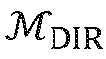 (k + 1) are defined above (for spatial HOA encoding), and the assignment vector v AMB,ASSIGN(k) consists of I components, which indicate for each transmission channel if and which coefficient sequence of the ambient HOA component it contains. In the Channel Reassignment the gain corrected signal frames ŷ i(k) are redistributed to reconstruct the frame X̂ PS(k) of all predominant sound signals (i.e., all directional and vector based signals) and the frame C I,AMB(k) of an intermediate representation of the ambient HOA component. Additionally, the set
 (k) of indices of coefficient sequences of the ambient HOA component, which are active in the k-th frame, and the sets
 (k - 1),
 (k - 1), and
 (k - 1) of coefficient indices of the ambient HOA component, which have to be enabled, disabled and to remain active in the (k - 1)-th frame, are provided.
- In the Predominant Sound Synthesis the HOA representation of the predominant sound component Ĉ PS(k - 1) is computed from the frame X̂ PS(k) of all predominant sound signals using the tuple set(k + 1) and the set ζ(k + 1) of prediction parameters, the tuple set
 (k + 1) and the sets
 (k - 1),
 (k - 1), and
 (k - 1).
- In the Ambience Synthesis, the ambient HOA component frame Ĉ AMB(k - 1) is created from the frame C I,AMB(k) of the intermediate representation of the ambient HOA component, using the set(k) of indices of coefficient sequences of the ambient HOA component which are active in the k-th frame. Note the delay of one frame, which is introduced due to the synchronization with the predominant sound HOA component. Finally, in the HOA Composition the ambient HOA component frame Ĉ AMB(k - 1) and the frame Ĉ PS(k - 1) of the predominant sound HOA component are superposed to provide the decoded HOA frame Ĉ (k - 1).

- As has become clear from the coarse description of the HOA compression and decompression method above, the compressed representation consists of I quantized monaural signals and some additional side information. A fixed number O MIN out of these I quantized monaural signals represent a spatially transformed version of the first O MIN coefficient sequences of the ambient HOA component C AMB(k - 2). The type of the remaining I - O MIN signals can vary between successive frame, being either directional, vector based, empty or representing an additional coefficient sequence of the ambient HOA component C AMB(k - 2). Taken as it is, the compressed HOA representation is meant to be monolithic. In particular, one problem is how to split the described representation into a low quality base layer and an enhancement layer.
- According to the disclosed invention, a candidate for a low quality base layer are the O MIN channels that contain a spatially transformed version of the first O MIN coefficient sequences of the ambient HOA component C AMB(k - 2). What makes these (without loss of generality: first) O MIN channels a good choice to form a low quality base layer is their time-invariant type. However, the respective signals lack any predominant sound components, which are essential for the sound scene. This can also be seen in the computation of the ambient HOA component C AMB(k - 1), which is carried out by subtraction of the predominant sound HOA representation C PS(k - 1) from the original HOA representation C(k - 1) according to

- A solution to this problem is to include the predominant sound components at a low spatial resolution into the base layer.
- Proposed amendments to the HOA compression are described in the following.
-
Fig.3 shows the structure of an architecture of a spatial HOA encoding and perceptual encoding portion of a HOA compressor according to one embodiment of the invention. To include also the predominant sound components at a low spatial resolution into the base layer, the ambient HOA component C AMB(k - 1), which is output by the HOA Decomposition processing in the spatial HOA encoder (seeFig. 1a ), is replaced by a modified version

- In other words, the first O MIN coefficient sequences of the ambient HOA component which are supposed to be always transmitted in a spatially transformed form, are replaced by the coefficient sequences of the original HOA component. The other processing blocks of the spatial HOA encoder can remain unchanged.
- It is important to note that this change of the HOA Decomposition processing can be seen as an initial operation making the HOA compression work in a so-called "dual layer" or "two layer" mode. This mode provides a bit stream that can be split up into a low quality Base Layer and an Enhancement Layer. Using or not this mode can be signalized by a single bit in access units of the total bit stream.
- A possible consequent modification of the bit stream multiplexing to provide bit streams for a base layer and an enhancement layer is illustrated in
Figs.3 and4 , as described further below. - The base layer bit stream


- In
Fig.3 andFig.4 , an apparatus for compressing a HOA signal being an input HOA representation with input time frames (C(k)) of HOA coefficient sequences is shown. Said apparatus comprises a spatial HOA encoding and perceptual encoding portion for spatial HOA encoding of the input time frames and subsequent perceptual encoding, which is shown inFig.3 , and a source coder portion for source encoding, which is shown inFig.4 . The spatial HOA encoding and perceptual encoding portion comprises a Direction andVector Estimation block 301, aHOA Decomposition block 303, an Ambient Component Modification block 304, aChannel Assignment block 305, and a plurality of Gain Control blocks 306. - The Direction and
Vector Estimation block 301 is adapted for performing Direction and Vector Estimation processing of the HOA signal, wherein data comprising first tuple sets(k) for directional signals and second tuple sets (k) for vector based signals are obtained, each of the first tuple sets
 (k) comprising an index of a directional signal and a respective quantized direction, and each of the second tuple sets
 (k) comprising an index of a vector based signal and a vector defining the directional distribution of the signals.
- The
HOA Decomposition block 303 is adapted for decomposing each input time frame of the HOA coefficient sequences into a frame of a plurality of predominant sound signals X PS (k-1) and a frame of an ambient HOA component C̃ AMB(k - 1), wherein the predominant sound signals X PS (k-1) comprise said directional sound signals and said vector based sound signals, and wherein the ambient HOA component C̃ AMB(k - 1) comprises HOA coefficient sequences representing a residual between the input HOA representation and the HOA representation of the predominant sound signals, and wherein the decomposing further provides prediction parameters ξ(k-1) and a target assignment vector v A,T(k - 1). The prediction parameters ξ(k-1) describe how to predict portions of the HOA signal representation from the directional signals within the predominant sound signals X PS (k-1) so as to enrich predominant sound HOA components, and the target assignment vector v A,T(k - 1) contains information about how to assign the predominant sound signals to a given number I of channels. - The Ambient Component Modification block 304 is adapted for modifying the ambient HOA component C AMB(k - 1) according to the information provided by the target assignment vector v A,T(k - 1), wherein it is determined which coefficient sequences of the ambient HOA component C AMB(k - 1) are to be transmitted in the given number I of channels, depending on how many channels are occupied by predominant sound signals, and wherein a modified ambient HOA component C M,A(k - 2) and a temporally predicted modified ambient HOA component C P,M,A(k - 1) are obtained, and wherein a final assignment vector v A (k - 2) is obtained from information in the target assignment vector v A,T(k - 1).
- The
Channel Assignment block 305 is adapted for assigning the predominant sound signals X PS(k-1) obtained from the decomposing, the determined coefficient sequences of the modified ambient HOA component C M,A(k - 2) and of the temporally predicted modified ambient HOA component C P,M,A(k - 1) to the given number I of channels using the information provided by the final assignment vector v A(k - 2), wherein transport signals y i (k - 2), i = 1, ... , I and predicted transport signals y P,i (k - 2), i = 1, ... , I are obtained. - The plurality of Gain Control blocks 306 is adapted for performing gain control (805) to the transport signals y i (k - 2) and the predicted transport signals y P,i (k - 2), wherein gain modified transport signals z i(k - 2), exponents ei (k - 2) and exception flags βi (k - 2) are obtained.
-
Fig.4 shows the structure of an architecture of a source coder portion of a HOA compressor according to one embodiment of the invention. The source coder portion as shown inFig.4 comprises aPerceptual Coder 310, a Side Information Source Coder block with two coders 320,330, namely a Base Layer SideInformation Source Coder 320 and an Enhancement LayerSide Information Encoder 330, and two multiplexers 340,350, namely a BaseLayer Bitstream Multiplexer 340 and an EnhancementLayer Bitstream Multiplexer 350. The Side Information Source Coders may be in a single Side Information Source Coder block. - The
Perceptual Coder 310 is adapted for perceptually coding 806 said gain modified transport signals z i(k - 2), wherein perceptually encoded transport signals
- The Side Information Source Coders 320,330 are adapted for encoding side information comprising said exponents ei (k - 2) and exception flags βi (k - 2), said first tuple sets(k) and second tuple sets
 (k), said prediction parameters ξ(k-1) and said final assignment vector v A(k - 2), wherein encoded side information Γ̌(k - 2) is obtained. The multiplexers 340,350 are adapted for multiplexing the perceptually encoded transport signals


Information Source Coder 320, wherein encoded Base Layer side information Γ̌ BASE (k - 2) is obtained, and wherein O MIN = (N MIN + 1)2 and O=(N+1)2, with N MIN ≤ N and O MIN ≤ I and N MIN is a predefined integer value. The first O MIN perceptually encoded transport signals
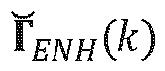
Information Source Coder 320 is one of the Side Information Source Coders, or it is within a Side Information Source Coder block. The remaining I - O MIN exponents ei (k - 2), i = O MIN + 1, ... , I and exception flags βi (k - 2), i = O MIN + 1, ..., I, said first tuple sets(k - 1) and second tuple sets (k - 1), said prediction parameters ξ(k-1) and said final assignment vector v A (k - 2) are encoded in an Enhancement Layer
Side Information Encoder 330, wherein encoded enhancement layer side information Γ̌ ENH (k - 2) is obtained. The Enhancement Layer SideInformation Source Coder 330 is one of the Side Information Source Coders, or is within a Side Information Source Coder block. - The remaining I - O MIN perceptually encoded transport signals

- In one embodiment, the apparatus for encoding further comprises a mode selector adapted for selecting a mode, the mode being indicated by the mode indication LMFE and being one of a layered mode and a non-layered mode. In the non-layered mode, the ambient HOA component C̃ AMB(k - 1) comprises only HOA coefficient sequences representing a residual between the input HOA representation and the HOA representation of the predominant sound signals (ie., no coefficient sequences of the input HOA representation).
- Proposed amendments of the HOA decompression are described in the following.
- In the layered mode, the modification of the ambient HOA component C AMB(k - 1) in the HOA compression is considered at the HOA decompression by appropriately modifying the HOA composition.
- In the HOA decompressor, the demultiplexing and decoding of the base layer and enhancement layer bit streams are performed according to
Fig.5 . The base layer bit stream B̌ BASE (k) is de-multiplexed into the coded representation of the base layer side information and the perceptually encoded signals. Subsequently, the coded representation of the base layer side information and the perceptually encoded signals are decoded to provide the exponents ei(k) and the exception flags on the one hand, and the perceptually decoded signals on the other hand. Similarly, the enhancement layer bit stream is de-multiplexed and decoded to provide the perceptually decoded signals and the remaining side information (seeFig.5 ). With this layered mode, the spatial HOA decoding part also has to be modified to consider the modification of the ambient HOA component C AMB(k - 1) in the spatial HOA encoding. The modification is accomplished in the HOA composition. - In particular, the reconstructed HOA representation



- That means that the predominant sound HOA component is not added to the ambient HOA component for the first O MIN coefficient sequences, since it is already included therein. All other processing blocks of the HOA spatial decoder remain unchanged.
- In the following, the HOA decompression in the pure presence of a low quality base layer bit stream B̌ BASE (k) is briefly considered.
- The bit stream is first de-multiplexed and decoded to provide the reconstructed signals ẑ i(k) and the corresponding gain control side information, consisting of the exponents ei (k) and the exception flags βi (k), i = 1, ..., O MIN. Note that in absence of the enhancement layer, the perceptually coded signals

- In a next step, in the spatial HOA decoder, the first O MIN Inverse Gain Control processing blocks provide gain corrected signal frames ŷ i (k), i = 1, ... , O MIN, which are used to construct the frame C I,AMB(k) of an intermediate representation of the ambient HOA component by the Channel Reassignment. Note that the set(k) of indices of coefficient sequences of the ambient HOA component, which are active in the k-th frame, contains only the

indices -
Fig.5 andFig.6 show the structure of an architecture of a HOA decompressor according to one embodiment of the invention. The apparatus comprises a perceptual decoding and source decoding portion as shown inFig.5 , a spatial HOA decoding portion as shown inFig.6 , and a mode detector adapted for detecting a layered mode indication LMFD indicating that the compressed HOA signal comprises a compressed base layer bitstream B̌ BASE (k) and a compressed enhancement layer bitstream. -
Fig.5 shows the structure of an architecture of a perceptual decoding and source decoding portion of a HOA decompressor according to one embodiment of the invention. The perceptual decoding and source decoding portion comprises afirst demultiplexer 510, asecond demultiplexer 520, a BaseLayer Perceptual Decoder 540 and an EnhancementLayer Perceptual Decoder 550, a Base Layer SideInformation Source Decoder 530 and an Enhancement Layer SideInformation Source Decoder 560. - The
first demultiplexer 510 is adapted for demultiplexing the compressed base layer bitstream B̌ BASE (k), wherein first perceptually encoded transport signals ži (k), i = 1, ..., O MIN and first encoded side information
- The
second demultiplexer 520 is adapted for demultiplexing the compressed enhancement layer bitstream B̌ ENH (k), wherein second perceptually encoded transport signals ži (k), i = O MIN + 1, ... , I and second encoded side information
- The Base
Layer Perceptual Decoder 540 and the EnhancementLayer Perceptual Decoder 550 are adapted for perceptually decoding 904 the perceptually encoded transport signals ži (k), i = 1, ... , I , wherein perceptually decoded transport signals ẑi(k) are obtained, and wherein in the BaseLayer Perceptual Decoder 540 said first perceptually encoded transport signals ži (k), i = 1, ..., O MIN of the base layer are decoded and first perceptually decoded transport signals ẑi (k), i = 1, ... , O MIN are obtained. In the EnhancementLayer Perceptual Decoder 550, said second perceptually encoded transport signals ži (k), i = O MIN + 1, ... , I of the enhancement layer are decoded and second perceptually decoded transport signals ẑi (k), i = O MIN + 1, ... , I are obtained. - The Base Layer Side
Information Source Decoder 530 is adapted for decoding 905 the first encoded side information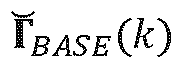
- The Enhancement Layer Side
Information Source Decoder 560 is adapted for decoding 906 the second encoded side information (k + 1) for directional signals and a second tuple set
 (k + 1) for vector based signals. Each tuple of the first tuple set
 (k + 1) comprises an index of a directional signal and a respective quantized direction, and each tuple of the second tuple set
 (k + 1) comprises an index of a vector based signal and a vector defining the directional distribution of the vector based signal. Further, prediction parameters ξ(k+1) and an ambient assignment vector v AMB,ASSIGN(k) are obtained, wherein the ambient assignment vector v AMB,ASSIGN(k) comprises components that indicate for each transmission channel if and which coefficient sequence of the ambient HOA component it contains.
-
Fig.6 shows the structure of an architecture of a spatial HOA decoding portion of a HOA decompressor according to one embodiment of the invention. The spatial HOA decoding portion comprises a plurality of inversegain control units 604, aChannel Reassignment block 605, a PredominantSound Synthesis block 606, and anAmbient Synthesis block 607, aHOA Composition block 608. - The plurality of inverse
gain control units 604 are adapted for performing inverse gain control, wherein said first perceptually decoded transport signals ẑ i (k), i = 1, ..., O MIN are transformed into first gain corrected signal frames ŷ i(k), i = 1, ... , O MIN according to the first exponents ei (k), i = 1, ... , O MIN and the first exception flags βi (k), i = 1, ... , O MIN , and wherein the second perceptually decoded transport signals ẑ i (k), i = O MIN + 1, ... ,I are transformed into second gain corrected signal frames ŷ i (k), i = O MIN + 1, ...,I according to the second exponents ei (k), i = O MIN + 1, ... , I and the second exception flags βi (k), i = O MIN + 1, ... ,I. - The
Channel Reassignment block 605 is adapted for redistributing 911 the first and second gain corrected signal frames ŷ i (k), i = 1, ... , I to I channels, wherein frames of predominant sound signals X̂ PS(k) are reconstructed, the predominant sound signals comprising directional signals and vector based signals, and wherein a modified ambient HOA component C̃ I,AMB (k) is obtained, and wherein the assigning is made according to said ambient assignment vector v AMB,ASSIGN(k) and to information in said first and second tuple sets(k + 1), (k + 1).
- Further, the
Channel Reassignment block 605 is adapted for generating a first set of indices(k) of coefficient sequences of the modified ambient HOA component that are active in a kth frame, and a second set of indices (k - 1),
 (k - 1),
 (k - 1) of coefficient sequences of the modified ambient HOA component that have to be enabled, disabled and to remain active in the (k-1)th frame.
- The Predominant
Sound Synthesis block 606 is adapted for synthesizing 912 a HOA representation of the predominant HOA sound components Ĉ PS (k - 1) from said predominant sound signals X̂ PS (k), wherein the first and second tuple sets(k + 1), (k + 1), the prediction parameters ξ(k+1) and the second set of indices
 (k - 1),
 (k - 1),
 (k - 1) are used.
- The
Ambient Synthesis block 607 is adapted for synthesizing 913 an ambient HOA component (k) is used, the first set of indices being indices of coefficient sequences of the ambient HOA component that are active in the kth frame.
- If the layered mode indication LMFD indicates a layered mode with at least two layers, the ambient HOA component comprises in its O MIN lowest positions (ie. those with lowest indices) HOA coefficient sequences of the decompressed HOA signal Ĉ (k - 1), and in remaining higher positions coefficient sequences that are part of an HOA representation of a residual. This residual is a residual between the decompressed HOA signal Ĉ (k - 1) and 914 the HOA representation of the predominant HOA sound components Ĉ PS (k - 1).
- On the other hand, if the layered mode indication LMFD indicates a single-layer mode, there are no HOA coefficient sequences of the decompressed HOA signal Ĉ (k - 1) comprised, and the ambient HOA component is a residual between the decompressed HOA signal Ĉ (k - 1) and the HOA representation of the predominant sound components Ĉ PS (k - 1).
- The
HOA Composition block 608 is adapted for adding the HOA representation of the predominant sound components to the ambient HOA component Ĉ PS (k - 1)
- if the layered mode indication LMFD indicates a layered mode with at least two layers, only the highest I-OMIN coefficient channels are obtained by addition of the predominant HOA sound components Ĉ PS(k - 1) and the ambient HOA component


-
Fig.7 shows transformation of frames from ambient HOA signals to modified ambient HOA signals. -
Fig.8 shows a flow-chart of a method for compressing a HOA signal. - The
method 800 for compressing a Higher Order Ambisonics (HOA) signal being an input HOA representation of an order N with input time frames C(k) of HOA coefficient sequences comprises spatial HOA encoding of the input time frames and subsequent perceptual encoding and source encoding. - The spatial HOA encoding comprises steps of
- performing Direction and
Vector Estimation processing 801 of the HOA signal in a Direction andVector Estimation block 301, wherein data comprising first tuple sets(k) for directional signals and second tuple sets (k) for vector based signals are obtained, each of the first tuple sets
 (k) comprising an index of a directional signal and a respective quantized direction, and each of the second tuple sets
 (k) comprising an index of a vector based signal and a vector defining the directional distribution of the signals,
- decomposing 802 in a
HOA Decomposition block 303 each input time frame of the HOA coefficient sequences into a frame of a plurality of predominant sound signals X PS (k-1) and a frame of an ambient HOA component C̃ AMB(k - 1), wherein the predominant sound signals X PS (k-1) comprise said directional sound signals and said vector based sound signals, and wherein the ambient HOA component C̃ AMB(k - 1) comprises HOA coefficient sequences representing a residual between the input HOA representation and the HOA representation of the predominant sound signals, and wherein the decomposing 702 further provides prediction parameters ξ(k-1) and a target assignment vector v A,T(k - 1), the prediction parameters ξ(k-1) describing how to predict portions of the HOA signal representation from the directional signals within the predominant sound signals X PS (k-1) so as to enrich predominant sound HOA components, and the target assignment vector v A,T(k - 1) containing information about how to assign the predominant sound signals to a given number I of channels, - modifying 803 in an Ambient Component Modification block 304 the ambient HOA component C AMB(k - 1) according to the information provided by the target assignment vector v A,T(k - 1), wherein it is determined which coefficient sequences of the ambient HOA component C AMB(k - 1) are to be transmitted in the given number I of channels, depending on how many channels are occupied by predominant sound signals, and wherein a modified ambient HOA component C M,A(k - 2) and a temporally predicted modified ambient HOA component C P,M,A(k - 1) are obtained, and wherein a final assignment vector v A(k - 2) is obtained from information in the target assignment vector v A,T(k - 1),
- assigning 804 in a
Channel Assignment block 105 the predominant sound signals X PS(k-1) obtained from the decomposing, and the determined coefficient sequences of the modified ambient HOA component C M,A(k - 2) and of the temporally predicted modified ambient HOA component C P,M,A(k - 1) to the given number I of channels using the information provided by the final assignment vector v A(k - 2), wherein transport signals y i (k - 2), i = 1, ... , I and predicted transport signals y P,i (k - 2), i = 1, ... , I are obtained, - and performing
gain control 805 to the transport signals y i (k - 2) and the predicted transport signals y P,i(k - 2) in a plurality of Gain Control blocks 306, wherein gain modified transport signals z i(k - 2), exponents ei (k - 2) and exception flags βi (k - 2) are obtained. - The perceptual encoding and source encoding comprises steps of
- perceptually coding 806 in a
Perceptual Coder 310 said gain modified transport signals z i(k - 2), wherein perceptually encoded transport signals
- encoding 807 in one or more Side Information Source Coders 320,330 side information comprising said exponents ei (k - 2) and exception flags βi (k - 2), said first tuple sets (k) and second tuple sets
 (k), said prediction parameters ξ(k-1) and said final assignment vector v A(k - 2), wherein encoded side information Γ̌(k - 2) is obtained; and
- multiplexing 808 the perceptually encoded transport signals


step 802 comprises first HOA coefficient sequences of the input HOA representation c n (k - 1) in O MIN lowest positions (ie. those with lowest indices) and second HOA coefficient sequences c AMB,n (k - 1) in remaining higher positions. The second coefficient sequences are part of an HOA representation of a residual between the input HOA representation and the HOA representation of the predominant sound signals. - The first O MIN exponents ei (k - 2), i = 1, ..., O MIN and exception flags βi (k - 2), i = 1, ..., O MIN are encoded in a Base Layer Side
Information Source Coder 320, wherein encoded Base Layer side information Γ̌ BASE (k - 2) is obtained, and wherein O MIN = (N MIN + 1)2 and O=(N+1)2, with N MIN ≤ N and O MIN ≤ I and N MIN is a predefined integer value. - The first O MIN perceptually encoded transport signals

Layer Bitstream Multiplexer 340, wherein a Base Layer bitstream B̌ BASE (k - 2) is obtained. The remaining I - O MIN exponents ei (k - 2), i = O MIN + 1, ... , I and exception flags βi (k - 2), i = O MIN + 1, ... , I , said first tuple sets(k - 1) and second tuple sets (k - 1), said prediction parameters ξ(k-1) and said final assignment vector v A (k - 2) (also shown as v AMB,ASSIGN(k) in the Figures) are encoded in an Enhancement Layer
Side Information Encoder 330, wherein encoded enhancement layer side information Γ̌ ENH (k - 2) is obtained. - The remaining I - O MIN perceptually encoded transport signals

Layer Bitstream Multiplexer 350, wherein an Enhancement Layer bitstream B̌ ENH (k - 2) is obtained. - A mode indication is added 811 that signalizes usage of a layered mode, as described above. The mode indication is added by an indication insertion block or a multiplexer.
- In one embodiment, the method further comprises a final step of multiplexing the Base Layer bitstream B̌ BASE (k - 2), Enhancement Layer bitstream B̌ ENH (k - 2) and mode indication into a single bitstream.
- In one embodiment, said dominant direction estimation is dependent on a directional power distribution of the energetically dominant HOA components.
- In one embodiment, in modifying the ambient HOA component, a fade in and fade out of coefficient sequences is performed if the HOA sequence indices of the chosen HOA coefficient sequences vary between successive frames.
- In one embodiment, in modifying the ambient HOA component, a partial decorrelation of the ambient HOA component C AMB(k - 1) is performed.
- In one embodiment, quantized direction comprised in the first tuple sets(k) is a dominant direction.

-
Fig.9 shows a flow-chart of a method for decompressing a compressed HOA signal. In this embodiment of the invention, themethod 900 for decompressing a compressed HOA signal comprises perceptual decoding and source decoding and subsequent spatial HOA decoding to obtain output time frames Ĉ (k - 1) of HOA coefficient sequences, and the method comprises a step of detecting 901 a layered mode indication LMFD indicating that the compressed Higher Order Ambisonics (HOA) signal comprises a compressed base layer bitstream B̌ BASE (k) and a compressed enhancement layer bitstream B̌ ENH (k). - The perceptual decoding and source decoding comprises steps of
- demultiplexing 902 the compressed base layer bitstream B̌ BASE (k), wherein first perceptually encoded transport signals ž i (k), i = 1,..., O MIN and first encoded side information

- demultiplexing 903 the compressed enhancement layer bitstream B̌ ENH (k), wherein second perceptually encoded transport signals ž i (k), i = O MIN + 1, ... , I and second encoded side information
- perceptually decoding 904 the perceptually encoded transport signals ž i (k), i = 1, ..., I, wherein perceptually decoded transport signals ẑ i(k) are obtained, and wherein in a Base
Layer Perceptual Decoder 540 said first perceptually encoded transport signals ž i(k), i = 1, ..., O MIN of the base layer are decoded and first perceptually decoded transport signals ẑ i (k), i = 1, ... , O MIN are obtained, and wherein in an EnhancementLayer Perceptual Decoder 550 said second perceptually encoded transport signals ž i (k), i = O MIN + 1, ... , I of the enhancement layer are decoded and second perceptually decoded transport signals ẑ i (k), i = O MIN + 1, ... , I are obtained, - decoding 905 the first encoded side information

Information Source Decoder 530, wherein first exponents ei (k), i = 1, ... , O MIN and first exception flags βi (k), i = 1, ... , O MIN are obtained, and - decoding 906 the second encoded side information

Information Source Decoder 560, wherein second exponents ei (k), i = O MIN + 1, ...,1 and second exception flags βi (k), i = O MIN + 1, ... , I are obtained, and wherein further data are obtained, the further data comprising a first tuple set(k + 1) for directional signals and a second tuple set (k + 1) for vector based signals, each tuple of the first tuple set
 (k + 1) comprising an index of a directional signal and a respective quantized direction, and each tuple of the second tuple set
 (k + 1) comprising an index of a vector based signal and a vector defining the directional distribution of the vector based signal, and further wherein prediction parameters ξ(k+1) and an ambient assignment vector v AMB,ASSIGN(k) are obtained. The ambient assignment vector v AMB,ASSIGN(k) comprises components that indicate for each transmission channel if and which coefficient sequence of the ambient HOA component it contains.
- The spatial HOA decoding comprises steps of
- performing 910 inverse gain control, wherein said first perceptually decoded transport signals ẑi (k), i = 1, ... , O MIN are transformed into first gain corrected signal frames ŷ i (k), i = 1, ... , O MIN according to said first exponents ei (k), i = 1, ... , O MIN and said first exception flags βi (k), i = 1, ... , O MIN, and wherein said second perceptually decoded transport signals ẑ i (k), i = O MIN + 1, ... , I are transformed into second gain corrected signal frames ŷ i (k), i = O MIN + 1, ...,1 according to said second exponents ei (k), i = O MIN + 1, ... , I and said second exception flags (βi (k), i = O MIN + 1, ... , I,
- redistributing 911 in a
Channel Reassignment block 605 the first and second gain corrected signal frames ŷ i(k), i = 1, ... , I to I channels, wherein frames of predominant sound signals X̂ PS(k) are reconstructed, the predominant sound signals comprising directional signals and vector based signals, and wherein a modified ambient HOA - component C̃ I,AMB (k) is obtained, and wherein the assigning is made according to said ambient assignment vector v AMB,ASSIGN(k) and to information in said first and second tuple sets (k + 1),
 (k + 1),
- generating 911b in the Channel Reassignment block 605 a first set of indices (k) of coefficient sequences of the modified ambient HOA component that are active in the kth frame, and a second set of indices
 (k - 1),
 (k - 1),
 (k - 1) of coefficient sequences of the modified ambient HOA component that have to be enabled, disabled and to remain active in the (k-1)th frame,
- synthesizing 912 in the Predominant Sound Synthesis block 606 a HOA representation of the predominant HOA sound components Ĉ PS (k - 1) from said predominant sound signals X̂PS (k), wherein the first and second tuple sets (k + 1),
 (k + 1)), the prediction parameters ξ(k+1) and the second set of indices
 (k - 1),
 (k - 1),
 (k - 1) are used,
- synthesizing 913 in the
Ambient Synthesis block 607 an ambient HOA component (k) is used, the first set of indices being indices of coefficient sequences of the ambient HOA component that are active in the kth frame, wherein the ambient HOA component has one of at least two different configurations, depending on the layered mode indication LMFD, and
- adding 914 the HOA representation of the predominant HOA sound components Ĉ PS (k - 1) and the ambient HOA component

HOA Composition block 608, wherein coefficients of the HOA representation of the predominant sound signals and corresponding coefficients of the ambient HOA component are added, and wherein the decompressed HOA signal Ĉ (k - 1) is obtained, and wherein the following conditions apply:- if the layered mode indication LMFD indicates a layered mode with at least two layers, only the highest I-OMIN coefficient channels are obtained by addition of the predominant HOA sound components Ĉ PS (k - 1) and the ambient HOA component


- if the layered mode indication LMFD indicates a layered mode with at least two layers, only the highest I-OMIN coefficient channels are obtained by addition of the predominant HOA sound components Ĉ PS (k - 1) and the ambient HOA component
- The configuration of the ambient HOA component in dependence of the layered mode indication LMFD is as follows:
If the layered mode indication LMFD indicates a layered mode with at least two layers, the ambient HOA component comprises in its O MIN lowest positions HOA coefficient sequences of the decompressed HOA signal Ĉ (k - 1), and in remaining higher positions coefficient sequences being part of an HOA representation of a residual between the decompressed HOA signal Ĉ (k - 1) and the HOA representation of the predominant HOA sound components Ĉ PS (k - 1). - On the other hand, if the layered mode indication LMFD indicates a single-layer mode, the ambient HOA component is a residual between the decompressed HOA signal Ĉ (k - 1) and the HOA representation of the predominant HOA sound components Ĉ PS(k - 1).
- In one embodiment, the compressed HOA signal representation is in a multiplexed bitstream, and the method for decompressing the compressed HOA signal further comprises an initial step of demultiplexing the compressed HOA signal representation, wherein said compressed base layer bitstream , said compressed enhancement layer bitstream B̌BENH (k) and said layered mode indication LMFD are obtained.
-
Fig.10 shows details of parts of an architecture of a spatial HOA decoding portion of a HOA decompressor according to one embodiment of the invention. - Advantageously, it is possible to decode only the BL, e.g. if no EL is received or if the BL quality is sufficient. For this case, signals of the EL can be set to zero at the decoder. Then, the redistributing 911 the first and second gain corrected signal frames ŷ i (k), i = 1, ... , I to l channels in the
Channel Reassignment block 605 is very simple, since the frames of predominant sound signals X̂ PS (k) are empty. The second set of indices(k - 1), (k - 1),
 (k - 1) of coefficient sequences of the modified ambient HOA component that have to be enabled, disabled and to remain active in the (k-1)th frame are set to zero. The synthesizing 912 the HOA representation of the predominant HOA sound components Ĉ PS (k - 1) from the predominant sound signals X̂ PS(k) in the Predominant
Sound Synthesis block 606 can therefore be skipped, and the synthesizing 913 an ambient HOA component
Ambient Synthesis block 607 corresponds to a conventional HOA synthesis. - The original (ie. monolithic, non-scalable, non-layered) mode for the HOA compression may still be useful for applications where a low quality base layer bit stream is not required, e.g. for file based compression. A major advantage of perceptually coding the spatially transformed first O MIN coefficient sequences of the ambient HOA component C AMB, which is a difference between the original and the directional HOA representation, instead of the spatially transformed coefficient sequences of the original HOA component C , is that in the former case the cross correlations between all signals to be perceptually coded are reduced. Any cross correlations between the signals z i , i = 1, ... , I may cause a constructive superposition of the perceptual coding noise during the spatial decoding process, while at the same time the noise-free HOA coefficient sequences are canceled at superposition. This phenomenon is known as perceptual noise unmasking.
- In the layered mode, there are high cross correlations between each of the signals z i , i = 1, ... , O MIN and also between the signals z i , i = 1, ... , O MIN and zi . i = O MIN + 1, ... ,I, because the modified coefficient sequences of the ambient HOA component c̃ AMB,n , n = 1, ..., O MIN include signals of the directional HOA component (see eq.(3)). To the contrary, this is not the case for the original, non-layered mode. It can therefore be concluded that the transmission robustness introduced by the layered mode may come at the expense of compression quality. However, the reduction in compression quality is low compared to the increase in transmission robustness. As has been shown above, the proposed layered mode is advantageous in at least the situations described above.
- While there has been shown, described, and pointed out fundamental novel features of the present invention as applied to preferred embodiments thereof, it will be understood that various omissions and substitutions and changes in the apparatus and method described, in the form and details of the devices disclosed, and in their operation, may be made by those skilled in the art without departing from the spirit of the present invention.. It is expressly intended that all combinations of those elements that perform substantially the same function in substantially the same way to achieve the same results are within the scope of the invention. Substitutions of elements from one described embodiment to another are also fully intended and contemplated.
- It will be understood that the present invention has been described purely by way of example, and modifications of detail can be made without departing from the scope of the invention.
- Each feature disclosed in the description and (where appropriate) the claims and drawings may be provided independently or in any appropriate combination. Features may, where appropriate be implemented in hardware, software, or a combination of the two. Connections may, where applicable, be implemented as wireless connections or wired, not necessarily direct or dedicated, connections.
- Reference numerals appearing in the claims are by way of illustration only and shall have no limiting effect on the scope of the claims.
-
- [1]
EP12306569.0 - [2]
EP12305537.8 EP2665208A ) - [3]
EP133005558.2 - [4] ISO/IEC JTC1/SC29/WG11 N14264. Working draft 1-HOAtext of MPEG-H 3D audio, January 2014
- Various aspects of the present invention may be appreciated from the following enumerated example embodiments (EEEs):
- 1. A method (800) for compressing a Higher Order Ambisonics (HOA) signal being an input HOA representation of an order N with input time frames (C(k)) of HOA coefficient sequences, said method comprising spatial HOA encoding of the input time frames and subsequent perceptual encoding and source encoding, wherein the spatial HOA encoding comprises steps of:
- performing Direction and Vector Estimation processing (801) of the HOA signal in a Direction and Vector Estimation block (301), wherein data comprising first tuple sets ((k)) for directional signals and second tuple sets (
 (k)) for vector based signals are obtained, each of the first tuple sets (
 (k)) comprising an index of a directional signal and a respective quantized direction, and each of the second tuple sets (
 (k)) comprising an index of a vector based signal and a vector defining the directional distribution of the signals;
- decomposing (802) in a HOA Decomposition block (303) each input time frame of the HOA coefficient sequences into a frame of a plurality of predominant sound signals ( X PS (k-1)) and a frame of an ambient HOA component ( C̃ AMB(k - 1)), wherein the predominant sound signals ( X PS (k-1)) comprise said directional sound signals and said vector based sound signals, and wherein the decomposing (702) further provides prediction parameters (ξ(k-1)) and a target assignment vector ( v A,T(k - 1)), the prediction parameters (ξ(k-1)) describing how to predict portions of the HOA signal representation from the directional signals within the predominant sound signals ( X PS(k-1)) so as to enrich predominant sound HOA components, and the target assignment vector ( v A,T(k - 1)) containing information about how to assign the predominant sound signals to a given number (I) of channels;
- modifying (803) in an Ambient Component Modification block (304) the ambient HOA component ( C AMB(k - 1)) according to the information provided by the target assignment vector ( v A,T(k - 1)), wherein it is determined which coefficient sequences of the ambient HOA component ( C AMB(k - 1)) are to be transmitted in the given number (I) of channels, depending on how many channels are occupied by predominant sound signals, and wherein a modified ambient HOA component ( C M,A(k - 2)) and a temporally predicted modified ambient HOA component ( C P,M,A(k - 1)) are obtained, and wherein a final assignment vector ( v A(k - 2)) is obtained from information in the target assignment vector ( v A,T(k - 1));
- assigning (804) in a Channel Assignment block (105) the predominant sound signals ( X PS(k-1)) obtained from the decomposing, and the determined coefficient sequences of the modified ambient HOA component ( C M,A(k - 2)) and of the temporally predicted modified ambient HOA component ( C P,M,A(k - 1)) to the given number (I) of channels using the information provided by the final assignment vector v A(k - 2), wherein transport signals y i (k - 2), i = 1, ... , I and predicted transport signals y P,i(k - 2), i = 1, ... , I are obtained;
- performing gain control (805) to the transport signals ( y i (k - 2)) and the predicted transport signals ( y P,i (k - 2)) in a plurality of Gain Control blocks (306), wherein gain modified transport signals ( z i (k - 2)), exponents (ei (k - 2)) and exception flags (βi (k - 2)) are obtained;
- perceptually coding (806) in a Perceptual Coder (310) said gain modified transport signals ( z i (k - 2)), wherein perceptually encoded transport signals (

- encoding (807) in a Side Information Source Coder (320,330) side information comprising said exponents (ei (k - 2)) and exception flags (βi (k - 2)), said first tuple sets ((k)) and second tuple sets (
 (k)), said prediction parameters (ξ(k-1)) and said final assignment vector ( v A(k - 2)), wherein encoded side information (Γ̌(k - 2)) is obtained; and
- multiplexing (808) the perceptually encoded transport signals (


- the ambient HOA component ( C̃ AMB(k - 1)) obtained in said decomposing (802) step comprises first HOA coefficient sequences of the input HOA representation ( c n (k - 1)) in O MIN lowest positions and second HOA coefficient sequences (c AMB,n (k - 1)) in remaining higher positions, the second HOA coefficient sequences being part of an HOA representation of a residual between the input HOA representation and the HOA representation of the predominant sound signals;
- the first O MIN exponents (ei (k - 2), i = 1, ... , OMIN ) and exception flags (βi (k - 2), i = 1, ... , OMIN ) are encoded in a Base Layer Side Information Source Coder (320), wherein encoded Base Layer side information (Γ̌ BASE (k - 2)) is obtained, and wherein O MIN = (N MIN + 1)2 and O=(N+1)2, with N MIN ≤ N and O MIN ≤ I and N MIN is a predefined integer value;
- the first O MIN perceptually encoded transport signals (

- the remaining I - O MIN exponents (ei (k - 2), i = O MIN + 1, ... , I) and exception flags (βi (k - 2), i = O MIN + 1, ... ,1), said first tuple sets ((k - 1)) and second tuple sets (
 (k - 1)), said prediction parameters (ξ(k-1)) and said final assignment vector ( v A(k - 2)) are encoded in an Enhancement Layer Side Information Encoder (330), wherein encoded enhancement layer side information (Γ̌ ENH (k - 2)) is obtained;
- the remaining I - O MIN perceptually encoded transport signals (

- a mode indication is added (811) that signalizes usage of a layered mode.
- performing Direction and Vector Estimation processing (801) of the HOA signal in a Direction and Vector Estimation block (301), wherein data comprising first tuple sets (
- 2. A method (900) for decompressing a compressed Higher Order Ambisonics (HOA) signal, the method comprising perceptual decoding and source decoding and subsequent spatial HOA decoding to obtain output time frames ( Ĉ (k - 1)) of HOA coefficient sequences, and the method comprising a step of
- detecting (901) a layered mode indication (LMFD) indicating that the compressed Higher Order Ambisonics (HOA) signal comprises a compressed base layer bitstream ( B̌ BASE (k)) and a compressed enhancement layer bitstream ( B̌ ENH (k));
- demultiplexing (902) the compressed base layer bitstream ( B̌ BASE (k)), wherein first perceptually encoded transport signals (ž i (k), i = 1, ... , OMIN ) and first encoded side information (

- demultiplexing (903) the compressed enhancement layer bitstream ( B̌ ENH (k)), wherein second perceptually encoded transport signals ( ž i (k), i = O MIN + 1, ... ,I) and second encoded side information (

- perceptually decoding (904) the perceptually encoded transport signals ( ž i (k), i = 1, ... , I), wherein perceptually decoded transport signals (ẑ i (k)) are obtained, and wherein in a Base Layer Perceptual Decoder (540) said first perceptually encoded transport signals ( ž i (k), i = 1, ... , OMIN ) of the base layer are decoded and first perceptually decoded transport signals ( ẑ i (k), i = 1, ..., OMIN ) are obtained, and wherein in an Enhancement Layer Perceptual Decoder (550) said second perceptually encoded transport signals ( ž i (k), i = O MIN + 1, ... ,1) of the enhancement layer are decoded and second perceptually decoded transport signals ( ẑ i(k),i = O MIN + 1, ... , I) are obtained;
- decoding (905) the first encoded side information (

- decoding (906) the second encoded side information (
 (k + 1)) for directional signals and a second tuple set (
 (k + 1)) for vector based signals, each tuple of the first tuple set (
 (k + 1)) comprising an index of a directional signal and a respective quantized direction, and each tuple of the second tuple set (
 (k + 1)) comprising an index of a vector based signal and a vector defining the directional distribution of the vector based signal, and further wherein prediction parameters (ξ(K+1)) and an ambient assignment vector ( v AMB,ASSIGN(k)) are obtained, wherein the ambient assignment vector ( v AMB,ASSIGN(k)) comprises components that indicate for each transmission channel if and which coefficient sequence of the ambient HOA component it contains;
- performing (910) inverse gain control (604), wherein said first perceptually decoded transport signals ( ẑ i (k), i = 1, ... , OMIN ) are transformed into first gain corrected signal frames ( ŷ i (k), i = 1, ... , OMIN ) according to said first exponents (ei (k), i = 1, ... , OMIN ) and said first exception flags (βi (k), i = 1, ... , O MIN), and wherein said second perceptually decoded transport signals ( ẑ i (k), i = O MIN + 1, ... , I) are transformed into second gain corrected signal frames ( ŷ i (k), i = O MIN + 1, ... , I) according to said second exponents (ei (k), i = O MIN + 1, ... , I) and said second exception flags (β i(k), i = O MIN + 1, ... ,I);
- redistributing (911), in a Channel Reassignment block (605), the first and second gain corrected signal frames ( ŷ i (k), i = 1, ... , I) to I channels, wherein frames of predominant sound signals ( X̂ PS (k)) are reconstructed, the predominant sound signals comprising directional signals and vector based signals, and wherein a modified ambient HOA component ( C̃ I,AMB (k)) is obtained, and wherein the assigning is made according to said ambient assignment vector ( v AMB,ASSIGN(k)) and to information in said first and second tuple sets ((k + 1),
 (k + 1));
- generating (911b), in the Channel Reassignment block (605), a first set of indices ((k)) of coefficient sequences of the modified ambient HOA component that are active in the kth frame, and a second set of indices (
 (k - 1),
 (k - 1),
 (k - 1)) of coefficient sequences of the modified ambient HOA component that have to be enabled, disabled and to remain active in the (k-1)th frame;
- synthesizing (912), in a Predominant Sound Synthesis block (606), a HOA representation of the predominant HOA sound components ( Ĉ PS (k - 1)) from said predominant sound signals ( X̂ PS(k)), wherein the first and second tuple sets ((k + 1),
 (k + 1)), the prediction parameters (ξ(k+1)) and the second set of indices (
 (k - 1),
 (k - 1),
 (k - 1)) are used;
- synthesizing (913), in an Ambient Synthesis block (607), an ambient HOA component (
 (k)) is used, the first set of indices being indices of coefficient sequences of the ambient HOA component that are active in the kth frame, wherein
- if said layered mode indication (LMFD) indicates a layered mode with at least two layers, the ambient HOA component comprises in its O MIN lowest positions HOA coefficient sequences of the decompressed HOA signal ( Ĉ (k - 1)) and in remaining higher positions coefficient sequences being part of an HOA representation of a residual between the decompressed HOA signal ( Ĉ (k - 1)) and the HOA representation of the predominant HOA sound components ( Ĉ PS (k - 1)), and
- if said layered mode indication (LMFD) indicates a single-layer mode, the ambient HOA component is a residual between the decompressed HOA signal ( Ĉ (k - 1)) and the HOA representation of the predominant HOA sound components ( Ĉ PS (k - 1)); and
- adding (914) the HOA representation of the predominant HOA sound components ( Ĉ PS (k - 1)) and the ambient HOA component (

- if said layered mode indication (LMFD) indicates a layered mode with at least two layers, only the highest I-OMIN coefficient channels are obtained by addition of the predominant HOA sound components ( Ĉ PS (k - 1)) and the ambient HOA component (


- if said layered mode indication (LMFD) indicates a single-layer mode, all coefficient channels of the decompressed HOA signal ( Ĉ (k - 1)) are obtained by addition of the predominant HOA sound components ( Ĉ PS (k - 1)) and the ambient HOA component (

- if said layered mode indication (LMFD) indicates a layered mode with at least two layers, only the highest I-OMIN coefficient channels are obtained by addition of the predominant HOA sound components ( Ĉ PS (k - 1)) and the ambient HOA component (
- 3. An apparatus for compressing a Higher Order Ambisonics (HOA) signal being an input HOA representation of an order N with input time frames (C(k)) of HOA coefficient sequences, said apparatus comprising a spatial HOA encoding and perceptual encoding portion for spatial HOA encoding of the input time frames and subsequent perceptual encoding, and a source coder portion for source encoding, wherein the spatial HOA encoding and perceptual encoding portion comprises:
- a Direction and Vector Estimation block (301) adapted for performing Direction and Vector Estimation processing of the HOA signal, wherein data comprising first tuple sets ((k)) for directional signals and second tuple sets (
 (k)) for vector based signals are obtained, each of the first tuple sets (
 (k)) comprising an index of a directional signal and a respective quantized direction, and each of the second tuple sets (
 (k)) comprising an index of a vector based signal and a vector defining the directional distribution of the signals;
- a HOA Decomposition block (303) adapted for decomposing each input time frame of the HOA coefficient sequences into a frame of a plurality of predominant sound signals ( X PS (k-1)) and a frame of an ambient HOA component (C̃ AMB(k - 1)), wherein the predominant sound signals ( X PS (k-1)) comprise said directional sound signals and said vector based sound signals, and wherein the decomposing further provides prediction parameters (ξ(k-1)) and a target assignment vector (v A,T(k - 1)), the prediction parameters (ξ(k-1)) describing how to predict portions of the HOA signal representation from the directional signals within the predominant sound signals ( X PS(k-1)) so as to enrich predominant sound HOA components, and the target assignment vector (v A,T(k - 1)) containing information about how to assign the predominant sound signals to a given number (l) of channels;
- an Ambient Component Modification block (304) adapted for modifying the ambient HOA component (C AMB(k - 1)) according to the information provided by the target assignment vector (v A,T(k - 1)), wherein it is determined which coefficient sequences of the ambient HOA component (C AMB(k - 1)) are to be transmitted in the given number (l) of channels, depending on how many channels are occupied by predominant sound signals, and wherein a modified ambient HOA component ( C M,A(k - 2)) and a temporally predicted modified ambient HOA component ( C P,M,A(k - 1)) are obtained, and wherein a final assignment vector (vA (k - 2)) is obtained from information in the target assignment vector (v A,T(k - 1));
- a Channel Assignment block (305) adapted for assigning the predominant sound signals ( X PS(k-1)) obtained from the decomposing, the determined coefficient sequences of the modified ambient HOA component ( C M,A(k - 2)) and of the temporally predicted modified ambient HOA component ( C P,M,A(k - 1)) to the given number (l) of channels using the information provided by the final assignment vector v A(k - 2), wherein transport signals y i (k - 2), i = 1, ... , I and predicted transport signals y P,i(k - 2), i = 1, ... , , I are obtained;
- a plurality of Gain Control blocks (306) adapted for performing gain control (805) to the transport signals ( y i (k - 2)) and the predicted transport signals ( y P,i (k - 2)), wherein gain modified transport signals ( z i (k - 2)), exponents (ei (k - 2)) and exception flags (βi (k - 2)) are obtained;
- a Perceptual Coder (310) adapted for perceptually coding (806) said gain modified transport signals ( z i (k - 2)), wherein perceptually encoded transport signals (žl (k - 2), i = 1, ... , I) are obtained;
- a Side Information Source Coder (320,330) adapted for encoding (807) side information comprising said exponents (ei (k - 2)) and exception flags (βi (k - 2)), said first tuple sets ((k)) and second tuple sets (
 (k)), said prediction parameters (ξ(k-1)) and said final assignment vector (v A(k - 2)), wherein encoded side information (Γ̌(k - 2)) is obtained; and
- a multiplexer (340,350) for multiplexing (808) the perceptually encoded transport signals (žl (k - 2)) and the encoded side information (Γ̌(k - 2)) into a multiplexed data stream (
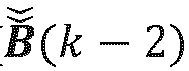
- the ambient HOA component ( C̃ AMB(k - 1)) obtained in said decomposing comprises first HOA coefficient sequences of the input HOA representation (c n (k - 1)) in OMIN lowest positions and second HOA coefficient sequences (c AMB,n (k - 1)) in remaining higher positions, the second HOA coefficient sequences being part of an HOA representation of a residual between the input HOA representation and the HOA representation of the predominant sound signals;
- the first O MIN exponents (ei (k - 2), i = 1, ... , OMIN ) and exception flags (βi (k - 2), i = 1, ... , OMIN ) are encoded in a Base Layer Side Information Source Coder (320) within said Side Information Source Coder, wherein encoded Base Layer side information (Γ̌BASE(k - 2)) is obtained, and wherein O MIN = (N MIN + 1)2 and O=(N+1)2, with N MIN ≤ N and O MIN ≤ I and N MIN is a predefined integer value;
- the first O MIN perceptually encoded transport signals ( ž l (k - 2), i = 1, ... , OMIN ) and the encoded Base Layer side information (Γ̌ BASE (k - 2)) are multiplexed in a Base Layer Bitstream Multiplexer (340) within said multiplexer, wherein a Base Layer bitstream ( B̌ BASE (k - 2)) is obtained;
- the remaining I - O MIN exponents (ei (k - 2), i = O MIN + 1, ... , I) and exception flags (βi (k - 2), i = O MIN + 1, ... ,1), said first tuple sets ((k - 1)) and second tuple sets (
 (k - 1)), said prediction parameters (ξ(k-1)) and said final assignment vector (v A(k - 2)) are encoded in an Enhancement Layer Side Information Encoder (330) within said Side Information Source Coder, wherein encoded enhancement layer side information (Γ̌ ENH (k - 2)) is obtained;
- the remaining I - O MIN perceptually encoded transport signals ( ž l (k - 2), i = O MIN + 1, ... , I) and the encoded enhancement layer side information (Γ̌ ENH (k - 2)) are multiplexed in an Enhancement Layer Bitstream Multiplexer (350) within said multiplexer, wherein an Enhancement Layer bitstream ( B̌ ENH (k - 2)) is obtained; and
- in a multiplexer or adder, a mode indication is added that signalizes usage of a layered mode.
- a Direction and Vector Estimation block (301) adapted for performing Direction and Vector Estimation processing of the HOA signal, wherein data comprising first tuple sets (
- 4. An apparatus for decompressing a compressed Higher Order Ambisonics (HOA) signal to obtain output time frames ( Ĉ (k - 1)) of HOA coefficient sequences, the apparatus comprising a perceptual decoding and source decoding portion and a spatial HOA decoding portion, and the apparatus comprising
- a mode detector adapted for detecting (901) a layered mode indication (LMFD) indicating that the compressed Higher Order Ambisonics (HOA) signal comprises a compressed base layer bitstream ( B̌ BASE (k)) and a compressed enhancement layer bitstream ( B̌ ENH (k));
- a first demultiplexer (510) for demultiplexing (902) the compressed base layer bitstream ( B̌ BASE (k)), wherein first perceptually encoded transport signals ( ž i (k), i = 1, ..., OMIN ) and first encoded side information (

- a second demultiplexer (520) for demultiplexing (903) the compressed enhancement layer bitstream ( B̌ ENH(k)), wherein second perceptually encoded transport signals ( ž i (k), i = O MIN + 1, ... , I) and second encoded side information (

- a Base Layer Perceptual Decoder (540) and an Enhancement Layer Perceptual Decoder (550) adapted for perceptually decoding (904) the perceptually encoded transport signals ( ž i (k), i = 1, ... , I), wherein perceptually decoded transport signals ( ẑ i (k)) are obtained, and wherein in the Base Layer Perceptual Decoder (540) said first perceptually encoded transport signals ( ž i (k), i = 1, ..., OMIN ) of the base layer are decoded and first perceptually decoded transport signals ( ẑ i (k), i = 1, ..., OMIN ) are obtained, and wherein in the Enhancement Layer Perceptual Decoder (550) said second perceptually encoded transport signals ( ž i (k), i = O MIN + 1, ... , I) of the enhancement layer are decoded and second perceptually decoded transport signals ( ẑ i (k), i = O MIN + 1, ... , I) are obtained;
- a Base Layer Side Information Source Decoder (530) adapted for decoding (905) the first encoded side information (

- an Enhancement Layer Side Information Source Decoder (560) adapted for decoding (906) the second encoded side information (
 (k + 1)) for directional signals and a second tuple set (
 (k + 1)) for vector based signals, each tuple of the first tuple set (
 (k + 1)) comprising an index of a directional signal and a respective quantized direction, and each tuple of the second tuple set (
 (k + 1)) comprising an index of a vector based signal and a vector defining the directional distribution of the vector based signal, and further wherein prediction parameters (ξ(K+1)) and an ambient assignment vector (v AMB,ASSIGN(k)) are obtained, wherein the ambient assignment vector (v AMB,ASSIGN(k)) comprises components that indicate for each transmission channel if and which coefficient sequence of the ambient HOA component it contains;
- a plurality of inverse gain control units for performing (910) inverse gain control (604), wherein said first perceptually decoded transport signals ( ẑ i (k), i = 1, ..., OMIN ) are transformed into first gain corrected signal frames ( ŷ i (k), i = 1 ,..., OMIN ) according to said first exponents (ei (k), i = 1, ..., OMIN ) and said first exception flags (βi (k), i = 1, ..., O MIN), and wherein said second perceptually decoded transport signals ( ẑ i (k), i = O MIN + 1, ...,I) are transformed into second gain corrected signal frames ( ŷ i (k), i = O MIN + 1, ... , I) according to said second exponents (ei (k), i = O MIN + 1, ... , I) and said second exception flags (βi (k), i = O MIN + 1, ... ,I);
- a Channel Reassignment block (605) adapted for redistributing (911) the first and second gain corrected signal frames ( ŷ i (k), i = 1,..., I) to I channels, wherein frames of predominant sound signals ( X̂ PS (k)) are reconstructed, the predominant sound signals comprising directional signals and vector based signals, and wherein a modified ambient HOA component ( C̃ I,AMB (k)) is obtained, and wherein the assigning is made according to said ambient assignment vector (v AMB,ASSIGN(k)) and to information in said first and second tuple sets
 (k)) of coefficient sequences of the modified ambient HOA component that are active in a kth frame, and a second set of indices (
 (k - 1),
 (k - 1),
 (k - 1)) of coefficient sequences of the modified ambient HOA component that have to be enabled, disabled and to remain active in the (k-1)th frame;
- a Predominant Sound Synthesis block (606) adapted for synthesizing (912) a HOA representation of the predominant HOA sound components ( Ĉ PS (k - 1)) from said predominant sound signals ( X̂ PS (k)), wherein the first and second tuple sets ((k + 1),
 (k + 1)), the prediction parameters (ξ(k+1)) and the second set of indices (
 (k - 1),
 (k - 1),
 (k - 1)) are used;
- an Ambient Synthesis block (607) adapted for synthesizing (913) an ambient HOA component (
 (k)) is used, the first set of indices being indices of coefficient sequences of the ambient HOA component that are active in the kth frame, wherein
- if said layered mode indication (LMFD) indicates a layered mode with at least two layers, the ambient HOA component comprises in its OMIN lowest positions HOA coefficient sequences of the decompressed HOA signal ( Ĉ (k - 1)) and in remaining higher positions coefficient sequences being part of an HOA representation of a residual between the decompressed HOA signal ( Ĉ (k - 1)) and the HOA representation of the predominant HOA sound components ( Ĉ PS (k - 1)), and
- if said layered mode indication (LMFD) indicates a single-layer mode, the ambient HOA component is a residual between the decompressed HOA signal ( Ĉ (k - 1)) and the HOA representation of the predominant HOA sound components ( Ĉ PS (k - 1)); and
- a HOA Composition block (608) adapted for adding (914) the HOA representation of the predominant HOA sound components ( Ĉ PS (k - 1)) to the ambient HOA component (

- if said layered mode indication (LMFD) indicates a layered mode with at least two layers, only the highest I-OMIN coefficient channels are obtained by addition of the predominant HOA sound components ( Ĉ PS (k - 1)) and the ambient HOA component (

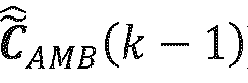
- if said layered mode indication (LMFD) indicates a single-layer mode, all coefficient channels of the decompressed HOA signal ( Ĉ '(k - 1)) are obtained by addition of the predominant HOA sound components ( Ĉ PS (k - 1)) and the ambient HOA component (

- if said layered mode indication (LMFD) indicates a layered mode with at least two layers, only the highest I-OMIN coefficient channels are obtained by addition of the predominant HOA sound components ( Ĉ PS (k - 1)) and the ambient HOA component (
- 5. A non-transitory computer readable storage medium having executable instructions to cause a computer to perform a method (800) for compressing a Higher Order Ambisonics (HOA) signal being an input HOA representation of an order N with input time frames (C(k)) of HOA coefficient sequences, said method comprising spatial HOA encoding of the input time frames and subsequent perceptual encoding and source encoding, wherein the spatial HOA encoding comprises steps of:
- performing Direction and Vector Estimation processing (801) of the HOA signal in a Direction and Vector Estimation block (301), wherein data comprising first tuple sets ((k)) for directional signals and second tuple sets (
 (k)) for vector based signals are obtained, each of the first tuple sets (
 (k)) comprising an index of a directional signal and a respective quantized direction, and each of the second tuple sets (
 (k)) comprising an index of a vector based signal and a vector defining the directional distribution of the signals;
- decomposing (802) in a HOA Decomposition block (303) each input time frame of the HOA coefficient sequences into a frame of a plurality of predominant sound signals ( X PS (k-1)) and a frame of an ambient HOA component ( C̃ AMB(k - 1)), wherein the predominant sound signals ( X PS (k-1)) comprise said directional sound signals and said vector based sound signals, and wherein the decomposing (702) further provides prediction parameters (ξ(k-1)) and a target assignment vector (v A,T(k - 1)), the prediction parameters (ξ(k-1)) describing how to predict portions of the HOA signal representation from the directional signals within the predominant sound signals ( X PS (k-1)) so as to enrich predominant sound HOA components, and the target assignment vector (v A,T(k - 1)) containing information about how to assign the predominant sound signals to a given number (l) of channels;
- modifying (803) in an Ambient Component Modification block (304) the ambient HOA component ( C AMB(k - 1)) according to the information provided by the target assignment vector (v A,T(k - 1)), wherein it is determined which coefficient sequences of the ambient HOA component ( C AMB(k - 1)) are to be transmitted in the given number (l) of channels, depending on how many channels are occupied by predominant sound signals, and wherein a modified ambient HOA component ( C M,A(k - 2)) and a temporally predicted modified ambient HOA component ( C P,M,A(k - 1)) are obtained, and wherein a final assignment vector (v A(k - 2)) is obtained from information in the target assignment vector (v A,T(k - 1));
- assigning (804) in a Channel Assignment block (105) the predominant sound signals ( X PS(k-1)) obtained from the decomposing, and the determined coefficient sequences of the modified ambient HOA component ( C M,A(k - 2)) and of the temporally predicted modified ambient HOA component ( C P,M,A(k - 1)) to the given number (l) of channels using the information provided by the final assignment vector v A(k - 2), wherein transport signals yi (k - 2), i = 1, ... , I and predicted transport signals y P,i (k - 2), i = 1, ... , I are obtained;
- performing gain control (805) to the transport signals ( y i (k - 2)) and the predicted transport signals ( y P,i (k - 2)) in a plurality of Gain Control blocks (306), wherein gain modified transport signals ( z i (k - 2)), exponents (ei (k - 2)) and exception flags (βi (k - 2)) are obtained;
- perceptually coding (806) in a Perceptual Coder (310) said gain modified transport signals ( z i (k - 2)), wherein perceptually encoded transport signals (

- encoding (807) in a Side Information Source Coder (320,330), side information comprising said exponents (ei (k - 2)) and exception flags (βi (k - 2)), said first tuple sets ((k)) and second tuple sets (
 (k)), said prediction parameters (ξ(k-1)) and said final assignment vector (v A(k - 2)), wherein encoded side information (Γ̌(k - 2)) is obtained; and
- multiplexing (808) the perceptually encoded transport signals (


- the ambient HOA component ( C̃ AMB(k - 1)) obtained in said decomposing (802) step comprises first HOA coefficient sequences of the input HOA representation (c n (k - 1)) in OMIN lowest positions and second HOA coefficient sequences (c AMB,n (k - 1)) in remaining higher positions, the second HOA coefficient sequences being part of an HOA representation of a residual between the input HOA representation and the HOA representation of the predominant sound signals;
- the first O MIN exponents (ei (k - 2), i = 1, ... , OMIN ) and exception flags (βi (k - 2), i = 1,..., OMIN ) are encoded in a Base Layer Side Information Source Coder (320), wherein encoded Base Layer side information (Γ̌ BASE (k - 2)) is obtained, and wherein O MIN = (N MIN + 1)2 and O=(N+1)2, with N MIN ≤ N and O MIN ≤ I and N MIN is a predefined integer value;
- the first O MIN perceptually encoded transport signals ( ž l (k - 2), i = 1,..., OMIN ) and the encoded Base Layer side information (Γ̌ BASE (k - 2)) are multiplexed (809) in a Base Layer Bitstream Multiplexer (340), wherein a Base Layer bitstream ( B̌ BASE (k - 2)) is obtained;
- the remaining I - O MIN exponents (ei (k - 2), i = O MIN + 1, ... , I) and exception flags (βi (k - 2), i = O MIN + 1, ... , I), said first tuple sets ((k - 1)) and second tuple sets (
 (k - 1)), said prediction parameters (ξ(k-1)) and said final assignment vector (v A(k - 2)) are encoded in an Enhancement Layer Side Information Encoder (330), wherein encoded enhancement layer side information (Γ̌ ENH (k - 2)) is obtained;
- the remaining I - O MIN perceptually encoded transport signals (

- a mode indication is added (811) that signalizes usage of a layered mode.
- performing Direction and Vector Estimation processing (801) of the HOA signal in a Direction and Vector Estimation block (301), wherein data comprising first tuple sets (
- 6. A non-transitory computer readable storage medium having executable instructions to cause a computer to perform a method (900) for decompressing a compressed Higher Order Ambisonics (HOA) signal, the method comprising perceptual decoding and source decoding and subsequent spatial HOA decoding to obtain output time frames ( Ĉ (k - 1)) of HOA coefficient sequences, and the method comprising a step of
- detecting (901) a layered mode indication (LMFD) indicating that the compressed Higher Order Ambisonics (HOA) signal comprises a compressed base layer bitstream ( B̌ BASE (k)) and a compressed enhancement layer bitstream ( B̌ ENH (k));
- demultiplexing (902) the compressed base layer bitstream ( B̌ BASE (k)), wherein first perceptually encoded transport signals ( ž i (k), i = 1,..., OMIN ) and first encoded side information (

- demultiplexing (903) the compressed enhancement layer bitstream ( B̌ ENH (k)), wherein second perceptually encoded transport signals ( ž i (k), i = O MIN + 1, ... ,I) and second encoded side information (
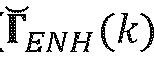
- perceptually decoding (904) the perceptually encoded transport signals ( ž i (k), i = 1, ..., I), wherein perceptually decoded transport signals ( ẑ i (k)) are obtained, and wherein in a Base Layer Perceptual Decoder (540) said first perceptually encoded transport signals ( ž i (k), i = 1, ... , OMIN ) of the base layer are decoded and first perceptually decoded transport signals ( ẑ i (k), i = 1, ..., OMIN ) are obtained, and wherein in an Enhancement Layer Perceptual Decoder (550) said second perceptually encoded transport signals (ži (k), i = O MIN + 1, ... , I) of the enhancement layer are decoded and second perceptually decoded transport signals ( ẑ i (k), i = O MIN + 1, ... , I) are obtained;
- decoding (905) the first encoded side information (

- decoding (906) the second encoded side information (
 (k + 1)) for directional signals and a second tuple set (
 (k + 1)) for vector based signals, each tuple of the first tuple set (
 (k + 1)) comprising an index of a directional signal and a respective quantized direction, and each tuple of the second tuple set (
 (k + 1)) comprising an index of a vector based signal and a vector defining the directional distribution of the vector based signal, and further wherein prediction parameters (ξ(K+1)) and an ambient assignment vector (v AMB,ASSIGN(k)) are obtained, wherein the ambient assignment vector (v AMB,ASSIGN(k)) comprises components that indicate for each transmission channel if and which coefficient sequence of the ambient HOA component it contains;
- performing (910) inverse gain control (604), wherein said first perceptually decoded transport signals ( ẑ i (k) , i = 1, ..., OMIN ) are transformed into first gain corrected signal frames ( ŷ i (k), i = 1, ..., OMIN ) according to said first exponents (ei (k), i = 1,..., OMIN ) and said first exception flags (βi (k), i = 1, ..., O MIN), and wherein said second perceptually decoded transport signals ( ẑ i (k), i = O MIN + 1, ... , I) are transformed into second gain corrected signal frames ( ŷ i (k), i = O MIN + 1, ... , I) according to said second exponents (ei (k), i = O MIN + 1, ... , I) and said second exception flags (βi (k), i = O MIN + 1, ... ,1);
- redistributing (911), in a Channel Reassignment block (605), the first and second gain corrected signal frames ( ŷ i (k), i = 1, ... , I) to I channels, wherein frames of predominant sound signals ( X̂ PS (k)) are reconstructed, the predominant sound signals comprising directional signals and vector based signals, and wherein a modified ambient HOA component ( C̃ I,AMB (k)) is obtained, and wherein the assigning is made according to said ambient assignment vector (v AMB,ASSIGN(k)) and to information in said first and second tuple sets ((k + 1),
 (k + 1));
- generating (911b), in the Channel Reassignment block (605), a first set of indices ((k)) of coefficient sequences of the modified ambient HOA component that are active in the kth frame, and a second set of indices (
 (k - 1),
 (k - 1),
 (k - 1)) of coefficient sequences of the modified ambient HOA component that have to be enabled, disabled and to remain active in the (k-1)th frame;
- synthesizing (912), in a Predominant Sound Synthesis block (606), a HOA representation of the predominant HOA sound components ( Ĉ PS (k - 1)) from said predominant sound signals ( X̂ PS (k)), wherein the first and second tuple sets ((k + 1),
 (k + 1)), the prediction parameters (ξ(K+1)) and the second set of indices (
 (k - 1),
 (k - 1),
 (k - 1)) are used;
- synthesizing (913), in an Ambient Synthesis block (607), an ambient HOA component (
 (k)) is used, the first set of indices being indices of coefficient sequences of the ambient HOA component that are active in the kth frame, wherein
- if said layered mode indication (LMFD) indicates a layered mode with at least two layers, the ambient HOA component comprises in its OMIN lowest positions HOA coefficient sequences of the decompressed HOA signal ( Ĉ (k - 1)) and in remaining higher positions coefficient sequences being part of an HOA representation of a residual between the decompressed HOA signal ( Ĉ (k - 1)) and the HOA representation of the predominant HOA sound components (ĈPS (k - 1)), and
- if said layered mode indication (LMFD) indicates a single-layer mode, the ambient HOA component is a residual between the decompressed HOA signal ( Ĉ (k - 1)) and the HOA representation of the predominant HOA sound components ( Ĉ PS (k - 1)); and
- adding (914) the HOA representation of the predominant HOA sound components ( Ĉ PS (k - 1)) and the ambient HOA component (

- if said layered mode indication (LMFD) indicates a layered mode with at least two layers, only the highest I-OMIN coefficient channels are obtained by addition of the predominant HOA sound components ( Ĉ PS (k - 1)) and the ambient HOA component (
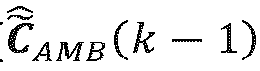

- if said layered mode indication (LMFD) indicates a single-layer mode, all coefficient channels of the decompressed HOA signal ( Ĉ (k - 1)) are obtained by addition of the predominant HOA sound components ( Ĉ PS (k - 1)) and the ambient HOA component (

- if said layered mode indication (LMFD) indicates a layered mode with at least two layers, only the highest I-OMIN coefficient channels are obtained by addition of the predominant HOA sound components ( Ĉ PS (k - 1)) and the ambient HOA component (
Claims (13)
- A spatial Higher Order Ambisonics (HOA) decoding portion for an HOA decoder for generating output time frames of HOA coefficient sequences, wherein the spatial HOA decoding portion is configured to:- receive perceptually decoded transport signals;- receive a layered mode indication LMFD indicating whether the compressed HOA signal comprises at least two layers;and wherein the spatial HOA decoding portion comprises:- a Channel Reassignment block (605) adapted for redistributing (911) the gain corrected signal frames to I channels based on ambient assignment vector (vAMB,ASSIGN ) and first and second tuple sets (,
 ), wherein the redistributing determines predominant sound signals ( X̂ PS ) and an intermediate representation of the ambient HOA components ( C̃ I,AMB );
 - a Predominant Sound Synthesis block (606) adapted for synthesizing (912) a HOA representation of the predominant HOA sound components ( Ĉ PS ) from said predominant sound signals ( X̂ PS ), based on the first and second tuple sets (,
 ), prediction parameters (ξ) and a set of indices (
 ,
, ,
, ) ;
) ; - an Ambient Synthesis block (607) adapted for synthesizing (913) ambient HOA components (
 - a HOA composition block (608), wherein the HOA composition block determines that the layered mode indication (LMFD) indicates a layered mode with at least two layers, and, wherein the HOA composition is adapted to, based on the layered mode indication, to determine a first set of decompressed HOA signals based on only a first subset of the ambient HOA components (

- A spatial Higher Order Ambisonics (HOA) decoding portion according to claim 1, wherein the HOA decoder comprises:a base layer perceptual decoder configured to decode first perceptually encoded transport signals of a base layer of the at least two layers to obtain first perceptually decoded transport signals of the perceptually decoded transport signals, andan enhancement layer perceptual decoder configured to decode second perceptually encoded transport signals of an enhancement layer to obtain second perceptually decoded transport signals of the perceptually decoded transport signals.
- A spatial HOA decoding portion according to claim 2, wherein the HOA decoder further comprises:a first demultiplexer adapted for demultiplexing a compressed base layer bitstream to obtain the first perceptually encoded transport signals and first encoded side information;a second demultiplexer adapted for demultiplexing the compressed enhancement layer bitstream to obtain the second perceptually encoded transport signals and second encoded side information.
- A spatial HOA decoding portion according to claim 3, wherein the HOA decoder comprises a base layer side information source decoder configured to decode the first encoded side information to obtain the first exponents and the first exception flags.
- A spatial HOA decoding portion according to claim 3 or 4, wherein the HOA decoder comprises an enhancement layer side information source decoder configured to decode the second encoded side information to obtain the second exponents, the second exception flags and further data.
- A spatial HOA decoding portion according to claim 5, wherein the further data comprises the first tuple set and the second tuple set.
- A spatial HOA decoding portion according to claim 5 or 6, wherein the further data comprises the prediction parameters the ambient assignment vector.
- A spatial HOA decoding portion according to any preceding claim, wherein each tuple of the first tuple setcomprises an index of a directional signal and respective quantized direction, and wherein each tuple of the second tuple set
 comprises an index of a vector-based signal and a vector defining the directional distribution of the vector-based signal.
- A spatial HOA decoding portion according to any preceding claim, wherein the ambient assignment vector (vAMB,ASSIGN ) comprises components that indicate for each transmission channel if and which coefficient sequence of the ambient HOA component it contains.
- A spatial HOA decoding portion according to any preceding claim, wherein the set of indices,
 ,
, are indices of coefficient sequences of the modified ambient HOA component that have to be enabled, disabled and to remain active, respectively.
- A spatial HOA decoding portion according to claim 8, wherein the quantized direction comprised in the first tuple setis a dominant direction.

- A method of spatial Higher Order Ambisonics (HOA) decoding for generating output time frames of HOA coefficient sequences, the method comprising:- receiving perceptually decoded transport signals,- receiving a layered mode indication LMFD indicating whether the compressed HOA signal comprises at least two layers,- performing (910) inverse gain control, wherein the perceptually decoded transport signals are transformed into gain corrected signal frames according to exponents and exception flags;- redistributing (911) the gain corrected signal frames to I channels based on ambient assignment vector (v AMB,ASSIGN ) and first and second tuple sets (,
 ), wherein the redistributing determines predominant sound signals X̂ PS and modified ambient HOA components ( C̃ I,AMB );
 - synthesizing (912) a HOA representation of the predominant HOA sound components ( Ĉ PS ) from said predominant sound signals ( X̂ PS ), based on the first and second tuple sets (,
 ), prediction parameters (ξ) and a set of indices (
 ,
, ,
, );
); - synthesizing (913) ambient HOA components (
 - determining that the layered mode indication (LMFD) indicates a layered mode with at least two layers and determining, based on the layered mode indication, a first set of decompressed HOA signals based on only a first subset of the ambient HOA components (

- A computer program having instructions that, when executed by one or more processors, cause said one or more processors to perform the method according to claim 12.
Applications Claiming Priority (5)
| Application Number | Priority Date | Filing Date | Title |
|---|---|---|---|
| EP14305412 | 2014-03-21 | ||
| EP22169940.8A EP4089674B1 (en) | 2014-03-21 | 2015-03-20 | Method for decompressing a compressed hoa signal and apparatus for decompressing a compressed hoa signal |
| EP19171584.6A EP3591649B8 (en) | 2014-03-21 | 2015-03-20 | Method and apparatus for decompressing a compressed hoa signal |
| PCT/EP2015/055916 WO2015140292A1 (en) | 2014-03-21 | 2015-03-20 | Method for compressing a higher order ambisonics (hoa) signal, method for decompressing a compressed hoa signal, apparatus for compressing a hoa signal, and apparatus for decompressing a compressed hoa signal |
| EP15715180.4A EP3120352B1 (en) | 2014-03-21 | 2015-03-20 | Method for compressing a higher order ambisonics (hoa) signal, method for decompressing a compressed hoa signal, apparatus for compressing a hoa signal, and apparatus for decompressing a compressed hoa signal |
Related Parent Applications (3)
| Application Number | Title | Priority Date | Filing Date |
|---|---|---|---|
| EP19171584.6A Division EP3591649B8 (en) | 2014-03-21 | 2015-03-20 | Method and apparatus for decompressing a compressed hoa signal |
| EP15715180.4A Division EP3120352B1 (en) | 2014-03-21 | 2015-03-20 | Method for compressing a higher order ambisonics (hoa) signal, method for decompressing a compressed hoa signal, apparatus for compressing a hoa signal, and apparatus for decompressing a compressed hoa signal |
| EP22169940.8A Division EP4089674B1 (en) | 2014-03-21 | 2015-03-20 | Method for decompressing a compressed hoa signal and apparatus for decompressing a compressed hoa signal |
Publications (1)
| Publication Number | Publication Date |
|---|---|
| EP4539046A1 true EP4539046A1 (en) | 2025-04-16 |
Family
ID=50439306
Family Applications (4)
| Application Number | Title | Priority Date | Filing Date |
|---|---|---|---|
| EP22169940.8A Active EP4089674B1 (en) | 2014-03-21 | 2015-03-20 | Method for decompressing a compressed hoa signal and apparatus for decompressing a compressed hoa signal |
| EP24209401.9A Pending EP4539046A1 (en) | 2014-03-21 | 2015-03-20 | Method for compressing a higher order ambisonics (hoa) signal, method for decompressing a compressed hoa signal, apparatus for compressing a hoa signal, and apparatus for decompressing a compressed hoa signal |
| EP19171584.6A Active EP3591649B8 (en) | 2014-03-21 | 2015-03-20 | Method and apparatus for decompressing a compressed hoa signal |
| EP15715180.4A Active EP3120352B1 (en) | 2014-03-21 | 2015-03-20 | Method for compressing a higher order ambisonics (hoa) signal, method for decompressing a compressed hoa signal, apparatus for compressing a hoa signal, and apparatus for decompressing a compressed hoa signal |
Family Applications Before (1)
| Application Number | Title | Priority Date | Filing Date |
|---|---|---|---|
| EP22169940.8A Active EP4089674B1 (en) | 2014-03-21 | 2015-03-20 | Method for decompressing a compressed hoa signal and apparatus for decompressing a compressed hoa signal |
Family Applications After (2)
| Application Number | Title | Priority Date | Filing Date |
|---|---|---|---|
| EP19171584.6A Active EP3591649B8 (en) | 2014-03-21 | 2015-03-20 | Method and apparatus for decompressing a compressed hoa signal |
| EP15715180.4A Active EP3120352B1 (en) | 2014-03-21 | 2015-03-20 | Method for compressing a higher order ambisonics (hoa) signal, method for decompressing a compressed hoa signal, apparatus for compressing a hoa signal, and apparatus for decompressing a compressed hoa signal |
Country Status (6)
| Country | Link |
|---|---|
| US (6) | US10127914B2 (en) |
| EP (4) | EP4089674B1 (en) |
| JP (6) | JP6351748B2 (en) |
| KR (8) | KR102144976B1 (en) |
| CN (2) | CN106104681B (en) |
| WO (1) | WO2015140292A1 (en) |
Families Citing this family (17)
| Publication number | Priority date | Publication date | Assignee | Title |
|---|---|---|---|---|
| KR102143037B1 (en) * | 2014-03-21 | 2020-08-11 | 돌비 인터네셔널 에이비 | Method for compressing a higher order ambisonics(hoa) signal, method for decompressing a compressed hoa signal, apparatus for compressing a hoa signal, and apparatus for decompressing a compressed hoa signal |
| EP2922057A1 (en) | 2014-03-21 | 2015-09-23 | Thomson Licensing | Method for compressing a Higher Order Ambisonics (HOA) signal, method for decompressing a compressed HOA signal, apparatus for compressing a HOA signal, and apparatus for decompressing a compressed HOA signal |
| KR102144976B1 (en) * | 2014-03-21 | 2020-08-14 | 돌비 인터네셔널 에이비 | Method for compressing a higher order ambisonics(hoa) signal, method for decompressing a compressed hoa signal, apparatus for compressing a hoa signal, and apparatus for decompressing a compressed hoa signal |
| US10134403B2 (en) * | 2014-05-16 | 2018-11-20 | Qualcomm Incorporated | Crossfading between higher order ambisonic signals |
| US9794714B2 (en) * | 2014-07-02 | 2017-10-17 | Dolby Laboratories Licensing Corporation | Method and apparatus for decoding a compressed HOA representation, and method and apparatus for encoding a compressed HOA representation |
| US9984693B2 (en) | 2014-10-10 | 2018-05-29 | Qualcomm Incorporated | Signaling channels for scalable coding of higher order ambisonic audio data |
| US10140996B2 (en) | 2014-10-10 | 2018-11-27 | Qualcomm Incorporated | Signaling layers for scalable coding of higher order ambisonic audio data |
| IL301645B2 (en) | 2015-10-08 | 2025-03-01 | Dolby Int Ab | Layered coding for compressed sound or sound field representations |
| AU2016335091B2 (en) | 2015-10-08 | 2021-08-19 | Dolby International Ab | Layered coding and data structure for compressed higher-order Ambisonics sound or sound field representations |
| JP6797198B2 (en) * | 2015-10-08 | 2020-12-09 | ドルビー・インターナショナル・アーベー | Layered coding for compressed sound or sound field representation |
| JP7076824B2 (en) * | 2017-01-04 | 2022-05-30 | ザット コーポレイション | System that can be configured for multiple audio enhancement modes |
| US10332530B2 (en) | 2017-01-27 | 2019-06-25 | Google Llc | Coding of a soundfield representation |
| JP7023201B2 (en) | 2018-08-24 | 2022-02-21 | 日本発條株式会社 | Coil spring device for suspension |
| CN109391896B (en) * | 2018-10-29 | 2021-05-18 | 中国传媒大学 | Method and device for generating sound effects |
| CN112530444B (en) * | 2019-09-18 | 2023-10-03 | 华为技术有限公司 | Audio coding method and device |
| CN115376527B (en) * | 2021-05-17 | 2026-04-07 | 华为技术有限公司 | Three-dimensional audio signal encoding methods, devices and encoders |
| US12374341B2 (en) * | 2022-04-18 | 2025-07-29 | Apple Inc. | Channel-aligned audio coding |
Citations (3)
| Publication number | Priority date | Publication date | Assignee | Title |
|---|---|---|---|---|
| EP2665208A1 (en) | 2012-05-14 | 2013-11-20 | Thomson Licensing | Method and apparatus for compressing and decompressing a Higher Order Ambisonics signal representation |
| EP2743922A1 (en) | 2012-12-12 | 2014-06-18 | Thomson Licensing | Method and apparatus for compressing and decompressing a higher order ambisonics representation for a sound field |
| EP2800401A1 (en) | 2013-04-29 | 2014-11-05 | Thomson Licensing | Method and Apparatus for compressing and decompressing a Higher Order Ambisonics representation |
Family Cites Families (16)
| Publication number | Priority date | Publication date | Assignee | Title |
|---|---|---|---|---|
| KR100658222B1 (en) | 2004-08-09 | 2006-12-15 | 한국전자통신연구원 | 3D digital multimedia broadcasting system |
| US8345899B2 (en) | 2006-05-17 | 2013-01-01 | Creative Technology Ltd | Phase-amplitude matrixed surround decoder |
| AU2011231565B2 (en) * | 2010-03-26 | 2014-08-28 | Dolby International Ab | Method and device for decoding an audio soundfield representation for audio playback |
| EP2450880A1 (en) * | 2010-11-05 | 2012-05-09 | Thomson Licensing | Data structure for Higher Order Ambisonics audio data |
| EP2469741A1 (en) * | 2010-12-21 | 2012-06-27 | Thomson Licensing | Method and apparatus for encoding and decoding successive frames of an ambisonics representation of a 2- or 3-dimensional sound field |
| EP2686654A4 (en) * | 2011-03-16 | 2015-03-11 | Dts Inc | Encoding and reproduction of three dimensional audio soundtracks |
| EP2541547A1 (en) * | 2011-06-30 | 2013-01-02 | Thomson Licensing | Method and apparatus for changing the relative positions of sound objects contained within a higher-order ambisonics representation |
| CA3157717A1 (en) * | 2011-07-01 | 2013-01-10 | Dolby Laboratories Licensing Corporation | System and method for adaptive audio signal generation, coding and rendering |
| US9060397B2 (en) * | 2011-07-15 | 2015-06-16 | General Electric Company | High voltage LED and driver |
| EP2592845A1 (en) | 2011-11-11 | 2013-05-15 | Thomson Licensing | Method and Apparatus for processing signals of a spherical microphone array on a rigid sphere used for generating an Ambisonics representation of the sound field |
| EP2637427A1 (en) * | 2012-03-06 | 2013-09-11 | Thomson Licensing | Method and apparatus for playback of a higher-order ambisonics audio signal |
| EP2688066A1 (en) | 2012-07-16 | 2014-01-22 | Thomson Licensing | Method and apparatus for encoding multi-channel HOA audio signals for noise reduction, and method and apparatus for decoding multi-channel HOA audio signals for noise reduction |
| EP2688065A1 (en) | 2012-07-16 | 2014-01-22 | Thomson Licensing | Method and apparatus for avoiding unmasking of coding noise when mixing perceptually coded multi-channel audio signals |
| CN104471641B (en) | 2012-07-19 | 2017-09-12 | 杜比国际公司 | Method and device for improving the rendering of multi-channel audio signals |
| EP2922057A1 (en) | 2014-03-21 | 2015-09-23 | Thomson Licensing | Method for compressing a Higher Order Ambisonics (HOA) signal, method for decompressing a compressed HOA signal, apparatus for compressing a HOA signal, and apparatus for decompressing a compressed HOA signal |
| KR102144976B1 (en) * | 2014-03-21 | 2020-08-14 | 돌비 인터네셔널 에이비 | Method for compressing a higher order ambisonics(hoa) signal, method for decompressing a compressed hoa signal, apparatus for compressing a hoa signal, and apparatus for decompressing a compressed hoa signal |
-
2015
- 2015-03-20 KR KR1020187021704A patent/KR102144976B1/en active Active
- 2015-03-20 EP EP22169940.8A patent/EP4089674B1/en active Active
- 2015-03-20 KR KR1020167026007A patent/KR101846484B1/en active Active
- 2015-03-20 EP EP24209401.9A patent/EP4539046A1/en active Pending
- 2015-03-20 KR KR1020247001513A patent/KR102871484B1/en active Active
- 2015-03-20 WO PCT/EP2015/055916 patent/WO2015140292A1/en not_active Ceased
- 2015-03-20 JP JP2016557316A patent/JP6351748B2/en active Active
- 2015-03-20 EP EP19171584.6A patent/EP3591649B8/en active Active
- 2015-03-20 KR KR1020187009346A patent/KR101884419B1/en active Active
- 2015-03-20 KR KR1020217000362A patent/KR102429841B1/en active Active
- 2015-03-20 KR KR1020227026742A patent/KR102626677B1/en active Active
- 2015-03-20 CN CN201580014981.8A patent/CN106104681B/en active Active
- 2015-03-20 US US15/127,545 patent/US10127914B2/en active Active
- 2015-03-20 KR KR1020207023097A patent/KR102201726B1/en active Active
- 2015-03-20 KR KR1020257033826A patent/KR20250153876A/en active Pending
- 2015-03-20 CN CN202010015988.4A patent/CN111179950B/en active Active
- 2015-03-20 EP EP15715180.4A patent/EP3120352B1/en active Active
-
2018
- 2018-06-05 JP JP2018107856A patent/JP6599516B2/en active Active
- 2018-11-12 US US16/186,765 patent/US10679634B2/en active Active
-
2019
- 2019-10-02 JP JP2019181978A patent/JP6870052B2/en active Active
-
2020
- 2020-06-03 US US16/892,154 patent/US11462222B2/en active Active
-
2021
- 2021-04-14 JP JP2021068380A patent/JP7378440B2/en active Active
-
2022
- 2022-09-30 US US17/957,199 patent/US11830504B2/en active Active
-
2023
- 2023-09-11 US US18/464,505 patent/US12236962B2/en active Active
- 2023-10-31 JP JP2023186104A patent/JP7749636B2/en active Active
-
2025
- 2025-01-27 US US19/037,693 patent/US20250239264A1/en active Pending
- 2025-09-24 JP JP2025157658A patent/JP2026009938A/en active Pending
Patent Citations (3)
| Publication number | Priority date | Publication date | Assignee | Title |
|---|---|---|---|---|
| EP2665208A1 (en) | 2012-05-14 | 2013-11-20 | Thomson Licensing | Method and apparatus for compressing and decompressing a Higher Order Ambisonics signal representation |
| EP2743922A1 (en) | 2012-12-12 | 2014-06-18 | Thomson Licensing | Method and apparatus for compressing and decompressing a higher order ambisonics representation for a sound field |
| EP2800401A1 (en) | 2013-04-29 | 2014-11-05 | Thomson Licensing | Method and Apparatus for compressing and decompressing a Higher Order Ambisonics representation |
Non-Patent Citations (4)
| Title |
|---|
| "WD1-HOA Text of MPEG-H 3D Audio", 107. MPEG MEETING;13-1-2014 - 17-1-2014; SAN JOSE; (MOTION PICTURE EXPERT GROUP OR ISO/IEC JTC1/SC29/WG11),, no. N14264, 21 February 2014 (2014-02-21), XP030021001 * |
| ERIK HELLERUD ET AL: "Spatial redundancy in Higher Order Ambisonics and its use for lowdelay lossless compression", ACOUSTICS, SPEECH AND SIGNAL PROCESSING, 2009. ICASSP 2009. IEEE INTERNATIONAL CONFERENCE ON, IEEE, PISCATAWAY, NJ, USA, 19 April 2009 (2009-04-19), pages 269 - 272, XP031459218, ISBN: 978-1-4244-2353-8 * |
| ISO/IEC JTC1/SC29/WG11 N14264 (WORKING DRAFT 1-HOA TEXT OF MPEG-H 3D AUDIO, January 2014 (2014-01-01) |
| ISO/IEC JTC1/SC29/WG11 N14264. WORKING DRAFT 1-HOA TEXT OF MPEG-H 3D AUDIO, January 2014 (2014-01-01) |
Also Published As
Similar Documents
| Publication | Publication Date | Title |
|---|---|---|
| US12236962B2 (en) | Methods and apparatus for decoding a compressed HOA signal | |
| US12069465B2 (en) | Methods, apparatus and systems for decompressing a Higher Order Ambisonics (HOA) signal | |
| US10629212B2 (en) | Methods and apparatus for decompressing a compressed HOA signal | |
| HK40075383A (en) | Method for decompressing a compressed hoa signal and apparatus for decompressing a compressed hoa signal | |
| HK40112597A (en) | Method for compressing a higher order ambisonics (hoa) signal, method for decompressing a compressed hoa signal, apparatus for compressing a hoa signal, and apparatus for decompressing a compressed hoa signal | |
| HK40017647A (en) | Method and apparatus for decompressing a compressed hoa signal | |
| HK40025499A (en) | A component for higher order ambisonics (hoa) composition, a corresponding method and associate program |
Legal Events
| Date | Code | Title | Description |
|---|---|---|---|
| PUAI | Public reference made under article 153(3) epc to a published international application that has entered the european phase |
Free format text: ORIGINAL CODE: 0009012 |
|
| STAA | Information on the status of an ep patent application or granted ep patent |
Free format text: STATUS: THE APPLICATION HAS BEEN PUBLISHED |
|
| AC | Divisional application: reference to earlier application |
Ref document number: 3120352 Country of ref document: EP Kind code of ref document: P Ref document number: 3591649 Country of ref document: EP Kind code of ref document: P Ref document number: 4089674 Country of ref document: EP Kind code of ref document: P |
|
| AK | Designated contracting states |
Kind code of ref document: A1 Designated state(s): AL AT BE BG CH CY CZ DE DK EE ES FI FR GB GR HR HU IE IS IT LI LT LU LV MC MK MT NL NO PL PT RO RS SE SI SK SM TR |
|
| P01 | Opt-out of the competence of the unified patent court (upc) registered |
Free format text: CASE NUMBER: APP_30092/2025 Effective date: 20250624 |
|
| STAA | Information on the status of an ep patent application or granted ep patent |
Free format text: STATUS: REQUEST FOR EXAMINATION WAS MADE |
|
| 17P | Request for examination filed |
Effective date: 20251015 |